
Submitted:
05 March 2026
Posted:
06 March 2026
You are already at the latest version
Abstract
In the marine navigation environment, static obstacles such as shallow waters, islands, and restricted zones coexist with dynamic threats like typhoons. Rapidly planning safe, shortest routes is crucial for ensuring vessel and personnel safety while enhancing navigation efficiency. However, existing path planning algorithms face limitations when addressing dynamic threats like typhoons, struggling to achieve an effective balance between efficiency and effectiveness. To address this, this study proposes an improved Time-Dynamic Theta algorithm (TDM-Theta*) based on the Theta algorithm. By incorporating wave height as a key constraint, it comprehensively evaluates the actual impact of dynamic marine environments on routes, thereby efficiently planning safe, shortest paths that proactively avoid typhoon impacts. Through testing and analysis of eight case studies across three typical scenarios, this algorithm demonstrates high efficiency and effectiveness in planning the shortest safe routes across diverse operational environments. The research findings provide theoretical foundations and methodological support for intelligent planning of safe vessel routes.
Keywords:
ship route planning
; TDM-Theta* algorithm
; typhoon avoidance
; safe and efficient
1. Introduction
Against the backdrop of new development opportunities for intelligent shipping, autonomous navigation technology for smart vessels has garnered significant attention from industrial and maritime enterprises [1]. However, complex topographical features and variable meteorological conditions pose substantial challenges to route planning during ocean voyages. During vessel route planning, it is essential not only to avoid static hazards such as restricted zones, islands, and shallow waters but also to guard against dynamic threats like typhoons. This requires comprehensively evaluating various risk factors to formulate optimal navigation strategies, thereby enhancing the safety of vessel route planning [2,3].
Currently, common methods for ship route planning include traditional algorithms, intelligent optimization algorithms, machine learning algorithms, and hybrid algorithms. Traditional algorithms primarily encompass the improved isochrone method, dynamic programming, and graph search methods. The isochrone method, first applied to ship meteorological navigation by James [4], was the earliest algorithm used. Hagiwara [5] refined it for optimizing routes with minimum transit time and fuel consumption, noting that isochrone lengths vary with meteorological factors. However, this method suffers from the “isochrone loop” drawback. Addressing this, Roh [6] estimated vessel fuel consumption using oceanic data and employed the improved isochrone method to determine economical routes. Lin et al.[7] proposed a three-dimensional isochrone method, expanding the algorithm’s applicability by accounting for weather and depth variations, with vessels navigating along the route with maximum weight. Dynamic programming decomposes the problem into multiple stages for sequential solution, involving multi-level decision optimization processes, and is commonly used in vessel route planning. For instance, Zaccone et al. [8] developed a novel voyage optimization method based on 3D dynamic programming. This approach considers meteorological conditions, vessel motion characteristics, and crew comfort to determine the route with minimum fuel consumption and the optimal speed profile. Graph search algorithms, such as Dijkstra, A*, and Theta*, are also frequently employed for intelligent vessel route optimization. Pennino et al. [9] proposed an adaptive meteorological route model based on Dijkstra’s algorithm, which selects the route with optimal vessel performance by integrating vessel characteristics and meteorological data. Xue et al. [10] innovatively employed a tree structure constructed from navigation buoys, applying an improved Dijkstra algorithm to design the shortest vessel route with optimized economic benefits. Wu et al. [11] modified the cost function of the traditional A* algorithm by incorporating meteorological conditions, introducing diverse optimization objectives to achieve multi-objective optimal path solutions. Chen et al. [12] proposed an improved A* algorithm by restricting the direction of travel, reducing the number of node searches. Simulation experiments demonstrated its ability to efficiently plan optimal routes with a 29.25% improvement in search efficiency. Cui Jinlong et al. [13,14] synergistically optimized vessel heading and speed through an enhanced A* algorithm, enabling ships to safely navigate away from hazardous high-wave areas while reducing fuel consumption. DANIEL K et al. [15] proposed the Theta* algorithm, which integrates the efficient path search capability of A* with the intuitiveness of visibility methods. By incorporating visibility detection techniques, path search is no longer constrained to fixed directions, enabling flexible adaptation to diverse scenarios and generating shorter paths.
Intelligent optimization algorithms, enhanced through researchers’ improvements, have gradually been applied in the field of route planning. Examples include genetic algorithms, simulated annealing algorithms, artificial potential field methods, ant colony algorithms, and particle swarm algorithms. Wang et al. [16] designed a quadratic optimization genetic algorithm for route planning by integrating vessel motion characteristics. Pan et al. [17] introduced trigonometric selection operators based on genetic algorithms. By modifying mutation operators to expand the search range during the initial phase and gradually narrow it in later stages, they accelerated algorithm convergence. Wu [18] incorporated additional potential field terms around obstacles to help the algorithm escape local optima traps. Cui et al. [19] incorporated wind and wave effects into navigation path planning. By combining the artificial potential field method with simulated annealing, they optimized voyage time and distance to address potential local minima issues in the artificial potential field approach. Lin [20] proposed a multi-objective meteorological route optimization method for vessels based on an improved ant colony algorithm, comprehensively considering navigation safety, fuel consumption, and voyage time. Simulation results demonstrated its effectiveness in expanding the range of optimal solutions for multi-objective meteorological routes. Zhang et al. [21] enhanced the particle swarm optimization algorithm by introducing new control factors to smooth routes. Drawing inspiration from genetic algorithm concepts (crossover, recombination, mutation) to broaden the solution space, they achieved optimal route solutions for multi-objective optimization of fuel consumption and voyage time. Zhao et al. [22] proposed a multi-criteria ship route optimization method. This algorithm integrates the rapid convergence of particle swarm optimization with the crossover, selection, and combination operators of genetic algorithms to expand the Pareto optimal solution set and enhance optimization efficiency.
Machine learning algorithms are increasingly being applied to ship route planning, primarily including deep learning (DL), reinforcement learning (RL), and deep reinforcement learning (DRL) algorithms. Zhang et al. [23] proposed a path planning method integrating deep learning, ray tracing, waiting rules, and the Rapidly Expanding Random Tree (RET) algorithm. They employed GoogLeNet to classify obstacles and selected different algorithms for path planning based on these classifications. Zhang Daheng [24] proposed a deep learning-based intelligent autonomous path planning method for vessels. This approach primarily involves clustering historical vessel trajectories and predicting fuel consumption using LSTM, while considering meteorological factors in the navigation area and vessel fuel expenditure. Chen et al. [25] employed reinforcement learning Q-learning for unmanned vessel route planning and maneuvering. By training reward models, they enhanced self-learning and continuous optimization capabilities, approximating human-like operation. Wu et al. [26] utilized deep reinforcement learning, employing a Dueling DQN model to perceive the environment and design the state-action space. They validated effectiveness through actual control model simulations. Chen Songtao et al. [27] proposed a route planning method based on deep reinforcement learning. By designing auxiliary reward functions, it effectively addresses sparse reward issues and generates smoother planned routes.
Hybrid algorithms for vessel route planning primarily combine three types of algorithms: traditional algorithms, intelligent optimization methods, and machine learning algorithms. Zhong et al. [28] proposed an innovative hybrid route planning algorithm integrating the A* algorithm with an adaptive window method. This algorithm first expands the operational environment of the A* algorithm and optimizes the cost function to ensure route safety. It then extracts key path points from the global route generated by the optimized A* algorithm and employs the adaptive window method for local route planning. Experiments demonstrate that this hybrid algorithm can rapidly plan global routes. Li et al. [29] proposed a multi-objective vessel route planning method integrating A* and NSGA-II. This approach utilizes the A* algorithm to guide the search direction of NSGA-II, accelerating convergence. Results indicate that this method generates a uniform and diverse set of Pareto optimal route solutions, effectively avoiding wind and waves while meeting decision-making requirements.
In summary, the current field of ship route planning encompasses multiple algorithms. Traditional methods such as isochrone and dynamic programming face computational efficiency challenges when attempting to balance efficiency and safety requirements. Dijkstra and A* algorithms suffer from limited search directions. Intelligent optimization algorithms possess exploratory capabilities but are often constrained by drawbacks including high computational demands, low execution efficiency, slow convergence rates, and susceptibility to local optima. Although machine learning algorithms possess strong learning capabilities, their generalization ability in route planning applications is insufficient, making them difficult to directly apply to various complex navigation scenarios. Hybrid algorithms can rapidly generate global route plans, but their parameter settings are highly dependent on empirical results and simulation experiments. How to scientifically and effectively optimize these parameters remains a critical challenge that requires urgent research.
This paper proposes an enhanced version of the Theta* algorithm—the Time-Dynamic Theta* (TMD-Theta*) algorithm. By integrating shallow water areas, restricted zones, islands and reefs, and wave conditions while incorporating a temporal dimension into a two-dimensional spatial framework, this algorithm efficiently plans the shortest safe route to avoid static hazards and typhoons. Suitable for diverse operational environments, it significantly enhances shipping safety and economic efficiency.
2. Models and Methods
Currently, the Theta* algorithm holds significant application value in fields such as autonomous driving and drone path planning. In open ocean environments, the direction-agnostic Theta* algorithm can bypass fixed path grids, enabling direct connections between any two points. This approach generates more natural paths that closely approximate actual optimal routes. Furthermore, compared to intelligent algorithms, Theta* offers superior search efficiency, meeting the demand for real-time route updates. Consequently, this algorithm also holds significant application potential in the field of vessel route planning.
2.1. Theta* Algorithm
Theta* is an improved version of the A* algorithm, primarily distinguished by its different approach to selecting parent nodes. When expanding child nodes, Theta* checks whether the line connecting the child node to the parent node of the current node is obstructed. If unobstructed, the child node and the current node share a parent node. Based on this iterative method, the angles and distances between path nodes become more flexible. This approach reduces the number of nodes and turns, shortens path length, and achieves smoother path planning. As shown in Figure 1, the planning results of the Theta* algorithm and the A* algorithm are represented by solid red lines and dashed blue lines, respectively. Compared to the A* algorithm, the path direction planned by the Theta* algorithm is no longer restricted to fixed, limited directions but can be at any angle, resulting in more ideal planning outcomes [30].
The Theta* algorithm, as a classic path planning algorithm, has been widely applied in practical navigation. By discretely decomposing the search space and performing an octant-based search within the space using a cost function, it finds the shortest path. The algorithm’s cost function is expressed as follows:
In the formula, g(s) represents the cumulative distance cost from the starting point to the node, while h(s) represents the heuristic distance between the node and the endpoint.
Theta* selects the node with the smallest cost for expansion based on the cost function, as expressed by the following formula:
When the algorithm expands to the desired target point, it finds the shortest path; otherwise, the search fails. When node s expands its child node s’, the Theta* algorithm checks whether there are obstacles between the child node and the parent node parent(s) of the current node. If no obstacles exist, the child node and the current node share a common parent node. As shown in Figure 2, when node s updates its g(s’) and parent node, the Theta* algorithm compares the costs of two distinct paths:
Path 1: The Theta* algorithm calculates the path cost g(s) from the starting point to node s and the straight-line length c(s, s′) from node s to its neighboring node s′, thereby obtaining the path cost g(s) + c(s, s′) for Path 1. , yielding the path cost g(s) + c(s, s′) for Path 1. The corresponding path is the red dashed line in Figure 2a, i.e., A4-B3-C3.
Path 2: The Theta* algorithm also calculates the straight-line distance c(parent(s), s′), thereby obtaining the path cost g(parent(s))+c(parent(s), s′). This approach enables Theta* to construct paths at arbitrary angles. The path corresponding to Path 2 is the blue solid line in Figure 2a, i.e., A4-C3.
According to the triangle inequality, the length of Path 2 is less than or equal to that of Path 1. However, Path 1 is a non-blocking path, while Path 2 requires line-of-sight detection to determine whether it is blocked. If parent node parent(s) is visible to neighbor node s’, indicating Path 2 is unblocked, the Theta* algorithm prioritizes Path 2, as shown in Figure 2a; If parent(s) and s’ are not in line-of-sight, the Theta* algorithm selects Path 1, as shown in Figure 2b.
Therefore, the path nodes obtained through this iterative method contain arbitrary angles and distances, thereby reducing the number of nodes and turns as well as the path length, resulting in a smoother path. Theta* uses the great circle distance between two points as the step cost and selects subnodes and the shortest path based on this criterion.
2.2. Improved Theta* Algorithm
The traditional Theta* algorithm can find the globally shortest route from the port of departure to the port of destination and effectively avoid static obstacles such as shallow waters, islands, and restricted navigation zones. However, it cannot effectively avoid dynamically changing extreme wave areas over time, such as those caused by typhoons. To address these limitations, this paper proposes an enhanced version of the traditional Theta* algorithm. By incorporating a temporal dimension into the original Theta* framework, we introduce a Time-Dynamic Theta* Algorithm (TDM-Theta*) that accounts for dynamic environmental data.
First, model the environmental map using the virtual obstacle method. Treat shallow water areas, islands, no-go zones, and navigable areas within a certain radius as static obstacles, prohibiting route passage through them. The visibility judgment condition S between the parent node and the current node is:
In the formula, x represents the current position’s longitude (°); y represents the current position’s latitude (°); dmin denotes the minimum permissible navigable water depth (m), taken as a positive value; D(x,y) denotes the current position’s water depth (m), taken as a positive value; G(x,y) denotes restricted navigation zone location information, where 0 indicates a non-restricted navigation zone. When S equals 0, it indicates that no static obstacles exist between the current node and its parent node, allowing passage.
Figure 3.
Schematic of Virtual Obstacle Modeling in Environmental Maps.
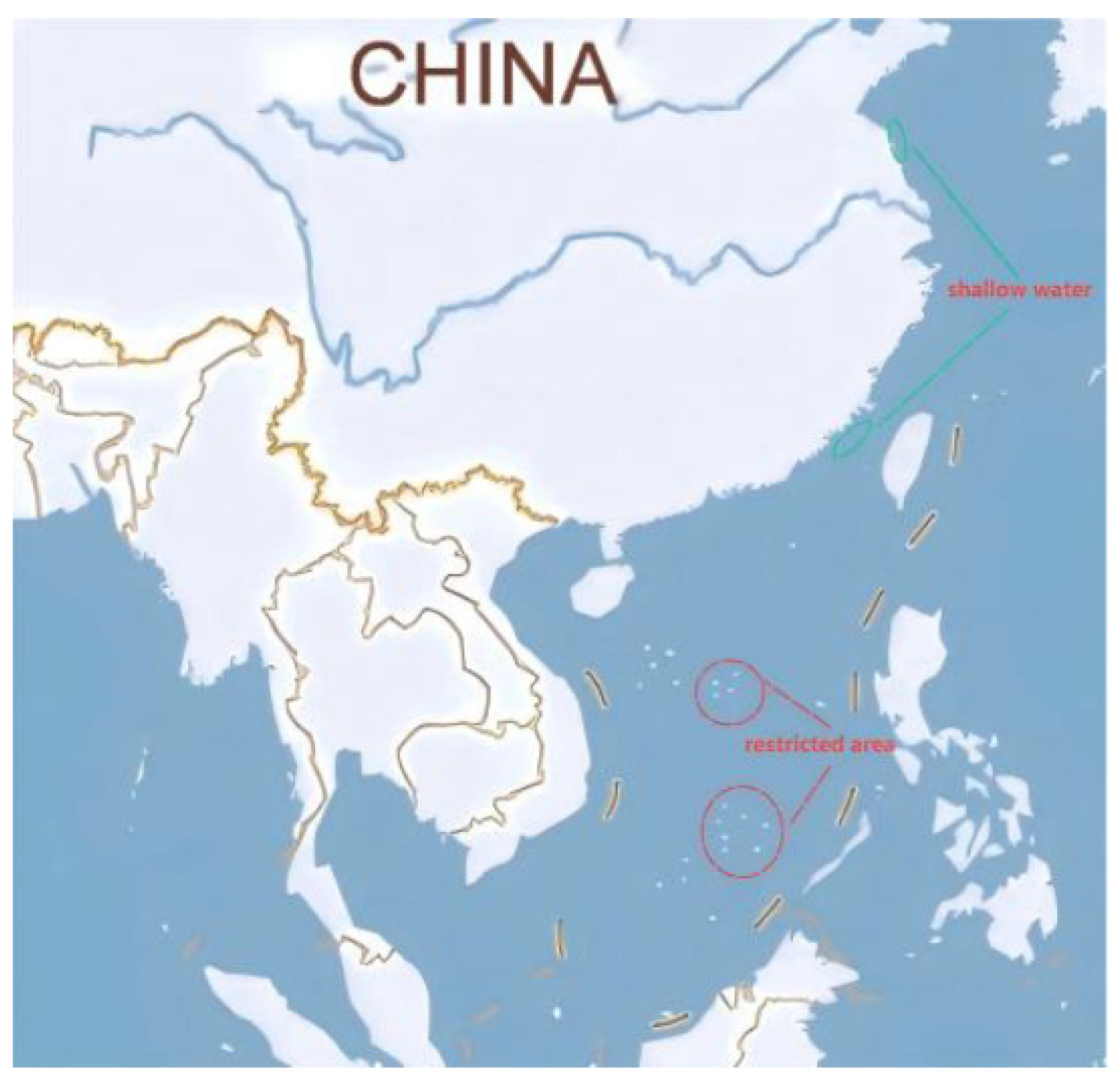
Second, to address the issue of temporal dynamics in sea conditions and ensure vessels can promptly and effectively avoid hazardous waters, the algorithm incorporates real-time forecast wave height data based on the previous step. Wave height at any point within the navigation area is obtained from weather forecasts:
Based on the safe navigation conditions specified in the vessel design, the maximum wave height threshold Fwmax for vessel passage is established. When forecasted environmental wave heights exceed Fwmax, vessel passage is prohibited. To determine safe navigation routes, the visibility determination condition S between the parent node and the current node is redefined as follows:
In the equation, x represents the current position’s longitude (degrees); y represents the current position’s latitude (degrees); dmin denotes the minimum permissible navigable water depth (m), taken as a positive value; D(x,y) denotes the current position’s water depth (m), taken as a positive value; G(x,y) denotes the location information of the restricted navigation zone, where 0 indicates a non-restricted navigation zone. n(x,y,t) denotes the wave height (m) at node (x,y) at time t; ti represents the estimated arrival time at node i. When S equals 0, it indicates no static or dynamic obstacles exist between the current node and its parent node, permitting navigation.
Building upon the standard Theta* algorithm, the TDM-Theta* algorithm reads wave heights at corresponding grid coordinates. If the wave height exceeds a preset threshold, it is modeled as an obstacle. During this process, considering that meteorological data is dynamically changing, the estimated time required for the vessel to reach the corresponding grid from its departure point must be calculated. This estimated time calculation also faces the two scenarios described above: Path 1 and Path 2.
Path 1: Estimated Time = [Path Cost g(s) + c(s,s′)] ÷ Vessel Economic Speed.
Path 2: Estimated Duration = [Path Cost g(parent(s) + c(parent(s), s′)] ÷ Vessel Economic Speed.
When node s expands child node s’, the TDM-Theta* algorithm not only detects whether obstacles exist between the child node and the parent node(s) of the current node, but also checks whether the connection between the child node and the parent node(s) of the current node would trave algorithm not only checks whether obstacles exist along the connection between the child node and the parent node(s) of the current node, but also verifies whether this connection traverses wave height zones exceeding a set threshold. If the path avoids obstacles and passes through areas free of severe weather conditions, the child node and the current node share a common parent node. Otherwise, the subnode and the current node’s parent(s) are deemed non-visible. If non-visible, subsequent checks determine whether the subnode and current node traverse obstacles or exceed the set wave height threshold to establish their association. Essentially, the TDM-Theta* algorithm models the grid location of severe weather as a dynamic obstacle. It then assesses whether the wave height at the corresponding time and location poses a threat to the vessel based on the vessel’s economic speed. This ultimately yields the shortest initial route from the starting point to the destination that completely avoids severe weather zones.
Figure 4a displays the significant wave height maps for Typhoon Sura (No. 2309, left) and Typhoon Davi (No. 2310, right) at 00:00 on August 30, 2023. Figure 4b displays the significant wave height maps for the aforementioned typhoons at 20:00 on August 30, 2023. By comparing the two maps, one can clearly observe the impact of typhoons on sea surface wave heights and their temporal evolution. The areas of extreme sea conditions rendering navigation unsafe also change in real time, fully demonstrating the necessity and importance of considering the dynamic marine environment in route planning. Note: Gray areas in the figure represent regions with static obstacles.
3. Case Study
To comprehensively validate the efficiency and effectiveness of the proposed TDM-Theta* algorithm, particularly its typhoon avoidance capabilities during typhoon weather, this paper designed route planning scenarios covering diverse environmental conditions. This enables a thorough assessment of the algorithm’s performance in complex and dynamic marine environments. Specific route planning application scenarios are set as follows:
(1) Route Planning under Normal Sea Conditions: In standard navigation environments, vessels traverse open waters free of static obstacles such as shoals, restricted zones, or islands, and remain unaffected by extreme weather like typhoons throughout the voyage. This scenario tests the algorithm’s fundamental path planning capabilities under typical conditions.
(2) Route Planning in Complex Terrain Environments: In more intricate navigation settings, numerous islands are distributed around the destination or along the planned direct route. Here, a safe passage through these islands must be planned, again without typhoon interference. This scenario evaluates the algorithm’s path optimization strategies in complex topography.
(3) Route Planning Under Typhoon Influence: This scenario, where vessels encounter typhoons during navigation, is subdivided into two parts: first, route planning for vessels navigating open seas facing single or multiple typhoons; second, route adjustments for vessels encountering typhoons in complex conditions (such as the aforementioned densely islanded areas). This scenario comprehensively evaluates the algorithm’s emergency response and dynamic adjustment capabilities under extreme weather conditions.
Assuming a vessel’s design speed of 15 knots, route planning incorporates eight specific cases across three typical scenarios (as shown in Table 1). This approach not only spans ideal to extreme marine environments but also addresses diverse route planning requirements, enabling systematic evaluation of the TDM-Theta* algorithm’s efficiency, accuracy, and adaptability under varying conditions.
3.1. Routing Under Normal Conditions
Most commercial vessels, including general cargo ships and passenger ships, operate on fixed routes within favorable maritime topography and meteorological conditions. To validate the route planning capability of the TDM-Theta* algorithm under typical conditions, three representative cases were selected: Case 1 (Figure 5a), Case 2 (Figure 5b), and Case 3 (Figure 5c).
Figure 5a depicts the route from Shanghai to the South China Sea. As the route follows China’s southeastern coastal waters with sparse island distribution, it features minimal obstructions and favorable marine conditions. The TDM-Theta* algorithm planned an approximate straight-line shortest route. Figure 5b shows the route from Tianjin to the South China Sea. Due to navigational obstacles between Tianjin Port and the target sea area, direct straight-line navigation is not feasible. The route planned by the TDM-Theta* algorithm is divided into three straight segments: departing Tianjin Port, turning toward the waters off the Shandong Peninsula, proceeding straight to the waters east of Zhejiang, and finally sailing straight to the target sea area. Figure 5) shows the route from Japan to the South China Sea. Due to the presence of a few islands along the way, direct navigation is not feasible. The route planned by the TDM-Theta* algorithm is roughly divided into four straight segments: from Japan to the eastern waters of North Korea, then an approximate straight line to the waters off the Shandong Peninsula, followed by a straight line to the waters east of Zhejiang, and finally a straight line to the target waters.
The TDM-Theta* algorithm achieved execution times of 1.02 seconds (single-core), 1.39 seconds (single-core), and 1.83 seconds (single-core) in these two cases, demonstrating excellent computational efficiency. In summary, under typical navigation conditions, the algorithm exhibits significant efficiency and effectiveness, holding substantial importance for real-time route planning in practical navigation scenarios.
3.2. Route Planning in Complex Terrain
Cargo ships and passenger vessels typically operate on fixed departure ports, destination ports, and routes with favorable navigational conditions. However, vessels such as intelligent test ships and ocean-going vessels operate in target sea areas directly tied to specific navigation tasks, making it impossible to pre-select port locations. Their routes may involve traversing complex terrain sea areas. To validate the TDM-Theta* algorithm’s route planning capability in complex terrain environments, three typical navigation planning cases were selected: Case ③ (Figure 6a), Case ④ (Figure 6b), and Case ⑤ (Figure 6c).
Figure 6a depicts the route from Tianjin to the eastern Indian Ocean, passing multiple islands. The inset on the right shows that when navigating near the coast, the route planned by the TDM-Theta* algorithm intelligently avoids static obstacles, ensuring vessel safety and the shortest possible route. Figure 6b and Figure 6c respectively illustrate routes from Tianjin to Tomini Bay and from Shanghai to Boni Bay. Both destinations feature complex topography with multiple islands and are surrounded by islands on three sides. The enlarged view on the right demonstrates that the route planned using the TDM-Theta* algorithm also intelligently avoids static obstacle zones, ensuring both vessel safety and the shortest possible route.
The computational times for the three cases were 2.3 seconds (single-core), 3.12 seconds (single-core), and 2.77 seconds (single-core), respectively, demonstrating the algorithm’s high efficiency and meeting the timeliness requirements for route planning. In summary, under complex terrain conditions, the TDM-Theta* algorithm maintains both efficiency and effectiveness. It rapidly identifies the shortest safe navigation route to the target test location, ensuring vessel safety in complex maritime environments while enhancing navigation efficiency.
3.3. Route Planning During Typhoon Weather
When facing adverse sea conditions such as typhoons, effective typhoon avoidance strategies must be developed to ensure vessels can safely navigate to their destinations. To validate the route planning capability of the TDM-Theta* algorithm under typhoon conditions, three typical navigation planning cases were selected: Case ⑥ (Figure 7), Case ⑦ (Figure 8), and Case ⑧ (Figure 9).
Figure 7 illustrates the route planning from Shanghai to a specific area in the South China Sea during Typhoon Sura (2309). To circumvent the typhoon zone, the route first traverses the Taiwan Strait in a straight line, then turns left to safely pass behind the typhoon. Finally, the route re-aligns in a straight line, proceeding directly to the destination. Compared to the route under non-typhoon conditions (shown in Figure 5a), the two routes exhibit significant differences.
Under normal weather conditions, the route is largely a straight line connecting the origin and destination. During the typhoon, the TDM-Theta* algorithm intelligently adjusted the route to successfully avoid the typhoon zone. This comparison confirms the effectiveness of the TDM-Theta* algorithm in planning safe routes under extreme sea conditions.
Figure 8 illustrates the planned route for a vessel sailing from the Sea of Japan to a specific area in the South China Sea as Typhoon Kanum (No. 2306) approaches the Tsushima Strait. Under normal conditions, the ship would depart Japan and proceed in an approximate straight line to the eastern waters of North Korea, then continue in a near-straight line to the waters off the Shandong Peninsula. It would then sail in a straight line to the waters east of Zhejiang Province before turning toward the target area, as shown in Figure 5c. However, to ensure safety, the route planned by the TDM-Theta* algorithm first bypasses the Tsushima Strait, opting instead to pass through the Tsugaru Strait to avoid potentially hazardous waters. Second, the TDM-Theta* algorithm also accounts for the potential impact of Typhoon 2307 “Lane.” To avoid Lane’s influence, the route hugs the eastern coastal waters of Japan, utilizing coastal islands as natural barriers to provide additional protection for the vessel. Subsequently, as Typhoon Lane began affecting Japan’s eastern coastal regions, the route was promptly adjusted into the relatively safer Pacific Ocean. The course shifted to a straight line, heading directly toward the destination to ensure prompt arrival once the typhoon’s influence subsided. Throughout the entire route planning process, the TDM-Theta* algorithm successfully evaded two typhoons, enhancing navigation efficiency while ensuring vessel safety.
Figure 9 shows the route planning for the voyage from Tianjin to Tomini Gulf under the influence of Typhoon Davi (2310). Under normal conditions, the intelligent vessel would proceed in a straight line from the Bohai Sea to the eastern waters of the Philippines before turning toward the destination area, as depicted in Figure 6b. However, due to the presence of Typhoon Davi, the vessel opted to detour around the eastern waters of Taiwan Province to avoid intersecting with the typhoon’s path. This ensured safe passage before the typhoon blocked the southern route, mitigating potential navigational risks. By navigating around the eastern waters of Taiwan Province, the TDM-Theta* algorithm successfully evaded the impact of Typhoon Davi, providing critical assurance for the safe passage of the intelligent vessel.
The computational times for the three cases above were 1.22 seconds (single-core), 2.64 seconds (single-core), and 3.66 seconds (single-core), respectively. These times are comparable to the route planning execution times for the typhoon-free cases (Case ① and Case ④), demonstrating the algorithm’s high efficiency and fully meeting the timeliness requirements for route planning. In summary, when confronting Typhoon Sura (No. 2309), Typhoon Kanu (No. 2306), and Typhoon Dabi (No. 2310), the route planning performed by the TDM-Theta* algorithm demonstrated satisfactory performance in route planning. This fully validates the TDM-Theta* algorithm’s effectiveness and efficiency in planning safe routes under complex terrain and extreme weather conditions. Its route planning results empower captains and crew to make swift decisions during emergencies, ensuring safe vessel navigation and the smooth execution of experimental missions.
4. Conclusions
This paper proposes a Time-Dynamic Theta* Algorithm (TDM-Theta*) based on the Theta* algorithm. It comprehensively considers the impacts of shallow water areas, restricted navigation zones, islands and reefs, as well as dynamic environmental factors, effectively addressing route planning challenges for vessels navigating complex topography and extreme sea conditions such as typhoons. To fully demonstrate the algorithm’s efficiency and effectiveness across diverse operational environments, calculations and analyses were conducted on eight case studies across three typical scenarios: route planning under general conditions, route planning in complex terrain, and route planning during typhoon weather. The results indicate:
(1) Under both general and complex terrain conditions, the TDM-Theta* algorithm effectively avoids static hazards like shallow waters, restricted zones, islands, and reefs using the virtual obstacle method, ensuring route safety and preventing risks such as grounding, reef strikes, and island collisions. This demonstrates the algorithm’s superior path planning capability in static complex environments;
(2) In extreme dynamic maritime environments, the TDM-Theta* algorithm effectively handles drastic changes in sea conditions. Whether navigating under a single typhoon or multiple concurrent typhoons in general or complex terrain, it rapidly and accurately calculates the shortest safe path, reliably ensuring route safety;
The TDM-Theta* algorithm extends route planning from static geometric space to a dynamic spatiotemporal dimension, providing a viable solution for vessel route planning in real-world complex marine environments. This algorithm can be integrated into ship intelligent navigation systems or shore-based monitoring platforms, providing real-time, scientifically grounded route decision support for captains and shipping management. Particularly during typhoon seasons or in unfamiliar waters, its ability to mitigate dynamic risks directly translates into significant safety and economic benefits.
However, current algorithms primarily rely on geometric path search, insufficiently accounting for the vessel’s own maneuvering characteristics (such as turning radius and inertia). Future enhancements could incorporate vessel dynamics constraints, resulting in planned routes that are not only safe but also better aligned with actual navigation requirements, thereby achieving greater feasibility.
Author Contributions
Conceptualization, J.D. and Z.S.; Methodology, J.D., Z.S. and P.Z.; Software, J.D., J.Z., C.C. and R.Q.; Validation, Z.S. and P.Z.; Investigation, J.D.; Resources, Z.S.; Data curation, J.D., Z.S. and P.Z.; Writing—original draft, J.D., C.C. and R.Q.; Writing—review and editing, Z.S.; Visualization, J.D. and C.C.; Supervision, Z.S.; Project administration, J.D.;Funding acquisition, J.Z. All authors have read and agreed to the published version of the manuscript.
Funding
This work was funded by the Basic Research Program of Jiangsu (BK20253037) .
Institutional Review Board Statement
Not applicable.
Data Availability Statement
The data presented in this study are available on request from the corresponding author.
Conflicts of Interest
The authors declare no conflicts of interest.
Abbreviations
The following abbreviations are used in this manuscript:
| TDM-Theta* | Time-Dynamic Theta* Algorithm |
References
- Borén, C; Castells-Sanabra, M; Grifoll, M. Ship emissions reduction using weather ship routing optimisation. Proceedings of the Institution of Mechanical Engineers, Part M: Journal of Engineering for the Maritime Environment 2022, 236(4), 856–867. [Google Scholar] [CrossRef]
- Zhang, G; Wang, H; Zhao, W; et al. Application of Improved Multi-Objective Ant Colony Optimization Algorithm in Ship Weather Routing. Journal of Ocean University of China 2021, 20(1), 45–55. [Google Scholar] [CrossRef]
- Jeong, M G; Lee, E B; Lee, M; et al. Multi-criteria route planning with risk contour map for smart navigation. Ocean Engineering 2019, 172(JA(N.15), 72–85. [Google Scholar] [CrossRef]
- JAMES, R W. Application of wave forecasts to marine navigation[M]. Comparative Biochemistry and PhysiologyA: Comparative Physiology 1957, 43(1), 195–205. [Google Scholar]
- Hagiwara, H. Weather routing of (sail-assisted) motor vessels[D]; Delft University of Technology: Delft, 1989. [Google Scholar] [CrossRef]
- Roh, M I. Determination of an economical shipping route considering the effects of sea state for lower fuel consumption. International Journal of Naval Architecture and Ocean Engineering 2013, 5(2), 246–262. [Google Scholar] [CrossRef]
- Lin, Y H; Fang, M C; Yeung, R W. The optimization of ship weather-routing algorithm based on the composite influence of multi-dynamic elements. Applied Ocean Research 2013, 43, 184–194. [Google Scholar] [CrossRef]
- ZACCONE, R; OTTAVIANI, E; FIGARI, M; et al. Ship voyage optimization for safe and energy-efficient navigation:a dynamic programming approach. Ocean En-gineering 2018, 153, 215–224. [Google Scholar] [CrossRef]
- Pennino, S; Gaglione, S; Innac, A; et al. Development of a new ship adaptive weather routing model based on seakeeping analysis and optimization. Journal of Marine Science and Engineering 2020, 8(4), 270. [Google Scholar] [CrossRef]
- Xue, H; Chai, T. Path Optimization along Buoys Based on the Shortest Path Tree with Uncertain Atmospheric and Oceanographic Data. Computational Intelligence and Neuroscience 2021, 2021(2), 1–7. [Google Scholar] [CrossRef]
- Gongxing, Wu; Lingchao, Wang; Jian, Zheng; et al. Intelligent Ship Dynamic Route Planning Method Considering Complex Meteorological Variations . Journal of Shanghai Maritime University 2021, 42(01), 1–6+12. [Google Scholar] [CrossRef]
- Chen, G; Wu, T; Zhou, Z. Research on Ship Meteorological Route Based on A-Star Algorithm. Mathematical Problems in Engineering 2021, 2021(7), 1–8. [Google Scholar] [CrossRef]
- Jinlong, Cui; Kui, Li Yuan; Yuan, Suo Ji; et al. Cooperative Optimization Method for Ship Heading and Speed Based on an Improved A* Algorithm . Journal of Dalian Maritime University 2022, 48(4), 29–37, 47. [Google Scholar] [CrossRef]
- LI, Y K; CUI, J L; ZHANG, X Y; et al. A ship route planning method under the sailing time constraint. Journal of Marine Science and Engineering 2023, 11(6), 1242. [Google Scholar] [CrossRef]
- DANIEL, K; NASH, A; KOENIG, S; et al. Theta*: Any-angle path planning on grids. Journal of Artificial Intelligence Research 2010, 39, 533–579. [Google Scholar] [CrossRef]
- WANG, L P; ZHANG, Z; ZHU, Q D; et al. Ship route planning based on double-cycling genetic algorithm considering ship maneuverability constraint. IEEE Access 2020, 8, 190746–190759. [Google Scholar] [CrossRef]
- Pan, C; Zhang, Z; Sun, W; et al. Development of ship weather routing system with higher accuracy using SPSS and an improved genetic algorithm. Journal of Marine Science and Technology 2021, 1–16. [Google Scholar] [CrossRef]
- WU, Z Y; HU, G; FENG, L; et al. Collision avoidance for mobile robots based on artificial potentialfield and obstacle envelope modelling. Assembly Automation 2016, 36(3), 318–332. [Google Scholar] [CrossRef]
- Cui, K.; Zheng, Y.; Chen, G.; et al. Optimized Design of Ship Routes in High-Wave Conditions . Journal of Wuhan University of Technology (Transportation Science and Engineering Edition) 2022, 46(2), 356–360. [Google Scholar] [CrossRef]
- Lin, Y H. The simulation of east-bound transoceanic voyages according to ocean-current sailing based on Particle Swarm Optimization in the weather routing system. Marine Structures 2018, 59, 219–236. [Google Scholar] [CrossRef]
- Zhang, G; Wang, H; Zhao, W; et al. Application of improved multi-objective ant colony optimization algorithm in ship weather routing. Journal of Ocean University of China 2021, 20(1), 45–55. [Google Scholar] [CrossRef]
- Zhao, W; Wang, Y; Zhang, Z; et al. Multicriteria ship route planning method based on improved particle swarm optimization–genetic algorithm. Journal of Marine Science and Engineering 2021, 9(4), 357. [Google Scholar] [CrossRef]
- Zhang, L; Zhang, Y J; Li, Y F. Path planning for indoor mobile robot based on deep learning. Optik 2020, 219(10), 165096. [Google Scholar] [CrossRef]
- Daheng, Zhang. Research on Intelligent Autonomous Path Planning for Ships Based on Deep Learning. Dalian Maritime University, 2022. [Google Scholar]
- Chen, C; Chen, X Q; Ma, F; et al. A knowledge-free path planning approach for smart ships based on reinforcement learning. Ocean Engineering 2019, 189, 106299. [Google Scholar] [CrossRef]
- Wu, X; Chen, H L; Chen, C G; et al. The autonomous navigation and obstacle avoidance for USVs with ANOA deep reinforcement learning method. Knowledge Based Systems 2020, 196, 105201. [Google Scholar] [CrossRef]
- Songtao, Chen. Research on Intelligent Ship Route Planning Based on Deep Reinforcement Learning. Harbin Engineering University, 2024. [Google Scholar]
- Zhong, X Y; Tian, J; Hu, H S; et al. Hybrid path planning based on safe A* algorithm and adaptive window approach for mobile robot in large-scale dynamic environment. Journal of Intelligent and Robotic Systems 2020, 99(1), 65–77. [Google Scholar] [CrossRef]
- Li, Y.-K.; Suo, J.-Y.; Yu, D.-Y.; et al. A Multi-Objective Planning Method for Ship Weather Routes Combining A* and NSGA-II [J/OL]. China Ship Research 2025, 1–8. [Google Scholar] [CrossRef]
- Fucai, Zhang; Yu, Ning; Xinzhi, Zhou. Platform Route Planning Based on Markov Models and A* Algorithm . Firepower and Command Control 2018, 43(7), 135–139. [Google Scholar] [CrossRef]
Figure 1.
Path Comparison Between A* and Theta*.
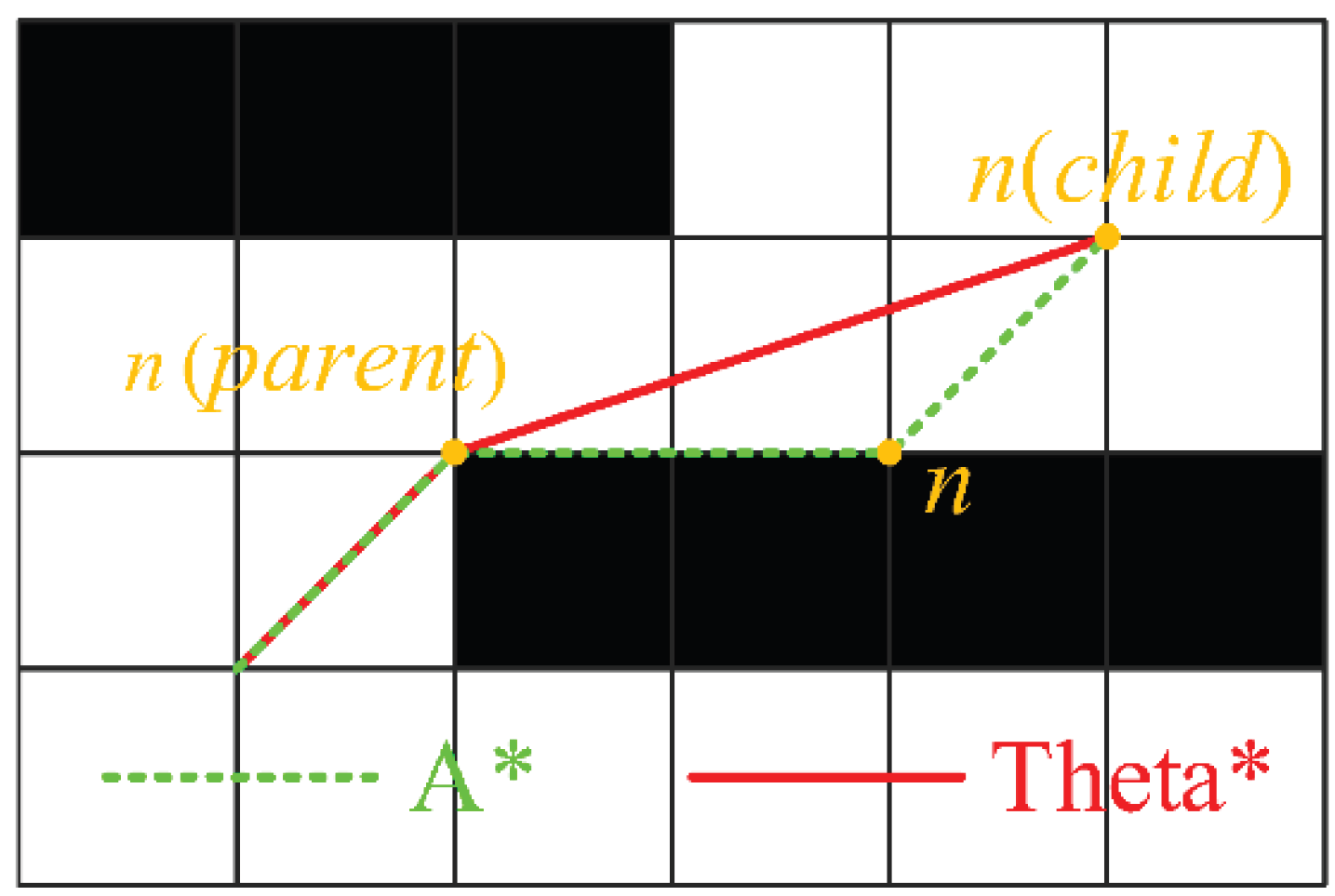
Figure 2.
Theta* Algorithm: Selection of Two Different Paths.(a)Parent node and adjacent node are visible.(b) Parent nodes and adjacent nodes are not visible.
Figure 2.
Theta* Algorithm: Selection of Two Different Paths.(a)Parent node and adjacent node are visible.(b) Parent nodes and adjacent nodes are not visible.
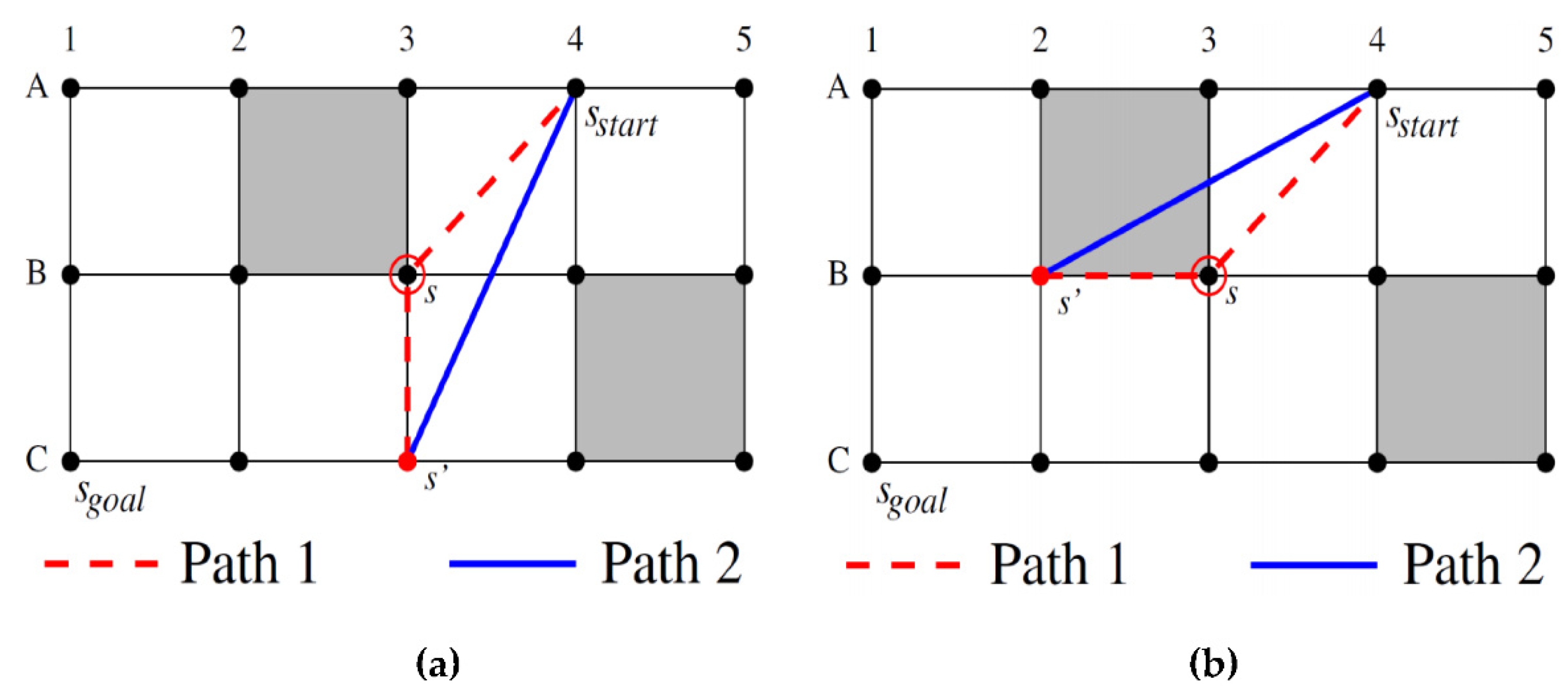
Figure 4.
Effective wave height maps during the occurrence of Typhoon Sura (No. 2309) and Typhoon Davi (No. 2310). (a) 00:00 on August 30, 2023. (b) 20:00 on August 30, 2023.
Figure 4.
Effective wave height maps during the occurrence of Typhoon Sura (No. 2309) and Typhoon Davi (No. 2310). (a) 00:00 on August 30, 2023. (b) 20:00 on August 30, 2023.
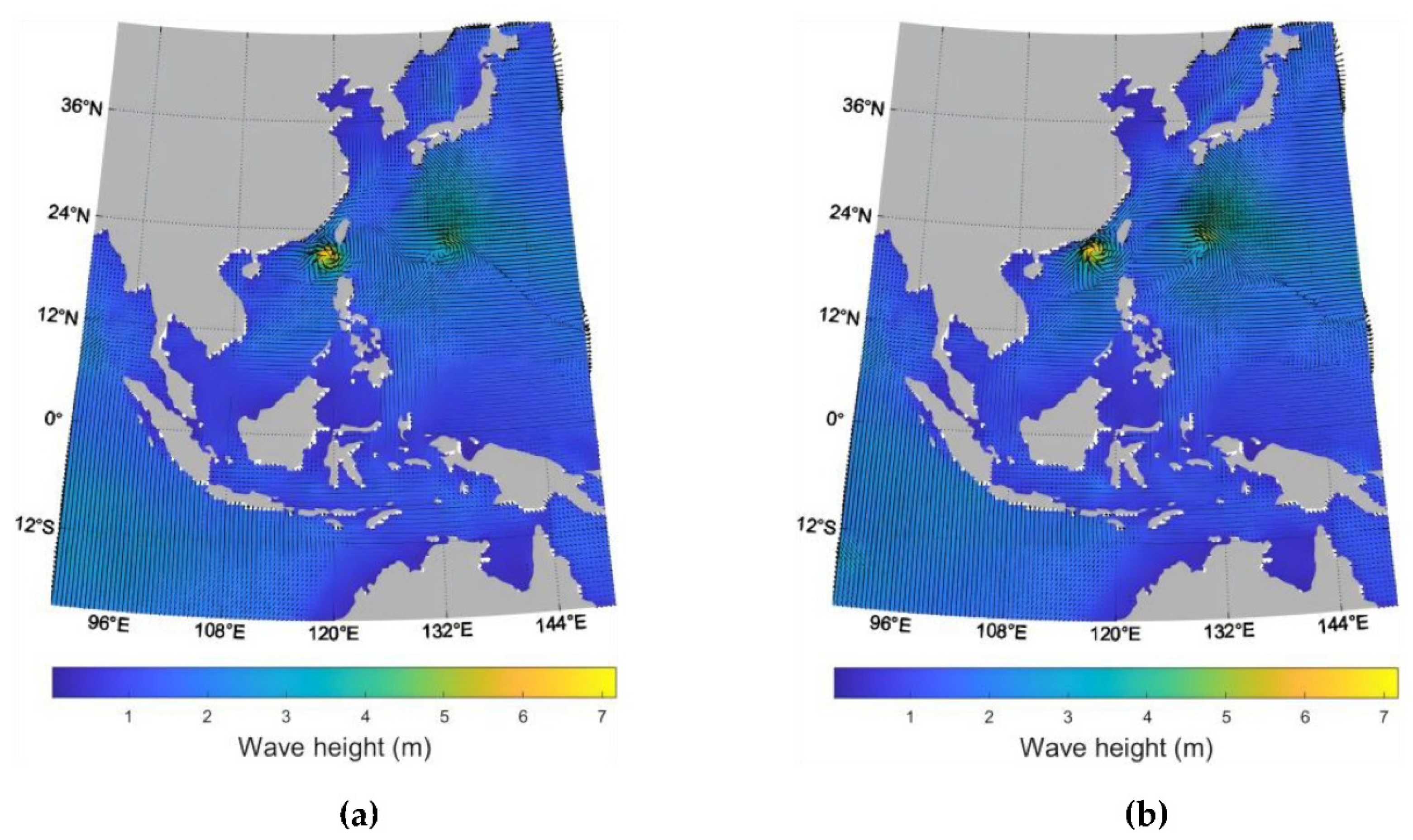
Figure 5.
Route Planning Under Normal Conditions. (a) Voyage from Shanghai to a Target Test Area in the South China Sea. (b) Voyage from Tianjin to a Target Test Area in the South China Sea. (c) Voyage from Japan to a Target Test Area in the South China Sea.
Figure 5.
Route Planning Under Normal Conditions. (a) Voyage from Shanghai to a Target Test Area in the South China Sea. (b) Voyage from Tianjin to a Target Test Area in the South China Sea. (c) Voyage from Japan to a Target Test Area in the South China Sea.
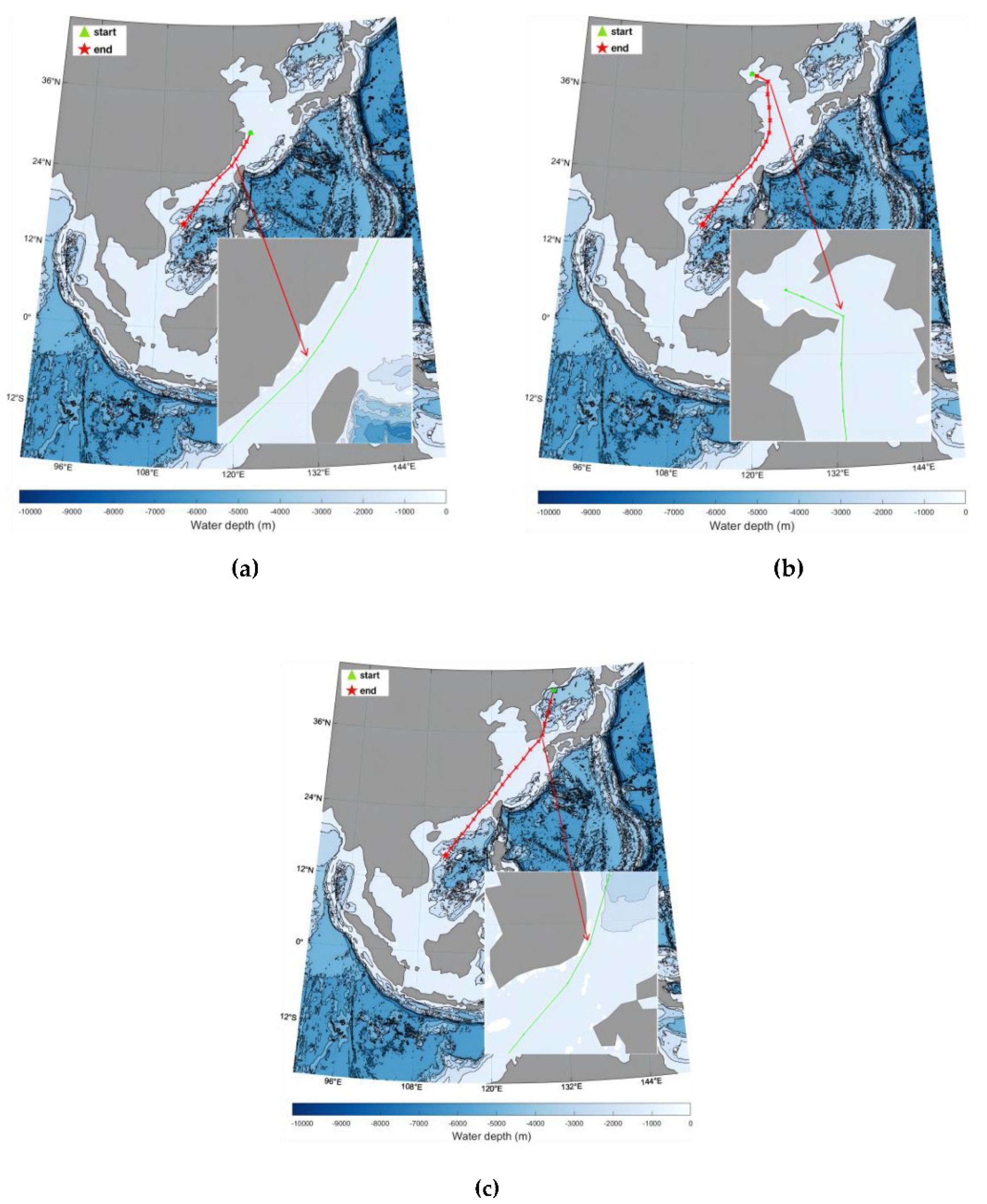
Figure 6.
Route planning for complex terrain navigation. (a) Tianjin voyage to the eastern Indian Ocean test area. (b) Tianjin voyage to the Tomini Bay test area. (c) Shanghai voyage to the Ponai Bay test area.
Figure 6.
Route planning for complex terrain navigation. (a) Tianjin voyage to the eastern Indian Ocean test area. (b) Tianjin voyage to the Tomini Bay test area. (c) Shanghai voyage to the Ponai Bay test area.
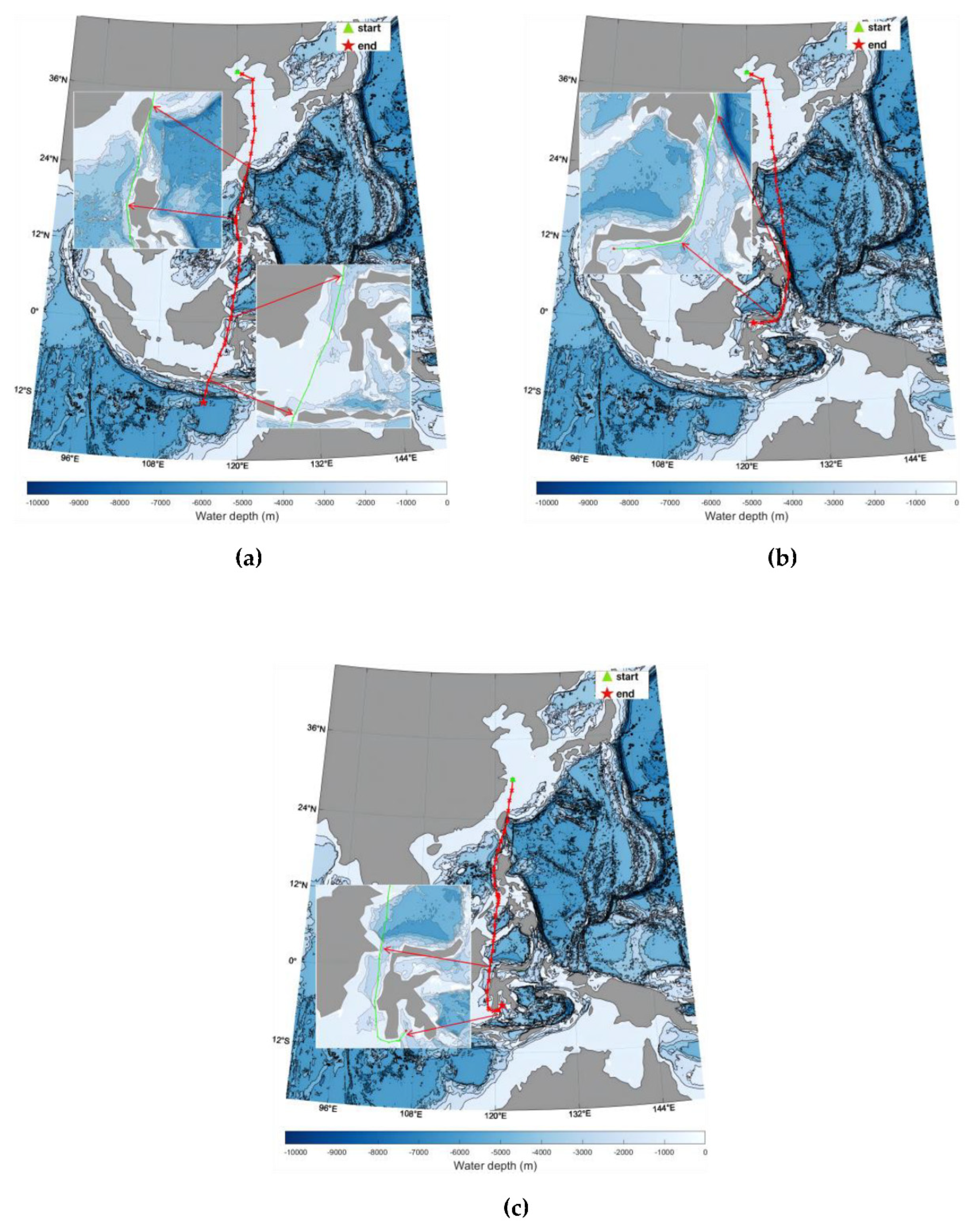
Figure 7.
Route Planning for Voyages from Shanghai to the South China Sea.
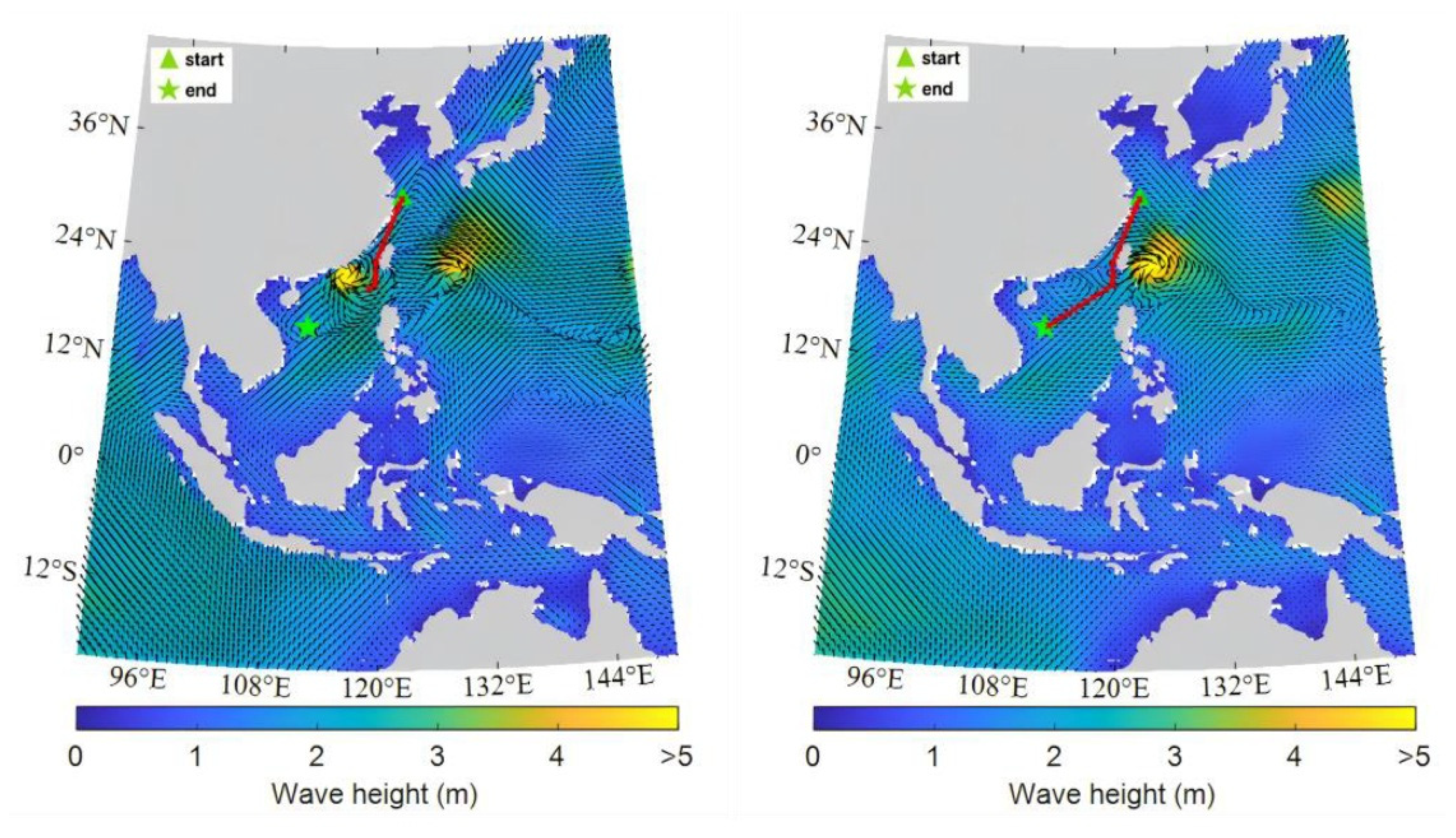
Figure 8.
Route Planning from Japan to the South China Sea.
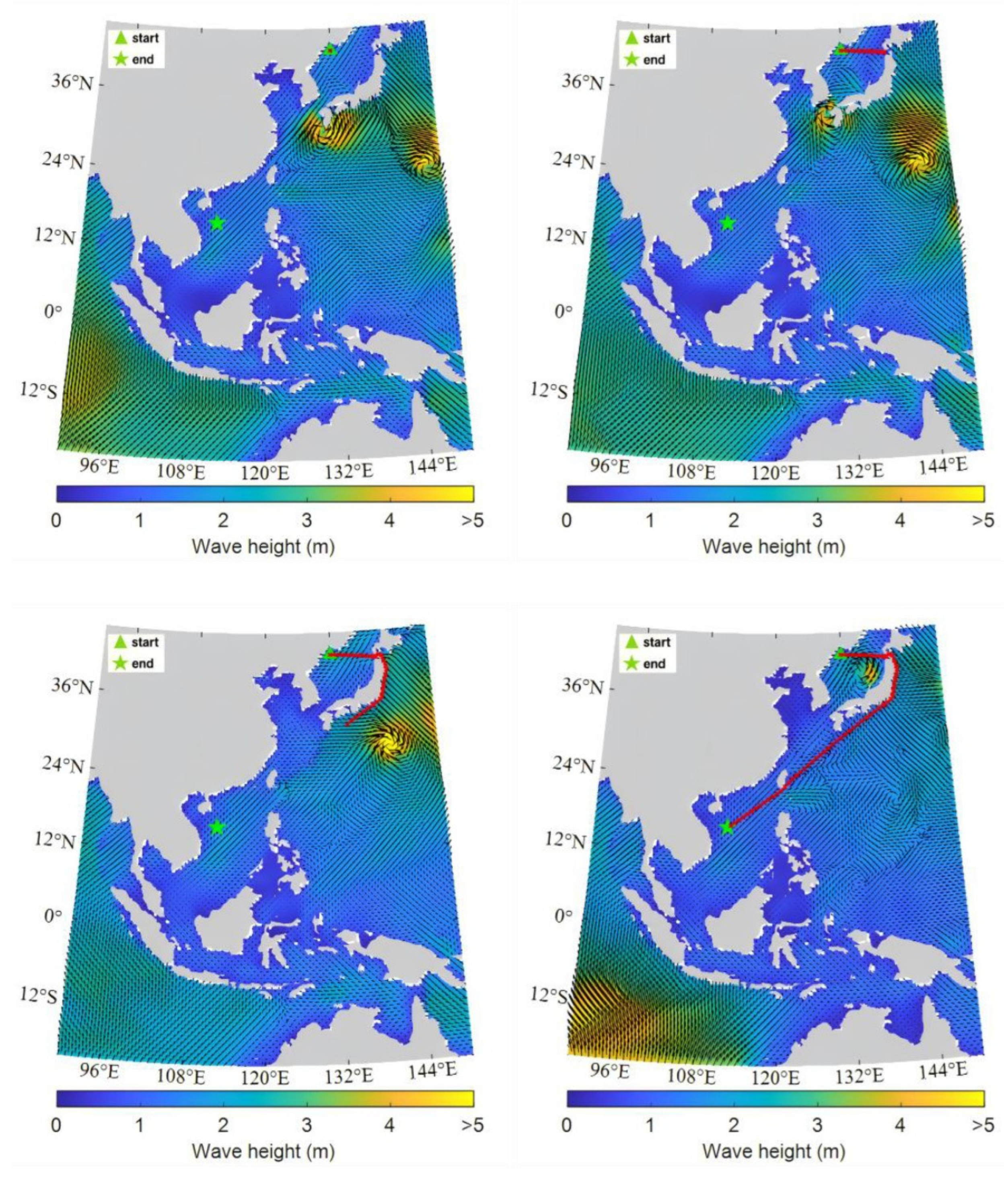
Figure 9.
Route Planning from Tianjin to Tomini Bay.
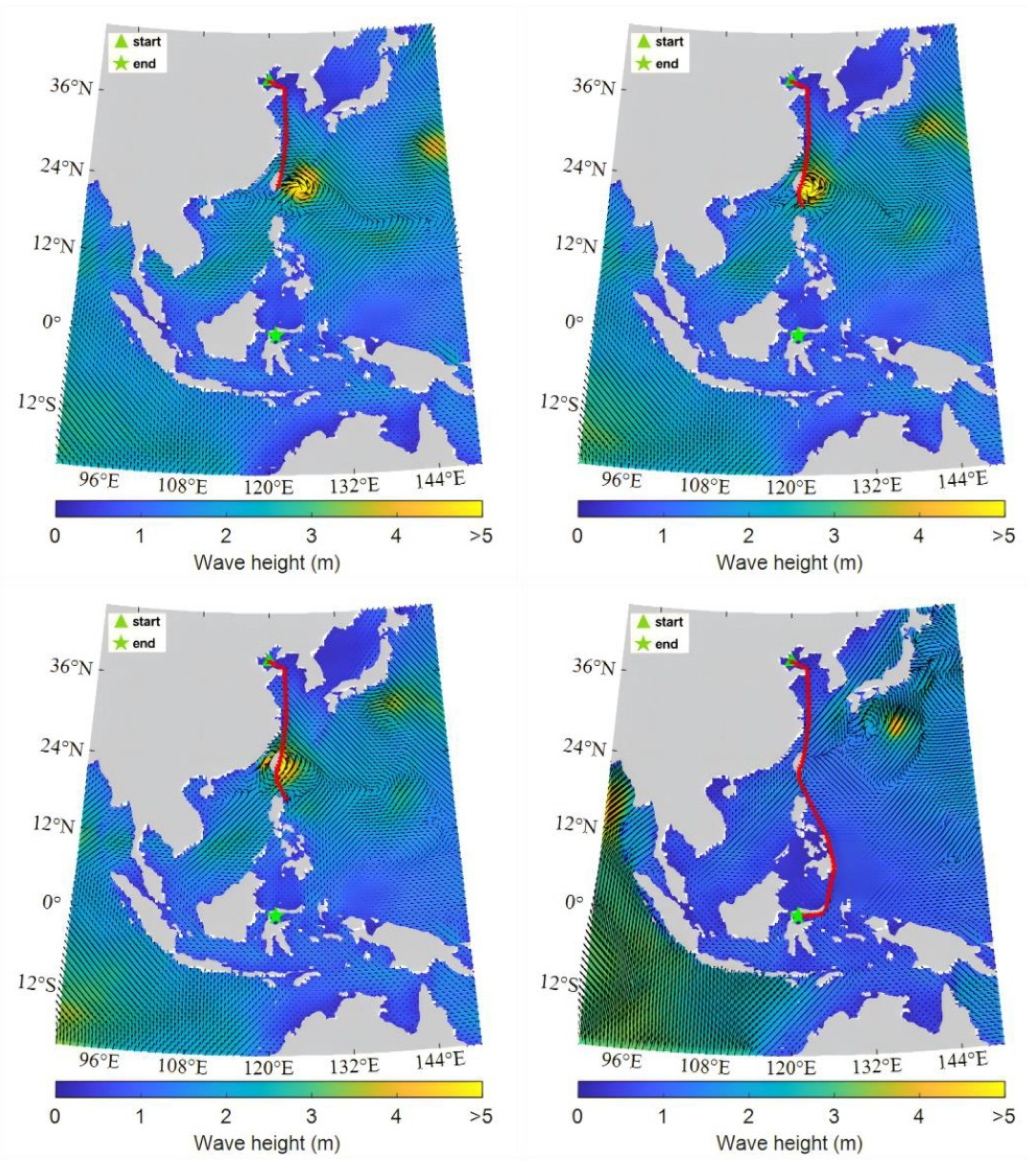

Table 1.
Case Settings.
| Environmental Conditions | Case | Route Type | route | Departure Time |
|---|---|---|---|---|
| General Conditions | ① | The route is largely fixed, and the navigational waters feature favorable topography and meteorological conditions. | Shanghai to South China Sea Departure Point: [30,123] Destination: [16,112] |
August 20, 2023, 8:00 PM |
| ② | Tianjin to South China Sea Departure Point: [38.5,120] Destination: [16,112] |
August 20, 2023, 8:00 PM | ||
| ③ | From Japan to the South China Sea Departure Point: [42,132] Destination: [16,112] |
August 20, 2023, 8:00 PM | ||
| complex terrain | ④ | The flight path is associated with specific missions involving traversing complex maritime terrain. | Tianjin to Eastern Indian Ocean Departure Point: [38.5,120] Destination: [[-12,115] |
August 29, 2023, 8:00 AM |
| ⑤ | Tianjin to Tomini Bay Departure Point: [42,132] Destination: [0,121] |
August 29, 2023, 8:00 AM | ||
| ⑥ | Shanghai to Bonny Bay Departure point: [30,123] Destination: [[-5,121] |
August 29, 2023, 8:00 AM | ||
| Typhoon weather | ⑦ | The route involves traversing typhoon-prone waters and other hazardous sea areas along the way. | Shanghai to South China Sea Departure Point: [30,123] Destination: [16,112] |
When Typhoon Sura (No. 2309) occurred |
| ⑧ | From Japan to the South China Sea Departure Point: [42,132] Destination: [16,112] |
Typhoon Kanum (No. 2306) is about to pass through the Tsushima Strait. | ||
| ⑨ | Tianjin to Tomini Bay Departure Point: [38.5,120] Destination: [0,121] |
When Typhoon Davi (No. 2310) occurred |
Disclaimer/Publisher’s Note: The statements, opinions and data contained in all publications are solely those of the individual author(s) and contributor(s) and not of MDPI and/or the editor(s). MDPI and/or the editor(s) disclaim responsibility for any injury to people or property resulting from any ideas, methods, instructions or products referred to in the content. |
© 2026 by the authors. Licensee MDPI, Basel, Switzerland. This article is an open access article distributed under the terms and conditions of the Creative Commons Attribution (CC BY) license (http://creativecommons.org/licenses/by/4.0/).
Copyright: This open access article is published under a Creative Commons CC BY 4.0 license, which permit the free download, distribution, and reuse, provided that the author and preprint are cited in any reuse.


