

Submitted:
17 February 2026
Posted:
05 March 2026
You are already at the latest version
Abstract
The biosphere is undergoing an unprecedented transformation driven by global warming, habitat loss, and resource depletion, threatening biodiversity through widespread species extinctions and population declines. Although conservation and restoration remain essential, the risk of irreversible tipping points demands new strategies. Synthetic biology offers one such approach: engineering existing ecosystems by modifying functional traits of resident communities to enhance resilience and prevent abrupt shifts. Despite and because of public concern, advances in biosafety and control have been achieved, mainly on a cellular scale. However, after decades of bioremediation efforts, a central question emerges: not only can interventions be perfectly controlled, but also whether they can persist and sustain ecological function. Meeting this challenge requires a paradigm shift in design philosophy, from classical to emergent engineering, embracing adaptation, feedback, and multiscale complexity as the foundation of ecosystem design.
Keywords:
synthetic biology
; ecosystem engineering
; ecological resilience
; complex systems
; emergence
; biodiversity
; biocontainment
1. Emergent Engineering
Kay Sage, one of the most prominent artists associated with Surrealism in the United States, painted The Butterfly Machine in 1942. This enigmatic artwork serves as a poignant metaphor for the paradox of engineering nature. Drawing on the surrealist tension between logic and dream, the painting depicts a structure that is highly ordered, almost surgical in its design, yet incapable of fulfilling the very function it alludes to (Figure 1). It resembles a machine for producing life, but cannot generate flight, self-repair, or reproduction. In this failure, The Butterfly Machine mirrors the limitations of classical engineering when applied to living systems. Although traditional engineering excels in building deterministic and centralized systems, it falters in the face of biology, decentralized, adaptive, and historically contingent assemblages that cannot be reduced to static blueprints. The painting thus prefigures a central challenge of our time: the inadequacy of conventional design principles in the stewardship of the biological world and by extension, of living, evolving ecosystems.
Modern advances in robotics may one day enable the design of a synthetic butterfly. However, while the construction of such a system remains elusive, classical engineering has achieved extraordinary feats: sending humans to the Moon, uncovering the hidden structure of the atom, and building the computational and networked infrastructures that underpin modern society. In stark contrast, it has struggled in fields such as drug discovery and therapeutic development, despite decades of massive investment [1,2]. Similar difficulties have marked the so-called "war on cancer" or long-standing efforts in ecosystem bioremediation [3,4]. What unites these challenges is that their targets are not machines, but decentralized, adaptive systems, the hallmark of what we now call complex systems [5,6]. Over the past few decades, both theory and experiments have revealed that such systems operate according to principles that defy the classical assumptions of engineering, suggesting the need for alternative design logics rooted in emergence, adaptability, and distributed control.
The classical axioms of engineering can be summarized as follows [7].
- 1.
- Design according to well-understood principles that hold for components in isolation and in aggregate.
- 2.
- Use nearly fault-free components to achieve very high levels of combined precision.
- 3.
- Minimize error and system failure rates by eliminating uncertainty and reducing the degrees of freedom of the components.
- 4.
- Operate within linear regimes where collective dynamics are predictable and controllable.
- 5.
- Reduce noise and adaptability of components to prevent unexpected emergent behaviors.
From the early ambitions of cybernetics [8], scientists and engineers have sought to model and regulate natural systems through artificial means, driven by the promise of prediction and control1. This cybernetic view was introduced within systems ecology and provided the basis for a top-down engineering, as sketched in Figure 2a-c, where three different scales of coarse-graining are shown, associated with three microcosm scales. These controlled microcosms were used to test a diverse range of interventions. However, complex adaptive systems fundamentally challenge this assumption. As interacting collectives, they give rise to emergent properties that are not simply the sum of their parts. High component failure rates are absorbed by systemic robustness, achieved through statistical averaging, redundancy, degeneracy and organization across multiple scales. Crucially, adaptive systems often operate near criticality, non-linear regimes where thresholds and tipping points dominate dynamics [10]. In such contexts, variability and noise are not obstacles to control, but essential features that support adaptability, innovation, and resilience.
This poses a central dilemma inherited from the aftermath of cybernetics: How can we design systems that we do not fully control? Classical design principles, grounded in linearity, stability, and central oversight, are ill-suited to the realities of complex systems. At the heart of this work is the question of whether a framework can be articulated for the design of successful large-scale ecosystem interventions, where control is not imposed from above but emerges from the integration of structure, adaptability, and feedback at all levels. Importantly, natural ecosystems already contain what is known as ecosystem engineers, i.e. species that have a disproportionate impact on the flows of energy and matter. An example is shown in Figure 2d-e, where a small part of the soil crust of a dryland ecosystem is shown (d), displaying a rich ecological diversity, including cyanobacteria (e) that are well-known soil ecosystem engineers.
Amid the challenges of global warming and future tipping points [11,12,13], the 21st century may witness the emergence of new paradigms that connect ecology and engineering. The window for response is shrinking rapidly, requiring a reevaluation of ecological risk and the search for new tools. Synthetic biology offers an unprecedented engineering framework for designing resilient ecological paradigms. More concretely, molecular and genetic engineering provides a promising toolbox, but progress requires new approaches that integrate these capabilities with ecological principles and dynamic feedback. Although adaptive components, such as synthetic cells or genetic circuits, may behave reliably in isolation, their collective behavior at higher scales often defies expectations [14] (see Box 1).
The possibility of engineering ecosystems can arise if classical engineering axioms are challenged through the lens of complexity theory, embracing the concept of emergent engineering [7]. Emergence stands out as a prominent characteristic of complex systems in which interactions among components yield properties that cannot be fully understood by examining individual components alone [15]. As stated above, classical engineering relies on well-established principles that apply to all (fault-free) components in isolation and as a collective, aiming to eliminate uncertainty, achieve linear predictability, and minimize the impact of unforeseen events. However, emerging engineering must embrace significant component variability and focus on collective outputs (e.g., redundancy). Design considerations should prioritize the distribution of outcomes rather than singular optimal values. Nonlinear dynamics and critical transitions, which operate at the heart of complex systems, become crucial design properties to explore. Furthermore, rather than striving for fixed states, adaptation becomes central in the design process.
Can we integrate these properties and adopt this mindset when designing desired ecosystem states, ensuring they remain resilient and safely distant from critical thresholds? This requires moving beyond deterministic ideals such as total risk elimination, perfect stability, or complete control, and instead embracing the inherently dynamic and evolving nature of adaptive systems.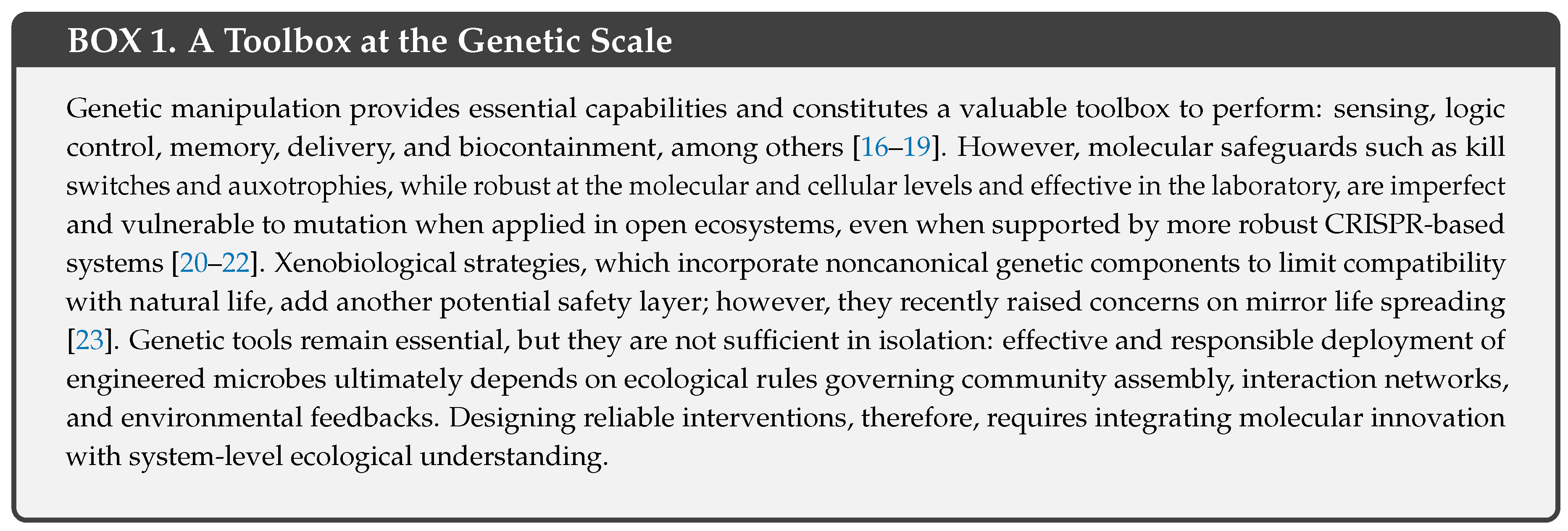
2. Ecology as a Design Language
Engineering interventions require understanding how ecological communities respond to perturbations, including the roles of biodiversity, network structure, and self-organization. Ecology is fundamentally a systems science: higher-level properties such as stability and resilience cannot be reduced to individual components alone. This implies that purely reductionist approaches are insufficient, but also that simple, well-grounded models can still capture essential system-level phenomena and inform effective design principles at the appropriate scale [24] (Figure 2). Crucially, a different path can be followed by combining the systemic multiscale view of traditional ecology (Figs.2a-c) with our understanding of how ecological communities work, particularly in relation to ecosystem engineers (Figs. 2d-e). Using synthetic biology (which allows us to work at sub-cellular scales) we can use species that are already present in the community, engineer them to perform some given function (such as reducing water loss) and bring them back. While they will be enhancing biodiversity, this emergent property can play the role of a firewall: a diverse community naturally controls the size of its populations. A closed loop, instead of a top-down control. is at work (Fig. 2f-g).
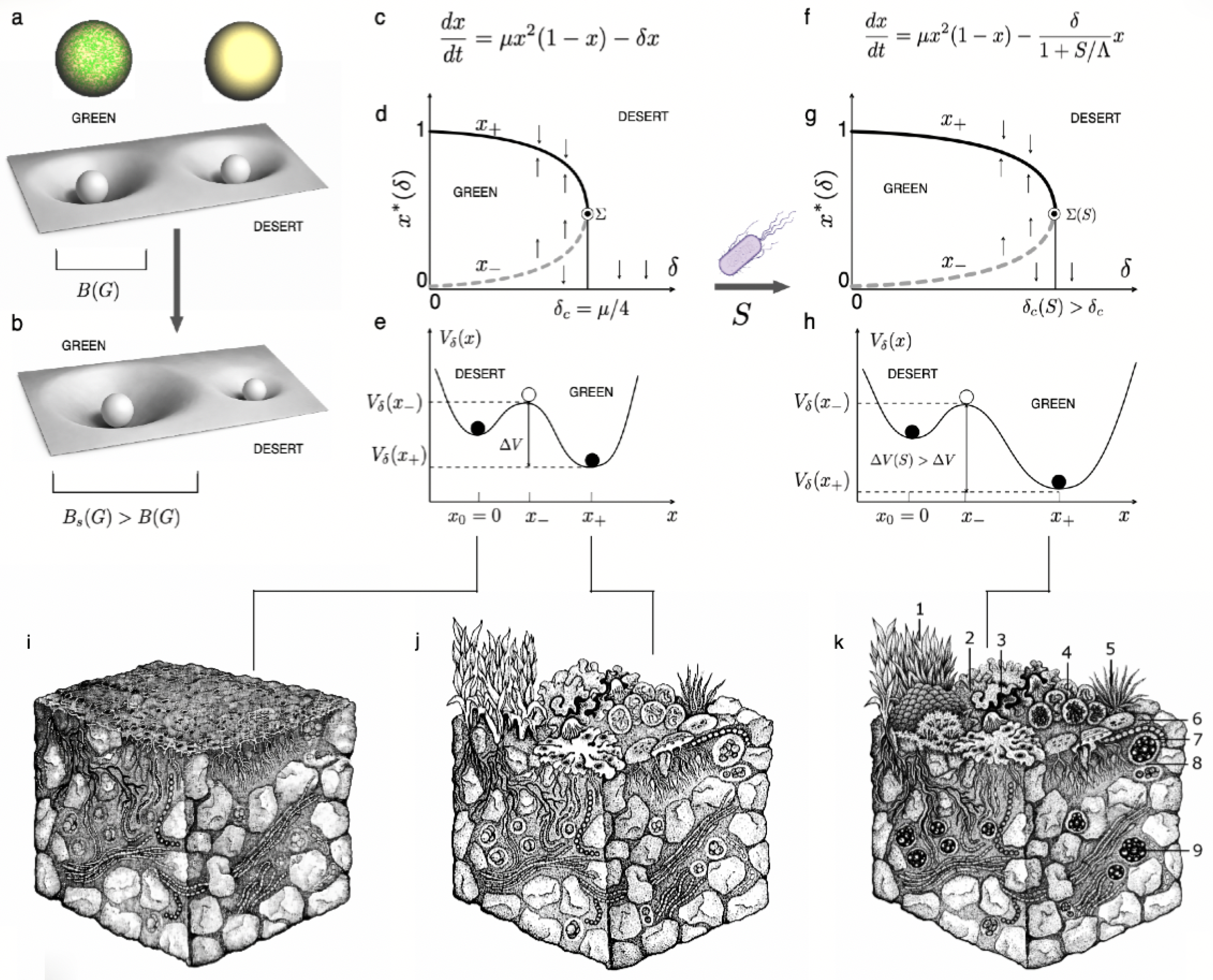
A key inspiration for this perspective is C. S. Holling’s distinction between engineering and ecological resilience [25]. While traditional engineering focuses on efficiency and rapid return to a single equilibrium, ecosystems are multistable systems characterized by alternative stable states and resilience domains. This motivates a shift toward emergent bioengineering, in which interventions aim to reshape system-level dynamics rather than enforce precise control. This idea is illustrated in Fig.3. Panels (a,b) show Holling’s classical stability landscape for a dryland ecosystem, where a vegetated (green) and a degraded (desert) state coexist, and resilience is associated with the size of the basin of attraction for the desirable state. Panels (c–e) formalize this picture using a minimal facilitation–aridity model exhibiting bistability and tipping points. Panels (f–h) extend the model by introducing a synthetic microorganism S, which modifies the effective dynamics, shifts the critical threshold, and enlarges the basin of attraction of the green state. Synthetic interventions thus reshape the stability landscape itself, making tipping points harder to reach and expanding the system’s range of resilience. Building on these ideas, we now introduce a set of core objectives for emergent bioengineering.
1. Complexity and fragility as primary design elements
Ecological change is inherently nonlinear and often abrupt: ecosystem dynamics is deeply asymmetric, with building-up processes (as in ecological succession) that can end in a sudden change. Ecological networks typically exhibit resilience due to their architecture, but can experience cascade effects as critical thresholds are crossed. Once new states are achieved, reversal can be difficult or effectively unattainable despite active intervention. Effective bioengineering must therefore recognize, anticipate and incorporate these nonlinear dynamics and critical transitions as core elements of design, rather than treating them as exceptions or control failures (Figure 3).
2. Distinguish Scale Dependence
At each organizational scale, new phenomena emerge that cannot be reduced to the properties of components at lower levels, requiring scale-specific models with their own effective variables and causal structures. Ecological systems therefore exhibit scale-dependent and scale-independent attributes, and distinguishing between them is essential to understand how natural or engineered interventions propagate across scales (Figure 2). Spatial and temporal patterns are inherently patchy, shaped by nonlinear multiscale dynamics, and ecosystems absorb noise and component-level failure through redundancy and statistical buffering. At the community level, the fate of a newcomer—natural or synthetically designed—is often unpredictable [26,27], yet colonization success declines with increasing species richness [28]. Thus, while specific interventions are scale-dependent, biodiversity emerges as a scale-independent and predictable firewall [29], providing a key systemic asset for robust and resilient bioengineering.
3. Prioritize outcome distributions over single optima
Ecosystems display multiple equilibria, as shown in Fig. 3. Although they may appear stable, traditional engineering typically targets rapid convergence to a single steady state. In contrast, ecosystems can occupy multiple regimes with distinct stability domains and alternative states [30,31,32]. Emergent bioengineering should therefore focus on the magnitude of disturbance a system can absorb before shifting to a new configuration with different drivers and structures. Given the multistable nature of ecosystems, standard optimality-based design should be replaced by strategies that target robust distributions of desirable outcomes. Aggregate properties such as diversity, biomass, and overall multifunctionality—which vary systematically across regimes—may thus provide more meaningful engineering indicators than detailed system configurations.
4. Design around adaptation rather than control
Ecosystems are moving targets. Conventional engineering seeks fixed control and constant yields, but in ecological systems the same disturbance can be buffered initially and still drive collapse later when transmitted across scales [33,34]. This is especially relevant for synthetic biology, where engineered organisms are embedded in evolving environments. Management and design must therefore be adaptive and function-oriented. For example, microbial communities assembled from different initial conditions often converge to similar metabolic functions despite distinct compositions [35,36]. Rather than enforcing fixed configurations, synthetic systems should enable controlled adaptation, allowing engineered traits to adjust within guided boundaries and remain responsive without continuous external control. In this sense, evolution becomes a feature that supports long-term resilience and functional persistence [34,37,38].
These objectives translate complexity into a design logic that is urgently needed for ecosystem engineering. Environmental biotechnology stands as an established field of ecosystem intervention, and one that would benefit greatly from this emerging paradigm. It promises cleaner alternatives to physicochemical remediation using microbial metabolism to transform or valorize contaminants [39,40]. Efforts in microbial ecology and synthetic biology now also offer practical routes to mitigate ecosystem degradation in soils, reefs, and other threatened environments. Soil microorganisms are especially promising targets, with the potential to reduce contaminants, improve nutrient cycling, buffer stress factors such as salinity and drought, and restore key ecosystem services [41,42,43,44,45,46,47,48,49,50].
Despite advances in synthetic biology and metabolic engineering [51,52], field outcomes often fall short [53], and synthetic biology–based alternatives are frequently dismissed due to persistent challenges in scaling from laboratory conditions to heterogeneous environments, achieving in situ performance, and ensuring ecological safety and containment when stimulating native communities or introducing engineered strains [54]. Progress therefore rests on three interconnected pillars: identifying influential microbes and genes, developing robust genetic tools to modify microbial function and persistence, and, critically, understanding community-level ecological principles that guide safe and effective design. While synthetic biology has produced a substantial toolkit for controlling engineered organisms, much of this effort remains fragmented and overly reductionist (Box 1). We argue instead that robust ecosystem engineering must be grounded in ecological first principles, embracing the adaptive and complex nature of the biosphere and exploiting fundamental constraints on ecosystem structure and function, so that synthetic biology complements, rather than replaces, ecological understanding and management.
3. Biodiversity as Both Shield and Scaffold
Based on the principles of Emergent Engineering, recent work casts biodiversity as a design principle. It is not only a desirable target for engineering, it can also be a firewall for containment and a scaffold for engraftment of bioremediation synthetic deployments [55,56].
Elton first proposed [57], and Case later formalized [28] the idea that species-rich communities are harder to invade. Case’s invasion theory reveal that the probability a newcomer successfully establishes declines as resident community size grows. In these models, adding an invader to a feasible, stable community typically leads either to its establishment at the cost of resident extinctions or to outright invasion failure, with failures becoming more common in larger systems. This highlights biodiversity as a firewall or a shield: rich ecosystems both buffer against invasions and limit the spread of genetically engineered microbes, which often carry costly traits and struggle to compete. Leveraging this, one can engineer a native wild-type strain into a synthetic variant and reintroduce it, so that its spread remains confined to the original niche and the broader network is minimally perturbed. Theory and simulations show that such native-derived synthetic strains almost always integrate successfully with few additional extinctions, using existing diversity to buffer their impact and, in turn, to scaffold successful engraftment. [29,58].
Bioengineered microbial taxa derived from the resident ecosystem can be constrained by existing community structure. Although this captures control over establishment and spread, it leaves a central question unaddressed: what functional role can the newcomer play in positively shaping community dynamics beyond mere persistence?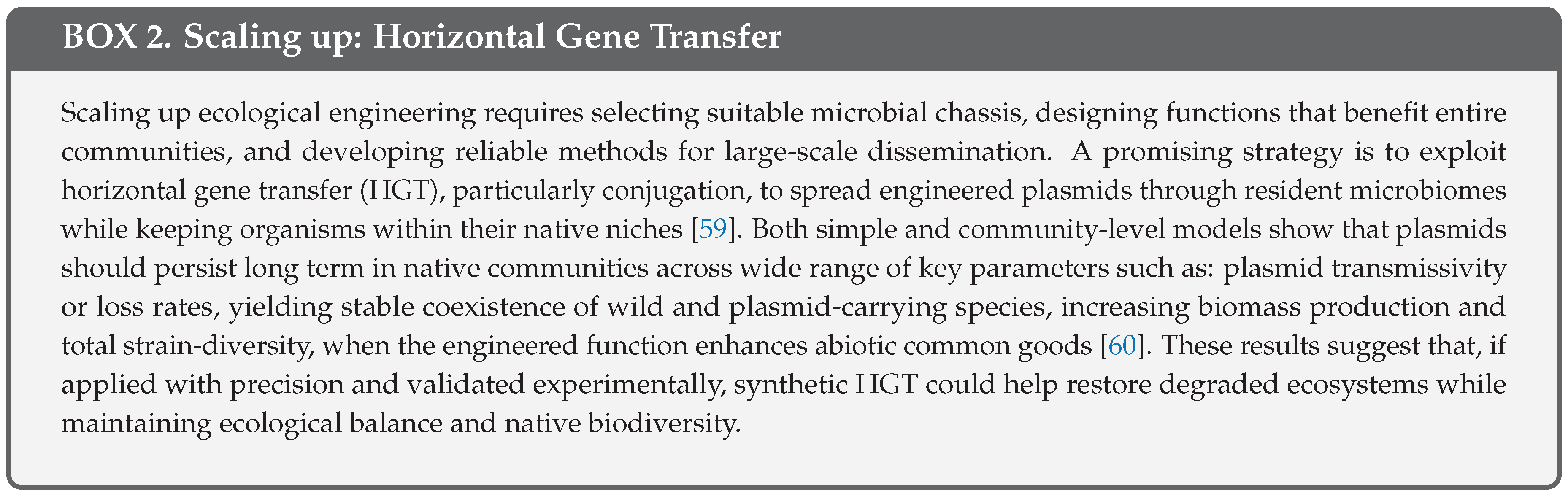
Let us illustrate with a simple model how community diversity naturally facilitates the integration of a synthetic in a given resident community while keeping it at bay [29,58]. The importance of this modeling approach is that it shows how this emergent bioengineering approach works and why negative cascade effects can be avoided. We consider a community composed by a set of species whose populations are indicated by where , and a set of resources , where . The details are presented in [29], but in summary, the idea is that the intervention is based on the use of a strain () engineered from a resident species. This is important since in this way the synthetic strain will share all the ecological interactions of the wild type. Specifically, this synthetic strain can reduce the loss of a given shared resource, such as water. The equations read:
for the species populations, whereas the resources will change in the following:
with the last term introducing the effect of the synthetic strain (), reducing the loss of the -th resource (here if and zero otherwise) whereas, in the absence of the synthetic strain (i. e. if ), decays at a rate . This model reveals that biodiversity acts as a firewall on the synthetic strain, which performs its function and improves the community without species loss. The overall picture is intuitive and robust. Diversity helps the synthetic strain to establish. A resident-derived engineered microbe can reduce resource loss while preserving (sometimes boosting) biodiversity and biomass by staying ecologically embedded in the existing network. This makes diverse communities natural “firewalls”: they facilitate controlled introduction of designed organisms while preventing ecological runaway, a desirable feature for ecological engineering.
4. Discussion
The future of the biosphere faces increasing pressures, from climate change and habitat degradation to unsustainable modes of growth. As the window to avoid transitions to undesirable tipping points continues to shrink, there is a growing need for intervention strategies that go beyond observation and prediction alone [11]. A central prerequisite for such interventions is recognizing that ecosystems are multiscale self-organizing systems, in which function and stability emerge from interactions across organizational levels rather than isolated components [6]. This challenges the direct transfer of classical engineering paradigms—based on top-down control and modularity—to living systems. Ecological systems are adaptive, nonlinear, and shaped by feedbacks between organisms and their environment. Bioengineering must therefore move beyond strict control toward guided self-organization, exploiting biodiversity-driven resilience rather than suppressing it. Emergent bioengineering aims to bridge engineering intent and ecological complexity by deliberately enhancing the intrinsic resilience of ecological networks through targeted synthetic biology interventions, following Holling’s distinction between engineering and ecological resilience [25].
Microorganisms provide a particularly powerful substrate for this paradigm. They have historically reshaped the biosphere at planetary scales [61] and today mediate key metabolic and biogeochemical processes. As an interface between chemical reaction networks and ecological organization, microbial communities are ideally suited for emergent bioengineering, allowing synthetic traits to be embedded within existing, diverse ecosystems rather than imposed externally. From this perspective, biodiversity is not an obstacle but a central design asset. High-diversity systems provide redundancy and statistical buffering, allowing engineered functions to be absorbed and stabilized by the surrounding network. Biodiversity thus acts as a scale-independent and predictable firewall, constraining failure propagation and reducing the risk of catastrophic regime shifts [29]. Rather than aiming for optimal performance under fixed conditions, emergent bioengineering targets robust distributions of desirable outcomes across variable environments.
A remaining challenge is the effective expression and scaling of engineered traits across environmental microbiomes [62], for which mechanisms such as domesticated horizontal gene transfer offer a promising route when guided by an Emergent Bioengineering framework linking molecular design to community- and ecosystem-level outcomes (Box 2).
Finally, this framework reframes evolution from a threat to a design partner. Instead of freezing systems in fixed configurations, emergent bioengineering embraces evolutionary dynamics as a mechanism for long-term persistence and functional maintenance. The goal is not precise control, but resilient coexistence: steering ecological systems within bounded regions of state space so that synthetic functions remain stable, adaptive, and ecologically integrated.
Acknowledgments
We thank the members of the Complex Systems Lab for fruitful discussions, and the Mattatuck Museum for permission to reproduce the image “The Butterfly Machine” by Kay Sage. Special thanks to Refaat Alareer and Hiba Abu Nada for inspiration. VM and LS are supported by the Ajuntament de Barcelona and “la Caixa” Foundation. RS is supported by the AGAUR 2021 SGR 0075 grant. The authors also appreciate the support of the Santa Fe Institute, where the workshop on Emergent Engineering was held in the fall of 2024.
References
- Dowden, H.; Munro, J. Trends in clinical success rates and therapeutic focus. Nature Reviews Drug Discovery 2019, 18, 495–496. [Google Scholar] [CrossRef]
- Harrison, R.K. Phase II and phase III failures: 2013–2015. Nature Reviews Drug Discovery 2016, 15, 817–818. [Google Scholar] [CrossRef]
- Bray, F.; Ferlay, J.; Soerjomataram, I.; Siegel, R.L.; Torre, L.A.; Jemal, A. Global cancer statistics 2018: GLOBOCAN estimates of incidence and mortality worldwide for 36 cancers in 185 countries. CA: A Cancer Journal for Clinicians 2018, 68, 394–424. [Google Scholar] [CrossRef]
- Dua, M.; Singh, A.; Sethunathan, N.; Johri, A. Biotechnology and bioremediation: successes and limitations. Applied Microbiology and Biotechnology 2002, 59, 143–152. [Google Scholar] [CrossRef] [PubMed]
- Cowan, G.; Pines, D.; Meltzer, D.E. Complexity: Metaphors, models, and reality. 1994. [Google Scholar]
- Levin, S.A. Ecosystems and the Biosphere as Complex Adaptive Systems. Ecosystems 1998, 1, 431–436. [Google Scholar] [CrossRef]
- Krakauer, D.C. Emergent Engineering: Reframing the Grand Challenge for the 21st Century. In Worlds Hidden in Plain Sight: The Evolving Idea of Complexity at the Santa Fe Institute; Krakauer, D.C., Ed.; SFI Press, 2019; chapter 37.** Raises the concept of Emergent Engineering for the first time. [Google Scholar]
- Rid, T. Rise of the machines: A cybernetic history; WW Norton & Company, 2016. [Google Scholar]
- Curtis, A. Machines of Loving Grace. Television documentary series. 2011. [Google Scholar]
- Munoz, M.A. Colloquium: Criticality and dynamical scaling in living systems. Reviews of Modern Physics 2018, 90, 031001. [Google Scholar] [CrossRef]
- Solé, R.; Levin, S. Ecological complexity and the biosphere: the next 30 years. 2022. [Google Scholar]
- Kemp, L.; Xu, C.; Depledge, J.; Ebi, K.L.; Gibbins, G.; Kohler, T.A.; et al. Climate Endgame: Exploring catastrophic climate change scenarios. Proceedings of the National Academy of Sciences 2022, 119. [Google Scholar] [CrossRef] [PubMed]
- Xu, C.; Kohler, T.A.; Lenton, T.M.; Svenning, J.C.; Scheffer, M. Future of the human climate niche. Proceedings of the National Academy of Sciences 2020, 117, 11350–11355. [Google Scholar] [CrossRef]
- Clauer, P.; Nou, A.X.; Toth, T.; Yu, Q.; Chemla, Y.; Boo, A.; Yoon, K.; Voigt, C. Synthetic Biology of Plants and Microbes for Agriculture, Environment, and Future Applications This extensive review describes how synthetic biology tools can turn plants and their microbiomes into programmable systems for improved agriculture and future applications like sensing, manufacturing, and remediation. Also highlights major hurdles such as field reliability, community stability, evolution, delivery, and biosafety/containment. Chemical Reviews 2026, 126, 895–1109. [Google Scholar] [CrossRef]
- Artime, O.; De Domenico, M. From the origin of life to pandemics: Emergent phenomena in complex systems. Philosophical Transactions of the Royal Society A 2022, 380, 20200410. [Google Scholar] [CrossRef]
- Pedrolli, D.B.; Ribeiro, N.V.; Squizato, P.N.; de Jesus, V.N.; Cozetto, D.A.; at iGEM 2017, T.A.U. Engineering Microbial Living Therapeutics: The Synthetic Biology Toolbox. Trends in Biotechnology 2019, 37, 100–115. [Google Scholar] [CrossRef] [PubMed]
- Brooks, S.M.; Alper, H.S. Applications, challenges, and needs for employing synthetic biology beyond the lab. Nature Communications 2021, 12, 1390. [Google Scholar] [CrossRef] [PubMed]
- Stirling, F.; Bitzan, L.; O’Keefe, S.; Redfield, E.; Oliver, J.W.; Way, J.; et al. Rational design of evolutionarily stable microbial kill switches. Molecular cell 2017, 68, 686–697. [Google Scholar] [CrossRef]
- Chan, C.T.; Lee, J.W.; Cameron, D.E.; Bashor, C.J.; Collins, J.J. ’Deadman’ and ’Passcode’ microbial kill switches for bacterial containment. Nature Chemical Biology 2016, 12, 82–86. [Google Scholar] [CrossRef]
- Schmidt, M.; de Lorenzo, V. Synthetic bugs on the loose: containment options for deeply engineered (micro)organisms. Current Opinion in Biotechnology 2016, 38, 90–96. [Google Scholar] [CrossRef]
- Lee, J.W.; Chan, C.T.Y.; Slomovic, S.; Collins, J.J. Next-generation biocontainment systems for engineered organisms. Nature Chemical Biology 2018, 14, 530–537. [Google Scholar] [CrossRef]
- Rottinghaus, A.G.; Ferreiro, A.; Fishbein, S.R.S.; Dantas, G.; Moon, T.S. Genetically stable CRISPR-based kill switches for engineered microbes. Nature Communications 2022, 13, 672. [Google Scholar] [CrossRef]
- Adamala, K.P.; Agashe, D.; Belkaid, Y.; et al. Confronting risks of mirror life. Science 2024, 386, 1351–1353. [Google Scholar] [CrossRef]
- van den Berg, N.I.; Machado, D.; Santos, S.; Rocha, I.; Chacón, J.; Harcombe, W. Ecological modelling approaches for predicting emergent properties in microbial communities This review explains how different ecological modelling frameworks can predict emergent properties of microbial communities and compares the strengths and limits of approaches from Lotka–Volterra to genome-scale metabolic models for guiding rational ecosystem modulation. Nature Ecology & Evolution 2022, 6, 855–865. [Google Scholar] [CrossRef]
- Holling, C.S. Engineering resilience versus ecological resilience. In Engineering Within Ecological Constraints; Schulze, P.C., Ed.; National Academy Press: Washington, DC, 1996; pp. 31–44, ** Holling contrasts “engineering resilience” with “ecological resilience”, arguing that sustainable management must design for the latter in dynamic, uncertain systems. [Google Scholar]
- Hui, C.; Richardson, D.M. How to Invade an Ecological Network. Trends in Ecology & Evolution 2019, 34, 121–131. [Google Scholar] [CrossRef]
- Aguadé-Gorgorió, G.; Kéfi, S. Emergent coexistence and the limits of reductionism in ecological communities. 2025. [Google Scholar] [CrossRef]
- Case, T.J. Invasion resistance arises in strongly interacting species-rich model competition communities. Proceedings of the National Academy of Sciences 1990, 87, 9610–9614. [Google Scholar] [CrossRef] [PubMed]
- Maull, V.; Solé, R. Biodiversity as a firewall to engineered microbiomes for restoration and conservation. Royal Society Open Science 2024, 11. * Provides the theoretical basis for biodiversity as a predictable firewall and scaffold for engraftment of resident-derived synthetic strains for ecosystem restoration.. [Google Scholar] [CrossRef] [PubMed]
- Holling, C.S. Resilience and stability of ecological systems. Annual review of ecology and systematics 1973, 4, 1–23. [Google Scholar] [CrossRef]
- Kéfi, S.; Holmgren, M.; Scheffer, M. When can positive interactions cause alternative stable states in ecosystems? Functional Ecology 2016, 30, 88–97. [Google Scholar] [CrossRef]
- Aguadé-Gorgorió, G.; Arnoldi, J.F.; Barbier, M.; Kéfi, S. A taxonomy of multiple stable states in complex ecological communities. Ecology Letters 2024, 27, e14413. [Google Scholar] [CrossRef]
- Walker, B.H.; Ludwig, D.; Holling, C.S.; Peterman, R.M. Stability of Semi-Arid Savanna Grazing Systems. Journal of Ecology 1981, 69, 473–498. [Google Scholar] [CrossRef]
- Sánchez, A.; Vila, J.C.; Chang, C.Y.; Diaz-Colunga, J.; Estrela, S.; Rebolleda-Gomez, M. Directed Evolution of Microbial Communities. Annual Review of Biophysics 2021, 50, 323–341. [Google Scholar] [CrossRef]
- Goldford, J.E.; Lu, N.; Bajić, D.; Estrela, S.; Tikhonov, M.; Sanchez-Gorostiaga, A.; et al. Emergent simplicity in microbial community assembly. Science 2018, 361, 469–474. [Google Scholar] [CrossRef]
- Burke, C.; Steinberg, P.; Rusch, D.; Kjelleberg, S.; Thomas, T. Bacterial community assembly based on functional genes rather than species. Proceedings of the National Academy of Sciences 2011, 108, 14288–14293. [Google Scholar] [CrossRef]
- Stock, M.; Gorochowski, T.E. Open-endedness in synthetic biology: A route to continual innovation for biological design. Science Advances 2024, 10. [Google Scholar] [CrossRef] [PubMed]
- Skerker, J.M.; Lucks, J.B.; Arkin, A.P. Evolution, ecology and the engineered organism: lessons for synthetic biology. Genome Biology 2009, 10, 114. [Google Scholar] [CrossRef]
- Michael-Igolima, U.; Abbey, S.J.; Ifelebuegu, A.O. A Systematic Review on the Effectiveness of Remediation Methods for Oil Contaminated Soils. 9, 100319. [CrossRef]
- Mustafa, M.G.; Khan, M.G.M.; Nguyen, D.; Iqbal, S. Techniques in Biotechnology. In Omics Technologies and Bio-Engineering; Elsevier; pp. 233–249. [CrossRef]
- Cleves, P.A.; Strader, M.E.; Bay, L.K.; Pringle, J.R.; Matz, M.V. CRISPR/Cas9-mediated genome editing in a reef-building coral. Proceedings of the National Academy of Sciences 2018, 115, 5235–5240. [Google Scholar] [CrossRef]
- Maestre, F.T.; Sole, R.; Singh, B.K. Microbial biotechnology as a tool to restore degraded drylands. Microbial biotechnology 2017, 10, 1250–1253. [Google Scholar] [CrossRef] [PubMed]
- Solé, R.V.; Montañez, R.; Duran-Nebreda, S.; Rodriguez-Amor, D.; Vidiella, B.; Sardanyés, J. Population dynamics of synthetic terraformation motifs. Royal Society Open Science 2018, 5, 180121. [Google Scholar] [CrossRef]
- de Lorenzo, V.; Marliere, P.; Sole, R. Bioremediation at a global scale: from the test tube to planet Earth. Microbial biotechnology 2016, 9, 618–625. [Google Scholar] [CrossRef]
- Rosado, P.M.; Leite, D.C.A.; Duarte, G.A.S.; Chaloub, R.M.; Jospin, G.; Nunes da Rocha, U.; Saraiva, J.P.; Dini-Andreote, F.; Eisen, J.A.; Bourne, D.G.; et al. Marine probiotics: increasing coral resistance to bleaching through microbiome manipulation. The ISME Journal 2018, 13, 921–936. [Google Scholar] [CrossRef]
- Coleman, M.A.; Goold, H.D. Harnessing synthetic biology for kelp forest conservation1. Journal of Phycology 2019, 55, 745–751. [Google Scholar] [CrossRef]
- van Oppen, M.J.H.; Blackall, L.L. Coral microbiome dynamics, functions and design in a changing world. Nature Reviews Microbiology 2019, 17, 557–567. [Google Scholar] [CrossRef]
- de Lorenzo, V. Environmental Galenics: large-scale fortification of extant microbiomes with engineered bioremediation agents. Philosophical Transactions of the Royal Society B: Biological Sciences 2022, 377. [Google Scholar] [CrossRef]
- Jansson, J.K.; McClure, R.; Egbert, R.G. Soil microbiome engineering for sustainability in a changing environment. Nature Biotechnology 2023, 41, 1716–1728, * It reviews how microbial ecology and synthetic biology can be used to engineer soil microbiomes that boost plant growth and restore soil health under environmental change.. [Google Scholar] [CrossRef] [PubMed]
- Lea-Smith, D.J.; Hassard, F.; et al. C. Engineering biology applications for environmental solutions: potential and challenges. Nature Communications 2025, 16. * This perspective surveys how engineering biology can tackle environmental problems and what’s needed to deploy it safely and at scale in the real world. [Google Scholar] [CrossRef]
- de Lorenzo, V. Systems Biology Approaches to Bioremediation. 19, 579–589. [CrossRef]
- Jiang, T.; Montgomery, V.A.; Jetty, K.; Ganesan, V.; Incha, M.R.; Gladden, J.M.; Hillson, N.J.; Liu, D. Metabolic Engineering and Synthetic Biology for the Environment: From Perspectives of Biodetection, Bioremediation, and Biomanufacturing. 14. [CrossRef]
- Nandy, S.; Andraskar, J.; Lanjewar, K.; Kapley, A. Challenges in bioremediation: from lab to land. In Bioremediation for Environmental Sustainability; Elsevier, 2021; pp. 561–583. [Google Scholar] [CrossRef]
- Chemla, Y.; Sweeney, C.J.; Wozniak, C.A.; Voigt, C.A. Design and Regulation of Engineered Bacteria for Environmental Release. 10, 281–300. [CrossRef] [PubMed]
- Vidiella, B.; Solé, R. Ecological firewalls for synthetic biology. iScience 2022, 25, 104658. [Google Scholar] [CrossRef]
- Solé, R.; Maull, V.; Amor, D.R.; Pla Mauri, J.; Conde-Pueyo, N. Synthetic Ecosystems: From the Test Tube to the Biosphere. ACS Synthetic Biology 2024, 13, 3812–3826. [Google Scholar] [CrossRef]
- Elton, C.S. The Ecology of Invasions by Animals and Plants; Chapman and Hall: London, 1958. [Google Scholar]
- Maull, V.; Solé, R. Network-level containment of single-species bioengineering. Philosophical Transactions of the Royal Society B 2022, 377, 20210396. [Google Scholar] [CrossRef]
- Aparicio, T.; Silbert, J.; Cepeda, S.; de Lorenzo, V. Propagation of Recombinant Genes through Complex Microbiomes with Synthetic Mini-RP4 Plasmid Vectors. BioDesign Research 2022, 2022, 9850305. [Google Scholar] [CrossRef] [PubMed]
- Maull, V.; Aguadé-Gorgorió, G.; de Lorenzo, V.; Solé, R. Synthetic Horizontal Gene Transfer for Ecosystem Restoration. bioRxiv 2025. [Google Scholar] [CrossRef]
- Lenton, T.; Watson, A. Revolutions that made the Earth; OUP Oxford, 2013. [Google Scholar]
- de Lorenzo, V. Environmental Galenics: large-scale fortification of extant microbiomes with engineered bioremediation agents. Philosophical Transactions of the Royal Society B 2022, 377, 20210395. [Google Scholar] [CrossRef] [PubMed]
| 1 | An excellent analysis of this attempt and its many failures can be found in Adam Curtis documentary Machines of loving grace [9]. |
Figure 1.
Kay Sage (left), was a Surrealist painter known for her architectural, desolate dreamscapes. On the right, her 1941 painting The Butterfly Machine, a work that reflects themes of constraint and transformation, recurrent in Sage’s exploration of existential landscapes. Image Courtesy of the Mattatuck Museum, Waterbury, CT, USA; Donation: Gift of the Estate of Kay Sage, 1965.
Figure 1.
Kay Sage (left), was a Surrealist painter known for her architectural, desolate dreamscapes. On the right, her 1941 painting The Butterfly Machine, a work that reflects themes of constraint and transformation, recurrent in Sage’s exploration of existential landscapes. Image Courtesy of the Mattatuck Museum, Waterbury, CT, USA; Donation: Gift of the Estate of Kay Sage, 1965.

Figure 2.
From left to right: (a–c) A cybernetics-like representation of multiscale ecosystems inspired by Odum, illustrating how interacting physical, chemical, and biological components can be viewed as coupled feedback networks, providing a conceptual framework for potential top-down interventions. (d–e) Natural ecosystem engineers in soil crusts, where microorganisms—particularly cyanobacteria—structure the matrix and play a central role in channeling flows of energy, water, and carbon. (f–i) Emergent bioengineering, in which synthetic biology (h,i) enables the design of strains (g), chosen among extant ecosystem engineers, that can be inoculated back into resident communities (f), enhancing resilience at the community level, while biodiversity and community structure act as a stabilizing “firewall” (thick arrows), controlling the engineered populations, buffering perturbations and constraining system-level responses.
Figure 2.
From left to right: (a–c) A cybernetics-like representation of multiscale ecosystems inspired by Odum, illustrating how interacting physical, chemical, and biological components can be viewed as coupled feedback networks, providing a conceptual framework for potential top-down interventions. (d–e) Natural ecosystem engineers in soil crusts, where microorganisms—particularly cyanobacteria—structure the matrix and play a central role in channeling flows of energy, water, and carbon. (f–i) Emergent bioengineering, in which synthetic biology (h,i) enables the design of strains (g), chosen among extant ecosystem engineers, that can be inoculated back into resident communities (f), enhancing resilience at the community level, while biodiversity and community structure act as a stabilizing “firewall” (thick arrows), controlling the engineered populations, buffering perturbations and constraining system-level responses.
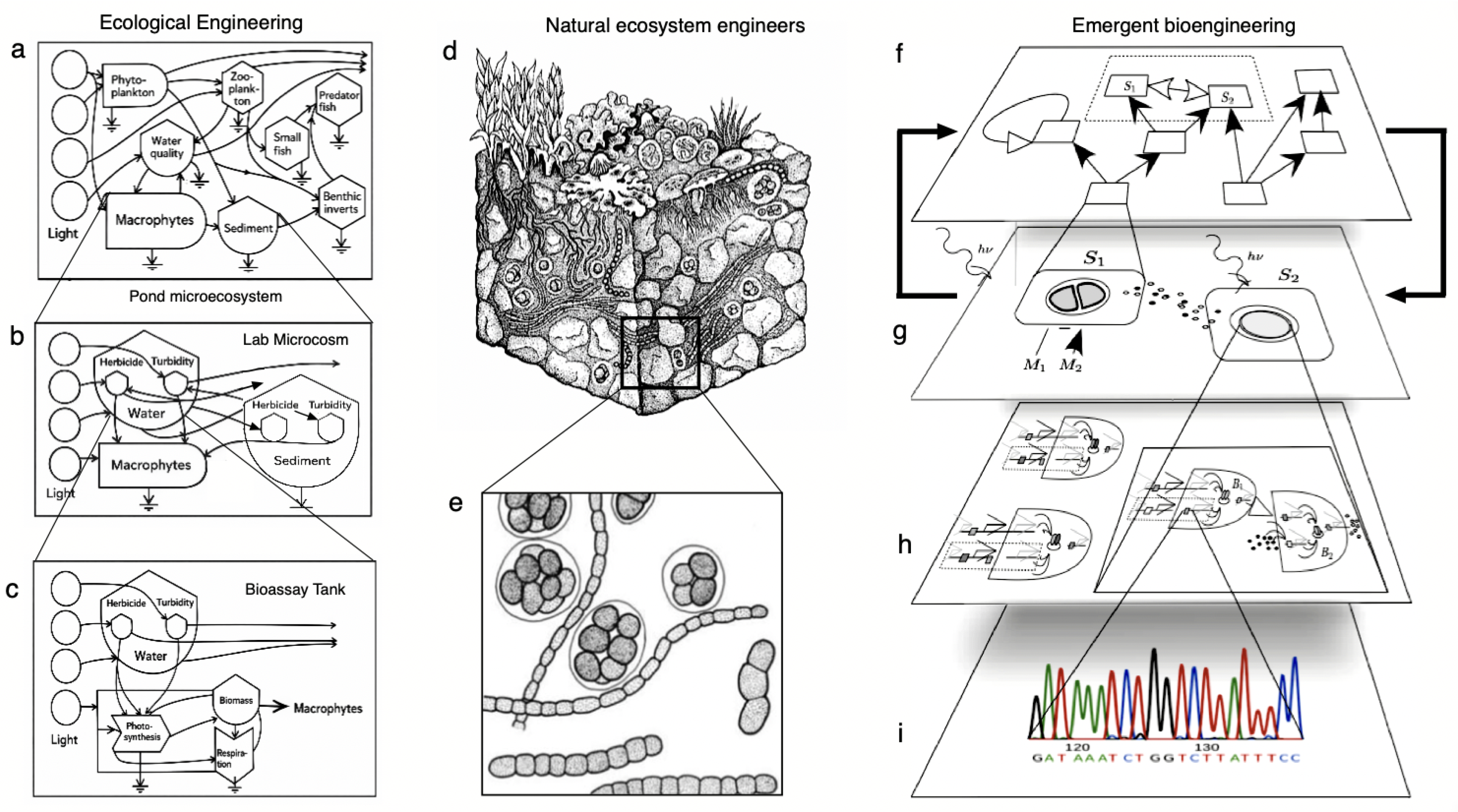
Figure 3.
Modelling engineered resilience. (a) Conceptual illustration of a dryland ecosystem exhibiting two alternative stable states (green () and desert) represented in (b) as marbles on a landscape, where resilience is quantified by the size of the basin of attraction of G, . Engineered resilience can enlarge this basin, , thereby increasing the stability and persistence of the desired green state. (c-e) Dynamical representation of a minimal facilitation-aridity model, showing bistability between green ()and desert () states as aridity increases, with a critical transition at .The associated potential illustrates the resilience barrier separating both states. By introducing a synthetic strain (S) that enhances facilitation, the modified model (f-h) shows that this intervention shifts the critical point to and increases the potential barrier , effectively enlarging the basin of attraction of the green state and extending its resilience range.(i–k) Conceptual cross-sections of soil structure (biocrust) corresponding to the desert state (i), a healthy natural biocrust (j), and an engineered biocrust with enhanced resilience due to introduced microbial functions (k).
Figure 3.
Modelling engineered resilience. (a) Conceptual illustration of a dryland ecosystem exhibiting two alternative stable states (green () and desert) represented in (b) as marbles on a landscape, where resilience is quantified by the size of the basin of attraction of G, . Engineered resilience can enlarge this basin, , thereby increasing the stability and persistence of the desired green state. (c-e) Dynamical representation of a minimal facilitation-aridity model, showing bistability between green ()and desert () states as aridity increases, with a critical transition at .The associated potential illustrates the resilience barrier separating both states. By introducing a synthetic strain (S) that enhances facilitation, the modified model (f-h) shows that this intervention shifts the critical point to and increases the potential barrier , effectively enlarging the basin of attraction of the green state and extending its resilience range.(i–k) Conceptual cross-sections of soil structure (biocrust) corresponding to the desert state (i), a healthy natural biocrust (j), and an engineered biocrust with enhanced resilience due to introduced microbial functions (k).
Disclaimer/Publisher’s Note: The statements, opinions and data contained in all publications are solely those of the individual author(s) and contributor(s) and not of MDPI and/or the editor(s). MDPI and/or the editor(s) disclaim responsibility for any injury to people or property resulting from any ideas, methods, instructions or products referred to in the content. |
© 2026 by the authors. Licensee MDPI, Basel, Switzerland. This article is an open access article distributed under the terms and conditions of the Creative Commons Attribution (CC BY) license (http://creativecommons.org/licenses/by/4.0/).
Copyright: This open access article is published under a Creative Commons CC BY 4.0 license, which permit the free download, distribution, and reuse, provided that the author and preprint are cited in any reuse.


