

Submitted:
04 March 2026
Posted:
04 March 2026
You are already at the latest version
Abstract
This article examines the impact of intermodal wagon technical specifica-tions and railway infrastructure parameters on electricity consumption in rail freight transport. To conduct this investigation, a three-stage analytical model was developed. The first stage establishes core assumptions, encompassing train lengths, rolling stock types, container configurations, infrastructure constraints, and the characteristics of the energy-consumption model. The second stage identifies technical constraints of specific wagons, determines representative train compositions, and executes loading simulations. The third stage focuses on evaluating energy efficiency across diverse loading scenarios.
The case study demonstrates that specific energy consumption varies significantly with wagon type, train mass, and route characteristics, challenging the use of static energy-consumption values prevalent in current literature. Results indicate that 40-foot wagons incur high energy penalties due to their tare weight and axle count, despite maximizing loading capacity. While 60-foot wagons consume less energy, they result in a high frequency of empty slots under a 20 t/axle limit. Conversely, 80-foot wagons emerge as the most energy-efficient, particularly at a 22.5 t/axle limit. Mixed consists offer a balance of operational flexibility and competitive performance. Inter-estingly, extending train length from 600 m to 730 m increases volume but does not inherently reduce unit energy consumption. These findings underscore the necessity of aligning wagon fleet selection with infrastructure capabilities and cargo characteris-tics. Ultimately, this study provides actionable recommendations for planning ener-gy-efficient intermodal operations.
Keywords:
railway wagon
; intermodal transport
; energy consumption
; energy efficiency
1. Introduction
The primary objective of this study is to develop a method that supports intermodal operators in optimizing container transport for energy efficiency. The research is informed by the professional observations of one of the authors, who noted that energy efficiency increases significantly with improved railway infrastructure parameters, the selection of an appropriate wagon fleet, and an optimized loading strategy.
Intermodal transport includes, inter alia, the carriage of containers, semi-trailers, swap bodies and road-vehicle combinations. The core principle of intermodal transport is the movement of these ITUs (Intermodal Transport Units) using at least two different transport modes, without transshipping the cargo itself [1,2].
The European Union (EU) Member States, in shaping sustainable development policy, support the growth of intermodal transport by introducing various legal regulations that facilitate its operation and enhance its competitiveness in relation to conventional road transport [3,4,5]. An example of such regulations can be found in the TEN-T (Trans-European Transport Network) and AGTC (European Agreement on Important International Combined Transport Lines and Related Installations) agreements, which oblige the signatories, inter alia, to extend loading tracks at intermodal terminals and handover stations to 740 m, to increase the permissible axle load for freight traffic to 22.5 t, and to electrify loading tracks in such a way that they can be accessed by an electric locomotive (without the need to use a diesel locomotive) [6]. Member States actively provide financial support for the construction of new intermodal transport infrastructure and handling equipment [7,8,9].
However, discussions of sustainable development in intermodal transport rarely consider the energetic effectiveness of intermodal rail freight. In particular, the academic literature does not sufficiently examine how wagon-fleet selection and railway infrastructure parameters affect energy consumption. On the one hand, railway lines used by intermodal trains differ in the axle-load limits a wagon bogie may impose on the track, as well as in the maximum permitted train length. On the other hand, intermodal wagons available on the market vary in tare weight, length, and capacity, allowing them to carry containers of different sizes and gross weights.
These factors raise fundamental questions about how loading should be organized, with which wagons as well as what parameters should be considered when selecting a railway route to transport ITUs so as to reduce energy intensity while, at the same time, maximizing container count or total cargo mass carried. To address these issues, we developed a three-stage research model, the stages of which are described below.
Stage 1: Identification of input data—in this stage, the inputs to the research model were specified. They include wagon parameters, train lengths, railway line characteristics, container types in use and their gross weights. This stage also sets out the method for estimating energy consumption and the operational parameters of the given train route. Some of these inputs shaped the loading scenarios analysed technically in Stage 2 and had a material effect on the results obtained in Stage 3.
Stage 2: Simulation of container train loading (container consist)—Stage 2 comprised four steps. In Step 1, constraints on the wagon fleet (axle loads and bending moments) were identified and defined using physico-mechanical formulas. These were based on equilibrium equations for statically determinate beams (in the case of 4-axle, 40- and 60-foot wagons) and statically indeterminate beams (for 6-axle, 80-foot wagons). In Step 2, using a purpose-built solver, the algorithm assembled train consists composed of different wagon types, given a specified objective function and selected constraints. Alongside heterogeneous consists, homogeneous consists (the most common service on the European market) were also examined. In Step 3, loading scenarios were developed that varied by train length, axle load, and wagon type. Step 4 set the assumptions and objective functions that may guide operators in loading an intermodal train. Containers were then allocated manually to wagons in each scenario using dedicated calculators.
Stage 3: Results analysis—in the final stage, we analysed total and unit energy consumption of transporting a given set of containers under different loading scenarios. Based on these results, we formulated conclusions and recommendations for intermodal operators.
The results highlight several key findings. First, longer trains do not always yield benefits. For some wagon types, unit energy consumption is higher in longer than in shorter consists, driven, among other things, by greater wagon tare weight and more axles, which increase rolling resistance at the wheel-rail interface. Second, the case for 40-foot, four-axle wagons weakens as the permissible axle load rises from 20 to 22.5 t/axle. Because 60- and 80-foot wagons have lower tare weight, they can become more economical as higher axle loads allow better use of their payload capacity. Third, the use of fixed unit energy-consumption values in rail freight, as often found in the literature, is not justified. These values vary with train gross mass, route length, wagon type, train length, permissible axle load, and other operational factors. Moreover, definitions of energy consumption per t-km are inconsistent across authors. Most of them do not specify how they understand mass in this unit (for example if it is gross mass of train or net cargo mass).
2. Literature Review
The production, storage, and distribution of energy represent substantial challenges for energy system operators as well as for society and the environment, as these processes are frequently associated with significant costs and greenhouse gas emissions [10,11]. In light of ongoing climate change and the potential for a global increase in energy prices, increasing attention is being directed toward the development of solutions that enable energy conservation and efficient energy management [12,13,14]. In particular, energy efficiency in the transport sector is of critical importance, as it remains one of the most energy-intensive sectors of the economy. Importantly, reductions in energy consumption can be achieved not only through conventional measures, such as route optimization [15,16], but also through less obvious strategies, including the optimal selection of transport modes and loading strategies for freight transportation [17,18]—what will be demonstrated using the example of intermodal transport.
The literature review was divided into three parts. The first part examined global trends related to the electrification of transport, including railway transport. The second part reviewed methods for optimizing the loading of intermodal trains. In our research we will investigate links between optimal train loading and energy consumption. The final part analyzed approaches used to estimate energy consumption in freight railway transport. One of these methods will be implemented in the model presented in this scientific paper.
2.1. Transport Electrification
In global transport reports, electrification has been identified as one of the fastest-progressing processes within the broader energy transition. Documents [19,20,21,22,23,24] emphasize that the electric vehicle segment is currently developing very dynamically. At the beginning of 2020, it remained relatively marginal; however, only four years later it had achieved a significant market share—particularly in the passenger car segment. It has also been noted that electrification is not limited solely to passenger cars. In recent years, a rapid development of electric two- and three-wheelers (especially in Asia) has been observed, along with a growing—though slower—share of electric vehicles in freight, rail, and bus transport [21,23]. The studies reviewed anticipate a further acceleration of transport electrification in the period up to 2050/2060. Some reports [21,22,25] even present projections according to which electric vehicles begin to dominate the structure of the entire operating fleet by mid-century. Several analyses also foresee a substantial increase in electrification in heavy-duty transport, albeit with a delay compared to the light-duty segment and with a significant role played by hybrid solutions [21,25,26].
An important complement to this perspective is provided by reports dedicated to rail and intermodal transport, prepared by the International Energy Agency, the International Union of Railways, the International Union for Road-Rail Combined Transport, and Europe’s Rail Joint Undertaking [27,28,29,30]. These documents present rail as a transport mode that already makes extensive use of electric energy and, owing to its low energy intensity and emissions, may play a key role in the decarbonization of land-based freight transport. The energy transition in this sector is primarily associated with further electrification of railway lines, improvements in the energy efficiency of rolling stock, and the development of combined transport, in which rail assumes the most emission-intensive segments of supply chains.
The most explicit and quantitatively developed approaches to energy intensity can be found in reports [27,28,29,30]. These documents consistently demonstrate that rail freight transport is significantly less energy-intensive than road transport and, for comparable cargo volumes, consumes several times less energy overall. In the scenario analyses presented particularly in [27,28], reductions in transport energy consumption are achieved primarily through modal shift from road to rail, improvements in railway infrastructure parameters (such as line electrification), and the modernization and enhancement of rolling stock performance. On the other hand, study [31] addresses reductions in energy consumption in rail transport through decreasing the tare mass of freight wagons. It is shown that a lower wagon tare mass reduces the resistance forces that must be overcome to accelerate a freight train over a given section of the route. Lower resistance forces consequently result in lower energy consumption. The authors of [32] note that energy consumption varies depending on the type of wagons used; however, they do not investigate the underlying causes of these differences. A technical analysis of energy consumption in rail freight transport is undertaken in [33]. This analysis considers route characteristics, types of wagon fleets and locomotives, number of axles, train mass and length, operating speeds, axle loads, traction power supply systems, and related parameters. Unfortunately, the article lacks a sensitivity analysis that would comprehensively illustrate how total and unit energy consumption change for a given variant as a function of variations in individual parameters.
Based on the literature review presented in this chapter, it can be concluded that there is a lack of practical knowledge on how to optimize freight train loading from a technical and operational perspective in order to reduce the energy intensity calculated per unit mass of transported cargo. Moreover, the studies discussed do not provide specific quantitative values illustrating the extent to which energy consumption on the railway network may be reduced as a result of improvements in infrastructure parameters, such as increasing train length from 600 to 730 m or raising the permissible axle load from 20 to 22.5 t/axle.
2.2. Optimal Loading an Intermodal Train
Among the few scholars to address this issue are those cited in [34]. The following conclusions can be formulated: (1) 40-foot and 80-foot wagons allow for the transport of the largest number of 40-foot containers; (2) 60-foot wagons are best suited to transporting 30-foot containers; (3) using 60- and 80-foot wagons allows transporting the greatest number of 20-foot containers.
In the international literature, optimal train loading is framed as the Train Load Planning Problem (TLPP). It concerns the optimal assignment of containers to intermodal wagons according to the following criteria [35,36,37,38,39]: (1) minimisation of loading time; (2) optimal use of human and mechanical resources; (3) minimisation of train-loading costs; (4) optimal utilisation of the train’s loading length; and (5) minimisation of penalties for leaving cargo in the storage yard.
In [40], is defined as follows: there is a set of containers differing in length, weight, loading priority, and stack positions that must be loaded onto wagons differing in length, tare weight, and loading configurations. The solution is an allocation that minimises the number of container-handling operations while maximising the number of loaded containers with the highest priority, subject to constraints on permissible length, payload capacity, and wagon loading configurations. The algorithm also enforces the permissible axle load—a key constraint determined by infrastructure parameters and the railway infrastructure manager’s regulations.
Figure 1 presents sample loading schemes for 40-foot and 60-foot wagons. These schemes show the maximum permissible container weight for each loading slot of a wagon.
Loading schemes also prevent overloading at either end of a wagon. This can occur when a very light container is placed at one end of the platform and a very heavy one at the other. In such cases, even if no bogie axle is overloaded, the wagon may tilt forward or backward, creating a safety hazard.
In practice, loading schemes are often insufficient—for example, when they are imprecise or offer too few configurations. In such cases, loading personnel use dedicated calculators to determine wagon axle loads. These calculations apply basic equilibrium equations for statically and non-statically determinate beams [40].
In [40], the authors split the optimal container-to-wagon assignment into two steps. First, they computed the maximum permissible container weight for each loading slot across wagon types. Second, they sorted containers in descending order of weight. For each slot, the weight limit from step one was compared with the heaviest container available in the yard; if it could not be loaded, the process continued down the list until a container satisfied all constraints—including slot-specific limits and axle-load limits. Containers exceeding these limits were not loaded.
The TLPP has also been examined in numerous other publications [41,42,43]. These studies usually considered 20- and 40-foot containers, which account for around 80–90% of the container market [44]. A common feature of the above studies is their focus on four-axle rail wagons. Container placement on such wagons is relatively straightforward operationally, as they offer few loading configurations and simple axle-load calculations. By contrast, six-axle platforms (80-foot wagons) present a more complex loading problem, both mathematically and mechanically.
To address this gap, the present study examines the optimisation of train consists comprising not only 40- and 60-foot four-axle wagons but also 80-foot six-axle wagons. Solving this problem is considerably more complex than the approaches described in the international literature and—as will be shown—requires a tailored strategy. The study investigates energy efficiency with respect to wagon-fleet type, train length, permissible axle load, and other operational parameters and loading strategies. This constitutes a novel contribution, as energy consumption in intermodal freight can be expected to vary with these factors.
2.3. Methods for Estimating Energy Consumption in Rail Freight Transport
Electricity consumption in rail freight can be assessed in two ways: empirically, using meter readings, or theoretically, using models that estimate consumption from formulae. Early methods from the 1970s and 1980s—described in [45,46,47,48].—required only a few inputs, such as line voltage, current, and motor configuration. However, they relied on the simplifying assumption that energy use is proportional to the ratio of actual traction to maximum traction. Subsequent work refined these estimation methods. One study [49,50] noted that train energy consumption may depend on factors such as:
- Track parameters, such as curve radius, the type of rail pads (e.g., hard rubber, steel, soft rubber), the track form (e.g., continuously welded, jointed), the ballast, and the grade.
- Mechanical and physical parameters, including wheel radius, gear ratio, traction-system efficiency, train length and frontal area, and wagon type.
- Operational conditions, such as speed, acceleration, load, and the rotational inertia of moving parts.
- External factors, such as wind and climate, which can affect the slip ratio along with other elements related to the track and the vehicle.
- Driver behavior and driving style.
In subsequent years, growing attention to environmental protection led to methods that link emissions to energy consumption. Notable approaches include MEET method (Methodologies for Estimating Emissions from Transport), ARTEMIS (Assessment and Reliability of Transport Emission Models and Inventory Systems), ETW (EcoTransIT World), mesoscopic models, which have been widely described in the literature [51,52,53,54,55,56,57]. The symbols used in these methods are listed in Table 1; some are applied in the present article.
Knowledge of energy consumption in rail transport was comprehensively systematised in our previous publication [57], which informed both the research model and the case study. In that work, total energy consumption covered not only the energy needed to overcome rolling resistance but also losses in the traction network and conversion losses in electricity generation. In the present study, we do not include these factors, as unit CO2 emissions from electricity generation are not calculated.
In the international literature, unit values of energy consumption are usually expressed as kWh/tkm (or Wh/tkm) [58,59,60,61]. It is often unclear what these metrics include—for example, whether they count the mass of locomotives and wagons or only the cargo. Nor is it always specified which wagon types are used, the train’s operating speed, or the route followed. To ensure reliable and comparable results, the units of energy consumption must therefore be defined explicitly—either descriptively or by equation—as we do in this article.
3. Materials and Methods
The designs of railway wagons differ in terms of length, mass, number of bogies, and payload capacity. These parameters significantly determine how well individual wagon types perform in specific transport tasks. They have a direct impact on the degree of train utilization as well as on its gross and net mass, and consequently on the unit energy consumption per ITU/TEU and per tonne of gross or net cargo.
In order to quantitatively illustrate these relationships, it is necessary to carry out simulations of intermodal train loading, taking into account the structural constraints of wagons (e.g., payload capacity) as well as railway infrastructure parameters, in particular permissible axle loads. The implementation of this task also requires the formulation of appropriate models and mathematical relationships. The results of the conducted research will make it possible to demonstrate the existence of potential for energy optimization in rail intermodal transport, which has not yet been the subject of such detailed analysis in the international literature.
The research model comprises three stages. Stage 1 defines the input assumptions, which largely determine the final results. In Stage 2, the basic constraints for the analysed wagon fleet are expressed as formulae. Train consists with both homogeneous and heterogeneous structures are then assembled, forming the basis for loading scenarios developed in the next step; this stage concludes with a simulation of train loading under those scenarios. Stage 3 analyses energy efficiency of intermodal transport on a given route. Figure 2 illustrates the research model.
Definition of the terms used in the above model is provided below:
Stage 1—Definition of the basic assumptions of the model
Step 1A: Identification of wagons and their parameters
The wagons used in intermodal transport are 40-, 60-, 80-, and 90-foot wagons. Their designations are presented as follows : 40-foot wagon, 60-foot wagon, 80-foot wagon, 90-foot wagon.
For the purposes of this study, designations were introduced for the key parameters of the respective wagon types: diagnostic variable denoting the tare weight of a wagon of type z, expressed in [t], diagnostic variable denoting the payload capacity of a wagon of type z, expressed in [t], diagnostic variable denoting the capacity of a wagon of type z, expressed in TEU. The capacities of wagons may be defined as follows: (it is worth mentioning that 1 TEU corresponds to the size of a 20-foot container), diagnostic variable denoting the length of a wagon of type z, expressed in [m].
Step 2A: Determination of intermodal wagon consists
In Western and Central Europe, where the standard track gauge of 1435 mm prevails, two train lengths dominate in freight operations: 620 m and 750 m (or 740 m). The corresponding lengths of wagon consist are 600 m and 730 m, respectively. These lengths exclude the locomotive (~20 m).
Step 3A: Determination of railway line parameters
Rail tracks on which freight trains operate are characterized by specific parameters. One such parameter is the permissible axle load that a wagon bogie axle can exert on the track. Until recently, on most European railway infrastructure, it was possible to operate freight trains mainly with a maximum axle load of 20 tons per axle. However, in accordance with the AGTC and TEN-T agreements, modernization works are underway that should, in the near future, make it possible to run trains with an axle load of 22.5 t/axle on the main corridors of the European railway network. To distinguish between railway line classes (), the following designations have been introduced: railway line with axle load up to 20 t/axle, railway line with axle load up to 22.5 t/axle, railway line with axle load up to 25 t/axle, railway line with axle load up to 18 t/axle.
Step 1B: Identification of container types loaded onto the wagon consist
A wide variety of container sizes are used worldwide. These include containers with lengths of 10-, 20-, 30-, 40-, and 45-foot. The following designations () have been introduced for them: 20-foot container, 40-foot container, 30-foot container, , .
The sizes of the discussed containers have been identified as follows ():
Step 2B: Determination of the gross mass of loaded containers
The gross weight of a container depends on its tare weight and the weight of the loaded cargo. The tare weight of a 20-foot container is approximately 2.2 t, while that of a 40-foot container is about 4.0 t. In both cases, around 26.0–28.0 t of cargo can be loaded into the transport vessel. Therefore, the gross weight of a container of type a () may be:
Step 1C, 2C: Selection of the method for estimating energy consumption in rail transport and Specification of train route parameters
At this stage, one of the methods described in the literature must be selected to estimate energy consumption in intermodal rail transport. Then, for the chosen energy-consumption estimation method, it is necessary to determine the parameters that influence the energy use of an electrified intermodal train. In this analysis, one of the methods outlined in the literature review will be chosen.
Stage 2—Assembly of wagon consists and simulation of the loading process
Step 1: Determination of technical constraints for the wagon fleet
Rail vehicles are subject to technical constraints that must be observed during loading. The main ones are:
Constraint due to the wagon’s payload capacity limit
Each wagon has a specified payload capacity. Overloading can cause floor failure; therefore, the total mass of containers loaded on a wagon of type must not exceed the manufacturer’s rated payload:
where: mass of the container of type , is a binary decision variable equal to 1 if container is assigned to wagon , and 0 otherwise. This variable determines whether the mass of the container is included in the load of wagon .
Constraint due to the wagon’s maximum capacity
Each wagon type has a specified capacity expressed in TEU; accordingly, the total TEU-equivalent length of containers loaded on a wagon of type must not exceed that wagon’s loading length.
where: TEU-equivalent length (e.g., 1 TEU for a 20-ft container, 2 TEU for a 40-ft container) of the container of type .
Constraint due to the wagon’s permissible axle load
Freight train tracks are designed with specific strength parameters. One of these is the permissible axle load that a wagon bogie axle may impose on the track. This constraint prevents excessive overstressing of the infrastructure and can be expressed as follows:
where: load on the bogie of a wagon of type , permissible axle load in railway line class .
The value is determined differently for four-axle and six-axle wagons. For four-axle wagons, the following equations must be solved:
- a)
- The equation of vertical force equilibrium acting on the wagon between gravitational forces and track reaction forces:
where: the portion of the wagon’s tare mass assigned to each bogie in type of wagon.
- b)
- The bending moment distribution equations for the wagon:
where: axle spacing of a wagon of type , distance from the support point to the center of gravity of the container of type on a wagon of type z.
The designations used in the above equations are illustrated below (see Figure 3).
An 80-foot wagon is statically indeterminate. To determine the support reactions of the 80-foot wagon, its floor must be modeled as two independent, statically determinate spans. For six-axle wagons, the following equations must be solved:
- a)
- The equation of vertical force equilibrium acting on the wagon, i.e., gravitational forces and track reaction forces:
- b)
- The bending moment distribution equations for the wagon:
The designations used in the above equations are illustrated above (see Figure 3).
Step 2: Formation of wagon consists
Rail wagons used for container transport can be configured in two ways. In the first, the train consist is composed of a single wagon type—such formations are referred to as homogeneous consists. The number of wagons in a homogeneous consist is given by the following formula:
where: length of the wagon consist.
Intermodal operators can also assemble consists from different wagon types; in this article, such consists are referred to as heterogeneous consists.
When assembling such a consist, the operator may pursue different objective functions, for example:
- The operator may aim to minimise the total tare mass of all wagons (as infrastructure managers usually charge higher access fees for heavier trains) . His objective can be formulated as the minimisation of the total wagon mass, expressed as the sum of the products of the number of wagons of type and the mass of a wagon of type .
- The operator may select wagons for the consist so as to maximise their total payload capacity expressed in tonnes , since greater carried volume increases transport revenueThis objective can be formulated as the maximisation of the sum of the products of the number of wagons of type and the payload capacity of a wagon of type .
- The operator may select wagons for the consist so as to maximise their total capacity or the total number of slots expressed in TEU ), as the more TEUs are transported, the greater the revenue he can gain. This objective can be formulated as the maximisation of the total wagon capacity, expressed as the sum of the products of the number of wagons of type and the capacity of a wagon of type .
- The operator may seek an optimal solution that simultaneously accounts for all the above objective functions.
If the above functions will be implemented in Solver, it is worth remembering that, to ensure that the program correctly determines the number of wagons, it is necessary to introduce a constraint on the total length of all wagons (the train consist length):
where:
Step 3: Determination of loading scenarios
Based on the previous step, loading scenarios can be defined that differ by the type and number of wagons used, train/consist length, and railway line class. The set of scenarios is denoted as:
—where is the scenario index.
Step 4: Simulated assignment of wagons to the consist
Once the wagon fleet and its technical constraints are known, the loading simulation can be performed. During loading, the entity responsible for container allocation may, for example, aim to:
- a)
- Maximise the utilisation of the loading space within the wagon consist (same equation as 2).
- b)
- Transport the largest possible gross cargo mass (same equation as 1)
or transport the largest possible net cargo mass :
where: tare mass of the container of type selected for loading, is a binary decision variable equal to 1 if container is assigned to wagon in scenario, and 0 otherwise. This variable determines whether the mass of the container is included in the load of wagon . This concerns variant.
Since no automated tool is available to perform the loading simulation in accordance with the above objective functions, the process must be performed manually by analyzing the loading of each wagon individually.
- c)
- Minimizing empty slots () within the wagon consist
The number of empty slots, expressed in TEU, is defined as the difference between the maximum slots available in the consist under a given scenario and the actual number of slots utilised in that consist .
Stage 3—Analysis of results
Step 1A: Determination of total energy consumption
Once the loading simulation is complete, the train’s operational parameters can be compared. In the final stage, the comparison focuses on total energy consumption of the locomotive(s) and the specific energy consumption for each scenario. The general equation for the total energy consumption of an intermodal train in the scenario, calculated using the method, is given below:
where (Mesoscopic method):
whereas: —energy required to overcome train resistances in the scenario, —power auxiliary devices in the scenario, —power required to overcome aerodynamic resistance in the scenario, —power required to overcome rolling resistance in the scenario, —power required to overcome gradient resistance in the scenario.
Step 2A: Determination of energy consumption
The total energy consumed by the train in a given loading scenario is not entirely informative, as it also includes the tare mass of the wagons. Therefore, to assess the energy use of the train more precisely, it is necessary to calculate the energy consumption in accordance with the formula described in [57], adapted for the purposes of this study:
per gross train t-km
or per net cargo t-km :
or per TEU :
or per ITU :
where: numer of ITU loaded in scenario.
4. Case Study
In the first subsection of this case study, the impact of technical and operational factors on the energy consumption of intermodal trains is examined. The model incorporates real values of parameters related to wagons, containers, and the train itself. Subsequently, loading variants are prepared in accordance with the principles defined in the model. These variants differ in terms of the composition of wagons assigned to transport and the parameters of the railway line, particularly the permissible axle loads (in this subsection, only trainsets with a length of 600 m are analyzed).
In the following stage, a simulation of wagon train loading is carried out for various variants, in accordance with the assumptions adopted in the model. The loading simulation, subject to the defined constraints, makes it possible to determine additional train parameters, such as gross train mass, net cargo mass, and the number of empty loading slots. Based on the selected energy consumption model, the input parameters, and the results obtained from the simulation, both unit and total energy consumption are calculated for successive loading variants.
At the end of the subsection, representative characteristics illustrating energy consumption and selected train operating parameters are presented, including the number of available slots, gross train mass, and the number of loaded containers. This research approach allows for the identification of correlations between energy consumption, operational practices, and the quality of the wagon fleet used.
In the second subsection, a comparative analysis is conducted, in which variants involving 600 m long wagon consists are compared with variants involving trains with a length of 730 m.
The conducted research supports the thesis that the energy consumption of electric trains depends not only on operating parameters (such as speed, gradient, and aerodynamic resistance), but also on factors such as the type of wagons in operation, infrastructure parameters, and train length.
4.1. Algorithm Implementation, Calculations, and Results
Stage 1—Definition of the basic model assumptions
Stage 1 begins with formulating the model’s basic assumptions. These assumptions largely determine what will be tested, how it will be tested, and what results will be obtained in Stage 3. Depending on the selected wagon fleet and the container types used for transport, there may be variation in energy consumption and utilisation of the train’s available loading space.
In Step 1, we selected 40-, 60-, and 80-foot wagons for analysis. Ninety-foot wagons are less common in international intermodal transport due to the limited availability of 45-foot containers worldwide—these, along with 40-foot refrigerated containers with cooling units, are typically the only units loaded onto such wagons. Consequently, this rolling-stock type was excluded from the analysis. Table 2 presents illustrative parameters for 40-, 60-, and 80-foot wagons used in the analyses that follow.
In Step 2A, we determined the length of the wagon consists to be formed. To diversify the scenarios, the study included both lengths of wagon consists listed in the previous section. It is generally assumed that longer consists are more economical than shorter ones—a hypothesis to be tested by the sensitivity analysis.
In Step 3A, we specified the class of railway lines on which the intermodal trains would operate. Under the TEN-T Regulation, tracks should support an axle load of 22.5 t. However, lines limited to 20 t remain common. This constraint prevents optimal use of wagon payload capacity, as it often leads to bogie-axle overloading. Lines allowing 25-tonne axle loads are relatively rare in Europe; accordingly, the analysis was confined to operations under 20- and 22.5-tonne axle-load conditions.
In Step 1B, 20- and 40-foot containers were selected for further analysis, as they are the most commonly used units in rail transport. Together, they account for approximately 90% (and up to 96% in Poland [63]) of all ITUs handled. The list of container types and their dimensions is presented in Table A1 in Appendix A.
In Step 2B, we specified the gross masses of the containers to be loaded. Values were generated in Excel using the RAND() function. The analysis focused on high-gross-mass containers, which are typically more difficult to load. Gross mass was sampled uniformly over 22–30 t (see Table A1 in Appendix A). Sampling also respected the constraint that the combined mass of the container and the road vehicle carrying it on the road leg must not exceed the permissible limit for combined road transport (44 t) [64].
In Step 1C, a method for estimating the energy consumption of intermodal trains was selected. The mesoscopic method discussed in [57] was adopted; this method was implemented and validated in an earlier paper.
In Step 2C, the train route parameters were specified, drawing on values reported in [51,52,54,57]. These parameters are summarised in Table 3.
Stage 2—Simulation of intermodal train loading (train consist)
In Step 1, a dedicated tool was prepared to calculate bogie axle loads for a given container type during loading. It was implemented in MS Excel. For the tool to compute axle loads correctly, selected technical parameters of intermodal wagons had to be specified—Table 4.
In Step 2, wagon consists were assembled. Both homogeneous and heterogeneous consists were considered. Homogeneous consists were obtained by dividing the nominal train length by the length of a single wagon . At this stage, only 600 m long wagon consists were considered. Mixed wagon consists were generated using the function described in Section 4 (Stage 2, Step 2) in a spreadsheet with the Solver add-in, which optimises fleet selection. In case of homogeneous type of wagon consists the intermodal operator does not have any limits according to wagons amounts. In case of homogeneous it was assumed that the intermodal operator had the following fleet available for service: , .
In Step 3, based on the previous step, loading scenarios were developed (Table A2 in Appendix A) that differed in permissible axle load , ) and in the types of wagons used. As noted earlier, the case study analysis was carried out for wagon consist . After the scenarios were defined, the tare mass of wagons, the total payload capacity in tonnes, the total capacity in TEU, and the overall train length of wagon consists were analyzed. For sensitivity analysis purposes, an analogous assessment was performed for (Table A2 in Appendix A).
In Step 4, a list of 82 containers was generated (Table A1 in Appendix A), consisting of 50 20-ft containers and 32 40-ft containers. Each unit was randomly assigned a gross mass within the range of 22–30 t. This allowed for the simulation of container-to-wagon assignment. The adopted strategy aimed to prioritize the dispatch of containers with the highest loading priority. Therefore, containers were sorted in ascending order of priority value. Each ITU was then manually allocated to wagons using a dedicated calculation tool. The results are summarized in Table A3 in Appendix A, including, among others, the number of utilized slots within the train consist, the level of slot utilization (in %), the payload utilization ratio, the number of loaded 20-ft and 40-ft containers, gross and net mass of the loaded goods.
Stage 3—Analysis of results
In Step 1A and Step 2A of Stage 3, the level of energy consumption for each scenario was determined in accordance with the procedure outlined in Chapter 3. To enable this calculation, it was first necessary to prepare the appropriate input parameters—Table 3. After performing the calculations, the following results were obtained—Figure 4.
From the figure, it can be seen that the total energy consumption in each scenario ranged from 12.7 to 17.3—the lowest value was observed for scenario 3 (12.7 MWh), and the highest in scenarios 1 and 5 (both 17.3 MWh). Energy consumption per gross train t-km ranged from 0.012 to 0.014 kWh. The lowest value was observed in scenario 7 (0.012 kWh/gross-tkm), while the highest was recorded for scenario 1 (0.014 kWh/gross-tkm). Energy consumption per net cargo t-km ranged from 0.019 to 0.024 kWh, with the lowest again in scenario 7 (0.019 kWh/net-tkm) and the highest for Scenario 1 and 5 (0.024 kWh/net-tkm). The largest reduction in unit energy consumption, expressed in kWh/gross-tkm and kWh/net-tkm, was observed in the variants using 80-ft wagons when the permissible axle load increased from 20 to 22.5 t/axle. Unit energy consumption was lower by 6% and 12%, respectively, in the variants with a 22.5 t/axle load compared to those with a 20 t/axle load. No such changes were observed when 40-ft wagons were used.
To understand the differences in results posted above, in this Step, the analysis also covered: TEUs transported per train; gross mass of transported containers; unused capacity (empty slots); and the number of containers carried, broken down into 20- and 40-foot ITUs (see Figure 5).
From the above figures, the number of transported TEUs ranged from 75 to 88, depending on the scenario. The lowest number of TEUs was recorded in Scenario 3 (75 TEUs), while the highest occurred in scenarios 1, 5, 7, and 8 (88 TEUs). In these same scenarios, all loading slots were filled. The highest number of empty slots was observed in scenarios 2 and 3 (13 TEUs). The gross weight of trains across all scenarios ranged from 2040 to 2419 t. The lowest total train mass was recorded in scenario 3 (2040 t), while the highest occurred in scenarios 1 and 5 (2419 t). The net cargo mass (excluding the tare mass of containers) ranged from 1179 to 1432 t. The smallest net cargo mass was obtained in scenario 3 (1179 t), and the highest in scenarios 1, 5, 7, and 8 (1432 t)
The gross mass of the loaded containers ranged from 1335 to 1615 t across all scenarios. The lowest gross container mass was obtained in scenario 3 (1335 t), while the highest occurred in scenarios 1 and 5 (1615 t). Each train was loaded with between 53 and 63 ITUs. The smallest number of 20′ containers was loaded in scenario 3 (31 units), and the largest in scenario 4 (39 units). Conversely, the smallest number of 40′ containers was loaded in scenario 2 (20 units), and the largest in scenarios 1, 5, 6, 7, and 8 (25 units).
The unused payload capacity, expressed in t, ranged from 363 to 1223 t. The lowest unused capacity was found in scenario 6 (363 t, 81% utilization), while the highest occurred in scenarios 1 and 5 (1223 t, 57% utilization).
4.2. Sensitivity Analysis
As part of the sensitivity analysis, the impact of extending the length of wagon consists from 600 m to 730 m on the characteristics discussed in the previous subsection was examined.
The descriptions of the scenarios involving 730 m wagon consists are presented in Table A2 in Appendix A. Since the main difference between these scenarios lies in the extended length of wagon consists, they were designated as follows:
—scenario number defined on the basis of the reference scenario.
A comparison was made of total and specific electricity consumption, expressed in kWh/gross-tkm and kWh/net-tkm, for the given route (see Figure 6).
Based on the figures above, total energy consumption increased across all scenarios by an average of approximately 24%, ranging from 19% to 29% (from 12.7–17.3 MWh to 15.3–22.2 MWh). Energy consumption, expressed in kWh/gross-tkm and kWh/net-tkm, fluctuated by scenario—alternately rising and falling. It increased for scenarios compared with their baseline counterparts —by an average of 3.6–5.1%, while it decreased for scenarios relative to —by an average of 2.1–3.3%. In the variants with a permissible axle load of 22.5 t/axle, energy consumption expressed in kWh/gross-tkm and kWh/net-tkm was on average 2–12% lower than in the variants with a 20 t/axle load. The lowest unit energy consumption was obtained in the variants using 80-foot wagons with a 22.5 t/axle load. It amounted to 0.012 kWh/gross-tkm and 0.019 kWh/net-tkm for 600 m trains, and 0.011 kWh/gross-tkm and 0.018 kWh/net-tkm for 730 m trains. The highest energy consumption was recorded in the variants using 40-foot wagons. It amounted to 0.014 kWh/gross-tkm and 0.024 kWh/net-tkm for 600 m trains, and 0.015 kWh/gross-tkm and 0.025 kWh/net-tkm for 730 m trains.
In the final stage of the sensitivity analysis, the impact of extending the train consist on increases in the train’s gross mass and the net mass of the cargo as well as unit energy consumption comparison expressed in kWh/TEU and kWh/ITU were examined (see Figure 7).
The first figure above indicates that both the gross mass of the train and the net cargo mass of the transported cargo increased on average by 21–23% in the scenarios with 730 m trainsets. The gross train mass rose from the range of 2040–2419 t to 2507–2969 t, while the net cargo mass increased from 1350–1432 t to 1476–1799 t. The second figure shows that the unit energy consumption, expressed in kWh/TEU and kWh/ITU, was on average 3.21–6.82% higher in variants = 1, 2, 5, 6 compared with variants = 1, 2, 5, 6, and on average 0.41–2.9% lower in variants = 3, 4, 7, 8 compared with variants = 3, 4, 7, 8. The average energy consumption expressed in kWh/TEU and kWh/ITU for variants with 600 m-long trains amounted to 174 and 242 kWh, respectively. or variants with 730 m long wagon sets, the corresponding values were 178 and 246 kWh. In the variants with a permissible axle load of 22.5 t/axle, energy consumption expressed in kWh/TEU and kWh/ITU was on average 9–12 kWh lower than in the variants with a 20 t/axle load, for both 600 m and 730 m trains. The lowest unit energy consumption was obtained in the variants using 80-ft wagons with a 22.5 t/axle load. It amounted to 153 kWh/TEU and 208 kWh/ITU for 730 m trains, and 153 kWh/TEU and 215 kWh/ITU for 600 m trains. The highest energy consumption was observed in the variants using 40-foot wagons. It amounted to 209 kWh/TEU and 285 kWh/ITU for 730 m trains, and 196 kWh/TEU and 274 kWh/ITU for 600 m trains.
5. Discussion
Based on the research carried out and supported by empirical experience, the following conclusions have been formulated:
- Energy consumption across all analysed scenarios ranged from 0.012 to 0.017 kWh/gross-tkm and from 0.018 to 0.025 kWh/net-tkm. Comparable values for energy consumption expressed in kWh/gross-tkm were reported in publications [65,66,67,68]. Significantly higher values, however, were reported in studies such as [69,70,71]. Energy consumption values reported in the literature inevitably differ. This variation arises from differences in freight-train operating parameters. The main factors include gross train mass, number of wagon axles, distance travelled, average speed, number of stops, rolling- and aerodynamic-resistance coefficients, the locomotive’s frontal area, and track gradient.
- It is important to distinguish between energy consumption per gross train t-km and per net t-km. In most publications, the notion of unit energy consumption is not clearly defined. As noted earlier, using fixed energy-consumption values introduces error—as shown by the results of the present case study. These values can vary substantially depending on the input parameters. To ensure comparability, it is therefore advisable to report the full set of train parameters for the case under consideration.
- Although 40-foot wagons have favourable loading characteristics—allowing very high cargo mass without exceeding permissible bogie-axle loads—their operation is associated with relatively high energy use of launching an intermodal service. This stems from their having the greatest total tare mass among all wagon types. In addition, the higher number of bogie axles increases rolling resistance at the wheel–rail interface, which materially raises energy consumption. Extending train wagon consist from 600 to 730 metres does not reduce unit energy use; on the contrary, it increases it. Notably, while loading space in a homogeneous consist of 40-foot wagons the number of empty slots is practically negligible. This is because the four axles are positioned relatively close together, preventing axle overloading and enabling all loading positions in the consist to be used. Consists of 40-foot wagons can also carry the largest net cargo mass. However, the operational advantage of this wagon type diminishes relative to 60- and 80-foot wagons when the permissible axle load increases from 20 to 22.5 t.
- Wagon consists of 60-foot wagons ranked second in energy consumption (kWh/net-tkm). Here, energy use was driven mainly by relatively low utilisation of available loading space—the locomotive’s energy over a given route was spread over less cargo. Using 60-foot wagons is disadvantageous for space utilisation: at 20 t/axle it is not possible to load three heavy 20-foot containers, or one heavy 40-foot container together with a 20-foot container. The problem worsens when too few ITUs of both types are available in the yard. For example, loading 30 sixty-foot wagons requires at least 30 forty-foot and 30 twenty-foot containers; otherwise, empty slots are likely. It was also observed that 60-foot wagons are suitable when heavy 20-foot containers must be moved but 40-foot wagons are unavailable. The payload-utilisation rate, measured in tonnes, ranged from approximately 75% to 77%. Furthermore, 60-foot wagons become a more attractive alternative once the permissible axle load increases from 20 to 22.5 t.
- Train consists of 80-foot wagons exhibited some of the lowest energy-use levels, expressed in kWh/net-tkm, kWh/gross-tkm, kWh/TEU and kWh/ITU. When consist length increased from 600 to 730 metres, unit energy consumption continued to fall—unlike for trains composed of 60 and 40-foot wagons—although the differences were marginal. This may be attributable to slightly lower aerodynamic drag from having fewer wagons (because 80-foot wagons are longer, fewer are needed to form a train). However, the simulation showed that when many heavy 20-foot containers are present in the storage yard and trains operate on lines limited to 20 t/axle, a large number of empty slots appear in the consist. When the permissible axle load increases to 22.5 t/axle, the load-handling performance of 80-foot wagons improves significantly.
- Using mixed consists appears particularly effective when heavy 20-foot containers must be transported but an insufficient number of 40-foot wagons is available. In such cases, the heaviest 40-foot containers are first loaded onto 80-foot wagons, the heaviest 20-foot containers are placed on 40-foot wagons, and the lightest 20- and 40-foot containers are positioned on 60-foot platforms. Simulation studies confirmed these conclusions: mixed consists show some of the lowest energy-consumption levels, optimal utilisation of loading slots and payload capacity (in tonnes) for the 20 t/axle Scenarios. Mixing different wagon types can therefore increase train utilization and improve the energy efficiency of transport operations.
- Operating 730-metre trains makes it possible to transport a significantly higher number of TEUs and ITUs. Consequently, such consists carry proportionally more cargo than 600-metre wagon consist. Surprisingly, however, energy consumption does not consistently decrease across all Scenarios; in most cases, results were comparable to those for the 600-metre configurations.
- Increasing the permissible axle load from 20 to 22.5 t has a notably positive effect on train utilization and energy efficiency. Across all key performance indicators, improvements of approximately 5–15% were observed.
- It is not possible to unequivocally determine which wagon type is the most economically efficient in operation, as this depends on the parameters of the railway line on which the trains operate. From the perspective of energy consumption, 80-foot wagons perform best; however, at an axle load limit of 20 t/axle they may generate a large number of unused slots, in contrast to 40-foot wagons.
Despite its comprehensive nature, the proposed algorithm has certain limitations, namely:
- The model is not suitable for estimating the energy use of refrigerated containers powered by onboard batteries or generator sets. In such cases, the model would need to be expanded with additional parameters—for example, differentiated rates for this ITU type, which is more expensive to move. A similar limitation applies to RO-RO intermodal transport: carrying semi-trailers, swap bodies, and road sets is significantly more energy-intensive than moving containers and requires different wagons, which themselves may consume power.
- In many regions—particularly the United States and Canada—double-stack trains are operated. For such trains, certain aerodynamic-resistance coefficients must be adjusted to reflect the changed geometry and drag characteristics.
- The model is limited to intermodal rail transport using electric locomotives. Many railway lines worldwide are not electrified. The model also has limited applicability to bulk rail transport; in such cases, the algorithm would need additional components and parameters.
- The energy-consumption model does not account for energy recuperation, i.e., recovery of braking energy.
6. Conclusions
The research showed that using different intermodal wagon types in non-uniform combinations significantly affects locomotive energy consumption.
The existing literature typically provides fixed values for energy consumption, which—as this study demonstrates—is a serious methodological flaw. The case-study results show that energy use depends on numerous variables, including total train mass, speed, and route length.
This study focused on three specific series of intermodal wagons; however, in practice there are several Scenarios of 40- and 60-foot wagons that differ in payload, number of axles, overall length, and other characteristics. These differences have practical implications—for example, 40-foot wagons equipped with only two axles cannot carry two heavy 20-foot containers simultaneously. Further research should therefore include additional wagon types to broaden the analysis.
The findings shed new light on energy consumption in intermodal rail transport. In this study, both factors are closely correlated with parameters such as axle-load limits, train length, and wagon and container specifications, among others.
These results open a new discussion on optimising intermodal transport from both economic and energy-efficiency perspectives. Until now, the influence of specific wagon types on energy use has not been systematically analysed. Hence, the conclusions presented here can guide logistics operators and rail carriers seeking to improve the financial and energy performance of their operations.
The findings are also relevant to infrastructure design and management entities. In cost–benefit analyses conducted, for instance, to secure EU funding for new rail infrastructure, it is necessary to demonstrate measurable environmental and energy benefits. The developed model enables precise simulation of energy consumption under defined infrastructure parameters.
Author Contributions
Conceptualization, M.B., methodology, M.B., formal analyses, M.B., data curation, M.B., original draft preparation M.B. and J.A., visualization M.B., project administration D.P., supervision D.P. and J.A., writing—review and editing D.P. and J.A., funding acquisition, D.P. and J.A. All authors have read and agreed to the published version of the manuscript.
Funding
This research was funded from 82/2024 Open Science Program as part of the implementation at the Warsaw University of Technology of the project “Initiative of Excellence—research university”.
Data Availability Statement
Not applicable.
Conflicts of Interest
The authors declare no conflict of interest. The funders had no role in the design of the study, in the collection, analysis, or interpretation of data, in the writing of the manuscript, or in the decision to publish the results.
Abbreviations
The following abbreviations are used in this manuscript:
| EU | European Union |
| ITU | Intermodal Transport Unit |
| TEN-T | Trans-European Transport Network |
| AGTC | European Agreement on Important International Combined Transport Lines and Related Installations |
| RO-RO | Roll-on/roll-off system |
| TLPP | Train Load Planning Problem |
| MEET | Methodologies for Estimating Emissions from Transport |
| ARTEMIS | Assessment and Reliability of Transport Emission Models and Inventory Systems |
| ETW | EcoTransIT World |
| kWh/tkm | kWh/tonne-kilometre |
| wagon type | |
| diagnostic variable denoting the tare weight of a wagon of type z, in tones | |
| diagnostic variable denoting the payload capacity of a wagon of type z, in tones | |
| diagnostic variable denoting the capacity of a wagon of type z, in TEU | |
| diagnostic variable denoting the length of a wagon of type z, in metres | |
| railway line class | |
| container type | |
| container size of type , in TEU | |
| gross mass of a container of type , in tones | |
| wagon conists length, in metres | |
| loading scenario number | |
| number of containers | |
| gross mass of the train in the scenario, in tones | |
| gross mass of cargo in the scenario, in tones | |
| locomotive mass, in tones | |
| mass of wagons in the scenario, in tones | |
| net mass of cargo in the scenario, in tones | |
| loading priority expressed as the number of days until loading | |
| gross mass of the container of type a, in tones | |
| load on the bogie of a wagon of type z | |
| permissible axle load in railway line class , in tones per axle | |
| portion of the tare mass of a wagon of type z, in tones | |
| axle spacing in a wagon of type z, in metres | |
| distance of the centre of gravity of the container of type a from the support centre () of a wagon of type z, in meters | |
| total wagon payload capacity, in tonnes | |
| total wagon capacity, in TEU | |
| number of wagons of type z | |
| maximum number of wagons of type z | |
| set of loading scenarios | |
| a binary decision variable equal to 1 if container is assigned to wagon , and 0 otherwise. This variable determines whether the mass of the container is included in the load of wagon . | |
| utilisation of the loading space within the wagon consist in the scenario | |
| tare mass of the container of type a selected for loading, in tones | |
| number of empty slots in the train consist in the scenario, in TEU | |
| total energy consumption of the intermodal train in the scenario, calculated by the method, in kWh | |
| locomotive motor efficiency | |
| energy required to overcome running resistance in the scenario, in kWh | |
| power of auxiliary devices in the scenario, in kW | |
| power required to overcome aerodynamic resistance in the scenario, in kW | |
| power required to overcome rolling resistance in the scenario, in kW | |
| power required to overcome gradient resistance in the scenario, in kW | |
| distance travelled by the train, in kilometers | |
| average train speed in the scenario, in km/h | |
| number of train stops per 100 km | |
| energy required for train acceleration, in kWh | |
| energy use per gross train tone-kilometer of cargo, in kWh/gross-tkm | |
| energy use per net cargo tone-kilometer of cargo, in kWh/net-tkm |
Appendix A

Table A1.
Mass of the containers and their type.
| 1 | 1 | 25,6 | 1 | 42 | 1 | 27,5 | 3 |
| 2 | 1 | 29,2 | 1 | 43 | 1 | 28,5 | 3 |
| 3 | 1 | 22,3 | 1 | 44 | 1 | 23,0 | 3 |
| 4 | 1 | 22,5 | 1 | 45 | 1 | 23,1 | 3 |
| 5 | 1 | 25,3 | 1 | 46 | 1 | 28,2 | 3 |
| 6 | 1 | 26,4 | 1 | 47 | 1 | 23,7 | 3 |
| 7 | 1 | 29,9 | 1 | 48 | 1 | 22,3 | 3 |
| 8 | 1 | 22,0 | 1 | 49 | 1 | 29,9 | 3 |
| 9 | 1 | 24,0 | 1 | 50 | 1 | 29,6 | 3 |
| 10 | 1 | 22,7 | 1 | 51 | 1 | 25,1 | 3 |
| 11 | 2 | 24,6 | 1 | 52 | 1 | 25,9 | 3 |
| 12 | 2 | 24,4 | 1 | 53 | 1 | 25,5 | 3 |
| 13 | 2 | 24,9 | 1 | 54 | 1 | 24,2 | 3 |
| 14 | 2 | 29,0 | 1 | 55 | 1 | 28,9 | 3 |
| 15 | 2 | 23,3 | 1 | 56 | 2 | 26,4 | 3 |
| 16 | 2 | 28,1 | 1 | 57 | 2 | 24,3 | 3 |
| 17 | 2 | 24,3 | 1 | 58 | 2 | 29,2 | 3 |
| 18 | 2 | 29,4 | 1 | 59 | 2 | 27,5 | 3 |
| 19 | 2 | 24,8 | 1 | 60 | 2 | 22,9 | 3 |
| 20 | 1 | 24,7 | 2 | 61 | 2 | 29,8 | 3 |
| 21 | 1 | 26,0 | 2 | 62 | 2 | 27,6 | 3 |
| 22 | 1 | 29,0 | 2 | 63 | 2 | 23,5 | 3 |
| 23 | 1 | 23,6 | 2 | 64 | 1 | 29,7 | 4 |
| 24 | 1 | 28,5 | 2 | 65 | 1 | 27,6 | 4 |
| 25 | 1 | 26,7 | 2 | 66 | 1 | 26,9 | 4 |
| 26 | 1 | 27,2 | 2 | 67 | 1 | 25,2 | 4 |
| 27 | 1 | 22,7 | 2 | 68 | 1 | 25,5 | 4 |
| 28 | 1 | 23,7 | 2 | 69 | 1 | 23,4 | 4 |
| 29 | 1 | 29,6 | 2 | 70 | 1 | 25,6 | 4 |
| 30 | 1 | 26,0 | 2 | 71 | 1 | 28,6 | 4 |
| 31 | 1 | 25,5 | 2 | 72 | 1 | 26,1 | 4 |
| 32 | 1 | 25,7 | 2 | 73 | 1 | 28,4 | 4 |
| 33 | 1 | 23,1 | 2 | 74 | 1 | 28,2 | 4 |
| 34 | 2 | 24,1 | 2 | 75 | 1 | 29,1 | 4 |
| 35 | 2 | 23,3 | 2 | 76 | 2 | 25,3 | 4 |
| 36 | 2 | 23,6 | 2 | 77 | 2 | 27,0 | 4 |
| 37 | 2 | 29,6 | 2 | 78 | 2 | 28,9 | 4 |
| 38 | 2 | 22,7 | 2 | 79 | 2 | 29,0 | 4 |
| 39 | 2 | 23,7 | 2 | 80 | 2 | 28,2 | 4 |
| 40 | 2 | 22,9 | 2 | 81 | 2 | 28,0 | 4 |
| 41 | 2 | 24,2 | 2 | 82 | 2 | 29,9 | 4 |
Table A2.
Characteristic of the wagon sets (600 m and 730 m trains).
| Max. Lengths of Wagon Consists [m] | [t/axle] | Type of the Wagon Fleet | Empty Wagon Set Weight [t] | Max. Capacity [t] | Max. Capacity [TEU] | Wagon Set Length [m] | |
|---|---|---|---|---|---|---|---|
| 1 | 600 | 20 | 44 × 40′ | 704 | 2838 | 88 | 599,72 |
| 2 | 600 | 20 | 30 × 60′ | 600 | 1890 | 90 | 589,2 |
| 3 | 600 | 20 | 22 × 80′ | 605 | 2024 | 88 | 596,2 |
| 4 | 600 | 20 | 7 × 40′ + 6 × 60′ + 14 × 80′ | 617 | 2117 | 88 | 592,65 |
| 5 | 600 | 22,5 | 44 × 40′ | 704 | 2838 | 88 | 599,72 |
| 6 | 600 | 22,5 | 30 × 60′ | 600 | 1890 | 90 | 589,2 |
| 7 | 600 | 22,5 | 22 × 80′ | 605 | 2024 | 88 | 596,2 |
| 8 | 600 | 22,5 | 7 × 40′ + 6 × 60′ + 14 × 80′ | 617 | 2117 | 88 | 592,65 |
| 1’ | 730 | 20 | 53 × 40′ | 848 | 3419 | 106 | 722,39 |
| 2’ | 730 | 20 | 37 × 60′ | 740 | 2331 | 111 | 726,68 |
| 3’ | 730 | 20 | 27 × 80′ | 743 | 2484 | 108 | 731,7 |
| 4’ | 730 | 20 | 7 × 40′+14 × 60′+13 × 80′ | 749,5 | 2529 | 108 | 722,7 |
| 5’ | 730 | 22,5 | 53 × 40′ | 848 | 3418 | 106 | 722,4 |
| 6’ | 730 | 22,5 | 37 × 60′ | 740 | 2331 | 111 | 726,7 |
| 7’ | 730 | 22,5 | 27 × 80′ | 743 | 2484 | 108 | 731,7 |
| 8’ | 730 | 22,5 | 7 × 40′+14 × 60′+13 × 80′ | 749,5 | 2529 | 108 | 722,7 |
Table A3.
Results for the subsequent Scenarios (600 m and 730 m trains).
| Total Gross Container Weight [t] | Unutilised Load Capacity [t] | Number of 20′ Containers Loaded | Number of 40′ Containers Loaded | Sum of ITU | Load Capacity Utilisation Rate [%] | Scenario No. | Total Train Gross Weight [t] | Total Net Cargo Weight [t] | |
|---|---|---|---|---|---|---|---|---|---|
| 1 | 1615 | 1223 | 38 | 25 | 63 | 57% | 1 | 2419 | 1432 |
| 2 | 1449 | 441 | 37 | 20 | 57 | 77% | 2 | 2149 | 1288 |
| 3 | 1335 | 689 | 31 | 22 | 53 | 66% | 3 | 2040 | 1179 |
| 4 | 1560 | 558 | 39 | 22 | 61 | 74% | 4 | 2277 | 1386 |
| 5 | 1615 | 1223 | 38 | 25 | 63 | 57% | 5 | 2419 | 1432 |
| 6 | 1527 | 363 | 35 | 25 | 60 | 81% | 6 | 2227 | 1350 |
| 7 | 1615 | 409 | 38 | 25 | 63 | 80% | 7 | 2320 | 1432 |
| 8 | 1615 | 502 | 38 | 25 | 63 | 76% | 8 | 2332 | 1432 |
| 1’ | 2021 | 1398 | 50 | 28 | 78 | 59% | 1’ | 2969 | 1799 |
| 2’ | 1715 | 616 | 42 | 25 | 67 | 74% | 2’ | 2555 | 1523 |
| 3’ | 1664 | 820 | 40 | 25 | 65 | 67% | 3’ | 2507 | 1476 |
| 4’ | 1882 | 647 | 48 | 25 | 73 | 74% | 4’ | 2732 | 1677 |
| 5’ | 2021 | 1398 | 50 | 28 | 78 | 59% | 5’ | 2969 | 1799 |
| 6’ | 1922 | 409 | 42 | 32 | 74 | 82% | 6’ | 2762 | 1701 |
| 7’ | 2021 | 463 | 48 | 30 | 78 | 81% | 7’ | 2864 | 1795 |
| 8’ | 1970 | 559 | 44 | 32 | 76 | 78% | 8’ | 2820 | 1745 |
References
- Jacyna, M.; Pyza, D.; Jachimowski, R. Transport Intermodalny—Projektowanie Terminali Intermodalnych; PWN: Warszawa, Poland, 2017. [Google Scholar]
- Brzeziński, M. Method of Locating Intermodal Terminals for the Sustainable Development of Poland. Ph.D. Thesis, Warsaw University of Technology, Warsaw, Poland, 2024. [Google Scholar]
- Jacyna-Gołda, I.; Shmygol, N.; Gavkalova, N.; Salwin, M. Sustainable Development of Intermodal Freight Transportation—Through the Integration of Logistics Flows in Ukraine and Poland. Sustainability 2024, 16, 267. [Google Scholar] [CrossRef]
- Archutowska, J.; Brzeziński, M.; Świniarski, S. Koncepcja Rozwoju Przewozów i Sieci Terminali Intermodalnych w Spółce CPK; Centralny Port Komunikacyjny: Warszawa, Poland, 2023. [Google Scholar]
- Archutowska, J. (Ed.) White Book on Railway Development, 2nd ed.; Port Polska: Warszawa, Poland, 2024; Available online: https://www.cpk.pl/en/the-white-book-on-railway-development (accessed on 1 August 2025).
- Regulation (EU) 2024/1679 of the European Parliament and of the Council of 13 June 2024 on Union Guidelines for the Development of the Trans-European Transport Network, Amending Regulations (EU) 2021/1153 and (EU) No 913/2010 and Repealing Regulation (EU) No 1315/2013Text with EEA Relevance.
- Kowalski, S. Obtaining EU Funding for the Development of Intermodal Transport in Poland. Logist. Transp. 2013, 20, 21–28. [Google Scholar]
- Simina, D.; Patrick, S.; Radu, C. Economic Benefits of Developing Intermodal Transport in the European Union. Ann. Fac. Econ. 2012, 1, 81–87. [Google Scholar]
- UIC 2024 Report on Combined Transport in Europe. Available online: https://uic.org/IMG/pdf/uic_uirr_report_2024-2.pdf (accessed on 1 September 2025).
- Yuan, M.; Thellufsen, J.Z.; Lund, H.; Liang, Y. The Electrification of Transportation in Energy Transition. Energy 2021, 236, 121564. [Google Scholar] [CrossRef]
- Jarnut, M.; Kaniewski, J.; Buciakowski, M. Energy Storage Systems for Fluctuating Energy Sources and Fluctuating Loads—Analysis of Selected Cases. Energies 2025, 18, 4792. [Google Scholar] [CrossRef]
- Serrano-Arévalo, T.I.; Ochoa-Barragán, R.; Ramírez-Márquez, C.; El-Halwagi, M.; Abdel Jabbar, N.; Ponce-Ortega, J.M. Energy Storage: From Fundamental Principles to Industrial Applications. Processes 2025, 13, 1853. [Google Scholar] [CrossRef]
- Khan, Z.A.; Ullah, A.; Ul Haq, I.; Hamdy, M.; Maria Mauro, G.; Muhammad, K.; Hijji, M.; Baik, S.W. Efficient Short-Term Electricity Load Forecasting for Effective Energy Management. Sustain. Energy Technol. Assess. 2022, 53, 102337. [Google Scholar] [CrossRef]
- Kuzior, A.; Staszek, M. Energy Management in the Railway Industry: A Case Study of Rail Freight Carrier in Poland. Energies 2021, 14, 6875. [Google Scholar] [CrossRef]
- Li, C.; Zhu, Y.; Lee, K.Y. Route Optimization of Electric Vehicles Based on Reinsertion Genetic Algorithm. IEEE Trans. Transp. Electrif. 2023, 9, 3753–3768. [Google Scholar] [CrossRef]
- Junhuathon, N.; Sakulphaisan, G.; Prukmahachaikul, S.; Chayakulkheeree, K. Route-Based Optimization Methods for Energy Consumption Modeling of Electric Trucks. Energies 2025, 18, 1986. [Google Scholar] [CrossRef]
- Melnyk, O.; Onishchenko, O.; Onyshchenko, S.; Golikov, V.; Sapiha, V.; Shcherbina, O.; Andrievska, V. Study of Environmental Efficiency of Ship Operation in Terms of Freight Transportation Effectiveness Provision. TransNav Int. J. Mar. Navig. Saf. Sea Transp. 2022, 16, 4. [Google Scholar] [CrossRef]
- Zhang, D.; Zhou, F.-R.; Tang, Y.-Y.; Tao, Z.-Y.; Peng, Q.-Y. Optimization of the Loading Plan for a Railway Wagon from the Perspectives of Running Safety and Energy Conservation. Energy 2023, 280, 128229. [Google Scholar] [CrossRef]
- IEA. World Energy Outlook. 2025. Available online: https://iea.blob.core.windows.net/assets/1438d3a5-65ca-4a8a-9a41-48b14f2ca7ea/WorldEnergyOutlook2025.pdf (accessed on 1 December 2025).
- IEA. Electricity 2025 Analysis and Forecast to 2027; IEA: Paris, France, 2025. [Google Scholar]
- DNV. Energy Transition Outlook: A Global and Regional Energy Forecast to 2060; DNV: Oslo, Norway, 2025. [Google Scholar]
- IRENA. World Energy Transitions Outlook 2024: 1.5 °C Pathway; IRENA: Abu Dhabi, United Arab Emirates, 2024. [Google Scholar]
- GSR Global Status Report 2025: A Comprehensive Annual Overview of the State of Renewable Energy. Available online: https://www.ren21.net/gsr-2025//gsr-2025/ (accessed on 3 December 2025).
- Pulido-Sánchez, D.; Capellán-Pérez, I.; de Castro, C.; Frechoso, F. Material and Energy Requirements of Transport Electrification. Energy Environ. Sci. 2022, 15, 4872–4910. [Google Scholar] [CrossRef]
- BP Energy Outlook. Available online: https://www.bp.com/content/dam/bp/business-sites/en/global/corporate/pdfs/energy-economics/energy-outlook/bp-energy-outlook-2025.pdf.
- Raźniewska, M.; Wronka, A. Transport Fleet Electrification Development Conditions—Perspective of Transport, Shipping, and Logistics Industry in Poland. Energies 2024, 17, 4288. [Google Scholar] [CrossRef]
- UIC Activity Report. Available online: https://uic.org/IMG/pdf/uic_activity_report_2019.pdf.
- UIC Activity Report. Available online: https://uic.org/IMG/pdf/uic_activity_report_2024.pdf.
- UIC Report on Combined Transport in Europe. Available online: https://uic.org/IMG/pdf/uic_uirr_report_2024-2.pdf.
- EY European Economic Outlook What Will the Tariffs Bring? Available online: https://www.ey.com/content/dam/ey-unified-site/ey-com/en-pl/insights/economic-analysis-team/documents/ey-european-economic_outlook-may25.pdf.
- Bulakh, M. Evaluation and Reduction of Energy Consumption of Railway Train Movement on a Straight Track Section with Reduced Freight Wagon Mass. Energies 2025, 18, 280. [Google Scholar] [CrossRef]
- Ćwil, M.; Bartnik, W.; Jarzębowski, S. Railway Vehicle Energy Efficiency as a Key Factor in Creating Sustainable Transportation Systems. Energies 2021, 14, 5211. [Google Scholar] [CrossRef]
- Gołębiowski, P.; Jacyna, M.; Stańczak, A. The Assessment of Energy Efficiency versus Planning of Rail Freight Traffic: A Case Study on the Example of Poland. Energies 2021, 14, 5629. [Google Scholar] [CrossRef]
- Kostrzewski, A.; Nader, M.; Kostrzewski, M. Racjonalizacja Rozłożenia Wybranych Jednostek Transportu Intermodalnego Na Długości Ładunkowej Pociągu. Pr. Nauk. Politech. Warsz. 2018, 120, 201–208. [Google Scholar]
- Kłodawski, M.; Nehring, K.; Jachimowski, R.; Lipińska, J. The Impact of the Intermodal Terminal Operation Strategy on Container Train Loading Duration. Transp. Probl. 2024, 19, 163–176. [Google Scholar] [CrossRef]
- Siri, S.; Palmiere, A.; Ambrosino, D. Multi-Objective Optimization Methods for Train Load Planning in Seaport Container Terminals. IEEE Trans. Autom. Sci. Eng. 2024, 21, 3216–3228. [Google Scholar] [CrossRef]
- Nehring, K.; Kłodawski, M.; Jachimowski, R.; Klimek, P.; Vasek, R. Simulation Analysis of the Impact of Container Wagon Pin Configuration on the Train Loading Time in the Intermodal Terminal. Arch. Transp. 2021, 60, 155–169. [Google Scholar] [CrossRef]
- Mantovani, S.; Morganti, G.; Umang, N.; Crainic, T.G.; Frejinger, E.; Larsen, E. The Load Planning Problem for Double-Stack Intermodal Trains. Eur. J. Oper. Res. 2018, 267, 107–119. [Google Scholar] [CrossRef]
- Foti, L.; Maratea, M.; Sacone, S.; Siri, S. Solving Train Load Planning Problems with Boolean Optimization. In Proceedings of the 19th RCRA International Workshop on Experimental Evaluation of Algorithms for Solving Problems with Combinatorial Explosion, Rome, Italy, 14–16 June 2012. [Google Scholar]
- Ambrosino, D.; Caballini, C. New Solution Approaches for the Train Load Planning Problem. EURO J. Transp. Logist. 2019, 8, 299–325. [Google Scholar] [CrossRef]
- Corry, P.; Kozan, E. Optimised Loading Patterns for Intermodal Trains. OR Spectrum 2007, 304, 721–750. [Google Scholar] [CrossRef]
- Bruns, F.; Goerigk, M.; Knust, S.; Schöbel, A. Robust Load Planning of Trains in Intermodal Transportation. OR Spectrum 2014, 36, 631–668. [Google Scholar] [CrossRef]
- Anghinolfi, D.; Paolucci, M. A General Purpose Lagrangian Heuristic Applied to the Train Loading Problem. Procedia—Soc. Behav. Sci. 2014, 108, 37–46. [Google Scholar] [CrossRef]
- Wymiary i Ładowność 20-Stopowych i 40-Stopowych Kontenerów Standardowych|DSV. Available online: https://www.dsv.com/pl-pl/nasze-rozwiazania/rodzaje-transportu/fracht-morski/wymiary-kontenerow-morskich/kontener-standardowy (accessed on 29 August 2025).
- Wardrop, A. MTRAIN User’s Manual, Version 89A; State Rail: New South Wales, Australia, 1989. [Google Scholar]
- Eash, W.R. Energy Efficient Rail Transit Operation. Transp. Res. Rec. 1978, 662, 1–7. [Google Scholar]
- Lee, C.K.; Sun, C.H. A Simulation Study on Energy Saving Effect of Train Operation. Transp. Plan. J. 2001, 30, 237–252. [Google Scholar]
- Jong, J.-C. Models for Estimating Energy Consumption of Electric Trains. J. East. Asia Soc. Transp. Stud. 2005, 5, 278–291. [Google Scholar] [CrossRef]
- Parajuli, A. Modelling Road and Rail Freight Energy Consumption: A Comparative Study. Master’s Thesis, Queensland University of Technology, Brisbane, QLD, Australia, 2005. [Google Scholar]
- Lukaszewicz, P. Energy Consumption and Running Time for Trains: Modelling of Running Resistance and Driver Behaviour Based on Full Scale Testing. Ph.D. Thesis, Royal Institute of Technology Department of Vehicle Engineering, Stockholm, Sweden, 2001. [Google Scholar]
- Heinold, A.; Meisel, F. Emission Rates of Intermodal Rail/Road and Road-Only Transportation in Europe: A Comprehensive Simulation Study. Transp. Res. Part Transp. Environ. 2018, 65, 421–437. [Google Scholar] [CrossRef]
- Heinold, A.; Meisel, F. Emission Limits and Emission Allocation Schemes in Intermodal Freight Transportation. Transp. Res. Part E Logist. Transp. Rev. 2020, 141, 101963. [Google Scholar] [CrossRef]
- Hickman, J.; Hassel, D.; Joumard, R.; Samaras, Z.; Sorenson, S. Methodology for Calculating Transport Emissions and Energy Consumption; The National Academies of Sciences, Engineering, and Medicine: Washington, DC, USA, 1999. [Google Scholar]
- Lindgreen, E.B.G.; Sorenson, S.C. Simulation of Energy Consumption and Emissions from Rail Traffic; Department of Mechanical Engineering, Technical University of Denmark: Lyngby, Denmark, 2005. [Google Scholar]
- EcoTransIT World. Initiative Ecological Transport Information Tool for Worldwide Transports; IVE: Silverwater, NSW, Australia, 2019. [Google Scholar]
- Kirschstein, T.; Meisel, F. GHG-Emission Models for Assessing the Eco-Friendliness of Road and Rail Freight Transports. Transp. Res. Part B Methodol. 2015, 73, 13–33. [Google Scholar] [CrossRef]
- Brzeziński, M.; Pyza, D. A Refined Model for Carbon Footprint Estimation in Electric Railway Transport. Energies 2023, 16, 6567. [Google Scholar] [CrossRef]
- Alice Favre Rail Statistics on Energy Consumption and Emissions. Available online: https://unece.org/sites/default/files/2024-05/Rail%20statistics%20on%20energy%20consumption%20and%20emissions%20-%20UIC.pdf (accessed on 2 September 2025).
- Ćwil, M.; Bartnik, W.; Jarzębowski, S. Railway Vehicle Energy Efficiency as a Key Factor in Creating Sustainable Transportation Systems. Energies 2021, 14, 5211. [Google Scholar] [CrossRef]
- Vleugel, J.M.; Bal, F. Climate Change and Resilient Rail Freight Transport. In Proceedings of the Sustainable Development and Planning 2022, Online, 17 August 2022; pp. 79–88. [Google Scholar]
- Martin Schmied Calculating GHG Emissions for Freight Forwarding and Logistics Services in Accordance with EN 16258—Terms, Methods, Examples. Available online: https://www.clecat.org/media/CLECAT_Guide_on_Calculating_GHG_emissions_for_freight_forwarding_and_logistics_services.pdf (accessed on 2 September 2025).
- PKP Cargo. Available online: https://www.pkpcargo.com/Wp-Content/Uploads/2023/10/Pkpcargo_katalogwagonow_3008_19.Pdf (accessed on 2 September 2025).
- W 2021 Dalszy Wzrost Przewozów Intermodalnych w Polsce. Available online: https://utk.gov.pl/pl/aktualnosci/18679,W-2021-dalszy-wzrost-przewozow-intermodalnych-w-Polsce.html (accessed on 30 August 2025).
- ROZPORZĄDZENIE MINISTRA INFRASTRUKTURY 1 z dnia 31 grudnia 2002 r. w sprawie warunków technicznych pojazdów oraz zakresu ich niezbędnego wyposażenia; 2024.
- Flodén, J. Rail Freight Costs—Some Basic Cost Estimates for Intermodal Transport; Swedish National Road and Transport Research Institute (VTI): Linköping, Sweden, 2011. [Google Scholar]
- Topsector Logistiek Insight into the Energy Consumption, CO2 Emissions and NO × Emissions of Rail Freight Transport. Available online: https://topsectorlogistiek.nl/wp-content/uploads/2018/04/20180318-Emissions-of-railtransport-Topsector-Logistics.pdf (accessed on 2 September 2025).
- adi Combined Transport Directive: Sustainable Means Combining Freight Transport Modes. Railw. PRO 2024.
- CLECAT Calculating GHG Emissions for Freight Forwarding and Logistics Services in Accordance with EN 16258. Available online: https://www.clecat.org/media/CLECAT_Guide_on_Calculating_GHG_emissions_for_freight_forwarding_and_logistics_services.pdf (accessed on 2 September 2025).
- Transport, Freight Train, Electricity. Available online: https://ecoquery.ecoinvent.org/3.01/apos/dataset/2969/documentation (accessed on 31 August 2025).
- García-Álvarez, A.; Pérez-Martínez, P.J.; González-Franco, I. Energy Consumption and Carbon Dioxide Emissions in Rail and Road Freight Transport in Spain: A Case Study of Car Carriers and Bulk Petrochemicals. J. Intell. Transp. Syst. 2013, 17, 233–244. [Google Scholar] [CrossRef]
- Gurrì, S.; Bocchieri, M.; Galasso, D.; Operti, V.; Dalla Chiara, B. Analisi della Velocità di un Elettrotreno Merci a Potenza Distribuita su Linee ad alta Velocità|EBSCOhost. Available online: https://openurl.ebsco.com/contentitem/doi:10.57597%2FIF.05.2023.ART.1?sid=ebsco:plink:crawler&id=ebsco:doi:10.57597%2FIF.05.2023.ART.1 (accessed on 31 August 2025).
Figure 1.
Loading instruction for 40′ and 60′ wagon. Source: [40].
Figure 1.
Loading instruction for 40′ and 60′ wagon. Source: [40].
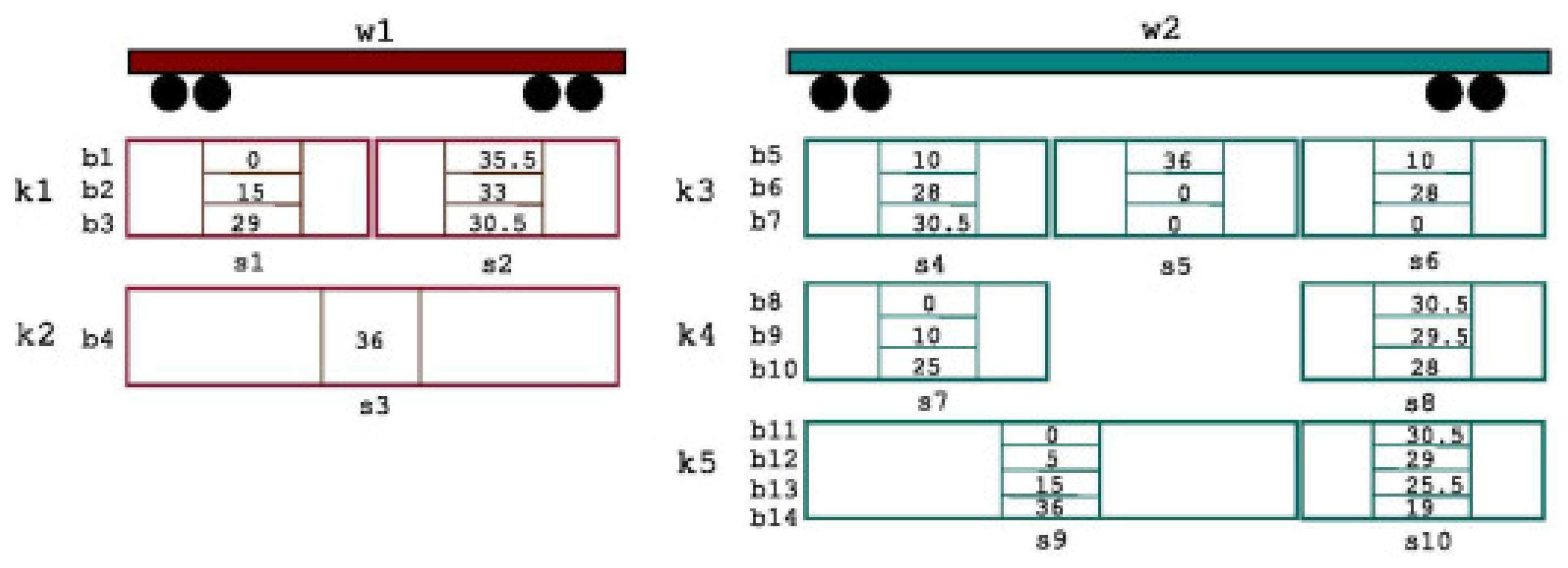
Figure 2.
Research model.
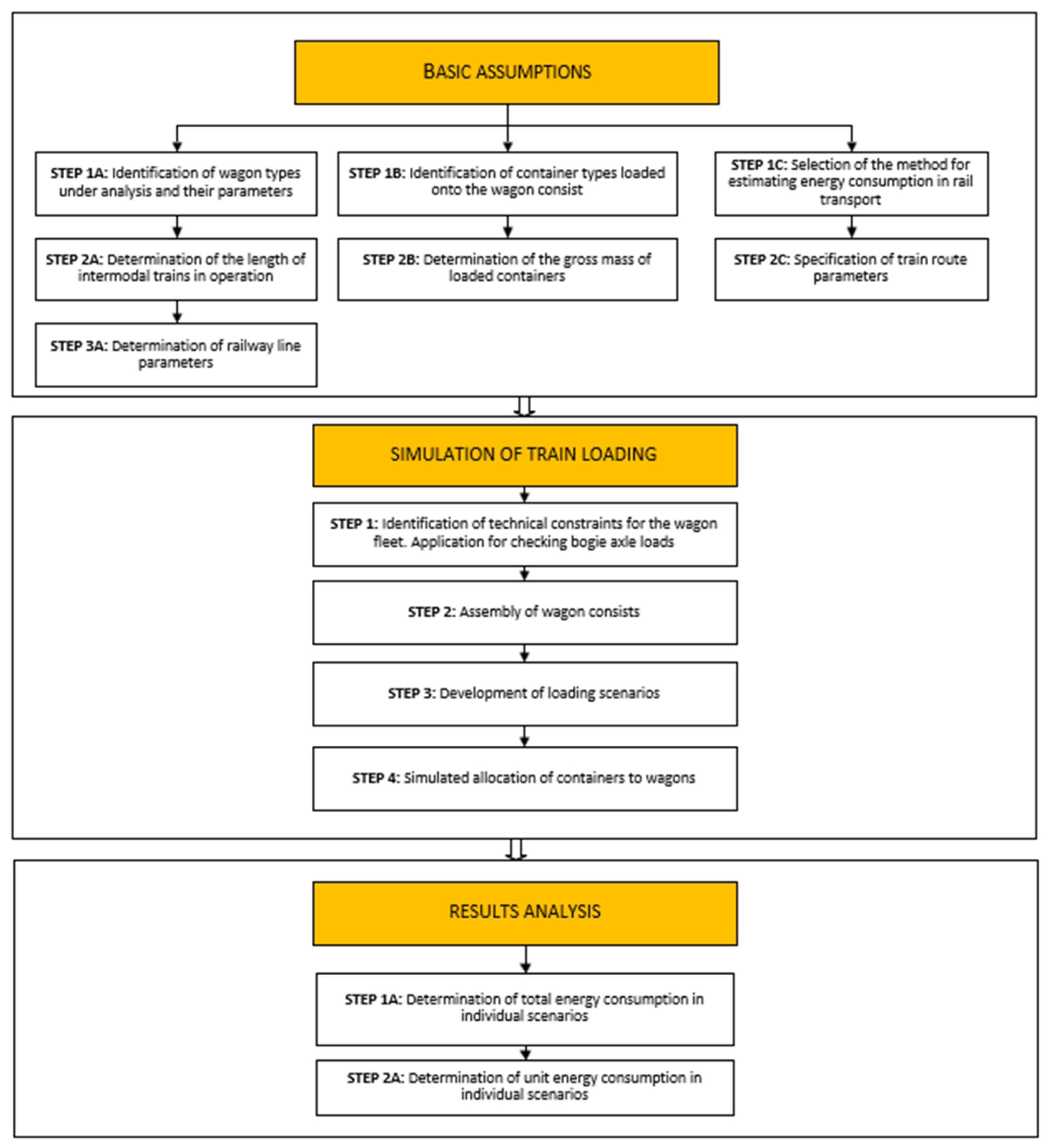
Figure 3.
Example of the reaction forces for 4-axle wagons (a), 6-axle wagons (b).
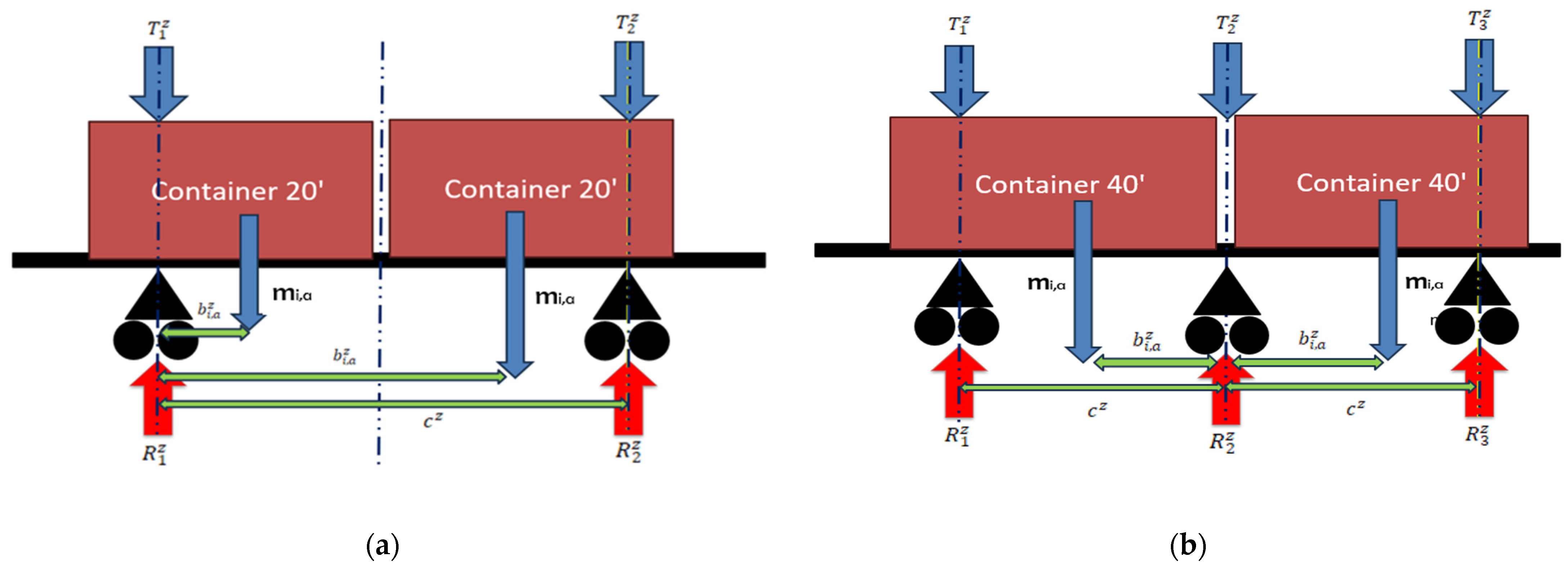
Figure 4.
Total and unit energy consumption.
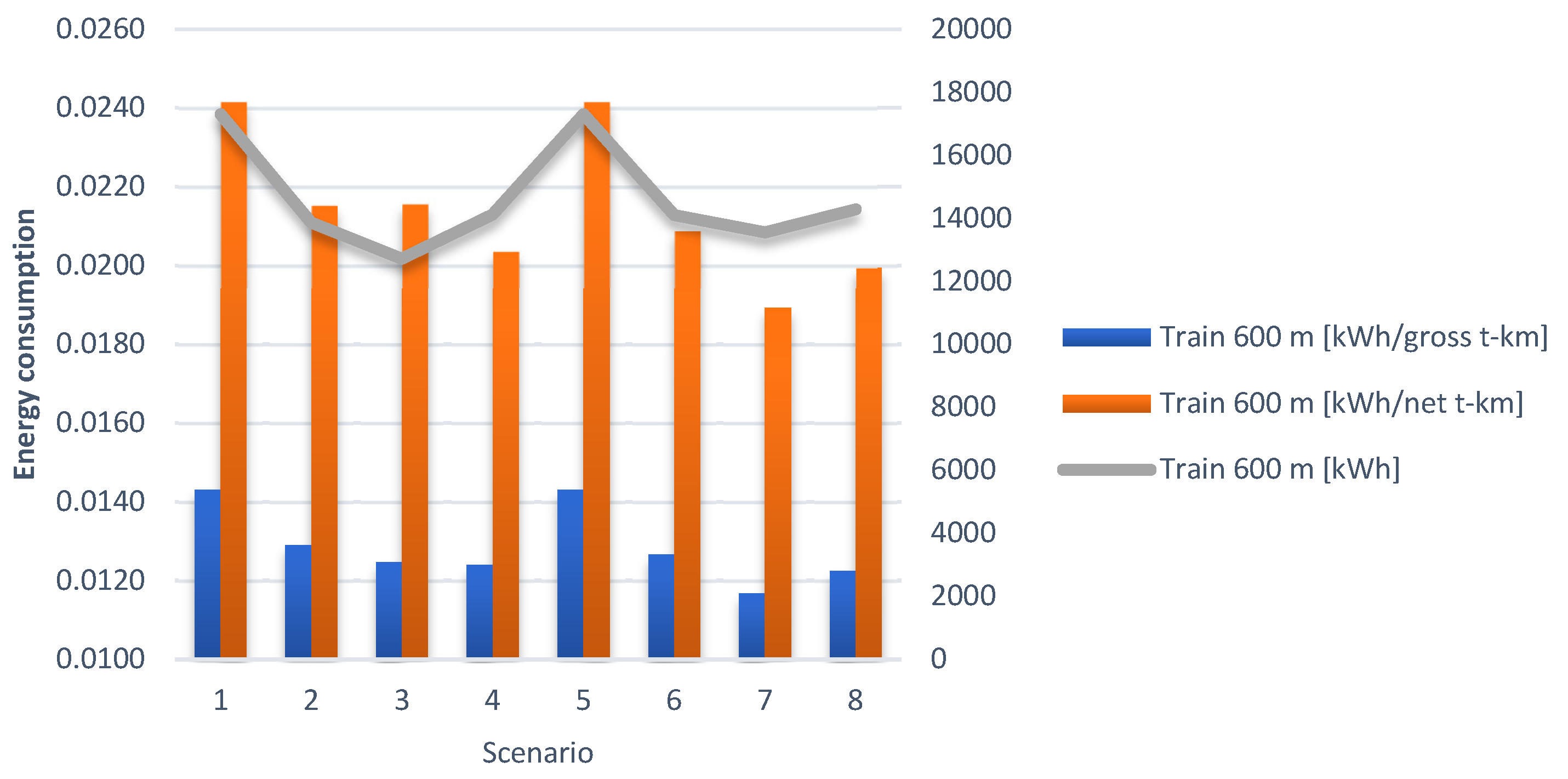
Figure 5.
(a) Utilisation analysis, (b) number of ITU loaded and gross mass of the train.
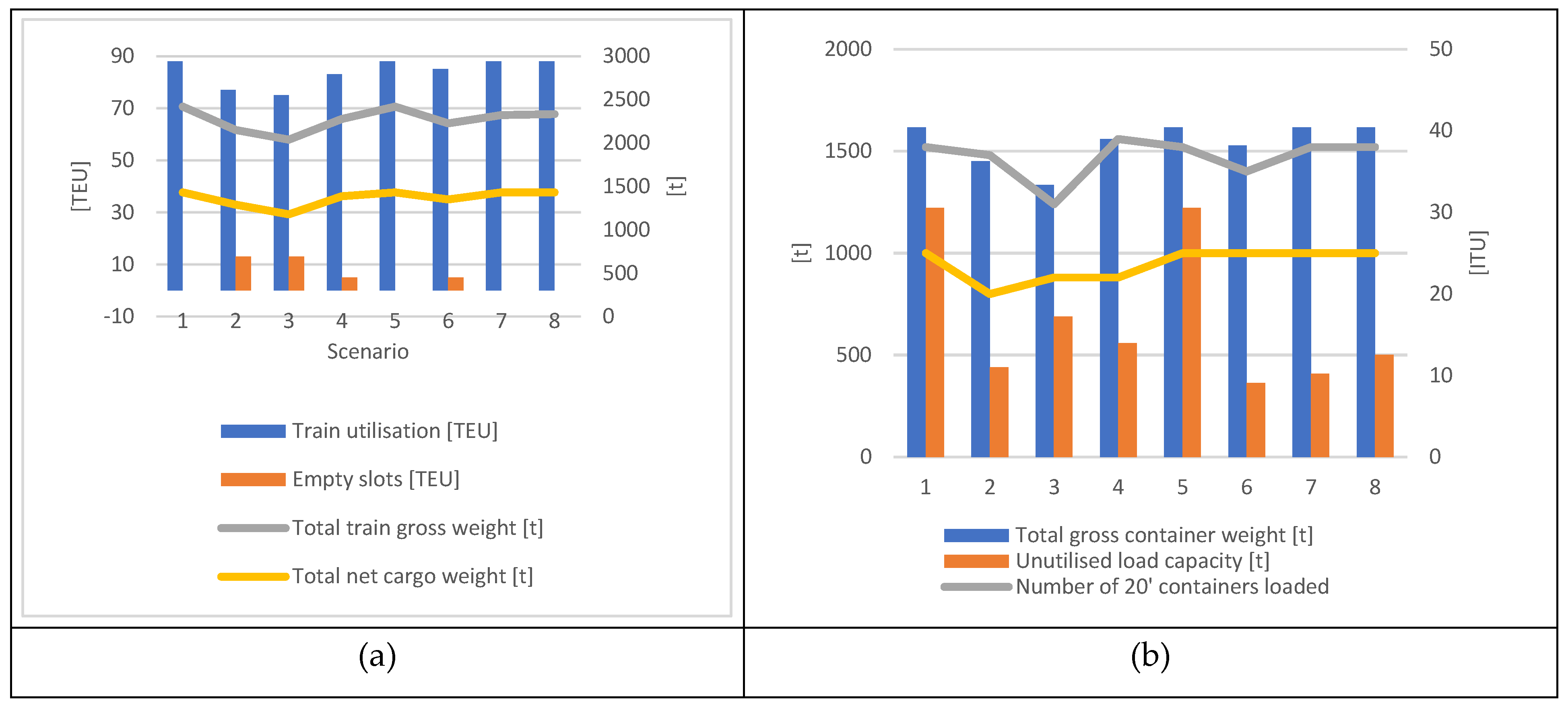
Figure 6.
(a) Total energy consumption comparison for 600 and 730 m long wagon consist (b) Unit energy consumption comparison for 600 and 730 m long wagon consist.
Figure 6.
(a) Total energy consumption comparison for 600 and 730 m long wagon consist (b) Unit energy consumption comparison for 600 and 730 m long wagon consist.
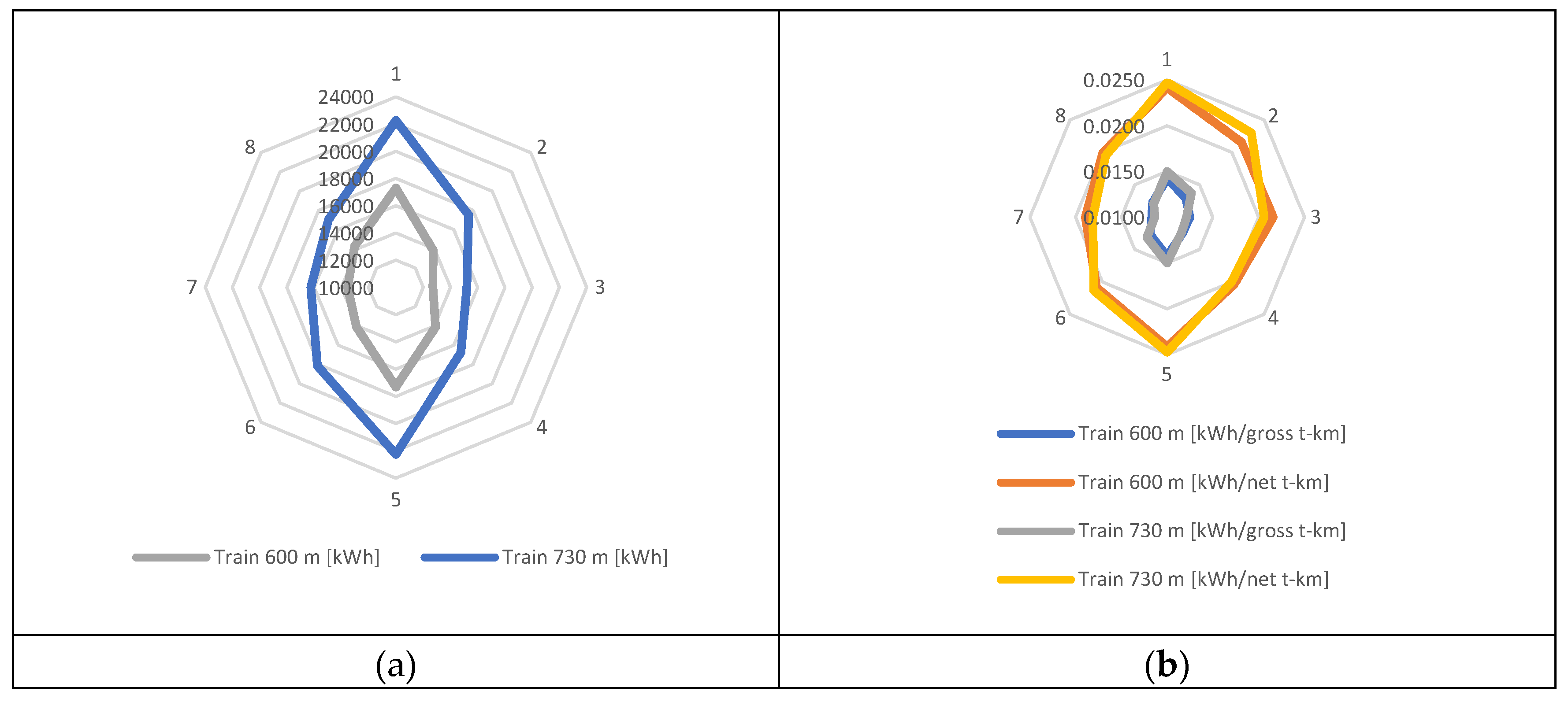
Figure 7.
(a) Total gross- and net- cargo weight for 600 and 730 m long wagon consist (b) Unit energy consumption comparison for 600 and 730 m long wagon consist.
Figure 7.
(a) Total gross- and net- cargo weight for 600 and 730 m long wagon consist (b) Unit energy consumption comparison for 600 and 730 m long wagon consist.
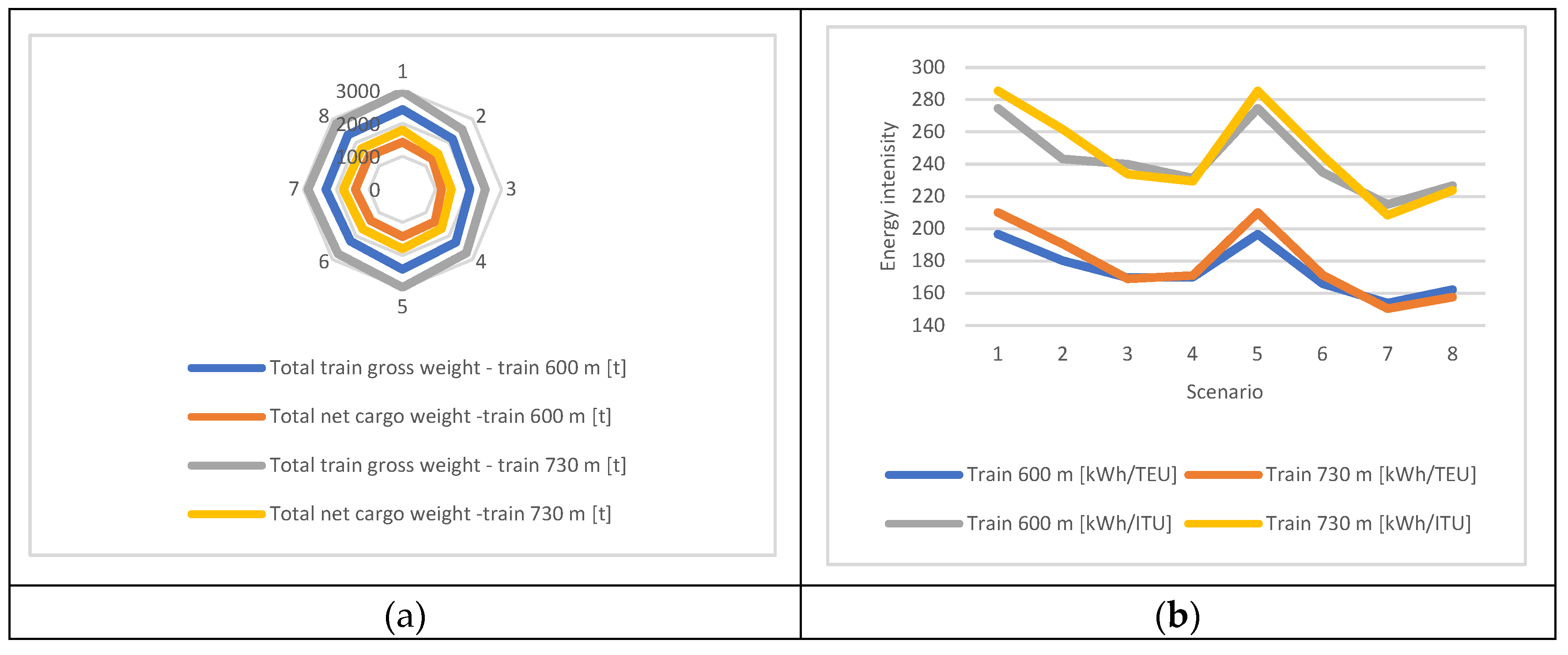
Table 1.
The designations used in the energy consumption measurement.
| Method | ||||
|---|---|---|---|---|
| MEET | ARTEMIS | ETW | Mesoscopic | |
| Parameters |
First approach: constants determined based on empirical observations average velocity traveled distance the maximal train payload ; Second approach: constants determined based on empirical observations number of stops maximal velocity of the route gravitation trip altitude difference (); traveled distance the maximal train payload . |
number of stops maximal velocity of the route gross train weight mass of locomotive ; average velocity gravitation trip altitude difference (); traveled distance air density locomotive front surface; number of stops per 100 km ; aerodynamic and rolling resistance factors of locomotives and wagons ; surface rolling resistance factors ; number of axles in wagons of the number of the wagons ( the efficiency of the locomotive | parameter related to the trip altitude difference , train gross mass , train space utilization rate ; wagon’s of the payload ; wagon’s of the max. payload ; empty traveled distance ; loaded traveled distance the efficiency of the locomotive |
number of stops maximal velocity of the route the maximal train payload mass of locomotive ; average velocity gravitation trip altitude difference (); traveled distance air density locomotive front surface; number of stops per 100 km ; aerodynamic and rolling resistance factors of locomotives and wagons ; surface rolling resistance factors ; number of axles in wagons of the number of the wagons the efficiency of the locomotive |
Table 2.
Wagon parameters.
| Type of wagon | |||
| Diagnostic variable | |||
| Tare weight of the wagon ) | 16 | 20 | 27,5 |
| Payload capacity ) | 64,5 | 63 | 92 |
| Loading capacity ) | 2 | 3 | 4 |
| Total length () | 13,63 | 19,64 | 27,1 |
Source: Based on [62].
Table 3.
Train and route parameters.
| Parameter | Unit | Value | ||
|---|---|---|---|---|
| Locomotive weight | t | 100 | ||
| Trip’s altitude difference | m | 150 | ||
| Locomotive efficiency | % | 90 | ||
| Air density | kg/m3 | 1225 | ||
| Locomotive front surface | m2 | 12,3 | ||
| Gravitation | m/s2 | 9,81 | ||
| Coefficients | - | 1.1/0.22/0.004/0.0006/0.0005/0.0006 | ||
| Power of auxiliary devices | kW | 100 | ||
| Distance | km | 500 | ||
| Number of stops per 100 km | - | 2 | ||
| Average velocity | km/h | 80 | ||
| Number of wagon axles | - | |||
| 4 | 4 | 6 | ||
Table 4.
Wagon parameters.
| Parameter | Value [m] |
|---|---|
| Axle spacing in the type wagon | 8.0/14.2/10.58 |
| Portion of the wagon’s tare weight (symmetric) ( | 8.0/10.0 |
| Portion of the wagon’s tare weight (asymmetric) ( | 8.8, 9.9 *,8.9* middle axle |
| Distance of the centre of gravity of the container of type from the support point of the z type wagon | |
| Configuration—wagon 40-foot: | Value [m] |
| 2 × 20-foot | 0.934/7.066 |
| 1 × 40-foot | 4.0 |
| Configuration—wagon 60-foot: | Value [m] |
| 3 × 20-foot | 0.976/7.1/13.224 |
| 1 × 40-foot + 1 × 20-foot | 0.985/10.166 |
| Configuration—wagon 80-foot: | Value [m] |
| 4 × 20-foot (wagon symmetry condition) | 3.535/9.635 |
| 2 × 20-foot + 1 × 40-foot (wagon symmetry condition) | 3.535/9.635/6.564 |
| 2 × 40-foot(wagon symmetry condition) | 6.564 |
Source: Based on [62].
Disclaimer/Publisher’s Note: The statements, opinions and data contained in all publications are solely those of the individual author(s) and contributor(s) and not of MDPI and/or the editor(s). MDPI and/or the editor(s) disclaim responsibility for any injury to people or property resulting from any ideas, methods, instructions or products referred to in the content. |
© 2026 by the authors. Licensee MDPI, Basel, Switzerland. This article is an open access article distributed under the terms and conditions of the Creative Commons Attribution (CC BY) license (http://creativecommons.org/licenses/by/4.0/).
Copyright: This open access article is published under a Creative Commons CC BY 4.0 license, which permit the free download, distribution, and reuse, provided that the author and preprint are cited in any reuse.


