

Submitted:
02 March 2026
Posted:
03 March 2026
You are already at the latest version
Abstract
Extended Reality (XR), which includes augmented, virtual, and mixed reality, is gaining prominence in the field of education as a valuable didactic tool. However, its effective implementation requires consideration of classroom diversity, particularly the presence of students with special educational needs (SEN), who may require tailored adaptations. This article presents a literature review of XR-based educational interventions targeting SEN learners, conducted through structured searches in major scientific databases and applying explicit inclusion and exclusion criteria to select and analyze the most relevant peer-reviewed studies. The review examines the pedagogical approaches, types of XR technologies employed, target populations, educational levels, and the skills or competencies addressed, as well as the reported effects on academic performance and learner motivation. The findings show that most interventions focus on the development of daily living, social, and professional skills, alongside domains such as language learning, natural sciences, and attention. Overall, the evidence suggests that well-designed XR experiences tend to improve both students' academic performance and their attitudes toward learning, highlighting XR's potential as an inclusive educational tool for learners with SEN. At the same time, these results underline that successful implementation depends on careful pedagogical planning, informed technological choices, and a deep understanding of students' individual profiles, needs, and interests to ensure truly effective and inclusive use of XR in special education.
Keywords:
extended reality (XR)
; augmented reality (AR)
; virtual reality (VR)
; special educational needs (SEN)
; inclusive education
; educational technology
1. Introduction
In the modern classroom environment, there has been an increasing prevalence of students with particular educational needs that teachers are required to address. In this context, technology set out as a supportive resource that enables more motivating, versatile and inclusive educational practices [1], facilitating access to information, the transmission of content and interaction between students and teachers. Furthermore, technological solutions have been shown to assist in adapting the teaching-learning process to the individual needs of students [2]. A significant body of research has been dedicated to investigating the benefits of Information and Communication Technologies (ICT) in the domain of special education. [3] posit that these tools favor the principle of individualization in the teaching of students with special educational needs (SEN), allowing the sequencing of contents and activities according to their abilities. Another benefit is that they help to reduce the frustration caused by making mistakes and, due to their flexibility, promote motivation for learning [4].
Moreover, using ICT as a teaching tool has facilitated the introduction of other technologies that can benefit the teaching-learning process. Specifically, the integration of Extended Reality (XR), defined as a collection of digital resources that facilitate the convergence of real-world experiences and virtual environments, is gaining prevalence [5]. XR encompasses Augmented Reality (AR), Virtual Reality (VR) and Mixed Reality (MR), the main difference between them being the degree of immersion of the user in the virtual world. [6] propose a classification system for XR, likening it to the rungs of a ladder. They designate AR as the initial step, representing the incorporation of virtual objects into real-world scenarios [7]. It is a versatile tool that adapts easily to different educational environments thanks to its special characteristics [8,9], which makes it suitable for multiple areas and educational contexts [10].
VR, on the other hand, is the final rung on the ladder, allowing the simulation of real-life scenarios in an entirely virtual world. Although it can be achieved through mobile devices, it is the head-mounted display (HMD) that produces the greatest immersion in this virtual world [11]. In recent years, this technology has undergone the most significant development in the field of education. The central step is constituted by MR, which combines the two previous ones because it introduces real elements into the virtual world and allows interaction with both [12,13]. Nevertheless, the expense of this technology makes its incorporation into educational settings difficult [5].
More and more schools are choosing to implement XR in their classrooms as a didactic resource that can be relied upon to perform the teaching-learning process in a new way [14]. This is confirmed by a recent [15] report, which refers to the rapid increase in the use of these tools in educational centers around the world to improve the quality and accessibility of education, responding to the need to adapt educational methodologies to the characteristics of today’s increasingly digitalized society [16].
Studies such as [17] point out that XR provides interactive learning spaces that can be easily combined with more traditional methodologies, leading students to improve their attitudes towards learning and encourage active participation in activities.
Within the domain of special education, XR facilitates novel experiences that can be employed in conjunction with traditional pedagogical methods. It offers opportunities to convey curricular contents and cultivate diverse skills, particularly for SEN students. These students often encounter challenges in learning in the real world, due to their ability to perceive specific stimuli, which can result in frustration, uneasiness, and anxiety. In this regard, XR provides a plethora of options to address these circumstances, facilitating the acquisition of independent living skills, the reduction of disruptive behaviors, and the visualization of real-life phenomena that students are otherwise unable to access independently, through the provision of visual, auditory, and tactile information [18]. This approach fosters the development of cognitive processing, psychomotor, and communicative skills, thereby enhancing academic performance [19,20,21].
Despite these advantages, XR may present certain disadvantages in terms of its integration into educational centers. A significant challenge is its economic cost, which is a barrier for many of them, especially those with low budgets [5]. However, the main obstacle for the integration of these tools is the challenge for teachers to learn how to use them [22,23,24]. This can be a significant impediment, as misuse can lead to distraction and deviation from the intended learning objectives [5].
In the field of special education, these challenges can be exacerbated due to the necessity of adapting to the diverse needs of students, which precludes the provision of experiences catering to all individuals. The design of complex activities can result in overstimulation, anxiety, and frustration, while their improper use can lead to dizziness and eyestrain [5].
To establish an appropriate, safe, and ethical use of XR, it is imperative to modify the educational paradigm. The primary challenge lies in researching its application in this domain and securing financial support from educational institutions to acquire these technologies and train teachers. This will ensure the selection of the most suitable type of XR and the design of experiences that align with educational objectives and student needs [25].
The objective of this study, conducted by a multidisciplinary team composed of specialists in computer vision and experts in heritage education, is to ascertain the nature of XR initiatives in special education and to examine the students targeted, the technology selected, and the efficacy of the results in enhancing student performance and motivation. Moreover, the study presents a comprehensive table that can serve as a foundational reference for further research, providing a clearer understanding of the topic based on data drawn from a detailed analysis of the existing literature.
2. Materials and Methods
2.1. Data Collection and Research Questions
To gather the data presented in this study, three literature searches were conducted using the Web of Science and Scopus databases. The results of these searches were then used to extract relevant variables and perform a qualitative analysis, as detailed in the following sections.
As previously stated, the aim of this study is to analyze the use of XR within the context of special education. This objective can also be articulated as an exploration of how XR is being applied to support students with SEN. To address this aim, the following research questions were formulated:
- Does the use of XR as a didactic resource enhance the academic performance and motivation of students with SEN in school settings?
- Within the field of special education, which groups of students have been most frequently targeted by XR-based interventions, and what types of technologies have been employed?
- What kinds of content or skills are these technologies intended to teach or develop?
- Is there a growing trend in research on the use of XR as an educational tool for students with SEN?
2.2. Search Strategies and Selection Criteria
A preliminary search was conducted on April 2, 2024, in the Scopus and Web of Science using the keywords: “special education”, “virtual reality”, “augmented reality”, “extended reality”, and “mixed reality”. The Boolean operators “AND” and “OR” were employed to refine the search, resulting in the following query: “special education” AND (“virtual reality” OR “augmented reality” OR “extended reality” OR “mixed reality”).
The initial search returned a total of 230 documents (116 in Web Of Science and 114 in Scopus).
A second search, using the same search terms, was conducted on October 30, 2024, resulting in 261 documents (130 from Scopus and 131 from Web of Science).
A third search was performed on November 7, 2024, incorporating the additional keyword “special needs” into the equation. The final search query was as follows: (“virtual reality” OR “augmented reality” OR “extended reality” OR “mixed reality”) AND (“special education” OR “special needs”).
This search yielded a total of 557 documents, with 310 found in Scopus and 247 in Web of Science. All searches were filtered by “Abstract” in both databases to ensure relevance.
The following exclusion criteria were applied during the selection process:
- Duplicate papers.
- Systematic reviews and meta-analyses.
- Books and book chapters.
- Conference proceedings.
- Doctoral theses.
- Articles focused exclusively on teacher training.
Conversely, the inclusion criteria were as follows:
- Peer-reviewed journal articles.
- Publications in any language.
- Open access availability.
After applying these criteria, the initial corpus was reduced to 233 documents. Following abstracts screening, a final sample of 59 articles was selected for in-depth analysis.
For the qualitative analysis, all 59 documents were read in full. Relevant data addressing the research questions were systematically coded. The analysis focused on the extraction of the following variables:
- Title, author(s), and year of publication
- Language of publication
- Implementation of the proposed XR activity (Yes/No)
- Type of XR employed (AR, VR, or MR)
- Nature of the technological tools used (Custom-developed vs. Commercial solutions)
- Type of SEN addressed
- Educational stage and type of institution
- Targeted skills or competencies
- Reported effect on academic performance and motivation (Improved, Unchanged, Decreased, Not reported)
Once extracted, the data were compiled and organized for all documents included in the study. These findings were then interpreted in relation to the research objectives, as discussed in the following sections.
3. Results
To begin this section, it is worth noting that the majority of the interventions described in the reviewed studies, 52 out of 59, were in fact implemented. In contrast, four interventions were not conducted, and three were still in progress at the time the articles were reviewed. Consequently, the variables pertaining to academic performance and student motivation could not be evaluated in these seven cases.
In light of this, and in response to the first research question, “Does the use of XR as a didactic resource improve the academic performance and motivation of students with SEN in school settings?”, the analysis reveals that a large proportion (81.36%) of the studies in which XR experiences were implemented reported positive effects on student performance.
However, some variations in outcomes were observed. For instance, the study by [26] implemented a MR intervention across three different schools. While two of the schools reported significant improvements in student performance, the third did not show any statistically significant changes. The authors suggest that this discrepancy may be due to the relatively short duration of the intervention in that particular school, indicating that a longer implementation period might be necessary to achieve more conclusive results.
When examining the influence of XR tools on student motivation, most of the reviewed studies (59.32%) reported an increase in learner motivation as a result of these interventions. However, a notable exception was observed in a study by [27], which reported an opposite effect. In this particular case, the authors reported no improvement in the motivation of students with special needs, attributing this finding to a lack of adaptation of the XR experience to the specific interest of the students.
In addition, 6.78% of the articles provided no information regarding changes in student performance, and 27.12% omitted any reference to motivation. Furthermore, 11.86% of the documents did not address either variable, as the corresponding XR interventions were either still underway or had not yet been implemented at the time of publication.
Taken together, the findings suggest that the use of XR as a didactic resource tends to improve both academic performance and motivation among students with SEN, with XR-based approaches generally demonstrating greater effectiveness than traditional methods.
Following the findings related to the first research question, the answer to the second question, “Which groups of students have been most frequently targeted by XR-based interventions and what types of XR have been used?”, required an initial step of categorizing and grouping the different student profiles addressed in the reviewed studies. The categories identified are as follows:
- Intellectual Disability (ID)
- Learning Difficulties (LD)
- Developmental Disability (DD)
- Motor Disability (MD)
- Sensory Disability (SD)
- Brain Injury (BI)
- Pediatric Patient (PP)
- Behavioral Disorder (BD)
- Attention-Deficit/Hyperactivity Disorder (ADHD)
- Autism Spectrum Disorder (ASD)
- Anxiety Disorder (AD)
Among these, the majority of XR-based interventions were designed for students with ASD, followed by those targeting individuals with ID. By contrast, pediatric patients were the group least frequently addressed in the reviewed experiences.
In terms of educational settings, most of the activities were conducted in mainstream schools, particularly those with special education classrooms, as well as in special education schools. These experiences primarily involved students in primary and secondary education (ages 6 to 16). By contrast, interventions in hospitals, universities, vocational training centers represented only 4.92% of all reviewed studies, Similarly, activities involving early childhood education students accounted for just 5.19% of the total.
Table 1 presents an analysis of the technologies used for each of the student groups identified above. As shown, AR emerges as the most employed technology (56.92%), followed by VR (40%). Experiences using MR are rare, representing only 3.08%, and only one study refers to XR in general terms, without specifying the exact type of technology used.
These results further reveal that AR is most frequently used in interventions targeting students with ASD or ID, whereas VR is the sole technology employed in activities designed for students with behavioral or anxiety disorders.
In addition, the vast majority of studies (72.88%) report on the use of custom-built applications, specifically developed for the purposes of each individual research project.
Turning to the third research question, “What kinds of content or skills are these technologies intended to teach or develop?”, the analysis of the different documents reveals a variety of subjects on which the experiences have been designed. It is noteworthy that the most prevalent experiences pertain to skills essential for daily living, such as life skills, social skills, and professional skills. In addition to these competencies, efforts have been made to cultivate language skills, natural sciences, and attention and concentration, which, although less frequent, were still represented across several studies. A detailed overview of the types of content and skills targeted by each experience is provided in Table 2.
Examples of activities related to life, social, and professional skills include learning to cross the street, conducting job interviews, using an ATM, serving in restaurants, symbolic play, money education, parts of the house, seasons of the year, board games, and social interaction.
Regarding language skills, activities have been developed that focus on reading, writing, and vocabulary, both in the individuals’ mother tongue and in other languages, as well as sign language, specifically Brazilian Sign Language [28]. Conversely, the domain of natural sciences included knowledge of domestic, wild, and marine animals, endangered animals, climate change, and space, among others.
To a lesser extent, experiences were developed in the areas of mathematical calculation, geometry, music, stress reduction, anxiety and aggressiveness management, and motor skills or physical education.
Finally, in response to the last question, “Is there a growing trend in research on the use of XR as an educational resource for students with SEN?”, Figure 1 shows that publications related to the topic addressed in this paper began in 2009, focusing on AR. Thereafter, there was a decline in publications concerning this technology, accompanied by an increase in publications focusing on VR.
The publication trend exhibited variability over the observed period, with AR reaching its highest peak in 2023, followed by VR in 2019, which then remained constant for the following two years.
This observation suggests a discernible trend in research focusing on the utilization of XR in special education, as evidenced by the increasing number of publications on this subject, as depicted in Figure 1. Notably, within the past seven years, AR has emerged as the most extensively researched area, signifying a notable shift in research focus.
It is important to note that the year 2024 cannot be evaluated at the same level as subsequent years, as the analysis was conducted using documents published up to November of the same year.
Noteworthy is the growing significance of the subject matter within South Korea, as evidenced by the predominance of the Korean language in these documents, second only to English.
To conclude this analysis, Table 2 presents a synthesis of the data extracted from each of the articles reviewed, all of which are listed in the Appendix. The table includes the reference for each study, the type of SEN addressed, the specific type of XR technology employed, the targeted skills, and whether the study reports improvements in academic performance and/or motivation. Improvements are indicated with a ✓, declines with a ✗, and “NR” denotes information not reported. This table offers a comprehensive overview of the variables defined in the study and serves as a resource for further exploration by researchers interested in this field.
4. Discussion
This study highlights the effectiveness of XR tools in improving academic performance and motivation among students with special educational needs (SEN). While the majority of studies reviewed support this conclusion, some present divergent findings. In those cases, the authors attribute the lack of positive outcomes to XR experiences that were not well-designed or insufficiently adapted to the specific interests of the student population, thereby limiting their educational impact [27]. Notably, several articles emphasize the positive influence of XR on learners’ self-efficacy, particularly in VR and AR environments, suggesting that these technologies may enhance learning more effectively than traditional pedagogical methods. However, [29] report that combining VR with conventional teaching strategies produced better results than using VR in isolation.
The most frequently studied populations were students with ASD and intellectual disabilities. This may be attributed to the significant challenges these groups face in abstract thinking and social interaction, skills that XR can help develop by simulating realistic, immersive environments [18]. Additionally, the increased prevalence of autism in Europe, with current estimates indicating a rate of 1 in 100 [30], has likely prompted a corresponding rise in research focused on this population. According to the World Health Organization, approximately 0.76% of children worldwide are affected by autism [31]. Furthermore, as noted by [32], changes in diagnostic criteria, along with increased awareness and societal understanding of Autism Spectrum Disorder (ASD), have played a significant role in the growing number of reported cases.
In contrast, limited research has examined the use of XR in early childhood education. This may be due to ongoing debate regarding its appropriateness and effectiveness at such developmental stages. Some authors argue that XR activities are too complex for younger learners and should instead be aligned more closely with their immediate interests and developmental needs [33]. Others, however, advocate for the use of AR at this level, citing its potential to facilitate meaningful learning experiences [34].
Among the XR technologies analyzed, AR emerged as the most widely used, likely due to its accessibility and ease of integration into educational settings. [8] supports this perspective, highlighting AR’s unique characteristics that support its pedagogical implementation. Cost and technical complexity are key barriers to the broader adoption of VR, as noted by [35], who argue that immersive VR experiences require expensive equipment and present usability challenges. Furthermore, the use of VR with students with SEN remains contentious: while [36] report instances of dizziness and discomfort associated with VR goggles, necessitating hybrid approaches, [37] observed a high level of competence and engagement among participants.
In terms of content focus, XR interventions have primarily targeted practical domains such as daily living skills, social, and professional competencies. Nonetheless, other areas, including language acquisition, natural sciences, and attention and concentration, have also received attention, reflecting the versatility of XR in addressing diverse educational needs.
5. Conclusions
XR is gaining increasing relevance in the educational domain and, when implemented appropriately, holds the potential to enhance the acquisition of knowledge among students with SEN.
This study has presented a qualitative analysis of the academic literature published in this field since 2009, leading to the conclusion that the use of XR technologies with SEN students generally supports their learning processes and fosters more positive attitudes towards education. However, the effectiveness of these interventions depends significantly on the careful planning of activities and the active involvement of educators.
For such initiatives to succeed, it is essential that teachers receive adequate training in the use of XR tools. Educators must be aware of the wide range of didactic possibilities these technologies offer, the various types of XR available, and the specific student populations to which they may be most effectively applied. In addition, attention must be paid to the interests and capabilities of participating students, ensuring that the selected XR modality aligns with the learning goals, the skills to be developed, and the characteristics of the target group.
Future research should explore teachers’ perceptions and practices regarding XR, identifying both effective and ineffective uses, as inappropriate implementation can undermine its value as an innovative and motivating educational resource. Furthermore, studies should address the pedagogical design, accessibility, and adaptability of XR tools for SEN students, as well as the selection of appropriate applications. Such efforts are crucial for advancing the meaningful integration of XR technologies in the field of Special Education.
Author Contributions
Conceptualization, M.J.M.; methodology, A.D. and E.L.; software, A.D. and E.L.; validation, M.J.M. and P.M.; formal analysis, M.J.M., A.D. and E.L.; investigation, A.D. and E.L.; data curation, A.D. and E.L.; writing—original draft preparation, M.J.M., A.D. and E.L.; writing—review and editing, M.J.M. and P.M.; supervision, M.J.M. and P.M.; project administration, P.M.; funding acquisition, P.M. All authors have read and agreed to the published version of the manuscript. All authors have read and agreed to the published version of the manuscript.”.
Funding
This research was funded by Junta de Extremadura through the grant “Ayudas para la contratación de personal investigador predoctoral en formación en el Sistema Extremeño de Ciencia, Tecnología e Innovación”.
Acknowledgments
This research has been conducted within the framework of the “PhD in Innovation in Teacher Training. Consulting in the Analysis of Educational Practice and ICT in Education” at the University of Extremadura.
Conflicts of Interest
The authors declare no conflicts of interest.
Abbreviations
The following abbreviations are used in this manuscript:
| XR | Extended Reality |
| VR | Virtual Reality |
| AR | Augmented Reality |
| MR | Mixed Reality |
| SEN | Special Educational Needs |
| ID | Intellectual Disability |
| LD | Learning Difficulties |
| DD | Developmental Disability |
| MD | Motor Disability |
| SD | Sensory Disability |
| BI | Brain Injury |
| PP | Pediatric Patient |
| BD | Behavioral Disorder |
| ADHD | Attention-Deficit/Hyperactivity Disorder |
| ASD | Autism Spectrum Disorder |
| AD | Anxiety Disorder |
| NR | Not Reported |
Appendix A
Appendix A.1. Documents Analyzed.
Abdullah, A. S.; Karthikeyan, J.; Gomathi, V.; Parkavi, R.; Rajarajeswari, P. Enabling Technology Integrated Learning for Autistic Children Using Augmented Reality Based Cognitive Rehabilitation. SN Computer Science 2024, 5(151), pp. 1-11. http://dx.doi.org/10.1007/s42979-023-02495-5
Afrianto, I.; Faris, A. F.; Atin, S. Hijaiyah Letter Interactive Learning for Mild Mental Retardation Children using Gillingham Method and Augmented Reality. International Journal of Advanced Computer Science and Applications 2019, 10(6), pp.334-341. http://dx.doi.org/10.14569/IJACSA.2019.0100643
Alahmari, M.; Jdaitawi, M.; Alzahrani, M.; Kholif, M.; Ghanem, R.; Nasr, N. Promoting Self-efficacy for Students with Special Needs through Augmented Reality. International Journal of Information and Education Technology 2023, 13(7), pp. 1021-1026. https://goo.su/GDaHGr
Alqarni, T. Comparison of Augmented Reality and Conventional Teaching on Special Needs Students’ Attitudes Towards Science and Their Learning Outcomes. Journal of Baltic Science Education 2021, 20(4), pp. 558-572. https://dx.doi.org/10.33225/jbse/21.20.558
Arvanitis, T. N.; Petrou, A.; Knight, J. F.; Savas, S.; Sotiriou, S.; Gargalakos, M.; Gialouri, E. Human factors and qualitative pedagogical evaluation of a mobile augmented reality system for science education used by learners with physical disabilities. Personal and Ubiquitous Computing 2009, 13, pp. 243–250. https://doi.org/10.1007/s00779-007-0187-7
Bossenbroek, R.; Wols, A.; Weerdmeester, J.; Lichtwarck-Aschoff, A.; Granic, I.; van Rooij, M. M. Efficacy of a virtual reality biofeedback game (DEEP) to reduce anxiety and disruptive classroom behavior: single-case study. JMIR mental health 2020, 7(3), p. e16066. https://doi.org/10.2196/16066
Bratu, M.; Muntean, C. H.; Buică-Belciu, C.; Stan, S.; Muntean, G. M. Impact of NEWTON Technology-Enhanced Learning Solutions on Knowledge Acquisition in Pilots Involving Students With Hearing Impairments. IEEE Transactions on Education 2024, 67(39), pp. 472-482. https://doi.org/10.1109/TE.2024.3378103
Cakir, R.; Korkmaz, O. The effectiveness of augmented reality environments on individuals with special education needs. Education and Information Technologies 2019, 24, pp. 1631–1659. https://link.springer.com/article/10.1007/s10639-018-9848-6
Carvalho, D.; Manzini, E. J. Aplicação de um Programa de Ensino de Palavras em Libras Utilizando Tecnologia de Realidade Aumentada. Revista Brasileira de Educação Especial 2017, 23(2), pp. 215-232. http://dx.doi.org/10.1590/s1413-65382317000200005
Chae, C. H.; Kim, D. I. Effects of Using Video-Based Intervention via Augment Reality Program on Arithmetic Operation Skills and Attitude in Mathematics for middle school students with Intellectual Disabilities. 지적장애연구 2022, 24(1), pp. 187-216. https://s-space.snu.ac.kr/handle/10371/183263
Choi, J. H. Design of Realistic Digital Micromirror System for Special Education. The Journal of Korea Institute of Information, Electronics, and Communication Technology 2015, 8(2), pp. 163-168. https://doi.org/10.17661/jkiiect.2015.8.2.163
Choi, J. I.; Kim, K. R.; Kim, T. Y. A situational training system based on augmented reality for developmentally disabled people. Journal of Korea Multimedia Society 2013, 16(5), pp. 629-636. https://doi.org/10.9717/kmms.2013.16.5.629
Cox, S. K.; Root, J. R.; McConomy, A.; Davis, K. “For Whom” and “Under What Conditions” Is MSBI Effective? A Conceptual Replication With High School Students With Autism. Exceptional Children 2024, 90(4), pp. 361-381. https://doi.org/10.1177/00144029241259013
Da Silva, L.; Romanovitch, D. I. Evaluation of gross motor function before and after virtual reality application. Fisioterapia em Movimento 2016, 29(1), pp. 131-136. https://doi.org/10.1590/0103-5150.029.001.AO14
Degli Innocenti, E.; Geronazzo, M.; Vescovi, D.; Nordahl, R.; Serafin, S.; Ludovico, L. A.; Avanzini, F. Mobile virtual reality for musical genre learning in primary education. Computers & Education 2019, 139, pp. 102-117. https://doi.org/10.1016/j.compedu.2019.04.010
De Oliveira Malaquias, F. F.; Malaquias, R. F.; Lamounier, E. A.; Cardoso, A. VirtualMat: A serious game to teach logical-mathematical concepts for students with intellectual disability. Technology and Disability 2013, 25(2), pp. 107-116. https://doi.org/10.3233/TAD-130375
De Vasconcelos, D. F.; Júnior, E. A.; de Oliveira Malaquias, F. F.; Oliveira, L. A.; Cardoso, A. A Virtual Reality Based Serious Game to Aid in the Literacy of Students with Intellectual Disability: Design Principles and Evaluation. Technology and Disability 2020, 32(3), pp. 149-157. http://dx.doi.org/10.3233/TAD-200272
Ha, J. Y.; Park, J. W. Virtual Reality Serious Games for Vocational Training in Individuals with Developmental Disabilities: Focus on Road to Wheel Master. 디지털콘텐츠학회논문지 (J. DCS) 2024, 25(6), pp. 1453-1463. http://doi.org/10.9728/dcs.2024.25.6.1453
Hu, X.; Han, Z. R. Effects of gesture-based match-to-sample instruction via virtual reality technology for Chinese students with autism spectrum disorders. International Journal of Developmental Disabilities 2019, 65(5), pp. 327–336. https://doi.org/10.1080/20473869.2019.1602350
Hyun, E. R; Im, H. B.; Yoo, M. Y. Development of Mobile Application Using AR Technology for Money Education for Learners with Intellectual Disabilities-Focusing on Priority Given to the High School ‘Mathematics’ Subject of the 2015 Basic. Journal of The Korea Society Design Culture 2020, 26(1), pp. 547-558. https://elibrary.ru/item.asp?id=76906573
Iatraki, G.; Mikropoulos, T. A. Augmented Reality in Physics Education: Students with Intellectual Disabilities Inquire the Structure of Matter. PRESENCE: Virtual and Augmented Reality 2022, 31, pp. 89-106. https://doi.org/10.1162/pres_a_00374
Kan’an, A.; Jdaitawi, M.; Toson, A.; Ghanem, R. The effectiveness of augmented reality technology in enhancing students learning experiences in science course. International Journal of Learning and Change 2023, 15(6), pp. 553-566. http://dx.doi.org/10.1504/IJLC.2023.134542
Kanellos, T.; Doulgerakis, A.; Georgiou, E.; Bessa, M.; Thomopoulos, S. C.; Vatakis, A.; Behan, A.; Arambarri, J.; Navarra, J. FocusLocus: ADHD management gaming system for educational achievement and social inclusion. In Smart Biomedical and Physiological Sensor Technology XV, Orlando, United States, 14 May 2018. http://dx.doi.org/10.1117/12.2307087
Kang, Y. S.; Chang, Y. J. Using an augmented reality game to teach three junior high school students with intellectual disabilities to improve ATM use. 2020. Journal of Applied Research in Intellectual Disabilities, 33(3), pp. 409-419. https://doi.org/10.1111/jar.12683
Ke, F.; Im, T. Virtual-reality-based social interaction training for children with high-functioning autism. The Journal of Educational Research 2013, 106(6), pp. 441-461. https://psycnet.apa.org/doi/10.1080/00220671.2013.832999
Khoirunnisa, A. N.; Munir; Dewi, L. Design and Prototype Development of Augmented Reality in Reading Learning for Autism. Computers 2023, 12(3), p. 55. https://doi.org/10.3390/computers12030055
Kim, B. A Pilot Study for the Application of Gamification to Special Education: Focusing on a student at risk of brain injuries. 2020. Journal of Behavior Analysis and Support, 7(1), pp. 79-96. https://doi.org/10.22874/kaba.2020.7.1.79
Kim, J. S.; Lee, T. S. Designing and exploring the possibility science contents based on augmented reality for students with intellectual disability. The Journal of the Korea Contents Association 2016, 16(1), pp. 720-733. https://doi.org/10.5392/JKCA.2016.16.01.720
Kim, M.; Han, K. Effectiveness of 360-degree virtual reality video as community simulation learning for students with severe and multiple disabilities. 지체.중복.건강장애연구 2019, 62(4), pp. 231-256. http://doi.org/10.20971/kcpmd.2019.62.4.231
Kim, Y. I.; Kwon, S. B.; Kwon, S. W.; Kim, H. J. The Effects of Augmented Reality-Based Language Intervention on Attention Concentration and Brain waves Changes in Children with Intellectual Disabilities.특수교육재활과학연구 2020, 59(4), pp. 227-254. http://doi.org/10.23944/Jsers.2020.12.59.4.10
Klein, R. E.; Popma, A.; Lindauer, R. J.; van Dam, L. The Effects of a Virtual Reality–Based Training Program for Adolescents With Disruptive Behavior Problems on Cognitive Distortions and Treatment Motivation: Protocol for a Multiple Baseline Single-Case Experimental Design. JMIR research protocols 2022, 11(5), p. e33555. https://doi.org/10.2196/33555
Lee, T. S.; Kim, Y. P. Developing and exploring the possibility of virtual reality based communication training program for students with intellectual disabilities. The Journal of the Korea Contents Association 2017, 17(11), pp. 342-353. https://doi.org/10.5392/JKCA.2017.17.11.342
Lin, C. Y.; Chai, H. C.; Wang, J. Y.; Chen, C. J.; Liu, Y. H.; Chen, C. W.; Lin, C. W.; Huang, Y. M. Augmented reality in educational activities for children with disabilities. Displays 2016, 42, pp. 51-54. https://doi.org/10.1016/j.displa.2015.02.004
López-Bouzas, N.; del Moral-Pérez, M. E.; Castañeda-Fernández, J. Communicative competence in students with ASD: Interaction and immersion in a Gamified Augmented Environment. Education and Information Technologies 2023, 29, pp. 13175-13199. https://doi.org/10.1007/s10639-023-12319-x
Newbutt, N.; Bradley, R. Using immersive virtual reality with autistic pupils: Moving towards greater inclusion and co-participation through ethical practices. Journal of Enabling Technologies 2022, 16(2), pp. 124-140. http://dx.doi.org/10.1108/JET-01-2022-0010
Nuguri, S. S.; Calyam, P.; Oruche, R.; Gulhane, A.; Valluripally, S.; Stichter, J.; He, Z. vSocial: a cloud-based system for social virtual reality learning environment applications in special education. Multimedia Tools and Applications 2021, 80, pp. 16827-16856. https://link.springer.com/article/10.1007/s11042-020-09051-w
Rapti, D., Gerogiannis; D.; Soulis, S. G. The effectiveness of augmented reality for English vocabulary instruction of Greek students with intellectual disability. European Journal of Special Needs Education 2023, 38(2), pp. 185–202. http://dx.doi.org/10.1080/08856257.2022.2045816
Ravindran, V.; Osgood, M.; Sazawal, V.; Solorzano, R.; Turnacioglu, S. Virtual Reality Support for Joint Attention Using the Floreo Joint Attention Module: Usability and Feasibility Pilot Study. JMIR Pediatrics and Parenting 2019, 2(2), p. e14429. https://doi.org/10.2196/14429
Restrepo, G.; Prakash, E. C.; Dshti, S. E.; Castillo, A. D.; Gómez, J.; Oviedo, L.; Floyd, J.; Aycardi, J.; Trejos, J.; González, J. Extended Realities for Sensorially Diverse Children. IEEE Computer Graphics and Applications 2024, 44(4), pp. 26-39. https://doi.org/10.1109/MCG.2024.3419699
Savitha, K. K.; Renumol, V. G. Effects of Integrating Augmented Reality in Early Childhood Special Education. International Journal of Recent Technology and Engineering (IJRTE) 2019, 8(3), pp. 7864-7867. http://dx.doi.org/10.35940/ijrte.C6552.098319
Smith, M. J.; Sherwood, K.; Ross, B.; Smith, J. D.; DaWalt, L.; Bishop, L.; Humm, L.; Elkins, J.; Steacy, C. Virtual interview training for autistic transition age youth: A randomized controlled feasibility and effectiveness trial. Autism 2021, 25(6), pp. 1536-1552. https://doi.org/10.1177/1362361321989928
Smith, M. J.; Smith, J. D.; Jordan, N.; Sherwood, K.; McRobert, E.; Ross, B.; Oulvey, E. A.; Atkins, M. S. Virtual Reality Job Interview Training in Transition Services: Results of a Single-Arm, Noncontrolled Effectiveness-Implementation Hybrid Trial. Journal of Special Education Technology 2021, 36(1), pp. 3-17. https://doi.org/10.1177/0162643420960093
Syahputra, M. F; Sari, P. P.; Arisandi, D.; Abdullah, D.; Napitupulu, D.; Setiawan, M. I.; Albra, W.; Asnawi; Andayani, U. Implementation of augmented reality to train focus on children with special needs. Journal of Physics: Conference Series 2018, 978. https://doi.org/10.1088/1742-6596/978/1/012109
Takahashi, I.; Oki, M.; Bourreau, B.; Kitahara, I.; Suzuki, K. An Empathic Design Approach to an Augmented Gymnasium in a Special Needs School Setting. International Journal of Design 2018, 12(3). https://baptistebourreau.net/fr/publication/international_journal_of_design_2018/International_Journal_of_Design_2018.pdf
Tan, Q. P.; Huang, L.; Xu, D.; Cen, Y.; Cao, Q. Serious Game for VR Road Crossing in Special Needs Education. Electronics 2022, 11(16). https://doi.org/10.3390/electronics11162568
Tan, S. Z. K.; Shendyapina, M.; Tay, L. N. S. Evaluating the Use of Immersive Interactive Mixed Reality (I2MR) Technology in Special Needs Education in Singapore. Technology, Knowledge and Learn 2024, 29, pp. 781–802. https://doi.org/10.1007/s10758-023-09648-8
Thevin, L.; Rodier, N.; Oriola, B.; Hachet, M.; Jouffrais, C.; Brock, M. A. Inclusive Adaptation of Existing Board Games for Gamers with and without Visual Impairments using a Spatial Augmented Reality Framework for Touch Detection and Audio Feedback. Proc. ACM Hum.-Comput. Interact. 2021, 5(505), pp. 1-33. https://doi.org/10.1145/3488550
Vanneste, P.; Dekeyser, K.; Pinos, L. A.; Debeer, D.; Cornillie, F.; Depaepe, F.; Raes, A.; Van den Noortgate, W.; Said-Metwaly, S. Towards tailored cognitive support in augmented reality assembly work instructions. Journal of Computer Assisted Learning 2023, 40(2), pp. 797–811. https://doi.org/10.1111/jcal.12916
Vaquero-Blasco, M. A.; Perez-Valero, E.; Lopez-Gordo, M. A.; Morillas, C. Virtual Reality as a Portable Alternative to Chromotherapy Rooms for Stress Relief: A Preliminary Study. Sensors 2020, 20(21), p. 6211. https://doi.org/10.3390/s20216211
Vera, L.; Herrera, G.; Fernandez, M. Virtual reality as a tool to improve the quality of life of people with autism and learning difficulties. Virtual Reality 2012, pp. 163-183. https://goo.su/196B6fz
Verhoef, R. E.; Verhulp, E. E.; van Dijk, A.; de Castro, B. O. Interactive virtual reality versus vignette-based assessment of children’s aggressive social information processing. Research on child and adolescent psychopathology 2021, 50(5), pp. 621-636. https://doi.org/10.1007/s10802-021-00879-w
Vidal-Balea, A.; Blanco-Novoa, Ó.; Fraga-Lamas, P.; Fernández-Caramés, T. M. Developing the Next Generation of Augmented Reality Games for Pediatric Healthcare: An Open-Source Collaborative Framework Based on ARCore for Implementing Teaching, Training and Monitoring Applications. Sensors 2021, 21(5), p. 1865. https://doi.org/10.3390/s21051865
Widyaningsih, H.; Julianti, E.; Setiawan, I.; Asmawi, M.; Nuraini, S.; Yusmawati; Wiratama, R. F. Physical Education Learning Design with Augmented Reality for Special Needs Students. International Journal of Human Movement and Sports Sciences 2023, 11(5), pp. 1070-1078. https://doi.org/10.13189/saj.2023.110515
Wong, K.-T.; Hanafi, H. F.; Abdullah, N.; Noh, N. M.; Hamzah, M. A Prototype of Augmented Reality Animation (ARA) E-Courseware: An Assistive Technology To Assist Autism Spectrum Disorders (Asd) Students Master In Basic Living Skills. International Journal of Innovative Technology and Exploring Engineering 2019, 9(1), pp. 3487-3492. https://doi.org/10.35940/ijitee.a4962.119119
Wong, K.-T.; Hosshan, H.; Hanafi, H. F.; Alif Mudiono. Augmented Reality (AR): An Assistive Technology for Special Education Needs. Journal of Advanced Research in Applied Sciences and Engineering Technology 2023, 35(1), pp. 97–105. https://doi.org/10.37934/araset.34.3.97105
Wu, C. L.; Tsai, Y. H. Effects of Video Prompting with Augmented Reality on Functional Living Skills of Students with Intellectual and Developmental Disabilities. Journal of Special Education Technology 2024, 39(1), pp. 3-14. http://dx.doi.org/10.1177/01626434231170594
Wu, W.; Le May, S.; Hung, N.; Fortin, O.; Genest, C.; Francoeur, M.; Guingo, E.; St-Arneault, K.; Sylfra, A.; Vu, A. K.; Carmel, J.; Lessard, L.; Cara-Slavich, S.; De Koven, K.; Paquette, J.; Hoffman, H.; Asselin, M. E. Effects of a Virtual Reality Game on Children’s Anxiety During Dental Procedures (VR-TOOTH): Protocol for a Pilot Randomized Controlled Trial. JMIR Research Protocols 2023, 12. https://doi.org/10.2196/49956
Yue, L.; Pengcheng, A.; Xiao, Y.; Zhang, Z.; Zhang, H.; Katsuragawa, K.; Zhao, J. Eggly: Designing Mobile Augmented Reality Neurofeedback Training Games for Children with Autism Spectrum Disorder. Proc. ACM Interact. Mob. Wearable Ubiquitous Technol. 2023, 7(2), pp. 1-29. https://doi.org/10.1145/3596251
Zhai, X.; Rajaram, A.; Ramesh, K. Cognitive model for human behavior analysis. Journal of Interconnection Networks 2021, 22(Supp04), p. 2146013. https://doi.org/10.1142/
References
- Santamaría, R. M.; Núñez, B. F.; Sánchez, P. L. La realidad aumentada como recurso didáctico para el alumnado con necesidades educativas especiales. In Innovación Docente e Investigación en Ciencias de la Educación; Pérez-Fuentes, M.C. Ed; Dykinson S.L.: Melendez Valdés, Madrid, 2020; pp. 617-627. https://riubu.ubu.es/bitstream/handle/10259/5303/Santamaria-la%20realidad_aumentada.pdf?sequence=1.
- López-Belmonte, J.; Moreno-Guerrero, A. J.; Marín-Marín, J. A.; Lampropoulos, G. El impacto del género en el uso de la realidad aumentada y la realidad virtual en estudiantes con TEA. EKS 2022, 23. [Google Scholar] [CrossRef]
- Lorenzo, G.; Lorenzo-Lledó, A.; Lledó Carreres, A.; Pérez-Vázquez, E. Creación de un entorno de realidad virtual inmersiva para la comunicación e interacción social: estudio piloto en alumnado con trastorno del espectro autista. RED 2023, 23. [Google Scholar] [CrossRef]
- Pérez-Vázquez, E.; Lorenzo, G.; Lledó, A.; Lorenzo-Lledó, A. Evolution and Identification from a Bibliometric Perspective of the Use of Robots in the Intervention of Children with ASD. Technology, Knowledge and Learning 2020, 25, 83–114. [Google Scholar] [CrossRef]
- Berral, B.; Victoria, J. J.; Camuñas, D. Explorando la Realidad Extendida desde la etapa de Educación Primaria. In Enseñanza e Innovación Educativa en el Ámbito Universitario; Llorente, M. C., Barragán, R., Pérez, N., Martín, L., Eds.; Dykinson S.L.: Melendez Valdés, Madrid, 2024; pp. 215–225. Available online: https://goo.su/GTYpfQi.
- Motejlek, J.; Alpay, E. Taxonomy of virtual and augmented reality applications in education. IEEE transactions on learning technologies 2021, 14, 415–429. [Google Scholar] [CrossRef]
- Soriano-Sánchez, J.G.; Jiménez-Vázquez, D. Las ventajas del uso de la realidad aumentada como recurso docente pedagógico. Revista Innova Educación 2023, 5, 7–28. [Google Scholar] [CrossRef]
- De la Horra, G. I. Realidad Aumentada, una revolución educativa. Edmetic 2017, 6, 9–22. [Google Scholar] [CrossRef]
- Lampropoulos, G.; Keramopoulos, E.; Diamantaras, K. Enhancing the functionality of augmented reality using deep learning, semantic web and knowledge graphs: A review. Visual Informatics 2020, 4, 32–42. [Google Scholar] [CrossRef]
- Sánchez García, J. M. Realidad aumentada: tecnología para la formación. Pixel-Bit, Revista de Medios y Educación 2016, (49), 241–243. Available online: https://go.gale.com/ps/i.do?id=GALE%7CA545430980&sid=googleScholar&v=2.1&it=r&linkaccess=abs&issn=11338482&p=IFME&sw=w.
- Dechsling, A.; Shic, F.; Zhang, D.; Marschik, P. B.; Esposito, G.; Orm, S.; Sütterlin, S.; Kalandadze, T.; Øien, R. A.; Nordahl-Hansen, A. Virtual reality and naturalistic developmental behavioral interventions for children with autism spectrum disorder. Research in Developmental Disabilities 2021, 111, 103885. [Google Scholar] [CrossRef] [PubMed]
- Benford, S.; Brown, C.; Reynard, G.; Greenhalgh, C. Shared Spaces: Transportation, Artificiality and Spatiality. In Proceedings of the 1996 ACM conference on Computer supported cooperative work, Nueva York, United States, 16 November 1996. [Google Scholar] [CrossRef]
- Cabero-Almenara, J.; Gisbert, M.; Barroso, J. M. Materiales formativos multimedia en la red. Guía práctica para su diseño. In Secretariado de Recursos Audiovisuales y Nuevas Tecnologías; Dykinson S.L.: Melendez Valdés, Madrid, 2022; Available online: https://www.torrossa.com/en/resources/an/5232265.
- Abásolo, M. J.; Sanz, C.; Naiouf, M.; De Giusti, A.; Santos, G.; Castro, M.; Bouciguez, M. Realidad aumentada, realidad virtual e interacción tangible para la educación. XIX Workshop de Investigadores en Ciencias de la Computación, Buenos Aires, Argentina, April 2017; Available online: https://sedici.unlp.edu.ar/handle/10915/62975.
- UNESCO. Resumen del informe de seguimiento de la educación en el mundo: Tecnología en la educación, ¿una herramienta en los términos de quién? 2023. [Google Scholar] [CrossRef]
- Paredes, D. M.; Mero, J. L.; Vera, M. J.; Barahona, R. J. La realidad virtual y realidad aumentada en la educación. Sinergia Académica 2024, 7, 122–134. [Google Scholar] [CrossRef]
- Sahin, D.; Yilmaz, R. M. The effect of augmented reality technology on middle school students’ achievements and attitudes towards science education. Computers & Education 2020, 144, 103710. [Google Scholar] [CrossRef]
- Özdemir, O.; Erbaş, D.; Özkan, Ş. Y. Özel eğitimde sanal gerçeklik uygulamaları. Ankara Üniversitesi Eğitim Bilimleri Fakültesi Özel Eğitim Dergisi 2019, 20, 395–420. [Google Scholar] [CrossRef]
- Araiza-Alba, P.; Keane, T.; Chen, W. S.; Kaufman, J. Immersive virtual reality as a tool to learn problem-solving skills. Computers & Education 2021, 164, 104121. [Google Scholar] [CrossRef]
- Halabi, O. Immersive virtual reality to enforce teaching in engineering education. Multimedia Tools and Applications 2020, 79, 2987–3004. [Google Scholar] [CrossRef]
- Jensen, L.; Konradsen, F. A review of the use of virtual reality head-mounted displays in education and training. Education and Information Technologies 2018, 23, 1515–1529. [Google Scholar] [CrossRef]
- Zamora, R. X.; Granados Romero, J. F. Realidad aumentada: rol del docente y modelos pedagógicos en el proceso educativo. Revista InGenio 2018, 1, 34–47. [Google Scholar] [CrossRef]
- Barroso-Osuma, J.; Gutiérrez, J. J.; Llorente, M. C.; Valencia, R. Dificultades para la incorporación de la Realidad Aumentada en la enseñanza universitaria: visiones desde los expertos. Journal of New Approaches in Educational Research 2019, 8, 131–147. [Google Scholar] [CrossRef]
- Fuentes, A.; López, C. S.; Pozo, S. Análisis de la competencia digital docente: Factor clave en el desempeño de pedagogías activas con Realidad Aumentada. REICE 2019, 17, 27–42. [Google Scholar] [CrossRef]
- Pascuas-Rengifo, Y. S.; García-Quintero, J. A.; Mercado-Varela, M. A. Dispositivos Móviles en la Educación: tendencias impacto para la innovación. Revista Politécnica 2020, (31), 97–109. [Google Scholar] [CrossRef]
- Tan, S. Z. K.; Shendyapina, M.; Tay, L. N. S. Evaluating the Use of Immersive Interactive Mixed Reality (I2MR) Technology in Special Needs Education in Singapore. Technology, Knowledge and Learn 2024, 29, 781–802. [Google Scholar] [CrossRef]
- Arvanitis, T. N.; Petrou, A.; Knight, J. F.; Savas, S.; Sotiriou, S.; Gargalakos, M.; Gialouri, E. Human factors and qualitative pedagogical evaluation of a mobile augmented reality system for science education used by learners with physical disabilities. Personal and Ubiquitous Computing 2009, 13, 243–250. [Google Scholar] [CrossRef]
- Carvalho, D.; Manzini, E. J. Aplicação de um Programa de Ensino de Palavras em Libras Utilizando Tecnologia de Realidade Aumentada. Revista Brasileira de Educação Especial 2017, 23, 215–232. [Google Scholar] [CrossRef]
- Bratu, M.; Muntean, C. H.; Buică-Belciu, C.; Stan, S.; Muntean, G. M. Impact of NEWTON Technology-Enhanced Learning Solutions on Knowledge Acquisition in Pilots Involving Students With Hearing Impairments. IEEE Transactions on Education 2024, 67, 472–482. [Google Scholar] [CrossRef]
- López-Belmonte, J.; Dúo-Terrón, P.; Moreno-Guerrero, A.-J.; Marín-Marín, J.-A. Efectos de la realidad aumentada y virtual en estudiantes con TEA (Effects of augmented and virtual reality on students with ASD). Pixel-Bit. Revista de Medios y Educación 2024, (70), 7–23. [Google Scholar] [CrossRef]
- Zeidan, J.; Fombonne, E.; Scorah, J.; Ibrahim, A.; Durkin, M. S.; Saxena, S.; Yusuf, A.; Shih, A.; Elsabbagh, M. Global prevalence of autism: a systematic review update. Autism Research 2022, 15, pp. 778−90. [Google Scholar] [CrossRef]
- Rosen, N. E.; Lord, C.; Volkmar, F. R. The Diagnosis of Autism: From Kanner to DSM-III to DSM-5 and Beyond. Journal of Autism and Developmental Disorders 2021, 51, 4253–4270. [Google Scholar] [CrossRef]
- Yue, L.; Pengcheng, A.; Xiao, Y.; Zhang, Z.; Zhang, H.; Katsuragawa, K.; Zhao, J. Eggly: Designing Mobile Augmented Reality Neurofeedback Training Games for Children with Autism Spectrum Disorder. Proc. ACM Interact. Mob. Wearable Ubiquitous Technol. 2023, 7, 1–29. [Google Scholar] [CrossRef]
- Savitha, K. K.; Renumol, V. G. Effects of Integrating Augmented Reality in Early Childhood Special Education. IJRTE 2019, 8, 7864–7867. [Google Scholar] [CrossRef]
- Bermúdez Caballero, M. P.; Mejía Corredo, C.; Rincón Romero, J. C. Realidad aumentada vs. realidad virtual: Una revisión conceptual. Teknos Revista Científica 2019, 19, 10–19. [Google Scholar] [CrossRef]
- Degli Innocenti, E.; Geronazzo, M.; Vescovi, D.; Nordahl, R.; Serafin, S.; Ludovico, L. A.; Avanzini, F. Mobile virtual reality for musical genre learning in primary education. Computers & Education 2019, 139, 102–117. [Google Scholar] [CrossRef]
- Newbutt, N.; Bradley, R. Using immersive virtual reality with autistic pupils: Moving towards greater inclusion and co-participation through ethical practices. Journal of Enabling Technologies 2022, 16, 124–140. [Google Scholar] [CrossRef]
Figure 1.
Evolution of articles published on the use of XR in special education (2009-2024).
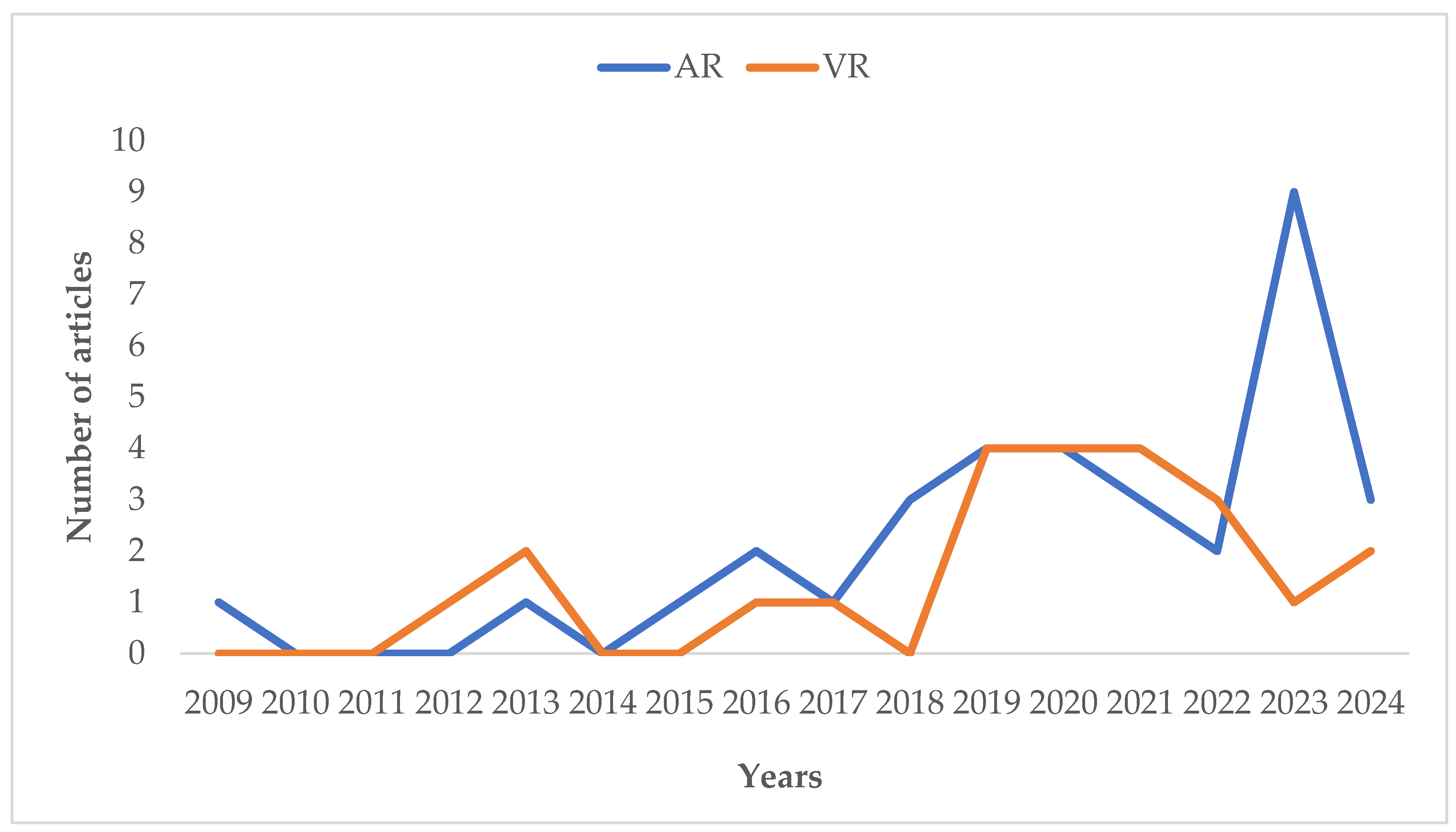

Table 1.
Technologies used for each category.
| Reality SEN |
AR | VR | MR | Total |
|---|---|---|---|---|
| Intellectual Disability | 19.99% | 7.69% | 1.54% | 29.22% |
| Learning Difficulties | 7.69% | 6.15% | 0.00% | 13.84% |
| Developmental Disability | 3.08% | 0.00% | 0.00% | 3.08% |
| Motor Disabilty | 3.08% | 3.08% | 0.00% | 6.16% |
| Sensory Disability | 3.08% | 1.54% | 0.00% | 4.62% |
| Brain Injury | 1.54% | 0.00% | 0.00% | 1.54% |
| Pediatric Patient | 1.54% | 0.00% | 0.00% | 1.54% |
| Behavioral Disorder | 0.00% | 3.08% | 0.00% | 3.08% |
| ADHD | 1.54% | 1.54% | 0.00% | 3.08% |
| ASD | 15.38% | 15.38% | 1.54% | 32.30% |
| Anxiety Disorder | 0.00% | 1.54% | 0.00% | 1.54% |
| Total | 56.92% | 40.00% | 3.08% | 100.00% |
Table 2.
Comprehensive table of documents analyzed.
| Reference* | SEN | XR technology |
Targeted skills | Performance | Motivation |
|---|---|---|---|---|---|
| Abdullah et al., 2024. | ASD | AR | Concentration, attention and identification | ✔ | NR |
| Afrianto et al., 2019. | ID | AR | Linguistic skills | ✔ | ✔ |
| Alahmari et al., 2023. | LD | AR | Sciences | ✔ | ✔ |
| Alqarni, 2021. | LD | AR | Natural Sciences | ✔ | ✔ |
| Arvanitis et al., 2009. | MD | AR | Perception | ✔ | 🗙 |
| Bossenbroek et al., 2020. | AD | VR | To calm anxiety | ✔ | ✔ |
| Bratu et al., 2024. | SD | VR | Natural Sciences | ✔ | NR |
| Cakir & Korkmaz, 2019. | ASD, MD, ID | AR | Daily life | ✔ | ✔ |
| Carvalho & Manzini, 2017. | SD | AR | Linguistic skills | ✔ | NR |
| Chae & Kim, 2022. | ID | AR | Maths | ✔ | ✔ |
| Choi, 2015. | ID | AR | NR | NR | NR |
| Choi et al., 2013. | DD | AR | Social skills | ✔ | ✔ |
| Cox et al., 2024. | ASD | AR | Maths | ✔ | NR |
| Da Silva & Romanovitch, 2016. | MD | VR | Mobility | ✔ | ✔ |
| Degli Innocenti et al., 2019. | LD | VR | Music | ✔ | ✔ |
| De Oliveira Malaquias et al., 2013. | ID | VR | Maths | ✔ | ✔ |
| De Vasconcelos et al., 2020. | ID | VR | Linguistic skills | ✔ | ✔ |
| Ha & Park, 2024. | ID, ASD, ADHD | VR | Professional skills | ✔ | ✔ |
| Hu & Han, 2019. | ASD | VR | Linguistic skills | ✔ | ✔ |
| Hyun et al., 2020. | ID | AR | Life skills | ✔ | NR |
| Iatraki & Mikropoulos, 2022. | ID | AR | Natural Sciences | ✔ | ✔ |
| Kan’an et al., 2023. | LD | AR | Sciences | ✔ | NR |
| Kanellos et al., 2018. | ADHD | AR | Cognitive skills | NR | NR |
| Kang & Chang, 2020. | ID | AR | Life skills | ✔ | NR |
| Ke & Im, 2013. | ASD | VR | Social skills | ✔ | NR |
| Khoirunnisa et al., 2023. | ASD | AR | Linguistic skills | ✔ | ✔ |
| Kim, 2020. | BI | AR | Mobility | ✔ | ✔ |
| Kim & Lee, 2016. | ID | AR | Natural Sciences | ✔ | ✔ |
| Kim & Han, 2019. | ID, MD | VR | Life skills | ✔ | ✔ |
| Kim et al., 2020. | ID | AR | Linguistic skills | ✔ | NR |
| Klein et al., 2022. | BD | VR | Control of aggression | NR | NR |
| Lee & Kim, 2017. | ID | VR | Natural Sciences | ✔ | ✔ |
| Lin et al., 2016. | LD | AR | Maths | ✔ | ✔ |
| López-Bouzas et al., 2023. | ASD | AR | Linguistic and socioemotional skills | ✔ | ✔ |
| Newbutt & Bradley, 2022. | ASD | VR | Usage of VR glasses | NR | NR |
| Nuguri et al., 2021. | ASD | VR | Social skills | NR | ✔ |
| Rapti et al., 2023. | ID | AR | English | ✔ | ✔ |
| Ravindran et al., 2019. | ASD | VR | Attention | ✔ | ✔ |
| Restrepo et al., 2024. | SD | XR | Natural Sciences | ✔ | ✔ |
| Savitha & Renumol, 2019. | ID | AR | Natural Sciences | ✔ | ✔ |
| Smith et al., 2021. | ASD | VR | Professional skills | ✔ | NR |
| Smith et al., 2021. | LD | VR | Professional skills | ✔ | NR |
| Syahputra et al., 2018. | ASD | AR | Attention | NR | NR |
| Takahashi et al., 2018. | ASD | AR | Mobility | ✔ | ✔ |
| Tan et al., 2022. | ASD | VR | Life skills | ✔ | ✔ |
| Tan et al., 2024. | ASD, ID | MR | Life skills | ✔ | ✔ |
| Thevin et al., 2021. | SD | AR | Games | NR | NR |
| Vanneste et al., 2023. | ID | AR | NR | ✔ | NR |
| Vaquero-Blasco et al., 2020. | LD | VR | To calm stress | NR | NR |
| Vera et al., 2012. | ASD | VR | Life skills | ✔ | ✔ |
| Verhoef et al., 2021. | BD | VR | Control of aggression | ✔ | ✔ |
| Vidal-Balea et al., 2021. | PP | AR | To calm anxiety | NR | NR |
| Widyaningsihet et al., 2023. | LD | AR | Physical Education | NR | NR |
| Wong et al., 2019. | ASD | AR | Life skills | ✔ | ✔ |
| Wong et al., 2023. | ASD | AR | Professional skills | ✔ | ✔ |
| Wu & Tsai, 2024. | ID, DD | AR | Life skills | ✔ | ✔ |
| Wu et al., 2023. | LD | VR | Anxiety | NR | NR |
| Yue et al., 2023. | ASD | AR | Social skills and attention | ✔ | ✔ |
| Zhai et al., 2021. | ASD | VR | Memory | ✔ | NR |
* The articles in this table follow the order shown in the “Appendix” at the end of the references section.
Disclaimer/Publisher’s Note: The statements, opinions and data contained in all publications are solely those of the individual author(s) and contributor(s) and not of MDPI and/or the editor(s). MDPI and/or the editor(s) disclaim responsibility for any injury to people or property resulting from any ideas, methods, instructions or products referred to in the content. |
© 2026 by the authors. Licensee MDPI, Basel, Switzerland. This article is an open access article distributed under the terms and conditions of the Creative Commons Attribution (CC BY) license (http://creativecommons.org/licenses/by/4.0/).
Copyright: This open access article is published under a Creative Commons CC BY 4.0 license, which permit the free download, distribution, and reuse, provided that the author and preprint are cited in any reuse.


