
Submitted:
03 March 2026
Posted:
04 March 2026
You are already at the latest version
Abstract
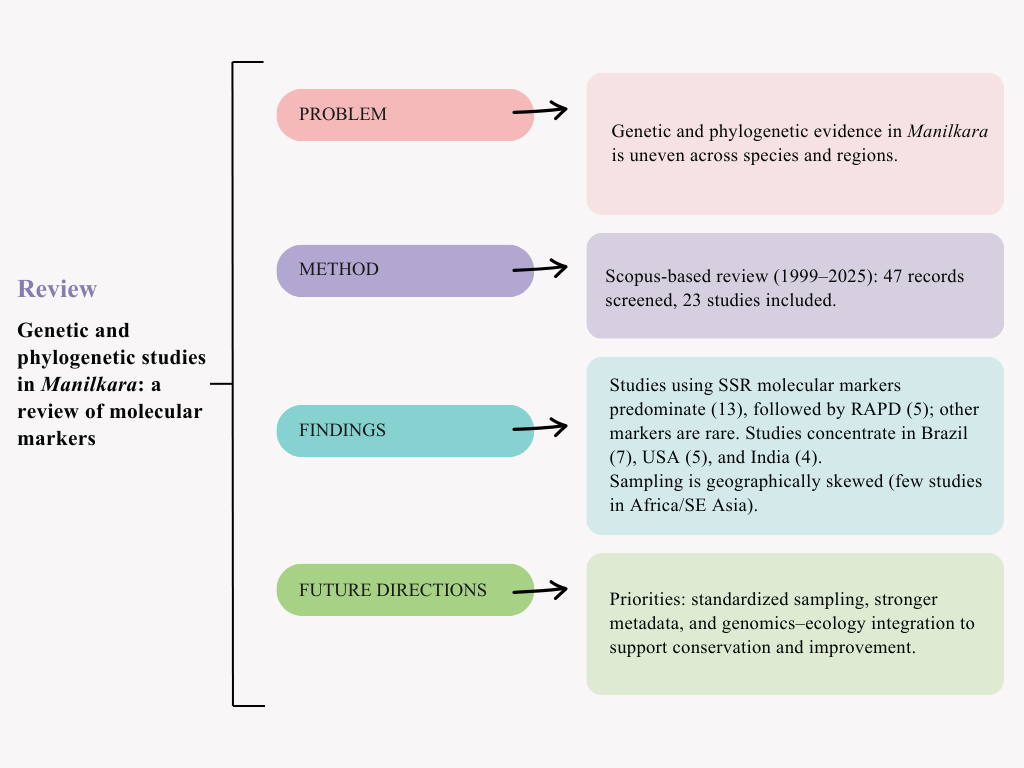
Manilkara (Sapotaceae) includes tropical tree species of high ecological and socio-economic value, yet genetic and phylogenetic evidence remains uneven across taxa and eco-geographic regions. Here, we synthesize studies conducted between 1999 and 2025 which summarize the use of molecular markers to infer genetic diversity, connectivity, population structure, and evolutionary relationships within this genus. The studies are dominated by PCR-based marker systems, including dominant markers (like RAPD and SCoT) and microsatellites from the nuclear genome and plastid genome. Other studies rely on PCR-amplified sequence loci, such as ITS and chloroplast regions, while others use high-throughput technologies, including NGS-assisted SSR development, sequences of complete plastomes, and targeted nuclear sequencing. Overall, studies using SSRs provide the most informative estimates for within-species diversity and fine-scale structure, whereas plastid datasets (cpSSR/cpDNA) mainly support inference on maternal lineages and plastid-based relationships but can be constrained by uniparental inheritance and limited variation, especially under small sampling. Some limitations found include heterogeneous sampling, inconsistency in reporting the methodological parameters, and limited connection with ecological or phenotypic parameters which restricts chances of inferences on demography and adaptation. Based on this review, future research in Manilkara would benefit from setting up a broader taxonomic and geographic coverage, incorporating genome-wide technology where feasible to strengthen conservation management, and breeding opportunities in Manilkara.
Keywords:
genetic diversity
; population structure
; sapotaceae
; technical gaps
; genome
Copyright: This open access article is published under a Creative Commons CC BY 4.0 license, which permit the free download, distribution, and reuse, provided that the author and preprint are cited in any reuse.


