

Submitted:
01 March 2026
Posted:
03 March 2026
You are already at the latest version
Abstract
The intensive use of synthetic pesticides and fertilizers has raised environmental concerns. Sustainable alternatives, such as plant biostimulants and plant resistance inducers, offer promising solutions by enhancing growth, yield, stress tolerance, or activating defense responses against pathogens. However, the physiological impacts and combined effects of these products remain poorly understood, limiting evidence-based application strategies.
Here, we evaluated the effects of a biostimulant and a plant defense inducer on durum wheat (Triticum turgidum ssp. durum), a key cereal crop in the Mediterranean Basin. Using controlled experiments, we assessed plant growth, chlorophyll content, and resistance to Zymoseptoria tritici, while considering potential trade-offs between growth promotion and defense activation. As expected, our results indicate that the biostimulant improved growth and photosynthetic performance, whereas the plant resistance inducer enhanced protection against Z. tritici. But the combination of these two treatments can trigger mitigated interaction effects, influenced by varietal genetic background.
This study provides novel insights into the interactions between plant growth promotion and defense induction in durum wheat. Understanding these multi-factorial effects (in particular genotype effect) enables the identification of optimal treatment strategies, supporting the development of sustainable crop management practices that reduce chemical inputs while maintaining productivity and resilience under biotic stress.
Keywords:
wheat
; septoria
; biostimulant
; plant resistance inducer
; growth/defense trade-off
1. Introduction
The widespread use of synthetic pesticides and fertilizers has led to significant environmental concerns, including water pollution, soil degradation, and harm to beneficial organisms. As a result, there is a growing demand for sustainable alternatives to reduce agrochemical reliance. Two promising tools to achieve this goal are plant biostimulants and plant resistance inducers, both acting through an elicitation of a plant’s physiology. Plant biostimulants are valuable tools, enhancing plant growth, food quality, yield, and stress tolerance [1,2]. Plant defense inducers are substances that trigger resistance mechanisms in plants against biotic stress, such as pathogens and pests [3,4]. These inducers can activate various signaling pathways and defense responses, enhancing the plant’s ability to withstand attacks [5]. In Europe, while biostimulants are considered as fertilizers, defense inducers are classified as plant protection products [6].
Despite the increasing use of stimulation products in agriculture (+12% worldwide growth rate over the last 5 years), scientific understanding of their physiological impacts remains limited [7]. Furthermore, scientific studies have shown that some products can act both to improve tolerance to abiotic stress and resistance to biotic stress, making the binary categorisation of this product a scientific challenge [8,9,10]. Deciphering the mechanisms underlying the action of these products—whether they act as growth promoters, stress mitigators, or immune primers—is not only essential for optimizing their agronomic potential but also for improving their regulatory categorization [11].
While controlled experiments have demonstrated the potential of these biosolutions, their efficacy under field conditions can be variable and unpredictable [12,13,14]. This inconsistency may be attributed to the complex interplay of multiple factors, such as variety [15,16], formulation [17], fertilization [18], abiotic stresses such as drought [19], and the multiplicity of biotic stresses [20]. Previous studies on this topic have primarily focused on individual factors, neglecting the interactive effects that may significantly influence treatment performance [21,22]. Moreover, while both types of stimulation products target the plant to produce their potential effects, very little knowledge is available about their combined impacts on plant [23,24,25], and even less concerning the genetics of the response to these stimulation products [26].
In plants, investment in defense against pathogens often comes at the expense of growth and reproduction, as it involves a significant energetic cost, a phenomenon described as the “trade-off” between growth and defense [27,28,29]. These crosstalks are largely mediated by hormonal regulation and its effects on global gene expression [30]. This trade-off raises concerns about the potential detrimental effects of a biostimulant on a plant defense inducer and vice versa [21,31,32]. For example, analogues to salicylic acid (SA) are known to have a contrasting impact on plant growth [27,33,34,35]. However, in the field, the apparent trade-off observed in controlled conditions may be mitigated by environmental variability and complex plant-environment interactions [36,37].
To address this knowledge gap, this study aims to evaluate the combined effects of multiple factors on the efficacy of biostimulants in durum wheat. Durum wheat (Triticum turgidum ssp. durum) is a cereal of significance, particularly in the Mediterranean Basin and several regions globally, as it is a cornerstone in human nutrition and a driver of economic value for numerous countries [38]. Annually, it accounts for roughly 8–10% of the world’s wheat cultivation area and supports millions of livelihoods from production to processing. However, the productivity and profitability of durum wheat are sharply constrained by multiple biotic stresses, in particular septoria leaf blotch, principally caused by Zymoseptoria tritici, standing out as one of the most devastating diseases [39]. This pathogen is especially problematic in regions with wet springs, such as the Mediterranean, where epidemics are often exacerbated by climatic conditions [40]. In wheat, several studies have demonstrated the value of treatments with analogues of salicylic acid to control fungal diseases. These compounds have demonstrated significant protection against fusarium diseases [41], leaf rust [42], septoria tritici blotch; for which disease severity can be reduced by up to 60 % [43,44] and powdery mildew [20].
Notably, we investigated in controlled conditions the impact of a combination of a biostimulant and a plant defense inducer on plant growth and disease resistance. By deciphering the putative physiological interactions between these 2 different stimulating products, we can identify optimal application strategies and develop more effective and sustainable crop management practices.
2. Materials and Methods
2.1. Experimental Design
Four independent experiments were conducted on seven elite durum wheat varieties (RGT Anvergur, RGT Cultur, RGT Sculptur, Obelix, Pescadou, RGT Surmesur and RGT Voilur) showing low to intermediate resistance levels to the pathogen strains were used [45] (Figure 1). Plants were sown in pots (9 cm diameter) with eight seeds per pot in a substrate containing 50% of topsoil (Richeterre) and 50% of N2 Neuhaus soil (ID 4020.20) supplemented with 100g/100L of inputs (TOP-PHOS). The experiment took place in a growth chamber with a controlled temperature (24 °C for 12 hours of daylight and 20 °C for 12 hours of nightlight). The plants were grown under a 16/8-h photoperiod with artificial light of 35 000 Lumen.
Fifty milliliters of the root growth-promoting biostimulant Osiryl® (Frayssinet SAS) were applied the day of sowing to each pot, at a final concentration of 2 mL·L⁻¹, corresponding to the field-relevant dose. The plant defense inducer Bion® (benzo-(1,2,3)-thiadiazole-7-carbothioic acid S-methyl ester, Syngenta France SAS) was applied as a foliar spray at 0.8 g·L⁻¹, corresponding to the field-relevant dose of 2.3 mL per pot, 48 hours prior to fungal inoculation. Control plants were sprayed with water only. Three weeks after sowing, plants were inoculated with Zymoseptoria tritici strain P1a, following [46]. Inoculation was performed using a spore suspension of 10⁶ spores·mL⁻¹, which was applied evenly to the leaves of each plant using a paintbrush, as described in [46]. After inoculation, seedlings were covered with plastic bags for three days to maintain high humidity and promote fungal infection and development.
For each combination of factors, different variables were measured: gene expression (four genes), Septoria tritici blotch (STB) symptoms (percentage of necrosis and percentage of pycnidia), above-ground dry biomass (grams), and Nitrogen Balance Index on 24 plants. Leaves were collected to assess molecular responses. For RNA extraction, the last fully expanded leaf was sampled 48 hours after biocontrol agent treatment, three weeks after sowing, prior to fungal inoculation. Phenotypic measurements were taken 6 weeks after sowing at 21 days post inoculation with STB. Nitrogen Balance Index (NBI), NBI reflects the balance between nitrogen assimilation (chlorophyll) and stress-related flavonol accumulation, serving as an indicator of plant nitrogen status, was measured with a Dualex [47] on the last elongated leaf. Above-ground dry biomass was determined after sampling and drying for 24 hours at 50 °C. Symptoms, including necrosis (%) and pycnidia (%), were assessed visually at 21 days post-inoculation.
2.2. Molecular Experiment
The expression of genes (Chitinase 1, PR4, PAL and Noduline) were measured before inoculation, forty-eight hours after the plant defense inducer treatment. These four genes that we examined are proxies for basal immunity in wheat [48]. The protocol described previously by [49] was used to evaluate these gene expressions. Frozen leaf tissues were ground in liquid nitrogen and ~500 mg of powder was treated with 1 ml of TRIzol (Invitrogen). RNA samples (5 μg) were denatured for 5 min at 65 °C with oligo(dT) 18 (3.5 mM) and deoxynucleoside triphosphate (dNTP; 1.5 mM). They were then subjected to reverse transcription for 60 min at 37 °C with 200 U of reverse transcriptase M-MLV (Promega) in the appropriate buffer. The cDNA (5 μg, dilution 1:10) was then used for reverse-transcription quantitative (RT-q)PCR. The RT-qPCR mixtures contained PCR buffer, dNTP (0.25 mM), MgCl2 (2.5 mM), forward and reverse primers (final concentrations of 150, 300, or 600 nM), 1 U of HotGoldStar polymerase, and SYBR Green PCR mix according to the manufacturer’s recommendations (Eurogentec, Seraing, Belgium). The sequences of primers used are given in Appendix A1.
Amplification was performed as follows: 95 °C for 10 min; 40 cycles of 95 °C for 15 s, 62 °C for 1 min, and 72 °C for 30 s; 95 °C for 1 min and 55 °C for 30 s. RT-qPCR was performed using a LightCycler480 instrument (Roche) and data were extracted using the accompanying software. The durum wheat ubiquitin gene (CD921597) was used as an internal control, house-keeping gene, and the expression level did not vary significantly between treatments. The calculation of gene relative expression was performed using the measured efficiency for each primer pair as described by [50].
2.3. Statistical Analysis
In order to identify the significance of the effect of the different factors and their variability among varieties, linear mixed models were used. For all the linear models presented, the reference used as intercept is the average computed on all the varieties in the absence of Bion® and Osiryl® from one experiment (Table 1).
For the construction of the mixed linear models the following strategy was chosen. The variety and all interaction with varieties were set as random effects. It allows the estimation of the variety variance for each effect. The factor experimentation was set up as a fixed factor, as the four experimentations were all carried out under controlled conditions and environments. The aim was to adjust the existing difference from one experiment to another on the average level of each variable tested. Similarly, the effects of Osiryl®, Bion® and their interaction were set as fixed factors in order to study the average response of each variable to the different biosolutions products. All the models that were used are summarized in Table 2 and the detailed information of each model are described in appendix A2. All data were analyzed using R studio software (version 2024.04.2). The package lme4 and his function glmer.nb were used to estimate the parameters of the model (version 1.1-35.3 ; [51]).
In addition to linear modelling, we used Random Forest. All data were analyzed using R studio software (version 2024.04.2) with packages vip and randomForest (ntree=1000, and mtry=3). Random forest is a nonlinear approach, used to rank the importance of all the possible predictors (VIP) included in the factorial design. The predictors are the dummy variables corresponding to the single and interaction effects between all factors at all available orders. Random Forest gives also an idea of the percentage of variance explained by this full factorial design.
3. Results
3.1. Salicylic Acid Analogue Enhances Resistance but Reduces Growth in Durum Wheat
Our multifactorial experiments revealed a clear growth–defense trade-off in durum wheat challenged by septoria leaf blotch. Treatments with the defense-stimulating compound Bion® resulted in improved plant resistance, as evidenced by a significant reduction of 25% in the probability of new pycnidia formation on necrotic leaf surfaces (Figure 2 and Table B1). However, this increased defensive capacity came at the cost of reduced plant growth, with Bion®-treated plants exhibiting an average significant decrease of 8% in above-ground dry biomass (Table B1). Notably, plants treated with the root growth-promoting biostimulant Osiryl® didn’t show any significant improvement regarding their growth ; Figure 2b shows that the plants which were treated had less above ground dry biomass. Nevertheless, when applied individually it significantly reduced by 45% the probability of new pycnidia formation on necrotic leaf surfaces (Figure 2 and Table B1). However, neither product significantly altered the overall necrotic surface area. Importantly, the simultaneous application of Osiryl® and Bion® did not produce a synergistic or antagonistic effect on biomass, indicating that the physiological costs associated with induced resistance were not further amplified or mitigated by their combination (Figure 2b). These findings regarding the defense stimulating compound Bion® are in accordance with the expected trade-offs between resistance to disease and growth in durum wheat. This emphasizes the need during evaluation of these products to always consider both growth and resistance together.
Surprisingly, no significant effect of Bion® was observed on necrosis or NBI. One hypothesis could be that this lack of effect could be due to the fact that this analysis was done by pooling data of seven varieties, whereas genetic background can impact these phenotypes.
As the study of the different factors shows a clear interaction between biosolutions products and the increase of the resistance, it is important to verify this interaction at molecular level on some defense marker genes.
3.2. Four Defense-Related Genes Expression Induced by Salicylic Acid Analogue can be Modulated by the Biostimulant
To investigate the mechanism of action of Bion® as a plant defense inducer, the relative expression of three defense-related genes (chitinase 1, PAL, and PR4) and one stress marker gene in wheat (nodulin) was evaluated. The results confirmed Bion®’s role as a plant defense inducer: it significantly increased the expression of three out of the four studied genes by an average of 22% (Figure 3 and Table B2). Notably, the relative expression of chitinase 1 rose by 38%. In contrast, Osiryl® exhibited no significant effect on the expression of any of the four genes, reinforcing its classification as a biostimulant without plant defense inducer activity. The fact that increased resistance is observed even though the expression of defence genes is unchanged is a fairly common observation in experiments and suggests that the protective effect of Osiryl® is due to resistance mechanisms other than those linked to basal immunity.
The plant defense induction activity of Bion® (applied 48h before by leaf spray) is counteracted when used in combination with Osiryl® (applied three weekends before by drenching at sowing), as none of the marker genes are induced. Rather, this combination significantly reduces by 11% the expression of the PAL gene (Figure 3 and Table B2). These results show that two products that act differently on the expression of defence marker genes can have their effects cancelled out when combined, making it difficult to predict this type of mechanism of action when products are combined.
3.3. Variety Dictates Resistance, Defense and Growth Outcomes in Durum Wheat
The absence of a significant effect of the Osiryl® root biostimulant on above-ground biomass and nitrogen status was unexpected. Given that genotype-dependent responses to this type of product are well documented, we therefore examined whether treatment effects varied among the seven genotypes tested. First of all, variety had a strong main effect—independent of treatment—on all phenotypic traits and on the expression of the four genes analyzed (Table 3), confirming that our experimental system robustly captures genetic background effects across all measured variables. Our analysis revealed that the effect of Osiryl® on above ground dry biomass was significantly genotype-dependent (Table 3), whereas no such varietal dependence was observed for Bion®. Indeed, the varietal variability associated with Bion® effects on above-ground biomass was approximately half that observed for Osiryl®, indicating a more genotype-sensitive response to the latter product. Notably, the interaction between the two products also varied significantly among varieties, affecting both aerial biomass and the three defense-related genes previously identified as responsive (Chitinase 1, PR4, and PAL) (Table 3).
Overall, our results highlight a pronounced varietal dependence in treatment efficacy, influencing both growth and defense induction–related traits. This strong genotype-specific variability raises a key subsequent question: which genotypes drive these differential responses ? Identifying the varieties that contribute most strongly to the observed treatment effects will be essential to translate these findings into practical recommendations, as it will allow us to determine for which genetic backgrounds the use of these products is most likely to be beneficial.
3.4. The Interaction Between Factors Is Variable Among Varieties
To characterize the contribution of each variety to treatment responses across traits, confidence intervals (CIs) were estimated for each mixed model. This analysis confirmed that several genotypes displayed robust, treatment-specific effects. Although applications of Osiryl® and Bion® consistently influenced the different traits, the magnitude of these effects varied markedly among durum wheat varieties (Figure 4). As previously reported, Bion® treatment led to an overall reduction in above-ground dry biomass (−8%), an effect that was largely independent of genotype. Nevertheless, CI-based comparisons revealed that only the variety RGT Cultur differed significantly from the reference (Figure 4a).
Although no significant main effect of biosolutions on the Nitrogen Balance Index (NBI) was detected by the model, clear varietal differences in treatment responses were evident in this analysis (Figure 4b). Osiryl® increased significantly NBI for two varieties (by 19% for Obelix and 45% for RGT Surmesur), whereas it reduced NBI by 0.4–5% for the other varieties, except for RGT Anvergur which seems not responsive to the product. In contrast, Bion® increased significantly NBI by 20% in RGT Anvergur but decreased it by 3% in Obelix and RGT Voilur. Importantly, the combined treatment of Osiryl® and Bion® produced effects that differed from those observed with either product alone, underscoring the complexity of their interaction. For example, Pescadou, which exhibited the highest NBI under control conditions, showed an increase in this index following Bion® application but a decrease in response to Osiryl®, with additional modulation arising from the interaction between the two products (Figure 4b). This contrasting pattern illustrates the difficulty of predicting the relevance and reliability of such indicators for monitoring the effects of combined treatments, particularly when strong genotype-dependent responses are involved.
The overall analysis did not reveal any effect of the treatments on the necrotic surface (Table B1). This new analysis allows us to observe a genotype-dependent pattern for Bion® (Figrure 4c). Bion appeared to confer significant protection on RGT Anvergur, while it increased necrosis on Obelix and RGT Surmesur. However, the effects of Osyril® or the interaction between products remain non significant depending on the variety. On the contrary, although the model indicated that Osiryl® and Bion® applied individually tended to reduce the pycnidia-to-necrosis (P/N) ratio, this response is also strongly variety-dependent (Figure 4d). For instance, Bion® reduced the P/N ratio in RGT Surmesur but increased it in Pescadou and RGT Cultur. The positive effect observed for Osiryl® treatments is observed only for Obelix variety. But, notably, this positive effect could be counteracted by a negative impact of the interaction between products, further illustrating the genotype-specific nature of combined treatment responses.
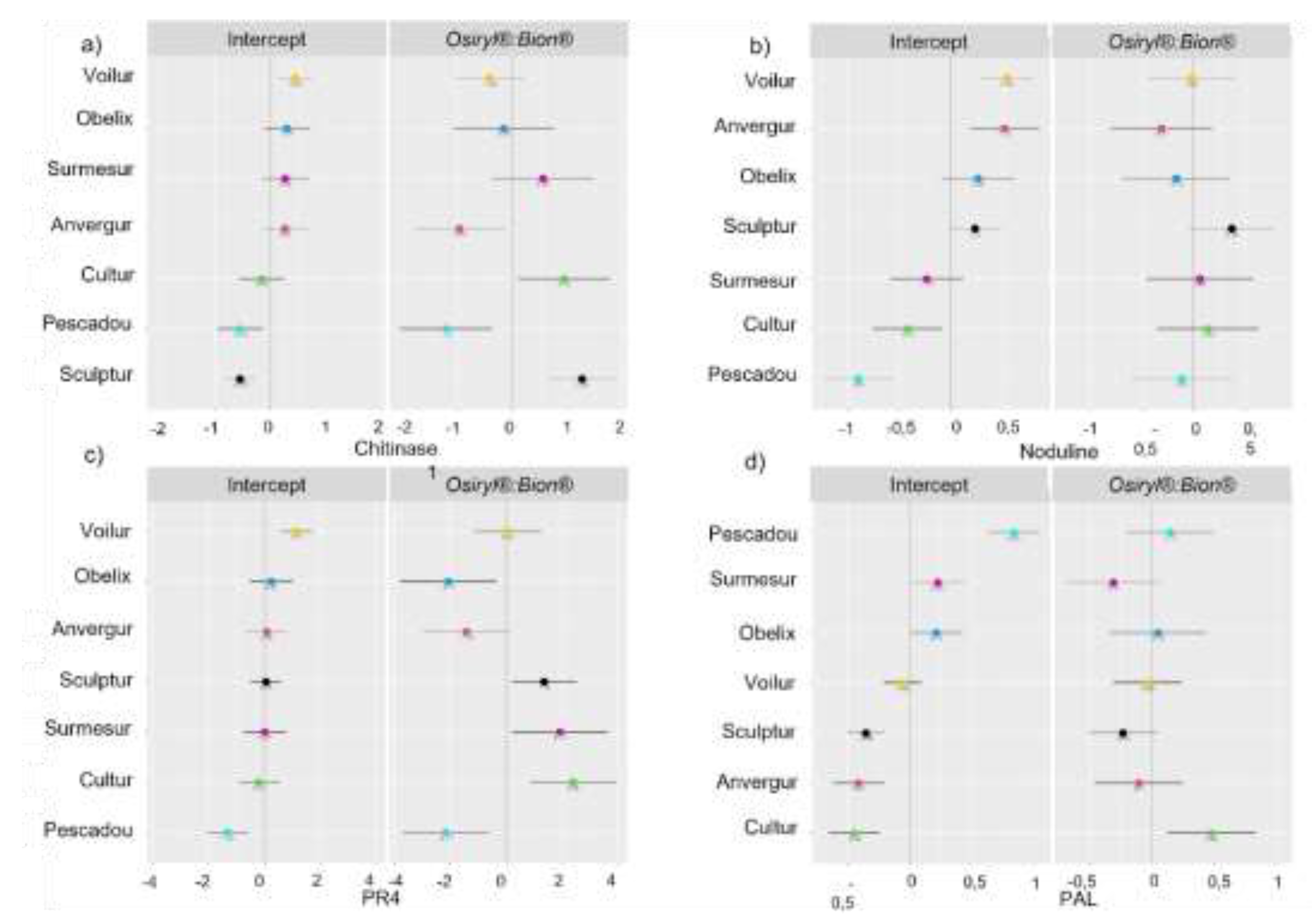
A similar approach was applied to the expression of the four genes; however, limitations in the dataset restricted the analysis to the interaction between variety and the combined Osiryl®–Bion® treatment. As shown in Appendix B4, the effect of the interaction between products was significantly variety-dependent for all genes except Nodulin, with either positive or negative modulation depending on the genotype. These results indicate that it will be difficult to predict whether these defense marker genes will be consistently induced by the defense stimulator Bion® when used in combination with Osiryl®, thereby limiting the practical applicability of marker-gene–based approaches.
The observation of trade-off phenomena is inherently difficult to interpret due to these contrasting genotype-dependent responses. At the global scale, our analysis showed that Bion® negatively affected above-ground biomass while reducing pycnidia formation, without a corresponding reduction in necrosis. However, a more detailed, genotype-specific analysis revealed that the negative impact of Bion® on aerial biomass was mainly driven by the RGT Cultur and RGT Sculptur varieties. Notably, in RGT Sculptur, Bion® also reduced pycnidia, suggesting that a growth–defense trade-off may be expressed in this genotype, whereas such a trade-off appears not evident in RGT Cultur, where Bion® treatment was associated with increased pycnidia. Similarly, Bion® had a negative effect on the Nitrogen Balance Index (NBI) in Obelix and RGT Voilur, yet these physiological changes were associated with contrasting disease outcomes: Bion® reduced necrosis in RGT Voilur but increased it in Obelix. Together, these results indicate that the difficulty in experimentally detecting growth–defense trade-offs may stem from the frequent omission of genotype-specific effects. Each variety appears to deploy distinct strategies in response to the different treatments, either engaging or avoiding trade-offs depending on its genetic background.
Together, these results underscore that the genetic background of durum wheat is a major determinant of treatment efficacy, shaping the magnitude of the effect of the different treatments. However, while these multifactorial models are well suited to detect significant effects and interactions, they do not readily allow the relative importance of factors and their combinations to be ranked. This limitation motivated the use of complementary analytical approaches, presented in the following section, aimed at better disentangling and prioritizing the respective contributions of genotype, treatments, and their interactions to durum wheat responses to septoria disease.
3.5. Beyond Main Effects: Interacting Factors Govern Phenotypic Variance
This analysis reveals that, although simple effects are often the most significant—with the effect of both treatments alone consistently dominating—several second- and third-order interactions also show meaningful effect sizes across variables (Figure 5). For example, both treatments (Osiryl® and Bion®) significantly impact above-ground biomass. The next most influential factors include interactions between inoculation and Osiryl®, between the two products themselves, and between variety and Osiryl®. Interestingly, variety ranks only sixth in terms of overall importance for this trait. In contrast, for necrotic lesion area, variety exerts the strongest effect, reflecting intrinsic resistance. Notably, the effect of Bion® alone is of similar magnitude to its interaction with variety, which may explain why treatment effects sometimes fail to appear—because the direct effect of Bion® can be masked or cancelled out by its genotype-specific interactions.
4. Discussion
The systematic investigation of durum wheat’s response to the plant resistance inducer Bion® and the root biostimulant Osiryl® has revealed the complex and interactive nature of disease resistance and plant growth dynamics, consistent with findings across multiple pathosystems [52,53]. Our results confirm that defense-inducing compounds such as Bion® significantly enhance disease resistance by reducing pycnidia formation and upregulating defense-related gene expression. These findings align with previous studies demonstrating the efficacy of such products in crop protection [27]. Our results also highlight the complexity of the phenomena of growth–defense trade-off—a fundamental constraint increasingly recognized in plant defense strategies that the enhanced defense often comes at a cost to aerial biomass [54,55].
Importantly, the efficacy of these treatments is not uniform but varies substantially depending on the genetic background of the durum wheat cultivar. This genotype-dependent variation echoes reports in wheat, Arabidopsis, and other crops, where differences in defense pathway induction and regulation dictate the extent and cost of resistance [26,56,57,58]. Genotypic variation thus emerges as a major determinant of treatment outcomes and must be carefully considered in cultivar selection for integrated disease management.
When applied in combination, treatments such as Osiryl® and Bion® did not consistently exhibit additive, synergistic, or antagonistic effects. Instead, their combined impacts varied significantly depending on the specific trait being measured—sometimes additive, sometimes antagonistic. This variability in interaction patterns makes the overall effects difficult to predict, as the physiological responses are context-dependent rather than following a uniform trend. Such complexity reflects the general principles in chemical ecology, where multiple elicitors are often assumed to exert unpredictable interactions [59]. It also underscores the need for comprehensive phenotypic assessment beyond disease symptomatology alone [60]. Indeed, the difficulty in predicting treatment effects under field conditions may stem from overlooked factors or unmeasured interactions. For instance, genotype × product interactions can mask the effects of individual treatments if genotypic variability is not accounted for, emphasizing the importance of experimental designs and analyses that incorporate multiple explanatory factors.
Our multifactorial analyses further reveal that plant response variance arises not only from individual factors such as genotype or treatment but is predominantly shaped by their interactions. This complexity likely underlies the inconsistent field efficacy reported for many biosolutions, highlighting the limitations of extrapolating controlled environment results directly to agricultural contexts. Major trade-off between growth and defense have been shown previously to disappear in field conditions in Arabidopsis [61]. The physiological and agronomic impacts of biosolutions are inherently multifactorial, influenced by genotype, environment, treatment, and their complex interplay. While single-factor analyses can identify significant main effects, our multifactorial framework demonstrated that much of the variance in disease susceptibility and growth is explained by combinations of factors rather than isolated effects. This insight is particularly critical for field applications, where the effectiveness of biosolutions is modulated by the dynamic interplay of genetic, environmental, and agronomic variables [3,62].
To better quantify the relative contributions of these interacting factors, we employed advanced statistical approaches that confirmed the dominant role of factor combinations over individual effects. This holistic perspective supports the growing consensus that successful septoria management in durum wheat cannot rely on single-factor interventions [63]. Instead, future strategies should integrate multifactorial analyses and leverage sophisticated statistical tools to dissect and prioritize the contributions of genetic, environmental, and agronomic variables [64]. Tailoring defense-inducing practices to specific cultivar backgrounds, environmental conditions, and interaction contexts will be essential to optimize both disease resistance and yield sustainably. These analyses will identify the conditions under which the products can fully express their potential so that they can be better recommended or even regulated.
5. Conclusions
In summary, our results support the trade-off hypothesis that induced resistance often comes at a cost in growth but also highlight that this cost is strongly mediated by complex genotype × environment × management interactions. These findings underscore the need to move beyond single-factor analyses in crop protection research and to develop predictive models that explicitly account for these interactions.
Our results emphasize that the development of effective septoria management strategies in durum wheat must move beyond a “one-size-fits-all” approach. The interplay between genotype, environment, and treatment creates a landscape of outcomes that cannot be reliably predicted without accounting for multifactorial interactions. Therefore, we advocate for context-specific, cultivar-driven application of biosolutions, with continuous evaluation of both disease control and yield performance. Leveraging advanced statistical and bioinformatic tools will be indispensable for optimizing treatment protocols and accelerating breeding for cultivars that can sustain both productivity and resilience in the face of evolving biotic pressures.
Future biosolution based strategies should follow an intelligent screening approach, integrating the impact of varietal and environmental factors whenever possible, and leaving less sustainable agrichemicals for specific situations that cannot be controlled in any other way.
Author Contributions
Conceptualization, E.B., P.L. and B.F.; methodology, A.D. and E.B.; formal analysis, E.D., N.G. and B.F.; investigation, E.D.; writing—original draft preparation, E.D and E.B.; writing—review and editing, C.B, E.S-M, and B.F..; visualization, E.D.; supervision, E.B. and B.F.; funding acquisition, E.B and B.F.. All authors have read and agreed to the published version of the manuscript. The authors have reviewed and edited the output and take full responsibility for the content of this publication.
Funding
This research was funded by the French National Research Agency (ANR Trade-off grant number ANR-19-CE20-0005) and Institut Agro Montpellier.
Data Availability Statement
The data presented in this study are available on request from the corresponding author due to allow for commercialization of research findings.
Acknowledgments
The authors want to thanks internship students who participated in discussions on data analysis. Thanks to RAGT company that provided all the RGT varieties.
Conflicts of Interest
The authors declare no conflicts of interest. The funders had no role in the design of the study; in the collection, analyses, or interpretation of data; in the writing of the manuscript; or in the decision to publish the results.
Abbreviations
The following abbreviations are used in this manuscript:
| PDI | Plant Defense Inducer |
| STB | Septoria tritici blotch |
| NBI | Nitrogen balance Index |
Appendix A. Comprises Two Appendices Providing Additional Information on the Methodologies Used in This Article
Appendix A.1
Figure A1.
List of primers. ChitinaseI, PR4 and PAL are defense genes and Noduline is a defense marker gene for wheat. Ubiquitine was used as the house-keeping gene.
Figure A1.
List of primers. ChitinaseI, PR4 and PAL are defense genes and Noduline is a defense marker gene for wheat. Ubiquitine was used as the house-keeping gene.
Appendix A.2
This appendix described the methodology to choose models for statistical analysis.
Models used for above ground dry biomass, NBI and 5 defense genes
For the variables : NBI, above ground dry biomass and the expression of 5 defense genes (Chitinase 1, Noduline, PR4, Pal and beta-glutamase), a linear mixed model with random effects was used (cf eq 1). The model was simplified for the defense genes to fit the data (cf eq 2). The lme4 package and his function lmer was used to estimate the parameters of it (version : 1.1-35.5 ; Bates et al, 2015).
h (E[Yijkl ])=β0+ml+αi+ail+βj+bjl+γij+cijl+δk (equation 1)
Where :
Yijkl~N(μ,σ2) ; ml~N(0, σ2m) ; ail ~ N(0, σ2a) ; bjl~N(0,σ2b) et cijl~N(0, σ2c)
h : link function : h(μ)=μ | i : Bion®, j : Osiryl®, l : Variety, k : experiment
E : Conditional expectation | m, a, b, c : random effects
Yijkl : Variable of interest | α, β, γ ,δ : Fixed effects
h (E[Yijkl ])=β0+ml+αi+βj+γij+cijl+δk (equation 2)
Where :
h : link function : h(μ)=μ | i : Bion®, j : Osiryl®, l : Variety, k : experiment
E : Conditional expectation | m, c : random effects
Yijkl : Variable of interest | α, β, γ ,δ : Fix effects
Models used for necrosis surface and pycnidia-to-necrosis ratio
As necrosis is a measure of necrotic area relative to leaf size (in %), a generalized linear random-effects model was used (cf eq 3). Percentage data were converted into binary 0, 1 data. To do this, each percentage was reduced to a double vector, the sum of which is 100%. Example: if the necrotic area represents 70% of the total leaf area, the vector will be [30,70]. To apply this method, we assumed that all leaves had the same size. In order to manage the overdispersion of the data, a beta-binomial distribution was used [65,66].
h (E[Yijkl ])=β0+ml+αi+ail+βj+bjl+γij+cijl+δk (Equation 3)
Yijkl ~ BB(n, α, β) ; Yijkl/p ~ Binomial(n, p) et p~Beta(α, β)
ml~N(0, σ2m) ; ail ~ N(0, σ2a) ; bjl~N(0,σ2b) et cijl~N(0, σ2c)
h : Link function : logit : h(p)=ln(p/1-p) | i : Bion®, j : Osiryl®, l : Variety, k : experiment
E : Conditional expectation | m, a, b, c : random effects
Yijkl : Variable of interest | α, β, γ ,δ : Fix effects
The package glmmTMB and its function of the same name were used to estimate the parameters of the model (version 1.1.9 ; [67]).
The pycnid variable is assimilated to a count data (pycnidia) on a surface data (necrosis). A generalized linear random effect model was used (cf Eq 4). Necrosis is offset in the model to take account of the pycnidia-to-necrosis ratio. A negative binomial distribution was used to correct for overdispersion of the data [66].
h (E[Yijkl ])=β0+ml+αi+ail+βj+bjl+γij+cijl+δk+ ln(n+1) (Equation 4)
Yijkl ~ BN(n,p)
ml~N(0, σ2m) ; ail ~ N(0, σ2a) ; bjl~N(0,σ2b) et cijl~N(0, σ2c)
h : Link function : logarithme : h(p)=ln(p) | i : Bion®, j : Osiryl®, l : Variety, k : experiment
E : Conditional expectation | m, a, b, c : random effects
Yijkl : Variable of interest | α, β, γ ,δ : Fix effects
| LD | Linear dichroism |
Appendix B
Appendix B contains three appendices presenting additional results, as well as an appendix that may assist in interpreting the results in Figure 4.
Appendix B.1

Table A1.
Results of the fixed effects obtained with the statistical models for the above ground dry biomass, the NBI, the Necrosis and the pycnidia-to-necrosis ratio. Std. error stands for standard error. Significance levels: p.value < 0.05.
Table A1.
Results of the fixed effects obtained with the statistical models for the above ground dry biomass, the NBI, the Necrosis and the pycnidia-to-necrosis ratio. Std. error stands for standard error. Significance levels: p.value < 0.05.
| Fixed effects | ||||
|---|---|---|---|---|
| Variables | Coefficients | Estimate | Std.error | p.value |
| Above ground dry biomass | Intercept | 0.288 | 0.0131 | 2.98E-07 |
| Osiryl® | 0.0244 | 0.0113 | 0.0724 | |
| Bion® | -0.0244 | 0.0094 | 0.0399 | |
| Osiryl®:Bion® | -0.0072 | 0.0147 | 6.38E-01 | |
| NBI | Intercept | 18.42 | 1.148 | 3.10E-06 |
| Osiryl® | 1.786 | 1.211 | 1.91E-01 | |
| Bion® | 0.145 | 0.692 | 8.40E-01 | |
| Osiryl®:Bion® | -1.56 | 0.765 | 8.61E-02 | |
| Necrosis | Intercept | 0.7758 | 0.3171 | 1.44E-02 |
| Osiryl® | 0.1375 | 0.2192 | 5.31E-01 | |
| Bion® | 0.0474 | 0.4312 | 9.12E-01 | |
| Osiryl®:Bion® | 0.2996 | 0.3636 | 4.10E-01 | |
|
Pycnidia-to- necrosis ratio |
Intercept | -1.42 | 0.252 | 1.80E-08 |
| Osiryl® | -0.591 | 0.152 | 0.000105 | |
| Bion® | -0.287 | 0.139 | 0.0387 | |
| Osiryl®:Bion® | 0.292 | 0.177 | 0.0985 | |
Appendix B.2
Table A2.
Results of the fixed effects obtained with the statistical model for the three defense genes (Chitinase A, Pal and PR4) and the defense marker gene (Noduline). Std. error stands for standard error. Significance levels: p.value < 0.05.
Table A2.
Results of the fixed effects obtained with the statistical model for the three defense genes (Chitinase A, Pal and PR4) and the defense marker gene (Noduline). Std. error stands for standard error. Significance levels: p.value < 0.05.
| Fixed effects | ||||
|---|---|---|---|---|
| Genes | Coefficients | Estimate | Std.error | p.value |
| Chitinase 1 | Intercept | -1.0847 | 0.228 | 0.00052 |
| Osiryl | -0.149 | 0.1991 | 0.4557 | |
| Bion | 0.408 | 0.1975 | 0.041 | |
| Osiryl:Bion | 0.3164 | 0.4833 | 0.52705 | |
| Noduline | Intercept | -0.08314 | 0.24333 | 0.741 |
| Osiryl | -0.24449 | 0.16348 | 0.1374 | |
| Bion | -0.07036 | 0.1622 | 0.6652 | |
| Osiryl:Bion | 0.49009 | 0.26633 | 0.0779 | |
| PR4 | Intercept | -4.4064 | 0.4068 | 2.16E-07 |
| Osiryl | -0.2528 | 0.367 | 0.49226 | |
| Bion | 1.0302 | 0.3641 | 0.00546 | |
| Osiryl:Bion | 0.7379 | 0.9469 | 0.45562 | |
| Pal | Intercept | -4.35642 | 0.19171 | 7.12E-08 |
| Osiryl | 0.13048 | 0.09312 | 0.1637 | |
| Bion | 0.26984 | 0.09238 | 0.00416 | |
| Osiryl:Bion | -0.49797 | 0.17991 | 0.0157 | |
Appendix B.3
Figure A3.
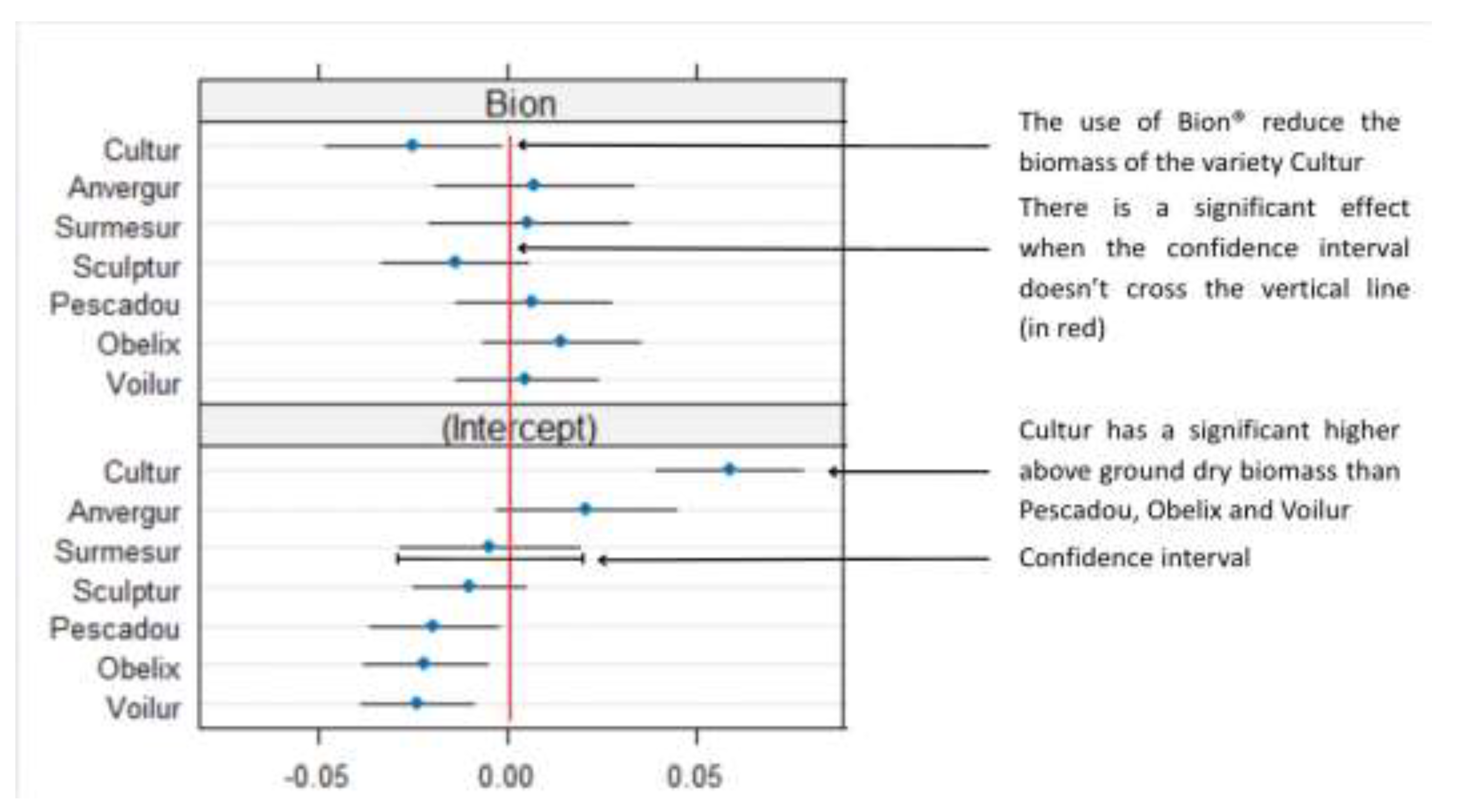
Guide to interpreting Figure 4 and Figure B4.
Figure A3.
Guide to interpreting Figure 4 and Figure B4.
>Appendix B4
Figure A4.
Effect of the variety (Intercept) and the effect of Bion® in combination with Osiryl® (Osy) according to the variety for the four defense genes : Chitinase 1 (CHI), Noduline (NOD), PR4 and Pal. The seven varieties are RGT Voilur, Obelix, RGT Anvergur, RGT Sculptur, RGT Surmesur, RGT Cultur and Pescadou. We can consider that the variety as a different reaction from the reference (one of the experiments without any product) when the error bare doesn’t cross zero.
Figure A4.
Effect of the variety (Intercept) and the effect of Bion® in combination with Osiryl® (Osy) according to the variety for the four defense genes : Chitinase 1 (CHI), Noduline (NOD), PR4 and Pal. The seven varieties are RGT Voilur, Obelix, RGT Anvergur, RGT Sculptur, RGT Surmesur, RGT Cultur and Pescadou. We can consider that the variety as a different reaction from the reference (one of the experiments without any product) when the error bare doesn’t cross zero.

References
- Li, J.; Van Gerrewey, T.; Geelen, D. A Meta-Analysis of Biostimulant Yield Effectiveness in Field Trials. Front. Plant Sci. 2022, 13. [Google Scholar] [CrossRef]
- Rouphael, Y.; Colla, G. Synergistic Biostimulatory Action: Designing the Next Generation of Plant Biostimulants for Sustainable Agriculture. Front. Plant Sci. 2018, 9. [Google Scholar] [CrossRef]
- Flors, V.; Kyndt, T.; Mauch-Mani, B.; Pozo, M.J.; Ryu, C.-M.; Ton, J. Enabling Sustainable Crop Protection with Induced Resistance in Plants. Front. Sci. 2024, 2. [Google Scholar] [CrossRef]
- Reglinski, T.; Havis, N.; Rees, H.J.; de Jong, H. The Practical Role of Induced Resistance for Crop Protection. Phytopathology® 2023, 113, 719–731. [Google Scholar] [CrossRef]
- Garcia-Brugger, A.; Lamotte, O.; Vandelle, E.; Bourque, S.; Lecourieux, D.; Poinssot, B.; Wendehenne, D.; Pugin, A. Early Signaling Events Induced by Elicitors of Plant Defenses. Mol. Plant-Microbe Interactions® 2006, 19, 711–724. [Google Scholar] [CrossRef]
- Llorens, E.; Agustí-Brisach, C. Biocontrol of Plant Diseases by Means of Antagonist Microorganisms, Biostimulants and Induced Resistance as Alternatives to Chemicals. Plants 2022, 11, 3521. [Google Scholar] [CrossRef] [PubMed]
- Ciriello, M.; Fusco, G.M.; Woodrow, P.; Carillo, P.; Rouphael, Y. Unravelling the Nexus of Plant Response to Non-Microbial Biostimulants under Stress Conditions. Plant Stress 2024, 11, 100421. [Google Scholar] [CrossRef]
- Raja, B.; Vidya, R. Application of Seaweed Extracts to Mitigate Biotic and Abiotic Stresses in Plants. Physiol. Mol. Biol. Plants 2023. [Google Scholar] [CrossRef]
- Song, W.; Shao, H.; Zheng, A.; Zhao, L.; Xu, Y.; Song, W.; Shao, H.; Zheng, A.; Zhao, L.; Xu, Y. Advances in Roles of Salicylic Acid in Plant Tolerance Responses to Biotic and Abiotic Stresses. Plants 2023, 12. [Google Scholar] [CrossRef] [PubMed]
- Wang, L.; Ning, C.; Pan, T.; Cai, K.; Wang, L.; Ning, C.; Pan, T.; Cai, K. Role of Silica Nanoparticles in Abiotic and Biotic Stress Tolerance in Plants: A Review. Int. J. Mol. Sci. 2022, 23. [Google Scholar] [CrossRef] [PubMed]
- Yakhin, O.I.; Lubyanov, A.A.; Yakhin, I.A.; Brown, P.H. Biostimulants in Plant Science: A Global Perspective. Front. Plant Sci. 2017, 7. [Google Scholar] [CrossRef]
- Lee Díaz, A.S.; Macheda, D.; Saha, H.; Ploll, U.; Orine, D.; Biere, A. Tackling the Context-Dependency of Microbial-Induced Resistance. Agronomy 2021, 11, 1293. [Google Scholar] [CrossRef]
- Mendes, R.; de Barros, I.; D’Andréa, P.A.; D’Andréa-Kühl, M.S.C.; Rodrigues, G.S. A Multi-Attribute Approach to Evaluating the Impact of Biostimulants on Crop Performance. Front. Plant Sci. 2023, 14. [Google Scholar] [CrossRef]
- Stiling, P.; Cornelissen, T. What Makes a Successful Biocontrol Agent? A Meta-Analysis of Biological Control Agent Performance. Biol. Control 2005, 34, 236–246. [Google Scholar] [CrossRef]
- Pagani, A.P.S.; Dianese, A.C.; Café-Filho, A.C. Management of Wheat Blast with Synthetic Fungicides, Partial Resistance and Silicate and Phosphite Minerals. Phytoparasitica 2014, 42, 609–617. [Google Scholar] [CrossRef]
- Samain, E.; Aussenac, T.; Selim, S. The Effect of Plant Genotype, Growth Stage, and Mycosphaerella Graminicola Strains on the Efficiency and Durability of Wheat-Induced Resistance by Paenibacillus Sp. Strain B2. Front. Plant Sci. 2019, 10. [Google Scholar] [CrossRef] [PubMed]
- Ji, H.; Wang, J.; Chen, F.; Fan, N.; Wang, X.; Xiao, Z.; Wang, Z. Meta-Analysis of Chitosan-Mediated Effects on Plant Defense against Oxidative Stress. Sci. Total Environ. 2022, 851, 158212. [Google Scholar] [CrossRef]
- Val-Torregrosa, B.; Bundó, M.; San Segundo, B. Crosstalk between Nutrient Signalling Pathways and Immune Responses in Rice. Agriculture 2021, 11, 747. [Google Scholar] [CrossRef]
- Choudhary, A.; Senthil-Kumar, M. Drought: A Context-Dependent Damper and Aggravator of Plant Diseases. Plant Cell Environ. 2024, 47, 2109–2126. [Google Scholar] [CrossRef]
- Dallacorte, L.V.; Bosse, M.A.; Capelin, D.; Paladini, M.V.; Cattani, F.; Remor, M.B.; de Lima, J.D.; Perboni, A.T.; Marchese, J.A. Economic versus Technical Efficiency in Using ASM Combined with Fungicides to Elicit Wheat Varieties with Different Disease Susceptibilities. Heliyon 2023, 9. [Google Scholar] [CrossRef]
- Jacquens, L.; Trouvelot, S.; Lemaitre-Guillier, C.; Krzyzaniak, Y.; Clément, G.; Citerne, S.; Mouille, G.; Moreau, E.; Héloir, M.-C.; Adrian, M. Biostimulation Can Prime Elicitor Induced Resistance of Grapevine Leaves to Downy Mildew. Front. Plant Sci. 2022, 13. [Google Scholar] [CrossRef] [PubMed]
- Petrova, M.; Miladinova-Georgieva, K.; Geneva, M.; Petrova, M.; Miladinova-Georgieva, K.; Geneva, M. Influence of Abiotic and Biotic Elicitors on Organogenesis, Biomass Accumulation, and Production of Key Secondary Metabolites in Asteraceae Plants. Int. J. Mol. Sci. 2024, 25. [Google Scholar] [CrossRef] [PubMed]
- Azmat, A.; Yasmin, H.; Hassan, M.N.; Nosheen, A.; Naz, R.; Sajjad, M.; Ilyas, N.; Akhtar, M.N. Co-Application of Bio-Fertilizer and Salicylic Acid Improves Growth, Photosynthetic Pigments and Stress Tolerance in Wheat under Drought Stress. PeerJ 2020, 8, e9960. [Google Scholar] [CrossRef]
- Iula, G.; Miras-Moreno, B.; Rouphael, Y.; Lucini, L.; Trevisan, M. The Complex Metabolomics Crosstalk Triggered by Four Molecular Elicitors in Tomato. Plants 2022, 11, 678. [Google Scholar] [CrossRef]
- Jacquens, L.; Trouvelot, S.; Lemaitre-Guillier, C.; Krzyzaniak, Y.; Clément, G.; Citerne, S.; Mouille, G.; Moreau, E.; Héloir, M.-C.; Adrian, M. Biostimulation Can Prime Elicitor Induced Resistance of Grapevine Leaves to Downy Mildew. Front. Plant Sci. 2022, 13. [Google Scholar] [CrossRef]
- Brzozowski, L.J.; Smith, K.P.; Ohm, J.-B.; Clark, A.J.; Palakurthi, R.; Sorrells, M.E.; Gore, M.A.; Jannink, J.-L. Response to Plant Defense Elicitation Is Genotype- and Context-Dependent in Diverse Oat (Avena Sativa L.) Germplasm. J. Exp. Bot. 2025, eraf313. [Google Scholar] [CrossRef]
- van Butselaar, T.; Ackerveken, G.V. den Salicylic Acid Steers the Growth–Immunity Tradeoff. Trends Plant Sci. 2020, 25, 566–576. [Google Scholar] [CrossRef] [PubMed]
- Karasov, T.L.; Chae, E.; Herman, J.J.; Bergelson, J. Mechanisms to Mitigate the Trade-Off between Growth and Defense. Plant Cell 2017, 29, 666–680. [Google Scholar] [CrossRef]
- Kliebenstein, D.J. False Idolatry of the Mythical Growth versus Immunity Tradeoff in Molecular Systems Plant Pathology. Physiol. Mol. Plant Pathol. 2016, 95, 55–59. [Google Scholar] [CrossRef]
- Proietti, S.; Caarls, L.; Coolen, S.; Van Pelt, J.A.; Van Wees, S.C.M.; Pieterse, C.M.J. Genome-Wide Association Study Reveals Novel Players in Defense Hormone Crosstalk in Arabidopsis. Plant Cell Environ. 2018, 41, 2342–2356. [Google Scholar] [CrossRef]
- Samanta, S.; Roychoudhury, A. Molecular Crosstalk of Jasmonate with Major Phytohormones and Plant Growth Regulators During Diverse Stress Responses. J. Plant Growth Regul. 2025, 44, 62–88. [Google Scholar] [CrossRef]
- Urban, L.; Lauri, F.; Ben Hdech, D.; Aarrouf, J. Prospects for Increasing the Efficacy of Plant Resistance Inducers Stimulating Salicylic Acid. Agronomy 2022, 12, 3151. [Google Scholar] [CrossRef]
- Chan, C. Progress in Salicylic Acid-Dependent Signaling for Growth–Defense Trade-Off. Cells 2022, 11, 2985. [Google Scholar] [CrossRef]
- Kitagawa, M. SA-Related Defense Signaling Supports the Trade-Off between Shoot Growth and Low-Ca Tolerance. Plant Cell Physiol. 2023, 64, 1576–1578. [Google Scholar] [CrossRef]
- Pokotylo, I.; Hodges, M.; Kravets, V.; Ruelland, E. A Ménage à Trois: Salicylic Acid, Growth Inhibition, and Immunity. Trends Plant Sci. 2022, 27, 460–471. [Google Scholar] [CrossRef]
- Matysiak, K.; Siatkowski, I.; Kierzek, R.; Kowalska, J.; Krawczyk, R. Effect of Foliar Applied Acetylsalicilic Acid on Wheat (Triticum Aestivum L.) under Field Conditions. Agronomy 2020, 10, 1918. [Google Scholar] [CrossRef]
- Perelló, A. e.; Dal Bello, G. m. Suppression of Tan Spot and Plant Growth Promotion of Wheat by Synthetic and Biological Inducers under Field Conditions. Ann. Appl. Biol. 2011, 158, 267–274. [Google Scholar] [CrossRef]
- Sissons, M. Durum Wheat Products—Recent Advances. Foods 2022, 11, 3660. [Google Scholar] [CrossRef] [PubMed]
- Fones, H.; Gurr, S. The Impact of Septoria Tritici Blotch Disease on Wheat: An EU Perspective. Fungal Genet. Biol. 2015, 79, 3–7. [Google Scholar] [CrossRef]
- Porras, R.; Miguel-Rojas, C.; Lorite, I.J.; Pérez-de-Luque, A.; Sillero, J.C. Characterization of Durum Wheat Resistance against Septoria Tritici Blotch under Climate Change Conditions of Increasing Temperature and CO2 Concentration. Agronomy 2023, 13, 2638. [Google Scholar] [CrossRef]
- Hekımhan, H.; Boyraz, N. The effects of acibenzolar-S-methyl application on root and foot rot disease (F. culmorum) on the some bread wheat varieties. TABAD Tarım Bilim. Araștırma Derg. 2013, 6, 56–61. [Google Scholar]
- Hafez, Y.; Soliman, N.K.; Mostafa, S.; Imbabi, I.A.; Abd-Elaziz, A.S. Induced Resistance against Puccinia Triticina, the Causal Agent of Wheat Leaf Rust by Chemical Inducers. Egypt. J. Biol. Pest Control 2014, 24, 173–181. [Google Scholar]
- Bellameche, F.; Pedrazzini, C.; Mauch-Mani, B.; Mascher, F. Efficiency of Biological and Chemical Inducers for Controlling Septoria Tritici Leaf Blotch (STB) on Wheat (Triticum Aestivum L.). Eur. J. Plant Pathol. 2020, 158, 99–109. [Google Scholar] [CrossRef]
- Mejri, S.; Siah, A.; Abuhaie, C.-M.; Halama, P.; Magnin-Robert, M.; Randoux, B.; Reignault, P.; Rigo, B.; Ghinet, A. New Salicylic Acid and Pyroglutamic Acid Conjugated Derivatives Confer Protection to Bread Wheat against Zymoseptoria Tritici. J. Sci. Food Agric. 2019, 99, 1780–1786. [Google Scholar] [CrossRef] [PubMed]
- Mathieu, L.; Ducasse, A.; Ballini, E.; Morel, J.-B. Plant–Plant Interactions in Wheat Mixtures Modulate Mean and Variance of Susceptibility to Septoria Tritici Blotch. J. Exp. Bot. 2025, 76, 6714–6722. [Google Scholar] [CrossRef] [PubMed]
- Ballini, E.; Tavaud, M.; Ducasse, A.; Sanchez, D.; Paux, E.; Kitt, J.; Charmet, G.; Audigeos, D.; Roumet, P.; David, J.; et al. Genome Wide Association Mapping for Resistance to Multiple Fungal Pathogens in a Panel Issued from a Broad Composite Cross-Population of Tetraploid Wheat Triticum Turgidum. Euphytica 2020, 216, 92. [Google Scholar] [CrossRef]
- Liu, Y.; Wang, J.; Xiao, Y.; Shi, X.; Zeng, Y. Diversity Analysis of Chlorophyll, Flavonoid, Anthocyanin, and Nitrogen Balance Index of Tea Based on Dualex. Phyton-Int. J. Exp. Bot. 2021, 90, 1549–1558. [Google Scholar] [CrossRef]
- Duba, A.; Goriewa-Duba, K.; Wachowska, U. A Review of the Interactions between Wheat and Wheat Pathogens: Zymoseptoria Tritici, Fusarium Spp. and Parastagonospora Nodorum. Int. J. Mol. Sci. 2018, 19, 1138. [Google Scholar] [CrossRef]
- Delteil, A.; Blein, M.; Faivre-Rampant, O.; Guellim, A.; Estevan, J.; Hirsch, J.; Bevitori, R.; Michel, C.; Morel, J.-B. Building a Mutant Resource for the Study of Disease Resistance in Rice Reveals the Pivotal Role of Several Genes Involved in Defence. Mol. Plant Pathol. 2012, 13, 72–82. [Google Scholar] [CrossRef]
- Vergne, E.; Ballini, E.; Marques, S.; Sidi Mammar, B.; Droc, G.; Gaillard, S.; Bourot, S.; DeRose, R.; Tharreau, D.; Nottéghem, J.-L.; et al. Early and Specific Gene Expression Triggered by Rice Resistance Gene Pi33 in Response to Infection by ACE1 Avirulent Blast Fungus. New Phytol. 2007, 174, 159–171. [Google Scholar] [CrossRef]
- Bates, D.; Mächler, M.; Bolker, B.; Walker, S. Fitting Linear Mixed-Effects Models Using Lme4. J. Stat. Softw. 2015, 67, 1–48. [Google Scholar] [CrossRef]
- Leisner, C.P.; Potnis, N.; Sanz-Saez, A. Crosstalk and Trade-offs: Plant Responses to Climate Change-associated Abiotic and Biotic Stresses. Plant Cell Environ. 2023, 46, 2946–2963. [Google Scholar] [CrossRef]
- Tripathi, R.; Tewari, R.; Singh, K.P.; Keswani, C.; Minkina, T.; Srivastava, A.K.; De Corato, U.; Sansinenea, E. Plant Mineral Nutrition and Disease Resistance: A Significant Linkage for Sustainable Crop Protection. Front. Plant Sci. 2022, 13. [Google Scholar] [CrossRef]
- Figueroa-Macías, J.P.; García, Y.C.; Núñez, M.; Díaz, K.; Olea, A.F.; Espinoza, L. Plant Growth-Defense Trade-Offs: Molecular Processes Leading to Physiological Changes. Int. J. Mol. Sci. 2021, 22. [Google Scholar] [CrossRef]
- He, Z.; Webster, S.; He, S.Y. Growth–Defense Trade-Offs in Plants. Curr. Biol. 2022, 32, R634–R639. [Google Scholar] [CrossRef]
- Bénéjam, J.; Ravon, E.; Gaucher, M.; Brisset, M.-N.; Durel, C.-E.; Perchepied, L. Acibenzolar-S-Methyl and Resistance Quantitative Trait Loci Complement Each Other to Control Apple Scab and Fire Blight. Plant Dis. 2021, 105, 1702–1710. [Google Scholar] [CrossRef] [PubMed]
- Matros, A.; Schikora, A.; Ordon, F.; Wehner, G. QTL for Induced Resistance against Leaf Rust in Barley. Front. Plant Sci. 2023, 13. [Google Scholar] [CrossRef] [PubMed]
- Soleimani, B.; Lehnert, H.; Schikora, A.; Stahl, A.; Matros, A.; Wehner, G. Bacterial N-Acyl Homoserine Lactone Priming Enhances Leaf-Rust Resistance in Winter Wheat and Some Genomic Regions Are Associated with Priming Efficiency. Microorganisms 2024, 12, 1936. [Google Scholar] [CrossRef]
- Du, B.; Haensch, R.; Alfarraj, S.; Rennenberg, H. Strategies of Plants to Overcome Abiotic and Biotic Stresses. Biol. Rev. Camb. Philos. Soc. 2024, 99, 1524–1536. [Google Scholar] [CrossRef]
- Walters, D.R.; Ratsep, J.; Havis, N.D. Controlling Crop Diseases Using Induced Resistance: Challenges for the Future. J. Exp. Bot. 2013, 64, 1263–1280. [Google Scholar] [CrossRef] [PubMed]
- Lundberg, D.S.; Kersten, S.; Boz, E.M.; Ayutthaya, P.P.N.; Zhu, W.; Poersch, K.; Yuan, W.; Swartz, S.; Müller, D.; Bezrukov, I.; et al. A Major Trade-off between Growth and Defense in Arabidopsis Thaliana Can Vanish in Field Conditions. PLOS Biol. 2025, 23, e3003237. [Google Scholar] [CrossRef]
- Walters, D.R.; Havis, N.D.; Sablou, C.; Walsh, D.J. Possible Trade-off Associated with the Use of a Combination of Resistance Elicitors. Physiol. Mol. Plant Pathol. 2011, 75, 188–192. [Google Scholar] [CrossRef]
- Suarez-Fernandez, M.; De Francesco, A. Embracing Biological Control of Septoria Tritici Blotch for Sustainable Wheat Protection. J. Phytopathol. 2024, 172, e13395. [Google Scholar] [CrossRef]
- Napier, J.D.; Heckman, R.W.; Juenger, T.E. Gene-by-Environment Interactions in Plants: Molecular Mechanisms, Environmental Drivers, and Adaptive Plasticity. Plant Cell 2023, 35, 109–124. [Google Scholar] [CrossRef] [PubMed]
- Bolker, B. Linear and Generalized Linear Mixed Models; 2015. [Google Scholar] [CrossRef]
- Bolker, B. GLMM. Available online: https://bbolker.github.io/mixedmodels-misc/glmmFAQ.html.
- brooks, mollie E.; Kristensen, K.; Van Benthem, K.J.; Magnusson, A.; Berg, C.W.; Nielsen, A.; Skaug, H.J.; Machler, M.; Bolker, B. glmmTMB Balances Speed and Flexibility Among Packages for Zero-Inflate. R J 2017. [Google Scholar] [CrossRef]
Figure 1.
Experimental design showing the combination of a biostimulant and a PDI (Plant Defense Inducer) under Zymoseptoria tritici inoculation. The biostimulant was added at sowing. The plant defense inducer was applied as a foliar spray forty-eight hours prior to fungal inoculation, almost three weeks (nineteen days) after the sowing. Control plants were sprayed with water only. Three weeks after sowing, plants were inoculated with Zymoseptoria tritici. Leaves (for RNAs extraction) were sampled just before inoculation (forty-eight hours after the pulverisation of the PDI). Symptoms assessment (STB : Septoria tritici blotch), nitrogen balance index (NBI; indicator of nitrogen status) estimation, and aerial biomass were measured 6 weeks after sowing.
Figure 1.
Experimental design showing the combination of a biostimulant and a PDI (Plant Defense Inducer) under Zymoseptoria tritici inoculation. The biostimulant was added at sowing. The plant defense inducer was applied as a foliar spray forty-eight hours prior to fungal inoculation, almost three weeks (nineteen days) after the sowing. Control plants were sprayed with water only. Three weeks after sowing, plants were inoculated with Zymoseptoria tritici. Leaves (for RNAs extraction) were sampled just before inoculation (forty-eight hours after the pulverisation of the PDI). Symptoms assessment (STB : Septoria tritici blotch), nitrogen balance index (NBI; indicator of nitrogen status) estimation, and aerial biomass were measured 6 weeks after sowing.
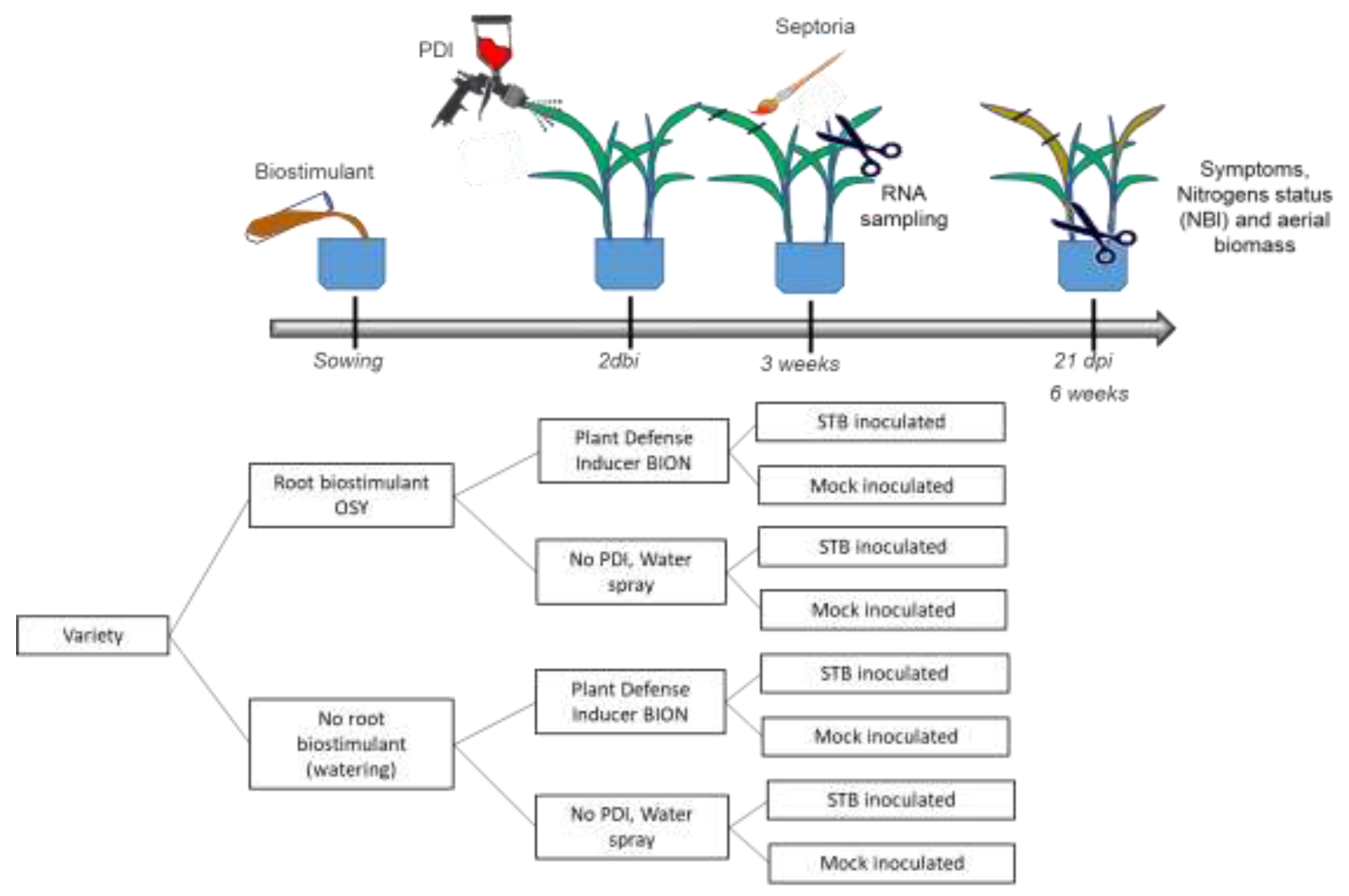
Figure 2.
a) Pycnidia-to-necrosis ratio without any biosolution (-1.420), with Bion® (-0.287), with Osiryl® (-0.591) and when with Osiryl in interaction with Bion® (0.292). b) Above ground dry biomass without any biosolution (0.288), with Bion® (-0.0244), with Osiryl® (0.0244) and when with Osiryl in interaction with Bion® (-0.0072). * and *** represent significant differences at the 0.05 and 0.001 levels. Values are means ± standard error (SE). No error bars could’ve been produced for the probabilities in a).
Figure 2.
a) Pycnidia-to-necrosis ratio without any biosolution (-1.420), with Bion® (-0.287), with Osiryl® (-0.591) and when with Osiryl in interaction with Bion® (0.292). b) Above ground dry biomass without any biosolution (0.288), with Bion® (-0.0244), with Osiryl® (0.0244) and when with Osiryl in interaction with Bion® (-0.0072). * and *** represent significant differences at the 0.05 and 0.001 levels. Values are means ± standard error (SE). No error bars could’ve been produced for the probabilities in a).
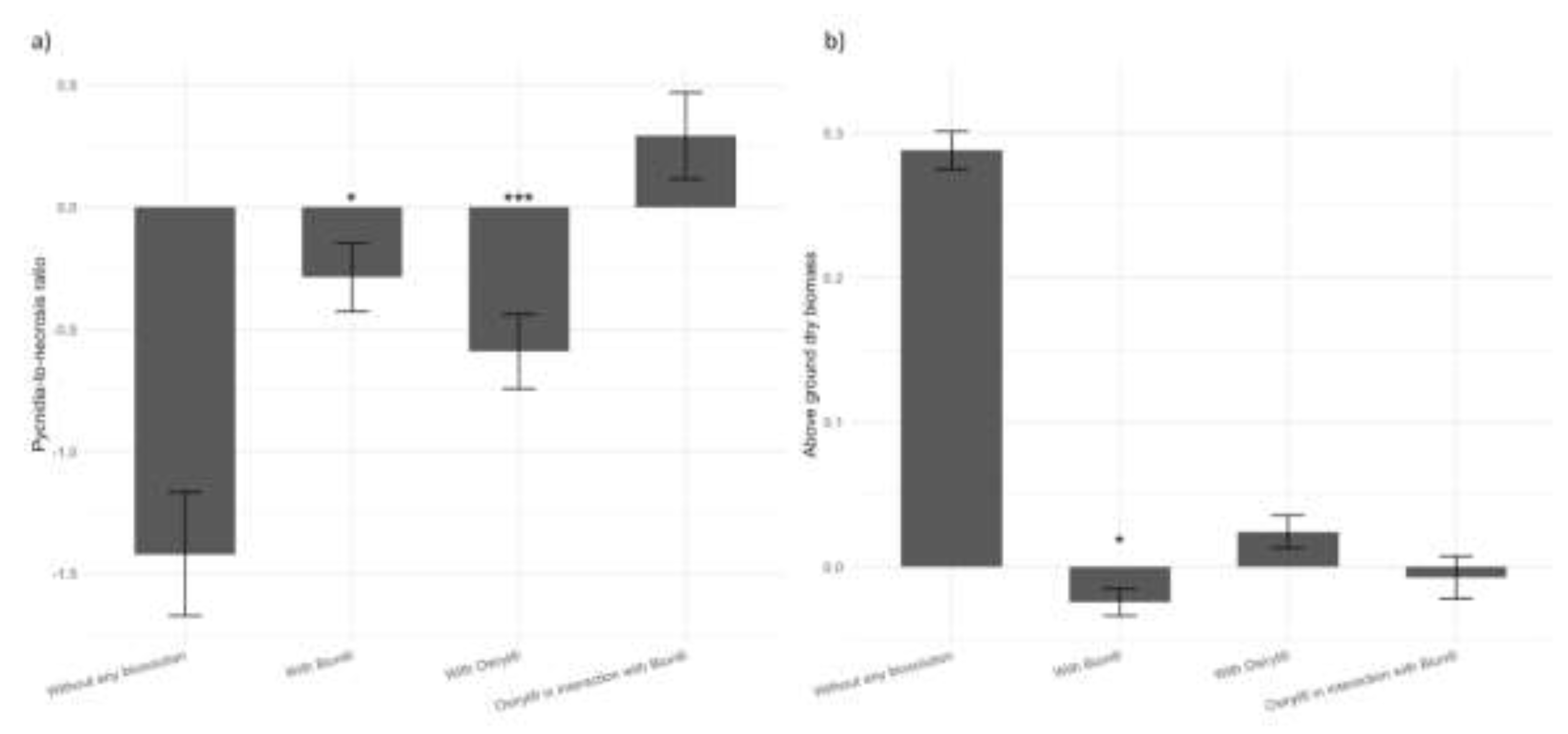
Figure 3.
Impact of Bion®, Osiryl® and the combination of both on the expression of the three defense genes : Chitinase 1, Pal and PRA and one defense marker gene such as Noduline in comparison with the expression of the genes without any biosolution. * and ** represent significant differences at the 0.05 and 0.01 levels. Values are means ± standard error (SE).
Figure 3.
Impact of Bion®, Osiryl® and the combination of both on the expression of the three defense genes : Chitinase 1, Pal and PRA and one defense marker gene such as Noduline in comparison with the expression of the genes without any biosolution. * and ** represent significant differences at the 0.05 and 0.01 levels. Values are means ± standard error (SE).
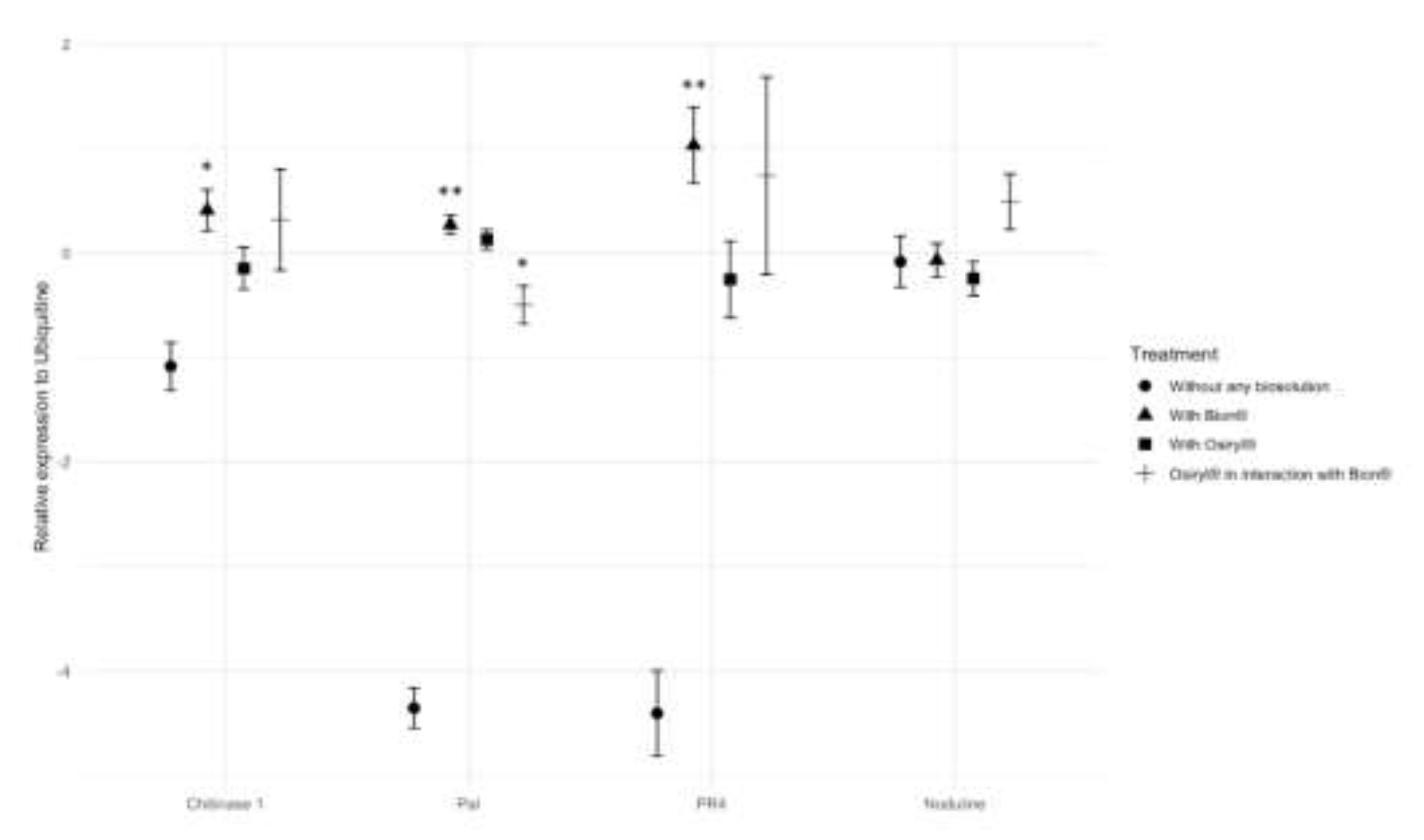
Figure 4.
Effect of the variety (Intercept) and the effect of Bion® in combination with Osiryl® (Osy) according to the variety on the above ground dry biomass, the NBI, the necrosis area and the number of pycnidia-to-necrosis ratio (Pycnidia/necrosis). The variety can be considered to have a different reaction from the reference (one of the experiments without products) when the error bar does not pass through 0. We can observe the additive bion effect with Bion® subplot and the additive Osiryl® effect for the Osiryl® subplot. Be careful, to have an idea of the variety reaction when both products (Bion® and Osiryl®) are used, the effect (blue dot) must be the sum from all the three subplots (Bion®, Osiryl® and Bion®:Osiryl®). To facilitate the interpretation of this type of graph, a reading grid is provided in the Figure B3.
Figure 4.
Effect of the variety (Intercept) and the effect of Bion® in combination with Osiryl® (Osy) according to the variety on the above ground dry biomass, the NBI, the necrosis area and the number of pycnidia-to-necrosis ratio (Pycnidia/necrosis). The variety can be considered to have a different reaction from the reference (one of the experiments without products) when the error bar does not pass through 0. We can observe the additive bion effect with Bion® subplot and the additive Osiryl® effect for the Osiryl® subplot. Be careful, to have an idea of the variety reaction when both products (Bion® and Osiryl®) are used, the effect (blue dot) must be the sum from all the three subplots (Bion®, Osiryl® and Bion®:Osiryl®). To facilitate the interpretation of this type of graph, a reading grid is provided in the Figure B3.
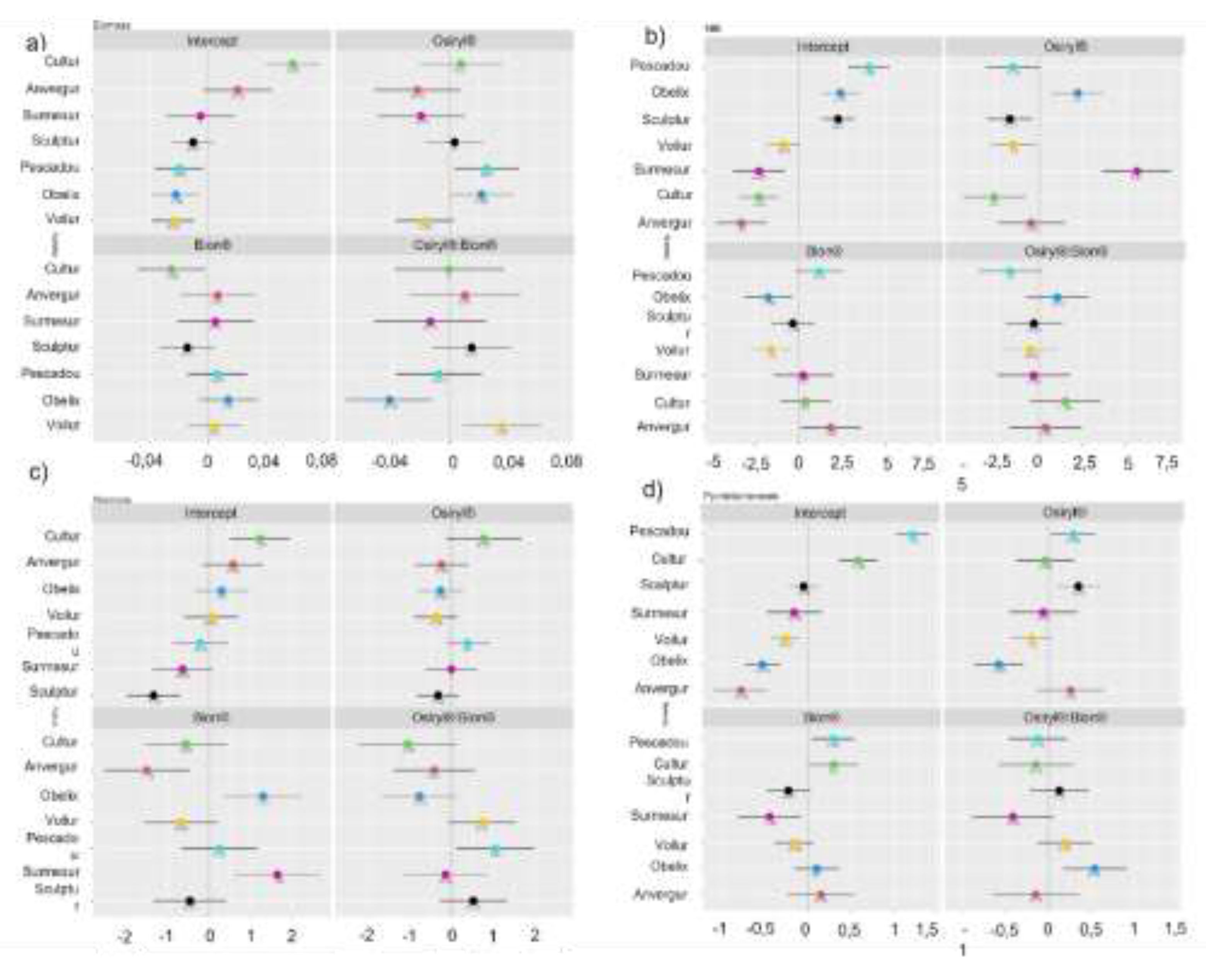
Figure 5.
Random forest variable importance plot. The variables have been ranked in order of relevance in predicting above ground biomass, NBI, Necrosis surface and Pycnidia-to-necrosis ratio. The importance measure considered for the analysis is the mean decrease in accuracy computed via Random Forest Classification Algorithm. The Random forest model accuracy is equal to 20.4% for Aerial biomass, 22.5% for NBI, 25.6% for necrosis and 17.8% for P/N achieved with 1000 trees and 3 mtry. In black are represented first order variable and in grey all the interactions between variables.
Figure 5.
Random forest variable importance plot. The variables have been ranked in order of relevance in predicting above ground biomass, NBI, Necrosis surface and Pycnidia-to-necrosis ratio. The importance measure considered for the analysis is the mean decrease in accuracy computed via Random Forest Classification Algorithm. The Random forest model accuracy is equal to 20.4% for Aerial biomass, 22.5% for NBI, 25.6% for necrosis and 17.8% for P/N achieved with 1000 trees and 3 mtry. In black are represented first order variable and in grey all the interactions between variables.
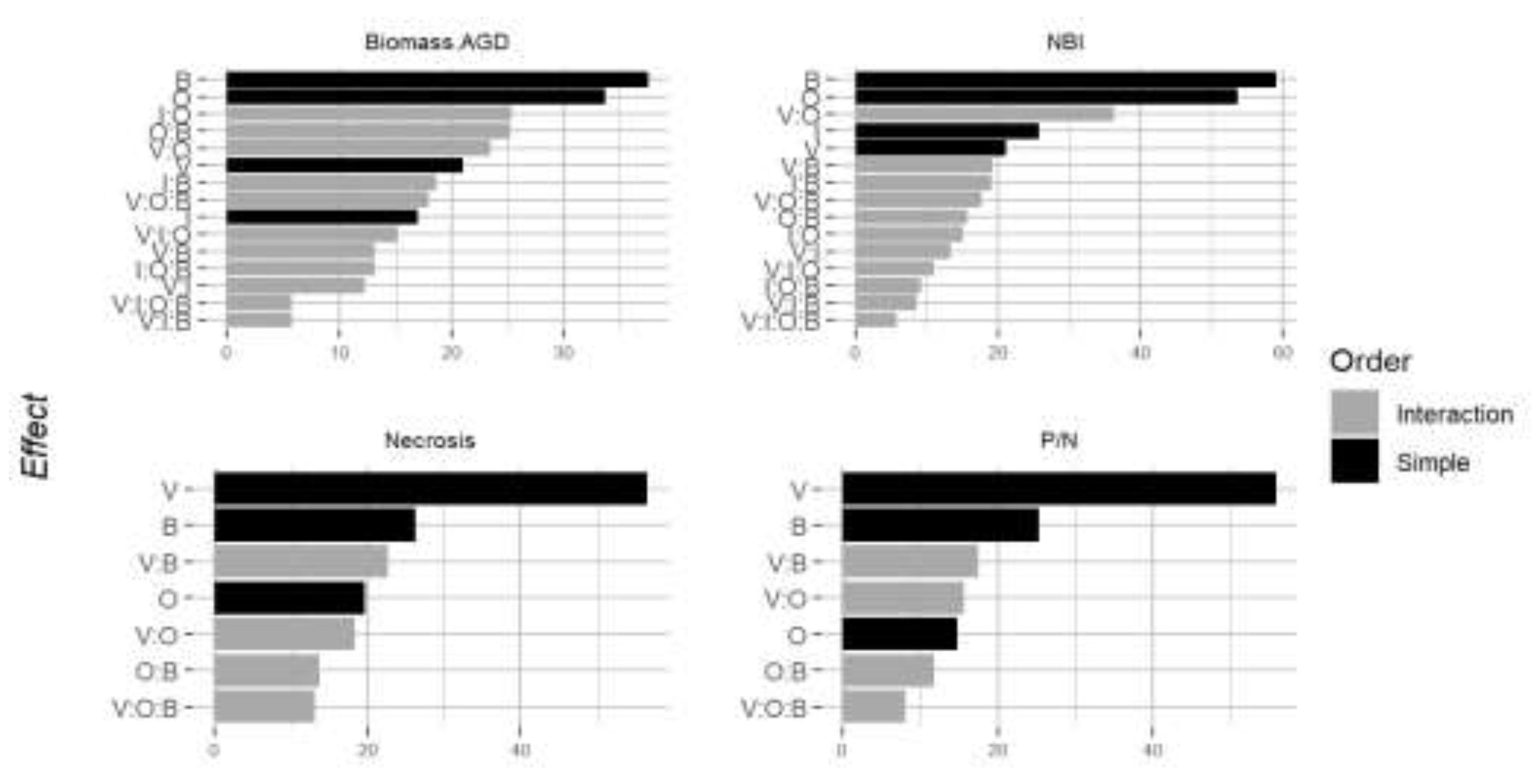
Table 1.
Intercept is estimated by the mean value of one experiment without Bion® or Osiryl® for each variable studied.
Table 1.
Intercept is estimated by the mean value of one experiment without Bion® or Osiryl® for each variable studied.
| Above ground dry biomass | NBI | Necrosis | pycnidia/necrosis | Chitinase 1 | Noduline | PR4 | Pal |
| 0,2879 | 18,413 | 0,6848 | 0,2417 | -1,0847 | -0,0831 | -4,4064 | -4,3564 |
Table 2.
Statistical models used and variables tested for each variable and according to data type, where O stands for Osiryl®, B for Bion®, “:“ for interaction, Exp for experimentation and V for variety.
Table 2.
Statistical models used and variables tested for each variable and according to data type, where O stands for Osiryl®, B for Bion®, “:“ for interaction, Exp for experimentation and V for variety.
| Response variable | Type of data | Tested effects | Statistical model | Statistical law |
|---|---|---|---|---|
| Above ground dry biomass | Quantitative continue | O, B, O:B, Exp, V, O:B, B:V, O:B:V | Linear mixed with random effects | Normal (0, σ2) |
| NBI | Quantitative continue | O, B, O:B, Exp, V, O:B, B:V, O:B:V | Linear mixed with random effects | Normal (0, σ2) |
| Necrosis | Surface (%) | O, B, O:B, Exp, V, O:B, B:V, O:B:V | Generalized linear with random effects | Beta-binomial BB(n, α, β) |
| Pycnidia-to-necrosis ratio | Counting | O, B, O:B, Exp, V, O:B, B:V, O:B:V | Generalized linear with random effects | Negative Binomial BN(n,p) |
| Genes | Quantitative continue | O, B, O:B, Exp, V, O:B:V | Linear mixed with random effects | Normal (0, σ2) |
Table 3.
Impact of genetic background and treatments on key variables. Estimates of the standard error of the random effects were calculated from the mixed model. *, ** and *** represent significant differences at the 0.05, 0.01 and 0.001 levels. The impact of these factors could not be assessed on Necrosis and pycnidia because GLMM models were used and these tests are not currently available with R for these models. For the genes the effect of Bion® and Osiryl® alone couldn’t be tested because the model did not converge.
Table 3.
Impact of genetic background and treatments on key variables. Estimates of the standard error of the random effects were calculated from the mixed model. *, ** and *** represent significant differences at the 0.05, 0.01 and 0.001 levels. The impact of these factors could not be assessed on Necrosis and pycnidia because GLMM models were used and these tests are not currently available with R for these models. For the genes the effect of Bion® and Osiryl® alone couldn’t be tested because the model did not converge.
| Variety | Osiryl® : Variety | Bion® : Variety | Osiryl®:Bion® : Variety | Residual | |
|---|---|---|---|---|---|
| Above ground dry biomass | 0.0318 (***) | 0.0239 (**) | 0.0181 | 0.0299 (**) | 0.0894 |
| NBI | 2.939 (***) | 3.033 (***) | 1.54 (**) | 1.436 | 4.661 |
| Chitinase 1 | 0.4674 (***) | 1.0264 (***) | 0.8319 | ||
| Noduline | 0.5627 (***) | 0.3332 | 0.6831 | ||
| PR4 | 0.8146 (***) | 2.0719 (***) | 1.5333 | ||
| Pal | 0.4748 (***) | 0.3164 (*) | 0.389 |
Disclaimer/Publisher’s Note: The statements, opinions and data contained in all publications are solely those of the individual author(s) and contributor(s) and not of MDPI and/or the editor(s). MDPI and/or the editor(s) disclaim responsibility for any injury to people or property resulting from any ideas, methods, instructions or products referred to in the content. |
© 2026 by the authors. Licensee MDPI, Basel, Switzerland. This article is an open access article distributed under the terms and conditions of the Creative Commons Attribution (CC BY) license.
Copyright: This open access article is published under a Creative Commons CC BY 4.0 license, which permit the free download, distribution, and reuse, provided that the author and preprint are cited in any reuse.


