Preprint
Article

This version is not peer-reviewed.

Resolving Bootstrap Paradoxes in Coral Bleaching Dynamics Through Nonlinear System States and Recursive Frameworks

Submitted:

02 March 2026

Posted:

03 March 2026

You are already at the latest version

Abstract

Ecological vulnerability of coral reefs contrasts sharply with their persistence through geologic time, creating a paradox from mis-scaled assumptions of time, mortality and organismal dimensionality, namely bleaching susceptibility, mortality, and recovery are treated as linear or sequential outcomes. Recursive definitions built on such mis-scaled assumptions generate straw-man inferences by conflating vulnerability with fragility and obscuring cryptic recovery dynamics. Using post hoc meta-analyses integrating datasets on coral bleaching, life history, reproductive strategy, morphology, and taxonomy, I evaluate system behavior across matrixed categories of thermal exposure and observation timing. Susceptibility emerges as a graded physiological response with weak coupling between predictor importance and variance, whereas mortality exhibits thresholded dynamics consistent with collapse behavior. Partial overlap in predictor structure indicates that bleaching does not represent a direct trajectory toward death, but rather a regulated buffering phase preceding potential tissue-level failure. Skeletal architecture consistently appears as a strong predictor across susceptibility and mortality, while taxonomic identity shows weak and variable effects. Recovery dynamics further indicate host–symbiont restructuring consistent with recursive evolutionary filtering rather than deterministic trait replacement. Together, these findings reframe coral bleaching as a regulated physiological state decoupled from mortality and demonstrate how recursive logic frameworks resolve paradoxes of timing, scale, and resilience in coral bleaching dynamics.

Keywords: 
;  ;  ;  ;  ;  ;  ;  ;  

1. Introduction

Reefs are among the earliest fossils in the geological record and have nearly continuously persisted through deep time, with shifts occurring primarily in the identity of the dominant ecosystem engineer [1,2,3,4,5]. Stromatolites, the oldest form of reefs (>3.5 billion years), host chemosynthetic symbionts at depth near hydrothermal vents and photosynthetic symbionts in the shallow continental shelves [1,2,3]. The proliferation of stromatolitic reefs in shallow water produced oxygen as a metabolic byproduct of photosynthesis, gradually transforming Earth’s early reducing environment into an oxidized state in which life has since flourished [1,4].
Photosymbiosis enables reef-building organisms to accrete biomass through both growth and mortality, forming a structural matrix that ultimately biomineralizes into limestone through time [1,4]. However, the conditions required for mineralization and reef accretion are largely restricted to shallow, oligotrophic tropical environments [4,5,6,7]. This constraint renders the identity of the dominant reef-building ecosystem engineer variable through geological time [1] and leaves the niche itself highly vulnerable to perturbations from global environmental change, disturbance, and competition [8,9,10,11,12,13].
Rugosa and Tabulata corals originated during the Ordovician (480–440 million years ago) and were present within shallow-water reef systems that were largely structured by calcifying stromatoporid sponges, which functioned as the dominant ecosystem engineers during this interval [6]. These reef systems persisted until the Permian–Triassic mass extinction approximately 242 million years ago [1,3,14]. The extinction of Rugosa and Tabulata in shallow environments, together with the collapse of sponge-dominated reef frameworks, created an ecological vacancy within the reef-building niche [1]. As environmental conditions stabilized, Scleractinian corals ascended as the dominant reef builders [15], consistent with a Lazarus-type recovery dynamic [Lazarus Effect; 3].
During the Triassic (~200 Ma), approximately half of extant Scleractinian corals evolved symbiotic relationships with photosynthetic dinoflagellates of the genus Symbiodinium [7,16]. Through this symbiosis, zooxanthellae allocate a substantial proportion of photosynthetically derived energy to their host coral [6], while the hosts provide protection and inorganic nutrients [1; but see 17]. This energetic reorganization allowed both partners to redirect energy previously invested in independent survival strategies (e.g., armored free-roaming dinoflagellates), facilitating the expansion of reef accretion in shallow, oligotrophic environments. Consequently, the Scleractinian–Symbiodinium symbiosis has been implicated in the mass radiation of corals as dominant ecosystem engineers and is widely considered energetically fundamental to the formation of coral reefs and their associated biodiversity [1,7].
As reef accretion became established through this symbiotic framework, fossilization of Scleractinian corals increased [1]. However, gaps in the fossil record and molecular records indicate that Scleractinians persisted cryptically at depth [15], leading to their classification as Lazarus taxa and to the concept of “naked corals” lacking skeletal accretion during unfavorable conditions [3]. This interpretation is supported by experimental and field observations demonstrating the persistence of coral tissues independent of their skeletons. In particular, [18] showed that decalcified coral tissues survived, were returned to natural conditions, and re-precipitated calcium carbonate from seawater to reconstruct their skeletons, providing direct evidence for tissue-level resilience and skeletal regeneration. Rugosa and Tabulata corals originated during the Ordovician (480–440 million years ago) and were present within shallow-water reef systems that were largely structured by calcifying stromatoporid sponges, which functioned as the dominant ecosystem engineers during this interval [13]. These reef systems persisted until the Permian–Triassic mass extinction approximately 242 million years ago [1,3]. The extinction of Rugosa and Tabulata in shallow environments, together with the collapse of sponge-dominated reef frameworks, created an ecological vacancy [1]. As environmental conditions stabilized, scleractinian corals ascended as the dominant reef builders, consistent with a Lazarus-type recovery dynamic [Lazarus Effect; 3].
The geologic, ecologic and functional resilience shown through the animal tissues is in stark contrast to our ecological perception of the coral-algal symbiosis and related disturbance vulnerability, often defined by the dissociation of corals and zooxanthellae, termed bleaching. Bleaching has gone from rare, localized occurrences to repeated global events (termed mass bleaching events) due to global thermal anomalies [10,11]. Over large spatial scales, thermal data and aerial observations provide resolution of the effects of mass bleaching [19,20,21]. It has been somewhat apparent that biological mechanisms hold underlying variability in bleaching responses [22], whereby the proportion of colonies that are affected and those that experience mortality vary among species, genera and families [22,23]. Furthermore, there has been further considerable evidence that different corals have intrinsic characteristics that influence bleaching susceptibility [11], including the predominant clade of zooxanthellae supported within each coral [24], growth form/morphology, tissue thickness [23], size [25], fluorescent pigments [26,27], mycosporine-like amino acids and reef morphology [28].
Bleaching is the general dissociation of the symbiosis and was coined due to the white skeleton becoming visible though the translucent tissues of the coral animal due to a decline in the density of zooxanthellae and/ or declines in the concentration of photosynthetic pigments within the zooxanthellae [9,10,29]. Therefore, bleaching is often reported based on the conspicuous “paling” of individual coral colonies, species, or assemblages [30], utilizing coral colour charts [31] as a rapid and assumed reliable method to diagnose the status of individual colonies [32]. However, visual techniques poorly resolve the extent of algae loss (since algae can also lose their pigment while remaining in the host) and therefore underscore the potential for recovery or exploration of phenotypic or genotypic variation [33]. Quantification of changes in zooxanthellae densities and/or pigment concentrations through time provides a reliable metric for determining if bleaching has occurred [29], however, the methods require protracted laboratory processing and sampling may become impractical for lengthy experiments. One alternative measure of bleaching incidence is non-invasive Pulse-Amplitude Modulated (PAM) fluorometry [34,35,36], which measures the photosynthetic capacity of the endosymbiont population in real time [34,35,36,37,38,39].
Current measurement techniques—visual assessment, pigment and algal density analysis, and PAM fluorometry—suffer from further limitations in that visual techniques are subjective, laboratory analyses are protracted, and experimental studies often rely on arbitrary algebraic means determined after a set timeframe, failing to capture the full range of variation in responses. This subjectivity has undermined our capacity to determine the precise functions and true extent of the bleaching response. In experimental studies, bleaching has been established as an average of different physiological parameters (e.g. zooxanthellae density, pigment concentration and/or fluorometry values) at different physiological levels (e.g. branches, fragments, colonies) and stopping time when the colonies were in variable phases of health and comparing the algebraic means of control and experimental corals [40,41]. These studies almost invariably show that there are some corals that do not bleach, reflective of marked intra-specific variation in bleaching susceptibility, but these studies do not effectively capture the full range of variation in bleaching susceptibility due to the subjective nature of the current definition of coral bleaching. However, I tried a different approach in one of my PhD experiments (herein referred to as the Orpheus Island Simulated Experimental Observation, OISEO, [42]), where I simulated the timing and thermal stress accumulation of a mass bleaching event (Orpheus Island, Great Barrier Reef;) and observed and measured the variability in the timings of the bleaching response, inclusive of recovery for two commonly susceptible species with contrasting life history and reproductive traits, Acropora nasuta and Pocillopora damicornis.
Bradbury [42], measured colony dysfunction through time with PAM Fluorometry, coral colour cards, and post hoc zooxanthellae densities to confirm. I redefined bleaching as a rapid colony-wide dysfunction noted by severe photoinhibition at the level of the colony (e.g. 3-day decrease in photosynthetic yield), chronic photoinhibition leading to rapid expulsion of zooxanthellae [42]. The results of year 1 (5 total years of observations) of the OISEO [42] revealed distinct cohorts of bleaching responses in time and demonstrated cryptic survival mechanisms, such as tissue sloughing followed by recovery patches (The Phoenix Effect, [43]) linking survival directly to the cryptic evolutionary trait of porous or complex skeletal architecture; moreover, recovery from the first year was limited to partial mortality under monitored conditions. Lastly, bleaching cohorts in time were associated with cryptic evolutionary methods, such as hybridization, ecomorphs and species complexes [42]; these observations suggest that survival pathways are encoded in co-evolved life history and reproductive traits—mechanisms that embody non-Mendelian inheritance and challenge our anthropomorphized notions of organismal dimensionality and death.
The intensity of research on coral bleaching (see database literature reviews within [19,32,42,44,45]) stresses the critical need to understand the basic nature of the dissociation oi the symbiosis, and the rules of bleaching responses inclusive of susceptibility, mortality, resistance and resilience, as these will provide an indication of what coral populations, hence coral reef ecosystems, will be like in the future. However, this effort has suffered from insufficient recognition of the paleoecology and evolutionary biology of these organisms. Life history traits have not been as frequently used to determine coral bleaching susceptibility, but see [46,47,48] in comparison to say, taxonomy [44,45], although life history characteristics have shown to accurately determine the susceptibility of plants and other animals to climate change, as they represent co-evolved traits from mass extinctions [50]. The aim then blossomed into defining the bleaching response and testing whether these life history and reproductive traits would better suit discussion of the disturbances as a form of sentinel trophic/disturbance guild. For this report, I intend to thoroughly analyze and merge qualitative observations (a posteriori) with and transform them into quantitative measurements (a priori) so that we include our bias, present it transparently, and ponder alternative perceptions of the notions that we may have gotten wrong. I propose that a simple change in our pillar assumptions about the relativity of time, physical dimensionality of organisms, and death—is the unifying field theorem needed to move forward. By quantifying our existing data from this freshly scaled perspective, we can employ the relativity of time, aging, and adaptability for conservation.
Reef managers have historically been cautious in their interpretation of disturbance data, shaped in part by earlier experiences with the so-called Cassandra Syndrome [51], most notably during predictions of widespread reef collapse associated with outbreaks of the crown-of-thorns seastar (Acanthaster spp.). Although many reefs were severely impacted, large-scale extinction and irreversible loss did not occur, and subsequent recovery was observed across multiple systems. This history underscored the risks of projecting system-wide collapse from short-term disturbance data and contributed to increased skepticism among both managers and the public when predicted outcomes were not realized.
Importantly, subsequent research [52] demonstrated that crown-of-thorns outbreaks are strongly mediated by life-history traits and environmental context, particularly nutrient enrichment that enhances larval survival during critical windows. In response, management strategies shifted toward mitigating land-based nutrient inputs, exemplified by collaborative efforts between the Great Barrier Reef Marine Park Authority and adjacent agricultural stakeholders to reduce runoff into reef systems. More recently, the Cassandra Syndrome has been revisited in the context of climate change, emphasizing the need to sustain urgency while avoiding credibility erosion arising from projections grounded in insufficiently resolved assumptions [53]. Accordingly, the aim of this work is not to minimize the severity of ongoing climatic change, but to strengthen inference by refining how disturbance responses are measured, interpreted, and scaled across time.
In this document, the objective is not to diminish the severity of contemporary climate change, nor to downplay the ecological consequences of mass bleaching events, but to refine how disturbance responses are defined, measured, and interpreted across biologically relevant scales of time and organization. By integrating long-term observational data with quantitative analyses that resolve variation in susceptibility, mortality, and recovery, this work seeks to move beyond endpoint-based interpretations of bleaching as failure. Instead, bleaching responses are examined as dynamic trajectories shaped by co-evolved life history traits, tissue-level resilience, and skeletal architecture. By re-scaling existing datasets through this framework, it becomes possible to distinguish vulnerability from persistence and collapse from transformation. Such a shift in perspective is essential for producing defensible predictions of reef futures and for developing conservation strategies grounded not in fear or oversimplification, but in the full dimensionality of coral biology and evolutionary history.

2. Materials and Methods

2.1. Zooxanthellae Density Meta-Database

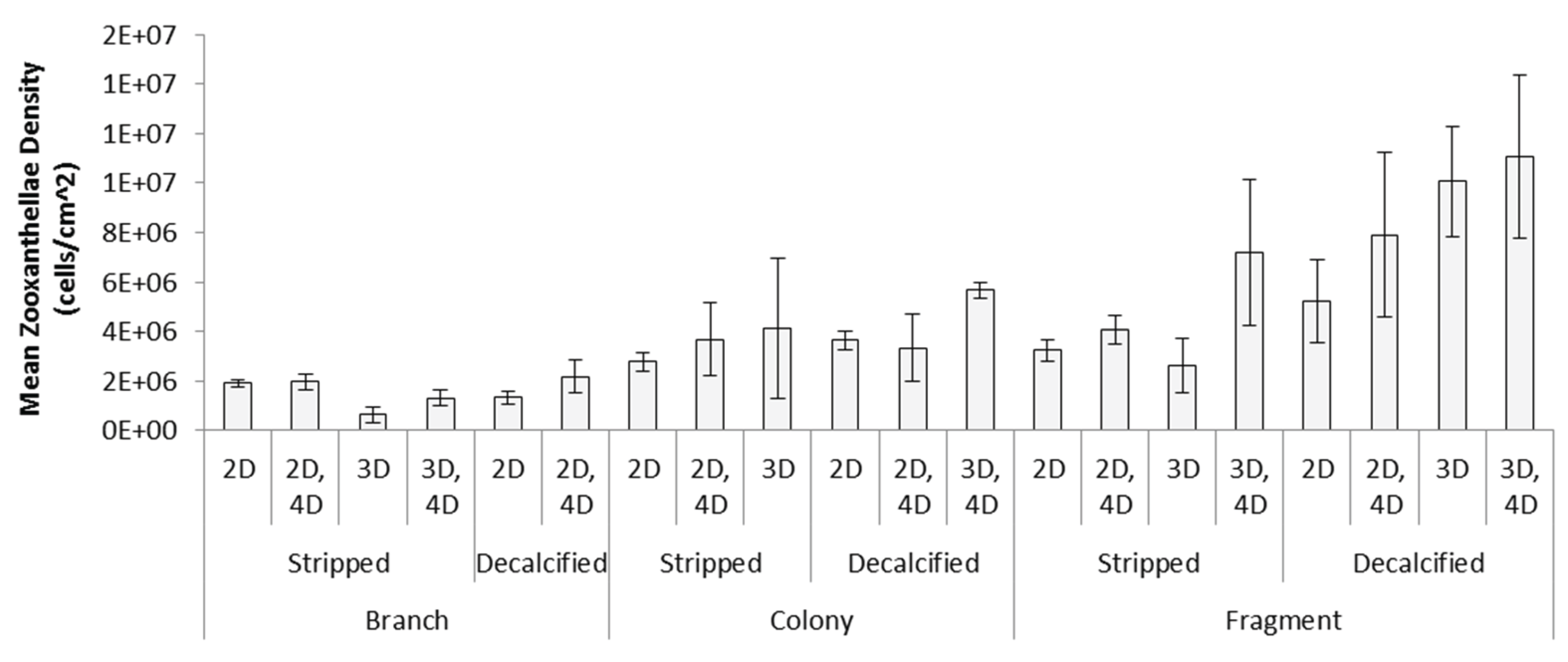
To account for apparent variation in published estimates of zooxanthellae densities from within samples of host tissues, I first explored differences in the methods used [54] and compared waterpiking the tissue off the coral skeletons with decalcifying the skeleton and measuring a known surface area. The waterpik method requires post hoc calibration of the area of tissue sampled by comparing the surface area of the skeleton to determine the surface area of the tissue slurry, (e.g. use aluminum foil to cover the skeleton after the tissue is piked off and compare that with a calibration curve of various surface areas and the weights of the foil). In contrast, the decalcification method utilizes coral’s well-adaptedness and dissolves the skeleton in 100% hydrochloric acid while the tissues and the algae inside them are kept safe, and areas are measured to be tested directly. The decalcification method provides higher average densities, which is likely because the tissue within skeletons (of Complex clade corals) are included in this method.
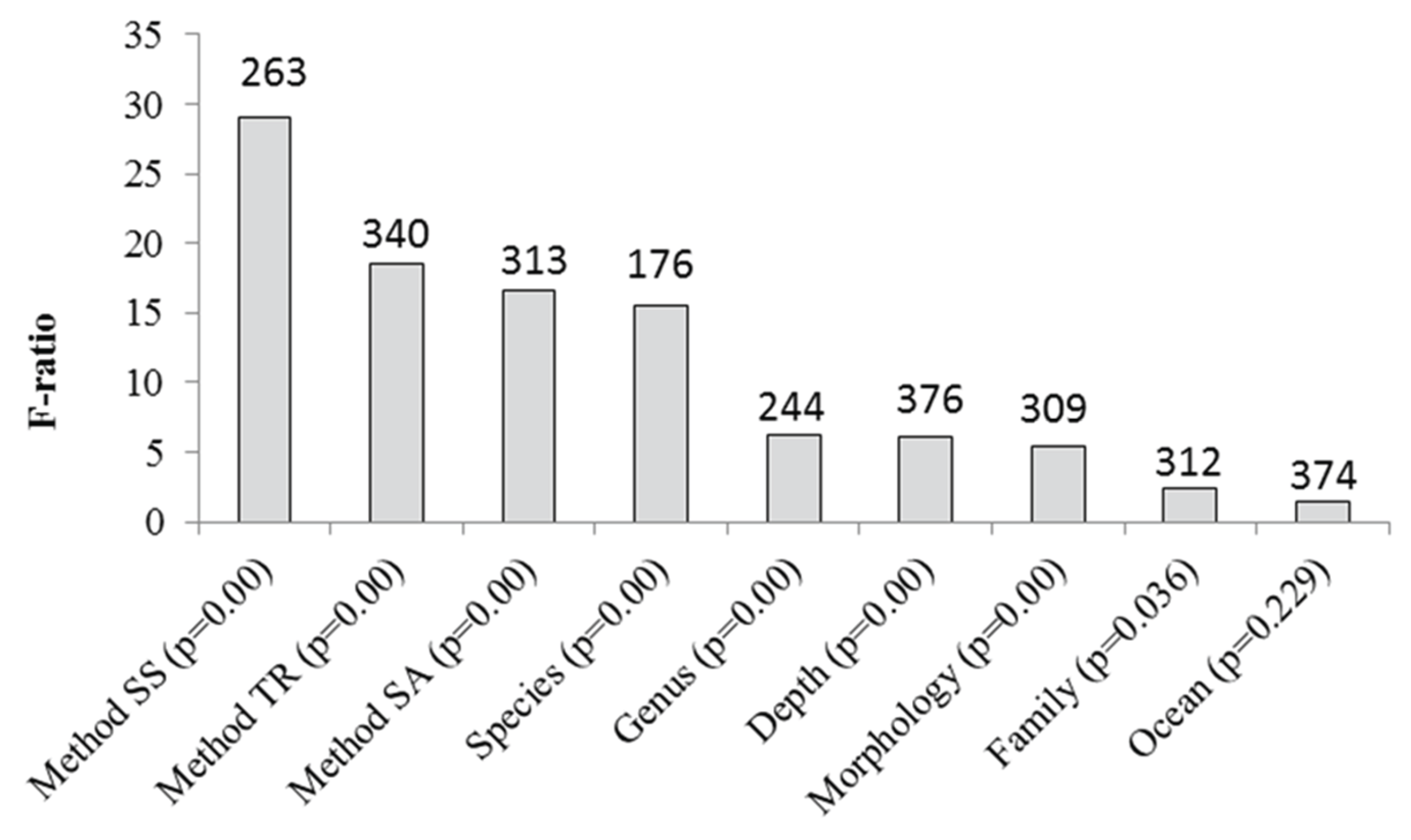
Since methods to determine results were a known source of variation in average estimates of zooxanthellae densities [54], I added it to the composition of the Zooxanthellae Density Database [42] and when I assessed variability, I found the top 3 F factors were methods. The process of determining the density of algal symbionts in coral tissues involves three recorded steps:
i)
Select a Sample Size (method SS): branch, colony, core, fragment, nubbin, and sample
ii)
Method for Tissue Removal (method TR): studies either decalcified the skeleton (decalcification) or stripped tissue from the skeleton (airbrushing and waterpiking). Data were first examined without pooled categories.
iii)
Method to determine the Surface Area (method SA); e.g. measured or inferred, were various: aluminum foil, calculated, vernier callipers, graph paper, imaging analyses, measured, paraffin wax, modification of paraffin wax, photography, spectrophotometry, submerged weight, normalized to weight, colony volume, normalized to polyps.
For this study, a recursive logic framework is proposed from post hoc results of mass bleaching susceptibility, mortality, and recovery [Table 3, Table 4 and Table 7], which afforded a new perspective of coral-algal co-evolutionary adaptations. Therefore, databases on taxonomy [55,56], morphology [55], and life history and reproductive traits [57] were amalgamated to create the Zooxanthellae Density Meta-database (ZDM). Taxonomy was recorded from original studies (at whatever taxonomic level they observed) and if at species, placed into genera and/or families based upon [55] and then reorganised via molecular analyses following [56]. Where possible, data were arranged by morphology (at species level) based upon major categories of growth morphologies: (1) branching, (2) tabular, (3) columnar, (4) sub-massive, (5) massive, (6) encrusting, and (7) free-living [55]. These categories were later pooled into ‘low’ (encrusting, free-living), ‘medium’ (massive or submassive) or ‘high’ (branching, tabular and columnar) levels of colony integration based upon post hoc analyses of the Bleaching Response Meta-database [Table 8]. Furthermore, life history characteristics were added at the level of species from [57] including, generalist or specialist, reproductive mode (brooder, spawner or both), sex (gonochoric or hermaphroditic), transmission of algae (zooxanthellae) to offspring (yes, no, or both), and complexity of skeleton (robust or complex).
As methods were a known cause of significant variation [42,55], every possible variable was recorded, including: i) the size of the experimental unit in which zooxanthellae densities are quantified, be it a polyp, branch (or nubbin), fragment, core sample, sampling across a coral colony, or any of these spatial factors through time (and for how long) ii) the specific method used to separate coral tissues from the underlying skeleton were separated (due to Tukey’s post-hoc test results, [42]) by decalcification of the skeleton or stripping tissue from the skeleton, iii) different methods used to estimate the surface area of host coral tissue from which zooxanthellae were extracted were pooled into callipers, foil, image analysis (spectrophotometry and photography), calculated (calculated and graph paper), and paraffin wax (both original and modified), iv) number of replicate counts, <6, 6-8. >8 counts. The length of observations were also recorded, as many authors [58,59] looked at only one point in time, whereas other others studied the reef numerous years,e.g. [60,61,62,63], and the data were separated thusly: one day, < one week, < 2 weeks, < 3 weeks, < 1 month, < 3 months, < 6 months, < 9 months, < 1 year, < 3 years, > 3 years. Another factor was the author of the methods, and results suggest that the same author follows his/her own way of determining mean zooxanthellae density. Variation was recorded due to changes in depth (transplant depth, intraspecific variation as recorded through depth gradients, aerial exposure), as well as inter-colonial variation, (such as lengthy observations or branch gradients). All categories are present that were used previously [42].
The proportional variation is a mathematical option is to compare the trends as completed in [55], which shows that as long as the same methods are used to quantify the zooxanthellae densities in healthy versus bleached colonies, the resulting estimates of proportional loss of zooxanthellae will not be biased by the methods used; while the absolute values may not be comparable, the proportionate trends remain consistent. By this logic, the results of [42] showed that a monitored decline of >55% of their algal population are bleached, but likely to recover, while corals that experience a loss of >78% of their zooxanthellae density are likely to at least experience partial mortality and that is tested against the Zooxanthellae Density Metadatabase, by re-examining records for their noted recovery, lethality, or unknown effect. For corals that were bleached, changes in zooxanthellae densities were expressed as the percent loss compared to the mean (highs and lows recorded) and wherever possible, were separated into those that ultimately recovered (“sublethal paling”) versus those that died (“lethal bleaching”). Two studies which reported >100% change in zooxanthellae densities were removed from these analyses as they represented special circumstances: [64] represented an experimental observation in which corals were transplanted from the intertidal zone into a cave environment, where they lost all zooxanthellae and acquired a type of cave zooxanthellae, which differed in average healthy population densities and therefore caused a >100% change in zooxanthellae density. Additionally, [61] showed variability over a decade likely due to nutrient supply, with fluctuations of >300%. Furthermore, where “natural variation” was occurring seasonally, it was entered as sublethal paling as well as healthy variation.
Natural variation data were explored previously [42] and collected from both field observations and experiments (categorized as such). Experiments that showed variations in the controls over time or expressed error as standard deviation (large counts) were used in natural variations but categorized by experimental. Furthermore, seasonal observational studies noted that they may have shown bleaching [60], and this was accounted for by data entry into both the natural variation and the percent loss associated with sublethal bleaching of colonies (for percentage data). The cause of variation was recorded; however, the data only provide a rough estimate of variation due to differences between causes, rather than looking at differences within them (e.g. variation caused by light compared to temperature, rather than specifying differences between light levels or levels of any of the variables, aside from depth).
Multiple causes of bleaching were identified among the published studies considered [42], but these were pooled into four categories, (1) changes in temperature (including experimental tests of temperature exposure, as well as transplants between depths or latitudes), (2) changes in light (darkness, irradiance, light, light transplants, UVB and UVR), (3) changes in salinity (4) pollutants (antifoulant, copper, cyanide, herbicide, insecticide, lubricants, metal pollution). Nutrient enrichment and seasonal fluctuations are shown to increase mean zooxanthellae population densities outside of the realm of natural variations [42], so they are only discussed, not included in analyses. Moreover, nutrient enrichment has the potential to help replenish the zooxanthellae population, in quite contrast to the effects of pollutants (antifoulant, copper, cyanide, herbicide, insecticide, lubricants, metal pollution) and declining water quality, so they were distinguished thusly.

2.2. Defining Phases of Health by Fluorometric Analyses

In OISEO [42], I compared two common corals representative of variable life histories and reproductive traits, Acropora nasuta (a complex, spawning hermaphroditic coral that does not transmit algae to its offspring) and Pocillopora damicornis (a robust, brooding hermaphroditic coral that does transmit algae to its offspring). I completed preliminary in situ heath definitions with PAM Fluorometry (alongside visual observations and post hoc confirmation with zooxanthellae densities) to enable the distinguishment of bleaching as a rapid decrease in colony health over 6 sampling times. One fluorometer measurement provides information on 6 variables; minimal fluorescence (F – how many receptors are being used) and maximal fluorescence (Fm – how many receptors are present) values of Photosystem II (PSII), of which the ratio is the quantum yield, which summarises the efficiency of PSII. In other words, you’re looking at the ratio between how many there are and how many are being used to compare the efficiency of the system. When PSII is under stress, two opposing processes are displayed, photoprotection and photoinhibition (34). Reversible damage, or photoprotection, is displayed as a sudden increase in minimal fluorescence (F) and a decrease in maximal fluorescence (Fm), which regulates the quantum yield, while a decrease in minimal fluorescence (F) implies photodamage [Walz 1998]. Photoinhibitors, which inhibit or quench the quantum yield, play a major role in the repair and damage of PSII [65]. Two photoinhibitory pathways are in direct competition for de-excitation processes 1) photochemical energy conversion at the PSII reaction centres (photochemical quenching qP) and 2) non-photochemical loss of energy through heat dissipation at antennae (antennae are chlorophyll or xanthophyll) (NPQ) and reaction centres (qN) [35,65].
In an aim to better define phases of health for the coral-algal symbiosis, the qualitative, subjective definitions for the phases of health [65] were translated into preliminary objective quantitative data phases of health [Table 1] and are used herein to test the definitions of the phases of health upon the OISEO fluorometric data [42]. The OISEO fluorometric data were rearranged to reflect these categories and to consider the relative proportional frequency of the branch site health phases at each level of changed experimental thermal conditions. Importantly, the first step to using a fluorometer is to calibrate your instrument measurements to a range of F values from 0-300, so hypothetically, with these new ranges, if you standardize quenching analyses to a dark control coral, it represents a relative comparison of quenching efforts that is much quicker than direct measurement, although direct measurements are needed to finetune the predicted quantitative definitions and more thoroughly grasp the intricacies of the mechanisms that are used.
Table 1. A unified interpretive framework resolving the dimensionality of zooxanthellae population flux. Recalibrating the x-axis to mean density removes misinterpreted temporal noise in natural fluctuations, revealing underlying system architecture. This exposes the contrast between healthy variation (NV high/low) and the perpendicular transition into sublethal and lethal states, clarifying how scale misinterpretation has obscured coral survival dynamics. The Architecture of Density Flux: Comparison of the Dimensionality of Zooxanthellae Population Densities, resolved the Misinterpreted Scale between homeostatic Natural Variation and the Phase Transition into sublethal and lethal states (expressed as percentage deviation from the system mean).
Healthy ±SE n Pale ±SE n Bleached ±SE n
21.37 1.86 349 56.26 1.23 195 8.15 1.01 163
A)
Architecture of density flux. Comparisons of zooxanthellae population dimensionality across healthy, pale, and bleached states, expressed as percent deviation from the system mean. This analysis resolves misinterpreted scale between natural homeostatic variation and phase transitions into sublethal and lethal states.
Healthy Sublethal bleaching Bleached
Source Average n ±SE Average n ±SE Average n ±SE
Within-colony 16.42 37 6.43 63.45 11 2.45
Temperature 25.34 195 2.70 56.16 141 1.49 82.76 129 1.13
Habitat 8.99 75 3.43 66.13 18 3.10 83 3 0
Pollutant 28.54 39 2.07 43.18 22 2.62 74.17 27 2.32
B)
Environmental forcing and systemic response. Analysis of functional drivers shaping system architecture, illustrating how within-colony integration and external stressors (temperature, habitat, pollutants) influence the direction and magnitude of symbiotic variation across bleaching states.
Source SS Type III df n MS F p
Natural Variation 76.548 3 345 0.216 3.863 <0.05*
Sublethal bleaching 9.248 3 191 0.044 6.876 <0.001***
Sublethal, pollution removed 8.200 2 169 0.047 2.858 >0.05
Lethal bleaching 9.312 1 155 0.056 11.292 <0.01**
*Significant, **strongly significant, ***highly significant.

2.3. Mass Bleaching Response Meta-Database

The Mass Bleaching Response Database [42,44,66,67] hosts records (>3200 susceptibility, >2700 mortality, <150 recovery) of over 300 studies, which span greater than 80 years of research and all geographical regions of extensive coral reef formation, that have specifically quantified variations in temperature-related bleaching susceptibility within and among Scleractinian corals. It is important to note that this database extends to 2015, so new information may show more intricacies than presented here. The first publishing of the Mass Bleaching Response Database [66] reported results on an interaction between taxonomic families and morphologies with regards to the bleaching response, and noted that for durational studies, there was no significant difference between susceptibility of differing growth forms; however, mortality was less for massive growth forms. The second publishing of the Mass Bleaching Response Database was a full breadth analysis of taxonomy and location on the bleaching responses of corals [44], while [67] focussed on the impacts of size, the inter-connectedness of growth forms and hinted towards reproductive phase (e.g. juvenile non-reproductive vs. adult reproductive coral and their energy investments) being an important attribute to the bleaching response. Moreover, [67] was part of a long-term monitoring effort in French Polynesia that showed lessoned impact through repeated bleaching incidence with similar disturbance regimes; a mechanism of selective removal from within populations that bolstered the community assemblage resilience.
The Bleaching Response Database was initially a compilation of observations of mass bleaching events [42,44], and as I analysed it, I became aware that other databases could help fill in the gaps of knowledge, such as the global thermal data from the National Oceanographic and Atmospheric Administration (NOAA) and the Australian Institute of Marine Sciences (AIMS) to help calculate the timing of observations witnessed in comparison to the length of thermal stress accumulation for each record (unless given, which was not often). The data collected were based on the Degree Heating Week (DHW, wherein the first mass bleaching episodes in the 1980s occurred when sea temperatures exceeded normal local limits by > 1.0oC for more than 1 week (e. g. >1 Degree Heating Week, DHW, [68]). The DHW Indices of the locations are examined through post hoc data entry of NOAA and AIMS temperature datasets for time made relative by recalibrating the data to the onset of thermal stress and related to when researchers took observations in comparison to when thermal stress began accumulating. Thermal stress accumulation was recorded from temperature data given in studies, where mean temperature, the years that determined the mean temperature, and the source of information (e.g. data loggers at sites or satellite information) were recorded. The number of weeks above the mean (e.g. +1oC, +2oC, +3oC, etc.) were multiplied by the increase above the mean (e.g. 4 weeks at 2oC = 8 weeks) and, for each site, the DHW were added to show the thermal stress accumulation (e.g. (4 weeks x +2oC) + (6 weeks x +1oC) = 14 weeks)). However, in 2007, NOAA updated the metric to 4DHW to initiate widespread distress on coral reefs. This is reflected in the category of bleaching occurrence, where the history of reported thermal stress was determined for each location and recorded based on previous published work. For instance, many study areas had experienced 5 repeated bleaching events (e.g. Eastern and Southern Pacific), while at least one bleaching was very notably the first recorded in the Central Pacific [69]. Additionally, the Bleaching Response Meta-database (BRM) is combined with databases on taxonomy [55,56], morphology [55], and life history and reproductive traits [57], as well as the thermal data from NOAA and AIMS and the calculated timing of observations based on dates provided and retrospective viewing of the thermal history and timing of anomalous waters. Lastly, while the decade of observations was recorded, there appeared to be some fluctuations due to the advent of new technologies.

2.4. Aims and Statistics

The following analyses are structured to evaluate competing definitions of bleaching by examining their internal consistency, biological interpretability, and predictive alignment with observed outcomes. The overarching aims are to define bleaching and explain bleaching responses. Bleaching is first explored by attempting to define healthy fluctuations in zooxanthellae densities [Section 2.4.1], then comparing healthy and bleached zooxanthellae densities for absolute densities to distinguish them [Section 2.4.2], which leads to the creation of dynamic equations [Section 2.4.3]. Zooxanthellae density data are then interpreted through proportional loss [Section 2.4.4], fully explored [Section 2.4.4.1], analyzed [Section 2.4.4.2], and then related to the causal agents [Section 2.4.4.3]. The bleaching definition [Section 2.1] is then linked to bleaching responses [Section 2.2] which forms the basis for the perceptual shift in our biased assumptions of the relativity of time to organismal dimensionality and cryptic evolutionary resilience [section 2.3].
The OISEO [42] Pam Fluorometry data are grouped into subjective categories for the phases of health and expressed in multiple perspectives on graphics [Section 2.4.5]. Overall bleaching responses of paired durational susceptibility and mortality records are explored [Section 2.4.6]. The aims then move to fully exploring bleaching responses [Section 2.4.6]. Bleaching susceptibility and mortality are overviewed [2.4.6.1] along with recovery [2.4.6.2]. Data are then grouped based on post hoc test results [2.4.6.3] and mapped through a descriptive statistical matrix of thermal stress accumulation and the relativity of the timing of the observations to the onset of thermal stress [2.4.6.4].
The zooxanthellae density data are then revisited to compare and contrast healthy and bleached zooxanthellae densities with mass bleaching susceptibility and mortality by post hoc categories of the level of colony integration and post hoc categories of locations, subregions within ocean basins [Section 2.4.6.5]. The final section is the preliminary exploratory analyses of zooxanthellae genomic diversity with coral life history strategies [Section 2.4.7].

2.4.1. Examine Healthy Fluctuations in Zooxanthellae Densities to Define a Bleached State

The full records of the Zooxanthellae Density Database were used to explore variations in seemingly healthy corals. Descriptive statistics and ANOVAs were completed. As counts had been too low to search for an absolutely healthy or bleached zooxanthellae density from the zooxanthellae density database, a series of independent 1-way ANOVAs were run for each variable (with Tukey’s post-hoc, where appropriate), including all appropriately categorized estimates of zooxanthellae density (where n > 5). For each analysis of variance, the F factor was recorded and used to compare the relative importance of the contribution of each factor to the ‘noise’ present in the database [following 42]. This data is reported at a base level, as analyses were recompleted with the Zooxanthellae Density Meta-Database when comparing healthy and bleached zooxanthellae densities and likely mortality; trends within factors remained the same, but new factors were added, and post hoc groupings (recorded in results text and Table 7) were used that slightly changed the overall results.
Examine a Bleaching Definition Through Absolute Zooxanthellae Densities
The primary aim of the zooxanthellae density database was to attempt to define bleaching via an absolute density of zooxanthellae, but due to the wide range of variability, this aim had to be modified to two subaims, 1) create dynamic equations that weigh the relative importances of factors and provide standards to be used for averages to fill in the blanks of the dynamic equations or compare, 2) calculate the relative proportional loss in zooxanthellae densities through time and compare the proportional variability amongst causes.
Dynamic Equations for Absolute Healthy and Bleached Zooxanthellae Densities
First, data were updated to be the Zooxanthellae Density Meta-database, and then data were restricted to pairwise entries for healthy and bleached (and if mortal or recovered), Regression analysis and a Student’s T-test were utilised to compare all healthy and all bleached zooxanthellae population densities. Then, due to differences in the methods used to assess variation (reported in the results text herein), attributable to the Sample Size used (method SS: branch, colony, core, fragment, nubbin, and sample), the Method for Tissue Removal (method TR; airbrushing, decalcification, and waterpiking), the method for the determination of tissue Surface Area (method SA; calculated, callipers, foil, image analyser, modified paraffin wax, paraffin wax), species (Acropora millepora, Acropora nasuta, Goniastrea aspera, Montastrea annularis, Montastrea faveolata, Pocillopora damicornis, Porites cylindrica, Porites lobata, Porites lutea, Seriatopora hystrix, and Stylophora pistillata), genus (Acropora, Favia, Goniastrea, Montastrea, Montipora, Pavona, Pocillopora, Porites, Seriatopora, Goniastrea) family (Acroporidae, Agariciidae, Faviidae, Oculinidae, Pocilloporidae and Poritidae), morphology (branching, encrusting, foliose and massive), and depth (<3m, 4-6m, 7-10m, 11-19m, >20m), it was not possible to do a single comprehensive analysis and partition variance accordingly. Instead, a series of independent 1-way ANOVAs were run for each variable (with Tukey’s post-hoc, where appropriate), including all appropriately categorized estimates of zooxanthellae density (where n > 5). For each analysis of variance, the F factor was recorded and used to compare the relative importance of the contribution of each factor to the ‘noise’ present in the database [Bradbury 2013], assuming most variability is captured. Variability was partitioned to groups of similar characteristics (methods, location, taxonomy, and biology/ecology) to further enable a relative importance of factors to overall variability (F factor/Total F factor x 100). The grouped relative importance of factors (Table 2) can then be used in a dynamic equation, such that one can look up the standards for average values (Table 1) and place them in the weighted categories to estimate and compare zooxanthellae densities (ANOVAs and correlations in Table 2 for estimating accuracy). Additionally, Pearson’s correlation tests were completed for significant variables.
Proportional Loss in Zooxanthellae Densities as a Metric to Define Bleaching
The results for absolute densities of zooxanthellae were a dead end, so proportional loss in zooxanthellae population density for nominally bleached corals (anemones were included for proportional variation) was used to test for differences in the severity of bleaching associated with different causes.
Exploratory Analysis of Proportional Variation in Zooxanthellae Densities
Natural variations (above and below the mean) are compared to sublethal (bleached, recover), and lethal bleaching (noted mortality).
Proportional Loss as a Metric to Define Bleaching Lethality
Proportional loss related to lethality (recovery, death, unknown) are displayed as a function of frequency.
Statistical Exploration of Proportional Loss
ANOVA was used to explore differences between healthy variation and sublethal and lethal bleaching for each of the grouped factors of causes. Descriptive statistics are also shown.
Variability in the Proportional Loss Associated with Bleaching Due to Causes
ANOVAs were used to explore differences between healthy variation and sublethal and lethal bleaching for each of the grouped factors of causes based on the proportional variation (percentage data were arcsine transformed to meet the assumptions), and descriptive statistics are shown.

2.4.2. Quantitative Fluorometric Definitions for the Phases of Health

Fluorometric analyses from OISEO [42] were regrouped based on subjective definitions turned quantitative [Table 1], coded and graphically explored.

2.4.3. Exploration of Bleaching Responses with Regards to New Perspective of Bleaching

An overall scatterplot of the Mass Bleaching Response Metadatabase is presented as paired records of susceptibility and mortality, with the quadratic formula and correlation coefficient shown on the graph.
Exploratory Statistics for Bleaching Responses
This subsection evaluates bleaching definitions by catabolizing zooxanthellae density into absolute, proportional, and dynamic components, and by examining their statistical and biological consequences. Since new categories were added to the meta-database on bleaching responses, exploratory descriptive statistics were completed first, followed by partitioned ANOVA results, then data were regrouped based on Tukey’s post hoc tests so that some of the variability in the responses could be lessoned, and enable a better picture of what is actually happening during mass bleaching events. Descriptive statistics and overall comparisons were completed. As bleaching susceptibility and mortality were limited to pair-wise values, analyses began with a scatterplot regression and a Student’s T test. Then, the data were explored though a series of independent 1-way ANOVAs for each variable (with Tukey’s post-hoc, where appropriate) and F factors were compared, as done with zooxanthellae density data. This exploratory analysis included all appropriately categorized estimates of bleaching susceptibility and mortality for which there were >10 records. ANOVA was used to establish the level (and significance) of variation in bleaching susceptibility due to taxa (family, genus and species), biology/ecology (morphology, habitat, depth, life history characteristics) location (ocean, subregion, country and location) and timing (how far into the event that observations were made and rather they were complete observations, as well as decade and bleaching occurrence - which is how many times that geographic region has experienced mass bleaching. Post hoc test results are shown, where applicable. Additionally, Pearson’s correlation tests were completed for significant variables. All data were arcsine square root transformed for normality to meet the assumptions of ANOVA.
Another post hoc category was added to susceptibility and mortality averages (throughout where applicable) – the bleaching efficiency, mirrored from the photosynthetic efficiency through quantum yield, in this case (Susceptibility – Mortality)/Susceptibility; where 0 would relate to a net loss and susceptibility equals mortality, while 1 represents no mortality from the response. An interesting ‘non-defined’ operation, dividing by zero is very defined here, bleaching responses can be 0 Susceptibility and 0 Mortality; these were marked with asterisks, however, this begs the question of why this is considered undefinable as I define it – it is important to note when there is no susceptibility to events, we need that information.
Exploratory Statistics on Recovery
The time to recover (in months) was analysed using independent ANOVA s for the various factors, and correlation tests were completed for factors that affect recovery. F ratios from the ANOVAs were compared to create relative importance of the factors. Due to the low number of records (n = 152), cases were included where n ≥ 3.
Post Hoc Groupings
Due to the large number of factors that cause variation in bleaching susceptibility and mortality (n = 34) Tukey’s post hoc results were used to regroup factors for simplicity [Table 8]. Data were combined when the Sum of Squares showed similar results as did the F ratio. For instance, degree heating weeks, and other thermal data (e.g. annual temperature, peak temperature) were replaced with thermal stress accumulation (low – 0-19 degree heating weeks, medium (20-39 degree heating weeks, high >40 degree heating weeks). Months of observations after anomalous thermal stress led to three different categories (beginning – 0-3 months; middle 3-6; end 7+ weeks). Location was simplified from to subregions within ocean basins. Growth form was exchanged for the level of colony integration (high- branching, columnar and tabular; medium – massive and submassive corals; low – encrusting and free-living. Anthropogenic input (yes/no, as well as y/n for protection, which replaced marine protected area and anthropogenic stress. Lastly, weather categories combined to express either relief or exacerbation of effects. For instance, there may be upwelling but also doldrums, so there were four groups: No relief, no relief + doldrums, yes relief, and yes relief with doldrums.
Map Bleaching Through a Matrix of Temperature and Time
Timing of observations (months) relative to the onset of thermal stress and thermal stress accumulation were the two greatest causes of significant variations in bleaching responses (Table 4 and Table 5), so I used Tukey’s post hoc tests (Table 7) to regroup and matrix the data. The timing of observations relative to the onset of thermal stress were grouped into ‘Beginning’ (0-2 months), ‘Middle’ (3-6 months), and ‘End’ (7+months), while the categories of thermal stress accumulation were ‘Low’ (0-20 Degree Heating Weeks), ‘Medium’ (21-39 Degree Heating Weeks) and ‘High’ (40+ Degree Heating Weeks). ANOVAs were completed before and after the post hoc groupings to show any impacts on significance within the data categories (Table 7). ANOVA’s were completed for as many factors as possible within these nine categories (Table 9) and average values are shown (Table 10). Dynamic equations can be created using the weighted average importance with the standard values, per previous dynamic equations (Table 9 and Table 10). Additionally. Data were restricted to recovery, susceptibility, and mortality triplet values to compare bleaching responses with recovery capabilities; scatterplots are presented.
Compare and Contrast Bleaching Definitions with Bleaching Responses
Dynamic equations for healthy and bleached zooxanthellae densities and proportional loss in the zooxanthellae population compared to the mean of the means through time are assessed as bleaching definitions in relation to their explanatory power towards bleaching responses. The locations of observations/ experiments were added; and, separated into ocean, subregions of oceans, country, location and then after post-hoc results (Table 7), subregions within oceans, which will be used as the platform to study the relationship between healthy variation in zooxanthellae densities and susceptibility and mortality to bleaching through correlation analyses, ANOVA, and descriptive statistics. Location (ocean basin and subregion) and the level of colony integration appear were tested and data were compared to bleaching susceptibility and mortality at the same level. MANOVA was used on ocean basin to compare pair-wise healthy and bleached zooxanthellae densities.
Survival of Genetic Material and Disturbance Guilds
Genetic variation of the zooxanthellae population was determined by combining the life history data [55] with a database on zooxanthellae population diversity [72]. I tested the hypothesis that the genetics of the zooxanthellae populations will be markedly different with regards to fight and flight responses, as the functions of certain types of zooxanthellae have been shown to vary (e.g. 71, 72). Genetic diversity due to life history traits were tested by observing the number and diversity of symbionts among the different life history characteristics (entered at species level, except for complexity ok skeleton which was entered at Family level).

3. Results

3.1. The Architecture of Resilience

The results presented herein delineate the foundational components of recovery mechanisms and quantitatively reframe the narrative of coral bleaching from a passive state of failure to an active, architectural strategy for survival. This work synthesizes greater than 350 records for symbiont density, 2,200 records for bleaching susceptibility and mortality, almost 150 records for recovery, and over 250 records of symbiont cladal diversity to explore the ‘static’ or ‘noise’ of methodological variation and traditional taxonomic assumptions to reveal a structured decision matrix. This analysis begins with the Architecture of Resilience identifying the physiological limits of the symbiosis between coral and algae and culminates in a systems-level exploration of BEQ – a metric that identifies bleaching not as a terminal event, but as a well-adapted survival protocol forged through 200 million years of evolutionary history.

Limits of a Stable Symbiosis

Reported zooxanthellae densities for healthy (unbleached) and bleached corals have enormous ranges of reported values [Figure 1, Figure A1, Figure 3A, Table 1A]. Healthy values reflected up to 369 records, while bleached values for 103 records are reported here for comparison [Figure 2, Table 1A]. Healthy zooxanthellae densities ranged from 0.1 x 10⁶ cells/cm2 to 18.0 x 10⁶ cells/cm2; [Table A1] and are largely attributable to methods used to estimate densities [Figure 2A and Table 1A]. In comparison, the mean densities of zooxanthellae recorded for bleached corals were 1.26x10⁶ (SE±8.78x10⁵) and ranged from 0.001 x 10⁶ cells/cm2 in a massive Porites exposed to high temperature and high UVR [62] to 6.5 x 10⁶ cells/cm2 in Plesiastrea versipora following cyanide exposure [63, Table 1A]. Moreover, when comparing bleached densities by methods, the data range from 5.00x10⁵ for Acropora nasuta (branch that was “peeled and squashed”) up to 6.5x10⁶ for Plesiastrea versipora (massive fragment that was waterpiked and used image analysis). Additionally, the highest bleached zooxanthellae density (1.16x10⁷ ±2.28x10⁶ SE) was recorded for Coelastrea aspera, a massive coral, while the lowest mean healthy zooxanthellae density was from Stylophora pistillata, a common branching coral (1.87x10⁶ ±5.92x10⁵ SE) [Table 1A].
The full breadth of variability in healthy and bleached densities by frequency of occurrence [Figure 3A] shows that there are notable fluctuations that need to be quantified. Methods are known to cause a significant amount of variation in healthy measurements of zooxanthellae densities [42], and further analyses [Table A1, Figure 2A] further support that notion. Furthermore, methods limit the records that could be used alongside taxonomy to find an absolute universal zooxanthellae density for healthy or bleached corals [Figure 2A, Table 2A and Table 3A]. Given the diverse combinations of methods possible in quantifying zooxanthellae densities there were very low numbers of records remaining that provided the resolution for directly comparable estimates of healthy or bleached zooxanthellae densities [e.g. Figure 2A, Table A1], although it is apparent that the “normal” density for some is well below that which characterises bleaching in others [Figure 3A, Table 1A, Table 2A and Table 3A]. Due to this high variability in absolute measures, and the known capacity for the trends in results to stay similar when comparing methods [54], I began exploring the proportional variation [Figure 2] (loss of zooxanthellae density from the mean healthy values) in [42] alongside indirect absolute values that can be created using the dynamic equations [Table 1 and Table 2], which provide standard substitutes and their relative importances.
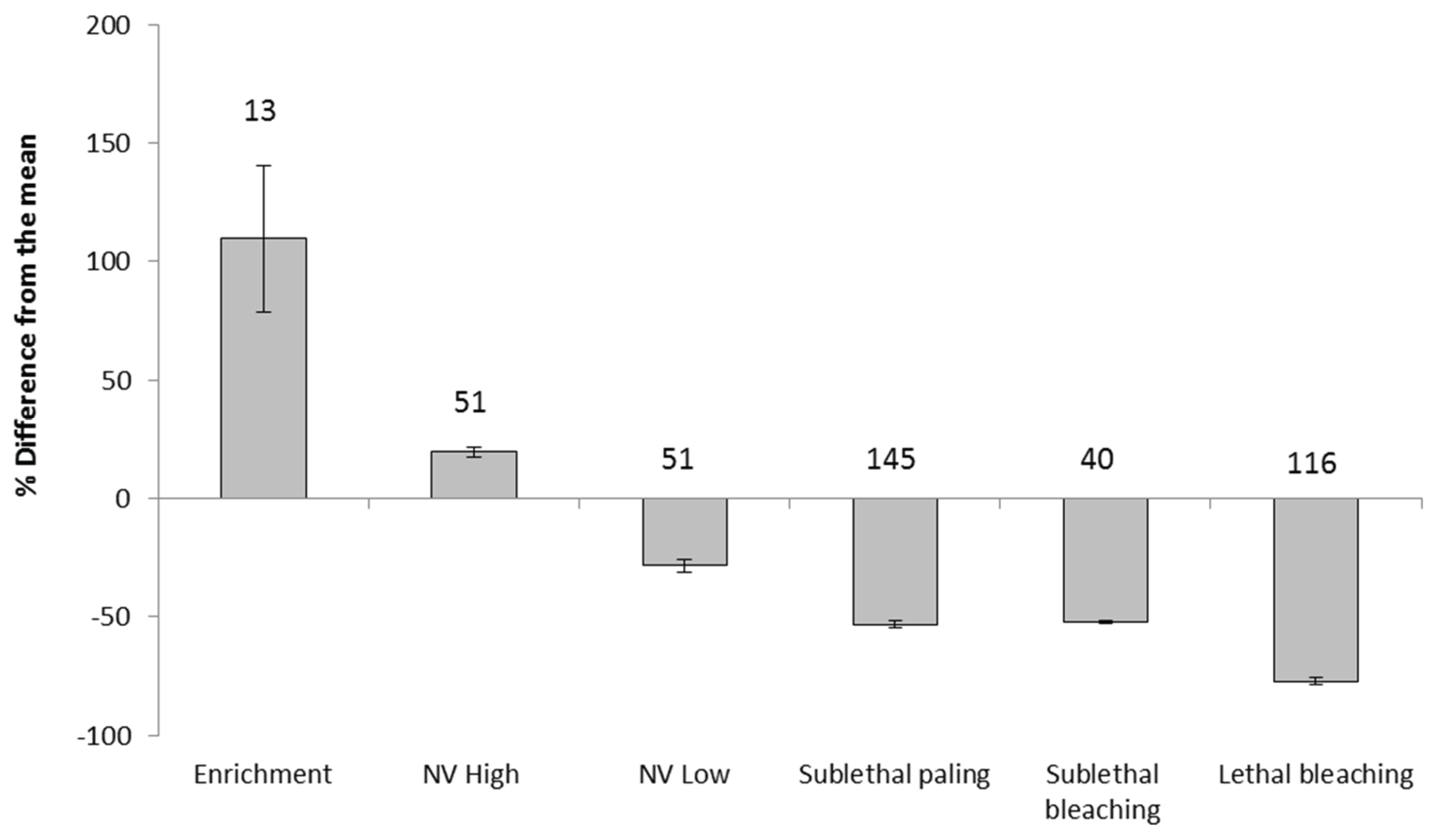
Zooxanthellae densities vary and fluctuate naturally; however, there were few cases where variations within healthy organisms exceeded the loss associated with the bleaching threshold [Figure 1] Nutrient enrichment (e.g. ammonia) was the only causal agent that dramatically increased mean zooxanthellae density [Figure 1]. Depth was the greatest source of natural variation as it caused the greatest percent difference from the mean zooxanthellae density, 136%, in Montastrea annularis colonies; this was also the greatest source of natural variation for above (95%) and below (41%) the mean zooxanthellae density [Figure 1]. The sublethal bleaching category presented in [Figure 1] are the data from the OISEO, where time was variable and health status was controlled, and the total number are representative of the algebraic means of colonies averaged on their individual bleaching days.
Figure 1. Architecture of Resilience Across Zooxanthellae Population States. Mean percent difference in symbiont density relative to the overall mean is shown across enrichment, natural variability (NV high, NV low), sublethal paling, sublethal bleaching, and lethal bleaching conditions. Values are centered on the mean to standardize comparisons across studies and sampling contexts. Positive deviations characterize enrichment and NV-high states, while progressively negative deviations correspond to sublethal and lethal stress states. Error bars represent variability within each category; numbers above bars indicate sample size. This normalization reveals discrete population states rather than continuous temporal decline, distinguishing natural fluctuation from transitions associated with bleaching severity.
Preprints 200993 g001
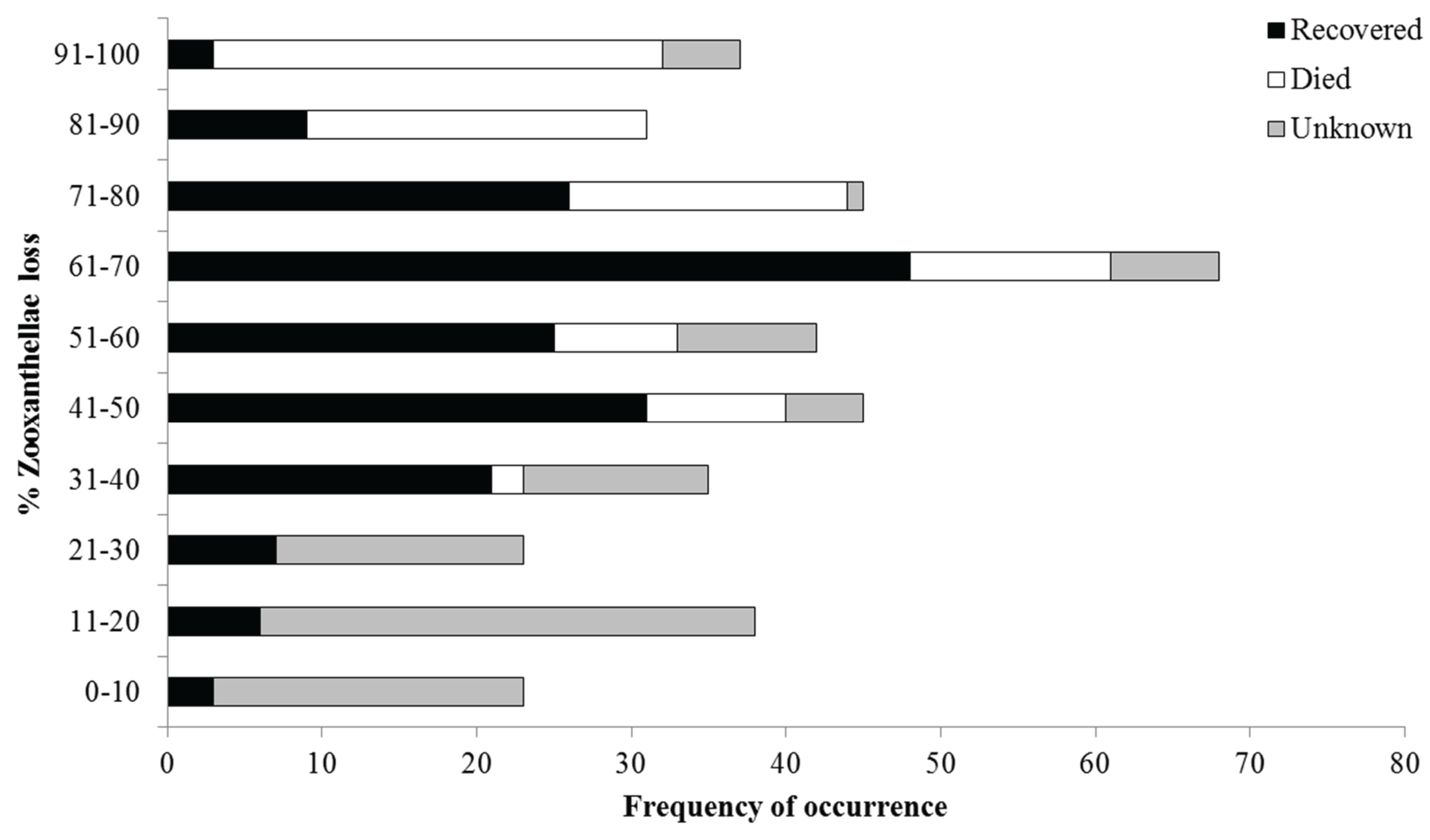
Figure 2. Frequency Distribution of Symbiotic Loss States and Associated Outcomes. Observed frequencies of recovery, mortality, and unknown outcomes are shown across binned percentages of zooxanthellae density loss. Recovery persists across a wide range of loss states, including levels commonly classified as severe bleaching. Mortality increases nonlinearly with increasing loss but does not follow a single deterministic threshold. This distribution reflects the underlying architecture of bleaching, where outcome states emerge from system structure rather than proportional loss alone.
Preprints 200993 g002
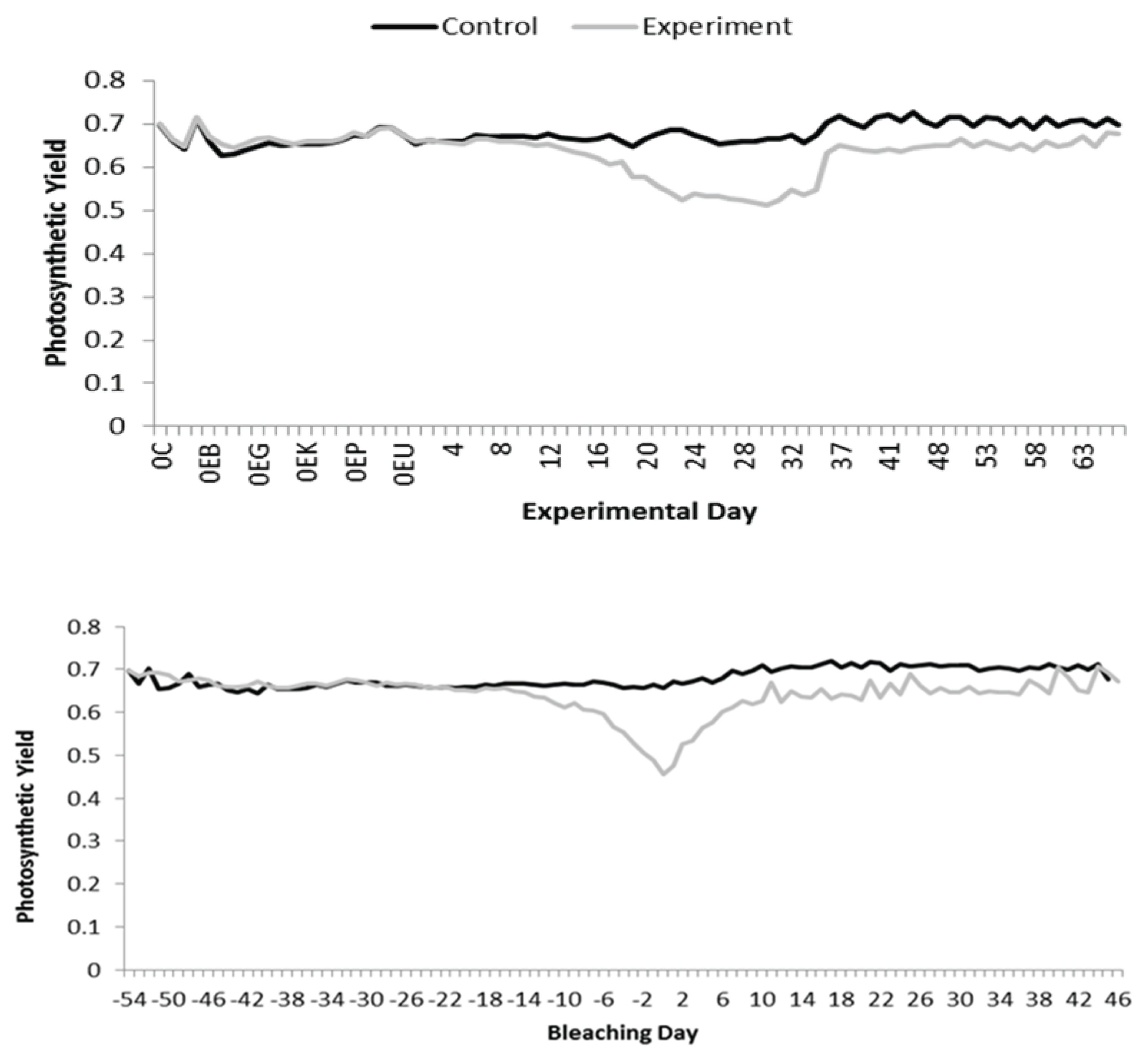
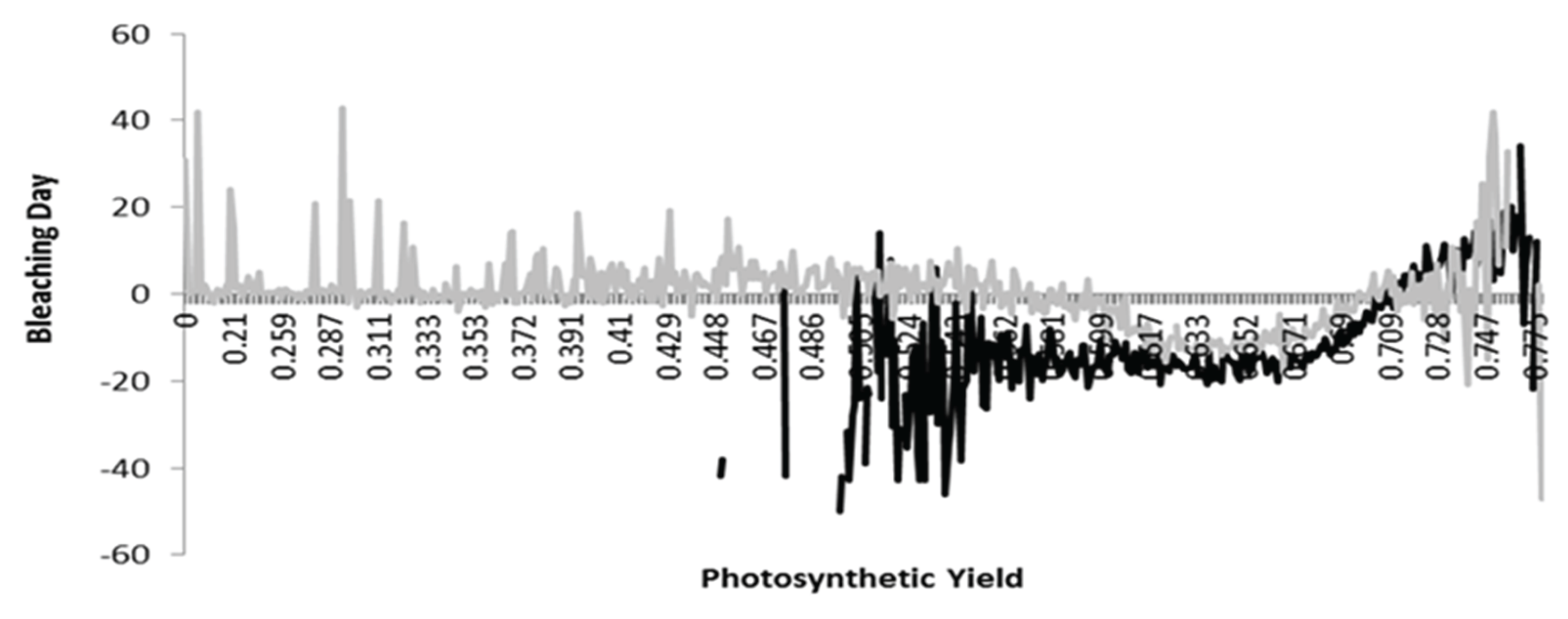
Figure 3. Comparison of photosynthetic quantum yield trajectories under alternative temporal frameworks. Data are shown for colonies of A. nasuta and P. damicornis pooled across species (no significant differences based on yield alone). (a) Time series arranged by experimental day illustrates apparent stability punctuated by transient declines. (b) Recalibration by bleaching day reveals a coherent depression in yield aligned with the bleaching event, followed by recovery, resolving temporal ambiguity. (c) Yield plotted against bleaching intensity identifies the inflection region where sublethal stress transitions toward structural instability. Together, these views demonstrate that yield dynamics are more interpretable when time is treated as a state-dependent variable rather than a linear experimental axis.
Preprints 200993 g003aPreprints 200993 g003b
Generally, the trends for healthy and bleached both form normal distributions, if slightly skewed [Figure 2], where recovery is highest when only between 61-70% of zooxanthellae is lost], and mortality is highest where >71% of zooxanthellae were lost. Corals that bleached and did not recover [lethal bleaching, Figure 2] were reported to have an average of <1.3x10⁶ zooxanthellae per cm2, which is higher than earlier estimates of “normal” zooxanthellae densities [Figure 3A]. One million cells/cm2 has commonly been cited as an average healthy zooxanthellae density [68,69], but this is dependent upon the methods and scales of samples [Figure 1A, Figure 2A and Figure 3A, Table 1A and Table 2A]. Moreover, when I separated out the causes of bleaching in comparison to natural fluctuations [Figure 4A], and analyzed them further [Table 1], pollutants caused the highest proportion of variability to healthy zooxanthellae densities and produce sublethal and lethal bleaching lower than other causes. Additionally, when pollution data were removed from the sublethal bleaching category [Table 3c], the data were not significantly different within the category.
In an attempt to further describe and define bleaching [Table 3], I compared the mean deviation in average densities between healthy, paled and bleached corals, to find that bleached corals should be readily distinguishable [8.15% colony deviation in variability, Table 1a] as more of the variability is captured in fewer attempts, the true mean is less variable than healthy or natural fluctuations [Table 1a]. Variability in the percent loss associated with both sublethal and lethal bleaching of corals [Figure 2] was affected by the methods SS, causal agent, and timeframes of observations. Methods SS caused significant variability (sublethal, F(6,165) = 2.423, p<0.05): samples (n=10) and fragments (n=20) were lower (separated by Tukey’s post hoc) than other sizes (49% and 52%, respectively), while core samples (n=13) were higher than other sizes (72%). The range of sublethal bleaching from other categories of methods SS (anemone (n=14), branch (n=33), colony (n=65) and subsamples (n=11)) was 55-60%. Lethal bleaching percentage loss was also affected by methods SS (F(5, 92) = 9.553, p<0.05). Samples (n= 28) were separated by Tukey’s post hoc as lower (64%), while colonies (n=18) were separated as higher (89%): the range of other categories (anemone (n=9), branch (n=12), fragment (n=20), subsample (n=6)) was 68-83%.
Table 3. Multidimensional drivers of recovery time following bleaching events. Factors associated with variation in recovery duration (months), where n ≥ 3; all values square-root transformed to meet ANOVA assumptions. The table synthesizes biological, environmental, and spatial variables to resolve recovery as a structured, non-linear process rather than a uniform temporal outcome. Recovery times vary systematically across colony position, thermal stress accumulation, anthropogenic input, habitat, geography, and genus, indicating that recovery reflects interaction between system architecture and historical exposure rather than bleaching intensity alone.
A)
Mean recovery times (± SE) across categorical drivers, illustrating differential recovery trajectories associated with internal colony structure, external forcing, and biogeographic context.
Factor Source Recovery (months) ±SE n
Shelf Position Inner 8.00 0.00 3
Middle 2.29 0.33 11
Outer 1.94 0.30 16
Relief from Weather No 7.00 0.53 43
Yes 3.59 0.31 80
Thermal Stress Accumulation Low 3.98 0.49 82
Medium 8.20 0.75 54
High 10.33 1.69 6
Anthropogenic Input Low 6.72 0.44 32
Medium 6.67 1.33 4
High 12.00 0 5
Locations Caribbean 5.00 1.00 8
Centre of Biodiversity 10.33 1.71 20
Eastern Pacific 6.72 0.44 32
French Polynesia 3.29 0.27 66
Great Barrier Reef 8.05 1.66 23
Habitat Bay 5.62 0.21 13
Reef Flat 3.00 1.73 4
Reef Crest 1.50 0.00 14
Reef Slope 4.15 1.04 20
Sex Gonochoric 4.99 0.67 30
Hermaphroditic 3.44 0.35 46
Genus Acropora 3.18 0.49 20
Astrea 4.20 1.10 5
Montipora 13.00 4.02 7
Pavona 6.43 1.15 7
Platygyra 2.85 1.10 3
Pocillopora 3.72 0.56 16
Porites 3.46 0.57 11
Psammocora 7.58 1.85 6
Bleaching Occurrence First 7.15 1.25 33
Second 4.71 0.86 55
Third 6.00 0.00 26
Fourth 5.60 1.60 5
Fifth 5.85 0.10 27
Species Acropora gemmifera 4.50 1.50 3
Acropora hyacinthus 3.08 0.78 7
Acropora millepora 2.19 0.48 3
Astrea curta 4.20 1.10 5
Pavona cactus 7.25 1.97 4
Platygyra daedalea 2.85 1.10 3
Pocillopora damicornis 6.00 0.00 3
Pocillopora elegans 6.00 0.00 3
Pocillopora meandrina 3.00 1.50 3
Porites lobata 2.51 0.85 4
Transmission of Algae to Offspring No 4.58 0.53 44
Yes 3.42 0.43 23
Level of Colony Integration Low 3.60 1.16 10
Medium 4.28 0.44 31
High 5.96 0.81 51
Generalization Generalist 3.78 0.38 49
Specialist 4.49 0.65 29
Reproductive Mode Brooder 4.44 0.55 8
Spawner 4.04 0.39 67
Family Acroporidae 6.14 1.24 37
Agariciidae 6.08 0.68 12
Fungiidae 4.45 1.18 10
Merulinidae 5.58 1.17 20
Mussidae 4.00 0.00 3
Pocilloporidae 4.94 0.95 24
Poritidae 4.21 0.53 17
Psammocoridae 7.58 1.85 6
Dominant Topography Acropora and Montipora 8.25 1.33 16
Acropora hyacinthus 6.00 0.00 16
Montastrea 4.00 0.00 4
Pavonids and Pocilloporids 5.77 0.13 22
Pocilloporidae, Fungiidae, Acroporidae, and Poritidae 6.00 0.00 5
Porites lobata, Pocillopora damicornis, and Pocillopora elegans 6.00 0.00 6
Complexity of Skeleton Complex 5.67 0.72 66
Robust 5.48 0.58 65
B)
Analysis of variance identifying dominant structural drivers of recovery duration following mass bleaching. Recovery time varies significantly with shelf position, relief from weather, thermal stress accumulation, anthropogenic input, location, habitat, sex, and genus, while species identity, reproductive mode, transmission mode, and structural complexity show no independent effect.
Source SS (Type III) df n MS F p
Shelf Position 8.501 2 29 0.108 25.908 <0.001***
Relief from Weather 86.023 1 122 0.593 23.972 <0.001***
Thermal Stress Accumulation 144.314 2 141 0.828 17.655 <0.001***
Anthropogenic Input 10.106 2 40 0.171 10.623 <0.001***
Location 147.165 4 148 0.817 9.042 <0.001***
Habitat 57.530 3 92 0.495 5.826 <0.001***
Sex 36.405 1 75 0.463 4.648 <0.05*
Genus 57.856 7 74 0.592 4.392 <0.001***
Bleaching Occurrence 145.510 4 145 0.966 2.418 >0.05
Species 14.550 9 37 0.309 2.127 >0.05
Transmission of Algae to Offspring 33.485 1 66 0.502 1.735 >0.05
Level of Colony Integration 73.084 2 91 0.795 1.490 >0.05
Generalization 37.160 1 77 0.484 0.803 >0.05
Reproductive Mode 35.957 1 74 0.489 0.550 >0.05
Family 119.113 7 128 0.955 0.536 >0.05
Dominant Topography 35.463 6 73 0.518 0.252 >0.05
Complexity 121.788 1 130 0.944 0.026 >0.05
C)
Pearson correlations between key environmental and biological variables and average recovery time following mass bleaching events. Recovery duration is strongly structured by exposure-related gradients and cumulative thermal stress, while intrinsic biological traits show weaker or inconsistent associations.
Source n Pearson’s Correlation Coefficient p
Shelf Position 30 -0.654 <0.001***
Anthropogenic Pressure 41 0.533 <0.001***
Degree Heating Index 142 0.446 <0.001***
Relief from Weather 123 -0.407 <0.001***
Sex 76 -0.243 <0.05*
Location 149 -0.173 <0.05*
*Significant, **strongly significant, ***highly significant.
D)
Relative contribution of major driver classes to variation in recovery time, derived from F-ratio importance values. Environmental forcing (weather exposure and cumulative heat stress) accounts for the majority of explained variance, with secondary contributions from habitat, location, and limited biological traits, reinforcing recovery as an emergent property of system context rather than species identity.
Factor Importance Source F Relative Importance
Weather 63.5% Relief from Weather 23.972 36.58%
Degree Heating Index 17.655 26.94%
Biology and Ecology 16.0% Habitat 5.826 8.89%
Sex 4.648 7.09%
Location 13.8% Location 9.042 13.80%
Taxonomy 6.7% Genus 4.392 6.70%

3.2. Defining Bleaching

Methods have caused considerable variability in the measurement of healthy fluctuations for zooxanthellae densities [Figure 1A, Figure 2A; Table 1A, Table 2A], and have made distinguishing healthy and bleached corals difficult by an instantaneous, absolute density [Figure 2]. However, one can use the dynamic equations [Table 1A and Table 2A] or look for overall decreased variability in the measurement [Table 1], as bleached corals have low intra-colony variability in comparison to paled and healthy corals. If one has the opportunity of measuring zooxanthellae densities through time, then one can use proportional loss to categorize natural variations from bleaching [Figure 4] and estimate likely lethality [Figure 5], particularly if the cause of bleaching is known [Figure 6].
As I, [42], took a different approach with OISEO and experimental analysis and measured the variability of time and controlled the health status, the end date of experimental conditions was variable amongst experimental days for colonies [Figure 3a]. Time was recalibrated as it was variable [Figure 3b], and because samples were collected on experimental day regimes (zooxanthellae densities and zooxanthellae genetics) they turned into an uneven distributions with the new time calibration, but therefore allowed a more detailed overall vantage point and confirmed the rapidity of the process [42].To showcase the change in interpretation of data, the average quantum yield is presented with variable assumptions of time [Figure 3, 42]. [Figure 3 (a, top)] is by experimental day and would be the perception of business as usual culminating in moving time onto the y axis after I was alerted [pers. comm. Prof. Peter Ridd] that I was not placing time on the dependent axis, which provides a much more fruitful exploration of the data [Figure 3c] and supports present assertions of the bleaching definition.
To transform subjective observations [Table 2a], the PAM Fluorometry data [42, Figure 3] were synthesized into phases of health that takes the F, Fm, Yield, qN, qP, and NPQ into simultaneous consideration [Table 2, Figure 4]. Background phases of health; healthy, photoprotection, photorepair, and recovery were normal for controls [Figure 8, top], and there was some noted photodamage and photoinhibition once moved to recovery conditions. In contrast, experimental corals [Figure 4, bottom], began experiencing less photorepair and more photodamage at the last thermal increase [experimental day 16, Figure 3] and contained few branch sampling sites in healthy or photoprotected phases nearing bleaching, the bulk proportionality moving towards photodamage and photoinhibition. Notably, the green category of recovery [Figure 4] is parsed throughout controls and experiments, and further quenching analyses is needed to explore this category, although it is interesting that experimental corals in recovery had the lowest percentage of ‘recovery’ phased branch sites at the end of monitored recovery.
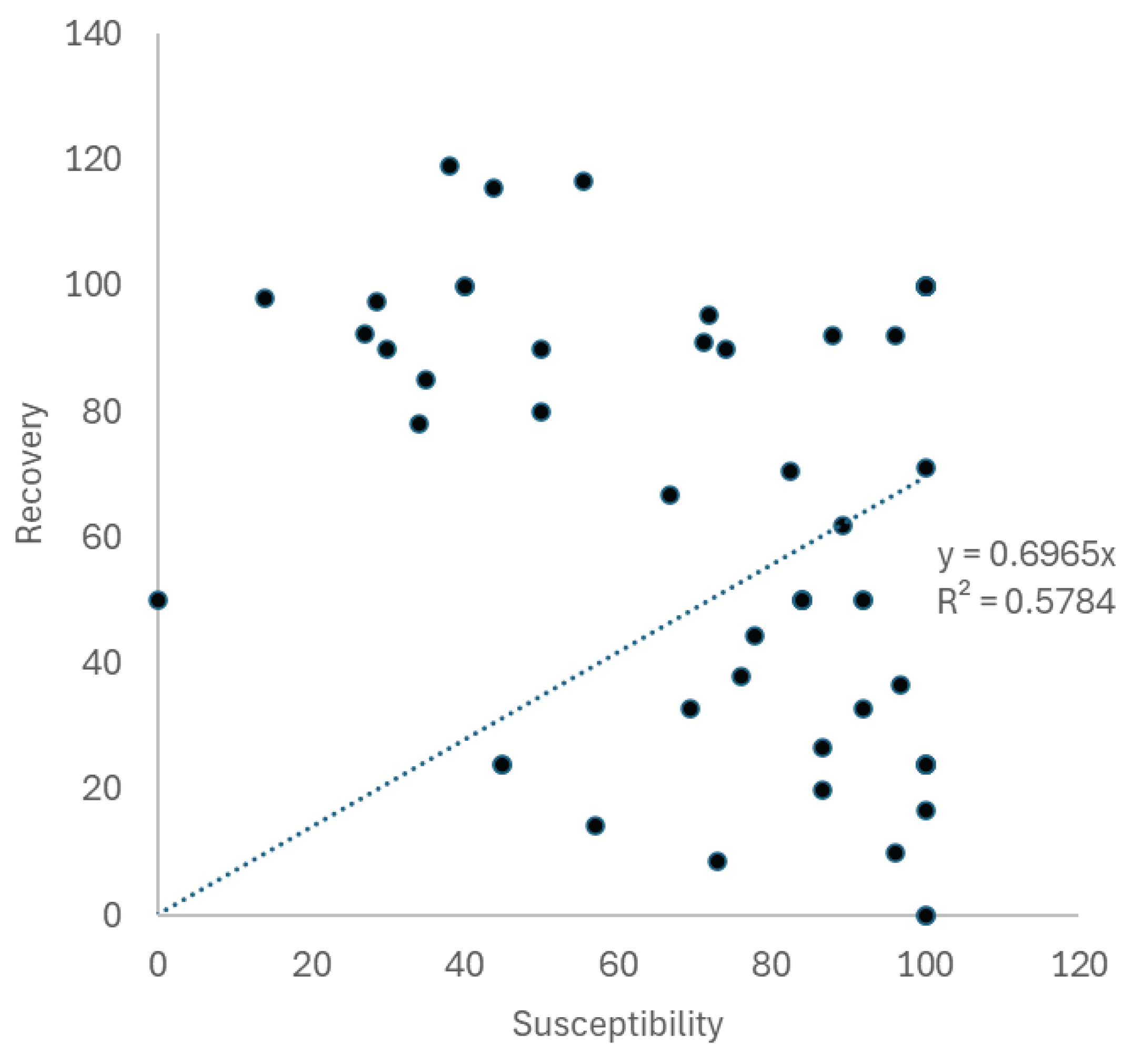
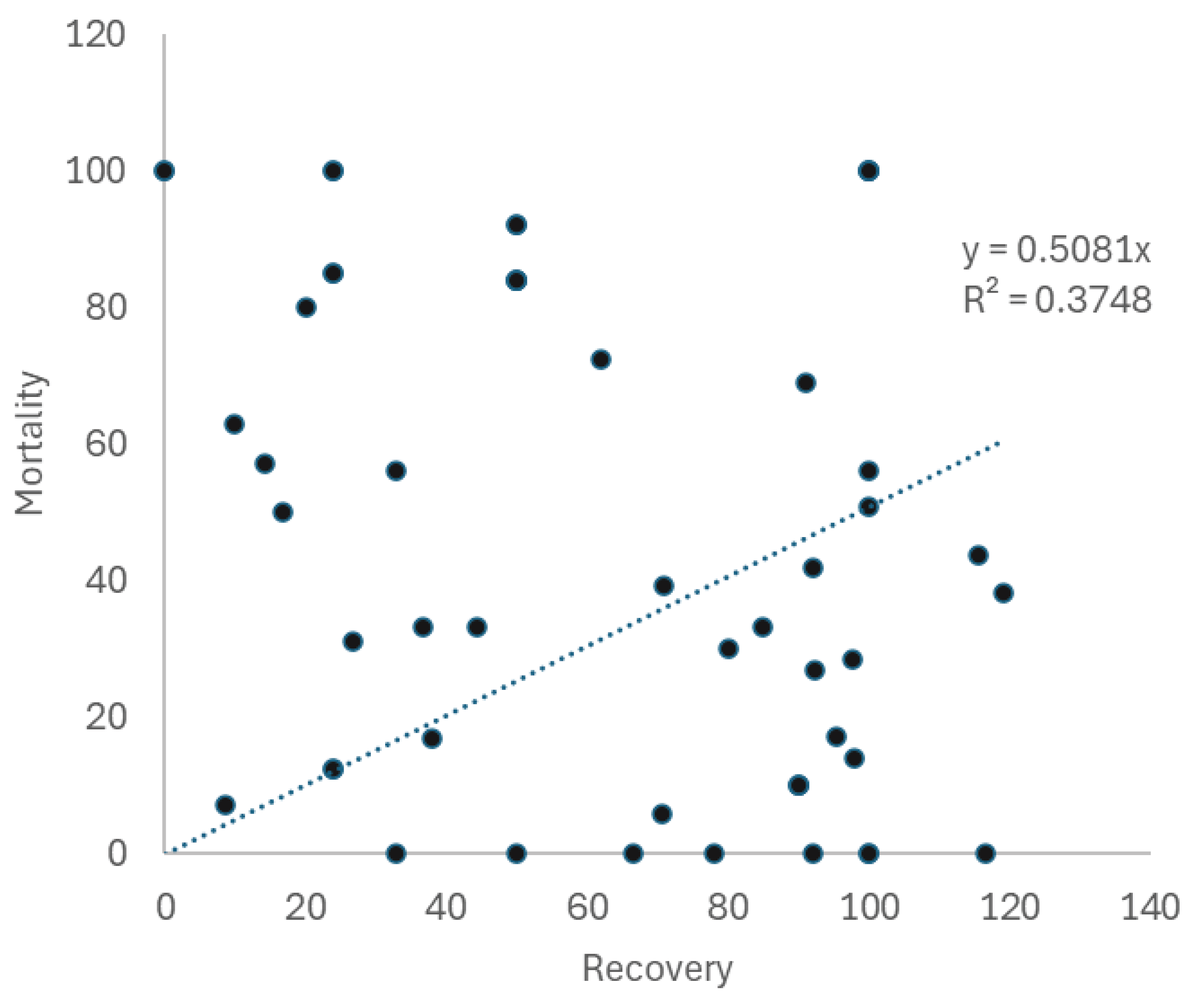
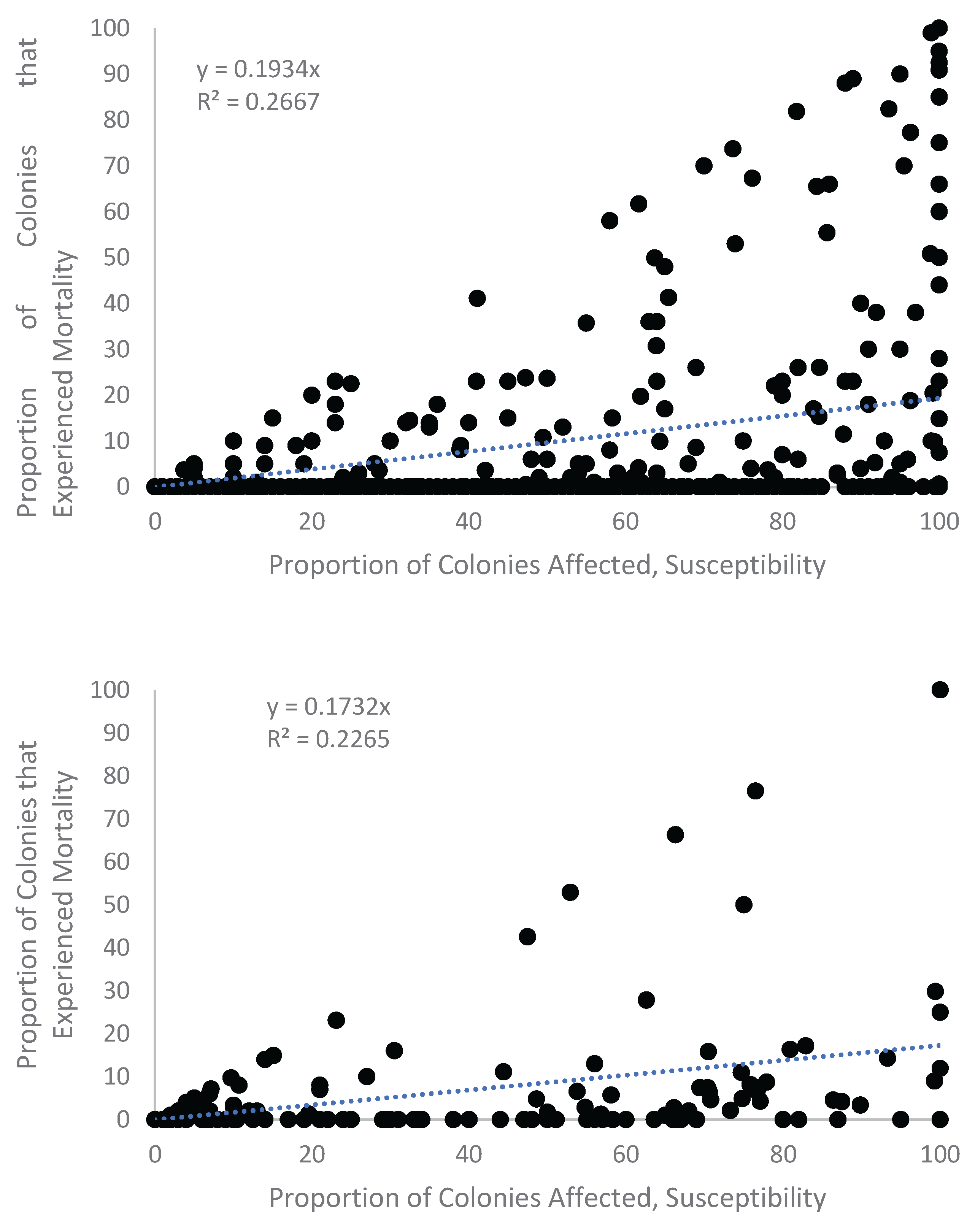
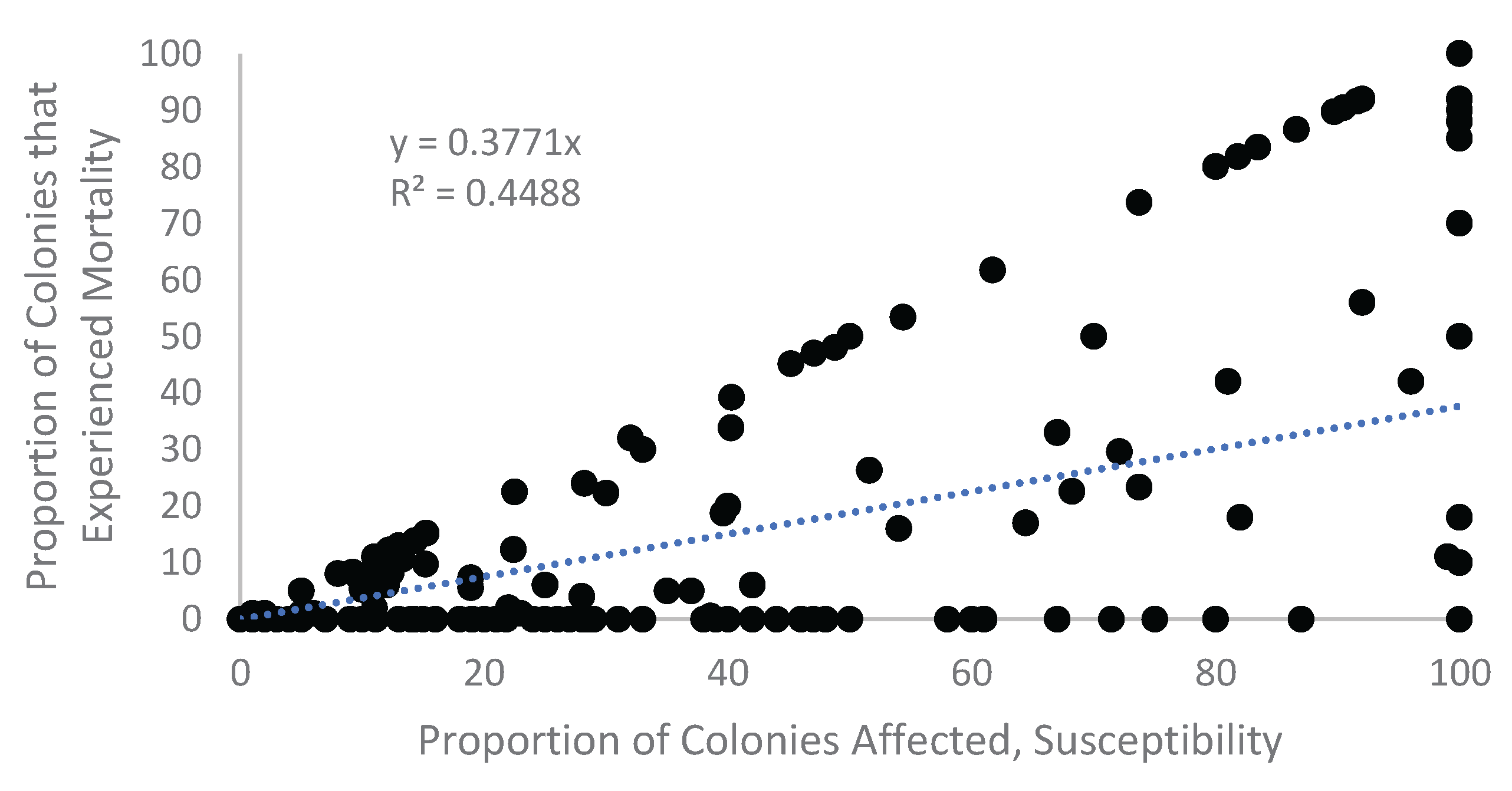
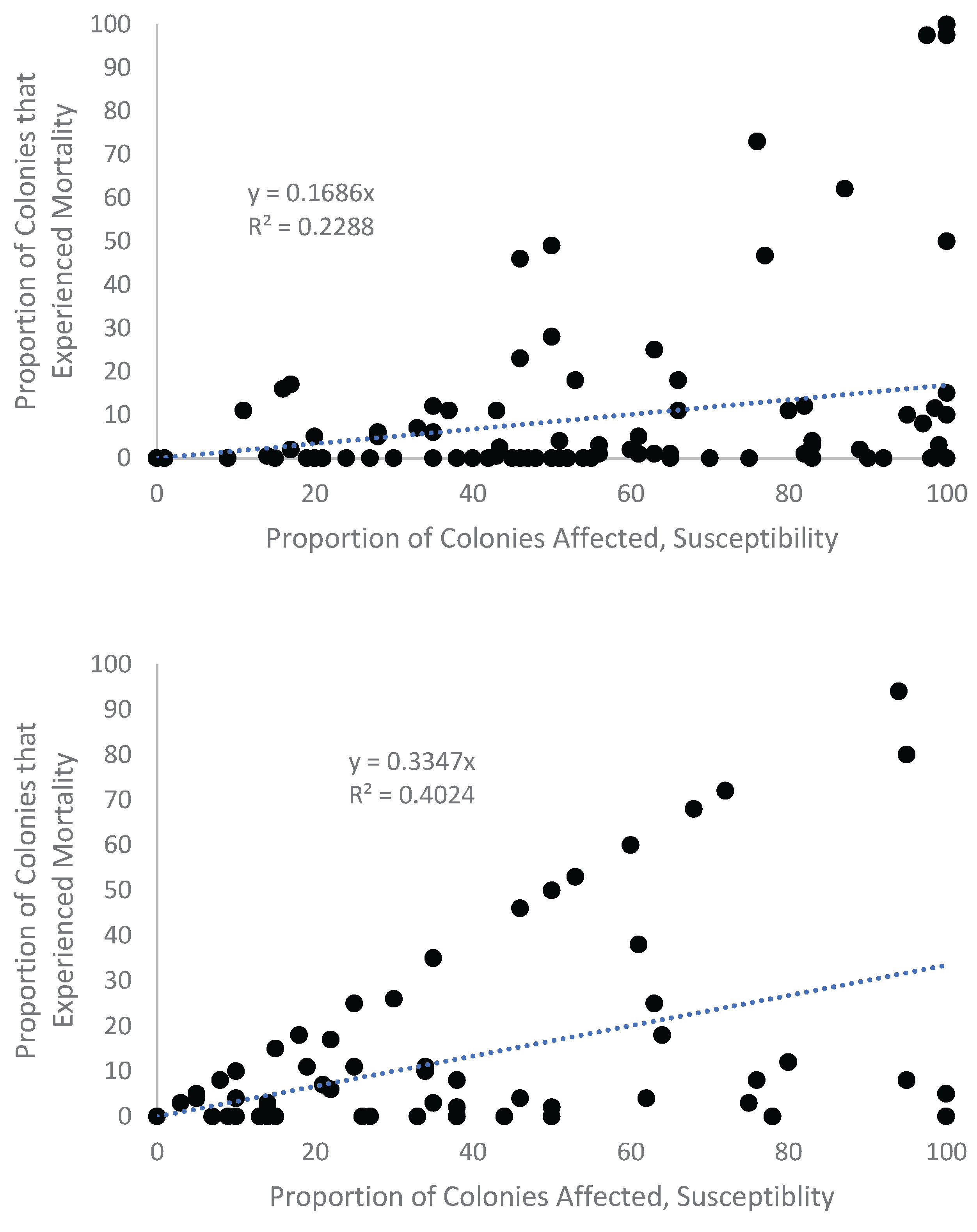
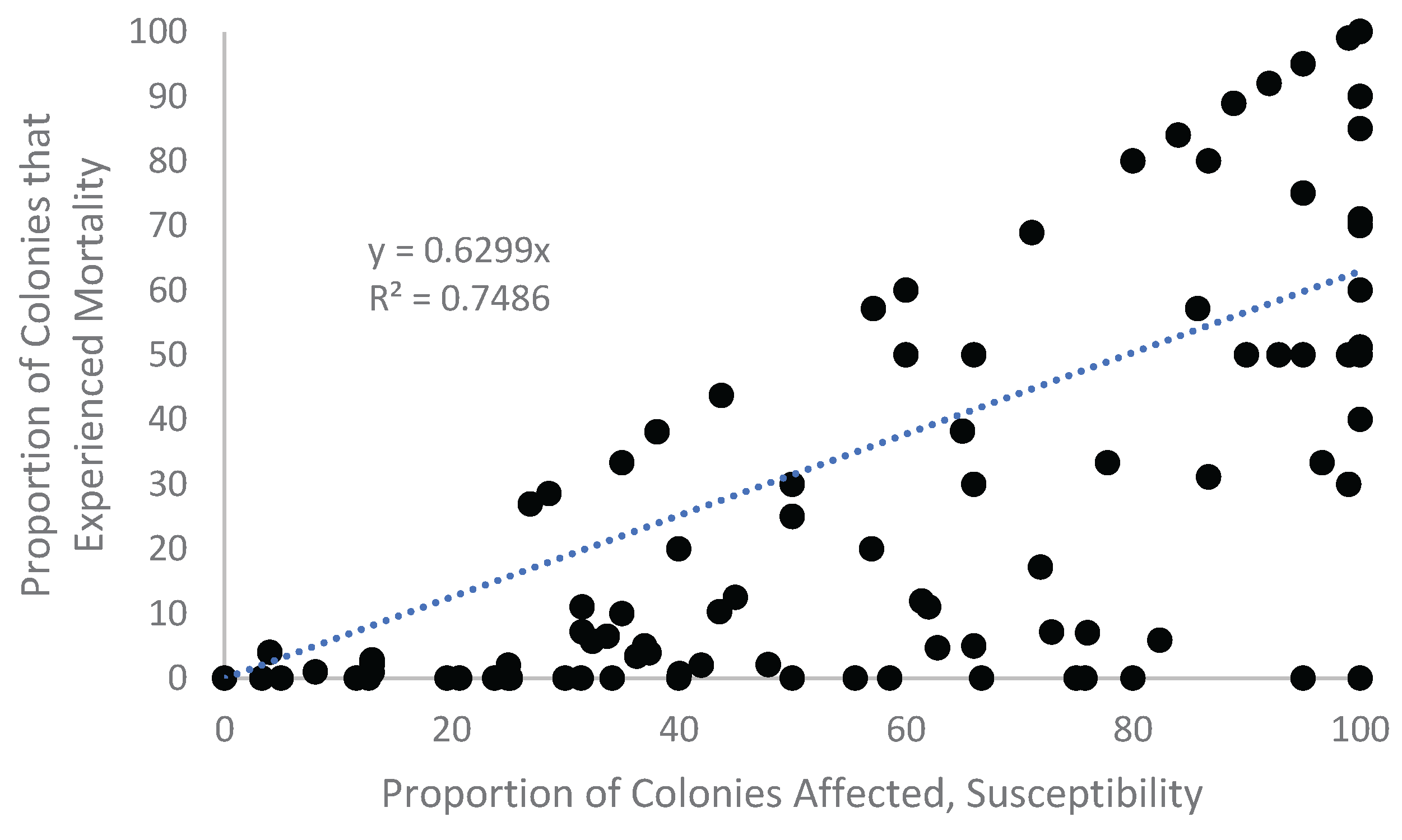
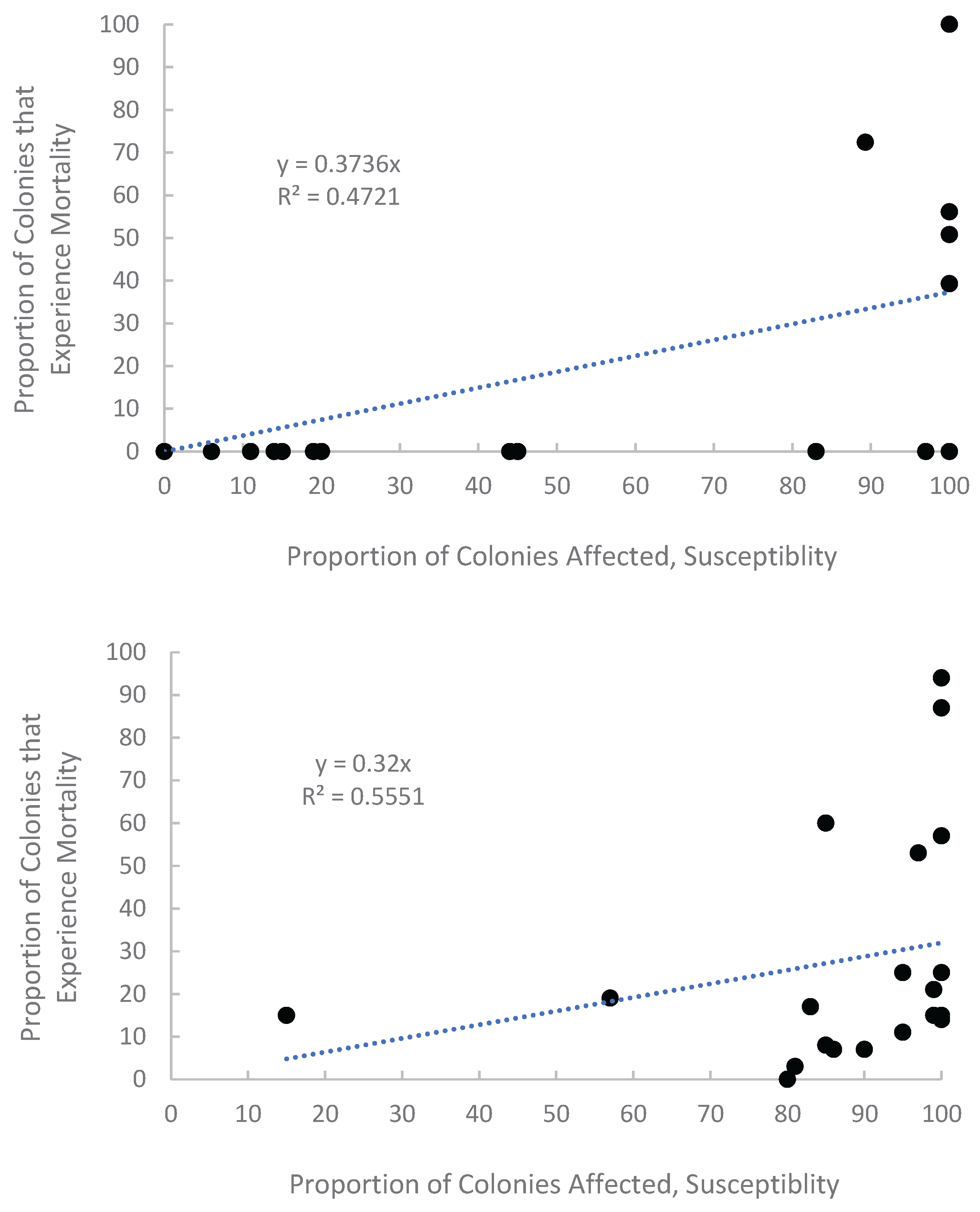
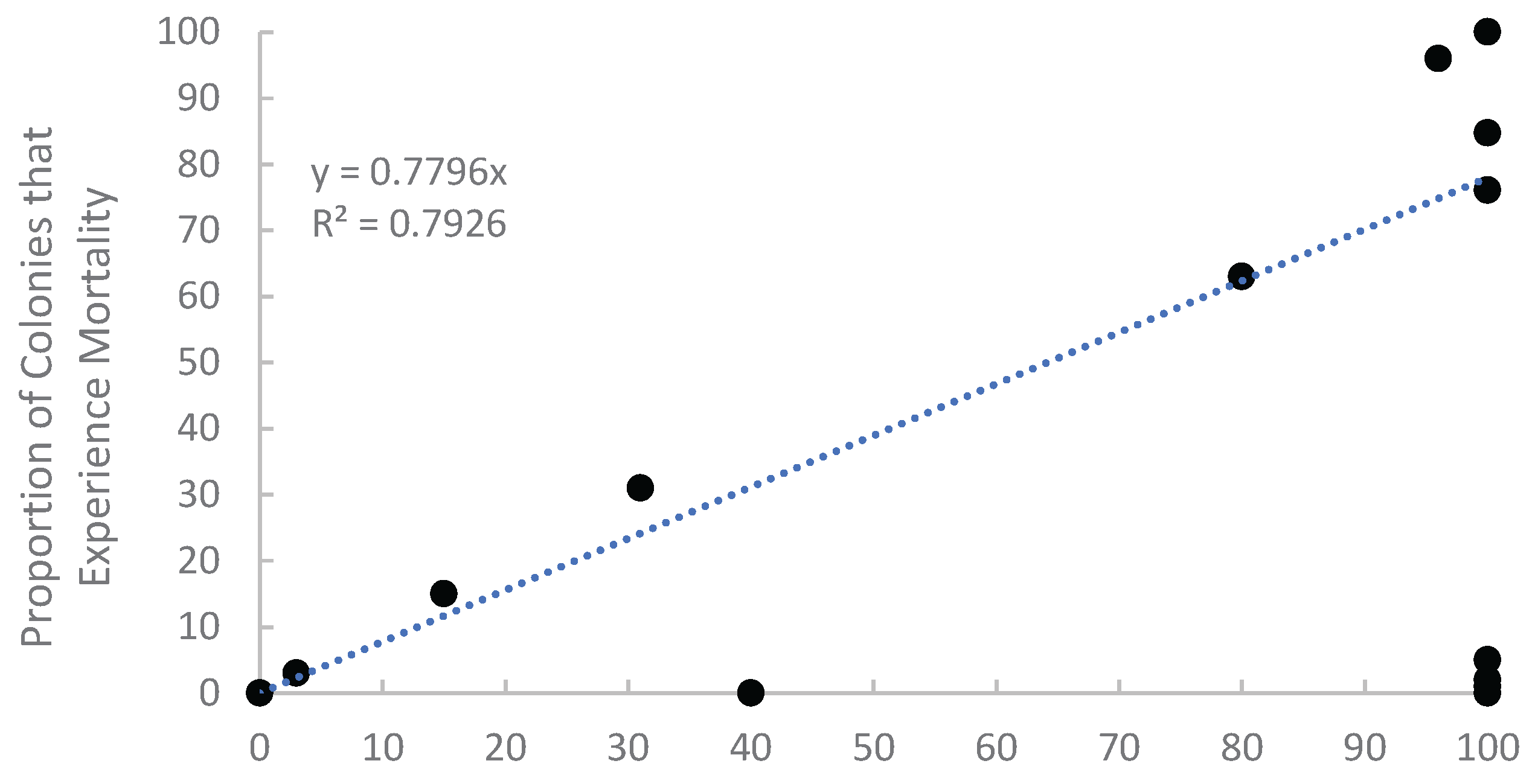
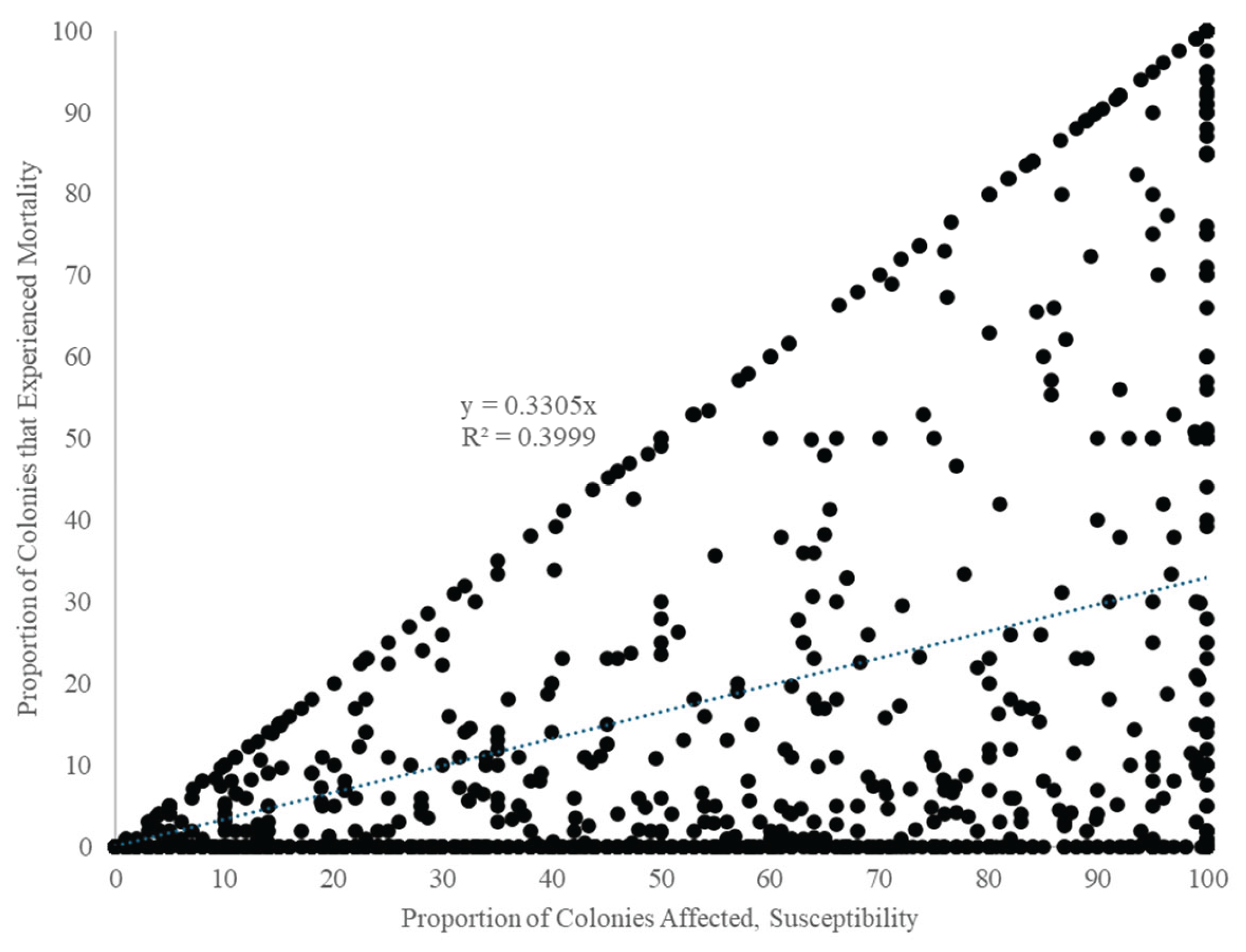
The proportional shift in perspective of time [Figure 3] into proportional variation [Figure 4] validates the multi-metric definition of bleaching [42]. Corals show a rapid loss of colony-wide photophysiological function and a move towards a colony that is proportionally covered with branch sites in the bulk of photodamaged or photoinhibition [definitions, Table 2; Figure 4] when the colony expels dysfunctional zooxanthellae [Figure 1, where the sublethal n=40 category are the results from OISEO, e.g. Figure 3 and Figure 4; data shown dispersed through time in B42]. Notably, deviations from the true mean healthy values are less than when chronically photoinhibited [Table 2]; therefore, as the proportional variability of colonies is less in bleaching [Figure 4, Table 2], bleaching should be readily distinguishable in one sampling time across a colony. This definition of bleaching is essentially what the photoinhibition model of coral bleaching predicts occurs at the molecular level [36]; however, [42] witnessed this reflected across the holobiont [Figure 3 and Figure 4]. Furthermore, this is in contrast to short term, high stress conditions, which elicit a flight response, where the colony expels photosynthetically healthy zooxanthellae in an effort to prevent further damage [39]. So, I hypothesized and herein test that bleaching can be observed as a spectrum of fight and flight responses based upon the strength and timing of the stressors and the co-evolutionary adaptations that the coral holobiont has acquired through deep co-evolutionary time with intermediate mass extinctions [42]. If bleaching were not a mechanism of survival, we would expect a 1:1 ratio with susceptibility and mortality; however, [Figure 5] shows the relationship between susceptibility and mortality is not a straightforward one, with susceptibility having a 40% predictive power of mortality.

3.3. The System Architecture of Mass Bleaching Responses

Mass Bleaching Events represent coordinated responses within a complex biological system rather than isolated failures of individual colonies. Across datasets, bleaching susceptibility and bleaching mortality do not scale linearly, indicating that loss of symbionts and colony death represent related by distinct outcomes within the holobionts response space. To characterize this system-level structure, the Bleaching Response Metadatabase was explored to identify how environmental, biological, and temporal inputs partition variation in bleaching susceptibility and mortality across contexts.
To move beyond binary observations of bleaching presence or absence, a standardized metric was developed to quantify the relationship between susceptibility and mortality, The Bleaching Efficiency Quotient (BEQ), is defined as [(Susceptibility – Mortality) / Susceptibility]. The BEQ provides a normalized scale to compare bleaching outcomes across studies, enabling evaluation of how susceptibility and mortality co-vary through time and across environmental and biological drivers.

3.3.1. Factored Components of Mass Bleaching Susceptibility and Mortality

Bleaching responses are undeniably confounded by a lot of variables [Table 4A], and taxonomy represents less than 2% of the overall variation in bleaching susceptibility [Table 4Aa] or mortality [Table 4Ad]. 35 variables (some made redundant and denoted on the tables with asterisks) were tested [Table 4Aa, susceptibility; 4Ab, mortality] and ANOVA found 22 variables highly significant for susceptibility and 27 variables highly significant for mortality. Less significance was also recorded (p<0.01 and p<0.5) and reflected 4-6 variables while only 7 variables (of the 35 tested) were not significant for susceptibility, and only 4 (of 35) variables were not significant for mortality. Pearson’s correlation coefficients for susceptibility [Table 4Ae] help further define, but still include 12 highly significant variables, while mortality coefficients [Table 4Af] had 20 variables that showed significance. Time to recover was the best fitting correlate for either susceptibility [0.355, 4Ae] or mortality [0.490, 4Af]. Moreover, when we look at the grouped relative importance of factors for susceptibility [6c] and mortality [6d], timing of observations caused 21.1% and 30.1% of the variability in susceptibility or mortality, respectively, weather conditions caused 28.7% and 19.6% of the variability in susceptibility and mortality, respectively. Location explained 24% of the variability in susceptibility and 16% of mortality, while biological and ecological factors represented 15.1% and 22.7% of susceptibility and mortality, respectively.
Taxonomy was notably low on the spectrum of importance for noted factors in both zooxanthellae densities [Table 1A, Table 2A] and bleaching susceptibility and mortality [Table 4A], so data were regrouped with post hoc analyses [Table 5] and restricted by taxonomic recordings, to re-analyze (Table 6A) as taxonomy is widely used to describe disturbance impacts in coral ecology. The data (Table 6A) still show high variability and higher importance of other factors. Notably, for families (Table 6Aa) and genera (Table 6Ab), the top 5 always included thermal stress accumulation, timing of observations, the ocean_subregion, and bleaching occurrence. The analyses for Species (Table 6Ac), however, showed a wild trend, where the greatest factor for susceptibility was whether the coral transmits algae to its offspring. For species [Table 6Ac], corals that do transmit algae to their offspring are highly significantly less susceptible than corals that do not transmit algae to offspring [Table 6A]. Intra-taxonomic resolution was not fully analyzed as this document moves towards the sentinel disturbance guilds, but, as an example, Pocillopora damicornis had a range of healthy zooxanthellae densities from 0.35x10⁶ cells/cm2 [71] up to 10x106 cells/cm2 [72].
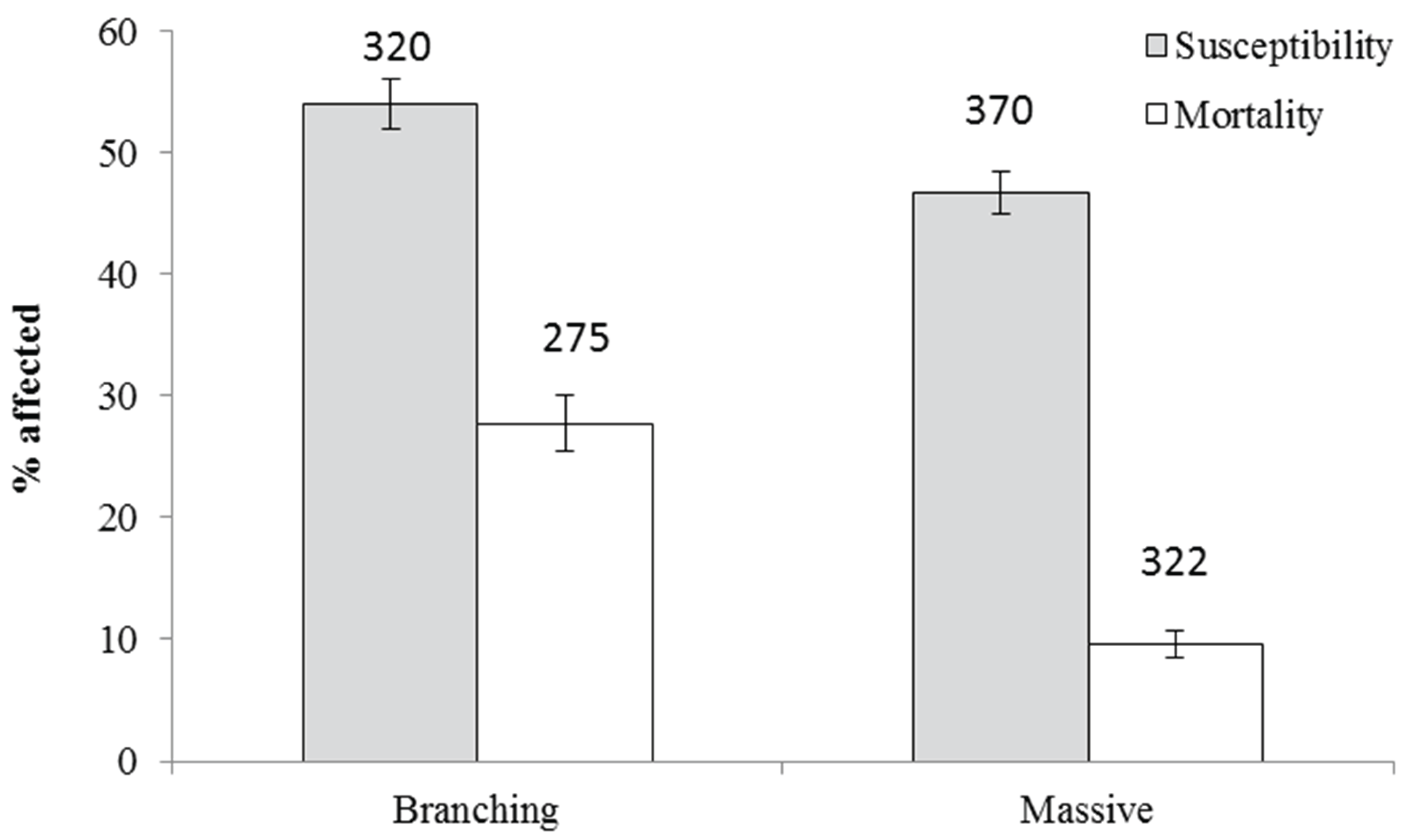
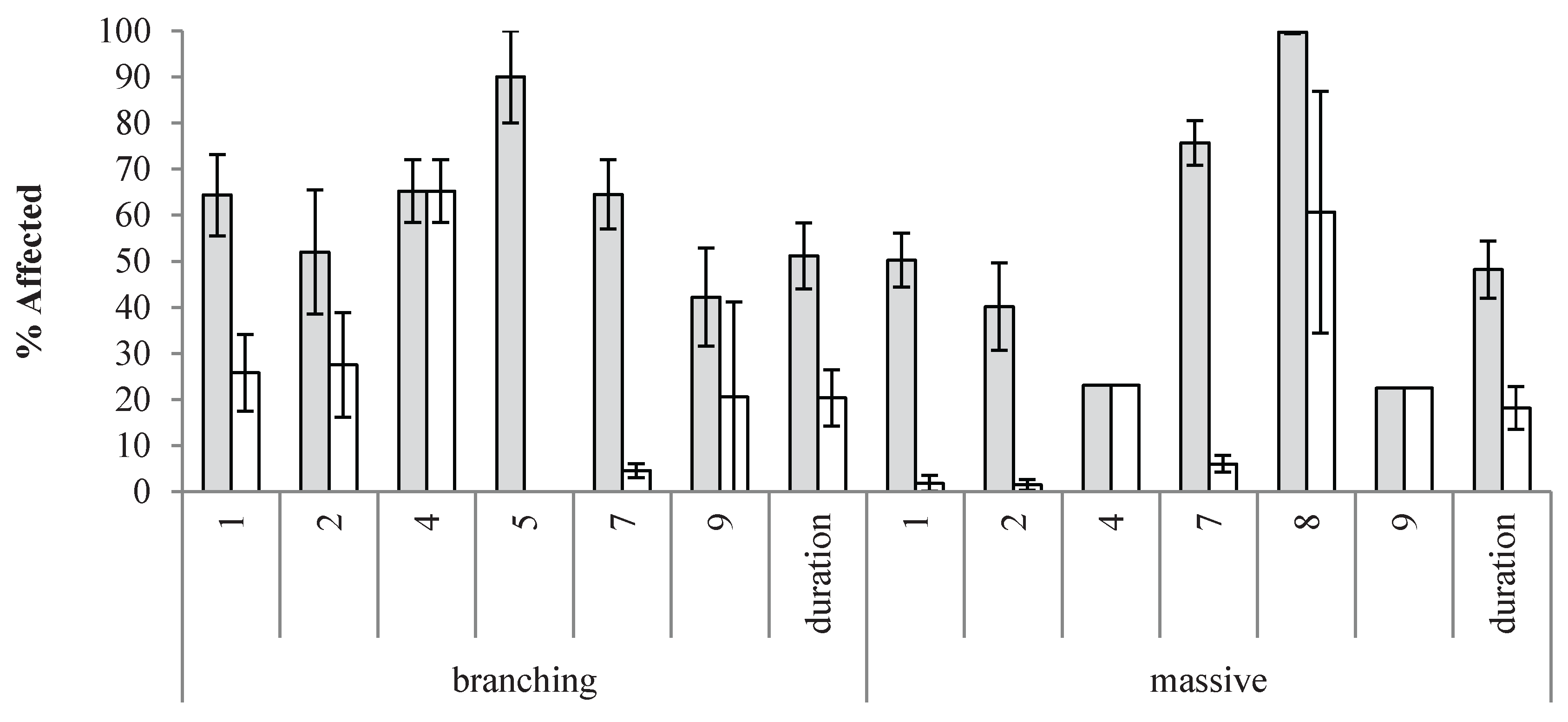
Post hoc results of [55] illustrate the change of perception in timing of observations and discrepancies due to the timing of observations for growth forms [Figure 5A] and growth forms through time (related to the onset of thermal stress) [Figure 6A]. When broken down by our time; the x-axis shows time and the y-axis shows the percent impacted, so we can monitor impacts through time. [Figure 6A] represents the change in perception of bleaching responses - susceptibility and mortality - caused by timing of observations (in months relative to thermal stress accumulation, for the pooled 20DHW thermal data, highest count). The peak bleaching susceptibility and mortality of branching corals occurs about 4-5 months, observations taken after this may underestimate susceptibility/mortality due to unknown cause of death (e.g. algal overgrowth from within where the tissues held in the porosity of skeletons have not won their way in competition back to the outside of the colony and are overwhelmed by the algae that are present to replenish the zooxanthellae populations). Massive colonies, however, reach a peak in susceptibility/mortality at about 8 months, but have been shown to have a high heat capacity (e.g. essentially concrete) and have been shown to retain heat stress for up to 3 years [73]. Biological factors will be fully explored in their own sections.
Thermal stress and timing of observations represent a relative importance of 40-58% of the variability in the dataset [Table 4Ac, 4Ad], and were thus explored by Tukey’s post hoc to simplify for further analysis [Table 5A]. Temperatures and thermal stress were re-grouped into ‘Thermal Stress Accumulation’ which was partitioned into 3 levels, high medium or low [Table 5A, Figure 7A, Figure 8A and Figure 9A]. The thermal stress accumulation categories removed all but one instance of a highly significant result, the ‘Medium’ category of Susceptibility, although there is still obvious importance within the categories [Table 5, a-d]. ‘Timing of Observations’ relative to Thermal Stress Accumulation are another post hoc data grouping [Table 5, a-d] and are separated by months since the onset of thermal stress into three categories, the beginning, middle, and end of events. The timing categories lower the overall variability, but in opposition to the thermal stress categories, post hoc analysis of the timing of observations seems to open more significance to be explored [Table 5A, a-d]. Location caused variability in the zooxanthellae densities [Table 1 and Table 1A and Table 2A] and bleaching responses [Table 3A and Table 4A] and represents some 16-24% of the variability in responses [Table 4Ac, Table 4Ad], so Tukey’s post hoc was used to further explore this category [Table 5C, a-j]. The post hoc category of subregion within ocean basin removed some variation from location significance [Table 5AC, i-j] and will henceforth be used.
Table 4. Trait-structured constraints on symbiont cladal diversity across coral functional groups. Descriptive statistics of cladal counts (mean ± SE), sample sizes, and observed upper ranges are shown for skeletal architecture, reproductive mode, symbiont transmission, morphology, and genus. Cladal diversity is not continuously distributed but constrained within discrete, trait-defined bounds, indicating that symbiotic flexibility is biologically structured rather than uniformly available across coral lineages.
Field Factor Average Cladal Count Counts SE Upper Range
Complexity of Skeleton Complex 1.26 111 0.073 5
Robust 1.17 156 0.037 4
Reproductive Mode Brooder 1.60 5 0.245 2
Spawner 1.37 68 0.115 5
Sexual
Reproduction
Gonochoric 1.06 17 0.059 2
Hermaphroditic 1.47 59 0.131 5
Transmission of Algae to Offspring No 1.42 60 0.126 5
Yes 1.43 7 0.297 3
Morphology Branching 1.19 27 0.085 3
Free living 1 6 0 1
Massive 1.31 13 0.133 2
Sub-massive 1.43 7 0.202 2
Tabular 1 3 0 1
Genera Acropora 1.57 37 0.2 5
Cyphastrea 1 5 0 1
Echinophyllia 1 6 0 1
Echinopora 1.25 8 0.164 2
Favia 1.29 7 0.184 2
Fungia 1 9 0 1
Galaxea 1.57 7 0.202 2
Goniastrea 1.25 8 0.164 2
Goniopora 1 6 0 1
Hydnophora 1.6 5 0.245 2
Leptoseris 1 5 0 1
Lobophyllia 1.17 6 0.167 2
Montastrea 1.33 6 0.211 2
Montipora 1 17 0 1
Pachyseris 1 5 0 1
Pavona 1 6 0 1
Platygyra 1 7 0 1
Pocillopora 2 6 0.516 4
Porites 1 10 0 1
Psammocora 1 9 0 1
Symphyllia 1 5 0 1
Turbinaria 1.5 6 0.224 2
Table 5. Skeletal complexity as a structural modifier of bleaching susceptibility, mortality, and recovery across thermal stress accumulation and observation timing. Average values of skeletal complexity are presented across low, medium, and high thermal stress accumulation, resolved by timing of observation relative to stress exposure (beginning, middle, end). Data were restricted to pair-wise susceptibility–mortality entries and post hoc grouped to minimize variance attributable to timing effects (see Table 5A; Figure 7A, Figure 8A and Figure 9A); only observations with n ≥ 3 were retained. Values are ordered by thermal stress accumulation, timing of observation, and mortality, illustrating how skeletal architecture modulates bleaching outcomes through differential exposure, tissue integration, and survivorship under escalating thermal stress.
Thermal stress accumulation Timing of observations Complexity of skeleton Susceptibility ±SE n Mortality ±SE BEQ (S-M)/S
Low Beginning Complex 39.51 2.07 280 7.10 1.16 0.82
Robust 40.60 2.00 271 4.95 0.96 0.88
Middle Complex 48.63 3.76 87 9.85 2.58 0.80
Robust 35.67 3.52 89 3.09 0.77 0.91
End Complex 37.50 3.46 99 16.41 3.04 0.56
Robust 33.76 3.07 108 7.74 1.62 0.77
Medium Beginning Complex 51.22 5.19 54 8.48 3.12 0.83
Robust 37.78 3.25 107 3.01 0.87 0.92
Middle Complex 33.20 5.45 25 14.52 4.26 0.56
Robust 29.86 5.06 36 3.28 1.14 0.89
End Complex 68.10 3.86 94 48.94 4.48 0.28
Robust 64.34 3.90 80 41.70 4.54 0.35
High Beginning Robust 55.73 13.50 10 17.93 3.57 0.68
Complex 42.45 14.12 11 3.57 9.28 0.92
End Complex 80.45 7.50 20 70.85 9.57 0.12
Robust 100.00 0.00 20 58.54 10.81 0.41
Beyond the physical characteristics that provide the rules for bleaching responses on larger spatial scales [Table 3A, Table 6A and Table 7A], the diversity of bleaching responses is consistently undermined by Biological factors outside of taxonomical categorization. The Biological factors account for 15.1% of the noise in the datasets in bleaching susceptibility [Table 4Ac], 22.7% for mortality [Table 4Ad], and 16% of the noise in the dataset for recovery [Table 3]. To further the view of these biological factors, post hoc results of bleaching responses [Table 4A] were used to form data groupings [Table 5D, a-d] for growth form to shift to a Level of Colony Integration (LCI) model, where low represents more solitary form corals, medium represents sub-massive, massive, and encrusting, and high represents more branching and tabular growth forms.

3.3.2. A Thermal and Time-Relative Matrixed View of Bleaching Responses

To examine how bleaching susceptibility, mortality and recovery vary jointly with thermal stress intensity and timing, post hoc regroupings [Table 5] were used to partition data into categories of Thermal Stress Accumulation (TSA) and Timing of Observations (TOB) relative to TSA, and these are matrixed [Table 7, Table 8, Table 9, Table 10, Table 11, Table 6A, Table 7A, Table 8A, Table 9A and Table 10A] and are presented similar to the previous table pairs of Descriptive Statisticvs [Table 7, Table 8, Table 9, Table 10, Table 11, Table 6A, Table 7A, Table 8A, and Table 9A] alongside Tables of analytical statistics [Table 10A], to create dynamic equations for zooxanthellae densities [Table 1A and Table 2A], susceptibility and mortality [Table 7, Table 8, Table 9, Table 10, Table 11, Table 6A, Table 8A, Table 9A and Table 10A] and recovery [Table 3]. While the analytical statistics are presented for all [Table 10A], the descriptive statistics [Table 7, Table 8, Table 9, Table 10, Table 11, Table 8A and Table 9A] are organized by factors and then matrixed within TSA and TOB to gain insight into the underlying patterns.
Taxonomy through time and stress is shown in [Table 6A] for Families [Table 6Ai), Genera [Table 6Aii], and Species [Table 6Aiii]; however, it is outside the purveyance of the new aims of this document due to the low relative importance in finding variability in bleaching susceptibility and mortality [Table 3A and Table 4A, which show taxonomy to represent <2-5% of overall variability in responses] or recovery [<7% relative importance of time to recover, Table 3]; moreover, when data were restricted to taxonomic recordings [Table 4A] factors still showed greater significance. Furthermore, taxonomic ranking and bleaching quotients were variable through thermal stress accumulation and timing of observations [Table 6Ai, Table 6Aii, Table 6Aiii]. Factors of importance are presented within the matrixed TSA and TOB categories, and include Biological [Table 4, Table 5, Table 6, Table 7, Table 8 and Table 9] which are represented by Complexity of Skeleton [Table 5], Reproductive Mode [Table 6], Sex [Table 7], the Transmission of Algae to Offspring [Table 8] and Colony Morphology [Table 9], Ecological factors [Table 9A] are represented by Depth, Habitat and Anthropogenic Input. Time was a major factor represented in various fashions, and bleaching occurrence is explored as a section of its own [Table 10], and other timing [Table 11]. The post hoc categories of locations (subregions within oceans) are shown through TSA and TOB [Table 12] and also have their own section.
Physical factors showed some consistencies through time [Table 9A and Table 10A], Deeper depths (15-18m+) consistently had a higher bleaching quotient -overall bleaching susceptibility produced less mortality. Habitats followed a similar trend in that reef slopes had a BEQ closer to 1, which was also true for lesser events in the shallows; however, greater thermal stress accumulation overwhelmed shallower habitats with accumulation of stress and lead to overall reef health deterioration [Table 9A]. Non-polluted areas and polluted areas with management maintained more efficient bleaching responses, while polluted areas without protection fared worse [Table 9A].
Overview of Matrixed Descriptive Statistics
Thermal bleaching accumulation categories and timing of observations are summarized by paired observations and their explanatory powers [Figure 3A, Figure 4A, Figure 5A]. Low Thermal Stress Accumulation [Figure 3A] shows that the explanatory power of susceptibility relates much stronger to mortality [Figure 3A, bottom; R2 of 0.45) at the end of events; however, not that over half of the responses are not quantified by thermal stress nor the timing of observations relative to thermal stress, supporting the notion to explore phenotypic responses within these categories. Medium Thermal Stress Accumulation [Figure 4A] shows almost double the explanatory power of susceptibility relating to mortality (based on R2 values) as timing of observations continue, such that at the end of events [Figure 4A, bottom] the correlation coefficient is 0.75. High Thermal Stress Accumulation [Figure 5A] also correlates susceptibility higher to mortality as the timing of observation lengthen, with an end explanatory power of 0.79 for just temperature and timing of observations relative to thermal stress accumulation. Notably, there is not a 1:1 relationship between thermal stress accumulation and timing categories, and that further implies [e.g. Figure 9] underlying mechanisms in biology and ecology that are ultimately influencing bleaching responses.
The overall trends in records (n) across the matrixed categories of thermal stress accumulation and timing of observations relative to thermal stress accumulation will be explored, as the results are unevenly distributed counts [e.g. Figure 7A, Figure 8A, Figure 9A] and the factors of data analyses and restrictions for statistical analyses have changed the number of records in each overall matrixed category [Figure 7A, Figure 8A, Figure 9A]. Notably, there are 618/1877 total records, or 33.33%of the total records that are in the beginning TOB of Low TSA, versus 94/1877 records, or 0.05% for the End (TOB) for all levels of TSA. From a broad scale of trends, the High TSA were less selective and generally induced higher mortality from susceptibility, while Low and Medium TSA had more observations and greater variability than High TSA [Table 10A]. In Low and Medium TSA, the rank-order of susceptibility, mortality, and the bleaching quotient are generally inconsistent and diverse through time [Table 10A], while, in contrast, observations of High TSA further detail the importance of noting and quantifying the variability and relativity of time. dependent on a different dimension of time, as the bleaching occurrence held the clearest contrasting results [Table 10A] and show that the first time a reef experiences an event, the bleaching efficiency quotient is 0.01, while the fifth time a reef has experienced TSA and bleached, the quotient is 0.98 – this reflects 100% susceptibility in both cases, but mortality is null at the end of the 5th experience of a heavy event, where it was once nearly ‘absolute’. Note, that these, High TSA, End TOB, were the data with fewest records. In a trend somewhat similar to thermal stress accumulation, the Beginning (n=824) and Middle (n=293) of events had greater variability, while the End (n=464) timing of observations relative to the onset of thermal stress were more straightforward and less variable [Table 10A].
Low TSA [Table 10A} records (n=1449) were mostly at the onset of events (n=618), with fewer observations in the middle (n=186) or end (n=213). At the Beginning TOB of Low TSA [Table 10Aa], 20 factors were tested, with 9 being highly significant for susceptibility [Table 10Aai] and 2 highly significant correlations, habitat and generalization [Table 10Ai1]; moreover, mortality also had 9 significant factors of 20 [Table 10Aaii], with 3 factors significantly correlating to mortality, doldrums, decade, and the Level of Colony Integration [Table 10Aaii1]. In the Middle TOB of the Low TSA [Table 10Ab], 16 factors were studied, with 5 producing highly significant impacts on susceptibility [Table 10Abi] and 2 producing significant correlations [Table 10Abi1], subregion within Ocean, and months of observations. Mortality for the Middle of the Low TSA has 4 significant factors of 16 [Table 10Abii], relief from weather, habitat, subregion within Ocean, and depth, with no strongly significant correlations [Table 10Abii1]. The End TOB of the Low TSA [Table 10Ac] contained 18 factors, of which 5 were highly significant for Susceptibility [Table 10Aci] and 2 factors highly correlated [Table 10Aci1], Reef Type and ; while Mortality had 8 factors that were highly significant [Table 10Acii], and 2 that were highly corelated [Table 10acii1] subregion within ocean and Family.
Medium TSA [Table 10B] had observations (n=334) at the beginning (n=180), few in the middle (n=74) and most at the end (n=198).The Beginning TOB of the Medium TSA [Table 10B] explored 19 factors, of which 8 had a highly significant impact on susceptibility [Table 10Bai], and 2 factors that highly correlate, Months of Observations and subregions within Oceans [Table Bai1]; while, Mortality data had 2 significant factors [Table Baii]: subregion within Ocean and Family, and no highly significant correlates [Table Baii1]. The Middle TOB of the Medium TSA [Table 10Bb] had 9 factors with enough data to study. For susceptibility, two were significant [Table 10Bbi] and one correlated [Table 10Bbi1], bleaching occurrence; while mortality results [Table 10Bbii] had subregions within Ocean Basins and the Level of Colony Integration as highly significant, with the subregion within the Ocean as the only highly significant correlation [Table 10Bii1]. The End TOB of the Medium TSA [Table 10Bc] had 20 factors that were able to be studied, of which 8 were significant [Table 10Bci] and correlated [Table 10Bci1] to susceptibility, while 8 were significant [Table 10Bcii] and 6 correlated [Table 10Bcii1] for mortality.
High TSA [Table 10C] records (n=94) were lowest overall with the Beginning (n=24), Middle (n=19) and End (n=19) representing the least number of records within the matrix. The Beginning TOB of High TSA [Table 10Ca] studied 14 factors, with only one significant factor for susceptibility, depth [Table 10Cai] and no highly significant correlations [Table 10Cai1], while Mortality data showed 4 highly significant factors [Table 10Caii] with 3 highly significant correlations [Table 10Caii1], Months of Observations, Degree Heating Weeks, and Bleaching Occurrence. The Middle TOB of the High TSA [Table 10Cb] studied only 2 factors the data were so low and represented no highly significant relationship by ANOVA for either susceptibility [Table 10Cbii] or mortality [Table 10Cbii] nor highly significant correlations for susceptibility [Table 10Cbi1] or mortality [Table 10Cbii1]. The End TOB of the High TSA [Table 10Cc] had enough records to analyze 13 factors with 4 factors each highly significant for susceptibility [Table 10Cci] and mortality [Table 10Ccii] – three of which were shared, Bleaching Occurrence, Level of Colony Integration, and subregion within Ocean basin; whereas Susceptibility was also influenced by Family, and Mortality was also influenced by Depth. In addition, susceptibility of End TOB, High TSA correlated to the Level of Colony Integration [Table 10Cci1], while mortality highly correlated to bleaching occurrence and depth [Table 10Ccii1].
Systems Architecture of Bleaching Responses
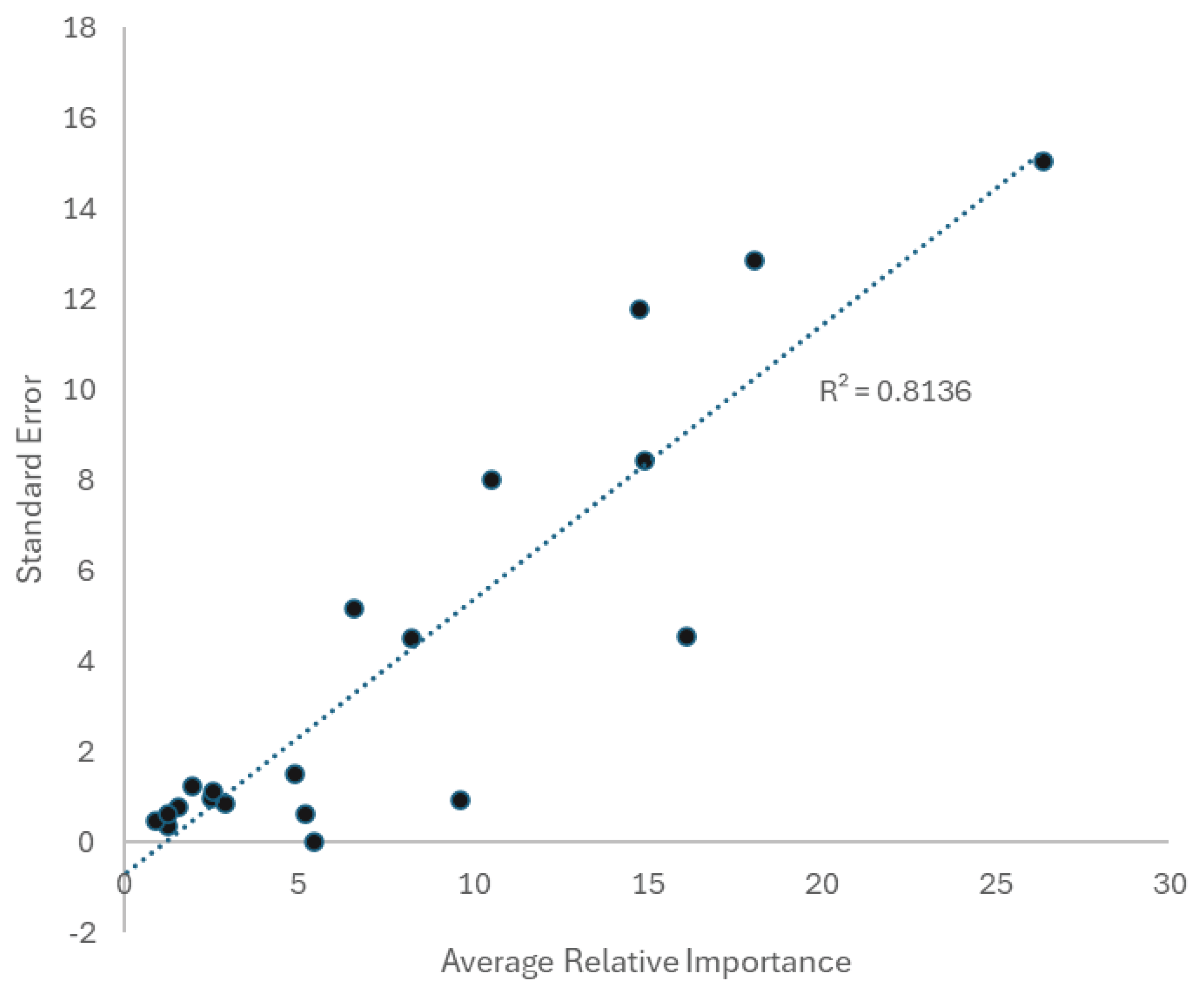
Bleaching susceptibility [Figure 6] behaves like a distributed, additive system where many predictors contribute incrementally, and their influence is relatively stable across contexts [e.g. R2 = 0.45]. Notably the 2 high standard errors [y-axis] are related to Complexity of Skeleton and Bleaching Occurrence, both of which host double digits worth of relative importance. In contrast, bleaching mortality [Figure 7] exhibits threshold-like behavior, where once critical conditions are exceeded, different rules govern outcomes. The strong relationship [R2 = 0.81] shown between relative importance and uncertainty observed for mortality [Figure 7) indicates that dominant predictors are also highly context-dependent, consistent with a high-dimensional, adaptive system near a tipping point. By comparison, the absence of such scaling for susceptibility [Figure 6] suggests nonlinear collapse dynamics in which survival outcomes become decoupled from environmental gradients; this pattern is consistent with cryptic evolutionary filtering and partial mortality processes, whereby extreme stress selectively prunes vulnerable tissue and symbiont configurations while preserving resistant and resilience types.
Figure 7. Relative importance scales more directly with impact on bleaching mortality than susceptibility. Summary of the relationship between average relative importance (ARI) of predictor variables and their standardized effect sizes on bleaching mortality. In contrast to susceptibility (Figure 6), mortality exhibits a stronger, more coherent scaling between explanatory importance and effect magnitude (R² = 0.81), indicating a narrower and more deterministic failure architecture. This pattern suggests that while susceptibility arises from multiple overlapping pathways, mortality reflects convergence onto a smaller subset of dominant drivers, consistent with threshold-mediated system collapse rather than distributed stress response.
Preprints 200993 g007

3.3.3. Unravelling the Mechanisms of Bleaching Recovery

As both bleaching definitions [Table 1A and Table 2A] and bleaching response metrics [Table 4A] correlate most strongly with recovery capabilities [Table 3e and Table 3f], these results indicate that bleaching susceptibility is inherently linked to recovery dynamics rather than just mortality alone. The processes governing the initial responses of bleaching cannot be fully interpreted without observing the outcome of recovery, as recovery itself is contingent upon the severity and structure of the initial response. The misalignment of cause and effect represents a persistent misperception of time in underlying assumptions and it mis-scales interpretation of bleaching studies as susceptibility is best understood not as a measure of weakness, but as a position along a fight-flight spectrum of sentinel disturbance strategies, where recovery capacity provides the appropriate functional context for interpretation. Therefore, a useful metric of exploring susceptibility may be understanding recovery and the fight or flight spectrum of sentinel disturbance guilds.
During OISEO [42], I observed that the earliest bleaching corals exhibited multiple recovery pathways, including partial mortality, endolithic persistence, and post-disturbance tissue re-emergence [The Phoenix Effect, 43]. Approximately one-third of colonies that initially sloughed tissue and were presumed dead subsequently regenerated living tissue. This response was associated with perforated, high-complexity skeletons that permit tissue retention within skeletal refugia during unfavorable conditions [supported by pers. Comms. with Professors Andrew Baird and Scott Smithers], followed by recolonization of the skeletal surface once environmental conditions return to ambient levels. In contrast, corals lacking these architectural recovery mechanisms exhibited reduced capacity to retain symbiont diversity and were more likely to resist bleaching outright or experience higher partial mortality when stressed.
Taken together, these recovery pathways indicated that bleaching outcomes are constrained not only by the magnitude and duration of thermal stress, but by the structural integrity of the coral holobiont itself. Skeletal architecture functions as a physical decision framework that governs tissue retention, symbiont preservations, and the temporal buffering of stress, thereby determining whether bleaching leads to regeneration, partial mortality, or collapse. Recovery is therefore not an independent phase following disturbance, but an emergent property of architectural resilience that is expressed through time. This framing establishes structural complexity as a central mediator linking susceptibility, morality, and recovery, and provides the foundation for evaluating how biological design features regulate bleaching responses across spatial and temporal scales.
Recovery data [Table 3] seem reliant on relief from stress and geographical location; however, these data are severalfold fewer (n<150) than either the susceptibility (n>2200) or mortality data (n>1500). Average recovery times are noted [Table 7a] amongst variables and the ANOVA test showed 7 highly significant factors: Shelf position, Relief from weather, Thermal Stress Accumulation, Anthropogenic Input, Location, Habitat, and Genus. Sex (gonochorism or hermaphroditism) also significantly impacted recovery (Table 7b; p<0.5). Four factors had a highly significant (p<0.001) correlation with recovery [Table 7c], Shelf Position, Anthropogenic Pressure, Degree Heating Index, and Relief from Weather; while sex and location were both significant (p<0.5). Notably, weather contained 63.5% of the relative noise in the recovery data [Table 7d], while biology/ecology represented 16.0% of the variability, Location represented 13.8% of the variability, and taxonomy represented 6.7% of the variability. A generic dynamic equation would thus be:
Bleaching Recovery
y = Weather (63.5%) + Biology and Ecology (16.0%) + Location (13.8%) + Taxonomy (6.7%)
Fewer observations were available on recovery, yet these preliminary results [Table 7] show that the ability of corals to recover after a mass bleaching event is most dependent upon the relief from weather which cuts recovery time in half, although inner reef shelf positions average 4 times longer to recover than mid-shelf or outer shelf reefs [Table 7a]. Areas of known high Anthropogenic Input took twice as long to recover as areas of medium or low anthropogenic input [12 months compared to 6, Table 7a]. French Polynesia was notably quicker to recover [3.29 month average, Table 7a] than the other locations, with the Centre of Biodiversity taking an average of 10.33 months to recover from bleaching [Table 7a]. Moreover, the biological and ecological traits [Table 7] appear to be the mediators that determine the outcome for the individual coral within environmental conditions. The finding that Hermaphroditic corals and Spawners have slightly faster average recovery times compared to Gonochoric corals and Brooders, respectively, is consistent with investigating the role of the reproductive strategies to define the bleaching responses.

3.3.4. Quantitative Resolution of the Paradox of Efficiency vs. Mortality
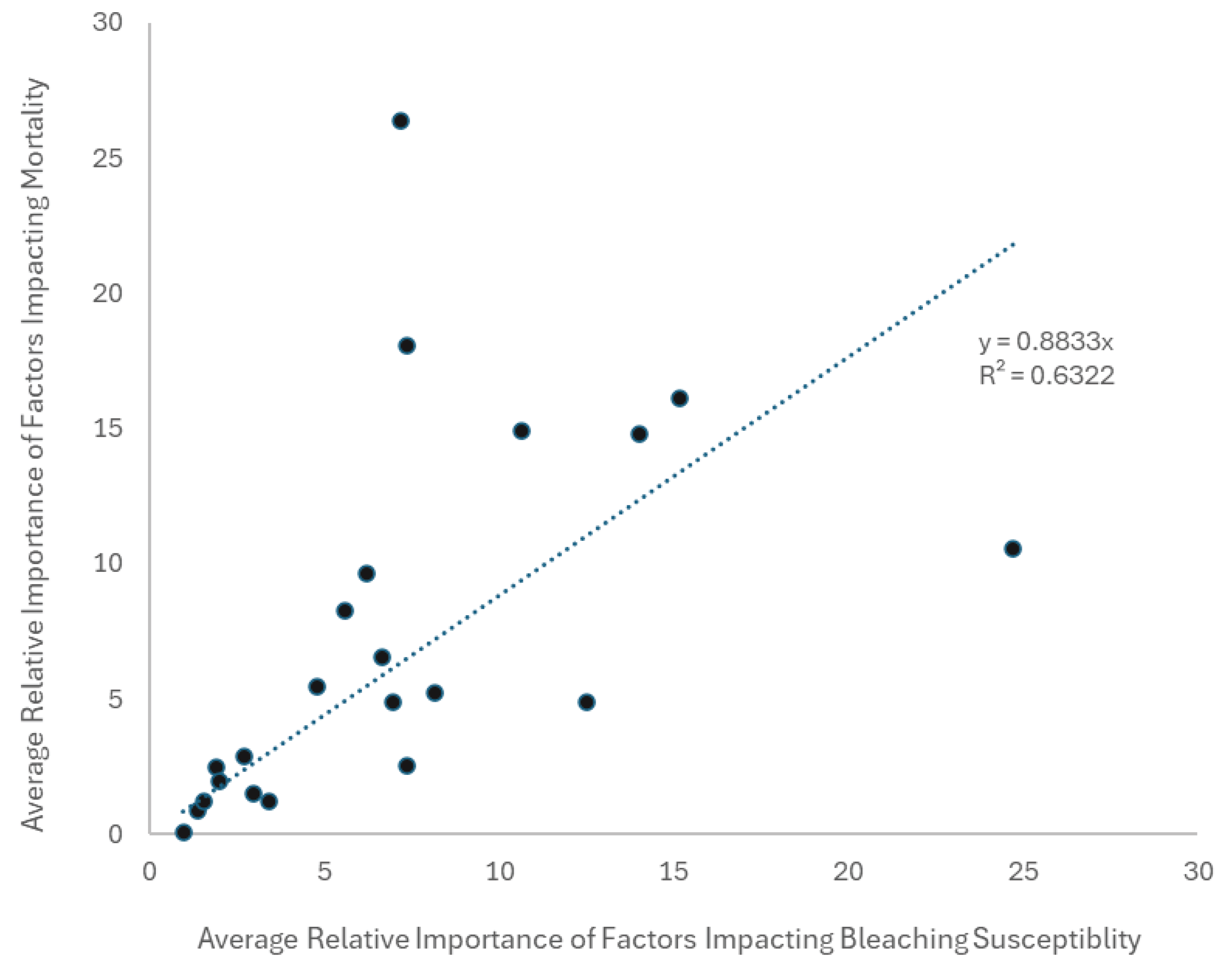
The bootstrap paradox of coral bleaching arises when resampling-based statistical methods are used to infer biological outcomes from variables that are not causally ordered. In such systems, predictors and responses are recursively defined: the same observations are used to estimate uncertainty, establish significance, and infer biological meaning. When the underlying process is non-linear or state-dependent, this circularity can obscure real structure, producing the illusion of noise or contradiction rather than resolution. This paradox becomes especially apparent when analyzing coral bleaching, where susceptibility, mortality, and recovery are often treated as sequential stages of a single failure pathway. Under this assumption, high susceptibility is expected to predict high mortality, and recovery is implicitly interpreted as incomplete failure rather than a functional response.
When susceptibility, mortality, and recovery are examined as triplet data values, the limitations of this framework become evident. The Average Relative Importance (ARI) analysis of susceptibility and mortality (Figure 8) reveals a positive overall trend (R² = 0.6322), yet the presence of significant outliers demonstrates that high susceptibility is not a deterministic precursor of high mortality. This statistical divergence defines the operational space of the recovery system architecture: a regime in which organisms successfully decouple environmental stress from lethal outcomes through sentinel buffering mechanisms. The bootstrap paradox is further quantified by the relationship between recovery and susceptibility (Figure 9; R² = 0.5784). Traditional models often interpret total bleaching as a near-death state. However, these data (Figure 8, Figure 9 and Figure 10) show that for many sentinel guilds, total susceptibility is not pathological but functional. Rapid expulsion of dysfunctional symbionts preserves skeletal and tissue architecture, enabling subsequent tissue regeneration—a process described here as the Phoenix Effect. Notable exceptions to this pattern include Madracis decactis and Scolymia sp., who exhibited 0% susceptibility and mortality, and 500% recovery following a bleaching event. In these cases, bleaching functioned as a temporal opportunity for maximal habitat expansion, reframing bleaching as an adaptive window rather than a failure state [72].
By redefining bleaching metrics not as predictors of death but as indicators of system efficiency, this analysis resolves the bootstrap paradox without requiring additional data. Instead, resolution emerges through constraining what the data are allowed to explain: pattern persistence rather than linear prediction across time, space, and biological scale. The predictive limitations of traditional bleaching metrics become starkly evident when analyzing the relationship between susceptibility, mortality and recovery across triplet data values. The Average Relative Importance (ARI) of susceptibility and mortality of this triplet database is shown [Figure 8], while susceptibility and mortality are related to recovery [Figure 9, Figure 10, respectively]. Susceptibility and mortality have a positive trend [R2 = 0.6322, Figure 8], although the significant outliers demonstrate that high susceptibility is not a deterministic precursor of high mortality. This statistical gap represents the primary operational space of the recovery system architecture – the sentinel protocols that successfully decouple environmental stress from lethal outcomes.
The bootstrap paradox is further quantified by the dependence of recovery upon susceptibility [R2 = 0.5784, Figure 9]. Traditional models often view total bleaching as a state of near-death; however, these data [Figure 8, Figure 9 and Figure 10], reveal that for many sentinel guilds, total susceptibility is a functional requirement for total recovery. By rapidly expelling dysfunctional symbionts the holobiont preserves its architectural integrity, allowing for subsequent tissue resurrection – the Phoenix Effect. Notable exception to this trend includes two cases of extreme resiliency in Madracis decactis and Scolymia sp., where they showed 0 susceptibility, 0 mortality, and 500% recovery after the event [72] showing bleaching was a temporal opportunity for maximum habitat coverage rather than a traditional disturbance.
Figure 8. Data restricted to triplet values, examining the coupled relationship between bleaching susceptibility and mortality. Scatterplot shows the average relative importance of factors influencing bleaching susceptibility plotted against their corresponding importance for mortality, restricted to observations where susceptibility, mortality, and recovery were jointly reported. The strong positive relationship (R² = 0.6322) demonstrates that, within triplet-constrained datasets, susceptibility and mortality share coordinated signal, while retaining substantial variance among individual drivers. This highlights that predictive alignment emerges only when dimensional completeness is preserved, reinforcing the necessity of triplet-based interpretation in resolving bleaching outcomes.
Preprints 200993 g008
Figure 9. Relationship between bleaching susceptibility and recovery across triplet-restricted observations. Scatterplot shows recovery plotted against susceptibility for observations where susceptibility, mortality, and recovery were jointly reported. A positive but weakened relationship (R² = 0.5784) indicates that, unlike mortality, recovery does not scale linearly with susceptibility. High-susceptibility observations span a wide range of recovery outcomes, demonstrating decoupling between initial bleaching response and longer-term system reconstitution. This divergence highlights recovery as a distinct biological axis, governed by processes beyond immediate susceptibility to stress.
Preprints 200993 g009
Finally, the weakest correlation within the triplet data is found between recovery and mortality [R2 = 0.3748, Figure 10]; this low predictive power reinforces the misperception of time inherent in current scientific discussion. Because ‘mortality’ is often recorded before the biological window for resurrection has fully closed, short-term or snapshot observations fail to account for the timing of recovery mechanisms, such as tissues hiding safe in endoskeletal refugia. The high degree of dispersion shown [Figure 10], validates the need for the BEQ as a more accurate metric for the holobiont’s long-term survival architecture over static mortality counts.
Comparison of response predictors of bleaching susceptibility and mortality [Figure 14] show only partial correlation to mortality outcomes [R2 = 0.27]; the lower correlation indicates that factors governing bleaching onset substantially differ from those governing post-bleaching survival. Several predictors exerted strong influence on susceptibility [summarized in Table 4, Table 5, Table 6, Table 7, Table 8 and Table 9], but weak influence on mortality, while others showed the inverse pattern, representing that bleaching does not represent a simple escalation toward death, but instead, marks a transition into distinct physiological regimes. This decoupling supports a phase-shift model in which bleaching functions as a stress detection and buffering response, while mortality reflects downstream filtering processes governed by internal host-symbiont architecture and tissue-level failure dynamics rather than external environmental gradients alone [which is consistent with Table 5 and Table 6].
Table 6. Reproductive Modes as a structural modifier of bleaching susceptibility, mortality, and recovery across thermal stress accumulation and observation timing. Average values of skeletal complexity are presented across low, medium, and high thermal stress accumulation, resolved by timing of observation relative to stress exposure (beginning, middle, end). Data were restricted to pair-wise susceptibility–mortality entries and post hoc grouped to minimize variance attributable to timing effects (see Table 5A; Figure 7A, Figure 8A and Figure 9A); only observations with n ≥ 3 were retained. Values are ordered by thermal stress accumulation, timing of observation, and mortality, illustrating how skeletal architecture modulates bleaching outcomes through differential exposure, tissue integration, and survivorship under escalating thermal stress.
Thermal stress accumulation Timing of observations Reproductive mode Susceptibility ±SE n Mortality ±SE BEQ (S-M)/S
Low Beginning Spawner 39.36 2.84 157 8.10 1.50 0.79
Brooder 39.16 4.06 62 2.88 1.24 0.93
Middle Spawner 44.40 5.47 41 8.46 2.91 0.81
Brooder 50.49 6.33 29 5.09 1.39 0.90
Both 14 6.67 4 2.75 1.89 0.80
End Brooder 47.20 10.68 12 33.76 10.17 0.28
Spawner 48.47 3.99 86 18.52 3.09 0.62
Medium Beginning Spawner 54.20 3.55 89 5.37 1.77 0.90
Brooder 26.74 5.21 31 4.05 1.82 0.85
Both 66.20 21.20 5 2.00 2.00 0.97
End Spawner 63.63 4.02 87 44.13 4.59 0.31
Brooder 70.75 5.84 25 32.67 7.05 0.54
High Beginning Spawner 48.07 10.76 18 12.14 5.68 0.75
Brooder 53.00 24.95 3 0.00 0.00 1
End Brooder 100.00 0.00 8 75.50 16.04 0.24
Spawner 90.22 4.99 23 64.74 9.72 0.28
Table 7. Mode of Sexual Reproduction as a structural modifier of bleaching susceptibility, mortality, and recovery across thermal stress accumulation and observation timing. Average values of skeletal complexity are presented across low, medium, and high thermal stress accumulation, resolved by timing of observation relative to stress exposure (beginning, middle, end). Data were restricted to pair-wise susceptibility–mortality entries and post hoc grouped to minimize variance attributable to timing effects (see Table 5A; Figure 7A, Figure 8A and Figure 9A); only observations with n ≥ 3 were retained. Values are ordered by thermal stress accumulation, timing of observation, and mortality, illustrating how skeletal architecture modulates bleaching outcomes through differential exposure, tissue integration, and survivor-ship under escalating thermal stress.
Thermal stress accumulation Timing of observations Sex Susceptibility ±SE n Mortality ±SE BEQ (S-M)/S
Low Beginning Hermaphroditic 40.34 2.99 142 8.99 1.64 0.78
Gonochoric 37.38 3.71 77 2.26 1.04 0.94
Middle Gonochoric 50.07 6.02 33 7.47 3.16 0.85
Hermaphroditic 42.20 5.40 40 6.47 1.81 0.85
End Gonochoric 40.44 6.45 32 24.16 6.01 0.40
Hermaphroditic 51.36 4.52 67 18.36 3.38 0.64
Medium Beginning Hermaphroditic 46.79 4.37 70 6.50 2.22 0.86
Gonochoric 46.58 4.55 55 2.36 0.99 0.95
End Hermaphroditic 73.53 4.27 56 48.46 5.66 0.34
Gonochoric 56.47 5.13 55 35.18 5.49 0.38
High Beginning Gonochoric 47.64 11.80 16 13.66 6.30 0.71
Hermaphroditic 52.40 16.91 5 0.00 0.00 1
End Hermaphroditic 100.00 0.00 16 75.50 10.96 0.24
Gonochoric 85.00 7.38 15 59.00 12.35 0.31
Table 8. Transmission of Algae to Offspring as a structural modifier of bleaching susceptibility, mortality, and recovery across thermal stress accumulation and observation timing. Average values of skeletal complexity are presented across low, medium, and high thermal stress accumulation, resolved by timing of observation relative to stress exposure (beginning, middle, end). Data were restricted to pair-wise susceptibility–mortality entries and post hoc grouped to minimize variance attributable to timing effects (see Table 5A; Figure 7A, Figure 8A and Figure 9A); only observations with n ≥ 3 were retained. Values are ordered by thermal stress accumulation, timing of observation, and mortality, illustrating how skeletal architecture modulates bleaching outcomes through differential exposure, tissue integration, and survivorship under escalating thermal stress.
Thermal stress accumulation Timing of observations Transmission of algae to offspring Susceptibility ±SE n Mortality ±SE BEQ (S-M)/S
Low Beginning Yes 45.21 11.39 8 9.36 4.18 0.79
No 61.32 3.67 68 7.20 2.42 0.88
Both 66.20 21.20 5 2.00 2.00 0.97
Middle No 44.29 6.10 33 5.76 1.88 0.87
Yes 48.35 7.59 22 2.39 0.60 0.95
End No 50.79 4.69 61 18.73 3.38 0.63
Yes 39.76 7.27 23 14.29 5.49 0.64
Medium Beginning Yes 45.21 11.39 8 9.36 4.18 0.79
No 61.32 3.67 68 7.20 2.42 0.88
Both 66.20 21.20 5 2.00 2.00 0.97
End No 56.45 5.83 42 27.18 4.79 0.52
Yes 50.30 6.54 25 19.38 6.25 0.61
High End No 82.50 13.89 6 63.17 18.49 0.23
Yes 92.50 5.12 16 57.06 12.57 0.38
Table 9. Level of Colony Integration as a structural modifier of bleaching susceptibility, mortality, and recovery across thermal stress accumulation and observation timing. Av-erage values of skeletal complexity are presented across low, medium, and high thermal stress accumulation, resolved by timing of observation relative to stress exposure (begin-ning, middle, end). Data were restricted to pair-wise susceptibility–mortality entries and post hoc grouped to minimize variance attributable to timing effects (see Table 5A; Figure 7A, Figure 8A and Figure 9A); only observations with n ≥ 3 were retained. Values are ordered by thermal stress accumulation, timing of observation, and mortality, illustrating how skeletal architecture modulates bleaching outcomes through differential exposure, tissue integration, and survivorship under escalating thermal stress. Level of colony integration.
Thermal stress accumulation Timing of observations Colony integration Susceptibility ±SE n Mortality ±SE BEQ (S-M)/S
Low Beginning Low 25.45 4.39 43 0.95 0.46 0.96
Medium 38.92 2.77 148 3.13 0.65 0.92
High 37.71 2.75 169 13.50 1.97 0.64
Middle Low 30.79 13.94 7 2.69 1.34 0.91
Medium 42.07 5.03 46 5.45 1.43 0.87
High 55.62 5.95 37 20.00 5.53 0.64
End Low 31.70 12.53 9 16.52 9.00 0.48
Medium 39.13 4.76 52 12.45 2.68 0.68
High 55.33 5.61 50 28.60 5.19 0.48
Medium Beginning Low 38.39 4.87 18 1.28 0.76 0.97
Medium 56.35 3.58 83 3.95 1.00 0.93
High 34.70 6.33 37 10.08 4.27 0.71
Middle Medium 21.71 4.59 7 13.43 4.95 0.38
High 42.25 12.71 8 42.25 12.71 0
End Medium 53.45 4.61 68 28.61 4.37 0.47
High 72.62 4.40 60 51.73 5.70 0.29
High Beginning Medium 23.86 13.60 7 0.00 0.00 1
High 58.61 10.47 17 21.32 8.92 0.64
End Medium 55.00 15.33 5 16.60 11.92 0.70
High 97.22 2.78 36 82.49 6.17 0.15
Table 10. Bleaching Occurrence as a structural modifier of bleaching susceptibility, mortality, and recovery across thermal stress accumulation and observation timing. Average values of skeletal complexity are presented across low, medium, and high thermal stress accumulation, resolved by timing of observation relative to stress exposure (beginning, middle, end). Data were restricted to pair-wise susceptibility–mortality entries and post hoc grouped to minimize variance attributable to timing effects (see Table 5A; Figure 7A, Figure 8A and Figure 9A); only observations with n ≥ 3 were retained. Values are ordered by thermal stress accumulation, timing of observation, and mortality, illustrating how skeletal architecture modulates bleaching outcomes through differential exposure, tissue integration, and survivorship under escalating thermal stress.
Thermal stress accumulation Timing of observations Bleaching occurrence Susceptibility ±SE n Mortality ±SE (S-M)/S
Low Beginning First 47.04 1.97 270 9.60 1.38 0.80
Second 37.67 2.46 204 6.88 1.32 0.82
Third 9.98 2.02 54 4.19 1.04 0.58
Fourth 50.55 3.26 91 0.06 0.06 1
Middle First 54.35 3.02 124 8.09 1.97 0.85
Second 14.28 2.51 38 5.43 1.72 0.62
Fourth 28.13 5.90 25 3.48 1.62 0.88
End First 41.71 3.17 97 11.71 2.44 0.72
Second 25.67 3.60 64 19.07 3.49 0.26
Third 28.54 5.35 44 3.94 2.76 0.86
Fourth 80.33 7.99 9 10.89 7.30 0.86
Medium Beginning First 56.53 3.91 58 8.76 2.89 0.84
Second 24.00 4.06 31 9.42 2.27 0.61
Third 76.42 5.44 33 8.94 4.39 0.88
Middle First 22.47 3.08 57 12.70 3.00 0.43
Second 68.44 6.04 18 9.44 3.41 0.86
End First 73.18 8.24 22 66.65 8.68 0.09
Second 52.40 11.25 17 42.29 10.03 0.19
Third 99.17 0.83 6 68.33 10.78 0.31
Fourth 60.10 4.65 53 30.43 4.09 0.49
Fifth 36.40 3.95 39 7.13 3.00 0.80
High Beginning First 41.62 9.21 21 9.52 6.56 0.77
Second 97.33 2.67 4 54.65 6.88 0.44
Middle First 87.10 4.72 20 27.65 6.13 0.68
End First 100.00 0.00 31 98.74 0.90 0.01
Second 58.75 11.87 12 34.00 12.46 0.42
Fifth 100.00 0.00 7 2.14 0.51 0.98
Table 11. Average susceptibility and mortality values resolved by thermal stress accumulation phase, timing of observation, and ocean basin, using pair-wise susceptibility–mortality entries and post hoc groupings to minimize variance associated with timing and stress accumulation. Data are ordered by thermal stress accumulation and observation phase, revealing spatially structured differences in how susceptibility translates into mortality across regions. The (S–M)/S metric highlights basin-specific efficiency of mortality expression under comparable stress conditions.
Thermal stress accumulation Timing of observations Location Susceptibility ±SE n Mortality ±SE (S-M)/S
Low Beginning N. Indian 70.71 8.84 15 24.33 6.79 0.66
N. Pacific 52.57 4.03 72 12.44 3.39 0.76
S. Atlantic 45.26 5.99 28 2.11 1.79 0.95
S. Pacific 27.95 3.09 121 0.05 0.04 1
W. Indian 42.68 2.66 139 1.04 0.47 0.98
W. Pacific 47.72 3.27 86 13.49 2.66 0.72
Middle N. Indian 24.81 4.64 49 17.09 4.64 0.31
S. Atlantic 68.52 2.34 34 5.17 0.86 0.92
S. Indian 54.07 4.38 54 0.30 0.24 0.99
W. Atlantic 30.06 4.90 49 4.58 1.44 0.85
End E. Pacific 61.87 24.99 3 61.87 24.99 0
N. Atlantic 30.21 6.04 15 15.54 2.62 0.49
N. Indian 38.47 10.91 17 29.65 11.36 0.23
N. Pacific 5.72 0.93 29 1.07 0.48 0.81
S. Atlantic 0.00 0.00 4 0.00 0.00 ***
S. Indian 30.98 2.92 65 2.48 1.17 0.92
S. Pacific 37.34 5.64 46 1.96 1.96 0.95
W. Atlantic 57.33 7.92 18 26.02 6.07 0.55
W. Indian 55.79 6.65 21 52.59 7.19 0.06
W. Pacific 71.40 9.65 13 27.29 9.38 0.62
Medium Beginning E. Indian 0.00 0.00 4 0.00 0.00 ***
N. Pacific 31.84 10.49 13 5.38 2.34 0.83
S. Atlantic 72.25 13.23 4 0.00 0.00 1
S. Pacific 38.82 6.68 11 0.00 0.00 1
W. Atlantic 32.43 2.79 114 2.85 0.73 0.91
W. Indian 87.58 3.55 34 20.88 5.89 0.76
Middle E. Indian 19.23 2.67 40 6.35 1.97 0.67
N. Pacific 61.35 6.46 23 13.35 4.51 0.78
W. Indian 33.30 10.49 10 33.30 10.49 0
End E. Pacific 38.97 4.27 42 9.74 3.32 0.75
N. Pacific 88.13 4.54 16 82.19 7.02 0.07
S. Atlantic 74.75 4.92 4 0.00 0.00 1
S. Pacific 74.00 17.11 4 51.00 18.89 0.31
W. Indian 26.67 13.33 3 0.00 0.00 1
High Beginning E. Pacific 50.53 8.77 25 16.74 6.52 0.67
Middle E. Indian 87.10 4.72 20 27.65 6.13 0.68
End E. Pacific 91.13 4.56 31 60.77 8.22 0.33
N. Pacific 100.00 0.00 16 100.00 0.00 0
***Somehow this operation is currently undefined, although dividing by 0 is appropriate for health statistics.
Table 12. Regional comparisons linking symbiont density, bleaching susceptibility, mortality, and background variability. Post hoc analyses comparing locations across multiple dimensions of bleaching response. Data include correlations between zooxanthellae densities and bleaching outcomes (A), regional differences in healthy and bleached zooxanthellae densities (B), regional patterns of bleaching susceptibility and mortality (C), and contextualization of bleaching outcomes relative to natural variability and colony integration (D). Zooxanthellae densities are reported as ×10⁶ cells cm⁻²; susceptibility and mortality are expressed as percent affected. All data were transformed prior to analysis (square-root transformation for proportional data; arcsine transformation for zooxanthellae densities). Standard error (±SE) is shown.
A)
Correlation analyses linking symbiont density to bleaching outcomes across locations. Correlation analysis testing the relationship between zooxanthellae population density (healthy and bleached states) and bleaching observations (susceptibility and mortality) across locations. Results demonstrate a strong association between healthy and bleached symbiont densities, while relationships between density and bleaching outcomes are weaker and non-uniform, indicating that bleaching response is not a simple linear function of symbiont abundance alone
Factor n Correlation coefficient p
Healthy and bleached 10 0.893 <0.001***
Healthy and susceptibility 10 0.346 >0.05
Healthy and mortality 10 0.431 >0.05
Bleached and susceptibility 10 0.059 >0.05
Bleached and mortality 10 0.191 >0.05
Susceptibility and mortality 10 0.500 >0.05
B)
Mean zooxanthellae population densities for healthy and bleached corals by location. Mean (±SE) zooxanthellae population densities for healthy and bleached corals across geographic regions. Regional differences reveal substantial spatial structure in baseline symbiotic states, with some locations maintaining higher symbiont densities even under bleaching conditions, suggesting location-specific buffering or historical filtering of symbiotic stability.
Location Healthy Bleached
Average ±SE n Average ±SE n
East Indian 7.06 1.02 20 1.34 0.32 12
East Pacific 4.63 0.71 57 1.32 0.27 42
North Atlantic 1.89 0.16 13 0.44 0.12 10
North Indian 2.81 0.52 38 0.33 0.19 3
North Pacific 2.29 0.17 38 0.33 0.19 3
South Atlantic 3.29 0.28 18 0.82 0.26 11
Southern Pacific 2.28 0.48 23 1.03 0.19 4
West Atlantic 2.43 0.20 63 0.48 0.08 48
West Indian 11.09 1.13 40 3.03 0.46 25
West Pacific 2.58 0.26 103 0.93 0.15 79
C)
Regional variation in bleaching susceptibility and bleaching-related mortality. Mean (±SE) bleaching susceptibility and mortality (%) across reef locations. Geographic patterns show that susceptibility and mortality are partially decoupled across regions, highlighting that high susceptibility does not uniformly translate to high mortality and reinforcing the role of regional context in shaping bleaching outcomes.
Location Susceptibility Mortality
Average ±SE n Average ±SE n
East Indian 56.13 3.53 118 22.69 3.58 78
East Pacific 56.63 3.49 126 28.39 3.85 112
North Atlantic 58.89 5.90 34 13.71 2.62 17
North Indian 61.25 4.54 62 38.07 6.44 43
North Pacific 44.15 1.94 347 24.31 2.59 223
South Atlantic 58.76 3.56 59 3.51 0.68 50
Southern Pacific 35.30 2.16 254 1.65 0.82 182
West Atlantic 45.73 1.62 463 8.81 1.02 389
West Indian 56.23 2.19 288 30.65 2.36 277
West Pacific 49.65 2.65 144 20.50 2.90 116
D)
Bleaching outcomes relative to natural variability and colony integration. Comparison of natural fluctuations (% loss from the mean), sublethal bleaching, and lethal bleaching across locations and levels of colony integration (LCI). Categories of natural variability are based on prior statistical thresholds (Table 1 and Table 2). This comparison contextualizes bleaching responses relative to background variability, illustrating that lethal bleaching frequently exceeds expected natural fluctuation ranges, while sublethal bleaching often overlaps with them.
Factor Natural variation Sublethal bleaching Lethal bleaching
Location LCI Average n ±SE Average n ±SE Average n ±SE
East Indian Low 24.12 8 1.5 62 3 0 81.00 3 0.00
Medium 29.00 9 7.5 53.75 6 3.91 85.00 6 0.00
East Pacific Medium 25.64 36 2.24 51.14 21 3.28 80.52 21 3.36
High 34.82 17 9.61 47.00 13 4.07 82.80 13 1.68
North Atlantic Medium 45.40 5 12.00 51.83 9 3.92 78.69 9 4.77
North Indian High 21.67 16 3.77
North Pacific Medium 26.00 3 0 48.06 5 3.64 83.38 5 6.66
High 32.38 29 2.81 64.20 10 5.81 94.5 10 0.67
South Atlantic High 8.71 14 2.68 55.00 9 10.87 78.9 9 6.21
South Pacific High 19.06 17 4.92 56.50 4 3.50 83.75 4 0.25
West Atlantic Medium 33.84 44 4.28 47.72 11 1.56 87.45 11 2.34
High 20.40 15 5.44 37.47 7 2.24 77.17 7 4.24
West Indian Medium 68.77 33 5.87 67.78 28 2.67
High 38.57 7 7.67 45.00 3 0.00 68.00 3 0.00
West Pacific Low 3.00 9 1.50 57.00 6 12.52 73.00 6 8.94
Medium 34.50 4 7.50 52.00 3 0.00 63.75 3 2.75
High 19.01 78 2.24 59.26 52 2.23 79.04 52 1.29
Table 13. The five biological drivers underlying Scleractinian “Phoenix” responses to mass bleaching. This table synthesizes the primary trait axes identified across the Results (skeletal complexity, reproductive mode, sexual reproduction strategy, symbiont transmission, and level of colony integration) into a unified conceptual framework explaining non-linear bleaching outcomes. For each driver, the mechanistic basis of influence and its ecological significance are summarized, illustrating how coral survival, mortality, and recovery emerge from interacting biological architectures rather than from thermal stress exposure alone. Together, these drivers define the functional pathways through which corals persist, reorganize, or fail following bleaching disturbance.
Skeletal Complexity Reproductive Mode Sexual Reproduction Transmission of Algae to Offspring Level of Colony Integration
Mechanism of Influence Provides micro-habitats and light-scattering properties within the calcium carbonate structure. Distinguishes between different strategies of larval development and settlement. Involves the specific methods of gamete exchange and genetic recombination. Defines whether symbionts are passed directly from the parent (vertical) or acquired from the environment (horizontal). The degree of physiological connectivity and resource sharing between individual polyps.
Why it Matters It acts as an underlying expression mechanism of bleaching survival by creating internal refugia for zooxanthellae. This trait serves as a biological driver that determines how a colony expressed resilience or vulnerability during a bleaching event. It is a key component in the system architecture of mass bleaching responses, influencing long-term recovery patterns. This is a critical survival mechanism that dictates the stability of the symbiosis across generations High integration allows the colony to function as a unified system, pushing the "death" of the organism into a perpendicular state through resource redistribution.
Over half of the variation in bleaching susceptibility was explained by the top three predictors: Bleaching Occurrence (average relative importance -ARI- of 24.72%), ocean_subregion (ARI 15.19%), Complexity of Skeleton (ARI 14.04%), while Location (ARI 14.41%) and Relief from Weather (ARI 10.65%) also had a ‘double digit’ impact. In comparison, bleaching mortality had the top 3 host over of 60% of variation: Habitat (ARI 26.39%), Months of Observations (ARI 18.07%) and ocean_subregion (ARI 16.14%), and other ’double digit’ factors included the Complexity of Skeleton (ARI 14.78) and Bleaching Occurrence (10.57%).Notably, location-related variables, Bleaching Occurrence and Complexity of Skeleton maintained importance for both Susceptibility and Mortality. Here the skeletal porosity of coral clades explained 14-15% of the relative importance in differences in bleaching susceptibility and mortality across the 9 matrixed categories of thermal stress accumulation and timing of observations relative to the thermal stress onset. Skeletal porosity is impressive for its number and consistency. By contrast, taxonomy ranged from 1-4% relative importance and was relatively more inconsistent than complexity of skeleton 0.63-0.87 standard error vs taxonomy which ranged from 0.77-2.73.
Figure 10. Relationship between recovery and mortality across triplet-restricted observations. Scatterplot shows recovery plotted against mortality for observations where susceptibility, mortality, and recovery were jointly reported. A moderate positive relationship (R² = 0.3748) indicates that higher mortality does not preclude recovery, nor does low mortality guarantee rapid system reconstitution. The broad dispersion of recovery values across the mortality axis demonstrates that recovery dynamics are partially decoupled from lethal outcomes, reinforcing recovery as an independent biological process rather than an inverse proxy of mortality.
Preprints 200993 g010

3.3.5. Biological Drivers Undermining Bleaching Response Patterns

The residual variability in bleaching responses observed after accounting for timing and thermal stress accumulation [Figure 7A, Figure 8A and Figure 9A] reveals a strong biological signature that cannot be explained by environmental forcing alone. This biological variability, consistently detected across bleaching susceptibility, mortality, and recovery metrics [Table 3, Table 4A] alongside zooxanthellae densities [Table 1], represents the dominant unresolved component governing bleaching outcomes. Rather than reflecting noise or stochastic failure, these patterns indicate that coral-symbiont systems express structured, heritable response strategies that regulate bleaching as a functional survival mechanism. Recognizing bleaching as an outcome shaped by biological design – rather than solely by external stress magnitude – resolves the apparent paradox between ecological vulnerability and long-term geological persistence. By reframing susceptibility as a position along a spectrum of adaptive response strategies, this analyses shifts bleaching from a narrative of fragility to one of conditional resilience, rooted in phenotypic plasticity and co-evolved survival architectures.
Descriptive statistics of cladal representation across biological traits [Table 5] indicate substantial heterogeneity in baseline diversity prior to the application of environmental stress. Average cladal counts varied across skeletal complexity, reproductive modes, sexual system, symbiont transmission strategy, and morphology, with no single trait category overwhelmingly dominating representation. However, taxonomy and specifically genera, turned into a very fruitful data exploration for potential bleaching mechanisms [Table 5]. Counts were unevenly distributed among trait classes and taxonomy, reflecting both biological structure and sampling availability, but variability was consistently present across all categories. These baseline differences establish that biological diversity is intrinsic to the dataset before the influence of thermal stress or bleaching responses, providing necessary context for interpreting trait-mediated or genera-mediated effects observed in subsequent analyses.
Skeletal Complexity as an Underlying Expression Mechanism of Bleaching Survival Mechanisms
Complexity of Skeleton is an ancestral trait to our fossil knowledge of Scleractinia. The co-evolutionary adaptation of half of Scleractinia (complex) to host endosymbiotic sponges and have porous skeletons. While the other half of Scleractinia has robust skeletons. Robust corals have evolved histidine systems, blood cells and other immune response systems such as photoprotectants (e.g. sunscreens) [74]. In contrast, Complex corals have the Phoenix effect, so having a complex skeleton affords one a vulnerability, but also pathways for recovery. This appears to us as a flight response, when in actuality, the coral is only susceptible as it can recover, but it is a gamble.
When susceptibility and mortality were examined jointly across thermal stress accumulation and timing of observations skeletal complexity consistently modulated bleaching outcomes [Table 7 and Table 10]. Under comparable thermal stress regimes, complex and robust skeletal architectures exhibited divergent susceptibility, mortality and BEW values, particularly as observations progressed from the beginning to the end of thermal stress events. Differences between skeletal categories were low, medium, and high thermal stress accumulation with the magnitude of divergence increasing toward later observation periods. These patterns indicate that skeletal architecture influences the balance between susceptibility and mortality across temporal phases of bleaching, independent of stress intensity alone. The resulting BEQ values demonstrate that recovery potential and survival outcomes are contingent upon structural traits interacting with both the accumulation and timing of thermal stress exposure.
Together, these results [Table 7 and Table 10] demonstrate that biological and architectural traits systematically shape bleaching responses event after accounting for thermal stress intensity and timing, highlighting intrinsic mechanisms that govern variability in susceptibility, mortality, and recovery.
Reproductive Mode as an Underlying Expression Mechanism of Bleaching Survival Mechanisms
Reproductive Mode contributed measurable variability to bleaching susceptibility and mortality across thermal stress accumulation and timing of observations [Table 8 and Table 10A]. Across low thermal stress conditions, spawners and brooders exhibited comparable susceptibility early in events, while brooders consistently showed lower mortality values, resulting in higher BEQ values relative to spawners. As observations progressed toward the end of low-stress events, mortality increased in both reproductive modes, though brooders maintained a higher proportion of non-lethal responses.
Under medium thermal stress accumulation, divergence between reproductive modes became more pronounced [Table 8 and Table 10A]. Spawners generally exhibited higher susceptibility values than brooders at both early and late observation periods, while brooders retained lower mortality despite comparable or elevated susceptibility. This pattern resulted in consistently higher BEQ values for brooders relative to spawners under medium stress conditions.
At high thermal stress accumulation, sample sizes were reduced; however, reproductive mode differences remained evident. Early observations showed brooders exhibiting zero recorded mortality despite elevated susceptibility, whereas spawners experienced measurable mortality. By the end of high-stress conditions, both reproductive modes exhibited high susceptibility and mortality, though brooders retained marginally higher BEQ values.
Across stress regimes, reproductive mode influences the balance between susceptibility and mortality more strongly than susceptibility alone, indicating that reproductive strategy contributes to variability in bleaching outcomes when environmental stress intensity and timing are held constant.
Mode of Sexual Reproduction as an Underlying Expression Mechanism of Bleaching Survival Mechanisms
Mode of sexual reproduction further refined bleaching outcomes by shaping the decoupling between susceptibility and mortality [Table 9 and Table 10A]. Hermaphroditic taxa generally exhibited higher susceptibility than gonochoric taxa across stress categories, particularly under medium and high thermal stress accumulation; however, this increased susceptibility did not translate proportionally into mortality during early and middle observation periods. Instead, hermaphroditic corals frequently maintained higher BEQ values, indicating greater recovery potential despite extensive bleaching. This pattern supports the interpretation that elevated susceptibility in hermaphrodites reflects and adaptive shedding or reconfiguration response rather than intrinsic vulnerability.
By contrast, gonochoric taxa tended to show tighter coupling between susceptibility and mortality, especially toward the end of bleaching events. Under high thermal stress conditions, gonochoric corals experienced substantial mortality once susceptibility thresholds were exceeded, whereas hermaphroditic taxa retained a wider range of outcomes, including instances of complete susceptibility followed by partial or delayed mortality. These results suggest that sexual system influences the flexibility of pos0bleahcing trajectories, with hermaphroditism associated with prolonged survival and greater capacity for recovery following severe disturbances.
Transmission of Algae to Offspring as an Underlying Expression Mechanism of Bleaching Survival Mechanisms
Transmission of symbionts to offspring influenced bleaching outcomes primarily through its effects of bleaching efficiency rather than absolute susceptibility or mortality alone [Table 10 and Table 10A]. Across low and medium thermal stress accumulation, taxa lacking vertical transmission generally exhibited higher susceptibility than those transmitting symbionts; however, this increased susceptibility was not consistently associated with higher mortality. As a result, non-transmitting taxa frequently maintained higher BEQs, particularly during early and middle observations periods, indicating effective de coupling of bleaching from lethal outcomes.
By contrast, taxa exhibiting vertical transmission tended to show longer susceptibility but a tighter coupling between susceptibility and mortality as stress accumulated, reflected in lower BEQ values under prolonged exposure. This pattern was most pronounced toward the end of bleaching events, where vertically transmitting taxa experienced comparable or elevated mortality relative to non-transmitting taxa despite reduced susceptibility. Under high thermal stress conditions, both strategies converged towards extreme outcomes, with susceptibility approaching saturation and BEQ declining sharply, indicating that symbiont transmission strategy does not confer resistance under severe stress but instead modulates the trajectory and timing of bleaching responses.
Taken together, these results suggest that vertical transmission functions less as a resistance mechanism and more as a constraint on post-bleaching flexibility. While inherited symbionts may stabilize early symbiosis, they appear to reduce the capacity for rapid symbiont turnover or restructuring during extreme disturbance, thereby limiting recovery pathways once bleaching thresholds are exceeded. This reinforces the interpretation that bleaching success is governed by architectural flexibility and recovery capacity rather than by symbiont fidelity alone.
Level of Colony Integration as an Underlying Expression Mechanism of Bleaching Survival Mechanisms
Level of Colony Integration exerted a strong and consistent influence on bleaching outcomes across thermal stress accumulation and timing of observation categories [Table 11 and Table 10A]. Across low and medium thermal stress, colonies with higher integration generally exhibited elevated susceptibility relative to poorly integrated colonies; however, this increased susceptibility did not scale proportionally to mortality. As a result, moderately to highly integrated colonies frequently maintained higher BEQ values during early and middle observation periods, indicating effective buffering of lethal outcomes despite pronounced bleaching responses.
As thermal stress accumulated and observations progressed toward the end of bleaching events, highly integrated colonies showed a marked decline in BEQ, reflecting increasing coupling between susceptibility and mortality. Under these conditions, mortality rose sharply in highly integrated colonies, suggesting that once internal buffering capacity is exceeded, failure propagates rapidly across the colony. In contrast, low-integration colonies displayed lower initial susceptibility and more variable mortality responses, resulting in intermediate BEQ values that were less sensitive to timing bit more heterogenous across stress regimes.
Under high thermal stress accumulation, differences among integration levels diminished, with BEQ collapsing across all categories as susceptibility approached saturation and mortality increased sharply. This convergence indicates that colony integration modulates the trajectory and timing of bleaching responses rather than conferring absolute resistance to extreme stress.
Overall, these results [Table 11 and Table 10A] suggest that colony integration functions as double-edged architectural trait: enhancing internal resource sharing and recovery potential under moderate stress, while increasing vulnerability to cascading failure once physiological thresholds are exceeded. This pattern reinforces the interpretation that bleaching outcomes are governed by internal architecture and failure dynamics, rather than by external stress intensity alone.

3.3.6. The Impact of the Variability of the Underlying System Components of Time and Location on Bleaching Responses

Bleaching responses are not static properties of taxa or environments, but emergent outcomes of processes unfolding across space and time. As thermal stress accumulates and observations are made at different points along the disturbance – recovery continuum, the apparent magnitude and direction of bleaching susceptibility and mortality shift often producing contradictory interpretations when time is treated as a fixed variable rather than a dynamic system component.
The post hoc groupings for thermal stress and time [Table 5A] further impress the need for quantification of time as the effects of mass bleaching events vary over the course of time [Figure 7A, Figure 8A and Figure 9A, Table 7, Table 8, Table 9, Table 10, Table 11, Table 8A, Table 9A and Table 10A]. Historically, the full picture of the durational impacts of bleaching has been misperceived due to the timing of observations relative to the physiological impacts felt by the organisms [Table 7, Table 8, Table 9, Table 10, Table 11, Table 8A, Table 9A and Table 10A]. The impacts to massive and branching growth forms [represented in both medium and high levels of colony integration, Table 11] of bleaching events reflect a different story than one-off observations [Figure 5A and Figure 6A]. For full durational studies, susceptibility is negligent through time between branching and massive growth forms, although mortality does vary [Figure 5A and 6A]. We have frozen time to their response [Figure 3 and Figure 4] and we need to become aware and maintain mindfulness that actions change through time and relative perceptions provide bias.
Bleaching occurrence, defined as the number of bleaching events reported for a given location, exhibited on the strongest and most consistent relationships with bleaching responses [Table 12 and Table 10A]. Susceptibility generally increased with the number of reported bleaching events, particularly under medium and high thermal stress accumulation categories, reflecting cumulative exposure effects. Mortality, however, showed nonlinear scaling with bleaching occurrence: early events were often associated with moderate mortality, while later events displayed either sharply elevated mortality or evidence of reduced mortality despite high susceptibility. This dispersion suggests selective filtering across repeated events, where vulnerable phenotypes are progressively removed, leaving more resilient configurations. Consequently, bleaching occurrence functions as both a stress-history metric and an emergent indicator of adaptive filtering across time.
Bleaching responses varied across locations, per the post hoc categories [Table 5A] of ocean_subregion [Table 13, Table 10A]. Geographic location integrates multiple underlying drivers of bleaching responses, including regional thermal histories, basin-scale circulation, species composition and evolutionary exposure to stress. Consequently, location represents a composite variable through which temporal dynamics and biological filtering are expressed rather than an isolated causal factor. When bleaching responses were examined across ocean basins and subregions, substantial spatial heterogeneity emerged in both susceptibility and mortality patterns, particularly when resolved by timing of observations and relative thermals stress accumulation [Table 13, Table 10A]. These patterns indicate that bleaching responses are not uniform, but instead reflect region-specific trajectories shaped by repeated exposure, selective mortality, and differential recovery potential.
To contextualize biological and temporal patterns within broader spatial structure, bleaching responses were further examined across ocean basins and subregions. Location-based analyses [Table 14] revealed substantial geographic variability in zooxanthellae densities, bleaching susceptibility, and bleaching-related mortality indicating that spatial context contributes meaningfully to observed response distributions. Mean healthy zooxanthellae densities differed markedly among regions, corresponding reductions under bleached conditions, while susceptibility and mortality exhibited rather than uniform scalin with thermal stress alone.
When natural fluctuations were compared with sublethal and lethal bleaching outcomes across locations and levels of colony integration [Table 14e], bleaching responses consistently exceeded background variability, though the magnitude of divergence varied among regions. These patterns suggest that geographic location integrates long-term environmental histories and selective regimes that shape both baseline physiological states and responses to repeated thermal stress events. Within ocean basins, bleaching was significantly different (MANOVA, F(2,178) = 14.434, p<0.00) from mean healthy zooxanthellae densities (which were not significantly different), although Tukey’s post hoc showed a significant difference for bleached zooxanthellae densities from the Pacific Ocean compared to the Atlantic and Indian Oceans. Mean healthy and bleached zooxanthellae densities of pair-wise data for the Atlantic Ocean (n=31) healthy: 2.69x10⁶ (SE±3.17x10⁵), bleached: 4.85x10⁵ (SE±9.36x10⁴). For the Indian Ocean (n=19) healthy densities average 5.24x10⁶ (SE±1.24x10⁶) and bleached densities were 1.01x10⁶ (SE±2.65x10⁵). In the Pacific Ocean (n=128), healthy densities averaged 7.43x10⁶ (SE±2.13x10⁶) and bleached densities averaged 2.78x10⁶ (SE±3.89x10⁵).

4. Discussion

The results presented here challenge the prevailing tendency to interpret coral bleaching as a uniform, terminal outcome of stress and instead reveal bleaching as a structured, context-dependent system response. Across datasets spanning symbiont density, susceptibility, mortality, recovery and symbiont diversity, variability emerges not as noise or inconsistency, but as an intrinsic feature of how coral-algal symbioses respond to disturbances. Interpreting bleaching therefore requires moving beyond static definitions and isolated metrics toward a framework that accounts for dynamic trajectories, functional states, and architectural constraints.
This discussion synthesizes the results by shifting the interpretive focus from outcome-based classifications to system architecture. Rather than asking whether corals bleach or die under stress, the emphasis here is on how bleaching responses are expressed, constrained, and resolved across time. By integrating absolute and proportional measures of symbiont loss with recovery patterns and biological expression mechanisms, the results support a view of bleaching as a functional state embedded within a broader response spectrum, rather than an endpoint signaling irreversible failure.
Accordingly, the sections that follow first reinterpret commonly used indicators of coral health, then articulate bleaching as a functional, non-terminal state with direct implications for how responses are monitored and compared. The Discussion then extends this framework to examine the architecture of bleaching responses, including sources of variability, disturbance guilds, and phase shifts that occur without collapse. Finally, these patterns are situated within a deep-time ecological context, highlighting how persistence under repeated disturbance has shaped the response space observed in modern reef systems.

4.1. From Variability to System Architecture

Much of the foundational understanding of coral bleaching—what occurs, under what conditions, and how recovery is interpreted—has been shaped as much by methodological assumptions as by biological processes themselves. Observational constraints and proxy-based measurements have historically encouraged descriptive interpretations that blur distinctions between variability, dysfunction, and failure. The redefinition of coral bleaching presented here reflects a broader epistemological shift: the translation of qualitative descriptors into quantitative, operational criteria.
This shift is not merely methodological; it is foundational to scientific progress across disciplines. By converting qualitative phases of coral health into measurable fluorometric states, we demonstrate how subjective biological phenomena can be reframed to support reproducibility, comparative analysis, and mechanistic inference. Similar transitions have occurred elsewhere: ecological terms such as “stress,” “resilience,” and “recovery” are often used descriptively despite lacking standardized thresholds; in medicine, clinical diagnoses once reliant on symptom narratives are increasingly anchored to biomarkers; in psychology, constructs such as anxiety or well-being have moved from qualitative descriptions to psychometric and neurophysiological metrics. Even in physics, phenomena now formalized through nonlinear dynamics—such as turbulence or chaos—were initially characterized qualitatively before appropriate mathematical frameworks emerged.
The central limitation, therefore, is not the absence of data, but the absence of frameworks capable of translating observational language into dimensional, testable system states. In coral reef science, the coral–algal symbiosis has long been assessed through visual cues and pigment proxies, yet lacks a time-resolved, colony-integrated metric of physiological dysfunction. By introducing calibrated PAM fluorometry as a system-level diagnostic, this framework requires explicit consideration of baseline variability—what constitutes “normal” behavior in zooxanthellae populations and how natural fluctuations scale across time and disturbance regimes (Figure 1, Figure 2, Figure 3, Figure 4 and Figure 5; Table 2, Table 3 and Table 4).

Interpreting Zooxanthellae Population Densities

Zooxanthellae densities have been observed to fluctuate with environmental parameters [42,60,61,62,75,76,77]. Seasonal variations occur such that the lowest mean density occurs during summer, while winter values may be up to 2-3 times higher; however, this appears to be dependent upon location (77); it has therefore been suggested that bleaching cannot be distinguished from these fluctuations. However, due to the slow progression of seasonal fluctuations in comparison to acute bleaching [77,79,80,81], if monitored consistently and routinely, bleaching is readily distinguishable from seasonal variations in zooxanthellae population densities. Furthermore, seasonal observations may be confounded by prolonged bleaching responses in massive, encrusting, and foliose colonies [82], which accumulate thermal stress (up to 3 years for Porites lobata, [75]), and their length of resistance is likely related to the level of colony integration and whether or not the colony can produce partial mortality [32].
Most factors studied had a negative impact on zooxanthellae population densities; however, both light and nutrient enrichments can have a positive impact on the population density. Light can potentially cause indistinguishable variation between healthy and bleached colonies due to variations in zooxanthellae pigmentation [83]. Most importantly, pollutants cause background, chronic stress that lowers baseline zooxanthellae densities and may make it harder to distinguish bleaching from natural variations, without consistent monitoring [42]. In this study, there was a marked and consistent trend with depth, with shallower sites (1-3m) generally having lower zooxanthellae densities than deeper sites (up to 20m). This pattern has been reported previously [69,74] and is a clear response to changes in light availability. As light becomes limiting, photosynthetic potential can be enhanced (up to a point) simply by increasing the concentration of zooxanthellae within surface tissues of the coral. It might be, therefore, that a similar pattern should be apparent when comparing along latitudinal gradients, though this will depend on the extent to which it is the total amount of light received, or the maximum amount of light received at any one time. The use of taxonomy to explore absolute densities of zooxanthellae densities was obscured by low records due to the variability in methods [Figure 2] and perhaps methods inherently have to be different for different corals, so that may all just be reflective of organismal diversity.
Nutrient enrichment (e.g. ammonia) was the only causal agent that increased mean zooxanthellae density [Figure 5]. [84] show that ammonia is regulated by urea in corals; such that indicator levels of urea can be measured in a field laboratory using a colorimetric kit designed for use with human blood plasma (which, if bought in bulk, costs 50 cents a test and takes 15 minutes to complete). The information from such data (as well as other environmental parameters measured from simple cost-effective water ecology kits) could be applied to management options. For instance, regulation of urea and ammonia (e.g. fish and invertebrate populations, [85]) will in turn regulate local coral populations. Therefore, areas that have lower urea concentrations should be protected to increase fish populations (thereby increasing zooxanthellae densities), while areas that have higher urea concentrations should be open to the public to help exploit fisheries and maintain ecosystem balance. This would require continued surveillance efforts and dynamic governance, because too much ammonia can cause bleaching [77,86,87,88,89], presumably because of overcrowding in the zooxanthellae population [90]. Moreover, the urea testing methods of [84], in collaboration with color sciences and chemistries could be a much more fruitful, common sense, cost-efficient pathway.
Bleaching of zooxanthellae may be defined as >55% reduction in zooxanthellae densities; where less than that may indicate that zooxanthellae have bleached pigments [77,79,80,81], that are more readily recoverable [91]. If the stress continues, corals are likely to bleach zooxanthellae (>55% loss), which takes weeks to months to recover [32,49,92,93,94]. A reduction of >78% of the zooxanthellae population suggests sustained bleaching that will likely lead to mortality if conditions persist [41], but this is also dependent upon the level of colony integration (e.g. concentration of stress in massive colonies producing partial mortality, [32]). If the MHZD is unknown, then sublethal bleaching may remain undistinguishable; however, lethal bleaching can be distinguished [81]. If the MHZD is known, then sublethal and lethal bleaching are clearly distinguishable from background variation.
Importantly, pollutants were the only categorical mechanism of bleaching (less the work of Leonard Muscatine [whom had a “skim the water for heat-stressed algae” method of discerning bleaching and likely discovered that impaired were bleached first) that reduced zooxanthellae densities within the realms of natural variation (e.g. the <45 flexibility of the proportional average while being monitored consistently): Moreover, nutrient enrichment was the only stressor that inflated population densities [Figure 1]. Colonies must be monitored consistently through time to observe the change in color and capture the impacts of pollution and natural variabilities in the area [Table 1]. This evidence suggests that perhaps a lot of what has been termed natural variations in palings/shadings of corals (and therefore variability in their algal densities and/or populations) are realistically sublethally stressed corals [42].

4.2. Bleaching as a Functional, Not Terminal, State

The simple version of the definition of bleaching is that it is a general stress response by the coral holobiont, which can be observed as either a fight or flight reaction based upon the strength and timing of the stressor [42]. Short term, high stress conditions elicit a flight response, where the colony expels photosynthetically healthy zooxanthellae in an effort to prevent further damage [39]. However, for longer-term chronic stress the colony fights the damage (through photoprotection and photorepair) then experiences photodamage, which leads to photoinhibition, which leads to chronic photoinhibition (free oxygen radicals begin to form) when the whole colony expels their chronically photoinhibited zooxanthellae [42]. This is essentially [36]’s photoinhibition model of coral bleaching, but at the level of the holobiont, not just molecular. Post hoc analyses of PAM Fluorometry measurements from [42] revealed objective definitions for each of these phases once methods are standardized [Table 2, Figure 3, Figure 4].
Fluorometry measurements reveal differences in the responses of corals to environmental stress [42], though there are some complexities in interpreting changes in resulting measurements. The photoinhibition model of coral bleaching presented by [36] recognizes several distinct phases of chronic photoinhibition (or bleaching); i) photoprotection, ii) photorepair, iii) photodamage, and iv) photoinhibition. I found this sequence to occur at the level of the colony [Figure 4] when quenching was standardized to a mean coral, and I compared the variability from the proportional mean values of healthy corals to a particular colony in experimental conditions [42]. During this sequence F and Fm values remain constant during photoprotection and photorepair, but photosynthetic yields become highly variable during photodamage and photoinhibition [Table 2]. In the formative stages, quenching analyses are important in revealing photoprotection (i.e. xanthophyll cycling or heat dissipation) and photorepair occurring simultaneously, but with competing roles. Once colonies bleach, the photosynthetic yield again stabilises, but may increase or decrease as it shuffles, acquires or grows zooxanthellae. Increases in photosynthetic yields among bleached corals are counter-intuitive, but reflect selective expulsion of defective zooxanthellae [81,95], similar to what the zooxanthellae densities report, there is less fluctuation across zooxanthellae densities in bleached corals (8%, [Table 1]. The specific physiological processes that lead to photoinhibition remain unclear [96] but are likely to vary depending upon the relative contribution of high light, high temperature and/ or other adverse environmental conditions to the bleaching response.
This definition of bleaching is supported by field observations made during mass bleaching events by [29,81], and it supports the commonly used visual methods of determining bleaching, the colour card [31] and categorization by bleaching level (e.g. slightly, moderately or severely bleached, e.g. [40]). However, as [33] suggested, these categories may misrepresent what is happening and beg for longer measurements and consistency and I suggest that fluorometry should be used to determine accuracy, which is supported by the suggestion of [29] who highlight the necessity of in-depth observational studies of bleaching.
There are exceptions to the definition of bleaching, such as intra-colonial gradients, timing of observations/measurements, and other experimental protocol. Variations associated with intra-colonial causes, such as branch gradients, shade-light adapted sections of branches [29,98,99,100] and comparison between inner and outer branch densities [76] exceeded the threshold (ranged from 25-110%). Moreover, light can potentially cause indistinguishable variation between healthy and bleached colonies due to variations in zooxanthellae pigmentation [83]. However, [99] showed that the light and dark-adapted sections of branches lose the same percentage during bleaching. Therefore, if methods are applied and repeated correctly, bleaching should be distinguishable from within colony variation.
The timeframes of experiments had a significant impact on the mean zooxanthellae loss. Except for [42], where health was fixed and time was measured, all experiments tested the mean difference between healthy and bleached organisms after a given timeframe, a pre-determined end to the experiment. Further differences in estimates of zooxanthellae densities probably also relate to differences in experimental protocols. For instance, the time that corals are left to acclimate to aquarium conditions ranges from hours to weeks (although they were not fully recorded or analyzed, but see [60,61]. Another likely source of variation is the replication of homogenized subsamples, which ranged from 2-12. Importantly, methods to determine the number of algae have caused 1/3 of the variation (or ‘noise’) in the reported algal densities from the Zooxanthellae Density Meta-database [Table 2]. Intraspecific variation in the timing of the bleaching response [80,81] causes mean zooxanthellae densities (from randomization and replication) to appear to be slowly decreasing (e.g. [100]). However, bleaching is an acute response [supported by field observations of mass bleaching events [80,81,102,103].
Furthermore, the OISEO [42] measured the phenotypic plasticity in the timing of the bleaching response for two common and susceptible corals with contrasting life history traits, Acropora nasuta is a complex spawning coral (that does not transmit algae to its offspring) while Pocillopora damicornis is a robust brooding coral (that does transmit algae to its offspring), and there were obvious differences in responses between them. 1/3 of the Acropora nasuta experimental corals sloughed their tissue and held remnant patches within their porous skeletons that came back out from 3-4 weeks onwards in recovering conditions (e.g. observation of the mechanism for the Phoenix Effect [43,104] through their complex, porous skeletons, half of extant corals are complex; regardless of if they hermatypic or not; half of the global populace of corals can look dead, and arise from endoskeletal porosity to compete for surficial skeleton again against their greatest foes, the algae they farm [16].
In OISEO [42], the Acroporids were also witnessed to uptake bioluminescent algae that were in the sea-flowed outdoor aquaria [31]. There were cohorts of bleaching responses in time, that best correlated with hybridization for Acropora nasuta and 2-3 other Acropora species [pers. obs. Bette Willis] and cryptic ecomorphs in the Pocilloporids [pers. obs. Sebastian Schmidt-Roach]. Additionally, one single branch of a single Pocillopora damicornis colony responded entirely differently from the rest, and even appeared to have a cryptic endolithic algae, which every Acroporid colony had during sampling while they were in recovery (I discarded them all because I was trying to get to the zooxanthellae counts and did not realize how rare it was to study recovery as I did at the time); this may have been an exhibition of chimerism [105].
The main impact to recovery seems a reflection of the closeness of reefs to anthropogenic stressors such as pollutants that lower baseline values of zooxanthellae densities, [Figure 6] and place more colonies in a sublethal state of bleaching which has less energy reserves to [106] to combat additional stressors [106,107,108,109]; however, when the reefs are given time to recover and then experience another mass bleaching event, the associated mortality for bleaching susceptible species is oftentimes less conspicuous [109,110,111,112].

New Framework Monitoring Protocol

If bleaching is interpreted as a functional system state rather than a terminal outcome, then monitoring approaches must make their underlying assumptions explicit. Much of the inconsistency in reported bleaching severity, susceptibility, and recovery across studies arises not from biological disagreement, but from unacknowledged differences in what is being measured, and how outcomes are defined. The following protocol outlines the minimum interpretive conditions required to assess bleaching responses within a structural framework:
(1)
Measurement consistency within individuals is required. Comparisons of zooxanthellae population densities, symbiont assemblage composition and associated metrics must be conducted on comparable regions of the same organism across time. Sampling different branches, tissues, or colony regions without accounting for internal heterogeneity introduces variance that cannot be biologically interpreted as response. Functional assessment therefore requires repeated measurements anchored to consistent sampling locations; such that proportional change, recovery, or suppression reflects system behavior rather than spatial artifact.
(2)
Temporal alignment between stress exposure and biological response must be assumed explicitly. Full bleaching responses are a temporally structured process, not instantaneous events. Monitoring protocols treat stress response exposure and observed response as synchronous collapse dynamic trajectories into static classifications. Assessments must therefore account for lagged responses, delayed recovery, and asynchronous expression across individuals. Failure to define the temporal window of observation renders comparisons of ‘bleached’ vs. ‘unbleached’ states biologically ambiguous [e.g. 50% successful estimate of mortality based on color alone, 42].
(3)
Chronic stressors must be distinguished from acute bleaching responses. Long-term exposure to pollutants or sublethal stressors can suppress baseline zooxanthellae population densities and reduce population variability, producing conditions that superficially resemble bleaching. In these cases, low variance and reduced deviation from the mean should not be interpreted as stability or health – healthy is variable. Rather, chronically suppressed states represent energetically constrained systems that may be highly vulnerable to subsequent disturbance. Protocols that rely solely on absolute density thresholds risk conflating chronic suppression with acute bleaching.
(4)
Life history context constrains valid interpretations. Monitoring protocols must be scaled to the life history and evolutionary context of the study organism. For long-lived, modular organisms such as corals, short observation windows are insufficient to resolve functional outcomes. Assumptions regarding recovery potential, persistence, and failure must therefore be stated explicitly, including the temporal scale over which observations are considered biologically meaningful.
(5)
Definitions of mortality must be operationally specific. In modular organisms, visual tissue loss does not necessarily constitute organismal death. Remnant tissue reservoirs and endoskeletal refugia may retain the capacity for regeneration long after apparent bleaching or partial mortality. Monitoring protocols that do not account for these recovery pathways systematically underestimate persistence and misclassify functional states. Absence of visible tissue should not be assumed to indicate terminal failure without explicit justification (e.g. Robust or solitary coral).
Taken together, this protocol does not prescribe specific field methods or analytical tools. Rather, it establishes the interpretive assumptions required for bleaching assessments to be biologically comparable and mechanistically meaningful. Without these assumptions made explicit, bleaching classifications risk reflecting methodological inconsistency rather than true differences in system responses.

4.3. Exploring Bleaching Response Architectures

We have historically framed a disparaging interpretation of thinking that corals are extremely sensitive, vulnerable and weak organisms. However, rather than being weak, corals are cryptic survivors of mass extinctions, and their vulnerability represents a warning to us. It is therefore unnecessary to wait to see how these organisms adapt; we should first explore their co-evolutionary history with mass extinction events and consider how well-adapted they are and see the whole situation from a new light. As Thomas Kuhn noted, science is more likely to progress via a swift conceptual reorganization rather than slow, cumulative change.
Corals have cryptic ecomorphs [113], hybridization [114], chimerism [105], the Phoenix effect [42,43], the ‘Naked Coral’ Lazarus Effect [3], all of these mechanisms that represent both non-Mendelian genetics (cryptic linkages) and definitions of species that extend beyond strictly Darwinian frameworks. [17] showed that the animal tissues can survive acidification high enough to dissolve their skeletons and if returned to ambient conditions, the tissues can reassimilate minerals from the seawater and regrow their skeletons, a likely mechanism of the ‘Naked Coral’ and ‘Lazarus Effect’ [3].
We have been, in a way, measuring our own responses to coral disturbances. Coral bleaching is not a failure, but a co-evolved strategy for survival, represented by a disturbance guild spectrum (fight or flight responses) determined by life history and reproductive traits. Bleaching, in this view, is correlated best with recovery capabilities [Table 7, Table 9, Table 10]. Representative resistant guild members include colonies with low levels of integration, robust skeletons, and that brood and transmit algae to offspring. The susceptible end of the disturbance guild spectrum includes corals that have various modes of recovering from bleaching, and bleach (susceptible, high integration of colony, complex skeletons, various reproductive traits, higher species diversity) can uptake zooxanthellae exogenously or farm from within from endolithic algae (also why competitive interactions are so fast to overwhelm colonies – the algae comes from within to overtake the colony, as the tissues can also do) and do not need to foster a genetic library, they are more apt to shuffle or bleach to acquire better clades (Adaptive Bleaching Hypothesis, 116. 117]).

4.3.1. Sources of Bleaching Response Variability

The Bleaching Response Meta-database and Zooxanthellae Density Meta-database together allow for transformation of taxonomic information into traits such as life history strategies and reproductive modes which can then be observed as sentinel disturbance guilds. The full spectrum of disturbance guilds needs further illumination; however, the polar ends of the disturbance guilds appear to be resistant or susceptible. The time it takes to bleach (susceptibility) varies by weather and timing, some life history and morphology [Figure 5A, Figure 6A], while the time to recover is the strongest correlation with mortality from events [Table 3]. The resolved paradox is that if corals can recover quickly, they are more susceptible to bleaching and/or tissue sloughing; however, if corals would lose genetic diversity in their symbiont population or if they have few recovery mechanisms, then they resist bleaching and often produce partial mortality. The apparent paradox is that corals capable of rapid recovery are often most susceptible to bleaching, to avoid temporal thermal stress.
Coral reef science has incorrect assumptions on the levels of replication, scales of space and time and overall organismal dimensionality. The results of the ZDM analyses (Table 1 and Table 2, and Table 3; Figure 1, Figure 2, and Figure 3] show how methods employed have blurred the answers when relating and comparing objective experiences. If major factors, such as the timing of observations relative to the onset of thermal anomalies, are entirely ignored and that is the basis of discussion, what is the point of that discussion, truly? One would not just have a report of susceptibility as mortality and recovery estimates are what shape community assemblages and determine how the population will survive. As noted within the ZDM and BRM, corals have highly variable modes of both asexual and sexual reproduction that influence the dynamics of their algal symbionts.
The susceptibility of local coral assemblages to mass bleaching episodes can also vary temporally, between successive bleaching events [53,117]. Most often, when reefs first bleach, heavy casualties result due to the loss of susceptible corals, such as Acropora and/ or Pocillopora [118], but the rates of mortality in subsequent bleaching events is oftentimes much less [119]. Reductions in the proportion of colonies that bleach and/ or die may reflect the selective removal of highly susceptible species from local coral assemblages, and/ or acclimation of individual colonies [67]. Corals that live in more dynamic environments also appear to cope better with bleaching, which suggests acclimatization or adaptation may operate to reduce bleaching susceptibility of individual colonies or populations, respectively [120,121]. Alternatively, areas that generally avoid thermal stress (i.e. upwelling) have a lower tolerance than areas that do not (i.e. non-upwelling) when exposed to doldrums and thermal stress [20].
The timing of the bleaching response appears highly dependent upon what best enables survival of genetic material (recovery). Therefore, bleaching susceptibility is dependent upon reproductive mode (e.g. Spawners are capable of acquiring new zooxanthellae, brooders are not,[122]), sex (hermaphrodite, gonochoric, e.g.[123]), maturity (smaller corals beneficial- more energy to invest and size allows higher mass transfer of free radicals, e.g. [44]), and the level of colony integration (how well affected areas are partitioned e.g. enabling partial mortality).Corals are well-adapted to bleaching. If intelligence were to be defined as creativity in survival, then corals are much smarter than us. Partial mortality, fission, fusion, tissue resurrection, polyp bail-out, etc.
There are known differences in bleaching susceptibility among different coral taxa (e.g., among coral genera; [19,23], although the hierarchy of bleaching susceptibility is not always consistent among different geographical locations. On the Great Barrier Reef (GBR), for example, Pocilloporidae corals, especially Stylophora and Pocillopora, are often the first to bleach and the most severely affected corals, whereas Fungiidae tend to be resistant to all but the most severe bleaching episodes (Figure 1). In French Polynesia, however, Pocilloporidae corals are much more resistant to bleaching compared to Acropora [124]; to the extent that recurrent bleaching is causing a shift towards Pocillopora-dominated coral assemblages [125].

4.3.2. Architectural Determinants of Deep Time Adaptations

While climate-change will undoubtedly cause, and is already having, major impacts on coral reef ecosystems [126,127], variation in the current and future capacity of corals to resist bleaching will lead to marked changes in community composition, prior to wholesale loss of these important habitat-forming organisms. The structure of future coral communities dictates what organisms will find them as suitable habitat. In many areas where branching corals, which provide structural integrity hence shelter to various organisms, are the dominant morphology, they are the most susceptible and often suffer the largest mortalities in relation to mass bleaching events [22,23,129,138,139]. In general, families of corals that are mostly characterized by branching growth forms (e.g., Acroporidae and Pocilloporidae) are considered to be most susceptible to bleaching and experience highest rates of mortality once bleached [32,104]. In contrast, families of corals that typically have massive morphologies (e.g., Faviidae, Mussidae, and Poritidae) appear resistant to increasing temperature, being among the last to bleach and more frequently experience partial, rather than whole colony mortality [32,43,46].
[Table 13] synthesizes the five primary architectural drivers underlying the Scleractinian Phoenix framework, illustrating how deep-time adaptive capacity emerges from the interaction of skeletal structure, reproductive strategy, symbiont transmission, and colony-level integration rather than any single trait in isolation. These dimensions represent orthogonal axes of biological organization that collectively shape bleaching response trajectories, recovery pathways and long-term persistence. Skeletal complexity governs the physical physiological stress is distributed, isolated, or amplified across the organism. Highly integrated colonies function as unified systems that may suppress variability but risk catastrophic failure, while modular colonies permit spatial decoupling of damage and recovery through fission, partial mortality, and tissue persistence.
Together, these drivers define a multidimensional response space within which bleaching manifests not as a binary outcome, but as a spectrum of functional states shaped by evolutionary history. The Phoenix response—characterized by apparent death followed by regeneration from remnant tissues—emerges where skeletal complexity, modular integration, and recovery-enabled reproductive strategies intersect. Table 13 therefore provides a mechanistic bridge between observed bleaching outcomes and the deep-time architectures that have allowed corals to persist through repeated environmental upheavals across geological history.

4.3.3. Sentinel Disturbance Guilds

The bleaching response architectures illustrated in Figure 1 define a set of Sentinel Disturbance Guilds, wherein coral taxa function as biological indicators of disturbance timing, intensity, and ecological consequence rather than as uniform victims of thermal stress. These guilds are not taxonomic groupings, but functional roles that emerge from the interaction of susceptibility, mortality, and recovery across time. As such, they provide an interpretive framework for understanding how coral assemblages register, absorb, and respond to environmental perturbation.
Vulnerable–terminal corals act as early-warning sentinels, exhibiting rapid bleaching and high mortality that signal acute stress events and system thresholds. Susceptible–recovery corals function as resilience sentinels, bleaching readily yet demonstrating survival through rapid regeneration, thereby revealing the capacity of reef systems to rebound following disturbance. Resistant corals serve as buffer sentinels, indicating the presence of intrinsic photoprotective or molecular mechanisms that prevent bleaching and stabilize community structure under stress. Finally, opportunistic or Phoenix corals operate as reorganization sentinels, increasing in abundance or performance following disturbance and signaling shifts in competitive landscapes and long-term community trajectories.
Together, these sentinel guilds demonstrate that bleaching responses encode information about both environmental forcing and biological strategy. Interpreting bleaching solely through metrics of prevalence or severity therefore obscures the functional signals embedded within differential outcomes. Recognizing sentinel guilds allows bleaching events to be read as structured ecological messages—revealing not only when stress occurs, but how reef systems reorganize in response across ecological and evolutionary timescales.
[Figure 1] synthesizes bleaching outcomes as response architectures rather than linear severity states, explicitly decoupling susceptibility, mortality, and recovery. Traditional bleaching frameworks implicitly assume that high susceptibility predicts high mortality and that recovery represents a return to a pre-disturbance baseline. The trajectories illustrated here demonstrate that these assumptions are not supported when bleaching is examined as a process unfolding across ecological and evolutionary timescales. Four dominant response architectures emerge.
The vulnerable–terminal architecture is characterized by high susceptibility coupled with high mortality. Colonies following this pathway bleach rapidly, fail to maintain symbiont function, and experience extensive tissue loss that culminates in system collapse. These trajectories converge on a terminal state when recovery mechanisms are insufficient or overwhelmed, particularly under acute or repeated thermal stress.
In contrast, the susceptible–recovery architecture exhibits high susceptibility but low mortality. Colonies bleach readily, yet retain the capacity for rapid symbiont reacquisition, tissue regeneration, or energetic compensation. In this pathway, susceptibility reflects sensitivity to stress detection rather than physiological failure. Recovery is therefore not anomalous but constitutive of survival, rendering these corals vulnerable in appearance yet resilient in outcome.
The resistant–buffered architecture is defined by low susceptibility and low mortality. Colonies occupying this state avoid bleaching altogether through photoprotective and molecular buffering mechanisms, including heat-shock proteins, antioxidant pathways, proteomic stability, and symbiont regulation. Resistance here reflects a prevention strategy rather than post-disturbance repair, allowing colonies to maintain functional continuity through environmental perturbation.
Finally, the opportunistic or Phoenix architecture represents a distinct response in which colonies exhibit negligible susceptibility and mortality while demonstrating recovery gains exceeding pre-disturbance levels. These trajectories indicate that disturbance can catalyze reorganization, expansion, or competitive release rather than loss. Recovery in this context is not restorative but transformative, producing net positive change in biomass, tissue integration, or ecological dominance.
Critically, these architectures [Table 13, Figure 1] demonstrate that bleaching is not inherently pathological, nor is mortality its inevitable consequence. Susceptibility, mortality, and recovery operate on partially independent axes, shaped by life-history traits, symbiont dynamics, colony integration, and energetic strategies. The same bleaching stimulus may therefore produce fundamentally different outcomes depending on the architecture through which it propagates.
By framing bleaching as movement through alternative system pathways rather than progression toward failure, this model reconciles apparent contradictions in the literature, including cases where highly susceptible taxa persist, resistant taxa eventually decline, and opportunistic taxa increase in abundance following disturbance. These results support the interpretation of bleaching as a state transition within a complex adaptive system, rather than a singular endpoint, with implications for predicting reef futures under increasingly variable thermal regimes.

4.3.4. Phase Shifts Along Functional Disturbance Guilds

Significant spatial, temporal and biological variation in bleaching susceptibility among corals makes it unlikely that there will be wholesale loss of coral assemblages (cf. [126]), at least not in short to medium time scales (years to decades). Instead, bleaching is expected to drive reorganization of community structure, mediated through shifts in the relative abundance of functional disturbance guilds rather than uniform decline across taxa.
Branching and tabular corals, particularly Acropora and Pocilloporidae, which contribute disproportionately to habitat complexity on Indo-Pacific reefs, are generally among the most thermally sensitive taxa and often exhibit high mortality during early phases of thermal stress [13]. However, the apparent dominance of these taxa among early bleaching casualties reflects, in part, observation timing bias [Figure 5A and Figure 6A]. Branching morphologies tend to bleach rapidly within the first few weeks to months of the onset of thermal stress [32,49], whereas massive and robust growth forms frequently exhibit delayed bleaching responses, sometimes occurring months after the initial thermal anomaly [74,76,82,130]. When temperatures remain above average into the following summer, massive growth forms become more susceptible than branching species [49,76,130,131,132,133] which suggests that massive growth forms accumulate thermal stress over time. If natural selection is occurring in coral populations due to selective removal of weak phenotypes or genotypes, we would expect a temporal decline in the proportion of coral colonies that bleach, or die, at a given temperature [67]. [117] compared the thermal histories and DHW’s of several locations on the Great Barrier Reef with the observed effects during bleaching events and found that at some locations, thermal thresholds have increased throughout repeated bleaching exposure. When reefs are first reported to mass bleach heavy casualties often result due to the disproportionate loss of susceptible corals (e.g. branching Acroporids and Pocilloporids, [118]); however, the bleaching susceptible corals are, in many cases, also the fastest to recover from disturbance; and, there is a growing field of evidence for acclimatization and adaptation to local environmental conditions [[22 71, 117].
Mass-bleaching episodes leads to increased bleaching resistance [53,67,136], which suggests that bleaching susceptibility will vary spatially with marked variation in thermal history and local environmental regimes. It is also clear that bleaching thresholds vary spatially for individual coral taxa [11], though it is not clear whether this leads to geographic changes in relative bleaching susceptibility, or if the entire assemblage is simply more resistant at locations exposed to generally higher or more frequent extreme temperatures [136,137].
The increasing incidence of climate-induced coral bleaching will not necessarily favour those corals that are resistant to bleaching [120,138]. Bleaching-susceptible species (e.g., Acropora) often have faster rates of recovery from disturbances, and could potentially increase in abundance, depending on the specific frequency versus severity of major bleaching events [11,119]. Accordingly, highly susceptible corals (e.g., Acropora) have become even more dominant in the aftermath of severe bleaching at some locations [127]. However, more research is necessary to test how changing environmental regimes will affect the underlying population dynamics and demographic rates of coral reef community assemblages.
Changes in community structure and diversity are caused by variability in the susceptibility, mortality, resistance and resilience to disturbance [74,75,76]. In many areas where branching corals, which provide structural integrity hence shelter to various organisms, are the dominant morphology, they are often the most susceptible and often suffer the largest apparent mortalities [Table 3 and Table 4; 36, 37]. Massive and submassive corals are more resistant [Table 3, Table 4], although when conditions are too frequent and/or severe, as they were throughout the 1997-98 global mass bleaching event, mortality may result [77,78]. Smaller spawning corals (e.g. Acroporids) have increased resistance to bleaching, while adults are more susceptible; while the opposite trend appears to be true for brooding corals [37,79,80,81,82,83,84].
The structure of future coral communities dictates what organisms will find them as suitable habitat. In many areas where branching corals, which provide structural integrity hence shelter to various organisms, are the dominant morphology, they are the most susceptible and often suffer the largest mortalities in relation to mass bleaching events [22,23]. Massive and submassive corals are more resistant to coral bleaching events, although this is not always the case. For instance, in the Mesoamerican coral reef system [140], it was observed that larger coral colonies were more likely to experience partial mortality, while smaller coral colonies were more likely to die; moreover, that the most spatially dominant coral taxa were often the most susceptible to the lethal effects of bleaching. [130] showed that the dominant branching communities of Okinawan corals (Seriatopora hystrix, Seriatopora caliendrum, Stylophora pistillata, Pocillopora damicornis, and Millepora intricate) experienced local extinctions, while the less common corals were resistant and now dominant, such as massive and encrusting colonies of Porites, Goniastrea, Leptastrea, Platygyra, Favia, and Favites.

4.3.5. Scope, Constraints, and Interpretive Limits

The structure of coral assemblages will inevitably change as the frequency and intensity of mass bleaching events increase. Predicting the precise trajectories of these changes, however, requires careful distinction between susceptibility, mortality, and recovery, as well as recognition of the temporal scales over which these processes operate. This study does not attempt to forecast specific future community compositions; rather, it resolves how bleaching responses are structured biologically and how these responses translate into differential persistence across disturbance regimes.
A primary constraint in interpreting bleaching outcomes arises from species-specific and trait-mediated variation in recovery capacity following thermal stress. Corals experiencing bleaching are not uniformly impaired: colonies vary widely in energetic reserves, tissue integration, symbiont acquisition strategies, and structural modularity. As a result, apparent resistance or vulnerability is often contingent on observation timing, with early surveys emphasizing rapid bleaching responses and later surveys capturing delayed mortality or regeneration. Without accounting for this temporal offset, comparisons among studies risk conflating susceptibility with failure.
Anthropogenic stressors further complicate interpretation by lowering baseline physiological states prior to bleaching events. Pollutants, eutrophication, sedimentation, and overfishing reduce background zooxanthellae densities and energetic reserves, placing colonies into chronic sublethal stress states. Under these conditions, bleaching responses may reflect compounded stress exposure rather than intrinsic thermal sensitivity. Importantly, when reefs are afforded sufficient recovery intervals between disturbance events, subsequent bleaching episodes often produce lower apparent mortality among previously susceptible taxa, consistent with selective filtering and survivorship bias rather than uniform adaptation.
This study is explicitly limited to thermal stress–mediated bleaching responses and does not directly address interacting drivers such as disease dynamics, ocean acidification, or storm damage. While these factors undoubtedly influence coral vulnerability, the patterns resolved here suggest that modes of recovery scale predictably with susceptibility, regardless of disturbance source. Thus, the response architectures identified are expected to generalize across stressors, even if absolute outcomes differ.
Finally, interpretation of these results must remain grounded in scale. Ecological timescales capture bleaching as an acute crisis, whereas evolutionary timescales reveal bleaching as a recurrent filtering mechanism operating across deep time. This work does not argue that contemporary bleaching poses no risk to reef ecosystems; rather, it demonstrates that bleaching is not synonymous with system failure. The critical uncertainty lies not in whether corals possess mechanisms for persistence, but in whether disturbance frequency will exceed the recovery windows required for those mechanisms to operate effectively.

4.3.6. Deep Time Ecology and Future Implications

The most immediate threat is increased global sea-surface temperatures [10,21,140], which causes naturally occurring thermal anomalies (e.g., linked to El Niño) to more frequently exceed coral thermal tolerances, resulting in mass bleaching and climate models predict and additional 1.8-4oC rise in tropical sea-surface temperatures over the coming century [10,12,142,143,144,145,146,147,148,149,150,151,152]. Mass bleaching has therefore been proposed as an early symptom of our planet’s health, or sentinel habitat, not because it is novel, but because the rate at which thermal thresholds are now exceeded is accelerating beyond historical ecological baselines.
One proposed mechanism for buffering these accelerating thermal thresholds is the adaptive capacity of the algal symbionts. Numerous studies have demonstrated variability in symbiont composition, physiology, and thermal tolerance, suggesting that shifts in algal communities may modulate bleaching responses under thermal stress [70,71,110,116,117]. However, work addressing the adaptive capacity of the coral holobiont – the entire suite of organisms associated with a coral, including the organism itself, and the symbiotic, communalistic and microbial communities – is comparatively limited [53,57,113,152]. Given the long evolutionary history of corals and their symbiosis [1,3,7,8,9,10,11,15,16], and the well-established role of intermediate disturbance in mediating biodiversity [9], it is reasonable to infer that coral-algal systems have evolved a diversity of life history strategies shaped by repeated exposure to environmental perturbations. These strategies do not eliminate disturbance but instead distribute risk across biological organization and time.
When disturbance exceeds the capacity for risk to be distributed across biological organization and time, its consequences are expressed at broader ecological and biogeochemical scales. In the millennia following the loss of shallow-water reef systems, global impacts may emerge that mirror patterns observed during previous mass extinction events. These include population outbreaks of opportunistic r-strategists fueled by nutrient enrichment, coupled with increased decomposition that progressively depletes available oxygen. Under such conditions, decomposer activity can both accelerate mortality and ultimately become oxygen-limited itself, constraining ecosystem recovery and restructuring marine habitats in ways that persist long after the initial disturbance.
Under oxygen-limited and increasingly acidified conditions characteristic of mass extinction intervals, mortality is often inferred from the disappearance of visible structure rather than directly observed biological failure. Organic remains may be transformed into fossil beds or dissolved through ocean acidification – yet experimental handling of coral skeletons—including complete skeletal removal using strong acids for zooxanthellae density analyses—demonstrates that the loss of calcified structure does not necessarily equate to the loss of living tissue. As a result, the operational definition of “death” becomes ambiguous in organisms capable of cryptic persistence. Scleractinian corals, in particular, exhibit remarkable evolutionary continuity through mass extinction events, retaining ancestral skeletal architectures (e.g., complex versus robust porosity) across radiations that postdate extinction boundaries by tens of millions of years. These patterns suggest that apparent extinction at ecological scales may mask persistence and re-emergence at lineage scales and produce Lazarus effects [3].
During mass extinctions, life dies. These remains can either be turned into fossil beds or dissolve due to ocean acidification. However, I and others have used 100% HCl to remove skeletons in the lab for zooxanthellae density processing and that had null impact on the tissue, hard to tell now if those samples were “dead”. Death is truly unknown as these organisms have shown utterly magnificent cryptic evolution and perseverance – they can lose their skeletons, and perhaps just sink to where they no longer feel the environmental pressures and return to the surface on the other side of the mass extinction, into the massive radiation of species that began our knowledge of Scleractinia, already maintaining the ancestral cladal split of skeletal porosity (Complex vs. Robust) and notably, some 40 million years older than Rugosa and Tabulata Corals. Scleractinian corals did not attain dominance of the shallows until the extinction (questionably an endosymbiotic amalgamation with exogenic uptake of genomes, another adaptation of Modern Scleractinia) of Rugosa and Tabulata Corals at the end Permian Mass Extinction/Mass Radiation Turnover Event.
Empirical support for cryptic persistence and scale-dependent responses emerges from fine-resolution observations of bleaching and recovery dynamics. In the OISEO dataset [42] bleaching responses occurred in distinct temporal cohorts that correlated most strongly with hybridization in Acropora nasuta and several closely related Acropora species (pers. obs. B. Willis), as well as with cryptic ecomorphs in the Pocilloporids (pers. obs. S. Schmidt-Roach). Notably, bleaching and recovery responses were not uniform even within individual colonies: a single branch of a Pocillopora damicornis colony responded entirely differently from adjacent branches, including the apparent presence of a cryptic endolithic algal assemblage during recovery. Although these samples were not retained at the time, such divergence is consistent with chimerism and within-colony physiological compartmentalization. Across taxa, the most consistent difference among bleaching responses was not susceptibility but recovery capacity, with a subset of colonies sloughing tissue early while retaining remnant patches within porous, complex skeletons that re-expanded after several weeks under recovering conditions. These observations demonstrate that bleaching outcomes are structured across nested biological scales—tissue, branch, colony, and lineage—challenging the assumption that the coral “individual” represents a singular, temporally coherent unit.
The capacity for responses to be structured across nested biological scales is closely linked to skeletal architecture in Scleractinian corals. Approximately half of extant Scleractinian species exhibit complex, porous skeletal morphologies, irrespective of whether they function as hermatypic reef builders, and this condition represents the oldest known ancestral trait within the clade. Skeletal porosity permits remnant tissue to persist cryptically within endoskeletal spaces during periods of environmental stress, enabling later reoccupation of abandoned skeletal volume when conditions improve. In this context, organismal continuity becomes partially decoupled from external morphology, such that visible colony structure is an incomplete proxy for biological persistence. As a result, chronological age and spatial extent alone are insufficient descriptors of coral identity; a small fragment may represent a deeper evolutionary lineage than a large, visually intact colony. This architectural capacity effectively alters the temporal resolution at which survival and recovery are expressed, challenging conventional assumptions about organismal dimensionality in reef-building corals.
By deep-sea Scleractinian coral genomics, their origin is at least some 450 million years ago [8,15], yet they were already highly diverse and the ancestral trait of skeletal porosity (porous complex or dense robust skeletons) already existed in the first fossil findings [8]. Importantly, the calcium carbonate that the reef engineers attain from the seawater to begin this process precipitates out in the form of aragonite or calcite, depending on environmental conditions, both stochasticity in time and space; aragonite is a more unstable form (during Earth changes and in the shallows), while calcite is a very stable form of calcium carbonate (in more stable evolutionary periods and at depths). Notably, calcite has a double refractive property that maximizes light harvesting for photosynthesizers at depth [155], so mesophotic communities do flourish [156]. So, where there is light, the symbiosis does exist (and perhaps form a chemosymbiosis at depth, like stromatolites).
Moreover, cryptic co-evolved traits between corals and their algal symbionts likely operate across biological scales that do not map cleanly onto classical Mendelian inheritance or organism-level selection. Life history and reproductive strategies among reef-building corals span a breadth that exceeds that of many more recently evolved taxa, encompassing sexual reproduction, asexual fragmentation, chimerism, and mixed symbiont transmission modes. This diversity of reproductive and developmental pathways suggests that evolutionary responses to disturbance may be distributed across multiple temporal and organizational scales simultaneously, rather than expressed through single, lineage-bound adaptive trajectories.
Restoration practices already exploit some of these properties. For example, complex corals that exhibit diminished endogenous timekeeping are fragmented and grown under sheltered conditions until energetic allocation shifts from growth to reproduction, after which colonies are outplanted to enhance larval production and genetic connectivity (e.g., Mote Marine Laboratory). Yet such interventions raise fundamental questions about organismal identity and dispersal. What constitutes the “individual” when a coral fragments, acclimates, adapts, reproduces sexually, or clones itself asexually? At what dimensional scale should survival and persistence be measured — a nubbin, a fragment, a colony, a genet, a reef, a genomic lineage, or an ocean basin?
Corals further complicate biological dimensionality through their skeletal architectures, which allow remnant tissue to persist cryptically within endoskeletal porosity during adverse conditions and later reoccupy abandoned skeletal space. In this sense, some corals exhibit functional persistence across environmental oscillations, with organismal continuity decoupled from visible morphology. A small branch fragment may be older, in evolutionary or genomic terms, than a massive colony, rendering chronological age an insufficient descriptor of biological persistence.
Studying such organisms therefore requires both methodological humility and expanded dimensional frameworks. Snapshot-based observation is insufficient to capture recovery trajectories, cryptic persistence, and latent survival mechanisms that are not anomalies but central features of reef biology. From this perspective, intermediate disturbance theory—long applied to ecological diversity maintenance—may operate analogously at evolutionary scales, where periodic mass extinction pulses function not solely as destructive forces but as diversity-generating filters that shape novel traits, symbioses, and adaptive pathways across geological time and dimensionality. The longstanding paradox of how corals appear highly susceptible on ecological timescales yet persist across geological intervals arises from mis-scaled interpretation: assessments of vulnerability are biased by assumptions about time, space, individuality, and death that are poorly suited to organisms whose persistence is distributed across tissues, colonies, genets, and lineages.

4.3.7. Formal Synthesis: A Unifying Interpretive Framework

With projected increases in frequencies and intensities of climate conditions, we should take every precaution and effort to not lose shallow water reefs, as it will be quite some time before a new version of coral comes up from the depths again and the Earth will very likely lose most of its albedo and surface habitability for millennia. Meanwhile, the cryptic survivors may rest in ocean trenches again to rise and re-acclimate to new minerals in the water and any other changed environmental considerations from the mass extinction. Corals and other survivors will radiate out and fill new niches since there will be plenty of opportunities as most other life will have likely died from surface conditions and dissolved from strong acidity or fossilized for future oil resources, as fossil fuels are renewable only on geologic timeframes far exceeding those of human or ecological recovery. Corals have survived more than we should hope to experience, we need shallow water coral reefs here on Earth for our survival, for our planet, the only hospitable planet that we know of, for its planetary albedo, the corals are prepared to survive full-fledged planetary acidification. I propose this work as a benchmark study for incorporating the relativity of time, organismal dimensionality, and lineage persistence into ecological interpretation. From this framework, I derive multiple theorems addressing the issues of mis-perceived time and mis-scaled interpretation, and their resolution through explicit quantification of temporal and biological assumptions, and not redefining terms, but sharpening their meanings.
Theorem 1.
The Issue of mis-perceived time and mis-scaled interpretation
As seen in the literature for coral reef ecology, sometimes bad assumptions can get in the way of good science. The assumptions, though, had to be attained from a retro-active point of hindsight to capture the variability at the beginning, and is akin to an Ouroboros, where assumptions are validated by the same observations they are meant to explain. So, all of the information is correct, but it needs to be fine-combed and transformed for the assumptions of time and organismal dimensionality for assurance that interpretation falls within the purveyance of actual happenings.
Theorem 2.
The Unifying Field Theorem
The correction for the issue of mis-perceived time or mis-scaled discussion – fine tooth combing the assumptions of data based on the end results. Forward-thinking Morality is what I call the responsibility of ensuring our interpretations don’t misrepresent actual happenings of the past or future and are grounded in full assumptions for repeatability.
This unifying interpretive framework is not intended to resolve all open questions within coral reef ecology, nor to serve as a comprehensive theory of biological persistence. Rather, its value lies in clarifying how assumptions about time, scale, and biological organization shape scientific interpretation. By making these assumptions explicit, the framework provides a means to move forward with informed hindsight—allowing emerging ecological problems to be evaluated within a dimensional context appropriate to their underlying processes, including those not yet fully observed or defined.

4.3.8. Speculative Synthesis: A Unifying Interpretive Framework

The following synthesis explores the conceptual implications of the Unifying Interpretive Framework beyond the immediate empirical scope of this study. Rather than advancing predictive claims, this section is intended to illustrate how the framework may assist in organizing biological complexity across scales of time, space, and organismal integration.
Science itself is an evolving interpretive process, and evolutionary outcomes are often reconstructed as the accumulation of stochastic events. An alternative perspective, consistent with the framework proposed here, is that many biological trajectories may be constrained by structural and symbiotic necessities rather than randomness alone. For example, the coral polyp’s internal skeleton, symbiotic partnerships, and modular growth reflect recurring solutions to energetic and environmental constraints rather than singular evolutionary accidents. Life gambles with the inevitability of time.
If life on Earth is viewed as a continuum shaped by shared ancestry and differentiated primarily by temporal, spatial, and symbiotic context, then ecological systems can be interpreted as emergent properties of larger organizing processes. Under this view, Earth’s biosphere itself functions as an integrated system governed by cyclical drivers such as seasonality, tides, and biological rhythms. This perspective reframes ecology as the study of interacting temporal processes rather than isolated taxa or events.
Within this context, the framework offers a way to reconsider longstanding paradoxes in ecology, including resilience versus vulnerability and stability versus change. Apparent contradictions may arise not from biological inconsistency, but from mismatches between the temporal scale of observation and the processes being measured. By explicitly incorporating dimensionality and timing into interpretation, the framework provides a means to contextualize ecological responses that appear contradictory under static or single-event analyses.
Finally, and explicitly speculatively, the framework invites consideration of whether some ecological and evolutionary dynamics operate within a form of bootstrap constraint, in which systems must reach particular levels of structural or symbiotic complexity before additional pathways become available. Under this view, biological innovation is not solely the product of incremental adaptation, but may also reflect threshold-dependent transitions that are only observable retrospectively.
Such a perspective does not imply determinism, nor does it advance predictive claims. Rather, it highlights how inevitability and contingency may coexist in biological systems constrained by time, energy, and organization. In cnidarians, repeated convergence on modularity, photosymbiosis, and architectural integration suggests that certain solutions may be repeatedly favored under shared boundary conditions, even as local outcomes remain context dependent.
More broadly, these considerations underscore the value of interpretive frameworks capable of accommodating nonlinearity, threshold effects, and scale dependence. The contribution of the present framework lies not in forecasting specific futures, but in providing conceptual structure for recognizing when apparent novelty, resilience, or collapse may instead reflect delayed emergence or reorganization within long-standing biological constraints.
These speculative extensions are presented to demonstrate the generative capacity of the framework and its potential to unify disparate ecological observations. They are not intended to assert empirical claims beyond the data presented here, but to offer a conceptual structure through which future research may explore complex adaptive systems with greater interpretive coherence.

5. Conclusions

We have insufficiently recognized the paleoecology, evolutionary biology, and the relativity of time, space, death, and dimensionality in coral systems. Corals clearly possess survival mechanisms that extend beyond conventional perceptual and conceptual frameworks. Historically, coral resilience has often been inferred from single-timepoint observations and limited follow-through on recovery dynamics, despite reef organisms having undergone extensive evolutionary filtering across environmental upheavals, including repeated mass extinction events. These histories have produced organisms capable of persistence through cryptic tissue reservoirs, modular fragmentation, symbiotic restructuring, and nonlinear recovery pathways that challenge traditional assumptions about individuality, age, and mortality.
Variability in the foundational methods used to estimate zooxanthellae population density has contributed to indistinguishable variation where clarity is required. Concurrently, anthropogenic pressures such as pollution and overfishing have lowered baseline symbiont densities in many reef systems. Mass bleaching events should therefore be understood not as isolated phenomena, but as emergent outcomes of interacting stressors operating across ecological and temporal scales. Cost-effective, standardized monitoring of water quality and environmental conditions remains an essential component of reef management, alongside continuous observation, adaptive governance, and improved integration of ecological feedback cycles into decision-making frameworks.
As oceans buffer atmospheric carbon dioxide through uptake, increasingly large-scale thermal anomalies are expected to drive recurrent mass bleaching via the expulsion of symbiotic dinoflagellates [21,111,112,118]. Resulting species losses may reduce not only taxonomic diversity but also ecosystem function, increasing the probability of phase shifts and structural reorganization [157,158]. When bleaching-associated mortality is severe, coral frameworks may degrade into rubble substrates, facilitating transitions away from coral-dominated states toward macroalgal dominance [160,161]. Such phase shifts are accelerated by both top-down and bottom-up processes, including herbivore removal [160] and eutrophication [162], which together suppress recovery potential and restructure reef assemblages [163,164].
The timing of bleaching responses appears strongly dependent on factors that enable the survival and transmission of genetic and symbiotic material during and after disturbance. Corals may therefore be simultaneously vulnerable on ecological timescales yet resilient across evolutionary ones. Drivers operating at the scale of individual colonies or local assemblages do not necessarily translate directly to population- or lineage-level outcomes, and vice versa. While additional stressors – including disease, ocean acidification, and storm activity – also influence vulnerability, this study focused specifically on thermal stress in relation to mass bleaching. Nevertheless, similar scale-dependent dynamics are likely to apply across multiple disturbance regimes.
Importantly, the effects of global climate change operate with temporal lags. Even under scenarios of reduced emissions, bleaching frequency and severity are expected to increase in the near term due to inertia within the climate system. The question therefore shifts from whether coral reefs can persist indefinitely under present conditions to how their biological and structural legacies may reorganize across human, ecological, and geological timescales.
Intermediate disturbance theory, when extended to evolutionary scales, suggests that pulses of disturbance—including historical mass extinctions—have contributed to the diversification of reef systems and associated traits, including symbiotic strategies. Over geological time, corals may retreat to deeper or more thermally stable refugia until surface conditions stabilize. On ecological timescales, however, sustaining reef function will require continued refinement of monitoring, management, and interpretive frameworks capable of integrating long-term biological constraints with short-term environmental change.
Ultimately, the value of the framework presented here lies not in predicting specific futures, but in improving our capacity to interpret resilience, collapse, and recovery as emergent properties shaped by time, scale, and biological organization.

Funding

This research received no external funding.

Institutional Review Board Statement

Not Applicable.

Data Availability Statement

Data are available as part of Unity Environmental University’s graduate program, and can be found online at AbstractStatistics.com.

Acknowledgments

I started this work 16 years ago, and I would like to thank all who listened to me and provided critiques. Special thanks to my family, including my mother, Diane Denning, and my partner, Michael Reed, II, who helped me find the time to complete this unfunded. Thank you to George Stanley Jr for our various conversations on paleoecology of corals and mass extinction sciences, they were very enlightening and I appreciate them.

Conflicts of Interest

The author declares no conflicts of interest.

Abbreviations

The following abbreviations are used in this manuscript:
COTS Crown of Thorn Seastars
ZDD Zooxanthellae Density Database
ZDM Zooxanthellae Density Meta-database
BRD Bleaching Response Database
BRM Bleaching Response Meta-database

Appendix A. Figures

The Method for Sample Size (Method SS [Figure 1] expressed as branch, colony, or fragment in [Figure 2]) used to determine mean zooxanthellae densities) caused the most variation in Mean Healthy Zooxanthellae Densities (MHZD). Tukey’s post hoc tests showed three groups, with the values from core samples (n=17) 1.25x10⁷ (SE±1.99x10⁶) being significantly higher than other sample sizes. The next highest MHZD came from colonies (n=124) MHZD: 4.78x10⁶ (SE±188x105) and fragments (n=35) MHZD: 3.96 x10⁶ (SE±7.63x10⁵). The final grouping had the lowest MHZD, and it contained: nubbins (n=28) MHZD: 2.73x10⁶ (SE±5.62x10⁵), samples (n=16) MHZD: 2.38x10⁶ (SE±2.40x10⁵), and branches (n=44) MHZD: 1.89x10⁶ (SE±3.15x10⁵). Three methods to remove coral tissue (Methods TR, [Figure 1 and Figure 2]) were generally applied in studies (decalcification, airbrushing and waterpiking) and caused significant variation in MHZD [Figure 1 and Figure 2]. Tukey’s post hoc tests showed significantly different results for MHZD from decalcified samples (n=152) MHZD: 5.41x10⁶ (SE±3.55x10⁵) rather than picked/brushed. Airbrushing (n=41) produced higher MHZD: 3.51x10⁶ (SE±6.73x10⁵) than waterpiking (n=146), which produced the lowest MHZD of 2.59x10⁶ (SE±1.97x10⁵).
Figure A1. Zooxanthellae Density Database results showing the relative contribution (F-values) of different factors to variation in healthy zooxanthellae densities. Sample size (n) and associated p-values are indicated.
Preprints 200993 g0a1
Methods of Surface Area (Method SA) determination (313/369 records, F=16.68) caused a significant amount of variation in mean zooxanthellae densities [Figure 1]. Tukey’s post hoc revealed significantly higher results for leaf-area image analysis (n=11), which had a mean zooxanthellae density of 1.24x10⁷ (SE±2.45x10⁶). Modification of the paraffin wax method (n=13) and calipers (n=140) were also separated by Tukey’s post-hoc, but not significant; the mean healthy zooxanthellae density for the modified paraffin wax method was 5.90x10⁶ (SE ±1.88x10⁶) and for calipers it was 4.95x10⁶ (SE±2.81x10⁵). Mean healthy values from studies that calculated surface areas (mixture of graphing paper and vague descriptions, such as “measured”) were 2.76x10⁶ (SE±4.34x10⁵). MHZD that were normalized to coral polyps were 2.55x10⁶ (SE±7.01x10⁵). Aluminum foil used for surface area determination produced MHZD of 2.66x10⁶ (SE±2.50x10⁵). The original paraffin wax method produced mean values of 2.36x10⁶ (SE±2.30x10⁵). For those interested, a separate ANOVA was run to compare the paraffin wax method with the modified version of this method, which produced significantly (F(1,47)=4.577, p<0.05) higher estimates (the modified version). While methods obviously cause variations in the results, there is still conspicuous evidence of variability beyond methods. Two examples to highlight this variability include the range of estimates within a single study, for example the average healthy zooxanthellae density ranged from 0.67- 8.48×10⁶ cell/cm2 in the South China Sea using the same methods as the same time [69].
Figure A2. Mean healthy zooxanthellae densities resolved by methodological differences. Variation is partitioned by sample size (branch, colony, fragment), tissue processing method (stripped or decalcified), and sampling dimensionality (2D, 3D, or 4D, where 4D denotes repeated measures through time).
Preprints 200993 g0a2
The species had a significant effect on mean zooxanthellae densities [Figure 1]. Tukey’s post hoc showed three groups and showed a significant difference for Goniastrea aspera (n=9), which had the highest MHZD, 1.16x10⁷ (SE±2.28x10⁶). The second grouping contained Acropora nasuta (n=38) MHZD: 6.00x10⁶ (SE±1.54x10⁵), Pocillopora damicornis (n=57) MHZD: 4.22x10⁶ (SE±2.4.x105), and Porites lutea (n=6) MHZD: 4.62x10⁶ (SE±1.94x10⁶**); however A. nasuta was the only coral not included in the third grouping, other than G. aspera. The third grouping contained most corals Montastrea annularis (n=15) MHZD: 2.74x10⁶ (SE±3.17x10⁵), Seriatopora hystrix (n=7) MHZD: 2.79x10⁶ (SE±5.33x10⁵), Montastrea faveolata (n=14) MHZD: 2.73x10⁶ (SE±5.37x10⁵), Porites cylindrica (n=7) MHZD: 2.79x10⁶ (SE±5.37x10⁵), Acropora millepora (n=14) MHZD: 2.15x10⁶ (SE±2.39x10⁵), Porites lobata (n=8) MHZD: 2.82x10⁶ (SE±1.90x10⁶), Stylophora pistillata (n=15) MHZD: 1.87x10⁶ (SE±5.92x10⁵). Moreover, a healthy zooxanthellae density range for Montastraea annularis was 2.65-8.76x10⁶ cells/cm2 across studies. Pocillopora damicornis data were analysed separately with methods SS (Branch, Fragment, Colony), which yielded significantly different results. (F(2, 58) = 50.728, p<0.00). Tukey’s post hoc separated each of the categories, with branches (n=11) having the lowest MHZD (1.24x10⁶SE±3.4x10⁵), fragments (n=11) having medium MHZD (3.01x10⁶SE±6.72x10⁵) and colonies (n=37) having the highest MHZD (3.01x10⁶SE±1.22x10⁵)
The genus had a significant effect on mean zooxanthellae densities [Figure.1]. Tukey’s post-hoc, although not significant, separated the lower mean zooxanthellae densities of the genera Acropora, Pocillopora, Pavona, and Goniastrea. The average healthy zooxanthellae densities of genera are as follows (in decreasing order): Favia (n=6) 1.71x10⁶ (SE±4.91x10⁵), Montastrea (n=28) 2.51x10⁶ (SE±2.16x10⁵), Montipora (n=10) 2.78x10⁶ (SE±6.45x10⁵), Seriatopora (n=8) 2.64x10⁶ (SE±4.84x10⁵), Porites (n=31) 3.23x10⁶ (SE±6.18x10⁵), Acropora (n=79) 3.91x10⁶ (SE±2.49x10⁵), Pocillopora (n=64) 4.26x10⁶ (SE±3.16x10⁵), Pavona (n=7) 5.18x10⁶ (SE±2.07x10⁶**), Goniastrea (n=15) 8.78x10⁶ (SE±1.92x10⁶).
The family had a significant effect on mean zooxanthellae densities [Figure 1]. Tukey’s post-hoc test grouped Agariciidae and Oculiniidae as having higher (not significant) healthy zooxanthellae densities. Pocilloporidae (n=88) had the lowest zooxanthellae densities, which averaged 3.68x10⁶ (SE±2.73x10⁵). Poritidae (n=36) had the second lowest mean zooxanthellae densities, 4.14x10⁶ (SE±7.33x10⁵), while Acroporidae (n=90) had an average of 3.76x10⁶ (SE±2.33x10⁵). Faviidae (n=61) averaged 4.43x10⁶ (SE±6.17x10⁵). Agariciidae (n=17) and Oculiniidae (n=7) had average zooxanthellae densities of 6.73x10⁶ (SE±1.99x10⁶) and 8.16x10⁶ (SE±1.80x10⁶), respectively.
Growth form (n=309/369 records) caused significant variation amongst healthy corals [Figure 1]. Encrusting growth forms (n=10) had the highest mean zooxanthellae density, 5.41x10⁶ (SE±1.46x10⁶), and was separated by Tukey’s post hoc, but not significant. Branching corals (n=191) had an average zooxanthellae density of 3.59x10⁶ (SE±1.71x10⁵), with high values (n=133) averaging 4.0x10⁶ (SE±2.1x10⁵) and low values (n=133) averaging 3.3x10⁶ (SE±2.1x10⁵). Massive corals had an average zooxanthellae density of 5.38x10⁶ (SE±6.05x10⁵), with high values (n=35) averaging 6.73x10⁶ (SE±1.09x10⁶) and low values (n=35) averaging 5.12x10⁶ (SE±9.22x10⁵). Foliose corals (n=15) had the lowest mean zooxanthellae density, 1.94x10⁶ (SE±3.26x10⁵) and was separated by Tukey’s post hoc, although non-significant.
Depth had a significant effect on mean zooxanthellae densities [Figure 1]; however, the relationship was such that corals decreased in zooxanthellae densities until >20m, where an increase is noted. Mean healthy zooxanthellae densities for <3m were 3.99x10⁶ (SE±5.35x10⁵). Depths ranging between 3-6m had average zooxanthellae densities of 4.50x10⁶ (SE±2.37x10⁵). From 7-10m, zooxanthellae densities averaged 2.48x10⁶ (SE±4.80x10⁵). From 11-19m, zooxanthellae densities averaged 1.94x10⁶ (SE±2.60x10⁵). And, zooxanthellae densities increased for depths >20m, which averaged 3.38x10⁶ (SE±6.46x10⁵).
The ocean basin did not have a significant effect on MHZD [Figure 1]; although Tukey’s post hoc tests showed that the Indian Ocean had higher average zooxanthellae densities. The Indian Ocean (n=65) had MHZD: 6.02x10⁶ (SE±8.25x10⁵). The Pacific Ocean (n=155) had the highest MHZD: 6.94x10⁶, but also the highest standard error ±1.89x10⁶. The Atlantic Ocean (n=55) had MHZD: 2.96x10⁶ (SE±2.36x10⁵).

Appendix A.1. Examination of Absolute Healthy and Bleached Zooxanthellae Population Densities
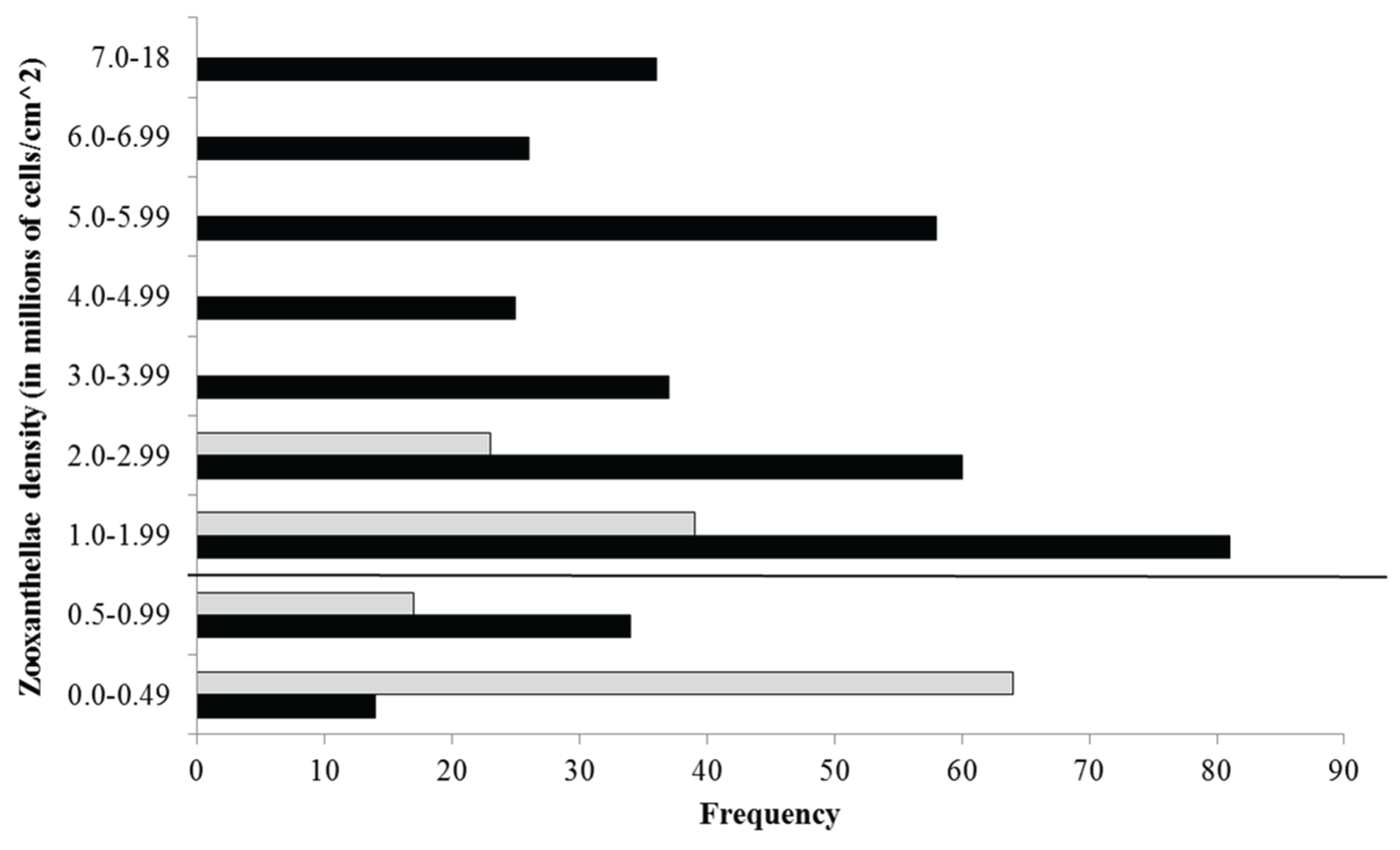
Figure A3. Frequency distribution of mean zooxanthellae densities for healthy (black) and bleached (gray) corals. The vertical line indicates 1.0 × 10⁶ cells cm⁻², a commonly cited average healthy density.
Preprints 200993 g0a3

Appendix A.2. Proportional Loss in Zooxanthellae Population Density by Cause of Bleaching
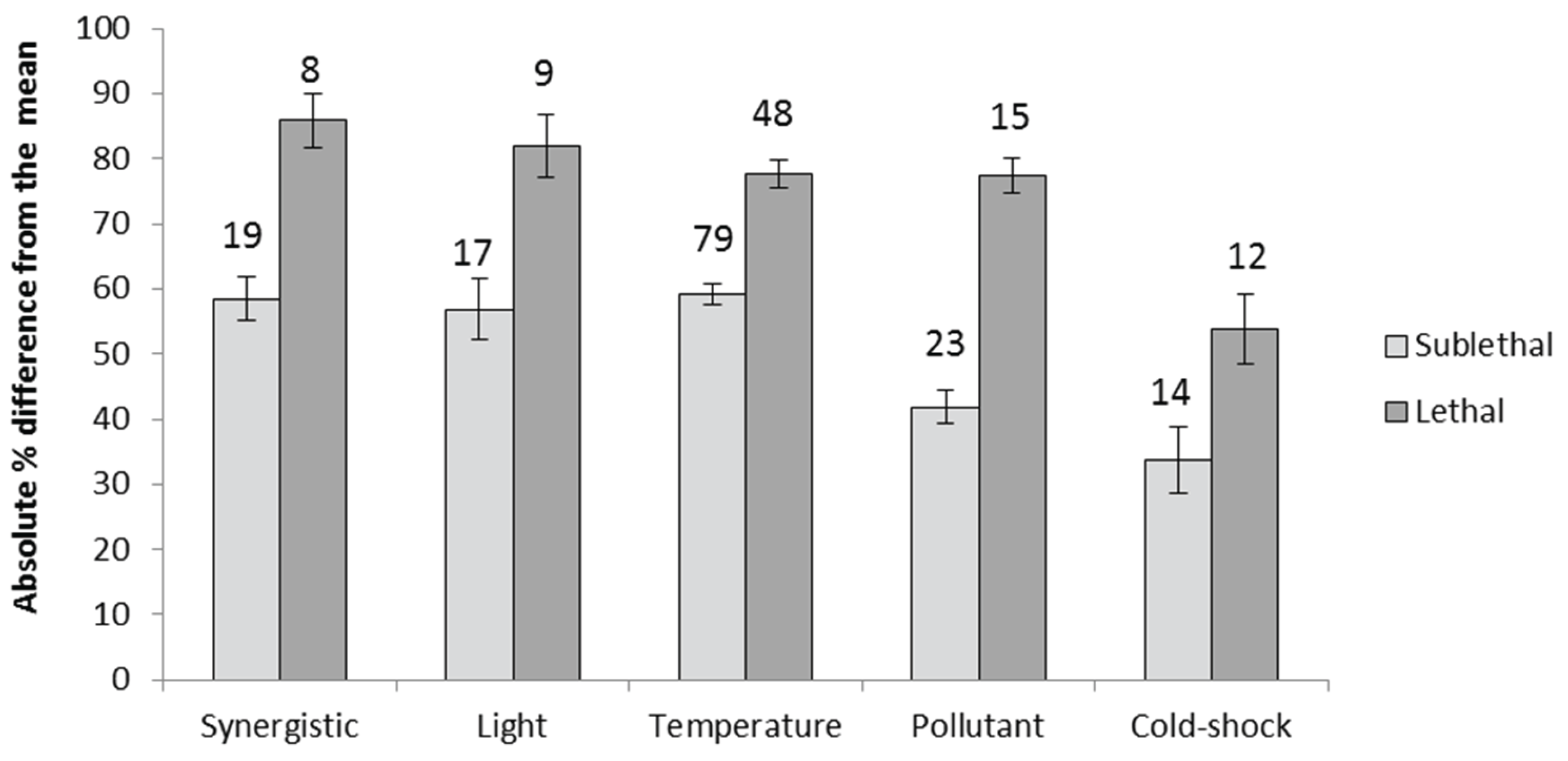
The proportional loss in zooxanthellae populations associated with sublethal paling and lethal bleaching were then analyzed through causal agents [Figure 6]. For the causal agent of sublethal bleaching (F(4,151) =12.074, p<0.001), Tukey’s post-hoc showed that the percent loss associated with light, temperature and multiple stressors (most often representing temperature and another variable) was significantly higher than the percent loss associated with cold shock or pollutants (both of which are within ‘natural variation’). For lethal bleaching (F(4, 91) = 6.466, p<0.000), the percent loss associated with cold-shock was significantly lower than the other causes and all collected by Leonard Muscatine. Pollution data came from 15 different studies that used variations on all methods. Only one of the records of sublethal bleaching data for pollutants reached the definition of sublethal bleaching, Acropora spp. (also Muscatine’s work), the rest ranged from 8-53%. Zooxanthellae loss associated with sublethal (F(5,182) = 7.541, p<0.000) and lethal (F(5, 117) = 6.108, p<0.000) bleaching significantly increased with time and in both cases, Tukey’s post hoc separated the lower mean values of one day experiments, which were significantly lower for sublethal stress.
Figure A4. Absolute percent deviation from mean zooxanthellae densities associated with different stress causes. Error bars represent ±SE; sample size (n) is shown above bars.
Preprints 200993 g0a4
Figure A5. Post hoc results from McCowan et al. (2012) illustrating morphological and familial effects on bleaching susceptibility. Branching and massive morphologies do not differ significantly when pooled, but nested family-level responses reveal significant subgroup structure. Mortality patterns (not tested here) suggest lower lethal outcomes in massive colonies, consistent with partial mortality dynamics.
Preprints 200993 g0a5
Figure A6. Temporal restructuring of bleaching susceptibility and mortality when resolved by timing of observations relative to thermal stress accumulation. Branching corals peak in susceptibility and mortality approximately 4–5 months post-stress, whereas massive corals peak later (~8 months), reflecting differences in heat retention and tissue integration.
Preprints 200993 g0a6
Figure A7. Paired bleaching susceptibility and mortality data during Low Thermal Stress Accumulation (DHW), resolved by timing of observations: Beginning (0–3 months), Middle (4–7 months), and End (8+ months). Linear fits assume a zero intercept; equations and correlation coefficients are shown.
Preprints 200993 g0a7aPreprints 200993 g0a7b
Figure A8. Paired bleaching susceptibility and mortality data during Medium Thermal Stress Accumulation (DHW), resolved by timing of observations relative to stress onset. Linear relationships illustrate how mortality expression varies with observation timing under moderate stress.
Preprints 200993 g0a8aPreprints 200993 g0a8b
Figure A9. Paired bleaching susceptibility and mortality data during High Thermal Stress Accumulation (DHW), resolved by timing of observations. The dispersion of outcomes highlights non-linear mortality expression under extreme stress conditions.
Preprints 200993 g0a9aPreprints 200993 g0a9b

Appendix B. Tables

Dynamic Equations for Absolute Zooxanthellae Densities

Records went from 369 for healthy values from the Zooxanthellae Density Database to 243 records of paired healthy and bleached values from the Zooxanthellae Density Meta-database. Pair-wise healthy and bleached zooxanthellae densities [Table 1a and Table 2a], average declines in the zooxanthellae densities equaled 71% and linear regression showed a significant relationship (r2= 0.509, F(1, 186) = 194, p<0.000). In lieu of an absolute density, which has been unachievable [Figure 2 and Figure 3], I prepared descriptive and analytical statistics 1for dynamic equations. One may use the averages provided in [Table 1] as standards to fill in the blanks for expected results, whereby the completion of multiple independent ANOVAs [Table 2b and Table 2e for healthy and bleached values, respectively] are completed to utilize the f factors to illustrate the amount of noise in the data from each given factor for a comparison of their relative importance in finding the true mean of the data [Table 2c and Table 2f for healthy and bleached values, respectively], and test for the data transparency (predictive power) comparing the explanatory power of the correlation coefficients {Table 2d and Table 2g for healthy and bleached values, respectively]. Examples below:
Healthy Zooxanthellae density
y = Methods (43.2%) + Location (26.8) + Biology and Ecology (18.4%) + Taxonomy (11.6%)
Bleached Zooxanthellae density
y = Methods (37.1%) + Biology and Ecology (29.2%) + Location (20.6%) + Taxonomy (13%)
The general trends discussed above with the Zooxanthellae Density Database [Figure 1 and Figure 2] remained similar to healthy fluctuations in zooxanthellae densities from the Zooxanthellae Density Metadatabase [Table 1 and Table 2] , but as the Meta-database contained new factors to partition variance (including more methods information) and new post hoc groupings, there are differences (e.g. compare Figure 1 with Table 2a).
Major points of noted difference when comparing [Figure 1] and [Table 2a] include the Ocean Basin, which had been at the bottom of the list [Figure 1], turned into the second greatest cause of variability [Table 2a]. Ocean basin alongside subregion of the Ocean were the only factors in the top 5 that were not directly related to methods, although it could reflect methods used for local reef morphologies, as source authors were also in the top 5 (Table 1a); therefore, the two factors of Ocean basin and subregion were used to organize zooxanthellae data and bleaching response data for later comparisons. Moreover, morphology, a biological/ecological factor became the second largest factor affecting bleached zooxanthellae densities [Table 2e], which supports the hypothesis that intrinsic variability is paramount to how a coral responds to disturbance. These absolute values are revisited after the bleaching responses are analyzed to compare the zooxanthellae densities with the knowledge of the relative importances of factors to susceptibility, mortality and recovery of corals.
Table A1. Analysis of variance on data restricted to pairwise averages of healthy and bleached zooxanthellae population densities (n ≥ 5). All data were square-root transformed prior to analysis and organized by F-values.
A)
Paired sample tests comparing average healthy and bleached zooxanthellae densities, including Pearson correlation and Student’s t-test.
Test Coefficient n p
Correlation 0.804 246 <0.001***
T-test 24.039 245 <0.001*** 1
1 ***Highly significant interaction.
B)
ANOVA results identifying factors associated with variation in healthy zooxanthellae population densities.
Source SS Type III df n MS F p
Method for Tissue Removal 18.83 1 233 6.92 43.917 <0.001***
Ocean Basin 2.07 2 242 2.40 36.643 <0.001***
Source Author 16.53 13 178 2.74 33.700 <0.001***
Surface Area Determination 17.64 3 202 18.09 29.476 <0.001***
Subregion 20.70 3 245 6.67 22.716 <0.001***
Genus 15.00 12 230 6.44 19.130 <0.001***
Location 18.77 10 228 7.37 14.080 <0.001***
Replication 10.07 2 64 11.38 13.216 <0.001***
Transmission of Algae 1.45 2 210 6.21 12.886 <0.001***
Sex 18.17 1 227 7.61 12.620 <0.001***
Sample Size 19.22 6 242 6.30 11.512 <0.001***
Species 10.25 15 191 3.03 10.798 <0.001***
Morphology 1.92 2 242 7.41 9.759 <0.001***
Generalization 1.92 1 241 7.71 9.058 <0.01**
Reproductive Mode 16.39 2 221 6.93 8.793 <0.001***
Depth 14.29 3 154 8.20 7.716 <0.001***
Sampling Time 19.22 10 242 6.29 7.466 <0.001***
Family 18.78 6 238 6.79 7.438 <0.001***
Complexity of Skeleton 19.22 1 242 7.78 6.045 <0.05*
Decade 19.22 2 242 7.67 5.300 <0.01**
*Significant, **strongly significant, ***highly significant.
C)
Relative importance of factors contributing to variation in healthy densities derived from B.
Grouped Factor Grouped Relative Importance Source F Relative Importance
Methods 43.2 Method for Tissue Removal 43.917 13.6
Source Author 33.700 10.5
Surface Area Determination 29.476 9.1
Replication 13.216 4.1
Sample Size 11.512 3.6
Sampling Time 7.466 2.3
Location 26.8 Ocean Basin 36.643 11.4
Subregion 22.716 7.0
Location 14.080 4.4
Depth 7.716 2.4
Decade 5.300 1.6
Biology and Ecology 18.4 Transmission of Algae 12.886 4.0
Sex 12.620 3.9
Morphology 9.759 3.0
Generalization 9.058 2.8
Reproductive Mode 8.793 2.7
Complexity of Skeleton 6.045 1.9
Taxonomy 11.6 Genus 19.130 5.9
Species 10.798 3.4
Family 7.438 2.3
D)
Pearson correlation tests among factors identified in B.
Source n Pearson’s Correlation Coefficient p
Location 229 0.471 <0.001***
Method for Tissue Removal 234 0.399 <0.001***
Subregion 246 -0.370 <0.001***
Replication 65 -0.351 <0.001***
Sampling Time 243 0.317 <0.001***
Sex 228 -0.230 <0.001***
Depth 155 -0.287 <0.001***
Morphology 243 0.237 <0.001***
Transmission of Algae 211 -0.217 <0.001***
Sample Size 243 0.199 <0.01**
Generalization 242 0.191 <0.01**
Source Author 179 0.162 <0.01**
Complexity of Skeleton 243 0.156 <0.05*
Ocean Basin 246 -0.150 >0.05*
Reproductive Mode 222 -0.112 >0.05
Surface Area Determination 203 0.096 >0.05
Genus 231 0.087 >0.05
Species 192 -0.063 >0.05
Family 239 0.030 >0.05
Decade 243 0.026 >0.05
*Significant, **strongly significant, ***highly significant.
E)
ANOVA results for bleached zooxanthellae population densities.
Source SS Type III df n MS F p
Method for Tissue Removal 6.97 1 233 2.57 39.928 <0.001***
Morphology 3.61 3 473 6.51 28.142 <0.001***
Source Author 5.94 13 178 1.24 24.256 <0.001***
Transmission of Algae 0.56 2 210 2.23 21.238 <0.001***
Ocean Basin 0.72 2 242 2.61 18.494 <0.001***
Genus 5.90 12 230 1.38 17.608 <0.001***
Surface Area Determination .046 3 202 2.47 15.341 <0.001***
Subregion 8.50 3 246 3.08 11.158 <0.001***
Location 6.94 10 228 2.24 9.166 <0.001***
Sex 6.94 1 227 2.95 8.980 <0.01**
Species 4.01 15 191 1.35 8.072 <0.001***
Depth 5.14 3 154 2.96 7.610 <0.001***
Sample Size 7.22 6 242 2.59 7.117 <0.001***
Family 6.15 6 238 2.29 6.534 <0.001***
Sampling Time 7.22 10 242 2.54 5.266 <0.001***
Generalization 7.19 1 241 2.93 5.179 <0.05*
Decade 7.22 2 242 2.90 4.615 <0.05*
Reproductive Mode 6.70 2 221 2.94 4.485 <0.05*
Complexity of Skeleton 7.22 1 242 2.94 4.232 <0.05*
Replication 2.81 2 64 4.29 1.821 >0.05
*Significant, **strongly significant, ***highly significant.
F)
Relative importance of factors contributing to variation in bleached densities derived from E.
Grouped Factor Grouped Relative Importance Source F Relative Importance
Methods 37.1 Method for Tissue Removal 39.928 16.1
Source Author 24.256 9.8
Surface Area Determination 15.341 6.2
Samples Size 7.117 2.9
Sample Time 5.266 2.1
Biology and Ecology 29.2 Morphology 28.142 11.4
Transmission of Algae 21.348 8.6
Sex 8.980 3.6
Generalization 5.179 2.1
Reproductive Mode 4.485 1.8
Complexity of Skeleton 4.232 1.7
Location% 20.6 Subregion 11.158 4.5
Ocean Basin 18.494 7.5
Location 9.166 3.7
Depth 7.610 3.1
Decade 4.615 1.9
Taxonomy 13.0 Genus 17.608 7.1
Species 8.072 3.3
Family 6.534 2.6
G)
Pearson correlation tests among factors identified in E.
Source n Pearson’s Correlation Coefficient p
Location 229 0.426 <0.001***
Method for Tissue Removal 234 0.379 <0.001***
Source Author 179 0.276 <0.001***
Subregion 246 -0.260 <0.001***
Transmission of Algae 211 -0.220 <0.001***
Replication 65 -0.206 <0.001***
Sex 228 -0.196 <0.001***
Surface Area Determination 203 0.185 <0.001***
Depth 155 -0.185 <0.05*
Morphology 243 0.167 <0.01**
Reproductive Mode 222 -0.157 <0.01**
Generalization) 242 0.145 <0.01**
Complexity of Skeleton 243 0.131 >0.05
Ocean Basin 246 0.114 <0.05*
Species 192 -0.092 >0.05
Decade 242 -0.054 >0.05
Genus 231 0.039 >0.05
Family 239 -0.031 >0.05
Sampling Time 243 0.014 >0.05
Sample Size 243 -0.003 >0.05
*Significant, **strongly significant, ***highly significant.
Table A2. Inter- and intra-specific variation in healthy zooxanthellae population densities. Data are restricted to species with n > 20 overall and n ≥ 3 per factor. Panel A shows interspecific variation; Panels B–F show intraspecific variation for Acropora millepora, Coelastrea aspera, Orbicella annularis, Pocillopora damicornis, and Stylophora pistillata, respectively. Healthy densities are reported as ×10⁶ cells cm⁻²; standard error is shown as ×10⁵ cells cm⁻². Data are ordered by F-ratio values.
A)
Average values of healthy and bleached zooxanthellae population densities
Healthy ±SE n Bleached ±SE n
3.70 2.69 243 1.00 0.83 243
1 ***Highly significant interaction.
B)
Taxonomy and average healthy and bleached zooxanthellae densities
Factor Source Healthy ±SE n Bleached ±SE n
Family Acroporidae 1.89 2.12 55 0.50 0.60 55
Agariciidae 7.57 1.69 16 2.51 5.45 16
Faviidae 4.04 4.28 74 1.28 1.80 74
Oculinidae 11.24 16.76 7 1.63 4.91 7
Pocilloporidae 3.20 4.16 58 0.84 1.11 58
Poritidae 3.45 9.85 31 0.64 1.66 31
Genus Acropora 1.49 1.00 45 0.39 0.48 45
Agaricia 1.30 4.25 8 0.52 1.93 8
Cladocora 3.32 3.68 6 0.95 2.46 6
Coelastrea 8.15 10.66 11 3.00 2.44 11
Montastrea 1.82 4.71 6 0.75 1.57 6
Montipora 3.73 9.02 10 1.02 1.85 10
Oculina 11.12 19.77 6 1.73 5.68 6
Orbicella 2.40 1.46 45 0.53 0.83 45
Pavona 12.92 8.31 6 5.00 0.45 6
Pocillopora 4.28 6.90 31 0.82 1.36 31
Porites 2.93 8.66 30 0.63 1.71 30
Seriatopora 2.95 3.81 13 1.31 3.39 13
Stylophora 1.03 1.61 14 0.43 0.69 14
Species Acropora millepora 1.58 1.31 24 0.54 0.07 24
Acropora muricata 1.25 2.77 7 0.21 0.00 7
Agaricia lamarcki 1.48 6.95 5 0.60 3.18 5
Cladocora caespita 3.32 3.68 6 0.95 2.46 6
Coelastrea aspera 8.15 10.66 11 3.00 2.44 11
Montastrea cavernosa 1.82 4.71 6 0.75 1.57 6
Oculina patagonica 11.12 19.77 6 1.73 5.68 6
Orbicella annularis 2.30 1.63 27 0.54 1.15 27
Orbicella faveolata 3.08 4.01 10 0.45 1.51 10
Orbicella franksi 1.86 1.84 8 0.59 1.97 8
Pocillopora damicornis 3.34 4.24 26 0.57 0.98 26
Porites cylindrica 3.36 3.06 5 1.06 0.85 5
Porites lobata 3.26 1.35 19 0.64 2.60 19
Porites lutea 1.45 6.87 5 0.22 1.20 5
Seriatopora hystrix 2.95 3.81 13 1.31 3.39 13
Stylophora pistillata 1.03 1.61 14 0.43 0.69 14
C)
Location and variation in healthy and bleached zooxanthellae population densities
Factor Source Healthy ±SE n Bleached ±SE n
Decade 1980’s 1.45 3.11 14
1990’s 4.98 7.40 54 1.35 2.14 54
2000’s 3.49 2.86 175 0.94 0.91 175
Ocean Basin Atlantic 2.29 1.36 69 0.53 0.70 69
Indian 7.67 8.26 37 1.82 1.98 37
Pacific 3.35 3.67 137 1.02 1.23 137
Subregion East 5.59 8.06 54 1.32 2.22 54
North 1.72 2.77 25 0.47 1.66 25
South 4.18 4.91 15 0.88 1.93 15
West 3.54 3.24 152 1.13 1.30 152
Location Bahamas 2.61. 2.16 27 0.39 1.16 27
Costa Rica 0.88 0.69 9 0.11 0.37 9
Florida 1.81 1.91 10 0.44 1.19 10
Great Barrier Reef 2.56 3.32 79 0.93 1.47 79
Jamaica 1.51 1.63 21 0.59 0.89 21
Japan 0.72 1.27 10 0.20 0.66 10
Kenya 3.36 3.06 5 1.06 0.85 5
Mediterranean Sea 7.22 1.52 12 1.34 3.18 12
Mexico 3.38 3.08 9 0.75 2.88 9
Panama 6.63 1.21 30 1.70 3.54 30
Thailand 10.06 1.13 17 2.65 2.30 17
D)
Biological and Ecological factors and variation in healthy and bleached zooxanthellae densities
Factor Source Healthy ±SE n Bleached ±SE n
Depth <3m 2.90 2.39 36 1.04 1.75 36
<6m 5.51 9.76 31 0.85 1.51 31
<9m 6.37 10.53 40 1.77 3.54 40
<12m 1.91 3.61 5 0.38 0.58 5
<15m 1.76 2.02 19 0.21 0.76 19
>15m 1.82 2.37 24 0.78 1.25 24
Transmission of Algae to Offspring Both 8.15 10.66 11 3.00 2.44 11
No 3.12 3.38 108 0.82 1.14 108
Yes 3.08 3.96 92 0.78 0.88 92
Morphology Branching 2.54 2.34 119 0.68 0.620 119
Encrusting 6.24 15.90 13 1.20 3.30 13
Massive 4.65 4.74 111 1.32 1.57 111
Generalization Generalist 3.10 2.85 150 0.90 1.05 150
Specialist 4.70 5.22 92 1.18 1.32 92
Sex Gonochoric 5.65 7.46 65 1.57 2.35 65
Hermaphroditic 2.92 2.28 163 0.80 0.70 163
Reproductive Mode Botha 5.13 6.50 31 1.51 2.31 31
Brooder 1.80 2.25 34 0.73 1.53 34
Spawner 3.54 3.43 157 0.96 1.09 157
Complexity of Skeleton Complex 3.33 4.53 104 0.86 1.22 104
Robust 3.98 3.25 139 1.11 1.11 139
E)
Methods used and variation in healthy bleached zooxanthellae population densities
Factor Source Healthy ±SE n Bleached ±SE n
Method for Tissue Removal from skeleton Pick 3.29 2.63 213 0.90 0.85 213
Decalcify 8.83 1.07 21 2.42 2.20 21
Sample Size Branch 1.46 0.96 50 0.49 0.52 50
Colony 3.32 6.91 36 1.23 2.98 36
Core 8.96 1.31 18 2.06 3.14 18
Fragment 4.27 7.00 59 1.27 2.08 59
Nubbin 4.87 5.61 12 1.10 1.14 12
Sample 2.76 1.82 46 0.52 1.21 46
Subsample 4.94 9.89 22 1.15 2.00 22
Sampling Time <1 day 2.15 2.27 38 0.63 0.97 38
<1 week 2.92 4.07 45 1.15 1.77 45
<2 weeks 1.54 2.32 12 0.57 1.25 12
<1 month 2.25 2.58 27 0.94 1.96 27
<1.5 months 2.95 6.22 17 0.77 2.49 17
<3 months 4.01 12.59 18 0.84 2.46 18
<4 months 7.06 26.02 8 2.76 1.11 8
<6 months 3.02 4.00 9 0.94 2.13 9
<1 year 4.93 9.06 11 0.69 1.09 11
<2 years 9.10 12.24 31 2.03 3.24 31
>2 years 2.43 2.00 27 0.24 0.64 27
Surface Area Determination Calipers 4.30 5.51 25 1.00 2.39 25
Foil 2.38 2.93 89 0.61 0.83 89
Image Analyzer 13.91 12.11 11 3.14 6.81 11
Wax 4.05 5.35 78 1.15 1.57 78
Replication <6 7.42 9.60 36 2.01 2.94 36
<8 13.25 15.66 8 1.87 2.80 8
≥8 3.24 7.70 31 1.25 3.23 31
Source Author Berkelmans 1.39 0.99 18 0.36 0.39 18
Brown 10.06 11.28 17 2.65 2.30 17
Centeno 0.88 0.69 9 0.11 0.37 9
D’Croz 1.27 2.14 17 0.30 1.11 17
Fitt 1.96 1.83 37 0.25 0.47 37
Flores-Ramirez 3.38 3.08 9 0.75 2.88 9
Hill 4.59 2.50 7 1.19 1.60 7
Hoegh-Guldberg 1.09 2.07 12 0.36 0.66 12
Hueerkamp 13.65 8.92 13 3.54 4.30 13
Jones 4.78 1.16 19 2.04 5.13 19
Mercurio 0.98 0.43 6 0.21 0.02 6
Rodolfo-Metalpa 7.32 2.03 9 1.63 3.77 9
Visram 3.36 3.06 5 1.06 0.85 5
Warner 1.88 2.32 9 0.77 1.52 9
Table A3. Inter- and intra-taxonomic variation in bleaching susceptibility and mortality using paired susceptibility–mortality records. Panel A shows inter-familial variation (n > 50 per family), Panel B inter-generic variation (n > 40 per genus), and Panel C inter-specific variation (species with n > 20 and n ≥ 3 per factor). ANOVAs were used to partition variance within each taxonomic level; data are ordered by F-values.
A) Average values for factors that cause inter and intra-specific variation
Source Healthy ±SE n
Species Acropora millepora 2.06 1.59 40
Coelastrea aspera 10.23 1.21 20
Orbicella annularis 2.91 2.92 34
Pocillopora damicornis 2.52 2.77 49
Stylophora pistillata 1.92 4.12 36
Ocean Atlantic 2.91 2.51 40
Indian 6.93 1.01 35
Pacific 2.11 1.63 104
Replication level Branch 1.81 1.58 63
Colony 2.75 3.09 32
Core 9.54 1.59 17
Fragment 2.48 6.94 16
Sample 2.65 2.34 27
Location Bahamas 2.57 2.95 12
Florida 2.07 2.48 6
Great Barrier Reef 2.11 1.70 61
Hawaii 1.70 3.21 13
Jamaica 3.49 6.25 14
Japan 1.55 5.60 8
Mexico 2.92 3.16 6
Pacific 7.73 1.60 4
Panama 2.74 6.55 16
Red Sea 2.96 7.99 17
Thailand 10.68 1.30 18
Method for tissue removal Airbrush 2.53 2.29 60
Decalcification 6.24 9.36 38
Waterpik 2.52 2.54 72
Method for surface area Calculated 2.31 3.13 10
Callipers 5.19 1.00 29
Foil 2.41 3.74 41
Image analyser 5.11 2.09 7
Paraffin Wax 2.11 1.99 64
Modified Paraffin Wax 3.60 6.24 9
Time < 1 day 2.81 3.51 45
< 1 week 5.13 8.64 29
< 2 weeks 4.30 1.82 4
< 1 month 1.62 1.91 26
< 2 months 1.63 1.93 18
< 3 months 1.85 5.27 4
< 6 months 3.98 7.33 11
< 9 months 3.25 3.03 10
< 1 year 2.84 9.54 11
< 2 years 6.64 2.60 5
> 2 years 5.13 1.62 16
Cause Aerial exposure 9.77 18.95 3
Ammonium enrichment 1.45 2.35 16
Depth 3.53 5.45 28
High light and temperature 4.98 7.91 18
Light 2.75 7.26 19
One sample 3.27 12.07 5
Pollutant 1.38 8.87 6
Seasonal variation 4.59 16.04 15
Temperature 2.81 3.92 68
Subregion East 2.74 6.55 16
North 2.54 4.62 33
South 1.90 2.43 24
West 3.82 3.96 106
Depth < 3m 2.38 4.07 43
< 6m 2.38 2.99 43
> 6m 3.18 3.81 25
Replicate counts < 6 4.53 1.03 15
> 6 2.95 6.55 25
B) Variation in healthy zooxanthellae population densities of Acropora millepora
Source Healthy ±SE n
Replication level Branch 1.69 1.29 27
Colony 3.25 3.03 10
Population 1.39 1.99 3
Cause Depth 1.62 1.51 15
High temperature and light 2.87 3.48 3
Pollutant 1.49 0.78 3
Seasonal variation 3.25 3.03 10
Temperature 1.39 1.47 9
Method for surface area Callipers 2.49 1.74 3
Foil 1.47 2.33 3
Wax 2.07 1.82 34
Method for tissue removal Airbrush 2.07 1.83 34
Decalcification 2.49 1.74 3
Waterpik 1.49 0.78 3
C) Variation in healthy zooxanthellae population densities of Coelastrea aspera
Source Healthy ±SE n
Replication level Colony 6.07 6.05 4
Core 11.63 16.80 13
Time < 1 month 8.85 11.34 14
> 1 year 13.46 27.60 6
Cause Aerial Exposure 9.77 18.85 3
High light and temperature 8.70 19.28 5
Temperature 10.56 22.63 6
Replicate counts 3 9.77 18.85 3
6 10.00 31.39 3
D) Variation in healthy zooxanthellae population densities of Orbicella annularis
Source Healthy ±SE n
Method for surface area Callipers 5.51 9.20 6
Foil 2.31 1.96 21
Cause Depth 4.99 6.52 9
High light and temperature 2.16 3.62 4
Temperature 2.08 1.45 20
Depth < 3m 2.27 4.91 3
< 6m 2.36 3.99 4
< 15m 2.11 1.56 14
< 18m 1.53 2.73 3
< 24m 3.93 1.76 3
> 24m 5.51 9.20 6
Time < 1 week 1.86 1.91 6
< 1 month 3.93 1.76 3
< 6 months 4.72 8.63 8
< 1 year 2.37 4.18 3
> 2years 2.16 2.01 12
Replicate counts < 8 3.93 1.76 3
> 8 2.59 4.17 5
Subregion North 2.07 2.48 6
West 3.10 3.55 27
Location Bahamas 2.57 2.95 12
Florida 2.07 2.48 6
Jamaica 3.49 6.25 14
Method for tissue removal Airbrush 2.16 3.62 4
Decalcification 3.93 1.76 3
Waterpik 2.91 3.55 27
Replication level Colony 1.97 3.31 5
Core 2.74 4.76 4
Sample 2.40 2.32 17
E) Variation in healthy zooxanthellae population densities of Pocillopora damicornis
Source Healthy ±SE n
Method for surface area Calipers 1.64 3.83 11
Wax 2.56 5.06 21
Subregion East 2.74 6.55 16
North 1.54 2.27 3
South 1.48 2.64 17
West 4.59 2.50 7
Cause Ammonium Enrichment 1.41 2.29 10
High light and temperature 4.83 0.96 6
Light 2.03 6.03 6
Seasonal Variation 0.77 1.74 3
Temperature 2.82 6.53 16
Method for tissue removal Airbrush 3.45 5.59 20
Decalcification 1.64 3.83 11
Waterpik 1.77 2.27 9
Time < 1 day 2.75 5.50 10
< 1 week 3.97 6.79 5
< 2 months 1.70 2.40 14
< 3 months 1.85 5.27 4
< 1 year 3.02 1.32 8
Depth < 3m 1.79 3.03 13
< 6m 2.16 1.73 5
< 9m 2.77 8.17 13
Replication level Branch 2.57 3.26 24
Colony 2.93 8.05 13
F) Variation in healthy zooxanthellae population densities of Stylophora pistillata
Source Healthy ±SE n
Ocean Indian 2.96 7.99 17
Pacific 0.98 1.20 19
Depth < 3m 1.10 1.30 15
< 6m 0.97 3.29 5
< 9m 0.61 1.64 4
> 9m 2.81 1.03 3
Location Great Barrier Reef 1.03 1.61 14
Japan 0.85 0.71 5
Red Sea 2.96 7.99 17
Subregion North 2.48 6.43 22
West 1.03 1.61 14
Time < 1 day 2.95 8.57 16
< 1 week 0.91 1.32 14
< 2 weeks 1.50 2.46 6
Cause Ammonium enrichment 1.04 3.04 5
Light 3.08 1.03 13
Pollutant 1.27 1.45 3
Temperature 0.96 1.99 11
Method for surface area Calculated 1.41 1.71 4
Foil 2.48 9.49 15
Image Analyser 2.70 7.13 4
Wax 1.21 1.89 9
Table A4. Variation in bleaching susceptibility and mortality attributable to (A) taxonomy, (B) location, (C) biological/ecological traits, (D) timing of observations, and (E) temperature. Values are shown alphabetically; only categories with n > 10 are included. No constraints were imposed on the database.
A)
Taxonomy and average proportional susceptibility and mortality to mass bleaching events
Factor Source (S-M)/S Susceptibility Mortality
Average ±SE n Average ±SE n
Family Acroporidae 0.50 54.7 1.89 367 27.2 2.27 290
Agariciidae 0.69 51.7 3.31 137 16.2 2.93 112
Astrocoeniidae 0.53 36.1 9.44 13 17.0 9.39 11
Dendrophyllidae 41.1 13.96 11
Diploastraeidae 0.58 35.7 7.68 27 15.0 7.90 20
Euphyllidae 0.65 42.8 5.04 46 15.1 5.24 36
Fungiidae 0.77 40.0 3.82 77 9.2 3.08 66
Lobophyllidae 0.97 36.1 4.51 45 1.16 0.54 38
Meandrinidae 0.86 30.7 4.96 35 4.4 2.18 30
Merulinidae 0.80 47.8 1.87 333 9.7 1.28 268
Milleporidae 0.33 56.4 4.96 60 37.7 6.53 48
Montastraeidae 0.94 42.0 6.32 27 2.7 1.52 21
Mussidae 0.78 45.4 2.83 144 10.2 2.12 120
Pocilloporidae 0.57 47.3 2.45 229 20.4 2.80 164
Poritidae 0.64 41.4 2.15 273 14.9 2.05 214
Psammocoridae 0.84 54.7 8.58 21 8.6 5.66 15
Siderastreidae 0.93 57.7 4.02 58 4.0 1.73 48
Genus Acanthastrea 0.97 44.7 7.08 16 1.4 1.00 12
Acropora 0.44 60.1 2.45 230 33.8 3.06 188
Agaricia 0.80 60.4 4.42 60 11.9 3.51 49
Astreopora 0.94 38.7 5.08 17 2.5 1.83 13
Colpopyllia 0.78 52.1 6.41 21 11.3 4.31 16
Cyphastrea 0.41 28.1 8.92 17 16.6 8.61 13
Diploastrea 0.58 35.7 7.68 27 15.0 7.90 20
Diploria 0.67 56.4 8.67 20 18.7 7.45 15
Echinophyllia 1 20.6 7.20 10 0 0 10
Echinopora 0.61 35.3 7.07 25 13.7 5.96 21
Favia 0.90 47.1 5.04 37 4.7 3.28 30
Favites 0.75 51.5 5.79 33 12.7 5.00 23
Fungia 0.83 56.5 5.73 31 9.5 5.23 23
Galaxea 0.74 36.2 5.71 29 9.5 4.58 24
Goniastrea 0.84 47.8 7.08 27 7.7 4.38 24
Goniopora 0.87 38.1 8.03 25 5.0 4.66 21
Hydnophora 0.68 40.7 6.68 24 13.0 5.19 21
Leptoria 27.5 9.64 11
Lobophyllia 43.0 11.06 11
Madracis 0.39 10.9 3.40 21 6.6 3.90 17
Meandrina 0.92 36.0 7.82 13 2.7 2.24 12
Millepora 0.35 55.6 5.00 59 36.4 6.54 47
Montastrea 0.94 44.4 4.89 43 2.8 1.17 31
Montipora 0.65 44.9 3.79 91 15.8 3.64 64
Mycetophyllia 0.50 32.6 12.32 11 16.4 11.06 11
Orbicella 0.84 65.6 3.85 50 10.4 2.11 44
Pavona 0.52 43.4 5.59 51 20.9 5.85 40
Platygyra 0.75 51.3 5.07 45 13.0 4.33 35
Pocillopora 0.54 47.2 2.82 162 21.8 3.41 114
Porites 0.60 42.4 2.32 235 16.8 2.31 183
Psammocora 0.85 55.7 8.58 21 8.6 5.66 15
Pseudodiploria 0.88 48.9 4.80 34 5.9 2.19 30
Seriatopora 75.1 9.39 12
Siderastrea 0.92 56.1 4.15 53 4.7 1.93 44
Stephanocoenia 0.54 35.0 10.19 12 16.17 10.34 10
Stylophora 0.73 61.4 8.18 23 16.4 9.67 14
Symphyllia 0.95 37.9 9.50 15 2.0 1.37 12
Turbinaria 41.1 13.96 11
Species Acropora cervicornis 0.77 36.6 7.90 21 8.3 5.62 16
Acropora hyacinthus 0.25 68.1 13.78 10 51.3 14.22 10
Acropora palmata 0.78 39.7 8.49 18 8.6 4.64 14
Agaricia agaricites 0.80 68.9 6.62 22 13.8 6.24 19
Agaricia tenuifolia 0.58 37.9 8.74 12 16.0 9.51 11
Colpophyllia natans 0.73 48.5 7.32 17 12.9 4.78 14
Diploria labyrinthiformis 0.64 51.5 8.91 18 18.7 7.45 15
Favia fragum 0.98 46.9 7.77 13 0.9 0.63 12
Meandrina meandrites 0.91 34.8 8,40 12 3.0 2.44 11
Montastrea cavernosa 0.94 42.0 6.32 27 2.7 1.52 21
Montipora capitata 31.4 11.14 13
Orbicella annularis 0.87 66.9 4.36 35 8.9 2.16 32
Orbicella faveolata 70.2 7.29 12
Pavona varians 52.0 11.32 11
Platygyra daedalea 0.69 69.9 6.54 14 21.4 7.69 14
Pocillopora damicornis 0.38 48.3 6.57 36 30.0 8.28 25
Pocillopora elegans 62.5 12.26 10
Pocillopora meandrina 19.8 5.40 21
Pocillopora verrucosa 0.56 71.2 9.55 10 31.2 13.25 10
Porites astreoides 0.95 45.1 6.19 30 2.2 0.78 26
Porites compressa 2.5 1.29 10
Porites lobata 0.79 23.3 6.32 26 4.9 3.19 24
Porites porites 0.77 56.8 6.92 24 13.3 4.15 21
Pseudodiploria strigosa 0.91 48.9 6.04 25 4.4 1.72 22
Siderastrea siderea 0.93 60.7 4.98 34 4.4 2.47 31
B)
Location and average proportional susceptibility and mortality to mass bleaching events
Factor Source (S-M)/S Susceptibility Mortality
Average ±SE n Average ±SE n
Ocean Basin Indian 0.82 47.9 1.46 556 8.4 0.88 456
Pacific 0.84 53.4 1.46 556 8.4 0.88 456
Atlantic 0.60 44.2 1.22 872 17.8 1.34 634
Subregion Central 43.6 11.47 10
East 0.62 43.0 1.72 450 16.4 1.80 309
Northeast 0.49 63.7 7.59 24 32.6 9.67 18
North 0.55 70.6 4.64 36 31.9 9.88 15
Northwest 0.16 67.3 3.76 108 56.3 4.39 94
Southeast 1 15.3 2.61 101 0.0 0.00 58
South 0.95 45.7 1.89 286 2.4 0.77 258
Southwest 0.94 58.8 3.56 59 3.5 0.68 50
West 0.64 50.4 1.12 970 18.2 1.09 825
Country Andaman Sea 0 90.9 2.48 53 90.9 2.48 53
Barbados 61.7 6.44 28
Belize 0.89 35.8 2.75 99 4.0 1.57 82
Brazil 0.93 57.8 3.70 55 3.8 0.72 46
Costa Rica 0.78 52.7 4.21 60 11.8 3.56 50
Curacao 0.98 36.9 8.82 15 0.7 0.73 15
Dominica 0.80 46.5 4.20 44 9.4 2.69 44
Florida Keys 79.4 5.62 17
French Polynesia 0.96 48.9 2.84 138 1.9 1.08 111
Great Barrier Reef 0.59 49.7 2.65 144 20.5 2.90 116
Grand Cayman 0.94 83.2 11.22 12 4.9 2.60 12
Hawaii 1 15.8 2.63 103 0.0 0.00 58
Indonesia 0.73 46.1 2.78 172 12.5 2.09 172
Jamaica 0.96 27.8 4.07 67 1.2 0.77 63
Japan 0.13 76.8 5.13 49 66.5 6.07 45
Kenya 0.56 57.8 3.05 93 25.7 3.31 91
Maldives 72.9 4.05 14
Martinique 0.52 49.7 8.13 15 24.0 6.84 15
Mauritius 0.79 14.9 2.30 71 3.2 0.82 71
Meso-American Reef 0.60 38.4 7.73 17 15.5 2.62 15
Palau 0.52 31.8 2.44 133 15.2 7.16 23
Panama 0.48 54.2 7.83 32 28.0 7.99 30
Persian Gulf 71.4 5.39 43
Papua New Guinea 0.63 51.4 7.66 16 18.8 7.72 11
Puerto Rico 63.6 11.08 14
Rodrigues 0.97 43.7 7.10 15 1.3 0.91 15
Seychelles 0.32 52.7 7.09 24 35.6 7.73 21
Singapore 0.69 20.1 3.51 21 6.3 2.59 21
South Africa 0.96 42.2 2.49 147 1.6 0.63 147
Thailand 0.70 90.9 3.04 35 27.0 6.66 32
Tioman Island 0.65 18.3 4.17 19 6.4 3.07 19
Tobago 1 53.4 7.72 16 0.0 0.00 16
United Arabian Emirates 0.37 29.4 11.04 14 18.4 12.03 11
US Virgin Islands 0.69 48.1 3.19 120 15.0 2.37 115
Location Eastern Indian 0.60 56.1 3.53 118 22.7 3.58 78
Eastern Pacific 0.50 56.6 3.49 126 28.4 3.85 112
Northern Atlantic 0.77 58.9 5.90 34 13.7 2.62 17
Northern Indian 0.38 61.3 4.54 62 38.1 6.44 43
Northern Pacific 0.45 44.1 1.94 347 24.3 2.59 223
Southern Atlantic 0.94 58.8 3.56 59 3.5 0.68 50
Southern Indian 0.96 42.3 2.48 148 1.6 0.63 147
Southern Pacific 0.95 35.3 2.16 254 1.6 0.82 182
Western Atlantic 0.81 45.7 1.62 463 8.8 1.02 389
Western Indian 0.46 56.2 2.19 288 30.6 2.36 277
Western Pacific 29.2 49.7 2.65 144 20.5 2.90 116
Continental Shelf Position Inner 0.73 61.6 3.66 70 16.5 3.69 61
Middle 0.41 68.1 6.95 26 40.5 7.74 24
Outer 0.86 41.0 3.22 99 5.6 2.72 65
C)
Biological factors and average proportional susceptibility and mortality to mass bleaching events
Factor Source (S-M)/S Susceptibility Mortality
Average ±SE n Average ±SE n
Complexity of Skeleton Complex 0.60 49.2 1.22 902 19.5 1.27 715
Robust 0.75 45.0 1.14 940 11.4 0.94 745
Level of Colony Integration High 0.45 52.0 1.72 518 28.8 1.91 425
Medium 0.79 46.9 1.57 491 10.0 1.03 430
Low 0.78 37.2 3.20 103 8.2 2.28 88
Transmission of Algae to Offspring Both 0.75 48.7 9.87 20 12.1 6.77 20
No 0.67 54.2 1.77 421 18.1 1.60 374
Yes 0.67 44.6 2.25 260 14.5 2.05 216
Morphology Branching 0.44 50.2 1.84 443 28.0 2.05 359
Columnar 0.63 55.9 9.33 22 20.6 8.24 20
Encrusting 0.80 36.3 3.60 80 7.2 2.32 66
Free-living 0.72 40.3 7.07 23 11.2 5.98 22
Massive 0.79 47.3 1.66 434 10.1 1.09 378
Submassive 0.79 43.8 4.88 57 9.3 3.12 52
Tabular 0.40 65.1 5.38 53 39.2 6.32 46
Generalization Generalist 0.71 47.6 1.45 629 13.7 1.17 531
Specialist 0.49 50.6 2.40 286 25.9 2.50 250
Sex Gonochoric 0.68 49.4 335 2.00 15.6 1.78 294
Hermaphroditic 0.63 51.6 471 1.71 19.3 1.62 407
Reproductive Mode Both 0.75 44.3 9.46 22 11.0 6.19 22
Brooder 0.71 49.3 2.45 211 14.3 2.15 175
Spawner 0.63 51.7 1.53 589 19.2 1.44 518
D)
Ecological factors and average proportional susceptibility and mortality to mass bleaching events
Factor Source (S-M)/S Susceptibility Mortality
Average ±SE n Average ±SE n
Anthropogenic Input No 0.87 44.1 2.20 200 5.8 1.13 195
Yes, but protected 0.90 38.5 4.30 60 4.0 1.86 58
Yes 0.39 60.8 6.46 27 37.0 7.06 27
Anthropogenic Pressure No 0.54 53.7 7.07 22 24.5 5.91 22
Yes 0.87 44.1 2.20 200 5.8 1.13 195
Dominant Topography Acropora 0.67 36.5 6.32 37 11.9 4.67 36
Acropora and Montipora 0.32 80.3 4.62 30 54.5 7.26 30
Acropora cervicornis 0.58 74.7 7.34 19 31.3 6.70 19
Acropora hyacinthus 1 50.2 7.92 16 0.0 0.00 16
Montastrea 0.58 57.4 7.36 19 24.1 6.00 19
Pavona and Pocillopora 0.83 31.3 3.96 31 5.2 2.57 31
Pocillopora 0.56 58.5 7.77 22 25.8 9.44 19
Porites 0.65 60.5 7.47 17 21.2 7.71 17
Porites and others 0.38 49.4 5.98 33 30.7 5.66 31
Depth <3 m 0.79 27.2 4.07 57 5.6 2.30 53
<6 m 0.42 60.3 3.50 131 34.9 3.84 129
<9 m 0.95 43.4 2.44 165 2.4 0.76 165
<12 m 0.71 49.9 1.96 283 14.6 1.63 260
<15 m 0.75 59.8 5.13 43 15.1 4.60 38
<18 m 0.80 46.5 4.20 44 9.4 2.69 44
>18 m 0.72 38.7 3.31 100 10.9 2.33 961
Habitat Bay 0.40 35.0 4.06 64 21.0 6.03 35
Lagoon 0.34 56.3 7.30 23 36.9 7.59 21
Reef Crest 0.93 24.3 3.96 60 1.6 1.07 57
Reef Flat 0.09 75.6 6.12 36 68.6 7.34 34
Reef Slope 0.86 42.8 3.15 121 5.8 1.83 103
Polluted No 0.92 45.0 2.69 144 3.7 1.11 142
Yes 0.7 43.0 3.78 82 12.9 2.95 82
Reef Type Barrier Reef 0.59 49.7 2.65 144 20.5 2.90 116
Patch Reef 0.61 45.7 1.58 456 17.8 1.59 370
Subtropical 0.96 41.9 2.66 133 1.8 0.69 133
Supratropical 1 45.2 6.98 14 0.0 0.00 14
E)
Timing and average proportional susceptibility and mortality to mass bleaching events
Factor Source (S-M)/S Susceptibility Mortality
Average ±SE n Average ±SE n
Timing of Observations 0-3 months 0.83 42.2 1.03 1068 7.0 0.67 825
4-7 months 0.74 47.1 1.90 346 12.2 1.42 294
>7 months 0.40 54.9 1.73 484 32.8 1.90 465
Month of observations relative to the onset of thermal anomalies <1 month 0.83 53.9 2.90 128 9.1 2.11 114
1-2 months 0.86 38.2 1.26 655 5.4 0.73 504
2-3 months 0.83 53.0 2.92 145 9.0 2.27 111
3-4 months 0.73 39.2 3.04 140 10.4 2.20 96
4-5 months 0.41 45.8 3.72 81 27.2 4.75 55
5-6 months 0.86 39.5 3.57 97 5.4 2.03 97
6-7 months 0.77 47.4 3.38 118 11.1 1.98 92
8-9 months 0.38 44.5 5.06 73 27.8 4.66 71
9-10 months 0.85 31.9 2.90 68 4.7 1.77 68
10-11 months 0.36 52.2 8.12 22 33.3 6.62 22
>11 months 0.35 62.1 2.09 313 40.2 2.49 296
Decade 1980’s 0.40 67.1 3.60 121 40.2 4.78 88
1990’s 0.66 51.9 1.13 910 17.5 1.12 776
2000’s 0.81 38.2 1.38 584 7.3 0.87 476
2010’s 0.53 47.6 1.84 429 22.5 2.16 295
Recovery time (months) <3 months 0.74 43.1 5.41 55 11.3 3.63 55
3-12 months 0.85 47.2 3.39 74 7.0 2.32 70
12-24 months 0.19 87.9 2.73 22 71.0 5.70 22
Bleaching Occurrence First bleaching 0.65 54.9 1.07 932 19.0 1.14 757
Second 0.67 35.8 1.21 655 11.7 1.06 470
Third 0.81 41.1 2.93 165 7.9 1.75 139
Fourth 0.56 59.9 2.14 234 26.3 2.5 220
Fifth 0.81 46.0 4.01 58 8.8 2.96 49
F)
Physical factors and average proportional susceptibility and mortality to mass bleaching events
Factor Source (S-M)/S Susceptibility Mortality
Average ±SE n Average ±SE n
Thermal Stress Accumulation 0-30 DHW 0.75 42.2 0.84 1601 10.7 0.65 1315
>30 DHW 0.52 79.5 2.53 158 38.1 3.55 147
Degree Heating Week Index (DHW) 0-10 0.91 43.6 3.12 126 4.0 1.70 96
11-20 0.78 40.0 1.00 1074 8.6 0.68 931
21-30 0.58 47.7 1.73 401 19.8 1.82 288
31-40 0.74 81.3 3.22 59 20.9 4.64 50
41-50 0.50 71.0 4.86 62 35.4 5.36 60
>50 0.28 91.1 4.28 37 65.7 7.37 37
Annual Temperature Range ≤3 0.92 56.8 3.93 54 4.4 2.10 47
3.1-4.0 0.77 25.2 2.20 106 5.9 5.88 17
4.1-5.0 0.79 43.1 2.75 142 9.4 1.56 142
5.1-6.0 0.72 48.7 2.63 166 13.4 2.52 166
>6.0 0.40 83.6 10.15 11 49.9 11.81 11
Peak Temperature (above mean monthly, oC) <1 0.93 28.3 4.92 45 2.1 1.19 45
1-1.9 0.66 46.7 3.44 75 15.7 3.00 67
2-2.9 0.53 54.3 2.23 274 25.5 2.18 248
3-3.9 0.91 49.6 2.04 209 4.4 0.92 209
4-5.9 0.50 59.0 7.40 22 29.6 9.82 20
>6 0.50 73.9 4.77 54 36.6 10.38 15
Relief or exacerbation of physical stress No relief 0.68 73.1 3.66 79 23.6 4.16 76
No relief and Doldrums 0.39 46.8 3.35 142 28.5 3.36 137
Relief 0.80 45.4 1.85 335 9.3 1.31 319
Relief and Doldrums 0.84 52.8 3.29 68 8.7 2.18 68
Cloud Cover/Storm No 0.55 53.9 2.45 247 24.1 2.37 239
Yes 0.76 44.9 2.56 179 10.8 1.89 163
Upwelling No 0.53 48.3 3.21 144 23.0 2.97 142
Yes 0.83 48.1 2.11 224 8.1 1.43 224
Doldrums No 0.52 68.3 7.51 27 32.8 7.69 24
Yes 0.59 47.5 2.26 256 19.3 2.11 251
Leeward/Windward Leeward 0.70 42.1 2.59 112 12.8 2.09 112
Windward 0.61 63.1 7.26 13 24.4 8.18 10
Table A5. Restriction of post hoc analyses from all records to paired susceptibility–mortality data. Factors shown include (A) thermal stress accumulation, (B) timing of observations, (C) location, and (D) growth form. Asterisks denote significance (* p < 0.05; ** p < 0.01; *** p < 0.001).
A)
Factors associated with variations in estimates of susceptibility to mass bleaching events
Source SS Type III df n MS F p
Thermal Stress Accumulation* 267.066 1 1758 0.138 172.769 <0.001***
Degree Heating Index** 267.466 5 1758 0.137 39.994 <0.001***
Bleaching Occurrence* 324.008 4 2043 0.148 38.448 <0.001***
Decade** 324.008 3 2043 0.151 33.735 <0.001***
Subregion** 324.008 8 2043 0.146 23.095 <0.001***
Timing of Observations* 295.925 2 1897 0.153 21.189 <0.001***
Country** 296.466 31 1914 0.118 20.182 <0.001***
Relief from Physical Stress* 105.637 3 669 0.148 15.520 <0.001***
Annual Temperature Range** 65.407 4 478 0.122 15.307 <0.001***
Habitat 53.116 4 303 0.148 15.098 <0.001***
Recovery 22.650 2 150 0.128 14.193 <0.001***
Months of Observations** 294.000 11 1889 0.146 12.668 <0.001***
Shelf Position 25.790 2 194 0.119 12.051 <0.001***
Ocean Basin** 324.008 2 2043 0.157 9.982 <0.001***
Peak Temperature** 102.300 5 678 0.142 9.725 <0.001***
Depth 119.339 6 822 0.137 9.513 <0.001***
Location* 323.562 10 2042 0.152 9.147 <0.001***
Transmission of Algae to Offspring 118.282 1 700 0.167 8.950 <0.01**
Level of Colony Integration* 192.431 2 1111 0.171 7.919 <0.001***
Clouds/Stormy Weather** 71.90 1 425 0.167 6.483 <0.05*
Doldrums** 47.764 1 282 0.166 6.335 <0.05*
Dominant taxa 34.475 8 223 0.130 6.254 <0.001***
Species 71.165 24 480 0.122 5.340 <0.01**
Complexity of Skeleton 292.282 1 1841 0.158 5.220 <0.05*
Morphology** 192.341 6 1111 0.170 4.058 <0.001***
Genus 259.843 37 1632 0.149 3.899 <0.001***
Anthropogenic Input* 38.114 2 286 0.131 3.545 <0.05*
Family 302.905 16 1902 0.156 3.456 <0.001***
Reproductive Mode 139.803 1 821 0.170 3.199 >0.05
Sex 118.804 1 821 0.144 2.650 >0.05
Reef Type 104.075 3 787 0.132 1.660 >0.05
Generalization 168.780 1 914 0.185 0.748 >0.05
Anthropogenic Pressure** 28.085 1 221 0.127 0.710 >0.05
Pollutants** 32.422 1 225 0.144 0.471 >0.05
Upwelling** 56.378 1 367 0.154 0.064 >0.05
B)
Factors associated with variations in estimates of mortality from mass bleaching events
Source SS Type III df n MS F p
Thermal Stress Accumulation* 178.988 1 1461 0.112 144.065 <0.001***
Timing of Observations* 227.967 2 1583 0.124 130.470 <0.001***
Recovery Time 23.176 2 146 0.085 64.911 <0.001***
Degree Heating Index** 178.988 5 1461 0.103 56.784 <0.001***
Habitat 43.400 4 249 0.098 54.519 <0.001***
Subregion** 249.592 8 1634 0.128 40.393 <0.001***
Level of Colony Integration* 152.856 2 942 0.150 39.704 <0.001***
Anthropogenic Pressure* 21.477 2 279 0.061 38.522 <0.001***
Months of Observations** 224.857 11 1575 0.113 38.024 <0.001***
Decade** 249.592 3 1634 0.144 35.630 <0.001***
Anthropogenic Input** 13.962 1 216 0.057 30.969 <0.001***
Location* 249.530 10 1633 0.130 29.397 <0.001***
Upwelling** 47.361 1 365 0.1320 29.871 <0.001***
Country** 215.033 31 1539 0.088 29.807 <0.001***
Ocean Basin*** 249.592 2 1634 0.149 22.211 <0.001***
Complexity of Skeleton 209.574 1 1459 0.141 25.103 <0.001***
Reef Type 88.178 3 666 0.122 20.862 <0.001***
Generalization 125.061 1 780 0.156 20.282 <0.001***
Peak Temperature** 80.630 5 603 0.115 20.186 <0.001***
Shelf Position 20.995 2 149 0.113 19.360 <0.001***
Depth 100.204 6 784 0.112 19.716 <0.001***
Clouds/Stormy Weather** 66.379 1 425 0.167 18.830 <0.001***
Pollutants 15.868 1 223 0.171 14.440 <0.001***
Morphology** 152.856 6 942 0.150 14.387 <0.01**
Relief from Physical Stress* 90.368 3 645 0.133 12.686 <0.001***
Bleaching Occurrence* 249.592 4 1634 0.149 10.511 <0.001***
Dominant Taxa 36.509 8 217 0.129 9.340 <0.001***
Annual Temperature Range** 45.074 4 382 0.110 7.629 <0.001***
Family 227.860 16 1507 0.142 6.822 <0.01**
Genus 200.483 37 1276 0.146 3.573 <0.01**
Species 39.719 24 394 0.088 3.342 <0.01**
Reproductive Mode 113.360 1 714 0.158 3.199 >0.05
Doldrums** 47.134 1 274 0.171 2.841 >0.05
Transmission of Algae to Offspring 90.930 1 609 0.149 2.770 >0.05
Sex 4.908 1 714 0.007 0.0477 >0.05
C)
Grouped factors and the relative percent importance associated with the variation in estimates of coral susceptibility to mass bleaching events
Grouped Factor Grouped Relative Importance Source F Relative Importance
Timing 30.1% Decade 33.735 12.43%
Recovery 14.193 5.23%
Months of Observations 12.668 4.67%
Weather 28.7% Degree Heating Index 39.994 14.74
Annual Temperature Range 15.307 5.64%
Peak Temperature 9.725 3.58%
Cloudy/Stormy Weather 6.483 2.39%
Doldrums 6.335 2.33%
Location 21.4% Subregion 23.095 8.51%
Country 20.182 7.44%
Ocean Basin 9.982 3.68%
Biology and Ecology 15.1% Complexity of Skeleton 5.22 1.92%
Depth 9.513 3.51%
Transmission of Algae to Offspring 8.950 3.30%
Habitat 5.444 2.01%
Morphology 4.058 1.50%
Taxonomy 1.7 % Species 5.340 1.97%
Genus 3.899 1.44%
Family 3.456 1.27%
D)
Grouped factors and the relative percent importance associated with the variation in estimates of coral mortality from mass bleaching events
Grouped Factors Grouped Relative Importance Source F Relative Importance
Timing 21.1% Recovery Time 64.911 9.56%
Months of Observations 38.024 5.60%
Decade 35.630 5.25%
Weather 19.6% Degree Heating Index 56.784 8.36%
Upwelling 29.871 4.40%
Peak Temperature 20.186 2.97%
Clouds and Stormy Weather 18.830 2.77%
Annual Temperature Range 7.629 1.12%
Biology and Ecology 22.7% Complexity of Skeleton 25.103 3.70%
Habitat 20.825 3.07%
Generalization 20.282 2.99%
Depth 19.716 2.90%
Pollutants 14.440 2.13%
Morphology 14.387 2.12%
Location 16.0% Subregion 40.393 5.95%
Country 29.807 4.39%
Ocean Basin 22.211 3.27%
Taxonomy 2.0% Family 6.822 1.00%
Genus 3.573 0.53%
Species 3.342 0.49%
E)
Correlation of factors with average susceptibility to mass bleaching events
Source n Pearson’s Correlation Coefficient p
Recovery 151 0.355 <0.001***
Degree Heating Index** 1759 0.284 <0.001***
Shelf position** 195 -0.282 <0.001***
Thermal Stress Accumulation* 1759 0.258 <0.001***
Peak Temperature 679 0.212 <0.001***
Months of Observations* 1890 0.166 <0.001***
Doldrums** 283 -0.148 <0.05*
Timing of Observations* 1898 0.147 <0.001***
Relief from Physical Stress* 670 -0140 <0.001***
Decade** 2044 -0.127 <0.001***
Annual Temperature Range** 479 0.123 <0.01**
Weather** 426 -0.123 <0.05*
Country** 1915 -0.121 <0.001***
Transmission of Algae to Offspring 701 -0.112 <0.01**
Level of Colony Integration* 1112 0.111 >0.001***
Habitat 304 0.088 >0.05
Genus 1633 -0.072 <0.01**
Reef Type 788 -0.070 >0.05
Sex 806 0.067 >0.05
Family 1903 -0.063 <0.01**
Anthropogenic Pressure** 222 0.057 >0.05
Complexity of Skeleton 1842 -0.053 <0.05*
Ocean 2044 -0.051 <0.05*
Subregion 2044 0.049 <0.05*
Anthropogenic Input* 287 0.049 >0.05
Depth 823 -0.047 >0.05
Pollution 226 -0.046 >0.05
Species 481 -0.038 >0.05
Dominant Taxa 224 -0.034 >0.05
Location* 2043 -0.033 >0.05
Bleaching Occurrence* 2044 -0.032 >0.05
Generalization/Specialization 915 0.029 >0.05
Reproductive Mode 822 0.025 >0.05
Upwelling 368 0.013 >0.05
Morphology 1112 0.006 >0.05
F)
Correlations of factors to average mortality from mass bleaching events
Source n Pearson’s Correlation Coefficient p
Recovery 147 0.490 <0.001***
Months of Observations** 1576 0.393 <0.001***
Degree Heating Index** 1462 0.391 <0.001***
Thermal Stress Accumulation* 1462 0.371 <0.001***
Timing of Observations 1576 0.370 <0.001***
Anthropogenic Pressure** 217 0.355 <0.001***
Anthropogenic Input* 280 0.343 <0.001***
Upwelling** 366 -0.275 <0.001***
Shelf Position 150 -0.256 <0.01**
Pollution** 224 0.247 <0.001***
Weather** 402 -0.212 <0.001***
Relief from Physical Stress* 646 -0.182 <0.001***
Annual Temperature Range** 383 0.162 <0.01**
Level of Colony Integration* 943 -0.160 <0.001***
Morphology** 943 -0.160 <0.001***
Generalization/Specialization 781 0.159 <0.001***
Habitat 250 -0.155 <0.05*
Country** 1540 -0.135 <0.001***
Location* 1634 -0.131 <0.001***
Complexity of Skeleton 1460 -0.130 <0.001***
Family 1508 -0.119 <0.001***
Doldrums** 275 -.101 >0.05
Species 395 -0.098 >0.05
Ocean** 1635 0.091 <0.001***
Genus 1277 -0.085 <0.001***
Decade** 1635 -0.071 <0.01**
Reproductive Mode 715 0.067 >0.05
Transmission of Algae to Offspring 610 -0.067 >0.05
Depth 785 -0.065 >0.05
Bleaching Occurrence* 1635 -0.032 >0.05
Sex 715 -0.025 >0.05
Peak Temperature** 604 0.013 >0.05
Dominant taxa 218 -0.003 >0.05
Table A6. Average taxonomic values derived from paired susceptibility–mortality records after post hoc grouping to reduce variance associated with thermal stress accumulation and observation timing (see Table 10A).
A) ANOVAs (i and iii) and descriptive statistics (ii and iv) for inter-familial variation in bleaching susceptibility (i and ii) and mortality (iii and iv).
i) Bleaching susceptibility -where n>50 for each family and n ≥ 5 for factors
Source SS(Type III) df n MS F p
Thermal stress accumulation 182.053 2 1095 0.156 35.905 <0.001***
Bleaching occurrence 213.121 4 1227 0.161 24.720 <0.001***
Ocean_subregion 212.574 11 1222 0.147 21.231 <0.001***
Timing of observations 205.053 2 1193 0.167 16.978 <0.001***
Relief from weather 60.127 3 406 0.139 9.570 <0.001***
Habitat 48.313 7 250 0.160 8.498 <0.001***
Level of colony integration 138.745 2 726 0.187 8.130 <0.001***
Species 87.156 44 469 0.126 6.095 <0.001***
Transmission of algae to offspring 90.565 2 505 0.176 5.228 <0.01**
Genus `199.376 38 1111 0.162 4.083 <0.001***
FAMILY 213.121 6 1227 0.171 3.674 <0.01**
Dominant taxa 22.823 7 142 0.149 2.645 <0.05*
Shelf position 65.446 6 462 0.139 2.210 <0.05*
Sex 103.911 1 570 0.182 1.663 >0.05
Complexity of skeleton 212.751 1 1226 0.173 1.445 >0.05
Anthropogenic Input 25.554 3 173 0.157 1.303 >0.05
Depth 70.637 4 469 0.150 1.284 >0.05
Generalisation 129.022 1 643 0.20-1 1.241 >0.05
Reproductive mode 105.887 2 578 0.183 1.228 >0.05
*Significant, **strongly significant, ***highly significant.
ii) Bleaching-related mortality- where n>50 for each family and n ≥ 5 for factors
Source SS(Type III) df n MS F p
Timing of observations 172.975 2 1193 0.123 109.773 <0.001***
Thermal stress accumulation 127.812 2 1095 0.101 85.998 <0.001***
Habitat 38.317 7 250 0.080 33.614 <0.001***
Ocean_subregion 189.248 1 1222 0.120 33.054 <0.001***
Bleaching occurrence 189.565 4 1227 0.143 26.125 <0.001***
Level of colony integration 120.787 2 726 0.156 24.858 <0.001***
Anthropogenic Input 13.428 3 173 0.056 23.419 <0.001**
Relief from weather 44.711 3 406 0.096 21.318 <0.001***
Complexity of skeleton 189.502 1 1226 0.152 18.628 <0.001***
Generalisation 110.218 1 643 0.168 14.564 <0.001***
Shelf position 57.561 6 462 0.108 12.672 <0.001***
FAMILY 189.565 6 1227 0.148 9.277 <0.001***
Depth 62.523 4 469 0.129 5.091 <0.01**
Dominant taxa 22.332 7 142 0.133 4.658 <0.001***
Reproductive mode 100.046 2 578 0.1722 3.222 <0.05*
Transmission of algae to offspring 80.916 2 505 0.159 2.700 >0.05
Species 60.851 44 469 0.112 2.734 <0.001***
Genus 176.381 38 1111 0.151 2.589 <0.001***
Sex 99.134 1 570 0.174 0.081 >0.05
A) Averages for inter-familial variation in bleaching susceptibility (i) and mortality (ii), ordered by F values of ANOVAs
iii) Bleaching-related mortality- where n>50 for each family and n ≥ 5 for factors
Source SS(Type III) df n MS F p
Timing of observations 172.975 2 1193 0.123 109.773 <0.001***
Thermal stress accumulation 127.812 2 1095 0.101 85.998 <0.001***
Habitat 38.317 7 250 0.080 33.614 <0.001***
Ocean_subregion 189.248 1 1222 0.120 33.054 <0.001***
Bleaching occurrence 189.565 4 1227 0.143 26.125 <0.001***
Level of colony integration 120.787 2 726 0.156 24.858 <0.001***
Anthropogenic Input 13.428 3 173 0.056 23.419 <0.001**
Relief from weather 44.711 3 406 0.096 21.318 <0.001***
Complexity of skeleton 189.502 1 1226 0.152 18.628 <0.001***
Generalisation 110.218 1 643 0.168 14.564 <0.001***
Shelf position 57.561 6 462 0.108 12.672 <0.001***
FAMILY 189.565 6 1227 0.148 9.277 <0.001***
Depth 62.523 4 469 0.129 5.091 <0.01**
Dominant taxa 22.332 7 142 0.133 4.658 <0.001***
Reproductive mode 100.046 2 578 0.1722 3.222 <0.05*
Transmission of algae to offspring 80.916 2 505 0.159 2.700 >0.05
Species 60.851 44 469 0.112 2.734 <0.001***
Genus 176.381 38 1111 0.151 2.589 <0.001***
Sex 99.134 1 570 0.174 0.081 >0.05
B) ANOVAs for inter-generic variation in bleaching (i) susceptibility and (ii) mortality
i) Bleaching susceptibility -where n>40 for each genus and n ≥ 5 for factors
Source SS(Type III) df n MS F p
Bleaching occurrence 127.755 4 728 0.150 31.678 <0.001***
Thermal stress accumulation 108.071 2 635 0.153 31.519 <0.001***
Ocean_subregion 127.755 12 728 0.128 23.602 <0.001***
Timing of observations 122.590 2 702 0.165 21.635 <0.001***
Level of colony integration 102.982 2 549 0.177 17.241 <0.001***
Habitat 36.723 6 179 0.139 15.097 <0.001***
Transmission of algae to offspring 58.713 1 338 0.167 13.570 <0.001***
Species 64.990 29 353 0.116 8.082 <0.001***
Relief from weather 31.971 3 215 0.139 6.166 <0.001***
GENUS 127.400 7 726 0.169 5.146 <0.001***
Dominant taxa 13.548 5 89 0.126 4.639 <0.01**
Depth 42.484 5 312 0.130 3.717 <0.01**
Shelf position 33.815 5 251 0.133 1.635 >0.05
Anthropogenic input 8.753 3 78 0.110 1.582 >0.05
Reproductive mode 69.176 1 395 0.175 0.870 >0.05
Sex 68.715 1 395 0.174 0.404 >0.05
Generalisation 87.553 1 442 0.198 0.176 >0.05
ii) Bleaching mortality - where n>40 for each genus and n ≥ 5 for factors
Source SS(Type III) df n MS F p
Thermal stress accumulation 99.721 2 635 0.122 91.828 <0.001***
Habitat 32.078 6 179 0.049 80.867 <0.001***
Timing of observations 127.290 2 702 0.149 75.719 <0.001***
Generalisation 81.014 1 442 0.171 32.106 <0.001***
Ocean_subregion 138.023 12 728 0.132 27.512 <0.001***
Level of colony integration 103.917 2 549 0.175 23.467 <0.001***
Relief from weather 36.411 3 215 0.144 13.596 <0.001***
Bleaching occurrence 138.023 4 728 0.177 13.640 <0.001***
Depth 53.287 5 312 0.145 12.273 <0.001***
Anthropogenic input 7.958 3 78 0.082 7.478 <0.001***
GENUS 137.823 7 726 0.179 7.122 <0.001***
Reproductive mode 74.791 1 395 0.187 6.973 <0.01**
Shelf position 44.202 5 251 0.1598 6.724 <0.001***
Dominant taxa 15.100 5 89 0.131 6.311 <0.001***
Transmission of algae to offspring 57.933 1 338 0.169 6.096 <0.05*
Sex 74.791 1 395 0.188 4.143 <0.05*
Species 48.129 29 353 0.110 3.886 <0.001***
C) ANOVAs for inter-species variation in bleaching (i) susceptibility and (ii) mortality
i) Bleaching susceptibility (where n>20) for each species and n ≥ 5 for individual records)
Source SS(Type III) df n MS F p
Transmission of algae to offspring 21.933 1 156 0.126 18.592 <0.001***
Ocean_subregion 25.818 6 192 0.091 16.081 <0.001***
Bleaching occurrence 26.753 4 198 0.116 9.059 <0.001***
Relief from weather 5.588 2 50 0.090 6.980 <0.01**
Thermal stress accumulation 24.528 2 184 0.126 6.233 <0.01**
SPECIES 26.753 7 198 0.115 5.833 <0.001***
Timing of observations 26.300 2 195 0.129 5.211 <0.01**
Sex 26.753 1 198 0.133 4.195 <0.05*
Complexity of skeleton 26.753 1 198 0.134 3.200 >0.05
Anthropogenic input 6.737 3 100 0.064 2.790 <0.05*
Depth 8.299 4 101 0.080 1.632 >0.05
Shelf position 6.752 1 84 0.080 1.095 >0.05
Dominant taxa 1.288 2 18 0.075 0.564 >0.05
Habitat 1.473 1 57 0.026 0.780 >0.05
Level of colony integration 26.753 1 198 0.136 0.166 >0.05
Reproductive mode 26.753 1 198 0.136 0.014 >0.05
ii) Bleaching mortality -where n>20 for each species and n ≥ 5 for factors
Source SS(Type III) df n MS F p
Timing of observations 15.062 2 195 0.054 42.565 <0.001***
Level of colony integration 15.481 1 198 0.069 28.246 <0.001***
Thermal stress accumulation 13.777 2 184 0.068 10.936 <0.001***
Reproductive mode 14.705 1 198 0.075 10.789 <0.01**
Relief from weather 3.419 2 50 0.053 8.534 <0.01**
SPECIES 15.841 7 198 0.066 6.016 <0.001****
Anthropogenic input 6.874 3 100 0.060 5.932 <0.01**
Location 14.003 6 192 0.063 5.880 <0.001***
Complexity of skeleton 15.481 1 198 0.076 5.810 <0.05*
Sex 15.481 1 198 0.076 5.499 <0.05*
Bleaching occurrence 15.481 4 198 0.076 2.401 <0.05*
Depth 7.395 4 101 0.071 1.844 >0.05
Transmission of algae to offspring 13.048 1 156 0.084 1.156 >0.05
Habitat 1.473 4 57 0.026 0.780 >0.05
Dominant taxa 1.476 2 18 0.090 0.227 >0.05
Shelf position 4.985 1 84 0.060 0.173 >0.05
Table A7. Average values of ecological factors matrixed by thermal stress accumulation (Low, Medium, High) and timing of observations relative to stress onset (Beginning, Middle, End). Data are restricted to paired susceptibility–mortality records with n ≥ 3. Error represents standard error. Values are ordered by thermal stress accumulation, observation timing, and mortality.
A)
Variation in bleaching-related susceptibility and mortality due to thermal stress accumulation
  • Overall variation in susceptibility and mortality due to thermal stress accumulation
Factor SS (Type III) df n MS F p
Susceptibility 235.725 2 1449 0.151 57.743 <0.001***
Mortality 174.188 2 1449 0.103 121.648 <0.001***
b.
The ‘Low’ category of thermal stress accumulation (0-19 weeks)
Factor SS (Type III) df n MS F p
Susceptibility 149.950 1 1019 0.341 0.341 >0.05
Mortality 74.552 1 1019 0.073 10.261 <0.01**
c.
The ‘Medium’ category of thermal stress accumulation (20-39 weeks)
Factor SS (Type III) df n MS F p
Susceptibility 53.651 1 334 0.136 62.518 <0.001***
Mortality 47.720 1 334 0.143 0.184 >0.05
d.
The ‘High’ category of thermal stress accumulation (40+ weeks)
Factor SS (Type III) df n MS F p
Susceptibility 14.701 1 94 0.141 11.114 <0.01**
Mortality 26.844 1 94 0.256 11.973 <0.01**
B)
Variations in bleaching susceptibility and mortality due to the timing of observations relative to the onset of thermal stress
  • Overall variation in susceptibility and mortality due to the timing of observations relative to the onset of thermal stress
Factor SS (Type III) df n MS F p
Susceptibility 237.725 3 1449 0.161 5.568 <0.01**
Mortality 174.188 3 1449 0.109 51.418 <0.001***
b.
The ‘Beginning’ category of timing of observations relative to the onset of thermal stress (0-3 months)
Factor SS (Type III) df n MS F p
Susceptibility 129.953 3 824 0.153 9.469 <0.001***
Mortality 54.999 3 824 0.066 3.503 <0.05*
c.
The ‘Middle’ category of timing of observations relative to the onset of thermal stress (4-7 months)
Factor SS (Type III) df n MS F p
Susceptibility 43.908 3 293 0.144 4.873 <0.01**
Mortality 28.758 3 293 0.088 11.650 <0.001***
d.
The ‘End’ category of timing of observations relative to the onset of thermal stress (≥8 months)
Factor SS (Type III) df n MS F p
Susceptibility 85.133 4 464 0.172 8.691 <0.001***
Mortality 112.005 4 464 0.217 14.211 <0.001***
C)
Variations in bleaching susceptibility and mortality due to location
  • Overall variation in susceptibility and mortality due to location
Factor SS (Type III) df n MS F p
Susceptibility 323.562 10 2042 0.152 9.147 <0.0001***
Mortality 249.530 10 1633 0.130 29.397 <0.001***
b.
‘Eastern Indian’ category
Factor SS (Type III) df n MS F p
Susceptibility 20.845 5 117 0.103 18.088 <0.001***
Mortality 11.427 5 77 0.064 21.347 <0.001***
c.
‘Eastern Pacific’ category
Factor SS (Type III) df n MS F p
Susceptibility 23.828 5 125 0.156 6.612 <0.001***
Mortality 26.291 5 111 0.157 12.306 <0.001***
d.
‘Northern Atlantic’ category
Factor SS (Type III) df n MS F p
Susceptibility 3.508 1 32 0.077 14.585 <0.01**
e.
‘Northern Indian’ category
Factor SS (Type III) df n MS F p
Susceptibility 9.558 6 57 0.111 5.822 <0.001***
Mortality 9.898 5 40 0.196 3.118 <0.05*
f.
‘Northern Pacific category
Factor SS (Type III) df n MS F p
Susceptibility 52.525 4 345 0.125 19.418 <0.001***
Mortality 48.449 4 222 0.143 30.464 <0.001***
g.
‘Southern Atlantic’ category
Factor SS (Type III) df n MS F p
Susceptibility 66.861 13 454 0.132 5.127 <0.001***
Mortality 29.618 13 387 0.065 6.051 <0.001***
h.
‘Southern Pacific’ category
Factor SS (Type III) df n MS F p
Susceptibility 40.794 5 247 0.111 24.866 <0.001***
Mortality 2.533 5 179 0.012 6.520 <0.01**
i.
‘Western Indian’ category
Factor SS (Type III) df n MS F p
Susceptibility 47.656 7 285 0.067 61.703 <0.001***
Mortality 60.043 7 274 0.093 54.061 <00.001***
j.
‘Western Pacific’ category)
Factor SS (Type III) df n MS F p
Susceptibility 15.159 2 143 0.102 0.038 >0.05
Mortality 16.565 2 114 0.134 5.476 <0.01**
D)
Variation in bleaching susceptibility and mortality due to the growth form or morphology of the coral
  • Overall variation in bleaching susceptibility and mortality due to the growth form
Factor SS (Type III) df n MS F p
Susceptibility 192.341 6 111 0.170 4.058 <0.001***
Mortality 152.704 6 940 0.1650 14.564 <0.001***
b.
‘High’ category of the level of colony integration (branching, columnar, and tabular)
Factor SS (Type III) df n MS F p
Susceptibility 90.835 1 464 0.196 0.254 >0.05
Mortality 85.834 1 378 0.227 0.930 >0.05
c.
‘Medium’ category of the level of colony integration (massive and submassive
Factor SS (Type III) df n MS F p
Susceptibility 71.473 1 490 0.146 0.971 >0.05
Mortality 35.442 1 428 0.083 0.475 >0.05
d.
‘Low’ category of the level of colony integration (encrusting and free-living)
Factor SS (Type III) df n MS F p
Susceptibility 15.234 1 102 0.150 0.320 >0.05
Mortality 6.707 1 87 0.078 0.075 >0.05
Table A8. Average taxonomic values derived from paired susceptibility–mortality records following post hoc grouping to reduce variance from thermal stress accumulation and timing effects (see Table 10A).
a. 
Families
Thermal stress accumulation Timing of observations Family Susceptibility ±SE n Mortality ±SE (S-M)/S
Low Beginning Milleporidae 37.51 8.75 13 19.26 10.00 0.49
Acroporidae 44.04 3.28 122 10.73 2.08 0.76
Pocilloporidae 42.95 4.40 76 10.07 2.78 0.98
Euphyllidae 37.36 9.19 10 8.80 6.66 0.76
Agariciidae 42.26 5.99 33 6.06 4.02 0.86
Merulinidae 43.76 2.93 105 5.18 1.30 0.88
Montastraeidae 28.37 0.00 7 4.35 0.00 0.85
Poritidae 31.81 3.27 95 3.94 1.36 0.88
Mussidae 37.89 5.55 34 0.74 0.68 0.98
Siderastreidae 60.63 8.27 13 0.65 0.58 0.99
Alcyonacae 40.40 14.88 5 0.40 0.24 0.99
Lobophyllidae 38.83 8.46 12 0.25 0.25 0.99
Fungiidae 40.52 7.09 23 0.22 0.22 0.99
Diploastraeidae 18.53 10.83 7 0.00 0.00 1
Meandrinidae 15.54 9.08 7 0.00 0.00 1
Dendrophylliidae 0.75 0.75 4 0.00 0.00 1
Middle Milleporidae 54.90 18.35 5 29.41 17.91 0.46
Acroporidae 49.74 5.62 32 13.04 5.21 0.74
Poritidae 49.90 7.00 26 11.07 4.35 0.78
Alcyonacae 51.00 28.88 3 6.00 6.00 0.88
Mussidae 45.26 6.83 21 5.05 2.38 0.89
Agariciidae 24.00 12.06 3 3.67 3.67 0.85
Fungiidae 23.25 11.52 8 4.50 1.93 0.81
Merulinidae 34.45 5.71 35 2.71 1.17 0.92
Siderastreidae 55.91 9.90 12 2.05 0.71 0.96
Pocilloporidae 27.71 10.95 7 1.14 0.46 0.96
Lobophyllidae 34.50 13.81 8 0.75 0.75 0.98
Euphyllidae 26.17 11.44 6 0.67 0.42 0.97
End Agariciidae 38.33 11.39 12 22.46 9.71 0.41
Acroporidae 45.59 5.31 47 17.51 4.69 0.62
Poritidae 30.86 7.24 23 15.30 6.14 0.50
Mussidae 28.35 10.35 11 13.39 4.79 0.53
Euphyllidae 30.39 9.16 9 12.49 9.80 0.59
Merulinidae 39.43 4.58 49 9.64 2.27 0.76
Pocilloporidae 38.37 7.98 20 9.45 5.95 0.75
Milleporidae 9.40 9.40 3 8.00 8.00 0.15
Siderastreidae 37.78 6.24 5 7.10 3.38 0.81
Fungiidae 12.32 3.69 11 1.00 1.00 0.92
Lobophyllidae 29.55 8.01 11 0.00 0.00 1
Medium Beginning Acroporidae 58.21 10.41 17 22.15 9.09 0.62
Milleporidae 37.31 13.49 8 13.06 12.08 0.65
Pocilloporidae 7.00 2.98 9 6.94 5.19 0.01
Meandrinidae 33.08 6.14 12 5.50 4.07 0.83
Merulinidae 64.93 6.66 29 4.21 1.94 0.94
Poritidae 35.95 9.87 11 3.41 1.69 0.91
Mussidae 28.42 4.31 31 2.13 1.02 0.93
Siderastreidae 63.80 8.18 10 1.60 0.91 0.97
Montastreidae 65.17 13.59 6 1.00 1.00 0.98
Agariciidae 45.38 11.47 13 0.77 0.77 0.98
Fungiidae 32.85 6.91 13 0.00 0.00 1
Middle Acroporidae 34.73 8.93 11 21.73 7.44 0.37
Poritidae 36.13 8.57 8 14.13 7.53 0.61
Pocilloporidae 55.00 17.09 4 13.25 8.44 0.76
Fungiidae 48.67 14.50 3 6.00 2.52 0.88
Agariciidae 24.00 12.06 3 3.67 3.67 0.85
Euphyllidae 40.40 20.28 5 3.00 3.00 0.93
Lobophyllidae 22.75 6.26 4 2.50 2.50 0.89
Merulinidae 24.63 6.37 19 1.84 0.65 0.93
Mussidae 37.50 23.94 4 0.50 0.50 0.99
End Diploastraeidae 96.67 3.33 3 96.67 3.33 0
Fungiidae 83.77 8.20 6 78.22 13.68 0.07
Acroporidae 84.79 5.34 30 74.93 6.78 0.12
Euphyllidae 86.00 12.00 4 73.50 24.50 0.15
Merulinidae 75.87 7.99 20 50.26 9.01 0.34
Mussidae 70.83 6.95 16 44.47 9.44 0.37
Agariciidae 65.28 7.63 25 37.19 7.86 0.43
Poritidae 54.46 8.67 23 33.26 8.88 0.39
Pocilloporidae 57.87 7.04 23 32.30 8.54 0.44
Milleporidae 48.67 12.74 5 31.56 19.58 0.35
Siderastreidae 46.16 14.75 7 15.48 10.98 0.66
Meandrinidae 27.98 15.50 6 10.84 7.00 0.61
Psammocoridae 43.90 16.66 3 1.13 1.13 0.97
High Beginning Milleporidae 59.75 23.24 4 50.00 28.87 0.16
Psammocoridae 48.83 26.58 4 30.80 18.32 0.37
Agariciidae 48.86 18.72 7 5.61 5.61 0.89
Pocilloporidae 52.40 16.91 5 0.00 0.00 1
Poritidae 31.25 23.11 4 0.00 0.00 1
Middle Poritidae 87.00 1.53 3 24.67 17.67 0.72
Merulinidae 83.87 10.87 8 24.62 7.07 0.71
End Acroporidae 100.00 0.00 4 100.00 0.00 0
Milleporidae 100.00 0.00 8 100.00 0.00 0
Pocilloporidae 100.00 0.00 16 73.05 0.00 0.27
Poritidae 85.46 7.68 13 72.00 8.42 0.16
Agariciidae 32.67 23.9 3 27.00 4.93 0.17
Psammocoridae 100.00 0 4 0.50 0.29 0.99
Thermal stress accumulation Timing of observations Genus Susceptibility ±SE n Mortality ±SE (S-M)/S
Low Beginning Millepora 37.51 8.75 13 19.26 10.00 0.49
Pavona 34.71 11.62 11 18.19 11.55 0.48
Stylophora 74.50 11.76 9 14.22 11.16 0.81
Acropora 47.82 4.29 71 13.52 3.17 0.72
Pocillopora 38.11 4.93 54 11.48 3.43 0.70
Dipsastraea 48.36 22.18 3 9.47 5.14 0.80
Galaxea 37.36 9.19 10 8.80 6.66 0.76
Hydnophora 37.65 8.38 13 8.78 6.31 0.77
Echinopora 39.68 9.58 9 8.66 5.89 0.78
Lobophyllia 25.33 15.34 3 8.33 7.36 0.67
Cyphastrea 10.28 10.28 6 7.20 3.64 0.30
Montipora 35.90 6.39 37 6.49 2.76 0.82
Favites 37.38 7.10 8 6.08 3.19 0.84
Platygyra 33.26 7.94 11 6.12 3.15 0.82
Orbicella 76.49 5.48 16 5.85 3.70 0.92
Porites 32.29 3.61 80 4.68 1.60 0.86
Astreopora 41.09 8.79 7 4.64 3.29 0.89
Seriatopora 97.75 2.25 4 4.50 4.50 0.95
Leptoria 51.00 15.79 5 2.00 2.00 0.96
Goniastrea 30.20 8.30 10 1.50 0.97 0.95
Montastraea 27.55 4.79 12 0.83 0.83 0.97
Siderastrea 60.63 8.27 13 0.65 0.58 0.99
Fungia 60.90 10.87 10 0.50 0.50 0.99
Favia 40.84 7.03 13 0.46 0.39 0.99
Diploria 66.70 23.61 3 0.00 0.00 1
Colpophyllia 62.55 12.92 4 0.00 0.00 1
Agaricia 52.26 6.94 19 0.00 0.00 1
Acanthastrea 51.67 13.54 3 0.00 0.00 1
Symphyllia 34.80 17.00 5 0.00 0.00 1
Goniopora 34.71 10.39 11 0.00 0.00 1
Pseudodiploria 32.33 9.52 10 0.00 0.00 1
Echinophyllia 26.00 13.45 3 0.00 0.00 1
Diploastrea 18.53 10.83 7 0.00 0.00 1
Madracis 5.40 2.77 5 0.00 0.00 1
Turbinaria 0.75 0.75 4 0.00 0.00 1
Middle Millepora 54.90 18.35 5 29.41 17.91 0.46
Montipora 53.33 7.67 4 16.83 16.49 0.68
Acropora 46.97 7.96 21 16.67 7.26 0.65
Porites 47.74 7.90 21 13.70 5.24 0.71
Orbicella 47.00 19.65 4 11.46 7.19 0.76
Pseudodiploria 61.10 10.54 7 5.02 1.59 0.92
Coelastrea 18.67 6.74 3 3.67 2.33 0.80
Platygyra 36.29 13.36 7 3.57 3.57 0.90
Agaricia 59.86 16.38 7 3.09 1.42 0.95
Siderastrea 47.59 9.87 10 2.46 0.79 0.95
Diploastrea 17.68 6.15 4 2.43 2.43 0.86
Montastraea 45.54 17.93 5 2.86 2.86 0.94
Diploria 23.40 6.58 5 2.20 2.20 0.91
Acanthastrea 58.67 27.34 3 2.00 2.00 0.97
Coeloseris 33.00 15.71 4 2.00 2.00 0.94
Colpophyllia 33.00 15.71 4 2.00 2.00 0.94
Favia 48.64 13.69 7 1.55 1.04 0.97
Pocillopora 37.80 12.73 5 1.20 0.58 0.97
Galaxea 23.33 21.36 3 0.67 0.67 0.97
Echinopora 17.50 16.19 4 0.50 0.50 0.97
Goniopora 52.00 27.15 3 0.00 0.00 1
Astreopora 49.00 10.69 3 0.00 0.00 1
Echinophyllia 25.00 15.54 4 0.00 0.00 1
End Pavona 56.68 21.35 5 35.73 20.89 0.37
Hydnophora 32.92 16.46 3 32.68 16.35 0.01
Agaricia 45.50 19.17 3 30.30 10.33 0.33
Acropora 56.08 7.09 31 26.06 6.62 0.54
Porites 36.93 8.65 18 19.55 7.58 0.47
Orbicella 65.89 10.33 7 18.96 2.51 0.71
Pseudodiploria 36.10 15.48 3 17.53 7.87 0.51
Galaxea 32.64 11.05 7 16.06 12.45 0.51
Echinopora 13.59 13.59 4 13.34 13.34 0.02
Platygyra 52.32 9.81 7 13.17 8.50 0.75
Pocillopora 46.90 9.58 14 12.92 8.40 0.72
Millepora 9.40 9.40 3 8.00 8.00 0.15
Favites 23.59 3.20 4 4.96 3.28 0.79
Montipora 21.71 6.64 7 2.14 1.83 0.90
Astrea 64.00 20.22 5 0.00 0.00 1
Goniastrea 58.33 22.05 3 0.00 0.00 1
Acanthastrea 35.67 5.93 3 0.00 0.00 1
Astreopora 22.33 10.71 3 0.00 0.00 1
Favia 21.67 5.84 3 0.00 0.00 1
Fungia 16.64 8.24 4 0.00 0.00 1
Echinophyllia 9.33 4.70 3 0.00 0.00 1
Goniopora 1.67 0.88 3 0.00 0.00 1
Mussismilia 0.00 0.00 3 0.00 0.00 ***
Medium Beginning Acropora 59.88 12.77 13 24.73 11.82 0.59
Eusmilia 38.33 14.24 3 16.33 16.33 0.57
Montipora 52.75 18.07 4 13.75 5.30 0.74
Millepora 37.31 13.49 8 13.06 12.08 0.65
Favites 86.25 13.75 4 12.50 12.50 0.86
Madracis 7.88 3.23 8 7.81 5.80 0.01
Stephanocoenia 51.00 28.88 3 6.00 6.00 0.88
Colpophyllia 34.25 5.53 4 4.50 2.87 0.87
Orbicella 49.11 8.64 9 4.00 2.66 0.92
Porites 35.95 9.87 11 3.41 1.69 0.91
Goniastrea 86.20 8.57 5 3.20 2.96 0.96
Coeloseris 100.00 0.00 4 2.50 2.50 0.97
Platygyra 83.75 11.43 4 2.50 2.50 0.97
Coelastrea 82.50 17.50 4 2.50 2.50 0.97
Siderastrea 63.80 8.18 10 1.60 0.91 0.97
Meandrina 46.00 6.16 4 1.50 1.19 0.97
Pseudodiploria 46.71 6.19 7 1.29 0.64 0.97
Montastraea 65.17 13.59 6 1.00 1.00 0.98
Agaricia 23.75 7.07 8 0.00 0.00 1
Mycetophyllia 4.00 4.00 5 0.00 0.00 1
Middle Montipora 45.33 24.85 3 36.00 22.07 0.21
Porites 39.25 5.44 4 24.75 13.46 0.37
Acropora 19.83 7.61 6 14.67 8.63 0.26
End Diploastrea 96.67 3.33 3 96.67 3.33 0
Acropora 86.72 6.70 22 79.33 7.45 0.09
Montipora 93.50 6.50 4 77.50 22.50 0.17
Stephanocoenia 56.25 23.66 3 47.92 28.94 0.15
Agaricia 86.84 6.14 9 37.26 10.94 0.57
Favites 71.56 14.07 3 36.00 31.13 0.50
Millepora 48.67 12.74 5 31.56 19.58 0.35
Porites 52.48 8.84 22 30.32 8.77 0.42
Pavona 45.43 11.34 10 28.63 13.82 0.37
Pocillopora 57.44 7.90 18 27.72 9.17 0.52
Pseudodiploria 61.43 7.69 3 26.44 15.75 0.57
Orbicella 64.73 13.91 6 18.52 6.55 0.71
Siderastrea 46.64 12.78 8 16.67 9.58 0.64
Psammocora 43.90 16.66 3 1.13 1.13 0.97
High Beginning Millepora 59.75 23.24 4 50.00 28.87 0.16
Psammocora 48.83 26.58 4 30.80 18.32 0.92
Pavona 59.40 24.26 5 7.86 7.86 0.87
Pocillopora 52.40 16.91 5 0.00 0.00 1
Porites 31.25 23.11 4 0.00 0.00 1
End Millepora 100.00 0.00 8 100.00 0.00 0
Acropora 100.00 0.00 3 100.00 0.00 0
Porites 85.46 7.68 13 72.00 12.30 0.16
Pocillopora 100.00 0.00 14 69.20 11.94 0.31
Psammocora 100.00 0.00 4 0.50 0.29 0.99
b.
Genera
1.
Species
Thermal stress accumulation Timing of observations Species Susceptibility ±SE n Mortality ±SE (S-M)/S
Low Beginning Diploastrea heliopora 43.88 22.98 5 41.94 23.77 0.04
Pocillopora verrucosa 58.98 13.52 6 21.35 13.93 0.64
Orbicella faveolata 97.67 2.33 3 20.00 20.00 0.80
Platygyra daedalea 47.36 8.48 3 17.44 7.85 0.63
Pocillopora damicornis 28.24 11.57 11 11.87 5.75 0.58
Hydnophora exesa 92.50 7.50 4 3.75 3.75 0.96
Acropora hyacinthus 24.13 6.71 7 3.57 2.83 0.85
Orbicella annularis 75.83 4.57 12 2.80 1.02 0.96
Dipsastraea favus 23.40 6.58 5 2.20 2.20 0.91
Montipora digitata 51.50 26.86 4 1.65 1.46 0.97
Siderastrea siderea 60.90 8.72 11 0.77 0.68 0.99
Porites astreoides 33.79 7.88 11 0.18 0.18 0.99
Diploria labyrinthiformis 66.70 23.61 3 0.00 0.00 1
Colpophyllia natans 62.55 12.92 4 0.00 0.00 1
Agaricia agaricites 58.63 10.65 8 0.00 0.00 1
Porites porites 40.52 11.31 7 0.00 0.00 1
Agaricia tenuifolia 38.68 12.75 5 0.00 0.00 1
Favia fragum 34.82 7.69 6 0.00 0.00 1
Pseudodiploria strigosa 32.22 10.65 9 0.00 0.00 1
Montastraea cavernosa 28.37 4.35 7 0.00 0.00 1
Meandrina meandrites 25.70 14.35 4 0.00 0.00 1
Acropora palmata 8.93 7.03 3 0.00 0.00 1
Madracis mirabilis 5.33 3.93 3 0.00 0.00 1
Montipora flabellata 0.65 0.38 4 0.00 0.00 1
Porites lobata 0.27 0.19 11 0.00 0.00 1
Montipora capita 0.00 0.00 5 0.00 0.00 ***
Montipora patula 0.00 0.00 5 0.00 0.00 ***
Pocillopora ligulata 0.00 0.00 7 0.00 0.00 ***
Pocillopora meandrina 0.00 0.00 6 0.00 0.00 ***
Porites compressa 0.00 0.00 7 0.00 0.00 ***
Porites evermanni 0.00 0.00 6 0.00 0.00 ***
Middle Porites porites 47.45 13.67 6 11.91 5.29 0.75
Orbicella annularis 47.00 19.65 4 11.46 7.19 0.76
Pseudodiploria strigosa 57.30 14.85 5 4.62 2.22 0.92
Coelastrea aspera 18.67 6.74 3 3.67 2.33 0.80
Agaricia agaricites 88.91 6.68 3 3.62 2.16 0.96
Montastraea cavernosa 40.25 22.12 4 3.57 3.57 0.91
Acropora palmata 41.48 14.56 4 3.48 2.63 0.92
Siderastrea radians 43.60 14.39 4 3.14 1.10 0.93
Favia fragum 50.88 19.00 4 2.71 1.64 0.95
Porites astreoides 42.44 16.36 7 2.37 1.28 0.94
Siderastrea siderea 50.25 14.35 6 2.00 1.14 0.96
Acropora cervicornis 16.38 11.52 4 0.00 0.00 1
End Acropora digitifera 80.33 19.67 3 74.33 25.67 0.07
Porites nigrescens 85.21 10.53 4 60.69 19.28 0.29
Galaxea astreata 85.90 4.90 3 54.08 25.27 0.37
Acropora aspera 94.17 5.83 6 50.00 22.36 0.47
Acropora eurystoma 79.82 16.34 3 49.79 22.57 0.38
Acropora hyacinthus 64.56 14.89 9 45.89 14.70 0.29
Stylophora pistillata 66.67 33.33 3 42.67 29.78 0.36
Acropora valida 66.00 22.68 3 38.00 31.26 0.42
Porites panamensis 58.80 19.17 6 33.45 21.05 0.43
Isophyllia sinuosa 78.57 14.87 3 28.38 16.50 0.64
Pocillopora damicornis 52.75 8.72 24 27.09 8.08 0.49
Montipora aequituberculata 32.50 22.87 4 26.25 24.61 0.19
Psammocora stellata 59.06 22.99 5 24.84 15.39 0.58
Pavona gigantea 34.58 20.24 4 24.75 22.33 0.28
Pocillopora elegans 67.81 12.37 9 24.30 14.33 0.64
Pocillopora verrucosa 68.03 10.06 9 23.50 12.10 0.65
Acropora millepora 77.33 22.67 3 20.00 6.43 0.74
Madracis decactis 19.20 11.77 5 19.20 11.77 0
Acropora gemmifera 75.00 14.60 4 18.75 18.75 0.75
Agaricia tenuifolia 41.97 9.70 10 17.59 10.37 0.58
Favia pentagona 40.89 13.49 3 17.50 3.09 0.57
Favites abdita 74.17 17.34 6 16.67 10.54 0.78
Orbicella faveolata 70.77 9.64 9 15.83 6.31 0.78
Platygyra daedalea 68.02 6.75 13 15.73 5.61 0.77
Diploria labyrinthiformis 47.82 10.64 13 15.44 6.89 0.68
Coelastrea aspera 60.75 15.06 8 15.13 12.21 0.75
Porites porites 54.43 7.39 20 14.00 4.31 0.74
Colpophyllia natans 50.63 7.87 13 13.92 5.05 0.72
Coeloseris mayeri 83.33 16.67 6 13.33 11.45 0.85
Gardineroseris planulata 23.88 13.21 6 13.00 10.30 0.46
Dipsastraea favus 43.77 16.34 4 12.68 4.85 0.71
Eusmilia fastigiata 26.25 15.19 4 12.25 12.25 0.53
Acropora cytherea 21.00 21.00 3 12.00 12.00 0.43
Pavona varians 40.78 13.65 8 11.40 10.09 0.72
Acropora palmata 36.98 9.50 12 10.03 5.33 0.73
Pseudodiploria clivosa 48.69 7.17 7 11.35 7.72 0.77
Stephanocoenia intersepta 41.13 14.30 6 10.29 7.31 0.75
Orbicella franksi 31.03 21.41 3 9.87 9.87 0.68
Dichoenia stokesii 22.47 8.05 5 9.82 7.38 0.56
Orbicella annularis 66.37 4.63 30 9.49 2.26 0.86
Goniastrea retiformis 78.33 16.41 6 9.17 6.64 0.88
Acropora cervicornis 29.57 8.62 15 8.89 5.98 0.70
Agaricia agaricites 66.21 8.21 14 8.04 4.40 0.88
Galaxea fascicularis 25.07 6.17 4 7.55 4.21 0.70
Pavona cactus 45.67 17.93 6 7.20 6.45 0.84
Siderastrea radians 46.81 11.19 7 6.56 4.54 0.86
Porites lutea 31.82 8.15 8 6.48 4.17 0.80
Porites furcata 67.17 8.86 4 5.92 4.05 0.91
Siderastrea siderea 54.91 5.35 28 4.89 2.72 0.91
Pseudodiploria strigosa 46.66 6.47 21 4.60 1.79 0.90
Montipora digitata 43.80 22.18 5 3.91 2.53 0.91
Porites lobata 21.92 7.09 23 3.55 3.04 0.84
Montastraea cavernosa 31.56 6.33 17 3.36 1.85 0.89
Meandrina meandrites 32.67 10.00 10 3.29 2.67 0.90
Madracis mirabilis 7.67 3.04 6 2.75 2.65 0.64
Pocillopora eydouxi 21.32 7.88 6 2.33 2.33 0.89
Porites astreoides 40.79 6.67 25 2.29 0.81 0.94
Favia fragum 43.55 8.15 11 0.98 0.68 0.98
Pocillopora meandrina 14.85 8.83 9 0.23 0.23 0.98
Astrea curta 64.00 20.22 5 0.00 0.00 1
Manicina areolata 49.03 4.96 3 0.00 0.00 1
Dendrogyra cylindrus 30.00 20.00 5 0.00 0.00 1
Montipora flabellata 0.65 0.38 4 0.00 0.00 1
Montastraea capitata 0.00 0.00 5 0.00 0.00 ***
Montipora patula 0.00 0.00 5 0.00 0.00 ***
Pocillopora ligulata 0.00 0.00 7 0.00 0.00 ***
Porites compressa 0.00 0.00 7 0.00 0.00 ***
Porites evermanni 0.00 0.00 6 0.00 0.00 ***
Medium Beginning Acropora aspera 100.00 0.00 4 50.00 28.87 0.5
Isophyllia. sinuosa 56.67 23.33 3 9.33 9.33 0.84
Madracis decactis 15.33 15.33 3 7.67 7.67 0.50
Madracis mirabilis 13.33 1.76 3 5.50 5.25 0.59
Porites astreoides 39.75 15.62 4 5.25 4.03 0.87
Porites porites 57.67 23.85 3 4.67 3.28 0.92
Colpophyllia natans 34.25 5.53 4 4.50 2.87 0.87
Dichocoenia stokesii 29.33 12.13 3 3.67 3.67 0.87
Coeloseris mayeri 100.00 0.00 4 2.50 2.50 0.97
Platygyra daedalea 83.75 11.43 4 2.50 2.50 0.97
Meandrina meandrites 44.67 8.51 3 2.00 1.53 0.96
Siderastrea siderea 64.22 9.14 9 1.78 1.00 0.97
Pseudodiploria strigosa 51.50 7.73 4 1.50 0.96 0.97
Orbicella annularis 44.86 9.96 7 1.71 1.55 0.96
Montastraea cavernosa 65.17 13.59 6 1.00 1.00 0.98
Pseudodiploria clivosa 40.33 10.65 3 1.00 1.00 0.98
Acropora palmata 17.50 9.19 4 0.63 0.47 0.96
End Diploastrea heliopora 96.67 3.33 3 96.67 3.33 0
Pocillopora damicornis 51.48 19.00 4 31.25 23.02 0.39
Porites lutea 30.33 30.33 3 30.33 30.33 0
Orbicella annularis 78.09 8.03 4 26.03 6.99 0.67
Agaricia agaricites 88.75 5.15 4 25.00 14.43 0.72
Siderastrea siderea 69.72 18.30 3 25.00 25.00 0.64
Porites lobata 51.30 17.14 4 17.50 17.50 0.66
Pocillopora elegans 35.77 14.53 3 4.90 1.27 0.86
Pavona cactus 24.67 7.45 3 1.30 1.30 0.95
High Beginning Psammocora stellata 48.83 26.58 4 30.80 18.32 0.37
Pocillopora damicornis 53.00 24.95 3 0.00 0.00 1
End Pocillopora damicornis 100.00 0.00 6 67.33 20.66 0.33
Pocillopora elegans 100.00 0.00 4 51.00 28.29 0.49
Table A9. Average values of ecological factors matrixed by thermal stress accumulation and timing of observations, using paired susceptibility–mortality records (n ≥ 3). Data are ordered by stress accumulation, observation timing, and mortality; error represents standard error.
A) Depth (in descending order)
Thermal stress accumulation Timing of observations Depth (metres) Susceptibility ±SE n Mortality ±SE (S-M)/S
Low Beginning 0-3m 47.00 5.84 26 0.31 0.22 0.99
3-6m 69.80 8.17 19 31.45 7.28 0.55
6-9m 43.31 5.43 35 1.69 1.43 0.96
9-12m 53.67 3.33 79 10.53 2.42 0.80
12-15m 43.50 6.60 19 0.02 0.02 1
>15m 43.40 6.52 28 2.34 2.34 0.95
Middle 0-3m 26.50 7.31 26 18 7.06 0.32
6-9m 58.07 3.58 69 1.36 0.44 0.98
9-12m 42.38 5.07 34 4.08 0.78 0.90
>15m 27.08 5.76 26 3.34 1.56 0.88
End 0-3m 6.93 1.53 14 1.36 0.63 0.80
3-6m 42.40 5.45 54 9.92 3.38 0.77
6-9m 30.98 2.92 65 2.48 1.17 0.92
9-12m 18.72 7.74 18 10.56 5.55 0.70
12-15m 45.92 8.92 13 21.87 7.74 0.52
Medium Beginning 3-6m 20.33 3.53 3 0.00 0.00 1
6-9m 74.80 8.84 12 35.40 10.93 0.53
9-12m 57.91 6.36 12 5.83 2.50 0.90
15-18m 45.47 4.16 43 7.33 1.71 0.84
>18m 46.67 2.91 3 0.00 0.00 1
End 0-3m 72.50 15.88 4 48.75 20.93 0.33
3-6m 55.54 10.38 7 13.19 9.61 0.76
9-12m 47.32 4.73 49 16.25 3.61 0.66
12-15m 95.00 2.89 4 95.00 3.54 0
>15m 48.87 5.82 34 29.89 5.37 0.39
High Beginning 9-12m 68.38 11.24 13 19.29 10.66 0.72
12-15m 96.43 3.57 3 55.93 9.56 0.42
>15m 9.44 3.13 9 0.00 0.00 1
End 3-6m 100.00 0.00 20 89.44 6.73 0.11
9-12m 78.75 13.74 8 50.76 16.56 0.36
12-15m 72.50 14.11 8 1.38 0.60 0.98
B) Habitat
Thermal stress accumulation Timing of observations Habitat Susceptibility ±SE n Mortality ±SE (S-M)/S
Low Beginning Lagoon 44.50 8.78 15 26.17 7.62 0.41
Fringing reef 55.30 4.09 51 12.99 3.13 0.77
Subtropical 45.36 10.01 14 4.21 3.55 0.91
Fore reef 22.51 4.93 40 2.04 1.51 0.91
Back reef 23.58 4.34 39 0.26 0.15 0.99
Reef slope 59.44 4.69 36 0.03 0.02 1
Patch reef 29.00 5.51 39 0.00 0.00 1
Middle Reef flat 52.91 13.81 11 40.09 14.47 0.24
Fringing reef 68.52 2.34 34 5.17 0.86 0.92
Patch 28.13 5.90 25 3.48 1.62 0.88
Subtropical 54.07 4.38 54 0.30 0.24 0.99
End Fringing 54.24 5.90 40 21.85 4.77 0.60
Subtropical 30.98 2.92 65 2.48 1.17 0.92
Reef Crest 30.26 8.51 14 0.00 0.00 1
Reef Slope 23.02 8.77 14 0.00 0.00 1
Medium End Reef flat 72.50 15.88 4 48.75 20.93 0.33
Lagoon 76.00 7.08 20 39.25 7.79 0.48
Patch reef 49.44 5.08 40 25.75 4.92 0.48
Gulf 43.82 5.41 19 12.71 5.92 0.71
Fringing reef 24.19 7.53 14 4.29 3.62 0.83
High End Reef flat 100.00 0.00 16 100.00 0.00 0
Gulf 90.00 6.00 4 80.40 3.04 0.11
Bay 75.71 15.47 7 47.14 18.66 0.38
Reef slope 26.67 13.33 3 0.00 0.00 1
C) Anthropogenic input
Thermal stress accumulation Timing of observations Pollution Susceptibility ±SE n Mortality ±SE (S-M)/S
Low Beginning No 57.26 8.15 22 11.14 4.02 0.81
Yes 46.09 6.05 34 5.26 2.98 0.89
Middle Yes 28.13 5.90 25 3.48 1.62 0.88
No 54.07 4.38 54 0.30 0.24 0.99
End Yes 45.92 8.92 13 21.87 7.74 0.52
No 30.98 2.92 65 2.48 1.17 0.92
D) Shelf position
Thermal stress accumulation Timing of observations Shelf position Susceptibility ±SE n Mortality ±SE (S-M)/S
Low Beginning Middle 60.25 14.56 6 54.75 22.35 0.09
Lagoon 62.29 14.19 7 25.57 9.67 0.59
Gulf 78.09 11.19 8 23.25 8.22 0.70
Inner 55.94 4.22 47 10.56 1.54 0.81
Fringing 38.79 3.44 64 3.34 0.42 0.91
Outer 59.44 4.69 36 0.03 0.00 1
High Latitude 45.17 6.98 14 0.00 0.00 1
Table A10. ANOVA results for paired susceptibility–mortality data stratified by thermal stress accumulation: (A) low, (B) medium, and (C) high. Each category is further subdivided by timing of observations relative to stress onset (Beginning, Middle, End). Not all combinations were available due to data limitations.
A)
Low Thermal Stress Accumulation
  • ) The beginning of the low degree heating week category (0-19 Degree Heating Weeks
i.
Factors associated with variation in estimates of susceptibility to mass bleaching events
Factor SS (Type III) df n MS F p
Relief from Weather 25.543 2 180 0.094 41.271 <0.001***
Bleaching Occurrence 91.851 3 618 0.131 28.900 <0.001***
Location 90.222 18 607 0.086 25.651 <0.001***
Species 25.534 18 146 0.058 15.329 <0.001***
Generalization 44.546 1 257 0.166 13.095 <0.001***
Habitat 37.089 6 233 0.128 10.502 <0.001***
Ocean_subregion 90.669 6 614 0.136 10.100 <0.001***
Months of Observations 91.168 3 616 0.144 7.344 <0.001***
Transmission of Algae to Offspring 35.151 1 192 0.759 4.679 <0.05*
Level of Colony Integrations 58.041 2 359 0.959 3.478 <0.05*
Shelf Position 20.798 7 195 0.142 3.357 <0.01**
Dominant Topography 8.958 5 53 0.139 3.326 <0.05*
Genus 73.722 27 479 0.138 3.061 <0.001***
Depth 24.165 5 205 0.114 2.389 <0.05*
Degree Heating Index 91.851 1 618 0.148 1.995 >0.05
Family 83.758 14 562 0.147 1.628 >0.05
Anthropogenic Input 9.641 2 55 0.173 1.321 >0.05
Sex 34.428 1 218 0.158 0.407 >0.05
Complexity 83.034 1 550 0.151 0.139 >0.05
Reproductive Mode 34.428 1 218 0.159 0.088 >0.05
1.
Correlation of factors with average susceptibility to mass bleaching events (only significant results reported)
Factor n Perason’s Correlation Coefficient p
Habitat 234 0.235 <0.001***
Generalization 258 -0.221 <0.001***
Relief from Weather 181 0.199 <0.01**
Transmission of Algae to Offspring 192 -0.155 <0.05*
Bleaching Occurrence 619 -0.087 <0.05*
ii.
Factors associated with variation in mortality associated with mass bleaching events
Factor SS (Type III) df n MS F p
Ocean_subregion 39.813 6 614 0.055 19.112 <0.001***
Habitat 10.39 6 233 0.032 18.720 <0.001***
Shelf Position 12.740 7 195 0.055 17.715 <0.001***
Depth 13.693 5 205 0.049 15.907 <0.001***
Level of Colony Integration 24.579 2 359 0.064 14.353 <0.001***
Sex 12.527 1 218 218 12.023 <0.01**
Anthropogenic Input 3.617 2 55 0.047 11.728 <0.001***
Months of Observations 39.832 3 616 0.062 11.052 <0.001***
Dominant Topography 4.482 5 53 0.050 8.264 <0.001***
Reproductive Mode 12.527 1 218 0.056 7.221 <0.01**
Transmission of Algae to Offspring 11.294 1 191 0.160 4.679 <0.05*
Species 3.168 18 146 0.018 2.778 <0.001***
Family 34.557 14 562 0.059 2.632 <0.01**
Complexity 32.168 1 550 0.058 2.243 >0.05
Genus 32.809 27 479 0.066 1.553 <0.05*
Degree Heating Index 39.860 1 618 0.065 0.517 >0.05
Generalization 13.024 1 257 0.051 0.397 >0.05
1.
Pearson’s correlation coefficients for significant results of ANOVA factors vs. mortality
Factor n Pearson’s Correlation Coefficient p
Doldrums 79 -0.504 <0.001***
Decade 615 -0.273 <0.001***
Level of Colony Integration 360 0.264 <0.001***
Sex 219 0.229 <0.01**
Reproductive Mode 219 0.179 <0.01**
Transmission of Algae to Offspring 192 -0.155 <0.05*
Ocean 619 0.100 <0.05*
Family 563 -0.099 <0.05*
Subregion 617 0.086 <0.05*
Location 608 -0.080 <0.05*
b.
The Middle Timing of the Low Degree Heating Week category
i.
Factors associated with variation in susceptibility and mortality of corals to mass bleaching events
Factor SS (Type III) df n MS F p
Months of Observations 27.022 3 186 0.119 14.729 <0.001***
Ocean_subregion 27.014 3 185 0.120 14.627 <0.001***
Habitat 27.022 3 186 0.125 11.226 <0.001***
Anthropogenic Input 12.008 1 78 0.140 9.075 <0.01**
Depth 7.956 3 154 0.121 8.072 <0.001***
Complexity 25.868 1 175 0.144 5.448 <0.05*
Degree Heating Index 27.022 1 186 0.142 5.376 <0.05*
Relief from Weather 14.177 2 109 0.122 4.728 <0.05*
Level of Colony Integration 13.856 2 89 0.149 1.985 >0.05
Reproductive Mode 10.218 2 73 0.317 1.865 >0.05
Family 25.339 10 171 0.145 1.419 >0.05
Sex 9.803 1 72 0.136 0.942 >0.05
Genus 13.445 10 95 0.148 0.607 >0.05
Species 3.368 4 29 0.128 0.349 >0.05
Transmission of Algae to Offspring 7.672 1 54 0.144 0.230 >0.05
Generalization 10.939 1 77 0.144 0.050 >0.05
1.
Correlation of factors with average susceptibility to mass bleaching events, only significant results reported
Factor n Pearson’s Correlation Coefficient p
Ocean-subregion 186 -0.326 <0.001***
Anthropogenic Input 79 -0.325 <0.01**
Months of Observations 187 0.324 <0.001***
Relief from Weather 110 0.199 <0.05*
Complexity 176 -0.174 <0.05*
Degree Heating Index 187 0.168< <0.05*
ii.
Factors associated with variations in coral mortality from mass bleaching events
Factor SS (Type III) df n MS F p
Relief from Weather 7.056 2 109 0.037 42.001 <0.001***
Habitat 7.607 3 123 0.039 25.630 <0.001***
Ocean_subregion 11.915 3 185 0.054 12.890 <0.001***
Depth 7.956 3 154 0.044 9.959 <0.001***
Level of Colony Integration 8.477 2 89 0.90 3.466 <0.05*
Anthropogenic Input 7.961 1 79 0.098 2.957 >0.05
Months of Observations 12.185 3 186 0.064 2.806 <0.05*
Generalization 3.638 1 77 0.049 2.654 >0.05
Family 11.853 10 171 0.066 1.966 <0.05*
Species 0.698 4 29 0.023 1.388 >0.05
Transmission of Algae to Offspring 1.499 1 54 0.028 0.648 >0.05
Degree Heating Index 12.185 1 186 0.066 0.640 >0.05
Genus 8.161 10 95 0.082 1.426 >0.05
Reproductive Mode 3.638 2 73 0.051 0.137 >0.05
Sex 3.610 1 72 0.051 0.043 >0.05
1.
Pearson’s correlation results for significant results of ANOVA factors vs. mortality; only significant results reported
Factor n Pearson’s Correlation Coefficient p
Anthropogenic Input 79 0.327 <0.01**
Level of Colony Integration 90 0.260 <0.05*
Habitat 124 -0.239 <0.01**
Complexity 176 -0.171 <0.05*
Location 184 -0.167 <0.05*
Depth 155 -0.161 <0.05*
c.
The End Timing of the Low Degree Heating Week category
i.
Factors associated with variation in estimates of susceptibility to mass bleaching events
Factor SS (Type III) df n MS F p
Bleaching Occurrence 30.513 3 213 0.127 9.795 <0.001***
Ocean_subregion 30.513 8 213 0.108 9.793 <0.001***
Reef Types 14.624 2 107 0.118 9.247 <0.001***
Relief from Weather 18.463 1 122 0.142 9.108 <0.01**
Recovery (months) 12.929 4 57 0.150 8.274 <0.001***
Shelf Position 13.701 2 70 0.164 7.753 <0.01**
Species 103.222 75 582 0.128 4.124 <0.001***
Months of Observations 30.513 2 213 0.139 3.013 <0.05*
Level of Colony Integration 20.918 2 110 0.185 2.649 >0.05
Genus 23.245 25 155 0.133 1.815 <0.05*
Depth 11.156 3 167 0.144 1.617 >0.05
Family 28.951 10 200 0.140 1.486 >0.05
Sex 17.052 1 96 0.177 1.437 >0.05
Habitat 4.624 2 30 0.150 1.368 >0.05
Transmission of Algae to Offspring 14.121 1 83 0.170 1.285 >0.05
Complexity of Skeleton 29.026 1 203 0.143 0.883 >0.05
Generalization 13.055 1 99 0.187 0.211 >0.05
Reproductive Mode 16.607 1 95 0.177 0.001 >0.05
1.
Correlation of factors with susceptibility to mass bleaching events; only significant results reported
Factor n Pearson’s Correlation Coefficient p
Recovery (months) 58 0.383 <0.01**
Reef Type 108 -0.367 <0.001***
Relief from Weather 123 -0.265 <0.01**
Complexity 214 0.197 <0.01**
Species 583 -0.088 <0.05*
ii.
Factors associated with variations in coral mortality associated with mass bleaching events
Factor SS (TypeIII) df n MS F p
Habitat 1.564 2 39 0.150 196.399 <0.001***
Anthropogenic Input 4.725 1 79 0.040 39.372 <0.001***
Ocean-subregion 21.507 8 213 0.108 34.933 <0.001***
Reef Type 10.148 2 107 0.073 16.991 <0.001***
Recovery (months) 3.948 4 57 0.034 16.056 <0.001***
Months of Observations 21.507 3 213 0.092 7.737 <0.001***
Bleaching Occurrence 21.507 3 213 0.093 7.247 <0.001***
Complexity of Skeleton 20.148 1 203 0.097 5.321 <0.05*
Depth 11.156 3 167 0.063 5.746 <0.01**
Shelf Position 8.417 2 7 0.108 4.850 <0.05*
Reproductive Mode 12.662 1 95 0.128 3.896 <0.05*
Species 65.683 75 582 0.095 2.509 <0.001***
Level of Colony Integration 14.957 2 100 0.134 1.981 >0.05
Genus 17.777 25 155 0.112 1.279 >0.05
Family 20.117 10 200 0.100 1.216 >0.05
Transmission of Algae to Offspring 9.316 1 83 0.112 0.934 >0.05
Relief From Weather 5.069 1 122 0.042 0.873 >0.05
Sex 12.763 1 96 0.133 0.740 >0.05
Generalization 13.055 1 99 0.153 0.005 >0.05
1.
Pearson’s correlation results for significant results of ANOVA factors verses mortality; only significant results reported
Factor n Pearson’s Correlation Coefficient p
Habitat 31 -0.69
Anthropogenic Input 80 0.579 <0.001***
Reef Type 108 -0.469 <0.001***
Location 214 0.291 <0.001***
Months of Observations 214 0.240 <0.001***
Depth 164 0.211 <0.01**
Complexity of Skeleton 204 -0.160 <0.05*
Species 583 -0.122 <0.01**
B)
Medium thermal stress accumulation
  • The Beginning timing of the medium thermal stress accumulation category
i.
Factors associated with variation in coral susceptibility to mass bleaching events
Factor SS (Type III) df n MS F p
Bleaching Occurrence 31.317 2 179 0.105 61.133 <0.001***
Ocean_subregion 31.372 5 179 0.110 22.132 <0.001***
Relief from Weather 5.456 2 52 0.072 12.674 <0.001***
Months of Observations 31.740 3 180 0.149 11.941 <0.001***
Reproductive Mode 18.644 2 124 0.131 10.136 <0.001***
Level of Colony Integration 19.780 2 137 0.132 7.395 <0.01**
Species 10.007 19 84 0.053 6.546 <0.001***
Transmission of Algae to Offspring 15.083 2 104 0.133 5.664 <0.01**
Complexity of Skeleton 27.845 1 160 0.170 4.556 <0.05*
Family 28.079 12 165 0.137 4.373 <0.001***
Genus 21.113 22 137 0.101 4.233 <0.001***
Depth 6.324 3 72 0.079 3.598 <0.05*
Generalization 23.446 1 141 0.164 2.895 >0.05
Sex 19.304 1 124 0.1577 0.025 >0.05
1.
Correlation of factors with average susceptibility to mass bleaching events
Factor n Pearson’s Correlation Coefficient p
Relief from Weather 53 -0.396 <0.01**
Months of Observations 181 -0.381 <0.001***
Ocean_subregion 180 0.373 <0.001***
Transmission of Algae to Offspring 105 -0.307 <0.01**
Reproductive Mode 125 0.216 <0.05*
Family 166 -0.169 <0.05
Complexity of Skeleton 161 -0.167 <0.05*
ii.
Factors associated with variation in coral mortality to mass bleaching events
Factor SS (Type III) df n MS F p
Ocean_subregion 10.611 5 179 0.110 22.132 <0.001***
Relief from Weather 6.847 2 52 0.109 6.357 <0.01**
Complexity of Skeleton 7.774 1 160 0.047 5.808 <0.05*
Months of Observations 10.625 3 180 0.055 5.244 <0.01**
Depth 5.145 3 72 0.066 2.849 <0.05*
Family 8.928 1 65 0.049 2.340 <0.001***
Level of Colony Integration 6.831 2 137 0.049 1.903 >0.05*
Reproductive Mode 5.996 2 124 0.049 0.203 >0.05*
Bleaching Occurrence 10.586 2 179 0.059 1.919 >0.05*
Species 4.522 19 84 0.050 1.302 >0.05*
Genus 8.546 22 137 0.064 0.877 >0.05*
1.
Pearson’s correlation results for significant results of ANOVA factors verses mortality; only significant results reported
Factor n Pearson’s Correlation Coefficient p
Relief from Weather 53 0.316 <0.05*
Months of Observations 181 -0.238 <0.01**
Ocean-subregion 180 0.197 <0.01**
Complexity of Skeleton 161 -0.188 <0.05*
b.
The Middle timing of the Medium thermal stress accumulation category
i.
Factors associated with variation in coral susceptibility to mass bleaching events
Factor SS (Type III) df n MS F p
Bleaching Occurrence 9.085 1 74 0.078 43.055 <0.001***
Ocean_subregion 8.529 2 72 0.079 18.933 <0.001***
Genus 0.990 3 13 0.053 2.880 >0.05
Depth 0.929 1 8 0.104 1.904 >0.05
Level of Colony Integration 1.454 1 14 0.107 0.534 >0.05
Months of Observations 9.033 2 72 0.128 0.363 >0.05
Complexity of Skeleton 6.765 1 60 0.114 0.328 >0.05
Family 6.820 8 60 0.118 0.725 >0.05
Relief from Weather 1.655 1 14 0.127 0.056 >0.05
1.
Pearson’s correlation results for significant results of ANOVA factors verses mortality; only significant results reported
Factor n Pearson’s Correlation Coefficient p
Bleaching Occurrence 75 0.609 <0.001***
Ocean_subregion 73 0.352 <0.01**
ii.
Factors associated with variation in coral mortality to mass bleaching events
Factor SS (Type III) df n MS F p
Level of Colony Integration 5.608 2 72 0.058 13.306 <0.001***
Ocean_subregion 5.608 2 72 0.064 8.739 >0.001***
Complexity of Skeleton 3.188 1 60 0.047 8.146 <0.01**
Family 3.201 8 60 0.043 2.905 <0.01**
Genus 1.380 3 13 0.108 0.943 >0.05
Relief from Weather 1.963 1 14 0.146 0.412 >0.05
Depth 1.017 1 8 0.141 0.222 >0.05
Bleaching Occurrence 5.716 1 74 0.078 0.005 >0.05
1.
Pearson’s correlation results for significant results of ANOVA factors verses mortality; only significant results reported
Factor n Pearson’s Correlation Coefficient p
Ocean_subregion 73 0.435 <0.001***
Complexity of Skeleton 61 -0.348 <0.01**
c.
The End Timing of the Medium thermal stress accumulation category
i.
Factors associated with variation in coral susceptibility to mass bleaching events
Factor SS (Type III) df n MS F p
Relief from Weather 10.071 2 78 0.071 32.847 <0.001***
Ocean_subregion 30.800 6 198 0.104 17.265 <0.001***
Degree Heating Weeks 23.168 1 136 0.157 12.834 <0.001***
Dominant Taxa 18.981 6 113 0.106 11.877 <0.001***
Shelf Position 14.660 2 96 0.126 11.002 <0.001***
Bleaching Occurrence 30.800 4 198 0.131 10.184 <0.001***
Anthropogenic Input 4.479 2 48 0.068 10.175 <0.001***
Recovery 5.392 5 54 0.061 7.883 <0.001***
Sex 17.356 1 110 0.149 7.650 <0.01**
Generalization 19.780 1 125 0.151 7.404 <0.01**
Level of Colony Integration 23.630 2 136 0.164 5.199 <0.01**
Depth 12.024 4 91 0.112 5.026 <0..01**
Months of Observations 30.800 3 198 0.147 4.726 <0.01**
Species 3.953 8 30 0.092 2.629 <0.05*
Family 28.576 13 176 0.145 2.607 <0.01**
Genus 18.579 13 118 0.136 2.394 <0.01**
Reproductive Mode 17.293 1 110 0.156 0.510 >0.05
Transmission of Algae to Offspring 14.899 1 96 0.156 0.510 >0.05
Complexity of Skeleton 28.268 1 173 0.164 0.446 >0.05
1.
Pearson’s correlation results for significant results of ANOVA factors verses susceptibility; only significant results reported
Factor n Pearson’s Correlation Coefficient p
Relief from Weather 79 -0.680 <0.001***
Anthropogenic Input 49 0.552 <0.001***
Species 31 -0.430 <0.05*
Location 199 0.422 <0.001***
Shelf Position 97 -0.399 <0.001***
Genus 119 0.422 <0.001***
Recovery 55 0.310 <0.05*
Degree Heating Weeks 137 0.295 <0.01**
Family 177 -0.257 <0.01**
Sex 111 0.256 <0.01**
Level of Colony Integration 137 0.250 <0.01**
Generalization 126 0.237 <0.01**
Months of Observations 199 -0.216 <0.05*
Depth 92 -0.215 <0.05*
Dominant Taxa 114 -0.191 <0.05*
ii.
Factors associated with variation in coral mortality to mass bleaching events
Factor SS (Type III) df n MS F p
Ocean_subregion 48.146 6 198 0.113 39.002 <0.001***
Anthropogenic Input 7.213 2 48 0.066 31.311 <0.001***
Recovery 11.352 5 54 0.087 16.257 <0.001***
Bleaching Occurrence 48.146 4 198 0.187 15.858 <0.01**
Dominant Taxa 20.743 6 113 0.105 15.242 <0.001***
Generalization 31.185 1 125 0.226 13.697 <0.001***
Degree Heating Weeks 26.455 1 136 0.181 10.996 <0.01**
Depth 11.826 4 91 0.107 5.913 <0.001***
Level of Colony Integration 33.428 2 136 0.230 5.519 <0.01**
Sex 27.557 1 110 0.242 4.875 <0.05*
Months of Observations 48.146 3 198 0.231 4.600 <0.01**
Family 43.792 13 176 0.199 4.397 <0.001***
Transmission of Algae to Offspring 24.100 1 96 0.244 3.931 <0.05*
Genus 29.940 13 118 0.193 3.860 <0.001***
Species 5.873 8 30 0.1557 2.114 >0.05
Reproductive Mode 27.156 1 111 0.245 1.003 >0.05
Complexity of Skeleton 42.057 1 173 0.246 0.791 >0.05
1.
Pearson’s correlation results for significant results of ANOVA factors verses mortality; only significant results reported
Factor n Pearson’s Correlation Coefficient p
Anthropogenic Input 49 0.745 <0.001***
Relief from Weather 79 -0.680 <0.001***
Location 199 0.488 <0.01**
Genus 119 -0.428 <0.001***
Dominant Taxa 114 -0.343 <0.001***
Family 177 -0.331 <0.001***
Generalization 126 0.315 <0.001***
Recovery 55 0.310 <0.05*
Degree Heating Weeks 137 0.222 <0.01**
Months of Observations 199 -0.235 <0.05*
Level of Colony Integration 137 0.222 <0.01**
Sex 111 0.207 <0.05
Transmission of Algae to Offspring 97 -0.199 <0.05*
Bleaching Occurrence 199 -0.188 <0.01**
C) High thermal stress accumulation (>40 DHW)
a) The beginning of the high thermal stress accumulation
i) Factors associated with variation in estimates of susceptibility to mass bleaching events
Source SS(Type III) df n MS F P
Depth 5.718 2 23 0.129 11.686 <0.001***
Months 5.359 1 22 0.182 8.370 <0.01**
Degree heating weeks 6.049 1 24 0.209 5.999 <0.05*
Ocean_subregion 6.049 1 24 0.209 5.999 <0.05*
Bleaching occurrence 6.049 1 24 0.209 5.999 <0.05*
Level of colony integration 5.718 1 23 0.219 4.166 >0.05
Generalization 5.273 1 20 0.262 1.138 >0.05
Complexity of skeleton 5.273 1 20 0.268 0.653 >0.05
Family 5.718 4 23 0.285 0.273 >0.05
Genus 5.255 4 21 0.292 0.255 >0.05
Sex 5.273 1 20 0.275 0.198 >0.05
Reproductive mode 5.273 1 20 0.275 0.160 >0.05
Species 1.530 1 6 0.300 0.104 >0.05
Transmission of algae to offspring 4.485 1 18 0.263 0.029 >0.05
1) Correlation of factors with average susceptibility to mass bleaching events (only significant results reported)
Source n Pearson’s correlation coefficient p
Months of observations 23 0.534 <0.01**
Depth 24 -0.528 <0.01**
Degree heating weeks 25 -0.455 <0.05*
Bleaching occurrence 25 0.455 >0.05
Location 25 -0.455 >0.05
ii) Factors associated with variation in estimates of mortality associated with mass bleaching
Source SS(Type III) df n MS F p
Months of observations 1.941 1 22 0.002 1109.104 <0.001***
Degree heating weeks 4.254 1 24 0.125 10.993 <0.001***
Ocean_subregion 4.254 1 24 0.125 10.993 <0.001***
Bleaching occurrence 4.254 1 24 0.055 17.715 <0.001***
Depth 3.985 2 23 0.126 5.273 <0.05*
Transmission of algae to offspring 1.856 1 18 0.093 3.060 >0.05
Generalisation 1.903 1 20 0.087 2.848 >0.05
Family 3.939 4 23 0.137 2.459 >0.05
Level of colony integration 3.939 1 23 0.161 2.422 >0.05
Genus 3.853 4 21 0.151 2.116 >0.05
Species 0.963 1 6 0.136 2.097 >0.05
Complexity of skeleton 1.903 1 20 0.091 1.915 >0.05
Sex 1.903 1 20 0.093 1.477 >0.05
Reproductive mode 1.903 1 20 0.096 0.760 >0.05
1) Pearson’s correlation tests for significant results of ANOVA factors versus mortality (only significant results reported)
Source n Pearson’s correlation coefficient p
Months of observations 23 0.991 <0.001***
Degree heating weeks 25 -0.569 <0.001***
Bleaching occurrence 25 0.569 <0.001***
Location (country) 25 -0.569 <0.01**
Depth 24 0.146 >0.05
b) The middle of the high thermal stress
i) Factors associated with variation in estimates of susceptibility to mass bleaching events
Source SS(Type III) df n MS F p
Complexity 0.935 1 19 0.01 0.313 >0.05
Family 0.683 1 10 0.076 0.007 >0.05
ii) Factors associated with variation in estimates of mortality associated with mass bleaching events
Source SS(Type III) df n MS F p
Complexity 1.478 1 19 0.080 0.482 >0.05
Family 0.503 1 10 0.056 0.018 >0.05
c) The end of the high degree heating week category
i) Factors associated with variation in estimates of susceptibility to mass bleaching events
Source SS(Type III) df n MS F p
Bleaching occurrence 4.202 2 49 0.048 20.007 <0.001***
Level of colony integration 2.831 1 40 0.051 16.849 <0.001***
Ocean_subregion 4.202 2 49 0.052 16.510 <0.001***
Family 2.868 5 47 0.030 10.442 <0.001***
Depth 3.449 3 35 0.065 7.096 <0.01
Sex 1.399 1 30 0.042 4.691 <0.05*
Generalization 1.405 1 31 0.042 3.750 >0.05
Relief from weather 2.161 2 27 0.069 3.257 >0.05
Months of observations 4.202 1 49 0.083 2.493 >0.05
Genus 1.140 4 41 0.026 1.907 >0.05
Reproductive mode 1.399 1 30 0.046 1.379 >0.05
Transmission of algae to offspring 1.324 1 21 0.063 0.930 >0.05
Thermal stress accumulation 4.202 1 49 0.086 0.887 >0.05
1) Correlation of factors with average susceptibility to mass bleaching events
Source n Pearson’s correlation coefficient p
Level of colony integration 41 0.549 <0.001***
Depth 36 -0.508 <0.01**
Complexity of skeleton 40 0.393 <0.05*
Sex 31 -0.373 <0.05*
Ocean_subregion 50 -0.288 <0.05*
i) Factors associated with variation in estimates of mortality to mass bleaching events
Source SS(Type III) df n MS F p
Bleaching occurrence 12.936 22 49 0.067 72.448 <0.001***
Depth 10.771 3 35 0.137 15.479 <0.001***
Level of colony integration 9.483 1 40 0.178 14.215 <0.001***
Ocean_subregion 12.936 2 49 0.174 13.571 <0.001***
Relief from weather 4.498 2 27 0.103 9.396 <0.05
Genus 10.887 4 41 0.179 5.945 <0.01**
Family 12.066 5 47 0.168 5.929 <0.05*
Months of observations 12.936 1 49 0.257 2.345 >0.05
Generalization 8.546 1 31 0.267 1.979 >0.05
Sex 8.411 1 30 0.280 1.083 >0.05
Complexity of skeleton 10.940 1 39 0.281 0.929 >0.05
Reproductive mode 8.411 1 30 0.287 0.344 >0.05
Transmission of algae to offspring 6.464 1 21 0.321 0.113 >0.05
Thermal stress accumulation 12.936 1 49 0.269 0.080 >0.05
1) Correlation of factors with average mortality to mass bleaching events
Source n Pearson’s correlation coefficient p
Bleaching occurrence 50 -0.764 <0.001***
Depth 36 -0.702 <0.001***
Level of colony integration 41 0.517 <0.01**
Family 48 -0.339 <0.05*

References

  1. Wood, R. The Ecological Evolution of Reefs. Ann. Rev. Eco. Syst. 2003 29 p. 179-206. [CrossRef]
  2. Himmler, T.; Smrzka, D.; Zwicker, J.; Kasten, S.; Shapiro, R.D.; Bohrmann, G. Stromatolites below the photic zone in the northern Arabian Sea formed by calcifying chemotrophic microbial mats Geology 2018 46 (4): 339-342. [CrossRef]
  3. Stanley G.D. Jr. Recovery of Corals and Reefs after the End-Permian and the “Naked Coral” Lazarus Effect Journal of Earth Science 2012 21(1): 161-164. [CrossRef]
  4. Darroch, S.A.F.; Casey, M.M.; Cribb, A.T.; Bates, A.E.; Clapham, M.E.; Contreras, D.L.; Craffey, M.; Duijnstee, I.A.P.; Gearty, W.; Gotelli, N.J.; Hamilton, M.J.; Hayes R.F.; Hull, P.M.; Ibarra, D.E.; Korasidis, V.A.; Lee, J.; Looy, C.V.; Lyson, T.R.; Muddiman, B.; Roopnarine, P.D.; Shupinski, A.B.; Smith, F.A.; Stigall, A.L.; Tomé, C.P.; Turk, K.A.; Villaseñor, A.; Wagner, P.J.; Wang, S.C.; Lyons, S.K. 'Earth system engineers' and the cumulative impact of organisms in deep time Trends Ecol. Evol. 2025 40(11): 1066-1076. PMID: 40993023. [CrossRef]
  5. Birkeland, C. Geographic Comparison of Coral-Reef Community Processes. Proc. of the 6th ICRS, Australia 1988 1.
  6. Hall, M.S.; Bulinkski K.V., Mazur MC; Challener R. Devonian Stromatoporid Interactions at the Falls of the Ohio State Park, Clarksville, Indiana Thesis submitted for the Honors program and Bachelors of Science at Bellarmine University 2018 p. 63.
  7. Muscatine, L., Porter, J.W. Reef Corals: Mutualistic Symbioses Adapted to Nutrient-Poor Environments. BioScience 1977 27(7): 454-460. [CrossRef]
  8. Stanley, G. D. Jr.; Lipps J.H. Photosymbiosis: The driving force for reef success and failure. The Paleontological Society Papers 2011 17: 33-59. [CrossRef]
  9. Connell, J.H. Diversity in Tropical Rainforests and Coral Reefs: High diversity of trees and corals is maintained only in a nonequilibrium state. Science 1978 199(4335): 1302-1310. [CrossRef]
  10. Hoegh-Guldberg, O. Climate Change, Coral Bleaching, and the Future of the World’s Reefs. Mar Freshwater Res 1999 50(8): 839-866. [CrossRef]
  11. Hughes, T.P.; Baird, A.H.; Bellwood, D.R.; Card, M.; Connolly, S.R.; Folke, C.; Grosberg, R.;, Hoegh-Guldberg, O.; Jackson, J.B.; Kleypas, J.; Lough, J.M.; Marshall, P.; Nyström, M.; Palumbi, S.R.; Pandolfi, J.M.; Rosen, B.; Roughgarden, J. Climate change, human impacts, and the resilience of coral reefs. Science 2003 5635: 929-33. PMID: 12920289. [CrossRef]
  12. Nyström M.; Folke, C. Spatial Resilience of Coral Reefs Ecosystems 2001 4: 406-417.
  13. Riegl, B.; Purkis S. Model of Population Response to Accelerated Bleaching and Mass Mortality in a Changing Climate. Ecological Modelling 2009 220(2): 192-208. [CrossRef]
  14. Pearse, V.B.; Muscatine, L. Role of Algae (Zooxanthellae) in coral calcification The Biological Bulletin 1971 141(2):. [CrossRef]
  15. Stolarski, J.; Kitahara, M.V. Miller, D.J.; Cairns, S.D. , A.; Mazur, M.; Meibom, A. Cretaceous Scleractinian coral with a calcitic skeleton. B.M.C. Evolutionary Biology 2011 11: 316. PMID: 22034946. [CrossRef]
  16. Veron, J.E.N. A Reef in Time: The Great Barrier Reef from Beginning to End. Belknap Press of Harvard University Press (Cambridge, MA) 2008.
  17. Trench R.K. Diversity of symbiotic dinoflagellates and the evolution of micro-algal-invertebrate symbioses. Proc. 8th ICRS 1997 2: 1275-1286.
  18. Wooldridge, S. Is the coral-algae symbiosis really ‘mutually beneficial’ for the partners? BioEssays 2010 32(7): 615-625. [CrossRef]
  19. Fine, M; Tchernov, D. Scleractinian Coral Species Survive and Recover from Decalcification Science 2007 30(315): 1811. PMID: 17395821. [CrossRef]
  20. Berkelmans, R.; Oliver J.K. Large-scale Bleaching of Corals on the Great Barrier Reef Coral Reefs 1999 18: 55-60. [CrossRef]
  21. McClanahan, T. R.; Ateweberhan, M.; Ruiz Sebastian, C.; Graham, N.A.J.; Wilson, S.K.; Bruggemann J.H.; Guillaume M.M.M. Predictability of coral bleaching from synoptic satellite and in situ temperature observations. Coral Reefs 2007 26: 695-701. [CrossRef]
  22. West, J.M; Salm, R.V. Resistance and Resilience to Coral Bleaching: Implications for Coral Reef Conservation and Management Conservation Biology 2003 17(4): 956-967. [CrossRef]
  23. Loya, Y.; Salkai K.; Yamazato R.; Nakano Y.; Sambali, H.; Van Woesik, R. Coral bleaching: The winners and the losers Ecology Letters 2001 4(2): 122-131. [CrossRef]
  24. Rowan, R.; Knowlton, N. Baker, A.; Jara, J. Landscape ecology algal symbionts creates variation in episodes of coral bleaching. Nature 1997 388: 6639: 265-9. PMID: 9230434. [CrossRef]
  25. Shenkar, N.; Fine, M.; Loya, Y. Size matters: - bleaching dynamics of the coral Oculina patagonica. Mar. Ecol. Prog. Ser. 2005 294: 181-188. [CrossRef]
  26. Salih, A.; Larkum, A.; Cox, G.; Kuhl, M.; Hoegh-Guldberg, O. Fluorescent pigments in corals are photoprotective. Nature 2000 14(408): 850-3. PMID: 11130722. [CrossRef]
  27. Salih, A.; Cox, G.; Szymczak, R.; Coles, S.L.; Baird, A.H.; Dunstan, A. The role of host-based color and fluorescent pigments in photoprotection and in reducing bleaching stress in corals. Proc. 10th Int. Coral Reef Symp. 2006 75: 46-756.
  28. Arceo, H.; Alino, P.; Lim, G.; Licuanan, W.; Coral bleaching in Philippine Reefs: Coincident evidences with mesoscale thermal anomalies Bulletin of Marine Science 2001 69(2): 579-593.
  29. Fitt, W.K.; Brown B.E.; Warner, M.E.; Dunne R.P. Coral bleaching: interpretation of thermal tolerance limits and thermal thresholds in tropical corals Coral Reefs 2001 20: p. 51-65. [CrossRef]
  30. Brown, B.E. Coral Bleaching: Causes and Mechanisms Coral Reefs 1997 16: S129-S138. [CrossRef]
  31. Siebeck, U.; Marshall N.J.; Kluter, A.; Hoegh-Guldberg, O. Monitoring Coral Bleaching Using a Colour Reference Card Coral Reefs 2006 25(3): 453-460. [CrossRef]
  32. Baird, A.H.; Marshall P.A. Mortality, Growth, and Reproduction in Scleractinian Coral Following Bleaching on the Great Barrier Reef. Maine Ecology Progress Series 2002 237: 133-141. [CrossRef]
  33. Suggett, D.J.; Smith, D.J. Interpreting the Sign of Coral Bleaching as Friend vs. Foe. Global Change Biology 2010 7(1): 45-55. [CrossRef]
  34. Schreiber, U.; Schliwa, U.; Bilger, W. Continuous Recording of Photochemical and Nonphotochemical Chlorophyll Fluorescence Quenching with a New Type of Modulation. Photosynthetic Research 1986 10(1-2): 51-62. PMID: 24435276. [CrossRef]
  35. Demmig-Adams, B.; Adams W.W. III. Photoprotection and Other Responses of Plants to High Light Stress Annu. Rev. Plant Physiol. Plant Mol. Biol. 1992 43: p. 599-626. [CrossRef]
  36. Jones, R. Hoegh-Guldberg, O.; Larkum, A.W.L.; Schreiber, U. Temperature-induced bleaching of corals begins with impairment of the dark metabolism in zooxanthellae. Plant, Cell, and Environment 1998 21: 1219-30.
  37. Genty, B.; Briantis, J-M.; Baker, N.R. The Relationship Between the Quantum Yield of Photosynthetic Electron Transport and Quenching of Chlorophyll Fluorescence. Biochimica et Biophysica Acta 1989 990(1): 87-92. [CrossRef]
  38. Lesser, M.P. Elevated Temperatures and UltraViolet Radiation Cause Oxidative Stress and Inhibit Photosynthesis in Symbiotic Dinoflagellates. Limnology and Oceanography 1996 41: 271-283. [CrossRef]
  39. Ralph, P. J.; Gademann, R.; Larkum, A.W.D. Zooxanthellae expelled from bleached corals at 33◦C are photosynthetically competent. Marine Ecology Progress Series 2001 220: 63–168. [CrossRef]
  40. Berkelmans, R.; Willis B.L. Seasonal and local spatial patterns in the upper thermal limits of corals on the inshore Central Great Barrier Reef. Coral Reefs 1999 18: 219-228. [CrossRef]
  41. Hueerkamp, C.; Glynn P.W.; D’Croz, L.; Mate, J.L.; Colley S.B. Bleaching and Recovery of Five Eastern Pacific Corals in an El-Nino-Related Temperature Experiment. Bulletin of Marine Science 2001 69(1): 215-236.
  42. Bradbury, D.M. Inter- and Intra-specific Variation in Bleaching Susceptibility Among Scleractinian Corals. Thesis submitted for PhD at the Australian Research Council Centre of Excellence for Coral Reef Studies at James Cook University, p. 211. [CrossRef]
  43. Riegl, B. Phoenix from the Ashes? Repetitive Mass Mortality and the Biogeology of Southern Arabian Gulf (United Arab Emirates) Coral Systems In The Vienna School of Marine Biology: a tribute to Jorg Ott Bright, M.; Dworschak, P.C.; Stachowitsch M. (Eds),; Facultas Universitatsverlag: Vienna, Austria, 2002 p. 137-159.
  44. Hoey, A.S.; Howells, E.; Johansen, J.L.; Hobbs, J. P. A., Messmer, V., McCowan, D. M.; Pratchett, M.S. Recent advances in understanding the effects of climate change on coral reefs. Diversity, 2016 8(2): 12. [CrossRef]
  45. Swain, T.D.; Vega-Perkins J.B.; Oestrich W.K.; Triebold, C.; DuBois E.; Henss, J.; Baird A.; Siple, M.; Backman, V.; Marcelino L. Coral Bleaching Response Index: a New Tool to Standardize and Compare Susceptibility to Thermal Bleaching Global Change Biology 2016 22(7): 2475-2488. [CrossRef]
  46. Brown, B. E.; Suharsono Damage and recovery of coral reefs in Indonesia. Coral Reefs 1990, 8: 163-170.
  47. Glynn, P.W.; Colgan, M.W. Tropical Pacific coral reefs as records of environmental change. 2005 In The Geologic History of the Reefs (pp. 132-161).
  48. Gleason M.G. 1993 Effects of disturbance on coral communities: Bleaching in Moorea, French Polynesia. Coral Reefs 1993 12: 193-201. [CrossRef]
  49. Obura D. Can Corals Survive Climate Change? Copeia 2001 4: 1161-1163.
  50. Foden, J.; Rogers, S.I.; Jones, A.P. A critical review of the use of indicators for the management of the marine environment. Marine Environmental Research 2008 65(2): p. 139-163.
  51. Grigg, R.W. Coral reef environmental science: truth versus the Cassandra syndrome. Coral Reefs 1992 11: 183–186. [CrossRef]
  52. GBRMPA Great Barrier Reef Outlook Report 2009 Great Barrier Reef Marine Park Authority, Townsville.
  53. Maynard, J.A.; Baird, A.H.; Pratchett, M.S. Revisiting the model of the coral bleaching process. Coral Reefs 2008 27(3): 515-525.
  54. McCowan , D.M.; Pratchett, M.S.; Paley, A.S.; Seeley, M.; Baird, A.H. A Comparison of Two Methods of Obtaining Densities of Zooxanthellae in Acropora millepora. Galaxea, Journal of Coral Reef Studies 2011 13: 29-34. [CrossRef]
  55. Veron J.E.N. Corals of the World. Vol. 1-3, Australian Institute of Marine Science, Townville 2000 1382.
  56. Bridge, T.C.; Baird, A.H.; Pandolfi, J.M.; McWilliam, R.K.; Pratchett, M.S. Depth-dependent mortality of reef corals following a severe bleaching event: implications for thermal refuges and population recovery. F1000Research 2014 2: 187.
  57. Baird, A.H.; Bhagooli, R.; Ralph, P.J.; Takahashi, S. Coral Bleaching: The Role of the Host Trends in Ecology and Evolution 2009 24(1): 16-20.
  58. Dunstan, P. Distribution of zooxanthellae and photosynthetic chloroplast pigments of the reef-building coral Montastrea annularis Ellis and Solander in relation to depth on a West Indian coral reef. Bulletin of Marine Science 1979 29: p. 79-95.
  59. Li, S.; Yu, K.; Shi, Q.; Chen, T.; Zhao, M.; Zhao, J. Interspecies and spatial diversity in the symbiotic zooxanthellae density in corals from northern South China Sea and its relationship to coral reef bleaching. Chinese Science Bulletin 2008 53: 295-303. [CrossRef]
  60. Fagoonee, I.; Wilson, H.B.; Hassell, M.P.; Turner, J.R. The population dynamics of zooxanthellae populations; a long-term study in the field. Science 1999 283:843-845. [CrossRef]
  61. Fitt, W.K.; McFarland, F.K.; Warner, M.E.; Chilcoat, G.C. Seasonal Patterns of Tissue Biomass and Densities of Symbiotic Dinoflagellates in Reef Corals and Relation to Coral Bleaching. Limnology and Oceanography 2000 45: 677-685. [CrossRef]
  62. Warner, M.E.; Chilcoat, G.C.; McFarland, F.K.; Fitt, W.K. Seasonal fluctuations in the photosynthetic capacity of photosystem II in symbiotic dinoflagellates in the Caribbean reef-building coral Montastraea. Marine Biology 2002 141: 31-38. [CrossRef]
  63. Toller, W.W.; Rowan, R.; Knowlton, N. Repopulation of Zooxanthellae in the Caribbean Corals Montastraea annularis and M. faveolata following Experimental and Disease-Associated Bleaching. Biological Bulletin 2001 201: 360-373. [CrossRef]
  64. Walz Underwater Fluorometer Diving-PAM Submersible Photosynthesis Yield Analyzer, Handbook of Operation 1998 Effeltrich, Germany.
  65. McCowan, D.M.; Pratchett, M.S.; Baird, A.H. Bleaching susceptibility and mortality among corals with differing growth forms. Proc. of the 12th ICRS 2012.
  66. Pratchett, M.S.; McCowan, D.M.; Heron, S.; Maynard, J.A. Changes in bleaching susceptibility among corals subject to ocean warming and recurrent bleaching in Moorea, French Polynesia. PLoS One 2013 8(7): p, e70443. [CrossRef]
  67. Goreau, T.J.; Hayes, R.L. Coral Bleaching and Ocean “Hot Spots”. Ambio 1994 23: 176-180.
  68. Aeby, G.S.; Kenyon, J.C.; Maragos, J.E.; Potts, D.C. First record of mass coral bleaching in the Northwestern Hawaiian Islands Coral Reefs 2003 22: 256. [CrossRef]
  69. Rowan, R.; Knowlton, N.; Baker, A.C., Jara, J. Landscape ecology of algal symbionts creates variation in episodes of coral bleaching. Nature 1997 388: 265-269. [CrossRef]
  70. Berkelmans, R.; Van Oppen, M.J.H. The role of zooxanthella in the thermal tolerance of corals: a 'nugget of hope' for coral reefs in an era of climate change. Proceedings of the Royal Society, B 2006 273: 2305-2312.
  71. Tonks, L. Unpublished database on Zooxanthellae Genetic (Cladal) Diversity.
  72. Clark, R.; Jeffrey, C.; Woody, K.; Hillis-Starr, Z. Monaco, M. Spatial and temporal patterns of coral bleaching around Buck Island reef national monument, St. Croix, US Virgin Islands. Bulletin of Marine Science 2009 84(2): 167-182.
  73. Centeno, C.J. Effects of recent warming events on coral reef communities of Costa Rica (Central America). PhD thesis, University of Bremen 2002 p 182.
  74. Ying, H.; Cooke, I.; Sprungula S.; Wang, W.; Hayward, D.C.; Tang, Y.; Huttley G.; Ball, E.E.; Foret, S.; Miller, D.J. Comparative genomics reveals the distinct evolutionary trajectories of the robust and complex lineages. Genome Biology 2018 19(175). [CrossRef]
  75. Moothien-Pillay, R.M.; Willis, B.L.; Terashima, H. Trends in the density of zooxanthellae in Acropora millepora (Ehrenberg, 1834) at the Palm Island Group, Great Barrier Reef, Australia. Symbiosis 2005 38: 209-226.
  76. Fitt, W.K.; Hesley, W.K.; Belda, C.A.; Yellowlees, D. Seasonal patterns of tissue biomass and densities of symbiotic dinoflagellates in reef corals. Coral Reefs 2005 24(1): p. 67-75.
  77. Stimson, J.S. The annual cycle of density of zooxanthellae in the tissues of field and laboratory-held Pocillopora damicornis (Linnaeus). Journal of Experimental Marine Biology and Ecology 1997 214: 35-48. [CrossRef]
  78. Mwaura, J.; Grimsditch, G.; Kilonzo, J.; Amiyo, N.; Obura, D. Zooxanthellae densities are highest in summer months in equatorial corals in Kenya, Western Indian Ocean. Journal of Marine Science 2010 8: 193-202. [CrossRef]
  79. Jones, R.J.; Kildea, T.; Hoegh-Guldberg O. PAM Fluorometry as a tool to monitor light-use efficiency and relevant parameters in corals. Marine Ecology Progress Series 1997 152: 145-152.
  80. Kleppel, G.S.; Dodge, R.E.; Reese, C.J. Changes in pigmentation associated with bleaching in stony corals. Limnology and Oceanography 1989 34: 1331-1335. [CrossRef]
  81. Okamoto, M.; Nojima, S.; Furushima, Y.; Nojima, H. Evaluation of coral bleaching condition in situ using an underwater pulse amplitude modulated fluorometer. Fisheries Science 2005 71: 847-854. [CrossRef]
  82. Lang, J.C.; Lasker, H.R.; Gladfelter, E.H.; Hallock, P.; Jaap, W.C.; Losada, F.J.; Muller, R.G. Spatial and temporal variability during periods of “recovery” after mass bleaching on Western Atlantic coral reefs. American Zoologist 1992 32: 696-706. [CrossRef]
  83. D’Angelo, C.D.; Denzel, A.; Vogt, A.; Matz, M.V.; Oswald, F.; Salih, A.; Nienhaus, U.; Wiedenmann, J. Blue light regulation of host pigment in reef-building corals. Marine Ecology Progress Series 2008 364: 97-106. [CrossRef]
  84. Bucher, D.J.; Fischer, E. A possible role for urea in mediating coral responses to external ammonium supply Proc. of the 10th ICRS 2006 831-836.
  85. Meyer, J.L.; Schulz, E.T. Tissue condition and growth rate of corals associated with schooling fish. Limnology and Oceanography 1985 30: 157-166.
  86. Fitt, W.K.; Cook, C.B. The effects of feeding or addition of dissolved inorganic nutrients in maintaining the symbiosis between dinoflagellates and a tropical marine cnidarian. Marine Biology 2001 139: 507-517.
  87. McGuire, M.P.; Szmant A.M. Time course of physiological responses to NH4 enrichment by a coral-zooxanthellae symbiosis. Proc. of the 8th ICRS 1997 1: 909-914.
  88. Schloder, C.; D'Croz, L. Responses of massive and branching coral species to the combined effects of water temperature and nitrate enrichment. Journal of Experimental Marine Biology and Ecology 2004 313: 255-268. [CrossRef]
  89. Stambler, N.; Cox, E.F.; Vago, R. Effect of ammonium enrichment on respiration, zooxanthellar densities, and pigment concentration in two species of Hawaiian corals. Pacific Science 1994 48: 284-290.
  90. Nese, B.; Hidaka, M. High zooxanthella density shortens the survival time of coral cell aggregates under thermal stress. Journal of Experimental Marine Biology and Ecology 2009 368: 81-87.
  91. Le Tissier, M.D.A.A; Brown, B.E. Dynamics of solar bleaching in the intertidal reef coral Goniastrea aspera at Ko Phuket, Thailand. Marine Ecology Progress Series 1996 136: 235-244. [CrossRef]
  92. Drollet, J.H.; Faucon, M.; Maritorena, S.M.; Martin, P.M.V. A survey of environmental physico-chemical parameters during a minor coral mass bleaching event in Tahiti in 1993. Australian Journal of Freshwater Research 1994 45: 1149-1156. [CrossRef]
  93. Drollet, J.H.; Faucon, M.; Martin, P.M.V. Elevated sea-water temperature and solar UV-B flux associated with two successive coral mass bleaching events in Tahiti. Marine and Freshwater Research 1995 46: 1153-1157. [CrossRef]
  94. Jimenez, C.; Cortes, J.; Leon, A.; Ruiz, E. Coral bleaching and mortality associated with the 1997-1998 El Nino in an upwelling environment in the Eastern Pacific (Gulf of Papagayo, Costa Rica). Bulletin of Marine Science 2001 69: 151-169.
  95. Hoegh-Guldberg, O.; Smith GJ Influence of the population density of zooxanthellae and supply of ammonium on the biomass and metabolic characteristics of the reef corals Seriatopora hystrix and Stylophora pistillata. Marine Ecology Progress Series 1989 57: 173-186.
  96. Smith, D.J.; Suggett, D.J.; Baker, N.R. Is photoinhibition of zooxanthellae photosynthesis the primary cause of thermal bleaching in corals? Global Change Biology 2005 11: 1-11. [CrossRef]
  97. Gladfelter, E.H.; Michel, G.; Sanfelici, A. Metabolic gradients along a branch of the reef coral Acropora palmata. Bulletin of Marine Science 1989 44: 1166-1173.
  98. Jones, R.J.; Yellowlees D. Regulation and control of intracellular algae (=zooxanthellae) in hard corals. Philosophical Transactions of the Royal Society of London, B. 1997 352: 457-468. [CrossRef]
  99. Franklin, D.J.; Cedres, C.M.M.; Hoegh-Guldberg, O. Increased mortality and photoinhibition in the symbiotic dinoflagellates of the Indo-Pacific coral Stylophora pistillata (Esper) after summer bleaching. Marine Biology 2006 149: 633-642. [CrossRef]
  100. Glynn, P.W.; D’Croz L. Experimental evidence for high temperature tolerance of algal endosymbionts of reef-building corals. Coral Reefs 2001 20(2): 113-116.
  101. Jones, R.J. Zooxanthellae loss as a bioassay for assessing stress in corals. Marine Ecology Progress Series 1997 149: 163-171.
  102. Hoegh-Guldberg, O. A method for determining the surface area of corals. Coral Reefs 1988 7: 113-116. [CrossRef]
  103. Jones, R.J. Coral bleaching, bleaching-induced mortality, and the adaptive significance of the bleaching response Marine Biology 2008. [CrossRef]
  104. Diaz-Pulido, G.; McCook, L.J.; Dove, S.; Berkelmans, R.; Holliday, G.; Beer, M; Hoegh-Guldberg, O. Doom and Boom on a Resilient Reef: Climate Change, Algal Overgrowth and Coral Recovery. PLoS One 2009 44(4): e5239.
  105. Rinkevich, B. Coral chimerism as an evolutionary rescue mechanism to mitigate climate change impacts Global Change Biology 2019 25(4): 1198-1206.
  106. Anthony K.R.N.; Connolly, S.R.;, Hoegh-Guldberg, O. Bleaching, energetics, and coral mortality risk: effects of temperature, light, and sediment regime. Limnology and Oceanography 2007 52: 716-736. [CrossRef]
  107. Yonge, C,M,; Nicholls, A.G. Studies on the physiology of corals: V. The effect of starvation in light and in darkness on the relationship between corals and zooxanthellae. Scientific Report of the Great Barrier Reef Expedition 1931 1: 177-211.
  108. McClanahan, T.R.; Weil, E.; Maina, J. Strong geographic differences in coral bleaching in response to the 1998-2001 thermal events in the Indian and western Pacific Oceans. Marine Ecology Progress Series 2009 378: 119-125.
  109. Glynn , P.W.; Mate, J.L.; Baker, A.C.; Calderon, M.O. Coral bleaching and mortality in Panama and Ecuador during the 1997-1998 El-Nino Southern Oscillation Event: spatial/temporal patterns and comparisons with the 1982-1983 event. Bulletin of Marine Science 2001 69: 79-109.
  110. Riegl, B. Climate change and coral reefs: different effects in two high-latitude areas (Arabian Gulf , South Africa). Coral Reefs 2003 22(4): 433-446. [CrossRef]
  111. Wilkinson, C.R. Status of Coral Reefs of the World: 2004. Australian Institute of Marine Science, Townsville, QLD 2004.
  112. Wilkinson, C.R. Status of Coral Reefs of the World: 2008. Global Coral Reef Monitoring Network and Australian Institute of Marine Science, Townsville, QLD Australia 2008.
  113. Schmidt-Roach, S.; Lundgren, P.; Miller, K.J.; Geriach, G.; Noreen, A.M.E.; Andreakis, N. Assessing hidden species diversity in the coral Pocillopora damicornis from Eastern Australia. Coral Reefs 2013 32(1): 161-172. [CrossRef]
  114. Vollmer, S.B. Palumbi, S.R. Hybridization and the Evolution of Reef Coral Diversity. Science 2002 296(5575): 2023-5. [CrossRef]
  115. Buddemeier, R.W.; Fautin, D.G Coral bleaching as an adaptive mechanism. BioScience 1993 43: 320-326. [CrossRef]
  116. Baker, A.C. Reef corals bleach to survive change. Nature 2001 411: 765-766. [CrossRef]
  117. Berkelmans, R. Bleaching and mortality thresholds: how much is too much? In: Coral bleaching- Patterns, processes, causes, and consequences. Van Oppen, M.J.H.; Lough, J.M.; (Eds) Springer Berlin, Heidelberg 2009 p.103-119.
  118. Wilkinson, C.R. Status of coral reefs of the world. Australian Institute of Marine Science, Townsville 1998.
  119. Baker, A.C.; Glynn, P.W. Riegl, B. Climate change and coral reef bleaching: An ecological assessment of long-term impacts, recovery capacity and adaptation strategy. Ocean and Costal Management 2008 51(12): 801-817. [CrossRef]
  120. McClanahan, T.R.; Maina, J. Marine Protected Areas and Resilience to Coral Bleaching. Western Indian Ocean Journal of Marine Science 2003 2(2): 113-124.
  121. Thompson, D.M.; van Woesik, R. Corals escape bleaching in regions that recently and historically experienced frequent thermal stress. Proceedings of the Royal Society, B: Biological Sciences 2009 276(1669): 2893-2901. [CrossRef]
  122. Thornhill, D.J.; Fitt, W.K; Schmidt, G.W. Highly stable symbioses among Western Atlantic brooding corals. Coral Reefs 2006 25: 515-519. [CrossRef]
  123. Glynn, P.W.; Colley, S,B. Survival of Eastern Pacific Pocillopora corals (Scleractinia) through extreme El-Nino-Southern Oscillation warming events: A potential for coral reef resilience. Marine Ecology Progress Series 2008 367: 131-143.
  124. Penin, L. Adjeroud, M.; Pratchett, M.S. Tsuchiya, M. Spatial distribution of juvenile corals among different life history groups and habitats on Tiahura Reef, Moorea, French Polynesia. Marine Ecology Progress Series 2007 349: 127-139.
  125. Berumen, M.L.; Pratchett, M.S. Recovery without resilience: persistent disturbance and long-term shifts in the structure of fish and coral communities at Tiahura Reef, Moorea. Coral Reefs 2006 25: 647-653. [CrossRef]
  126. Hoegh-Guldberg, O.; Mumby, P.J.; Hooten, A.J.; Steneck, R.;S.; Greenfield, P.; Gomez, E.; Harvell, C.D.; Sale, P.F.; Edwards, A.J.; Caldeira, K.; Knowlton, N.; Eakin, C.M.; Iglesias-Prieto, R.; Muthiga, N.A.; Bradbury, R.H.; Dubi, A.; Hatziolos, M.E. Coral Reefs Under Rapid Climate Change and Ocean Acidification. Science 2007 318: 1737-1742.
  127. Pratchett, M.S.; Wilson S.K.; Graham, N.A.J.; Cinner, J.E.; Bellwood, D.R.; Jones, G.P.; Polunin, N.V.C.; McClanahan, T.R. Effects of climate=induced coral bleaching on coral reef fishes – ecological and economic consequences. Oceanography and Marine Biology: An Annual Review 2008 46: 251-296.
  128. Kramer, P.A.; Kramer, P. R. Transient and lethal effects of the 1998 coral bleaching event on the MesoAmerican reef system. Proc. of the 9th ICRS 2000 2: 1175-1180.
  129. Wilkinson, C.R. Status of Coral Reefs of the World:2000. Global Coral Reef Monitoring Network (GCRMN) and Australian Institute of Marine Science 2000.
  130. Guest, J.R.; Baird, A.H.; Maynard, J.A.; Muttaqin, E.; Edwards, A.J.; Campbell, S.J.; Yewdall, K.; Affendi, Y.A,; Chou, L.M. Contrasting patterns of coral bleaching susceptibility suggest an adaptive response to thermal stress. PLoS One 2012 7: e33353. [CrossRef]
  131. Brandt, M.E. The effect of species and colony size on the bleaching response of reef-building corals in the Florida Keys during the 2005 mass bleaching event. Coral Reefs 2009 28(4): 911-924. [CrossRef]
  132. Goorah, B.; Rathacharen, B.D.; Kultputeea, D. Occurrence of coral bleaching in the marine parks of Mauritius. AMAS 1998 135-141.
  133. Guzman, H.M.; Cortes, J. Changes in reef community structure after fifteen years of natural disturbances in the eastern Pacific (Costa Rica). Bulletin of Marine Science 2001 69(1): 133-139.
  134. Mohammed, T.A.E.-A.A.; Mohamed, A.E.-W. Some ecological factors affecting coral reef assemblages off of Hurghada, Red Sea, Egypt. Egyptian Journal of Aquatic Research 2005 31(1): 133-142.
  135. Dunne, R.P.; Brown, B.E.; The influence of solar radiation on bleaching of shallow water reef corals in the Andaman Sea, 1993-1998. Coral Reefs 2001 20: 201-210. [CrossRef]
  136. Castillo, K.D.; Helmuth, B.S.T. Influence of thermal history on the response of Montastraea annularis to short-term temperature exposure. Marine Biology 2005 148(2): 261-270. [CrossRef]
  137. Oliver, T.A.; Palumbi , S.R. Do corals care about record highs or high-frequency heat? Coral Reefs 2011 30(1): 195-206. [CrossRef]
  138. Pandolfi, J.M.; Connolly, S.R.; Marshall, D.J.l Cohen, A.L. Protected Coral Reef Futures Under Global Warming and Ocean Acidification. Science 2011 333(6041): 418-422.
  139. Kramer, P.A.; Kramer P.R. Ecological status of the Caribbean: a regional overview of coral reef health. United Nations Environment Programme 2000.
  140. Huppert, A.; Stone, L. Chaos in the Marine Deep: The Dynamics of phytoplankton-zooplankton system. The American Naturalist 1998 152(5): 723-738.
  141. McWilliams, J.P.; Cote, I.M.; Gill, AJ.A.; Watkinson, A.R.; Sutherland, W.J. Accelerating impacts of temperature-induced coral bleaching in the Caribbean. Ecology 2005 86(8): 2055-2060. [CrossRef]
  142. Stone, L.; Gabric, A.; Berman, T. Ecosystem resilience, biodiversity and canopy structure. Oikos 1999 86(3): 569-574.
  143. Stanley, Jr, G.D.; Fautin, D.G. Paleontology and evolution: The origins of modern corals. Science 2001 291(5510); 1913-1914.
  144. Wood, R. Chapter 22: Using the past to understand the future: Paleoecology of coral reefs. In Coral Reefs: An ecosystem in Transition. Dubinsky, Z.; Stambler, N. (Eds). Springer, Dordrecht. 2001 p. 313-324.
  145. Kinzie III, R.A.; Takayama, M.; Satos S.R.; Coffroth, M.A. The Adaptive Bleaching Hypothesis: Experimental Tests of Critical Assumptions. Biological Bulletin 2001 200: 51-58. [CrossRef]
  146. Ulstrup, K.E.; van Oppen, M.J. Geographic and within-colony variation in bacterial compositions and diversity in Acropora valida. Coral Reefs 2003 22(3): 253-264.
  147. Baker, A.C.; Starger, S.J.; McClanahan, T.R.; Glynn, P.W. Corals’ adaptive response to climate change: Shifting to new algal symbionts may safeguard devastated reefs from extinction. Nature 2004 430: 741.
  148. Buddemeier R.W.; Baker, A.C.; Fautin, D.G.; Jacobs, J.R. The adaptive hypothesis of bleaching. In Coral Health and Disease Rosenberg E and Loya Eds 2004 427-444.
  149. Fabricius, K.E.; Mieog, J.C.; Colin, P.L.; Idip, D.; van Oppen, M.J.H. Identity and diversity of coral endosymbionts (zooxanthellae) form three Palauan reefs with contrasting bleaching, temperature and shading histories. Molecular Ecology 2004 13(8): 2445-2458. [CrossRef]
  150. Rowan, R. Coral bleaching: thermal adaptation in reef coral symbionts. Nature 2004 430: 742.
  151. Ulstrup, K.E.; Berkelmans, R.; Ralph, P.J.; Van Oppen, M.J.H. Variation in bleaching sensitivity of two coral species across a latitudinal gradient on the Great Barrier Reef: the role of zooxanthellae. Marine Ecology Progress Series 2006 314: 135-148. [CrossRef]
  152. Wood, R. Reef Evolution. Oxford University Press, Oxford 1999.
  153. Brown, B.E.; Dunne, R.P.; Goodson, M.S.; Douglas, A.E. Experience shapes the susceptibility of a reef coral to bleaching. Coral Reefs 2002 21: 119-126. [CrossRef]
  154. Donner, S.D.; Skirving, Q.J.; Little, C.M.; Oppenheimer, M.; Hoegh-Guldberg, O. Global assessment of corals bleaching and required rates of adaptation under climate change. Global Change Biology 2005 11: 2251-2265. [CrossRef]
  155. Enriques, S.; Mendez, E.R., Iglesias-Prieto, R. Multiple light scattering and absorption in reef-building corals. Applied Optics 2005 44(1): 2218-2225. [CrossRef]
  156. Bongaerts P. Mesophotic Coral Ecosystems Current Biology 2022 32(8): R345-R346.
  157. Tilman, D. Causes, Consequences, and Ethics of Biodiversity. Nature 2000 405: 208-211. [CrossRef]
  158. Myers, N.; Knoll, A.H. The Biotic Crisis and the Future of Evolution Proc Natl Acad Sci U.S.A 2001 98(10): 5389-92.
  159. Riegl, B. Inhibition of reef framework by frequent disturbance: examples from the Arabian Gulf, South Africa, and the Cayman Islands. Palaeogeography, Palaeoclimatology, Palaeoecology 2001 175: 79-101. [CrossRef]
  160. Hughes, T.P.; Reed, D.C.; Boyle, M.J. Herbivory on coral reefs: community structure following mass mortalities of sea urchins. Journal of Experimental Marine Biology and Ecology 1987 113(1): 39-59. [CrossRef]
  161. Hughes, T.P. Catastrophes, Phase Shifts, and Large-Scale Degradation of a Caribbean Coral Reef. Science 1994 265(5178): 1547-1551. [CrossRef]
  162. Lapointe, B.E. Nutrient Thresholds for Bottom-Up Control of Macroalgal Blooms on Coral Reefs in Jamaica and Southeast Florida. Limnology and Oceanography 1997 42: 1119-1131. [CrossRef]
  163. Birkeland, C.C. Ratcheting down the coral reefs. BioScience 2004 54: 1021-1029.
  164. Feary, D.A.; Almany, G.R.; McCormick, M.I.; Jones, G.P. Habitat choice, recruitment and the response of coral reef fishes to coral degradation. Oecologia 2007 153: 727-737. [CrossRef]
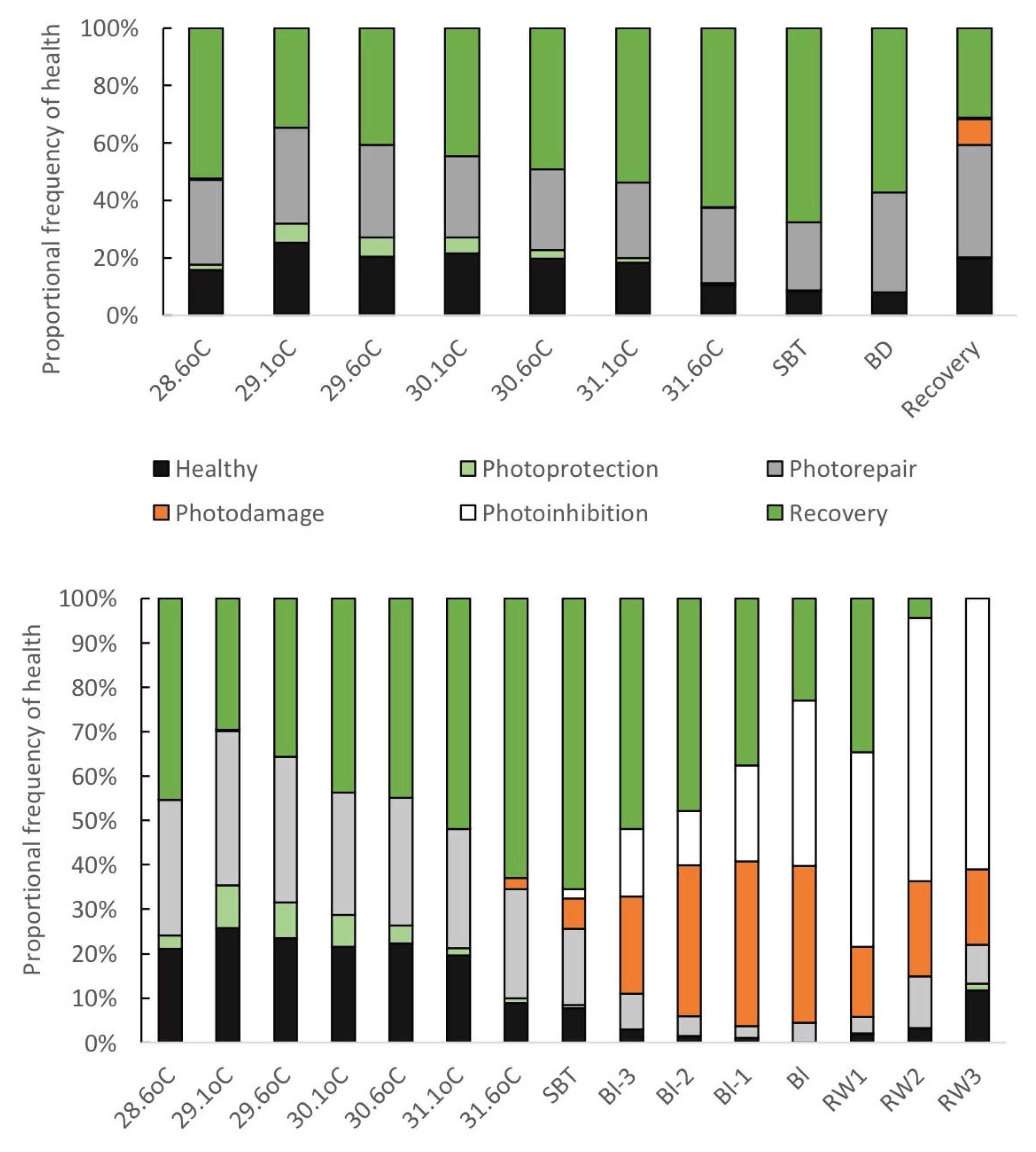
Figure 4. Shifts in photosynthetic health states across temperature exposure and recovery. Stacked bar plots show the proportional frequency of health phases (healthy, photoprotection, photorepair, photodamage, photoinhibition, recovery) across control (top) and experimental (bottom) coral samples. Experimental corals were exposed to incremental temperature increases (0.5 °C every 3 days) leading to the Standard Bleaching Temperature (SBT; 31.6 °C), followed by recovery. Health phase distributions illustrate progressive reorganization of photosynthetic function with increasing thermal stress, highlighting non-linear transitions among protective, damaged, and inhibited states rather than a simple monotonic decline. Recovery bars represent post-stress reassembly of functional states.
Preprints 200993 g004
Figure 5. Scatterplot of paired bleaching susceptibility and mortality data (n = 1363), illustrating the non-linear relationship between susceptibility and lethal outcome. While a positive upper-bound trend is present, susceptibility alone explains limited variance in mortality, revealing substantial dispersion across the response space. This triangular distribution demonstrates that high susceptibility does not deterministically predict mortality, and that lethal bleaching represents a perpendicular transition rather than a linear extension of susceptibility. The structure highlights the limits of susceptibility as a predictive metric and underscores the role of system architecture and state-dependent thresholds in coral survival outcomes.
Preprints 200993 g005
Figure 6. Summary of the relationship between average relative importance (ARI) of predictor variables and their standardized effect sizes on bleaching susceptibility. While a positive trend is observed (R² = 0.45), substantial dispersion indicates that high explanatory importance does not uniformly translate into strong effect magnitude. This decoupling highlights the presence of multiple susceptibility architectures, where some drivers exert consistent but modest influence, while others produce disproportionate impacts despite lower relative importance. The pattern reinforces a non-linear, multi-dimensional susceptibility landscape rather than a single dominant causal hierarchy.
Preprints 200993 g006
Figure 1. Coral bleaching response architectures across time: decoupling susceptibility, mortality, and recovery into distinct survival pathways. Rather than treating bleaching as a single continuum of severity, this conceptual model maps alternative state trajectories in which bleaching susceptibility does not deterministically predict mortality and recovery is an active, time-structured process. The schematic defines sentinel disturbance guilds—failure-prone, recovery-dependent, resistant, and opportunistic (“Phoenix”)—that partition outcomes by trajectory (directionality through time) rather than by snapshot condition. This framework makes explicit the central inference of the manuscript: survival emerges from biological architecture and timing, not exposure alone.
Preprints 200993 g011
Table 2. Operational definitions for distinguishing healthy, sublethally stressed, and bleached coral states using PAM fluorometry.
A) Comparison of healthy and bleached colonies using fluorometric parameters (F′, Fm′, effective quantum yield, qP, qN, NPQ) and quenching dynamics. Thresholds are based on short-term temporal patterns (3-day means) to distinguish sustained dysfunction from transient fluctuation.
Variable F’ Fm’ Yield qP qN NPQ
Control 130-300; mean 185 400 – 700, mean 600 0.61-0.7, mean 0.66 1 0 0
Bleached Significant increase followed by a rapid decline, for 3 days 3-day mean of 200 (within SE) 3 consecutive decreasing days: 3-day mean <0.45 (within SE) 3-day mean of 0 or >2 (within SE) 3-day mean of 0 or >2 (within SE) 3-day mean of 0 or >2 (within SE)
B) Objective phase classifications of photosynthetic health derived from PAM metrics, defining functional states including photoprotection, photorepair, photodamage, photoinhibition, and recovery. Together, these criteria translate continuous photophysiological measures into discrete, repeatable health states, providing a standardized framework for identifying phase transitions in coral bleaching dynamics.
Phase of Health F’ Fm’ Quantum yield qP qN NPQ
Healthy 200-325 600-800 0.6-0.8 1 0 0
Photoprotection 250+ 800+ 0.6+ 1 0 0
Photorepair 150-250 500-600 0.5-0.6 >1 <1 1
Photodamaged 100-200 <500 <0.5 0 >1 >1
Photoinhibited <100 <300 <0.5 0 >1 >5
Recovering 50-150 >400 0.6+ >0 <1 <1
Disclaimer/Publisher’s Note: The statements, opinions and data contained in all publications are solely those of the individual author(s) and contributor(s) and not of MDPI and/or the editor(s). MDPI and/or the editor(s) disclaim responsibility for any injury to people or property resulting from any ideas, methods, instructions or products referred to in the content.
Copyright: This open access article is published under a Creative Commons CC BY 4.0 license, which permit the free download, distribution, and reuse, provided that the author and preprint are cited in any reuse.
Prerpints.org logo

Preprints.org is a free preprint server supported by MDPI in Basel, Switzerland.

Subscribe

Disclaimer

Terms of Use

Privacy Policy

Privacy Settings

© 2026 MDPI (Basel, Switzerland) unless otherwise stated