

Submitted:
24 February 2026
Posted:
27 February 2026
You are already at the latest version
Abstract
Quantum electrodynamics (QED) provides extraordinarily accurate predictions for charged lepton properties, although its formalism offers limited intuitive insight into the geometrical and energetic scales associated with vacuum effects. In this work, a phenomenological representation is introduced to describe the leading-order contribution to the anomalous magnetic moment of charged leptons. By combining characteristic length and energy scales associated with the Compton radius and rest energy with geometric arguments, the Schwinger correction to the electron magnetic moment is recovered. Within this framework, the fine-structure constant acquires the meaning of a characteristic angular scale associated with the effective vacuum dressing of the particle. The construction naturally extends to the muon, indicating the universality of the angular structure underlying anomalous magnetic moments. The model does not replace quantum electrodynamics but tries to provide an effective geometric representation of its lowest-order result, offering an intuitive picture of vacuum dressing and interaction scales.
Keywords:
quantum vacuum
; virtual particles
; fine-structure constant
; electron magnetic moment
; anomalous magnetic moment
; muon magnetic moment
1. Introduction
Quantum mechanics and quantum electrodynamics (QED) provide an extraordinarily accurate description of the electron and its interactions. In particular, perturbative QED yields theoretical predictions for quantities such as the electron anomalous magnetic moment that are in remarkable agreement with experimental measurements (Schwinger, 1948 [1]; Aoyama et al., 2018 [2]). Despite this quantitative success, the standard formulation is largely based on abstract mathematical structures and does not generally aim at providing a direct or intuitive physical representation of the underlying microscopic mechanisms.
From a historical perspective, the development of modern physics shows that several concepts initially introduced as formal or computational devices were later endowed with a clearer physical interpretation. A notable example is the photon, which was first introduced as a quantization rule for electromagnetic energy exchange (Planck, 1901 [3]; Einstein, 1905 [4]) and was for a long time regarded primarily as a theoretical construct. Only through subsequent experimental and conceptual developments did it acquire the status of a physical entity in its own right.
In contemporary quantum field theory, a conceptually analogous role is played by virtual particles and vacuum fluctuations. Within the standard perturbative framework, virtual particles appear as internal lines in Feynman diagrams and are not considered observable objects; they do not satisfy on-shell dispersion relations and are generally interpreted as elements of a calculational scheme rather than as physical particles propagating in spacetime (Feynman, 1963 [5]; Weinberg, 1995 [6]). Nevertheless, vacuum-related effects such as radiative corrections and vacuum polarization give rise to measurable phenomena, indicating that the quantum vacuum itself plays an active dynamical role.
Recent work has also revisited the physical interpretation of electron properties from different perspectives, including field-based accounts of electron spin [7] and geometric or dynamical interpretations of internal motion associated with Zitterbewegung [8]. These studies indicate a continuing interest in physically transparent or semiclassical representations that complement the standard QED formalism.
In a previous work published in Physics Essays (Nocci, 2025 [9]), a semiclassical approach was proposed in which the quantum vacuum is treated as an effective structured medium influencing the properties of the electron. The present study builds upon that framework and further explores its implications, without departing from the well-established results of QED.
Specifically, a phenomenological semiclassical model is introduced in which the vacuum is represented by massless virtual particle–antiparticle pairs of opposite charge, moving at the speed of light near the electron. Within this framework, the electron’s normal magnetic moment is reproduced, and the anomalous magnetic moment is interpreted phenomenologically through an effective angular-sector dressing. The model can also be straightforwardly scaled to calculate the muon’s magnetic moment.
The main aim of this work is not to challenge the formal validity of quantum electrodynamics, but rather to investigate whether a complementary semiclassical representation may offer additional physical insight into phenomena that are usually treated in a purely formal manner.
2. Materials and Methods
This study is purely theoretical and based solely on analytical considerations. All results are obtained through analytical calculations within a semiclassical phenomenological framework.
The methodology consists of constructing an effective geometric model of vacuum excitations interacting with charged particles, based on established physical constants and symmetry considerations. Standard electromagnetic relations and dimensional analysis are employed to derive effective expressions for the magnetic moment.
All assumptions and approximations used in the derivations are explicitly stated in the text. No numerical fitting or adjustable parameters are introduced. The calculations are fully reproducible using the equations and constants provided in the manuscript.
No external datasets, computer codes, or simulation tools were used. Ethical approval is not required for this study.
3. Theoretical Framework
3.1. Quantum Vacuum Fluctuations and Emergent Virtual Pairs
Within quantum mechanics, Heisenberg’s uncertainty principle establishes that certain pairs of conjugate quantities, such as energy and time, cannot be determined simultaneously with arbitrary precision. This principle can be mathematically expressed as
where indicates the uncertainty in energy, the characteristic time interval, and ℏ the reduced Planck constant. This principle does not imply a violation of conservation laws, but defines a fundamental limit on the precision with which such quantities can be specified over very short time scales.
In this context, vacuum fluctuations can be interpreted as the temporary appearance of virtual particle–antiparticle pairs with opposite charges, which exist only for time intervals short enough to satisfy the uncertainty principle. These virtual pairs are not directly observable, yet they contribute to quantum effects such as electron dressing and the anomalous magnetic moment.
In the figurative semiclassical model proposed in this work, such pairs are generated under a minimal escape condition, assuming equal and opposite directions and moving at the maximum allowed speed, corresponding to the speed of light c. This representation provides an intuitive visualization of vacuum dynamics without violating conservation principles:
- conservation of linear momentum,
- conservation of angular momentum,
- conservation of electric charge.
These virtual particle–antiparticle pairs thus emerge as effective excitations of the vacuum, consistent with symmetry laws and conservation principles. This interpretation allows, at a semiclassical level, an explanation of certain effects observed in QED, such as the anomalous magnetic moment, offering an intuitive representation of vacuum dynamics without introducing new fundamental particles.
3.2. Effective Hamiltonian in the Ultrashort-Time Limit
We consider a system composed of two ideal charged particles, treated as massless, that emerge for an extremely short time interval, as shown in Figure 1. In this temporal regime, and for the very small distances explored during the process, the effects associated with the causal propagation of the electromagnetic field can be neglected. In this limit, the electromagnetic interaction between the particles can be described by the electrostatic Coulomb potential,
understood as an effective instantaneous potential that incorporates the energy associated with the field in a non-dynamical way.
Under these assumptions, the system can be characterized by an effective Hamiltonian of the form
where and denote the momentum and position of the i-th particle, respectively. The first two terms represent the relativistic energy of massless particles, while the interaction term describes the electromagnetic energy contribution in the instantaneous limit.
In the present context, the Hamiltonian is not intended as a constant of motion associated with long-time evolution, but rather as an effective energetic description valid over an extremely short time interval. In this regime, energy fluctuations are allowed, and the quantity
should be interpreted as a characteristic energy scale of the process, rather than as a strictly conserved energy.
In the symmetric case of two particles with opposite momenta and equal magnitude, , the above expression reduces to
This relation provides an instantaneous energetic constraint linking the particle momentum magnitude to their relative separation. In particular, in the limit where the momentum tends to zero, , the kinetic contribution becomes negligible and the energy scale of the process is dominated by the interaction term, fixing a characteristic separation
By fixing the energy scale of the process to the relativistic threshold of the electron, , one obtains
which coincides with the classical electron radius. In this framework, this length naturally emerges as the electromagnetic interaction scale associated with the energetic constraint, without introducing a dynamical mass for the particles.
3.3. Compton Radius and Geometric Interpretation of the Interaction Scale
To geometrically interpret the obtained length scale, we also introduce the Compton radius of the electron,
This quantity is obtained by imposing that the wavelength of a photon with energy coincides with the circumference length, . The Compton radius therefore represents the radius of the circle associated with a massless particle carrying the relativistic energy of the electron.
We now consider a geometric construction in which a massless particle with energy is associated with a circle of radius . We assume that, for extremely short times, the two particles considered in the previous model move along a straight line tangent to this circle, as shown in Figure 2. In this limit, for small displacements, the distance traveled along the straight line can be approximated by the length of a circular arc.
Denoting by s the arc length and by the subtended angle, the geometric approximation reads
Identifying the maximum relevant linear separation with the characteristic distance determined by the instantaneous energetic constraint, , one obtains
Substituting the expressions for r and , one finds
where is the fine-structure constant. Within this construction, the fine-structure constant therefore emerges as a characteristic geometric angle associated with the interaction scale of the system.
4. Results
4.1. Magnetic Moment from Oppositely Moving Charged Particles
We consider two particles carrying opposite electric charges, and , moving with equal velocities in opposite directions. Although the particles propagate in opposite directions, their contributions to the magnetic moment add coherently. Indeed, the magnetic moment associated with a moving charge is proportional to the quantity . Reversing both the sign of the charge and the direction of the velocity leaves this product unchanged, so that the two contributions have the same orientation and sum constructively.
As a result, for the purpose of computing the magnetic moment, the system is equivalent to a single effective particle carrying charge
moving along the same trajectory. This allows the system to be treated as an effective current loop generated by a charge .
For a charge q moving along a circular trajectory of radius R with speed v, the associated magnetic moment is given by
In the present model, the effective particle is massless and therefore propagates at the speed of light, , while the characteristic radius of the trajectory is identified with the Compton radius,
Substituting these expressions, one finds
This result corresponds to twice the Bohr magneton [10],
Within this framework, the factor of two emerges naturally from the coherent contribution of the two oppositely moving, oppositely charged particles and from the geometric scale set by the Compton radius, without invoking intrinsic spin degrees of freedom or the Dirac formalism.
5. Radial Energy Flux and Effective Semiclassical Hamiltonian
5.1. Radial Component of the Energy-Momentum Tensor
We consider a massless particle carrying relativistic energy
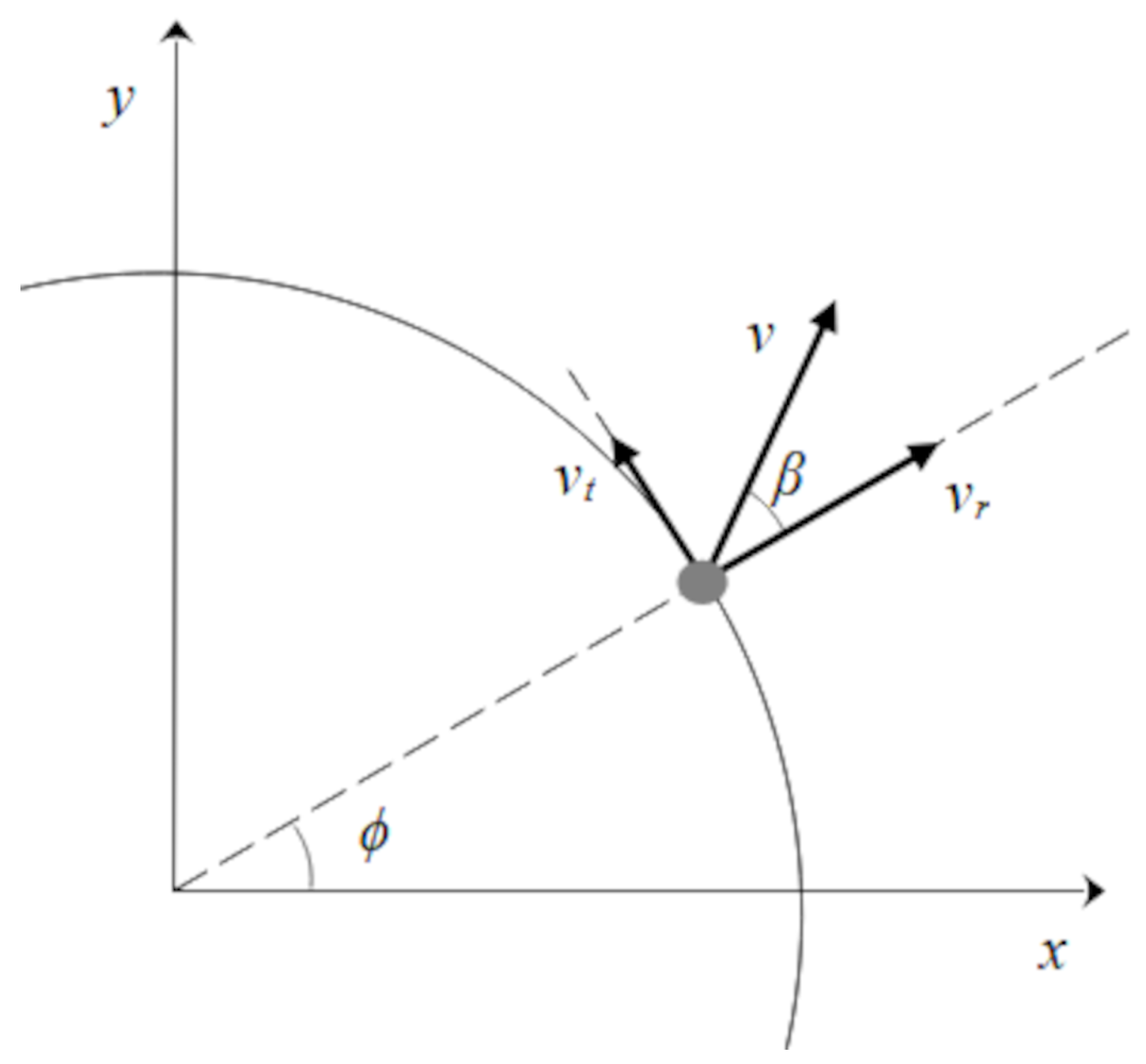
with momentum magnitude . The particle velocity forms an angle with respect to the local radial direction, as shown in Figure 3.
The radial component of the momentum is therefore
For a relativistic point particle, the spatial components of the energy-momentum tensor can be written as
where the Dirac delta localizes the energy flux on the particle trajectory; the superscript indicates that the effective dynamics is formulated in the two–dimensional radial plane.
The radial component of the energy-momentum tensor is then
Substituting , one obtains
This expression shows that the radial contribution to the energy-momentum tensor scales as and reaches its maximum at . For the purpose of setting a characteristic energy scale, we take , corresponding to the electron rest energy; this is used **only as a reference** for the radial energy of the massless virtual particles. Because the angle is **statistically uniformly distributed** between 0 and , the **net radial energy flux averages to zero**, so no energy is actually lost from the electron.
5.2. From Energy Tensor to Effective Radial Energy
To extract the effective energy associated with the radial dynamics, we integrate the component over the spatial coordinates:
Using the expression derived above, the integration directly yields the effective energy scale
5.3. Semiclassical Model of the Electron Anomalous Magnetic Moment
5.3.1. Effective Radial Energy
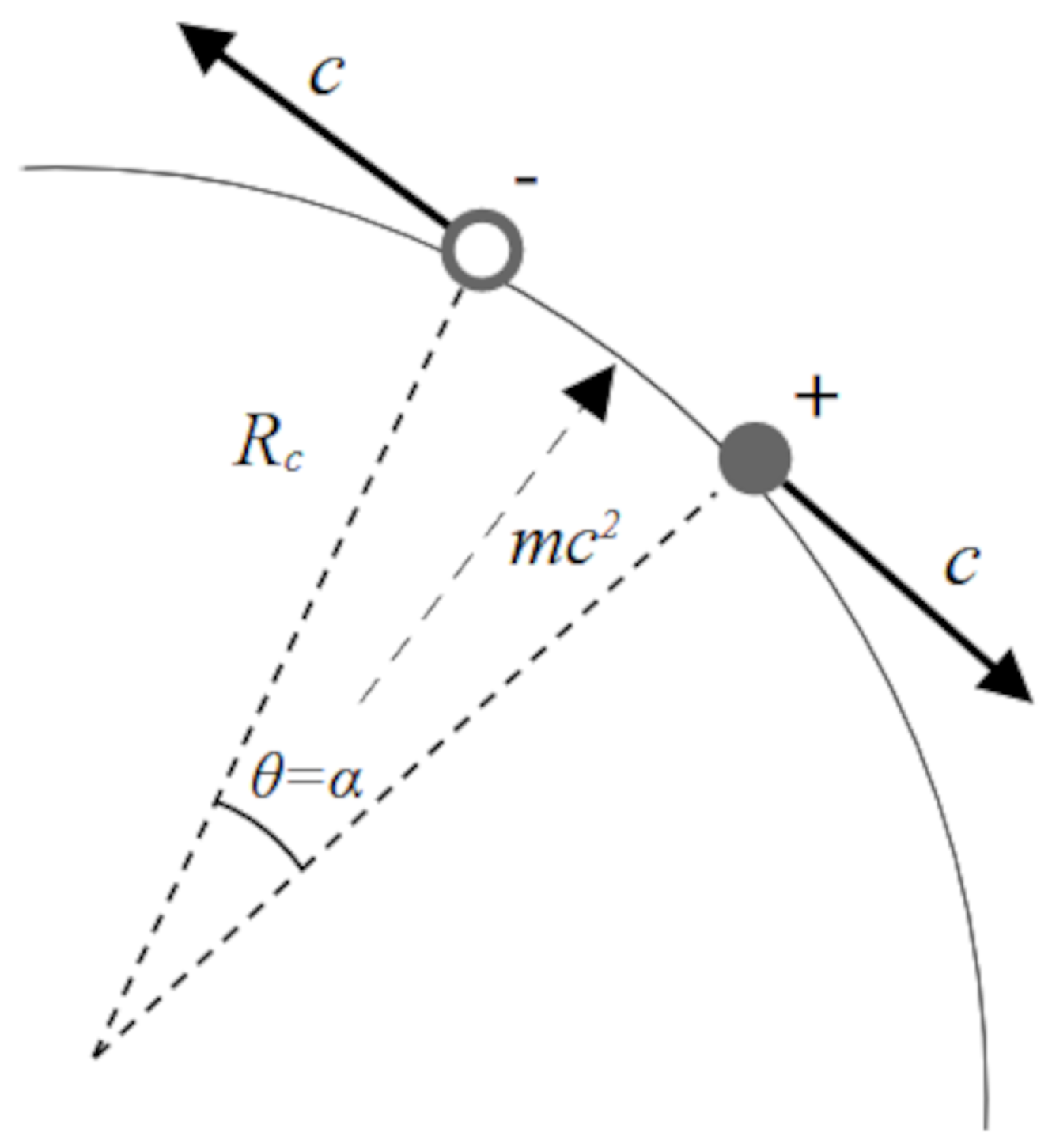
We consider the radial dynamics of virtual particles in the electron dressing. The maximum radial energy of a virtual particle is
used as a reference scale.
This maximum energy is realized only along a small portion of the Compton circle. This arises from a **statistical consideration**: the angle between the particle velocity and the radial direction is assumed to be **uniformly distributed** between 0 and , ensuring that the **net radial energy flux averaged over the full circle is zero**, i.e., no net energy loss occurs.
Consequently, the fraction of the circle where the radial energy is near its maximum can be identified with a small angle , corresponding to a fraction of the period
The energy effectively available to the dressing is therefore
5.3.2. Electrostatic Potential Energy
The maximum radial energy generates a new virtual particle–antiparticle pair along the dressing separated along by a distance
where is the Compton radius.
The electrostatic potential energy of the pair is
Since this energy exists only during the fraction of the period corresponding to maximum radial energy, we multiply by to obtain the **average potential energy**:
5.3.3. Effective Semiclassical Hamiltonian
We define a **semiclassical Hamiltonian** for the radial dressing as the difference between the radial energy and the electrostatic potential energy:
The critical angle of the active arc is obtained by imposing the equilibrium condition (Hamiltonian = 0):
from which we find
Expressed in terms of the fine-structure constant and , we obtain
5.3.4. Effective Charge and Anomalous Magnetic Moment
Each particle of the pair is satistically active only for half the fraction of the arc, so the **effective charge** contributing to the magnetic moment is
The resulting magnetic moment of the active arc is
reproducing the **first-order Schwinger correction** [1].
5.3.5. Summary and Physical Interpretation
- The radial energy of virtual particles reaches its maximum only along a small fraction of the Compton circle, defining the active arc contributing to the dressing.
- The electrostatic potential energy of the virtual particle pair exists only for this fraction; multiplying by yields the average potential energy.
- The semiclassical effective energy is defined as the difference between the radial energy and the potential energy, and the critical angle is obtained by setting this energy to zero (equilibrium).
- Only the fraction of charge contained within the active arc contributes to the magnetic moment responsible for the first-order Schwinger correction.
- This approach establishes a clear physical connection between the radial energy distribution of the virtual particles in the dressing and the observed anomalous magnetic moment,without introducing any arbitrary numerical factors.
Figure 4.
Virtual particle–antiparticle pairs generated by the radial energy along the dressing; only the fraction of the arc corresponding to the maximum radial energy contributes effectively.
Figure 4.
Virtual particle–antiparticle pairs generated by the radial energy along the dressing; only the fraction of the arc corresponding to the maximum radial energy contributes effectively.
5.4. Muon Anomalous Magnetic Moment and Scalability of the Model
The semiclassical mechanism introduced for the electron anomalous magnetic moment can be naturally extended to the muon by simple rescaling of the characteristic physical quantities. The structure of the model depends only on the relativistic energy scale, the geometric radius of the dressing, and the angular redistribution of the effective charge, without introducing any additional parameters.
5.4.1. Characteristic Scales for the Muon
For the muon, the relativistic energy is
and the characteristic geometric scale of the dressing is the reduced Compton radius
Compared to the electron, the dressing radius scales inversely with the particle mass, while the total relativistic energy increases proportionally. No new physical assumptions are needed to extend the model from the electron to the muon.
5.4.2. Radial Energy and Effective Arc
Following the same reasoning as for the electron, the maximum radial energy is , realized only along a small “active arc” of the Compton circle. The fraction of the arc is determined by the balance between radial energy and the electrostatic potential energy of the virtual particle–antiparticle pair. By symmetry, the net radial energy flux over the full circle averages to zero, so no energy is lost from the muon.
5.4.3. Critical Angle and Effective Charge
The critical angular extension of the active arc is obtained exactly as in the electron case:
This shows that the angular fraction of the dressing contributing effectively to the anomalous magnetic moment is universal, independent of the particle mass.
5.4.4. Muon Anomalous Magnetic Moment
Only the charge contained within the active arc contributes to the magnetic moment:
The corresponding magnetic moment is
where
is the muon Bohr magneton.
This result coincides with the leading-order (one-loop) QED prediction for the muon anomalous magnetic moment [1].
5.4.5. Scalability of the Model
The result shows that the dependence on the particle mass enters exclusively through the Compton scale, while the angular structure and the numerical coefficient remain unchanged. The same semiclassical mechanism therefore reproduces the leading-order anomalous magnetic moment for both the electron and the muon without introducing additional parameters.
This scalability strongly suggests that the proposed model captures a universal first-order feature of QED, providing a geometric and intuitive interpretation of a result that, in the standard perturbative formalism, emerges from significantly more involved calculations.
6. Methodology and Limits of the Semiclassical Approach
6.1. Methodological Framework
The approach developed in this work is explicitly semiclassical and phenomenological. It is not intended to replace quantum electrodynamics or to modify its formal structure, but rather to provide an effective physical representation of selected QED phenomena based on geometric arguments, symmetry considerations, and dimensional consistency.
The framework relies on the following elements:
- an effective description of vacuum fluctuations in terms of massless virtual particle–antiparticle pairs;
- the identification of characteristic energy scales through instantaneous energetic constraints, applicable in the ultrashort-time regime permitted by the uncertainty principle;
- the use of geometric constructions, such as the Compton radius and angular sectors, to relate energy scales to observable quantities;
- a semiclassical interpretation of selected energy–momentum tensor components as directed energy fluxes.
All calculations are performed at leading order. No perturbative expansion in coupling constants is assumed, and no quantum field operators or diagrammatic methods are introduced.
6.2. Scope and Limitations
The validity of the model is restricted to extremely short time intervals, during which causal propagation and retardation effects can be neglected, and to length scales comparable to or larger than the Compton radius but well below macroscopic interaction distances. The construction further assumes highly symmetric configurations, for which higher-order multipole contributions are suppressed.
Within this limited regime, the framework reproduces the classical electron radius as an emergent interaction scale, yields the correct numerical coefficient of the first-order anomalous magnetic moment of charged leptons.
Higher-order quantum corrections, radiation effects, and renormalization-group behavior are not addressed, and the model is therefore not expected to reproduce precision observables beyond leading order.
7. Discussion
The results obtained in this work show that a semiclassical and geometrically motivated representation of the quantum vacuum can capture nontrivial structural aspects of quantum electrodynamics at leading order. In particular, the recovery of the first-order anomalous magnetic moment and the emergence of the classical electron radius indicate that symmetry and geometry alone can encode essential features of electromagnetic interactions.
From the perspective of standard QED, the present framework does not introduce new fundamental dynamics, nor does it alter the perturbative structure underlying high-precision calculations. Instead, it provides a complementary interpretative viewpoint in which vacuum fluctuations are represented by effective excitations constrained by geometry and energetic considerations. Similar semiclassical representations have historically served as valuable heuristic tools, offering physical intuition without challenging the validity of the underlying quantum field theory.
A central conceptual result is the appearance of the fine-structure constant as an effective geometric quantity. Within the model, is associated with a characteristic angular scale that controls the extent of vacuum dressing around a charged particle. While this does not constitute a fundamental explanation of the numerical value of , it provides a coherent geometric interpretation consistent with its role as a dimensionless coupling constant.
The extension of the framework to the muon supports its internal consistency. The leading-order anomalous magnetic moment emerges with the same coefficient as in QED, while the characteristic angular scale remains universal and independent of the lepton mass. This suggests that the semiclassical construction captures a structural feature common to charged leptons, with mass dependence entering only through the Compton scale.
8. Conclusions
A semiclassical and geometrically motivated framework has been presented to provide an effective physical representation of selected quantum electrodynamical phenomena. By modeling the quantum vacuum as a structured medium of transient excitations, the approach reproduces the classical electron radius and the leading-order anomalous magnetic moment of charged leptons.
The interpretation of the fine-structure constant as an effective geometric angle constitutes the main conceptual outcome of the model. Although this interpretation does not provide a fundamental determination of , it offers physical insight into its smallness and into its role in governing electromagnetic interactions.
Despite its explicit limitations to a semiclassical regime and to leading-order effects, the framework demonstrates that nontrivial QED results can be recovered using geometric reasoning, symmetry arguments, and dimensional consistency. Effective representations of the quantum vacuum, while not fundamental, may therefore serve as useful conceptual complements to the standard formalism of quantum field theory.
Funding
This research received no external funding.
Conflicts of Interest
The author declares no conflict of interest.
References
- Schwinger, J. On Quantum-Electrodynamics and the Magnetic Moment of the Electron. Phys. Rev. 1948, 73, 416–417. [Google Scholar] [CrossRef]
- Aoyama, T.; Hayakawa, M.; Kinoshita, T.; Nio, M. Revised and improved value of the QED tenth-order electron anomalous magnetic moment. Phys. Rev. D 2018, 97, 036001. [Google Scholar] [CrossRef]
- Planck, M. Über das Gesetz der Energieverteilung im Normalspectrum. Ann. Phys. 1901, 309, 553–563. [Google Scholar] [CrossRef]
- Einstein, A. Über einen die Erzeugung und Verwandlung des Lichtes betreffenden heuristischen Gesichtspunkt. Ann. Phys. 1905, 322, 132–148. [Google Scholar] [CrossRef]
- Feynman, R.P. Quantum Electrodynamics; W. A. Benjamin: New York, NY, USA, 1963. [Google Scholar]
- Weinberg, S. The Quantum Theory of Fields; Cambridge Univ. Press: Cambridge, UK, 1995; Volume I. [Google Scholar]
- Sebens, C.T. How Electrons Spin. Stud. Hist. Philos. Mod. Phys. 2019, 68, 40–50. [Google Scholar] [CrossRef]
- Hestenes, D. The Zitterbewegung Interpretation of Quantum Mechanics. Found. Phys. 1990, 20, 1213–1232. [Google Scholar] [CrossRef]
- Nocci, P. Speculative Analysis of the Spin and Nature of Electrons. Phys. Essays 2025, 38, 276–280. [Google Scholar] [CrossRef]
- Griffiths, D.J. Introduction to Electrodynamics, 4th ed.; Cambridge Univ. Press: Cambridge, UK, 2017. [Google Scholar]
- Barut, A.O. Electrodynamics and Classical Theory of Fields and Particles; Dover: Mineola, NY, USA, 1980. [Google Scholar]
Figure 1.
Schematic representation of charged particles emerging from the vacuum.
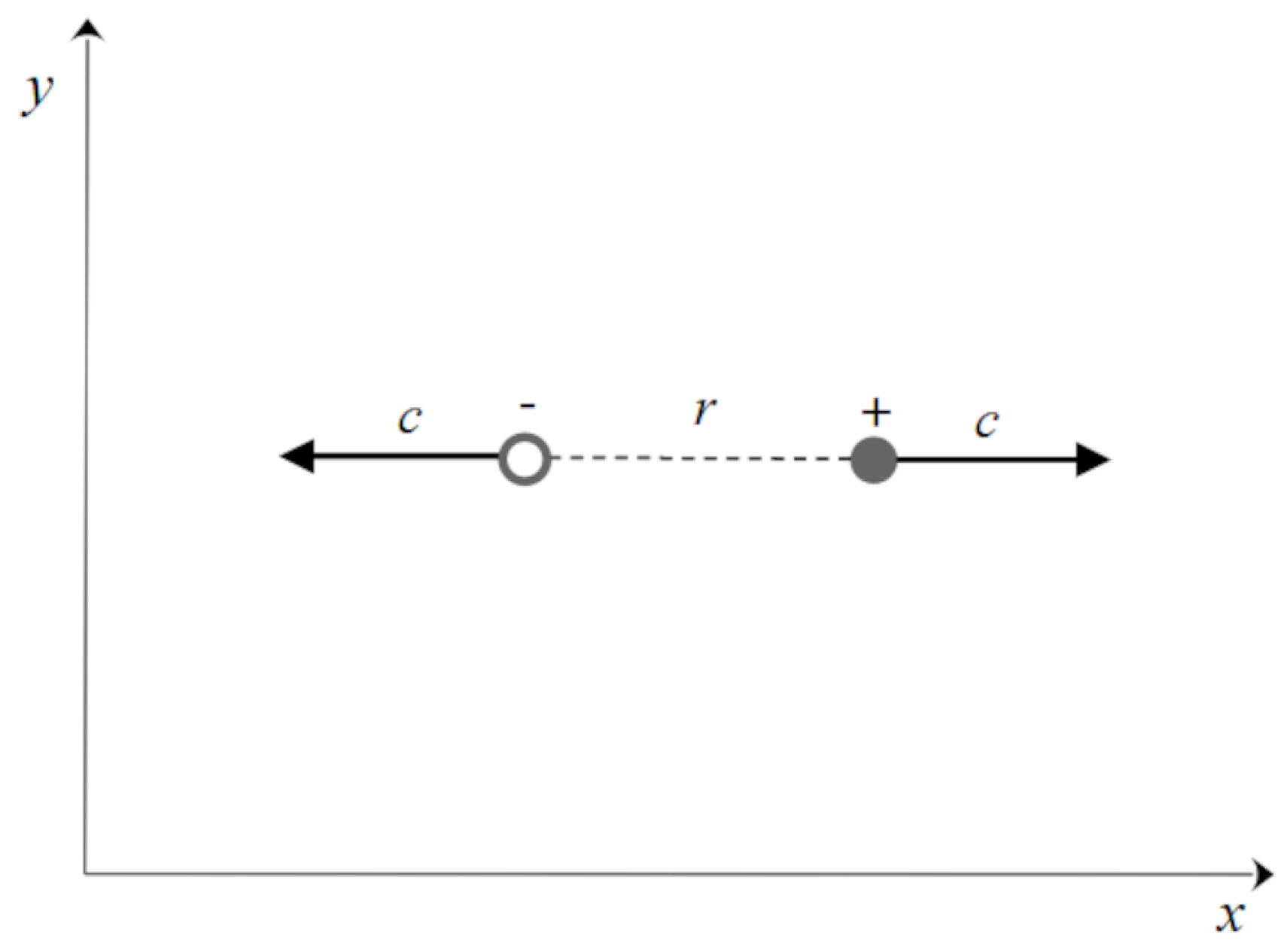
Figure 2.
Particles tangent to the circle of radius .
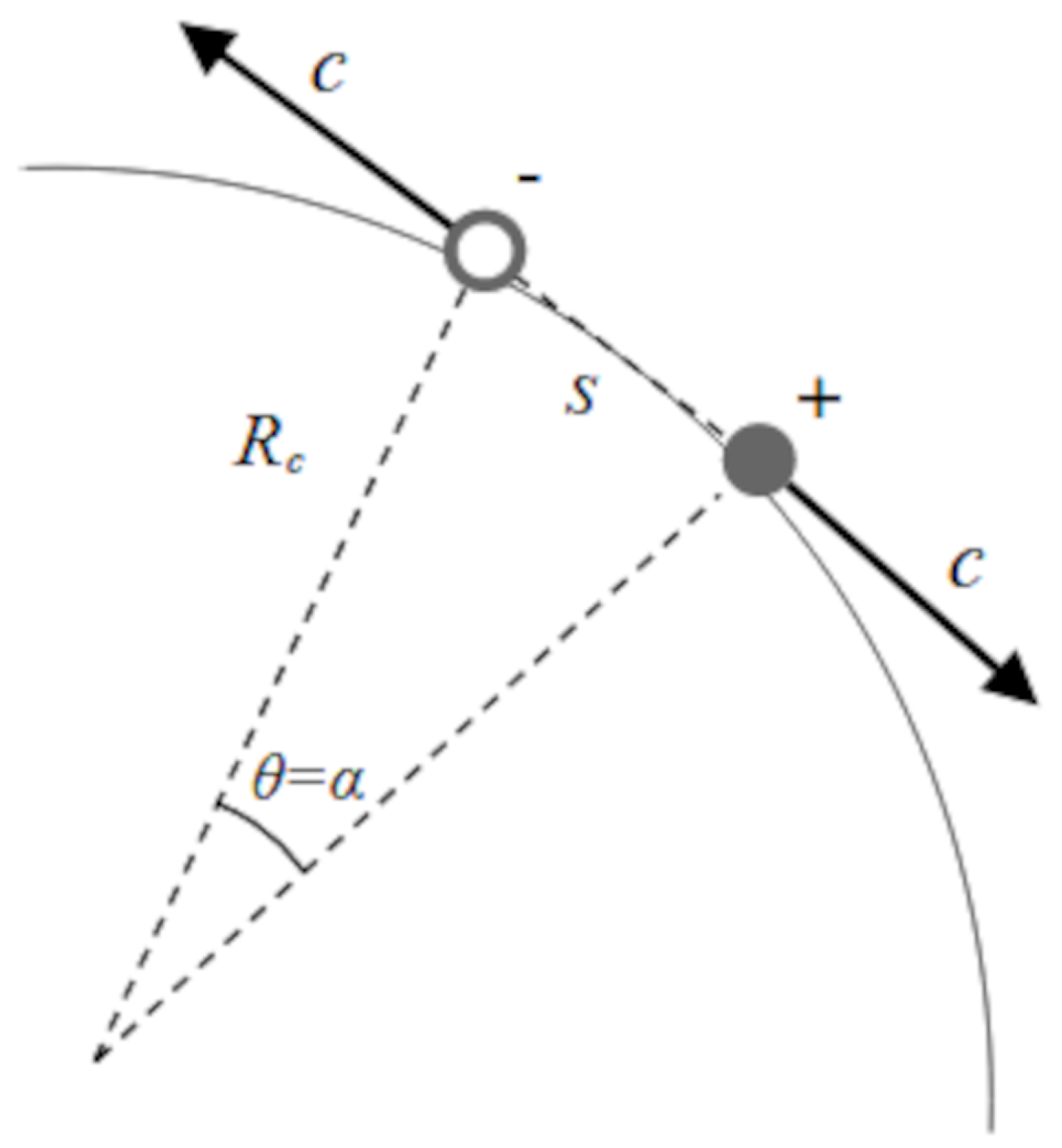
Figure 3.
Momentum direction of a particle and its radial and tangential components.
Disclaimer/Publisher’s Note: The statements, opinions and data contained in all publications are solely those of the individual author(s) and contributor(s) and not of MDPI and/or the editor(s). MDPI and/or the editor(s) disclaim responsibility for any injury to people or property resulting from any ideas, methods, instructions or products referred to in the content. |
© 2026 by the authors. Licensee MDPI, Basel, Switzerland. This article is an open access article distributed under the terms and conditions of the Creative Commons Attribution (CC BY) license (http://creativecommons.org/licenses/by/4.0/).
Copyright: This open access article is published under a Creative Commons CC BY 4.0 license, which permit the free download, distribution, and reuse, provided that the author and preprint are cited in any reuse.


