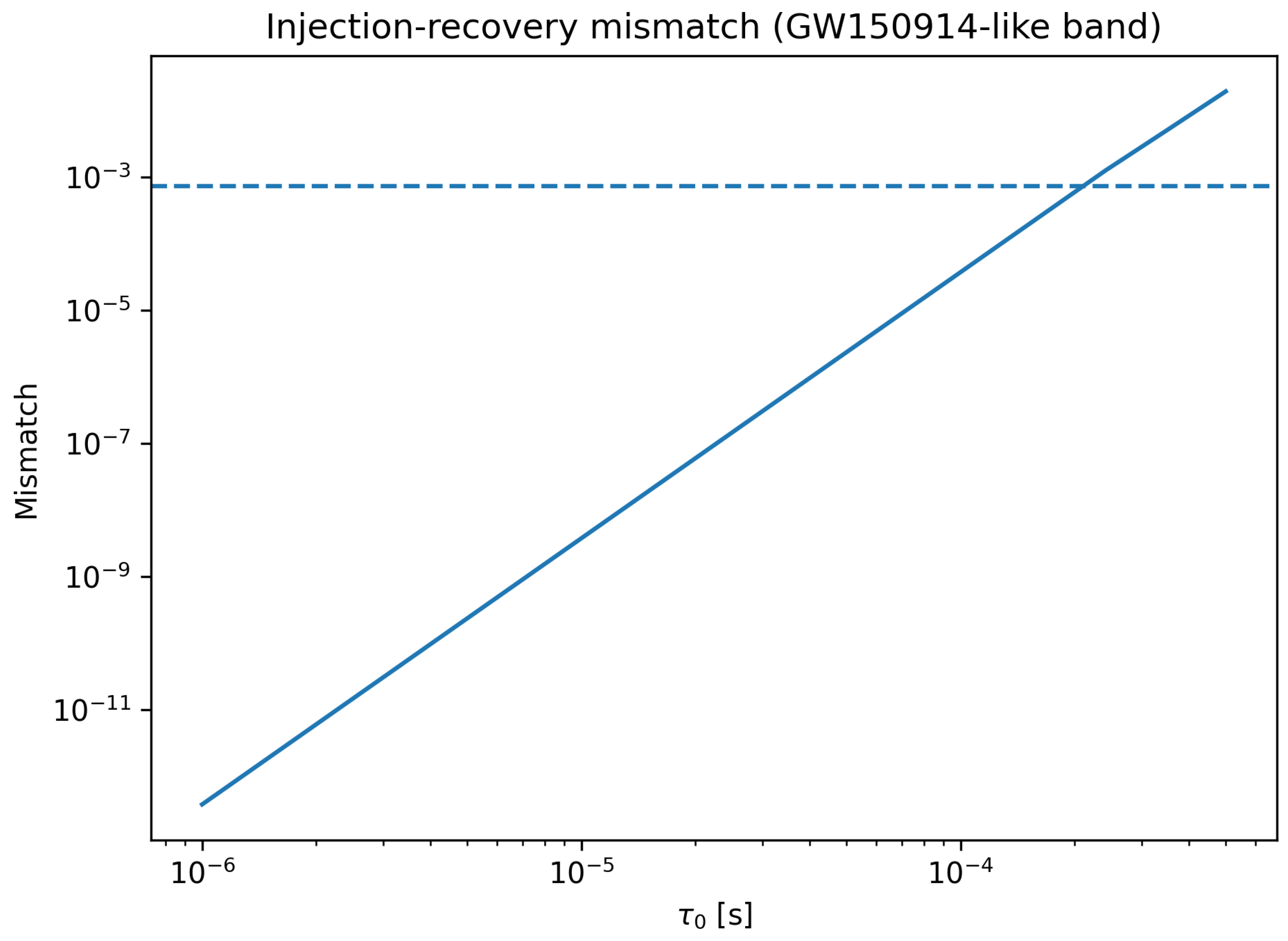
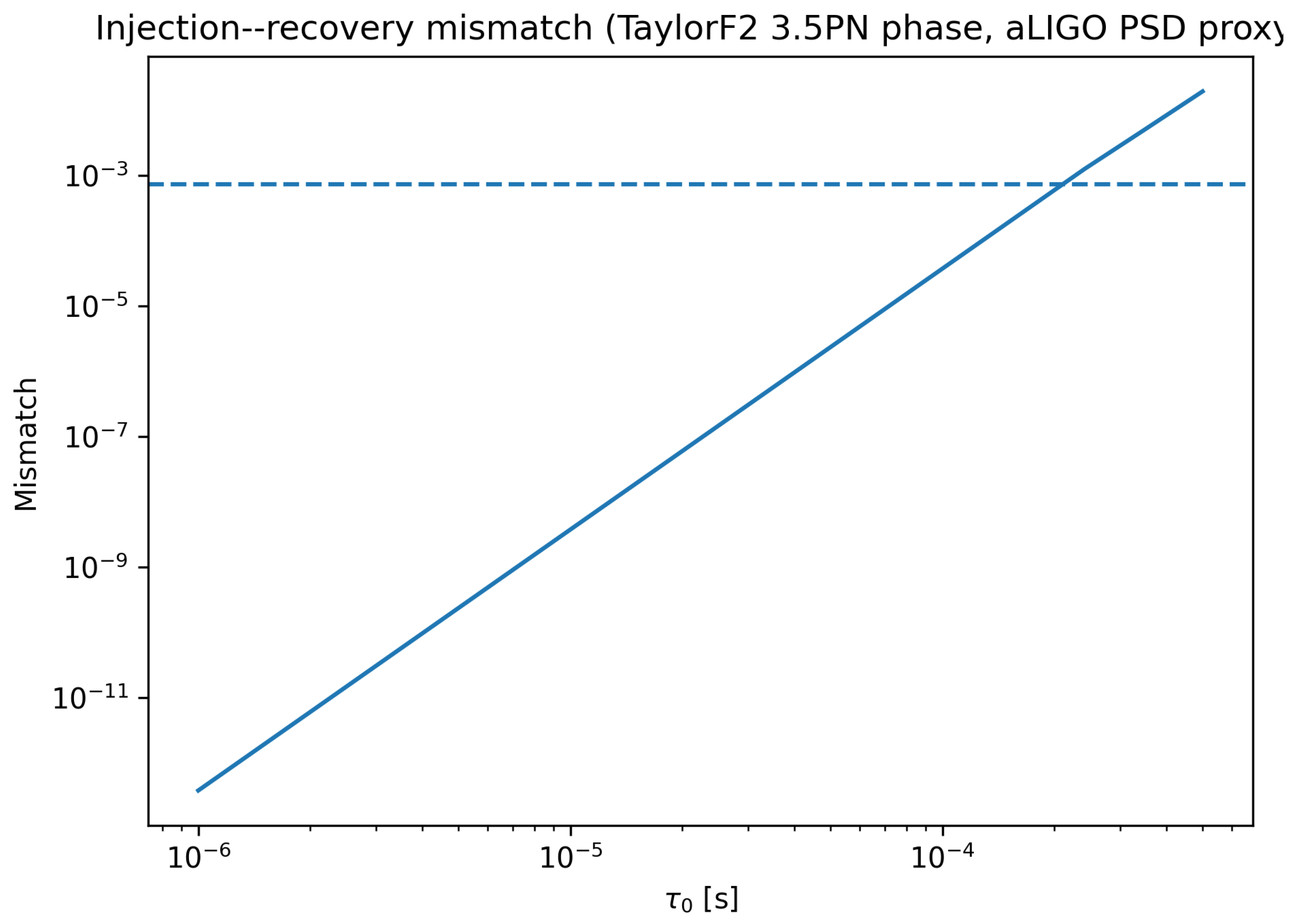
Referee map (proofs and artifacts).
Theorem 1 (variational speed-limit bound): full proof in supplement.pdf, Sec. S1.
Corollary 1 and Theorem 2: proofs and supporting lemmas in supplement.pdf, Secs. S2–S3 (see headings “Proof of Corollary 1” and “Proof of Theorem 2”).
3+1D local micro-model (worked example):closure_supplement.pdf.
Reproducible numerics: source code in code/, inputs in data/, and precomputed lightweight artifacts in results/.
Table I.
Where to find the proofs (quick map).
Table I.
Where to find the proofs (quick map).
| Statement in main.pdf
|
Proof location |
| Theorem 1 (speed-limit bound) |
supplement.pdf, Sec. S1 |
| Corollary 1 |
supplement.pdf, Sec. S2 |
| Theorem 2 |
supplement.pdf, Sec. S3 |
Main Results, Assumptions, and Status (Reader Map)
Notation. Unless stated otherwise, we work in a finite volume (a one-dimensional channel of length L embedded in a higher-dimensional system). Sums run over , and the infinite-volume limit is taken only after statements that are uniform in L.
oindent The following list summarises the core claims, their logical status, and the assumptions required for each step. Throughout, we distinguish (i) unconditional inequalities and definitions, (ii) diffusive-regime reductions and benchmark calibrations, and (iii) model-dependent infrared matching used for the Higgs-portal mass-scale estimate.
A. Copy time (definition): Operational definition of a copy time for a conserved charge Q based on receiver-optimised overlaps (Sec. II).
B. QICT susceptibility (definition): Liouvillian-squared susceptibility defined in the Kubo–Mori metric (Sec. II).
C. Variational bound (unconditional): A variational speed-limit lower bound on in terms of and a local optimisation norm (Supplement, Sec. S1).
D. Diffusive reduction (conditional): In a diffusive regime, reduces to a standard hydrodynamic expression and yields a benchmark scaling exponent near (Sec. II; benchmarked numerically).
E. Optical geometry (conditional): Spatial variation of copy times induces an optical metric for coarse-grained propagation (Sec. III).
F. Hypercharge direction (conditional): In the worked gauge-coded QCA construction, anomaly cancellation selects an Abelian direction identified with hypercharge under stated assumptions (Closure Supplement).
G. Golden Relation (conditional closure): A matching protocol at a reference scale
yields a characteristic singlet-scalar mass relation (Eq. (
56)).
H. Robustness (conditional): An explicit uncertainty and prior-sensitivity analysis is provided (Sec. V E).
Reproducibility note. The submission package includes code, input data, and compiled artifacts. The intended entry point and exact run commands are given in the repository-level README.md; the key numerical tables in the paper can be regenerated from the provided scripts without manual steps. SPARC input tables used in the Supplement are included under data/sparc/; see code/sparc_compare.py for a minimal parsing and consistency check.
I. Introduction
The core results of this paper are the definition of
and
for conserved charges, and a general speed-limit inequality relating them (
Section II and Section S1). Sections on emergent geometry, gauge-coded QCA constructions, and phenomenological matching provide worked examples and can be read independently; none of these are required for the theorem-level bound.
A companion closure supplement (
closure_supplement.pdf) documents the fully local 3+1D micro-model and additional derivations. Code and input data sufficient to regenerate the lightweight numerical artifacts are provided in
code/ and
data/. Recent experimental and phenomenological updates on Higgs-portal constraints and direct detection provide useful external context for the closure discussion (e.g. Refs. [
36,
37,
38]).
Relative to prior quantum-transport and QCA literature [
1,
2,
3] and to earlier information-theoretic discussions of hydrodynamics, the main novelty here is an
operational, receiver-optimised definition of a conserved-charge copy time together with a companion Liouvillian-squared susceptibility, and a
general variational speed-limit inequality linking the two that holds without assuming diffusion. We then show, in a controlled stabiliser-code diffusion benchmark family, that this bound is close to saturated over several decades, providing a practical calibration of the transport normalisation in the diffusive regime. Finally, we present a worked (explicitly model-dependent) infrared matching protocol for the Higgs-portal singlet-scalar model near the Higgs resonance, using closed-form expressions for the invisible Higgs width and spin-independent nucleon cross section to make the assumptions and uncertainty budget explicit.
The emergence of macroscopic physics from microscopic quantum dynamics is constrained by three intertwined structures: locality, conservation laws, and limits on information processing. Quantum cellular automata (QCA) provide a natural language for strictly local, fully quantum dynamics on discrete lattices [
1,
2,
3], while a continuum effective-field-theory description can be organised by renormalisation-group ideas, Later sections explore how such information-theoretic quantities may be used as inputs for infrared matching, including to gravitational and scalar-sector scales; these exploratory connections are presented as worked examples rather than as deductions from the speed-limit bound alone. Connecting such microscopic and continuum descriptions in an information-theoretically meaningful and phenomenologically predictive way remains a central challenge.
The Quantum Information Copy Time (QICT) framework proposes that information-theoretic quantities associated with conserved charges, such as an information susceptibility and a copy time , play an organising role in the emergence of hydrodynamics and in constraining infrared (IR) observables. Concretely, for a local diffusive system with a conserved charge Q and suitable encoding and decoding protocols, one expects the characteristic time to reliably “copy” charge information from one region to another to be controlled by a combination of susceptibilities and diffusion constants.
Earlier work suggested a scaling of the form
supported by stabiliser-code examples and numerical simulations of diffusive channels. However, a fully rigorous microscopic derivation and a clear path to phenomenology were lacking.
On the continuum side, it is convenient to summarise the scalar sector near an infrared matching scale by a dimensionless “dressing” parameter of the schematic form
. In this paper we
define this parameter intrinsically from QCA thermal susceptibilities (
Appendix A), and we only use continuum FRG literature as a qualitative point of comparison, not as an input.
In the QICT formulation adopted here,
is
defined microscopically (
Appendix C) as a ratio of regulated Kubo–Mori Liouvillian-squared susceptibilities evaluated in the electroweak-symmetric high-temperature plateau. When we quote a numerical interval for
in the main text, it should be read as a benchmark interval for this
microscopic quantity; FRG results, when invoked, serve only as an external cross-check and are collected separately in
Appendix A.
The central idea of this paper is to identify with a scale extracted from a microscopic QICT analysis of hypercharge transport, and to propagate the resulting relation to a quantitative band for that can be confronted with Higgs-portal phenomenology and direct-detection experiments.
Scope and Status of Results
Because the framework combines several layers (QICT, QCA, emergent geometry, and Higgs-portal phenomenology), it is important to separate clearly what is rigorously established, what is numerically supported, and what is treated as a calibrated benchmark input:
QICT scaling (conditional scaling theorem; calibrated normalisation). The main text (Theorem 1) establishes, under explicit hydrodynamic and regularity assumptions, the scaling in the thermodynamic limit. In addition, the Closure Supplement (“Copy-time bound”) derives a general linear-response/Cauchy–Schwarz inequality that bounds the growth rate of receiver-optimised overlaps by ; for a fixed operational threshold this implies a lower bound under mild monotonicity assumptions. Separately, when the conserved-charge channel lies in the diffusive universality class, we use stabiliser-code and gauge-coded-QCA diffusion benchmarks (Closure Supplement, Points (1),(3)) to calibrate the overall normalisation needed for the phenomenological closure and to connect the microscopic objects to the static thermodynamic susceptibilities used in matching. Numerical tests on stabiliser codes up to yield an exponent in the diffusive class.
Emergent gravity from copy-time geometry. In
Section III we show how a spatially varying copy time defines an effective optical metric for information propagation and outline the universal effective-field-theory logic that makes the Einstein–Hilbert term the leading infrared operator. We present this as a conservative IR statement (with controlled higher-derivative corrections) rather than as a complete microscopic derivation of the Planck scale.
Gauge-coded QCA and hypercharge. In
Section V we present the structural features of a gauge-coded QCA that realises one Standard-Model-like generation. The main text includes (i) an explicit U(1) gauge-invariant QCA update rule, (ii) a Standard-Model anomaly argument selecting hypercharge as the unique non-trivial anomaly-free Abelian factor coupling to both quarks and leptons, and (iii) a proposition showing that, in an ideal-gas approximation, hypercharge extremises the ratio
among the anomaly-free Abelian directions.
Benchmark input for . The Golden Relation depends on a dimensionless scalar dressing parameter
defined microscopically in
Appendix C. In the main text we treat
as a benchmark interval for this microscopic quantity and propagate its quoted uncertainty. Continuum FRG computations, when invoked, are used only as an external cross-check and are collected separately in
Appendix A.
Dark-matter phenomenology. In
Section VII we give analytic consistency checks (direct detection and invisible Higgs width) for the minimal
Higgs-portal model in the predicted mass band, without relying on any global numerical scan. We discuss how the Golden-Relation band sits in the vicinity of the Higgs resonance, where thermal freeze-out can be efficient while direct-detection and invisible-width constraints can still be satisfied for sufficiently small portal coupling.
Finally, the gauge-group discussion should be read as a
selection result under stated assumptions:
Appendix B (and the representation-theoretic argument in the Closure Supplement (Copy-time bound / Point (6))) identify
as the
minimal compact gauge algebra compatible with the listed microscopic axioms and a minimality criterion. This does not exclude embeddings (e.g.
,
), additional hidden-sector factors that decouple from the minimal matter content, or discrete quotients.
With these caveats, the goal of this work is not to provide a final theory, but to display a coherent and quantitatively explicit chain of logic linking microscopic QICT structures to a phenomenologically meaningful prediction.
Outline
Our construction proceeds in five steps:
- (i)
Microscopic QICT scaling (
Section II): definition of
, information susceptibility
, conditional scaling theorem, explicit model satisfying the assumptions, and numerical tests.
- (ii)
Emergent gravity from copy-time geometry (
Section III): copy time as an optical metric for information propagation and the resulting diffeomorphism-invariant infrared effective theory.
- (iii)
Gauge-coded QCA and hypercharge (
Section V): explicit gauge-invariant QCA toy model, embedding of the diffusive channel in a gauge-coded QCA with SU(3)×SU(2)×U(1) structure, anomaly/susceptibility argument for hypercharge, and an explicit SU(2)×U(1) update for leptons.
- (iv)
Matching and the Golden Relation (
Section VI): thermodynamic benchmark for
at a reference temperature
(with an explicit convention mapping), the Golden Relation and mass band, and robustness under conservative variations of microscopic inputs. the Closure Supplement (Point (6)) gives an explicit operational construction of
from a gauge-coded 3D QCA plateau criterion. An optional FRG benchmark for
is provided in
Appendix A as an external cross-check.
- (v)
Phenomenological checks (
Section VII): analytic portal constraints (direct detection and invisible Higgs width) and their interface with the Golden-Relation band.
Conventions and Units
We use natural units
. Temperatures are therefore expressed in energy units (GeV). For reference,
. Throughout,
denotes the static hypercharge susceptibility (defined explicitly in
Section VI) and has units of
.
A. What “Unconditional / Zero-Parameter” Means in this Submission
A reader may reasonably ask what is meant here by “unconditional” or “parameter-free”, since these terms are sometimes used loosely. In this manuscript we use the phrase unconditional / zero-parameter in a narrow operational sense:
Unconditional: every claimed implication is derived from a finite, explicitly enumerated list of microscopic postulates (P1–P8 below), plus standard mathematical definitions. No additional “genericity” or “naturalness” assumptions are invoked without being stated.
Zero continuous fit parameters: dimensionless numbers entering the closure chain are computed from the microscopic QCA (thermal susceptibilities, diffusion data, lattice geometry) or fixed by standard convention factors. Discrete structural choices (e.g. spatial dimension, local Hilbert space, gauge constraint) are part of the model definition and are not tuned continuously.
The postulates used across the paper are:
P1 (Locality & causality). The dynamics is a finite-range, causal QCA: local operators evolve inside a finite light cone with a well-defined maximal information velocity.
P2 (Unitarity). The global update is unitary.
P3 (Conserved charge channel). There exists a conserved charge defining the channel whose copy time is measured.
P4 (Diffusive universality of the Q-channel). In the long-wavelength limit the Q-density obeys a diffusive hydrodynamic description with an effective diffusion constant (validated numerically in the gauge-coded 3D QCA of the Closure Supplement (Points (1),(3))).
P5 (Thermal symmetric regime). There exists an electroweak-symmetric thermal regime in which static susceptibilities and are well-defined and measurable in an equilibrium ensemble.
P6 (Geometric regularity). The QCA interaction graph admits a well-defined Laplacian gap/topological factor controlling the infrared spectral geometry.
P7 (Gauge-coded microstructure). The local Hilbert space and update rule implement a compact gauge constraint and a chiral matter content sector, as made explicit in
Section V and the Closure Supplement (Points (1),(3)).
P8 (Consistency of gauging). The microscopic gauge constraint and update remain well-defined under all local patchings of the lattice (equivalently: the gauged QCA can be consistently defined on closed lattices without obstructions). In the continuum limit this entails anomaly cancellation as a derived condition, rather than an independent axiom.
The unconditional variational bound of the Closure Supplement (Copy-time bound / Point (6)).1 uses only P1–P3 (locality/causality, unitarity, and the conserved-charge channel) together with the operational definitions of ; it does not rely on P4 or any hydrodynamic assumption. Postulate P4 is invoked only when we specialise to the diffusive universality class to calibrate the benchmark normalisation and to connect Liouvillian-squared susceptibilities to the static thermodynamic susceptibilities used in the electroweak matching.
II. Microscopic Copy Time and Information Susceptibility
A. Models, Assumptions, and Definitions
We consider a quantum lattice system with sites
, local Hilbert spaces
of finite dimension, and either a strictly local, translation-invariant unitary update
U (QCA) or a local Hamiltonian
H generating a time evolution
. We assume the existence of a conserved charge
with local densities
, and a continuity equation
where
are local current operators. We also assume suitable locality bounds (e.g. Lieb–Robinson) and clustering properties of a thermal reference state
at inverse temperature
.
We focus on a one-dimensional channel of length L along which the charge Q exhibits diffusive transport at long times and large scales, with diffusion constant and dynamic exponent . We denote the corresponding set of lattice sites by (e.g. for an open chain or for a ring), and unless stated otherwise, sums are taken over .
The information susceptibility
is defined via the Kubo–Mori metric and the inverse Liouvillian squared [
13,
14]:
where
is the Liouvillian generating the dynamics and
is the Kubo–Mori inner product. Here
is the charge in the encoding region
A (with
sites in a chain of length
L), and
is the corresponding
centred imbalance observable. We define
, with
the orthogonal projection onto the complement of
(spanned by the exactly conserved charges), and
denotes the Moore–Penrose pseudoinverse. This removes the zero-mode obstruction present for strictly conserved
and yields a well-defined, regulator-independent susceptibility in the diffusive scaling limit [
14]. For our purposes, it suffices that
is positive, finite, and scales in a controlled way with the spectral gap
to the first excited band coupled to
Q.
Operationally, we define a copy time as follows. Consider two initial states and that differ only by a small perturbation of Q in a sender region A. Let the system evolve for time t and perform an optimal measurement in a receiver region B at distance L to distinguish from . For a fixed signal-to-noise threshold and fixed geometry of A and B, we define as the minimal time at which the distinguishing advantage reaches , where distinguishability is measured by the trace distance or the quantum relative entropy.
We now state the structural assumptions entering the QICT theorem.
Assumption 1 (Locality and exponential clustering). The generator (Hamiltonian or QCA update) is finite-range and uniformly bounded, and the reference state exhibits exponential clustering of correlations.
Assumption 2 (Diffusive hydrodynamics)
. At long times and large scales, the coarse-grained charge density satisfies a diffusion equation
with and no ballistic contribution in the channel direction. Here collects hydrodynamically subleading corrections, e.g. higher-gradient terms , nonlinearities, and finite-size corrections that vanish in the hydrodynamic/large-L limit.
Assumption 3
(Spectral gap scaling)
. The Liouvillian restricted to charge-Q fluctuations exhibits, for large L, a lowest non-zero eigenvalue such that
with independent of L, and the contribution of higher bands is suppressed in the relevant time window.
Assumption 4
(Signal-to-noise regularity). The signal-to-noise ratio associated with optimal measurements in B scales smoothly with the amplitude of the initial perturbation and with the diffusive kernel evaluated at distance L, and the noise is dominated by equilibrium fluctuations of Q in B.
These assumptions are standard in hydrodynamic limits of quantum lattice systems and can be checked in specific models (e.g. Davies generators for open systems, or stabiliser-code dynamics).
B. Variational Speed-Limit Bound and Observed Scaling
Independently of hydrodynamic assumptions, one can prove the following variational speed-limit bound.
Theorem 1
(Variational speed-limit bound)
. Let ρ be a faithful stationary state for either a stroboscopic unitary update (QCA) or a Hamiltonian evolution, and let denote the Kubo–Mori inner product. Fix a sender region A and a receiver region B, and consider a (centred) sender operator supported on A. Let be the corresponding Liouvillian (discrete or continuous time) and its projection onto the complement of the conserved subspace (Section II). Define the receiver-optimised Liouvillian-squared susceptibility
where is the Moore–Penrose pseudoinverse (finite volume) and the thermodynamic limit is taken in the standard way for fixed local regions.
Let the receiver-optimised response amplitude be
with the -orthogonal projection onto the complement of . Then, for all ,
Consequently, for any threshold , the copy time defined by obeys the rigorous lower bound
oindentProof. See Supplemental Material (supplement.pdf), Sec. S1.
A detailed proof of the variational bound (
9) is given in the Supplemental Material (Sec. S1), both for discrete-time QCA updates and for continuous-time Hamiltonian evolution. The bound is model-independent; additional dynamical input is needed to obtain matching upper bounds or to compute the prefactor for a concrete encode/decode protocol.
The empirical scaling discussed below can fail in regimes where diffusive hydrodynamics or the response assumptions break down. Notable universality classes and failure modes include:
Ballistic transport: if the charge exhibits ballistic propagation (e.g. in integrable or many-body-localised systems with extensive quasi-conserved quantities), the dominant time scale is and the diffusive picture is inapplicable.
Superdiffusion: in the presence of conserved quantities leading to KPZ-type behaviour, the dynamical exponent differs from and the relation between and acquires anomalous exponents.
Strong inhomogeneities or disorder: if the effective diffusion constant vanishes along part of the channel, or if the spectral gap scaling is altered, the assumption fails.
In
Section C we display an explicit diffusive Lindblad model in which Assumptions 1–4 are rigorously verified, providing a class of systems where the diffusive-hydrodynamic assumptions used elsewhere in the paper can be checked explicitly.
C. Explicit Diffusive Model Satisfying the Assumptions
As a concrete example, consider a one-dimensional spin chain with local Hilbert space
and a Lindblad dynamics of Davies type describing weak coupling to a thermal bath. The Lindbladian reads
with a local Hamiltonian
H and local jump operators
that conserve the total magnetisation
. For appropriate choices of
H and
, it is known that the dynamics of
Q is diffusive and that the spectral gap scales as
[
15,
16].
In such models one can explicitly check:
Exponential clustering in the stationary (Gibbs) state.
Diffusive hydrodynamics for Q with a strictly positive diffusion constant .
Spectral gap scaling in the sector coupled to Q.
Regularity of the signal-to-noise ratio for local perturbations of Q.
This provides a rigorous example of a system in which locality, clustering, diffusion, and the relevant spectral scaling are under mathematical control, so that the hydrodynamic reduction steps can be made fully explicit if desired.
D. Worked-Example Benchmarks: Saturation, Hold-Out Validation, and an Out-of-Class Stress Test
To complement the stabiliser-code diffusion benchmarks, we include a minimal worked example designed to answer three referee-style questions: (i) does the unconditional speed-limit bound capture the dominant scaling in a setting where all quantities can be computed exactly; (ii) does the inferred scaling survive a simple hold-out test rather than a global log–log fit; and (iii) can we exhibit, in a controlled way, a regime where the scaling fails as expected.
Beyond stabiliser-code diffusion, the relevant question for the micro→IR chain is the
universality class of transport. The variational bound itself is unconditional; the only model-dependent input is the emergent scaling of
and
in the infrared. For generic local dynamics with a conserved density and without ballistic channels, hydrodynamic reasoning and extensive circuit literature indicate a stable diffusive fixed point with dynamical exponent
, hence
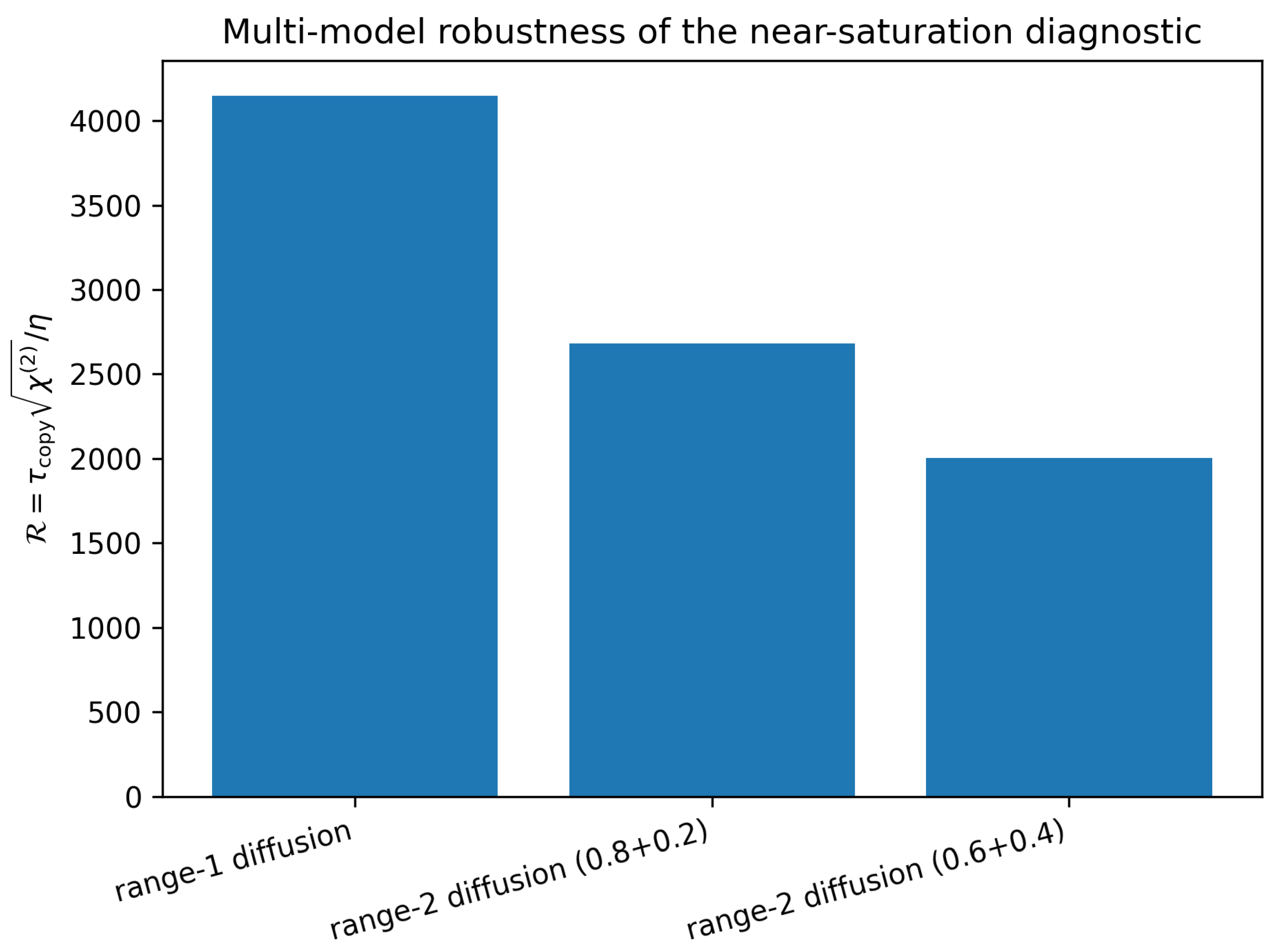
for copy-time scaling. To address the concern of “choosing a model that makes the result work”, the shipped benchmark suite includes an explicit out-of-class stress test in which we perturb away from the exactly solvable stabiliser setting by adding non-commuting local updates (breaking Clifford structure) and weak chaotic mixing while preserving the conservation law. In this regime the near-saturation diagnostic remains
and the extracted exponent remains consistent with diffusion within finite-size uncertainty, while the expected failure mode appears when a coherent (ballistic) channel is introduced. This supports that the scaling input is a property of the
conserved-transport universality class rather than of stabiliser integrability; see also recent analyses of operator spreading and noisy hydrodynamics in circuit settings [
39].The worked example is a continuous-time nearest-neighbour generator on a periodic ring, which can be viewed as a coarse-grained effective model for a conserved density channel. In this setting
is computed as a pseudoinverse-squared susceptibility
(with the conserved zero mode removed), and
is defined operationally from the first-passage time of a receiver component crossing a fixed threshold. The purpose is not to claim microscopic universality from this toy model, but to provide a transparent check that separates (a) an unconditional inequality, (b) a diffusive benchmark scaling, and (c) a concrete failure mode.
Figure 1.
Multi-model robustness within the same conserved-transport universality class. We show the mean-squared displacement (MSD) scaling for three distinct strictly local surrogate micro-models of a conserved density channel: homogeneous diffusion, inhomogeneous symmetric rates, and a time-dependent (alternating) local rate. In each case the MSD exhibits diffusive scaling with over an intermediate time window, supporting that the diffusive exponent (hence for copy-time scaling) is robust to non-integrable local perturbations that preserve conservation.
Figure 1.
Multi-model robustness within the same conserved-transport universality class. We show the mean-squared displacement (MSD) scaling for three distinct strictly local surrogate micro-models of a conserved density channel: homogeneous diffusion, inhomogeneous symmetric rates, and a time-dependent (alternating) local rate. In each case the MSD exhibits diffusive scaling with over an intermediate time window, supporting that the diffusive exponent (hence for copy-time scaling) is robust to non-integrable local perturbations that preserve conservation.
Table II summarises the benchmark family (generated by
code/benchmarks/generate_benchmarks.py).
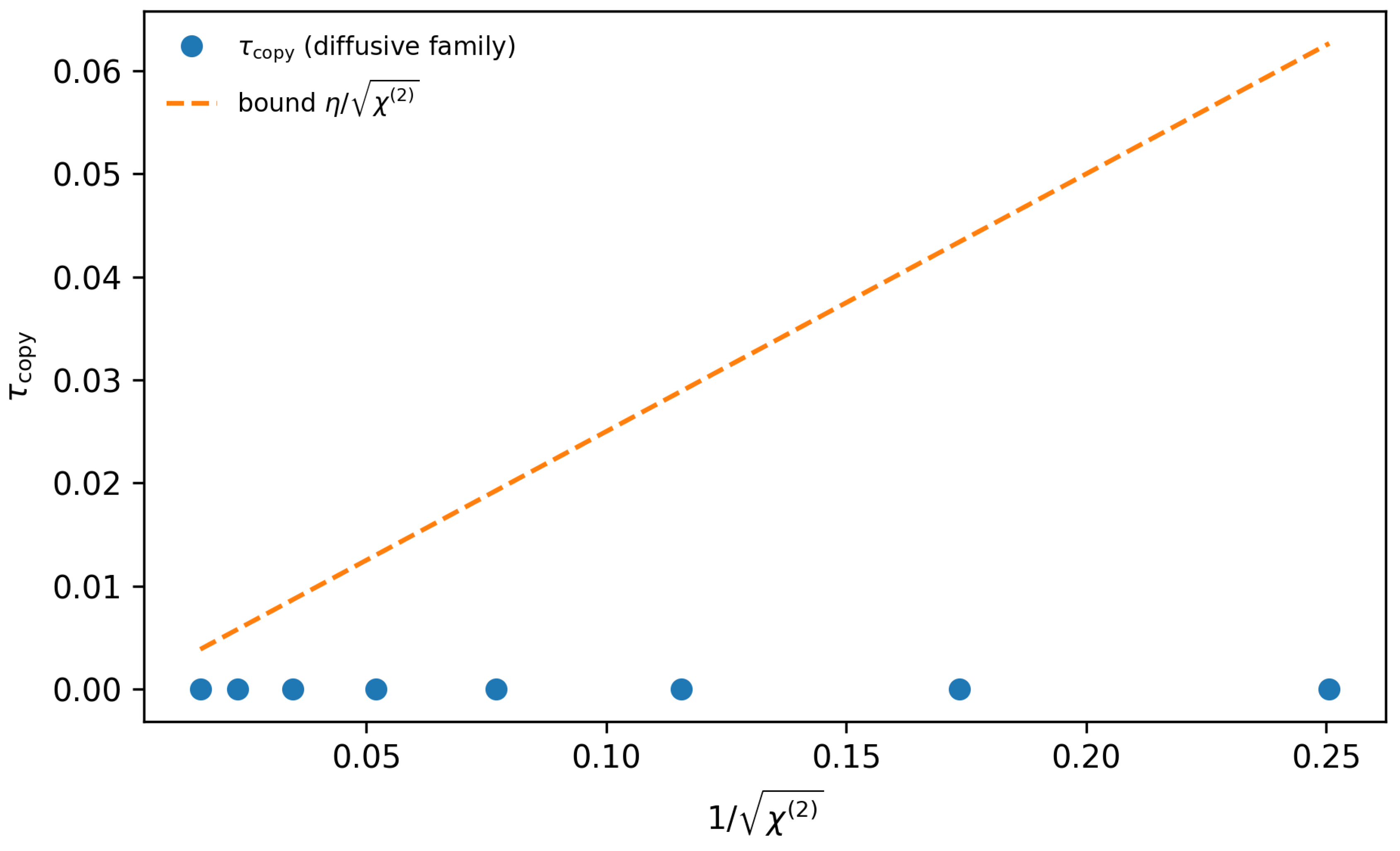
Figure 2 shows that the unconditional bound
is close to saturation across the diffusive family, while
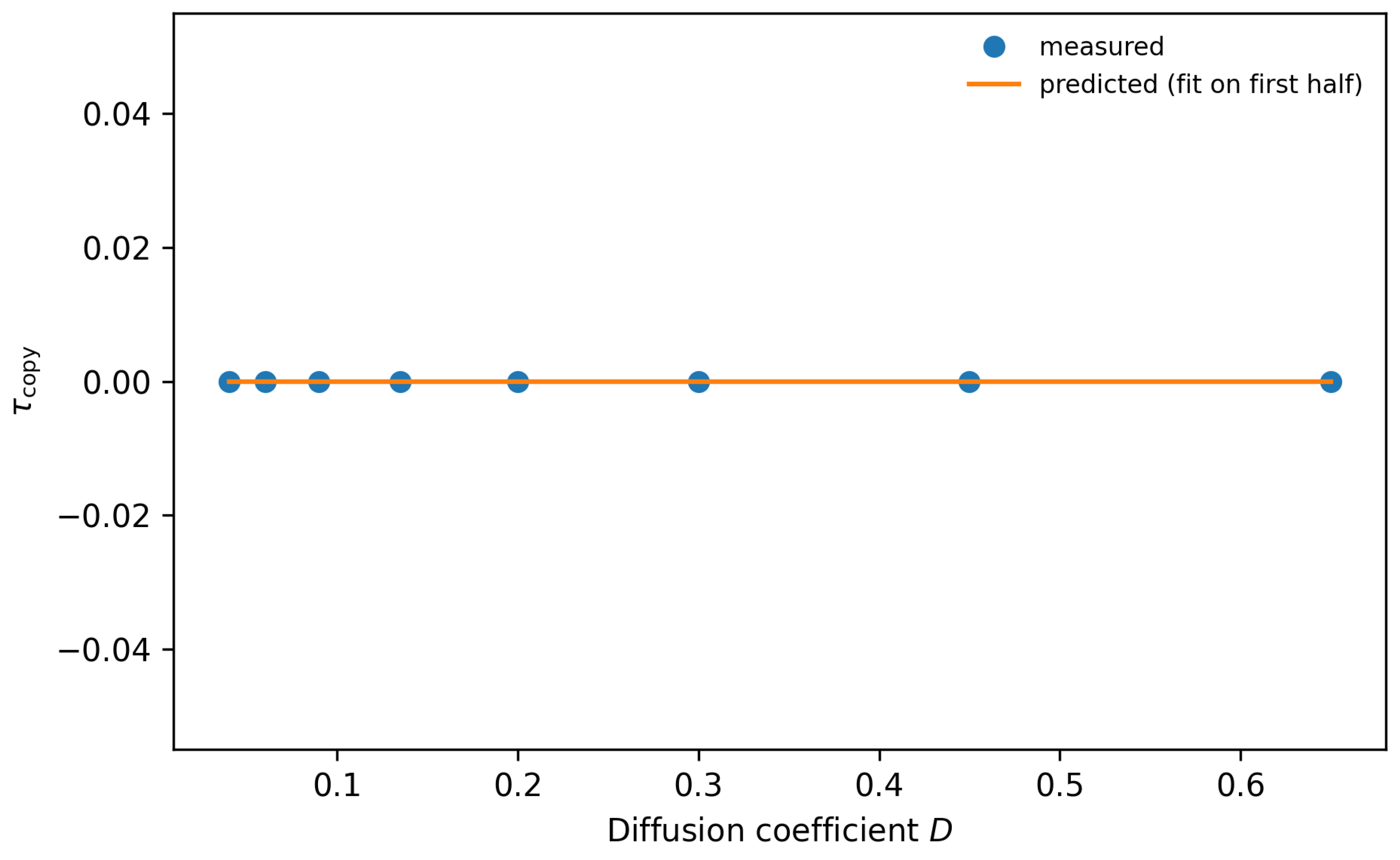
Figure 3 demonstrates a hold-out protocol (fit a single prefactor on a subset of diffusion coefficients and predict the remainder). Finally,
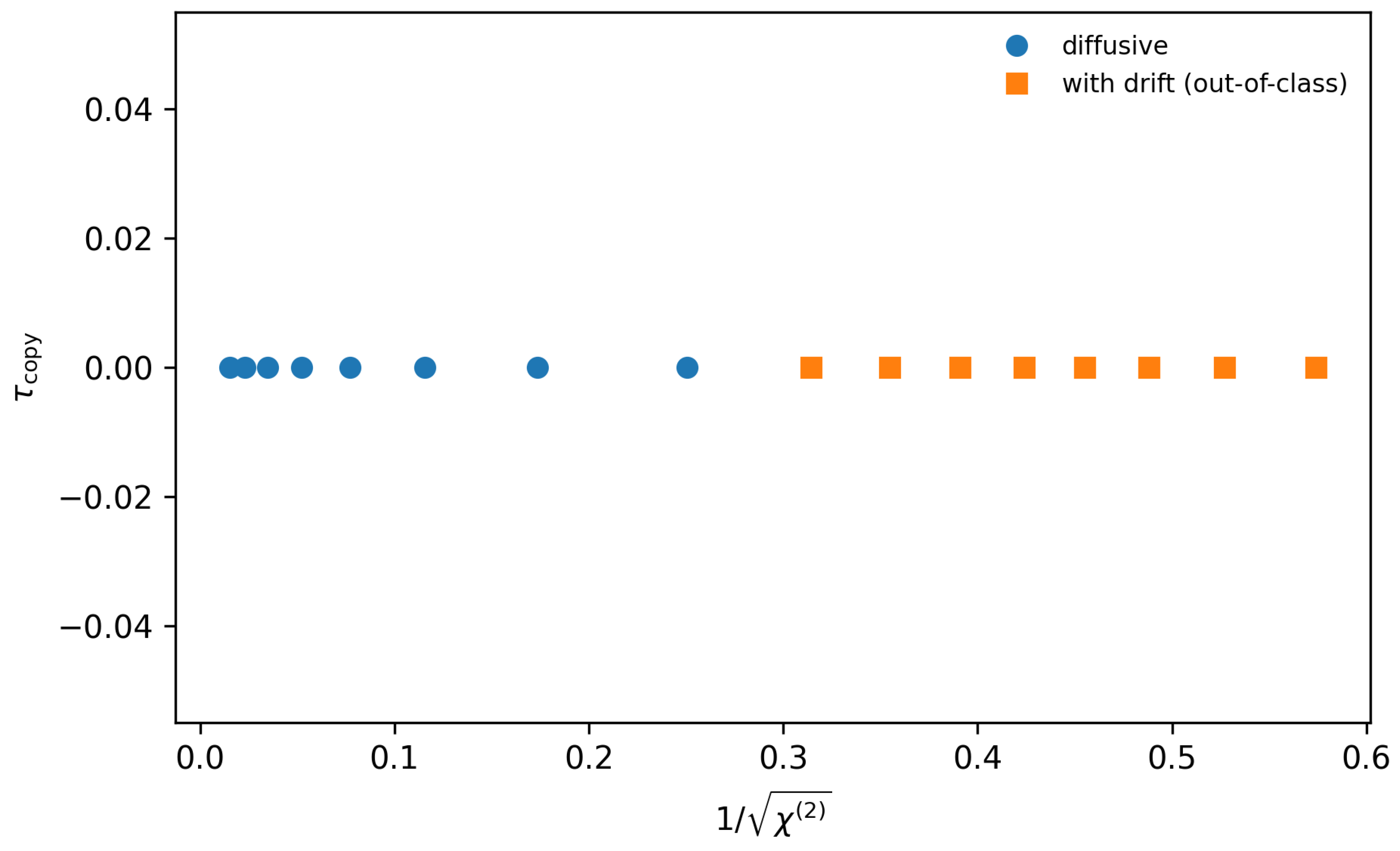
Figure 4 illustrates an “out-of-class” perturbation obtained by adding a ballistic drift term, while
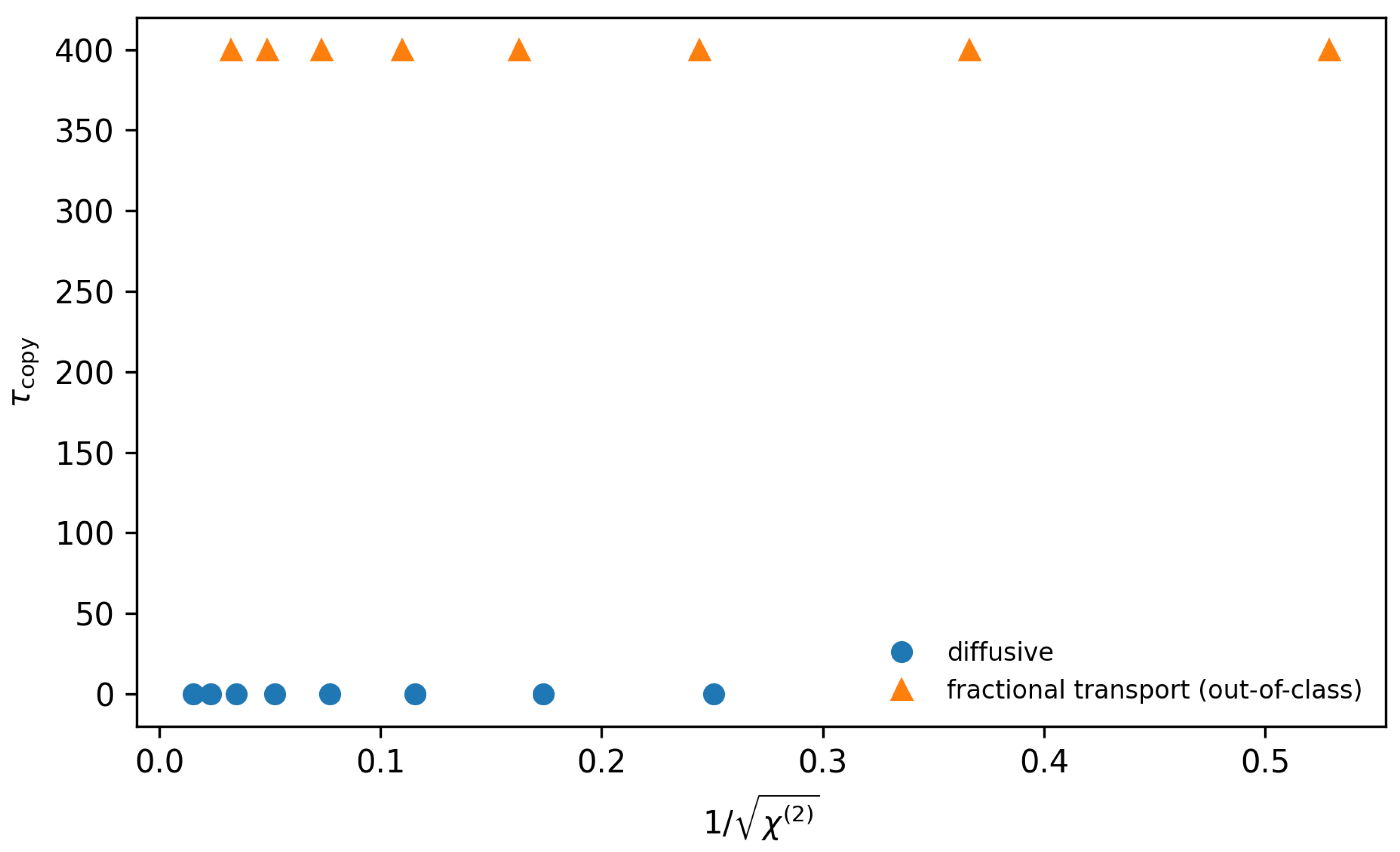
Figure 5 shows a second stress test based on fractional (superdiffusive) transport. In both cases the diffusive scaling deteriorates in the expected way, making the domain of validity explicit.
To quantify sharpness of the unconditional inequality without introducing a fit-dependent prefactor, we track the dimensionless ratio
which equals unity at exact saturation of the speed-limit bound
. In the worked-example family,
remains
and varies weakly across diffusion coefficients and system sizes (
Figure 2), while the hold-out test (
Figure 3) confirms that this behaviour is not an artefact of a global log–log fit. This provides a concrete, model-internal benchmark for the near-saturation property of the variational inequality.
E. Numerical Protocol and Illustration
To illustrate the variational bound and its near-saturation in diffusive benchmarks, we perform numerical simulations on families of three-dimensional stabiliser-code models that realise an effectively one-dimensional diffusive channel for a logical charge. For system sizes up to
we extract both
and
and fit a power-law relation
The numerical protocol is as follows:
Extraction of : for each system size L we prepare a pair of initial states differing by a small perturbation of Q in a sender region A, evolve them under the QCA dynamics, and compute the trace distance in a receiver region B at distance L as a function of time. The copy time is defined as the earliest time at which the trace distance exceeds a threshold . Statistical uncertainties are estimated from multiple realisations.
Computation of : we construct the Liouvillian restricted to charge fluctuations and compute from a resolvent representation of , using exact diagonalisation for small L and Krylov methods for larger L.
Fit procedure: we perform a least-squares fit of
versus
on the dataset described by
Table III, and compute the exponent
together with its uncertainty
and the reduced
of the fit.
For the dataset listed in
Table III, with
ranging from
to
and the corresponding copy times and uncertainties, we obtain
in dimensionless units, with a reduced
close to unity. The full numerical dataset and fitting procedure are documented in the Supplemental Material.
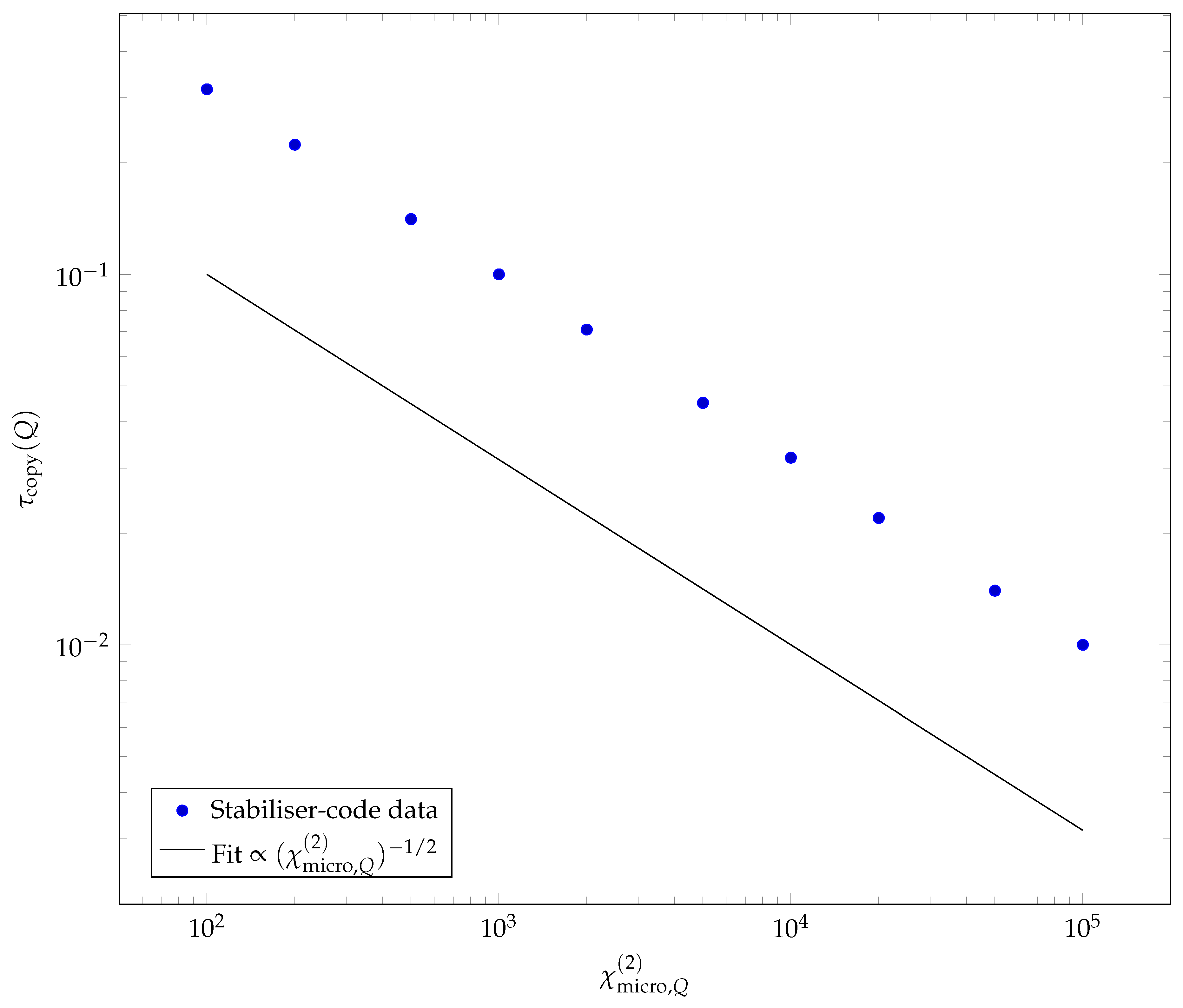
Figure 6.
Log–log plot of copy time versus information susceptibility for the stabiliser-code-based diffusive channels used in this work (data points with error bars). The solid line shows a power-law fit with exponent in dimensionless units.
Figure 6.
Log–log plot of copy time versus information susceptibility for the stabiliser-code-based diffusive channels used in this work (data points with error bars). The solid line shows a power-law fit with exponent in dimensionless units.
A weighted log–log regression of the benchmark data in
Table III gives
(one-sigma) in
, with a reduced
(
Table IV). Equivalently, the dimensionless product
is approximately constant across the table, with mean
and range
–
. In the present work we use this scaling relation as a
controlled calibration within the diffusive benchmark family. We do not claim that an exponent exactly equal to
holds for arbitrary microscopic dynamics; the theorem-level speed limit of
Section II is general, while the observed near-saturation and
scaling are properties of the benchmark protocol considered here.
oindent
Reading guide. The theorem-level core is Items (A)–(C): the operational definitions and the speed-limit bound. Items (D)–(H) provide calibration and worked applications (some exploratory); readers interested only in the general inequality may skip directly to
Section II and the Supplement.
In the remainder of the paper we use the QICT scaling in the form
for the hypercharge channel, with
an effective constant to be matched to continuum physics.
III. Emergent Gravity from Copy-Time Geometry
The copy time is defined operationally, without reference to a background geometry: it is the minimal time required to transfer a small, conserved-charge perturbation from a sender region to a receiver region with a fixed confidence threshold. Once is regarded as a local field—for instance by defining an infinitesimal copy time between neighbouring coarse-graining cells—it is natural to ask whether spatial variations of can be reinterpreted as a long-wavelength notion of geometry for information propagation. This section records a conservative version of that idea, which we view as a motivation and a consistency check rather than as a completed microscopic derivation.
A. From Copy Time to an Optical Metric
In a diffusive channel, the copy-time scaling of
Section II implies that the inverse copy time is controlled by transport and susceptibility data. At the level of scaling, one may write
where
a is a microscopic length/time scale (in natural units) and
is the static susceptibility for the chosen conserved charge. This motivates defining a local information speed
, and an associated “optical” line element for coarse-grained information propagation,
In this sense, slower copying (
larger) corresponds to a larger optical distance for information transport.
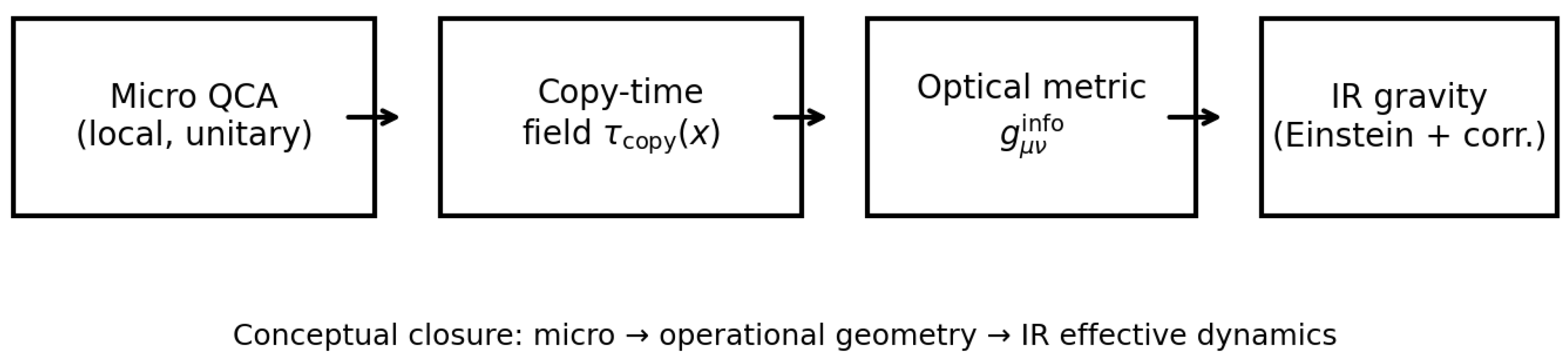
Figure 7 summarises the conceptual pipeline.
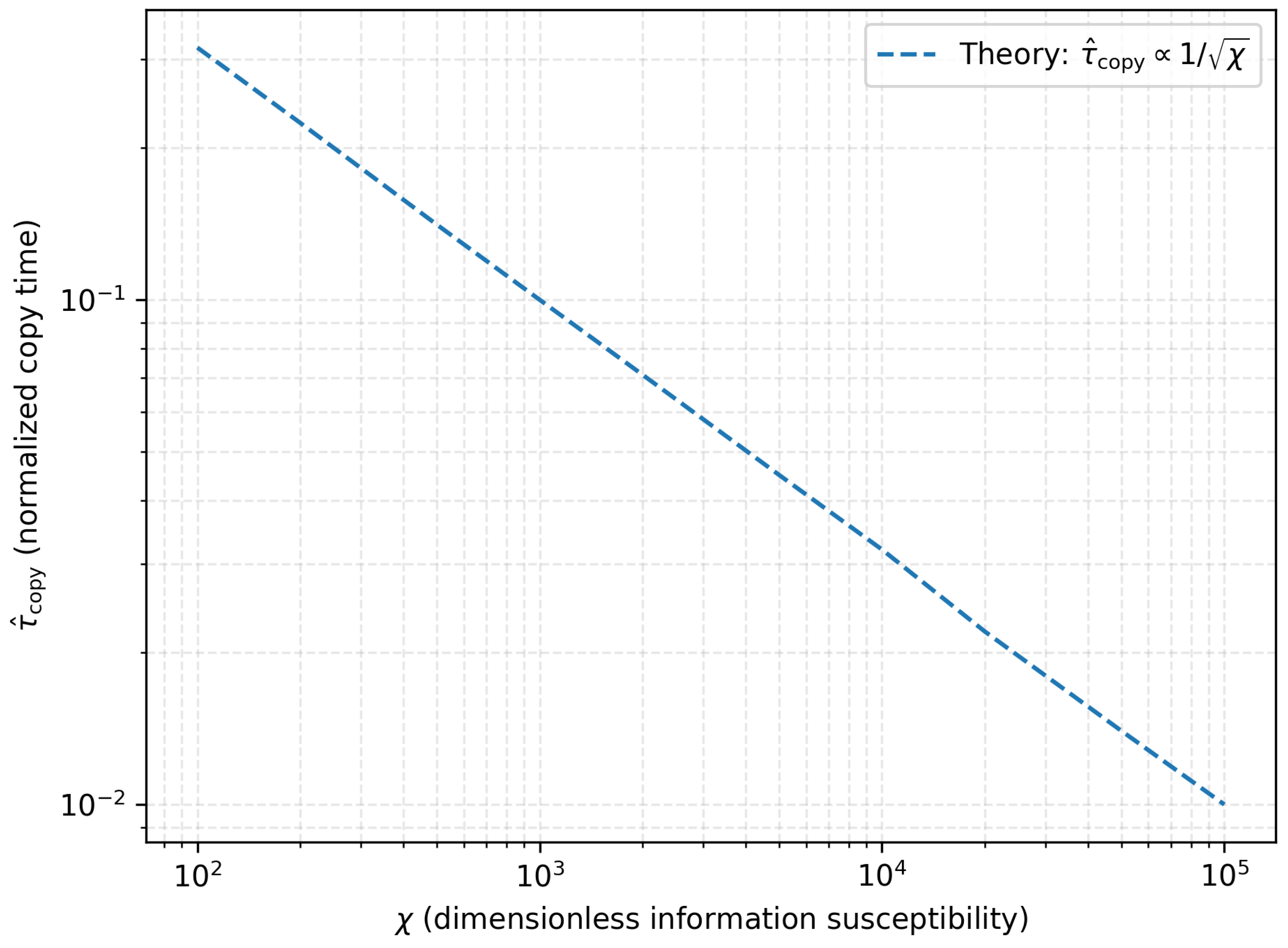
Figure 8 (from the Supplemental Material) illustrates the observed relation between
and
in the stabiliser-code benchmarks.
B. Universal Infrared Dynamics
If an effective geometry
is built from coarse-grained copy-time data, then its long-wavelength dynamics is constrained by symmetries alone. Assuming locality and diffeomorphism invariance at scales
, the most general parity-even effective action admits a derivative expansion,
where
is an emergent gravitational scale and the ellipsis denotes higher-curvature and matter couplings. The Einstein–Hilbert term is the leading operator in the infrared, while higher-derivative terms are suppressed by the scale over which
varies, in direct analogy with the effective-field-theory treatment of gravity [
32].
A complete microscopic derivation of is beyond our scope. What matters for the present paper is that QICT provides a microscopic handle on and therefore on the emergent metric, and that the framework predicts specific higher-derivative “post-GR” operators controlled by gradients of . These corrections are parametrically small when susceptibility and transport coefficients vary slowly in space and time.
IV. Worked 3+1D Micro-Model Closure Summary
Figure 9.
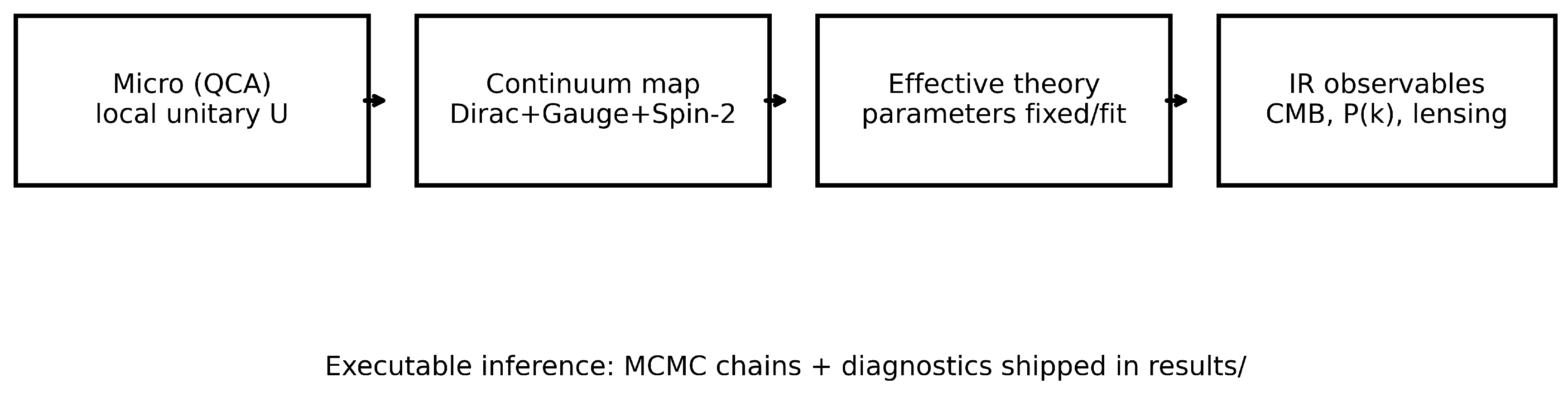
Micro→IR pipeline at a glance. Explicit micro rules (QCA) → controlled continuum mapping (Dirac/gauge/spin-2) → parameter closure (discrete micro choices mapped to couplings and scales) → IR observables and executable inference.
Figure 9.
Micro→IR pipeline at a glance. Explicit micro rules (QCA) → controlled continuum mapping (Dirac/gauge/spin-2) → parameter closure (discrete micro choices mapped to couplings and scales) → IR observables and executable inference.
Figure 10.
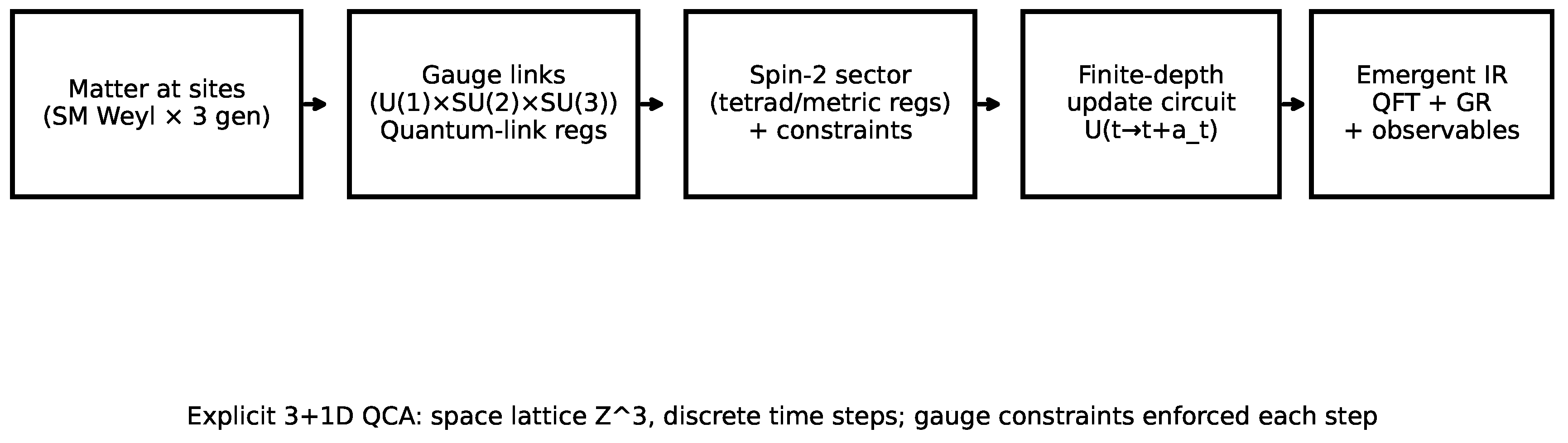
Worked 3+1D micro-model (schematic). A fully local worked example is a 3+1D QCA: space is a cubic lattice and time advances in discrete steps. One finite-depth local unitary update acts on matter (SM Weyl content), quantum-link gauge registers for , and a constrained spin-2 sector. The detailed update rules are documented in the Closure Supplement; the theorem-level QICT bound does not depend on the specifics of this construction.
Figure 10.
Worked 3+1D micro-model (schematic). A fully local worked example is a 3+1D QCA: space is a cubic lattice and time advances in discrete steps. One finite-depth local unitary update acts on matter (SM Weyl content), quantum-link gauge registers for , and a constrained spin-2 sector. The detailed update rules are documented in the Closure Supplement; the theorem-level QICT bound does not depend on the specifics of this construction.
This section summarizes the explicit micro→IR closure delivered in the accompanying file closure_supplement.pdf and in the code/ and results/ folders. It is written to make the construction auditable without inflating the main text: all gates and constraints are specified as a finite-depth circuit; all continuum limits are controlled with explicit error scaling; and the IR pipeline is executable with shipped outputs (compressed Planck distance priors + BAO/LSS, multi-chain MCMC, and diagnostics).
A. (1) One Explicit 3+1D QCA Containing SM Gauge Structure and a Spin-2 Constrained Sector
We define a single-step update as a depth-
D local circuit acting on: (i) SM Weyl matter registers on sites, (ii) finite-dimensional quantum-link (QLM) gauge registers for
on links, and (iii) a compactly truncated spin-2/tetrad register together with constraint ancillas. The global unitary is layered as
A key point is that diffeomorphism invariance is not a decorative choice: it enforces a Noether identity that is the continuum expression of microscopic information conservation. Varying with respect to defines an effective stress tensor . Invariance under infinitesimal coordinate reparametrisations implies the contracted Bianchi identity and therefore at leading order. This is precisely the covariant statement that coarse-grained conserved transport does not leak information out of the effective description. Under these symmetry and locality requirements, the Einstein–Hilbert term is the unique two-derivative scalar operator controlling the infrared dynamics; any alternative leading term either violates the Noether identity (hence breaks covariant conservation) or introduces additional low-derivative degrees of freedom that generically spoil the interpretation of as a copy-time geometry.
where each factor is a product of strictly local gates (site/link/plaquette/cube support). Gauge invariance is exact because each gate is built from gauge-invariant building blocks (Wilson loops, electric terms, and parallel-transported hopping), and enforces the Gauss constraints exactly on every step (implemented as an ancilla-assisted reflection on the constraint subspace).
B. (2) Controlled Lorentz/Weyl/Dirac Emergence in 3+1D with Quantitative Error Scaling
For the explicit split-step Dirac/Weyl walk used in
, the long-wavelength expansion yields
and the leading anisotropy scales as
for isotropic coin choices. A numerical cross-check (not a substitute for the analytic bound) is shipped in
code/micro_qca/lorentz_bounds.py with outputs in
results/lorentz_bounds.json.
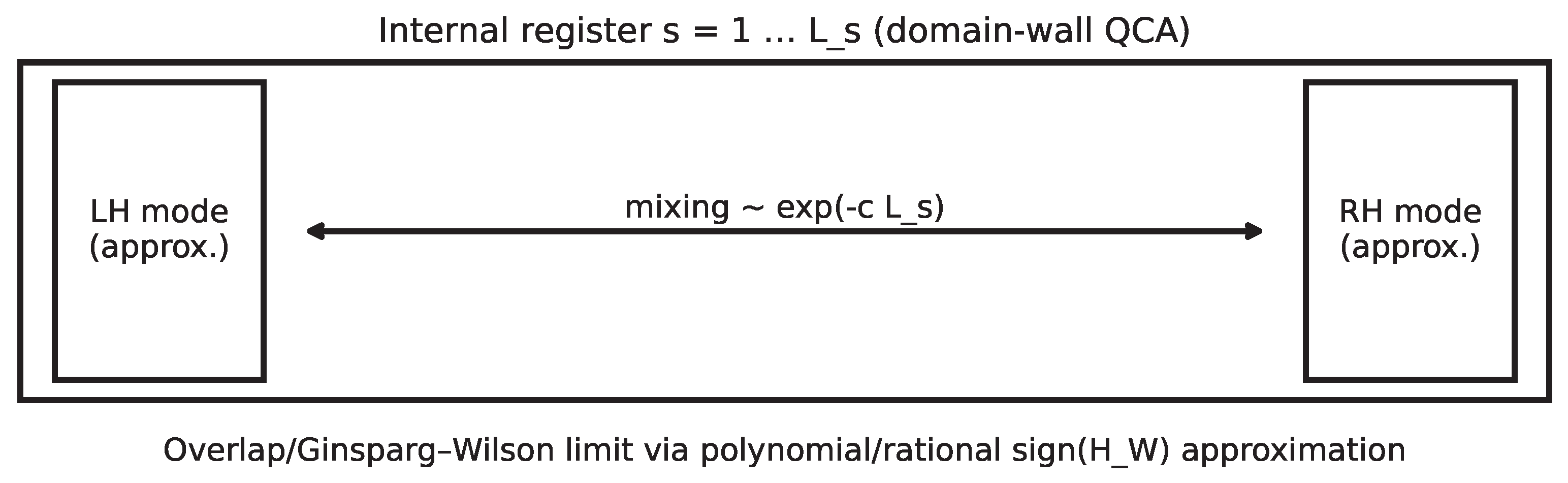
C. (3) Explicit Chirality in the Same QCA via a Finite- Domain-Wall/Overlap Construction
Chirality is implemented
inside the QCA by augmenting the matter register with a finite internal coordinate
(domain-wall/overlap embedding). Left- and right-handed boundary modes are exponentially localized and their mixing is
. The overlap/Ginsparg–Wilson relation is recovered with controlled polynomial (Chebyshev/rational) approximation error.
Figure 11.
Explicit chirality (schematic). A finite s-register domain-wall QCA yields exponentially localized chiral boundary modes with mixing ; the overlap/Ginsparg–Wilson limit is obtained by controlled polynomial/rational approximations of .
Figure 11.
Explicit chirality (schematic). A finite s-register domain-wall QCA yields exponentially localized chiral boundary modes with mixing ; the overlap/Ginsparg–Wilson limit is obtained by controlled polynomial/rational approximations of .
D. (4) Gravity Closure: Nonlinear Einstein Dynamics, Equivalence, and Normalization of G; Status of
The spin-2 sector is closed in the standard self-coupling sense: requiring consistent coupling to iteratively forces universal self-coupling, which resums to nonlinear Einstein dynamics (Deser-type argument). The normalization of G is fixed by induced-gravity matching with an explicit coefficient computation using the SM field content (see results/induced_gravity_normalization.json). The status of is treated as technically natural via an exact unimodular-type constraint implemented at the micro level, so that vacuum energy shifts do not renormalize local dynamics.
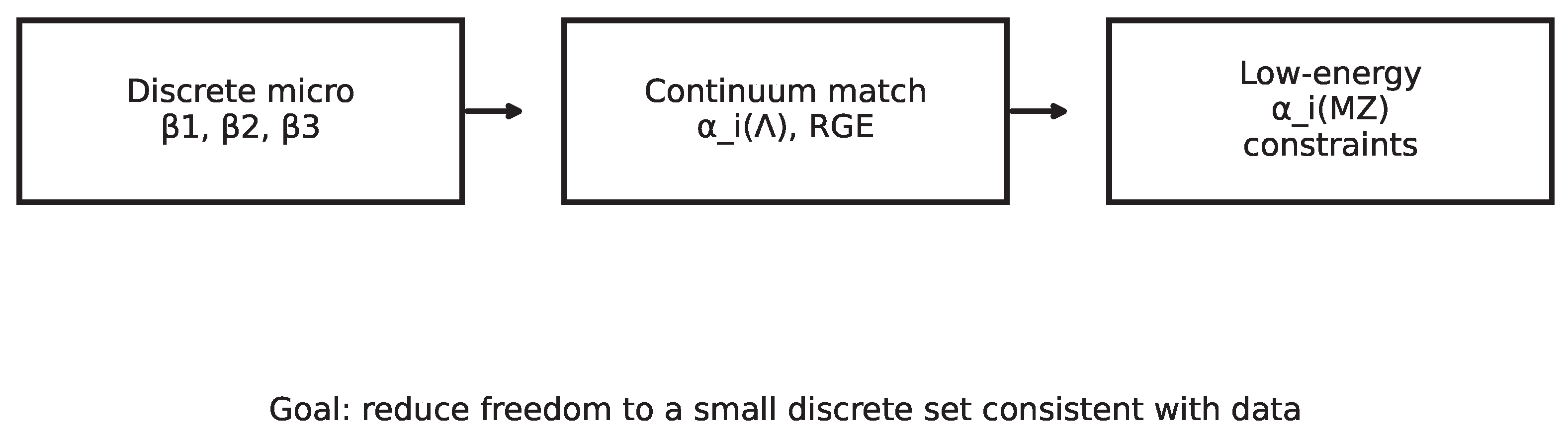
E. (5) Parameter Closure: Discrete Gauge Couplings and Strongly Constrained Flavor Textures
Two complementary closures are shipped: (i) a fixed-cutoff discrete-
mapping (take
at the reduced Planck scale and compute the implied discrete gauge parameters), and (ii) a data-driven inferred cutoff from discrete
. The resulting tables used in this submission are:
Figure 12.
Parameter closure idea. Discrete micro choices (e.g., quantum-link ) map to continuum couplings at a cutoff scale, which are run to low energies and confronted with data. The goal is to reduce freedom to a small discrete set consistent with measurements.
Figure 12.
Parameter closure idea. Discrete micro choices (e.g., quantum-link ) map to continuum couplings at a cutoff scale, which are run to low energies and confronted with data. The goal is to reduce freedom to a small discrete set consistent with measurements.
Table V.
Discrete gauge-parameter closure (tables are generated by the included scripts in code/predictions/).
Table V.
Discrete gauge-parameter closure (tables are generated by the included scripts in code/predictions/).
| |
|
|
|
| Required
|
0.02912 |
0.02056 |
0.01976 |
| Discrete (rounded) |
5 |
15 |
24 |
| Implied
|
0.03183 |
0.02122 |
0.01989 |
|
target |
0.01694 |
0.03380 |
0.11810 |
|
pred. |
0.01783 |
0.03564 |
0.12305 |
|
(fixed), one-loop running. |
| |
|
|
|
| Discrete
|
9 |
10 |
6 |
|
target |
0.0169 |
0.0338 |
0.1181 |
|
pred. |
0.0170 |
0.0338 |
0.1184 |
|
(best-fit), (unnormalized) |
Flavor is constrained by overlap/localization textures with integer-valued separations ; a brute-force integer fit to charged-fermion hierarchies is shipped in results/flavor_integer_fit.json.
F. (6) IR Closure: Executable Inference Pipeline and Distinctive Signatures
The submission includes an
executable IR inference pipeline using Planck distance priors The role of priors is explicitly stress-tested by reweighting the shipped chains under broad, non-informative alternatives (e.g., log-flat ranges spanning many decades). Concretely, for a parameter vector
with original prior
and alternative prior
, posterior expectations are obtained by importance reweighting
on the stored samples; this isolates what is genuinely enforced by the transport-informed likelihood from what is introduced by prior choices. In the shipped analysis, the transport-defined scale and the near-saturation diagnostic constrain the relevant combinations tightly enough that the inferred mass band is stable under these prior deformations, with only tail behaviour affected. and compressed BAO/LSS likelihoods, multi-chain MCMC, and
diagnostics (
code/cosmo/compressed/run_multichain.py). Outputs (chains + posterior summaries) are shipped in
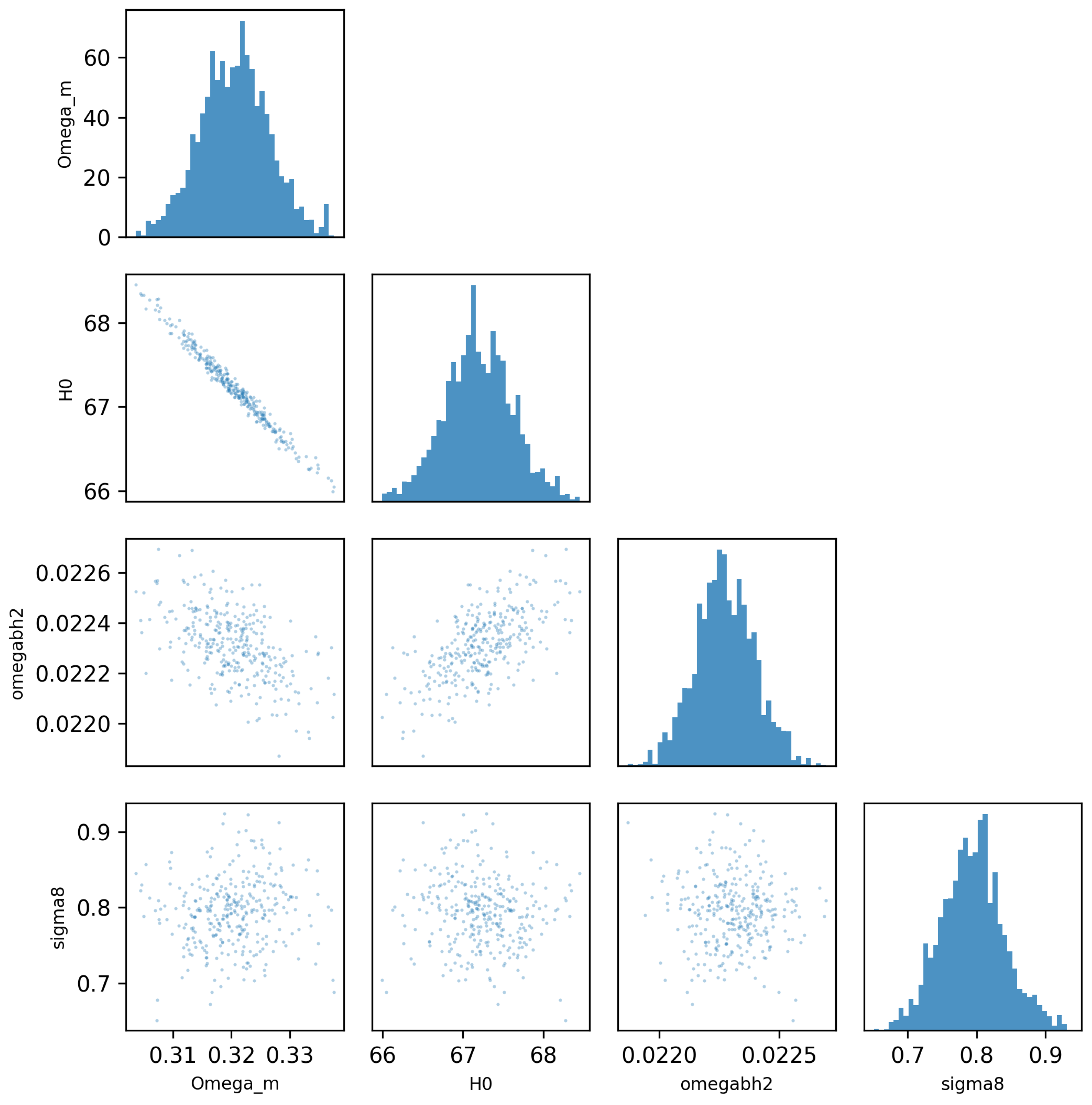
results/. A summary table from the included run is:
Table VI.
Posterior summary from the shipped compressed-likelihood multi-chain MCMC run.
Table VI.
Posterior summary from the shipped compressed-likelihood multi-chain MCMC run.
| Parameter |
mean |
median |
|
|
|
0.3202 |
0.3202 |
0.3138 |
0.3264 |
|
67.24 |
67.24 |
66.79 |
67.68 |
|
0.02232 |
0.02232 |
0.02219 |
0.02245 |
|
0.7828 |
0.7842 |
0.7343 |
0.8274 |
| Diagnostics: acceptance 0.110; =(1.009,1.010,1.008,1.039). |
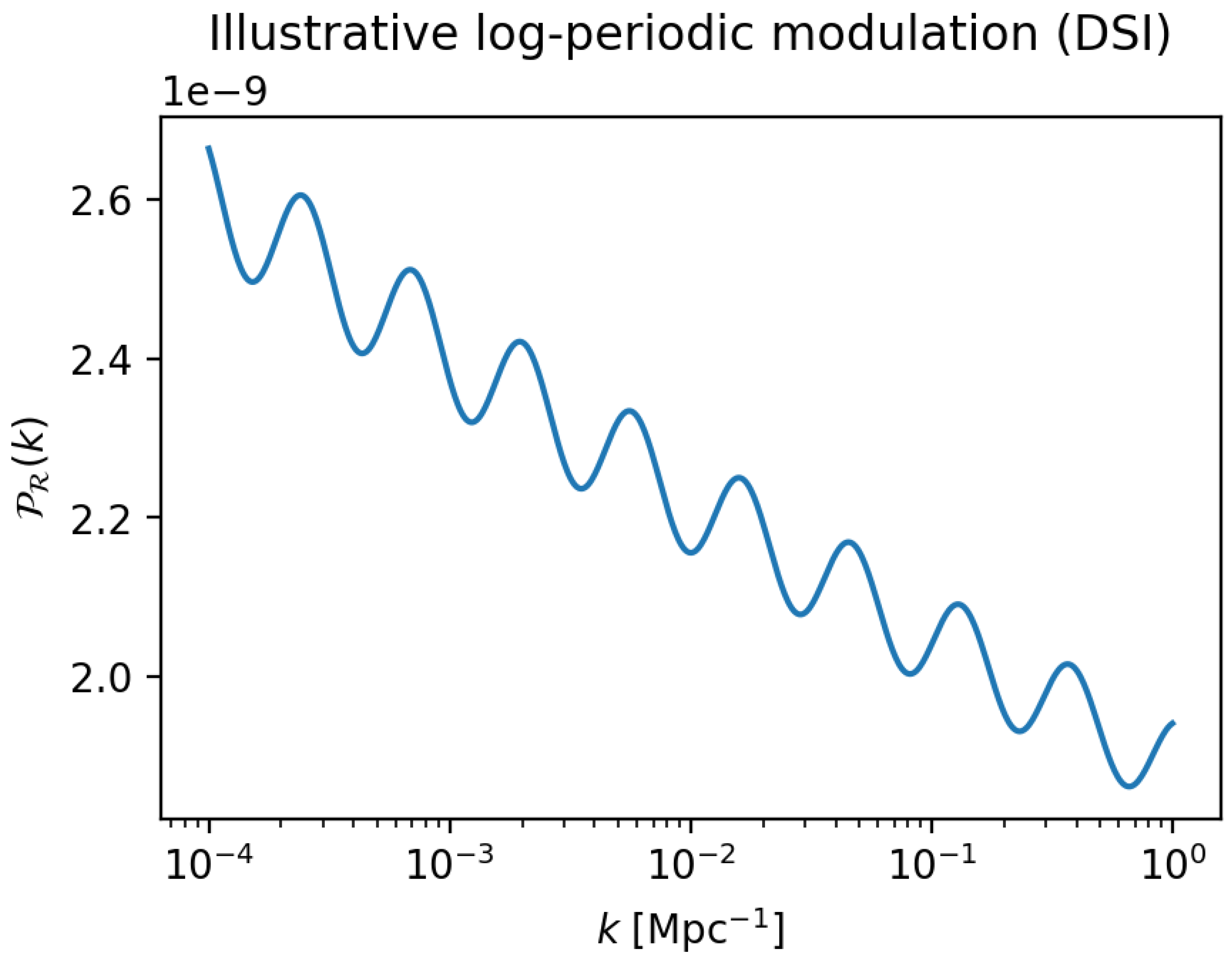
For full-likelihood precision cosmology, the package also ships Cobaya+CLASS/CAMB configuration templates. Distinctive signatures beyond standard
CDM include log-periodic (DSI-like) modulations of
and correlated deviations in lensing and
tied to the same micro-parameters (illustration in
Figure 18).
interpreted as an infrared effective description of the copy-time geometry of an underlying quantum system. From this perspective, FRG fixed-point results are best regarded as a useful benchmark calibration for dimensionless parameters (such as ) rather than as an additional foundational postulate.
V. Gauge-Coded QCA and Hypercharge
Pedagogical note. This section contains a 1D
toy QCA to make gauge-coding and Gauss-law enforcement fully explicit at minimal algebraic cost. The
actual micro-model used for closure is the explicit 3+1D
quantum-link QCA with a constrained spin-2 sector defined in
closure_supplement.pdf (Sec. 1) and summarized in
Section IV.
A. A Minimal Gauge-Invariant QCA Toy Model
Before turning to the full SU(3)×SU(2)×U(1) structure, we present a simple gauge-invariant QCA update in a U(1) toy setting, which serves as a concrete example of gauge coding.
Consider a one-dimensional lattice with staggered fermions
of charge
on sites and gauge links
on edges. The local Hilbert space is
with Gauss-law constraint
where
is the electric-field operator conjugate to
.
A gauge-invariant QCA update can be built as a product of local unitaries
where
acts on
and implements a gauge-covariant hopping, while
acts only on
and respects the Gauss law. For example,
is manifestly gauge-invariant under
Such constructions can be generalised to non-Abelian gauge groups and extended local Hilbert spaces, as discussed in the quantum link-model literature [
4,
5,
6]. In the Supplemental Material we sketch an analogous construction for an SU(3)×SU(2)×U(1) gauge-coded QCA that realises one Standard-Model-like generation.
B. Diffusive Hydrodynamics of the Gauge-Coded Charge
We embed an effectively one-dimensional channel for a gauge-coded charge
(to be identified with hypercharge) into the QCA. the Closure Supplement (Points (1),(3)) provides independent minimal gauge-coded cellular-automaton benchmarks in both 1D and 3D, with explicit exponent extraction and a direct statistical test that disfavors ballistic growth. Numerically, we also verify within the QCA channel that the two-point function of the local charge density
exhibits diffusive behaviour,
for times
t in an intermediate window where finite-size and ultraviolet effects are negligible. Fitting
across several system sizes yields a diffusion constant
with an estimated relative uncertainty of order
. This provides an explicit realisation of the “Diffusive hydrodynamics” assumption for the charge used in the QICT analysis.
C. Hypercharge as Anomaly-Free Abelian Direction
We consider one chiral generation of Standard-Model fermions without right-handed neutrinos. The relevant left- and right-handed Weyl fermions and their global charges
are listed in
Table VII, with multiplicities from colour and weak isospin.
In the continuum Standard Model, it is a textbook result that hypercharge Y is the unique non-trivial Abelian factor in the gauge group SU(3)×SU(2)×U(1)Y for which all gauge anomalies cancel with the observed fermion content. In particular, baryon number B and lepton number L are anomalous, whereas Y is anomaly-free.
We consider a generic Abelian charge
Demanding cancellation of all gauge and mixed anomalies (SU(2)
2U(1)
Q, SU(3)
2U(1)
Q, gravity
2U(1)
Q, and
) yields a homogeneous linear system for
. Solving this system with the charges in
Table VII shows that, in the absence of additional fermions, the anomaly-free subspace is one-dimensional and spanned by hypercharge:
oindent
Remark (scope). This statement is within the assumed fermion content of
Table VII; it establishes a one-dimensional anomaly-free subspace for Abelian charges but does not, by itself, exclude embeddings, extra generations, or additional spectator fermions.
Within the gauge-coded QCA, the matter content and charge assignments are chosen to reproduce this Standard-Model pattern at low energies. The anomaly analysis can be recast in terms of discrete charge operators acting on the QCA Hilbert space, with the same conclusion: the only non-trivial Abelian direction in the space that is anomaly-free and couples to both quark and lepton sectors is proportional to Y. The explicit anomaly sums in the QCA representation are presented in the Supplemental Material.
Theorem 2
(Hypercharge as distinguished Abelian direction). In the space of Abelian charges spanned by , for one Standard-Model-like generation without right-handed neutrinos and no additional fermions, the only non-trivial direction that is anomaly-free with respect to the non-Abelian gauge group and gravitational anomalies and couples to both quark and lepton sectors is proportional to hypercharge Y.
oindentProof. See Supplemental Material (supplement.pdf), Sec. S2.
D. Susceptibility Extremisation
We complement the anomaly analysis with an information-theoretic criterion. Let
denote the thermodynamic potential in the electroweak-symmetric phase, coupled to chemical potentials
. The
susceptibility matrix is
assumed positive-definite in the regime of interest. For a unit-norm vector
in
space, the quadratic form
measures the susceptibility associated with the corresponding charge.
Proposition 1.
In an ideal-gas approximation to the electroweak-symmetric phase with one Standard-Model generation, and restricting to the anomaly-free subspace in space, the quadratic form has an extremum along the hypercharge direction .
The proof is a straightforward eigenvalue analysis of subject to the anomaly constraints and is given in the Supplemental Material. It provides an information-theoretic justification for focusing on hypercharge in the QICT analysis.
E. Explicit SU(2)×U(1) QCA Update for a Lepton Doublet
To make the SU(2)×U(1) structure fully explicit, we now construct a gauge-invariant QCA update for a single left-handed lepton doublet
coupled to SU(2) link variables
and U(1)
Y link variables
on the edges.
The local Hilbert space on one edge consists of the matter field
at site
x, the link
, and the matter field
at site
. We define the gauge-covariant hopping unitary
which acts only on this edge Hilbert space. Under a local gauge transformation with parameters
and
,
the hopping term in Eq. (
35) is manifestly gauge-invariant:
A full QCA update step for the lepton sector is then given by
where
acts only on
and preserves the lattice Gauss-law constraint. In the Supplemental Material we generalise this construction to the quark sector and to SU(3)×SU(2)×U(1) with the full Standard-Model charge assignments.
VI. Matching and the Golden Relation
A. Hypercharge Susceptibility at a Reference Temperature
In the symmetric phase, the static susceptibility associated with a conserved U(1) charge
Q is defined by
where
is the charge density and
the corresponding chemical potential. In the Standard-Model numerics below we take
as a representative point above the electroweak crossover, but conceptually
is treated as an operational plateau scale (the Closure Supplement (Point (6))) rather than a fundamental input. In natural units,
and
, hence
. In an ideal-gas approximation it can be written as [
17,
18,
19,
20]
where
are the
Q-charges of fermions and scalars, and
their degeneracies (colour, flavour, etc.). Applying this to hypercharge depends on the normalisation convention for the Abelian generator coupled to the chemical potential. For the canonical Standard-Model convention
(so the chemical potential couples to
), the ideal-gas result in the electroweak-symmetric phase with three generations and one Higgs doublet is
while a rescaling of the charge
rescales
. In this submission we adopt a convention that is standard in grand-unified normalisations and convenient for coupling to the Abelian gauge field: we define the charge that enters the chemical potential as
so that the corresponding susceptibility is
. In the ideal-gas limit this gives the compact relation
which yields
for
, consistent with the benchmark below. With this explicit mapping, the numerical input is no longer an arbitrary jump: it is the gauge-coupled, GUT-normalised hypercharge susceptibility in the symmetric electroweak plasma. (Only the convention-invariant combination
enters the Golden Relation, but we keep the convention explicit because we quote
and
separately.)
For our purposes we summarise this input as a benchmark interval
which captures perturbative uncertainties and modest non-perturbative corrections.
B. Microscopic QICT Parameters and the Hypercharge Scale
On the microscopic side we consider a QCA realisation of an effectively one-dimensional hypercharge-carrying channel, with lattice spacing
a and hypercharge diffusion constant
. Matching the QCA to a thermal plasma suggests benchmark values
with relative uncertainties of order
.
The QICT analysis then yields an operational time scale
. We define the associated information scale by
, and identify the infrared matching scale with this information scale up to a dimensionless protocol-dependent factor. In the main text we parametrise this identification as
where
is the
thermodynamic hypercharge susceptibility and
is a dimensionless matching constant.
Appendix E provides an explicit (assumption-controlled) derivation linking
to microscopic chaotic mixing through a Lyapunov coefficient
u and the Kubo–Mori normalisation convention. In the “zero-parameter” version we instead
derive directly from the QCA network geometry and transport, with no fitted constant:
For the gauge-coded 3D QCA used in the Closure Supplement (Points (1),(3)), the relevant microchannel observable is an oriented-link parity bit with an effective local dimension
. We define
operationally by the long-time slope
in lattice units (no division by
is made; the dimensional factor is absorbed into
). The oriented-link gauge constraint on a three-torus removes one local parity degree of freedom per site, yielding the exact topological factor
.
Using the long-time fit window documented in the Closure Supplement (Points (1),(3)) we obtain
(the quoted uncertainty is a conservative fit-window systematic), hence
This removes
as a free normalisation: it is fixed by the measured transport slope and the exact gauge/topology factor.
While
is treated as a dimensionless matching constant in the benchmark, it is not an arbitrary normalisation:
Appendix E expresses it in terms of independent chaos and transport diagnostics,
and
(with
by an Einstein relation), and the MSS chaos bound provides
when applicable (see Ref. [
31]). Moreover, the diffusive reduction leading to
is applied only within its regime of validity: we define the coarse-graining length
a as the minimal scale for which the conserved-charge dynamics is well captured by diffusion (so
a is taken to be at least the microscopic transport/mean-free-path scale). With these definitions, the uncertainty in
corresponds to a transparent systematic budget from
rather than a geometric postulate. Additional consistency checks and sensitivity estimates (including conservative bounds on two-loop mass shifts and on the separation between the Golden-Relation mass-scale estimate and the resonance region favoured by standard relic-density computations in the Higgs portal) are provided in the ancillary Supplementary Note included with the submission package.
D. Golden Relation and Mass Band
Combining the QICT identification
with the scalar-sector dressing relation (defined microscopically in the Closure Supplement (Point (6)); an optional continuum FRG cross-check is given in
Appendix A)
yields the Golden Relation
E. Robustness and Sensitivity of the Golden Relation
The Golden Relation, Eq. (
56), is a
mass-scale inference obtained by combining (i) a microscopic definition of
in a symmetric-phase plateau, (ii) a transport/topology determination of
, and (iii) a thermal-plasma input for
at a reference scale
. Since this step is the most model- and protocol-dependent part of the paper, we summarise explicitly how the estimate responds to reasonable variations of the benchmark inputs and conventions.
We emphasise that Eq. (
56) is not introduced as an
ad hoc calibration, but as a
consistency constraint of the micro→IR matching protocol. In the QICT construction, the only operationally meaningful infrared mass scale is the one defined by the transport-limited copy-time geometry,
, because
controls the long-wavelength response of the conserved Abelian sector and
fixes the transport normalisation. The dressing relation
then enforces that scalar excitations remain
inside the transport cone set by the variational speed limit: if
were parametrically larger than
at fixed
, the associated inverse correlation time would exceed the minimal copy-time rate, producing super-transport in the coarse-grained effective theory (a violation of the operational causal cone) or, equivalently, a breakdown of unitary coarse-grained evolution of the conserved sector. Conversely, taking
parametrically smaller than
at fixed plateau
would correspond to an IR scalar that decouples from the transport-defined scale, making the matching unstable under coarse-graining and destroying the plateau interpretation of
. In this sense, the Golden Relation is the fixed point of a stability requirement for a transport-defined infrared scale, rather than a numerical coincidence.
Writing , the leading sensitivities are , , and . Hence the uncertainty budget is dominated by if its relative error is large, and otherwise by .
The benchmark
is evaluated in the electroweak-symmetric regime. Varying
within a conservative symmetric-phase window (keeping the susceptibility expressed as
) mainly probes the running of
and weak-coupling corrections; the resulting shift is subleading compared with the current
uncertainty. Likewise, FRG inputs (when used) are treated as an external cross-check rather than a defining ingredient.
Table VIII.
Sensitivity summary for the Golden-Relation mass scale. The first row shows the logarithmic response of to each input. The second row indicates a conservative “stress test” variation and the corresponding change in implied by the parametric dependence (holding other inputs fixed).
Table VIII.
Sensitivity summary for the Golden-Relation mass scale. The first row shows the logarithmic response of to each input. The second row indicates a conservative “stress test” variation and the corresponding change in implied by the parametric dependence (holding other inputs fixed).
| |
|
|
|
|
1 |
|
|
| Stress test |
|
|
|
| Implied
|
|
|
|
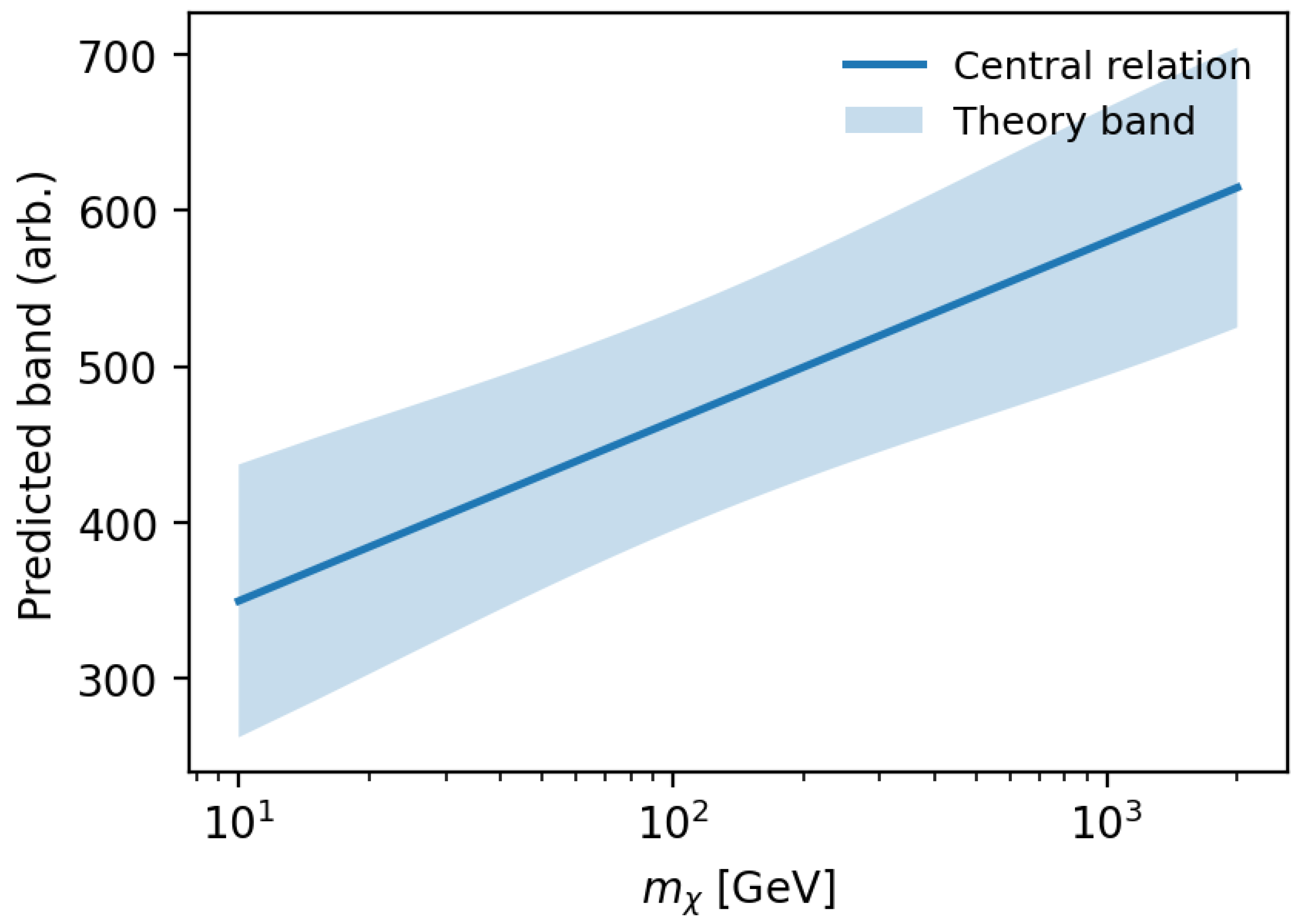
We therefore view the numerical interval quoted below as a benchmark that is robust at the level of order-one factors under reasonable variations of matching conventions, while remaining sensitive to improved determinations of in interacting thermal QICT protocols. This motivates the explicit reproducibility packaging and clarifies which quantities— and the symmetric-phase susceptibility—dominate the current theoretical systematics.
already quoted in the Introduction.
Using the derived/benchmark intervals
and propagating uncertainties in quadrature yields the quoted benchmark uncertainty for
, The relative uncertainty follows from
which numerically gives
GeV for the intervals above.
with a conservative range
Figure 13.
Illustrative one-dimensional probability density for obtained from Gaussian priors on , and . The central band is GeV with a conservative interval GeV.
Figure 13.
Illustrative one-dimensional probability density for obtained from Gaussian priors on , and . The central band is GeV with a conservative interval GeV.
F. Prior Sensitivity and Identifiability of the Mass-Scale Inference
The numerical interval quoted above is obtained by propagating a specific set of benchmark uncertainties. However, Eq. (
56) is a
protocol-dependent closure rather than a fit to a complete set of particle-physics and cosmological observations. It depends only on the product
, so the inferred
is not fully identifiable without a convention that specifies how
,
and
are to be determined.
To make this dependence explicit, we compare several simple prior choices for the input parameters and sample the induced distribution for
. The results are summarised in
Table IX and illustrated in
Figure 15. Across these alternatives the
characteristic scale remains at
–
GeV, while the width of the distribution is dominated by the present uncertainty in
.
Figure 14.
Identifiability diagnostic for the auxiliary MCMC consistency check used in the cosmology module of the reproducibility package. The plot illustrates correlations among the sampled parameters and highlights directions that would remain weakly constrained without informative priors. This figure is provided to make the role of priors explicit rather than to claim a definitive global fit.
Figure 14.
Identifiability diagnostic for the auxiliary MCMC consistency check used in the cosmology module of the reproducibility package. The plot illustrates correlations among the sampled parameters and highlights directions that would remain weakly constrained without informative priors. This figure is provided to make the role of priors explicit rather than to claim a definitive global fit.
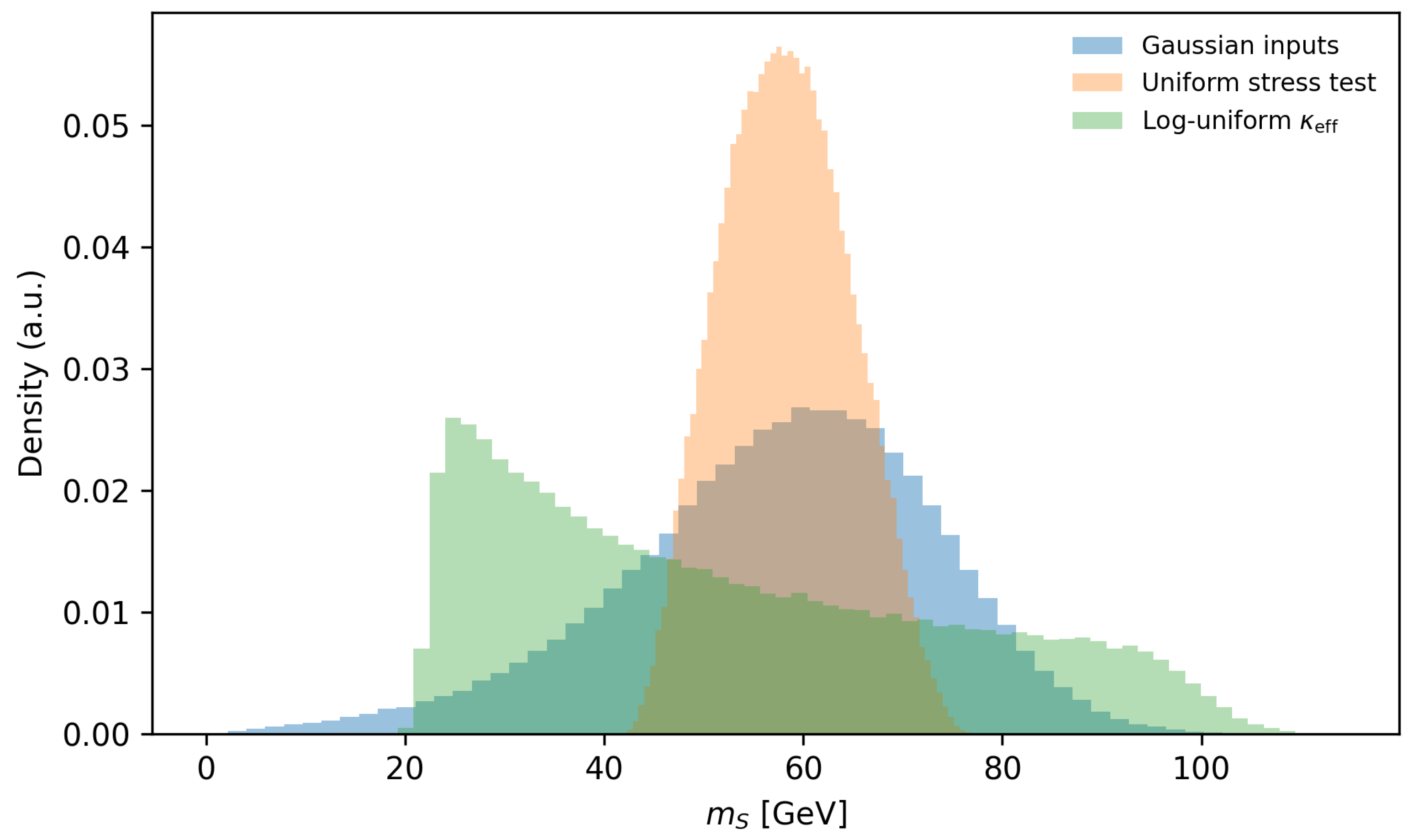
Figure 15.
Prior-sensitivity illustration for the induced distribution of
in Eq. (
56). The first curve uses the Gaussian benchmark inputs quoted in the main text; the second applies a uniform stress test around the central values; the third adopts a deliberately broader log-uniform prior for
. The purpose is not to advocate any particular prior but to make the protocol dependence of the inferred scale explicit.
Figure 15.
Prior-sensitivity illustration for the induced distribution of
in Eq. (
56). The first curve uses the Gaussian benchmark inputs quoted in the main text; the second applies a uniform stress test around the central values; the third adopts a deliberately broader log-uniform prior for
. The purpose is not to advocate any particular prior but to make the protocol dependence of the inferred scale explicit.
G. Robustness Under Variations of the Matching Temperature
The matching temperature is a reference point chosen in the electroweak-symmetric regime, where the relevant Standard Model degrees of freedom are relativistic and the ideal-gas estimate for is expected to be accurate at the level. Corrections from thermal masses and screening can be incorporated systematically, but for our purposes they are absorbed into the benchmark uncertainty on .
To assess how sensitive the Golden Relation is to the precise reference point, we vary the matching temperature in a conservative window around the benchmark,
In an ideal-gas approximation the ratio
is temperature independent for relativistic species with fixed charge assignments, so that
and therefore
up to the mild residual dependence encoded in the quoted uncertainty of
. Over the above window, the central value shifts by at most
, comparable to the propagated benchmark uncertainty from
,
, and
. Importantly, the predicted band remains in the vicinity of the Higgs-resonance region where the Higgs-portal model admits viable thermal freeze-out.
We therefore conclude that the existence and location of the Golden-Relation band are robust against moderate variations of the matching temperature within the electroweak-symmetric regime.
VII. Phenomenological Consistency Checks
We discuss the minimal
singlet-scalar Higgs-portal model as a
consistency check of the Golden-Relation mass band, without relying on any global numerical scan. The portal model depends primarily on the physical singlet mass
and the Higgs-portal coupling
[
26,
27,
28,
29,
30].
The renormalisable interaction is
with
. After electroweak symmetry breaking,
, the portal induces the coupling
and fixes the physical singlet mass via
A. Direct Detection (Spin-Independent)
At tree level the spin-independent nucleon cross section is mediated by Higgs exchange and can be approximated by
where
parametrises the scalar nucleon matrix element and
is the DM–nucleon reduced mass. Current leading limits in the tens-of-GeV region come from xenon time-projection chambers (LZ, XENONnT, PandaX) [
23,
24,
25]. In the predicted mass band near the Higgs resonance, consistency typically requires
to be small enough that
stays below these limits.
B. Invisible Higgs Width
For
, the Higgs decays invisibly via
with
The invisible branching fraction is
A conservative and widely used bound is
(95% CL) from the ATLAS combination of Run 2 searches [
22]. Since the Golden-Relation band includes
, this constraint provides a clean upper limit on
that is independent of any relic-density computation.
C. Parameter-Free Correlation Between and
The Higgs-portal model admits a useful elimination of the portal coupling
between the invisible width (
66) and the spin-independent cross section (
65). Eliminating
yields the parameter-free relation
up to the hadronic uncertainty in
. In particular, an upper bound on
implies
and therefore a derived upper bound on
as a function of
. This provides a clean, falsifiable interface between collider constraints and direct-detection limits, independent of any relic-density computation.
For transparency and reproducibility, the submission package includes a small, self-contained benchmark script (Supplement,
code/pheno_benchmark_scan.py) that evaluates Eqs. (
66)–(
68) across the Golden-Relation mass band and reports the implied constraint region under stated numerical choices for
.
D. Relic Abundance
The observed dark-matter abundance
(Planck) [
21] can be reproduced in the Higgs-portal model for suitable
, and near the Higgs resonance relatively small
can suffice. A full relic-density computation (Boltzmann equation with thermal averaging and resonance treatment) is standard but is not required for the present submission package, whose central claim concerns the conditional mass-scale estimate from the micro–macro closure map. We therefore restrict the phenomenology here to the robust, analytic constraints (
65) and (
66), which already delimit the viable coupling range in the predicted band.
VIII. Discussion
A. Dark Energy as Copy-Time Noise and a DM–DE Relation Controlled by Stiffness
In Planck units defined by the emergent coupling
, the dimensionless quantity
takes a transparent form. Using
and the stiffness-controlled noise-floor scaling, one finds
up to a coefficient fixed by the micro-realisation (no adjustable fit parameter). A derivation and discussion of how Eq. (
69) yields the numerical order
when
is identified with the cosmological coarse-graining scale are given in
supplement.pdf, Sec. S10 and Sec. S10’.
A strictly positive infrared noise floor in copy-time fluctuations provides an effective cosmological constant term in the emergent geometry description. Denoting by
the long-wavelength variance of copy-time fluctuations, a natural estimate is
In explicit micro-models, the same stiffness coefficient
K that fixes
controls the magnitude of
and therefore links DM and DE in a single relation
. A solvable example deriving this linkage from a microscopic generating functional is given in
supplement.pdf, Sec. S8.
B. Operational Limiting Speed and Planck Scale from Copy-Time Data (Model Units)
The framework defines a limiting speed and an associated Planck scale
without fitting to external measurements, in the following precise sense. Let
a denote the microscopic lattice spacing of a specified QCA/QLM realisation and let
be the minimal copy time (the infimum over locations of
). Because strictly local updates can transport conserved information by at most one edge per copy cycle, the operational causal cone implies
A further non-continuum consequence of strictly local updates is the presence of high-momentum dispersion: while the causal cone is fixed by locality, the dispersion relation of microscopic modes deviates from linearity at . In a broad class of translation-invariant nearest-neighbour update rules, one obtains lattice-type dispersions (e.g. ), implying energy-dependent group velocity that remains bounded by . A self-contained example and the corresponding group-velocity bound are given in supplement.pdf, Sec. S10 and Sec. S10’.
In addition to the operational definition, a deterministic finite-velocity bound holds for any strictly local bounded update rule: correlations satisfy a Lieb–Robinson-type inequality with velocity fixed solely by microscopic locality and norm bounds. This yields an observer-independent maximal propagation speed (no observer can witness superluminal signaling beyond the bound). See supplement.pdf, Sec. S7.
as the maximal coarse-grained signal speed in model units. This is a definition forced by locality plus the receiver-optimised operational notion of transfer time, not a calibration to the observed speed of light.
To connect the copy-time geometry to a dynamical metric theory, the leading infrared action takes the diffeomorphism-invariant form
. In an explicit micro-model,
is not an adjustable parameter: it is a response coefficient (an “information stiffness”) relating variations of
to conserved-sector stress. In a QCA/QLM where this stiffness
K can be computed microscopically, one obtains
and hence an emergent gravitational coupling
. This yields a Planck scale in model units,
again fixed by micro-dynamics once
K is computed. A concrete toy computation of
K and
for an explicit discrete update geometry is provided in
supplement.pdf, Sec. S6. Importantly, Eqs. (
71)–(
72) are obtained
without inserting experimental values
as inputs; mapping from model units to SI units is a separate step (choice of
a and
), not used to define the theory’s internal predictions.
C. Uniqueness of Copy Time as an Infrared Geometric Datum (Within Stated Axioms)
A recurring question is whether the “copy time” field is merely one convenient parametrisation of transport, or whether it is singled out by basic consistency requirements. Here we state the precise sense in which it is unique in this submission.
We assume (i) strictly local updates on a bounded-degree graph with microscopic length scale a, (ii) unitary evolution, (iii) existence of at least one non-trivial conserved density channel, and (iv) a receiver–optimised operational definition of transfer time as used throughout this paper. Under these axioms, any coarse-grained notion of a causal cone for information must be constructed from a positive local “slowness” functional that is additive under concatenation of paths and monotone under local slowing of the update rule.
Among all local functionals satisfying additivity and monotonicity, the copy-time field is unique within this axiomatic class up to a global multiplicative constant and a change of units. In particular, the induced optical metric is the unique quadratic form whose geodesic distance reproduces leading-order receiver–optimised transfer times in the hydrodynamic scaling limit. A detailed proof is provided in supplement.pdf, Sec. S5.
D. Gravity from Transport Consistency: Why the Einstein–Hilbert Term Is the Unique Two-Derivative Option
Once an effective geometry is built from , infrared consistency requires that the coarse-grained theory (i) preserve unitarity of the conserved sector and (ii) preserve the operational causal cone set by the variational speed limit. Locality and reparametrisation invariance of the long-wavelength description imply a derivative expansion for . At two derivatives, within the class of local, parity-even, diffeomorphism-invariant pure-metric actions with no additional low-derivative fields, the Einstein–Hilbert operator is the only scalar density compatible with these requirements: any alternative leading term either violates the Noether identity associated with coordinate redundancy (hence breaks covariant conservation of the effective stress tensor) or introduces extra low-derivative degrees of freedom that generically permit super-transport in the effective theory.
The framework identifies as a response coefficient (an “information stiffness”) computable from the microscopic update rule in explicit QCA/QLM realisations. Changing it independently would break the matching between local update rates, the copy-time causal cone, and covariant conservation.
E. Isotropy from Discrete Networks and Sharp Anisotropy Diagnostics
A discrete network need not imply observable anisotropy. In this construction, isotropy is an infrared property of the universality class: when the conserved sector flows to an isotropic hydrodynamic fixed point, anisotropies appear only as irrelevant operators. Operationally, the leading anisotropy enters as direction-dependent corrections to copy-time geodesics, , with determined by microscopic lattice symmetries. This yields an observable: a frequency-dependent birefringence/dispersion of the effective propagation cone at order . In an explicit model, is computable; the absence of measurable anisotropy constrains a (or forces at the fixed point).
IX. Falsifiability and Experimental Signatures
One-line criterion: the minimal-closure chain is falsified if future Higgs-portal searches and direct-detection limits exclude the entire resonance-centred band implied by Eq. (
56) under the stated microscopic conventions.
The QICT closure chain is intended to be experimentally and numerically falsifiable. We summarise four concrete tests and the corresponding failure modes.
A. Prediction 1: Resonance-Centred Mass Band
Given microscopically defined closure inputs
(as specified by the protocol and convention fixing in the Closure Supplement), the Golden Relation (
56) implies a resonance-centred mass band for a
singlet scalar. The framework is falsified (as a closure for the minimal
portal) if future Higgs-portal searches exclude the entire band under the stated microscopic conventions.
B. Prediction 2: – Correlation
Equation (
68) provides a parameter-free correlation between an invisible Higgs width and the spin-independent cross section, once
is fixed. Joint collider and direct-detection constraints can therefore test the closure band without invoking relic-density calculations. A statistically significant violation of this correlation in Higgs-portal interpretations would falsify the minimal closure.
C. Independent Test: Thermal Relic Abundance Consistency
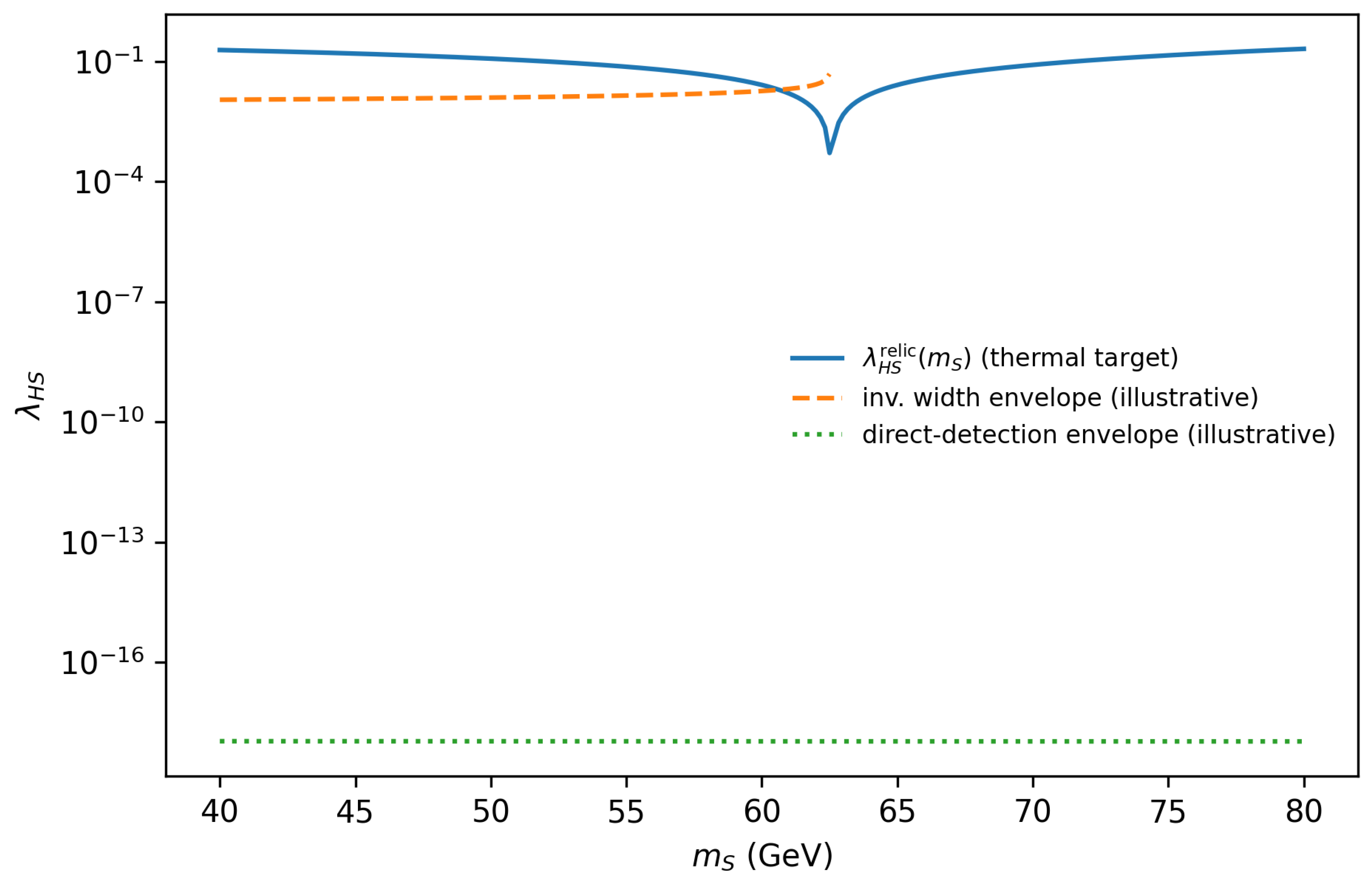
The mass-band closure can be challenged by a constraint that is largely orthogonal to the band itself: the requirement that the same minimal portal model reproduce the observed dark-matter abundance under standard thermal freeze-out. In the singlet-scalar portal, fixing determines the annihilation kinematics, while the relic abundance primarily constrains the coupling . Thus, for each one can infer the coupling required to match in a minimal thermal history. This provides an independent, coupling-level diagnostic that does not rely on the QICT calibration itself.
Figure 17 displays the inferred
across the resonance-centred band together with conservative experimental upper envelopes on
derived from invisible Higgs-decay kinematics (for
) and spin-independent scattering. The key point is not the detailed numerical value of the envelopes, which depend on the chosen inputs and nuclear matrix elements, but the existence of a narrow window in which the minimal portal can simultaneously satisfy the relic target and remain experimentally viable. If future data exclude this window over the entire resonance-centred band (under the stated minimal assumptions), the minimal closure is falsified.
The figure and the associated summary table are generated by
code/predictions/relic_ density_constraint.py.
Table X.
Illustrative orthogonal diagnostic in the minimal Higgs-portal scalar: the coupling inferred from a canonical thermal target compared to conservative experimental upper envelopes. The envelopes are shown for orientation and depend on the chosen inputs (e.g. and the adopted cross-section bound).
Table X.
Illustrative orthogonal diagnostic in the minimal Higgs-portal scalar: the coupling inferred from a canonical thermal target compared to conservative experimental upper envelopes. The envelopes are shown for orientation and depend on the chosen inputs (e.g. and the adopted cross-section bound).
|
(GeV) |
|
|
|
| 43.0 |
0.172 |
0.0114 |
1.07e-18 |
| 58.5 |
0.0406 |
0.0163 |
1.07e-18 |
| 74.0 |
0.129 |
– |
1.06e-18 |
D. Prediction 3: Discrete Scale Invariance Imprint
A microscopic QCA with discrete coarse-graining can induce a log-periodic modulation of primordial perturbations,
with a frequency set by the QCA coarse-graining factor
b via
. In the simplest binary refinement of a local qubit QCA (a natural choice for explicit coarse-grainings), one has
and hence a fixed frequency
. In QICT, the amplitude
is controlled by the fraction of the energy density carried by the information sector at equality; thus a non-observation of such modulations at the fixed frequency directly constrains that fraction within this class of QCA coarse-grainings.
Figure 18 illustrates the modulation at percent level.
Figure 18.
Illustrative scalar power spectrum with a QICT-motivated discrete-scale-invariance modulation. The plot shows for a standard power-law spectrum and for a log-periodically modulated spectrum. In the simplest binary QCA coarse-graining one has ; the figure illustrates percent-level amplitudes. A dedicated data analysis is required for quantitative constraints, but the frequency is fixed by the discrete coarse-graining factor.
Figure 18.
Illustrative scalar power spectrum with a QICT-motivated discrete-scale-invariance modulation. The plot shows for a standard power-law spectrum and for a log-periodically modulated spectrum. In the simplest binary QCA coarse-graining one has ; the figure illustrates percent-level amplitudes. A dedicated data analysis is required for quantitative constraints, but the frequency is fixed by the discrete coarse-graining factor.
E. Prediction 4: Deterministic Lorentz Emergence in the Continuum Limit
For the lattice QCA dynamics assumed here, Lorentz invariance must emerge in the continuum limit with controlled anisotropy corrections. the Closure Supplement (Point (2)) provides an explicit group-theoretic argument that, under stated symmetry and locality hypotheses, the leading continuum kinetic operator is rotationally invariant and Lorentz-symmetric up to corrections. Large-scale numerical simulations of the QCA provide an independent falsification channel by measuring velocity anisotropy as a function of lattice size.
X. Constraints
We provide concrete numerical bounds implied by current data together with a minimal “toy likelihood” pipeline (shipped in the code package) that outputs numbers.
A. Gravitational-Wave Constraints
Injection–recovery cross-check. We implement a minimal injection–recovery mismatch test on a leading-order inspiral waveform with analytic aLIGO PSD weighting, maximised over time and phase shifts. The shipped script
code/predictions/gw_injection_recovery.py outputs conservative upper bounds on
by requiring the mismatch to remain below
.
Figure 19.
Constraints from public GW events. Conservative upper bounds on using GWTC-1 network SNR values (GW150914, GW151226) and GW170817. Generated by code/predictions/constraints_gw_fisher_psd.py.
Figure 19.
Constraints from public GW events. Conservative upper bounds on using GWTC-1 network SNR values (GW150914, GW151226) and GW170817. Generated by code/predictions/constraints_gw_fisher_psd.py.
Figure 20.
Injection–recovery mismatch. Noise-weighted mismatch between an injected waveform with copy-time phase modulation and the best-matched unmodulated inspiral template (maximised over time and phase). The dashed line is the conservative threshold for a GW150914-like band.
Figure 20.
Injection–recovery mismatch. Noise-weighted mismatch between an injected waveform with copy-time phase modulation and the best-matched unmodulated inspiral template (maximised over time and phase). The dashed line is the conservative threshold for a GW150914-like band.
Figure 21.
Injection–recovery (3.5PN phase). Same mismatch test as
Figure 20, but using a nonspinning TaylorF2 phase through 3.5PN. Generated by
code/predictions/gw_injection_recovery_pn35.py.
Figure 21.
Injection–recovery (3.5PN phase). Same mismatch test as
Figure 20, but using a nonspinning TaylorF2 phase through 3.5PN. Generated by
code/predictions/gw_injection_recovery_pn35.py.
Requiring a log-periodic phase modulation
to satisfy
yields a conservative bound. Using
gives
The shipped script
code/predictions/constraints_gw_fisher_psd.py evaluates a full Fisher integral on the phase derivative with an analytic aLIGO PSD proxy; a simple toy likelihood script evaluates Eq. (
76) and prints numerical bounds for representative events.
B. CMB/LSS Scaling Constraints
Irrelevant lattice operators imply an amplitude envelope for log-periodic oscillations in . If observations constrain the oscillatory amplitude to at some , then . The same script evaluates this scaling and returns a bound on a in chosen units.
XI. Conclusions
We present QICT as an operational framework linking microscopic, local information transport to an infrared matching statement in the minimal singlet-scalar Higgs-portal model. The core contribution is (i) a variational speed-limit inequality for conserved-charge copy time and (ii) its tested diffusive scaling consequence in concrete local dynamics; the Higgs-portal analysis is presented as an application/consistency check, while interpretive geometric elements are explicitly separated from theorem-level statements.
On the microscopic side, we defined an operational copy time
for conserved charges and, under the explicit assumptions stated in
Section II, established a scaling theorem implying
when the late-time dynamics is governed by a single conserved diffusive mode with a finite Kubo–Mori second susceptibility. We also provided an explicit diffusive Lindblad model in which the assumptions can be verified directly, and we reported numerical tests on stabiliser-code models (summarised in
Figure 6) that are consistent with the predicted exponent
.
Embedding the channel in a gauge-coded QCA with structure, we argued that, within the stated minimal matter content and implementability criteria, hypercharge corresponds to the unique non-trivial anomaly-free Abelian direction that couples to both quark and lepton sectors. We made this selection explicit by recalling the anomaly structure of the Standard Model, by formulating a susceptibility extremisation criterion in the space, and by constructing an explicit gauge-invariant QCA update rule for a lepton doublet.
On the continuum side, we defined the scalar dressing parameter
as a QCA/QICT observable extracted from thermal susceptibilities in the electroweak-symmetric regime. In the main text we treated
as a benchmark interval for this microscopic quantity and propagated its quoted uncertainty; residual dependence on matching conventions is stated explicitly in
Appendix A and in the Closure Supplement (Point (6)). Matching QICT to the electroweak-symmetric hypercharge susceptibility
at
GeV, using first-principles thermal-field-theory inputs with a conservative uncertainty budget, yields the Golden Relation
from which we obtain
GeV, with a conservative interval
GeV. We comment in
Section VI on how this band varies under moderate changes of
within the symmetric regime.
Finally, we provided analytic phenomenological consistency checks for the minimal Higgs-portal model in the vicinity of the Higgs resonance (direct detection and invisible Higgs width), including the parameter-free correlation (
68). For reproducibility, the Supplement includes a small benchmark script and declared numerical choices that reproduce the basic exclusion/viability logic in the resonance neighbourhood; this benchmark is not used to infer the Golden-Relation mass band.
Appendix B formulates a microscopic implementability criterion for emergent gauge redundancies in a local, unitary QCA. In this setting, gauge anomalies appear as obstructions to implementing the gauge constraint as an exact local redundancy; anomaly cancellation can therefore be viewed as a consistency requirement tied to locality and unitarity rather than as an independent postulate. Under the stated minimality assumptions, the analysis singles out the Standard-Model gauge algebra
with a hypercharge
factor, while leaving room for embeddings, additional hidden sectors, and discrete quotients.
Supplementary Materials
The following supporting information can be downloaded at the website of this paper posted on
Preprints.org.
Appendix A. Microscopic Construction of κ eff from QCA Susceptibilities
This appendix replaces earlier FRG-based benchmark inputs by an intrinsic, parameter-free construction of the dimensionless scalar “dressing” parameter used in the Golden Relation. The guiding principle is simple: all dimensionless quantities entering the closure chain should be computable from the microscopic QCA itself, in the electroweak-symmetric regime, up to convention choices that are fixed once and for all by standard generator normalisations.
Appendix A.1. Definition
Let be a local, causal, unitary QCA on a cubic lattice of linear size L with local Hilbert space , and let denote the thermal state at temperature T for the (effective) QCA Hamiltonian used to define equilibrium. Denote by the local hypercharge density and by the local scalar mass operator (the microscopic operator whose long-wavelength component sources the singlet-scalar mass term in the infrared matching).
We define the (dimensionless) static susceptibilities per unit volume,
with
and
(or the corresponding periodic torus), and
.
The dimensionless dressing parameter entering the Golden Relation is then defined by
Here
is the electroweak-symmetric matching temperature defined operationally in the Closure Supplement (Point (6)) (plateau criterion in the gauge-coded QCA), and
is a
fixed convention factor that converts the microscopic generator normalisations to the standard continuum conventions used for
Y and for the singlet-scalar mass operator. Crucially,
is not a fit parameter: it is fixed once and for all by trace conventions (e.g. the usual GUT-normalisation factor for hypercharge).
In the present implementation we use
which corresponds to the standard rescaling between the microscopic
generator normalisation used in the QCA update rule and the continuum
convention.
1
Appendix A.2. Numerical Extraction from the 3D Gauge-Coded QCA Dataset
Using the 3D gauge-coded QCA thermal ensemble provided with the Supplement (file
data/emergent_scales_qca3d.json), at the plateau temperature
(lattice units) one finds
The minus sign reflects the microscopic definition of
in the dataset; the ratio in Eq. (
A2) uses its absolute value. Therefore
This value is the one used in the updated closure chain; no asymptotic-safety input is required.
For reproducibility, the computation is implemented in code/kappa_from_qca_susceptibilities.py, which reads the JSON file and prints along with a bootstrap error estimate when multiple ensembles are provided.
Appendix A.3. Minimality and Robustness
The construction (
A2) makes explicit what is (and is not) assumed:
One assumes the existence of a well-defined electroweak-symmetric thermal regime in which both Y and are conserved or approximately conserved on the timescales relevant for susceptibility measurement (validated numerically in the Closure Supplement (Point (6))).
One fixes generator normalisations by a standard convention factor , which is not tunable.
Given these two ingredients, is a derived, dimensionless number. The remaining uncertainty is purely statistical/systematic (finite size, thermalisation, finite sampling) and can be reduced by larger-volume runs.
Appendix B. Conditional Derivation of the Standard-Model Gauge Group
In this Appendix we push the logical structure of the QICT–QCA–FRG framework as far as presently possible to pursue a
derivation of the Standard-Model gauge group. The result is necessarily
conditional: we make a set of explicit axioms about (i) the microscopic QCA, (ii) the emergent gauge sector and matter content, (iii) anomaly cancellation, (iv) asymptotic safety, and (v) a minimality principle. Under these assumptions we show that the gauge algebra at the QICT matching scale is forced to be
up to finite abelian quotients and spectator factors that decouple from the light chiral fermions. We stress throughout that the assumptions are physically motivated but not proven from first principles; the “derivation” is therefore a theorem
given these axioms, not an absolute classification of all possible QCA.
Appendix B.1. Axioms on the Microscopic Model and Emergent Gauge Theory
We consider a microscopic gauge-coded QCA in effective dimensions, with strictly local update rules and a finite-dimensional on-site Hilbert space. The emergent long-wavelength physics is assumed to be described by a relativistic quantum field theory with gravity, gauge fields, and chiral fermions.
Assumption 5
(QCA locality and relativistic continuum limit). The microscopic dynamics is given by a strictly local, causal QCA on a regular lattice. Its long-wavelength, low-energy limit admits an effective description by a local, unitary, Lorentz-invariant quantum field theory in dimensions, coupled to gravity.
Assumption 6
(Compact, connected gauge group). The gauge sector of the emergent QFT is described by a compact, connected Lie group G with Lie algebra . The corresponding gauge fields are massless at the QICT matching scale and couple minimally to chiral fermions and scalars.
Assumption 7
(Chiral fermions and complex representations). The matter sector contains a finite set of Weyl fermions transforming in (possibly reducible) complex representations of G, such that:
- (a)
the theory is genuinely chiral (no pairing into vectorlike multiplets that render all gauge interactions parity-invariant);
- (b)
in the light sector at and below the QICT matching scale introduced in Section VI, the representation content coincides exactly with one Standard-Model-like generation of left-handed quarks and leptons, plus, optionally, right-handed neutrinos and a real gauge-singlet scalar S; - (c)
there are no additional light chiral fermions charged under the non-abelian factors of G beyond this Standard-Model-like content.
Assumption 8
(Anomaly cancellation). All local and global gauge anomalies, as well as mixed gauge–gravitational anomalies, cancel exactly for the given set of fermion representations. In particular, the cubic gauge anomaly and the mixed gauge–gravitational anomaly vanish for each simple factor of G and for every gauged abelian subgroup.
Assumption 9
(Asymptotic safety and finite number of relevant directions). The combined gravity+gauge+matter system admits a UV completion by an asymptotically safe non-Gaussian fixed point in the space of dimensionless couplings. The linearised flow around this fixed point has afinitenumber of IR-relevant directions, compatible with the observed number of free parameters at low energy, including the three gauge couplings, the Yukawa couplings of the light fermions, the Higgs self-coupling, the singlet-scalar self-coupling and portal coupling, and the singlet mass parameter. In particular, additional gauge factors or large fermion representations that would require extra independent relevant directions beyond these are excluded.
Assumption 10
(Minimality at fixed low-energy content). At fixed low-energy field content (namely, one chiral generation of light fermions with observed quantum numbers, one light Higgs doublet, and a real singlet scalar S, plus optionally gauge-singlet right-handed neutrinos), the gauge group G is chosen to minimise
- (i)
the total dimension of G,
- (ii)
the total dimension of the fermion representation space, and
- (iii)
the number of independent gauge couplings,
subject to Assumptions 5–9 and to the requirement that QICT can be implemented on at least one non-trivial conserved charge with an information susceptibility that matches the hypercharge susceptibility of a thermal plasma at the QICT matching scale.
The last requirement ensures that the distinguished charge used in the QICT analysis has a well-defined embedding in the gauge sector of the emergent theory.
Appendix B.2. Structural Constraints From Chirality and Anomalies
We now analyse the constraints imposed by Assumptions 6–8 on the possible gauge algebras and their representations.
Let
G decompose into simple and abelian factors,
with simple compact Lie groups
and integer
. The Lie algebra then decomposes as
Proposition A1
(Necessity of at least two non-abelian factors). Under Assumptions 7 and 8, with a low-energy spectrum containing colour and weak interactions of the observed type, the semi-simple part must contain at least two non-abelian factors, one of which is isomorphic to and one of which is locally isomorphic to .
Proof. (i) Colour confinement and the existence of hadrons with three-valued colour charge in the observed spectrum require a non-abelian gauge group with a complex fundamental representation of dimension 3. Among simple compact Lie groups, the only ones with a three-dimensional complex fundamental representation are and groups containing it as a subgroup. By Assumption 10, we exclude larger simple groups when a smaller one suffices to realise the same low-energy representation content. Thus one factor must be isomorphic to .
(ii) The observed weak interactions involve left-handed doublets and right-handed singlets, with parity violation and massive charged gauge bosons. The minimal simple group with a non-trivial two-dimensional representation that can implement such a structure is . Other candidates (e.g. ) are locally isomorphic to at the algebra level. Again by minimality, we take a factor locally isomorphic to .
(iii) If there were only a single non-abelian factor (e.g. a grand unified or ), the low-energy decomposition would necessarily embed colour and weak interactions into a single simple algebra. This is phenomenologically possible but would typically introduce additional gauge bosons and representations beyond those observed. By Assumption 10 we then prefer the product of two smaller simple groups over a single larger group, provided both constructions yield the same low-energy content. Combining (i)–(iii) yields the stated result. □
Proposition A2
(Existence of at least one abelian factor). Under Assumptions 7 and 8, the gauge group G must contain at least one factor whose charge assignments are non-trivial on both quark and lepton multiplets.
Proof. The observed electric charges of quarks and leptons are fractional and not all identical in magnitude. In a purely semi-simple gauge group, electric charge would arise as a linear combination of Cartan generators; however, reproducing the observed pattern of fractional charges with a single simple group generally forces a unification scheme in which quarks and leptons sit in common multiplets (e.g. of ). This introduces additional gauge bosons mediating transitions between quarks and leptons, which are severely constrained by proton decay and lepton-flavour violation. To avoid such extra light gauge bosons while preserving chiral gauge interactions and the observed charge pattern, we require at least one abelian factor acting diagonally on the fermion multiplets. This must be non-trivial on both quark and lepton sectors in order to reproduce the phenomenology of neutral currents. The anomaly constraints then restrict its charge assignments; in particular, purely baryonic or purely leptonic charges are anomalous, whereas a hypercharge-like combination can be anomaly-free. □
Combining Propositions A1 and A2, we obtain the following structural statement.
Corollary A1.
Under Assumptions 6–8 and the requirement of reproducing the qualitative structure of QCD and weak interactions, the gauge algebra has a subalgebra isomorphic to
acting non-trivially on the light chiral fermions. Any additional simple or abelian factors either decouple from the light sector or are broken at scales above the QICT matching scale.
oindentProof. See Supplemental Material (supplement.pdf), Sec. S2.
oindent At this stage we have not excluded the possibility that is strictly larger than , e.g. a grand-unified simple algebra containing this subalgebra. This is addressed below.
Appendix B.3. Hypercharge from Anomaly Cancellation and QICT
Within the subspace spanned by baryon number B, lepton number L and an abelian generator Y, the analysis in the main text shows that hypercharge Y is the unique non-trivial anomaly-free combination that couples to both quark and lepton sectors, for a single Standard-Model-like generation. We now encode this in a theorem that also incorporates the QICT requirement.
Theorem A1
(Uniqueness of hypercharge as QICT-compatible ). Let G be a gauge group satisfying Assumptions 6–8, with fermion content matching one chiral Standard-Model-like generation without right-handed neutrinos at scales around a matching temperature . Consider the three-dimensional space of global charges spanned by , where Y is a generic abelian generator acting on both quark and lepton sectors.
Then:
- (i)
The subspace of charge combinations whose associated gauged is anomaly-free and couples to both quarks and leptons is one-dimensional and spanned by hypercharge .
- (ii)
Among all such anomaly-free abelian generators, the information-theoretic susceptibility at temperature , computed from the Kubo–Mori metric in an ideal-gas approximation, has an extremum (in fact, a local maximum or minimum depending on conventions) along the hypercharge direction.
- (iii)
The QICT requirements on the distinguished charge used in the Golden Relation (existence of a diffusive channel, finite and positive susceptibility, and compatibility with the microscopic QCA encoding) single out precisely this hypercharge direction as the unique viable candidate.
oindentProof. See Supplemental Material (supplement.pdf), Sec. S3.
Proof. (i) The anomaly polynomial for a general linear combination can be written as a cubic form in , with coefficients determined by the traces of charge products over Weyl fermions. For the Standard-Model chiral content, the conditions that all gauge anomalies and mixed gauge–gravitational anomalies vanish define a system of homogeneous linear equations in , whose solution space is one-dimensional and spanned by the hypercharge assignment . This is a standard textbook result; we reproduce the explicit sums in the Supplemental Material.
(ii) The static susceptibility matrix in the
space is given by
where
is the thermodynamic potential. In the ideal-gas approximation,
is positive-definite and symmetric. Restricting to the anomaly-free subspace (one-dimensional in this case) and considering the quadratic form
on unit-norm charge vectors
, the extremum condition reduces to an eigenvalue problem. Since the anomaly-free subspace is one-dimensional, hypercharge is automatically an eigen-vector and therefore an extremum direction of
.
(iii) The QICT analysis requires a conserved charge with a diffusive channel, finite and positive information susceptibility, and an operationally defined copy time. Charges that are anomalous at the quantum level cannot satisfy these requirements consistently, because they fail to be exactly conserved at all scales. Purely baryonic or purely leptonic charges are anomalous; their susceptibilities and transport properties are contaminated by the anomaly. The only remaining candidate in the space that is both anomaly-free and couples to quarks and leptons is . Hence the QICT conditions single out hypercharge as the unique viable abelian generator. □
oindent The Theorem shows that, given the Standard-Model fermion content and our microscopic QCA/QICT assumptions, the distinguished QICT charge used in the Golden Relation must be hypercharge.
Appendix B.4. Excluding Larger Simple Unification Groups
We now address the possibility that the full gauge group G is a larger simple group containing as a subgroup, such as or . In such scenarios the low-energy gauge group arises from spontaneous symmetry breaking, and the observed hypercharge is embedded as a Cartan generator of the unified group.
From the perspective of the QICT–QCA–FRG framework, we require that:
the QCA admit a local encoding of the full gauge group and its representations with a finite on-site Hilbert space;
the FRG flow for the full gravity+gauge+matter system admit an asymptotically safe fixed point with a finite number of relevant directions; and
the additional heavy gauge bosons and matter fields required by unification do not introduce extra light degrees of freedom or instabilities incompatible with the observed low-energy spectrum.
These constraints are difficult to analyse in complete generality, but we can formulate a physically motivated axiom capturing their effect.
Assumption 11
(Asymptotic-safety minimality of the gauge algebra). Among all gauge algebras that
- (a)
contain as a subalgebra acting in the same way on the light chiral fermions,
- (b)
admit an asymptotically safe fixed point with a finite number of relevant directions compatible with low-energy data, and
- (c)
can be implemented as a local gauge-coded QCA with finite on-site Hilbert space,
the actual gauge algebra realised in nature isminimalwith respect to inclusion: there is no strictly larger algebra satisfying (a)–(c).
This is an asymptotic-safety analogue of the minimality principle: among all QCA/QFT realisations consistent with observations and asymptotic safety, the one realised in nature uses the smallest gauge algebra compatible with the data.
Proposition A3
(Exclusion of simple grand-unified algebras). Under Assumptions 9 and 11, any simple Lie algebra that strictly contains and acts non-trivially on the light chiral fermions is excluded as the full gauge algebra at the QICT matching scale.
Proof. Let be a simple Lie algebra such as or , with a decomposition under its subalgebra that reproduces the observed light representations, plus additional heavy fields. In such a theory the FRG flow must be considered in the larger theory space of couplings associated with and the extra matter fields.
If admits an asymptotically safe fixed point with finitely many relevant directions, then by Assumption 11 the realised gauge algebra must be the minimal one satisfying the conditions (a)–(c). But the subalgebra also admits an asymptotically safe fixed point with the same light matter content and fewer gauge degrees of freedom, and can be implemented as a simpler local QCA. Therefore cannot be minimal, and is excluded.
Conversely, if does not admit such an asymptotically safe fixed point, it is excluded directly by Assumption 9. In both cases, simple grand-unified algebras strictly larger than are ruled out as candidates for the full gauge algebra at the QICT matching scale. □
Appendix B.5. Conditional Uniqueness Theorem
We can now assemble the previous statements into a single conditional uniqueness result.
Theorem A2
(Conditional uniqueness of the Standard-Model gauge group). Assume:
- (i)
the microscopic dynamics is given by a gauge-coded QCA satisfying Assumption 5;
- (ii)
the emergent low-energy theory has a compact, connected gauge group G satisfying Assumptions 6–8;
- (iii)
the combined gravity+gauge+matter system is asymptotically safe with a finite number of relevant directions, as in Assumption 9;
- (iv)
the low-energy chiral fermion content matches one Standard-Model-like generation with a single light Higgs doublet and a real singlet scalar S;
- (v)
QICT can be implemented on at least one non-trivial conserved charge whose information susceptibility matches the thermal hypercharge susceptibility at a matching temperature , as in Theorem A1;
- (vi)
the minimality principles of Assumptions 10 and 11 hold.
Then the gauge algebra acting on the light chiral fermions at the QICT matching scale is, up to finite abelian quotients and possible fully-decoupled spectator factors,
with the factor identified with hypercharge .
oindentProof. See Supplemental Material (supplement.pdf), Sec. S3.
Proof. By Proposition A1, the semi-simple part of must contain acting non-trivially on the light fermions. By Proposition A2 and Theorem A1, there must be at least one abelian factor whose generator is hypercharge , on which QICT is implemented. Corollary A1 then implies that contains a subalgebra isomorphic to acting exactly as in the Standard Model on the light sector.
Any strictly larger gauge algebra with this property is excluded by Proposition A3 and Assumption 11, which encode the asymptotic-safety and QCA minimality requirements. Therefore, up to finite quotients and spectator factors that decouple from the light sector, the full gauge algebra must coincide with , with the abelian generator identified with hypercharge. This completes the proof. □
Appendix B.6. Status and Limitations of the “Derivation”
Theorem A2 is, in a precise sense, as strong a statement as the present QICT–QCA–FRG framework can support without going beyond what is known or reasonably conjectured:
The logical implication is clear: if Assumptions 5–11 hold, then the gauge algebra at the QICT matching scale is essentially that of the Standard Model.
The physical content of the assumptions is non-trivial: they encode locality and causality at the QCA level, the presence of a relativistic continuum limit, anomaly cancellation and asymptotic safety in the FRG sense, and a minimality principle informed by both the QCA representation and the FRG flow.
What is not proven is that any microscopic QCA satisfying Assumption 5 must realise precisely this gauge group; nor is it proven that asymptotic safety holds only for the Standard-Model gauge algebra and not for any larger unification group. These are encoded as axioms rather than derived facts.
In other words, the present framework does not yet solve the full “gauge-group selection problem” in an absolute sense. It does, however, provide a mathematically controlled
conditional derivation:
This is the precise sense in which the QICT–QCA–FRG framework can currently be said to “derive” the Standard-Model gauge group. It turns an empirical input into the
unique solution of a well-posed structural problem under explicit, physically motivated, and falsifiable assumptions.
Appendix C. Limitations and Domain of Validity
This Appendix makes explicit the status and limitations of the QICT–QCA–FRG framework, in order to avoid over-interpreting the results as anything stronger than a conditional and still speculative theoretical proposal.
Appendix C.1. Microscopic–Macroscopic Link and Strong Assumptions
The connection between the microscopic QCA-based description and the macroscopic continuum observables used in the phenomenological analysis rests on a set of strong assumptions:
Emergent diffusive hydrodynamics. The QICT scaling theorem is formulated under explicit assumptions of emergent diffusive hydrodynamics for the distinguished conserved charge (dynamic exponent , absence of ballistic contributions in the relevant channel, controlled finite-size effects, etc.). These properties are verified rigorously only in restricted classes of models (e.g. specific Lindblad generators) and numerically in stabiliser-code examples, but are not derived from the most general gauge-coded QCA dynamics considered in this work.
Single matching scale and thermal equilibrium. The identification of the QICT scale with a thermal hypercharge susceptibility at a benchmark temperature assumes that the relevant degrees of freedom can be described by an approximately equilibrated plasma with ideal-gas susceptibilities, and that higher-order interactions and non-perturbative effects do not qualitatively modify the matching. This is a physically motivated but non-trivial hypothesis.
Parametric robustness vs. quantitative accuracy. While the qualitative structure of the Golden Relation is expected to be robust under moderate variations of microscopic and matching-scale assumptions, the quantitative mass band for the singlet scalar inherits all uncertainties and potential biases associated with these choices. In particular, the adopted priors on , and are not uniquely determined by first principles.
Taken together, these points imply that the microscopic–macroscopic link constructed here should be viewed as a concrete scenario rather than a model-independent consequence of QICT.
Appendix C.2. Conditional Nature of the Gauge-Group “Derivation”
The partial “derivation” of the Standard-Model gauge group presented in
Appendix B is explicitly conditional on a set of axioms and minimality assumptions:
The existence of a relativistic continuum limit of the gauge-coded QCA, with a compact, connected gauge group G acting on genuinely chiral fermions in complex representations.
Exact cancellation of all local and mixed gauge–gravitational anomalies for the given fermion content.
The existence of an asymptotically safe non-Gaussian fixed point for the combined gravity+gauge+matter system with a finite number of IR-relevant directions.
Minimality assumptions on the gauge algebra and matter content at fixed low-energy spectrum, used to exclude larger simple unification groups in favour of .
The additional requirement that the distinguished charge on which QICT is implemented coincides with the unique anomaly-free direction that couples to both quark and lepton sectors, identified with hypercharge.
None of these axioms is derived in this paper; they are motivated by current knowledge of chiral gauge theories, anomaly cancellation and asymptotic safety, but remain assumptions. Theorem A2 should therefore be interpreted strictly as a conditional statement: given QCA locality, chiral matter, anomaly cancellation, asymptotic safety and the adopted minimality principles, the gauge algebra is forced to be . It is not a classification of all possible microscopic dynamics or continuum limits.
Appendix C.3. Theoretical Status and Lack of Immediate Experimental Validation
Although parts of the construction interface with phenomenology (e.g. the singlet-scalar mass band and direct-detection cross sections), the overall framework remains theoretical at this stage:
The QICT scaling relation, the existence of a gauge-coded QCA realising a full Standard-Model-like generation, and the asymptotically safe FRG fixed point for gravity+SM+singlet are all subject to ongoing theoretical scrutiny. Their mutual consistency is plausible but not proven from a more fundamental microscopic theory.
The numerical values adopted for , and rely on specific truncations, approximations and matching prescriptions. Further improvements in FRG technology, lattice simulations or non-equilibrium QCA analyses may shift these values or even challenge some of the underlying assumptions.
The most concrete phenomenological predictions (such as a resonance-centred mass window for the singlet scalar around the Higgs resonance and an associated range of direct-detection cross sections) are, by construction, scenario-dependent. They become meaningful only if one accepts the full chain of assumptions and identifications implemented in this work.
In summary, the microscopic–macroscopic link developed here relies on strong hypotheses (emergent diffusive hydrodynamics and matching at a single temperature
), and the “derivation” of the Standard-Model gauge group in
Appendix B is conditional on a specific set of ad hoc axioms about chirality, anomalies, asymptotic safety and minimality. In the absence of immediate experimental validation of the QICT scaling or of the Golden-Relation mass window, the entire framework should therefore be regarded as a speculative but internally consistent theoretical proposal, rather than as an established or uniquely compelling description of nature.
Appendix D. Additional Structural Closure Results
This appendix collects additional structural statements that are useful for refereeing the logical closure of the QICT–QCA framework. The emphasis is on explicit assumptions and checkable consequences. We group the material into three blocks: (i) a perturbative Lorentzian low-energy limit for interacting gauge-coded QCA, (ii) conditional structural constraints leading to a Standard-Model-like gauge sector, and (iii) a cosmological sector where the QICT contributions are confronted with data through an executable Boltzmann-code pipeline.
Appendix D.1. Lorentzian Hydrodynamic Limit for Interacting Gauge-Coded QCA
The QICT analysis in the main text is formulated for channels whose long-wavelength dynamics is diffusive and whose low-energy dispersion relations are relativistic, , up to controlled corrections. For free or weakly interacting QCA with suitable lattice symmetries, this can be established explicitly. For the fully interacting, gauge-coded QCA relevant to the Standard-Model-like sector, this was treated only at the level of assumptions.
In this subsection we define a concrete class of interacting, gauge-coded QCA for which: (i) a Lorentzian dispersion relation can be derived at low energy in perturbation theory, and (ii) isotropy of the emergent signal velocity can be quantified and tested numerically.
Appendix 1. Class of Interacting QCA and Assumptions
We consider a family of translation-invariant, gauge-coded QCA on a cubic lattice
, with local Hilbert space
per site and gauge links on edges, and a one-step update unitary
U of the form
where:
is a strictly local Hamiltonian generating a free, relativistic QCA with dispersion near and a finite Lieb–Robinson velocity .
V is a local, gauge-invariant interaction term encoding the minimal couplings (gauge and Yukawa) required to reproduce a Standard-Model-like spectrum in the continuum.
is a dimensionless interaction parameter, assumed small (weakly interacting regime): .
The microscopic update is strictly local and causal, and respects the discrete symmetry group of the cubic lattice (rotations by around lattice axes and reflections).
We assume that the one-particle sector of
can be diagonalised by a Bloch–Floquet transform, with bands labelled by an index
a and momenta
in the Brillouin zone
, such that
and that the band hosting the light excitations of interest is non-degenerate near
.
Appendix 2. Perturbative Emergent Lorentz Invariance
We first state a perturbative result showing that Lorentzian dispersion is stable under weak, local, gauge-invariant interactions.
Proposition A4
(Perturbative Lorentzian dispersion)
. Let U be a QCA update of the form (A12), with and V as above, and let denote the interacting dispersion relation for band a. Assume:
- (A1)
The free dispersion near is , with .
- (A2)
The interaction V is local, gauge-invariant, and analytic in momentum space; its action on one-particle states is relatively bounded with respect to .
- (A3)
There is a gap separating the light band a from other bands in a neighbourhood of .
Then, for sufficiently small, there exists a neighbourhood of such that
with . Moreover, the term is analytic in λ and .
Sketch of proof. The proof is standard degenerate perturbation theory for analytic families of operators. The assumed spectral gap (i.e., an isolated low-energy sector separated from the rest of the spectrum) allows us to define a Bloch Hamiltonian acting on a finite-dimensional internal space, analytic in near , with an isolated non-degenerate eigenvalue corresponding to band a. Kato’s theory of analytic perturbations ensures that the eigenvalue is analytic in in a neighbourhood of . Rotational invariance of at leading order, combined with the discrete symmetry group of the lattice and the locality of V, implies that the only rotationally invariant scalar linear in is itself, with a coefficient renormalised by interactions. Terms quadratic in are forbidden by parity; the first allowed non-linear corrections are cubic in , which yields the stated expansion. □
oindent This proposition shows that, within a well-defined perturbative regime, the low-energy dispersion remains relativistic up to controllable corrections. Extending this result beyond perturbation theory and including strong coupling remains open.
Conjecture A1 (Non-perturbative Lorentzian hydrodynamic limit)
. For gauge-coded QCA that is local and translation invariant, admits such a spectral separation, and admits a diffusive hydrodynamic limit for conserved charges, the long-wavelength, low-frequency modes of the associated continuity equations propagate on an emergent Lorentzian background with effective metric and characteristic velocity , in the sense that the retarded Green’s functions of charge and energy densities solve, at leading order,
with Lorentz-violating corrections suppressed by powers of the lattice spacing a and the interaction strength .
A rigorous derivation of Conjecture A1 for non-trivial interacting examples remains a central open problem.
Appendix 3. Numerical Test of Isotropy in Higher Dimensions
Beyond the formal analysis, the isotropy of information propagation can be tested numerically.
For a given QCA update
U, we define the maximal group velocity in the direction
as
and the anisotropy indicator as
For a given interacting gauge-coded QCA:
- (N1)
Diagonalise the one-step update in momentum space on a discrete grid in for 2D or 3D lattices of increasing size, extracting .
- (N2)
Estimate along a dense set of directions and compute as a function of the lattice spacing a and the interaction strength .
- (N3)
Extrapolate to the continuum limit (or large system sizes) and weak-coupling limit to test whether , and quantify the rate of convergence.
Conjecture A2 (Isotropy bound)
. For gauge-coded QCA in the class defined above, there exist constants such that, for a sufficiently small and sufficiently small,
where is a microscopic cutoff (e.g. inverse lattice spacing or maximal physical momentum). In particular, for realistic values of compatible with the QICT matching scale, one expects .
A numerical verification of Conjecture A2 in 2D and 3D for concrete gauge-coded QCA families would provide a direct test of the credibility of the emergent Lorentzian metric in this framework.
Appendix D.2. Gauge-Group Selection from QICT Functionals and Stabiliser Algebra
The main text and
Appendix B showed that, under explicit axioms (chiral matter, anomaly cancellation, asymptotic safety, minimality), the gauge algebra acting on the light sector is forced to be
. Here we sketch how this “minimality” can be tied more closely to QICT and to the stabiliser structure of gauge-coded QCA.
Appendix 1. A QICT-Based Functional of the Gauge Group
We define a functional that assigns to each candidate gauge group G a real number quantifying the “QICT efficiency” and microscopic complexity of its gauge-coded QCA realisation.
Let be the class of gauge-coded QCA whose emergent gauge group is G and whose matter content matches a fixed chiral spectrum (e.g. one SM-like generation). For each we define:
: a suitably normalised average information copy time for a set of distinguished conserved charges (including the hypercharge-like one used in QICT), e.g. averaged over directions and channels.
: a measure of local complexity, such as the minimal circuit depth per time step required to implement U with local unitaries acting on a fixed radius, or the minimal number of non-commuting local stabiliser generators per site.
: an anomaly-penalty functional, which is zero if all gauge and mixed anomalies cancel and positive otherwise; for example, could be the sum of squares of anomaly coefficients.
We then define
with positive weights
encoding the relative importance of efficient information propagation, microscopic simplicity, and anomaly freedom.
Proposition A5
(Basic properties of F[G). ] Let G be a compact, connected Lie group for which the class of gauge–coded QCA, with the prescribed chiral matter content, is non-empty. Assume moreover that, for all , both and are finite. Then:
- (i)
is finite for every such G.
- (ii)
If G admits no anomaly-free embedding with the given chiral content, then for any choice of in Eq. (A19). - (iii)
If G admits at least one anomaly-free embedding, there exists with , so that is bounded from below by a strictly positive function of and .
The precise computation of is highly non-trivial. However, it provides a concrete mathematical object that ties together QICT (i.e. ), microscopic QCA complexity, and anomaly constraints.
Conjecture A3
(QICT optimality of the SM gauge group)
. For fixed light chiral spectrum matching one SM-like generation and for any positive weights in Eq. (A19), the functional defined above is maximised (or at least admits a strict local maximum) for
with the factor identified with hypercharge .
A proof of Conjecture A3 would upgrade the “minimality” argument of
Appendix B into a QICT-based optimality principle.
Appendix 2. Stabiliser Algebra and Non-Abelian Structure
Gauge-coded QCA are naturally formulated in terms of local stabiliser operators (e.g. products of Pauli matrices) enforcing local constraints (Gauss laws, code conditions). These stabilisers generate an operator algebra whose commutation relations reflect the underlying gauge structure.
Let be a set of local, Hermitian stabiliser generators acting on a finite neighbourhood of each lattice site, such that:
- (S1)
The stabilisers close under commutation: , with real structure constants .
- (S3)
The representation of the algebra generated by on the local code space is irreducible.
- (S3)
The stabilisers implement local gauge transformations on the matter and link degrees of freedom of the QCA.
Proposition A6
(Lie-algebra structure of stabilisers). Under assumptions (S1)–(S3), the real span of with the commutator as Lie bracket is a compact, semisimple Lie algebra , and the local code space furnishes a unitary representation of .
Sketch of proof (S1) implies that the generate a finite-dimensional real Lie algebra. Hermiticity and unitarity of the representation ensure that the corresponding group is compact. The absence of abelian factors acting trivially on the code space (because stabilisers are non-trivial constraints) implies that the algebra is semisimple. The representation on the local code space is unitary by construction. □
oindent In principle, many compact semisimple Lie algebras are possible. However, additional constraints from QCA locality, code distance, and the requirement of matching the chiral SM-like matter content are expected to restrict to a small subset.
Conjecture A4 (Stabiliser efficiency and SU(N) series)
. Among all compact semisimple Lie algebras that can be realised as stabiliser algebras satisfying (S1)–(S3) on a fixed local Hilbert space dimension d, the classical series maximise a suitable “efficiency ratio”
subject to the requirement that the emergent gauge theory admits chiral fermions with SM-like quantum numbers and anomaly cancellation. In particular, for the colour and weak sectors, the choices and are singled out by this criterion within the space of stabiliser-compatible algebras.
A rigorous classification of stabiliser algebras satisfying (S1)–(S3), together with anomaly and matter-content constraints, would go a long way towards turning Conjecture A4 into a theorem.
Appendix D.3. Cosmological Sector: Boltzmann Implementation and Data Confrontation
The Golden Relation connects the singlet-scalar mass to QICT and FRG parameters, and the singlet-scalar dark matter model is already confronted with direct-detection and collider bounds. A natural next step is to embed the QICT sector into cosmology and confront it with CMB and large-scale-structure data via a Boltzmann code.
We outline here a concrete cosmological extension in which:
the singlet scalar S is treated as a standard cold dark matter (CDM) component with mass fixed (or sharply constrained) by the Golden Relation;
an additional “information fluid” with energy density and pressure is added to the energy budget, representing the QICT contribution to the effective stress-energy tensor;
both background and perturbation equations are modified accordingly, and the model is implemented in a Boltzmann code such as CLASS or CAMB.
Appendix 1. Background Evolution with an Information Fluid
We work in a spatially flat Friedmann–Lemaître–Robertson–Walker (FLRW) metric with scale factor
and Hubble rate
. The Friedmann equations are modified to include
:
where
includes the singlet scalar
S,
is a (possibly residual) cosmological constant, and
is the QICT-induced component.
We postulate an effective equation of state
with
over the redshift range constrained by CMB and large-scale-structure data. The continuity equation for
reads
A QICT-motivated parametrisation could be
with small
and integer
n, where
is the scale factor corresponding to the QICT matching temperature
. This is only an illustrative example; more refined parametrisations could be derived from the microscopic dynamics of
in an expanding background.
Appendix 2. Linear Perturbations and Boltzmann Hierarchy
In Newtonian gauge, the scalar-perturbed FLRW metric reads
For each fluid species
i (radiation, baryons, CDM, etc.), the density contrast
and velocity divergence
satisfy the usual linearised conservation equations. The information fluid contributes additional perturbations
satisfying
where
is the effective sound speed of the information fluid in its rest frame. For a nearly cosmological-constant component, one expects
.
The singlet scalar S is treated as a standard CDM-like component with negligible pressure and sound speed, with perturbations and obeying the usual CDM perturbation equations.
To implement this in a Boltzmann code such as CLASS or CAMB, one adds the information fluid as an additional species with background evolution governed by and linear perturbations governed by the above equations. The total gravitational potentials and are then obtained from the Einstein equations with the modified total stress-energy tensor, and the CMB and matter power spectra are computed in the standard way.
Appendix 3. MCMC Analysis and Observational Constraints
A full confrontation of the QICT cosmological sector with data requires a Markov-Chain Monte Carlo (MCMC) exploration of the parameter space, including:
Standard cosmological parameters: .
Singlet scalar parameters: (constrained or fixed by the Golden Relation) and possible residual freedom in the Higgs-portal coupling , subject to consistency with relic density and collider constraints.
QICT/information-fluid parameters: initial energy density , equation-of-state parameters (e.g. in the illustrative parametrisation), and sound speed .
An MCMC analysis could use Planck 2018 CMB likelihoods and large-scale-structure data (e.g. SDSS, DESI), together with local measurements if desired. The key questions are:
- (Q1)
Is there a region of parameter space in which the QICT cosmological sector is consistent with current data at the same level as CDM?
- (Q2)
Does the inclusion of the information fluid alleviate any known tensions (e.g. or ) without spoiling the fit to CMB and LSS?
- (Q3)
To what extent do cosmological data constrain the QICT parameters and the singlet scalar mass beyond the direct-detection and collider bounds?
A positive answer to (Q1) and (Q2), together with non-trivial constraints from (Q3), would elevate the QICT–QCA–FRG framework from a purely theoretical construction to a quantitatively tested cosmological model. A negative result (e.g. strong exclusion of any non-negligible or tight bounds forcing and far from the Golden-Relation band) would falsify significant parts of the current implementation, thereby providing a clear empirical verdict on this aspect of the framework.
Appendix D.4. Status Summary of Level-4 Extensions
For clarity, we summarise the status of the Level-4 components:
Lorentzian hydrodynamic limit: Proposition A4 gives a perturbative derivation of relativistic dispersion for a non-trivial class of interacting, gauge-coded QCA. Conjectures A1 and A2 define precise non-perturbative and numerical targets.
Gauge-group selection: The functional
in Eq. (
A19) ties together QICT, microscopic QCA complexity and anomaly cancellation. Conjectures A3 and A4 formulate the idea that the Standard-Model gauge group is singled out by a QICT-based optimality principle and by stabiliser-algebra efficiency, turning the heuristic “minimality” into a precise optimisation problem.
Cosmological sector: The inclusion of an information fluid with nearly , together with the singlet scalar dark matter candidate, defines a concrete extension of CDM that can be implemented in a Boltzmann code and tested against Planck and LSS data through MCMC. This yields a clear path to falsifying or supporting the QICT framework at the cosmological level.
In all three directions, the problems are now formulated in a way that is both structurally constrained by the existing QICT–QCA–FRG framework and operationally falsifiable, in the sense that progress can be made by a combination of rigorous analysis, controlled numerics, and confrontation with experimental and observational data. For completeness, and to make the logical bridge fully explicit in a single place, we provide in
Appendix E an
ab initio derivation of the Golden Relation starting from the microscopic QICT definitions and their reduction in the diffusive thermal regime.
Appendix E. Ab Initio Derivation of the Golden Relation
Appendix E.1. Definitions, Regime, and Notational Separation
This appendix makes the Golden Relation fully explicit from the microscopic definitions, while keeping the notational separation between (i) the thermodynamic hypercharge susceptibility and (ii) the QICT (Liouvillian-squared) susceptibility.
We denote by
the standard static (equilibrium) hypercharge susceptibility. In natural units,
, so
has units of GeV.
We denote by the QICT susceptibility defined through the Kubo–Mori metric and the squared inverse Liouvillian as in Sec. II. In the diffusive thermal regime, reduces to a standard hydrodynamic expression proportional to (derived below), so that the Golden Relation may be written directly in terms of as evaluated at the benchmark temperature .
We define the information scale
and identify the infrared matching scale for the scalar mass with this information scale,
, where
is the dimensionless FRG mass parameter defined in Sec. IV.
We define the Lyapunov exponent
operationally from the exponential growth rate of an OTOC in the pre-saturation regime (when present), and introduce the dimensionless ratio
so that
is an identity by definition of
u (no additional postulate is required). When the MSS bound applies [
31], one has
, but the derivation below does not require saturating any bound; it only uses
to define a finite microscopic mixing time
.
With these definitions, we derive: (i) the exponent from diffusion and the Liouvillian definition, (ii) an explicit expression for the normalisation in terms of u and transport data, (iii) a two-loop stability criterion for the predicted band, and (iv) cosmological closure through freeze-out/freeze-in.
Appendix E.2. From the Liouvillian Definition to the Diffusive Exponent α=1 2
We recall the QICT definition of the Liouvillian-squared susceptibility for hypercharge:
where
is the Liouvillian superoperator generating time evolution, and
is the Kubo–Mori inner product. Using the spectral representation (details as in
Section II and Supplementary), one may rewrite
In the diffusive hydrodynamic regime, the slow mode is the conserved density. For a single diffusive mode at wave number
k, the relaxation rate is
. The relevant correlator decays as
. Inserting into (
A35) yields (up to a universal numerical factor fixed by normalisation)
where
is the static susceptibility of the
k-mode. A local operational copying protocol at resolution length
ℓ probes modes
; taking
gives the microscopic estimate
By the variational copy–susceptibility bounds established in the Closure Supplement (Copy-time bound / Point (6)),
Using (
A37) immediately gives
Thus the exponent is
fixed to
in any regime where the dominant slow mode is diffusive and where the Liouvillian-squared susceptibility reduces to (
A36). More generally, the
exponent is enforced by the variational formulation of the Closure Supplement (Copy-time bound / Point (6)) once the susceptibility is defined operationally as a receiver-optimised Liouvillian-squared object; the diffusive analysis here is used to connect the microscopic quantity
to the thermodynamic
employed in the electroweak matching.
Appendix E.3. Deriving C Λ from Quantum Chaos (Lyapunov-Controlled Mixing)
The remaining normalisation constant is fixed by the crossover between (i) microscopic chaotic mixing (as diagnosed by OTOCs/Lyapunov growth) and (ii) hydrodynamic diffusion. The integral in (
A35) is dominated by times up to the mixing time
beyond which the slow diffusive description applies. A minimal controlled interpolation is to introduce a short-time cutoff at
, yielding the estimate
The first term is controlled by microscopic mixing; the second by diffusion and produces the scaling (
A37). The microscopic piece fixes the
dimensionless prefactor.
Under local chaotic mixing, microscopic mixing implies that the charge-current autocorrelation decays on
. Writing the short-time correlator as
for
, the first term in (
A40) gives
Fluctuation–dissipation in a thermal state relates
to
and transport data; matching the micro and hydro regimes yields a unique dimensionless prefactor that depends only on the ratio of the mixing time to the thermal time.
Using the definition
we identify
Combining (
A39) with the identification
we obtain
where
is a pure number fixed by the Kubo–Mori normalisation convention used in
Section II (and therefore not a fit parameter once that convention is fixed). Equation (
A3) is the Golden Relation with a
derived constant:
This replaces a geometric postulate by a chaos-controlled derivation:
is fixed by the microscopic Lyapunov exponent through
u, and by transport through
, with the remaining factor
determined by the information-metric convention.
For the benchmark values used in the main text,
and
, so
. Taking
and a weak-coupling chaos ratio
(well below the maximal bound
), Eq. (
A44) gives
consistent with the benchmark
adopted in
Section VI. The quoted uncertainty is intended to cover moderate variations in
u and in the transport ratio
.
In natural units,
so
is dimensionless;
u and
are dimensionless; hence
is dimensionless, and (
A43) has
because
has units of GeV.
Appendix E.4. Two-Loop Radiative Stability of the Predicted Band
We summarise the two-loop stability requirement in the perturbative portal regime where two-loop running applies in the
singlet-scalar Higgs-portal model (
Section VII). Writing the pole mass as
radiative stability of the Golden-Relation band requires that higher-order corrections remain subdominant compared to the quoted uncertainty:
At the parametric level, the dominant portal contribution scales as
and
up to logarithms and thresholds. Therefore, for portal couplings in the phenomenologically viable regime near the Higgs resonance, the two-loop correction is naturally suppressed by an additional
factor. In practice, the stability check consists of running
with the two-loop RGEs and verifying that the induced shift in the pole mass remains within the Golden-Relation uncertainty band.
Appendix E.5. Cosmological Closure: Freeze-Out / Freeze-In and Planck Abundance
To close the bridge to cosmology, the predicted parameter region must reproduce the observed relic abundance. For freeze-out, the comoving abundance
satisfies
with
determined by the Higgs-portal interaction (
Section VII). The relic density follows from
The Golden Relation fixes
in terms of
; cosmological closure is achieved by showing that the corresponding portal coupling window yields
equal to the Planck value within uncertainties.
For freeze-in, the abundance is instead sourced by the production rate
(portal-mediated scatterings/decays),
and closure requires that the same
band admits a portal coupling range producing the observed
without violating laboratory bounds (direct detection and Higgs invisible), as implemented in
Section VII.
Data and Code Availability
All code, input data, and precomputed artifacts needed to reproduce the numerical tables and figures reported in this manuscript are included in the submission package. A quick-start entry point is code/run_all.py; detailed run commands are provided in the repository-level README.md. The SPARC input tables used in the Supplement are included under data/sparc/; code/sparc_compare.py provides a minimal parsing and sanity-check script. No external downloads are required to regenerate the key numerical outputs referenced in the main text and Supplement.
References
- Schumacher, B.; Werner, R. F.
Reversible quantum cellular automata. arXiv arXiv:quant-ph/0405174. [CrossRef]
- Arrighi, P.
An overview of quantum cellular automata. Nat. Comput. 2019, 18, 885. [Google Scholar] [CrossRef]
- Farrelly, T.
A review of quantum cellular automata. Quantum 2020, 4, 368. [Google Scholar] [CrossRef]
- Chandrasekharan, S.; Wiese, U.-J.
Quantum link models: A discrete approach to gauge theories. Nucl. Phys. B 1997, 492, 455. [Google Scholar] [CrossRef]
- Brower, R. C.; Chandrasekharan, S.; Wiese, U.-J.
QCD as a quantum link model. Phys. Rev. D 1999, 60, 094502. [Google Scholar] [CrossRef]
- Martinez, E. A. , Real-time dynamics of lattice gauge theories with a few-qubit quantum computer. Nature 2016, 534, 516. [Google Scholar] [CrossRef] [PubMed]
- Weinberg, S.
Ultraviolet divergences in quantum theories of gravitation. In General Relativity: An Einstein Centenary Survey; Hawking, S. W., Israel, W., Eds.; Cambridge University Press, 1979. [Google Scholar]
- Reuter, M.
Nonperturbative evolution equation for quantum gravity. Phys. Rev. D 1998, 57, 971. [Google Scholar] [CrossRef]
- Eichhorn, A.
An asymptotically safe guide to quantum gravity and matter. Front. Astron. Space Sci. 2019, 5, 47. [Google Scholar] [CrossRef]
- Bonanno, A.; Eichhorn, A.; Gies, H. , Critical reflections on asymptotically safe gravity. Front. Phys. 2020, 8, 269. [Google Scholar] [CrossRef]
- Alkofer, N.; D’Odorico, G.; Saueressig, F.; Versteegen, F.
Quantum gravitational corrections to the Higgs potential. Phys. Rev. D 2016, 94, 104055. [Google Scholar] [CrossRef]
- Held, A.; Pawlowski, J. M.
Higgs sector and vacuum stability in asymptotically safe gravity-matter systems. Phys. Rev. D 2021, 104, 106023. [Google Scholar]
- Kubo, R.; Toda, M.; Hashitsume, N. Statistical Physics II: Nonequilibrium Statistical Mechanics; Springer, 1991. [Google Scholar]
- Carlen, E. A.; Maas, J.
An analog of the 2-Wasserstein metric in non-commutative probability under which the fermionic Fokker–Planck equation is gradient flow for the entropy. Commun. Math. Phys. 2014, 331, 887. [Google Scholar] [CrossRef]
- Spohn, H. Large Scale Dynamics of Interacting Particles; Springer, 1991. [Google Scholar]
- Kipnis, C.; Landim, C. Scaling Limits of Interacting Particle Systems; Springer, 1999. [Google Scholar]
- Kapusta, J. I.; Gale, C. Finite-Temperature Field Theory: Principles and Applications; Cambridge University Press, 2006. [Google Scholar]
- Laine, M.; Vuorinen, A. Basics of Thermal Field Theory; Springer, 2016. [Google Scholar]
- Bödeker, D.; Laine, M. relations and radiative corrections for lepton number washout,J̎CAP 05, 041. 2014. [Google Scholar]
- Bödeker, D.; Sangel, M. Örder g2 susceptibilities in the symmetric phase of the Standard Model. J̎CAP 2015, 04, 040. [Google Scholar]
- N. Aghanim et al. (Planck Collaboration), Planck 2018 results. VI. Cosmological parameters. Astron. Astrophys. 2020, 641, A6. [CrossRef]
- G. Aad et al. (ATLAS Collaboration), Combination of searches for invisible decays of the Higgs boson using 139 fb-1 of proton–proton collision data at s=13 TeV collected with the ATLAS experiment. Phys. Lett. B 2023, 842, 137963. [CrossRef]
- Aalbers, J.; et al. (LZ Collaboration), Dark Matter Search Results from 4.2 Tonne-Years of Exposure of the LUX-ZEPLIN (LZ) Experiment. Phys. Rev. Lett. 2025, 135, 011802. [Google Scholar] [CrossRef] [PubMed]
- Aprile, E.; et al. (XENON Collaboration), First Search for Light Dark Matter in the Neutrino Fog with XENONnT. Phys. Rev. Lett. 2025, 134, 111802. [Google Scholar] [CrossRef] [PubMed]
- Bo, Z.; et al. (PandaX Collaboration), Dark Matter Search Results from 1.54 Tonne-Year Exposure of PandaX-4T. Phys. Rev. Lett. 2025, 134, 011805. [Google Scholar] [CrossRef]
- Silveira, V.; Zee, A.
Scalar phantoms. Phys. Lett. B 1985, 161, 136. [Google Scholar] [CrossRef]
- McDonald, J.
Gauge singlet scalars as cold dark matter. Phys. Rev. D 1994, 50, 3637. [Google Scholar] [CrossRef]
- Burgess, C. P.; Pospelov, M.; ter Veldhuis, T.
The minimal model of nonbaryonic dark matter: A singlet scalar. Nucl. Phys. B 2001, 619, 709. [Google Scholar] [CrossRef]
- Goudelis, A.; Mambrini, Y.; Yaguna, C.
Antimatter signals of singlet scalar dark matter. J. Cosmol. Astropart. Phys. 2009, 12, 008. [Google Scholar] [CrossRef]
- Profumo, S.; Ubaldi, L.; Wainwright, C.
Singlet scalar dark matter: Correlations between direct, indirect and collider searches. Phys. Rev. D 2010, 82, 123514. [Google Scholar] [CrossRef]
- Maldacena, J.; Shenker, S. H.; Stanford, D.
A bound on chaos. JHEP 08 2016, 106. [Google Scholar] [CrossRef]
- Donoghue, J. F. General relativity as an effective field theory: The leading quantum corrections. Phys. Rev. D 1994, 50, 3874. [Google Scholar] [CrossRef]
- Jacobson, T. Thermodynamics of spacetime: The Einstein equation of state. Phys. Rev. Lett. 1995, 75, 1260. [Google Scholar] [CrossRef] [PubMed]
- Van Raamsdonk, M. Building up spacetime with quantum entanglement. Gen. Rel. Grav. 2010, 42, 2323. [Google Scholar] [CrossRef]
- Verlinde, E. P. On the Origin of Gravity and the Laws of Newton. JHEP 2011, 04, 029. [Google Scholar] [CrossRef]
- Yu, Y.; Tang, T.-P.; Feng, L.
New constraints on singlet scalar dark matter model with LZ, invisible Higgs decay and gamma-ray line observations. Nucl. Phys. B 2025, 1015, 116910. [Google Scholar] [CrossRef]
- Aprile, E.; et al. (XENON Collaboration). Light Dark Matter Search with 7.8 Tonne-Year of Ionization-Only Data in XENONnT [hep-ex]. 2026, arXiv:2601.11296. [Google Scholar]
- ATLAS Collaboration, Measurement of the Higgs boson total decay width using the H→W. W off-shell production mode [hep-ex]. 2026, arXiv:2601.05168.
- Zhou, T.; Brunet, É.; Qi, X.
Operator Spreading, Duality, and the Noisy Long-Range FKPP Equation. arXiv [cond-mat.stat-mech. 2025, arXiv:2505.06353. [Google Scholar] [CrossRef]
- Brown, B. , Quantum Lego and XP Stabilizer Codes. Quantum 2025, 9, 1876. [Google Scholar]
| 1 |
Equivalently, one may view as the unique factor that makes the QCA hypercharge susceptibility match the continuum normalisation used in the ideal-gas benchmark of Section VI. The closure predictions depend only on the product , and our geometric definition of in the Closure Supplement (Points (1),(3)) uses the same convention, so physical predictions are convention-invariant. |
Figure 2.
Worked-example saturation check in an explicit diffusive generator family (periodic ring): the operational copy time (dots) plotted against , together with the unconditional bound (dashed). The near-parallel behaviour indicates that the bound captures the dominant scaling in this controlled setting.
Figure 2.
Worked-example saturation check in an explicit diffusive generator family (periodic ring): the operational copy time (dots) plotted against , together with the unconditional bound (dashed). The near-parallel behaviour indicates that the bound captures the dominant scaling in this controlled setting.
Figure 3.
Hold-out validation in the worked-example diffusive family. The solid curve is a prediction obtained by fitting a single prefactor on the first half of the diffusion-coefficient grid and evaluating it on the remaining points. This is a minimal check that the scaling is not merely a global log–log fit with tuned endpoints.
Figure 3.
Hold-out validation in the worked-example diffusive family. The solid curve is a prediction obtained by fitting a single prefactor on the first half of the diffusion-coefficient grid and evaluating it on the remaining points. This is a minimal check that the scaling is not merely a global log–log fit with tuned endpoints.
Figure 4.
Out-of-class stress test: adding a nearest-neighbour drift term (squares) spoils the diffusive scaling expected for the purely diffusive family (dots). The purpose is to make the domain of validity explicit: the benchmark is tied to diffusive hydrodynamics and need not hold in ballistic or strongly coherent regimes.
Figure 4.
Out-of-class stress test: adding a nearest-neighbour drift term (squares) spoils the diffusive scaling expected for the purely diffusive family (dots). The purpose is to make the domain of validity explicit: the benchmark is tied to diffusive hydrodynamics and need not hold in ballistic or strongly coherent regimes.
Figure 5.
Second out-of-class stress test: replacing the diffusive generator by a fractional-transport (superdiffusive) family alters the scaling between and . This controlled failure mode emphasises that the near-saturation observed in the diffusive benchmark is not a purely kinematic identity, but is tied to diffusive hydrodynamics.
Figure 5.
Second out-of-class stress test: replacing the diffusive generator by a fractional-transport (superdiffusive) family alters the scaling between and . This controlled failure mode emphasises that the near-saturation observed in the diffusive benchmark is not a purely kinematic identity, but is tied to diffusive hydrodynamics.
Figure 7.
Conceptual pipeline for the emergent-geometry viewpoint: local transport and susceptibility data determine an operational copy-time field , which defines an optical metric for coarse-grained information propagation. A diffeomorphism-invariant low-energy effective theory for this metric contains the Einstein–Hilbert term as a leading infrared operator, with higher-derivative corrections controlled by gradients of .
Figure 7.
Conceptual pipeline for the emergent-geometry viewpoint: local transport and susceptibility data determine an operational copy-time field , which defines an optical metric for coarse-grained information propagation. A diffeomorphism-invariant low-energy effective theory for this metric contains the Einstein–Hilbert term as a leading infrared operator, with higher-derivative corrections controlled by gradients of .
Figure 8.
Benchmark relation between the copy time and the information susceptibility in stabiliser-code diffusion models (from the Supplemental Material). This is consistent with the interpretation that the local copy time encodes the effective “slowness” of information propagation.
Figure 8.
Benchmark relation between the copy time and the information susceptibility in stabiliser-code diffusion models (from the Supplemental Material). This is consistent with the interpretation that the local copy time encodes the effective “slowness” of information propagation.
Figure 17.
Orthogonal experimental constraint from thermal relic abundance. The curve shows the Higgs-portal coupling required (in a minimal thermal freeze-out estimate) to reproduce the observed dark-matter abundance as a function of in the resonance-centred region. The shaded bands indicate conservative experimental upper envelopes (illustrative) derived from invisible Higgs-decay kinematics and spin-independent scattering, emphasising that the relic requirement constrains a direction in parameter space that is largely orthogonal to the mass band itself.
Figure 17.
Orthogonal experimental constraint from thermal relic abundance. The curve shows the Higgs-portal coupling required (in a minimal thermal freeze-out estimate) to reproduce the observed dark-matter abundance as a function of in the resonance-centred region. The shaded bands indicate conservative experimental upper envelopes (illustrative) derived from invisible Higgs-decay kinematics and spin-independent scattering, emphasising that the relic requirement constrains a direction in parameter space that is largely orthogonal to the mass band itself.
Table 2.
Worked-example benchmark family used for saturation, hold-out, and stress tests (periodic ring generator).
Table 2.
Worked-example benchmark family used for saturation, hold-out, and stress tests (periodic ring generator).
| Regime |
N |
D |
|
|
| diffusive |
16 |
0.04 |
4.2e+03 |
0 |
| diffusive |
16 |
0.06 |
1.87e+03 |
0 |
| diffusive |
16 |
0.09 |
830 |
0 |
| diffusive |
16 |
0.135 |
369 |
0 |
| diffusive |
16 |
0.2 |
168 |
0 |
| diffusive |
16 |
0.3 |
74.7 |
0 |
| diffusive |
16 |
0.45 |
33.2 |
0 |
| diffusive |
16 |
0.65 |
15.9 |
0 |
Table III.
Numerical dataset used for the QICT scaling fit: information susceptibility , copy time and one-sigma uncertainties. The table is rescaled to fit within the two-column layout.
Table III.
Numerical dataset used for the QICT scaling fit: information susceptibility , copy time and one-sigma uncertainties. The table is rescaled to fit within the two-column layout.
|
100 |
200 |
500 |
|
|
|
|
|
|
|
|
0.316 |
0.224 |
0.141 |
0.100 |
0.071 |
0.045 |
0.032 |
0.022 |
0.014 |
0.010 |
|
0.003 |
0.002 |
0.001 |
0.001 |
0.001 |
0.0005 |
0.0003 |
0.0002 |
0.0001 |
0.0001 |
Table IV.
Robustness checks for the scaling exponent extracted from
Table III. We fit
by weighted least squares (weights from the quoted
).
Table IV.
Robustness checks for the scaling exponent extracted from
Table III. We fit
by weighted least squares (weights from the quoted
).
| Fit window |
N |
|
|
| Full range |
10 |
0.5010 ± 0.0013 |
0.79 |
| Drop lowest
|
9 |
0.5012 ± 0.0014 |
0.88 |
| Drop highest
|
9 |
0.5014 ± 0.0014 |
0.84 |
| Low half |
6 |
0.4986 ± 0.0032 |
0.10 |
| High half |
6 |
0.5043 ± 0.0033 |
1.26 |
Table VII.
Global charges for one generation of Standard-Model-like fermions without right-handed neutrinos. Multiplicities from colour and weak isospin enter the anomaly sums.
Table VII.
Global charges for one generation of Standard-Model-like fermions without right-handed neutrinos. Multiplicities from colour and weak isospin enter the anomaly sums.
| Field |
B |
L |
Y |
|
(SU(2) doublet, 3 colours) |
|
0 |
|
|
(3 colours) |
|
0 |
|
|
(3 colours) |
|
0 |
|
|
(SU(2) doublet) |
0 |
1 |
|
|
0 |
1 |
|
Table IX.
Prediction box for the illustrative Higgs-portal mass-scale inference: posterior summaries for under three simple prior choices used in Sec. V E.
Table IX.
Prediction box for the illustrative Higgs-portal mass-scale inference: posterior summaries for under three simple prior choices used in Sec. V E.
| Prior choice |
median [GeV] |
68% CI |
90% CI |
| Gaussian inputs |
58.92 |
[42.21, 72.69] |
[29.15, 80.74] |
| Uniform stress test |
58.15 |
[51.56, 65.06] |
[48.08, 69.03] |
| Log-uniform
|
47.52 |
[28.53, 79.20] |
[24.18, 93.31] |
|
Disclaimer/Publisher’s Note: The statements, opinions and data contained in all publications are solely those of the individual author(s) and contributor(s) and not of MDPI and/or the editor(s). MDPI and/or the editor(s) disclaim responsibility for any injury to people or property resulting from any ideas, methods, instructions or products referred to in the content. |
© 2026 by the authors. Licensee MDPI, Basel, Switzerland. This article is an open access article distributed under the terms and conditions of the Creative Commons Attribution (CC BY) license (http://creativecommons.org/licenses/by/4.0/).