

Submitted:
25 February 2026
Posted:
27 February 2026
You are already at the latest version
Abstract
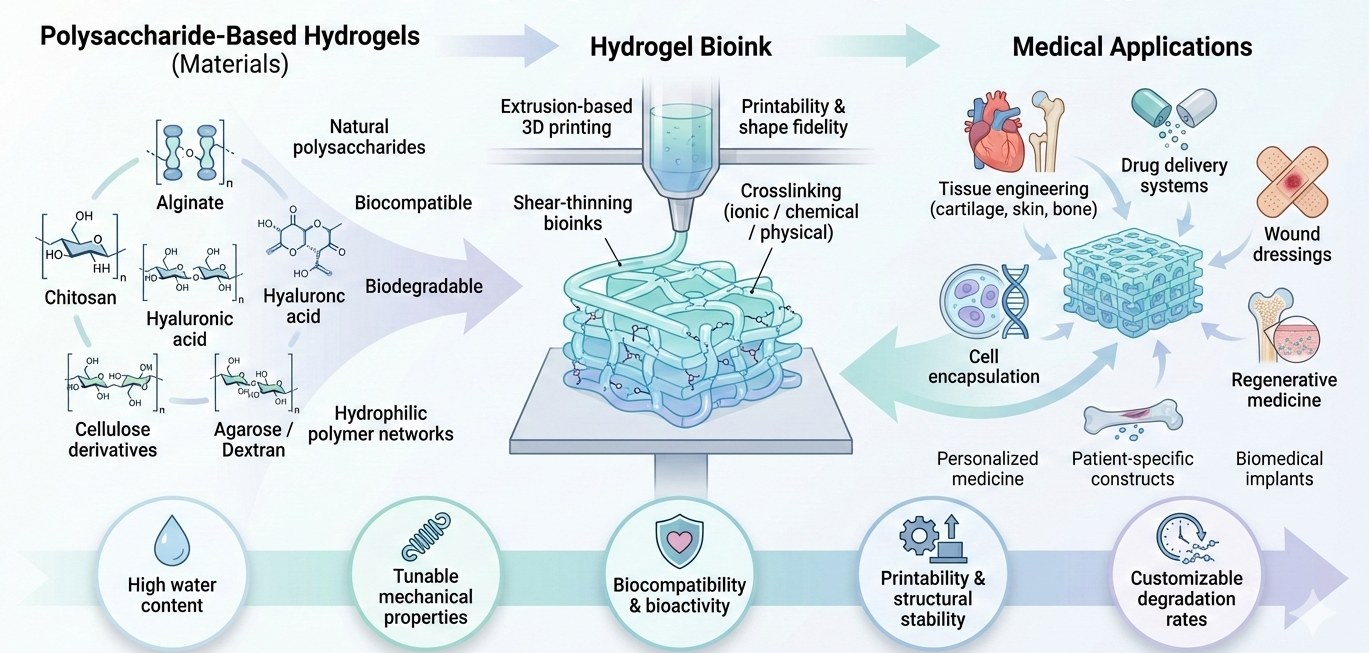
Polysaccharide-based hydrogels represent sustainable and biocompatible bioinks for 3D bioprinting applications in regenerative medicine. However, their clinical translation is impeded by complex structure–property–processing interrelationships. This comprehensive review synthesizes existing literature on polysaccharides derived from seaweed, plant, microbial, and animal sources, correlating their chemical characteristics with rheological performance across extrusion, light-based, and embedded bioprinting modalities. It further critically examines crosslinking strategies, including ionic, photochemical, enzymatic, and hybrid approaches, alongside essential criteria for high-fidelity, cell-laden constructs, such as shear-thinning, yield stress, and post-print stability. By critically analyzing structure–property–processing relationships across seaweed-, plant-, microbial-, and animal-derived polysaccharides and evaluating key translational barriers from preclinical studies, this review distills design principles for next-generation hybrid bioinks. These principles emphasize double-network architectures, bioactive modifications, and perfusable constructs to advance clinically viable tissues and expedite the development of functional regenerative therapies.
Keywords:
3D bioprinting
; polysaccharides
; hydrogel
; bioink
; biopolymers
; medical applications
; tissue engineering
Copyright: This open access article is published under a Creative Commons CC BY 4.0 license, which permit the free download, distribution, and reuse, provided that the author and preprint are cited in any reuse.


