

Submitted:
15 February 2026
Posted:
27 February 2026
You are already at the latest version
Abstract
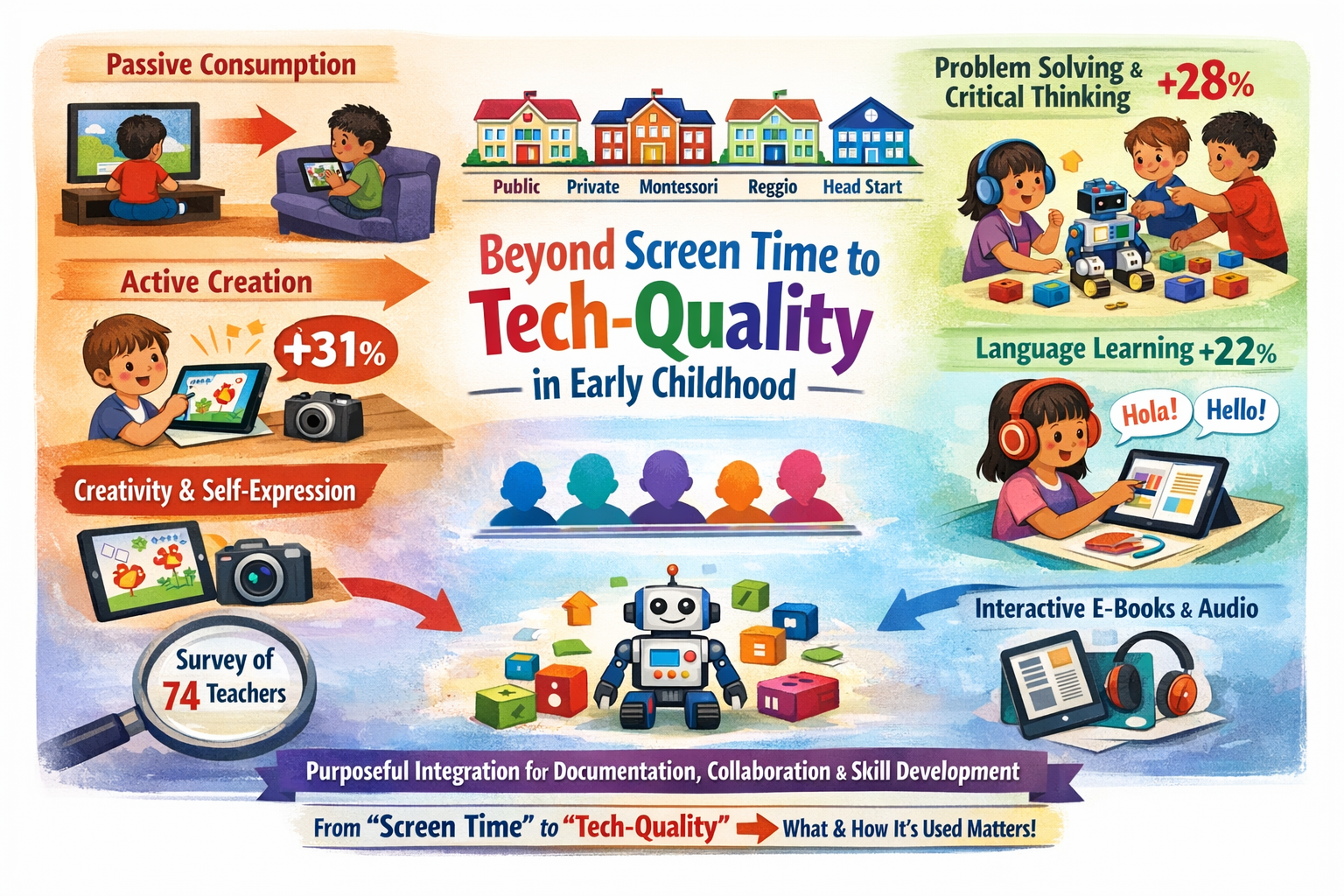
The discussion surrounding early childhood technology continues to concentrate predominantly on the duration of screen time, overlooking a critical examination of how particular digital tools qualitatively affect cognitive development. This study asked 74 early childhood teachers and administrators from different types of schools (public, private, Montessori, Reggio, and Head Start) about how they use technology with kids ages 3 to 5 and what effects it has on their thinking. Data indicates a transition from passive consumption to active creation. The study strongly links tablet-based creation apps and digital cameras to the observed 31% increase in creativity and self-expression. There is a strong correlation between educational robotics and coding kits and the growth of problem-solving and critical thinking skills 28%. Interactive e-books and audio resources help people learn languages 22%, especially if they speak more than one language. Success is not determined by duration but by purposeful integration that employs technology as a medium for documentation, collaboration, and targeted skill development within play-based teaching. It is important to move beyond the "screen time" model to a "tech-quality" model. The cognitive advantage is contingent upon the tool's function, the child's position as a creator, and its smooth integration into comprehensive early learning experiences.
Keywords:
active creation
; cognitive scaffolding (through digital tools)
; digital literacy foundations
; intentional integration (in early learning)
; play-based tech
Copyright: This open access article is published under a Creative Commons CC BY 4.0 license, which permit the free download, distribution, and reuse, provided that the author and preprint are cited in any reuse.


