

Submitted:
31 August 2025
Posted:
03 September 2025
You are already at the latest version
Abstract
In today’s digital age, children are often left not in the care of family or peers but in front of glowing smartphone screens. This phenomenon—what we call “phone alone”—captures a growing reality where digital devices increasingly replace face-to-face human interaction. While smartphones provide opportunities for learning, creativity, and global connection, they also pose significant risks to children’s cognitive, emotional, and social development. Prolonged screen exposure during critical stages of growth can delay language acquisition, weaken communication skills, and contribute to psychological disturbances such as anxiety, social withdrawal, and feelings of loneliness. At the same time, the benefits cannot be overlooked. Smartphones can support education, expand access to information, and foster digital literacy—skills that are essential in the modern world. The challenge lies in balancing these opportunities with the very real risks of overexposure, cultural disconnection, and the influence of commercialized content that often prioritizes consumerism over well-being. This paper explores both the positive and negative effects of smartphone use on children’s learning and growth, drawing on insights from media studies and child psychology. It emphasizes the urgent need to design a safer, more purposeful media environment—one that supports healthy identity formation, encourages authentic communication, and prioritizes children’s emotional and developmental needs. By framing “phone alone” not only as a play on words but as an accurate description of modern childhood, this study highlights the importance of guidance, balance, and human connection in shaping children’s digital lives.
Keywords:
children’s digital lives
; smartphone reliance in childhood
; screen-centered development
; digital solitude
; media-driven childhood
; technology-mediated learning
; early screen immersion
; psychosocial effects of smartphones
; childhood screen ecology
Introduction
Let us recall the unforgettable scene from the iconic film Home Alone. A young boy, Kevin, sits in his vast family home, surrounded by silence, while the telephones of the early 1990s echo through the rooms. Alone, yet not powerless, Kevin’s imagination and courage transformed what could have been fear and vulnerability into an extraordinary adventure—one that audiences around the world still remember decades later.
But today, more than thirty-four years since that film’s release, the reality of childhood solitude has taken on an entirely new form. We are no longer speaking of landline telephones that ring from a distance, but of smartphones—personal devices that rest in the palms of nearly every child. Unlike the telephone of Kevin’s world, the smartphone is not a passive tool for calling; it is a gateway to an entire universe of information, entertainment, and interaction. This raises an intriguing question: if Kevin had held a smartphone instead of toy soldiers and paint cans, would he have reached immediately for his family? Or would he have abandoned his creative adventure, losing himself in games, videos, or endless scrolling?
This reflection is not merely a playful thought experiment. It captures a reality faced by millions of children today: children left digitally alone. Smartphones offer them remarkable opportunities: access to learning resources, the ability to communicate with friends and family across distances, and a chance to explore the wider world in ways previous generations could not imagine. For some children, these devices become tools of creativity, self-expression, and even resilience.
Yet, at the same time, the very device that connects them to the world may also disconnect them from the people directly around them. Smartphones can draw children into a private sphere of screens, reducing face-to-face dialogue, weakening social skills, and narrowing opportunities for emotional development. They may provide entertainment but also promote isolation; they may inspire curiosity but also expose children to content far beyond their cultural context or psychological readiness. In this paradox lies the central concern of our discussion.
This paper seeks to explore the dual reality of unsupervised smartphone use among children—its potential benefits and its undeniable risks. By situating this exploration within the specific context of Arab childhood, where cultural content is often scarce and commercial advertising exerts strong influence, we ask: What are children truly gaining when left alone with their devices? And what, in turn, might they be losing? Just as Kevin’s story was not simply about being left at home, but about what he did with his solitude, our inquiry is not only about the smartphone itself but about how solitude with such a device shapes the child’s development, identity, and human connections.
I. The importance of the topic, its objectives, and the reasons for raising it:
In the context of this intervention—as part of the International Forum on the Arab Child—I would like to highlight an issue with extremely important communication and media dimensions: children's use of smartphones and its manifold effects. According to recent studies, children now spend between four and seven hours a day in front of electronic screens, replacing direct social interaction with individual and superficial activities such as screen scrolling and digital games (Rideout, 2019). This phenomenon should not be viewed solely as a result of technological progress, but rather as a qualitative shift that reshapes children's communication patterns and reshapes their relationship with society, especially the media, and with themselves. Today, we are witnessing a generation growing up in a digital environment that is redefining the concepts of dialogue, interaction, privacy, and even identity and belonging. Hence the importance of this intervention, which will address the topic from a communication and media perspective, focusing on analyzing the dynamics of communication among children in light of digital dominance, monitoring the opportunities and challenges posed by this phenomenon at the level of socialization and media awareness, and also exploring ways to guide the promotion of a more conscious and responsible use of technology in children's lives. It's worth noting that I chose to highlight this topic in the context of this intervention because, despite growing societal concern about the effects of smartphone use on children, we still underestimate the psychological and social repercussions that may result from their excessive use. Although these devices offer undeniable cognitive and entertainment benefits, they also create a digital environment in which children become increasingly isolated from direct face-to-face interaction. This puts their ability to develop basic social communication skills at risk and undermines their ability to enhance their emotional resilience (Twenge & Campbell, 2018). Through this intervention, I will explore the psychological and social dimensions of this digital transformation, focusing on its potential negative effects during the early stages of development.
Methodology
This study is based on a narrative literature review, designed to explore both the benefits and the risks of children’s unsupervised use of smartphones. To gather relevant material, I searched academic databases including Google Scholar, PubMed, and Scopus, using combinations of keywords such as children, smartphone use, unsupervised, digital isolation, benefits, risks, language development, social skills, mental health, creativity, and digital safety. The review concentrated on studies published between 2010 and 2023, with a focus on research involving children and early adolescents that examined developmental, social, or psychological outcomes of smartphone use. Works that dealt exclusively with adults, lacked empirical grounding, or did not specifically address smartphones or tablets were set aside. In line with established guidance for narrative reviews (Baumeister & Leary, 1997; Ferrari, 2015), the final set of six studies was grouped into six main themes: language and learning, emotional and social support, digital skills development, mental health, creativity and play, and digital safety. Organizing the literature this way made it possible to compare both the confirmed and potential advantages and disadvantages of smartphone use, while also recognizing the strengths and limitations of a narrative review approach.
Results
The review of six selected studies reveals a complex and often paradoxical picture of children’s unsupervised smartphone use. To capture this duality, the findings are presented along two complementary axes: one highlighting the benefits that smartphones can offer children- such as opportunities for learning, creativity, and social connection- and the other emphasizing the risks they may carry, including developmental delays, social isolation, and exposure to harmful content. Within this framework, the results are further organized into six thematic domains: language and learning, emotional and social support, digital skills development, mental health, creativity and play, and digital safety. This structure makes it possible to view smartphones not as inherently harmful or beneficial, but as tools whose impact depends on context, content, and the presence or absence of adult guidance.
First Axis: The Negative Side
1-1: The Problem of Isolation Resulting from Mobile Phone Use:
The issue of social isolation resulting from children's use of smartphones is one of the most important issues of concern to researchers and families alike. These devices are not limited to being a means of entertainment or communication, but are gradually threatening the quality of direct human interactions, which have a profound impact on the formation of a child's personality and their psychological and social development. As children increasingly rely on smartphones as a means of entertainment, communication, and even emotional release, they show a clear tendency to withdraw from face-to-face encounters, which leads to a shrinking space for acquiring essential social skills (Uhls et al., 2014). Studies have shown that children who spend long hours in front of screens engage less in real-life interactions (face-to-face communication), which weakens their family ties and social circles. For example, a study by Twenge et al. (2018) found that children and adolescents who spend more time on screens report lower levels of happiness and significantly less time spent on face-to-face social interaction. This shift is evident in the daily family landscape; many parents notice their children staring at their devices during mealtimes, indifferent to family conversations or shared activities (Radesky et al., 2016). Furthermore, excessive screen use has been linked to a sharp decline in outdoor play, an activity that has long been a vital arena for learning cooperation, negotiation, and conflict resolution skills (Gray, 2011). When children prioritize virtual interactions over real-life play, they miss out on essential opportunities to build empathy, develop organizational skills, and enhance social competence. Thus, smartphones, while they can connect children to distant friends or digital communities, become a means of reinforcing children's isolation from those around them, both within the family and in their immediate social circles.
1-2: The Impact of Telephone Isolation on Communication
1-2-1: Effects on Language Development:
Undoubtedly, one of the most worrisome repercussions of children's excessive smartphone use is its negative effects on their language development, especially in their early years, which are critical for acquiring expressive and comprehension skills. Studies have shown that early childhood constitutes a golden age for language development, due to the importance of direct interactive communication with parents and peers, including linguistic richness and opportunities for narrative and dialogue (Christakis, 2009). However, prolonged immersion in the world of screens and being limited to brief text messages or static digital content deprives children of this fertile environment, undermining the development of vocabulary and natural expression skills. A recent study by Madigan et al. (2020) demonstrated a close relationship between increased screen time in children and delayed expressive language abilities, emphasizing the pivotal role of live verbal interaction in building their linguistic abilities. In addition, the proliferation of visual media such as emojis and GIFs contributes to children's narrow linguistic horizons, depriving them of engaging in rich linguistic experiences that enhance their understanding of tone, context, and nuanced meaning- all of which are essential for deep communication later in life. Unless addressed, this deficit threatens to have long-term consequences for children’s academic achievement and social integration, highlighting that while linguistic accessibility may be relatively high, the methods of content delivery require improvement to bridge persistent gaps in comprehension.(Cheriti & Mehiri, 2025, p. 137).
1-2-2: Weak social skills (eye contact, empathy, listening): The impact of excessive smartphone use extends beyond language to affect children's deep social skills, most notably eye contact, empathy, and the ability to actively listen. Human relationships require the ability to pick up on subtle cues conveyed by the face, body, and voice- skills that digital interaction fails to hone. In this context, Uhls et al. (2014) noted that children who spend extended hours in front of screens show a marked impairment in interpreting nonverbal emotional cues, which undermines their ability to empathize and understand the feelings of others. This deficit manifests itself in daily life practices, as children become less able to maintain eye contact and less attentive when listening to others, leading to superficial and fragile relationships. Shakya and Christakis (2017) supported this view, explaining that excessive use of social media and smartphones is associated with a decline in social well-being, given that digital interactions lack the emotional depth and directness of face-to-face encounters. Therefore, immersion in the digital world strips children of the fine-grained skills that form the foundation of authentic human communication.
1-2-3 Weak Conflict Resolution Skills:
One of the most significant shortcomings resulting from the pervasive use of smartphones in children's lives is their diminished ability to resolve conflicts, a skill traditionally honed through confrontations with peers. In past decades, children were accustomed to managing conflicts face-to-face, requiring patience, negotiation skills, emotional regulation, and flexibility. However, the current generation now prefers to resort to digital media to resolve their disputes, avoiding direct confrontation. According to Uhls et al. (2017), this shift deprives children of valuable opportunities to practice essential conflict resolution skills. We often see children today resorting to sending a terse text message or withdrawing from an online conversation instead of confronting a conflict and finding common solutions. In the long run, this pattern fosters feelings of social anxiety, reduces frustration tolerance, and undermines a child's confidence in their ability to handle interpersonal challenges (Keles et al., 2020). Thus, the negative impact is not limited to a decline in conflict resolution skills, but also extends to deepening the child's isolation as unresolved conflicts accumulate and valuable relationships in his life deteriorate.
Figure 1.
shows an example (sample) of media interest in the phenomenon of leaving children to use the phone in isolation.
Figure 1.
shows an example (sample) of media interest in the phenomenon of leaving children to use the phone in isolation.
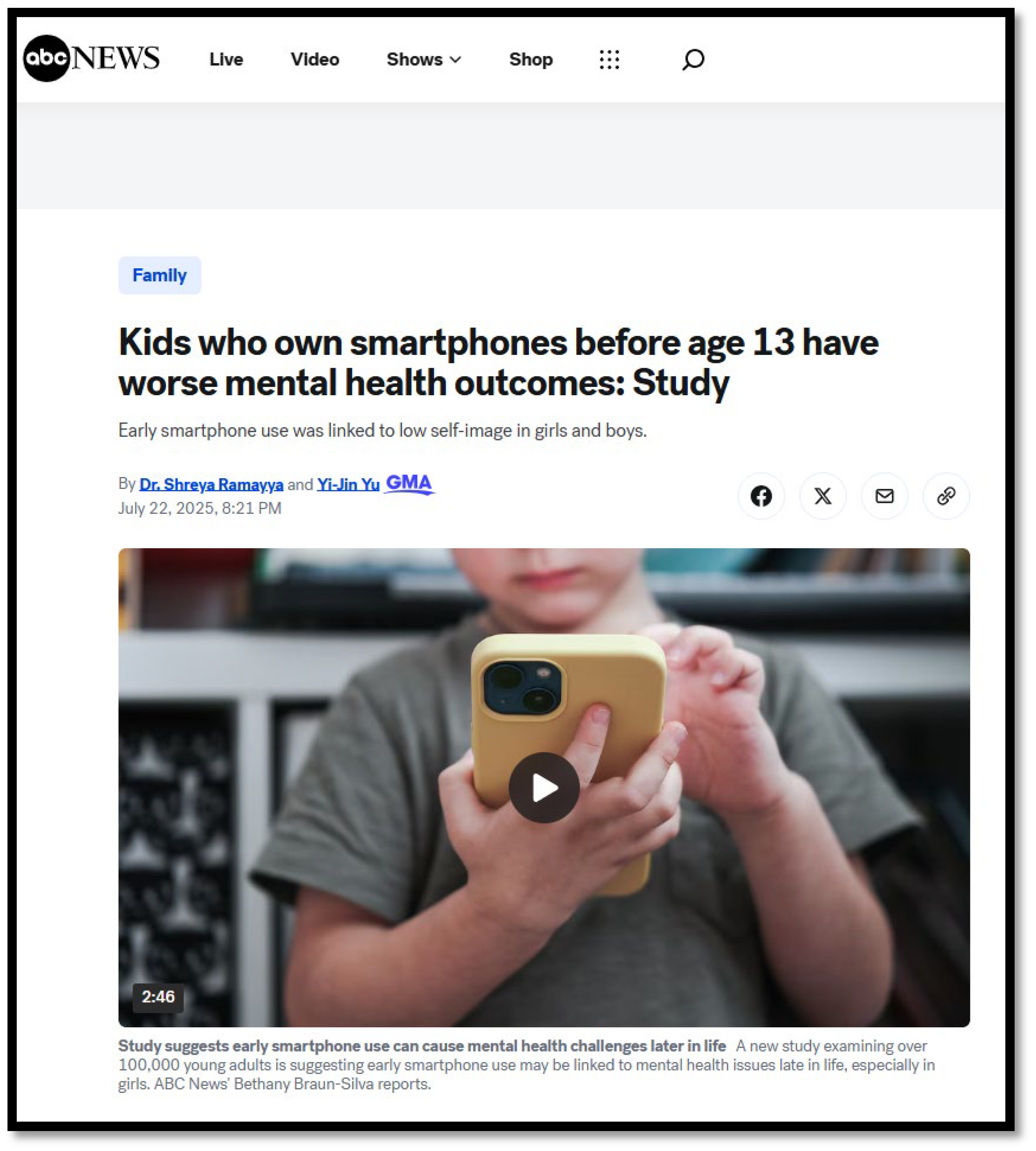

Table 1.
An Overview of Media Discourses on Children’s Digital Lives and Smartphone Use (2025), (self-designed).
Table 1.
An Overview of Media Discourses on Children’s Digital Lives and Smartphone Use (2025), (self-designed).
| Media Outlet. | Date | Focus / Interest Type | Key Statistics or Insights |
|---|---|---|---|
| University of South Florida (USF Study) | March 27, 2025 | Benefits: positive effects of smartphone use | Smartphone owners (ages 11–13) reported higher self-esteem, more in-person time with friends, and fewer depressive symptoms . |
| Good Morning America | July 22, 2025 | Risks: early smartphone ownership linked to poor mental health | Individuals given smartphones before age 13 had worse mental health in young adulthood, including lower self-image and emotional resilience |
| UPI | July 22, 2025 | Risks: early exposure harms developing minds | Early smartphone use correlates with suicidal thoughts, aggression, poor emotional regulation; social media exposure explained ~40% of this link |
| The Guardian | Jan 11, 2025 | Policy / Prevention: delaying smartphone access | Campaigns in Spain and Australia promote delaying phone ownership; Spain: 72% of children have smartphones by age 12 |
| Jonathan Haidt (People interview) | About a month ago (2025) | Expert opinion / risks | Haidt supports full-day school phone bans and social media age limits; warns early screen exposure undermines attention and emotional development |
| The Guardian (Rasmus Meyer—Europe) | March 5, 2025 | Policy / Benefits: banning phones aids well-being | Denmark’s ban improves attention, social skills; 94% of children had social media profiles before age 13 |
| Reuters (South Korea) | Aug 27, 2025 | Policy / Risks: classroom phone ban | 37% of students say social media affects daily life; 22% feel anxious without phones. Nationwide ban starts March 2026 |
| Indian Times (Japan) | Recent (2025) | Policy / Risks: limiting daily use to improve health | Toyoake recommends max 2 hours phone use; curfews 9 p.m. (kids), 10 p.m. (adults). 80% unhappy; 120+ complaints filed |
| The Atlantic | 6 days ago (2025) | Parenting / Risks: unseen disadvantages of phone access | Phones in schools cause distractions, social anxiety, reduced resilience. Advocates for restrictions to foster independence |
| Times of India | Today (2025) | Health risks: screen time linked to heart issues | Excessive screen time linked to high blood pressure, insulin resistance, high cholesterol in children |
| Sunday Times Magazine (UK) | March 2025 | Culture / Mitigation: Smartphone Free Childhood movement | Encourages delaying phones until age 14; supported by 100,000+ parents; celebrity endorsements . |
A recent article (Skopeliti, 2024) published by The Guardian (2024) provides a timely and thought-provoking exploration of the growing concerns about children’s screen time and its broader implications for their social and psychological well-being. Drawing on expert opinion and empirical evidence, the article convincingly demonstrates how excessive smartphone use disrupts face-to-face communication, reshapes family dynamics, and may impair emotional and social development. In the context of our intervention, we find this study particularly valuable in highlighting the complex interplay between digital media consumption and personal relationships. the shift to the digital age has also shaped other media and content industries (Cheriti & Mehiri, 2025) . However, while the article succeeds in raising public awareness, it somewhat downplays the importance of communication mechanisms. For example, it frames the problem primarily in terms of screen time, when arguably the quality and context of digital interactions are equally important. Not all screen time is equal; educational or creative uses are markedly different from passive scrolling or social comparisons on platforms such as Instagram or TikTok. Furthermore, The article would benefit from a more nuanced discussion of the symbolic dimension of smartphone use, and how these devices have become an extension of identity, social belonging, and emotional regulation for young users. From a communication perspective, the study's call for parental boundaries is essential, but it also opens a broader discussion about media literacy and the need to provide children with basic tools for consciously navigating digital environments. Rather than viewing screens as a mere threat, we should explore how they can be integrated into children's lives in ways that enhance rather than undermine social competence. Ultimately, the Guardian article is a valuable entry point into these discussions, but its analysis would be enriched by exploring the communicative functions of technology in children's daily lives. In this context, several issues raised by the previous study, which we used as an example to address the topic of our intervention, loom large. Perhaps the most important of these issues—which we attempt to address below, drawing on recent scientific studies—are:
A - The Role of Parents in Regulating Phone Use:
Studies have shown that parental control and involvement in technology use reduce risks and enhance the potential benefits of such use. A study by Radesky et al. (2016) confirms that children whose parents interact with them while using digital devices acquire better self-regulation skills compared to those left alone in front of screens. However, some argue that focusing on parental responsibility may neglect the need for public policies and the role of schools in digital awareness, placing the entire burden on families alone.
B - The Role of Schools in Digital Awareness:
Schools are a key space for teaching children the skills of safe and responsible smartphone use. According to a study by Livingstone et al. (2017) Children who participate in digital literacy programs within schools (as part of their curriculum or as part of extracurricular activities) demonstrate a greater understanding of online risks, such as cyberbullying and privacy, and have safer online practices. However, some studies (Selwyn, 2016) criticize these initiatives because they are often theoretical and do not translate into children's real-life practices.
C - The impact of phone use on physical health:
In addition to the psychological and social aspects, there is an important dimension related to physical health. A study conducted by Tremblay et al. (2011) found that excessive screen use is associated with decreased physical activity and increased obesity rates in children. In the same context, Hale & Guan (2015) indicate that prolonged exposure to the blue light emitted by screens causes sleep disturbances, which negatively impacts concentration and academic performance. This highlights the need to educate children on how to manage their screen time, not just how much content they consume.
D- The Role of Technology Designed for Children:
Some companies produce digital applications specifically designed to promote learning and positive interaction in children, such as language learning applications or educational games. According to a study by Marsh et al. (2015), the latter can enhance creativity and problem-solving skills if used within a well-guided and supervised context. However, researchers raise concerns about the confusion between "entertainment" and "education," as some applications may market themselves as educational tools when their primary purpose is purely entertainment and commercial.
The second Axis: The positives of children's use of smartphones.
In the following, we attempt to highlight the findings of some scientific studies that confirm and prove these positive aspects of children's use of smartphones to watch cartoons, gaming apps, and other activities.
The first study: Educational benefits and learning applications.
Hirsh-Pasek and other researchers (2015) conducted a study that examined how educational applications on smartphones can enhance children's vocabulary, in addition to empowering them to control their problem-solving skills. The researchers found that children who use well-designed educational applications show improvements in word learning and terminology comprehension, even without their parents' involvement in using or viewing them. Most importantly, the study confirmed that interactivity—not mere screen exposure—is the primary factor in enhancing learning. From a communicative perspective (so to speak), although this study highlights the cognitive gains associated with the use of educational applications, it largely ignores the social dimensions and dialogue as a communicative process in learning. Theorists such as Vygotsky believe that social interaction is essential for cognitive development, and applications, no matter how interactive, may not provide the communicative framework for human dialogue with its richness of signals, connotations, and meanings. Moreover, the study did not address whether these digital gains translate into real-world communication competence for children.
The second study: Coping with Loneliness and Emotional Support. A study by Odgers and Jensen (2020) examined longitudinal data and ecological momentary assessments of smartphone use among adolescents and older children. They found that smartphones can provide a lifeline in times of loneliness or distress, enabling children to connect with peers or access specific online communities. They also found that the emotional benefits are particularly pronounced when children are isolated or lack non-digital social support, helping to alleviate feelings of exclusion or sadness. However, we believe that while the results of this study challenge simplistic narratives such as “phones = harm,” they raise ethical questions about replacing digital interactions with real-life (non-digital) support networks. From a communication researcher’s perspective, we caution that digital communication may temporarily alleviate loneliness, but it may also enhance coping strategies for children or adolescents experiencing difficult psychological conditions, reducing their motivation to seek face-to-face support or resolve problems directly. On the other hand, the study did not consider the risks associated with exposure to online harassment, which may exacerbate psychological distress rather than alleviate it.
Third Study: Developing Digital Skills and Independence. Researcher Hooft Graafland (2018) conducted a study that addressed the question: How do children use smartphones to develop digital literacy/independence? He concluded that even in isolated contexts (solo use), children engage in exploring, creating, and curating content, which enhances the skills necessary for positive participation. The study also confirmed that smartphones give children a sense of control over their media environment and digital identities. We believe this study offers a new perspective by portraying children as active producers of media rather than passive consumers. However, from a media criticism perspective, it does not sufficiently analyze whether this "independence" is real or hidden, particularly by commercial institutions, such as advertising.
Table 01.
Benefits and Risks Associated with Children’s Use of Smartphones.
| Benefits (Confirmed / Potential) | Risks (Confirmed / Potential) | Domain |
|---|---|---|
| Interactive educational applications that enhance vocabulary and problem-solving (Hirsh-Pasek et al., 2015) | Delays in expressive language skills due to negative interaction and non-interactive content (Madigan et al., 2020) | Language Development and Learning |
| Reduction of feelings of loneliness through communication with peers and online communities (Odgers & Jensen, 2020) | Weakening of core social skills such as empathy, eye contact, and active listening (Uhls et al., 2014) | Emotional and Social Support |
| Development of digital literacy, autonomy, and content organization (Hooft Graafland, 2018) | Hidden constraints resulting from algorithms and commercial interests, which may limit true autonomy, alongside neglect of non-digital skills such as conflict resolution and negotiation (Keles et al., 2020) | Digital Skills Development |
| Access to well-being applications such as meditation and mindfulness (Rideout & Robb, 2018) | Increased anxiety and depression, particularly due to social comparison and excessive use (Twenge & Campbell, 2018) | Mental Health |
| Use of creative applications such as drawing, design, and game programming enhances innovative thinking (Granic et al., 2014) | Excessive consumption of negative or repetitive content reduces time for free and imaginative play in the real world (Gray, 2011) | Creativity and Play |
| Acquisition of basic cybersecurity skills and awareness of online risks (Livingstone et al., 2017) | Exposure to cyberbullying and inappropriate content, increasing stress, fear, and weakening self-confidence (Kowalski et al., 2014) | Digital Safety |
Discussion
The findings of this review suggest that children’s unsupervised use of smartphones cannot be reduced to a simple narrative of either harm or benefit. Instead, the evidence reveals a dual reality: smartphones can enrich learning, creativity, and digital literacy, while at the same time exposing children to significant developmental, psychological, and social risks. This paradox echoes broader debates in media and child development research, where technology is increasingly recognized as a “double-edged sword” (Livingstone & Blum-Ross, 2020).
One central insight concerns the role of context and mediation. Studies consistently show that the quality of content and the degree of adult involvement strongly shape outcomes. For example, interactive educational apps may enhance vocabulary and problem-solving skills (Hirsh-Pasek et al., 2015), yet passive or unsupervised exposure to digital media has been associated with language delays (Madigan et al., 2020). This contrast suggests that smartphones are not inherently developmental threats; rather, their impact depends on whether they are used as tools for engagement or as substitutes for human interaction.
A second theme relates to social connectedness versus isolation. Digital communication can reduce children’s sense of loneliness by providing opportunities to connect with peers (Odgers & Jensen, 2020). However, these same connections may occur at the expense of face-to-face interaction, empathy, and other core social skills (Uhls et al., 2014). The evidence here illustrates a developmental tension: smartphones extend children’s social worlds but may simultaneously thin out the quality of relational experiences that are foundational in early years.
The findings on mental health highlight similar contradictions. On one hand, digital tools can provide access to mindfulness and emotional regulation resources (Rideout & Robb, 2018). On the other, heavy reliance on social media platforms has been linked with heightened anxiety, depression, and lowered self-esteem (Twenge & Campbell, 2018). These mixed results call for a more nuanced understanding of thresholds—how much use, under what conditions, and in which developmental periods smartphone use tips from beneficial to harmful. Another important consideration is the cultural and structural context in which children use smartphones. In the Arab world, for example, the scarcity of locally relevant, culturally sensitive digital content raises particular challenges. Children often engage with media produced in contexts that may not reflect their values or developmental needs, while commercial advertising increasingly targets young users and shapes their sense of identity and self-worth. These realities point to the urgent need for investment in child-centered, culturally grounded digital ecosystems that go beyond parental control and actively promote healthy development.
Finally, the review underscores gaps in existing research. Much of the literature is still cross-sectional, making it difficult to establish causal pathways between smartphone use and developmental outcomes. Moreover, children are often treated as a homogenous group, despite wide variation in age, temperament, socio-economic background, and cultural setting. Future studies should adopt longitudinal and cross-cultural designs, moving beyond simplistic “screen time” measures toward richer assessments of digital practices, contexts, and lived experiences (Livingstone & Blum-Ross, 2020).
Conclusion
Together, these studies remind us that children's smartphone use is a complex and multidimensional phenomenon, carrying potential benefits alongside a number of known and unknown risks. As researchers, we must move beyond binary debates about good and bad and adopt a more nuanced, sensitive, and contextual approach when assessing children's engagement with digital media. We hope this intervention will spark further discussions and research into the phenomenon of children's solitude and isolation from their parents and the real world.
Limitations and Future Directions
This review is limited by its story approach and dependence on a small set of studies, which cannot fully represent the width of the available research. Most reviewed tasks are cross-sectional and often consider "screen time" as a uniform category, ignoring important differences such as supervised vs unprotected use or academic vs. entertainment materials. In addition, the review is mainly attracted to the study of the English-language, leaving potential regional and cultural approaches, especially in the Arabs context.
Future research should adopt longitudinal and cross-cultural designs, include children's own voices, and proceeding from the simple binary of "profit versus risk" towards identifying conditions, which is the support or obstruction of the smartphone.
Disclosure Statement
The author declares no conflicts of interest related to this study.
Funding Statement
This research received no financial support or grants from universities, government agencies, funding organizations, or other entities.
References
- Baumeister, R.F.; Leary, M.R. Writing narrative literature reviews. Review of General Psychology 1997, 1, 311–320. [Google Scholar] [CrossRef]
- Cheriti, F.; Mehiri, D. Discourses of guidance: Exploring contextual face-to-face communication between Imams and congregants. Akofena 2025, 16, 133–150. [Google Scholar] [CrossRef]
- Cheriti, F.; Mehiri, D. Pertinence ou déclin: Impact du journalisme numérique sur la production médiatique face aux défis de l’IA. Ziglôbitha, Revue des Arts, Linguistique, Littérature & Civilisations 2025, 2, 1–20. [Google Scholar] [CrossRef]
- Christakis, D.A. The effects of infant media usage: What do we know and what should we learn? Acta Paediatrica 2009, 98, 8–16. [Google Scholar] [CrossRef] [PubMed]
- Ferrari, R. Writing narrative style literature reviews. Medical Writing 2015, 24, 230–235. [Google Scholar] [CrossRef]
- Gray, P. The decline of play and the rise of psychopathology in children and adolescents. American Journal of Play 2011, 3, 443–463. [Google Scholar]
- Hale, L.; Guan, S. Screen time and sleep among school-aged children and adolescents: A systematic review. Pediatrics 2015, 135, e1018–e1030. [Google Scholar] [CrossRef]
- Hirsh-Pasek, K.; Zosh, J.M.; Golinkoff, R.M.; Gray, J.H.; Robb, M.B.; Kaufman, J. Putting education in “educational” apps: Lessons from the science of learning. Psychological Science in the Public Interest 2015, 16, 3–34. [Google Scholar] [CrossRef]
- Hirsh-Pasek, K.; Zosh, J.M.; Golinkoff, R.M.; Gray, J.H.; Robb, M.B.; Kaufman, J. Putting education in “educational” apps: Lessons from the science of learning. Psychological Science in the Public Interest 2015, 16, 3–34. [Google Scholar] [CrossRef]
- Hooft Graafland, J. (2018). New technologies and 21st century children: Recent trends and outcomes. OECD Education Working Papers, No. 179. OECD Publishing. [CrossRef]
- Keles, B.; McCrae, N.; Grealish, A. A systematic review: The influence of social media on depression, anxiety, and psychological distress in adolescents. International Journal of Adolescence and Youth 2020, 25, 79–93. [Google Scholar] [CrossRef]
- Livingstone, S.; Blum-Ross, A. (2020). Parenting for a digital future: How hopes and fears about technology shape children’s lives. Oxford University Press.
- Livingstone, S.; et al. (2017). Children's online risks and opportunities: Comparative findings from EU Kids Online and Net Children Go Mobile.
- Madigan, S.; Browne, D.; Racine, N.; Mori, C.; Tough, S. Association between screen time and children’s performance on a developmental screening test. JAMA Pediatrics 2020, 173, 244–250. [Google Scholar] [CrossRef] [PubMed]
- Madigan, S.; McArthur, B.A.; Anhorn, C.; Eirich, R.; Christakis, D.A. Associations between screen use and child language skills: A systematic review and meta-analysis. JAMA Pediatrics 2020, 174, 665–675. [Google Scholar] [CrossRef] [PubMed]
- Marsh, J.; et al. (2015). Exploring play and creativity in pre-schoolers’ use of apps: Final project report. University of Sheffield.
- Odgers, C.L.; Jensen, M.R. Annual Research Review: Adolescent mental health in the digital age: Facts, fears, and future directions. Journal of Child Psychology and Psychiatry 2020, 61, 336–348. [Google Scholar] [CrossRef] [PubMed]
- Odgers, C.L.; Jensen, M.R. Annual Research Review: Adolescent mental health in the digital age: Facts, fears, and future directions. Journal of Child Psychology and Psychiatry 2020, 61, 336–348. [Google Scholar] [CrossRef]
- Radesky, J.S.; Schumacher, J.; Zuckerman, B. Mobile and interactive media use by young children: The good, the bad, and the unknown. Pediatrics 2016, 135, 1–3. [Google Scholar] [CrossRef]
- Radesky, J.S.; Schumacher, J.; Zuckerman, B. Mobile and interactive media use by young children: The good, the bad, and the unknown. Pediatrics 2016, 135, 1–3. [Google Scholar] [CrossRef]
- Rideout, V. (2019). The Common Sense Census: Media use by tweens and teens. Common Sense Media. https://www.commonsensemedia.org.
- Rideout, V.; Robb, M.B. (2018). Social media, social life: Teens reveal their experiences. Common Sense Media.
- Selwyn, N. (2016). Education and technology: Key issues and debates. Bloomsbury.
- Shakya, H.B.; Christakis, N.A. Association of Facebook use with compromised well-being: A longitudinal study. American Journal of Epidemiology 2017, 185, 203–211. [Google Scholar] [CrossRef]
- Skopeliti, C. (2024, February 1). Kids are on their phones more than ever. We asked parents what they’re doing about it. The Guardian. https://www.theguardian.com/lifeandstyle/2024/feb/01/screen-time-phones-kids-limit.
- Tremblay, M.S.; et al. Systematic review of sedentary behavior and health indicators in school-aged children and youth. International Journal of Behavioral Nutrition and Physical Activity 2011, 8, 98. [Google Scholar] [CrossRef]
- Twenge, J.M.; Campbell, W.K. Associations between screen time and lower psychological well-being among children and adolescents: Evidence from a population-based study. Preventive Medicine Reports 2018, 12, 271–283. [Google Scholar] [CrossRef]
- Twenge, J.M.; Campbell, W.K. Associations between screen time and lower psychological well-being among children and adolescents: Evidence from a population-based study. Preventive Medicine Reports 2018, 12, 271–283. [Google Scholar] [CrossRef]
- Twenge, J.M.; Martin, G.N.; Campbell, W.K. Decreases in psychological well-being among American adolescents after 2012 and links to screen time during the rise of smartphone technology. Emotion 2018, 18, 765–780. [Google Scholar] [CrossRef] [PubMed]
- Uhls, Y.T.; Ellison, N.B.; Subrahmanyam, K. Benefits and costs of social media in adolescence. Pediatrics 2014, 140 (Supplement 2), S67–S70. [Google Scholar] [CrossRef]
- Uhls, Y.T.; Ellison, N.B.; Subrahmanyam, K. Benefits and costs of social media in adolescence. Pediatrics 2014, 140 (Supplement 2), S67–S70. [Google Scholar] [CrossRef]
- Uhls, Y.T.; Ellison, N.B.; Subrahmanyam, K. Benefits and costs of social media in adolescence. Pediatrics 2014, 140 (Supplement_2), S67–S70. [Google Scholar] [CrossRef] [PubMed]
- Uhls, Y.T.; Michikyan, M.; Morris, J.; Garcia, D.; Small, G.W.; Zgourou, E.; Greenfield, P.M. Five days at outdoor education camp without screens improves preteen skills with nonverbal emotion cues. Computers in Human Behavior 2017, 39, 387–392. [Google Scholar] [CrossRef]
Disclaimer/Publisher’s Note: The statements, opinions and data contained in all publications are solely those of the individual author(s) and contributor(s) and not of MDPI and/or the editor(s). MDPI and/or the editor(s) disclaim responsibility for any injury to people or property resulting from any ideas, methods, instructions or products referred to in the content. |
© 2025 by the authors. Licensee MDPI, Basel, Switzerland. This article is an open access article distributed under the terms and conditions of the Creative Commons Attribution (CC BY) license (http://creativecommons.org/licenses/by/4.0/).
Copyright: This open access article is published under a Creative Commons CC BY 4.0 license, which permit the free download, distribution, and reuse, provided that the author and preprint are cited in any reuse.


