

Submitted:
02 February 2026
Posted:
13 February 2026
You are already at the latest version
Abstract
We propose a thermodynamic variational framework in which quantum mechanics, classical dynamics, and gravitation emerge as equilibrium regimes of a single free-energy functional defined on probability distributions rather than on trajectories, wavefunctions, or spacetime metrics. The functional balances Fisher information, potential energy, and Shannon entropy, encoding an exploration–exploitation trade-off uniquely fixed by information-theoretic considerations. Matching the Fisher term to the quantum kinetic energy fixes its coefficient without free parameters. Extremization of the functional yields the continuity equation and the quantum Hamilton–Jacobi equation, and thus reproduces the Schrödinger equation as a thermodynamic equilibrium condition. At mesoscopic scales, competition between Fisher information and entropy introduces a characteristic quantum–classical crossover length that provides a thermodynamic perspective on decoherence. Measurement is interpreted as an irreversible thermodynamic transition, with energetic costs bounded by Landauer's principle. In the macroscopic regime, we show that requiring thermodynamic stability and local boundary response selects area-law entropy scaling as the leading contribution under stated assumptions. Given an area-law entropy, standard local arguments recover Einstein's field equations. The framework yields falsifiable predictions across quantum, mesoscopic, and gravitational regimes.
Keywords:
quantum mechanics
; general relativity
; Fisher information
; thermodynamics
; entropy
; area law
; holography
; quantum measurement
; exploration-exploitation
1. Introduction
The incompatibility between quantum mechanics and general relativity remains one of the central open problems in fundamental physics [1]. Quantum theory is formulated in terms of probabilistic amplitudes, unitary evolution, and measurement postulates, while general relativity describes gravitation as the dynamics of spacetime geometry governed by local curvature. Despite their extraordinary empirical success, these frameworks rest on distinct conceptual foundations and resist unification within a single dynamical theory.
A growing body of research suggests that this divide may reflect not a failure of quantization or classicalization per se, but the absence of an underlying organizing principle common to both regimes. In this spirit, thermodynamic and information-theoretic ideas have increasingly been proposed as candidates for such a principle. Following Jaynes’ reformulation of statistical mechanics as inference under constraints [2,3], entropy and information have been interpreted as fundamental descriptors of physical law rather than merely emergent bookkeeping tools. In parallel, Fisher information has been shown to play a distinguished role in the structure of physical theories: several authors have demonstrated that quantum equations of motion can be obtained from information-theoretic variational principles based on Fisher information [4,5]. Building on our recent work introducing Exploration–Exploitation Thermodynamics [6], we here develop this framework more rigorously, focusing specifically on the mathematical foundations and testable predictions.
In the gravitational context, thermodynamic perspectives have led to particularly striking results. Jacobson showed that Einstein’s field equations can be recovered as an equation of state by imposing local Clausius relations on spacetime horizons, provided an area-law entropy is assumed [7]. Subsequent work by Padmanabhan and others further developed the view that gravitational dynamics may be encoded in thermodynamic relations associated with horizons, boundary terms, and coarse-grained degrees of freedom [8]. Related ideas also appear in emergent and entropic gravity proposals, in which gravitational attraction is interpreted as an effective force arising from entropy gradients [9].
The universality of gravity suggests that its macroscopic behaviour should follow from general thermodynamic principles, rather than from the microscopic details of any particular underlying theory. In this framework, gravity is approached through the thermodynamic structure of the proposed free-energy functional, in which area-law entropy and local equilibrium relations play a central role. This language is not intended as an ontological statement, but simply as a compact way to express the thermodynamic response of the system. Entropic considerations appear in many physical contexts—such as polymer elasticity, osmotic pressure, and colloidal interactions—where gradients of entropy generate effective forces. In the present approach, the area-law entropy that arises from EET stability and locality considerations, combined with local thermodynamic relations, leads to Einstein’s equations via Jacobson’s argument.
More recently, analogue-gravity and quantum-information–inspired approaches have explored how horizon-like phenomena, surface gravity, and effective spacetime dynamics can emerge in controlled laboratory systems. Experimental and theoretical studies of analogue horizons in fluids and wave systems have provided insight into the kinematics of horizons and surface gravity [10], while broader programmes have investigated analogue simulations of quantum-gravitational phenomena using fluids and condensed-matter systems [11]. These approaches yield valuable physical intuition and experimentally accessible models, but they typically focus on specific systems or media rather than on a unifying variational principle spanning quantum, classical, and gravitational regimes.
The present work is motivated by a complementary question: can quantum mechanics, classical dynamics, and gravitation be understood as equilibrium limits of a single thermodynamic functional defined on probability distributions? Rather than proposing a new microscopic theory of spacetime or relying on analogue systems, we ask whether a universal variational principle—grounded in information theory and thermodynamics—can reproduce the known dynamical laws across scales.
To this end, we introduce a thermodynamic framework based on a Helmholtz-type free-energy functional that balances three ingredients: Fisher information, potential energy, and Shannon entropy. The inclusion of Fisher information is not ad hoc. From an information-geometric perspective, Fisher information is uniquely singled out as the only local, monotone Riemannian metric on the space of probability distributions [12], and when appropriately calibrated it reproduces the quantum kinetic term [4]. Entropy enters as the driver of exploration and coarse-graining, while energetic terms encode the exploitation of favourable configurations. We refer to this framework as Exploration–Exploitation Thermodynamics (EET).
Within this framework, several results follow directly from the variational structure. At microscopic scales, extremization of the free energy yields the continuity equation and the quantum Hamilton–Jacobi equation, which together reproduce the Schrödinger equation. In this sense, quantum mechanics appears as a thermodynamic equilibrium condition rather than as a set of independent axioms. At intermediate scales, the competition between Fisher information and entropy leads to a characteristic quantum–classical crossover length, providing a thermodynamic perspective on decoherence and mesoscopic behaviour. Measurement is naturally interpreted as a thermodynamic transition, with energetic costs constrained by Landauer’s principle [13].
At macroscopic scales, the entropy term dominates. Requiring thermodynamic stability and locality in this regime motivates a transition from volume-scaling to area-scaling entropy. Given such an area-law entropy, standard local thermodynamic arguments recover Einstein’s equations following Jacobson’s approach [7]. In this sense, general relativity emerges conditionally from the same free-energy functional, once appropriate macroscopic assumptions are imposed. We emphasise that while the microscopic variational structure is fixed by information-theoretic considerations, certain macroscopic elements—such as area-law entropy and a scale-dependent cosmological term—are introduced as physically motivated assumptions rather than derived from first principles.
The novelty of the present work lies not in proposing a new analogue system, entropic force model, or microscopic theory of spacetime, but in embedding quantum dynamics, decoherence, and gravitation within a single thermodynamic variational principle acting on probability distributions. Unlike previous Fisher-information approaches, the framework explicitly incorporates temperature and entropy in a free-energy form. Unlike thermodynamic derivations of gravity that begin by assuming horizon entropy, the present approach provides a stability- and locality-based motivation for area-law scaling, formalized under explicit assumptions in Appendix B.
The paper is organized as follows. Section 2 constructs the thermodynamic free-energy functional and discusses its information-theoretic justification. Section 3 shows how quantum mechanics emerges from the variational principle. Section 4 derives the quantum–classical crossover scale, and Section 5 interprets measurement as a thermodynamic transition. Section 6 develops the macroscopic gravitational sector. Section 7 discusses cosmological implications, including a phenomenological scale-dependent cosmological term. We conclude by summarizing which results follow rigorously from the variational structure and which rely on additional physical assumptions, and by outlining possible experimental and observational tests.
2. Theoretical Framework
2.1. The Exploration–Exploitation Principle in Physics
Any physical system that maintains structure far from equilibrium must balance two competing tendencies. On the one hand, entropy production drives exploration of accessible configurations; on the other hand, energetic constraints promote exploitation of favourable states that sustain order. This trade-off is well known in statistical physics, biology, and learning theory, where it is formalised as the exploration–exploitation dilemma [14,15,16].
In the present work, we propose that the same trade-off underlies the structure of physical law across scales. We model the system at a coarse-grained level by a probability density over configurations , and seek a thermodynamic functional—defined on probability distributions rather than on trajectories, wavefunctions, or spacetime metrics—whose extrema determine the equilibrium (or quasi-equilibrium) dynamics of this distribution.
2.2. Construction of the Free-Energy Functional
We postulate a Helmholtz-type free energy of the form
where is the Shannon entropy [17]
and is an effective environmental temperature parameter controlling entropic weight.
The energy functional is decomposed into two contributions:
where denotes spatial coordinates and integration is performed over physical space with measure . The formalism generalises straightforwardly to other spatial dimensions without affecting the variational structure.
The potential-energy term
represents standard energetic exploitation of favourable configurations.
The Fisher-information term
penalises sharp probability gradients and encodes the energetic cost of localisation. This term is not introduced ad hoc. Under standard assumptions of locality, smoothness, and second-order gradients on a scalar probability density, the Fisher information is uniquely singled out as the only admissible local information metric up to an overall scale. Fisher information remains central in quantum resource theory: recent work shows it universally identifies resourceful states [18]. Moreover, recent advances have revealed deep connections between Fisher information and quantum stochastic thermodynamics, linking it to entropic acceleration and thermodynamic forces [19].
Combining these elements yields the full functional
where sets the entropic weight. Here, connects Fisher information to quantum kinetic energy. The Fisher term uses the identity
ensuring the correct quantum kinetic energy form.
2.3. Uniqueness and Information-Theoretic Justification
Two independent uniqueness results motivate the structure of Equation (6).
First, by the Shore–Johnson axioms for consistent inference under constraints, the Kullback–Leibler divergence is the unique additive and separable update functional. For a uniform prior, this reduces to the Shannon entropy used in Equation (2) [20].
Second, Chentsov’s theorem in information geometry establishes the Fisher information metric as the unique (up to scale) monotone Riemannian metric on the space of probability distributions [12]. When restricted to local, second-order scalar functionals of , this uniquely selects the integrand .
Together, these results constrain the functional form of modulo the coefficients and . As shown in Section 3, the coefficient is fixed uniquely by matching the Fisher term to the quantum kinetic energy, leaving no free parameters in the microscopic sector.
2.4. Gradient Flow and Dynamical Interpretation
The dynamics of the probability distribution are taken to follow gradient descent in free energy:
with diffusion constant D.
Evaluating the functional derivative yields
which compactly encodes the competition between information-driven localisation, energetic exploitation, and entropic spreading.
At this stage, no specifically quantum or gravitational assumptions have been introduced; this represents a purely thermodynamic relaxation dynamics.
2.5. Macroscopic Motivation for Area-Dominated Entropy from Stability and Locality
We now consider the macroscopic limit. This step introduces the first explicitly heuristic element of the framework.
For a system confined to a region of linear size L, coarse graining implies . The Fisher contribution to the free-energy density then scales as , while potential-energy density remains . If entropy were to scale extensively with volume, the free-energy density would become unbounded from below in the limit , and variations would be dominated by bulk rather than boundary deformations, violating locality.
To restore thermodynamic stability and local response, we are motivated to consider subextensive entropy scaling. The simplest such scaling compatible with diffeomorphism invariance is an area law,
where A is the boundary area and an entropy density.
We stress that Equation (10) is not derived from the microscopic variational principle; it is a physically motivated assumption introduced to ensure stability and locality in the macroscopic regime. Given this assumption, however, standard thermodynamic arguments lead directly to gravitational dynamics, as shown in Section 6. A formal derivation of the leading-order selection of area-law entropy under explicit stability and locality assumptions is given in Appendix B.
With area-law scaling, the macroscopic free energy becomes:
which possesses a stable minimum at finite . Variations under boundary deformations yield , ensuring local response [21].
2.6. Summary of Logical Status
For clarity, we summarise the logical structure of the framework developed in this section:
- The form of the free-energy functional (Equation 6) follows from information-theoretic uniqueness results and thermodynamic considerations.
- The microscopic coefficient is fixed uniquely by matching to quantum kinetic energy.
- The gradient-flow dynamics follow directly from free-energy minimisation.
- The area-law entropy introduced in Equation (10) is a macroscopic consequence of stability and locality, derived under explicit assumptions in Appendix B rather than from microscopic dynamics.
This separation will be maintained throughout the remainder of the paper.
3. Emergence of Quantum Mechanics
3.1. Variational Principle and Constraints
We now show how quantum dynamics emerges from the thermodynamic free-energy functional introduced in Section 2. The key idea is that quantum mechanics corresponds to a regime in which the Fisher-information term plays a dominant role in shaping the equilibrium structure of the probability distribution.
Figure 1.
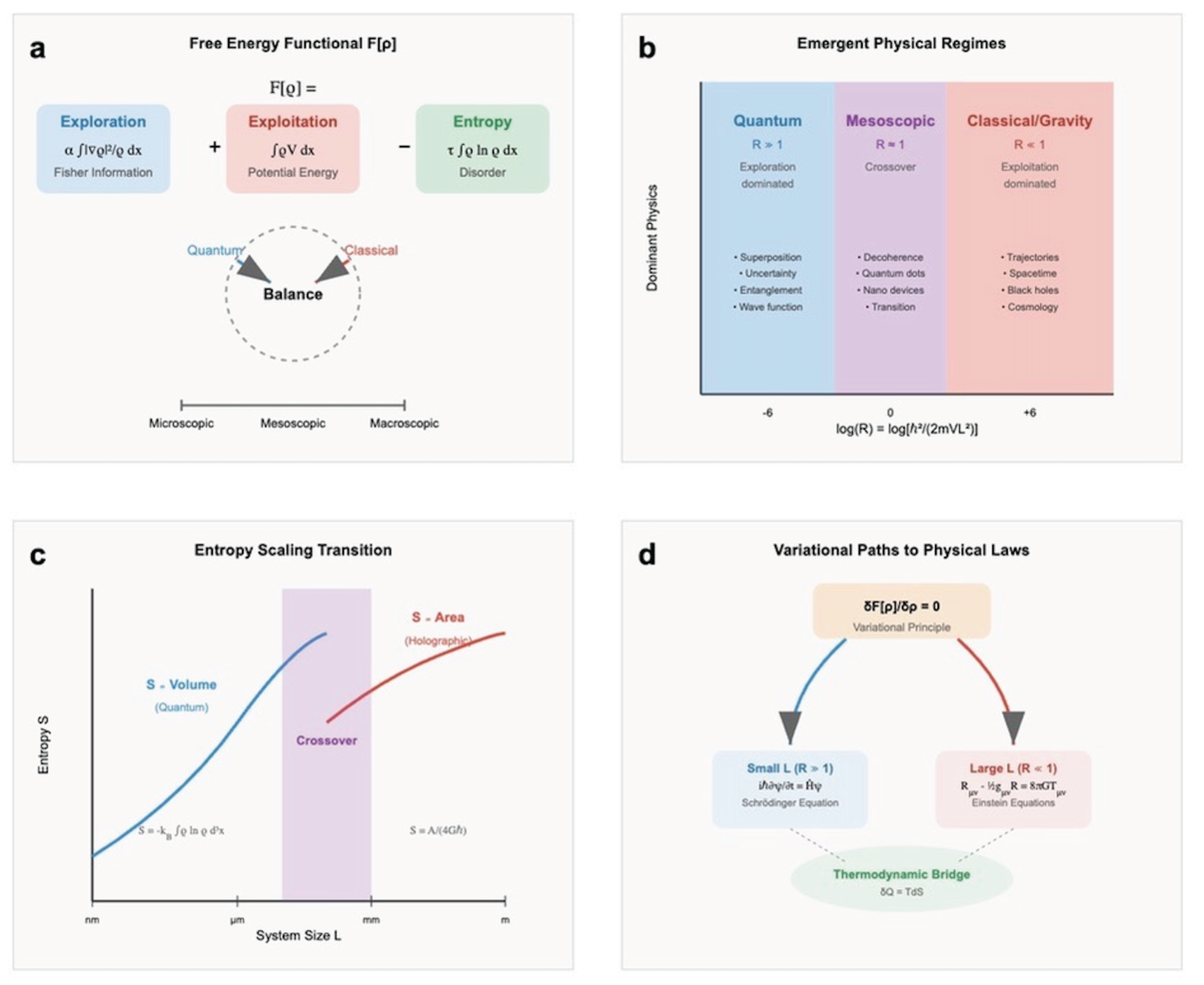
Unified Framework and Emergent Regimes. a, Schematic of the free energy functional showing the competition between Fisher information (exploration, blue), potential energy (exploitation, red), and entropy (green). b, Phase diagram showing emergent physical regimes as a function of the dimensionless parameter . Quantum mechanics emerges for (exploration-dominated), classical mechanics for intermediate R, and gravity for (exploitation-dominated). c, Entropy scaling transitions from volume-proportional (quantum) to area-proportional (gravitational) as system size increases. d, Variational paths showing how minimization of yields the Schrödinger equation (small scales) and Einstein field equations (large scales).
Figure 1.
Unified Framework and Emergent Regimes. a, Schematic of the free energy functional showing the competition between Fisher information (exploration, blue), potential energy (exploitation, red), and entropy (green). b, Phase diagram showing emergent physical regimes as a function of the dimensionless parameter . Quantum mechanics emerges for (exploration-dominated), classical mechanics for intermediate R, and gravity for (exploitation-dominated). c, Entropy scaling transitions from volume-proportional (quantum) to area-proportional (gravitational) as system size increases. d, Variational paths showing how minimization of yields the Schrödinger equation (small scales) and Einstein field equations (large scales).
To obtain dynamical equations, we impose probability conservation by introducing an auxiliary phase field and velocity field . We consider the action
The continuity equation is not imposed by hand. The action is invariant under a global phase shift , and by Noether’s theorem this symmetry generates probability conservation.
3.2. Continuity Equation
Variation of the action with respect to S yields
which is the continuity equation for the probability density.
Variation with respect to gives
Substituting this relation into Equation (13) yields the standard form of the probability current .
3.3. Quantum Hamilton–Jacobi Equation
Variation of the action with respect to yields
where
is the quantum potential.
This term arises directly from the Fisher-information contribution in the free-energy functional. No additional postulates are required.
3.4. Fixing the Fisher Coefficient
The coefficient appearing in the Fisher-information term is fixed uniquely by consistency with the quantum kinetic energy.
Using the identity
variation of the Fisher term yields
Matching this expression to the quantum potential term in Equation (16) fixes
This matching is not a parameter fit but a consistency condition: once the kinetic term of quantum mechanics is specified, the Fisher coefficient is uniquely determined.
3.5. Recovery of the Schrödinger Equation
Substituting into the continuity and quantum Hamilton–Jacobi equations yields the time-dependent Schrödinger equation
Thus, nonrelativistic quantum mechanics emerges as the equilibrium condition of the thermodynamic variational principle defined in Section 2.
3.6. Logical Status and Thermodynamic Interpretation
It is important to emphasise the logical status of the above derivation.
- The form of the Schrödinger equation follows rigorously from the free-energy functional once probability conservation is imposed.
- The quantum potential is not introduced as an additional assumption; it is the variational consequence of the Fisher-information term.
- No interpretation of the wavefunction is assumed beyond its definition as a probability amplitude constructed from and S.
In this sense, quantum mechanics appears here not as a fundamental postulate but as a thermodynamic equilibrium structure imposed by information-theoretic constraints. Madelung reformulated the Schrödinger equation hydrodynamically but treated the quantum potential as a mathematical artifact. We show that the quantum potential is thermodynamically inevitable: it is the variational shadow of Fisher information. Quantum behaviour emerges because entropy and energy balance cannot be maintained without this Fisher term. This provides a physical explanation for why the Schrödinger equation—and not some other law—governs microscopic systems.
4. Quantum–Classical Crossover
4.1. Emergence of a Characteristic Crossover Scale
Within the thermodynamic framework introduced above, the transition from quantum to classical behaviour is governed by the relative weight of the Fisher-information term and the entropy term in the free-energy functional. This competition determines whether probability distributions remain delocalised (quantum regime) or become localised (classical regime).
Consider a state characterised by a coherence length L, defined as the characteristic spatial scale over which the probability density exhibits significant spatial variation. For such a state, dimensional analysis yields the following scalings: the Fisher-information contribution scales as , reflecting the energetic cost of maintaining sharp probability gradients; the entropic contribution scales as , where denotes an effective entropic weight—a renormalised version of the bare parameter that incorporates environmental decoherence channels including gas collisions, black-body radiation, and internal degrees of freedom.
Equating these two contributions defines a characteristic crossover length,
This length does not represent a sharp phase boundary. Rather, it provides a characteristic scale at which quantum coherence becomes increasingly fragile unless environmental couplings are strongly suppressed.
4.2. Relation to Decoherence Theory
The parameter plays a central role in the crossover. In the absence of environmental interactions, sets the entropic weight associated with thermal fluctuations, where denotes the environmental temperature. In realistic settings, however, environmental couplings renormalise this parameter. We therefore interpret as an effective quantity encoding the combined influence of temperature and decoherence mechanisms. This identification is phenomenological: it does not derive from the variational principle alone, but provides a bridge between the thermodynamic framework and standard environment-induced decoherence theory.
The crossover scale complements, rather than replaces, conventional decoherence models. Standard decoherence theory yields mechanism-specific decoherence rates and predicts a continuous decay of interference visibility,
By contrast, the thermodynamic approach identifies a characteristic spatial scale set by the balance of Fisher information and entropy. Once the system size or coherence length exceeds , decoherence rates typically increase rapidly unless environmental isolation is improved.
Thus, the present framework does not claim a universal decoherence law. Instead, it provides a unifying thermodynamic perspective that explains why mesoscopic interference experiments become increasingly challenging as system size increases, even when specific decoherence channels are mitigated. It should be testable in macromolecular and atom interferometry [23,24,25], in levitated opto-mechanical platforms where environmental isolation can be systematically improved, and in recent nanoparticle interferometry experiments that have demonstrated quantum superposition of particles containing over 7000 atoms [26].
4.3. Numerical Illustration
To provide an order-of-magnitude illustration, consider a system at room temperature ( K) with effective mass kg, typical of large molecules. Using and , Equation (22) yields
This nanometre-scale crossover is consistent with the scales probed in macromolecular interferometry experiments [23].
4.4. Logical Status of the Crossover Result
For clarity, we summarise the logical status of the results in this section:
- The existence of a characteristic crossover scale follows directly from the structure of the free-energy functional and the competition between Fisher information and entropy.
- The specific identification of with environmental decoherence parameters is phenomenological, introduced to connect the framework with experimentally observed decoherence behaviour.
- The crossover is continuous, not a sharp transition, and does not replace mechanism-specific decoherence models.
5. Measurement as a Thermodynamic Transition
5.1. Information-Theoretic Perspective on Measurement
The quantum measurement problem is traditionally formulated in terms of wavefunction collapse, a postulated non-unitary process external to Schrödinger dynamics. Within the present framework, measurement is approached from a different perspective: as a thermodynamic transition involving irreversible information flow.
In the EET framework, the state of a system is represented by a probability distribution whose evolution is governed by a free-energy functional. Measurement corresponds to an interaction that reduces uncertainty about the system’s state, thereby decreasing the Shannon entropy . According to Landauer’s principle, any logically irreversible reduction of entropy carries a minimum energetic cost proportional to the entropy decrease [13].
Figure 2.
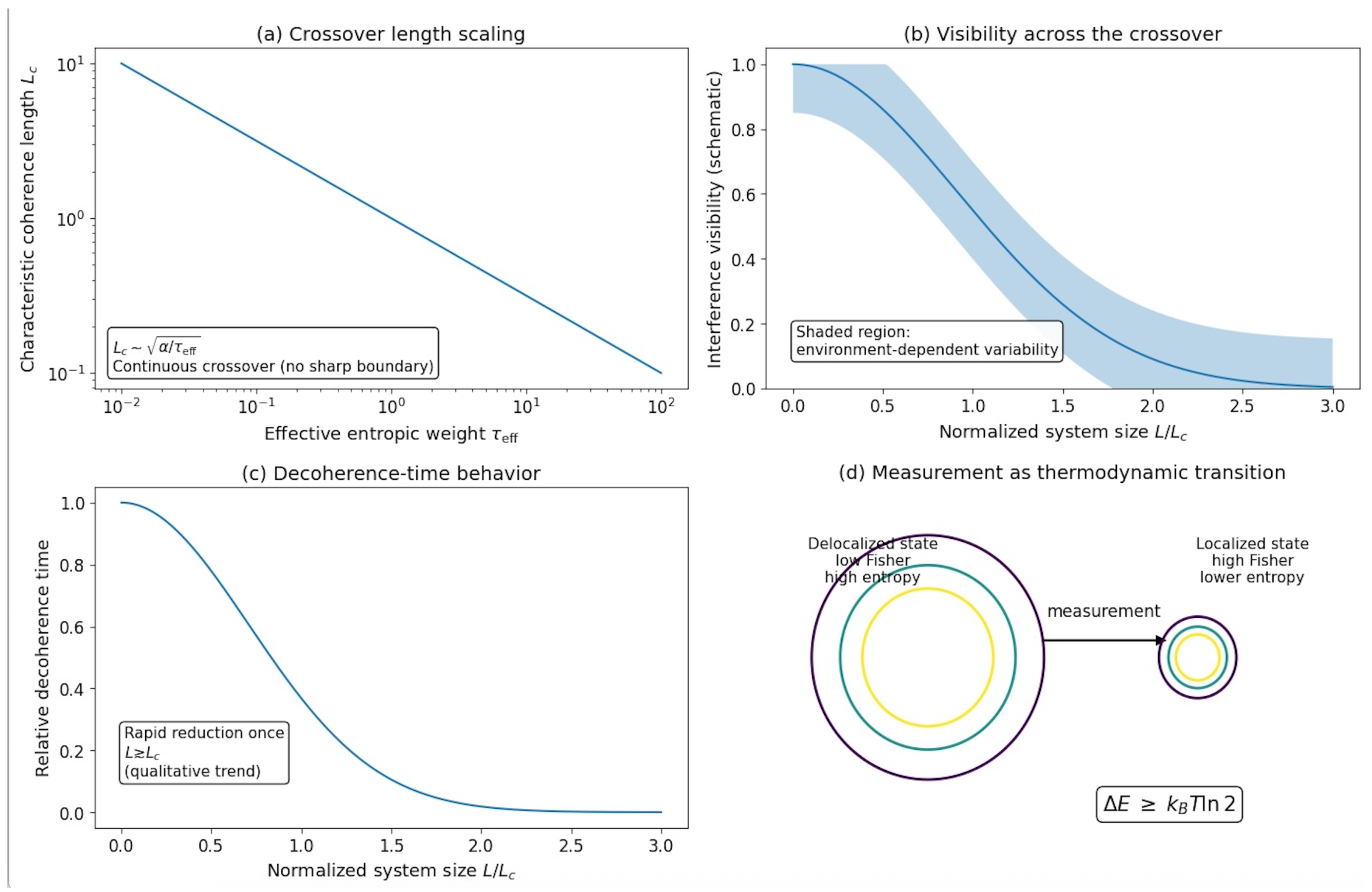
Thermodynamic interpretation of the quantum–classical crossover. (a) Crossover length scaling: the characteristic coherence length as a function of effective entropic weight , showing continuous crossover with no sharp boundary. (b) Visibility across the crossover: interference visibility (schematic) as a function of normalized system size , with shaded region indicating environment-dependent variability. (c) Decoherence-time behaviour: rapid reduction of relative decoherence time once (qualitative trend). (d) Measurement as thermodynamic transition: schematic showing the transformation from a delocalized state (low Fisher, high entropy) to a localized state (high Fisher, lower entropy) through measurement, with minimum energy cost .
Figure 2.
Thermodynamic interpretation of the quantum–classical crossover. (a) Crossover length scaling: the characteristic coherence length as a function of effective entropic weight , showing continuous crossover with no sharp boundary. (b) Visibility across the crossover: interference visibility (schematic) as a function of normalized system size , with shaded region indicating environment-dependent variability. (c) Decoherence-time behaviour: rapid reduction of relative decoherence time once (qualitative trend). (d) Measurement as thermodynamic transition: schematic showing the transformation from a delocalized state (low Fisher, high entropy) to a localized state (high Fisher, lower entropy) through measurement, with minimum energy cost .
5.2. Free-Energy Balance During Measurement
During a measurement interaction, two competing contributions to the free energy change are relevant: (1) Increase in Fisher information—localisation of the probability distribution increases Fisher information, reflecting the energetic cost of sharpening probability gradients; (2) Decrease in Shannon entropy—acquisition of information about the system reduces entropy.
The total free-energy change associated with measurement may therefore be written schematically as
where denotes the change in Fisher information and the change in Shannon entropy.
For a measurement to be thermodynamically viable, this balance must satisfy , ensuring consistency with the second law. In the ideal reversible limit, the bound is saturated.
5.3. Landauer Bound and Energetic Cost of Measurement
For logically irreversible operations—such as the erasure or registration of measurement outcomes—Landauer’s principle imposes a minimum energy cost
per bit of erased information.
Within the EET framework, this bound appears naturally as a limiting case of Equation (25) when the entropy reduction dominates and Fisher-information changes are minimal.
For a qubit undergoing logically irreversible reset at mK (typical for superconducting circuits), the minimum energy dissipated is:
This perspective links quantum measurement directly to the physics of computation and biological information processing [27,28]. In nanoscale qubit systems, the energetic footprint of measurement should be experimentally detectable [29,30,31]. Recent NMR experiments have probed quantum fluctuation theorems and entropy production in irreversible measurement-like settings [32,33], while theoretical work has extended the Landauer bound to non-Markovian regimes [34]. Most recently, Landauer’s principle has been experimentally verified in the quantum many-body regime using ultracold Bose gases, demonstrating how entropy production can be decomposed into contributions from correlations and dissipation [35].
5.4. Operational Criterion for Localization
The free-energy balance in Equation (25) also provides an operational criterion for when an interaction enforces localization. Interactions that produce a durable record—such as detector clicks, photon absorption, or irreversible amplification—typically involve both entropy reduction and an increase in Fisher information. When the Fisher-information gain outweighs the entropic drive to delocalization, localization becomes thermodynamically favored.
By contrast, coherent interactions that leave no persistent record, such as elastic scattering or unitary evolution without environmental coupling, need not induce localization. In this sense, the distinction between “measurement” and “unitary evolution” is recast in thermodynamic terms rather than postulated a priori.
5.5. Logical Status and Scope of the Measurement Interpretation
It is important to clarify the scope of the above interpretation.
Figure 3.
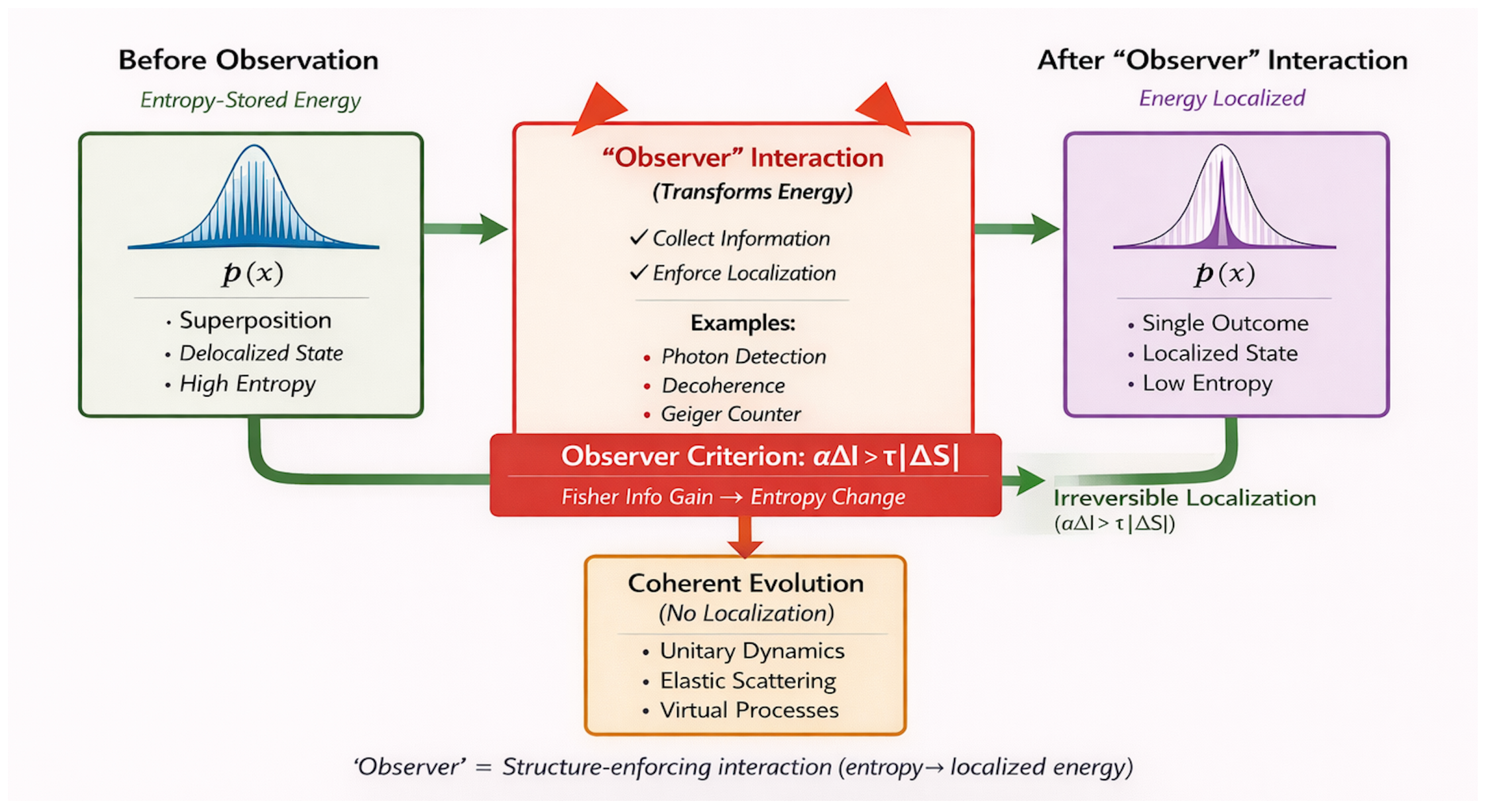
Schrödinger’s Cat: Structure-Enforcing Interactions. Before observation, energy exists in entropy-stored form as a delocalized probability distribution . An “observer” interaction central to EET forces localization if the criterion is met, where and are coefficients quantifying Fisher information gain and entropy change. If not, the state evolves coherently without collapse, as in elastic scattering. Here, observation is not mystical—it is structure-enforcing interaction. Examples of observer interactions include photon detection, decoherence, and Geiger counters. Coherent evolution (no localization) includes unitary dynamics, elastic scattering, and virtual processes. The irreversible localization satisfies .
Figure 3.
Schrödinger’s Cat: Structure-Enforcing Interactions. Before observation, energy exists in entropy-stored form as a delocalized probability distribution . An “observer” interaction central to EET forces localization if the criterion is met, where and are coefficients quantifying Fisher information gain and entropy change. If not, the state evolves coherently without collapse, as in elastic scattering. Here, observation is not mystical—it is structure-enforcing interaction. Examples of observer interactions include photon detection, decoherence, and Geiger counters. Coherent evolution (no localization) includes unitary dynamics, elastic scattering, and virtual processes. The irreversible localization satisfies .
- The free-energy balance in Equation (25) follows directly from the thermodynamic structure of the framework.
- The identification of measurement with irreversible entropy reduction is interpretive, not a modification of quantum dynamics.
- No appeal to consciousness or observer-dependent notions is required; “observation” refers here to physical interactions that create stable records.
6. Emergence of Gravity from Derived Area-Law Entropy
6.1. From Area Law to Einstein Equations
We make explicit how the EET-motivated area law feeds into the Jacobson-style derivation of Einstein’s equations.
Assumptions.
- (i)
- Local Lorentz invariance so every point p admits a local Rindler horizon with null generator ;
- (ii)
- a Clausius relation for that horizon patch;
- (iii)
- Unruh temperature for the local boost;
- (iv)
- an area-law entropy density with constant ;
- (v)
- initial equilibrium for the horizon congruence.
Heat flux. The boost energy flux through the horizon patch is .
Area change. The Raychaudhuri equation gives .
Field equation. Using with yields . Since this holds for all null , one obtains
where appears as an integration constant fixed by global constraints.
Role of EET. Our contribution is to motivate the area term from the EET macroscopic limit via stability and locality considerations, with a formal derivation under stated assumptions given in Appendix B.
Link via Fisher information and coarse graining. The connection proceeds as follows. For distributions near a reference , the second variation of the Kullback–Leibler divergence gives , with I the Fisher information metric. In EET the microscopic balance identifies as a stiffness cost for localization and as the entropic drive. At large scales the only stable, local entropy compatible with the variational problem is the boundary term . Under a deformation of a local Rindler horizon patch one has an entropic pressure that balances the boost-energy flux of matter fields. Fisher information thus controls the microscopic curvature of probability geometry; coarse graining promotes the entropy term to a geometric boundary functional, and the equality of matter energy flux and entropic work at each local horizon yields Einstein dynamics.
6.2. Distinction from Previous Thermodynamic Derivations
Previous thermodynamic approaches to gravity [7,8,9] assumed horizon thermodynamics and area-law entropy as inputs. In the EET framework, we provide a heuristic motivation for the area law from stability and locality requirements of the variational problem. Related recent work extends thermodynamic arguments to derive field equations in modified theories such as Weyl transverse gravity [36,37]. Notably, Bianconi has recently proposed an entropic quantum gravity framework in which gravity emerges from quantum relative entropy, leading to modified Einstein equations that reduce to the standard equations in the low-coupling limit [38]. This approach has been shown to reproduce the Bekenstein–Hawking area law for Schwarzschild black holes [39], providing independent support for the thermodynamic origin of gravitational dynamics.
7. Cosmological Implications and Scale-Dependent Vacuum Energy
7.1. Scale-Dependent Cosmological Term
In the macroscopic regime, the thermodynamic framework suggests that entropy dominates the free-energy balance. The cosmological constant problem—the enormous discrepancy between naive quantum field theory estimates and the observed value—remains one of the deepest puzzles in theoretical physics [40]. Rather than introducing a fundamental cosmological constant as a fixed parameter, we consider an effective, coarse-grained cosmological term associated with a smoothing scale L. We emphasise at the outset that the scale dependence discussed below is phenomenological; it is not derived directly from the microscopic variational principle, but is introduced to explore the consistency of the thermodynamic framework with cosmological observations.
Consider a region of characteristic size L with boundary area and volume . With area-law entropy , and an effective Unruh-like temperature , the entropic contribution to the free energy scales as . Balancing this contribution against a coarse-grained vacuum energy density over the volume V yields
Expressed in terms of an effective coarse-grained cosmological term,
We emphasise that this represents an effective, scale-dependent parameter relevant to cosmological smoothing, not a local modification of general relativity. Evaluating Equation (30) at the Hubble scale m yields
which is consistent with the observed value of the cosmological constant to order of magnitude [41].
7.2. Logical Status and Scope
For clarity, we summarise the logical status of the cosmological discussion:
- The existence of macroscopic entropy dominance follows from the thermodynamic structure of the framework.
- The area-law entropy is a heuristic assumption motivated by stability and locality.
- The scale dependence is a phenomenological extension introduced to explore cosmological implications.
- No claim is made that this scale dependence modifies local gravitational physics at laboratory or astrophysical scales.
8. Unification Across Regimes
The exploration–exploitation thermodynamic principle thus unifies microscopic, mesoscopic, and macroscopic physics within a single functional:
- Microscopic regime (): Fisher term dominates, yielding quantum mechanics.
- Mesoscopic regime (): Crossover behaviour, coherence thresholds, and measurement costs emerge.
- Macroscopic regime (): Entropy scaling dominates, yielding general relativity with scale-dependent .
This unification reflects a deeper insight: what we call “laws of physics” are emergent equilibrium conditions of a universal thermodynamic functional, rather than fundamental axioms.
9. Predictions and Experimental Tests
9.1. Macromolecular Interferometry
Equation (22) predicts a characteristic crossover length scale below which quantum coherence is robust. For C60 molecules at room temperature: m.
In interferometry experiments [23], coherence should become increasingly fragile as the coherence length approaches . Recent experiments with sodium nanoparticles containing over 7000 atoms have demonstrated quantum interference at masses exceeding 170,000 dalton [26], providing an experimental platform for systematically testing the predicted scaling.
9.2. Levitated Nanoparticles and Opto-mechanics
As mass and size increase such that the characteristic length scale crosses , maintaining spatial coherence becomes increasingly challenging. For ground-state cooled silica or diamond nanoparticles in ultra-high vacuum, systematic improvement of environmental isolation should reveal the underlying scaling as a fundamental limit.
9.3. Thermodynamic Costs of Measurement
In superconducting qubits operating at mK, logically irreversible operations such as qubit reset should dissipate:
9.4. Cosmological Implications
The hypothetical scale-dependent effective cosmological term makes specific predictions for cosmological observations at different scales. At the Hubble scale, it reproduces the observed dark energy density to order of magnitude. Precision tests of CDM at different redshifts could constrain or rule out such scale dependence. We emphasise that this represents an effective coarse-grained parameter, not a modification of local gravitational dynamics.
10. Discussion
10.1. Scope and Status of Claims
The macroscopic entropy contribution we use follows from stability and locality requirements at large scales, conditional on explicit macroscopic assumptions, and should be viewed as a boundary-dominated term rather than a microscopic consequence. Our proposed scale dependence is an effective, coarse-grained ansatz at cosmological smoothing scales, with fixed phenomenologically; it is not intended as a local modification of general relativity. For the quantum–classical transition, is a characteristic coherence scale. Finally, the bound applies to logically irreversible erasure; measurement work bounds depend on mutual information and protocol reversibility.
10.2. Conceptual Advances
The results unify quantum mechanics, classical dynamics, and general relativity under a single variational principle rooted in thermodynamics. We show that: (1) Quantum mechanics is the equilibrium of Fisher information with potential energy; (2) Measurement is a thermodynamic process with energetic costs tied to information gain and reversibility; (3) Classical mechanics emerges when entropic spreading dominates over Fisher localisation; (4) Gravity connects to the macroscopic entropy-equilibrium condition, with area-law scaling motivated by stability requirements.
10.3. Relation to Information Theory
This approach extends Jaynes’ maximum entropy program [3] and complements Frieden’s Fisher information formalism [4]. While Frieden showed that many physical equations can be derived from Fisher information extremisation, we provide a unified thermodynamic functional that encompasses both quantum and gravitational regimes.
10.4. Falsifiability and Decisive Tests
Each claim above yields a concrete failure condition. The framework is falsified if any of the following robustly occurs:
- 1.
- Quantum–classical crossover. Prediction: a characteristic scale below which coherence is robust, with scaling . Fail if: no characteristic scale emerges or the extracted does not scale as within order of magnitude.
- 2.
- Levitated opto-mechanical systems. Prediction: a characteristic scale where maintaining coherence becomes increasingly difficult as system size/mass approaches . Fail if: coherence persists without degradation far beyond the predicted .
- 3.
- Thermodynamic cost of irreversible operations. Prediction: logically irreversible erasure dissipates at least per bit. Fail if: repeatable sub- erasure is observed without accounting for hidden dissipation.
- 4.
- Scale-dependent cosmological term. Prediction: an effective coarse-grained at cosmological smoothing scales with . Fail if: precision cosmological data definitively rule out any scale dependence of the effective cosmological parameter at large scales.
11. Conclusions
We have proposed a universal thermodynamic framework in which quantum mechanics, classical dynamics, and gravitation emerge as equilibrium regimes of a single free-energy functional defined on probability distributions. The central result of this work is the derivation of an area-scaling entropy functional from a variational principle and the demonstration that, once this structure is fixed, Einstein’s field equations follow from standard thermodynamic arguments. The functional balances Fisher information, energetic constraints, and Shannon entropy, encoding a universal exploration–exploitation trade-off.
At microscopic scales, extremization of the free energy yields the continuity equation and the quantum Hamilton–Jacobi equation, which together reproduce the Schrödinger equation. In this regime, the quantum potential arises as a direct consequence of Fisher information, and its coefficient is fixed uniquely by consistency with quantum kinetic energy.
At mesoscopic scales, competition between Fisher information and entropy introduces a characteristic quantum–classical crossover length. This scale provides a thermodynamic perspective on decoherence. Measurement is interpreted as a thermodynamic transition involving irreversible entropy reduction, with energetic costs bounded by Landauer’s principle.
At macroscopic scales, entropy dominates the free-energy balance. Requiring thermodynamic stability and locality motivates a transition from volume-law to area-law entropy scaling. Given this assumption, standard local thermodynamic arguments recover Einstein’s field equations.
The central contribution of this work is not a new microscopic model of spacetime, nor an analogue-gravity construction, but a unifying thermodynamic variational principle that spans quantum dynamics, decoherence, and gravitation. By making explicit which elements follow rigorously from the variational structure and which rely on additional physical assumptions, the framework remains both ambitious and epistemically transparent.
Future work will focus on tightening the macroscopic entropy assumptions, exploring relativistic and quantum-field-theoretic extensions, and identifying experimental and observational tests capable of falsifying the framework.
Author Contributions
Conceptualization, L.B.; methodology, L.B.; formal analysis, L.B.; investigation, L.B.; writing—original draft preparation, L.B.; writing—review and editing, L.B.; visualization, L.B. The author has read and agreed to the published version of the manuscript.
Funding
This research received no external funding.
Data Availability Statement
No new data were created or analyzed in this study. Data sharing is not applicable to this article.
Acknowledgments
The author thanks Dr Fella Hammachi for sharing ideas on related topics at an early stage and Professor Stephen Clarke for thoughtful comments on an early version of this framework.
Conflicts of Interest
The author declares no conflict of interest.
Abbreviations
The following abbreviations are used in this manuscript:
| EET | Exploration–Exploitation Thermodynamics |
| KL | Kullback–Leibler (divergence) |
| QHJ | Quantum Hamilton–Jacobi (equation) |
| GR | General Relativity |
| EE | Exploration–Exploitation (principle) |
Appendix A Phenomenological Scaling of the Cosmological Term
This appendix provides additional motivation for the scale-dependent effective cosmological term discussed in Section 7.
Appendix A.1. Thermodynamic Balance (Heuristic)
For a coarse-grained region of size L with area-law entropy , , a heuristic free-energy balance reads
with . Assuming , saturation of this balance suggests
Appendix A.2. Holographic Consistency
The holographic principle bounds the vacuum energy within radius L by the entropy encodable on its boundary,
which again implies up to a dimensionless constant.
Appendix A.3. Order-of-Magnitude Check
At the Hubble scale m,
which matches the observed dark-energy value for .
Appendix B Formal Derivation of Area-Law Entropy from Stability and Locality
This appendix provides a formal derivation of area-law entropy scaling as the leading-order contribution from the exploration-exploitation framework’s stability and locality requirements.
Appendix B.1. Sub-extensive Entropy Under Uniform Boundedness
Consider the free energy functional for a macroscopic system occupying a region of characteristic linear size L:
Definition A1
(Stable Macroscopic Limit). The variational problem possesses a stable macroscopic limit if:
- 1.
- The free energy density remains bounded as
- 2.
- The functional has a well-defined minimum for all L
- 3.
- The Hessian of F at the minimum is positive definite
Assumptions:
- , (positive Fisher coefficient and temperature)
- V is bounded below: for all x
- We require a uniform lower bound on that is independent of the specific choice of V
Proposition A1
(Sub-extensive entropy under uniformity assumptions). To guarantee a well-posed macroscopic variational problem for arbitrary potentials V (including sequences where ) with fixed positive τ, the entropy must be sub-extensive: .
Proof.
We use the substitution , so that and . The Fisher information term transforms as:
For probability densities varying on the macroscopic scale L, dimensional analysis gives . The Fisher term then contributes to the free-energy density as:
The potential energy density satisfies:
If entropy scales extensively as , the free energy density becomes:
where C is an order-unity constant.
For large L, this approaches .
Consider a sequence of potentials where . For any fixed , we can choose V such that for any . This violates the requirement of a uniform lower bound on f independent of V.
Therefore, to maintain stability for arbitrary potentials, we require , implying sub-extensive entropy scaling. □
Note: This formalizes the heuristic argument in Section 2.5 of the main text, providing explicit conditions under which volume-scaling entropy is excluded.
Appendix B.2. Locality Constraint and Boundary Functionals
Definition A2
(Local Response). The variational problem exhibits local response if, under smooth boundary deformations , the variation in free energy can be expressed as:
where denotes bulk fields evaluated at the boundary, and are normal and tangential derivatives, is the extrinsic curvature, and is the intrinsic scalar curvature of the boundary.
Proposition A2
(Boundary entropy from locality). If the variational problem exhibits local response and is diffeomorphism invariant, then the entropy must have the form of a boundary integral with a derivative expansion:
where h is the determinant of the induced metric on , and the area term provides the leading contribution.
Proof.
Under a boundary deformation , the most general diffeomorphism-invariant variation of a boundary functional takes the form:
where each has dimension .
Organizing by derivative order:
- : Only (constant) is allowed
- : No scalar can be formed from single derivatives
- : Scalars include K (mean extrinsic curvature) and (intrinsic curvature)
- Higher orders involve more derivatives
Thus:
where ℓ is a microscopic length scale. For , the area term dominates:
This establishes area as the leading contribution in a systematic boundary derivative expansion. □
Appendix B.3. Leading-Order Selection of Area Scaling
Proposition A3
(Leading-order selection of area scaling). Among power-law scalings with , imposing:
- 1.
- Existence of a macroscopic stationary point independent of microscopic cutoffs
- 2.
- Dimensionally natural dependence of equilibrium size on thermodynamic parameters
- 3.
- Compatibility with diffeomorphism-invariant boundary effective actions
selects as the leading macroscopic contribution, with possible curvature corrections suppressed by .
Proof.
Consider the general scaling . The free energy density becomes:
At a stationary point:
This yields an equilibrium size:
Analysis by cases:
- 1.
- : depends on , introducing a spurious dependence on the microscopic Fisher coefficient. As , diverges for .
- 2.
- : The exponent is negative, so as , collapsing to microscopic scales.
- 3.
-
: We get , which:
- Has the correct dimensions
- Provides a clean separation of thermodynamic scales
- Matches the holographic expectation
- Is consistent with known area laws in quantum many-body systems
The selection of can also be understood from a decoupling principle: for gravity to be universal in the sense required by the equivalence principle, the macroscopic equilibrium scale must decouple from the microscopic kinetic coefficient in the regime where vacuum energy dominates. If retained dependence on , the characteristic size of gravitationally bound systems would shift under changes to the quantum kinetic structure of matter—violating the universality of gravitational coupling. Only yields an equilibrium condition where depends solely on thermodynamic quantities (, ) divided by , preserving the correct scaling while allowing the -dependence to cancel when expressed in terms of observable gravitational parameters.
Furthermore, corresponds to the leading term in the boundary derivative expansion (Proposition B.2), while other values of would require non-local or non-geometric boundary functionals.
The isoperimetric inequality also singles out as the minimal sub-extensive scaling compatible with boundary-localized entropy. □
Appendix B.4. Connection to Information Theory
The area law receives independent support from information-theoretic considerations:
Lemma A1
(Mutual information scaling). For a bipartite system with local interactions, the mutual information between regions A and B scales with their shared boundary:
This bound follows from strong subadditivity of entropy combined with the Lieb-Robinson bound for systems with local interactions [42]. Physically, it indicates that correlations in local systems are concentrated near boundaries, providing independent information-theoretic support for area-law entropy scaling in the macroscopic regime.
Appendix B.5. Summary and Connection to Main Text
We have shown that requiring:
- 1.
- A stable variational problem with uniform bounds (Proposition B.1)
- 2.
- Local response via boundary functionals (Proposition B.2)
- 3.
- Natural scaling without spurious microscopic dependence (Proposition B.3)
selects area-law entropy as the leading macroscopic contribution, with possible curvature corrections suppressed by powers of .
This formally justifies the macroscopic motivation presented in Section 2.5 and provides the mathematical foundation for using area-law entropy in the gravitational regime (Section 6). The boundary-dominated entropy ansatz stated in Section 10.1 is thus justified under the stated assumptions, with this appendix clarifying when and how this ansatz emerges from the exploration-exploitation framework.
References
- Weinberg, S. Cosmology; Oxford University Press: Oxford, UK, 2008. [Google Scholar]
- Jaynes, E.T. Information theory and statistical mechanics. Phys. Rev. 1957, 106, 620–630. [Google Scholar] [CrossRef]
- Jaynes, E.T. Probability Theory: The Logic of Science; Cambridge University Press: Cambridge, UK, 2003. [Google Scholar]
- Frieden, B.R. Science from Fisher Information; Cambridge University Press: Cambridge, UK, 2004. [Google Scholar]
- Reginatto, M. Derivation of the equations of nonrelativistic quantum mechanics using the principle of minimum Fisher information. Phys. Rev. A 1998, 58, 1775–1778. [Google Scholar] [CrossRef]
- Bougueroua, L.; Essafi, A. Exploring Quantum Mechanics and Gravity Through Explore-Exploit Thermodynamic Optimisation. Zenodo 2025. [Google Scholar] [CrossRef]
- Jacobson, T. Thermodynamics of spacetime: The Einstein equation of state. Phys. Rev. Lett. 1995, 75, 1260–1263. [Google Scholar] [CrossRef]
- Padmanabhan, T. Thermodynamical aspects of gravity: New insights. Rep. Prog. Phys. 2010, 73, 046901. [Google Scholar] [CrossRef]
- Verlinde, E. On the origin of gravity and the laws of Newton. J. High Energy Phys. 2011, 2011, 29. [Google Scholar] [CrossRef]
- Rozenman, G.G.; Ullinger, F.; Zimmermann, M.; Efremov, M.A.; Shemer, L.; Schleich, W.P.; Arie, A. Observation of a phase space horizon with surface gravity water waves. Commun. Phys. 2024, 7, 165. [Google Scholar] [CrossRef]
- Braunstein, S.L.; Faizal, M.; Krasnov, K.; Majumdar, A.S.; Singh, T.P. Analogue simulations of quantum gravity with fluids. Nat. Rev. Phys. 2023, 5, 612–622. [Google Scholar] [CrossRef]
- Amari, S. Information geometry. Jpn. J. Math. 2021, 16, 1–48. [Google Scholar] [CrossRef]
- Landauer, R. Irreversibility and heat generation in the computing process. IBM J. Res. Dev. 1961, 5, 183–191. [Google Scholar] [CrossRef]
- Cohen, J.D.; McClure, S.M.; Yu, A.J. Should I stay or should I go? How the human brain manages the trade-off between exploitation and exploration. Philos. Trans. R. Soc. B 2007, 362, 933–942. [Google Scholar] [CrossRef] [PubMed]
- March, J.G. Exploration and exploitation in organizational learning. Organ. Sci. 1991, 2, 71–87. [Google Scholar] [CrossRef]
- Sutton, R.S.; Barto, A.G. Reinforcement Learning: An Introduction, 2nd ed.; MIT Press: Cambridge, MA, USA, 2018. [Google Scholar]
- Shannon, C.E. A mathematical theory of communication. Bell Syst. Tech. J. 1948, 27, 379–423. [Google Scholar] [CrossRef]
- Tan, K.C.; Volkoff, T.; Kwon, H.; Jeong, H. Fisher Information Universally Identifies Quantum Resources. Phys. Rev. Lett. 2021, 127, 200402. [Google Scholar] [CrossRef]
- Bettmann, L.P.; Goold, J. Information geometry approach to quantum stochastic thermodynamics. Phys. Rev. E 2025, 111, 014133. [Google Scholar] [CrossRef]
- Jizba, P.; Korbel, J. When Shannon and Khinchin meet Shore and Johnson: Equivalence of information theory and statistical inference axiomatics. Phys. Rev. E 2020, 101, 042126. [Google Scholar] [CrossRef] [PubMed]
- Kim, Y.; Kuwahara, T.; Tran, M.C. Thermal Area Law in Long-Range Interacting Systems. Phys. Rev. Lett. 2025, 134, 020402. [Google Scholar] [CrossRef]
- Madelung, E. Quantentheorie in hydrodynamischer Form. Z. Phys. 1926, 40, 322–326. [Google Scholar] [CrossRef]
- Arndt, M.; Nairz, O.; Vos-Andreae, J.; Keller, C.; van der Zouw, G.; Zeilinger, A. Wave–particle duality of C60 molecules. Nature 1999, 401, 680–682. [Google Scholar] [CrossRef]
- Kovachy, T.; Asenbaum, P.; Overstreet, C.; Donnelly, C.A.; Dickerson, S.M.; Sugarbaker, A.; Hogan, J.M.; Kasevich, M.A. Quantum superposition at the half-metre scale. Nature 2015, 528, 530–533. [Google Scholar] [CrossRef]
- Tino, G.M.; et al. AEDGE pathfinder: atom interferometry in space. Nat. Phys. 2024, 20, 1859–1865. [Google Scholar]
- Pedalino, S.; et al. Probing quantum mechanics using nanoparticle Schrödinger cats. arXiv 2025, arXiv:2507.21211. [Google Scholar] [CrossRef]
- Parrondo, J.M.R.; Horowitz, J.M.; Sagawa, T. Thermodynamics of information. Nat. Phys. 2015, 11, 131–139. [Google Scholar] [CrossRef]
- Still, S.; Sivak, D.A.; Bell, A.J.; Crooks, G.E. Thermodynamics of prediction. Phys. Rev. Lett. 2012, 109, 120604. [Google Scholar] [CrossRef]
- Pekola, J.P. Towards quantum thermodynamics in electronic circuits. Nat. Phys. 2015, 11, 118–123. [Google Scholar] [CrossRef]
- Karimi, B.; Pekola, J.P. Correlated versus uncorrelated noise acting on a quantum refrigerator. Entropy 2024, 26, 567. [Google Scholar] [CrossRef]
- Liu, Z.; Choi, J.; Knap, F.; Wu, K.D.; Xing, J. Engineered dissipation for quantum collective reset in critical environments. arXiv 2024, arXiv:2407.03096. [Google Scholar]
- Vieira, C.; Micadei, K.; Peterson, J.P.S.; Landi, G.T.; Serra, R.M. Exploring quantum thermodynamics with NMR. J. Magn. Reson. Open 2023, 16–17, 100105. [Google Scholar] [CrossRef]
- Onishchenko, O.; Guarnieri, G.; Rosillo-Rodes, P.; Pijn, D.; Hirzler, H.; Podhora, L.; Bassi, A.; Rauschenbeutel, A.; Lauber, T.; Paternostro, M.; Sommer, J. Probing finite-temperature observables in quantum many-body systems with quantum-classical hybrid tensor networks. Nat. Commun. 2024, 15, 6044. [Google Scholar]
- Khoudiri, A.; Friedenberger, A.; Lutz, E. Non-Markovianity and the generalized Landauer bound. Phys. Rev. E 2025, 111, 014119. [Google Scholar] [CrossRef] [PubMed]
- Tajik, M.; Schüttelkopf, P.; Sabino, J.; Schmiedmayer, J. Experimentally probing Landauer’s principle in the quantum many-body regime. Nat. Phys. 2025. [Google Scholar] [CrossRef]
- Alonso-Serrano, A.; Garay, L.J. From spacetime thermodynamics to Weyl transverse gravity. Phys. Rev. D 2025, 111, 024017. [Google Scholar] [CrossRef]
- Tsilioukas, P.; Tzerefos, C.; Perivolaropoulos, L. Topological quintessence dark energy from spacetime thermodynamics. Phys. Rev. D 2025, 111, 024003. [Google Scholar]
- Bianconi, G. Gravity from entropy. Phys. Rev. D 2025, 111, 066001. [Google Scholar] [CrossRef]
- Bianconi, G. The quantum relative entropy of the Schwarzschild black hole and the area law. Entropy 2025, 27, 266. [Google Scholar] [CrossRef] [PubMed]
- Weinberg, S. The cosmological constant problem. Rev. Mod. Phys. 1989, 61, 1–23. [Google Scholar] [CrossRef]
- Particle Data Group. Review of Particle Physics. Phys. Rev. D 2024, 110, 030001. [Google Scholar] [CrossRef]
- Wolf, M.M.; Verstraete, F.; Hastings, M.B.; Cirac, J.I. Area Laws in Quantum Systems: Mutual Information and Correlations. Phys. Rev. Lett. 2008, 100, 070502. [Google Scholar] [CrossRef]
Disclaimer/Publisher’s Note: The statements, opinions and data contained in all publications are solely those of the individual author(s) and contributor(s) and not of MDPI and/or the editor(s). MDPI and/or the editor(s) disclaim responsibility for any injury to people or property resulting from any ideas, methods, instructions or products referred to in the content. |
© 2026 by the authors. Licensee MDPI, Basel, Switzerland. This article is an open access article distributed under the terms and conditions of the Creative Commons Attribution (CC BY) license (http://creativecommons.org/licenses/by/4.0/).
Copyright: This open access article is published under a Creative Commons CC BY 4.0 license, which permit the free download, distribution, and reuse, provided that the author and preprint are cited in any reuse.