

Submitted:
11 February 2026
Posted:
13 February 2026
You are already at the latest version
Abstract
(1) Background: As Para-Powerlifting (PP) athletes need the maximum bench press concentric strength performance during competitions, the velocity of the eccentric phase could be critical to the sport's success. (2) Methods: Through eccentric tempo modification, normative, faster, and slower bench press eccentric velocities were tested on 16 experienced PP athletes. Mean propulsive velocity (MPV), maximum velocity (Vmax), and power were measured during a single bench press set at different loads (90% and 100% of 1RM) and tempos. After the bench press set, Maximal isometric force (MIF), rate of force development (RFD), impulse, variability, and maximal average force (MAF) were obtained through an isometric bench press test. (3) Results: slower and faster tempos were not different in concentric performance than a normative tempo at the 90% 1RM load. A faster tempo generated higher MPV and Vmax than a normative one at the 100% 1RM load. A normative tempo produced higher MIF than a slower tempo, and higher impulse than a faster tempo after a 90% 1RM bench press set. (4) Conclusions: PP athletes seem to have an optimized technique in submaximal loads; however, they may need faster eccentric velocities in the 100% 1RM load to improve their concentric performance.
Keywords:
strength training
; adapted sport
; Para-Powerlifting
; eccentric cadence
; sport performance
1. Introduction
Paralympic Powerlifting (PP) is a sport where athletes with disabilities, such as lower-body impairments and short stature, compete by lifting the highest weight possible in the adapted bench press (WPPO, 2022b). As maximal efforts are the primary activity of PP, athletes are accustomed to lifting high-intensity loads ranging from 80% to 100% of their one-repetition maximum (1RM) during training and competitions (Santos et al., 2023; Van Den Hoek et al., 2023). Then, strategies to enhance maximal force production during the bench press are paramount to PP performance.
For PP athletes, Maximal force production is essential in the upward portion of the bench press (concentric phase), since most lifts fail in this phase due to biomechanical constraints (Aidar et al., 2021). An important biomechanical factor that can maximize force production during the concentric phase of the bench press is the stretch-shortening cycle (SSC), which has been demonstrated to enhance concentric power output even with heavy loads (Cronin et al., 2000). This SSC contribution to the concentric phase depends heavily on the eccentric phase velocity, with the literature indicating that higher velocities can produce more powerful lifts than slower ones. However, extremely high velocities can be detrimental to concentric performance (Handford et al., 2022).
A practical way to manipulate eccentric velocity is by modifying the movement tempo of the downward phase of the bench press (eccentric phase). In this way, longer tempos correspond to slower velocities, and shorter tempos to higher velocities (Wilk, Tufano, et al., 2020). Then, modifying eccentric tempo can directly influence the SSC participation and the concentric performance of the lift (Handford et al., 2022). Importantly, PP competition rules include a visible stop at the chest before the concentric phase that could diminish SSC participation. Thereafter, eccentric tempo modification could result in different performance outcomes in PP athletes, given the technical exigencies. A previous study found that faster or slower eccentric tempos did not result in superior or inferior concentric performance compared to the normally executed eccentric tempo in PP athletes at high intensities (5RM: 80-90% 1RM) (Méndez-DelCanto et al., 2025). These results suggest that PP athletes could respond differently to eccentric tempo modification, probably due to their already optimal lifting technique.
As different eccentric tempos have been tested in PP athletes only with loads corresponding to training and competitive warm-up (80–90% 1RM), there remains a doubt about how slower or faster tempos could affect loads near maximal intensities. This study investigates the effects of slower and faster eccentric tempos on dynamic and static strength performance in Para powerlifting athletes during the bench press exercise at high and maximal intensities. We hypothesize that modifying the eccentric tempo could be detrimental to concentric performance, given that PP athletes already have an optimal bench press technique.
2. Materials and Methods
2.1. Experimental Design
This study was based on a previous work (Méndez-DelCanto et al., 2025) that applied an individualized tempo modification based on the normative eccentric tempo of each athlete. Normative tempo can be defined as the tempo typically executed by athletes without prior instruction. This resulted in three different eccentric tempo conditions for the bench press: normative tempo (control), slower than normative, and faster than normative.
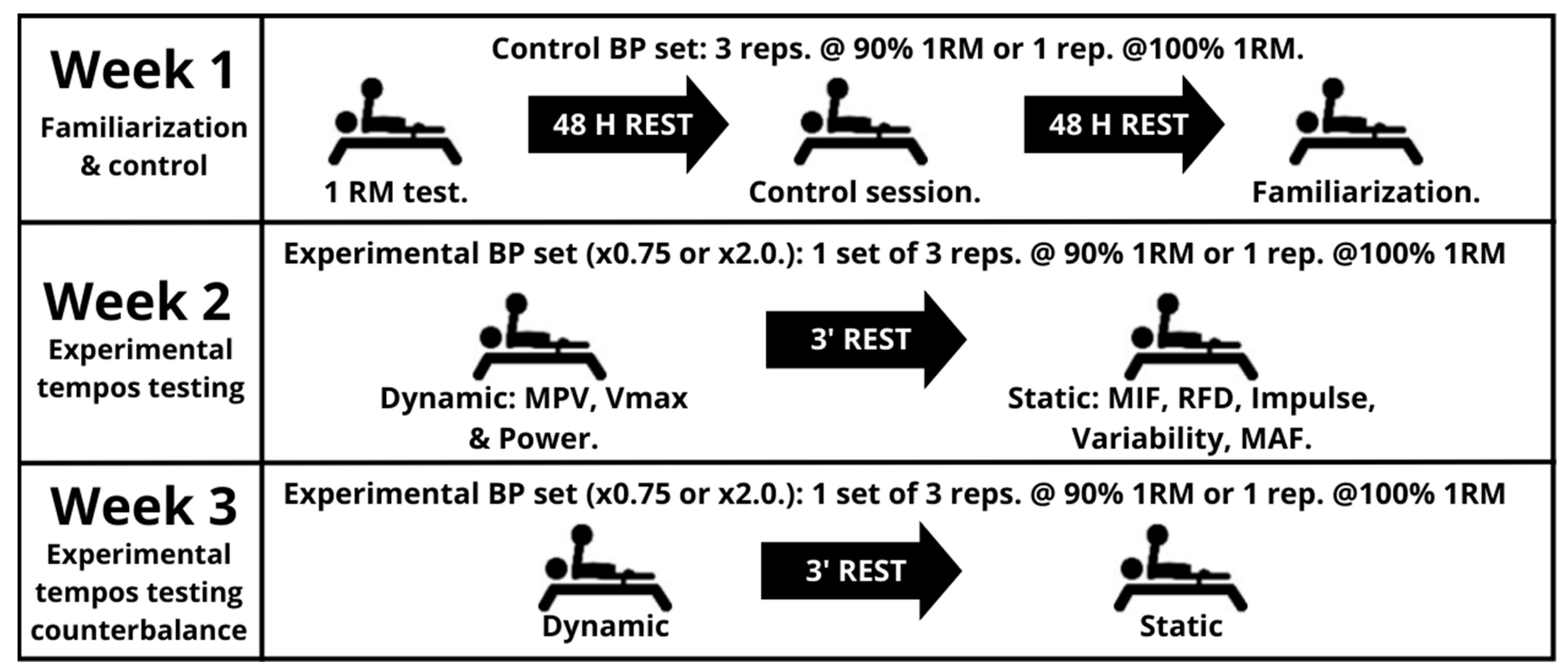
Since our study aimed to measure two different high-intensity loads (3 repetitions at 90% 1RM and 1 repetition at 100% 1RM), we applied a 3-week crossover cycle for each load. In each cycle, the first week included a 1RM test, a control (normative tempo) testing session, and a familiarization session for the experimental tempos. The control bench press sets were used to define the normative eccentric tempo of each athlete at each intensity. The second and third weeks included a single experimental testing session each, conducted under faster and slower tempos, in a counterbalanced crossover design. Athletes were randomly assigned to either the faster or the slower condition before the first experimental session. All testing sessions were executed in the morning between 8 a.m. and 12 p.m. Finally, the athletes were asked not to perform any strenuous physical activity in the 48 hours before testing sessions, as well as to avoid any stimulant drugs.
2.2. Sample
The sample size calculation was performed using the software G*Power version 3.1.9.7 (Universität Düsseldorf, Berlin, Germany) (Faul et al., 2007) considering an effect size of f = 4 (Cohen, 1988), a significance of α = 0.05, and a power of 1-β = 80, resulting in a minimum sample of n = 42 to obtain a large effect size in the ANOVA Fixed effects one-way test (F [2,39] = 3.23) for 3 groups (n = 14 per group, one group for each condition). Previous related studies also used a similar sample size (Guerra et al., 2022; Wilk et al., 2021).
16 male athletes from PP participated in this study (Table 1). Our athletes were eligible for the sport due to malformations in the lower limbs (arthrogryposis) (06), sequelae due to poliomyelitis (01), amputations (04), spinal cord injuries below the eighth thoracic vertebrae (04), and cerebral palsy (01).
Athletes participated voluntarily in this study. To be eligible, they must have participated in at least one national-level competition within the last 12 months. Athletes who do not attend the familiarization period, one of the experimental sessions, or report consumption of illicit substances could be excluded from the study; however, no one was excluded. All of them signed an informed consent form under the 466/2012 resolution of the National Commission for Research Ethics of the Brazilian National Health Council. The study was also approved by the Ethics Committee of the Federal University of Sergipe (UFS) by protocol number 6.523.247. All procedures were conducted according to the 2013 Helsinki Declaration of the World Medical Association.
Figure 1.
Experimental design of a crossover cycle. Each 1RM load had its own crossover cycle. x0.75: BP execution with x0.75 times of eccentric normative tempo; x2.0: BP execution with x2.0 times of eccentric normative tempo; %1RM: BP intensity; MPV: mean propulsive velocity; VMax: maximum velocity; MIF: maximal isometric force; RFD: rate of force development; MAF: maximal average force.
Figure 1.
Experimental design of a crossover cycle. Each 1RM load had its own crossover cycle. x0.75: BP execution with x0.75 times of eccentric normative tempo; x2.0: BP execution with x2.0 times of eccentric normative tempo; %1RM: BP intensity; MPV: mean propulsive velocity; VMax: maximum velocity; MIF: maximal isometric force; RFD: rate of force development; MAF: maximal average force.
2.3. Instruments/Procedures
All testing protocols included in this work were conducted as previously described by Méndez-delCanto et al. Further details of each testing procedure and instrument can be found in their previous work (Méndez-DelCanto et al., 2025).
All resistance training equipment (Eleiko Sport AB, Halmstad, Sweden) used in this study was approved by the International Paralympic Committee (WPPO, 2022a). The same upper-body warmup was used for the one-repetition maximum (1RM) test, and before all control and experimental bench press sets. It consisted of weighted shoulder movements and slow and fast bench press repetitions with 30% 1RM, followed by single repetitions with increasing intensity. The first load of the 1RM test was selected by the athlete based on competition scores. If this weight allowed him to realize more than one repetition, an additional weight was added until he reached the 1RM, without exceeding five attempts. 2.4 to 2.5% of the load used was subtracted when an attempt failed. A rest interval of 3 to 5 minutes was utilized between each attempt.
A time-motion analysis using Kinovea version 0.9.5 (Free Software Foundation Inc., Boston, Massachusetts, USA) was conducted to determine the normative eccentric tempo (NET) of each athlete at each load. A video of the bench press execution was recorded during control sessions and used to calculate the time spent in the eccentric phase of each repetition with the software analysis. Then, for the 90% 1RM load, the mean NET of the three repetitions of the set was established as the NET of the athlete for this load. The NET of the 100% 1RM load was calculated with a single repetition.
In the familiarization session, athletes trained the different tempos, matching the downward phase of the bench press with an auditory metronome (Metronome Beats; Stonekick, London, Uk). The metronome was set at 120 beats per minute (BPM), counting two beats per second. This allowed the finest control in the execution of tempos that have decimal numbers, such as 1.5 or 3.5 seconds. Verbal indications of “start” and “go-up” were provided during the execution, which also matched the metronome.
All bench press sessions were conducted identically. After the warm-up, a single set of bench press was executed with normative, faster, or slower eccentric tempos at 90% or 100% of 1RM. All repetitions were executed without a pause between eccentric and concentric phases, and without bouncing the bar on the chest. Athletes were free to use the arched bench press technique. During bench press sets, mean propulsive velocity (MPV), maximum velocity (Vmax), and power (P) were measured with a linear transducer (Speed4Lift®, Madrid, Spain). In the case of the 90% 1RM load, only the best repetition of the set was included in the statistical analysis. Five minutes after the bench press set, maximal isometric force (MIF), rate of force development (RFD), impulse, variability, and maximal average force in 1 second (MAF) were measured in an isometric bench press test using a load cell (Chronojump, BoscoSystem, Barcelona, Spain).
2.4. Statistics
The Statistical Package for the Social Sciences (SPSS) version 25.0 (IBM, New York, USA) was used for statistical analyses. All variables are presented as mean ± standard deviation (SD) with their 95% confidence interval (CI). The normality of the data was checked with the Shapiro–Wilk test. An ANOVA one-way and a Bonferroni’s Post Hoc test were executed to assess the differences among conditions of each load, considering p = ≤ 0.05. Importantly, statistical analyses comparing loads were not conducted. The magnitude differences were calculated using the partial eta square (η2p) to obtain the effect size classified as: small effect = ≤ 0.05, medium effect = 0.05 – 0.25, high effect =0.25 – 0.50, and very high effect = > 0.50 (Cohen, 1988, 1992).
3. Results
Table 2 presents the results of the concentric performance during bench press at different tempos with 90% 1RM. Differences in all dynamic variables were found between the fast and slow conditions.
In the 100% 1RM load, differences were found between the fast and slow conditions in all dynamic variables. Additionally, differences were found between normative and fast conditions in MPV and P (Table 3).
Table 4 presents the isometric bench press results obtained before the bench press with a 90% 1RM load. Differences were found in FIM between slow and normative conditions. In addition, differences were found in impulse between normative and faster conditions.
With the 100% 1RM load, no differences were found in any isometric variable (Table 5).
4. Discussion
This study aimed to measure the impact of slower and faster eccentric tempos on concentric performance during the bench press and on static strength performance after the bench press in Paralympic powerlifting (PP) athletes at high and maximal intensities. Our main findings were that (1) a faster eccentric tempo resulted in a higher overall dynamic performance than a slower tempo in all tested loads (Table 2 and Table 3); (2) a faster eccentric tempo resulted in higher MPV and power than a normative eccentric tempo at the 100% 1RM load, but this was not observed at the 90% 1RM load (table 3) and; (3) the normative tempo resulted in higher MIF than a slower tempo, and higher impulse than a faster tempo after a 90% 1RM bench press set (Table 4), while no differences were found in any static strength variable.
Our results from dynamic measures during the bench press support the positive relationship between eccentric velocity and concentric performance (Handford et al., 2022). Faster eccentric tempos generated higher concentric performance than slower ones in all loads lifted (Table 2 and Table 3). However, the normative tempo was not statistically different from slower or faster ones in the 90% 1RM load. The same phenomenon was observed in a previous study, where PP athletes performed faster and slower tempos in a single set of 5 repetitions at 5RM intensity (80 – 90% 1RM) (Méndez-DelCanto et al., 2025). These results indicate that, in loads ranging from 80% to 90% of the 1RM, PP athletes don’t suffer any concentric performance improvement or detriment when eccentric velocity is reduced or increased. However, at the 100% 1RM load, we found that a faster tempo resulted in higher mean propulsive velocity (MPV) and power than a normative tempo without differences in maximum velocity (Vmax). Also, a slower tempo doesn’t negatively affect concentric performance at this load. Importantly, our results don’t support our initial hypothesis, since no detrimental effects were found from experimental tempos, and there was even a performance improvement in the 100% 1RM load.
This appears to be the first study to increase and decrease the eccentric velocity of the bench press at 100% 1RM load with individually adjusted tempos, as other studies tested tempos with the same specific durations for all participants. Wilk et al. tested bench press eccentric tempos of 2 (fast), 4 (medium), and 6 (slow) seconds in a 1RM test on strength-trained females. Their results indicated that faster tempos resulted in more kilos lifted than slower ones (Wilk, Gepfert, et al., 2020). In another work, Wilk et al. tested bench press eccentric phases with volitional (normative), 2 (faster), 5 (medium), 8 (slow), and 10 (extremely slow) second tempos in healthy men, with their results indicating that volitional and 2-second tempos resulted in more kilos lifted than slower tempos (Wilk, Golas, et al., 2020). Although these studies don’t have individualized tempo modification, their results partially agree with ours, as they suggest that normative and fast tempos cause higher concentric performance than slower ones. However, our PP athletes did not experience a reduction in the weight lifted when velocity was slowed with longer eccentric tempos, and they also experienced a reduced concentric performance. This discrepancy between results may be related to population differences among studies. PP athletes develop high levels of bench press strength and constantly lift 1RM loads during training sessions and competitions (Van Den Hoek et al., 2023). Then, it is expected that PP athletes have a higher bench press concentric performance than well-strength-trained men and women at maximal intensity loads, even with technical perturbations such as a slower tempo execution. And this can also be related to the non-detrimental effect of slower tempos on 90% 1RM concentric performance.
As mentioned above, a faster tempo improved the concentric performance of the 100% 1RM load when compared to a normative tempo, which was not observed on 80% and 90% 1RM loads (Méndez-DelCanto et al., 2025). This result may be related to the training volume expended by PP athletes on each load zone. It is intended that each load zone has its own maximum executable volume. For loads ranging from 80% to 90% of 1RM, athletes can perform 3 to 6 maximal repetitions, while only 1 repetition can be executed with a 1RM load (x). Considering that 80% and 90% 1RM loads are common during PP training (Oliveira et al., 2023), PP athletes can accumulate high volumes of training in those loads. This would favor the technical development of the bench press execution in those loads, helping PP athletes to develop a sufficiently fast eccentric phase that would not benefit from increasing its speed. On the other hand, the lower volume executed at the 1RM load may be insufficient to allow this phenomenon, even in highly trained national and international-level athletes. This suggests that many years of PP practice may be needed to optimize the eccentric velocity of a 1RM lift. At the same time, technical optimization may initially arise during the execution of lower-intensity loads (90% 1RM or less).
Static strength results indicate that, before a bench press set at 90% 1RM, a normative tempo resulted in higher MIF than a slower tempo. Additionally, a normative tempo resulted in a higher impulse than a faster tempo. These results may be related to the effects of different movement tempos on the total volume lifted. In this line, when PP athletes executed a slower tempo, they lifted more volume than in a normative tempo, and even more than in a faster tempo. (Wilk, Tufano, et al., 2020). Then, it is expected that the higher volume lifted in the slower condition caused more fatigue than the normative condition, impairing MIF production through neuromuscular fatigue (Walker et al., 2012). However, the same logic cannot be applied to explain why a normative tempo produced a higher impulse than a faster tempo, since, in theory, a normative tempo should cause higher fatigue than a faster one. A previous study in PP athletes also found that a normative tempo stimulated higher impulse than a faster one, but after a bench press set at 5RM (80% to 90% 1RM) (Méndez-DelCanto et al., 2025). These results could be related to some physiological force-enhancement mechanisms, such as post-activation performance enhancement (PAPE) or post-activation potentiation (PAP).
PAP and PAPE mechanisms are activated by high-intensity muscle contraction known as conditioning activity, and their magnitude depends on several load and individual factors (Blazevich & Babault, 2019). Since our study did not conduct an isometric test in a pre-post fashion, we don’t have direct measures of the magnitude of a possible force potentiation. However, our results suggest that the load of a normative tempo is more suitable than that of a faster tempo to improve neural drive in a subsequent bench press set by increasing impulse generation (Aagaard et al., 2002). This makes sense, as stronger athletes require higher volume loads to achieve those potentiation states (Wilson et al., 2013), making a faster tempo insufficient to induce notable PAP/PAPE effects in experienced PP athletes. As neural drive is an important factor to improve strength gains during training, a normative tempo could be suitable to maintain higher impulse values during a PP training session. However, methodological limitations in our study demand caution in the interpretation of these results, since our study cannot measure the magnitude of a possible PAP/PAPE effect. This limitation can be corrected in future studies with the purpose of assessing and comparing the possible PAP/PAPE effects of faster and slower eccentric tempos.
5. Conclusions
Faster and slower eccentric velocities can modify the performance of the concentric part of a bench press lift, and the movement tempo modification is a practical way to manipulate this factor. PP athletes did not suffer any worsening or improvement of concentric performance when eccentric velocity was modified in a 90% 1RM lift; however, a faster velocity improved concentric performance when the 100% 1RM was lifted. The higher total volume executed by PP athletes at 90% 1RM can lead to an earlier technical optimization of the eccentric phase velocity at this load. On the other hand, as the volume lifted in 1RM loads is lower, many years of practice may be required to master the eccentric phase of a 1RM lift. Then, the benefit of a bench press normative tempo for PP athletes is clear in sub-maximal loads. At the same time, an individualized increase in eccentric speed for 1RM loads could be beneficial for improving PP competition performance. Finally, future studies can assess the possible neural potentiation effects of different eccentric tempos, as it seems that normative tempos are better suited to improve neural drive during PP training.
Author Contributions
Conceptualization, R.M.D. and F.J.A.; methodology, F.J.A.; material preparation, data collection and analysis, R.M.D., F.J.A.; software, A.L.D.; writing - original draft preparation, R.M.D.; writing - review & editing, all authors; project administration, F.J.A. All authors read and agreed to the published version of the manuscript.
Funding
This research received no external funding.
Institutional Review Board Statement
This study was carried out in accordance with Resolution 466/2012 of the National Commission for Research Ethics (CONEP) of the National Health Council and following the ethical principles of the Declaration of Helsinki (1964, revised in 2013) of the World Medical Association. This study was approved by the Research Ethics Committee of the Federal University of Sergipe (ID-CAAE: 67953622.7.0000.5546) under opinion number 6,523,247, dated November 22, 2023.
Informed Consent Statement
Informed consent was obtained from all subjects involved in the study.
Data Availability Statement
All data are available by the corresponding author upon reasonable request.
Conflicts of Interest
The authors declare no conflicts of interest.
References
- Aagaard, P.; Simonsen, E. B.; Andersen, J. L.; Magnusson, P.; Dyhre-Poulsen, P. Increased rate of force development and neural drive of human skeletal muscle following resistance training. Journal of Applied Physiology 2002, 93(4), 1318–1326. [Google Scholar] [CrossRef] [PubMed]
- Aidar, F. J.; Clemente, F. M.; Matos, D. G. D.; Marçal, A. C.; De Souza, R. F.; Moreira, O. C.; Almeida-Neto, P. F. D.; Vilaça-Alves, J.; Garrido, N. D.; Dos Santos, J. L.; Jeffreys, I.; Neto, F. R.; Reis, V. M.; Cabral, B. G. D. A. T.; Rosemann, T.; Knechtle, B. Evaluation of Strength and Muscle Activation Indicators in Sticking Point Region of National-Level Paralympic Powerlifting Athletes. Journal of Functional Morphology and Kinesiology 2021, 6(2), 43. [Google Scholar] [CrossRef] [PubMed]
- Ball, R.; Weidman, D. Analysis of USA Powerlifting Federation Data From January 1, 2012–June 11, 2016. Journal of Strength and Conditioning Research 2018, 32(7), 1843–1851. [Google Scholar] [CrossRef] [PubMed]
- Blazevich, A. J.; Babault, N. Post-activation Potentiation Versus Post-activation Performance Enhancement in Humans: Historical Perspective, Underlying Mechanisms, and Current Issues. Frontiers in Physiology 2019, 10, 1359. [Google Scholar] [CrossRef] [PubMed]
- Cohen, J. Statistical power analysis for the behavioral sciences, 2. ed., reprint; 1988. [Google Scholar]
- Cohen, J. A power primer. Psychological Bulletin 1992, 112(1), 155–159. [Google Scholar] [CrossRef] [PubMed]
- Cronin, J. B.; McNAIR, P. J.; Marshall, R. N. The role of maximal strength and load on initial power production. Medicine & Science in Sports & Exercise 2000, 32(10), 1763–1769. [Google Scholar] [CrossRef] [PubMed]
- Faul, F.; Erdfelder, E.; Lang, A.-G.; Buchner, A. G*Power 3: A flexible statistical power analysis program for the social, behavioral, and biomedical sciences. Behavior Research Methods 2007, 39(2), 175–191. [Google Scholar] [CrossRef] [PubMed]
- Guerra, I.; Aidar, F. J.; Greco, G.; de Almeida-Neto, P. F.; De Candia, M.; de Araújo Tinoco Cabral, B. G.; Poli, L.; Filho, M. M.; Carvutto, R.; Silva, A. F.; Clemente, F. M.; Badicu, G.; Cataldi, S.; Fischetti, F. Are sEMG, Velocity and Power Influenced by Athletes’ Fixation in Paralympic Powerlifting? International Journal of Environmental Research and Public Health 2022, 19(7), 4127. [Google Scholar] [CrossRef] [PubMed]
- Handford, M. J.; Bright, T. E.; Mundy, P.; Lake, J.; Theis, N.; Hughes, J. D. The Need for Eccentric Speed: A Narrative Review of the Effects of Accelerated Eccentric Actions During Resistance-Based Training. Sports Medicine 2022, 52(9), 2061–2083. [Google Scholar] [CrossRef] [PubMed]
- Méndez-DelCanto, R.; Aidar, F. J.; Banja, T.; Dos Santos, J. L.; Da Silva-Grigoletto, M. E.; Marçal, A. C.; Aedo-Muñoz, E.; Brito, C. J.; Nikolaidis, P. T. Effects of bench press eccentric tempo modification on dynamic and static strength performance in powerlifting athletes with disabilities. In Sport Sciences for Health; 2025. [Google Scholar] [CrossRef]
- Oliveira, J. I. V.; De Lucena, E. G. P.; Ferland, P.-M.; Oliveira, S. F. M.; Uchida, M. C. Para Powerlifting Performance: A Systematic Review. International Journal of Sports Medicine 2023, 45(02), 95–103. [Google Scholar] [CrossRef] [PubMed]
- Santos, L. C. V.; Aidar, F. J.; Villar, R.; Greco, G.; De Santana, J. L.; Marçal, A. C.; De Almeida-Neto, P. F.; De Araújo Tinoco Cabral, B. G.; Badicu, G.; Nobari, H.; De Souza, R. F.; Da Silva Júnior, W. M. Evaluation of the Training Session in Elite Paralympic Powerlifting Athletes Based on Biomechanical and Thermal Indicators. Sports 2023, 11(8), 151. [Google Scholar] [CrossRef] [PubMed]
- Van Den Hoek, D.; Garrett, J.; Howells, R.; Latella, C. Paralympians Are Stronger Than You Know: A Comparison of Para and Nondisabled Powerlifting Bench Press World Records. Journal of Strength and Conditioning Research 2023, 37(2), 452–456. [Google Scholar] [CrossRef] [PubMed]
- Walker, S.; Davis, L.; Avela, J.; Häkkinen, K. Neuromuscular fatigue during dynamic maximal strength and hypertrophic resistance loadings. Journal of Electromyography and Kinesiology 2012, 22(3), 356–362. [Google Scholar] [CrossRef] [PubMed]
- Wilk, M.; Gepfert, M.; Krzysztofik, M.; Mostowik, A.; Filip, A.; Hajduk, G.; Zajac, A. Impact of Duration of Eccentric Movement in the One-Repetition Maximum Test Result in the Bench Press among Women. Journal of Sports Science & Medicine 2020, 19(2), 317–322. [Google Scholar]
- Wilk, M.; Golas, A.; Zmijewski, P.; Krzysztofik, M.; Filip, A.; Coso, J. D.; Tufano, J. J. The Effects of the Movement Tempo on the One-Repetition Maximum Bench Press Results. Journal of Human Kinetics 2020, 72(1), 151–159. [Google Scholar] [CrossRef] [PubMed]
- Wilk, M.; Jarosz, J.; Krzysztofik, M.; Filip-Stachnik, A.; Bialas, M.; Rzeszutko-Belzowska, A.; Zajac, A.; Stastny, P. Contrast Tempo of Movement and Its Effect on Power Output and Bar Velocity During Resistance Exercise. Frontiers in Physiology 2021, 11, 629199. [Google Scholar] [CrossRef] [PubMed]
- Wilk, M.; Tufano, J. J.; Zajac, A. The Influence of Movement Tempo on Acute Neuromuscular, Hormonal, and Mechanical Responses to Resistance Exercise—A Mini Review. Journal of Strength and Conditioning Research 2020, 34(8), 2369–2383. [Google Scholar] [CrossRef] [PubMed]
- Wilson, J. M.; Duncan, N. M.; Marin, P. J.; Brown, L. E.; Loenneke, J. P.; Wilson, S. M. C.; Jo, E.; Lowery, R. P.; Ugrinowitsch, C. Meta-Analysis of Postactivation Potentiation and Power: Effects of Conditioning Activity, Volume, Gender, Rest Periods, and Training Status. Journal of Strength and Conditioning Research 2013, 27(3), 854–859. [Google Scholar] [CrossRef] [PubMed]
- WPPO, W. P. P. O. Appendix 6—Equipment Requirements. (Appendix 1.2; Technical requirements); International Paralympic Committee, 2022a. [Google Scholar]
- WPPO, W. P. P. O. Rules and Regulations (Rules and Regulations); International Paralympic Committee, 2022b. Available online: https://www.paralympic.org/powerlifting/rules.

Table 1.
Characteristics of the study participants (n=16).
| Variable | (Mean±Standard Deviation) |
|---|---|
| Age (years) | 29.13±7.81 |
| Body Mass (kg) | 79.06±24.23 |
| Experience (years) | 4.38±1.32 |
| 1RM test (bench press) (kg) | 140.31±36.58 |
| 1RM test/body mass (kg) | 1.83±0.39* |
1RM: one repetition maximum. All athletes with loads that keep them in the top 10 of their categories nationwide. Athletes with values above 1.4 in the Bench Press (1-RM/Body Weight) would be considered elite athletes (Ball & Weidman, 2018).
Table 2.
Dynamic strength measures from a 90% 1 RM bench press set with different eccentric tempos execution in PP athletes (Mean ±SD; 95% CI).
Table 2.
Dynamic strength measures from a 90% 1 RM bench press set with different eccentric tempos execution in PP athletes (Mean ±SD; 95% CI).
| MPV (m/s) | VMax (m/s) | Power (W) | |
| Slower | 0,29±0,07 a (0,26-0,33) |
0,41±0,11 a (0,35-0,46) |
320,44±65,69 a (285,44-355,44) |
| Normative | 0,33±0,09 (0,28-0,38) |
0,48±0,17 (0,39-0,57) |
376,19±134,26 (304,65-447,73) |
| Faster | 0,37±0,07 a (0,33-0,41) |
0,50±0,11 a (0,45-0,56) |
414,44±103,83 a (359,11-469,76) |
| p | “a” p<0.001 |
“a” p<0.001 |
“a” p=0.001 |
| F | 7.307 | 4.651 | 8.713 |
| ɳ2p | 0.328 |
0.237 | 0.367 |
p≤0,05 (ANOVA two way and Post Hoc de Bonferroni). η2p = partial eta square (small effect ≤0.05, medium effect 0.05 to 0.25, high effect 0.25 to 050, and very high effect (>050). * Intraclass, # Interclass. The homologous letters indicate the differences (Ex: a-a, b-b).
Table 3.
Dynamic strength measures from a 100% 1 RM bench press set with different eccentric tempos execution in PP athletes (Mean ±SD; 95% CI).
Table 3.
Dynamic strength measures from a 100% 1 RM bench press set with different eccentric tempos execution in PP athletes (Mean ±SD; 95% CI).
| MPV (m/s) | VMax (m/s) | Power (W) | |
| Slower | 0,12±0,05 a (0,10-0,15) |
0,23±0,07 a (0,19-0,27) |
150,31±64,27 a (116,06-184,56) |
| Normative | 0,16±0,09 b (0,11-0,20) |
0,29±0,12 (0,22-0,35) |
186,63±98,70 b (134,03-239,22) |
| Faster | 0,21±0,08 a,b (0,17-0,25) |
0,33±0,09 a (0,28-0,38) |
248,69±65,80 a,b (213,63-283,75) |
| p | “a” p<0.001 “b” p=0.018 |
“a” p<0.001 |
“a” p=0.001 “b” p=0.016 |
| F | 11.536 | 8.645 | 9.417 |
| ɳ2p | 0.435 |
0.366 | 0.386 |
p≤0,05 (ANOVA two way and Post Hoc de Bonferroni). η2p = partial eta square (small effect ≤0.05, medium effect 0.05 to 0.25, high effect 0.25 to 050, and very high effect (>050). * Intraclass, # Interclass. The homologous letters indicate the differences (Ex: a-a, b-b).
Table 4.
Static strength measures after a 90% 1 RM bench press set with different eccentric tempos execution in PP athletes (Mean ±SD; 95% CI).
Table 4.
Static strength measures after a 90% 1 RM bench press set with different eccentric tempos execution in PP athletes (Mean ±SD; 95% CI).
| Tempo | MIF (N) | RFD (N/s) | Impulse (N/s) | Variability (N) | MAF (N) |
| Slower | 688,77±166,25 a (600,18-777,36) |
7814,14±3129,90 (6146,33-9481,95) |
2902,31±705,92 (2526,15-3278,47) |
2,27±0,77 (1,85-2,68) |
660,14±161,75 (573,96-746,33) |
| Normative | 803,44±238,27 a (676,47-930,40) |
12904,29±8161,52 (8555,32-17253,26) |
3335,73±1062,65 a (2769,48-3901,97) |
2,28±1,30 (1,58-2,97) |
737,58±227,30 (616,46-858,70) |
| Faster | 730,43±200,32 (623,69-837,18) |
10194,46±6898,85 (6518,33-13870,60) |
2999,62±864,91 a (2538,74-3460,49) |
2,47±0,96 (1,95-2,98) |
683,22±189,05 (582,48-783,96) |
| p | “a” p=0.003 |
p=0.057 |
“a” p=0.029 |
p=0.761 |
p=0.076 |
| F (2,30) | 5.405 | XXX | 5.447 | XXX | XXX |
| ɳ2p | 0.265 |
XXX | 0.266 | XXX |
XXX |
p≤0,05 (ANOVA two way and Post Hoc de Bonferroni). η2p = partial eta square (small effect ≤0.05, medium effect 0.05 to 0.25, high effect 0.25 to 050, and very high effect (>050). * Intraclass, # Interclass. The homologous letters indicate the differences (Ex: a-a, b-b).
Table 5.
Static strength measures after a 100% 1 RM bench press set with different eccentric tempos execution in PP athletes (Mean ±SD; 95% CI).
Table 5.
Static strength measures after a 100% 1 RM bench press set with different eccentric tempos execution in PP athletes (Mean ±SD; 95% CI).
| Tempo | MIF (N) | RFD (N/s) | Impulse (N/s) | Variability (N) | MAF (N) |
| Slower | 707,94±193,43 (604,87-811,01) |
12993,00±7514,10 (8989,02-16996,98) |
2889,06±957,24 (2378,99-3399,14) |
3,47±1,67 (2,578-4,357) |
649,98±196,27 (545,39-754,56) |
| Normative | 763,82±216,87 (648,26-879,38) |
12134,98±7492,40 (8142,56-16127,40) |
3263,86±982,65 (2740,24-3787,47) |
2,24±1,00 (1,711-2,779) |
721,21±206,31 (611,28-831,15) |
| Faster | 745,82±148,79 (666,54-825,11) |
9812,56±4737,25 (7288,25-12336,86) |
3045,86±700,74 (2672,46-3419,26) |
2,43±0,97 (1,915-2,951) |
703,73±149,52 (624,05-783,40) |
| p |
p=0.402 |
p=0.394 |
p=0.213 |
p=0.051 |
p=0.213 |
| F (2,30) | XXX | XXX | XXX | XXX | XXX |
| ɳ2p | XXX |
XXX | XXX | XXX |
XXX |
p≤0,05 (ANOVA two way and Post Hoc de Bonferroni). η2p = partial eta square (small effect ≤0.05, medium effect 0.05 to 0.25, high effect 0.25 to 050, and very high effect (>050). * Intraclass, # Interclass. The homologous letters indicate the differences (Ex: a-a, b-b).
Disclaimer/Publisher’s Note: The statements, opinions and data contained in all publications are solely those of the individual author(s) and contributor(s) and not of MDPI and/or the editor(s). MDPI and/or the editor(s) disclaim responsibility for any injury to people or property resulting from any ideas, methods, instructions or products referred to in the content. |
© 2026 by the authors. Licensee MDPI, Basel, Switzerland. This article is an open access article distributed under the terms and conditions of the Creative Commons Attribution (CC BY) license.
Copyright: This open access article is published under a Creative Commons CC BY 4.0 license, which permit the free download, distribution, and reuse, provided that the author and preprint are cited in any reuse.


