

Submitted:
09 April 2025
Posted:
09 April 2025
You are already at the latest version
Abstract
Muscular strength is an essential factor in sports performance and general health, especially for optimizing mechanical power, as well as for injury prevention. The present study biomechanically characterized the half squat (HS) using a systemic-structural approach based on mechanical power, called Power-Based Training (PBT), through which four phases of the movement were determined (acceleration and deceleration in descent, acceleration and deceleration in ascent). Five weightlifters from the Mexican national team (categories U17, U20 and U23) participated, who performed 5 repetitions per serie of HS with progressive loads (20%, 35%, 50%, 65% and 80% of the 1RM). The behavior of the CoM of the subject-bar system was recorded by photogrammetry, calculating position, velocity, acceleration, mechanical power and mechanical work. The results showed a significant reduction in velocity, acceleration and mechanical power as the load increases, as well as variations in the duration and range of displacement per phase. These findings evidence the importance of a detailed analysis to understand the neuromuscular demands of MS and to optimize its training. The PBT approach and global CoM analysis provide a more accurate view of the mechanics of this exercise, facilitating its application in future research, as well as in performance planning and monitoring.
Keywords:
Half squat
; Power-based training
; Mechanical power
; Exercise Biomechanics
1. Introduction
Muscular strength plays a fundamental role both in the field of high-performance sport and in the promotion of general health throughout life. In the sporting context, its importance is particularly notable in elite athletes, as it enables effective distribution of force across muscle chains, a key element in disciplines such as football and athletics [1,2]. Furthermore, it has been identified as a reliable predictor of sporting performance, which has led to its systematic inclusion in training programmes designed not only to optimise physical performance, but also to prevent injuries [1].
Beyond competitive sport, muscular strength is a significant biological indicator of general health from early in life. It is associated with other components of physical fitness, such as speed, agility and aerobic capacity, thus establishing a solid physiological basis for balanced physical development [3]. In older adulthood, its maintenance becomes critically important as it is essential for the performance of daily activities and the prevention of debilitating conditions such as sarcopenia, characterised by the progressive loss of muscle mass and function [4,5].
On the other hand, literature has shown additional benefits of muscle strength in the cognitive and behavioral domains. In children, particularly in children diagnosed with attention deficit hyperactivity disorder (ADHD), greater muscle strength has been found to correlate positively with better cognitive performance and more adaptive behavior in school settings [6].
Consequently, strength training has become a constant presence in a variety of contexts, from sports development programmes to public health interventions. Among the commonly employed methods, weight training has established itself as an effective strategy for improving both physical fitness and athletic performance [7] and it is commonly used by athletes to enhance maximum strength, muscle power [8]. In this context, scientific literature broadly supports weight training as a versatile tool, capable of inducing key physiological adaptations in multiple dimensions of neuromuscular performance. Its systematic practice has been shown to be effective in improving maximal strength [9,10], muscle power [8,11], hypertrophy development [9,10] and fatigue resistance [12,13]. These benefits are not only manifested in sporting populations but have also been exploited in clinical and therapeutic settings, where weight training has shown positive effects both in functional rehabilitation processes [14,15,16,17,18] and in post-injury sports rehabilitation .
In particular, it has been identified that strength training performed at high speed produces superior improvements in functional performance and in the expression of muscle power, compared to methods based on low execution speeds [4]. This finding reinforces the need to consider not only the magnitude of the load, but also the speed of execution as a determining variable in the planning of strength training, especially when the objective is to optimise performance in explosive or functionally demanding motor actions.
Within this framework of strength training, the squat has become one of the most widely used exercises for the development of the lower body, given its effectiveness in improving strength, muscle hypertrophy and maximum strength in the lower limbs [21,22]. Its versatility has allowed its inclusion in both conventional training programmes and in more advanced proposals that integrate different load intensities [23]. Among its many variants, the front squat and the back squat have shown comparable effects in terms of increasing maximal dynamic strength and muscle mass development [24]. Likewise, the half squat (HS) represents a particularly useful option in contexts where the depth of movement needs to be limited, either due to specific training goal considerations or individual mobility restrictions [25,26]. The involvement of large muscle groups, such as glutes and quadriceps femoris, reinforces its value in both increasing athletic performance and injury prevention [27]. This quality makes the squat an indispensable tool for strength training [28,29,30,31]. However, due to the technical complexity of its execution, rigorous control of the biomechanical aspects that determine its effectiveness is necessary in order to maximise the benefits and minimise the risk of injury.
According to the technical description proposed by Pérez-Castilla [32], the HS consists of a controlled descent until reaching a 90° angle at the knee joint, ensuring full contact of the feet with the ground. This is followed by an ascent to an upright position, both phases being performed at the maximum possible voluntary speed.
Nowadays, this exercise is frequently analysed under the velocity-based training (VBT) approach, a paradigm that has gained relevance both in scientific literature and in professional practice [33]. Under this approach, the movement is segmented into two phases: an eccentric or ‘downhill’ phase and a concentric or ‘uphill’ phase [34,35,36,37]. Within this framework, parameters such as average and maximal velocity [38,39], average and maximal mechanical power [38], velocity loss [40,41] and force-velocity profile [42] are assessed.
However, for a correct treatment of the concept of ‘strength’, the definition of strength and its qualities is required: Muscular strength is defined as the capacity of the neuromuscular system to generate tension in order to overcome, resist or counteract an external load by means of active muscular contractions [43]. Its level of development is a direct determinant of physical performance, which is why its monitoring, assessment and improvement are essential within the field of sports training. Traditionally, the assessment of muscular strength has been structured around three main indicators, also known as qualities of strength: fatigability, maximal strength and mechanical power [43].
Considering the intensity of the exercise (carried load) as an indicator of performance, it is important to distinguish between three qualities of muscular force [44]: strength, power [45] and fatigability [43,46], as well as between mechanical work (W) and mechanical power (P) [47,48].
Given that this study does not include the evaluation of fatigability -which requires prolonged or repetitive efforts over time- or maximum strength -which involves the execution of submaximal or maximal isometric contractions-, it will focus exclusively on the third of these qualities: mechanical power. This variable, together with other relevant biomechanical parameters, constitutes the main focus of the analysis carried out in this research.
In physical terms, and in relation to the center of mass (CoM) of a body segment or a multi-segment system, mechanical power (MP) is defined as the ratio between the mechanical work done and the time taken to do it. This ratio can be expressed, equivalently, as the product of the applied force (measured in newtons) and the speed of the displacement (measured in meters per second) [48]. In real human movement contexts, where force rarely remains constant over time, both the magnitude of the force and the speed of execution exhibit significant temporal variation [48]. Consequently, to obtain an accurate estimate of the mechanical power developed, it is necessary to treat it as a function of time (Equation 1). From this function, the calculation of the total mechanical work performed is obtained by integrating the area under the mechanical power curve over time (Equation 2), which makes it possible to quantify the total mechanical cost of the movement analyzed [48].
Thus, the mechanical power is calculated as follows:
Equation 1. Where P is the instantaneous mechanical power, expressed in watts; is force, in newtons; and is the velocity, in meters per second.
The mechanical work is also calculated as:
Equation 2. Where W is the instantaneous mechanical power, expressed in watts; P is the force, in newtons; and is the velocity, in meters per second.
Having determined the necessary theoretical foundation, this article proposes the study of the HS from the perspective of biomechanical analysis of muscle strength qualities. Despite its relevance, HS has been less studied in comparison with other variants of the squat, which is why its biomechanical parameterization is proposed. In order to carry out this characterization, it is necessary to determine a methodological procedure that allows the description of the biomechanical behavior in the HS, exploring the main phases of the exercise.
To this end, the Power-Based Training (PBT) framework is proposed. PBT is a methodological approach that allows the assessment and training of muscular strength qualities [43], based on the analysis of mechanical power [48] and the use of structural-systemic analysis [49]. In the present work, the PBT approach is applied to the assessment of the mechanical power of the end-effector, i.e. the CoM of the subject-bar system. The changes of sign in the mechanical power determine changes in the tendency of the movement that allow a detailed analysis of the phases of the movement that occur during its execution. This methodology is particularly applicable in countermovement exercises, which integrates a stretch-shortening cycle consisting of an immediate transition between the eccentric and concentric phases [50]. This segmented analysis facilitates the quantification of relevant parameters for the understanding of physical effort such as average and maximum mechanical power, as well as mechanical work, in each repetition, resulting in positive (concentric) and negative (eccentric) values depending on the phase of the movement.
In this context, the present study aims to: (1) determine a systemic-structural (Bernstein) analysis procedure of the HS exercise, in order to biomechanically determine its movement phases and its kinematic and kinetic parameters; and (2) evaluate the differences in the kinematic and mechanical parameters of the exercise under different loading conditions: CoM range of motion, CoM vertical linear velocity, CoM vertical linear acceleration, CoM vertical mechanical power, CoM vertical mechanical work.
It is hoped that the results of this research will contribute to a better understanding of the factors that influence the execution of the HS exercise, providing detailed information on its mechanics in each phase of the movement. It is also intended to complement the current methodology for the evaluation of the HS -and other similar lower body exercises with countermovement- by means of a protocol based on the analysis of the mechanical power of the CoM and a systemic-structural approach, in order to optimise the planning and use of strength training.
2. Materials and Methods
2.1. Experimental Design
A cross-sectional study was conducted with the aim of biomechanically characterising the motor pattern of the Half Squat (HS) exercise. Given that velocity and acceleration can be affected by the intensity [47,51], it is essential to conduct a comparison and analysis across different load intensities during the HS exercise. For this purpose, an incremental loading protocol based on the known value of 1RM (1 Repetition Maximum), the last load lifted when failure occurred [52], was used for each subject. It started with a load equivalent to 20% of the 1RM and ended at 80%, with progressive increments of 15% (20%, 35%, 50%, 65% and 80% of the 1RM).
During the development of the protocol, kinematic and dynamic data were recorded for five repetitions of MS for each load level (%1RM), in order to calculate the mean and maximum values of the following biomechanical variables (normalized according to the subject's body weight), in each of the identified movement phases: 1) Vertical position of the CoM; 2) Vertical velocity of the CoM; 3) Vertical acceleration of the CoM; 4) Mechanical power of the CoM; 5) Mechanical work of the CoM.
2.2. Subjects
With the aim of guaranteeing technical homogeneity and biomechanical validity in the execution of the HS exercise, a purposive sample was selected consisting of five professional athletes belonging to the Mexican national weightlifting team. All of them were competitors in bodyweight categories of 96 kg and 102 kg, within the age ranges of the U17, U20 and U23 divisions.
The inclusion criteria were the following: (1) belong to the national weightlifting team in the U17, U20 or U23 categories; (2) have a ratio between the maximum repetition value (1RM) in full squat and body weight greater than 1.5; (3) perform regular squat exercise training at least three times a week; (4) have no lower body or trunk injuries during the last year; and (5) have no medical contraindications for performing maximal efforts.
Subjects had an average body weight of 96.09 ± 4.34 kg, an average height of 172.88 ± 6.43 cm, an average full squat RM of 220.20 ± 28.73 kg, and a mean RM to body weight ratio of 2.29 ± 0.23.
The study was approved by the Department of Teaching and Research Support of the Mexicali Campus of the Autonomous University of Baja California, in accordance with the ethical principles established in the Declaration of Helsinki. All participants were duly informed about the study procedures and signed an informed consent form prior to participation.
2.3. Instrumental
For data collection in the present study, the Vicon biomechanical analysis system [53] and Nexus software [54] 2.16 version were used, a reference tool in the three-dimensional capture of human movement, widely validated in both clinical and biomechanical research contexts. This system integrates high-speed optical technology with advanced reconstruction algorithms, enabling accurate and detailed assessment of kinematic and kinetic variables, with high spatial and temporal resolution.
The VICON system operates using a set of high-speed infrared cameras that detect the position of reflective markers strategically placed on the subject's body surface. From the signals captured by these cameras, a three-dimensional reconstruction of the movement is generated based on the spatial trajectories of the markers, allowing the motor patterns involved in the execution of the exercise to be analysed with great precision.
In the present study, the Plug-in Gait (PiG) Full Body [55] model was used, which allowed estimating the vertical position of the CoM of the subject, as well as the vertical position of the CoM of the bar, determined through the average vertical position of the hands. From these data, it was possible to calculate the vertical position of the CoM of the complete system (subject + bar), a fundamental variable for the subsequent dynamic analysis.
2.4. Procedure
Protocol
The biomechanical evaluation protocol of the HS exercise was structured in several consecutive phases. First, the participants' personal data were collected, and the informed consent was signed, in accordance with the established ethical principles. Next, anthropometric measurements were recorded and the loads corresponding to each series were calculated, based on the 1RM value previously known for each athlete for the full squat exercise.
Subjects then underwent a general warm-up, consisting of low-intensity aerobic exercises and joint mobility, with the aim of preparing the body for the specific activity. After this initial phase, the anatomical markers necessary for the photogrammetric recording were placed, following the anthropometric model mentioned in the section on instruments.
Once the preparation was completed, a static capture was performed with no external load, used as a biomechanical reference to facilitate the automatic tracking of the markers during the dynamic analysis. This phase was followed by a specific warm-up that included progressive repetitions of the exercise under study with load levels below 20% of their 1RM.
Finally, the experimental protocol was implemented, consisting of the execution of the HS exercise under a progression of loads equivalent to 20%, 35%, 50%, 65% and 80% of the 1RM. At each load level, participants performed five repetitions, with controlled rest periods of between 2 and 3 minutes between sets, in accordance with methodological recommendations to ensure complete recovery and avoid interference with performance [56,57,58].
Signal Processing
Before proceeding to the calculation of the position of the CoM and its kinematic derivatives (velocity, acceleration, mechanical power and mechanical work), a filtering process was applied to the original signal corresponding to the position of the reflective markers. A fourth-order Butterworth digital low-pass filter was used, with a cut-off frequency of 6.5 Hz [48,59,60].
Determination of the Phases
This paper assumes the theoretical hypothesis that biomechanical analysis of the squat, based on mechanical power, will allow an accurate segmentation of the movement into four phases, providing a detailed understanding of the dynamic demands of the exercise. Mechanical power, defined as the product of resultant force and velocity of the movement, is used as the central variable to differentiate between concentric actions, where mechanical power is positive, and eccentric, where mechanical power is negative. This approach combines position, velocity and vertical acceleration of the CoM to identify key events in the movement cycle. The local minima and maxima of the vertical position of the CoM determine the moments of change of direction of the movement (when the velocity changes sign), just as the local minima and maxima of the vertical velocity of the CoM determine the moments of change of direction of the resultant force (when the acceleration changes sign) indicating whether the force exerted on the bar is greater or lower than the weight force of the bar, since the acceleration, associated with the resultant force by Newton's second law, indicates the direction of the applied force
The four expected phases of the movement are:
- The first phase, lowering acceleration, is characterised by negative velocity and acceleration, where the resulting force acts in the same direction as the downward motion, generating negative mechanical power indicating eccentric control while storing elastic energy in the tissues.
- The second phase, lowering deceleration, is defined by a negative velocity and a positive acceleration, at which point the resulting force opposes the downward movement, progressively reducing the velocity and maintaining a negative mechanical power.
- The third phase, lifting acceleration, is distinguished by positive velocity and acceleration, where the resulting force cooperates with the upward movement, generating positive mechanical power and reflecting concentric mechanical work to overcome resistance.
- The fourth phase, lifting deceleration, presents a positive velocity and a negative acceleration, where the resulting force opposes the upward motion, progressively decreasing the velocity and showing a decreasing positive mechanical power as the cycle is completed.
The identification of these phases is based on the detection of the points where the CoM velocity changes sign, which delimit the transitions between descent and ascent, and on the points where the acceleration changes sign, which subdivide each half of the movement into acceleration and deceleration.
In order to ensure that the results could be compared with other studies with less precise methodologies in the division of the phases, the ‘upstream’ phase was also considered as the set of phases 3 and 4.
2.5. Statistical Analysis
The mean and maximum values (understood as those of the greatest magnitude) of the different biomechanical variables were calculated from the individual values obtained by each subject in each series (load condition), in each phase of the movement and in each repetition. In order to avoid possible alterations in the results derived from transitory variations at the beginning or end of the exercise, the first and last of the five repetitions performed in each series were excluded, considering only the three central repetitions. The aim of this methodological decision was to reduce the possible contamination of the results caused by the differences that these repetitions usually present with respect to the others.
As for the inferential analysis, the non-parametric Friedman test was used to compare, within each biomechanical parameter, the values obtained between the different phases in each loading condition. This test allowed the detection of possible global differences between phases in dependent sample conditions.
In those cases where the Friedman test yielded statistically significant results (p < .05), post-hoc comparisons were performed using the Wilcoxon pairwise test to identify specifically which phases were significantly different from each other. This sequence of analyses allowed a robust assessment of the evolution of the biomechanical parameters of the CoM throughout the phases of the movement, considering the non-parametric nature of the data and the small sample size.
3. Results
3.1. Phases of the Movement
Figure 1 illustrates the description of the squat exercise movement and its different phases, based on the mechanical power of the CoM of the subject and the barbell. According to the mechanical power results, the squat movement can be divided into four distinct phases. During phase 1, a negative acceleration and vertical velocity of the bar is observed, which translates into positive (concentric) mechanical power. However, it has been found that the downward displacement of the CoM is mainly due to the action of gravity and not to the concentric action of the hip, knee and ankle flexors. Phase 2 is characterised by positive vertical acceleration combined with negative vertical velocity, indicating eccentric mechanical power and consequently eccentric mechanical work of the hip, knee and ankle extensors to slow the descent. During phase 3, positive acceleration is seen together with positive velocity, reflecting concentric action of the hip, knee and ankle extensors, generating positive mechanical power to raise the CoM. Finally, phase 4 is characterised by negative acceleration with positive velocity, resulting in negative mechanical power, which could indicate eccentric action by the hip flexors and knee flexors; however, it has been observed that the braking behaviour of the bar in this phase is mainly due to the action of gravity, although muscular activity may contribute partially to the control of the action, regulating the final range of ascent.
Figure 1.
CoM movement description: position (m), velocity (m·s−1), acceleration (m·s−2) and mechanical power (W) of one interval 1 (20% 1RM) subject sequence (3 repetitions). Phases (separated by dotted lines). Lines represent the mean, and the shaded areas represent standard deviation.
Figure 1.
CoM movement description: position (m), velocity (m·s−1), acceleration (m·s−2) and mechanical power (W) of one interval 1 (20% 1RM) subject sequence (3 repetitions). Phases (separated by dotted lines). Lines represent the mean, and the shaded areas represent standard deviation.
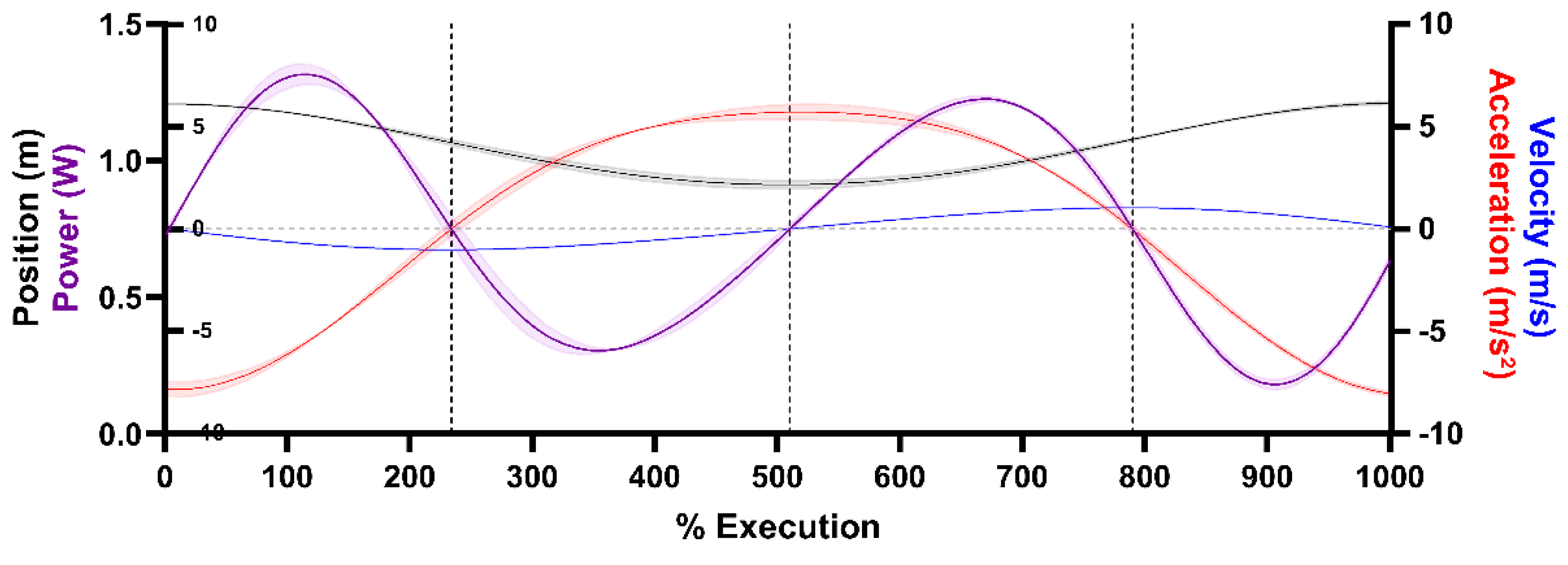
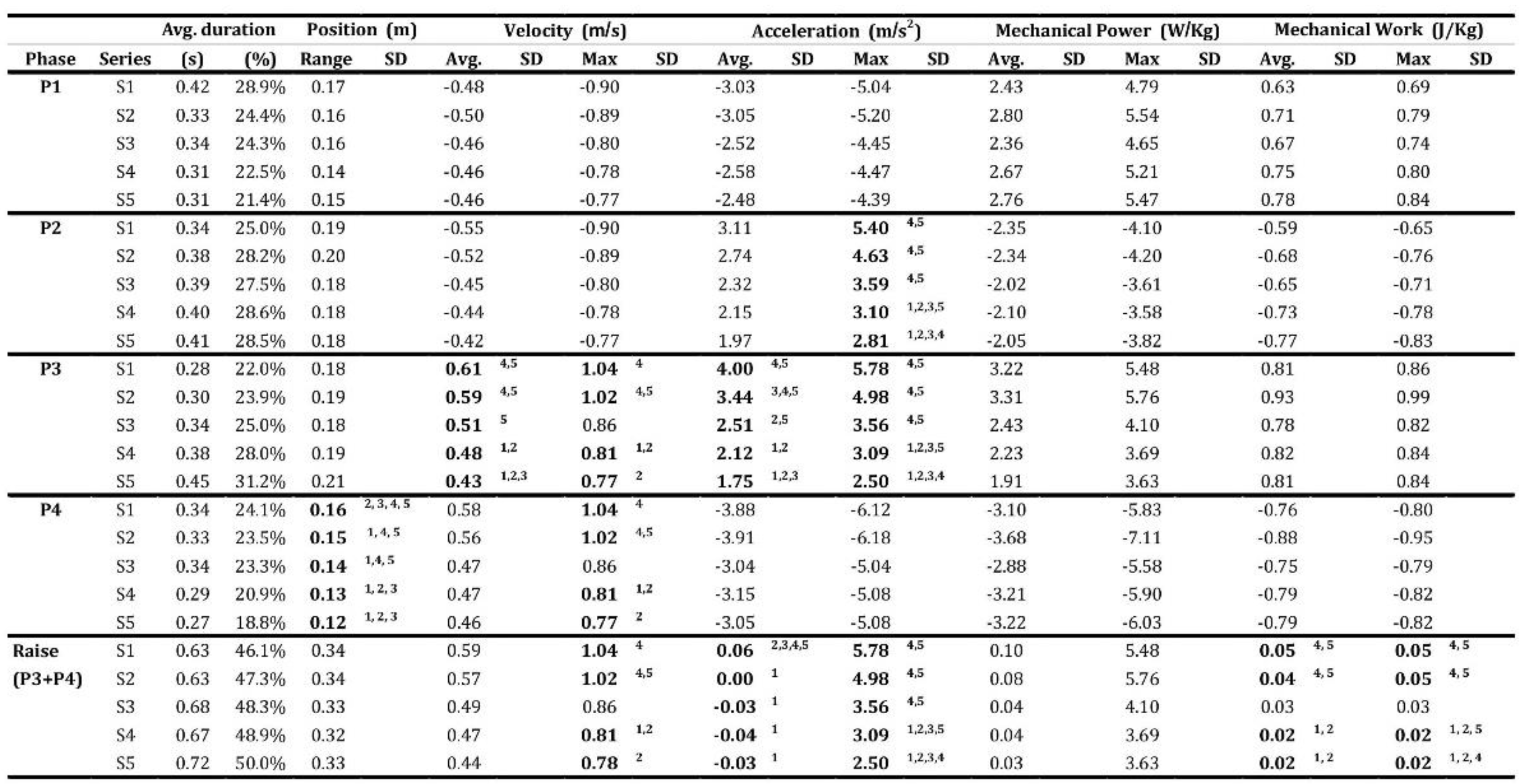
Table 1 presents a detailed analysis of the kinematic and dynamic variables associated with the execution of the HS (CoM behaviour), showing the mean and maximum values of the variables studied. In this context, the maximum values correspond to those of greater absolute magnitude, regardless of their sign, as this depends on the direction of movement in each phase of the exercise.
The analysis of the squat movement has been structured in four phases, previously represented in the previous graph. The first phase corresponds to the acceleration of the descent, where the downward displacement of the bar begins. The second phase comprises the braking of the descent, in which the bar slows down until it reaches the transition point to the upward movement. The third phase is characterised by the acceleration of the upward movement, in which an increase in the positive velocity of the movement is generated. Finally, the fourth phase represents the braking of the upward movement, at which point the velocity of the bar decreases until the movement comes to a complete stop.
The results obtained for each phase and series have been organised in the table in two sub-columns. The first of these presents the mean values of each variable, with the significant differences identified to the right. The second sub-column shows the absolute maximum values recorded, which are also accompanied by the significant differences detected.
As for the variables analysed, the average duration of each phase is expressed both in seconds and as a percentage of the total squat time. The position variable, defined as the range of displacement, represents the distance travelled by the CoM during each phase. The velocity is recorded with a positive sign when the displacement is upward and with a negative sign when the displacement is downward. Similarly, acceleration has positive values when the acceleration vector is directed upwards and negative values when the acceleration is directed downwards. For mechanical power and mechanical work, positive values reflect concentric action, while negative values correspond to eccentric action.

Table 1.
Kinematic and dynamic variables of CoM behavior associated with HS execution in each phase of the movement and for each load level. Mean and maximum values are shown, as well as the significant differences found between the values of the series.
Table 1.
Kinematic and dynamic variables of CoM behavior associated with HS execution in each phase of the movement and for each load level. Mean and maximum values are shown, as well as the significant differences found between the values of the series.
3.2. Time Parameters
Analysis of the duration of each phase of the HS cycle reveals a pattern of progressive change as the load increases. In the initial downhill phase (Phase 1), dedicated to downward acceleration, the average time decreases noticeably from 0.42 s (28.9% of the cycle) at the lightest load (S1) to 0.31 s (21.4%) at the heaviest load (S5). Complementarily, the downhill braking phase (Phase 2) shows a slightly increasing trend from 0.34 s (25.0%) in S1 to 0.41 s (28.5%) in S5.
In the upward part, the positive acceleration phase (Phase 3) progressively lengthens from 0.28 s (22.0%) in S1 to 0.45 s (31.2%) in S5. In contrast, the final phase of the ascent (Phase 4), corresponding to upward braking, reduces its duration from 0.34 s (24.1%) in S1 to 0.27 s (18.8%) in S5. Thus, the total rise time (F3 + F4) increases from 0.63 s (46.1% of the cycle) in S1 to 0.72 s (50.0%) in S5, which emphasises the slowing down of the ascent under higher mechanical demands.
3.3. Kinecmatics
The kinematic behaviour of the CoM is evaluated by means of position, velocity and acceleration, observing changes in each phase with the progressive increase of the load.
In terms of position, the range of vertical displacement in the descent (Phases 1 and 2) does not show statistically significant differences, although in the initial phase (Phase 1) a slight downward trend is observed, with values between 0.17 m in S1 and 0.14 m in S4, rising again to 0.15 m in S5. During downward braking (Phase 2), displacements remain around 0.18-0.20 m, with no clear pattern associated with increasing load. On the way up (Phases 3 and 4), the displacement in Phase 3 varies subtly (between 0.18 m and 0.21 m), with S5 being the series that reaches the highest value (0.21 m), although without significant differences. In contrast, the upward braking phase (Phase 4) does show a significant reduction in displacement, from 0.16 m in S1 to 0.12 m in S5, with significant differences between all load conditions, grouped between the lowest load level (S1), the intermediate levels (S2 and S3) and the highest levels (S4 and S5). When evaluating the combined range of the two ascending phases (F3 + F4), a stability around 0.33-0.34 m is observed, with no statistically significant findings. This indicates that, although the range of ascent is the same, the range of movement during which acceleration and braking of the CoM occurs varies within the ascent, which evidences the need to pay attention to the mechanical behavior of the exercise taking into consideration the 4 phases detected.
Regarding velocity, the downhill phases (F1 and F2) show negative mean and maximum values, indicating a downward displacement. These values decrease slightly in magnitude with increasing load (between -0.50 m/s and -0.46 m/s mean velocity, with peaks of up to -0.90 m/s at the lightest load), although without reaching statistical significance. In contrast, the uphill phases (F3 and F4) show positive values, indicating upward displacement. During the acceleration phase of the ascent (F3), the average velocities drop from 0.61 m/s in S1 to 0.43 m/s in S5, while the maximum velocities drop from 1.04 m/s to 0.77 m/s, indicating a progressive slowing of the ascent under conditions of increased weight. These reductions, in several cases, are statistically significant, especially when comparing the series with light and moderate loads (S1-S2-S3) versus higher loads (S4-S5). The final phase of the ascent (Phase 4) presents average speeds somewhat lower than those of F3, with a range that goes from 0.58 m/s (S1) to 0.46 m/s (S5), and a maximum speed that coincides with that detected in F3, given that the peak speed in F4 occurs an instant after the end of F3, as a result of the segmentation methodology of the phases.
The acceleration confirms this trend. In the downward acceleration phase (F1), the average and maximum values are negative, between -3.03 m/s² and -2.48 m/s² on average, with no statistically significant differences with increasing load. The downhill braking phase (Phase 2) and the upward propulsion phase (Phase 3) show positive accelerations; both show noticeable decreases in peak acceleration at higher loads, being more marked in the concentric phase (Phase 3), with values going from 5.78 m/s² (S1) to 2.50 m/s² (S5). This suggests a reduced ability to apply momentum to the CoM at higher load levels, reflected in the appearance of significant differences between low and moderate versus high load conditions. Finally, upward braking (Phase 4) again shows negative accelerations (from -3.88 m/s² to -3.05 m/s² on average) that do not differ markedly between runs, indicating a relatively constant final deceleration pattern despite increasing load.
3.4. Dynamics
The assessment of mechanical power and mechanical work provides information on the capacity to generate force-velocity and the energy cost in each phase of the movement.
In terms of mechanical power, an inverse relationship between increasing load and mechanical power levels is evident, especially in the concentric acceleration phase (Phase 3). Thus, average mechanical power decreases from approximately 3.22 W/kg in S1 to 1.91 W/kg in S5, while peak values decrease from 5.48 W/kg to 3.63 W/kg. Although the differences do not always reach statistical significance, there is a clear tendency to produce lower peak mechanical power with heavier loads, consistent with the drop in velocity during ascent. On the other hand, the eccentric phases (Phase 2 and Phase 4) show negative mechanical power values, indicating the absorption of mechanical energy by the joints to produce the braking of the movement. In these phases, no marked changes linked to the increase in load are identified, although a slight decrease in the magnitude of the negative peak is observed when the resistance is higher, especially in Phase 2. It should be noted that the average mechanical power during the ‘rise’ is close to zero, since the mechanical power of phases 3 and 4 cancel each other out.
The mechanical work also follows the logic of alternating between phases of energy generation and absorption. Thus, in the downward acceleration (Phase 1), positive average values between 0.63 J/kg and 0.78 J/kg are recorded, with a slight increase as the load increases. In the downward braking phase (Phase 2), the mechanical work is negative and its magnitude also increases as the resistance increases, from -0.59 J/kg in S1 to -0.77 J/kg in S5. During the upward propulsion (Phase 3), the results are of positive sign but do not follow a defined pattern, and in the final braking (Phase 4) the mechanical work is negative, with no evident tendencies but highlighting, for both phases, the second series, with values of greater magnitude. When the two uphill phases are combined (F3 + F4), the total mechanical work remains close to zero, showing that the energy input in the concentric phase tends to be compensated by the energy absorption during the uphill braking.
4. Discussion
In the scientific literature, the number of movement phases detected and their method of delimitation differ according to the author and the objective of the study. On the one hand, there is a traditional approach, in which exercise is segmented into two main stages: the (erroneously called) eccentric or lowering phase and the (erroneously called) concentric or lifting phase [61,62,63,64]. In these works, the usual criterion to identify the transition between both phases is the moment when the vertical velocity of the CoM changes sign (going from negative to positive) or, equivalently, when the subject initiates the upward pushing action [62,65]. Authors such as Wagle et al. [66], have analysed the movement by introducing variations related to eccentric loading or the inclusion of pauses between repetitions, while maintaining the essential distinction between the downward and upward phases.
In contrast, the proposal presented in this paper provides a more detailed segmentation into four phases, establishing as a segmentation criterion the changes of sign in mechanical power (determined by the relationship between load, vertical velocity and CoM acceleration), which allows for a more precise identification of the eccentric and concentric control intervals. Thus, while the majority literature concentrates on two major phases - descent and ascent - this proposal refines the analysis into four phases, taking into account the variation in mechanical power. To the best of the authors' knowledge, no previous study has described these four phases in squat exercises, although there is published evidence of this methodology in the bench press exercise [67] and, additionally, the present findings for phases 3 and 4 are almost in line with other studies that differentiate between the propulsive phase and the braking phase [68,69].
The four-phase model proposed in this paper breaks down the movement into: (1) negative acceleration phase, (2) downhill braking phase, (3) positive acceleration phase, (4) uphill braking phase. Phase 1 can be compared to the negative impulse that occurs during a countermovement jump that is not caused by the subject's direct action [70,71], and phase 4 is similar to its opposite because, if the concentric action were to continue to the end of the vertical trajectory, the CoM would not brake and would produce a vertical projection beyond the initial position of the CoM.
The phased analysis of CoM behavior during HS also yields useful information to understand the kinematic and dynamic adaptations of exercise execution as a function of load levels. Unlike most previous studies using barbell displacement as an indicator of movement [72,73,74], this work directly assesses the CoM of the combined system (subject + barbell), which represents a significant methodological improvement in terms of mechanical accuracy.
In relation to kinematics, the results of this study confirm a progressive reduction in CoM velocity and acceleration with increasing load, especially during the propulsion phase (Phase 3), which is consistent with patterns described in previous studies [62,75,76,77]. The decrease in peak velocity from 1.04 m/s to 0.77 m/s and peak acceleration from 5.78 m/s² to 2.50 m/s² between the lowest and highest loads supports the already established inverse relationship between load and execution velocity [77], observed even when considering only barbell movement. This study, however, shows that this trend also holds when considering the overall CoM, which reinforces its validity as a generalisable biomechanical phenomenon.
In terms of displacement, a maintenance of the total range of the ascent (F3 + F4) is observed, suggesting that the subjects internally adjust the distribution of movement between phases, but not the total range. In the final braking of the ascent (F4), as the load is increased, a significant decrease in displacement is observed, attributable to an adjustment in the distribution of the range of movement in which each phase is developed, increasing the distance covered in F3 and decreasing, proportionally, the distance in F4. This observation partially coincides with Larsen [74], but with greater precision, by decomposing and quantifying the braking phase (F4) independently, and identifying how its relative contribution decreases with increasing load.
From a temporal perspective, it is noteworthy that the redistribution of the durations between phases shows that, at high loads, subjects reduce the downward acceleration time (F1) and increase the duration of the eccentric braking phase (F2). This strategy could be explained as a safety or efficiency mechanism, aimed at minimising the speed of the descent at the start of the braking phase, thus facilitating the change of direction, but possibly impairs the adjustment to an optimal acceleration course [78] that maximises mechanical power values. With respect to the ascent, Larsen [74] already noted the existence of a deceleration phase in the ascent (equivalent to F4), but the present work extends this finding by showing how the duration of the F3 and F4 phases is adjusted in response to the load.
The analysis of mechanical power is consistent with studies such as those of Sinclair [76] and Zink [77]in documenting a clear reduction in peak mechanical power values as load increases, both in absolute terms and relative to body weight. This pattern reinforces the hypothesis that optimal mechanical power is achieved at moderate loads, and that mechanical power production is limited under conditions of high resistance.
With regard to mechanical work, the findings of the present study make it possible to distinguish between energy absorption and energy production phases (eccentric and concentric, respectively). The progressive increase in negative mechanical work during downhill braking (Phase 2) at high loads has not previously been documented with this precision, as previous studies do not disaggregate mechanical work by phase [72,73]. Furthermore, the tendency of the total mechanical work to approach zero during the ascent (F3 + F4), a product of the trade-off between positive and negative mechanical work, provides a novel interpretation of the energy balance of the gesture, hardly considered in previous work.
It has also been observed that there is a decrease in the magnitude of the different kinematic and mechanical parameters as the load intensity increases, both during phases 2 and 3, aligning with the muscle mechanical model previously described by Hill [79]. Moreover, this behaviour supports the proposed hypotheses and aligns with previous studies that have observed an inverse relationship between load and velocity in weightlifting exercises [80,81].
A reduction in the magnitude of various kinematic and mechanical parameters has also been identified as load intensity increases, specifically during phases 2 and 3. This trend is consistent with Hill’s muscle mechanical model [79]. Furthermore, the observed pattern supports the hypotheses proposed and aligns with prior research that has reported an inverse relationship between load and velocity in weightlifting movements [80,81,82].
Overall, mechanical power and joint mechanical work show that progressively increasing load results in increased stress in both the eccentric and concentric phases. The hip emerges as the main biomechanical resource for sustaining and lifting higher and higher loads, especially when combining its high capacity to generate mechanical power with the need to absorb and produce mechanical work in the most demanding parts of the movement. The knee remains a fundamental pillar in force absorption and generation, but its relative contribution may be partially relegated as the demand intensifies in the heavier sets. The ankle, finally, retains a secondary role, although it adopts slight increases in participation at certain times, especially at the end of the ascent, without matching the involvement of the proximal joints.
In summary, in the present study, the Power-Based Training (PBT) approach has been defined and applied in the biomechanical evaluation of HS exercise as a reference for lower body training. The results confirm trends described in previous literature, such as the reduction of velocity, acceleration and mechanical power with increasing exercise load. However, they provide a more accurate view of the behavior of the subject-bar system by integrating the joint CoM and breaking down the motor pattern into functional phases and assessing the adaptation of the pattern as a function of the load used. On the other hand, it has been shown that the temporal and kinematic patterns of exercise should be considered phase by phase, rather than analysing the gesture as an indivisible unit (cycle or repetition) or divisible into only two phases, determined by the direction of movement.
This perspective creates new opportunities for future research that integrates joint mechanical power (JMP) and joint mechanical work (JMW) through inverse dynamics analysis; variability studies grounded in dynamic systems theory [83] and uncontrolled manifold hypothesis [84,85], synergy analysis [86,87], usability and ergonomics (efficiency, safety, and comfort) [88].
5. Conclusions
The results of this research highlight the relevance of analyzing the half squat (MS) from a systemic-structural approach and based on mechanical power, thus defining the Power-Based Training (PBT) approach, in contrast to the traditional division into only two phases (descent and ascent). The segmentation into four phases (lowering acceleration, lowering braking, lifting acceleration and lifting braking) makes it possible to identify more precisely the internal dynamics of each interval and the way in which the mechanical demands vary according to the external load. This analytical strategy also demonstrated the importance of assessing the CoM of the complete system (subject + bar), which provides a more accurate view than the exclusive study of the trajectory of the bar.
The progressive increase in load intensity evidenced a reduction in peak velocity and acceleration, as well as in mechanical power output, especially in the propulsion phase (phase 3). In addition, a redistribution in the duration and magnitude of displacement was observed during the total MS cycle; in particular, the upward braking phase (phase 4) was shortened at higher load levels, while the propulsion phase showed a prolongation and lower peak velocity. These findings corroborate the inverse relationship between load magnitude and the ability to rapidly generate force-velocity, ratifying the validity of the mechanical model proposed in the literature.
The analysis of mechanical power and mechanical work, in turn, reveals the prominent role of the eccentric phases in the absorption of mechanical energy for the braking of the movement, in the final stretch of the descent (phase 2). The fact that the sum of the positive and negative work in the ascent (phases 3 and 4) tends to equalize confirms the need to break down the movement into functional phases, since high loads do not modify the total range of displacement but do require adjustments in execution to lift the bar effectively.
The detailed biomechanical characterization of MS provides practical evidence for the planning and optimization of lower body strength training, as it helps to determine more accurately the neuromuscular demands of each phase and to guide the prescription of loads and intensities in a specific way. Likewise, it lays the groundwork for future work integrating inverse dynamic analysis, gesture variability and muscle synergies, in order to improve dosage and performance control in countermovement exercises such as the half squat, as well as to evaluate the mechanical joint contribution and the symmetry or asymmetry in the execution of the exercises.
Author Contributions
Conceptualization, M.R; methodology, M.R., K.G. and J.P.G.; formal analysis, M.R., E.M.A.M. and M.E.G.M.; investigation, M.R., E.M.A.M. and M.E.G.M.; resources E.M.A.M. and M.E.G.M.; writing—original draft preparation, M.R.; writing—review and editing, M.R., and K.G.; supervision, K.G. and J.P.G. All authors have read and agreed to the published version of the manuscript.
Funding
This research received no external funding.
Institutional Review Board Statement
Department of Teaching and Research Support of the Mexicali Campus of the Autonomous University of Baja California.
Informed Consent Statement
Informed consent was obtained from all subjects involved in the study.
Data Availability Statement
The data presented in this study are available on request from the corresponding author. The data are not publicly available due to ethical considerations.
Acknowledgments
The authors would like to thank all the subjects who selflessly participated in the study.
Conflicts of Interest
The authors declare that they have no conflicts of interest.
References
- Quiceno, C.; Mantilla, J.I.A.; Samudio, M.A.; Arévalo, J.C. Caracterización de Fuerza de Cadena Muscular Anterior y Posterior En Futbolistas Colombianos, Categorías U17 y U20. VIREF Rev. Educ. Física 2020, 9, 38–47. [Google Scholar]
- Aliaga Reynaldo, J.R.; Núñez Aliaga, F. Distribución del volumen de trabajo de la fuerza muscular en atletas del área de velocidad del atletismo (Original). Olimp. Publ. Científica Fac. Cult. Física Univ. Granma 2016, 13, 192–201. [Google Scholar]
- Rosa-Guillamón, A.; García-Cantó, E. Relación entre fuerza muscular y otros parámetros de la condición física en escolares de primaria. SPORT TK-Rev. Euroam. Cienc. Deporte 2017, 6, 107–116. [Google Scholar] [CrossRef] [PubMed]
- Fernandez Ortega, J.A.; Hoyos Cuartas, L.A. Efectos de La Velocidad de Entrenamiento En Fuerza Sobre Diversas Manifestaciones de La Fuerza En Mujeres Adultas Mayores (Effect of the Velocity Resistance Training on Various Manifestations of Resistance in Older Women). Retos 2020, 325–332. [Google Scholar] [CrossRef]
- Registre, F.; Lopes, L.M.P.; Souza, P.M.; Becker, L.K.; Borba, D. de A.; Ferreira Júnior, J.B.; Oliveira, E.C. de; Coelho, D.B. Effects of Different Strength Training Protocols on Sarcopenia Influencing Parameters in Older Adults: A Systematic Review. ABCS Health Sci 2022, e022308. [Google Scholar] [CrossRef]
- Suárez Manzano, S.; Rusillo Magdaleno, A.; Solas Martínez, J.L.; Brandão Loureiro, V. Asociación de La Fuerza Muscular Con Atención, Comportamiento Hiperactivo-Desatento, Cálculo Matemáti-Co y Razonamiento Lingüístico En Escolares Diagnosticados TDAH (Association of Muscle Strength with Attention, Hyperactive-Attentive Behavior, Mathematical Calculation and Linguistic Reasoning in Schoolchildren Diagnosed with ADHD). Retos 2023, 47, 753–760. [Google Scholar] [CrossRef]
- Hori, N.; Newton, R.U.; Nosaka, K.; Stone, M.H. Weightlifting Exercises Enhance Athletic Performance That Requires High-Load Speed Strength. Strength Cond. J. 2005, 27, 50. [Google Scholar] [CrossRef]
- Comfort, P.; Haff, G.G.; Suchomel, T.J.; Soriano, M.A.; Pierce, K.C.; Hornsby, W.G.; Haff, E.E.; Sommerfield, L.M.; Chavda, S.; Morris, S.J.; et al. National Strength and Conditioning Association Position Statement on Weightlifting for Sports Performance. J. Strength Cond. Res. 2023, 37, 1163–1190. [Google Scholar] [CrossRef]
- Schoenfeld, B.J.; Grgic, J.; Ogborn, D.; Krieger, J.W. Strength and Hypertrophy Adaptations Between Low- vs. High-Load Resistance Training: A Systematic Review and Meta-Analysis. J. Strength Cond. Res. 2017, 31, 3508–3523. [Google Scholar] [CrossRef]
- Lacio, M.; Vieira, J.G.; Trybulski, R.; Campos, Y.; Santana, D.; Filho, J.E.; Novaes, J.; Vianna, J.; Wilk, M. Effects of Resistance Training Performed with Different Loads in Untrained and Trained Male Adult Individuals on Maximal Strength and Muscle Hypertrophy: A Systematic Review. Int. J. Environ. Res. Public. Health 2021, 18, 11237. [Google Scholar] [CrossRef]
- Storey, A.; Smith, H.K. Unique Aspects of Competitive Weightlifting: Performance, Training and Physiology. Sports Med. Auckl. NZ 2012, 42, 769–790. [Google Scholar] [CrossRef] [PubMed]
- Gacesa, J.Z.P.; Klasnja, A.V.; Grujic, N.G. Changes in Strength, Endurance, and Fatigue During a Resistance-Training Program for the Triceps Brachii Muscle. J. Athl. Train. 2013, 48, 804–809. [Google Scholar] [CrossRef] [PubMed]
- Redwood, J.Q.; Almeida, M.D. The Combined Effects of Endurance and Strength Training on Exercise Tolerance and Quality of Life in Patients with COPD. Stud. Sports Sci. Phys. Educ. 2024, 2, 43–51. [Google Scholar] [CrossRef]
- McKelvie, R.S.; McCartney, N. Weightlifting Training in Cardiac Patients. Considerations. Sports Med. Auckl. NZ 1990, 10, 355–364. [Google Scholar] [CrossRef]
- Simpson, K.; Killian, K.; McCartney, N.; Stubbing, D.G.; Jones, N.L. Randomised Controlled Trial of Weightlifting Exercise in Patients with Chronic Airflow Limitation. Thorax 1992, 47, 70–75. [Google Scholar] [CrossRef] [PubMed]
- Nguyen, C.; Lefèvre-Colau, M.-M.; Poiraudeau, S.; Rannou, F. Rehabilitation (Exercise and Strength Training) and Osteoarthritis: A Critical Narrative Review. Ann. Phys. Rehabil. Med. 2016, 59, 190–195. [Google Scholar] [CrossRef]
- Noguchi, K.S.; Moncion, K.; Wiley, E.; Morgan, A.; Huynh, E.; Balbim, G.M.; Elliott, B.; Harris-Blake, C.; Krysa, B.; Koetsier, B.; et al. Prescribing Strength Training for Stroke Recovery: A Systematic Review and Meta-Analysis of Randomised Controlled Trials. Br. J. Sports Med. 2025, 59, 185–197. [Google Scholar] [CrossRef]
- Nabutovsky, I.; Sabah, R.; Moreno, M.; Epstein, Y.; Klempfner, R.; Scheinowitz, M. Evaluating the Effects of an Enhanced Strength Training Program in Remote Cardiological Rehabilitation: A Shift from Aerobic Dominance-A Pilot Randomized Controlled Trial. J. Clin. Med. 2024, 13, 1445. [Google Scholar] [CrossRef]
- Enoka, R.M. Strength Training for Exercise Performance and Rehabilitation. Scand. J. Med. Sci. Sports 2007, 17, 1. [Google Scholar] [CrossRef]
- Mausehund, L.; Skard, A.E.; Krosshaug, T. Muscle Activation in Unilateral Barbell Exercises: Implications for Strength Training and Rehabilitation. J. Strength Cond. Res. 2019, 33, S85. [Google Scholar] [CrossRef]
- Bird, S.P.; Tarpenning, K.M.; Marino, F.E. Designing Resistance Training Programmes to Enhance Muscular Fitness. Sports Med. 2005, 35, 841–851. [Google Scholar] [CrossRef]
- Nigro, F.; Bartolomei, S. A Comparison Between the Squat and the Deadlift for Lower Body Strength and Power Training. J. Hum. Kinet. 2020, 73, 145–152. [Google Scholar] [CrossRef] [PubMed]
- Bauer, P.; Uebellacker, F.; Mitter, B.; Aigner, A.J.; Hasenoehrl, T.; Ristl, R.; Tschan, H.; Seitz, L.B. Combining Higher-Load and Lower-Load Resistance Training Exercises: A Systematic Review and Meta-Analysis of Findings from Complex Training Studies. J. Sci. Med. Sport 2019, 22, 838–851. [Google Scholar] [CrossRef]
- Enes, A.; Oneda, G.; Leonel, D.F.; Lemos, L.; Alves, F.; Ferreira, L.H.B.; Escalante, G.; Schoenfeld, B.J.; Souza-Junior, T.P. The Effects of Squat Variations on Strength and Quadriceps Hypertrophy Adaptations in Recreationally Trained Females. Eur. J. Sport Sci. 2024, 24, 6–15. [Google Scholar] [CrossRef]
- Hartmann, H.; Wirth, K.; Klusemann, M. Analysis of the Load on the Knee Joint and Vertebral Column with Changes in Squatting Depth and Weight Load. Sports Med. 2013, 43, 993–1008. [Google Scholar] [CrossRef] [PubMed]
- Li, X.; Adrien, N.; Baker, J.S.; Mei, Q.; Gu, Y. Novice Female Exercisers Exhibited Different Biomechanical Loading Profiles during Full-Squat and Half-Squat Practice. Biology 2021, 10, 1184. [Google Scholar] [CrossRef] [PubMed]
- Schoenfeld, B.J. Squatting Kinematics and Kinetics and Their Application to Exercise Performance. J. Strength Cond. Res. 2010, 24, 3497–3506. [Google Scholar] [CrossRef]
- Marshall, J.; Bishop, C.; Turner, A.; Haff, G.G. Optimal Training Sequences to Develop Lower Body Force, Velocity, Power, and Jump Height: A Systematic Review with Meta-Analysis. Sports Med. 2021, 51, 1245–1271. [Google Scholar] [CrossRef]
- Korak, J.A.; Paquette, M.R.; Fuller, D.K.; Caputo, J.L.; Coons, J.M. Muscle Activation Patterns of Lower-Body Musculature Among 3 Traditional Lower-Body Exercises in Trained Women. J. Strength Cond. Res. 2018, 32, 2770–2775. [Google Scholar] [CrossRef]
- Jaeggi, J.S.; Achermann, B.; Lorenzetti, S.R. Female Lower Body Muscle Forces: A Musculoskeletal Modeling Comparison of Back Squats, Split Squats and Good Mornings. J. Funct. Morphol. Kinesiol. 2024, 9, 68. [Google Scholar] [CrossRef]
- Wong, D.P.; Tan, E.C.H.; Chaouachi, A.; Carling, C.; Castagna, C.; Bloomfield, J.; Behm, D.G. Using Squat Testing to Predict Training Loads for Lower-Body Exercises in Elite Karate Athletes. J. Strength Cond. Res. 2010, 24, 3075–3080. [Google Scholar] [CrossRef] [PubMed]
- Perez-Castilla, A.; Garcia-Ramos, A.; Padial, P.; Morales-Artacho, A.; Feriche, B. Load-Velocity Relationship in Variations of the Half-Squat Exercise: Influence of Execution Technique. J. STRENGTH Cond. Res. 2020, 34, 1024–1031. [Google Scholar] [CrossRef] [PubMed]
- Weakley, J.; Mann, B.; Banyard, H.; McLaren, S.; Scott, T.; Garcia-Ramos, A. Velocity-Based Training: From Theory to Application. Strength Cond. J. 2021, 43, 31–49. [Google Scholar] [CrossRef]
- Gullett, J.C.; Tillman, M.D.; Gutierrez, G.M.; Chow, J.W. A Biomechanical Comparison of Back and Front Squats in Healthy Trained Individuals. J. Strength Cond. Res. 2009, 23, 284. [Google Scholar] [CrossRef]
- Swinton, P.A.; Lloyd, R.; Keogh, J.W.L.; Agouris, I.; Stewart, A.D. A Biomechanical Comparison of the Traditional Squat, Powerlifting Squat, and Box Squat. J. Strength Cond. Res. 2012, 26, 1805. [Google Scholar] [CrossRef]
- Kingston, D. C.; Tennant, L. M.; Chong, H. C.; Acker, S. M. Lower Limb Muscular Activation During Transitions to Symmetric High Knee Flexion Postures in Young Females. IISE Trans. Occup. Ergon. Hum. Factors 2017, 5, 82–91. [Google Scholar] [CrossRef]
- Coratella, G.; Tornatore, G.; Caccavale, F.; Longo, S.; Esposito, F.; Cè, E. The Activation of Gluteal, Thigh, and Lower Back Muscles in Different Squat Variations Performed by Competitive Bodybuilders: Implications for Resistance Training. Int. J. Environ. Res. Public. Health 2021, 18, 772. [Google Scholar] [CrossRef]
- Gantois, P.; Fonseca, F. de S.; Nakamura, F.Y.; Fortes, L. de S.; Fernandez-Fernandez, J.; Batista, G.R. Analysis of Velocity- and Power-Load Relationships of the Free-Weight Back-Squat and Hexagonal Bar Deadlift Exercises. Biol. Sport 2023, 40, 201–208. [Google Scholar] [CrossRef]
- Banyard, H.G.; Tufano, J.J.; Delgado, J.; Thompson, S.W.; Nosaka, K. Comparison of the Effects of Velocity-Based Training Methods and Traditional 1RM-Percent-Based Training Prescription on Acute Kinetic and Kinematic Variables. Int. J. Sports Physiol. Perform. 2019, 14, 246–255. [Google Scholar] [CrossRef]
- Alcazar, J.; Cornejo-Daza, P.J.; Sánchez-Valdepeñas, J.; Alegre, L.M.; Pareja-Blanco, F. Dose-Response Relationship Between Velocity Loss During Resistance Training and Changes in the Squat Force-Velocity Relationship. Int. J. Sports Physiol. Perform. 2021, 16, 1736–1745. [Google Scholar] [CrossRef]
- Pareja-Blanco, F.; Rodríguez-Rosell, D.; Sánchez-Medina, L.; Sanchis-Moysi, J.; Dorado, C.; Mora-Custodio, R.; Yáñez-García, J.M.; Morales-Alamo, D.; Pérez-Suárez, I.; Calbet, J. a. L.; et al. Effects of Velocity Loss during Resistance Training on Athletic Performance, Strength Gains and Muscle Adaptations. Scand. J. Med. Sci. Sports 2017, 27, 724–735. [Google Scholar] [CrossRef] [PubMed]
- Spudić, D.; Smajla, D.; Šarabon, N. Validity and Reliability of Force–Velocity Outcome Parameters in Flywheel Squats. J. Biomech. 2020, 107, 109824. [Google Scholar] [CrossRef] [PubMed]
- Zatsiorsky, V.M. Metrología deportiva: libro de texto; Planeta, 1989; ISBN 978-5-85250-257-5. [Google Scholar]
- Strength and Power in Sport; Komi, P.V., Ed.; Osney Mead, Oxford: Malden, MA, 2002; ISBN 978-0-632-05911-9. [Google Scholar]
- Knudson, D.V. Correcting the Use of the Term “Power” in the Strength and Conditioning Literature. J. Strength Cond. Res. 2009, 23, 1902. [Google Scholar] [CrossRef]
- Enoka, R.M. Neuromechanics of Human Movement; Human Kinetics, 2024; ISBN 978-1-7182-1373-9. [Google Scholar]
- Zatsiorsky, V.M. Kinetics of Human Motion; Human Kinetics: Champaign, IL, USA, 2002; ISBN 978-0-7360-3778-5. [Google Scholar]
- Winter, D.A. Biomechanics and Motor Control of Human Movement; John Wiley & Sons: Hoboken, NJ, USA, 2009; ISBN 978-0-470-39818-0. [Google Scholar]
- Bernshteĭn, N.A. The Co-Ordination and Regulation of Movements; Pergamon Press: Oxford, UK, 1967. [Google Scholar]
- Zatsiorsky, V. Biomechanics in Sport. Performance Enhancement and Injury Prevention; 2000; Vol. 33, ISBN 978-0-632-05392-6. [Google Scholar]
- Behm, D.G.; Sale, D.G. Velocity Specificity of Resistance Training. Sports Med. 1993, 15, 374–388. [Google Scholar] [CrossRef] [PubMed]
- Haff, G.G.; Triplett, N.T. Essentials of Strength Training and Conditioning 4th Edition; Human Kinetics: Champaign, IL, USA, 2015; ISBN 978-1-4925-0162-6. [Google Scholar]
- Vicon Motion Systems Ltd. Vicon Motion Capture System 2024.
- Vicon Motion Systems Ltd. Vicon Nexus 2024.
- Vicon Motion Systems Ltd. Plug-in Gait Reference Guide Vicon Help 2023.
- Matos, F.; Ferreira, B.; Guedes, J.; Saavedra, F.; Reis, V.M.; Vilaça-Alves, J. Effect of Rest Interval Between Sets in the Muscle Function During a Sequence of Strength Training Exercises for the Upper Body. J. Strength Cond. Res. 2021, 35, 1628. [Google Scholar] [CrossRef]
- Santana, W. de J.; Bocalini, D.S.; João, G.A.; Caperuto, E.C.; Araujo, I.P. de; Figueira Junior, A. Recovery between Sets in Strength Training: Systematic Review and Meta-Analysis. Rev. Bras. Med. Esporte 2023, 30, e2021_0037. [Google Scholar] [CrossRef]
- Harris, J. Establishing an Optimal Recovery Time between Repeated Maximal Stength Sets on the Squat and Bench Press; 2008. [Google Scholar]
- Yu, B.; Gabriel, D.; Noble, L.; An, K.-N. Estimate of the Optimum Cutoff Frequency for the Butterworth Low-Pass Digital Filter. 1999. [Google Scholar] [CrossRef]
- Roithner, R.; Schwameder, H.; Müller, E. Determination of Optimal Filter Parameters for Filtering Kinematic Walking Data Using Butterworth Low-Pass Filter; 2000. [Google Scholar]
- Escamilla, R.F. Knee Biomechanics of the Dynamic Squat Exercise. Med. Sci. Sports Exerc. 2001, 33, 127. [Google Scholar] [CrossRef]
- Carzoli, J.P.; Sousa, C.A.; Belcher, D.J.; Helms, E.R.; Khamoui, A.V.; Whitehurst, M.; Zourdos, M.C. The Effects of Eccentric Phase Duration on Concentric Outcomes in the Back Squat and Bench Press in Well-Trained Males. J. Sports Sci. 2019, 37, 2676–2684. [Google Scholar] [CrossRef]
- Armstrong, R.; Baltzopoulos, V.; Langan-Evans, C.; Clark, D.; Jarvis, J.; Stewart, C.; O’Brien, T. An Investigation of Movement Dynamics and Muscle Activity during Traditional and Accentuated-Eccentric Squatting. PLOS ONE 2022, 17, e0276096. [Google Scholar] [CrossRef]
- Orantes-Gonzalez, E.; Heredia-Jimenez, J.; Lindley, S.B.; Richards, J.D.; Chapman, G.J. An Exploration of the Motor Unit Behaviour during the Concentric and Eccentric Phases of a Squat Task Performed at Different Speeds. Sports Biomech. 1–12. [CrossRef]
- Armstrong, R.; Baltzopoulos, V.; Langan-Evans, C.; Clark, D.; Jarvis, J.; Stewart, C.; O’Brien, T.D. Determining Concentric and Eccentric Force–Velocity Profiles during Squatting. Eur. J. Appl. Physiol. 2022, 122, 769–779. [Google Scholar] [CrossRef]
- Wagle, J.P.; Taber, C.B.; Carroll, K.M.; Cunanan, A.J.; Sams, M.L.; Wetmore, A.; Bingham, G.E.; DeWeese, B.H.; Sato, K.; Stuart, C.A.; et al. Repetition-to-Repetition Differences Using Cluster and Accentuated Eccentric Loading in the Back Squat. Sports 2018, 6, 59. [Google Scholar] [CrossRef] [PubMed]
- Rodal, M.; Franco-García, J.M.; Carlos-Vivas, J.; García-Muro San José, F.; Pérez Gosálvez, A.; Charneco Salguero, G.; Gianikellis, K.; Pérez-Gómez, J. Spatio-Temporal and Mechanical Analysis of Bench Press Phases: Barbell Kinematics and Dynamics Across Different Load Intensities. Appl. Sci. 2024, 14, 11783. [Google Scholar] [CrossRef]
- Sanchez-Medina, L.; Perez, C.E.; Gonzalez-Badillo, J.J. Importance of the Propulsive Phase in Strength Assessment. Int. J. Sports Med. 2010, 31, 123–129. [Google Scholar] [CrossRef] [PubMed]
- Loturco, I.; Suchomel, T.; Bishop, C.; Kobal, R.; Pereira, L.; McGuigan, M. Determining the Optimum Bar Velocity in the Barbell Hip Thrust Exercise. Int. J. SPORTS Physiol. Perform. 2020, 15, 585–589. [Google Scholar] [CrossRef]
- Gianikellis, K.; Bote García, A.; Pulido Gil, J.M.; Pérez, A. Análisis biomecánico del salto vertical con contramovimiento en personas con parálisis cerebral. Eur. J. Hum. Mov. 2004, 187–194. [Google Scholar]
- Masci, I.; Vannozzi, G.; Gizzi, L.; Bellotti, P.; Felici, F. Neuromechanical Evidence of Improved Neuromuscular Control around Knee Joint in Volleyball Players. Eur. J. Appl. Physiol. 2010, 108, 443–450. [Google Scholar] [CrossRef]
- Eliassen, W.; Saeterbakken, A.; Tillaar, R. van den Comparison of Bilateral and Unilateral Squat Exercises on Barbell Kinematics and Muscle Activation. Int. J. Sports Phys. Ther. 2018, 13 5, 871–881. [Google Scholar] [CrossRef]
- Goodin, J. Comparison of External Kinetic and Kinematic Variables between High Barbell Back Squats and Low Barbell Back Squats across a Range of Loads. Electron. Theses Diss. 2015. [Google Scholar]
- Larsen, S.; Kristiansen, E.; Falch, H.N.; Haugen, M.E.; Fimland, M.; Tillaar, R. van den Effects of Barbell Load on Kinematics, Kinetics, and Myoelectric Activity in Back Squats. Sports Biomech. 2022, 1–15. [Google Scholar] [CrossRef]
- Giustino, V.; Vicari, D.S.S.; Figlioli, F.; Gervasi, M.; Fernández Peña, E.; Schifaudo, N.; Tedesco, M.; Drid, P.; Paoli, A.; Battaglia, G.; et al. Kinematic Analysis of the Back Squat at Different Load Intensities in Powerlifters and Weightlifters. Front. Sports Act. Living 2024, 6. [Google Scholar] [CrossRef] [PubMed]
- Sinclair, J.; Taylor, P.J.; Jones, B.; Butters, B.; Bentley, I.; Edmundson, C.J. A Multi-Experiment Investigation of the Effects Stance Width on the Biomechanics of the Barbell Squat. Sports Basel Switz. 2022, 10, 136. [Google Scholar] [CrossRef]
- Zink, A.J.; Perry, A.C.; Robertson, B.L.; Roach, K.E.; Signorile, J.F. Peak Power, Ground Reaction Forces, and Velocity during the Squat Exercise Performed at Different Loads. J. Strength Cond. Res. 2006, 20, 658. [Google Scholar]
- Hochmuth, G. Biomechanics of Athletic Movement; Sportverlag, 1984. [Google Scholar]
- Hill, A. The Heat of Shortening and the Dynamic Constants of Muscle. Proc. R. Soc. Lond. Ser. B - Biol. Sci. 1938, 126, 136–195. [Google Scholar] [CrossRef]
- González-Badillo, J.J.; Sánchez-Medina, L. Movement Velocity as a Measure of Loading Intensity in Resistance Training. Int. J. Sports Med. 2010, 31, 347–352. [Google Scholar] [CrossRef] [PubMed]
- Torrejón, A.; Balsalobre-Fernández, C.; Haff, G.G.; García-Ramos, A. The Load-Velocity Profile Differs More between Men and Women than between Individuals with Different Strength Levels. Sports Biomech. 2019, 18, 245–255. [Google Scholar] [CrossRef]
- Sánchez-Medina, L.; González-Badillo, J.J.; Pérez, C.E.; Pallarés, J.G. Velocity- and Power-Load Relationships of the Bench Pull vs. Bench Press Exercises. Int. J. Sports Med. 2014, 35, 209–216. [Google Scholar] [CrossRef]
- Stergiou, N. Innovative Analyses of Human Movement; Human Kinetics: Champaign, IL, USA, 2004; ISBN 978-0-7360-4467-7. [Google Scholar]
- Schoner, G. Recent Developments and Problems in Human Movement Science and Their Conceptual Implications. Ecol. Psychol. 1995, 7, 291–314. [Google Scholar] [CrossRef]
- Scholz, J.P.; Schöner, G. The Uncontrolled Manifold Concept: Identifying Control Variables for a Functional Task. Exp. Brain Res. 1999, 126, 289–306. [Google Scholar] [CrossRef]
- Latash, M.L. The Bliss (Not the Problem) of Motor Abundance (Not Redundancy). Exp. Brain Res. 2012, 217, 1–5. [Google Scholar] [CrossRef] [PubMed]
- Latash, M.L.; Scholz, J.P.; Sch??ner, G. Motor Control Strategies Revealed in the Structure of Motor Variability: Exerc. Sport Sci. Rev. 2002, 30, 26–31. [Google Scholar] [CrossRef] [PubMed]
- Gianikellis, K.; Skiadopoulos, A.; Caro, B. Ergonomics and “Usability” Applied on The Training of Muscular Force Qualities. ISBS Proc. Arch. 2017, 35. [Google Scholar]
Disclaimer/Publisher’s Note: The statements, opinions and data contained in all publications are solely those of the individual author(s) and contributor(s) and not of MDPI and/or the editor(s). MDPI and/or the editor(s) disclaim responsibility for any injury to people or property resulting from any ideas, methods, instructions or products referred to in the content. |
© 2025 by the authors. Licensee MDPI, Basel, Switzerland. This article is an open access article distributed under the terms and conditions of the Creative Commons Attribution (CC BY) license (http://creativecommons.org/licenses/by/4.0/).
Copyright: This open access article is published under a Creative Commons CC BY 4.0 license, which permit the free download, distribution, and reuse, provided that the author and preprint are cited in any reuse.


