
Submitted:
12 February 2026
Posted:
12 February 2026
You are already at the latest version
Abstract
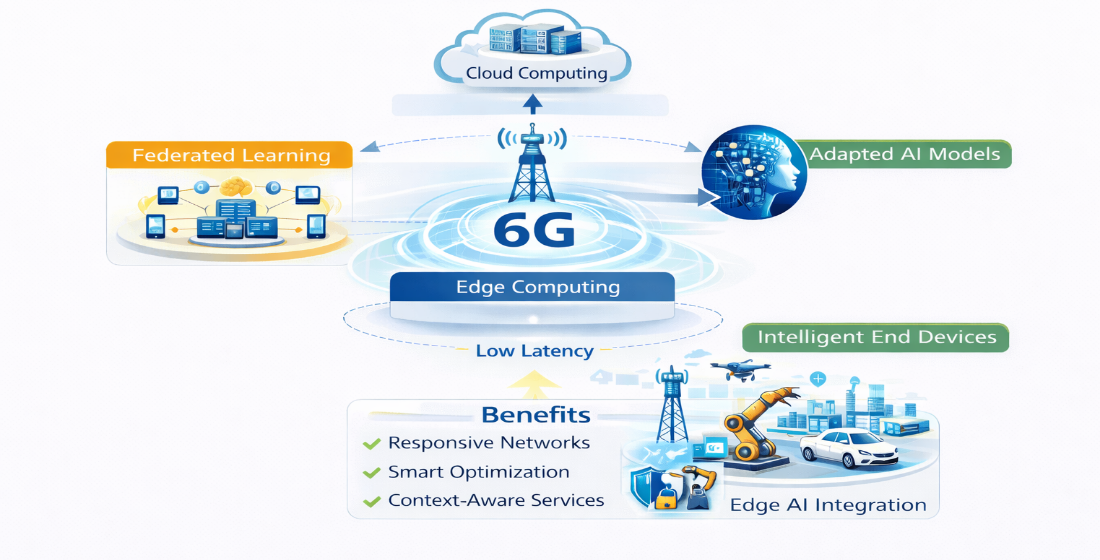
The sixth generation of mobile networks (6G) is envisioned as an AI-native and computa-tion-driven infrastructure capable of supporting ultra-low latency, massive connectivity and intelligent services across highly heterogeneous environments. Achieving these objec-tives challenges traditional centralised architectures and motivates a shift towards dis-tributed computing and intelligence at the network edge. This study presents a structured computational analysis of architectural approaches that integrate distributed computing paradigms and Edge Artificial Intelligence (Edge AI) as core enablers of 6G networks. The methodology follows PRISMA guidelines for systematic reviews and is based on a com-prehensive analysis of peer-reviewed literature, architectural proposals and standardisa-tion documents retrieved from major scientific databases, including IEEE Xplore, Scopus, Web of Science, MDPI and arXiv, as well as reports from ITU-R, 3GPP and ETSI. The analysis examines the evolution from cloud-centric to edge-centric computing, key Edge AI techniques—such as Federated Learning, Split Learning and edge-adapted large AI models—and their role in enabling intelligent orchestration, resource optimisation and context-aware services. The results indicate that the tight integration of distributed com-puting and Edge AI enhances network responsiveness, scalability and adaptability, while also revealing persistent challenges related to orchestration complexity, resource con-straints, security and interoperability. The study concludes that holistic computational architectures and AI-native design principles are essential for the effective realisation of 6G networks and for guiding future research and standardisation efforts.
Keywords:
distributed computing
; edge artificial intelligence
; 6G network architectures
; computational frameworks
; AI-native networks
; intelligent orchestration
Copyright: This open access article is published under a Creative Commons CC BY 4.0 license, which permit the free download, distribution, and reuse, provided that the author and preprint are cited in any reuse.


