
Submitted:
11 February 2026
Posted:
13 February 2026
You are already at the latest version
Abstract
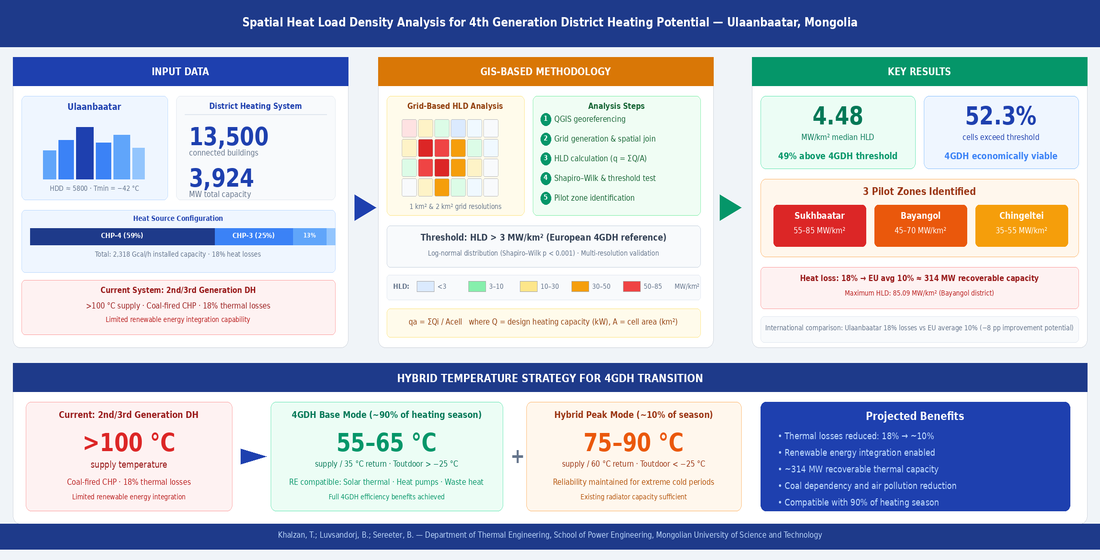
Ulaanbaatar, the capital of Mongolia, operates one of the world’s largest district heating (DH) systems in the coldest national capital (Heating Degree Days ~5800). Despite serving over 60% of the city’s 1.6 million residents, the current 3rd generation DH system suffers from high thermal losses (~17–18%) and relies on coal-fired combined heat and power plants. Transitioning to 4th generation district heating (4GDH) with lower supply temperatures could reduce these losses while enabling future low-temperature renewable energy integration. This GIS-based spatial heat load density (HLD) analysis uses operational data from the Ulaanbaatar District Heating Company, encompassing 13,500 buildings with a total connected capacity of 3,924 MW. Grid-based spatial analysis was performed at two resolutions (1 km² and 2 km²). Threshold sensitivity analysis was conducted across HLD criteria of 1–5 MW/km². Results indicate that median HLD values exceed the European reference threshold of 3 MW/km², with log-normal distributions confirmed by Shapiro–Wilk tests. Three candidate pilot zones were identified. A hybrid temperature strategy (65/35 °C above −25 °C; 90/60 °C below) further contextualizes the findings. These results suggest spatially favorable conditions for 4GDH development, providing a quantitative foundation for subsequent techno-economic feasibility studies.
Keywords:
district heating
; heat load density
; 4th generation district heating
; extreme cold climate
; spatial analysis
; GIS-based heat mapping
; threshold sensitivity analysis
; Ulaanbaatar
Copyright: This open access article is published under a Creative Commons CC BY 4.0 license, which permit the free download, distribution, and reuse, provided that the author and preprint are cited in any reuse.


