
Submitted:
10 February 2026
Posted:
11 February 2026
You are already at the latest version
Abstract
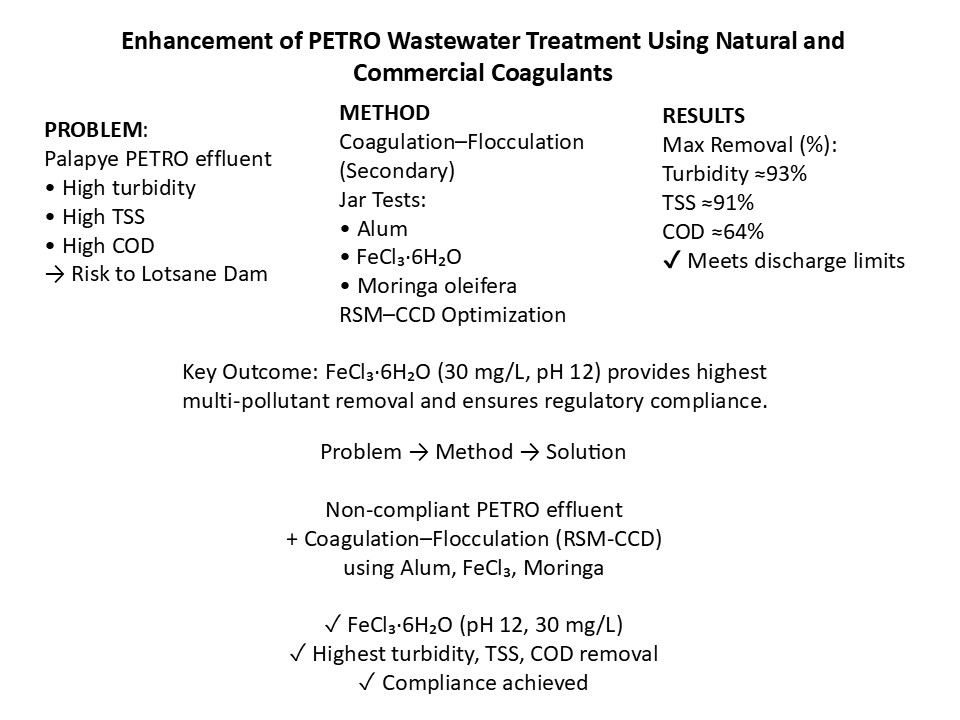
Water pollution due to insufficient wastewater treatment is a global concern. In this paper coagulation and flocculation as a tertiary unit process was investigated to find the solution for a non-complying wastewater treatment facility. The Palapye Pond Enhanced Treatment and Operation (PETRO) system has not been compliant for a long time with effluent characterised by high turbidity, Biological Oxygen Demand/Chemical Oxygen Demand (BOD/COD), Total Suspended Solids (TSS), Nitrates (NO3), and Phosphates (PO4.) The effluent from the plant is released into the stream that drains into the nearby Lotsane dam, posing a lot of danger to the water quality of the dam. The main objective of the project was to investigate the effect of coagulation and flocculation processes at the secondary stage of the wastewater treatment. Response Surface Methodology (RSM), Central Composite Design (CCD) and Multi Response Surface (MRS) were used to optimize the coagulation process and generate regression models to predict the coagulation and flocculation. The performance was evaluated using turbidity, Colour, COD and TSS as response variables. Response surface analysis indicated that the experimental data could be adequately Fitted to quadratic polynomial models. Under optimum conditions the removal efficiency for Al2(SO4)3·18H2O: 91.1% (turbidity), 88.2% (colour), 58.9% (COD), 83.0% (TSS); for FeCl3·6H2O: 93.2%, 88.7%, 63.8%, 91.3%; for Moringa: 91.8%, 85.4%, 56.6%, 83.7%. The optimal removals based on MRS for Al2(SO4)3.18H2O, FeCl3.6H2O and Moringa were 90.7%, 89.7%, 59.9% and 88.5%; 94.7%, 90.8%, 58.1% and 93.8%; 94.0%, 87.2%, 60.1% and 82.1% for turbidity, colour, COD and TSS respectively. This research has demonstrated that the coagulation/flocculation process can be incorporated into the secondary stage of the wastewater treatment facility and the treatment process optimized using RSM, CCD and MRS. The study introduces comparative evaluation of three coagulants within a single RSM-CCD optimization framework, employing desirability functions for multi-response optimization.
Keywords:
response surface methodology
; central composite design
; multi response surface
; ph-induced coagulation
; flocculation
; petro
; wastewater treatment
Copyright: This open access article is published under a Creative Commons CC BY 4.0 license, which permit the free download, distribution, and reuse, provided that the author and preprint are cited in any reuse.


