

Submitted:
10 February 2026
Posted:
11 February 2026
You are already at the latest version
Abstract
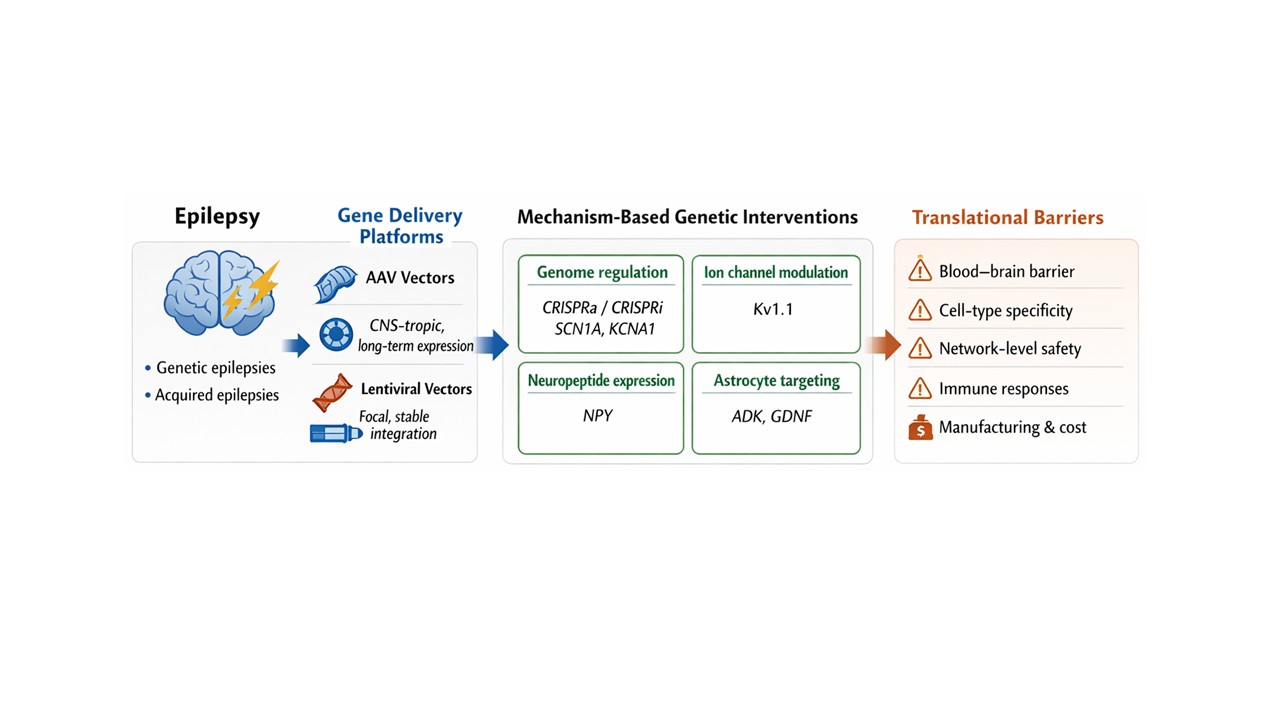
Epilepsy affects more than 50 million individuals worldwide, and approximately one-third of patients remain refractory to existing antiseizure medications. Advances in gene therapy and genome editing have opened new possibilities for disease-modifying interventions that directly target the molecular and circuit-level mechanisms underlying epileptogenesis. Recent progress in central nervous system tropic viral vectors, non-viral delivery systems, and programmable genome-editing technologies has enabled precise manipulation of neuronal and glial function in preclinical epilepsy models. Strategies range from restoration of haploinsufficient genes implicated in monogenic epilepsies, such as SCN1A in Dravet syndrome, to modulation of neuronal excitability through engineered ion channels, neuropeptides, and astrocyte-based approaches. In parallel, CRISPR-derived platforms, including transcriptional activation and repression systems, base editing, and prime editing, offer new avenues for regulating gene expression in post-mitotic neurons without introducing double-strand DNA breaks. Despite these advances, significant translational challenges remain, including efficient and cell-type-specific delivery, long-term safety, and the risk of network-level side effects in the epileptic brain. This review critically examines recent gene therapy and genome-editing approaches for epilepsy, highlights key technological and biological barriers to clinical translation, and discusses emerging strategies that may enable durable and targeted treatments for drug-resistant epilepsies.
Keywords:
epilepsy
; gene therapy
; genome editing
; CRISPR-based technologies
Copyright: This open access article is published under a Creative Commons CC BY 4.0 license, which permit the free download, distribution, and reuse, provided that the author and preprint are cited in any reuse.


