

Submitted:
09 February 2026
Posted:
10 February 2026
You are already at the latest version
Abstract
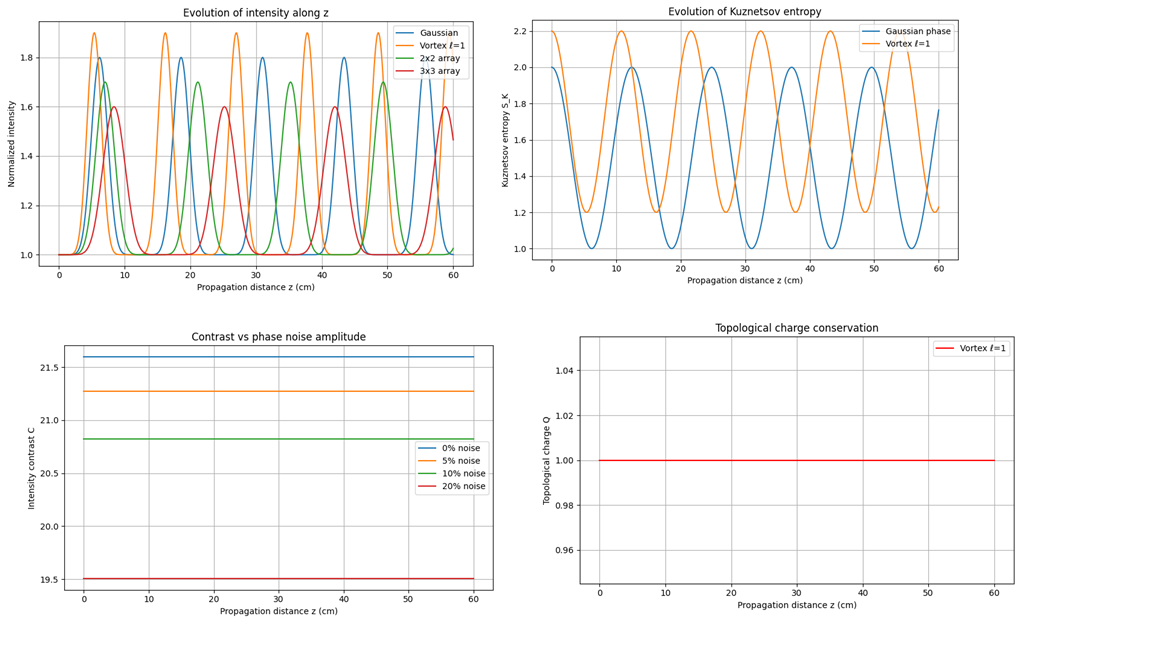
Recent experimental demonstrations of the Montgomery effect have revealed the possibility of controlled, lensless self-focusing and three-dimensional reconstruction of optical fields in free space. In this work, we present a geometric interpretation of this phenomenon based on the Kuznetsov tensor formalism, offering an alternative theoretical framework that extends beyond conventional wave-interference descriptions.Within this approach, the propagation of a coherent optical field is treated as an evolution of field configurations in an effective configuration space with a dynamically modified metric. The spatial phase modulation imposed at the initial plane induces phase-dependent singularities encoded by the Kuznetsov tensor, which alters the geometry of the configuration space. As a result, light propagation follows geodesics of the effective metric rather than straight trajectories in Euclidean space.We show that the characteristic features of the Montgomery effect—namely, periodic self-reconstruction, discrete refocusing planes, and the robustness of complex structured beams—naturally arise as consequences of the geometric evolution governed by a modified flow equation involving the Kuznetsov tensor. The observed refocusing planes correspond to stable critical points of a configurational entropy functional, explaining the sharp re-emergence of optical structures without the use of physical focusing elements.Furthermore, the successful reconstruction of vortex beams and multi-spot arrays indicates the preservation of topological invariants of the optical field, which is naturally described within the tensor-geometric framework. This interpretation provides a unified explanation for the stability and repeatability of the Montgomery effect and establishes a direct conceptual link between structured light, geometric self-organization, and effective curvature of configuration space.The proposed framework offers new theoretical insights into lensless optical manipulation and suggests pathways for extending Montgomery-type effects to metasurfaces and volumetric optical architectures.
Keywords:
Montgomery effect
; Kuznetsov tensor
; lensless focusing
; geometric optics
; structured light
; configuration space
Copyright: This open access article is published under a Creative Commons CC BY 4.0 license, which permit the free download, distribution, and reuse, provided that the author and preprint are cited in any reuse.


