

Submitted:
09 February 2026
Posted:
10 February 2026
You are already at the latest version
Abstract
Global population growth underscores the increasing demands for food production, and therefore, for higher crop yields, especially in soybean, as the cheapest source of protein for animal and human nutrition. This scenario frequently leads to overuse of traditional chemical insecticides to maximize yields, thereby triggering adverse side effects. However, both consumers and governments around the world have been demanding reduction of chemical insecticides in agriculture. To address this challenge, pest control must be guided by proper adoption of economic thresholds (ETs), which indicate the most appropriate time to initiate insecticide applications. Despite the well-documented science behind ETs, not only its adoption but also its reliability has been questioned by farmers in a search for higher production, highlighting the importance of reviewing this topic. Thus, this review discusses, based on the available literature, the role of ETs to optimize insecticide application in soybean production, highlining the importance of their adoption to mitigate the overuse of chemicals. In Brazil, the major soybean producer in the world, not only did growers who adopted ETs to control pests in soybean reduce the amount of pesticides required, but also production costs associated with pest control, while achieving greater yields than conventional producers. The use of ETs improves soybean sustainability and farmers profit while benefitting the agroecosystem.
Keywords:
IPM
; sustainability
; chemical control
; conservation biological control
1. Introduction
Soybean (Glycine max L) is one of the most important crops for human and animal nutrition because it offers an affordable source of protein and edible oil [1] and is critical to feed an increasing world population predicted to reach nearly 10 billion by 2050 [2]. However, soybean production still deeply relies on the application of traditional chemical insecticides to manage economic pests and reach high yields [3]. Despite the importance played by chemical insecticides to agricultural production and food security, revolutionizing insect control [4], their overuse has been raising increasing concerns about their negative non-target effects [5]. The overuse of chemical insecticides can reduce natural biocontrol agents [6] and pollinators [7], select populations of resistant pests [8], trigger pest resurgence and outbreaks of secondary pests and potentially affect human health [3]. Consequently, reducing chemical insecticide use in soybean to allow more sustainable production has been emphasized [9].
The adoption of Integrated Pest Management in soybean (Soybean-IPM) has been recognized as the most effective approach for sustainably managing pest outbreaks [10]. Soybean-IPM is based on the premise that not all plant feeding insects require control, and even for key pests, there are infestation levels that are tolerable without economic yield loss [10,11].
Based on costs of control, value of the crop, and the amount of achievable control, the pest population that causes economic damage to a crop was defined as the Economic Injury Level (EIL) [12]. However, for the management of potential pests prior to populations reaching the EIL and consequent economic yield reduction, several factors are crucial. The necessary time required for the control strategy to be effective against the pest and unfavorable weather conditions that delay the insecticide application, among other factors, can allow pest population increase even after the decision to control has been made [11]. Therefore, to prevent economic losses, pest populations are managed before the EIL, at a percentage defined as the Economic Threshold (ET) (Figure 1). It is assumed that once the ET is reached or surpassed, there is a high probability that the pest population will reach the EIL if no management action is taken [13].
2. Economic Thresholds for Soybean-IPM
Soybean ETs are well established for the most important soybean pests around the world (Figure 1). These ETs vary slightly among different countries and even regions in same country. These variations are associated with 1) the use of different soybean cultivars, which have different pest tolerances, different pest complexes, and variable pest control costs; 2) local environmental conditions; 3) availability and effectiveness of different control technologies in each region [27].
In Brazil, the major global soybean producer and exporter, the first adoption of ETs in soybean integrated pest management (Soybean-IPM) occurred between the late 1960s and early 1970s. The use of ETs as decision criteria for pest control resulted in a reduction of approximately 50% in insecticide use at the national level [28]. Later the adoption of ETs for defoliators and stink bugs within the Soybean-IPM framework was compared with the calendar-based approach used by farmers [16]. Across five different farms, the adoption of IPM reduced insecticide use by an average of 39.7%, ranging from 25% in Arapongas County, Paraná State, to 50% in Morrinhos and Santa Helena de Goiás counties, Goiás State, Brazil (Table 1). More recently, similar reductions in chemical insecticide applications following the adoption of ETs in Soybean-IPM have been consistently reported in Paraná State, southern Brazil in several years [10].
Comparing across twelve soybean seasons, farmers who adopted economic thresholds alongside calendar-based insecticide applications used substantially less insecticide than those who did not rely on ETs, ranging from 43.3% less in 2019/20 to 70.6% less in 2024/25 (Figure 2A). ET adoption not only reduced insecticide use by 54.1% on average over the 12-year period but also lowered control costs by 53.7% (expressed as kg of soybean per hectare) (Figure 2B). These farms also achieved slightly higher yields, averaging an increase of about 2.9% (Figure 2C).
These results contrast with the common perception that improved pest control requires increased insecticide use. In fact, excessive insecticide applications can paradoxically exacerbate pest problems through mechanisms such as pest resurgence following the removal of natural enemies [31,32], secondary pest outbreaks (eliminating primary pests allows others to thrive) [33], and development of insecticide resistance (pests evolve to survive chemicals) [34]. Unfortunately, this creates a cycle where overuse leads to even worse pest infestations and the need to use stronger chemicals more frequently [35].
A pest is a species that, only when it becomes too numerous, causes financial harm by reducing yield or quality of a product. The aim of any management program, including Soybean-IPM should not be to eradicate pests, but rather to maintain their populations below EILs [36]. The controlled presence of insect populations below pest status, as defined by EILs, improve crop health because these insects will serve as food and hosts for biocontrol agents, conserving those beneficials in the area [32]. The conservation of natural enemies in the fields is essential for naturally regulating pest populations [37], being therefore, crucial to food security, since insect pests reduces between 5% and 20% of the yield of major grain crops around the world [38]. For instance, in Brazil and USA, the first and second global soybean producer, yield losses from pests have reached around 4.3 and 1.7 million tons of soybean, respectively, each year [39,40].
3. Discussion about The Importance and Challenges of Adopting ETs in Soybean Cultivation
Conservation Biological Control (CBC) involves changes to the crop environment to favor the abundance and pest-suppression activity of native or introduced natural enemies, including the mitigation of factors harming natural enemies as chemical insecticides [41]. In this matter, as previously discussed in this review, the adoption of ETs is an effective strategy to reduce the use insecticides in soybean up to 70% when compared to traditional farmer’s practice (Figure 2A), being consequently, an effective CBC strategy.
Despite the importance of biocontrol agents being recognized in agriculture for years [41], the evaluation of the economic value of their action is still scarce and only more recently scientists have tried to assign economic value to natural biological control [42] which provides an estimated value of $4.5 billion annually in pest control services [43]. In soybean, the importance of adopting ETs as a CBC strategy is still undervalued, despite the common biocontrol agents found in soybean fields having a great capacity of naturally reducing populations of insects that can become pests. For instance, egg parasitoids are considered the most important stink bug biocontrol agents [44,45]. Each female Telenomus podisi Ashmead, 1893 (Hymenoptera: Scelionidae) wasp can parasitize more than 100 eggs of Euschistus heros (Fabricius, 1798) [46] or Diceraeus melacanthus (Dallas, 1851) (Hemiptera: Pentatomidae) [47] during its lifespan, the most important pests of soybean in the Neotropics [39,48].
In addition to parasitoids, predators and entomopathogens also play an important role to keep pest populations below EIL in soybean fields. For example, Geocoris sp. (Hemiptera: Geocoridae) and Nabis spp. (Hemiptera: Nabidae), which are frequently recorded in soybean agroecosystems [49], are capable of consuming between nine and 21.1 eggs of the velvet bean caterpillar, Anticarsia gemmatalis Hübner, 1818 (Lepidoptera: Erebidae) per day, respectively [50]. Similarly, larvae of ground beetles, Callida sp., consume around 65 caterpillars to reach the adult stage [54]. The natural occurrence of entomopathogens was responsible for up to 17.9% of mortality of Helicoverpa armigera in soybean fields [10]. Therefore, conserving those biological control agents in soybean fields are economically beneficial [10,52], yet this value is rarely recognized or incorporated into routine farm management decisions.
Not only the adoption of ETs in soybean fields is valuable for conserving biological control but also reducing IPM costs (Figure 2B). ETs within soybean IPM programs has generated substantial economic returns; for example, estimated benefits to U.S. farmers ranged from US$0.6 to 2.6 billion in 2005 alone [53]. Comparable economic gains associated with ETs inside IPM have also been reported in other countries, for instance, Argentina [54], India [48], and Indonesia [58]. For these documented benefits to translate into widespread on-farm adoption, it is essential to challenge the prevailing assumption that all pest presence is inherently detrimental to crop production. In contrast, maintaining pest populations at low levels, below economic injury levels (EILs) or economic thresholds (ETs), is critical for sustaining biological control agents within agroecosystems. Excessive insecticide use not only imposes additional economic costs and environmental risks but can also reduce overall crop productivity by disrupting trophic interactions and natural pest regulation [32]. Under conditions of high natural enemy abundance, ETs should therefore be even adjusted upward, allowing fewer insecticide applications. This approach, referred to as dynamic thresholds, enables producers to better exploit existing biological control interactions, resulting in improved pest management, higher yields, and lower production costs compared to calendar-based or prophylactic insecticide applications [57].
It is important to call the attention that the mitigation of insecticides triggered by the adoption of ETs is not be essential to preserve biocontrol agents but also pollinators [58] as well as the whole environment [59]. There are different problems associated with pesticides, being health risks, environmental damage, and selection of resistant pest populations highlighted as the most important ones [60]. Pesticides are usually spread over the environment throughout leaching and runoff [61,62] and can remain in the soil for many years for the long half-life products [60]. The larger inputs of contamination with pesticides is a growing source of concern in today’s world for the universal population regarding environmental health, including the preservation of beneficial organisms and sustainable food production [63]. Pollinators, for instance, have an important role in the functioning of all terrestrial ecosystems [64], being essential for agriculture and food security [65]. Despite being an autogamous plants, soybean yields are enhanced by insect pollinators [66]. The average soybean yield increased 13% for caged plots with honey bees and 5.6% for open plots, compared to caged plots without honey bee hives [67], highlighting the importance of conserving this ecosystem service and, therefore, the benefits of adopting ETs for IPM decisions, which lead to an increased profit for farmers while ensuring the successful management of pests [68]. Beyond successful pest control, the adoption of IPM, including ETs, can increase the overall farm resilience and contribute to increasing of natural capital and ecosystem services [69].
Despite these well-documented benefits of ETs for IPM decisions, IPM did not have the success expected and its application is still partial and jeopardized [70]. Farmers still perceive IPM as too complex and time consuming, besides difficult to be implemented, providing lower and unpredictable economic advantages compared to the traditional insecticide-based agriculture [71]. Consequently, ETs and IPM have not been widely adopted by soybean farmers [10]. A primary barrier to ET adoption is the need for regular monitoring of pest populations [72] Pest detection and monitoring has been a big challenge in agriculture [73], requiring farmers and crop consultants to invest additional labor and develop specialized expertise, thereby increasing monitoring costs [72]. Complexity of decision-making is another important limiting factor preventing a wider implementation of ETs and IPM worldwide [74]. Multiple pest species outbreaks are, for instance, one common challenge faced by farmers in open field crops [10] that can constrain the adoption of ETs in soybean management [75].
The literature on multiple-species ETs is sparse. An ET model for a two-pest/two-pesticide situation on spring barleys was initially developed [76]. Later, an injury equivalency system converting larval size to leaf consumption to develop a multispecies economic injury equivalency for determinate soybean was proposed [77]. Despite the proposal of multispecies economic injury levels (EILs), their use is still limited [78]. The central requirements for adopting a multiple-species ElL are: a) injuries by the different species of interest produce a homogeneous physiological response in the plant; b) the relationship of yield loss to injury must be determined; and c) the determination of injury per individual (or stage) for each species in the guild must be known [77]. Consequently, developing a single EIL for pests that causes different injury types is probably unlikely because they will impact crop physiology and growth differently [78].
Another common limitation of EILs and ETs in IPM is valorizing the natural environment inside IPM decisions [79]. Defining values to protecting and sustainably managing agroecosystems faces significant, interconnected difficulties. The procedures for calculating environmental costs (ECs) and determine Environmental EIL (EEIL) was detailed in the literature adding the EC of each insecticide into EIL formula. Despite the development of ECs for formulated products being an important modification to improve decision-taking into IPM, it makes the use of EILs and ETs even more complex [80]. Farmers already regard ETs as too complex, making the chances of accepting the use of EEILs and their ETs even more scarce.
In contrast, the convenience and simplicity of prophylactic pest management strategies, particularly the use of Bacillus thuringiensis Berliner, 1911 (Bacillales: Bacillaceae) transgenic crops or routine insecticide application together with herbicide and fungicide applications, have driven to widespread adoption of Bt crops or insecticide-based agriculture over recent decades, often hindering the implementation of more sustainable insect pest management approaches [36].
However, this scenario has undergone important changes recently. Resistance to both chemical insecticides [81] and transgenic crops [82] has been increasing under field conditions. At the same time, the frequency of extreme climatic events has risen [83], affecting both rural and urban populations. These have intensified governmental efforts toward environmental sustainability worldwide [84]. Within this emerging context, integrated pest management (IPM) strategies and, consequently, the adoption of ETs, have gained renewed relevance as viable and resilient approaches to crop protection in food production.
4. Conclusions
Conventional ETs for IPM decisions are well established for the most important soybean pests despite the success of their application being dependent of the adoption of a careful pest monitoring, what can be laborious and time consuming. In addition, limitations of ETs exist and can limit their adoption. Therefore, improvements in ETs should include the development of not only dynamic thresholds, which take the presence of biocontrol agents into consideration, but also multispecies and environmental ETs, that takes the simultaneous presence of multiple species and the environmental costs of insecticide use into consideration, respectively. Certainly, the adoption of ETs in Soybean-IPM reduces not only insecticides’ costs but also environmental risks, turning soybean production more sustainable and even more profitable to farmers. It is a win-win combination not only farmers but also for the whole world. Therefore, ETs adoption inside IPM context should be somehow encouraged by governments and public policies in order to meet the global demand of insecticide reduction and a more sustainable food production. Farmers and crop consultants’ trainings in IPM to develop the required expertise could also be supported not only by governmental actions and but also by the private food industry as well. It would help to meet global goals of decarbonization and overall sustainability, which would greatly value the whole food production chain.
Author Contributions
Author Contributions: Conceptualization, writing—original draft preparation and final review and editing A.F.B.; writing—review and editing, W.W.H., Y.C.C., I.C., W.P.S., L.S.Z. All authors have read and agreed to the published version of the manuscript.:.
Funding
We acknowledge funding from the Neustadt-Sarkey Professorship for W. Wyatt Hoback, the Department of Entomology and Plant Pathology at Oklahoma State University and supported by Hatch Project accession no. 1019561.
Conflicts of Interest
The authors declare that they have no conflicts of interest.
References
- Hamza, M.; Basit, A.W.; Shehzadi, I.; Tufail, U.; Hassan, A.; Hussain, T.; Siddique, M.U.; Hayat, H.M. Global impact of soybean production: a review. Asian J. Biochem. Genet. Mol. Biol. 2024, 16, 12–20. [Google Scholar] [CrossRef]
- United Nations. World Population Prospects 2019—Volume II: Demographic Profiles; United Nations Department of Economic and Social Affairs, Population Division: New York, NY, USA, 2019. [Google Scholar] [CrossRef]
- Hamed, A.S.A.; Hidayah, N. Global Trade and Pesticide Use. In The Interplay of Pesticides and Climate Change: Environmental Dynamics and Challenges; Springer Nature Switzerland: Cham, 2025; pp. 111–126. [Google Scholar] [CrossRef]
- Ansari, M.; Moraiet, M.; Ahmad, S. Insecticides: Impact on the environment and human health. In Environmental Deterioration and Human Health; Malik, A., Grohmann, E., Akhtar, R., Eds.; Springer: Dordrecht, The Netherlands, 2014; pp. 99–118. [Google Scholar] [CrossRef]
- Zhou, W.; Li, M.; Achal, V. A comprehensive review on environmental and human health impacts of chemical pesticide usage. Emerg. Contam. 2025, 11, 100410. [Google Scholar] [CrossRef]
- Guedes, R.N.C.; Berenbaum, M.R.; Biondi, A.; Desneux, N. The side effects of pesticides on nontarget arthropods. Annu. Rev. Entomol. 2026, 71. in press. [Google Scholar] [CrossRef]
- Kuldna, P.K.; Peterson, H.; Poltimäe, J. An application of DPSIR framework to identify issues of pollinator loss. Ecol. Econ. 2009, 69, 32–42. [Google Scholar] [CrossRef]
- Sosa-Gómez, D.R.; Corrêa-Ferreira, B.S.; Kraemer, B.; Pasini, A.; Husch, P.E.; Vieira, C.E.D.; Reis Martinez, C.B.; Lopes, I.O.N. Prevalence, damage, management and insecticide resistance of stink bug populations (Hemiptera: Pentatomidae) in commodity crops. Agric. For. Entomol. 2020, 22, 99–118. [Google Scholar] [CrossRef]
- Schünemann, R.; Knaak, N.; Cassal, M. C.; Fiuza, L. M. Pest management of soybean: sustainable production techniques. In Basic and Applied Aspects of Biopesticides; Springer India: New Delhi, 2014; pp. 357–373. [Google Scholar] [CrossRef]
- Bueno, A.F.; Hoback, W.W.; Colmenarez, Y.C.; Valmorbida, I.; Sutil, W.P.; Zang, L.S.; Horikoshi, R. J. Advancements, challenges, and future perspectives of Soybean-Integrated Pest Management, emphasizing the adoption of biological control by the major global producers. Plants 2026, 15(3)(366), 1–18. [Google Scholar] [CrossRef]
- Haile, F.J.; Higley, L.G.; Specht, J.E. Soybean cultivars and insect defoliation: yield loss and economic injury levels. Agron. J. 1998, 90(3), 344–352. [Google Scholar] [CrossRef]
- Stern, V.M.; Smith, R.F.; Van den Bosch, R.; Hagen, K.S. The integrated control concept. Hilgardia 1959, 29, 81–101. [Google Scholar] [CrossRef]
- Pedigo, L.P.; Hutchins, S.H.; Higley, L.G. Economic injury levels in theory and practice. Annu. Rev. Entomol. 1986, 31, 341–368. [Google Scholar] [CrossRef]
- Ragsdale, D.W.; McCornack, B.P.; Venette, R.C.; Potter, B.D.; MacRae, I.V.; Hodgson, E.W.; O’Neal, M.E.; Johnson, K.D.; O’Neil, R.J.; DiFonzo, C.D.; Hunt, T.E.; Glogoza, P.A.; Cullen, E.M. Economic threshold for soybean aphid (Hemiptera: Aphididae). J. Econ. Entomol. 2007, 100, 1258–1267. [Google Scholar] [CrossRef]
- Andrews, G.; Daves, C.; Koger, T.; et al. Insect control guides for cotton, soybeans, corn, grain sorghum, wheat, sweet potatoes & pastures; Mississippi State University Extension Service: [S.l.], USA, 2009; 64p. [Google Scholar]
- Bueno, A.F.; Batistela, M.J.; Bueno, R.C.O.F.; França-Neto, J.B.; Nishikawa, M.A.N.; Filho, A.L. Effects of integrated pest management, biological control and prophylactic use of insecticides on the management and sustainability of soybean. Crop Protec. 2011, 30, 937–945. [Google Scholar] [CrossRef]
- Batistela, M.J.; Bueno, A.F.; Nishikawa, M.A.N.; Bueno, R.C.O.F.; Hidalgo, G.; Silva, L.; Corbo, E.; Silva, R.B. Re-evaluation of leaf-lamina consumer thresholds for IPM decision in short-season soybeans using artificial defoliation. Crop Protec. 2012, 32, 7–11. [Google Scholar] [CrossRef]
- Bueno, A.F.; Bortolotto, O.C.; Pomari-Fernandes, A.; França-Neto, J.B. Assessment of a more conservative stink bug economic threshold for managing stink bugs in Brazilian soybean. Crop Protec. 2015, 71, 132–137. [Google Scholar] [CrossRef]
- Adams, B.P.; Cook, D.R.; Catchot, A.L.; Gore, J.; Musser, F.; Stewart, S.D.; Kerns, D.L.; Lorenz, G.M.; Irby, J.T.; Golden, B. Evaluation of corn earworm, Helicoverpa zea (Lepidoptera: Noctuidae), economic injury levels in Mid-South reproductive stage soybean. J. Econ. Entomol. 2016, 109, 1161–1166. [Google Scholar] [CrossRef]
- Kalmosh, F.S. Economic threshold and economic injury levels for the two-spotted spider mite Tetranychus cucurbitacearum (Sayed) on soybean. Ann. Agric. Sci. Moshtohor 2016, 54. Available online: http://annagricmoshj.com (accessed on 14 November 2025).
- Vieira, S.S.; Lourenção, A.L.; da Graça, J.P.; Janegitz, T.; Salvador, M.C.; Oliveira, M.C.N.; Hoffmann-Campo, C.B. Biological aspects of Bemisia tabaci biotype B and the chemical causes of resistance in soybean genotypes. Arthropod-Plant Interact. 2016, 10, 525–534. [Google Scholar] [CrossRef]
- Padilha, G.; Pozebon, H.; Patias, L.S.; Ferreira, D.R.; Castilhos, L.B.; Forgiarini, S.E.; Donatti, A.; Bevilaqua, J.G.; Marques, R.P.; Moro, D.; Rohrig, A.; Bones, S.A.S.; Cargnelutti Filho, A.; Pes, L.Z.; Arnemann, J.A. Damage assessment of Bemisia tabaci and economic injury level on soybean. Crop Protec. 2021, 143, 105542. [Google Scholar] [CrossRef]
- Carnevalli, R.A.; Oliveira, A.B.; Gomes, E.C.; Possamai, E.J.; Silva, G.C.; Reis, E.A.; Roggia, S.; Prando, A.M.; Lima, D. Resultados do manejo integrado de pragas da soja na safra 2021/2022 no Paraná; Embrapa Soja: Londrina, Brazil, 2022; Documentos 448; pp. 1–43. [Google Scholar]
- Justus, C.M.; Paula-Moraes, S.V.; Pasini, A.; Hoback, W.W.; Hayashida, R.; Bueno, A.F. Simulated soybean pod and flower injuries and economic thresholds for Spodoptera eridania (Lepidoptera: Noctuidae) management decisions. Crop Protec. 2022, 155, 105936. [Google Scholar] [CrossRef]
- Hayashida, R.; Hoback, W.W.; Dourado, P.M.; Bueno, A.F. Re-evaluation of the economic threshold for Crocidosema aporema injury to indeterminate Bt soybean cultivars. Agron. J. 2023, 1–9. [Google Scholar] [CrossRef]
- Seiter, N.J.; Decker, A.L.; Tilmon, K.J.; McCornack, B.; Krupke, C.; DiFonzo, C.; Knodel, J. Soybean defoliation estimation methods and thresholds in the North Central United States. J. Econ. Entomol. 2025, toaf288. [Google Scholar] [CrossRef]
- Hall, D.C. The regional economic threshold for integrated pest management. Nat. Resour. Model. 1988, 2, 631–652. [Google Scholar] [CrossRef]
- Panizzi, A.R. History and contemporary perspectives of the integrated pest management of soybean in Brazil. Neotrop. Entomol. 2013, 42, 119–127. [Google Scholar] [CrossRef]
- Carnevalli, R.A.; Prando, A.M.; Lima, D.; Borges, R.S.; Possamai, E.J.; Silva, G.C.; Reis, E.A.; Gomes, E.C.; Silva, G.C.; Roggia, S. Resultados do manejo integrado de pragas da soja na safra 2022/2023 no Paraná; Embrapa Soja: Londrina, Brazil, 2023; Documentos 455; pp. 1–44. [Google Scholar]
- Ramos Junior, E.U.; Gomes, E.C.; Roggia, S.; Possamai, E.J.; Prando, A.M.; Reis, E.A.; Lima, D. Resultados do manejo integrado de pragas da soja na safra 2024/2024 no Paraná; Embrapa Soja: Londrina, Brazil, 2025; Documentos 479; pp. 1–50. [Google Scholar]
- Bommarco, R.; Miranda, F.; Bylund, H.; Björkman, C. Insecticides suppress natural enemies and increase pest damage in cabbage. J. Econ. Entomol. 2011, 104, 782–791. [Google Scholar] [CrossRef]
- Perrot, T.; Möhring, N.; Rusch, A.; Gaba, S.; Bretagnolle, V. Crop yield loss under high insecticide regime driven by reduction in natural pest control. Proc. R. Soc. B 2025, 292, 20250138. [Google Scholar] [CrossRef]
- Dutcher, J.D. A review of resurgence and replacement causing pest outbreaks in IPM. In General Concepts in Integrated Pest and Disease Management; Ciancio, A., Mukerji, K.G., Eds.; Integrated Management of Plant Pests and Diseases, Vol. 1; Springer: Dordrecht, The Netherlands, 2007. [Google Scholar] [CrossRef]
- Thompson, G.D.; Head, G. Implications of regulating insect resistance management. Am. Entomol. 2001, 47, 6–10. [Google Scholar] [CrossRef]
- Paredes, D.; Rosenheim, J.A.; Chaplin-Kramer, R.; Winter, S.; Karp, D.S. Landscape simplification increases vineyard pest outbreaks and insecticide use. Ecol. Lett. 2021, 24, 73–83. [Google Scholar] [CrossRef]
- Peterson, R.K.D.; Higley, L.G.; Pedigo, L.P. Whatever happened to IPM? Am. Entomol. 2018, 64, 146–150. [Google Scholar] [CrossRef]
- Snyder, W.E.; Snyder, G.B.; Finke, D.L.; Straub, C.S. Predator biodiversity strengthens herbivore suppression. Ecol. Lett. 2006, 9(7), 789–796. [Google Scholar] [CrossRef]
- Oerke, E.C. Crop losses to pests. J. Agric. Sci. 2006, 144(1), 31–43. [Google Scholar] [CrossRef]
- Saldanha, A.V.; Horikoshi, R.; Dourado, P.; Lopez-Ovejero, R.F.; Berger, G.U.; Martinelli, S.; Head, G.P.; Moraes, T.; Corrêa, A.S.; Schwertner, C.F. The first extensive analysis of species composition and abundance of stink bugs (Hemiptera: Pentatomidae) on soybean crops in Brazil. Pest Manag. Sci. 2024, 80, 3945–3956. [Google Scholar] [CrossRef]
- Crop Protection Network. Soybean invertebrate loss estimates from the United States — 2024. CPN-1029-24 2025. [CrossRef]
- Naranjo, S.E.; Ellsworth, P.C.; Frisvold, G.B. Economic value of biological control in integrated pest management of managed plant systems. Annu. Rev. Entomol. 2015, 60(1), 621–645. [Google Scholar] [CrossRef]
- Lee, K.; McDermott, S.; Fernandez, L. Using economics to inform and evaluate biological control programs: opportunities, challenges, and recommendations for future research. BioControl 2024, 69, 237–252. [Google Scholar] [CrossRef]
- Losey, J.E.; Vaughan, M. The economic value of ecological services provided by insects. Bioscience 2006, 56(4), 311–323. [Google Scholar] [CrossRef]
- Koppel, A.L.; Herbert, D.A.; Kuhar, T.P.; Kamminga, K. Survey of stink bug (Hemiptera: Pentatomidae) egg parasitoids in wheat, soybean, and vegetable crops in southeast Virginia. Environ. Entomol. 2009, 38, 375–379. [Google Scholar] [CrossRef]
- Laumann, R.A.; Moraes, M.C.B.; Silva, J.P.D.; Vieira, A.M.C.; Silveira, S.D.; Borges, M. Egg parasitoid wasps as natural enemies of the neotropical stink bug Dichelops melacanthus. Pesq. Agropec. Bras. 2010, 45, 442–449. [Google Scholar] [CrossRef]
- Silva, G.V.; Bueno, A.F.; Neves, P.M.O.J.; Favetti, B.M. Biological characteristics and parasitism capacity of Telenomus podisi (Hymenoptera: Platygastridae) on eggs of Euschistus heros (Hemiptera: Pentatomidae). J. Agric. Sci. 2018, 10, 210–220. [Google Scholar] [CrossRef]
- Taguti, E.A.; Gonçalvez, J.; Bueno, A.F.; Marchioro, S.T. Telenomus podisi parasitism on Dichelops melacanthus and Podisus nigrispinus eggs at different temperatures. Florida Entomol. 2019, 102, 607–613. [Google Scholar] [CrossRef]
- Bueno, A.F.; Panizzi, A.R.; Sutil, W.P. Case study 1: Euschistus heros (F.) on soybean in Brazil. In Stink Bugs (Hemiptera: Pentatomidae) Research and Management; Bueno, A.F., Panizzi, A.R., Eds.; Springer: Cham, Switzerland, 2024; Entomology in Focus, Vol. 9; pp. 255–270. [Google Scholar] [CrossRef]
- Cividanes, F.J.; Barbosa, J.C. Effects of no-tillage and of soybean–corn intercropping on natural enemies and pests. Pesq. Agropec. Bras. 2001, 36, 235–241. [Google Scholar] [CrossRef]
- Corrêa-Ferreira, B.S.; Moscardi, F. Potencial de consumo dos principais insetos predadores ocorrentes na cultura da soja. In Resultados de Pesquisa de Soja 1984/85; Embrapa Soja: Londrina, Brazil, 1985; Documentos 15; p. 79. [Google Scholar]
- Corrêa-Ferreira, B.S.; Pollato, S.L.B. Biologia e consumo do predador Callida sp. (Coleoptera: Carabidae) criado em Anticarsia gemmatalis Hübner, 1818. Pesq. Agropec. Bras. 1989, 24, 923–927. [Google Scholar]
- Zhang, W.; Swinton, S.M. Optimal control of soybean aphid in the presence of natural enemies and the implied value of their ecosystem services. J. Environ. Manag. 2012, 96, 7–16. [Google Scholar] [CrossRef]
- Song, F.; Swinton, S.M. Returns to integrated pest management research and outreach for soybean aphid. J. Econ. Entomol. 2009, 102, 2116–2125. [Google Scholar] [CrossRef] [PubMed]
- Gaur, N.; Mogalapu, S. Pests of soybean. In Pests and Their Management; Omkar, Ed.; Springer: Singapore, 2018. [Google Scholar] [CrossRef]
- Vinayagam, S.S.; Dupare, B.U. Monetary benefits of integrated pest management in soybean (Glycine max (L.) Merrill) cultivation. Soybean Res. 2019, 17, 89–94. Available online: https://www.researchgate.net/profile/SsenthilVinayagam/publication/370872196_Monetary_Benefits_of_Integrated_Pest_Management_in_Soyabean_Glycine_max_L_Merill_Cultivation/links/646727d5c9802f2f72e81724/Monetary-Benefits-of-Integrated-Pest-Management-in-Soyabean-Glycine-max-L-Merill-Cultivation.pdf (accessed on 12 January 2026).
- Mariyono, J. The impact of integrated pest management technology on insecticide use in soybean farming in Java, Indonesia: two models of demand for insecticides. Asian J. Agric. Dev. 2008, 5. Available online: https://ageconsearch.umn.edu/record/198979/ (accessed on 12 January 2026). [CrossRef]
- Keasar, T.; Wajnberg, E.; Heimpel, G.; Hardy, I.C.W.; Harpaz, L.S.; Gottlieb, D.; Nouhuys, S. Dynamic economic thresholds for insecticide applications against agricultural pests: importance of pest and natural enemy migration. J. Econ. Entomol. 2023, 116, 321–330. [Google Scholar] [CrossRef]
- Roy Chowdhury, A.; Gupta, S. An overview of complex threats to bee populations: pesticides, contaminants, and the urgency for research. Proc. Natl. Acad. Sci., India, Sect. B Biol. Sci. 2025. [Google Scholar] [CrossRef]
- Tamta, A.K.; Srivastava, R.P. Insecticide resistance: challenges and solutions for sustainable pest management. In Advancements in Entomology; Mitra, D., Pellegrini, M., Sierra, B.E.G., Eds.; Springer: Singapore. [CrossRef]
- Said, T.O. Challenges and future orientation of pesticides. In Pesticides—Balancing Efficient Pest Control with Environmental and Health Safety [Working Title]; Kumar, R., Mahawer, S.K., Oliveira, M.S., Eds.; IntechOpen, 2026. [Google Scholar] [CrossRef]
- Ewald, JA; Wheatley, CJ; Aebischer, NJ; Moreby, SJ; Duffield, SJ; Crick, HQ; Morecroft, MB. Influences of extreme weather, climate and pesticide use on invertebrates in cereal fields over 42 years. Glob. Chang. Biol. 2015, 21(11), 3931–3950. [Google Scholar] [CrossRef]
- Mehmood, Y.; Arshad, M.; Mahmood, N.; Kachele, H.; Kong, R. Occupational hazards, health costs, and pesticide handling practices among vegetable growers in Pakistan. Environ. Res. 2021, 200, 111340. [Google Scholar] [CrossRef]
- Boudh, S.; Singh, J.S. Pesticide Contamination: Environmental Problems and Remediation Strategies. In Emerging and Eco-Friendly Approaches for Waste Management; Bharagava, R., Chowdhary, P., Eds.; Springer: Singapore, 2019. [Google Scholar] [CrossRef]
- Patil, P. B.; Rajah, R. A.; Bora, N. R.; Brahma, D.; Krishnan, S.N.; Vasanth, V.; Nath, I.; Dutta, P.L.; Nitish, G.; Manoj Prabhakar, SJ. Pollination ecology: Understanding plant-pollinator relationships. Int. J. Agric. Res. 2024, 7, 101–105. [Google Scholar] [CrossRef]
- Bashir, H.; Ammar, A.; Bashir, S.; Hassan, A.; Rashid, M. Insects as allies: The role of beneficial insects in sustainable agriculture. TAPS 2023, 23(2), 17–24. [Google Scholar] [CrossRef]
- Santone, A.; Mazzei, M.P.; Vesprini, J.; Torres, C.; Amarilla, L.D.; Galetto, L. Pollination service and soybean yields. Acta Oecologica 2022, 116, 103846. [Google Scholar] [CrossRef]
- Gazzoni, D.L.; Paz Barateiro, J.V.G.R. Soybean yield is increased through complementary pollination by honey bees. J. Apic. Res. 2024, 63(4), 801–812. [Google Scholar] [CrossRef]
- Lechenet, M.; Bretagnolle, V.; Bockstaller, C.; Boissinot, F.; Petit, M.-S.; Petit, S.; Munier-Jolain, N.M. Reconciling Pesticide Reduction with Economic and Environmental Sustainability in Arable Farming. PLOS ONE 2014, 9, e97922. [Google Scholar] [CrossRef] [PubMed]
- Bommarco, R.; Kleijn, D.; Potts, S.G. Ecological intensification: Harnessing ecosystem services for food security. Trends Ecol. Evol. 2013, 28, 230–238. [Google Scholar] [CrossRef] [PubMed]
- Jeger, M. Bottlenecks in IPM. Crop Prot. 2000, 19, 787–792. [Google Scholar] [CrossRef]
- Ehler, L.E. Integrated pest management (IPM): Definition, historical development and implementation, and the other IPM. Pest Manag. Sci. 2006, 62, 787–789. [Google Scholar] [CrossRef]
- Abdullah, H.M.; Mohana, N.T.; Khan, B.M.; Ahmed, S.M.; Hossain, M.; Islam, K.H.S.; Redoy, M.H.; Ferdush, J.; Bhuiyan, M.A.H.B.; Hossain, M.M.; Ahamed, T. Present and future scopes and challenges of plant pest and disease (P&D) monitoring: Remote sensing, image processing, and artificial intelligence perspectives. Remote Sensing Applications: Society and Environment 2023, 32, 100996. [Google Scholar] [CrossRef]
- Giles, K.L.; McCornack, B.P.; Royer, T.A.; Elliott, N.C. Incorporating biological control into IPM decision making. Curr. Opin. Insect Sci. 2017, 20, 84–89. [Google Scholar] [CrossRef]
- Rossi, V.; Sperandio, G.; Caffi, T.; Simonetto, A.; Gilioli, G. Critical success factors for the adoption of decision tools in IPM. Agronomy 2019, 9(11), 710. [Google Scholar] [CrossRef]
- Bueno, A.F.; Panizzi, A.R.; Hunt, T.E.; Dourado, P.M.; Pitta, R.M.; Gonçalves, J. Challenges for adoption of integrated pest management (IPM): the soybean example. Neotrop. Entomol. 2021, 50, 5–20. [Google Scholar] [CrossRef]
- Blackshaw, R.P. Resolving economic decisions for the simultaneous control of two pests, diseases or weeds. Crop Prot. 1986, 5(2), 93–99. [Google Scholar] [CrossRef]
- Hutchins, S.H.; Higley, L.G.; Pedigo, L.P. Injury Equivalency as a Basis for Developing Multiple-Species Economic Injury Levels. J. Econ. Entomol. 1988, 81(1), 1–8. [Google Scholar] [CrossRef]
- Hammond, R.B. Limitations to EILs and thresholds. In Economic Thresholds for Integrated Pest Management; HIGLEY, L. G., PEDIGO, L. P., Eds.; University of Nebraska Press: Lincoln, 1996; pp. 147–161. [Google Scholar]
- Nelson, D. R.; Bledsoe, B. P.; Ferreira, S.; Nibbelink, N. P. Challenges to realizing the potential of nature-based solutions. Curr. Opin. Environ. Sustain. 2020, 45, 49–55. [Google Scholar] [CrossRef]
- Higley, L.G.; Wintersteen, W.K. Thresholds and environmental quality. In Economic Thresholds for Integrated Pest Management; HIGLEY, L. G., PEDIGO, L. P., Eds.; University of Nebraska Press: Lincoln, 1996; pp. 249–274. [Google Scholar]
- Sosa-Gómez, D.R.; Bernardi, O. Insecticide resistance management of stink bugs. In Stink Bugs (Hemiptera: Pentatomidae) Research and Management; Bueno, A.F., Panizzi, A.R., Eds.; Entomology in Focus, Vol. 9; Springer: Cham, Switzerland, 2024; pp. 241–254. [Google Scholar] [CrossRef]
- Godói, C.T.; Ishizuka, T.K.; Gotardi, G.A.; Batista, N.R.; Marques, L.H.; Santos, A.C.S.; Dal Pogetto, M.H.; Nowatzki, T.; Sethi, A.; Dahmer, M.L. Distribution of Rachiplusia nu and Chrysodeixis includens in Bt and conventional soybean fields in Brazil. Insects 2025, 16(4), 365. [Google Scholar] [CrossRef]
- Dantas, L.G.; Ferreira, A.J.F.; Pinto Junior, J.A.; et al. Projections of extreme weather events according to climate change scenarios and populations at-risk in Brazil. Climatic Change 2025, 178, 152. [Google Scholar] [CrossRef]
- Hoffmann, C. Decarbonization rush? The problem of speed in the energy transition. Economy Soc. 2025, 54, 789–810. [Google Scholar] [CrossRef]
Figure 1.
Economic Injury Level (EIL) and Economic Threshold (ET) relation to Integrated Pest Management decisions accordingly to the published ETs for soybean management [14,15,16,17,18,19,20,21,22,23,24,25,26].
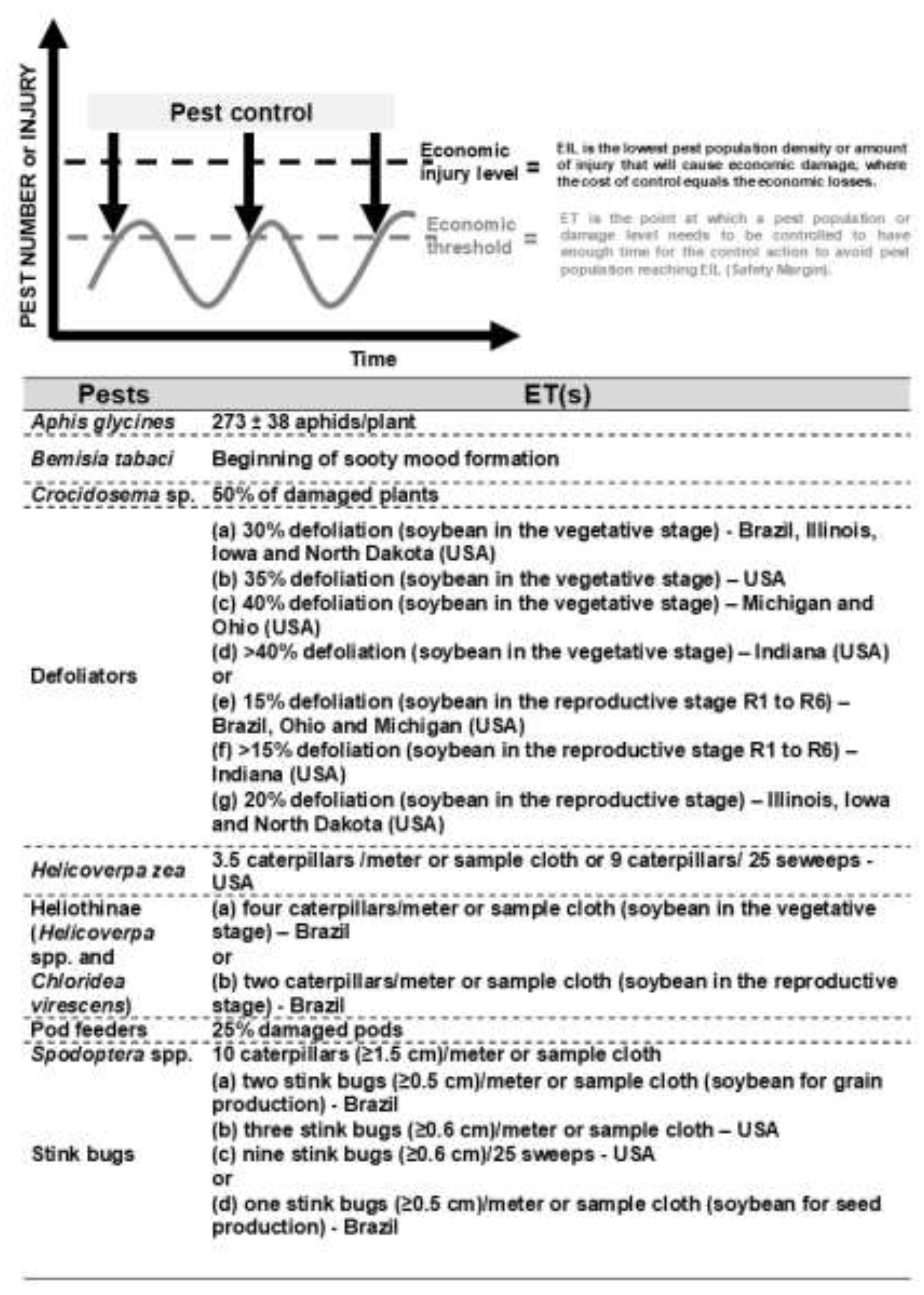
Figure 2.
Number of insecticide sprays (A), Costs of pest control transformed in kg/ha (B), and Yield (kg/ha) (C) of soybean fields with the adoption of ETs inside Soybean-IPM compared to soybean fields without the adoption of ETs over 12 crop seasons in the State of Paraná, Brazil [10,23,29,30].
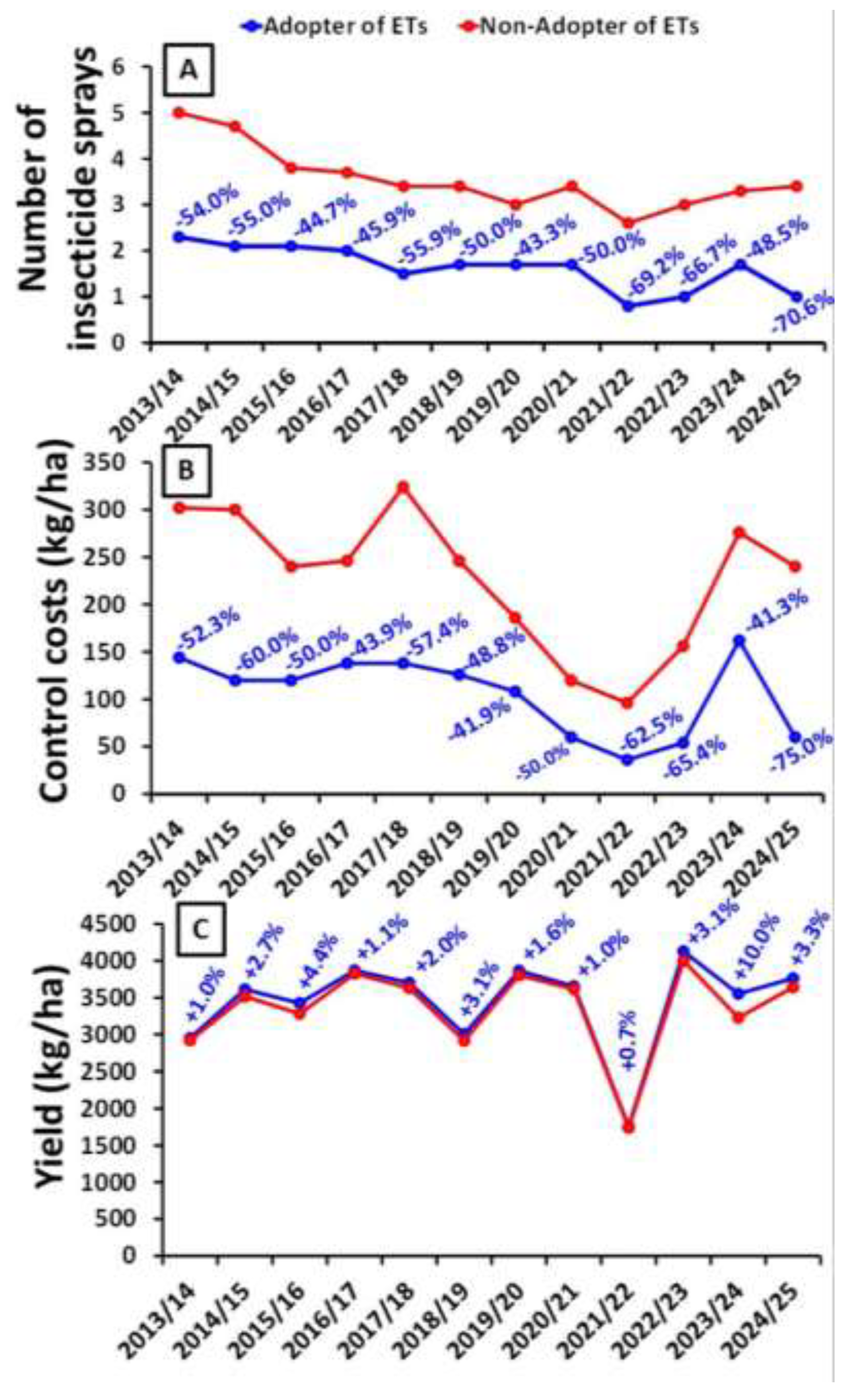

Table 1.
Soybean yield (kg/ha) obtained in five counties of two soybean-producing Brazilian states (Goiás-GO and Paraná-PR) from experiments comparing areas with adoption of ETs inside IPM with areas adopting prophylactic use of insecticides sprayed in a calendar basis mixed with herbicides or fungicides during 2008/2009 and 2009/2010 seasons [16].
Table 1.
Soybean yield (kg/ha) obtained in five counties of two soybean-producing Brazilian states (Goiás-GO and Paraná-PR) from experiments comparing areas with adoption of ETs inside IPM with areas adopting prophylactic use of insecticides sprayed in a calendar basis mixed with herbicides or fungicides during 2008/2009 and 2009/2010 seasons [16].
| Pest Management1 |
Number of sprays for L = Lepidoptera and SB = stink bug (soybean development stage)2 |
Total sprays of insecticides | Reduction of insecticide sprays with the adoption of ETs | Stink bug Damage Scale (6-8)3 |
Yield (kg/ha)4 |
|---|---|---|---|---|---|
| Castelândia, GO, Brazil—growing season 2008/09 | |||||
| ET adoption | 1 L + 2 SB (R2 + R5.2 − R6) |
3 | 40% | 6.0 b | 3,180.4 a |
| PUI | 2 L + 3 SB (V2 − V6 + R2 − R5.1 − R6) |
5 | - | 7.3 ab | 2,981.5 a |
| C | 0 | 0 | - | 14.3 a | 2,555.1 b |
| Santa Helena de Goiás, GO, Brazil—growing season 2008/09 | |||||
| ET adoption | 2 L (R1 − R3) |
2 | 50% | - | 2,447.0 a |
| PUI | 2 L + 2 SB (V6 − V8 + R2 − R5.2) |
4 | - | - | 2,441.3 a |
| C | 0 | 0 | - | - | 2,228.6 a |
| Senador Canedo, GO, Brazil—growing season 2008/09 | |||||
| ET adoption | 4 SB (R4 − R5.1 − R5.3 − R6) |
4 | 33.3% | 7.0 a | 2,913.6 a |
| PUI | 3 L + 3 SB (V7 − R5 − R6 + R1 − R5.3 − R6) |
6 | - | 5.5 a | 2,832.9 a |
| C | 0 | 0 | - | 5.3 a | 2,487.3 a |
| Morrinhos, GO, Brazil—growing season 2009/10 | |||||
| ET adoption | 2 L (R4 − R5.2) |
2 | 50% | 4.3 a | 4,179.3 a |
| PUI | 3 L + 1 SB (V8 − V6 − R4 + R2) |
4 | - | 3.3 a | 3,902.5 a |
| C | 0 | 0 | - | 5.3 a | 3,797.5 a |
| Arapongas, PR, Brazil—growing season 2009/10 | |||||
| ET adoption | 1 L + 2 SB (R3 + R5.1 − R5.3) |
3 | 25% | 6.3 b | 2,992.6 a |
| PUI | 1 L + 3 SB (V8 + R1 − R5.1 − R5.3) |
4 | - | 3.5 c | 3,175.7 a |
| C | 0 | 0 | - | 14.0 a | 2,667.8 b |
1ET adoption inside Soybean-IPM; PUI = prophylactic use of insecticides sprayed in a calendar basis mixed with herbicides or fungicides; C = control without pest treatment. 2Number of spray for pest category (L= Lepidoptera and SB = stink bug) followed by soybean development stage [29] at insecticide application. 3Stink bug damage according to the tetrazolium test [18]. 4Yield of each trial. Means followed by the same letter in the column in each city (independent field trial) do not differ statistically from each other by the Tukey test (P > 0.05).
Disclaimer/Publisher’s Note: The statements, opinions and data contained in all publications are solely those of the individual author(s) and contributor(s) and not of MDPI and/or the editor(s). MDPI and/or the editor(s) disclaim responsibility for any injury to people or property resulting from any ideas, methods, instructions or products referred to in the content. |
© 2026 by the authors. Licensee MDPI, Basel, Switzerland. This article is an open access article distributed under the terms and conditions of the Creative Commons Attribution (CC BY) license (http://creativecommons.org/licenses/by/4.0/).
Copyright: This open access article is published under a Creative Commons CC BY 4.0 license, which permit the free download, distribution, and reuse, provided that the author and preprint are cited in any reuse.


