

Submitted:
09 February 2026
Posted:
10 February 2026
You are already at the latest version
Abstract
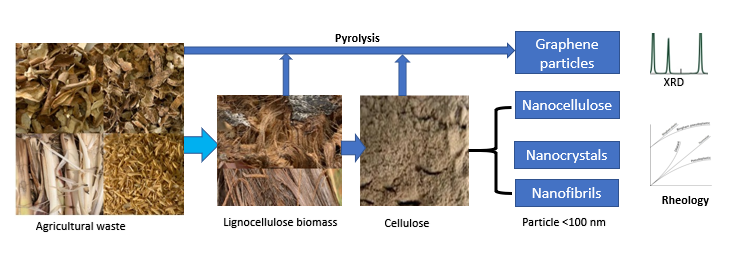
The nanoparticles processed from non-edible crop materials and residues have evoked great use in the food and non-food industry. The diversity in agricultural waste biomass and differences in extraction techniques account for variations in end-product properties, and would require examination of waste crop types (source) for suitability of production of cellulose, and nanocellulose including graphene particles. This review showed that screening criteria of end-user properties include chemical composition, cellulose contents, morphology, crystallinity, thermal stability, rheology, surface charge and zeta potential. Literature shows that the end-user properties vary with plant source (that is crop type) and extraction techniques. In this review, the cellulose content and percentage crystallinity are primary parameters for selecting agricultural waste biomass for production of nano-cellulose and nanofibrils. Additionally, zeta potential and surface charge can determine polymer interaction for suitability of industrial applications. Moreover, nanocellulose in-cluding biochar were found to have various industrial application as ingredients in pro-duction of food packaging including active packaging, rheological modifiers and thicken-ers. Pyrosis is eminently the strategy for transformation of agricultural waste into bio-char-derived nanoparticles and carbon-rich materials.
Keywords:
waste biomass
; lignocellulose
; cellulose
; carbonized particles
; nanocellulose
; rheology
; thermal decomposition
; crystallinity
; Zeta potential
Copyright: This open access article is published under a Creative Commons CC BY 4.0 license, which permit the free download, distribution, and reuse, provided that the author and preprint are cited in any reuse.


