

Submitted:
03 February 2026
Posted:
09 February 2026
You are already at the latest version
Abstract
Area-law entropy appears in quantum many-body systems and gravitational physics,
whereas classical thermodynamics treats entropy as volume-extensive.
Rather than reflecting competing fundamental principles, we show that these scalings
correspond to distinct thermodynamic stability regimes.
Using a minimal information-theoretic free-energy functional combining Fisher information
and Shannon entropy, we analyze entropy scaling under three physically unavoidable
requirements: locality of response, existence of thermodynamic equilibrium, and
universality of gravitational coupling.
Within this framework, we prove that volume-law entropy cannot define an intrinsically
stable equilibrium for isolated macroscopic systems and is therefore viable only as an
externally stabilized, mesoscopic approximation.
We identify three regimes.
At microscopic scales, Fisher dominance and locality of information propagation enforce
area-law entropy.
At intermediate scales, volume-law entropy emerges as a metastable regime sustained by
non-gravitational confinement.
At macroscopic scales dominated by self-gravity, we show that thermodynamic stability and
composition-independent equilibrium uniquely require area-law entropy; any more extensive
scaling leads either to instability or to violations of the equivalence principle.
Volume-law entropy is thus identified as a mesoscopic anomaly rather than a fundamental
property of matter.
Area-law scaling emerges as the only entropy behavior consistent with a unified
thermodynamic description spanning quantum coherence and gravitational universality.
Keywords:
entropy scaling
; area law
; Fisher information
; thermodynamic stability
; entanglement entropy
; gravitational thermodynamics
1. Introduction
Entropy scaling exhibits a striking and persistent dichotomy across physical regimes. Ground states of local quantum many-body systems obey area-law entanglement entropy [1,2,3,23], while black holes possess entropy proportional to the area of their event horizons [4,5]. By contrast, the entropy of ordinary macroscopic matter in classical thermodynamics is extensive, scaling with system volume. This coexistence of area-law and volume-law entropy across different domains of physics raises a fundamental conceptual question: why does the same quantity—entropy—exhibit radically different scaling behaviors, and under what conditions is each scaling thermodynamically consistent?
Area-law entropy plays a central role in gravitational physics. In black-hole thermodynamics, it underpins the Bekenstein–Hawking formula, while in semiclassical gravity it is closely tied to the universality of gravitational coupling. Thermodynamic and entropic approaches to gravity, notably those developed by Jacobson [6,7], Verlinde [8], and Padmanabhan [9], take area-scaling as a foundational input. Similarly, holographic entropy bounds [10,11] presuppose that the maximum entropy contained in a region grows no faster than its boundary area. In quantum many-body physics, area-law entanglement has been rigorously established for large classes of local Hamiltonians and gapped ground states, and is widely understood as a consequence of locality and finite correlation length.
Despite its ubiquity, area-law entropy is typically assumed rather than derived in both gravitational and quantum-information contexts. Classical thermodynamics, on the other hand, treats volume extensivity as fundamental, with little attention paid to its regime of validity. This asymmetry obscures a key issue: whether volume-law entropy represents a truly fundamental principle, or merely an effective description valid under restrictive physical conditions. If gravity is to admit a consistent thermodynamic formulation, the entropy scaling appropriate to self-gravitating systems cannot be left as an independent postulate.
In this work, we argue that volume-law entropy is not fundamental, but instead represents a mesoscopic anomaly: an effective scaling that appears only in an intermediate regime where quantum coherence is suppressed and gravitational self-interaction remains negligible. Using an information-theoretic free-energy framework, we analyze entropy scaling from the perspective of thermodynamic stability, locality of response, and universality of gravitational coupling. We show that these requirements sharply constrain the admissible entropy scalings for macroscopic systems.
Our central result is that area-law entropy is uniquely selected as the only scaling compatible with a consistent thermodynamic description spanning quantum and gravitational regimes. At microscopic scales, area-law entropy follows from entanglement locality enforced by finite-speed information propagation. At macroscopic scales dominated by gravity, we show that any entropy scaling more extensive than area leads either to thermodynamic instability or to composition-dependent gravitational equilibrium, in violation of the equivalence principle. Volume-law entropy survives only in an intermediate regime sustained by external stabilization, such as container walls, chemical bonding, or electromagnetic confinement.
The analysis unifies three regimes within a single thermodynamic framework: (i) a quantum coherent regime in which entanglement enforces area-law entropy; (ii) a mesoscopic regime in which volume-law entropy emerges as an effective, externally stabilized approximation; and (iii) a gravitational regime in which thermodynamic stability and universality require a return to area-law scaling. Area-law entropy thus emerges not as an independent axiom, but as a necessary consistency condition for thermodynamic descriptions that extend from quantum mechanics to gravity.
The structure of the paper is as follows. In Section 2, we introduce the information-theoretic free-energy functional and justify its form from principles of probabilistic inference and information geometry. Section 3 analyzes the quantum regime and the breakdown of volume extensivity beyond a coherence scale. In Section 4, we show how volume-law entropy arises as a metastable mesoscopic phenomenon sustained by external stabilization. Section 5 presents the core result: the uniqueness of area-law entropy under the combined requirements of thermodynamic stability and universal gravitational coupling. Finally, Section 6 discusses the implications for black-hole entropy, holography, and thermodynamic approaches to gravity, and clarifies the regime of validity of classical extensivity.
2. Information-Theoretic Free-Energy Framework
To analyze entropy scaling across quantum, mesoscopic, and gravitational regimes within a unified setting, we adopt an information-theoretic formulation of thermodynamic free energy. The framework is designed to be minimal and conservative: it relies only on standard principles of probabilistic inference, locality, and thermodynamic stability, without introducing microscopic model assumptions or gravitational field equations.
2.1. Free-Energy Functional
We consider probability densities defined on a spatial domain , normalized as
The thermodynamic state of the system is characterized by a Helmholtz-type free-energy functional of the form
where
is the Fisher information, denotes the expectation value of the potential energy, and is the thermodynamic entropy.
The coefficient sets the energetic cost of spatial localization. For non-relativistic quantum systems, consistency with the Schrödinger equation fixes
as established in information-theoretic derivations of quantum mechanics [12,13]. The parameter plays the role of an effective temperature controlling the balance between energetic localization and entropic delocalization. Throughout this work, is treated as an externally fixed thermodynamic parameter, appropriate to coarse-grained equilibrium descriptions.
Equationation (2) should be understood as an effective free energy governing the equilibrium configuration of under macroscopic constraints. It does not assume a microscopic Hamiltonian, nor does it presuppose any specific gravitational dynamics. Instead, it encodes three general physical contributions: localization, interaction energy, and entropy.
2.2. Uniqueness of the Entropy and Information Terms
The functional form of Equation (2) is not arbitrary. The use of Shannon entropy,
is uniquely selected by the Shore–Johnson axioms for consistent probabilistic inference [14]. These axioms ensure that updating probability distributions in the presence of new information is independent of irrelevant degrees of freedom and respects subsystem consistency. Alternative entropy functionals generally violate at least one of these requirements and therefore do not admit a consistent thermodynamic interpretation.
Similarly, the Fisher information functional is uniquely distinguished by information geometry. Chentsov’s theorem establishes that Fisher information is the only Riemannian metric on the space of probability distributions that is invariant under sufficient statistics [15,16]. As a result, provides the unique quadratic measure of distinguishability between nearby probability distributions that is compatible with coarse-graining and statistical inference. Its appearance as the localization term in Equation (2) is therefore natural and, in this sense, unavoidable.
These uniqueness results imply that the competition between Fisher information and Shannon entropy in Equation (2) is not a modeling choice but a structural feature of probabilistic thermodynamics. The framework thus provides a well-defined arena in which entropy scaling can be analyzed without introducing ad hoc assumptions.
2.3. Locality and Scaling Behavior
A key feature of the Fisher information term is its sensitivity to spatial gradients. For a normalized density supported on a domain of characteristic linear size L, dimensional analysis implies
up to shape-dependent numerical factors. This scaling expresses the fact that localization costs energy inversely proportional to the square of the system size.
By contrast, the entropy term scales with the effective number of accessible degrees of freedom. If entropy scales as
the exponent characterizes the extensivity of the thermodynamic description. Classical thermodynamics corresponds to , while area-law entropy corresponds to . As we will show, the effective value of depends on the physical regime, yielding a characteristic “sandwich structure” (Figure 1).
The free energy density therefore depends sensitively on the relative scaling of localization, interaction energy, and entropy. As we show in subsequent sections, this scaling competition determines whether a thermodynamically stable equilibrium exists and whether the resulting equilibrium is universal or composition-dependent.
2.4. Regime of Validity and Assumptions
Several assumptions underlie the framework and delimit its regime of applicability. First, the description is coarse-grained: represents a mesoscopic probability density rather than a microscopic quantum state. Second, the analysis is non-relativistic in form; relativistic effects enter only through the requirement of diffeomorphism-invariant entropy functionals at macroscopic scales. Third, the framework assumes equilibrium or quasi-equilibrium configurations, allowing the use of a free-energy variational principle.
Within these limitations, Equation (2) provides a unified description of quantum localization, thermodynamic entropy, and gravitational self-interaction. Crucially, it allows entropy scaling to be treated as a dynamical and thermodynamic question rather than an external postulate.
For mathematical completeness, Appendix A derives the stationary Euler–Lagrange equation associated with the free energy functional, explicitly recovering the standard quantum and classical limits. Additionally, Appendix B provides a scaling consistency argument demonstrating that, under standard infrared inputs ( and ), area-law entropy () is the unique scaling compatible with composition-independent macroscopic geometry.
In the following sections, we apply this framework to three distinct regimes. We first analyze the quantum regime, where the Fisher information term dominates and enforces entanglement locality. We then show how volume-law entropy arises as a metastable mesoscopic approximation. Finally, we demonstrate that in the gravitational regime, thermodynamic stability and universality uniquely select area-law entropy scaling.
3. Quantum Regime and the Breakdown of Volume Extensivity
We first consider the regime in which the localization term in the free-energy functional dominates the thermodynamic balance. This regime corresponds to sufficiently small length scales, where quantum coherence is maintained and the equilibrium structure of is strongly constrained by locality.
3.1. Fisher Dominance and the Coherence Scale
At small system sizes, the Fisher information term in Equation (2) provides the leading contribution to the free energy. This dominance can be made precise using functional inequalities that bound the Fisher information from below. For a normalized probability density supported on a convex domain of characteristic linear size L, the Poincaré–Wirtinger inequality implies
where denotes the spatial average. As a result, the Fisher contribution to the free energy scales at least as .
The competition between localization and entropy introduces a characteristic length scale at which these contributions become comparable. Equationating the Fisher and entropy terms yields a coherence length
where we have identified for thermal equilibrium. For , localization effects dominate, suppressing bulk entropy and enforcing quantum coherence across the system. For , the Fisher term becomes negligible, allowing classical entropy to dominate the equilibrium behavior.
The scale thus marks the boundary between a quantum-coherent regime and a decohered, thermodynamically classical regime. Its magnitude is consistent with experimentally observed decoherence thresholds in matter-wave interferometry and macromolecular superposition experiments.
3.2. Entanglement Locality and Area-Law Entropy
In the regime , thermodynamic entropy coincides with entanglement entropy. The structure of entanglement in local quantum systems is strongly constrained by finite-speed information propagation. Lieb–Robinson bounds establish that correlations generated by local Hamiltonians propagate with a finite effective velocity, confining significant correlations to neighborhoods of finite depth near the boundary between subsystems [17,18].
As a consequence, the entanglement between a spatial region A and its complement is dominated by degrees of freedom localized near the boundary . This leads to area-law scaling of the entanglement entropy,
where c is a constant set by microscopic details. Area-law entanglement has been rigorously established for gapped one-dimensional systems [1], extended to higher-dimensional frustration-free systems [23], and generalized to thermal states and long-range interactions [19,20,21,22]. Related area-law behavior has been demonstrated for entanglement spread [24] and even for entanglement entropy in superfluid 4He [29], confirming its universality across distinct physical contexts.
Within the present framework, area-law entropy is not imposed as an axiom. Rather, it emerges as the thermodynamic consequence of Fisher dominance combined with locality of interactions. The Fisher information term penalizes rapid spatial variation of , effectively suppressing bulk degrees of freedom and confining entropy production to boundary regions. Entropy thus scales with area rather than volume whenever quantum coherence is preserved.
3.3. Loss of Coherence and the Opening of the Mesoscopic Regime
As the system size exceeds the coherence length , the Fisher contribution to the free energy becomes subdominant. Quantum coherence is progressively suppressed by thermal fluctuations and environmental coupling, and the equilibrium distribution becomes effectively classical. In this regime, Shannon entropy governs the thermodynamic behavior, and volume-extensive entropy appears to be favored.
Importantly, the emergence of volume-law entropy at does not signal a fundamental change in the nature of entropy itself. Rather, it reflects the loss of quantum constraints that previously enforced locality of information. The system enters a regime in which entropy can, in principle, occupy the bulk.
However, as we show in the following section, this volume-extensive behavior is not intrinsically stable. It persists only in the presence of external stabilization mechanisms that fix the system size or energy density. Absent such stabilization, volume-law entropy fails to define a self-consistent thermodynamic equilibrium.
The quantum-to-mesoscopic transition thus marks the opening of a regime in which volume-law entropy may appear, but only as an effective and metastable approximation. This observation sets the stage for analyzing the conditions under which volume extensivity breaks down and for identifying the entropy scaling required by gravitational stability.
4. Classical Thermodynamics as an Effective Description
We now examine the regime in which quantum coherence has been suppressed but gravitational self-interaction remains negligible. This intermediate domain corresponds to length scales
where denotes the scale at which gravitational effects become thermodynamically significant. It is within this window that classical thermodynamics operates and volume-law entropy appears to be stable.
4.1. External Stabilization and Effective Extensivity
In the absence of quantum coherence, the Fisher information term in the free energy becomes subdominant, and entropy maximization favors bulk occupation of available degrees of freedom. For ordinary laboratory systems, this leads to entropy scaling proportional to the system volume. However, such systems are invariably subject to external stabilization mechanisms.
A paradigmatic example is the ideal gas confined within rigid container walls. The volume-extensive entropy of the gas arises only because the container imposes an external length scale that fixes the spatial domain . Similarly, condensed matter systems rely on electromagnetic bonding, lattice rigidity, or externally imposed boundary conditions to maintain a finite equilibrium size. In all such cases, the energy density is effectively fixed by non-gravitational forces.
Within the present framework, these stabilization mechanisms enter through the potential energy term in Equation (2). They provide a restoring force that counteracts entropic expansion and allows a volume-extensive entropy to coexist with thermodynamic equilibrium. The resulting extensivity is therefore not intrinsic to entropy itself, but contingent on the presence of external constraints.
4.2. Absence of Intrinsic Equationilibrium for Volume-Law Entropy
The dependence of volume-law entropy on external stabilization becomes evident when such constraints are removed. Consider a system whose entropy scales as
but which is otherwise free to expand. In the absence of confining forces, the entropy term in the free energy grows without bound as L increases, while the localization term is negligible. The free energy therefore decreases monotonically with system size, and no finite equilibrium configuration exists.
This observation highlights a crucial distinction between entropy scaling and equilibrium existence. Volume-law entropy does not, by itself, define a stable thermodynamic state. Rather, it presupposes an externally fixed volume or energy density. Classical thermodynamics implicitly assumes such stabilization and is therefore silent on the behavior of truly isolated macroscopic systems.
From this perspective, volume extensivity is an effective description valid only within a restricted domain. It is sustained by non-gravitational forces that dominate over both quantum coherence and gravitational self-interaction. Once these forces are removed or rendered negligible, the volume-law description ceases to be self-consistent.
4.3. Mesoscopic Anomaly and Its Limits
The appearance of volume-law entropy in the intermediate regime can thus be understood as a mesoscopic anomaly. It reflects a balance in which entropy is allowed to fill the bulk because neither quantum locality nor gravitational instability imposes a stronger constraint. This balance is inherently fragile and disappears outside the mesoscopic window.
Importantly, the anomaly is not associated with any singular behavior or phase transition. Rather, it marks a crossover between two regimes in which area-law entropy is enforced for different reasons. At small scales, locality of information propagation confines entropy to boundaries. At large scales, as we show in the next section, thermodynamic stability and universality of gravitational coupling impose a similar constraint.
The mesoscopic regime therefore occupies a special but limited place in the hierarchy of entropy scalings. It explains the empirical success of classical thermodynamics while simultaneously clarifying its domain of validity. Volume-law entropy emerges as a contingent approximation rather than a fundamental principle, setting the stage for the analysis of gravitational systems in which no external stabilization is available.
5. Gravitational Regime: Stability and Universality
We now turn to the regime in which gravitational self-interaction dominates the macroscopic behavior of the system. Unlike the mesoscopic domain discussed in the previous section, self-gravitating systems admit no external stabilization mechanism: their equilibrium structure must be determined intrinsically by the balance between energy and entropy. This requirement imposes strong constraints on admissible entropy scalings.
5.1. Thermodynamic Equationilibrium of Self-Gravitating Systems
Consider a macroscopic system of total mass M and characteristic size L, whose entropy scales as
with an entropy density parameter and an extensivity exponent. For a self-gravitating system, the dominant contribution to the potential energy scales as
up to geometry-dependent numerical factors.
At macroscopic scales , the Fisher information term is negligible, and the free energy reduces to
Thermodynamic equilibrium requires the existence of a finite minimum of with respect to variations in L. Differentiating Equation (15) yields the equilibrium condition
which implies an equilibrium scale
For , the entropy term grows too rapidly for a minimum to exist: the free energy decreases monotonically with increasing L, and no finite equilibrium state is possible. Thermodynamic stability therefore requires sub-extensive entropy scaling,
5.2. Composition Dependence and the Equationivalence Principle
The existence of a stable equilibrium is not, by itself, sufficient. A viable gravitational thermodynamics must also respect the universality of gravitational coupling. In particular, equilibrium properties should not depend on the microscopic composition of the gravitating system beyond its total mass and energy content.
To examine this requirement, we note that the entropy coefficient generally depends on microscopic parameters. In particular, through the underlying information-theoretic structure, may inherit dependence on the kinetic coefficient
and hence on the particle mass m. If the equilibrium size depends explicitly on , then systems of identical macroscopic mass but different microscopic composition would exhibit different gravitational equilibrium configurations. Such behavior would constitute a violation of the equivalence principle.
From Equation (17), it follows that for generic , the equilibrium scale depends on in a manner that transmits microscopic information into macroscopic gravitational behavior. This dependence disappears only for a specific value of the entropy exponent.
5.3. Uniqueness of Area-Law Entropy
For , corresponding to area-law entropy, the free energy takes the form
In this case, the equilibrium condition yields
which depends only on macroscopic quantities once gravitational energy dominates the balance. Any residual dependence of on microscopic parameters is suppressed relative to the gravitational contribution, ensuring universal behavior.
Area-law entropy therefore occupies a unique position. It is the only entropy scaling that simultaneously satisfies: (i) the existence of a finite thermodynamic equilibrium for self-gravitating systems, and (ii) the universality of gravitational coupling required by the equivalence principle.
Proposition.Under the assumptions of thermodynamic equilibrium, absence of external stabilization, and universality of gravitational coupling, entropy scaling of the form is admissible if and only if .
This result provides a thermodynamic explanation for the recurrence of area-law entropy in gravitational physics. It shows that area-law scaling is not merely compatible with gravity, but is required for a consistent macroscopic description.
5.4. The Sandwich Structure
The analysis of the preceding sections reveals a coherent hierarchy of entropy scalings, summarized in Table 1. Area-law entropy brackets volume-law from both above and below, with the intermediate mesoscopic regime sustained only by external stabilization mechanisms.
The key insight is that volume-law entropy does not interpolate between two unrelated area-law regimes; rather, it represents a temporary suspension of the locality constraints that enforce area scaling at both extremes. The vast separation between (nanometers) and (planetary scales) for ordinary matter explains why volume-extensive thermodynamics dominates human experience, even though it is not the fundamental scaling.
5.5. Relation to Black-Hole Entropy
The argument presented here addresses the scaling of entropy rather than its absolute normalization. In particular, it does not derive the numerical coefficient of the Bekenstein–Hawking entropy. However, the uniqueness of area-law scaling established above provides a thermodynamic foundation for why black-hole entropy must scale with horizon area.
From this perspective, black holes represent the gravitational fixed point of entropy scaling: a regime in which external stabilization is absent, quantum coherence is irrelevant at macroscopic scales, and universality constraints are maximally enforced. The area-law behavior of black-hole entropy thus reflects the same stability requirement that governs all self-gravitating systems, rather than a peculiarity of horizons alone.
6. Discussion, Empirical Scales, and Conclusions
6.1. Empirical Scales and Physical Interpretation
Although the analysis presented in this work is purely theoretical, it predicts two physically meaningful crossover scales that delineate the regimes of entropy scaling. The first is the coherence length introduced in Equation (9), which separates quantum-coherent behavior from classical thermodynamics. For molecular masses at room temperature, lies in the nanometer range, consistent with experimentally observed decoherence thresholds in matter-wave interferometry and macromolecular superposition experiments.
The second is the gravitational scale , defined implicitly as the system size at which gravitational self-interaction becomes thermodynamically relevant. Dimensional analysis yields
where is the characteristic mass density. For ordinary condensed matter densities, this scale lies in the range –m, coinciding with the astrophysical transition at which material rigidity can no longer counteract self-gravity. This scale is closely related to the so-called “potato radius” that separates irregular bodies from approximately spherical ones in planetary science.
These crossover scales are not free parameters to be fitted, but consistency checks that support the physical interpretation of the framework. They indicate that the mesoscopic regime of volume-law entropy occupies a finite window between two asymptotic domains in which area-law scaling is enforced for independent reasons.
6.2. Relation to Thermodynamic and Entropic Gravity
Recent developments in quantum information provide further support for the picture presented here. Measurement-induced entanglement phase transitions, in which the entanglement scaling of a quantum state changes from volume-law to area-law as the rate of projective measurement increases, have been demonstrated both theoretically and experimentally [25,26,27]. These transitions illustrate that volume-law entanglement is fragile and can be driven to area-law scaling by local information extraction, consistent with our identification of volume-law entropy as a metastable anomaly. In a complementary direction, area-law scaling has been established for entanglement entropy in high-energy particle scattering [28], extending the universality of area-law entropy beyond lattice systems to relativistic quantum field theory.
The present results clarify and constrain thermodynamic approaches to gravity. In Jacobson’s derivation of the Einstein equations as an equation of state [6,7], area-law entropy is assumed as an input. Our analysis shows that this assumption is not optional: any alternative entropy scaling would fail to support a universal and stable gravitational thermodynamics.
Similarly, entropic force models of gravity implicitly rely on area-scaling to ensure universality of the emergent force. The results presented here provide a thermodynamic justification for this reliance, independent of holographic dualities or microscopic spacetime models. The argument applies to any self-gravitating system admitting an equilibrium description, regardless of whether horizons are present.
The framework also complements holographic entropy bounds. Rather than postulating an upper bound on entropy, it explains why entropy must scale with area in regimes where gravitational self-interaction dominates. From this perspective, holographic bounds reflect a thermodynamic necessity rather than a distinct principle.
6.3. Scope and Limitations
Several limitations of the present analysis should be emphasized. First, the framework is coarse-grained and equilibrium-based; it does not address far-from-equilibrium dynamics or strongly time-dependent gravitational systems. Second, the analysis focuses on entropy scaling rather than absolute normalization. While it explains why entropy must scale with area, it does not derive the numerical coefficient appearing in the Bekenstein–Hawking formula. Third, the treatment is non-relativistic in form, relying on scaling arguments rather than a full covariant field-theoretic description.
These limitations are deliberate. The goal of this work is not to provide a microscopic theory of gravity, but to identify thermodynamic consistency conditions that any such theory must satisfy. Within this scope, the results are robust and largely model-independent.
6.4. Conclusion
We have shown that volume-law entropy is not a fundamental property of macroscopic systems, but an effective and metastable feature of a mesoscopic regime sustained by external stabilization. Using an information-theoretic free-energy framework, we demonstrated that entropy scaling is constrained by thermodynamic stability, locality of response, and the universality of gravitational coupling.
Area-law entropy emerges as the unique scaling compatible with these requirements. At microscopic scales, it is enforced by quantum locality and finite-speed information propagation. At macroscopic scales dominated by gravity, it is required for the existence of a stable and universal equilibrium. Volume-law entropy occupies only an intermediate window between these regimes.
By identifying entropy scaling as a consistency condition rather than an independent postulate, the present work unifies the appearance of area-law entropy in quantum entanglement, black-hole thermodynamics, and gravitational universality. It clarifies the domain of validity of classical extensivity and constrains thermodynamic approaches to gravity, holography, and emergent spacetime. The recurrence of area-law entropy across disparate physical contexts thus reflects a shared stability principle, rather than unrelated microscopic mechanisms.
Appendix A. Variational Derivation of the Stationarity Equationation
In this appendix, we derive the equilibrium condition for the probability density by minimizing the free-energy functional defined in Equation (2), subject to the normalization constraint .
We introduce the real amplitude such that . In terms of , the Fisher information becomes proportional to a kinetic energy term:
The Shannon entropy term can be written as:
We define the Lagrangian with a multiplier to enforce normalization:
Minimizing with respect to () and integrating the gradient term by parts (), we obtain:
Dividing by 2 and absorbing the linear term arising from the entropy variation into the Lagrange multiplier (defining ), we arrive at the stationary equation:
Equationation (A5) interpolates between two fundamental regimes:
- 1.
- Quantum Regime (): The logarithmic term vanishes. Setting , we identify the kinetic operator . This recovers the standard time-independent Schrödinger equation, , where .
- 2.
- Classical Regime (): The gradient term vanishes. The equation reduces to the algebraic balance , which yields the standard Boltzmann distribution .
Appendix B. Infrared Scaling Consistency (Relativistic Fixed Point)
In the gravitational regime, we assess entropy scaling by checking for consistency with the geometric properties of the infrared fixed point. We consider a self-gravitating system of characteristic size L and mass M in the relativistic limit.
We invoke two standard inputs for this regime:
- 1.
- Geometric Universality: The characteristic radius of a relativistic self-gravitating object scales linearly with mass, (e.g., the Schwarzschild radius ).
- 2.
- Gravitational Temperature: The effective temperature scales inversely with size, (consistent with Hawking and Unruh temperature scalings).
We assume an entropy scaling of the form , where is a microscopic constant. For the thermodynamics to be consistent with the geometry, the “entropic energy” contribution must scale commensurately with the magnitude of the gravitational self-energy .
Comparing the scaling dimensions with respect to L (using ):
For these energy scales to remain commensurate across macroscopic scales (ensuring universality), their exponents must match:
This indicates that area-law entropy () is the unique scaling compatible with the linear mass-radius relation () inherent to relativistic gravity.
Conversely, if we postulate volume-law entropy (), the consistency condition would require , implying . This would require the entropy density parameter to depend on the macroscopic size of the system, violating the assumption that is a fixed microscopic parameter. Thus, is incompatible with a composition-independent macroscopic geometry.
References
- Hastings, M. B. An area law for one-dimensional quantum systems. J. Stat. Mech. 2007, P08024. [Google Scholar] [CrossRef]
- Eisert, J.; Cramer, M.; Plenio, M. B. Colloquium: Area laws for the entanglement entropy. Rev. Mod. Phys. 2010, 82, 277. [Google Scholar] [CrossRef]
- Calabrese, P.; Cardy, J. Entanglement entropy and quantum field theory. J. Stat. Mech. 2004, P06002. [Google Scholar] [CrossRef]
- Bekenstein, J. D. Black holes and entropy. Phys. Rev. D 1973, 7, 2333. [Google Scholar] [CrossRef]
- Hawking, S. W. Particle creation by black holes. Commun. Math. Phys. 1975, 43, 199. [Google Scholar] [CrossRef]
- Jacobson, T. Thermodynamics of spacetime: The Einstein equation of state. Phys. Rev. Lett. 1995, 75, 1260. [Google Scholar] [CrossRef]
- Jacobson, T. Entanglement equilibrium and the Einstein equation. Phys. Rev. Lett. 2016, 116, 201101. [Google Scholar] [CrossRef]
- Verlinde, E. On the origin of gravity and the laws of Newton. J. High Energy Phys. 2011, 2011(04), 029. [Google Scholar] [CrossRef]
- Padmanabhan, T. Thermodynamical aspects of gravity: New insights. Rep. Prog. Phys. 2010, 73, 046901. [Google Scholar] [CrossRef]
- Susskind, L. The world as a hologram. J. Math. Phys. 1995, 36, 6377. [Google Scholar] [CrossRef]
- Bousso, R. The holographic principle. Rev. Mod. Phys. 2002, 74, 825. [Google Scholar] [CrossRef]
- Reginatto, M. Derivation of the equations of nonrelativistic quantum mechanics using the principle of minimum Fisher information. Phys. Rev. A 1998, 58, 1775. [Google Scholar] [CrossRef]
- Hall, M. J. W.; Reginatto, M. Schrödinger equation from an exact uncertainty principle. J. Phys. A: Math. Gen. 2002, 35, 3289. [Google Scholar] [CrossRef]
- Shore, J. E.; Johnson, R. W. Axiomatic derivation of the principle of maximum entropy and the principle of minimum cross-entropy. IEEE Trans. Inf. Theory 1980, 26, 26. [Google Scholar] [CrossRef]
- Chentsov, N. N. Statistical Decision Rules and Optimal Inference. In Translations of Mathematical Monographs; American Mathematical Society: Providence, 1982; Vol. 53. [Google Scholar]
- S. Amari, Information Geometry and Its Applications. In Applied Mathematical Sciences; Springer: Berlin, 2016; Vol. 194.
- Lieb, E. H.; Robinson, D. W. The finite group velocity of quantum spin systems. Commun. Math. Phys. 1972, 28, 251. [Google Scholar] [CrossRef]
- Nachtergaele, B.; Sims, R. Lieb-Robinson bounds and the exponential clustering theorem. Commun. Math. Phys. 2006, 265, 119. [Google Scholar] [CrossRef]
- Wolf, M. M.; Verstraete, F.; Hastings, M. B.; Cirac, J. I. Area laws in quantum systems: Mutual information and correlations. Phys. Rev. Lett. 2008, 100, 070502. [Google Scholar] [CrossRef]
- Kuwahara, T.; Alhambra, Á. M.; Anshu, A. Improved thermal area law and quasilinear time algorithm for quantum Gibbs states. Phys. Rev. X 2021, 11, 011047. [Google Scholar] [CrossRef]
- Kim, D.; Kuwahara, T.; Saito, K. Thermal area law in long-range interacting systems. Phys. Rev. Lett. 2025, 134, 020402. [Google Scholar] [CrossRef]
- Kuwahara, T.; Saito, K. Area law of noncritical ground states in 1D long-range interacting systems. Nature Commun. 2020, 11, 4478. [Google Scholar] [CrossRef]
- Anshu, A.; Arad, I.; Gosset, D. An area law for 2D frustration-free spin systems. In Proceedings of the 54th Annual ACM Symposium on Theory of Computing (STOC 2022), 2022; pp. 52–65. [Google Scholar]
- Anshu, A.; Harrow, A. W.; Soleimanifar, M. Entanglement spread area law in gapped ground states. Nature Phys. 2022, 18, 1362–1366. [Google Scholar] [CrossRef]
- Koh, J. M.; Sun, S.-N.; Motta, M.; Minnich, A. J. Measurement-induced entanglement phase transition on a superconducting quantum processor with mid-circuit readout. Nature Phys. 2023, 19, 1314–1319. [Google Scholar] [CrossRef]
- Google Quantum AI and Collaborators, Measurement-induced entanglement and teleportation on a noisy quantum processor. Nature 2023, 622, 481–486. [CrossRef]
- Granet, E.; Zhang, C.; Dreyer, H. Volume-law to area-law entanglement transition in a non-unitary periodic Gaussian circuit. Phys. Rev. Lett. 2023, 130, 230401. [Google Scholar] [CrossRef]
- Low, I.; Yin, Z. An area law for entanglement entropy in particle scattering. arXiv 2024, arXiv:2405.08056. [Google Scholar] [CrossRef]
- Herdman, C. M.; Roy, P.-N.; Melko, R. G.; Del Maestro, A. Entanglement area law in superfluid 4He. Nature Phys. 2017, 13, 556–560. [Google Scholar] [CrossRef]
Figure 1.
Entropy scaling exponent (where ) as a function of system size. Area-law scaling () prevails at both quantum () and gravitational () scales; volume-law () is a mesoscopic anomaly sustained by external stabilization.
Figure 1.
Entropy scaling exponent (where ) as a function of system size. Area-law scaling () prevails at both quantum () and gravitational () scales; volume-law () is a mesoscopic anomaly sustained by external stabilization.
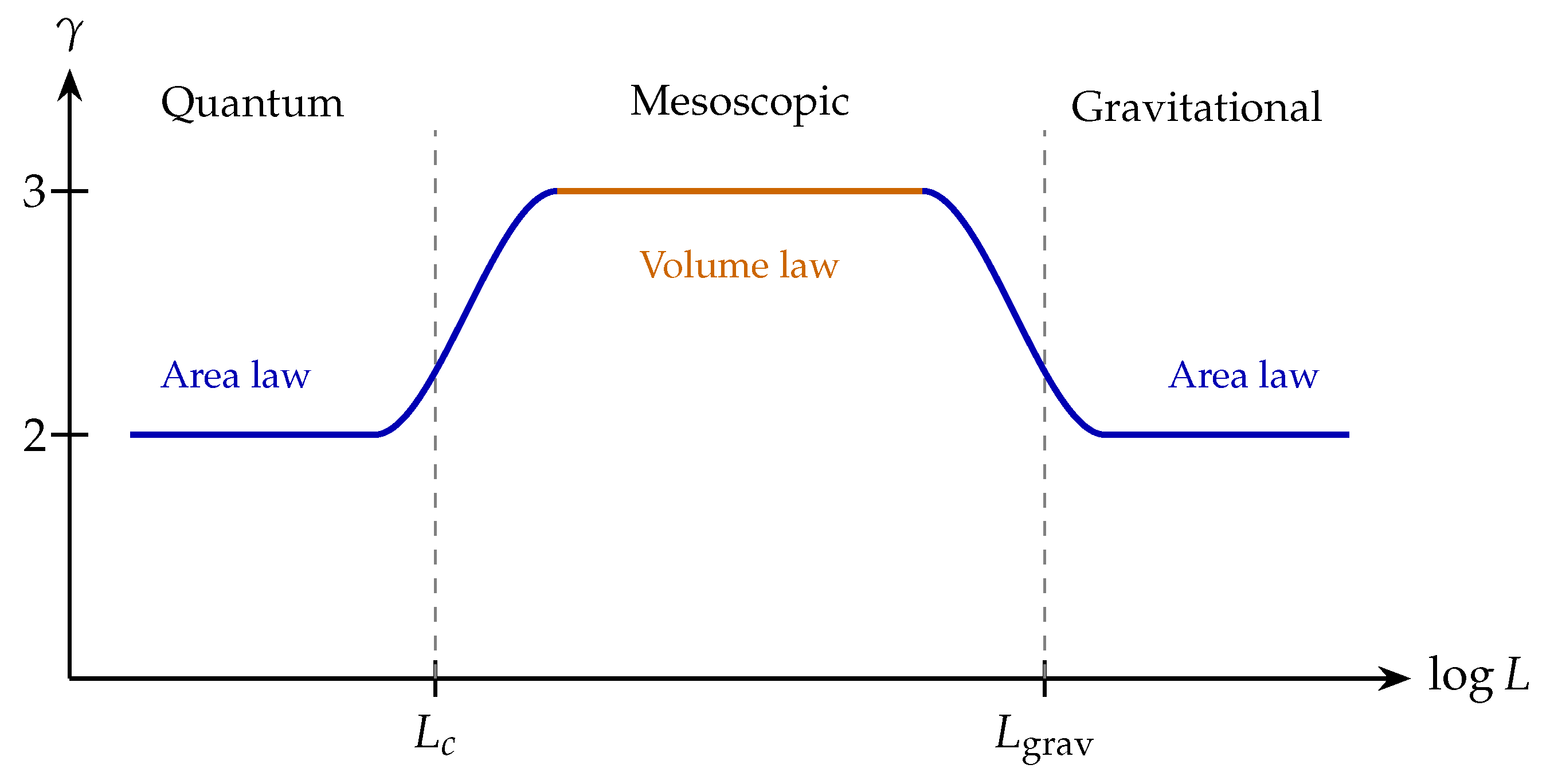

Table 1.
Entropy scaling across physical regimes. Area-law is the stable asymptotic behavior at both ultraviolet (quantum) and infrared (gravitational) limits; volume-law is the intermediate anomaly.
Table 1.
Entropy scaling across physical regimes. Area-law is the stable asymptotic behavior at both ultraviolet (quantum) and infrared (gravitational) limits; volume-law is the intermediate anomaly.
| Regime | Scale | Scaling | Mechanism |
|---|---|---|---|
| Quantum | Entanglement locality | ||
| Mesoscopic | External stabilization | ||
| Gravitational | Stability + locality |
Disclaimer/Publisher’s Note: The statements, opinions and data contained in all publications are solely those of the individual author(s) and contributor(s) and not of MDPI and/or the editor(s). MDPI and/or the editor(s) disclaim responsibility for any injury to people or property resulting from any ideas, methods, instructions or products referred to in the content. |
© 2026 by the author. Licensee MDPI, Basel, Switzerland. This article is an open access article distributed under the terms and conditions of the Creative Commons Attribution (CC BY) license.
Copyright: This open access article is published under a Creative Commons CC BY 4.0 license, which permit the free download, distribution, and reuse, provided that the author and preprint are cited in any reuse.


