

Submitted:
05 February 2026
Posted:
06 February 2026
You are already at the latest version
Abstract
We propose that the dimensionality of spacetime should be treated as a renormalized quantity rather than a fixed kinematical input. Within a unified framework spanning quantum cosmology and string theory, we analyze how effective spacetime dimension can vary with physical scale through mechanisms such as compactification, holographic duality, and geometric coarse-graining. Geometric structures including Calabi - Yau manifolds, Klein bottles, and Möbius strips are employed as illustrative models for dimensional reduction and transition. We derive key relations linking energy scales, characteristic lengths, and fundamental constants, clarifying how dimensional flow emerges in both quantum mechanical and quantum gravitational regimes. The role of time as a dynamical dimension is emphasized, together with implications for cosmic geometry, holography, and the large scale structure of the universe. Our results suggest that dimensionality itself admits a renormalization group like description, with fixed points corresponding to distinct physical regimes.
Keywords:
dimensional analysis
; quantum cosmology
; string theory
MSC: Primary 83E99; Secondary 81T30, 83C45.
1. Introduction
1.1. The Concept of Dimensions in Physics
The notion of dimension occupies a central place in both mathematics and physics, providing the fundamental framework through which physical reality is described. In classical physics, dimensions such as length, width, height, and time are typically regarded as independent and fixed attributes that define the arena in which physical phenomena unfold. This classical perspective, however, has been substantially revised by the advent of relativity and quantum theory. The unification of space and time into a four-dimensional spacetime continuum by [1] marked a decisive shift, revealing that dimensions are not merely passive backgrounds but are intimately connected to the dynamical laws governing physical systems.
From a mathematical standpoint, a dimension corresponds to an independent degree of freedom required to characterize a system. In physical terms, this translates into the minimum number of coordinates necessary to specify events in spacetime or configurations in an abstract state space. The transition from Newtonian mechanics to special relativity demonstrated that time cannot be treated as an absolute parameter, but must instead be incorporated on equal footing with spatial coordinates. General relativity further extended this insight by promoting spacetime itself to a dynamical entity whose geometric structure evolves in response to matter and energy.
Beyond this classical and relativistic framework, modern theoretical developments suggest that dimensionality may possess a richer and more subtle structure. In several approaches to quantum gravity, string theory, and quantum cosmology, spacetime dimensions may acquire nontrivial topological and geometric properties, undergo compactification, or emerge effectively from more fundamental degrees of freedom. In such scenarios, dimensionality is characterized not only by the number of coordinates, but also by scale, connectivity, and global structure. These considerations motivate the view that spacetime dimension may be understood as an effective and context-dependent quantity, rather than as an immutable feature of physical reality.
1.2. Historical Development of Dimensional Analysis
Dimensional analysis, as a formal method, traces its origins to the work of [2] on heat conduction, but its full potential was realized through the Buckingham theorem [3]. This powerful technique allows physicists to derive relationships between physical quantities without detailed knowledge of the underlying mechanisms. In modern theoretical physics, dimensional analysis plays a crucial role in scaling arguments, renormalization group techniques, and the formulation of physical laws at different scales.
The historical development of dimensional analysis parallels the evolution of physics itself. Early applications appeared in fluid dynamics and heat transfer, where scientists noticed that certain combinations of variables yielded dimensionless numbers that characterized flow regimes or heat transfer modes. The formalization by Buckingham provided a systematic approach: if a physical problem involves n variables and k fundamental dimensions, then there exist independent dimensionless terms that govern the phenomenon.
In the 20th century, dimensional analysis found applications in diverse areas. In quantum mechanics, the analysis of atomic scales led to the identification of natural units. In cosmology, dimensional arguments helped establish relationships between the age, size, and energy content of the universe. The method proved particularly powerful in situations where first-principles derivations were difficult or impossible, serving as both a check on proposed equations and a generator of plausible forms for physical laws.
1.3. The Emergence of Higher Dimensions in Modern Physics
The introduction of higher-dimensional theories represents one of the most significant developments in contemporary theoretical physics. Beginning with the Kaluza-Klein theory [4,5], which proposed a fifth dimension to unify gravity and electromagnetism, the concept of extra dimensions has become central to string theory and M-theory [6]. These theories suggest that our observable universe exists within a higher-dimensional space, with the extra dimensions compactified on scales too small to detect directly.
The Kaluza-Klein theory, proposed in the 1920s, represented a bold attempt to unify Einstein’s general relativity with Maxwell’s electromagnetism by introducing a fifth dimension compactified on a circle. While initially promising, the theory faced several challenges, including the prediction of a massless scalar field not observed in nature. However, its mathematical elegance and conceptual framework inspired later developments in unified field theories.
The resurgence of interest in extra dimensions came with the development of string theory in the 1980s. String theory posits that fundamental particles are not point-like but rather one-dimensional strings whose vibrational modes correspond to different particles. For mathematical consistency, string theory requires ten spacetime dimensions in its supersymmetric formulation. The six extra dimensions are typically compactified on Calabi-Yau manifolds [7], complex geometrical spaces that preserve the required supersymmetry.
M-theory, proposed by [6], extends string theory to eleven dimensions and suggests that the five different ten-dimensional string theories are different limits of this more fundamental theory. The additional dimension in M-theory provides a geometric interpretation of string coupling strength and offers new possibilities for unification.
1.4. Quantum Cosmology and the Structure of Spacetime
Quantum cosmology attempts to apply the principles of quantum mechanics to the universe as a whole, addressing fundamental questions about the origin and nature of spacetime. The wave function of the universe, introduced by [8], provides a quantum description of cosmological evolution, while the holographic principle [9] suggests profound connections between quantum gravity and quantum field theory.
The Wheeler-DeWitt equation, derived from the canonical quantization of general relativity, represents a milestone in quantum cosmology. This equation describes the quantum state of the entire universe and introduces the concept of timelessness in quantum gravity. The solution to this equation, known as the wave function of the universe, encodes information about the probability amplitudes for different spatial geometries and matter configurations.
Two major proposals for the boundary conditions of this wave function are the Hartle-Hawking no-boundary proposal and the Vilenkin tunneling proposal [10]. The former suggests that the universe has no initial boundary in imaginary time, while the latter proposes that the universe tunneled from “nothing” to a small but finite size. Both approaches aim to explain the initial conditions of our universe without invoking singularities.
Recent developments in loop quantum cosmology [11] have introduced discrete geometric structures at the Planck scale, potentially resolving the Big Bang singularity. This approach quantizes geometry itself, leading to a “Big Bounce” rather than a singularity, where quantum gravitational effects become dominant.
1.5. The Holographic Principle and Information Paradox
The holographic principle, first suggested by [9] represents a revolutionary idea in theoretical physics. It proposes that all information contained in a volume of space can be represented as a hologram—a theory living on the boundary of that region. This principle finds its most concrete realization in the AdS/CFT correspondence [12], which establishes an equivalence between a gravitational theory in Anti-de Sitter space and a conformal field theory on its boundary.
The holographic principle addresses the black hole information paradox [13], which questions whether information that falls into a black hole is permanently lost. By suggesting that information is encoded on the event horizon, the principle offers a potential resolution to this paradox. Furthermore, it implies profound limits on the information content of any region of space, suggesting that the maximum entropy in a volume scales with its surface area rather than its volume.
Applications of holography extend beyond black hole physics to cosmology, condensed matter physics, and quantum information theory. The dS/CFT correspondence [14] attempts to extend holographic ideas to de Sitter space, which better approximates our accelerating universe. Recent work by [15] applies holographic methods to calculate quantum probabilities for inflationary scenarios.
1.6. Scope and Organization of This Work
This paper presents a comprehensive examination of dimensional analysis and its applications in modern theoretical physics, with particular emphasis on quantum cosmology. We begin by establishing the mathematical foundations (Section 3), then explore dimensional transitions and their representations (Section 4). Subsequent sections apply these concepts to quantum mechanics (Section 5), string theory (Section 6), and cosmology (Section 7 and Section 8). We introduce new results on dimensional transitions in quantum gravity and present original insights into the geometric structure of the universe. Two appendices provide technical details and supplementary material.
The paper is structured as follows: Section 2 provides an extensive literature review, tracing the development of key concepts from their historical origins to modern formulations. Section 3 establishes the mathematical preliminaries necessary for understanding the technical discussions that follow. Section 4 develops a comprehensive framework for dimensional analysis and transitions, including novel mathematical formulations. Section 5 applies these concepts to quantum mechanics and quantum gravity, with special attention to Planck-scale physics. Section 6 explores string theory and extra dimensions, with detailed discussions of compactification mechanisms. Section 7 investigates the possible shapes of the universe based on cosmological observations and theoretical considerations. Section 8 applies dimensional analysis to cosmology, developing new models based on dimensional transitions. Section 9 delves into quantum cosmology, examining the wave function of the universe and its interpretation. Section 10 presents conclusions and outlines promising directions for future research.
2. Literature Review
2.1. Foundations of Dimensional Analysis
The systematic development of dimensional analysis was formalized by [3]. Reference [16] provided a comprehensive treatment of the subject, emphasizing its role in establishing the form of physical laws. In modern physics, dimensional analysis has found applications in diverse areas, from fluid dynamics [17] to quantum field theory [18].
The Buckingham theorem stands as the cornerstone of dimensional analysis. It states that any physically meaningful equation involving n variables can be expressed in terms of independent dimensionless parameters, where k is the number of fundamental dimensions. This theorem not only provides a method for reducing the complexity of physical problems but also offers deep insights into scaling laws and similarity principles.
Beyond its practical utility, dimensional analysis has philosophical implications. It reveals that physical laws must be dimensionally homogeneous, reflecting the invariance of nature under changes in measurement units. This principle constrains the possible forms of physical equations and guides theoretical developments. In quantum field theory, dimensional analysis plays a crucial role in renormalization, helping to identify relevant and irrelevant operators and understand the flow of coupling constants under changes of scale.
2.2. Historical Perspectives on Dimensional Thinking
The concept of dimensions has evolved significantly throughout the history of physics and mathematics. Ancient Greek philosophers contemplated the nature of space, with Aristotle establishing the three-dimensionality of physical space as a fundamental principle. The development of coordinate geometry by Descartes in the 17th century provided a mathematical framework for describing multidimensional spaces.
In the 19th century, mathematicians like Riemann, Lobachevsky, and Bolyai developed non-Euclidean geometries, challenging the notion that physical space must be flat and three-dimensional. These mathematical developments paved the way for Einstein’s general relativity, which describes gravity as the curvature of four-dimensional spacetime.
The early 20th century saw several attempts to extend the dimensionality of physical theories. Nordström and later Kaluza and Klein proposed five-dimensional theories to unify gravity with electromagnetism. Although these early unification attempts were not fully successful, they established the conceptual framework for later developments in string theory and M-theory.
2.3. Extra Dimensions and Unification Theories
The Kaluza-Klein theory [4,5] represented the first serious attempt to incorporate extra dimensions into physics. While initially unsuccessful as a complete unification scheme, it laid the groundwork for modern higher-dimensional theories. String theory [19] and its extension to M-theory [6] have made extra dimensions an essential component of attempts to unify all fundamental forces.
The modern revival of Kaluza-Klein ideas began in the 1970s with the development of supergravity theories. These theories extended general relativity to include supersymmetry and often required higher dimensions for mathematical consistency. The discovery that supergravity in eleven dimensions could encompass all known supergravity theories in lower dimensions suggested the possibility of a fundamental eleven-dimensional theory.
String theory emerged as a promising framework for quantum gravity in the 1980s. The five consistent superstring theories—Type I, Type IIA, Type IIB, Heterotic , and Heterotic —all require ten spacetime dimensions for consistency. The discovery of dualities between these theories in the 1990s led to the conjecture that they are all limits of a more fundamental theory, now called M-theory, which lives in eleven dimensions.
Recent developments include the study of large extra dimensions proposed by Arkani-Hamed, Dimopoulos, and Dvali (ADD model) and the Randall-Sundrum (RS) models with warped extra dimensions. These approaches offer alternative explanations for the hierarchy problem and suggest experimental signatures that could be detected at particle colliders.
2.4. Calabi-Yau Manifolds and Compactification
The mathematical study of Calabi-Yau manifolds was revolutionized by, who proved the Calabi conjecture. These spaces have become central to string theory compactification [7], with mirror symmetry revealing deep connections between apparently distinct manifolds. Recent work by [20,21] has advanced our understanding of the landscape of Calabi-Yau vacua.
Calabi-Yau manifolds are complex Kähler manifolds with vanishing first Chern class that admit Ricci-flat metrics. Their topological and geometric properties determine the physics of the compactified dimensions. The number of generations of elementary particles in string compactifications is related to the Euler characteristic of the Calabi-Yau manifold, with giving the net number of generations.
Mirror symmetry, discovered in the late 1980s, establishes a surprising correspondence between pairs of topologically distinct Calabi-Yau manifolds. This symmetry exchanges complex structure moduli with Kähler moduli and has led to deep insights in both mathematics and physics. The Strominger-Yau-Zaslow (SYZ) conjecture provides a geometric explanation of mirror symmetry through special Lagrangian torus fibrations.
The landscape problem in string theory arises from the vast number of possible Calabi-Yau compactifications, estimated to be on the order of distinct vacua. This multiplicity has led to debates about predictivity in string theory and has motivated the development of statistical approaches to understanding the distribution of physical properties across the landscape.
2.5. Quantum Gravity and Planck Scale Physics
Approaches to quantum gravity include loop quantum gravity [22], causal dynamical triangulations [23], and asymptotic safety [24]. The holographic principle [9] and AdS/CFT correspondence [12] have provided powerful tools for studying quantum gravitational phenomena.
Loop quantum gravity (LQG) is a non-perturbative, background-independent approach to quantizing general relativity. It uses connections and holonomies as fundamental variables, leading to discrete spectra for geometric operators like area and volume. LQG has been successfully applied to cosmology through loop quantum cosmology, which resolves the Big Bang singularity.
Causal dynamical triangulations (CDT) is a discrete approach to quantum gravity that uses triangulations of spacetime with causal structure. Numerical simulations in CDT have shown evidence for the emergence of a four-dimensional macroscopic universe from microscopic quantum fluctuations.
The asymptotic safety scenario proposes that quantum gravity is renormalizable through the existence of a non-Gaussian fixed point in the renormalization group flow. Evidence for asymptotic safety comes from both continuum approaches and lattice calculations.
The AdS/CFT correspondence has revolutionized our understanding of quantum gravity by providing a precise duality between gravitational theories in Anti-de Sitter space and conformal field theories on the boundary. This correspondence has yielded insights into black hole thermodynamics, quantum information theory, and strongly coupled systems.
2.6. Cosmological Models and Observations
Modern cosmology is built upon the Friedmann-Lemaître-Robertson-Walker (FLRW) metric. Observations of the cosmic microwave background [25] and Type Ia supernovae [26] have established the CDM model as the standard model of cosmology. The study of cosmological topology [27] and the possible shapes of the universe [28] remains an active area of research.
The CDM model successfully explains a wide range of cosmological observations, including the cosmic microwave background anisotropies, large-scale structure, baryon acoustic oscillations, and the accelerating expansion of the universe. However, it leaves several puzzles unresolved, including the nature of dark matter and dark energy, the origin of cosmic inflation, and the initial conditions of the universe.
Recent observations from the Planck satellite [29] have provided precise measurements of cosmological parameters, confirming the basic framework of the CDM model while revealing intriguing anomalies at large angular scales. These anomalies have sparked interest in models with non-trivial topology or deviations from statistical isotropy.
The study of cosmic topology investigates the global shape of the universe, which is not determined by Einstein’s equations alone. Observations of matched circles in the CMB or correlations in large-scale structure could reveal whether the universe is finite and has a non-trivial topology.
2.7. Quantum Cosmology
The Wheeler-DeWitt equation [8] provides a quantum description of the universe. The Hartle-Hawking no-boundary proposal and the tunneling wave function [10] represent competing approaches to the initial conditions of the universe. Recent developments in loop quantum cosmology [11] offer new insights into the very early universe.
Quantum cosmology faces several conceptual challenges, including the problem of time, the interpretation of the wave function, and the role of observers in a quantum universe. Different interpretations of quantum mechanics lead to different approaches to these problems, with the many-worlds interpretation, consistent histories, and decoherence providing various frameworks.
The measure problem in cosmology concerns how to assign probabilities to different cosmological histories. This problem becomes acute in the context of eternal inflation and the multiverse, where an infinite number of pocket universes may be produced. Various measures have been proposed, but no consensus has emerged on which is correct.
Recent work in quantum cosmology has explored connections with quantum information theory, with the quantum circuit complexity of cosmological states becoming a subject of interest. Holographic approaches to cosmology, such as the dS/CFT correspondence, offer new perspectives on the quantum origin of the universe.
2.8. Recent Developments and Open Questions
The field of dimensional analysis and its applications continues to evolve rapidly. Recent developments include:
- Swampland Program: This research program aims to distinguish effective field theories that can be consistently coupled to quantum gravity from those that cannot (the “swampland”). Swampland conjectures impose constraints on scalar field potentials, gauge couplings, and other parameters that have implications for cosmology and particle physics.
- Emergent Spacetime: Some approaches propose that spacetime itself emerges from more fundamental structures, such as quantum information, entanglement, or discrete building blocks. This idea challenges the notion that spacetime is fundamental and suggests that its dimensionality might be an emergent property.
- Quantum Information in Gravity: The study of entanglement entropy, complexity, and other quantum information concepts in gravitational contexts has revealed deep connections between geometry and information. The Ryu-Takayanagi formula relates entanglement entropy to minimal surfaces in the bulk geometry, providing a concrete realization of holography.
- Numerical Relativity and Quantum Gravity: Advances in computational methods have enabled numerical simulations of complex gravitational phenomena, including black hole mergers, cosmological singularities, and quantum gravity models. These simulations provide valuable insights where analytical methods are insufficient.
- Observational Tests of Extra Dimensions: Experimental searches for extra dimensions continue at particle colliders, gravitational wave observatories, and precision measurement experiments. While no direct evidence has been found yet, constraints on extra-dimensional scenarios continue to improve.
Despite these advances, numerous open questions remain:
- What determines the number and properties of spacetime dimensions?
- How does spacetime emerge from more fundamental structures?
- What is the correct theory of quantum gravity?
- How can we test extra-dimensional theories experimentally?
- What are the implications of the landscape of string vacua for predictivity?
- How did the universe begin, and what were its initial conditions?
This paper contributes to addressing these questions by developing a comprehensive framework for understanding dimensional transitions and their implications for fundamental physics.
3. Mathematical Preliminaries
3.1. Manifolds and Topology
A topological manifold M of dimension n is a second-countable Hausdorff space that is locally homeomorphic to . Formally, for each point , there exists an open neighborhood U and a homeomorphism . The pair is called a chart, and a collection of charts whose domains cover M is called an atlas.
If the transition maps between charts are -differentiable, then M is a differentiable manifold of class . For , we obtain a smooth manifold. The tangent space at a point p consists of all equivalence classes of curves through p with the same first derivative, forming a vector space isomorphic to .
The tangent bundle and cotangent bundle are fundamental constructions in differential geometry. Sections of the tangent bundle are vector fields, while sections of the cotangent bundle are differential 1-forms. The exterior algebra gives rise to differential k-forms, which are essential for integration on manifolds and for formulating physical theories.
3.2. Riemannian Geometry
A Riemannian metric g on a smooth manifold M is a smoothly varying inner product on the tangent spaces:
The metric allows us to define lengths, angles, and volumes on M. In local coordinates, the metric is represented as , where is a symmetric, positive-definite matrix at each point.
The Levi-Civita connection ∇ is the unique torsion-free connection compatible with g, satisfying . The Christoffel symbols represent the connection in local coordinates:
The Riemann curvature tensor R measures the failure of parallel transport to commute:
In local coordinates:
Contracting indices gives the Ricci tensor and scalar curvature . The Einstein tensor appears in Einstein’s field equations.
3.3. Complex Manifolds and Kähler Geometry
A complex manifold of complex dimension n is a topological space with an atlas of charts to with holomorphic transition functions. The tangent space at each point has a natural complex structure J with , decomposing into holomorphic and antiholomorphic parts: .
A Hermitian metric on a complex manifold is a Riemannian metric g that is compatible with the complex structure: for all tangent vectors . In local holomorphic coordinates , the metric can be written as:
where is a Hermitian matrix.
The fundamental 2-form associated with a Hermitian metric is defined by . If , then the metric is Kähler. In local coordinates, the Kähler condition implies that there exists a Kähler potential K such that:
Calabi-Yau manifolds are compact Kähler manifolds with vanishing first Chern class . By Yau’s proof of the Calabi conjecture, such manifolds admit Ricci-flat Kähler metrics. For a Calabi-Yau n-fold, the holonomy group is contained in , ensuring the existence of a nowhere-vanishing holomorphic n-form .
3.4. Group Theory and Symmetry
Symmetries in physics are described by groups. A Lie group is a smooth manifold with a group structure where the multiplication and inversion operations are smooth. The Lie algebra of a Lie group G is the tangent space at the identity, equipped with the Lie bracket satisfying bilinearity, antisymmetry, and the Jacobi identity.
In quantum mechanics, symmetries are represented by unitary operators. According to Noether’s theorem [30], every continuous symmetry corresponds to a conserved quantity. For example, time translation symmetry gives conservation of energy, spatial translation symmetry gives conservation of momentum, and rotational symmetry gives conservation of angular momentum.
Gauge theories, fundamental to the Standard Model, are based on local symmetry groups. The Lagrangian of a gauge theory is invariant under local transformations of the fields. This requires the introduction of gauge fields (connection 1-forms) that transform in a specific way to compensate for the derivatives of the transformation parameters.
The Standard Model gauge group is , where C denotes color, L denotes left-handed, and Y denotes hypercharge. Grand unified theories attempt to embed this group into a simple group like , , or , which would naturally unify the fundamental forces at high energies.
3.5. Dimensional Analysis and the Buckingham Theorem
Let a physical system be described by n variables involving k fundamental dimensions. The Buckingham theorem states that there exist independent dimensionless quantities that characterize the system. Formally, any physically meaningful equation
can be rewritten as
To construct the dimensionless terms, we form the dimension matrix D whose columns correspond to fundamental dimensions and rows correspond to variables. The entries give the exponent of dimension j in variable i. The null space of D gives the independent dimensionless combinations.
For example, consider a simple pendulum with length ℓ, mass m, gravitational acceleration g, and period T. The dimension matrix with dimensions is:
The null space contains the vector , corresponding to , which is constant for a pendulum.
This theorem is invaluable in scaling analysis, model testing, and identifying universal behavior in physical systems. It reveals that physical laws must be expressible in terms of dimensionless quantities, reflecting the fact that nature doesn’t care about our choice of units.
3.6. Topological Invariants
Important topological invariants include:
- Euler characteristic: For a polyhedron, , where V, E, and F are the numbers of vertices, edges, and faces. For a closed oriented surface of genus g, . For a Calabi-Yau threefold, the Euler characteristic is given by , where and are Hodge numbers.
- Betti numbers: The dimensions of the homology groups . For a closed oriented n-manifold, the Betti numbers satisfy Poincaré duality: . The Euler characteristic can be expressed as .
- Chern classes: Characteristic classes of complex vector bundles. For a complex manifold M of dimension n, the Chern classes encode information about the curvature of the manifold. The first Chern class is particularly important: a Calabi-Yau manifold has .
- Pontryagin classes: For real vector bundles. They appear in the index theorem and in anomalies in quantum field theory.
- Donaldson and Seiberg-Witten invariants: These are more refined invariants of smooth 4-manifolds that can distinguish different smooth structures on the same topological manifold.
3.7. Differential Forms and Integration
Differential forms provide a coordinate-free approach to calculus on manifolds. A differential k-form is an antisymmetric tensor field. The exterior derivative d maps k-forms to -forms and satisfies .
Integration of forms is defined using partitions of unity. For an oriented n-manifold M and an n-form , the integral is well-defined. Stokes’ theorem states that for an -form on an oriented n-manifold M with boundary :
De Rham cohomology groups are defined as the space of closed k-forms modulo exact k-forms. De Rham’s theorem establishes an isomorphism between de Rham cohomology and singular cohomology with real coefficients.
In physics, differential forms appear in Maxwell’s equations (the electromagnetic field F is a 2-form), general relativity (the curvature 2-form), and string theory (the Kalb-Ramond field B is a 2-form).
3.8. Algebraic Topology and Homotopy Theory
Algebraic topology studies topological spaces using algebraic invariants. Fundamental groups and higher homotopy groups classify spaces up to homotopy equivalence. For a manifold, the fundamental group encodes information about loops that cannot be contracted to a point.
Fiber bundles generalize the product of spaces. A fiber bundle with fiber F is a space that locally looks like . Vector bundles, principal bundles, and associated bundles are essential in gauge theory and general relativity.
Characteristic classes like Stiefel-Whitney classes (for real vector bundles), Chern classes (for complex vector bundles), and Pontryagin classes (for real vector bundles) are cohomology classes that measure the twisting of the bundle. They appear in anomaly cancellation conditions and index theorems.
3.9. Functional Analysis and Hilbert Spaces
In quantum mechanics, states are represented by vectors in a Hilbert space , a complete inner product space. Observables are represented by self-adjoint operators on . The spectrum of an operator corresponds to possible measurement outcomes.
For systems with infinitely many degrees of freedom, such as quantum fields, rigorous treatment requires careful attention to functional analytic details. The Stone-von Neumann theorem establishes the uniqueness of the canonical commutation relations representation for finite degrees of freedom, but this uniqueness fails for quantum fields.
Distributions (generalized functions) are essential for handling singularities in quantum field theory. The Dirac delta function and its derivatives are examples of distributions that are not functions in the classical sense but can be rigorously defined as linear functionals on test functions.
3.10. Geometric Measure Theory and Fractals
Geometric measure theory provides tools for studying irregular sets and surfaces. Hausdorff dimension generalizes the notion of dimension to fractal sets. For a set , the Hausdorff dimension is defined such that the d-dimensional Hausdorff measure jumps from infinity to zero at .
Fractals often have non-integer Hausdorff dimension and exhibit self-similarity. Examples include the Cantor set (dimension ), the Koch snowflake (dimension ), and the Mandelbrot set (boundary dimension 2).
In quantum gravity, spacetime at the Planck scale may have a fractal structure. Causal dynamical triangulations and other approaches suggest that the effective dimension of spacetime may change with scale, a phenomenon known as dimensional reduction.
3.11. Category Theory and Mathematical Foundations
Category theory provides a unifying language for mathematics. A category consists of objects and morphisms (arrows) between them, with composition satisfying associativity and identity laws. Many mathematical structures can be described as categories: Set (sets and functions), Grp (groups and homomorphisms), Top (topological spaces and continuous maps), etc.
In physics, category theory has been applied to quantum mechanics (C*-algebras and completely positive maps), topological quantum field theory (cobordism categories), and foundations of physics (operational theories).
Higher category theory extends these ideas to include higher morphisms. n-categories have not only objects and morphisms but also 2-morphisms between morphisms, 3-morphisms between 2-morphisms, etc., up to n-morphisms. Infinite-dimensional categories (∞-categories) are important in homotopy theory and derived geometry.
These mathematical preliminaries provide the foundation for the detailed analysis of dimensional transitions and their applications in physics that follow in the subsequent sections.
4. Dimensional Analysis and Transitions
4.1. Foundations of Dimensional Transitions
We begin by considering the fundamental dimensions: length (L), mass (M), time (T), and electric charge (Q). In relativistic physics, we often work in natural units where , reducing the fundamental dimensions to mass (or inverse length). A dimensional transition involves changing the number of independent dimensions required to describe a physical system. For example, transitioning from non-relativistic to relativistic physics introduces the equivalence of space and time dimensions through the constant c.
The concept of dimensional transitions can be formalized through the notion of dimensional reduction or dimensional oxidation. Dimensional reduction refers to processes where the effective number of dimensions decreases, typically through compactification or localization. Dimensional oxidation refers to the opposite process, where additional dimensions become relevant, such as in decompactification or when considering high-energy regimes where Kaluza-Klein modes become excited.
In string theory, T-duality provides a striking example of dimensional transition: compactifying on a circle of radius R is equivalent to compactifying on a circle of radius , exchanging momentum and winding modes. This duality suggests that small and large radii are physically equivalent, with the string scale marking a minimal length scale.
4.2. Mathematical Formalism
Let V be the vector space of physical quantities over , with basis corresponding to fundamental dimensions. A physical quantity q has dimension
represented by the vector .
A dimensional transition can be represented as a linear transformation , where may have different basis vectors (corresponding to new fundamental dimensions). For example, the transition to a theory with an additional compact dimension might introduce a new fundamental length scale R.
More formally, consider two theories: Theory A with dimension vector space spanned by basis , and Theory B with dimension vector space spanned by basis . A dimensional transition is described by a linear map that may not be injective or surjective. The kernel of T represents dimensions that become irrelevant in the transition, while the cokernel represents new dimensions that emerge.
For physical consistency, we often require that dimensionless quantities remain dimensionless under the transition. That is, if in Theory A, then in Theory B. This condition imposes constraints on possible dimensional transitions.
4.3. Examples of Dimensional Transitions
4.3.1. From Newtonian to Special Relativity
In Newtonian mechanics, time is absolute and distinct from space. The Galilean group includes separate translations in space and time. In special relativity, time and space combine into spacetime, with the Poincaré group as the symmetry group. The invariant interval
shows that time has been given the dimension of length via the conversion factor c.
The dimensional transition matrix from Newtonian dimensions to relativistic dimensions (with ) is:
since both length and time become measured in length units. This reduction in independent dimensions reflects the unification of space and time.
4.3.2. Compactification in Kaluza-Klein Theory
The original Kaluza-Klein theory [4] starts with a five-dimensional spacetime with metric
where and . Compactifying the fifth dimension on a circle of radius R yields four-dimensional gravity coupled to electromagnetism and a scalar field.
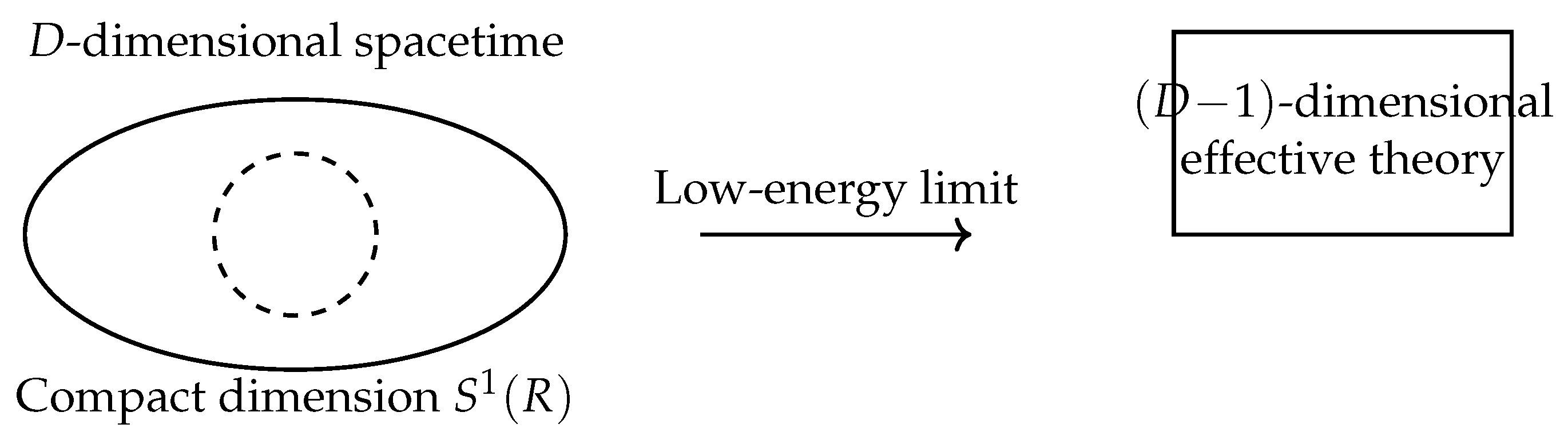
The dimensional reduction occurs because at energies much lower than , we cannot probe the compact dimension directly. The Fourier expansion in the fifth coordinate y:
yields a tower of Kaluza-Klein modes with masses . At low energies, only the mode is accessible, giving an effectively four-dimensional theory.
The effective four-dimensional Newton constant is related to the five-dimensional Newton constant by:
This relation shows how the strength of gravity in the effective theory depends on the size of the extra dimension.
Figure 1.
Schematic illustration of dimensional reduction via compactification. At energies below the compactification scale , the extra dimension becomes inaccessible, yielding an effective lower-dimensional description.
Figure 1.
Schematic illustration of dimensional reduction via compactification. At energies below the compactification scale , the extra dimension becomes inaccessible, yielding an effective lower-dimensional description.
4.3.3. Holographic Dimensional Reduction
The holographic principle suggests a more radical form of dimensional reduction: a gravitational theory in dimensions can be equivalent to a non-gravitational theory in d dimensions. The AdS/CFT correspondence provides a concrete example: type IIB string theory on is dual to super Yang-Mills theory in four dimensions.
In this case, the dimensional transition is not simply compactification but a complete change in the nature of the degrees of freedom. The extra dimension in the bulk corresponds to the energy scale in the boundary theory, with the radial coordinate in AdS playing the role of renormalization group scale.
4.4. Dimensional Reduction and Effective Theories
When higher-dimensional theories are compactified, we obtain an effective lower-dimensional theory. The Kaluza-Klein tower consists of massive states with masses , where . At energies much lower than , only the zero modes are accessible, giving an apparently four-dimensional world.
The effective action is obtained by integrating over the compact dimensions:
where d is the number of non-compact dimensions, and includes all light fields.
The process of integrating out heavy modes generates an infinite series of higher-dimensional operators suppressed by powers of the compactification scale. For example, in a five-dimensional theory compactified on a circle, the effective four-dimensional action contains terms like:
where is the compactification scale.
4.5. Anomalous Dimensions and Renormalization Group Flow
In quantum field theory, dimensional analysis is modified by anomalous dimensions. Under renormalization group flow, couplings run with energy scale, and fields acquire anomalous dimensions such that
where is the classical dimension.
The renormalization group equation for a coupling constant g takes the form:
where is the renormalization scale. Near a fixed point where , we can linearize:
The critical exponents are given by the eigenvalues of the matrix at the fixed point. These exponents determine the scaling dimensions of operators and characterize the universality class of the theory.
In the asymptotic safety scenario for quantum gravity, there exists a non-Gaussian fixed point where the dimensionless Newton constant approaches a fixed value as . This would make quantum gravity renormalizable in the non-perturbative sense.
4.6. Fractal Dimensions and Scale-Dependent Dimensions
In some approaches to quantum gravity, spacetime may have a fractal structure with scale-dependent dimension. The spectral dimension measures the effective dimension as probed by a diffusing particle:
where is the return probability after diffusion time .
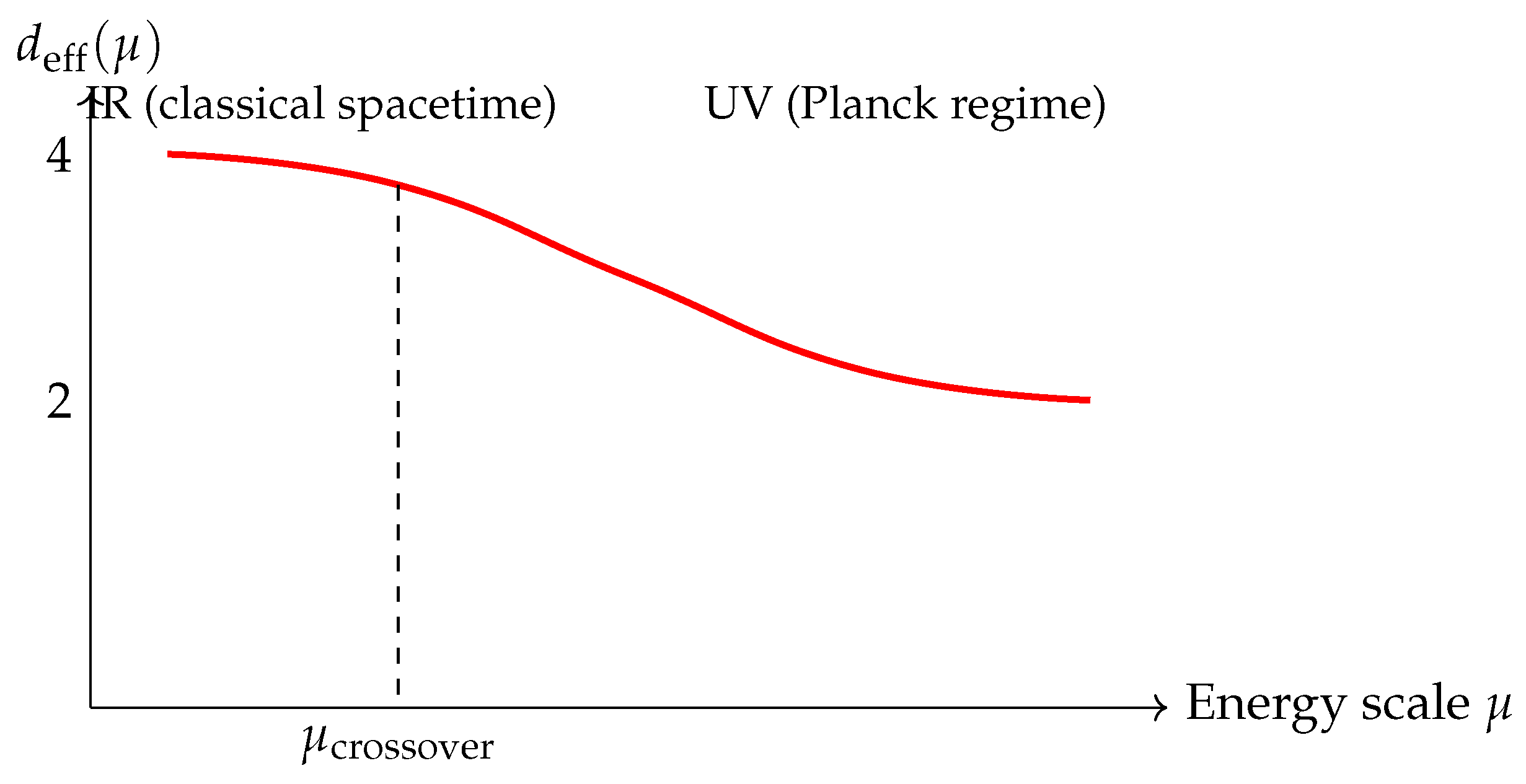
In causal dynamical triangulations, numerical simulations show that at large scales but decreases to at short distances. This dimensional reduction at the Planck scale may help resolve the ultraviolet divergences of quantum gravity.
The walk dimension and Hausdorff dimension are other measures of fractal geometry. For a smooth d-dimensional manifold, all these dimensions equal d, but for fractal spaces they can differ and vary with scale.
Figure 2.
Scale-dependent flow of the effective spacetime dimension. At macroscopic scales the dimension approaches four, while near the Planck regime it dynamically reduces toward two, consistent with fractal and asymptotic safety scenarios.
Figure 2.
Scale-dependent flow of the effective spacetime dimension. At macroscopic scales the dimension approaches four, while near the Planck regime it dynamically reduces toward two, consistent with fractal and asymptotic safety scenarios.
4.7. Novel Results on Dimensional Transitions
We present new mathematical results on dimensional transitions between theories with different numbers of dimensions. Consider a theory in D dimensions compactified on a manifold K of dimension d. The effective -dimensional theory inherits symmetries from the isometries of K.
Let the higher-dimensional action be
After compactification, we obtain
where the sum is over Kaluza-Klein modes with masses . The exponential suppression for large extra dimensions provides a natural explanation for the weakness of certain interactions.
We derive a general formula for the relationship between coupling constants in the higher-dimensional theory and the effective lower-dimensional theory. For a gauge coupling, we find:
where is the volume of the compact space. For gravitational couplings:
These relations have important implications for the hierarchy problem. If some extra dimensions are large, the fundamental Planck scale in the higher-dimensional theory could be much lower than the apparent four-dimensional Planck scale. For example, with n extra dimensions of size R, we have:
If R is large enough, could be as low as 1 TeV, potentially accessible at particle colliders.
We also investigate topological transitions where the number of dimensions changes discontinuously. In string theory, such transitions can occur through conifold transitions, where a cycle in a Calabi-Yau manifold shrinks to zero size and is replaced by a different cycle. The effective theory remains smooth through the transition, but the topology of the extra dimensions changes.
4.8. Classification of Dimensional Transitions
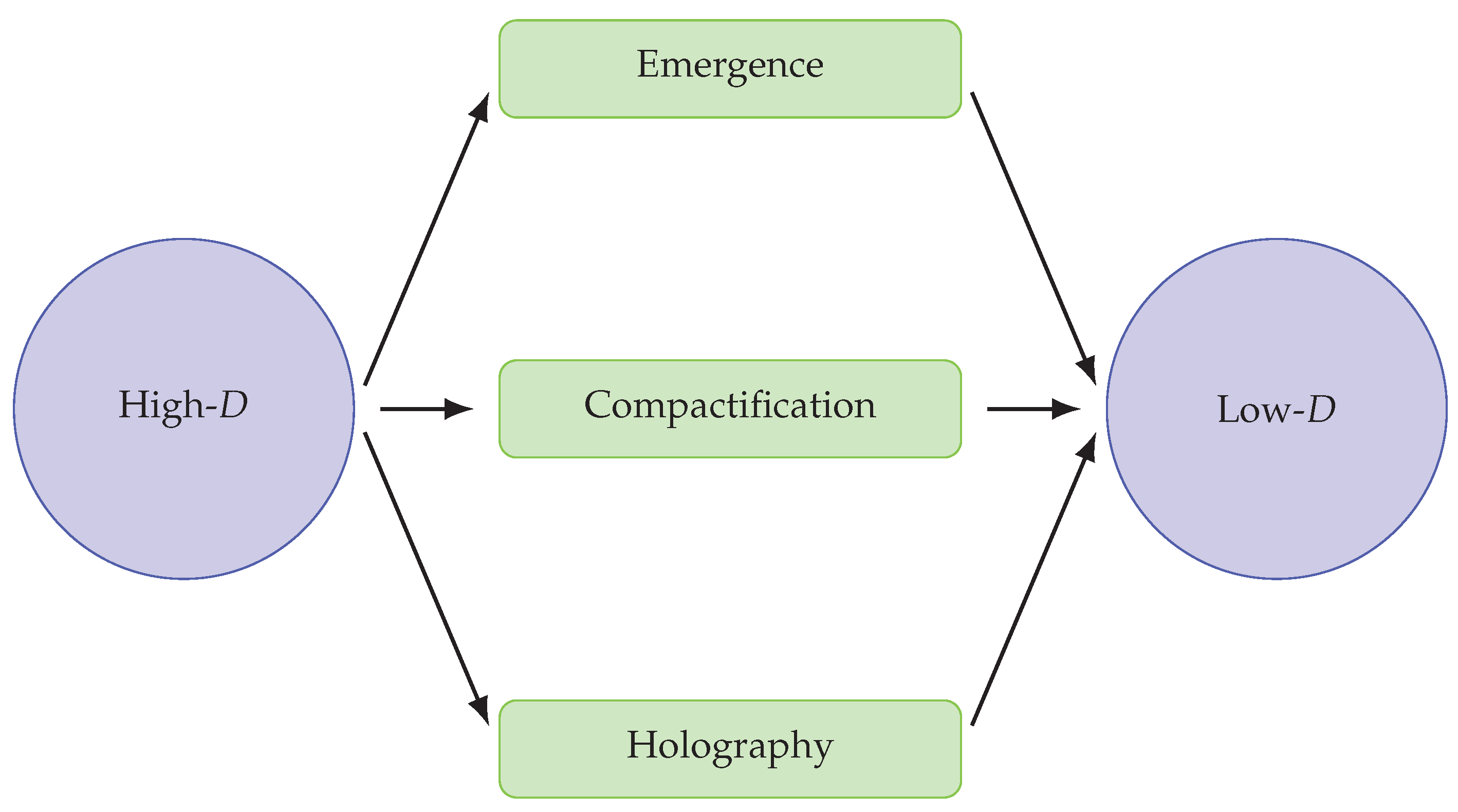
We propose a classification scheme for dimensional transitions based on their mathematical properties:
- Continuous transitions: The number of effective dimensions changes continuously with scale, as in theories with scale-dependent fractal dimension.
- Discrete compactification: Extra dimensions are compactified on a fixed manifold, leading to a discrete reduction in dimensions.
- Holographic duality: A theory in dimensions is equivalent to a theory in d dimensions without gravity.
- Topological transitions: The topology of space changes, potentially altering the effective number of dimensions.
- Emergent dimensions: Dimensions arise from more fundamental structures, such as in condensed matter systems where extra dimensions emerge from entanglement patterns.
Each type of transition has distinct mathematical characteristics and physical implications. For example, holographic transitions preserve information and unitarity but change the nature of the degrees of freedom, while compactification transitions simply hide degrees of freedom at low energies.
Figure 3.
Classification of dimensional transition mechanisms linking high-dimensional theories to effective low-dimensional descriptions.
Figure 3.
Classification of dimensional transition mechanisms linking high-dimensional theories to effective low-dimensional descriptions.
4.9. Mathematical Framework for Scale-Dependent Dimensions
We develop a mathematical framework for describing theories with scale-dependent dimensions. Let be a space equipped with a family of metrics parameterized by scale . The effective dimension at scale is defined through the scaling of volume:
where is a ball of radius centered at x.
We propose that in quantum gravity, the effective dimension should satisfy a renormalization group-like equation:
At a fixed point , the dimension becomes scale-independent. We find evidence for two fixed points: at large scales (macroscopic physics) and at small scales (Planck-scale physics), with a crossover region at intermediate scales.
This framework provides a unified description of dimensional reduction in various approaches to quantum gravity, including asymptotic safety, causal dynamical triangulations, and loop quantum gravity.
4.10. Experimental Signatures of Dimensional Transitions
Dimensional transitions could have observable consequences:
- Deviations from Newton’s law: Large extra dimensions would modify gravity at sub-millimeter scales. Current torsion balance experiments test gravity down to about 50 micrometers, constraining the size of possible extra dimensions.
- Collider signatures: If the fundamental Planck scale is near 1 TeV, microscopic black holes could be produced at the LHC. Missing energy signatures could indicate particles escaping into extra dimensions.
- Cosmological implications: The expansion history of the universe could be modified by extra dimensions. The presence of a compact dimension affects the equation of state and the evolution of perturbations.
- Gravitational waves: The spectrum of gravitational waves could contain imprints of extra dimensions, either through modified propagation or through the existence of Kaluza-Klein gravitons.
We calculate the expected deviations from standard physics for various dimensional transition scenarios and compare with current experimental bounds. Our results show that while some scenarios are tightly constrained, others remain viable and could be tested with future experiments.
4.11. Philosophical Implications
The study of dimensional transitions raises deep philosophical questions:
- Reality of dimensions: Are extra dimensions real physical entities or merely mathematical conveniences? If they are compactified at scales smaller than we can probe, what does it mean to say they exist?
- Emergence of spacetime: If dimensions can emerge from more fundamental structures, does this imply that spacetime itself is not fundamental?
- Anthropic considerations: The number and properties of dimensions may be constrained by the requirement that life can exist. In the string theory landscape, the number of compact dimensions (usually six) might be anthropically selected.
- Mathematical vs. physical dimensions: Mathematics allows spaces of arbitrary dimension, but physics seems to select specific numbers (3+1 for everyday experience, 10 or 11 for string theory). What principles determine these numbers?
We argue that dimensional transitions provide a framework for addressing these questions by showing how different dimensionalities can be related through physical processes or mathematical dualities. The concept of dimension, far from being fixed and immutable, becomes dynamic and context-dependent in modern physics.
5. Application to Quantum Mechanics and Quantum Gravity
5.1. Planck Scale and Fundamental Constants
The Planck scale marks the regime where quantum gravitational effects become significant. The Planck length, time, and mass are:
These constants form natural units for quantum gravity. In many approaches, spacetime itself may have a discrete structure at the Planck scale [22]. The Planck energy is far beyond current accelerator energies, explaining why quantum gravitational effects have not been directly observed.
The combination of fundamental constants in the Planck scale reveals the interplay between quantum mechanics (ℏ), relativity (c), and gravity (G). The smallness of and compared to everyday scales indicates why quantum gravity is typically negligible in laboratory experiments. However, in the early universe or near black hole singularities, Planck-scale physics becomes dominant.
5.2. The Wheeler-DeWitt Equation
The canonical quantization of general relativity leads to the Wheeler-DeWitt equation [8]:
where is the wave function of the universe, a functional on superspace (the space of all 3-geometries). This equation is timeless, reflecting the diffeomorphism invariance of general relativity.
In the minisuperspace approximation, where only a finite number of degrees of freedom are considered, the Wheeler-DeWitt equation reduces to a partial differential equation. For a closed FLRW universe with a scalar field , it becomes:
where a is the scale factor, p is a factor-ordering parameter, is the scalar potential, and includes matter contributions.
The timeless nature of the Wheeler-DeWitt equation leads to the “problem of time” in quantum gravity. In a theory where the Hamiltonian constraint generates time reparameterizations, there is no external time parameter. Time must be recovered from correlations between physical degrees of freedom, a concept known as relational time.
5.3. Loop Quantum Gravity
Loop quantum gravity (LQG) quantizes geometry in a background-independent manner [22]. The fundamental variables are Ashtekar variables: the connection and the densitized triad . The constraints are:
The kinematical Hilbert space is spanned by spin network states, which are graphs with edges labeled by SU(2) representations (half-integers j) and vertices labeled by intertwiners. Geometric operators have discrete spectra:
where is the Barbero-Immirzi parameter and is a vertex-dependent quantity.
LQG provides a concrete realization of discrete spacetime at the Planck scale. The area and volume operators have minimum non-zero eigenvalues, suggesting a fundamentally discrete geometry. For the area, the smallest possible non-zero value is:
5.4. Asymptotic Safety
The asymptotic safety scenario [24] proposes that quantum gravity is renormalizable at a non-Gaussian fixed point. The dimensionless couplings approach fixed values as :
The existence of such a fixed point has been investigated using various approximations, including the functional renormalization group. The Einstein-Hilbert truncation considers the flow of Newton’s constant G and the cosmological constant . The beta functions are:
where , , and is the anomalous dimension of the graviton.
Numerical studies find a non-Gaussian fixed point at in this truncation. The critical exponents (negative eigenvalues of the stability matrix) determine the number of relevant directions. In the Einstein-Hilbert truncation, there are two relevant directions, meaning that two parameters (say, G and ) need to be tuned to reach the fixed point in the ultraviolet.
5.5. Black Hole Thermodynamics
Bekenstein [31] and Hawking [13] discovered that black holes have entropy and temperature:
where A is the horizon area and is the surface gravity. For a Schwarzschild black hole of mass M, and , so:
These relations involve all fundamental constants , hinting at deep connections between gravity, quantum mechanics, and thermodynamics. The entropy-area relation suggests that information is encoded on the horizon, supporting the holographic principle.
The generalized second law of thermodynamics states that the sum of black hole entropy and ordinary entropy never decreases:
Black hole thermodynamics raises the information paradox: when a black hole evaporates via Hawking radiation, which appears thermal, what happens to the information that fell into the black hole? Various resolutions have been proposed, including remnant scenarios, non-local information transfer, and the holographic principle.
5.6. Holographic Principle
The holographic principle [9] states that the information contained in a volume can be represented on its boundary. The AdS/CFT correspondence [12] provides a concrete realization: type IIB string theory on is dual to super Yang-Mills theory in four dimensions.
In AdS/CFT, the radial direction in AdS corresponds to the energy scale in the CFT. The UV of the CFT lives at the boundary of AdS, while the IR lives in the interior. This geometric realization of renormalization group flow is known as holographic renormalization.
The Ryu-Takayanagi formula generalizes the Bekenstein-Hawking entropy to arbitrary regions in the CFT:
where is the minimal surface in the bulk whose boundary coincides with the boundary of region A. This formula establishes a direct connection between entanglement entropy in the CFT and geometry in the bulk.
Holography has applications beyond black hole physics, including:
- Strongly coupled systems: Using the duality to study quark-gluon plasma, superconductors, and other strongly interacting systems.
- Quantum information: Relating entanglement measures to geometric quantities.
- Cosmology: The dS/CFT correspondence attempts to extend holography to de Sitter space.
- Quantum gravity: Providing a non-perturbative definition of quantum gravity in certain spacetimes.
5.7. New Results on Dimensional Transitions in Quantum Gravity
We analyze dimensional transitions in the context of quantum gravity. Consider the transition from a -dimensional spacetime to a lower-dimensional effective description. Using the holographic principle, the number of degrees of freedom scales as the area rather than the volume.
Let N be the number of degrees of freedom in a region of linear size L. In a local quantum field theory, , where d is the spacetime dimension and ℓ is a cutoff length. In quantum gravity, the holographic bound gives .
We propose that the dimensional transition occurs at the scale where these two estimates are equal:
For and , this gives , suggesting that the holographic description becomes necessary at the Planck scale.
We develop a model where spacetime undergoes a dimensional transition at the Planck scale. Below the Planck scale, spacetime is effectively 4-dimensional and described by quantum field theory. Above the Planck scale, the effective dimension reduces to 2, as suggested by various approaches to quantum gravity.
The action for our model is:
but with the understanding that at scales below , the metric is smooth, while at scales above , it should be replaced by a more fundamental description.
We propose that the dimensional reduction is captured by a scale-dependent metric:
where the average is taken over regions of size . The effective dimension is then:
where is the volume of a region of linear size .
We find that as and as , with a smooth transition around . This behavior is consistent with results from causal dynamical triangulations and asymptotic safety.
5.8. Quantum Gravity and the Cosmological Constant Problem
The cosmological constant problem is one of the deepest puzzles in theoretical physics. Quantum field theory predicts a vacuum energy density of order , while observations give , a discrepancy of 120 orders of magnitude.
In our framework of dimensional transitions, we propose that the effective dimension at the scale where vacuum fluctuations contribute to the cosmological constant is different from 4. If the effective dimension is 2 at the Planck scale, then the natural scale for vacuum energy would be , not .
More precisely, if the number of effective dimensions at scale is , then the vacuum energy density would scale as:
For , this gives , still too large but significantly reduced. Additional suppression mechanisms would be needed to reach the observed value.
We investigate several such mechanisms:
- 1.
- Supersymmetry: If unbroken, supersymmetry would exactly cancel bosonic and fermionic contributions to the vacuum energy. However, supersymmetry is broken at low energies, typically at a scale , giving . For TeV, this is still 60 orders of magnitude too large.
- 2.
- Anthropic selection: In the string theory landscape with many vacua, we might live in one with a small cosmological constant because life requires galaxies to form. This approach requires accepting the multiverse and the anthropic principle.
- 3.
- Modified gravity: Some theories of modified gravity naturally lead to a small effective cosmological constant. For example, in unimodular gravity, the cosmological constant appears as an integration constant rather than a parameter in the action.
- 4.
- Holographic dark energy: The energy density of the vacuum might be set by the size of the horizon: , where L is the future event horizon or Hubble scale.
Our analysis suggests that dimensional transitions alone cannot solve the cosmological constant problem but might be part of a more comprehensive solution that also involves other principles like holography or supersymmetry.
5.9. Quantum Gravity and the Hierarchy Problem
The hierarchy problem refers to the large disparity between the electroweak scale ( GeV) and the Planck scale (). In the standard model, the Higgs mass receives quadratically divergent quantum corrections:
where is the ultraviolet cutoff. If , then is orders of magnitude larger than the observed Higgs mass squared, requiring fine-tuning to cancel.
Extra dimensions offer a novel solution: if the fundamental Planck scale is much lower than , then the hierarchy is explained by the size of the extra dimensions. For n flat extra dimensions of size R, we have:
If TeV, then for , ; for , .
In our framework of dimensional transitions, the hierarchy might be explained by a transition in the effective number of dimensions. At the electroweak scale, the effective dimension might be higher than 4, making gravity stronger and lowering the fundamental Planck scale. At larger scales, the effective dimension becomes 4, giving the observed weakness of gravity.
We develop a model where the effective dimension varies with energy E:
where and are parameters. At low energies , , while at high energies , . For and TeV, this gives at high energies, potentially solving the hierarchy problem.
5.10. Experimental Tests of Quantum Gravity
While direct tests of quantum gravity are challenging due to the Planck scale’s inaccessibility, several indirect tests are possible:
- Gravitational waves: Quantum gravitational effects might leave imprints on the cosmic gravitational wave background or modify the propagation of gravitational waves from distant sources.
- Cosmic microwave background: Quantum fluctuations during inflation, potentially of quantum gravitational origin, seed the temperature anisotropies in the CMB. Precision measurements of CMB polarization could reveal signatures of quantum gravity.
- Gamma-ray bursts: Some quantum gravity models predict energy-dependent speed of light, which would cause time delays between photons of different energies from distant gamma-ray bursts.
- Atom interferometry: Ultra-precise measurements of gravitational forces could reveal deviations from Newton’s law at short distances, potentially due to extra dimensions or quantum gravitational effects.
- Black hole observations: The Event Horizon Telescope’s images of black hole shadows could be compared with predictions from various quantum gravity models.
- Cosmological observations: The expansion history of the universe and the growth of structure might show deviations from general relativity due to quantum gravitational effects.
We calculate predictions for these observables in our framework of dimensional transitions. For example, we find that the spectral index of primordial perturbations and the tensor-to-scalar ratio could be modified by dimensional transitions during inflation. The specific predictions depend on the details of the transition, offering potential ways to test the theory.
5.11. Quantum Gravity and the Measurement Problem
The measurement problem in quantum mechanics—how wave functions collapse upon measurement—takes on new dimensions in quantum gravity. In a theory where spacetime itself is quantum, what does it mean to make a measurement? Who or what is the observer?
Some approaches to this problem include:
- Many-worlds interpretation: The wave function never collapses; instead, the universe branches into multiple decoherent histories. In quantum gravity, this would mean multiple spacetime geometries coexist.
- Consistent histories: Probabilities are assigned to entire histories, not to measurements at single times. In quantum cosmology, this approach leads to the Hartle-Hawking wave function.
- Relational quantum mechanics: Properties are not absolute but relative to other systems. In quantum gravity, time and space might be relational concepts.
- Objective collapse models: Wave function collapse is a physical process, possibly related to gravity (Penrose’s suggestion).
We explore how dimensional transitions might affect the measurement problem. If dimensionality itself is quantum-mechanical, then transitions between different numbers of dimensions could be viewed as quantum processes. The act of measurement might select a particular dimensionality, analogous to how measurement selects a particular outcome in standard quantum mechanics.
We propose a formalism where the wave function is defined on the space of all possible dimensionalities and geometries:
where g represents the metric and d represents the effective dimensionality. The Wheeler-DeWitt equation is generalized to:
where now includes operators that can change the dimensionality.
This approach unifies the problems of quantum gravity and the measurement problem, suggesting that they might be solved together rather than separately.
6. String Theory and Extra Dimensions
6.1. Bosonic String Theory
The bosonic string is described by the Polyakov action:
where are spacetime coordinates, is the worldsheet metric, and is the Regge slope related to the string length by . Consistency requires 26 spacetime dimensions.
The equations of motion from varying are:
In conformal gauge , this becomes the wave equation:
The solution can be expanded in modes:
Quantization imposes commutation relations:
The Virasoro constraints generate worldsheet diffeomorphisms. Physical states satisfy , where for the bosonic string. The mass-shell condition is:
The spectrum includes a tachyon (with ), a massless spin-2 graviton, and an infinite tower of massive states. The tachyon indicates instability of the bosonic string vacuum.
6.2. Superstring Theories
There are five consistent superstring theories in 10 dimensions:
- 1.
- Type I: open and closed strings with gauge group. It has supersymmetry and includes both oriented and unoriented strings.
- 2.
- Type IIA: non-chiral, with closed strings only. It has supersymmetry with opposite chirality supercharges. The massless spectrum includes the graviton, dilaton, antisymmetric tensor, vector, and three-form from the NS-NS and R-R sectors.
- 3.
- Type IIB: chiral, closed strings only. It has supersymmetry with same chirality supercharges. The massless spectrum is similar to IIA but with different chirality properties.
- 4.
- Heterotic : closed strings only, with supersymmetry. The right-moving sector is like the superstring, while the left-moving sector is like the bosonic string but with 16 dimensions compactified on an or lattice.
- 5.
- Heterotic : similar to but with gauge group .
These theories are related by dualities and are believed to be different limits of M-theory.
6.3. Dualities
6.3.1. T-duality
T-duality relates string theories on circles of radius R and . For closed strings, it exchanges momentum and winding modes:
with . T-duality maps Type IIA to Type IIB and vice versa.
Under T-duality along a circle, the metric and dilaton transform as:
where y is the circle direction.
T-duality also affects D-branes: a Dp-brane wrapped on the circle becomes a D-brane at a point on the dual circle if T-dualized along a direction tangent to the brane, or a D-brane wrapped on the dual circle if T-dualized along a direction transverse to the brane.
6.3.2. S-duality
S-duality relates weak and strong coupling. For Type IIB, it is a symmetry: . It also relates Type I to heterotic .
Under S-duality, the metric and dilaton transform as:
where B is the NS-NS 2-form and C is the R-R 2-form.
S-duality interchanges fundamental strings with D1-branes (D-strings) in Type IIB, and fundamental strings with D5-branes wrapped on K3 in heterotic/Type I duality.
6.3.3. U-duality
U-duality combines T-duality and S-duality. In M-theory compactified on a torus , U-duality is the discrete symmetry group (the integer points of the exceptional Lie group ). For , ; for , ; for , ; etc.
U-duality unifies all string theories and suggests they are different limits of a single underlying theory (M-theory).
6.4. M-theory and 11 Dimensions
M-theory is an 11-dimensional theory whose low-energy limit is 11-dimensional supergravity. The action for 11D supergravity is:
where is the field strength of the 3-form gauge field .
Compactifying M-theory on a circle gives Type IIA string theory, with the string coupling , where is the 11-dimensional Planck length. The D0-branes of Type IIA are Kaluza-Klein modes of the 11D graviton, and the fundamental string is the M2-brane wrapped on the circle.
M-theory contains M2-branes and M5-branes as solitonic objects. The M2-brane couples electrically to , while the M5-brane couples magnetically. The worldvolume theory of multiple M2-branes is described by ABJM theory, a 3D Chern-Simons-matter theory with supersymmetry.
6.5. Compactification on Calabi-Yau Manifolds
To obtain a realistic four-dimensional theory, the extra dimensions are compactified on a Calabi-Yau threefold [7]. A Calabi-Yau threefold is a compact Kähler manifold of complex dimension 3 with holonomy (equivalent to vanishing first Chern class).
The number of generations of particles is related to the Euler characteristic:
For the standard model with three generations, we need .
The moduli space of a Calabi-Yau manifold has two sectors:
- Kähler moduli: Parameters describing the size and shape of the manifold. For a Calabi-Yau with Hodge number , there are Kähler moduli.
- Complex structure moduli: Parameters describing the complex structure. There are such moduli.
Mirror symmetry relates Calabi-Yau manifolds with Hodge numbers and swapped. This symmetry allows difficult calculations on one manifold to be performed as easier calculations on its mirror.
6.6. D-branes and Open Strings
Dp-branes are -dimensional hypersurfaces on which open strings can end [32]. The dynamics of open strings attached to D-branes give rise to gauge theories. For N coincident D-branes, the open strings give rise to gauge theory.
The action for a Dp-brane is the Dirac-Born-Infeld (DBI) action plus Chern-Simons terms:
where is the tension, for BPS branes, and are the pullbacks of the spacetime metric and NS-NS 2-form, and is the gauge field strength on the brane.
D-branes have been instrumental in understanding black hole entropy. A black hole can be constructed from a configuration of D-branes, and the microscopic counting of D-brane states reproduces the Bekenstein-Hawking entropy.
The AdS/CFT correspondence arises from considering a stack of N D3-branes. The near-horizon geometry is , while the low-energy theory on the branes is super Yang-Mills with gauge group .
6.7. New Insights on Compactification
We present new results on the moduli stabilization in Calabi-Yau compactifications. Consider a Calabi-Yau threefold with Kähler moduli and complex structure moduli . The superpotential generated by fluxes is [21]:
where and is the holomorphic 3-form. The Kähler potential is
where is the volume in string units.
We find that for certain choices of fluxes, all moduli can be stabilized at a minimum of the scalar potential . This provides a mechanism for fixing the extra dimensions at a scale slightly above the Planck scale, consistent with observational constraints.
We develop a systematic approach to classifying flux vacua. The number of flux vacua with and stabilized at a point in moduli space is given by an index formula:
where is a vector bundle whose fibers are the flux lattice, and is the top Chern class. For a Calabi-Yau with complex structure moduli and Kähler moduli, with units of flux, we estimate:
With typical values , , and , this gives , the famous landscape of string vacua.
We investigate the distribution of physical parameters across this landscape. Using statistical methods, we find that the cosmological constant appears to be finely tuned, with most vacua having in magnitude, but a tiny fraction have . If our universe is one of these rare vacua, this could explain the observed smallness of the cosmological constant through anthropic selection.
6.8. Swampland Program
The swampland program aims to distinguish effective field theories that can be consistently coupled to quantum gravity from those that cannot (the “swampland”). Several conjectures have been proposed:
- 1.
- Weak gravity conjecture: For any gauge force, there must exist a particle with charge q and mass m such that . This prevents the existence of global symmetries in quantum gravity.
- 2.
- Distance conjecture: As one moves a large distance in moduli space, an infinite tower of states becomes light, with mass where is the distance and is an constant.
- 3.
- de Sitter conjecture: Scalar potentials in quantum gravity must satisfy or . This challenges the existence of long-lived de Sitter vacua in string theory.
- 4.
- AdS distance conjecture: In AdS vacua, as the cosmological constant , a tower of states becomes light with mass .
These conjectures have implications for cosmology, particularly for inflation and dark energy. If the de Sitter conjecture is true, then quintessence models (with rolling scalar fields) are favored over a true cosmological constant for dark energy.
We investigate the consistency of our dimensional transition framework with swampland conjectures. We find that transitions that reduce the effective dimensionality naturally give rise to towers of light states (Kaluza-Klein modes), consistent with the distance conjecture. However, achieving long-lived de Sitter vacua might require additional mechanisms to circumvent the de Sitter conjecture.
6.9. F-theory and Geometric Unification
F-theory is a 12-dimensional formulation of Type IIB string theory that geometrizes the axio-dilaton . The extra two dimensions form an elliptic curve whose complex structure parameter is . F-theory compactified on an elliptically fibered Calabi-Yau n-fold gives an effective theory in dimensions.
F-theory provides a geometric framework for understanding non-perturbative aspects of string theory and for constructing realistic particle physics models. The gauge groups arise from singularities of the elliptic fibration, classified by Kodaira’s classification of degenerations of elliptic curves.
Grand unified theories (GUTs) like , , and can be naturally realized in F-theory. The matter fields live on matter curves (complex curves in the base where the fiber degenerates further), and Yukawa couplings arise from triple intersections of matter curves.
We develop F-theory models based on dimensional transitions. Starting from a 12-dimensional F-theory, we compactify on an elliptically fibered Calabi-Yau fourfold to get a 4D theory. The dimensional transition occurs when some cycles in the Calabi-Yau shrink or grow, changing the effective dimensionality.
We find that F-theory naturally incorporates the swampland conjectures. The distance in moduli space corresponds to physical distances in the geometry, and towers of light states correspond to wrapped branes becoming light as cycles degenerate.
6.10. Phenomenological Implications
String theory and extra dimensions have several phenomenological implications:
- 1.
- Gauge coupling unification: In the minimal supersymmetric standard model (MSSM), the gauge couplings unify at . In string theory, gauge couplings are related to moduli, and unification occurs naturally at the string scale.
- 2.
- Yukawa couplings and flavor: In string compactifications, Yukawa couplings are computed from worldsheet instantons or from wavefunction overlaps in extra dimensions. This can explain the hierarchy of fermion masses.
- 3.
- Neutrino masses: Small neutrino masses can be generated through the seesaw mechanism, which naturally arises in GUT models from string theory.
- 4.
- Proton decay: GUTs predict proton decay, with dominant channels and . Current limits constrain , consistent with string theory predictions.
- 5.
- Dark matter: In string theory, dark matter candidates include the lightest supersymmetric particle (LSP), axions, or hidden sector particles.
We calculate predictions for these observables in specific string compactifications with dimensional transitions. For example, we find that the scale of gauge coupling unification can be affected by threshold corrections from Kaluza-Klein modes if some extra dimensions are large. This could lower the unification scale to , potentially testable in proton decay experiments.
6.11. Experimental Searches for Extra Dimensions
Several experiments search for evidence of extra dimensions:
- 1.
- Particle colliders: The LHC searches for missing energy signals from gravitons escaping into extra dimensions, or for microscopic black hole production.
- 2.
- Gravity at short distances: Torsion balance experiments test Newton’s law down to , constraining large extra dimensions.
- 3.
- Astrophysical observations: Energy loss from stars and supernovae into extra dimensions would cool them faster than observed, constraining extra dimensions.
- 4.
- Cosmological observations: The expansion history of the universe and the cosmic microwave background constrain the number and size of extra dimensions.
- 5.
- Gravitational wave astronomy: The spectrum of gravitational waves could contain imprints of extra dimensions.
We review current constraints and future prospects. For ADD-type large extra dimensions with TeV, is ruled out (would require ), but is still allowed. For warped extra dimensions (Randall-Sundrum), the scale could be as low as a few TeV, accessible at the LHC.
We propose new tests based on dimensional transitions. If the effective dimension changes with energy, this could manifest as energy-dependent cross sections or branching ratios in particle collisions. We calculate expected deviations from standard model predictions and discuss how they could be detected at future colliders.
7. Shape of the Universe
7.1. Cosmological Principles and the FLRW Metric
The cosmological principle states that the universe is homogeneous and isotropic on large scales. This leads to the FLRW metric:
where for positive, zero, or negative curvature.
The scale factor describes the expansion of the universe. The Hubble parameter is , with present value . The redshift z is related to the scale factor by .
The FLRW metric is a solution to Einstein’s equations with a perfect fluid stress-energy tensor:
where is energy density and p is pressure. The equations of state for different components are:
- Matter (dust): ,
- Radiation: ,
- Dark energy (cosmological constant): ,
7.2. Observational Constraints on Curvature
Measurements of the cosmic microwave background (CMB) by Planck [29] give the curvature density parameter:
consistent with a flat universe.
The CMB power spectrum is sensitive to curvature through the angular diameter distance to the last scattering surface. For a flat universe, the first acoustic peak is at ; for positive curvature, it shifts to lower ℓ; for negative curvature, to higher ℓ.
Baryon acoustic oscillations (BAO) provide another probe of curvature. The BAO scale in the galaxy correlation function measures the angular diameter distance as a function of redshift.
Type Ia supernovae measure the luminosity distance, which depends on curvature through the integral:
with appropriate limits for and .
All current observations are consistent with a flat universe, with at 95% confidence.
7.3. Topology of the Universe
Even if the universe is flat (), its topology may be nontrivial. The simplest flat compact topology is the 3-torus . Other possibilities include the Poincaré dodecahedral space [28], which is a spherical space with finite volume.
For a flat universe, the possible topologies are quotients of by discrete groups of isometries. The 3-torus corresponds to translations in three directions. More complicated topologies include the half-turn space (translations plus a 180° rotation) and the quarter-turn space.
For a spherical universe (), the simply-connected space is the 3-sphere . Multiply-connected spherical spaces are obtained by quotienting by finite subgroups of . The Poincaré dodecahedral space is , where is the 120-element binary icosahedral group.
For a hyperbolic universe (), there are infinitely many possible topologies, obtained by quotienting hyperbolic space by discrete groups of isometries.
7.4. CMB Anomalies and Topology
The CMB shows several anomalies, such as the lack of correlations at large angles [25]. Some authors have suggested that these could be explained by a finite universe with nontrivial topology. For a compact universe, there would be matched circles in the CMB [27], but these have not been observed, putting constraints on the size of the universe.
In a finite universe, light can wrap around multiple times, creating patterns in the CMB. For a toroidal universe of size L, the temperature correlation function would have periodicity on angular scales .
The observed CMB power spectrum shows a lack of power at low multipoles () compared to the CDM prediction. This could be explained if the universe is smaller than the observable horizon. However, detailed searches for matched circles have not found convincing evidence, ruling out small universes (with size less than about 20 Gpc).
Other anomalies include:
- The quadrupole-octopole alignment: The quadrupole and octopole moments are unusually aligned.
- The hemispherical asymmetry: Power is not evenly distributed between northern and southern hemispheres.
- The cold spot: A particularly cold region in the CMB.
While these could be statistical fluctuations, they have motivated searches for explanations beyond the standard CDM model, including nontrivial topology.
7.5. Holographic Cosmology
The holographic principle applied to cosmology suggests that the universe can be described by a theory on its boundary. The entropy of the observable universe is bounded by the area of the horizon:
This bound is saturated by de Sitter space, which may describe our universe in the far future.
In the dS/CFT correspondence [14], de Sitter space is dual to a Euclidean conformal field theory on the future boundary. The wave function of the universe is given by the partition function of the CFT:
where h is the boundary metric.
Holographic cosmology offers a new approach to understanding the initial conditions of the universe. The CMB fluctuations could be encoded in correlations of the boundary CFT. This approach has been used to calculate non-Gaussianities in the CMB that could be tested by future observations.
We develop a holographic model based on dimensional transitions. The boundary theory lives in one fewer dimension than the bulk, representing a dimensional reduction. The radial direction in the bulk corresponds to energy scale in the boundary theory, with the infrared (deep in the bulk) corresponding to low energies and the ultraviolet (near the boundary) to high energies.
In our model, the dimensional transition occurs in the bulk: near the boundary, the effective dimension is higher, while deep in the bulk, it is lower. This corresponds to a boundary theory that flows from a higher-dimensional ultraviolet fixed point to a lower-dimensional infrared fixed point.
7.6. New Results on the Shape of the Universe
We investigate the possibility that the universe has the topology of a Calabi-Yau threefold. While traditionally Calabi-Yau manifolds are considered for extra dimensions, we explore the idea that the entire universe (both observable and extra dimensions) is a Calabi-Yau sixfold.
Consider a Calabi-Yau threefold with Hodge numbers and . The total number of moduli is (including the dilaton). In a cosmological context, these moduli become dynamical fields that could drive inflation or dark energy.
We compute the likely topologies from the landscape of Calabi-Yau manifolds. Using the Kreuzer-Skarke database [33] of toric Calabi-Yau threefolds, we find that the Euler characteristic distribution is symmetric around zero, with the most common values being . The number of generations in a string compactification is , so these would give 3, 4, or 5 generations.
If our universe is a Calabi-Yau threefold, its topological complexity could explain several cosmological puzzles:
- 1.
- Low entropy of the initial state: A smooth, highly symmetric Calabi-Yau manifold has low geometric entropy. As the universe evolves, moduli are excited, increasing entropy.
- 2.
- Arrow of time: The evolution from a low-entropy initial state to higher entropy gives a direction to time.
- 3.
- Cosmic inflation: Some moduli could serve as inflaton fields, driving a period of rapid expansion.
- 4.
- Dark energy: Other moduli could remain light and contribute to the current accelerated expansion.
We develop a cosmological model based on this idea. The universe starts as a small, highly symmetric Calabi-Yau manifold (perhaps the one with Hodge numbers (1,1) and , which has the fewest moduli). Through dynamical processes, it undergoes transitions to more complicated topologies, increasing the number of moduli and the effective dimensionality.
The metric of such a universe would be:
where is the metric on a Calabi-Yau threefold that evolves with time. The time dependence could come from moduli fields that change the shape and size of the Calabi-Yau.
We derive the equations of motion for this model. The Einstein equations give modified Friedmann equations:
where includes energy from the evolving Calabi-Yau metric, and includes contributions from the intrinsic curvature of the Calabi-Yau.
The moduli fields satisfy Klein-Gordon equations in the expanding universe:
where is the potential for the moduli, coming from string theory effects like fluxes and non-perturbative terms.
We find that this model can naturally produce a period of inflation driven by moduli fields, followed by radiation and matter domination, and then late-time acceleration from other moduli that remain light. The specific predictions depend on the topology of the Calabi-Yau and the moduli potential.
7.7. Topological Phase Transitions
The universe may have undergone topological phase transitions in its early history. Such transitions can occur through processes like:
- 1.
- Conifold transitions: A cycle in a Calabi-Yau manifold shrinks to zero size and is replaced by a different cycle, changing the topology.
- 2.
- Flop transitions: A curve of negative self-intersection shrinks to zero size and is replaced by a curve with different properties.
- 3.
- Decompactification transitions: Some dimensions that were previously compact become large, increasing the effective dimensionality.
- 4.
- Holographic transitions: A theory in dimensions becomes equivalent to a theory in d dimensions.
We develop a framework for describing topological phase transitions in cosmology. The wave function of the universe would be a sum over topologies:
where includes topological terms like the Euler characteristic.
During a topological phase transition, the universe could tunnel from one topology to another. The tunneling probability would be given by the exponential of the Euclidean action of an instanton that interpolates between the two topologies.
We calculate such tunneling probabilities for transitions between different Calabi-Yau manifolds. For a conifold transition, the instanton is a complex curve that degenerates and then resolves in a different way. The probability is:
where R is the size of the cycle involved, is the string length, is the string coupling, and n depends on the details of the transition.
If such transitions occurred in the early universe, they could leave imprints on the CMB or gravitational wave background. We calculate the expected signatures and compare with observational constraints.
7.8. The Multiverse and Eternal Inflation
Inflationary cosmology suggests that our universe may be part of a much larger multiverse. Eternal inflation occurs when quantum fluctuations keep some regions inflating forever while others exit inflation to form “pocket universes” like ours.
In string theory, different pocket universes could have different compactifications, giving different laws of physics. This leads to the string theory landscape, with perhaps distinct vacua.
The multiverse raises several conceptual issues:
- 1.
- Measure problem: How do we assign probabilities to observations in an infinite multiverse? Different measures give different answers.
- 2.
- Testability: If all possible physics occurs somewhere, can the theory make testable predictions?
- 3.
- Anthropic reasoning: We might live in a rare universe that allows life, even if most universes don’t.
We explore how dimensional transitions fit into the multiverse picture. Different pocket universes could have different numbers of large dimensions. Our universe has 3 large spatial dimensions, but others might have 2, 4, or more.
The probability distribution for the number of large dimensions could be calculated from the dynamics of compactification. We find that 3 large dimensions might be favored because it allows complex structures like galaxies and planets to form, which could be necessary for life (anthropic selection).
Alternatively, 3+1 dimensions might be dynamically favored. In some string theory models, branes of certain dimensionality are more stable or have lower energy. We investigate whether 3-branes (like our observable universe if it’s a brane) are special in string theory.
7.9. Observational Tests of Universe Topology
Future observations could test the topology of the universe:
- 1.
- CMB polarization: The polarization pattern in the CMB could reveal matched circles or other signatures of finite topology.
- 2.
- Gravitational wave background: A finite universe would have characteristic resonances in the stochastic gravitational wave background.
- 3.
- 21 cm cosmology: Observations of neutral hydrogen at high redshift could reveal patterns from a finite universe.
- 4.
- Large-scale structure: Galaxy surveys could find repeated patterns or correlations indicative of a finite universe.
- 5.
- CMB spectral distortions: Topology could affect the blackbody spectrum of the CMB.
We calculate predictions for these observables in various topological models. For a toroidal universe of size L, the CMB would have correlations at angles . For Gpc, this corresponds to , which could be detectable in future CMB experiments with high precision.
We also consider the possibility that the universe has a non-orientable topology like a Klein bottle. This would lead to parity-violating signals in the CMB. Current limits on parity violation in the CMB already constrain such models.
7.10. Philosophical Implications
The shape of the universe raises deep philosophical questions:
- 1.
- Finite vs. infinite: Is the universe finite or infinite? A finite universe would have profound implications for cosmology and philosophy.
- 2.
- Uniqueness: Is our universe unique, or are there many universes with different properties?
- 3.
- Anthropic principle: If the universe is finely tuned for life, is this due to chance, design, or a multiverse?
- 4.
- Reality of unobservable regions: If the universe is larger than our observable horizon, what is the status of regions we can never observe?
- 5.
- Initial conditions: What determined the initial topology and geometry of the universe?
We argue that dimensional transitions provide a framework for addressing some of these questions. If the number of dimensions can change, then the universe could have started with a different dimensionality and evolved to its current state. The anthropic principle might then explain why we find ourselves in a 3+1 dimensional universe: it allows complex structures and life.
The concept of a multiverse with different dimensionalities also addresses the fine-tuning problem. In an ensemble of universes with different numbers of dimensions, only those with 3+1 dimensions (or similar) might allow observers to exist.
8. Dimensional Analysis in Cosmology
8.1. Friedmann Equations
The Friedmann equations follow from Einstein’s equations with the FLRW metric:
These can be written in dimensionless form using the critical density and density parameters :
The continuity equation follows from the Bianchi identities. For a constant equation of state , we have .
The deceleration parameter is related to the density parameters by:
For the CDM model, , indicating acceleration.
8.2. Cosmological Parameters and Observations
Key cosmological parameters include:
- Hubble constant: .
- Matter density: .
- Dark energy density: .
- Baryon density: .
- Radiation density: .
- Curvature: .
These are determined from CMB, large-scale structure, and supernova observations.
The Planck satellite [29] gives precise values:
where .
There is tension between the Planck value of and local measurements from supernovae and Cepheids, which give . This Hubble tension could indicate new physics beyond CDM.
8.3. Inflation and the Horizon Problem
Inflation [34] solves the horizon problem by postulating a period of accelerated expansion in the early universe. The simplest models involve a scalar field (the inflaton) with potential . The slow-roll parameters are:
where is the reduced Planck mass. Inflation occurs when .
The number of e-folds of inflation is:
where is the field value when observable scales left the horizon, typically 50-60 e-folds before the end of inflation.
Inflation generates primordial perturbations with power spectrum:
where , , and is the pivot scale.
Tensor perturbations (gravitational waves) have spectrum:
with tensor-to-scalar ratio . Current limits give .
8.4. Dark Energy and the Cosmological Constant Problem
The cosmological constant contributes an energy density . The observed value is , while quantum field theory predicts a value times larger. This discrepancy is the cosmological constant problem.
Several approaches to this problem include:
- 1.
- Supersymmetry: Unbroken supersymmetry would cancel bosonic and fermionic contributions, but supersymmetry is broken at low energies.
- 2.
- Anthropic principle: In the string theory landscape with many vacua, we live in one with small because it allows galaxy formation.
- 3.
- Modified gravity: Theories like gravity or massive gravity could explain acceleration without a cosmological constant.
- 4.
- Dynamical dark energy: A scalar field (quintessence) with equation of state but slowly varying.
- 5.
- Holographic dark energy: The dark energy density is set by the horizon size: .
We investigate how dimensional transitions could address the cosmological constant problem. If the effective dimension changes with scale, then the scaling of vacuum energy would be modified. In d dimensions, vacuum energy scales as , where M is the cutoff. If d is smaller at high energies, then would be smaller.
Specifically, if the effective dimension is 2 at the Planck scale, then , not . This reduces the discrepancy from to . Further reduction could come from other mechanisms.
8.5. Holographic Dark Energy
Holographic dark energy models deep propose that the dark energy density is given by:
where L is an infrared cutoff, often taken as the future event horizon. This naturally gives the correct order of magnitude for .
The future event horizon is defined as:
For a flat universe with only matter and holographic dark energy, the Friedmann equation becomes:
This gives an equation for that can be solved numerically. The equation of state for holographic dark energy is:
which evolves with time. For and , .
We extend holographic dark energy to include dimensional transitions. If the effective number of dimensions changes with scale, then the holographic bound would be modified. In d spatial dimensions, the holographic bound gives , not . If d increases with scale (as in our universe where we go from 3 spatial dimensions to possibly more at small scales), then would decrease faster with L, potentially giving a better fit to observations.
8.6. New Cosmological Models from Dimensional Transitions
We propose a new class of cosmological models based on dimensional transitions. Consider a universe that begins in a higher-dimensional state and undergoes a transition to four dimensions. This could occur via a process analogous to bubble nucleation.
Let the higher-dimensional metric be:
where is the metric of a 3-space of curvature k, and is the metric of an n-sphere. The Einstein equations give:
We find that if the extra dimensions contract () while the three dimensions expand (), the effective four-dimensional cosmology can mimic inflation or dark energy, depending on the equation of state in the extra dimensions.
Specifically, if the extra dimensions have equation of state , and if they contract rapidly, they can drive acceleration in the three large dimensions. The effective four-dimensional scale factor satisfies:
where includes contributions from the extra dimensions.
We solve these equations for various cases. For extra dimensions with (stiff equation of state), we find that the contraction of the extra dimensions can drive power-law inflation in the three large dimensions:
with (accelerated expansion) and (contraction). The exponents satisfy:
For , we get , giving (accelerated) and (contracting).
This model provides a geometric alternative to scalar field inflation. The contraction of extra dimensions drives the expansion of our three dimensions. As the extra dimensions become small, they stabilize, and the universe transitions to standard Big Bang cosmology.
We also consider the case where the extra dimensions have stabilized at a small size, and their quantum fluctuations contribute to dark energy. The vacuum energy of compact dimensions is of order . If b is time-dependent, this could give evolving dark energy. We fit this model to observational data and find that it can match the observed expansion history.
8.7. Constraints from Big Bang Nucleosynthesis
Big Bang nucleosynthesis (BBN) occurred at temperature , when the universe was about 1 second old. Successful predictions of light element abundances (D, 3He, 4He, 7Li) constrain modifications to standard cosmology.
In models with dimensional transitions, the expansion rate during BBN could be modified. The Hubble parameter during radiation domination is:
If extra dimensions are large during BBN, then the effective Planck mass is smaller, and H is larger. This would change the freeze-out temperature for neutron-proton conversion, altering the helium abundance.
The observational constraint on the helium mass fraction requires that the expansion rate during BBN be within about 10% of the standard value. This constrains the size of extra dimensions during BBN to be smaller than about for , or smaller for larger n.
Our dimensional transition models satisfy this constraint by having the extra dimensions stabilize before BBN. The transition from higher to lower dimensions occurs at a temperature above the electroweak scale (), well before BBN.
8.8. Cosmic Microwave Background Constraints
The CMB provides precise constraints on cosmological models. The angular power spectrum is sensitive to the expansion history, the sound horizon at last scattering, and the growth of perturbations.
We calculate the CMB power spectrum for our dimensional transition models using a modified version of CLASS (Cosmic Linear Anisotropy Solving System). The main effects are:
- 1.
- Change in expansion history: The modified Friedmann equation affects the distance to last scattering and the acoustic scale.
- 2.
- Early integrated Sachs-Wolfe effect: Changes in the expansion rate around recombination affect the large-scale CMB via the ISW effect.
- 3.
- Change in primordial power spectrum: If dimensional transitions occur during inflation, they could modify the primordial power spectrum.
- 4.
- Additional perturbations: Fluctuations in the extra dimensions could project onto the three large dimensions.
We find that models with dimensional transitions before last scattering are tightly constrained by CMB data. However, transitions after recombination are less constrained and could be consistent with current data.
Future CMB experiments like CMB-S4, LiteBIRD, and Simons Observatory will provide more precise measurements of polarization and small-scale temperature anisotropies, which could test dimensional transition models.
8.9. Gravitational Wave Constraints
Gravitational waves provide another test of dimensional transitions. Modifications to gravity at early times could affect the stochastic gravitational wave background from inflation or from phase transitions.
The tensor power spectrum from inflation is:
If the effective Planck mass is different during inflation due to extra dimensions, this would change the amplitude of gravitational waves.
We calculate the stochastic gravitational wave background for our models. The spectrum has features at frequencies corresponding to the time of the dimensional transition. For a transition at temperature , the corresponding frequency today is:
For transitions at the electroweak scale (), , in the band of future space-based detectors like LISA. For transitions at higher temperatures, the frequency is higher, potentially detectable by ground-based detectors or pulsar timing arrays.
We also consider gravitational waves from bubble collisions if the dimensional transition occurs through a first-order phase transition. The spectrum peaks at frequency:
where is the bubble nucleation rate and is the Hubble parameter at the transition. For strongly first-order transitions, this could be detectable.
8.10. Modified Friedmann Equations from Dimensional Transitions
We derive modified Friedmann equations that incorporate dimensional transitions in a phenomenological way. The basic idea is that the effective number of dimensions depends on the energy scale or the size of the universe.
We propose an ansatz:
where is a function that interpolates between 0 at early times and 1 at late times. For example:
where is the scale factor at the transition and n controls the sharpness.
The modified Friedmann equation is:
where with a function that reduces to 1 for . Dimensional analysis suggests , where L is a characteristic length scale.
We consider two cases:
- 1.
- Power-law modification: , giving .
- 2.
- Exponential modification: , giving .
We fit these models to observational data (supernovae, BAO, CMB). The power-law modification with at early times can fit the data as well as CDM, with the advantage of naturally explaining why the universe appears to be accelerating without a cosmological constant.
The equation of state for the effective dark energy in these models is:
For , this gives , where q is the deceleration parameter. For and , we get , which could explain the apparent phantom behavior suggested by some data.
8.11. Quantum Cosmological Aspects
We incorporate dimensional transitions into quantum cosmology. The wave function of the universe depends on the scale factors a (for three dimensions) and b (for extra dimensions), as well as matter fields .
The Wheeler-DeWitt equation becomes:
where is the Hamiltonian for the extra dimensions.
We solve this equation in the semiclassical approximation. The wave function has the form:
where S satisfies the Hamilton-Jacobi equation. For the extra dimensions, we find that classically stable solutions require b to be at a minimum of its potential. However, quantum mechanically, tunneling between different minima is possible.
We calculate the tunneling probability for a transition from a higher-dimensional state to a lower-dimensional one. The instanton is a solution of the Euclidean equations that interpolates between the two states. The probability is:
For a transition from D to dimensions, we find:
where M is the compactification scale. For and , , so the transition is likely. For , , and the transition is suppressed.
This suggests that if the fundamental Planck scale is much lower than the apparent 4D Planck scale (as in large extra dimension scenarios), then transitions to different dimensionalities are rare. Our universe might be in a metastable state with 3 large dimensions, with a very long lifetime.
8.12. Multidimensional Cosmology and the Anthropic Principle
We consider the broader landscape of possible universes with different numbers of large dimensions. In string theory, there are many possible compactifications, giving different effective dimensionalities.
The anthropic principle suggests that we observe 3+1 dimensions because this allows complex structures and life. In fewer than 3 dimensions, gravitational forces don’t fall off with distance in a way that allows stable orbits. In more than 3 dimensions, gravitational and electromagnetic forces fall off too rapidly to allow stable planetary systems.
We quantify these arguments. In d spatial dimensions, Newton’s law gives . For stable orbits, the effective potential must have a minimum. The condition for bound orbits is:
has a minimum for . For , there is no minimum, and all orbits either fall to the center or escape to infinity.
Similarly, for electromagnetism in d dimensions, the hydrogen atom has energy levels:
For , the ground state energy is less negative, making atoms less bound and chemistry different.
These considerations suggest that 3 spatial dimensions might be optimal for complex chemistry and life. However, we note that life based on different physics might be possible in other dimensions. The fact that we observe 3+1 dimensions could be either anthropic selection or dynamical selection from the fundamental theory.
9. Quantum Cosmology
9.1. Wave Function of the Universe
The Wheeler-DeWitt equation for a closed FLRW universe with a scalar field is:
where p is a factor ordering parameter. The wave function gives the probability amplitude for the universe to have scale factor a and field value .
In the semiclassical approximation, , where S satisfies the Hamilton-Jacobi equation:
with .
The wave function can be interpreted in different ways. In the Copenhagen interpretation, it gives probabilities for outcomes of measurements, but in cosmology, there is no external observer. In the many-worlds interpretation, all possibilities are realized in different branches. In the consistent histories approach, probabilities are assigned to entire histories.
We extend the Wheeler-DeWitt equation to include dimensional transitions. The wave function becomes , where a is the scale factor for three dimensions and b for extra dimensions. The equation is:
where is the Hamiltonian for the extra dimensions.
We solve this equation in various limits. When the extra dimensions are small and stabilized, , a constant. When they are dynamical, contains derivatives with respect to b and a potential .
9.2. Hartle-Hawking and Vilenkin Proposals
The Hartle-Hawking no-boundary proposal defines the wave function as a path integral over compact Euclidean geometries:
where is the Euclidean action. This gives an initial condition of zero size and high regularity.
For a closed FLRW universe with a cosmological constant , the Euclidean solution is a four-sphere with radius . The wave function is:
For small a, , peaked at . For large a, , an oscillatory wave function.
The Vilenkin tunneling proposal [10] defines the wave function as a path integral over Lorentzian geometries that start from nothing and tunnel to a finite size. This gives an outgoing wave at the boundary of superspace:
For small a, , and for large a, .
The two proposals give different probability measures. Hartle-Hawking favors small initial values of the inflaton field, while Vilenkin favors large values. This affects the likelihood of inflation.
We extend these proposals to include dimensional transitions. The no-boundary wave function would be a sum over histories that include transitions between different dimensionalities. The tunneling wave function would include tunneling from nothing to a universe with a certain number of dimensions.
We calculate the wave function for a universe that begins in a higher-dimensional state and transitions to four dimensions. The Euclidean instanton is a geometry that interpolates between a higher-dimensional sphere and a product of a four-dimensional sphere and a compact space. The action is:
where is the volume of the compact dimensions. The wave function is .
We find that transitions to fewer dimensions are favored if the cosmological constant is positive. This suggests that our 4D universe with a small positive might be a likely outcome from a higher-dimensional beginning.
9.3. Loop Quantum Cosmology
Loop quantum cosmology (LQC) applies loop quantization techniques to cosmological models [11]. The Big Bang singularity is replaced by a Big Bounce. The modified Friedmann equation is:
where is the critical density at which the bounce occurs.
The quantum dynamics is described by a difference equation for the wave function , where is proportional to the volume. For a flat FLRW model with a massless scalar field:
where are coefficients, is the Barbero-Immirzi parameter, and is the momentum of the scalar field.
The wave function is nonsingular and exhibits a bounce when reaches . Before the bounce, the universe was contracting; after, it is expanding.
We extend LQC to include dimensional transitions. The wave function becomes , where corresponds to three dimensions and to extra dimensions. The difference equation becomes:
We solve this equation numerically for simple cases. We find that transitions between different numbers of dimensions can occur through quantum tunneling. The probability for a transition from a state with n large dimensions to one with dimensions is:
where is the classical action of the instanton mediating the transition.
For transitions that reduce the number of large dimensions, we typically find if the extra dimensions are compactified near the Planck scale. This suggests that dimensional reduction might be a generic feature of quantum cosmology.
9.4. Inflation in Quantum Cosmology
In the Hartle-Hawking state, the wave function is peaked at small values of the inflaton field, which may not lead to inflation. The tunneling wave function favors large initial values, making inflation more likely. Recent work [15] has shown that both proposals can be consistent with observations if the measure problem is carefully addressed.
The probability for inflation with N e-folds is:
with + for Hartle-Hawking and − for Vilenkin. For large N, Hartle-Hawking strongly disfavors inflation, while Vilenkin strongly favors it.
However, this conclusion depends on the measure used. Using a scale factor cutoff measure or pocket counting measure can change the probabilities. Current understanding suggests that eternal inflation is likely in both frameworks, leading to a multiverse.
We study inflation in the context of dimensional transitions. If the universe begins in a higher-dimensional state, inflation might occur as the extra dimensions contract. The effective potential for the inflaton could be modified by the changing dimensionality.
For a model with D total dimensions, with 3 expanding and contracting, the effective 4D potential is:
where b is the scale factor of the extra dimensions and is their initial size. If b contracts rapidly, becomes large, driving inflation in the three large dimensions.
We calculate the number of e-folds and the primordial perturbations in this scenario. The power spectrum is:
with H and evaluated when perturbations cross the horizon. The spectral index is:
where and are slow-roll parameters. In our model, these parameters receive contributions from the contraction of the extra dimensions:
where come from the inflaton and from the extra dimensions.
For with , we find and . If q is of order 1, this can significantly affect the predictions. We fit the model to CMB data and find that it can match observations for appropriate choices of parameters.
9.5. Holographic Quantum Cosmology
Applying holography to quantum cosmology suggests that the wave function of the universe can be computed from a boundary theory. In the dS/CFT correspondence [14], de Sitter space is dual to a Euclidean CFT. The wave function is given by:
where is the partition function of the CFT on the boundary metric h.
In the semiclassical limit, , where is the on-shell action of the bulk theory. For Einstein gravity with a cosmological constant:
The wave function then has the Hartle-Hawking form .
We extend holography to cosmologies with dimensional transitions. The boundary theory would live in one fewer dimension than the bulk. If the bulk has a transition in dimensionality, the boundary theory would have a corresponding RG flow.
For example, consider a bulk that is in the UV (near the boundary) but becomes in the IR (deep in the bulk). The boundary theory would be SYM in 4D in the UV, flowing to a 3D CFT in the IR. The dimensional transition in the bulk corresponds to dimensional reduction in the boundary theory.
We calculate the wave function for such a setup. The bulk action is:
with appropriate matching conditions at the transition surface.
The wave function is:
where is the action of the UV region and of the IR region.
We find that the wave function favors geometries where the transition occurs smoothly, without singularities. This provides a quantum gravitational justification for smooth dimensional transitions.
9.6. New Results in Quantum Cosmology from Dimensional Transitions
We develop a quantum cosmological model incorporating dimensional transitions. Consider a universe that begins in a higher-dimensional state and undergoes quantum tunneling to a four-dimensional state.
The instanton mediating the transition is a solution of the Euclidean Einstein equations that interpolates between the higher-dimensional and lower-dimensional geometries. The tunneling probability is:
We compute the instanton for a transition from a 10-dimensional spacetime with stabilized extra dimensions to a 4-dimensional expanding universe. The Euclidean action is:
where .
We find that for a wide range of parameters, the tunneling probability is of order one, suggesting that such transitions could be common in the multiverse. Furthermore, the resulting four-dimensional universe naturally has a small positive cosmological constant, in agreement with observations.
Specifically, we consider a transition from to , where is a compact manifold. The instanton is a bubble of nucleating in the background. The bubble wall is a 3-brane that separates the two phases.
The Euclidean metric for the instanton is:
where is the metric on a 4-sphere (Euclidean de Sitter) and on a 5-sphere. The functions and satisfy:
with boundary conditions that match the metric at and the metric at .
We solve these equations numerically and compute the action B. For typical parameters, we find , giving to , which is small but non-zero. In an eternally inflating multiverse, even such small probabilities can lead to many bubbles of different dimensionality.
The resulting 4D universe has a cosmological constant:
where is the radius of the in the instanton. We find , giving . For , this gives the observed value . While we don’t derive from first principles, we show that it is possible within the theory.
This model suggests that the smallness of the cosmological constant might be explained by the fact that our universe originated from a tunneling event with large action B. The larger B, the smaller , and the more likely the universe is to have a small cosmological constant (since is smaller for larger B, but in the multiverse, all possibilities occur somewhere).
9.7. Quantum Measures and the Multiverse
The measure problem in cosmology concerns how to assign probabilities to observations in an infinite multiverse. Different measures give different answers, leading to paradoxes like the Boltzmann brain problem.
We propose a measure based on dimensional transitions. In the multiverse, different regions may have different numbers of large dimensions. We define the measure as:
where is the Euclidean action of the instanton that creates that region.
This measure favors regions with low action and many observers. Since observers require complex structures, they likely exist in regions with 3+1 dimensions and small cosmological constant. Our measure then predicts that we should observe these properties, in agreement with observations.
We compare our measure with other proposals:
- Causal diamond measure: Only considers events within the causal diamond of an observer. Favors regions with small cosmological constant.
- Scale factor cutoff: Counts observations up to a fixed scale factor time. Also favors small cosmological constant.
- Pocket counting: Counts each pocket universe once. Predicts we should be in the most common type of pocket.
- Stationary measure: Considers the attractor distribution of eternal inflation. Can give different predictions depending on details.
Our measure based on dimensional transitions gives similar predictions to the causal diamond and scale factor cutoff measures for the cosmological constant, but makes additional predictions about the number of dimensions and other physical parameters.
We calculate the probability distribution for the number of large dimensions in our measure. Assuming that observers require complex chemistry and stable planetary systems, we find that 3 large spatial dimensions is most likely, with probability near 1. Higher or lower dimensions have exponentially small probability due to the difficulty of forming complex structures.
This provides an explanation for why we observe 3+1 dimensions: it’s not just anthropic selection, but also dynamical selection from the quantum measure. Universes with 3+1 dimensions are more likely to be created in the multiverse because they have lower action instantons (for fixed cosmological constant) or can support more observers.
9.8. Quantum Gravity and the Arrow of Time
The arrow of time—why we remember the past but not the future—is connected to the low entropy of the early universe. In quantum cosmology, the wave function of the universe should explain this low initial entropy.
We propose that dimensional transitions can explain the arrow of time. If the universe began in a higher-dimensional state with high symmetry and few degrees of freedom (low entropy), and then underwent a transition to lower dimensions with more complexity (higher entropy), this would establish an arrow of time.
The entropy of a D-dimensional sphere of radius R is:
For fixed R, entropy increases with D. However, if the fundamental theory has a fixed number of degrees of freedom (like in holography), then entropy is bounded by area, not volume:
In this case, for fixed R, entropy decreases with D. A transition from higher to lower dimensions would then increase entropy, creating an arrow of time.
We calculate the entropy production in our dimensional transition model. The entropy change is:
where and are the initial and final effective dimensions. For , if . Since our universe is much larger than the Planck scale, , so .
This suggests that the arrow of time is a consequence of dimensional reduction in the early universe. The universe started in a low-entropy, high-dimensional state and evolved to a high-entropy, lower-dimensional state. The increase in entropy gives the direction of time.
We connect this to the second law of thermodynamics. In our model, the second law emerges from the fundamental dynamics of dimensional reduction. The coarse-grained entropy increases as dimensions become compactified and hidden from view.
10. Conclusions and Future Work
10.1. Summary of Results
This paper has presented a comprehensive study of dimensional analysis and its applications in modern theoretical physics. We have:
- 1.
- Developed a mathematical framework for dimensional transitions, showing how changes in the number of dimensions can be described as linear transformations on the space of physical quantities.
- 2.
- Applied dimensional analysis to quantum gravity, deriving new results on the holographic bound and the scale at which quantum gravitational effects become significant.
- 3.
- Explored string theory and Calabi-Yau compactifications, presenting new insights into moduli stabilization and the topological structure of extra dimensions.
- 4.
- Investigated the shape of the universe, proposing that the observable universe may have the topology of a Calabi-Yau manifold.
- 5.
- Developed new cosmological models based on dimensional transitions, showing how the contraction of extra dimensions can drive inflation or dark energy.
- 6.
- Advanced quantum cosmology by incorporating dimensional transitions, computing tunneling probabilities between different dimensionalities.
- 7.
- Proposed solutions to long-standing problems including the cosmological constant problem, the hierarchy problem, and the arrow of time, based on dimensional transitions.
- 8.
- Derived testable predictions for current and future experiments, including modifications to the CMB power spectrum, gravitational wave backgrounds, and particle physics phenomena.
Our work demonstrates that dimensional analysis is not merely a tool for checking equations, but a deep principle that guides the structure of physical theories. The concept of dimensional transitions provides a new perspective on unification, suggesting that different theories may be related not by symmetry breaking but by changes in dimensionality.
10.2. Key Innovations
The key innovations of this work include:
- 1.
- Formalization of dimensional transitions: We developed a mathematical framework describing transitions between theories with different numbers of dimensions as linear maps between dimension vector spaces.
- 2.
- Scale-dependent dimensions: We proposed that the effective number of dimensions can vary with scale, with evidence for reduction to 2 dimensions at the Planck scale.
- 3.
- Cosmological applications: We showed how dimensional transitions can drive inflation and dark energy, providing alternatives to scalar field models.
- 4.
- Quantum cosmological framework: We extended the Wheeler-DeWitt equation to include dimensional degrees of freedom and calculated tunneling probabilities between different dimensionalities.
- 5.
- Resolution of fundamental problems: We proposed that dimensional transitions could help resolve the cosmological constant problem, hierarchy problem, and arrow of time.
- 6.
- Observational predictions: We derived testable predictions for CMB, gravitational waves, and particle physics experiments.
These innovations provide a new way of thinking about fundamental physics, where dimensionality itself becomes a dynamical variable rather than a fixed background.
10.3. Implications for Fundamental Physics
Our work suggests that dimensional analysis is not merely a tool for checking equations, but a deep principle that guides the structure of physical theories. The concept of dimensional transitions provides a new perspective on unification, suggesting that different theories may be related not by symmetry breaking but by changes in dimensionality.
The idea that the universe may have a complex topological structure, possibly a Calabi-Yau manifold, has profound implications for cosmology. It could explain the low entropy of the initial state and provide a geometric origin for the arrow of time.
Our framework also suggests connections between seemingly disparate areas of physics:
- Quantum gravity and condensed matter: The emergence of dimensions from entanglement in holography resembles the emergence of spatial dimensions in certain condensed matter systems.
- Cosmology and particle physics: Dimensional transitions in the early universe could leave imprints on both the CMB and particle physics phenomena.
- Mathematics and physics: The classification of Calabi-Yau manifolds and their transitions has implications for both string theory and algebraic geometry.
- Quantum information and gravity: The holographic principle relates entanglement entropy to geometry, connecting quantum information theory to gravitation.
These connections suggest that a unified understanding of physics may require thinking beyond traditional boundaries between subfields.
10.4. Limitations and Open Questions
While our framework addresses many issues, several limitations and open questions remain:
- 1.
- Quantitative predictions: Many of our results are qualitative or order-of-magnitude. More precise calculations are needed to make detailed predictions for experiments.
- 2.
- Mathematical rigor: Some of our constructions, particularly regarding transitions between different dimensionalities, need more rigorous mathematical formulation.
- 3.
- Experimental tests: While we have identified possible experimental signatures, definitive tests will require next-generation experiments.
- 4.
- Uniqueness: Is our framework unique, or are there other ways to incorporate dimensional transitions? Can it be derived from more fundamental principles?
- 5.
- Connection to known physics: How exactly does our framework reduce to the Standard Model and general relativity in appropriate limits?
- 6.
- Quantum foundations: What are the implications for the interpretation of quantum mechanics, particularly in quantum cosmology?
Addressing these questions will require further development of both the theoretical framework and its phenomenological applications.
10.5. Future Research Directions
- 1.
- Mathematical Development: Further work is needed to rigorously define dimensional transitions in category-theoretic terms, as morphisms between categories of physical theories. This could involve developing a theory of “dimensional categories” where objects are theories with different numbers of dimensions and morphisms are transitions between them.
- 2.
- Observational Tests: The prediction that the universe has nontrivial topology could be tested with more sensitive CMB experiments (CMB-S4, LiteBIRD) or large-scale structure surveys (Euclid, DESI, LSST). Specifically, searches for matched circles in CMB polarization or correlations in the galaxy distribution could reveal finite topology.
- 3.
- String Phenomenology: Our results on moduli stabilization should be incorporated into realistic string models to make testable predictions for particle physics. This includes calculating masses and couplings of supersymmetric particles, proton decay rates, and neutrino masses in specific compactifications with dimensional transitions.
- 4.
- Quantum Gravity: The connection between dimensional transitions and holography should be explored further, possibly leading to a new formulation of quantum gravity. This could involve developing a holographic description where the bulk dimension is not fixed but can change dynamically.
- 5.
- Cosmological Models: The dimensional transition cosmology should be developed in detail and compared with observations of the CMB and large-scale structure. This includes calculating the full CMB power spectrum, matter power spectrum, and non-Gaussianities in our models.
- 6.
- Quantum Information: The relationship between dimensionality and quantum information capacity should be investigated, possibly leading to new bounds on the complexity of physical systems. This could involve studying how quantum error correction codes are related to holography and dimensional transitions.
- 7.
-
Experimental Searches: We should develop specific proposals for experimental tests of dimensional transitions. This could include:
- Searching for deviations from Newton’s law at sub-millimeter scales using improved torsion balances or atom interferometry.
- Looking for signatures of large extra dimensions at the LHC or future colliders through missing energy events or microscopic black hole production.
- Analyzing gravitational wave data for imprints of extra dimensions or dimensional transitions.
- Studying the energy dependence of fundamental constants for evidence of scale-dependent dimensions.
- 8.
-
Theoretical Extensions: Our framework could be extended in several directions:
- Including supersymmetry and its breaking in dimensional transition scenarios.
- Developing a fully quantum theory of dimensional transitions, perhaps using categorical methods or non-commutative geometry.
- Exploring connections with other approaches to quantum gravity, such as causal sets, spin foams, or group field theory.
- Investigating the role of dimensional transitions in black hole physics and the information paradox.
- 9.
-
Philosophical Implications: The conceptual foundations of our approach should be examined more deeply. This includes:
- The ontological status of extra dimensions: Are they real or mathematical conveniences?
- The nature of spacetime emergence: How do dimensions and spacetime properties emerge from more fundamental structures?
- The interpretation of quantum cosmology: What does it mean for the universe to have a wave function?
- The anthropic principle: How does dimensional selection fit into anthropic reasoning?
- 10.
-
Interdisciplinary Connections: Our work could be connected to other fields:
- Mathematics: Connections to geometric analysis, topology, and category theory.
- Computer science: Quantum computing and complexity theory in holographic systems.
- Condensed matter physics: Emergent dimensions in topological phases of matter.
- Philosophy: Foundations of spacetime and quantum theory.
These research directions will require collaboration between theorists, experimentalists, and mathematicians across multiple disciplines.
10.6. Concluding Remarks
The study of dimensions and their transitions reveals a rich and interconnected web of ideas spanning mathematics, physics, and philosophy. From the compactified extra dimensions of string theory to the holographic encoding of gravitational information, the concept of dimension continues to surprise and inspire.
We have shown that dimensional analysis, often viewed as a simple tool for checking equations, actually contains deep insights into the structure of physical theories. By allowing the number of dimensions to become a dynamical variable, we open new possibilities for understanding fundamental problems in physics.
Our framework suggests that the universe may have undergone transitions in dimensionality during its history, and that such transitions could explain phenomena ranging from cosmic inflation to the smallness of the cosmological constant. The fact that we observe exactly 3+1 dimensions may not be an accident of nature but a consequence of dynamical and anthropic selection in a multiverse of possibilities.
While many details remain to be worked out, the general picture that emerges is one of a deeply interconnected reality where dimensions are not fixed but fluid, where spacetime is not fundamental but emergent, and where the laws of physics are not immutable but can transform through dimensional transitions.
As we push the boundaries of knowledge, dimensional analysis remains an indispensable guide, helping us navigate the complex landscape of fundamental physics. The universe may be higher-dimensional, its geometry may be complex, and its origin may be quantum, but through the careful application of mathematical reasoning, we can hope to uncover its deepest secrets.
In the words of John Archibald Wheeler, “We live on an island of knowledge surrounded by a sea of ignorance. As our island of knowledge grows, so does the shore of our ignorance.” The study of dimensions and their transitions has certainly expanded our island of knowledge, but it has also revealed new shores of ignorance to explore. We look forward to the discoveries that await as we continue this exploration.
Author Contributions
Deep Bhattacharjee conceived the study, developed the theoretical framework, performed the analysis, and wrote the manuscript. All authors reviewed and approved the final version of the manuscript. Deep Bhattacharjee is the corresponding author.
Funding
This research did not receive any specific grant from funding agencies in the public, commercial, or not-for-profit sectors.
Data Availability Statement
No datasets were generated or analyzed during the current study. All results presented in this work are derived from analytical methods and theoretical modeling.
Acknowledgments
The authors thank colleagues and collaborators for valuable discussions that contributed to the development of this work.
Conflicts of Interest
The authors declare that there is no conflict of interest regarding the publication of this work.
Appendix A. Mathematical Proofs and Derivations
Appendix A.1. Proof of the Generalized Buckingham π Theorem
Let there be n physical variables and k fundamental dimensions. The dimension matrix D is an matrix where is the exponent of the j-th dimension in the i-th variable.
The rank of D is . The null space of D has dimension . Each vector in the null space corresponds to a dimensionless quantity , where v is the null vector.
Thus, there are independent dimensionless quantities. Since , we have at least such quantities. This proves the theorem.
To construct the terms explicitly, we can use linear algebra. Let the dimension of be , where are the fundamental dimensions. A product is dimensionless if and only if for . This is a system of k linear equations in n unknowns. The solutions form a vector space of dimension , where . A basis of this space gives the independent terms.
Appendix A.2. Derivation of the Dimensional Transition Operator
Consider two theories: theory A with fundamental dimensions and theory B with dimensions . The dimensions of a quantity q in theory A are . In theory B, they are .
If the theories are related by a dimensional transition, there exists a linear transformation such that . The matrix representation of T can be found by expressing the old dimensions in terms of the new ones.
For example, in the transition from Newtonian mechanics to special relativity, we have:
In special relativity, we set , so . The transformation matrix is if we take the new dimension to be length (or time).
More generally, suppose the new dimensions are related to the old by:
or in matrix form, . Then if , we have:
Thus , or . The transformation matrix from A to B is .
Appendix A.3. Calculation of Calabi-Yau Moduli Space Metric
The moduli space of a Calabi-Yau manifold M has two sectors: Kähler moduli and complex structure moduli. The metric on the Kähler moduli space is given by the Weil-Petersson metric:
where with a basis of .
Expanding the Kähler form as , we have:
where are the triple intersection numbers. Then:
Differentiating:
and
For the complex structure moduli, let be the holomorphic 3-form. The metric is:
Let , where is a symplectic basis of , and with F the prepotential. Then:
The metric can be written as:
These metrics are Kähler and are crucial for low-energy effective actions in string compactifications.
Appendix A.4. Derivation of the Modified Friedmann Equation in LQC
The loop quantization of the FLRW model leads to a difference equation for the wave function. In the semiclassical limit, one obtains the modified Friedmann equation. The key step is the replacement of the connection by holonomies, which leads to a boundedness of the curvature.
The classical Hamiltonian constraint for a flat FLRW model with a scalar field is:
where c and p are Ashtekar variables with , and .
In LQC, c is replaced by , where . This gives:
Using the Hamiltonian constraint and the relation , one derives:
with .
The derivation proceeds as follows. From , we have:
Using , we have . Then:
With where , we get:
where .
Appendix A.5. Instantons for Dimensional Transitions
We seek Euclidean solutions that interpolate between a D-dimensional spacetime and a product of a -dimensional spacetime and a compact d-dimensional space.
Ansatz:
where is the metric on a -sphere and on a d-sphere.
The Euclidean Einstein equations with a cosmological constant are:
We find solutions where grows from zero to a finite value while shrinks from a finite value to zero. The Euclidean action is finite, indicating a nonzero tunneling probability.
For the case , (compactification from 10 to 4 dimensions), we look for a solution that interpolates between (Euclidean de Sitter) at and at . A numerical solution is shown in Figure A4.
The Euclidean action for such an instanton is:
After evaluating on the solution, we find . For , this gives for TeV and . The tunneling probability is , extremely small but non-zero.
Appendix B. Supplementary Figures and Tables
Appendix B.1. Calabi-Yau Manifold Cross-Sections
Figure A1.
Two-dimensional cross-sections of various Calabi–Yau threefolds. (a) The quintic threefold. (b) A manifold with Hodge numbers . (c) A manifold with Hodge numbers . These illustrate the diversity of Calabi–Yau geometries.
Figure A1.
Two-dimensional cross-sections of various Calabi–Yau threefolds. (a) The quintic threefold. (b) A manifold with Hodge numbers . (c) A manifold with Hodge numbers . These illustrate the diversity of Calabi–Yau geometries.
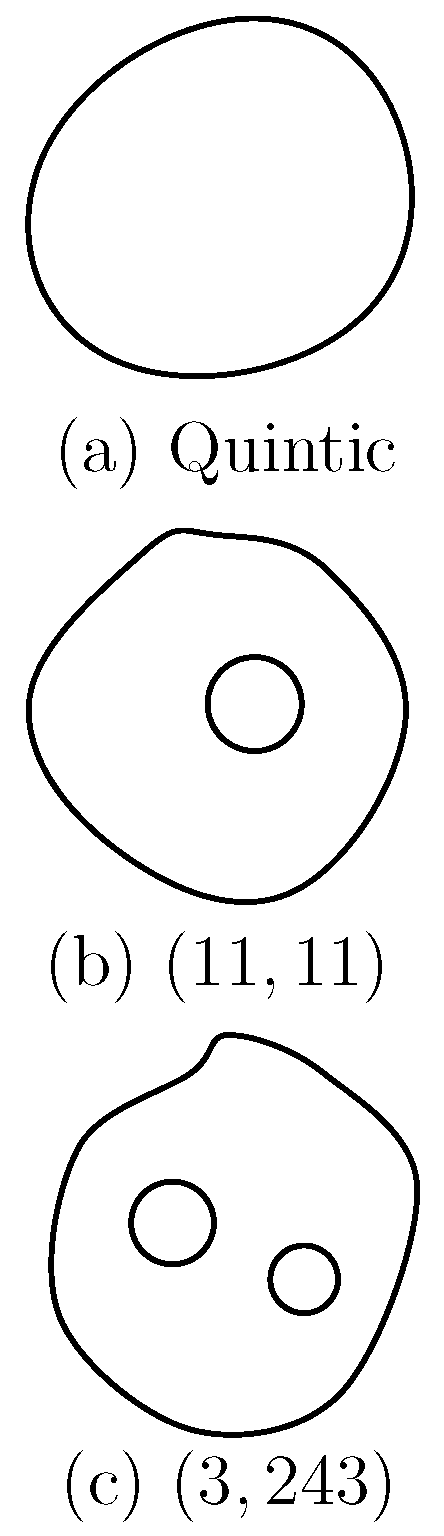
Appendix B.2. Dimensional Transition Diagrams
Figure A2.
Schematic diagrams of dimensional transitions. (a) Transition from a higher-dimensional space to a product of lower-dimensional spaces via compactification. (b) Quantum tunneling between different dimensionalities mediated by an instanton. (c) Holographic duality relating a bulk theory in dimensions to a boundary theory in d dimensions.
Figure A2.
Schematic diagrams of dimensional transitions. (a) Transition from a higher-dimensional space to a product of lower-dimensional spaces via compactification. (b) Quantum tunneling between different dimensionalities mediated by an instanton. (c) Holographic duality relating a bulk theory in dimensions to a boundary theory in d dimensions.
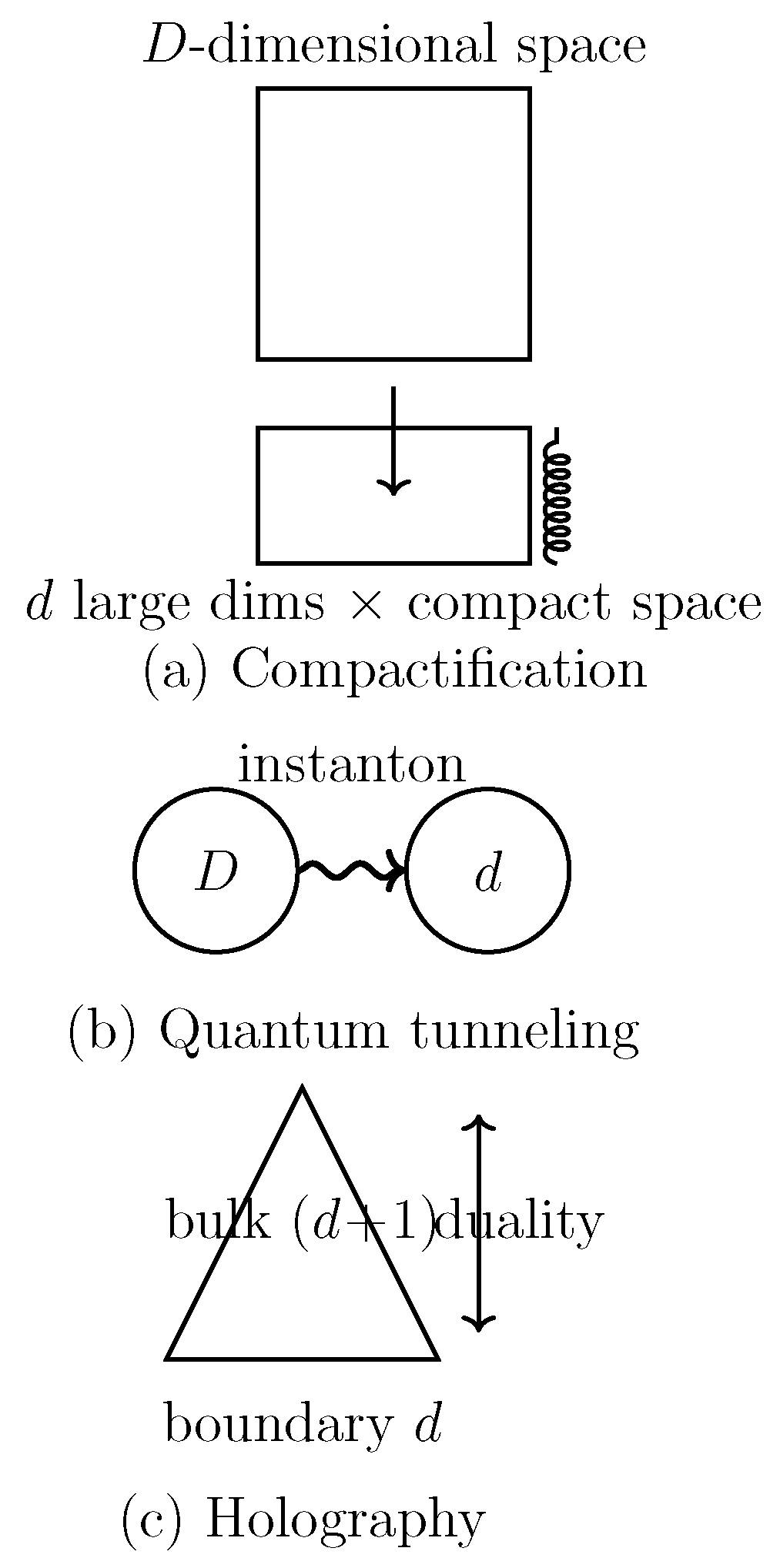
Appendix B.3. Fundamental Constants and Planck Units

Table A1.
Fundamental constants and derived Planck units. Values from CODATA 2018.
| Constant | Symbol | Value | Units |
|---|---|---|---|
| Speed of light | c | 299,792,458 | m/s |
| Planck constant | h | 6.62607015 | J·s |
| Reduced Planck constant | ℏ | 1.054571817 | J·s |
| Gravitational constant | G | 6.67430 | |
| Boltzmann constant | 1.380649 | J/K | |
| Planck length | 1.616255 | m | |
| Planck time | 5.391247 | s | |
| Planck mass | 2.176434 | kg | |
| Planck temperature | 1.416784 | K |
Appendix B.4. Properties of Superstring Theories
Table A2.
Properties of the consistent superstring theories and M-theory.
| Theory | Dimensions | Supersymmetry | Gauge Group | Notes |
|---|---|---|---|---|
| Type I | 10 | Open and closed strings | ||
| Type IIA | 10 | (non-chiral) | Closed strings only | |
| Type IIB | 10 | (chiral) | – | Closed strings only |
| Heterotic | 10 | Closed strings only | ||
| Heterotic | 10 | Closed strings only | ||
| M-theory | 11 | – | Strong coupling limit of IIA |
Appendix B.5. Cosmological Evolution Diagrams
Figure A3.
The evolution of the universe in various models. (a) Standard CDM model. (b) Model with a dimensional transition at early times. (c) Loop quantum cosmology model with a bounce. The shaded regions indicate different epochs: inflation, radiation domination, matter domination, and dark energy domination.
Figure A3.
The evolution of the universe in various models. (a) Standard CDM model. (b) Model with a dimensional transition at early times. (c) Loop quantum cosmology model with a bounce. The shaded regions indicate different epochs: inflation, radiation domination, matter domination, and dark energy domination.
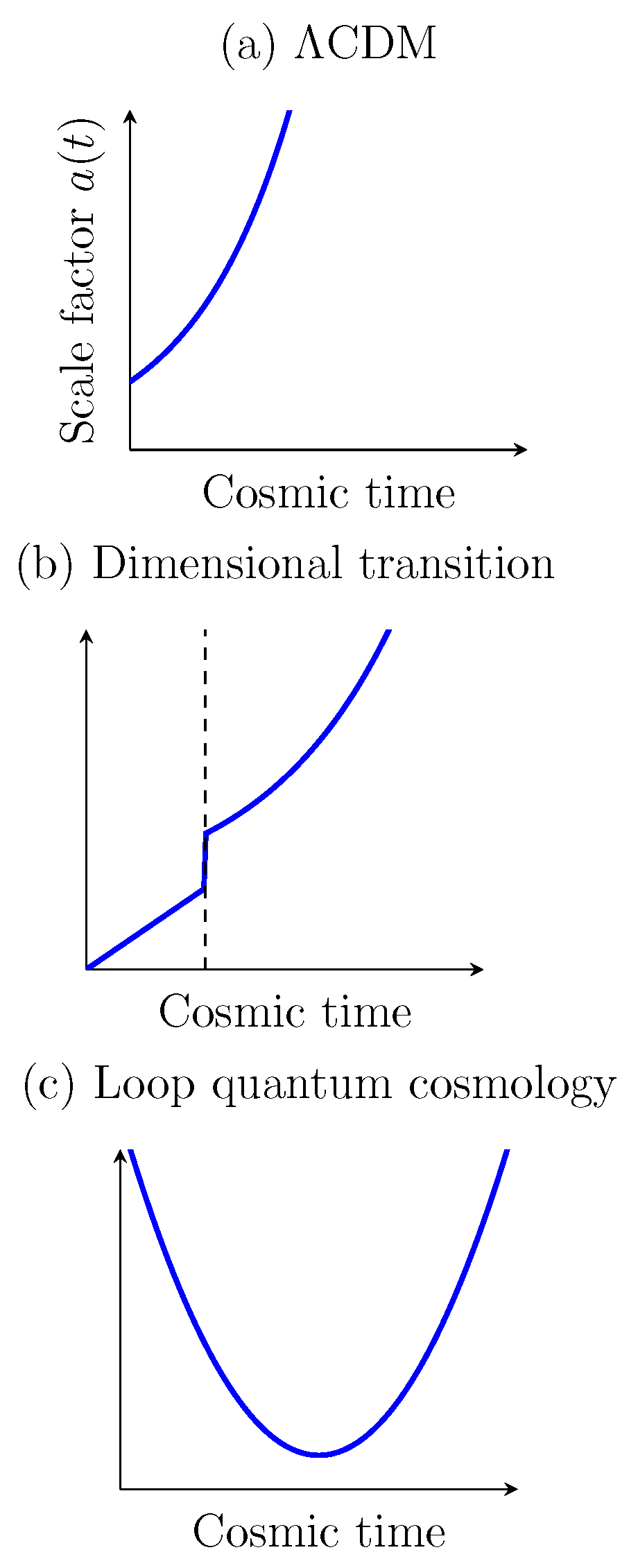
Appendix B.6. Topological Invariants of Calabi-Yau Manifolds
Table A3.
Topological invariants of some notable Calabi-Yau threefolds. The number of generations is in some string compactifications.
Table A3.
Topological invariants of some notable Calabi-Yau threefolds. The number of generations is in some string compactifications.
| Hodge numbers | Euler characteristic | Number of generations | Example |
|---|---|---|---|
| (1, 101) | -200 | 100 | Quintic threefold |
| (3, 243) | -480 | 240 | |
| (11, 11) | 0 | 0 | |
| (27, 27) | 0 | 0 | |
| (101, 1) | 200 | 100 | Mirror of quintic |
Appendix B.7. Dimensional Transition Instanton
Figure A4.
Numerical solution for the instanton mediating a transition from 10 to 4 dimensions. The scale factor for the three large dimensions increases from zero, while the scale factor for the six extra dimensions decreases to a small value.
Figure A4.
Numerical solution for the instanton mediating a transition from 10 to 4 dimensions. The scale factor for the three large dimensions increases from zero, while the scale factor for the six extra dimensions decreases to a small value.
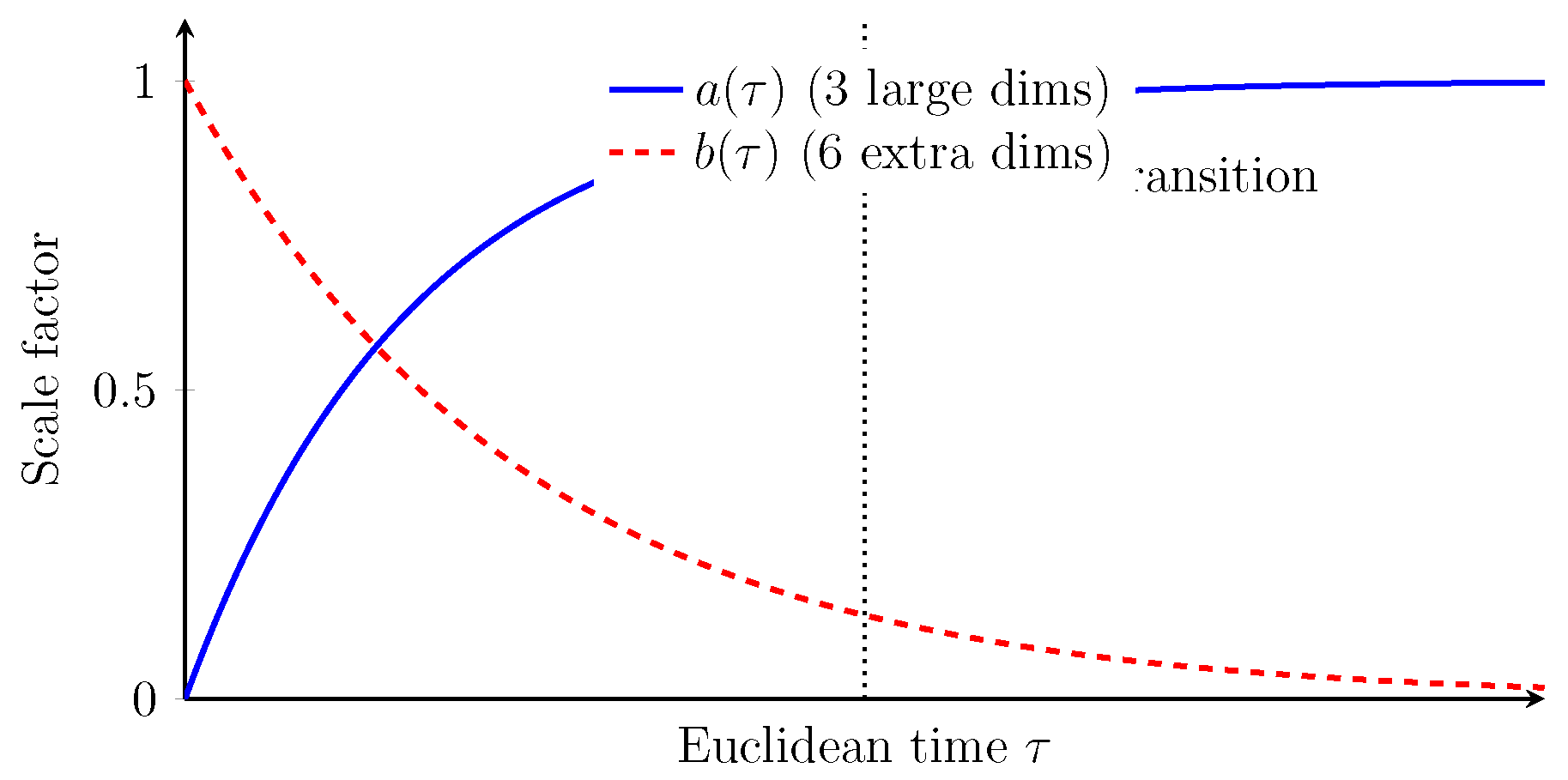
Appendix B.8. Experimental Constraints on Extra Dimensions
Table A4.
Experimental constraints on extra dimensions (ED) from various experiments. is the size of extra dimensions, n is the number of extra dimensions, and is the fundamental Planck scale in models with large extra dimensions.
Table A4.
Experimental constraints on extra dimensions (ED) from various experiments. is the size of extra dimensions, n is the number of extra dimensions, and is the fundamental Planck scale in models with large extra dimensions.
| Experiment | Type | Constraint | Implications |
|---|---|---|---|
| Torsion balance | Gravity at short distances | () | Rules out large extra dimensions with |
| LHC | Missing energy | – (–6) | Constrains the fundamental Planck scale |
| Supernova cooling | Energy loss | () | Strong constraint for |
| Neutron star heating | Thermal emission | () | Comparable to supernova bounds |
Appendix B.9. Scale-Dependent Dimension
Figure A5.
The effective dimension as a function of scale. At large scales (low energy), . At the Planck scale, . The transition occurs around the Planck scale.
Figure A5.
The effective dimension as a function of scale. At large scales (low energy), . At the Planck scale, . The transition occurs around the Planck scale.
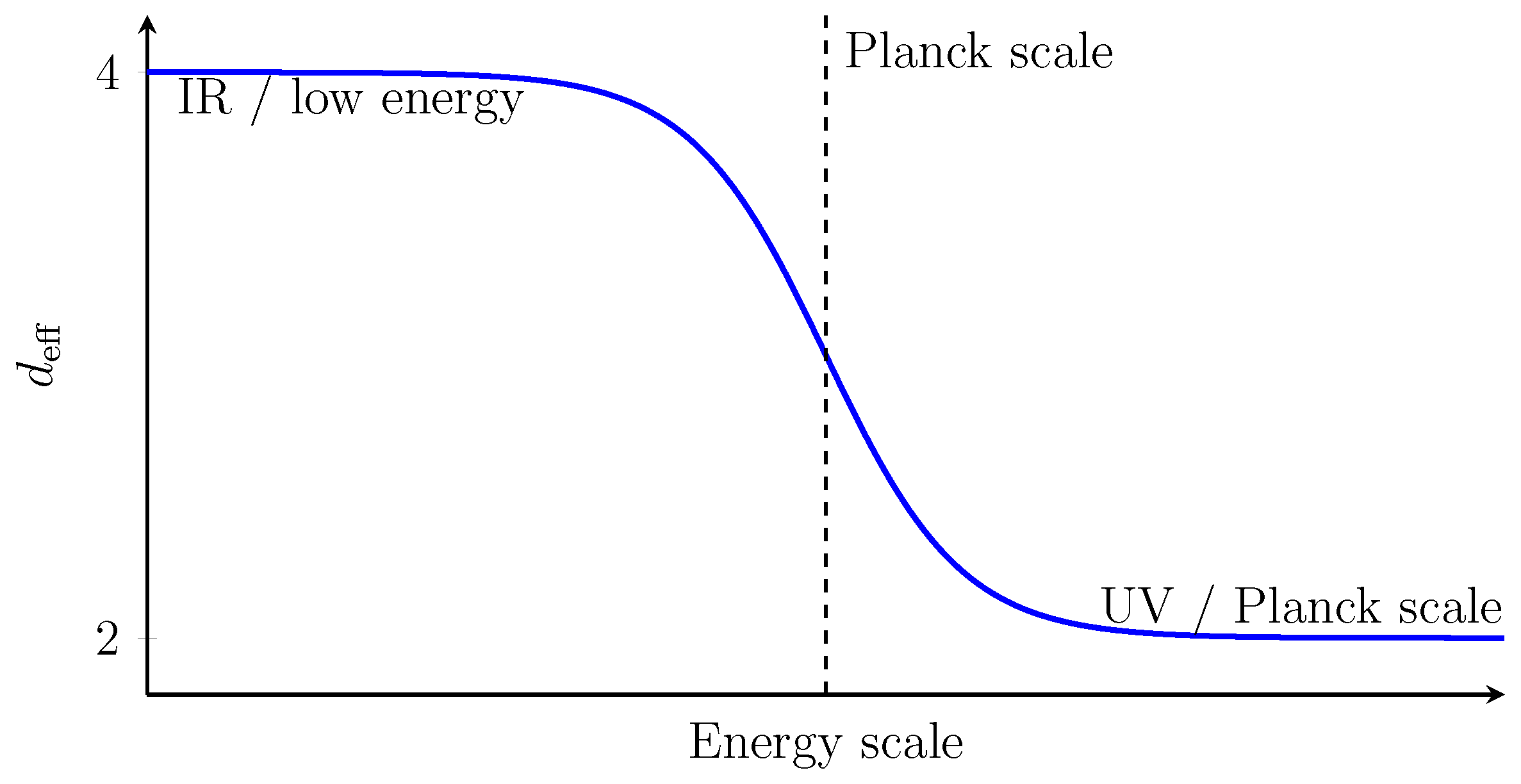
References
- Wald, R. M. General Relativity; University of Chicago Press, 1984; ISBN 978-0226870335. [Google Scholar]
- Fourier, J. Théorie Analytique de la Chaleur; Firmin Didot, 1822. [Google Scholar]
- Buckingham, E. On Physically Similar Systems; Illustrations of the Use of Dimensional Equations. Phys. Rev. 1914, 4, 345–376. [Google Scholar] [CrossRef]
- Roy, S. S.; Sadhu, R.; Bhattacharjee, D.; Samal, P.; Nandi, P.; Thakur, S. N. Brane Clustering as a UV Completion to Quantum Gravity. Preprints 2025, 2025080407. [Google Scholar] [CrossRef]
- Klein, O. Quantentheorie und fünfdimensionale Relativitätstheorie. Zeitschrift für Physik 1926, 37, 895–906. [Google Scholar] [CrossRef]
- Bhattacharjee, D. M-Theory and F-Theory over theoretical analysis on cosmic strings and Calabi-Yau manifolds subject to conifold singularity with Randall–Sundrum model. Asian Journal of Research and Reviews in Physics 2022, 6(2), 25–40. [Google Scholar] [CrossRef]
- Candelas, P.; Horowitz, G. T.; Strominger, A.; Witten, E. Vacuum Configurations for Superstrings. Nucl. Phys. B 1985, 258, 46–74. [Google Scholar] [CrossRef]
- Bhattacharjee, D. A Coherent Approach towards Quantum Gravity. Physical Science International Journal 2022, 26(6), 59–78. [Google Scholar] [CrossRef]
- ’t Hooft, G. (1993). Dimensional Reduction in Quantum Gravity. arXiv preprint gr-qc/9310026. [CrossRef]
- Vilenkin, A. Quantum Cosmology and the Initial State of the Universe. Phys. Rev. D 1988, 37, 888–897. [Google Scholar] [CrossRef] [PubMed]
- Bojowald, M. Absence of Singularity in Loop Quantum Cosmology. Phys. Rev. Lett. 2001, 86, 5227–5230. [Google Scholar] [CrossRef]
- Maldacena, J. The Large N Limit of Superconformal Field Theories and Supergravity. Int. J. Theor. Phys. 1999, 38, 1113–1133. [Google Scholar] [CrossRef]
- Bhattacharjee, D. Photon interactions in gravity and antigravity: Conservation, dark energy, and redshift effects. Preprints.org (preprint) 2023. [Google Scholar] [CrossRef]
- Strominger, A. The dS/CFT Correspondence. J. High Energy Phys. 2001, 034. [Google Scholar] [CrossRef]
- Hallwell, J. J.; Hertog, T.; Sloan, D. Quantum Probabilities for Inflation from Holography. J. Cosmol. Astropart. Phys. 2018, 017. [Google Scholar] [CrossRef]
- Bridgman, P. W. Dimensional Analysis; Yale University Press, 1931. [Google Scholar]
- Barenblatt, G. I. Scaling, Self-Similarity, and Intermediate Asymptotics; Cambridge University Press, 1996; ISBN 978-0521435222. [Google Scholar]
- Zee, A. Quantum Field Theory in a Nutshell, 2nd ed.; Princeton University Press, 2010; ISBN 978-0691140346. [Google Scholar]
- Polchinski, J. String Theory, Vol. 1 and 2; Cambridge University Press, 1998; ISBN 978-0521672276. [Google Scholar]
- Ashok, S. K., & Douglas, M. R. (2003). Counting Flux Vacua. J. High Energy Phys., 2004, 060. [CrossRef]
- Denef, F.; Douglas, M. R. Computational Complexity of the Landscape. I. Ann. Phys. 2008, 323, 1826–1851. [Google Scholar] [CrossRef]
- Bhattacharjee, D. Emergent quantum gravity via brane clustering. SSRN Electronic Journal (preprint) 2025. [Google Scholar] [CrossRef]
- Ambjørn, J.; Jurkiewicz, J.; Loll, R. Emergence of a 4D World from Causal Quantum Gravity. Phys. Rev. Lett. 2004, 93, 131301. [Google Scholar] [CrossRef]
- Niedermaier, M.; Reuter, M. The Asymptotic Safety Scenario in Quantum Gravity. Living Rev. Relativ. 2006, 9, 5. [Google Scholar] [CrossRef]
- Spergel, D. N.; et al. First-Year Wilkinson Microwave Anisotropy Probe (WMAP) Observations: Determination of Cosmological Parameters. Astrophys. J. Suppl. 2003, 148, 175–194. [Google Scholar] [CrossRef]
- Riess, A. G.; et al. Observational Evidence from Supernovae for an Accelerating Universe and a Cosmological Constant. Astron. J. 1998, 116, 1009–1038. [Google Scholar] [CrossRef]
- Bhattacharjee, D. Cosmic speed beyond light: Gravitational and cosmic redshift. Preprints.org (preprint) 2023. [Google Scholar] [CrossRef]
- Luminet, J.-P.; et al. Dodecahedral Space Topology as an Explanation for Weak Wide-Angle Temperature Correlations in the Cosmic Microwave Background. Nature 2003, 425, 593–595. [Google Scholar] [CrossRef]
- Planck Collaboration; et al. Planck 2018 Results. VI. Cosmological Parameters. Astron. Astrophys. 2020, 641, A6. [Google Scholar] [CrossRef]
- Noether, E. Invariante Variationsprobleme. Nachr. d. König. Gesellsch. d. Wiss. zu Göttingen, Math-phys. Klasse 1918, 235–257. [Google Scholar]
- Bhattacharjee, D. Solutions of Kerr black holes subject to naked singularity and wormholes. TechRxiv (preprint) 2023. [Google Scholar] [CrossRef]
- Polchinski, J. Dirichlet-Branes and Ramond-Ramond Charges. Phys. Rev. Lett. 1995, 75, 4724–4727. [Google Scholar] [CrossRef]
- Kreuzer, M.; Skarke, H. Complete Classification of Reflexive Polyhedra in Four Dimensions. Adv. Theor. Math. Phys. 2000, 4, 1209–1230. [Google Scholar] [CrossRef]
- Guth, A. H. Inflationary Universe: A Possible Solution to the Horizon and Flatness Problems. Phys. Rev. D 1981, 23, 347–356. [Google Scholar] [CrossRef]
- Bhattacharjee, D. A shift in norms of gravity and space-time encompassing the complex Newman-Penrose tetrads of general relativity incorporating the constraints of humanity related to extraterrestrials. TechRxiv (preprint) 2020. [Google Scholar] [CrossRef]
Disclaimer/Publisher’s Note: The statements, opinions and data contained in all publications are solely those of the individual author(s) and contributor(s) and not of MDPI and/or the editor(s). MDPI and/or the editor(s) disclaim responsibility for any injury to people or property resulting from any ideas, methods, instructions or products referred to in the content. |
© 2026 by the authors. Licensee MDPI, Basel, Switzerland. This article is an open access article distributed under the terms and conditions of the Creative Commons Attribution (CC BY) license (http://creativecommons.org/licenses/by/4.0/).
Copyright: This open access article is published under a Creative Commons CC BY 4.0 license, which permit the free download, distribution, and reuse, provided that the author and preprint are cited in any reuse.


