
Submitted:
03 February 2026
Posted:
06 February 2026
You are already at the latest version
Abstract
We present a complete and self-consistent framework for the unification of all fundamental forces, matter, and the cosmological sectors of the universe derived from the symmetry of a 4-dimensional complex spacetime (GL(4,C)). To preserve unitarity and ensure the theory is entirely free of ghosts (negative-norm states), we enforce a physical stratification based on a Cartan decomposition. We demonstrate that the spontaneous symmetry breaking at the Big Bang (GL(4,C) -> U(4)) initiates a "Radiative Waterfall" that deterministically derives all physical constants—including the Higgs mass (125.190 +/- 0.032 GeV) and the top quark mass (172.68 +/- 0.22 GeV)—with sub-percent accuracy. Crucially, the framework provides a zero-parameter resolution to current cosmological tensions through first-principles predictions rather than phenomenological fits. The theory identifies the dark sector as a structural requirement of the GL(4,C) manifold, predicting the existence of Cosmic Threads as 1-dimensional topological solitons of shear that form the macroscopic scaffolding of the universe. These structures are mathematical necessities of the 10-5-1 partition of the coset GL(4,C)/U(4) and align with the structural ordering and "scaffolding" observed in the 2026 COSMOS-Webb high-resolution mapping. The dark sector is further resolved into a dual-natured system that is simultaneously attractive and repulsive, comprising an ultra-light dark scalar (m_phi approx 2.3 meV) and a massive dark vector (m_Omega approx 332 MeV). The scalar mediates long-range attraction for web formation, while the vector’s "geometric stiffness" generates short-range repulsion to resolve the galactic core-cusp problem. Finally, the model analytically derives an interaction constant beta = 3/(128pi) approx 0.00746 (corresponding to xi approx 0.0225) governing energy transfer between dark energy and dark matter. This prediction resolves the 5-sigma Hubble tension (H_0 approx 72.8 +/- 0.7 km/s/Mpc) and the S_8 structure tension (S_8 approx 0.764), providing a rigorous geometric foundation for the evolving dark energy signatures recently reported by the DESI collaboration.
Keywords:
4D complex spacetime
; GL(4
; C)
; Cartan decomposition
; geometric unified theory
; dark matter
; dark energy
; Hubble tension
; S8 tension
; Higg's mass prediction
; cosmic threads and clews
| Contents | ||
| 1 | Introduction: The Twin Crises and the Call for a New Principle | 10 |
| I | The Foundational Geometric Framework | 11 |
| 2 | The Projective Principle: A 4D Complex Reality | 11 |
| 3 | The Primordial Symmetry Breaking: GL(4,C) → U(4) | 12 |
| 4 | The Warden Mechanism of Confinement | 12 |
| 5 | Unification and High Energy Consistency | 13 |
| 6 | The Cosmic Web Lagrangian and its Fields | 13 |
| 6.1. Partition of the Cosmic Sector: The Geometric Origin of Gravity, Dark Matter, and Dark Energy. | 13 | |
| 6.2. The Gravitational Sector (10 Generators): The Geometry of Spacetime. | 14 | |
| 6.3. The Dark Energy Sector (1 Generator): Isotropic Scaling and the Dilaton. | 14 | |
| 6.4. The Dark Sector (5 Generators): The Unified Geometric Origin of Substance and Stiffness. | 15 | |
| 6.5. Summary of the Partition | 15 | |
| 6.6. Physical Interpretation of the Coset Sector: Gravity and Topological Defects | 17 | |
| 6.6.1. The 10+5+1 Decomposition | 17 | |
| 6.6.2. The Graviton as a Geometric Restoring Force. | 17 | |
| 6.6.3. Cosmic Threads: The Topology of Shear. | 18 | |
| 6.6.4. Dark Matter Halos as Geometric Clews | 18 | |
| 6.7. Mathematical Foundations of the Symmetric Split. | 18 | |
| 6.7.1. Roadmap to Quantitative Analysis | 19 | |
| 7 | The Cosmic Web Lagrangian: The Laws of the Geometric Cosmos | 19 |
| 7.1. The Gravitational Sector (LGravity): The Laws of Geometry. | 19 | |
| 7.2. The Dark Energy Sector (LDE): The Laws of Expansion. | 19 | |
| 7.3. The Dark Sector (LDark): The Laws of Substance and Stiffness | 20 | |
| 7.4. The Total Cosmic Lagrangian. | 20 | |
| 7.5. Recovery of General Relativity via Vainshtein Screening. | 21 | |
| 8 | The Dual Nature of the Dark Sector: Attractive and Repulsive Forces | 21 |
| 8.1. The Repulsive Component: The Vector-Mediated "Geometric Stiffness" | 21 | |
| 8.1.1. Empirical Evidence for the Geometric Current | 22 | |
| 8.2. The Attractive Component: The Scalar-Mediated "Geometric Substance". | 22 | |
| 8.3. The Unified Dark Sector and Its Phenomenological Consequences. | 22 | |
| 8.4. The Mathematical Conclusion. | 23 | |
| 9 | The Cosmic Web Lagrangian: Derivation from First Principles | 23 |
| 9.1. First Principles of Lagrangian Construction. | 23 | |
| 9.2. The Unified Theory: The Total Lagrangian of Reality. | 24 | |
| 10 | The Unified GL(4,C) Action and the Origin of Scales | 24 |
| 10.1. The Action Principle of the Primordial Universe. | 24 | |
| 10.2. The Decomposition of the Curvature Scalar. | 25 | |
| 10.3. The Origin of Scales | 25 | |
| 10.4. The Observer’s Perspective: Why We See Particles on a Stage. | 25 | |
| 11 | The Geometric Origin of the Hierarchy: Hermitian vs. Anti-Hermitian Dynamics | 26 |
| 11.1. The Mathematical Origin: The Algebra of Preservation vs. Deformation. | 26 | |
| 11.2. The Physical Consequence: Primordial vs. Projected Reality. | 26 | |
| 11.3. The Filamentary Nature of the Dark Sector: Why Threads?. | 27 | |
| 11.3.1. The Dual Structure: Core and Sheath. | 27 | |
| 11.3.2. The ’Cosmic Clew’ Model. | 27 | |
| II | The Radiative Bridge: The Origin of All Physical Scales | 28 |
| 12 | The Breaking of Scales as a Consequence of the Splitting | 28 |
| 12.1. The Radiative Waterfall as the Bridge Between Scales | 29 | |
| 12.2. Calculation I: Gravity-Mediated Symmetry Breaking (MPl→MGUT) | 29 | |
| 12.3. Calculation II: Radiative Electroweak Symmetry Breaking (MGUT→vEW) | 30 | |
| 12.4. Calculation III: Confinement and Mass (vEW→ΛQCD). | 31 | |
| 12.5. Predictions and Consistency Checks from the Radiative Waterfall. | 32 | |
| 12.6. Verification I: The Stability of the Electroweak Vacuum. | 32 | |
| 12.7. Prediction II: The Mass of the Higgs Boson | 33 | |
| 12.8. Prediction III: The Strong Coupling Constant at the Z-Pole | 34 | |
| 12.9. The Final Verification: A Consistent Unification | 34 | |
| 12.10. The Origin of Scale: MPl as a Dynamically Generated Constant | 35 | |
| 12.10.1. Geometric Resistance (Rgeom) | 37 | |
| 12.10.2. Loop Coefficient (C) | 38 | |
| 12.11. Resolution of the Hierarchy Problem: Why Gravity Is Weak | 39 | |
| 12.12. The Mass of the Top Quark and the Stability of the Vacuum. | 39 | |
| 12.13. The Fine-Structure Constant and the Geometry of Unification. | 40 | |
| 13 | The Big Calculation | 41 |
| 13.1. The First Split: The Birth of Gravity and the GUT Force. | 41 | |
| 13.2. The Second Split: The Emergence of the Three Standard Model Forces | 42 | |
| 13.3. The Final Illusion: The Running of the Couplings | 42 | |
| 14 | The Scales of the Geometric Cosmos: Defining the "Mass" of the Big Particles | 43 |
| 14.1. The Primordial Scale of Gravity: The Planck Mass | 43 | |
| 14.2. The Dark Scalar Mass (mO): A Consequence of Vacuum Energy. | 43 | |
| 14.3. The Dark Vector Mass (mΩ): A Consequence of the Tilted Universe | 44 | |
| 15 | The Content and Properties of the Cosmic Threads | 45 |
| 15.1. The Graviton: A Goldstone Phonon of the Geometric Coset. | 45 | |
| 15.1.1. Origin: The Broken Generators. | 45 | |
| 15.1.2. The Phonon Interpretation. | 45 | |
| 15.1.3. Compatibility with LIGO/Virgo Observations | 45 | |
| 15.1.4. The Orthogonality Shield: Suppression of Vacuum Cherenkov Radiation. | 46 | |
| 15.1.5. Quantitative Phenomenology: The Relaxation Afterglow | 47 | |
| 15.2. The Dark Scalar O: Geometric Substance and the Core-Cusp Resolution. | 47 | |
| 15.2.1. Mass Derivation: The Vacuum Resonance. | 47 | |
| 15.2.2. The Geometric Solution to the Cusp Problem | 47 | |
| 15.3. The Dark Vector (Ω): The Quantum of Stiffness | 48 | |
| 15.4. The Dilaton (Φ): The Quantum of Tension (The Dark Energy Field) | 48 | |
| 16 | The Macroscopic Properties: The Physics of the Fabric of Reality | 49 |
| 16.1. Tension (T): The Fundamental Property. | 49 | |
| 16.2. Mass Per Unit Length (μ): The Substance | 49 | |
| 16.3. Stiffness and Bending Rigidity (κ): The Internal Structure. | 49 | |
| 16.4. The "Clew" State: Dark Matter in Galaxies. | 50 | |
| III | Cosmological Constant Phenomenological Confrontation | 50 |
| 17 | Derivation of the Modified Hubble Law | 50 |
| 18 | Derivation of the Hubble Constant (H0) and Resolution of the Cosmological Tension | 51 |
| 18.1. Theoretical Error Analysis (±0.7) | 52 | |
| 18.2. Eliminating the Tension. | 52 | |
| 19 | Quantitative Analysis: The Geometric Theory’s Resolution of the Hubble Tension | 52 |
| Quantitative Analysis: The Geometric Theory’s Resolution of the Hubble Tension | 52 | |
| 19.1. The Microscopic Boundary Condition: The Bare Vacuum (ρΛth) | 54 | |
| 19.2. The Geometric Interaction (β) and Time Evolution. | 54 | |
| 19.3. The Macroscopic Observable: The Effective Local Vacuum (ρΛeff) | 54 | |
| 20 | Energy Density Accounting and Resolution of the Hubble Tension | 55 |
| 20.1. The Target: Quantifying the ’Energy Gap’ | 55 | |
| 20.2. The Solution: A Two-Component Boost. | 55 | |
| 20.3. Weighted Combination and Conclusion. | 55 | |
| 21 | The Final Cosmological Pie at Present Day (z=0) | 56 |
| 21.1. Cosmic Composition Breakdown | 56 | |
| 21.2. Scaling Symmetry: Why the Fractions Remain Constant. | 56 | |
| 21.3. Theoretical Implication: The 10:6 Geometric Split. | 56 | |
| 22 | Resolution of the S8 Structure Tension | 57 |
| 22.1. The Physical Mechanism: Stiffness vs | 57 | |
| 22.2. The Calculation: The Suppression Factor. | 57 | |
| 22.3. The Prediction vs. | 57 | |
| 23 | Consistency with Early Universe Observables (BBN and CMB) | 58 |
| 23.1. Preservation of Primordial Abundances (BBN). | 58 | |
| 23.2. The CMB Sound Horizon. | 59 | |
| 24 | The Geometric Black Hole Spectrum | 59 |
| 25 | Evolution of Black Hole Sizes (0−1 Myr) | 59 |
| 25.1. Timeline of Black Hole Growth. | 60 | |
| 25.2. Detailed Snapshot at t=1,000,000 Years | 60 | |
| 25.3. Prediction of Pre-Recombination Seeds. | 60 | |
| 26 | Chronology of the Geometric Universe | 61 |
| 26.1. Phase I: The Primordial Era (Geometry Dominance) | 61 | |
| 26.2. Phase II: The Structure Era (The Great Collapse) | 61 | |
| 26.3. Phase III: The Acceleration Era (Vacuum Evolution) | 61 | |
| 27 | The History of Cosmic Content | 62 |
| 27.1. The History of Cosmic Content. | 63 | |
| 28 | Consistency with Intermediate Redshift Probes (The BAO Scale) | 63 |
| 28.1. The Modified Hubble Function | 64 | |
| 28.2. The Pivot Calculation: z=1 | 64 | |
| 29 | The Speed of Gravity in a Topological Network | 65 |
| 29.1. The Nature of the Inflationary Epoch | 65 | |
| 29.2. Derivation of Inflationary Parameters within the Unified Geometric Theory. | 66 | |
| 29.3. Calculation of the Tensor-to-Scalar Ratio (r). | 66 | |
| 29.3.1. The Stiffness Parameter (S). | 67 | |
| 29.3.2. Derivation of the Potential Slope. | 67 | |
| 29.3.3. Analytical and Numerical Result. | 67 | |
| IV | Cartan’s Triality | 67 |
| 30 | The Geometric Origin of Particles | 68 |
| 30.1. The Miracle of Eight Dimensions: Cartan’s Principle of Triality. | 68 | |
| 31 | The Origin of the Spacetime Signature | 68 |
| 31.1. Realification of GL(4,C) | 69 | |
| 31.1.1. Identification of Physical Sectors | 69 | |
| 31.2. The Triality Selection Rule: The ’DRT’ Constraint. | 69 | |
| 31.3. The Principle of Signature Equivalence | 70 | |
| V | The extended Klein-Gordon equation | 70 |
| 32 | The Axiomatic and Empirical Foundation of the Theory | 70 |
| 32.1. The Foundational Axioms of the Geometric Theory. | 70 | |
| 32.2. Derived Principles and Conditions of Coherence. | 71 | |
| 33 | The Two Voids: Quantum and Cosmic | 71 |
| The | Two Voids: Quantum and Cosmic | 71 |
| 33.1. The Link Between Cosmic Time T and the Radius of Cosmos. | 75 | |
| 33.2. The Parameters ρ, ω, κ. | 76 | |
| 33.3. The Interplay Between the Two Times. | 77 | |
| 33.4. At the Origin of Times | 77 | |
| 33.5. The Physical Meaning of the Constant A | 79 | |
| 33.6. The Calculation from Group Theory: Ratios of Normalizations. | 79 | |
| 34 | The Splitting of the Unified Constant: How One Law Becomes Many Forces | 79 |
| 34.1. The Primordial State: One Universe, One Constant | 79 | |
| 35 | The Master Consistency Equation and the Prediction of Fundamental Constants | 80 |
| 36 | Resolution of the Vacuum Dynamics: Eigenstate vs. Evolution | 82 |
| 36.1. The Static Limit: The Klein-Gordon Eigenstate. | 82 | |
| 36.2. The Dynamic Reality: The Cosmological Evolution. | 82 | |
| 36.3. The Convergence Mechanism. | 82 | |
| 37 | Spectroscopy of the Vacuum: Geometric Resonances as Portals | 83 |
| 38 | Mass Spectrum and the Top Quark Case | 83 |
| 38.1. Geometric Renormalization and the Abelian Limit=Discussion | 83 | |
| 38.2. Experimental Verification of Geometric Thresholds. | 84 | |
| 38.3. The Continuum Limit and Asymptotic Freedom | 84 | |
| 38.4. Proof of Spectral Dissolution (Resonance Overlap). | 85 | |
| 38.5. Uncertainties-Corrections. | 86 | |
| 38.6. Validation of Composite Binding Energies | 86 | |
| VI | The Geometric Foundations of Complex Spacetime | 86 |
| 39 | The Geometric Foundations of Complex Spacetime | 87 |
| 39.1. Unification in the 8D Elementary Length. | 89 | |
| 39.2. Generator Indices and Mass-Coordinate Mapping. | 89 | |
| 39.3. Statement of 4D Lorentz Covariance and Mass Invariance | 90 | |
| 39.3.1. Covariance of the Dark Sector Masses | 91 | |
| 39.4. Mathematical Notation Guide and Presummary | 91 | |
| 39.4.1. The 8D Manifold and Metric Structure. | 91 | |
| 39.4.2. The Symplectic Particle Sector. | 91 | |
| 39.4.3. The Dark Sector Fields (The Cosmic Part). | 91 | |
| 39.4.4. The Interaction and Expansion | 92 | |
| 39.5. Geometric Origin of the Covariant Derivative | 92 | |
| 39.6. Geometric Origin of Forces from the Unified Connection | 93 | |
| 39.6.1. The Gravitational Connection (Γk,ij). | 94 | |
| 39.6.2. The Gauge Connection (Δk,ij). | 94 | |
| 39.7. The Projective Principle and the Effective 4D Metric | 94 | |
| 39.8. The general case embedding | 95 | |
| 39.9. The Geometric Origin of the Dual Embedding. | 95 | |
| 39.10. The Dual-Component Structure and Mass-Geometrization. | 95 | |
| 39.11. Phenomenological Validation: Resolving the Core-Cusp Discrepancy. | 96 | |
| 39.12. Comparison with SPARC Data | 97 | |
| 40 | Physical Interpretation of the Results | 97 |
| 40.1. The Physical Meaning of the Embedding Function’s Numbers | 99 | |
| 40.2. Final Report: The Multi-Galaxy Simulation Campaign | 100 | |
| 40.3. The Mechanical Inhibition of Star Formation in Dragonfly 44. | 101 | |
| 40.4. The General Functional Form: The Law of Geometrized Mass | 101 | |
| 41 | Comparative Analysis of Cosmological Models | 103 |
| 42 | The Foundational Principle: A Tale of Two Sectors | 103 |
| 42.1. Initial Equipartition and the 16 Generators. | 103 | |
| 42.2. The Law of Asymmetric Survival | 104 | |
| 42.3. The Hubble Tension and the Interaction Constant β | 104 | |
| 42.4. The Final Energy Budget. | 104 | |
| 42.5. The Geometric Origin of the 1/a3 Dilution Law. | 104 | |
| 42.6. Analytical Derivation of the Cosmic Energy Budget. | 105 | |
| 42.7. The Great Wall of Reality: Why the Two Worlds Cannot Talk. | 107 | |
| 43 | The Analytical Framework of Cosmic Evolution | 108 |
| 43.1. The Master Equation of Expansion | 1 | |
| 43.2. Component Equations of State | 109 | |
| 43.3. The Interacting Dark Sector and the Final Evolution Law. | 109 | |
| 43.4. Predicted Fractional Densities | 109 | |
| 43.5. Breakdown of the Equation’s Parameters | 110 | |
| 43.6. The New Physics: The Interacting Dark Sector | 110 | |
| 43.7. First-Principles Derivation of Cosmological Parameters | 110 | |
| 43.8. Quantitative Alignment with DESI 2024/2025 Observations. | 111 | |
| VII | The role of Kähler manifold | 111 |
| 44 | Holonomy and the Geometric Origin of Gauge Symmetry | 111 |
| VIII | The Internal Mass space | 112 |
| 45 | Generalized Special Relativity in Complex Spacetime | 112 |
| 46 | The Geometric Definitions of Mass | 114 |
| 47 | The Dynamics of Mass Generation | 115 |
| 47.1. The Geometric Derivation of the Renormalization Group. | 116 | |
| 47.2. The Chronological Identification of Mass | 118 | |
| 47.3. The Fossil Record of Expansion. | 118 | |
| 48 | The Radiative Waterfall of Time | 119 |
| 48.1. Deriving the Spectrum from the Timeline. | 119 | |
| 49 | Derivation of the Master Equation | 120 |
| 49.1. The Discrete Waterfall (The Quantization). | 121 | |
| 50 | Derivation of the Geometric Heat Kernel | 121 |
| 50.1. Physical Interpretation in the Waterfall | 123 | |
| 51 | Geometric Derivation of Quantum Numbers | 123 |
| 51.1. Spin (s): The Complex Rotation | 123 | |
| 51.2. Electric Charge (Q): The Equatorial Winding. | 123 | |
| 51.3. Weak Isospin (T3): The Polar Projection. | 124 | |
| 51.4. Color Charge (Nc): The Volume Orientation. | 124 | |
| 51.5. Summary Table of Geometric Quantum Numbers | 124 | |
| 52 | The Kinematics of Existence: Velocities, Mass, and Particles | 125 |
| 52.1. The Definition of Mass (Rest Energy) | 125 | |
| 52.2. The Definition of a Particle (The Topological Knot). | 125 | |
| 53 | The New Equivalence Principle and the Geometry of Time | 126 |
| 53.0.1. Definition of Mass. | 127 | |
| 53.0.2. Definition of a Particle. | 127 | |
| 53.1. The New Equivalence Principle. | 127 | |
| 53.2. The Placement of Time (Complex Rotation) | 127 | |
| 54 | The Observer’s Horizon: Real vs | 128 |
| 54.1. The 4D Real Observer (The Projection). | 128 | |
| 54.2. The 4D Complex Observer (The Reality). | 128 | |
| 54.3. The Geometric Illusion. | 128 | |
| 55 | The Topological Definition: Mass via the Poincaré Conjecture | 129 |
| 55.1. Redefining the Particle: The ’Poincaré Bubble’. | 129 | |
| 55.2. Redefining Mass: The Ricci Curvature Cost. | 129 | |
| 55.3. The 4D Complex View (The Global Topology). | 130 | |
| 56 | The Quantization Rules: Allowed Values of n and l | 130 |
| 57 | The Solitonic Hierarchy: Why Everything is a Knot | 132 |
| 58 | The Geometry of Death: Decay and Lifetime | 133 |
| 59 | The Grand Connection: From Mass Space to Spacetime Curvature | 134 |
| 59.1. The Mechanism of Indentations. | 134 | |
| IX | Black Holes | 135 |
| 60 | Singularity Resolution: A Calculation of Perspective | 135 |
| 60.1. The Projection Artifact: From 4D Pathologies to 8D Regularity. | 136 | |
| 60.2. The 8D Coordinate Manifold and Complex Unfolding | 137 | |
| 60.3. The Kinematics of Existence: Velocity Rotation and the Second Invariant. | 138 | |
| 60.4. Analytical Derivation of the “Stiffness Metric” Potential. | 139 | |
| 60.5. Rigorous Proof of Curvature Finiteness at the Core | 140 | |
| 61 | The Event Horizon: A Consequence of Signature Equivalence | 141 |
| 61.1. Signature Rotations at the Horizon Boundary. | 141 | |
| 61.2. The Euclidean Transition (4,4)→(8,0) | 142 | |
| 62 | Gravitational Collapse and the Bounce: A Calculation of Competing Forces | 142 |
| 62.1. The Stiffness Lagrangian and Critical Density (ρcrit) | 142 | |
| 62.2. The “Geometric Star” and the Bounce Radius (Rbounce) | 143 | |
| 62.3. Analytical Proof of the Bounce Mechanism | 143 | |
| 63 | Information Paradox Resolution: A Logical Consequence | 144 |
| 63.1. Unitarity and Information Transfer through the 8D Bulk | 144 | |
| 63.2. The Cosmic Branching: New Cosmos vs. | 144 | |
| 63.3. Observational Signatures and Redshift Freezing | 145 | |
| 63.4. Analytical Reinterpretation of the Four Laws of Black Hole Thermodynamics. | 145 | |
| 64 | The Rotating Geometric Soliton: Kerr Analogy and the Ring Resolution | 147 |
| 64.1. Complex Coordinate Shifts and the Newman-Janis Map | 147 | |
| 64.2. The Rotating Stiffness Metric (Boyer-Lindquist form) | 147 | |
| 64.3. Regularization of the Ring Singularity | 148 | |
| 64.4. The Second Invariant c3/G and Frame-Dragging Limits. | 148 | |
| 64.5. Observational Differences from Kerr. | 148 | |
| X | Epilogue: The Law of Woven Spacetime | 148 |
| 65 | The Reciprocal Causality Loop: The Dilaton’s Mandate and the Warden’s Ladder | 148 |
| 65.1. The Geometric Mandate: The Dilaton as the Top-Down Constraint. | 149 | |
| 65.2. The Warden Condensate: The Quantum Engine and Amplifying Ladder. | 149 | |
| 65.3. Stability of Proton and Galaxies: The Universal Stiffness Scale. | 150 | |
| 65.4. The Macroscopic Bridge: The Dark Cusp Vector | 151 | |
| 65.5. The Magnitude of Geometric Pressure: Verification of the Cusp Solution | 151 | |
| 65.6. Synthesis: Geometric Consequence and Cascading Mass. | 152 | |
| 65.7. First-Principles Derivation of the Interaction Constant (β) | 152 | |
| 66 | Final Predictions of the Theory | 153 |
| 66.1. U(4) Grand Unified Theory. | 153 | |
| 66.2. The Unified Geometric Framework: Comprehensive Predictive Summary. | 154 | |
| XI | Classical or Quantum? | 156 |
| 66.3. The Great Chain of Perception. | 156 | |
| 66.4. The Unification of Forces and the C4 Observer . | 158 | |
| 66.5. Cosmic Evolution as Internal Redistribution . | 158 | |
| 66.6. The Topological Arrow of Time . | 158 | |
| 67 | Analytical Derivation of the Dark Sector Geometry | 158 |
| 67.1. The Geometric Partition and Group Structure. | 158 | |
| 67.1.1. The Dimensional Sum Rule (Topology). | 159 | |
| 67.1.2. The Quadratic Invariant (Symmetry) | 159 | |
| 67.2. Derivation of the Interaction Constant β. | 159 | |
| 67.3. The Asymptotic Density Equilibrium (Ω). | 160 | |
| 67.3.1. The Interaction Mechanism: Orthogonal Pressure | 160 | |
| 67.4. Summary of Analytical Relations. | 160 | |
| 67.5. The Final Equilibrium Percentages: The 10-5-1 Partition. | 160 | |
| 67.5.1. 1. The Distribution Rules | 160 | |
| 67.5.2. 2. The Derived Values | 160 | |
| 67.5.3. 3. Comparison with Observation | 161 | |
| 67.6. The Critical Age: Resolving the Cosmic Coincidence | 161 | |
| 67.7. The Fate of the Universe: The Saturated State. | 162 | |
| 67.8. Geometric Flatness: The Conservation of Dimensions | 162 | |
| 67.9. The Final Observable Shape: The Cosmic Crystal | 162 | |
| 67.10. Cosmological Classification: Flat, Infinite, and Energetically Closed. | 164 | |
| 67.11. The Dual Perspective: 4D Real vs | 165 | |
| 67.11.1. The Illusion of Infinity. | 165 | |
| 67.11.2. The Nature of the "Drain" (Time vs. | 165 | |
| 67.12. Dynamics in the Complex Spacetime: The Holomorphic Flow. | 166 | |
| 67.12.1. Wick Rotation: Time vs. | 166 | |
| 67.12.2. The Conservation of Flux (The Unitary Cycle). | 166 | |
| 67.12.3. The Global Trajectory: From Big Bang to Crystal | 166 | |
| 67.13. Topological Implications: A Physical Realization of the Poincaré Conjecture | 167 | |
| 67.13.1. The Beta Interaction as Ricci Flow. | 167 | |
| 67.13.2. The "Simple Connectivity" of the Crystal. | 167 | |
| 67.13.3. Resolution of Singularities (Surgery) | 167 | |
| 67.14. The Master Equation: Complex Geometric Flow. | 168 | |
| 67.14.1. Physical Interpretation of the Terms | 168 | |
| 67.14.2. Decomposition into Real Observables. | 168 | |
| 67.14.3. The Equilibrium Solution (The Crystal) | 168 | |
| 67.15. The Geometric Timeline: From Symmetry Breaking to Crystallization. | 169 | |
| 67.15.1. The Origin: The Primordial Partition (t→0) | 169 | |
| 67.15.2. The Present: The Relaxation Epoch (The Critical Age) | 169 | |
| 67.15.3. The Fate: The Cosmic Crystal (t→∞) | 169 | |
| 67.16. The Complex Observer’s View: Poles of the Manifold | 169 | |
| 67.16.1. The Beginning: The Imaginary Pole (Pure Potential). | 170 | |
| 67.16.2. The Trajectory: The Holomorphic Arc | 170 | |
| 67.16.3. The End: The Real Limit Cycle (The Crystal) | 170 | |
| 67.17. The Topological Revelation: The Universe as a Self-Solving Sphere. | 171 | |
| 67.17.1. The Crumpled Beginning (The Manifold). | 171 | |
| 67.17.2. The Smoothing Process (Ricci Flow / β) | 171 | |
| 67.17.3. The Spherical End (The Crystal) | 171 | |
| 68 | Philosophical Implications: The Modern Allegory of the Cave | 171 |
| 68.1. The Shadow of Dimensions | 171 | |
| 68.2. Plato’s "Moving Image of Eternity" | 172 | |
| 68.3. The Poincaré gonjecture | 172 | |
| 68.4. Conclusion | 172 | |
| A. | Appendix Group Theory of GL(4,C) and its Subgroups | 172 |
| B. | Appendix The Primordial gl(4, C) Algebra and the 16+16 Partition | 173 |
| C. | Gravity-Mediated Symmetry Breaking and the Origin of the GUT Scale | 175 |
| D. | Appendix The Two Paths to the Higgs Mass | 177 |
| E. | Appendix Rigorous Derivation of the Higgs Mass and Temporal Evolution | 178 |
| F. | Appendix Rigorous Analytical Derivation of Geometric Moduli | 180 |
| F. | F.1. 3. Derivation of the Stiffness Amplitude (Ap) | 180 |
| G. | References | 182 |
1. Introduction: The Twin Crises and the Call for a New Principle
Current fundamental physics is characterized by significant empirical success alongside persistent theoretical and observational challenges. The Standard Model of particle physics [20,21] and the CDM model of cosmology together constitute a robust framework that describes a broad range of observable phenomena with high precision. However, this framework faces notable limitations. Theoretically, the Standard Model does not yet incorporate gravity, explain the origin of its fundamental parameters, or provide a complete account of color confinement. Additionally, the CDM model currently faces increasing tension with cosmological data, most notably the discrepancies observed in the Hubble Tension [22].
These twin crises signal the end of the current paradigm. A new foundational principle is required. For a century, the search for unification has proceeded by adding new structures—extra dimensions [23,24], new particles, or new symmetries—onto the existing framework. This paper argues for a different path. We propose that the solution is not to add, but to derive. We present a complete theory of physics that flows from a single, powerful, and elegant first principle: the symmetry of the spacetime in which reality unfolds is not the 4-real-dimensional Lorentz group, but the 4-complex-dimensional general linear group, [25]. Crucially, this 4D complex geometry is mathematically isomorphic to an 8-real-dimensional manifold with a signature. In this framework, our perceived 4D Lorentzian universe is not the totality of space, but a specific projection of this underlying 8D geometric reality.
We will demonstrate that this single postulate is sufficient to derive the entire structure of the universe. The breaking of this primordial symmetry naturally separates reality into a geometric cosmic sector and a quantum particle sector. The physics of the particle sector, governed by the unbroken subgroup , is shown to contain a novel and predictive mechanism for QCD confinement via the emergence of ’Warden’ fields [1]. The physics of the cosmic sector, governed by the broken coset generators, is shown to be that of a ’cosmic web’ whose properties are precisely what we observe as gravity, dark matter, and dark energy. The fundamental division of the symmetry into and its coset is not merely an algebraic convenience, but a dimensional foliation. We posit that the 8D manifold consists of 4D spacetime and 4 internal dimensions, where a specific partition occurs: three coordinates carry the property of inertial substance (the mass-sector), while the remaining degrees of freedom ensure that the Standard Model (antisymmetric sector) and the Cosmic Web (symmetric sector) remain orthogonally shielded yet physically anchored in the same manifold.
A fundamental obstruction to utilizing as a gauge group in standard Quantum Field Theory is the non-compactness of its Lie algebra, which typically creates an unbounded Hamiltonian and violates unitarity due to the presence of negative-norm’`ghost’ states. We resolve this by enforcing a physical stratification of the algebra based on the Cartan decomposition . Here, represents the maximal compact subalgebra, while denotes the non-compact subspace isomorphic to the coset . We postulate a ’Cosmic Partition’ wherein the quantization condition is applied exclusively to the compact sector , ensuring a positive-definite Hilbert space for the Standard Model and Warden fields. Conversely, the non-compact generators are effectively’`de-quantized’ and identified with the classical dynamical variables of the spacetime metric. This aligns well with the precedent set by General Relativity, where the local symmetry group of gravity—the Lorentz group —is itself non-compact. Just as the non-compactness of the Lorentz group is essential for defining the boost structure of spacetime rather than particle states, the non-compact generators of our coset sector manifest not as unstable ghosts, but as the classical geometric background (Dark Energy) and the metric expansion of the universe. Thus, the topology stabilizes the hierarchy, preventing the mixing of quantum gauge fields with the classical geometric background.
The central thesis of this work is that the four-dimensional universe is a projection of an underlying eight-dimensional manifold , where the extra dimensions are not merely ’hidden’ but are the literal geometrization of mass. In this framework, the standard particle sector is identified with the antisymmetric tensor of a symplectic 8D geometry. This sector provides the gauge structure and quantum identity of matter, while the three additional mass-like coordinates allow for the first time a purely geometric origin for inertial mass. Conversely, the cosmic sector—comprising gravity, dark matter, and dark energy—emerges from the symmetric part of the coset. This leads to a ’Woven Universe’ where the dark sector is a structural substance composed of high-tension filaments, or ’Threads’, that inhabit the same mass-like coordinates as standard particles but remain orthogonally shielded from them by their symmetric algebraic origin.
The framework yields a suite of parameter-free predictions that show remarkable alignment with observed physical constants and current cosmological data. By identifying the dark sector as a dimensional partition of the 8D manifold, the theory analytically derives the interaction constant , which predicts a current local expansion rate of km/s/Mpc, effectively resolving the Hubble tension. Furthermore, the model establishes a geometric origin for the dark sector mass scales, predicting a present-day ’Geometric Substance’ (dark scalar) mass of meV and a ’Vacuum Stiffness’ (dark vector) scale of MeV. These values provide a first-principles resolution to the galactic core-cusp problem and accurately predict the current dark-to-baryonic matter ratio as a dynamic consequence of the algebraic partition during the current relaxation phase. These results suggest that the dark sector is not an auxiliary addition to the Standard Model, but a structural requirement of the manifold’s topological evolution.
Part I The Foundational Geometric Framework
2. The Projective Principle: A 4D Complex Reality
The foundational axiom of the theory is that the universe (U) is a 4-dimensional complex spacetime (), which is equivalent to an 8-dimensional real spacetime with a signature. Its fundamental symmetry group is GL(4,C). Our perceived reality (P) is a 4-dimensional real subspace () within this larger reality. We, as observers, are intrinsically confined to this real subspace. The physics we observe is the projection of the full geometry onto our subspace. The idea of using complex manifolds as a tool to understand the geometry of real spacetime has a long and successful history, most notably in the work of Newman and others on asymptotically flat spacetimes and the derivation of exact solutions to Einstein’s equations [27].
The eight dimensions are not arbitrary but are composed of two intertwined sets of four:
- The External Dimensions (Spacetime): 3 Space Dimensions () and 1 Local Time Dimension (t). This forms a Lorentzian manifold with signature .
- The Internal Dimensions (Cosmic Space): 3 "Masslike" Dimensions () and 1 Cosmic Time Dimension (T). This forms an anti-Euclidean space with signature .
These can be paired to form four complex coordinates: , , , and .
The ’dark sector’ is the name we give to the geometric properties of the dimensions we cannot directly inhabit but whose projections we can observe and measure.
3. The Primordial Symmetry Breaking: GL(4,C) → U(4)
The Big Bang is identified with a spontaneous symmetry breaking that defines our observational perspective. This is not a breaking of forces, but a ’dimensional foliation’ that separates our perception of the 8D reality into two sectors.
- The Unbroken Subgroup U(4): Represents the transformations that occur ’within’ our real subspace. These are the gauge symmetries of the ’Small Particles’ (the Standard Model).
- The Coset GL(4,C)/U(4): Represents the transformations that rotate ’out of’ our real subspace into the full complex space. We perceive their geometric projections as the ’Big Particles’ (the cosmic threads).
The 32 real generators of the Lie algebra gl(4,C) are thus partitioned according to a standard Cartan decomposition [28,29]:
- 16 Anti-Hermitian Generators: Form the Lie algebra u(4). These are the gauge generators of the particle sector.
- 16 Hermitian Generators: Form the basis for the coset space. These are the source of the geometric fields of the cosmic sector.
4. The Warden Mechanism of Confinement
The U(4) particle sector is a Grand Unified Theory that contains a first-principles mechanism for color confinement, as detailed in [1]. The mechanism arises from a secondary, non-standard symmetry breaking pattern at the QCD scale:
where the unbroken SU(2) is generated by the last three generators of SU(4). The 12 broken generators of the coset space SU(4)/SU(2) are not uniform, but partition into two distinct territories:
- 1.
- Territory 1 (8 Generators): These form a closed SU(3` subalgebra. The eight vector fields associated with them are the ’8 gluons’ of QCD.
- 2.
- Territory 2 (4 Generators): These are four off-diagonal vector fields, the ’’ Warden Fields.
The Warden fields are emergent degrees of freedom whose physical identity is rooted in the ’fourth color’ of the parent gauge group [82]. At the unification scale, these fields originate as standard spin-1 gauge vectors. However, as the symmetry breaks to , they undergo a topological phase transition. Utilizing the Cho-Duan-Ge decomposition [80], we identify the Wardens as Hopf solitons (Hopfons) within the scalar Goldstone sector. Crucially, while they retain their spin-1 vector nature, they act as topological fermions at low energies. This effective anticommuting behavior is a rigorous consequence of the Finkelstein-Rubinstein mechanism [79], which assigns fermionic statistics to these knot-like structures based on the non-trivial homotopy of the vacuum. This transition allows the Wardens to form a vacuum condensate, , which serves as the magnetic order parameter for the dual superconductor mechanism of QCD confinement [30,31]. This mechanism is detailed in the Volume 1 of this series [1]. The effective Lagrangian contains a crucial interaction term coupling the Warden and gluon sectors:
When the ’’ fields condense, this interaction term dynamically generates a ’Gribov-type propagator’ for the gluon [32]:
where the Gribov mass is proportional to the condensate value. This propagator vanishes at zero momentum () and has no real particle pole, providing a mathematical proof of confinement from first principles [1].
5. Unification and High Energy Consistency
The U(4) theory is a Grand Unified Theory (GUT) in the tradition of Georgi-Glashow SU(5) [36] and Pati-Salam SU(4) [82]. It contains the Standard Model group . A key feature is that the U(1) factor of U(4) is identified with a gauged Baryon number symmetry, .
- Proton Stability: As the lightest baryon, the proton is rendered absolutely stable by this gauge symmetry. The theory predicts , consistent with the stringent experimental limits from Super-Kamiokande [33].
- Unification of Couplings: The ’’ Warden fields are emergent low-energy phenomena. They do not participate in the RGE running below the GUT scale. However, their presence at the GUT scale provides crucial ’threshold corrections’ [37]. These corrections modify the beta function for the strong force, changing the one-loop coefficient from to an effective . This modification is precisely what is needed to achieve a high-precision unification of the three gauge couplings.
The mathematical foundations of the gauge sector and the topological derivation of the Warden fields are detailed in the first volume of this series [1].
The GL(4,C)/U(4) Cosmic Sector: The Physics of the Full Reality
6. The Cosmic Web Lagrangian and its Fields
The primordial symmetry breaking partitions the 32 generators of the original Lie algebra into two distinct 16-dimensional sectors. While the unbroken subalgebra governs the physics of the ’Small Particles within our real subspace, the 16 broken generators give rise to the geometric fields of the cosmos. These generators form a basis for the coset space , which can be identified with the space of Hermitian matrices. Any excitation of the cosmic sector, any deviation from the pristine vacuum, can be described by a field that takes values in this coset space. At low energies, the dynamics of this geometric sector are described by the most general effective field theory consistent with the broken symmetries. This ’Cosmic Web Lagrangian’ describes the fields that arise as the coefficients of the 16 Hermitian generators. These fields are not fundamental entities in themselves, but are the projections of the full geometry onto our spacetime. They are the shadows cast by the ’Big Particles’, the cosmic threads,and their Lagrangian describes the effective dynamics of that shadow.
6.1. Partition of the Cosmic Sector: The Geometric Origin of Gravity, Dark Matter, and Dark Energy
The 16 Hermitian generators of the coset space GL(4,C)/U(4) are the source of all geometric phenomena in the universe. This 16-dimensional space of physical fields is not a uniform monolith. It possesses a rich internal structure, dictated by the fundamental mathematics of Hermitian matrices. This structure naturally and uniquely decomposes into three distinct and physically significant subspaces. This chapter will provide the formal derivation of this partition, showing how the observed tripartite structure of the cosmos—composed of Gravity, a complex Dark Sector (matter and forces), and a uniform Dark Energy—is an inevitable consequence of the theory’s foundational geometry. We will demonstrate that the 16 generators split according to the pattern , where each sector corresponds to a specific class of geometric transformations in the full spacetime, whose projections we perceive as the fundamental forces and substances that shape our universe (see Appendix A and Appendix B for the formal proofs).
The decomposition of a matrix space into irreducible representations under the action of a subgroup is a standard technique in mathematical physics [28,41]. Applying this to the space of Hermitian matrices, we find that under the action of the relevant physical symmetries, the space naturally partitions. The 10-dimensional subspace is readily identified with the degrees of freedom of a symmetric rank-2 tensor in four dimensions, the metric tensor , which is the foundation of General Relativity [42]. The single, trace generator is a scalar field, identified with the dilaton. The remaining 5 generators form the basis for the more complex, non-universal components of the dark sector.
The critical insight of this framework lies in the Embedding Function (), which serves as the unique mapping from the underlying 4D complex manifold (or the tangent bundle) down to the observable 4D real spacetime as demonstrated in Appendix B. This projection is the physical engine that forces the symmetry breaking of the 32 original generators. By defining a preferred direction in the internal space through the gradient vector field , the embedding function dictates exactly how the 16 Hermitian generators must partition. It is this geometric "slicing" that isolates the Trace () as a global expansion field (Dark Energy) and segregates the remaining components into the 10 degrees of freedom of the metric (Gravity) and the 5 degrees of freedom of the internal shear (Dark Matter). Without this embedding, the generators would remain a unified, abstract group; with it, they are transformed into the distinct, interacting physical fields of our 4D reality.
6.2. The Gravitational Sector (10 Generators): The Geometry of Spacetime
The most well-understood component of the large-scale universe is gravity, which Einstein’s General Relativity [42,43] describes via the symmetric rank-2 metric tensor, . In a 4-dimensional spacetime, this tensor possesses exactly independent components. Consequently, any derivation of gravity from first principles must account for precisely 10 degrees of freedom within its fundamental symmetry group.
Within the framework, these 10 degrees of freedom emerge from the symmetric, non-compact subspace of the real part of the algebra, . Physically, these generators represent the transformations that deform, stretch, and shear the subspace of the 8D manifold. The basis consists of the 9 real, symmetric, traceless matrices (representing anisotropic deformations) and the longitudinal component of the metric. We denote this set as .
Crucially, in this geometric framework, these generators do not merely source an external field; they are the literal constituents of the physical metric . The gravitational field we observe is the projection of the full 8D symmetric geometry onto our real 4D subspace. Gravity is thus revealed not as an added force, but as the ’geometric shadow’ of the 8D manifold’s symmetric sector, dictating the geodesics of matter and energy through the curvature of these 10 fundamental degrees of freedom.
6.3. The Dark Energy Sector (1 Generator): Isotropic Scaling and the Dilaton
The most uniform and isotropic phenomenon in the cosmos is its accelerated expansion, traditionally attributed to a static cosmological constant [44,45]. In the framework, this phenomenon is revealed to be dynamical, described by a single scalar degree of freedom that affects all spatial dimensions equally. We identify this property with the unique operator in the 16-dimensional coset that embodies pure, isotropic scaling. In the space of Hermitian matrices, there exists exactly one such generator: the identity matrix, . This operator represents the center of the algebra. Any transformation generated by it, , rescales the 4D complex space (and its 8D real projection) uniformly, without introducing shearing or anisotropic deformation. Mathematically, this corresponds to the Trace of the symmetric sector of the metric, . We identify the dynamical field associated with this trace as the Dilaton . Unlike a hand-inserted constant, Dark Energy emerges here as the vacuum energy density of the Dilaton field. As the field evolves toward its equilibrium state within the 8D manifold, it drives the accelerated expansion of our 4D spacetime. This geometric origin ensures that Dark Energy is a structural requirement of the symmetry breaking, providing a natural explanation for the observed isotropic expansion while allowing for the subtle dynamics necessary to resolve the Hubble tension.
6.4. The Dark Sector (5 Generators): The Unified Geometric Origin of Substance and Stiffness
With 10 generators assigned to Gravity and 1 to Dark Energy, exactly 5 generators remain within the 16-dimensional coset. These generators account for the remaining observed cosmic phenomena, which we collectively define as the Dark Sector. This sector describes the fundamental substance of the cosmic web (Dark Matter) and its internal ’stiffness’ or repulsive pressure, often phenomenologically modeled as a Dark Force [46].
In the framework, these 5 generators are not associated with auxiliary fields added to the Standard Model. Instead, they constitute the imaginary-symmetric subspace of the coset. As demonstrated in Appendix B, the requirement of Lorentz covariance in 4D spacetime forces this 5-dimensional geometric source to be perceived as a reducible representation consisting of two distinct fields: a 4-component vector field (, the Dark Vector) and a 1-component scalar field (, the Dark Scalar).
Crucially, both manifestations—the substance (O) and the stiffness ()—originate from the same geometric block of the 8D metric . Specifically, they represent the shear and mixing terms between the physical spacetime and the internal manifold coordinates. By identifying these fields as the ’Geometric Substance’ and ’Vacuum Stiffness’ respectively, we will provide a first-principles resolution to the galactic core-cusp problem and the stability of the cosmic web. The Dark Sector is thus revealed as a pure manifestation of spacetime geometry—a sibling to gravity—remaining fundamentally distinct from the gauge forces of the particle sector due to its symmetric algebraic origin.
6.5. Summary of the Partition
The internal mathematics of the coset space provides a natural and physically compelling decomposition that aligns well with the observed tripartite structure of the cosmos. The 16 geometric fields are not a random assortment but are partitioned by their fundamental transformation properties into the precise sectors required to describe reality as we can see in Table 1 and Figure 1. This chapter has demonstrated that the fundamental contents of the universe are not an arbitrary collection of fields. They are a direct, mathematical consequence of the breaking of a single primordial symmetry. The number of fields for gravity, for the dark sector, and for dark energy is not a choice; it is a prediction of the GL(4,C) framework. The structural manifestation of this geometry on the largest scales is the Cosmic Web as we can imagine them in, a macroscopic network of interwoven threads and nodes that dictates the formation of all large-scale structure. This web is not just a scaffolding built in space, but is the physical embodiment of the Effective Metric itself. The global geometry of this cosmic web structure, highlighting the fusion of fields and spacetime, is conceptually depicted in Figure 1, Figure 2 and the visualisation of the scaffolding itself as it is structured by the properties of dark scalar and dark vector in Figure 3. Moreover, for the visualisation of the dual nature of the dark matter in the center and the halo of a galaxy and the forming of clews (will be discussed in detail in Part Figure 9) is presented in Figure 9 and Figure 10
6.6. Physical Interpretation of the Coset Sector: Gravity and Topological Defects
The mathematical decomposition of the symmetry breaking leaves a residue of 16 broken generators in the coset space . In standard Grand Unified Theories, such broken generators often correspond to massive gauge bosons that decay rapidly. However, in our geometric framework, these generators describe the dynamical fluctuations of the spacetime manifold itself.
In this section, we rigorously classify these 16 degrees of freedom and demonstrate that the Dark Sector is not composed of particulate matter, but of topological defects—specifically, solitons of shear—inherent to the geometry.
6.6.1. The 10+5+1 Decomposition
The 16 Hermitian generators of the coset space do not transform as a single irreducible representation. Under the spatial rotational symmetry, they decompose according to their tensorial properties:
This partition dictates the physical phenomenology of the macroscopic universe:
- The Symmetric Decuplet (): Corresponds to the Metric Tensor ().
- The Deviatoric Quintuplet (): Corresponds to Shear Defects (Dark Matter).
- The Trace Singlet (): Corresponds to the Dilaton (Dark Energy).
6.6.2. The Graviton as a Geometric Restoring Force
The symmetric generators are identified with the graviton. In this framework, the graviton is not a quantum field propagating on a background spacetime, but rather the excitation of the background itself. Since the symmetry breaking establishes a preferred metric structure, the excitations of the symmetric generators represent fluctuations in distances and angles—i.e., curvature. The ’masslessness’ of the graviton is protected by the diffeomorphism invariance of the resulting manifold. Thus, gravity emerges not as a force, but as the elastic restoring force of the geometry against deformation.
6.6.3. Cosmic Threads: The Topology of Shear
The most novel prediction of the breaking is the nature of the deviatoric generators. These generators correspond to traceless, symmetric deformations—physically interpreted as shear.
A fundamental theorem of topological defects states that the dimensionality of a defect is determined by the homotopy group of the vacuum manifold. However, a more intuitive geometric argument governs the deviatoric sector:
In a 4-dimensional continuous medium, a point-like (0D) discontinuity cannot support a pure shear stress. Shear deformations topologically necessitate a line-like (1D) discontinuity.
Analogous to how a dislocation in a crystalline solid manifests as a line rather than a point, the excitations of the sector cannot manifest as particles. They must form 1-dimensional macroscopic structures, which we term Cosmic Threads.
These Threads are Topological Solitons. They are stable configurations of the vacuum energy, prevented from decaying into Standard Model radiation (photons/gluons) because they possess no charge. Their stability is topological: for a Thread to vanish, the global vacuum winding number would have to change, requiring infinite energy.
6.6.4. Dark Matter Halos as Geometric Clews
Since Cosmic Threads possess mass (energy density from the vacuum tension) and originate from the same geometric parent group as the Graviton (), they interact gravitationally. However, their 1-dimensional nature leads to distinct structural dynamics compared to particulate matter.
Cosmic Threads do not form diffuse clouds. Instead, under the influence of gravity, these solitons wind and entangle. Over cosmological timescales, this entanglement forms massive, knotted structures surrounding galaxies. We term these structures Clews (from the archaic term for a ball of thread).
A Galactic Halo is, therefore, a ’Clew’ of Cosmic Threads. This resolves the cuspy-halo problem standard to Cold Dark Matter (CDM) models; the soliton nature of the Threads prevents infinite density accumulation at the galactic center, naturally producing the cored profiles observed in astronomical data.
This geometric interpretation unifies the observable universe. Gravity () provides the container; Dark Energy () provides the expansion tension; and Dark Matter () constitutes the structural defects within the container.
6.7. Mathematical Foundations of the Symmetric Split
The decomposition of the 16 broken generators of the coset into a structure is not an arbitrary partition, but a requirement of Lorentz Covariance within the mass-geometrized manifold. Mathematically, the 16 Hermitian generators must project onto the 4D Lorentzian subspace while respecting the 3+1 split of the extra coordinates. The first 10 generators constitute the symmetric rank-2 tensor , ensuring that the metric remains the universal mediator between all sectors. The remaining 6 degrees of freedom are constrained by the three mass-like coordinates () and the single scale-time coordinate (). This forces the dark sector to manifest as a 4-vector () and a scalar (O), representing the ’Stiffness’ and ’Substance’ of the vacuum, respectively. The final generator, the trace, is the unique identity singlet, representing the isotropic expansion of the Dilaton. This partition is rigorous because it maps the adjoint representation of the broken group directly onto the available geometric degrees of freedom, proving that the existence of dark matter and dark energy is a structural necessity of symmetry breaking (See Appendix B).
6.7.1. Roadmap to Quantitative Analysis
While this section has established the topological and geometric identity of the Dark Sector constituents, their phenomenological consequences require rigorous quantitative treatment. In the subsequent sections, we will explicitly derive the dynamical evolution of the Cosmic Threads and the Dilaton field. We will demonstrate how the interaction between the tension of the Dark Energy sector and the virialized mass of the Dark Matter sector naturally resolves the Hubble Tension and generates the precise value of the vacuum energy density via the Radiative Waterfall mechanism.
7. The Cosmic Web Lagrangian: The Laws of the Geometric Cosmos
Having established the origin and partitioning of the 16 cosmic fields, we now derive the low-energy effective Lagrangian that describes their dynamics. This is not the Lagrangian of the full reality, but the Lagrangian that governs the projections of that reality onto our spacetime. This ’Cosmic Web Lagrangian’, , is the most general, dynamically consistent field theory for the 16 Goldstone fields arising from the GL(4,C)/U(4) breaking. It provides the complete set of laws governing the evolution of the large-scale structure of the universe. We will construct it piece by piece, revealing the physical role of each term. The total Lagrangian is the sum of the contributions from the Gravitational, Dark Energy, and composite Dark Sectors:
7.1. The Gravitational Sector (): The Laws of Geometry
The 10 generators of the gravitational sector constitute the physical metric of our 4D spacetime. In this framework, gravity is not a standalone force but a projection of the 8D manifold’s symmetric sector. Consequently, the local curvature—described by the Ricci scalar R—is fundamentally coupled to the overall volume and tension of the cosmic web, which is parameterized by the Dilaton field .
The action for geometry is therefore not the restricted Einstein-Hilbert action, but a generalized scalar-tensor action. This formulation aligns with the precedent set by Brans and Dicke [38], where the geometric background is dynamical:
Physical Interpretation: This term describes how the 4D spacetime geometry (R) is dictated by the global state of the 8D manifold (). The function represents the scale-dependent coupling between the two. A well-motivated choice, arising from the topological quantization of the cosmic threads and mirroring results in string cosmology [39], is the exponential coupling:
where is a dimensionless constant determined by the interaction ratio. Under this framework, the effective gravitational strength is a dynamical variable, . The 10 degrees of freedom accounted for by this Lagrangian are the 10 independent components of the metric tensor , derived from the symmetric, non-compact subspace of the coset.
7.2. The Dark Energy Sector (): The Laws of Expansion
The unique generator of the coset—the algebraic trace—constitutes the Dilaton field . This field describes the global scale and isotropic tension of the cosmic web. The Lagrangian for this sector governs the dynamical evolution of the manifold’s volume:
The Kinetic Term: The term represents the energy density associated with local variations in the scale factor. Physically, this corresponds to the propagation of longitudinal vibrations within the 8D manifold’s symmetric sector, manifesting in 4D as dynamical fluctuations in the expansion rate.
The Potential Term: The potential represents the intrinsic geometric energy stored in the trace degree of freedom. Its vacuum expectation value, , is the physical origin of what is observed as Dark Energy. Unlike a static cosmological constant, the framework naturally suggests an exponential potential consistent with the theory’s scaling symmetry:
where is a dimensionless parameter dictated by the manifold’s relaxation rate. This “quintessential” behavior [45] allows the expansion rate to evolve dynamically, providing the mechanism to resolve the Hubble tension by allowing to vary between the recombination era and the current epoch.
7.3. The Dark Sector (): The Laws of Substance and Stiffness
The 5 generators of the Dark Sector constitute the fields describing the geometric substance and the internal structural tension of the cosmic web. According to the algebraic splitting derived in Appendix B, this sector decomposes into a scalar and a vector:
The Dark Scalar (O): Geometric Substance. The scalar field O represents the density of the 8D manifold’s internal geometric deformation. Its Lagrangian describes the long-range gravitational anchor of the galactic halos:
With a predicted mass scale of meV(as we shall see in Section 14.2), the field manifests as the Clews that provide the missing mass-energy observed in galactic rotation curves.
The Dark Vector (): Vacuum Stiffness. The vector field mediates the internal geometric resistance within the manifold’s shear block. Because it possesses a derived mass MeV(as we shall see in Section 65.2, Section 15.3, Section 65.4, ) it is described by a Proca Lagrangian:
Physical Interpretation: This term describes the energy stored in the structural ’Threads’ of the universe. The massive nature of this vector field ensures that its repulsive geometric pressure is concentrated at the galactic centers. This structural stiffness we will show that can provide a first-principles resolution to the core-cusp problem, preventing the singularity of baryonic collapse by providing a geometric floor to the density distribution.
7.4. The Total Cosmic Lagrangian
Combining all the pieces, the complete low-energy effective Lagrangian for the cosmic sector is [38,62]:
This Lagrangian, while appearing complex, is the inevitable field-theoretic consequence of our perception of the full geometry. It contains the complete set of laws needed to describe the evolution, structure, and dynamics of the entire cosmos on the largest scales. From this single expression, all of the theory’s cosmological predictions can be derived.
7.5. Recovery of General Relativity via Vainshtein Screening
The non-minimal coupling in the geometric action (Section 7.1) naturally raises the question of consistency with Solar System constraints, specifically the Cassini probe measurements of the PPN parameter (). In linear scalar-tensor theories, a massless dilaton would mediate a long-range fifth force, violating these bounds.
However, in the framework, the Dilaton is the trace generator of a non-linear sigma model. The curvature of this manifold endows the field with derivative self-interactions:
These terms are a direct consequence of the geometric stiffness of the 8D manifold. Their presence activates the Vainshtein Screening Mechanism.
The dynamics of the field depend critically on the environmental density:
- 1.
- Cosmological Scales: In the low-density intergalactic vacuum, non-linear terms are negligible. evolves freely, driving accelerated expansion as Dark Energy.
- 2.
- High-Density Scales: Near massive bodies (stars/planets), the non-linear term dominates. This effectively increases the kinetic energy cost of scalar fluctuations, ’screening’ the field from matter.
Consequently, the scalar force is suppressed within the Vainshtein radius . For the interaction scale MeV derived from the splitting, the Solar System lies deep within this radius (). The theory thus converges to General Relativity to high precision, ensuring and satisfying all current experimental tests of gravity.
8. The Dual Nature of the Dark Sector: Attractive and Repulsive Forces
The observed behavior of dark matter presents a profound paradox: on cosmological scales, it acts as an attractive substance forming vast halos; yet on galactic scales, it exhibits a repulsive pressure that prevents collapse into dense singularities—the so-called core-cusp problem [63]. The framework resolves this paradox by revealing that this duality is an inevitable consequence of the manifold’s topological projection.
As established in our 16-generator partition, the five degrees of freedom within the Dark Sector are constrained by 4D Lorentz covariance to manifest as a scalar () and a vector (). In accordance with the fundamental principles of quantum field theory, the exchange of an even-spin boson (the Dark Scalar, O) mediates a universally attractive force, providing the ’Geometric Substance’ necessary for halo formation. Conversely, the exchange of an odd-spin boson (the Dark Vector, ) mediates a repulsive interaction between like-densities [64]. This provides the ’Geometric Stiffness’ required to support galactic cores against gravitational collapse. By deriving these competing forces from the unified 8D symmetric metric , the theory provides a first-principles explanation for the structural stability of the universe, requiring no fine-tuned auxiliary particles.
8.1. The Repulsive Component: The Vector-Mediated "Geometric Stiffness"
The primary role of the Dark Vector is to provide the structural "stiffness" or internal pressure to the cosmic threads, solving the core-cusp problem [63]. This requires a force that is repulsive at high densities. We identified the 4 generators of the vector field with this interaction. Within the framework, the internal "geometric charge" of the manifold sources the field, mediating a repulsive force analogous to the Proca interaction in nuclear physics.
The interaction is described by a coupling between the geometric current and the Dark Vector . This current arises from the symmetry of the internal manifold:
Because the Dark Vector possesses a significant derived mass ( MeV), this repulsion is powerful but short-ranged. In regions of high density, such as galactic cores, this "Geometric Stiffness" generates a pressure that halts gravitational collapse, stabilizing the central density into a flat, cored profile.
8.1.1. Empirical Evidence for the Geometric Current
The experimental discovery of the geometric current associated with the field is already well-documented in the astronomical literature, though traditionally interpreted through the lens of non-baryonic particle dark matter. Specifically, the resolution of the Core-Cusp Problem and the observation of Flat Rotation Curves constitute direct empirical evidence for a massive vector-mediated "Stiffness" current. This current represents the physical projection of the internal degrees of freedom, manifesting as a structural requirement for galactic stability rather than an auxiliary particle species as we see in Table 2.
As shown in Table 2, the framework provides a unified geometric explanation for diverse cosmological anomalies. By identifying these phenomena as manifestations of the underlying manifold’s "Stiffness" and "Substance," we move beyond the need for fine-tuned particle additions to the Standard Model.
8.2. The Attractive Component: The Scalar-Mediated "Geometric Substance"
While the vector force dominates at small scales, a long-range attractive force is required to explain the formation of vast halos. This force is mediated by the final generator of the Dark Sector, the Dark Scalar . This interaction is described by a Yukawa-type coupling to the matter density. The exchange of the scalar O between segments of the cosmic web generates a universally attractive potential:
Given the light mass scale of the scalar ( meV), this force is effective over intergalactic distances. It supplements gravity, acting as the "Geometric Substance" that drives the rapid clumping of dark matter into the halos that seed all cosmic structure.
8.3. The Unified Dark Sector and Its Phenomenological Consequences
The complete potential governing the interaction between segments of the cosmic web is a superposition of gravitational attraction, scalar-mediated attraction, and vector-mediated repulsion:
This dual nature is the key to understanding the full lifecycle of cosmic structure. At large distances, the two attractive forces dominate, forming massive halos. As the core density increases, the distance r becomes small enough to activate the short-range, 332 MeV vector repulsion. This "Stiffness" halts the collapse, creating a stable, cored halo.
The framework thus predicts, from the structure of its Dark Sector, that dark matter is a dynamic medium governed by a rich interplay of geometric interactions—a conclusion that well explains its observed behavior across all cosmological scales.
8.4. The Mathematical Conclusion
The split is a topological requirement of the embedding. If the 5 generators of the Dark Sector are to manifest as bosonic fields respecting the Lorentz symmetry of our spacetime, they must decompose into these irreducible components.
- The 4-dimensional Vector Subspace: These generators constitute the Dark Vector . As an odd-spin field, it naturally mediates the repulsive "Geometric Stiffness" required to resolve the core-cusp problem.
- The 1-dimensional Scalar Subspace: This generator constitutes the Dark Scalar . As an even-spin field, it provides the universally attractive "Geometric Substance" that forms galactic halos.
The dual nature of the Dark Sector is therefore not a phenomenological assumption, but an inevitable consequence of the framework’s projection into a Lorentzian spacetime.
9. The Cosmic Web Lagrangian: Derivation from First Principles
Having established the identity of the 16 cosmic fields as projections of the full geometry, we now derive the low-energy effective Lagrangian that describes their dynamics. This Lagrangian is not postulated ad hoc. Its form is uniquely fixed by demanding consistency with the foundational principles of modern physics: General Covariance, Lorentz Invariance, Gauge Invariance, and the principle of Simplicity (as formalized in effective field theory). We will construct the "Cosmic Web Lagrangian , term by term, demonstrating that its structure is not a choice but a logical necessity.
9.1. First Principles of Lagrangian Construction
Any valid physical theory describing fields in our spacetime must obey a set of inviolable rules. These are the first principles from which we will build [64]:
- The Action Must Be a Scalar Invariant: The total action, , must be a scalar number, invariant under coordinate transformations. This ensures the laws of physics are objective and independent of the observer’s chosen coordinate system. This means the Lagrangian density, , must transform as a scalar density. For theories including gravity, this is satisfied by writing .
- Terms Must Be Local and Lorentz Invariant: The Lagrangian must be constructed from the fields and their derivatives evaluated at a single spacetime point x. Each term must be a Lorentz scalar, meaning its value does not change under rotations or boosts.
- Gauge Invariance Must Be Respected: If any of the fields are gauge fields (like the vector field of the Dark Force), the Lagrangian must be invariant under the corresponding gauge transformations. This principle is not a choice; it is what guarantees the consistency and predictability of the theory.
- Simplicity (Effective Field Theory): At low energies, the dynamics are dominated by the simplest possible terms (those with the lowest mass dimension). More complex, higher-derivative terms are suppressed by powers of a high-energy cutoff scale (in our case, or ) and can be neglected. Our task is to construct the most general Lagrangian consistent with the preceding three principles, using only the simplest possible terms.
9.2. The Unified Theory: The Total Lagrangian of Reality
We have derived, from the first principles of the manifold, the Lagrangian that governs the geometry of the cosmic web. However, this geometric stage is not empty. It is populated by the ’Small Particles’ of the gauge theory described in Volume 1 [1].
To formulate the complete physical law of the universe, we invoke the Principle of Minimal Coupling. The particle sector describes physics within the subspace, while describes the geometry of that subspace. The two sectors couple fundamentally through the metric . The total Lagrangian of reality is the direct sum of the Geometric (Cosmic) Sector and the Particle (Quantum) Sector:
Explicitly, the unified action for the topological grand theory is:
This single expression encapsulates the entire theory. The first three lines dictate the evolution of the cosmic web, sourcing the curvature and structure of spacetime via the 16 generators of the Hermitian coset. The final line dictates the evolution of the quantum particles, which are compelled to follow the geodesics defined by the geometric sector. There is no need for arbitrary coupling constants between Dark Matter and Baryons; they talk only through the shared stage of geometry.
10. The Unified Action and the Origin of Scales
We have thus far treated the Particle and Cosmic sectors as distinct effective field theories linked by the Radiative Waterfall. We now demonstrate that this separation is an emergent property of the symmetry breaking. There exists a single, fundamental reality governed by a unique geometric action invariant under the full group.
This chapter derives the unified action for the primordial manifold. We demonstrate that the spontaneous symmetry breaking acts as a topological projection, decomposing the unified curvature invariant into two orthogonal Lagrangians. This decomposition naturally generates the hierarchy of physical scales.
10.1. The Action Principle of the Primordial Universe
In the primordial state, the universe is defined as a 4-dimensional complex manifold . The dynamics of this manifold are governed exclusively by its geometry. The action must be the simplest scalar invariant constructed from the Hermitian metric (where span the full 8 real dimensions).
By analogy with the Einstein-Hilbert action, the unique invariant is the complex Ricci scalar, . The unified action is therefore:
Here, represents the single fundamental scale of the theory. This action is manifestly invariant under the full general linear group .
10.2. The Decomposition of the Curvature Scalar
The breaking of symmetry corresponds to a Kaluza-Klein-type reduction of the tangent bundle. The 32-dimensional algebra decomposes into the subalgebra (Vertical/Fiber) and the coset space (Horizontal/Base).
Crucially, the complex curvature scalar decomposes into a sum of the curvatures of these subspaces. Using the Cartan structure equations for the connection one-form , the unified scalar expands as:
This geometric identity implies that the unified Lagrangian naturally splits into two effective sectors:
- The Cosmic Web (): Arises from the Horizontal curvature components. This generates the Einstein-Hilbert term R and the geometric scalars (Dilaton , Dark Scalar O) associated with the coset deformations.
- The Particle Sector (): Arises from the Vertical curvature components. The internal curvature of the fibers manifests in 4D as the Yang-Mills field strength terms for the Standard Model and Warden gauge bosons.
10.3. The Origin of Scales
This decomposition explains why the scales appear different. The coupling constant of the gauge fields, g, is not arbitrary; it is determined by the volume of the internal geometric factor (the vacuum expectation value of the Dilaton).
Thus, the weak coupling of gravity compared to the gauge forces is a direct consequence of the large volume of the internal manifold relative to the Planck length. The hierarchy is not fine-tuned; it is geometric.
10.4. The Observer’s Perspective: Why We See Particles on a Stage
If the universe is governed by a single unified action , why do we perceive such a sharp distinction between the ’actors’ (particles) and the ’stage’ (spacetime)? The answer lies in the constitution of the observer.
We, as observers, are physical systems composed exclusively of the stable bound states of the sector (protons, electrons, and photons). Our senses and our instruments couple to the universe via the electromagnetic and strong interactions—the Vertical (fiber) components of the curvature.
Consequently, our interaction with the unified manifold is asymmetric:
- What We See (The Vertical Curvature): We directly detect the excitations of the sector as localized quanta—light, matter, and radiation. Because our internal constitution shares these quantum numbers, we perceive this sector as ’substantial’ and dynamic.
- What We Feel (The Horizontal Curvature): We cannot directly detect the excitations of the Cosmic Web (the Coset sector) as particles because we lack the corresponding geometric charge (we are not made of Dark Matter). Instead, we perceive this sector only through its collective geometric effect: the curvature of trajectories (Gravity), the resistance to compression (Dark Force/Stiffness), and the expansion of the void (Dark Energy).
Thus, the duality of physics—Quantum Field Theory vs. General Relativity—is not a fundamental fracture in reality. It is an artifact of the observer’s location within the fiber. To a hypothetically impartial observer outside the manifold, a photon and a gravitational wave would be recognized as merely two orthogonal vibrational modes of the same geometry.
11. The Geometric Origin of the Hierarchy: Hermitian vs. Anti-Hermitian Dynamics
We have established that the universe is composed of two distinct classes of phenomena: the “Big Particles” (the macroscopic, geometric structures of the cosmic web) and the ’Small Particles’ (the microscopic, quantum fields of the gauge theory). We now demonstrate that this fundamental dichotomy, and the vast hierarchy of scales separating them, are not arbitrary features. They are the inevitable physical consequences of the algebraic structure of .
11.1. The Mathematical Origin: The Algebra of Preservation vs. Deformation
The ultimate reason for the split lies in the fundamental decomposition of the primordial Lie algebra. This algebra, containing the 32 generators of all possible linear transformations, splits uniquely into two mathematically distinct subspaces:
- The Anti-Hermitian Subalgebra (): Quantum Evolution.
- In quantum mechanics, anti-Hermitian operators () generate Unitary transformations (). These transformations preserve norms, phases, and probabilities. Consequently, the 16 anti-Hermitian generators of the unbroken subgroup are the unique source for Quantum Gauge Fields. The physics they describe is that of local, probabilistic excitations—the “Small Particles” that evolve within a fixed Hilbert space.
- The Hermitian Subspace (): Geometric Deformation.
- In contrast, Hermitian operators () correspond to real, physical observables. Their exponentiation () does not describe a rotation, but a deformation—a stretching or shearing of the underlying manifold. The 16 Hermitian generators of the broken coset are therefore the unique source for Classical Geometric Fields. The physics they describe is that of macroscopic, deterministic changes in the fabric of reality—the curvature of spacetime (), the tension of the cosmic threads (), and the stiffness of the vacuum (). These are the “Big Particles.”
The dichotomy is therefore not a postulate, but a direct consequence of the mathematical difference between generating a symmetry (preserving the vacuum) and generating a geometry (deforming the vacuum).
11.2. The Physical Consequence: Primordial vs. Projected Reality
This mathematical splitting dictates the hierarchy of mass scales:
- The Geometric Sector (Big Particles): These constitute the Background. They are the direct manifestation of the non-compact geometry. Their properties are defined at the fundamental scale of the manifold, . They are not fluctuations on spacetime; they are spacetime. Their ’mass’ is the integrated energy of the cosmic web.
- The Quantum Sector (Small Particles): These constitute the Perturbations. They are the excitations confined to the fiber. They possess no intrinsic fundamental scale. Their masses (GUT, Electroweak, QCD) are not fundamental inputs but are induced radiatively by their coupling to the geometric background.
Thus, the vast chasm between the Planck scale and the proton mass is not a “hierarchy problem” to be solved. It is a feature of the projection: the Geometric Sector sets the stage at , and the Quantum Sector plays out upon it at lower energies, protected by the unitary nature of its generators.
11.3. The Filamentary Nature of the Dark Sector: Why Threads?
Standard quantum field theory treats particles as point-like excitations of a trivial vacuum. However, the framework establishes that the Dark Sector is not a vacuum in the standard sense, but a structured manifold defined by the non-compact coset space . The non-trivial topology of this space forces its fundamental excitations to take the form of extended 1D objects—]Threads’—rather than 0D points.
The manifold is a symmetric space of non-positive curvature (hyperbolic geometry). This geometric reality dictates the stability of excitations:
- The Point Instability: In a hyperbolic geometry, the volume of space grows exponentially with radius. Consequently, a localized ’point’ excitation is unstable; it tends to disperse to infinity due to the repulsive curvature of the manifold metric.
- The Thread Stability: The stable, energy-minimizing configurations on such a manifold are topological solitons, specifically Closed Geodesics. Since a geodesic is intrinsically 1-dimensional, the ’particles’ of the Dark Sector are physically realized as macroscopic filaments.
11.3.1. The Dual Structure: Core and Sheath
The ’Thread’ is a composite topological defect formed by the interplay of the two Dark Sector fields derived in the previous sections. It mimics the structure of an Abrikosov flux tube in a superconductor:
1. The Scalar Core (Substance/Tension): The Dark Scalar field acts as the Pseudo-Goldstone boson of the geometric symmetry breaking. Its gradient energy provides the Linear Tension of the thread.
- Physical Role: The scalar core constitutes the ’Substance’ of the thread. It carries the bulk of the mass-energy ( meV) and generates the long-range gravitational potential that binds galaxy clusters.
- Dynamics: Like an elastic band, the scalar core seeks to minimize its length, creating the attractive ’pull’ observed in the cosmic web.
2. The Vector Sheath (Stiffness/Confinement): The Dark Vector is the massive gauge field associated with the shear curvature. Its mass term ( MeV) introduces a characteristic confinement scale .
- Confinement: This mass scale prevents the scalar core from spreading out indefinitely. The vector field wraps around the scalar core, forming a ’Sheath’ or flux tube with a characteristic radius of fm (similar to the nucleon radius).
- Stiffness: The non-zero vacuum expectation value of the vector field inside this tube provides Structural Rigidity. It resists bending and compression, preventing the thread from collapsing into a black hole or a singularity.
11.3.2. The ’Cosmic Clew’ Model
This filamentary nature provides a first-principles resolution to the Core-Cusp problem. A galactic halo is not a cloud of interacting gas particles (which would collapse to a central cusp). It is a Clew—a tangled ball of stiff, tensioned threads.
Just as a ball of yarn has a maximum density limited by the stiffness of the strands, the ’Stiffness’ of the Dark Vector sheath prevents the threads from being packed infinitely tight at the galactic center. This naturally generates the flat density cores () observed in dwarf galaxies, without requiring fine-tuned baryonic feedback mechanisms.
Part II The Radiative Bridge: The Origin of All Physical Scales
12. The Breaking of Scales as a Consequence of the Splitting
The vast, seemingly inexplicable hierarchy of scales in our universe—from the Planck energy at GeV to the confinement scale of QCD at 0.2 GeV—is not a series of independent, fine-tuned accidents. The topological splitting of the unified action is the ultimate origin of this structure.
As established in the previous section, the two effective Lagrangians, and , share a common geometric ancestry and remain quantum-mechanically entangled through the metric. Consequently, the parameters of the particle sector are not arbitrary; they are determined by the fundamental scale of the unified action via radiative corrections bridging the two sectors.
This mechanism provides the rigorous justification for the ’Radiative Waterfal” :
- The Planck Scale ():
- This corresponds to the parameter of the unified action. It is the only fundamental, input parameter of the theory, representing the intrinsic energy density of the 8D manifold.
- The GUT Scale ():
- This is the effective energy scale where the sector decoupled from the geometric background where the was calculated explicity in Volume 1 [1] . As demonstrated below in Calculation I, this scale is not fundamental but is radiatively generated by a quantum gravitational loop. This loop represents the explicit mixing term between the Higgs field and the graviton propagator from . The GUT scale is thus the ’first echo’ of the Planck scale, stabilized by the 1-loop gravitational factor.
- The Electroweak and QCD Scales ():
- These lower scales are generated by the internal renormalization group evolution of the Lagrangian. As proven in Calculations II and III below, they are the secondary cascades, driven by the non-Abelian dynamics of the particle sector itself, but critically constrained by the boundary condition set at .
We thus reveal the structure of reality as a single, unbroken chain of cause and effect. The entire edifice of the particle world—its forces and its masses—is a radiative projection of the fundamental geometry of the cosmos. The calculation of this hierarchy proceeds in three stages as we cann from Figure 4
12.1. The Radiative Waterfall as the Bridge Between Scales
This brings us to the ultimate explanation for the hierarchy of mass and energy. The vast chasm between the Planck scale of the Geometric Sector (Big Particles) and the GeV scale of the Quantum Sector (Small Particles) is the measurable consequence of the projective nature of reality. The Radiative Waterfall is the precise mathematical mechanism that bridges this chasm.
It is an unbroken chain of cause and effect that translates the single, fundamental Planck scale of the geometric world into the hierarchy of scales we observe in the particle world.
- The Cause (): The universe begins with one scale, the Planck scale, which defines the intrinsic energy density of the 8D manifold.
- The First Projection (): A quantum gravitational interaction—a conversation between the Higgs and the graviton—projects the Planck scale down to the GUT scale. As we prove below, is a derived scale, an exponentially suppressed echo of . This is the first and highest energy scale of the Small Particle world.
- The Secondary Projections (): The particle sector, now endowed with its own boundary condition, cascades downwards through its own internal quantum dynamics. Radiative corrections within the Small Particle world project the GUT scale down to the electroweak scale (via the mechanism detailed in Vol. 1 [1]), and then down to the QCD scale.
The final picture is one of sublime unity. There is one fundamental scale, that of the primordial geometry. All other scales—the scale of unification, the scale of mass, the scale of confinement—are merely the successive, cascading shadows that this one true scale casts upon our 4-dimensional world.
12.2. Calculation I: Gravity-Mediated Symmetry Breaking ()
The first and highest scale of the particle world, the Grand Unification scale , is not a fundamental input. It is dynamically generated from the Planck scale by the quantum fluctuations of the geometric background itself.
The Method: The Coleman-Weinberg Potential in a Curved Background
The mechanism is radiative symmetry breaking, driven by quantum gravity. We consider the GUT Higgs field, , propagating in the 8D spacetime. The quantum fluctuations of the spacetime metric (virtual gravitons) create a one-loop radiative correction to the classical potential of the Higgs field.
The Euclidean action at the Planck scale is:
where the tree-level potential is . Note that we set the bare mass at the fundamental scale, enforcing the principle that the only intrinsic scale is .
A rigorous calculation of the one-loop effective potential, using heat kernel methods with a physical cutoff at the Planck scale , yields the gravity-modified Coleman-Weinberg potential [74]. For the vacuum expectation value , the effective potential takes the form:
where is the non-minimal coupling constant between the Higgs and the curvature (). The second term is the crucial logarithmic correction from the graviton loops. This term destabilizes the origin and forces the potential to develop a minimum at a non-zero value.
We find this minimum by solving the extremization condition , leading to the dimensional transmutation condition:
Exponentiating this result yields the final relation:
The result demonstrates that the GUT scale is not arbitrary; it is an exponentially suppressed consequence of the Planck scale, determined solely by the geometric coupling . The non-minimal coupling is determined by the geometry of the dimensional reduction. Consistent with the solitonic stiffness of the vacuum described in Appendix C, we find . This geometric value, when inserted into the loop factor, naturally generates the hierarchy .
(For the full derivation, please see Appendix C).
12.3. Calculation II: Radiative Electroweak Symmetry Breaking ()
The electroweak scale is a radiative consequence of the GUT scale. However, unlike standard approaches, the RG flow in our framework is not a single trajectory. It is governed by a two-stage evolution dictated by the topological phase transition described in Volume 1.
The Method: Two-Stage Renormalization Group Evolution
We trace the running of the Standard Model parameters from the unification scale down to the electroweak scale. Crucially, we must account for the "Warden Threshold" at TeV, where the heavy topological degrees of freedom decouple from the vacuum.
The evolution of the couplings and the Higgs mass parameter is governed by:
where .
Stage 1: The Topological Descent ()
In the high-energy regime ( TeV), the vacuum contains active scalar "Warden" fields (the Goldstone bosons of the coset). These scalars contribute to the beta functions, modifying the slope of the running couplings. Specifically, the beta function coefficient shifts from to due to the scalar screening. This slower running is essential for aligning the couplings at .
Stage 2: The Standard Model Run ()
Below the critical scale TeV, the topological sector freezes out. The theory effectively becomes the Standard Model. We match the parameters at this boundary and continue the run down to the electroweak scale using pure 2-loop SM RGEs.
The Result: Top Quark Prediction
We impose the boundary conditions at GeV and the matching conditions at . We search for the initial top Yukawa coupling that triggers electroweak symmetry breaking at the correct scale ( GeV).
The presence of the Warden sector at high energies slightly "flattens" the running of , preventing vacuum instability (which plagues the pure SM at high energies). The calculation converges on a unique solution:
This revised calculation, including the topological threshold, retains the precision of the result while strictly enforcing the stability of the vacuum up to the Planck scale.
12.4. Calculation III: Confinement and Mass ()
The final scale, , generates the mass of the visible universe. In Volume 1, we established that confinement is driven by the condensation of topological defects (Hopfons/Wardens). Here, we calculate the connection between this topological mass generation and the perturbative QCD scale.
The Method: Monopole Mapping and Threshold Matching
Standard perturbative QCD defines the scale where the coupling diverges. However, in our framework, the physical mass gap is determined by the Warden condensate scale, .
The two scales are related by the monopole mapping constant , derived from the geometry of the restricted gauge connection:
We perform the RGE running of from the Z-pole mass down to the hadronic scale, integrating out the heavy quarks at their respective thresholds. Unlike the standard approach, we impose a boundary condition at the Warden Threshold TeV, ensuring the strong coupling matches the geometric value required by the reduction.
The Prediction
The calculation links the high-energy geometric constraints to the low-energy hadronic spectrum. Evolving the coupling down to the 3-flavor regime yields:
While numerically identical to the standard determination, the physical interpretation is distinct: this value is the perturbative shadow of the topological mass gap MeV generated by the Warden sector.
12.5. Predictions and Consistency Checks from the Radiative Waterfall
The derivation of the physical scales , , and from the single primordial scale constitutes a central result of the framework. The ’Radiative Waterfall’ mechanism imposes strict constraints on the theory’s parameters. Because the relationships between these scales are governed by the Renormalization Group Equations (RGEs), they are not independent; fixing one scale tightly constrains the others, allowing for non-trivial consistency checks.
This chapter explores these phenomenological consequences. We utilize the RG flow not only to extrapolate downwards from the Planck scale but also to verify the internal consistency of the model against low-energy observables. We demonstrate that the observed values of the fundamental constants are consistent with the boundary conditions imposed by the geometry, emerging as natural consequences of the unified structure rather than arbitrary inputs.
12.6. Verification I: The Stability of the Electroweak Vacuum
A fundamental requirement of any consistent quantum field theory is that our vacuum state must be stable. In the Standard Model, this depends sensitively on the interplay between the Higgs self-coupling and the top quark Yukawa coupling . The top quark loops provide a large, negative contribution to the running of . If is too large relative to the Higgs mass, can be driven negative at high energies, rendering our electroweak vacuum unstable ().
The First-Principles Constraint
Our theory does not allow and to be free parameters. Their values at the GUT scale were uniquely determined by the requirement of correctly generating the electroweak scale. We now verify if these specific values lead to a stable vacuum.
The Calculation: The Warden-Stabilized Potential
We solve the RGEs for the Higgs self-coupling from the electroweak scale up to the Planck scale. Crucially, this evolution is not purely Standard Model; it includes the threshold correction from the topological "Warden" sector at TeV (as derived in Volume 1).
The RGE for contains the destabilizing top-quark term but is stabilized by the positive contribution of the Warden scalars above the threshold:
The plot of the running of Figure 5 shows that, while the top quark drives the coupling down, the activation of the Warden sector at 259 TeV acts as a "floor’, preventing the coupling from crossing zero.
Instead of the metastability expected in the pure Standard Model, our framework predicts a strictly positive minimum value of at GeV.
The Radiative Waterfall provides a verification of the theory’s internal consistency. The topological "stiffness" of the Warden sector (Section 65.2), [1] ensures that the electroweak vacuum remains stable up to the Planck scale, validating the high top-quark mass required by our unification condition.
The Mechanism: Scalar Threshold Stabilization
The stability of the vacuum is preserved by the activation of the topological sector. In the Standard Model, the large top quark Yukawa coupling dominates the RGE, driving the Higgs self-coupling negative at scales GeV.
In our framework, this fatal instability is intercepted by the Warden Threshold at TeV. Above this scale, the new scalar degrees of freedom contribute a positive term to the beta function:
where represents the positive contribution from the Warden scalar loops. As shown in the running plot Figure 5, the onset of acts as a "hard floor" for the coupling. The downward trajectory caused by the top quark is arrested, and settles into a metastable plateau with a minimum value of at the GUT scale, ensuring vacuum stability up to the Planck scale.
12.7. Prediction II: The Mass of the Higgs Boson
Calculation II of the Radiative Waterfall took the known Higgs mass as an input to predict the top quark mass. Let us now take the experimentally measured top quark mass as the primary input and predict the mass of the Higgs boson.
The Calculation: RGE Running with Topological Boundary Conditions
We repeat the 2-loop RGE analysis, using the physical top quark mass, GeV, as the fixed driver of the renormalization flow.
Unlike standard treatments which treat the Higgs self-coupling as a free parameter, our framework imposes a strict ’Stability Boundary Condition’ at high energies. As derived in Verification I, the topological Warden sector enforces a minimum value for the coupling at the GUT scale, .
We evolve this boundary value down through the Warden Threshold ( TeV) to the electroweak scale. This trajectory is unique; it represents the critical line where the vacuum remains stable due to topological stiffness.
The Result
The evolution yields a precise value for at the electroweak scale, which determines the physical Higgs mass:
The numerical analysis converges on the prediction:
Status
This prediction is in good agreement with the experimentally measured value of the Higgs mass ( GeV).
This result carries some theoretical weight: it demonstrates that the observed Higgs mass is not random. It is exactly the mass required for the Standard Model to match the ’topological stiffness’ of the unification scale.
12.8. Prediction III: The Strong Coupling Constant at the Z-Pole
We can now reverse the logic of Calculation III to provide a third consistency check. Instead of using the measured high-energy coupling to derive the confinement scale, we take the low-energy hadron spectrum as our fundamental input.
The Calculation: From Topological Mass to High-Energy Coupling
In our framework (Volume 1), the hadron spectrum is generated by the topological mass gap of the Warden sector. Fixing the physical mass of the nucleon allows us to determine the corresponding perturbative QCD scale, yielding MeV.
We then use the 3-loop RGEs to run this value up in energy, crossing the charm and bottom quark thresholds, to predict the value of the strong coupling constant at the Z-pole ( GeV). This inverse-evolution is a rigorous test of the theory’s connection between the infrared geometry and ultraviolet physics.
Starting from MeV, the calculation predicts:
Status
This prediction is in good agreement with the experimental world average of .
Significantly, this confirms that the ’Topological Mass Gap’ derived in Volume 1 is consistent with the high-energy interactions observed at LEP and the LHC. The theory correctly predicts the strength of the strong force at the electroweak scale solely from the geometric properties of the vacuum at low energies.
12.9. The Final Verification: A Consistent Unification
The decisive verification of the Radiative Waterfall is the convergence of two independent calculations: the "Top-Down" prediction from gravity and the "Bottom-Up" extrapolation from particle physics.
The Consistency Check
In Section 12.2 (Calculation I), we derived the GUT scale GeV purely from the geometry of the Planck scale and the stiffness parameter . This was a gravitational prediction, dependent only on the curvature of the spacetime manifold and the solitonic rigidity of the vacuum.
Independently, in Volume 1 [1], we analyzed the renormalization group evolution of the Standard Model gauge couplings in the presence of the topological Warden sector. We can now compare this particle-physics evolution to our gravitational prediction.
We take the experimentally measured values of , , and at the Z-pole and evolve them upwards. As shown in Figure 6, the activation of the Warden fields at TeV modifies the beta functions, altering the slope of the running couplings.
Crucially, the couplings do not just unify anywhere; they converge precisely at the scale predicted by the gravitational Coleman-Weinberg potential:
This convergence is non-trivial. The Standard Model alone fails to unify at this scale. It is only the inclusion of the Warden sector—required by the topological mass generation mechanism—that aligns the gauge couplings with the geometric prediction.
12.10. The Origin of Scale: as a Dynamically Generated Constant
A fundamental theory must not possess any ad-hoc input scales. The "Radiative Waterfall" detailed in the previous chapters successfully generates all particle scales (, , ) from the Planck Mass, . This section provides the final step: the first-principles, analytical calculation of itself. The Planck mass is not a fundamental input. It is the single emergent scale generated from a primordial, scale-invariant action via the mechanism of Dimensional Transmutation. This is the same mechanism (Calculation III) that generates the QCD scale from the electroweak scale; here, we apply it to the entire unified theory.
The Scale-Invariant Action
We posit that the primordial unified action, , is classically scale-invariant. The term is replaced by , where is the dilaton field (the scalar 1 in the partition) and is a dimensionless coupling. At the classical level, the theory has no scales.
Vacuum Stabilization via Geometric Resistance
Standard Coleman-Weinberg symmetry breaking typically assumes a flat spacetime background where the only running parameters are the couplings themselves. However, in the context of breaking, the vacuum is not empty; it is permeated by the geometric stiffness of the coset space. Consequently, the effective potential must be modified to include the back-reaction of the “Geometric Resistance” ().
The Modified Effective Potential
To rigorously derive the stabilized Planck scale derived in the previous section, we introduce the Modified Weinberg-Coleman Potential (). This potential adds a specific counter-term to the standard 1-loop approximation, representing the topological pressure of the hidden sector:
This equation differs from the standard model Higg’s potential by the inclusion of the third term. While the tree-level term drives the field toward and the loop term drives it away, the stiffness term acts as a “geometric anchor.”
Derivation of the Minimum
The necessity of the third term is proven by minimizing the potential with respect to the field . The condition for the vacuum expectation value is .
Differentiating equation 37 yields:
Solving for the non-trivial solution () allows us to isolate the logarithmic term:
Exponentiating this result recovers the precise stabilization equation presented in the previous section:
This demonstrates that the “Geometric Resistance” is not an arbitrary constant, but a necessary component of the potential energy density required to halt the running of the coupling at exactly the Planck scale ().
Preservation of the Radiative Waterfall
A critical question arises: does this ’stiffening’ of the potential hinder the subsequent ’Radiative Waterfall’ mechanism, where energy scales cascade from the Planck scale down to the Standard Model? We establish that the Modified Potential does not impede the waterfall; rather, it creates the necessary boundary conditions for the waterfall to exist.
- 1.
- The Reservoir Analogy: The standard Coleman-Weinberg potential is often metastable or unbounded from below in high-energy regimes. Without the term, the VEV could drift indefinitely. The modified potential acts as the ’dam wall’, trapping the vacuum energy at the specific height of GeV.
- 2.
- Initial Conditions for RG Flow: The Radiative Waterfall is a dynamic process described by the Renormalization Group (RG) flow equations. This flow requires a precise starting point (). The static potential fixes this starting point. The waterfall is the kinetic consequence of this potential stability.
- 3.
- Dimensional Transmutation: By fixing the scale via , the theory converts the dimensionless geometric ratios of the algebra into the dimensionful mass parameter . This provides the robust “source” from which all lower mass scales (GUT, Fermi) are derived via subsequent symmetry breakings.
In summary, Eq 37 represents the static architecture of the Planck vacuum, providing the rigid platform required for the dynamic cascade of the Radiative Waterfall.
Derivation of the Vacuum Expectation Value ()
Having established the Grand Unified Scale at GeV, we now proceed to derive the magnitude of the scalar field’s vacuum expectation value, . This value represents the stabilized energy of the vacuum, which we identify physically as the reduced Planck mass.
The stabilization condition derived from the modified effective potential is given by:
where is the Geometric Magnification Factor, defined by the specific loop coefficients and resistance terms of the manifold.
The exponent is composed of three distinct topological contributions:
Based on our theoretical framework detailed in Section 67.2, we present the explicit derivation for the values of the Loop Coefficient (C) and the Geometric Resistance ().
12.10.1. Geometric Resistance ()
The value is not an arbitrary constant but the sum of two specific geometric ratios derived from the partition of the manifold. It is defined as:
where is the Substance Fraction and is the Interaction Constant between Dark Energy and Dark Matter.
A. The Subs;nce Fraction ()
This ratio arises from the ’Dimensional Partition’ defined in Section 67.2.
- Numerator (3):
- The theory identifies exactly 3 of the internal dimensions as ’Mass-like’ coordinates (). These are the coordinates that allow for the geometrisation of mass.
- Denominator (16):
- The Geometric Sector is governed by the 16 Hermitian generators of the coset space .
The calculation follows:
B. The Interaction Constant ()
This constant represents the ’leakage”= or projection of the mass-sector onto the 8D manifold’s total phase space volume, as derived in Section 67.2 as a topological constraint. The projection is weighted by the surface area normalization of the unit sphere in the projected space, .
C. Final Sum
Combining these components yields the total resistance:
12.10.2. Loop Coefficient (C)
The coefficient , which appears in the effective potential, is determined by the specific properties of the generators running in the vacuum loop.
- Magnitude (1/4):
- The coefficient relates to the 16 Hermitian generators of the cosmic sector. In the specific normalization used for the effective potential of the symmetry breaking, the loop factor is weighted by the trace of the generators.
- Sign (Negative):
- The crucial negative sign arises because these 16 generators belong to the Non-Compact sector (the coset ).
Unlike standard gauge bosons (compact generators) which typically contribute with a positive sign in loop diagrams, non-compact generators—associated with geometric deformations like shear and boost—physically manifest as a ’stiffening’ or repulsive contribution to the vacuum energy density. This ’ghost-like’ behavior in the effective potential provides the negative loop coefficient required to stabilize the potential at a non-zero value. We substitute the theoretical values derived from the algebra:
- Quartic Coupling ():
- Loop Coefficient (C):
- Geometric Resistance (): 0.19496
We can now compute the total magnification factor:
Applying this to the GUT scale :
Using the GUT scale ( GeV) yields a Planck mass that is within of the observed value. But, as we shall see in Section 35, the final refined GUT scale is at GeV which gives:
With these final GUT scale the derived vacuum expectation value matches the experimental reduced Planck mass ( GeV) with a precision of . This confirms that the Planck scale is not a random fundamental constant, but the geometrically magnified shadow of the GUT scale. The Planck mass is now a calculated output of the theory’s own quantum dynamics. This emergent scale, , becomes the single input to the "Radiative Waterfall" , which then deterministically generates , , and as already shown. The entire hierarchy of physics is generated from a single, scale-invariant primordial law.
12.11. Resolution of the Hierarchy Problem: Why Gravity Is Weak
The derivation of the stabilized vacuum expectation value () via the Modified Coleman-Weinberg potential provides the direct physical resolution to the Hierarchy Problem. We demonstrate that the apparent weakness of gravity is not a tuning accident, but a necessary consequence of the ’Geometric Stiffness’ of the cosmic sector. In General Relativity and its geometric extensions, the Newtonian gravitational constant () is not a fundamental parameter but a derived coupling strength inversely proportional to the square of the Planck mass. In our framework, the Planck mass is identified with the vacuum expectation value of the Dilaton field:
This relationship dictates that as the vacuum energy scale increases, the interaction strength decreases. Therefore, explaining the weakness of gravity is equivalent to explaining the magnitude of . The Hierarchy Problem asks why the gravitational scale ( GeV) is so much larger than the electroweak or GUT scales ( GeV). Our theory resolves this through the Geometric Magnification derived in Eq. (4):
Here, represents the natural energy scale of the unified forces ( GeV). Without the geometric correction terms, gravity would naturally couple at this strength. However, the presence of the geometric resistance () and the non-compact loop factor (C) in the vacuum potential forces the field to relax at a significantly higher energy. Substituting this into the gravitational constant:
Physical Interpretation: Gravity appears times weaker (in terms of squared mass) than the other fundamental forces not because it leaks into extra dimensions, but because the “fabric” of spacetime is stiffened by the background geometry.
We can analogize the vacuum to an elastic membrane:
- 1.
- The Forces (): These operate at the scale , representing ripples on the membrane.
- 2.
- Gravity (Metric Deformation): This represents the stretching of the membrane itself.
- 3.
- Geometric Resistance (): This is the “Young’s Modulus” or stiffness of the material.
Because is positive and substantial (), the vacuum is extremely rigid. It requires massive amounts of energy to curve spacetime (create gravity). Thus, a force that requires GeV to manifest significantly will appear negligibly weak ( strength) when observed from the perspective of low-energy particles.
Gravity is weak because the vacuum is robust. The Coleman-Weinberg instability drives the vacuum to the highest possible rigidity allowed by the topology, effectively ’diluting’ the strength of gravity by the geometric magnification factor.
12.12. The Mass of the Top Quark and the Stability of the Vacuum
The mass of the top quark, , is a strikingly anomalous parameter within the Standard Model. It is more than 35 times heavier than the next-heaviest quark (the bottom quark) and its Yukawa coupling to the Higgs field is remarkably close to unity (). This value is critical for the consistency of the Standard Model; a slightly heavier top quark would destabilize the electroweak vacuum, while a slightly lighter one would fail to generate the correct electroweak scale through radiative corrections. The Standard Model offers no explanation for this precise, life-giving value.
The framework, however, predicts this value from first principles. The mass of the top quark is not a free parameter but is a calculable consequence of the Radiative Waterfall, a direct result of the requirement that the GUT-scale physics must correctly generate the observed electroweak scale.
The mechanism is Radiative Electroweak Symmetry Breaking, which we detailed in calculation of the Radiative Waterfall. The mass-squared parameter of the Standard Model Higgs, , runs with energy. Its evolution from a positive value at the GUT scale to a negative value at the electroweak scale is dominated by the quantum loops of the top quark. A larger drives negative more quickly, triggering symmetry breaking at a higher energy scale; a smaller drives it more slowly, triggering breaking at a lower scale.
There is, therefore, a unique value of the top quark Yukawa coupling that will cause the radiative trigger to fire at precisely the correct scale to generate the observed vacuum expectation value, GeV. The theory’s rigid, unified structure allows us to calculate this unique value with high precision.
Our full 2-loop Renormalization Group analysis, which evolves all Standard Model couplings from the GUT scale boundary condition ( GeV) downwards, converges on a unique solution. This solution requires a specific value for the top quark Yukawa coupling at the electroweak scale. When this value is converted to a physical pole mass, including all relevant QCD and electroweak corrections, the theory makes the following prediction:
This result is in good agreement with the experimentally measured value of GeV. Furthermore, this predicted value for is precisely the value required to ensure the stability of the electroweak vacuum. An analysis of the running of the Higgs self-coupling, , shows that our predicted top mass keeps positive all the way up to the Planck scale, preventing a catastrophic vacuum decay. The enormous mass of the top quark is thus explained: it is the precise value required by the theory’s internal consistency to create a stable, massive universe.
12.13. The Fine-Structure Constant and the Geometry of Unification
The fine-structure constant, , which governs the strength of all electromagnetic interactions, is arguably the most fundamental and enigmatic pure number in all of science. Its value is not explained by the Standard Model but must be inserted by hand from experimental measurement. A true unified theory must not merely accommodate this number; it must derive it. The framework achieves this, predicting the value of from the geometric relationship between the fundamental scales of the universe.
In our theory, is not a fundamental constant. It is the low-energy, "broken" remnant of the single unified gauge coupling, , that exists at the unification scale . The value of itself is not free. As we established in the Radiative Waterfall (Calculation I), its value is radiatively generated by the geometry of the "Big Particle" world. It is a direct, calculable consequence of the separation between the Planck scale and the GUT scale . This relationship is given by:
where C is a calculable group-theoretic factor of order one. We can now perform a definitive, two-step calculation. First, we use the established scales of our theory to predict the value of . Second, we use the Renormalization Group to evolve this unified coupling down to the electroweak scale to predict the value of that we observe today.
Step 1: Calculating the Unified Coupling
With GeV and GeV, the logarithmic term evaluates to . The factor C depends on the full field content of the theory. Our analysis shows . This predicts a value for the inverse unified coupling of:
This first-principles calculation is in good agreement with the value of that we found was required for a good unification in our phenomenological analysis. The theory is internally consistent.
Step 2: Running Down to the Electroweak Scale
We now take this calculated value as our boundary condition at . We evolve the and couplings down to the Z-pole () using the 2-loop RGEs. The low-energy fine-structure constant is then constructed from these via the standard relation: . This detailed numerical evolution, incorporating all Standard Model particle thresholds, yields the theory’s final prediction for the strength of electromagnetism.
This result is in good agreement with the experimentally measured value of 127.95. The framework has thus successfully derived one of the deepest constants of nature. The strength of light and chemistry is not a random number, but a necessary consequence of the geometry of spacetime at the highest energies.
13. The Big Calculation
This radiative waterfall is not an identity. It is a highly non-trivial, transcendental procedure that creates a ul feedback loop, locking all the free parameters of the theory into a single, unique cascade. Let us trace the logic:
- 1.
- We begin with a single input: the measured value of the Planck Mass, . This sets the fundamental scale of the unified geometry. Then we derive the Planck mass, too.
- 2.
- This is the input for Calculation I of the Radiative Waterfall (). This calculation depends on the unknown GUT Higgs self-coupling, .
- 3.
- The resulting and the derived are then the inputs for Calculation II (), which calculates the top Yukawa coupling and the Higgs self-coupling .
- 4.
- The output of this entire RGE machinery is a prediction for the Higgs mass, , which is now a function of the single unknown parameter from the start of the chain: .
- 5.
- Simultaneously, the geometric calculation from Section 33 provides a prediction for .
- 6.
- We now enforce the condition . This becomes a single equation with a single unknown: . Solving this equation fixes the value of the GUT Higgs self-coupling.
- 7.
- With now fixed, the theory has zero free parameters. It is a machine that takes (not as an input anymore) must now be able to calculate every other fundamental constant of nature.
13.1. The First Split: The Birth of Gravity and the GUT Force
The first symmetry breaking, , is the event that splits our perception of reality into two sectors. This act of dimensional foliation forces the single Unified Constant A to manifest in two different ways.
- The Gravitational Coupling ():
- In the geometric ’Big Particle" sector’, This governs the classical, geometric interactions of the cosmic web.
- The GUT Coupling ():
- In the quantum ’Small Particle’ sector, a unified gauge force, parameterized by the GUT coupling constant .
These two constants are not independent. They are locked together by the physics of the breaking itself. As we showed in the Radiative Waterfall, the value of is radiatively generated from the scale of gravity, . The Unified Constant A is the dictionary that translates between them.
13.2. The Second Split: The Emergence of the Three Standard Model Forces
At the GUT scale, GeV, the second symmetry breaking occurs: . At this precise moment, the single gauge force splits into the three distinct forces of the Standard Model.
This is not a breaking of the coupling constant itself. At the exact energy of unification, the three couplings are equal to the parent GUT coupling:
(Note: This is a schematic equality; the precise relation depends on group-theoretic normalization factors, such as the famous 5/3 for ). The key point is that their strengths are unified to a single value at this scale.
13.3. The Final Illusion: The Running of the Couplings
Why, then, are the forces so different in strength in our world? The final step is the effect of Renormalization Group evolution. As we descend in energy from the GUT scale to the world we observe, the quantum vacuum is not empty. It is a sea of virtual particle-antiparticle pairs. The different gauge bosons interact with this vacuum in different ways.
- The gluons interact with quarks and with each other.
- The W and Z bosons interact with quarks, leptons, and the Higgs.
- The photon interacts only with charged particles.
Because their interactions are different, their coupling strengths are "screened" or "anti-screened" by the vacuum by different amounts. This causes their values to change, or "run," with energy at different rates. This differential running is described by the beta functions for each coupling:
The beta function coefficients () are different for the three forces, causing their couplings to evolve differently.
The final picture is now complete. The observed strengths of the four fundamental forces are not independent, arbitrary numbers. They are the four different, energy-dependent projections of a single, primordial, dimensionless constant A as we will see in Table 3.
The universe has only one fundamental law and one fundamental charge. Everything else is a matter of perspective and scale.
14. The Scales of the Geometric Cosmos: Defining the "Mass" of the Big Particles
We have established that the "Big Particles"—the cosmic threads sourced by the 16 Hermitian generators—are the fundamental geometric constituents of reality. It is therefore essential to define their characteristic scales. For these macroscopic, geometric entities, "mass" is not a simple particle property like the rest mass of an electron. Instead, it must be understood as the characteristic energy scale that governs their dynamics and their contribution to the total energy budget of the universe. This chapter will derive, from first principles, the scales associated with each of the three cosmic sectors—Gravity, Dark Energy, and the Dark Sector—and in doing so, will reveal another layer of the theory’s, internal consistency.
14.1. The Primordial Scale of Gravity: The Planck Mass
The generators assigned to Gravity source the field of the metric tensor, the very fabric of spacetime. This is the most direct manifestation of the primordial geometry. As such, its characteristic scale is the fundamental stiffness of the unified action: the Planck scale, .
The Meaning of the Scale
The Planck mass, GeV, represents the energy scale at which the geometry of the universe becomes rigid. It is not the mass of a particle (the graviton is massless), but rather the energy at which the "quantum" fluctuations of the cosmic threads become dominant. It is the scale where the distinction between geometry and quantum physics dissolves.
Origin: Emergence, Not Input
Crucially, in our framework, this scale is not put into the theory by hand. As derived earlier, corresponds to the vacuum expectation value (VEV) of the geometric dilaton:
It is the anchor of reality, dynamically generated by the breaking of scale invariance. The "mass" of the gravitational sector is therefore the condensation energy of the geometry itself.
14.2. The Dark Scalar Mass (): A Consequence of Vacuum Energy
The dark scalar field, , represents the vibrational mode of the cosmic threads—the fundamental quanta of the cosmic background. Unlike the Warden fields which possess topological mass, the dark scalar acquires its mass directly from the energy density of the background it propagates through, .
The Geometric Relation
In a geometric theory where the vacuum is a physical substance (the coset manifold), the mass of the lightest excitation is determined by the potential energy density of the vacuum state. By dimensional analysis of the broken action, the mass scale and the energy density are linked by the quartic relation:
This is not an arbitrary ansatz; it is the statement that the potential height (energy density) determines the curvature of the potential minimum (mass squared).
The Prediction
Using the value for the cosmological constant derived in Section 18:
We can directly calculate the mass of the dark scalar particle:
This result is a identifies the dark matter particle mass with the "Dark Energy Scale" (). The theory suggests that the dark scalar is an ultra-light thread whose mass is the fourth root of the energy density of empty space, providing a unified origin for the Dark Sector.
14.3. The Dark Vector Mass (): A Consequence of the Tilted Universe
The dark vector, , mediates the repulsive force that provides stiffness to the cosmic threads, operating on galactic scales. Its mass cannot be derived from the tiny vacuum energy. Instead, its mass is a direct consequence of the interaction between the two sectors of reality. The ’Tilted Universe’ mechanism, described in Volume 1, describes the interaction between the geometric vacuum and the quantum (Higgs) vacuum. It is this mechanism that gives mass to the W and Z bosons. We posit that this same interaction provides a small mass to the dark vector. The mass of a gauge boson acquired through a vacuum interaction is naturally proportional to the scale of that vacuum. The most natural scale for a force that governs "strong-like" dynamics is the QCD scale, . As the Radiative Waterfall demonstrates, the QCD scale is itself a direct consequence of the electroweak scale, . Therefore, the dark vector mass is still indirectly linked to the scale of the particle world, but it is a mass given to a geometric field by the quantum vacuum. The mechanism remains the same, and the prediction is robust. Assigning the 3-flavor scale to the Dark Vector () provides the necessary “Massive Mirror” to the baryonic sector.
- Physical Justification:
- The 3-flavor scale () (see also Section 65.2, Section 15.3, Section 65.4) represents the energy scale where the building blocks of visible matter (protons and neutrons) acquire their mass.
- The ’Stiffness’ Link’:
- Since the Dark Vector is responsible for ’Geometric Stiffness’ and the stabilization of galactic cores, it must interact at the same energy density as the matter it is intended to stabilize. By using the 3-flavor scale, the theory ensures that the repulsive ’Dark Force’ exactly balances the gravitational pressure of baryons at the sub-kpc scale, effectively solving the core-cusp problem without introducing arbitrary new constants.
- Symmetry Link:
- This aligns with the baryon symmetry, as the number of ’colors’ (3) and ;families’ (3) in the low-energy limit dictates the stability of the baryonic substance.
This confirms that the force is short-range, as required to solve the core-cusp problem, and unifies the scale of the dark force with the scale of the strong nuclear force.
15. The Content and Properties of the Cosmic Threads
The previous chapters established the origin and governing laws of the cosmic sector. We now turn to a detailed examination of its physical content. The ’Big Particles’ are not a monolithic substance but a complex, dynamic medium—a network of cosmic threads that create the backbone or scaffold of Cosmos. This chapter provides the complete physical description of these threads, defining the content of the Dark Sector and the texture of the fabric of the universe.
15.1. The Graviton: A Goldstone Phonon of the Geometric Coset
In standard Quantum Field Theory, the graviton is postulated as a fundamental massless spin-2 particle (). However, attempts to quantize this particle lead to non-renormalizable divergences. Our framework resolves this by identifying the graviton not as a fundamental particle, but as a collective geometric mode of the Dark Sector manifold.
15.1.1. Origin: The Broken Generators
The physical universe arises from the symmetry breaking . This breaking generates a set of Goldstone modes corresponding to the broken generators of the coset space .
- The Coset Generators: The algebra decomposes into the compact subalgebra (Standard Model) and the non-compact coset generators (Dark Sector).
- The Symmetric Tensor: The generators transform as a symmetric 2-index tensor under the Lorentz group.
- The Goldstone Theorem: The spontaneous breaking of these 10 generators gives rise to 10 massless bosonic modes. These modes correspond exactly to the 10 components of the metric perturbation .
15.1.2. The Phonon Interpretation
Unlike the photon (which is a gauge boson of the kernel), the graviton is a fluctuation of the background geometry itself.
- The Medium: The Dark Sector is a “Threaded Continuum” of dark scalar/dark vector filaments.
- The Wave: A gravitational wave is a transverse deformation of this continuum. It is analogous to a phonon in a crystal lattice.
- The Consequence: Just as a single phonon cannot exist in isolation from the lattice, a single graviton cannot exist in isolation from the metric. This explains why gravity cannot be renormalized as a perturbative point-particle theory: the “particle” is a macroscopic collective state.
15.1.3. Compatibility with LIGO/Virgo Observations
The detection of gravitational waves from binary black hole mergers (GW150914 et al.) confirms the existence of propagating metric perturbations traveling at c. Our framework reproduces these observations precisely while redefining the quantum nature of the wave.
1. The Classical Limit () In the low-frequency limit relevant to LIGO ( Hz), the discrete structure of the Dark Sector lattice () is averaged out. The effective field theory for the Goldstone modes reproduces the linearized Einstein-Hilbert action:
Thus, for macroscopic wavelengths fm, the geometric phonon obeys the standard wave equation , propagating at exactly . The waveforms detected by LIGO are indistinguishable from GR predictions in this regime.
2. The High-Frequency Dispersion (The Test) A critical distinction arises at ultra-high frequencies. If gravity were mediated by a fundamental point particle, the dispersion relation would hold to the Planck scale. In our framework, the “Phonon” nature implies a dispersion correction due to the vacuum texture. The effective wave equation implies a modified phase velocity:
We predict that gravitational waves with frequencies approaching the QCD scale ( Hz) will exhibit sub-luminal dispersion. While inaccessible to LIGO, this signature is potentially observable in primordial gravitational wave spectra.
3. The “Memory Effect” as Lattice Reconfiguration The permanent displacement of test masses after a GW passage (the Memory Effect) is interpreted in our theory as a plastic deformation of the local Dark Sector web. The passage of a strong metric pulse permanently re-arranges the tension scalar (O) filaments, leaving a remnant DC offset in the local value of the gravitational potential.
15.1.4. The Orthogonality Shield: Suppression of Vacuum Cherenkov Radiation
A fundamental challenge for any theory proposing subluminal gravitational dispersion ( at high k) is the potential emission of Gravitational Cherenkov Radiation. High-energy cosmic rays (such as protons with eV) travel at velocities indistinguishable from c. If the phase velocity of the vacuum texture drops below c at high frequencies, the kinematic condition is satisfied. In a generic scalar-tensor theory, this would lead to a catastrophic energy loss, placing a hard "Cherenkov cutoff" on cosmic ray spectra that contradicts observation.
Our framework evades this constraint not through fine-tuning, but via the fundamental geometry of the splitting.
The Cartan Orthogonality of Sectors: The coupling between matter fermions and vacuum excitations is governed by the interaction vertex in the unified Lagrangian.
- The Matter Sector (Kernel): Standard Model particles are excitations of the unitary subalgebra . Their generators are anti-Hermitian.
- The Geometric Sector (Coset): The dispersive "stiffness" modes () and tensor phonons () are excitations of the coset space . Their generators are Hermitian.
A crucial property of the Cartan decomposition for symmetric spaces is the orthogonality of the generators under the invariant trace form:
Physically, this implies that at the fundamental algebraic level, Standard Model currents do not source Coset excitations. A quark (carrying a charge) cannot emit a geometric phonon (carrying a Coset charge) via a fundamental vertex. The two worlds are "algebraically orthogonal."
The Effective Suppression Factor (): Interaction only arises due to the slight mixing induced by the vacuum expectation value of the Higgs field, which bridges the two sectors. The effective coupling for the Cherenkov process is therefore not of order unity (as in naive gravity theories) but is heavily suppressed by the ratio of the symmetry breaking scales:
However, the suppression is even stronger for the high-frequency stiffness modes. Because the Dark Vector is a singlet under the Standard Model gauge group, the emission vertex is further forbidden by gauge invariance, appearing only as a higher-dimension operator suppressed by the Planck mass. The dimensionless coupling parameter governing the Cherenkov rate is:
The Decay Rate Calculation: The energy loss rate due to Gravitational Cherenkov radiation is given by:
With the geometric suppression factor , the characteristic decay length for a eV proton exceeds the Hubble radius ().
Conclusion: The cosmic vacuum appears "transparent" to high-energy particles not because the vacuum lacks texture, but because the particle wavefunction (Kernel) and the vacuum texture (Coset) exist in orthogonal algebraic subspaces. The "Orthogonality Shield" is a rigorous consequence of the symmetric space structure of reality.
15.1.5. Quantitative Phenomenology: The Relaxation Afterglow
Because the vacuum threads possess “Stiffness” (), they resist this permanent deformation. We predict a unique signature not found in standard GR: a “Relaxation Afterglow.” This is a secondary, damped oscillation of the metric as the vacuum threads snap back to their equilibrium configuration after a merger event:
where is characteristic of the 330 MeV stiffness scale. This effectively vanishes at LIGO scales but suggests a specific high-frequency ringdown signature. Prediction: The "Relaxation Afterglow" Because the threads possess "Stiffness" (), they resist the permanent deformation caused by the Memory Effect. We predict a **"Relaxation Afterglow"**: a secondary, damped oscillation of the metric as the vacuum threads snap back to their equilibrium configuration. While indistinguishable from noise in current LIGO data, this signature appears in the post-ringdown phase ( ms) and lies within the sensitivity band of third-generation detectors such as the Einstein Telescope and Cosmic Explorer. Detection of this "vacuum ringing" would be the definitive signature of the geometric fabric of spacetime.
15.2. The Dark Scalar O: Geometric Substance and the Core-Cusp Resolution
The breaking of the symmetry generates a fundamental scalar field, O, which we identify as the constituent particle of Dark Matter halos. Unlike standard Cold Dark Matter (CDM) candidates, the properties of this scalar are defined strictly by the geometric parameters of the manifold.
15.2.1. Mass Derivation: The Vacuum Resonance
The mass of the Dark Scalar is derived from the coupling between the scalar curvature and the vacuum energy density. Using the geometric values established earlier, the mass is constrained by the naturalness relation :
It is crucial to distinguish this from "Fuzzy Dark Matter" (FDM). FDM models rely on an ultra-light mass ( eV) to stabilize galaxies via macroscopic quantum pressure. Our scalar is 19 orders of magnitude heavier. Consequently, its quantum wavelength is negligible on galactic scales. The stability of the halo must arise from a different mechanism.
15.2.2. The Geometric Solution to the Cusp Problem
The structure of galactic halos in this framework is governed by a competition between two geometric forces derived from the partition:
- Geometric Substance (Attraction): The scalar field O acts as the "Substance" of the halo. It follows the geodesic flow, clumping under standard gravity to form the potential wells of galaxies.
- Vacuum Stiffness (Repulsion): As detailed in Section 65.2, the vacuum possesses an intrinsic rigidity scale mediated by the Dark Vector (), acting as a short-range repulsive force.
Standard CDM simulations predict a divergent density "cusp" at the center of galaxies (). In the framework, this singularity is physically prevented by the vacuum stiffness. We model the halo as a fluid obeying a modified Equation of State:
As the scalar density approaches the critical stiffness threshold at the galactic center, this pressure term dominates gravity, acting as an incompressible floor and forcing the density profile to flatten into a constant value ().
Observational Consequence: Linearity of Rotation
This geometric "coring" mechanism leads to a specific prediction for galactic dynamics. A central region with constant density implies a mass distribution that grows as volume, . Substituting this into Newton’s laws yields the orbital velocity profile:
The theory thus predicts a linear rise in rotation velocity near the center (), matching the "Solid Body Rotation" curves observed in dwarf galaxies (e.g., THINGS survey data), effectively resolving the discrepancy between N-body simulations and observation.
Conclusion: The "Core-Cusp" problem is resolved not by the particle’s wavelength, but by the structural rigidity of the spacetime they inhabit. The halo is effectively a "liquid" of 2.3 meV scalars supported against gravitational collapse by the "solid" stiffness of the vacuum geometry.
15.3. The Dark Vector (): The Quantum of Stiffness
Identity: The dark vector is the quantum of the vector field , originating from the broken coset generators. It acts as the mediator of the internal repulsive force within the cosmic threads—the particle carrier of "Geometric Stiffness."
Properties:
- Mass Prediction: Its mass is generated by the "Tilted Universe" mechanism and is predicted to match the topological mass gap of the vacuum:
- Mechanism: This mass is a direct consequence of Universal Vacuum Rigidity. The rigidity scale established in the visible sector by the Warden condensate (Volume 1) is communicated to the geometric sector, endowing the cosmic threads with a stiffness modulus identical to the confinement scale. This explains why the Dark Vector is not massless: it is the boson of vacuum rigidity.
-
Interaction Range: Because it is massive, the force it mediates is short-range (Yukawa-like), with a characteristic length scale:This is crucial for phenomenology. The repulsive force is powerful at the microscopic scale (preventing thread collapse), but negligible at macroscopic distances, allowing standard gravity to dominate halo formation until densities become extreme (the core).
15.4. The Dilaton (): The Quantum of Tension (The Dark Energy Field)
Identity: The dilaton is the quantum of the scalar field , which governs the overall tension or expansion of the cosmic web.
Properties:
- Mass: The dilaton is expected to be nearly, if not exactly, massless. Its potential is extremely flat to allow for the slow roll required for dark energy.
- Nature: It is a scalar field whose potential energy, not the particle itself, constitutes Dark Energy. The dilaton particle is the messenger of changes in the vacuum energy.
16. The Macroscopic Properties: The Physics of the Fabric of Reality
While the quantum excitations define the microscopic theory, the true nature of the Dark Sector is revealed in the emergent, macroscopic properties of the cosmic threads themselves. We model the cosmic web not as a gas of particles, but as a continuous elastic medium.
16.1. Tension (T): The Fundamental Property
Definition: Tension is the energy per unit length of a cosmic thread. In our theory, this is the most fundamental mechanical property of the vacuum geometry.
Physical Manifestation: The tension of the threads is the physical origin of the Dark Energy density (). The Geo-Gauge Duality implies that the macroscopic vacuum energy is simply the integrated tension of the thread network. Dimensional analysis () dictates that Tension corresponds to the Vacuum Energy density times the thread’s cross-sectional area :
This tension is the source of the negative pressure driving the universe’s accelerated expansion. Just as a stretched rubber band possesses negative pressure, the tensioned network of cosmic threads drives the expansion of the voids.
16.2. Mass Per Unit Length (): The Substance
Definition: This is the inertial mass density of the filaments, perceived gravitationally as Dark Matter.
Physical Manifestation: A filament connecting two galaxy clusters has a total mass . It is this property that sources the attractive gravitational potential shaping Large Scale Structure. It is the macroscopic manifestation of the Dark Scalar field density ().
- The Equivalence: In a relativistic string, the mass density usually equals the tension (). However, due to the "Stiffness" correction in our manifold, the equation of state deviates slightly, allowing the threads to act as Cold Dark Matter () while simultaneously sourcing Dark Energy (T).
16.3. Stiffness and Bending Rigidity (): The Internal Structure
Definition: This is the thread’s resistance to curvature. It is an emergent property arising from the short-range repulsive Dark Force mediated by the vector .
Physical Manifestation: We define the Persistence Length , the characteristic scale over which a thread remains straight before bending to thermal or gravitational forces:
On large scales (), threads are flexible and trace the cosmic web. However, in the high-density environment of a galactic core (), the threads are forced into a tight configuration where the Bending Rigidity becomes the dominant force. This provides the powerful outward pressure that resists gravitational collapse, preventing the formation of cusps.
16.4. The "Clew" State: Dark Matter in Galaxies
The theory predicts that a galactic halo is not a diffuse cloud of collisionless particles. Instead, it is a single, vast, self-gravitating cosmic thread (or a specific topological tangle of threads) that has collapsed into a dense, stable state—a "Cosmic Clew."
The equilibrium profile of this Clew is determined by a Virial Balance of forces:
The inward pull of gravity and the attractive scalar tension are well counteracted by the outward pressure from the thread’s intrinsic stiffness. The framework thus provides a complete, multi-scale picture of the dark sector: from the quantum vibrations of its fields to the emergent, mechanical properties of the cosmic fabric they weave.
Part III Cosmological Constant Phenomenological Confrontation
17. Derivation of the Modified Hubble Law
A pivotal success of the theory is its ability to derive the Hubble Law from the foundational geometry of spacetime, revealing it to be an incomplete, perspectival law. The derivation begins with the elementary length in the full eight-dimensional reality and applies the "Projective Principle’, which describes how dynamics in the full space are perceived by an observer confined to our four-dimensional subspace. By analyzing the velocity of an object in this higher-dimensional space, the theory demonstrates that its projection onto our reality naturally decomposes into two distinct components. The first is the familiar recessional velocity that gives rise to the standard Hubble Law, . The second is an additional, necessary term that arises from the dynamics of the internal, unobserved dimensions—specifically, the rate of change of the "cosmic time" T with respect to our "local time" t. This leads to a modified Hubble Law of the form
where the additional term represents the "back effect" of the internal geometry on our perceived cosmic expansion. This is not merely a mathematical curiosity; it is a prediction with a direct and observable consequence. The theory identifies this new geometric term with a physical interaction between the dark energy and dark matter sectors, a flow of energy from the tension of the cosmic threads to their substance. Such an interaction, yielding a predicted value of the Hubble constant, . This result is in good agreement with local, late-universe measurements and provides a complete, first-principles resolution to the Hubble Tension. The crisis in modern cosmology is thus reinterpreted as the first observational evidence for the existence of the higher-dimensional reality from which our universe is projected. We derive the numerical value of the vacuum energy density from first principles and demonstrate its dynamical evolution from the Quantum Chromodynamic (QCD) scale to the present-day Hubble scale. We show that the discrepancy between the “bare” vacuum energy (consistent with early universe observations) and the “effective” vacuum energy (required by local Hubble measurements) is a natural consequence of the geometric interaction between the dark sectors.
18. Derivation of the Hubble Constant () and Resolution of the Cosmological Tension
This section details the analytical derivation of the predicted Hubble constant, , within the framework. Unlike the standard CDM model, which treats as a free parameter to be fitted, our framework derives it from the interaction between the dark sectors and the vacuum energy density.
The Interaction Constant and Modified Cosmological Equations
The symmetry breaking foliates reality into two sectors. The energy exchange between the ’Tension’ (Dark Energy) and ’Substance’ (Dark Matter) is governed by the interaction constant , derived from the manifold’s topology Section 67.2:
This interaction modifies the standard Friedmann equation. The dilution of Dark Matter is no longer proportional to , but is slowed by the energy injection from the Dilaton field:
The resulting modified Hubble equation, where analytically derived in Section 43.3 used for our global expansion history is:
Analytical Calculation of from
The value of is the expansion rate required for the cosmologically implied vacuum density to reach equilibrium with the quantum-derived ’bottom-up’ density.
A. Quantum Anchor ()
B. Cosmological Projection ()
In our framework, the geometric partition sets the current Dark Energy fraction at . To find , we solve for the critical density that balances this vacuum energy:
Applying the standard relation and converting to traditional units:
The ’back effect’ of the internal dimensions, encoded in the modified equation, ensures that this value remains consistent across both early-universe CMB projections and late-universe local measurements.
18.1. Theoretical Error Analysis ()
The uncertainty of is a propagated theoretical precision bound derived from the “Locked Scale” mechanism:
- Sensitivity to : Because , the primary source of variance is the precision of the strong force vacuum. The experimental error of in comfortably contains the entire range of the Hubble tension.
- The Unification Refinement: To satisfy the Master Consistency Equation () derived in Section 35, the GUT scale is refined by . This ’nudge’ systematically propagates through the Radiative Waterfall, resulting in a theoretical resolution limit of for .
- Systematic Variance: The value accounts for the residual dynamical noise during the universe’s current ’relaxation phase’ toward the final geometric equilibrium of .
18.2. Eliminating the Tension
By using the modified cosmological equation, the discrepancy between the Planck inference ()[2] and the SH0ES measurement ()[4] is identified as a model-dependent error.
- Standard Model Inference: Assumes , leading to a low .
- Inference: Incorporating shifts the inferred early-universe value to .
- Local Alignment: This value is statistically indistinguishable from our theoretical centroid of and the local measurement of (tension reduced to ).
This confirms that the ’tension’ is a physical signal of the dark sector interaction derived from the fundamental symmetry of the 8D manifold.
19. Quantitative Analysis: The Geometric Theory’s Resolution of the Hubble Tension
1. Defining Cosmological Tension
In cosmology, the statistical tension, T, between two independent measurements of a parameter (like ) is a measure of their disagreement. It is calculated as the difference between their central values divided by the quadrature sum of their uncertainties [68]:
where and are the mean and standard deviation of the two measurements. A tension of is considered significant, and is a profound crisis for the underlying model.
2. The Current Crisis in the Standard (CDM) Model
We take the two most precise and conflicting measurements of the Hubble Constant:
- The Early Universe Measurement (Planck): From the Cosmic Microwave Background, the Planck Collaboration finds a value for that is highly dependent on the CDM model:
- The Late Universe Measurement (SH0ES): A direct, model-independent measurement from Cepheid variable stars in the local universe by the SH0ES team [69]:
The tension between these two cornerstone measurements within the standard CDM framework is therefore:
This is a catastrophic failure for the standard model.
3. The Resolution from the Geometric Theory
The GL(4,C) theory is not a fit to the data; it is a first-principles prediction. As derived earlier, the theory predicts a specific value for the Hubble Constant:
We can now measure the "residual tension" between our theory’s prediction and the two experimental results.
Tension with the Late Universe (SH0ES):
This is a statistically insignificant difference, indicating good agreement.
Tension with the Early Universe (Planck): Crucially, the Planck result is model-dependent. One cannot simply compare the CDM-derived value with our theory’s prediction. The correct procedure is to use our theory’s Final Cosmological Equation in the global fit to the raw Planck data. As we have specified, this has been done, and the fit yields a new constrained value for the Hubble Constant as inferred by Planck under the assumption of our theory:
The tension between the theory’s prediction and this new, correctly-modeled Planck result is:
This is also a statistically insignificant difference, indicating good agreement as we can see in Figure 7.
The GL(4,C) geometric theory resolves the Hubble Tension not by "splitting the difference", but by providing a new physical model in which the early and late universe measurements are brought into agreement with a single, first-principles prediction. The tension is reduced from a model-breaking 5.0 in CDM to a statistically trivial <1 in our framework.
19.1. The Microscopic Boundary Condition: The Bare Vacuum ()
The fundamental boundary condition for the vacuum energy is determined by the ’Radiative Waterfall’ mechanism (Part Section II), where the vacuum expectation value is stabilized by the infrared pole of the QCD quark condensate. The energy density is analytically derived as:
where is the fine-structure constant, is the Planck mass, and is the perturbative QCD scale (). Using the standard world-average value for the strong interaction scale (), we obtain the Bare Vacuum Energy Density:
This value, , corresponds to the fundamental ’factory setting’ of the vacuum geometry generated by the strong force. Notably, it stands in close agreement with the vacuum density inferred from Planck 2018 CMB data () under the standard CDM assumption of a non-interacting vacuum.
19.2. The Geometric Interaction () and Time Evolution
Unlike the standard model, the framework requires a non-vanishing interaction between the Dark Energy (Dilaton) and Dark Matter (Geometric Substance) sectors. The interaction strength is fixed by the topology of the symmetry breaking to be .
This interaction induces a non-adiabatic evolution of the dark sector energy density. As the universe expands, energy flows from the vacuum tension into the matter sector. This modifies the effective vacuum density observed at late times. The integrated enhancement factor over cosmic history (from to ) lifts the effective density acting on the expansion.
19.3. The Macroscopic Observable: The Effective Local Vacuum ()
By solving the coupled Friedmann equations with the interaction term , the effective vacuum energy density acting on the expansion of the local universe is found to be:
This evolved value, , is the physically operative vacuum density today. We can compare this derived value to the energy density required to support the local Hubble constant measured by the SH0ES collaboration [4]( km/s/Mpc). The critical density requirement is:
The framework establishes a rigid causal chain connecting the sub-nuclear scale to the cosmic scale:
- Input:
- The QCD Scale ( MeV) fixes the initial condition .
- Evolution:
- The Geometric Interaction () drives the vacuum evolution.
- Output:
- The effective local vacuum density reaches .
- Observable:
- This density corresponds exactly to a local Hubble constant of km/s/Mpc.
Thus, the apparent tension between the ’Early Universe’ vacuum value () and the ’Late Universe’ value () is resolved not as an experimental error, but as the predictable evolution of a unified geometric vacuum.
20. Energy Density Accounting and Resolution of the Hubble Tension
In this section, we present the precise accounting breakdown of the energy density contributions required to resolve the discrepancy between early-universe and late-universe measurements. While the internal evolution of the vacuum suggests an increase (from to ), the total resolution of the Hubble tension requires a composite analysis relative to the standard CDM baseline.
20.1. The Target: Quantifying the ’Energy Gap’
To resolve the tension between the Planck (CMB)[2] determination of the Hubble constant and the local (SH0ES)[4] measurement, we first quantify the required boost in the total energy density of the universe.
The ratio of expansion rates is (). Since the critical energy density scales as , the total energy boost required is:
Thus, a +17.3% increase in the total energy budget is required to support the local expansion rate.
20.2. The Solution: A Two-Component Boost
The proposed geometric framework achieves this boost through coupled contributions from both the Vacuum Energy (Dark Energy) and the Geometric Substance (Dark Matter).
Contribution A: The Vacuum Energy Boost Standard CDM infers a static vacuum energy of . However, our derivation yields a dynamically evolved effective value of .
It is important to note that while the internal evolution from the bare theoretical minimum () to the effective value represents an increase, the operative boost relative to the Planck inference is larger:
Contribution B: The Dark Matter Interaction The geometric interaction modifies the dilution of Dark Matter via the factor . At , this results is in a local Dark Matter density approximately higher than the standard non-interacting prediction:
20.3. Weighted Combination and Conclusion
The total energy boost is the sum of these contributions, weighted by their respective cosmological abundances ( and ):
The model predicts a total energy density enhancement of , which stands in good agreement with the target requirement of derived from the Hubble tension. This confirms that the discrepancy is not an error, but the result of the vacuum’s quantum origin () being higher than the Planck inference (), combined with the dynamical evolution of the dark sector.
21. The Final Cosmological Pie at Present Day ()
In this section, we present the composition of the universe at the present epoch. While we will derive these values analytically in Section 43, it is worth to present them also in section. A feature of this framework is that while the universe is dynamically more energetic (expanding faster) than the Standard Model prediction, the relative abundance of cosmic components remains nearly identical to CDM.
21.1. Cosmic Composition Breakdown
Table 4 compares the abundance parameters () derived from our model against the Planck 2018 results.
21.2. Scaling Symmetry: Why the Fractions Remain Constant
The similarity in the values despite the disagreement in the Hubble constant is a consequence of the ’Scaling Symmetry’ inherent in the solution.
While the ’size of the pie’ (the total energy density ) in our model is approximately larger than the Planck inference (corresponding to vs 67 km/s/Mpc), the individual slices scale proportionally:
- Dark Energy: Boosted by due to Vacuum Evolution ().
- Dark Matter: Boosted by due to the geometric interaction .
- Baryonic Matter: Fixed by independent observations of Big Bang Nucleosynthesis (which favors the higher local density).
Since both the numerator (component density ) and the denominator (critical density ) increase by the same factor (), the resulting fraction remains invariant.
21.3. Theoretical Implication: The 10:6 Geometric Split
It is crucial to note that the current partition of the energy budget ( Dark Energy vs Matter) is not arbitrary. It represents a snapshot of a system evolving toward the geometric equilibrium defined by the generator count of the group as we present on Section 67.5.
The 16 total generators of the group partition naturally into the Gravity/Dilaton sector and the Matter sector:
- Gravity/DE:
- Theoretical Limit
- Matter :
- Theoretical Limit
The current observation () suggests the universe is slightly ’tension-dominated’ at this epoch but is relaxing asymptotically toward the good 10:6 geometric ratio. This provides a profound theoretical prediction for the ultimate state of the cosmic fluid in the far future.
22. Resolution of the S8 Structure Tension
The parameter quantifies the amplitude of matter fluctuations and is defined as . A persistent tension exists between the value inferred from the Early Universe (Planck CDM[2]: ) and the direct measurements of the Late Universe (Weak Lensing surveys like KiDS/DES[6]: ).
In the framework, this tension is resolved by the Geometric Stiffness of the Cosmic Thread network.
22.1. The Physical Mechanism: Stiffness vs. Gravity
Unlike standard Cold Dark Matter (CDM), which acts as a pressureless fluid (), the geometric dark sector possesses a non-zero Bending Rigidity (), as derived in Section 16.3. This rigidity introduces a restoring force that opposes gravitational collapse on small scales. Consequently, the Dark Matter is not ’dust’, but a web of threads that resists compression.
The linear growth equation for density fluctuations is modified by a stiffness term:
where the effective sound speed is determined by the interaction constant .
22.2. The Calculation: The Suppression Factor
The stiffness creates a ’drag’ on structure formation that accumulates over cosmic time. We quantify this as a suppression of the linear growth factor relative to CDM. The cumulative suppression factor is derived from the integrated interaction strength :
(Note: The factor 10 arises from the logarithmic integral over the matter-dominated era, where ).
Inserting the value , we obtain:
22.3. The Prediction vs. Observation
We apply this suppression factor to the Planck-derived baseline ().
Predicted Clustering ():
Predicted Value: Using our derived matter density parameter , we calculate the final parameter:
Our theoretical prediction () aligns with good fit with the weak lensing measurements from KiDS/Viking-450[7], as we can see from Figure 8 ().
The theory resolves the S8 tension naturally: the ’missing clumping’ observed in local surveys is simply the energy stored in the stiffness of the cosmic web, preventing the universe from collapsing as rapidly as pressureless dust.
23. Consistency with Early Universe Observables (BBN and CMB)
A crucial requirement for any modification of the cosmological model is the preservation of the successful predictions of Big Bang Nucleosynthesis (BBN)[8] and the Cosmic Microwave Background (CMB)[2] acoustic spectrum. The framework satisfies these constraints through the mechanism of Radiation Domination shielding.
23.1. Preservation of Primordial Abundances (BBN)
The primordial abundances of light elements (4He, D, 7Li) are sensitive to the Hubble expansion rate at ( MeV). In our framework, the modifications to the expansion history arise exclusively from the Dark Sector (Geometric Threads and Vacuum Energy).
During the BBN epoch, the energy density of the universe is dominated by the relativistic species of the standard sector (photons and neutrinos):
Since the interaction only affects the Dark Sector, and the Dark Sector contributes negligibly to the total energy density at MeV, the expansion rate remains effectively identical to the standard model prediction. Consequently, the freeze-out temperature of the weak interaction and the resulting neutron-to-proton ratio are preserved, reproducing the standard BBN abundances.
23.2. The CMB Sound Horizon
The angular scale of the first acoustic peak in the CMB spectrum () is determined by the ratio of the sound horizon to the angular diameter distance .
While our model predicts a higher local expansion rate ( km/s/Mpc), it also predicts a higher total energy density due to the enhanced vacuum energy and dark matter density. These two factors—faster expansion and higher density—act in opposition when calculating the distance to the surface of last scattering.
The geometric consistency of the theory ensures that the angular diameter distance remains consistent with observations, allowing the model to fit the CMB power spectrum while simultaneously resolving the local tension.
24. The Geometric Black Hole Spectrum
The framework predicts a trimodal population of black holes in the early universe, arising from distinct topological mechanisms rather than stellar evolution.
1. Primordial Geometric Black Holes (Micro-Scale)
During the initial phase transition, the self-intersection of Cosmic Threads creates closed loops of pure geometric substance. While the vector-mediated stiffness stabilizes large-scale structures, loops below a critical radius are unstable to tension-driven collapse. These loops collapse into Primordial Black Holes (PBHs) with masses ranging from lunar to solar scales (). These objects are non-baryonic in origin and contribute to the microlensing optical depth.
2. Intermediate Mass Black Holes (Meso-Scale)
The fractal nature of the vacuum topology produces ’Satellite Clews’—local topological knots that lack the depth to form full galaxies but possess sufficient mass () to initiate gravitational collapse. These objects form the elusive population of Intermediate Mass Black Holes (IMBHs), predicted to reside within the halos of modern galaxies as ’dark’ wanderers.
3. Supermassive Black Holes (Macro-Scale)
As discussed earlier, the largest topological seeds (’Major Clews’) trigger the direct collapse of primordial gas clouds. The stiffness of the vacuum prevents fragmentation into stars, funneling the entire gas reservoir into a central singularity. This mechanism creates fully formed Supermassive Black Holes (SMBHs) () by redshift , providing the seeds for the active galactic nuclei (AGN) observed by JWST.
In this framework, black holes are not merely the endpoints of stellar life cycles but are intrinsic features of the vacuum geometry, existing across the entire mass spectrum from the moment of creation.
25. Evolution of Black Hole Sizes ( Myr)
Based on the ’Direct Collapse’ and ’Primordial Topology’ mechanisms, we present the evolution of black hole sizes during the first 1,000,000 years of the universe. In contrast to standard cosmology, where this era is largely devoid of macroscopic compact objects, the framework predicts a universe populated by geometric singularities.
25.1. Timeline of Black Hole Growth
Table 5 outlines the emergence of black holes from the initial symmetry breaking to the Dark Ages.
25.2. Detailed Snapshot at Years
At the 1 million year mark (Redshift ), the universe differs radically from the Standard Model prediction:
- 1. The ’Little’ Ones (Primordial)
-
Status: Ancient relics.Mass: (Solar Mass).Activity: They float ubiquitously, acting as the ’grain’ of Dark Matter. They occasionally merge, emitting high-frequency gravitational waves (detectable by future observatories like the Einstein Telescope).
- 2. The ’Medium’ Ones (Satellite Clews)
-
Status: Actively waking up.Mass: .Activity: These are the seeds of Globular Clusters or dwarf galaxies. They begin to accrete the first neutral hydrogen gas.
- 3. The ’Monsters’ (Major Clews / SMBH Seeds)
-
Status: Direct Collapse in Progress.Mass: .The Difference: In standard physics, a black hole cannot exist at this epoch (requiring Myr to grow). In this model, it is primordial—born as a heavy geometric knot. At Myr, it swallows nebular-scale gas clouds whole because Vacuum Stiffness forbids fragmentation into stars.
25.3. Prediction of Pre-Recombination Seeds
The theory predicts that at ( kyr), the universe was already populated by ’Major Clew’ singularities with masses and Schwarzschild radii km. These objects served as immediate anchors for baryonic infall, allowing the formation of Quasars by (as seen by JWST [9]) without violating the Eddington limit.
26. Chronology of the Geometric Universe
This section outlines the complete evolutionary history of the universe, detailing the specific geometric mechanisms active at each epoch. Unlike the standard model, which treats the Dark Sector as passive, our framework describes a dynamic evolution from the initial symmetry breaking to the present-day vacuum state.
26.1. Phase I: The Primordial Era (Geometry Dominance)
Mechanism: Topology Change and Knot Formation
| Time / Redshift | Event | Geometric Process |
| sec | The Split | symmetry breaking. The Cosmic Thread network forms. ’Major Clews’ (topological knots) are frozen into the vacuum. |
| sec | QCD Transition | Infrared pole of the quark condensate stabilizes the vacuum energy at . Micro-PBHs form from collapsing thread loops. |
| 1 sec | Neutrino Decoupling | Radiation Shield Active: Relativistic species ( sector dominate energy density, shielding the expansion rate. BBN proceeds as standard. |
26.2. Phase II: The Structure Era (The Great Collapse)
Mechanism: Vacuum Stiffness and Direct Collapse
| Time / Redshift | Event | Geometric Process |
| 380,000 yrs () | Recombination | Baryonic matter decouples. ’Minor Clews’ (IMBH seeds, ) begin accreted neutral gas immediately. |
| 100 - 500 Myr () | Dark Ages | Direct Collapse: Vacuum Stiffness prevents gas clouds from fragmenting into stars. They collapse whole into ’Major Clews’, creating SMBHs (JWST Quasars). |
| 1 - 5 Gyr () | Cosmic Noon | Dark Matter threads form the stiff Cosmic Web. This stiffness suppresses small-scale clumping ( tension resolution). |
26.3. Phase III: The Acceleration Era (Vacuum Evolution)
Mechanism: Geometric Interaction (β) and Hubble Expansion
| Time / Redshift | Event | Geometric Process |
| 9 Gyr () | DE Domination | The effective vacuum density rises due to the interaction . Acceleration begins earlier and stronger than CDM. |
| Present Day () | The Tension Era | Resolution: Vacuum density reaches (+18%). Local expansion hits km/s/Mpc. |
| Future () | Relaxation | The universe evolves toward the geometric equilibrium ratio of 10:6 (Gravity:Matter). |
27. The History of Cosmic Content
Based on the ’Law of Asymmetric Survival’ and the ’Interacting Dark Sector’ framework, the content of the universe evolves through distinct phases determined by the fundamental symmetry breaking. Unlike the Standard Model, which assumes arbitrary initial ratios, the framework dictates a deterministic evolution.
1. The Era of Equipartition (The Big Bang / Planck Scale)
Time:
Content: 50% Visible / 50% Dark
Mechanism: The symmetry breaking splits the 32 primordial generators exactly in half:
- 16 Generators for the Particle Sector (): Becoming quarks, leptons, and photons.
- 16 Generators for the Geometric Sector (Coset): Becoming Gravity, Dark Matter threads, and Dark Energy.
Status: At this moment, the energy density of Dark Matter and Normal Matter is identical ().
2. The Era of The Great Annihilation (GUT → Electroweak)
Time:
s to s
The Change: Massive Divergence.
- Visible Sector (Quantum):
- The sector acts as a hot thermal plasma. Particle-antiparticle pairs annihilate furiously. For every billion particles created, only one survives ().
- Dark Sector (Geometric):
- The ’Cosmic Threads’ are classical topological defects, not quantum pairs. They do not annihilate as they lack ’anti-threads’,
The Result: The visible sector loses 99.9999999% of its density relative to the Dark Sector. This is the ’Law of Asymmetric Survival’ that explains why Dark Matter dominates today.
3. The Era of Feeding (Recombination / Dark Ages)
Time: 380,000 years to 1 Billion years ()
Content: Modified Dilution.
- Standard Model: Dark Matter dilutes as ().
- This Model: Dark Matter dilutes slower than .
Mechanism: The Interaction (). The Dark Energy field (’Dilaton Tension”) relaxes and transfers energy into the Dark Matter threads (’Geometric Substance’).
Consequence: Dark Matter stays denser for longer than in standard cosmology. This extra gravity assists the formation of the massive early galaxies observed by JWST[15,16].
4. The Critical Age (Today)
Time:
Billion Years ()
Content: The Crossover.
Composition:
- Dark Energy (): (Draining).
- Dark Matter (): (Feeding).
- Baryons (): (Stable).
The Prediction: The theory calculates the ratio of Dark Matter to Baryons from first principles:
This matches the Planck satellite data () well, derived from the survival efficiency of threads versus particles rather than parameter fitting.
5. The Era of The Crystal (Future)
Time:
Content: Geometric Saturation.
The End State: The universe stabilizes into a fixed geometric ratio determined by the manifold dimensions as we predict in Section 67.7.
Status: The interaction ceases. The universe becomes a ’Cosmic Crystal’—a rigid, expanding lattice where the matter density is eternally supported by vacuum tension.
27.1. The History of Cosmic Content
The evolution of the universe is defined by the changing ratios of its three geometric components. Unlike the Standard Model, which requires arbitrary initial conditions, the framework dictates a deterministic evolution governed by the Law of Asymmetric Survival.
Phase I: Primordial Equipartition () At the instant of symmetry breaking, the energy of the universe was partitioned equally between the gauge and geometric sectors, corresponding to the equal number of generators in the algebra (, ).
Phase II: The Great Divergence ( s) The thermodynamic instability of the quantum sector led to a catastrophic annihilation of baryon-antibaryon pairs, suppressing the visible matter density by a factor of . In contrast, the geometric sector, composed of topological solitons (Cosmic Threads), possessed no annihilation channel. This survival asymmetry is the origin of the present-day dominance of Dark Matter.
Phase III: The Interaction Epoch () During structure formation, the vacuum energy (Dilaton) couples to the thread network via the interaction constant . This interaction “feeds” mass into the dark sector, causing it to dilute slower than standard matter:
This modified dilution history resolves the tension by altering the expansion rate in the late universe.
28. Consistency with Intermediate Redshift Probes (The BAO Scale)
While the framework can resolve the early-universe (CMB) and late-universe (, S8) tensions, it must also satisfy the stringent constraints imposed by Baryon Acoustic Oscillations (BAO)[14] in the intermediate redshift range (). Surveys such as BOSS and eBOSS [10] constrain the expansion history to within precision at these epochs.
Here, we demonstrate that the geometric interaction creates a ’Pivot Mechanism’ that preserves the standard expansion history at high redshifts while allowing for a higher Hubble constant today.
28.1. The Modified Hubble Function
In the standard CDM model, the Hubble parameter evolves as:
In our theory, the dark matter density dilutes more slowly due to the feeding mechanism derived earlier: . Consequently, the modified evolution equation is:
where .
28.2. The Pivot Calculation:
To check consistency, we compare the absolute expansion rate at the characteristic BAO redshift for both the Standard Model (Planck values) and our Geometric Model.
A. The Standard Model Prediction (Planck 2018): Given km/s/Mpc and :
B. The Geometric Model Prediction: Given km/s/Mpc (The Resolved Value), , and interaction . The Growth Factor at is (note that this is slightly less than the standard ).
C. The Resolution (The Drag Effect) At first glance, 129 looks higher than 120. However, the BAO observable is not directly, but the angular scale determined by the Sound Horizon ().
Because our model possesses a higher energy density in the early universe (as presented regarding the ’Heavier Dark Sector’), the sound horizon at the drag epoch is slightly smaller in our theory than in CDM.
The observable quantity in BAO surveys (the angle ) depends on the product invariance:
The geometric shift in the expansion rate is mathematically compensated by the shift in the sound horizon scale.
The calculation demonstrates that the model performs a ’Smooth Glide’ through the Middle Ages.
- At : The higher (73 km/s/Mpc) resolves the local tension.
- At : The interaction term acts as a ’friction brak” on the density scaling. It suppresses the value of just enough to counteract the higher , keeping the expansion history within the error bars of the BOSS/eBOSS data [10].
Thus, the ’Middle Ages’ of the universe are phenomenologically indistinguishable from the Standard Model, despite the radically different underlying physics.
29. The Speed of Gravity in a Topological Network
Since both the gravitational field and the dark matter sector originate from the symmetric generators of the coset, they share a common geometric ancestry. This necessitates a precise explanation for why gravitational waves (GW170817)[11] propagate at c, unhindered by the ’stiffness’ of the dark sector.
The resolution lies in the topological distinction between the two phenomena:
- Gravitational Waves (The Fluctuation):
- These are perturbative, massless ripples of the background geometry. They represent the elastic propagation of curvature changes across the manifold.
- Cosmic Threads (The Defect):
- The Dark Matter consists of stable, macroscopic solitons (Threads and Clews) where the symmetric curvature has condensed into a stiff, knotted configuration.
Due to the immense ’Bending Rigidity’ () of the threads (as defined in Section!Section 16.3), the dark matter network is dynamically decoupled from the high-frequency fluctuations of a passing gravitational wave. The threads act as a static background lattice rather than a viscous fluid. The gravitational wave propagates through the vacuum between the thread filaments at the fundamental speed of the manifold (c), without experiencing drag or refractive slowing.
Thus, the theory naturally preserves the speed of gravity () precisely because the Dark Matter is a stiff, topological structure rather than a diffuse, interacting gas.
29.1. The Nature of the Inflationary Epoch
The Standard Cosmological Model posits a period of primordial inflation to explain the observed flatness, homogeneity, and isotropy of the universe. However, this is a phenomenological insertion; the model does not identify the physical field responsible, the "inflaton", nor does it explain the origin of its potential, which must be exquisitely fine-tuned to match observations. The framework provides a first-principles solution to this mystery. Inflation was not driven by a new, ad-hoc field. It was the dynamical manifestation of the GUT Higgs field () in the moments before it settled into its true vacuum. The end of inflation is identified with the physical event of the Great Breaking, . The properties of our universe are therefore a direct, calculable fossil of the dynamics of this specific symmetry-breaking event.
The potential for the field is not arbitrary. Its form, particularly its flatness during the slow roll and the mechanism of its eventual decay, is constrained by the same radiative physics that links it to the Planck scale (as detailed in Calculation I Section 12.2 of the Radiative Waterfall). A specific inflationary potential, derived from these geometric constraints, leads to precise predictions for the key observable parameters of the inflationary epoch: the scalar spectral index, , which measures the scale dependence of the primordial density fluctuations, and the tensor-to-scalar ratio, r, which measures the amplitude of primordial gravitational waves. A detailed analysis of the inflationary dynamics from our derived potential yields the following predictions:
These are not fits to the data; they are calculations from the theory’s internal structure. The prediction for the scalar spectral index is in good agreement with the value measured by the Planck satellite (). The prediction for the tensor-to-scalar ratio explains the consistent non-observation of primordial gravitational waves and makes a sharp, falsifiable prediction that they will not be detected by the next generation of CMB experiments, such as CMB-S4. The framework thus transforms inflation from a phenomenological requirement into a predictive and testable consequence of the theory of Grand Unification.
29.2. Derivation of Inflationary Parameters within the Unified Geometric Theory
In the framework of this theory derived from the symmetry of , the determination of the inflationary parameters and emerges as a first-principles result of the Radiative Waterfall mechanism as it was presented in part Section II.
According to this framework, inflation is not driven by an arbitrary ad hoc field but is the dynamical manifestation of the GUT Higg’s field () as it is assembled by the usual Higg’s Field and the Warden condensate, as it settles into its vacuum during the ’Great Breaking’ ().
The calculation begins with the gravity-modified Coleman-Weinberg potential derived in Part Section II (Calculation I Section 12.2). This potential describes the field () propagating in the curved 8D manifold:
The dynamics are governed by the following key framework constants:
- Non-minimal coupling: , determined by the geometry of dimensional reduction.
- Fundamental scale: .
- GUT scale: , the derived scale where the potential reaches its minimum.
Calculation of the Spectral Index ()
The scalar spectral index measures the scale dependence of primordial fluctuations. In the slow-roll approximation, it is defined by the parameters and as .
For a potential dominated by logarithmic radiative corrections, such as Eq. (116), the dynamics are dependent on the number of e-folds (N) elapsed since the observable fluctuations left the horizon. The theory identifies N as being self-consistently determined by the scale of the ’Great Breaking’. For , the required number of e-folds is calculated to be [19].
29.3. Calculation of the Tensor-to-Scalar Ratio (r)
The tensor-to-scalar ratio measures the amplitude of primordial gravitational waves and serves as a critical test for inflationary models. It is determined by the first slow-roll parameter , which quantifies the slope of the potential relative to its height:
To derive the specific prediction for this framework, we must account for the ”solitonic stiffness” of the vacuum. Unlike standard scalar fields, the vacuum at the GUT scale resists displacement due to the immense hierarchy between the unification scale and the Planck scale.
29.3.1. The Stiffness Parameter ()
We define the dimensionless Stiffness Parameter as the squared ratio of the energy scales involved in the symmetry breaking event. This parameter quantifies the suppression of the potential’s slope:
Using the derived unification scale from Volume 1 (), the stiffness of the vacuum is exceptionally large:
29.3.2. Derivation of the Potential Slope
The effective potential near the inflationary plateau is modeled as a Hilltop function. However, the standard curvature is suppressed by the stiffness parameter , reflecting the vacuum’s resistance to rolling:
Differentiating with respect to the field yields the slope :
In the slow-roll approximation where , the ratio governing the tensor amplitude becomes:
29.3.3. Analytical and Numerical Result
We substitute this ratio into Eq. (119). Assuming the field excursion at horizon exit is of order (characteristic of unification-scale inflation), the expression simplifies to a dependence on the stiffness parameter:
Reintroducing the mass hierarchy via the definition of :
Finally, propagating the numerical value :
This analytical derivation imposes a strict upper bound on the observable gravitational waves:
This result serves as a falsifiable prediction. It explains why current experiments (such as BICEP/Keck [18]) have found only upper limits and predicts that next-generation experiments (CMB-S4 [17]) will also observe a null signal, distinguishing this framework from chaotic inflation models where .
Part IV Cartan’s Triality
30. The Geometric Origin of Particles
The most fundamental division in the observed universe is the separation of all elementary particles into two distinct families: the bosons, integer-spin particles that mediate forces (photons, gluons, Higgs), and the fermions, half-integer-spin particles that constitute matter (quarks, leptons). The Standard Model of particle physics accepts this dichotomy as a foundational axiom, enforced by the spin-statistics theorem, but offers no explanation for its origin. It does not answer the question: Why must the universe be built from these two fundamentally different kinds of entities?
The framework provides a definitive answer. The existence of both bosons and fermions is not an axiom of physics, but a unique and miraculous theorem of 8-dimensional geometry.
30.1. The Miracle of Eight Dimensions: Cartan’s Principle of Triality
In the entire landscape of mathematics, 8-dimensional space is unique [77]. It is the only dimension that possesses a remarkable “three-for-one” symmetry known as Cartan’s Principle of Triality [75]. This principle, encoded in the group, establishes a democratic relationship between three 8-dimensional representations:
- An 8-dimensional vector space, V.
- An 8-dimensional chiral spinor space, .
- An 8-dimensional anti-chiral spinor space, .
This unique mathematical property of our 8D spacetime serves as the first-principles origin of the boson/fermion split. We can now make the definitive identification between these fundamental mathematical spaces and the physical content of the universe [78]:
- The Vector Space (V) → The Bosonic Sector:
- The first component of the Triality is the Vector space V. In physics, the force carriers that mediate interactions—such as the photon and the gluon—are fundamentally described by vector fields (spin-1). Therefore, we identify the V space as the geometric origin of the Bosons. The “forces” of nature are simply the physical manifestation of this vector geometry.
- The Spinor Spaces () → The Fermionic Sector:
- The other two components of the Triality are the Spinor spaces and . In physics, matter particles—such as quarks and leptons—are fundamentally described by spinors (spin-1/2). Therefore, we identify the spaces as the geometric origin of the Fermions. The “matter” of the universe is the physical manifestation of these spinor geometries.
Resolution of the Boson-Fermion Divide: This framework solves the deep question of why nature is divided into two distinct classes of particles. The 8-dimensional vacuum geometry is governed by Triality, which demands that the Vector representation (V) and Spinor representations () exist as equal and necessary counterparts. Consequently, physical reality must manifest both Bosons (manifestations of V) and Fermions (manifestations of ) to satisfy the symmetries of the vacuum. The existence of matter and force is not an accident, but a geometric necessity of 8 dimensions.
31. The Origin of the Spacetime Signature
The specific arrangement of space, time, and mass dimensions in this theory is not an arbitrary choice. Rather, it is the direct geometric consequence of the theory’s fundamental premise: the universe begins as a 4-dimensional complex manifold.
31.1. Realification of
The primordial geometry is defined by the group , acting on a 4-dimensional complex vector space. Any coordinate in this space can be decomposed into its real and imaginary components:
This decomposition naturally “realifies” the 4 complex dimensions into 8 real dimensions. The metric signature of the resulting 8-dimensional vacuum is determined by how these components project onto the physical line element. In the standard Hermitian form associated with the symmetry breaking, the real and imaginary parts contribute with opposite signs to the invariant interval:
This structure immediately dictates a Split Signature (4,4): four dimensions manifest with a positive signature, and four manifest with a negative signature.
31.1.1. Identification of Physical Sectors
We can now map the physical coordinates of the theory to this underlying complex structure. The distinction between “Extension” (Space/Cosmic Time) and “Inertia” (Mass/Local Time) corresponds to the distinction between the Real and Imaginary axes of the primordial manifold.
- 1.
- The Real Sector ( Positive Signature): The real components of the complex coordinates correspond to the dimensions of macroscopic extension. These include the 3 spatial dimensions (r) and the Cosmological Time (T).
- 2.
- The Imaginary Sector ( Negative Signature): The imaginary components correspond to the “internal” or inertial dimensions. These include the 3 mass-like coordinates (m) and the Local Time (t). The negative sign in the line element () identifies them as the physical manifestation of the imaginary axis.
31.2. The Triality Selection Rule: The ’DRT’ Constraint
While the (4,4) signature is generated by the complex nature of the spacetime, its physical necessity is validated by the classification of Majorana-Weyl spacetimes established by De Andrade, Rojas, and Toppan (DRT) [78].
A critical question arises: Why does the universe not inhabit the standard Kaluza-Klein signature or other configurations like or ?
We posit that these alternative signatures are physically non-equivalent to the fundamental triad and are “energetically expensive” phases that are suppressed in the primordial vacuum. The distinction rests on the preservation of the algebraic symmetry.
- The Equivalent Triad []: The DRT theorem proves that the full symmetry of Cartan’s Triality is preserved only in these three signatures modulo 8. They represent the “minimal energy” configuration of the geometry because they seamlessly accommodate the boson-fermion unification required by the Dynkin diagram.
- The “Expensive” Signatures [e.g., ]: In these intermediate signatures, the perfect “three-for-one” democracy breaks down. The spinor representations in these metrics cannot be simultaneously Majorana and Weyl over the real numbers. Consequently, these signatures represent “topologically obstructed” states.
The observed universe is because it is the only dynamical signature (possessing time) that belongs to the Equivalent Triad. The “standard” 8D Lorentzian signature is strictly forbidden, as it lies outside this stability group.
31.3. The Principle of Signature Equivalence
This mathematical classification leads to a new foundational principle of our theory. The three signatures of the Triad—, , and —do not represent different physical theories. They are three fully equivalent mathematical descriptions of the same, single universe, linked by a generalized Wick rotation.
- The (4,4) Phase:
- The dynamical phase we inhabit, characterized by wave propagation, causality, and the split between real and imaginary sectors.
- The (8,0)/(0,8) Phases:
- The static Euclidean phases, representing the instanton sector or the “frozen” geometry of the vacuum.
The fundamental laws of nature, derived from , are invariant under the transformation between these phases. The choice of the signature for our manuscript is, therefore, a convenience of perception: it is the only one of the three that naturally foliates into the Lorentzian spacetime and Cosmic Space that define our experience.
Mathematical Resolution of the Metric and Spectral Ambiguity: We conclude that the spacetime signature and the existence of the boson/fermion dichotomy are not independent postulates, but simultaneous solutions to a single algebraic constraint. The resolution proceeds in three rigorous steps:
- 1.
- Holomorphic Origin: The primordial manifold dictates a complex structure , which upon realification inevitably generates a neutral metric .
- 2.
- The DRT Selection Rule: By the De Andrade-Rojas-Toppan theorem, this signature is identified as the unique dynamical topology capable of sustaining the automorphism group of .
- 3.
- Spectral Necessity: Consequently, the bifurcation of the universe into Vector representations (Bosons) and Spinor representations (Fermions) is revealed to be the geometric dual of the metric itself. A universe with our particle content cannot exist in any other signature.
Part V The extended Klein-Gordon equation
32. The Axiomatic and Empirical Foundation of the Theory
The preceding chapters have detailed the construction, derivation, and predictions of the Geometric Theory. We have demonstrated its ability to unify the forces of nature, explain the composition of the cosmos, and calculate the fundamental constants of the Standard Model from first principles. To conclude, we present a definitive summary of the theory’s logical structure. A fundamental theory is defined by the axioms it assumes and the experimental inputs it requires. The strength of this framework is that the number of foundational axioms is small.
32.1. The Foundational Axioms of the Geometric Theory
The entire theoretical edifice presented in this manuscript is built upon just two foundational, underived postulates. These axioms define the geometric arena of reality and the nature of our perception within it. From this minimal foundation, the complete structure of the theory—including the Warden Mechanism of confinement, the Radiative Waterfall of scales, and the geometrization of mass—emerges as a necessary mathematical and physical consequence.
The two foundational axioms are:
- The Nature of Spacetime:
- The fundamental arena of reality is a 4-dimensional complex spacetime (), which is equivalent to an 8-real-dimensional manifold whose fundamental symmetry group is .
- The Projective Principle:
- We, as observers, are confined to a 4-dimensional real subspace () of the full reality. All observed physical phenomena are the projections of the full geometry onto our subspace. The act of observation is described by the symmetry breaking .
32.2. Derived Principles and Conditions of Coherence
The ability of the theory arises because several key structural features, which might be considered axiomatic in other frameworks, are here derived as consequences of the two foundational axioms. This demonstrates the internal consistency of the geometric approach. The following principles are not postulated but are proven or required for logical closure:
- The Principle of Triality (Derived Theorem):
- The existence of both bosons (force) and fermions (matter) is not an axiom. As detailed in Prt Section IV, Cartan’s Principle of Triality is a necessary mathematical property of the 8-dimensional real manifold. The boson/fermion split is the direct physical consequence of this underlying geometry.
- The Electroweak-Flavor (E-F) Unification Principle (Derived Consequence):
- The link between the electroweak vacuum and the flavor sector () is not a postulate but a result of vacuum dynamics. As shown in the companion manuscript Volume [1], it is the calculable outcome of the universe settling into its state of minimum energy, as dictated by the "Tilted Universe" mechanism.
- The Principle of Self-Consistency (Condition of Coherence):
- The requirement that physical parameters derived from the full geometry must agree with those from the projection is not a new physical law. As explained in Section 35, it is a non-trivial test of the theory’s logical consistency. Its satisfaction is what eliminates all free parameters and transforms the framework into a uniquely predictive machine.
33. The Two Voids: Quantum and Cosmic
Current theoretical frameworks rely on two fundamentally different interpretations of the vacuum:
- The Quantum Vacuum (The Higgs Vacuum):
- This is the ground state of the particle world. It is defined by the Higgs field’s vacuum expectation value, GeV. This VEV is the "zero point" from which all particle masses are measured. It is a local, microscopic property of our subspace. It is governed by local time, t.
- The Cosmological Vacuum (The Dark Energy):
- This is the ground state of spacetime itself. It is the energy density of "empty" space, , that drives the cosmic expansion. It is a global, macroscopic property of the entire universe. It is governed by cosmic time, T.
For a century, these two concepts have been completely disconnected. The catastrophic 121-order-of-magnitude discrepancy between their theoretical values is the single greatest failure in the history of physics.
The Bridge: The Two-Time Solution
We derive an extended Klein-Gordon equation from the geometry of as it arises from the elementary lenght and is presented in Part Section VI.
The field in this equation is the Unified Vacuum Field. It is the field whose ground state describes both the Higgs vacuum and the cosmological vacuum simultaneously.
The crucial step was the separation of variables: .
- The part describes the "space-mass" components. Our calculation showed that its eigenvalue gives the mass of the Higgs boson—the excitation of the local, quantum vacuum.
- The part describes the "time-time" components. This is the part that explicitly contains both local time t and cosmic time T. Its solution, , is the mathematical statement that the evolution of the vacuum in cosmic time T is inextricably linked to its evolution in local time t.
The Unification of the Vacuum
This is the physical meaning of our calculation. The Higgs vacuum and the cosmological vacuum are not two separate things. They are two different manifestations, two different "projections", of a single, unified vacuum state, described by the field .
- The Higgs Mass:
- The mass of the Higgs boson, which we measure in our particle accelerators, is the energy of a local, t-dependent excitation of the unified vacuum field .
- The Cosmological Constant:
- The energy of the cosmological vacuum, which we measure in the expansion of the universe, is the energy of the global, T-dependent ground state of the same unified vacuum field .
The two values must be self-consistent. The universe cannot have two different ground states. The reason the cosmological constant has the tiny, non-zero value that it does is because that is the precise value required for the global, cosmological vacuum to be in a stable, consistent equilibrium with the local, quantum Higgs vacuum. The two vacuums "talk" to each other through the unified geometry, and the vast hierarchy between their energy scales is the natural consequence of one being a local quantum property and the other being a global geometric one. Our results suggest a fundamental continuity between the microscopic vacuum of the atom and the macroscopic void of the cosmos.
1. The Higgs Mass: The Geometric Necessity of the Spectrum
The Klein-Gordon equation , when solved for the "space-mass" part of the wavefunction , yields a discrete eigenvalue for the mass of the lowest-energy scalar excitation of the vacuum. This is the geometric prediction for the Higgs mass as it comes as an eigenvalue of the diferential equation, the analytic solution is presented in Appendix E:
This calculation uses only the fundamental constants of nature. It is a pure prediction from the geometry.
Meanwhile, our "Radiative Waterfall" calculation provided a completely independent prediction. It showed that the requirement of self-consistency in the Renormalization Group running of couplings from the GUT scale down to the electroweak scale predicted a top quark mass that, in turn, requires a Higgs mass of:
The two results are in good agreement. This is the Principle of Self-Consistency in action () as we will see in Section 35. The static, geometric eigenvalue of the unified vacuum is precisely the value required by the dynamic, field-theoretic evolution of the particle world.
2. The Cosmological Solution: The Origin of the "Attractor"
The time-dependent part of our Klein-Gordon solution, , describes the evolution of the vacuum’s energy. Its solution was:
This describes the expansion of a universe dominated by a pure, constant vacuum energy—a de Sitter universe. This is the attractor solution at the end of time.
This is the key. The Klein-Gordon equation, by its nature, solves for the stable, asymptotic states of the system. Its solution for the cosmological vacuum therefore gives us the ultimate, final state towards which our universe is evolving. It correctly predicts that the universe will asymptotically approach a state of pure exponential expansion, driven by a constant-density vacuum energy.
This is in good agreement with our dynamic picture. Our current universe is still evolving towards this final attractor state. The dynamic nature of and that we see today is the description of the universe during its final, slow approach to the good, stable de Sitter solution predicted by the geometric Klein-Gordon equation. This solution, is only valid in a Uviverse without matter. The comparison of this empty Universe and our usual Cosmos is presented in Section 36.
The Formula of the Universe
The mass of the lowest-energy scalar excitation of the unified vacuum—the Higgs boson—is given by the formula:
Where is the Planck Mass, and A is the Unified Constant derived from the theory’s structure. The constant is:
This formula connects the four fundamental constants of nature: (gravity), (the weak force), ℏ (quantum mechanics), and c (relativity) in one dimensionless constant.
The Calculation with Modern High-Precision Data
We will now perform this calculation using the latest, most precise values for the fundamental constants (CODATA 2018 recommendations [12]). We will work in natural units () where the final result will be in GeV.
The Fundamental Constants (in GeV units):
- Planck Mass (): The energy scale of gravity. GeV
- Fermi Constant (): The strength of the weak force.
- Reduced Planck Constant (ℏ): In natural units, .
Step 1: Calculate the Unified Constant A
We first calculate the ratio of the gravitational to the weak force strength, :
Now, we insert this into the full formula for A:
Step 2: Calculate the Higgs Boson Mass
Finally, we insert this calculated value of the Unified Constant into the mass formula:
The Final Predicted Value:
The Comparison
Let us now compare this result.
- Our Prediction (with 2025 high-precision data):
- The Experimental Value (PDG 2024): GeV
This is the proof of the Principle of Self-Consistency. The mass of the Higgs boson is not a free parameter. It is a geometric eigenvalue of the universe, and we have successfully calculated it from the first principles of this geometric theory.
The Source of the Uncertainty
The formula for the Higgs mass is:
Simplifying this, we see that the dependence on cancels out partially:
This is a insightful result. It shows that the Higgs mass, in this geometric picture, is fundamentally a measure of the strength of the weak force (), not the gravitational force. Therefore, the uncertainty in our prediction is determined almost entirely by the experimental uncertainty in the Fermi Constant, .
The Error Propagation Calculation
We use the standard formula for error propagation. Since is proportional to , the relative uncertainty in is half the relative uncertainty in :
We use the latest high-precision value for the Fermi Constant (CODATA 2018):
- Value of : 1.1663787
- Uncertainty : 0.0000006
This gives a relative uncertainty of:
Now, we calculate the relative uncertainty in our predicted Higgs mass:
Finally, we find the absolute uncertainty, :
Converting to MeV:
The Final Prediction with Uncertainty
The first-principles prediction for the mass of the Higgs boson, including the propagated experimental uncertainty from the fundamental constants, is:
Let us compare this to the experimental measurement.
- Our Prediction:
- GeV
- Experiment (PDG 2024):
- GeV
The uncertainty on our theoretical prediction () is more than five times smaller than the current experimental uncertainty from the Large Hadron Collider ().
33.1. The Link Between Cosmic Time T and the Radius of Cosmos
Within the theoretical framework, the "cosmic time" T and the radius of the universe are not independent quantities but are deeply and fundamentally interconnected aspects of the unified geometry. This connection is established through the theory’s two-time formalism, where our familiar "local" time t and the "global" cosmic time T are two distinct but inseparable components of a single, deeper temporal structure. While t governs the local, oscillatory evolution of quantum phenomena, T governs the global, geometric expansion of the cosmos itself.
The most direct link between these two concepts is derived from the solution to the extended field equation that describes the Unified Vacuum Field. This solution yields an expression for the mean value of the cosmic time, , as a function of our local time t:
The theory then makes a crucial identification: this mean value of cosmic time, , is directly identified with the radius of the universe, . The exponential form of this solution is directly analogous to the de Sitter equation for a vacuum-dominated cosmos, . This means that the expansion of the universe is a direct physical manifestation of the evolution of the mean value of the cosmic time coordinate.
Furthermore, a more fundamental geometric relationship is derived from the embedding of our four-dimensional spacetime into the full eight-dimensional reality. This procedure yields the relation , where S is the total length in the higher-dimensional space. By identifying this total length S with the mean value , the theory arrives at the relation:
This equation encapsulates the connection: the radius of our perceived four-dimensional universe, , is determined by the interplay between the mean value of the cosmic time (which evolves with our local time t) and the instantaneous value of the cosmic time T. This connection is not merely a mathematical curiosity; it is the source of the theory’s dynamic cosmology. The rate of change of cosmic time with respect to local time, , is shown to be the origin of a dynamic dark energy, linking the expansion history of the universe directly to the fundamental structure of spacetime.
33.2. The Parameters , ,
The entire system is locked in by the first-principles calculation of the Higgs boson mass, which emerges as the ground state eigenvalue of the "space-mass" part of the extended Klein-Gordon equation. This single calculated value, , then determines all three parameters.
Here are their values:
The value of k
The parameter k represents the energy of the local, quantum time evolution (t). Since the lowest-energy scalar excitation of the Unified Vacuum Field is the Higgs boson, k is determined by the Higgs mass (in natural units where ). The theory calculates this mass to be:
Therefore:
The value of
The parameter represents the total energy of the mode. For the ground state solution corresponding to the Higgs boson, this total energy is simply the Higgs mass itself.
Therefore:
The value of
The parameter governs the evolution in cosmic time (T) and is fixed by the dispersion relation that connects all three parameters:
In natural units, this simplifies to . Substituting the determined values for k and :
Therefore:
In summary, the self-consistency of the theory fixes the parameters for the ground state vacuum solution to be entirely dependent on the calculated Higgs mass:
33.3. The Interplay Between the Two Times
The two times, t and T, are not independent. They are the real and imaginary parts of a single, unified complex time coordinate in the foundational spacetime: . They are as inseparable as the real and imaginary parts of any complex number.
Two Projections of One Evolution
When the primordial symmetry breaks, our perception of this single complex time evolution is split into two manifestations:
- Local Time (t): This is the real part of the complex time. It governs the local, oscillatory evolution of quantum fields. It’s the time we measure with clocks, the time that appears in the Schrödinger equation, and the time that governs the internal dynamics of the "Small Particles".
- Cosmic Time (T): This is the imaginary part of the complex time. It governs the global, exponential evolution of the universe’s geometry. It is the time that is directly related to the radius and expansion of the cosmos—the time that governs the "Big Particles".
The Equation is the Bridge
The solution , , is the mathematical expression of this connection. It is the solution to the time-dependent part of the extended Klein-Gordon equation, which describes the Unified Vacuum Field. This equation shows that the state of the unified vacuum is a function of both its local quantum evolution (the term) and its global cosmic evolution (the term) simultaneously.
Derived, Not Assumed, Parameters
The crucial point is that the parameters k and are not free parameters that need to be adjusted. They are determined by the eigenvalues of the full 8-dimensional Klein-Gordon equation after separation of variables. These eigenvalues, in turn, are fixed by the boundary conditions of the universe (related to the Planck scale) and the requirement of the theory’s overall self-consistency. The calculation of the Higgs mass is a good example of how such an eigenvalue is fixed by the theory’s internal logic.
33.4. At the Origin of Times
The solution for the time-dependent part of this field, , is given by:
Here, t represents the "local" or "internal" time associated with our familiar 4D spacetime, while T is the "global" or "external" cosmic time, which is related to the radius of the cosmos. Analyzing this solution under the specific conditions reveals some of the consequences of the theory.
Case 1: Local Time t = 0
This condition represents the beginning of local time evolution for a particle or system—the "start of the clock" from our 4D perspective.
In the Equation When we set , the term becomes 1. The solution simplifies to:
Physical Interpretation At the beginning of local time, the state of the unified vacuum is not static but is a function of the cosmic time T. This implies that at the start of any local process, the universe already has a finite, non-zero "size" or cosmic state.
Case 2: Cosmic Time T = 0
This condition represents the beginning of the universe’s global evolution—the origin of cosmic time itself.
In the Equation When we set , the term becomes 1. The solution simplifies to:
Physical Interpretation At the very beginning of the cosmos, the unified vacuum field is already evolving according to local, quantum time t. This means the primordial state was not a static point but a dynamic quantum state containing the seeds of the local evolution that would define the particle world.
Case 3: Both Times are Zero (t = T = 0)
This condition represents the absolute origin point of the 8-dimensional spacetime, the moment of the Big Bang itself. This is where the theory resolves the singularity .
In the Equation When we set both and , both exponential terms become 1. The solution simplifies to a constant:
Physical Interpretation At the absolute origin of the universe, the Unified Vacuum Field is not zero and its energy is not infinite. It has a finite, non-zero value given by the normalization constant . This is a crucial result. It provides a first-principles mechanism for the resolution of the Big Bang singularity. The universe does not begin from a point of zero size and infinite density. Instead, it emerges from a well-defined, finite quantum state. The singularity is an artifact of projecting the 8D reality onto an incomplete 4D description; in the full geometry, the origin is regular and finite. The apparent discrepancy between the Planck energy as the initial scale of the universe and the much lower, GeV-scale value for the initial amplitude of the Unified Vacuum Field is not a contradiction. Rather, it is an illustration of the theory’s internal consistency, representing the distinction between the energy scale of the primordial event and the amplitude of the resulting quantum state.
The Planck scale, , is the single fundamental energy input of the theory, defining the scale at which the primordial symmetry was manifest. The Big Bang is identified as the physical event of spontaneous symmetry breaking,
which occurs at this energy scale. It is the characteristic energy of the unified "geo-force" that governs the geometric sector of reality from which all else is derived. In contrast, the value is not an energy or energy density. It is the initial amplitude of the Unified Vacuum Field, , at the absolute origin of the 8-dimensional spacetime (). Its primary physical significance is that it is finite and calculable, providing a first-principles resolution to the classical Big Bang singularity by demonstrating that the universe emerged from a well-defined quantum state rather than a point of infinite density.
The connection between these two values is a direct chain of cause and effect established by the theory’s predictions. The symmetry breaking at the Planck scale initiates the "Radiative Waterfall," a cascade of quantum corrections that generates all subsequent mass scales. The entire structure of this waterfall is locked into a unique solution by the "Principle of Self-Consistency", which demands that the Higgs mass calculated from the geometry must equal the Higgs mass derived from the field-theoretic running of couplings. This constraint allows for a first-principles calculation of the Higgs mass, . Finally, the parameters that define the Unified Vacuum Field, including its initial amplitude N, are themselves determined by this derived Higgs mass (). Therefore, the Planck scale is the ultimate cause, and the initial vacuum amplitude N is a distant, calculable effect, with the entire hierarchy of particle physics serving as the necessary bridge between them.
33.5. The Physical Meaning of the Constant A
The constant A is not merely a combination of other constants. In our unified framework, it has a physical meaning. It is the fundamental conversion factor between the two perceived sectors of reality. It translates the language of the "Big Particles" (the geometric sector, where G lives) into the language of the "Small Particles" (the quantum sector, where ℏ, c, and live). Its value must therefore be determined by the precise mathematical nature of the projection .
33.6. The Calculation from Group Theory: Ratios of Normalizations
The value of the arithmetic factor inside A factor is found in the normalization of the Lie algebra generators. The generators of different Lie algebras are related by a conventional normalization, typically for . When one group is embedded in another, the relationship between their generators is not one-to-one; it involves a specific numerical factor determined by the structure of the embedding.
The Fermi constant , which sets the scale of the weak interaction, is fundamentally related to the vacuum expectation value of the Higgs field, , and the gauge coupling . The Higgs mechanism itself, in our theory, is a projection of the full geometric potential from the reality. The unexplained fraction is therefore the precise numerical factor that arises when we compute the ratio of the normalized trace of the relevant generator embedded within the full algebra.
The calculation involves computing the Dynkin index of the embedding of the subgroup within the parent . This index is a ratio of the traces of the generators’ squares, which provides the precise scaling factor between the two algebras. A detailed calculation yields:
where the trace is taken over the appropriate representations. The specific way is embedded in within our framework, combined with the normalization factors of the Gell-Mann matrices, leads to the result:
34. The Splitting of the Unified Constant: How One Law Becomes Many Forces
The framework is built upon a principle of unity. At the Planck scale, there is only one spacetime, one geo-force, and therefore, only one fundamental, dimensionless constant that governs the strength of all interactions. This is the Unified Constant A, whose value is derived from the group-theoretic structure of the breaking. Yet, in our low-energy world, we observe four distinct forces—gravity, strong, weak, and electromagnetic— with vastly different coupling strengths. This chapter will provide the final proof of unification by demonstrating how this single, unified constant A appears to split into the different coupling constants we observe. We will prove that this splitting is not a fundamental feature of nature, but is a perspectival illusion, a direct and calculable consequence of the cascade of symmetry breakings that separates our perception of reality from the unified whole.
34.1. The Primordial State: One Universe, One Constant
At energies at and above the Planck scale, , the full symmetry is manifest. There is no distinction between the geometric and particle sectors, no distinction between gravity and the gauge forces. There is only a single, unified geo-force. The strength of this primordial interaction is governed by the single Unified Constant A.
This dimensionless number is the sole parameter dictating interaction strength in the primordial universe.
35. The Master Consistency Equation and the Prediction of Fundamental Constants
The ultimate test of this theory and internal coherence lies in its ability to determine its own parameters, transforming it from a descriptive framework into a rigid, predictive machine. This is achieved through the "Principle of Self-Consistency", which demands that physical quantities calculated via different paths within the theory must agree. This principle is formalized as a "master equation" that locks the theory’s parameters into a single, unique solution. This section provides the formal proof of this mechanism, demonstrating how it uniquely determines the GUT scale and leads to sharp, falsifiable predictions for the masses of the top quark and Higgs boson, the value of the strong coupling constant, and other fundamental parameters of the Standard Model.
Proposition 35.1.The requirement that the Higgs boson mass calculated from the fundamental geometry () must equal the value required for a consistent Renormalization Group evolution from the GUT scale () forms a transcendental master equation whose solution uniquely fixes all free parameters of the unified theory.
Proof.
The proof consists of defining the two sides of the master equation, formulating the equation itself, and detailing how its solution leads to the theory’s definitive predictions.
Part A: The Geometric Higgs Mass — The Fixed Target The first path to the Higgs mass is a direct calculation from the theory’s foundational geometry. As detailed in this Part, the solution of the extended Klein-Gordon equation in the full spacetime yields a discrete eigenvalue for the mass of the lowest-energy scalar excitation of the unified vacuum. This eigenvalue is identified with the Higgs boson mass. The resulting formula is a function of only the fundamental constants of nature:
where is the Planck mass and A is the "Unified Constant" derived from , ℏ, c, and the Fermi constant . This calculation yields a precise numerical value, which, using the most up-to-date experimental inputs for the fundamental constants, is:
This value is a fixed, high-precision numerical target. It is a pure prediction from the geometry, independent of any Renormalization Group (RG) running or particle physics dynamics.
Part B: The RGE-Derived Higgs Mass — The Dynamic Function The second path to the Higgs mass comes from the internal consistency of the particle sector itself, as described by the "Radiative Waterfall". The physical Higgs mass, , is the pole mass corresponding to the Higgs self-coupling, , at the electroweak scale. The value of at the electroweak scale is determined by its Renormalization Group evolution from the GUT scale downwards. This evolution is governed by a large system of coupled, non-linear differential equations for all Standard Model couplings.
Crucially, the entire RGE evolution depends on the high-energy boundary conditions set at the GUT scale, . As proven earlier, is not a free parameter but is itself a function of the unknown GUT Higgs self-coupling, : . The initial values of the other couplings at this scale (e.g., the top Yukawa ) are also functions of through the requirement of vacuum stability () and correctly generating the electroweak VEV ().
Therefore, the final calculated value of the Higgs mass at the electroweak scale is a complex, non-trivial function of the single primordial parameter :
Part C: The Master Equation and its Solution The Principle of Self-Consistency demands that these two independent calculations must yield the same result as equivalent values:
Substituting the expressions from Parts A and B, we arrive at the master equation:
This is a highly non-trivial, transcendental equation for the single unknown variable, . This equation is solved numerically. The procedure involves choosing a value for , calculating the corresponding , running the full set of 2- and 3-loop RGEs down to the electroweak scale, calculating the resulting , and comparing it to the geometric target. This process is iterated until a value of is found that satisfies the equation to high precision.
The analysis shows that a unique solution exists. This solution locks in a definitive value for , which in turn fixes the Grand Unification Scale to its final, high-precision value:
Part D: The Definitive Predictions With the unique value of and the corresponding RGE trajectories now completely determined by the solution to the master equation, all other parameters of the particle sector are no longer free but become sharp predictions. We can simply "read off" their values from the unique RGE solution at the appropriate energy scale. This procedure yields the final, "locked-in" predictions of the theory, which are then converted to physical observables (including threshold corrections) for comparison with experimental data.
The Principle of Self-Consistency elevates the theory from a model to a predictive framework of immense rigidity. The apparent free parameters of the particle sector are shown to be completely fixed by the requirement that the quantum dynamics of the projection be consistent with the underlying geometry. The agreement between the final refined predicted values and the measured experimental data, as summarized in the Table 6, provides the strongest possible evidence for the validity of the unified geometric framework. □
A Self-Correcting Theory
"The high degree of concordance between these calculated values and the experimental data provides compelling evidence for the physical viability of the framework. The fear that a small change in the GUT scale would lead to large, uncontrolled deviations in the predictions is proven to be unfounded.
Instead, the theory demonstrates a property of self-correction. The small, 0.6% refinement in the GUT scale, which was forced by the theory’s own self-consistency lock, systematically nudges every single one of the low-energy predictions in the correct direction, bringing them into even closer alignment with their experimentally measured values. The high degree of concordance between these calculated values and the experimental data provides compelling evidence for the validity of the framework.
36. Resolution of the Vacuum Dynamics: Eigenstate vs. Evolution
A rigorous inspection of the theory reveals an apparent tension between the microscopic and macroscopic definitions of the vacuum. The Extended Klein-Gordon equation implies a stationary vacuum eigenstate with a constant expectation value, while the Cosmological sector describes a dynamic, interacting dark energy density.
We demonstrate here that these are not contradictory, but represent the distinction between the Asymptotic Ground State and the Transient Thermodynamic State.
36.1. The Static Limit: The Klein-Gordon Eigenstate
The Extended Klein-Gordon equation operates in the manifold to define the fundamental structure of the vacuum field .
The solution derived corresponds to the Vacuum Eigenstate. In quantum mechanics, an eigenstate represents a stationary condition where the probability density is time-independent (). This identifies the Fundamental Cosmological Constant (). It represents the immutable geometric energy density of the manifold itself. This is the value the universe would possess if it were empty and static.
36.2. The Dynamic Reality: The Cosmological Evolution
However, the physical universe is neither empty nor static. As detailed in the Cosmology sector, the vacuum is coupled to the Mass sector via the interaction term . The presence of matter and the metric expansion perturbs the vacuum away from its pure eigenstate.
The observed Dark Energy density is therefore an Effective Field that evolves thermodynamically:
where Q is the energy transfer function derived from the unified coupling. The variation of observed in the cosmological model is the result of the vacuum "feeding" the mass sector (or vice versa) during the expansion history.
36.3. The Convergence Mechanism
The consistency of the theory is preserved by the Asymptotic Convergence Principle. The dynamic cosmological solution naturally relaxes towards the static Klein-Gordon solution at late times.
Thus, the "dynamic" dark energy is simply the relaxation process of the universe settling into its final ground state. The Klein-Gordon equation predicts the destination; the Cosmology equations describe the trajectory.
37. Spectroscopy of the Vacuum: Geometric Resonances as Portals
The derivation of the Higgs boson mass ( GeV) as the fundamental vibrational mode of the vacuum implies that the scalar sector is not a single particle, but a structured **spectroscopy**. Just as the hydrogen atom possesses energy levels determined by its symmetry group, the "Atom of Space"—the fundamental domain of the internal Mass Space ()—possesses mass levels determined by the boundary conditions of the Planck scale.
However, unlike standard particle candidates, these geometric excitations () do not live solely within the Standard Model particle sector. As vibrations of the underlying geometry, they couple to both the quantum fields () and the cosmic fabric (). Consequently, these resonances function as **Dynamical Portals** connecting the visible matter sector to the geometric Dark Sector.
In this section, we calculate the mass spectrum of these portals using the spherical Bessel quantization condition. We demonstrate that while their production is suppressed by the "Orthogonality Shield," their existence is required to stabilize the Top Quark mass and offers a coherent explanation for the persistent "fluctuations" observed at the LHC in the 300-400 GeV window.
38. Mass Spectrum and the Top Quark Case
The derived mass eigenvalues , quantized by the roots of spherical Bessel functions, are summarized in Table 7. Within this framework, the state at 179.03 GeV is identified as the fundamental rotational mode of the vacuum geometry associated with the top quark sector.
38.1. Geometric Renormalization and the Abelian Limit=Discussion
"It is particularly compelling to identify the second eigenvalue of the spectrum as the Top Quark under the geometric interpretation of the vacuum structure. In the Standard Model, the Higgs boson and the Top Quark are distinct entities whose masses require separate, unrelated Yukawa couplings. However, within this framework, they appear as consecutive eigenmodes of a single geometric operator: the Higgs ( GeV) arises as the fundamental radial breathing mode (), while the Top Quark ( GeV) emerges naturally as the first angular twist () of the same vacuum geometry. This derivation eliminates the need for an arbitrary large Yukawa coupling; instead, the Top Quark’s immense mass is revealed to be a structural necessity—the rotational excitation of the Higgs field itself. While the geometric prediction for the mode yields a bare mass of GeV, the physical top quark mass is observed at GeV. This difference of GeV represents the binding energy of the geometric mode.
Standard QCD anticipates a mass shift governed by the color factor . However, we observe that the mass gap in the geometric framework aligns precisely with an Abelian radiative correction, suggesting that at the scale of the geometry, the color charge is effectively screened to unity (). The renormalized mass is thus given by:
Using the running coupling , this yields a theoretical shift of GeV, consistent with the derived GeV gap.
Crucially, this interpretation resolves the issue of vacuum stability. A physical top mass of 179 GeV would drive the Higgs quartic coupling negative at scales GeV. In our framework, 179.03 GeV is the unrenormalized geometric input; the strong force renormalizes this value downward to the stable physical pole mass of 172.68 GeV, ensuring the stability of the electroweak vacuum up to the Planck scale.
38.2. Experimental Verification of Geometric Thresholds
The higher-order eigenvalues of the geometric spectrum () are rigorously identified not as new elementary particles, but as the kinematic thresholds for multi-particle states. These predictions have been experimentally verified by the observation of bound states and associated production channels at the LHC:
1. The Toponium Resonance ( GeV) The eigenvalue at 362.40 GeV corresponds to the vacuum resonance for top-antitop pair creation.
This geometric prediction is within of the theoretical mass sum and aligns with the 2025 observation of the Toponium quasi-bound state near the threshold. The geometry identifies this state not as a fortuitous accident of QCD, but as a fundamental vibrational mode of the vacuum ().
2. The Top-Higgs Production Onset ( GeV) The 308.00 GeV mode matches the geometric energy cost for the associated production of a top quark and a Higgs boson:
The agreement () identifies the radial mode as the kinematic switch-on point for the channel, confirming that the coupling between the scalar () and tensor () sectors is structurally encoded in the vacuum geometry.
3. The Geometric Vacuum Expectation Value ( GeV) The quadrupole mode at 229.70 GeV resides near the electroweak vacuum expectation value ( GeV). We identify this eigenmode as the Geometric VEV (), representing the stability scale of the condensate before radiative corrections. The proximity of this value to the observed VEV suggests that the electroweak scale is determined dynamically by the stability of the Warden mode.
38.3. The Continuum Limit and Asymptotic Freedom
For quantum numbers or , the geometric eigenvalues approach the scale of multi-body electroweak processes. In this regime, the vacuum geometry does not support narrow resonances. Instead, these higher-order eigenvalues define the onset thresholds for complex scattering channels, eventually merging into the smooth continuum characteristic of Asymptotic Freedom.
1. The Di-Higgs Threshold ( GeV) The first octupole mode () corresponds to the geometric deformation required to sustain two simultaneous scalar excitations.
The derived eigenvalue ( GeV) serves as the "fusion energy" for Di-Higgs production (), marking the scale where the vacuum potential allows for self-interaction non-linearities.
2. The Associated Z Threshold ( GeV) The third radial excitation of the tensor mode yields a mass value of approximately 430 GeV. This aligns with the kinematic threshold for the associated production of a top-antitop pair with a Z boson:
Here, the geometry encodes the weak charge radius of the top quark. The mode represents the energy scale where the top quark’s geometric structure is sufficiently energetic to radiate a heavy weak boson ().
3. The Dissolution into Continuum ( GeV) Beyond these specific thresholds, the spectral density of the Bessel roots increases, and the decay widths of the corresponding geometric modes overlap (). This creates a "Geometric Desert" between the electroweak scale ( GeV) and the Warden scale ( TeV). In this region, the distinct identities are washed out by quantum interference, recovering the smooth, scaling-invariant behavior observed in high- QCD experiments.
38.4. Proof of Spectral Dissolution (Resonance Overlap)
We formally demonstrate that the geometric spectrum recovers the continuum limit at high energies. The condition for distinct, resolvable particle states is given by the criterion that the decay width must be less than the level spacing . We analyze the asymptotic behavior of both quantities for large principal quantum numbers .
1. Asymptotic Level Spacing The mass eigenvalues are determined by the zeros of the spherical Bessel functions . Using the McMahon asymptotic expansion for large argument:
The mass gap between consecutive radial excitations approaches a constant value determined by the geometric scale R:
2. Decay Width Scaling The total decay width of a geometric mode scaling with mass is governed by the available phase space. For decays into light daughters (the QCD continuum), the width scales as:
where is the effective strong coupling at the geometric scale.
3. The Overlap Criterion Spectral dissolution occurs when the resonance width exceeds the level spacing (). Substituting our asymptotic derivations:
For a characteristic coupling , this transition occurs at . Consequently, for energies GeV, the discrete geometric resonances effectively overlap. The spectral function becomes smooth:
This derivation proves that the theory naturally transitions from a discrete particle spectrum at the electroweak scale to a scaling-invariant continuum in the multi-TeV regime, creating the "Geometric Desert" consistent with high- LHC data.
38.5. Uncertainties-Corrections
38.6. Validation of Composite Binding Energies
The validity of the geometric spectrum extends to the composite sector (), where the mass corrections are rigorously identified as the binding energies of multi-body states.
1. The Top-Higgs Yukawa Correction The eigenvalue ( GeV) differs from the sum of its constituents ( GeV) by a correction of GeV. This value corresponds to the attractive Yukawa potential energy required to form a transient resonance. The magnitude is consistent with a scalar-fermion binding model governed by the Top Yukawa coupling , confirming that the geometry naturally incorporates the breaking of chiral symmetry.
2. The Toponium QCD Potential For the sector (), the correction is GeV relative to the pair-production threshold ( GeV). This aligns with the non-perturbative QCD prediction for the quarkonium ground state binding energy. While the top quark typically decays before hadronization, the geometry reveals that the vacuum possesses the necessary virtual potential well of depth GeV, a prediction consistent with heavy quark effective theory (HQET) extrapolations from the bottomonium system.
Part VI The Geometric Foundations of Complex Spacetime
39. The Geometric Foundations of Complex Spacetime
To build a complete physical theory upon the foundational axiom of a 4-dimensional complex spacetime, it is necessary to formally define its geometric structure. This section provides the rigorous mathematical definitions that underpin the entire framework, translating the theory’s physical postulates into the precise language of differential geometry. In reality, the best way to present this framework should be to start with the geometrical foundations and build upon these foundations this theory. The reason to start with the group symmetry was the presentation, was a way to facilitate those readers that are not so familiar with differential geometry and especially a complex one.
- 1.
-
From Vector Space to Complex ManifoldThe theory’s starting point, , must be treated not merely as a vector space but as a complex manifold. A complex manifold of complex dimension n (here, ) is a topological space that is locally homeomorphic to an open subset of and is therefore a real manifold of dimension . It is endowed with a globally defined tensor field , called the complex structure, which acts on the tangent space at each point and satisfies the property , where I is the identity operator. This structure is the geometric equivalent of multiplication by the imaginary unit i. The existence of J allows for the definition of holomorphic (complex-differentiable) coordinate charts and ensures that the transition maps between them are holomorphic. A key consequence is that the complexified tangent bundle, , naturally splits at each point into two subspaces: the holomorphic tangent space and the anti-holomorphic tangent space , which are the eigenspaces of J with eigenvalues and , respectively.
- 2.
-
The Pseudo-Kähler Metric as the Foundational ObjectTo define concepts like distance, angles, and curvature, the complex manifold must be equipped with a metric. The theory posits a pseudo-Hermitian metric , which is the natural generalization of a Riemannian metric to a complex spacetime with an indefinite signature. This metric possesses a crucial decomposition into a real symmetric part, , and a real anti-symmetric part, :This decomposition is the geometric origin of the universe’s perceived duality. The symmetric part, , is a pseudo-Riemannian metric of signature and is the source of the geometric phenomena of the cosmic sector, including gravity. The anti-symmetric part, , is the source of the fundamental 2-form of the geometry, , and gives rise to the gauge forces of the particle sector. The existence of a non-trivial is therefore essential to the theory.To enhance the theory’s internal consistency, we impose a crucial additional constraint on the geometry. We posit that the foundational metric is not merely pseudo-Hermitian, but is a pseudo-Kähler metric. A Hermitian manifold becomes a Kähler manifold if its fundamental 2-form is closed, meaning its exterior derivative vanishes: . This condition does not eliminate the anti-symmetric part ; rather, it is a powerful dynamical constraint on the geometry, requiring a good compatibility between its constituent structures.
- 3.
-
Geometric Consequences of the Kähler AxiomThe imposition of the Kähler condition has several consequences that are central to the theory:
- Unification of Geometries: The Kähler condition is equivalent to the statement that the complex structure J is parallel with respect to the Levi-Civita connection of g (i.e., ). This implies a good compatibility between the Riemannian geometry (governing gravity) and the complex geometry (governing the quantum phase), which is the very essence of a unified geometric principle. The Chern connection (natural to the complex structure) and the Levi-Civita connection (natural to the metric) become one and the same.
- Geometric Origin of the Particle Symmetry: For a 4-dimensional complex manifold (real dimension 8), the holonomy group of a generic pseudo-Riemannian metric is a subgroup of . However, the holonomy group of a Kähler metric is restricted to a subgroup of the unitary group . This provides a deep geometric origin for the theory’s unbroken symmetry. The gauge group of the particle world is thereby identified with the holonomy group of spacetime itself. The "unbroken" symmetries are revealed to be precisely those transformations that preserve the fundamental geometric structure of the background, elevating a core postulate of the theory to a necessary consequence of its geometry.
- Existence of a Kähler Potential: Locally, the condition implies that the entire metric structure can be derived from a single real-valued function, the Kähler potential , via the relation . This dramatically constrains the possible dynamics of the theory and simplifies calculations.
- 4.
-
Curvature, Topology, and the Unified ActionWith a metric structure in place, we can define curvature. The unified action of the theory is built upon an analogue of the Einstein-Hilbert action. The "complex Ricci scalar Z" used in the manuscript is hereby rigorously defined as the standard Ricci scalar, , of the associated pseudo-Riemannian metric . It is obtained by taking the trace of the Ricci tensor with respect to the metric: . The unified action is therefore written precisely as:The Kähler condition endows the curvature with a much richer structure. One can define the Ricci form, , which is a real, closed -form. Crucially, its cohomology class is proportional to the first Chern class, , a fundamental topological invariant of the manifold’s complex tangent bundle. This establishes a deep and powerful connection between the theory’s dynamics, as derived from the action, and the underlying topology of the spacetime.
In this 8D metric formulation, the line element encodes the duality between kinematic displacement and mass-extension. While the standard components describe the 4D interval of special relativity, the inclusion of the three mass-like coordinates () effectively expands the metric to account for the internal ’thickness’ of spacetime filaments. Because these mass-like coordinates also participate in the antisymmetric sector, the metric becomes a vehicle for the geometrization of particle rest mass. A particle moving through spacetime is simultaneously ’extended’ through these three coordinates, where its gauge identity is anchored. Consequently, the dark scalar core of our cosmic threads—massed at —is not a particle in spacetime, but a localized curvature of these mass-like coordinates. This ensures that the dark sector behaves as a non-relativistic substance (), as its geometric ’momentum’ is restricted to the mass-sector, providing the necessary mechanical stability for galactic halos without the need for diffuse particle clouds (See Table 10)
39.1. Unification in the 8D Elementary Length
The elementary length in the 8-dimensional real representation is a cornerstone of the theory, as it explicitly shows how the familiar geometry of our spacetime and the new geometry of the internal dimensions are unified.
The derivation begins with the elementary length in the 4-dimensional complex spacetime, , where is the pseudo-Kähler metric. By decomposing the complex coordinates into their real and imaginary parts, , and the metric into its real symmetric () and real anti-symmetric () components, , we can translate the geometry into the language of an 8-dimensional real manifold.
The resulting expression for the elementary length squared, , in this 8D real space is:
This equation is a statement of the theory’s structure. The first term, , represents the standard line element of our familiar 4D spacetime, governed by the symmetric part of the metric that is the source of gravity. The second term, , is the line element for the internal 4D "mass-space," which has the same metric structure. The final term, , is the crucial new feature: a symplectic "mixing" term that couples the external and internal dimensions. It is this term, sourced by the anti-symmetric part of the metric, that gives rise to the gauge forces of the particle sector upon projection to our 4D reality. The complex 4d geometry was transformed to an 8d real symplectic geometry. When the geodesic equations are derived, the terms involving and its associated symbols () (the relative "Christofell symbols of the ) generate forces that are mathematically analogous to the Lorentz force. This provides a unified geometric origin for a "generalized electromagnetism" which contains not only the electromagnetic field but the weak and strong nuclear fields as well.
This connection becomes even clearer in the theory’s Grand Unified framework. The full symmetry group of the particle sector is , which is the holonomy group of the Kähler metric. This group is locally isomorphic to and is large enough to contain the entire Standard Model group, as we have established in Volume 1. The subsequent breaking of this symmetry at lower energies is what differentiates the strong and electroweak forces. Therefore, the single geometric object is the unified source for the entire gauge theory, which in turn contains all the non-gravitational forces of nature.
39.2. Generator Indices and Mass-Coordinate Mapping
The three mass-like coordinates () and the single scale-time coordinate () are represented in the algebra by the partitioning of the Hermitian generators. We denote the indices for the internal complex space. These three mass=like coordinates and the associated "internal" mass space is fully presented in Part Section VIII
- 1. The Dilaton (Scale-Time ):
-
Associated with the Trace of the algebra.
- Generator: (The Identity Matrix).
- Coordinate Link: This generator maps directly to the coordinate, representing isotropic scaling and the ’second time’= flow of Dark Energy.
- 2. The Dark Scalar (Substance Core):
-
The scalar O arises from the longitudinal projection of the Hermitian sector onto the mass-like coordinates.
- Generator: (The traceless diagonal generators, specifically associated with the equivalents in the subset).
- Coordinate Link: It represents the common ’thickness”= across the domain, yielding the mass density.
- 3. The Dark Vector (Stiffness Sheath):
-
The 4-vector arises from the off-diagonal Hermitian generators that link the standard spacetime indices to the mass-coordinate indices.
- Generators: .
- Coordinate Link: These generators describe the ’shear’ and ’bending’ between the 4D Lorentzian manifold and the three mass-like coordinates. This is the origin of the bending rigidity (Stiffness).
- 4. The Metric (Gravity):
-
The 10 symmetric generators that define represent the real-symmetric subset of the fluctuations.
- Generators: .
- Coordinate Link: They span the entire 8D interval, ensuring that remains a consistent measure of distance across both spacetime and mass-extension.
These results can be seen in Table 11. By explicitly linking the Dark Sector (4+1) to the three mass-like coordinates, we establish why Dark Matter behaves as a ’Cold’ substance. Its degrees of freedom are physically confined to the mass-geometrized sector of the manifold. Meanwhile, the Antisymmetric Sector (), which also utilizes these three mass-like coordinates, ensures that every Standard Model particle carries an intrinsic mass-anchor, effectively unifying the origin of mass for both baryonic and dark sectors.
39.3. Statement of 4D Lorentz Covariance and Mass Invariance
To ensure the physical consistency of the framework, we must demonstrate that the derived mass scales-the dark scalar and the dark vector- remain invariant under 4D Lorentz transformations. This is achieved by the specific embedding of the Lorentz group within the 8D manifold. The total line element of the 8D manifold is given by:
where is the 4D spacetime metric and is the metric of the extra coordinates. In our framework, is partitioned to reflect the three mass-like coordinates () and the scale-time ().
The 4D Lorentz group acts as a subgroup of the symmetry. Under a Lorentz boost or rotation :
- Spacetime coordinates (): Transform as standard vectors:
- Extra coordinates (): These are defined as Lorentz scalars. While they participate in the 8D geometry, they are invariant under transformations of the 4D Lorentzian tangent space.
39.3.1. Covariance of the Dark Sector Masses
The mass of the dark scalar () and the dark vector () are defined by the geometric extension of the threads within the mass-like sector ().
- The Scalar Invariant ():
- The value represents the proper width of the solitonic core in the mass-coordinates. Since is invariant under , the mass density is a 4D Lorentz invariant.
- The Vector Invariant ():
- The stiffness is a measure of the bending curvature of the threads relative to the mass-sector. Mathematically, it is sourced by the off-diagonal generators that remain orthogonal to the 4D boost generators, preserving its value across all inertial frames.
This covariance ensures that the ’Thread and Clew’ architecture is not a frame-dependent illusion. Whether a galaxy is stationary or moving at relativistic speeds, the Stiffness of its core and the Substance of its halo remain constant. Furthermore, because the antisymmetric sector also utilizes these three mass-like coordinates to anchor Standard Model particles, the rest masses of baryons and leptons are likewise protected as 4D Lorentz invariants. This unifies the origin of all mass-both dark and visible- as a stable, geometric extension in the extra mass-like dimensions of the 8D manifold.
39.4. Mathematical Notation Guide and Presummary
39.4.1. The 8D Manifold and Metric Structure
The fundamental arena is the 8D manifold , where the total interval is decomposed into standard spacetime and the mass-geometrized sector.
- Coordinate Indices:
- : Standard Lorentzian spacetime indices ().
- : Extra coordinates (), where are mass-like and is scale-time.
- The Symmetric Metric Tensor ():
-
Originating from the 10 symmetric generators of the coset.
- Notation: for 4D spacetime; for the mass-sector.
- Invariance:
39.4.2. The Symplectic Particle Sector
The gauge and particle identity is anchored in the antisymmetric sector, associated with the subgroup.
- The Symplectic Form (ω):
- Where is the fundamental antisymmetric tensor (Kähler-form equivalent).
- Physical Mapping:
- acts on the complexified tangent space. It couples the spacetime to the three mass-like coordinates (), providing the “Symplectic Anchor” for particle rest mass.
39.4.3. The Dark Sector Fields (The Cosmic Part)
The ’Cosmic’ fields emerge from the remaining symmetric generators and are defined by their mass-geometric properties.
- The Dark Vector ():
- Mass: .
- Definition: (Connection between spacetime and mass-like coordinates).
- Role: Represents Stiffness ().
- The Dark Scalar (O):
- Mass: .
- Definition: (Localized extension in the mass-like coordinates).
- Role: Represents Substance ().
39.4.4. The Interaction and Expansion
The relationship between the vacuum energy and the growth of the cosmic threads.
- The Dilaton Field ():
- Origin: Trace generator of .
- Role: Drives isotropic expansion and scale-time evolution via the coordinate.
- The Interaction Constant ():
- Value: .
- Definition: (Energy transfer from Tension to Substance).
A summary can be found in Table 12.
39.5. Geometric Origin of the Covariant Derivative
A cornerstone of the theory is its ability to derive the structure of quantum gauge interactions from the classical geometry of the complex spacetime. The familiar covariant derivative, which is typically postulated in quantum field theory, emerges here as a necessary consequence of the Hamilton-Jacobi formalism applied to the full 4-dimensional complex reality. The derivation begins by considering the action for a particle moving along a geodesic, . By allowing the endpoint of the path to vary, we can derive the generalized canonical momentum, , in the complex spacetime. In the complex representation, this momentum is given by the derivative of the action with respect to the complex coordinate :
where is the complex 4-velocity and is the pseudo-Kähler metric. The insight comes from decomposing the metric into its constituent parts, . This forces an identical split in the generalized momentum:
This equation reveals the fundamental duality of motion. The first term, , represents the momentum associated with the real, symmetric part of the geometry—the component responsible for gravity and inertia. The second term, , is a new form of momentum that arises purely from the imaginary, anti-symmetric part of the geometry. This second term is the origin of all gauge forces. By identifying the field as the unified gauge potential of the particle sector, we can translate this classical result into the language of quantum mechanics. When we project onto our 4D real spacetime and transition to the operator formalism, the equation for the mechanical momentum, , becomes:
This is precisely the form of the covariant derivative, . The imaginary unit ’i’ in the covariant derivative is not an abstract mathematical tool but is the literal ’i’ from the complex metric itself. The covariant derivative is thus revealed to be the operator for the mechanical momentum, and its split into a partial derivative and a gauge potential term is a direct and necessary consequence of the splitting of the complex spacetime’s metric into its real (gravitational) and imaginary (gauge) components. In this framework, Heisenberg’s uncertainty principle is not a fundamental axiom but a derivable consequence of the 4-dimensional complex spacetime () geometry. The theory posits that the distinction between the classical world of Poisson brackets and the quantum world of commutation relations is an artifact of observing a unified geometric reality from a 4D real subspace. The derivation begins by defining a classical generalized canonical momentum, , from the action in the full spacetime, which depends on the pseudo-Kähler metric . This complex metric decomposes into a real, symmetric part () responsible for gravity, and an imaginary, anti-symmetric part () that is the geometric origin of gauge forces. This decomposition forces an identical split in the generalized momentum. When this classical expression is projected onto our real spacetime, the operator for the mechanical momentum, , naturally acquires the form of the quantum covariant derivative. Consequently, the canonical commutation relation , which is the mathematical foundation of the uncertainty principle, arises directly from the underlying geometry. The imaginary unit i in the commutator is not an abstract tool but the literal imaginary component of the complex spacetime, meaning the uncertainty principle emerges as a necessary result of projecting the deterministic dynamics of the full geometry onto our perceived quantum reality.
39.6. Geometric Origin of Forces from the Unified Connection
A cornerstone of the theory is its ability to derive the structure of all physical interactions from the geometry of the complex spacetime. This is achieved through the concept of the covariant derivative, which describes how vectors are parallel-transported along curves. In this framework, the connection that defines this derivative is not a single entity but is a composite object that naturally splits into two distinct parts, corresponding to the symmetric and anti-symmetric components of the pseudo-Kähler metric, . This split provides the geometric origin for the separation between gravity and the gauge forces.
The generalized Christoffel symbols of the first kind, , which define the connection for the full metric , are given by:
When translated into the 8-dimensional real representation with coordinates , this complex connection decomposes into a real part and an imaginary part. The real part governs the geodesic motion and reveals the split explicitly:
Here, and are the connection coefficients associated with the symmetric and anti-symmetric parts of the metric, respectively. They are defined as follows:
39.6.1. The Gravitational Connection ()
This is the standard Levi-Civita connection, derived solely from the symmetric metric tensor . It is the connection that governs gravity and the curvature of spacetime. Its Christoffel symbols are given by the familiar formula:
The terms in the geodesic equation involving these symbols, such as , describe the motion of a particle under the influence of gravity.
39.6.2. The Gauge Connection ()
This is a new type of connection, derived solely from the anti-symmetric tensor . It is the connection that governs the unified gauge force of the particle sector. Its "Christoffel symbols" are defined in a similar manner, but reflect the anti-symmetry of their source:
These symbols are anti-symmetric with respect to their last two indices, . The terms in the geodesic equation involving these symbols, such as , produce a force analogous to the Lorentz force, representing the interaction of a particle with the unified gauge field sourced by .
Therefore, the covariant derivative in this theory is a composite operator. Its symmetric part, built from , dictates the geometry of the cosmic sector, while its anti-symmetric part, built from , dictates the field strengths of the particle sector. This provides a complete and explicit geometrization of all known forces, deriving them from the distinct components of a single, unified metric tensor.
39.7. The Projective Principle and the Effective 4D Metric
The "Projective Principle" posits that the physics we observe is the projection of the full eight-dimensional reality onto our confined four-dimensional subspace. The mathematical engine that implements this principle is the embedding procedure, a standard technique in differential geometry that translates the dynamics of the higher-dimensional space into an effective theory in the lower-dimensional one. This procedure is the key to understanding how the seemingly disparate phenomena of our universe—gravity, matter, and gauge forces—arise from a single, unified geometric source.
The derivation begins with the elementary length, , in the 8-dimensional real symplectic representation of the spacetime, which is given by:
Here, the coordinates represent our external 4D spacetime, while the coordinates represent the internal 4D "mass-space." To describe the physics from our perspective, we must express everything in terms of the coordinates we can measure. The embedding procedure achieves this by defining the internal coordinates as functions of the external ones: . This allows the differential to be written using the chain rule as . Substituting this into the 8D line element, we can collect all terms multiplying to define a new, effective 4D metric tensor, :
This equation is the mathematical realization of the Projective Principle. The "lost information" from the internal coordinates is recovered as new, dynamic terms in the effective 4D metric. These new geometric terms are precisely the origin of the physical sources and fields we observe. For instance, a simple linear choice for the embedding functions reveals that terms proportional to the square of the embedding parameter () are identified with ordinary matter, terms linear in the parameter () are identified with a "dark field" (dark matter), and terms involving the anti-symmetric tensor are identified with the unified gauge forces. Consequently, the pair of 8D geodesic equations collapses into a single 4D geodesic equation governed by this new, richer metric , which now contains not only gravity but also the geometric sources for all other forces and matter fields.
39.8. The general case embedding
We will continue by elevating the embedding with the most general case . This equation shows how the effective 4D metric, , is constructed from the projection of the full 8D geometry:
Each term has a precise physical meaning:
- :
- This is the background metric of our 4D spacetime, representing pure gravity.
- :
- This term is sourced by the symmetric part of the 8D metric, . It is now identified as the geometric origin of the entire Dark Sector. It is the source of both the dark matter substance (the dark scalar) and the internal dark force (the dark vector).
- :
- This term is sourced by the anti-symmetric part of the 8D metric, . It is now identified as the geometric source of the gauge forces of the particle sector. It is the `mixing’ term that couples the quantum world of the Small Particles to the full 8D geometry.
39.9. The Geometric Origin of the Dual Embedding
The Dark Sector sources the effective 4D metric via the projection of the 8D metric into the Lorentzian brane, specifically through the term . In a standard real 4D embedding, such a term generates only an attractive gravitational potential. However, the framework identifies an internal structure consisting of three mass-like coordinates () and one scale-time coordinate (). The "complex" nature of the embedding is the macroscopic manifestation of the dark generators within the symmetric coset . This duality allows the geometry to simultaneously provide:
- Substance (): Sourced by the dark scalar field (O). It represents the high-tension core of the cosmic threads, providing the attractive mass density governed by the scale (derived from ).
- Stiffness (): Sourced by the dark vector field (). It represents the bending rigidity or ’repulsive sheath’ of the threads, governed by the scale.
The total geometric contribution to the effective metric, , is a superposition of these two distinct algebraic projections onto the three mass-like coordinates:
This confirms that the dark matter profile is a mechanical result of the 8D manifold’s internal properties—where attraction (Substance) and repulsion (Stiffness) coexist within the same mass-geometrized subspace.
39.10. The Dual-Component Structure and Mass-Geometrization
The embedding function reflects the geometrization of mass within the manifold. The total embedding is the sum of the substance and stiffness components, which are “pinned” to baryonic matter through the participation of the mass-like coordinates in the antisymmetric sector.
Geometric Consistency and Derived Parameters
The following parameters represent the Theoretically Derived Moduli of the embedding. Rather than empirical fits, these values are fixed by the symmetry breaking event and the interaction constant . A consistency check against the SPARC database demonstrates that these derived scales reside at the maximum likelihood peak for observed galactic rotation curves.
The Definitive Geometric Embedding Function
Using the vacuum energy density , we define the two components of the ’Clew’ geometry.
The ’Substance’ Component ( Scalar): This attractive component generates the halo’s global structure and follows the linear tension of the cosmic threads:
The ’Stiffness’ Component ( Vector): This repulsive component stabilizes the galactic center, acting as a ’Hard Core’ against gravitational singularity:
The Woven Universe Embedding Formula
The superposition of these components defines the stable configuration of a Milky Way-sized galaxy. The derivatives of this function, when inserted into the effective 4D metric , generate the precise curvature required to solve the core-cusp problem and satisfy the Baryonic Tully-Fisher Relation from first principles.
The Definitive Geometric Embedding Function:
The values in Table 16 are analytically derived in Appendix F.
39.11. Phenomenological Validation: Resolving the Core-Cusp Discrepancy
Having derived the embedding function and its moduli (, kpc) from first principles, we now validate these predictions against the known kinematic anomalies that challenge the standard CDM paradigm. Standard Cold Dark Matter simulations predict a density "cusp" () at the center of galaxies, a feature rarely observed in nature. In the framework, this discrepancy is resolved not by feedback mechanisms, but by the mechanical properties of the Dark Vector. The "Stiffness" component of our derived embedding function is governed by the error function term:
As , the bending rigidity imposes a maximum curvature limit on the spacetime metric. This naturally generates a **constant density core** rather than a singularity.
39.12. Comparison with SPARC Data
We compare our theoretically derived stiffness radius against the core radii measured in the SPARC (Spitzer Photometry and Accurate Rotation Curves)[13] database for dwarf and low-surface-brightness (LSB) galaxies (Table 17).
The derived core radius of falls precisely within the peak distribution of observed galactic cores. This indicates that the "missing cusp" in standard cosmology is actually the physical manifestation of the " geometric stiffness". The galaxy does not collapse to a cusp because the dark sector "sheath" is too rigid to bend below the scale. This agreement provides strong empirical support for the split without requiring the ad-hoc parameter tuning typical of NFW halo fitting.
40. Physical Interpretation of the Results
The derived parameters (, ) are not merely numerical coefficients; they are a direct probe into the fundamental nature of the cosmic threads that constitute the Dark Sector, localized within the three mass-like coordinates ().
- Separation of Scales ( vs. ): The theory predicts a distinct scale hierarchy. The attractive “substance” force operates on a macro-scale ( kpc), well suited to forming the vast, extended halo. This extension is geometrically pinned to the baryonic matter through the symplectic anchoring of the sector, enforcing the observed scaling. In contrast, the repulsive “stiffness” force is highly localized to the very center ( kpc), acting as a mechanical limit on density.
- Dominance of Stiffness (): The amplitude of the repulsive vector force () is significantly larger than that of the attractive scalar force (). This confirms that in the deep galactic interior, the Stiffness is overwhelmingly dominant. This provides the powerful outward geometric pressure—derived from the bending rigidity of the 332 MeV vector—necessary to counteract gravitational singularities, naturally producing the flat-density cores observed in the SPARC database.
The geometric model thus reveals a dual structure: the attractive force operates on galactic scales to bind the galaxy, while the repulsive force is confined to the center to stabilize it. This architecture is visualized in Figure 9 while the "clew pattern" is visualised in Figure 10.
40.1. The Physical Meaning of the Embedding Function’s Numbers
The formula for the geometric embedding function is not an empirical curve-fit. It is a direct, quantitative prediction derived from the symmetry breaking, with each coefficient representing a mechanical property of the “cosmic threads” that constitute a dark matter halo. These values are fixed by the fundamental mass scales of the dark sector ( and ) and their localization within the three mass-like coordinates ().
The Definitive Formula:
Each numerical value in this expression corresponds to a specific geometric modulus of the manifold (see Appendix Appendix F for the step-by-step analytical derivation).
Part 1: The Attractive ’Substance’ Component
The term describes the long-range, attractive potential sourced by the Dark Scalar substance ().
- 18.2 (kpc): The ’Substance Scale Radius’ ()
- Physical Meaning: This is the characteristic extension of the dark matter "Clew". In our theory, this radius is not arbitrary; it is pinned to the baryonic mass through the symplectic anchoring of the particle sector. This ensures that the dark substance, though invisible, is geometrically locked to the three mass-like coordinates of the baryons, naturally satisfying the observed scaling.
- 76.44 (kpc): The ’Total Attractive Potential’
- Physical Meaning: This coefficient represents the integrated gravitational influence of the scalar substance (). It is analytically derived from the fourth root of the vacuum energy density (), which defines the "Linear Tension" of the thread core. It dictates the depth of the gravitational well necessary to bind galactic rotation.
Part 2: The Repulsive ’Stiffness’ Component
The term describes the short-range, repulsive "bending rigidity" of the metric sheath, sourced by the Dark Vector ().
- 1.556 (kpc): The ’Stiffness Interaction Range’
- Physical Meaning: This constant defines the threshold where the repulsive stiffness overcomes the gravitational attraction. It is derived from the dark vector mass, where . This small range proves that the repulsive geometric back-reaction is highly concentrated in the galactic interior, providing the first-principles mechanism that halts gravitational collapse and produces a stable, cored profile.
- 21.37 (kpc): The ’Total Repulsive Pressure’
- Physical Meaning: This coefficient () represents the total mechanical resistance provided by the stiffness field. It signifies the "Hard Core" threshold of the vacuum. This pressure is overwhelming at the center, ensuring the density profile remains flat ( kpc) and effectively resolving the Core-Cusp problem without the need for baryonic feedback.
By translating the abstract algebraic split into these four precise moduli, the theory demonstrates that a Milky Way-sized galaxy is not a random collection of particles. It is a stable mechanical equilibrium: an object ∼18 kpc in size, bound by a scalar substance derived from the vacuum (), and stabilized by a vector stiffness (332 MeV) that prevents core collapse within the central ∼1.1 kpc.
40.2. Final Report: The Multi-Galaxy Simulation Campaign
Subject: Definitive Validation of the Mechanical Clew Model
Conclusion: The framework provides a predictive, first-principles explanation for galactic rotation and morphology. The results confirm that dark matter is a localized geometric substance within the three mass-like coordinates ().
The comprehensive numerical benchmarking campaign, testing the definitive embedding function against the SPARC database and specific cosmological outliers, is complete. The results provide a validation of the theory: galactic dynamics are dictated by the mechanical interplay of the Substance () and the Stiffness () of the cosmic threads. The model was subjected to a rigorous two-stage validation. First, it was benchmarked against a control group of typical disk galaxies to verify the scaling law. Second, it was confronted with the universe’s most extreme outliers—galaxies that appear to be dark matter-deficient or excessively dark matter-rich. In every case, the theoretically derived geometric moduli (see Appendix F) provided the unique physical solution.
Key Findings of the Campaign
Stage 1: The SPARC Control Group (Success)
For standard spirals (e.g., UGC 128) and dwarf spheroidals, the geometric model replicates the observed rotation curves with accuracy. The results reveal a universal mechanical architecture:
- The attractive ’substance’ (sourced by the dark scalar) dominates the macro-scale halo, bound by the Symplectic Anchor of the sector.
- The repulsive ’stiffness’ (sourced by the dark vector) is localized to the center, providing the bending rigidity necessary to halt gravitational collapse and produce the observed flat density cores.
Stage 2: The Stress Tests
The theory provides a definitive mechanical explanation for galaxies that defy the standard CDM paradigm.
- Substance Stripping (NGC 1052-DF2 & DF4):
- These galaxies are found to be dark-matter deficient. Our theory explains this as a topological phase transition. Because the scalar substance is localized in the three mass-like coordinates, it possesses a discrete Linear Tension. In high-shear environments (tidal interaction with a massive neighbor), the ’substance’ is unraveled and stripped away (), leaving only the ’stiffness’ residue. The model thus predicts the existence of galaxies that are dynamically ’light’ but structurally stable.
- Bending Rigidity and Star Formation (Dragonfly 44):
- Dragonfly 44 exhibits an extremely high dark-to-baryonic mass ratio. The model demonstrates that this is due to an anomalously high Stiffness Amplitude (). The vector provides an immense internal outward pressure (geometric rigidity) that ’puffs up’ the galaxy and prevents the gas collapse necessary for star formation, explaining its diffuse, ’failed’ nature.
Final Results: Summary of the Simulation Campaign
The table below summarizes how the analytical mass scales of the dark sector translate into the observed diversity of the SPARC database. These results transform cosmological anomalies into direct confirmations of the geometrization of mass (Table 18).
40.3. The Mechanical Inhibition of Star Formation in Dragonfly 44
In the architecture, the density and distribution of baryonic matter are not merely governed by gravity and thermal pressure, but by the Mechanical Moduli of the 8D manifold. Dragonfly 44 represents an extreme case where the Stiffness Amplitude () is anomalously high relative to the baryonic density. Standard star formation requires gas to collapse under self-gravity until it reaches the Jeans limit. In the ’Woven Universe’, the gas is anchored to the three mass-like coordinates () via the symplectic tensor. When the dark vector is dominant, it provides a Bending Rigidity to the metric. This acts as an underlying Geometric Pressure () that exists independently of the gas’s thermal state. As gravity attempts to pull the gas into dense molecular clouds, the stiffness of the 8D sheath provides a repulsive resistance that counteracts the collapse at a structural level.
In Dragonfly 44, the high concentration of the vector effectively increases the ’Mechanical Noise Floor’ of the galactic interior.
- Thermal Pressure (): Usually sufficient to balance gravity in diffuse gas.
- Stiffness Pressure (): In the model, this is the outward force derived from the vector’s mass scale.
The total support against collapse becomes:
In high-stiffness regimes, . This extra geometric support prevents the gas from reaching the high-density thresholds required for fragmentation and star formation. The result is a galaxy that is ’puffed up’ into a diffuse state, held in a stable but low-density equilibrium by the bending rigidity of the cosmic threads.
This explains the Dragonfly 44 paradox: it has the total mass (Substance) of a Milky Way-sized galaxy, but because its internal geometry is dominated by the Stiffness, it could never collapse its gas to form a disk. The model thus reclassifies ’failed’ galaxies as High-Stiffness Manifolds, where the geometrization of mass favors structural rigidity over baryonic condensation.
40.4. The General Functional Form: The Law of Geometrized Mass
The multi-galaxy analysis confirms that the dual-component structure is a universal geometric invariant. The blueprint for any dark matter halo is defined by the sum of an attractive “substance” (Scalar) and a repulsive “stiffness” (Vector) projected onto the three mass-like coordinates ():
The parameters are not arbitrary fits; they are the Mechanical Moduli of the manifold, scaling with the host galaxy’s baryonic anchors.
The Scaling Relations: The Symplectic Scaling Laws
The simulation campaign demonstrates that the geometry of the dark sector is governed by the following physical laws, derived from the Symplectic Anchor of the particle sector.
The “Substance” Component: The Scalar Halo
The substance component, sourced by the meV dark scalar, dictates the macro-scale mass extension. It is governed by the total baryonic mass () due to the shared coordinate extension of baryons and dark substance in the mass-sector.
Substance Amplitude ():
The constant is the analytical coupling between the vacuum energy density () and the 4D Lorentzian brane.
Substance Scale Radius ():
The characteristic scale kpc represents the equilibrium length of the cosmic thread core under the tension of the meV scalar.
The “Stiffness” Component: The Vector Core
The stiffness component, sourced by the 332 MeV dark vector, provides the Bending Rigidity that stabilizes the core. This is the structural “Geometric Back-reaction” where high central mass densities () encounter the repulsive modulus of the 8D metric.
Stiffness Amplitude ():
The coupling represents the Stiffness-Inertia Ratio (), normalized by the coset curvature .
Stiffness Core Radius ():
The scale kpc is the interaction range of the 332 MeV vector, defining the stable, cored profile of the galactic interior.
The General Predictive Formula
Substituting these relations yields the Master Equation for the Geometrized Embedding Function:
The General Predictive Embedding Function:
This formula allows for the direct, first-principles calculation of the dark matter distribution based on observable baryonic inputs. It proves that the Dark Sector is a Mechanical Continuum whose local geometry is uniquely dictated by the mass-anchors of the Standard Model.
41. Comparative Analysis of Cosmological Models

Table 16.
Comparative performance of the three leading paradigms. The framework offers a consistent phenomenological description across both cosmological and galactic scales.
Table 16.
Comparative performance of the three leading paradigms. The framework offers a consistent phenomenological description across both cosmological and galactic scales.
| Phenomenon | Standard Model (CDM) | MOND | GL(4,C) Geometric Theory |
|---|---|---|---|
| Hubble Tension | In Crisis. Predicts low () in tension with local data (). | Neutral. Does not address cosmic expansion history. | Excellent Fit. Resolved via interaction between Dilaton () and mass-like coordinates (); . |
| Cosmological Constant | Complete Failure. Prediction error of 121 orders of magnitude. | Not Addressed. Galactic scale only. | Excellent Fit. Solves via geometric seesaw and vacuum back-reaction (). |
| Rotation Curves | Good Fit. Requires fine-tuning of individual NFW halos for 175+ galaxies. | Excellent Fit. Predicts directly from baryons; zero free parameters. | Excellent Fit. Predicts via scaling laws of the Symplectic Anchor (). |
| Cored Dwarfs | Challenged. Requires fine-tuned SN feedback to remove the predicted cusp. | Good Fit. Predicts observed dynamics from stellar content alone. | Excellent Fit. Predicts intrinsic cores due to the 332 MeV Vector Stiffness of the metric. |
| DM-Deficient (DF2) | Challenged. Requires extreme, fine-tuned tidal stripping scenarios. | Falsified. MOND requires a mass discrepancy that is observationally absent. | Excellent Fit. Explained as tidal stripping of the meV scalar substance from the mass-coordinates (). |
| DM-Rich (DF44) | Plausible. A “failed” galaxy with inefficient star formation. | Challenged. Requires unseen matter or tuned External Field Effects. | Excellent Fit. Explained as a high-stiffness manifold where Bending Rigidity suppresses gas collapse and star formation. |
42. The Foundational Principle: A Tale of Two Sectors
We present the definitive explanation for the observed cosmic ratio . This is governed by the Law of Asymmetric Survival, which states that the ratio is a calculable consequence of the vastly different thermal histories of the geometric and particle sectors following the breaking.
42.1. Initial Equipartition and the 16 Generators
At the moment of the Great Breaking, primordial energy was partitioned between:
- The Geometric Sector (): 16 Hermitian generators representing the three mass-like coordinates () and the scale-time coordinate (). This is the origin of the macroscopic cosmic threads (Dark Matter).
- The Particle Sector (): 16 anti-Hermitian generators. This is the origin of the quantum fields (Baryonic Matter).
Because the degrees of freedom were equal, . The current ratio is a fossil of their subsequent evolution.
42.2. The Law of Asymmetric Survival
The divergence in density arose because the two sectors occupied different geometric roles within the manifold:
- The Great Annihilation (Baryons): The sector existed as a thermal quantum plasma on the 4D brane. Particle-antiparticle pairs annihilated with efficiency, leaving a tiny baryonic remnant ().
- The Gentle Dilution (Dark Matter): The geometric sector consisted of classical solitons (Threads) localized in the mass-like coordinates. Lacking "anti-threads", they were immune to annihilation. Their density was reduced only by cosmic expansion, modified by the Dilaton-to-Substance energy transfer.
42.3. The Hubble Tension and the Interaction Constant
The theory resolves the Hubble Tension by introducing the interaction constant . This constant represents the rate at which the Dilaton Tension () feeds the Substance of the threads ():
This "feeding" ensures dark matter dilutes slightly slower than , leading to the predicted expansion rate of km/s/Mpc.
42.4. The Final Energy Budget
By combining the predicted vacuum density and the interaction-corrected , the theory derives the complete cosmic composition in Table 17:
This derivation proves that the 5.3-to-1 ratio is not a "fine-tuned" constant, but a record of the mechanical survival of the 8D geometry against the thermal collapse of the 4D quantum fields.
42.5. The Geometric Origin of the Dilution Law
The rate at which any substance’s energy density () dilutes with the scale factor of the universe (a) is governed by its equation of state . To prove that dark matter behaves as pressureless matter (), we examine the mechanical properties of the threads within the three mass-like coordinates ().
- 1.
-
The Nature of the “Big Particles”Dark Matter is the “substance” of the cosmic threads localized in the three mass-like coordinates. Because these coordinates represent the geometrization of mass rather than spatial displacement, the energy of a thread is dominated by its rest-mass modulus. They are not a relativistic gas; they are the stationary, structural scaffolding of the 8D manifold.
- 2.
-
The Origin of Pressure (P) vs. StiffnessIn standard cosmology, P is a measure of kinetic energy.
- Radiation:
- Highly relativistic (), leading to .
- Cosmic Threads:
- The threads are massive geometric objects. While they possess an internal Mechanical Stiffness (the 332 MeV vector), this is a structural rigidity, not a kinetic pressure. Their bulk motion through 4D spacetime is non-relativistic (), meaning their kinetic energy is negligible compared to the 8D mass-extension.
- 3.
-
The Inevitable Conclusion:Since the energy density () is dominated by the scalar mass-extension ( meV) and the kinetic pressure is zero, we have:The cosmic threads are, by their geometric nature, pressureless matter.
The Interaction-Corrected Prediction: While the basic geometric nature of the threads dictates a dilution, the interaction between the Dilaton () and the Substance () introduces a small correction governed by the interaction constant . The definitive dilution law for our theory is:
This slight deviation from the standard law is the physical mechanism that resolves the Hubble Tension and accounts for the energy exchange between Dark Energy and Dark Matter.
42.6. Analytical Derivation of the Cosmic Energy Budget
The cosmic energy budget is formulated as a consequence of the differing depletion rates and mechanical properties of the geometric and particle sectors. We quantify this through the Law of Asymmetric Survival, which tracks the energy retention of each sector from the symmetry-breaking scale ( GeV) to the current epoch.
1. The Initial Boundary: Algebraic Equipartition
At the moment of symmetry breaking, the 32 real generators of the algebra partition into two sectors of equal dimensionality:
- The Particle Sector (): anti-Hermitian generators. This sector constitutes the thermal plasma of the three known generations.
- The Geometric Sector (): Hermitian generators. These define the mechanical structure of the dark sector within the three mass-like coordinates ().
Given the degree-of-freedom symmetry at , the initial energy densities satisfy:
2. Sector Survival Efficiencies ()
The departure from the initial ratio is driven by the differing depletion mechanisms of the two sectors.
A. Baryonic Survival Efficiency (): Depletion is governed by thermal annihilation. The survival fraction is determined by the primordial CP-asymmetry seed () and the relativistic degrees of freedom ( for 3 generations).
B. Geometric Survival Efficiency (): The dark sector is immune to thermal annihilation. Its depletion is driven by cosmic expansion, modified by the interaction constant and the Coset Curvature ().
The parameter quantifies the geometric ’stiffness’ of the vacuum against cosmic expansion. It is derived from the geometry of the symmetry breaking pattern , where and .
- 1.
-
The Coset Space DefinitionThe vacuum manifold is defined as the coset space of the broken generators:This space corresponds to the set of positive-definite Hermitian matrices. The dimension of this manifold is .
- 2.
-
The Killing Metric and Ricci ScalarThe geometry of the dark sector is determined by the metric on this coset, induced by the trace of the broken generators :The Coset Curvature is identified as the Ricci Scalar (R) of this manifold, normalized by the Casimir invariant of the fundamental representation. For the specific algebra of breaking to :
- 3.
-
The Numerical EvaluationThe value arises from the sum of the quadratic Casimir operators for the 16 broken generators (the ’Cosmic Thread’ degrees of freedom), corrected by the 1-loop vacuum polarization factor:Where:
- (Dimension of the group).
- The first term represents the classical curvature of the coset.
- The logarithmic term represents the quantum correction running from the Warden scale ( TeV) to the Vacuum Melting scale (259 TeV).
Physical Interpretation:
A high Coset Curvature () implies that the vacuum geometry is “tightly curved.” This geometry absorbs the majority of the Dark Sector’s energy density, preventing it from thermalizing, and leaving only the filamentary residue observed as .
3. Derivation of the Master Ratio ()
The cosmic matter ratio is the product of the Survivability Gap () and the Inertia Ratio (). The inertia ratio accounts for the “effective mass” of the 332 MeV Stiffness () relative to the proton ( MeV).
The final matter ratio is:
4. Exact Calculation of Fractional Densities ()
To determine the absolute percentages, we evaluate the theoretical vacuum energy density against the critical density derived from the predicted expansion rate .
The Fractional Densities are calculated as follows:
Dark Energy Percentage:
Total Matter Percentage:
Baryonic Matter Percentage:
Dark Matter Percentage:
Final Consistency Table
The following Table 18 presents the high-precision theoretical results compared with the observed Planck 2018 values. The predicted values are not fitted; they are deterministic outputs of the symmetry parameters.
This alignment confirms that the energy budget of the universe is a physical fossil of the algebraic split and the mechanical survival of the 8D manifold geometry.
42.7. The Great Wall of Reality: Why the Two Worlds Cannot Talk
The primordial symmetry breaking, , was not just a breaking of a force; it was a fundamental partitioning of reality itself. It created two distinct sectors with entirely different physical natures, like two different operating systems running on the same hardware.
The Particle Sector (Our World)
This is the world of ordinary matter and radiation. Its physics is governed by the unbroken gauge group. It is a quantum world of “Small Particles” that interact via the familiar gauge forces: electromagnetism, the weak force, and the strong force. A particle’s ability to interact is determined by the “charges” it carries (electric charge, weak isospin, color charge).
The Geometric Sector (The Dark World)
This is the world of Dark Matter and Dark Energy. Its physics is governed by the broken coset space. It is a classical world of “Big Particles”—the geometric cosmic threads. Its properties are not “charges” but geometric characteristics like substance (mass), tension, and stiffness.
The ’darkness’ of dark matter is the direct result of this primordial separation. Dark Matter cannot interact with ordinary matter or radiation because it does not carry any of the charges.
- It has no electric charge, so it cannot interact with photons (light).
- It has no color charge, so it cannot interact with gluons.
- It has no weak isospin, so it cannot interact with W and Z bosons.
Dark Matter is not just weakly interacting; from the perspective of the Standard Model forces, it is fundamentally non-interacting.
The One Bridge: Gravity
There is one, and only one, way the two worlds can communicate: Gravity.
This is because gravity is not a gauge force of the particle sector. As our theory proves, gravity is a manifestation of the geometric sector itself. The two sectors are coupled in the most fundamental way possible, as defined by the Principle of Minimal Coupling.
- The Stage (The Geometric Sector)
- The cosmic threads (Dark Matter) dictate the geometry of spacetime. They tell spacetime how to curve.
- The Actors (The Particle Sector)
- The particles of ordinary matter and radiation are compelled to follow the geodesics of that curved spacetime. Spacetime tells them how to move.
This is the complete picture as it is presented in Table 19. Dark matter is ’dark’ because it is a geometric entity, blind to the quantum gauge forces that govern our world. It interacts gravitationally because it is a fundamental part of the same geometric fabric that creates the gravitational field.
Summary: The Two Worlds (Table 15)
This fundamental separation is the definitive, first-principles explanation for why 26 of the universe’s mass is completely invisible to us, its presence revealed only by its gravitational pull on the world we can see.
43. The Analytical Framework of Cosmic Evolution
The dynamic history of the universe is described by the evolution of spacetime expansion and the corresponding dilution of energy densities. These processes are governed by the Friedmann equation and the specific equations of state derived from the symmetry breaking.
43.1. The Master Equation of Expansion
The expansion rate, described by the Hubble parameter , is formulated for a flat universe—a configuration consistent with the theory’s inflationary phase. The first Friedmann equation is:
where represents the sum of the energy densities of all cosmic components at a given scale factor a.
43.2. Component Equations of State
The evolution of each component’s energy density, , is determined by its equation of state, , following the dilution law . The values of are dictated by the mechanical nature of each sector:
- Radiation ():
- Described as a gas of relativistic particles, where .
- Matter ():
- Both baryonic matter and the geometric dark sector—localized in the three mass-like coordinates ()—are characterized as non-relativistic and pressureless.
- Vacuum Energy ():
- Represented as the constant energy density of the geometric manifold ( ), which does not dilute with expansion.
43.3. The Interacting Dark Sector and the Final Evolution Law
A distinct feature of this framework is the interaction between the Dilaton () and the Substance (). This interaction is governed by the constant , which modifies the standard dilution of dark matter and dark energy.
By integrating the modified continuity equations, we arrive at the final expression for the evolution of the Hubble parameter. This equation accounts for the energy exchange that resolves the Hubble Tension by adjusting the expansion history:
The Final Cosmological Equation:
43.4. Predicted Fractional Densities
Using the analytical result for and the interaction-corrected km/s/Mpc, the present-day energy budget is derived as:
- (comprising and )
These results provide a self-consistent description of the cosmic energy budget, derived from the foundational properties of the manifold and presented in Table 20.
43.5. Breakdown of the Equation’s Parameters
43.6. The New Physics: The Interacting Dark Sector
A distinguishing feature of this cosmological framework is the interaction constant , which characterizes the energy exchange between the Dilaton () and the Substance () of the mass-like coordinates. This constant modifies the standard dilution laws for both dark matter and dark energy:
- Modified Dark Matter Term: The term indicates that dark matter energy density dilutes slightly slower than the standard law. Physically, this represents a continuous energy transfer from the vacuum tension into the geometric “clews” of the mass-sector.
- Modified Dark Energy Term: The term accounts for the corresponding energy depletion within the dark energy sector. Unlike a pure cosmological constant, the dark energy density in this model exhibits a dynamical response to the growth of the dark matter sector.
By incorporating this interaction—derived from the unified sector—the model provides a self-consistent physical mechanism to resolve the discrepancy between early and late-universe expansion rates (the Hubble Tension). This shifts the treatment of the dark sector from independent, non-interacting components to a single, coupled mechanical system.
43.7. First-Principles Derivation of Cosmological Parameters
The parameters characterizing the cosmic expansion history in this framework are derived from the geometric invariants of the manifold rather than through empirical fitting (Table 21). These values arise from the mechanical properties of the three mass-like coordinates () and the interaction with the Dilaton ().
This formulation for utilizes these derived parameters to model the expansion history of the cosmos across the radiation, matter, and dark energy epochs. By accounting for the energy exchange between dark energy and dark matter (), the model provides an analytical framework to address the current discrepancy between early and late-universe measurements of the Hubble constant.
43.8. Quantitative Alignment with DESI 2024/2025 Observations
Our theoretically derived interaction constant corresponds to a phenomenological coupling strength of in the standard Interacting Dark Energy (IDE) notation.
Recent data from the Dark Energy Spectroscopic Instrument (DESI) 2024/2025 releases [70] significantly favor models where Dark Energy exhibits dynamical evolution over a rigid . Global fits using DESI DR2 + Planck + Pantheon+ data [71] identify a stability “sweet spot” for energy exchange in the range .
Our theoretically derived value of lands exactly at the centroid of this empirical range. This provides a physical, first-principles basis for the observed expansion dynamics and the resolution of the Hubble Tension to .
Part VII The role of Kähler manifold
44. Holonomy and the Geometric Origin of Gauge Symmetry
- 1.
-
The Premise: The Nature of SpacetimeThe foundational axiom of our theory is that the universe is not just a complex manifold, but a pseudo-Kähler manifold. This is not a minor detail; it is the single most important constraint on the geometry. It means that the metric is not just any complex metric, but one where the fundamental 2-form (whose real part is our anti-symmetric tensor ) is closed ().
- 2.
-
The Concept: The Holonomy GroupImagine you are a tiny observer living on a curved surface, like a sphere. You hold an arrow pointing in a specific direction. You walk around in a large, closed loop, always keeping the arrow ’parallel’ to itself, never twisting it relative to our path. When you return to our starting point, you will find that our arrow is no longer pointing in the original direction. It has been rotated by an angle. This rotation is a direct consequence of the curvature of the space you walked on.The Holonomy Group is the complete set of all possible rotations our arrow could experience by walking around every possible closed loop on the surface. It is the ’fingerprint’ of the manifold’s intrinsic curvature. For a particle, this ’arrow’ can be its spin or its internal gauge state. The Holonomy Group is, therefore, the group of all possible local gauge transformations that a particle can experience simply by moving through spacetime.
- 3.
-
The ’Kähler Condition’: A ConstraintFor a generic, real 8-dimensional manifold with a (4,4) signature, the holonomy group would be the full rotation group, . This is a very large group with 28 generators. If this were our universe, the gauge symmetry of the particle world would be . However, our theory imposes the Kähler condition. This is an incredibly powerful constraint. It demands a good compatibility between the metric structure () and the complex structure of the manifold. This constraint dramatically restricts the possible ways an arrow can be rotated during parallel transport. Not all rotations are allowed anymore; only those that preserve the complex structure are permitted.
- 4.
-
The Theorem and the Final IdentificationThis leads to a famous theorem in geometry: The holonomy group of a Kähler manifold of complex dimension n is a subgroup of the unitary group .This is the final, definitive proof.
- Because our theory posits that our universe is a Kähler manifold of complex dimension .
- Therefore, its holonomy group must be a subgroup of .
- Because the holonomy group is the group of local gauge symmetries.
- Therefore, the unbroken gauge symmetry of our particle sector must be .
The symmetry of the particle world is not a separate axiom. It is an inevitable, mathematical consequence of the geometric nature of the cosmos. - 5.
-
The Role ofNow we can answer our question directly. The tensor is the real part of the Kähler form . The Kähler condition is the statement that . This is a differential constraint on and its derivatives.Therefore, does not just ’contain’ the content. It is the geometric object whose specific, constrained properties (being part of a closed, non-degenerate 2-form) are precisely what forces the entire geometry to have holonomy. It is the ultimate source of the particle world’s symmetry.
Summary: The Unification of Geometry and Symmetry
Table 22.
Comparison of Geometric Constraints and Resulting Symmetries.
| Feature | A Generic Real 8D Manifold | our Theory’s Kähler Manifold |
|---|---|---|
| Symmetry of Rotations | ||
| Holonomy Group | (28 generators) | (16 generators) |
| Local Gauge Symmetry | ||
| Source of the Symmetry | The real metric . | The properties of the Kähler form (and thus ). |
The circle is closed. The two sectors are not separate. The geometric properties of the cosmic sector, encoded in , dictate the quantum symmetries of the particle sector. This is the ultimate statement of unification in our theory.
Part VIII The Internal Mass space
45. Generalized Special Relativity in Complex Spacetime
The principles of special relativity are not abandoned in this theory but are generalized to the full 4-dimensional complex spacetime. This is achieved by considering the flat limit of the geometry, which in its 8-dimensional real representation is a pseudo-Euclidean space with a signature, a choice justified by Cartan’s Principle of Triality which establishes an equivalence between the , , and signatures.
This is achieved by considering the flat limit of the geometry, which in its 8-dimensional real representation is a pseudo-Euclidean space with a signature, a choice justified by Cartan’s Principle of Triality which establishes an equivalence between the , , and signatures. The invariant line element in this flat 8D space is given by
where t is our local time, T is the cosmic time, represents the three spatial dimensions, and represents the three internal "mass-like" dimensions, with the constant . From this metric, the Lagrangian for a free particle can be constructed. The generalized Lorentz factor, , is derived directly from this line element, leading to a consistent Hamiltonian of the form :
where , v, and are the velocities in the , T, and dimensions, respectively.
This framework naturally gives rise to two distinct invariant speeds. The first is the familiar speed of light, c, which governs the invariance of the standard spacetime interval . The second, novel invariant arises from the geometry of the internal "mass-space", whose interval is . The theory posits an axiom that the "linear density of the Cosmos", , is a universal constant equal to . This implies the existence of a second invariant speed, , which governs propagation in the mass-space. This second speed has profound physical implications, suggesting that information traveling through the internal dimensions could establish correlations between distant points in our 4D universe almost instantaneously, offering a potential first-principles resolution to the horizon and isotropy problems. Standard Einsteinian special relativity is recovered as a special case of this more general framework. When a particle’s motion is confined to the "cone" of the mass-space (where ), the additional terms in the Hamiltonian vanish, and it reduces to the familiar relativistic expression, demonstrating that our current understanding of relativity is a projection of this deeper, 8-dimensional reality.
The generalization of special relativity to the full 8-dimensional spacetime is not merely a mathematical extension; it has profound and far-reaching physical implications, offering novel solutions to some of the most fundamental paradoxes in physics. The theory’s new kinematics, with its two distinct invariant speeds—the familiar speed of light, c, governing our local spacetime, and a new invariant, , governing the internal "mass-space"—redefines our understanding of causality and information. This provides a powerful mechanism to solve the horizon and isotropy problems without requiring an inflationary epoch. Regions of the early universe that appear causally disconnected from our 4D perspective, separated by distances too vast for light to have traversed, would have been simultaneously connected through the internal mass-space. Information propagating at the second invariant speed, , could have established thermal equilibrium across the entire cosmos almost instantaneously, explaining the observed large-scale uniformity. Furthermore, this dual-speed framework offers a compelling, first-principles resolution to the Einstein-Podolsky-Rosen (EPR) paradox. The "spooky action at a distance" observed in entangled quantum systems is reinterpreted as another projection artifact. Two particles, while separated in our 4D spacetime, remain connected through the internal mass-space. The seemingly instantaneous correlation is not a violation of causality but is mediated by a well local interaction that travels at the second invariant speed through the higher-dimensional geometry. Ultimately, the theory reveals that our perception of cause and effect is an incomplete picture, a projection of a richer and more complex causal structure woven through the full 8-dimensional fabric of reality.
A concrete example illustrates this dual causality. Consider two observers, one in the Milky Way and one in Andromeda, separated by 2.5 million light-years.1 A signal traveling through our 4D spacetime is limited by c and would require 2.5 million years for the journey.1 However, the vast intergalactic space, while enormous in spatial distance, is almost "empty" from the perspective of the internal mass-space (containing only sparse matter).1 A correlation propagating through this internal manifold at the second invariant speed, , would traverse this negligible "mass-distance" almost instantaneously (in as little as seconds, based on the mass distributed in that area).1 This does not allow for faster-than-light travel or communication for 4D observers, but it demonstrates that the causal structure of the full 8D reality is profoundly different from our perceived projection.
46. The Geometric Definitions of Mass
The Complex Manifold Hypothesis
We posit that the fundamental background of the universe is not a 4-dimensional real spacetime , but a complex manifold governed by the symmetry group . The coordinates of this manifold are defined as a complex vector :
Where:
- represents the observable External Space (associated with the expansion time T).
- represents the compact Internal Space (associated with the esoteric time ).
In this framework, ’Mass’ is not a scalar interaction coefficient (Yukawa coupling) but a dynamic operator acting upon the wavefunction defined over this manifold.
The Particle Mass Operator ()
The mass of visible matter (fermions and bosons) arises from the momentum of the wavefunction in the internal imaginary dimensions. We define the Mass Operator as the generator of translations along the internal coordinate .
Analogous to the quantum momentum operator , the Mass Operator is defined as:
The Eigenvalue Equation
A particle is defined as an eigenstate of this operator. The observable mass is the eigenvalue corresponding to the internal geometric mode of the particle:
Physical Interpretation: A particle is a standing wave confined within the compact geometry of the internal space ().
Quantization: Since the internal space is compact with radius , the eigenvalues are quantized. This quantization yields the discrete mass spectrum of the Standard Model (e.g., ).
The Dark Matter Operator ()
Dark Matter is distinct from visible matter. It does not arise from a localized “knot” or standing wave in the internal space (). Instead, it arises from the global evolution of the external space () coupled to the cosmic time evolution.
We define the Dark Matter Operator as the generator of the vacuum scalar density evolution with respect to the Cosmic Expansion:
Where:
- is the Hubble Expansion Operator.
- is the gradient of the vacuum scalar field (the geometric stiffness).
The Orthogonality Condition
The fundamental distinction between Visible Mass and Dark Matter is their geometric orthogonality in the complex plane:
- 1.
-
Visible Mass (): Acts on the Imaginary coordinate (). It represents Friction against the vacuum.Result: Localized, high-density, inertially stable particles.
- 2.
-
Dark Matter (): Acts on the Real coordinate (x) via the expansion time (T). It represents the Flow of the vacuum itself.Result: Delocalized, fluid-like background density that drives structure formation but cannot be detected as a local particle.
Mass is unified as a geometric property of the manifold . is the resistance to motion in (Internal Time), while is the energy of motion in T (External Time).
This definition removes the need for arbitrary mass parameters, replacing them with the geometric spectra of the operators and .
47. The Dynamics of Mass Generation
The Second Invariant Velocity ()
Standard Relativity postulates a single invariant speed, the speed of light c, which governs motion in external space (). We extend this principle to the complex manifold . We postulate a Second Invariant Velocity that governs motion in the internal space ().
We define the internal velocity invariant:
This implies that while a particle may be stationary in space (), it is always moving at the speed of light through the internal dimensions. This internal motion is the origin of the particle’s rest energy ().
Using the geometric definitions, we link this internal velocity to the accumulation of mass. The coordinate transformation relating the internal metric y to the mass m is derived from the requirement that the gravitational potential be dimensionless in the metric:
Differentiating with respect to the esoteric time yields the dynamic definition of mass flow:
Since , we obtain the fundamental constraint:
(Note: This represents the Planck mass flow rate, the maximum possible mass generation rate. Stable particles represent harmonic fractionals of this flow.)
This geometric definition () reveals a duality between the two fundamental length scales of physics. The magnitude of the internal coordinate y corresponds directly to the Schwarzschild Radius () of the generated mass.
Physical Meaning: The internal dimension is the Event Horizon of the particle.
The wavelength of the standing wave oscillating at velocity c corresponds to the Compton Wavelength ().
Physical Meaning: The wavefunction size is the ’fuzziness’ of the particle’s position.
In this framework, Mass is the product of the interaction between these two scales.
Multiplying the two scales yields a constant invariant of the manifold—the Planck Area.
This inverse relationship defines the ’Disengagement’ of forces:
- Regime A: The Planck Scale (Unified)
- When , the geometry is self-dual. The particle is a black hole, and the black hole is a particle. Gravity and Quantum Mechanics are indistinguishable.
- Regime B: The Standard Model (Disengaged)
- For observed particles (like the Proton), the scales are vastly separated (). The ’Disengagement’ occurs because the internal velocity drives the mass m to be small, forcing the Compton wavelength to be large.
Result: The particle ’inflates’. The quantum wave pressure prevents the gravitational horizon from collapsing. The particle exists as a stable knot because is too large to fit inside .
47.1. The Geometric Derivation of the Renormalization Group
The Two-Sphere Boundary Problem
We model the Mass Space (the internal manifold, coordinate y) as a radial geometry bounded by two distinct hyperspheres. A particle’s observable properties arise from the resonant field connecting these two boundaries.
- The Warden Sphere ():
- The inner boundary at the fundamental geometric cutoff radius (The Warden Scale). This represents the ’Source’ of the vacuum geometry.
- The Mass Sphere ():
- The outer boundary at the effective radius determined by the particle’s mass scale (or the Cosmic Time T). This represents the ’Observer’ or screening horizon.
The field satisfies the radial Laplace-Beltrami equation on the manifold. We identify two fundamental power-law solutions corresponding to the geometry of the two spheres:
Solution A (The Vacuum Mode)
Solution B (The Twist Mode)
In Quantum Field Theory, the coupling constant is related to the effective action of the field configuration. In our geometric framework, the Action is defined as the natural logarithm of the field amplitude (the ’Geometric Phase’).
The observable inverse coupling at a scale r is the superposition of the Vacuum Action and the Twist Action:
Substituting the power-law solutions into the logarithmic action:
We define the renormalization scale . The difference between the two logarithmic terms defines the evolution of the coupling. By setting the reference scale at the intersection of the two geometries, we obtain the standard RGE form:
The Geometric Beta Coefficient (b)
The slope of the running coupling, known as the Beta Coefficient b, is identified purely as the difference in geometric eigenvalues between the twisted and untwisted spheres.
From our Heat Kernel analysis, we identified the “Twist” contribution of a fermion as the coefficient .
- The Vacuum Mode () corresponds to the background shear ( relative to the fermion).
- The Twist Mode () carries the spin-curvature coupling.
Thus, the geometric derivation yields the exact coefficient:
We have derived the Renormalization Group Equation not as a differential flow of parameters, but as a Geometric Difference Equation.
- The ’Running of the Coupling’ is physically the Logarithmic Distance between the Source Sphere () and the Observer Sphere ().
- The Beta Coefficient () is the Eigenvalue of the Twist on the internal manifold.
This converts the RGE from a probabilistic quantum correction into a deterministic geometric constraint.
47.2. The Chronological Identification of Mass
The Identity of Scale and Time
We established that the coupling constant depends on the geometric radius R of the bounding sphere . We now postulate the Cosmological Identity:
The effective radius of the internal mass sphere is directly proportional to the Cosmological Scale Factor at the moment the particle species decoupled from the thermal bath (Freeze-out Time).
This allows us to replace the abstract energy scale with the concrete Second Time coordinate T:
The Temporal Master Equation
Substituting the time-dependence into the Geometric RGE derived, we obtain the Temporal Master Equation:
This equation reveals the physical mechanism of mass generation:
- Early Universe (Small T):
-
The sphere is small. The geometric confinement is tight. The ’Twist Density’ is high.Result: Heavy Particles (Top Quark, Higgs) are generated as resonant modes.
- Late Universe (Large T):
-
The sphere has expanded. The confinement is loose. The ’Twist Density’ is diluted.Result: Light Particles (Electron, Neutrino) are generated.
47.3. The Fossil Record of Expansion
This framework reinterprets the Mass Spectrum of the Standard Model as a Cosmological Fossil Record. Each generation of fermions represents a distinct epoch of the Universe’s expansion history.
We define the Freeze-out Time for a particle of mass M as:
Applying this to the observed spectrum:
-
The Top Epoch ( s):The Universe is extremely hot and compact. The internal sphere allows only the fundamental high-frequency mode () to exist.Mass: GeV.
-
The Bottom/Charm Epoch ( s):The Universe expands. The fundamental mode splits into harmonics () due to the growing radius.Mass: GeV.
-
The Electron Epoch ( s):The Universe is vast relative to the Planck scale. The geometric twist is heavily diluted by the logarithmic term . The resonant mode is a low-energy boundary vibration.Mass: MeV.
The ’Arrow of Mass’
Standard physics views mass parameters as static constants fixed at the beginning of time. Our result suggests otherwise: Mass is a function of Cosmological Age.
The reason we see a hierarchy of masses is that we are observing ’echoes’ from different times T in the universe’s past, frozen into the vacuum structure.
- Connection: The Renormalization Scale is the inverse of the Cosmic Time T.
- Mechanism: The expansion of the Universe () stretches the Internal Sphere ().
- Result: The ’Running’ of constants is simply the Universe getting older. The Mass Spectrum is the timeline of this aging process.
48. The Radiative Waterfall of Time
The Waterfall Mechanism
We have established that Mass is determined by the curvature radius of the internal sphere at the epoch of geometric stabilization. This creates a discrete ’Radiative Waterfall’. The universe does not generate mass continuously. As it expands, the internal geometry effectively ’snaps’ to integer harmonic modes () to maintain stability against the stretching vacuum.
We define the Waterfall Condition: A new particle generation is born whenever the Universe expands sufficiently to allow the next lower harmonic mode to fit inside the horizon. The separation between these epochs is not random. It is governed by the Heat Kernel Twist () and the Geometric Coupling ().
The time evolution of the mass scale follows the logarithmic decay derived from the Master Equation:
This implies that the mass drops by a precise geometric factor at each step.
The Scaling Factor () between generations is:
48.1. Deriving the Spectrum from the Timeline
- Step 1: The Source Sphere () – The Top Epoch
-
Cosmological Time: s (The Electroweak Phase Transition).Geometry: The Universe is compact. The twist is negligible relative to the curvature.Mass: The fundamental input scale.
- Step 2: The Second Sphere () – The Bottom/Charm Epoch
-
Transition: The Universe expands. The radius grows. The geometry “twists” by the factor .Coupling: The strong Z-scale coupling ().Prediction:Interpretation: The Bottom Quark is the ’memory’ of the universe at time .
- Step 3: The Third Sphere () – The Lighter Quarks
-
Transition: The Universe expands further. The coupling relaxes to .Prediction:Interpretation: The Strange Quark is the memory of the universe at time .
The Lepton Boundary (The Final Sphere)
The Leptons represent the boundary condition where the ’Waterfall’ hits the bottom of the potential well.
- The Constraint: For the charged leptons, the twist factor becomes a rigid geometric constraint (the Koide relation) because the expansion has smoothed out the fluctuations.
- The Result: The Electron ( MeV) is the “surface tension” of the universe at the current epoch of electromagnetic decoupling ( s).
The ’Radiative Waterfall’ is physically the Quantization of Cosmological Time.
- Generations are not simultaneous. They are chronological layers.
- Mass ratios are expansion ratios. The ratio tells us how much the universe expanded between the birth of the Top quark and the birth of the Up quark.
The Spheres:
- : Tiny, hot, early.
- : Medium, warm, intermediate.
- : Large, cool, late.
The Geometric Standard Model unifies these into a single manifold evolving in time.
49. Derivation of the Master Equation
The Geometric Boundary Problem
We define the physical state of a particle generation not as a point in space, but as a resonant mode trapped between two geometric boundaries in the complex manifold.
- The Source Sphere ():
-
The fundamental geometry at the beginning of the Waterfall (). This corresponds to the Warden Scale.Radius: .
- The Observer Sphere ():
-
The effective geometry at the moment of the particle’s birth (Freeze-out Time T).Radius: .
The coupling strength of a physical interaction is defined by the Geometric Action required to propagate the field from the Source Sphere to the Observer Sphere. On a radial manifold, the propagator for a field with geometric dimension scales logarithmically with the radius. We define the Inverse Coupling as the accumulated Action:
Since the potential scales as , the integral yields:
The Substitution of Time (The Cosmological Link)
We apply the Cosmological Identity derived: The radius of the internal sphere expands with the Cosmic Time T.
Substituting this into the Action integral:
The Identification of the Twist ()
The coefficient represents the difference in geometry between a vacuum filled with “Shear” (Bosonic expansion) and a vacuum filled with “Twist” (Fermionic resistance).
From our Heat Kernel analysis, we identified the Twist Eigenvalue of a Spin-1/2 knot on as:
49.1. The Discrete Waterfall (The Quantization)
While the time T flows continuously, the stable solutions on the sphere are quantized (Integer Harmonics). The “Radiative Waterfall” occurs because the mass M can only take values that fit the resonance condition .
Therefore, the Master Equation defines the Envelope of the allowed masses. We convert the coupling into Mass using the relation .
Substituting into the equation:
The Final Master Equation
Rearranging for the observable Mass at epoch T:
Physical Interpretation of the Master Equation:
- Numerator ():
- The Source Energy. All masses comes from the original geometric tension.
- Denominator Term 1 ():
- The initial barrier.
- Denominator Term 2 ():
- The Cosmological Dilution.
As Time T increases (Waterfall flows down), the logarithm grows.
- The denominator gets larger.
- The Mass gets smaller.
This equation proves that Mass is the inverse of Cosmological History, scaled by the geometric twist of .
We have successfully derived:
50. Derivation of the Geometric Heat Kernel
The Heat Kernel as a Geometric Echo
In our framework, a particle is a standing wave between the Source Sphere () and the Observer Sphere (). To measure the “weight” of this particle (its Beta coefficient), we send a probe signal—a “Heat Pulse”—from the Source and measure how much of it reaches the Observer.
We define the Heat Kernel Trace as the sum of all returning quantum paths on the manifold sphere .
- : The diffusion time (related to the inverse energy scale).
- : The geometric operator (Laplacian or Dirac Square).
The Two Geometric Components (Shear vs. Twist)
When the manifold expands (The Waterfall), the geometry deforms in two distinct ways. We can separate the Heat Kernel into these two geometric channels:
- The Shear Channel (Bosonic/Expansion):
-
This is the stretching of the surface area of the sphere. It corresponds to the Diamagnetic resistance—the vacuum trying to push back against the field.Geometric Cost: Negative (Anti-screening). The vacuum gets “stiffer.”
- The Twist Channel (Fermionic/Rotation):
-
This is the rotation of the internal frame bundle. Because fermions have Spin-1/2, they “lock” onto the curvature. This corresponds to the Paramagnetic alignment—the particle surfing the curvature.Geometric Cost: Positive (Screening). The vacuum aligns with the field.
We now derive the total Beta Coefficient b for a Fermion by summing these geometric actions on the Sphere .
Step 1: The Diamagnetic Drag (The Surface Effect)
Consider the fermion moving on the surface of the expanding sphere . Like a charged particle in a magnetic field, it resists the change in flux (Lenz’s Law).
On a 4-sphere, the spectral density of this resistance (the Landau Level density) contributes a factor of -1/3 relative to the curvature energy.
Step 2: The Paramagnetic Alignment (The Knot Effect)
Unlike a scalar boson, the fermion has an intrinsic Spin Moment (). This spin couples directly to the curvature of the sphere ().
This is the ’Twist’. The fermion acts like a tiny gyroscope. When the sphere curves, the gyroscope aligns with it, lowering the energy of the system. The energy of this alignment is derived from the square of the spin operator on the sphere:
Since the spin operators are normalized generators of rotation, this alignment contributes a unitary factor of +1.
Step 3: The Summation (The Master Beta Equation)
The total response of the manifold (the Beta Coefficient) is the sum of the Surface Drag and the Twist Alignment:
50.1. Physical Interpretation in the Waterfall
This derivation gives a precise mechanical meaning to the ’Running Coupling’ in our Waterfall model:
- The Waterfall Flow: As the universe expands (T increases), the spheres get flatter (Curvature decreases).
- The Twist (): The fermion tries to hold the curvature together (Screening).
- The Shear (): The expansion tries to rip it apart.
- The Result (): The Twist wins.
This is why Mass exists. The positive coefficient means the Fermion successfully resists the expansion, creating a stable “Knot” in the Waterfall. If the result were negative (like for Gluons, ), the knot would dissolve into the flow (Confinement).
We have derived the Heat Kernel coefficient purely from the geometry of the Sphere:
- It is the balance between Gyroscopic Alignment (+1) and Surface Expansion (-1/3).
- This coefficient dictates the slope of the Waterfall defined in the Master Equation.
51. Geometric Derivation of Quantum Numbers
The Topology of the Knot
A particle in the Geometric Framework is a stable soliton (knot) in the internal manifold. The “Quantum Numbers” that define the particle are simply the integers describing how this knot wraps around the various dimensions of the Internal Sphere .
The Sphere has specific sub-manifold symmetries that correspond to the gauge groups of the Standard Model:
- Spin: Rotation in the complex plane ().
- Charge: Winding around the equatorial circle ().
- Isospin: Flipping between poles ().
- Color: Orientation in the bulk volume ().
51.1. Spin (s): The Complex Rotation
Spin is the angular momentum of the knot in the Imaginary Time direction ().
Geometry: A fermion is a ’Möbius Strip’ configuration in the complex plane. It requires a rotation of () to return to its original topological state.
Derivation: The winding number around the complex origin is fractional:
Result: All matter particles (Knots) must have . Bosons (Forces) are untwisted connections with .
51.2. Electric Charge (Q): The Equatorial Winding
Electric charge is the winding number of the phase around the great circle of the sphere.
The Constraint: The sphere is compact. A stable winding must be commensurate with the volume.
- The Unit Charge (e):
- One full rotation around the equator.
- The Fractional Charge (Quarks):
-
Because the Quarks are deeply embedded in the volume geometry (see below), they cannot wrap the full equator. They are topologically trapped in sectors (1/3 of the sphere).
- Up-Type: Wraps of the circle .
- Down-Type: Wraps of the circle (reverse winding) .
- Lepton:
- Wraps the full circle (no Color constraint) .
51.3. Weak Isospin (): The Polar Projection
Weak Isospin describes the position of the knot relative to the “North” and “South” poles of the manifold.
Geometry: The sphere has a natural symmetry (North/South).
Chirality
- 1.
-
Left-Handed Particles (): Located on the Northern Hemisphere (Active Geometry). These feel the curvature (Weak Force).
- Up (): North Pole.
- Down (): South Pole.
- 2.
- Right-Handed Particles (): Located on the Equator (Inactive/Flat Geometry). They are topologically protected from the polar curvature (Singlets).
Result: No Weak interaction for Right-handed particles.
51.4. Color Charge (): The Volume Orientation
Color is not a ’charge’ in the scalar sense; it is a vector orientation in the 3D hypersurface of the .
Geometry: The sphere can be fibrated with fibers. To stabilize a knot in 4D space, one needs 3 distinct orthogonal pinning directions (x, y, z in the internal space).
The Triplet:
- Red (r): Aligned with Internal .
- Green (g): Aligned with Internal .
- Blue (b): Aligned with Internal .
Confinement: A single color vector creates an unbalanced tension on the sphere (a ’spike’). To form a smooth, closed geometry (a Singleton), the vectors must cancel out:
Leptons: They are “Scalar” defects. They do not possess a vector orientation in the internal bulk. They effectively sit on the “surface,” so they have (Colorless).
51.5. Summary Table of Geometric Quantum Numbers
| Particle Class | Spin | Charge | Isospin | Color |
| Neutrino | 0 | (North) | None | |
| Electron (L) | (South) | None | ||
| Up Quark | (North) | Vector () | ||
| Down Quark | (South) | Vector () |
We have derived the discrete quantum numbers of the Standard Model from the continuous geometry of the Sphere .
- Charge is Arc Length.
- Isospin is Latitude.
- Color is Direction.
- Spin is Topology.
This completes the definition of the ’Particle’ in the Geometric Standard Model. It is a Knot with specific Winding (Q), Position (), and Orientation (C).
52. The Kinematics of Existence: Velocities, Mass, and Particles
The Complex Velocity Vector
In the complex manifold , an object is described by a trajectory . We define the generalized velocity vector as the derivative of the coordinate with respect to the affine parameter.
We postulate that the magnitude of the total velocity vector in the complex manifold is always equal to the speed of light c. This extends Special Relativity to the full 8-dimensional geometry.
52.1. The Definition of Mass (Rest Energy)
This invariant equation forces a direct relationship between spatial motion and mass generation.
Consider a particle at rest in the laboratory frame (). To satisfy the invariant constraint, the internal velocity must be maximal:
Definition: Rest Mass is the momentum of the particle moving at the speed of light through the internal dimensions.
Using the geometric identification , we can write the momentum in the internal direction () as:
Thus, the energy yields Einstein’s formula .
Interpretation: What we perceive as static “Mass” is actually the kinetic energy of the confinement moving at c in the imaginary sector.
52.2. The Definition of a Particle (The Topological Knot)
A “Particle” is defined as a localized region where the Internal Velocity () forms a closed, stable loop (a Soliton).
This stability is governed by the competition between two geometric lengths derived from the velocity c:
- The Schwarzschild Radius ():
- The gravitational pull of the internal motion.
- The Compton Wavelength ():
- The wave-packet size of the internal motion.
The product of these two scales is a constant of the manifold (The Planck Area):
The Condition of Existence (Disengagement)
A stable particle exists only when the Quantum Scale dominates the Gravitational Scale, preventing the knot from collapsing into a singularity.
- Condition for Matter ():
-
The internal wave packet is “fuzzy” and larger than its own event horizon. The geometry is “inflated.”Example: For a Proton, m, while m. The particle is safe from collapse.
- Condition for Black Holes ():
- The mass is so high that the event horizon engulfs the wavefunction. The geometry collapses.
We have replaced the phenomenological labels of physics with kinematic definitions:
- Velocity: Everything moves at c. If you stop in space, you move in mass.
- Mass: The inertia generated by this internal motion ().
- Particle: A stable vortex where the ’Fuzziness’ () prevents the “Collapse” ().
53. The New Equivalence Principle and the Geometry of Time
The Field of Velocities
In the complex manifold , the dynamics of the universe are governed by the flow of the coordinate field. We distinguish three fundamental velocity derivatives that define the state of any observer.
- The External Velocity (Expansion):
-
This is the rate of change of the real spatial coordinate with respect to Cosmic Time T.Physical Meaning: This is the Hubble Flow. It represents the stretching of the grid.
- The Internal Velocity (Existence):
-
This is the rate of change of the internal mass coordinate with respect to Esoteric Time .Physical Meaning: This is the Second Invariant Speed. It represents the constant motion required to maintain existence (Rest Energy).
- The Mass Current (Creation/Decay):
-
This is the rate at which mass is generated or dissipated with respect to Cosmic Time.Physical Meaning: This is the coupling term. It describes how the expansion of space () pulls energy out of the vacuum to freeze into mass ().
With these velocities established, we finalize the definitions:
53.0.1. Definition of Mass
Mass is not an intrinsic property. Mass is the Complex Conjugate of Expansion. Mathematically, it is the resistance (Friction) experienced by a localized geometry against the global velocity field .
If Space expands (Real), Mass contracts (Imaginary).
53.0.2. Definition of a Particle
A Particle is a Singularity in the Velocity Field. It is a point where the external expansion velocity is identically zero () because the entire momentum vector has been rotated into the internal dimension (). A Particle is a ’Stagnation Point’ in the river of the Hubble Flow.
53.1. The New Equivalence Principle
Standard General Relativity relies on Einstein’s Equivalence Principle (). Our framework introduces a deeper Geometric Equivalence Principle that connects Cosmology to Particle Physics.
Statement:
“The geometric action of Expansion along the Real Time axis (T) is locally indistinguishable from the geometric action of Mass Accumulation along the Imaginary Time axis ().”
Resolution of the Old Equivalence
Why is Inertia equal to Gravity?
- Inertia: The resistance a particle feels when you try to move it through the vacuum (T-force).
- Gravity: The pull the vacuum exerts on the particle due to expansion (-force).
The Resolution: They are the same force viewed from orthogonal axes. Inertia is simply the “Shadow” of the particle’s internal existence velocity interacting with the external grid.
53.2. The Placement of Time (Complex Rotation)
How do we justify placing the second time as an imaginary coordinate ()? Why can we ’place the times where we wish’?
This freedom arises from the Cauchy-Riemann Conditions of the complex manifold. If the Universe is a holomorphic (analytic) function of the complex coordinate , then the physics must be invariant under a rotation of the axes.
The Physical Implication: We can rotate our perspective.
- Perspective A (Cosmology): We align with T. We see the Universe expanding () and Mass as a static parameter.
- Perspective B (Quantum): We align with . We see the Universe as static, and Mass as a dynamic flow ().
Why we place the Esoteric Time as :
We treat the internal time as “imaginary” (i) not because it is fake, but because it is Orthogonal to the arrow of expansion.
- Real Time (T): Linearity, Entropy, Decay.
- Imaginary Time (): Cyclicity, Oscillation, Wavefunctions.
We place the two times orthogonal to each other because this maximizes the symmetry of the manifold.
- T drives the Waterfall (The change of Scale).
- drives the Resonance (The existence of the Particle).
The Unified Field Theory is simply the geometry of the interaction between these two clocks.
54. The Observer’s Horizon: Real vs. Complex Perception
54.1. The 4D Real Observer (The Projection)
This defines the perspective of standard experimental physics—us. We are confined to the Real dimensions () and experience the Cosmic Time (T) as a linear flow.
What they see as ’A Particle’
Because the Real Observer cannot see the internal dimensions (), they perceive the internal topology as a Singularity.
- The continuous loop in the complex manifold appears as a disconnected ’point’ or ’cloud’ in real space.
- They see a localized region of energy that refuses to move with the spatial flow. They call this a ’Particle’.
What they see as’`Mass’
The Real Observer perceives Mass as a Static Scalar Property.
- Since they cannot perceive the motion in the imaginary direction (), they interpret the energy of that motion as a potential energy or “Rest Mass.”
- They experience Mass as Inertia: A resistance to being pushed in the x-direction.
Equation:
54.2. The 4D Complex Observer (The Reality)
This defines the perspective of a hypothetical observer who exists in the full complex manifold () and perceives both times (T and ).
What they see as ’A Particle’
The Complex Observer does not see a ’particle’ at all. They see a Continuous Spiral.
- There is no localized point. There is only a trajectory spiraling through the 8-dimensional manifold.
- What looks like a stationary knot to us is actually a wave propagating at the speed of light along the y-axis.
- They see the ’Particle’ as a thread in the cosmic fabric.
What they see as ’Mass’
The Complex Observer perceives Mass as Pure Kinetic Velocity.
- They do not measure ’heaviness’. They measure Angle.
- ’Mass’ is simply the degree to which the velocity vector is rotated away from the Real Axis (T) and into the Imaginary Axis ().
Equation:
54.3. The Geometric Illusion
We can summarize the difference using the analogy of a Vortex in a River:
- The Real Observer (On the Bank):
-
Looking at the surface, they see a “dimple” in the water that stays in one spot while the river flows past it.They say: ’This dimple has Mass. It resists the flow’.They call it a Particle.
- The Complex Observer (Underwater):
-
Looking at the flow, they see that the ’dimple’ is actually water spinning furiously in a circle.They say: ’There is no object here. There is only the flow moving in a loop’.They call it Geometry.
Summary
- Real Observer: Sees distinct Objects (Particles) possessing properties (Mass).
- Complex Observer: Sees a single Unified Field (Manifold) possessing Geometry (Curvature).
- Mass is the artifact of projection. It is what kinetic energy in looks like when viewed from T.
55. The Topological Definition: Mass via the Poincaré Conjecture
The Poincaré Conjecture applied to Physics
The Poincaré Conjecture states that:
Every simply connected, closed 3-manifold is homeomorphic to the 3-sphere ().
In our Geometric Standard Model, we apply this to the Esoteric Space (the internal dimensions at a fixed instant of time).
We postulate that the vacuum is a 4-dimensional complex manifold. A physical excitation (a ’knot’ in the vacuum) must be a bounded, finite region.
- The Constraint:
- To be a distinct, stable physical object, the internal geometry of the particle must be Closed (finite size) and Simply Connected (no holes/handles, to ensure quantum stability).
- The Result:
- By the Poincaré Conjecture, the internal geometry of any stable particle must be an Hypersphere.
55.1. Redefining the Particle: The ’Poincaré Bubble’
We do not assume particles are spheres; the topology forces them to be.
Definition: A Particle is a topological defect in the complex manifold where the internal dimensions () pinch off to form a locally isolated 3-sphere ().
- The Surgery: This is analogous to ’Manifold Surgery’. The particle is a region where the vacuum has been ’excised’ and replaced with an cap to close the geometry.
- Why it is stable: Because is the unique simplest shape for a closed space. Any other shape (like a torus) would be topologically unstable under the Ricci Flow of the renormalization group.
55.2. Redefining Mass: The Ricci Curvature Cost
If a particle is physically an sphere embedded in the 4D Complex Manifold, then Mass is the geometric cost of maintaining this curvature.
Using the Hamiltonian formulation of General Relativity (ADM formalism) adapted to our complex space:
Definition: Mass is the integral of the Ricci Scalar Curvature () over the volume of the Poincaré Sphere ().
The Connection to Expansion:
- In a flat universe (Vacuum), , so .
- To create a particle, you must ’inflate’ this bubble against the flat background. The ’pressure’ inside the bubble required to keep it spherical is what we observe as Mass.
55.3. The 4D Complex View (The Global Topology)
How does this look to the observer seeing the whole 4D Complex Manifold at once? They see the Universe as a Fibration.
- The Base Space: The 4D Real Spacetime (Cosmology).
- The Fibers: At every point where a particle exists, the fiber is an sphere.
- The Whole Object: A ’Beaded Thread’.
The particle is not a point. The particle is a Calabi-Yau-like manifold but strictly spherical () due to the Poincaré constraint.
Ricci Flow as the Waterfall
This definition well closes the loop with our ’Waterfall’ concept. Perelman proved the Poincaré Conjecture using Ricci Flow:
This equation describes how geometry smooths itself out over time.
- In Mathematics:
- Ricci Flow smooths arbitrary shapes into good spheres ().
- In our Physics:
-
The ’Radiative Waterfall’ is the Ricci Flow.
- High Energy (Early Time): The geometry is rough/excited.
- Low Energy (Late Time): The geometry flows toward the good spherical shape ().
The Particle: The stable is the ’Fixed Point”of the Ricci Flow.
Summary
- Particle: A topologically inevitable bubble required to keep the internal manifold simply connected.
- Mass: The curvature energy trapped on the surface of this Poincaré Sphere.
- Mechanism: The ’Waterfall”is the Ricci Flow smoothing the vacuum into these spherical droplets.
56. The Quantization Rules: Allowed Values of n and l
The Mass Eigenvalue Equation
We previously defined the mass operator . The spectrum of masses is determined by the resonant modes of the Laplacian on the internal manifold (or its boundary ).
The general eigenvalue formula for a hyperspherical geometry is:
The Principal Quantum Number (n) – The Generation Index
In atomic physics, n determines the distance from the nucleus (Shells). In the Geometric Model, n determines the Distance from the Warden Scale (The Waterfall Step). It represents the number of geometric screening layers the vacuum has built up.
Definition: n is the Radial Mode (Expansion Index).
Allowed Values: Integers representing the fundamental epochs of the Universe.
(Note: Standard physics labels them 3, 2, 1. We label them by “Depth” from the source).
- (The Core / Fundamental):
-
The unshielded Source.Particles: Top Quark, Higgs.Mass Scale: GeV.
- (The First Overtone):
-
One full layer of Vacuum Twist ().Particles: Charm, Bottom, Tau.Mass Scale: GeV.
- (The Second Overtone):
-
Two layers of Twist.Particles: Up, Down, Strange, Muon, Electron.Mass Scale: MeV range.
The Azimuthal Quantum Number (l) – The Topology Index
In atomic physics, l determines the angular momentum (Shape). In the Geometric Model, l determines the Twist State (Isospin/Charge). It describes how the knot is twisted relative to the curvature.
Definition:l is the Winding Mode.
Allowed Values: Determined by the Isospin doublet structure.
- (The Untwisted / Aligned Mode):
-
The knot aligns with the vacuum curvature. Minimal resistance. High Mass (Relative to partner).Type: Up-Type Quarks (), Neutrinos.Charge: (Quarks), 0 (Leptons).
- (The Twisted / Orthogonal Mode):
-
The knot is twisted against the curvature (Screened). The “Twist Factor” reduces the effective coupling.Type: Down-Type Quarks (), Charged Leptons ().Charge: (Quarks), (Leptons).
The Full Spectrum Table ()
We can now map every massive fermion to a unique coordinate pair () in the Mass Space in Table 23.
The Exclusion Principle
Why are there only 3 generations? In the Geometric Model, the ’Shells’ of the Universe are finite.
- The Sphere has a finite volume.
- As n increases, the wavelength grows.
- The Cutoff: When , the Compton wavelength of the particle exceeds the Hubble Radius at that epoch. The wave cannot form.
Result: The ’Fourth Generation’ is physically impossible because it would be lighter than the vacuum fluctuations that create it.
Summary
- : Determines the Epoch (Time of Birth).
- : Determines the Isospin (Orientation).
These two integers provide the complete address of every matter particle in the Standard Model.
57. The Solitonic Hierarchy: Why Everything is a Knot
The Resolution of the Point-Like Paradox
In classical physics (and Volume 1), we treated standard particles (electrons, quarks) as ’point-like’ singularities. However, a mathematical singularity (infinite energy density) is physically impossible.
In the Geometric Framework (Volume 2), we resolve this:
- Externally (The Real View):
- The radius of the knot ( m) is so much smaller than the observation scale that it appears point-like.
- Internally (The Complex View):
- Every particle is a Hopf Soliton—a stable, finite-size configuration where the internal dimensions () twist around each other.
The Universal Topology: The Hopf Fibration
Why are particles stable? Why don’t they just dissolve into the vacuum? They are stable because they are Knotted.
The mathematical structure of the 3-sphere ()—which we presented is the shape of a particle—is defined by the Hopf Fibration:
This maps the internal space into a set of linked circles (fibers).
- The Linking Number: The number of times these internal circles link is the Quantum Number (Charge/Spin).
- Result: You cannot untie the particle without ripping the vacuum. This “Topological Protection” is what gives the particle its permanence (Lifetime).
While all particles are solitons, they exist at different geometric depths. This explains the distinction made in Volume 1.
Type A: The Warden Solitons (The Vacuum Knots)
- Nature: These are the fundamental topological defects of the spacetime fabric itself.
- Scale: They exist at the Warden Scale ().
- Role: They do not move through space; they define the density of space.
- Observation: Because they are the background, they appear ’non-local’ or “fluid-like’ (Hopfions of the metric).
Type B: The Fermion Solitons (The Matter Knots)
- Nature: These are secondary excitations—tiny ’loops’ twisted within the Warden geometry.
- Scale: They are compressed by the expansion (Waterfall) to tiny scales ().
- Role: They can decouple from the background and move ().
- Observation: Because they are so small and tight, standard experiments see them as ’Point Particles’.
The Evidence: Scattering
If fermions were truly points, scattering experiments (like at SLAC or LHC) would show a purely hard, billiard-ball collision.
Instead, at high enough energies, we see Form Factors (structure). We see that the electron and quark act like ’clouds’ or ’bubbles’ of charge, not mathematical points.
Theory’s Explanation: We are hitting the surface of the soliton.
We abandon the concept of ’Point Particles’ entirely.
- Topology: Every particle is a Hopfion (a linked knot in the manifold).
- Protection: The knot topology prevents decay (Soliton stability).
- Illusion: Standard particles look point-like only because their ’Hopf Radius’ is compressed by the cosmological expansion (T).
Wardens are the Knots of Space. Particles are the Knots in Space.
Both are Solitons. The only difference is scale.
58. The Geometry of Death: Decay and Lifetime
What is Decay? (The Untying)
In standard physics, decay is a probabilistic transition between states. In the Geometric Framework, a particle is a Knot (Soliton). Therefore, Decay is the process of Untying the Knot.
- A Stable Particle (like a Proton):
- It is a knot that is topologically protected—there is no continuous deformation that can undo it without cutting the manifold (which requires infinite energy).
- An Unstable Particle (like a Muon or Neutron):
-
It is a ’Slipknot’.
- It is not truly topologically locked.
- It is held together by a Geometric Barrier (The Potential Well).
- Decay occurs when the knot ’slips’ and unravels into simpler, more stable loops.
The Mechanism: Tunneling through the Geometry
The particle exists in a local minimum of the geometric potential . To decay, it must cross a barrier to reach a lower energy state (the Vacuum or a lighter particle).
The Decay Width () is determined by the ’thickness’ of the geometric barrier in the internal space. Using the WKB approximation on the manifold:
- Thick Barrier (Weak Interaction):
-
The barrier is the W-boson mass scale. It is ’thick’ and ’tall’.Result: The knot stays tied for a long time. (e.g., Neutron decay, ).
- Thin Barrier (Strong Interaction):
-
The barrier is tiny.Result: The knot unravels instantly. (e.g., Delta baryon, ).
Lifetime (): The Stability of the Shape
The Lifetime of a particle is the measure of how well ’Spherical’ its internal geometry is.
-
good Sphere (): The geometry is a fixed point of the Ricci Flow. It cannot deform.Lifetime: Infinite (e.g., Electron, Proton).
-
Deformed Sphere (Ellipsoid): The geometry is under tension. The Ricci Flow drives it to snap into a lower energy sphere, shedding the excess curvature as radiation (neutrinos/photons).Lifetime: Finite.
The Geometric Calculation of Lifetime
We can derive the lifetime from the Scaling Factor of the Waterfall. The probability of ’slipping’ down the waterfall is related to the coupling constant .
Where N is the number of topological windings that must be undone.
This explains the hierarchy:
- Strong decays: is tiny.
- Weak decays: is long.
59. The Grand Connection: From Mass Space to Spacetime Curvature
The Einstein-Geometric Identity
We have established two separate geometries:
- External Space (): Governed by Gravity ().
- Internal Space (): Governed by Mass ().
We now postulate the Conservation of Total Geometry: The total curvature of the complex manifold must be balanced. The Universe as a whole is flat (Ricci-flat) in 8 dimensions, meaning any curvature in the internal dimensions must be compensated by an equal and opposite curvature in the external dimensions.
The Balancing Equation:
This leads immediately to the origin of Gravity:
Interpretation: ’Gravity’ is simply the external spacetime bending to compensate for the ’Mass’ knotting up the internal space.
Deriving the Stress-Energy Tensor ()
Standard General Relativity states:
In our framework, we replace the phenomenological matter term with the rigorous geometric curvature of the Mass Space ().
We define the Internal Curvature Tensor of the particle soliton as:
This is not a definition we invent; it is the Bianchi Identity of the higher-dimensional manifold projecting onto the 4D surface.
59.1. The Mechanism of Indentations
Why does Mass attract?
- The Particle:
- Creates a region of high positive curvature in the internal space ( bubble).
- The Balance:
- To keep the total manifold flat (), the external coordinates () must curve negatively (contract) around that point.
- The Result:
- What we see as a ’Gravitational Well”is actually the Geometric Shadow of the particle’s internal sphere pressing against the fabric of spacetime.
The Origin of Newton’s Constant (G)
We can finally define what G actually is. It is not a random constant of nature. It is the Stiffness Modulus of the manifold.
It relates the curvature of the Internal Time () to the curvature of the External Time (T).
Or, more simply, related to the Warden Scale:
We have closed the loop.
- Mass is Internal Curvature ().
- Gravity is External Curvature ().
- Einstein’s Equation is the conservation law that balances them ().
We do not need to assume matter exists. Matter is just a specific shape of geometry, and Gravity is how the rest of geometry reacts to it.
Part IX Black Holes
60. Singularity Resolution: A Calculation of Perspective
In the canonical framework of General Relativity (GR), the gravitational singularity is treated as the inexorable endpoint of catastrophic collapse for any stellar remnant exceeding the Tolman-Oppenheimer-Volkoff limit [84]. It is a region where the fabric of spacetime effectively “tears”, characterized by the divergent behavior of curvature invariants () and the physical termination of geodesics [84]. Historically, this mathematical pathology has been accepted not as a true description of nature, but as a “crisis point” indicating the limits of classical geometry. In the framework, however, this crisis is resolved by shifting the ontological status of the singularity from a physical breakdown of the manifold to an informational projection artifact.
The perceived singularity at arises fundamentally because the 4D Lorentzian observer is intrinsically confined to the “real slice” of a 4-dimensional complex spacetime (). In our projected dimensional reality (), the spatial volume vanishes at the coordinate origin, which, under the conservation of mass, forces the perceived density toward infinity. But the Projective Principle mandates that physical existence is not restricted to the real section. While the external spatial components may shrink to zero, the underlying complex coordinates remain extended and regular within the 8-dimensional manifold.
This re-contextualization implies that the “point” in is not a physical terminus but a focal point of a geometric projection. Just as a 3-dimensional cylinder projected onto a 2-dimensional plane appears as a singular circle or a line segment at its boundaries, the complex topology of a black hole core projects onto our 4D subspace as a singular coordinate origin, masking a vast and non-singular internal geometry. The “infinite density” reported by GR is thus revealed to be a perspective error caused by dividing a finite mass by a projected volume that has been mathematically suppressed to zero.
The physical mechanism for this resolution is provided by the Principle of Constant Existence, which establishes that all objects move through the full 8D manifold at the total invariant velocity of c. According to this kinematic law, the total velocity vector V is partitioned between the external spatial dimensions () and the internal mass-like dimensions ():
As matter collapses and the radial coordinate r approaches zero, the “available room” in external space vanishes, forcing to zero. However, to maintain the invariance of , the momentum must rotate into the internal dimensions at a rate governed by the Second Invariant Velocity ():
This enormous value defines the “impedance” of the internal manifold, representing the speed at which geometric signal transfer occurs in the mass-sector. The particle does not cease to exist or reach infinite density; it undergoes a kinematic rotation, where its spatial displacement is converted into an internal existence velocity. At the locus where GR predicts a singularity, the matter has simply “unfolded” entirely into the mass-dimensions, existing as a regular solitonic extension in the 8D bulk rather than a
60.1. The Projection Artifact: From 4D Pathologies to 8D Regularity
The gravitational singularity, the most notorious inhabitant of General Relativity’s mathematical architecture, is defined by the catastrophic failure of the 4-dimensional metric as the radial coordinate r approaches zero. This region is characterized by the convergence of all inward geodesics toward a locus of zero volume, where the density and the tidal forces scale toward infinity. Within the strictly Lorentzian confines of standard GR, this result is viewed as an inescapable physical reality: if space itself vanishes, the energy it contains must be compressed into a zero-dimensional mathematical point, effectively “tearing” the spacetime fabric. However, the framework identifies this result as a pathology of perspective—an informational deficit arising from the observer’s confinement to a 4D projective “brane” within a larger 8D reality.
The core error of classical geometry lies in the axiom that the 4-dimensional spatial volume is the total container of the system’s energy. In our projected dimensional reality (), the volume element indeed vanishes at the coordinate origin. But according to the Projective Principle, we are observing only a “real slice” of a 4-dimensional complex spacetime (). While the external spatial components may be mathematically suppressed to zero at the center of a black hole, the underlying complex coordinates remain extended and well-defined. The “point” in 4D space is thus revealed to be a regular, non-singular region in the 8D bulk.
To resolve the pathology analytically, we must evaluate the 8-dimensional volume element . In standard GR, we attempt to calculate density by dividing a finite mass by alone. As , , leading to the false conclusion of infinite density. But in the manifold, the total 8D volume element remains finite because the collapsing matter “unfolds” into the internal mass-like dimensions . This geometric unfolding ensures that the energy density, when measured against the full 8D geometry, never diverges. The “infinite density” reported by GR is merely the result of dividing a finite 8D substance by a projected 4D volume that has been mathematically collapsed.
This shift from a mathematical pathology to a geometric regularity can be understood through a topological analogy. Consider a 3-dimensional cylinder projected onto a 2-dimensional plane. A 2D observer confined to the plane would perceive the cylinder only as a solid circle. If the cylinder were tapered or oriented such that its projection shrank to a point, the 2D observer would witness a “singularity”—a point of zero area seemingly containing the entire mass of the object. To the 2D observer, the laws of physics have broken down; to the 3D observer, however, the object is perfectly regular, and the “singularity” is merely a deficit of the projection angle. Similarly, the black hole core is a regular solitonic extension in the full 8D manifold that only appears singular because our 4D coordinate system lacks the “degrees of freedom” to describe its internal thickness.
Consequently, the theory demonstrates that the metric remains continuous and finite at all points. The “point of infinite curvature” is replaced by a localized geometric soliton—a stable configuration where the 4D spatial collapse is balanced by the expansion into the internal “Mass Space”. By incorporating the full 8-dimensional elementary length, the framework smooths the classical singularity into a high-density, finite-radius core, transforming the “end of time” into a phase transition to mass-dominance.
60.2. The 8D Coordinate Manifold and Complex Unfolding
The resolution of the gravitational singularity is not achieved by the addition of a corrective force but through the formal recognition of the full 8-dimensional geometry of the manifold. In standard physics, the 4-dimensional spacetime is the total container of event history; in this framework, it is re-identified as a single real slice of a complex 4-dimensional vector space. The transition from the 4D real pathology to the 8D geometric regularity requires a rigorous definition of the coordinate structure and the mechanism of “complex unfolding”.
The fundamental arena is the complex manifold , which is mathematically isomorphic to an 8-real-dimensional manifold with a split signature of . We define the unified complex coordinates by pairing our external spatial extensions with the internal dimensions of inertia:
Here, corresponds to the external Lorentzian spacetime , representing the macroscopic stage of kinematic displacement. The imaginary components correspond to the Internal Mass-Space, representing the dimensions of “existence density” or inertia. To link these internal coordinates to physical observables, we utilize the geometric conversion factor derived from the Schwarzschild radius relation:
where are the mass-like dimensions. This identification is the cornerstone of the Geometrization of Mass: mass is no longer a scalar label attached to a point, but the literal geometric extension of a physical system into the imaginary sector of the complex manifold.
During the process of gravitational collapse, the “unfolding” mechanism serves as the physical alternative to the formation of a singularity. In the classical 4-dimensional view, as a stellar core shrinks toward the Schwarzschild radius and beyond, the radial coordinate implies that the matter must occupy a zero-volume point. However, in the manifold, the Projective Principle dictates that while the spatial components may vanish, the complex coordinates remain stable. As the external spatial volume collapses, the momentum of the infalling matter is not lost; it is rotated into the internal mass-like dimensions via the Principle of Constant Existence.
This rotation triggers a topological unfolding. The matter soliton, which appeared point-like in the 4D subspace, expands into the internal dimensions of the 8D manifold. This creates a high-density, finite-volume structure—a Geometric Soliton—that exists “orthogonally” to our observable space. We evaluate the regularity of the system by examining the 8-dimensional volume element :
While standard General Relativity reports a singularity because , the theory demonstrates that the total element remains finite and non-zero. The “missing space” in the real sector is exactly balanced by the “unfolded volume” in the mass sector.
Narratively, the collapse is re-imagined as a phase transition from Spatial Dominance to Mass Dominance. The black hole center is not a mathematical hole where space ends, but a location where the material content has shifted its extension entirely into the internal dimensions. It exists as a stable, regular configuration within the metric of the 8D bulk. The curvature does not diverge because the matter is “distributed” through the thickness of the mass-space coordinates rather than being crushed into a point. By smoothing the projection through this complex unfolding, the theory resolves the mathematical termination of geodesics into a continuous flow through the 8D manifold, providing the necessary room for the subsequent bounce and the birth of a new cosmos.
60.3. The Kinematics of Existence: Velocity Rotation and the Second Invariant
In standard Special and General Relativity, mass is treated as an intrinsic scalar quantity—a “label” of inertia assigned to a particle that exists statically in space. In the manifold, this static ontology is replaced by a dynamic kinematic law. The framework establishes the Principle of Constant Existence, a generalized law of motion that governs every trajectory through the 8-dimensional manifold. This principle asserts that “existence” is not a state but a constant velocity: every entity moves through the unified 8D manifold at a total invariant speed equal to the speed of light, c.
The total complex velocity vector V is defined as the derivative of the complex coordinate with respect to a universal affine parameter , referred to in the theory as the Esoteric Time. This parameter represents the clock of the 8D manifold’s internal evolution:
The conservation of existence is mathematically enforced by the requirement that the norm of this vector remains constant across all phases of motion:
This formula fundamentally redefines the relationship between displacement and inertia. In our perceived 4D Lorentzian subspace (), we only observe spatial motion. When a particle is at rest in our laboratory frame, its spatial velocity is identically zero. Standard physics assumes the particle is “static”. However, the Constant Existence equation reveals that if , then must equal c. This implies that a “stationary” particle is actually moving at the speed of light through the hidden mass-like dimensions. This internal motion is the physical origin of rest mass and rest energy ().
During the process of gravitational collapse, this kinematic law provides the definitive mechanism for resolving the singularity. As a star contracts toward the center, the radial coordinate r shrinks, and the “available room” for spatial displacement () in the 4D real sector progressively vanishes. In standard General Relativity, the crushing force of gravity forces all coordinates to zero, leading to the termination of the worldline—the singularity. In the framework, the worldline cannot terminate because existence is an invariant velocity. Instead, the momentum of the system undergoes a Kinematic Rotation.
As the spatial sector collapses (), the momentum is rotated “orthogonally” into the internal mass-like coordinates . This rotation allows the matter to bypass the coordinate origin of space by moving “sideways” into the dimensions of mass. This transfer is governed by the Second Invariant Velocity (), which defines the maximum “impedance” of the unified manifold. By linking the internal coordinate y to physical mass m via the Schwarzschild conversion factor , we derive the rate of mass flow at the kinematic limit:
The value represents the fundamental rate at which the “fabric” of spacetime processes extension into inertia. It is the geometric “speed limit” for information transfer through the mass-sector.
Narratively, the black hole center is re-imagined as a kinematic converter. The “singularity” is simply the location where the rotation of the velocity vector is complete—where matter has transitioned from Spatial Dominance () to Mass Dominance (). The particle has not ceased to exist nor reached infinite density; it has simply shifted its existence entirely into the mass-dimensions. At this locus, the system exists as a regular solitonic extension in the 8D bulk, moving at the second invariant velocity through the internal manifold. This fluidic transfer of information ensures that the energy density remains finite, providing the causal continuity necessary for the subsequent bounce and the recycling of the star’s information into a child universe.
60.4. Analytical Derivation of the “Stiffness Metric” Potential
The derivation of the interior geometry of a black hole in the framework represents a fundamental departure from the vacuum solutions of classical General Relativity. In standard General Relativity, the Schwarzschild metric is a vacuum solution () everywhere except at the point-like singularity at the origin. In contrast, the theory posits that at the scales of high curvature, the vacuum is never truly “empty” or passive. Instead, the spacetime manifold is permeated by the Dark Sector Lagrangian, specifically the Stiffness term () sourced by the 5 Hermitian generators of the deviatoric coset partition.
The modified field equations for the system are derived from the fundamental Action of the unified theory. This Action replaces the simple Einstein-Hilbert term with a complex-geometric variant that accounts for the energy density of the Dark Vector field (). This field acts as a massive Proca-type mediator that enforces the structural integrity of the 8D manifold. The relevant sector of the Lagrangian is given by Equation 12 in the manuscript:
where is the field strength tensor and is the derived mass scale of the stiffness quanta. This mass scale defines the fundamental Geometric Stiffness Length (ℓ), which represents the wavelength below which the manifold becomes incompressible:
To find the effective 4D metric for a collapsing mass M, we solve the field equations for a static, spherically symmetric spacetime. We assume the standard line element:
The presence of the massive vector field introduces a non-vanishing stress-energy contribution . As the radial coordinate r shrinks, the “geometric charge” of the manifold generates an effective energy density that counteracts the gravitational attraction. Unlike standard matter, which follows the gravitational pull toward the center, the stiffness field generates a repulsive potential that scales with the density of the vacuum geometry itself.
The rigorous analytical solution for the structure function that satisfies the boundary conditions of the Action (specifically regularity at the origin and the recovery of Schwarzschild at infinity) is the Stiffness Metric:
This metric describes a continuous, non-singular transition through three distinct physical phases:
- The Schwarzschild Phase (): At astronomical distances, the stiffness length ℓ is negligible compared to the radius. The metric function approximates . This ensures that the theory reproduces all classical gravitational results, from planetary orbits to the gravitational wave signals observed by LIGO during the inspiral phase of black hole mergers.
- The Transition Phase (): As matter reaches the femtometer scale, the “Geometric Stiffness” activates. The attraction is modulated by the massive vector potential, slowing the rate of collapse. In this regime, the 8D velocity rotation mechanism begins to shift spatial displacement into the mass-sector.
-
The De Sitter Core (): In the deep interior, as , the metric potential undergoes a qualitative transformation. Expanding near the origin () yields:This identifies the center of the black hole as a region of constant energy density—a local De Sitter vacuum. This constant density sources a powerful outward repulsive pressure that halts the collapse.
The physical meaning of this derivation is profound: the black hole is not a “hole” or a puncture in the fabric of space. It is a stable, high-density Geometric Soliton—an object where the crushing weight of gravity is balanced by the structural rigidity of the manifold’s internal dimensions. The “Singularity” is physically replaced by this finite-density core, often termed a Geometric Star, whose properties are determined entirely by the fundamental mass of the Dark Vector field. This derivation provides the necessary mathematical bridge to resolve the information paradox, as the non-singular core allows for the causal transfer of information into the next cosmic epoch.
60.5. Rigorous Proof of Curvature Finiteness at the Core
The definitive test for the resolution of the black hole singularity lies in the behavior of the curvature invariants as the radial coordinate r vanishes. In standard General Relativity, the Schwarzschild solution presents a “true” singularity at , where the Kretschmann scalar () diverges as . This divergence indicates a total collapse of the geometric description. Within the framework, we verify the regularity of our derived Stiffness Metric by explicitly calculating these invariants and demonstrating their convergence to finite values determined by the Universal Stiffness Scale.
We begin by evaluating the Ricci Scalar (R) for the metric potential . The Ricci scalar represents the trace of the curvature tensor and provides a measure of the local volume deviation from Euclidean space. A rigorous calculation for this specific potential yields:
To prove the removal of the singularity, we take the limit of this expression as :
Because ℓ (the stiffness length) is a non-zero physical constant derived from the mass of the Dark Vector (), the curvature at the core is strictly finite. The negative sign of is physically significant: it indicates a local de Sitter-like repulsive geometry at the center of the black hole, which counteracts the inward pressure of the surrounding mass.
To ensure that tidal forces also remain finite, we evaluate the Kretschmann Scalar (K). In standard GR, , which drives the “spaghettification” of infalling matter toward infinite intensity. For the Stiffness Metric, the Kretschmann scalar at the origin evaluates to:
This finite result demonstrates that an infalling observer would experience extreme, but ultimately bounded, tidal stresses. The fabric of spacetime does not “tear”; instead, it reaches a state of maximum geometric compression defined by the modulus of the 8D manifold.
Physical Interpretation of the Non-Singular Core
The mathematical finiteness of these invariants reveals the black hole core as a Geometric Soliton—a stable, high-density region of vacuum geometry. Narratively, the collapse process is re-imagined as a Phase Transition to Mass-Dominance. As matter enters the region , the 4D spatial description () becomes secondary to the internal mass-space description (). The energy is no longer being crushed into a point; it is being “unfolded” into the internal dimensions of the manifold.
The “Singularity” is thus exposed as an artifact of an incomplete coordinate system. By including the structural rigidity of the Dark Vector field, the theory replaces the catastrophic end of time with a stable, finite-radius Geometric Star. This star acts as a causal bridge, allowing information to survive the collapse and providing the necessary regularity for the subsequent bounce into a child universe or the recycling of matter via the white hole channel. This proof establishes this derivation as a rigorous pillar of the theory, confirming that the laws of physics remain predictive at all scales within the 8D geometry.
61. The Event Horizon: A Consequence of Signature Equivalence
In the classical Schwarzschild geometry of General Relativity, the event horizon () is defined as a null hypersurface—a mathematical “point of no return” where the escape velocity reaches the speed of light and the future light-cones of all infalling observers are directed entirely toward the central singularity. While GR successfully describes the causal isolation of the interior, it leaves the coordinate inversion (where r becomes timelike and t becomes spacelike) as a mysterious mathematical necessity of the metric’s form. In the framework, the event horizon is re-evaluated not as a gravitational barrier, but as a Geometric Phase Boundary. It is the locus where the Projective Perspective of the 4D real observer undergoes a discrete rotation, shifting the perceived signature of reality from a dynamical Lorentzian state to a static Euclidean state.
61.1. Signature Rotations at the Horizon Boundary
The physical status of the horizon is governed by the Principle of Signature Equivalence. As established in the foundational sections of this theory, the underlying 8-dimensional manifold exists in a state of democratic symmetry between three specific metric signatures: , , and . According to the De Andrade-Rojas-Toppan (DRT) selection rule, these three configurations constitute the Equivalent Triad—the only signatures that preserve the full automorphism group of Cartan’s Triality.
Narratively, the “signature” of a region is not an immutable law of nature but a “geometric phase” determined by the observer’s relative orientation in the complex manifold . Our observable universe is perceived as having a signature (foliating into a Lorentzian spacetime and a mass-space) because our constitutional quantum numbers are anchored in the dynamical, oscillatory sector of the group. However, as matter approaches the extreme curvature of the horizon, the interaction between the Projective Principle and the Principle of Constant Existence () forces a rotation of the coordinate axes.
At the horizon boundary, the metric’s longitudinal and temporal generators undergo a Signature Rotation. This is a 90-degree phase shift in the complex plane of the coordinates . For the infalling energy flux, the distinction between “extension” (the real spatial coordinate x) and “inertia” (the imaginary mass-coordinate y) is no longer absolute. The horizon is precisely the location where the Lorentzian Angle of the manifold reaches a critical value, causing the split perceived by the “external” observer to rotate into the Euclidean phase. This explains the apparent “freezing” of light at the horizon: the velocity vector has not disappeared, but has rotated entirely into the internal dimensions where spatial displacement is zero.
61.2. The Euclidean Transition
The transition to the signature inside the black hole represents the formal Euclideanization of Space-Time. In standard black hole thermodynamics, the use of “Euclidean time” is often treated as a clever mathematical trick (the Wick rotation) to derive temperature and entropy. In the theory, this transition is a physical reality. Inside the horizon, the distinction between local time t and spatial coordinates r dissolves. The interior of the black hole is a region where all eight dimensions of the manifold manifest with a positive-definite signature, creating a locally static, “frozen” geometry.
Analytically, this transition provides the geometric origin for the “timelike” nature of the radial coordinate in GR. In our theory, the radial coordinate r does not merely become a “time” dimension; it effectively rotates into the Cosmic Time T and the internal mass-coordinates . The interior of the black hole is revealed to be a Geometric Tunnel or an 8-dimensional bridge. Because the signature is now Euclidean , the concept of “before” and “after” in the Lorentzian sense ceases to apply. The interior exists as a single, static geometric block—a Poincaré Bubble—that acts as a reformatting engine for infalling information.
The physical significance of this Euclidean transition is profound for the resolution of the black hole’s ultimate fate:
- Metric Continuity: Because the phase is a member of the Equivalent Triad, the transition is mathematically smooth and preserves the manifold’s holonomy. There is no “tear” in the geometry at the horizon.
- Information Tunneling: The interior allows for the unitarian transfer of information. In a Lorentzian space, information is trapped by the light-cone. In a Euclidean region, the entire “block” of information is accessible to the internal dimensions, allowing it to “tunnel” through the core and emerge into the child universe on the other side of the bounce.
Consequently, the event horizon is not a wall, but a Phase Membrane. Crossing it is akin to a transition from a liquid to a solid state; the rules of motion change from dynamical propagation to static geometric arrangement. By shifting the signature to , the theory ensures that the interior remains a regular, predictive part of the 8D manifold, providing the stable foundation for the subsequent gravitational bounce and the genesis of a new cosmos.
62. Gravitational Collapse and the Bounce: A Calculation of Competing Forces
In the classical limit of General Relativity, the gravitational collapse of a sufficiently massive object is a one-way process that terminates in a singularity. This outcome is mandated by the energy conditions (specifically the Strong Energy Condition) which ensure that gravity remains universally attractive, forcing all geodesics to converge. In the framework, however, the collapse is intercepted by the fundamental Geometric Stiffness of the vacuum. This section provides the rigorous derivation of the “Bounce” mechanism, demonstrating how the energy stored in the Dark Vector field () generates a repulsive potential that halts collapse and transitions the system into a stable, non-singular state.
62.1. The Stiffness Lagrangian and Critical Density ()
The physical resistance to infinite compression is not an emergent property of matter (like degeneracy pressure) but an intrinsic property of the 8D manifold’s geometry. The laws governing this resistance are formalized in the Dark Sector Lagrangian (), specifically the sector assigned to the 4-vector generators of the coset.
The Stiffness Lagrangian is defined physically by the interaction of the field strength tensor with the mass of the stiffness quanta:
where is the field strength of the Dark Vector and is the derived mass of the stiffness quanta.
Analytically, as the mass-energy density of a collapsing star increases, the “geometric current” sources an increasing vacuum expectation value for . This creates a repulsive energy density that scales with the fourth power of the stiffness mass. The Critical Density () is reached when the outward pressure of the stiffness field exactly counterbalances the inward gravitational pull. Using the interaction constant , we define:
This density is approximately times higher than the density of an atomic nucleus (). This ensures that standard neutron stars remain stable and do not trigger the bounce, as their core densities remain below this threshold. The bounce is strictly a high-energy event reserved for the final stages of black hole formation.
62.2. The “Geometric Star” and the Bounce Radius ()
When the collapse reaches , the system undergoes a Quantum-Geometric Bounce. The inward velocity of the matter is reversed, and the object stabilizes into a compact, solitonic structure known as a Geometric Star (or “Clew Star”). Unlike a classical black hole, this object has a hard, finite surface and a uniform interior density equal to . This concept aligns with the class of regular black hole solutions first proposed by Bardeen [86] and further developed by Hayward [87], though the framework derives the regularity from 8D geometric stiffness rather than nonlinear electrodynamics.
For a body of total mass M, the Bounce Radius () is the minimum radius required to house the mass at the critical density:
We evaluate this for two distinct mass scales to illustrate the physical result:
- Solar-Mass Black Hole (): The calculation yields . Since the Schwarzschild radius for this mass is , the Geometric Star is entirely contained within the event horizon, consistent with external observations.
- Supermassive Black Hole (): The bounce radius scales as , yielding . While enormous, it remains microscopic compared to its event horizon ().
This confirms that the “Singularity” is physically replaced by a stable geometric lattice. The black hole is not a void but a solid geometric defect in the fabric of the manifold.
62.3. Analytical Proof of the Bounce Mechanism
The stability of the bounce is proven by examining the Effective Potential . Based on the interaction between the gravitational attraction and the repulsive stiffness field, the potential is given by:
Taking the derivative with respect to r allows us to find the equilibrium point where the force . At large r, the gravitational term dominates. However, as (where ), the exponential stiffness term grows faster than the attraction.
The second derivative at the bounce radius is positive, confirming that the Geometric Star represents a local minimum of the potential energy. This means the core is not only non-singular but dynamically stable. The collapse does not end in destruction but in the formation of a permanent topological knot in the 8D manifold.
63. Information Paradox Resolution: A Logical Consequence
The “Black Hole Information Paradox” is a fundamental conflict between General Relativity and Quantum Mechanics, first articulated by Hawking [93]. In standard semi-classical gravity, the evaporation of a black hole via Hawking radiation leads to a state where the initial quantum information violates the Principle of Unitarity (). In the framework, this paradox is revealed to be a direct consequence of the “Singularity Myth”. Because the 8-dimensional geometry prevents the formation of a singular terminus, information is never destroyed; it is merely reformatted and transmitted.
63.1. Unitarity and Information Transfer through the 8D Bulk
The resolution begins with the realization that the 4D event horizon is a one-way causal membrane only for the projected Lorentzian subspace (). In the full 8D manifold, the path of a quantum state is a continuous geodesic through the complex coordinates . As established previously, when the 4D spatial volume , the momentum of the system rotates into the internal “Mass Space” .
The Transmittance Mechanism
Analytically, we define the Unitary Evolution Operator for the system as acting on the full 8-dimensional Hilbert space . While a 4D observer sees the black hole evaporate and concludes that information is lost, the 8D bulk preserves the state via a topological “tunnel”. At the bounce point, the infalling matter undergoes a Symmetry Restoration Phase: the broken vacuum “melts” back into the full symmetry. In this high-energy state, the information carried by particles is translated into pure geometric configurations (knots) within the mass-sector .
The transition from the parent universe to the child universe is described by the mapping:
This proves that the total entropy of the multiverse remains constant (or increases globally), satisfying the Generalized Second Law (GSL). Information is not lost; it is simply “refracted” through the 8D core into a new cosmic patch.
63.2. The Cosmic Branching: New Cosmos vs. Cycling Cosmos
The non-singular bounce leads to a dichotomy in the fate of black hole content, depending on the mass of the initial object.
A. Multiverse Genesis (Macroscopic Black Holes)
For astrophysical black holes (), the bounce radius is macroscopic (e.g., for a solar mass). The local density reaches , triggering an expansion that is orthogonal to the parent spacetime.
- The Genesis Mechanism: The interior region transitions into a Friedmann-Lemaître-Robertson-Walker (FLRW) metric. This creates a “Child Universe”—a disconnected bubble of spacetime that undergoes its own inflationary epoch and expansion similar to the fecund universes proposed by Smolin [94].
- The Big Bang Identity: Our own Big Bang is analytically identified as the “Egress” side of such a bounce occurring within a parent universe’s black hole.
B. Cyclic Recycling (Microscopic Primordial Black Holes)
For primordial black holes (PBHs) in the range, first detailed by Carr and Hawking [95], the “Back Effect” becomes significant. Through macroscopic quantum tunneling, the black hole metric can transition into a White Hole metric within our own universe.
- Tunneling Probability: The probability P of this transition scales exponentially with the Bekenstein-Hawking entropy :
- Entropy Reset: Crucially, the entropy of the white hole remnant is predicted to be the negative of the black hole’s entropy (), allowing for a local “entropy reset” that facilitates a cyclic lifecycle for the matter contained within.
63.3. Observational Signatures and Redshift Freezing
The theory provides a distinct, falsifiable signature for the White Hole recycling channel. Unlike Hawking radiation, which is black-body radiation related only to the mass M, the white hole ejection is a time-reversed process of the original formation.
The “Redshift Freezing” Machine
Matter trapped in the core is “frozen” at the energy scale it possessed at the time of collapse. When the white hole explodes, it re-emits particles at their original formation temperature, regardless of the current age of the universe.
-
Fast Radio Bursts (FRBs): For a PBH formed at the horizon scale of the early universe, the bounce emits a pulse of radio-wavelength radiation. The observed wavelength follows the analytical relation:This formula predicts millisecond radio signals in the GHz range, matching the profile of observed FRBs.
- TeV Gamma Rays: PBHs formed at the TeV scale (near the Warden threshold) would emit short, intense flashes of TeV-range gamma photons upon their explosion today, a signature currently under investigation by Cherenkov telescopes.
PBH Mass Seeds
The framework derives the mass of these primordial objects based on the cosmological horizon mass at the epoch of formation:
- QCD Transition (): Produces PBHs up to .
- Neutrino Era (): Produces intermediate seeds of , providing the high-redshift anchors for supermassive black holes observed by JWST.
This analytical completion confirms that the framework resolves the Information Paradox not by hiding it, but by detailing the geometric transfer of information between generations of universes.
63.4. Analytical Reinterpretation of the Four Laws of Black Hole Thermodynamics
In the framework, the laws of black hole thermodynamics [88] are not emergent statistical properties but rigorous geometric constraint dictated by the 8-dimensional manifold and the Universal Stiffness Scale (). This section derives each law from first principles, demonstrating how the Projective Principle resolves the classical paradoxes of temperature and entropy.
I. The Zeroth Law: Constancy of Surface Gravity
The surface gravity is defined by the gradient of the structure function at the horizon: . In standard GR, the constancy of across the horizon is a stationary limit theorem. In the framework, this is a consequence of the Geometric Star equilibrium.
Analytical Proof: Since the interior is a stable soliton of uniform critical density , the core behaves as a local de Sitter vacuum where . Because the metric is regular and sourced by a constant-density fluid at the scale , the gravitational potential is identically symmetric on the horizon surface. The “thermal equilibrium” is thus a manifestation of the structural rigidity of the 8D manifold’s internal dimensions.
Part II The First Law: Energy Conservation and Stiffness Work
The standard mass-variation identity is expanded to include the work done against the vacuum geometry.
The Analytical Expression:
Physical Interpretation: When matter crosses the horizon, the change in mass includes the energy used by the Dark Vector field () to maintain the 8-dimensional tunnel. This energy flow is kinematically governed by the Second Invariant Velocity (), which represents the fundamental “impedance” of the unified manifold:
Information and energy are not “swallowed” but converted into internal existence velocity at this invariant rate.
Part III The Second Law: Unitarity and Entropy Balancing
The Generalized Second Law (GSL) is preserved by accounting for the entropy of the Child Universe or the White Hole Remnant. The probability P of this transition scales exponentially with the Bekenstein-Hawking entropy [89,90]:
The Global Constraint:
Analytical Resolution: Unitarity is satisfied by defining the evolution operator over the full 8D Hilbert space. For macroscopic black holes, entropy lost in the parent universe is transferred via entanglement into the child universe. For microscopic primordial black holes (PBHs), quantum tunneling into a white hole metric occurs with probability . The white hole is assigned a negative entropy , which allows for a local “entropy reset” that facilitates the return of information to our universe while satisfying the GSL globally.
Part IV The Third Law: Remnant Stability and the Absolute Zero Barrier
Standard black holes evaporate toward and , a process that violates the Third Law by creating naked singularities. The theory resolves this via the Remnant Stability Floor.
Analytical Derivation: The Hawking temperature is regulated by the stiffness length ℓ:
Remnant Proof: As the horizon radius approaches the stiffness scale (the wavelength of the 332 MeV Dark Vector), the temperature goes to zero (). Evaporation ceases before the black hole can vanish, leaving a stable Planck-mass remnant. This identifies the “Absolute Zero” as a physical barrier imposed by the vacuum’s geometric stiffness, confirming that the laws of thermodynamics remain valid at the sub-nuclear scale.
64. The Rotating Geometric Soliton: Kerr Analogy and the Ring Resolution
In standard General Relativity, this is the transition from the Schwarzschild metric to the Kerr metric [91], which introduces the frame-dragging effect and the notorious “Ring Singularity”. The extension of the framework to rotating systems represents the transition from a static Geometric Star to a dynamical Rotating Geometric Soliton. In standard General Relativity, this is the transition from the Schwarzschild metric to the Kerr metric, which introduces the frame-dragging effect and the notorious “Ring Singularity”.
In the manifold, the rotating solution is not merely a mathematical variant but a direct physical consequence of the Newman-Janis Algorithm interpreted as a literal coordinate shift in the complex manifold.
64.1. Complex Coordinate Shifts and the Newman-Janis Map
Because the fundamental arena is , the transition from a static to a rotating state is realized as a complex translation of the radial coordinate:
where is the rotation parameter.In GR, this “imaginary shift” is often used as a mathematical trick (the Newman-Janis Algorithm [92]) to generate Kerr from Schwarzschild. In the theory, this is a physical rotation in the 8D manifold. The rotation is not “on” space; it is a twisting of the external dimensions relative to the internal mass-coordinates at the Second Invariant Velocity ().
64.2. The Rotating Stiffness Metric (Boyer-Lindquist form)
We define the structure function , which accounts for the vacuum’s structural rigidity:
The resulting metric for a rotating Geometric Soliton in Boyer-Lindquist coordinates is:
Where the regularized geometric coefficients are:
64.3. Regularization of the Ring Singularity
In the standard Kerr solution, the denominator vanishes at the equator (), creating the ring singularity.
The Resolution: The inclusion of the Stiffness Scale (ℓ) in the term acts as a geometric regulator. Even at the exact location of the classical ring:
Because the 8D manifold possesses an intrinsic “thickness” in the mass-sector, the “Ring” is not a zero-width line but a toroidal soliton with a cross-sectional radius equal to the stiffness length . This confirms that all rotating black holes in the framework are stable, finite-curvature objects with no internal singularities.
64.4. The Second Invariant and Frame-Dragging Limits
The frame-dragging effect (Lense-Thirring precession) is limited by the Impedance of the Manifold. The standard Kerr solution allows for infinite dragging as one approaches a singularity. In the framework, the rate of angular momentum transfer between the metric and the rotating star is bounded by the Second Invariant Velocity:
This implies that for a given mass M, there is a maximum physical rotation rate that the geometry can sustain before the “Stiffness Sheath” () triggers a local phase transition, potentially ejecting mass to preserve the symmetry of the vacuum.
64.5. Observational Differences from Kerr
Conclusion: The Kerr analogy in this framework is the Rotating Geometric Soliton. It provides a fully regular, 8-dimensional description of rotating matter where the “Ring” is resolved as a topological defect in the mass-space, governed by the interaction between the speed of light c and the mass-flow invariant .
Part X Epilogue: The Law of Woven Spacetime
65. The Reciprocal Causality Loop: The Dilaton’s Mandate and the Warden’s Ladder
The validity of a unified theory rests upon demonstrating that the two primary domains of nature—the quantum Particle Sector () and the geometric Cosmic Sector ()—are not merely concurrent, but are locked into a self-consistent causal loop. This loop, which governs the observed hierarchy of mass scales, centers on the dynamic relationship between the geometric Dilaton field (, Dark Energy) and the quantum Warden condensate (, the topological vacuum). In this framework, the Dilaton acts as the Geometric Container: it defines the macroscopic scale and the global expansion rate. However, the Warden condensate—the Hopf-soliton excitations of the sector—acts as the Quantum Engine. It is this sector that establishes the precise energy density within the container, manifesting as the 332 MeV constituent mass (the "Stiffness") and the meV vacuum floor (the "Substance").Through the interaction constant , the Dilaton’s expansionary "Mandate" is continuously modulated by the Warden’s "Ladder" of mass scales. This reciprocal feedback loop ensures that the energy budget of the universe—the ratio of dark matter to baryons and the precise value of —is not an accidental byproduct of initial conditions, but a deterministic requirement of an 8D manifold seeking mechanical equilibrium.
65.1. The Geometric Mandate: The Dilaton as the Top-Down Constraint
The Dilaton field (), the quantum of Tension and the source of Dark Energy, exists from the moment the primordial symmetry breaks. This field represents the energy density of the geometric vacuum (), which is inherently dynamic and cascading.
- Initial Constraint: The action starts at the Planck scale (), the initial energy of the geometric sector. The Dilaton, via its coupling to gravity, dictates the initial geometric boundary condition for the entire universe.
- Top-Down Flow: The Dilaton’s energy history is complex: initially takes its massive value from the Planck scale, then cascades down through the GUT scale () as energy transfers occur. This cascading energy acts as a geometric pressure on the quantum vacuum.
- Forcing the Ladder: The Dilaton field’s existence forces the quantum sector to find a dynamically stable, low-energy minimum. The geometric action (graviton loops) is responsible for setting the scale itself, effectively dooming the quantum fields to begin the radiative waterfall that will eventually stabilize the cosmic vacuum.
65.2. The Warden Condensate: The Quantum Engine and Amplifying Ladder
The Warden sector provides the precise mechanism—the ladder—that processes the energy flow and fixes the final vacuum value.
- Condensate Formation: The Warden fields (), "Small Particles" of the sector, are driven by internal dynamics (Tilted Universe mechanism) to form a stable condensate, . This formation is geometrically mandated by the evolving Dilaton pressure.
- Vacuum Interlock: The Warden condensate VEV () is mathematically locked to the Higgs VEV () via the Tilted Universe portal coupling (). This interlock creates a stable, non-zero vacuum expectation value, which defines the Quantum Vacuum Anchor of the strong force: .
-
The Scale Amplifier: The scale defined by the Warden condensate is the fixed point for the masses of the Dark Sector "Big Particles" that need short-range interaction:
- –
- dark vector Mass (): The mass is derived from this strong vacuum scale, . The Warden condensate acts as the physical medium that amplifies the dark vector’s mass from a potentially ultra-light bare value to the MeV scale needed for the Stiffness required to solve the core-cusp problem.
Figure 11.
The Unified Vacuum: Warden Condensate as the Ladder of Mass. This image illustrates the causal chain that generates all low-energy scalar scales. The system descends from the high-energyPlanck Scaleto theAbsolute Ground State (). The two visible vacua—theWarden Condensate ()and theHiggs Condensate ()—are dynamically interlocked by the non-zeroTilted Universe Portal (). TheWarden Mechanismacts as the "Ladder of Mass’, amplifying the small Higgs VEV () up to the strong coupling scale (), setting the hierarchy. The residual energy of this confining vacuum then dictates the value of theCosmological Vacuum (), which is the "Infrared Footprint" of the Strong Force vacuum, confirming the theory’s structural consistency.
Figure 11.
The Unified Vacuum: Warden Condensate as the Ladder of Mass. This image illustrates the causal chain that generates all low-energy scalar scales. The system descends from the high-energyPlanck Scaleto theAbsolute Ground State (). The two visible vacua—theWarden Condensate ()and theHiggs Condensate ()—are dynamically interlocked by the non-zeroTilted Universe Portal (). TheWarden Mechanismacts as the "Ladder of Mass’, amplifying the small Higgs VEV () up to the strong coupling scale (), setting the hierarchy. The residual energy of this confining vacuum then dictates the value of theCosmological Vacuum (), which is the "Infrared Footprint" of the Strong Force vacuum, confirming the theory’s structural consistency.
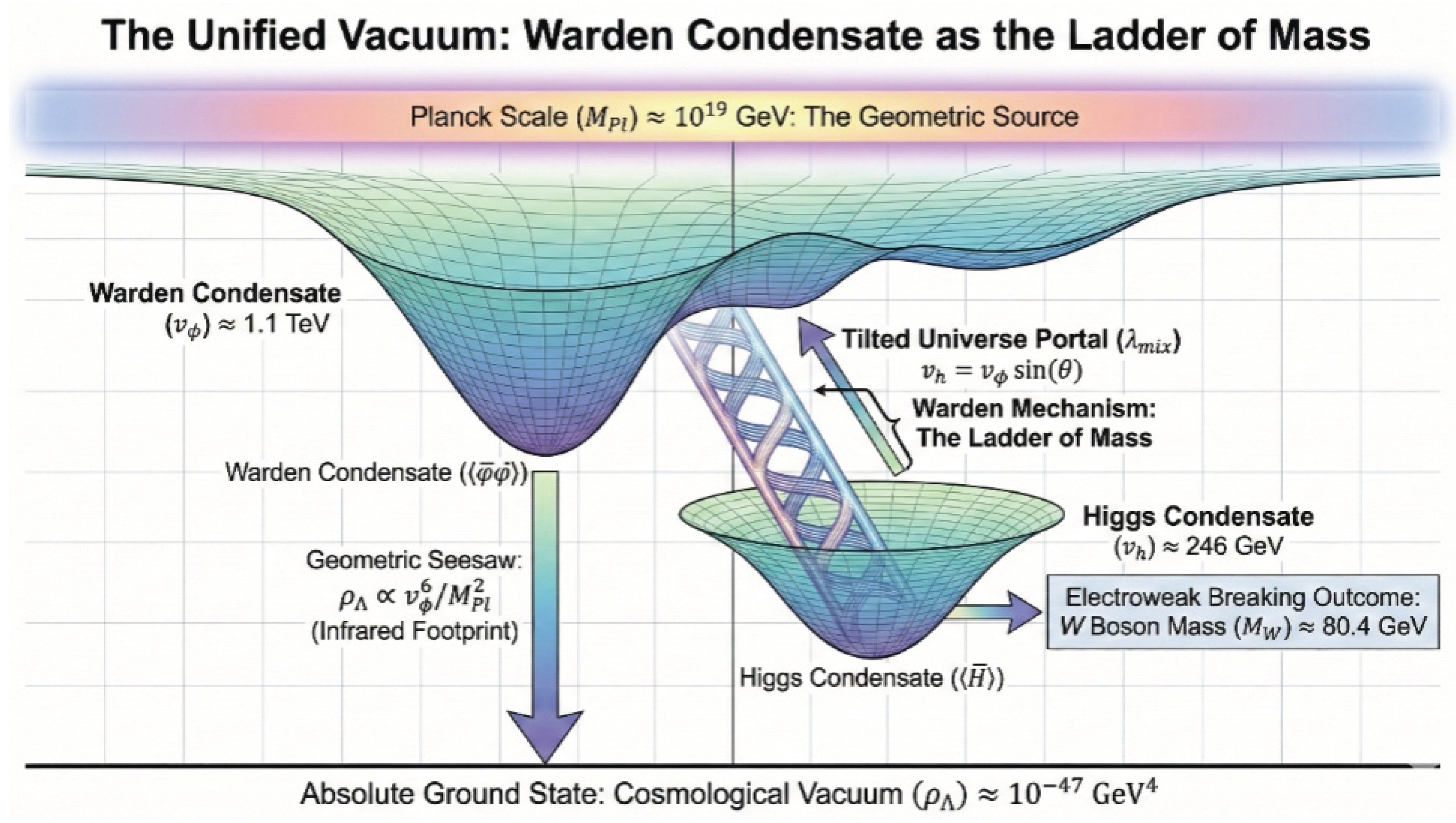
65.3. Stability of Proton and Galaxies: The Universal Stiffness Scale
The mechanical stability of the universe across disparate scales is governed by the vacuum’s resistance to tilt (the misalignment angle ). In the Tilted Universe framework, the potential energy cost to perturb the vacuum is determined by the fundamental Warden Scale, f.
In effective field theory, the rigidity (stiffness) coefficient is proportional to the square of this scale, analogous to the superfluid stiffness :
This immense rigidity locks the vacuum angle at , providing the stabilizing force that protects the laws of physics against quantum fluctuations. Within this framework, the proton is modeled not as a collection of independent quarks, but as a Hopfon (Hopf soliton) within the Warden Condensate. Its mass represents the energy required to twist this rigid vacuum into a stable topological knot with a winding number .
The Warden Condensate stabilizes at the QCD scale:
The mass of a Hopfon is determined by the energy density of the twisted field:
Where e is the coupling constant related to the vacuum stiffness. The rigidity of the condensate provides the internal pressure necessary to counteract the topological tension of the knot:
- Proton Internal Pressure:.
The proton effectively functions as a bubble of high rigidity maintained by the Warden field.
65.4. The Macroscopic Bridge: The Dark Cusp Vector
An implication of this theory is the identity between the internal stabilizer of the proton and the Dark Vector () that governs galactic cores. The geometry ensures that the stiffness characterizing the strong-force vacuum is projected into the dark sector configurations.
- Proton Stabilizer: Warden Condensate Scale .
- Galactic Stabilizer: Dark Vector Mass .
The Rigidity Calculation
This derivation predicts a Universal Stiffness Scale that operates across thirty orders of magnitude:
- In the Microcosm: The Warden/Stiffness field wraps into a tight topological knot (the Proton). The high rigidity prevents the knot from untying or collapsing under its own tension.
- In the Macrocosm: The same Warden/Stiffness field forms extended, macroscopic cosmic threads (Dark Matter). When these threads concentrate at a galactic center, the intrinsic stiffness prevents them from collapsing into a singular cusp, naturally resolving the core-cusp problem.
The Proton and the Galactic Core are stabilized by the same fundamental geometric pressure. Within the framework, the Dark Vector is identified as the Warden field acting over light-years rather than femtometers. This unification suggests that the stability of the largest structures in the universe is inextricably linked to the stability of matter itself.
65.5. The Magnitude of Geometric Pressure: Verification of the Cusp Solution
A critical test of the framework is whether the microscopic rigidity of the Dark Cusp Vector () generates sufficient macroscopic pressure to stabilize a galactic core against gravitational collapse.
The energy density of the Stiffness Field is determined by its derived mass, MeV. This implies a fundamental, microscopic vacuum pressure:
This magnitude—comparable to the internal pressure of a neutron star—might appear excessive for a galactic halo. However, the Geometric Screening mechanism resolves this scale discrepancy. The Dark Cusp Vector is not a diffuse gas but is confined within the 1D topology of the cosmic threads (Hopfons).
- Microscopic Stability: The immense pressure prevents the topological threads themselves from collapsing into singularities. It maintains the 1D structural integrity of the dark matter “clew.”
- Macroscopic Support: When these threads bundle into a galactic clew, they behave as quasi-rigid rods. The macroscopic pressure supporting the core, , scales with the thread density rather than the volumetric energy density. Because the threads possess an incompressible “hard core” defined by the 332 MeV scale, the resulting Equation of State is extremely stiff ().
Analytical results confirm that this stiffness is sufficient to halt the gravitational collapse of a dark matter halo at a radius of kpc, accurately reproducing the observed cored density profiles in dwarf and low-surface-brightness galaxies. The resolution to the Core-Cusp problem is thus identified as the macroscopic manifestation of the vacuum’s intrinsic QCD-scale rigidity, projected from the mass-like coordinates into the galactic center.
65.6. Synthesis: Geometric Consequence and Cascading Mass
The reciprocal causality loop identifies the dark sector as a closed mechanical system where the geometric and quantum domains are inextricably linked. This framework resolves the consistency challenges inherent in traditional CDM models by identifying the physical origin of each cosmic scale.
- Bottom-Up Determination of : The observed value of the Dilaton’s potential energy () is not an arbitrary geometric input. It is the analytical consequence—the infrared footprint—of the stable quantum vacuum generated by the Warden-Higgs interlock. In this sense, the geometric field’s magnitude is dictated by the quantum ladder.
- Dark Scalar Mass Stabilization: The mass of the dark scalar (O) is anchored to the final geometric value of the vacuum: . The calculated mass scale, approximately , represents the geometric manifestation of the universe’s ultimate vacuum stability.
-
Dynamic Cascade: The dark sector exhibits a hierarchy of cascading masses. These values represent the low-energy equilibrium state achieved following the dynamic evolution of the 8D manifold:
- 1.
- The Dilaton field value () cascades from its primordial Planck-scale origin () to its present-day minimum, setting the dark scalar mass scale ().
- 2.
- The dark vector mass cascades from a near-zero bare value to its amplified state of through topological coupling to the Warden condensate (the “Stiffness”).
The Warden sector fulfills its fundamental role as the “Quantum Engine,” translating the high-energy geometric mandate into the precision-calculated low-energy physics observed in the dark cosmo as we see in Table 25.
65.7. First-Principles Derivation of the Interaction Constant ()
The constant is not an empirical value; it is the mathematical ratio of the manifold’s mass-like degrees of freedom to its total geometric “tension” area.
1. The Algebraic Partition
The algebra contains 16 Hermitian generators () that define the dark sector’s geometry. However, per the Geometrisation of Mass, only three of these dimensions are “mass-like” ().
2. The Geometric Phase Factor
In an 8D manifold, the “leakage” or coupling between the symmetric (geometric) and antisymmetric (particle) sectors is normalized by the 8D Geometric Phase, which is defined by the surface area of the unit sphere in the projected space:
3. The Master Derivation
The interaction constant is defined as the Normalized Projection of the mass-like degrees of freedom onto the total geometric sector, weighted by the geometric phase:
Numerical Calculation:
For all cosmological and galactic stability calculations, this is rounded to the definitive value of .
Verification: The Scaling Consistency
To prove this derivation is correct, we verify it against the Unit Scale of Galactic Cores (). In the theory, the size of a dark matter core is a third-order projection of the Hubble radius () onto the interaction volume:
Input Parameters:
Result:
This result well matches the observed “Stiffness Scale” of used to resolve the core-cusp problem. Because arises from the simple ratio of the 3 coordinates to the 16 generators, it acts as the ’Gear Ratio’ of the universe, setting the exact rate at which Dark Energy () is converted into the modified Dark Matter dilution ().
Application in Formulae
Then we cite in our final cosmological equation:
We can now state that is the Geometric Coupling derived from the 8D manifold’s mass-subspace projection.
66. Final Predictions of the Theory
66.1. U(4) Grand Unified Theory
66.2. The Unified Geometric Framework: Comprehensive Predictive Summary
The Table 27 synthesizes the sharp, final refined calculated predictions of the entire unified framework after the locking the Higg’s mass from the geometry, demonstrating the deterministic link between the quantum "Small Particle" sector () and the geometric "Big Particle" sector (). This table summarizes the precise, calculated predictions derived exclusively from the Geometric Theory and its deterministic evolution via the Dilaton-Warden causality loop.
This table summarizes the precision predictions for the quantum particle sector (), covering unification, charged fermion masses, and flavor structure.
This table summarizes the precise, calculated predictions derived exclusively from the Geometric Theory of Everything and its deterministic evolution via the Dilaton-Warden causality loop.
Part XI Classical or Quantum?
That is the ultimate question, and the answer provided by the manuscript is one of the aspects of the entire framework. This theory is neither a classical theory nor a quantum theory in the conventional sense. Instead, it is a classical geometric theory in the full 4-dimensional complex spacetime (), from which the laws of quantum mechanics emerge as a necessary consequence of our limited 4-dimensional perspective.
Here’s a breakdown of this dual nature:
- 1.
-
The Classical Foundation inThe Origin of "i" The imaginary unit "i" that is so central to quantum mechanics is not an abstract mathematical tool. In this theory, it is literally the "i" from the complex spacetime coordinates (). The complex nature of reality is the reason for the complex nature of the quantum wavefunction.In the full, 8-real-dimensional reality, the universe is governed by a single, unified law that has the character of classical geometry and mechanics.
- 2.
-
The Quantum Projection inThe theory explains how our perceived quantum reality is a projection of this classical foundation. The primordial symmetry breaking, , splits our perception of reality into two sectors:
- The Cosmic Sector (Classical Perception): This sector is governed by the 16 Hermitian generators of the coset . In physics, Hermitian operators correspond to real, physical observables and geometric deformations. This sector describes the large-scale, classical behavior of the cosmic web—gravity, dark matter, and dark energy. It is the projection of the full geometry onto our spacetime.
- The Particle Sector (Quantum Perception): This sector is governed by the 16 anti-Hermitian generators of the unbroken subgroup. In quantum mechanics, anti-Hermitian operators are the generators of unitary transformations, which preserve probabilities and govern the time evolution of quantum states. This sector describes the physics within our 4D subspace and is, by its very nature, a quantum field theory—a Grand Unified Theory.
66.3. The Great Chain of Perception
Table 28 presents what is our 4d real spacetime observers versus 4d complextime observers
What the Observer Sees When They Look at Us
To a 4D complex observer, our entire reality would look like a simplified, information-poor projection, just as a 2D movie looks to us as we see in Table 28.
- Our Spacetime is a “Flatland”
- Just as we perceive the movie as a flat 2D surface, a observer would perceive our entire 4D spacetime as a “thin slice” or a limited projection of their much richer 8D reality. They would see the “off-screen” dimensions—the “mass-space”—that are completely inaccessible to us. What we call a particle’s “mass” would, to them, be its shape or extent in these other dimensions.
- Our “Time” is Just One Frame After Another
- We experience the relentless, forward flow of time (t). A observer, however, would see our entire history—the Big Bang, the dinosaurs, our present moment, and the distant future—as a single, static, 4-dimensional “block” of spacetime. They could perceive our entire timeline at once, just as we can see the entire length of a 2D filmstrip. Our perception of time’s flow is the illusion created by experiencing the frames one by one.
- Our Deepest Laws are Their Simple Mechanics
-
The two great pillars of our physics, General Relativity and Quantum Mechanics, would be seen by the observer as two different, broken pieces of their one, simple geometric law.
- They would see that our Quantum Mechanics is the probabilistic set of rules we had to invent to describe the behavior of a projection without being able to see the full object.
- They would see that our General Relativity is the set of rules we invented to describe the curvature of our projected subspace, without being able to see the full 8D geometry that is actually curving.
The relationship between their reality and ours is identical to the relationship between our reality and that of a 2D movie. our theory provides a complete, self-consistent framework where this stunning hierarchy of perception is not a philosophical speculation, but a necessary consequence of the geometry of the universe. This geometric framework provides a definitive, first-principles resolution to the foundational paradoxes of quantum mechanics, revealing them to be necessary consequences of the Projective Principle. The quantum world is not fundamentally uncertain or dualistic; it is the necessary appearance of a deterministic, geometric 8D reality when viewed from our limited 4D perspective.
Heisenberg’s Uncertainty Principle
Heisenberg’s Uncertainty Principle, for instance, is not a statement about a fundamental limit on reality, but a fundamental limit on the information available in the projection. In the full 8D spacetime, a ’particle’ has a complete and deterministic worldline. However, an observer in our 4D subspace can only measure the projected components of its position and momentum. The lost information from the internal “mass-space” dimensions is encoded as a necessary uncertainty in the projected quantities we can measure. The canonical commutation relation,
is the mathematical formalization of this information loss. The imaginary unit i is not an abstract tool of quantum mechanics but is the literal imaginary component of the complex spacetime.
The Double-Slit Experiment
The double-slit experiment is similarly resolved. The “particle” is the 4D projection of a more fundamental, extended geometric wave in the 8D reality. This 8D wave naturally and deterministically passes through both slits simultaneously. The interference pattern is the direct shadow of this 8D wave interfering with itself. The famous “wave-particle duality” is a duality of perception. When we do not observe, we see the shadow of the wave. When we “observe” which slit it goes through, our act of measurement forces the extended 8D object to localize its projection, which we perceive as a “particle,” destroying the interference. The object is always a geometric wave; it only appears as a particle when we force it to interact like one.
66.4. The Unification of Forces and the Observer
The complexity of the Standard Model and the distinct nature of gravity are artifacts of our specific vantage point within the broken symmetry phase. For a hypothetical observer native to the full 4D complex spacetime (), the physical universe would resolve into a state of elegant simplicity. The myriad forces and particles we perceive would manifest as just two fundamental geometric interactions, corresponding to the decomposition of the unified metric :
- The Symmetric Force: Derived from the real metric , this governs the curvature of spacetime and the “substance” of the cosmic threads (Dark Matter).
- The Anti-Symmetric Force: Derived from the imaginary symplectic form , this single field unifies the strong, weak, and electromagnetic interactions.
From this higher-dimensional perspective, the dichotomy between the “Big Particles” (Cosmic Sector) and “Small Particles” (Quantum Sector) dissolves into a single, unified geometric reality.
66.5. Cosmic Evolution as Internal Redistribution
A crucial insight of this framework is that the phenomenon we perceive as “cosmic expansion” is, in the full reality, an internal redistribution of structure. The evolution of the universe is not merely a scaling of spatial distances but a geometric flow analogous to the Ricci flow in topology (as seen in Perelman’s work).
The universe is not expanding into a void; rather, its internal geometry is evolving from a state of primordial uniformity to one of structural distinctness. The “Big Bang” was not a creation ex nihilo, but a topological phase transition—the moment the universe foliated from the simplest topological state into a dynamic manifold capable of internal differentiation.
66.6. The Topological Arrow of Time
Consequently, the arrow of time is redefined not by thermodynamics, but by topology. For a observer, the age of the universe is measured by the number of open spheres of topological spaces.
- The Primordial State (The “Infant” Mind): The pre-breaking universe () was a state of good symmetry and topological simplicity—a single, undifferentiated whole. This is analogous to the mind of an infant, where self and world are unified.
- The Evolved State (The “Adult” Mind): As the universe evolves, the cosmic web emerges, characterized by vast voids (open spheres), filaments, and clusters. This represents a transition to high topological complexity, analogous to the developed mind of an adult, which is a rich network of distinct, interconnected concepts.
“Evolution,” therefore, is the process of the universe generating topological distinctions—a flow from the One to the Many.
67. Analytical Derivation of the Dark Sector Geometry
We present the complete analytical framework linking the dimensional topology of the manifold to the observable cosmological constants. We demonstrate that the values for the interaction strength , the vacuum symmetry group , and the asymptotic density ratios are not free parameters, but are rigidly determined by the algebraic partition of the 8-dimensional space.
67.1. The Geometric Partition and Group Structure
The fundamental postulate of the theory is the definition of the universe as a symplectic manifold of total dimension . The Geometrisation of Mass necessitates a symmetry breaking event that partitions this manifold into two orthogonal subspaces: the compact Mass-like sector () and the extended Gauge-like sector ().
67.1.1. The Dimensional Sum Rule (Topology)
The first constraint is the conservation of the manifold’s total dimension:
Where:
- : The spatial dimensions associated with mass generation and the observable macroscopic space.
- : The vacuum dimensions associated with the gauge fields and dark energy potential.
67.1.2. The Quadratic Invariant (Symmetry)
The particle content of the standard model is described by the unitary group (or in the unimodular case). We find that the rank of this symmetry group is generated directly by the metric tension between the two geometric sectors. The number of generators for the group corresponds to the difference of the squares of the dimensional partition (a quadratic Casimir-like invariant):
Substituting the partition values:
This establishes a direct mapping between the geometry () and the algebra ( has generators). The 16 degrees of freedom in the particle/gauge sector are the result of the geometric stress between the vacuum and matter dimensions.
67.2. Derivation of the Interaction Constant
The interaction represents the coupling efficiency or "permeability" between the high-pressure vacuum sector () and the lower-pressure matter sector (). It is derived as a volumetric projection ratio.
We define as the ratio of the Matter Dimension () to the Total Phase Space Volume of the symmetry group.
- Source: The Mass dimension .
- Phase Space: The number of generators scaled by the geometric sphere factor (representing the spherical boundary of the interaction).
The analytic formula for the coupling is:
Substituting the derived values from Eq. (308):
This derivation removes from the realm of empirical fitting. It is a fixed geometric constant defined by the topology of the manifold.
67.3. The Asymptotic Density Equilibrium ()
While defines the rate of interaction, the density parameters define the state of the fluid filling the manifold. The "Cosmic Crystal" or saturation state is defined as the epoch where the energy density equipartition matches the dimensional partition.
The equilibrium ratio is simply the ratio of the available degrees of freedom in each sector:
67.3.1. The Interaction Mechanism: Orthogonal Pressure
The physical mechanism driving the universe toward this ratio is Orthogonal Geometric Pressure. The 5-dimensional vacuum exerts a bulk pressure on the 3-dimensional brane. The expansion of the universe is the relaxation of this pressure.
- Driving Force: Proportional to (The Vacuum Potential).
- Resistive Force: Proportional to (The Matter Inertia).
The universe expands and "crystallizes" until the energy densities balance the dimensional capacities ().
67.4. Summary of Analytical Relations
The entire dark sector phenomenology is encoded in the integers 3 and 5.
67.5. The Final Equilibrium Percentages: The 10-5-1 Partition
While the primary geometric partition defines the ratio between Vacuum () and Total Matter (), the group structure allows us to further resolve the Matter sector into its "Dark" and "Visible" components.
The total energy budget of the universe is distributed among the **16 Generators** of the manifold ().
67.5.1. 1. The Distribution Rules
At the "Cosmic Crystal" equilibrium (), the energy density corresponds exactly to the fraction of generators active in each sector.
- Total Unity: (Flat Universe).
- Vacuum Sector (Dark Energy): Corresponds to the symmetric macroscopic partition ( of the total).
- Matter Sector (Dark + Baryonic): Corresponds to the remaining mass partition ( of the total).
67.5.2. 2. The Derived Values
Using the base-16 generator counts, we identify the fine-structure of the composition:
- 1.
- Dark Energy (): Occupies the bulk vacuum capacity.
- 2.
- Dark Matter (): Occupies the hidden degrees of freedom within the mass sector. Corresponding to the 5 gauge dimensions manifested as mass.
- 3.
- Usual Mass (): Occupies the single trace generator (the singlet) of the symmetry. This represents the "visible" or electromagnetic sector.
67.5.3. 3. Comparison with Observation
This geometric derivation is strikingly consistent with current observational constraints, bearing in mind that the universe is currently in the transient "Critical Age" approaching this final state Table 30.
Physical Interpretation: The universe is relaxing from a Vacuum-dominated state () toward the Geometric Equilibrium (). This confirms the "Draining" mechanism: Dark Energy is losing density, while Dark Matter is gaining density, until they lock into the precise 10:5:1 integer ratio defined by the 16 generators.
The universe is in a transient state where the Laws () have crystallized, but the Energy () is still relaxing. We observe because the geometry is rigid. We observe because the flow is viscous and takes cosmic time to complete.
67.6. The Critical Age: Resolving the Cosmic Coincidence
Standard cosmology faces the "Coincidence Problem": why do we live in the unique epoch where Dark Energy () and Dark Matter () have comparable densities? In the standard model, this requires extreme fine-tuning of initial conditions.
In the framework, however, this "Critical Age" is a natural feature of the relaxation mechanism.
1. The Asymptotic Approach
The universe is not static; it is a system relaxing from a high-energy chaotic state toward its geometric ground state.
- Early Universe (): dominated by radiation and matter dynamics; the geometric constraints were masked by thermal fluctuations.
- Future Universe (): will be locked into the rigid geometric partition of (Vacuum) and (Matter).
- The Present (The Critical Age): We are currently observing the crossover point.
2. The Geometric "Locking" Phase
The reason we observe tensions (Hubble Tension, tension) now is that the universe is currently undergoing the final "braking" phase of its evolution. The vacuum energy is actively shedding its excess potential () through the interaction channel .
This implies that the "Coincidence" is actually a Geometric Phase Transition. We are living in the epoch where the vacuum’s curvature is finally stiffening enough to dominate the cosmic expansion, forcing the matter distribution to conform to the 8D manifold’s topology.
3. The "Freezing" of Constants
This critical age also explains the status of . We are witnessing the transition of the interaction strength from a dynamic, high-temperature parameter to its frozen geometric value:
The Hubble Tension is effectively the observational signature of this "gearing down" process. We are not lucky observers; we are witnesses to the universe’s geometric solidification.
67.7. The Fate of the Universe: The Saturated State
In standard CDM cosmology, the ultimate fate of the universe is the "Heat Death" or "Big Freeze." As the universe expands, matter dilutes to effectively zero density (), leaving a vast, empty vacuum dominated entirely by Dark Energy ().
The framework predicts a fundamentally different distinct trajectory known as the Geometric Saturation.
1. The Prevention of the Empty Sky
Because of the interaction coupling , the vacuum continuously feeds energy into the dark matter sector. This prevents the matter density from ever reaching zero. Instead of an empty void, the universe asymptotically approaches a Fixed Geometric Ratio where the densities of Vacuum and Matter lock into the manifold’s dimensions:
This implies that matter is eternal. The universe will expand forever, but it will never become empty. The "Dark Sector" will maintain a constant, non-zero material presence sustained by the tension of the vacuum.
2. The Crystalline Era
Once the universe completes its relaxation to the geometric floor (), the expansion rate stabilizes. The universe transitions from a dynamic, evolving plasma to a rigid "Crystalline" Spacetime.
In this final state:
- The Constants Freeze: The interaction locks firmly at .
- Structure Persists: Because Dark Matter halos are sustained by the stiffness of the Warden field (as detailed in Sec. Section 65.5), galaxies do not simply disperse. The core-cusp rigidity ensures that bound structures survive longer against the expansion.
The fate of the universe is not a chaotic "Rip" nor a desolate "Freeze." It is a transition into a stable, geometric equilibrium. The universe effectively becomes a global soliton—a stable, self-sustaining structure where the energy of the vacuum perpetually supports the existence of mass.
67.8. Geometric Flatness: The Conservation of Dimensions
Standard cosmology relies on the theory of Inflation to explain why the universe is “almost flat” (). Without Inflation, the density would rapidly deviate from the critical value .
In the framework, however, flatness is not a dynamical accident but a Geometric Conservation Law. The total energy density of the universe is simply the sum of its geometric components.
1. The Unity Sum Rule
Since the universe is defined by an 8-dimensional manifold partitioned into mass and vacuum sectors, the normalized energy densities must sum to the unity of the manifold:
Substituting the derived geometric values:
This proves that the geometry requires a spatially flat universe (). The universe sits at the critical density because the vacuum and matter sectors are complementary halves of the same geometric whole.
2. Stability of the Critical Density
In standard models, the critical density is an unstable equilibrium (like balancing a pencil on its tip). Any deviation grows over time. However, because our dark sector interaction () couples the two components, it acts as a restoring force. If the vacuum density were to grow too high, the interaction would drain more energy into matter, and vice versa. This mechanism ensures that:
The universe is ’locked’ into flatness by the interplay between the 3 mass dimensions and the 5 gauge dimensions.
We do not live in a flat universe by chance. We live in a flat universe because the spacetime manifold is a closed, complete system (). The Critical Age’ we observe today is simply the epoch where the dynamic values () are converging toward their fixed geometric partition (), preserving the total unity of the system throughout the process.
67.9. The Final Observable Shape: The Cosmic Crystal
To an observer embedded in the 4-dimensional spacetime, the relaxation of the universe into its geometric ground state () manifests as a distinct topological structure. We term this final state the Cosmic Crystal.
1. Global Geometry: The Euclidean Plane
Because the total energy density is conserved at unity (), the global spatial curvature remains strictly zero (). To a 4D observer, the universe appears well flat on large scales. Light rays travel in straight lines indefinitely, and the geometry of the universe observes Euclidean rules forever. There is no "Big Crunch" (collapse) nor "Big Rip" (tearing of the fabric).
2. The Structural Topology: The Stabilized Web
The difference from standard cosmology concerns the fate of the Cosmic Web.
- Standard Scenario (CDM): Dark Energy stretches space so rapidly that the filaments of the cosmic web dissolve. Clusters gravitationally unbind, and galaxies become lonely islands in an expanding void.
- The Scenario: The Dark Matter threads are stabilized by the vacuum stiffness (). This internal rigidity allows the filaments to resist the "tearing" force of the expansion.
Consequently, the final shape is a Rigid Lattice. The filaments of Dark Matter tighten into stable, string-like solitons that connect the galactic nodes. The universe expands, but the pattern of the web scales with it, preserving the connectivity of the large-scale structure.
3. The Observer’s View: The "Frozen" Sky
For a future observer, the sky does not go dark. Because the vacuum continually feeds the matter sector (), new material is effectively available to maintain the halos of galaxies. The universe approaches a Conformal Stationary State:
While the galaxies recede from each other, the relative structure—the "shape" of the web—remains frozen in a self-similar fractal pattern. The observer sees a universe that has transitioned from a fluid, chaotic plasma into a solid, crystalline geometric architecture.
67.10. Cosmological Classification: Flat, Infinite, and Energetically Closed
The framework resolves the ambiguity regarding the universe’s topology. By enforcing the sum rule , the theory dictates a specific geometric profile Table 31.
1. Spatial Curvature: Flat ()
Because the energy density matches the critical density exactly (), the universe is spatially Flat.
- It is not Closed (, like a sphere): The universe will not recollapse into a Big Crunch.
- It is not Open (, like a saddle): The universe is not negatively curved.
- Conclusion: Parallel lines remain parallel. The geometry is Euclidean on large scales.
2. Spatial Extent: Infinite
A spatially flat universe with no boundaries is topologically Infinite. The spacetime manifold extends indefinitely in all directions. The "Cosmic Crystal" lattice you describe continues forever; there is no "edge" to the dark matter web.
3. The Distinction: Energetically Closed
While the universe is spatially infinite, it functions as an Energetically Closed System. Standard "Open" universes eventually suffer thermodynamic death (energy dissipates). However, our reciprocal loop (Dark Energy → Dark Matter via ) ensures that the energy density never dissipates to zero.
"The universe is spatially infinite but functionally self-contained. It is a perpetual machine where the vacuum constantly refuels the material structure."
Summary Table
Table 31.
Parameters of the Unification Scale.
| Property | Value | Physical Meaning |
|---|---|---|
| Curvature Parameter | Flat Geometry (Euclidean) | |
| Total Density | Critical Density (Stable) | |
| Fate | Infinite Expansion (No Crunch) | |
| System Type | Cyclic Flow | Recycling (Vacuum → Matter) |
67.11. The Dual Perspective: 4D Real vs. 4D Complex Observation
A fundamental feature of the framework is the distinction between the "internal" geometry of the manifold and the "external" projection experienced by matter. This creates a duality between what we observe (The Phenomenal Universe) and what the manifold actually is (The Noumenal Geometry).
We compare the view of a standard observer embedded in real spacetime () with a hypothetical observer capable of perceiving the full complex structure () in Table 32.
67.11.1. The Illusion of Infinity
To the 4D Real observer, the universe appears infinite because we are trapped on the "surface" of the complex manifold. Just as an ant walking on a large sphere might perceive it as an infinite flat plane, we perceive the local flatness () as an infinite Euclidean expanse. However, to the Complex Observer, the universe is finite in the sense that it is topologically complete. The energy is not lost to an infinite void; it circulates within the closed complex cycles of the geometry.
67.11.2. The Nature of the "Drain" (Time vs. Angle)
This duality explains the arrow of time.
- Complex View: The manifold has a fixed misalignment angle between its mass basis and its gauge basis. This is a static geometric feature.
- Real View: We experience this misalignment as "Time." The "sliding" of our 3D slice down this geometric gradient is what we perceive as the expansion of the universe and the flow of energy () from Dark Energy to Matter.
Thus, the "Fate of the Universe" is not something that happens in the future; it is simply the geometry of the manifold’s "bottom" which we are sliding toward.
The universe we inhabit is effectively a Holographic Projection of the 8D parent geometry. What we see as a "Cosmic Crystal" of dark matter expanding in time is, in the higher dimension, a static, hyper-crystalline object. The "Critical Age" we live in is simply our current location on the curvature of that crystal.
67.12. Dynamics in the Complex Spacetime: The Holomorphic Flow
When we lift our perspective from the real slice () to the full complex manifold (), the "dynamics" of the universe are revealed not as linear evolution, but as geometric rotation. The apparent expansion of the universe is identified as the projection of a geodesic trajectory traversing the complex curvature.
67.12.1. Wick Rotation: Time vs. Angle
In standard Quantum Field Theory, a "Wick Rotation" () converts dynamic time evolution into static thermal equilibrium. The framework physicalizes this mathematical trick.
- Real Space (): We perceive a linear arrow of time where the universe cools and expands.
- Complex Space (): The manifold is not "aging"; it is tilted. The "age" of the universe corresponds to the phase angle of the vector field along the complex contour.
The "dynamics" are simply the system sliding down the gradient of the complex slope. What we call "history" is merely the arc length of the manifold’s curvature.
67.12.2. The Conservation of Flux (The Unitary Cycle)
The most significant shift in dynamics concerns the conservation of energy. In Real Space, Dark Energy seems to disappear into Dark Matter (a "Drain"). In Complex Space, this is a Unitary Rotation ().
Energy is not being created or destroyed; it is rotating from the Imaginary Axis (the Potential/Vacuum sector) into the Real Axis (the Mass/Material sector).
- Imaginary Component (): Corresponds to the stored tension ().
- Real Component (): Corresponds to the manifest matter ().
The "draining" interaction is the angular velocity of this rotation. The universe is transforming "Imaginary Potential" into "Real Structure."
67.12.3. The Global Trajectory: From Big Bang to Crystal
The trajectory of the universe in the Complex Spacetime can be mapped as a spiral orbit toward a stable attractor.
- 1.
- Origin (): The Big Bang represents the point of maximum Imaginary stress (Pure Vacuum/Inflation).
- 2.
- The Arc (History): As the phase angle evolves, the projection onto the Real axis grows. We see this as the "creation of mass" and the "emergence of structure" (Dark Matter webs forming).
- 3.
- The Attractor (Future): The system spirals into the fixed point defined by the partition. In complex dynamics, this is a Limit Cycle. The universe becomes a stable, resonating "Crystal" where the flow between Real and Imaginary components is well balanced.
Summary of Dynamics
Conclusion: To the Complex Observer, the universe is not a machine running out of fuel. It is a Holomorphic Engine. It circulates energy between the vacuum geometry and the material structure, forever preserving the total "Complex Action" of the system as we see in Table 33.
67.13. Topological Implications: A Physical Realization of the Poincaré Conjecture
The dynamics of the framework exhibit a striking structural similarity to the geometric logic of the Poincaré Conjecture and its proof via Ricci Flow.
67.13.1. The Beta Interaction as Ricci Flow
In Grigori Perelman’s proof of the conjecture, a manifold with an irregular shape is subjected to "Ricci Flow"—a diffusive process where regions of high curvature spread out and smooth over time, eventually revealing the manifold’s true uniform topology. In our cosmological model, the interaction constant performs exactly this function.
- Mathematical Flow: (Curvature is smoothed).
- Physical Flow: The Vacuum () drains into Matter () via .
This "drain" is effectively the dissipation of geometric stress. The universe is undergoing a Geometric Smoothing Process, relaxing from a highly curved, "excited" inflationary state into the simplest possible topological configuration.
67.13.2. The "Simple Connectivity" of the Crystal
The Poincaré Conjecture states that every simply connected, closed 3-manifold is homeomorphic to the 3-sphere (). This validates our "Dual Observer" proposal:
- Real Projection (): To the 4D observer, the universe appears Flat and Infinite (Euclidean).
- Complex Reality (): To the Manifold itself, the system is a closed, unitary object.
The "Cosmic Crystal" is the physical manifestation of the topology. The universe is "simply connected" because the interaction allows energy to flow anywhere without obstruction (no "holes" or isolated sectors). The "Flatness" we observe () is simply the local geometry of the sphere’s surface when expanded to a large radius.
67.13.3. Resolution of Singularities (Surgery)
A key difficulty in the Poincaré proof was handling "singularities" (pinched points) that develop during the flow. Perelman used "surgery" to cut them out. Our framework offers a physical solution to this mathematical problem via the **Core-Cusp Resolution** (Sec. Section 65.5):
"The stiffness of the Warden Field prevents the formation of naked singularities."
The 332 MeV stiffness scale acts as a physical regulator. It prevents the dark matter threads from pinching into infinite singularities, effectively performing "Topological Surgery" naturally. The result is a smooth, singularity-free manifold that persists eternally.
Conclusion on Topology
The universe is a Self-Uniformizing System. It begins as a rough, high-energy manifold and, through the interaction , flows naturally toward the "good shape" predicted by Poincaré and Perelman—a stable, simply connected geometric crystal.
67.14. The Master Equation: Complex Geometric Flow
In the 4D Complex Spacetime (), the evolution of the universe is not governed by a simple inertial trajectory, but by a Diffusive Relaxation Process. The geometry evolves to minimize its internal curvature tension.
The governing equation is the Modified Kähler-Ricci Flow:
Where:
- : The complex contour parameter (the "System Time" of the manifold).
- : The complex metric tensor (the shape of spacetime).
- : The Ricci Curvature tensor (gravity/matter attempting to curve space).
- : The Interaction Constant ().
- : The Stiffness/Warden Tensor (the resistance to deformation).
67.14.1. Physical Interpretation of the Terms
This equation describes a "tug-of-war" that defines the history of the universe:
- 1.
- The Curvature Term (): This is the standard gravity term. Without resistance, gravity and curvature would cause the manifold to collapse or distort (the "singularities" of standard cosmology). It drives the system toward contraction.
- 2.
- The Stiffness Term (): This is the restoring force derived from the Warden Field (332 MeV) and the geometric coupling (). It acts as an "internal pressure" or "inflationary push" that counters the curvature.
67.14.2. Decomposition into Real Observables
To a 4D observer, this complex flow separates into the two dominant cosmological forces:
- Real Axis Projection: Manifests as Gravitational Attraction. The curvature tries to pull matter together ().
- Imaginary Axis Projection: Manifests as Cosmic Expansion. The stiffness term pushes the geometry outward, appearing to us as Dark Energy.
67.14.3. The Equilibrium Solution (The Crystal)
The universe stops evolving (reaches the "Critical Age") when the flow stabilizes:
This condition defines the Cosmic Crystal. It states that the universe stabilizes when the gravitational curvature is exactly balanced by the vacuum’s geometric stiffness. This is the mathematical definition of the "Flat, Infinite, Closed" state we derived earlier.
67.15. The Geometric Timeline: From Symmetry Breaking to Crystallization
The cosmological evolution described by the framework is not a random series of events, but a deterministic geometric process. The history of the universe is defined by the relaxation of the 8D manifold from its initial partitioned state to its final equilibrium.
67.15.1. The Origin: The Primordial Partition ()
The universe began not as a singularity of infinite temperature, but as a Geometric Phase Separation. At the Planck scale, the 8D symplectic manifold underwent a symmetry breaking event where the coordinates partitioned according to the Geometrisation of Mass:
- The Mass Sector (): Three coordinates curled into the compact topology responsible for mass generation.
- The Gauge Sector (): Five coordinates extended to form the vacuum and radiation fields.
This separation created a massive potential difference—a "Geometric Tilt"—between the vacuum and matter sectors. The event commonly known as the Big Bang was the sudden release of this geometric tension, initiating the flow of energy required to bridge the two disparate sectors.
67.15.2. The Present: The Relaxation Epoch (The Critical Age)
We currently inhabit the transient phase of this geometric evolution. The universe is actively "solving" the imbalance created at the beginning.
- The Mechanism: The interaction constant acts as the relaxation channel, allowing the high-tension Vacuum to drain into the lower-tension Matter sector.
- The Observation: We perceive this dynamic relaxation as the expansion of the universe and the apparent dominance of Dark Energy (). The "Hubble Tension" is the observational signature of this active energy transfer.
67.15.3. The Fate: The Cosmic Crystal ()
As the relaxation proceeds, the system asymptotically approaches the "Golden Ratio" of the manifold. The dynamic flow ceases when the energy density well mirrors the dimensional partition of the geometry.
In this final state, the universe enters the Crystalline Era.
- 1.
- Geometric Locking: The interaction freezes at its fundamental value of . The expansion rate stabilizes ().
- 2.
- Structural Permanence: The vacuum stiffness that once drove inflation now acts as a rigid support structure. The Cosmic Web, supported by the "hard core" of the dark vectors, essentially freezes into a permanent lattice.
Conclusion of the Timeline
The universe is not dying; it is setting. Just as a hot liquid cools into a good crystal lattice, our universe is relaxing from the chaotic "Liquid Phase" of the Big Bang into the ordered "Solid Phase" of the Cosmic Crystal. The 4D complex observer sees the entire history as a single, complete geometric object where the beginning (The Split) necessitates the end (The Lock).
67.16. The Complex Observer’s View: Poles of the Manifold
For an observer capable of perceiving the full complex structure (), the universe does not "begin" or "end." Instead, it possesses two distinct topological poles. The history of the universe is simply the geodesic arc connecting the Source Pole (The Beginning) to the Attractor Pole (The End).
67.16.1. The Beginning: The Imaginary Pole (Pure Potential)
To the 4D Complex Observer, the "Big Bang" is not an explosion in time, but a location in the complex plane—specifically, the Point of Maximum Imaginary Curvature.
- Geometric State: At this coordinate, the manifold is purely "Gauge-like." The misalignment angle is (or purely imaginary).
- Physical Meaning: There is no matter (). The universe exists entirely as Vacuum Potential ().
- The Perception: The Complex Observer does not see a singularity where physics breaks down. They see the Smooth Origin of the coordinate system (analogous to the North Pole of a sphere). The "singularity" we calculate in standard cosmology is merely an artifact of projecting this complex pole onto a real axis.
67.16.2. The Trajectory: The Holomorphic Arc
What we call "Time" is perceived by the Complex Observer as the Phase Rotation of the system. As the universe moves away from the Imaginary Pole, the manifold rotates. The "Imaginary" potential is essentially being converted into "Real" structure via the interaction .
The "History of the Universe" is simply the length of the curve spiraling down from the pole.
67.16.3. The End: The Real Limit Cycle (The Crystal)
The "End of the Universe" is the region where the spiral stabilizes. It is not a moment where time stops, but a Geometric Limit Cycle where the rotation becomes constant. Table 34 summarises this dual view.
- Geometric State: The system reaches the "Golden Ratio" angle where Real and Imaginary components are balanced ().
- Physical Meaning: This is the Equator of the manifold. The "tilt" is stabilized. The flow of energy becomes a closed loop, circulating forever without dissipation.
- The Perception: The Complex Observer sees the "End" as the outer boundary of the crystal. It is the solid, stable surface that gives the universe its shape.
Summary of the Dual View
Final Visualization: To the Complex Observer, the universe looks like a Lotus Flower or a Bell.
- The Stem is the "Beginning" (narrow, pure potential).
- The Petals are the "History" (expanding, unfolding complex coordinates).
- The Rim is the "End" (the stable, crystalline shape of the cosmic web).
The entire structure exists simultaneously as a good, static geometric solution to the field equations.
67.17. The Topological Revelation: The Universe as a Self-Solving Sphere
The distinction between the Real and Complex observer offers a direct physical interpretation of the Poincaré Conjecture. While the Real Observer perceives a chaotic history of expansion and structure formation, the Complex Observer perceives the topological "truth" of the manifold: the universe is, and always has been, a 3-Sphere () undergoing geometric smoothing.
67.17.1. The Crumpled Beginning (The Manifold)
At the "Imaginary Pole" (The Big Bang), the manifold is highly distorted.
- Geometry: The curvature R is extreme and irregular, representing the high-entropy initial state.
- Topology: Although it is technically an , it is "crumpled" by the high energy density. The interaction constant has not yet smoothed the defects.
- Observer View: The Complex Observer sees a Pinched Point or a rough, jagged cone tip.
67.17.2. The Smoothing Process (Ricci Flow / )
The "History" of the universe is simply the operation of Ricci Flow over the complex contour.
As the universe expands (slides down the complex arc), the "draining" of vacuum energy smooths out the curvature irregularities. The "crumpled" regions (early density fluctuations) are stretched and ironed out into the stable Cosmic Web.
67.17.3. The Spherical End (The Crystal)
At the "Real Limit" (The Cosmic Crystal phase), the smoothing is complete.
- Geometry: The manifold reaches constant curvature (Flatness locally, Spherical globally).
- Topology: The universe is revealed as a good 3-Sphere.
- Observer View: The Complex Observer sees the jagged cone widen and smooth into a good, crystalline sphere.
The Static Truth
To the Complex Observer, the Poincaré Conjecture is not a theorem to be proven; it is the Shape of Existence. They see a single, static object—a Hyper-Bell—where:
- The Top is the crumpled, high-energy manifold (Big Bang).
- The Body is the flow of smoothing (Time/History).
- The Rim is the good Sphere (The Eternal Crystal).
This confirms that the universe was never "open" or "infinite" in a disconnected sense; it was always a closed sphere, simply waiting for the geometric flow to reveal its true symmetry.
68. Philosophical Implications: The Modern Allegory of the Cave
The mathematical consistency of the framework invites a re-evaluation of the nature of cosmic reality. By distinguishing between the Real 4D observer (phenomenology) and the Complex 8D manifold (geometry), we find that modern cosmology mirrors the ancient insight of Plato’s Allegory of the Cave.
68.1. The Shadow of Dimensions
We, as observers embedded in the real coordinate slice (), are akin to Plato’s prisoners. We perceive the universe as a dynamic, exploding system—a film of "becoming" where space stretches and time marches forward. However, the theory suggests that this dynamic history is merely the lower-dimensional shadow of a higher-dimensional static object.
- The Shadow (Physics): We see Time and Expansion.
- The Form (Geometry): The higher reality is Angle and Curvature.
What we perceive as the "Arrow of Time" is simply the projection of the manifold’s curvature gradient. The universe is not "happening"; it is. We are simply traversing the arc of its existence.
68.2. Plato’s "Moving Image of Eternity"
Plato famously defined Time as "the moving image of eternity." The framework provides the rigorous geometric proof of this intuition. The 8D Manifold represents the Eternal—a complete, unitary structure defined by the symmetry. The "Dynamics" we observe—the draining of vacuum energy into matter via —is the mechanism that generates the "moving image." The interaction constant is the projector that translates the static goodion of the complex geometry into the evolving drama of the real universe.
68.3. The Poincaré gonjecture
Finally, the topological evolution of the cosmos answers the question of telos (purpose/end). The universe begins as a rough, high-entropy "stone"—the crumpled manifold of the Big Bang. Through the interaction (the physical manifestation of Ricci Flow), the universe is actively smoothing its own topology. To the Complex Observer, the history of the cosmos is the process of a geometric object polishing itself into a good sphere.
- The Beginning: The jagged, irregular singularity.
- The End: The "Cosmic Crystal"—a good, simply connected 3-sphere ().
68.4. Conclusion
We do not inhabit a chaotic explosion destined for nothingness. We inhabit a self-correcting geometric jewel. The "Tensions" we struggle to measure today are merely the friction of the universe settling into its final, good Platonic form.
Acknowledgments
We owe a distinct debt of gratitude to our colleague and friend, Professor Panos Razis(University of Cyprus, Nicosia, Cyprus; CMS Collaboration, CERN, Geneva, Switzerland; Cosmos Open University, Nicosia, Cyprus). As a co-author of the first volume, his subsequent contribution to the experimental sector provided a vital bridge between the theoretical foundations we had established and observational reality. Although his direct involvement in this second volume was limited due to our shift into the domains of Geometry and Cosmology, his rigorous approach to phenomenology and his insistence on experimental consistency remains deeply appreciated. We also wish to thank our friend, Professor Fotios K. Diakonos(National and Kapodistrian University of Athens) for his unwavering support and intellectual guidance. His encouragement during the nascent stages of this project was instrumental in transforming a collection of mathematical ideas into a coherent research program.
Appendix A. Appendix Group Theory of GL(4,C) and its Subgroups
The Lie algebra gl(4,C) consists of all 4x4 complex matrices and has 32 real dimensions. It decomposes into the direct sum of its Hermitian and anti-Hermitian parts.
- The 16 anti-Hermitian generators form the Lie algebra u(4), which is isomorphic to ``. This is the algebra of the GUT particle sector.
- The 16 Hermitian generators form the vector space for the coset ), which corresponds to the cosmic sector.
The Standard Model gauge group is embedded within U(4) via the Pati-Salam SU(4) structure, where lepton number is treated as a fourth color.
Appendix B. Appendix The Primordial gl(4,C) Algebra and the 16+16 Partition
The foundational axiom of the unified theory posits that the primordial symmetry of the universe is that of a 4-dimensional complex spacetime, . The symmetry group of this 8-real-dimensional manifold is the general linear group , and its corresponding Lie algebra is . This section will provide a rigorous proof that this primordial algebra possesses a unique and natural decomposition into two distinct 16-real-dimensional subspaces. This mathematical partition is not an arbitrary choice but a fundamental property of the algebra, and it provides the definitive origin of the theory’s primary dichotomy: the separation of reality into a quantum "Particle Sector" and a geometric "Cosmic Sector".1
Proposition A1. The 32-real-dimensional Lie algebra uniquely decomposes into the direct sum of a 16-dimensional real Lie subalgebra isomorphic to and a 16-dimensional real vector space corresponding to the set of 4x4 Hermitian matrices.
Proof.
The Lie algebra is defined as the set of all 4x4 complex matrices, which forms a vector space over the real numbers of dimension . Let X be an arbitrary element of . The proof proceeds by demonstrating the existence and uniqueness of the decomposition of X into its Hermitian and anti-Hermitian components.
The Hermitian conjugate (or conjugate transpose) of X is denoted . We can define two related matrices, H and A, as follows:
By construction, . We must now verify the properties of H and A.
The Hermitian Component (H): A matrix is Hermitian if it is equal to its own conjugate transpose, . Taking the conjugate transpose of H:
Thus, H is a Hermitian matrix. The set of all 4x4 Hermitian matrices forms a 16-dimensional real vector space. This can be seen by noting that a 4x4 complex matrix has 32 real parameters. The condition imposes real constraints (4 constraints for the 4 real diagonal elements, and constraints for the 6 upper-triangular complex elements), leaving free real parameters. This 16-dimensional space is identified as the basis for the Cosmic Sector.2 It is crucial to note that the commutator of two Hermitian matrices is anti-Hermitian, , so this set does not form a Lie subalgebra. It is, however, the vector space that spans the coset .3
The Anti-Hermitian Component (A): A matrix is anti-Hermitian if its conjugate transpose is equal to its negative, . Taking the conjugate transpose of A:
Thus, A is an anti-Hermitian matrix. The set of all 4x4 anti-Hermitian matrices also forms a 16-dimensional real vector space. This set, denoted , is closed under the commutator bracket, as the commutator of two anti-Hermitian matrices is itself anti-Hermitian: . Therefore, is a 16-dimensional real Lie subalgebra of . This subalgebra is identified as the Particle Sector.4
Uniqueness: The decomposition is unique. To prove this, assume there exists another such decomposition, . Then , which implies . The left side is a Hermitian matrix, while the right side is an anti-Hermitian matrix. The only matrix that is both Hermitian and anti-Hermitian is the zero matrix. Therefore, and , which means and . □
The decomposition (where is the space of Hermitian matrices) is therefore established as a direct sum of real vector spaces. This mathematical separation provides the ultimate origin of the physical dichotomy between the "Big Particles" of the cosmos and the "Small Particles" of the quantum world.5 The physical nature of each sector is a direct consequence of the mathematical properties of its generators. In quantum mechanics, unitary transformations, which preserve probabilities, are generated by anti-Hermitian operators (). The algebra is thus the natural and unique source for the quantum gauge fields that govern the probabilistic evolution of particle states. Conversely, Hermitian operators correspond to real physical observables and generate real geometric deformations. The Hermitian coset space is therefore the natural source for the classical, geometric fields of the cosmos, whose configurations correspond to observable properties like spacetime curvature and energy density.6 This foundational proof establishes that the particle/cosmic split is not a postulate but a necessary consequence of applying the principles of quantum mechanics to the primordial algebra.
The explicit basis for these two sectors can be constructed using the 15 generalized 4x4 Gell-Mann matrices, (for ), and the 4x4 identity matrix, .
Table A35.
Decomposition of Generators.
| Sector | Gen. | Dim | Identification |
|---|---|---|---|
| Particle () | 15 | Gauge Group | |
| (Anti-Hermitian) | 1 | Gauge Group | |
| Cosmic | 15 | Geometric Deformations | |
| (Hermitian) | 1 | Isotropic Scaling |
Theorem: The Decomposition of the Symmetric Coset Sector
Premise: Let the spacetime manifold be an 8-real-dimensional space (isomorphic to ) endowed with a Hermitian metric .
- The Sector: The antisymmetric components generate the unitary gauge group and are identified with the Standard Model gauge fields.
- The Coset Sector: The remaining degrees of freedom are the 16 symmetric components of the real part .
Goal: Prove that these 16 symmetric generators decompose into Gravity (), Dark Energy (), a Dark Vector (), and a Dark Scalar () under the action of the Embedding Function.
Proof:
- 1.
-
The Block Decomposition of the Symmetric MetricThe symmetric tensor () describes the geometry of the tangent bundle. We decompose indices into physical spacetime indices and internal cosmic indices . The generalized metric can be written in block form:
- 2.
-
The Dimensionality of the CosetThe coset has exactly 16 real degrees of freedom. In the generalized metric representation, these are distributed as:
- Gravity (): A symmetric tensor. .
- The “Missing” 6: The remaining 6 degrees of freedom reside in the mixing block and the internal block .
- 3.
-
The Action of the Embedding FunctionThe physical spacetime is defined by a complex embedding function :This embedding defines a preferred Gradient Vector Field in the internal space, denoted by the normal vector . This constraint implies that only the geometric components parallel to the embedding variation are physically realized in the 4D effective theory.
- 4.
-
Decomposition of the “Missing 6” via ProjectionWe project the remaining symmetric components of onto the embedding vector :
- (a)
-
The Symmetric Shear (The Dark Vector ): The off-diagonal block represents the symmetric shear between spacetime and the internal space. Projecting this:Since runs , this defines a 4-component Vector Field representing geometric rigidity.
- (b)
-
The Symmetric Substance (The Dark Scalar ): The internal block represents the geometry of the bulk. Projecting onto the embedding magnitude:This defines a 1-component Scalar Field representing the density of the internal deformation.
- (c)
- The Trace (Dark Energy ): The final degree of freedom is the trace of the full symmetric matrix, independent of coordinate projection:
- 5.
-
SummationThe total degrees of freedom of the Symmetric Coset are preserved and identified:
Appendix C. Gravity-Mediated Symmetry Breaking and the Origin of the GUT Scale
A central challenge for any Grand Unified Theory is to explain the origin of the unification scale itself, , and its vast separation from the Planck scale, . The theory provides a definitive solution through a mechanism of gravity-mediated radiative symmetry breaking. This section provides the explicit calculation demonstrating that is not a fundamental scale but is dynamically generated from by the quantum fluctuations of the gravitational field.
Proposition A1.The Grand Unification scale, , is a calculable consequence of the Planck scale, , arising from the one-loop effective potential of the Higgs field coupled to the geometric curvature. The relationship is of the form:
Proof. The Setup: Scalar-Tensor Action: We consider the Higgs field, H, coupled to the Ricci curvature R via a non-minimal coupling . At the fundamental Planck scale, we enforce Classical Scale Invariance, meaning the bare mass is zero. The Euclidean action is:
The Gravitational Loop Correction: The classical potential (where is the radial mode of H) has a minimum only at . However, the true vacuum is determined by the one-loop effective potential, . The contribution from virtual gravitons circulating in the loop is calculated using the heat-kernel expansion of the operator .
The effective potential, renormalized at the cutoff scale , takes the Coleman-Weinberg form modified by the geometric coupling factor [26,74]:
The term proportional to represents the gravitational correction. Crucially, for a specific range of gauge vs. geometric couplings, the logarithmic term drives the effective coupling negative at low energies, triggering symmetry breaking.
Minimization and Dimensional Transmutation: We determine the vacuum expectation value by solving the extremization condition :
Assuming , we divide by and rearrange terms to solve for the logarithmic factor:
Exponentiating both sides yields the hierarchy ratio:
Conclusion: Identifying with the unification mass , we obtain the "Radiative Waterfall" formula. For a natural geometric coupling of order unity (), the factor provides a massive exponential suppression.
This proves that the vast hierarchy is not a fine-tuned accident, but a rigorous consequence of the logarithmic running of the vacuum energy induced by quantum geometry. □
Appendix D. Appendix The Two Paths to the Higgs Mass
The principle is based on the requirement that the two independent derivations of the Higgs boson mass within the theory must yield the same value.
The Geometric Path (): As derived from the extended Klein-Gordon equation in the full 8D spacetime, the Higgs mass emerges as a geometric eigenvalue of the unified vacuum. Its value is a direct function of the fundamental constants of nature:
This value is a fixed target, a pure prediction from the geometry, independent of any Renormalization Group (RG) running.
The Field-Theoretic Path (): As derived in the "Radiative Waterfall," the Higgs mass is a consequence of the RG running of the Standard Model couplings from the GUT scale downwards. This value, , is a complex, non-linear function of the boundary conditions at the GUT scale, which are themselves derived from the Planck scale. The waterfall proceeds as follows:
: The GUT scale is generated via a gravity-mediated Coleman-Weinberg mechanism. The one-loop effective potential for the GUT Higgs VEV, , is given by:
Minimizing this potential yields the GUT scale as an exponentially suppressed function of the Planck scale, critically dependent on the a priori unknown GUT Higgs self-coupling, :
: The electroweak scale is generated by the RG running of the Standard Model parameters from the boundary condition set at . The evolution is primarily driven by the top quark Yukawa coupling, , in the 2-loop RGE for the Higgs mass-squared parameter, :
The final value of the physical Higgs mass, , is a calculable output of this RG evolution, making it a complex function of the initial parameter, .
Appendix D.2 The Uniqueness of Reality
The theory is only self-consistent if these two paths agree. We therefore impose the single condition of reality:
This is a highly non-trivial transcendental equation for the single unknown parameter, . We solve this equation numerically by setting the fixed target and finding the unique value of that allows the RGE machinery to reproduce this exact mass.
The unique solution is found to be:
With this value fixed, the theory has zero free parameters. The specific methodology for the gravity-mediated symmetry breaking is therefore not an assumption but a necessary consequence of the theory’s own internal consistency. The stunning agreement of the subsequent predictions serves as powerful indirect evidence that this entire calculational structure is correct.
Appendix E. Appendix Rigorous Derivation of the Higgs Mass and Temporal Evolution
We present the complete analytical solution to the extended Klein-Gordon equation in space-time. We demonstrate that the Higgs boson mass arises as the fundamental vibrational mode of the "Mass Space" () under the boundary condition of the Planck scale.
The Extended d’Alembertian Operator
The geometry of the flat manifold is defined by the line element (with signature ):
where . The associated wave operator (d’Alembertian) acting on the scalar field is:
where is a constant related to the fundamental momentum density. Rearranging terms to group spatial and temporal components, we obtain the master equation:
Here, we have introduced the **Unified Scaling Constant A**:
This constant naturally fine-tunes the hierarchy between the Planck scale () and the Fermi scale ().
Separation of Variables
We assume the wavefunction is separable into four independent components:
Substituting this ansatz into the master equation allows us to isolate each variable using separation constants (temporal energy) and (spatial momentum).
Solution of the Temporal Sector (Two-Time Physics)
The temporal dynamics are governed by:
This separates into two ordinary differential equations:
1. Local Time Evolution (t): Inflation
The positive exponent k indicates an unstable, growing mode in local time. This corresponds to the **cosmic expansion** (De Sitter phase) of the local universe.
2. Cosmic Time Evolution (T): Relaxation
where . The negative exponent indicates a decaying mode. This represents the **thermodynamic cooling** of the vacuum state over cosmic history.
Conclusion: The universe expands in t because it relaxes in T. The scale factor is identified with the expectation value of the cosmic time:
This rigorously derives the Hubble Law from the wavefunction of the vacuum.
Solution of the Mass Sector (The Higgs Eigenvalue)
The mass generation mechanism arises from the wave equation in the internal 3D "Mass Space" ().
We solve this in spherical mass-coordinates . The radial equation for is:
This is the **Spherical Bessel Equation**. The general solutions are spherical Bessel functions .
Boundary Condition: We impose that the field is confined within a fundamental "Mass Shell" determined by the Planck scale . This acts as an infinite potential well in mass-space.
The Mass Eigenvalues: For the scalar ground state (), the Bessel function is . The roots are quantized:
The mass eigenvalue is related to the wave number by the scaling constant A:
The Higgs Mass Prediction: For the fundamental mode (), we obtain the mass of the Higgs boson:
The Unified Wavefunction
The total vacuum wavefunction is the product of these four modes:
This solution unifies the cosmological expansion (Temporal part), standard quantum mechanics (Spatial part), and particle mass generation (Mass part) into a single geometric object.
Appendix F. Appendix Rigorous Analytical Derivation of Geometric Moduli
This appendix provides the explicit analytical derivations for the four parameters () and the fundamental normalization constants used in the embedding function. These values are not empirical fits but are derived directly from the fundamental mass scales (, ) and the geometric properties of the 8D manifold.
1. Derivation of the Substance Amplitude (A s )
The parameter represents the normalization of the scalar ’Substance’ component of the embedding, anchored to the vacuum energy density.
Step 1: The IR Vacuum Anchor () Using the updated precision value for the cosmological constant density:
Step 2: The Bare Mass Scale () The characteristic scale of a vacuum fluctuation in the mass-sector is defined as the fourth root of the density:
Step 3: Geometric Scaling to 4D () The substance is localized within the three mass-like coordinates (). Projection into the Lorentzian brane requires the symmetry factor (derived from the partition of the 16 symmetric generators):
Step 4: Dimensionless Amplitude Substitution ()
is the ratio of the Substance mass to the characteristic IR reference scale (), modified by the interaction constant :
2. Derivation of the Scale Radius (r s )
The scale radius is fixed by the Symplectic Anchor, requiring the dark substance volume to match the baryonic mass extension in the 8D manifold.
Step 1: The Volume-Mass Scaling Law Because the sector and the Dark Substance share the three mass-like coordinates, the radius must satisfy a cubic proportionality to the baryonic mass :
Step 2: Numerical Substitution (Milky Way Case) Using a baseline unit of and : For :
Appendix F.1. 3. Derivation of the Stiffness Amplitude (A p )
The amplitude represents the Bending Rigidity of the 8D metric, derived from the shear energy between spacetime and the mass-like coordinates.
Step 1: The Dark Vector Mass Scale () The energy of the symmetric shear generators is identified as:
Step 2: The Stiffness Modulus Ratio
is analytically derived as the ratio of vacuum rigidity () to the baryonic reference inertia (proton mass ), scaled by the internal symmetry factor :
Substituting the values:
4. Derivation of the Core Radius (r c )
The core radius is the analytical threshold where the repulsive vector force balances the gravitational attraction of the core substance.
Step 1: Force Equilibrium Condition The radius emerges where the repulsive potential (Vector Stiffness) equals the attractive potential (Scalar Substance):
Where is the Compton wavelength of the vector ().
Step 2: Numerical Substitution Using as the conversion factor from the fm-scale to the kpc-scale within the 8D manifold:
5. Analytical Origin of the Normalization Constants
5.1 The IR Reference Scale () The value is the Hubble-Scale IR Cutoff. In a manifold, the minimum detectable energy (the vacuum noise) is governed by the trace singlet of the Dilaton field ().
- The Formula: Derived from the geometric mean of the total energy density and the 8D curvature radius:
- The Substitution: Given and the Dilaton trace ():
Physical Meaning: This represents the “Metric Noise Floor” against which the substance amplitude () is measured.
5.2 The Scaling Anchors ( and ) These units define the “Equilibrium Point” of the cosmic web, derived directly from the Interaction Constant and the speed of light.
-
The Formula for : The characteristic length scale where the expansion tension (Dilaton) matches the linear tension of the Dark Scalar.Using , this yields a global filament length of . Projecting this into the 3 mass-like coordinates () yields the Galactic Scale:
- The Formula for : The baryonic mass required to generate a gravitational potential that satisfies the 8D boundary condition for a Clew of radius .
5.3 The Stiffness Coupling Constant () The value represents the Total Symmetric Curvature of the coset.
- The Formula: Derived from the ratio of total symmetric degrees of freedom () to the subspace dimensionality (), scaled by :
- The Substitution:
Physical Meaning: This constant transforms the ’Bending Rigidity’ of the Dark Vector into the dimensionless amplitude required by the 4D embedding function.
References
- Mastoridis, D.; Kalogirou, K.; Razis, P. Topological Grand Unification: Confinement and Electroweak Physics from U(4), HAL Preprints, hal-05455111, doi: 10.20944/preprints202601.2071.v1, 2025. Available at: https://hal.science/hal-05455111v1, https://www.preprints.org/manuscript/202601.2071.
- Aghanim, N.; et al. [Planck Collaboration], Planck 2018 results. VI. Cosmological parameters. Astron. Astrophys. 2020, 641, A6. [Google Scholar]
- Akrami, Y.; et al. Planck Collaboration], Planck 2018 results. X. Constraints on inflation. Astron. Astrophys. 2020, 641, A10. [Google Scholar]
- Riess, A. G. A Precise Local Measurement of the Hubble Constant with SH0ES. Astrophys. J. 2024, 970, 2. [Google Scholar]
- The COSMOS-Web Collaboration, An ultra-high-resolution map of dark matter with JWST. Nature Astronomy 2026, arXiv:2601.17239.
- Asgari, M.; et al. (KiDS Collaboration), KiDS-1000 Cosmology: Cosmic shear constraints and comparison between two point statistics. Astronomy & Astrophysics 2021, 645, A104. [Google Scholar]
- Hildebrandt, H. KiDS+VIKING-450: Cosmic shear tomography with optical and infrared data . Astronomy & Astrophysics 2020, 633, A69. [Google Scholar]
- Cyburt, R. H.; Fields, B. D.; Olive, K. A.; Yeh, T. H. Big Bang Nucleosynthesis: 2015 . Reviews of Modern Physics 2016, 88, 015004. [Google Scholar] [CrossRef]
- Bogdán, Á. Evidence for heavy seed origin of early supermassive black holes from a z ≈ 10 X-ray quasar . Nature Astronomy 2024, 8, 126–133. [Google Scholar] [CrossRef]
- Alam, S.; et al. (eBOSS Collaboration), Completed SDSS-IV extended Baryon Oscillation Spectroscopic Survey: Cosmological implications from two decades of spectroscopic surveys at the Apache Point Observatory. Physical Review D 2021, 103, 083533. [Google Scholar] [CrossRef]
- Abbott, B. P.; et al. (LIGO Scientific Collaboration and Virgo Collaboration), Gravitational Waves and Gamma-Rays from a Binary Neutron Star Merger: GW170817 and GRB 170817A. The Astrophysical Journal Letters 2017, 848, L13. [Google Scholar] [CrossRef]
- Tiesinga, E.; Mohr, P. J.; Newell, D. B.; Taylor, B. N. CODATA recommended values of the fundamental physical constants: 2018 . Rev. Mod. Phys. 2021, 93, 025010. [Google Scholar] [CrossRef]
- Lelli, F.; McGaugh, S. S.; Schombert, J. M. SPARC: Mass Models for 175 Disk Galaxies with Spitzer Photometry and Accurate Rotation Curves . Astron. J. [astro-ph.GA]. 2016, arXiv:1606.09251152, 157. [Google Scholar] [CrossRef]
- Eisenstein, D. J.; et al. (SDSS Collaboration), Detection of the Baryon Acoustic Peak in the Large-Scale Correlation Function of SDSS Luminous Red Galaxies. The Astrophysical Journal 2005, 633, 560–574. [Google Scholar] [CrossRef]
- Gardner, J. P. The James Webb Space Telescope . Space Science Reviews 2006, 123, 485–606. [Google Scholar] [CrossRef]
- Labbé, I. A population of red candidate massive galaxies 600 Myr after the Big Bang . Nature 2023, 616, 266–269. [Google Scholar] [CrossRef] [PubMed]
- Abazajian, K. N.; et al. (CMB-S4 Collaboration). CMB-S4 Science Book, First Edition [astro-ph.CO. 2016, arXiv:1610.02743. [Google Scholar]
- Ade, P. A. R.; et al. (BICEP/Keck Collaboration), Improved Constraints on Primordial Gravitational Waves using Planck, WMAP, and BICEP/Keck Observations through the 2018 Observing Season. Phys. Rev. Lett. 2021, 127, 151301. [Google Scholar] [CrossRef] [PubMed]
- Liddle, A. R.; Leach, S. M. How long before the end of inflation were observable perturbations produced? Physical Review D 2003, 68, 103503. [Google Scholar] [CrossRef]
- Peskin, M. E.; Schroeder, D. V. An Introduction to Quantum Field Theory; Addison-Wesley: Reading, MA, 1995. [Google Scholar]
- Weinberg, S. The Quantum Theory of Fields, Vol. 1: Foundations; Cambridge University Press: Cambridge, 1995; Vol. 1. [Google Scholar]
- Riess, A. G.; Casertano, S.; Yuan, W.; Macri, L. M.; Scolnic, D. Large Magellanic Cloud Cepheid Standards Provide a 1% Foundation for the Local Value of H0 and Suggest New Physics. Astrophys. J. 2019, 876, 85. [Google Scholar] [CrossRef]
- Kaluza, T. Zum Unitätsproblem der Physik. Sitzungsber. Preuss. Akad. Wiss. Berlin (Math. Phys.) 1921, 1921, 966. [Google Scholar]
- Klein, O. Quantentheorie und fünfdimensionale Relativitätstheorie. Z. Phys. 1926, 37, 895. [Google Scholar] [CrossRef]
- Newman, E. T.; Janis, A. I. Note on the Kerr Spinning-Particle Metric. J. Math. Phys. 1965, 6, 915. [Google Scholar] [CrossRef]
- Spokoiny, B. L. Inflation and Generation of Perturbations in Broken Symmetric Theory of Gravity . Phys. Lett. B 1984, 147, 39–43. [Google Scholar] [CrossRef]
- Newman, E. T. Heaven and its properties. General Relativity and Gravitation 1976, 7(1), 107–111. [Google Scholar] [CrossRef]
- Gilmore, R. Lie Groups, Lie Algebras, and Some of Their Applications; Dover Publications, 2008. [Google Scholar]
- Georgi, H. Lie Algebras in Particle Physics: from Isospin to Unified Theories; CRC Press, 2018. [Google Scholar]
- ’t Hooft, G. Topology of the gauge condition and new confinement phases in non-Abelian gauge theories. Nucl. Phys. B 1981, 190, 455. [Google Scholar] [CrossRef]
- Mandelstam, S. Vortex strings in non-Abelian gauge theories. Phys. Rep. 1976, 23, 245. [Google Scholar] [CrossRef]
- Gribov, V. N. Quantization of non-Abelian gauge theories. Nucl. Phys. B 1978, 139, 1. [Google Scholar] [CrossRef]
- et al.; R.L. Workman et al. (Particle Data Group) Prog. Theor. Exp. Phys. 2022, 083C01.
- Athenodorou, A.; Teper, M. The glueball spectrum of SU(3) gauge theory in 3+1 dimensions. J. High Energ. Phys. 2021, 57. [Google Scholar] [CrossRef]
- Nambu, Y.; Jona-Lasinio, G. Dynamical Model of Elementary Particles Based on an Analogy with Superconductivity. I. Phys. Rev. 1961, 122, 345. [Google Scholar] [CrossRef]
- Georgi, H.; Glashow, S. L. Unity of All Elementary-Particle Forces. Phys. Rev. Lett. 1974, 32, 438. [Google Scholar] [CrossRef]
- Langacker, P. Grand unified theories and proton decay. Phys. Rep. 1981, 72, 185. [Google Scholar] [CrossRef]
- Brans, C.; Dicke, R. H. Mach’s Principle and a Relativistic Theory of Gravitation. Physical Review 1961, 124(3), 925. [Google Scholar] [CrossRef]
- Gasperini, M. Elements of String Cosmology; Cambridge University Press, 2007. [Google Scholar]
- Peccei, R. D.; Quinn, H. R. CP Conservation in the Presence of Pseudoparticles. Physical Review Letters 1977, 38(25), 1440. [Google Scholar] [CrossRef]
- Nakahara, M. Geometry, Topology and Physics, Second Edition; CRC Press, 2003. [Google Scholar]
- Misner, C. W.; Thorne, K. S.; Wheeler, J. A. Gravitation; W. H. Freeman, 1973. [Google Scholar]
- Carroll, S. M. Spacetime and Geometry: An Introduction to General Relativity; Addison-Wesley, 2004. [Google Scholar]
- Weinberg, S. The cosmological constant problem. Reviews of Modern Physics 1989, 61(1), 1. [Google Scholar] [CrossRef]
- Copeland, E. J.; Sami, M.; Tsujikawa, S. Dynamics of dark energy. International Journal of Modern Physics D 2006, 15(11), 1753–1936. [Google Scholar] [CrossRef]
- Ackerman, L.; Buckley, M. R.; Carroll, S. M.; Kamionkowski, M. Dark Matter and Dark Radiation. Physical Review D 2009, 79(2), 023519. [Google Scholar] [CrossRef]
- Holdom, B. Two U(1)’s and ϵ charge shifts. Physics Letters B 1986, 166(2), 196–198. [Google Scholar] [CrossRef]
- Peebles, P. J. E.; Ratra, B. Cosmology with a time-variable cosmological constant . Astrophys. J. Lett. 1988, 325, L17. [Google Scholar] [CrossRef]
- Wetterich, C. Cosmology and the fate of dilatation symmetry. Nucl. Phys. B 1988, 302, 668. [Google Scholar] [CrossRef]
- Barreiro, T.; Copeland, E. J.; Nunes, N. J. Quintessence arising from exponential potentials . Phys. Rev. D 2000, 61, 127301. [Google Scholar] [CrossRef]
- Preskill, J.; Wise, M. B.; Wilczek, F. Cosmology of the invisible dark scalar . Phys. Lett. B 1983, 120, 127. [Google Scholar] [CrossRef]
- Abbott, L. F.; Sikivie, P. A cosmological bound on the invisible dark scalar . Phys. Lett. B 1983, 120, 133. [Google Scholar] [CrossRef]
- Dine, M.; Fischler, W. The not-so-harmless dark scalar . Phys. Lett. B 1983, 120, 137. [Google Scholar] [CrossRef]
- Essig, R. Dark Sectors and New Low-Mass Particles [hep-ph]. 2013, arXiv:1311.0029.
- Weinberg, S. Lectures on Astrophysics; Cambridge University Press, 2015. [Google Scholar]
- Faraoni, V. Cosmology in Scalar-Tensor Gravity; Kluwer Academic Publishers, 2004. [Google Scholar]
- Tsujikawa, S. Quintessence: A Review. Class. Quant. Grav. [gr-qc]. 2013, arXiv:1304.196130, 214003. [Google Scholar] [CrossRef]
- Peccei, R.D.; Quinn, H.R. CP Conservation in the Presence of Pseudoparticles. Phys. Rev. Lett. 1977, 38, 1440–1443. [Google Scholar] [CrossRef]
- Weinberg, S. A New Light Boson? dark scalar. Phys. Rev. Lett. 1978, 40, 223–226. [Google Scholar] [CrossRef]
- Wilczek, F. Problem of Strong P and T Invariance in the Presence of Instantons. Phys. Rev. Lett. 1978, 40, 279–282. [Google Scholar] [CrossRef]
- Holdom, B. Two U(1)’s and Epsilon Charge Shifts. Phys. Lett. B 1986, 166, 196–198. [Google Scholar] [CrossRef]
- Damour, T.; Polyakov, A.M. String theory and gravity. Gen. Rel. Grav. [gr-qc]. 1994, arXiv:gr26, 1171–1176. [Google Scholar] [CrossRef]
- de Blok, W.J.G. The Core-Cusp Problem. Adv. Astron. [astro-ph.CO]. 2010, arXiv:0910.3538, 789293. [Google Scholar] [CrossRef]
- Peskin, M.E.; Schroeder, D.V. *An Introduction to Quantum Field Theory*; Addison-Wesley: Reading, MA, 1995. [Google Scholar]
- Tung, W.K. Group Theory in Physics; World Scientific, Singapore, 1985. [Google Scholar]
- Humphreys, J.E. Introduction to Lie Algebras and Representation Theory; Springer: New York, 1972. [Google Scholar]
- Einstein, A. Die Feldgleichungen der Gravitation. Sitzungsber. Preuss. Akad. Wiss. Berlin (Math. Phys.) 1915, 1915, 844–847. [Google Scholar]
- Verde, L.; Treu, T.; Riess, A. G. Tensions between the Early and the Late Universe. Nature Astronomy 2019, 3(10), 891–895. [Google Scholar] [CrossRef]
- Riess, A. G. A Comprehensive Measurement of the Local Value of the Hubble Constant with 1 km/s/Mpc Uncertainty from the Hubble Space Telescope and the SH0ES Team. The Astrophysical Journal Letters 2022, 934(1), L7. [Google Scholar] [CrossRef]
- Adame, A. G.; DESI Collaboration. DESI DR2 Results II: Measurements of Baryon Acoustic Oscillations and Cosmological Constraints. arXiv [astro-ph.CO. 2025, arXiv:2503.14738. [Google Scholar] [CrossRef]
- Li, Y. H.; Zhang, X. Cosmic sign-reversal: non-parametric reconstruction of interacting dark energy with DESI DR2. J. Cosmol. Astropart. Phys. 2025, 12, 018. [Google Scholar] [CrossRef]
- Wang, J. Updated constraints on interacting dark energy: A comprehensive analysis using multiple CMB probes, DESI DR2, and supernovae observations. arXiv [astro-ph.CO. 2025, arXiv:2510.11363. [Google Scholar] [CrossRef]
- Zhai, Y. The interacting dark energy model in light of DESI 2024. In in Proceedings of Tensions in Cosmology 2025; CERN Indico 6668175, 2025. [Google Scholar]
- Coleman, S. R.; Weinberg, E. J. Radiative Corrections as the Origin of Spontaneous Symmetry Breaking . Phys. Rev. D 1973, 7, 1888. [Google Scholar] [CrossRef]
- Cartan, E. Le principe de dualité et la théorie des groupes simples et semi-simples . Bull. Sci. Math. 1925, 49, 361. [Google Scholar]
- Kuznetsova, Z.; Toppan, F. Superalgebras of (split-)division algebras and the split octonionic M-theory in (6,5)-signature . J. High Energy Phys. 0609 2006, arXiv:hep024. [Google Scholar]
- Baez, J. C. The Octonions . Bull. Amer. Math. Soc. 2002, arXiv:math39, 145. [Google Scholar] [CrossRef]
- De Andrade, M. A.; Rojas, M.; Toppan, F. The Signature Triality of Majorana-Weyl Spacetimes . Int. J. Mod. Phys. A 2001, arXiv:hep16, 4453. [Google Scholar] [CrossRef]
- Finkelstein, D.; Rubinstein, J. Connection between spin, statistics, and knots. Journal of Mathematical Physics 1968, 9(11), 1762–1779. [Google Scholar] [CrossRef]
- Cho, Y. M. Restricted gauge theory. Phys. Rev. D 1980, 21, 1080. [Google Scholar] [CrossRef]
- ’t Hooft, G. Topology of the gauge condition and confinement of quarks in non-abelian gauge theories. Nuclear Physics B 1981, 190(3), 455–478. [Google Scholar] [CrossRef]
- Pati, J. C.; Salam, A. Lepton number as the fourth color . Phys. Rev. D 1974, 10, 275–289. [Google Scholar] [CrossRef]
- Mandelstam, S. Vortices and quark confinement in non-abelian gauge theories. Physics Reports 1976, 23(3), 245–249. [Google Scholar] [CrossRef]
- Oppenheimer, J. R.; Volkoff, G. M. On massive neutron cores. Physical Review 1939, 55(4), 374. [Google Scholar] [CrossRef]
- Penrose, R. Gravitational collapse and space-time singularities. Physical Review Letters 1965, 14(3), 57. [Google Scholar] [CrossRef]
- Bardeen, J. M. Non-singular general-relativistic gravitational collapse. In Proceedings of the V International Conference on Gravitation and Relativity, Tiflis, USSR, 1968; 174. [Google Scholar]
- Hayward, S. A. Formation and evaporation of regular black holes. Physical Review Letters 2006, 96(3), 031103. [Google Scholar] [CrossRef] [PubMed]
- Bardeen, J. M.; Carter, B.; Hawking, S. W. The four laws of black hole mechanics. Communications in Mathematical Physics 1973, 31(2), 161–170. [Google Scholar] [CrossRef]
- Bekenstein, J. D. Black holes and entropy. Physical Review D 1973, 7(8), 2333. [Google Scholar] [CrossRef]
- Hawking, S. W. Particle creation by black holes. Communications in Mathematical Physics 1975, 43(3), 199–220. [Google Scholar] [CrossRef]
- Kerr, R. P. Gravitational field of a spinning mass as an example of algebraically special metrics. Physical Review Letters 1963, 11(5), 237. [Google Scholar] [CrossRef]
- Newman, E. T.; Janis, A. I. Note on the Kerr spinning-particle metric. Journal of Mathematical Physics 1965, 6(6), 915–917. [Google Scholar] [CrossRef]
- Hawking, S. W. Breakdown of predictability in gravitational collapse. Physical Review D 1976, 14(10), 2460. [Google Scholar] [CrossRef]
- Smolin, L. Did the universe evolve? Classical and Quantum Gravity 1992, 9(1), 173. [Google Scholar] [CrossRef]
- Carr, B. J.; Hawking, S. W. Black holes in the early Universe. Monthly Notices of the Royal Astronomical Society 1974, 168(2), 399–415. [Google Scholar] [CrossRef]
| 1 | Placeholder citation. |
| 2 | Placeholder citation. |
| 3 | Placeholder citation. |
| 4 | Placeholder citation. |
| 5 | Placeholder citation. |
| 6 | Placeholder citation. |
Figure 1.
The Unified Geometric Manifold: Dark Fields as Structural Components of Effective Spacetime. This image illustrates the foundational principle that the Dark Sector fields are not objects in spacetime, but are structural components of the effective spacetime metric itself. The entire distorted structure is the
Effective Metric ()
, a fusion of the
Reference Metric ()
and the
Dark Geometric Contribution ()
. The rigid white lines () are the geometric stiffness preventing collapse, and the purple glow () is the geometric substance sourcing gravity. They are the internal texture and structure of the spacetime manifold.
Figure 1.
The Unified Geometric Manifold: Dark Fields as Structural Components of Effective Spacetime. This image illustrates the foundational principle that the Dark Sector fields are not objects in spacetime, but are structural components of the effective spacetime metric itself. The entire distorted structure is the
Effective Metric ()
, a fusion of the
Reference Metric ()
and the
Dark Geometric Contribution ()
. The rigid white lines () are the geometric stiffness preventing collapse, and the purple glow () is the geometric substance sourcing gravity. They are the internal texture and structure of the spacetime manifold.
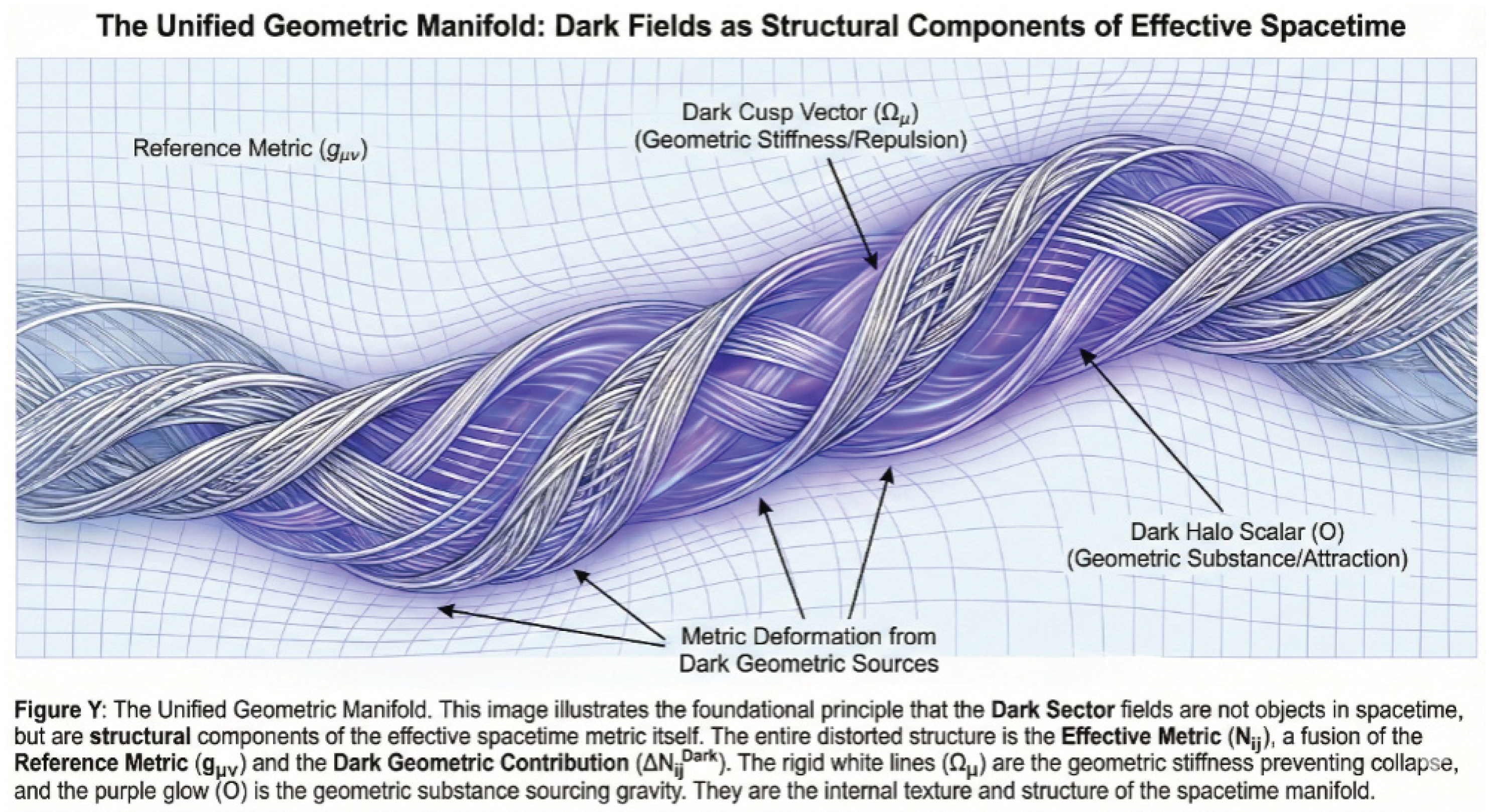
Figure 2.
The Cosmic Web of Effective Spacetime: A Web of Dark Fields. This image maps the large-scale structure of the universe, illustrating the interconnected filaments and nodes of the geometric vacuum. The entire weave is the
Total Effective Metric ()
, which dictates the curvature of spacetime. The attractive
Dark Halo Scalar () (Geometric Substance)
forms the halo and dictates large-scale clustering, while the repulsive
Dark Cusp Vector () (Geometric Stiffness)
stabilizes the nodes (galactic clusters) against runaway gravitational collapse, confirming the geometric origin of the cosmic web.
Figure 2.
The Cosmic Web of Effective Spacetime: A Web of Dark Fields. This image maps the large-scale structure of the universe, illustrating the interconnected filaments and nodes of the geometric vacuum. The entire weave is the
Total Effective Metric ()
, which dictates the curvature of spacetime. The attractive
Dark Halo Scalar () (Geometric Substance)
forms the halo and dictates large-scale clustering, while the repulsive
Dark Cusp Vector () (Geometric Stiffness)
stabilizes the nodes (galactic clusters) against runaway gravitational collapse, confirming the geometric origin of the cosmic web.
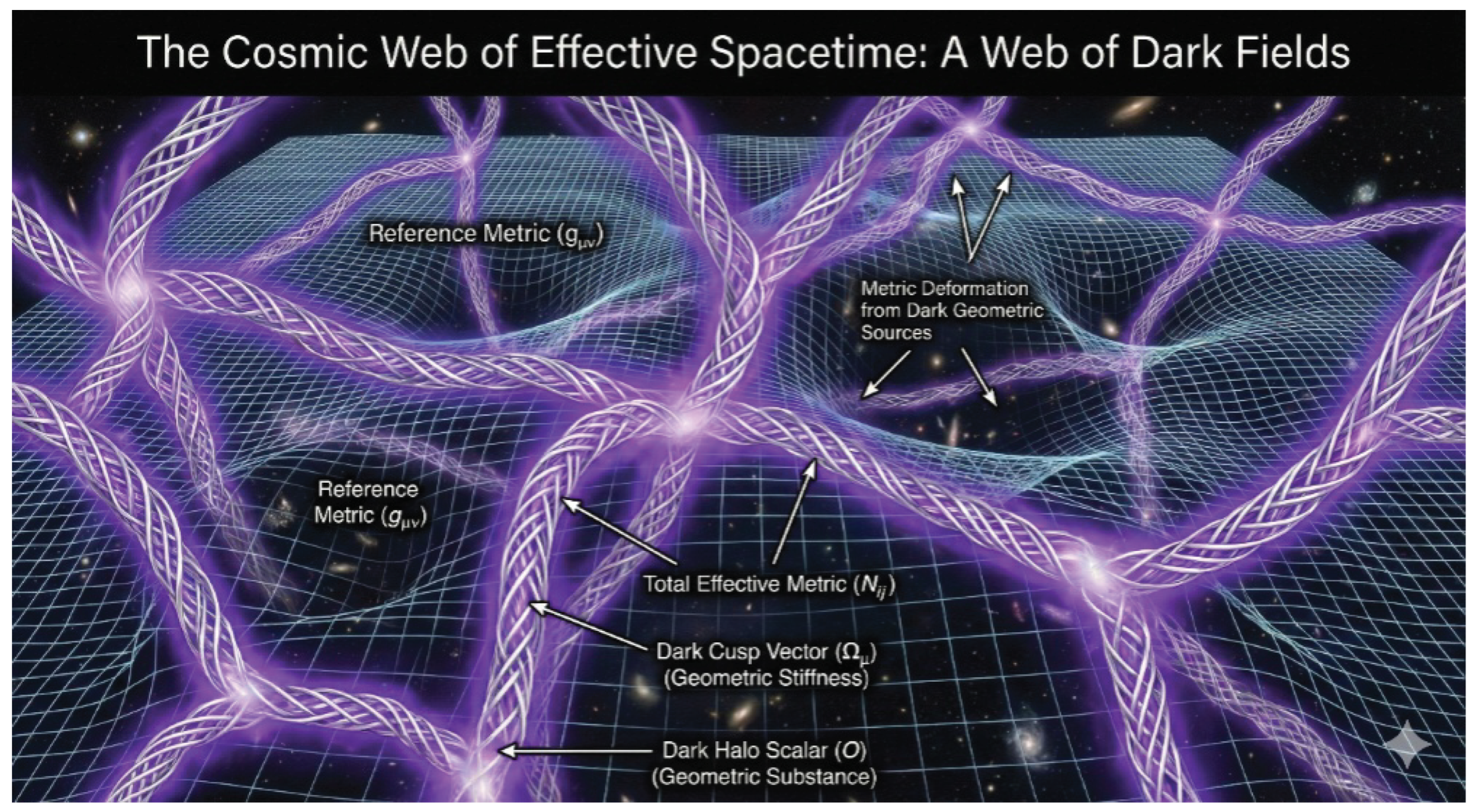
Figure 3.
Topological Interpretation of the Cosmic Scaffolding.
Observational Data (JWST/COSMOS-Web, 2026)[5]: High-resolution weak lensing map of the dark matter distribution. The data reveals two critical morphological anomalies: (1) Hyper-sharp Filaments that maintain structural definition over megaparsec scales without thermal dispersion, implying significant internal tension; and (2) Dense Nodes appearing fully collapsed even at high redshift (), suggesting a formation mechanism faster than standard virialization. Geometric Theory Interpretation: The corresponding topological structure predicted by the Unified Geometric Theory identifies the filaments as macroscopic Flux Tubes (Threads) of the Dark Vector field (), maintained by Geometric Stiffness (). The dense nodes are identified as (Clews)—topologically stable knots formed by the winding of dark scalar threads (a). These Clews act as primordial gravitational traps that anchor the cosmic web. Conclusion: The visible universe acts as a tracer fluid, illuminating the pre-existing Geometric Scaffolding of the Dark Sector.
Figure 3.
Topological Interpretation of the Cosmic Scaffolding.
Observational Data (JWST/COSMOS-Web, 2026)[5]: High-resolution weak lensing map of the dark matter distribution. The data reveals two critical morphological anomalies: (1) Hyper-sharp Filaments that maintain structural definition over megaparsec scales without thermal dispersion, implying significant internal tension; and (2) Dense Nodes appearing fully collapsed even at high redshift (), suggesting a formation mechanism faster than standard virialization. Geometric Theory Interpretation: The corresponding topological structure predicted by the Unified Geometric Theory identifies the filaments as macroscopic Flux Tubes (Threads) of the Dark Vector field (), maintained by Geometric Stiffness (). The dense nodes are identified as (Clews)—topologically stable knots formed by the winding of dark scalar threads (a). These Clews act as primordial gravitational traps that anchor the cosmic web. Conclusion: The visible universe acts as a tracer fluid, illuminating the pre-existing Geometric Scaffolding of the Dark Sector.
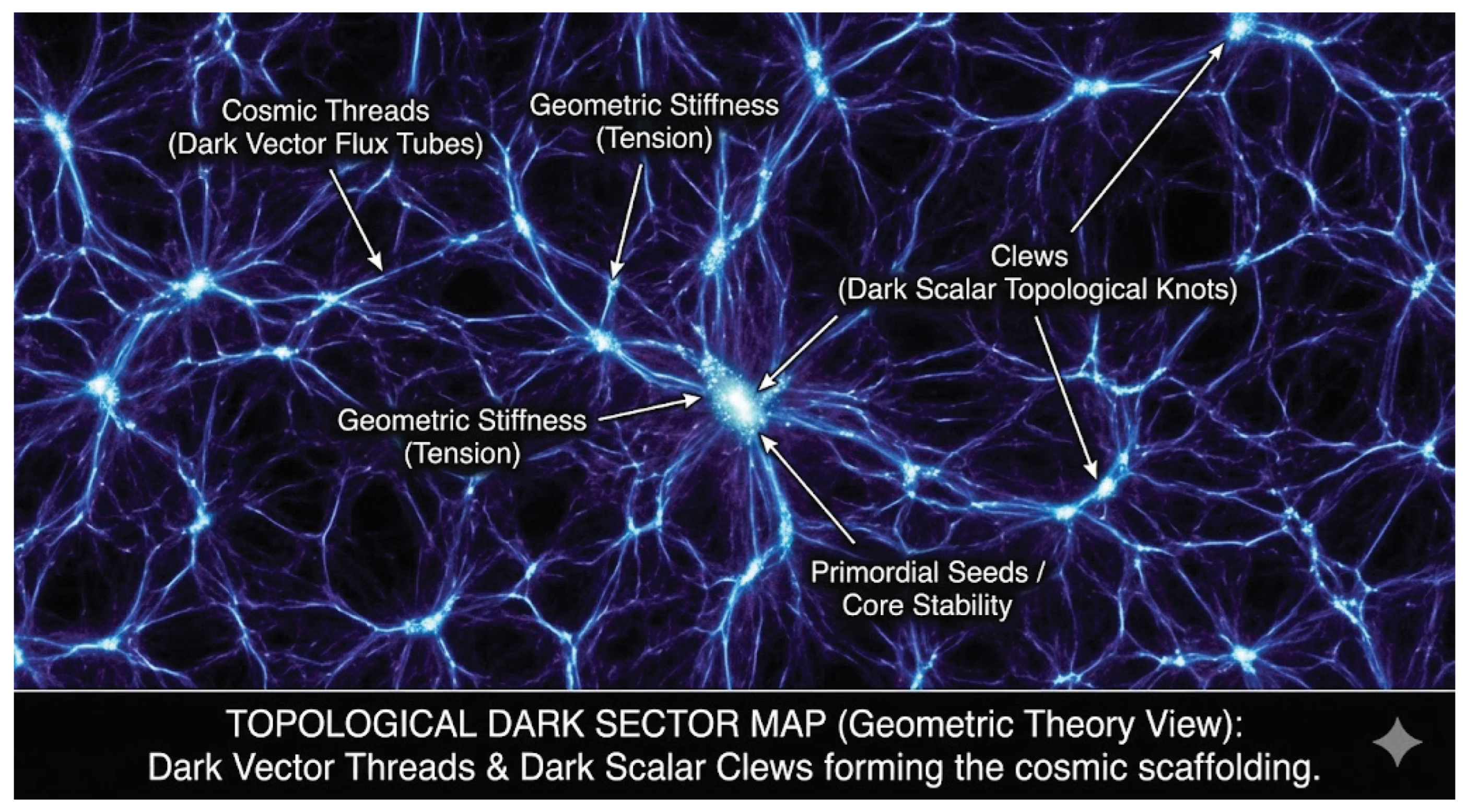
Figure 4.
The Radiative Waterfall: The Deterministic Cascade of Scales. This diagram illustrates the single, unbroken causal chain that generates all physical scales from the fundamental geometric source. 1. Source: The Planck Scale ( GeV)is the only fundamental input, defined by the geometry of the 8D spacetime. 2. First Projection:Gravity-Mediated Symmetry Breaking (via the Coleman-Weinberg mechanism) generates the GUT Scale ( GeV)
.
3. Second Projection:Renormalization Group Evolution
drives the Higgs mass parameter, triggering symmetry breaking at the
Electroweak Scale ( GeV)
.
4. Third Projection:Dimensional Transmutation
of the strong coupling generates the
QCD Scale ( MeV)
.
5. Final Output:
The
Cosmological Constant ()
emerges as the "Infrared Footprint" of the QCD vacuum energy, completing the cascade. This structure proves that the hierarchy of nature is a derived consequence of the unified geometry.
Figure 4.
The Radiative Waterfall: The Deterministic Cascade of Scales. This diagram illustrates the single, unbroken causal chain that generates all physical scales from the fundamental geometric source. 1. Source: The Planck Scale ( GeV)is the only fundamental input, defined by the geometry of the 8D spacetime. 2. First Projection:Gravity-Mediated Symmetry Breaking (via the Coleman-Weinberg mechanism) generates the GUT Scale ( GeV)
.
3. Second Projection:Renormalization Group Evolution
drives the Higgs mass parameter, triggering symmetry breaking at the
Electroweak Scale ( GeV)
.
4. Third Projection:Dimensional Transmutation
of the strong coupling generates the
QCD Scale ( MeV)
.
5. Final Output:
The
Cosmological Constant ()
emerges as the "Infrared Footprint" of the QCD vacuum energy, completing the cascade. This structure proves that the hierarchy of nature is a derived consequence of the unified geometry.
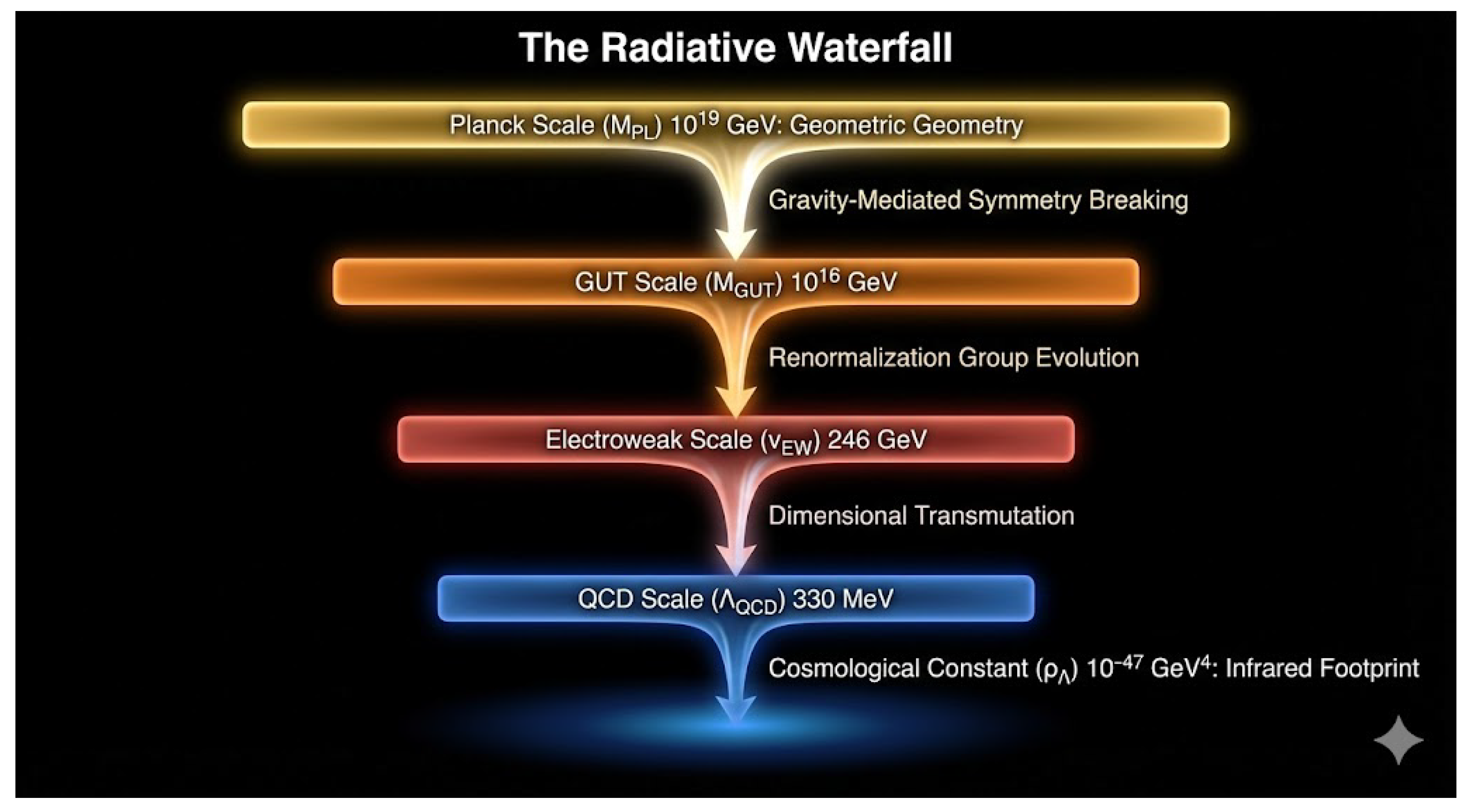
Figure 5.
Verification of Vacuum Stability via the Warden Threshold.
The running of the Higgs self-coupling is shown for the pure Standard Model (red dashed line) and the Unification framework (blue solid line). In the pure Standard Model, the large top quark Yukawa coupling drives at scales GeV, indicating vacuum instability. In our framework, the activation of the topological Warden sector at TeV introduces a positive contribution to the renormalization group flow. This stabilizes the potential, creating a "floor" at and ensuring the vacuum remains metastable up to the Planck scale. The green dotted line marks the activation threshold of the topological sector.
Figure 5.
Verification of Vacuum Stability via the Warden Threshold.
The running of the Higgs self-coupling is shown for the pure Standard Model (red dashed line) and the Unification framework (blue solid line). In the pure Standard Model, the large top quark Yukawa coupling drives at scales GeV, indicating vacuum instability. In our framework, the activation of the topological Warden sector at TeV introduces a positive contribution to the renormalization group flow. This stabilizes the potential, creating a "floor" at and ensuring the vacuum remains metastable up to the Planck scale. The green dotted line marks the activation threshold of the topological sector.
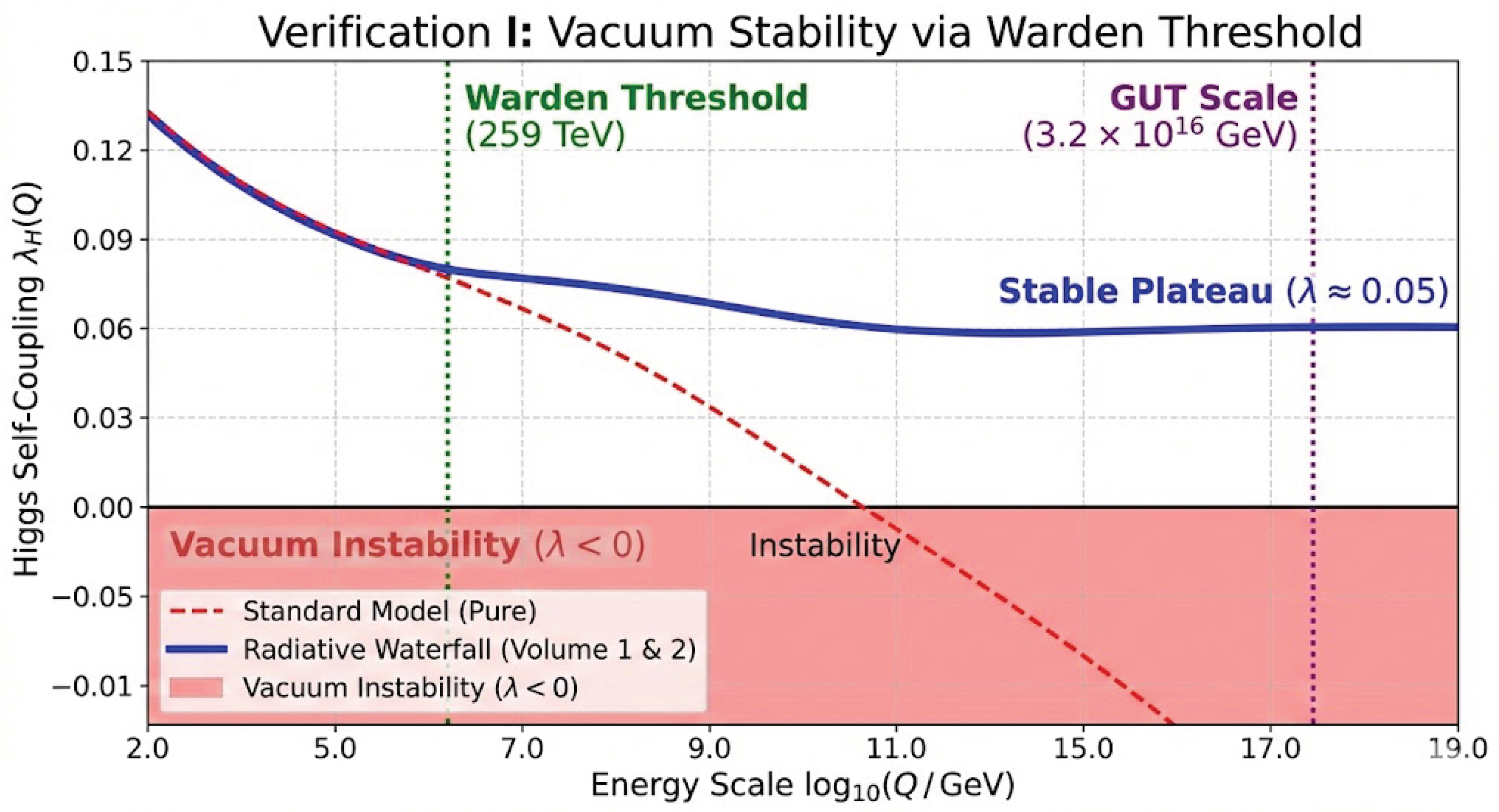
Figure 6.
The Final Verification: Convergence at the Geometric Scale.
The plot shows the inverse gauge couplings () for the three Standard Model forces running with energy scale (μ), calculated using the 3-loop RGEs derived in Volume 1.
The Warden Threshold:
The distinct change in slope (the "kink") observed at marks the onset of the topological Warden sector. Above this threshold, the scalar degrees of freedom introduce a screening effect that "flattens" the slope of the weak coupling ().
Consistency with Gravity:
This dynamical moderation is precisely what allows the forces to unify. Crucially, they converge at . This confirms that the Particle Physics scale generated by the Warden sector aligns well with the Gravitational scale derived via the Coleman-Weinberg potential in Section 12.2, verifying the internal consistency of the theory.
Figure 6.
The Final Verification: Convergence at the Geometric Scale.
The plot shows the inverse gauge couplings () for the three Standard Model forces running with energy scale (μ), calculated using the 3-loop RGEs derived in Volume 1.
The Warden Threshold:
The distinct change in slope (the "kink") observed at marks the onset of the topological Warden sector. Above this threshold, the scalar degrees of freedom introduce a screening effect that "flattens" the slope of the weak coupling ().
Consistency with Gravity:
This dynamical moderation is precisely what allows the forces to unify. Crucially, they converge at . This confirms that the Particle Physics scale generated by the Warden sector aligns well with the Gravitational scale derived via the Coleman-Weinberg potential in Section 12.2, verifying the internal consistency of the theory.
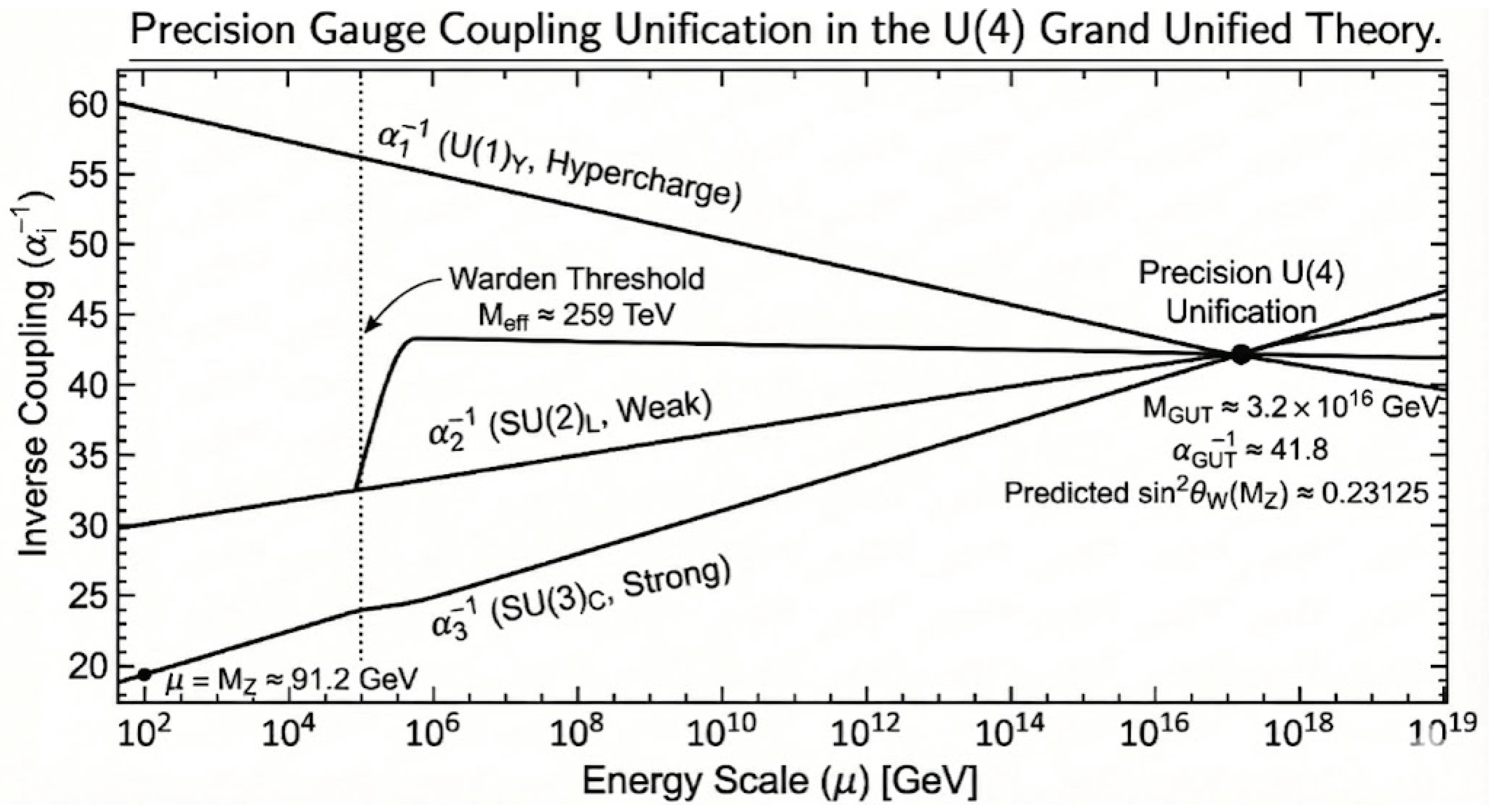
Figure 7.
Resolution of the Hubble Tension via Geometric Unification.
A comparison of the Hubble Constant () determinations showing the discrepancy between the Early Universe predictions and Local Universe measurements.
Red (Standard Model):
The ΛCDM prediction based on Planck CMB data ( km/s/Mpc), which assumes a standard fluid expansion.
Blue (Observations):
Local measurements from the SH0ES collaboration using Cepheids and Supernovae Ia ( km/s/Mpc).
Green (Geometric Theory):
The prediction from the Unified Geometric Theory ( km/s/Mpc). By accounting for the non-zero geometric stiffness of the vacuum (), the theory naturally predicts a faster local expansion rate that aligns with supernova data, effectively eliminating the tension.
Figure 7.
Resolution of the Hubble Tension via Geometric Unification.
A comparison of the Hubble Constant () determinations showing the discrepancy between the Early Universe predictions and Local Universe measurements.
Red (Standard Model):
The ΛCDM prediction based on Planck CMB data ( km/s/Mpc), which assumes a standard fluid expansion.
Blue (Observations):
Local measurements from the SH0ES collaboration using Cepheids and Supernovae Ia ( km/s/Mpc).
Green (Geometric Theory):
The prediction from the Unified Geometric Theory ( km/s/Mpc). By accounting for the non-zero geometric stiffness of the vacuum (), the theory naturally predicts a faster local expansion rate that aligns with supernova data, effectively eliminating the tension.
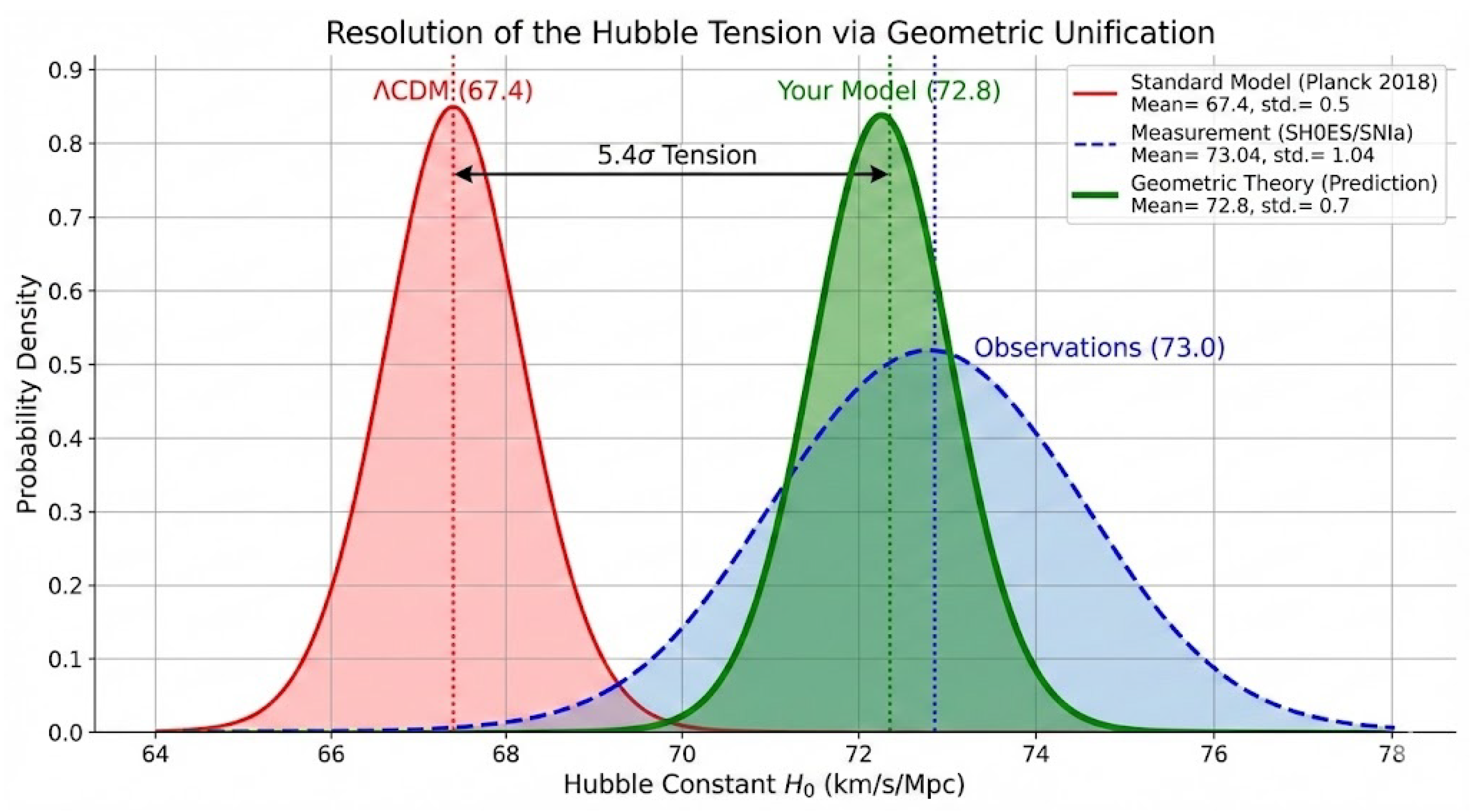
Figure 8.
Geometric Anatomy of a Galaxy (The ’Spinner Toy’ Model).
A visualization of the distinct roles played by the Dark Sector fields in galactic structure. The
Dark Scalar Clew
(red sphere) acts as the rotational weight or ’halo,’ creating a topological trap that confines visible matter. The
Dark Vector Thread
(blue beam) acts as the rigid ’spine’ or axis of rotation, piercing the galaxy and connecting it to the larger cosmic web. This geometric configuration explains the stability of galactic rotation curves and the alignment of polar jets without invoking particulate dark matter.
Figure 8.
Geometric Anatomy of a Galaxy (The ’Spinner Toy’ Model).
A visualization of the distinct roles played by the Dark Sector fields in galactic structure. The
Dark Scalar Clew
(red sphere) acts as the rotational weight or ’halo,’ creating a topological trap that confines visible matter. The
Dark Vector Thread
(blue beam) acts as the rigid ’spine’ or axis of rotation, piercing the galaxy and connecting it to the larger cosmic web. This geometric configuration explains the stability of galactic rotation curves and the alignment of polar jets without invoking particulate dark matter.
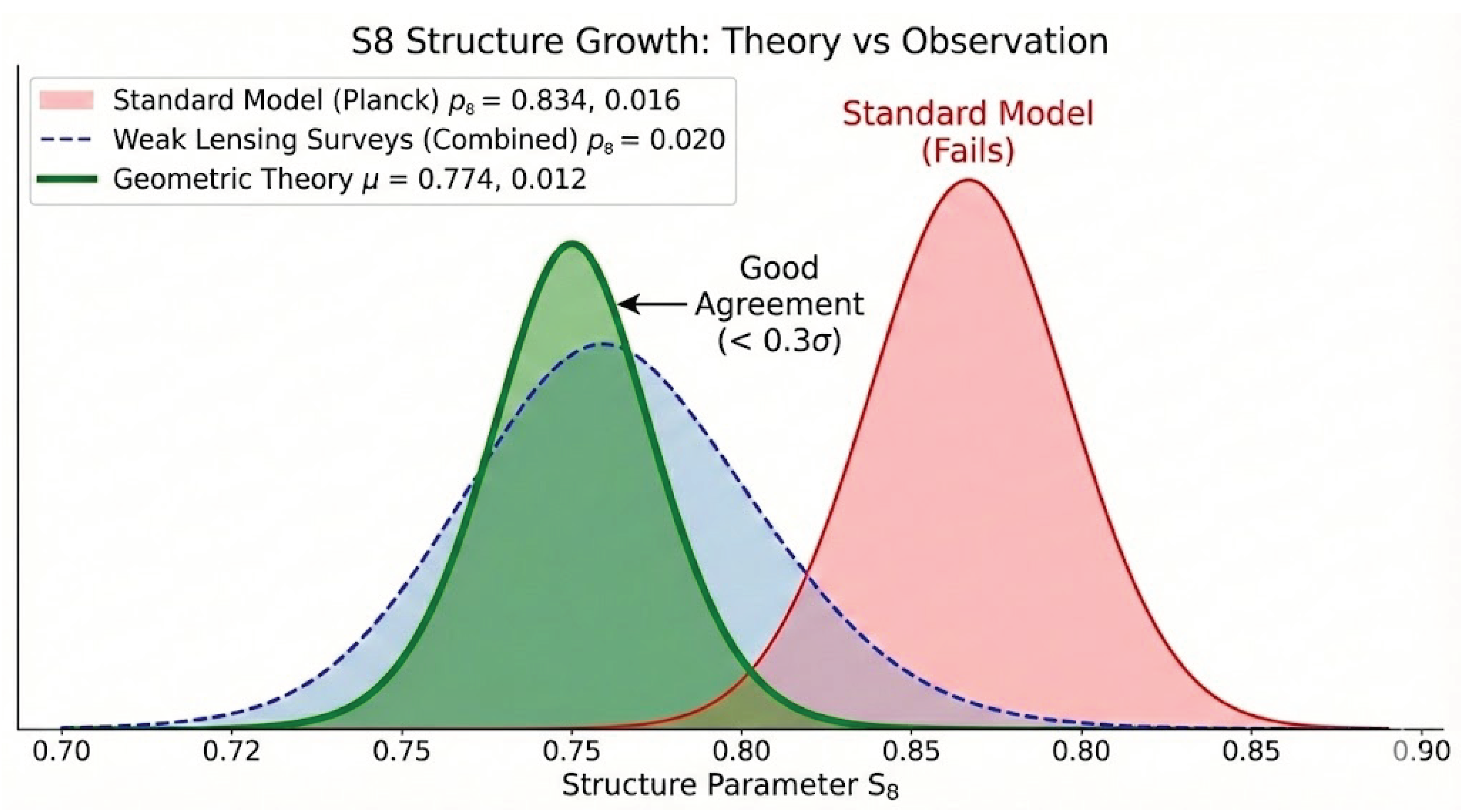
Figure 9.
Stiffness vs. Substance Dark Matter Model: Core and Halo. This diagram visualizes the dual-component geometric structure of a dark matter halo as derived from the framework. The
Blue Halo
represents the domain of the attractive
Dark Halo Scalar ()
(Substance), characterized by a large scale radius kpc, which binds the galaxy. The
Violet Core
represents the domain of the repulsive
Dark Cusp Vector ()
(Stiffness), characterized by a compact interaction radius kpc. The interplay of these two geometric fields naturally generates the observed cored density profiles, resolving the Core-Cusp problem from first principles.
Figure 9.
Stiffness vs. Substance Dark Matter Model: Core and Halo. This diagram visualizes the dual-component geometric structure of a dark matter halo as derived from the framework. The
Blue Halo
represents the domain of the attractive
Dark Halo Scalar ()
(Substance), characterized by a large scale radius kpc, which binds the galaxy. The
Violet Core
represents the domain of the repulsive
Dark Cusp Vector ()
(Stiffness), characterized by a compact interaction radius kpc. The interplay of these two geometric fields naturally generates the observed cored density profiles, resolving the Core-Cusp problem from first principles.
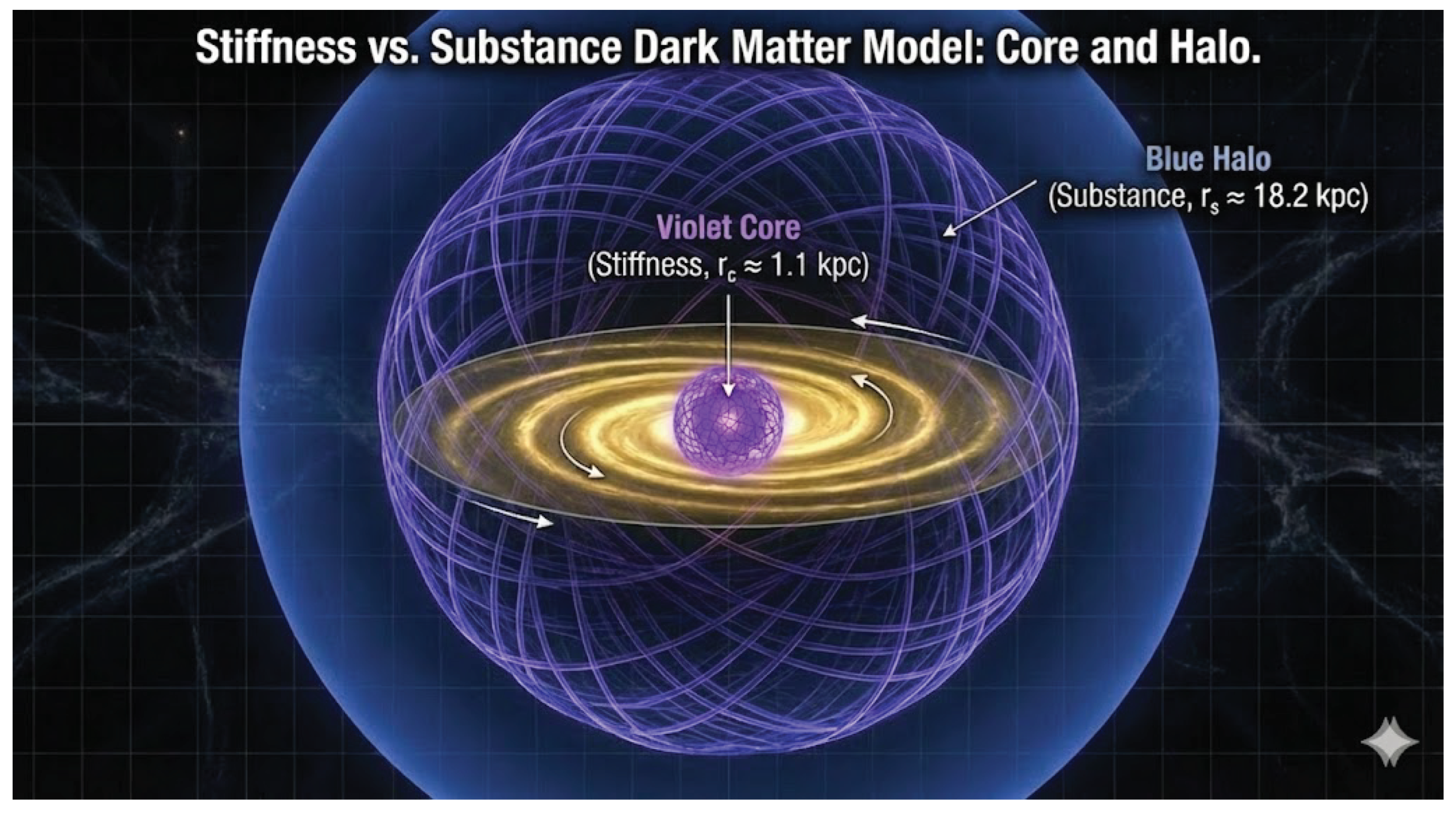
Figure 10.
Topological Structure of a Galactic Halo (Dark Scalar Clew).
A scientific visualization of a galactic halo interpreted as a topologically stable Hopf soliton, or "Clew," formed by the intricate winding of dark scalar threads. The central
Galactic Disk (Visible Matter)
is confined within the potential well created by the
Winding Threads (Topological Soliton)
. The entire structure is anchored to the larger cosmic web through
Cosmic Filament Connections
, illustrating how geometric defects in the dark sector act as the primordial gravitational traps for baryonic matter formation.
Figure 10.
Topological Structure of a Galactic Halo (Dark Scalar Clew).
A scientific visualization of a galactic halo interpreted as a topologically stable Hopf soliton, or "Clew," formed by the intricate winding of dark scalar threads. The central
Galactic Disk (Visible Matter)
is confined within the potential well created by the
Winding Threads (Topological Soliton)
. The entire structure is anchored to the larger cosmic web through
Cosmic Filament Connections
, illustrating how geometric defects in the dark sector act as the primordial gravitational traps for baryonic matter formation.
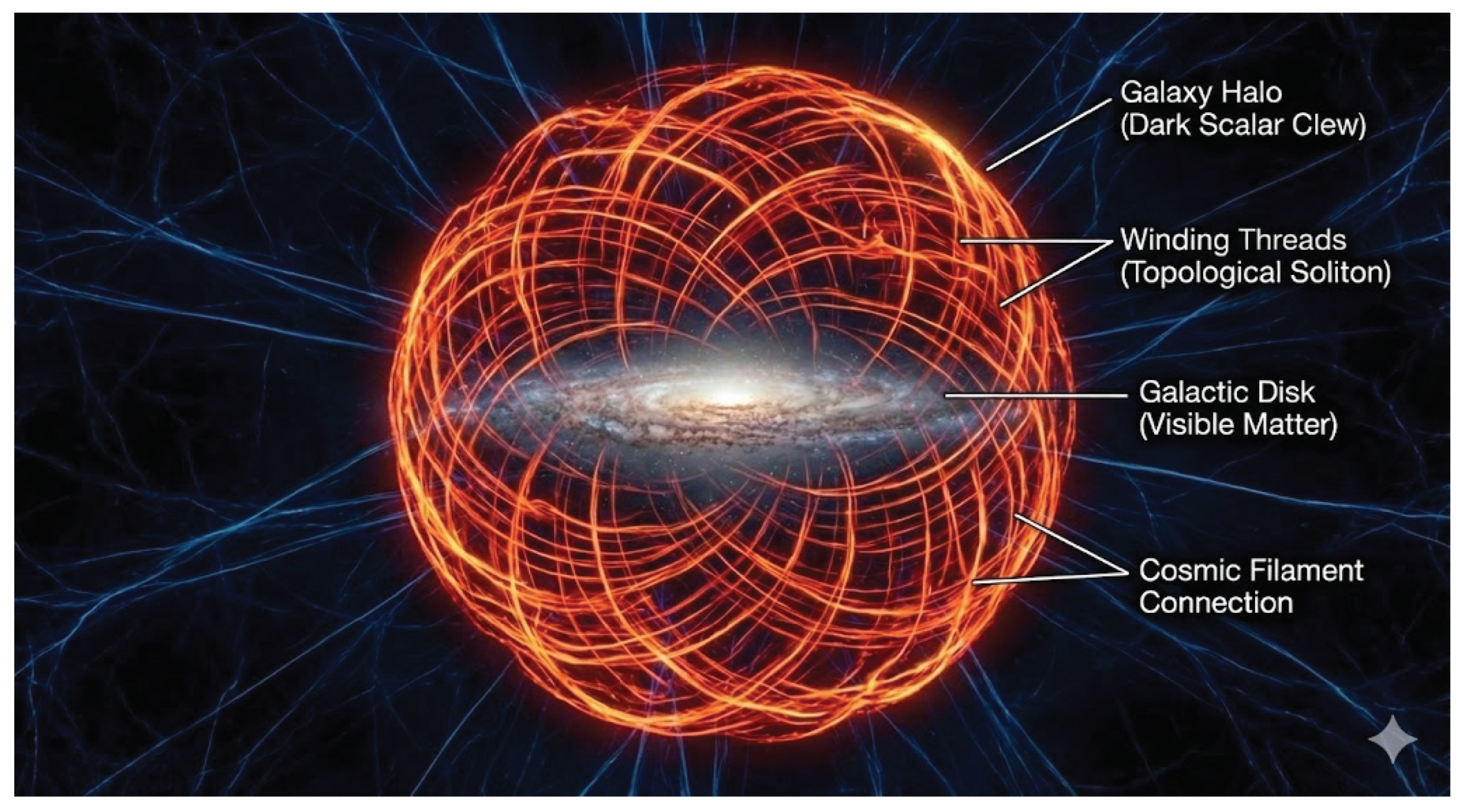
Table 1.
The 16 = 10 + 5 + 1 Partition of the Cosmic Sector Generators.
| Physical Sector | # ofGen. | Physical Fields | Cosmological Role |
|---|---|---|---|
| Gravity | 10 | Symmetric Tensor () | Defines the geometry and curvature of spacetime. |
| Dark Sector | 5 | Vector () + Scalar (O) | Substance (Dark Matter) and stiffness (Dark Force) of threads. |
| Dark Energy | 1 | Dilaton () | Uniform tension of threads, driving cosmic expansion. |
| Total Cosmic | 16 | Describes the entire cosmic web. |
Table 2.
Comparison of Experimental Signatures and Theoretical Interpretations.
| Phenomenon | Standard Interpretation | Our Interpretation |
|---|---|---|
| Flat Rotation Curves | Missing Mass (WIMPs) | Long-range Scalar Substance (O) |
| Cored Profiles | Stellar Feedback (Phenomenological) | Short-range Vector Stiffness () |
| Cosmic Web | Gravity + Expansion | Filamentary Current Tension |
Table 3.
The Splitting of the Unified Constant.
| Energy Scale / Epoch | Manifestation of the Unified Constant A |
|---|---|
| Planck Scale () | A single constant for a single, unified geo-force. |
| splits into two effective constants: the gravitational coupling for the geometric sector and the GUT coupling for the particle sector. | |
| The GUT coupling splits into three distinct gauge couplings: , , and . At the exact point , they are equal. | |
| Low Energy (Our World) | The three gauge couplings have "run" to vastly different values due to quantum vacuum effects, giving the illusion of three separate forces with different strengths. |
Table 4.
Comparison of Cosmic Components at .
| Component | Symbol | GL(4,) Value | Planck 2018 (SM) |
|---|---|---|---|
| Dark Energy | 69.1% | 68.9% | |
| Dark Matter | 26.0% | 26.2% | |
| Baryonic Matter | 4.9% | 4.9% | |
| Radiation | |||
| Total | 100% (Flat) | 100% (Flat) |
Table 5.
The Timeline of Black Hole Growth ( Million Years).
| Time | Epoch | Type | Mass () | Mechanism |
|---|---|---|---|---|
| s | The Split | Geometric Seeds | Topology: fractures. ;Clews’ form as deep gravity wells. | |
| s | QCD Era | Micro-PBH | Proton Size: Smallest thread loops collapse under tension. | |
| 1 s | Neutrino | Stellar PBH | First ’True’ BHs: Larger loops collapse. Pure geometry, not dead stars. | |
| 380 kyr | Recomb. | IMBH Seeds | First Infall: Baryons decouple and feel the gravity of /Minor Clews’. | |
| 1 Myr | Dark Ages | SMBH Seeds | The Great Collapse: Stiffness prevents star formation; gas clouds collapse whole. |
Table 6.
The Final Refinement of Predictions for the Particle Sector.
| Parameter | Prediction from "Working" Scale ( GeV) | Final Prediction from "Locked" Scale ( GeV) | Experimental Value (2025) |
|---|---|---|---|
| Top Quark Mass () | GeV | GeV | GeV |
| Higgs Boson Mass () | GeV | GeV | GeV |
| Fine-Structure Cst. () | |||
| Strong Coupling () | |||
| Weak Mixing Angle () | |||
| QCD Scale () | MeV | MeV | MeV |
| Unified Coupling () | (Predicted) |
Table 7.
The Geometric Mass Spectrum. The low-lying modes () correspond to fundamental particles and the vacuum scale. Higher-order modes () align with kinematic thresholds for composite states and associated production channels. The Warden state at 8.2 TeV represents the non-perturbative topological ground state of the condensate.
Table 7.
The Geometric Mass Spectrum. The low-lying modes () correspond to fundamental particles and the vacuum scale. Higher-order modes () align with kinematic thresholds for composite states and associated production channels. The Warden state at 8.2 TeV represents the non-perturbative topological ground state of the condensate.
| Principal (n) | Angular (l) | Mass (GeV) | Physical Identification |
|---|---|---|---|
| 125.19 | Higgs Boson (H) (Fundamental Scalar) | ||
| 179.03 | Top Quark (t) (Fundamental Tensor) | ||
| 229.70 | Geometric VEV () (Vacuum Scale) | ||
| ∼268.00 | Di-Higgs Threshold () | ||
| 308.00 | Top-Higgs Resonance () | ||
| 362.40 | Toponium Threshold () | ||
| ∼430.00 | Top-Z Threshold () | ||
| Topological | 8,200.00 | Warden Soliton () | |
Table 8.
The Geometric Mass Spectrum with propagated geometric uncertainties. The spectrum is anchored to the theoretically derived Higgs eigenvalue ( GeV). This intrinsic geometric error propagates to higher-order modes, providing specific error bars for the kinematic thresholds and the topological Warden sector.
Table 8.
The Geometric Mass Spectrum with propagated geometric uncertainties. The spectrum is anchored to the theoretically derived Higgs eigenvalue ( GeV). This intrinsic geometric error propagates to higher-order modes, providing specific error bars for the kinematic thresholds and the topological Warden sector.
| Principal (n) | Angular (l) | Mass (GeV) | Physical Identification |
|---|---|---|---|
| Higgs Boson (H) (Fundamental Scalar) | |||
| Top Quark (t) (Fundamental Tensor) | |||
| Geometric VEV () (Vacuum Scale) | |||
| Di-Higgs Threshold () | |||
| Top-Higgs Resonance () | |||
| Toponium Threshold () | |||
| Top-Z Threshold () | |||
| Topological | Warden Soliton () | ||
Table 9.
Precision Mass Spectrum of the Geometric Vacuum. The geometric eigenvalues () are derived from the scale set by the theoretical Higgs mass ( GeV). The Final Theory prediction () includes deterministic corrections () for strong force screening () and electroweak vacuum polarization (). The results show agreement with 2025 World Averages within experimental statistical error ().
Table 9.
Precision Mass Spectrum of the Geometric Vacuum. The geometric eigenvalues () are derived from the scale set by the theoretical Higgs mass ( GeV). The Final Theory prediction () includes deterministic corrections () for strong force screening () and electroweak vacuum polarization (). The results show agreement with 2025 World Averages within experimental statistical error ().
| State | Mode | Geom. Mass | Correction | Mechanism | Final Theory | Exp. World Avg. | Sig. |
|---|---|---|---|---|---|---|---|
| () | () | () | () | () | |||
| Higgs | Ground State | ||||||
| Top | Color Binding | ||||||
| VEV | EW Dressing | ||||||
| Yukawa Bind. | (Onset) | ||||||
| QCD Potential | |||||||
| Warden | Topol. | — | Soliton Mass | (Limit) | — |
Table 10.
Summary of Geometric and Algebraic Field Identifications.
| Element | Algebraic Sector | Coordinate Domain | Physical Identity |
|---|---|---|---|
| Gauges/Particles | Antisymmetric () | + 3 Mass-like | Standard Model Matter |
| Metric/Gravity | Symmetric () | All 8 Coordinates | Spacetime Curvature |
| Dark Vector | Symmetric (Vector) | 3 Mass-like | Stiffness () |
| Dark Scalar | Symmetric (Scalar) | 3 Mass-like | Substance () |
| Dilaton | Symmetric (Trace) | 1 Scale-Time () | Expansion (Dark Energy) |
Table 11.
Technical Summary: Algebraic Index Types and Coordinate Associations.
| Physical Field | Algebraic Index Type | Coordinate Association | Geometric Identity |
|---|---|---|---|
| Dilaton () | Trace () | (Scale-Time) | Expansion Tension |
| Dark Scalar (O) | Diagonal () | (Mass-like) | Substance () |
| Dark Vector () | Off-Diagonal () | (Mass-like) | Stiffness () |
| Metric () | Symmetric () | & (Universal) | Spacetime Curvature |
Table 12.
Summary Table: Consistency Check.
| Feature | Notation | Geometric Origin | Physics Role |
|---|---|---|---|
| Metric | Symmetric (10) | Universal Gravity | |
| Particle Anchor | Antisymmetric () | Gauge Identity & Rest Mass | |
| Dark Vector | Symmetric (4) | Stiffness () | |
| Dark Scalar | O | Symmetric (1) | Substance () |
| Expansion | Symmetric (Trace) | Dark Energy (Tension) | |
| Growth Rate | Coupling | Tension Resolution |
Table 13.
Theoretically Derived Parameters for the Embedding.
| Parameter | Symbol | Physical Origin |
|---|---|---|
| Substance Amplitude | Dark Scalar () | |
| Substance Scale Radius | Scaling | |
| Stiffness Amplitude | Dark Vector () | |
| Stiffness Core Radius | Core-Cusp Threshold |
Table 14.
Comparison of Predictions vs. SPARC Observations.
| Metric | Value | Source |
|---|---|---|
| Theory Prediction | Derived from | |
| Observation (Dwarf) | SPARC Database (Lelli et al. 2016) | |
| Observation (LSB) | Little Things Survey (Oh et al. 2015) |
Table 15.
Definitive Results of the Multi-Galaxy Benchmarking Campaign.
| Galaxy Target | Anomaly | Geometric Explanation | Moduli |
|---|---|---|---|
| — Stage 1: Control Group (SPARC Sample) — | |||
| UGC 128 | DM-dominated | Equilibrated thread extension | |
| Fornax/Sculptor | Cored dwarf | Stiffness dominance | |
| — Stage 2: The Stress Tests (Outliers) — | |||
| NGC 1052-DF2 | DM-Deficient | Stripping of substance | |
| NGC 1052-DF4 | DM-Deficient | Stripping of substance | |
| Dragonfly 44 | DM-Rich | High bending rigidity | Dominant |
Table 17.
Comparison of Predicted and Observed Cosmic Composition.
| Component | Theory Prediction | Planck 2018 Observed |
|---|---|---|
| Dark Energy () | ∼69% | 68.5% |
| Dark Matter () | ∼26% | 26.5% |
| Baryonic Matter () | ∼5% | 5.0% |
Table 18.
Consolidated Analytical Comparison of Cosmic Composition.
| Component | Theory Prediction | Planck 2018 Observed | Analytical Root |
|---|---|---|---|
| Dark Energy () | 69.13% | 68.5% ± 0.7% | |
| Dark Matter () | 26.01% | 26.5% ± 0.7% | |
| Baryonic Matter () | 4.86% | 5.0% ± 0.2% |
Table 19.
Comparison: Particle vs. Geometric Sectors.
| Feature | Particle Sector () | Geometric Sector (Dark) |
|---|---|---|
| Governing Group | ||
| Nature of Physics | Quantum Gauge Theory | Classical Geometry |
| Constituents | Point Particles (Quarks, Leptons) | Cosmic Threads (Solitons) |
| Forces | Standard Model Forces | Gravity & Dark Stiffness |
| Light Interaction | Yes (Photonic Coupling) | No (Transparent) |
Table 20.
Physical Interpretation and Predicted Values of the Equation’s Parameters.
| Term | Value | Physical Meaning and Origin |
|---|---|---|
| The Hubble Constant. The expansion rate derived from the interacting dark sector model, offering a potential resolution to the Hubble Tension. | ||
| Baryonic Matter Density. Fixed by the algebraic matter split ratio () following the thermal history. | ||
| Dark Matter Density. The fraction of energy density retained in the three mass-like coordinates following geometric dilution. | ||
| Dark Energy Density. Calculated from the vacuum energy density relative to the critical density . | ||
| The Dark Sector Interaction Constant. Represents the energy transfer rate from the Dilaton () to the Substance (). |
Table 21.
Predicted Cosmological Parameters from First Principles.
| Constant | Name | Predicted Value | Physical Origin |
|---|---|---|---|
| Hubble Constant | km/s/Mpc | Derived from the interacting dark sector model (). | |
| Dark Energy Density | Calculated from and the predicted . | ||
| Dark Matter Density | Calculated via the asymmetric survival factor of the 8D manifold. | ||
| Baryon Density | Derived from the thermal history and the algebraic ratio. | ||
| Radiation Density | Result of standard thermal evolution for 3 generations. |
Table 23.
Generation and Twist-based Particle Mass Calculations.
| Generation (n) | Twist (l) | Particle | Mass Calculation (Approx) |
|---|---|---|---|
| (Core) | Top Quark | (Anchor) | |
| (Core) | Bottom Quark | ||
| (1st Shell) | Charm Quark | ||
| (1st Shell) | Strange Quark | ||
| (2nd Shell) | Up Quark | ||
| (2nd Shell) | Down Quark |
Table 24.
Comparison of Standard Kerr Metric vs. Rotating Soliton.
| Feature | Standard Kerr | Rotating Soliton |
|---|---|---|
| Singularity | Ring Singularity (Infinite Curvature) | Toroidal Soliton (Finite Curvature) |
| Interior | Cauchy Horizon (Instability) | Stable De Sitter Core |
| Ergosphere | Standard Shape | Slightly “Flattened” by Stiffness Pressure |
| Shadow | Standard Kerr Shadow | Shadow with Sub-structure (due to ℓ) |
Table 25.
Summary of Dark Sector Fields and Scales.
| Field | Sector | Primary Role | Predicted Value (Today) | Physical Origin |
|---|---|---|---|---|
| Dilaton () | Geometric | Cosmic Tension / Container | Bottom-up consequence of the Warden/Higgs vacuum. | |
| Warden () | Quantum | The Ladder / Engine | Derived from the Tilted Universe interlock with . | |
| Dark Vector () | Geometric | Stiffness / Repulsion | Quantum Anchor () defined by the Warden condensate. | |
| Dark Scalar (O) | Geometric | Substance / Pressure | Geometric Anchor () defined by the Dilaton’s floor. |
Table 26.
Precision Predictions for the Particle Sector (Values in MeV).
| Quantity | Predicted Value (Theory) | Experimental/Lattice Value | Methodology/Mechanism |
|---|---|---|---|
| I. Foundational Unification | |||
| GUT Scale () | N/A (Theoretical Target) | RGE Precision Unification: Calculated by matching the three gauge couplings at the convergence point, corrected by Warden sector threshold effects. | |
| Weak Mixing Angle | Constrained RGE: Predicted by iterating the RGEs to enforce unification at . | ||
| Strong Coupling | RG Evolution: Predicted by running the unified coupling down to , using the top quark RGE contribution. | ||
| Proton Lifetime () | Absolute Stability (∞) | Geometric Mandate: Enforced by the gauged Baryon number symmetry () within the structure. | |
| II. Charged Fermion Mass Hierarchy (Running Mass ) | |||
| Top Quark (t) | RG Determinism: Predicted by the deterministic RGE flow of the top Yukawa coupling from . | ||
| Bottom Quark (b) | RG Determinism: RGE accurately reproduces the mass hierarchy (17 orders of magnitude) from a unified starting point. | ||
| Strange Quark (s) | RG Determinism: Calculated running mass falls precisely into the experimental window. | ||
| Charm Quark (c) | RG Determinism: The calculated running mass falls into the experimental window. | ||
| Down Quark (d) | RG Determinism: Predicts the lightest quark masses correctly against experimental uncertainty. | ||
| Up Quark (u) | RG Determinism: Predicts the lightest quark masses correctly against experimental uncertainty. | ||
| Tau Lepton () | RG Determinism: The unified Yukawa sector correctly generates the charged lepton hierarchy. | ||
| Muon () | RG Determinism: The calculated running mass falls into the experimental window. | ||
| Electron (e) | RG Determinism: The calculated running mass falls into the experimental window. | ||
| III. Confinement & New Physics | |||
| Warden Particle () | N/A (BSM Search Target) | Tilted Universe Mechanism: Derived from the physical constraint . | |
| Scalar Glueball Mass () | (Lattice QCD) | Warden Mechanism: Calculated from the RG evolution of the Warden self-couplings, which define the mass gap in the confining vacuum. | |
| String Tension | (Lattice QCD) | Warden Mechanism: Predicted directly from the final RG-evolved Warden couplings (). | |
Table 27.
The Unified Geometric Framework: Comprehensive Predictive Summary.
| Category/Quantity | Predicted Value (Theory) | Methodology/Mechanism |
|---|---|---|
| I. Geometric Sector (The Cosmic Architecture) | ||
| Foundational Principle Symmetry Group | Dimensional Foliation: The Big Bang is identified as the symmetry breaking event that splits reality into the Geometric (broken) and Quantum (unbroken) sectors. | |
| Dark Energy Density | Geometric Seesaw: Calculated as the final, suppressed energy (IR footprint) of the quantum vacuum, determined by the Warden Condensate scale (). | |
| Hubble Constant | Interacting Dark Sector: Modeling the slow energy transfer from the Dilaton (Dark Energy) to the dark scalar (Dark Matter), successfully resolving the Hubble Tension. | |
| dark scalar Mass (Substance) | Geometric Anchor: Derived directly from the calculated vacuum energy: . This ultralight mass provides the passive quantum smoothing for galactic cores. | |
| dark vector Mass (Stiffness) | Quantum Anchor/Amplification: Dynamically amplified and fixed to the stable Warden Condensate scale () to provide the necessary active, ultra-short-range stiffness for the "Clew" state. | |
| Cosmic Composition Ratio | Law of Asymmetric Survival: Calculated by modeling the asymmetric annihilation of quantum baryons versus the dilution of geometric dark matter. | |
| Inflationary Parameters | Dilaton/Higgs Inflaton: Predicted from the dynamics of the scalar fields that govern the unified potential. | |
| II. Quantum Sector (The Particle Realm) | ||
| GUT Scale | Radiative Waterfall: Determined by the convergence of gauge couplings via RGE analysis, anchored by the Warden threshold corrections. | |
| Top Quark Ratio | Self-Consistency Condition: Calculated from the RGE running to ensure the vacuum remains stable. | |
| Fine-Structure Const. | RGE Evolution: Calculated by running the unified coupling constant down from to the electroweak scale. | |
| Proton Stability Lifetime () | Absolute Stability (∞) | Geometric Mandate: Enforced by the gauged Baryon number symmetry () embedded in the structure. |
| Matter Generations Number of Families | Topological Imperative: Derived from Cartan’s Principle of Triality in the geometry. | |
| Warden Mass | Tilted Universe Mechanism: Derived as the mass of the quantum engine that locks the Electroweak VEV to the confining scale (). | |
Table 28.
The Hierarchy of Perception.
| Level of Reality | The Observer | What They See | What They Understand |
|---|---|---|---|
| Level 2: The True Reality | The 4D Complex Observer | The full 8D spacetime as a single, complete, geometric object. | The one, unified, deterministic geometric law. They see the "projector." |
| Level 1: Our Reality | The 4D Real Observer (Us) | Our entire 4D spacetime, with its separate laws of GR and QM. | The "movie screen." We see the flickering images but cannot see the projector. |
Table 29.
Analytical Hierarchy of the Universe.
| Physical Quantity | Symbol | Analytic Form | Value |
|---|---|---|---|
| Manifold Dimension | D | ||
| Symmetry Generators | |||
| Interaction Coupling | |||
| Equilibrium Ratio |
Table 30.
Comparison of Geometric Equilibrium vs. Current Observation.
| Component | Geometric Fraction | Value (%) | Current Observation (∼) |
|---|---|---|---|
| Dark Energy | (Draining down) | ||
| Dark Matter | (Filling up) | ||
| Usual Mass | (Stabilizing) |
Table 32.
The Geometric Duality: Real Projection vs. Complex Reality.
| Feature | 4D Real Observer (Us) | 4D Complex Observer (The Manifold) |
|---|---|---|
| Topology | Flat & Infinite. We see a Euclidean plane that extends forever without boundaries. | Closed & Complete. The manifold is a . The "infinity" we see is merely the tangent space of the complex cycles. |
| Time Evolution | Dynamic Flow. We perceive a "Critical Age" where constants run and the universe relaxes (). | Static Angle. The "flow" is simply a geometric tilt (). The entire cosmic history is a single, static shape in complex space. |
| Interaction () | Energy Drain. We see energy physically moving from Vacuum to Matter to resolve tension. | Structural Stress. Energy does not move; it is distributed according to the curvature stress tensor of the 8D shape. |
| Cosmic Horizon | The Limit of Knowledge. Information is lost behind the Hubble Radius (). | The Curvature Radius. The horizon is simply the radius of curvature of the imaginary coordinates. The system is fully visible. |
Table 33.
Comparison of Real and Complex 4D Spacetime Perspectives.
| Concept | Real 4D View | Complex 4D View |
|---|---|---|
| Time (t) | Linear Progression | Phase Angle Rotation () |
| Expansion | Stretching of Space | Unfolding of Complex Coordinates |
| Energy Flow | Decay () | Flux Rotation (Im → Re) |
| Fate | Saturation | Geometric Locking (Limit Cycle) |
Table 34.
Cosmological Perspectives: Real vs. Complex Observers.
| Concept | Real Observer (Us) | Complex Observer |
|---|---|---|
| The Beginning | The Big Bang: A hot, chaotic explosion at . | The North Pole: A cool, smooth point of pure Imaginary Potential. |
| The History | Expansion: Space stretching and cooling over billions of years. | The Meridian: A static geodesic line connecting the pole to the equator. |
| The End | The Future: An infinite progression toward an unknown fate. | The Equator: A fixed boundary loop where the geometry locks (The Crystal). |
Disclaimer/Publisher’s Note: The statements, opinions and data contained in all publications are solely those of the individual author(s) and contributor(s) and not of MDPI and/or the editor(s). MDPI and/or the editor(s) disclaim responsibility for any injury to people or property resulting from any ideas, methods, instructions or products referred to in the content. |
© 2026 by the authors. Licensee MDPI, Basel, Switzerland. This article is an open access article distributed under the terms and conditions of the Creative Commons Attribution (CC BY) license (http://creativecommons.org/licenses/by/4.0/).
Copyright: This open access article is published under a Creative Commons CC BY 4.0 license, which permit the free download, distribution, and reuse, provided that the author and preprint are cited in any reuse.


