
Submitted:
04 February 2026
Posted:
06 February 2026
You are already at the latest version
Abstract
We construct a family of positive but not completely positive linear maps acting on $M_4(\mathcal{C})$, obtained as a natural extension of Kye’s indecomposable maps defined for $M_3(\mathcal{C})$. We rigorously prove positivity of these maps on 'X' states and employ them to identify a one-parameter family of bipartite quantum states living in the vicinity of maximally mixed state to be entangled even though states are positive under partial transposition (PPT). This provides an explicit example of a family of quantum states with both bound entangled states and free entangled states in $4 \otimes 4$ systems, a regime that remains less characterized compared to lower-dimensional cases. The proposed maps detect entanglement and reveal new structural features of the PPT entangled region in higher dimensions. Our results extend the applicability of positive-map–based entanglement detection and contribute to the systematic understanding of bound entanglement beyond the $3\otimes 3$ and $2 \otimes 4$ systems. In addition, we show that generalized Choi maps simply can not detect well known PPT entangled states for $2 \otimes 4$ systems.
Keywords:
entanglement
; positive maps
; Choi maps
1. Introduction
The characterization and detection of quantum entanglement is of utmost importance in quantum information theory [1,2,3], due to its potential utilization for upcoming quantum technologies [4,5]. Although the Peres–Horodecki criterion [6,7] based on partial transposition provides a necessary and sufficient test for separability in low-dimensional systems such as and , however, its sufficiency fails in higher dimensions. In these cases, there exist mixed states that are positive under partial transposition (PPT) yet entangled—commonly referred to as bound entangled states [8,9,10]. Such states cannot be distilled into pure entanglement by local operations and classical communication (LOCC) and thus represent a subtle and structurally rich form of quantum correlations. Numerous complementary approaches to entanglement detection have been developed. These include entanglement witnesses constructed via convex optimization [11], nonlinear entanglement criteria based on uncertainty relations [12], covariance matrices [13], majorization relations [14], realignment (or computable cross-norm) criteria [15,16] and its variant [17], entanglement detection through local measurements or Bell-type inequalities [18], and partial transpose moments [19,20,21]. In addition, numerous investigations have been done for entanglement detection in bipartite as welll as multipartite systems [22,23,24,25,26,27,28,29]. Together, these methods form a rich hierarchy of separability tests, differing in their experimental accessibility and mathematical strength. The positive-map framework explored in this work complements these approaches by providing analytical insight into the geometric and algebraic structure of entanglement, especially in higher-dimensional PPT regions where other criteria may fail.
A powerful mathematical framework for studying entanglement is provided by the theory of positive but not completely positive linear maps. According to the Horodecki theorem [7], a bipartite state is separable if and only if it remains positive under the action of all positive maps on one subsystem. Consequently, non-completely positive maps furnish entanglement witnesses and serve as essential tools for detecting states that escape simpler separability criteria. This is an extensive research area and lot of efforts are done to study positive maps which are not completely positive. Advances in this area have relied on the theory of positive but not completely positive maps, beginning with the pioneering constructions of Choi map [30] and the development of indecomposable examples capable of detecting PPT entangled states [31]. Notable contributions include the reduction map [32] together with the families proposed by Breuer [33], Hall [34], Robertson [35], Hou [36] and the extensive investigations by Kye and co-workers on the structure and classification of positive linear maps [37]. These developments collectively form the mathematical foundation for modern entanglement detection, upon which the present work extends the framework to higher-dimensional systems.
Despite substantial progress, the landscape of indecomposable positive maps in dimensions higher than three remains sparsely explored. In particular, generalizing known constructions while preserving positivity and indecomposability is highly nontrivial. In this work, we construct an explicit extension of Kye’s indecomposable maps to the four-dimensional case . We rigorously establish the positivity and not complete positivity of these maps and employ them to detect bound entanglement in a one-parameter class of states that are PPT yet entangled. Interestingly, such states live in the vicinity of maximally mixed states, perhaps just near to the boundary of separable states. This provides new analytical examples of bound entanglement in higher dimensions and demonstrates the utility of generalized positive maps for probing the geometry of the PPT region. We also study Kye maps for systems and show analytically that well know bound entangled states and all their variants, simply can not be detected by such maps. We need some other approach to construct positive maps to detect these states.
The remainder of this paper is organized as follows. In Sec. Section 2, we briefly review the necessary background on positive and completely positive maps. We present the construction of the extended Kye maps and analyze their structural properties. In Sec. Section 3, we apply these maps to a parameterized family of PPT states and prove the existence of bound entanglement. In Sec. Section 4, we apply these maps to well known bound entangled states all their variants. Finally, Sec. Section 5 summarizes our results and discusses possible directions for further generalizations.
2. Separability for Bipartite Quantum Systems
We define as the bipartite finite dimensional Hilbert space. A mixed quantum state is a positive semidefinitive density matrix with unit trace. A bipartite density matrix is said to be separable if it can be written as
where , , and () is a state for subsystem A (B). If a quantum state is not separable then it is entangled. However, it is not simple to use this definition to check whether a given quantum state can be written as convex combination of product states. Despite significant efforts and some partial results, it is still an open question to decide if a given quantum state is entangled or not [1,2].
An important contribution on this problem of separabilty is to relate the issue with theory of positive maps [7]. A map is said to be positive if it maps a positive matrix M (with positive eigenvalues) to another positive matrix . A positive map is called complete positive if is positive, where is positive, otherwise is called positive but not completely positive map. Such maps are indecomposable and quite powerful for detection of entanglement. It was found that if is a positive map but not completely positive then for a separable state , the matrix must have all positive eigenvalues. This condition is both necessary and sufficient for detection of entanglement [7]. This means that if a given quantum state is entangled then there must exist a positive map , such that the matrix will have at least one negative eigenvalue. Therefore, it follows that the problem of detection of entanglement is to find the positive maps which are not completely positive. This issue is non-trivial because it is not easy to find the positive maps which are not completely positive. Even if we are able to find such maps, it is not clear whether they will detect a given quantum state. Hence the challenge is to look for ’quantum state specific positive maps’ as other positive maps may not detect entanglement of a quantum given state.
Transposition is one such positive map, which is not completely positive and hence can detect some entangled states [6]. A necessary condition for separability is to check the partial transpose of the density matrix. If is negative (having atleast one negative eigenvalue) then state is entangled. This condition is necessary and sufficient for and quantum systems [7]. However, for higher dimensions of Hilbert space, there are quantum states having positive partial transpose (PPT) nevertheless entangled. In this work, we only focus on and quantum systems with Hilbert space having dimension 8 and 16, respectively. The is the lowest dimension bipartite quantum system higher than (dimension 6). Already we observe that it is not an easy task to construct positive maps to detect PPT entangled states in this dimension. There are few known examples of PPT-entangled states for this system but it is not known how to construct the positive but not completely positive maps for them.
In this work, we approach the problem from the perspective of some well known positive maps and study their range of entanglement detection. Kye’s indecomposable positive maps on have played a central role in the study of bound entanglement. These maps provided some of the first systematic examples of analytically tractable, indecomposable maps capable of detecting PPT entangled states in systems [37]. Owing to their clear algebraic structure and close connection to unextendible product bases, Kye maps have become a benchmark for testing the strength of positive-map–based separability criteria. However, their applicability has been largely restricted to the three-dimensional case, leaving open the question of whether similar constructions can exist in higher dimensions. Extending these maps to is significant and provides new analytical tools for identifying bound entangled states. To describe it, we first define with , to be an orthonormal basis in . We define the elementary operators by (we have 16 such operators). In addition, we define two additional operators and [36]. The general positive Kye map originally defined for dimension 3 systems [37], and extended for dimension 4 systems, can be written as
where and X is a positive matrix. The mapped matrix is given as
where , , , and . The map will be positive if and only if is a positive matrix.
In general, it is not simple to answer the question regarding the ranges of parameters , such that is a positive map on positive matrices. Moreover, it is also not easy to check the conditions on to be a positive but not complete positive map, capable of detecting entanglement including bound entanglement. We have already seen that such maps defined for systems are capable of detecting certain entangled states including PPT-entangled states. In this work, we aim to investigate whether for this dimension of Hilbert space, they can detect PPT-entangled states or not. The reduction map defined for dimension 4 [36] is a special case of these generalized Choi maps with . We can study the capability of generalized Choi maps to detect certain type of entangled states. However, first we have to make sure that the mapped matrix 3 is positive. It is not simple to determine analytical conditions for the full matrix even with the help of a computer algebra programm, like Mathematica or Maple. Nevertheless, if we restrict ourselves with X-states (as we mainly deal with quantum states to be mapped) with matrix elements on main diagonal and anti-diagonal defined as
In fact, most of quantum correlations exist within this larger class of states and without loss of generality, it is possible to get analytical expressions for the positivity of generalized Choi maps as discussed below. It is known that X states are positive semi-definitive provided and . After some algebra, we find that for the mapped matrix , we have
and
As are positive, therefore each term on left side of inequalities is positive. We observe that it is guaranteed that for , both inequalities are always valid and resulting matrix is always positive. This condition implies that either w or z must be larger or equal to 1 as if both are smaller than 1 then maps might not remain positive. We note that (reduction map) is a special case with , and being as positive map [36,38].
3. System
Let us consider an example of entangled state in quantum systems [39]. We define the computational basis for this system as , , … , and
then the family of quantum states is given as
where (normalization). The possible negative eigenvalues of the partially transposed matrix, are (2 times) and (4 times). It is obvious that these states are PPT for and NPT for all other values of q. It was shown [17,39] that the states are bound entangled for . It is equivalent to say that for and , the states are bound entangled. We have found that the mapped state , have the following possible negative eigenvalues (obtained using Mathematica):
All these eigenvalues are positive for , irrespective of values assumed by , and z. We conclude that the maps (with ) are unable to detect entanglement of states . This observation also suggest that in order to make these eigenvalues negative, we may choose either or very small value for it. Therefore, we expect that all such maps may detect NPT entangled states in this family including PPT-entangled states. By setting , we find that if . There are various possibilities to satisfy this condition, e.g. , , and , etc. One can easily check the other eigenvalues, but it is sufficient even for one value to be negative. We conclude that the maps are positive (for ) and may detect NPT entangled states as well as PPT entangled states. It is possible to choose parameters , and z such that remain positive yet not complete positive.
Let us now consider a pure entangled state
mixed with maximally mixed state as
where . The partially transposed matrix for this state gives (6 times) as the only possible negative eigenvalue. It is obvious that for , the states are NPT and hence entangled. For , the states are PPT and we have to check whether they are separable or not. Intuitively, one would expect them to be separable, however, there is a result [40] that for N qubits entangled states, mixed with maximally mixed state are separable, if
where is fraction of entangled state in the mixture. Although, we do not have in our current study, nevertheless, system has same dimension as 4 qubits, so we may apply this result to find that for , the states are separable with certainty. Hildebrand improved this range [41] and gave an upper bound on the radius of largest separable ball of mixed states around the maximally mixed state for N (for even) qubits to be
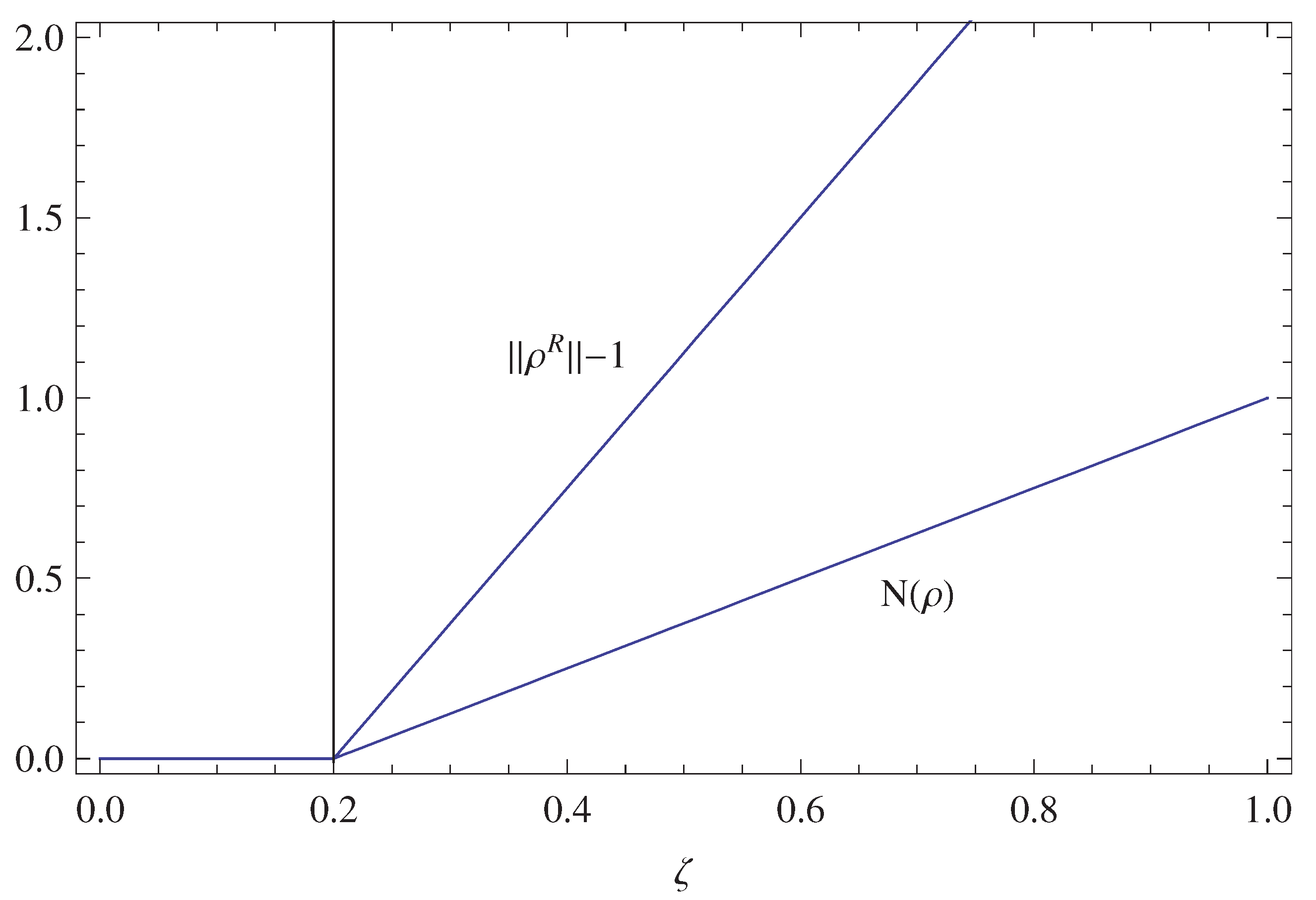
For 4 qubits, . However, for , the states may not be separable. All previous studies agree that for this range the states may or may not be entangled [42]. It is interesting to note that the realignment criterion [15,16] and negativity [43], both give same result as depicted in Figure 1. Both measures are zero for .
We find that mapped states , have 15 confirm positive eigenvalues for acceptable ranges of parameters , and z. The only possible negative eigenvalue is given as
It is clear that we can choose the parameters such that , and hence the states are entangled. To check the maximum detection range of generalized Choi maps for these states, we may take and . The other two parameters (x and y) can be set to zero and consequently for the range , the states are PPT but entangled, means bound entangled. Hence is capable to detect bound entangled states. Another possibility is to take and resulting eigenvalue would be negative for . Another option is and state are detected to be entangled for . Therefore, we have provided a concrete example of quantum states living in the vicinity of maximally mixed states and found to be bound entangled.
4. Systems
In this section, we aim to check the entangleemnt detection power of generalized Choi maps for quantum systems. For the most general quantum state in system, we observe that gives us
where we have defined
All other off-diagonal matrix elements get only negative sign. It is interesting to observe that the last four matrix elements defined in Eq.(16) are dependent on each other only. This clearly indicates which types of entangled states may be detected by generalized Choi maps and which states simply can not be detected. We will provide one example for each bound entangled states as well as NPT entangled state.
The well known bound entangled states for are given [8] as
where . The partial transpose of this matrix w.r.t A or B is positive (PPT), however is entangled for [8]. As the initial off-diagonal matrix elements (last four elements defined in Eq.(16)), responsible for bringing the parameters in off-diagonal positions, are all zero, so the only places where may apear are among diagonal elements. The mapped matrix may have some negative eigenvalues for these parameters, provided that the non-zero off-diagonal matrix elements may become larger than the corresponding diagonal entries. The matrix form of the transformed matrix is given as
where we have defined , , and . As we have argued before that either w or z must be 1 or larger, therefore, it is obvious that for all the acceptable choices of parameters. In addition, , hence all the diagonal elements are strictly larger than off-diagonal elements, therefore it is not possible for these maps to detect this family of bound entangled states. In our recent work, we had claimed that reduction map (a special case of generalized Choi maps) can detect such states [38]. During preparation of this work, I found some missing terms in Eq.(2) in the computer programm, which lead to this erroneous result. All other results and conclusions in that work [38] are correct except this particular bound entangled example. One of the aim of this section is to clarify this confusion as well. We stress that in fact, we should be looking for a map from to such that , however, it is known that finding such maps is not an easy task [8], and despite some efforts, we are still unable to find such maps. Therefore, we conclude that generalized Choi maps and their variants can not detect these particular bound entangled states. However, they may detect some other PPT entangled states in systems. It would be an interesting result to seach whether there is such family of bound entangled states in this dimension of Hilbert space.
It is worth to mention here that the local unitary operations can not change the entanglement properties of a state. We replace one of the pure entangled state, used in the construction of these bound entangled states, with another pure entangled state and find the equivalent quantum states in the same computational basis as
We have checked all 64 possibilities of local unitaries which can shuffle the matrix elements, to obtain all such bound entangled states, which ’look’ different in the same computational basis, however, they are equivalent and share same entanglement structure. We find that all ′ such states are not at all effected (detected) by maps. We have checked 64 local unitaries constructed from Pauli matrices with wihout loss of generality.
Finally, we consider a pure entangled state mixed with maximally mixed state given as
This state is NPT for and PPT for . This state is equivalent to GHZ state mixed with white noise for three qubits and it is known that PPT region of this state is fully separable [23]. The generalized Choi mapped states have only one possible negative eigenvalue, given as
There are interesting similarities between possible negative eigenvalues of mapped states in systems and system. The maximum entanglement detection power of generalized Choi maps, once again comes by taking , and . In contrast to systems, however, this choice makes sure that is negative only for . Therefore, PPT and genralized Choi maps give same conclusions and there are no bound entangled states among states as compared with systems.
5. Discussion and Summary
In this work, we have presented a systematic extension of generalized Choi positive maps to the four-dimensional matrix algebra . We rigorously established the positivity of the constructed maps for specific positive matrices and demonstrated their effectiveness in detecting bound entangled states within a one-parameter family of bipartite quantum states. The identified states are positive under partial transposition for certain range of parameter and NPT for some other. We clearly demonstrate that some part of the PPT region is entangled, providing explicit analytical examples of PPT entanglement in systems. Interestingly, such states live in vicinity of maximally mixed states. We have studied the detection capabilities of these maps for systems and demonstrated analytically that such maps can not detect entanglement of well known bound entangled states. We have shown that for a pure entangled state mixed with maximally mixed state, the PPT region is separable and generalized Choi maps confirm this result.
Our results contribute to the broader understanding of entanglement detection in higher dimensions, where the structure of the PPT region remains poorly characterized. The generalized Choi Kye maps enrich the existing toolbox of positive-map–based criteria and illustrate that indecomposability can be preserved under controlled dimensional generalization. Beyond their immediate application to PPT entanglement detection, the maps introduced here may also find use in constructing new classes of entanglement witnesses and in exploring the geometry of quantum state spaces in high-dimensional systems. Future work may focus on generalizing these constructions to arbitrary dimensions, analyzing their extremality and optimality properties, and identifying potential operational roles of the corresponding bound entangled states in quantum information processing tasks such as secret sharing or activation of distillability.
References
- Horodecki, R.; et al. Rev. Mod. Phys. 2009, 81, 865. [CrossRef]
- Gühne, O.; Tóth, G. Phys. Rep. 2009, 474, 1. [CrossRef]
- Eisert, J.; Cramer, M.; Plenio, M. B. Rev. Mod. Phys. 2010, 82, 277. [CrossRef]
- Erhard, M.; Krenn, M.; Zeilinger, A. Nat. Rev. Phys. 2020, 2, 365. [CrossRef]
- Friis, N.; Vitagliano, G.; Malik, M.; Huber, M. Nat. Rev. Phys. 2019, 1, 72. [CrossRef]
- Peres, A. Phys. Rev. Lett. 1996, 77, 1413. [CrossRef]
- Horodecki, M.; Horodecki, P.; Horodecki, R. Phys. Lett. A 1996, 223, 1. [CrossRef]
- Horodecki, P.; Horodecki, P.; Horodecki, M.; Horodecki, R. Phys. Lett. A;Phys. Rev. Lett. 1997, 232 82, 333 1056.
- Bennet, C. H.; Divincenzo, D. P.; Mor, T.; Shor, P. W.; Smolin, J. A.; Terhal, B. M. Phys. Rev. Lett. 1999, 82, 5385. [CrossRef]
- Bruß, D.; Peres, A. Phys. Rev. A 2000, 61, 30301. [CrossRef]
- Lewenstein, M. Phys. Rev. A 2000, 62, 052310. [CrossRef]
- Gühne, O. Phys. Rev. Lett. 2004, 92, 117903. [CrossRef] [PubMed]
- Tóth, G.; Gühne, O. Phys. Rev. A 2005, 72, 022340. [CrossRef]
- Nielsen, M.; Kempe, J. Phys. Rev. Lett. 2001, 86, 5184. [CrossRef]
- Chen, K.; Wu, L. A. Quant. Inf. Comput. 2003, 3, 193.
- Rudolph, O.; Rudolph, O. Phys. Rev. A;Quant. Inf. Process. 2003, 67 4, 032312 219.
- Aggarwal, S.; Adhikari, S.; Majumdar, A. S.; Aggarwal, S.; Kumari, A.; Adhikari, S. Phys. Rev. A 2024, 109, 012404 108, 012422. [CrossRef]
- Gisin, N.; Branciard, C. Phys. Lett. A;Phys. Rev. Lett. 1991, 154 110, 201 060405.
- Schneeloch, J.; Tison, C. C.; Fanto, M. L.; Ray, S.; Alsing, P. M. Phys. Rev. Research 2020, 2, 043152. [CrossRef]
- Elben, A.; Vermersch, B.; Roos, C. F.; Zoller, P.; Brydges, T.; Elben, A.; Jurcevic, P.; Vermersch, B.; Maier, C.; Lanyon, B. P.; Zoller, P.; Blatt, R.; Roos, C. F.; Elben, A.; Kueng, R.; Huang, H-Y.; van Bijnen, R.; Kokail, C.; Dalmonte, M.; Calabrese, P.; Kraus, B.; Preskill, J.; Zoller, P.; Vermersch, B.; Huang, H-Y.; Kueng, R.; Preskill, J. Phys. Rev. A 99, 052323. Science;Phys. Rev. Lett.;Nat. Phys. 2019, 364 125 16, 260 200501 1050. [Google Scholar]
- Ketterer, A.; Wyderka, N.; Gühne, O.; Wyderka, N.; Ketterer, A.; Imai, S.; Bönsel, J. L.; Jones, D. E.; Kirby, B. T.; Yu, X-D.; Gühne, O.; Imai, S.; Wyderka, N.; Ketterer, A.; Gühne, O. Phys. Rev. Lett. 122, 120505 (2019); A. Ketterer, N. Wyderka, and O. Gühne, Quantum 4, 325 (2020); A. Ketterer, S. Imai, N. Wyderka, and O. Gühne, Phys. Rev. A 106, L010402 (2022); S. Ohnemus, H-P. Breuer, and A. Ketterer, Phys. Rev. A 107, 042406 (2023). Phys. Rev. Lett. 131, 090201;Phys. Rev. Lett. 126 2023, 150501. [Google Scholar]
- Jungnitsch, B.; Moroder, T.; Gühne, O.; Novo, L.; Moroder, T.; Gühne, O.; Hofmann, M.; Moroder, T.; Gühne, O.; Bergmann, M.; Gühne, O. Phys. Rev. Lett.;Phys. Rev. A;J. Phys. A: Math. Theor.;J. Phys. A: Math. Theor. 46 2011, 106 88 47, 190502 012305 155301 385304.
- Gühne, O.; Seevinck, M.; Gühne, O. New. J. Phys.;Phys. Lett. A 2010, 12 375, 053002 406.
- Zhou, Y.; Zhao, Q.; Yuan, X.; Ma, X. NPJ Quant. Inf. 2019, 5, 83. [CrossRef]
- Xu, X-Y.; Zhou, Q.; Zhao, S.; Hu, S-M.; Li, L.; Liu, N-L.; Chen, K. Phys. Rev. A 2023, 107, 052405. [CrossRef]
- Zhang, T.; Jing, N.; Fei, S-M. Quant. Info. Process. 2022, 21, 276. [CrossRef]
- Zhang, L.; Zhao, M-J.; Chen, L.; Xiang, H.; Shen, Y.; Zhang, L. Ann. Phys.;Phys. Rev. A 2022, 534 108, 2200289 012414.
- Ali, M. Quant. Inf. Process. 2023, 22, 207. [CrossRef]
- Wang, K-K.; Wei, Z-W.; Fei, S-M. Eur. Phys. J. Plus 2023, 137, 1378. [CrossRef]
- Choi, M.-D. Lin. Alg. Appl. 1975, 10, 285. [CrossRef]
- Woronowicz, S. L.; Osaka, H. Rep. Math. Phys.;Publ. Res. Inst. Math. Sci. 1976, 10, 165 28.
- Horodecki, M.; Horodecki, P. Phys. Rev. A 1999, 59, 4206. [CrossRef]
- Breuer, H.-P. Phys. Rev. Lett. 2006, 97, 080501. [CrossRef] [PubMed]
- Hall, W.J. Phys. A: Math. Gen. 2006, 39, 14119. [CrossRef]
- Robertson, A. G. J. London Math. Soc. 1985, 32, 133. [CrossRef]
- Hou, J. J.; Qi, X. F.; Hou, J. J. Phys. A: Math. Theor.;J. Phys. A: Math. Theor. 2010, 43 44, 385201 215305.
- Choi, J.; Kiem, Y-H.; Kye, S-H.; Han, K. H.; Kye, S-H.; Ha, K. C.; Kye, S-H.; Ha, K. C.; Kye, S-H.; Ha, K. C.; Kye, S-H. J. Math. Phys.;J. Math. Phys. 57, 015205;Linear and Multilinear Algebra;J. Phys. A: Math. Gen. 45, 415305;Phys. Rev. A 86, 034301 2020, 61(062202 64 (11)), 2188.
- Ali, M. Quant. Info. Process. 2025, 24, 25. [CrossRef]
- Tóth, G.; Vertesi, T. Phys. Rev. Lett. 2018, 120, 020506. [CrossRef]
- Braunstein, S. L.; Caves, C. M.; Jozsa, R.; Linden, N.; Popescu, S.; Schack, R. Phys. Rev. Lett. 1999, 83, 1054. [CrossRef]
- Hildebrand, R. Phys. Rev. A 2007, 75, 062330. [CrossRef]
- Zyczkowski, K.; Horodecki, P.; Sanpera, A.; Lewenstein, M.; Vidal, G.; Tarrach, R.; Deuar, P.; Munro, W. J.; Nemoto, K. J.; Schack, R.; Caves, C. M. Opt. B: Quant. Semiclass. Opt. 2, 225. Phys. Rev. A 58, 883;Phys. Rev. A 59, 141;J. Mod. Opt. 47 1998, 387. [Google Scholar]
- Vidal, G.; Werner, R. F. Phys. Rev. A 2002, 65, 032314. [CrossRef]
Figure 1.
(Color online) Negativity and realignment criterion are plotted against parameter . It is clear that states are entangled for , however, both measures of entanglement are zero for . See text for more descriptions.
Figure 1.
(Color online) Negativity and realignment criterion are plotted against parameter . It is clear that states are entangled for , however, both measures of entanglement are zero for . See text for more descriptions.
Disclaimer/Publisher’s Note: The statements, opinions and data contained in all publications are solely those of the individual author(s) and contributor(s) and not of MDPI and/or the editor(s). MDPI and/or the editor(s) disclaim responsibility for any injury to people or property resulting from any ideas, methods, instructions or products referred to in the content. |
© 2026 by the authors. Licensee MDPI, Basel, Switzerland. This article is an open access article distributed under the terms and conditions of the Creative Commons Attribution (CC BY) license (http://creativecommons.org/licenses/by/4.0/).
Copyright: This open access article is published under a Creative Commons CC BY 4.0 license, which permit the free download, distribution, and reuse, provided that the author and preprint are cited in any reuse.


