

Submitted:
30 January 2026
Posted:
02 February 2026
You are already at the latest version
Abstract
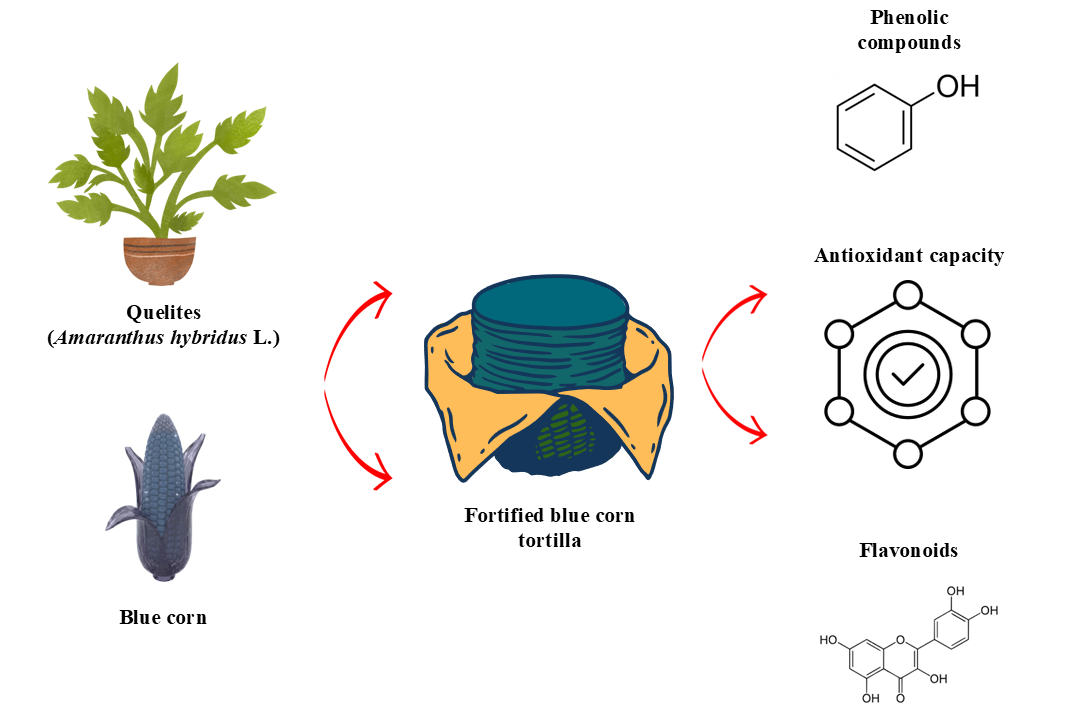
Tortillas are an essential food staple in the Mexican diet due to their nutritional value. Blue corn tortilla has been reported as a source of bioactive compounds such as phenolic compounds and flavonoids; likewise, the blue corn tortilla has been studied to enhance the nutritional and nutraceutical composition. In this sense, Quelites are a large family of plants with macronutrients and micronutrients content, as well as a source of phenolic compounds, flavonoids, and carotenoids; among these, Amaranthus hybridus L. could fortify the blue corn tortilla composition. Therefore, this study aims to fortify blue corn tortillas with different concentrations of Quelites flours. The total flavonoid and phenolic compounds content, as well as the antioxidant capacity and identification of phenolic compounds were evaluated on tortillas fortified with Quelites. The addition of Quelites to blue corn tortillas reduced the lipid content, increased the protein, carbohydrate, and flavonoid content, and maintained the antioxidant capacity of tortillas as measured by FRAP, ORAC, and TEAC assays. Also, caffeic acid, chlorogenic acid, ferulic acid, and synapic acid were identified on blue corn tortillas fortified with Quelites. These results support the use of A. hybridus L. as an ingredient to improve the nutrient and nutraceutical composition of foods.
Keywords:
tortillas
; phenolic compounds
; antioxidant capacity
; Quelites
1. Introduction
In the last decades, the challenge of securing global food and nutrition has called for the urgent exploration and revalorization of underutilized traditional food systems. Particularly, those exhibiting high resilience and dense nutritional profiles. In this context, Quelites, a polyphyletic group of edible non-crop plants deeply rooted in Mexican heritage, represent a crucial advantage for promoting sustainable diets and combating the dual burden of malnutrition [1,2].
Quelites encompass over 500 species whose leaves, stems, and flowers have sustained indigenous and rural communities since pre-Hispanic times, often flourishing in marginal lands or as co-cultivars in the milpa agroecosystem [2,3]. Despite their historical significance and demonstrated adaptability, the consumption and knowledge of Quelites have diminished in recent decades due to shifting dietary preferences and agricultural modernization [1].
Nutritionally, Quelites provide substantial amounts of essential macronutrients and micronutrients, notably high fiber and vegetable protein content, with some species exhibiting protein levels exceeding 22% of dry matter, along with crucial minerals like iron, calcium, and zinc [4,5,6,7]. Furthermore, these plants are potent sources of bioactive compounds, including flavonoids (quercetin and kaempferol derivatives), phenolic acids (caffeic and ferulic acid), and carotenoids, which confer not only remarkable antioxidant capacity [5,6,7,8] but also functional benefits like anti-inflammatory, anti-hyperlipidemic, and anti-diabetic activities, often mediated through the inhibition of key metabolic enzymes such as α-glucosidase and pancreatic lipase, making them ideal candidates for dietary interventions against chronic diseases [3,7,9].
Among these, Amaranthus hybridus L. has been reported to be a rich source of protein, inorganic nutrients, carotenoids, phenolic compounds, flavonoids, and ascorbic acid. Additionally, these Quelites are a source of dietary fiber, calcium, potassium, and magnesium. Also, A. hybridus L. exhibits antioxidant capacity, suggesting that it could be an economically accessible food with potential benefits for consumers [6,10,11].
In this context, Quelites can be used as functional ingredients, serving as one strategy for their incorporation into corn tortillas, a staple of the Mexican diet. It has also been recognized as Intangible Cultural Heritage by UNESCO and is among the most consumed foods in Latin American cuisine [12]. Additionally, tortillas are an important contributor to nutrient intake, making them an ideal vehicle for fortification [13]. In this context, white maize has been used for tortilla production by traditional processes, namely nixtamalization [10,14]; however, pigmented maize, such as blue maize, has been studied [15,16]. Studies on fortifying corn tortillas with other traditional legumes, such as common bean flour [17], cabbage [18], groundnut flour [19], among other sources have already demonstrated that this approach successfully improves protein, dietary fiber, phenolic, and total flavonoid content while maintaining consumer acceptability, physical quality, as well as confers potential bioactivity [10]. Therefore, the objective of this work is to fortify corn tortillas with varying concentrations of Quelites flour, thereby offering a promising public health strategy to address malnutrition and other non-communicable diseases.
2. Materials and Methods
2.1. Plant Material
Raw Quelites (Amaranthus hybridus L.) and blue corn flour used in this study were purchased in markets located in Culiacán, Sinaloa. Blue corn flour packages were stored at environmental temperature, and raw Quelites (A. hybridus L.) were blanched and stored in plastic bags at 4°C until their use.
2.2. Chemical Reagents
2,2′-azino-bis-(3-ethylbenzothiazoline-6-sulphonic acid) (ABTS) (Sigma 10102946001), 2,2′-azobis(2-methylpropionamidine) dihydrochloride (AAPH) (Sigma 440914), 6-hydroxy-2,5,7,8-tetramethylchroman-2-carboxylic acid (Trolox) (Sigma 238813), fluorescein (Sigma 46955), 2,4,6-Tri-(2-pyridyl)-s-triazine (TPTZ) (Sigma T1253), iron(III) chloride hexahydrate (FeCl3·6H2O) (Sigma 236489) and analytical-grade reagents were also purchased from Sigma-Aldrich (St. Louis, MO, USA).
2.3. Quelites (A. hybridus L.) Blanching Procedure
Blanching was performed as described by Maila and Tseke [20] with slight modifications. Briefly, Quelites (A. hybridus L.) were chopped into approximately 2-3 cm pieces to facilitate blanching; the leaves and tender stems with damaged or lignified parts were discarded. All chopped pieces were blanched in boiling water (at a 1:5 w/v Quelites: water ratio) for 2–3 min. Immediately afterward, a thermal shock was performed by immersing them in ice water to halt cooking and preserve color and nutrients. Finally, the blanched Quelites (A. hybridus L.) were drained and stored in resealable plastic bags in a freezer until use.
2.3. Production of Corn Tortillas Fortified with Quelites (Amaranthus hybridus L.)
The production of the fortified tortillas was according to the methodology described by Astorga-Gaxiola et al. [13], with minor modifications. Blanched Quelites were used as the starting material. These were processed in an industrial blender or food processor, with a minimal addition of potable water (if necessary for grinding) until a fine, homogeneous paste was obtained. This paste was incorporated at concentrations of 10%, 20%, and 30% by weight into the blue maize dough. Constant manual kneading was performed until a homogenous distribution was achieved. The dough's moisture content was adjusted as needed. Once the dough was obtained, small portions of approximately 30 g were pressed and shaped into flat disks (15 cm) using a manual press (Casa Herrera, México DF, México). The disks were cooked on a hot griddle for 15 s on one side and 30 s on the other. Finally, the first side was cooked again until the tortilla puffed. Fresh tortillas were dried and ground (UD Cyclone Sample Mill, UD Corp., Boulder, CO, USA) to pass through an 80-US mesh sieve (0.180 mm). The resulting tortilla flour was stored in plastic bags at 4 °C until use.
2.4. Proximate Chemical Composition
Moisture, ash, protein, lipids, and carbohydrate contents were determined by the official methods 925.098, 942.05, 920.39, and 32-05.01 of the AOAC, respectively [21].
2.5. Obtention of the Extracts of Samples
Extracts from the tortilla flour were obtained according to Picos-Salas et al. [22]. In brief, 1 g of flour was added to 10 mL of a methanol-water mixture (80:20, w/v), and the mixture was incubated in constant shaking for 2 h. Subsequently, the mixture was centrifuged at 11,627 g for 14 min at 4°C using a Z 36 HK centrifuge (HERMLE, Germany). Then, the supernatant was collected and stored at -20 °C until further analysis.
2.6. Total Phenolic Content
The total phenolic content (TPC) was determined following the methodology reported by Picos-Salas et al. [22] 10 µL of the extract was mixed with 230 µL of distilled water and 10 µL of the Folin–Ciocalteu reagent in a 96-well microplate. After 3 min of incubation, 25 µL of 4 N Na2CO3 was added, and the mixture was incubated in the dark for 2 h. Then, absorbance was measured at 725 nm using a Synergy HT microplate reader (Bio-Tek Instruments, Inc., VT, USA). Results were expressed as mg of gallic acid equivalents per gram (mg GAE/g) (n=3).
2.7. Total Flavonoid Content
The total flavonoid content (TFC) was determined via the colorimetric protocol previously established by Gutiérrez-Grijalva et al. [23]. For the assay, 10 μL of the extract was dispensed into a 96-well microplate. This was followed by the sequential introduction of 250 μL of distilled water, 10 μL of 10% AlCl3, and finally, 10 μL of 1 M C2H3KO2. The resulting mixture was incubated for 30 minutes. Subsequently, the absorbance was recorded at 415 nm using a 96-well microplate reader. The total flavonoid content was quantified against a quercetin standard curve (0−0.4 mg/mL). Results were ultimately reported as mg of quercetin equivalents per gram (mg QE/g).
2.8. Antioxidant Capacity Assays
2.8.1. Ferric Reducing Antioxidant Power Assay (FRAP)
This antioxidant assay was performed according to the methodology of Iris F. F. Benzie and Strain [24]. In this assay, 120 μL of the FRAP reagent (1 mL of 30 mM TPTZ, 1 mL of 60 mM FeCl3·6H2O, and 10 mL of acetate buffer) was added to 30 μL of the extract [25]. The mixture was incubated in the dark for 4 min, and the absorbance was read at 590 nm in a Synergy HT microplate reader (BioTek, Inc., Winooski, VT, USA). The results were expressed as millimoles of Trolox equivalent per g (mmol TE/g).
2.8.2. Oxygen Radical Absorbance Capacity (ORAC)
This assay was performed as described by Huang et al. [26]. For this assay, 25 μL of the extract was placed in a 96-well microplate with transparent bottom and black walls; 75 mM phosphate buffer was used as blank and Trolox as standard. Later, the microplate was placed in the Synergy HT microplate reader (BioTek, Inc., Winooski, VT, USA), which dispensed 75 μL of 95.8 μM AAPH (radical generator) and 200 μL of 0.96 μM fluorescein and started a kinetic of fluorescence loss at 37 °C for 70 min at 485 nm excitation and 580 nm emission wavelengths. The results were expressed as millimoles of Trolox equivalent per g (mmol TE/g).
2.8.3. Trolox Equivalent Antioxidant Capacity (TEAC)
This assay is based on the absorbance inhibition of the ABTS•+ radical by the reaction with antioxidants, following the methodology of Karadag et al. [27]. The reaction solution was prepared by homogenizing 1 mL of 2.6 mM potassium persulfate and 1 mL of 7.4 mM ABTS•+. The mixture was left at room temperature for 16 h to obtain the reaction mixture. For the assay, 10 μL of the extract was added to 190 μL of the reaction mixture. This was incubated in the dark for 2 h. Absorbance was measured at 734 nm using a Synergy HT microplate reader (BioTek, Inc., Winooski, VT, USA). The results were expressed as millimoles of Trolox equivalent per g (mmol TE/g).
2.9. Phenolic Compounds Content by UPLC
Phenolic compounds were evaluated based on the methodology by Picos-Salas et al. [22], the samples were separated using a UPLC BEH C18 column (1.7 μm × 2.1 mm × 100 mm) at 40 °C. Gradient elution was conducted with water-formic acid 0.1% (A) and acetonitrile (B) at a flow rate of 0.3 mL/min. The following gradient was used: 0 min, 95% (A); 5 min, 70% (A); 9 min, 30% (A); 14 min, 0% (A); 14.5 min, 0% (A); 15 min, 95% (A); and 16 min, 95% (A). Electrospray (ESI) was used for compound ionization. The phenolic compounds were identified and quantified by comparing their absorbance with a calibration curve prepared from the corresponding standards.
2.10. Identification and Quantification of Phenolic Acids by UPLC–PDA
Phenolic acids in the extracts were evaluated according to the methodology described by Jeong et al. [28]. An H-Class UPLC system (Waters Corporation, USA) coupled to a photodiode array (PDA) detector was used. Phenolic acids in the extract were separated using a UPLC BEH C18 column (1.7 µm × 2.1 mm × 100 mm) maintained at 40 °C. Gradient elution was carried out using 0.1% formic acid in water (A) and 0.1% acidified acetonitrile (B) at a flow rate of 0.25 mL/min. The following gradient program was applied: 0 min, 98% (A); 20 min, 75% (A); 24 min, 340% (A); 27 min, 10% (A); 28 min, 10% (A); 30 min, 98% (A); and 35 min, 98% (A). Identification and quantification of phenolic acids were performed by comparison with calibration curves constructed using the corresponding standards.
2.11. Statistical Analysis
Total phenolic compounds, total flavonoids compounds, ferric reducing antioxidant power assay, oxygen radical absorbance capacity, and Trolox equivalent antioxidant capacity were analyzed by an analysis of variance (ANOVA) with one factor (Quelites concentration) with three levels (10%, 20%, and 30%), and each analysis was performed by triplicate; also, mean comparisons were evaluated by Tukey’s HSD test using the software Minitab 19 (Minitab LLC, PA, USA). A p-value of < 0.05 was considered significant. Data were reported as mean ± standard error of the mean (SEM).
3. Results
3.1. Proximate Chemical Composition
This work evaluated the effect of incorporating Quelites (A. hybridus L.) at varying concentrations (10, 20, and 30%) into blue corn tortillas. The fortification of blue corn tortillas with Quelites significantly modulated the proximate chemical composition (Table 1). The Quelites exhibited a marked nutritional advantage over the blue corn tortilla, showing substantially higher Protein (22.0±0.76%), Ash (17.12±0.19%), and moisture (10.66±0.25%) content than the blue corn tortilla (7.86±0.78%, 1.64±0.13%, and 6.52±0.12%, respectively).
Among fortified tortillas with varying concentrations of Quelites (A. hybridus L.), an increase in ash was observed. The highest protein content was observed in Tortilla with 30% Quelites (10.33±0.41%) and Tortilla 10% Quelites (10.15±0.33%), both of which were similarly (p<0.05) than the blue corn tortilla control (11.18±0.85%). Ash content increased in a concentration-dependent manner, reaching 2.44±0.05% in Tortilla 30% Quelites, a 49% increase relative to the control (blue corn tortilla). In addition, moisture content was inversely related to ash content in the raw materials, with the highest value observed in pure Quelites (10.66±0.25%) and the lowest in Tortilla 20% Quelites (5.17±0.05%).
On the other hand, a beneficial reduction in the lipid fraction was observed across all fortified samples, ranging from 2.17±0.04% to 2.7±0.09%, which was significantly lower than in the control (3.03±0.009%). Conversely, carbohydrate content remained the principal component, with Tortilla 20% Quelites achieving the highest percentage (81.25±0.53%).
3.2. Total Phenolic and Flavonoid Content
The addition of Quelites (A. hybridus L.) increases the phytochemical profile of the tortillas. Specifically, in this work, we evaluated total phenolic (TPC) and total flavonoid (TFC) contents, as shown in Table 2.
The Quelites (A. hybridus L.) demonstrated substantially higher phytochemical concentrations than blue corn tortilla, with TFC (8.15±0.57 mg QE/g) and TPC (2.05±0.11 GAE/g). In contrast, blue corn tortilla had TFC (0.09±0.004 mg QE/g) and TPC (0.34±0.02 GAE/g). Despite potential losses during cooking, the TFC of the fortified tortillas increased significantly, with the highest concentration observed in Tortilla 30% Quelites (1.23±0.04 GAE/g). This represents a more than 40% increase in flavonoid content relative to the unfortified blue corn tortilla control, confirming the important contribution of the Quelites (A. hybridus L.) addition.
However, all fortified tortilla groups (10, 20, and 30%) exhibited TPC values lower than the blue corn tortillas, suggesting the TPC fraction (likely comprising the native blue corn anthocyanins) was particularly susceptible to processing losses, or that the concentration by substitution did not offset the inherent richness of the blue corn control. Nonetheless, a clear, increasing trend correlated with substitution level was evident among the fortified samples, ranging from 0.71±0.06 GAE/g in Tortilla 10% to 0.83±0.08 GAE/g in Tortilla 30% (p<0.05).
3.3. Antioxidant Capacity
The functional impact of incorporating Quelites (A. hybridus L.) was evaluated using three antioxidant assays: the Ferric Reducing Antioxidant Power (FRAP) assay, the Oxygen Radical Absorbance Capacity (ORAC) assay, and the TEAC assay for scavenging ABTS radicals. Table 3 shows that Quelites (A. hybridus L.) demonstrated significantly higher antioxidant capacity across all three assays than the blue corn tortilla (ORAC: 88.49±4.61 mmol TE/g; ABTS: 17.10±3.70 mmol TE/g; FRAP: 27.28±2.08 mmol TE/g), confirming its high potential as a functional ingredient. The ORAC and FRAP assays showed the highest antioxidant capacity retention in the fortified products. For FRAP, values increased consistently with fortification, culminating in Tortilla 30% (6.46±0.21 mmol TE/g), which reached parity with the control group (1.19±0.08 mmol TE/g), suggesting that Quelites (A. hybridus L.) compounds effectively preserved ferric-reducing capacity. Similarly, ORAC values were maintained across all fortification percentages, with Tortilla 30% (44.01±2.86 mmol TE/g) demonstrating activity comparable to the control (blue corn tortilla: 17.18±1.21 mmol TE/g). In contrast, the ABTS scavenging capacity decreased post-processing and fortification. All fortified tortillas clustered significantly lower (p ≤ 0.05) than the blue corn tortilla (control) (2.96±0.15 mmol TE/g), indicating that the specific compounds responsible for ABTS radical neutralization were likely degraded or less accessible during cooking.
3.4. Phenolic Compounds Content by UPLC
The phenolic compound content of blue corn tortillas fortified with Quelites (A. hybridus L.) was evaluated by UPLC, with chlorogenic acid, caffeic acid, sinapic acid, and ferulic acid being identified and quantified (Table 4). In this sense, blue corn tortillas with 10% and 20% of Quelites (A. hybridus L.) presented at 13.26 and 12.78 µg/g of chlorogenic acid, respectively; also, sinapic acid (30259.52 µg/g) was quantified on blue corn tortilla with 10% Quelites, while 428.27 µg/g of ferulic acid was found on blue corn tortilla with the incorporation of 20% of Quelites. On the other hand, blue corn tortilla fortified with 30% Quelites (A. hybridus L.) contains 190.51 µg/g of caffeic acid and 29885.97 µg/g of sinapic acid.
4. Discussion
The protein content observed in the Quelites (A. hybridus L.) (22.0±0.76%) agrees with Román-Cortés and García-Mateos [9], who reported that ancestral vegetables like Portulaca oleracea (verdolaga) and Amaranthus spp. (quintoniles) contain up to 25.9% and 26.2% protein (on a fresh-weight basis, respectively), concentrations substantially higher than those of common cultivated vegetables like spinach (2.86%).
In this context, the inclusion of Quelites (A. hybridus L.) increased the tortilla's protein content. Tortilla 30% (30% Quelites) had the highest protein content (10.33±0.41%), representing a 31% nutritional improvement relative to the control (blue corn tortilla). This is critical, as the addition of Quelites (A. hybridus L.) enhances the amino acid profile of the maize staple, which is typically deficient in essential amino acids like lysine Mateos-Maces et al. [29]. These results are consistent with reports on several Quelites species, including Amaranthus spp. (quintonil) and Chenopodium spp. (Quelites cenizo), which have protein concentrations ranging from 22% to over 26% on a dry weight basis, significantly higher than those of cereals [7,30]. In this context, the achieved protein enrichment in our tortillas (7.86% to 10.33%) is comparable to or slightly higher than gains reported by Treviño-Mejía et al. [17] who used traditional legumes for tortilla fortification. For instance, fortifying maize tortillas with common bean flour increased protein from 9.43% to 10.89%, underscoring that Quelites offers a non-legume, leaf-based alternative with comparable protein-boosting potential [6]. On the other hand, the addition of Quelites to blue corn tortillas increases the protein content compared with tortillas obtained by different processes [10], in this sense, our results of protein are higher that tortillas reported by Rojo-Gutiérrez et al. [31], as well as a tortillas obtained by the traditional method (white corn nixtamalization) [32].
On the other hand, the ash content, a key indicator of mineral density, increased by 49% in Tortilla 30% (2.44±0.05% vs. 1.64±0.13% in the control). This significant gain validates the use of Quelites (A. hybridus L.) as an effective mineral fortifier, offering a natural route to improve micronutrient intake without relying on synthetic mineral salts. Román-Cortés and García-Mateos [9] reported that Quelites like Portulaca oleracea exhibit high concentrations of essential micronutrients (Fe, Zn, Mg, Mn), positioning the fortified tortilla as a valuable vehicle for addressing widespread micronutrient deficiencies. In addition to nutritional content, a complementary health benefit was observed in the lipid profile. The fortified tortillas consistently showed a significant reduction in total lipid content across all substitution levels (10, 20, and 30%) (Table 1). These results are similar to the tortillas obtained by Rojo-Gutiérrez et al. [31]. This is beneficial, as it lowers the caloric density and saturated fat contribution of the maize staple, offering a product that aligns with modern nutritional recommendations aimed at mitigating the risks associated with excessive fat intake and obesity [30].
The raw Quelites (A. hybridus L.) exhibited a Total Flavonoid Content (TFC) of 8.15 ± 0.57 μmol TE/g, which provides phytochemicals (Table 2). This successfully translated into a significant 43% enhancement in TFC in Tortilla 30% Quelites (A. hybridus L.) (1.23±0.04 μmol TE/g), confirming that Quelites is a powerful source of flavonoids, leveraging the concentration of beneficial phytochemicals like phlorizin, a major compound often found in Quelites like Chenopodium berlandieri [6], known for its anti-inflammatory and anti-diabetic properties [30]. However, the decrease in Total Phenolic Content (TPC) across all fortified groups relative to the blue corn control suggests a pronounced sensitivity to the cooking process. This TPC loss corroborates findings from various food-processing studies [6,10,17,32]. Mateos-Maces et al. [30] reported that high heat during tortilla elaboration could cause thermal degradation of polyphenols. This contrasts sharply with the raw Quelites (A. hybridus L.), which itself showed a significantly higher TPC (2.05±0.11 μmol TE/g) than the tortillas, suggesting that the high TPC of the raw Quelites (A. hybridus L.) includes compounds that are highly susceptible to the tortilla-making process. On the other hand, the addition of Quelites to blue corn tortillas increases TPC and TFC content relative to tortillas produced by the traditional method of white corn nixtamalization [16,32] and by blue corn nixtamalization [33]. Also, these results are higher than tortillas fortified with Ayocote and Quintonil reported by Rojo-Gutiérrez et al. [31]. In addition, the observed differences in TFC and TPC contents may be attributable to the chemical structures of the flavonoids, which are often more stable as glycosides. In contrast, phenolic acids have been reported to be more thermosensitive during tortilla processing, or anthocyanins may be denatured [9].
The high retention of FRAP and ORAC activities in fortified Tortilla with 30% Quelites (A. hybridus L.) indicates that Quelites compounds survive the cooking process and remain highly effective. In this sense, Román-Cortés and García-Mateos [9] found the highest antioxidant activity in Chenopodium spp. (huauzontles), correlating strongly with their content of phenolic compounds and flavonoids. The successful transfer of this functional capacity supports the potential of Quelites to confer health benefits, as evidenced by their ability to neutralize free radicals (ORAC) and reduce metal ions (FRAP) [6]. Also, these results are in concordance with the report by Méndez-Lagunas et al. [16] which mentioned that corn tortillas have antioxidant capacity regardless of the tortilla obtaining process. The low ABTS assay values in the fortified tortillas further highlight the matrix's complexity. This suggests that thermal processing altered the antioxidant profile, affecting the compounds reactive toward this specific radical, a phenomenon commonly observed in heat-treated plant products [30]. On the other hand, these results are in concordance with tortilla fortified with Ayocote and Quintonil reported by Rojo-Gutiérrez et al. [31]
5. Conclusions
Fortification of tortillas with Quelites (A. hybridus L.) improved nutritional quality in a dose-dependent manner. In this sense, tortilla with Quelites has significantly higher protein (22%) and ash (17%), indicating enhanced mineral density. On the other hand, tortillas with Quelites reduced lipid levels, whereas carbohydrates remained the predominant nutrient; additionally, bioactive compounds (such as flavonoids) increased substantially, reflecting their stability during cooking. Likewise, the antioxidant capacity of tortillas with Quelites (A. hybridus L.) showed partial preservation of ORAC and FRAP capacity. However, the antioxidant capacity of tortillas with Quelites, as measured by the TEAC assay, decreases, suggesting selective loss or transformation of compounds responsive to this assay during processing. Overall, the incorporation of Quelites (A. hybridus L.) successfully enhanced the nutritional and functional profile of blue corn tortillas without compromising their basic composition. These results support the use of Quelites (A. hybridus L.) as culturally rooted, sustainable fortifying agents to improve the nutrient density of staple foods. Future studies should address sensory acceptability, flavonoid identification and quantification, bioaccessibility, species-specific effects, and tortilla optimization for broader food applications.
Author Contributions
Conceptualization, A.H.A.-G. and J.E.-M.; Methodology, N.L..L and M.G.-C.; Software, N.L.-L. and M.G.-C.; Validation, J.B.-H.; Formal analysis, E.P.G.-G.; Investigation, A.H.A.-G. and M.A.P.-S.; Resources, M.A.P.-S.; Data curation, L.A.C.-B.; Writing—original draft preparation, A.H.A.-G. and L.A.C.-B.; writing—review and editing, E.P.G.-G., N.L.-L. and M.G.-C.; Visualization, J.B.-H.; supervision, M.A.P.-S. and J.E.-M.; Project administration, J.B.-H. and J.E.-M.; Funding acquisition, J.E.-M. All authors have read and agreed to the published version of the manuscript.
Funding
This research was funded by TECNOLÓGICO NACIONAL DE MÉXICO, grant number 23231-P.
Data Availability Statement
Data is contained within the article.
Acknowledgments
Acknowledgments to students Hanna Kritza Ortiz Barrutieta and Daniela Alejandra Zúñiga Noriega for their support in conducting the assays.
Conflicts of Interest
The authors declare no conflicts of interest.
References
- Ebel, R. and Méndez Aguilar, M. d. J. Chapter 11 - “Quelites”: the culture of edible weeds in Mexico. In Agroecology of Edible Weeds and Noncrop Plants. R. Ebel and F. Menalled. Academic Press, 2025, 183-207.
- Severiano-Pérez, P.; Cristians, S.; Bye, R.; Lucas-Florentino, B.; Ramírez-Orejel, J. C.; Linares, E.; Mera-Ovando, L. M.; Castro-Lara, D.; Enríquez-Maldonado, D.; Rodríguez-Servín, J.; González-Pedroza, M. d. G.; Escalante-Martínez, V.; Palma Pérez del Valle, J. E.; Mendoza-Cruz, M.; Nevarez-Durán, A.; Silvestre-Lara, P. Quelites Pasados of the Sierra Tarahumara, Chihuahua, Mexico: An Interdisciplinary Ethnobotanical Study of Leafy Green Vegetables. Econ. Bot. 2023, 77, 433–54. [Google Scholar] [CrossRef]
- Ramírez-Jiménez, A. K., Domínguez-Hernández, E., Peralta, A. C. and Mariscal-Moreno, R. M. Chapter 6 - Quelites: a nutritional and functional food for use in dietary therapy. In Improving Health and Nutrition through Functional Foods. M. R. S. Campos. Woodhead Publishing, 2025, 101-25.
- Ebel, R.; Menalled, F. D.; Morales Payán, J. P.; Baldinelli, G. M.; Berríos Ortiz, L.; Castillo Cocom, J. A. Quelites—Agrobiodiversity beyond our crops. Elementa: Sci. Anthropocene 2024, 12, 00141. [Google Scholar] [CrossRef]
- Mendez-Lopez, A. Y.; Lagunes-Espinoza, L. d. C.; González-Esquinca, A. R.; Hernández-Nataren, E.; Ortiz-García, C. F. Phenological characterization of chipilín (Crotalaria longirostrata Hook. & Arn.) and relationship between the phenological stage and chemical composition of leaves. S. Afr. J. Bot. 2023, 154, 140–48. [Google Scholar] [CrossRef]
- Saenz, Santiago; López-Palestina, C. U.; Gutiérrez Tlahque, J.; Monroy -Torres, R.; Hernández-Fuentes, A. Nutritional and functional evaluation of three powder mixtures based on mexican quelites: Alternative ingredients to formulate food supplements. Food Sci. Technol. (Campinas) 2020, Ahead of print, 1–9. [Google Scholar] [CrossRef]
- Santiago-Saenz, Y. O.; Hernández-Fuentes, A. D.; López-Palestina, C. U.; Garrido-Cauich, J. H.; Alatorre-Cruz, J. M.; Monroy-Torres, R. Importancia nutricional y actividad biológica de los compuestos bioactivos de quelites consumidos en México. Rev. chil. nutr. 2019, 46, 593–605. [Google Scholar] [CrossRef]
- Kongdang, P.; Dukaew, N.; Pruksakorn, D.; Koonrungsesomboon, N. Biochemistry of Amaranthus polyphenols and their potential benefits on gut ecosystem: A comprehensive review of the literature. J. Ethnopharmacol. 2021, 281, 114547. [Google Scholar] [CrossRef]
- Román-Cortés, N. R.; García-Mateos, M. d. R. C.-G.; Sahagún-Castellanos, Ana Ma.; Jiménez-Arellanes, Jaime; Adelina, Ma. Características nutricionales y nutracéuticas de hortalizas de uso ancestral en México. RFM 2018, 41. [Google Scholar] [CrossRef]
- Rojo-Gutiérrez, E.; López-Martínez, L.; Tirado-Gallegos, J.; Buenrostro-Figueroa, J. J.; García, H. S.; Baeza-Jiménez, R. Fortified Maize Tortilla: from the traditional Mesoamerican diet to functional food. Biotecnia 2025, 27. [Google Scholar] [CrossRef]
- Santiago-Saenz, Y. O.; Hernández-Fuentes, A. D.; Monroy-Torres, R.; Cariño-Cortés, R.; Jiménez-Alvarado, R. Physicochemical, nutritional and antioxidant characterization of three vegetables (Amaranthus hybridus L., Chenopodium berlandieri L., Portulaca oleracea L.) as potential sources of phytochemicals and bioactive compounds. J. Food Meas. Charact. 2018, 12, 2855–64. [Google Scholar] [CrossRef]
- García-Lorca, N.; Libero, C.; Livigni, C.; Frouzaki, N. E.; Aguayo, E. Sustainable Fortification of Corn Tortillas with Broccoli By-Products. Foods 2025, 14, 799. [Google Scholar] [CrossRef]
- Astorga-Gaxiola, A. H.; Reyes-Moreno, C.; Jiménez-Edeza, M.; Cuevas-Rodríguez, E. O.; Mora-Rochín, S. Effect of Traditional Nixtamalization and Extrusion Processes on Bioaccessibility and Antioxidant Activity of Phenolic Compounds in Blue Maize Tortillas During In Vitro Fermentation by Human Colonic Microbiota. Biotecnia 2025, 27. [Google Scholar] [CrossRef]
- Menchaca-Armenta, M.; José Frutos, M.; Ramírez-Wong, B.; Valero-Cases, E.; Muelas-Domingo, R.; Quintero-Ramos, A.; Isabel Torres-Chávez, P.; Carbonell-Barrachina, Á. A.; Irene Ledesma-Osuna, A.; Nydia Campas-Baypoli, O. Changes in phytochemical content, bioaccesibility and antioxidant capacity of corn tortillas during simulated in vitro gastrointestinal digestion. Food Chem 2023, 405, 134223. [Google Scholar] [CrossRef]
- Bello-Pérez, L. A.; Camelo-Mendez, G. A.; Agama-Acevedo, E.; Utrilla-Coello, R. G. Nutraceutic aspects of pigmented maize: digestibility of carbohydrates and anthocyanins. Agrociencia 2016, 50, 1041–63. [Google Scholar]
- Méndez-Lagunas, L. L.; Cruz-Gracida, M.; Barriada-Bernal, L. G.; Rodríguez-Méndez, L. I. Profile of phenolic acids, antioxidant activity and total phenolic compounds during blue corn tortilla processing and its bioaccessibility. J. Food Sci. Technol. 2020, 57, 4688–96. [Google Scholar] [CrossRef]
- Treviño-Mejía, D.; Luna-Vital, D. A.; Gaytán-Martínez, M.; Mendoza, S.; Loarca-Piña, G. Fortification of Commercial Nixtamalized Maize (Zea mays L.) with Common Bean (Phaseolus vulgaris L.) Increased the Nutritional and Nutraceutical Content of Tortillas without Modifying Sensory Properties. J. Food Qual. 2016, 39, 569–79. [Google Scholar] [CrossRef]
- Uuh Narvaez, J. J.; Us Medina, U.; Muñoz Rodríguez, D.; Segura Campos, M. R. Nutritional and functional properties of corn tortillas added with cabbage as an option for diabetes management. Int. J. Gastron. Food Sci. 2023, 32, 100706. [Google Scholar] [CrossRef]
- Mashau, M. E.; Mabodze, T.; Tshiakhatho, O. J.; Silungwe, H.; Ramashia, S. E. Evaluation of the Content of Polyphenols, Antioxidant Activity and Physicochemical Properties of Tortillas Added with Bambara Groundnut Flour. Molecules 2020, 25, 3035. [Google Scholar] [CrossRef] [PubMed]
- Maila, M. Y.; Tseke, P. E. Influence of Blanching Time on the Phytochemical and Nutritive Value of Cowpea (Vigna unguiculata L. Walp) Leafy Vegetable. Int. J. Food Sci. 2024, 2024, 9095035. [Google Scholar] [CrossRef] [PubMed]
- AOAC. Official Methods of Analysis, 19th ed.; Association of Official Analytical Chemists: Washington, D. C. USA, 2012. [Google Scholar]
- Picos-Salas, M. A.; Leyva-López, N.; Bastidas-Bastidas, P. d. J.; Antunes-Ricardo, M.; Cabanillas-Bojórquez, L. A.; Angulo-Escalante, M. A.; Heredia, J. B.; Gutiérrez-Grijalva, E. P. Supercritical CO2 extraction of naringenin from Mexican oregano (Lippia graveolens): its antioxidant capacity under simulated gastrointestinal digestion. Sci. Rep. 2024, 14, 1146. [Google Scholar] [CrossRef] [PubMed]
- Gutiérrez-Grijalva, E. P.; Zamudio-Sosa, V. E.; Contreras-Angulo, L. A.; Leyva-López, N.; Heredia, J. B. Bioaccessibility of Phenolic Compounds from Mistletoe Infusions and Effect of In Vitro Digestion on Its Antioxidant and Pancreatic Lipase Inhibitory Activity. Foods 2022, 11. [Google Scholar] [CrossRef]
- Benzie, Iris F. F.; Strain, J. J. The Ferric Reducing Ability of Plasma (FRAP) as a Measure of ‘‘Antioxidant Power’’: The FRAP Assay. Anal. Biochem. 1996, 239, 70–76. [Google Scholar] [CrossRef]
- Benzie, I. F. F.; Strain, J. J. The Ferric Reducing Ability of Plasma (FRAP) as a Measure of “Antioxidant Power”: The FRAP Assay. Anal. Biochem. 1996, 239, 70–76. [Google Scholar] [CrossRef]
- Huang, H.; Jiang, J.; Wang, X.; Jiang, K.; Cao, H. Exposure to prescribed medication in early life and impacts on gut microbiota and disease development. eClinicalMedicine 2024, 68, 102428. [Google Scholar] [CrossRef]
- Karadag, A.; Ozcelik, B.; Saner, S. Review of Methods to Determine Antioxidant Capacities. Food Anal. Methods 2009, 2, 41–60. [Google Scholar] [CrossRef]
- Jeong, W. T.; Bang, J.-H.; Han, S.; Hyun, T. K.; Cho, H.; Lim, H. B.; Chung, J.-W. Establishment of a UPLC-PDA/ESI-Q-TOF/MS-Based Approach for the Simultaneous Analysis of Multiple Phenolic Compounds in Amaranth (A. cruentus and A. tricolor). Molecules 2020, 25, 5674. [Google Scholar] [CrossRef]
- Mateos-Maces, L.; Chávez-Servia, J. L.; Vera-Guzmán, A. M.; Aquino-Bolaños, E. N.; Alba-Jiménez, J. E.; Villagómez-González, B. B. Edible Leafy Plants from Mexico as Sources of Antioxidant Compounds, and Their Nutritional, Nutraceutical and Antimicrobial Potential: A Review. Antioxidants 2020, 9. [Google Scholar] [CrossRef]
- Mateos-Maces, L.; Chavez-Servia, J. L.; Vera-Guzman, A. M.; Aquino-Bolanos, E. N.; Alba-Jimenez, J. E.; Villagomez-Gonzalez, B. B. Edible Leafy Plants from Mexico as Sources of Antioxidant Compounds, and Their Nutritional, Nutraceutical and Antimicrobial Potential: A Review. Antioxidants (Basel) 2020, 9. [Google Scholar] [CrossRef] [PubMed]
- Rojo-Gutiérrez, E.; López-Martínez, L. X.; Sáenz-Hidalgo, H. K.; Tirado-Gallegos, J. M.; García-Galindo, H. S.; Baeza-Jiménez, R. Maize Tortillas Fortified with Ayocote and Quintonil Flours: Nutritional and Functional Properties. Foods 2026, 15, 21. [Google Scholar] [CrossRef]
- Tranquilino-Rodríguez, E.; Rodiles-López, J. O.; Martínez-Flores, H. E.; Figueroa-Cárdenas, J. D. Antioxidant Capacity of a Nanoencapsulated Phenolic Extract from Opuntia atropes during Corn Tortilla Processing and In Vitro Digestion. J. Food Chem. Nanotechnol. 2025, 11, 1–9. [Google Scholar] [CrossRef]
- González-Nieto, P. F.; Alvarado-Olivarez, M.; Guzmán-Gerónimo, R. I.; Rodríguez-Landa, J. F.; Hernández-Salazar, L. T. Effect of Traditional and Non-Traditionally Processed Blue Corn Tortilla Consumption During the Gestation of Rats in the Dentate Gyrus of Pups. Foods 2024, 13, 3639. [Google Scholar] [CrossRef]

Table 1.
Proximate chemical composition of fortified tortillas with Quelites (Amaranthus hybridus L.).
Table 1.
Proximate chemical composition of fortified tortillas with Quelites (Amaranthus hybridus L.).
| Samples | Moisture (%) | Ash (%) | Protein (%) | Lipids (%) | Carbohydrates (%) |
|---|---|---|---|---|---|
| Blue corn tortilla | 6.53±0.02b | 1.68±0.01e | 11.18±0.85b | 3.03±0.09 | 77.55±0.83c |
| Quelites | 10.66±0.25a | 17.12±0.19a | 22.00±0.76a | 2.94±0.08b | 47.27±0.56d |
| Tortilla with 10% Quelites | 5.54±0.06d | 1.93±0.03d | 10.15±0.33b | 2.33±0.06d | 80.04±0.45b |
| Tortilla with 20% Quelites | 5.17±0.05e | 2.19±0.03c | 9.21±0.50c | 2.17±0.04e | 81.25±0.53a |
| Tortilla with 30% Quelites | 5.96±0.05c | 2.44±0.05b | 10.33±0.41b | 2.71±0.09c | 78.56±0.47c |
Results are expressed as mean ± standard deviation (n=3). Different superscript letters within each column are significantly different according to the Tukey test (p ≤ 0.05).
Table 2.
Total phenolic and flavonoid contents of fortified tortillas with Quelites.
| Samples | Total phenolic content (mg GAE/g) | Total flavonoid content (mg QE/g) |
|---|---|---|
| Blue corn tortilla | 0.34±0.02c | 0.09±0.004d |
| Quelites | 2.05±0.11a | 8.15±0.57a |
| Tortilla with 10% Quelites | 0.71±0.06b | 0.61±0.05c |
| Tortilla with 20% Quelites | 0.73±0.04b | 0.70±0.02c |
| Tortilla with 30% Quelites | 0.83±0.08b | 1.23±0.04b |
Results are expressed as mean ± standard deviation (n=3). Different superscript letters within each column are significantly different according to the Tukey test (p ≤ 0.05). TPC= Total phenolic content, TFC= Total flavonoid content. Results are expressed as TFC= mg QE/g and TPC= mg GAE/g.
Table 3.
Antioxidant capacity of fortified tortillas with Quelites.
| Samples | FRAP (mmol TE/g) | ORAC (mmol TE/g) | TEAC (mmol TE/g) |
|---|---|---|---|
| Blue corn tortilla | 1.19±0.08d | 17.18±1.21c | 2.96±0.15c |
| Quelites | 27.28±2.08a | 88.49±4.61a | 14.14±0.4a |
| Tortilla with 10% Quelites | 5.05±0.33c | 43.13±0.65b | 5.90±0.02b |
| Tortilla with 20% Quelites | 5.20±0.29b,c | 45.49±2.47b | 6.27±0.58b |
| Tortilla with 30% Quelites | 6.46±0.21b,c | 44.01±2.86b | 6.10±0.36b |
Results are expressed as mean ± standard deviation (n=3). Different superscript letters within each column are significantly different according to the Tukey test (p ≤ 0.05). FRAP = Ferric Reducing Antioxidant Power Assay, ORAC = Oxygen Radical Absorbance Capacity, TEAC = Trolox Equivalent Antioxidant Capacity. Results are expressed as μmol Trolox Equivalent per gram (μmol TE/g).
Table 4.
Phenolic compounds content by UPLC of blue corn tortillas fortified with Quelites.
| Samples | Caffeic acid | Chlorogenic acid | Ferulic acid | Sinapic acid |
|---|---|---|---|---|
| Tortilla with 10% Quelites | - | 13.26 µg/g | - | 30259.52 µg/g |
| Tortilla with 20% Quelites | - | 12.78 µg/g | 428.27 µg/g | - |
| Tortilla with 30% Quelites | 190.51 µg/g | - | - | 29885.97 µg/g |
Disclaimer/Publisher’s Note: The statements, opinions and data contained in all publications are solely those of the individual author(s) and contributor(s) and not of MDPI and/or the editor(s). MDPI and/or the editor(s) disclaim responsibility for any injury to people or property resulting from any ideas, methods, instructions or products referred to in the content. |
© 2026 by the authors. Licensee MDPI, Basel, Switzerland. This article is an open access article distributed under the terms and conditions of the Creative Commons Attribution (CC BY) license (http://creativecommons.org/licenses/by/4.0/).
Copyright: This open access article is published under a Creative Commons CC BY 4.0 license, which permit the free download, distribution, and reuse, provided that the author and preprint are cited in any reuse.


