

Submitted:
14 January 2026
Posted:
29 January 2026
You are already at the latest version
Abstract
Sustainability and healthy eating have emerged as key areas of interest and concern among younger generations in recent decades. Another prominent feature of this cohort is their increasing engagement with sport, both as practicing sport and as sport fan. Participation in sporting activities and enthusiasm for sports frequently align with the principles of sustainable and healthy living. Despite extensive theoretical interest and a growing body of research on young consumers’ concern for sustainability and balanced nutrition, the interrelations among these domains remain underexplored. The connection with sport engagement has received even less scholarly attention. This study investigates how sustainable and healthy eating (SHE) behaviors, together with sport engagement, influence advocacy for sustainable and healthy food practices among young Italian consumers. Drawing on the stimulus–organism–response (S–O–R) framework, we develop and test a structural equation model (SEM) using data from 206 respondents. The results reveal that the two main constructs (SHE and SPORT) play a significant role in fostering Gen Z’s advocacy for sustainable and healthy eating. Moreover, there are no significant differences among male and females. These findings contribute to consumer research on the interplay between sustainable and healthy lifestyle behaviors by identifying sport engagement as a novel and meaningful driver of consumer advocacy toward sustainable and healthy eating (SHE).
Keywords:
healthy eating behaviors
; leisure-time exercise
; fan sport engagement
; advocacy
; Generation Z
; SEM
1. Introduction
In recent decades, sustainability and healthy eating have become central issues in public discourse and academic research [1,2], particularly in relation to younger generations [3,4]. Young consumers are increasingly recognized as key agents of change, as their food-related choices not only affect personal well-being but also have broader social, environmental, and economic implications. Growing awareness of climate change, resource depletion, and public health challenges has contributed to heightened attention to sustainable and healthy eating behaviors, positioning food consumption as a critical domain for advancing sustainable development goals [5].
Alongside this heightened interest in food-related sustainability, younger generations are also characterized by increasing engagement with sport, both in terms of active participation in leisure-time physical activity and involvement as sport fans [6,7].
Sport occupies a prominent role in the lives of young people, functioning not only as a form of physical activity but also as a social and cultural practice through which values, identities, and norms are shaped. It is important to note that sport-related behaviors are frequently associated with values such as self-discipline, health consciousness, environmental awareness, and social responsibility. These values closely align with the principles underpinning sustainable and healthy lifestyles.
Despite a growing body of research examining young consumers’ concern for sustainability and balanced nutrition, existing studies have largely addressed these domains in isolation. The interrelationships between sustainable and healthy eating behaviors and other lifestyle-related practices have yet to be thoroughly empirically explored. In particular, the role of leisure time exercise, its frequency and fan sport engagement as potential drivers of pro-sustainability and pro-health food advocacy has received limited scholarly attention. While there is a well-established link between sporting participation and healthier dietary patterns, and the influence of sporting fandom on attitudes and behaviors through social identification processes has been demonstrated, little is known about how these dimensions may foster advocacy for sustainable and healthy eating beyond individual consumption choices.
Addressing this gap, the present study investigates the extent to which sustainable and healthy eating behaviors, together with sport-related behaviors, influence advocacy for sustainable and healthy food practices among young Italian consumers. Advocacy is conceptualized as an active form of engagement, encompassing behaviors such as recommending, promoting, and supporting sustainable and healthy eating within one’s social environment. By focusing on advocacy, this study moves beyond individual-level consumption to examine mechanisms through which sustainable and healthy practices may diffuse within society.
Drawing on the Theory of Planned Behavior (TPB) [8], this study conceptualizes sustainable and healthy eating behaviors and sport-related behaviors as antecedent behaviors that shape individuals’ attitudes, normative beliefs, and perceived behavioral control, ultimately leading to advocacy as subsequent intentional behavior.
To empirically test the proposed relationships, we develop and estimate a structural equation model (SEM) using survey data collected from 241 young Italian consumers. Furthermore, given evidence of gender-based differences in food-related and sport-related behaviors, we explore whether these relationships vary between male and female respondents.
Accordingly, the study addresses the following research questions:
RQ1:
To what extent do healthy and sustainable eating behaviors influence consumers’ advocacy for healthy and sustainable eating?
RQ2:
How do sport-related behaviors - namely leisure-time physical activity and sport fan engagement - influence consumers’ advocacy for healthy and sustainable eating?
RQ3:
Do the relationships between eating behaviors, sport-related behaviors, and advocacy for healthy and sustainable eating differ by gender?
2. Conceptual Background
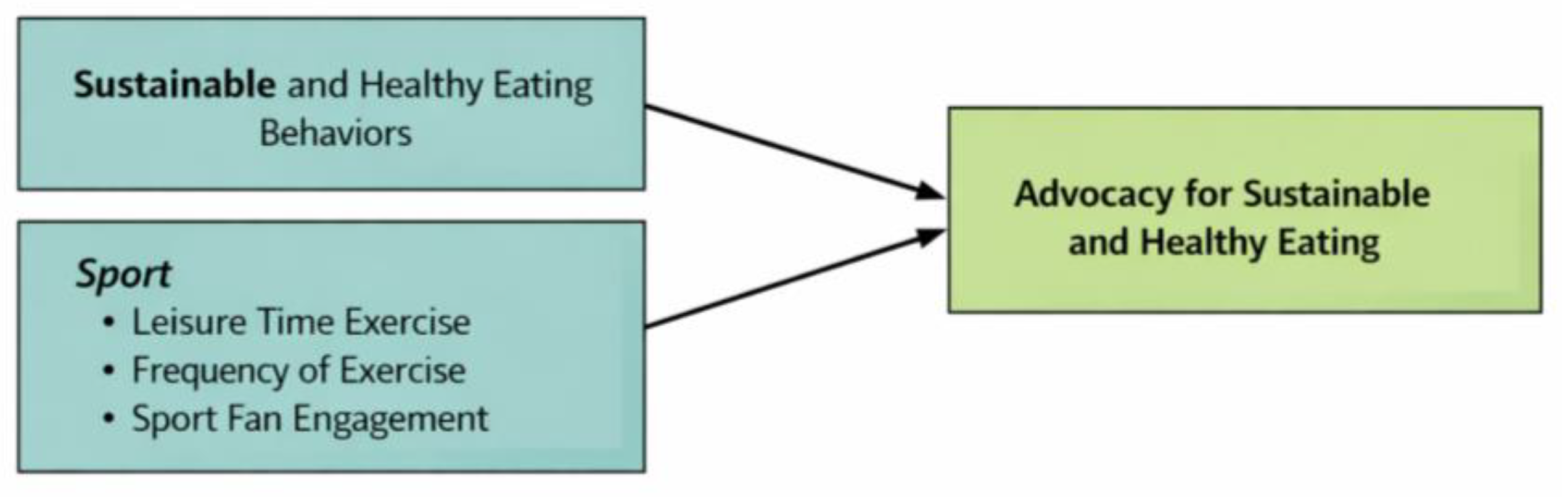
From a theoretical perspective, this study draws on the Theory of Planned Behavior (TPB) [8], which posits that individuals’ behaviors are shaped by attitudes, subjective norms, and perceived behavioral control, ultimately influencing subsequent intentional behaviors. Within this framework, engaging in healthy eating practices and sport-related behaviors is expected to reinforce favorable attitudes toward health and sustainability, strengthen normative beliefs, and enhance perceived control, thereby increasing the likelihood of advocacy behaviors - such as positive word-of-mouth and recommendation - conceptualized in this study as a subsequent intentional behavior. Accordingly, we assume that individuals who consistently engage in healthy eating and sport activities are more likely to advocate healthy and sustainable eating practices.
Figure 1.
Research Model.
2.1. Advocacy
Advocacy is a pivotal concept in marketing literature, as it signifies the ultimate success of a brand or organization in establishing robust, voluntary consumer support [9]. Advocacy has been traditionally described as “the act of publicly representing an individual, organisation, or idea with the object of persuading targeted audiences to look favourably on - or accept the point of view - the individual, the organisation, the idea” [10]. Advocacy is defined as consumers’ willingness to actively recommend, promote, or defend a brand, product, or cause, which often goes beyond mere satisfaction or loyalty to genuine endorsement. In contemporary contexts, online advocacy has become a particularly salient and effective phenomenon, especially among younger generations who utilize digital and social media platforms to express their opinions, preferences, and values [11]. These channels enable individuals to consume responsibly, to influence others, and to contribute to the shaping of public discourse around sustainability and health. Advocacy, therefore, can be defined as the act of consumers actively supporting and promoting a brand, product, or cause, frequently in a spontaneous manner via word-of-mouth or online channels.
The extant literature has focused primarily on the first phase of sustainable consumption, exploring the antecedents that drive individuals towards sustainable choices. It has highlighted a behavior gap, that is, the discrepancy between consumers’ stated intentions and their actual behaviors [12,13].
However, there is a lack of research examining both effective SHE behaviors and the subsequent stage, which concerns the transition from sustainable and healthy behaviors to advocacy actions. The present study aims to contribute to the existing body of knowledge by investigating how young consumers’ concrete sustainable and healthy lifestyle practices can evolve into active advocacy behaviors, thereby contributing to the diffusion of SHE consumption norms and collective engagement.
2.2. Sustainable and Healthy Eating Behaviors
It is well recognized that young consumers today show a dual concern for sustainability and healthy eating. However, empirical studies specifically addressing how Italian youth navigate these issues remain scarce [14,15,16], with even less research focusing on the intersection of sustainable healthy eating behaviors (HSEB). While many consumers intuitively understand healthy eating, they are often less familiar with how it interrelates with sustainability [17]. Theoretically, however, the connection is strong. According to the food well-being paradigm, choices prioritizing personal health often reflect deeper concerns for environmental welfare [18,19,20], a link further supported by the concept of mindful consumption [21,22,23]. Moreover, lifestyle habits formed early in life are critical; they influence self-control and pro-social choices [24], suggesting that young adults who successfully maintain a healthy diet are uniquely positioned to advocate for broader sustainable practices.
A primary dimension of HSEB involves the search for quality and transparency. Research indicates that certifications and eco-labels are crucial for reducing information asymmetry, thereby fostering trust and encouraging responsible consumption [25]. By enhancing the credibility of products, these labels not only influence purchase decisions but also reinforce a consumer’s commitment to responsible lifestyles [26]. Closely linked to this is the preference for local and seasonal food. These practices are inherently sustainable due to shorter supply chains and lower environmental impact, while simultaneously signaling a higher attention to freshness and quality [27]. It is plausible to argue that the active effort required to seek out certified, local, or seasonal products creates a deeper cognitive investment, leading consumers to speak more positively about these choices to others.
Previous research highlights that healthy and balanced eating is closely linked to a broader sustainable lifestyle orientation. According to the food well-being paradigm, food choices that prioritize personal health often reflect deeper concerns for social and environmental welfare [18]. Similarly, the concept of mindful consumption emphasizes that individuals who are attentive to their health and well-being also tend to act responsibly toward environmental sustainability [23]. Moreover, studies in consumer research show that lifestyle habits formed early in life influence self-control and pro-social food choices, particularly among younger consumers [24]. Hence, these findings suggest that a positive attitude toward or a real consumption maintaining a healthy and balanced diet may foster stronger advocacy for sustainable and healthy eating practices.
Another practice that connects the concept of healthy eating with sustainability is the use of certifications and quality labels. Prior research shows that certifications, quality labels, and eco-labels enhance transparency and traceability, foster consumer trust, and encourage responsible consumption. Environmental labels act as credibility cues that reduce information asymmetry and strengthen consumers’ trust in certified products [25]. Furthermore, labeling and certification practices positively influence purchase decisions and promote more sustainable consumption behaviors [28]. The credibility associated with these labels also increases consumers’ willingness to pay and reinforces their commitment to responsible and sustainable consumption [26].
Healthy eating practices, such as the consumption of local food, are often inherently sustainable, as they typically involve shorter supply chains, lower environmental impact, and greater attention to food quality and origin [27]. It can be assumed that individuals who consume local food tend to speak positively about it and engage in positive word-of-mouth.
Meat has a significantly higher environmental and climate footprint than plant-based foods and diets with lower meat consumption reduce greenhouse gas emissions and other environmental impacts [29]. A recent study shows that young adults associate sustainable diets with more plant-based and less meat-intensive eating patterns, highlighting how sustainability awareness shapes their food choices and positions them as a key segment for promoting sustainable food behaviors [30]. Closely related, reducing the consumption of red meat, which typically contains higher levels of fat, and more generally adopting a low-fat diet, contributes to both environmental sustainability and healthier eating behaviors.
Beyond purchasing habits, the composition of the diet itself plays a pivotal role. Reducing meat consumption, particularly red meat, in favor of plant-based options is widely recognized for lowering greenhouse gas emissions and improving health outcomes [29]. Recent findings suggest that young adults are increasingly aware of this link, associating sustainable diets with low-meat patterns [30]. Finally, food waste reduction represents a critical behavioral bridge between health and sustainability. While young consumers often face an “attitude-behavior gap” regarding waste due to limited planning skills [31], those who master responsible food management - such as reusing leftovers and avoiding oversized portions - demonstrate a high level of engagement. Consequently, we argue that individuals who actively practice these complex behaviors (from diet shifts to waste reduction) are more likely to champion them socially.
Based on this integrated framework, we hypothesize that:
H1:
Healthy and sustainable eating behaviors (HSEB) positively influence young consumers’ advocacy for healthy and sustainable eating.
2.3. The Impact of Sport-Related Behaviors on Advocacy
Sport is naturally associated with healthy eating, as it embodies values associated with optimal physical performance, health, and overall well-being. Consequently, it serves as a credible and influential context for the promotion of healthy consumption behaviors [32,33]. The association between the two phenomena can be explained through several complementary theoretical perspectives. According to congruity (fit) theory the credibility and persuasiveness of a message is increased by the presence of a strong alignment between the communication context and the promoted behavior or product [34,35]. In this regard, sport represents a highly congruent context for promoting healthy and sustainable eating, as both domains are closely linked to physical fitness and long-term well-being.
In parallel, Social Identity Theory posits that sport participation and fandom contribute to the formation of salient social identities, thereby increasing the likelihood that individuals will adopt and advocate behaviors consistent with sport-related values, including healthy eating [36,37,38]. Moreover, Social Learning Theory highlights the pivotal role of athletes and sport organizations as influential role models. Their visible commitment to fostering healthy and sustainable lifestyles has the capacity to influence social norms, thereby encouraging imitation and advocacy behaviors among both sport participants and fans [39].
Beyond its symbolic association with health, sport is increasingly recognized as a domain that places growing emphasis on green practices and sustainability. This is demonstrated by the rising attention of sport organizations to environmental responsibility and sustainable development initiatives within their Corporate Social Responsibility (CSR) strategies [40]. At the organizational level, CSR literature in sport emphasizes that perceived authenticity is a critical determinant of meaningful fan engagement. When sporting organizations demonstrate consistency, continuity, and alignment with shared values, sustainability initiatives are more likely to be perceived as credible, thereby strengthening fan identification and engagement. It is important to note that such engagement may extend beyond sport-related outcomes and stimulate positive advocacy behaviors in other life domains, including healthy and sustainable eating.
This mechanism is particularly relevant among young consumers, who are highly engaged with sport both as active participants [41,42] and as sport fans, making sport a powerful context for influencing their attitudes and behaviors (e.g., national sport participation and fandom reports in Italy). Moreover, young people are intensive users of social media [43,44], which represents a powerful tools for the dissemination of advocacy messages and the amplification of positive word-of-mouth related to healthy and sustainable behaviors.
Despite the well-established associations between sport and healthy eating, as well as between sport and sustainability, and their potential to foster advocacy, empirical research remains limited in examining how engagement in physical exercise and sport fan engagement influence advocacy for healthy and sustainable eating behaviors.
Building on this premise, the present study adopts a broad conceptualization of sport, encompassing both participation and spectatorship. Specifically, sport is operationalized through three components: the intensity of exercise undertaken during leisure time (soft, moderate, and hard), the frequency of exercise, and the extent to which individuals engage with sport as fans. This multidimensional approach is essential to fully capture the potential influence of sport-related behaviors on advocacy for healthy and sustainable eating among young consumers.
Accordingly, this study proposes the following hypothesis:
H2:
Sport-related behaviors (leisure-time exercise, frequency of exercise, and sport fan engagement) positively influence young consumers’ advocacy for healthy and sustainable eating.
2.4. The Influence of Gender on Healthy Eating and Sport-Related Outcomes
As indicated by previous research in the field of sport management, significant variations have been identified among diverse forms of sport engagement. These forms include sport participation and sport fan involvement, with gender frequently emerging as a salient differentiating factor. Empirical evidence consistently shows that men tend to report higher levels of sport fandom and spectator involvement, whereas women are, on average, less intensely engaged as fans, although this gap varies by sport and cultural context [45,46]. Research has identified gender differences in sport participation patterns, with male participants tending to report higher participation rates and greater involvement in competitive and high-intensity sports, while female participants tend to favor recreational and health-oriented physical activities [47].
Similarly, research on advocacy, pro-social behavior, and sustainability suggests the existence of systematic gender differences. As indicated by prior studies, women demonstrate a greater propensity than men to engage in behaviors that are health-related, ethical, and sustainability-oriented. These behaviors encompass advocacy and positive word-of-mouth for responsible consumption practices [48,49,50].
However, despite these established gender differences in both sport engagement and sustainability-related advocacy, empirical studies explicitly examining gender-based variations in the relationship between sport-related behaviors and advocacy for healthy and sustainable eating remain scarce. This gap underscores the necessity of accounting for gender differences when investigating the role of sport participation and sport fan engagement in shaping advocacy behaviors.
It is hypothesized that no significant gender differences will be observed in the relationships under investigation, due to the increasing diffusion of healthy eating practices and sporting engagement among both young men and women:
H3:
The relationships between healthy and sustainable eating behaviors and young consumers’ advocacy for healthy and sustainable eating, as well as between sport-related behaviors and young consumers’ advocacy for healthy and sustainable eating, do not significantly differ between males and females.
3. Research Methodology
3.1. Research Design and Data Collection
The present study adopts a quantitative cross-sectional research design to empirically examine the proposed conceptual model. Data were gathered through an online self-administered questionnaire distributed to young Italian consumers belonging to Generation Z. The survey instrument was developed by adapting validated measurement scales from prior literature, which were subjected to a rigorous translation-back-translation procedure to ensure semantic equivalence between the original English versions and the Italian adaptation [51]. The final survey was administered between October 2025 and December 2025 through an online questionnaire. Participation was voluntary and anonymous; respondents were provided with an informed consent form detailing the research objectives of the study and their right to withdraw at any. In accordance with Regulation (EU) 2016/679 (GDPR) and Italian Legislative Decree No. 196/2003 (as amended by Legislative Decree No. 101/2018), no identifiable or sensitive personal data were collected, ensuring the study met all ethical and legal standards for privacy. The target population comprised Italian individuals of the Generation Z. This demographic segment was selected due to Generation Z’s strong interest in healthy eating, sustainability, and physical activity. The focus on Italy is justified by the country’s deeply rooted culture of food, health, and physical fitness. The data collection process yielded a total of 220 completed questionnaires.
3.2. Measurement Scales
All constructs in the proposed model were measured using multi-item scales adapted from established instruments in the extant literature. Respondents indicated their level of agreement with each statement on a seven-point Likert-type scale ranging from 1 (“strongly disagree”) to 7 (“strongly agree”), a format widely recommended in behavioral research for capturing sufficient variance while maintaining respondent comprehension [52].
3.2.1. Healthy and Sustainable Eating Behavior (HSEB)
HSEB was conceptualized as a multidimensional higher-order construct encompassing eight distinct but interrelated behavioral dimensions: (1) Healthy and balanced diet (HBD, 7 items), capturing behaviors related to nutritional balance and dietary quality; (2) Meat reduction (MR, 4 items), assessing efforts to decrease meat consumption; (3) Animal welfare (AW, 3 items), measuring consideration for animal welfare in food choices; (4) Quality labels (QL, 5 items), evaluating attention to food certifications and quality standards; (5) Local food (LOCALF, 3 items), reflecting preferences for locally sourced products; (6) Seasonal food (SF, 3 items), assessing consumption of seasonal products; (7) Avoiding food waste (AFW, 3 items), capturing waste reduction behaviors; and (8) Low fat (LOWF, 3 items), measuring attention to fat content in food choices. These measurement scales were adapted from Żakowska-Biemans et al. [53].
3.2.2. Sport Engagement (SPORT)
Sport engagement was operationalized as a higher-order construct comprising three lower-order dimensions: (1) Free time and sport (FTS, 3 items), measuring active participation in physical activities; (2) Sport fan engagement (SFE, 4 items), adapted from Yoshida et al. [54], capturing psychological involvement and emotional attachment to sport as a spectator; and (3) Sport frequency (SPORTFREQ), assessing the regularity of physical activity engagement. The leisure-time exercise dimension was adapted from the Godin Leisure-Time Exercise Questionnaire [55], a validated instrument widely employed in health behavior research.
We conceptualized Sport Engagement as a higher-order construct capturing an individual’s overall involvement with sport, combining behavioral participation and psychological identification as a sport fan. This conceptualization aligns with sport consumer research emphasizing psychological connections to sport and related involvement processes [54,55]. Given that participation and fandom represent distinct, non-interchangeable facets that jointly define the domain of engagement, we specified the higher-order construct as formative.
3.2.3. Advocacy for Healthy and Sustainable Eating
Advocacy was measured using a four-item reflective scale capturing consumers’ propensity to actively recommend, promote, and defend healthy and sustainable eating practices within their social environment. These measurement items are based on the work of Lee and Tao [56].
3.3. Analytical Approach
The proposed research model was analyzed using Partial Least Squares Structural for several reasons. First, PLS-SEM is particularly well-suited for models that incorporate both reflective and formative measurement specifications [52]. The present study includes higher-order constructs operationalized as formative composites of reflective lower-order dimensions, a configuration that PLS-SEM handles more flexibly than CB-SEM approaches. Second, PLS-SEM is advantageous when the primary research objective is to explore new relationships between variables rather than theory confirmation [52]. To the best of authors, this study is one the first exploring the relationships between sustainable and healthy eating behaviors, sport-related behaviors, and advocacy, PLS-SEM represents a methodologically appropriate choice. Third, PLS-SEM does not impose strict distributional assumptions on the data [52].
Modeling Higher-Order Constructs
The research model features two higher-order constructs: HSEB and SPORT. Both are characterized by formative relationships at the higher-order level and reflective measurement at the lower-order level. This specification reflects the theoretical conceptualization wherein the higher-order constructs are formed by their constituent dimensions, which in turn are measured through reflective indicators.
To estimate these hierarchical structures, the two-stage approach was employed following established methodological guidelines [52]. In the first stage, the measurement model comprising all lower-order constructs was estimated, and latent variable scores were extracted for each first-order dimension. In the second stage, these latent variable scores served as formative indicators of the respective higher-order constructs in the structural model estimation. This approach is recommended for complex models involving formative higher-order constructs as it avoids the interpretational difficulties associated with the repeated indicator approach while maintaining computational efficiency [52].
4. Results
The psychometric properties of each measurement scale were evaluated by examining reliability, convergent validity, and discriminant validity. Scale reliability was assessed through Cronbach’s alpha (α ≥ 0.70), composite reliability (ρc ≥ 0.70), and average variance extracted (AVE ≥ 0.50), following established thresholds in the PLS-SEM literature [52]. Convergent validity was confirmed when item loadings on their respective constructs exceeded the 0.708 threshold [52].
As reported in Table 1, all indicator loadings surpassed the recommended cut-off value, and all constructs demonstrated satisfactory convergent validity with AVE values above 0.50. B3, B9 and B10 were dropped because their load was below the recommended threshold. The higher-order constructs have been tested according to the procedure of Becker et al. [57]. Table 2 shows the results of the model with higher order constructs. As shown, certain indicators of the second-order HSBE construct display non-significant weights and loadings below the 0.5 cutoff [52]. Nevertheless, these items were kept respecting the construct’s conceptual nature and ensure comparability.
Discriminant validity, which ensures that constructs are empirically distinct from one another, was primarily evaluated using the heterotrait-monotrait ratio of correlations (HTMT). The HTMT criterion has been shown to outperform traditional approaches such as cross-loadings and the Fornell-Larcker criterion in detecting discriminant validity violations [58,59]. HTMT values below 0.90 indicate that constructs are conceptually distinct, with more conservative thresholds of 0.85 recommended for conceptually similar constructs [52,59]. As shown in Table 3, discriminant validity is ensured.
4.1. Assessment of Common Method Bias
Since data for both predictor and criterion variables were collected from the same source through self-report measures at a single point in time, common method variance (CMV) represents a potential concern [60]. Both procedural and statistical remedies were implemented to mitigate and assess this threat. From a procedural standpoint, respondent anonymity was assured, and participants were encouraged to answer honestly, emphasizing that there were no correct or incorrect responses [60]. From a statistical perspective, Harman’s single-factor test was performed by entering all measurement items into an exploratory factor analysis with principal component extraction. The results revealed that no single factor accounted for the majority of variance, with the first unrotated factor explaining less than 50% of total variance, suggesting that CMV is unlikely to be a substantial concern.
4.2. Structural Model
Following the guidelines of Hair et al. [52], the structural model was assessed to test the research hypotheses. The significance of path coefficients was evaluated through the bootstrapping algorithm with 10,000 resamples, generating t-statistics and bias-corrected confidence intervals at the 95% level. Path coefficients (β) represent the standardized estimates of the hypothesized relationships between constructs; their statistical significance was determined based on p-values and confidence intervals not containing zero. [52]. Figure 2 shows the results of the structural model, confirming H1 and H2.
4.3. Structural Model
To investigate potential differences in male and female respondents (H3), a multi-group analysis (MGA) was conducted. Prior to comparing path coefficients across groups, measurement invariance was assessed following the MICOM procedure [59], which involves evaluating configural invariance, compositional invariance, and equality of composite means and variances. Upon establishing at least partial measurement invariance, the permutation-based MGA approach was employed to test for significant differences in path coefficients between male and female subsamples [52]. As shown in Table 4, there are no statistically significant differences in the path coefficients between the two identified groups (males and females).
5. Discussion and Implications
The results of this study allow us to address the three research questions. With regard to RQ1 (“To what extent do healthy and sustainable eating behaviors influence consumers’ advocacy for healthy and sustainable eating?”), the findings confirm that both healthy and sustainable eating practices (H1) positively and significantly influence advocacy for healthy and sustainable eating. This means that young people who take care of their diet and put into practice healthy and sustainable eating behaviors are more prone to engage in positive word of mouth and to promote these themes among friends and other people.
Concerning RQ2 (“How do sport-related behaviors - namely leisure-time physical activity and sport fan engagement - influence consumers’ advocacy for healthy and sustainable eating?”), the analysis reveals that leisure-time physical activity, its intensity, and sport fan engagement (H2) also positively contribute to advocacy for healthy and sustainable eating practices, although their effects are weaker than those associated with healthy and sustainable eating behaviors. This confirms that the more individuals both practice sport and are engaged as sport fans, the more they are likely to speak positively about healthy and sustainable food consumption, thus confirming the strong relationship between good food-related practices and sport-related activities.
Finally, addressing RQ3 (“Do the relationships between eating behaviors, sport-related behaviors, and advocacy for healthy and sustainable eating differ by gender?”), we discover that there are no significant gender differences in the relationships between healthy and sustainable eating behaviors, sport-related activities, and advocacy (H3). This result confirms our assumption that nowadays both young men and women are deeply concerned with key topics of great interest, such as good nutrition, physical activity, and sport fan engagement.
Several implications can be identified from the findings of this study.
First, this study is original in jointly examining healthy and sustainable eating behaviors and sport-related practices - domains that have largely been investigated separately - and in showing that these concrete lifestyle practices can foster proactive support and promotion of sustainable and healthy consumption.
Second, this study adds to the existing literature on advocacy and sustainable consumption by highlighting the role of actual behaviours, rather than intentions, as key drivers of consumer advocacy. While prior research has mainly conceptualised advocacy in relation to brands, organisations, or broad sustainability issues [9,10], the findings show that when young consumers consistently engage in healthy and sustainable eating, as well as in sport-related practices, these behaviors are more likely to extend beyond the private sphere and generate positive word-of-mouth.
Third, much of the literature on sustainable and healthy eating has focused on identifying the antecedents of responsible food choices, often highlighting the existence of an intention-behavior gap [12,13]. By linking effective eating behaviors to advocacy, this study addresses a subsequent and less explored stage of the process, showing that concrete lifestyle practices may represent a key mechanism through which sustainable consumption norms are diffused. In this respect, the results support previous work suggesting that behaviors requiring higher levels of involvement and awareness - such as choosing certified or local products, reducing meat consumption, and limiting food waste - are more likely to generate social influence effects [25,26,27].
Fourth, focusing on young consumers, the study complements existing research on the development of lifestyle habits early in life [24] by showing that healthy and sustainable eating is not only associated with personal well-being, but also with a greater tendency to advocate these practices within one’s social environment. Overall, the findings contribute to the literature by positioning advocacy as a natural outcome of sustained healthy and sustainable eating behaviors, rather than as a separate or purely attitudinal phenomenon.
Fifth, this study contributes to the literature by providing empirical evidence on the role of sport-related behaviors in shaping advocacy for healthy and sustainable eating. While prior research has emphasized the conceptual alignment between sport, health, and sustainability and has framed sport as a credible context for promoting healthy lifestyles [32,33], the present findings show that both leisure-time physical activity and sport fan engagement are positively associated with advocacy, albeit with weaker effects than those of direct eating behaviors. This suggests that sport-related practices function primarily as reinforcing mechanisms rather than as primary drivers of advocacy. Consistent with congruity and social identity perspectives [35,37], engagement in sport appears to strengthen health- and sustainability-oriented values, which may subsequently be expressed through positive word-of-mouth about food choices. By jointly considering sport participation and fandom, the study also extends prior research that has typically examined these dimensions separately.
Overall, the findings position sport-related behaviors as part of a broader lifestyle configuration in which food- and sport-related practices are interconnected, with sport complementing healthy and sustainable eating by supporting its social diffusion, particularly among young consumers.
Sixth, this study shows that gender does not moderate the relationships between healthy and sustainable eating behaviors, sport-related practices, and advocacy. While previous research has documented gender differences in sport engagement and sustainability-oriented behaviors, our findings suggest that, among young consumers, these lifestyle practices translate into advocacy in similar ways for both men and women.
This study also provides managerial and practical implications. Food companies should focus on marketing initiatives that support consumers’ everyday behaviors, for example by using loyalty programs and brand activities to reinforce healthy and sustainable choices and encourage positive word-of-mouth. Sport organizations can act as credible partners by integrating consistent food-related messages into their communication and offering healthy and sustainable options within sport contexts. From a policy and education perspective, the results support integrated initiatives that jointly promote nutrition, physical activity, and sustainability, particularly among young consumers.
6. Conclusions
This study advances understanding of how healthy and sustainable eating behaviors and sport-related practices jointly shape young consumers’ advocacy for healthy and sustainable eating. The findings show that advocacy for healthy and sustainable behaviors is primarily driven by concrete eating behaviors, while sport participation and sport fan engagement play a complementary role by reinforcing health- and sustainability-oriented values. By focusing on actual lifestyle practices rather than intentions alone, the study provides evidence on how everyday behaviors can extend beyond the private sphere and translate into positive word-of-mouth.
In addition, the absence of gender differences suggests that, among young consumers, healthy eating and sport-related practices are similarly associated with advocacy for both men and women. This points to a convergence in values and lifestyles related to nutrition, physical activity, and sustainability. Overall, the study advances existing research by positioning advocacy as a natural outcome of sustained lifestyle practices and by highlighting the interconnected role of food- and sport-related behaviors in the diffusion of healthy and sustainable consumption.
This study presents some limitations that open avenues for future research. First, the exploratory nature of the study and the use of self-administered online surveys may be subject to response biases. Future research could therefore complement survey data with observational or experimental approaches. Second, the focus on young consumers within a single national context may limit the generalizability of the findings, suggesting the need for studies involving different age groups and cultural settings. Further research could also adopt qualitative approaches to explore in greater depth the content and narratives of advocacy related to healthy and sustainable eating and sport practices, thereby providing a more comprehensive understanding of the underlying mechanisms.
References
- Berti, B. Nutrition discourse and societal attitudes across time: a corpus-based analysis of the collocation “healthy food”. Food and Foodways 2025, 33(2), 131–149. [Google Scholar] [CrossRef]
- Whittall, B.; Warwick, S. M.; Guy, D. J.; Appleton, K. M. Public understanding of sustainable diets and changes towards sustainability: A qualitative study in a UK population sample. Appetite 2023, 181, 106388. [Google Scholar] [CrossRef]
- Rosenau, N.; Neumann, U.; Hamblett, S.; Ellrott, T. University students as change agents for health and sustainability: a pilot study on the effects of a teaching kitchen-based planetary health diet curriculum. Nutrients 2024, 16(4), 521. [Google Scholar] [CrossRef] [PubMed]
- Confetto, M. G.; Covucci, C.; Addeo, F.; Normando, M. Sustainability advocacy antecedents: how social media content influences sustainable behaviours among Generation Z. Journal of Consumer Marketing 2023, 40(6), 758–774. [Google Scholar] [CrossRef]
- Mensah, K.; Wieck, C.; Rudloff, B. Sustainable food consumption and Sustainable Development Goal 12: Conceptual challenges for monitoring and implementation. Sustainable Development 2024, 32(1), 1109–1119. [Google Scholar] [CrossRef]
- Corvo, P.; Verde, F. M. L. (Eds.) Sport and quality of life: Practices, habits and lifestyles; Springer Nature, 2022; Vol. 84. [Google Scholar]
- Martelli, S.; Russo, G. From Whom Comes the New Question of Well-Being in Italy? Practitioners of Sport and Physical Activity. In Sport and Quality of Life: Practices, Habits and Lifestyles; Springer International Publishing: Cham, 2022; pp. 127–139. [Google Scholar] [CrossRef]
- Ajzen, I. The theory of planned behavior. Organizational Behavior and Human Decision Processes 1991, 50(2), 179–211. [Google Scholar] [CrossRef]
- Shimul, A. S.; Faroque, A. R.; Quader, E. Brand advocacy: A scoping review and future research agenda. Journal of Product & Brand Management 2025. Advance online publication. [Google Scholar] [CrossRef]
- Edgett, R. “Toward an ethical framework for advocacy in public relations”. Journal of Public Relations Research 2002, Vol. 14, 1–26. [Google Scholar] [CrossRef]
- Bresciani, S.; Schmeil, A. “Social media platforms for social good”. 2012 6th IEEE International Conference on Digital Ecosystems and Technologies (DEST), Italy, 2012; pp. 1–6. [Google Scholar]
- Kushwah, S.; Dhir, A.; Sagar, M. Ethical consumption intentions and choice behavior towards organic food: Moderation role of buying and environmental concerns. Journal of Cleaner Production 2019, 236, 117519. [Google Scholar] [CrossRef]
- Emekci, S. Green consumption behaviours of consumers within the scope of TPB. Journal of Consumer Marketing 2019, 36(3), 410–417. [Google Scholar] [CrossRef]
- Gazzola, P.; Pavione, E.; Grechi, D.; Scavarda, F. Natural wine as an expression of sustainability: an exploratory analysis of Italy’s restaurant industry. British Food Journal 2023, 125(13), 390–409. [Google Scholar] [CrossRef]
- Aureli, V.; Nardi, A.; Palmieri, N.; Peluso, D.; Rossi, L. When knowledge is not enough: understanding the barriers to sustainable food choices in Italy. International Journal of Food Sciences and Nutrition 2025, 1–11. [Google Scholar] [CrossRef]
- Savelli, E.; Travasi, A. Technological and sustainable orientation in the wine context: a focus on Gen Z. Micro & Macro Marketing 2024, 33(3), 551–580. [Google Scholar] [CrossRef]
- Hazley, D.; Kearney, J. M. Consumer perceptions of healthy and sustainable eating. Proceedings of the Nutrition Society 2024, 83(4), 254–262. [Google Scholar] [CrossRef] [PubMed]
- Block, L. G.; Grier, S. A.; Childers, T. L.; Davis, B.; Ebert, J. E. J.; Kumanyika, S.; Van Ginkel Bieshaar, M. N. G. From nutrients to nurturance: A conceptual introduction to food well-being. Journal of Public Policy & Marketing 2011, 30(1), 5–13. [Google Scholar] [CrossRef]
- Qazi, A.; Khoso, U.; Ahmad, F.; Hamid, S. A. R. Food as an ingredient of well-being: from food and well-being to food well-being (FWB): a comparative study. International Journal of Pharmaceutical and Healthcare Marketing 2024, 18(2), 276–299. [Google Scholar] [CrossRef]
- Varzakas, T.; Antoniadou, M. A holistic approach for ethics and sustainability in the food chain: the gateway to oral and systemic health. Foods 2024, 13(8), 1224. [Google Scholar] [CrossRef]
- Gupta, S.; Sheth, J. Mindful consumption: Its conception, measurement, and implications. Journal of the Academy of Marketing Science 2024, 52(5), 1531–1549. [Google Scholar] [CrossRef]
- Kumar, R.; Prabha, V.; Kumar, V.; Saxena, S. Mindfulness in marketing & consumption: a review & research agenda. Management Review Quarterly 2024, 74(2), 977–1001. [Google Scholar] [CrossRef]
- Sheth, J. N.; Sethia, N. K.; Srinivas, S. Mindful consumption: A customer-centric approach to sustainability. Journal of the academy of marketing science 2011, 39(1), 21–39. [Google Scholar] [CrossRef]
- Mittal, C.; Griskevicius, V.; Haws, K. L. From cradle to grave: How childhood and current environments impact consumers’ subjective life expectancy and decision-making. Journal of Consumer Research 2020, 47(3), 350–372. [Google Scholar] [CrossRef]
- Taufique, K. M. R.; Vocino, A.; Polonsky, M. J. The influence of eco-label knowledge and trust on pro-environmental consumer behaviour in an emerging market. Journal of Strategic Marketing 2017, 25(7), 511–529. [Google Scholar] [CrossRef]
- Aminravan, M.; Ahmadi Kaliji, S.; Mulazzani, L.; Rota, C.; Camanzi, L. Ecolabels as a means to satisfy consumers’ environmental concerns, need for information, and trust in short fruit and vegetable supply chains: a cross-national study. Agricultural and Food Economics 2025, 13, 24. [Google Scholar] [CrossRef]
- Savelli, E.; Gissi, V. Drivers of local food consumption among young consumers: Integrating intrinsic and extrinsic motivations. Sustainability 2025, 17(20), 8969. [Google Scholar] [CrossRef]
- Huang, L.; Solangi, Y. A.; Magazzino, C.; Solangi, S. A. Evaluating the efficiency of green innovation and marketing strategies for long-term sustainability in the context of environmental labeling. Journal of Cleaner Production 2024, 450, 141870. [Google Scholar] [CrossRef]
- Parlasca, M. C.; Qaim, M. Meat consumption and sustainability. Annual Review of Resource Economics 2022, 14, 17–41. [Google Scholar] [CrossRef]
- Ruzgys, S.; Pickering, G. J. Perceptions of a sustainable diet among young adults. Environmental Education Research 2025, 31(3), 512–528. [Google Scholar] [CrossRef]
- Viluma, L.; Šuminska, J.; Silvennoinen, K. Exploring causes and potential solutions for food waste among young consumers in high-income countries. Foods 2023, 12(13), 2541. [Google Scholar] [CrossRef]
- Chang, Y.; Mansfield, A. C.; Yoo, T. Influence of game context on sport fan dietary choices: framing food attributes to promote healthier eating. International Journal of Sports Marketing and Sponsorship 2025, 26(3), 507–522. [Google Scholar] [CrossRef]
- Koenigstorfer, J.; Groeppel-Klein, A.; Kettenbaum, M.; Klicker, K. Eat fit. Get big? How fitness cues influence food consumption volumes. Appetite 2013, 65, 165–169. [Google Scholar] [CrossRef] [PubMed]
- del Carmen Triana, M.; Song, R.; Um, C. T.; Huang, L. Stereotypical perception in management: A review and expansion of role congruity theory. Journal of Management 2024, 50(1), 188–215. [Google Scholar] [CrossRef]
- Becker-Olsen, K. L.; Hill, R. P. The impact of sponsor fit on brand equity: The case of nonprofit service providers. Journal of service research 2006, 9(1), 73–83. [Google Scholar] [CrossRef]
- Toder Alon, A.; Shuv-Ami, A.; Bareket-Bojmel, L. The positive and negative impacts of social and personal self-categorizations on sport fans’ experience. International Journal of Sports Marketing and Sponsorship 2022, 23(3), 572–593. [Google Scholar] [CrossRef]
- Turner, J. C.; Brown, R. J.; Tajfel, H. Social comparison and group interest in ingroup favouritism. European journal of social psychology 1979, 9(2), 187–204. [Google Scholar] [CrossRef]
- Biscaia, R.; Hedlund, D. P.; Dickson, G.; Naylor, M. Conceptualising and measuring fan identity using stakeholder theory. European Sport Management Quarterly 2018, 18(4), 459–481. [Google Scholar] [CrossRef]
- Bandura, A. Social foundations of thought and action. Englewood Cliffs, NJ, 1986(23-28), 2.
- Mamo, Y.; Anagnostopoulos, C.; Kwame Agyemang, J. A.; Andrew, D. A conceptual model for understanding the relationships between sport stakeholder and authentic CSR. Managing Sport and Leisure 2022, 1–17. [Google Scholar] [CrossRef]
- Cachon-Zagalaz, J.; Carrasco-Venturelli, H.; Sanchez-Zafra, M.; Zagalaz-Sanchez, M. L. Motivation toward physical activity and healthy habits of adolescents: A systematic review. Children 2023, 10(4), 659. [Google Scholar] [CrossRef] [PubMed]
- Dorsch, T. E.; Smith, A. L.; Blazo, J. A.; Coakley, J.; Côté, J.; Wagstaff, C. R.; King, M. Q. Toward an integrated understanding of the youth sport system. Research Quarterly for Exercise and Sport 2022, 93(1), 105–119. [Google Scholar] [CrossRef]
- Al-Samarraie, H.; Bello, K. A.; Alzahrani, A. I.; Smith, A. P.; Emele, C. Young users’ social media addiction: causes, consequences and preventions. Information Technology & People 2022, 35(7), 2314–2343. [Google Scholar] [CrossRef]
- Wojdan, W.; Wdowiak, K.; Witas, A.; Drogoń, J.; Brakowiecki, W. The impact of social media on the lifestyle of young people. Polish Journal of Public Health 2020, 130, 8–13. [Google Scholar] [CrossRef]
- Wann, D. L.; Schrader, M. P.; Wilson, A. M. Sport fan motivation: Questionnarie validation, comparisons by sport, and relationship to athletic motivation. Journal of Sport Behavior 1999, 22(1), 114. [Google Scholar]
- Pope, S. Female fans of men’s football. In Routledge handbook of football studies; Routledge, 2016; pp. 341–351. [Google Scholar]
- Eime, R. M.; Young, J. A.; Harvey, J. T.; Charity, M. J.; Payne, W. R. A systematic review of the psychological and social benefits of participation in sport for children and adolescents: informing development of a conceptual model of health through sport. International journal of behavioral nutrition and physical activity 2013, 10(1), 98. [Google Scholar] [CrossRef]
- Zelezny, L. C.; Chua, P. P.; Aldrich, C. New ways of thinking about environmentalism: Elaborating on gender differences in environmentalism. Journal of Social issues 2000, 56(3), 443–457. [Google Scholar] [CrossRef]
- Dietz, T.; Kalof, L.; Stern, P. C. Gender, values, and environmentalism. Social science quarterly 2002, 83(1), 353–364. [Google Scholar] [CrossRef]
- Bulut, Z. A.; Kökalan Çımrin, F.; Doğan, O. Gender, generation and sustainable consumption: Exploring the behaviour of consumers from Izmir, Turkey. International journal of consumer studies 2017, 41(6), 597–604. [Google Scholar] [CrossRef]
- Brislin, R. W. Back-translation for cross-cultural research. Journal of cross-cultural psychology 1970, 1(3), 185–216. [Google Scholar] [CrossRef]
- Hair, J. F.; Astrachan, C. B.; Moisescu, O. I.; Radomir, L.; Sarstedt, M.; Vaithilingam, S.; Ringle, C. M. Executing and interpreting applications of PLS-SEM: Updates for family business researchers. Journal of Family Business Strategy 2021, 12(3), 100392. [Google Scholar] [CrossRef]
- Żakowska-Biemans, S.; Pieniak, Z.; Kostyra, E.; Gutkowska, K. Searching for a measure integrating sustainable and healthy eating behaviors. Nutrients 2019, 11(1), 95. [Google Scholar] [CrossRef] [PubMed]
- Yoshida, M.; Gordon, B. S.; Nakazawa, M.; Biscaia, R. Conceptualization and measurement of fan engagement: Empirical evidence from a professional sport context. Journal of Sport Management 2014, 28(4), 399–417. [Google Scholar] [CrossRef]
- Godin, G.; Shephard, R. J. A simple method to assess exercise behavior in the community. Canadian Journal of Applied Sport Sciences 1985, 10(3), 141–146. [Google Scholar]
- Lee, Y.; Tao, W. “Does perceived morality of CEO activism matter? Understanding employees’ responses to CEO actions on sociopolitical issues”. Management Decision 2021, 59, 2329–2354. [Google Scholar] [CrossRef]
- Becker, J. M.; Klein, K.; Wetzels, M. Hierarchical latent variable models in PLS-SEM: guidelines for using reflective-formative type models. Long range planning 2012, 45(5-6), 359–394. [Google Scholar] [CrossRef]
- Henseler, J.; Hubona, G.; Ray, P. A. Using PLS path modeling in new technology research: updated guidelines. Industrial management & data systems 2016, 116(1), 2–20. [Google Scholar] [CrossRef]
- Roemer, E.; Schuberth, F.; Henseler, J. HTMT2–an improved criterion for assessing discriminant validity in structural equation modeling. Industrial management & data systems 2021, 121(12), 2637–2650. [Google Scholar] [CrossRef]
- Podsakoff, P. M.; MacKenzie, S. B.; Lee, J. Y.; Podsakoff, N. P. Common method biases in behavioral research: a critical review of the literature and recommended remedies. Journal of applied psychology 2003, 88(5), 879. [Google Scholar] [CrossRef] [PubMed]
Figure 2.
Results of the structural model: standardized path coefficients and hypothesis testing.
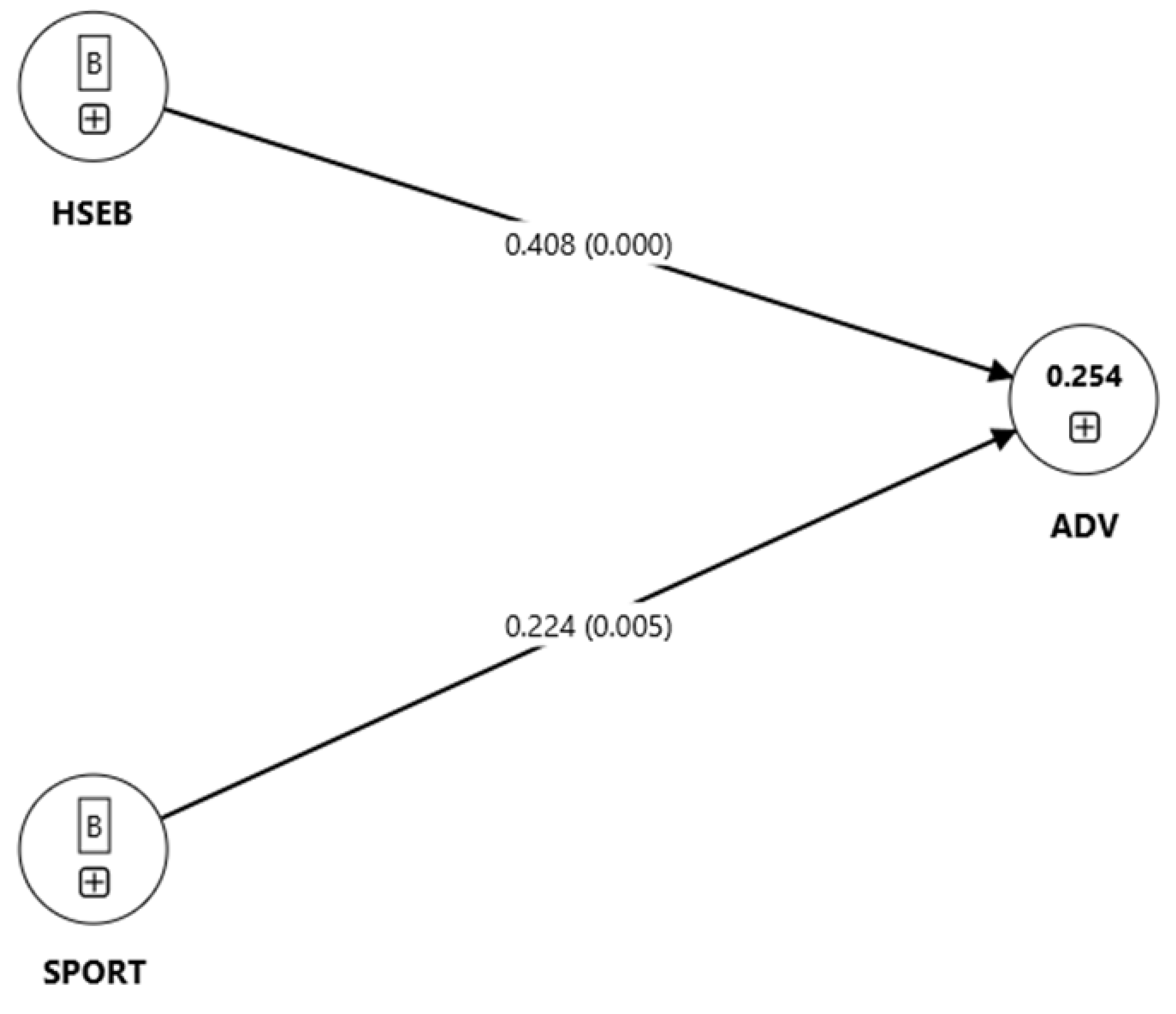

Table 1.
Evaluation of the measurement model: item loadings, reliability, and convergent validity.
| Item | Loading | Reliability and convergent validity |
|---|---|---|
| Advocacy | ||
| ADV1 | 0.844 | Cronbach’s α = 0.910 Dillon-Goldstein rho = 0.937 AVE = 0.788 |
| ADV2 | 0.893 | |
| ADV3 | 0.902 | |
| ADV4 | 0.911 | |
| Avoiding food waste | ||
| AFW1 | 0.830 | Cronbach’s α = 0.878 Dillon-Goldstein rho = 0.920 AVE = 0.794 |
| AFW2 | 0.935 | |
| AFW3 | 0.904 | |
| Animal welfare | ||
| AW1 | 0.918 | Cronbach’s α = 0.895 Dillon-Goldstein rho = 0.935 AVE = 0.826 |
| AW2 | 0.919 | |
| AW3 | 0.890 | |
| Free time and sport | ||
| FTS1 | 0.781 | Cronbach’s α = 0.757 Dillon-Goldstein rho = 0.860 AVE = 0.671 |
| FTS2 | 0.864 | |
| FTS3 | 0.810 | |
| Healty and balanced diet | ||
| HBD1 | 0.762 | Cronbach’s α = 0.903 Dillon-Goldstein rho = 0.923 AVE = 0.632 |
| HBD2 | 0.878 | |
| HBD4 | 0.776 | |
| HBD5 | 0.813 | |
| HBD6 | 0.814 | |
| HBD7 | 0.801 | |
| HBD8 | 0.708 | |
| Local food | ||
| LOCALF1 | 0.923 | Cronbach’s α = 0.862 Dillon-Goldstein rho = 0.915 AVE = 0.783 |
| LOCALF2 | 0.946 | |
| LOCALF3 | 0.777 | |
| Low fat | ||
| LOWF1 | 0.865 | Cronbach’s α = 0.844 Dillon-Goldstein rho = 0.905 AVE = 0.761 |
| LOWF2 | 0.941 | |
| LOWF3 | 0.806 | |
| Meat reduction | ||
| MR1 | 0.928 | Cronbach’s α = 0.922 Dillon-Goldstein rho = 0.945 AVE = 0.811 |
| MR2 | 0.943 | |
| MR3 | 0.914 | |
| MR4 | 0.811 | |
| Quality labels | ||
| QL1 | 0.856 | Cronbach’s α = 0.918 Dillon-Goldstein rho = 0.939 AVE = 0.755 |
| QL2 | 0.908 | |
| QL3 | 0.800 | |
| QL4 | 0.882 | |
| QL5 | 0.895 | |
| Seasonal food | ||
| SF1 | 0.802 | Cronbach’s α = 0.678 Dillon-Goldstein rho = 0.819 AVE = 0.602 |
| SF2 | 0.703 | |
| SF3 | 0.818 | |
| Sport fan engagement | ||
| SFE1 | 0.918 | Cronbach’s α = 0.953 Dillon-Goldstein rho = 0.966 AVE = 0.876 |
| SFE2 | 0.960 | |
| SFE3 | 0.920 | |
| SFE4 | 0.946 | |
Table 2.
Evaluation of the measurement model for higher-order constructs: weights, loadings, and collinearity assessment.
Table 2.
Evaluation of the measurement model for higher-order constructs: weights, loadings, and collinearity assessment.
| Item | Loading | Reliability and convergent validity | ||
|---|---|---|---|---|
| Advocacy (first order) | ||||
| ADV1 | 0.837 | Cronbach’s α = 0.910 Dillon-Goldstein rho = 0.937 AVE = 0.788 |
||
| ADV2 | 0.894 | |||
| ADV3 | 0.904 | |||
| ADV4 | 0.914 | |||
| HSEB (higher order) | Weight | p-value | Loading | VIF |
| AFW | 0.025 | 0.887 | 0.384 | 1.205 |
| AW | 0.785 | 0.000 | 0.891 | 1.524 |
| HBD | 0.091 | 0.657 | 0.358 | 1.327 |
| LOCALF | -0.215 | 0.188 | 0.314 | 1.604 |
| LOWF | 0.022 | 0.882 | 0.291 | 1.159 |
| MR | 0.351 | 0.017 | 0.571 | 1.162 |
| QL | 0.112 | 0.563 | 0.483 | 1.663 |
| SF | 0.131 | 0.404 | 0.500 | 1.449 |
| SPORT (higher order) | Weight | p-value | Loading | VIF |
| FTS | 0.515 | 0.033 | 0.867 | 1.668 |
| SFE | 0.487 | 0.094 | 0.805 | 1.286 |
| SPORTFREQ | 0.228 | 0.457 | 0.706 | 1.537 |
Table 3.
Discriminant validity: heterotrait-monotrait ratio of correlations (HTMT).
| ADV | AFW | AW | FTS | HBD | LOCALF | LOWF | MR | QL | SF | SFE | |
|---|---|---|---|---|---|---|---|---|---|---|---|
| AFW | 0.222 | ||||||||||
| AW | 0.472 | 0.441 | |||||||||
| FTS | 0.359 | 0.153 | 0.385 | ||||||||
| HBD | 0.152 | 0.157 | 0.218 | 0.169 | |||||||
| LOCALF | 0.182 | 0.180 | 0.455 | 0.211 | 0.176 | ||||||
| LOWF | 0.205 | 0.137 | 0.315 | 0.303 | 0.342 | 0.212 | |||||
| MR | 0.286 | 0.162 | 0.286 | 0.277 | 0.290 | 0.270 | 0.201 | ||||
| QL | 0.256 | 0.099 | 0.459 | 0.350 | 0.532 | 0.526 | 0.285 | 0.364 | |||
| SF | 0.343 | 0.233 | 0.580 | 0.303 | 0.364 | 0.619 | 0.294 | 0.464 | 0.510 | ||
| SFE | 0.283 | 0.203 | 0.162 | 0.580 | 0.101 | 0.166 | 0.107 | 0.059 | 0.297 | 0.237 | |
| SPORTFREQ | 0.259 | 0.064 | 0.190 | 0.751 | 0.079 | 0.133 | 0.212 | 0.113 | 0.202 | 0.146 | 0.409 |
Table 4.
Multi-group analysis (MGA) and permutation test results for gender differences.
| Path | Group Female | Group Male | Original difference | Permutation mean difference | 2.5% | 97.5% | Permutation p value |
|---|---|---|---|---|---|---|---|
| HSEB -> ADV | 0.349 | 0.518 | -0.169 | 0.024 | -0.273 | 0.309 | 0.267 |
| SPORT -> ADV | 0.295 | 0.267 | 0.027 | 0.001 | -0.307 | 0.316 | 0.861 |
Disclaimer/Publisher’s Note: The statements, opinions and data contained in all publications are solely those of the individual author(s) and contributor(s) and not of MDPI and/or the editor(s). MDPI and/or the editor(s) disclaim responsibility for any injury to people or property resulting from any ideas, methods, instructions or products referred to in the content. |
© 2026 by the authors. Licensee MDPI, Basel, Switzerland. This article is an open access article distributed under the terms and conditions of the Creative Commons Attribution (CC BY) license.
Copyright: This open access article is published under a Creative Commons CC BY 4.0 license, which permit the free download, distribution, and reuse, provided that the author and preprint are cited in any reuse.


