

Submitted:
28 January 2026
Posted:
29 January 2026
You are already at the latest version
Abstract
This study aimed to assess the efficacy of selected commercial toxin binders, with or without additives against aflatoxin and T-2 toxin in broiler diets. A total of 360-day-old Cobb broilers (all males) were used for the test, which was randomly assigned to the different treatments with 6 replications of 10 broilers each following a Completely Randomized Design. Treatments were Attapulgite Regular (AR), Attapulgite Plus (AP), HCAS (HC), HCAS Plus (HP), and Bentonite Plus (BP). Each toxin binder was added at 0.10% in broiler diets containing corn contaminated with 172 ppb aflatoxin and 151 ppb T-2 toxin; a diet with the same level of mycotoxin from the corn, without toxin binder, served the Control. The AP was superior for body weight gain (P<0.01) and feed conversion (P<0.01) than any of its counterparts. AR elicited body weights comparable with HC, BP and HP, but effected better feed conversion (P<0.001) than its counterparts. Diets with AR, as well as AP, did not evoke differences in terms of livability, carcass yield, and weights of both liver and gizzard + proventriculus, compared with the other toxin binders. The cost of feed per kg bodyweight gain, for AR and AP were comparable but lower (P<0.01) than their counterparts. The addition of toxin binders singly or with adjunct/additions alleviated the adverse effects of aflatoxin and T2 toxin; however, among the toxin binders, the attapulgite with adjuncts showed the most effective prevention of the mycotoxins, resulting in superior gain, feed conversion and least-cost feed per kg gain of the broilers.
Keywords:
aflatoxin
; attapulgite clay
; bentonite
; HSCAS
; mycotoxin
; T2 toxin
Introduction
Mycotoxins are toxic metabolites synthesized by various fungal species that grow ubiquitously in agricultural crops under favorable conditions. About 25% of world crops are contaminated with mycotoxins, as estimated earlier by the Food and Agriculture Organization, which was confirmed in a recent study [1]. World mycotoxin survey for the first quarter of 2024 showed that contamination of feed samples in Asia was 61%, 41%, 17%, 57%, and 59%, 56% for aflatoxin, zearalenone, deoxynivalenol, T-2 toxin (trichothecenes), fumonisins, and ochratoxin [2]. The same mycotoxins have been detected in both the raw form and by-products of major crops in the Philippines [3]. It was cited that feeds can be co-contaminated with two or more mycotoxins, and their interactions may exert additive or synergistic effects [4]. The consumption of high levels of mycotoxin adversely affects the production performance and health of poultry through reduced nutrient intake, immune suppression, mutagenicity, teratogenicity and cellular death [5]. Lack of proper feed quality control, poor feed storage and unchecked negligence of feed mill or farm personnel are likely factors for birds’ myotoxicity problem. Under the local scene, aflatoxin and T2-toxin are of particular concern due to the inclusion of more than 50% corn in the diet and up to 20% by-products, which are prone to contain beyond the biological threshold for these mycotoxins.
Inorganic adsorbents, organic binders and synthetic biopolymers have been used to prevent mycotoxicosis, singly or in combination with selected specific binders plus other additives such as enzymes, organic acids, probiotic and vitamin among others. Hydrated sodium calcium aluminosilicate (HSCAS), bentonite and attapulgite are inorganic toxin binders. A micronized attapulgite has recently been introduced for improved mycotoxin control. There is still a dearth of information on the efficacy of this preparation for its intended purpose. The efficacy of the toxin binders is influenced by their physicochemical properties such as total charge, charge distribution, size of the pores on the surface and surface area, iodine number, methylene blue and pH; likewise, the properties of mycotoxins such as polarity, solubility, form and size of the mycotoxin to be adsorbed and the presence of ionized compounds in the environment [5]. The efficacy of bentonite and HSCAS against aflatoxin and, to a minor extent, other mycotoxins has been well demonstrated [6,7] and is among the widely used toxin binders in the world. Similarly, attapulgite has great promise for mitigating these mycotoxins [8,9,10]. There is a dearth of scientific information pertinent to the comparative efficacy of these toxin binders singly or with adjuncts for the prevention of adverse effects of mycotoxin-contaminated poultry diets. Empirical data on this subject are worthy for the screening and selection of toxin binders by the industry stakeholders that will be beneficial for production and economic efficiency in poultry production. Hence, this study was conducted.
Materials and Methods
All experimental protocols involving animals were approved by the Institutional Animal Care and Use Committee of the Central Luzon State University (CLSU) under protocol number CLSU-IACUC Reference No. 20250926-01.
The experimental treatments consisted of basal diets with aflatoxin and T2 toxin without or with the commercial toxin binders described below.
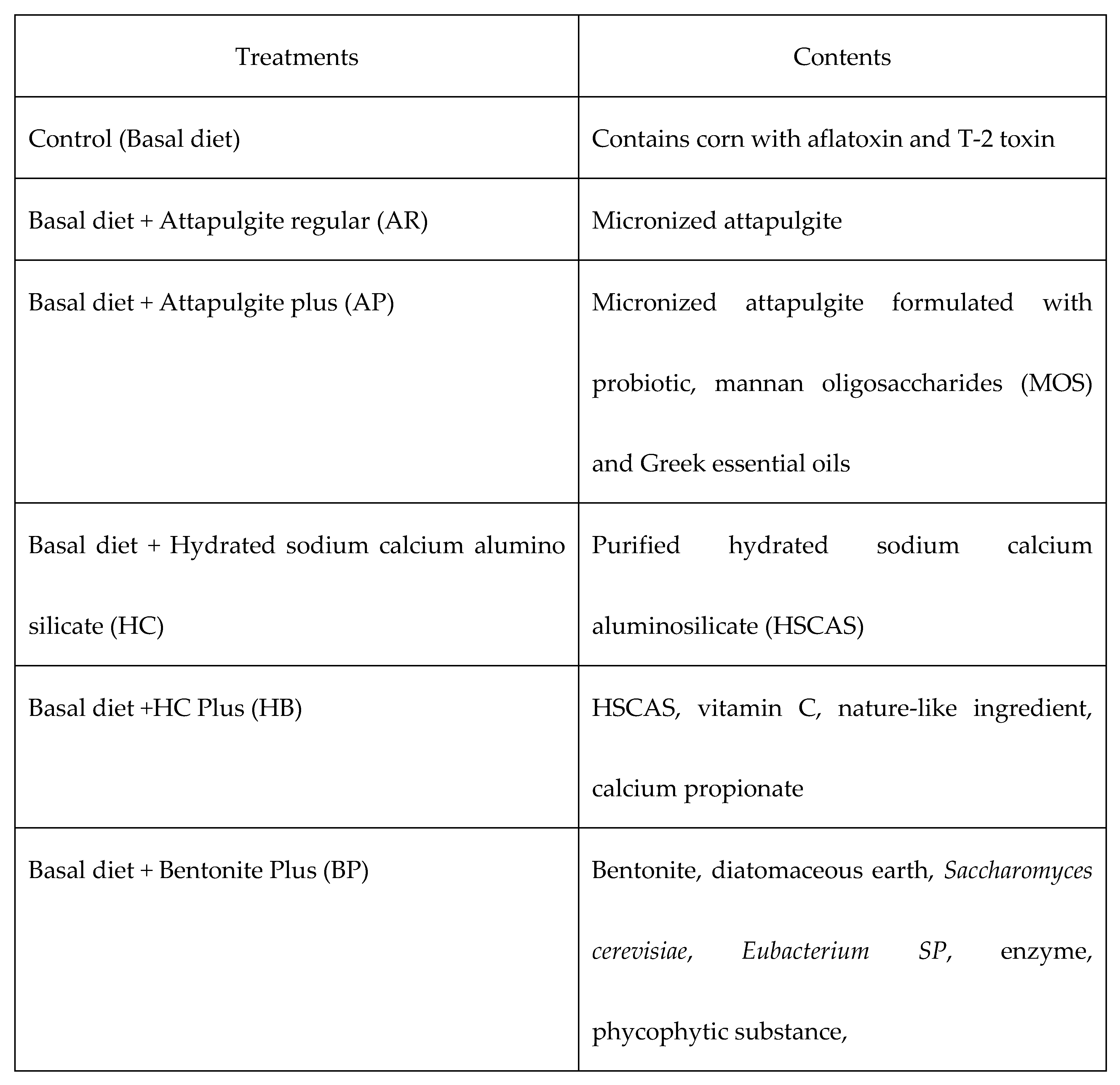
The basal booster, starter and finisher diets (Table 1) were least-cost formulated using nutrient analysis of feed ingredients from PHILSAN [11]. The diets contained nutrients and energy that meet the minimum requirements for Cobb 500 broilers [12]. Each diet contained corn contaminated with 172 ppb and 151 ppb aflatoxin and T-2 toxin, respectively. The ingredients of the basal diets and toxin binders were weighed using digital weighing scales and mixed in an electrically operated horizontal ribbon-type mixer. Each type of basal diet was equally apportioned into 6 lots. Except for the lot for Control, each lot was added with the weighed amount of the test toxin binder (1 kg/ton) and mixed in a rotary feed mixer. All diets were prepared in mash form.
A total of 360 day-old broilers (all males; class A) of a commercial strain (Cobb 500) were used in the study. The broilers were immediately weighed by the group upon arrival at the experimental site. They were randomly assigned to each of the 6 dietary treatments with 6 replicates, each with 10 broilers, following a Completely Randomized Design. A group fed basal diets with non-mycotoxin-contaminated corn and without toxin binder, with 4 replications and 12 broilers per replication, served as a reference group. The data from this group were not included in the production performance and feed cost per kg gain analyses. However, it was used as a reference for the data on carcass yield and gross lesions in the gut and liver.
The broilers were raised in cages in an open-sided house. For the first 10 days, the broilers were brooded in three-tier battery-type cages. After this period, the broilers were transferred to flat-deck wire growing cages provided on the side with trough-type feeders and a common (for 10 pens) trough-type waterer. The house was provided with a compact fluorescent lamp for lighting and two industrial fans for cooling the broilers when the in-house ambient temperature reached beyond 30 °C. Ambient temperature and humidity were taken at 6:00 a.m. and 10:00 a.m. and 1:00 a.m. and 4:00 p.m. daily throughout the feeding period.
The booster, starter and finisher diets were offered to the broilers at 1 to 10 days (d) 11 to 24 d and 25 to 32 d of age, respectively. The diets were offered in liberal amounts. Fresh and clean drinking water was provided at all times.
The health protocol for raising broiler chickens in Poultry Module I was followed. The experimental site was thoroughly cleaned and disinfected before the arrival of the broiler chicks.
Strict cleanliness and sanitation in the experimental area were maintained during the conduct of the feeding trial. Excreta under the pens were regularly removed and promptly disposed of from the broiler house.
The broilers were group-weighed at 0, 10, 24, and 35 d of age. Except on day 0, the broilers were fasted for 3 h before weighing. Dead broilers were weighed and the date when the death occurred was recorded. The average daily gain (ADG) was computed as group weight + weight of dead broiler, less initial group weight, divided by the broiler-days. The pre-weighed amounts of the experimental diets for each period (0-10 d; 11-24 d; 25 to 32 d) were placed in plastic buckets. The amounts of diet given to the broilers were taken from such amounts. At the end of each feeding period, the remaining amount of diet was weighed and deducted from the pre-weighed amount of diet to obtain the group dietary intake. The latter was divided by the broiler-days to obtain the average daily feed intake (ADFI) of the broilers. The average total feed intake and cumulative gain in weight were computed by multiplying the computed daily values for these parameters by the number of feeding days for each period. The feed conversion ratio (FCR) was computed by dividing the mean feed intake by the mean gain in weight for the same period.
Five sample broilers per treatment, of relatively the same weight, at 33 d of age, were obtained for weight of carcass, liver and gizzard + proventriculus determinations. The same number of samples was obtained from a group of broilers from the same batch, fed the same basal diets except the corn used, which was not contaminated with aflatoxin and T2 toxin. The liveweight of the broilers was obtained after 3 h of feed withdrawal and immediately manually dressed. Following evisceration and removal of offal and giblets, the carcasses were then weighed. The liver and gizzard + proventriculus were also excised, cleaned and weighed. Following this, they were examined for gross lesions and surface texture, including color evaluation of the liver.
Data gathered periodically were analyzed for means, standard deviation and coefficient of variations. The data were statistically analyzed using the ANOVA of SAS (SAS Inst. Inc., Cary, NC). The least significant difference (LSD, P= 0.05) was used for comparing means.
Results and Discussion
Performance of the Broilers
Table 2 presents the production performance of the broilers at different periods as influenced by the toxin binders. Statistical analysis revealed significant effects of treatments on various production parameters in some periods. On the 10th day, significant differences in the gain in weight of the broilers from the different treatments were not observed (P>0.05). However, differences due to the treatments at 24 d (P<0.009), 32 d (P<0.0069), 11-24 d (P<0.02), as well as at 25-32 d (P<0.02) were noted. During these periods, the gain in weight of the broilers fed the Control diet was generally comparable with most of the broilers from the different treatments except for those fed the diet with AP which was significantly higher in all measurement periods; the broilers from the latter had also significantly higher gain in weight than their counterparts fed diet with HC, BP, and HP in all periods except at 25-32 d when comparable value with the diet with BP was noted. Moreover, the broilers from this treatment (AP) attained significantly higher weight gain compared to AR in all periods, except at 11-24 d, which was comparable. For broilers fed the diet with AR, significantly higher weight gain was observed compared with those fed the diet with BP at 11-24 d. Significant effects of the treatments on the cumulative feed intake of the broilers were observed on the 10th d (P<0.0001) and 24th d (P<0.0087). In these periods, the feed intake of the broilers fed the Control diet was higher than those from any of the treatments. Broilers from both diets with AR and AP had comparable feed intakes, which were higher than those from the other treatments (HC, HP, and BP) at 10 d but not at 24 d. A numerically higher feed intake for the broilers in the control compared to their counterparts was observed at 32 d and 11 to 24 d, but values among treatments with toxin binders did not greatly differ. The FCR of broilers fed the Control diet was the worst in all measurement periods, which reached numerical to statistical differences (P<0.0001) compared to their counterparts. At 10 d, the FCR of broilers fed a diet with AR and AP was comparable but was better than those fed diets with HC, BP and HP; broilers fed a diet with HC had better FCR than those fed diet with HP. This trend was also noted at 24 d, except no differences among diets with HC, BP and HP were noted. The FCR of broilers fed a diet with AR and AP was better than any of the treatments at 32 d and 11-24 d; broilers fed diet with AP had a better FCR than those fed diet with AR at 32 d but were comparable at 11-24 d. At 25-32 d, FCR of the broilers fed the diet with AP was better than that of their counterparts with toxin binders in their diet, including those fed the diet with AR; the latter had an FCR value that did not differ from those fed the diet with HC, BP, and HP. The results demonstrated that the diet containing aflatoxin and T2 toxin adversely affected the growth and FCR of the broilers without the inclusion of an effective toxin binder. The basal booster, starter and finisher diets had a calculated amount of 98 ppb, 99 ppb, and 100 ppb aflatoxin and 86 ppb, 87 ppb, and 87 ppb T2 toxin, respectively. The aflatoxin was almost twice (50 ppb) the risk level while the T-2 toxin was near the low-risk level (>100 ppb) for these mycotoxins, as indicated by PHILSAN [11]. The amelioration of the adverse effects of these harmful metabolites by the toxin binders indicated their favorable actions. The superior growth and FCR of the broilers fed a diet with AP were possibly related to the synergistic effects of the attapulgite and its adjuncts, resulting in enhanced toxin adsorption and overall health status of the broilers. Without the adjunct (AR), attapulgite rendered protection of the broilers against the mycotoxins better than its counterparts, as evidenced by their better FCR at the end of the feeding period (32 d). The physicochemical properties [5] and production processes, origin, mode of actions or reactions in the gut and other unknown factors contribute to the efficacy and safety of adsorbing or bio-transforming toxins in the gut [13]. Thus, it can be inferred that the attapulgite is conferred with attributes that render its actions against the mycotoxins superior to its counterparts.
Livability of the Broilers
The livability of the broilers at different periods is presented in Table 3. Small differences among treatments in the livability of the broilers at 10 d and 24 d were observed; the differences, though, were a bit larger at 32 d, with the lowest fed diets with HP and BP. Statistical analysis showed that these differences were insignificant (P>0.05).
Carcass Yield, Liver, and Gizzard + Proventriculus of the Broilers
The carcass yield, liver and gizzard + proventriculus of the broilers as influenced by the treatments, including that for the reference group, are presented in Table 4. There were no differences (P>0.05) among treatments as well as the reference group on any of these parameters. However, the liver of broilers in the Control was numerically heavier than the broilers fed the diet with any of the toxin binders, as well as those from the reference group indicating adverse effects of the toxins. The lower weight of the liver of broilers, irrespective of the toxin binder added to their diet, suggests mitigation of the harmful effects of toxins by the toxin binders. It was also noted that the liver of the broilers given the control diet had a lighter brown-red color than those fed the diet with toxin binders. Lesions in the mouth and gizzard, as well as enlarged proventriculus, which were possibly due to T-2 toxin, were observed in some sample broilers fed the Control diet but none in the broilers fed the diet with any of the toxin binders. Aflatoxin is a potent hepatotoxin that causes varying degrees of liver breakdown and its toxicity is enhanced by the presence of other toxins such as T-2 and ochratoxin [7]. The levels of aflatoxin and T-2, as stated above, in the diet, therefore, disrupted normal liver functions. It was plausible that the poorer growth and FCR of the broilers fed the Control diet than their counterparts were associated with damage to their liver. The inclusion of any of the toxin binders gave protection to the liver at varying degrees judging on the gain in weight and FCR of the broilers. It was likely that this was related to the properties of the toxin binders as well as the adjuncts they contain, as mentioned above. To some extent, the toxin binder properties were likely factors for such differences as manifested by the better FCR of broilers (32 d) fed the diet with AR compared to those fed the diet with HC, HP and BP. It was plausible that the lessened amount of the toxins reaching the liver occurred as a result of more toxins being absorbed by the AR than its counterparts. Moreover, the adjuncts possibly influenced the superior FCR (32 d) of the broilers fed the diet with AP.
Feed Cost Per Kilogram Gain
The cost of feed consumed for each type of diet, final gain in weight, and feed cost per kg gain in bodyweight of the broilers is given in Table 5. The cost of the booster diet for both diets with AR and AP was comparable but was significantly lower (P<0.01) than the Control diet, and diets with HC, BP and HP. The cost of starter and finisher diets, as well as the total for all diets, did not differ significantly (P>0.05), but numerical differences among the treatments were noted. As presented above, the gain in weight of the broilers at 32 d differed significantly (P< 0.009), with the broilers fed the diet containing AP higher than any of its counterparts; broilers fed the other diets had comparable weight gain. For the cost per kg gain in weight, diets with AR and AP were comparable, which was significantly lower than any of the treatments (P<0.0001); HC, BP, and HP effected comparable cost per kg gain in bodyweight which did not differ with Control diet, except for diet with HC where much lower cost was incurred than the latter (Control). The gain in weight and the cost of diets are key factors for the cost of gain by the broilers. The cost of the toxin binder differed, with the highest for the BP followed by HP, HC, AP and AR at PhP 550.00, PhP 360.00, PhP 300.00, PhP 280, and PhP 100.00, per kg respectively. In effect, the average cost per kg diet (booster, starter and finisher) at 1 kg/ton inclusion rate of the toxin binders was PhP 29.12, PhP 28.93, PhP 28.87, PhP 28.85, and PhP 28.67 for the BP, HP, HC, AP and AR, respectively; the Control diet had an average cost of PhP 27.89/kg. The inclusion of a toxin binder to a diet increases its cost and varies depending on the cost of the binder of choice. More importantly, though, its impact on gain in weight and the consequent cost of feed per kg gain. Thus, AP addition to the diet had the economic advantage relative to these criteria.
The results indicated that feeding a diet containing aflatoxin and T-2 toxin compromised performance and caused damage to some organs. The addition of toxin binders singly or with adjunct/additions alleviated the adverse effects of these mycotoxins. Among the toxin binders, the attapulgite with adjuncts showed the most effective prevention of the mycotoxins, resulting in superior gain and feed conversion of the broilers. Moreover, the least-cost feed cost per kg gain was realized in feeding the broilers.
Authors Contribution
Conceptualization: Martin EA, Santiago KG, Lalugar CC, San Andres JV, De Vera PI, Dayandayan A, Serviento A Data curation: Martin EA, Santiago KG, Dayandayan A, Lalugar CC Formal analysis: Martin EA Methodology: Martin EA, Dayandayan A, Santiago KG Software: Martin EA Validation: Martin EA, Santiago KG, Lalugar CC, San Andres JV Investigation: Martin EA, Santiago KG, Lalugar CC, San Andres JV Writing - original draft: Martin EA, Santiago KG, Lalugar CC, San Andres JV Writing - review & editing: Martin EA, Santiago KG, Lalugar CC, San Andres JV, De Vera PI, Dayandayan A, Serviento A.
Funding
Not applicable.
Institutional Review Board Statement
CLSU-IACUC Reference No: 20250926-01.
Data Availability Statement
Upon reasonable request, the datasets of this study can be made available from the corresponding author.
Acknowledgments
We greatly acknowledge the financial support provided by Biostar Nutritional Products, Inc., San Pablo City, Laguna.
Conflicts of Interest
No potential conflict of interest relevant to this article was reported.
Declaration of Generative AI
No AI tools were used in this article.
References
- Eskola, M; Kos, G; Elliott, CT; Hajšlová, J; Mayar, S; Krska, R. Worldwide contamination of food-crops with mycotoxins: Validity of the widely cited ‘FAO estimate’ of 25%. Critical Reviews in Food Science and Nutrition 2020, 60(16), 2773–2789. [Google Scholar] [CrossRef] [PubMed]
- World Mycotoxin Survey (January-March 2024). DSM-Firminich; 2024 [Cited 2024 Jul 8]. Available online: https://www.google.com/search?q=REP_MTXsurvey_Q1_2024_EN_0424_61887.pdf&oq=REP_MTXsurvey_Q1_2024_EN_0424_61887.pdf&gs_lcrp=EgZjaHJvbWUyBggAEEUYOTIGCAEQRRg8MgYIAhBFGDzSAQ4xMTc3MTE1OTgzajBqMKgCALACAA&sourceid=chrome&ie=UTF-8.
- Balendres, MAO; Karlovsky, P; Cumagon, CJR. Mycotoxigenic fungi and mycotoxins in agricultural crop commodities in the Philippines: A Review. Foods 2019, 8, 249. [Google Scholar] [CrossRef] [PubMed]
- Nazarizadeh, H; Pourreza, J. Evaluation of three mycotoxin binders to prevent the adverse effects of aflatoxin B1 in growing broilers. J Appl Res 2019, 47(1), 135–139. [Google Scholar] [CrossRef]
- Sing, RK. Role of toxin binders in poultry. Phashudhan Prharee. 2021. Available online: https://www.pashudhanpraharee.com/role-of-toxin-binders-in-poultry/ (accessed on 9 July 2021).
- Darmawan, A; Jayanegara, A; Ozturk, E. A Meta-analysis of bentonite efficacy on performance, carcass yield, giblet, and blood constituents of broiler fed contaminated aflatoxin. Journal of Agricultural Sciences 2023, 29(2), 395–403. [Google Scholar] [CrossRef]
- Leeson, S; Summers, JD. Commercial Poultry Nutrition, 3rd ed.; Nottingham University Press: England, 2008; 398. [Google Scholar]
- Chen, Y; Cheng, Y; Yang, W; Li, X; Wen, C; Wang, W; Wang, A; Zhou, Y. An evaluation of palygorskite inclusion on the growth performance and digestive function of broilers. Applied Clay Science 2016, 129, 1–6. [Google Scholar] [CrossRef]
- Qiao, L; Chen, Y; Wen, C; Zhou, Y. Effects of natural and heat modified palygorskite supplementation on the laying performance, egg quality, intestinal morphology, digestive enzyme activity and pancreatic enzyme mRNA expression of laying hens. Applied Clay Science 2015, 104, 303–308. [Google Scholar] [CrossRef]
- Skoufos, I; Giannenas, I; Tontis, D; Bartzanas, T; Kittas, C; Panagakis, P; Tzora, A. Effects of oregano essential oil and attapulgite on growth performance, intestinal microbiota and morphometry in broilers. South African Journal of Animal Science 2016, 46(1), 77–88. [Google Scholar] [CrossRef]
- Philippine Society of Animal Nutritionists (PHILSAN). Feed Reference Standards, 4th ed.; College, Laguna, Philippines, 2010; 498. [Google Scholar]
- Cobb 500 Broiler performance and nutrition supplement. Cobb-Vantress; 2018 [Cited 2024 Jul 8]. Available online: https://www.cobbgenetics.com/assets/Cobb-Files/2022-Cobb500-Broiler-Performance-Nutrition-Supplement.pdf.
- Gimeno, AL; Martins, ML. Mycotoxins and mycotoxicosis in animals and humans; Special Nutrients, Inc. 2766 SW Douglas Road: Miami, FL, U.S.A, 2006. [Google Scholar]

Table 1.
Ingredients and nutrient composition of basal diets.
| Ingredient | Booster | Starter | Finisher |
| ---------- (%)---------- | |||
| Corn (Yellow, with aflatoxin and T-2 toxin) | 57.11 | 57.30 | 57.90 |
| Rice bran (D1, fullfat) | 3.00 | 6.00 | 9.00 |
| Coconut oil | 1.50 | 2.25 | 3.11 |
| Soybean meal (USHP) | 34.50 | 30.85 | 26.79 |
| Monodicalcium phosphate 21% | 1.48 | 1.32 | 1.13 |
| Limestone (Fine) | 1.05 | 1.00 | 0.88 |
| DL- methionine | 0.27 | 0.23 | 0.22 |
| Lysine HCl | 0.19 | 0.14 | 0.14 |
| Threonine | 0.12 | 0.07 | 0.05 |
| Salt | 0.30 | 0.35 | 0.35 |
| Poultry vitamin premix | 0.025 | 0.025 | 0.018 |
| Poultry trace mineral premix | 0.15 | 0.15 | 0.10 |
| Choline chloride (50% Choline) | 0.10 | 0.10 | 0.10 |
| Phytase | 0.01 | 0.01 | 0.01 |
| Sanitizer | 0.10 | 0.10 | 0.10 |
| Toxin binder | 0.10 | 0.10 | 0.10 |
| Total | 100.01 | 100.00 | 100.00 |
| Calculated analysis (as is basis) | |||
| AME, kcal/kg | 2991 | 3050 | 3100 |
| Crude protein, % | 22.00 | 20.68 | 19.00 |
| Crude fat, % | 4.57 | 5.69 | 6.93 |
| Crude ash, % | 3.29 | 3.26 | 3.21 |
| Crude fiber,% | 2.73 | 2.77 | 2.81 |
| Total phosphorus, % | 0.77 | 0.75 | 0.72 |
| Available phosphorus, % | 0.45 | 0.42 | 0.38 |
| Calcium,% | 0.90 | 0.85 | 0.76 |
| Sodium, % | 0.13 | 0.15 | 0.15 |
| Chlorine, % | 0.22 | 0.25 | 0.25 |
| Linoleic acid, % | 1.71 | 1.88 | 2.04 |
| Digestible amino acids | |||
| Lysine, % | 1.25 | 1.12 | 1.02 |
| Methionine, % | 0.59 | 0.53 | 0.50 |
| Methionine + Cystine, % | 0.92 | 0.85 | 0.80 |
| Threonine, % | 0.83 | 0.73 | 0.66 |
| Tryptophan, % | 0.24 | 0.22 | 0.20 |
| Arginine, % | 1.30 | 1.20 | 1.10 |
| Valine, % | 0.91 | 0.85 | 0.78 |
| Isoleucine, % | 0.87 | 0.81 | 0.73 |
| Leucine, % | 1.66 | 1.56 | 1.44 |
Table 2.
Production performance (1-32 d) of broilers fed diet contaminated with aflatoxin and T2 toxin added with mycotoxin binders1).
Table 2.
Production performance (1-32 d) of broilers fed diet contaminated with aflatoxin and T2 toxin added with mycotoxin binders1).
| Parameters | Control | AR | AP | HC | HP | BP | LSD | Prob. |
| Initial weight, g | 40.7 | 41.3 | 41.2 | 40.7 | 40.6 | 41.2 | 1.48 | 0.42 |
| 1-10 d | ||||||||
| Body weight, g | 232 | 233 | 239 | 231 | 229 | 233 | 10.82 | 0.49 |
| Gain in weight, g | 192 | 192 | 198 | 190 | 188 | 192 | 10.45 | 0.55 |
| Feed intake, g | 256a | 214c | 212c | 231b | 241b | 235b | 11.91 | <0.0001 |
| FCR, g/g | 1.34a | 1.12d | 1.08d | 1.21c | 1.29ab | 1.23bc | 0.07 | <0.0001 |
| 1-24 d | ||||||||
| Body weight, g | 1053bc | 1083bc | 1119a | 1058bc | 1043bc | 1033c | 46.61 | 0.009 |
| Gain in weight, g | 1013bc | 1042ab | 1078a | 1018bc | 1002bc | 992c | 46.22 | 0.0087 |
| Feed intake, g | 1382a | 1289b | 1318b | 1324b | 1314b | 1318b | 49.61 | 0.02 |
| FCR, g/g | 1.37a | 1.24d | 1.22d | 1.30c | 1.31bc | 1.33bc | 0.02 | <0.0001 |
| 1-32 d | ||||||||
| Body weight, g | 1579b | 1638b | 1775a | 1639b | 1569b | 1595b | 107.55 | 0.0069 |
| Gain in weight, g | 1538b | 1596b | 1734a | 1598b | 1529b | 1554b | 107.09 | 0.0067 |
| Feed intake, g | 2318 | 2184 | 2277 | 2267 | 2182 | 2241 | 135.75 | 0.27 |
| FCR, g/g | 1.51a | 1.37c | 1.31d | 1.42b | 1.43b | 1.44b | 0.04 | <0.0001 |
| 11-24 d | ||||||||
| Gain in weight, g | 821bc | 850ab | 880a | 827bc | 814bc | 800c | 44.69 | 0.02 |
| Feed intake, g | 1127 | 1074 | 1106 | 1093 | 1073 | 1083 | 46.29 | 0.18 |
| FCR, g/g | 1.37a | 1.26d | 1.26d | 1.32bc | 1.32bc | 1.35ab | 0.04 | <0.0001 |
| 25-32 d | ||||||||
| Gain in weight, g | 525b | 555b | 656a | 581ab | 527b | 580ab | 78.46 | 0.02 |
| Feed intake, g | 935 | 895 | 959 | 944 | 868 | 924 | 93.85 | 0.36 |
| FCR, g/g | 1.79a | 1.64b | 1.46c | 1.63b | 1.66ab | 1.65b | 0.14 | 0.0032 |
|
1) Means in a row with no common superscript are significantly different ________________ Control – basal diet containing aflatoxin and T2 toxin without toxin binder AR - basal diet + attapulgite AP - basal diet + attapulgite + additives HC - basal diet + hydrated sodium calcium aluminosilicate HP - basal diet + hydrated sodium calcium aluminosilicate + additives BP - basal diet + bentonite + additives | ||||||||
Table 3.
Percent livability of broilers fed diet contaminated with aflatoxin and T2 toxin added with mycotoxin binders.
Table 3.
Percent livability of broilers fed diet contaminated with aflatoxin and T2 toxin added with mycotoxin binders.
| Period | Control | AR | AP | HC | HP | BP | LSD | Prob. |
| 1-10 d | 98.33 | 98.33 | 98.33 | 96.67 | 100.00 | 98.00 | 4.65 | 0.52 |
| 1-24 d | 98.33 | 98.33 | 96.67 | 96.67 | 95.00 | 96.00 | 0.52 | 0.90 |
| 1-32 d | 95.00 | 96.67 | 96.67 | 91.67 | 90.00 | 94.00 | 9.74 | 0.66 |
| _______________ Control – basal diet containing aflatoxin and T2 toxin without toxin binder AR - basal diet + attapulgite AP - basal diet + attapulgite + additives HC - basal diet + hydrated sodium calcium aluminosilicate HP - basal diet + hydrated sodium calcium aluminosilicate + additives BP - basal diet + bentonite + additives | ||||||||
Table 4.
Carcass yield and weight of liver and gizzard + proventriculus of broilers fed diet contaminated with aflatoxin and T2 toxin added with mycotoxin binders.
Table 4.
Carcass yield and weight of liver and gizzard + proventriculus of broilers fed diet contaminated with aflatoxin and T2 toxin added with mycotoxin binders.
| Treatment | Liveweight g | Carcass | Liver | Gizzard+Proventriculus | |||
| g | % | g | % | g | % | ||
| Control | 1834 | 1284 | 69.97 | 35.18 | 1.92 | 44.94 | 2.45 |
| AR | 1848 | 1310 | 70.88 | 28.46 | 1.55 | 40.88 | 2.21 |
| AP | 1798 | 1234 | 68.67 | 29.16 | 1.64 | 44.66 | 2.48 |
| HC | 1846 | 1308 | 70.86 | 28.04 | 1.53 | 42.56 | 2.30 |
| HP | 1816 | 1258 | 69.32 | 28.80 | 1.60 | 48.08 | 2.65 |
| BP | 1816 | 1258 | 69.32 | 28.80 | 1.60 | 48.08 | 2.65 |
| Reference | 1852 | 1332 | 71.93 | 31.78 | 1.71 | 45.72 | 2.47 |
| LSD | 54.49 | 83.92 | 4.07 | 7.51 | 0.39 | 7.30 | 0.34 |
| Prob. | 0.31 | 0.28 | 0.68 | 0.20 | 0.19 | 0.54 | 0.34 |
| _______________ Control – basal diet containing aflatoxin and T2 toxin without toxin binder AR - basal diet + attapulgite AP - basal diet + attapulgite + additives HC - basal diet + hydrated sodium calcium aluminosilicate HP - basal diet + hydrated sodium calcium aluminosilicate + additives BP - basal diet + bentonite + additives Reference – basal diet without mycotoxin contamination; without mycotoxin binder | |||||||
Table 5.
Feed cost per kg gain bodyweight of broilers fed diet contaminated with aflatoxin and T2 toxin added with mycotoxin binders1).
Table 5.
Feed cost per kg gain bodyweight of broilers fed diet contaminated with aflatoxin and T2 toxin added with mycotoxin binders1).
| Item | Control | AR | AP | HC | HP | BP | LSD | Prob. | |
| Feed cost, PhP | |||||||||
| Booster | 7.52a | 6.26c | 6.32c | 6.82b | 7.12b | 7.00b | 0.42 | 0.0001 | |
| Starter | 32.50 | 31.11 | 32.02 | 31.66 | 31.57 | 31.88 | 1.26 | 0.35 | |
| Finisher | 26.84 | 25.53 | 27.61 | 27.14 | 24.67 | 27.41 | 2.58 | 0.16 | |
| Total | 66.86 | 62.90 | 65.95 | 65.63 | 63.36 | 66.29 | 3.78 | 0.20 | |
| Weight gain, kg | 1.57b | 1.62b | 1.75a | 1.61b | 1.53b | 1.60b | 0.11 | 0.009 | |
| Cost/kg gain, PhP | 42.57a | 38.78c | 37.75c | 40.82b | 41.39ab | 41.46ab | 1.23 | 0.0001 | |
|
1) Means in a row with no common superscript are significantly different ______________ Control – basal diet containing aflatoxin and T2 toxin without toxin binder AR - basal diet + attapulgite AP - basal diet + attapulgite + additives HC - basal diet + hydrated sodium calcium aluminosilicate HP - basal diet + hydrated sodium calcium aluminosilicate + additives BP - basal diet + bentonite + additives |
|||||||||
Disclaimer/Publisher’s Note: The statements, opinions and data contained in all publications are solely those of the individual author(s) and contributor(s) and not of MDPI and/or the editor(s). MDPI and/or the editor(s) disclaim responsibility for any injury to people or property resulting from any ideas, methods, instructions or products referred to in the content. |
© 2026 by the authors. Licensee MDPI, Basel, Switzerland. This article is an open access article distributed under the terms and conditions of the Creative Commons Attribution (CC BY) license (http://creativecommons.org/licenses/by/4.0/).
Copyright: This open access article is published under a Creative Commons CC BY 4.0 license, which permit the free download, distribution, and reuse, provided that the author and preprint are cited in any reuse.