

Submitted:
26 January 2026
Posted:
27 January 2026
Read the latest preprint version here
Abstract
Space heating remains a consequential component of residential energy demand across many climates and persists as a seasonal load even in regions where cooling dominates annual consumption. This study examines the extent to which AI-guided passive design optimization can reduce residential heating demand when envelope and solar-responsive parameters are considered in isolation. A standardized single-story residential prototype is simulated across three climatic contexts: (a) Riyadh, representing a hot-dry environment; (b) Barcelona, representing a temperate environment; and (c) Toronto, representing a cold-humid environment. The analysis combines dynamic building energy simulation with multi-generation parametric optimization based on evolutionary search. The research objective is to minimize annual space heating demand under fixed comfort conditions. Cooling is intentionally excluded, and heating demand is modeled through an ideal loads approach to focus on effects related to the building's envelope and solar gains. Under these controlled assumptions, the optimization leads to substantial reductions in heating demand across all climates, ranging from approximately 43% in cold conditions to high relative reductions in the hot and dry case. The resulting optimal solutions demonstrate how passive design strategies vary by climate. The findings support AI-guided passive optimization as a transparent decision-support approach in the residential early design stage.
Keywords:
passive solar design
; residential heating demand
; AI-guided optimization
; building energy simulation
; climate-responsive architecture
1. Introduction
Residential buildings remain a primary consumption sector in global energy demand. In both temperate and cold climates, space heating constitutes a dominant load, while in many hot regions it persists as a seasonal but still meaningful requirement [1,2,3]. And even though decarbonization strategies often prioritize active systems and renewable supply, the building envelope and the configuration of passive solar elements continue to shape heating demand in fundamental ways [4]. They govern heat-loss pathways, determine the availability of useful solar gains, and influence the timing and magnitude of indoor heat deficits. Early design decisions, such as orientation, window ratio, glazing choice, and the incorporation of thermal mass, are therefore crucial for residential prototypes, as they can establish heating demand characteristics that persist over the full-service life of a dwelling [5,6,7]. This path dependence drives strategies that focus on strong passive solutions during the design phase rather than relying on corrective measures later.
A persistent methodological challenge arises from the nonlinear interaction of passive design variables. For example, increasing the window-to-wall ratio may improve winter solar gains, but it can also increase transmission losses if the glazing doesn't work well or the orientation isn't right for the sun's seasonal paths [7]. Thermal mass offers another example. While it can dampen temperature swings and improve heat retention, its effectiveness depends on solar availability, internal gains, and the timing of heat delivery [8]. These complex relationships make the design options much broader than what can be thoroughly explored by manual testing, especially when focusing only on heating demand and considering multiple climates within one analysis.
In response, simulation-based optimization has become increasingly common. Evolutionary methods, including genetic algorithms, are frequently applied to navigate high dimensional design spaces and to identify high performing configurations under constrained assumptions [7,9]. At the same time, surrogate modeling and machine-learning approaches have been introduced to reduce computational cost and to support broader exploration, including early-stage analysis under uncertainty [10,11]. These methodological developments are especially relevant to passive solar design, where solution landscapes often contain multiple local optima and strong variable coupling [4,12]. Optimization tools can reveal viable combinations that would otherwise remain untested
Despite this progress, two limitations in recent work motivate the present study. Many optimizations studies frame heating performance as one element within a multi objective formulation that also includes cooling, cost, comfort indices, or carbon metrics [13,14]. Such approaches are valuable, yet they can obscure the specific contribution of solar-responsive passive decisions to heating-load reduction. Improvements may instead be driven by changes in HVAC efficiency, operational control, or objective weighting rather than by envelope behavior itself. In addition, cross-climatic comparisons are often difficult to interpret. Studies frequently modify building form, internal gains, occupancy assumptions, or system definitions when changing climate, which limits causal inference regarding how passive optimization logic depends on climate alone [1,2].
This paper addresses these limitations through a deliberately bounded research question: to what extent can annual residential heating demand be reduced through AI-guided optimization of passive and solar-responsive design variables when building geometry and comfort conditions are held constant and cooling is excluded? The analysis is structured around a standardized residential prototype simulated across three climatic contexts that represent hot and dry, temperate, and cold and humid conditions. The optimization objective is defined as the minimization of annual heating load, expressed in kilowatt-hours, using an ideal loads representation [15]. This formulation isolates envelope-driven demand rather than system efficiency effects. For early-stage design assessment, heating load serves as a direct and interpretable indicator of passive performance because it reflects the combined outcome of transmission losses, infiltration, and useful solar gains.
A further motivation concerns the gap between simulation-based expectations of passive solar performance and outcomes observed in practice. Conceptual evidence suggests that discrepancies often emerge when design assumptions diverge from operational realities [4]. While post-occupancy validation lies outside the scope of the present work, the study addresses a related concern by making all modeling and optimization assumptions explicit and consistent across climates. This transparency enables results to be interpreted as conditional on clearly stated boundaries. It also supports replication and serves as a basis for extensions that include uncertain occupancy, adaptive comfort models, or calibrated data.
Accordingly, the study contributes in three ways. First, it offers a controlled cross-climate comparison of AI-guided passive optimization outcomes using a consistent residential prototype and a single heating-focused objective. Second, it interprets the resulting design patterns as climate-specific optimization logics, identifying which classes of variables dominate in each context and why, in physical terms. Third, it presents structured tables and figure-ready outputs suitable for direct inclusion in a Solar manuscript, supporting clarity and reuse.
The following sections of the paper are organized as follows: Section 2 synthesizes recent work on AI-assisted passive optimization and solar-responsive envelope design, positioning the present study relative to prevailing approaches and identified gaps. Section 3 describes the simulation model, climatic datasets, optimization formulation, and reproducibility provisions. Section 4 reports baseline and optimized results for Riyadh, Barcelona, and Toronto, followed by a cross-climate comparison. Section 5 discusses climate-dependent optimization logics and their implications for early-stage residential design. Section 6 concludes with a bounded statement of contributions and limitations and outlines directions for further research.
2. Background and Related Work on Passive Solar Heating Optimization
This section reviews prior work on passive and solar-responsive design, AI-based optimization in building energy research, and approaches that focus specifically on heating demand across climates. The review is structured to identify methodological trends and recurring limitations that motivate the present study.
2.1. Passive and Solar-Responsive Design as variables of Heating Demand
Passive design strategies have long been recognized as key determinants of residential heating demand. Their influence operates primarily through transmission losses, infiltration behavior, and the availability of useful solar gains [1,8]. Envelope configuration, glazing performance, building orientation, and the presence of thermal mass together shape the balance between heat loss and heat acquisition during the heating season [4,5]. In low-rise residential typologies, particularly in cold and temperate climates, these factors often exert a stronger influence on heating demand than system efficiency because surface-area-to-volume ratios are relatively high [3].
Recent comparative studies confirm that decisions related to solar-responsive envelope design can significantly reduce heating demand when they are aligned with local climatic conditions. Examples include glazing orientation to south, optimized window-to-wall ratios, and the use of high-performance glazing system [6,7]. The literature also stresses that these strategies only work in certain situations. Increasing the amount of glass may help winter solar gains, but it can also be counterproductive if the losses from transmission are greater than the gains or if the orientation does not match the seasonal solar paths [7]. This conditional behavior complicates rule-based passive design approaches and motivates the use of computational exploration.
Thermal mass exhibits a similarly climate sensitive role. In cold climates, heavyweight constructions can improve heat retention and dampen indoor temperature fluctuations, which reduces heating peaks and annual demand [2,8]. In hot and dry climates, thermal mass is more frequently discussed in relation to cooling performance. Its contribution to winter heating remains less explored, despite the fact that limited heating demand is not negligible [9]. Taken together, the literature indicates that passive heating optimization cannot rely on isolated parameter adjustments. Instead, it requires consideration of interactions among multiple envelope-related variables [16,17].
2.2. Evolutionary and AI-Based Optimization in Building Energy Design
To address the complex nature of passive design variables, evolutionary optimization methods have become widely adopted in building energy research. In particular genetic algorithms are well suited to nonlinear and multi-dimensional problems. They have been applied to envelope retrofitting, façade design, and early-stage residential optimization under constrained assumptions [9,11]. Their principal advantage lies in the ability to explore large solution spaces without reliance on gradient information or linear approximations.
More recently, AI-assisted approaches have expanded beyond direct evolutionary search to include surrogate modeling and hybrid optimization frameworks. Surrogate models, often based on machine-learning techniques, approximate simulation outputs in order to reduce computational cost. This enables deeper or broader searches within the same computational budget. Such approaches have proven especially effective during early-stage design, where uncertainty is high and design freedom remains relatively unconstrained [18].
Even with their advanced methods many optimization studies adopt multi-objective formulations that combine heating, cooling, cost, emissions, and comfort metrics within a single problem definition [13,14]. Improvements in heating performance may arise indirectly from changes in system efficiency, control strategies, or objective weighting rather than from envelope and solar-responsive behavior itself. As a result, isolating the specific contribution of passive design variables to heating load reduction often remains challenging.
2.3. Optimization Focused on Heating and the Role of Objective Definition
Recent studies have increasingly addressed heating demand as a primary or dominant optimization objective. Studies conducted in cold climates show that optimization aimed at reducing heating demand tends to prioritize high-performance glazing, reduced infiltration, and increased thermal mass. Solar gains play a complementary role that depends on orientation and shading control [3,19]. These findings suggest that heating demand follows a different hierarchy of governing variables than cooling demand, even when both occur within the same building.
Most research centered on heating however are specific to each climate. Few adopt a unified framework that enables direct cross-climatic comparison. When multiple climates are considered, changes in building form, occupancy assumptions, or HVAC representations often accompany climate variation. Such changes limit causal inference regarding whether differences in optimized solutions arise from climatic drivers or from modeling inconsistencies [1,2].
Another methodological issue concerns the representation of HVAC systems. A number of studies include detailed heating system models, which can make it hard to see effects at the envelope level. In such cases, reductions in heating demand may be conflated with system efficiency improvements or control logic adjustments. In response, some authors advocate the use of ideal-loads or demand-based representations when the research objective is to evaluate passive performance rather than system design [15,18]. This approach allows clearer attribution of results to envelope and solar-responsive variables.
2.4. Cross-Climatic Comparisons and The Adaptability of Optimization Logic
Cross-climatic studies provide insightful information about the transferability of passive design strategies. Comparative research indicates that optimized envelope variables do not scale uniformly with climatic severity. Window areas that perform well in temperate climates may prove excessive in cold climates unless they are paired with advanced glazing and carefully selected orientations [7,19]. Similarly, strategies that are effective in hot and dry regions during winter can differ fundamentally from those applied in temperate zones, even when solar availability appears comparable [9].
AI-based optimization provides a means to uncover ways designs respond to different climates by allowing solutions to emerge from performance driven search rather than prescriptive assumptions. Nevertheless, the literature shows that relatively few studies interpret why optimized solutions diverge across climates in physical terms. Aspects such as the relative contribution of solar gains, the dominance of transmission losses, or the stabilizing role of thermal mass are often left implicit [4]. Without such interpretation, optimization results risk being treated as black-box outputs rather than as sources of transferable design knowledge.
Recent analyses further highlight the gap between simulation-based passive solar predictions and realized building performance. These research investigations emphasize the value of transparent assumptions and cautious framing of conclusions [4]. Although the result doesn’t mean optimization-based research is invalid, it reinforces the importance of clearly bounded claims and reproducible modeling choices [20].
2.5. Identified Research Gap and Positioning of the Present Study
The reviewed body of related work reveals three interrelated gaps:
- Studies that focus only on heating optimization which isolate passive and so-lar-responsive effects without conflating them with cooling performance or HVAC efficiency remain limited;
- Cross-climatic comparisons are often undermined by inconsistent modeling assumptions, which restrict the ability to attribute differences in optimized solutions to climate alone;
- While AI-guided optimization is widely applied, fewer studies translate optimization outcomes into interpretable, climate-specific design logics that are relevant to early-stage residential design.
By applying a consistent AI-guided optimization framework to a standardized residential prototype across three distinct climate zones, the present study addresses these gaps. A single objective focused on annual heating load is used throughout. The analysis enables direct comparison of optimization outcomes and supports interpretation of climate-driven design tendencies by maintaining constant geometry, comfort conditions, and HVAC representation. By prioritizing passive and solar-responsive strategies across different climatic contexts, the study provides both quantitative results and structured insight.
3. Materials and Methods
This section describes the framework and methodology used to evaluate the impact of passive and solar-responsive design strategies on residential space heating demand. The approach combines dynamic building energy simulation with AI-guided parametric optimization under a deliberately constrained set of assumptions. The methodology highlights the focus on transparency and cross-climatic comparability, making sure that differences in performance outcomes are due to climate-driven design responses and not changes in geometry, comfort criteria, or HVAC representation. The following subsections set the details of the research design, case study selection, model definition, optimization formulation, and analytical boundaries.
3.1. Overall Research Design
This study employs a simulation and an AI-guided optimization framework to evaluate the potential of passive and solar-responsive design strategies to decrease the demand for space heating in homes across distinct climate zones. The study’s methodological framework is intentionally constrained in order to isolate envelope-driven effects and to enable cross-climatic comparison under consistent assumptions.
The research design follows a sequential structure. It begins with the definition of a standardized residential prototype, followed by climate-specific baseline simulation. AI-guided parametric optimization is then applied using a single objective focused on heating demand. The final stage consists of comparative analysis and interpretation of optimized solutions across the selected climates.
Throughout all stages, building geometry, occupancy assumptions, comfort setpoints, and HVAC representation are held constant. Climate is treated as the sole external differentiating variable.
3.2. Case Study Locations and Climate Data
Three cities were selected to represent distinct residential heating contexts. These include a hot and dry climate with limited winter heating demand, a temperate climate with seasonal heating requirements, and a cold and humid climate characterized by prolonged heating periods. See Table 1.
Hourly EnergyPlus Weather (EPW) files were used for all simulations [21]. Each model was simulated over a full annual period from 1 January to 31 December in order to capture seasonal heating dynamics.
3.3. Residential Prototype Definition
A single-story residential prototype was selected to represent a common low-rise housing typology while minimizing geometric complexity. The prototype was purposely kept simple to focus on how the building’s envelope and solar features affect performance, rather than differences caused by the building’s shape. See Table 2.
A single thermal zone was used to avoid intra-zonal variability and to maintain consistency across all optimization runs.
3.4. Envelope Construction and Airtightness Assumptions
Baseline envelope constructions were defined using energy code compliant assemblies’ representative of contemporary residential practice. The objective was not to reproduce region-specific construction traditions, but to establish a consistent and realistic reference condition against which passive optimization effects could be evaluated across climates. See Table 3.
Airtightness was represented using a constant infiltration rate of 0.7 air changes per hour. This rate was applied continuously throughout the year and across all climate cases. By fixing infiltration assumptions, the analysis focuses on envelope configuration and solar-responsive parameters rather than variations in air leakage behavior, which can otherwise obscure passive design effects.
3.5. Glazing and Window Configuration (Baseline)
The baseline glazing configuration was defined to represent a conservative residential condition with limited intentional exploitation of solar gains. Clear single glazing with a nominal thickness of 6 mm was used throughout the dwelling. The window-to-wall ratio was set to 20%, with windows distributed uniformly across all façades.
No external shading devices or internal blinds were included in the baseline model. This configuration establishes a neutral reference condition in which solar access is neither maximized nor deliberately restricted. As such, it provides a clear baseline against which the effects of optimized glazing performance, window area, orientation, and shading strategies can be evaluated.
Window dimensions and placement were kept constant in the baseline model and were only modified within the bounds defined by the optimization variables. This approach ensures that changes in heating demand observed in optimized solutions can be attributed to controlled design decisions rather than inconsistencies in baseline fenestration definition.
3.6. HVAC Representation and Comfort Conditions
To separate heating demand related solely to the building envelope, the study employs an ideal loads heating-only HVAC representation. This approach calculates the thermal energy required to maintain indoor comfort without modeling system efficiency or distribution losses. See Table 4. Cooling systems were intentionally disabled in all simulations to maintain a strictly heating-focused scope.
3.7. Optimization Problem Formulation
The optimization problem was formulated as a single-objective: Minimize annual space heating load (kWh). This formulation directly reflects the combined outcome of envelope heat losses, infiltration, and useful solar gains, independent of HVAC system efficiency. Design variables were selected to represent passive and solar-responsive parameters that can be modified at early design stages. See Table 5.
3.8. Optimization Procedure
The optimization was conducted using a multi-generation evolutionary search comprising five generations. Each generation explored a population of candidate solutions generated through recombination and mutation of design variables. EnergyPlus simulations were executed for each candidate, and annual heating load was recorded as the fitness metric. No surrogate model was employed; all reported results are derived from direct dynamic simulation to ensure fidelity and transparency. Artificial intelligence is employed here in the sense of intelligent search and decision space exploration through evolutionary algorithms, rather than predictive learning or data driven model inference. No predictive or data-trained learning models are employed; the optimization relies exclusively on evolutionary search coupled with deterministic simulation.
3.9. Scope and Limitations
The methodology deliberately excludes cooling, domestic hot water, equipment loads, and occupant adaptive behaviors. Internal gains were held constant and identical across climates. The residential prototype does not represent regional construction practices in detail but serves as a controlled comparative model. Therefore, the results should be interpreted as relative performance improvements under standardized conditions, rather than as predictions of absolute real-world energy use.
4. Results
This section presents the baseline heating performance and AI-guided optimization outcomes for the three selected climatic contexts. Results are reported first for each climate individually, using narrative description supported by key quantitative values, followed by a consolidated cross-climatic comparison. This structure emphasizes interpretability and avoids repetition while preserving analytical clarity.
4.1. Hot and Dry Climate: Riyadh
This subsection reports the baseline heating performance and AI-guided optimization outcomes for the hot and dry climate case. Results are used to examine how passive and solar-responsive variables behave when winter heating demand is limited but non-zero. The analysis focuses on identifying the dominant drivers of heating reduction under conditions of high solar availability.
4.1.1. Baseline Heating Performance
Under baseline conditions, the Riyadh residential prototype exhibits very low annual heating demand, reflecting the limited severity and duration of winter conditions in a hot and dry climate. The simulated annual space heating load is 989 kWh, corresponding to a heating energy use intensity of approximately 10.5 kWh/m²·yr. Peak heating demand occurs during short winter periods and remains modest in magnitude relative to the other climates considered.
Despite the low baseline demand, the heating load is non-zero, indicating that envelope configuration and solar access still influence winter comfort requirements even in cooling-dominated regions.
4.1.2. Optimized Heating Performance
AI-guided optimization yields a substantial reduction in heating demand. The best-performing solution reduces annual heating load to approximately 38.8 kWh, representing a reduction of about 95.9% relative to the baseline. This near elimination of heating demand is achieved entirely through passive and solar-responsive design adjustments.
Across high-performing solutions, the optimization consistently increases window-to-wall ratio and favors orientations that maximize winter solar exposure. High-performance glazing is selected, while shading devices and internal blinds are systematically excluded. These results indicate that, under hot and dry winter conditions, maximizing solar gains dominates the optimization logic, and the penalty associated with increased transmission losses remains secondary when cooling is not considered. See Table 6.
4.2. Temperate Climate: Barcelona
This subsection presents baseline heating performance and optimization outcomes for the temperate climate case. The results are used to examine how passive and solar responsive strategies operate under conditions of moderate seasonal heating demand. Attention is given to the balance between solar contribution and transmission loss control.
4.2.1. Baseline Heating Performance
In the temperate Barcelona case, baseline heating demand is substantially higher than in Riyadh, reflecting a longer heating season and cooler winter temperatures. The annual heating load of the baseline model is 5652 kWh, corresponding to a heating energy use intensity of approximately 60.0 kWh/m²·yr.
Heating demand in this context is distributed over a broader portion of the year, making envelope thermal performance and heat retention more influential than in the hot and dry case.
4.2.2. Optimized Heating Performance
Optimization reduces annual heating demand to 1987.95 kWh, corresponding to a reduction of approximately 64.8% relative to baseline performance. While the magnitude of reduction is lower than in Riyadh, the absolute reduction in energy demand is substantial.
Unlike the hot and dry case, optimization in Barcelona consistently prioritizes glazing performance over geometric solar amplification alone. High window-to-wall ratios remain present in top performing solutions, but only when paired with triple Low-E argon-filled glazing. Orientation continues to influence performance, though its effect is moderated by the dominant role of transmission loss suppression. Look Table 7.
4.3. Cold and Humid Climate: Toronto
This subsection reports the baseline heating performance and AI-guided optimization outcomes for the cold and humid climate case. Results are used to examine how passive and solar-responsive variables behave when winter heating demand is limited but non-zero. The analysis focuses on identifying the dominant drivers of heating reduction under conditions of high solar availability.
4.3.1. Baseline Heating Performance
The Toronto baseline represents the most demanding heating scenario among the three cases. Annual heating demand reaches 16,903.94 kWh, corresponding to a heating energy use intensity of approximately 179.4 kWh/m²·yr. Heating demand persists for extended periods throughout the year, and peak loads are significantly higher than in the other climates. This baseline establishes a stringent reference condition for evaluating the effectiveness of passive optimization in cold climates.
4.3.2. Optimized Heating Performance
Optimization reduces annual heating demand to 9611.69 kWh, corresponding to a reduction of approximately 43.1%. Although the relative reduction is smaller than in Riyadh and Barcelona, the absolute energy savings are considerable. Optimized solutions consistently combine high-performance glazing with heavyweight envelope constructions and limited solar control through short overhangs. Window-to-wall ratios remain moderate, reflecting the need to balance solar gains against elevated transmission losses during prolonged cold periods. See Table 8.
4.4. Cross-Climatic Comparison
A consolidated comparison of baseline and optimized heating performance across the three climates is presented in Figure 1.
Across all climates, AI-guided passive optimization produces meaningful reductions in heating demand, though the magnitude and underlying drivers vary substantially. The hot and dry case achieves the highest relative reduction due to the amplification of winter solar gains acting on a low baseline. The temperate case demonstrates balanced performance gains driven primarily by glazing efficiency. The cold and humid case shows more constrained but still significant improvements, governed by thermal resistance and mass rather than solar amplification alone. These differences highlight that passive optimization does not scale uniformly with climatic severity. Instead, it reorganizes design priorities according to the dominant physical mechanisms governing heat demand in each context.
5. Discussion
This section interprets the optimization outcomes by examining how dominant passive design variables and their interactions vary across climatic contexts. Rather than reiterating numerical results, the discussion focuses on the underlying physical and design logics that emerge from the AI-guided search. Emphasis is placed on explaining why different climates favor distinct combinations of solar utilization, envelope performance, and thermal storage.
5.1. Climate-Dependent Optimization Logic
The results indicate that AI-guided passive optimization does not converge toward a single universal design solution. Instead, it produces optimization logics that differ by climate. This outcome aligns with previous research showing that the effectiveness of passive strategies depends on the interaction between solar availability, transmission losses, and climatic severity [1,4,8].
In the hot and dry Riyadh case, optimization nearly eliminates heating demand by increasing winter solar gains through higher window-to-wall ratios and favorable orientation. The magnitude of this reduction reflects the combination of a low baseline heating demand and unconstrained winter solar amplification under a heating-only objective, rather than a generalizable expectation for real-world residential operation. When cooling requirements or seasonal comfort constraints are reintroduced, the feasible extent of solar amplification would be expected to narrow. Across all high-performing solutions, shading devices and blinds are consistently excluded. Under hot–dry winter conditions, the marginal benefit associated with solar heat gain exceeds the penalty associated with increased transmission losses. Comparable tendencies have been reported in arid-climate studies, where winter heating demand can be minimized through solar exposure despite cooling-dominated annual profile [9,22]. The scale of reduction observed here highlights how responsive low baseline heating demand is to envelope configuration and orientation when cooling constraints are deliberately removed.
By contrast, the temperate Barcelona case reveals a different hierarchy of influential variables. Although increased glazing area remains beneficial, optimization shifts toward glazing performance rather than solar aperture alone. The repeated selection of triple Low-E argon-filled glazing reflects the need to reduce transmission losses while preserving useful solar contribution during the heating season. This behavior is consistent with studies indicating that, in temperate climates, heating optimization prioritizes envelope efficiency over geometric solar amplification [6,23]. Orientation continues to influence outcomes, yet its role is secondary to the thermal quality of glazing.
The cold and humid Toronto case reinforces this progression. Optimization converges on solutions that combine high-performance glazing with substantial thermal mass and controlled solar admission through limited overhangs. Unlike the hot and dry context, unrestricted solar amplification is not optimal because increased glazing area without sufficient thermal resistance raises heat losses during prolonged cold periods. The presence of short overhangs among top-performing solutions points to a balance between winter solar utilization and shoulder-season loss control. Similar patterns have been documented in cold and climate studies, where heating demand is governed primarily by loss reduction and heat storage capacity rather than by solar gain alone [2,3,19].
5.2. Role of Window-to-Wall Ratio and Glazing Performance
Across all climates, window-related parameters emerge as central to heating optimization, although their functional role varies by context. In Riyadh, higher window-to-wall ratios function primarily as solar collectors. In Barcelona and Toronto, windows act as thermally regulated apertures whose effectiveness depends on advanced glazing performance [24].
This finding supports recent literature indicating that window-to-wall ratio should not be treated as a monotonic variable. Its optimal value depends on both glazing quality and climatic conditions [7,23]. AI-guided optimization is particularly suited to resolving this dependency because window area and glazing type are evaluated simultaneously rather than independently [10,11]. As a result, the optimization avoids oversimplified outcomes, such as uniformly minimizing window area or universally maximizing solar exposure.
5.3. Thermal Mass as a Climate-Selective Strategy
Thermal mass emerges as a decisive variable primarily in the cold and climate case. Heavyweight walls and ground floors are consistently selected, reflecting the stabilizing influence of thermal mass on indoor temperatures and its capacity to retain solar and internal gains over extended heating periods [2,3]. In temperate and hot and dry climates, thermal mass plays a more limited role, suggesting that its contribution to heating demand reduction depends on both heating season duration and the availability of recoverable gains.
These observations are consistent with earlier findings that thermal mass yields diminishing returns in climates characterized by short or intermittent heating seasons [8,9]. The optimization outcomes therefore reinforce the view that thermal mass should be applied selectively rather than treated as a universally effective passive heating strategy.
5.4. Implications for AI-Guided Early-Stage Design
From a methodological standpoint, the study demonstrates the value of heating-focused, single-objective optimization for clarifying passive design behavior. By leaving out cooling and HVAC efficiency from the main goal, the optimization clearly shows the compromises related to the building envelope that can get hidden when multiple goals are considered at once [13,14]. This approach is particularly relevant during early design stages, when decisions regarding orientation, glazing, and construction precede system specification [18].
At the same time, the results must be interpreted within the limits of the modeling assumptions. The ideal-loads heating representation isolates demand but does not capture system constraints or occupant-driven adaptation. As noted in recent analyses, simulation-based predictions of passive solar performance require cautious interpretation when extended to real-world operation [4]. Nevertheless, the controlled nature of the framework strengthens internal validity and supports comparative insight across climates. Accordingly, the reported reductions should be interpreted as heating specific performance outcomes rather than indicators of whole year energy balance.
5.5. Limitations and Transferability
The findings are specific to the standardized residential prototype and comfort assumptions adopted in this study. Absolute heating loads will vary with building form, occupancy behavior, and regional construction practices. However, the relative trends identified solar amplification during hot and dry winters, controlling heat loss through better windows in temperate climates, and using a mix of thermal mass and solar design in cold climates are strategies that can likely be applied to similar low-rise homes [1,19].
Future research could extend this framework by incorporating stochastic occupancy profiles, adaptive comfort models, or calibrated post-occupancy data. Reintroducing cooling as a secondary objective would also enable investigation of seasonal trade-offs under more comprehensive performance criteria.
6. Conclusion
This study examined the potential of AI-guided passive design optimization to reduce residential space heating demand across distinct climate zones. This was achieved by isolating envelope and solar-responsive parameters under standardized comfort conditions. Using a consistent residential prototype and a single objective optimization framework, the analysis compared outcomes in a hot and dry climate (Riyadh), a temperate climate (Barcelona), and a cold and humid climate (Toronto).
The results demonstrate that passive and solar-responsive strategies can deliver substantial heating demand reductions across all examined climates, although the extent and basic reasoning behind these reductions vary significantly with climatic context. In the hot and dry case, winter heating demand was nearly eliminated through solar amplification enabled by favorable orientation, increased glazing area, and moderate thermal mass. In the temperate case, optimization outcomes were dominated by transmission loss reduction through high-performance glazing, combined with increased solar aperture. In the cold climate, meaningful reductions were achieved through a balanced strategy integrating advanced glazing, thermal mass, and controlled solar admission, reflecting the physical limits of passive heating under prolonged cold conditions.
A key contribution of this work lies in demonstrating that AI-guided optimization does not converge on uniform passive design strategies but rather reveals climate-specific hierarchies of influential variables. By constraining the objective function to annual heating load and excluding cooling and system efficiency effects, the study clarifies how envelope-level decisions alone shape heating demand. This method makes the results easier to understand and shows how useful demand-based optimization is for assessing residential design in the early stages.
The findings also underscore the continued relevance of passive and solar-responsive design in contemporary residential architecture. Even in climates with severe heating requirements, envelope optimization achieved reductions exceeding 40% without reliance on active systems. These outcomes suggest that integrating AI-guided passive optimization into early design workflows can support more climate-responsive, energy-efficient residential buildings before system selection or technological enhancements are considered.
The study is subject to several limitations. Results are based on a simplified residential prototype, fixed comfort setpoints, and an ideal loads representation of heating demand. Occupant behavior, adaptive comfort, and real-world construction variability were not modeled. Accordingly, the reported reductions should be interpreted as conditional on the stated assumptions and as indicators of relative performance rather than absolute predictions.
Future research may extend this framework by incorporating adaptive comfort models, stochastic occupancy, or combined heating and cooling objectives, as well as by validating optimization outcomes against measured performance data. Nonetheless, within its defined scope, this study provides clear evidence that AI-guided passive design optimization offers a robust and interpretable approach for reducing residential heating demand across diverse climatic contexts.
Author Contributions
Conceptualization, G.T. and K.A.; methodology, G.T.; software, G.T.; validation, G.T., K.A. and M.B.; formal analysis, K.A.; investigation, G.T.; resources, K.A.; data curation, G.T.; writing—original draft preparation, G.T.; writing—review and editing, K.A.; visualization, M.B.; supervision, K.A.; project administration, G.T. All authors have read and agreed to the published version of the manuscript.
Funding
This research received no external funding
Institutional Review Board Statement
Not applicable.
Informed Consent Statement
Not applicable.
Data Availability Statement
The data presented in this study are included within the article and its supplementary material. Additional simulation outputs and optimization records are available from the corresponding author upon reasonable request.
Acknowledgments
The authors acknowledge IMAGINE Studios for providing technical infrastructure and research support used in conducting the simulation and optimization analyses.
Conflicts of Interest
The authors declare no conflicts of interest.
Abbreviations
The following abbreviations are used in this manuscript:
| AI | Artificial Intelligence |
| WWR | Window-to-Wall Ratio |
| HVAC | Heating, Ventilation, and Air Conditioning |
| EPW | EnergyPlus Weather File |
| COP | Coefficient of Performance |
| ASHRAE | American Society of Heating, Refrigerating and Air-Conditioning Engineers |
References
- Pajek, L.; Potočnik, J.; Košir, M. The Effect of a Warming Climate on the Relevance of Passive Design Measures for Heating and Cooling of European Single-Family Detached Buildings. Energy and Buildings 2022, 261, 111947. [Google Scholar] [CrossRef]
- Sayadi, S.; Akander, J.; Hayati, A.; Cehlin, M. Analyzing the Climate-Driven Energy Demand and Carbon Emission for a Prototype Residential nZEB in Central Sweden. Energy and Buildings 2022, 261, 111960. [Google Scholar] [CrossRef]
- Xue, Q.; Wang, Z.; Chen, Q. Multi-Objective Optimization of Building Design for Life Cycle Cost and CO2 Emissions: A Case Study of a Low-Energy Residential Building in a Severe Cold Climate. Build. Simul. 2022, 15, 83–98. [Google Scholar] [CrossRef]
- Wingrove, K.; Heffernan, E.; Daly, D.; Ambrose, M. Passive-Solar Design: Evidence of the Disconnect between Theory, Policy and Practice in the Glazing Design of Contemporary Australian Homes. Energy and Buildings 2025, 345, 116104. [Google Scholar] [CrossRef]
- Albatayneh, A. Sensitivity Analysis Optimisation of Building Envelope Parameters in a Sub-Humid Mediterranean Climate Zone. Energy Exploration & Exploitation 2021, 39, 2080–2102. [Google Scholar] [CrossRef]
- Tawfeeq, H.; Qaradaghi, A.M.A. Optimising Window-to-Wall Ratio for Enhanced Energy Efficiency and Building Intelligence in Hot Summer Mediterranean Climates. Sustainability 2024, 16, 7342. [Google Scholar] [CrossRef]
- Gigasari, A.R.; Cañada-Soriano, M.; Aparicio-Fernández, C.; Vivancos, J.-L. Impact of Window-to-Wall Ratio (WWR) and Shading on Energy Demand in a Residential Building across Five Distinct Climates. Results in Engineering 2025, 28, 107518. [Google Scholar] [CrossRef]
- Toroxel, J.L.; Silva, S.M. A Review of Passive Solar Heating and Cooling Technologies Based on Bioclimatic and Vernacular Architecture. Energies 2024, 17, 1006. [Google Scholar] [CrossRef]
- Ayoobi, A.W.; Inceoğlu, M. Developing an Optimized Energy-Efficient Sustainable Building Design Model in an Arid and Semi-Arid Region: A Genetic Algorithm Approach. Energies 2024, 17, 6095. [Google Scholar] [CrossRef]
- Araújo, G.R.; Gomes, R.; Gomes, M.G.; Guedes, M.C.; Ferrão, P. Surrogate Models for Efficient Multi-Objective Optimization of Building Performance. Energies 2023, 16, 4030. [Google Scholar] [CrossRef]
- Shirzadi, N.; Lau, D.; Stylianou, M. Surrogate Modeling for Building Design: Energy and Cost Prediction Compared to Simulation-Based Methods. Buildings 2025, 15, 2361. [Google Scholar] [CrossRef]
- Magnier, L.; Haghighat, F. Multiobjective Optimization of Building Design Using TRNSYS Simulations, Genetic Algorithm, and Artificial Neural Network. Building and Environment 2010, 45, 739–746. [Google Scholar] [CrossRef]
- Alexakis, K.; Benekis, V.; Kokkinakos, P.; Askounis, D. Genetic Algorithm-Based Multi-Objective Optimisation for Energy-Efficient Building Retrofitting: A Systematic Review. Energy and Buildings 2025, 328, 115216. [Google Scholar] [CrossRef]
- Zhao, Z.; Li, H.; Wang, S. Surrogate-Assisted Coordinated Design Optimization of Building and Microclimate Considering Their Mutual Impacts. Applied Energy 2025, 383, 125374. [Google Scholar] [CrossRef]
- Kubwimana, B.; Najafi, H. A Novel Approach for Optimizing Building Energy Models Using Machine Learning Algorithms. Energies 2023, 16, 1033. [Google Scholar] [CrossRef]
- Chen, Y.; Chen, Z.; Wang, D.; Liu, Y.; Zhang, Y.; Liu, Y.; Zhao, Y.; Gao, M.; Fan, J. Co-Optimization of Passive Building and Active Solar Heating System Based on the Objective of Minimum Carbon Emissions. Energy 2023, 275, 127401. [Google Scholar] [CrossRef]
- Sun, Q.; Alhamayani, A.; Huang, K.; Hao, L.; Hallinan, K.; Ghareeb, A. Smart Wi-Fi Physics-Informed Thermostat Enabled Estimation of Residential Passive Solar Heat Gain for Any Residence. Energy and Buildings 2022, 261, 111934. [Google Scholar] [CrossRef]
- Lu, Y.; Ma, N.; Arsano, A.Y.; Brown, N.; Chung, J.; Dilsiz, A.D.; Dong, B.; Franconi, E.; Han, X.; Jiang, Z.; et al. Towards High-Performance Buildings for Thermal Resilience and Health. Energy and Buildings 2025, 347, 116367. [Google Scholar] [CrossRef]
- Rasouli, N.; Shirizadeh, S.; Fayaz, R.; Naseri Mobaraki, H. Multi-Objective Optimization of Façade Elements for Residential Buildings in Cold Climate. Intelligent Buildings International 2025, 1–20. [Google Scholar] [CrossRef]
- D’Agostino, D.; D’Agostino, P.; Minelli, F.; Minichiello, F. Proposal of a New Automated Workflow for the Computational Performance-Driven Design Optimization of Building Energy Need and Construction Cost. Energy and Buildings 2021, 239, 110857. [Google Scholar] [CrossRef]
- Crawley, D.B.; Lawrie, L.K.; Winkelmann, F.C.; Buhl, W.F.; Huang, Y.J.; Pedersen, C.O.; Strand, R.K.; Liesen, R.J.; Fisher, D.E.; Witte, M.J.; et al. EnergyPlus: Creating a New-Generation Building Energy Simulation Program. Energy and Buildings 2001, 33, 319–331. [Google Scholar] [CrossRef]
- Edbais, A.; Hossain, M. Analysis of Window Parameters and Shading Strategies in Buildings in Hyper-Arid Desert Coastal Climates: A Case Study for Kuwait. Discov Sustain 2025, 6, 534. [Google Scholar] [CrossRef]
- Alwetaishi, M.; Benjeddou, O. Impact of Window to Wall Ratio on Energy Loads in Hot Regions: A Study of Building Energy Performance. Energies 2021, 14, 1080. [Google Scholar] [CrossRef]
- Zhang, R.; Xu, X.; Zhai, P.; Liu, K.; Kong, L.; Wang, W. Agile and Integrated Workflow Proposal for Optimising Energy Use, Solar and Wind Energy Potential, and Structural Stability of High-Rise Buildings in Early Design Decisions. Energy and Buildings 2023, 300, 113692. [Google Scholar] [CrossRef]
Figure 1.
Baseline and optimized annual heating demand across climates.
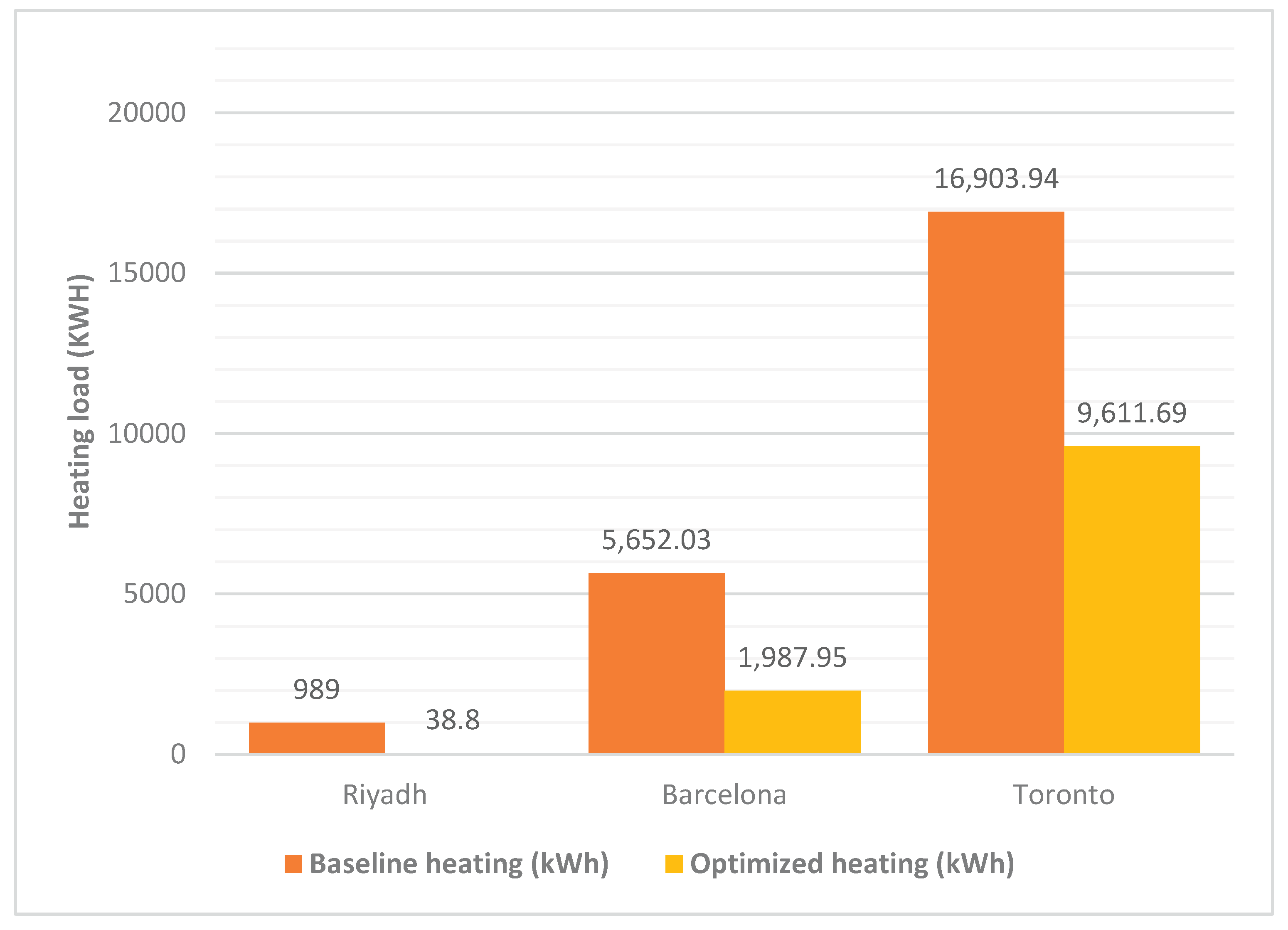

Table 1.
Climatic characteristics of selected case study locations.
| Country | Climate classification | ASHRAE climate zone | Weather file | |
| Riyadh | Saudi Arabia | Hot–dry | 1B | EPW (IWEC) |
| Barcelona | Spain | Temperate | 3C | EPW (IWEC) |
| Toronto | Canada | Cold–humid | 6A | EPW (IWEC) |
Table 2.
Residential prototype geometry and zoning.
| Parameter | Value |
| Building type | Single-story dwelling |
| Plan dimensions | 10 m × 10 m |
| Gross floor area | 100 m² |
| Conditioned floor area | 94.2 m² |
| Story height | 3.0 m |
| Conditioned volume | 282.6 m³ |
| Thermal zoning | Single thermal zone |
Table 3.
Baseline envelope thermal properties.
| Component | Construction type | U-value (W/m²·K) |
| External walls | Lightweight, code-compliant | 0.354 |
| Roof | Lightweight flat roof, code-compliant | 0.346 |
| Ground floor | Lightweight slab-on-grade | 0.314 |
Table 4.
Heating setpoints and HVAC assumptions.
| Parameter | Value |
| HVAC model | Ideal loads (heating only) |
| Heating enabled | Yes |
| Cooling enabled | No |
| Occupied heating setpoint | 21 °C |
| Unoccupied setback | 16 °C |
| Heating fuel | Electricity (reference) |
| Seasonal COP | 1.0 |
Table 5.
Optimization design variables and ranges.
| Variable | Range / Options |
| Window-to-wall ratio | 20–80% |
| Building rotation | 0–355° (5° increments) |
| Glazing type | Single; double; triple; Low-E; argon-filled |
| External wall construction | Lightweight; mediumweight; heavyweight |
| Roof construction | Lightweight; mediumweight; heavyweight |
| Ground floor construction | Lightweight; mediumweight; heavyweight |
| External shading depth | None; 0.5–2.0 m overhangs |
| Internal blinds | None; low-reflective; reflective |
Table 6.
Optimized solutions, Riyadh (Hot and Dry Climate).
| Rank |
Heating Load (kWh/yr) |
WWR (%) | Rotation (°) | Glazing1,2 | Wall | Roof |
| 1 | 38.80 | 56 | 165 | Double clear Low-E argon, no SHD | Lightweight | Mediumweight |
| 2 | 59.13 | 58 | 160 | Double clear Low-E argon, no SHD | Lightweight | Mediumweight |
| 3 | 193.04 | 38 | 230 | Triple clear 1 m louvres, 0.5m-OH | Mediumweight | Mediumweight |
| 4 | 314.91 | 26 | 275 | Triple clear 1 m louvres, 0.5m-OH | Mediumweight | Mediumweight |
| 5 | 405.07 | 32 | 250 | Triple clear, no SHD | Mediumweight | Lightweight |
1 No SHD = no external shading device applied, 2 OH = external shading device implemented as a horizontal overhang.
Table 7.
Optimized solutions, Barcelona (Temperate Climate).
| Rank |
Heating Load (kWh/yr) |
WWR (%) | Rotation (°) | Glazing1,2 | Wall | Roof |
| 1 | 1987.95 | 78 | 275 | Triple clear Low-E argon, no SHD | Mediumweight | Lightweight |
| 2 | 1987.95 | 78 | 275 | Triple clear Low-E argon, 0.5m-OH | Heavyweight | Mediumweight |
| 3 | 2008.60 | 78 | 340 | Double clear Low-E argon, no SHD | Heavyweight | Mediumweight |
| 4 | 2103.88 | 76 | 45 | Triple clear Low-E argon, no SHD | Heavyweight | Heavyweight |
| 5 | 2151.00 | 68 | 305 | Double clear Low-E argon, 0.5m-OH | Mediumweight | Mediumweight |
1 No SHD = no external shading device applied, 2 OH = external shading device implemented as a horizontal overhang.
Table 8.
Optimized solutions, Toronto (Cold and Humid Climate).
| Rank |
Heating Load (kWh/yr) |
WWR (%) | Rotation (°) | Glazing1,2 | Wall | Roof |
| 1 | 9,611.69 | 52 | 105 | Triple clear Low-E argon, 1m-OH | Heavyweight | Lightweight |
| 2 | 10,339.04 | 46 | 265 | Double clear Low-E argon, no SHD | Mediumweight | Lightweight |
| 3 | 10,417.51 | 22 | 225 | Double clear Low-E argon, 1m-OH | Mediumweight | Lightweight |
| 4 | 10,597.96 | 30 | 225 | Double clear Low-E argon, 0.5m-OH | Mediumweight | Lightweight |
| 5 | 11,009.53 | 42 | 220 | Triple clear Low-E argon, 2m-OH | Lightweight | Lightweight |
1 No SHD = no external shading device applied, 2 OH = external shading device implemented as a horizontal overhang.
Disclaimer/Publisher’s Note: The statements, opinions and data contained in all publications are solely those of the individual author(s) and contributor(s) and not of MDPI and/or the editor(s). MDPI and/or the editor(s) disclaim responsibility for any injury to people or property resulting from any ideas, methods, instructions or products referred to in the content. |
© 2026 by the authors. Licensee MDPI, Basel, Switzerland. This article is an open access article distributed under the terms and conditions of the Creative Commons Attribution (CC BY) license (http://creativecommons.org/licenses/by/4.0/).
Copyright: This open access article is published under a Creative Commons CC BY 4.0 license, which permit the free download, distribution, and reuse, provided that the author and preprint are cited in any reuse.


