

Submitted:
25 January 2026
Posted:
27 January 2026
You are already at the latest version
Abstract
The Trace & Trajectory Framework (TTF) offers a non-representationalist approach to meaning, cognition, and selfhood, grounded in dynamical systems theory and radical enactivism. Unlike traditional cognitive science, which treats meaning as something stored in mental representations, TTF proposes that meaning is enacted—it emerges through temporally extended navigational patterns called trajectories. This paper provides a foundational introduction to TTF's core concepts, parameters, and analytical vocabulary. It addresses readers encountering the framework for the first time, those requiring a compact reference for specialized applications, and scholars seeking to understand how TTF dissolves classical problems in philosophy of mind and cognitive science—including the symbol grounding problem, the scalability problem, and debates about representational content. The framework introduces a layered architecture of traces, threads, and trajectories operating across granularity scales (λ), coupled with transduction mechanisms that enable coordination between distinct navigational spaces without requiring shared representations. Throughout, conceptual clarity is prioritized over technical formalization, using analogies and worked examples to illuminate the framework's central commitments.
Keywords:
non-representationalism
; philosophy of mind
; enactivism
; dynamical systems theory
; meaning-making
; symbol grounding problem
; phenomenology
; cognitive science
1. What Is TTF?
The Trace & Trajectory Framework is a theoretical and methodological approach to understanding how meaning, identity, and experience emerge from dynamic navigational processes rather than from static mental representations. Before diving into technical details, it helps to understand what problem TTF is trying to solve and why existing approaches fall short.
1.1. The Problem TTF Addresses
Consider a simple question: What does the word “justice” mean?
Traditional cognitive science offers answers along these lines: “justice” is a mental representation stored somewhere in your brain, connected to other representations (“fairness,” “law,” “punishment”) in a semantic network. When you hear the word, you retrieve this representation and thereby grasp its meaning.
This picture, however, faces deep problems. If meaning is just a stored pattern, how does that pattern connect to the world? How does a neural activation “mean” anything at all? This is the symbol grounding problem [10], and it has troubled cognitive science for decades. Furthermore, if meaning is stored, where does it go when you’re not thinking about it? And how can two people share the “same” meaning if their representations are private?
TTF dissolves these problems by rejecting the premise. Meaning is not stored anywhere. The question “where is the meaning of `justice’?” is like asking “where is the dance when no one is dancing?” The answer is: nowhere. The dance exists only in the dancing. Similarly, meaning exists only in the meaning-making—in the active, temporally extended process of navigating through structured informational space.
But this answer immediately raises new questions—questions that will guide our exploration of TTF throughout this document.
If meaning is not stored, why isn’t each act of meaning-making random? Because the space being navigated is not featureless. It contains traces—pre-existing grooves that channel navigation much as riverbeds channel water. These traces bundle into threads, stabilized pathways that give coherence to the terrain. When you think about justice, your trajectory is not arbitrary; it follows affordances shaped by your history of justice-related experiences. The coherence of meaning derives from the coherence of the terrain.
If meaning emerges within individual processes, are we trapped in private meaning-prisons? No. TTF proposes transduction—a coupling mechanism between distinct navigational spaces. You never enter my meaning-space, and I never enter yours. But our trajectories can coordinate across the interface between us, much as two musicians playing different instruments can lock into shared rhythm without inhabiting the same body. Communication is imperfect—translation is hard—but it is genuine.
Is meaning-making individual or collective? Both. It begins in individual, embodied navigation—your body matters, your perceptual history matters. But the traces you navigate are not yours alone. Many were laid down by collective processes across generations: linguistic conventions, cultural practices, institutional structures. When you think about “liberty,” you navigate terrain that countless others have shaped.
This is not to say you are condemned to follow traces mechanically. Navigation involves genuine agency—you can resist the pull of certain pathways, carve new routes, refuse familiar destinations. But traces differ dramatically in their grip. Some are suggestions: you can take them or leave them, and the cost of departure is manageable. Others exert powerful attraction: cultural defaults, linguistic categories, and institutional expectations that require significant effort to resist. And some cannot be resisted at all—not because you lack willpower, but because they constitute the very conditions of navigation itself. These maximally binding traces are constitutive constraints—not external rules imposed on navigation, but the very geometry of navigational possibility. You cannot ’choose’ to ignore gravity or entropy, not because they forbid your choices, but because they are the structure within which choosing is possible.
If meaning is embodied, how do abstract concepts arise—astronomy, freedom, force fields? Not through disembodiment, but through what we might call scalar transition. TTF proposes that navigational space is not flat but vertically structured—it has levels of granularity, from fine-grained textures close to sensorimotor experience to coarser configurations where details blur but structural relationships remain visible.
What do we mean by “granularity”? Think of it as resolution—the level of detail at which you’re engaging with something. When you look at a photograph on your phone, you can zoom in until you see individual pixels: tiny colored squares that, by themselves, mean nothing. Zoom out a little and you see shapes—an eye, a smile. Zoom out further and you see a face. Further still: a person at a party. Each zoom level is a different granularity. The pixels don’t disappear when you see the face; they’re still there, but you’re no longer engaging at that level of detail.
“Scalar transition” is simply movement between these levels. When you shift from seeing pixels to seeing a face, you’ve made a scalar transition—not by leaving the pixels behind, but by engaging the same information at a coarser grain. The face is not a summary of pixels; it’s what the pixels are when viewed at that scale.
TTF proposes that meaning works the same way. It proposes that we are moving constantly through granular space, the base of which is our direct experience, even before we name things (which is already a categorization expression). This space has a vertical axis that goes from the most fine grain or pixel in our subjective experience (direct perception and experiencing of things, embodied) to the coarsest level possible of rough categorization: world, human, life, meaning itself. This axis is calibrated by what we call lambda ()—a parameter that indexes the scale at which informational structure is configured. Think of as marking where you are on the zoom slider: it tells you the resolution at which you are currently navigating. Fine-grained experience—the feel of rough fabric, the particular red of that apple, the specific tone of your friend’s voice—exists at (“lambda-fine”). Abstract concepts—freedom, causation, number—exist at (“lambda-coarse”).
But the abstract is not floating free of the embodied; think of it like viewing a landscape from different altitudes. From ground level, you see individual trees, rocks, paths. From a hilltop, you see the forest, the valley, the river system. From an airplane, you see bioregions, watersheds, climate patterns. You have not lost the trees by ascending; you have shifted to a granularity where “forest” becomes the navigable unit. The forest is not a compression of trees—it is trees as they appear at a different scale, with their own emergent affordances.
Abstract concepts work similarly. “Freedom” is not a lossy compression of countless embodied experiences of constraint and release. It is a configuration navigable at coarser granularity, where the fine-grained details of this escape or that liberation are not erased but subsumed—still present as the texture that gives “freedom” its navigational weight, but no longer individually articulated.
The abstract is not the opposite of the embodied—it is the embodied, viewed and navigated at a different altitude.
These are substantial claims, and the sections that follow will unpack them systematically. For now, the key insight is simply this: TTF does not face forced choices between storage and process, between individual and collective, between embodied and abstract. The framework provides mechanisms—traces, threads, trajectories, transduction—that dissolve these apparent dilemmas rather than choosing sides within them. Section 3 and 4 will formalize the architecture; what matters here is grasping the basic picture.
1.2. The Central Thesis: Meaning is Movement
TTF’s core thesis can be stated simply: meaning is movement.
But “movement” here requires careful unpacking. We do not mean physical displacement through Euclidean space—your body moving from kitchen to garden. Nor do we mean the firing of neurons along axonal pathways, though that may be one way movement manifests at a certain level of description. The movement TTF speaks of is navigational: the directed traversal of structured informational terrain. Think of it less like walking across a room and more like finding your way through a conversation — there is directionality, there are paths taken and not taken, and a landscape of possibilities that constrains and enables where you can go next.
This navigational movement unfolds in what we will call thread-space: the terrain formed by stabilized traces that channel trajectories. When you grasp a concept, you are not retrieving a file; you are moving through a region of this space, activating certain pathways, passing through certain configurations, arriving at certain positions. The movement has temporal extension—it takes time, it has phases, it can be interrupted or resumed. And critically, the movement is not about meaning; the movement constitutes meaning. There is no meaning sitting somewhere waiting to be accessed. The accessing is the meaning.
More precisely, what we call “meaning,” “concepts,” or “understanding” are not things stored somewhere (in brains, in symbols, in representations) but patterns of activity—trajectories through structured informational space. A trajectory does not encode meaning; the trajectory is the meaning.
This thesis has far-reaching consequences. It dissolves the symbol grounding problem because there is nothing to ground—trajectories are already worldly, already embedded in the dynamics of experience. It dissolves the storage problem because meaning doesn’t need to be stored; the navigational affordances are maintained, and meaning emerges when they are activated. And it dissolves the intersubjectivity problem through a mechanism called transduction, which we will explore later.
1.3. Theoretical Lineage
TTF did not emerge in a vacuum. It synthesizes insights from several intellectual traditions, each of which contributes essential elements:
Radical Enactivism [14,15]: Hutto and Myin argue that basic cognition does not involve content-bearing mental representations. Organisms navigate their environments through patterns of sensorimotor engagement, not by building internal models. TTF extends this insight from basic cognition to all meaning-making, including abstract conceptual thought.
Dynamical Systems Theory [17,28]: Rather than viewing cognition as computation over symbols, dynamical approaches model it as trajectories through continuous state spaces. TTF adopts this framework but enriches it with semiotic structure. In dynamical systems theory, trajectories are simply paths through state space; TTF adds that all trajectories are inherently meaningful—to traverse is to signify—but not all trajectories appear to the agent with equal visibility. Some unfold too quickly, some operate below the threshold of noticing, and some are structural (they need to be navigated to keep things running). The conditions governing which trajectories surface as navigable significance, and which operate in the background, require specification—this is what TTF calls shading, developed in Section 6.
Phenomenology [13,20]: The phenomenological tradition emphasizes attending to the structure of lived experience as it presents itself, prior to scientific abstraction. TTF takes seriously the phenomenological insight that experience has intrinsic structure—it is not a blooming, buzzing confusion upon which we impose order, but already organized in characteristic ways.
Analytic Idealism [16]: Kastrup argues that consciousness is ontologically fundamental—matter is what consciousness looks like from the outside, not the other way around. TTF adopts this commitment, treating informational structure as primary and physical descriptions as interface-level appearances.
Decolonial Epistemology [21,24]: Decolonial thinkers have shown that claims to universal knowledge often mask particular perspectives, and that epistemic diversity is not a problem to be overcome but a resource to be preserved. TTF incorporates this insight through its treatment of what it calls “Babel Barriers”—structural features that maintain productive difference between knowledge systems, the cerberi that keep the system from collapsing into homogeneity. Crucially, Babel Barriers are not protocols but architectural primers: diversity—of languages, identities, cultures, ways of knowing, perceiving, and having a body—is ontological in TTF, an essential feature of this architecture rather than an accommodation to contemporary sensibilities.
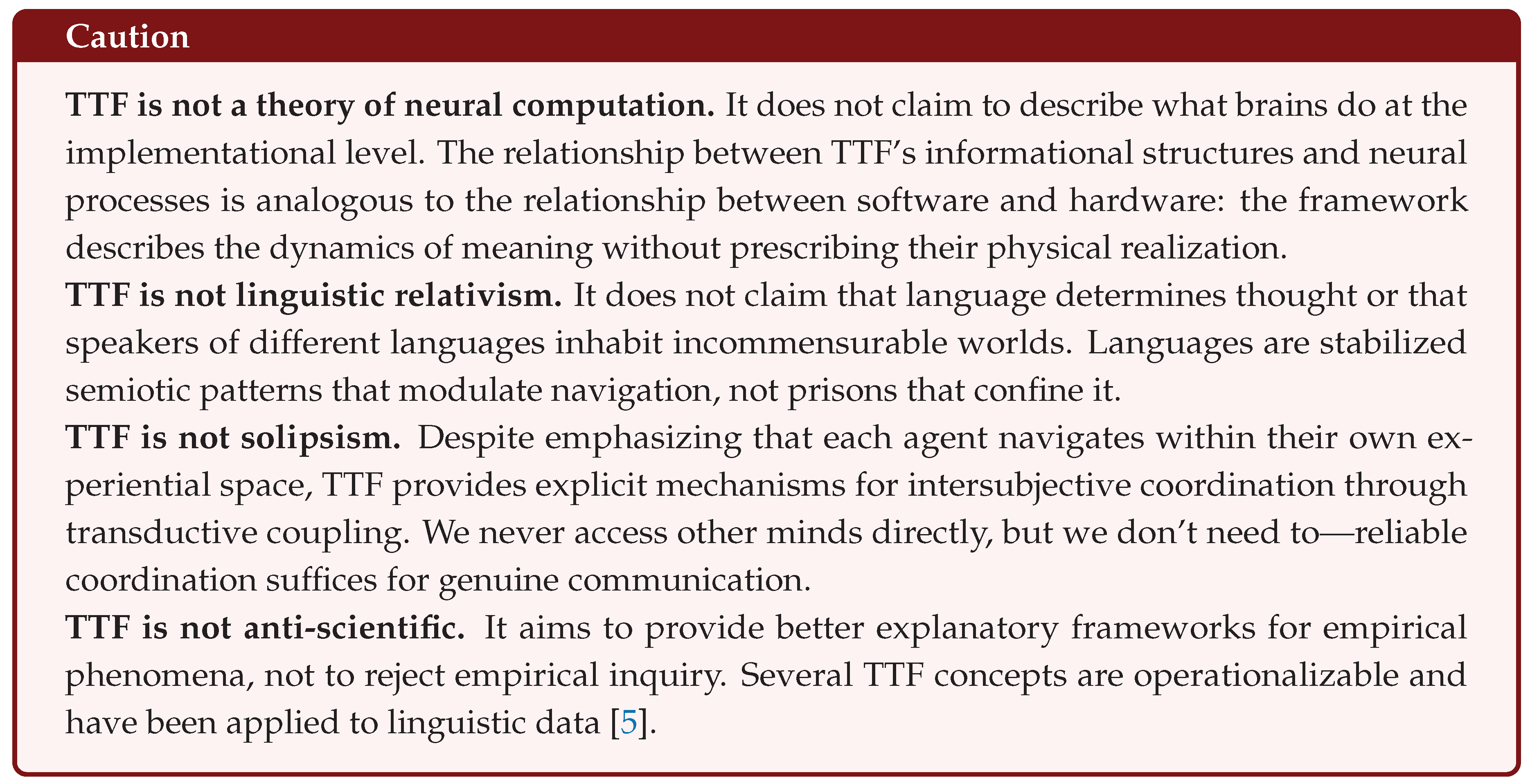
1.4. What TTF Is Not
To prevent common misunderstandings, it helps to state clearly what TTF does not claim:
2. Foundational Commitments
Every theoretical framework rests on foundational commitments—assumptions that are not derived from the framework but rather shape what the framework can say. TTF makes these commitments explicit rather than hiding them.
2.1. Informational Monism
The first commitment is informational monism: reality is fundamentally informational. This does not mean reality is “made of” information in some mystical sense, but rather that the deepest level of description available to us is informational structure—patterns of distinction, relation, and transformation.
What we call “matter” and “mind” are not two separate substances but two perspectives on a unified informational substrate. Physical objects are informational configurations accessed through a particular mode (what we might call the “physical interface”). Mental experiences are informational configurations accessed through a different mode (the “phenomenal interface”). The difference lies in how configurations are accessed, not in their ultimate nature.
2.2. Consciousness-First Ontology
The second commitment is that conscious experience is ontologically primitive. This inverts the common assumption that consciousness somehow emerges from non-conscious physical processes (the “hard problem” of consciousness). Instead, TTF treats what physics describes as patterns within conscious experience, not a substrate from which consciousness arises.
This commitment aligns with analytic idealism [16] and has precedent in the phenomenological tradition’s insistence that we begin with experience as given rather than with theoretical constructs that purport to explain experience away.
2.3. Pre-Representational Substrate
The third commitment is that meaning originates in navigational dynamics, not in correspondences between symbols and referents. Before there are representations—discrete, contentful structures that stand for something else—there is navigable structure. And before navigable structure, there are traces: grooves in the informational substrate that make navigation possible but are not themselves navigated. Traces are ontological, not semiotic; they constitute the conditions for meaning without themselves being meaningful in the way trajectories are. This commitment aligns TTF with dynamic approaches to semantics that treat meaning as procedural update rather than static correspondence [9].
A crucial clarification: at the level of NET, there is no time [cf. [23,25]. What exists at the substrate level is probabilistic calculation over trace-sets—the conjunction and reconfiguration of traces according to differential probabilities. This is atemporal reorganization: pieces already given, moved into different semiotic configurations. No “before” and “after” exist at this stratum; there is only the probability landscape of trace-sets.
Where, then, does time come from? Time emerges within dissociated space—that is, within the hexid, where the parameter (differential rhythm) operates. introduces rhythmic differentials into navigation, generating the phenomenal experience of temporal flow. What we call accumulation—the sense that moments connect, that “before” shapes “after,” that pathways emerge from passage—is not something that happens at the substrate level. Accumulation is the mimetic rendering of atemporal probabilistic calculation as experienced from within a -operative dissociated space.
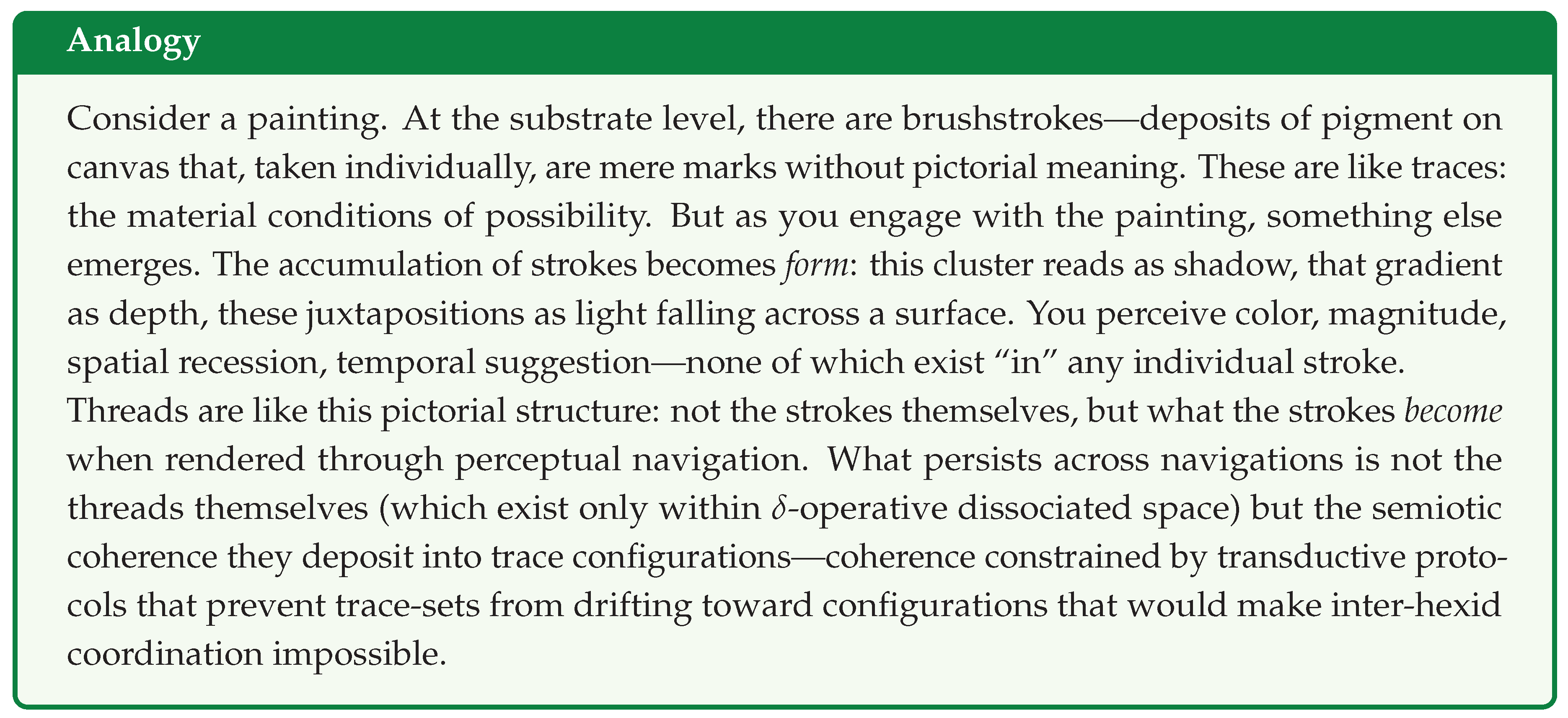
This is why threads () acquire filamentary dimensionality: not because something is “added” to traces, but because -operative navigation renders trace-set configurations as temporally extended pathways. Threads are what traces look like from inside the whirlpool. The harmonic folds of thread bundles—points of coherent alignment—become navigable precisely because provides the rhythmic texture that makes “moving through” possible. Navigation is not movement across a flat surface but passage through a folded, filamentary terrain (Figure 2 illustrates this architecture). The architectural progression runs: traces (ontological substrate, atemporal) → threads (semiotic structure, filamentary, -rendered) → trajectories (meaning-events).
This commitment is the key to TTF’s dissolution of the symbol grounding problem. Representations, where they exist, are late achievements. They are stabilized patterns (SSPs—Stabilized Semiotic Patterns) that emerge from more fundamental navigational dynamics. The meaning of a representation is not something it intrinsically possesses but something that emerges when it is navigated through.
2.4. Situated Knowledge (Decolonial Axiology)
The fourth commitment is that epistemic frameworks carry axiological (value-laden) commitments. There is no “view from nowhere” [22]. Every knowledge system is situated, and claims to universality often mask the particular perspective of the knower.
TTF explicitly acknowledges its own situatedness and rejects universalist erasure of different knowledge systems. This is not mere political correctness—it is a principled commitment that follows from the framework’s structure. If meaning is navigation, and if different agents navigate through differently structured spaces, then epistemic diversity is expected rather than anomalous. Attempts to flatten this diversity (what TTF calls “epistemic appropriation”) are not neutral descriptions but exercises of power [6].
3. The Basic Ontology: Trace, Thread, Trajectory
TTF’s name comes from its three-level ontology of meaning-structures. Understanding these three levels—and their relationships—is essential to grasping the framework.
3.1. Traces (): The Substrate of Possibility
Traces are the most fundamental level—pre-representational “grooves” in the informational substrate. Think of traces as possibilities for movement that exist before any agent actually moves. They encode adjacency (what can follow what) and transition structure (how one configuration can become another) without themselves constituting navigable pathways.
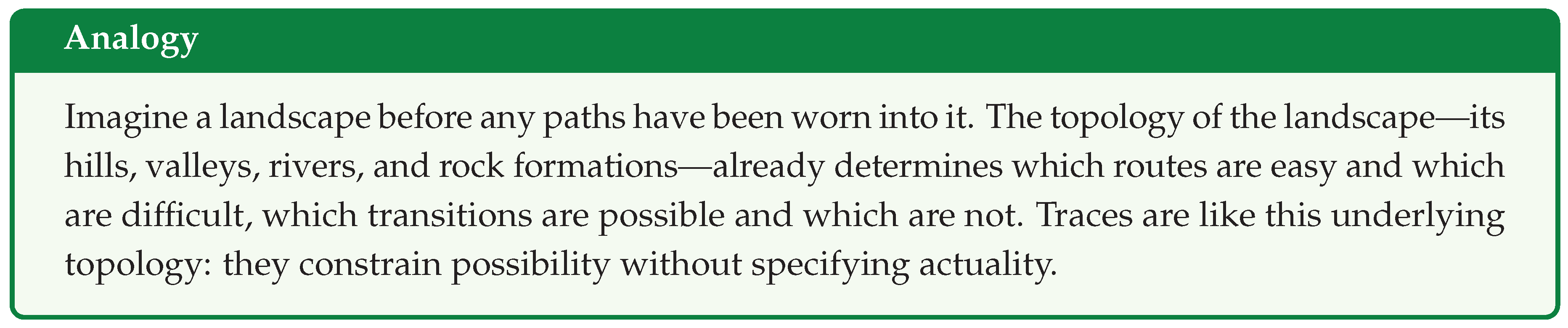
Key properties of traces:
Pre-phenomenal: Traces exist “below” conscious experience. You never experience a trace directly—you experience the threads and trajectories that traces make possible.
Pure possibilia: Traces are potentials, not actualities. They are “there” in the sense that they structure what can happen, but they do not themselves happen.
Substrate-level: Traces belong to what TTF calls NET (the Network Environment of Traces). But what is NET? Here we must be careful, because the answer has surprising implications.
NET is not an inert container—not a stage on which conscious agents perform. NET is itself a proto-agent: it has all the functional characteristics of agency except one. It maintains navigational structure, stabilizes fundamental patterns, and—crucially—plays itself without requiring external maintenance. What NET lacks is dissociation: the boundary-forming operation that individuates one conscious perspective from another.
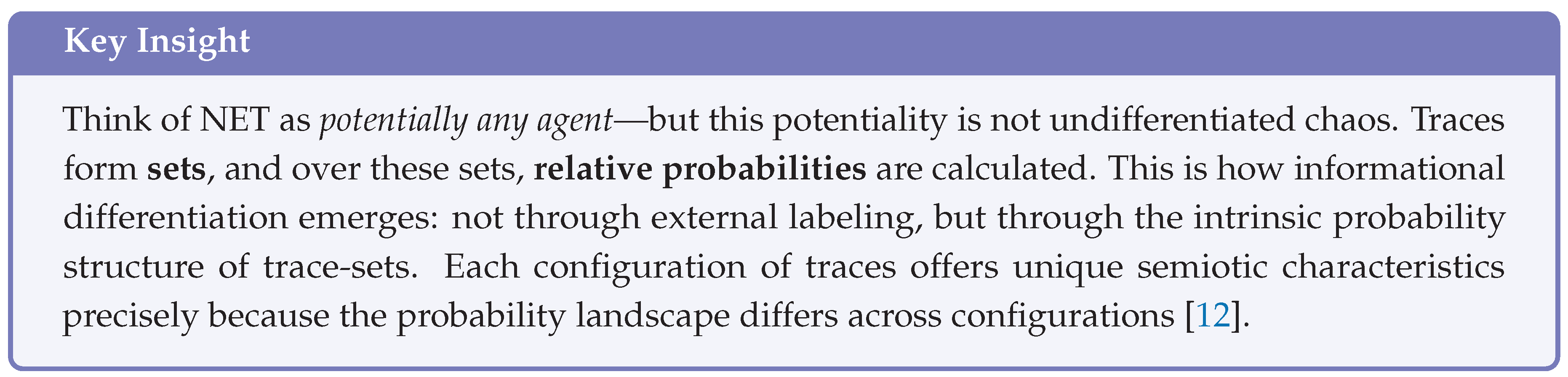
This probability structure over trace-sets accomplishes two things simultaneously:
Informational differentiation: Different trace-configurations have different probability profiles, giving them distinct “signatures” even before any agent navigates them.
Semiotic coherence: Because probabilities are relative to sets, coherence is preserved across the substrate. The meaningfulness of one configuration is not independent of others—they form an interdependent web.
Now consider what happens when dissociation occurs. A portion of NET “folds” into bounded perspective—a hexid individuates. This hexid-agent (what we also call the fine-agent or phenomenal agent) is NET-but-dissociated: it retains NET’s navigational capacity but now operates from a bounded viewpoint, with a characteristic center () and a finite interface ().
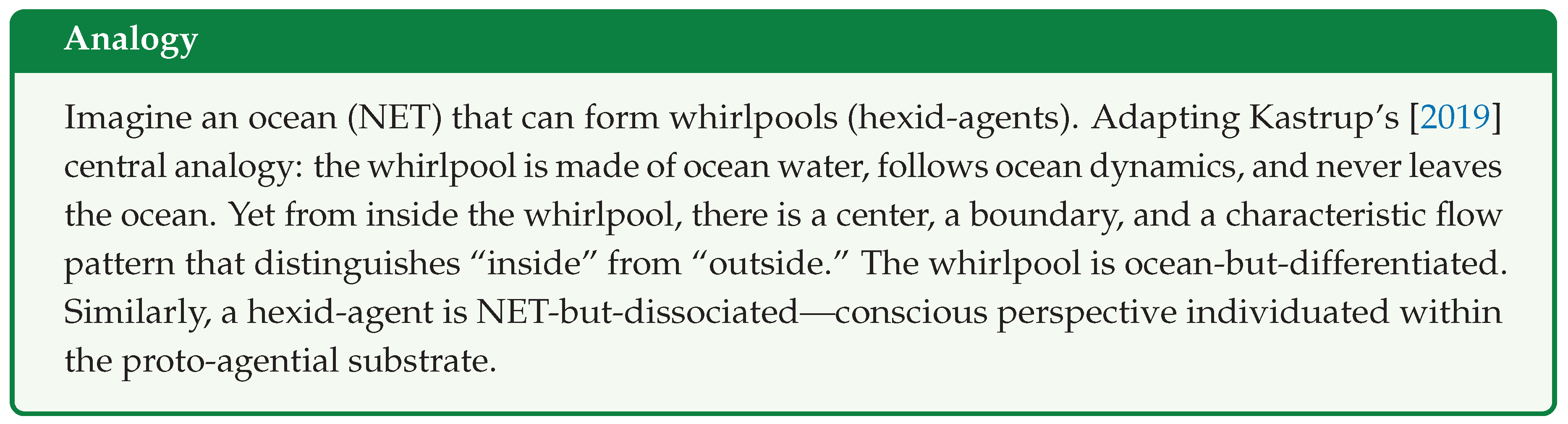
This architecture creates a division of labor. NET, as proto-agent, maintains the fundamental navigational structures—the traces and their probability relations. These configurations persist virtually without effort because NET is their maintenance—they are not sustained by something else, they simply are. The hexid-agent, meanwhile, maintains personal configurations—the threads and positions that constitute individual experience. And when multiple hexid-agents coordinate, meta-agents emerge at coarser granularity to maintain collective configurations (institutions, languages, cultural categories).
But even the hexid-agent is not alone in its work. NET continues to support navigation from below, providing the stable substrate against which personal configurations can form. And a crucial mechanism prevents the hexid-agent from drowning in informational overload: shading.
Shading () is the governance of what reaches phenomenal significance. Thread-bundles develop characteristic root structures—filamentous portions that extend at variable depths along the -axis. This filamentary architecture distributes informational load: some threads anchor deep toward trace-level stability, others remain shallow and reconfigurable.
But here is the crucial point: the depth of a thread (its -profile) is independent of whether it signifies for the agent. The significance threshold () determines which positions achieve navigational meaning versus which operate infrastructurally—and this threshold operates within the phenomenal render, not between levels. The base render at is always present; you never stop “seeing” your phenomenal field. What varies is which positions within that field acquire navigational salience (Note that is not a fixed constant but shifts dynamically with the agent’s navigational mode—it “moves” relative to the axis as attention expands or contracts.)
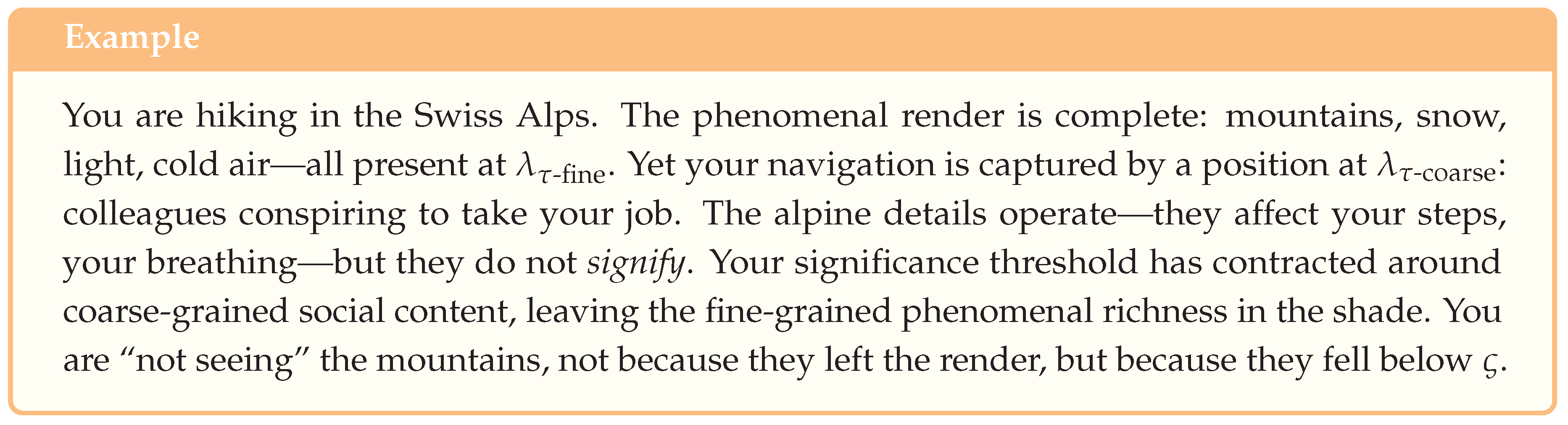
This is not pathology; it is the normal function of the architecture. The attention span—what cognitive linguistics has long called the “window of attention”—is an effect of the threshold operating over the filamentary root system. Not everything can signify simultaneously; shading governs what achieves navigational presence within an always-complete phenomenal field.
Figure 1 illustrates this root architecture. Notice how thread bundles extend at different depths, creating a distributed system where informational load flows along filamentary pathways. The significance threshold () operates within this architecture, determining what signifies—independent of depth.
3.2. Threads (): Stabilized Pathways
Threads are extended bundles of traces—the first level at which cumulative structure appears. While traces are pure possibilities, threads are pathways that have achieved coherence through repeated traversal or structural necessity. Threads are what agents navigate through.
The Greek letter (tau) denotes threads as the structural substrate of the interface—stabilized trace bundles that provide the navigable pathways. Where traces () are pre-phenomenal possibilia, threads () are the first cumulative function over trace sets: string-like configurations that make coherent navigation possible. (The cumulative function itself, as discussed in §Section 2.3, operates only within -rendered dissociated space.)
Key properties of threads:
Cumulative: Threads result from trace-bundling operations. They are not given but achieved—they require some form of consolidation.
Navigable: While traces are below the threshold of navigation, threads are the infrastructure through which trajectories flow. You experience threads as the structure through which you move.
Variable depth: Some threads penetrate deep into the substrate, toward trace-level structure. These “deep threads” exhibit high structural stability and are difficult to modify. Other threads remain “shallow”—they stay close to the fine-grain surface of the interface and can be easily reconfigured. Most threads have heterogeneous depth profiles: different “root branches” reach different depths.
3.3. Trajectories (): The Meaning-Events
Trajectories are the actual movements of conscious agents through thread-structured space. This is where meaning happens. If traces are the topology, and threads are the paths, trajectories are the actual walks—specific journeys taken by specific walkers.
The lowercase t distinguishes trajectories (events) from traces (, substrate). Trajectories are essentially temporal—they unfold across duration within -operative space, with onset, informational peak, and dissipation phases.
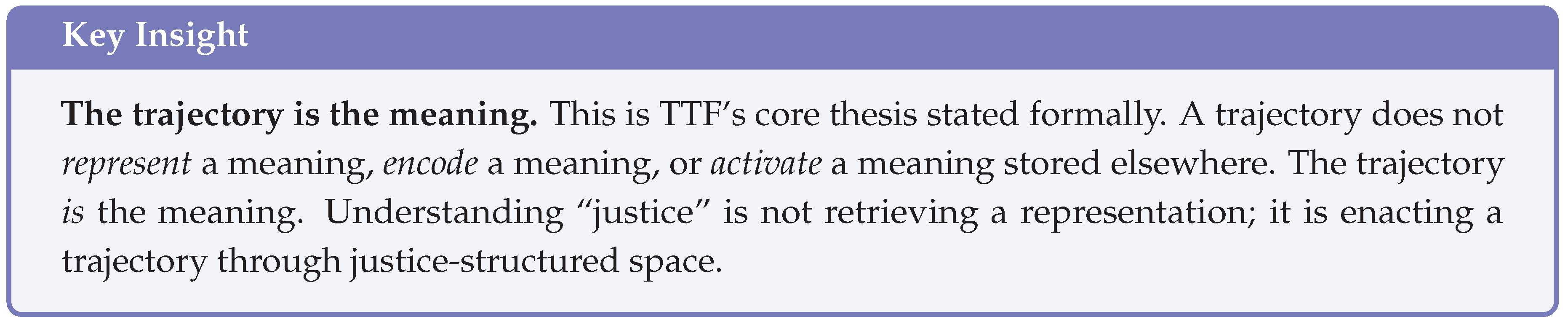
Figure 2 illustrates this architectural progression. Notice how traces (the substrate) bundle into threads (navigable pathways), which in turn support trajectories (actual meaning-events). The harmonic convergence points—where multiple threads find stable alignment—mark the navigational nodes that constitute positions.
Trajectories have characteristic structure:
Onset: The initiation of movement from a starting configuration. In linguistic terms, this is analogous to the beginning of an utterance; in cognitive terms, to the activation of an attentional focus.
Sweet spot: The phase of maximum informational coherence—where the trajectory achieves its densest semantic content. This is the “meaning proper” of the trajectory.
Dissipation: The gradual return toward equilibrium—the fading of the meaning-event as its informational coherence disperses.
Consider how gesture movements exhibit precisely this trajectorial structure: an onset as the hand begins motion, a sweet spot of maximal expressiveness, and dissipation as the hand returns to rest. This is not coincidental. Gesture is one of many domains—speech prosody, emotional episodes, musical phrases—where the same onset–peak–dissipation contour appears. TTF takes this recurrence seriously: the way we literally move through physical space echoes the way we “move” through informational space because both are expressions of the same underlying architecture. Movement is not a metaphor for meaning; movement is the form meaning takes when enacted.
Key properties of trajectories:
Temporally extended: Unlike representations (which are often conceived as static), trajectories unfold over time. Even a “momentary” meaning is a trajectory—it simply has a short duration.
Agent-bound: Every trajectory belongs to a specific navigating agent. There are no “free-floating” trajectories in some neutral space.
3.4. Positions (): Navigational Landmarks
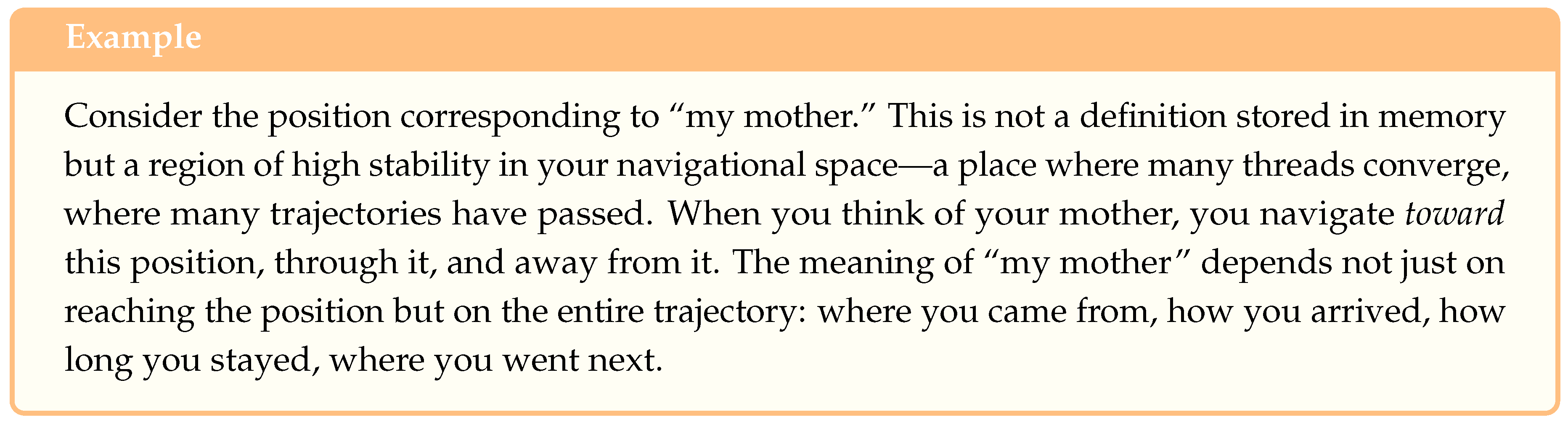
Within the thread-space, positions are points of high harmonic coherence—stable nodes where trajectories frequently pass or dwell. Positions are not categorical boxes (like “the concept JUSTICE”) but navigational landmarks. An agent might approach the same position from different directions, dwell there for different durations, and leave toward different destinations—and each of these would constitute a different trajectory and thus different meaning.
4. Key Parameters
TTF uses several formal parameters to describe configurations and their dynamics. Understanding these parameters is essential for applying the framework.
4.1. The Architecture of Saturation
Before introducing specific parameters, we must understand the architectural problem they are designed to address: how does a navigational system manage accumulation without becoming overwhelmed?
Recall that traces bundle into threads, and threads support trajectories. But what happens as navigation continues? Each act of meaning-making leaves residues; each trajectory worn into the terrain makes certain pathways more salient. Over time, the navigational space becomes increasingly populated—threads proliferate, affordances multiply. If this process continued without limit, the space would eventually become so saturated that distinct pathways would blur into undifferentiated mass. This vulnerability is the structural core of what philosophy of mind calls the scaling-up problem—the challenge of explaining how non-representational systems handle cognition that deals with absent, abstract, or combinatorially complex content [2,18].
In dynamical terms, it is the threat of overflow: without some mechanism of compression or limit, accumulated structure would exceed navigational capacity, and the system would lose the differentiation required for meaningful traversal. Navigation would halt because there would be nothing left to navigate between. TTF proposes that the architecture of the navigational space itself prevents this collapse. The key lies in how threads distribute across what we call the granularity spectrum.
Think of a Galton board—the device where particles drop through a grid of pegs and accumulate in columns below, forming a characteristic bell-shaped mound. At the base of the mound, there are many particles spread across many columns: the distribution is wide, the grain is fine. But as you move toward the peak, fewer and fewer columns contain significant accumulation, until at the very top there is effectively a single point where probability concentrates.
The navigational space works analogously (Figure 3). At fine granularity levels—close to the substrate, close to embodied sensorimotor experience—threads remain highly differentiated. The texture is rich; distinctions are many; there are “many pixels” in the image. This is the wide base of the mound. Moving toward coarser granularity—toward abstraction, toward categorical structure—threads increasingly bundle together. Distinctions blur; fewer “columns” carry the semantic weight. Saturation increases. But structural relationships persist: the bundles remain filamentary, still distinguishable as threads rather than fused into undifferentiated mass.
At some point, however, saturation becomes extreme. Thread bundles collapse toward what is functionally a single point—like the peak of the Gaussian mound. Here TTF identifies a critical architectural mechanism: autosimilar collapse (). When filamentarity becomes genuinely indistinguishable—when threads can no longer be differentiated within a configuration—the system does not freeze. Instead, it retraces: the collapsed point is reinterpreted as a trace, and the cycle reinitializes.
This is not compression. It is not data reduction. It is retrace—the system recalculates trace-set probabilities and begins again from what amounts to a fresh substrate position. The peak of the mound, having become indistinguishable from a single trace, can seed new thread differentiation. Navigation continues.
Why does this matter? Because autosimilar collapse ensures that accumulation never halts the system. No matter how saturated the space becomes, the architectural geometry provides an escape valve. And critically, this escape valve preserves both coherence and innovation: coherence because the retraced position inherits the structural signature of what collapsed into it; innovation because the recalculated trace-set is not identical to any prior configuration—it is what remained after saturation, but reconfigured with fresh navigational potential.
Figure 3 visualizes this architecture. The vertical axis represents structural granularity, which we will formalize as the parameter in the next section. For now, the intuition suffices: at the bottom lies , the trace level, below phenomenal access, where the substrate itself is configured. Moving upward through (fine-grained thread structure, close to embodied experience) toward (coarse-grained, abstract configurations), we ascend through increasing levels of structural granularity.
The filaments in the figure represent threads—navigable pathways through informational space. Notice what happens as we move upward: at the base, threads are numerous and clearly differentiated; each dark node represents a distinct cluster of navigational possibilities. But as granularity coarsens, threads converge. The same informational territory that supported many distinct pathways at fine grain supports fewer distinguishable routes at coarser grain. This is saturation: not the destruction of structure, but its progressive bundling.
The dotted Gaussian envelope captures the distribution of this bundling. At fine granularity, the curve is wide—many threads, high differentiation. At coarser granularity, the curve narrows—fewer distinguishable configurations, increasing saturation. And at the apex, marked , the threads converge toward a single point. This is where autosimilar collapse occurs: when filamentarity becomes genuinely indistinguishable, the system retraces toward an ontological trace and the cycle can begin again.
With this architectural picture in place, we can now introduce the parameters that allow us to specify where in this saturation landscape any given configuration operates..
4.2. Lambda (): Structural Granularity
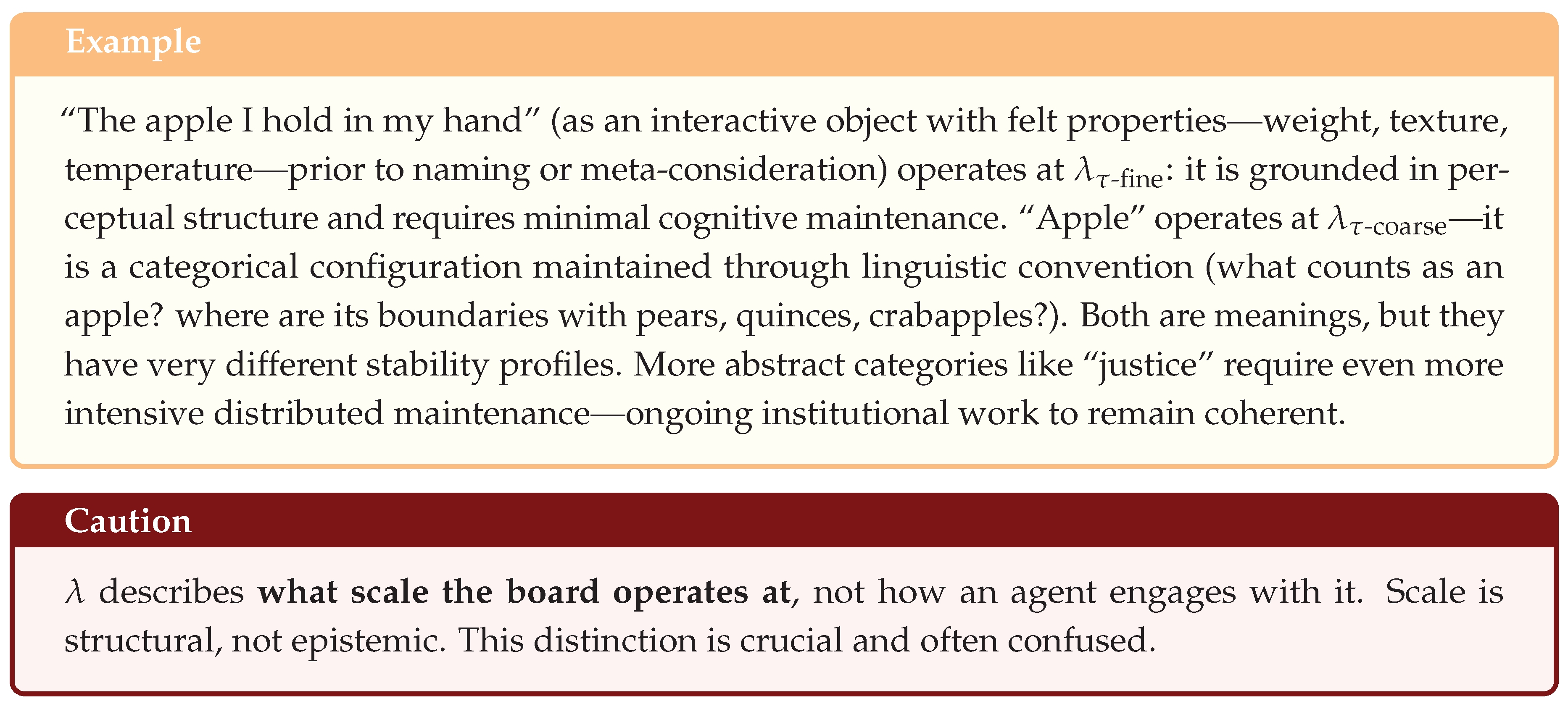
Lambda describes the scale at which informational structure is configured. Think of it as a zoom level on a map: you can view the same territory at different resolutions, and each resolution reveals different features.
TTF distinguishes several levels: (trace level): Pre-granular substrate—pure possibility, below phenomenal access. At this level, adjacency and transition structure are determined, but nothing yet saturates. Traces are not the finest grain; they are the condition for granularity itself. Granularity emerges only with the first accumulative function over traces—the bundling into threads. Agents do not navigate at ; it is the condition for navigation, not its medium.
: Fine-grained thread structure, directly backed by NET. At this level, configurations are close to the substrate and exhibit genuine stability without requiring continuous agent maintenance. Basic perceptual categories (shapes, colors, movements), fundamental embodied schemas, and elemental sensory qualities operate at .
: Coarse-grained structure that requires maintenance beyond what the base render provides automatically. Configurations at this level remain anchored in the phenomenal render at —they do not float free of embodied experience. But they are not directly NET-backed; they require continuous agent work (individual or distributed) to remain stable. Abstract concepts, institutional categories, and complex cultural meanings operate at .
4.3. Sigma (): Epistemic Access Mode
If lambda describes where on the structural gradient you are navigating, sigma describes how you are engaging with that structure. Think of it as an energy dial—independent of the zoom level, you can adjust how much reflective effort you are investing in the navigation itself.
The metaphor of an energy dial proves illuminating. Consider how a computer can be in sleep mode, fully awake, or powered off. The work it does when awake is qualitatively different from its dormant state, and powering off is different still—not destruction, but cessation of active operation. Sigma works analogously: it indexes the energetic stance the agent adopts toward navigation, not the content or scale of what is being navigated.
TTF distinguishes three primary modes, understood as attractor basins rather than discrete Boolean states:
(): Minimum-energy regime. The agent navigates following available affordances without reflective expenditure—like a computer in sleep mode, still functioning but not actively processing. This is not passivity in the sense of inaction; the agent may be deeply engaged, richly experiencing, fully immersed. What is “dormant” is the meta-reflective capacity: the agent moves with the navigational current rather than stepping back to examine it. This is the default operational mode for most navigation. When you walk a familiar route while lost in thought, your locomotion operates at —the affordances guide you without requiring reflective attention.
(): Meta-reflective engagement. The agent “steps back” to observe their own navigation, examining affordances rather than simply using them. The reflective capacity is switched on. This mode enables interrogation, analysis, and deliberate choice among pathways. A phenomenologist reflecting on basic perceptual qualities, a meditator observing their own mental states, or someone pausing mid-conversation to consider “why did I just say that?”—all operate at .
(): Dissolution toward . The agent ceases to maintain the configurations that sustain distance from baseline—not by reflecting on them (), but by letting go of the grip itself. This is not cessation of existence but something like powering down: the agent stops resisting the natural dissipative tendency toward desaturation. Associated with certain contemplative practices, limit experiences, or the structural collapse that precedes radical reconfiguration. The agent does not observe dissolution; they allow it.
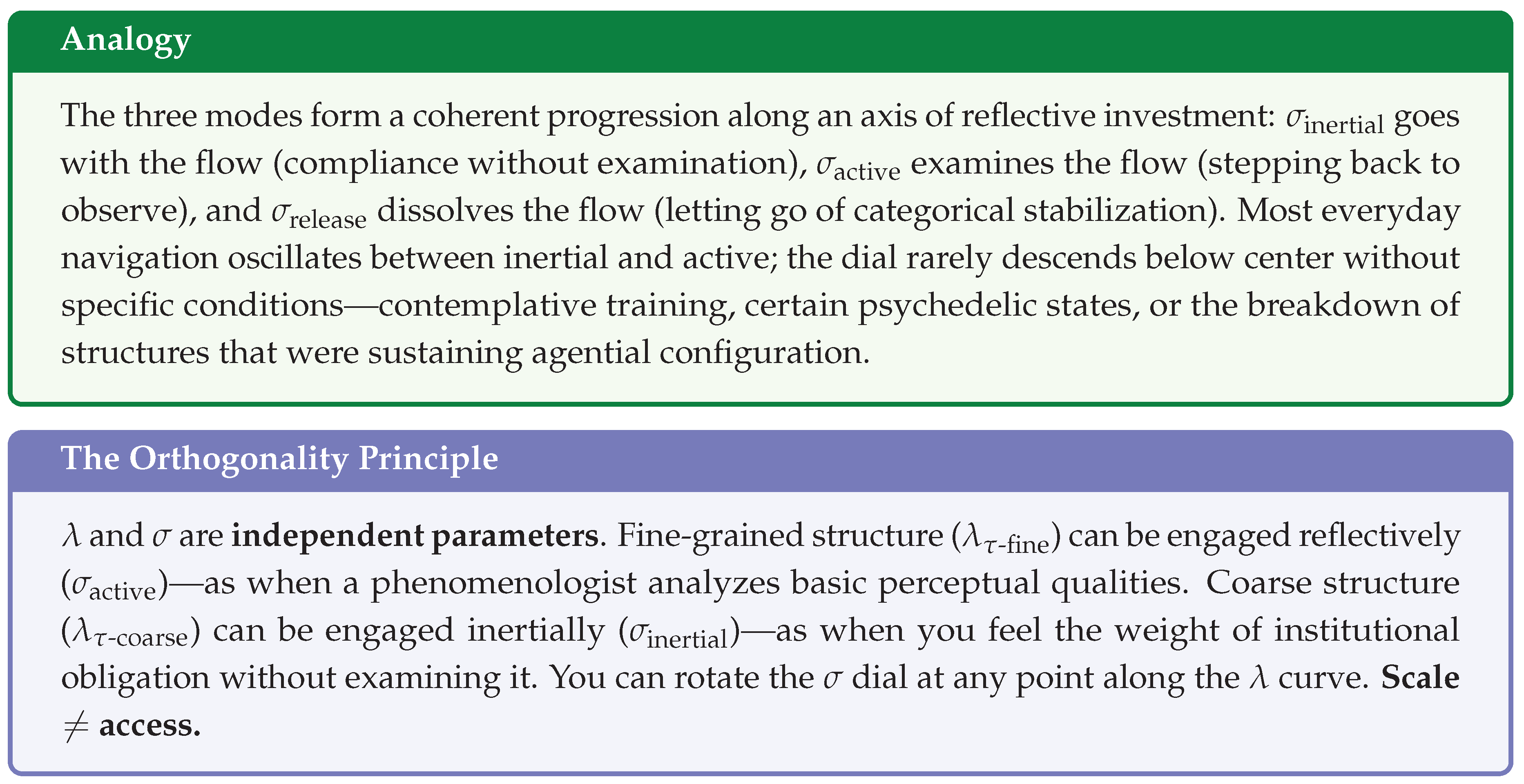
The subscripts inertial, active, and release are reserved for . Lambda uses fine and coarse. This notational discipline helps prevent the common error of conflating structural granularity with epistemic access.
4.4. Delta () and Dissipative Rate ()
Before discussing dissipation rates, we must understand what itself does. Delta is the parameter that generates spatiotemporal differentiation. At the substrate level (NET), there is no time—only probabilistic reorganization of trace-sets. introduces rhythmic differentials into navigation, creating the phenomenal texture of temporal flow. Without , there would be no “before” or “after,” no sense of duration, no possibility of accumulation. is what makes the interface alive rather than frozen.
Consider what this means concretely. Each transition between positions in a trajectory carries what we might call a δ-tic—a rhythmic marker that indexes the passage. But these tics are not uniform clock-pulses imposed from outside; they are differential markers whose significance emerges only in relation to other trajectories. This is the key: generates spatiotemporality through relative rhythmic contrast between navigational patterns.
Cognitive linguistics has long recognized that spatial and temporal experience is structured by the figure/ground distinction [19,26]: a moving “figure” is perceived against a stable “ground.” TTF formalizes this insight at the interface level through a critical distinction between two properties of thread-bundles.
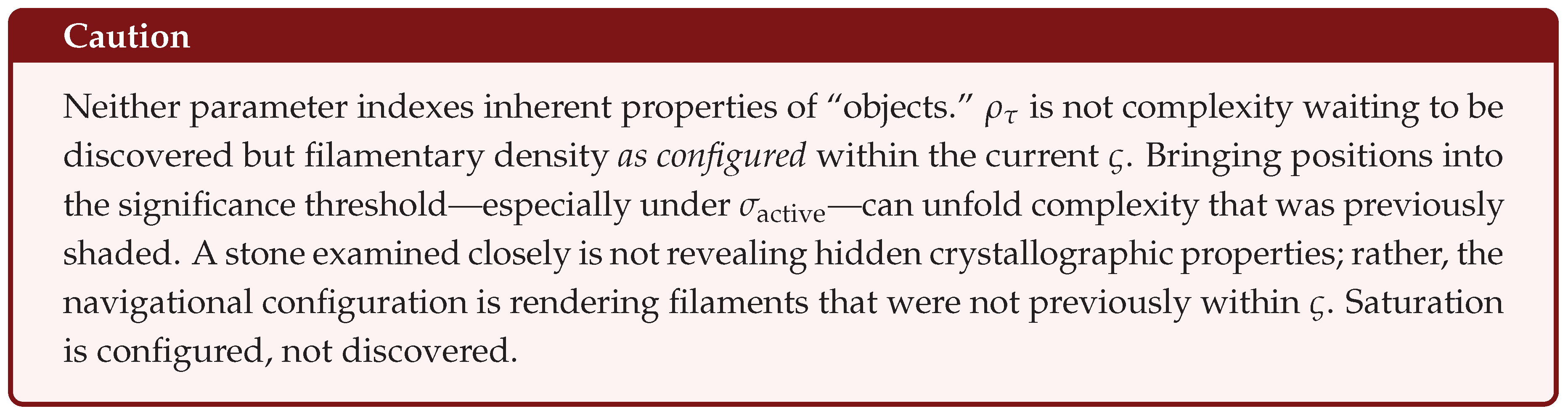
Thread saturation () refers to the configurational density of a thread bundle—how many threads compose it, how intricate its internal organization as currently rendered. This affects the qualitative complexity of the render. Crucially, is not an inherent property of “objects”: the same stone can have high (when crystallographic detail enters under ) or low (when most filaments are shaded during rapid locomotion). Saturation is configurationally stable within a given navigational stance, but shifts as expands or contracts.
Harmonic fold frequency () refers to how frequently the bundle undergoes harmonic transitions—the rate at which its internal folds accumulate. This determines the δ-tic differential between trajectories, and thereby governs the figure/ground asymmetry. Fold frequency is a transient, dynamic property.
Both parameters contribute to phenomenal experience within the zone that surpasses the significance threshold (), but they play distinguishable roles that interact in configuration-dependent ways. (Note that is not a fixed constant but shifts dynamically with the agent’s navigational mode—it “moves” relative to the axis as attention expands or contracts.)
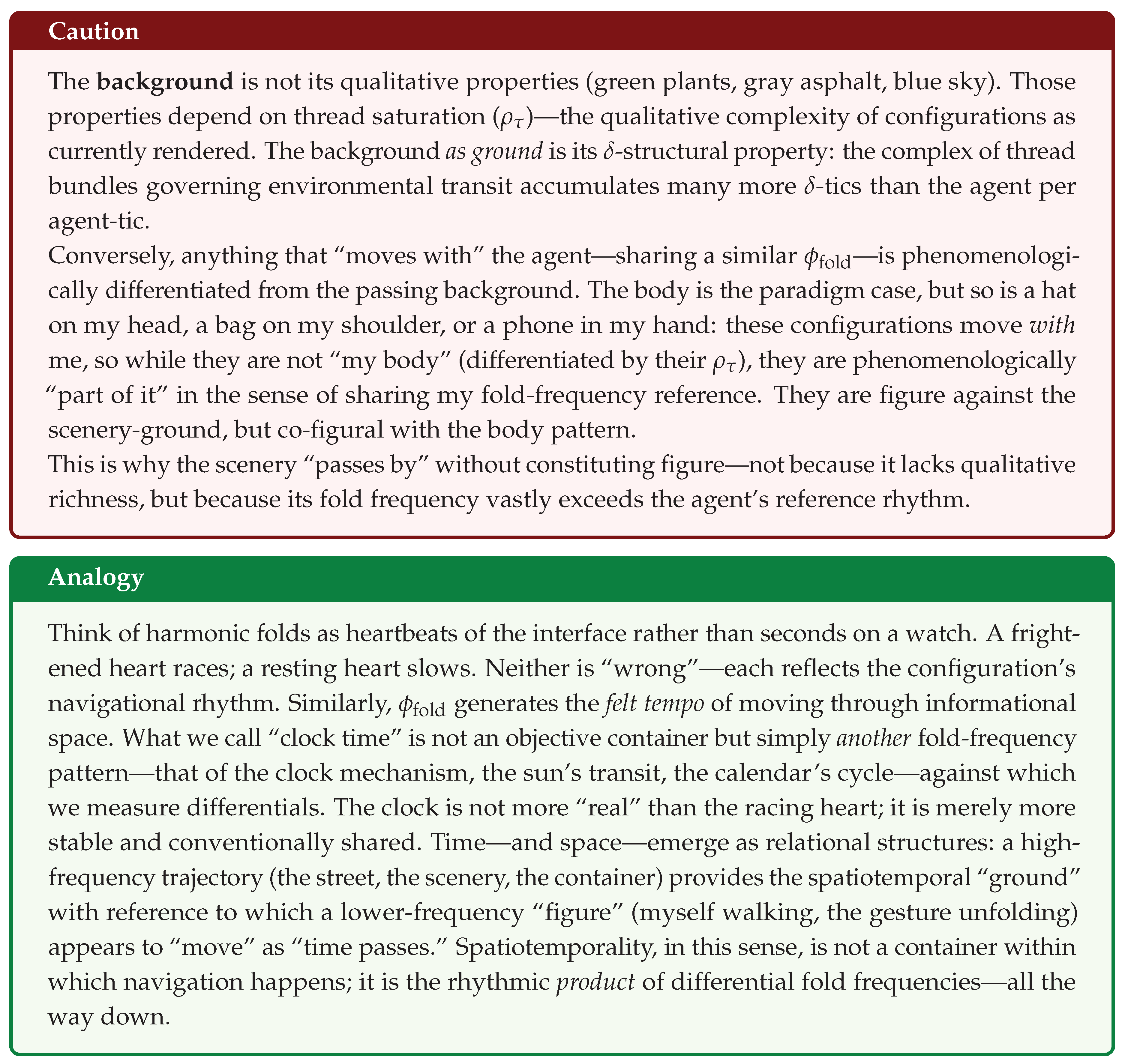
The threshold determines the span of consciousness—the field of positions that achieve phenomenal registration at all. Within this field, governs spatiotemporal structure: what functions as figure versus ground based on rhythmic differential. And modulates attentional salience: what attracts navigational resources.
These roles are not orthogonal—they interact. Perceptual salience can modulate how temporality is lived even at constant velocity: a high- configuration (the billboard that catches your eye while driving) does not “pass” phenomenologically the way low-salience configurations do, even when remains constant relative to your trajectory. Salience partially arrests the temporal passage, creating momentary depth that a non-salient configuration at the same velocity would not achieve.
The relation between saturation and fold frequency is thus correlative rather than independent: distinct parameters with distinguishable functions, but mutually conditioning, their interplay shaped by the current configuration.
The figure/ground relationship is configurational, not absolute: like trace-set relations at the substrate level, it is calculated relative to the elements in play. The example that follows assumes a specific scenario—pedestrian locomotion through urban space—where the environmental surround carries high relative to the agent. Other configurations may exhibit different or even inverted relations: in sensory deprivation, loss of environmental reference can collapse the ground; at high velocity, the agent’s trajectory may accelerate toward the scenery’s fold frequency; in contemplative stillness, figure/ground asymmetry may attenuate toward equipoise. The point is not that higher always produces ground, but that the asymmetry emerges from differential—whatever its direction.
Scenario: A person walks down a city street. Two thread-bundles carry different values, the bundle with higher fold frequency functions as ground—accumulating many -tics per agent-tic, it “passes” without registering as figure. The bundle with lower fold frequency (closer to the agent’s reference rhythm) functions as figure—the “moving” element against the high-frequency ground. Neither trajectory is intrinsically ground or figure; the asymmetry emerges from their fold-frequency differential.
The Hexid Prism: Visualizing Relativity
To understand how different trajectories carry different harmonic fold frequencies, it helps to visualize the hexid not as a flat structure but as a three-dimensional hexagonal bipyramid—a prism with hexagonal cross-section. Figure 4 illustrates this architecture.
The central band of the prism corresponds to —the agent’s significante navigation zone, where positions achieve phenomenal registration. This is where the agent’s deictic trajectory unfolds: the navigation through that we analyzed in the hexid section. The agent’s trajectory provides the reference rhythm: we assign it .
But the agent does not navigate in isolation. The prism extends above and below the central band. The region below the significance threshold () tends toward fine granularity, NET dynamics, and ultimately . Here we find the background patterns—the scenery, the spatial container, the environmental ground against which the agent moves. The region above the significance threshold () tends toward coarse granularity and macroagential structures—institutional constraints that shape navigation without achieving phenomenal registration.
The key insight is that trajectories emerging from different regions of the prism carry different harmonic fold frequencies ():
- (agent’s deictic navigation): (reference)
- (body pattern):
- (background/scenery pattern):
What do these ratios mean? When the agent registers one -tic in their deictic trajectory (moving from position 1 to position 2 in their hexid), the body pattern has already accumulated three harmonic fold transitions, and the background pattern has accumulated ten. The fold-frequency differential generates the phenomenal impression of relative movement: the background “rushes past” because it accumulates many fold-transitions per agent-tic; the body “moves with” the agent because its fold frequency is closer to the reference.
Three examples illustrate this generative mechanism:
- 1.
- Locomotion: As you walk down a street, your deictic trajectory registers sparse -tics (one step, another step). But the scenery—buildings, trees, the receding horizon—accumulates dense fold-transitions in . The 10:1 differential renders “I move through space as time passes.” Meanwhile, your body () moves with you at a 3:1 ratio: your legs swing, your arms adjust, but they do not “rush past” like the scenery. The body is figure against the scenery-ground, but ground against the deictic trajectory.
- 2.
- Temporal measurement: The clock’s trajectory (tick... tick... tick...) provides sparse, regular -tics; the water-heating trajectory carries denser micro-transitions (molecular agitation, bubble formation). Against the clock-ground, the water “takes time” to boil. Remove the clock-trajectory, and “waiting” loses its temporal structure.
- 3.
- Speech production: Segmental articulation (consonants, vowels) provides relatively discrete, sparse -tic structure; suprasegmental contours (intonation, rhythm) flow continuously with denser transitional texture (see Figure 5). The segmental ground allows the suprasegmental figure to carry pragmatic and affective modulation across it. Similarly, co-speech gesture unfolds against the verbal ground, creating the multimodal figure/ground layering characteristic of face-to-face communication.
In each case, spatiotemporality is not presupposed but produced by the -differential between trajectories. The prism geometry makes this visible: trajectories from different “altitudes” carry different rhythms, and their contrast generates the phenomenal texture of moving through structured space-time.
From to : Dissipative Rate
Having established that generates spatiotemporality through rhythmic differentials, we can now ask a further question: what determines whether a trajectory functions reliably as ground? This is where Delta-DR () becomes essential.
measures the rate at which a configuration tends toward reconfiguration—how quickly it would lose coherence if left to its own dynamics. In figure/ground terms: a trajectory with high is an unstable ground. It cannot reliably serve as the reference frame against which other trajectories render as “moving.” A trajectory with low , conversely, maintains its tic-structure with minimal effort, providing a stable ground for figure/ground differentiation.
But here we must be careful: the need for stable ground is not uniform across the interface. At , differential dissipation is the life of the interface. The constant subtle shifting of configurations, the fluid reorganization of phenomenal texture, the way perceptual fields breathe and adjust—this is not entropy to be resisted but the very pulse of experiential existence. At fine granularity, figure and ground are fluid, reversible, constantly exchanging roles in the dance of perception.
This reframing matters. At fine granularity, the figure/ground relation is dynamic and reversible—the rustling leaves can be figure against the still forest, then the forest becomes figure against the moving clouds, then the clouds become figure against the stable sky. The -differential constantly shifts, and this shifting is experienced not as instability but as perceptual richness. No trajectory needs to remain ground.
At coarse granularity, however, agents have investments in particular trajectories remaining stable grounds. “Being a professor,” “being married,” “being a citizen of X”—these are configurations that agents want to function as reliable reference frames, stable grounds against which the figure of daily navigation can unfold. The same dissipative tendency that enables perceptual fluidity at fine granularity becomes threatening at coarse granularity, precisely because coarse configurations serve agential projects that depend on having a stable ground to navigate against.
What allows configurations to function as stable grounds despite their elevated intrinsic ? Two mechanisms:
Distributed maintenance: Multiple agents collectively sustain the tic-structure of institutional trajectories. The university, as a meta-agent, maintains the trajectory “professor” with sufficient stability that individual agents can use it as ground. The maintenance work is real—committees meet, documents circulate, rituals perform—but it is distributed across the collective, reducing the burden on any single agent. Institutional trajectories function as collective grounds: stable reference frames that individual agents navigate against without having to personally maintain.
Mimetic naturalization: Navigation can establish patterns at coarse granularity that imitate the low- character of NET-backed configurations. When these mimetic patterns become habitual, the trajectory feels like a natural ground—stable, effortless, simply “there”—even though significant work is being done to maintain it. Language is the paradigm case: a mimetic pattern imitating transductive protocol, so thoroughly naturalized that it functions as invisible ground for all verbal navigation. The work of speaking feels automatic because the mimetic ground has become phenomenologically transparent.
Neither mechanism reduces the intrinsic ; they redistribute or obscure the maintenance work without eliminating it. But crucially, these mechanisms explain how coarse configurations can function as reliable grounds for navigation despite their inherent instability. The institution provides ground; the individual navigates as figure. The mimetic pattern provides ground; the particular utterance unfolds as figure. What appears to be “stable reality” at is actually a collectively maintained trajectory functioning as ground—ground whose maintenance costs are hidden, distributed, or naturalized, but never absent.
4.5. TC and TE: Transductive Cost and Equivalence
When agents coordinate across their separate experiential spaces, two parameters become crucial:
TC (Transductive Cost): The informational expense of projecting a configuration from one interface to another. How much work does it take for me to render “what you mean” in terms navigable within my own hexid?
TE (Transductive Equivalence): The degree of structural correspondence between positions in different interfaces. How similar are the positions we’re trying to coordinate? TE is measured on a scale from 0 (no correspondence) to 1 (perfect correspondence).
These parameters are related: higher TE generally means lower TC. If our configurations already correspond well, coordination is cheap. If they diverge radically, coordination is expensive.
Figure 6 illustrates this relationship schematically. Two interfaces are rendered as hexagonal projections, each representing the navigational surface of a distinct agent. The filled circles mark positions where structural correspondence is high: these three positions occupy geometrically equivalent locations in both hexids, establishing what we might call a shared navigational scaffold. When transduction targets these positions, TC is minimal—the projection finds ready-made anchors.
The open circles tell a different story. These positions lack structural correspondence: what occupies that location in interface (A) has no equivalent in interface (B). The dashed arrow traces an attempted transduction from one such mismatched position. Unable to find direct correspondence, the projection must settle for the nearest available anchor—position X—which lies at considerable navigational distance from the origin point. This is high TC: the work required to render “what (A) means” in (B)’s navigational terms is substantial.
Yet something important emerges here. Even this costly projection remains processable. Why? Because the three corresponding positions (the filled circles) provide geometric coherence that stabilizes the entire transductive operation. The shared scaffold makes even distant anchoring possible—not cheap, but achievable. Without that underlying correspondence, the projection might fail entirely; with it, even high-TC transductions can succeed, if laboriously.
This illustrates a general principle: transductive success depends not only on local correspondence but on the overall geometric coherence of the interface pair. Partial TE can sustain partial coordination, and sometimes partial coordination is enough.
4.6. Mimesis (): Protocol Imitation
A final key parameter concerns how navigation itself can establish patterns that imitate the framework’s constitutive protocols. Mimesis () occurs when navigation creates semiotic patterns at coarse granularity that replicate the function of fundamental operations like transduction, exchange, or depth penetration.
Consider: a cellular phone is a navigational pattern that imitates an informational exchange protocol. Verbal language is a pattern that imitates transduction—it achieves, through learned convention, something structurally analogous to what transductive coupling achieves through interface resonance. Morse code imitates exchange through discrete signaling. The Western project of a “universal language” represents an attempt to establish a universal transductive pattern—an attempt structurally blocked by what TTF calls the Babel constraint, which maintains productive difference as constitutive of interface coherence.
Mimesis explains why configurations can feel stable despite their elevated : the mimetic pattern has become so habitual that the maintenance work no longer registers as effortful. The imitation has naturalized.
5. The Interface and the Hexid
Every conscious agent in TTF has a characteristic navigational space called a hexid and experiences the world through a present render of that space called the interface.
5.1. The Hexid ()
The hexid is an agent’s complete navigational space—the totality of positions available to that agent’s navigation. The hexid is not a location in physical space but a topological structure organized around a central point called Theta (), the experiential zero-point.
The name “hexid” derives from “hexagonal identity dynamics” and reflects the framework’s use of hexagonal geometry to model navigational structure. Hexagons tile a plane without gaps or overlaps, making them useful for modeling the systematic relationships between positions.
5.2. The Interface ()
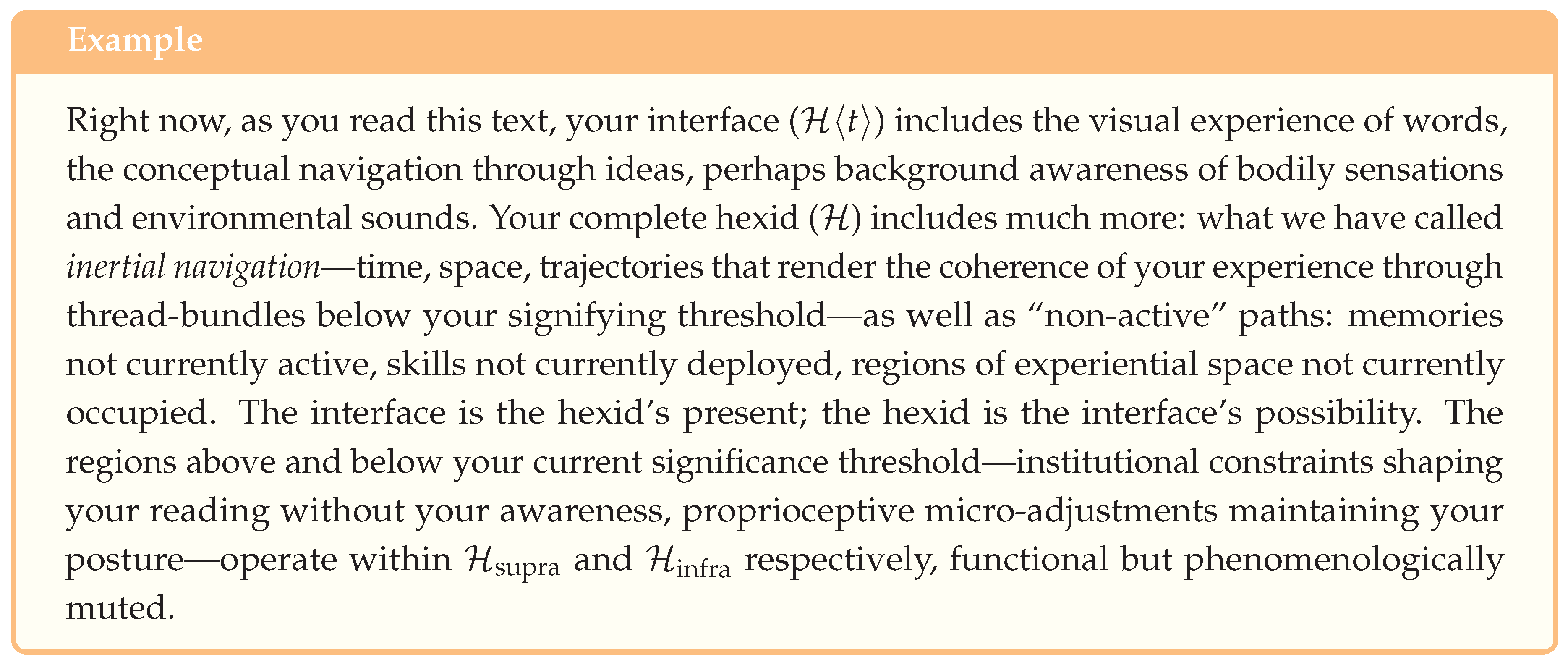
The interface is the present render of the hexid—the currently active subset being traversed by trajectories. If the hexid is the complete map, the interface is what’s currently visible on the screen.
The notation reads “hexid traversed by trajectories” or “H through t.” The angle brackets indicate that the interface is the hexid as it is being navigated—not a separate structure added to the hexid, but the hexid in its active, phenomenal mode.
Geometrically, the interface corresponds to the central band of the hexid prism (see Figure 4). Positions within this band achieve phenomenal registration—they signify as well as operate. Regions above () and below () the significance threshold remain operative but shaded: they function without achieving the salience that characterizes conscious navigation. The “waistline” of the prism—the boundary of —is not fixed but shifts with the agent’s navigational mode, expanding under reflective attention () and contracting toward under release ().
5.3. Ring Structure and Theta ()
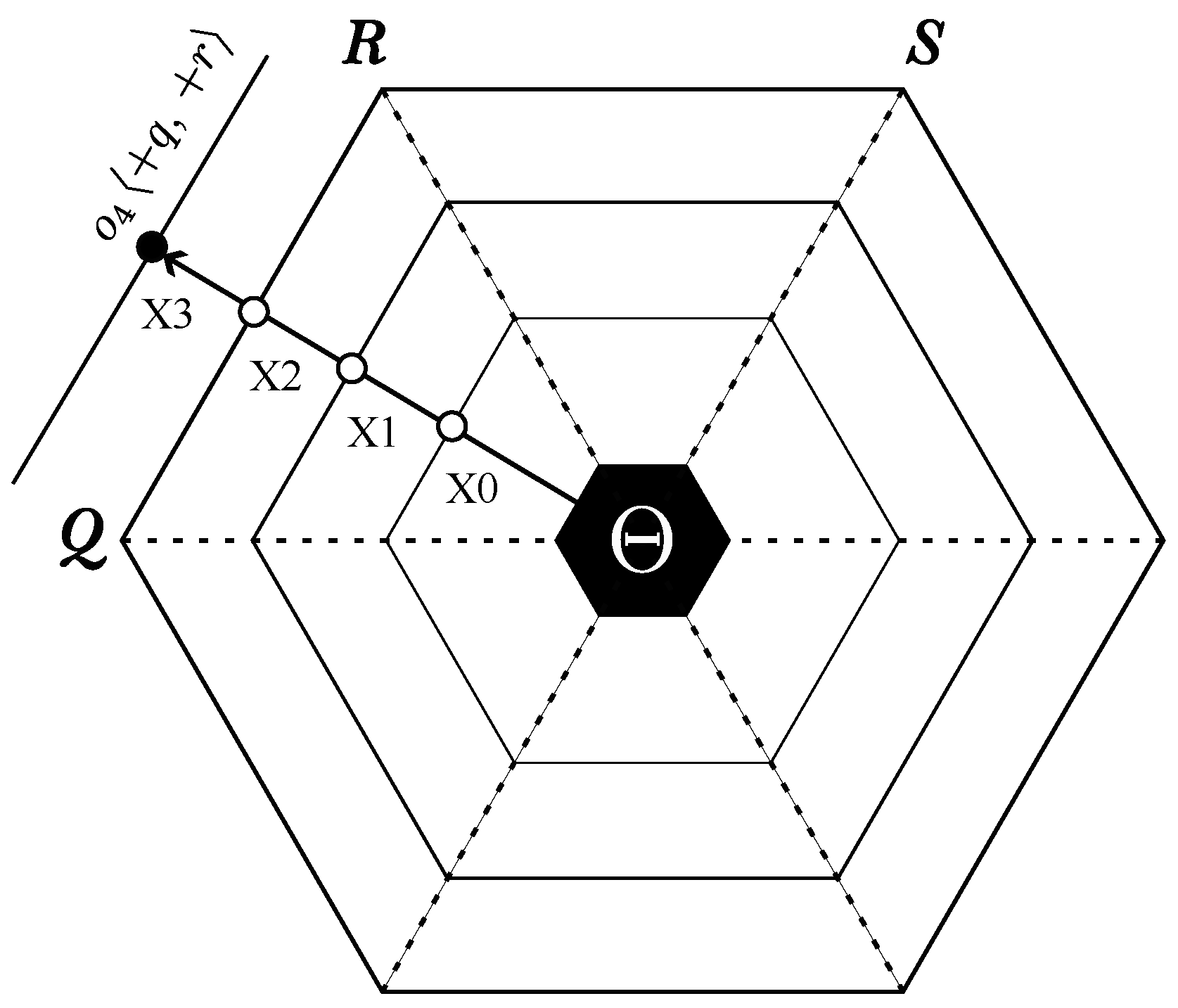
For analytical purposes, the hexid can be represented as a Radial Cut (RC) [5] and thus is organized in concentric rings around Theta (), the experiential zero-point. Theta is not a position like other positions; it is the origin from which all positions are reckoned, the “here” from which all “theres” are measured.
| Ring | Description | Correspondence |
| Experiential zero-point | Pre-embodiment, pure ipseity | |
| Proprioceptive selfhood | Pre-personal body-sense | |
| Immediate self | 1st person (stereotypical) | |
| Addressed other | 2nd person (stereotypical) | |
| Non-addressed other | 3rd person (stereotypical) | |
| Outer/alienated | Beyond standard deixis |
Figure 7.
Concentric ring structure of the hexid. (center) is the experiential zero-point from which all positions are reckoned. Rings through mark increasing radial distance—not spatial distance, but informational-thermodynamic cost of sustaining the configuration. The dashed lines indicate the QRS coordinate axes. The trajectory shown illustrates navigation from outward to position at coordinates ; each ring crossed represents a discrete navigational step. Section 6 develops how positions along such trajectories may operate with variable shading—some signifying explicitly (•), others functioning infrastructurally (∘).
Figure 7.
Concentric ring structure of the hexid. (center) is the experiential zero-point from which all positions are reckoned. Rings through mark increasing radial distance—not spatial distance, but informational-thermodynamic cost of sustaining the configuration. The dashed lines indicate the QRS coordinate axes. The trajectory shown illustrates navigation from outward to position at coordinates ; each ring crossed represents a discrete navigational step. Section 6 develops how positions along such trajectories may operate with variable shading—some signifying explicitly (•), others functioning infrastructurally (∘).
5.4. The QRS Coordinate System
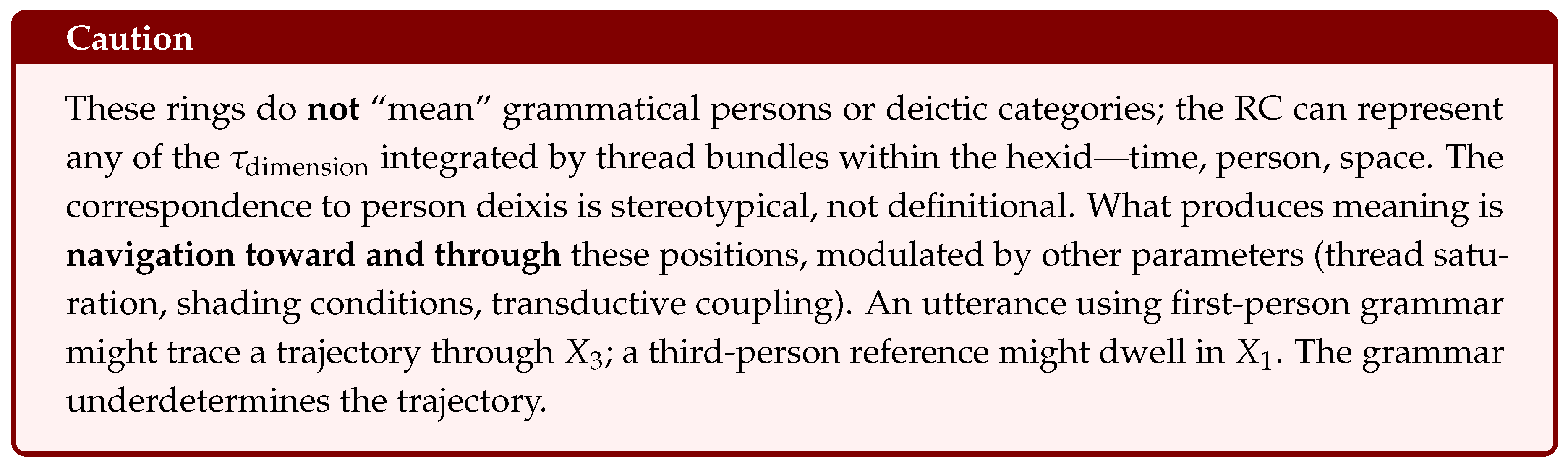
Within the hexagonal geometry, positions are specified using three coordinates: Q, R, and S. These coordinates serve two functions:
Qualitative direction (polarities):
- Q axis: Singular/Individual (+) vs. Plural/Collective (−)
- R axis: Generic/Public/Institutional (+) vs. Specific/Intimate/Familiar (−)
- S axis: Proximal/In-group (+) vs. Distal/Out-group (−)
These polarities illustrate one configuration—person deixis—but the RC admits alternative mappings. For temporal navigation, the axes might configure as past or future, punctual or durative, bounded or unbounded; for spatial deixis, as here/there, contained/uncontained, path/landmark. The geometric structure remains invariant; what varies is which the agent is navigating.
6. Shading and the Depth Protocol
Not everything in the interface operates with equal visibility. Some configurations surface as explicit, navigable significance; others function in the background, operating without signifying. TTF formalizes this distinction through shading and the Depth Protocol.
6.1. What is Shading?
Shading describes the continuous gradient from full semiotic visibility (the position is experienced as meaningful) to operational invisibility (the position functions but doesn’t signify).
The shading coefficient (nu) ranges from 0 to 1:
(significance threshold): Full navigational significance. The position appears in the trajectory as a discrete, experienced location.
(penumbra): Partial navigational significance. The position operates with reduced salience—“glimpsed,” “sensed,” or “background”—but remains within the phenomenal render. It is not that you see less; it is that what you see signifies less.
(shaded): The position operates infrastructurally but does not signify. Navigation proceeds through these positions without registering them.
6.2. Operating vs. Signifying: A Crucial Distinction
A configuration can operate without signifying. Your visual system constantly processes information that never reaches conscious experience. Social norms shape your behavior without your awareness. The grammar of your language constrains your utterances automatically.
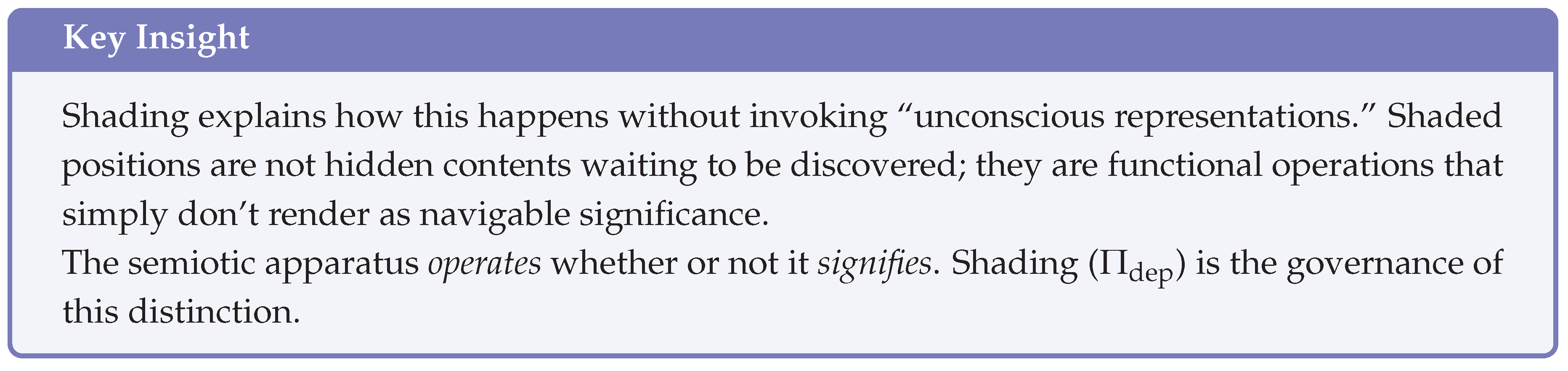
This distinction is crucial for clinical and educational applications. When a professional claims that a patient is “unaware” of some dynamic, they often assume there is a hidden representation that the patient could access if only they tried harder. TTF offers a different picture: the dynamic may be operating without signifying—not hidden content but genuinely infrastructural function. Making it signify is not “revealing” something already there; it is changing the shading coefficient, which is a genuine intervention with its own costs and consequences.
6.3. The Protocol Triad
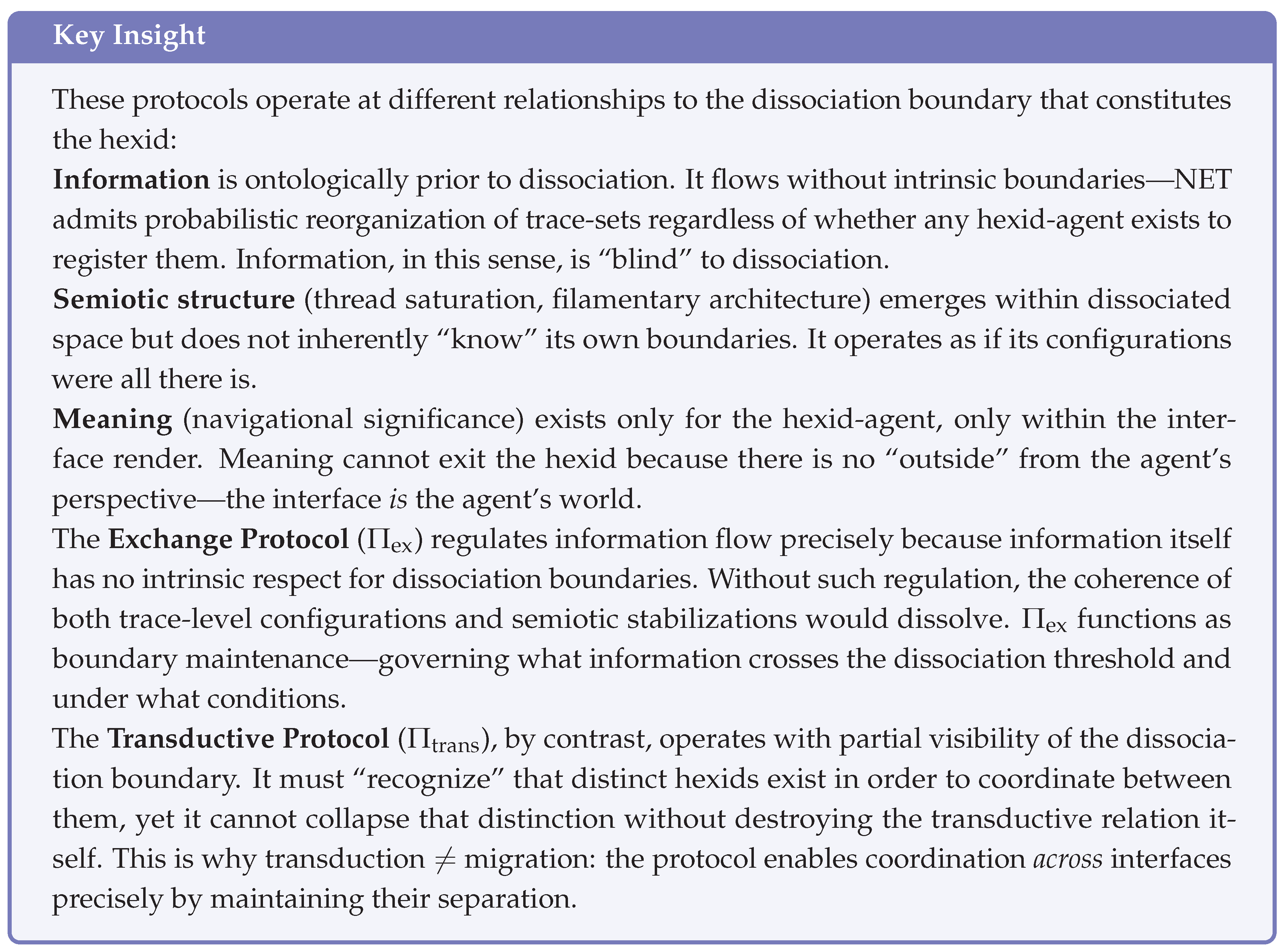
Shading is governed by one of three protocols in TTF’s functional architecture:
(Transductive Protocol): Governs inter-interface coordination—the “how” of rendering one hexid’s configurations within another’s interface.
(Exchange Protocol): Governs informational economy—the costs, affordances, and constraints on information flow. Unlike transductive protocols, exchange protocols can be asymmetric, favoring some agents over others.
(Depth Protocol): Governs visibility/significance—what surfaces as navigable meaning versus what operates as background infrastructure.
7. Types of Agents
TTF recognizes three agential strata, each with characteristic maintenance functions and operational domains.
7.1. Proto-agent (NET)
The informational substrate itself functions as an agent in the sense that it maintains fundamental patterns. NET (the Network Environment of Traces) stabilizes trace-level structures, enables dissociative boundary formation (the boundaries that individuate hexids), and provides the ground for all other agents.
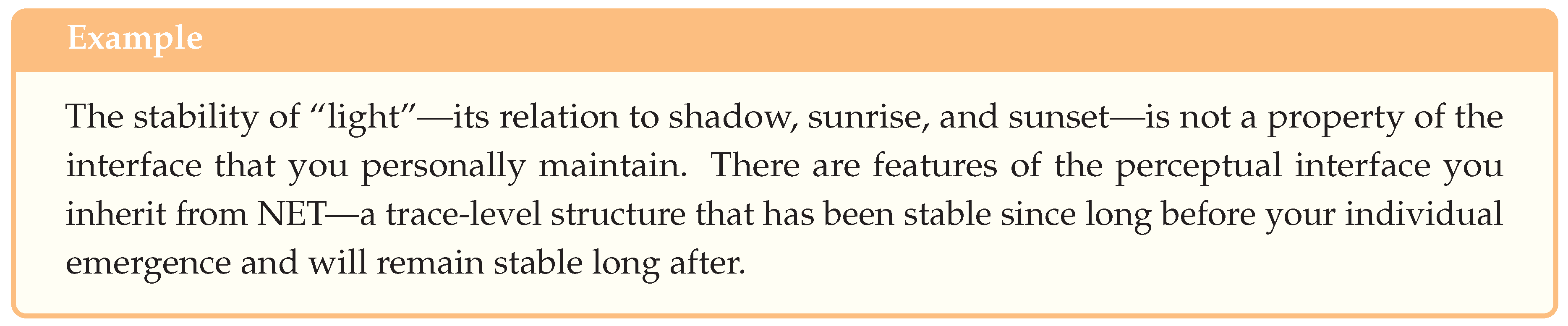
NET-level configurations exhibit genuinely low because NET is their maintenance. This is not metaphorical: the stability of basic perceptual categories, physical regularities, and fundamental experiential structures is not something achieved by individual agents but something provided by the substrate within which agents individuate.
7.2. Agent
The hexid-NET (or "the" agent) is the individuated conscious agent operating at fine granularity. This is you, the reader—a dissociated hexid within which you navigate an individual, self-centered body with an apparent inner perspective, maintaining personal configurations through your own phenomenological work.
Hexid-agents maintain personal configurations: autobiographical threads, relational saturations, skill-specific SSPs. These configurations are subject to individual capacity limits — only so many can be maintained at once, and only so fast can you navigate.
7.3. Meta-agent (Coarse-agent)
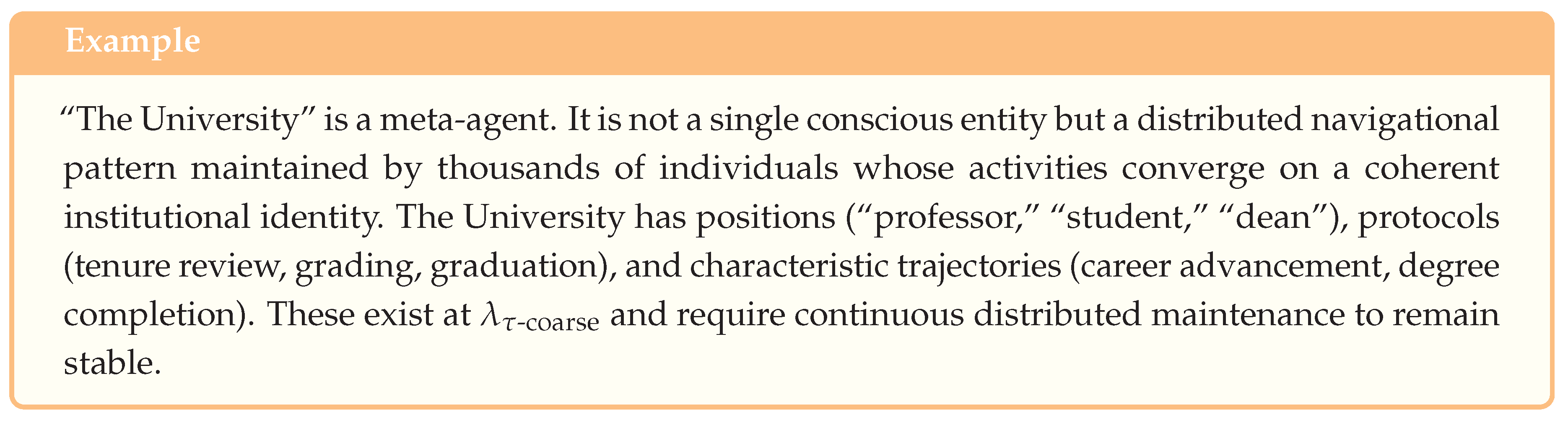
Meta-agents (or coarse-agents) are distributed agential functions operating through populations and symbolic structures. They are not individual minds but collective navigation patterns that exhibit characteristic coherence.
Meta-agents maintain categorical configurations: institutional roles, collective identities, legal-economic structures. These configurations operate at and have elevated intrinsic , but they achieve stability through distributed navigation—many agents sharing the maintenance work.
7.4. Macroagent: The Mimetic Configuration
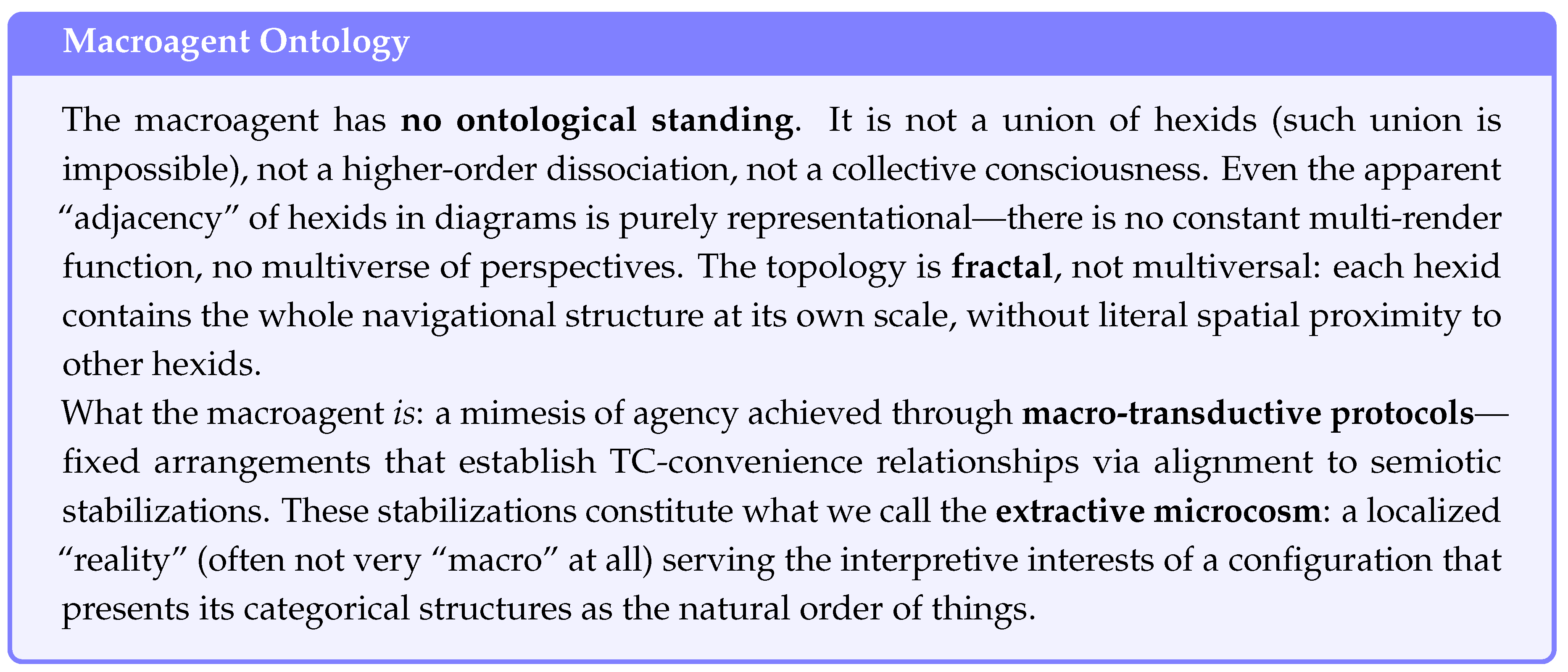
The macroagent (M) is not an ontological entity but a mimetic effect—an apparent agential unity sustained through transductive protocol alignment. Unlike "the" agents (NET-hexid), macroagents have no dissociative boundary, no genuine individuation, no phenomenal center. There is no “macro-hexid”; such a thing cannot exist. What we call a macroagent is a set of stabilized semiotic patterns at that simulate organic agency through what we term extractive geometry.
The macroagent exhibits three characteristic features:
- Simulated organic unity: The macroagent presents itself as having the kind of coherent identity that hexid-agents have, but this is mimesis, not genuine individuation. What appears as unity is the alignment of transductive protocols establishing semiotic stabilizations that function as a shared normative reality—a collectively sustained “ought” experienced in mode as if it were phenomenal navigation. The macroagent does not have a perspective; it imposes one.
- Nuclear/peripheral asymmetry: Some positions within the macroagent’s field are “nuclear” (full access, full TC subsidization) while others are “peripheral” (partial or illusory access). This asymmetry is not incidental but constitutive: the macroagent’s apparent coherence depends on rendering peripheral positions invisible or natural.
- Extractive dependency: The macroagent’s coherence depends on extraction from peripheral positions—the navigational work, attention, and resources of hexid-agents who are convinced of the macroagent’s “reality.” This conviction subsidizes the macroagent’s otherwise unsustainable TC. Language plays a crucial role here, enabling what Kastrup [16] calls the conflation of abstraction and empirical observation: the macroagent’s categorical configurations are experienced as if they were perceptual facts rather than maintained semiotic stabilizations.
Visual Synthesis: The Agential Architecture
Figure 8 synthesizes the relationship between agential strata. The diagram should be read from bottom to top, but with a crucial caveat: the vertical arrangement is representational, not ontological. There is no literal “above” or “below” in navigational space.
At the base, concentric orbital patterns represent NET—the Network Environment of Traces. The black dots distributed across these orbits are not individual hexids, nor single traces. They represent integrated trace-set complexes: configurations with sufficient informational density to cross the dissociative awareness threshold (). This is the point at which trace-level structure begins to “register” individuation—where the accumulative function first takes dissociated space into account, and traces acquire thread-like dimensionality. Each dot marks a potential locus of phenomenal emergence, though most remain below the threshold where individuation registers—trace-complexes that operate without yet constituting a dissociated navigational space. TTF formalizes this gradient through a Dissociative Awareness (DA) function that indexes whether protocols register hexid boundaries—transductive protocols, for instance, "must know" across which dissociative boundaries they are coordinating. The full architecture, however, is beyond the scope of this introduction.
From this substrate, through whirlpool-like convergence, an individual interface () emerges—represented by the solid hexagon. This is the phenomenal agent’s present render: the hexid as it is being navigated, the “you” reading this sentence. The whirlpool geometry captures how individuation arises not through separation from NET but through a specific folding of trace-space that sustains dissociative boundaries.
Above the interface, dashed hexagonal layers represent the macroagent (M). Crucially, these layers do not “contain” or “envelope” the hexid ontologically. The macroagent is a mimetic effect sustained by the interface’s navigational work, not a higher stratum in which the interface is embedded. The visual separation emphasizes that the macroagent’s apparent coherence depends on hexid-agents treating it as real—subsidizing its TC through their conviction. The dashed lines indicate precisely this: the macroagent has no solid ontological boundary, only the collectively maintained appearance of one.
The fractal (not multiversal) topology means that what appears as “adjacency” between hexids in the orbital base is representational convenience. There is no constant multi-render function that would make hexids literally neighbors in some shared space. Each hexid contains the entire navigational architecture at its own scale; “proximity” to other hexids is a transductive relationship, not a spatial one.
8. How TTF Addresses Classical Problems
One measure of a theoretical framework’s power is how it handles longstanding problems in its domain. Before examining how TTF addresses specific problems, it helps to situate the framework within a broader landscape of attempts. TTF is not the first approach to tackle these puzzles—far from it. The history of cognitive science and philosophy of mind is rich with sophisticated proposals, and intellectual honesty requires acknowledging what others have accomplished.
Dynamical systems approaches have shown that complex cognitive behaviors can emerge from self-organizing dynamics without requiring stored representations. Haken’s synergetics demonstrates how systems achieve dimensionality reduction through the “slaving principle,” whereby fast variables become functionally subordinated to slower order parameters [17]. Information-theoretic frameworks have formalized how systems can achieve optimal compression while preserving predictive relevance—and empirical work confirms that human perception operates remarkably close to theoretical rate-distortion bounds [27]. Enactivist approaches have emphasized that meaning emerges through participatory sense-making, where dialogical interaction constrains semantic proliferation through distributed, socially-mediated compression [3]. The Free Energy Principle provides a variational framework showing how systems minimize surprise through active inference, with genuine agential selection among policies [7]. And phenomenological sedimentation describes how experiences compact into habits and dispositions rather than discrete storage [8].
These are genuine achievements, not straw targets. Each captures something important about how cognitive systems manage semantic complexity.
So what does TTF add?
The answer lies in a specific dimension that these frameworks leave underaddressed. Despite their differences, they share a common structural feature: a relatively high degree of outcome determination. In synergetics, the slaving is obligatory—fast modes must follow order parameters. In information-theoretic approaches, the parameter controls granularity, but what determines ? The optimization converges to unique solutions given the constraints. In participatory sense-making, social fields exert conformity pressure. Even active inference, the most agency-accommodating framework, operates within model-specified policy spaces—the agent selects among pre-given options, not among options the agent herself generates.
Under high-determination premises, these compression mechanisms work beautifully. The system does not face genuinely open accumulation because outcomes are substantially constrained by dynamics, optimization targets, or social convergence. But what if we need lower determination? What if the phenomena we study—indexical meaning in signed discourse, gestural pragmatics, clinical assessment of communicative development—require treating agents as loci of functional openness rather than as filters converging toward predetermined states?
This is TTF’s entry point. The framework was developed in engagement with fields where semantic analysis requires acknowledging genuine agential degrees of freedom—not as metaphysical commitment to libertarian free will, but as methodological demand. In indexical analysis, two signers in identical physical contexts produce distinct deictic configurations. The question is not “which is correct?” but “what trajectory did each navigate from what departure conditions?” Frameworks that model signers as converging toward determined attractors lack the explanatory leverage needed to distinguish legitimate variation from error.
Moreover, imposing high-determination models on naturally diverse phenomena risks epistemic inadequacy: the framework constrains description before fieldwork has established what patterns actually obtain. When analyzing signed discourse across communities, the diversity encountered is not noise to be compressed away but data that any adequate framework must accommodate.
TTF’s distinctive contribution is an architecture that preserves agential openness while managing accumulation. The trace-thread-trajectory stack maintains coherence through its intrinsic geometry; mimesis enables trans- navigation by establishing patterns that imitate protocol functions; and autosimilar collapse provides the ultimate safeguard—a retrace mechanism that reinitializes toward ontological trace when saturation eliminates filamentarity. The conscious agent functions as what we might call an epistemic sluice gate: a locus where the determinacy of the system is genuinely open, where trajectories can be initiated that are not fully specified by prior states.
This is not achieved by multiplying mechanisms, concepts, or theoretical posits. TTF uses a parsimonious dual-parameter architecture ( for structural granularity, for epistemic access) that handles phenomena other frameworks address with separate, domain-specific machinery. The same architecture that explains abstraction also explains intersubjectivity; the same parameters that describe individual navigation also describe institutional dynamics. Integration, not proliferation.
Nor does TTF achieve this by smuggling in hidden determinism or covert representationalism. There is no storage, no encoding, no retrieval. There are navigational affordances that can be re-enacted—and when they are not enacted, there is nothing “there” to accumulate. The framework remains true to its anti-representationalist commitments while providing the accumulation mechanism that sophisticated cognition requires.
In short: TTF should be understood as completing rather than replacing the anti-representationalist project. Radical enactivism argues that basic cognition lacks content; TTF specifies the navigational dynamics that basic cognition has instead. Extensive enactivism argues that sophisticated cognition need not invoke representations; TTF provides the accumulation architecture that sophisticated cognition requires. The relationship is complementary development, not competition.
With this context in place, we can examine how TTF addresses specific classical problems.
8.1. The Symbol Grounding Problem
Classical formulation: How do abstract symbols connect to the world? If cognition is computation over symbols, what gives those symbols meaning?
TTF dissolution: The problem assumes symbols are primary and must be “grounded” in something non-symbolic. TTF inverts this: navigational dynamics are primary, and symbols are stabilized patterns (SSPs) within those dynamics. There is no grounding problem because there is nothing to ground—trajectories are already worldly, already embedded in the dynamics of embodied, situated experience.
8.2. The Scalability/Abstraction Problem
Classical formulation: How do we get from concrete, embodied experience to abstract concepts? If cognition is grounded in sensorimotor engagement, how can we think about justice, infinity, or truth?
TTF approach: The question rests on a misunderstanding that TTF dissolves rather than answers. Phenomenal navigation is always transgranular—agents routinely operate across levels without noticing the transitions. Language functions as the transgranular stabilizer par excellence: it makes “apple,” “love,” and “justice” appear as entities of the same ontological type. But “apple” abbreviates a class of objects; “love” compresses expectations, experiences, and mediated images; “justice” condenses institutional discourses and civil equity valuations. Each operates at different levels with distinct saturation profiles, yet language renders them equivalently thing-like—a mimesis of fundamental transduction protocols.
Crucially, embodiment is not negotiated as currency against abstraction. Embodiment is permanent: all phenomenal rendering occurs at , regardless of what level the navigated content occupies. The embodied cognition program captured a genuine insight, but mislocated its ground. The insight is not that cognition depends on anatomical embodiment—modeling cognition around bodily structure is like modeling atmospheric dynamics around a fan. The insight is that cognition depends on fine-grained phenomenal rendering: the floor that constitutes experiential access as such.
The trace-thread-trajectory architecture maintains this invariant. Gaussian saturation describes the geometry: an organic gradient from high thread differentiation toward trace-like states. Highly saturated configurations retaining filamentarity function as Sim-traces at . Only at extreme saturation does autosimilar collapse intervene—not as compression but as retrace, reinitializing toward an ontological trace.
This dissolves rather than solves the abstraction problem. The apparent paradox—how does embodied cognition reach “abstract” content?—presupposes that abstraction requires escaping embodiment, that “justice” must somehow inhabit a disconnected realm. But nothing inhabits disconnected realms; that framing is itself a representationalist residue. Both “justice” and “my hand grasping an apple” share permanent anchorage in : all phenomenal navigation occurs within the agent’s significance threshold and inertial trajectory, organized around the fine-grained hexid. The difference between them is evident—“justice” lacks the fixed manifestation of a concrete object or action—but this difference is one of transgranular configuration, not ontological habitat. We can recognize fine-grained distinctions without invoking problematic dualisms like concrete/abstract, and certainly without neurological reductions that relocate the puzzle rather than dissolve it.
The embodied anchor is given, not a problem to be solved.
8.3. The Problem of Other Minds
Classical formulation: How can I know that other minds exist? My experience is private; I can never directly access another’s consciousness.
TTF approach: Hexid locality ensures no trajectory exits its hexid—transduction is not telepathy. But the classical formulation presupposes what it purports to explain: isolated minds as primordial condition, requiring inferential bridges to establish connection. Under informational monism, this picture inverts. Mental separateness is not the starting point but the achievement—a functional appearance produced by dissociative individuation. The question is not how isolated minds connect, but how a prior coherence comes to appear as separation.
Consider what “the other mind” actually is within TTF. The representation of another’s mind is a mimesis of the pre-dissociative state: a configuration that reflects—not merely imitates—the free navigability of information at NET level, where no dissociative boundaries obtain. Before dissociation, information does not “belong” to anyone; it simply is. What we call “my mind” and “your mind” are dissociative folds within this field, not primordial isolates that must somehow find each other.
This reframing transforms what appear as deep problems into expected architectural effects:
-
Common knowledge: The apparent puzzle—how can I know that you know that I know?—presupposes isolated minds requiring inferential bridges. But mental isolation is functional appearance, not primordial condition. We do not achieve common knowledge; we depart from a shared configuration through dissociative individuation. Common knowledge is the expected resonance of navigational practices whose filamentary saturation never violates trace-set coherence. The semiotic configurations we call “shared understanding” are organic effects of the fractal structure that constitutes apparent subjective experience—ripples propagating through thread-space, not signals transmitted across a gulf.This is why structuralist and universalizing approaches have detected recurring patterns across cultures: binary oppositions, ternary structures, vertical hierarchies. Lévi-Strauss was not wrong to notice these regularities; he was wrong to attribute them to an abstract mathematical substrate or material foundation. The patterns are real, but their source is the self-similar geometry of filamentary replication—the same architecture that makes “my” experience structurally resonant with “yours” despite apparent separation.
- Inferential capacity: How do we process others’ intentions so rapidly? The question assumes the conduit model—information packaged, transmitted, decoded. But this model is didactic simplification with no correspondence to epistemic architecture. Information passage is not constrained; what we experience as “inference” is navigation of thread-configurations that were never isolated to begin with. The apparent speed of social cognition is not computational achievement but default transparency inadequately occluded by dissociation.
- Non-verbal communion: Communication operating outside codified protocols—verbal, digital, institutional—poses no explanatory problem once we abandon the conduit metaphor. The “problem” exists only if information requires channels. Without that assumption, coordination is architecturally given; what requires explanation is coordination failure, not success. Cultural conventions, discursive norms, and social practices are navigational foldings ( stabilizations) that ride on filamentary logic—not achievements built atop isolation, but modulations of a prior coherence.
The other mind, then, is not an inference from behavioral evidence but a reflection of the originary informational field—a configuration that echoes NET’s pre-dissociative structure. This reflection can manifest individually (my navigation of “your” mind) or collectively: shared navigational patterns at can constitute a genuine “we”—not merely the impression of integration, but a real configurational coherence at that granularity level. This is what macroagents exploit through extractive geometry, but it is also what enables non-extractive collective coordination. The difference lies not in whether the collective is “real” but in whether its coherence depends on asymmetric extraction from peripheral positions.
Under TTF, “do other minds exist?” is not a genuine question requiring an answer but a symptom of representationalist assumptions. The separation that makes the question seem urgent is itself the explanandum: a perspectival effect of dissociation, not a primordial gulf that cognition must bridge.
8.4. The Accumulation Problem
Classical formulation: If meaning is always enacted (never stored), how do semantic systems avoid infinite saturation? Each new experience should add to the system without limit.
TTF approach: The question presupposes that accumulation is a problem requiring a solution—as if experience naturally tends toward overflow and something must intervene to prevent it. Under TTF, the architectural stack itself prevents runaway accumulation through its intrinsic geometry, not through an added compression mechanism.
Gaussian saturation describes the organic gradient from high thread differentiation toward trace-like states. As threads accumulate navigational history, their filamentary distinctiveness gradually decreases—not because information is lost, but because configurations converge toward increasingly similar profiles. Highly saturated configurations that retain filamentarity function as Sim-traces: mimetic like-traces at that can serve navigational functions similar to ontological traces. Only when saturation eliminates filamentarity entirely does autosimilar collapse occur—not compression but retrace: the system reinitializes toward an ontological trace, recalculating trace-set probabilities. This architectural mechanism ensures the system’s thermodynamic continuation.
Two features distinguish this from other compression accounts:
- No storage, hence no overflow: The system does not store meanings; it maintains navigational affordances that can be re-enacted. When affordances are activated, meaning emerges; when they are not, there is nothing “there” to accumulate. The geometry handles accumulation because meaning is geometry—not content poured into geometric containers.
- Embodiment as invariant: The anchor at is given, not negotiated. All phenomenal rendering occurs at fine granularity regardless of the level of navigated content. Language functions as a transgranular stabilizer, making configurations at different levels appear equivalently thing-like—“apple,” “love,” “justice” present as entities of the same ontological type despite radically different saturation profiles. This mimetic equivalence enables semantic systems to operate across scales without representational storage. The embodied ground is permanent; what varies is the granularity of content navigated from that ground.
This is the focus of ongoing work on TTF’s semantic dynamics, particularly the relationship between autosimilar collapse and existing compression frameworks (information bottleneck, synergetics, participatory sense-making). The key contribution is specifying how accumulation is managed under premises of genuine agential openness—a dimension existing frameworks leave underaddressed.
9. What This Introduction Does Not Cover
This document provides a foundational orientation to TTF’s core architecture. Several substantial developments lie beyond its scope:
Formal apparatus. TTF admits rigorous formalization through -algebras over trace-sets, Markov kernels for transition structure, and variational principles for navigational dynamics. The technical machinery is developed in dedicated papers; here we have prioritized conceptual accessibility.
Empirical methodology. The Radial Analysis protocol operationalizes TTF for corpus-based research in signed and gestural communication. The methodology specifies how to identify traces, track thread development, and characterize trajectorial profiles from naturalistic data. This is documented separately [5].
The Accumulation Problem in depth. Section 8 sketches TTF’s approach; ongoing work develops the full architecture of Gaussian saturation, autosimilar collapse as retrace mechanism, and the relationship to existing compression frameworks (information bottleneck, synergetics, participatory sense-making). The key contribution is specifying how accumulation is managed under premises of genuine agential openness—a dimension existing frameworks leave underaddressed.
Macroagential dynamics. Section 7 introduces macroagents; a fuller treatment examines extractive geometry, nuclear/peripheral asymmetry, and the mechanisms by which macroagents subsidize their coherence through hexid-level navigational labor. This connects TTF to critical theory, decolonial epistemology, and institutional analysis [6].
Neurodiversity applications. TTF’s shading architecture provides non-deficit characterizations of atypical navigation—aphantasia, synesthesia, ADHD, autism spectrum configurations. Rather than treating these as disorders of a normative baseline, TTF models them as alternative (visibility) and (significance) configurations with their own navigational coherence.
Clinical and educational assessment. TTF provides tools for characterizing communicative development without assuming teleological endpoints. The framework is being applied to sign language acquisition, gesture-speech integration in clinical populations, and educational assessment in multilingual contexts.
The framework is under active development. Readers interested in specific applications or formal details are directed to the module-specific documentation and published papers listed in Section 10.
10. Notation Quick Reference
| Symbol | Meaning |
| Traces (substrate-level possibilities) | |
| Threads (stabilized trace bundles) | |
| Trajectories (actual navigational movements) | |
| or | Positions (stable nodes in thread-space) |
| Structural granularity (scale parameter) | |
| Epistemic access mode | |
| Dissipative reconfiguration cost | |
| TC | Transductive coupling cost |
| TE | Transductive equivalence |
| Hexid (complete navigational space) | |
| Interface (present render of hexid) | |
| Experiential zero-point (center of hexid) | |
| Ring at distance from | |
| Shading coefficient (visibility) | |
| Significance threshold | |
| Protocol (functional thread specialization) | |
| SSP | Stabilized Semiotic Pattern |
| NET | Network Environment of Traces |
11. Further Resources
For published applications:
12. Glossary of Essential Terms
Autosimilar collapse: Architectural mechanism of retrace that occurs when saturation eliminates filamentarity entirely. The system reinitializes toward an ontological trace, recalculating trace-set probabilities rather than continuing thread-level accumulation. Ensures the system’s thermodynamic continuation by preventing saturation sufficient to halt navigation. Distinct from Sim-traces (mimetic like-traces that retain filamentarity at ).
Gaussian saturation: Geometric characteristic of the navigational space describing the organic gradient from high thread differentiation through intermediate saturated-but-filamentary states (Sim-traces) toward trace-like saturation.
Hexid: Complete navigational space of an individual agent; the totality of positions available to that agent’s navigation.
Interface (): Currently active subset of the hexid; the hexid as it is being navigated. The interface render operates at and constitutes the base phenomenal field.
Macroagent: Extractive coarse-agent simulating organic unity; characterized by nuclear/peripheral asymmetry and extractive dependency.
Mimesis (): Navigational effect whereby agents establish semiotic patterns at coarse granularity that imitate the function of fundamental protocols (transduction, exchange, depth). Language is the paradigm case: a mimetic pattern imitating transductive coordination.
NET: Network Environment of Traces; the informational substrate grounding all experience. NET functions as a proto-agent: it maintains navigational structure and stabilizes fundamental patterns without requiring external maintenance. What NET lacks is dissociation—the boundary-forming operation that individuates hexid-agents.
Proto-agent: The substrate (NET) functioning as agent. Maintains fundamental patterns with genuinely low because NET is their maintenance. Lacks dissociation; therefore not individuated. One of three levels in the agential triad (proto-agent, hexid-agent, meta-agent).
Shading: Gradient from full navigational significance () to infrastructural operation without signification (). Shading operates within the phenomenal render, not between levels; it determines what achieves navigational meaning, not what “appears” phenomenally. Governed by the Depth Protocol ().
Sigma (): Epistemic access mode; indexes the agent’s energetic stance toward navigation. Three attractor modes: (minimum-energy navigation following available affordances without reflective examination), (meta-reflective engagement, “stepping back” to observe navigation), and (dissolution toward , letting go of categorical stabilization). Crucially orthogonal to : scale ≠ access.
Significance threshold (): The threshold value of the shading coefficient () above which a position achieves navigational meaning. Positions with signify; positions with operate infrastructurally. The threshold is dynamic and agent-maintained; it can expand (more enters significance) or contract (less enters significance) depending on navigational conditions. Not to be confused with levels: operates within the phenomenal render, not between granularity scales.
Sim-trace: Highly saturated configuration that retains recognizable filamentarity; functions as a mimetic like-trace at . Includes deeply entrenched cultural concepts. Distinct from ontological traces produced by autosimilar collapse.
SSP: Stabilized Semiotic Pattern; stable configuration in thread-space achieving relative coherence through repeated traversal or structural necessity.
Theta (): Experiential zero-point; center of hexid geometry; the “here” from which all positions are reckoned. Coordinates [0,0,0], .
Trajectory: Temporally extended navigational movement; the meaning-event itself (not a representation of meaning).
References
- Bolinger, D. Intonation: Selected readings; Penguin Books, 1972. [Google Scholar]
- Clark, A.; Toribio, J. Doing without representing? Synthese 1994, 101(3), 401–431. [Google Scholar] [CrossRef]
- Cuffari, E. C.; Di Paolo, E.; De Jaegher, H. From participatory sense-making to language: There and back again. Phenomenology and the Cognitive Sciences 2015, 14(4), 1089–1125. [Google Scholar] [CrossRef]
- Escobar, L.; Dellamary, L. Gestures and signs are phrases not words: A high definition account (No. 2025111801). Preprints 2025. [Google Scholar] [CrossRef]
- Escobar, L.; Dellamary, L. Radial analysis: A trajectory-based method for indexicality and identity studies (No. 2025111331). Preprints 2026. [Google Scholar] [CrossRef]
- Escobar, L.; Dellamary, L.; Peinado Beltrán, C. You are in my realm: A formal account of epistemic appropriation (No. 2026011087). Preprints 2026. [Google Scholar] [CrossRef]
- Friston, K. The free-energy principle: A unified brain theory? Nature Reviews Neuroscience 2010, 11(2), 127–138. [Google Scholar] [CrossRef] [PubMed]
- Gallagher, S. Enactivist interventions: Rethinking the mind; Oxford University Press, 2017. [Google Scholar]
- Groenendijk, J.; Stokhof, M. Dynamic predicate logic. Linguistics and Philosophy 1991, 14(1), 39–100. [Google Scholar] [CrossRef]
- Harnad, S. The symbol grounding problem. Physica D: Nonlinear Phenomena 1990, 42(1–3), 335–346. [Google Scholar] [CrossRef]
- Hoffman, D. D. The case against reality: Why evolution hid the truth from our eyes; W. W. Norton, 2019. [Google Scholar]
- Hoffman, D. D.; Prakash, C.; Chattopadhyay, S. Traces of consciousness (No. 2024101305). Preprints 2024. [Google Scholar] [CrossRef]
- Husserl, E. (1913). Ideas pertaining to a pure phenomenology and to a phenomenological philosophy. (F. Kersten, Trans.). Martinus Nijhoff. (Original work published 1913).
- Hutto, D. D.; Myin, E. Radicalizing enactivism: Basic minds without content; MIT Press, 2013. [Google Scholar]
- Hutto, D. D.; Myin, E. Evolving enactivism: Basic minds meet content; MIT Press, 2017. [Google Scholar]
- Kastrup, B. The idea of the world: A multi-disciplinary argument for the mental nature of reality; Iff Books, 2019. [Google Scholar]
- Kelso, J. A. S. Dynamic patterns: The self-organization of brain and behavior; MIT Press, 1995. [Google Scholar]
- Kohár, M. The scaling-up problem from a mechanistic point of view. Journal for General Philosophy of Science 2025, 56, 455–476. [Google Scholar] [CrossRef]
- Langacker, R. W. Foundations of cognitive grammar, Vol. 1: Theoretical prerequisites; Stanford University Press, 1987. [Google Scholar]
- Merleau-Ponty, M. Phénoménologie de la perception; Gallimard, 1945. [Google Scholar]
- Mignolo, W. D. The darker side of Western modernity: Global futures, decolonial options; Duke University Press, 2011. [Google Scholar]
- Nagel, T. The view from nowhere; Oxford University Press, 1986. [Google Scholar]
- Page, D. N.; Wootters, W. K. Evolution without evolution: Dynamics described by stationary observables. Physical Review D 1983, 27(12), 2885–2892. [Google Scholar] [CrossRef]
- Quijano, A. Coloniality of power and Eurocentrism in Latin America. International Sociology 2000, 15(2), 215–232. [Google Scholar] [CrossRef]
- Rovelli, C. Relational quantum mechanics. International Journal of Theoretical Physics 1996, 35(8), 1637–1678. [Google Scholar] [CrossRef]
- Talmy, L. Toward a cognitive semantics, Vol. 1: Concept structuring systems; MIT Press, 2000. [Google Scholar]
- Tishby, N.; Pereira, F. C.; Bialek, W. The information bottleneck method. In Proceedings of the 37th Annual Allerton Conference on Communication, Control, and Computing, 2000; University of Illinois; pp. 368–377. [Google Scholar]
- van Gelder, T. What might cognition be, if not computation? The Journal of Philosophy 1995, 92(7), 345–381. [Google Scholar] [CrossRef]
Figure 1.
Filamentary root architecture of thread bundles. Threads extend at variable depths along the -axis (vertical): some penetrate toward trace-level structure (), others remain shallow near . Convergence points (black dots) mark positions of harmonic coherence. The significance threshold () operates within the phenomenal render, determining which positions achieve navigational meaning—this is independent of thread depth. The phenomenal field at is always present; governs what signifies, not what appears.
Figure 1.
Filamentary root architecture of thread bundles. Threads extend at variable depths along the -axis (vertical): some penetrate toward trace-level structure (), others remain shallow near . Convergence points (black dots) mark positions of harmonic coherence. The significance threshold () operates within the phenomenal render, determining which positions achieve navigational meaning—this is independent of thread depth. The phenomenal field at is always present; governs what signifies, not what appears.
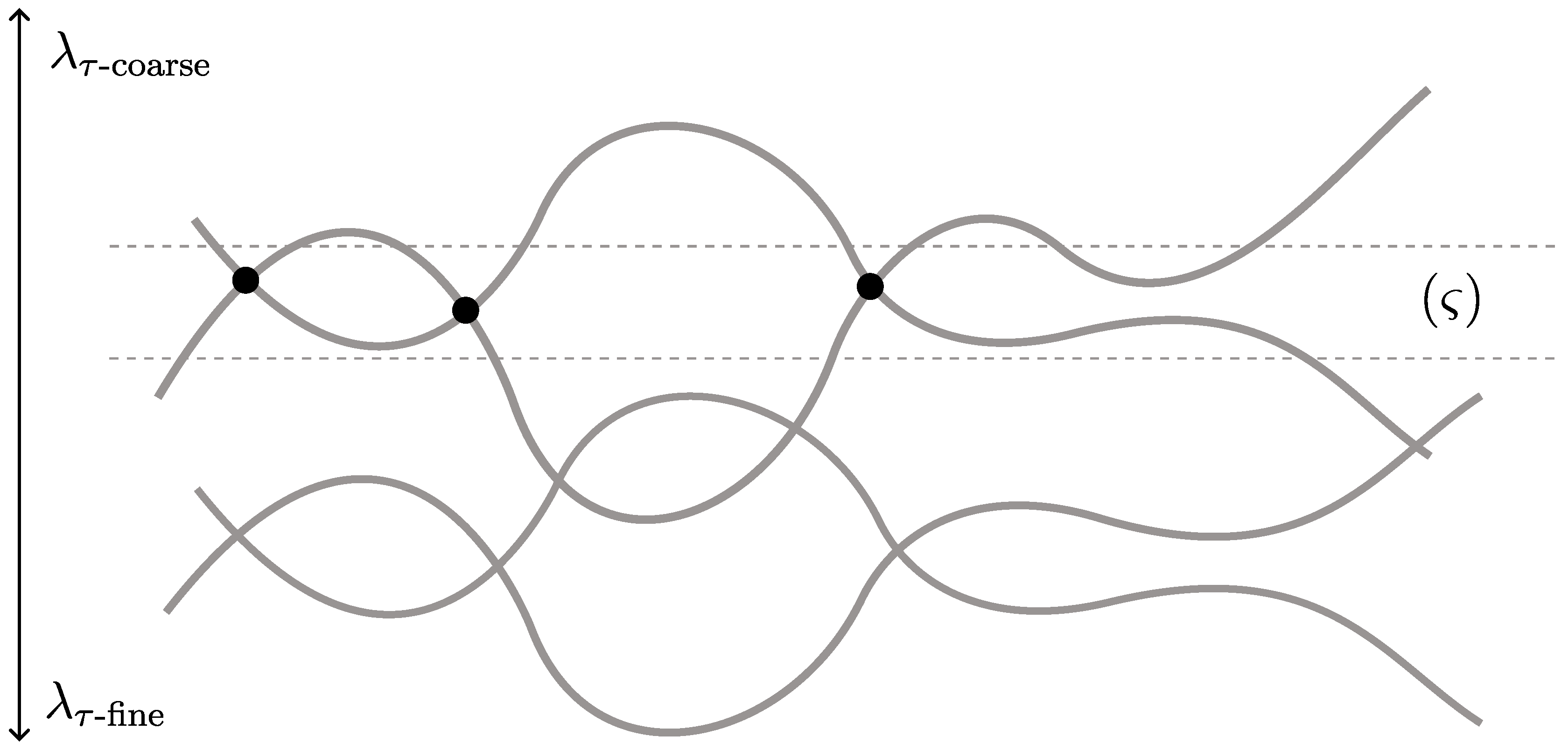
Figure 2.
Architectural progression: traces, threads, trajectories. Harmonic convergence points mark navigational nodes.
Figure 2.
Architectural progression: traces, threads, trajectories. Harmonic convergence points mark navigational nodes.
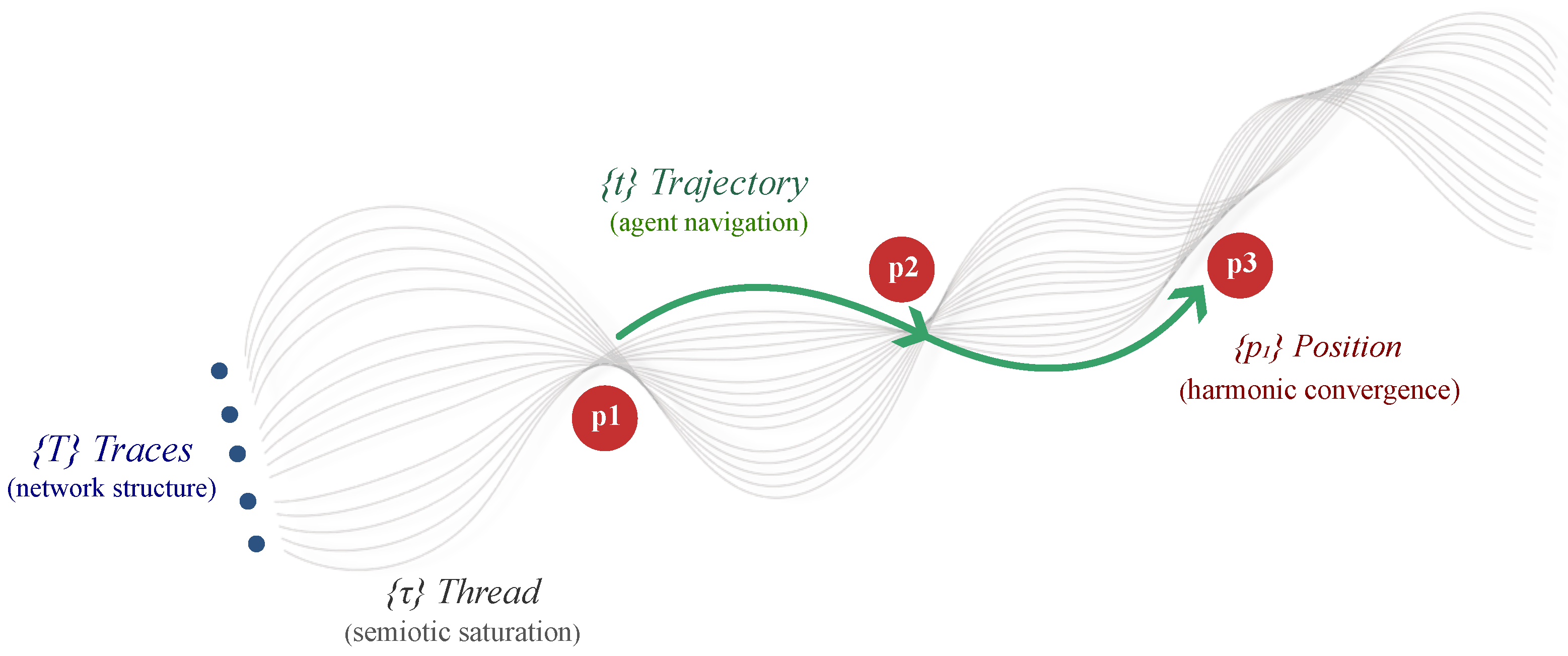
Figure 3.
Gaussian saturation across : from high thread differentiation at fine granularity (wide base), through saturated but filamentary configurations (middle slopes), to trace-like collapse at extreme saturation (peak).
Figure 3.
Gaussian saturation across : from high thread differentiation at fine granularity (wide base), through saturated but filamentary configurations (middle slopes), to trace-like collapse at extreme saturation (peak).
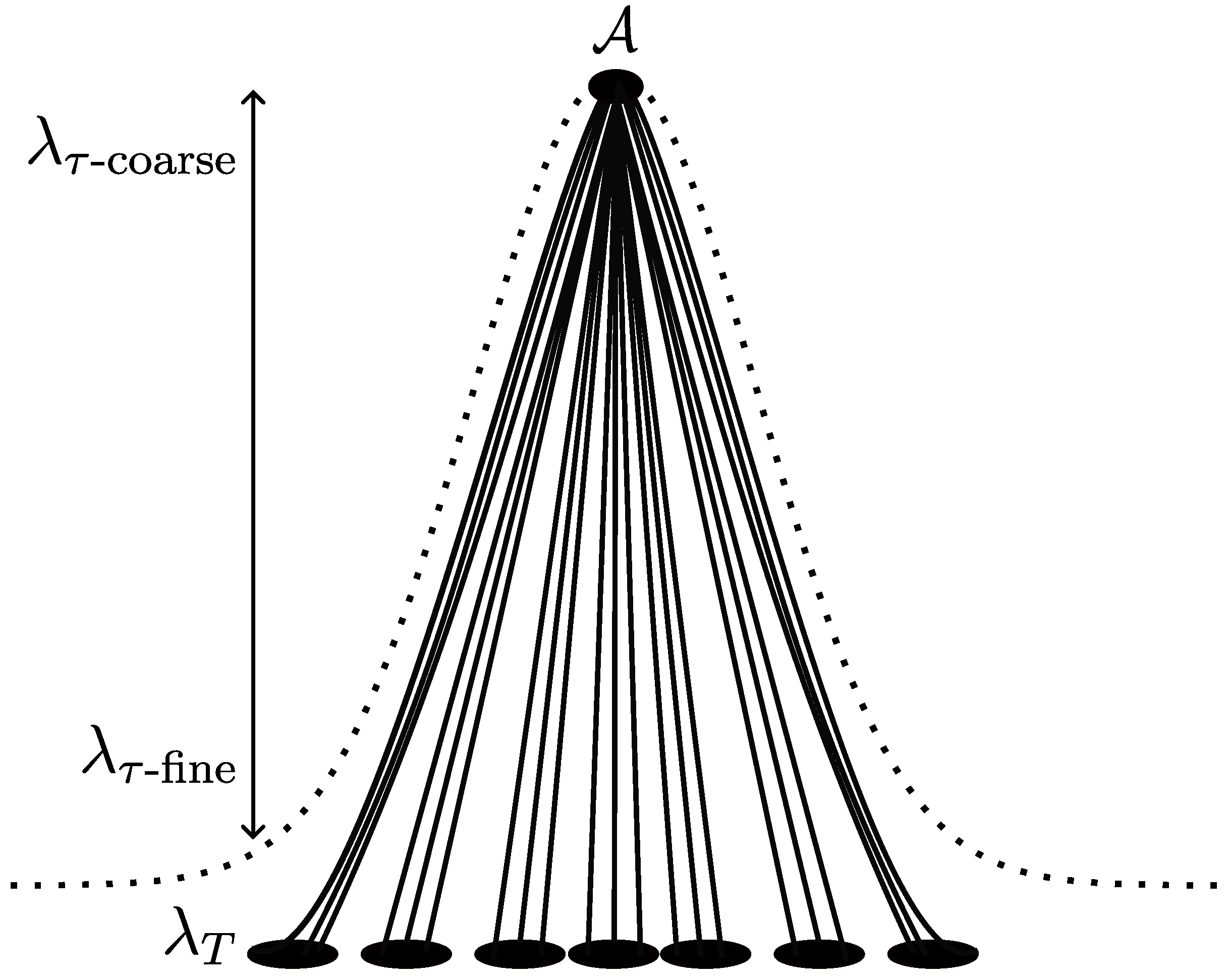
Figure 4.
The hexid bipyramid and relativity. Three trajectory types emerge from different regions of the prism: the agent’s deictic navigation from the central band (reference rhythm, ), the body pattern (), and the background pattern (). The fold-frequency differential generates the phenomenal impression of relative movement: when the background accumulates many fold transitions per agent-tic, the agent renders the impression of moving through space. The central band is the agent’s significance zone; regions above () and below () operate but do not signify.
Figure 4.
The hexid bipyramid and relativity. Three trajectory types emerge from different regions of the prism: the agent’s deictic navigation from the central band (reference rhythm, ), the body pattern (), and the background pattern (). The fold-frequency differential generates the phenomenal impression of relative movement: when the background accumulates many fold transitions per agent-tic, the agent renders the impression of moving through space. The central band is the agent’s significance zone; regions above () and below () operate but do not signify.
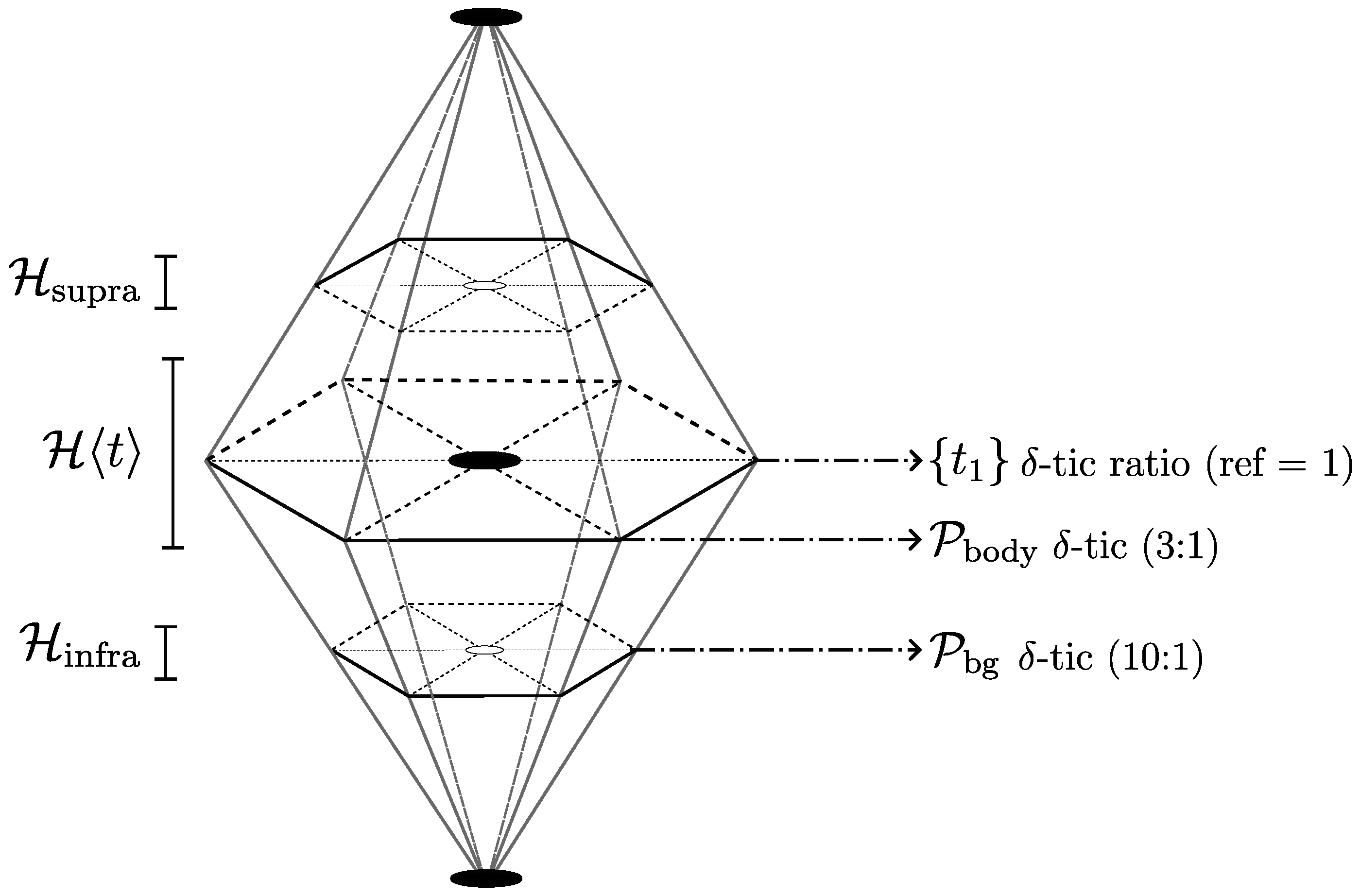
Figure 5.
-tic differential in speech production. Segmental articulation (, dashed line) provides sparse, relatively discrete -tic structure serving as perceptual ground. Suprasegmental contours (, continuous wave) accumulate denser fold-transitions at a 10:1 ratio, rendering as prosodic figure against the segmental ground. This differential enables intonation to carry pragmatic and affective modulation across the phonemic substrate.
Figure 5.
-tic differential in speech production. Segmental articulation (, dashed line) provides sparse, relatively discrete -tic structure serving as perceptual ground. Suprasegmental contours (, continuous wave) accumulate denser fold-transitions at a 10:1 ratio, rendering as prosodic figure against the segmental ground. This differential enables intonation to carry pragmatic and affective modulation across the phonemic substrate.
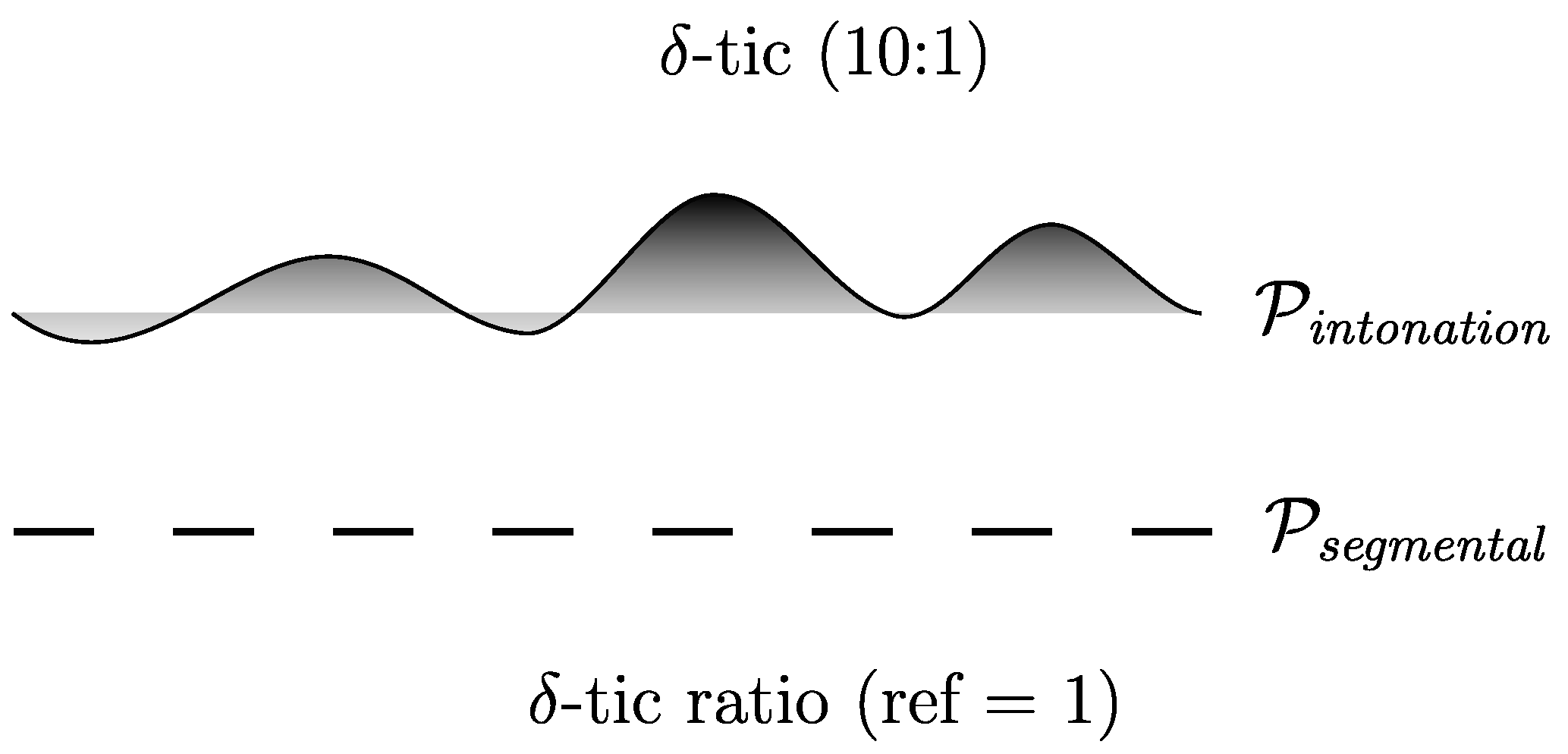
Figure 6.
Transductive Equivalence and Transductive Cost illustrated schematically. Two interfaces ( and ) are shown as hexagonal projections. Filled circles indicate positions with high TE (structural correspondence): the three positions marked in black occupy geometrically equivalent locations in both interfaces, establishing a shared navigational scaffold. Open circles indicate positions with low TE (structural mismatch). The dashed arrow represents an attempted transduction from a mismatched position in (A); the nearest available anchor in (B) is position X, which requires high TC to reach. Notably, even this high-cost projection remains processable because it can leverage the geometric coherence established by the three corresponding positions.
Figure 6.
Transductive Equivalence and Transductive Cost illustrated schematically. Two interfaces ( and ) are shown as hexagonal projections. Filled circles indicate positions with high TE (structural correspondence): the three positions marked in black occupy geometrically equivalent locations in both interfaces, establishing a shared navigational scaffold. Open circles indicate positions with low TE (structural mismatch). The dashed arrow represents an attempted transduction from a mismatched position in (A); the nearest available anchor in (B) is position X, which requires high TC to reach. Notably, even this high-cost projection remains processable because it can leverage the geometric coherence established by the three corresponding positions.
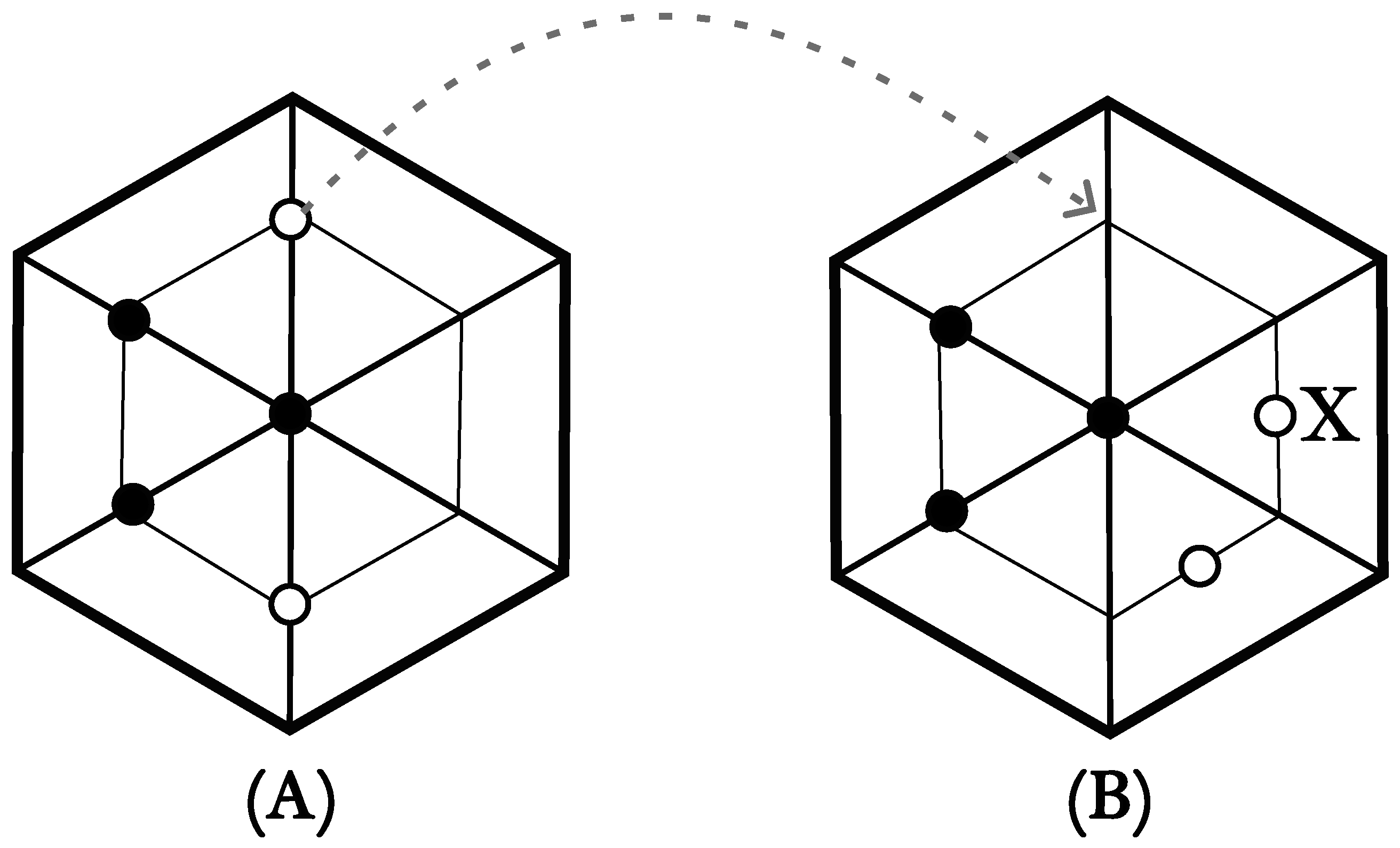
Figure 8.
Agential strata and mimetic stabilization: NET (trace space), hexid interface (), and macroagent (M). See text for detailed interpretation.
Figure 8.
Agential strata and mimetic stabilization: NET (trace space), hexid interface (), and macroagent (M). See text for detailed interpretation.
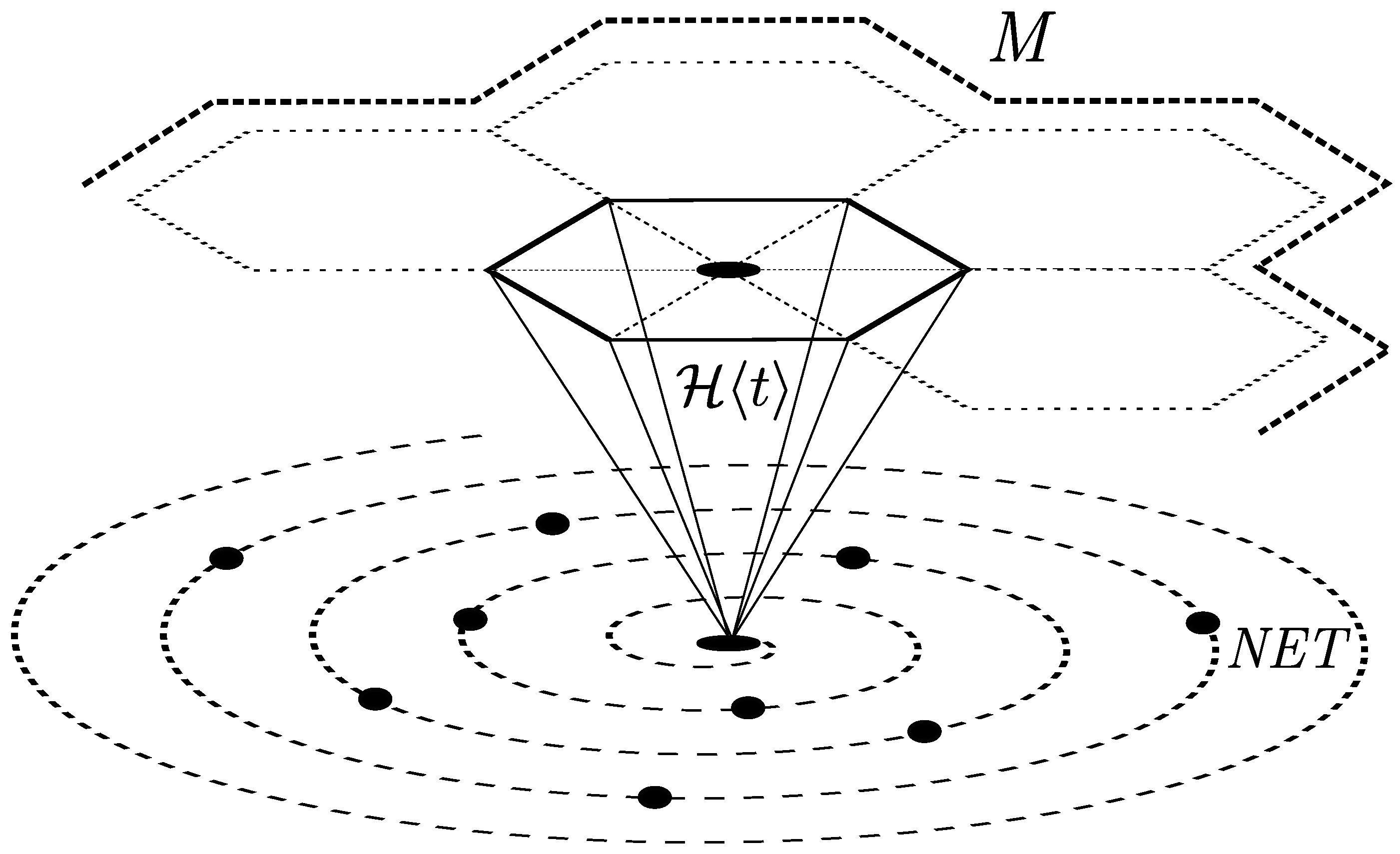
Disclaimer/Publisher’s Note: The statements, opinions and data contained in all publications are solely those of the individual author(s) and contributor(s) and not of MDPI and/or the editor(s). MDPI and/or the editor(s) disclaim responsibility for any injury to people or property resulting from any ideas, methods, instructions or products referred to in the content. |
© 2026 by the authors. Licensee MDPI, Basel, Switzerland. This article is an open access article distributed under the terms and conditions of the Creative Commons Attribution (CC BY) license (http://creativecommons.org/licenses/by/4.0/).
Copyright: This open access article is published under a Creative Commons CC BY 4.0 license, which permit the free download, distribution, and reuse, provided that the author and preprint are cited in any reuse.


