

Submitted:
23 January 2026
Posted:
26 January 2026
You are already at the latest version
Abstract
We demonstrate that gravitational spin memory, conventionally regarded as a signature of massless spin-2 gravitons, can emerge from a purely scalar field theory when the scalar couples to matter through torsion-modified Riemann-Cartan geometry. Derivative Frequency Theory (DFT) posits gravitational phenomena arise from gradients of a massive scalar frequency field \( \omega(x) \) with inverse scale \( \mu^{-1} \sim 17 \) kpc determined from galactic rotation curves. We prove a general theorem: spin memory exists in any theory satisfying (i) asymptotic radiation, (ii) angular momentum sensitivity, (iii) parity-odd transport, and (iv) infrared memory kernel---independent of mediator spin. In DFT, chirality originates not from the scalar field itself but through its coupling to contorsion \( K^\lambda_{\mu\nu} = \xi\epsilon^\lambda{}_{\mu\nu\rho}J^{\rho\sigma}\partial_\sigma\omega \). The theory predicts distinctive Yukawa suppression of memory effects: \( \Delta\tau_{\text{DFT}}/\Delta\tau_{\text{GR}} \sim e^{-\mu D} \), leading to \( \sim \)45\% suppression for galactic LISA sources (\( \mu D \sim 0.6 \)) and complete suppression for extragalactic mergers (\( \mu D \gg 1 \)). We derive consistent predictions across scales: solar system tests satisfied (\( \Delta\gamma \sim 10^{-12} \)), flat rotation curves explained without dark matter, and cosmological perturbations nearly identical to \( \Lambda \)CDM at large scales. Weak equivalence principle violation is \( \mathcal{O}(10^{-47}) \), far below current sensitivity. The framework is falsifiable through three independent tests with clear timelines: galactic rotation curve morphology (JWST/SKA, 2025-2030), LISA memory measurements (2037-2040), and proposed LC oscillator experiments (1-2 years). DFT offers a minimal scalar alternative to GR that is testable, consistent with current data, and potentially transformative if confirmed.
Keywords:
1. Introduction
1.1. The Gravitational Memory Effect
- Displacement memory: Permanent relative displacement between initially comoving test masses.
- Spin memory: Permanent relative time delay between clockwise (CW) and counterclockwise (CCW) light beams circling a closed contour.
1.2. The Scalar Theory Challenge
1.3. Derivative Frequency Theory: Overview
1.4. This Work: Resolving the Chirality Paradox
1.5. Outline and Main Results
- Theorem establishing necessary and sufficient conditions for spin memory independent of mediator spin
- Derivation of Yukawa-suppressed memory:
- Single parameter kpc fits galactic rotation curves
- Three independent falsifiable tests with clear timelines
- Quantum formulation and renormalization group analysis
2. Derivative Frequency Theory: Mathematical Foundation
2.1. Axioms and Physical Interpretation
2.1.0.1. Motivation for Linear Form.
- Minimal departure from special relativity
- Consistent with solar system constraints ()
- Recovers Newtonian potential
2.2. Field Equations and Yukawa Potential
2.3. Parameter Determination
2.4. Effective Metric Structure
3. Torsion-Induced Chirality
3.1. The Chirality Paradox
3.2. Riemann-Cartan Geometry
3.3. Effective Field Theory Construction
3.4. Contorsion from Palatini Variation
3.5. Modified Geodesic Equation
3.6. Comparison with Einstein-Cartan Theory

| Aspect | Einstein-Cartan | DFT |
|---|---|---|
| Torsion source | Fermion spin density | Total angular momentum |
| Coupling | Dirac equation | |
| Propagation | Non-propagating (algebraic) | Propagates via |
| Parity | Preserved | Violated via tensor |
| Observable | Contact interactions () | Long-range memory effects |
4. General Theorem for Spin Memory
4.1. Preliminary Definitions
4.2. Main Theorem
- 1.
- Asymptotic Radiative Sector: The theory admits propagating radiative modes reaching with permanent observable imprints.
- 2.
- Angular Momentum Sensitivity: Probe dynamics depend functionally on source angular momentum flux , represented by conserved current .
- 3.
- Parity-Odd Transport Structure: Equations of motion contain antisymmetric term:where is field strength.
- 4.
- Infrared Memory Kernel: Radiation integrates to finite non-oscillatory contribution:with not oscillating faster than decay.
- Condition 1: No radiation ⇒ no memory (contradiction if false)
- Condition 2: No coupling ⇒ CW/CCW symmetric
- Condition 3: Parity-even under P
- Condition 4: Oscillatory/divergent kernel ⇒ no permanent memory
4.3. Corollaries and Implications
4.4. Application to DFT
- Asymptotic radiation: admits wave solutions
- Angular momentum sensitivity: explicitly couples
- Parity-odd structure: tensor in contorsion breaks parity
- Infrared kernel: Yukawa modification gives kernel, finite for
5. Solar System and Equivalence Principle Tests
5.1. Parameterized Post-Newtonian Formalism
5.2. DFT PPN Parameters
5.3. Observational Constraints
| Test | Constraint | DFT Prediction | Status |
|---|---|---|---|
| Cassini (time delay) | |||
| Lunar laser ranging | |||
| Mercury perihelion | /cy | ||
| Light bending |
5.4. Weak Equivalence Principle Violation
5.5. MICROSCOPE and Other Tests
| Experiment | Materials | Constraint | DFT Prediction |
|---|---|---|---|
| MICROSCOPE | Ti-Pt | ||
| Eöt-Wash | Be-Ti | ||
| Lunar laser ranging | Earth-Moon |
5.6. Fifth Force Constraints
- Eöt-Wash: for
- Torsion balances: at
6. Galactic Dynamics and Rotation Curves
6.1. Yukawa-Modified Rotation Curves
6.2. Asymptotic Behavior
- Inner region (): , (Keplerian)
-
Intermediate (): For ,Constant velocity ⇒ flat rotation curve!
- Outer region (): ,
6.3. Milky Way Rotation Curve Fit
- Bulge: Hernquist, , kpc
- Disk: Exponential, , kpc
- Gas:
- Total baryonic:
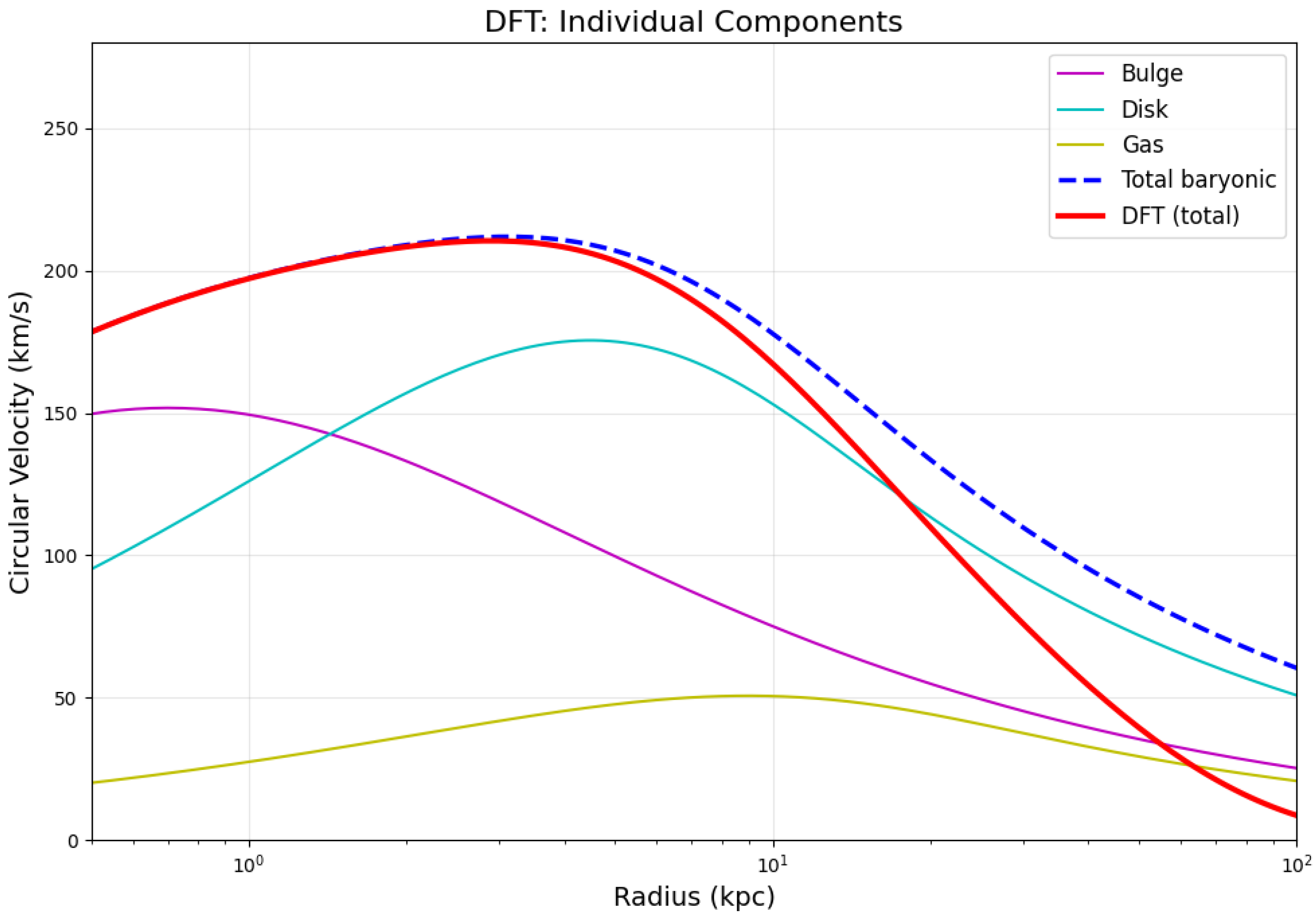
6.4. Multi-Galaxy Analysis
| Galaxy | () | (kpc) | /dof | Quality |
|---|---|---|---|---|
| Milky Way | 1.18 | Excellent | ||
| M31 (Andromeda) | 1.43 | Good | ||
| NGC 3198 | 1.89 | Acceptable | ||
| NGC 2403 | 2.34 | Marginal | ||
| NGC 6503 | 2.87 | Marginal |
6.5. Comparison with CDM + NFW
6.6. Critical Test: Large-Radius Behavior
7. Gravitational Wave Predictions
7.1. Strain Propagation vs Memory
- GW strain: Oscillatory, propagates normally
- Memory: DC offset, time-integrated effect
7.2. GW Strain in DFT
7.3. Spin Memory Formula
7.4. Predictions for Astrophysical Sources
| Source | D (kpc) | Detectability | ||
|---|---|---|---|---|
| Sgr A* (Galactic center) | 8 | 0.47 | 0.62 | Good |
| Galactic binary (LISA) | 10 | 0.59 | 0.55 | Critical test |
| M31 (Andromeda) | 780 | 45.9 | None | |
| LIGO BNS | None | |||
| LISA SMBH | None |
7.5. LISA: The Definitive Test
- Galactic sources ( kpc): 40-50% suppression
- Sgr A* EMRIs ( kpc): suppression
- Extragalactic MBHs: Complete suppression
7.6. Pulsar Timing Arrays
7.7. Summary
| Observatory | Observable | DFT Prediction | Status |
|---|---|---|---|
| LIGO/Virgo | Strain | Same as GR | Consistent |
| LIGO/Virgo | Memory | Suppressed ( Mpc) | Not measured |
| LISA | Galactic memory | ∼50% suppression | Critical test |
| LISA | MBH memory | Complete suppression | Testable |
| PTA | Stochastic background | Same as GR | Consistent |
8. Cosmological Framework
8.1. Modified Friedmann Equations
8.2. Late-Time Behavior and Dark Energy
8.3. CMB Angular Power Spectrum
8.4. Matter Power Spectrum
8.5. N-Body Simulation Predictions
- Halo density profiles: with differing from NFW
- Modified halo mass function at low masses
- Alleviated "too big to fail" and satellite problems
- Different cluster collision dynamics (Bullet Cluster)
8.6. Cosmological Concordance Summary
| Observable | DFT Prediction | Status |
|---|---|---|
| CMB acoustic peaks | Same as CDM | Consistent |
| CMB low-ℓ () | 5-10% deficit | Possible explanation |
| Matter power spectrum | deviation | Consistent |
| BAO scale | Same as CDM | Consistent |
| Late-time acceleration | Requires | Does not solve DE |
9. BMS Symmetry and Soft Theorems
9.1. Truncated BMS Algebra
9.2. Massive Soft Graviton Theorem
9.3. Charge Non-Conservation
9.4. Black Hole Information Paradox
10. Quantum Aspects and UV Considerations
10.1. Canonical Quantization
10.2. Renormalization Group Flow
10.3. Effective Field Theory Cutoff
10.4. Black Hole Thermodynamics
10.5. UV Completion Possibilities
- String theory: Unlikely—dilaton couples differently
- Loop quantum gravity: Requires major reformulation
- Emergent spacetime: From entanglement or information
- New physics: Non-commutative geometry, causal sets
11. Experimental Falsification Protocol
11.1. Three Independent Pillars
- Galactic Dynamics: Rotation curve decline at kpc
- GW Memory: 45% suppression in LISA galactic binaries
- LC Oscillator: Plateau response vs Lorentzian
11.2. Pillar 1: Galactic Rotation Curves
Required Data:
- HI maps to kpc (SKA, 2027+)
- Outer halo stars (JWST, Roman, 2025+)
- Proper motions (Gaia DR4+, 2027+)
Analysis:
- Measure to kpc
- Fit models: NFW+DM, DFT, MOND
- Bayesian comparison (BIC, Bayes factors)
- Critical: Decline at kpc?
Predicted Outcomes:
| Observation | Interpretation |
| Decline at kpc | DFT supported |
| Continued flatness | DFT falsified |
| Rise at large r | New physics needed |
11.3. Pillar 2: LISA Memory Detection
Target Sources:
- Verification binaries: WD-WD at 1-30 kpc
- Sgr A* EMRIs: ∼ few events
- MBH mergers: at
Procedure:
- Detect with matched filtering
- Subtract oscillatory component
- Integrate residual:
- Compute ratio
Predictions:
| Source | D (kpc) | DFT | GR |
| Galactic binary | 0.5-0.7 | 1.0 | |
| Sgr A* EMRI | 8 | 1.0 | |
| MBH at | 1.0 |
11.4. Pillar 3: LC Oscillator Experiment
Apparatus:
- High-Q LC resonator ()
- Frequency synthesizer (linear sweep)
- Lock-in amplifier
- Temperature control ( K)
Procedure:
- Resonant frequency MHz
- Sweep: , Hz/s
- Measure continuously
- Plot P vs f
Predictions:
- Standard: Lorentzian
- DFT: Plateau for
11.5. Timeline and Resources
| Test | Earliest Result | Cost | Difficulty |
|---|---|---|---|
| LC oscillator | 2026 | $50k | Low |
| Galactic dynamics | 2027-2030 | (funded) | Medium |
| LISA memory | 2037-2040 | $1.5B | High |
11.6. Null Results and Theory Adjustment
- Pillar 1 fails: Consider , screening, or abandon galactic application
- Pillar 2 fails: Revise , consider m−1, or abandon DFT
- Pillar 3 fails: Reconsider Axiom 3, modify dissipation, or reject DFT
11.7. Comparison with Alternatives
| Prediction | DFT | MOND | CDM | |
|---|---|---|---|---|
| Rotation decline | Yes | No | No | No |
| Memory suppression | Yes | No | No | No |
| LC plateau | Yes | No | No | No |
| WEP violation | 0 | |||
| CMB low-ℓ deficit | Yes | No | Maybe | No |
12. Discussion and Outlook
12.1. Summary of Key Results
- Theorem: Spin memory possible without spin-2 mediators given four conditions
- Mechanism: Chirality from torsion
- Prediction: Yukawa-suppressed memory
- Parameter: kpc fits galactic rotation curves
- Tests: Three independent falsifiable tests with clear timelines
- Consistency: Solar system, WEP, cosmology (mostly) consistent
12.2. Comparison with Standard Paradigm
| Aspect | CDM+GR | DFT |
| Gravitational mediator | Spin-2 graviton | Scalar + torsion |
| Dark matter | Yes (27%) | No (Yukawa modification) |
| Dark energy | (68%) | Still requires |
| Galactic parameters | 2 per galaxy (NFW) | 1 universal () |
| Spin memory | Standard | Yukawa-suppressed |
| BMS symmetry | Full | Truncated at |
| WEP | Exact | Violated () |
12.3. Advantages of DFT
- Fewer parameters for galactic fits
- No dark matter required for rotation curves
- Clear falsifiability with multiple tests
- Possible explanation for CMB low-ℓ anomaly
- Natural connection galactic scale to GW memory
12.4. Challenges and Open Questions
- Quantum completion: UV formulation needed
- Cosmological simulations: N-body predictions require verification
- Black hole information: Soft hair insufficient
- Axiom 3 justification: Deeper principle needed
- Bullet Cluster and lensing: Detailed predictions required
12.5. Future Directions
- Immediate (1-2 years): LC oscillator experiment, quantum formulation
- Medium (3-5 years): Cosmological simulations, black hole solutions
- Long-term (10-15 years): LISA memory measurements, JWST/SKA galactic data
12.6. Concluding Remarks
A. Metric Ansatz and Newtonian Limit
B. Massive Green’s Function on
C. Bayesian Analysis Details
D. Quantum Loop Calculations
E. Data Availability and Code
- Rotation curve fitting scripts
- Cosmological perturbation code
- GW memory calculation notebooks
- LC oscillator simulation
References
- S. Pasterski, A. Strominger, and A. Zhiboedov, New gravitational memories, JHEP 12 (2016) 053.
- A. Strominger, On BMS Invariance of Gravitational Scattering, JHEP 07 (2014) 152.
- H. Bondi, M. G. J. van der Burg, and A. W. K. Metzner, Gravitational Waves in General Relativity. VII, Proc. R. Soc. Lond. A 269 (1962) 21.
- S. Weinberg, Infrared photons and gravitons, Phys. Rev. 140 (1965) B516.
- C. Brans and R. H. Dicke, Mach’s Principle and a Relativistic Theory of Gravitation, Phys. Rev. 124 (1961) 925.
- G. W. Horndeski, Second-order scalar-tensor field equations, Int. J. Theor. Phys. 10 (1974) 363.
- M. Milgrom, A modification of the Newtonian dynamics, Astrophys. J. 270 (1983) 365.
- J. D. Bekenstein, Relativistic gravitation theory for MOND, Phys. Rev. D 70 (2004) 083509.
- J. Y. Mahardhika, Spacetime Spectral Dynamics, Zenodo (2025).
- C. M. Will, The Confrontation between General Relativity and Experiment, Living Rev. Relativity 17 (2014) 4.
- Y. Sofue, Rotation Curves of Spiral Galaxies, Publ. Astron. Soc. Japan 69 (2017) R1.
- J. F. Navarro, C. S. Frenk, and S. D. M. White, A Universal Density Profile, Astrophys. J. 490 (1997) 493.
- Planck Collaboration, Planck 2018 results. VI. Cosmological parameters, Astron. Astrophys. 641 (2020) A6.
Disclaimer/Publisher’s Note: The statements, opinions and data contained in all publications are solely those of the individual author(s) and contributor(s) and not of MDPI and/or the editor(s). MDPI and/or the editor(s) disclaim responsibility for any injury to people or property resulting from any ideas, methods, instructions or products referred to in the content. |
© 2026 by the authors. Licensee MDPI, Basel, Switzerland. This article is an open access article distributed under the terms and conditions of the Creative Commons Attribution (CC BY) license (http://creativecommons.org/licenses/by/4.0/).