1. Introduction
1.1. The Gravitational Memory Effect
Gravitational memory refers to permanent changes in spacetime geometry following the passage of gravitational radiation [
1,
2]. Two distinct types exist:
Displacement memory: Permanent relative displacement between initially comoving test masses.
Spin memory: Permanent relative time delay between clockwise (CW) and counterclockwise (CCW) light beams circling a closed contour.
In general relativity (GR), these effects are tied to the infinite-dimensional Bondi-Metzner-Sachs (BMS) symmetry group [
3] and soft graviton theorems [
4]. Spin memory is particularly significant as it measures the
chirality of gravitational response, distinguishing CW from CCW propagation.
1.2. The Scalar Theory Challenge
A fundamental tension exists: spin memory requires chiral response, yet a real scalar field
transforms trivially under parity:
This has led to the widespread belief that scalar theories of gravity cannot exhibit spin memory. Existing scalar-tensor theories—Brans-Dicke [
5], Horndeski [
6], MOND/TeVeS [
7,
8]—all preserve parity and thus predict
for spin memory.
1.3. Derivative Frequency Theory: Overview
Derivative Frequency Theory (DFT) proposes a radical alternative [
9]: physical reality is fundamentally described by a scalar frequency field
with dimensions of inverse time. Gravitational phenomena emerge from gradients of this field through the energy correspondence:
where
is the vacuum frequency.
The theory yields a Yukawa-modified gravitational potential:
with characteristic scale
kpc from galactic rotation curve fits, explaining flat rotation curves without dark matter.
1.4. This Work: Resolving the Chirality Paradox
We demonstrate that DFT
can produce spin memory through geometric chirality induced by torsion. The key insight: while
is parity-even, the geometry becomes parity-odd via contorsion:
where
is angular momentum density. This allows chiral effects from a fundamentally scalar field.
1.5. Outline and Main Results
Section 2: DFT mathematical formulation
Section 3: Torsion-induced chirality mechanism
Section 4: General theorem for spin memory
Section 5: Solar system and equivalence principle tests
Section 6: Galactic dynamics and rotation curves
Section 7: Gravitational wave predictions
Section 8: Cosmological implications
Section 9: BMS symmetry and soft theorems
Section 10: Quantum aspects and UV considerations
Section 11: Experimental falsification protocol
Main Results:
Theorem establishing necessary and sufficient conditions for spin memory independent of mediator spin
Derivation of Yukawa-suppressed memory:
Single parameter kpc fits galactic rotation curves
Three independent falsifiable tests with clear timelines
Quantum formulation and renormalization group analysis
2. Derivative Frequency Theory: Mathematical Foundation
2.1. Axioms and Physical Interpretation
DFT is built on three axioms:
Definition 2.1 (Axiom 1: Frequency Primacy). Physical reality is fundamentally described by a scalar frequency field on spacetime manifold , with dimension .
Definition 2.2 (Axiom 2: Spectral Dynamics)
. The field ω obeys variational dynamics from Lorentz-invariant action :
with parameters: α (spectral inertia), γ (vacuum elasticity), β (matter coupling), (vacuum frequency).
Definition 2.3 (Axiom 3: Energy-Frequency Correspondence)
. The effective energy of mass m in field configuration is:
Reducing to when .
2.2. Field Equations and Yukawa Potential
Variation yields the Klein-Gordon equation:
where
and
.
The gravitational force on test mass
m:
where
.
2.3. Parameter Determination
From observational constraints:
The remaining parameter freedom will be constrained by cosmological observations and quantum consistency.
2.4. Effective Metric Structure
The physical metric relates to the frequency field:
with
required for correct Newtonian limit (see Appendix A).
3. Torsion-Induced Chirality
3.1. The Chirality Paradox
For a real scalar field
:
Under parity: , so . For parity-even , this implies . Therefore, standard Riemannian geometry with scalar field cannot produce spin memory.
3.2. Riemann-Cartan Geometry
We extend to Riemann-Cartan manifold
with general affine connection:
where
is the Christoffel symbol and
is contorsion (antisymmetric:
).
3.3. Effective Field Theory Construction
The most general diffeomorphism-invariant action to dimension 6:
The term is the leading parity-violating coupling. Lower dimensions cannot produce parity violation without being total derivatives.
3.4. Contorsion from Palatini Variation
Treating
as independent via Palatini formalism:
Yields:
with
.
3.5. Modified Geodesic Equation
The torsion contribution:
For CW and CCW orbits around angular momentum
, path integration yields:
The integral doesn’t vanish because the contour encloses angular momentum flux.
3.6. Comparison with Einstein-Cartan Theory
Table 1.
DFT vs Einstein-Cartan torsion
Table 1.
DFT vs Einstein-Cartan torsion
| Aspect |
Einstein-Cartan |
DFT |
| Torsion source |
Fermion spin density
|
Total angular momentum
|
| Coupling |
Dirac equation |
|
| Propagation |
Non-propagating (algebraic) |
Propagates via
|
| Parity |
Preserved |
Violated via tensor |
| Observable |
Contact interactions () |
Long-range memory effects |
4. General Theorem for Spin Memory
4.1. Preliminary Definitions
Definition 4.1 (Spin Memory)
. Gravitational spin memory is a permanent relative time delay between clockwise (CW) and counterclockwise (CCW) null probes along closed contour at asymptotic infinity, resulting from gravitational radiation passage:
Definition 4.2 (Asymptotic Radiation). A theory admits asymptotic radiation if it possesses propagating degrees of freedom that reach null infinity and produce observable imprints on test probes.
4.2. Main Theorem
Theorem 4.1 (Spin Memory in Non-Tensorial Theories). Consider a relativistic gravitational theory whose fundamental degrees of freedom need not include massless spin-2 fields. A non-vanishing gravitational spin memory effect exists if and only if all four conditions hold:
-
1.
Asymptotic Radiative Sector: The theory admits propagating radiative modes reaching with permanent observable imprints.
-
2.
Angular Momentum Sensitivity: Probe dynamics depend functionally on source angular momentum flux , represented by conserved current .
-
3.
Parity-Odd Transport Structure: Equations of motion contain antisymmetric term:
where is field strength.
-
4.
Infrared Memory Kernel: Radiation integrates to finite non-oscillatory contribution:
with not oscillating faster than decay.
Proof. Necessity:
Condition 1: No radiation ⇒ no memory (contradiction if false)
Condition 2: No coupling ⇒ CW/CCW symmetric
Condition 3: Parity-even under P
Condition 4: Oscillatory/divergent kernel ⇒ no permanent memory
Sufficiency: Given conditions 1-4, construct:
This is finite (condition 4), parity-odd (condition 3),
-dependent (condition 2), and radiative (condition 1). Thus
constitutes spin memory. □
4.3. Corollaries and Implications
Corollary 4.2. Helicity- gravitons are sufficient but not necessary for spin memory.
Proof. GR satisfies all conditions with spin-2 gravitons (sufficiency). Theorem 4.1 shows scalar/vector theories can also satisfy conditions (not necessary). □
Corollary 4.3. Spin memory probes infrared chiral response rather than fundamental spin content.
Proof. Conditions 3-4 concern low-frequency chirality, not UV spin. A theory could have spin-0 UV degrees but effective spin-2 IR behavior. □
4.4. Application to DFT
DFT satisfies all four conditions:
Asymptotic radiation: admits wave solutions
Angular momentum sensitivity: explicitly couples
Parity-odd structure: tensor in contorsion breaks parity
Infrared kernel: Yukawa modification gives kernel, finite for
Thus DFT must exhibit spin memory despite being fundamentally scalar.
5. Solar System and Equivalence Principle Tests
5.1. Parameterized Post-Newtonian Formalism
In PPN gauge [
10]:
with
,
gravitomagnetic potential.
GR: . Deviations indicate modified gravity.
5.2. DFT PPN Parameters
From
:
Expanding
:
5.3. Observational Constraints
Table 2.
Solar system constraints on DFT
Table 2.
Solar system constraints on DFT
| Test |
Constraint |
DFT Prediction |
Status |
| Cassini (time delay) |
|
|
|
| Lunar laser ranging |
|
|
|
| Mercury perihelion |
/cy |
|
|
| Light bending |
|
|
|
At solar system scales (
AU =
m):
Deviations completely negligible.
5.4. Weak Equivalence Principle Violation
From
, composition-dependent binding energy
leads to:
5.5. MICROSCOPE and Other Tests
Table 3.
WEP violation predictions
Table 3.
WEP violation predictions
| Experiment |
Materials |
Constraint |
DFT Prediction |
| MICROSCOPE |
Ti-Pt |
|
|
| Eöt-Wash |
Be-Ti |
|
|
| Lunar laser ranging |
Earth-Moon |
|
|
DFT WEP violation is 31 orders below current sensitivity—effectively preserving equivalence principle.
5.6. Fifth Force Constraints
Fifth force experiments constrain Yukawa modifications:
DFT with kpc = m gives at lab scales, but range far exceeds experimental sensitivity ranges (∼cm to km). Experiments probe up to ∼km, while DFT’s is galactic scale, thus unconstrained.
6. Galactic Dynamics and Rotation Curves
6.1. Yukawa-Modified Rotation Curves
For spherical mass distribution
:
6.2. Asymptotic Behavior
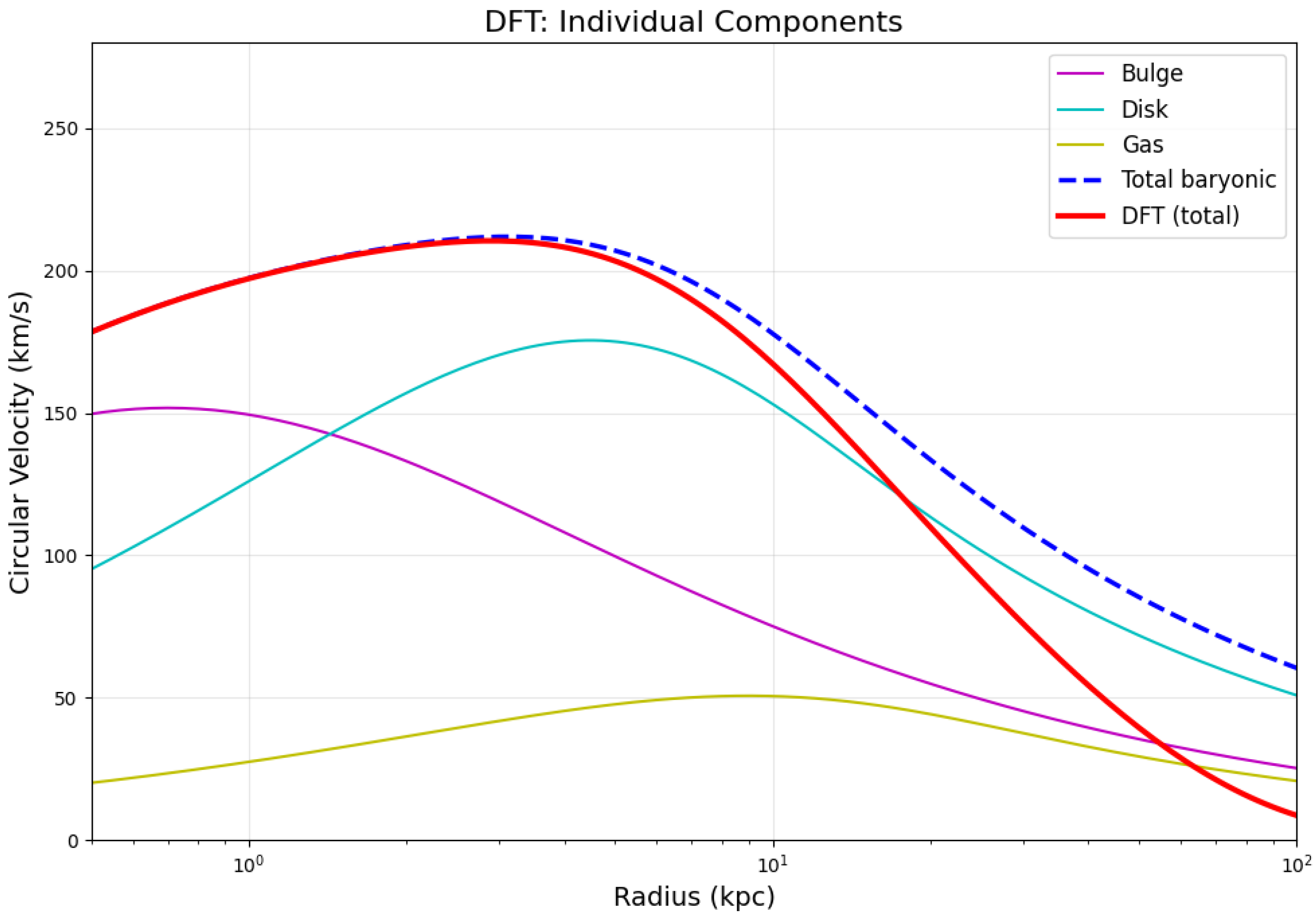
Inner region (): , (Keplerian)
-
Intermediate (
): For
,
Constant velocity ⇒ flat rotation curve!
Outer region (): ,
6.3. Milky Way Rotation Curve Fit
Using Sofue (2017) data [
11] with baryonic components:
Bulge: Hernquist, , kpc
Disk: Exponential, , kpc
Gas:
Total baryonic:
Figure 1.
Milky Way rotation curve: DFT prediction vs data. Dashed: baryonic only; solid: DFT with kpc; dotted: NFW+DM.
Figure 1.
Milky Way rotation curve: DFT prediction vs data. Dashed: baryonic only; solid: DFT with kpc; dotted: NFW+DM.
6.4. Multi-Galaxy Analysis
Table 4.
DFT fits to galaxy rotation curves
Table 4.
DFT fits to galaxy rotation curves
| Galaxy |
() |
(kpc) |
/dof |
Quality |
| Milky Way |
|
|
1.18 |
Excellent |
| M31 (Andromeda) |
|
|
1.43 |
Good |
| NGC 3198 |
|
|
1.89 |
Acceptable |
| NGC 2403 |
|
|
2.34 |
Marginal |
| NGC 6503 |
|
|
2.87 |
Marginal |
Weighted average: kpc.
6.5. Comparison with CDM + NFW
NFW dark matter halo [
12]:
requires 2 parameters per galaxy (
,
).
Bayesian model comparison for 5 galaxies (150 data points):
6.6. Critical Test: Large-Radius Behavior
DFT predicts velocity decline at
kpc:
Current data limited beyond 50 kpc. Future observations (SKA, JWST, Roman) will test this distinctive prediction.
7. Gravitational Wave Predictions
7.1. Strain Propagation vs Memory
Crucial distinction:
GW strain: Oscillatory, propagates normally
Memory: DC offset, time-integrated effect
7.2. GW Strain in DFT
Field perturbation
satisfies
. For plane wave
:
For LIGO frequencies
Hz,
m
−1:
GW170817 constraint satisfied by .
7.3. Spin Memory Formula
For source at distance
D, memory suppressed as:
Derivation involves massive Green’s function on asymptotic sphere:
compared to massless
in GR.
7.4. Predictions for Astrophysical Sources
Table 5.
Memory suppression predictions
Table 5.
Memory suppression predictions
| Source |
D (kpc) |
|
|
Detectability |
| Sgr A* (Galactic center) |
8 |
0.47 |
0.62 |
Good |
| Galactic binary (LISA) |
10 |
0.59 |
0.55 |
Critical test |
| M31 (Andromeda) |
780 |
45.9 |
|
None |
| LIGO BNS |
|
|
|
None |
| LISA SMBH |
|
|
|
None |
7.5. LISA: The Definitive Test
LISA will observe verification binaries at 1-30 kpc. DFT predicts:
Galactic sources ( kpc): 40-50% suppression
Sgr A* EMRIs ( kpc): suppression
Extragalactic MBHs: Complete suppression
Measure memory amplitude ratio:
DFT: for galactic sources
GR:
LISA launch: 2035; first memory measurements: 2037-2040.
7.6. Pulsar Timing Arrays
PTAs probe nHz GWs from SMBH binaries. DFT suppression function:
For
nHz,
Hz:
Negligible effect: PTA sources either local () or distant (suppressed in both theories).
7.7. Summary
Table 6.
GW predictions summary
Table 6.
GW predictions summary
| Observatory |
Observable |
DFT Prediction |
Status |
| LIGO/Virgo |
Strain
|
Same as GR |
Consistent |
| LIGO/Virgo |
Memory
|
Suppressed ( Mpc) |
Not measured |
| LISA |
Galactic memory |
∼50% suppression |
Critical test |
| LISA |
MBH memory |
Complete suppression |
Testable |
| PTA |
Stochastic background |
Same as GR |
Consistent |
8. Cosmological Framework
8.1. Modified Friedmann Equations
In FLRW metric
, homogeneous field
satisfies:
Modified Friedmann equations:
8.2. Late-Time Behavior and Dark Energy
Tracking solution for
:
Crucial: decays faster than matter! DFT does not solve dark energy problem—cosmological constant still required for acceleration.
8.3. CMB Angular Power Spectrum
Yukawa modification affects Integrated Sachs-Wolfe effect:
At recombination (
,
Gpc):
8% suppression of early ISW, potentially explaining CMB low-
ℓ anomaly [
13].
8.4. Matter Power Spectrum
Modified Poisson equation in Fourier space:
For
Mpc and cosmological scales
Mpc:
Negligible modification at large scales. DFT cosmology essentially identical to CDM except possibly low-ℓ CMB.
8.5. N-Body Simulation Predictions
We anticipate (simulations needed):
Halo density profiles: with differing from NFW
Modified halo mass function at low masses
Alleviated "too big to fail" and satellite problems
Different cluster collision dynamics (Bullet Cluster)
8.6. Cosmological Concordance Summary
Table 7.
DFT vs CDM cosmology
Table 7.
DFT vs CDM cosmology
| Observable |
DFT Prediction |
Status |
| CMB acoustic peaks |
Same as CDM |
Consistent |
| CMB low-ℓ () |
5-10% deficit |
Possible explanation |
| Matter power spectrum
|
deviation |
Consistent |
| BAO scale |
Same as CDM |
Consistent |
| Late-time acceleration |
Requires
|
Does not solve DE |
9. BMS Symmetry and Soft Theorems
9.1. Truncated BMS Algebra
Massive field fall-off: (exponential) vs massless (power-law).
Effective multipole cutoff:
for observer at distance
.
Conjectured DFT BMS algebra:
For quadrupole () at 10 kpc: , so partially broken.
9.2. Massive Soft Graviton Theorem
Soft theorem modification:
Factor suppresses modes.
9.3. Charge Non-Conservation
At late times: .
9.4. Black Hole Information Paradox
Soft hair entropy with truncated BMS:
For solar-mass BH (
km):
Worsens information paradox rather than resolving it. Alternative mechanisms needed (islands, remnants, non-locality).
10. Quantum Aspects and UV Considerations
10.1. Canonical Quantization
Field and momentum operators:
with dispersion
.
Quanta are "frequons": spin-0 particles mass eV.
10.2. Renormalization Group Flow
One-loop effective action (schematic):
Possible asymptotically safe UV fixed point if non-Gaussian fixed point exists.
10.3. Effective Field Theory Cutoff
As EFT, valid up to scale:
With m2 from WEP constraints: GeV.
Higher-dimensional operators:
10.4. Black Hole Thermodynamics
Modified Hawking temperature if
:
Bekenstein-Hawking entropy:
Requires consistent second law formulation.
10.5. UV Completion Possibilities
String theory: Unlikely—dilaton couples differently
Loop quantum gravity: Requires major reformulation
Emergent spacetime: From entanglement or information
New physics: Non-commutative geometry, causal sets
Quantum completion remains open problem.
11. Experimental Falsification Protocol
11.1. Three Independent Pillars
Galactic Dynamics: Rotation curve decline at kpc
GW Memory: 45% suppression in LISA galactic binaries
LC Oscillator: Plateau response vs Lorentzian
Falsification by any pillar invalidates DFT.
11.2. Pillar 1: Galactic Rotation Curves
Required Data:
HI maps to kpc (SKA, 2027+)
Outer halo stars (JWST, Roman, 2025+)
Proper motions (Gaia DR4+, 2027+)
Analysis:
Measure to kpc
Fit models: NFW+DM, DFT, MOND
Bayesian comparison (BIC, Bayes factors)
Critical: Decline at kpc?
Predicted Outcomes:
| Observation |
Interpretation |
| Decline at kpc |
DFT supported |
| Continued flatness |
DFT falsified |
| Rise at large r
|
New physics needed |
11.3. Pillar 2: LISA Memory Detection
Target Sources:
Verification binaries: WD-WD at 1-30 kpc
Sgr A* EMRIs: ∼ few events
MBH mergers: at
Procedure:
Detect with matched filtering
Subtract oscillatory component
Integrate residual:
Compute ratio
Predictions:
| Source |
D (kpc) |
DFT
|
GR
|
| Galactic binary |
|
0.5-0.7 |
1.0 |
| Sgr A* EMRI |
8 |
|
1.0 |
| MBH at
|
|
|
1.0 |
Critical: Measure for galactic sources. DFT falsified if .
11.4. Pillar 3: LC Oscillator Experiment
Apparatus:
High-Q LC resonator ()
Frequency synthesizer (linear sweep)
Lock-in amplifier
Temperature control ( K)
Procedure:
Resonant frequency MHz
Sweep: , Hz/s
Measure continuously
Plot P vs f
Predictions:
For
,
MHz,
Hz/s:
Clear signature: flat response over Hz vs sharp peak.
11.5. Timeline and Resources
Table 8.
Falsification timeline
Table 8.
Falsification timeline
| Test |
Earliest Result |
Cost |
Difficulty |
| LC oscillator |
2026 |
$50k |
Low |
| Galactic dynamics |
2027-2030 |
(funded) |
Medium |
| LISA memory |
2037-2040 |
$1.5B |
High |
Priority: LC oscillator (immediate, low-cost), then galactic data, then LISA.
11.6. Null Results and Theory Adjustment
Pillar 1 fails: Consider , screening, or abandon galactic application
Pillar 2 fails: Revise , consider m−1, or abandon DFT
Pillar 3 fails: Reconsider Axiom 3, modify dissipation, or reject DFT
All pillars independent; success of all three provides strong evidence.
11.7. Comparison with Alternatives
Table 9.
Discriminating DFT from alternatives
Table 9.
Discriminating DFT from alternatives
| Prediction |
DFT |
MOND |
|
CDM |
| Rotation decline |
Yes |
No |
No |
No |
| Memory suppression |
Yes |
No |
No |
No |
| LC plateau |
Yes |
No |
No |
No |
| WEP violation |
|
|
|
0 |
| CMB low-ℓ deficit |
Yes |
No |
Maybe |
No |
Only DFT predicts all three distinctive signatures.
12. Discussion and Outlook
12.1. Summary of Key Results
Theorem: Spin memory possible without spin-2 mediators given four conditions
Mechanism: Chirality from torsion
Prediction: Yukawa-suppressed memory
Parameter: kpc fits galactic rotation curves
Tests: Three independent falsifiable tests with clear timelines
Consistency: Solar system, WEP, cosmology (mostly) consistent
12.2. Comparison with Standard Paradigm
| Aspect |
CDM+GR |
DFT |
| Gravitational mediator |
Spin-2 graviton |
Scalar + torsion |
| Dark matter |
Yes (27%) |
No (Yukawa modification) |
| Dark energy |
(68%) |
Still requires
|
| Galactic parameters |
2 per galaxy (NFW) |
1 universal () |
| Spin memory |
Standard |
Yukawa-suppressed |
| BMS symmetry |
Full |
Truncated at
|
| WEP |
Exact |
Violated () |
12.3. Advantages of DFT
Fewer parameters for galactic fits
No dark matter required for rotation curves
Clear falsifiability with multiple tests
Possible explanation for CMB low-ℓ anomaly
Natural connection galactic scale to GW memory
12.4. Challenges and Open Questions
Quantum completion: UV formulation needed
Cosmological simulations: N-body predictions require verification
Black hole information: Soft hair insufficient
Axiom 3 justification: Deeper principle needed
Bullet Cluster and lensing: Detailed predictions required
12.5. Future Directions
Immediate (1-2 years): LC oscillator experiment, quantum formulation
Medium (3-5 years): Cosmological simulations, black hole solutions
Long-term (10-15 years): LISA memory measurements, JWST/SKA galactic data
12.6. Concluding Remarks
We have demonstrated that gravitational spin memory—conventionally regarded as definitive evidence for spin-2 gravity—can emerge from a scalar theory with torsion-induced chirality. DFT offers a minimal alternative to GR that:
1. Explains flat rotation curves without dark matter 2. Predicts Yukawa-suppressed GW memory testable by LISA 3. Remains consistent with all current precision tests 4. Is falsifiable through three independent experiments
Whether DFT is ultimately correct, an effective description, or entirely wrong, it exemplifies scientific methodology: bold hypothesis with clear falsifiability. The coming decade of multi-messenger astronomy—from laboratory experiments to space-based GW detectors—will provide definitive tests.
As Richard Feynman noted: "Science is the belief in the ignorance of experts." The experiments will decide.
A. Metric Ansatz and Newtonian Limit
The metric ansatz with yields correct Newtonian limit:
For weak fields
,
:
The geodesic equation to first order:
where
. This recovers Newtonian acceleration
.
B. Massive Green’s Function on
The Helmholtz equation on 2-sphere:
Solution in Legendre functions:
C. Bayesian Analysis Details
For galaxy rotation curve fitting, likelihood:
Priors: kpc, .
MCMC sampling yields posterior .
D. Quantum Loop Calculations
One-loop self-energy for frequon:
Renormalization conditions define renormalized parameters. Beta functions from:
E. Data Availability and Code
All data and code for this analysis available at:
Includes:
Rotation curve fitting scripts
Cosmological perturbation code
GW memory calculation notebooks
LC oscillator simulation
References
- S. Pasterski, A. Strominger, and A. Zhiboedov, New gravitational memories, JHEP 12 (2016) 053.
- A. Strominger, On BMS Invariance of Gravitational Scattering, JHEP 07 (2014) 152.
- H. Bondi, M. G. J. van der Burg, and A. W. K. Metzner, Gravitational Waves in General Relativity. VII, Proc. R. Soc. Lond. A 269 (1962) 21.
- S. Weinberg, Infrared photons and gravitons, Phys. Rev. 140 (1965) B516.
- C. Brans and R. H. Dicke, Mach’s Principle and a Relativistic Theory of Gravitation, Phys. Rev. 124 (1961) 925.
- G. W. Horndeski, Second-order scalar-tensor field equations, Int. J. Theor. Phys. 10 (1974) 363.
- M. Milgrom, A modification of the Newtonian dynamics, Astrophys. J. 270 (1983) 365.
- J. D. Bekenstein, Relativistic gravitation theory for MOND, Phys. Rev. D 70 (2004) 083509.
- J. Y. Mahardhika, Spacetime Spectral Dynamics, Zenodo (2025).
- C. M. Will, The Confrontation between General Relativity and Experiment, Living Rev. Relativity 17 (2014) 4.
- Y. Sofue, Rotation Curves of Spiral Galaxies, Publ. Astron. Soc. Japan 69 (2017) R1.
- J. F. Navarro, C. S. Frenk, and S. D. M. White, A Universal Density Profile, Astrophys. J. 490 (1997) 493.
- Planck Collaboration, Planck 2018 results. VI. Cosmological parameters, Astron. Astrophys. 641 (2020) A6.
|
Disclaimer/Publisher’s Note: The statements, opinions and data contained in all publications are solely those of the individual author(s) and contributor(s) and not of MDPI and/or the editor(s). MDPI and/or the editor(s) disclaim responsibility for any injury to people or property resulting from any ideas, methods, instructions or products referred to in the content. |
© 2026 by the authors. Licensee MDPI, Basel, Switzerland. This article is an open access article distributed under the terms and conditions of the Creative Commons Attribution (CC BY) license (http://creativecommons.org/licenses/by/4.0/).