
Submitted:
22 January 2026
Posted:
23 January 2026
You are already at the latest version
Abstract
In acidic tea soil, boron (B) adsorption and desorption processes are dominated by the complex relationship between soil acidity, mineralogy, and organic matter. This study investigated B adsorption–desorption behavior in five acidic tea soils (pH 3.8–5.6) col-lected from the Eastern Black Sea region of Türkiye and evaluated the potential of machine learning (ML) algorithms to predict B desorption. Laboratory batch experi-ments were conducted using five initial B concentrations, and adsorption data were interpreted using the Langmuir isotherm model. Adsorption experiments indicated that B interacted with Fe/Al-oxide-containing clay minerals, which had low but fa-vorable binding affinity, as indicated by Langmuir maximum adsorption capacities (Qmax) ranging from 46.5 to 181.8 mg kg⁻¹. Desorption experiments revealed a high degree of reversibility, particularly in soils with lower adsorption capacities, ensuring potential B leaching. To capture the non-linear relationships governing B desorption, six ML algorithms were trained on 75 data points. Among the tested models, Extreme Gradient Boosting (XGBoost) showed the highest predictive accuracy (R² = 0.963), fol-lowed by Gaussian Process Regression and Random Forest. Variable importance anal-yses consistently highlighted soil pH, organic matter content, and clay fraction as the dominant factors. The results demonstrate that integrating laboratory experiments with machine learning provides an effective framework for predicting B mobility in acidic tea soils, offering a practical tool for improving boron management strategies.
Keywords:
boron mobility
; adsorption–desorption
; acidic tea soils
; Langmuir isotherm
; machine learning modeling
1. Introduction
Boron is an important micronutrient that is required for proper growth of the plant, but its range between the deficient and toxic levels is narrower than any other nutrient element. This makes its management particularly difficult in the agricultural ecosystem [1]. In wet and acidic soil conditions, as observed in the tea-growing zones of the Black Sea region of Türkiye, B leaches easily as it is mainly present as the undissociated form of boric acid B(OH)₃, which readily moves in the acidic soil solution [2]. This often leads to frequent B deficiency, which dramatically reduces the growth of tea crops. Alloway [3] indicates that B is the second most frequently deficient micronutrient worldwide, thus showing the importance of studying its soil behavior in agricultural practices.
The availability of B to plants is mainly regulated by adsorption–desorption reactions rather than mineral equilibria [1]. Several soil factors such as pH, clay mineralogy, organic matter (OM), sesquioxides, and cation exchange capacity (CEC) influence the degree and reversibility of B adsorption [4,5,6]. Adsorption of B usually tends to increase from acidic to near alkaline soil pHs as B(OH)₃ progressively transforms into the borate ion [B(OH)₄]⁻, which shows higher affinity for soil colloids [1,7]. This means that liming an acidic soil, for example, can result in B deficiency despite the soil having adequate levels of other elements such as nitrogen, P, K, and microelements [8].
Soil mineralogy is likewise an important factor influencing B retention. Aluminum and iron oxides, and clay minerals such as illite, montmorillonite, and kaolinite, contain ligand-exchange functional groups that strongly adsorb B [4,9]. Illite clay is a strong adsorbent, especially at the edge sites. Organic matter can either increase or decrease B adsorption, depending on the OM composition, and humic acids can form B complexes that are stable at high pH values but weakens in acidic conditions [5,10]. As such, the adsorption-desorption process of B in acidic soils can suffer hysteresis, which indicates an irreversible process and tight binding of B to soil constituents [11]. OM content and CEC worsen hysteresis-effect, whereas at high pHs it weakens.
Despite extensive research, predicting B dynamics in acidic soils remains complex due to the non-linear interactions among multiple physicochemical properties. Although the Langmuir and Freundlich equations are common empirical isotherms that describe adsorption behavior, their applicability is often limited, especially for the case of heterogeneous surfaces typically occurred in natural soils [5,6]. In the last decade, significant advances have been made in applying machine learning algorithms to soil. These data-driven approaches can uncover hidden patterns in multivariable, high-dimensional datasets and have proven effective in material science and environmental modeling [12,13,14,15,16]. These learning algorithms enable the model to learn and utilize the intricate, possibly non-linear relationship present between soil properties and adsorption capacities that are difficult to model through other means. These algorithms were also shown to be effective for the prediction of adsorption capacities of gases and heavy metal ions [17,18] and the identification of critical factors affecting the various adsorption behaviors under extreme soil heterogeneities [19].
In this study, we hypothesized that boron desorption in highly acidic tea plantation soils is primarily governed by non-linear interactions among soil pH, clay mineralogy, and organic matter content, which cannot be adequately captured by conventional adsorption isotherm models alone. We further hypothesized that machine learning algorithms, by integrating multiple soil physicochemical descriptors, can more accurately predict boron desorption behavior than traditional empirical approaches. Accordingly, the objectives of this study were (i) to experimentally characterize boron adsorption and desorption dynamics in representative acidic tea soils, (ii) to quantify the limitations of Langmuir-based descriptions under heterogeneous soil conditions, and (iii) to develop and validate machine learning-based predictive models for boron desorption, providing a practical framework for assessing boron mobility and management risks in tea-growing ecosystems.
2. Materials and Methods
2.1. Soil Sites and Preparation
In this study, the sampling of the topsoil (0–20 cm) was carried out using a composite sampling technique at five different spots in the Black Sea Region of Türkiye, which is known to have acidic soils. After sample collection, the samples were air-dried and graded using a 2 mm sieve. The soil sample analysis techniques were based on Sparks et al. [20]. Measurement for pH and electric conductivity (EC) were performed in a soil and water suspension (1:2.5, W/V) [21]. Organic matter content (OM) was estimated using the modified Walkley-Black method [22]. The calcium carbonate equivalence (CCE) was quantified using the Scheibler calcimeter [23]. Soil texture was carried out using the hydrometer method [24]. The available amounts of potassium (K), sodium (Na), calcium (Ca), and magnesium (Mg) were determined using 1 M ammonium acetate extract using ICP-OES (Thermo Scientific 7200 ICP-OES Analyzer) [25].
2.2. Adsorption Studies
Adsorption experiments were conducted using 5 g of soil that was put into 50 mL polypropylene centrifuge tubes. Solutions of B were prepared at five concentrations (0, 5, 10, 20, and 60 mg L⁻¹) in 0.01 M CaCl₂, and 20 mL of B solution was added to the soil. The soil-B suspensions were shaken at 150 rpm for 23 h and kept at 24 ± 1 °C. Then, the tubes were centrifuged for 10 min at 4000 rpm, and the supernatant was filtered through Whatman No. 42 filter paper. Concentrations of B were measured using the Azomethine-H method [26]. The amount of B adsorbed (qₑ, mg kg⁻¹) was calculated from Equation (1):
where C₀ is the initial B concentration (mg L⁻¹), Cₑ is the equilibrium concentration (mg L⁻¹), V is the solution volume (mL), and W is the soil weight (g).
Adsorption behavior was modeled using the Langmuir isotherm (Equation (2)):
2.3. Desorption Studies
After the adsorption process, soil residues were again equilibrated in 20 mL of 0.01 M CaCl₂ to successively determine B desorption. The mixture was shaken for 23 h at 24 °C. Then, the supernatants were obtained and analyzed as in the adsorption study.
2.4. Machine Learning
A holistic modeling approach employing ML algorithms on the desorption behavior of B in acidic tea plantation soils was developed based on experimental findings. The modeling process involved data processing, modeling, and evaluation. Data consisted of 75 samples derived from replicated adsorption-desorption studies carried out on five samples of acidic tea soil obtained from the Eastern Black Sea Region. Firstly, the principal objective of the developed machine learning models was to compute the amount of desorbed boron based on the measured physicochemical variables. Five basic variables were used as inputs in the machine learning models: initial concentration of boron, adsorbed boron, equilibrium concentration of boron, pH in the adsorption phase, and electrical conductivity in the adsorption phase. Desorbed boron was the target output variable.
All variables prior to model development received Z-scoring normalization to obviate any biases resulting from differing scales among variables and improve model performance. To account for the complexities involved in boron desorption, models using six regression-based machine learning models: Extreme Gradient Boosting (XGBoost), Random Forest (RF), Support Vector Regression (SVR), Gaussian Process Regression (GP), Elastic Net Regression (EN), and Multivariate Adaptive Regression Splines (MARS), are examined for comparison.
All modeling and statistical procedures were performed within the R environment (version 4.5.2; R Core Team, 2025) [27]. The full data set (n = 75) was randomly split evenly into two distinct data sets, with 70% used for training the models and 30% used for evaluation/testing. Due to the small sample size, extensive hyperparameter optimization was deliberately eschewed for fear of inducing overfitting on the data set. As a consequence, a fair comparison of models was achieved without involving extensive customization of algorithms through their hyperparameters, where basically all algorithms were set to use their default settings.
To determine the stability of the models, 5-fold cross-validation methods were carried out on the training sets. The testing sets, which were not used in developing the models, were then utilized as unseen data to determine the predictive capability of the models. For model performance evaluation, three major evaluation criteria were incorporated. These are: the root mean squared error (RMSE), (Equation (3)); the coefficient of determination (R²), (Equation (4)); and the mean absolute deviation (MAD), (Equation (5)).
In the present case, n is the number of data points, and y_true refers experimentally determined value, while y_pred indicate the predicted value, and finally y is the mean value of the set. When repetitions are used, it improved the robustness of experimentation and modeling.
3. Results
3.1. Soil Properties
The physico-chemical properties of the tea soils were found to exhibit marked variability, thereby influencing the movement and reactivity of B. The pH of the tea soils ranged between 3.8 and 5.6, showing very strong acidity, which is common in tea plantations located in high rainfall areas. In such soils, B occurs in the form of H₃BO₃, and it is highly mobile. Soil textural classes ranged from clay to loam, correlating to the extent of functional groups participating in adsorption reactions. In clay soils, B is more strongly adsorbed due to hydroxyl groups on kaolinite, illite, and Fe and Al oxide minerals, which involve in ligand exchange. The percentage of OM varies between 1.00 and 5.8%, consistent with tea agro-ecosystems, where deposition of leaf litter and shallow root structure due to compacted sub soil layer occur. The calcium carbonate equivalents were negligible around zero, indicating high leaching and ruling out the possibility of carbonate precipitation (Table 1).
3.2. Adsorption Isotherms
Boron adsorption isotherms were also modeled using the Langmuir isotherm equation, with differing degrees of fit across the soils (Figure 1). The best data fit was achieved on Soil 3 (R²=0.92), which indicated strong boron adsorption primarily through a monolayer mechanism and greater homogeneity of adsorption sites. Data fittings on Soils 1 and 4 were moderate (R²=0.75), but large errors were present on Soils 2 (R²=0.42) and 5 (R²=0.62), which indicated heterogeneity of adsorption sites in these soils.
The maximum adsorption capacities (Qmax) varied considerably, ranging between 46.5 and 181.8 mg kg⁻¹, and were found to occur highest values observed in Soil 3. Soils 1, 4, and 5 displayed medium capacities (Table 2). High Qmax indicated increased clay and OM contents, reflecting increased hydroxyl groups to form inner-sphere complexes with B. The bonding energy constant (KL ≈ 0.1 L mg⁻¹) revealed little difference among soils, suggesting that although the number of binding sites differed greatly, the affinity of individual binding sites to boron was equal under the given pH conditions. The separation factor (RL = 0.9–1.0) supported boron adsorption, although the adsorption was relatively weak. These observations suggest a sorption environment dominated by ligand exchange on Fe/Al oxides and clay edges, rather than strong, but not high, irreversible binding, which may be expected in the highly acidic conditions of tea soils.
3.3. Desorption and Short-Term B Availability
The results of the desorption experiments showed that the higher the loading of B prior to desorption, the greater the amount of B released. At the highest loading of 60 mg L⁻¹ B, the amount of B desorbed was between 5.6 to 9.2 mg kg⁻¹ (Table 3). A higher proportion of previously adsorbed B was released from soils with lower Qmax values, reflecting their reduced capacity and weaker bonding energy to retain B, whereas soils with higher Qmax values released less B.
These results indicate that the desorption ratios were largely governed by the reversible nature of the ligand exchange process. The higher value of the desorption ratios also accentuates the vulnerability of the soils to B leaching in the context of high rainfall conditions, thereby retarding the buildup of B reserves in the soils.
3.4. Machine-Learning Prediction of Boron Desorption
A total of 75 data points was collected from repeated adsorption-desorption experiments performed on five different acidic soils. The prediction capability of six different machine learning algorithms for B desorption was compared for seven physico-chemical descriptors. Interestingly, amongst the algorithms tested, XGBoost achieved the best accuracy (R² = 0.963), followed by GP (R² = 0.945) and RF (R² = 0.931). Meanwhile, the accuracy of SVR and MARS was moderate, while the lowest accuracy was observed for EN. The accuracy of the algorithms in both the training and test sets is given in Table 4.
Non-linear algorithms that have the capability to deal with interactions between the data points effectively performed much better in terms of accuracy compared to the semi-linear method. These algorithms include XGBoost and Gaussian Process. Soil pH, OM, and the clay fraction in terms of their influence on the experimentally derived B values. This suggests that the relationships derived by the algorithms for the given problem have high concordance between the predicted values for the output variable.
3.5. Agronomic and Environmental Implications
The results of the integrated experiments and predictions clearly show that the B retention capacity of the soil under consideration is low, but has a high desorption capacity. These soils are prone to fluctuate between B deficiency and toxicity conditions depending on the precipitation levels and fertilizer application. The machine learning algorithm improves the results by providing fast predictions about desorption and/or potential availability for the particular soil type. With regards to the environment, weak bonding and high potential desorption ratio in these soils may also promote B transport into drainage or runoff zones—the need for B input calibration being underscored. Current predictive modeling capabilities have enabled the delineation of risk-prone regions for the optimization of management practices at both the field level and the larger geographical context.
4. Discussion
This research provides a holistic evaluation adsorption, desorption, and modeling in the acidic tea soils of B. This highly acidic pH range of 3.8 to 5.6 in tea soils has a central effect on B dynamics. Boron in highly acidic conditions presents in the form of the molecule boric acid (H₃BO₃). Its significantly weak attraction to the negatively charged surface of the soil works to explicate the favorable, but less-adequate adsorption. Similar values have been demonstrated in highly acidic conditions in terms of less negative surface charges and without high concentrations of hydrogen bonds of the hydroxyl form to facilitate B mobility over fixation [1,28].
The range of values obtained for the maximum adsorption (Langmuir Qmax) of 46.5–181.8 mg kg⁻¹ for the soils resulted in the conclusion that the adsorption capability of soils in the activity of the borate ion in localized environments was a function of mineral composition and OM. Soils possessing higher clay content and higher levels of OM showed higher adsorption in agreement with earlier studies attributing the adsorption of borate ions in soils to the presence of hydroxyl groups on kaolinite, illite, and Fe/Al oxides providing sites for the ligand exchange reaction of borate ions [29,30]. A comparable value of the KL in the experiments tends to support the conclusion that there was similarity in the surface energy of the soils, but a huge difference in the number of adsorption sites. This was also documented to be the case for humid soils where the surface reactivity was highly similar compared to the mineral composition [31,32].
In the desorption experiments, the results also supported the reversibility of B sorption on the soils. Large desorption ratios in the higher levels of B application show that the B is not strongly fixed in the soils, but instead can be easily desorbed. These characteristics of soils are common in non-calcareous acidic soils. The high reactivity of the soils for B makes them susceptible to both B deficiency and toxicity stresses in the soil solution, due to the soils’ lacking capacity to buffer the B concentrations in the solution [33,34]. Additionally, from the agronomic point of view, the combination of the characteristics of both high desorption ratios and low B adsorption in the tea soils determines very small safety threshold for the application of B to tea plantations.
One of the main contributions of the present research was the successful application of machine learning algorithms for the prediction of B desorption. XGBoost, RF, and GP algorithms performed better than the linear algorithms due to the nonlinear relationships between pH values, OM, clay proportion, and solution chemistry. These results support the current trends of research in the application of ensemble learners and kernel machines for modeling complex nonlinear relationships between soils and the different nutrients [17,18,19]. The selected top three factors of pH values, OM content, and the clay proportion in the present research validate the results of the mechanistic interpretation of adsorption–desorption experiments. Notably, the high prediction accuracy obtained from a small but well-replicated dataset indicates the potential for the application of machine learning algorithms in soil fertility decision-making. Looking at the difficulties or costs of performing the laboratory desorption assay under differing B fertilization scenario to delineate B mobility/availability, the application of the developed ML model becomes a fast alternative for the prediction of B mobility based on soil test values. This application can prove to be particularly beneficial in tea growing, since the critical values for both B deficiency and B toxicity in tea soils have very small margins. Environmental point of view, the high degree of desorption in some soils indicates the susceptibility of the B enrichment in the soil prone to leaching. Such risks to aquatic environments can therefore be addressed by predictive modeling. Apart from that, the combination of geospatial soil information and the application of machine learning prediction can offer the prospect of risk map outputs for the mobility of B.
5. Conclusions
This research contributes to the existing body of knowledge of B dynamics in the case of the highly acidic tea soils of the Eastern Black Sea region by illustrating the complex multivariate relationships between the acidity of the soil, the nature of the organic material, the nature of the clay mineralogy of the soil material, particularly the Fe-Al oxides. The empirical findings of the research clearly show the high reversibility in B desorption of the soil even in the context of moderate adsorption capacity (Qmax 46.5–181.8 mg kg⁻¹) contributing to the high risk of B leaching in high-intensity rainfall. A significant factor for the research presented herein was the illustration of the efficiency of the application of the machine learning algorithms over conventional isotherms in the modeling of the complex interactions between the soil-solute systems. Amongst the algorithms applied in the research performed herein XGBoost clearly showed the highest accuracy in B desorption (R² = 0.963), validating its application efficiency for the determination of B desorption values. These results make it clear that the prediction method provides fast and useful predictions for the behavior of B, thus eliminating the need to make extensive laboratory analyses at tea farms, which need to carefully manage B due to its limited range of deficiency to toxicity.
Author Contributions
Conceptualization, F.G.; methodology, F.G.; software, F.G.; validation, F.G.; formal analysis, F.G.; investigation, F.G.; resources, F.G.; data curation, F.G.; writing—original draft preparation, F.G.; writing—review and editing, F.G.; visualization, F.G. F.G have read and agreed to the published version of the manuscript.
Funding
This research received no external funding.
Data Availability Statement
The data presented in this study are available on request from the corresponding author.
Acknowledgments
I would like to thank Prof. Dr. Veli UYGUR for providing the soil.
Conflicts of Interest
The author declares no conflict of interest.
References
- Goldberg, S. Reactions of boron with soils. Plant Soil 1997, 193, 35–48. [Google Scholar] [CrossRef]
- Kabata-Pendias, A. Trace Elements in Soils and Plants, 4th ed.; CRC Press: Boca Raton, FL, USA, 2011. [Google Scholar]
- Alloway, B.J. Micronutrients and Crop Production: An Introduction. In Micronutrient Deficiencies in Global Crop Production; Alloway, B.J., Ed.; Springer: Dordrecht, The Netherlands, 2008; pp. 1–39. [Google Scholar]
- Hingston, F.J. Reactions between boron and clays. Aust. J. Soil Res. 1964, 2, 83–95. [Google Scholar] [CrossRef]
- Datta, S.P.; Bhadoria, P.B.S. Boron adsorption and desorption in some acid soils of West Bengal, India. J. Plant Nutr. Soil Sci. 1999, 162, 183–191. [Google Scholar] [CrossRef]
- Mondal, A.K.; Bhattacharyya, K.; Bandyopadhyay, P.K. Effect of different sources of boron on yield and boron content of mustard. J. Indian Soc. Soil Sci. 1993, 41, 596–597. [Google Scholar]
- Mengel, K.; Kirkby, E.A. Principles of Plant Nutrition, 5th ed.; Kluwer Academic Publishers: Dordrecht, The Netherlands, 2001. [Google Scholar]
- Steiner, F.; Lana, M.C. Boron leaching decreases with increases on soil pH. Rev. Bras. Cienc. Solo 2013, 37, 1645–1654. [Google Scholar]
- Bingham, F.T.; Page, A.L.; Coleman, N.T.; Flach, K. Boron adsorption characteristics of selected amorphous soils from Mexico and Hawaii. Soil Sci. Soc. Am. Proc. 1971, 35, 546–550. [Google Scholar] [CrossRef]
- Gu, B.; Lowe, L.E. Studies on the adsorption of boron on humic acids. Can. J. Soil Sci. 1990, 70, 305–311. [Google Scholar] [CrossRef]
- Chen, D.; Zhou, J.; Wang, H. Adsorption and desorption of boron by various particle-size fractions of Red soil. Pedosphere 2009, 19, 253–260. [Google Scholar]
- Eren, B.; Türkoğlu, A.; Haliloğlu, K.; Demirel, F.; Nowosad, K.; Özkan, G.; Niedbała, G.; Pour-Aboughadareh, A.; Bujak, H.; Bocianowski, J. Investigation of the Influence of Polyamines on Mature Embryo Culture and DNA Methylation of Wheat (Triticum aestivum L.) Using the Machine Learning Algorithm Method. Plants 2023, 12, 3261. [Google Scholar] [CrossRef]
- Kucukerdem, H.K.; Ozturk, H.H. Machine Learning-Based Prediction of Root-Zone Temperature Using Bio-Based Phase-Change Material in Greenhouse. Sustainability 2025, 17, 9455. [Google Scholar] [CrossRef]
- Türkoğlu, A.; Haliloğlu, K.; Demirel, F.; Aydin, M.; Çiçek, S.; Yiğider, E.; Demirel, S.; Piekutowska, M.; Szulc, P.; Niedbała, G. Machine Learning Analysis of the Impact of Silver Nitrate and Silver Nanoparticles on Wheat (Triticum aestivum L.): Callus Induction, Plant Regeneration, and DNA Methylation. Plants 2023, 12, 4151. [Google Scholar] [CrossRef]
- Gomez-Vazquez, A.; Tırınk, C.; Cruz-Tamayo, A.A.; Cruz-Hernandez, A.; Camacho-Pérez, E.; Okuyucu, İ.C.; Şahin, H.A.; Dzib-Cauich, D.A.; Gülboy, Ö.; Garcia-Herrera, R.A.; Chay-Canul, A.J. Prediction of Body Weight by Using PCA-Supported Gradient Boosting and Random Forest Algorithms in Water Buffaloes (Bubalus bubalis) Reared in South-Eastern Mexico. Animals 2024, 14, 293. [Google Scholar] [CrossRef]
- Benlioğlu, B.; Demirel, F.; Türkoğlu, A.; Haliloğlu, K.; Özaktan, H.; Kujawa, S.; Piekutowska, M.; Wojciechowski, T.; Niedbała, G. Insights into Drought Tolerance of Tetraploid Wheat Genotypes in the Germination Stage Using Machine Learning Algorithms. Agriculture 2024, 14, 206. [Google Scholar] [CrossRef]
- Namdeo, S.; Srivastava, V.C.; Mohanty, P. Machine learning implemented exploration of the adsorption mechanism of carbon dioxide onto porous carbons. J. Colloid Interface Sci. 2023, 647, 174–187. [Google Scholar] [CrossRef] [PubMed]
- Zhao, F.; Tang, L.; Jiang, H.; Mao, Y.; Song, W.; Chen, H. Prediction of heavy metals adsorption by hydrochars and identification of critical factors using machine learning algorithms. Bioresour. Technol. 2023, 383, 129223. [Google Scholar] [CrossRef]
- Abbasi, E.; Alavi Moghaddam, M.R.; Kowsari, E. A systematic and critical review on development of machine learning based-ensemble models for prediction of adsorption process efficiency. J. Clean. Prod. 2022, 379, 134588. [Google Scholar] [CrossRef]
- Methods of Soil Analysis; Sparks, D.L., Page, A.L., Helmke, P.A., Loeppert, R.H., Soltanpour, P.N., Tabatabai, M.A., Johnston, C.T., Sumner, M.E., Eds.; Soil Science Society of America: Madison, WI, USA, 1996. [Google Scholar]
- Rhoades, J.D. Salinity: Electrical Conductivity and Total Dissolved Solids. In Methods of Soil Analysis Part 3: Chemical Methods; SSSA Book Series 5; Sparks, D.L., et al., Eds.; SSSA: Madison, WI, USA, 2018; pp. 417–435. [Google Scholar]
- Nelson, D.W.; Sommers, L.E. Total Carbon, Organic Carbon, and Organic Matter. In Methods of Soil Analysis Part 3: Chemical Methods; SSSA Book Series 5; Sparks, D.L., et al., Eds.; SSSA: Madison, WI, USA, 2018; pp. 961–1010. [Google Scholar]
- Loeppert, R.H.; Suarez, D.L. Carbonate and Gypsum. In Methods of Soil Analysis Part 3: Chemical Methods; SSSA Book Series 5; Sparks, D.L., et al., Eds.; SSSA: Madison, WI, USA, 2018; pp. 437–474. [Google Scholar]
- Gee, G.W.; Bauder, J.W. Particle-size analysis. In Methods of Soil Analysis: Part 1—Physical and Mineralogical Methods; Klute, A., Ed.; SSSA: Madison, WI, USA, 1986; pp. 383–411. [Google Scholar]
- Sumner, M.E.; Miller, W.P. Cation Exchange Capacity and Exchange Coefficients. In Methods of Soil Analysis Part 3: Chemical Methods; SSSA Book Series 5; Sparks, D.L., et al., Eds.; SSSA: Madison, WI, USA, 2018; pp. 1201–1229. [Google Scholar]
- Keren, R. Boron. Methods of Soil Analysis Part 3: Chemical Methods. In SSSA Book Series 5; Sparks, D.L., et al., Eds.; SSSA: Madison, WI, USA, 2018; pp. 603–626. [Google Scholar]
- R Core Team. R: A Language and Environment for Statistical Computing; R Foundation for Statistical Computing: Vienna, Austria, 2025. [Google Scholar]
- Hajiboland, R. Environmental and nutritional requirements for tea cultivation. Folia Hortic. 2017, 29, 199–220. [Google Scholar] [CrossRef]
- Sarkar, D.; De, D.K.; Das, R.; Mandal, B. Removal of organic matter and oxides of iron and manganese from soil influences boron adsorption in soil. Geoderma 2014, 214, 213–216. [Google Scholar] [CrossRef]
- Kozlecki, T.; Polowczyk, I. Adsorption of boron by minerals, clays and soils. In Boron Separation Processes; Kabay, N., Bryjak, M., Hilal, N., Eds.; Elsevier: Amsterdam, The Netherlands, 2015; pp. 147–168. [Google Scholar]
- Goldberg, S.; Corwin, D.L.; Shouse, P.J.; Suarez, D.L. Prediction of boron adsorption by field samples of diverse textures. Soil Sci. Soc. Am. J. 2005, 69, 1379–1388. [Google Scholar] [CrossRef]
- Communar, G.; Keren, R. Rate-limited boron transport in soils: The effect of soil texture and solution pH. Soil Sci. Soc. Am. J. 2006, 70, 882–892. [Google Scholar] [CrossRef]
- Elrashidi, M.A.; O’Connor, G.A. Boron sorption and desorption in soils. Soil Sci. Soc. Am. J. 1982, 46, 27–31. [Google Scholar] [CrossRef]
- Arora, S.; Chahal, D.S. Effect of soil properties on boron adsorption and release in arid and semi-arid benchmark soils. Commun. Soil Sci. Plant Anal. 2010, 41, 2532–2544. [Google Scholar] [CrossRef]
Figure 1.
Langmuir isotherms of soils.
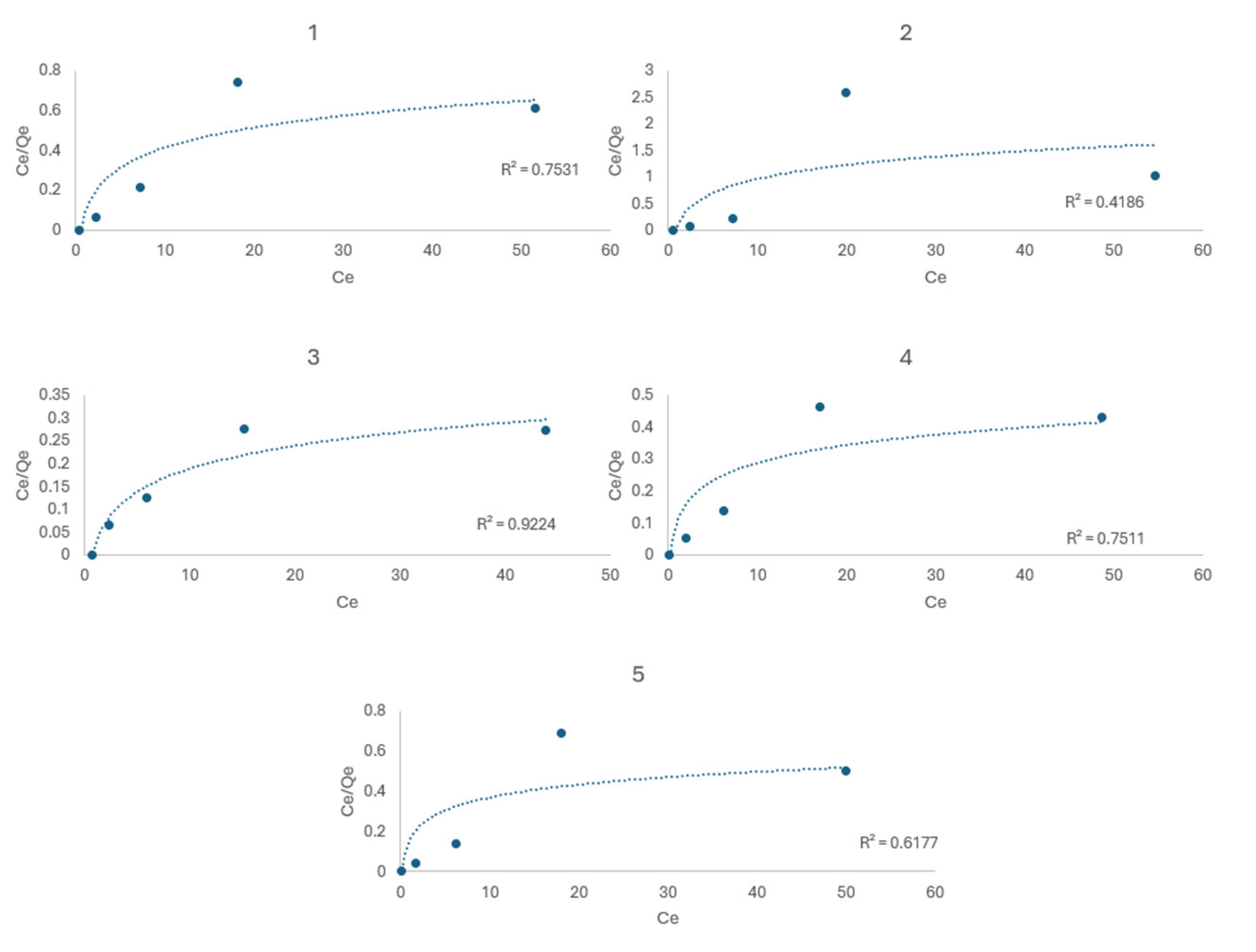

Table 1.
Descriptive soil properties.
| pH | EC | OM | Clay | Silt | Sand | ||
| (1:2.5) | (μS m-1) | (%) | (%) | (%) | (%) | ||
| 1 | 3.81 | 216 | 4.27 | 67.7 | 19.6 | 12.7 | |
| 2 | 4.21 | 167 | 1.01 | 37.4 | 34.2 | 28.4 | |
| 3 | 5.59 | 417 | 5.78 | 32.1 | 23.0 | 44.9 | |
| 4 | 4.02 | 124 | 2.42 | 45.7 | 26.9 | 27.4 | |
| 5 | 3.84 | 235 | 2.45 | 37.4 | 26.0 | 36.6 | |
| Ca | Mg | K | Na | CCE | |||
| (cmol kg-1) | (cmol kg-1) | (cmol kg-1) | (cmol kg-1) | (%) | |||
| 1 | 0.78 | 0.09 | 0.62 | 0.12 | 0.031 | ||
| 2 | 9.6 | 1.11 | 2.88 | 0.11 | 0.038 | ||
| 3 | 33.12 | 3.68 | 2.55 | 0.17 | 0.034 | ||
| 4 | 0.98 | 0.16 | 0.85 | 0.12 | 0.002 | ||
| 5 | 1.46 | 0.15 | 0.68 | 0.12 | 0.025 | ||
Table 2.
Langmuir adsorption isotherm parameters for boron in five acidic tea soils.
| 1 | 2 | 3 | 4 | 5 | |
| Qmax | 86.2 | 46.5 | 181.8 | 116.3 | 97.1 |
| KL | 0.1 | 0.1 | 0.1 | 0.1 | 0.1 |
| RL | 0.9 | 1.0 | 0.9 | 0.9 | 0.9 |
Table 3.
Boron desorption (%).
| B loading (mg kg-1) |
1 | 2 | 3 | 4 | 5 |
| 0 | 0.3 | 0.3 | 0.3 | 0.3 | 0.3 |
| 5 | 2.0 | 1.8 | 1.9 | 1.6 | 1.0 |
| 10 | 2.5 | 2.3 | 3.1 | 2.8 | 1.8 |
| 20 | 4.1 | 3.9 | 4.7 | 4.2 | 2.9 |
| 60 | 8.3 | 7.0 | 9.2 | 7.7 | 5.6 |
Table 4.
Performance metrics of machine learning models for predicting boron desorption.
| SVM | RF | XGBoost | ||||
| Train | Test | Train | Test | Train | Test | |
| Root mean square error (RMSE) | 0.635 | 0.73 | 0.446 | 0.639 | 0.167 | 0.629 |
| Mean absolute deviation (MAD) | 0.449 | 0.542 | 0.297 | 0.435 | 0.113 | 0.428 |
| Coefficient of determination (R2) | 0.938 | 0.911 | 0.97 | 0.931 | 0.979 | 0.963 |
| EN | GP | MARS | ||||
| Train | Test | Train | Test | Train | Test | |
| Root mean square error (RMSE) | 0.778 | 0.655 | 0.381 | 0.571 | 0.558 | 0.536 |
| Mean absolute deviation (MAD) | 0.577 | 0.514 | 0.259 | 0.413 | 0.379 | 0.426 |
| Coefficient of determination (R2) | 0.907 | 0.914 | 0.978 | 0.945 | 0.922 | 0.922 |
Disclaimer/Publisher’s Note: The statements, opinions and data contained in all publications are solely those of the individual author(s) and contributor(s) and not of MDPI and/or the editor(s). MDPI and/or the editor(s) disclaim responsibility for any injury to people or property resulting from any ideas, methods, instructions or products referred to in the content. |
© 2026 by the authors. Licensee MDPI, Basel, Switzerland. This article is an open access article distributed under the terms and conditions of the Creative Commons Attribution (CC BY) license (http://creativecommons.org/licenses/by/4.0/).
Copyright: This open access article is published under a Creative Commons CC BY 4.0 license, which permit the free download, distribution, and reuse, provided that the author and preprint are cited in any reuse.


