1. Introduction
Acorus tatarinowii is a perennial monocotyledonous plant and a traditional Chinese medicinal herb. Its application can be traced back to ancient pharmacopeias, having been first documented in Shennong Bencaojing (literally, Classic of the Materia Medica), where it was esteemed as a superior-grade herb with significant medicinal and ornamental value. In the classical text Xian Jing (or Immortal Classic), Acorus tatarinowii is described as the essence of aquatic grasses and the divine herb of immortals (Zhu et al. 2017). In China, it has been used for more than 2,000 years (Anonymous 1986) for its effects of opening orifices and resolving phlegm, arousing the mind and enhancing intelligence, and transforming dampness to stimulate appetite (Feng et al. 2025; Li et al. 2016; Shi et al. 2021; Yang et al. 2017; Wang et al. 2025; Zeng et al. 2014). Because of its unique pharmacological activities and extensive clinical applications, Acorus tatarinowii has attracted considerable attention for its role in maintaining human health. However, as a Category III medicinal plant, Acorus tatarinowii does not enjoy the large market demand of major herbals and is often overlooked. At present, wild harvesting remains its primary source of supply, yet harvested populations require a 4–5-year recovery period. In recent years, market demand for Acorus tatarinowii has remained high and increased annually. Yet, its seed germination rates are extremely low in both wild and cultivated settings, and low propagation efficiency directly constrains its development of large-scale artificial cultivation, ultimately affecting its yield and market stability. Propagation via rhizome cuttings, however, can rapidly generate a large number of seedlings.
In plant cutting propagation, commonly used rooting agents include indole-3-butyric acid potassium salt (IBA-K), 1-naphthaleneacetic acid (NAA), 3-indoleacetic acid (IAA), and gibberellic acid (GA3). The efficacy of these agents is closely related to the species’ inherent characteristics, growth environment, application method, and type of rooting (Ma et al. 2024; Wu et al. 2015). IBA at 1,500 mg·L-1 has been shown to significantly promote root growth and development in rose cuttings (Ma et al. 2024), and 1,000 ppm IBA yielded rooting rates of 82 % and 81 % in “Gisela 5” and “Gisela 6” rootstocks, respectively (Lu et al. 2024). Soaking Camellia sinensis softwood cuttings in GA3 or GA7 solutions has likewise been reported to enhance rooting (Zhou et al. 2025). Different concentrations of NAA have been found to promote rooting to varying degrees in Hydrangea macrophylla, Bougainvillea glabra, and climbing-type Rosa spp. cuttings (Du et al. 2024; Li et al. 2023; Wu et al. 2024), and NAA also increased both the number and length of roots in difficult-to-root Castanea crenata cuttings (Miyata et al. 2024). Hardwood cuttings of Crimson grape treated with 2,000 mg·L-1 IAA exhibited favorable rooting responses (Du et al. 2024). Collectively, these previous studies demonstrate that exogenous reagents can exert a positive effect on the rooting of plant cuttings.
To date, a search in CNKI using the keywords “Acorus tatarinowii” and “cutting” has revealed no relevant studies. In the course of supporting rural industry development, it was observed that, in China, Acorus tatarinowii seedlings are primarily obtained by wild harvesting or by division; its factory-level production remains minimal, and seedling quality is inconsistent, which severely impedes its large-scale cultivation. Therefore, investigations of asexual rhizome cutting propagation techniques for Acorus tatarinowii to improve its seedling quality carry important practical significance for its cultivation. In this study, rhizome cuttings were treated by dipping in exogenous reagent solutions of various types and concentrations, with the goal of enhancing the efficiency of Acorus tatarinowii rhizome cutting propagation, identifying the optimal rooting agent, and laying the foundation for an efficient propagation technology system.
2. Materials and Methods
2.1. Materials
The experiment was initiated in December 2024 at the central government-supported Garden Horticulture Training Base sponsored by Anqing Vocational and Technical College (N 30°32’18”, E 117°07’04”). Acorus tatarinowii rhizomes were collected from Mingtang Village, Yuexi County, Anqing City, and their identity was confirmed by both morphological and molecular analyses. During the rooting period, no fertilizer was applied. The cutting substrate consisted of sand and sheep manure (2:1, v/v) and was disinfected with Carbendazim at an 800-fold dilution.
Ultrapure water was obtained from a UPT-I-10T ultrapure water system. NAA (BR, 99%) and GA3 (BR, 98%) were purchased from Fuzhou Phygene Biotechnology Co., Ltd. IAA (BR, 99%) and IBA-K (BR, 98%) were obtained from Shanghai Macklin Biochemical Co., Ltd. Carbendazim (wettable powder; 50% active ingredient) was supplied by Zhongbao Green Agriculture Technology Group Co., Ltd., which is affiliated to the Institute of Plant Protection, Chinese Academy of Agricultural Sciences.
2.2. Experimental Design
The experimental design consisted of four rooting reagents, NAA, IAA, IBA-K, and GA3, each applied at five concentration levels (see
Table 1), plus a purified water control (CK), for a total of 21 treatments. Each treatment included 50 rhizome cuttings per replicate, with three replicates. Rhizome segments (each containing three nodes) were used as the experimental units. Both ends of each segment were cut to a flat surface, and all fibrous roots were removed. Segments were then immersed in the designated reagent solution for the prescribed duration, after which they were allowed to drain briefly. The treated segments were placed evenly on the surface of the sterilized cutting substrate, then covered with a thin layer of substrate. Subsequently, Carbendazim (1,000× dilution) was applied as a fungicidal spray. All trays were transferred into a small plastic tunnel equipped with heating cables; the air temperature was maintained at 25 °C. To prevent desiccation, distilled water was misted onto the substrate every three days.
2.3. Measurement Indicators and Methods
Seedling emergence was recorded at 30, 45, and 60 days after planting. At 60 days, root and shoot growth parameters were measured, including the number of fibrous roots, number of root tips, root length, rooting rate, plant height, number of leaves, and leaf width (second simple leaf).
For each treatment, five representative plants were randomly selected from each replicate. Seedlings were gently removed from their pots (inverted to retain substrate around the roots), and roots were carefully washed with tap water to remove all substrate. Excess surface moisture was blotted with paper towels. The number of fibrous roots and root tips was counted and recorded as fibrous root number and root tip number, respectively. Fibrous root length was measured with a ruler and recorded as root length. Plant height was measured from the root collar to the tip of the highest leaf using a ruler. The total number of leaves per plant was counted and recorded as leaf number. Leaf width was measured on the second simple leaf (measured at its widest point) with a ruler and recorded as leaf width. Rooting rate and emergence rate were calculated as follows:
Emergence rate = Number of emerged cuttings / Total number of cuttings × 100%
Rooting rate = Number of rooted cuttings / Total number of cuttings × 100 %
2.4. Data Analysis
Data were organized in Microsoft Excel. One-way analysis of variance (ANOVA) was performed using SPSS 26.0, and multiple comparisons were conducted by the least significant difference (LSD) test at the 0.05 and 0.01 probability levels. Pearson correlation analyses among morphological parameters were also carried out with SPSS.
3. Results
3.1. Effects of Different Concentrations of Exogenous Reagents on Emergence and Rooting Rates
Emergence rates of
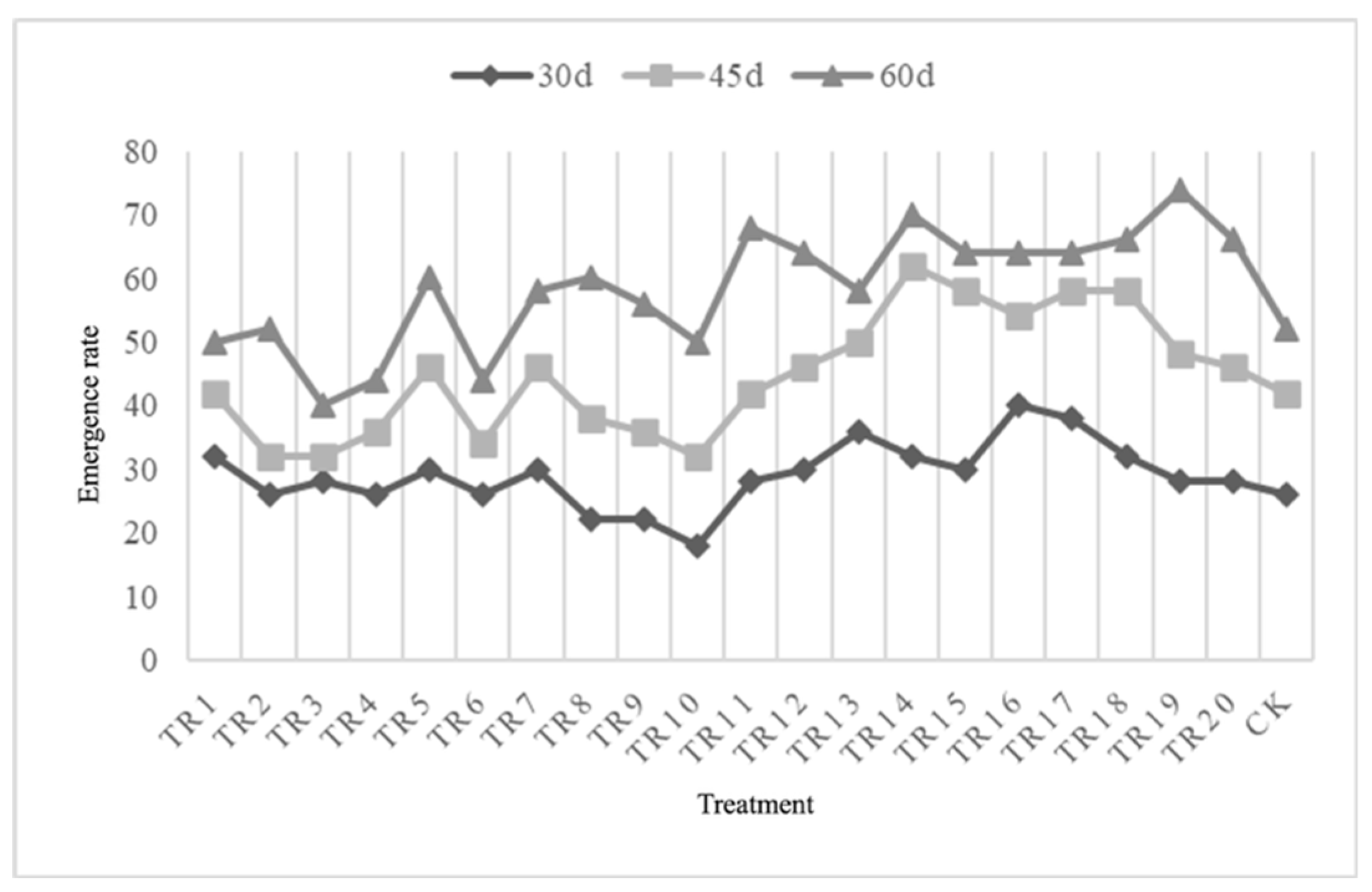
Acorus tatarinowii rhizome cuttings treated with different concentrations of exogenous reagents were recorded at 30, 45, and 60 days after planting. As shown in
Figure 1, all treatments influenced emergence to varying degrees. Tr19 and Tr14 produced the highest emergence rates, 74 % and 70 %, respectively, which were 22 % and 18 % higher than the control (CK). In contrast, Tr1, Tr3, Tr4, Tr8, and Tr10 yielded emergence rates lower than CK. All other treatments exceeded CK in emergence rate. From day 45 to day 60, treatments Tr2, Tr8, Tr9, Tr10,Tr11, Tr12, and Tr19 had a more pronounced effect on emergence, whereas Tr14, Tr15, Tr16, Tr17, and Tr18 exhibited faster emergence between day 30 and day 45.
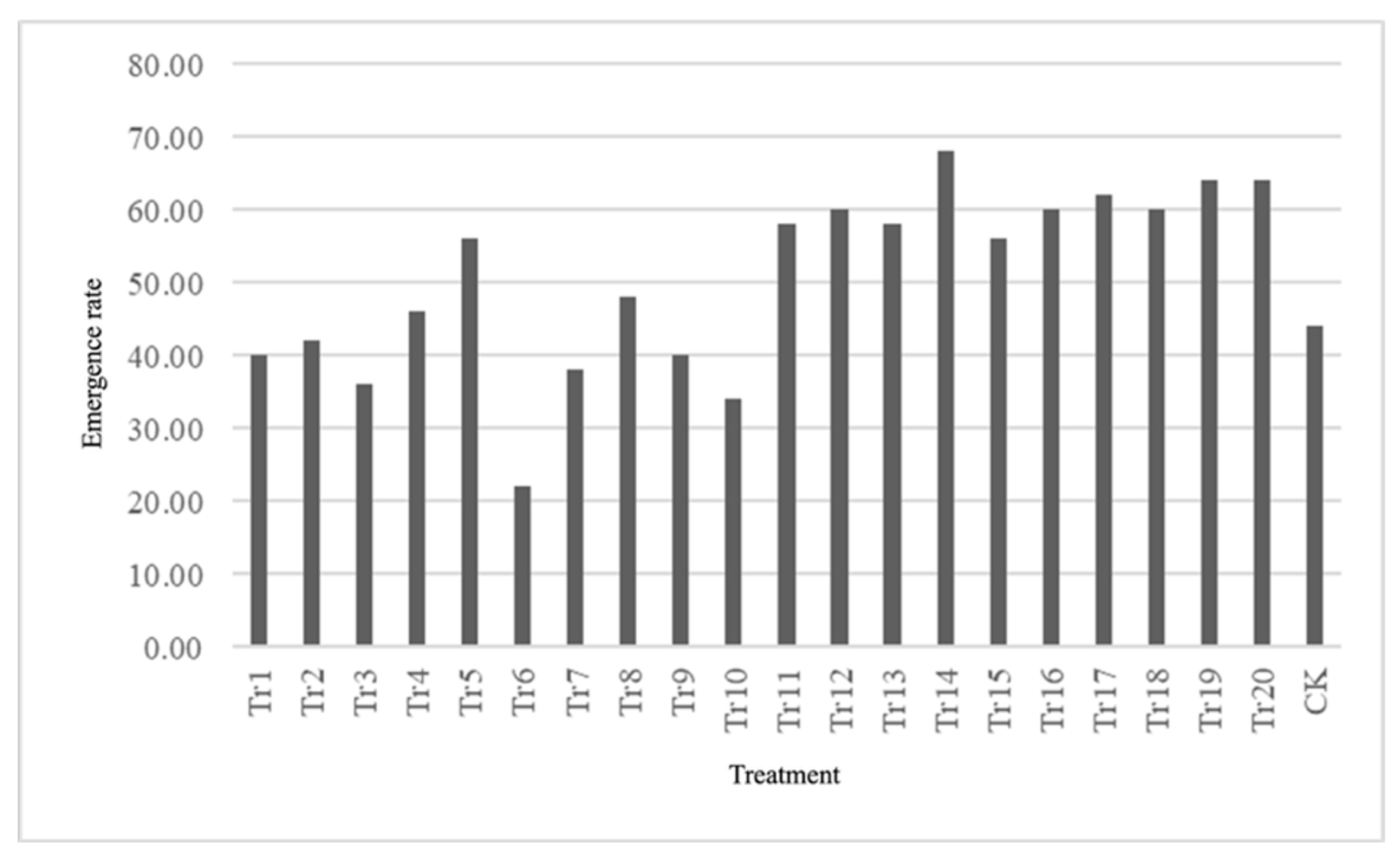
According to
Figure 2, different concentrations of exogenous reagents affected the root development of
Acorus tatarinowii rhizome cuttings to varying degrees. Treatment Tr14 exhibited the highest rooting rate (68 %). Treatments Tr17, Tr19, and Tr20 also achieved rooting rates exceeding 60 %, substantially higher than the control (44 %). Tr5, Tr11, Tr12, Tr13, Tr15, Tr16, and Tr18 produced rooting rates between 50 % and 60 %, all clearly superior to CK. Treatments Tr2, Tr4, and Tr8 performed comparably to the control. In contrast, Tr3, Tr6, and Tr10 yielded rooting rates below CK, with Tr6 demonstrating the poorest performance.
3.2. Effects of Different Concentrations of Exogenous Reagents on Root Traits
As shown in
Table 2, all exogenous reagent treatments influenced the underground root traits of
Acorus tatarinowii cuttings to varying degrees. The effect on fibrous root number ranked as follows: Tr14 > Tr11 > Tr12 > Tr15 > Tr13 > Tr5 > Tr2 > Tr4 > Tr1 > Tr19 > Tr17 > Tr16 > Tr20 > CK > Tr18 > Tr3 > Tr9 > Tr10 > Tr8 > Tr7 > Tr6. Treatments Tr14, Tr11, Tr12, Tr15, Tr13, and Tr5 produced the greatest increase in fibrous root number. Similarly, the ranking for root tip number was: Tr14 > Tr11 > Tr12 > Tr13 > Tr15 > Tr5 > Tr2 > Tr4 > Tr3 > CK > Tr20 > Tr1 > Tr16 > Tr17 > Tr19 > Tr18 > Tr10 > Tr9 > Tr8 > Tr7 > Tr6. This trend closely mirrored that of fibrous root number; Pearson correlation between fibrous root number and root tip number was 0.74 (
p < 0.01), indicating a moderate positive correlation. For root length, the treatments ranked as: Tr11 > Tr14 > Tr12 > Tr13 > Tr15 > Tr5 > Tr2 > Tr4 > Tr3 > CK > Tr20 > Tr1 > Tr16 > Tr17 > Tr19 > Tr18 > Tr10 > Tr9 > Tr7 > Tr8 > Tr6. Treatment Tr11 differed significantly from all other treatments (
p < 0.05).
3.3. Effects of Different Concentrations of Exogenous Reagents on Shoot Growth
As shown in
Table 3, all exogenous reagent treatments influenced aboveground traits of
Acorus tatarinowii cuttings to varying degrees. For plant height, the mean values ranked as follows: Tr12 > Tr13 > Tr2 > Tr5 > Tr11 > Tr14 > Tr15 > Tr6 > Tr8 > Tr20 > Tr19 > Tr18 > Tr16 > Tr1 > Tr4 > Tr10 > CK > Tr3 > Tr17 > Tr7 > Tr9; treatments Tr12, Tr13, Tr2, and Tr5 produced the tallest plants. For leaf number, the ranking of mean values was: Tr14 > Tr2 > Tr4 > Tr1 > Tr17 > Tr13 > Tr16 > Tr20 > Tr5 > Tr11 > Tr18 > Tr12 > Tr15 > Tr8 > Tr19 > Tr6 > Tr3 > Tr9 > Tr7 > Tr10 > CK; treatments Tr14 and Tr2 generated the greatest number of leaves, and all treatments exceeded CK in leaf number. For leaf width (second simple leaf), the mean values ranked as: Tr16 > Tr17 > Tr20 > Tr6 > Tr18 > Tr5 > Tr11 > Tr13 > Tr4 > Tr8 > Tr12 > Tr9 > Tr1 > Tr15 > Tr10 > Tr19 > Tr14 > CK > Tr7 > Tr2 > Tr3; treatment Tr16 exhibited the widest second simple leaf, followed by Tr17, Tr20, Tr6, and Tr18.
3.4. Correlation Analysis of Morphological Traits of Acorus tatarinowii Cutting Seedlings
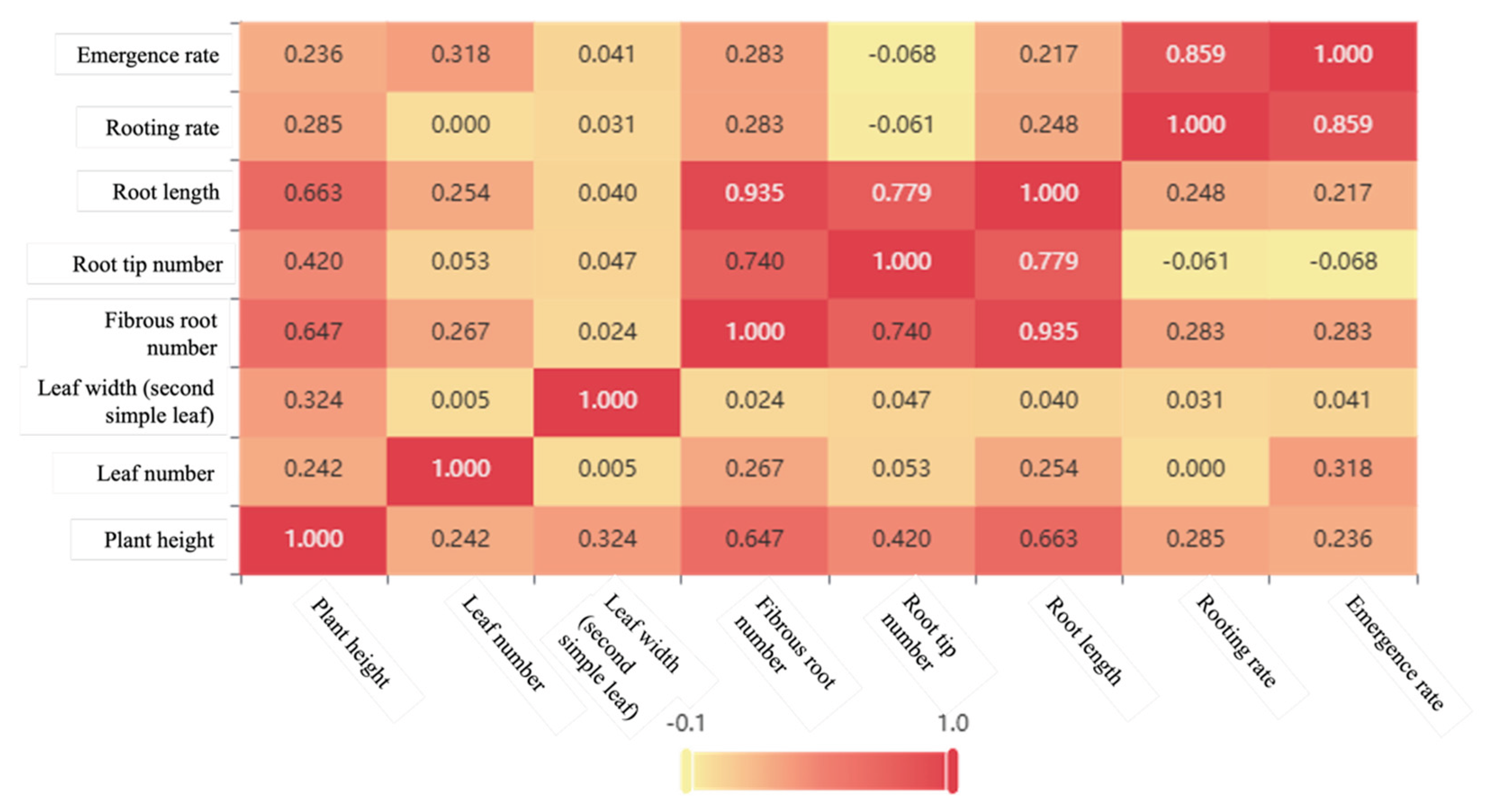
Correlation coefficients among measured parameters are presented in
Table 4. The number of fibrous roots and root length exhibited a very strong positive correlation (
r = 0.935,
p < 0.01). Similarly, root tip number and root length were strongly positively correlated (
r = 0.779,
p < 0.01). Rooting rate and emergence rate also showed a strong positive relationship (
r = 0.859,
p < 0.01). Plant height correlated moderately with fibrous root number (
r = 0.647,
p < 0.01) and with root length (
r = 0.663,
p < 0.01). Fibrous root number and root tip number were moderately positively correlated as well (
r = 0.740,
p < 0.01). In contrast, plant height and leaf width were not significantly correlated (
r = 0.324,
p = 0.152), indicating a weak relationship. Plant height and root tip number had a low but significant positive correlation (
r = 0.420,
p < 0.05). Leaf number showed a weak and nonsignificant correlation with fibrous root number (
r = 0.267,
p = 0.243).
Overall, leaf number, leaf width (second simple leaf), fibrous root number, root tip number, and root length were closely interrelated. Rooting rate and emergence rate also shared a strong positive correlation. Plant height was moderately correlated with fibrous root number and root length, whereas other pairwise relationships among the remaining traits were relatively weak.
Figure 3.
Heatmap of correlation coefficients among morphological traits of Acorus tatarinowii cutting seedlings.
Figure 3.
Heatmap of correlation coefficients among morphological traits of Acorus tatarinowii cutting seedlings.
4. Discussion
The formation of adventitious roots is a critical criterion for evaluating the success of cutting propagation. Treatments with exogenous reagents can influence the distribution of nutrients within cuttings (Shao et al. 2018; Zhang et al. 2025), thereby promoting callus formation, the initiation of root primordia, and subsequent rooting. Based on preliminary trials, this study confirmed that Acorus tatarinowii can be propagated by rhizome cuttings with a measurable survival rate. By immersing rhizomes in solutions of four different exogenous reagents, namely, IBA-K, NAA, IAA, and GA3, at various concentrations, positive effects were observed compared with the control. This enabled the identification of optimal reagents and concentrations for rooting. Among them, Tr19 (IBA-K 100 mg·L⁻¹) yielded the highest emergence rate (74%), followed by Tr14 (IAA 100 mg·L-1) with 68%. Rooting performance was best under Tr14 (IAA 100 mg·L-1), reaching 68 %. IBA-K, a promotive plant growth regulator, is more stable in its potassium salt form and more readily absorbed by plants. It effectively stimulates the sprouting and outgrowth of latent buds on rhizomes, enhances antioxidant enzyme activity in roots (Liu et al. 2022), and regulates osmotic substance levels. It has also been reported to promote the development of root systems and seedling growth in maize (Hua et al. 2025; Jiao et al 2025) and rice (Qi et al. 2019). IAA, the principal endogenous auxin, when applied exogenously, directly regulates the induction of root primordia and the formation and elongation of roots (Casanova-Sáez et al. 2021). In this study, IAA at 100 mg·L-1 exhibited the strongest rooting activity, outperformed other IAA concentrations, and demonstrated a pronounced concentration-dependent effect in promoting root development.
Tr12 (IAA 20 mg·L-1) exerted the greatest effect on plant height, producing seedlings up to 27.2 cm tall, followed by Tr13 (IAA 50 mg·L-1) with 24.39 cm. Low concentrations of IAA may favor cell elongation, thereby contributing to increased plant height, which is consistent with the findings of Niu et al. (2024), who reported that IAA promoted height growth in tobacco. Treatments Tr14 (IAA 100 mg·L-1) and Tr2 (GA3 100 mg·L-1) produced the highest number of leaves, with mean values of 7.07 and 6.53, respectively. This may be related to the ability of IAA at appropriate concentrations to activate meristematic tissues (Zhuhai Modern Agriculture Development Center, 2013) and promote axillary bud development or leaf differentiation. GA3, a growth hormone known to stimulate both cell division and elongation, increased the number of leaves in Acorus tatarinowii cuttings, in agreement with its well-documented role in promoting vegetative growth. Treatment Tr16 (IBA-K 10 mg·L-1) resulted in the widest second simple leaf (0.61 cm). Low concentrations of IBA-K likely promoted cell enlargement and facilitated lateral expansion of leaves, in contrast to higher concentrations that mainly favor bud initiation. This observation highlights the strong concentration-dependent nature of auxin activity. The four exogenous reagents showed generally similar effects on fibrous root number, root tip number, and root length, with Tr11 (IAA 10 mg·L-1) and Tr14 (IAA 100 mg·L-1) performing best. These results demonstrate that auxin-type substances play a crucial role in regulating root morphogenesis (Liu et al. 2023; Xu 2024; Xuan et al. 2024). The coordinated increase in fibrous root number, root tip number, and root length is essential for successful transplanting and subsequent growth of cuttings.
With respect to correlations among morphological traits, leaves are the principal organs of photosynthesis, and their growth and development provide essential assimilates for root construction. A well-developed root system, in turn, efficiently absorbs water and nutrients, thereby supporting the expansion and functionality of aboveground leaves. In Acorus tatarinowii cuttings, leaf number, leaf width (second simple leaf), fibrous root number, root tip number, and root length were strongly correlated, indicating that indicators of aboveground vegetative growth and belowground absorptive organs vary in a coordinated manner and together contribute to the overall growth potential of the seedlings. Rooting rate and emergence rate were also strongly correlated, suggesting that successful root establishment is a fundamental prerequisite for shoot sprouting and subsequent growth. The strong correlations observed among these morphological traits reflect the dynamic balance of internal resource allocation within the plant, serving as an important manifestation of overall vigor and growth robustness.
5. Conclusions
Different exogenous reagents influenced the cutting propagation of Acorus tatarinowii to varying degrees. Treatment Tr19 (IBA-K 100 mg·L-1) produced the highest emergence rate (74%), while Tr14 (IAA 100 mg·L-1) achieved the best rooting rate (68%). Tr12 (IAA 20 mg·L-1) significantly increased plant height, reaching 27.2 cm. Treatments Tr14 (IAA 100 mg·L-1) and Tr2 (GA3 100 mg·L-1) produced the greatest number of leaves, averaging 7.07 and 6.53 per plant, respectively. The widest second simple leaf (0.61 cm) was observed in Tr16 (IBA-K 10 mg·L-1). All four reagents showed similar effects on fibrous root number, root tip number, and root length, with growth traits clearly superior to the control; the best performance was observed under Tr11 (IAA 10 mg·L-1) and Tr14 (IAA 100 mg·L-1). Strong correlations were found among leaf number, leaf width (second simple leaf), fibrous root number, root tip number, and root length, and between rooting rate and emergence rate. These findings provide important implications for improving emergence rate, rooting rate, and subsequent growth performance in Acorus tatarinowii cutting propagation.
Based on the results of this study, for large-scale propagation of Acorus tatarinowii via rhizome cuttings, it is recommended to prioritize rhizome soaking treatments with IAA at 10–200 mg·L-1, GA3 at 400 mg·L-1, and IBA-K at 100 mg·L-1. These treatments can effectively enhance cutting survival rate, uniformity of emergence, plant height, number of leaves, number of fibrous roots, and number of root tips compared to the control. Overall, cuttings treated with these reagents exhibited superior morphological performance, thereby enabling rapid production of large quantities of Acorus tatarinowii seedlings through rhizome propagation and promoting the development of its large-scale cultivation.
To enhance commercial nursery propagation techniques for Acorus tatarinowii, future research could investigate the synergistic effects of IBA-K, IAA, NAA, and GA3 combined with other growth regulators, aiming to develop multi-objective optimized compound formulations that improve emergence rate, root biomass, and stress resistance. Moreover, integrating transcriptomic analyses with hormone signaling pathway studies will elucidate the molecular mechanisms by which exogenous reagents (e.g., IBA-K, IAA, NAA, GA3) regulate rooting and emergence in cuttings, and identify key genes that underlie such processes, such as auxin response factors (ARF) and gibberellin metabolic enzyme genes.
Funding
This work was supported by the projects of the Natural Science Foundation of the Colleges and Universities in Anhui Province (No. 2024 AH051151, 2023AH053079, 2024AH040182).
Conflicts of Interest/Competing interests
The authors declare no conflict of interest.
Consent for publication
Written informed consent for publication of this study’s findings was obtained from all participants.
Data availability
The data supporting this study are available from the corresponding author upon reasonable request.
Materials availability
The materials used in this study are available from the authors.
References
- Anonymous Sanfu Huangtu [Facsimile of Wenyuan Ge Siku Quanshu. Taiwan Commercial Press; Taipei, 1986; vol. 468.
- Casanova-Sáez, R; Mateo-Bonmatí, E; Ljung, K. Auxin metabolism in plants. Cold Spring Harb Perspect Biol a039867 2021. [Google Scholar] [CrossRef] [PubMed]
- Du, X; Zhang, L; Lu, Y; Yuan, Z; Wen, Z. Effects of NAA pretreatment on rooting of Bougainvillea glabra cuttings in hydroponic and substrate culture. Trop Agric Sci 2024, 44(06), 43–47. [Google Scholar]
- Feng, P; Wang, M; Wang, Y; Xu, X; Li, C; Chen, Y; Wei, X; Sun, K; He, Y; Shang, J. Research progress on chemical constituents and pharmacological actions of volatile oil from Acorus tatarinowii. Chin J Trop Agric Sci Technol. 2025, pp. 1–22, Online.
- Hua, Q; Kong, D; Zhou, C. Effects of exogenous IAA and ZT spraying on seedling biomass and allosteric growth of decapitation Pinus yunnanensis. J West For Sci 2025, 54(02), 50–57. [Google Scholar] [CrossRef]
- Jiao, F; Hao, X; Wang, J; Bian, J; Wang, Z; Chen, M; Wen, J; Wang, F. The influence of exogenous melatonin, potassium indolebutyrate, and γ-aminobutyric acid on the germination and physiological traits of aging maize seeds. Acta Agrestia Sinica. 2025, pp. 1–15. Available online: http://kns.cnki.net/kcms/detail/11.3362.S.20250408.1355.008.html.
- Li, H; Shi, R; Han, W; Wang, H; Ding, F; Huang, Z. Recent progress in pharmacological effects and related mechanisms of medicinal herb Acorus tatarinowii. Lishizhen Med Mater Med Res 2016, 27(11), 2728–2730. [Google Scholar]
- Li, N; Deng, L; Xi, J. Effects of different concentrations of NAA on cutting propagation of four climbing roses. In Proceedings of the 2023 Annual Academic Conference of China Botanical Gardens; Chinese Botanical Society, Chinese Wild Plant Conservation Association, Chinese Park Association, China Biodiversity Conservation and Green Development Foundation, China Botanical Garden Joint Conservation Program. Beijing Botanical Garden Administration & Beijing Flower Horticulture Engineering Technology Research Center, 2023; pp. pp 125–128. [Google Scholar] [CrossRef]
- Liu, M; Feng, N; Zheng, D; Feng, S; Wang, S; Xiang, H. Effects of potassium indole butyrate on root morphogenesis and physiological metabolism of soybean under different soil water conditions. Chin J Oil Crop Sci 2022, 44(03), 621–631. [Google Scholar] [CrossRef]
- Liu, M; Jin, R; Zhao, P; Zhang, Q; Zhu, X; Wang, J; Yu, Y; Tang, Z. Effects of exogenous auxin on root response to low potassium stress in sweet potato. J Jiangsu Normal Univ Nat Sci Ed 2023, 41(02), 29–34. [Google Scholar]
- Lu, X; Feng, Y; Dou, Z. Effects of hormones, light and cutting leaves on rooting of six cherry rootstocks. Acta Hortic 2024, 1408, 447–454. [Google Scholar] [CrossRef]
- Ma, L; Cao, T; Fan, Y; Ren, Z; Liu, C; Yuan, S. Effects of different rooting reagents on rooting of miniature potted rose cuttings. J Agric Sci Technol 2024, 26(07), 50–60. [Google Scholar] [CrossRef]
- Miyata, K; Sato, T; Honsho, C. Rooting of softwood cuttings of ‘Porotan’ Japanese chestnut. Acta Hortic 2024, 1404, 1059–1066. [Google Scholar] [CrossRef]
- Niu, M; Miao, P; Wang, H; Li, W; Jiang, S; Zhou, Y; Li, J; Cui, J. Effects of plant growth regulators on seed germination and stress resistance of tobacco seedlings. Zhejiang Agric Sci 2024, 1–11, [Online 2025-06-08]. [Google Scholar]
- Qi, D; Feng, N; Zheng, D; Liang, X. Effects of different seedling-strengthening agents on growth and physiological characteristics of rice seedlings. J Nucl Agric 2019, 33(08), 1611–1621. [Google Scholar]
- Qin, Y; Dong, C; Yang, WY. Effects of three kinds of growth regulators on hardwood cutting of Crimson seedless. J Fruit Tree Res 2025, 6(01), 21–24. [Google Scholar] [CrossRef]
- Shao, F; Wang, S; Huang, W; Liu, Z. Effects of IBA on the rooting of branch cuttings of Chinese jujube (Zizyphus jujuba Mill.) and changes to nutrients and endogenous hormones. J For Res 2018, 29(06), 1557–1567. [Google Scholar] [CrossRef]
- Shi, J; Ji, L; Luo, Q; Yu, H; Huang, S; Li, C. Advances in chemical constituents, pharmacological actions, and quality marker prediction analysis of Acorus tatarinowii. Chin Tradit Patent Med 2021, 43(05), 1286–1290. [Google Scholar]
- Wang, H; Gao, L; Zhang, J; Zhong, L; Jin, S; Chen, X; Zhang, W; Wen, J. Research progress on pharmacological effects and mechanism of α-asarone and β-asarone in Acori Tatarinowii Rhizoma. China J Chin Mater Med. 2025, pp. 1–14.
- Wu, W; Liu, B; Zhang, Y; Wang, J; Qin, F; Gao, Q; Zhang, X; Liu, G; Ge, W; Jia, S. Effects of different concentrations of NAA and IBA on cutting seedling raising of Hydrangea macrophylla Endless Summer. J Anhui Sci Technol Univ 2024, 38(05), 15–20. [Google Scholar] [CrossRef]
- Wu, Y; Leng, Y; Xia, C; Zhou, S; Lan, H. Comparative analysis of endogenous hormones in maize seeds with different dormancy characteristics. Acta Pratac Sin 2015, 24(12), 213–219. [Google Scholar]
- Xu, J. Effects of auxin treatment on growth and development of strawberry plants. MS thesis, Shenyang Agricultural University, 2024. [Google Scholar] [CrossRef]
- Xuan, L; Li, J; Jiang, Y; Shi, M; Zhu, Y; Bao, X; Gong, Q; Xue, H; Yu, H; Liu, L. MCTP controls nucleocytoplasmic partitioning of auxin response factors during lateral root development. Dev Cell 2024, 59(24), 3229–3244.e5. [Google Scholar] [CrossRef] [PubMed]
- Yang, X; Deng, A; Wang, Y; Liu, Y; Wang, D. Research progress on chemical constituents and pharmacological actions of Acorus tatarinowii. Inner Mong J Tradit Chin Med 2017, 36(19), 132–133. [Google Scholar] [CrossRef]
- Zeng, L; Lu, M; Zhen, H. Research progress on pharmacological effects of Acorus tatarinowii on the central nervous system and its chemical constituents. Light Ind Sci Technol 2014, 30(04), 29–30, 41. [Google Scholar]
- Zhang, P; Lü, Y; Zhang, R; Wang, H; Lü, J. The effect of exogenous hormones on rooting and physiological-biochemical characteristics of softwood cuttings from Elaeagnus angustifolia. J Northeast For Univ 2025, 53(04), 79–87. [Google Scholar] [CrossRef]
- Zhou, C; Wang, K; Song, D; Wang, H; Fang, F; Li, J; Sun, X; Ding, S. Effects of different gibberellins and soaking durations on rooting of tea shoot apex cuttings. J Northwest A&F Univ Nat Sci 2025, Ed (06), 1–9, Online. [Google Scholar]
- Zhu, Q; Zhou, S; Zhang, D; Li, Y; Yang, J; Zhu, Z. The interpretation of Materia Medica of Shennong’s Classic of Materia Medica - Cannabis Sativa. Chin Med Mod Dist Educ China 2017, 15(23), 75–77. [Google Scholar]
- Zhuhai Modern Agriculture Development Center. Mycobacterium with the function of secreting indole-3-acetic acid (IAA), its preparation method and application: CN 201210368480.8. 2013. [Google Scholar]
|
Disclaimer/Publisher’s Note: The statements, opinions and data contained in all publications are solely those of the individual author(s) and contributor(s) and not of MDPI and/or the editor(s). MDPI and/or the editor(s) disclaim responsibility for any injury to people or property resulting from any ideas, methods, instructions or products referred to in the content. |
© 2026 by the authors. Licensee MDPI, Basel, Switzerland. This article is an open access article distributed under the terms and conditions of the Creative Commons Attribution (CC BY) license (http://creativecommons.org/licenses/by/4.0/).