

Submitted:
21 January 2026
Posted:
23 January 2026
You are already at the latest version
Abstract
Background/Objectives: Sichuan Mandarin is often described as exhibiting overlap or merger between word-initial /n/ and /l/, but perceptual sensitivity across phonetic contexts remains underexplored. This study examines whether perception of the /n–l/ contrast varies by vowel context and listener experience. Methods: Thirty-two Sichuan Mandarin listeners completed categorical identification and same–different AX discrimination tasks using seven-step /n/→/l/ continua derived from native-speaker productions in /i/ and /a/ contexts. Sensitivity, response bias, accuracy, and response times were analyzed alongside individual differences. Acoustic properties of the stimuli were quantified using spectral and amplitude-based measures. Results: Listeners showed overall reduced sensitivity to the /n–l/ contrast, with substantially stronger perceptual differentiation in /i/ than /a/ context. Bias patterns were comparable across contexts, indicating sensitivity-driven effects. Acoustic analyses showed more robust cue structure in the /i/ continuum. Age, education, and Standard Mandarin experience modulated response efficiency but did not eliminate the vowel asymmetry. Conclusions: Results support a context-dependent near-merger of /n/ and /l/, shaped by acoustic cue availability and experience-based cue exploitation.
Keywords:
Sichuan Mandarin
; /n-l/
; speech perception
; vowel context effects
; acoustic cue availability
; near-merger
1. Introduction
Phonological mergers arise when a distinction between two or more phonological categories is reduced or neutralized, often following extensive overlap in their phonetic realizations [1]. The merger or alternation of word-initial nasal /n/ and lateral /l/ consonants has been documented in several Chinese languages and dialects, including Fuzhou Min [2], Cantonese [3], Nanjing Mandarin [4], Wuhan Mandarin [5], and Sichuan Mandarin [6]. While production data from these varieties demonstrate substantial overlap between /n/ and /l/, an open question is whether such patterns reflect complete phonological merger or intermediate states in which perceptual distinctions persist under specific phonetic or sociolinguistic conditions.
This question is particularly pertinent for speakers of regional Mandarin varieties who are also exposed to Standard Mandarin (Putonghua), where /n/ and /l/ remain phonemically distinct [2,3]. Exposure to Standard Mandarin introduces a stable contrast that may coexist with merger-like patterns in the regional variety, potentially yielding competing perceptual representations of the same segmental contrast. Sichuan Mandarin, a Southwestern Mandarin variety spoken by over 270 million speakers [6], therefore provides an informative testing ground for examining how dialectal variation and language contact shape perceptual representations of phonological contrast.
The present study investigates the perceptual differentiation of the /n–l/ contrast in Sichuan Mandarin using same–different AX discrimination and forced-choice identification tasks. Listeners’ sensitivity to the contrast was examined across vowel contexts and as a function of social factors, including age, gender, education, and Standard Mandarin proficiency and use. Additionally, we analyze perceptual judgments in relation to the acoustic structure of the stimuli, allowing assessment of whether /n–l/ alternation in Sichuan Mandarin patterns as a context-dependent near-merger, how gradient the perceptual representations are, and how sociolinguistic experience shapes contrast stability. The results speak to broader accounts of sound change by highlighting how phonetic context and language experience jointly constrain perceptual contrast maintenance.
2. Background
2.1. /n/ and /l/ Alternations in Sichuan Mandarin
Sichuan Mandarin, also known as Sichuan Dialect, is a branch of Southwestern Mandarin spoken primarily in Sichuan and Chongqing and adjacent regions [7]. A widely noted characteristic of Sichuan Mandarin concerns the phonemic status of the coronal sonorant consonants /n/ and /l/. Descriptive accounts have long reported alternations between these segments in word-initial position, raising questions about whether they reflect free phonetic variation [8,9], directional neutralization [10], or a broader process of phonological merger [6,11]. Importantly, Sichuan Mandarin shares the same syllable structure as Standard Mandarin, in which /n/ and /l/ are phonemically distinct. Because Standard Mandarin serves as the medium of instruction throughout Sichuan Province, speakers are extensively exposed to a system that maintains a robust /n–l/ contrast. This sociolinguistic context makes Sichuan Mandarin a particularly informative case for examining how dialectal phonological patterns interact with perceptual representations of contrast, and whether reported /n–l/ alternations correspond to categorical merger or to context-dependent, gradient reorganization of phonetic cues.
Despite long-standing descriptive attention, there remains debate regarding the phonemic status of /n/ and /l/ in Sichuan Mandarin and the nature of their surface realizations. Early descriptive work suggested that syllable-initial /n/ may surface as an alveolar nasal [n], an alveolar lateral approximant [l], or a nasalized lateral approximant [l̃] [8]. Subsequent studies described variation primarily between [n] and [l] [9,12], with evidence further suggesting that tokens transcribed as [n] may in fact involve lateral airflow with nasalization [12]. The precise phonetic nature and distribution of these realizations remain unsettled, in part due to the limited availability of systematic acoustic or articulatory evidence.
Several studies have attempted to identify phonological or phonetic conditioning factors underlying the /n–l/ alternation. The Dialect Investigation Group [8] reported that [n] occurred more frequently before high front vowels such as /i/ and /y/, whereas [n], [l], and [l̃] appeared to be in free variation before other vowels. In contrast, Ma and Tan [9] described [n] and [l] as freely varying without specifying clear conditioning environments, and the status of the nasalized lateral approximant [l̃] was not systematically examined. These divergent accounts leave unresolved whether vowel context plays a consistent or robust role in shaping the /n–l/ pattern in Sichuan Mandarin.
Phonetic studies have likewise yielded mixed results. Shi [11] reported that both [n] and [l] produced by Chengdu speakers—a representative variety of Sichuan Mandarin—exhibited relatively high degrees of nasality, with nasalance values of approximately 93.5% for [n] and 61% for [l], and found no reliable effect of vowel quality. In contrast, a study of Beijing Mandarin—a variety that maintains a robust /n–l/ contrast—reported a large nasality difference between [n] (typically above 90%) and [l] (approximately 20–40%) [13]. Taken together, these findings point to substantial phonetic overlap between realizations associated with /n/ and /l/ in Sichuan Mandarin, but they do not establish whether this overlap reflects free phonetic variation, a directional merger, or a phonological merger with residual phonetic structure.
Evidence for a directional or incomplete merger has been proposed on the basis of limited production data. In a single-case study of one Sichuan Mandarin speaker, Zhang [10] argued that the alternation reflects a one-way merger in which syllable-initial /n/ may be realized as [l], but not vice versa. However, the narrow empirical basis of this claim leaves its generality uncertain.
Zhang and Levis [6] further examined /n–l/ production by Southwestern Mandarin speakers in Standard Mandarin (L2) and English (L3). Although their study did not directly investigate L1 production, the results demonstrated persistent effects of speakers’ native phonological inventories on production in both additional languages. These findings suggest that merger-like patterns in Southwestern Mandarin are robust and not fully overridden by exposure to Standard Mandarin. At the same time, variability across speakers and contexts was observed, consistent with an incomplete or gradient merger rather than categorical contrast maintenance.
2.2. The Merger Between [l] and [n] in Other Chinese Languages
The /n–l/ merger is not unique to Sichuan Mandarin and has been documented in several other Chinese languages, providing useful comparative perspectives on the range of merger outcomes and the conditions under which perceptual sensitivity may be retained. One well-documented case comes from Fuzhou Min. Cheng et al. [2] reported converging production and perception evidence for a near-complete phonological merger of word-initial /n/ and /l/. Although speakers produced acoustically differentiated variants, listeners failed to reliably distinguish the two sounds, indicating a dissociation between production and perception. Importantly, younger Fuzhou Min listeners showed greater sensitivity to the contrast than older listeners, a pattern attributed to increased exposure to Standard Mandarin, which reintroduces the /n–l/ distinction into the linguistic environment.
Hong Kong Cantonese (HKC) presents a different developmental trajectory. In HKC, /l/ and /n/ have been described as occurring in complementary distribution, with [l] appearing in onset position and [n] in coda position [14]. However, this distribution has been progressively eroded by an ongoing merger, particularly among younger speakers [15,16]. Despite substantial overlap in production, Cantonese speakers retain some perceptual sensitivity to the /n–l/ distinction, indicating that the merger remains incomplete [17]. Taken together, evidence from Fuzhou Min and Hong Kong Cantonese demonstrates that /n–l/ mergers in Chinese languages vary in completeness and that sociolinguistic factors—most notably exposure to Standard Mandarin—can constrain their perceptual consequences.
In addition to cross-dialectal merger patterns, perceptual work on Standard Mandarin provides an important baseline for understanding vowel-context effects on the /n–l/ contrast in a non-merged system. Using speeded AX discrimination, Liu and Li [18] demonstrated that the /n–l/ contrast is perceptually more distinct in the low vowel context /a/ than in the high vowel context /i/, a pattern consistent with typological tendencies observed across Chinese dialects. More generally, research on nasality perception has shown that perceived nasalization depends on the interaction of multiple acoustic cues—particularly in the F1 region—and that large acoustic differences do not necessarily translate into proportional perceptual distinctiveness across vowel contexts [19].
Despite longstanding descriptive accounts of /n–l/ alternation in Sichuan Mandarin, relatively little is known about how this pattern is reflected in perception, particularly across phonetic contexts. Given the variability observed across Chinese languages and the documented role of Standard Mandarin exposure in shaping merger outcomes elsewhere, a perceptual investigation is necessary to determine whether residual sensitivity to the /n–l/ distinction persists in Sichuan Mandarin and whether such sensitivity is context-dependent. The present study addresses this gap by examining the perceptual discrimination of /n/ and /l/ across vowel contexts, informed by detailed acoustic analysis of the stimuli.
3. This Present Study
Using a combination of same–different AX discrimination and forced-choice identification tasks, the present study examines Sichuan Mandarin listeners’ sensitivity to the /n–l/ distinction across vowel contexts. In the identification task, we deliberately avoided the use of Chinese characters—unlike [2]—and instead employed picture-based responses to minimize potential orthographic and lexical biases. Although Chinese characters do not transparently encode segmental phonological form, they are strongly associated with conventionalized lexical pronunciations, particularly those of Standard Mandarin. Psycholinguistic research has shown that orthographic representations can be automatically activated during spoken-word recognition, biasing listeners toward top-down lexical expectations rather than fine-grained acoustic information [20]. In Chinese, character recognition reliably engages phonological representations despite the absence of systematic grapheme–phoneme correspondence, and these phonological activations are closely tied to standardized lexical pronunciations [21]. As a result, character-based response formats may encourage reliance on canonical lexical forms, potentially obscuring listeners’ sensitivity to gradient acoustic cues—especially for speakers of regional varieties whose phonological systems do not robustly maintain the Standard Mandarin /n–l/ contrast. Importantly, the use of picture-based responses does not assume intact phonological contrast or collapsed lexical representations. Even in systems exhibiting phonological merger or near-merger, speakers maintain distinct lexical entries for words historically containing /n/ versus /l/; perceptual difficulty arises from mapping acoustically ambiguous input onto these lexical categories rather than from the absence of lexical knowledge.
The study addresses the following research questions:
RQ1: To what extent do native speakers of Sichuan Mandarin perceptually differentiate /n/ and /l/, and does this differentiation vary across vowel contexts?
RQ2: How do social and experiential factors—such as age, gender, education, proficiency in Standard Mandarin, and language use—modulate perceptual differentiation between /n/ and /l/?
Based on prior descriptive work on Sichuan Mandarin and comparative evidence from other Chinese languages, we advance the following hypotheses. First, if the /n–l/ contrast is reduced or incompletely maintained in Sichuan Mandarin, listeners are expected to show limited or gradient perceptual differentiation between /n/ and /l/, rather than categorical contrast. Second, perceptual differentiation is expected to be stronger in the high vowel context /i/ than in the low vowel context /a/, reflecting vowel-dependent cue availability in the present stimuli. Finally, listeners with greater exposure to Standard Mandarin—particularly younger and more highly educated speakers—are expected to show weaker merger-like patterns, reflecting partial maintenance or reweighting of perceptual cues associated with the /n–l/ contrast.
3.1. Materials and Methods
3.1.1. Participants
Thirty-two adults from Deyang, China took part in the study (24 females, 8 males; age range 31–56 years). Female participants had a mean age of 42.58 years (SD = 7.17); males 47.75 years (SD = 7.01). Recruitment and testing occurred in a city mall during the Summer of 2025. All participants reported normal hearing and no history of speech or language disorders. Participation was voluntary and uncompensated.
All listeners were native speakers of Sichuan Mandarin (L1) and reported speaking Standard Mandarin (Putonghua) as an L2. Language background was assessed with the LEAP-Q [22]. Education averaged 10.73 years (SD = 2.48; median = 12; range = 5–16). Highest attained level: 1 professional training, 3 college graduates, 12 some college, 2 technical secondary school, 14 less than high school. Current language exposure (self-reported percentage of time) was L1: M = 85.8%, SD = 10.3, median = 90, min–max = 60–99; L2: M = 14.2%, SD = 10.3, median = 10, min–max = 1–40. Preferred language for speaking when the interlocutor is equally fluent: L1: M = 86.09%, SD = 14.85, median = 90, min–max = 50–100; L2: M = 13.91%, SD = 14.85, median = 10, min–max = 0–50.
No audiometric screening, vision/literacy requirements, or handedness criteria were imposed, and no a priori exclusion criteria were applied beyond native-language status. Consent materials were written in Standard Mandarin, and all study instructions were delivered in Sichuan Mandarin. The protocol was approved by the University of Florida IRB board, and all participants provided written informed consent.
3.1.2. Stimuli
We constructed two seven-step /n/→/l/ continua (i.e., one for /a/ and one for /i/ vocalic context) from an unambiguous /n/ (step 0) to an unambiguous /l/ (step 6) (Figure 1). Waveform editing (silence padding, segmentation, duration normalization, and intensity normalization) was performed in Praat software (version 6.4.38 [23]), and only the spectral morphing and resynthesis of the consonant–vowel (CV) window were implemented using a custom Python script.
Endpoint tokens (/na4/ 那 ‘that’, /la4/ 辣 ‘spicy’, /ni2/ 泥 ‘mud’, /li2/ 梨 ‘pear’ ) were recorded at 44.1 kHz in a quiet hotel room (no sound attenuation) using the inline microphone of Huawei Classic In-ear Earphones (wired control) connected to a laptop running Praat software.
The talker was a 28-year-old female from Zhejiang Province, a native speaker of Standard Mandarin and a Wu variety, who holds a Mandarin secondary-level A certificate, which indicates high proficiency in Mandarin pronunciation. She does not exhibit an /n–l/ merger in the selected materials. From 10 takes per item, endpoints were chosen on waveform criteria such that the consonant portion was ≥ 70 ms and the following vowel displayed steady F0 and formant structure. Each file was padded with 50 ms of silence at the beginning and end (prior to segmentation). A phonetically trained annotator set hand boundaries using zero-crossing marks, formant transitions, and intensity cues to isolate the consonant and initial-vowel coarticulation window and the remainder of the vowel. For tokens in /a/ context, tokens were duration-normalized to 400 ms of speech (plus the 50 ms pre-/post-silences); for /i/, tokens were normalized to 500 ms of speech (plus the silences). After resynthesis (see below), intensity normalization was performed in Praat, scaling the average intensity to 70 dB SPL and applying this uniform scaling across both vowel series and the practice items.
Each continuum step was created by linearly interpolating the magnitude spectral envelope of the CV portion between the /n/ and /l/ endpoints on a frame-by-frame basis in the frequency domain, while holding phase, timing, and excitation constant. This procedure yields graded, multi-cue spectral variation across steps rather than perceptually equidistant phonetic increments. Specifically, for each continuum, a Short-Time Fourier Transform (STFT) was computed on the CV window (Hann window, 1024-point FFT, 75% overlap, hop size = 256 samples), yielding framewise magnitude spectral envelopes and phase information. To hold excitation source and temporal structure constant across steps, the /n/ endpoint was pre-emphasized (first-order high-pass filter, coefficient = 0.97), and its phase spectrum was reused for resynthesis at every continuum position.
Continuum steps were generated by linear framewise interpolation of the magnitude spectral envelopes of the /n/ and /l/ endpoints:
where and denote magnitude spectral envelopes of the endpoints, s the step index, and α the mixing weight. The interpolated envelope was combined with the fixed /n/-derived phase and converted back to the time domain via inverse STFT. The morphed CV segment then replaced the original CV portion in the /nV/ token; the remainder of the vowel was left unchanged to preserve naturalness. Finally, files were peak-normalized to 99% prior to Praat-based intensity scaling. The final stimulus set comprised 14 tokens (2 vowels × 7 steps). Three practice items (/ba/→/pa/; VOT = 13, 47, 87 ms) were used for task familiarization in both experiments (see § 4 Procedures below).
Because the spectral-envelope interpolation causes multiple correlated acoustic cues (e.g., F2/F3 transitions, bandwidths, anti-resonances, spectral tilt) to shift jointly across steps, adjacent continuum steps are not expected to be equidistant in acoustic or perceptual space. Accordingly, the present study was not designed as a categorical perception experiment and does not assume equal spacing between continuum steps. Instead, the continua were intended to provide graded variation in the acoustic cues distinguishing /n/ and /l/, allowing us to assess listeners’ sensitivity to vowel-dependent cue availability and cue use rather than categorical boundary placement. Consistent with this design, step was treated as an ordered factor with successive-difference contrasts, without assuming equal perceptual spacing.
3.1.3. Acoustic Characteristics of the Stimuli
To characterize the acoustic properties of the /n–l/ continua and to assess how relevant cues varied across vowel contexts, we conducted acoustic analyses on all stimulus tokens. Following [2], we examined three measures previously shown to be informative for nasal–lateral contrasts: ΔA1, relative root mean square (RMS) amplitude, and first-formant bandwidth (BW1). ΔA1 was measured as the difference in the amplitude of the first-formant peak 20 ms after versus 20 ms before the consonant–vowel boundary. Relative RMS amplitude was computed as the difference in RMS amplitude (in dB) between the consonant interval and the following vowel interval, measured over their full durations. BW1 was estimated using Burg formant analysis as the bandwidth of F1 at 5, 10, 15, and 20 ms after vowel onset, with values averaged across these time points.
These measures are motivated by well-established acoustic consequences of nasal coupling. Prior work has shown that nasal segments and nasalized vowels exhibit attenuation of low-frequency oral energy, the introduction of low-frequency nasal resonances, and increased formant bandwidth due to added losses associated with coupling to the nasal tract [24,25]. In contrast, laterals are characterized by stronger oral resonance and more stable formant structure, yielding higher relative amplitude and narrower bandwidths. Accordingly, /n/ endpoints are expected to exhibit lower relative RMS amplitude, greater attenuation of A1 across the consonant–vowel boundary, and wider BW1 values relative to /l/ endpoints, though the magnitude of these effects may vary as a function of vowel context [2,25].
Although this implementation does not exactly replicate the VoiceSauce-based procedures used in prior work, it captures early-vowel spectral attenuation and broadening effects that have been shown to index nasalization and to contribute to nasal–lateral distinctions in both production and perception [2,24,25].
Table 1 summarizes descriptive acoustic characteristics of the seven-step /n–l/ continua in the /i/ and /a/ vowel contexts. Consonant and vowel durations were held approximately constant across continuum steps within each vowel context, ensuring that temporal properties were not systematically manipulated along the continua. Vowel duration differed across vowel contexts, with longer vowels in the /a/ series than in the /i/ series.
Across the acoustic dimensions examined, spectral and amplitude-based measures exhibited clear vowel-dependent scaling, consistent with prior work showing that the magnitude and recoverability of nasal-related acoustic cues vary systematically across vowel contexts [2,24,25]. Relative RMS amplitude varied systematically across continuum steps in both vowel contexts, with larger overall consonant–vowel amplitude differences in the /i/ continuum than in the /a/ continuum. ΔA1 showed a graded decrease from the /n/ endpoint (C0) to the /l/ endpoint (C6) in the /i/ continuum, whereas ΔA1 values in the /a/ continuum were substantially smaller and spanned a compressed range. In contrast, BW1 did not exhibit a monotonic change across continuum steps in either vowel context. BW1 values in the /a/ continuum remained highly stable across steps, while BW1 values in the /i/ continuum showed greater variability, including elevated values at later continuum positions. Taken together, these patterns indicate that while amplitude-based measures were systematically graded along the continua, BW1 was not uniformly controlled across steps, consistent with prior findings that bandwidth-based correlates of nasality exhibit greater variability and vowel dependence.
4. Procedures
Each experimental session followed a fixed sequence. First, participants completed the Language Experience and Proficiency Questionnaire [22], administered in an interview format. They then completed a picture-naming task designed to elicit productions of the target tokens (production data are not reported here). The perceptual component followed, consisting of a same–different AX discrimination task and a forced-choice identification task, administered in that order.
All perceptual tasks were administered on a PC laptop (Microsoft Surface Pro 8) using PsychoPy (version 2025.1.1 [26]) in a quiet office room within a furniture mall. Stimuli were presented over Bose Headphones 700 (model 794297-0300). Laptop output volume was held constant at 70/100 across participants, although absolute sound pressure levels were not calibrated. Responses were collected via the laptop keyboard, and both response accuracy and reaction time were recorded. Participants were instructed to keep their index fingers on the response keys throughout the task, to respond as quickly and accurately as possible, and to make a single response per trial. Short breaks were provided between task blocks.
4.1. AX Discrimination (Same-Different)
Participants heard two tokens (A and X) and judged whether they were the same or different. Oral instructions were delivered in Sichuan Mandarin, while the same text was displayed on the screen. The full Chinese instructions appear in Supplementary Materials S1.1. The blue-labeled key mapped to “same” and the red-labeled key to “different.” In our setup, these were ‘S’ and ‘L’, respectively. Each token included 50 ms of leading and trailing silence (see § 3.2.1 Stimuli above). The inter-stimulus interval (ISI) was 750 ms (nominal 650 ms plus the appended silences), selected to encourage phonological-level judgments (cf. [2,27]). The inter-trial interval (ITI) was 550 ms (500 ms plus the leading silence of the next A). Responses were disabled until the offset of X. AX response times were measured from X-offset to keypress. Participants had 3 seconds to respond, and if no key was pressed, the next trial began automatically.
During the practice (task familiarization) block, participants first responded to two repetitions of 8 AX pairs (4 same, 4 different covering AA, BB, AB, BA). No feedback was given. The main task was designed similarly, with trials blocked by vowel (/i/ first, then /a/ for all participants). Within each vowel block, participants completed 6 repetitions of 20 pairs: 10 same (Δ = 0) and 10 different (Δ = 2), where Δ = 2 referred to nominal step separation along the seven-step continuum (e.g., 1–3, 2–4, 3–5, 4–6, 5–7, plus reverse orderings). In total, 240 trials (20 pairs × 6 reps × 2 vowels) were presented in pseudorandomized order. No additional randomization constraints were imposed, and no feedback was provided. The AX task lasted approximately 25 minutes.
4.2. Identification (Forced-Choice Labeling)
On each trial, participants heard a single stimulus and selected which lexical category it belonged to by choosing between two pictorial referents displayed on the screen. One referent corresponded to the word /li2/ ‘pear’ and the other to /ni2/ ‘mud’. The two referents were presented side by side and were not labeled with Chinese characters or phonetic transcriptions, in order to avoid orthographic or lexical bias.
Oral instructions were given in Sichuan Mandarin, and the matching on-screen text appears in Supplementary Materials S1.2. The blue-labeled button on the keyboard selected the left image (key ‘S’), and the red-labeled button selected the right image (key ‘L’). Side assignment of category images was randomized on each trial (e.g., /li/ “pear” vs. /ni/ “mud”). Images were generic, publicly available pictures (sourced via web search), chosen to be easily nameable. Luminance standardization was not critical for this task. The pictures appeared only after stimulus offset to discourage anticipatory responses.
The ITI matched AX (550 ms). Trials were also blocked by vowel (/i/ then /a/). Practice block included two repetitions of six items with no feedback. The main task comprised 168 trials. For each of the two vowels, each of the seven tokens was presented six times in each of the two choice-order conditions (label A–label B vs. label B–label A), resulting in 7 tokens × 6 repetitions × 2 choice orders × 2 vowels = 168 trials. Participants had 3 seconds to respond, and if no key was pressed, the trial timed out and the program advanced. Identification RTs were measured from stimulus offset to keypress. The task lasted about seven minutes.
4.3. Statistical Analysis
Although AX preceded Identification task in each session, the Statistical Analysis and Results sections present Identification first to establish the category mapping and response bias that contextualize AX discrimination.
All analyses were run in R 4.3.1 [28]. Data import and wrangling used the tidyverse stack [29]. Graphics were produced with ggplot2 [30]. Mixed-effects logistic and linear models were fit with lme4 [31]; Satterthwaite-approximated p-values came from lmerTest [32]. Estimated marginal means and planned contrasts were obtained with emmeans [33] using Holm adjustment [34], and model checks used performance and DHARMa [35,36]. For factor coding, we used sum contrasts and successive-difference contrasts from MASS [37]; models were optimized with the BOBYQA algorithm [38]. Lastly, for SDT sensitivity indices, we used log-linear-corrected d′, drawing on a compact R routine by Christophe Pallier [39].
4.3.1. Identification Task: Responses and Reaction Times
Responses. We modeled trial-level /l/ responses (1 = /l/, 0 = /n/) with a binomial generalized linear mixed model (GLMM; lme4, logit link). Primary fixed effects included Step (CV0–CV6), Vowel (/i/, /a/), and their interaction. Step was treated as an ordered factor and coded with successive-difference (adjacent) contrasts to target local changes from step k to k+1, appropriate for ordinal continua that do not need to be perceptually equidistant. This allows non-linear identification functions without imposing a single slope. Vowel and Gender were sum-coded, yielding a grand-mean intercept. Continuous covariates (Age, Education Years, L2 Standard Mandarin Use: mean of LEAP-Q exposure and speaking %, and L2 Standard Mandarin Proficiency: mean of LEAP-Q speaking and understanding) were z-scored. Guided by a priori hypotheses [2], wherein older listeners, females, lower L2 use and proficiency, and lower education flatten identification slopes; /i/ contexts yield steeper slopes, we specified Step × Vowel, Vowel × Age (baseline bias by vowel), and Step × {Age, Proficiency, Education, Gender} (as slope modulation). Random effects included by-subject intercepts and an uncorrelated by-subject slope for Vowel to capture individual response biases with stable convergence for a two-level slope.
Model selection followed a sequence of nested likelihood-ratio tests under maximum likelihood (Laplace). Fixed-effect inferences were based on Wald z statistics and likelihood-ratio tests. Evidence consistent with a merger was defined as flattened adjacent-step contrasts within a vowel (odds ratios ≈ 1) and/or convergence of the /i/ and /a/ functions across steps. Planned comparisons (emmeans) targeted (a) adjacent-step contrasts within each vowel (and, where moderators were of interest, at −1/0/+1 SD on the observed scale) and (b) between-vowel contrasts at each step. Family-wise error within each prespecified family was controlled with Holm adjustment.
Reaction times. RTs for pressed keys were analyzed on the log scale with linear mixed-effects models. Latencies were expressed in seconds, and trials with missing or extreme latencies were removed using 0.1–3.0 s bounds, followed by subject-wise ±3 median absolute deviation (MAD [40]) trimming on log-RT. Fixed-effect specification, factor coding (adjacent contrasts for Step; sum-coding for Vowel and Gender), and covariates (Age, Education, L2 Use, L2 Proficiency; all z-scored) mirrored the response analysis. Models were compared with ML LRTs while preserving hierarchy, and the final LMM was refit with REML, while fixed effects were evaluated with Satterthwaite degrees of freedom. Planned emmeans contrasts matched the response analysis (adjacent-step within vowel; between-vowel at each step). For interpretability, estimates and contrasts are reported as time ratios (exponentiated log-RT effects) with 95% CIs.
4.3.2. AX Task: Sensitivity, Response Accuracy, and Reaction Times
We first quantify sensitivity and decision bias using signal-detection theory (SDT) tailored to the same-different AX design with roving stimuli (i.e., the SD differencing model) [41,42,43], and then we perform mixed-effects inference on discrimination accuracy and RTs. Many speech-perception papers summarize AX same-different task performance using yes/no-style d′ and c as a heuristic (e.g. [44,45]). However, we do not use those inferences here because the mapping from (H, F) to sensitivity/bias differs under roving SD.
SDT indices (roving same-different, differencing model). For each listener and condition (Vowel, Step distance Δ), we treat “different” vs “same” responses as SDT outcomes with signals = different trials (A≠X) and noise = same trials (A=X). We use log-linear (Hautus) correction to avoid 0/1 rates by adding 0.5 to H, FA, M, CR, and 1 to the corresponding denominators [46]. Following the sensitivity and ROCs equations in [43], we let
Under the differencing rule appropriate for roving AX, bias is parameterized by a criterion on the difference axis, k, and sensitivity by d′:
with Φ the standard normal cumulative distribution function. We estimate
then solve numerically for d′ from the H equation (monotone in d′, bounded root on [0,10]) (using R script by [39]). As a complementary bias index, we report the log likelihood-ratio at the criterion for “different” vs “same,”
which increases with a conservative “same” bias (larger k). For interpretability we also report k directly (in SD units on the difference axis).
Since at Δ = 0, there are no signal trials, we do not compute d′ at Δ = 0 and report only F and the implied k (criterion). Additionally, we compute percentile-bootstrap 95% CIs across listeners (10,000 resamples) for d′ and k, and lnβd within each Vowel × Δ.
Response accuracy. Trial-level accuracy (1 = correct, 0 = incorrect) was modeled with a binomial GLMM (lme4, logit link). Analyses were restricted to Δ = 2 “different” pairs; the pair midpoint (CV1–CV5) was coded as an ordered factor with successive-difference (adjacent) contrasts to allow non-linear discrimination across the continuum. Vowel (/i/, /a/) and the Vowel × Midpoint interaction were the primary design factors. Age and Education were entered as z-scored covariates; L2 Use, L2 Proficiency, and Gender were evaluated but not retained because they did not improve fit (model selection described below). Random effects comprised by-subject intercepts and a by-subject slope for Vowel. Models were compared by ML likelihood-ratio tests. Planned emmeans contrasts were (a) adjacent-Midpoint comparisons within each vowel and (b) between-vowel differences at each Midpoint, with Holm adjustment controlling family-wise error within each contrast family.
Reaction times. Analyses were restricted to Δ = 2 “different” trials and to correct responses. RTs < 0.1 s or > 3 s were removed; remaining RTs were log-transformed and trimmed within participant at ±3 MAD around the participant’s median (on log-RT). A linear mixed-effects model predicted log-RT from Midpoint (CV1–CV5) × Vowel (/i/, /a/). Midpoint was treated as an ordered factor with successive-difference (adjacent) contrasts; Vowel was sum-coded. Age (z) and L2 use (z) were included as covariates (Education, L2 Proficiency, Gender were evaluated but not retained). Random effects comprised a by-subject intercept and by-subject Vowel slope; a by-token intercept was considered but omitted when it induced singular fits. Model selection used ML likelihood-ratio tests, the final model was refit with REML, and fixed effects were tested with Satterthwaite df. Planned emmeans contrasts were computed on the link (log) scale and reported as time ratios (TR = exp(β)) with Holm-adjusted inferences.
5. Results
5.1. Identification Task Responses
We analyzed categorical identification along the /n/–/l/ continua (CV0–CV6) in two vowel contexts (/i/, /a/). The dependent variable was the probability of choosing /l/ (1 = /l/, 0 = /n/). After preprocessing, 5,326 of 5,376 trials entered the analysis (32 listeners; 14 tokens), with 50 missing trials (0.93%). Trial balance was high: participants contributed on average 166.4 trials (SD = 1.8; range = 162–168), and each token accrued on average 380.4 trials (SD = 2.8; range = 375–384).
As detailed in § 4.3.1, we fit binomial logistic mixed-effects models to trial-level /l/ responses, with Step, Vowel, and their interactions as primary predictors and z-scored Age, Education, L2 Use, and L2 Proficiency as covariates, plus by-subject random intercepts and Vowel slopes. Model selection proceeded via nested likelihood-ratio tests under maximum likelihood. Model comparison indicated reliable interactions of Vowel with Age (χ2(1) = 3.90, p = 0.048) and of Step with Age (χ2(6) = 47.42, p < 0.001). Gender terms (main effect, Vowel × Gender, Step × Gender) did not improve fit (all p > 0.05). Education improved the model both as a main effect (χ2(1) = 4.65, p = 0.031) and in interaction with Vowel (χ2(2) = 8.06, p = 0.018) and Step (χ2(7) = 26.31, p < 0.001). L2 Use (main effect, Vowel × Use, Step × Use) had no detectable contribution (all p > 0.05). L2 Proficiency did not shift overall means (main effect or Vowel × Proficiency, both p > 0.05) but did interact with Step (χ2(7) = 57.75, p < 0.001), indicating modulation of the identification function’s shape. The resulting model can be summarized as:
Response ∼ Step × Vowel + Age + Proficiency + Education + (Vowel × Age) + (Step × Age) + (Step × Proficiency) + (Step × Education) + (1 + Vowel || Subject).
Diagnostics indicated a satisfactory fit: the model was not singular by standard checks; overdispersion was absent (dispersion ratio = 1.016, p = 0.816); and simulated DHARMa residuals showed no concerning structure. Model R2 was high for a categorical task (marginal R2 = 0.593, conditional R2 = 0.600). Random-effect variances by Subject were 0.051 for the intercept and 0.798/2.662 for Vowel slopes (see Supplementary Table S2.1 for fixed effects).
On the probability scale, the grand-mean intercept corresponded to P(/l/) = 0.678, indicating that /l/ responses were common overall. Averaged over steps, tokens in /i/ context elicited fewer /l/ responses than in /a/ context (OR = 0.387, z = −2.25, p = 0.025), i.e., the overall /l/ bias was stronger in /a/. At CV3 (midpoint), P(/l/) was 0.631 [0.537, 0.717] for /i/ and 0.731 [0.588, 0.838] for /a/, suggesting that the category boundary lies right of the midpoint for /i/ (more /n/ than /l/ at CV3) and is flatter and higher for /a/.
Fixed-effects estimates (Supplementary Table S2.4) showed robust Step × Vowel structure. In /i/, all adjacent-step increases except the last were significant (at mean covariates) after Holm adjustment: CV0→1 (OR = 3.50, p = 0.002), CV1→2 (OR = 7.20, p < 0.001), CV2→3 (OR = 3.97, p < 0.001), CV3→4 (OR = 4.22, p < 0.001), CV4→5 (OR = 3.96, p < 0.001), whereas CV5→6 was not (OR = 1.47, p = 0.304). In /a/, no adjacent contrast reached significance at the mean of covariates (all Holm-adjusted p > 0.05). This pattern suggests that the identification function is steep and asymmetric for /i/ (increasing as stimulus tokens shift from /n/ to /l/) but comparatively flat for /a/ (see Figure 2).
With respect to age, older listeners had higher grand-mean /l/ response rates (β = 0.412, z = 2.52, p = 0.012), with a Vowel × Age offset: older listeners produced relatively fewer /l/ responses in /i/ vs /a/ (β = −0.475, z = −2.29, p = 0.022). Stepwise modulation by Age was limited; the most notable effect was a larger CV0→CV1 change with age (β = 0.788, z = 3.79, p < 0.001), with other adjacent-step interactions non-significant.
Higher education reduced grand-mean /l/ responding (β = −0.390, z = −2.67, p = 0.008) and attenuated late-continuum changes: Step × Education was negative at 5→4 (β = −0.469, z = −2.77, p = 0.006) and 7→6 (β = −0.486, z = −2.13, p = 0.033), consistent with a boundary shift toward /n/ among more-educated listeners.
There was no reliable main effect of L2 Proficiency, and stepwise tendencies were weak (largest at 5→4, p = 0.057), providing little evidence that L2 proficiency markedly altered adjacent-step slopes despite the significant global Step × Proficiency interaction.
For transparency, fitted probabilities by Step × Vowel at covariate means and Holm-adjusted between-vowel tests at each step are provided in Supplementary Table S2.4. Within-vowel adjacent-step tests with Holm adjustment are provided in Supplementary Table S2.5. These tables report estimates on the probability and odds-ratio scales with back-transformed 95% CIs.
5.2. Identification Task RTs
We analyzed identification RTs from the same trials. Of 5,326 trials contributing to the response analysis, 4,931 remained for RT modeling (7.41% trimmed). Trials were excluded for missing RTs, values outside the 0.1–3.0 s bounds, and subject-wise outliers beyond ±3 MAD on log-RT.
As described in § 4.3.1, log-RTs (in seconds) were modeled with linear mixed-effects models including Step and Vowel as fixed effects and z-scored individual-difference covariates. Through a sequence of ML likelihood-ratio tests, we selected a final specification of: logRT ~ Step × Vowel + Age + L2 Proficiency + (1 + Vowel | Subject). Adding Age improved fit relative to a Step × Vowel baseline (χ2(1) = 13.34, p < 0.001). Adding Gender improved fit over the baseline (χ2(1) = 6.13, p = 0.013) but not beyond the Age model (χ2(1) = 2.90, p = 0.089).
Education showed no detectable contribution as a main effect or in interaction (all p > 0.05). L2 Use showed a trend as a main effect (χ2(1) = 2.82, p = 0.093) with no interactions (all p > 0.05). L2 Proficiency improved fit as a main effect (χ2(1) = 12.67, p < 0.001), with no interactions (all p > 0.05). Age × Vowel and Age × Step were not supported (all p > 0.05). A combined Age + Proficiency model fit better than an Age-only model (χ2(1) = 4.65, p = 0.031). Fixed effects were evaluated with Satterthwaite degrees of freedom, and estimates are reported on the log scale with time ratios (TR = exp(β)) in Supplementary Table S3.1.
The grand-mean intercept corresponded to ~721 ms (exp(−0.328) s). Age was associated with slower responses (β = 0.086, t = 2.30, p = 0.029), a +8.96% increase in RT per +1 SD of age (TR = 1.090). L2 Proficiency predicted faster responses (β = −0.080, t = −2.13, p = 0.041), a −7.65% change per +1 SD (TR = 0.923). The Vowel main effect was small and not reliable (p > 0.05).
Stepwise effects were modest overall, with a localized change near the upper continuum. The only reliable adjacent-step main effect was 5→4 (β = −0.048, z = −2.79, p = 0.005), corresponding to a 4.7% speed-up averaged over vowels (TR = 0.953). The Step × Vowel interaction was similarly selective: the 5→4 × Vowel interaction was robust (β = −0.078, z = −4.52, p < 0.001), whereas other adjacent-step contrasts showed no reliable vowel modulation (all p > 0.05). Decomposition showed that the 5→4 transition was ~11.8% faster in /i/ (TR = 0.882) but ~3.0% slower in /a/ (TR = 1.030), indicating vowel-dependent behavior in the RT function near the /l/ end of the continuum. Between-vowel RT differences at individual steps were otherwise small and, after Holm adjustment, not systematically different from zero. Figure 3 visualizes model-based means (back-transformed to milliseconds with 95% CIs) by vowel across steps.
5.3. AX Discrimination (SDT, Differencing)
We estimated bias and sensitivity under the equal-variance differencing model appropriate for roving same–different AX (see Methods). For each Subject × Vowel, we anchored the criterion k from the false-alarm rate at Δ = 0 (“same pairs”, noise) and solved d′ at Δ = 2 (two-step “different” pairs) from the hit rate (signals).
Pooled false-alarm rates were FA0 = 0.220 in /i/ and 0.196 in /a/. These imply positive criteria (consistent with a “same” bias) of k/i/ = 1.87 [1.64, 2.12] and k/a/ = 2.13 [1.83, 2.44] (Figure 4). Across Subject × Vowel cells, FA0 was generally well below 0.5 (median 0.189, IQR 0.107–0.307, max 0.693), indicating a robust “same” bias overall.
Pooled hit rates were 0.365 in /i/ and 0.231 in /a/. Given the FA0 anchors above, dif-ferencing-model estimates were d′/i/ = 1.03 [0.68, 1.35] and d′/a/ = 0.45 [0.16, 0.74] (Figure 5). Negative d′ values, expected when H < FA0, occurred in 18.8% of Subject × Vowel cells.
Across listeners, criterion k and sensitivity d′ were positively associated (per-vowel OLS; see Figure 6), indicating that listeners who were more conservative (‘same’-biased; lower FA) also tended to be more sensitive at Δ=2 (higher H). This between-subject pattern reflects joint variation in ability and response strategy but does not imply a within-subject trade-off.
5.4. AX Discrimination Accuracy
We analyzed AX discrimination at Δ = 2 (unordered 2-step pairs) in two vowel contexts (/i/, /a/), using trial-level accuracy as the dependent variable (1 = correct “different,” 0 = incorrect). After preprocessing and restricting to “different” trials only, 3,748 trials entered the analysis.
As detailed in §4.3.2, we fit binomial logistic mixed-effects models with Midpoint (CV1–CV5), Vowel, and their interaction as primary predictors, z-scored Age and Education as covariates, and by-subject random intercepts with a Vowel slope. Model selection used nested likelihood-ratio tests (ML). Vowel × Age and the Age main effect did not improve fit (both p > 0.05). Nevertheless, Midpoint × Age improved fit (χ2(5) = 11.50, p < 0.05). Gender terms (main effect, Vowel × Gender, Midpoint × Gender) were uninformative (all p > 0.05). Education did not shift overall accuracy nor interact with Vowel, but Midpoint × Education improved fit (χ2(5) = 13.85, p = 0.016). Finally, L2 Use and L2 Proficiency (main effects and interactions with Vowel or Midpoint) showed no evidence of contribution (all p > 0.05). The resulting model was: Accuracy ∼ Vowel × Midpoint + Age + Education + (Midpoint × Age) + (Midpoint × Education) + (1+Vowel ∣ Subject).
Diagnostics indicated a satisfactory fit: no singularity by standard checks; no overdispersion (dispersion = 1.012, p = 0.872), and DHARMa residuals showed no concerning structure. Model R2 was marginal = 0.145, conditional = 0.241. Random-effect variances by Subject were 0.419 (intercept) and 0.271/0.896 for Vowel slopes.
On the probability scale, the grand-mean intercept corresponded to P(correct) = 0.241, reflecting overall task difficulty for “different” trials, when averaged across Midpoints and covariates. Averaged over Midpoints, listeners were more accurate in /i/ than /a/ (OR = 2.29, z = 4.25, p < 0.001). Simple effects by Midpoint showed robust Vowel differences at CV1–CV3 (all Holm-adjusted p < 0.001; ORs ≈ 4.68, 5.70, 2.52), but no reliable difference at CV4–CV5 (both p > 0.05).
Fixed-effects estimates (Supplementary Table S4.1) revealed a clear Midpoint × Vowel structure. Within /i/, accuracy declined monotonically across the continuum: CV2 vs CV1 (OR = 0.69, z = −2.32, p = 0.020), CV3 vs CV2 (OR = 0.50, z = −4.30, p = 0.001), CV4 vs CV3 (OR = 0.57, z = −3.25, p = 0.002), and CV5 vs CV4 (OR = 0.52, z = −3.35, p = 0.002; Holm-adjusted). In /a/, only the early contrast (CV2 vs CV1) reached significance (OR = 0.57, z = −3.03, p = 0.010), while later adjacent changes were not reliable (all Holm-adjusted p > 1.00). This pattern indicates a steep, graded loss of discriminability along the /i/ continuum but a comparatively flat function for /a/, as illustrated in Figure 7.
With respect to covariates, Age had no main effect on overall accuracy (β = −0.200, z = −1.30, p > 0.05) and did not interact with Vowel (p > 0.05), but did modulate late-continuum change: the CV5→CV4 contrast grew more negative with age (β = −0.301, z = −2.18, p = 0.029), suggesting older listeners show a sharper accuracy drop at the most /l/-like end. Education likewise showed no main effect (p > 0.05) and no Vowel interaction (p > 0.05) yet reliably interacted with Midpoint (global LRT p = 0.016). In /i/, the early drop (CV2→CV1) weakens with education: OR = 0.54 at −1 SD (p = 0.007), 0.69 at mean (p = 0.020), 0.89 at +1 SD (p = 0.57, n.s.). In /a/, stepwise changes are broadly flat beyond the first step (all Holm p > 0.64).
5.5. AX Discrimination RTs
We analyzed RTs from the Δ = 2 (“different”) AX trials. Of 3,748 trials, 3,323 remained after RT preprocessing (11.34% trimmed) and exclusions of missing RTs, values outside 0.1–3.0 s, and subject-wise outliers beyond ±3 MAD on log-RT. As in §2.4, log-RTs (s) were modeled using LMMs that included Midpoint (CV1–CV5) and Vowel as fixed effects, along with z-scored covariates. Model selection via ML LRTs favored adding Age and L2 Use to a Midpoint × Vowel baseline: Age improved fit (χ2(1) = 5.20, p = 0.023), and adding L2 Use to the Age model further improved fit (χ2(1) = 4.55, p = 0.033). Gender and Education did not contribute as main effects or interactions (all p > 0.05). L2 Proficiency improved fit over the baseline (χ2(1) = 5.26, p = 0.022) but did not improve an Age-only model (χ2(1) = 1.50, p > 0.05), so the final model was: logRT ~ Midpoint × Vowel + Age + L2 Use + (1 + Vowel | Subject).
The grand-mean intercept corresponded to ≈ 489 ms (exp(−0.715) s). RTs were slower for older participants (β = 0.112, t = 2.19, p = 0.036), a +11.8% change per +1 SD of Age (TR = 1.12), and faster with greater L2 Use (β = −0.111, t = −2.18, p = 0.038), a −10.5% change per +1 SD (TR = 0.895). Vowel showed a small but reliable main effect (t = 3.24, p = 0.003), with /i/ responses slower than /a/ on average; however, neither Age × Vowel nor moderator × Midpoint interactions were supported (all p > 0.05).
Stepwise effects across midpoints were modest: no adjacent Midpoint contrast reached Holm-adjusted significance (all p > 0.05), and the Midpoint × Vowel interaction was not reliable (all p > 0.05). Consistent with this, between-vowel differences at individual midpoints were small and did not survive Holm correction. Figure 8 plots model-based means (back-transformed to milliseconds with 95% CIs) by vowel across midpoints.
6. Discussion
The present study examined how Sichuan Mandarin listeners perceive the /n–l/ contrast using spectrally morphed continua in two vowel contexts, assessed with categorical identification and same–different AX discrimination. Across tasks, listeners showed overall reduced sensitivity to the contrast, consistent with overlap between /n/ and /l/ reported for Southwestern Mandarin varieties. At the same time, perceptual performance was not uniform across contexts: listeners consistently showed stronger differentiation in the /i/ continuum than in the /a/ continuum. Individual differences related to age, education, and Standard Mandarin experience modulated response efficiency and bias, but did not eliminate the robust vowel-dependent asymmetry observed at the group level.
The perceptual advantage observed in the /i/ context is consistent with the acoustic structure of the stimuli. In the /i/ continuum, amplitude-based measures exhibited larger magnitudes and clearer grading across continuum steps, providing listeners with more informative and separable acoustic differences between /n/ and /l/. In contrast, these measures spanned a compressed range in the /a/ continuum, and first-formant bandwidth did not vary systematically across steps in either vowel context. Prior work has shown that perceptual sensitivity to nasal–lateral contrasts depends on the availability and reliability of acoustic cues rather than on any single invariant correlate [2,24,25]. From this perspective, reduced cue separability in the /a/ context plausibly limited perceptual differentiation, whereas the more pronounced amplitude-based differences in /i/ supported greater contrast sensitivity. More broadly, this pattern is consistent with models of speech perception in which listeners dynamically weight multiple, non-invariant acoustic cues based on their relative reliability within a given phonetic context, rather than relying on any single stable correlate [47,48,49].
Crucially, however, the presence of measurable acoustic differences does not guarantee perceptual distinctiveness. A substantial body of work on nasality perception demonstrates that perceived nasalization depends on the integration of multiple cues—particularly in the F1 region—and that vowel context can strongly modulate how these cues are weighted and interpreted (e.g., [19,50,51]). From this perspective, the weak discrimination observed in the /a/ continuum likely reflects the dispersion or impoverishment of contrast-relevant cues in the spectrally morphed stimuli, rather than a categorical absence of perceptual sensitivity. The fact that listeners showed merger-like behavior in /a/ despite longer vowels and residual acoustic structure underscores the importance of cue coherence, not just cue magnitude, for successful perceptual differentiation.
From a signal-detection perspective, this pattern constrains how the /n–l/ contrast is represented in the perceptual system. In roving same–different AX tasks, performance can be limited either by decision criteria or by the separability of the internal sensory representations evoked by the stimuli. The present SDT results show that although listeners adopted a conservative “same” bias in both vowel contexts, this bias did not differ systematically between /i/ and /a/, whereas sensitivity (d′) was markedly reduced in /a/. This dissociation indicates that the vowel asymmetry does not arise from changes in decision strategy but from differences in the underlying perceptual evidence available for discriminating /n/ and /l/. Had the asymmetry reflected response strategy or task difficulty, corresponding changes in response bias would be expected across contexts; the absence of such changes therefore constrains the effect to the level of perceptual encoding. In SDT terms, the internal response distributions corresponding to /n/ and /l/ overlap much more strongly in the /a/ context than in the /i/ context, yielding merger-like behavior even though some acoustic differences remain in the signal. Crucially, this implies that near-merger in Sichuan Mandarin reflects compression of contrastive information at the level of perceptual encoding rather than categorical loss of phonological knowledge: when the acoustic input provides coherent cue structure, as in the /i/ continuum, listeners can recover partial separation between the categories, but when cues are weak or diffusely distributed, the internal representations collapse into a highly overlapping perceptual space.
The direction of the vowel asymmetry observed here should therefore not be interpreted as a general property of /n–l/ perception. Using speeded AX discrimination with Standard Mandarin listeners, Liu and Li [18] found that the /n–l/ contrast was perceptually more distinct in the /a/ context than in the /i/ context when both were produced with an identical high-level tone, a pattern opposite to that observed in the present study. Rather than indicating a contradiction, this difference highlights the context-dependent nature of vowel effects in speech perception: differences in stimulus construction, task demands, and listener phonological background can substantially influence which acoustic cues are most informative and how they are weighted. In the present study, although the /i/ continuum (/ni–li/) and the /a/ continuum (/na–la/) differed in lexical tone, tone was held constant across steps within each continuum and therefore cannot account for graded perceptual patterns or category structure within contexts. Moreover, prior work indicates that tone does not show robust effects on the realization of /n/ and /l/ in production in Southwestern Mandarin [21], and vowel-dependent perceptual asymmetries have been reported even when tone is experimentally controlled [18]. Taken together, these considerations suggest that the vowel-dependent asymmetry observed here is best understood as reflecting differences in segmental cue structure across the two spectrally morphed continua, rather than tone-driven or vowel-intrinsic perceptual advantages.
Signal detection analyses further revealed substantial individual variability. Listeners exhibited a strong same-response bias in both vowel contexts, and the positive association between sensitivity and bias across listeners suggests stable individual differences in perceptual clarity rather than a simple speed–accuracy trade-off. These differences likely reflect variation in how reliably listeners extract and integrate contrast-relevant cues from the acoustic signal, without altering the overall vowel-dependent pattern observed at the group level.
Individual differences related to age, education, and Standard Mandarin experience shaped perceptual performance without redefining the overall context-dependent representational pattern. Age was associated with slower responses and increased /l/-biased responding, consistent with age-related changes in the encoding or weighting of fine-grained spectral cues. Education exerted a stabilizing effect on category use and response efficiency, plausibly reflecting greater exposure to Standard Mandarin norms and more consistent mapping between acoustic cues and phonological categories. Standard Mandarin proficiency and use showed more limited effects, primarily influencing response speed rather than discrimination accuracy or identification slopes. Crucially, none of these factors eliminated the vowel-dependent asymmetry in sensitivity, indicating that sociolinguistic experience modulates how listeners exploit available perceptual evidence rather than restoring a context-independent separation between /n/ and /l/.
This pattern aligns with findings from other /n/–/l/ merger systems. In Fuzhou Min, Cheng et al. [2] report near-complete perceptual merger despite residual acoustic differentiation in production, with younger listeners showing modest gains in sensitivity attributable to increased Mandarin exposure. The present results converge with this account while highlighting the role of cue availability: Sichuan Mandarin listeners showed measurable sensitivity when the acoustic signal instantiated sufficiently robust and coherent cues, but exhibited merger-like behavior when cues were weaker or more diffusely distributed. In this respect, the present study extends prior merger work by showing that perceptual differentiation can emerge selectively within a near-merger when the acoustic signal provides sufficiently coherent cue structure, even in the absence of robust category-level separation. Mandarin experience thus appears to facilitate selective cue exploitation rather than categorical recovery of the contrast.
Taken together, the results support an account of the /n–l/ alternation in Sichuan Mandarin as a context-dependent near-merger, in which perceptual differentiation is reduced overall but can emerge under favorable acoustic conditions. Perception is shaped jointly by the structure of the acoustic signal, phonetic context, and listeners’ experience with a contrastive system. These findings underscore the importance of integrating detailed acoustic analysis with perceptual data in studies of merger and caution against interpreting context-dependent discrimination failures as direct evidence of categorical phonological neutralization.
7. Conclusion and Future Directions
The present study shows that Sichuan Mandarin listeners’ perception of the /n–l/ contrast is strongly context-dependent, with substantially greater sensitivity in a spectrally morphed /i/ continuum than in a corresponding /a/ continuum. Although age, education, and Standard Mandarin experience modulated response efficiency and bias, these factors did not reverse the overall vowel asymmetry. Acoustic analyses indicate that the /i/ continuum instantiated more robust and coherent segmental cue differences than the /a/ continuum, suggesting that perceptual outcomes reflect listeners’ ability to exploit available acoustic structure rather than uniform preservation of the contrast across contexts. Together, the findings support a view of /n–l/ merger in Sichuan Mandarin as gradient and context-dependent, shaped by cue availability and listener experience rather than categorical loss or recovery of a phonological contrast.
An important next step is to examine whether the perceptual asymmetry observed here is mirrored in speakers’ productions. Ongoing analyses of the corresponding production data will assess the extent to which /n–l/ realizations differ across vowel contexts and whether residual acoustic differentiation aligns with the perceptual patterns reported here. Directly linking production and perception within the same speaker population will help clarify whether listeners’ sensitivity reflects properties of their own speech or selective exploitation of cues present in the acoustic signal. More broadly, extending this approach to additional vowel contexts, tonal environments, and task paradigms will further illuminate how cue structure and phonetic context jointly shape perception in near-merger systems. Such work will contribute to a more nuanced understanding of how gradient phonetic variation, rather than categorical neutralization, underlies patterns of sound change and stability in spoken language.
Supplementary Materials
The following supporting information can be downloaded at the website of this paper posted on Preprints.org, Supplementary Materials S1: On-screen experimental instructions in Standard Mandarin (with English translations), including S1.1 AX same–different discrimination task instructions and S1.2 forced-choice identification task instructions; Table S2.1: Fixed effects from the GLMM of identification responses (logit estimates and odds ratios with 95% CIs); Table S2.2: Overall vowel difference in identification (odds ratio for /i/ vs. /a/ averaged over steps); Table S2.3: Midpoint fitted identification estimates at Step 3 by vowel (P(/l/) with 95% CI); Table S2.4: Fitted P(/l/) by Step × Vowel with Holm-adjusted between-vowel p-values per step; Table S2.5: Holm-adjusted adjacent-step contrasts within vowel for identification responses; Table S3.1: Fixed effects from the LMM of identification RTs (log-RT, time ratios, and 95% CIs); Table S3.2: Holm-adjusted between-vowel comparisons at each step for identification RTs (time ratios with 95% CIs); Table S3.3: Adjacent-step identification RT contrasts by Age level (time ratios with 95% CIs); Table S4.1: Fixed effects from the GLMM of AX discrimination accuracy (logit estimates and odds ratios with 95% CIs); Table S4.2: Mean “different” accuracy by vowel (probability scale); Table S4.3: Estimated means by Midpoint × Vowel for AX accuracy (probability scale), with Holm-adjusted adjacent-midpoint contrasts within vowel and Holm-adjusted vowel differences at each midpoint; Table S5.1: Fixed effects from the LMM of AX RTs (log-RT, time ratios, and 95% CIs); Table S5.2: Holm-adjusted between-vowel RT differences at each midpoint for AX RTs (time ratios with 95% CIs); Table S5.3: Adjacent-midpoint RT changes by moderator level (Age; L2 Use), reported as time ratios with 95% CIs and Holm-adjusted p-values within panel.
Author Contributions
Conceptualization, M.Z.; A.S and R.W.; methodology, M.Z.; A.S and R.W.; software, M.Z.; A.S and R.W.; validation, M.Z.; A.S and R.W.; formal analysis, A.S.; investigation, M.Z.; A.S and R.W.; resources, M.Z.; A.S and R.W.; data curation, M.Z.; writing—original draft preparation, M.Z.; A.S and R.W.; writing—review and editing, M.Z.; A.S and R.W.; visualization, A.S.; supervision, R.W.; project administration, M.Z.; A.S and R.W. All authors have read and agreed to the published version of the manuscript.
Funding
This research received no external funding
Institutional Review Board Statement
The study was conducted in accordance with the Declaration of Helsinki, and approved as Exempt by the Institutional Review Board at the University of Florida (IRB202500892, June 30, 2025). The approved protocol included ancillary international review authorizing data collection outside the United States (approval confirmed June 17, 2025).
Informed Consent Statement
Verbal informed consent was obtained from all subjects involved in the study.
Data Availability Statement
The audio stimuli used in this study are available via the Open Science Framework (OSF) project at OSF | Perception of /n–l/ in Sichuan Mandarin . De-identified behavioral data and analysis scripts are available from the corresponding author upon reasonable request due to participant privacy and ethical restrictions.
Acknowledgments
During the preparation of this manuscript, the authors used an AI-based language tool (ChatGPT and Grammarly) solely for assistance with grammatical editing and clarity of expression. The tool was not used for study design, data collection, data analysis, or interpretation of results. The authors have reviewed and edited the output and take full responsibility for the content of this publication.”
Conflicts of Interest
The authors declare no conflicts of interest
References
- Maguire, W.; Clark, L.; Watson, K. Introduction: What Are Mergers and Can They Be Reversed? Engl. Lang. Linguist. 2013, 17(2), 229–239. [Google Scholar] [CrossRef]
- Cheng, R.; Jongman, A.; Sereno, J. A. Production and Perception Evidence of a Merger: l and n in Fuzhou Min. Lang. Speech 2023, 66(3), 533–563. [Google Scholar] [CrossRef]
- Soo, R.; Johnson, K. A.; Babel, M. Sound change in spontaneous bilingual speech: A corpus study on the Cantonese n-l merger in Cantonese-English bilinguals. Proceedings of Interspeech 2021, Brno, Czech Republic, Aug 30–Sep 3, 2021; pp. pp 421–425. [Google Scholar]
- Johnson, K.; Song, Y. Gradient Phonemic Contrast in Nanjing Mandarin. J. Acoust. Soc. Am. 2016, 140(4), 3110–3110. [Google Scholar] [CrossRef]
- Shi, X.; Xiang, N. An Investigation of Sound Nasality in the Wuhan Dialect. Stud. Lang. Linguist. 2010, 30(1), 49–54. (in Chinese). [Google Scholar]
- Zhang, W.; Levis, J. M. The Southwestern Mandarin /n/–/l/ Merger: Effects on Production in Standard Mandarin and English. Front. Commun. 2021, 6, 639390. [Google Scholar] [CrossRef]
- Li, L. On the Classification of Southwestern Mandarin. Fangyan 2009, (1), 72–87. (in Chinese). [Google Scholar]
- Dialect Investigation Group of Sichuan University. The Phonological System of the Sichuan Dialect. J. Sichuan Univ. 1960, 3, 8–68. (in Chinese). [Google Scholar]
- Ma, C. D.; Tan, L. H. Comparison Study of Sichuan Dialect Phonetics and English Phonetics. J. Sichuan Teach. Coll. 1998, 3, 11–16. [Google Scholar]
- Zhang, W. Alternation of [n] and [l] in Sichuan Dialect, Standard Mandarin and English: A Single-Case Study. Leeds Work. Pap. Linguist. Phon. 2007, 12, 156–173. [Google Scholar]
- Shi, X. The Nasality of Sonorants in Chengdu Dialect: On the Nature and Type of the /n/–/l/ Merger. Chin. J. Phon. 2015, (10), 92–100. (in Chinese). [Google Scholar]
- Wang, W. H. The Phonetic Features of Putonghua with Sichuan Accent. J. Sichuan Univ. 1994, 3, 56–61. (in Chinese). [Google Scholar]
- Shi, X.; Ran, Q.; Shi, F. A Preliminary Analysis of Nasalance in Beijing Mandarin. Contemp. Linguist. 2010, (4), 348–355. (in Chinese). [Google Scholar]
- Ng, C. L. C. Merger of the Syllable-Initial [n-] and [l-] in Hong Kong Cantonese; Outstanding Academic Papers by Students; City University of Hong Kong: Hong Kong, 2017; http://dspace.cityu.edu.hk/handle/2031/100.
- Yeung, S. W. Some Aspects of Phonological Variations in the Cantonese Spoken in Hong Kong. Ph.D. Dissertation, University of Hong Kong, Hong Kong, 1980. [Google Scholar]
- Tong, K. S. T.; James, G. Colloquial Cantonese; Routledge: London and New York, 1994. [Google Scholar]
- Chan, A. Y. W. The Perception of English Speech Sounds by Cantonese ESL Learners in Hong Kong. TESOL Q. 2011, 45(4), 718–733. [Google Scholar] [CrossRef]
- Liu, P. B.; Li, M. The Perceptual Distinctiveness of the [n–l] Contrast in Different Vowel and Tonal Contexts. JASA Express Lett. 2024, 4(11), 115202. [Google Scholar] [CrossRef] [PubMed]
- Hawkins, S.; Stevens, K. N. Acoustic and Perceptual Correlates of the Non-Nasal–Nasal Distinction for Vowels. J. Acoust. Soc. Am. 1985, 77(4), 1560–1575. [Google Scholar] [CrossRef]
- Ziegler, J. C.; Ferrand, L. Orthography Shapes the Perception of Speech: The Consistency Effect in Auditory Word Recognition. Psychon. Bull. Rev. 1998, 5(4), 683–689. [Google Scholar] [CrossRef]
- Perfetti, C. A.; Liu, Y. Orthography to Phonology and Meaning: Comparisons across and within Writing Systems. Read. Writ. 2005, 18(3), 193–210. [Google Scholar] [CrossRef]
- Marian, V.; Blumenfeld, H. K.; Kaushanskaya, M. The Language Experience and Proficiency Questionnaire (LEAP-Q): Assessing Language Profiles in Bilinguals and Multilinguals. J. Speech Lang. Hear. Res. 2007, 50(4), 940–967. [Google Scholar] [CrossRef] [PubMed]
- Boersma, P.; Weenink, D. Praat: Doing Phonetics by Computer, Version 6.4.51; Computer Program. 2025. https://www.praat.org.
- Chen, M. Y. Acoustic Correlates of English and French Nasalized Vowels. J. Acoust. Soc. Am. 1997, 102(4), 2360–2370. [Google Scholar] [CrossRef]
- Styler, W. On the Acoustical Features of Vowel Nasality in English and French. J. Acoust. Soc. Am. 2017, 142(4), 2469–2482. [Google Scholar] [CrossRef]
- Peirce, J. W.; Gray, J. R.; Simpson, S.; MacAskill, M. R.; Höchenberger, R.; Sogo, H.; Kastman, E.; Lindeløv, J. PsychoPy2: Experiments in Behavior Made Easy. Behav. Res. Methods 2019, 51, 195–203. [Google Scholar] [CrossRef]
- Werker, J. F.; Logan, J. S. Cross-Language Evidence for Three Factors in Speech Perception. Percept. Psychophys. 1985, 37(1), 35–44. [Google Scholar] [CrossRef]
- R Development Core Team. R: A Language and Environment for Statistical Computing; R Foundation for Statistical Computing: Vienna, Austria, 2023; https://www.R-project.org/.
- Wickham, H.; Averick, M.; Bryan, J.; Chang, W.; McGowan, L.-D.; François, R.; Grolemund, G.; Hayes, A.; Henry, L.; Hester, J.; et al. Welcome to the Tidyverse. J. Open Source Softw. 2019, 4(43), 1686. [Google Scholar] [CrossRef]
- Wickham, H. ggplot2: Elegant Graphics for Data Analysis; Springer: New York, 2016. [Google Scholar]
- Bates, D.; Mächler, M.; Bolker, B.; Walker, S. Fitting Linear Mixed-Effects Models Using lme4. J. Stat. Softw. 2015, 67(1), 1–48. [Google Scholar] [CrossRef]
- Kuznetsova, A.; Brockhoff, P. B.; Christensen, R. H. B. lmerTest Package: Tests in Linear Mixed Effects Models. J. Stat. Softw. 2017, 82, 1–26. [Google Scholar] [CrossRef]
- Lenth, R. emmeans: Estimated Marginal Means, aka Least-Squares Means; R Package Version 1.8.4–1; 2023; https://CRAN.R-project.org/package=emmeans.
- Holm, S. A Simple Sequentially Rejective Multiple Test Procedure. Scand. J. Stat. 1979, 6(2), 65–70. [Google Scholar]
- Hartig, F. DHARMa: Residual Diagnostics for Hierarchical Regression Models; R Package Version 0.4.7; 2024; https://CRAN.R-project.org/package=DHARMa.
- Lüdecke, D.; Ben-Shachar, M.; Patil, I.; Waggoner, P.; Makowski, D. performance: An R Package for Assessment, Comparison and Testing of Statistical Models. J. Open Source Softw. 2021, 6(60), 3139. [Google Scholar] [CrossRef]
- Venables, W. N.; Ripley, B. D. Modern Applied Statistics with S, 4th ed.; Springer: New York, 2002. [Google Scholar] [CrossRef]
- Powell, M. J. D. The BOBYQA Algorithm for Bound Constrained Optimization without Derivatives; Cambridge NA Report NA2009/06; University of Cambridge: Cambridge, U.K., 2009. [Google Scholar]
- Pallier, C. Computing Discriminability (A′, d′) and Bias with R. Online Technical Note. 2002. https://www.pallier.org/ressources/aprime_dprime/.
- Leys, C.; Ley, C.; Klein, O.; Bernard, P.; Licata, L. Detecting Outliers: Do Not Use Standard Deviation around the Mean, Use Absolute Deviation around the Median. J. Exp. Soc. Psychol. 2013, 49(4), 764–766. [Google Scholar] [CrossRef]
- Sorkin, R. D. Extension of the Theory of Signal Detectability to Matching Procedures in Psychoacoustics. J. Acoust. Soc. Am. 1962, 34(11), 1745–1751. [Google Scholar] [CrossRef]
- Macmillan, N. A.; Creelman, C. D. Detection Theory: A User’s Guide; Cambridge University Press: Cambridge, U.K., 1991. [Google Scholar]
- Hautus, M. J. Detection Theory: A User’s Guide, 3rd ed.; Taylor & Francis: United Kingdom, 2022. [Google Scholar] [CrossRef]
- Babel, M.; McAuliffe, M.; Norton, C.; Senior, B.; Vaughn, C. The Goldilocks Zone of Perceptual Learning. Phonetica 2019, 76(2–3), 179–200. [Google Scholar] [CrossRef]
- Zhao, J.; Yan, H.; Chien, Y. F. The Production and Perception of Low Tone Alternations in Huaiyuan Chinese. Lab. Phonol. 2025, 16(1). [Google Scholar] [CrossRef]
- Hautus, M. J. Corrections for Extreme Proportions and Their Biasing Effects on Estimated Values of d′. Behav. Res. Methods Instrum. Comput. 1995, 27(1), 46–51. [Google Scholar] [CrossRef]
- Holt, L. L.; Lotto, A. J. Cue Weighting in Auditory Categorization: Implications for First and Second Language Acquisition. J. Acoust. Soc. Am. 2006, 119(5), 3059–3071. [Google Scholar] [CrossRef] [PubMed]
- Toscano, J. C.; McMurray, B. Cue Integration with Categories: Weighting Acoustic Cues in Speech Using Unsupervised Learning and Distributional Statistics. Cogn. Sci. 2010, 34(3), 434–464. [Google Scholar] [CrossRef] [PubMed]
- McMurray, B.; Jongman, A. What Information Is Necessary for Speech Categorization? Harnessing Variability in the Speech Signal by Integrating Cues Computed Relative to Expectations. Psychol. Rev. 2011, 118(2), 219–246. [Google Scholar] [CrossRef]
- Krakow, R. A.; Beddor, P. S.; Goldstein, L. M.; Fowler, C. A. Coarticulatory Influences on the Perceived Height of Nasal Vowels. J. Acoust. Soc. Am. 1988, 83(3), 1146–1158. [Google Scholar] [CrossRef]
- Beddor, P. S.; Krakow, R. A. Perception of Coarticulatory Nasalization by Speakers of English and Thai: Evidence for Partial Compensation. J. Acoust. Soc. Am. 1999, 106(5), 2868–2887. [Google Scholar] [CrossRef]
Figure 1.
Waveform, spectrogram, and TextGrid annotations for the endpoint tokens /ni2/ ‘pear’ (top left) and /li2/ ‘mud’ (top right), as well as /na4/ ‘that’ (bottom left) and /la4/ ‘spicy’ (bottom right). All tokens include 50-ms silence padding at onset and offset. Vertical boundaries indicate segmentation of the consonant (C) and vowel (V) intervals used for stimulus construction and acoustic analysis.
Figure 1.
Waveform, spectrogram, and TextGrid annotations for the endpoint tokens /ni2/ ‘pear’ (top left) and /li2/ ‘mud’ (top right), as well as /na4/ ‘that’ (bottom left) and /la4/ ‘spicy’ (bottom right). All tokens include 50-ms silence padding at onset and offset. Vertical boundaries indicate segmentation of the consonant (C) and vowel (V) intervals used for stimulus construction and acoustic analysis.
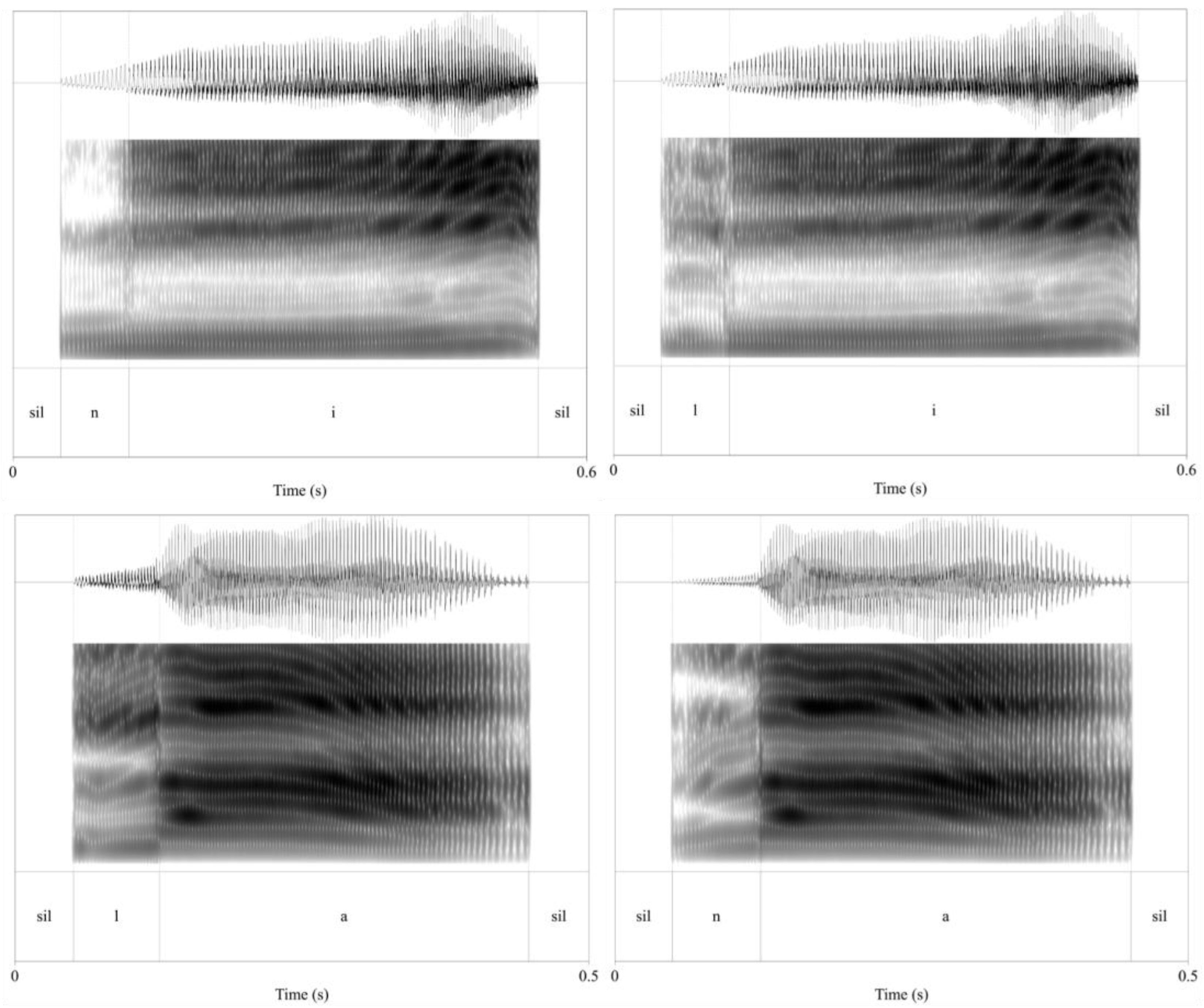
Figure 2.
/n–l/ identification by vowel. The lines trace the percentage of /l/ responses across stimulus steps (CV0–CV6); bars are 95% Wilson CIs. Dotted line = 50%; arrow shows /n/→/l/.
Figure 2.
/n–l/ identification by vowel. The lines trace the percentage of /l/ responses across stimulus steps (CV0–CV6); bars are 95% Wilson CIs. Dotted line = 50%; arrow shows /n/→/l/.
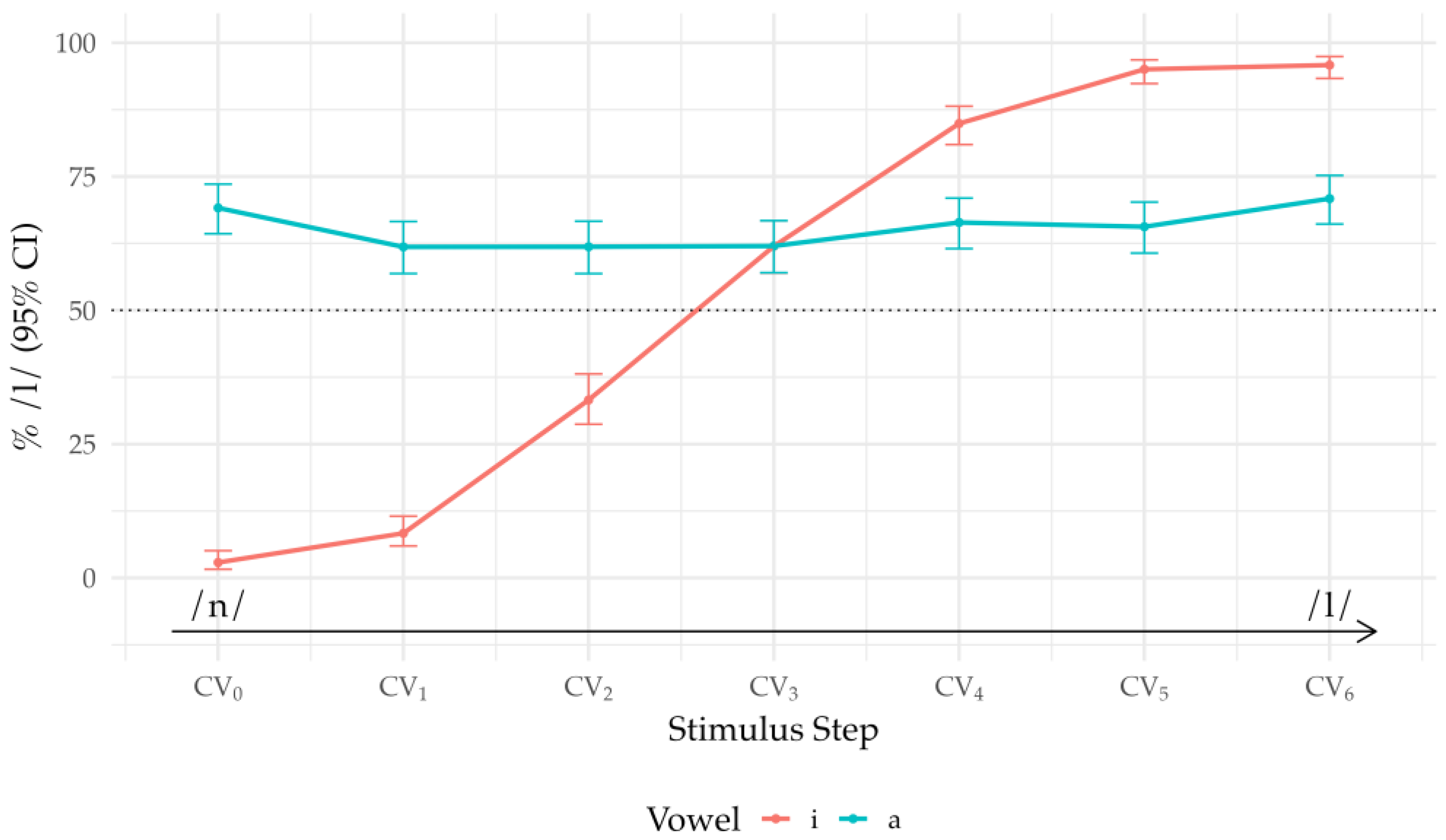
Figure 3.
Identification response times (model-based means ±95% CI) by continuum step and vowel. Estimates are back-transformed from the final mixed-effects model (log scale) and evaluated at Age = 0 and L2 Proficiency = 0 (z-scored means); arrow shows /n/→/l/.
Figure 3.
Identification response times (model-based means ±95% CI) by continuum step and vowel. Estimates are back-transformed from the final mixed-effects model (log scale) and evaluated at Age = 0 and L2 Proficiency = 0 (z-scored means); arrow shows /n/→/l/.
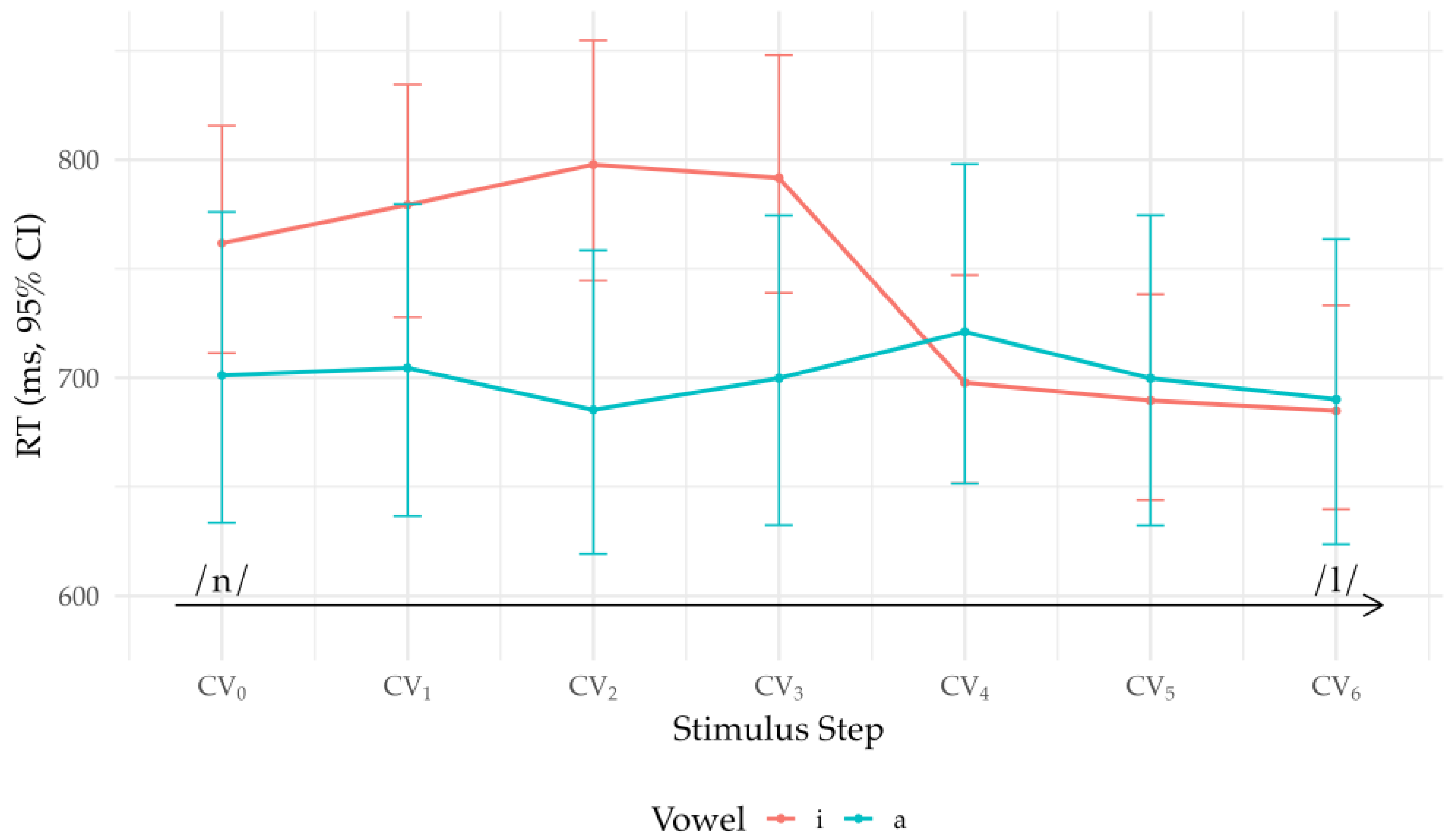
Figure 4.
Response bias by vowel. Individual listeners (jittered points); black dot ± SE is the group mean. Criterion k computed from Δ=0 (“same”) trials; k = 0 indicates no bias (solid line), k = 2 shown for reference (dashed).
Figure 4.
Response bias by vowel. Individual listeners (jittered points); black dot ± SE is the group mean. Criterion k computed from Δ=0 (“same”) trials; k = 0 indicates no bias (solid line), k = 2 shown for reference (dashed).
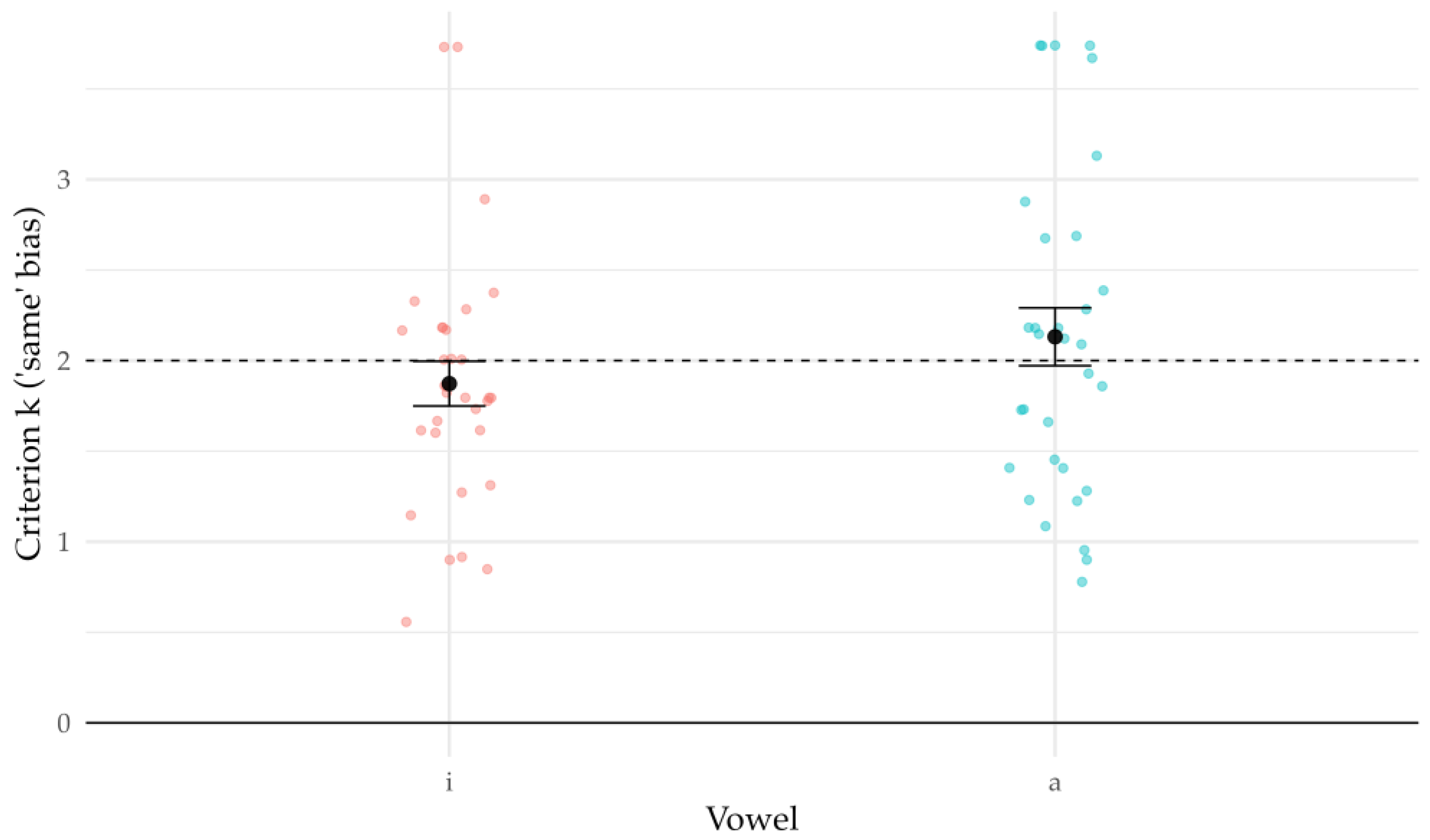
Figure 5.
Sensitivity (d′) at Δ = 2. Individual listeners with mean ± SE by vowel (/i/, /a/). Higher d′ indicates better discriminability; d′ = 0 shown as a reference (dashed line).
Figure 5.
Sensitivity (d′) at Δ = 2. Individual listeners with mean ± SE by vowel (/i/, /a/). Higher d′ indicates better discriminability; d′ = 0 shown as a reference (dashed line).
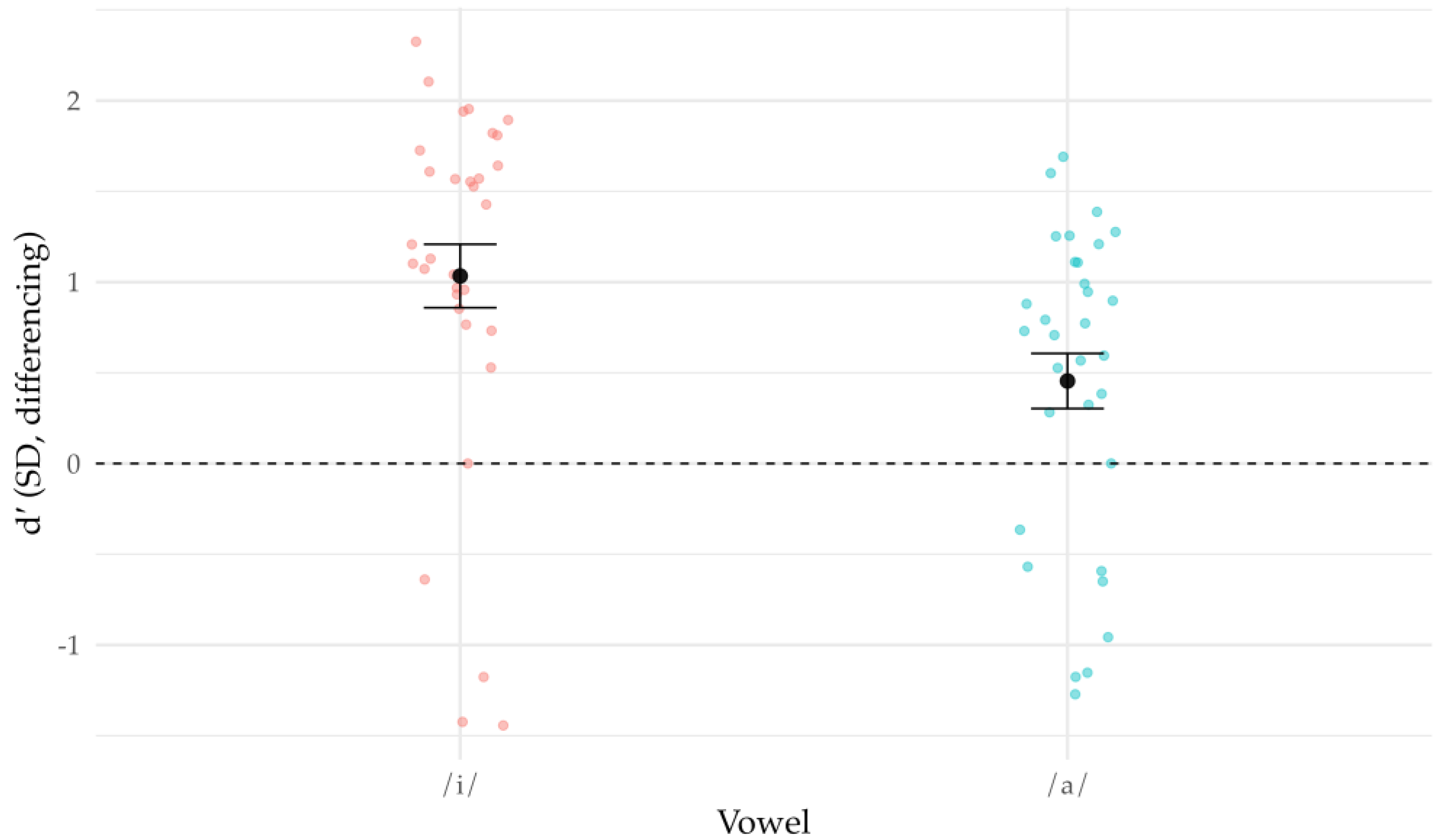
Figure 6.
Bias-sensitivity relationship. Scatter of criterion k at Δ=0 vs. d′ at Δ=2 by vowel, with pooled OLS fit (gray, dotted) and per-vowel fits (colored). Each point is one listener.
Figure 6.
Bias-sensitivity relationship. Scatter of criterion k at Δ=0 vs. d′ at Δ=2 by vowel, with pooled OLS fit (gray, dotted) and per-vowel fits (colored). Each point is one listener.
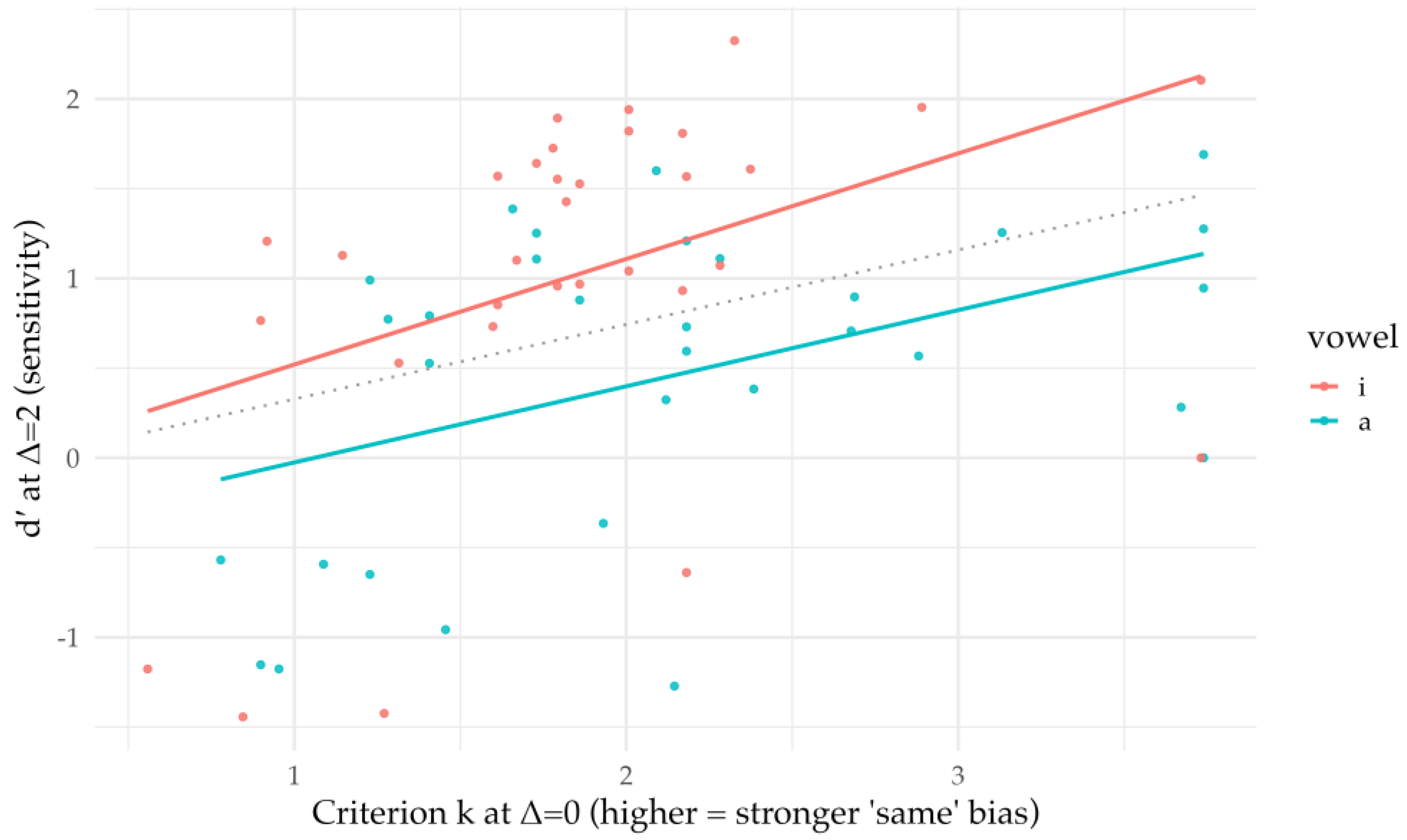
Figure 7.
Discrimination accuracy at Δ = 2. The lines trace the percentage of correct for 2-step “different” pairs by midpoint (CV1–CV5) and vowel; error bars are 95% Wilson CIs. Dotted line marks 50% chance; arrow shows /n/→/l/.
Figure 7.
Discrimination accuracy at Δ = 2. The lines trace the percentage of correct for 2-step “different” pairs by midpoint (CV1–CV5) and vowel; error bars are 95% Wilson CIs. Dotted line marks 50% chance; arrow shows /n/→/l/.
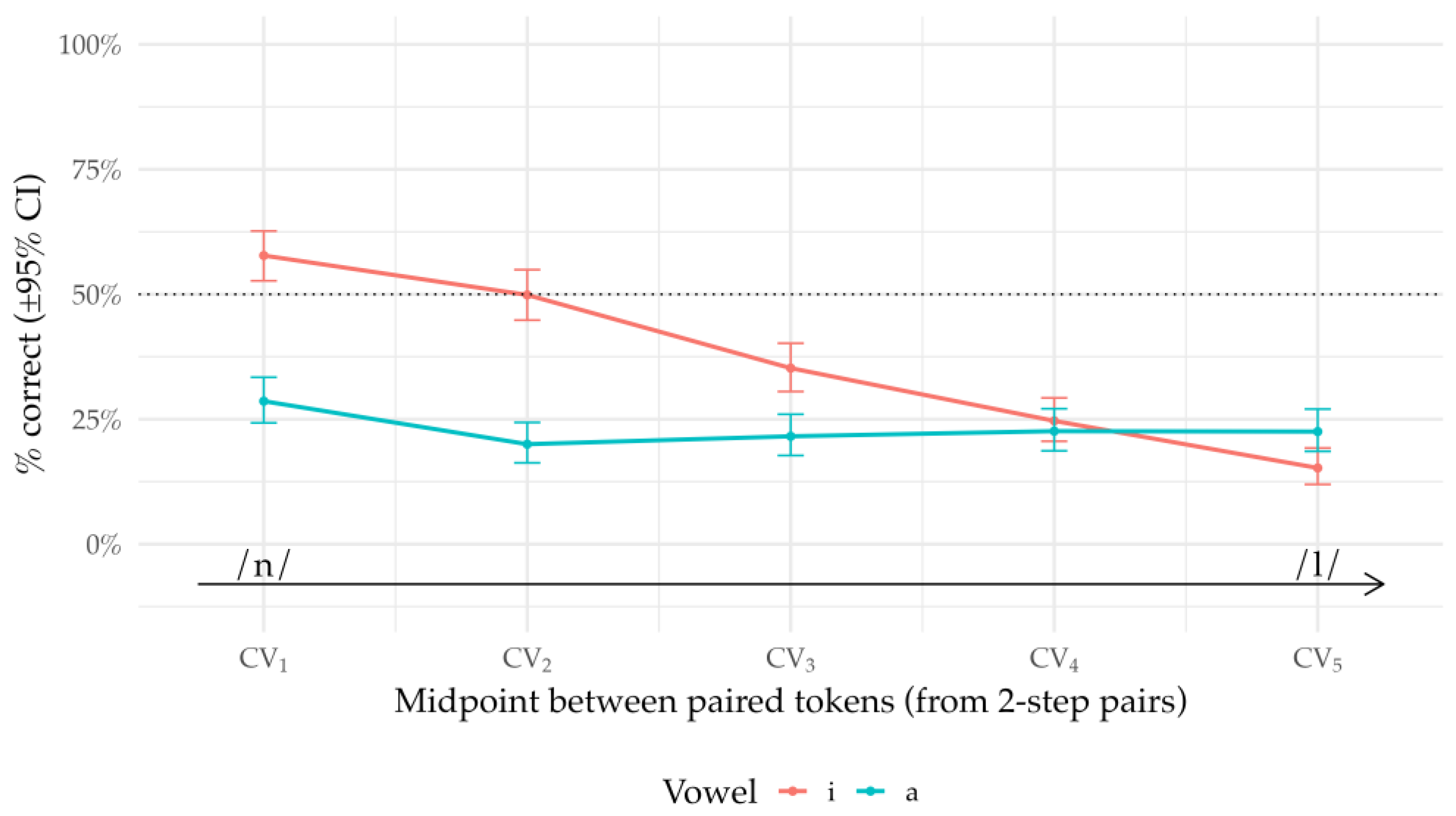
Figure 8.
AX reaction times at Δ = 2. The lines trace model-based mean RTs (ms) by midpoint and vowel with 95% CIs; the arrow shows /n/→/l/.
Figure 8.
AX reaction times at Δ = 2. The lines trace model-based mean RTs (ms) by midpoint and vowel with 95% CIs; the arrow shows /n/→/l/.
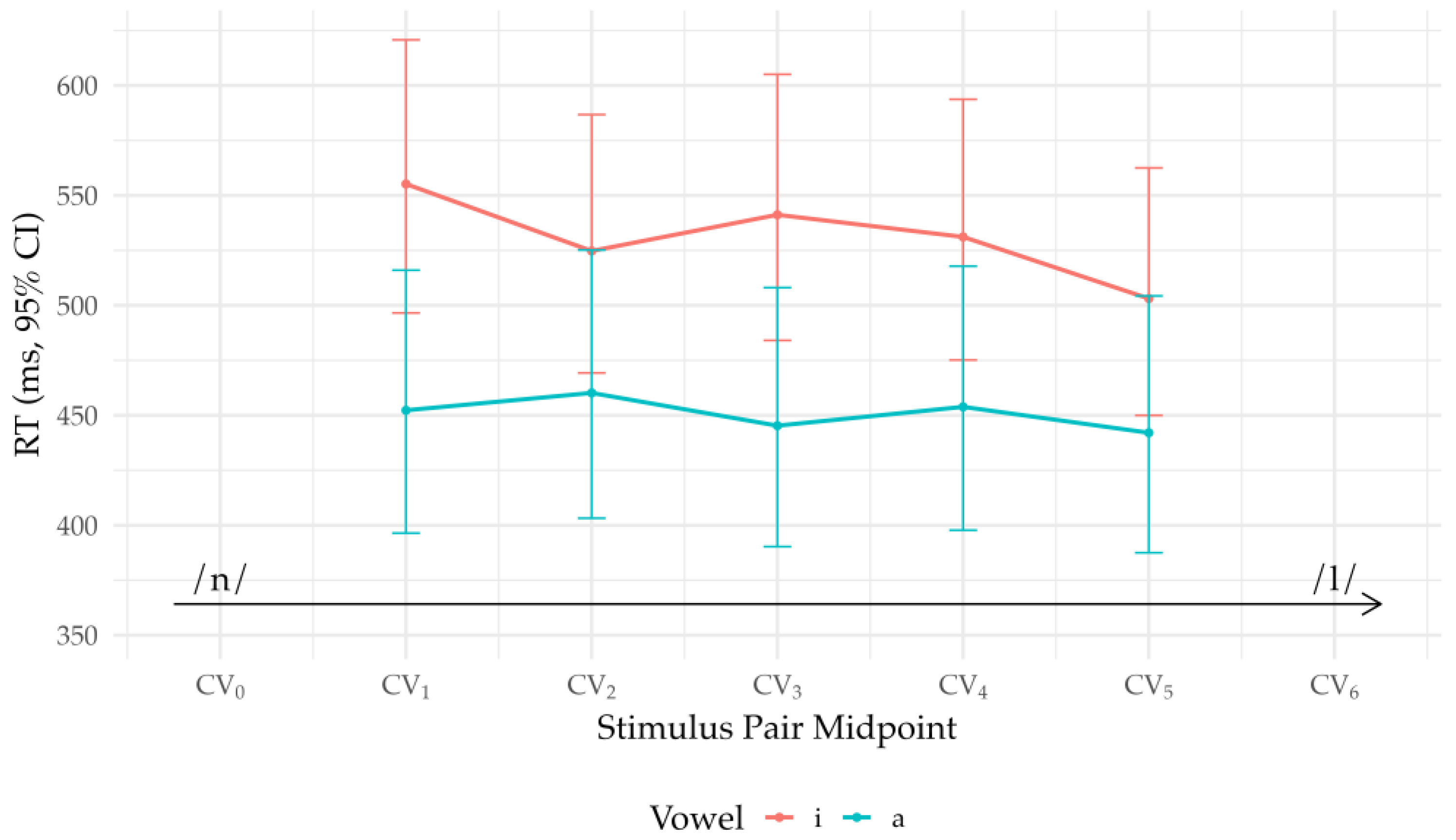

Table 1.
Consonant and vowel durations, ΔA1, relative RMS amplitude, and mean BW1 values across the seven-step /n–l/ continua in the /i/ and /a/ vowel contexts.
Table 1.
Consonant and vowel durations, ΔA1, relative RMS amplitude, and mean BW1 values across the seven-step /n–l/ continua in the /i/ and /a/ vowel contexts.
| Step | C Duration (ms) | V Duration (ms) | Relative RMS amplitude (dB) | Δ A1 (dB) | BW1 (Hz) | |
|---|---|---|---|---|---|---|
| /ni/-/li/ | C0 | 77.162 | 322.807 | 17.485 | 47.531 | 135.61 |
| C1 | 76.629 | 322.804 | 14.827 | 40.352 | 118.603 | |
| C2 | 77.590 | 322.432 | 14.111 | 37.793 | 134.511 | |
| C3 | 76.993 | 323.030 | 12.741 | 36.694 | 134.452 | |
| C4 | 77.321 | 322.706 | 12.493 | 35.279 | 160.843 | |
| C5 | 76.586 | 326.022 | 11.591 | 34.805 | 162.621 | |
| C6 | 74.845 | 321.821 | 11.007 | 34.424 | 134.845 | |
| /na/-/la/ | C0 | 71.162 | 428.069 | 7.482 | 2.35 | 122.772 |
| C1 | 71.261 | 428.092 | 7.769 | 2.706 | 125.66 | |
| C2 | 71.133 | 428.092 | 8.061 | 3.141 | 125.574 | |
| C3 | 71.195 | 428.092 | 8.376 | 3.659 | 125.315 | |
| C4 | 71.289 | 428.092 | 8.707 | 4.286 | 126.269 | |
| C5 | 71.263 | 428.092 | 9.075 | 5.023 | 126.099 | |
| C6 | 71.600 | 428.092 | 9.52 | 5.982 | 125.869 |
Disclaimer/Publisher’s Note: The statements, opinions and data contained in all publications are solely those of the individual author(s) and contributor(s) and not of MDPI and/or the editor(s). MDPI and/or the editor(s) disclaim responsibility for any injury to people or property resulting from any ideas, methods, instructions or products referred to in the content. |
© 2026 by the authors. Licensee MDPI, Basel, Switzerland. This article is an open access article distributed under the terms and conditions of the Creative Commons Attribution (CC BY) license (http://creativecommons.org/licenses/by/4.0/).
Copyright: This open access article is published under a Creative Commons CC BY 4.0 license, which permit the free download, distribution, and reuse, provided that the author and preprint are cited in any reuse.


