
Submitted:
17 January 2026
Posted:
21 January 2026
You are already at the latest version
Abstract
The sustainability transition driven in large part by global climate change has created demand for a new generation of green technologies highly dependent on rare earth minerals. These rare earth and critical minerals are also needed for consumer and medical products as well as for military uses. This has created unintended risks, as China has assumed the world’s dominant position by controlling access to and pro-cessing of these minerals, leaving countries around the world to develop policies and approaches to minimize national security risks. This paper reviews the sustainability drivers of REEs as well as the role that the U.S. administration is taking which has triggered geopolitical tensions with historic NATO allies including the threat of ac-quiring Greenland for access to REEs and critical minerals. We explore the great power competition over REEs and chart the location and value of NATO as an alliance in these terms. This includes developing up to date data on the spatial variability of key minerals for the sustainability transition possessed by NATO and other U.S. friendly nations.
Keywords:
rare earth minerals
; critical minerals
; NATO
; dynamic sustainability
; green tech
; public policy
; Greenland
1. Introduction
Addressing global climate change requires governments and industries to accelerate the creation of new policies and practices in conjunction with the rapid adoption of a new generation of sustainable technologies. However, these actions do not come without the risk of unintended implications for policies, markets, and national security, a phenomenon termed “Dynamic Sustainability” [1].
These dynamics are increasingly present as companies and states have increased reliance on new green technologies and their expanded deployment in order to offset the growing impacts of climate change [2,3,4]. Yet, most of these green technologies are highly dependent on the legacy mining industry, specifically critical minerals and their subset, rare earth elements (REEs).
Critical minerals are a classification of minerals found around the globe which serve as essential materials in a broad range of defense and non-defense manufactured technologies such as in energy, transportation, communications, medicine, data, and consumer products. The U.S. Department of the Interior published the most recent list of 60 critical minerals, which include lithium, aluminum, cobalt, copper, silicon, silicon carbide, and others, as well as 15 rare earth elements [5].
Rare earth elements are a subset of critical materials and minerals. Despite their name, REE’s are not rare, they are commonly found in low concentrations and are distributed throughout a variety of minerals rather than occurring in isolated, readily available for extraction form. LREEs are generally being more abundant [6]. REEs include 17 elements crucial for high-tech applications, including the 15 lanthanides (Lanthanum, Cerium, Praseodymium, Neodymium, Promethium, Samarium, Europium, Gadolinium, Terbium, Dysprosium, Holmium, Erbium, Thulium, Ytterbium, Lutetium), plus Scandium (Sc) and Yttrium (Y) [5].
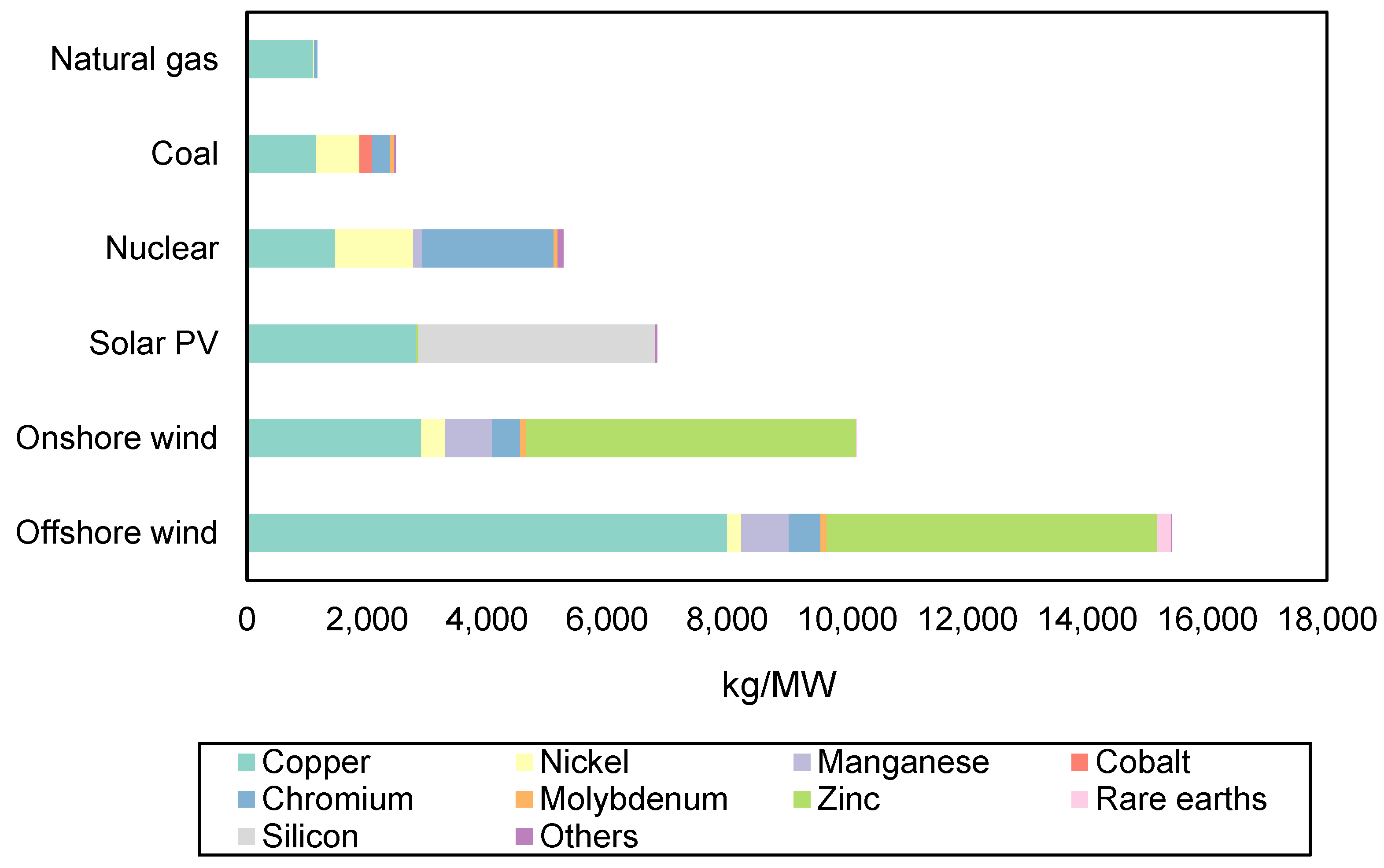
According to the International Energy Agency (IEA), production of rare earths will need to increase sevenfold by 2040 to meet the needs of the clean energy sector alone [7], a projection that does not include growing demand for military systems and the unprecedented growth of AI driven data centers. Demand for other critical minerals such as lithium may multiply 40-fold. The European Union in its 2024 Critical Raw Materials Act, stated that EU demand for rare earth metals is expected to increase seven-fold by 2050, and twenty-one-fold for lithium over the same period [9] as examples of future demand needs. Figure 1 provides an overview of the minerals used in the clean energy sector, represented in kilograms per megawatt.
Figure 1.
Minerals used in clean energy technologies compared to other power generation types in 2021 [8].
Figure 1.
Minerals used in clean energy technologies compared to other power generation types in 2021 [8].
While there is unprecedented current and future demand for critical minerals and REEs, there are two significant and growing risks for nations to secure sufficient volumes of critical minerals including REEs. First is the growing competition for these minerals beyond green technologies to include other industrial purposes, as well as military applications, at a time of growing U.S. and NATO budgets [10,11].
Second, and cause of great geopolitical tensions and risk, is the dependence by countries around the globe on China, which holds a monopoly on REEs processing [12,13,14]. A recent report by the World Economic Forum [15] reveals that global demand for data centers by could exceed 100 GW, almost double today’s installed base, and that each megawatt (MW) embeds around 60-75 tonnes of minerals, mainly in power and cooling systems rather than servers.
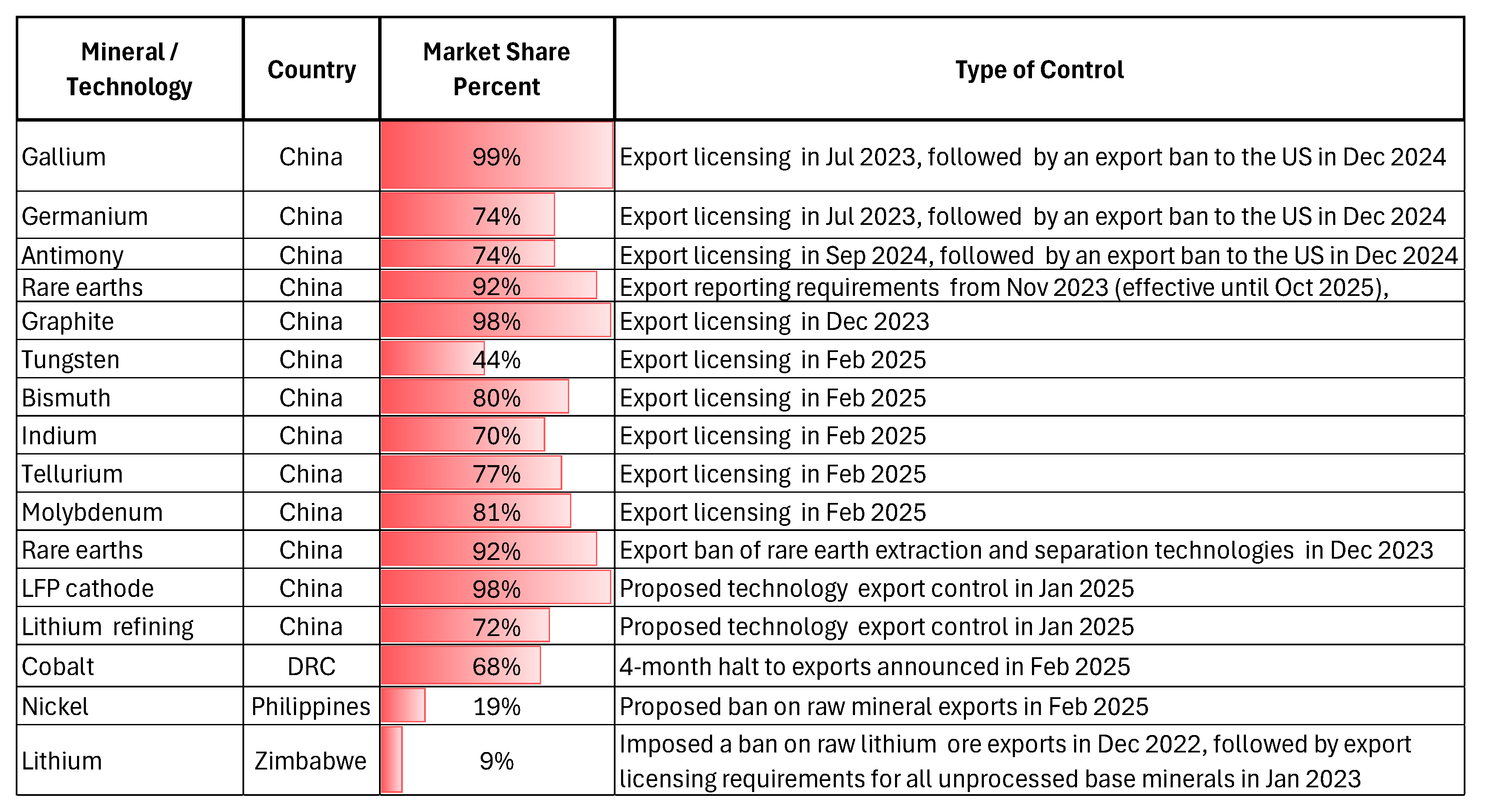
These raising geopolitical concerns have been accelerated by policy actions, including U.S. tariffs placed on China in part to retaliate for the perceived market manipulation by China limiting access to the minerals [16,17], as presented in Table 1.

Table 1.
Export restrictions on energy-related minerals by country and mineral or technology since 2023 [18].
Table 1.
Export restrictions on energy-related minerals by country and mineral or technology since 2023 [18].
1.1. Alliance Value in International Relations Scholarship
International relations scholars have long recognized military alliances as fundamental instruments of statecraft that enhance security through collective defense and burden-sharing. The literature emphasizes how alliances allow states to aggregate military capabilities, creating a combined force that exceeds the sum of individual parts. Classical realist theorists like Hans Morgenthau and Stephen Walt argue that alliances emerge from calculations of power and threat, enabling weaker states to balance against stronger adversaries while allowing great powers to extend their influence and maintain regional stability [19,20]. This pooling of resources not only provides immediate defensive benefits but also enables specialization, where alliance members can focus on developing specific military capabilities while relying on partners for complementary strengths. Recent scholarship has intensified debates about quantifying these arrangements, with studies like Alley and Fuhrmann’s controversial finding that each US alliance commitment adds $11-21 billion annually to defense spending [21]. But critics like Cooley and Nexon argue such estimates fail to account for the distinction between correlation and causation, as well as the broader strategic context of postwar American grand strategy [22].
The deterrence value of military alliances represents another central theme in the literature, with scholars examining how formal security commitments can prevent conflict by raising the costs of aggression. Thomas Schelling’s work on credible commitments and Glenn Snyder’s alliance theory highlights how treaties create expectations of collective response that alter potential adversaries’ cost-benefit calculations [23]. The literature also explores how alliances serve as signaling mechanisms in international politics, with formal agreements communicating resolve and solidarity to both adversaries and allies. NATO’s Article 5 mutual defense clause, for instance, is frequently cited as a successful deterrent that helped maintain stability during the Cold War by clearly establishing that an attack on one member would trigger a collective response. Contemporary research increasingly grapples with measuring these preventive benefits against budgetary costs, with scholars like Paul Poast emphasizing that alliances may generate substantial economic returns through maintaining open trading systems, supporting dollar primacy, and preventing nuclear proliferation—benefits that could outweigh their fiscal burden even if precise quantification remains elusive [24].
However, the international relations literature also identifies significant challenges and trade-offs inherent in alliance relationships. The concepts of entrapment and abandonment illustrate the dilemmas states face when alliance commitments may draw them into unwanted conflicts or leave them unsupported in times of need [25]. Additionally, the free-riding problem, extensively analyzed through collective action theory, demonstrates how smaller alliance members may under-invest in defense capabilities when they can rely on the security guarantees of more powerful partners [26,27,28]. The methodological challenges highlighted in recent exchanges between scholars, such as in the Security Studies forum, underscore ongoing debates about how to properly measure alliance effects—particularly the difficulty of distinguishing formal treaty obligations from informal security partnerships, accounting for grand strategy shifts that affect both alliance formation and defense spending simultaneously, and establishing appropriate counterfactuals for what might have happened absent these commitments. These debates reflect ongoing tensions between the clear security benefits alliances provide and the sovereignty costs, resource commitments, and strategic constraints they impose on member states. But what the IR literature on alliances does not do is assess the literal value of NATO when it comes to rare earth elements. Rather than just looking at NATO as a military expense or a burden, it would be beneficial in an era of great power competition to work out the benefits of exclusive access to these assets.
1.2. U.S. Policy Response
Faced with U.S. dependence on China for critical minerals, the Trump administration had various strategic options. Rather than look to historic international partners to collectively address and solve this national security priority, the administration has in part taken a tack of making aggressive overtures to long-term allies. This is best exemplified by the President making clear of the administration’s goal of securing Greenland, a self-governing territory of Denmark, a founding member of NATO. The administration seeks to acquire Greenland as United States territory in some manner, including not ruling out obtaining the island through military options [20,30].
Greenland possesses significant amounts of land-based minerals as well as a large cache of ocean-based resources, which are becoming more accessible as Arctic Sea opens due to climate change impacts [31,32,33]. Greenland is surrounded by the Arctic Ocean, which since the 1980s has experienced sea ice decline of at least 70% and may see its first ice-free day before 2030. This would result in the opening of three new shipping routes 1) Norther Sear Route, 2) North-West Passage and 3) the Transpolar Sea Route [34,35].
While many initially perceived President Trump’s threats as unlikely to materialize, those views changed on the early morning of January 3, 2026. This is when the United States conducted a joint military and law enforcement raid on Caracas, Venezuela’s capital, capturing Venezuelan President Nicolás Maduro [36] accused of various drug related charges, further stoking fears among European leaders that the United States could potentially make good on its threats to seize control of Greenland [37]. The ratcheting up of rhetoric and threats by the United States government has placed an increasing strain on the long-standing North Atlantic Treaty Organization (NATO) alliance.
America’s interest in acquiring Greenland have been coupled with the development of new policies and strategies. These have included policies to streamline licenses for U.S. companies in international waters, such as the Arctic sea, aiming to secure critical minerals for U.S. supply chains. On April 24, 2025, President Trump signed Executive Order 14285, “Unleashing America’s Offshore Critical Minerals and Resources,” to accelerate U.S. deep seabed mining (DSM) by invoking the dormant Deep Seabed Hard Mineral Resources Act (DSHMRA) [38]. On October 9, 2025, Finnish President Alexander Stubb and President Trump met at the White House and signed a Memorandum of Understanding (MOU) for the U.S. to acquire 11 icebreaking ships for the U.S. Coast Guard [39]. The U.S., with currently only 3 icebreakers, the last of which (Healy) was completed in 1997, is far behind Russia, which operates 57 [40,41]. In addition, as reported in the Wall Street Journal [42], the United States has stepped up intelligence gathering efforts regarding Greenland, including the identification of individuals in Greenland who might support U.S. goals.
These actions have increased tensions between the U.S. and fellow NATO member Denmark, as well as the other member nations. To better understand the value of NATO to the United States of America in the mid-21st century, this paper explores great power competition over rare earths and critical minerals, assesses the mineral assets held by NATO member nations, and examines the implications for sustained growth of green technologies essential to sustainable transitions.
2. Background
“The Middle East has oil. China has rare earths.” These words spoken by Deng Xiaoping, China’s paramount leader, while touring one of China’s largest rare deposits in Baotou, Inner Mongolia, in 1987 [43], have played out into reality as China now controls the global rare earths and critical mineral market, causing fierce global competition as nations seek to de-risk their supply chains, competition that is potentially pitting NATO allies against each other.
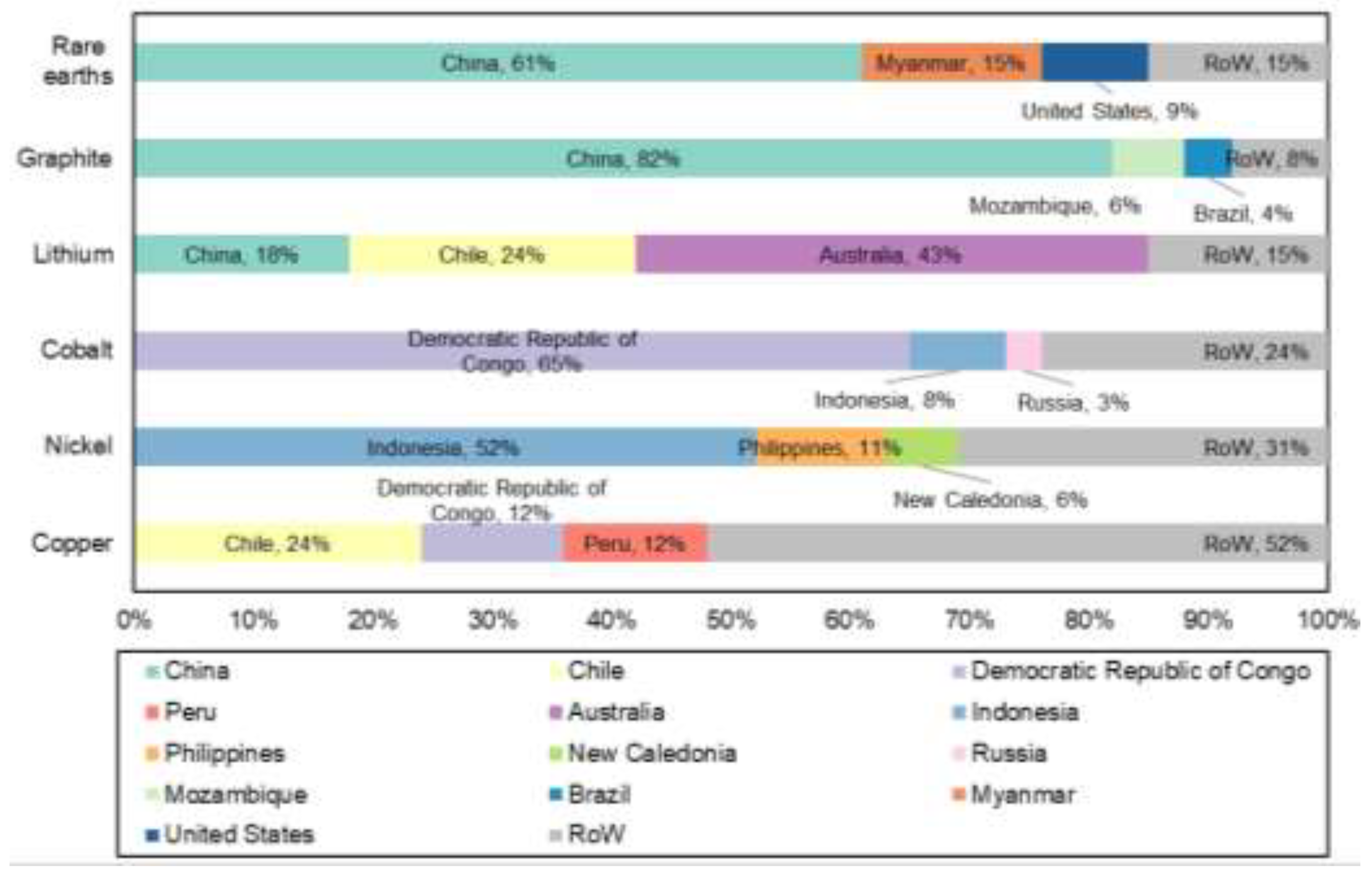
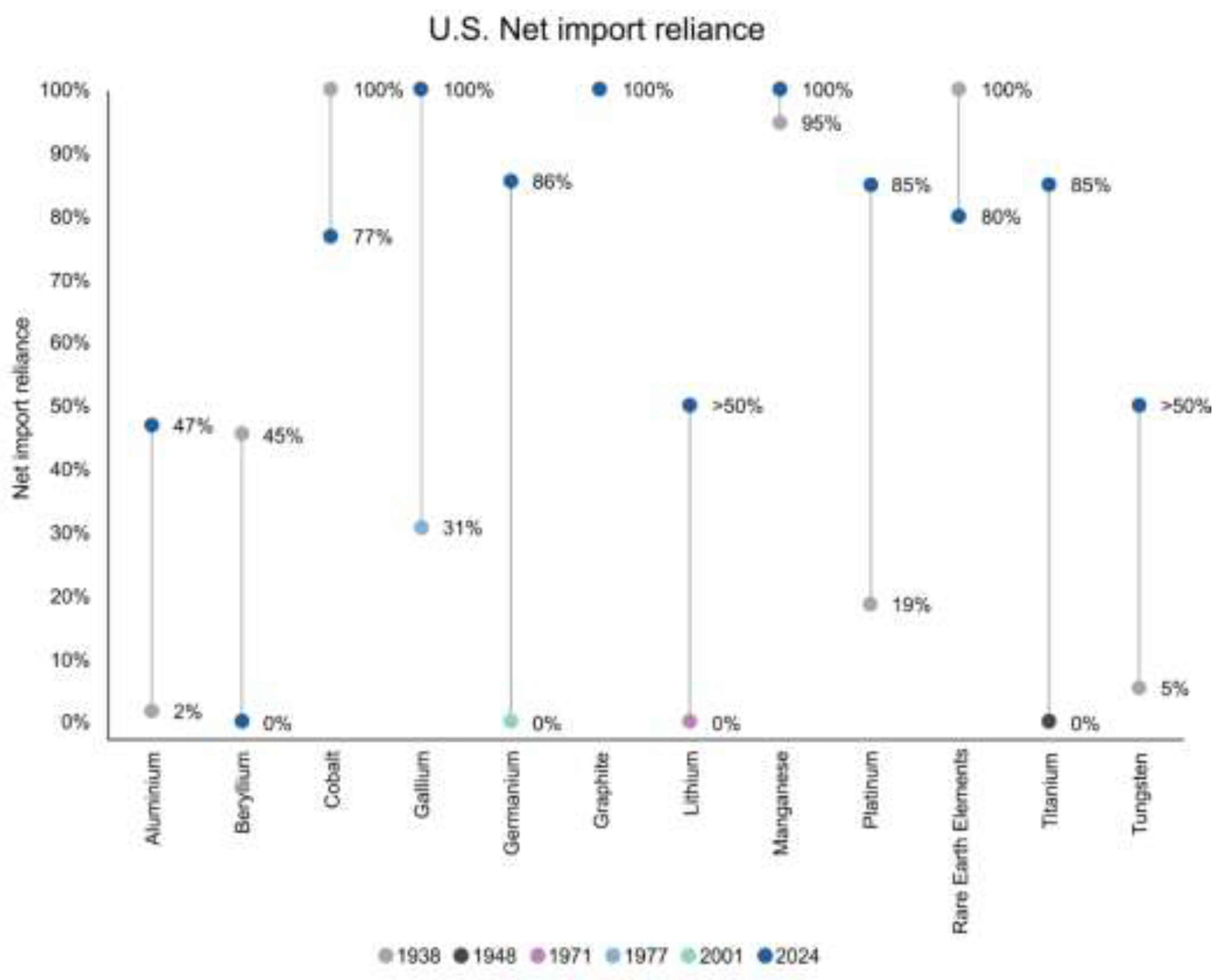
As of 2023, China was producing 60 percent of the world’s rare earth minerals and processes almost 90 percent [12] (see Figure 2). As presented in Figure 3, the United States currently relies on a greater share of critical mineral imports to meet domestic consumption. A 2019 U.S. Congressional Research report documented that the United States was 100 percent import reliant for 14 minerals on the critical minerals list, including graphite, manganese, niobium, tantalum and rare earth minerals. The result of this dominance has created considerable national security vulnerability for NATO nations that rely on these minerals for both defense armaments and technologies as well as domestically produced consumer products. This has been exacerbated by growing demand from non-defense technologies such as electric vehicles, smart phones, and batteries.
Figure 2.
Share of top three producing countries in “mining” of selected minerals in 2023 [44].
Figure 2.
Share of top three producing countries in “mining” of selected minerals in 2023 [44].
This was not always the case. Before and during World War II, the United States, along with what would become NATO allied countries, was the world leader in mineral ownership, production, sales, and consumption, with control of major mineral resources across Canada, Central America, and South America. In fact, the United States and the British Empire combined controlled about 75 percent of global mineral supplies [45,46]. Despite the United States’ strong mineral position, the U.S. military experienced supply constraints before and during the war. The country faced export controls that reduced its access to foreign minerals. Before the war, for instance, Germany placed export restrictions on certain mineral products, such as copper sulfate. Interestingly, the United States also faced export controls from its geopolitical partners. In October 1940, Canada instituted a copper export ban that applied to the United States, except under certain conditions, such as U.S. entities fulfilling munitions contracts for Allied countries.
In the aftermath of World War II and the start of the Cold War, the United States National Defense Stockpile had an inflation adjusted value of approximately $77.1 Billion by 1962. As of March 2023, the stockpile’s value had fallen to just $912 million, only 1.2 percent of the 1962 value. Additionally, the current stockpile would cover only 40 percent of the military’s projected shortfalls in a one-year conflict followed by three years of recovery and replenishment [47].
Figure 3.
Net import reliance as a percentage of apparent consumption of critical minerals in the United States from 1938, or the earliest available year, to 2024 [47].
Figure 3.
Net import reliance as a percentage of apparent consumption of critical minerals in the United States from 1938, or the earliest available year, to 2024 [47].
3. Results
3.1. Mapping Greenland and Broader NATO’s Value in Critical Minerals and REEs
As presented in Figure 4, Greenland which has a population of just 56,000 people and a land mass larger than Mexico and Saudi Arabia possesses important reserves of critical mineral needed for the sustainability transition. Greenland is estimated to have 36 million tonnes of rare earths, one of the largest deposits of uranium and ranks eighth in the world for rare earth reserves, with 1.5 million tons, and is home to two rare earth deposits that are among the largest in the world: Kvanefjeld and Tanbreez. Still, no rare earth mining has taken place on the island to date [48,49].
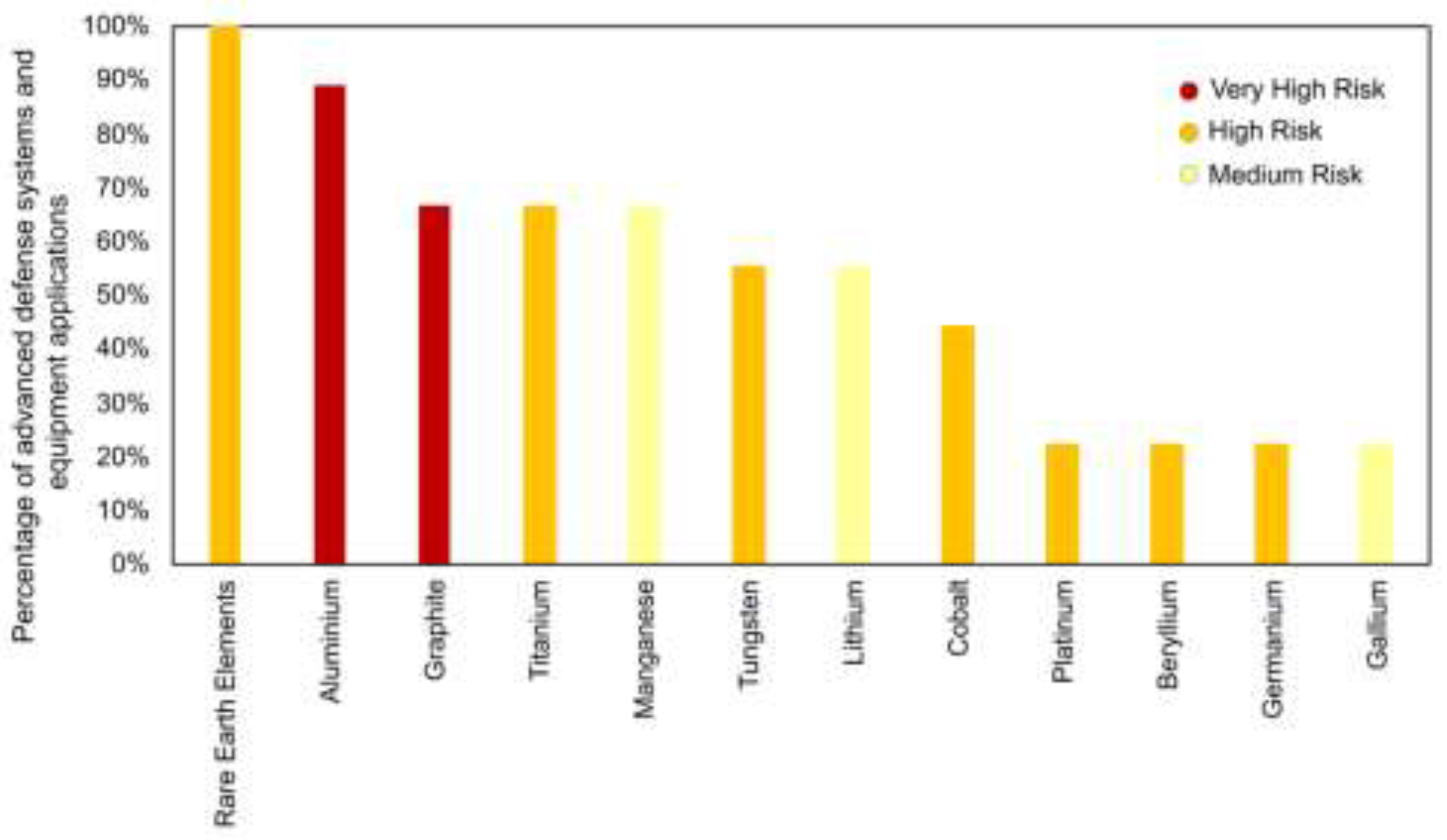
In December 2024, NATO published a list of 12 defense-critical minerals essential to the defense industry. These minerals are vital for the manufacturing of advanced defense systems and equipment such as fighter aircraft, artillery, and ammunition. The list includes aluminum, beryllium, cobalt, gallium, germanium, graphite, lithium, manganese, platinum, rare earth elements, titanium, and tungsten.
Figure 5 presents the supply risks associated with these 12 critical minerals in military applications for NATO countries. Rare earth elements, which are used in 100 percent of defense applications, pose a high risk to NATO security because their production, and more importantly their processing, is concentrated in China. Similarly, aluminum, essential for producing lightweight and robust military aircraft and missiles, and graphite, a key component in battle tanks, corvettes, and submarines, are also classified as very high supply risk. Disruptions in the supply of these critical minerals could seriously impact the production of NATO’s vital defense equipment [11].
Figure 4.
Greenland’s critical minerals deposit’s location [50].
Figure 4.
Greenland’s critical minerals deposit’s location [50].
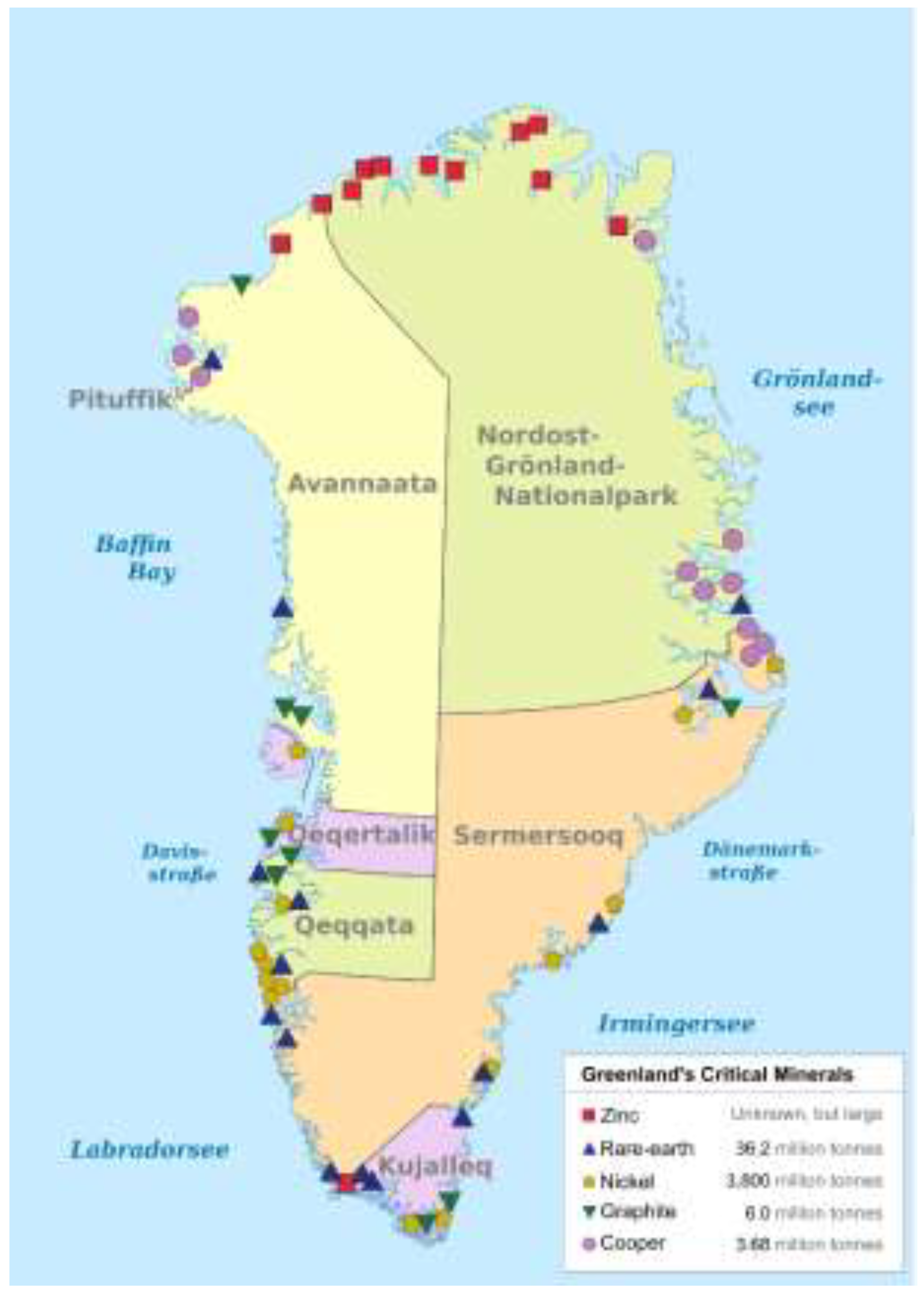
Figure 5.
Percentage of advanced defense systems and equipment applications for NATO’s 12 defense critical minerals by level of risk [11].
Figure 5.
Percentage of advanced defense systems and equipment applications for NATO’s 12 defense critical minerals by level of risk [11].
China holds a dominant position in the global REE market. As of 2023, China controlled 48 percent of global reserves and processed over 92 percent of the world’s REE supply [44]. This concentration of capacity has enabled China to leverage its control over critical minerals for geopolitical gain. In 2010, China imposed an export ban on REEs targeting Japan amid a diplomatic dispute. More recently, in December 2024, China introduced export restrictions on gallium, germanium, and antimony destined for the United States, and in April 2025, China imposed additional restrictions on seven REEs (i.e., samarium, gadolinium, terbium, dysprosium, lutetium, scandium, and yttrium) as well as magnets used in defense, energy, and automotive sectors in response to U.S. President Trump’s tariff increase on Chinese products [17]. These actions underscore China’s capability and willingness to use its dominance in strategic minerals as a tool of coercive diplomacy, raising significant concerns among NATO allies regarding supply chain vulnerabilities and strategic dependencies.
Recognizing the strategic risk, NATO has elevated critical minerals on its agenda. In June 2024, NATO released a Defense-Critical Supply Chain Security Roadmap [11] to address upstream vulnerabilities, followed in December by NATO’s first list of 12 defense critical minerals deemed integral to the manufacture of advanced defense systems and equipment [11].
NATO emphasized that identifying these materials constitutes the first step towards building stronger, better, protected supply chains, crucial for Allied defense and a necessary measure to reduce Western dependence on any single supplier (i.e., China) for minerals essential to defense and energy technologies.
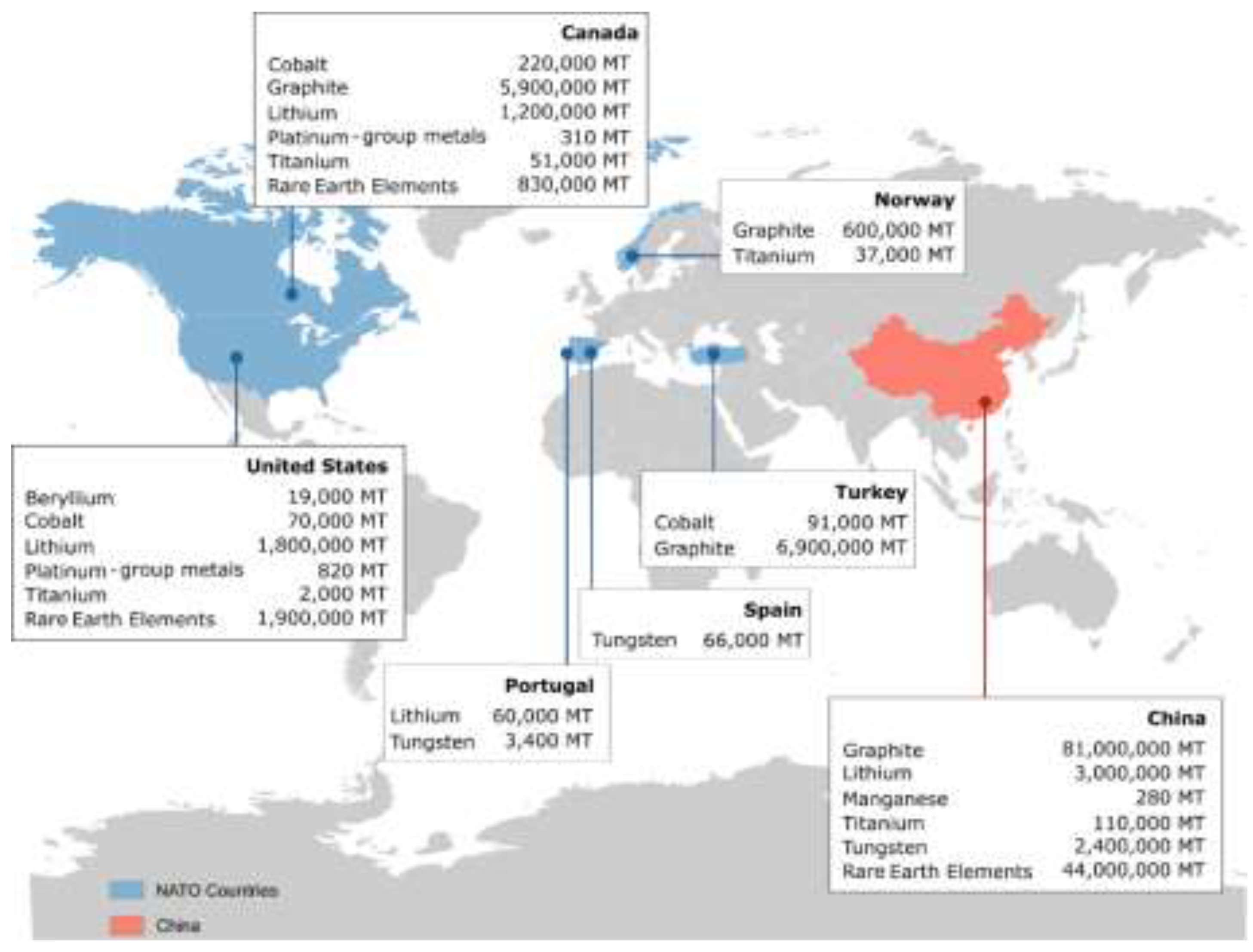
While China dominates reserves and processing of many critical minerals, several NATO members possess significant reserves and processing capacity that can serve as viable alternatives to reduce allied supply chain dependence. As presented in Figure 6 and Figure 7, aluminum, classified by NATO as a very high-risk defense critical mineral, is produced in Canada, Norway, and Germany, offering important sources of supply within the Alliance. Canada and Norway are also significant producers of graphite, which could strengthen resilience among NATO partners. In addition, Canada and Finland together account for 6 percent of global platinum production, a share that surpasses China’s contribution, underscoring the potential for allied resources to offset vulnerabilities in critical mineral supply chains [51].
In June 2025, at the Defense Industry Forum, twelve NATO allies —Belgium, Canada, Denmark, Germany, Greece, Italy, the Netherlands, Norway, Poland, Sweden, Türkiye and the United Kingdom — committed to the joint acquisition, transportation, storage, and management of key defense critical materials, including the recycling of existing products, across the alliance. This collective initiative is designed to facilitate secure access to sufficient supplies of critical materials, thereby reducing NATO’s vulnerability to supply chain disruptions. The agreement underscores NATO’s central role in strengthening allied defense-industrial resilience and safeguarding the security of supply chains essential to military readiness [52].
For the United States, which remains heavily dependent on foreign imports for most critical minerals, NATO’s initiatives are strategically valuable in several ways. First, American and NATO security interests align, particularly since the Trump administration designated critical minerals as a national security priority. In March 2025, President Trump signed an executive order invoking emergency powers to boost domestic production of critical minerals under the Defense Production Act. However, scaling up domestic capacity will be challenging due to limited refining infrastructure and processing capabilities. Closer cooperation between NATO allies and the United States allows European partners to supplement American efforts to secure new sources of critical minerals. Joint initiatives such as the Critical Minerals Agreement (CMA), the Minerals Security Partnership (MSP), and bilateral critical-mineral agreements between the European Union and the United States aim to reduce reliance on China by expanding mining and processing across allied nations [53,54].
Second, NATO serves as a key source of intelligence and strategic coordination for developing new capabilities to secure critical material supply chains. Like the United States, NATO members have acknowledged the growing unreliability of their critical material supply networks. This shared awareness provides the U.S. with valuable intelligence and opportunities to collaborate with allies on measures such as establishing strategic stockpiles, coordinating investment initiatives, and enhancing supply chain resilience.
Finally, NATO’s prioritization of critical minerals serves as a political catalyst for mobilizing member states’ resources. When NATO defines critical minerals as a priority, member governments are compelled to align their policies and investments accordingly. As a result, at the 2025 NATO Summit, allies committed to investing 5 percent of Gross Domestic Product (GDP) annually on core defense requirements, and security-related spending by 2035 [55]. For the United States, the result is a stronger, more resilient supply network as American defense companies can source components and feedstocks from multiple NATO allies rather than relying on a single country. These coordinated efforts enhance U.S. strategic leverage by transforming China’s dominance over critical minerals into a collective, rather than bilateral, challenge.
Figure 6.
World production of NATO listing of defense critical minerals in 2022 [47].
Figure 6.
World production of NATO listing of defense critical minerals in 2022 [47].
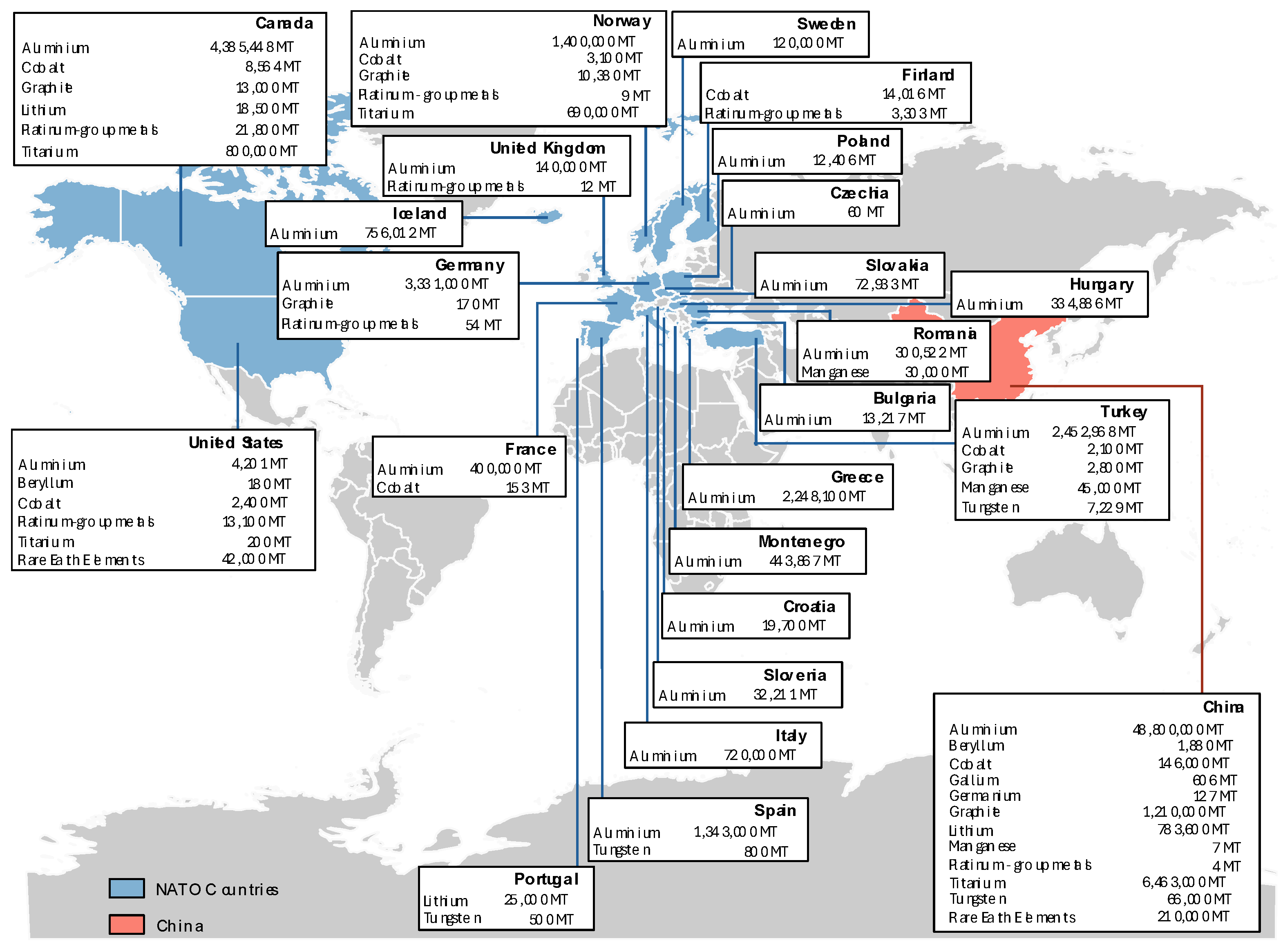
Figure 7.
World reserves of NATO listing of defense critical minerals in 2024 [47].
Figure 7.
World reserves of NATO listing of defense critical minerals in 2024 [47].
3.2. Beyond NATO: Value Added Friends and Aspirants
The United States’ strategy to diversify critical minerals supply chains extends beyond NATO members to include partnerships with resource-rich nations. The Minerals Security Partnership (MSP), launched in June 2022, brings together 14 countries (Australia, Canada, Estonia, Finland, France, Germany, India, Italy, Japan, Norway, the Republic of Korea, Sweden, the United Kingdom, the United States, and the European Union) to accelerate the development of diverse and sustainable energy critical minerals supply chains. While the MSP focuses on minerals most relevant for clean energy technologies, such as lithium, cobalt, nickel, manganese, graphite, rare earth elements, and copper, these minerals are also critical for the defense industry [54].
Several MSP members and NATO aspirants hold strategic importance for U.S. supply chain resilience, including NATO aspirant Ukraine and U.S. Indo-Pacific partners Australia and Japan. Each plays a distinct role in strengthening U.S. supply chain resilience and national security.
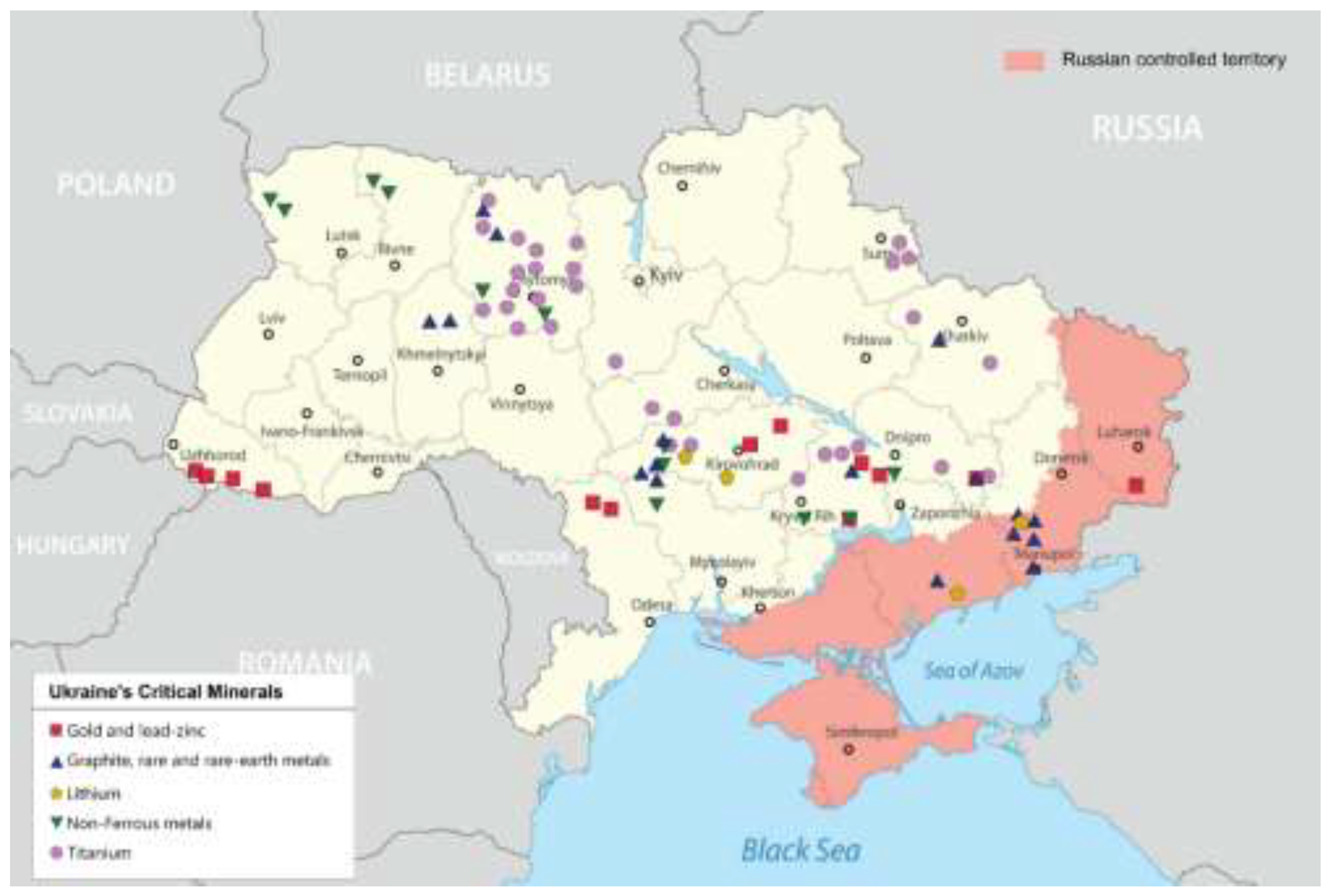
The strategic importance of Ukraine’s critical materials cannot be overstated. Despite the ongoing war with Russia, Ukraine has the potential to become a major supplier of critical materials essential for industries such as defense, high-tech, aerospace, and green energy. As presented in Figure 8, Ukraine possesses substantial critical mineral reserves, accounting for an estimated 5 percent of global critical mineral deposits. The country possesses around 20,000 natural deposits of 116 different minerals, 15 percent of which were actively exploited before the Russian invasion. Notably, Ukraine is a key potential supplier of critical minerals, including titanium (7 percent of global reserves), lithium (Europe’s largest confirmed reserve, estimated at 500,000 tons), graphite (20 percent of global reserves), beryllium, manganese, gallium, uranium, zirconium, apatite, fluorite, and nickel [56].
In recent years, Ukraine has advanced strategic partnerships with both the European Union and the United States to strengthen its role within Western supply networks. The EU-Ukrainian Strategic Partnership on Critical Minerals, signed in 2021, aims to implement 100 projects centered on 10 essential raw materials [57]. Likewise, the U.S.-Ukraine Reconstruction Investment Fund, signed in 2025 by the Trump administration, established a framework enabling U.S. firms to negotiate offtake contracts on new Ukrainian mineral projects at market terms [58]. These agreements underscore Ukraine’s growing significance in diversifying critical mineral supply chains among NATO members and partners.
Figure 8.
Ukraine’s critical minerals deposits’ location and Russian controlled territory in 2025 [59].
Figure 8.
Ukraine’s critical minerals deposits’ location and Russian controlled territory in 2025 [59].
Australia, though not a NATO member, remains a key U.S. ally for critical minerals strategies. The country is home to some of the largest recoverable critical mineral deposits on Earth, including cobalt, lithium, manganese, rare earth elements, tungsten, and vanadium, and holds 43 of the 55 minerals identified as critical by the U.S. Geological Survey. Additionally, its government has actively aligned its resource policy with U.S. and European supply chain priorities [60]. In July 2025, the U.S. launched the Quad Critical Minerals Initiative with Australia, India, and Japan. The four nations committed to collaborate on securing and diversifying supply chains to reduce dependency on China by promoting co-financing of mining and processing projects across the Indo-Pacific [61].
Subsequently, in October 2025, President Trump and Australian Prime Minister Anthony Albanese signed a landmark Critical Minerals Framework Agreement, committing to invest more than $3 billion in critical mineral projects over the following six months. This agreement directly responds to China’s tightened export controls on rare earths and positions Australia as a key partner for the U.S. and its allies in breaking Chinese dominance of critical minerals supply chains [62].
Through the Japan Organization for Metals and Energy Security (JOGMEC), Japan has invested over $600 million and currently carries out more than 30 projects in 15 countries, allowing the nation to reduce its reliance on Chinese rare earths from about 90 percent to 58 percent over the past decade [63].
Additionally, in October 2025, President Trump and Japanese Prime Minister Sanae Takaichi signed a new framework agreement for securing the supply of critical minerals and rare earths through mining and processing. The agreement mobilizes both government and private sector support, including capital and operational expenditures via grants, guarantees, loans, or equity; offtake arrangements; insurance; and regulatory facilitation [64].
While Japan is not a NATO member and has no specific agreements on critical minerals with NATO, it maintains a formal partnership with the alliance through an Individually Tailored Partnership Programme. This cooperation focuses on areas such as cyber defense, maritime security, and technology and innovation [65]. Despite the absence of NATO-specific mineral agreements, Japan’s participation in broader allied frameworks like the MSP ensures coordination on critical minerals security. Access to Japan’s resources and, more importantly, its proven strategies for reducing dependence on Chinese supply chains are essential to enhancing the resilience of U.S. critical mineral supply chains.
4. Discussion
During the Cold War, Europe was seen as the front line in a potential war with the Soviet Union – “An attack on you is an attack on us” [66]. Another benefit was the hierarchical ordering function of the alliance which prevented war between states like France and Germany and allowed European integration. In the post-Cold War era, NATO’s socialization function helped stabilize post-Communist Europe, and American and allied bases across Europe supported the Global War on Terror. In short, one can see several benefits of U.S. membership in NATO, despite what some viewed as an imbalance on the spending front. However, President Trump is a highly transactional individual, and these broader benefits may understandably fall short of what he views as worthwhile. In this era of great power competition, however, the Trump White House may want to rethink its assessment of the alliance. The value of NATO, beyond the “soft” benefits outlined above, runs far deeper – quite literally. For beneath the 27,580,492 sq km of NATO territory lie vast deposits of rare earth minerals – minerals critical to the modern world’s high-tech industry. When conceptualized in this manner, the value of NATO far exceeds the financial costs of U.S. commitments to Europe.
5. Conclusions
Geopolitical risks for critical minerals may well expand if not addressed in meaningful ways. Both China and the United States have significant interest in Pakistan’s emerging Reko Diq mine in the Balochistan province, which may contain one of the world’s largest reserves of gold and copper [67]. Similarly. in Africa, countries such as Zimbabwe(Africa’s top producer of Lithium), Guinea, Uganda, and Namibia have reportedly introduced policies limiting and/or outlawing the export of mineral ores [68]. These policies further complicate the potential for global expansion of green technologies needed to address sustainability imperatives, including climate change.
Finally, global attention may soon shift to new regions. First, the Antarctic is attracting increasing focus, even though the territory is protected by both the Antarctic Treaty of 1961 and the Protocol on Environmental Protection to the Antarctic Treaty, signed in 1991, which bans mining under article 7 [69,70].
The second region is, in fact, a new frontier as both manned and unmanned space flights by multiple countries and companies are headed to the Moon, which contains significant REE deposits as well as helium-3 for potential future fusion reactors [71,72]. These developments underscore the need to balance sustainability goals with not only appropriate technologies but also with policies and strategies that minimize the potential for nation-to-nation conflicts.
Author Contributions
Author Golden led conceptualization and led the writing as well as undertaking research, investigation, portions of data curation and data visualization. Pasucal undertook research, investigation and large portions of data curation and visualization. Williams assisted with conceptualization and report writing. All authors have read and agreed to the published version of the manuscript.
Funding
This research received no external funding.
Institutional Review Board Statement
Not applicable for studies not involving humans or animals.
Data Availability Statement
Data used in this research is available at www.DynamicsLab.org.
Acknowledgments
The authors have reviewed and edited the output and take full responsibility for the content of this publication.
Conflicts of Interest
The authors declare no conflicts of interest.
References
- Golden, J.S. Dynamic Sustainability: Implications for Policy, Markets, and National Security; Cambridge University Press: Cambridge, UK, 2024. [Google Scholar]
- Alestra, C.; Cette, G.; Chouard, V.; Lecat, R. How can technology significantly contribute to climate change mitigation? Appl. Econ. 2024, 56, 4925–4937. [Google Scholar] [CrossRef]
- Princiotta, F. T.; Loughlin, D. H. Global climate change: The quantifiable sustainability challenge. Air Waste Manag. Assoc. 2014, 64, 979–994. [Google Scholar] [CrossRef] [PubMed]
- Sohn, W.-S. Towards a Sustainable Future: Addressing Climate Change and Promoting Sustainable Development. Sustain. Dev. 2026, 34, 226–247. [Google Scholar] [CrossRef]
- About the 2025 List of Critical Minerals. Available online: https://www.usgs.gov/programs/mineral-resources-program/science/about-2025-list-critical-minerals (accessed on 12 January 2026).
- Rare Earth Elements – A Subset of Critical Minerals. Available online: https://www.netl.doe.gov/resource-sustainability/critical-minerals-and-materials/rare-earth-elements (accessed on 12 January 2026).
- International Energy Agency. The Role of Critical Minerals in Clean Energy Transitions; IEA: France, 2021; Available online: https://www.iea.org/reports/the-role-of-critical-minerals-in-clean-energy-transitions (accessed on 12 January 2026).
- Minerals used in clean energy technologies compared to other power generation sources. Available online: https://www.iea.org/data-and-statistics/charts/minerals-used-in-clean-energy-technologies-compared-to-other-power-generation-sources (accessed on 12 January 2026).
- Critical Raw Material Act. Available online: https://single-market-economy.ec.europa.eu/sectors/raw-materials/areas-specific-interest/critical-raw-materials/critical-raw-materials-act_en (accessed on 12 January 2026).
- Trump calls for $1.5 trillion military budget in 2027, up from $901 bln in 2026. Available online: https://www.reuters.com/world/us/trump-says-us-military-budget-2027-should-be-15-trillion-2026-01-07 (accessed on 12 January 2026).
- Defence-Critical Supply Chain Security Roadmap. Available online: https://www.nato.int/nato_static_fl2014/assets/pdf/2024/7/pdf/240712-Factsheet-Defence-Supply-Chain-Ro.pdf (accessed on 29 October 2025).
- China’s Role in Supplying Critical Minerals for thea Global Energy Transition. What could the future hold. Available online: https://www.brookings.edu/articles/chinas-role-in-supplying-critical-minerals-for-the-global-energy-transition-what-could-the-future-hold (accessed on 12 January 2026).
- Kannan, S.; Fleming, M.; Hirwa, J.; Castillo, E.; Eggert, R. Critical materials and manufacturing: Comparing China, the European Union, Japan, and the United States. Resour. Conserv. Recycl. Adv. 2025, 25, 200250. [Google Scholar] [CrossRef]
- Vision 2035: Critical Minerals Strategy. Available online: https://www.gov.uk/government/publications/uk-critical-minerals-strategy/vision-2035-critical-minerals-strategy (accessed on 12 January 2026).
- Metals at scale for AI at scale: securing the data centre materials backbone. Available online: https://www.weforum.org/stories/2025/12/securing-data-centre-materials/ (accessed on 12 January 2026).
- China, the United States, and a Critical Chokepoint on Minerals. Available online: https://www.cfr.org/article/china-united-states-and-critical-chokepoint-minerals (accessed on 12 January 2026).
- The Consequences of China’s New Rare Earths Export Restrictions. Available online: https://www.csis.org/analysis/consequences-chinas-new-rare-earths-export-restrictions (accessed on 12 January 2026).
- International Energy Agency. Global Critical Minerals Outlook 2025; IEA: France, 2025; Available online: https://iea.blob.core.windows.net/assets/ef5e9b70-3374-4caa-ba9d-19c72253bfc4/GlobalCriticalMineralsOutlook2025.pdf (accessed on 12 January 2026).
- Morgenthau, H.J. Politics Among Nations: The Struggle for Power and Peace, 3rd ed.; Alfred A. Knopf: New York, NY, USA, 1960. [Google Scholar]
- Walt, S.M. The Origins of Alliances; Cornell University Press: Ithaca, NY, USA, 1987. [Google Scholar]
- Alley, J.; Fuhrmann, M. Budget Breaker? The Financial Cost of US Military Alliances. Security Studies 2021, 30, 682–718. [Google Scholar] [CrossRef]
- Cooley, A.; Nexon, D.H. Alliances Cost What States Spend on Them. Security Studies 2022, 31, 510–520. [Google Scholar] [CrossRef]
- Snyder, G. The Security Dilemma in Alliance Politics. World Politics 1984, 36, 461–495. [Google Scholar] [CrossRef]
- Poast, P. No Free Lunches: What the United States Gains from Its Alliances. Security Studies 2022, 31, 520–526. [Google Scholar]
- Banka, A. Dangerous Allies? Small States and Great Power Entrapment Risks. European Journal of International Security 2025, 1–20. [Google Scholar] [CrossRef]
- Plümper, T.; Neumayer, E. Free-Riding in Alliances: Testing an Old Theory with a New Method. Conflict Management and Peace Science 2015, 32, 247–268. [Google Scholar] [CrossRef]
- Goldstein, A. Discounting the Free Ride: Alliances and Security in the Postwar World. International Organization 1995, 49, 39–71. [Google Scholar] [CrossRef]
- Kinne, B.J.; Kang, S.N. Free Riding, Network Effects, and Burden Sharing in Defense Cooperation Networks. International Organization 2023, 77, 405–439. [Google Scholar] [CrossRef]
- Trump Greenland takeover would end NATO, Denmark asserts. Available online: https://www.foxnews.com/world/trump-greenland-takeover-would-end-nato-denmark-asserts (accessed on 12 January 2026).
- US discussing options to acquire Greenland, including use of military, says White House. Available online: https://www.bbc.com/news/articles/cwyg1jg8xkmo (accessed on 12 January 2026).
- Geological Survey of Denmark and Greenland. The rare earth element potential in Greenland, 2018. Available online: https://eng.geus.dk/media/13174/go29.pdf (accessed on 12 January 2026).
- Will climate change lead to an industrial boom in the Arctic? Available online: https://www.newscientist.com/article/2474824-will-climate-change-lead-to-an-industrial-boom-in-the-arctic/ (accessed on 12 January 2026).
- Arctic Development and Transport. Available online: https://toolkit.climate.gov/arctic-development-and-transport (accessed on 12 January 2026).
- Arctic Sea Ice Reaches Annual Low. Available online: https://www.nasa.gov/earth/arctic-sea-ice-2025-low/ (accessed on 12 January 2026).
- The Arctic: climate change’s great economic opportunity. Available online: https://www.economist.com/finance-and-economics/2025/01/23/the-arctic-climate-changes-great-economic-opportunity (accessed on 12 January 2026).
- The US capture of Nicolás Maduro. Available online: https://commonslibrary.parliament.uk/research-briefings/cbp-10452/ (accessed on 12 January 2026).
- Europe draws red line on Greenland after a year of trying to pacify Trump. Available online: https://www.washingtonpost.com/world/2026/01/07/trump-us-europe-greenland/ (accessed on 12 January 2026).
- Understanding Executive Order 14285: On the Possibility of Authorizing Seabed Mining in Areas Beyond National Jurisdiction. Available online: https://www.asil.org/insights/volume/29/issue/9 (accessed on 12 January 2026).
- Trump announces deal with Finland to purchase icebreakers. Available online: https://thehill.com/policy/defense/5547900-trump-finland-icebreakers-deal/ (accessed on 12 January 2026).
- Arctic Icebreaker Fleets: The Great Gap. Available online: https://atlasinstitute.org/arctic-icebreaker-fleets-the-great-gap/ (accessed on 12 January 2026).
- Cracking stuff. Available online: https://www.economist.com/ (accessed on 12 January 2026).
- U.S. steps up Greenland spying. Available online: https://www.wsj.com/public/resources/documents/4OlAySOsCA5SDJGpoyED-WSJNewsPaper-5-7-2025.pdf?gaa_at=eafs&gaa_n=AWEtsqdQNopdhFYpo1KeqiUyZWrj0CLyH0gw-M1hmfC0_35p0we8km0XTNCbB7oMNSY%3D&gaa_ts=696686fd&gaa_sig=UuwFGX6pNQWvY4zH_mYJ9ZzY09gyAdNLxH2 × 0C2fNmLh8CPXfM9ycTRQAtonI85PDb1AnMvxjyBPLBa--Tq8_A%3D%3D (accessed on 12 January 2026).
- Can Europe go green without China’s rare earths? Available online: https://ig.ft.com/rare-earths/ (accessed on 12 January 2026).
- International Energy Agency. Global Critical Minerals Outlook 2024; IEA: France, 2025; Available online: https://iea.blob.core.windows.net/assets/ee01701d-1d5c-4ba8-9df6-abeeac9de99a/GlobalCriticalMineralsOutlook2024.pdf (accessed on 12 January 2026).
- Leith, C.K. Mineral Resources and Peace. Foreign Aff. 1938, 16, 515–524. [Google Scholar] [CrossRef]
- The U.S. Military and NATO Face Serious Risks of Mineral Shortages. Available online: https://carnegieendowment.org/research/2024/02/the-us-military-and-nato-face-serious-risks-of-mineral-shortages?lang=en (accessed on 12 January 2026).
- Mineral Commodity Summaries 2025. Available online: https://tableau.usgs.gov/views/MCS2025_Workbook_01-28-2025_Public/MCSDashboard?%3Aembed=y&%3Aiid=1&%3AisGuestRedirectFromVizportal=y (accessed on 12 January 2026).
- Atlantic Council. Greenland’s critical minerals require patient statecraft. Available online: https://www.atlanticcouncil.org/dispatches/greenlands-critical-minerals-require-patient-statecraft/ (accessed on 14 January 2026).
- CSIS. Greenland, Rare Earths, and Arctic Security. Available online: https://www.csis.org/analysis/greenland-rare-earths-and-arctic-security (accessed on 8 January 2025).
- Geological Survey of Denmark and Greenland. Available online: https://eng.geus.dk/ (accessed on 14 January 2026).
- International Minerals Statistics and Information. Available online: https://www.usgs.gov/centers/national-minerals-information-center/international-minerals-statistics-and-information (accessed on 12 January 2026).
- NATO Allies step up multinational capability delivery cooperation. Available online: https://www.nato.int/cps/fr/natohq/news_236514.htm?selectedLocale=en (accessed on 29 October 2025).
- EU moves forward with Critical Minerals Agreement negotiations with the US. Available online: https://ec.europa.eu/commission/presscorner/detail/en/ip_23_3214 (accessed on 12 January 2026).
- Minerals Security Partnership. Available online: https://www.state.gov/minerals-security-partnership (accessed on 12 January 2026).
- Defence expenditures and NATO’s 5% commitment. Available online: https://www.nato.int/en/what-we-do/introduction-to-nato/defence-expenditures-and-natos-5-commitment (accessed on 12 January 2026).
- Ukraine’s resources. Critical raw materials. Available online: https://www.enseccoe.org/publications/ukraines-resources/#:~:text=Before%20February%202022%2C%20Ukraine%20was,to%20the%20US%20chip%20industry (accessed on 12 January 2026).
- EU and Ukraine kick-start strategic partnership on raw materials. Available online: https://single-market-economy.ec.europa.eu/news/eu-and-ukraine-kick-start-strategic-partnership-raw-materials-2021-07-13_en (accessed on 12 January 2026).
- Agreement between the United States of America and Ukraine. Available online: https://www.state.gov/wp-content/uploads/2025/07/25-523-Ukraine-Reconstruction-and-Investment.pdf (accessed on 12 January 2026).
- Critical Raw Materials. Available online: https://www.geo.gov.ua/en/critical-raw-materials/ (accessed on 12 January 2026).
- Australian Department of Industry; Science and Resources. Critical Minerals Strategy 2023–2030. Australian Government: Canberra, Australia, 2023. Available online: https://www.industry.gov.au/sites/default/files/2023-06/critical-minerals-strategy-2023-2030.pdf (accessed on 12 January 2026).
- 2025 Quad Foreign Ministers’ Meeting. Available online: https://www.state.gov/releases/office-of-the-spokesperson/2025/07/2025-quad-foreign-ministers-meeting (accessed on 12 January 2026).
- United States-Australia Framework For Securing of Supply in the Mining and Processing of Critical Minerals and Rare Earths. Available online: https://www.whitehouse.gov/briefings-statements/2025/10/united-states-australia-framework-for-securing-of-supply-in-the-mining-and-processing-of-critical-minerals-and-rare-earths/ (accessed on 12 January 2026).
- UN Comtrade Database. Available online: https://comtradeplus.un.org/ (accessed on 12 January 2026).
- United States-Japan Framework For Securing the Supply of Critical Minerals and Rare Earths through Mining and Processing. Available online: https://www.whitehouse.gov/briefings-statements/2025/10/united-states-japan-framework-for-securing-the-supply-of-critical-minerals-and-rare-earths-through-mining-and-processing/ (accessed on 12 January 2026).
- Relations with Japan. Available online: https://www.nato.int/cps/en/natohq/topics_50336.htm (accessed on 29 October 2025).
- Address to the Citizens of Western Europe. Available online: https://www.reaganlibrary.gov/archives/speech/address-citizens-western-europe-0#:~:text=The%20Atlantic%20alliance%20is%20the,important%20as%20treaty%20language%20is (accessed on 12 January 2026).
- The global gold boom’s $150bn final frontier. Pakistan. Available online: https://www.economist.com/asia/2025/10/09/the-global-gold-booms-150bn-final-frontier-pakistan?utm_medium=cpc.adword.pd&utm_source=google&ppccampaignID=17210591673&ppcadID=&utm_campaign=a.22brand_pmax&utm_content=conversion.direct-response.anonymous&gclsrc=aw.ds&gad_source=1&gad_campaignid=17210596221&gbraid=0AAAAADBuq3KwqsC7bT11nXWeoZQw5WRZr&gclid=CjwKCAiA95fLBhBPEiwATXUsxPTNEcVIOvvL_tVyJ44CPOI4IZuPZ91nRkKCFDqgFhcV0z1rAGcKfBoCwdUQAvD_BwE (accessed on 12 January 2026).
- Africa Wants Its Minerals to Yield Jobs, Not Just Dollars. Available online: https://www.wsj.com/world/africa/africa-wants-its-critical-minerals-to-yield-jobs-not-just-dollars-850963e3?gaa_at=eafs&gaa_n=AWEtsqftl7pNlFK7A6cCE8evKsZq71Dy8V_SkCjVg23s73RLCTSwDZ9eTcq-VJURll4%3D&gaa_ts=69668bd0&gaa_sig=dLdXPojlUUteApdk5Z9KAXLyBpyJ-Lgpy46PpEmnOS3Dci2fKMQK0oy3YdmeLlq4ZV0JIHZloWOdMCSGxvIeQg%3D%3D (accessed on 12 January 2026).
- The Protocol on Environmental Protection to the Antarctic Treaty. Available online: https://www.ats.aq/e/protocol.html (accessed on 12 January 2026).
- Antarctica Critical minerals, policy, and the energy transition. Available online: https://www.sfa-oxford.com/lithox/critical-minerals-policy-legislation/all-countries/critical-minerals-in-antarctica-and-geopolitics/#:~:text=Antarctica%20is%20a%20potential%20source%20of%20critical,standards%20for%20environmental%20protection%20and%20sustainable%20development (accessed on 12 January 2026).
- Clery, D. Moon’s scientifically important sites could be “lost forever” in mining rush: Researchers seek protection for pristine areas on Moon’s far side and polar regions. Science 2023, 382(6674), 985. [Google Scholar] [CrossRef]
- Moon Mining Takes Giant Leap Forward With Plans to Harvest Lunar Soil. Available online: https://www.newsweek.com/interlune-lunar-mining-helium-3-moon-2103195 (accessed on 12 January 2026).
Disclaimer/Publisher’s Note: The statements, opinions and data contained in all publications are solely those of the individual author(s) and contributor(s) and not of MDPI and/or the editor(s). MDPI and/or the editor(s) disclaim responsibility for any injury to people or property resulting from any ideas, methods, instructions or products referred to in the content. |
© 2026 by the authors. Licensee MDPI, Basel, Switzerland. This article is an open access article distributed under the terms and conditions of the Creative Commons Attribution (CC BY) license (http://creativecommons.org/licenses/by/4.0/).
Copyright: This open access article is published under a Creative Commons CC BY 4.0 license, which permit the free download, distribution, and reuse, provided that the author and preprint are cited in any reuse.


