

Submitted:
20 January 2026
Posted:
20 January 2026
You are already at the latest version
Abstract
The present study documents the diversity and ecological attributes of grass species (family Poaceae) recorded from Abheda Biological Park (ABP), Kota, Rajasthan. Floristic surveys conducted between July 2024 and December 2025 resulted in the documentation of 42 grass species. Species were evaluated based on life span (annual/perennial) and palatability, which are key indicators of grassland stability and forage potential. The dominance of palatable (65.8%) and perennial (53.6%) species suggests that ABP supports a productive and ecologically balanced grassland system. Herbarium specimens of selected taxa were prepared to ensure taxonomic accuracy and future reference. The study provides baseline information crucial for grassland management and conservation planning in southeastern Rajasthan.
Keywords:
Poaceae
; grass diversity
; palatability
; herbarium
; grassland ecology
; Kota
; Rajasthan
Introduction
Grasslands are among the most important terrestrial ecosystems, contributing significantly to biodiversity conservation, nutrient cycling, soil stabilization, and carbon sequestration (Misra 1989). Grasses belonging to the family Poaceae dominate these ecosystems and serve as the primary forage base for herbivorous fauna. (Barbhuiya, H.A., B.K. Dutta, A.K. Das & A.K. Baishya 2013).
Abheda Biological Park (ABP), located on the Hadoti Plateau of southeastern Rajasthan, represents a heterogeneous landscape comprising open grasslands, dry deciduous forest patches, wetlands, and disturbed habitats (Joy, B.A. 1992). Despite its ecological importance and protected status, systematic studies on grass diversity from ABP are limited. Floristic inventories of grasses are essential for understanding grassland structure and for developing effective habitat management strategies (Singh & Pandey 2003; SONU KUMAR, & Om Prakash Bairwa 2025).
The present study aims to document the grass flora of ABP and assess their ecological characteristics based on life span and palatability.
Materials and Methods
Grass species were surveyed in Abheda Biological Park, Kota, Rajasthan, from July 2024 to December 2025 using an opportunistic sampling method. Species were recorded whenever encountered during repeated field visits conducted across different seasons and habitat types, including open grasslands, forest edges, wetland margins, and disturbed sites.
Representative specimens of selected species were collected and processed following standard herbarium preparation techniques, including pressing, drying, mounting, and labeling. Herbarium specimens were preserved for taxonomic verification and future reference. Species identification was based on morphological characters and confirmed using standard regional floras (Misra 1989; Singh & Pandey 2003; Khandelwal & Mathur 2022; Sreekumar, P.V & V.J. Nair 1991). Recorded species were categorized according to life span (annual or perennial) and palatability, and the data were analyzed using descriptive statistics.
Results and Discussion
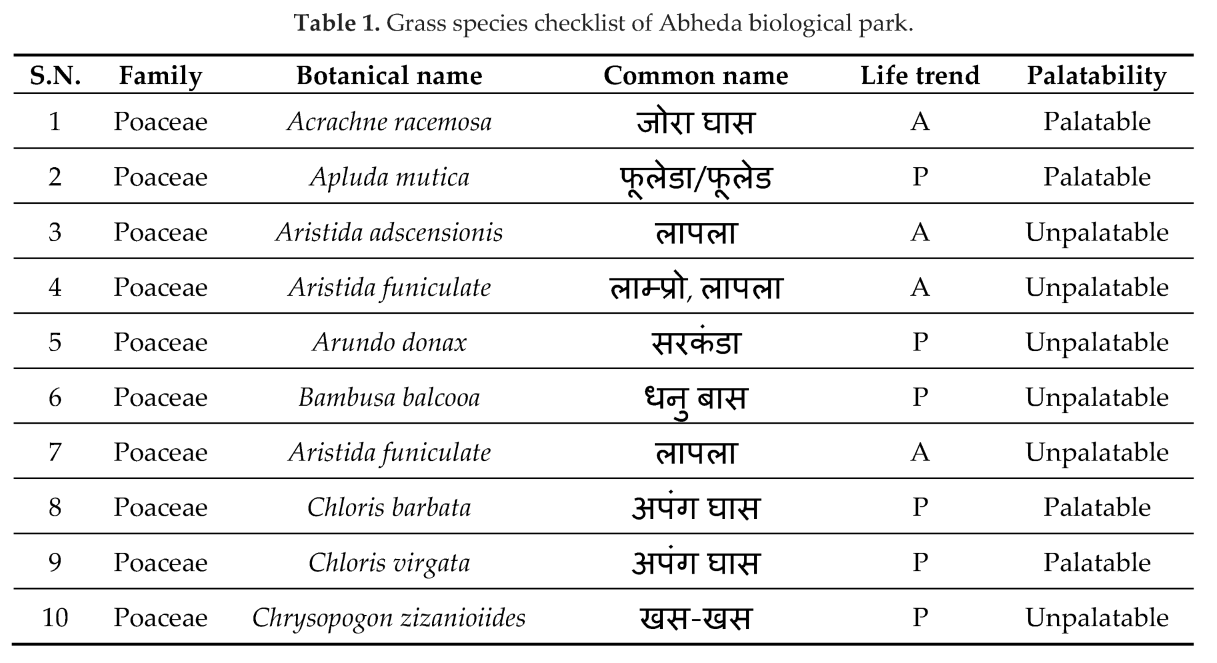
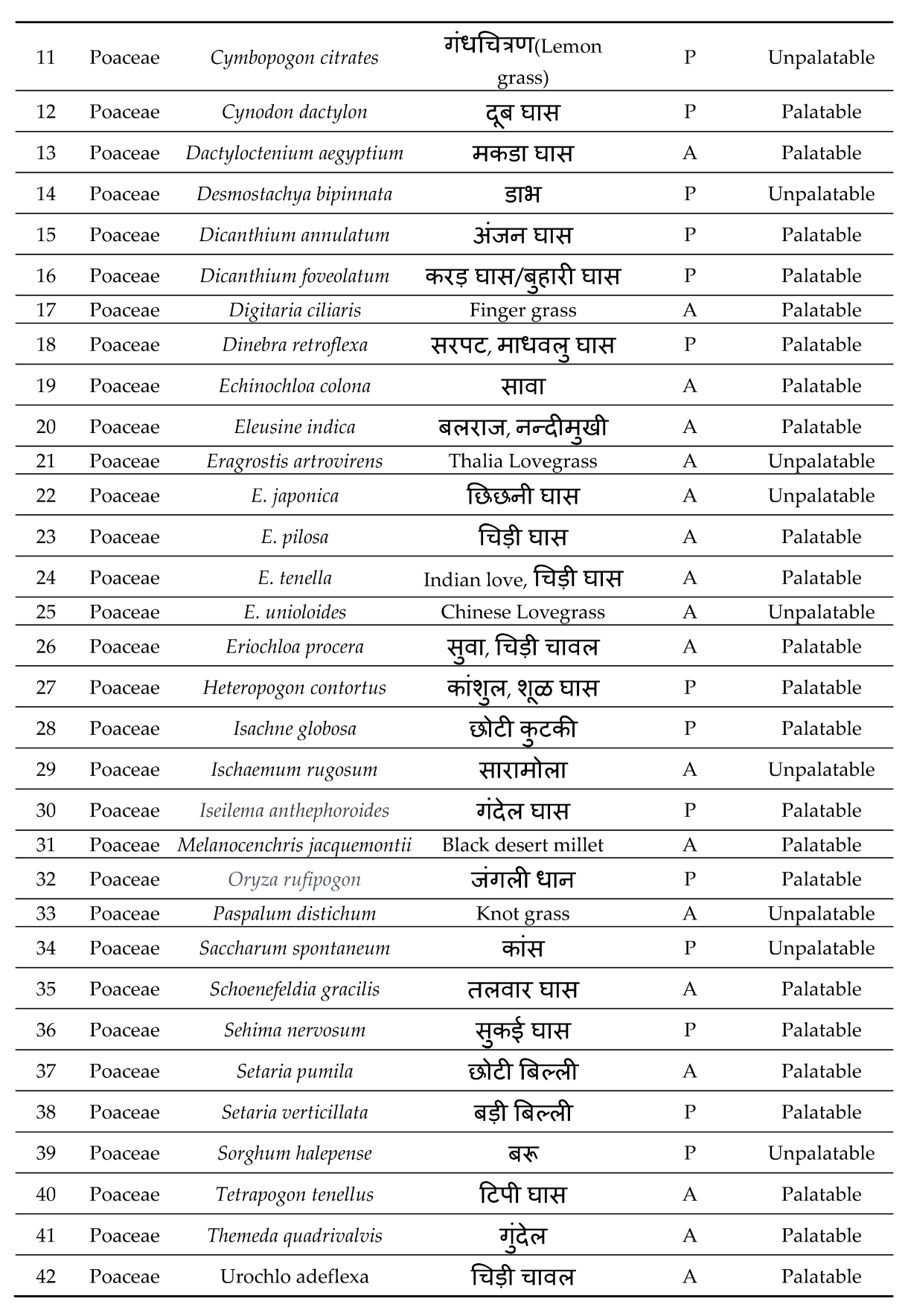
A total of 42 grass species (Table 1), all belonging to the family Poaceae, were documented from Abheda Biological Park. Analysis of ecological attributes revealed distinct patterns in terms of palatability and life span, reflecting the functional structure of the grassland ecosystem.
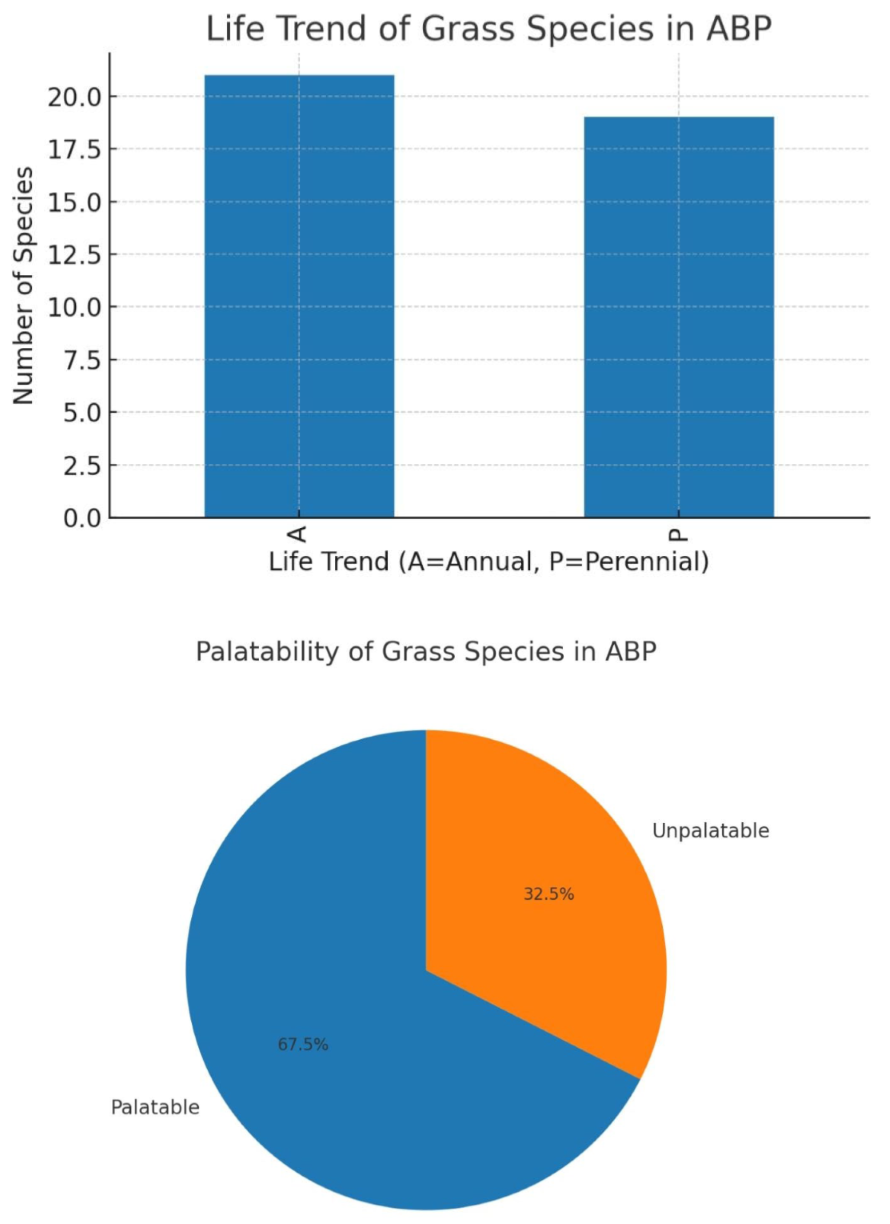
Out of the total recorded species, 27 species (65.8%) were identified as palatable, while 15 species (34.1%) were unpalatable. The dominance of palatable grasses indicates a high-quality forage base capable of supporting herbivorous wildlife. Frequently observed palatable species included Cynodon dactylon, Dicanthium annulatum, Heteropogon contortus, Eleusine indica, and Digitaria ciliaris. These species are well known for their nutritional value, grazing tolerance, and adaptability to semi-arid climatic conditions, and their prevalence suggests favorable habitat conditions within the park (Kumar & Yadav 2021).
In terms of life span, 23 species (53.6%) were perennial, while 19 species (46.3%) were annual. The slightly higher proportion of perennial grasses contributes to long-term ecosystem stability through continuous ground cover, soil binding, and sustained biomass availability (SONU KUMAR, & Om Prakash Bairwa 2025). Annual grasses, on the other hand, play a crucial role in seasonal productivity by rapidly colonizing open spaces during the monsoon period and enhancing short-term forage availability.
Although unpalatable grasses such as Aristida funiculata, Saccharum spontaneum, and Cymbopogon citratus are less preferred by grazers, their ecological significance cannot be overlooked (SONU KUMAR, & Om Prakash Bairwa 2025). These species contribute to habitat heterogeneity, regulate grazing pressure on palatable species, and provide shelter and resources for insects and other microfauna. Unpalatable grasses are also known to function as pioneer species in disturbed habitats and play an important role in ecological succession (Misra 1989).
The combined presence of palatable and unpalatable species, along with a balanced representation of annual and perennial life forms, indicates that the grassland ecosystem of Abheda Biological Park is structurally diverse and functionally resilient. The preparation of herbarium specimens further strengthens the reliability of the inventory by ensuring accurate species identification and providing permanent reference material.
Conclusion
The present study provides a comprehensive account of grass diversity and ecological characteristics in Abheda Biological Park. The dominance of palatable and perennial grasses highlights the ecological stability and forage potential of the park’s grasslands. The findings, supported by herbarium records, offer valuable baseline data for grassland management, wildlife habitat improvement, and conservation planning. Continued monitoring and detailed studies on seasonal biomass and nutritional attributes of grasses are recommended to support long-term conservation strategies.
References
- Shetty, B.V.; Singh, V. “Flora of Rajasthan, Botanical Survey of India,” Vol. I, II, & III Old Connaught Place, Dehradun; 1987, 1991. [Google Scholar]
- Barbhuiya, H.A.; Dutta, B.K.; Das, A.K.; Baishya, A.K. An annotated checklist of the grasses (Poaceae) of southern Assam. Check List 2013, 9(5), 980. [Google Scholar] [CrossRef]
- Bhat, K.G.; Nagendran, C.R. Sedges and Grasses (Dakshina Kannada and Udupi Districts); Bishen Singh Mahendra Pal Singh: Dehradun, 2001; p. 341pp. [Google Scholar]
- Bor, N.L. The Grasses of Burma, Ceylon, India and Pakistan (excluding Bambusae); Pergamon Press: Oxford, 1960; p. 767pp. [Google Scholar]
- Gadgil, M. Western Ghats: A lifescape. Journal of the Indian Institute of Sciences 1996, 76, 495–504. [Google Scholar]
- Gunawardene, N.R.; Daniels, A.E.D.; Gunatilleke, I.A.U.N.; Gunatilleke, C.V.S.; Karunakaran, P.V.; Nayak, K.G.; Prasad, S.; Puravaud, P.; Ramesh, B.R.; Subramanian, K.A.; et al. A brief overview of the Western Ghats Sri Lanka biodiversity hotspot. Current Science 2007, 93, 1567–1572. [Google Scholar]
- Jain, S.K. The grass genera of India - A synoptic account of uses and phytogeography. Bulletin of the Botanical Survey of India 1986, 28, 229–240. [Google Scholar]
- Joy, B.A. Effects of Grazing, Competition, Disturbance and Fire on Species Composition and Diversity in Grassland Communities. Journal of Vegetation Science 1992, 3(2), 187–200. [Google Scholar] [CrossRef]
- Kabeer, K.A.; Nair, V.J. Flora of Tamilnadu- Grasses; Botanical Survey of India, 2009; p. 525pp. [Google Scholar]
- Karthikeyan, S.; Jain, S.K.; Nayar, M.P.; Sanjappa, M. Florae Indicae Enumaratio: Monocotyledonae; B.S.I.: Calcutta, 1989; p. 435pp. [Google Scholar]
- Khandelwal, S.; Mathur, R. Flora of Rajasthan: An Illustrated Guide; Rajasthan Biodiversity Board: Jaipur, 2022. [Google Scholar]
- Kumar, R.; Yadav, A. Ecological assessment of grassland habitats in western India. Journal of Grassland Studies 2021, 15(2), 45–60. [Google Scholar]
- Manjunatha, B.R.; Balakrishna, K.; Krishnakumar, K.N.; Manjunatha, H.V.; Avinash, K.; Mulemane, A.C.; Krishna, K.M. Increasing trend of rainfall over Agumbe, Western Ghats, India in the scenario of global warming. The Open Oceanography Journal 2015, 8, 39–44. [Google Scholar] [CrossRef]
- Moulik, S. The grasses and bamboos of India. Vols. 1 and 2; Scientific Publishers: Jodhpur, 1997; p. 359pp + 636pp. [Google Scholar]
- Pathak, S. Cenchrus prieurii a new record for North Eastern India. Reedea 2013, 23(2), 132–134. [Google Scholar]
- Potdar, G.G.; Salunkhe, C.B.; Yadav, S.R. Grasses of Maharashtra; Shivaji University: Kolhapur, 2012; p. 656pp. [Google Scholar]
- Ray, S.; Sainkhediya, J. Diversity of grasses in Nimar region of Madhya Pradesh. Indian journal of plant sciences 2012, 1:2-3, 144–152. [Google Scholar]
- Sainkhediya, J.; Patil, K. Palatable grass biodiversity in Govt. P.G. College Sendhwa Dist. Barwani, M.P., India. In Global journal for research analysis; 2019. [Google Scholar]
- Shantz, H.L. The place of grasslands in the earth’s cover of vegetation. Ecology 1954, 35, 143–145. [Google Scholar] [CrossRef]
- Singh, N.P.; Pandey, R.P. Flora of Rajasthan, Vols. I–III; Botanical Survey of India: Kolkata, 2003. [Google Scholar]
- KUMAR, S.; Bairwa, O.P. Grasses Of Abhera biological park; Zenodo, 2025. [Google Scholar] [CrossRef]
- KUMAR, S.; Bairwa, O.P. Grass species utilization by munia birds (Estrildidae) at Abhera Biological Park, Kota, Rajasthan, India. In Journal of advance and future research; Zenodo, 2025; Vol. 3, Number 12, pp. 788–791. [Google Scholar] [CrossRef]
- KUMAR, S.; Bairwa, O.P. Grasses of Ummedganj Pakshi Vihar Conservation Reserve UPVCR), Kota, Rajasthan”. 2025. [Google Scholar] [CrossRef]
- KUMAR, S. Common Grasses of Hadoti Region; Zenodo, 2025. [Google Scholar] [CrossRef]
- Sreekumar, P.V.; Nair, V.J. Flora of Kerala Grasses; Botanical Survey of India: Calcutta, 1991; p. 470pp. [Google Scholar]
- Thomas, B.; Rajendran, A.; Kabeer, K.A.A.; Sivalingam, R. Chasmophytic grasses of Velliangiri Hills in the southern Western Ghats of Tamil Nadu, India. Journal of Threatened Taxa 2012, 4(15), 3462–3472. [Google Scholar] [CrossRef]
- Yoganarasimhan, S.N.; Subramanyan, K.; Razi, B.A. Flora of Chikkamagalore District, Karnataka, India; International Book Distributers: Dehradun, 1982; p. 407pp. [Google Scholar]
Disclaimer/Publisher’s Note: The statements, opinions and data contained in all publications are solely those of the individual author(s) and contributor(s) and not of MDPI and/or the editor(s). MDPI and/or the editor(s) disclaim responsibility for any injury to people or property resulting from any ideas, methods, instructions or products referred to in the content. |
© 2026 by the authors. Licensee MDPI, Basel, Switzerland. This article is an open access article distributed under the terms and conditions of the Creative Commons Attribution (CC BY) license.
Copyright: This open access article is published under a Creative Commons CC BY 4.0 license, which permit the free download, distribution, and reuse, provided that the author and preprint are cited in any reuse.


