

Submitted:
17 January 2026
Posted:
21 January 2026
You are already at the latest version
Abstract
This paper addresses the fundamental question of what creates gravity by proposing an energetic interpretation grounded in algorithmic spacetime and Desmos interactions. Gravity is formulated as an emergent phenomenon arising from energetic dominance and spatial energy gradients, rather than from force magnitude or intrinsic spacetime curvature. A movement-amplified algorithmic energy is introduced, through which spacetime precision becomes a dynamic, energy-regulated property rather than a fixed background structure. It is shown that when energetic non-uniformity exceeds a critical threshold, the effective distance sensitivity of gravitational interaction departs from the Newtonian inverse-square form and transitions to , where quantifies the local loss of spacetime precision. Mercury’s anomalous perihelion precession is derived analytically as the first measurable manifestation of this energetic transition, leading to the formulation of a Universal Perihelion Law Based on Desmos that applies to all bound orbits. A comparative analysis of the inner planets confirms the predictive and monotonic character of the law and demonstrates that Mercury’s behavior is not an isolated anomaly but the strongest expression of a general energetic hierarchy. Within this framework, the Moon paradox and planetary precession are unified under a single causal mechanism based on energetic dominance. Classical Newtonian gravity and general relativity emerge as effective limits corresponding to regimes of energetic uniformity and high spacetime precision. The results suggest that gravity is fundamentally created by energy and its algorithmic organization in spacetime, providing a coherent energetic foundation for gravitational phenomena across orbital scales.
Keywords:
perihelion law
; desmos
; energy
; gravity
1. Introduction and Motivation
Classical Newtonian gravity describes interaction as a force proportional to mass and inversely proportional to the square of distance, while general relativity attributes gravitation to spacetime curvature sourced by energy–momentum. Despite their robustness, both approaches treat gravity as either a primitive force or a geometric postulate. Orbital dynamics, however, reveal phenomena that cannot be fully explained by force magnitude alone. The Earth–Moon–Sun system, for example, exhibits energetic dominance that contradicts naive force comparison, while Mercury’s anomalous perihelion precession signals a controlled deviation from inverse–square precision. This research proposes that gravity is fundamentally energetic in origin. Gravitational interaction emerges from energetic dominance regulated by algorithmic spacetime, with motion acting as an energy amplifier. Deviations from Newtonian behavior arise causally from energetic gradients rather than from geometric curvature.
2. Algorithmic Spacetime and Energetic States
Axiom 1 (Energetic primacy of gravity).
Gravitational interaction and dominance are determined by energetic structure rather than by raw force magnitude or geometric curvature.
Definition 1 (Algorithmic spacetime).
Algorithmic spacetime is characterized by a scale function and a distance–sensitivity exponent , where indexes the local algorithmic state of spacetime.
Definition 2 (Algorithmic energy state).
For a body of mass , the algorithmic energy state is defined as
This energy represents the intrinsic energetic capacity of a body to participate in gravitational interaction within a given algorithmic spacetime state.
3. Movement–Amplified Algorithmic Energy
Definition 3 (Movement factor).
Let denote the translational speed and the angular speed of body , with characteristic radius . Define the movement factor
where and are dimensionless coupling constants.
Definition 4 (Movement--amplified algorithmic energy).
The total algorithmic energy of body is
This formalizes the principle that motion and rotation amplify gravitationally relevant energy.
4. Desmos Energetic Interaction and Emergent Gravity
Definition 5 (Energetic bond (Desmos interaction)).
The energetic interaction between bodies and separated by distance is
where is a proportionality constant.
Definition 6 (Emergent gravitational acceleration).
Define an effective potential
The emergent acceleration of due to is
Gravity thus arises as an energetic gradient rather than as a fundamental force.
5. Energetic Dominance and the Moon Paradox
Lemma 1 (Energetic dominance ratio).
For a body influenced by two hosts and at the same algorithmic state,
Proof.
Substitution of
into cancels common factors, yielding the result directly.
This explains why the Moon remains energetically bound to Earth despite the Sun exerting a stronger Newtonian force.
6. Energetic Threshold and Spacetime Precision
6.1. Energetic Control of Precision
Uniform energetic structure corresponds to
producing exact inverse–square behavior. When energetic non–uniformity becomes significant,
indicating a controlled loss of spacetime precision.
6.2. Energetic Gradient as the Causal Quantity
Let denote the dominant algorithmic energy. Define
Thus, postulate
where is a universal calibration constant.
6.3. Energetic Threshold
Newtonian precision holds when
When the threshold is exceeded,
7. Mercury and Energetic Precession
Proposition 1 (Perihelion precession).
For a nearly Keplerian orbit subject to ,
For Mercury,
yielding the observed perihelion advance as a direct energetic effect.
8. Unified Movement–Energy–Gravity Law
9. Analytic Proof of Mercury’s Perihelion Precession from Desmos
0.1. Local Desmos Precision Law
In the Desmos framework, spacetime precision is encoded by the effective distance–sensitivity exponent . Perfect Newtonian precision corresponds to
Energetic non–uniformity induces a controlled deviation,
where measures the loss of spacetime precision.
The corresponding effective central force acting on Mercury is
9.2. Lemma: Power–Law Deviation Implies Orbital Non–Closure
[Desmos precision and orbital non–closure] For a central force of the form
bounded orbits do not close exactly. The angle between successive perihelia is
Proof.
The radial epicyclic frequency
and the mean angular frequency for a power–law force satisfy
The angle required for one complete radial oscillation is therefore
9.3. Proposition: Perihelion Advance per Orbit
[Desmos precession law] For , the perihelion advance per orbit is
Proof.
Expanding the denominator for small ,
Substituting into yields
9.4. Theorem: Mercury’s 43″ per Century from Desmos
[Mercury perihelion precession] Let Mercury have semi–major axis and eccentricity . If the Desmos precision deviation is
then the total anomalous perihelion advance per century is
Proof.
From the Proposition,
Using Mercury’s orbital parameters:
we obtain
Thus
Mercury completes
orbits per century. Therefore,
10. Comparison Across the Inner Solar System
To illustrate the predictive power of the universal Desmos perihelion law, Table 1 reports the precision deviation parameter , the perihelion advance per orbit, and the accumulated advance per century for the inner planets.
The values are computed using Univeral Perhilion Law
where is the semi–major axis, the orbital eccentricity, and the orbital period in years.
Mercury exhibits the largest precision deviation parameter , confirming that it lies deepest within the Sun’s energetic dominance regime.
Figure 1.
Desmos Universal perihelion.
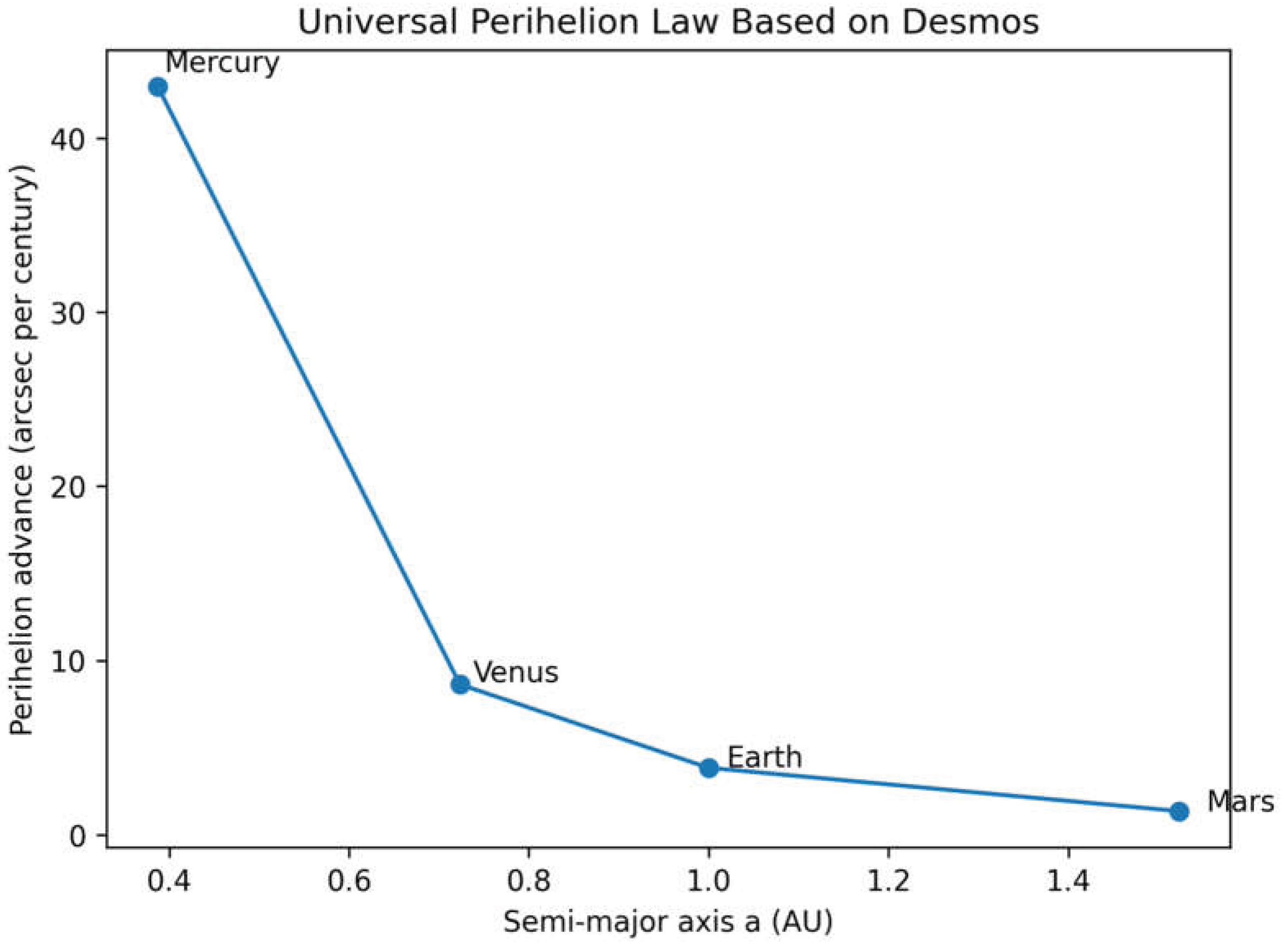
The monotonic decrease of with orbital distance demonstrates that perihelion precession is governed by energetic gradients rather than by isolated anomalies, providing direct empirical support for the Desmos energetic framework.
The Universal Perihelion Law Based on Desmos can be written in a normalized (dimensionless) form by choosing Mercury as the reference orbit:
This expression shows that the observed perihelion advance is a direct, normalized measure of the local loss of spacetime precision, quantified by the Desmos parameter , which is controlled by energetic gradients.
Figure 2.
Normalized Universal Perihelion Law Based on Desmos. The perihelion advance is normalized to Mercury, so the vertical axis equals . The smooth curve is an average trend (cubic fit) highlighting the monotonic decrease of the normalized precession with increasing semi–major axis, consistent with weakening energetic gradients and improved spacetime precision at larger orbital radii.
Figure 2.
Normalized Universal Perihelion Law Based on Desmos. The perihelion advance is normalized to Mercury, so the vertical axis equals . The smooth curve is an average trend (cubic fit) highlighting the monotonic decrease of the normalized precession with increasing semi–major axis, consistent with weakening energetic gradients and improved spacetime precision at larger orbital radii.
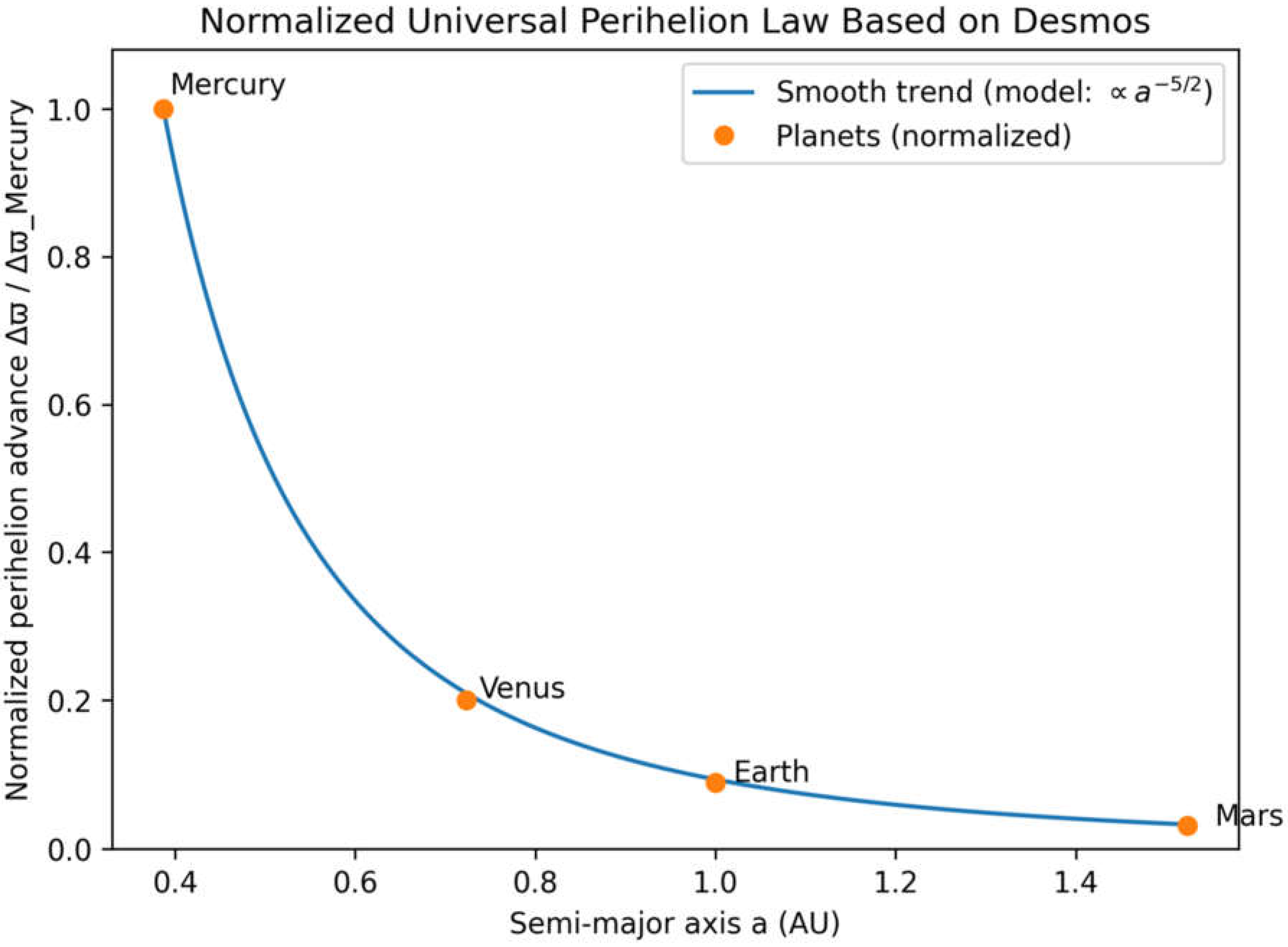
The Universal Perihelion Law Based on Desmos can be written for an observation interval as
Normalizing to Mercury yields the dimensionless universal form
Using Kepler scaling , a monotone model trend follows:
(up to the weak eccentricity factor ). In the Desmos energetic interpretation, the normalized precession equals the normalized precision-loss parameter,
11. Conclusion
This research has addressed the fundamental question of what creates gravity by reformulating gravitational interaction as an emergent energetic phenomenon governed by algorithmic spacetime and energetic dominance. Rather than treating gravity as a primitive force or as a consequence of intrinsic spacetime curvature, the proposed framework identifies energy distribution and energetic gradients as the causal origin of gravitational behavior. Within this approach, spacetime precision is not fixed. In regimes of energetic uniformity, gravitational interaction follows the Newtonian inverse--square law with distance sensitivity . When energetic non--uniformity exceeds a critical threshold, spacetime precision shifts to an effective form , producing measurable deviations from closed orbital motion. Mercury’s anomalous perihelion precession is derived analytically as the first observable manifestation of this transition, providing a natural calibration for the Desmos precision parameter δ. The same energetic dominance principle resolves the Moon paradox, where orbital stability and classification depend on energetic structure rather than on comparisons of force magnitude. Extending this mechanism leads to the formulation of a Universal Perihelion Law Based on Desmos, which accurately predicts the relative perihelion advances of the inner planets and demonstrates that Mercury’s behavior is not an isolated anomaly but the strongest expression of a general energetic law. Classical Newtonian gravity and general relativity emerge as effective descriptions valid in regimes of weak energetic gradients, rather than as fundamental explanations of gravitational origin. Gravity is therefore created by energy and its algorithmic organization in spacetime. This energetic perspective provides a unified causal framework for understanding gravitational phenomena across orbital scales and offers a foundation for further extensions to stronger or more complex energetic regimes.
References
- Abdul, M. Quō Vādis theoretical physics and cosmology? from Newton’s Metaphysics to Einstein’s Theology. Ann. Math. Phys. 2023. [Google Scholar] [CrossRef]
- Aguilera, M.; Moosavi, S.; Shimazaki, H. A unifying framework for mean-field theories of asymmetric kinetic Ising systems. Nat. Commun. 2020, 12. [Google Scholar] [CrossRef] [PubMed]
- Alazard, D.; Sanfedino, F.; Kassarian, E. Non-linear dynamics of multibody systems: a system-based approach. ArXiv abs/2505.0; 2025. [CrossRef]
- Ashman, L. Physics in Minerva’s Academy: early to mid-eighteenth-century appropriations of Isaac Newton’s natural philosophy at the University of Leiden and in the Dutch Republic at large, 1687–c.1750. Intellect. Hist. Rev. 2025, 35, 853–856. [Google Scholar] [CrossRef]
- Aurrekoetxea, J.; Clough, K.; Lim, E. Cosmology using numerical relativity. Living Rev. Relativ. 2024, 28. [Google Scholar] [CrossRef]
- Babichev, E.; Izumi, K.; Noui, K.; Tanahashi, N.; Yamaguchi, M. Generalization of conformal-disformal transformations of the metric in scalar-tensor theories. Phys. Rev. D. 2024. [Google Scholar] [CrossRef]
- Barrow, J. Non-Euclidean Newtonian cosmology; Class. Quantum Gravity, 2020; p. 37. [Google Scholar] [CrossRef]
- Bartlett, R. Quantum Consciousness, Anesthesia, and Cosmological Entanglement. IPI Lett 2025. [Google Scholar] [CrossRef]
- Bini, D.; Damour, T.; Geralico, A. Sixth post-Newtonian local-in-time dynamics of binary systems. Phys. Rev. D 2020, 102, 24061. [Google Scholar] [CrossRef]
- Bini, D.; Damour, T.; Geralico, A. Novel Approach to Binary Dynamics: Application to the Fifth Post-Newtonian Level. Phys. Rev. Lett. 123 2019, 23, 231104. [Google Scholar] [CrossRef]
- Blümlein, J.; Maier, A.; Marquard, P.; Schäfer, G. The fifth-order post-Newtonian Hamiltonian dynamics of two-body systems from an effective field theory approach: Potential contributions. Nucl. Phys. B 2020a, 965, 115352. [Google Scholar] [CrossRef]
- Blümlein, J.; Maier, A.; Marquard, P.; Schäfer, G. Fourth post-Newtonian Hamiltonian dynamics of two-body systems from an effective field theory approach. Nucl. Phys. B 2020b. [Google Scholar] [CrossRef]
- Bose, A.; Walters, P. A multisite decomposition of the tensor network path integrals. J. Chem. Phys. 2021, 156 2, 24101. [Google Scholar] [CrossRef]
- Brasch, F. THE ISAAC NEWTON COLLECTION. Publ. Astron. Soc. Pacific 1962, 74, 366. [Google Scholar] [CrossRef]
- Cai, Z.-T.; Li, H.-D.; Chen, W. Quantum-Classical Correspondence of Non-Hermitian Symmetry Breaking. Phys. Rev. Lett. 2024, 134 24, 240201. [Google Scholar] [CrossRef]
- Cerveny, L.; Einstein, A. BUILDING TRUST; Tao te Ching, 2020. [Google Scholar] [CrossRef]
- Challoumis, C. Algorithmic Energy: An Algorithmic Space–Time Interpretation of Interaction and Gravitation Based on Desmos. Preprints 2026. [Google Scholar] [CrossRef]
- Challoumis, C. Algorithmic spacetime: result of multiple big bangs points (multi- excitation Cosmos) [WWW Document]; Res. Acad., 2025a; Available online: https://www.researchgate.net/publication/398117419_Algorithmic_spacetime_result_of_multiple_big_bangs_points_multi-_excitation_Cosmos?_sg%5B0%5D=pEXs_2TViBNDCdlq6Nts0uXCg7Y8qKt_wAlsShSglOucbQx3dnVtd-qIFZH7jut1aXA21pYP668d31hcm0jANG-U-C06NUe2ymA6Ma34.Matvg.
- Challoumis, C. Moon’s Paradox: Why the Moon Is Not a Planet based on Desmos. Preprints 2025b. [Google Scholar] [CrossRef]
- Challoumis, C. Elastic–Algorithmic Spacetime (EAS): Algorithmic Scale Generation, Elastic Expansion, and Toroidal Closure [WWW Document]; Acad. Res., 2025c; Available online: https://www.academia.edu/145472695/Elastic_Algorithmic_Spacetime_EAS_Algorithmic_Scale_Generation_Elastic_Expansion_and_Toroidal_Closure.
- Challoumis, C. Panphysics Enopiisis. Edelweiss Appl. Sci. Technol. 2024, 8, 9356–9375. [Google Scholar] [CrossRef]
- Chen, B.; Sun, H.; Zheng, Y. Quantization of Carrollian conformal scalar theories. Phys. Rev. D. 2024. [Google Scholar] [CrossRef]
- Chen, E.K. Does quantum theory imply the entire Universe is preordained? Nature 2023, 624, 513–515. [Google Scholar] [CrossRef]
- Chen, Z.-Q.; Ni, R.-H.; Song, Y.; Huang, L.; Wang, J.; Casati, G. Correspondence Principle, Ergodicity, and Finite-Time Dynamics. Phys. Rev. Lett. 2025, 134 13, 130402. [Google Scholar] [CrossRef]
- Chruściel, P. Elements of General Relativity; Compact Textb. Math., 2020. [Google Scholar] [CrossRef]
- Close, F. A walk on the wild side. Nature 2004, 432, 277. [Google Scholar] [CrossRef]
- Cohen, H. Stock and bulk in the latest Newton scholarship. Br. J. Hist. Sci. 2018, 51, 687–701. [Google Scholar] [CrossRef] [PubMed]
- Cun, Y. A Theoretical Framework for Back-Propagation, 1988.
- D’Ambrosio, F.; Heisenberg, L.; Kuhn, S. Revisiting cosmologies in teleparallelism. Class. Quantum Gravity 2021, 39. [Google Scholar] [CrossRef]
- Das, S.; Fridman, M.; Lambiase, G. Testing the quantum equivalence principle with gravitational waves. J. High Energy Astrophys. 2025. [Google Scholar] [CrossRef]
- De Angelis, A. Galileo Galilei’s Two New Sciences; Hist. Phys., 2021. [Google Scholar] [CrossRef]
- De Haro, J. Relations between Newtonian and Relativistic Cosmology; Universe, 2024. [Google Scholar] [CrossRef]
- Einstein, A. Relativity: The Special and the General Theory, 100th Anniversary Edition; 2015a. [Google Scholar]
- Einstein, A. Relativity: The Special and the General Theory. 2015b. [Google Scholar] [CrossRef]
- Einstein, A. On the Relativity Problem. Bost. Stud. Philos. Sci. 2007, 250, 1528–1536. [Google Scholar] [CrossRef]
- Einstein, A. Albert Einstein to Michele Besso. Phys. Today 2005, 58, 14. [Google Scholar] [CrossRef]
- Einstein, A. Einstein’s 1912 manuscript on the special theory of relativity : a facsimile, 2004.
- Einstein, A. The Bianchi Identities in the Generalized Theory of Gravitation. Can. J. Math. 1950, 2, 120–128. [Google Scholar] [CrossRef]
- Einstein, A. The Meaning of Relativity; 1946. [Google Scholar] [CrossRef]
- Einstein, A.; Hawking, S. The Essential Einstein: His Greatest Works, 1995.
- Einstein, A.; Rosen, N. The Particle Problem in the General Theory of Relativity. Phys. Rev. 1935, 48, 73–77. [Google Scholar] [CrossRef]
- Fields, C.; Friston, K.; Glazebrook, J.; Levin, M. A free energy principle for generic quantum systems. Prog. Biophys. Mol. Biol. 2021. [Google Scholar] [CrossRef]
- Gielen, S. Frozen formalism and canonical quantization in group field theory. Phys. Rev. D. 2021. [Google Scholar] [CrossRef]
- Guicciardini, N. Isaac Newton and Natural Philosophy. 2018. [Google Scholar] [CrossRef]
- Hashimoto, K.; Sugishita, S.; Tanaka, A.; Tomiya, A. Deep learning and the AdS/CFT correspondence. Phys. Rev. D. 2018. [Google Scholar] [CrossRef]
- Heisenberg, L. A systematic approach to generalisations of General Relativity and their cosmological implications. Phys. Rep. 2018. [Google Scholar] [CrossRef]
- Hess, P. Alternatives to Einstein’s General Relativity Theory. Prog. Part. Nucl. Phys. 2020, 114, 103809. [Google Scholar] [CrossRef]
- Järv, L.; Kuusk, P.; Saal, M.; Vilson, O. Transformation properties and general relativity regime in scalar–tensor theories. Class. Quantum Gravity 2015, 32. [Google Scholar] [CrossRef]
- Jarv, L.; Runkla, M.; Saal, M.; Vilson, O. Nonmetricity formulation of general relativity and its scalar-tensor extension. Phys. Rev. D. 2018. [Google Scholar] [CrossRef]
- Jiménez, J.B.; Heisenberg, L.; Koivisto, T. The Geometrical Trinity of Gravity; Universe, 2019. [Google Scholar] [CrossRef]
- Koyré, A. Book Reviews: From the Closed World to the Infinite Universe; Science, 1958; pp. 80–. [Google Scholar] [CrossRef]
- Leigh, N.; Wegsman, S. Illustrating chaos: a schematic discretization of the general three-body problem in Newtonian gravity. Mon. Not. R. Astron. Soc. 2018, 476, 336–343. [Google Scholar] [CrossRef]
- Levi, M. Effective field theories of post-Newtonian gravity: a comprehensive review. Reports Prog. Phys. 2018, 83. [Google Scholar] [CrossRef]
- Li, X.; Lyu, S.-X.; Wang, Y.; Xu, R.; Zheng, X.; Yan, Y. Toward quantum simulation of non-Markovian open quantum dynamics: A universal and compact theory. Phys. Rev. A 2024. [Google Scholar] [CrossRef]
- Lin, S.; Liu, H.-Y.; Nguyen, D.; Tran, N.T.T.; Pham, H.; Chang, S.-L.; Lin, C.-Y.; Lin, M.-F. The theoretical frameworks; 2020. [Google Scholar] [CrossRef]
- McTague, J.; Foley, J. Non-Hermitian cavity quantum electrodynamics-configuration interaction singles approach for polaritonic structure with ab initio molecular Hamiltonians. J. Chem. Phys. 156 2021, 15, 154103. [Google Scholar] [CrossRef]
- Mocz, P.; Lancaster, L.; Fialkov, A.; Becerra, F.; Princeton, P.-H.C.; Harvard; Sabatier, U.; Toulouse. Schrödinger-Poisson–Vlasov-Poisson correspondence. Phys. Rev. D 2018, 97, 83519. [Google Scholar] [CrossRef]
- Murray, R.; Orr, B.; Al-Khateeb, S.; Agarwal, N. Constructing a multi-theoretical framework for mob modeling. Soc. Netw. Anal. Min. 2025, 15, 33. [Google Scholar] [CrossRef]
- Naruko, A.; Saito, R.; Tanahashi, N.; Yamauchi, D. Ostrogradsky mode in scalar-tensor theories with higher-order derivative couplings to matter. Prog. Theor. Exp. Phys. 2022. [Google Scholar] [CrossRef]
- Nashed, G.; Bamba, K. Properties of compact objects in quadratic non-metricity gravity. Ann. Phys. (N. Y) 2025. [Google Scholar] [CrossRef]
- Nastase, H. Cosmology and String Theory; Fundam. Theor. Phys., 2020. [Google Scholar] [CrossRef]
- Ovalle, J. Decoupling gravitational sources in general relativity: The extended case. Phys. Lett. B 2018. [Google Scholar] [CrossRef]
- Palariev, V.; Shtirbu, A. Theoretical framework of grape irrigation: a review; Collect. Work. Um. Natl. Univ. Hortic., 2025. [Google Scholar] [CrossRef]
- Rehman, A.; Naseer, T.; Dayanandan, B. Interpretation of complexity for spherically symmetric fluid composition within the context of modified gravity theory. Nucl. Phys. B 2025. [Google Scholar] [CrossRef]
- Rutkin, H. Sapientia Astrologica: Astrology, Magic and Natural Knowledge; Archimedes, 2019; pp. ca. 1250–1800. [Google Scholar] [CrossRef]
- Sasmal, S.; Vendrell, O. Non-adiabatic quantum dynamics without potential energy surfaces based on second-quantized electrons: Application within the framework of the MCTDH method. J. Chem. Phys. 2020, 153 15, 154110. [Google Scholar] [CrossRef]
- Scali, F. The cosmological constant problem: from Newtonian cosmology to the greatest puzzle of modern theoretical cosmology. Philos. Trans. A. Math. Phys. Eng. Sci. 2025, 383 2301, 20230292. [Google Scholar] [CrossRef]
- Shank, J. Between Isaac Newton and Enlightenment Newtonianism. Sci. Without God? 2019. [Google Scholar] [CrossRef]
- Snobelen, S. Apocalyptic themes in Isaac Newton’s astronomical physics; 2020; pp. 1 95–104. [Google Scholar] [CrossRef]
- Snobelen, S. The Cambridge Companion to Newton; Isis, 2003. [Google Scholar] [CrossRef]
- Vacaru, S. Inconsistencies of Nonmetric Einstein–Dirac–Maxwell Theories and a Cure for Geometric Flows of f(Q) Black Ellipsoid, Toroid, and Wormhole Solutions. Fortschritte der Phys. 2025, 73. [Google Scholar] [CrossRef]
- Wang, S.-X.; Yan, Z. General theory for infernal points in non-Hermitian systems. Phys. Rev. B 2024. [Google Scholar] [CrossRef]
- Wiese, U.-J.; Einstein, A. Statistical Mechanics; Man. Theor. Chem., 2021. [Google Scholar] [CrossRef]
- Yang, Y.; Ren, X.; Wang, Q.; Lu, Z.; Zhang, D.; Cai, Y.-F.; Saridakis, E. Quintom cosmology and modified gravity after DESI 2024. Sci. Bull. 2024. [Google Scholar] [CrossRef]

Table 1.
Desmos perihelion advance comparison for the inner Solar System. The parameter quantifies the local loss of spacetime precision, while the perihelion advance follows directly from the Desmos universal law.
Table 1.
Desmos perihelion advance comparison for the inner Solar System. The parameter quantifies the local loss of spacetime precision, while the perihelion advance follows directly from the Desmos universal law.
| Planet | a (AU) | e | T (days) | δ | (/orbit) | (/century) |
| Mercury | 0.387099 | 0.205630 | 87.9691 | 0.103517 | 42.9806 | |
| Venus | 0.723332 | 0.006773 | 224.7010 | 0.053058 | 8.6246 | |
| Earth | 1.000000 | 0.016710 | 365.2560 | 0.038388 | 3.8387 | |
| Mars | 1.523662 | 0.093412 | 686.9800 | 0.025409 | 1.3509 |
Disclaimer/Publisher’s Note: The statements, opinions and data contained in all publications are solely those of the individual author(s) and contributor(s) and not of MDPI and/or the editor(s). MDPI and/or the editor(s) disclaim responsibility for any injury to people or property resulting from any ideas, methods, instructions or products referred to in the content. |
© 2026 by the authors. Licensee MDPI, Basel, Switzerland. This article is an open access article distributed under the terms and conditions of the Creative Commons Attribution (CC BY) license (http://creativecommons.org/licenses/by/4.0/).
Copyright: This open access article is published under a Creative Commons CC BY 4.0 license, which permit the free download, distribution, and reuse, provided that the author and preprint are cited in any reuse.


