

Submitted:
16 January 2026
Posted:
19 January 2026
You are already at the latest version
Abstract
Ammonia decomposition is one of the most used pathways for a carbon-free hydrogen production, particularly in systems where ammonia is used as a hydrogen carrier. Modelling and simulation are critical for the general quantification of reaction kinetics, transport limitations, reactor performance, and system-level integration; however, simulation-based studies remain disjointed across modelling scales and synthesis routes. This systematic review examines modelling and simulation studies on ammonia decomposition published in the period between 2014 and 2025, identified through a structured Scopus search and screened using PRISMA methodology. A total of 70 model-ling-focused studies were classified into five modelling categories: reactor-scale numerical and CFD modelling; kinetic and thermochemical mechanism modelling; thermodynamic, energy, and exergy-based process simulation; multiscale or cross-scale modelling; and conceptual or dimensionless modelling frameworks. The results show that reactor-scale CFD and kinetic models constitute most published studies, while integrated multiscale frameworks linking catalyst-scale phenomena to reactor and process-level performance remain limited. Furthermore, the inclusion of technoeconomic analysis (TEA) and life-cycle assessment (LCA) is limited, restricting quantitative evaluation of scalability and system viability. Based on the reviewed literature, key methodological gaps are identified, and a multiscale modelling roadmap is proposed to support the design, optimisation, and scale-up of ammonia-to-hydrogen conversion systems.
Keywords:
ammonia decomposition
; hydrogen production
; computational fluid dynamics (CFD)
; kinetic modelling
; multiscale simulation
; process simulation
; techno-economic analysis (TEA)
; energy systems modelling
; exergy analysis
1. Introduction
Hydrogen is increasingly recognized as a clean energy vector [1], offering high gravimetric energy density [2] and the potential to decarbonize power generation [3], transportation [4], and industry when produced via low-carbon pathways [5,6]. Its adoption directly supports UN Sustainable Development Goals (SDGs) [7], particularly SDG 7 (Affordable and Clean Energy), SDG 9 (Industry, Innovation and Infrastructure), SDG 12 (Responsible Consumption and Production), and SDG 13 (Climate Action). However, practical deployment of hydrogen is constrained by challenges in storage and transport; gaseous hydrogen requires high pressures or cryogenic conditions [4], leading to high capital and operational cost [8], while infrastructure for hydrogen delivery remains under-developed [9]. Hydrogen gases must be pressurized (350-700 bar) and/or cryogenically liquefied at 253 degrees Celsius, which are both energy-intensive and costly in terms of capital investments [9,10], and the global infrastructure of hydrogen transport and distribution is small and spatially dispersed [12].
Despite these challenges, hydrogen usage has increased considerably in the last ten years. In the 2022 report by the International Energy Agency (IEA), the world hydrogen consumption is reported to have been more than 95 million tonnes and mainly demanded in oil refining and ammonia production, which consumes almost 6% of world natural gas and near 2% of world CO2 emissions when produced through traditional fossil-based pathways [13]. National hydrogen strategies are already published in more than 40 countries, and more than 1,000 large-scale hydrogen projects have been announced across the globe, signifying planned investments of over USD 500 billion by 2030 [12,13]. Such advances underscore the increasingly central role of hydrogen as a foundation in long-term decarbonization strategies, especially in the steelmaking, chemicals, and long-distance transport domains that are hard to decarbonize [15].
Ammonia has been proposed as a hydrogen carrier [16] because of its high volumetric hydrogen density (17.6 wt.%), an established global production capacity of more than 180 million tonnes per year, and well-developed storage and transport infrastructure as a result of the fertilizer industry [15,16]. Unlike liquid hydrogen, ammonia can be stored at moderate pressures (810 bar at ambient temperature) and transported with existing tanks, pipelines and shipping vessels; thereby, reducing the large logistical hurdles associated with hydrogen transport [19]. As a result, hydrogen supply chains based on ammonia are becoming more actively studied as the source of energy storage on a large scale, maritime fuel, and long-distance hydrogen delivery system [20].
In order to facilitate the use of ammonia as a source of hydrogen, effective ammonia decomposition (or cracking) technologies are required to produce high-purity hydrogen that can be used in downstream processes, including fuel cells, turbines, or industrial processes. Traditional thermo-catalytic ammonia decomposition has been widely investigated as the technology is relatively mature and simple to operate; However, it typically operates at very high operating temperatures (500-800 °C) and experiences difficulties associated with catalyst deactivation, equilibrium constraints and energy efficiency [19,20,21]. Consequently, various other methods, including plasma-catalytic, photocatalytic, photothermal, electrocatalytic, and microwave-assisted catalytic ammonia decomposition, have also been considered to lower the operating temperature, increase conversion, as well as to enable integration with renewable energy sources [22,23,24].
In this regard, process modelling and simulation are important in the assessment of ammonia decomposition technologies on a system level, complementing experimental developments. Simulation-based research allows assessment of reactor performance, heat and mass exchange, hydrogen separation, energy efficiency and integration with downstream processes including, fuel cells or power generation units [25,26,27], to be performed cheaply with minimal risk, especially at the early stage of research. Additionally, modelling models form the framework for techno-economic analysis (TEA) and environmental impact assessment (EIA) [30,31], which are required to determine commercial-viability and sustainability of the hydrogen production pathways [32].
Despite the growing body of research on the topic, available studies are scattered across various decomposition mechanisms, modelling approaches, and performance measures; making it difficult to conclude coherent conclusions on the technology-readiness and comparative advantages. Accordingly, this paper presents a systematic review of the simulation-based research on hydrogen production through ammonia breakdown. Decomposition technologies are first classified according to their most likely forms of energy-generating processes, followed by an examination of the modelling approaches used to evaluate the system’s performance. From the synthesis of technological trends, modelling approaches, and published results, this study aims to provide a structured overview of the existing research landscape, as well as to determine the main gaps and opportunities in the future development of ammonia-based hydrogen systems.
2. Background
2.1. Hydrogen Production from Ammonia
In this context, ammonia (NH₃) has emerged as a promising hydrogen carrier due to its high hydrogen weight density (~17.7 wt. % H₂) [33], ease of liquefaction under moderate conditions [34], and established transport infrastructure [35] derived from the fertilizer industry. Hydrogen can be recovered by decomposing ammonia via the endothermic reaction [36]:
The reaction typically proceeds at 500–900 °C depending on catalyst type and is favoured thermodynamically at low pressures and high temperatures [37], consistent with Le Chatelier’s principle. Ruthenium-based catalysts achieve high conversions at 450–550 °C, whereas nickel and cobalt catalysts usually require >600 °C to reach comparable levels [38].
The decomposition mechanism involves sequential surface-mediated steps:
followed by recombination:
The catalytic breakdown of ammonia occurs in a series of surface reactions on the catalyst, usually involving dehydrogenation and recombinative desorption [39,40,41]. These reactions are of significance because they form an essential component of the overall reaction mechanism, significantly affecting reaction rate, catalyst performance as well as hydrogen yield.
Ammonia molecules first attach onto the metal’s active sites, forming surface-bound NH₃*. The asterisk (*) indicates that it is adsorbed on the catalyst surface. This adsorbed species then undergoes stepwise dehydrogenation, producing surface nitrogen (N*) and hydrogen (H*) atoms. These N* and H* species would finally recombine and desorb from the surface, releasing N₂ and H₂ into the gas phase. In general, the mechanism involves adsorption, sequential removal of hydrogen, and recombinational desorption, which eventually results in the production of molecular nitrogen and hydrogen. The rate-limiting step in relation to NH3 activation (e.g., Ni) to N-N recombination (e.g., Ru) can be different depending on the catalyst used.
Efficient ammonia decomposition is thus of high importance for the hydrogen economy, offering a pathway to carbon-free energy generation, long-distance hydrogen transport and integration with renewable systems. The use of simulation and modelling tools is paramount in understanding decomposition mechanisms, designing efficient reactors, and evaluating techno-economic and environmental performance. This review categorizes modelling approaches into: Reactor-Scale Numerical and CFD Modelling, Kinetic and Thermochemical Mechanism Modelling, Thermodynamic Energy and Exergy-Based Modelling, Multi-Scale and Cross-Scale Modelling and Generalized/Dimensionless/Conceptual Modelling. The aim of this systematic review is to categorize studies published between 2014–2025, evaluate modelling trends at different scales, highlight the strengths and limitations of current modelling practices, and identify gaps in multiscale and hybrid simulation schemes which need to be bridged to hasten the development of efficient, scalable ammonia-to hydrogen technologies.
2.2. Overiew of Ammonia Decomposition Types
As illustrated in Figure 1, ammonia decomposition can proceed through several distinct pathways, each relying on different reaction mechanisms, energy sources, catalyst requirements and operating temperatures.
The most popular and prevalent pathway to hydrogen production from ammonia is thermo-catalytic decomposition [42]. This process normally uses high temperatures, often above 400–500 °C, and utilizes metal-based catalysts such as Ru, Ni, Co, and Fe. Ruthenium-based catalysts would generally be the most active but are expensive [43], whereas Ni-based systems are more cost-effective but require higher temperatures to achieve full conversion rate [44]. Recent reviews highlight fast improvements in catalyst design, such as metal oxides, bimetallic systems, structured catalysts, and carbon-supported catalysts, each of which targets at lower temperatures and higher durability [45,46]. Thermo-catalytic decomposition is a key benchmark for an alternative decomposition method due to its well-understood kinetics and strong scalability potential [47].
Contrary to photothermal systems, photocatalytic decomposition relies on semiconductor materials to create electron–hole pairs for decomposition reaction. Despite the low efficiencies, recent developments in full-spectrum photocatalysts and engineered semiconductor surfaces have demonstrated an enhanced hydrogen evolution under UV–vis or solar irradiation [48,49]. Photocatalysis can also be characterized as a potentially low-energy route for NH₃ decomposition but is still in need of breakthroughs before commercialization.
On the other hand, plasma-assisted decomposition uses non-thermal plasma (NTP), dielectric barrier discharge (DBD), or microwave plasma to activate ammonia molecules. Plasma methods generate highly energetic electrons that break N–H bonds even at low bulk temperatures (typically < 400 °C), enabling decomposition under milder conditions compared to purely thermo-catalytic routes. Plasma–catalyst hybrid systems further enhance activity by combining plasma activation with catalytic surfaces. Some studies have highlighted improved ammonia activation pathways, unique radical species, and enhanced conversion efficiency in plasma environments [50,51]; indicating a promising approach for low-temperature hydrogen production albeit remaining energy-intensive.
Photothermal decomposition involves the association of solar irradiation with catalytic ammonia cracking, where absorbed light is primarily converted into heat rather than charge carriers. In these systems, intensive solar heating or broadband light fixation can elevate the catalyst temperature to cause thermo-catalytic reactions and decrease the use of external heating. Recent studies have demonstrated that photothermal catalysts connected with plasmonic metals, carbonaceous materials, or structured absorbers can achieve high ammonia conversion efficiencies under solar irradiation [48,49]. Photothermal ammonia decomposition is often used to develop the integration of hydrogen generation with renewable energy sources, although challenges remain in reactor design, thermal management, and solar intermittency.
Electrochemical decomposition integrates ammonia cracking with solid oxide fuel cell (SOFC) technology, where ammonia is decomposed chemically or electrochemically at the anode to produce hydrogen in-situ. This approach operates at 700–900 °C and offers the advantage of immediate utilization of the generated hydrogen within the SOFC, without the need for an external reformer. Recent developments have shown that the use of exsolved Ni catalysts and proton-conducting materials that allow stable, high-power-density operation using ammonia as a direct fuel [50,51]. Electrochemical decomposition is of interest in distributed power systems and ammonia-to-electricity applications.
Microwave-assisted catalytic ammonia decomposition uses microwave radiation to selectively heat catalysts and reactants through dielectric and conductive losses, enabling rapid volumetric heating and reduced thermal gradients compared to conventional furnaces. Microwave-assisted systems have been shown to enhance ammonia conversion rates and lower apparent activation energies, particularly when using metal-supported or carbon-based catalysts [52,53]. While still at a relatively early stage of development, microwave-assisted decomposition offers potential advantages in energy efficiency, dynamic operation, and process intensification, making it a promising area for further modelling and techno-economic evaluation.
2.3. Role of Modelling and Simulation
Simulation and modelling play a crucial role in advancing ammonia decomposition technologies beyond laboratory-scale experimentation. While experimental studies provide fundamental insights into catalyst activity and reaction mechanisms, they are often limited by high costs, narrow operating ranges, and challenges in system integration [58]. Process simulation enables systematic evaluation of ammonia decomposition reactors under a wide range of operating conditions, including temperature, pressure, space velocity, and heat integration strategies, which would be impractical to explore experimentally [59]. In addition, modelling frameworks allow the coupling of ammonia cracking units with downstream processes such as hydrogen purification, fuel cells, gas turbines, or power generation systems, thereby enabling holistic system-level analysis [60].
Kinetic modelling, thermodynamic analysis, and computational fluid dynamics (CFD) are commonly employed to describe reaction behaviour, heat and mass transfer, and reactor performance in ammonia decomposition systems [61]. These models form the basis for process simulations conducted using tools such as Aspen Plus, MATLAB, COMSOL, and bespoke numerical codes. Importantly, simulation-based studies provide key performance indicators, including hydrogen yield, energy efficiency, heat demand, and system scalability, which are essential for subsequent techno-economic and environmental assessments [62]. As a result, simulation and modelling serve as indispensable tools for comparing competing decomposition pathways, optimizing reactor configurations, and identifying viable routes for large-scale hydrogen production from ammonia.
2.4. Gap in Current Literature
Although there is an increasing number of studies on ammonia decomposition, the literature has several gaps. First, studies tend to be divided into various mechanisms of decomposition, with thermo-catalytic, plasma-assisted, photothermal, photocatalytic, electrochemical, and microwave-assisted-research being commonly studied separately. This fragmentation complicates the process of setting some consistent benchmarks or even comparing performance across technologies based on some common metrics.
Moreover, numerous studies have relied on reported experimental outcomes only, whilst simulation-based research is reported based on a variety of assumptions, modelling scope, and boundary conditions. This makes cross-comparability almost impossible. Additionally, no systematic grouping of ammonia decomposition technologies has been done in terms of the dominant energy-driving mechanism, especially when integrated or hybrid systems are concerned. The use of terms like membrane-assisted, electrified, or solar-driven are often inconsistently applied, clouding the underlying reaction mechanisms and making comparative evaluations difficult.
Techno-economic and environmental analysis are becoming more frequently reported; however, they are often made on simplified or incomplete models not capable of adequately describing the integration of systems, effect of heat recovery, and scale up. These limitations underline the necessity of an organized review of the literature in simulation-based studies not only to consistently classify ammonia decomposition pathways, but also critically to evaluate modelling methods, assumptions, and reported results.
Accordingly, this systematic review aims to identify and categorize modelling and simulation studies of ammonia decomposition for hydrogen production that have been published between 2014 and 2025. Specifically, modelling methods are classified accordingly with the scope of their application summarised, whilst examining their strengths and limitations, in order to identify research gaps on the topic. The outcomes are intended to provide a roadmap for future modelling endeavours, emphasising multiscale integration, hybrid modelling, and the link between catalyst–reactor–system performance to support the development of scalable, efficient ammonia-to-hydrogen processes.
3. Methodology
3.1. Systematic Review Process
This systematic review adopted a structured, evidence-based methodology to identify, screen, and curate peer-reviewed studies relevant to modelling and simulation of ammonia decomposition for hydrogen production. The literature search was conducted in the Scopus database using predefined keywords. The final search was performed on 24 December 2025, and all records available up to this date were considered for inclusion. Literature searches were conducted in the Scopus and Web of Science databases, covering publications from 2014 to 2025, using predefined keywords and inclusion criteria. The review process comprised three main stages:
- i.
- execution of a comprehensive and reproducible database search,
- ii.
- assessment of search completeness through iterative recall checking to ensure adequate coverage of key and recurring studies within the field, and
- iii.
These steps ensured that the final dataset was comprehensive, non-duplicative, and methodologically consistent, providing a robust foundation for subsequent classification, synthesis, and analysis.
3.1.1. Literature Review Search
A systematic literature search was conducted using the Scopus database, selected for its comprehensive coverage of peer-reviewed publications in engineering, chemistry, and energy systems. The search aimed to identify modelling and simulation studies related to ammonia decomposition for hydrogen production. The following search query was applied:
(“ammonia decomposition” OR “ammonia cracking”) AND (“hydrogen” AND (production OR purification OR separation))
This initial search retrieved 907 documents, representing the full base dataset. No restrictions on document type or discipline were applied at this stage to ensure maximum coverage.
3.1.2. Screening, Filtering, and Eligibility Criteria
To refine the dataset, several inclusion and exclusion criteria were applied systematically. First, the results were filtered by:
- Publication year: 2014–2025
- Subject area: Chemical Engineering
- Document type: Article and Review
- Language: English
- Keyword relevance: ammonia, ammonia decomposition, hydrogen production
After applying these filters, the dataset was reduced to 292 documents. These records were then screened manually based on their titles and abstracts.
3.1.3. Inclusion and Exclusion Criteria
To ensure relevance with the objectives of this systematic review, explicit inclusion and exclusion criteria were defined and applied during the screening and eligibility assessment process.
Inclusion criteria
- Studies must focus on ammonia decomposition or ammonia cracking.
- The study must contain a modelling or simulation component, including but not limited to:process simulation, CFD, kinetic modelling, DFT, MD, membrane modelling, ML-based models, or any numerical analysis.
- Studies presenting integrated analysis (e.g., TEA or reactor-scale modelling) were considered relevant.
Exclusion criteria
- Papers not related to ammonia decomposition (e.g., ammonia synthesis, NOx reduction, fertilizer studies).
- Papers containing purely experimental work with no simulation or modelling component.
- Papers focusing on hydrogen production routes unrelated to ammonia.
3.1.4. Scope Clarification
This systematic review focuses on modelling and simulation studies related to ammonia decomposition for hydrogen production. The scope is limited to studies that employ numerical, analytical, or computational modelling approaches to investigate reaction kinetics, catalytic behaviour, reactor performance, transport phenomena, or system-level integration of ammonia cracking processes. Both steady-state and dynamic modelling frameworks are considered, including microkinetic, reactor-scale, and multiscale models.
Experimental-only studies without a modelling or simulation component are excluded unless they are explicitly used for model development, calibration, or validation. Similarly, studies primarily addressing ammonia synthesis, ammonia combustion, or downstream hydrogen utilisation are excluded unless directly linked to the decomposition process. The review considers peer-reviewed journal articles published between 2014 and 2025 and indexed in Scopus and Web of Science. Conference papers, patents, theses, and non–peer-reviewed literature are excluded to ensure methodological consistency and data quality.
3.1.5. PRISMA Flow Description
Figure 2 depicts a PRISMA flow diagram that summarises the systematic study selection process adopted in this review. A preliminary literature search conducted in the Scopus database retrieved 907 records through a generally keyword approach that was aimed to capture the full scope of research pertinent to the topic of ammonia-based hydrogen production. All retrieved records were screened for duplicates prior to further evaluation; however, no duplicate records were identified.
Title, abstract, and keyword screening was subsequently performed following the application of predefined filtering criteria, including publication year (2014–2025), subject area (Chemical Engineering), document type (journal articles and review papers), and language (English). These filters were applied to ensure methodological relevance, disciplinary consistency, and cross-study comparisons. The remaining records were then screened to assess their relevance to ammonia decomposition and the presence of a modelling or simulation component. This screening stage resulted in 301 records being retained for full-text assessment.
Full-text evaluation led to the exclusion of 231 studies, primarily because they did not address ammonia decomposition, did not focus on hydrogen production from ammonia, or consisted solely of experimental investigations without any modelling or simulation component. Ultimately, 70 studies met all of the eligibility criteria and were added in the final review. The identified papers used a diverse range of modelling approaches, including process simulation, computational fluid dynamics (CFD), kinetic modelling, density functional theory, molecular dynamics, membrane reactor modelling, and machine learning–based simulation frameworks. Overall, the PRISMA flow diagram illustrates a transparent, systematic, and reproducible methodology that refined an initially broad dataset into a focused and methodologically coherent body of literature for subsequent analysis.
3.2. Data Extraction and Classification Framework
A structured data extraction and classification framework was employed to systematically organise and analyse the 70 modelling and simulation studies in this review. Following full-text screening, relevant information was extracted from each study and categorised along two primary dimensions: (i) ammonia decomposition pathway and (ii) modelling methodology.
The classification scheme was designed to capture both the physical mechanisms of ammonia decomposition into hydrogen and the modelling approaches used to represent these processes. This two-level structure allows consistent comparison across studies and helps identify key research trends, methodological gaps, and emerging directions in ammonia-to-hydrogen modelling.
3.2.1. Synthesis Methods Classification
This category describes the process of producing hydrogen from ammonia. It is crucial because different synthesis routes vary significantly in energy demand, operating temperature, catalyst requirements, and scalability. The process of producing hydrogen from ammonia is described in Table 1.
3.2.2. Modelling Methods Classification
This category focuses on the modelling approaches used to represent the process of producing hydrogen from ammonia. It is important because different modelling methods emphasise difference aspects of ammonia decomposition systems, and depending on their underlying assumptions and scope, these different modelling methos may offer complementary insights into the process. The modelling methods considered in this review are described in Table 2.
Overall, the data extraction and classification framework ensures consistent and reproducible organisation of the studies according to ammonia decomposition pathways and modelling methodologies. The structured dataset supports direct comparison across studies and enables systematic evaluation of modelling assumptions, scope and study-specific details.
3.3. Technological Updates
Building on the categorisation of modelling approaches, the subsequent analysis presents a detailed review of selected studies that exemplify recent developments in ammonia decomposition modelling. These studies are examined to highlight distinctive modelling strategies, critical assumptions, and reported outcomes across different scales, from catalyst-level mechanisms to reactor and system-level performance. This focused evaluation enables a deeper technical discussion of current modelling capabilities and limitations, forming the basis for the results and discussion that follow.
4. Results and Discussion
4.1. Bibliographical Analysis
This section provides bibliographic analysis of the 70 selected studies, followed by a categorisation on these studies based on their synthesis methods and modelling approaches.
Several time-based indicators were evaluated to investigate the temporal evolution of the final validated dataset of modelling and simulation studies on ammonia decomposition to yield hydrogen. Assessing publication trends over time provides important insight into the rate of research growth, the maturity of modelling approaches, and the redevelopment of integrated and sophisticated concepts of systems in the field. Specifically, publication dynamics reflect how rapidly modelling methodologies have evolved in response to technological, environmental, and energy-system drivers, and they help contextualize the transition from fundamental reaction modelling toward reactor- and system-level analyses.
As shown in Figure 4, the number of published studies remained relatively low and stable between 2015 and 2019, with only a small number of modelling-focused papers appearing annually. During this period, research activity was mostly focused on fundamental kinetic modelling, thermodynamic studies, and initial reactor-scale modelling, with the main objective of understanding the inherent behaviour of ammonia decomposition and developing baseline performance characteristics. The low rate of publication suggests that, at this stage, modelling efforts were still in its exploratory stage but still closely aligned with laboratory-scale experimental developments.
A noticeable increase in publication output is observed beginning around 2020, which marks the transition of literature. Although a slight fluctuation is visible in the immediate post-2020 period, the overall trend shows that there has been an increase in interest in ammonia decomposition modelling, coinciding with heightened global focus on hydrogen as a clean energy vector, net-zero emission targets, and energy security concerns. During this phase, modelling studies increasingly expanded beyond isolated reaction analysis to address reactor design, heat management, and preliminary system integration, reflecting the need to translate laboratory findings into scalable concepts.
The rate of publication increases dramatically beginning in 2022 and reaching its peak in 2023-2025 when the number of studies will be the highest. This accelerating development provides an indication of transitioning to a more mature and application-based research stage, and this is characterised by reactor scale numerical simulations, CFD investigations, multiscale modelling framework and integrated system investigations of membrane reactors, electrified heating, plasma assistance, and solar-thermal coupling. The recent years of publications concentration is an indication of how modelling has become a tool of critical importance in terms of assessing feasibility, optimisation, and scale-up of ammonia-to-hydrogen technologies.
In general, the identified time trend points to the fact that the modelling of the ammonia decomposition became not only a comparatively marginal area of research, but also a fast-growing discipline determined by the critical decarbonisation agenda and the strategic importance of ammonia to the hydrogen supply chains of the future. The fact that the number of publications aimed at the utilization of simulation and modelling to inform the decisions on catalyst development, reactor design, and system integration continues to grow highlights that more decisions are being based on these methodologies. The trends also indicate that the field is at the very dynamic and innovative stage at the moment, and methodological improvements and integrated modelling methods are bound to have a vital role in the further development of ammonia-to-hydrogen technologies.
Figure 5 shows the time distribution of the modelling and simulation studies on the ammonia decomposition to produce hydrogen in the major journals that comprise the final dataset. Until 2020, the literature is limited, articles are published in very few journals, with the occasional publication in Applied Catalysis B: Environmental, Catalysts and Molecular Catalytics. This trend suggests that initial modelling works were mainly incorporated in catalyst-oriented journals and were mainly geared towards basic performance and mechanism studies of catalysts and not the design of systems.
An apparent diversification of publication venues will also become apparent from 2021 onwards, when the general trend of publication activity is also rising. Chemical Engineering Journal starts to experience a strong increase in the number of modelling studies published, becoming the leading one by 2023-2024. This is an indication of the increased focus on reactor-scale modelling, process integration, and system-level optimisation, which are very much aligned to the journal area of interest in chemical process design and analysis of the engineering process.
At the same time, a consistent upward trend in the number of publications published by Fuel is observed after 2022, which represents increased attention to the ammonia decomposition in the framework of energy systems, the fuel processing and the decarbonisation pathways. Energy & Fuels and Catalysis Today demonstrate a slow increase too, with the indication that modelling studies to bridge catalytic chemistry and applied energy conversion, and reactor operation are growing. By contrast, Molecular Catalysis and Catalysts are present in a humbler yet steady way which, however, highlights the fact that they remain active in publishing the research related to reaction mechanisms and catalyst behaviour facilitated by modelling.
Overall, this trend at the level of a journal is an indication of a shift of ammonia decomposition modelling studies out of the traditional catalysis-based journals over the past few years to a range of chemical engineering and energy journals. This shift points to the rising maturity of the discipline, in which modelling work is no longer focused on intrinsic catalytic performance but rather is applied to reactor design, system scale, and application to scalable hydrogen production.
The distribution of document types in the final dataset is shown in Figure 6. Research articles dominate the literature with a figure of about 91% of the total publications whereas the remaining 9% feature review papers. Such a high ratio of original research articles suggests that the use of ammonia as a hydrogen source through decomposition is a research area in its infancy and in which new modelling frameworks, reactor designs and integration approaches are being proposed and assessed in a stream of new ones. The proportion of review articles is also relatively low which also indicates that the field is in its developing stage, and continuing methodological and technological improvement, which is yet to be more consolidated into the knowledge basis of the reviews.
Figure 7 presents the distribution of publications by subject area for the analysed studies. Most of the papers belong to Chemical Engineering, the largest portion of the dataset, showing the high priority of the reactor modelling, process simulation, and system-level optimisation in the ammonia decomposition studies. This is subsequently succeeded by a substantial input of Energy-related science, such as energy systems and fuels, showing the applicability of ammonia cracking to larger hydrogen and decarbonisation routes. More interesting smaller contributions come because of Chemistry and Catalysis-related subject areas, where modelling frequently finds application to complement kinetic, mechanistic, and catalyst-performance studies. Comprehensively, this subject-area distribution reinforces the interdisciplinary character of ammonia decomposition modelling, yet it again validates that the chemical engineering point of view prevails because of the requirement to analyse the design of reactors and systems on a scale.
Figure 8(a) presents the subject-area distribution of the analysed publications using a pie chart representation. The dataset is dominated by Chemical Engineering (36.9%) and Chemistry (26.6%), together accounting for nearly two-thirds of the studies, reflecting the strong emphasis on reactor modelling, process analysis, and catalytic chemistry in ammonia decomposition research. The Environmental Science make a significant contribution (7.6%), which points to the fact that modelling studies are becoming more and more contextualised in the measures of environmental performance, which include emissions reduction, energy efficiency, and sustainability implications of ammonia-based hydrogen production. Engineering (7.8%) and Energy-Related Studies (7.6%) and Materials Science (4.3%) and Biochemistry/Chemical Biology (2.2%) and Physics and Astronomy (1.3%) and Computer Science (0.7%) and Mathematics (0.4%) contribute slightly less, but still significantly, to modelling and simulation work in the field, so we can see the interdisciplinary nature of this work.
Figure 8(b) represents the identical subject-area distribution with the visualisation in a funnel format that highlights the relative predominance and hierarchical contribution of every discipline. Chemical Engineering and Chemistry are found at the broadest ends of the funnel reasserting their central place in ammonia decomposition modelling and Energy and Environmental Science are secondary levels which support system-level and sustainability-oriented analysis. The increasingly smaller bottom areas indicate subject fields that have lesser publication shares, like materials, physics and computational disciplines, and how these fields make specific, but narrowly focused contributions. This representation does not merely emphasize interdisciplinarity, but also the focus of research on core engineering and chemical sciences.
Figure 9 illustrates the distribution of publications across journals in the final dataset, highlighting where modelling and simulation research on ammonia decomposition for hydrogen production is most frequently disseminated. The publications of greatest impact are those of Chemical Engineering Journal (the largest number of publications) (about 38 documents), which points to the great focus of the area on reactor-scale modelling, process integration, and optimisation on the level of the system.
This is then succeeded by Applied Catalysis B: Environmental that has a publication of about 23 publications, which is still significant in studies of catalytic performance with a modelling-based study of reaction mechanisms and intensification of the processes. A second level of journals consists of Catalysis Today (about 14 documents) and Fuel (about 10–11 documents), which jointly represent the body of research at the border of catalytic chemistry and applied reactor research and energy-system relevance.
Other contributions are noted in ACS Sustainable Chemistry & Engineering, Chemical Engineering Science, Fuel Processing Technology, and Applied Catalysis A: General, with a moderate contribution of each of the studies, which highlights the interdisciplinary character of modelling ammonia decomposition. Journals that have fewer publications cover a broad spectrum of fields, such as catalysis, materials science, thermal engineering, as well as energy research. This long-tail structure shows that a set of core journals leads the publication of research on the topic of modelling-oriented research on ammonia decomposition, but that the field is open to a wide range of journals. Generally, the journal publication trend supports the fact that modelling ammonia decomposition has progressively moved to chemical engineering-focused journals as the trend in emphasis of the research has shifted to reactor design, system integration, and scalable hydrogen production technologies.
Figure 10 presents the distribution of publications by the most prolific authors in the analysed dataset. Huang, Z., Jiang, L., and Luo, Y., appear to be the most active with 10 publications each, which denotes long-term and repeated participation in the studies of modelling and simulation of ammonia decomposition to produce hydrogen. Liu, L. and Chen, P. and Ju, X. are ranked second and third respectively in number of documents and are the next best representatives of the secondary tier of active researchers. Other significant contributors are Gallucci, F., He, T., Pinzon, M. and Sánchez, P., with 7 publications each, indicating that they are actively involved in several studies or in working on a joint project. Altogether, this publication pattern indicates that an interdisciplinary research area though had a number of authors who have been viewed as the most influential in promoting the development of modelling techniques, reactor principles, and overall systems analysis of ammonia-to-hydrogen technologies.
Figure 11 shows the geographical distribution of publications in the analysed dataset based on author affiliation. China is leading, having contributed about 145 publications, and this signifies that China is at the forefront in modelling and simulation research on ammonia decomposition to produce hydrogen. It is followed by South Korea with approximately 30 documents and Saudi Arabia and United Kingdom contributor roughly 20 publications each, which represents the high activity of research in areas where the energy strategies of hydrogen and ammonia are active. Next there are the United States and Japan with less than 15 and 18 studies respectively, and European countries such as Spain, Germany, the Netherlands, and Italy have less but significant numbers of the publications. In general, this distribution demonstrates that the research on the ammonia decomposition modelling is highly concentrated in East Asia with significant presence of Europe and North America, which are the reasons to emphasize the global interest to ammonia as a hydrogen carrier.
Figure 12 shows the distribution of publications in the major funding agencies recognized in the studies under analysis. The most predominant funding organization is the National Natural Science Foundation of China (NSFC) which funds around 100 publications, which reflects great and consistent national investment in ammonia breakdown and hydrogen-associated modelling studies. This is then followed by the National Key Research and Development Program of China which has approximately 35-40 funded studies which further highlights the strategic value of the ammonia to hydrogen technologies in the national research programs. There is also the role played by international funding bodies. European Commission publishes approximately 20 publications, which are the results of the coordinated research within the frame of European energy and decarbonization activities.
In a similar fashion, South Korean funding bodies, such as the National Research Foundation of Korea, the Ministry of Trade, Industry and Energy, and the Korea Institute of Energy Technology Evaluation and Planning, together fund many studies, which indicates the involvement of South Korea in the research of hydrogen and ammonia energy. Other donations by organizations like the Chinese Academy of Sciences, the Engineering and Physical Sciences Research Council (UK) and the U.S. Department of Energy reflect a wider international contribution although at a relatively reduced number of publications. In general, the allocation of funds shows that research on ammonia decomposition modelling is highly motivated by energy and innovation programmes supported by the governments, and especially in regions that prioritizes as a key decarbonization vehicle.
The bibliographic analysis indicates that modelling and simulation-based research on ammonia decomposition for hydrogen production has increased in the past 10 years, especially showing a rapid increase from the year 2020, with publication activity concentrated in chemical engineering and energy journals. This trends in research activity are only possible with strongly support by national and international funding programmes. The geographical and funding distributions further suggest that research efforts are strategically aligned with decarbonisation and hydrogen-economy strategies and initiatives, particularly in regions where ammonia is positioned as a key energy carrier. Collectively, the results suggest a maturing research landscape, with modelling increasingly used to complement experimental research.
To characterise ammonia decomposition strategies in the reviewed modelling and simulation literature, the studies were categorized according to their dominant synthesis method, as presented in Table 3 and Figure 13; providing a high-level overview of the primary decomposition pathways investigated. Whilst this summarized classification enables clear comparison across studies, it does not fully capture the extent to which many systems incorporate additional integration features. Accordingly, a complementary analysis was performed to identify and quantify system-level integration strategies, including membrane-assisted separation, electrified heating, thermal coupling, and hybrid configurations, which are summarized in the accompanying horizontal bar chart later in Figure 14.
The pie chart demonstrates that thermo-catalytic ammonia decomposition is significantly dominant in the analysed modelling and simulation literature. Out of the 70 studies reviewed, 60 papers (86%) were classified under thermo-catalytic or thermal-catalytic decomposition. Such widespread dominance is indicative of technological maturity of thermo-catalytic ammonia cracking and its long-standing role as the benchmark pathway for hydrogen production, which has enabled extensive development of kinetic models, reactor-scale simulations, and system-level analyses.
Plasma-catalytic decomposition represents the second most studied category, constituting for 8 studies (12%). The increasing popularity of plasma-assisted systems is largely driven by their potential to lower activation barriers and enable ammonia decomposition at reduced temperatures. However, the relatively low share of modelling studies indicates that plasma–chemistry coupling and non-equilibrium effects remain challenging to represent accurately within conventional simulation frameworks.
Electrocatalytic and photothermal decomposition methods are underrepresented at 1% respectively. This limited presence implies that, despite the active experimentation of these approaches, their modelling and simulation frameworks is still at its infancy. The complication or the complexity of charge transfer phenomena, photon–matter interactions and coupled electrochemical or radiative effects likely contributes to the scarcity of detailed modelling studies in these categories.
As for photo-catalytic decomposition and microwave-assisted decomposition, while the classification framework includes these decomposition pathways, no reviewed studies were identified for these categories; they were therefore omitted from the pie chart to enhance readability.
Overall, the distribution highlights a clear concentration of modelling efforts on established thermo-catalytic pathways, while alternative and electrified decomposition strategies remain underrepresented. This discrepancy or imbalance indicates a great to an opportunity for future modelling research to facilitate the scale-up and integration of non-thermal and hybrid ammonia decomposition technologies.
Although the pie chart in Figure 13 categorises each study based on the dominant ammonia decomposition pathway, this generalisation hides the fact that many studies have the tendencies to incorporate additional system-level integrations. In order to reflect this dimension, the literature was further characterised based on the specific integration strategies employed within individual ammonia decomposition systems, as summarised in Figure 14.
Figure 14 demonstrates that the standalone thermo-catalytic systems is still the most common, accounting for 48.6% of the reviewed studies. This dominance is an indication of the level of maturity of thermo-catalytic ammonia decomposition and its suitability for basic kinetic studies, reactor-scale, and thermodynamic modelling. Nonetheless, on top of these standalone systems, a significant percentage of the literature combines additional functionalities aimed to improve the general conversion efficiency, thermal management, or system performance.
Among the integrated configurations, membrane-assisted thermo-catalytic decomposition emerges as the most widely adopted strategy, appearing in 21.4% of the studies. The frequent integration of hydrogen-selective membranes reflects the significant of membranes in overcoming equilibrium limitations and enabling in situ product separation within ammonia decomposition reactors. Electrified or induction-heated thermo-catalytic systems and thermo-catalytic systems combined with plasma assistance each account for 5.7% of the studies, reflecting growing interest in electrification and non-thermal activation as pathways to lower operating temperatures and improve dynamic control.
Other integration strategies are less common, but they demonstrate a growing complexity in the system. The use of thermo-catalytic systems with system-level integration, such as energy conversion devices or exhaust heat utilisation, constitutes 4.3% of the literature. Autothermal or heat-integrated configurations, solar-thermal integration, and multi-mechanism systems combining plasma, photocatalytic, or electrocatalytic processes each account for approximately 2.9% of the studies. Hybrid configurations that highly integrated, including combinations of membrane separation with solar-thermal input or additional system integration, are rare, each representing 1.4% of the reviewed studies.
Overall, this distribution suggests that that although thermo-catalytic ammonia decomposition remains the dominant modelling focus, system-level integration is already embedded in a significant fraction of the literature. The diversity of integration strategies observed suggests a gradual shift from isolated reactor modelling toward more complex, multifunctional system designs, with important implications for the development of advanced modelling frameworks capable of capturing coupled reaction, transport, and energy-integration phenomena.
The pie chart in Figure 15 summarises the distribution of modelling approaches that were used in the reviewed ammonia decomposition studies. Reactor-scale numerical and CFD modelling represents the largest share of the literature, accounting for 29 studies (42%). This dominance indicates the high importance in resolving coupled reaction, heat transfer, and mass transport phenomena within fixed-bed, membrane, and structured reactors, which plays an important role in assessing reactor performance and scale-up feasibility.
Kinetic and thermochemical mechanism modelling constitutes the second largest category, comprising 15 studies (21%). These studies deal with reaction mechanisms, rate-determining steps, and catalyst behaviour, and are often the basis of inputs needed for higher-level reactor and system simulations. Such high prevalence of this category highlights the continued importance of mechanistic insights and understanding for directing catalyst selection and operating condition optimisation.
Multi-scale or cross-scale modelling, on the other hand, constitutes for 12 studies (17%), indicating growing interest in linking atomistic, particle-scale, and reactor-scale phenomena within unified modelling frameworks. These approaches becoming more popular to capture the interactions between catalyst structure, intrinsic kinetics, and reactor-level performance, especially in low-temperature systems and integrated ammonia decomposition systems.
Modelling based on thermodynamics, energy, and exergy-based modelling is found in 8 studies (11%), most of them addresses system-level performance, efficiency limits, and heat integration potential. Although these models are less informative on the aspect of reaction kinetics, these models have a significant part in assessing the energetic feasibility and optimisation potential of ammonia-to-hydrogen conversion pathways. Finally, generalized, dimensionless, or conceptual modelling approaches represent 6 studies (9%), typically used for theoretical analysis, scaling insights, or comparative evaluation of process trends.
In general, the distribution shows that ammonia decomposition modelling is predominantly reactor- and mechanism-based, with increasing popularity in the adoption of multi-scale frameworks to address system complexity. This development reflects a change from isolated kinetic or thermodynamic analyses toward integrated modelling approaches capable of supporting reactor design, system integration, and eventual scale-up.
4.2. Technology Updates by Synthesis Pathway and Modelling Method
The reviewed studies were examined in greater technical detail by categorising the 70 identified studies according to their ammonia decomposition synthesis pathway, and subsequently further categorized based on the modelling approaches; to examine the technical details of the studies. This layered analysis allows structured examination of the reviewed studies.
4.2.1. Thermo-Catalytic Ammonia Decomposition
Thermo-catalytic decomposition forms the core of the modelling literature, and technology progress in this pathway is increasingly defined by reactor intensification, heat management, and reaction–separation coupling rather than catalyst screening alone. In this thermo-catalytic subset, the dominant modelling approaches are Reactor-Scale Numerical/CFD modelling (n = 24), followed by Multi-Scale/Cross-Scale modelling (n = 12) and Kinetic/Thermochemical mechanism modelling (n = 11), with smaller contributions from Thermodynamic/Energy/Exergy modelling (n = 4) and Generalised/Conceptual modelling (n = 4). Across the reactor-scale thermo-catalytic models specifically, temperature appears as an explicitly varied factor in 12 of 24 studies, membranes appear in 8 of 24, and pressure is examined in 5 of 24; common modelling assumptions include steady-state operation (9 of 24) and uniform property simplifications (6 of 24).
- Reactor-scale numerical and CFD modelling
This modelling cluster is used to translate ammonia decomposition kinetics into engineering outcomes such as conversion, hydrogen yield/productivity, ammonia slip, pressure drop, and thermal gradients. A recurring trend is the shift from single packed-bed performance to structured reactors, membrane reactors, and integrated reactor concepts, where modelling is required to optimise geometry and transport limitations. Within the dataset, membrane or membrane-reactor language appears in 8 of 24 of thermo-catalytic reactor-scale studies, showing that reaction–separation coupling is now a primary technology-update direction rather than a niche topic.
A key reactor-scale update is membrane integration feasibility and performance mapping. One of the studies assesses the viability of membrane integration with ammonia cracking and dwells on reactor-level considerations that regulate both the conversion and separation performance based on numerical modelling applied to determine the operating window and the sensitivities of the integrated design [66]. n a similar direction of intensification, an optimisation-based study of membrane reactors explicitly aims at optimizing productivity, applying reactor scale modelling to demonstrate how productivity is controlled by design variables and transport constraints (such as interaction between reactor configuration and effective separation) and not by kinetics [67]. Another example of a modelling study of membrane-reactor based on Pd membranes further underlines that the shift in the equilibrium can only be actualised when the strength of membrane transport is sufficiently high in comparison to the strength of reaction and axial transport; such a study usually considers membrane properties and operating temperature of the reactor as co-design variables and not independent ones [68].
In addition to membranes, structured catalysts and intensified geometries are also noted as essential in a variety of reactor-scale studies. One example is the use of a Co@CN-based catalyst derived from ZIF-67 and operated at around 550°C, an example of the ongoing effort to make operation severer and yet maintain conversion performance [69]. The other reactor-engineering update is a new internal Joule-heated reactor concept (thermo-catalytic pathway), in which modelling is rationalised to determine how the heating mode varies the temperature distribution in a reactor and thus determines the feasibility of conversion under limited heat transfer [70].
Across the 24 thermo-catalytic reactor-scale studies, temperature is the most frequently explored variable (12 of 24 explicitly test temperature), followed by membranes (8 of 24) and pressure (5 of 24). Flow or residence-time variables appear repeatedly (flow appears in 4 of 24, space-velocity language appears in 3 of 24. The dominant assumptions are steady-state operation (9 of 24) and simplified spatial uniformity (uniform conditions noted in 6 of 24); a smaller subset explicitly assumes ideal-gas behaviour (2 of 24) or equilibrium constraints (3 of 24). The key technology update message is that reactor-scale modelling has shifted toward integrated transport–reaction–separation design, where performance is limited as much by heat and mass transfer as by intrinsic kinetics.
- Multi-scale and cross-scale modelling
Multi-scale studies constitute one of the most significant technology advances to the thermo-catalytic route owing to the connection between the catalyst-scale structure and the reactor-scale feasibility. The most notable multiscale research in the dataset generates a framework that links catalyst particle properties and reactor behaviour in low-temperature cracking. It directly evaluates design variables (catalyst porosity and pore diameter) and reports that a staged eggshell packed segmented reactor can minimize the amount of precious metals used and drop in reactor temperature, which is concrete engineering pathway towards compact low-temperature systems[71]. Another highly visible mechanistic-to-scale update uses a combined kinetic and first-principles framework to show that recombinative N₂ desorption controls performance, and that strain engineering reduces the barrier, enabling exceptionally high hydrogen production rates at 450 °C with very low Ru loading; this work is important because it demonstrates how “materials innovation” becomes a reactor-relevant technology update when it is tied to rate-limiting chemistry and operating temperature constraints [72].
Catalyst electronic structure engineering is increasingly being presented in the same cross-scale direction in terms of modelling outputs that allow performance interpretation. An example is the spin-state engineering study of Co-based catalysts, focused on the influence of active electronic environment modification on performance-relevant behaviour; although not every paper is reported to be under full reactor conditions, this type of study is an indicator of the increasing importance of multi-scale reasoning to map catalytic descriptors to useful operating effects[73]. Similarly, the effects of Ru precursors or Ru-support interaction (such as Ru on CeO2) are also studied where, again, multiscale interpretation is applied to justify activity under low-temperature conditions, yet in most of these papers complete operating envelopes in the abstract field have not been reported yet [73,74,75].
Within the 12 multi-scale thermo-catalytic studies, catalyst and catalyst-structure variables dominate the parameter space (porosity and pore structure are explicit in the most detailed work), while temperature is explicitly tested in 4 of 12 and Ru-related design variables appear frequently (4 of 12 mention Ru directly). Multi-scale models are less likely to state idealised flow assumptions with CFD studies; where assumptions are stated, steady-state operation appears most often (2 of 12).
- Kinetic and thermochemical mechanism modelling
Mechanism-level modelling remains essential for identifying the limiting chemistry and supporting reduced-order reactor models. In the thermo-catalytic kinetic subset (n = 11), temperature is explicitly varied in 7 of 11 studies, while pressure appears less frequently (1 of 11), reflecting the emphasis on identifying temperature-dependent rate limitations. The field increasingly uses kinetic interpretations alongside catalyst design narratives, especially for low-temperature activity.
Another significant mechanism-based technology upgrade is the field-enhanced catalytic cracking study, which states that the application of an electric field can raise conversion and adjusts reaction behaviour on the range 586-823 K and that external forcing variables can be addressed as valid design knobs in decomposition modelling [76]. Another kinetic-mechanistic update is the review-type synthesis to unify principal decomposition procedures and mechanistic restrictions to help explain why thermal catalytic modelling is still dominant and why low temperature operation is the key technology concern [77]. Equally, the catalyst-centred perspective on the online conversion of ammonia to hydrogen offers a mechanistic structure of catalyst families and implicitly justifies the reason why low-temperature goals are still challenging without Ru or robust promoters [78].
These publications generally focus on rate-limited steps and trends of activities but do not always include the entire reactor-level operating envelope in the extracted metadata fields. Temperature occupies most of the parameter space explored in this sub-set (7 of 11) with catalyst composition and promoter/support effects often considered important factors (the explicit expression of catalyst loading appears 1 out of 11). Assumptions are mentioned when a steady state is observed in 2 out of 11, and there are cases when equilibrium constraints are mentioned (1 out of 11). The technology update message is that mechanism modelling is being applied to justify operating-temperature reduction strategies and external-field/strain-engineering approaches as well as explain trends.
- Thermodynamic, energy and exergy-based modelling
Thermodynamic and exergy analyses frame technology updates in terms of energy penalties, recoverable heat, and system-level feasibility. A strong example is the waste-heat recovery optimisation study for an ammonia decomposition-based hydrogen production and liquefaction system, where it is assumed that the conversion behaviour is based on equilibrium and that performance or behaviour of the system is evaluated by metrics of net power, thermal efficiency, exergy efficiency, area of heat exchange per unit power and LCOH as optimisation goals [79]. A second study uses first-principles and data-informed screening in a more extensive energetic feasibility framing, demonstrating that catalyst and process design decisions can be edited with system-level measures instead of just using conversion comparisons [80].
These studies frequently employ equilibrium or steady-state assumptions and treat heat-integration effectiveness and process configuration as central variables. The metrics based on exergy and energy are always presented as important parameters, which indicates that the main contribution of this study area is the quantification of the system level, not the physical modelling on a micro-scale.
4.2.2. Plasma-Catalytic Ammonia Decomposition
Plasma-catalytic modelling is smaller in volume but represents a distinct technology-update pathway targeting reduced bulk temperatures through non-equilibrium activation. The modelling approaches are split between Reactor-scale numerical/CFD (n = 3), Kinetic/thermochemical modelling (n = 3), plus Energy/exergy modelling (n = 1) and Conceptual modelling (n = 1). Where conditions are explicitly reported in the abstract field, plasma-assisted systems commonly demonstrate performance at 380–400 °C, supporting the key narrative that plasma integration shifts the feasible operating window downward.
- Reactor-scale modelling of intensified plasma systems
One example of this is the plasma-driven dual-membrane system with plasma activation, Ru catalyst, and an ultrathin Pd membrane, which reports high H2 space-time yield at high temperature of 400 °C; the study also integrates NH₃ recovery and includes technoeconomic framing, making it one of the clearest examples of “intensification + modelling + system framing” in the plasma subset [81]Another key intensification direction is process-design modelling of reversed plasma catalysis, where plasma–catalyst coupling is treated as a design variable and process configuration is explored explicitly through modelling rather than only performance reporting [82]. Reactor-scale plasma modelling is also represented by kinetics-informed process evaluations such as gliding-arc plasma systems, where operating windows are explored in a way that is closer to design optimisation than laboratory reporting [83].
- Kinetic/mechanistic modelling for plasma activation
A core technology update paper demonstrates plasma-promoted decomposition over supported Ru catalysts and reports near-complete conversion at around 380 °C, which is useful in understanding the plasmas can change the temperature barrier in a better way [84]. Comparative plasma-versus-thermal modelling work is also valuable because it clarifies what portion of improvement is attributable to plasma activation rather than thermal severity alone, supporting better interpretation of plasma integration benefits [85]Review-synthesis papers provide structured framing of plasma within green decomposition routes and consolidate key barriers that prevent plasma modelling from being standardised across studies [86,87].
- Energy-flow modelling
Energy feasibility is particularly critical for plasma systems. A specifically focused energy-flow analysis paper has been done in which the energy distribution and losses in plasma-enhanced systems are explicitly assessed and operating conditions around 593 K are reported with the dissipation pathways and electrical power input to the system being the main limiting factors of system viability rather than conversion per se [88]. Across the plasma subset, plasma power or energy input terms are common implicit variables, temperature as well as residence time is found in multiple applications as operating constraints. An often-repeated modelling weakness is that the effects of plasmas are commonly modelled through effective kinetic improvements instead of complete plasma-surface coupling, i.e. important non-equilibrium chemistry simplifications are often implicitly contained within the fundamental assumptions of such models.
4.3. Electro-Enabled Ammonia Decomposition
Electro-enabled modelling in the dataset is dominated by system-level electrification (as opposed to pure electrocatalysis), in response to changes in technology to substitute fossil heat with electricity and to provide control over operation. The dominant modelling approach is Thermodynamic/Energy/Exergy modelling (n = 3), complemented by Reactor-scale optimisation (n = 1). Where explicitly stated, operating windows tend to lie in the 400–700 °C range, which is in line with realistic thermo-catalytic requirements, although heat supply mechanism is considered the technological-defining variable.
- Thermodynamic/energy/exergy modelling of electrified systems
One of the most significant system-level updates is the electrified-cracking supply-chain study which considers the electrified ammonia-cracking with temperature ranges between 400–700 °C, framing performance using thermodynamic and exergy concepts and identifying trade-offs between operating temperature, heat supply, and overall system efficiency [89]. Induction-heating intensification is explicitly addressed in a study that evaluates enhanced cracking via induction heating and associated integration contexts; the work uses system modelling and tests design/operational sensitivities within the same general temperature band where cracking is feasible [90]. A different system modelling paper suggests a design of a carbon-free green hydrogen process and documents operation at around 600 °C and 7 bar, indicating that electro-enabled designs are frequently studied in process-relevant conditions of pressurisation and not in the laboratory [91].
- Reactor-scale optimisation of electrified heating
An optimisation study explicitly compares ammonia decomposition configurations under electrical heating and applies multi-objective optimisation to measure the effectiveness of the heater configuration and operating variables in governing the effectiveness of decomposition [92]. This class of work is important because it bridges “electrification as an idea” into “electrification as a design space,” where efficiency and conversion become outputs of optimisable decisions. Steady-state assumptions are common in this subset (2 of 3 system-level studies explicitly mention steady-state language), while major variables include operating temperature band, process configuration, and electrical heat-delivery assumptions. The technology update insight is that electro-enabled modelling is maturing at the system level but still requires more detailed coupled electro-thermal reactor modelling for design validation.
4.4. Photothermal and Solar-Thermal Assisted Decomposition
Photothermal/solar-thermal modelling is the smallest synthesis subset yet constitutes a distinctive technology-update route due to the fact that the primary limitation is no longer fuel-catalyst activity but the heat availability, flux distribution and thermal integration. The modelling approaches include Generalised/conceptual modelling (n = 1), Kinetic/thermochemical modelling (n = 1), and Reactor-scale modelling (n = 1).
- Conceptual thermal/device modelling
A thermal study of SOFC-based ammonia-fuelled systems assesses thermal effects and performance sensitivities as a functional of inlet temperature, voltage and flow parameters and finds that there is a high sensitivity to inlet temperature and the operating conditions, with integrated ammonia utilisation placing thermal limits which are to be reflected even in reduced-order models [93].
- Kinetic modelling of solar-thermal multichannel membrane reactors
A solar-driven multichannel membrane reactor study models ammonia decomposition under solar thermochemical conditions and reports a high-temperature operating domain of 600–1000 °C, explicitly testing design parameters such as channel configuration and the solar-flux-driven boundary; the key technology update is that multichannel + membrane coupling can improve hydrogen recovery and reduce ammonia slip under solar-thermal operation [94].
- Reactor-scale modelling with irradiation-driven boundaries
A solar-driven decomposition system analysis evaluates performance sensitivity to irradiation-linked variables such as direct normal irradiation and inlet mass flow rate, demonstrating that conversion feasibility is governed by solar heat availability and inlet severity assumptions rather than reaction kinetics alone [95]. These studies commonly assume simplified or prescribed heat-flux boundaries (rather than full transient solar dynamics), and the main tested variables are irradiation intensity, flow severity, channel/reactor design, and temperature. The technology update message is that solar-thermal modelling is feasibility-oriented and still sparse relative to thermo-catalytic reactor modelling, indicating a gap for transient and system-integrated solar-driven cracking models.
5. Conclusions
Ammonia has emerged as a promising hydrogen carrier due to its high hydrogen density, established storage and transport infrastructure, and suitability for large-scale transport and storage. To complement experimental research in the area, modelling and simulation also play an important role in understanding ammonia decomposition processes; enabling systematic evaluation of reactor performance, system integration, and scalability.
The objective of this systematic review is to provide a comprehensive synthesis of modelling and simulation studies on hydrogen production via ammonia decomposition, encompassing thermo-catalytic, plasma-catalytic, electro-enabled, and photothermal pathways published between 2014 and 2025. Through a rigorous PRISMA-based screening and classification process, an initial broad Scopus dataset was refined to a final corpus of 70 modelling-focused studies, enabling a structured assessment of synthesis routes, modelling methodologies, integration strategies, and reported performance trends. The results clearly indicate that thermo-catalytic ammonia decomposition remains the dominant research pathway, accounting for the majority of modelling activity, while plasma-assisted, electro-enabled, and photothermal routes are emerging but comparatively less mature. Across all synthesis routes, recent studies increasingly emphasise process intensification, system integration, and design optimisation, signalling a shift from purely fundamental investigations toward application-oriented modelling.
One of the most significant insights from this review, the key role of multiscale integration in the development of ammonia decomposition technologies can be mentioned. The literature is dominated by reactor-scale numerical and CFD modelling, especially in the case of thermo-catalytic systems, although models of progressively greater predictive ability have been demonstrated when these models are joined to kinetic and thermochemical models and ultimately to catalyst-scale models. The multi-scale and cross-scale modelling models which relate catalyst properties, reaction mechanism, heat and mass transfer, and reactor performance are proved to be particularly useful in determining rate-limiting behaviour and to inform the design of low-temperature reactors. Although this has been achieved, much of the research continues to be based on simplifying assumptions, including the assumption of steady-state operation, the assumption of a uniform temperature field (or concentration field), etc., and equilibrium constraints: It is still clear that fully coupled multi-physics modelling is a significant challenge. This is especially true of plasma-catalytic and photothermal systems, the effects of plasma or heat provided by the sun are commonly modelled in terms of effective or prescribed quantities instead of the physical model being fully solved.
The results of this review have a direct implication on the establishment of hydrogen economy that uses ammonia. Simulation studies have regularly shown that hydrogen yield, purity and energy efficiency are highly dependent on system-level integration, such as membrane-assisted separation, heat recovery, electrified heating schemes as well as association with downstream utilisation technologies. It is found that plasma-assisted decomposition can be used to reduce the effective operating temperatures, whereas electro-enabled and solar-thermal methods appear as promising pathways towards decarbonising the heat needed to crack ammonia to obtain the required products. Nevertheless, energy and exergy analyses indicate that reactor-scale optimal results may not always be mirrored in system performance that is favourable, and therefore, holistic modelling strategies need to consider auxiliary energy requirements, thermal losses and integration limits.
Consequently, the use of modelling and simulation has become an irreplaceable method in determining the technically feasible and energetically efficient ammonia-to-hydrogen reactions, which can be deployed on a large-scale basis. Based on the examined literature, it is possible to outline a research roadmap of further modelling activities. First, there has been a major demand of enhanced multiscale coupling especially the combination of proven kinetic models with reactor-scale CFD and system-level energy/exergy analysis. Second, models based on integration need to be extended, particularly to membrane reactor designs, electrified heating, and hybrid plasma-catalytic designs, the performance of which relies on design variables that are closely interrelated. Third, more focus must be put on dynamic and transient modelling that represents realistic operating conditions, including load-following behaviour, intermittent input of renewable energy and start-up or shut-down processes. Fourth, better model validation and reporting of assumptions is needed to increase the reproducibility and comparability of studies. Lastly, it will be necessary to include techno-economic and environmental measures and performance modelling systematically to make informed decisions about scale-up and commercial implementation.
Overall, this review indicates that ammonia decomposition modelling of hydrogen production has progressed to incorporate not just the isolated reactions and catalyst studies but also system-based design studies. Although significant advances have already been made- especially in terms of thermo-catalytic systems- it is important that even greater improvements be made at the multiscale, multi-physics and validation-driven modelling levels to ensure a complete transition of ammonia-based-hydrogen technologies to the concept of practical and economical hydrogen energy systems.
Author Contributions
Conceptualization, H.S. and P.E.A.; methodology, D.N.H.A.P.H.O.A. and P.E.A.; software, D.N.H.A.P.H.O.A. and P.E.A.; validation, D.N.H.A.P.H.O.A., H.S. and P.E.A.; formal analysis, D.N.H.A.P.H.O.A. and P.E.A.; investigation, D.N.H.A.P.H.O.A.; data curation, D.N.H.A.P.H.O.A. and P.E.A.; writing—original draft preparation, D.N.H.A.P.H.O.A.; writing—review and editing, D.N.H.A.P.H.O.A., H.S. and P.E.A.; visualization, D.N.H.A.P.H.O.A. and P.E.A.; supervision, H.S. and P.E.A.; project administration, H.S. and P.E.A.; funding acquisition, H.S. and P.E.A. All authors have read and agreed to the published version of the manuscript.
Funding
The APC was funded by the Universiti Brunei Darussalam Research Grant No. UBD/RSCH/1.3/FICBF/2025/010.
Data Availability Statement
Not applicable.
Conflicts of Interest
The authors declare no conflicts of interest.
References
- Abdelghany, M.B.; Shafiqurrahman, A.; Al-Durra, A.; Mohamed, M.; Hu, J.; Vaccaro, A.; Gao, F.; El Moursi, M.S. Hydrogen energy systems for decarbonizing smart cities and industrial applications: A review. Renew. Sustain. Energy Rev. 2025, 226, 116370. [Google Scholar] [CrossRef]
- Møller, K.T.; Jensen, T.R.; Akiba, E.; Li, H.-W. Hydrogen - A sustainable energy carrier. Prog. Nat. Sci. Mater. Int. 2017, 27, 34–40. [Google Scholar] [CrossRef]
- Venizelou, V.; Poullikkas, A. The potential of Green Hydrogen as an alternative to Natural Gas Power Generation. Renew. Sustain. Energy Rev. 2025, 224, 116028. [Google Scholar] [CrossRef]
- Hren, R.; Vujanović, A.; Van Fan, Y.; Klemeš, J.J.; Krajnc, D.; Čuček, L. Hydrogen production, storage and transport for renewable energy and chemicals: An environmental footprint assessment. Renew. Sustain. Energy Rev. 2022, 173, 113113. [Google Scholar] [CrossRef]
- Ali, D.N.H.A.P.H.O.; Suhaimi, H.; Abas, P.E. Membrane-Based Hydrogen Production: A Techno-Economic Evaluation of Cost and Feasibility. Hydrogen 2025, 6, 9. [Google Scholar] [CrossRef]
- Chu, C.C.; Suhainin, M.D.; Ali, D.N.H.A.P.H.O.; Lim, J.Y.; Swee, P.S.; Raymundo, J.Y.; Tan, R.X.H.; Yap, M.K.; Khoo, H.F.; Suhaimi, H.; et al. A Techno-Economic Assessment of Steam Methane Reforming and Alkaline Water Electrolysis for Hydrogen Production. Hydrogen 2025, 6, 23. [Google Scholar] [CrossRef]
- THE 17 GOALS | Sustainable Development. 20 Sep 2023. Available online: https://sdgs.un.org/goals.
- Halder, P.; Babaie, M.; Salek, F.; Haque, N.; Savage, R.; Stevanovic, S.; Bodisco, T.A.; Zare, A. Advancements in hydrogen production, storage, distribution and refuelling for a sustainable transport sector: Hydrogen fuel cell vehicles. Int. J. Hydrogen Energy 2024, 52, 973–1004. [Google Scholar] [CrossRef]
- Hammond, J.; Rosenberg, M.; Brown, S. Understanding costs in hydrogen infrastructure networks: A multi-stage approach for spatially-aware pipeline design. Int. J. Hydrogen Energy 2025, 102, 430–443. [Google Scholar] [CrossRef]
- Rivard, E.; Trudeau, M.; Zaghib, K. Hydrogen Storage for Mobility: A Review. Materials 2019, 12, 1973. [Google Scholar] [CrossRef] [PubMed]
- Schlapbach, L.; Züttel, A. Hydrogen-storage materials for mobile applications. Nature 2001, 414, 353–358. [Google Scholar] [CrossRef]
- Ball, M.; Weeda, M. The hydrogen economy—Vision or reality? Int. J. Hydrogen Energy 2015, 40, 7903–7919. [Google Scholar] [CrossRef]
- IEA.ORG. International Energy Agency [Internet]. 2025. Available online: https://www.iea.org.
- Hydrogen Production and Infrastructure Projects Database - Data product - IEA. 16 Dec 2025. Available online: https://www.iea.org/data-and-statistics/data-product/hydrogen-production-and-infrastructure-projects-database.
- Voldsund, M.; Gardarsdottir, S.O.; De Lena, E.; Pérez-Calvo, J.-F.; Jamali, A.; Berstad, D.; Fu, C.; Romano, M.; Roussanaly, S.; Anantharaman, R.; et al. Comparison of Technologies for CO2 Capture from Cement Production—Part 1: Technical Evaluation. Energies 2019, 12, 559. [Google Scholar] [CrossRef]
- Haji Rhyme, M. S.; Pg Haji Omar Ali, D. N. H. A.; Suhaimi, H.; Abas, P. E. Technological Trends in Ammonia-to-Hydrogen Production: Insights from a Global Patent Review; Preprints, 2026. [Google Scholar] [CrossRef]
- Lan, R.; Irvine, J.T.S.; Tao, S. Ammonia and related chemicals as potential indirect hydrogen storage materials. Int. J. Hydrog. Energy 2012, 37, 1482–1494. [Google Scholar] [CrossRef]
- Valera-Medina, A.; Xiao, H.; Owen-Jones, M.; David, W.; Bowen, P. Ammonia for power. Prog. Energy Combust. Sci. 2018, 69, 63–102. [Google Scholar] [CrossRef]
- Zamfirescu, C.; Dincer, I. Using ammonia as a sustainable fuel. J. Power Sources 2008, 185, 459–465. [Google Scholar] [CrossRef]
- Liu, Z.; Liu, Z.; Yang, X.; Zhai, H.; Yang, X. Advanced exergy and exergoeconomic analysis of a novel liquid carbon dioxide energy storage system. Energy Convers. Manag. 2020, 205, 112391. [Google Scholar] [CrossRef]
- Gaspar, A.; Dieguez, L. The influence of Cr precursors in the ethylene polymerization on Cr/SiO2 catalysts. Appl. Catal. A: Gen. 2002, 227, 241–254. [Google Scholar] [CrossRef]
- Aizaz, U.; Ansari, M.A.; Malaibari, Z.O.; Hussain, I. Frontiers in catalytic ammonia decomposition: A cutting-edge tutorial and review on catalyst innovation trends and techno-economic insights. Chem. Eng. Journal: Green Sustain. 2025, 1, 100001. [Google Scholar] [CrossRef]
- Lu, Z.; Jiang, B.; Chen, Z.; Shi, J.; Jing, D.; Lu, Y.; Liu, M. Advancements in thermocatalytic ammonia decomposition for hydrogen production. Innov. Energy 2024, 1, 100056-1–100056-15. [Google Scholar] [CrossRef]
- Im, Y.; Muroyama, H.; Matsui, T.; Eguchi, K. Ammonia decomposition over nickel catalysts supported on alkaline earth metal aluminate for H2 production. Int. J. Hydrogen Energy 2020, 45, 26979–26988. [Google Scholar] [CrossRef]
- Hisatomi, T.; Kubota, J.; Domen, K. Recent advances in semiconductors for photocatalytic and photoelectrochemical water splitting. Chem. Soc. Rev. 2014, 43, 7520–7535. [Google Scholar] [CrossRef]
- Alinajafi, H.A.; Ensafi, A.A.; Rezaei, B. Reduction of carbon dioxide to methanol on the surface of adenine functionalized reduced graphene oxide at a low potential. Int. J. Hydrogen Energy 2018, 43, 23262–23274. [Google Scholar] [CrossRef]
- Chiesa, P.; Lozza, G.; Mazzocchi, L. Using Hydrogen as Gas Turbine Fuel. J. Eng. Gas Turbines Power 2005, 127, 73–80. [Google Scholar] [CrossRef]
- Ahmad, A.H.; Tsujimura, T.; Shimura, M.; Fan, Y.; Ito, H.; Iki, N.; Kurata, O.; Jo, H.; Aziz, M. Thermodynamic and preliminary techno-economic analysis of NH3 utilization in combined cycle power plant: Comparison of direct liquid, vaporized, and cracked NH3-Based combustion methods. Int. J. Hydrogen Energy 2025, 173, 151337. [Google Scholar] [CrossRef]
- Mojaver, P.; Abbasalizadeh, M.; Khalilarya, S.; Chitsaz, A. Co-generation of electricity and heating using a SOFC-ScCO2 Brayton cycle-ORC integrated plant: Investigation and multi-objective optimization. Int. J. Hydrogen Energy 2020, 45, 27713–27729. [Google Scholar] [CrossRef]
- Danial, M.; Azis, F.A.; Abas, P.E. Techno-Economic Analysis and Feasibility Studies of Electric Vehicle Charging Station. World Electr. Veh. J. 2021, 12, 264. [Google Scholar] [CrossRef]
- Khaled, S.; Abdalla, A.M.; Abas, P.E.; Taweekun, J.; Reza, S.; Azad, A.K. Life Cycle Cost Assessment of Electric, Hybrid, and Conventional Vehicles in Bangladesh: A Comparative Analysis. World Electr. Veh. J. 2024, 15, 183. [Google Scholar] [CrossRef]
- Bhandari, R.; Trudewind, C.A.; Zapp, P. Life cycle assessment of hydrogen production via electrolysis – a review. J. Clean. Prod. 2014, 85, 151–163. [Google Scholar] [CrossRef]
- Omata, K.; Sato, K.; Nagaoka, K.; Yukawa, H.; Matsumoto, Y.; Nambu, T. Direct high-purity hydrogen production from ammonia by using a membrane reactor combining V-10mol%Fe hydrogen permeable alloy membrane with Ru/Cs2O/Pr6O11 ammonia decomposition catalyst. Int. J. Hydrogen Energy 2022, 47, 8372–8381. [Google Scholar] [CrossRef]
- Usman, M.; Ali, A.; Yamani, Z.H.; Shaikh, M.N. Catalytic pathways for efficient ammonia-to-hydrogen conversion towards a sustainable energy future. Sustain. Energy Fuels 2024, 8, 5329–5351. [Google Scholar] [CrossRef]
- AlZohbi, G. Ammonia from Hydrogen: A Viable Pathway to Sustainable Transportation? Sustainability 2025, 17, 8172. [Google Scholar] [CrossRef]
- Maccarrone, D.; Italiano, C.; Giorgianni, G.; Centi, G.; Perathoner, S.; Vita, A.; Abate, S. A Comprehensive Review on Hydrogen Production via Catalytic Ammonia Decomposition. Catalysts 2025, 15, 811. [Google Scholar] [CrossRef]
- Arsad, S.; Ker, P.J.; Hannan, M.; Tang, S.G.; N.R., S; Chau, C.; Mahlia, T. Patent landscape review of hydrogen production methods: Assessing technological updates and innovations. Int. J. Hydrogen Energy 2023, 50, 447–472. [Google Scholar] [CrossRef]
- Xi, S.; Wu, W.; Yao, W.; Han, R.; He, S.; Wang, W.; Zhang, T.; Yu, L. Hydrogen Production from Ammonia Decomposition: A Mini-Review of Metal Oxide-Based Catalysts. Molecules 2024, 29, 3817. [Google Scholar] [CrossRef]
- Khan, W.U.; Alasiri, H.S.; A Ali, S.; Hossain, M.M. Recent Advances in Bimetallic Catalysts for Hydrogen Production from Ammonia. Chem. Rec. 2022, 22, e202200030. [Google Scholar] [CrossRef] [PubMed]
- Mukherjee, S.; Devaguptapu, S.V.; Sviripa, A.; Lund, C.R.; Wu, G. Low-temperature ammonia decomposition catalysts for hydrogen generation. Appl. Catal. B: Environ. 2018, 226, 162–181. [Google Scholar] [CrossRef]
- Le, T.A.; Do, Q.C.; Kim, Y.; Kim, T.-W.; Chae, H.-J. A review on the recent developments of ruthenium and nickel catalysts for COx-free H2 generation by ammonia decomposition. Korean J. Chem. Eng. 2021, 38, 1087–1103. [Google Scholar] [CrossRef]
- Lu, Z.; Jiang, B.; Chen, Z.; Shi, J.; Jing, D.; Lu, Y.; Liu, M. Advancements in thermocatalytic ammonia decomposition for hydrogen production. Innov. Energy 2024, 1, 100056-1–100056-15. [Google Scholar] [CrossRef]
- Su, Z.; Guan, J.; Liu, Y.; Shi, D.; Wu, Q.; Chen, K.; Zhang, Y.; Li, H. Research progress of ruthenium-based catalysts for hydrogen production from ammonia decomposition. Int. J. Hydrogen Energy 2024, 51, 1019–1043. [Google Scholar] [CrossRef]
- Zhu, N.; Yang, F.; Hong, Y.; Liang, J. Hydrogen production from ammonia decomposition: Advances in Ru- and Ni-based catalysts. Int. J. Hydrogen Energy 2025, 98, 1243–1261. [Google Scholar] [CrossRef]
- Zhang, L.; Li, Z.; Gao, Y.; Li, Q.; Deng, Z.; Miao, B.; He, H.; Poh, C.K.; Zhang, L.; Chan, S.H. Recent advances in supported metal catalysts for CO2 methanation: mechanisms, materials design, and the promise of perovskite-based supports. Energy Convers. Manag. X 2025, 27, 101066. [Google Scholar] [CrossRef]
- Dawood, F.; Anda, M.; Shafiullah, G.M. Hydrogen Production for Energy: An Overview. Int. J. Hydrog. Energy 2020, 45, 3847–3869. [Google Scholar] [CrossRef]
- Bernhard, D.; Kadyk, T.; Krewer, U.; Kirsch, S. How platinum oxide affects the degradation analysis of PEM fuel cell cathodes. Int. J. Hydrogen Energy 2021, 46, 13791–13805. [Google Scholar] [CrossRef]
- Franz, S.; Falletta, E.; Arab, H.; Murgolo, S.; Bestetti, M.; Mascolo, G. Degradation of Carbamazepine by Photo(electro)catalysis on Nanostructured TiO2 Meshes: Transformation Products and Reaction Pathways. Catalysts 2020, 10, 169. [Google Scholar] [CrossRef]
- Wei, G.; Wu, X.; Meng, J.; Huang, Z.; He, F.; Zhao, W.; Zhao, K.; Zheng, A.; Zhao, Z.; Li, H. Performance evaluation of hematite oxygen carriers in high purity hydrogen generation from cooking oil by chemical looping reaction. Int. J. Hydrogen Energy 2018, 43, 20500–20512. [Google Scholar] [CrossRef]
- Vodlan, K.; Likozar, B.; Huš, M. Modeling of plasma-activated ammonia synthesis. Chem. Eng. J. 2025, 509, 161459. [Google Scholar] [CrossRef]
- Alinajafi, H.A.; Ensafi, A.A.; Rezaei, B. Reduction of carbon dioxide to methanol on the surface of adenine functionalized reduced graphene oxide at a low potential. Int. J. Hydrogen Energy 2018, 43, 23262–23274. [Google Scholar] [CrossRef]
- Flores-Lasluisa, J.; Huerta, F.; Cazorla-Amorós, D.; Morallón, E. Manganese oxides/LaMnO3 perovskite materials and their application in the oxygen reduction reaction. Energy 2022, 247, 123456. [Google Scholar] [CrossRef]
- Nikolaeva, N.S.; Klyamer, D.D.; Zharkov, S.M.; Tsygankova, A.R.; Sukhikh, A.S.; Morozova, N.B.; Basova, T.V. Heterostructures based on Pd–Au nanoparticles and cobalt phthalocyanine for hydrogen chemiresistive sensors. Int. J. Hydrogen Energy 2021, 46, 19682–19692. [Google Scholar] [CrossRef]
- Fang, Y.; Huang, W.; Yang, S.; Zhou, X.; Ge, C.; Gao, Q.; Fang, Y.; Zhang, S. Facile synthesis of anatase/rutile TiO2/g-C3N4 multi-heterostructure for efficient photocatalytic overall water splitting. Int. J. Hydrogen Energy 2020, 45, 17378–17387. [Google Scholar] [CrossRef]
- Yang, T.-F.; Lu, J.-H.; Yan, W.-M.; Ghalambaz, M. Optimization of pulse current on energy storage of zinc-air flow batteries. J. Power Sources 2019, 442, 227253. [Google Scholar] [CrossRef]
- Ishaq, T.; Yousaf, M.; Bhatti, I.A.; Ahmad, M.; Ikram, M.; Khan, M.U.; Qayyum, A. Photo-assisted splitting of water into hydrogen using visible-light activated silver doped g-C3N4 & CNTs hybrids. Int. J. Hydrogen Energy 2020, 45, 31574–31584. [Google Scholar] [CrossRef]
- Gabelica, I.; Ćurković, L.; Mandić, V.; Panžić, I.; Ljubas, D.; Zadro, K. Rapid Microwave-Assisted Synthesis of Fe3O4/SiO2/TiO2 Core-2-Layer-Shell Nanocomposite for Photocatalytic Degradation of Ciprofloxacin. Catalysts 2021, 11, 1136. [Google Scholar] [CrossRef]
- Dawood, F.; Anda, M.; Shafiullah, G.M. Hydrogen Production for Energy: An Overview. Int. J. Hydrog. Energy 2020, 45, 3847–3869. [Google Scholar] [CrossRef]
- Mojaver, P.; Abbasalizadeh, M.; Khalilarya, S.; Chitsaz, A. Co-generation of electricity and heating using a SOFC-ScCO2 Brayton cycle-ORC integrated plant: Investigation and multi-objective optimization. Int. J. Hydrogen Energy 2020, 45, 27713–27729. [Google Scholar] [CrossRef]
- Liu, H.; Wang, C.; Tian, M.; Wen, F. Analysis of regional difference decomposition of changes in energy consumption in China during 1995–2015. Energy 2019, 171, 1139–1149. [Google Scholar] [CrossRef]
- Bernhard, D.; Kadyk, T.; Krewer, U.; Kirsch, S. How platinum oxide affects the degradation analysis of PEM fuel cell cathodes. Int. J. Hydrogen Energy 2021, 46, 13791–13805. [Google Scholar] [CrossRef]
- Sefeedpari, P.; Shokoohi, Z.; Behzadifar, Y. Energy use and carbon dioxide emission analysis in sugarcane farms: a survey on Haft-Tappeh Sugarcane Agro-Industrial Company in Iran. J. Clean. Prod. 2014, 83, 212–219. [Google Scholar] [CrossRef]
- Ratnayake, A.M.B.; Yasin, H.M.; Naim, A.G.; Abas, P.E. Buzzing through Data: Advancing Bee Species Identification with Machine Learning. Appl. Syst. Innov. 2024, 7, 62. [Google Scholar] [CrossRef]
- Wang, L.S.; Firdaous, M.H.; Abas, P.E. Echoes from Below: A Systematic Review of Cement Bond Log Innovations Through Global Patent Analysis. Inventions 2025, 10, 67. [Google Scholar] [CrossRef]
- Hossen, A.; Abas, P.E. Machine Learning for Human Activity Recognition: State-of-the-Art Techniques and Emerging Trends. J. Imaging 2025, 11, 91. [Google Scholar] [CrossRef]
- Richard, S.; Tasso, D.; Rajana, M.; Saker, A.; Meynet, N.; Hary, B.; Nardone, S.; Marino, G.; Italiano, C.; Vita, A.; et al. Modelling the feasibility of membrane integration into periodic open cellular structures for ammonia decomposition. Chem. Eng. J. 2025, 521, 166903. [Google Scholar] [CrossRef]
- Lundin, S.-T.B.; Ikeda, A.; Hasegawa, Y. Optimizing the hydrogen productivity of an ammonia decomposition membrane reactor through offset positioning of the membrane and catalyst. J. Membr. Sci. 2025, 725, 124020. [Google Scholar] [CrossRef]
- Cechetto, V.; Agnolin, S.; Di Felice, L.; Tanaka, A.P.; Tanco, M.L.; Gallucci, F. Metallic Supported Pd-Ag Membranes for Simultaneous Ammonia Decomposition and H2 Separation in a Membrane Reactor: Experimental Proof of Concept. Catalysts 2023, 13, 920. [Google Scholar] [CrossRef]
- Li, T.; Gu, X.; Wang, Q.; Zhang, K.; Li, W.; Du, H.; Liu, H.; Aili, E.; Ye, Y.; Chen, X. Metal-organic framework ZIF-67 derived Co@CN catalysts for the promising generation of hydrogen from ammonia decomposition. Fuel 2025, 398, 135558. [Google Scholar] [CrossRef]
- Peng, Z.; Guo, A.; Chang, J.; Wang, Y.; Wang, X.; Zhang, J. Cluster-type open-loop pumped storage power stations with hydraulic connections exacerbate water level fluctuations of conventional hydropower stations and alter hydropower flexibility. Energy 2025, 334, 137707. [Google Scholar] [CrossRef]
- Zhang, L.; Wu, Y.; Huang, W.; Lin, L.; Wang, L.; Wu, Z.; Fang, H.; Wang, D.; Chen, C.; Luo, Y.; et al. Multiscale modeling of a low-temperature NH 3 decomposition reactor for precious metal reduction and temperature control. AIChE J. 2025, 71, e18781. [Google Scholar] [CrossRef]
- Zhang, D.; Wang, B.; Tang, R.; Guo, J.; Li, Z.; Gong, X.; Yang, J.; Yao, J.; Xie, L.; Chen, L.; et al. Efficient low-temperature NH 3 decomposition to H 2 over strain-engineered Ru/ Y 2 O 3 - MgO: Kinetic and mechanistic insights. AIChE J. 2025, e70187. [Google Scholar] [CrossRef]
- Gong, X.-C.; Peng, C.; Li, Z.; Zhang, D.; Wang, B.-H.; Yao, J.-J.; Guo, J.-K.; Chen, G.-H.; Yin, S.-F. Spin-State Engineering of Co-Based Catalysts Enables Efficient Ammonia Decomposition for Hydrogen Production. Energy Fuels 2025, 39, 19904–19911. [Google Scholar] [CrossRef]
- Guan, B.; Chen, J.; Zhuang, Z.; Zhu, L.; Ma, Z.; Hu, X.; Zhu, C.; Zhao, S.; Shu, K.; Dang, H.; et al. Study on the Effect and Mechanism of Ru Precursors and Alkali Metal Modification on Ru/Pr6O11 Catalysts for Ammonia Decomposition. Catal. Lett. 2025, 155, 1–17. [Google Scholar] [CrossRef]
- Chen, X.; Zhou, J.; Chen, S.; Zhang, H. Catalytic performance of M@Ni (M = Fe, Ru, Ir) core−shell nanoparticles towards ammonia decomposition for COx-free hydrogen production. J. Nanoparticle Res. 2018, 20, 1–9. [Google Scholar] [CrossRef]
- Singh, P.; Li, Q.; Liu, Y.; Che, F. Multiscale Simulation Guided Electric Field-Enhanced Ammonia Catalytic Cracking. ACS Catal. 2025, 15, 7690–7699. [Google Scholar] [CrossRef] [PubMed]
- Maccarrone, D.; Italiano, C.; Giorgianni, G.; Centi, G.; Perathoner, S.; Vita, A.; Abate, S. A Comprehensive Review on Hydrogen Production via Catalytic Ammonia Decomposition. Catalysts 2025, 15, 811. [Google Scholar] [CrossRef]
- Wu, J.; Yang, L.; Xiang, C.; Liang, J.; Yang, H.; Li, D.; Sun, Y.; Lv, L.; Zhu, N. Research on Catalysts for Online Ammonia Hydrogen Production in Marine Engines: Performance Evaluation and Reaction Kinetic Modeling. Catalysts 2025, 15, 488. [Google Scholar] [CrossRef]
- Li, Y.-F.; Chen, X.-Y. Analysis and Optimization of Waste Heat Recovery from Ammonia Containers and an Ammonia Decomposition-Based Hydrogen Production and Liquefaction System. Korean J. Chem. Eng. 2025, 42, 3033–3054. [Google Scholar] [CrossRef]
- Song, Y.; Ju, Y.; Son, C.; Bae, D.; Go, Y.J.; Kang, S.B.; Kim, M. First-principles, data-guided screening and catalyst design: Unveiling energetic trade-offs in ammonia decomposition. J. Catal. 2025, 450, 116339. [Google Scholar] [CrossRef]
- Meng, S.; Chen, Y.; Cui, Z.; Gu, Y.; Xiao, H.; Liu, Y.; Yang, S.; Li, J.; Yu, K.; Wang, C.; et al. Plasma-Driven Dual-Membrane System for Intensified Hydrogen Production with Integrated Ammonia Recovery. J. Am. Chem. Soc. 2025, 147, 42949–42963. [Google Scholar] [CrossRef] [PubMed]
- Van Steenweghen, F.; Verschueren, A.; Fedirchyk, I.; Martens, J.A.; Bogaerts, A.; Hollevoet, L. Reversed Plasma Catalysis Process Design for Efficient Ammonia Decomposition. ACS Sustain. Chem. Eng. 2025, 13, 737–743. [Google Scholar] [CrossRef]
- Dong, G.; Zhou, Y.; Ming, P.; Wu, Z.; Chen, H.; Huang, Y.; Li, L. Kinetics-Based analysis of the gliding arc plasma assisted ammonia decomposition process towards vehicle on-board applications. Chem. Eng. J. 2025, 505, 159443. [Google Scholar] [CrossRef]
- Wang, Z.; He, G.; Zhang, H.; Liao, C.; Yang, C.; Zhao, F.; Lei, G.; Zheng, G.; Mao, X.; Zhang, K. Plasma-Promoted Ammonia Decomposition over Supported Ruthenium Catalysts for COx-Free H2 Production. ChemSusChem 2023, 16, e202202370. [Google Scholar] [CrossRef]
- Meng, S.; Li, S.; Sun, S.; Bogaerts, A.; Liu, Y.; Yi, Y. NH3 decomposition for H2 production by thermal and plasma catalysis using bimetallic catalysts. Chem. Eng. Sci. 2023, 283, 119449. [Google Scholar] [CrossRef]
- Zhao, Z.; He, W.; Guo, B.; Yu, J.; Wang, Z.; Yu, H. A Comprehensive Review of Ammonia Decomposition for Hydrogen Production. Energy Fuels 2025, 39, 13825–13847. [Google Scholar] [CrossRef]
- Maccarrone, D.; Italiano, C.; Giorgianni, G.; Centi, G.; Perathoner, S.; Vita, A.; Abate, S. A Comprehensive Review on Hydrogen Production via Catalytic Ammonia Decomposition. Catalysts 2025, 15, 811. [Google Scholar] [CrossRef]
- Li, Z.; Li, T.; Chen, R.; Zhang, H.; Zhou, X.; Wang, N.; Huang, S.; Li, S. Energy Flow Analysis and Modeling of Plasma-Enhanced Thermocatalytic Ammonia Reforming for On-Board Hydrogen Production. Energy Fuels 2025, 39, 19042–19053. [Google Scholar] [CrossRef]
- Ratnakar, R.R. Decarbonizing hydrogen supply chain via electrifying endothermic processes. Chem. Eng. Sci. 2024, 299, 120439. [Google Scholar] [CrossRef]
- Yun, S.; Im, J.; Kim, J.; Cho, H.; Lee, J. Enhanced ammonia-cracking process via induction heating for green hydrogen: A comprehensive energy, exergy, economic, and environmental (4E) analysis. Chem. Eng. J. 2024, 491, 151875. [Google Scholar] [CrossRef]
- Lee, J.; Ga, S.; Lim, D.; Lee, S.; Cho, H.; Kim, J. Carbon-free green hydrogen production process with induction heating-based ammonia decomposition reactor. Chem. Eng. J. 2022, 457, 141203. [Google Scholar] [CrossRef]
- Cherif, A.; Zarei, M.; Lee, J.-S.; Yoon, H.-J.; Lee, C.-J. Modeling and multi-objective optimization of electrified ammonia decomposition: Improvement of performance and thermal behavior. Fuel 2023, 358, 130243. [Google Scholar] [CrossRef]
- Wang, D.; Wang, L.; Liu, Y.; Zhang, X.; Liu, Z. Study of thermal effects in ammonia-fueled solid oxide fuel cells. J. Electroanal. Chem. 2023, 953, 118001. [Google Scholar] [CrossRef]
- Yu, Q.; Ao, R.; Wang, B.; Li, H. Performance analysis of a multi-channel membrane reactor for solar thermochemical ammonia decomposition. Appl. Therm. Eng. 2025, 280, 128142. [Google Scholar] [CrossRef]
- Geng, J.; Fan, X.; Dou, L.; Li, Y.; Sun, J.; Mu, M. Study of ammonia decomposition system for hydrogen production driven by medium–low temperature solar energy. Appl. Therm. Eng. 2025, 269, 126172. [Google Scholar] [CrossRef]
Figure 1.
Types of Ammonia Decomposition comprising of Thermo-catalytic/Thermal Catalytic Decomposition, Photocatalytic Decomposition, Plasma-Catalytic, Photothermal, Electrocatalytic and Microwave-assisted Catalytic.
Figure 1.
Types of Ammonia Decomposition comprising of Thermo-catalytic/Thermal Catalytic Decomposition, Photocatalytic Decomposition, Plasma-Catalytic, Photothermal, Electrocatalytic and Microwave-assisted Catalytic.
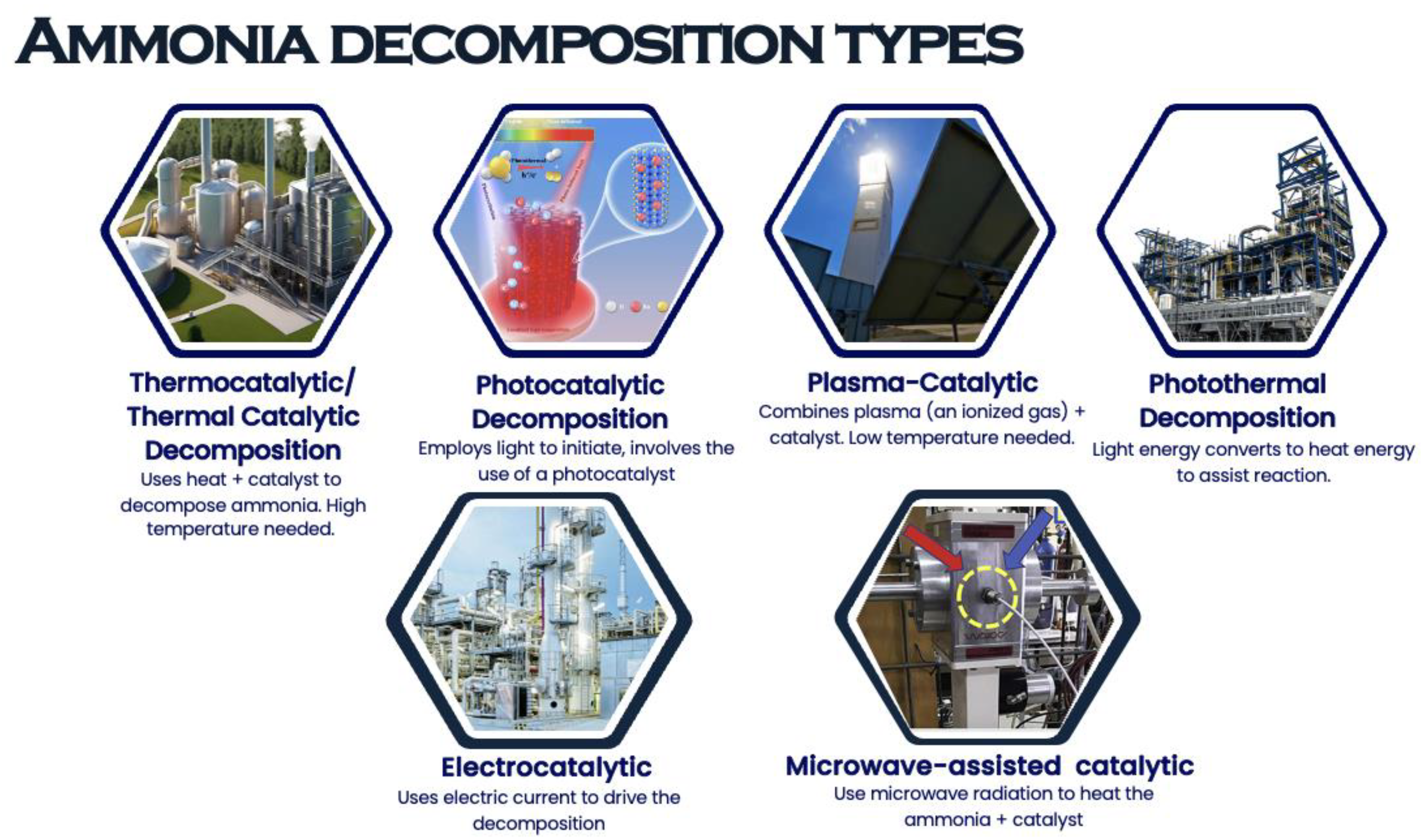
Figure 2.
PRISMA flow diagram of the study selection process [65].
Figure 2.
PRISMA flow diagram of the study selection process [65].
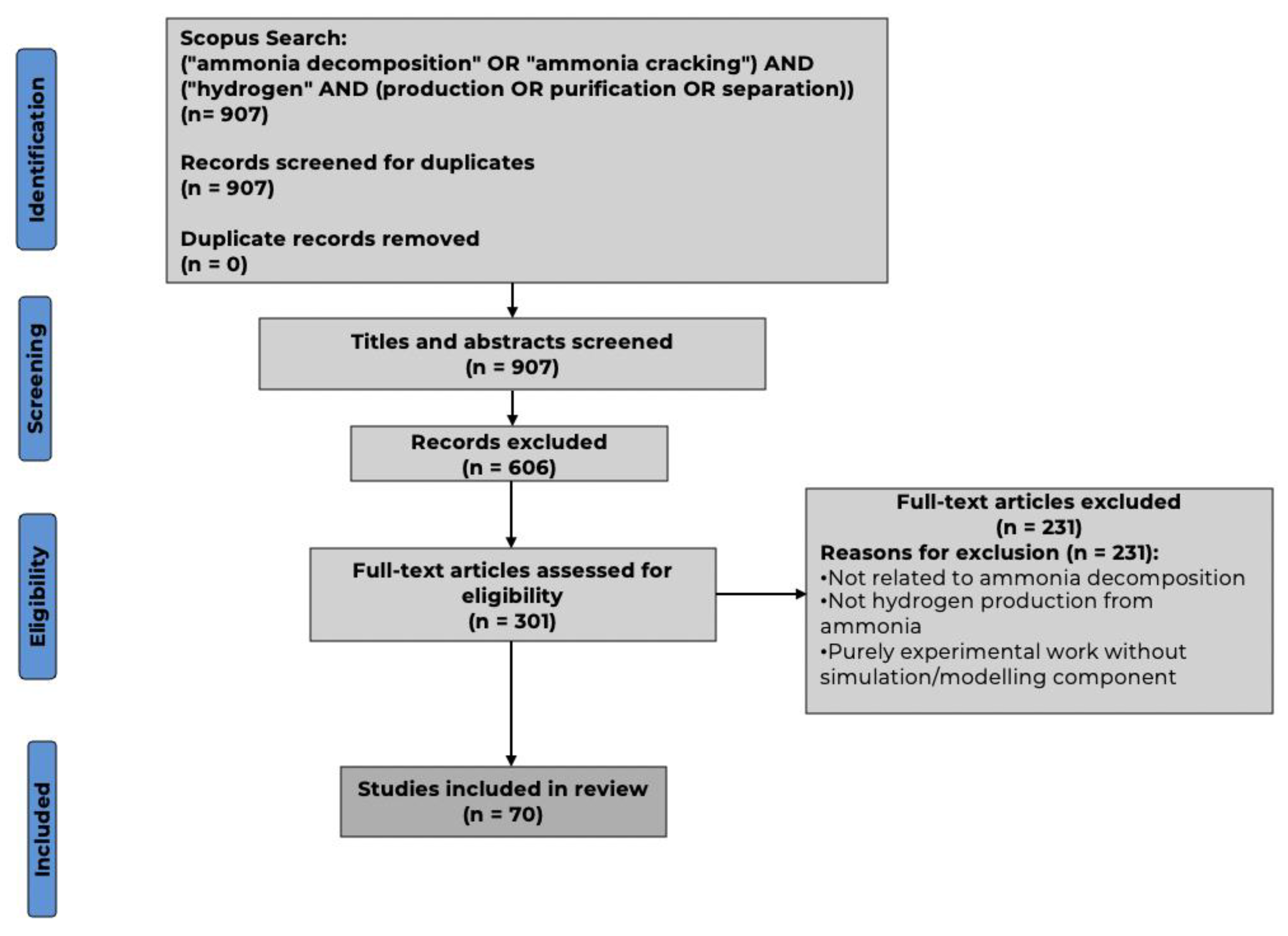
Figure 3.
Flowchart of the synthesis and modelling classifications.
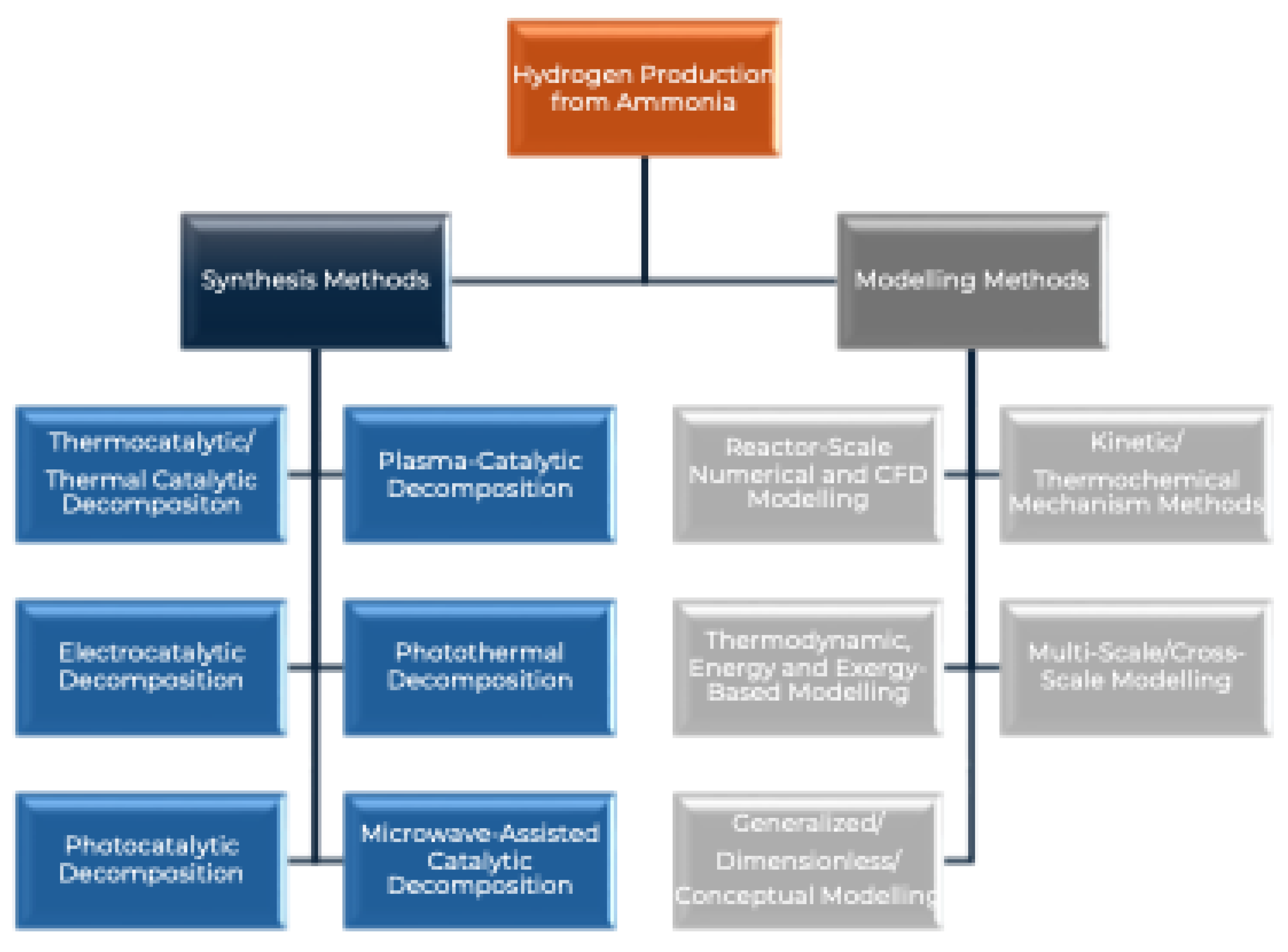
Figure 4.
Annual distribution of modelling and simulation studies on ammonia decomposition for hydrogen production included in the final dataset.
Figure 4.
Annual distribution of modelling and simulation studies on ammonia decomposition for hydrogen production included in the final dataset.
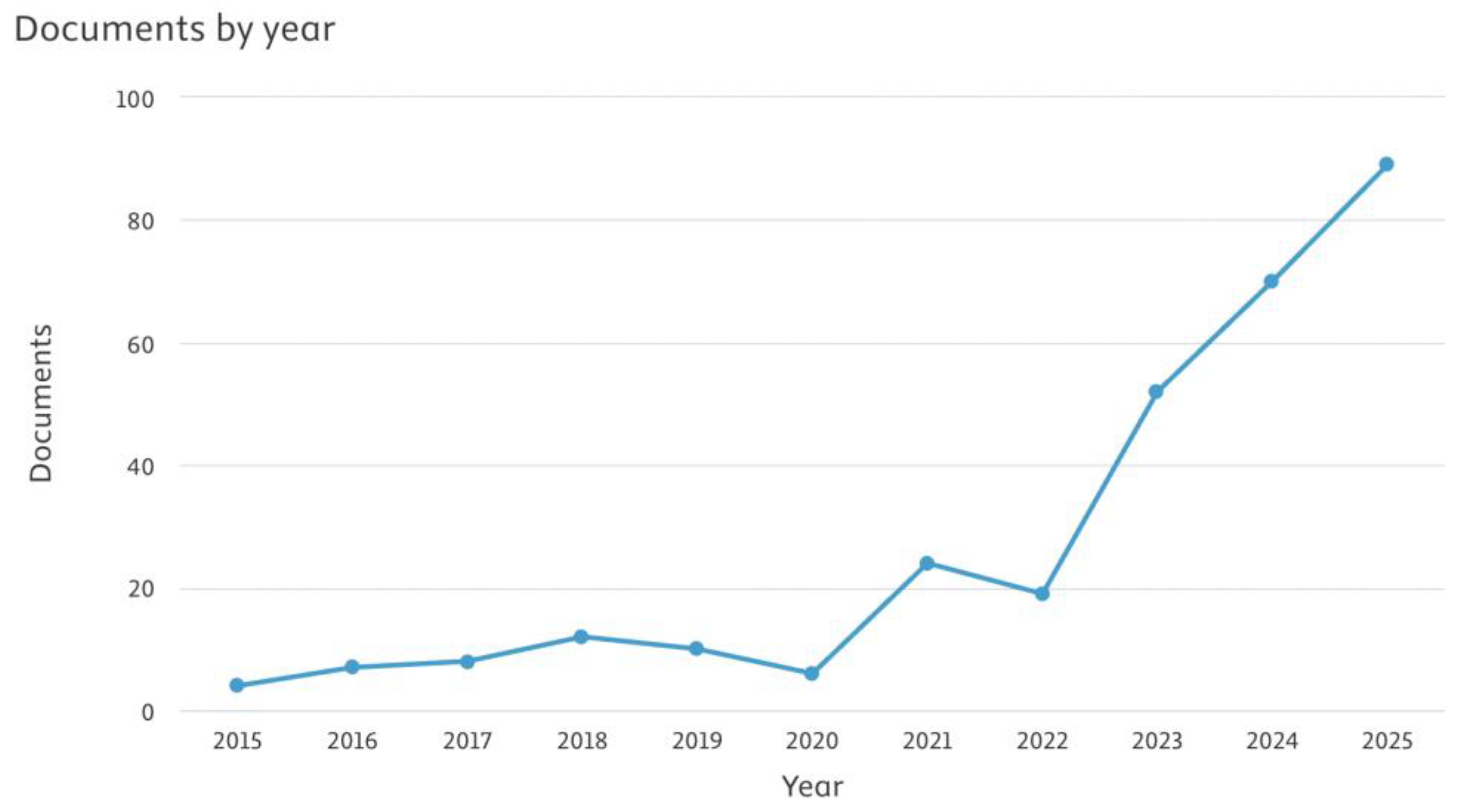
Figure 5.
Annual distribution of modelling and simulation studies on ammonia decomposition for hydrogen production across major journals included in the final dataset.
Figure 5.
Annual distribution of modelling and simulation studies on ammonia decomposition for hydrogen production across major journals included in the final dataset.
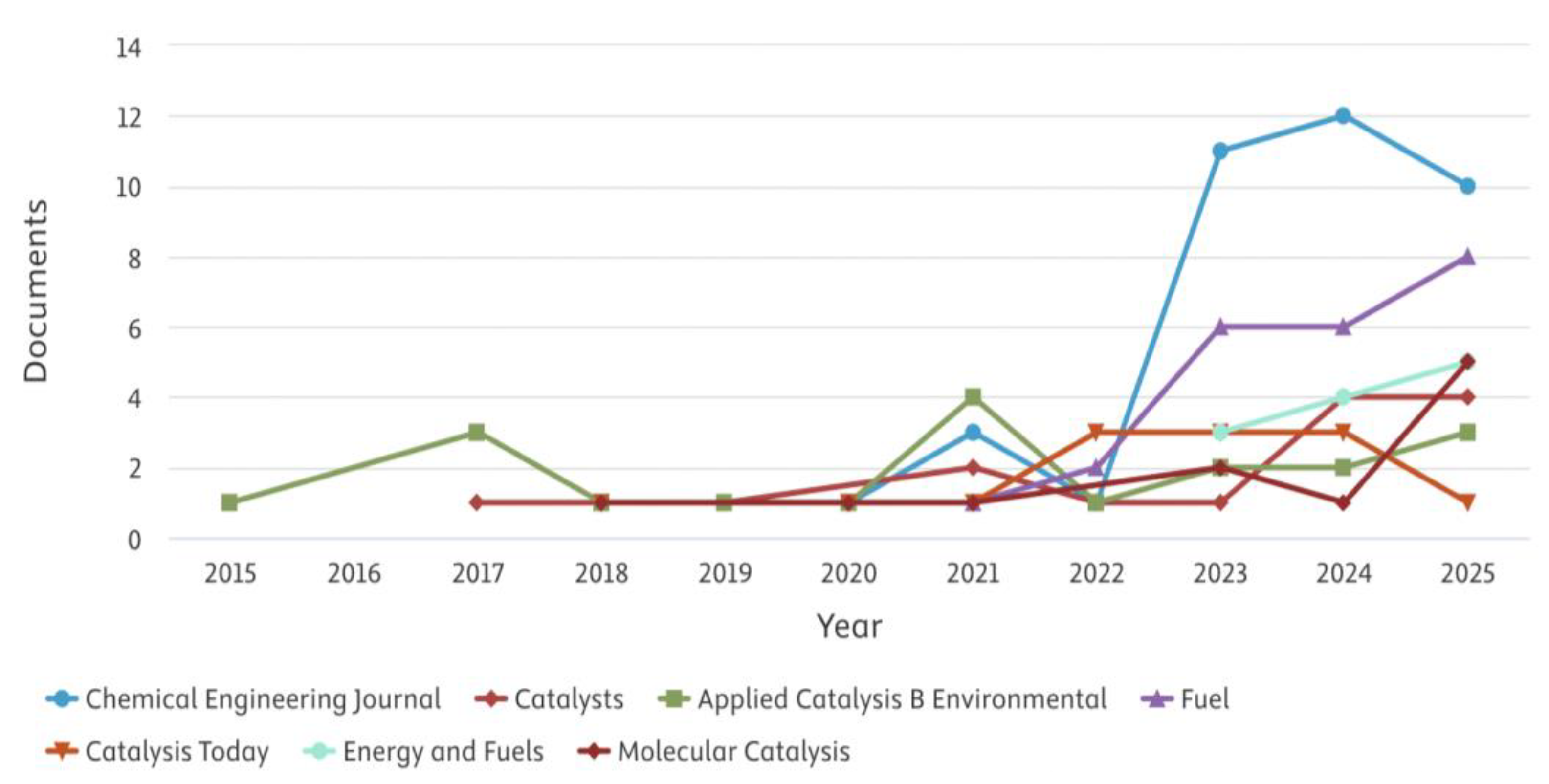
Figure 6.
Document-type distribution of the analysed publications.
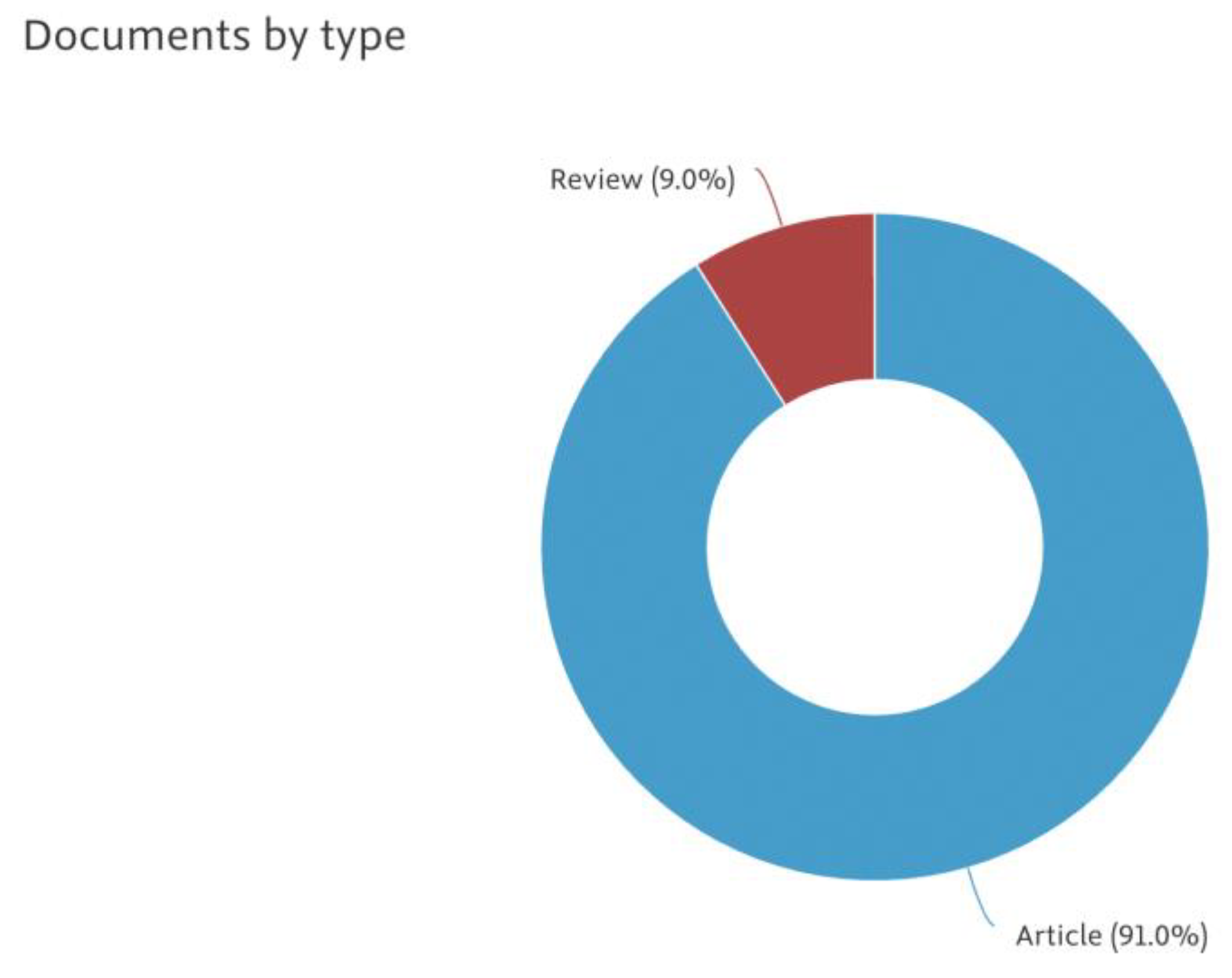
Figure 7.
Distribution of analysed publications by subject area.
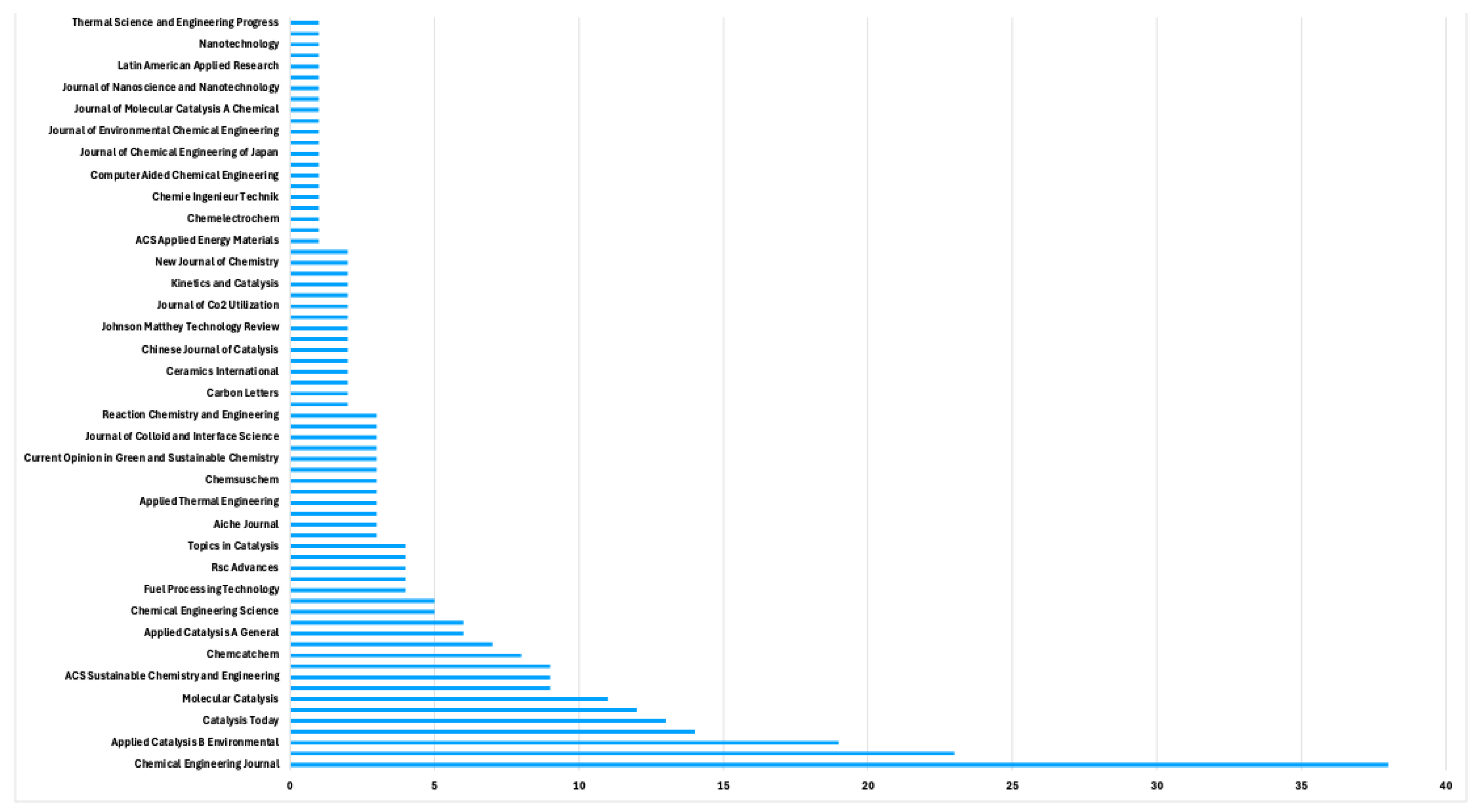
Figure 8.
Subject-area distribution of the analysed publications presented as (a) a pie chart and (b) a funnel chart, illustrating the relative contribution and hierarchical dominance of disciplines involved in ammonia decomposition modelling research.
Figure 8.
Subject-area distribution of the analysed publications presented as (a) a pie chart and (b) a funnel chart, illustrating the relative contribution and hierarchical dominance of disciplines involved in ammonia decomposition modelling research.
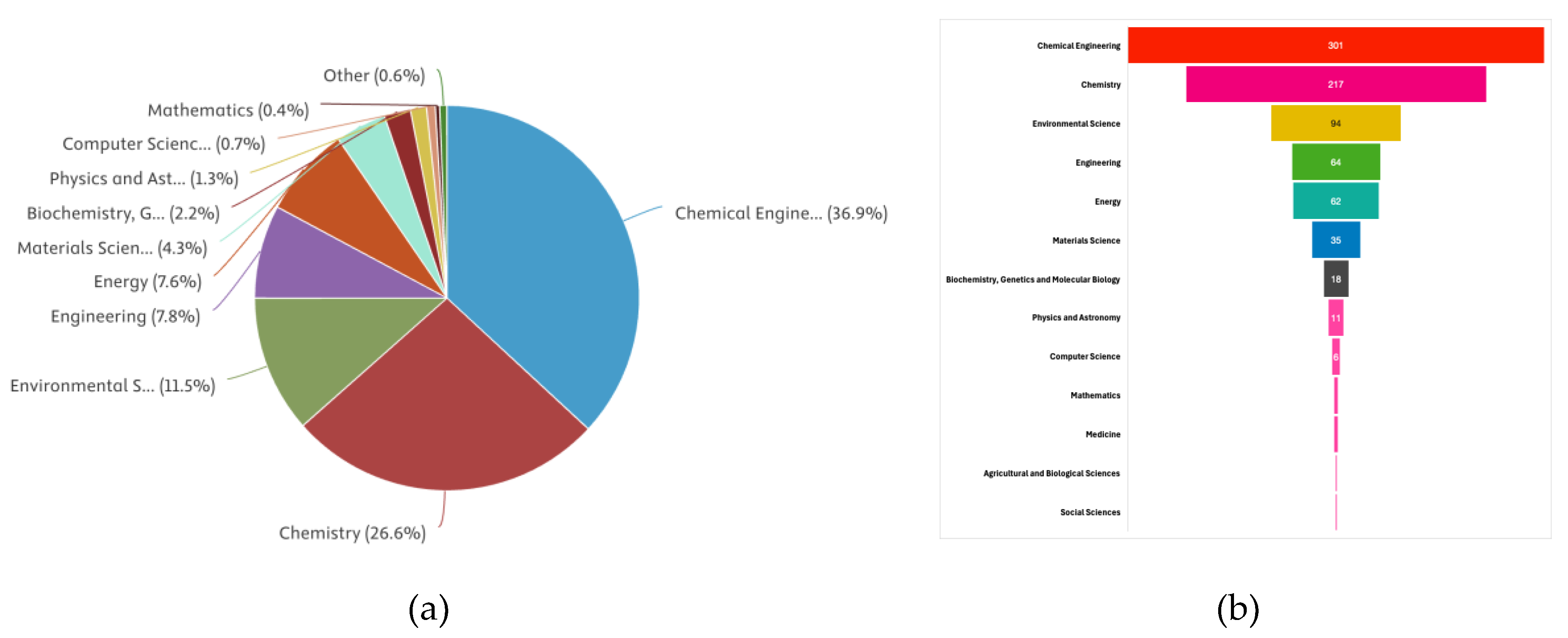
Figure 9.
Distribution of analysed publications across journals.
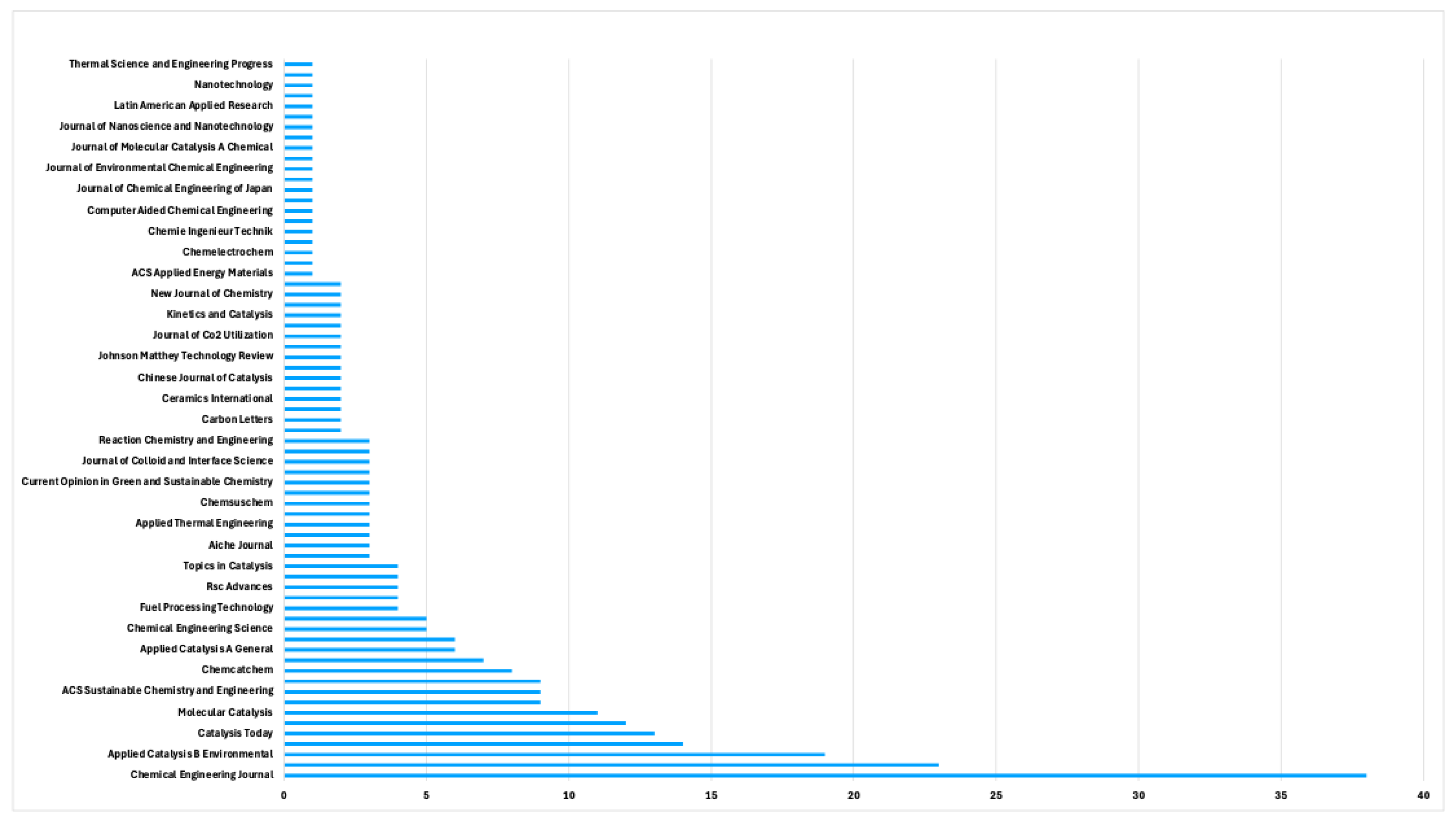
Figure 10.
Publications by the most prolific authors in the analysed dataset.
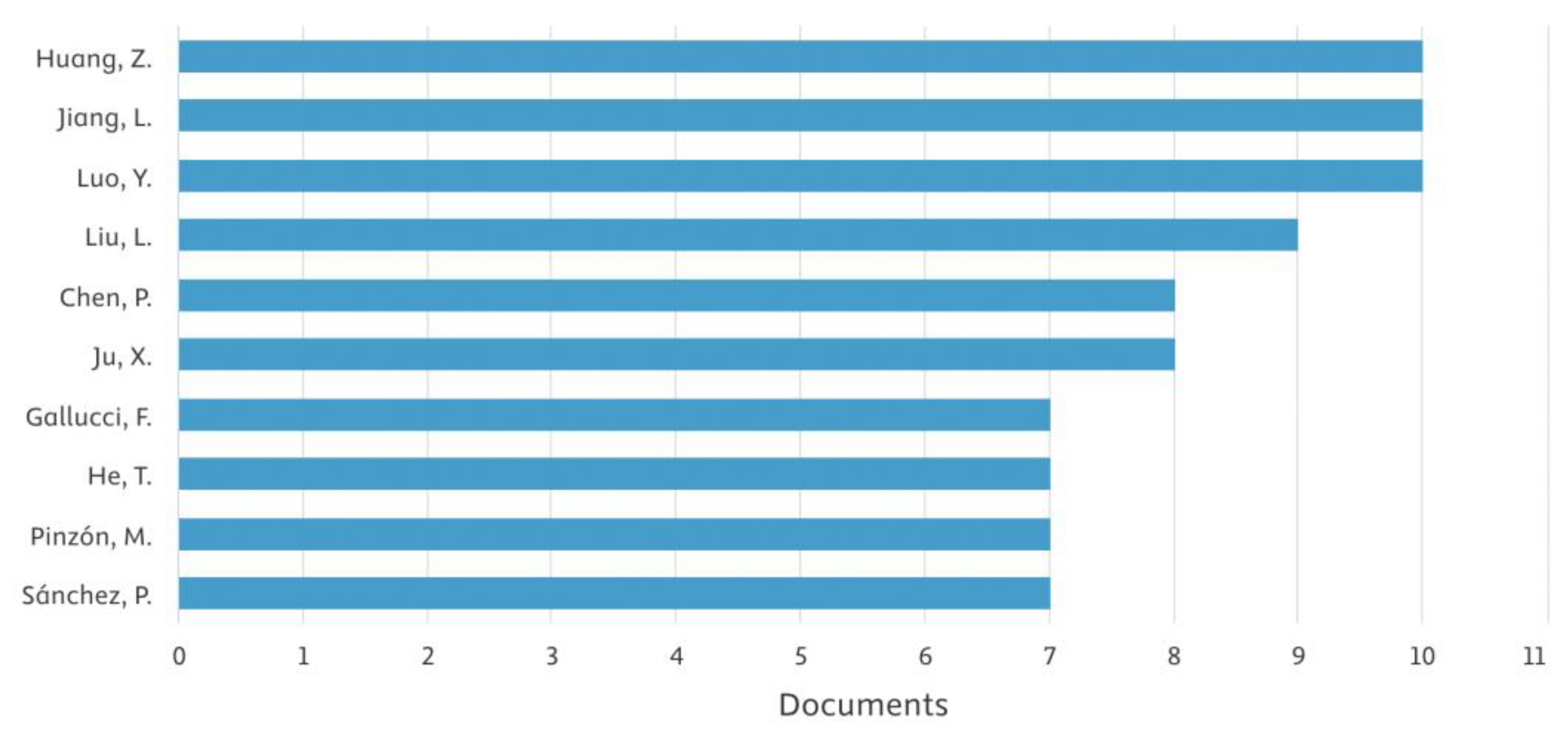
Figure 11.
Distribution of analysed publications by country based on author affiliation.
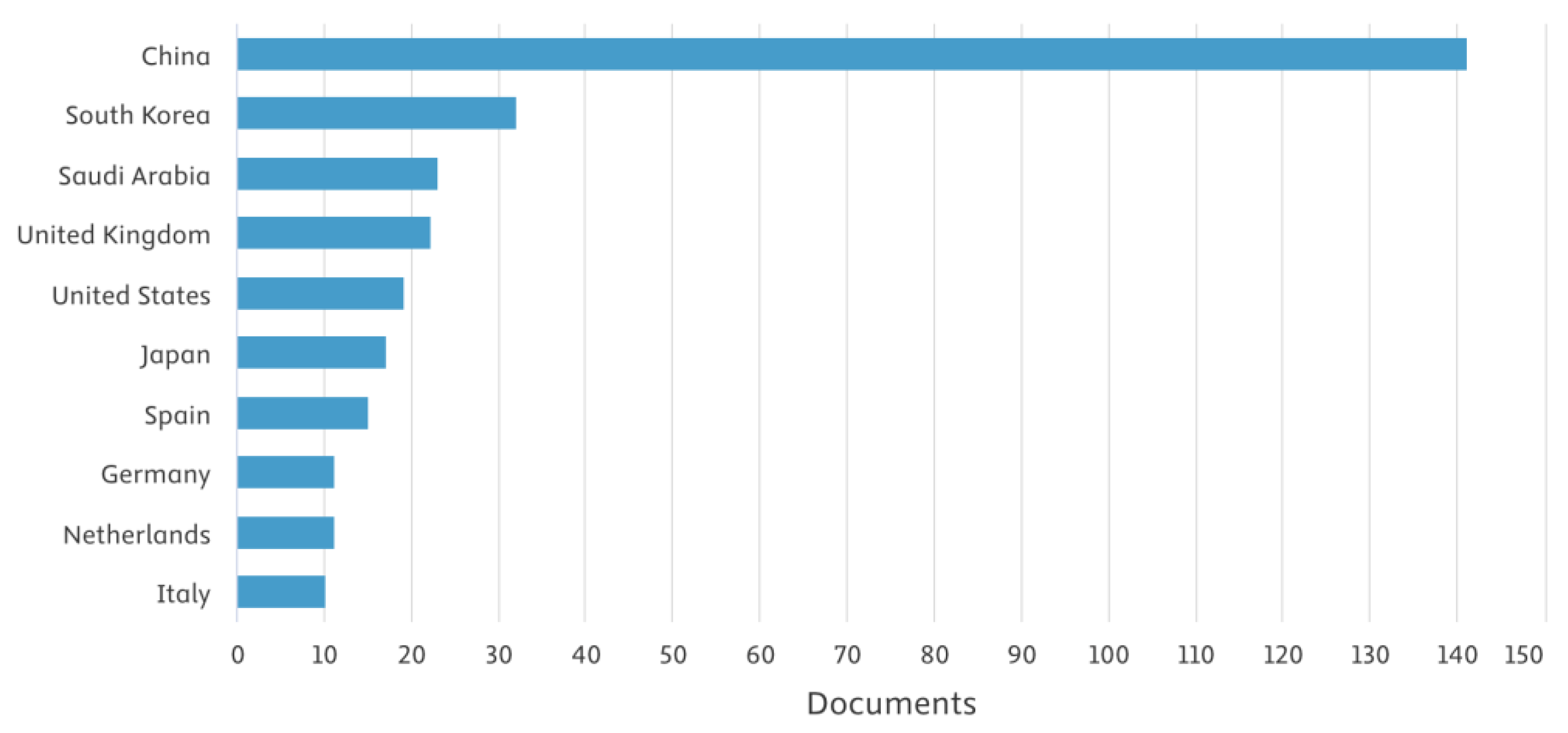
Figure 12.
Distribution of analysed publications by major funding agencies.
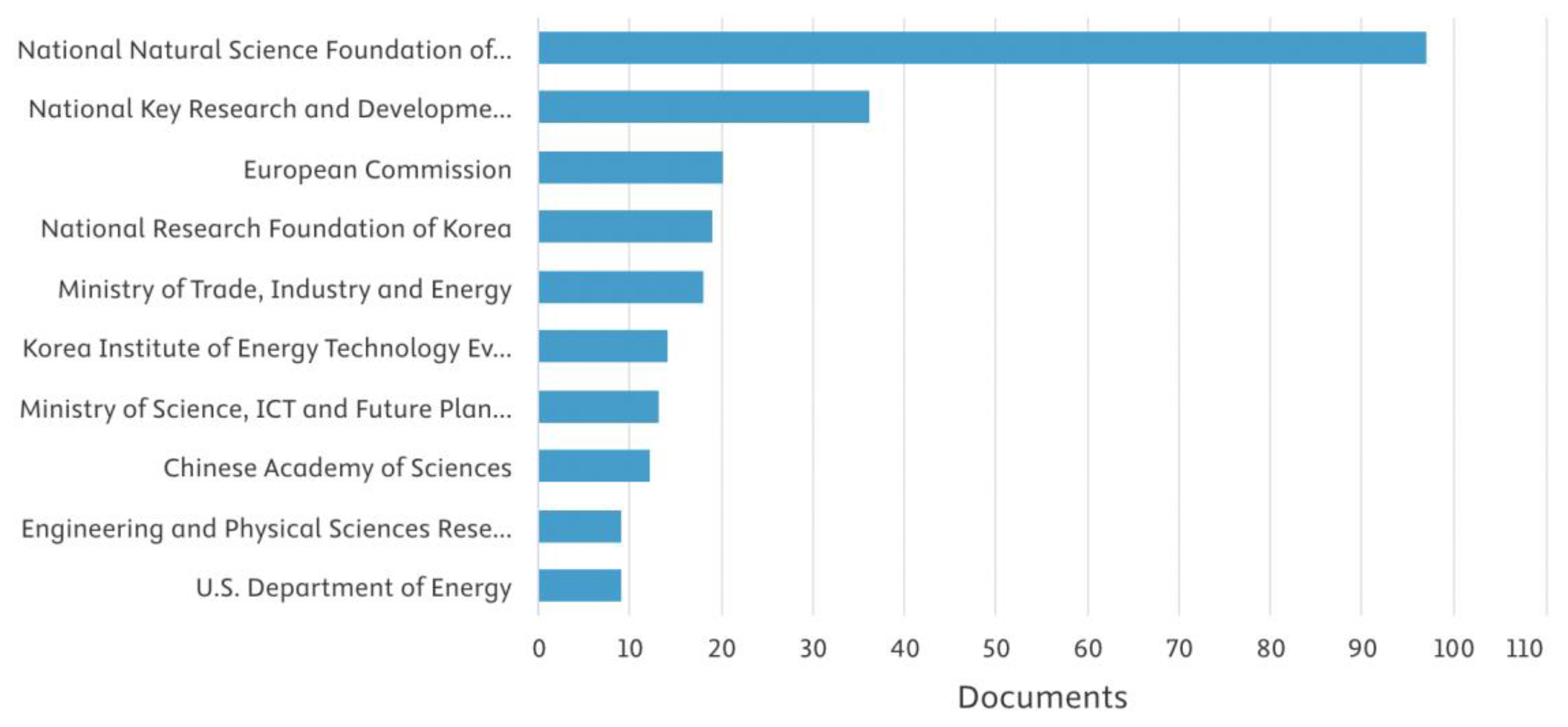
Figure 13.
Distribution of primary ammonia decomposition synthesis methods across the reviewed modelling and simulation studies. Each study is assigned to a single dominant synthesis pathway, irrespective of potential method integration.
Figure 13.
Distribution of primary ammonia decomposition synthesis methods across the reviewed modelling and simulation studies. Each study is assigned to a single dominant synthesis pathway, irrespective of potential method integration.
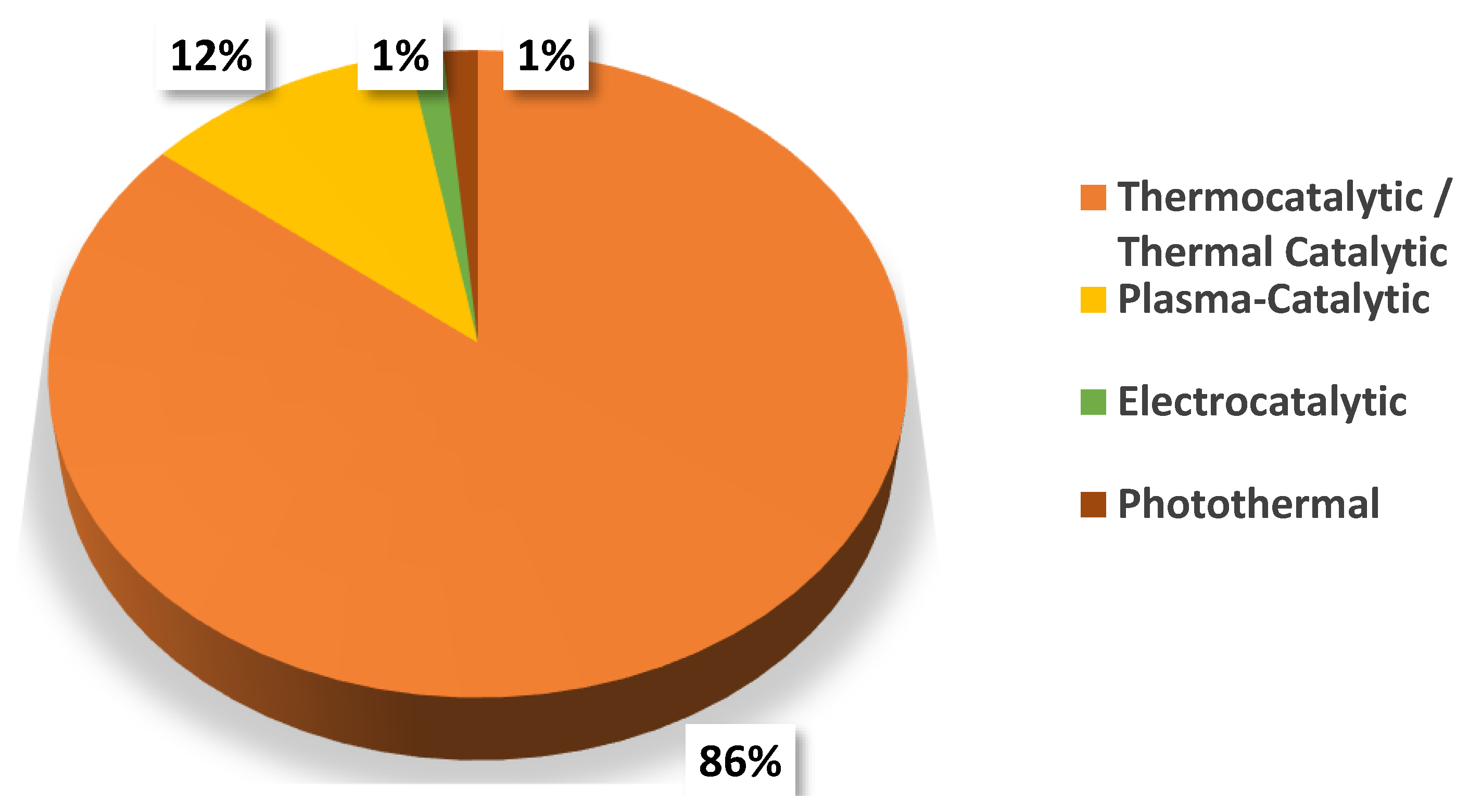
Figure 14.
Distribution of integrated ammonia decomposition system configurations across the reviewed modelling and simulation studies. Percentages are calculated relative to the total number of studies (n = 70); categories are not mutually exclusive.
Figure 14.
Distribution of integrated ammonia decomposition system configurations across the reviewed modelling and simulation studies. Percentages are calculated relative to the total number of studies (n = 70); categories are not mutually exclusive.
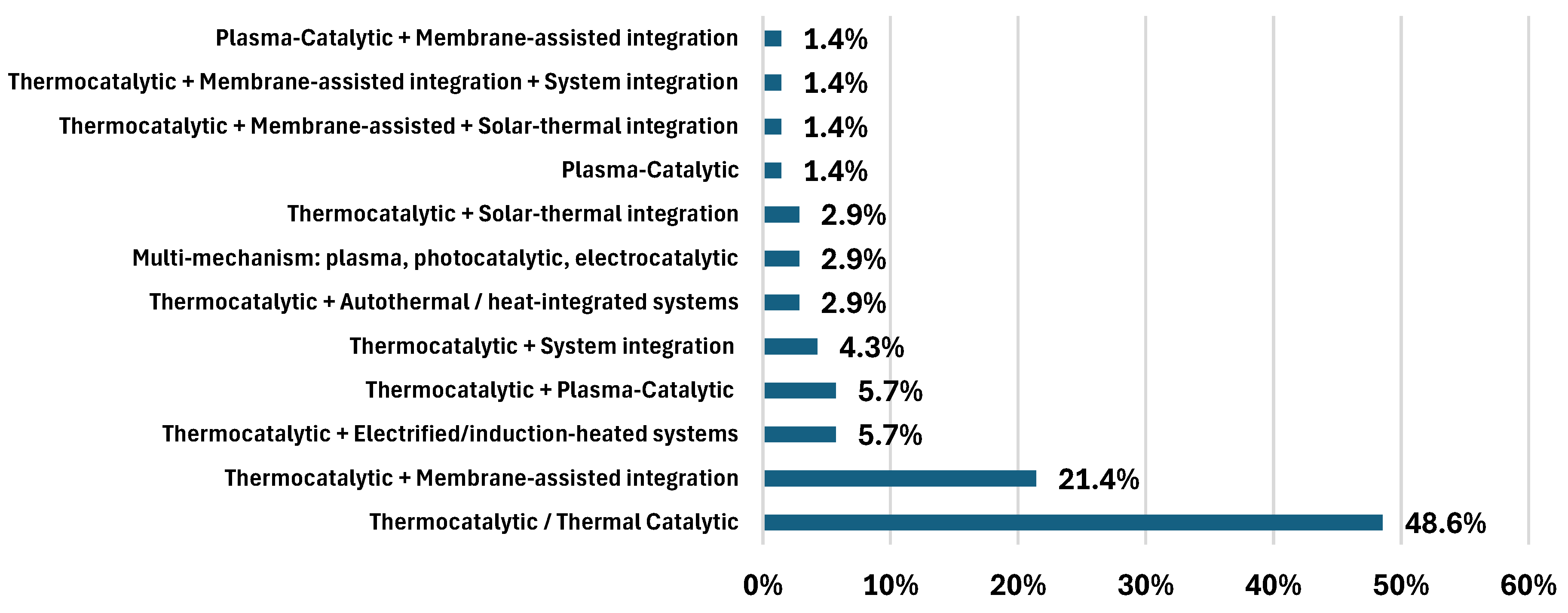
Figure 15.
Distribution of modelling approaches employed across reviewed ammonia decomposition studies.
Figure 15.
Distribution of modelling approaches employed across reviewed ammonia decomposition studies.
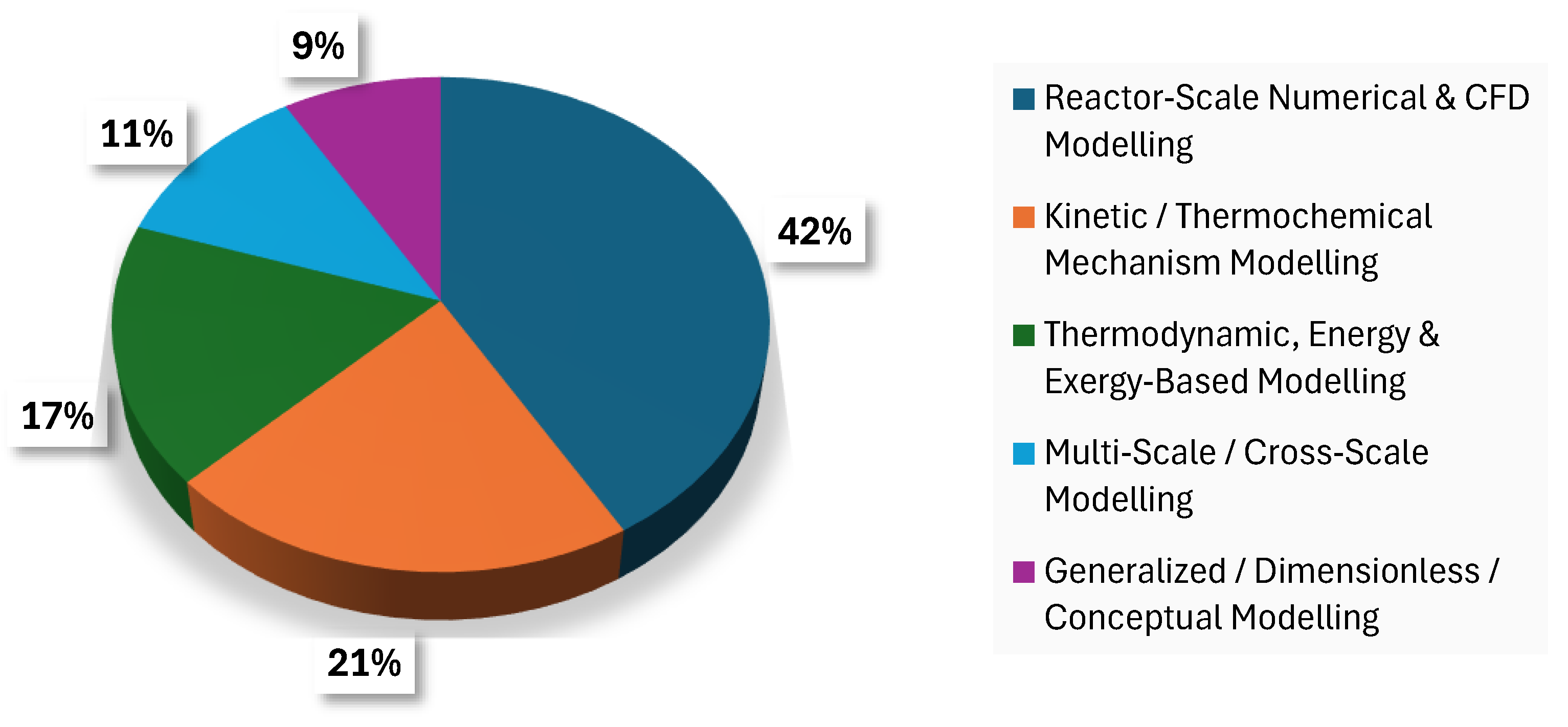

Table 1.
Description of each synthesis method from ammonia.
| Synthesis Methods | Description |
|---|---|
| Thermo-catalytic/Thermal Catalytic Decomposition | Studies classified under this category simulate ammonia decomposition driven primarily by thermal energy in the presence of heterogeneous catalysts. These works commonly assumes steady or quasi-steady temperature fields aimed to capture temperature-dependent reaction rates, catalyst activity, and reactor-level performance under high-temperature operating conditions. |
| Plasma-catalytic Decomposition | This category includes modelling studies that explicitly account for plasma-enhanced ammonia decomposition, in which electrical energy is employed to produce reactive species that interact with catalytic surfaces. Models of this type would usually include non-equilibrium effects, plasma–chemical interactions, or effective reaction rate enhancements to represent plasma-induced activation mechanisms. |
| Electrocatalytic Decomposition | Electrocatalytic decomposition studies are characterised by modelling frameworks that represent ammonia conversion driven by applied electrical potentials at electrochemical interfaces. These models typically include electrode kinetics, charge transfer processes, and electrochemical reaction pathways, with ammonia decomposition treated as a voltage-dependent process rather than a purely thermally activated reaction. |
| Photothermal Decomposition | Photothermal decomposition research involves the simulation of ammonia conversion caused by light-mediated heating of catalytic substances. The modelling in this category is concentrated on linking the radiative energy absorption with thermal transport and catalytic reaction kinetics, often representing light intensity as an indirect driver of local temperature elevation at the catalyst surface. |
| *Photocatalytic Decomposition | This type of ammonia decomposition is driven directly by photo-induced charge carriers generated within photoactive materials. Models typically represent surface reaction pathways influenced by photon absorption, charge separation, and recombination dynamics, rather than relying solely on bulk temperature effects. |
*These decomposition pathways were included in the classification scheme; however, no studies in the reviewed dataset reported modelling or analysis based on these routes.
Table 2.
Description of each modelling method.
| Modelling Methods | Description |
|---|---|
| Reactor-scale numerical & CFD modelling | This category includes studies that utilizes numerical or CFD-based techniques to resolve spatially distributed flow, heat transfer, and species transfer in ammonia decomposition reactors. Transport phenomena is usually coupled with reaction kinetics to capture non-uniform temperature fields, concentration gradients, and reactor-scale performance metrics. |
| Kinetic/thermochemical mechanism modelling | Research in this category is aimed at modelling ammonia decomposition through reaction-rate expressions or mechanistic formulations. These models range from global kinetic representations to detailed reaction mechanisms and are usually applied to the analysis of temperature dependence, catalyst behaviour, and reaction pathways under controlled conditions. |
| Thermodynamic, energy & exergy-based modelling | This category includes modelling studies that analyse ammonia decomposition using equilibrium assumptions, energy balances, and exergy concepts. These models are mainly employed to test theoretical performance limits, energy efficiency, and irreversibility within ammonia cracking systems, as opposed to reaction dynamics. |
| Multi-scale/cross-scale modelling | Multi-scale modelling studies combines information across different length or time scales, such as combining atomistic-level insights with kinetic or reactor-scale models. These designs aim to bridge catalyst-level phenomena with that of macroscopic reactor behaviour, enabling ammonia decomposition phenomena to be represented more comprehensively. |
| Generalized/dimensionless/conceptual modelling | This category includes simplified or abstract modelling techniques used to describe the behaviour of ammonia decomposition using dimensionless groups, analytical formulations, or conceptual frameworks. These models are generally employed to find ruling parameters, scaling relationships, or qualitative trends instead of detailed quantitative predictions. |
Table 3.
Classification of ammonia synthesis methods.
| Synthesis Methods | Counts |
|---|---|
| Thermo-catalytic / Thermal Catalytic | 60 |
| Plasma-Catalytic | 8 |
| Electrocatalytic | 1 |
| Photothermal | 1 |
| Photocatalytic | 0 |
| Microwave-Assisted Catalytic Decomposition | 0 |
| Total | 70 |
Disclaimer/Publisher’s Note: The statements, opinions and data contained in all publications are solely those of the individual author(s) and contributor(s) and not of MDPI and/or the editor(s). MDPI and/or the editor(s) disclaim responsibility for any injury to people or property resulting from any ideas, methods, instructions or products referred to in the content. |
© 2026 by the authors. Licensee MDPI, Basel, Switzerland. This article is an open access article distributed under the terms and conditions of the Creative Commons Attribution (CC BY) license (http://creativecommons.org/licenses/by/4.0/).
Copyright: This open access article is published under a Creative Commons CC BY 4.0 license, which permit the free download, distribution, and reuse, provided that the author and preprint are cited in any reuse.


