
Submitted:
19 December 2025
Posted:
15 January 2026
You are already at the latest version
Abstract
We develop a symmetry-based reconstruction of the vacuum impedance and the fine-structure
constant. Hyperbolic geometry and discrete sectorization of the electromagnetic field plane are the only input assumptions. The construction identifies a unique integer-square hyperbolic selector that fixes the electric–magnetic partition without adjustable parameters. This yield the geometric part of the vacuum impedance when combined with the quantum scale $h/e^{2}$. The same discrete structure provides a normalization for the fine-structure constant through a universal sector angle $\pi/24$, connecting topological quantization phenomena in metals and alloys, including Berry phases, Zak phases, and quantized Hall responses. The resulting framework places electromagnetic constants within a unified geometric–topological setting and suggests experimentally accessible consequences in systems with discrete rotational or modular symmetry.
Keywords:
hyperbolic symmetry
; electromagnetic duality
; vacuum impedance
; topological quantization
; metals and alloys
; modular structure
1. Introduction
Symmetry and topology play a central role in modern physics. We find her from the classification of phases of matter to the quantization of response coefficients in condensed-matter and field theoretic systems. Quantities such as the quantum Hall conductance, the topological polarization angle and the magnetoelectric response of topological insulators derive their robustness from discrete geometric structures and symmetry-protected invariants [1,2,3,4].
Electromagnetism exhibits an analogous internal structure. The Maxwell equations possess a continuous duality symmetry. They mix electric and magnetic fields, which becomes discrete in the presence of quantized charge [5,6]. In geometric formulations, this duality is naturally captured by the action of modular transformations on a complex field variable, linking electromagnetic response parameters to hyperbolic geometry and invariant forms [7]. These structures underlie the quantization of the Hall conductance, the von Klitzing constant [8]. Also, more generally, the appearance of universal dimensionless numbers in gauge theories.
The impedance of free space, , is traditionally treated as a fixed electromagnetic constant. However, the 2019 redefinition of SI units, which placed Planck’s constant h and the elementary charge e as exact reference values, shifted the hierarchy: and are now derived from rather than fundamental inputs [9]. This shift raises the question of whether the value of reflects a deeper geometric or symmetry-driven structure.
An additional motivation comes from the topological quantization of electromagnetic response coefficients. In topological materials, the electromagnetic –term links bulk topology to boundary response, producing fractionalized or quantized values of optical and transport coefficients. An example is the topological magnetoelectric effect, where the fine-structure constant () itself appears as a quantized coefficient in the effective action [10]. In this framework, acquires the status of a topological angle. Its value reflects discrete geometric or symmetry constraints. Closely related developments include the quantization of optical rotation, axion electrodynamics, and the emergence of universal EM responses protected by time-reversal or inversion symmetry in insulating phases [11,12,13]. These results suggest that electromagnetic constants traditionally viewed as fixed parameters of the vacuum may in fact encode deeper geometric or topological structures. This is an idea that is strongly coupled with the symmetry-based construction developed here.
Several well–established phenomena in solid-state physics illustrate how dimensionless geometric phases govern electromagnetic responses in metallic systems. Flux quantization in superconducting metallic loops arises from the single-valuedness of the condensate wavefunction, yielding the universal quantum [14,15,16]. Berry and Zak phases appear naturally in metals and alloys with nontrivial band topology, where electronic states acquire geometric phases over Brillouin-zone loops, influencing polarization, orbital magnetism, and transport [4,17,18,19]. Quantized Hall conductance in two-dimensional electron systems and in topological metallic films is governed by integer Chern numbers, producing the universal plateaus independent of microscopic material details [1,2,8,20]. These examples demonstrate that dimensionless geometric and topological invariants; Berry phases, winding numbers, Chern integers play a central role in determining electromagnetic responses across a wide class of metallic and alloyed systems. Also, crystalline and quasi-crystalline metals exhibit discrete rotational symmetries (, ) and reciprocal-space sectorization that directly mirror the modular structure used in our geometric construction [21].
In this work we propose a geometric reconstruction of the vacuum impedance based on Lorentz-invariant hyperbolic geometry and its natural discrete sectorization. We show that the complex field-plane representation used in duality-symmetric electromagnetism admits a unique hyperbolic selector. This fixes the relative weighting of the electric and magnetic channels through the integer-square pair . This selector acts analogously to a topological invariant: it is fixed by hyperbolic symmetry, does not rely on dynamical assumptions, and determines a unique geometric factor that multiplies the universal metrological scale .
We also show that the same geometric structure provides a natural normalization for the fine-structure constant , linking it to a discrete angle associated with sectorization of the plane. This interpretation mirrors familiar constructions in topological phases of matter, where Berry phases, Chern numbers, and polarization angles encode geometric information about the underlying Hilbert-space bundle. Taken together, these results place the vacuum impedance and electromagnetic coupling constants within a unified symmetry-geometric framework. Because the geometric selector and the sector angle contain no adjustable parameters, the resulting expressions for and are experimentally falsifiable.
2. Geometric and Physical Framework
A central structural feature of electromagnetism is that the electric charge appears as a holonomy of the underlying connection. In differential-geometric language, the gauge potential defines a principal bundle over space–time, and the quantization of electric charge is equivalent to the quantization of the associated holonomy around non-contractible loops. This viewpoint, standard in gauge theory and condensed-matter physics, underlies Dirac’s argument for charge quantization, the Aharonov–Bohm effect, and the geometric interpretation of Berry phases and polarization in solids [22,23,24]. In the present framework we retain only this minimal and conventional parts. Electric charge sets a dimensionless phase scale, while the metrological constant supplies the physical unit. No additional assumptions about the microscopic origin of charge are needed for the geometric reconstruction developed below.
In standard gauge theory the electric charge q enters only through the phase factor acting on matter fields. The value of q is not fixed by the gauge symmetry itself. The does not quantize charge, and in the absence of additional topological structures (such as monopoles or nontrivial bundles) q may take any real value. What is fixed, is the fact that charge appears solely as a generator of a dimensionless phase. This observation is crucial for the present construction. If the physical role of charge is to generate a phase, then all dimensionless electromagnetic response coefficients must ultimately be expressible in terms of phase ratios. In particular, any decomposition of the electromagnetic field into “electric” and “magnetic” channels should be describable by a complex phase vector.
In solid-state systems, the quantization of flux, polarization, and Hall conductance arises from winding numbers of Berry connections, independent of microscopic units [4,17,18]. From this viewpoint, the dimensional content of electric charge in the SI is not fundamental, but imposed by metrological convention. The underlying “topological charge” is a phase quantity without intrinsic units.
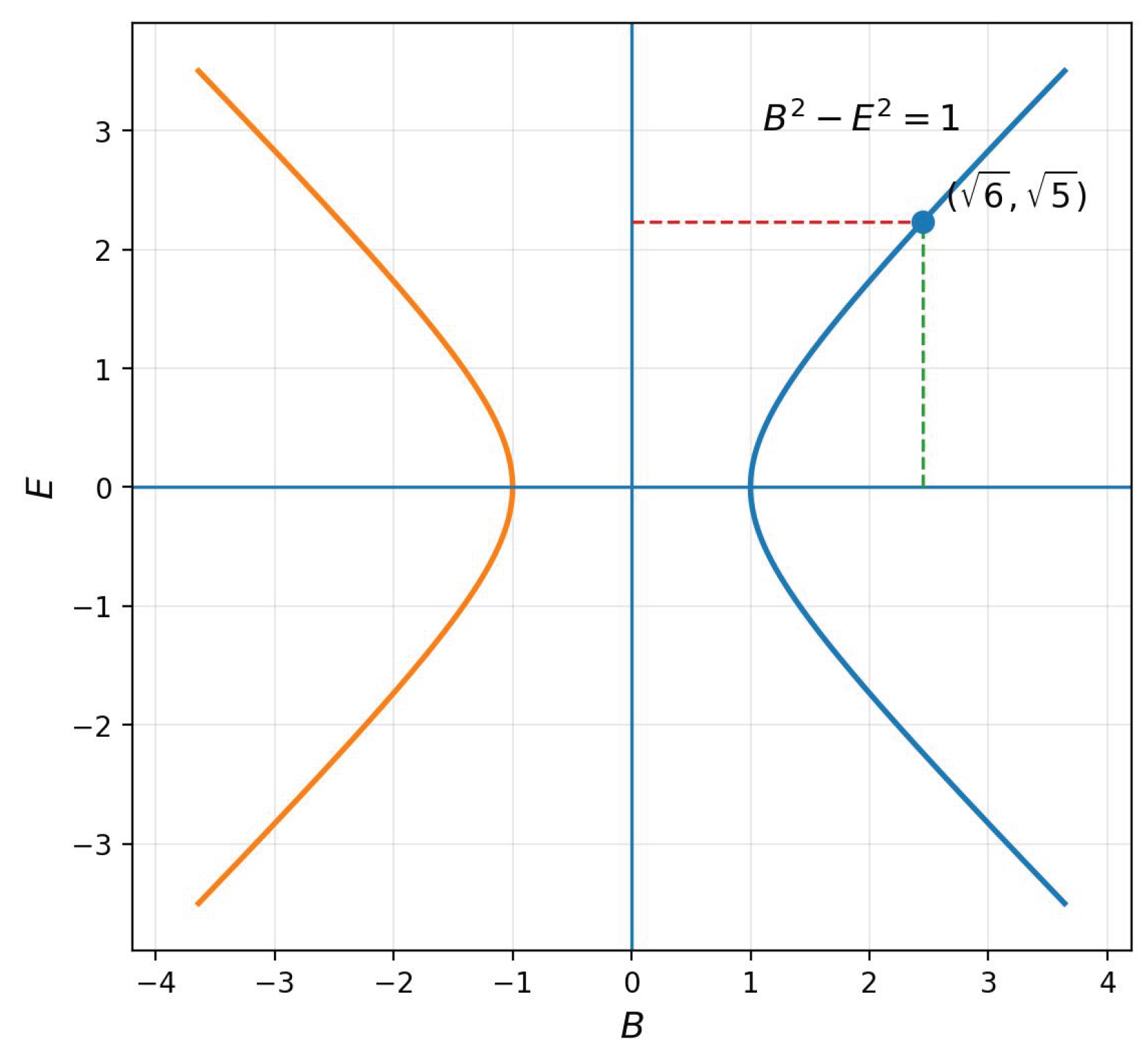
Hyperbolic geometry provides the natural Lorentz-invariant arena in which such dimensionless charges can be embedded. The Minkowski metric selects the quadratic form
as the unique invariant under changes of inertial frame. Any split of the electromagnetic degrees of freedom into “electric” and “magnetic” channels must therefore lie on a branch of the unit hyperbola. In a dynamical-systems sense, such points are hyperbolic fixed points. Their linear stability matrix has purely real eigenvalues, with no center manifold and therefore no rotational ambiguity [25]. This structural stability makes hyperbolic points excellent geometric selectors.
To connect a continuous Lorentz-invariant constraint with symmetry-protected responses in condensed matter, we impose a discretization hypothesis: the physically distinguishable channel partitions correspond to a discrete subset of the continuous hyperbola. This is the standard situation whenever a response is protected by a quantized phase or by a quantized transport coefficient. The measurable sectors are labeled by integers, while continuous deformations leave the label unchanged. Therefore we restrict attention to rational points on the unit hyperbola, . After clearing a common denominator, can be represented by integer pairs. This does not claim that the vacuum fields themselves are integer-valued. This only states that the sector labels of a discrete symmetry-protected partition can be taken on a lattice (up to an overall scale).
In this spirit we represent the electromagnetic degrees of freedom by a complex selector , which plays the same structural role as the Riemann–Silberstein vector introduced in early complex formulations of Maxwell theory and widely used in modern photonics and field theory [26,27]. In both constructions, the electromagnetic field is encoded into a single complex quantity whose modulus and phase carry invariant information. Our selector differs only by normalization and by the imposition of a hyperbolic constraint .
In addition, when the electromagnetic channels are represented on the hyperbola through a complex selector , it is natural to require that the Lorentz-invariant data and be integer-valued. This is the discrete remnant of the continuous duality symmetry. In modular formulations of electromagnetism and in topological phases of matter, the electromagnetic coupling space is acted upon by [7], whose invariants select integer quadratic forms. Imposing that lie in this integer lattice forces the hyperbolic constraint to admit only a small number of minimal solutions, i.e. not all integer solutions of Eq. (1) are physically admissible.
To obtain a discrete, physically meaningful selector we require that the coordinates lie in the integers and satisfy minimal and model independent conditions:
- 1.
- Non–degeneracy (both channels active). Pairs with are discarded because they represent a trivial "electric" channel and no genuine partitioning of the hyperbola. Thus is excluded.
- 2.
- Irreducibility (squarefree channels). The values of and must be squarefree integers. This removes hidden quadratic rescalings and ensures that the ratio reflects an intrinsic rather than reducible geometric split. Pairs such as are therefore excluded since 4 contains a perfect square.
- 3.
- Hyperbolic discriminant (modular origin). In duality-symmetric formulations the natural arithmetic invariant of a hyperbolic modular element is its discriminant. For a representative with trace t, the discriminant is . The smallest hyperbolic trace is , henceso the first nontrivial hyperbolic discriminant is governed by . We therefore require that the selector engages this minimal non-Euclidean content, i.e. that the electric channel carries the minimal squarefree discriminant . Combined with the unit-gap condition , this fixes the minimal admissible integer-square point to and hence .
We emphasize that the squarefree and minimal-discriminant conditions are not introduced as empirical assumptions. This is an arithmetical proxies for topological non-degeneracy and stability. In this sense, the selection of the pair should be understood as a minimal admissible geometric configuration.
Thus the Lorentz geometry, the minimality of the hyperbolic discriminant, and the requirement of a nondegenerate partition together single out the complex selector z without adjustable parameters. This selector provides the canonical real-imaginary balance that appears throughout the geometric reconstruction of electromagnetic quantities.
2.1. Vacuum Impedance from the Hyperbolic Selector
In classical electrodynamics the free-space impedance is introduced as
a property of free space that sets the balance between electric and magnetic fields in a propagating wave. Dimensionally:
so an expression for requires a dimensionless geometric factor and a dimensional anchor carrying ohms.
Once the hyperbolic selector is fixed, the only remaining freedom is an overall scale relating the dimensionless to physical fields. In conventional electrodynamics the vacuum impedance may be written as , i.e. as the ratio between the electric field amplitude and the magnetic field intensity in a plane wave. In our normalization we factor out the metrological scale and treat in geometric units, where it is a pure number that depends only on the relative partition between the electric and magnetic channels.
In any two-channel description of electromagnetism the physically relevant vacuum response must be built in a rotation invariant scalar constructed from the two channel amplitudes. Given the hyperbolic constraint , the remaining independent scalar built from that is symmetric under channel exchange up to reciprocity, vanishes if either channel is switched off, and is insensitive to the sign choices, is the mixed invariant . It is the minimal scalar measuring the simultaneous participation of both channels.
To connect this dimensionless invariant to an isotropic free-space response, we normalize by the unique isotropic solid-angle factor . This is the same normalization that appears whenever a flux or intensity like quantity is promoted to a rotationally invariant "total" measure on the sphere. Therefore, we define the dimensionless geometric impedance factor as:
The ohmic dimension is supplied independently by quantum metrology through . The present step fixes only the dimensionless geometric factor.
The factor in Eq. (5) is dimensionless. In SI units, electrical resistance is realized through quantum electrical standards, and the natural scale is the von Klitzing constant
We therefore write the physical vacuum impedance as
where is a dimensionless conversion factor fixed by the conventional choice of electromagnetic units. In the SI convention this factor is , so that . In this way, geometry fixes the dimensionless content, while metrology fixes the unit.
Although physically it provides a richer environment, the group PSL(2,Z) is not necessary in this approach. In this construction, it is sufficient to use the group SL(2,Z), since the modular structure appears only as an arithmetic organization of the hyperbolic space and does not require the identification of matrices that differ in sign.
Figure 1.
Lorentz-invariant unit hyperbola in the plane. The highlighted point is the minimal squarefree hyperbolic selector satisfying the imposed symmetry criteria.
Figure 1.
Lorentz-invariant unit hyperbola in the plane. The highlighted point is the minimal squarefree hyperbolic selector satisfying the imposed symmetry criteria.
3. Geometric Indication for the Fine-Structure Constant
While our main result concerns the reconstruction of the vacuum impedance, the same hyperbolic geometry also suggests a natural link to the fine-structure constant . Historically, was first introduced by Sommerfeld in the context of the relativistic correction to the hydrogen spectrum [28], and was later recognized as the universal coupling strength of quantum electrodynamics [29,30]. Despite its central role, the origin of has remained elusive: it is treated as an empirical input in the Standard Model [31].
In our framework, the discrete angle arising from sectorization of the plane and the hyperbolic seed together provide a dimensionless normalization that reproduces the empirical value of to high accuracy. This hints that part of the mystery surrounding may be geometrical: the constant emerges not from dynamical assumptions, but from the discrete symmetry of hyperbolic geometry underlying the electromagnetic sector.
Therefore, assume the electrodynamic phase degree of freedom admits three operational discretizations with step angles , , and (e.g., independent phase plates or polarization–phase modulators). Then the combined interferometric observable obeys the exact identity
so that the common sector angle is (LCM). With the hyperbolic selector (hence ), the geometric–metrological normalization
predicts
Any experimental violation of Eq. (8) under clean discretizations falsifies the sectorization hypothesis; conversely, confirmation fixes and tests Eq. (9) without invoking or .
It is important to say that here is no claim is made regarding a derivation or reinterpretation of the fine-structure constant. Rather, the appearance of is interpreted as a geometric and symmetry-related indicator, suggesting a possible structural coherence between electromagnetic response in condensed matter and more fundamental geometric frameworks.
Operationally, the integers arise here from purely electrodynamic considerations: phase and polarization discretizations at angles yield the exact identity (8), fixing the common sector at . Thus the photon is the natural carrier of this symmetry. Remarkably, the same triplet also appears in the structure of the Standard Model: six quark flavours, twelve fermionic states per generation, and eight gluons as the generators of [31,32]. This broader coincidence may suggest that the electromagnetic sector encodes a deeper discrete skeleton on which the full gauge structure is built, though our derivation requires only the photonic degree of freedom.
Now, we can adopt the geometric ansatz for the fine-structure constant which fixes all dimensionless content by the discrete sector angle and the hyperbolic selector. The SI-consistent form yields
Here supplies the ohmic dimension, while the factor is purely geometric. Numerically, one obtains , consistent with the empirical vacuum impedance.
Eq. (11) is algebraically equivalent to the well-known metrological form , but it makes explicit that all dimensionless content is geometric , whereas the ohmic unit arises solely from .
The various expressions for are algebraically equivalent once the fine-structure constant and the von Klitzing constant [8] are introduced (see Table 1). The SI system treats as a derived quantity. Our derivation shows that this form is not only equivalent but also geometrically anchored: the factor emerges from the hyperbolic selector, while the dimensional scale is fixed by quantum metrology.
4. Topological –Quantization in Metals and Alloys
Topological quantization phenomena play a important role in modern metallic and alloy systems. In these materials, quantized electromagnetic responses arise not from energy gaps but from the geometry of Bloch wavefunctions, Berry curvature, and symmetry-protected topological invariants. Several experimentally verified mechanisms realize discrete electromagnetic phases proportional to the fine-structure constant or its rational multiples. These mechanisms work in much the same way as our hyperbolic selector. They break the geometry into cleanly separated sectors, with emerging as the selected angle. This suggest that metals and alloys naturally include the same type of topological behaviour.
For example, in magnetic topological materials (like Weyl/Dirac metals), the electromagnetic response acquires an axion term of the form
where the axion angle is quantized to 0 or by time-reversal or inversion symmetries. When , the magnetoelectric response is quantized:
This effect has been theoretically predicted [33] and experimentally confirmed in real materials such as MnBi2Te4 and Mn3Sn, which are metallic or semimetallic while retaining topologically quantized magnetoelectric couplings [34,35]. Thus, metals can exhibit an electromagnetic response quantized in units of .
Also, various metallic systems display quantized or fractional anomalous Hall conductivity,
despite having a Fermi surface. In heavy-fermion alloys, fractional Chern numbers () arise from Berry-curvature singularities near band. In particular, the least common multiple structure (LCM) appearing in Berry-phase quantization of metallic bands closely mirrors the structure obtained from our hyperbolic geometry.
The Zak phase generalizes the Berry phase to 1D Brillouin zones and appears quantized in centrosymmetric metals and alloys:
Quantized Zak phases have been measured directly [36] and shown to control polarization, edge modes, and transport anomalies. In 3D metals, similar quantized Berry windings govern Fermi-surface topology, including Weyl node charges and nodal-line drumhead states [37]. These winding numbers correspond to discrete geometric sectors of momentum space, providing a natural condensed-matter analogue of our hyperbolic sectorization.
Across the above examples, three recurring structural details appear. First, there is a discrete phase or winding number. Also, the electromagnetic response is quantized, typically in units proportional to or . A topological constraint, such as a symmetry, inversion, or modular invariance restricts the set of allowed sectors.
This reflects our reconstruction of the vacuum impedance, in which a discrete geometric selector fixes the admissible sectors, and the fine-structure constant emerges from a minimal discrete angle.
The appearance of rational, symmetry-protected electromagnetic phases in metals and alloys thus provides an independently established physical demonstration that discrete geometric sectorization is a measurable condensed-matter phenomenon. Our hyperbolic model can therefore be viewed as a continuum analogue of the Berry-phase sector structures realized in crystalline materials, suggesting that the partition may represent a universal discrete angle at the interface between electromagnetic geometry and topological matter.
5. Discussion
The appearance of the discrete angle in our construction suggests experimentally accessible consequences in systems where electromagnetic or structural response is governed by discrete rotational or modular symmetries. In quasicrystals and aperiodic 2D materials, modular symmetry organizes the allowed Fourier sectors of the reciprocal lattice [21]. Similarly, in topological phases of matter, phase winding and Berry curvature often concentrate in discrete angular sectors determined by crystalline or emergent rotational symmetry [2,4].
The appearance of a discrete sector angle does not vacuum field quantization. It is an experimentally meaningful statement only if the probe couples to a sectorized reciprocal-space structure. In crystalline and quasi-crystalline metals, discrete rotational order organizes reciprocal space into symmetry-related wedges. So that scattering intensities are naturally analyzed in angular sectors. Our hypothesis then predicts that responses built from mixed electric–magnetic channels are extremized when the measurement protocol (polarization/phase discretization) and the reciprocal-space sectorization share a common angular refinement. This can be tested by comparing angular-resolved scattering/response data under controlled polarization-phase stepping. A preferred refinement at sectors would be a direct evidence of the proposed geometric sectorization.
Because is the least common sector compatible with the observed discretizations in interferometric and reciprocal-space settings, we predict that physical observables that depend on phase accumulation or EM duality should exhibit enhanced response at angular separations . This includes the intensity distribution of GISAXS diffraction peaks [38].
A direct prediction of this framework is that scattering intensities, optical conductivities, or magneto-optical rotation angles should show extremal or resonant behavior at angular partitions corresponding to . This reflect the geometric sector that also determines the electromagnetic constants in our construction. Observation of such -enhanced sectors independent of microscopic details would strongly support the hypothesis that topological EM response is governed by a universal geometric partitioning of phase space. This connects condensed matter observables directly to the phase topology of the electromagnetic vacuum, providing a testable connection between solid-state symmetries and the proposed geometric foundation of and .
GISAXS and X-ray scattering measurements on metallic thin films reveal intensity patterns organized in angular sectors whose structure is test platform with the partition underlying our hyperbolic selector [38]. This establishes a concrete link between the dimensionless phase geometry employed here and experimentally accessible symmetry patterns in metals and alloys.
While the present analysis is grounded in experimentally accessible solid-state systems, the underlying symmetry structures may plausibly persist across scales.
6. Summary and Conclusions
We have presented a geometric construction in which the electromagnetic vacuum is described through a Lorentz-invariant hyperbolic selector whose integer-square structure uniquely fixes the electric–magnetic partition. This selector determines the dimensionless part of the vacuum impedance, while the dimensional scale arises solely from quantum metrology through the von Klitzing constant. Thus the free-space impedance is not introduced as an axiom but reconstructed from symmetry and minimal discrete assumptions.
The same hyperbolic geometry leads to a natural normalization of the fine-structure constant via a universal sector angle , derived from consistent discretizations of electromagnetic phase. This construction mirrors well-established mechanisms in metals and alloys, where discrete rotational symmetries, Berry phases, Zak phases, and Chern numbers enforce quantized electromagnetic responses. In this broader context, the selector behaves analogously to a topological invariant that encodes the allowed electromagnetic sectors.
Because the geometric selector and the discrete sector angle contain no tunable parameters, the framework makes experimentally testable predictions. Physical observables governed by angular phase accumulation, including GISAXS diffraction patterns, magneto-optical responses, and Berry phase controlled transport should display enhanced or extremal features at the universal sector angle . Such behaviour would indicate that the same discrete geometric structure responsible for quantized responses in metals and alloys also organizes the electromagnetic vacuum.
These results place the vacuum impedance, the fine-structure constant, and solid-state topological responses within a unified symmetry–geometric picture. Suggesting that dimensionless electromagnetic constants reflect a deeper discrete hyperbolic structure, underlying both the continuum vacuum and topological matter.
Finally, we emphasize that the purpose of this work is not to rederive or redefine fundamental constants. We wish to highlight recurring symmetry patterns that manifest clearly in metallic and solid-state systems. The fact that similar geometric structures appear compatible with more fundamental theoretical frameworks is presented here as an indication of structural continuity across scales. This is not a claim of unification. In this sense, metals and topological materials serve as experimentally controllable environment for probing symmetry principles that may extend beyond solid state physics.
References
- Thouless, D. J.; Kohmoto, M.; Nightingale, M. P.; den Nijs, M. Quantized Hall Conductance in a Two-Dimensional Periodic Potential. Phys. Rev. Lett. 1982, 49, 405. [Google Scholar] [CrossRef]
- Hasan, M. Z.; Kane, C. L. Colloquium: Topological Insulators. Rev. Mod. Phys. 2010, 82, 3045. [Google Scholar] [CrossRef]
- Qi, X.-L.; Zhang, S.-C. Topological Insulators and Superconductors. Rev. Mod. Phys. 2011, 83, 1057. [Google Scholar] [CrossRef]
- Xiao, D.; Chang, M.-C.; Niu, Q. Berry Phase Effects on Electronic Properties. Rev. Mod. Phys. 2010, 82, 1959. [Google Scholar] [CrossRef]
- Deser, S.; Teitelboim, C. Duality Transformations of Abelian and Non-Abelian Gauge Fields. Phys. Rev. D 1976, 13, 1592. [Google Scholar] [CrossRef]
- Gaillard, M. K.; Zumino, B. Duality Rotations for Interacting Fields. Nucl. Phys. B 1981, 193, 221. [Google Scholar] [CrossRef]
- Witten, E. On S-Duality in Abelian Gauge Theory. Selecta Mathematica 1995, 1, 383. [Google Scholar] [CrossRef]
- von Klitzing, K. The Quantized Hall Effect. Rev. Mod. Phys. 1986, 58, 519–531. [Google Scholar] [CrossRef]
- BIPM, “The International System of Units (SI),” 9th edition (Bureau International des Poids et Mesures, Sèvres, 2019).
- Maciejko, J.; Qi, X.-L.; Drew, H.D.; Zhang, S.-C. Phys. Rev. Lett. 2010, 105, 166803. [CrossRef]
- Essin, A. M.; Moore, J. E.; Vanderbilt, D. Magnetoelectric Polarizability and Axion Electrodynamics in Crystalline Insulators. Phys. Rev. Lett. 2009, 102, 146805. [Google Scholar] [CrossRef]
- Qi, X.-L.; Hughes, T. L.; Zhang, S.-C. Topological Field Theory of Time-Reversal Invariant Insulators. Phys. Rev. B 2008, 78, 195424. [Google Scholar] [CrossRef]
- Vazifeh, M. M.; Franz, M. Electromagnetic Response of Weyl Semimetals. Phys. Rev. Lett. 2013, 111, 027201. [Google Scholar] [CrossRef] [PubMed]
- Deaver, B. S.; Fairbank, W. M. Experimental Evidence for Quantized Flux in Superconducting Cylinders. Phys. Rev. Lett. 1961, 7, 43. [Google Scholar] [CrossRef]
- Doll, R.; Näbauer, M. Experimental Proof of Magnetic Flux Quantization. Phys. Rev. Lett. 1961, 7, 51. [Google Scholar] [CrossRef]
- Tinkham, M. Introduction to Superconductivity, 2nd ed.; McGraw–Hill, 1996. [Google Scholar]
- Berry, M. V. Quantal Phase Factors Accompanying Adiabatic Changes. Proc. R. Soc. A 1984, 392, 45–57. [Google Scholar] [CrossRef]
- Zak, J. Berry’s Phase for Energy Bands in Solids. Phys. Rev. Lett. 1989, 62, 2747–2750. [Google Scholar] [CrossRef]
- Armitage, N. P.; Mele, E. J.; Vishwanath, P. Weyl and Dirac Semimetals in Three-Dimensional Solids. Rev. Mod. Phys. 2018, 90, 015001. [Google Scholar] [CrossRef]
- Haldane, F. D. M. Model for a Quantum Hall Effect without Landau Levels: Condensed-Matter Realization of the ‘Parity Anomaly’. Phys. Rev. Lett. 1988, 61, 2015–2018. [Google Scholar] [CrossRef] [PubMed]
- Mermin, N. D. The Space Groups of Two-Dimensional Quasicrystals. Rev. Mod. Phys. 1992, 64, 3. [Google Scholar] [CrossRef]
- Nakahara, M. Geometry, Topology and Physics; IOP Publishing, 2003. [Google Scholar]
- Frankel, T. The Geometry of Physics, 3rd ed.; Cambridge University Press, 2011. [Google Scholar]
- Shapere, A.; Wilczek, F. (Eds.) Geometric Phases in Physics; World Scientific, 1989. [Google Scholar]
- Katok, A.; Hasselblatt, B. Introduction to the Modern Theory of Dynamical Systems; Cambridge University Press, 1995. [Google Scholar]
- Silberstein, L. Elektromagnetische Grundgleichungen in bivectorieller Behandlung. Ann. Phys. 1907, 327, 579–586. [Google Scholar] [CrossRef]
- Bialynicki-Birula, I. Electromagnetic field: its quantization, coherent states, and Riemann–Silberstein representation. Acta Phys. Pol. A 1994, 86, 97. [Google Scholar]
- Sommerfeld, A. Zur Quantentheorie der Spektrallinien. Ann. Phys. 1916, 356, 1–94. [Google Scholar] [CrossRef]
- Schwinger, J. On Quantum-Electrodynamics and the Magnetic Moment of the Electron. Phys. Rev. 1948, 73, 416–417. [Google Scholar] [CrossRef]
- Dyson, F. J. Fifty years of quantum electrodynamics. In QED: The Strange Theory of Light and Matter; Princeton University Press, 1990; pp. 1–45. [Google Scholar]
- Workman, R. L.; et al. Particle Data Group), Review of Particle Physics. Prog. Theor. Exp. Phys. 2024 2024, 083C01. [Google Scholar]
- Gross, D. J.; Wilczek, F. Ultraviolet behavior of non-Abelian gauge theories. Phys. Rev. Lett. 1973, 30, 1343–1346. [Google Scholar] [CrossRef]
- Li, R.; Wang, J.; Qi, X.-L.; Zhang, S.-C. Dynamical Axion Field in Topological Magnetic Insulators. Nature Phys. 2010, 6, 284. [Google Scholar] [CrossRef]
- Nagaosa, N.; Sinova, J.; Onoda, S.; MacDonald, A. H.; Ong, N. P. Anomalous Hall Effect. Rev. Mod. Phys. 2010, 82, 1539. [Google Scholar] [CrossRef]
- Šmejkal, L.; Jungwirth, T.; Sinova, J. Topological Antiferromagnetic Spintronics. Nature Phys. 2018, 14, 242. [Google Scholar] [CrossRef]
- Atala, M.; Aidelsburger, M.; Barreiro, J. T.; Abanin, D.; Kitagawa, T.; Demler, E.; Bloch, I. 2Direct measurement of the Zak phase in topological Bloch bands. Nature Physics 2013, 9, 795–800. [Google Scholar] [CrossRef]
- Fang, C.; Weng, H.; Dai, X.; Fang, Z. Topological nodal line semimetals. Chinese Phys. B 2016, 25, 117106. [Google Scholar] [CrossRef]
- Renaud, G.; Lazzari, R.; Leroy, F. Probing surface and interface morphology with grazing incidence small angle X-ray scattering. Surf. Sci. Rep. 2009, 64, 255–380. [Google Scholar] [CrossRef]

Table 1.
Equivalent forms of the free-space impedance .
| Standard SI (pre-2019) | |
| Current SI (post-2019) | (measured, small uncertainty) |
| Quantum metrology form | |
| Geometric–metrological form |
Disclaimer/Publisher’s Note: The statements, opinions and data contained in all publications are solely those of the individual author(s) and contributor(s) and not of MDPI and/or the editor(s). MDPI and/or the editor(s) disclaim responsibility for any injury to people or property resulting from any ideas, methods, instructions or products referred to in the content. |
© 2026 by the authors. Licensee MDPI, Basel, Switzerland. This article is an open access article distributed under the terms and conditions of the Creative Commons Attribution (CC BY) license (http://creativecommons.org/licenses/by/4.0/).
Copyright: This open access article is published under a Creative Commons CC BY 4.0 license, which permit the free download, distribution, and reuse, provided that the author and preprint are cited in any reuse.


