

Submitted:
13 January 2026
Posted:
14 January 2026
You are already at the latest version
Abstract
Antimicrobial resistance (AMR) is recognised as a major global public health threat, with the environment increasingly acknowledged as a key reservoir and dissemination pathway for resistant bacteria and resistance genes. In this study, 148 surface water samples were collected between 2023 and 2024 from six rivers and three canals discharging wastewater into two lake waters in southern Italy to assess the occurrence and genomic features of extended-spectrum β-lactamase (ESBL)-, AmpC- and carbapenemase-producing Escherichia coli and Klebsiella pneumoniae. Relevant isolates were obtained using selective culturing, and tested for antimicrobial susceptibility by broth microdilution. Major β-lactam resistance genes were detected by Real-Time PCR. Whole-genome sequencing (WGS) was performed on presumptive carbapenemase-producing isolates. ESBL- and/or carbapenemase-producing Enterobacterales were detected in 67.6% of samples, yielding 176 non-duplicate isolates. The most prevalent gene was blaCTX-M, detected in 79.3% of positive isolates (96/121), while carbapenemase genes were detected in 20.6% (25/121) of isolates, mainly blaOXA-48 and blaVIM. WGS analysis revealed occurrence of clinically relevant high-risk clones, such as K. pneumoniae ST512/ST307 carrying blaKPC-3 and E. coli ST10 harboring blaOXA-244. These findings demonstrate widespread contamination of surface waters with clinically relevant resistant Enterobacterales and highlight the importance of integrating environmental compartments into One Health AMR surveillance frameworks.
Keywords:
1. Introduction
2. Materials and Methods
2.1. Sampling Points
2.2. Sampling Procedure
2.3. Microbiological Screening, Isolation and Identification of Target Bacteria
2.4. Phenotypic Detection of Antimicrobial Resistance
2.5. Genotypic Detection of ESBL- and Carbapenemase-Encoding Genes and Characterization by Whole-Genome Sequencing
2.6. Data Availability and Sequence Deposition
3. Results
3.1. Selective Isolation of Presumptive ESBL- and Carbapenemase-Producing Enterobacterales from Surface Water
3.2. Detection of ESBL- and Carbapenemase-Encoding Genes by Multiplex Real-Time PCR
3.3. Phenotypic and Genotypic Detection of Antimicrobial Resistance
3.4. Whole Genome Sequencing (WGS) of Isolates Positive for Carbapenemase-Encoding Genes by PCR
4. Discussion
Supplementary Materials
Author Contributions
Funding
Institutional Review Board Statement
Informed Consent Statement
Data Availability Statement
Acknowledgments
Conflicts of Interest
References
- Clifford, K.; Desai, D.; Prazeres Da Costa, C.; Meyer, H.; Klohe, K.; Winkler, A.; Rahman, T.; Islam, T.; Zaman, M.H. Antimicrobial Resistance in Livestock and Poor Quality Veterinary Medicines. Bull. World Health Organ. 2018, 96, 662–664. [CrossRef]
- Bonomo, R.A. β-Lactamases: A Focus on Current Challenges. Cold Spring Harb Perspect Med 2017, 7, a025239. [CrossRef]
- Xu, X.; Zhou, W.; Xie, C.; Zhu, Y.; Tang, W.; Zhou, X.; Xiao, H. Airborne Bacterial Communities in the Poultry Farm and Their Relevance with Environmental Factors and Antibiotic Resistance Genes. Science of The Total Environment 2022, 846, 157420. [CrossRef]
- Bengtsson-Palme, J.; Kristiansson, E.; Larsson, D.G.J. Environmental Factors Influencing the Development and Spread of Antibiotic Resistance. FEMS Microbiology Reviews 2018, 42. [CrossRef]
- Marathe, N.P.; Pal, C.; Gaikwad, S.S.; Jonsson, V.; Kristiansson, E.; Larsson, D.G.J. Untreated Urban Waste Contaminates Indian River Sediments with Resistance Genes to Last Resort Antibiotics. Water Research 2017, 124, 388–397. [CrossRef]
- Christou, A.; Agüera, A.; Bayona, J.M.; Cytryn, E.; Fotopoulos, V.; Lambropoulou, D.; Manaia, C.M.; Michael, C.; Revitt, M.; Schröder, P.; et al. The Potential Implications of Reclaimed Wastewater Reuse for Irrigation on the Agricultural Environment: The Knowns and Unknowns of the Fate of Antibiotics and Antibiotic Resistant Bacteria and Resistance Genes – A Review. Water Research 2017, 123, 448–467. [CrossRef]
- Jechalke, S.; Broszat, M.; Lang, F.; Siebe, C.; Smalla, K.; Grohmann, E. Effects of 100 Years Wastewater Irrigation on Resistance Genes, Class 1 Integrons and IncP-1 Plasmids in Mexican Soil. Front. Microbiol. 2015, 6. [CrossRef]
- Gigliucci, F.; Barbieri, G.; Veyrunes, M.; Chiani, P.; Marra, M.; Carollo, M.; Knijn, A.; Brambilla, G.; Morabito, S. Characterization of the Resistome and Antibiotic-Resistant Bacteria in Top Soil Improvers and Irrigation Waters Devoted to Food Production: A Case Study from Italy. Environ Sci Pollut Res 2025, 32, 14691–14705. [CrossRef]
- Stanton, I.C.; Bethel, A.; Leonard, A.F.C.; Gaze, W.H.; Garside, R. Existing Evidence on Antibiotic Resistance Exposure and Transmission to Humans from the Environment: A Systematic Map. Environ Evid 2022, 11, 8. [CrossRef]
- Leonard, A.F.C.; Zhang, L.; Balfour, A.J.; Garside, R.; Hawkey, P.M.; Murray, A.K.; Ukoumunne, O.C.; Gaze, W.H. Exposure to and Colonisation by Antibiotic-Resistant E. Coli in UK Coastal Water Users: Environmental Surveillance, Exposure Assessment, and Epidemiological Study (Beach Bum Survey). Environment International 2018, 114, 326–333. [CrossRef]
- O’Flaherty, E.; Solimini, A.G.; Pantanella, F.; De Giusti, M.; Cummins, E. Human Exposure to Antibiotic Resistant-Escherichia Coli through Irrigated Lettuce. Environment International 2019, 122, 270–280. [CrossRef]
- Rahman, M.; Alam, M.-U.; Luies, S.K.; Kamal, A.; Ferdous, S.; Lin, A.; Sharior, F.; Khan, R.; Rahman, Z.; Parvez, S.M.; et al. Contamination of Fresh Produce with Antibiotic-Resistant Bacteria and Associated Risks to Human Health: A Scoping Review. IJERPH 2021, 19, 360. [CrossRef]
- Berglund, B. Environmental Dissemination of Antibiotic Resistance Genes and Correlation to Anthropogenic Contamination with Antibiotics. Infection Ecology & Epidemiology 2015, 5, 28564. [CrossRef]
- Schwartz, T.; Kohnen, W.; Jansen, B.; Obst, U. Detection of Antibiotic-Resistant Bacteria and Their Resistance Genes in Wastewater, Surface Water, and Drinking Water Biofilms. FEMS Microbiology Ecology 2003, 43, 325–335. [CrossRef]
- Bouki, C.; Venieri, D.; Diamadopoulos, E. Detection and Fate of Antibiotic Resistant Bacteria in Wastewater Treatment Plants: A Review. Ecotoxicology and Environmental Safety 2013, 91, 1–9. [CrossRef]
- European Food Safety Authority (EFSA); European Centre for Disease Prevention and Control (ECDC) The European Union Summary Report on Antimicrobial Resistance in Zoonotic and Indicator Bacteria from Humans, Animals and Food in 2021–2022. EFS2 2024, 22. [CrossRef]
- Magiorakos, A.-P.; Srinivasan, A.; Carey, R.B.; Carmeli, Y.; Falagas, M.E.; Giske, C.G.; Harbarth, S.; Hindler, J.F.; Kahlmeter, G.; Olsson-Liljequist, B.; et al. Multidrug-Resistant, Extensively Drug-Resistant and Pandrug-Resistant Bacteria: An International Expert Proposal for Interim Standard Definitions for Acquired Resistance. Clinical Microbiology and Infection 2012, 18, 268–281. [CrossRef]
- Knijn, A.; Michelacci, V.; Orsini, M.; Morabito, S. Advanced Research Infrastructure for Experimentation in genomicS (ARIES): A Lustrum of Galaxy Experience 2020.
- Sati, H.; Carrara, E.; Savoldi, A.; Hansen, P.; Garlasco, J.; Campagnaro, E.; Boccia, S.; Castillo-Polo, J.A.; Magrini, E.; Garcia-Vello, P.; et al. The WHO Bacterial Priority Pathogens List 2024: A Prioritisation Study to Guide Research, Development, and Public Health Strategies against Antimicrobial Resistance. The Lancet Infectious Diseases 2025, 25, 1033–1043. [CrossRef]
- Larsson, D.G.J.; Flach, C.-F. Antibiotic Resistance in the Environment. Nat Rev Microbiol 2022, 20, 257–269. [CrossRef]
- Mills, M.C.; Lee, J. The Threat of Carbapenem-Resistant Bacteria in the Environment: Evidence of Widespread Contamination of Reservoirs at a Global Scale. Environmental Pollution 2019, 255, 113143. [CrossRef]
- Schwermer, C.U.; Krzeminski, P.; Anglès d’Auriac, M.; Gjeitnes, M.; Moe, J.; Bellanger, X.; Bürgmann, H.; Carapeto García, R.; Crespo Iniesta, P.; Dagot, C.; et al. Pilot Study on Antimicrobial Resistance Monitoring in European Surface Waters - Final Report of the Eionet Working Group; Zenodo, 2025;
- Baquero, F.; Martínez, J.-L.; Cantón, R. Antibiotics and Antibiotic Resistance in Water Environments. Current Opinion in Biotechnology 2008, 19, 260–265. [CrossRef]
- Rizzo, L.; Manaia, C.; Merlin, C.; Schwartz, T.; Dagot, C.; Ploy, M.C.; Michael, I.; Fatta-Kassinos, D. Urban Wastewater Treatment Plants as Hotspots for Antibiotic Resistant Bacteria and Genes Spread into the Environment: A Review. Science of The Total Environment 2013, 447, 345–360. [CrossRef]
- Bong, C.W.; Low, K.Y.; Chai, L.C.; Lee, C.W. Prevalence and Diversity of Antibiotic Resistant Escherichia Coli From Anthropogenic-Impacted Larut River. Front. Public Health 2022, 10, 794513. [CrossRef]
- Crettels, L.; Champon, L.; Burlion, N.; Delrée, E.; Saegerman, C.; Thiry, D. Antimicrobial Resistant Escherichia Coli Prevalence in Freshwaters in Belgium and Human Exposure Risk Assessment. Heliyon 2023, 9, e16538. [CrossRef]
- García-Aljaro, C.; Ballesté, E.; Muniesa, M.; Jofre, J. Determination of crAssphage in Water Samples and Applicability for Tracking Human Faecal Pollution. Microbial Biotechnology 2017, 10, 1775–1780. [CrossRef]
- Zhang, S.; Abbas, M.; Rehman, M.U.; Huang, Y.; Zhou, R.; Gong, S.; Yang, H.; Chen, S.; Wang, M.; Cheng, A. Dissemination of Antibiotic Resistance Genes (ARGs) via Integrons in Escherichia Coli: A Risk to Human Health. Environmental Pollution 2020, 266, 115260. [CrossRef]
- Wilkinson, K.M.; Winstanley, T.G.; Lanyon, C.; Cummings, S.P.; Raza, M.W.; Perry, J.D. Comparison of Four Chromogenic Culture Media for Carbapenemase-Producing Enterobacteriaceae. J Clin Microbiol 2012, 50, 3102–3104. [CrossRef]
- Noster, J.; Thelen, P.; Hamprecht, A. Detection of Multidrug-Resistant Enterobacterales—From ESBLs to Carbapenemases. Antibiotics 2021, 10, 1140. [CrossRef]
- Bortolaia, V.; Kaas, R.S.; Ruppe, E.; Roberts, M.C.; Schwarz, S.; Cattoir, V.; Philippon, A.; Allesoe, R.L.; Rebelo, A.R.; Florensa, A.F.; et al. ResFinder 4.0 for Predictions of Phenotypes from Genotypes. Journal of Antimicrobial Chemotherapy 2020, 75, 3491–3500. [CrossRef]
- Cantón, R.; Coque, T.M. The CTX-M β-Lactamase Pandemic. Current Opinion in Microbiology 2006, 9, 466–475. [CrossRef]
- Pehrsson, E.C.; Tsukayama, P.; Patel, S.; Mejía-Bautista, M.; Sosa-Soto, G.; Navarrete, K.M.; Calderon, M.; Cabrera, L.; Hoyos-Arango, W.; Bertoli, M.T.; et al. Interconnected Microbiomes and Resistomes in Low-Income Human Habitats. Nature 2016, 533, 212–216. [CrossRef]
- Karkman, A.; Do, T.T.; Walsh, F.; Virta, M.P.J. Antibiotic-Resistance Genes in Waste Water. Trends in Microbiology 2018, 26, 220–228. [CrossRef]
- Giani, T.; Pini, B.; Arena, F.; Conte, V.; Bracco, S.; Migliavacca, R.; AMCLI-CRE Survey Participants; Pantosti, A.; Pagani, L.; Luzzaro, F.; et al. Epidemic Diffusion of KPC Carbapenemase-Producing Klebsiella Pneumoniae in Italy: Results of the First Countrywide Survey, 15 May to 30 June 2011. Euro Surveill 2013, 18, 20489.
- Potron, A.; Poirel, L.; Nordmann, P. Emerging Broad-Spectrum Resistance in Pseudomonas Aeruginosa and Acinetobacter Baumannii : Mechanisms and Epidemiology. International Journal of Antimicrobial Agents 2015, 45, 568–585. [CrossRef]
- Dantas Palmeira, J.; Do Arte, I.; Ragab Mersal, M.M.; Carneiro Da Mota, C.; Ferreira, H.M.N. KPC-Producing Enterobacterales from Douro River, Portugal—Persistent Environmental Contamination by Putative Healthcare Settings. Antibiotics 2022, 12, 62. [CrossRef]
- Partridge, S.R.; Kwong, S.M.; Firth, N.; Jensen, S.O. Mobile Genetic Elements Associated with Antimicrobial Resistance. Clin Microbiol Rev 2018, 31, e00088-17. [CrossRef]
- Lupo, A.; Coyne, S.; Berendonk, T.U. Origin and Evolution of Antibiotic Resistance: The Common Mechanisms of Emergence and Spread in Water Bodies. Front. Microbio. 2012, 3. [CrossRef]
- Van Beek, J.; Räisänen, K.; Broas, M.; Kauranen, J.; Kähkölä, A.; Laine, J.; Mustonen, E.; Nurkkala, T.; Puhto, T.; Sinkkonen, J.; et al. Tracing Local and Regional Clusters of Carbapenemase-Producing Klebsiella Pneumoniae ST512 with Whole Genome Sequencing, Finland, 2013 to 2018. Eurosurveillance 2019, 24. [CrossRef]
- Grundmann, H.; Glasner, C.; Albiger, B.; Aanensen, D.M.; Tomlinson, C.T.; Andrasević, A.T.; Cantón, R.; Carmeli, Y.; Friedrich, A.W.; Giske, C.G.; et al. Occurrence of Carbapenemase-Producing Klebsiella Pneumoniae and Escherichia Coli in the European Survey of Carbapenemase-Producing Enterobacteriaceae (EuSCAPE): A Prospective, Multinational Study. The Lancet Infectious Diseases 2017, 17, 153–163. [CrossRef]
- Wyres, K.L.; Holt, K.E. Klebsiella Pneumoniae as a Key Trafficker of Drug Resistance Genes from Environmental to Clinically Important Bacteria. Current Opinion in Microbiology 2018, 45, 131–139. [CrossRef]
- Monaco, M.; Giani, T.; Raffone, M.; Arena, F.; Garcia-Fernandez, A.; Pollini, S.; Network EuSCAPE-Italy, C.; Grundmann, H.; Pantosti, A.; Rossolini, G.M. Colistin Resistance Superimposed to Endemic Carbapenem-Resistant Klebsiella Pneumoniae: A Rapidly Evolving Problem in Italy, November 2013 to April 2014. Eurosurveillance 2014, 19. [CrossRef]
- Ludden, C.; Coll, F.; Gouliouris, T.; Restif, O.; Blane, B.; Blackwell, G.A.; Kumar, N.; Naydenova, P.; Crawley, C.; Brown, N.M.; et al. Defining Nosocomial Transmission of Escherichia Coli and Antimicrobial Resistance Genes: A Genomic Surveillance Study. The Lancet Microbe 2021, 2, e472–e480. [CrossRef]
- Ben Said, L.; Jouini, A.; Klibi, N.; Dziri, R.; Alonso, C.A.; Boudabous, A.; Ben Slama, K.; Torres, C. Detection of Extended-Spectrum Beta-Lactamase (ESBL)-Producing Enterobacteriaceae in Vegetables, Soil and Water of the Farm Environment in Tunisia. International Journal of Food Microbiology 2015, 203, 86–92. [CrossRef]
- Di Pilato, V.; Pollini, S.; Miriagou, V.; Rossolini, G.M.; D’Andrea, M.M. Carbapenem-Resistant Klebsiella Pneumoniae : The Role of Plasmids in Emergence, Dissemination, and Evolution of a Major Clinical Challenge. Expert Review of Anti-infective Therapy 2024, 22, 25–43. [CrossRef]
- Manges, A.R.; Geum, H.M.; Guo, A.; Edens, T.J.; Fibke, C.D.; Pitout, J.D.D. Global Extraintestinal Pathogenic Escherichia Coli (ExPEC) Lineages. Clin Microbiol Rev 2019, 32, e00135-18. [CrossRef]
- Totsika, M.; Beatson, S.A.; Sarkar, S.; Phan, M.-D.; Petty, N.K.; Bachmann, N.; Szubert, M.; Sidjabat, H.E.; Paterson, D.L.; Upton, M.; et al. Insights into a Multidrug Resistant Escherichia Coli Pathogen of the Globally Disseminated ST131 Lineage: Genome Analysis and Virulence Mechanisms. PLoS ONE 2011, 6, e26578. [CrossRef]
- Hendriksen, R.S.; Bortolaia, V.; Tate, H.; Tyson, G.H.; Aarestrup, F.M.; McDermott, P.F. Using Genomics to Track Global Antimicrobial Resistance. Front. Public Health 2019, 7, 242. [CrossRef]
- Villa, L.; García-Fernández, A.; Fortini, D.; Carattoli, A. Replicon Sequence Typing of IncF Plasmids Carrying Virulence and Resistance Determinants. Journal of Antimicrobial Chemotherapy 2010, 65, 2518–2529. [CrossRef]
- Rozwandowicz, M.; Brouwer, M.S.M.; Fischer, J.; Wagenaar, J.A.; Gonzalez-Zorn, B.; Guerra, B.; Mevius, D.J.; Hordijk, J. Plasmids Carrying Antimicrobial Resistance Genes in Enterobacteriaceae. Journal of Antimicrobial Chemotherapy 2018, 73, 1121–1137. [CrossRef]
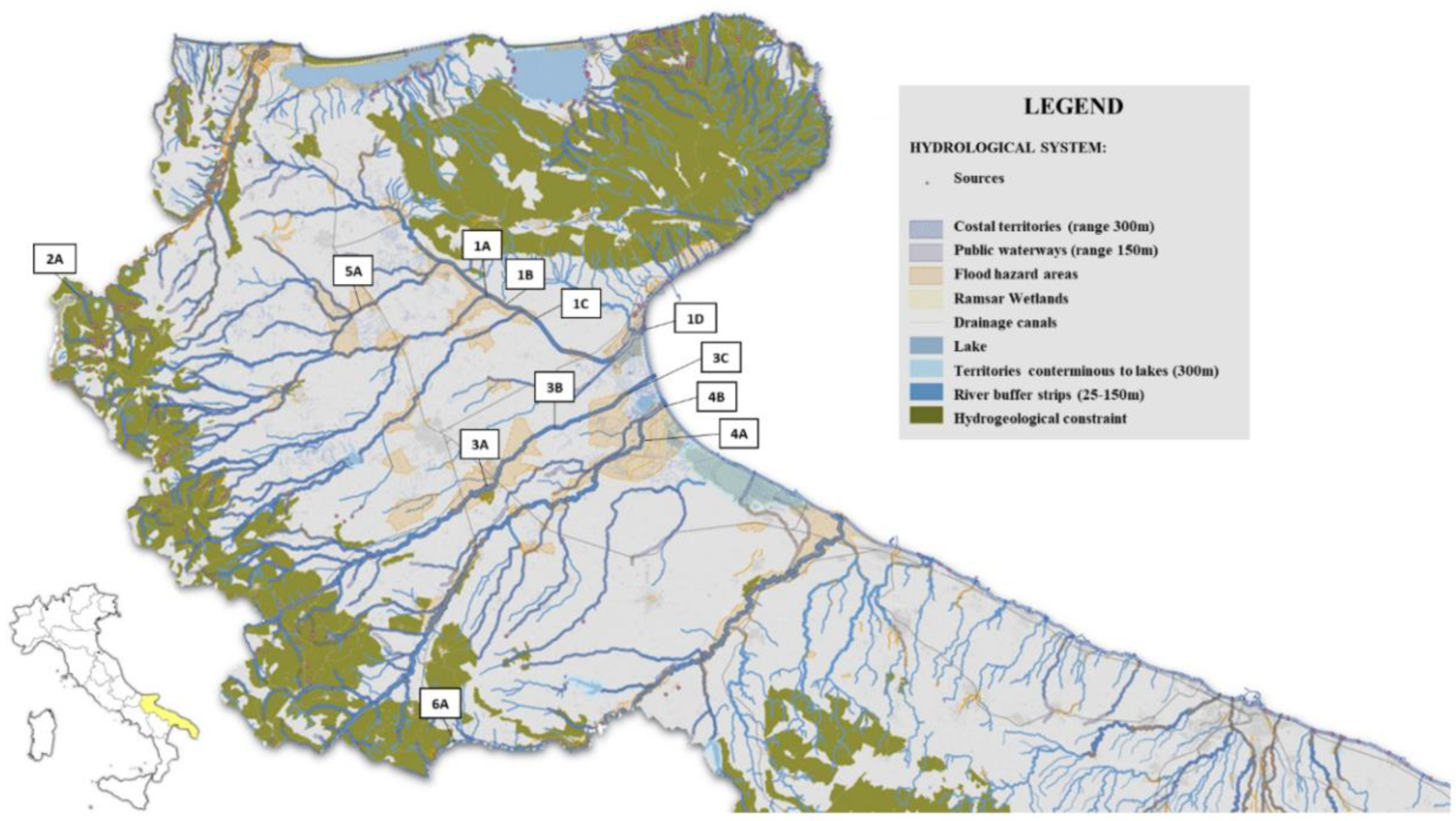
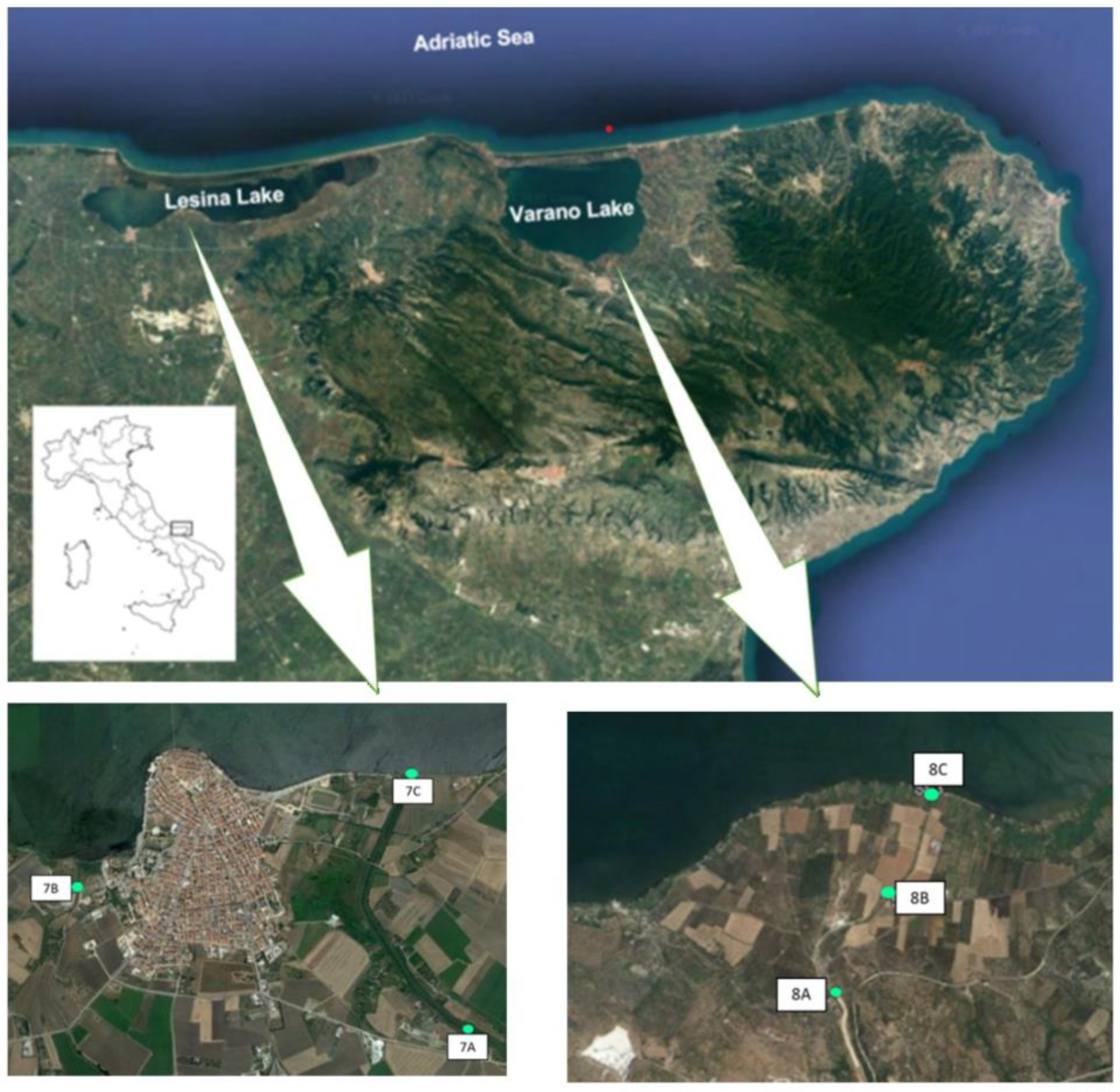

| N. | Sampling points |
Surface water bodies of Apulia Region |
LAT (degrees, minutes, seconds-milliseconds) | LONG (degrees, minutes, seconds-milliseconds) |
Annual average E. coli count (CFU/100 mL)1 |
Municipality |
| 1 | 1A | Candelaro River | 41°37' 34" N | 15°38' 7" E | 4715,8 | San Marco in Lamis |
| 2 | 1B | Candelaro River | 41°36' 36" N | 15°40' 4" E | 12374,8 | San Marco in Lamis |
| 3 | 1C | Candelaro River | 41°35' 58" N | 15°42' 18" E | 2240,0 | San Marco in Lamis |
| 4 | 1D | Candelaro stream | 41°34' 25" N | 15°53' 6" E | 1795,8 | Manfredonia |
| 5 | 2A | Fortore River | 41°38' 50" N | 15°2' 40" E | 505,6 | Casalnuovo Monterotaro |
| 6 | 3A | Cervaro River | 41°24' 4" N | 15°39' 8" E | 679,0 | Foggia |
| 7 | 3B | Cervaro River | 41°25' 37" N | 15°40' 4" E | 6228,8 | Foggia |
| 8 | 3C | Cervaro River- | 41°31' 17" N | 15°53' 55" E | 516,7 | Manfredonia |
| 9 | 4A | Carapelle Torrent | 41°23' 51" N | 15°48' 51" E | 245,1 | Cerignola |
| 10 | 4B | Carapelle Torrent | 41° 29' 26" N | 15°55' 14" E | 2420,8 | Zapponeta |
| 11 | 5A | Triolo Torrent | 41° 38' 51" N | 15°32' 44" E | 7749,2 | Rignano Garganico |
| 12 | 6A | Ofanto River | 41° 05' 29" N | 15° 34' 20" E | 1434,3 | Rocchetta S.Antonio |
| 13 | 7A | Cammarata canal (Lesina lake) | 41° 51' 34" N | 15°21' 27" E | data not available | Lesina |
| 14 | 7B | La Fara canal (Lesina lake) | 41° 51' 48" N | 15° 21' 24" E | data not available | Lesina |
| 15 | 7C | Cammarata canal (Lesina lake) | 41° 51' 54" N | 15°21'19" E | data not available | Lesina |
| 16 | 8A | San Francesco canal (Varano lake) | 41° 50 '17" N | 15°46' 32" E | data not available | Varano |
| 17 | 8B | San Francesco canal (Varano lake) | 41°50'34"N | 15°45'07" E | data not available | Varano |
| 18 | 8C | San Francesco canal (Varano lake) | 41°50'37" N | 15°46'25"E | data not available | Varano |
| Organism | No. of PCR-positive isolates | Resistance genes in Enterobacterales isolates | ||||||
| blaCTX-M | CRE* (25/121, 20.6%) | |||||||
| blaOXA-48 | blaKPC | blaVIM | blaCTXM+ blaKPC | blaCTX-M+ blaVIM | blaCTX-M-+blaOXA-48 | |||
| K. pneumoniae | 51/75 (68%) | 40/51 (78.4%) | 1/51 (2%) |
- | 5/51 (9.8%) | 3/51 (5.9%) |
2/51 (3.9%) |
- |
| E. coli | 70/101 (69.3%) | 56/70 (80%) | 3/70 (4.3%) | 2/70 (2.9%) | 6/70 (8.6%) | - | 1/70 (1.4%) |
2/70 (2.9%) |
| Total No. | 121/176 (68.8%) | 96/121 (79.3%) | 4/121 (3.3%) |
2/121 (1.7%) | 11/121 (9.1%) |
3/121 (2.5%) |
3/121 (2.5%) |
2/121 (1.7%) |
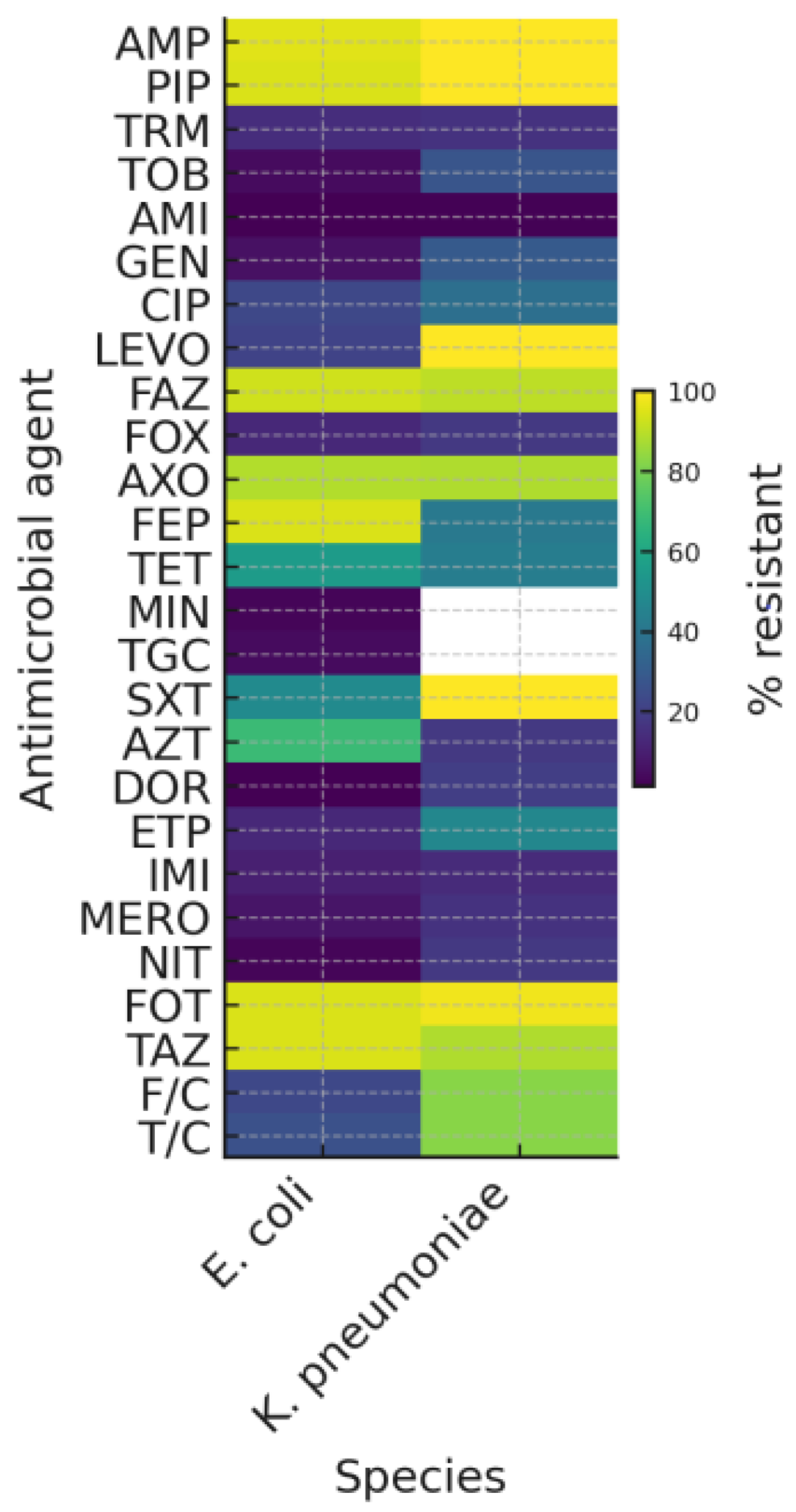
| Moleculesa | No. of E. coli categorized as resistant (%) | No. of K. pneumoniae categorized as resistant (%) |
MIC* (mg/L) E. coli |
MIC* (mg/L) K. pneumoniae |
|
| Penicillins | AMP | 67/70 (95.71) | - | >8 | ** |
| PIP | 67/70 (94.28) | - | >8 | ** | |
| Penicillin derivatives*** | TRM | 10/70 (14.28) | 8/51 (15.68) | >16 | >8 |
| Aminoglycosides | TOB | 3/70 (4.28) | 14/51 (27.45) | >4 | >2 |
| AMI | 1/70 (1.42) | 1/51 (1.96) | >8 | >8 | |
| GEN | 4/70 (5.71) | 15/51 (29.41) | >2 | >2 | |
| Fluoroquinolones | CIP | 16/70 (22.85) | 19/51 (37.25) | >0.06 | >0.125 |
| LEVO | 16/70 (21.42) | 11/51 (21.56) | >0.125 | >0.25 | |
| First generation cephalosporins | FAZ | 65/70 (92.85) | 46/51 (90.19) | >4 | >4 |
| Second-generation cephalosporins | FOX | 9/70 (12.85) | 9/51 (17.64) | >1 | >8 |
| Third- and fourth-generation | AXO | 62/70 (88.57) | 45/51 (88.23) | >2 | >2 |
| FEP | 66/70 (94.28) | 21/51 (41.17) | >0.25 | >0.125 | |
| Tetracyclines | TET | 39/70 (55.71) | 22/51 (43.13) | >8 | >8 |
| MIN | 2/70 (2.85) | 8/51 (15.68) | >4 | >8 | |
| TGC | 3/70 (4.28) | 2/51 (3.92) | >0.5 | >2 | |
| Sulfonamides | SXT | 34/70 (48.57) | 36/51 (70.58) | >4 | >4 |
| Monobactam | AZT | 48/70 (68.57) | 9/51 (17.64) | >0.25 | >4 |
| Carbapenems | DOR | 1/70 (1.42) | 10/51 (19.60) | >0.06 | >0.125 |
| ETP | 9/70 (12.85) | 24/51 (47.05) | >0.06 | >0.03 | |
| IMI | 7/70 (10.00) | 7/51 (13.72) | >0.5 | >1 | |
| MERO | 7/70 (7.14) | 8/51 (15.68) | >0.06 | >0.125 | |
| Nitrofurans | NIT | 2/70 (2.85) | - | >64 | ** |
| ESBL confirmatory tests | FOT | 67/70 (94.28) | 50/51 (98.03) | >0.25 | >0.25 |
| TAZ | 67/70 (94.28) | 45/51 (88.23) | >1 | >1 | |
| F/C | 16/70 (22.85) | 42/51 (82.35) | >0.25 | >0.25 | |
| T/C | 18/70 (25.71) | 42/51 (82.35) | >1 | >0.5 |
| N. | Sampling points | Date | ID | Species | Multiplex PCR results | Carbapenemase | ESBL_AmpC | Other AMR genes | MLST | Plasmid type |
| 1 | 1B | 11/23 | IZSPB_EC01 | E. coli |
blaCTX-M blaOXA-48 |
blaOXA-244 | blaCTX-M-15 | blaTEM-1B, qnrS1, aph(6)-Id, aph(3'')-Ib, sul2, dfrA14, tet(A) | ST10 | IncFIB(K), IncFIB(AP0019) |
| 2 | 1B | 06/24 | IZSPB_KP01 | K. pneumoniae | blaCTX-M blaOXA-48 | blaKPC-3 | - | blaTEM-1A, blaOXA-9, aadA3, aac(3)-IIa, aadA2, aph(3')-Ia, aac(6')-Ib, mph(A), sul1, dfrA12, catA1 | ST512 | IncFIB(K), ColRNAI, IncQ1, IncFIB(pQil) |
| 3 | 1B | 07/24 | IZSPB_EC02 | E. coli | blaVIM | - | blaTEM-52B | ant(3'')-Ia, lnu(F) | ST602 | IncX1, IncI1-I(Alpha) |
| 4 | 1D | 02/24 | IZSPB_EC03 | E. coli | blaOXA-48 | blaOXA-244 | - | - | ST43 | IncFIB(AP0019) |
| 5 | 1D | 05/24 | IZSPB_EC04 | E. coli | blaKPC | blaKPC-3 | - | - | ST1139 | IncI(Gamma), IncFIB(pQil) |
| 6 | 1D | 05/24 | IZSPB_KP02 | K. pneumoniae | blaCTX-MblaKPC | blaKPC-3 | blaSHV-28, blaCTX-M-15 | blaTEM-1A, blaOXA-1, blaOXA-9, qnrB1, aac(3)-IIa, aph(6)-Id, aph(3'')-Ib, sul2, dfrA14, aac(6')-Ib-cr | ST307 | IncFIB(K), IncN4, IncFIB(pQil) |
| 7 | 2A | 02/24 | IZSPB_KP03 | K. pneumoniae | blaOXA-48 | - | - | - | ST3442 | IncFIB(K)(pCA), RepB |
| 8 | 3B | 02/24 | IZSPB_KP04 | K. pneumoniae | blaVIM | blaVIM-1 | blaSHV-12 | qnrS1, aph(3')-XV, mph(A), sul1, dfrA14, catB2 | ST1537 | IncA |
| 9 | 3B | 07/24 | IZSPB_KP05 | K. pneumoniae | blaCTX-MblaKPC | blaKPC-3 | blaTEM-1A, blaOXA-9, tet(D) | ST45 | IncFIB(K), Col440II, ColRNAI, IncFIB(pQil) | |
| 10 | 3B | 08/24 | IZSPB_KP06 | K. pneumoniae | blaVIM | - | blaDHA-1 | blaOKP-B-2, qnrB4, sul1, dfrA1 | ST2059 | IncFIB(K), IncR, Col440I |
| 11 | 3B | 09/24 | IZSPB_KP07 | K. pneumoniae | blaVIM | - | - | - | ST983 | negative |
| 12 | 3B | 09/24 | IZSPB_EC05 | E. coli | blaVIM | - | - | blaTEM-1B, aph(3'')-Ib, tet(B) | ST Novel* | IncFIB (AP0019) |
| 13 | 4A | 03/24 | IZSPB_EC06 | E. coli | blaOXA-48 | blaOXA-181 | - | blaTEM-1B, aac(3)-IId, aph(6)-Id, aph(3')-Ia, aph(3'')-Ib, aadA5, mph(A), erm(B), sul1, sul2, dfrA17, floR, catA1 | ST542 | IncFII, IncX1, IncX1, Col (BS512), Col156, IncQ1 |
| 14 | 5A | 02/24 | IZSPB_EC07 | E. coli | blaOXA-48 | blaOXA-244 | - | - | ST746 | negative |
| 15 | 5A | 02/24 | IZSPB_EC08 | E. coli | blaVIM | blaVIM-4 | - | - | ST Novel* | IncFIB(K), IncFIA(HI1) |
| 16 | 5A | 02/24 | IZSPB_KP08 | K. pneumoniae | blaVIM | blaVIM-1 | - | aph(3')-XV, mph(A), sul1, catB2 | ST Novel* | repB(R1701), IncFIB(K) (pCA), IncFIB(pKPHS1, Col440I |
| 17 | 5A | 03/24 | IZSPB_KP09 | K. pneumoniae | blaVIM | blaVIM-1 | - | qnrS1, aph(3')-XV, mph(A), sul1, dfrA14, catB2 | ST34 | IncFIB(K), IncN, IncR |
| 18 | 5A | 03/24 | IZSPB_EC09 | E. coli | blaOXA-48 | blaOXA-244 | blaCTX-M-15 | blaTEM-1B, qnrS1, aph(6)-Id, aph(3'')-Ib, sul2, dfrA14, tet(A) | ST540 | IncFIB(K), IncFIB(AP0019) |
| 19 | 5A | 03/24 | IZSPB_KP10 | K. pneumoniae | blaCTX-MblaVIM | - | blaCTX-M-15 | qnrS1, aph(6)-Id, aadA2, aph(3')-Ia, aph(3'')-Ib, mph(A), sul1, sul2, dfrA12, catA2 | ST469 | IncFIB(K)(pCA), IncFIB(pKPHS1, RepB |
| 20 | 5A | 04/24 | IZSPB_EC10 | E. coli | blaCTX-MblaVIM | blaVIM-4 | - | - | ST1721 | negative |
| 21 | 5A | 04/24 | IZSPB_KP11 | K. pneumoniae | blaVIM | blaVIM-1 | - | aph(3')-XV, sul1, catB2 | ST Novel* | IncFIB(K), IncFIA(HI1), IncX1, IncX1, IncR, Col(pHAD28), Col440I, Col(pHAD28) |
| 22 | 5A | 06/24 | IZSPB_EC11 | E. coli | blaVIM | blaVIM-4 | - | - | ST1721 | IncFIB(pHCM2) |
| 23 | 8A | 08/24 | IZSPB_EC12 | E. coli | blaVIM | - | blaSHV-12 | qnrS1, aph(3'')-Ib, tet(A), floR | ST2144 | IncFIA, IncFIA, IncX1, IncX1, ColpVC, IncFIB(AP0019) |
| 24 | 8B | 02/24 | IZSPB_EC13 | E. coli | blaKPC | blaKPC-3 | - | - | ST141 | IncN |
| 25 | 8B | 08/24 | IZSPB_EC14 | E. coli | blaVIM | - | blaSHV-12 | qnrS1, aph(3'')-Ib, tet(A), floR | ST2144 | IncFII(29), IncFIA, IncFIA, IncX1, IncX1, ColpVC, IncFIB(AP0019) |
Disclaimer/Publisher’s Note: The statements, opinions and data contained in all publications are solely those of the individual author(s) and contributor(s) and not of MDPI and/or the editor(s). MDPI and/or the editor(s) disclaim responsibility for any injury to people or property resulting from any ideas, methods, instructions or products referred to in the content. |
© 2026 by the authors. Licensee MDPI, Basel, Switzerland. This article is an open access article distributed under the terms and conditions of the Creative Commons Attribution (CC BY) license (http://creativecommons.org/licenses/by/4.0/).


