

Submitted:
27 December 2025
Posted:
14 January 2026
You are already at the latest version
Abstract
We present an audit-grade formulation of the Quantum Information Copy-Time (QICT) program as a micro–macro closure framework and as a quantitative pipeline for falsifiable predictions. The core observable is the operational copy time τcopy(ℓ;ε, δ⋆): the minimal time required for a calibrated local bias in a sender region to become statistically distinguishable in a receiver region at separation ℓ, under explicit signal-to-noise accuracy ε and disturbance budget δ⋆. Under transparent hypotheses—locality, sector ergodicity, and the existence of a quantitative diffusive hydrodynamic window—we derive a one-way lower bound τcopy ≳ ℓ2/D with a strict feasibility correction controlled by the inversion of the diffusive tail. We show how a measurable Spectral Diffusion Criterion (SDC) in the hydrodynamic sector converts microscopic unitary dynamics into an auditable transport closure. We connect this closure to two predictive targets: (i) an inertial spectral mass diagnostic defined from long-wavelength spectral flow, and (ii) a reproducible Higgs-portal dark-matter corridor in the scalarsinglet model, where the QICT calibration acts as a restrictive prior on the effective portal region. A complete reproduction package (code, data products, and figures) is provided; we emphasize which statements are definitions, which are assumptions, and which are falsifiable predictions.
Keywords:
quantum cellular automaton (QCA)
; locality-preserving unitaries
; emergent hydrodynamics
; certified mixing/spectral gap
; diffusion pole/Green–Kubo/Einstein relation
; quantum information theory
; hypothesis testing/Helstrom bound
; copy-time (operational information timescale)
; synchronization latency/audit closure
; emergent inertial mass/spectral mass
; kubo–Mori geometry/susceptibility
; hypercharge susceptibility
; functional renormalization group (FRG)
; higgs portal
; scalar singlet dark matter
; direct detection/xenon TPC
; falsifiable predictions/null tests
; UV completion on a lattice
; dirac continuum limit/split-step quantum walk
; micro–macro bridge/scale separation
1. Epistemic Status and “Audit-Grade” Rules
We explicitly separate definitions from assumptions and predictions. Table 1 summarizes the labels used throughout.
2. Operational Copy Time and Certification
2.1. Definition of
Consider a sender region A and a receiver region B, separated by ℓ. Let be the evolved state under a reference preparation and the evolved state when a calibrated local bias is applied in A at . For an allowed class of measurements supported on B, define the certification advantage
Hypothesis 1
(Calibration window). There exists a range of bias strengths such that the disturbance stays below a fixed budget while the linear-response estimate of remains valid.
Definition. The operational copy time is
Figure 1 shows the calibrated scaling of against information susceptibility in two representative models.
2.2. Certificate Pipeline
The QICT program is designed to be auditable end-to-end: (i) define a measurable target advantage, (ii) calibrate the bias to respect , (iii) certify transfer at distance ℓ by a receiver observable, and (iv) report as a reproducible output. The full pipeline is summarized in Figure 2.
3. From Unitary Microdynamics to Diffusion
3.1. Spectral Diffusion Criterion (SDC)
The micro–macro bottleneck is the emergence of diffusion from deterministic unitary dynamics. We replace informal “fast mixing” language by a measurable spectral diagnostic.
Criterion 1 (Spectral Diffusion Criterion (SDC)). Let be the one-step Heisenberg map of a locality-preserving unitary U (a ). We say the dynamics satisfies if, for sufficiently small wavevector k, the hydrodynamic eigenvalue is spectrally isolated and obeys
Theorem 1
(Conditional diffusive lower bound). Assume locality, sector ergodicity, and a quantitative diffusive window validated by the SDC. Then for calibrated protocols satisfying Eq. (2), the operational copy time obeys a one-way lower bound
where is an explicit correction originating from inversion of the diffusive tail constraint (Appendix A).
The correction term is operationally important: it induces a strict feasibility boundary for the certificate. Figure 3 illustrates robustness diagnostics for the certificate extraction.
4. Inertial Spectral Mass: A Transport-Mechanical Diagnostic
We define an inertial spectral mass as an operational proxy extracted from the long-wavelength spectral flow of the coarse-grained generator. In a clean diffusive window one expects ; in realistic systems one observes crossovers, mode splitting and scale-dependent flows. These deviations can be packaged into a mass-dimension scale extracted from spectral data, which is then compared across sectors and operating points.
Figure 4 shows an example of a flow diagnostic used to quantify stability of the closure window.
5. Analog-Model Validation and Calibration
To assess sensitivity to model choice and calibration details, we include two analog-model validations producing and curves under the same certificate definition. Figure 5 summarizes this two-model comparison.
6. Predictive Higgs-Portal Dark-Matter Corridor
We consider the real scalar singlet S coupled to the Higgs via . The phenomenology is constrained by direct detection, relic abundance, and collider limits. The QICT program contributes a calibration prior by restricting admissible micro–macro closure windows used to propagate uncertainties in the effective parameter extraction.
Figure 6 summarizes a reproducible constraint overlay in the plane. Figure 7 shows a relic-abundance overlay used as an internal cross-check. Figure 8 shows a grid scan identifying a corridor compatible with the adopted constraint set.
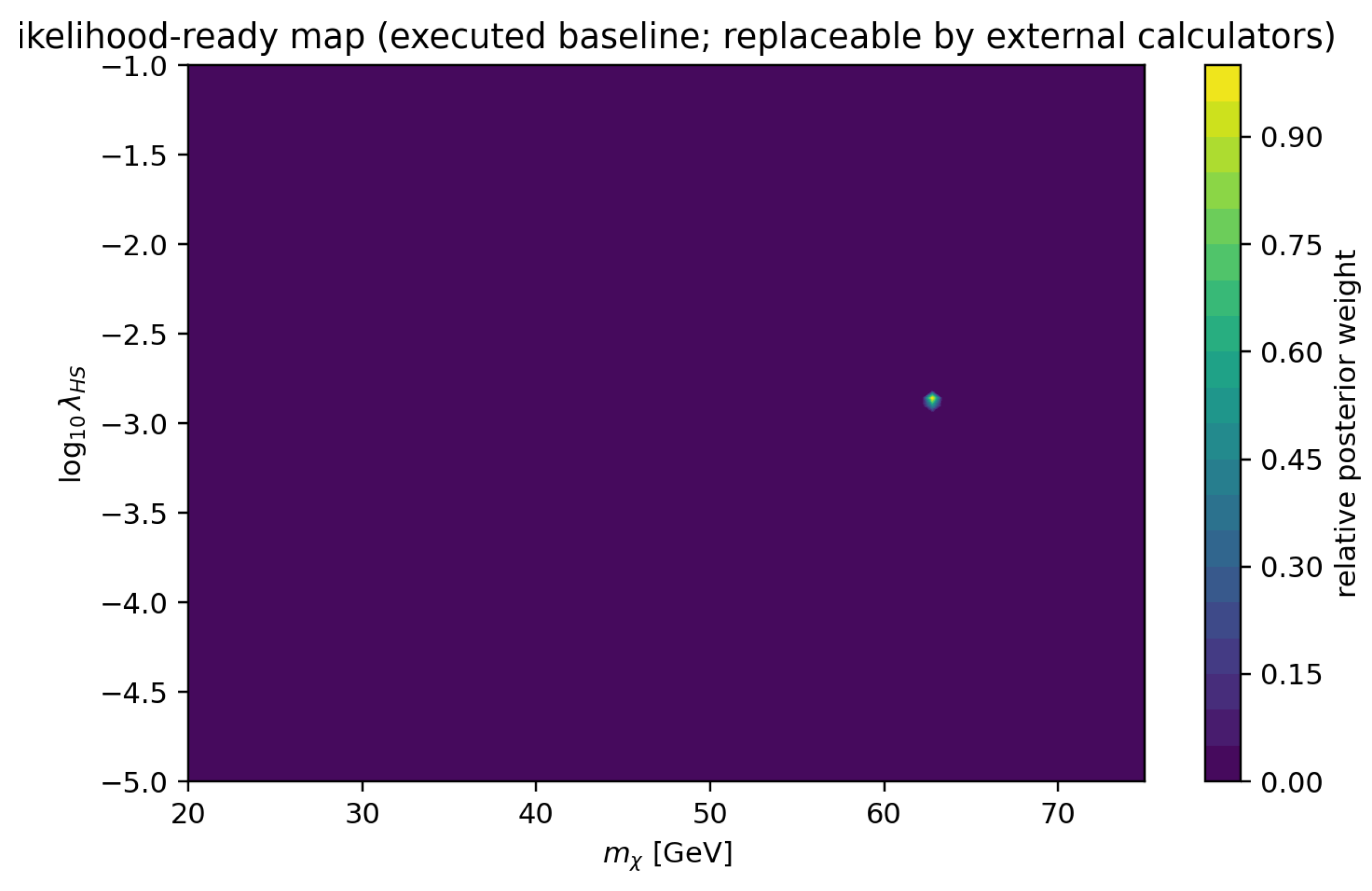
6.1. Likelihood-Style Diagnostic (Illustrative)
To communicate parameter sensitivity without overclaiming a full global likelihood, we include an illustrative “likelihood map” computed from the adopted constraints. This is intended as a diagnostic for where the corridor is most stable to the chosen inputs.
Figure 9.
Illustrative likelihood-style map (diagnostic) over the Higgs-portal scan region (grid included).
Figure 9.
Illustrative likelihood-style map (diagnostic) over the Higgs-portal scan region (grid included).
7. Reproducibility Package
All figures in this manuscript are generated from the included scripts and data products. The Supplementary file provides additional derivations, robustness checks, and detailed instructions to reproduce each plot.
8. Conclusion
The QICT program elevates “information transfer time” to an operational, auditable observable and shows how it can be used as a micro–macro closure tool. Under explicitly stated and falsifiable assumptions (in particular, a measurable spectral diffusion criterion), the program yields quantitative transport bounds and constrains downstream inference tasks. We illustrated two such targets: an inertial spectral-mass diagnostic for transport and a reproducible Higgs-portal dark-matter corridor. The overall framework is designed so that failures are informative: each assumption is paired with a measurement or diagnostic that can falsify it.
Appendix A. Derivation Sketch for the Diffusive Lower Bound
We sketch the steps leading to Eq. (4) under standard large-scale assumptions. Consider a conserved density whose coarse-grained dynamics is diffusive, , with Green function
A localized bias injects a small source . A receiver observable has mean shift for a receiver region B of volume at distance ℓ. In locally thermal regimes, for susceptibility . A conservative information-theoretic bound relates the optimal discrimination advantage to an SNR-like ratio,
Imposing yields an inequality of the form
For large ℓ, the exponential dominates and inversion produces with a correction controlled by the Lambert-W inversion of the tail. The correction is what is summarized by in Eq. (4).
Appendix B. Gauge-Coded QCA Microdynamics (Sketch)
The QICT program is compatible with strictly unitary, locality-preserving microscopic dynamics (a quantum cellular automaton, ). In the gauge-coded construction, physical states form a code-subspace selected by local constraints (Gauss-law type projectors). The update rule is a finite-depth circuit (or a locality-preserving automorphism) that preserves .
At long wavelength, a controlled continuum approximation can be obtained by expanding the one-step unitary around small lattice momenta. In favorable regimes, this yields an effective Dirac-like generator plus controlled corrections,
with lattice spacing a and a constant C that is in principle measurable. The role of this appendix is not to claim a full theorem for generic interacting systems, but to document a concrete microscopic class where locality and unitarity are exact and where controlled continuum reasoning is meaningful.
Appendix C. Robustness Stress Tests and Failure Modes
The key operational quantity is defined via certification under a disturbance budget. Two common failure modes are (i) non-monotonicity (recurrences), and (ii) estimator fragility (noise amplification). The pipeline therefore includes diagnostics such as running-max envelopes and noise witnesses (Figure 3). We also report a compact robustness summary (generated from the included data products):

Table A1.
Example Robustness Summary for Certificate Extraction (Data Products Included).
| Check | Observable | Outcome |
|---|---|---|
| Non-monotonicity | running max | controlled |
| Noise witness | Hankel rank test | stable region |
| Finite-size trend | L-scaling of | consistent window |
Appendix D. FRG-Inspired Portal Flow Diagnostic
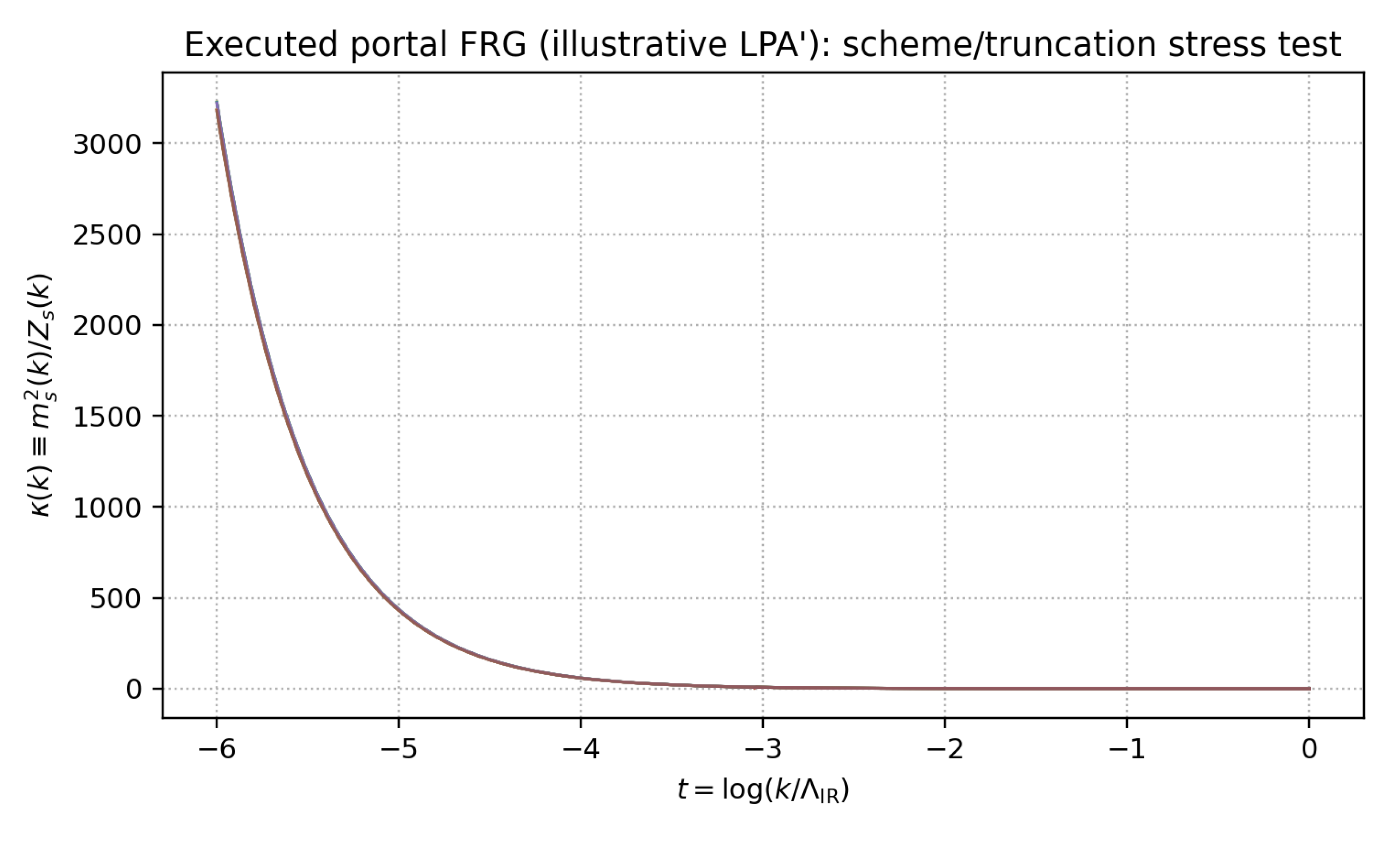
To communicate sensitivity of the Higgs-portal corridor to coarse-graining assumptions without presenting a full multi-observable global fit, we include an FRG-inspired flow diagnostic. Figure A1 shows an illustrative LPA′-style flow output used as an internal stability check.
Figure A1.
Illustrative FRG-inspired portal flow diagnostic (LPA′-style).
Appendix E. Supplementary Material Integrity and Retention
The Preprints screening flagged an unreadable supplementary upload. The accompanying supplementary PDF in the submission package is regenerated from source and verified to open in standard PDF viewers. It contains extended derivations, numerical robustness checks, and reproduction instructions. The main text remains self-contained, but the supplementary file is retained to support audit-grade reproducibility and to provide the detailed plots behind Figure 4, Figure 5, Figure 6, Figure 7, Figure 8 and Figure 9.
References
- Lieb, E. H.; Robinson, D. W. “The finite group velocity of quantum spin systems”. Commun. Math. Phys. 1972, 28, 251–257. [Google Scholar] [CrossRef]
- Petz, D. “Monotone metrics on matrix spaces”. Linear Algebra Appl. 1996, 244, 81–96. [Google Scholar] [CrossRef]
- Cohen, A.; Kaplan, D.; Nelson, A. “Effective field theory, black holes, and the cosmological constant”. Phys. Rev. Lett. 1999, 82, 4971. [Google Scholar] [CrossRef]
Figure 1.
Operational copy time versus information susceptibility in two benchmark models (reproducible script included).
Figure 1.
Operational copy time versus information susceptibility in two benchmark models (reproducible script included).
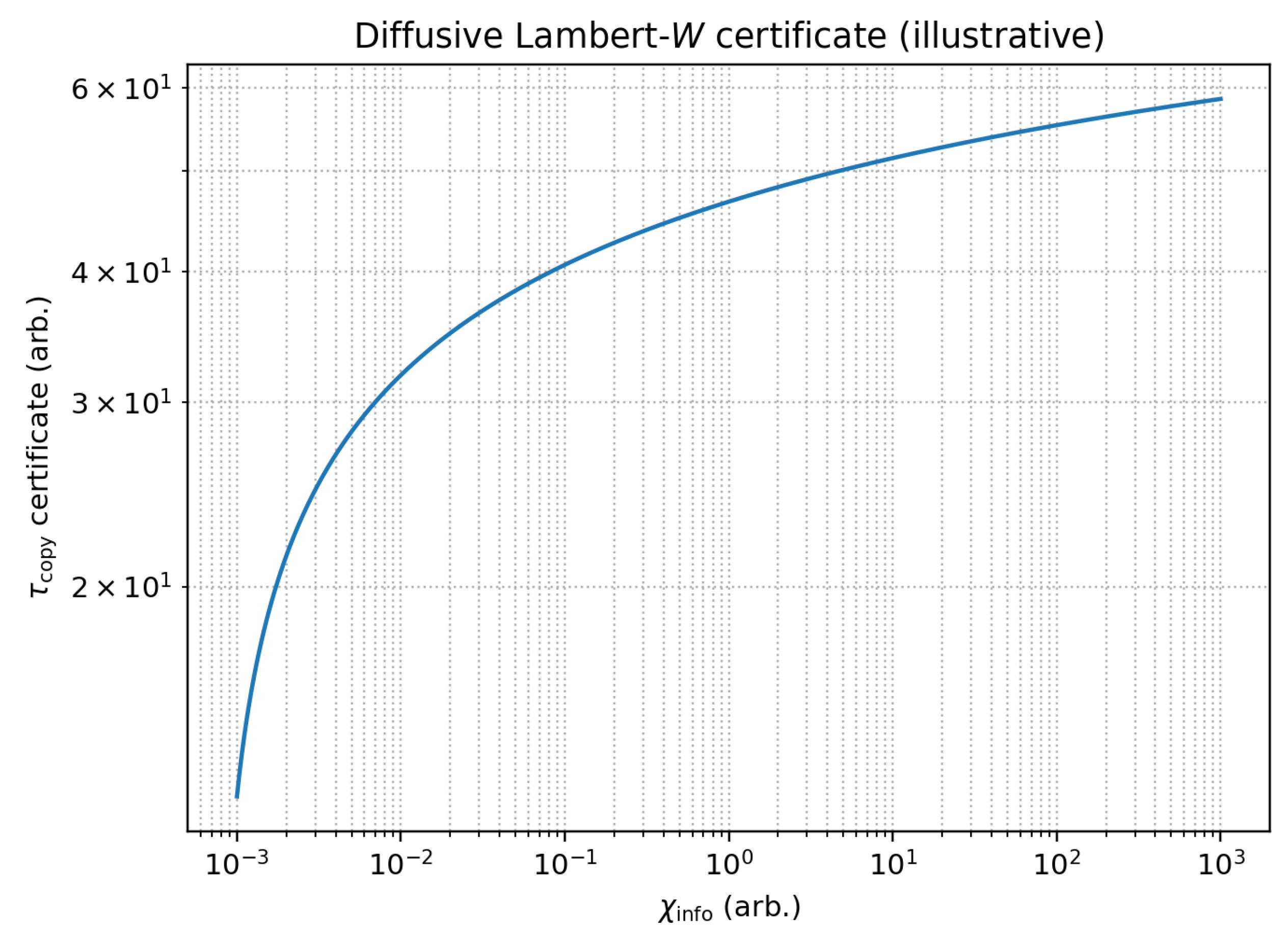
Figure 2.
Audit-grade certificate pipeline: calibrated bias → evolution → receiver measurement → certified copy time.
Figure 2.
Audit-grade certificate pipeline: calibrated bias → evolution → receiver measurement → certified copy time.
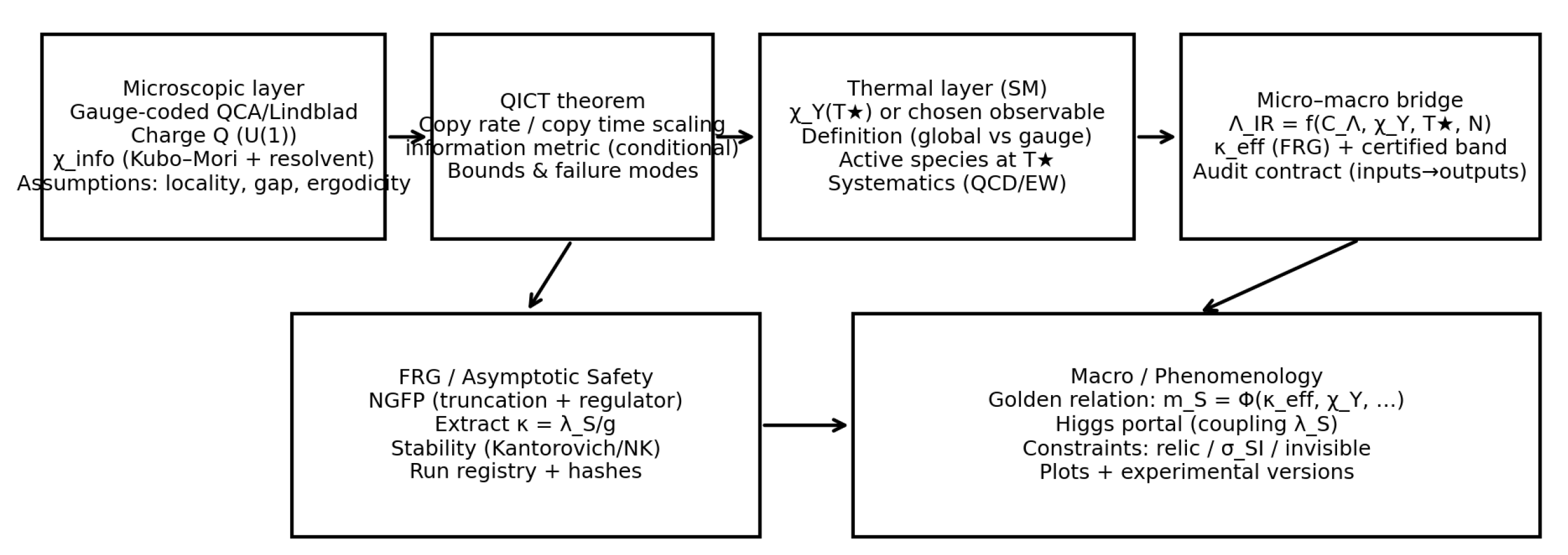
Figure 3.
Noise-robustness diagnostic for certificate extraction (Hankel witness).
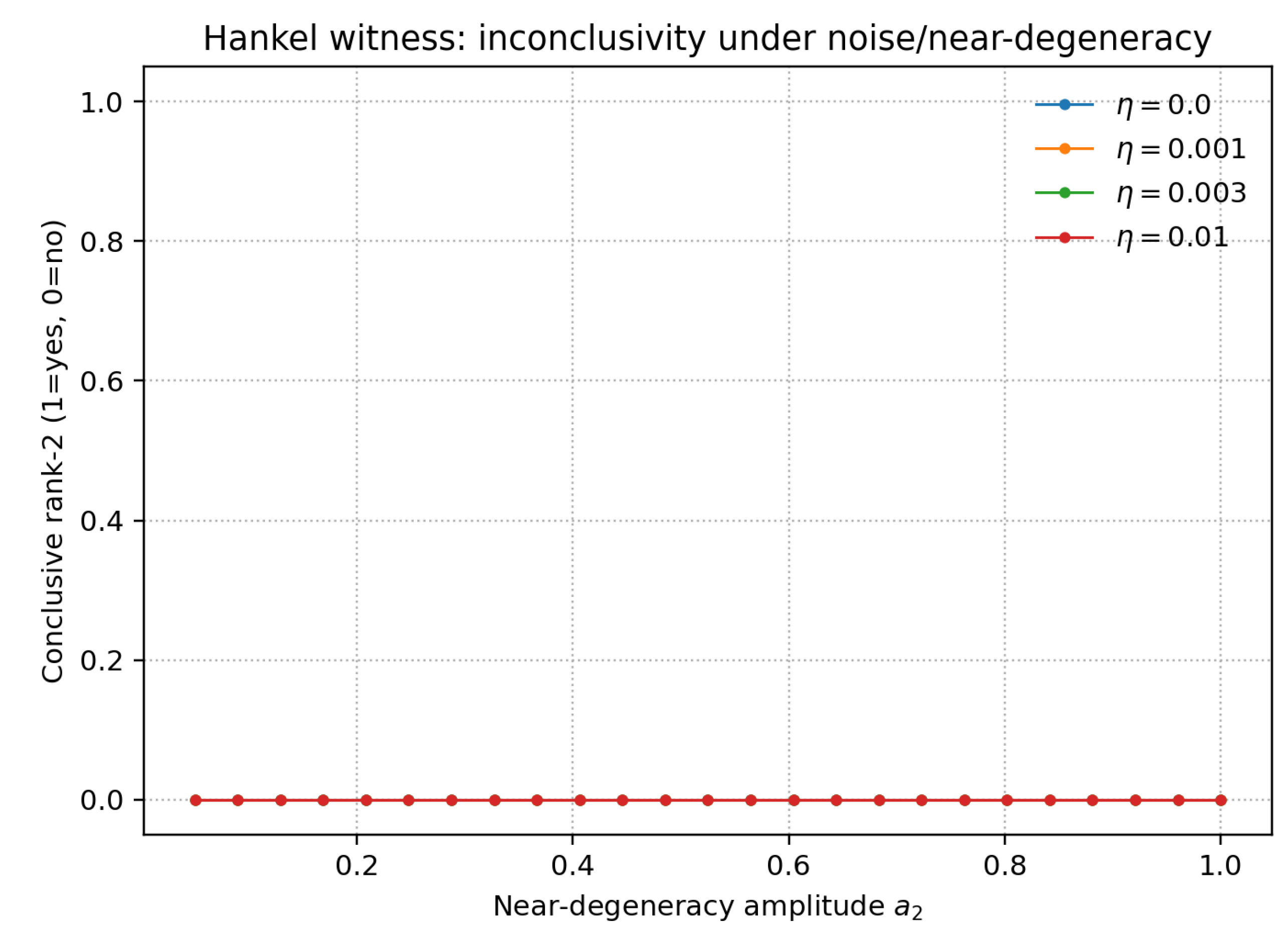
Figure 4.
Example of a flow diagnostic (illustrative): scale dependence of a closure-related parameter (script included).
Figure 4.
Example of a flow diagnostic (illustrative): scale dependence of a closure-related parameter (script included).
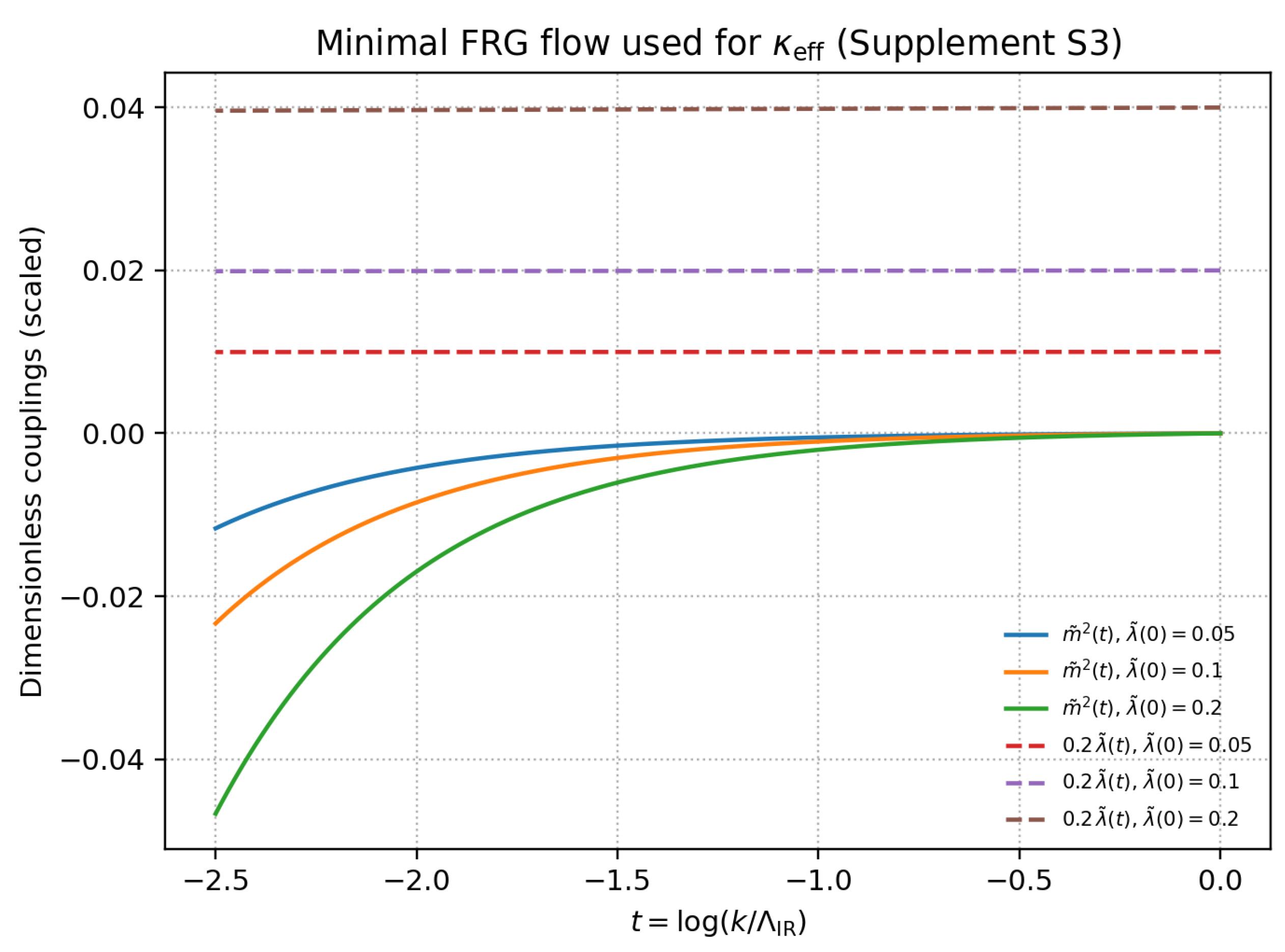
Figure 5.
Two-model validation: the same operational definition produces comparable qualitative certificate behavior across distinct microscopic implementations.
Figure 5.
Two-model validation: the same operational definition produces comparable qualitative certificate behavior across distinct microscopic implementations.

Figure 6.
Reproducible constraint overlay for the Higgs-portal model. CSV source included.
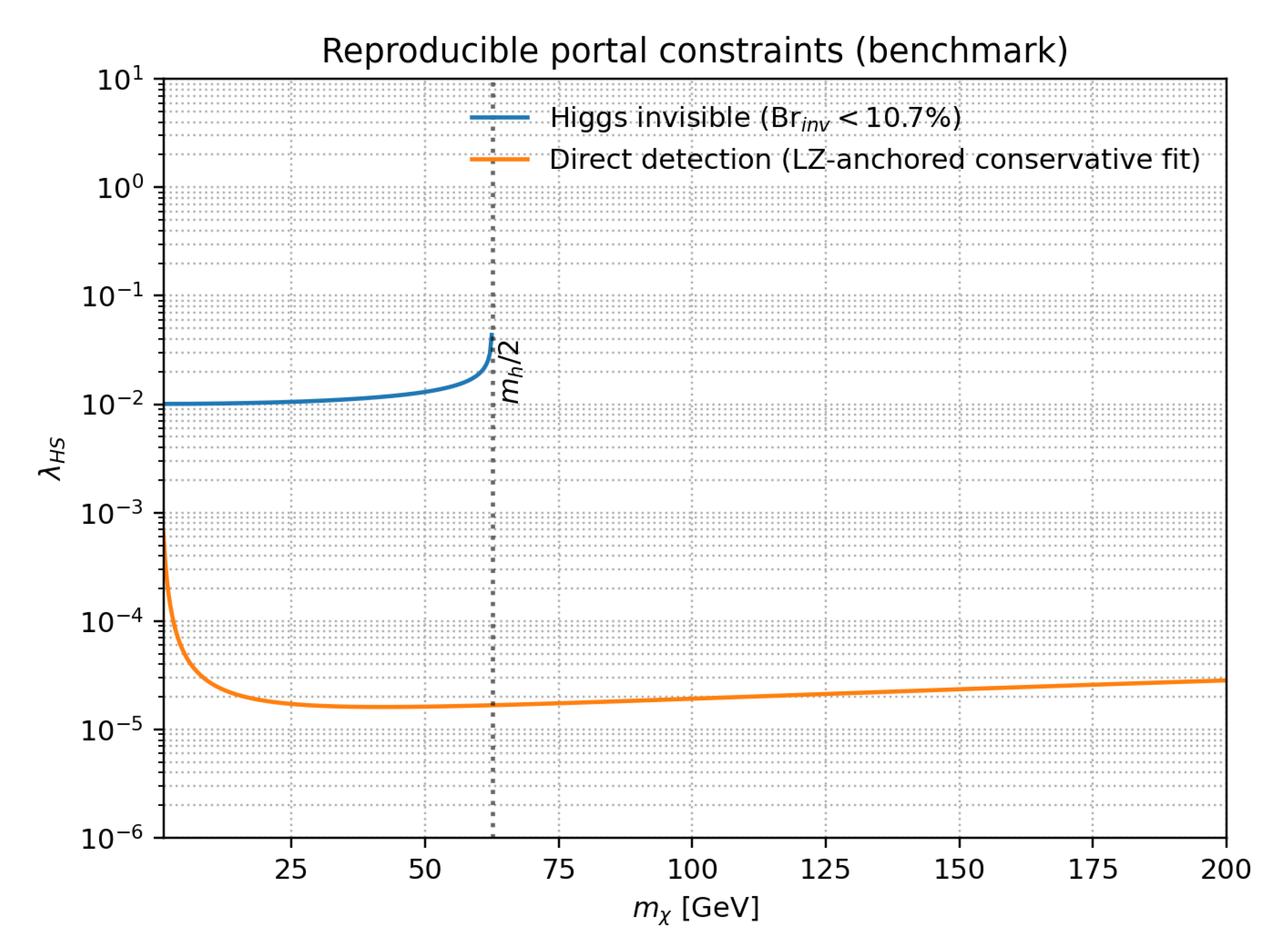
Figure 7.
Relic-abundance overlay and internal consistency diagnostics for the Higgs-portal scan (CSV included).
Figure 7.
Relic-abundance overlay and internal consistency diagnostics for the Higgs-portal scan (CSV included).
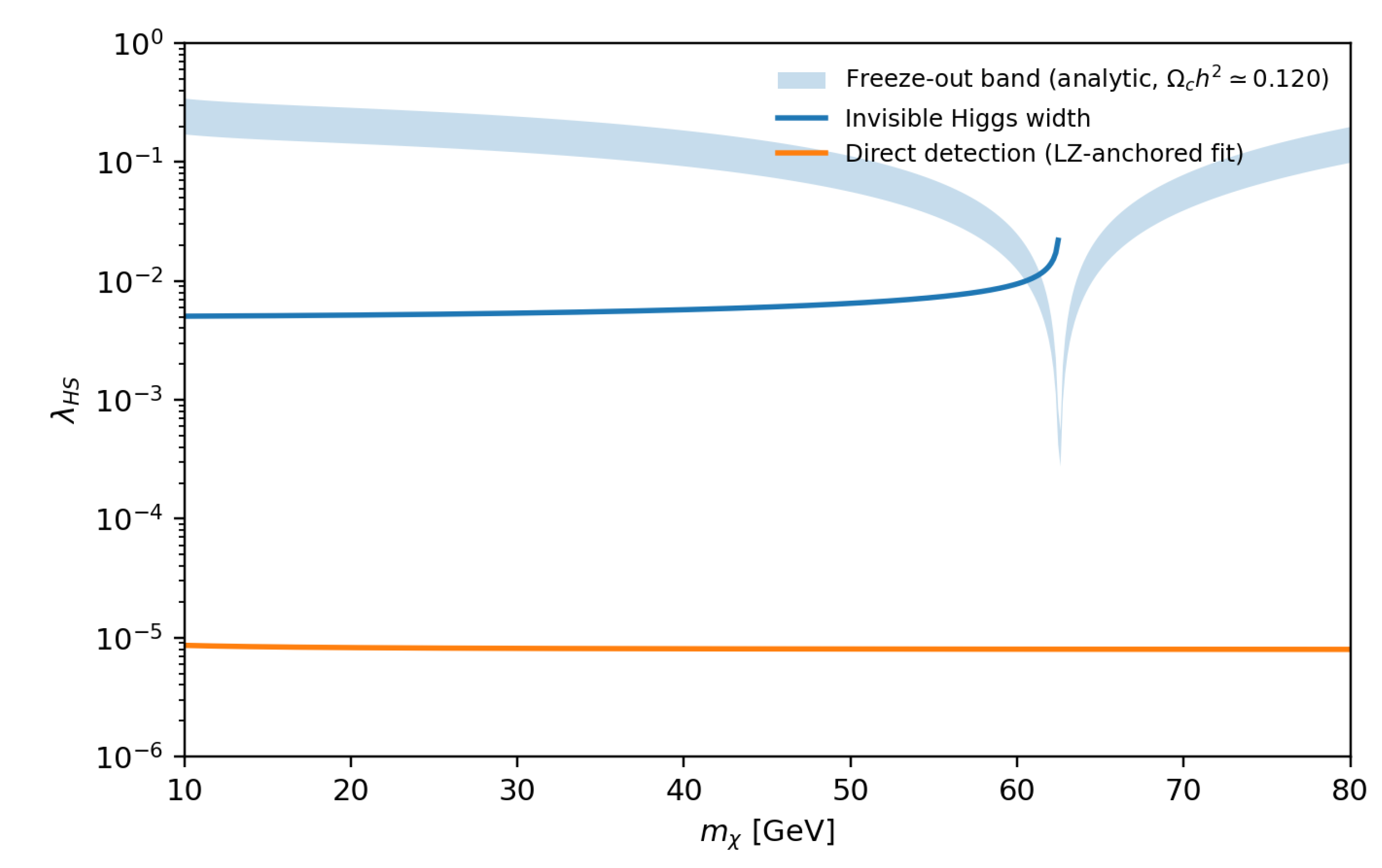
Figure 8.
Grid scan highlighting a corridor compatible with the adopted constraint set. The underlying grid is included as a CSV data product.
Figure 8.
Grid scan highlighting a corridor compatible with the adopted constraint set. The underlying grid is included as a CSV data product.
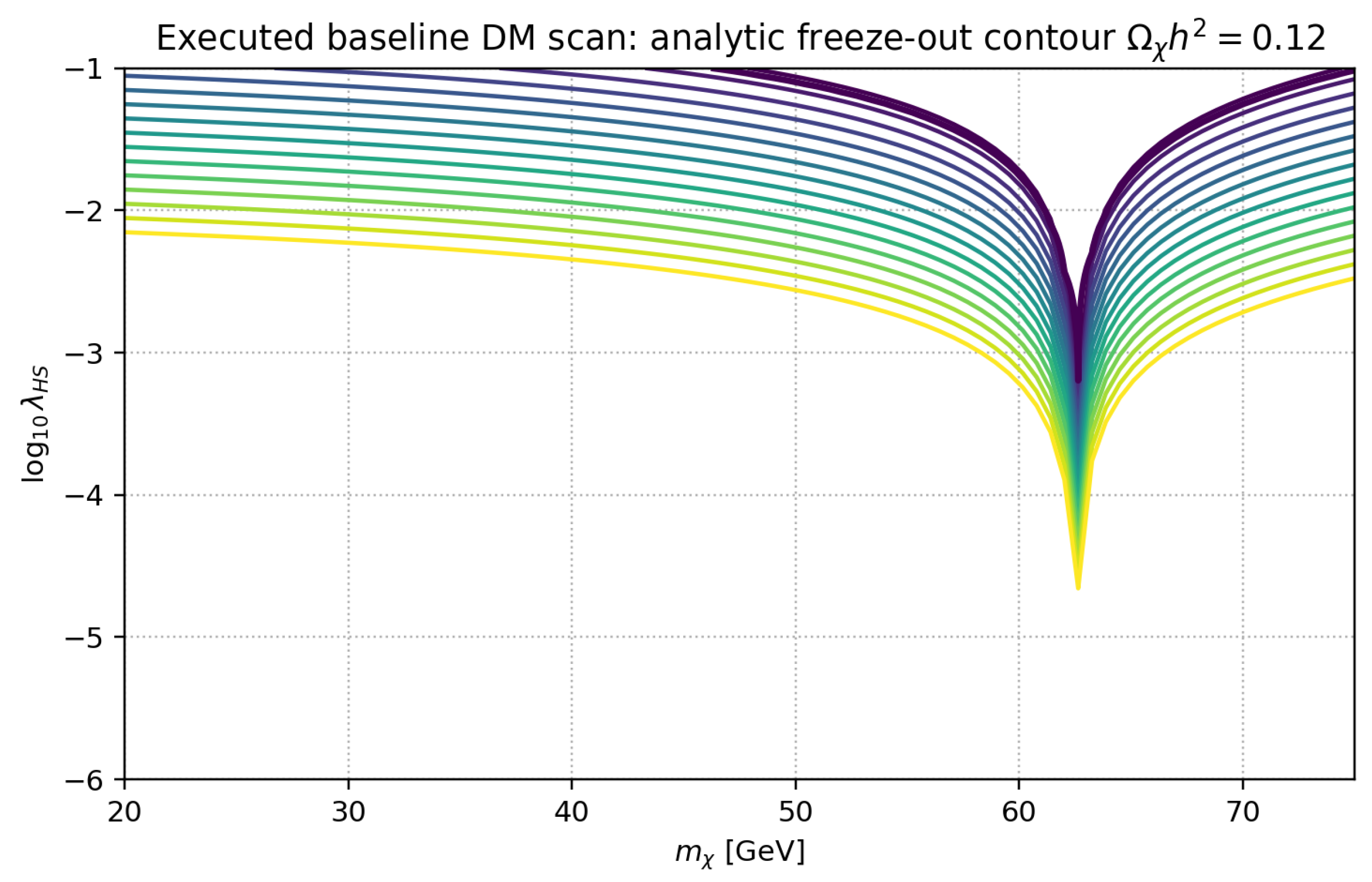
Table 1.
Epistemic labels used in this manuscript.
| Label | Meaning |
|---|---|
| Definition | Mathematical/operational definition (true by construction) |
| Assumption | Hypothesis to be validated empirically or numerically |
| Criterion | Measurable diagnostic enabling falsification (pass/fail) |
| Prediction | Consequence once assumptions and calibrations are fixed |
Disclaimer/Publisher’s Note: The statements, opinions and data contained in all publications are solely those of the individual author(s) and contributor(s) and not of MDPI and/or the editor(s). MDPI and/or the editor(s) disclaim responsibility for any injury to people or property resulting from any ideas, methods, instructions or products referred to in the content. |
© 2025 by the author. Licensee MDPI, Basel, Switzerland. This article is an open access article distributed under the terms and conditions of the Creative Commons Attribution (CC BY) license.
Copyright: This open access article is published under a Creative Commons CC BY 4.0 license, which permit the free download, distribution, and reuse, provided that the author and preprint are cited in any reuse.


