

Submitted:
12 January 2026
Posted:
14 January 2026
You are already at the latest version
Abstract
Direct-current (DC) electrokinetics in microfluidic channels is inherently affected by Faradaic reactions at the electrode–electrolyte interfaces, which induce local changes in pH and conductivity and, consequently, alter particle behavior. In this work, we present a simple microfluidic T-junction device designed to mitigate these effects by continuously flushing the regions near the electrodes with fresh electrolyte, thereby preserving the physicochemical properties of the main channel. Using fluorescence imaging with a pH-sensitive dye and electrical resistance measurements, we demonstrate that electrolyte acidification caused by water electrolysis can be effectively suppressed when advection overcomes electromigration of H+ ions. Order-of-magnitude estimates based on ion transport reveal that this condition is achieved when the flow velocity exceeds the characteristic electromigration velocity. We further investigate the effect of Faradaic reactions on cross-stream particle migration in electrophoresis experiments by quantifying the separation between suspended particles and the channel walls. We find that the particle–wall separation is significantly larger when electrolyte modifications are suppressed, clearly demonstrating the influence of Faradaic reactions on this phenomenon. Our results show that minimizing electrolyte modifications leads to a significantly enhanced particle-wall separation, highlighting the strong influence of Faradaic reactions on electrokinetic outcomes. These findings emphasize the importance of controlling electrochemical effects in DC electrokinetics and provide a simple and robust strategy to improve the accuracy and reproducibility of microfluidic electrophoresis experiments.
Keywords:
electrokinetics
; electrophoresis
; Faradaic reactions
; microfluidics
1. Introduction
Electric fields are often employed to drive the motion of electrolytes and/or particles dispersed in liquids – a research field known as electrokinetics. A well-known case of electrokinetic phenomenon is electrophoresis, which refers to the motion of a particle through an electrolyte when an external electric field interacts with the electrical charges present in the electric double layer (EDL) at the particle–electrolyte boundary [1,2]. This phenomenon is widely used to separate and analyze colloidal particles [3], as well as large molecules like DNA and proteins [4]. More broadly, electrophoresis applies to any particle that acquires a net surface charge when dispersed in an electrolyte. The electrophoretic velocity is related to the zeta potential of a particle through the Helmholtz–Smoluchowski equation [1]: , where E is the magnitude of the applied electric field, and and represent the electrical permittivity and viscosity of the liquid, respectively.
Electrokinetic phenomena in microfluidic channels are commonly studied by inserting metal electrodes at the ends of the microchannel [5,6,7,8,9,10,11,12]. Applying a voltage difference between the electrodes generates an electric field within the channel. Because the electrolyte behaves as an ohmic conductor, the presence of an electric field implies an electrical current flowing through the channel, which necessarily involves charge transfer between the electrodes and the liquid. As a result, electrochemical (Faradaic) reactions occur at the electrode–electrolyte interfaces, altering the composition of the electrolyte and leading to local changes in conductivity and pH [13,14,15,16,17,18].
These electrolyte modifications have two major consequences for the electrophoretic behavior of suspended particles. First, the particle zeta potential generally depends on both the pH and the ionic strength of the solution [19,20]. Second, spatial variations in electrolyte conductivity lead to corresponding variations in the electric field along the microchannel. This latter effect follows directly from current conservation along the channel. Besides the effect on the electrophoretic motion, these electrolyte modifications might influence cross-stream particle migration experiments [21]. In these experiments, collinear electric field and pressure-driven flow are combined in microchannels and, as a result, particles drift perpendicular to the direction of the electrophoretic motion, i.e. perpendicular to the direction of the electric field. This phenomenon is currently under investigation for its potential application in microparticle focusing and fractionation [22,23].
In this paper, we propose a simple microfluidic device designed to mitigate the impact of Faradaic currents on electrokinetics experiments with applied DC voltages, thereby avoiding or minimizing the electrolyte property changes described above. The device employs a T-junction configuration in which fresh electrolyte is continuously injected, while the fluid in the vicinity of the electrodes is flushed away. As a result, the main channel remains filled with electrolyte whose physicochemical properties are preserved. To demonstrate the effectiveness of this approach, we combine electrical measurements with fluorescence imaging using a pH-sensitive dye, showing that the electrolyte properties in the main channel remain unchanged. This behavior is in sharp contrast with that observed in a single-channel configuration, where Faradaic reactions lead to significant local modifications of the electrolyte. Importantly, we study the effect of Faradaic reactions on cross-stream particle migration experiments by quantifying the separation between suspended particles and the channel walls. We find that the particle–wall separation is significantly larger when electrolyte modifications are suppressed, clearly demonstrating the influence of Faradaic reactions on this phenomenon.
2. Methodology
The experimental setup is shown in Figure 1. The microfluidic device, fabricated using standard soft lithography techniques, consists of a PDMS microchannel with three inlets (labeled 1, 2, and 3 in Figure 1). The device comprises two main channels that intersect at a T-shape junction. The shorter channel is 2 mm long with a rectangular cross-section measuring 165 m in width and 80 m in height. The longer channel (main channel) is 25 mm long, 50 m wide, and also 80 m high. An electric field was applied along the longer channel by imposing a 2000 V potential difference between the metal needles placed in inlets 1 and 3. Flow rate and direction of the fluid flow were controlled using a pressure controller connected to liquid reservoirs via plastic tubings. A KCl electrolyte solution with a conductivity of 1.45 mS/m was used. Electric current in the channel was monitored by measuring the voltage drop across a 10 M resistor connected to the electrode in inlet 3. This value of the resistance is much lower than the estimated 4.31 G resistance of the 2.5 mm-long channel segment. Variations in the pH of the solution were monitored using a pH-sensitive fluorescent dye (fluorescein, Riedel-de Haën), for which decreased fluorescence intensity indicates a more acidic electrolyte. Fluorescent latex particles (3 m in diameter) dispersed in the electrolyte were used as flow tracers and, upon application of the voltage, underwent electrophoretic motion. Images of the junction were captured with a high-sensitivity camera mounted on an inverted fluorescence microscope with the objective focused at the mid-height of the channel cross-section.
3. Results and Discussion
In this section, we present the results of our experiments using fluorescent dyes and particles, together with measurements of the electrical resistance of the channel. These results are discussed in the context of the effects of Faradaic currents on the liquid properties and on the cross-stream particle migration in electrophoresis experiments.
3.1. Experiments with Fluorescein
Figure 2 shows fluorescence images of the microfluidic junction filled with an electrolyte containing fluorescein, acquired at different fluid velocities as indicated. The velocities were determined by tracking the motion of fluorescent particles at the center of the channel. The white arrows indicate the direction of the flow. The first column of three images on the left corresponds to the initial state, prior to activating the voltage supply, while the column on the right shows the state after the voltage had been applied for five minutes. For 0, the fluorescein brightness is homogeneous at the channel intersection, and no spatial variations in pH are observed. After five minutes, cases (a) and (b) exhibit a distinct behavior, characterized by the emergence of a darker region in the longer channel. In the experiments, the darker region consistently advanced from inlet 1 toward inlet 3, and never in the opposite direction. This change in fluorescence intensity indicates that the pH decreases near the electrode in inlet 1, that is, the liquid near the anode becomes more acidic.
According to several authors [12,24], water electrolysis can occur under two distinct scenarios depending on the pH of the electrolyte, both of which lead to increased acidity near the anode (located at inlet 1), in agreement with our observations. In contrast, as observed in case (c), the formation of the dark region can be suppressed by increasing the flow velocity. This behavior can be rationalized by considering the flux of a chemical species within the electrolyte:
where D is the diffusion coefficient, c is the concentration, is the fluid velocity, q is the electrical charge, is the Boltzmann constant, T is the absolute temperature and is the electric field. The first term on the right-hand side of Equation 1 represents diffusion, the second term corresponds to advection, and the third term accounts for electromigration. Under our experimental conditions, with a flow velocity of m/s, a diffusion coefficient for H+ of =9.1· m2/s [25] and a characteristic length from the intersection to inlet 1 of 5· m, the Péclet number is , indicating that advection dominates over diffusion. It is also possible to compare the relative contributions of diffusion and electromigration. According to Equation 1, the electromigration velocity is given by mm/s. Drawing an analogy with the concept of the Péclet number, we can define the dimensionless ratio of electromigration to diffusion as , which reveals that electromigration dominates over diffusion. The electric field is estimated by dividing the applied voltage by the total length of the channel connecting inlets 1 and 3: V/m. Therefore, the electromigration velocity, mm/s, is comparable to the advection velocity in the channel connecting the intersection to inlet 1.
In light of this calculation, the scenarios shown in Figure 2 become easier to interpret. Advection prevents H+ ions from entering the channel when its direction opposes that of the applied electric field. In contrast, electromigration consistently drives H+ ions into the channel. When the advection is aligned with the direction of the electric field, as shown in Figure 2a), it also contributes to driving H+ ions into the channel. This results in a darker region, indicating a decrease in pH. When advection opposes electromigration, its velocity must exceed the electromigration velocity to completely prevent H+ ions from entering the channel. Therefore, our order of magnitude estimates require that the advection velocity has to be of the order or larger than 28 mm/s. According to the scenario represented in Figure 2c, at a advection velocity of 17 mm/s, the presence of H+ cannot be detected by a change in brightness.
3.2. Electrical Measurements
The electrical resistance of the channel was determined by measuring the electric current flowing through the channel. To this end, we used a resistor R in series with the channel – the current through the channel also flows through the resistor. The voltage drop across the resistor allows us to determine the current I, which relates to the applied voltage V through the electrical resistance of the channel . Figure 3 shows the time evolution of for different advection velocities measured at the center of the channel connecting the intersection to inlet 1, with the flow opposing the direction of the electric field. We distinguish between two situations: Data in Figure 3a) show that decreases over time, whereas in those shown in Figure 3b), remains steady. The electric resistance of a channel with length l, cross section S, and conductivity is given by . Therefore, a decrease in resistance over time indicates an increase in conductivity, consistent with the fact that advection does not fully counteract electromigration, leading to a rise in the concentration of H+ ions. When the advection velocity is comparable to the electromigration velocity, as in the cases represented by the blue circles and dark grey triangles in Figure 3b), the channel resistance remains steady. However, it does not reach the expected value corresponding to a conductivity of mS/m, which is the measured conductivity of the KCl solution used. This may be attributed to the fact that fluid flow in a channel with a rectangular cross-section exhibits a non-uniform velocity profile, with a maximum at the center of the channel and a minimum (zero) velocity near the walls. Thus, while the flow velocity exceeds electromigration in the center of the channels, electromigration still dominates in other regions of the cross-section. For a centerline flow velocity of 73 mm/s, nearly reaches its expected value, and the remaining discrepancy may be attributed to uncertainties in the velocity measurements or in the conductivity value. Therefore, under these conditions, the concentration of H+ ions in the channel is minimal.
3.3. Electrophoresis Experiments
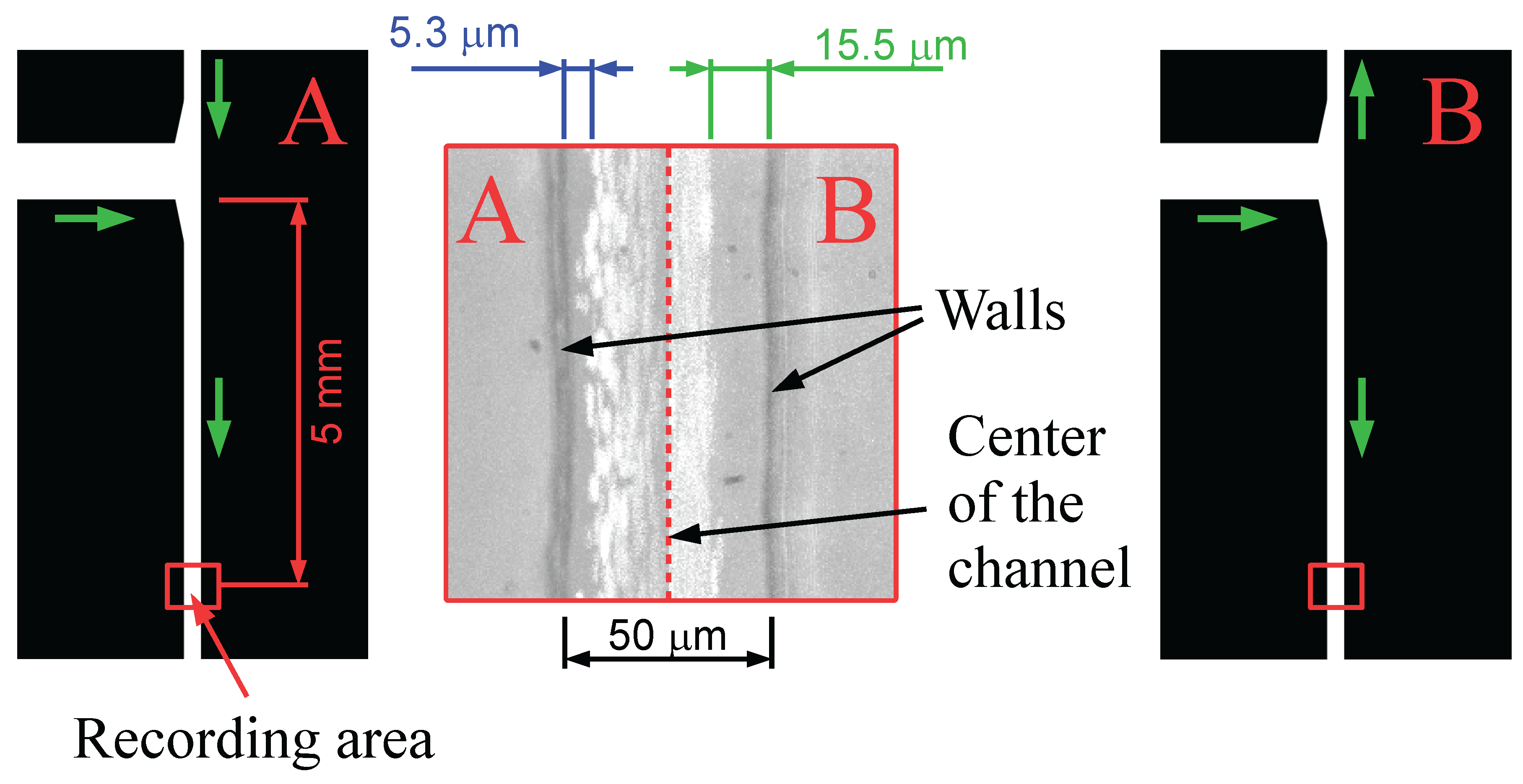
To illustrate how an increase in H+ concentration affects the cross-stream migration in electrophoresis experiments, we conducted an experiment to measure the distance to the wall of 3 m particles under two different conditions. The observation area was located 5 mm downstream from the intersection, within the channel connecting the intersection to inlet 3 (see Figure 4). In one case, labeled A, the flow direction through the channel promotes an increase in H+ concentration. In the other case, case B, the presence of H+ ions is minimized by employing the configuration described previously. An image of the observation area is shown at the center of Figure 4. The video frames recorded during the experiments were stacked using ImageJ. The presence of the 3 m particles is indicated by their white traces. To better highlight the contrast between the two scenarios, the result corresponding to configuration A is shown on the left half, while configuration B is presented on the right. In both cases, the flow velocity at the center of the channel was measured to be 57 mm/s. The formation of a depletion zone is observed in both configurations. This observation confirms the occurrence of particle drift perpendicular to the electrophoretic motion in both cases. Nonetheless, it is worth noting that the magnitude of this drift is greater in case B, where the depletion zone extends up to 15.5 m from the wall. In contrast, in case A, the depletion zone is nearly three times narrower. The depletion zone is defined as the distance from the wall within which 95 % of the particle is located. Wall separation in electrophoresis experiments has been extensively studied under a wide range of conditions. For low Reynolds numbers and AC fields, the separation is well explained by the electroosmotic flows which arises as a consequence of concentration polarization around the particles[8,9,26]. We refer to these flows as concentration polarization electroosmosis (CPEO) [27,28]. However, under the experimental conditions examined in this study – including DC fields and Reynolds numbers around 1 – there is no clear consensus on the origin of the interaction with the wall, and it remains an active area of research [21,29]. Regardless of its origin, the clarification of which lies beyond the scope of this work, the results presented here underscore the importance of preventing an increase in H+ concentration during electrophoresis experiments, as it clearly impacts the outcomes.
4. Conclusions
We have proposed a simple microfluidic device to mitigate the impact of Faradaic currents on DC electrophoresis experiments. We have investigated the interplay between the advection and electromigration of H+ ions in a microfluidic PDMS device under DC electric fields and Reynolds numbers around 1. Our results show that the advection can effectively limit the accumulation of H+ ions in the channel when its velocity exceeds the electromigration velocity (∼ 28 mm/s). This balance directly impacts the local pH and conductivity, as demonstrated by changes in electrical resistance of the channel and fluorescence intensity of a pH-sensitive dye. The separation of channel walls of 3 m particles was observed to be significantly stronger when H+ ions were minimized, highlighting the critical role of acidification in cross-stream particle migration in electrophoresis experiments. While the exact origin of the particle-wall separation under these conditions remains unresolved, our findings emphasize the importance of controlling the effect of Faradaic reactions to ensure accurate and reproducible electrophoresis experiments.
Funding
The authors acknowledge financial support from MICIU/AEI/10.13039/501100011033/FEDER, UE (Grant No. PID2022-138890NB-I00). JAT gratefully acknowledges funding from the University of Seville through the VII Plan Propio de Investigación y Transferencia (VII PPIT-US).
References
- Hunter, R. Introduction to Modern Colloid Science; Oxford University Press, 1993.
- von Smoluchowski, M. Contribution à la théorie de l’endosmose électrique et de quelques phénomènes corrélatifs. Bull. Akad. Sci. Cracovie. 1903, 8, 182–200.
- O’Brien, R.W.; White, L.R. Electrophoretic mobility of a spherical colloidal particle. Journal of the Chemical Society, Faraday Transactions 2: Molecular and Chemical Physics 1978, 74, 1607–1626. DOI . [CrossRef]
- Southern, E.M.; et al. Detection of specific sequences among DNA fragments separated by gel electrophoresis. J mol biol 1975, 98, 503–517. [CrossRef]
- Fernández-Mateo, R.; García-Sánchez, P.; Calero, V.; Ramos, A.; Morgan, H. A simple and accurate method of measuring the zeta-potential of microfluidic channels. Electrophoresis 2022, 43, 1259–1262. [CrossRef]
- Saucedo-Espinosa, M.A.; Lapizco-Encinas, B.H. Refinement of current monitoring methodology for electroosmotic flow assessment under low ionic strength conditions. Biomicrofluidics 2016, 10, 033104. [CrossRef]
- Saucedo-Espinosa, M.A.; Rauch, M.M.; LaLonde, A.; Lapizco-Encinas, B.H. Polarization behavior of polystyrene particles under direct current and low-frequency (<1 kHz) electric fields in dielectrophoretic systems. Electrophoresis 2016, 37, 635–644. [CrossRef]
- Fernández-Mateo, R.; Calero, V.; Morgan, H.; García-Sánchez, P.; Ramos, A. Wall Repulsion of Charged Colloidal Particles during Electrophoresis in Microfluidic Channels. Phys. Rev. Lett. 2022, 128, 074501. [CrossRef]
- Fernández-Mateo, R.; Morgan, H.; Ramos, A.; García-Sánchez, P. Wall Repulsion during Electrophoresis: Testing the theory of Concentration-Polarization Electroosmosis. Physics of Fluids 2023. [CrossRef]
- Gallo-Villanueva, R.C.; Rodríguez-López, C.E.; Díaz-de-la Garza, R.I.; Reyes-Betanzo, C.; Lapizco-Encinas, B.H. DNA manipulation by means of insulator-based dielectrophoresis employing direct current electric fields. Electrophoresis 2009, 30, 4195–4205. [CrossRef]
- Pysher, M.D.; Hayes, M.A. Electrophoretic and dielectrophoretic field gradient technique for separating bioparticles. Analytical chemistry 2007, 79, 4552–4557. [CrossRef]
- Corstjens, H.; Billiet, H.A.; Frank, J.; Luyben, K.C. Variation of the pH of the background electrolyte due to electrode reactions in capillary electrophoresis: theoretical approach and in situ measurement. Electrophoresis 1996, 17, 137–143. [CrossRef]
- Cabrera, C.R.; Finlayson, B.; Yager, P. Formation of natural pH gradients in a microfluidic device under flow conditions: model and experimental validation. Analytical Chemistry 2001, 73, 658–666. [CrossRef]
- Calero, V.; García-Sánchez, P.; Ramos, A.; Morgan, H. Combining DC and AC electric fields with deterministic lateral displacement for micro-and nano-particle separation. Biomicrofluidics 2019, 13, 054110. [CrossRef]
- Persat, A.; Suss, M.E.; Santiago, J.G. Basic principles of electrolyte chemistry for microfluidic electrokinetics. Part II: Coupling between ion mobility, electrolysis, and acid–base equilibria. Lab on a Chip 2009, 9, 2454–2469. [CrossRef]
- Macka, M.; Andersson, P.; Haddad, P.R. Changes in electrolyte pH due to electrolysis during capillary zone electrophoresis. Analytical Chemistry 1998, 70, 743–749. [CrossRef]
- Novotnỳ, T.; Gaš, B. Electrolysis phenomena in electrophoresis. Electrophoresis 2020, 41, 536–544. [CrossRef]
- Macounová, K.; Cabrera, C.R.; Holl, M.R.; Yager, P. Generation of natural pH gradients in microfluidic channels for use in isoelectric focusing. Analytical chemistry 2000, 72, 3745–3751. [CrossRef]
- Kosmulski, M. Surface charging and points of zero charge; CRC press, 2009.
- Chen, D.; Arancibia-Miranda, N.; Escudey, M.; Fu, J.; Lu, Q.; Amon, C.H.; Galatro, D.; Guzmán, A.M. Nonlinear dependence (on ionic strength, pH) of surface charge density and zeta potential in microchannel electrokinetic flow. Heliyon 2023, 9. [CrossRef]
- Abdorahimzadeh, S.; Bölükkaya, Z.; Vainio, S.J.; Liimatainen, H.; Elbuken, C. Anomalous electrohydrodynamic cross-stream particle migration. Physics of Fluids 2024, 36. [CrossRef]
- Yuan, D.; Pan, C.; Zhang, J.; Yan, S.; Zhao, Q.; Alici, G.; Li, W. Tunable Particle Focusing in a Straight Channel with Symmetric Semicircle Obstacle Arrays Using Electrophoresis-Modified Inertial Effects. Micromachines 2016, 7. [CrossRef]
- Lochab, V.; Yee, A.; Yoda, M.; Conlisk, A.; Prakash, S. Dynamics of colloidal particles in microchannels under combined pressure and electric potential gradients. Microfluidics and Nanofluidics 2019, 23, 134. [CrossRef]
- Trau, M.; Saville, D.A.; Aksay, I.A. Assembly of Colloidal Crystals at Electrode Interfaces. Langmuir 1997, 13, 6375–6381. [CrossRef]
- Kadhim, M.J.; Gamaj, M.I. Estimation of the Diffusion Coefficient and Hydrodynamic Radius (Stokes Radius) for Inorganic Ions in Solution Depending on Molar Conductivity as Electro-Analytical Technique-A Review. Journal of Chemical Reviews 2020, 2, 182–188. [CrossRef]
- Arcenegui-Troya, J.; Fernández-Mateo, R.; Ramos, A.; García-Sánchez, P. Wall repulsion of charged Brownian particles subjected to alternating current electric fields in microfluidic channels. Physics of Fluids 2025, 37. [CrossRef]
- Fernández-Mateo, R.; García-Sánchez, P.; Calero, V.; Morgan, H.; Ramos, A. Stationary electro-osmotic flow driven by AC fields around charged dielectric spheres. Journal of Fluid Mechanics 2021, 924, R2. [CrossRef]
- Calero, V.; Fernández-Mateo, R.; Morgan, H.; García-Sánchez, P.; Ramos, A. Stationary Electro-osmotic Flow Driven by ac Fields around Insulators. Physical Review Applied 2021, 15, 014047. [CrossRef]
- Khair, A.S.; Kabarowski, J.K. Migration of an electrophoretic particle in a weakly inertial or viscoelastic shear flow. Physical Review Fluids 2020, 5, 033702. [CrossRef]
Figure 1.
(Left)Schematic representation of the experimental setup (not to scale). (Right) Schematics of the microfluidic channel with dimensions. The figure also shows an experimental image of the channel junction.
Figure 1.
(Left)Schematic representation of the experimental setup (not to scale). (Right) Schematics of the microfluidic channel with dimensions. The figure also shows an experimental image of the channel junction.
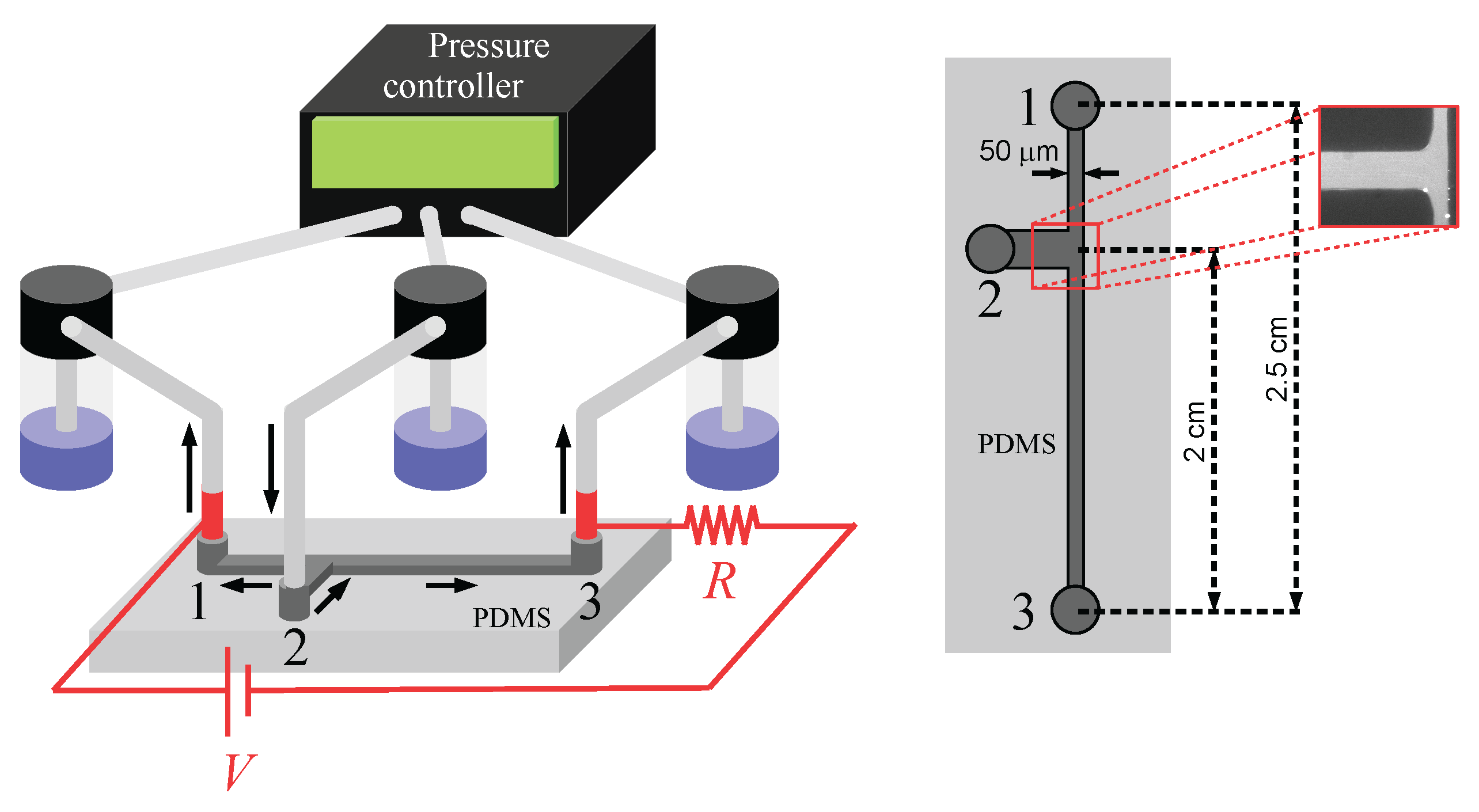
Figure 2.
Images of the channel intersection captured under various experimental conditions, including different flow rates and flow directions. The first column of images on the left corresponds to the state before activating the voltage supply. The column on the right shows the state after the voltage had been applied for five minutes.
Figure 2.
Images of the channel intersection captured under various experimental conditions, including different flow rates and flow directions. The first column of images on the left corresponds to the state before activating the voltage supply. The column on the right shows the state after the voltage had been applied for five minutes.
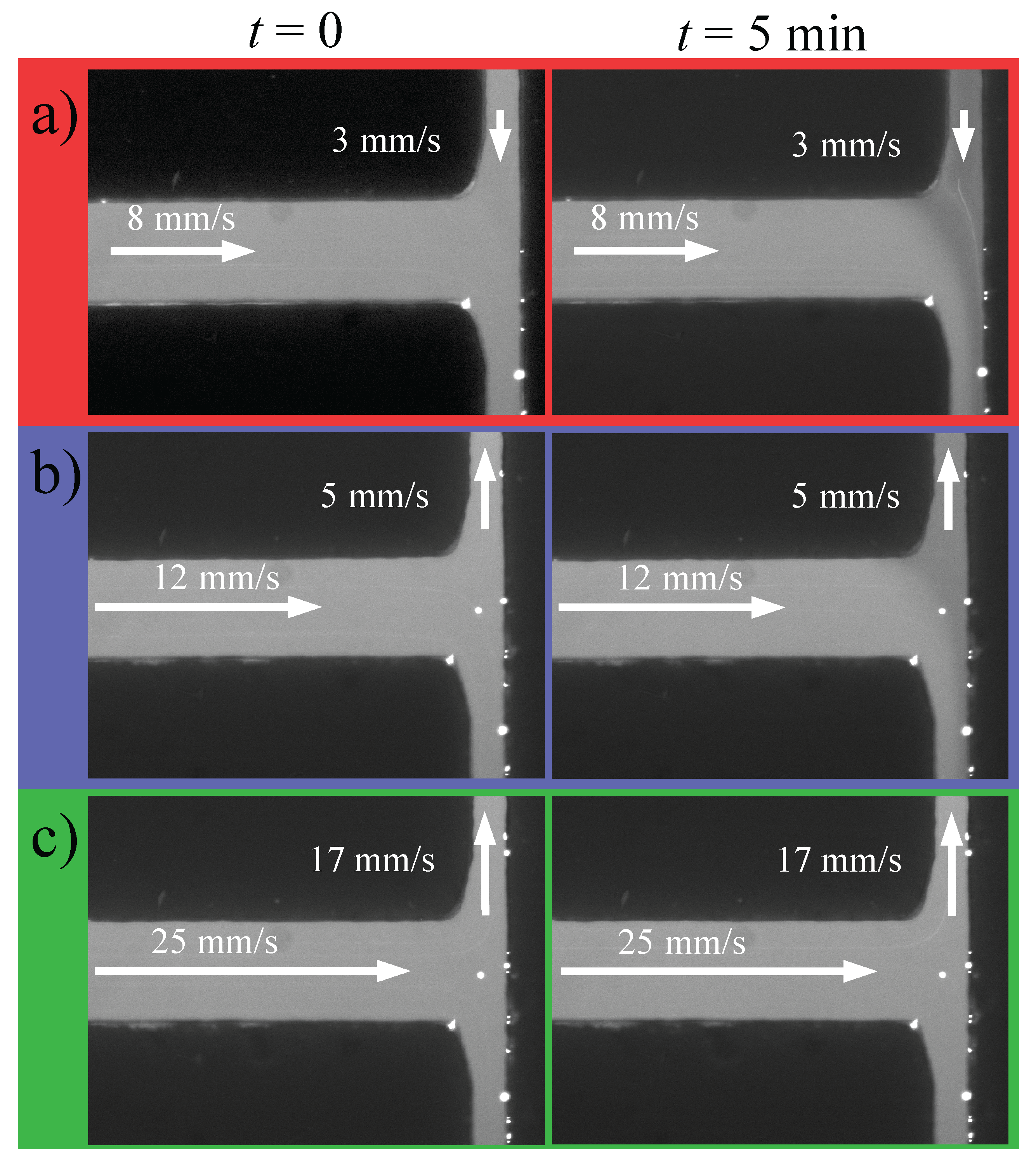
Figure 3.
Time evolution of for different advection velocities measured at the center of the channel connecting the intersection to inlet 1, with the flow opposing the direction of the electric field. a) Cases where decreases with time. b) Cases where remains steady.
Figure 3.
Time evolution of for different advection velocities measured at the center of the channel connecting the intersection to inlet 1, with the flow opposing the direction of the electric field. a) Cases where decreases with time. b) Cases where remains steady.
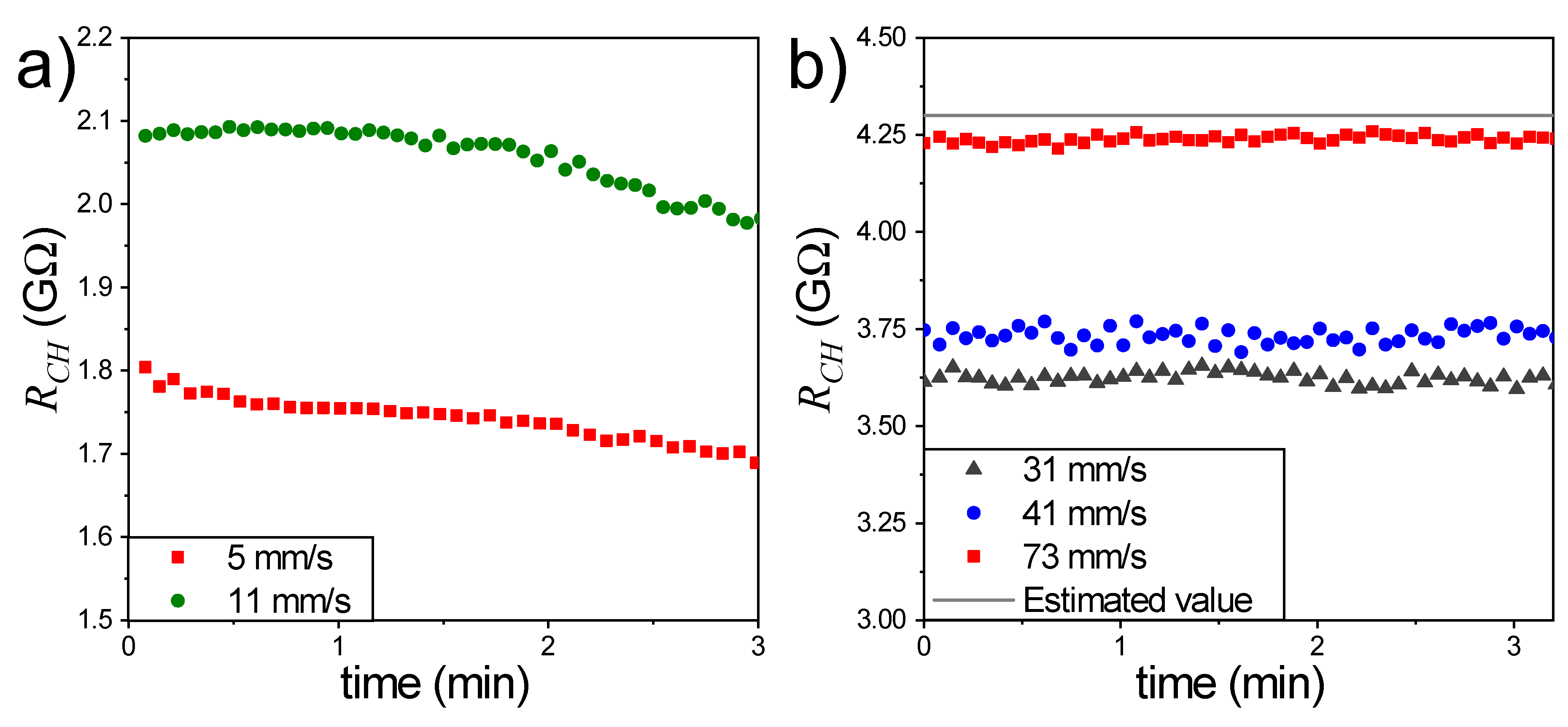
Figure 4.
Stack of video frames recorded during the experiments designed to measure wall separation under two different conditions: (A) with the flow direction promoting an increase in H+ concentration, and (B) with the presence of H+ ions minimized by using the previously described configuration. The flow velocity at the center of the channel was 57 mm/s in both cases.
Figure 4.
Stack of video frames recorded during the experiments designed to measure wall separation under two different conditions: (A) with the flow direction promoting an increase in H+ concentration, and (B) with the presence of H+ ions minimized by using the previously described configuration. The flow velocity at the center of the channel was 57 mm/s in both cases.
Disclaimer/Publisher’s Note: The statements, opinions and data contained in all publications are solely those of the individual author(s) and contributor(s) and not of MDPI and/or the editor(s). MDPI and/or the editor(s) disclaim responsibility for any injury to people or property resulting from any ideas, methods, instructions or products referred to in the content. |
© 2026 by the authors. Licensee MDPI, Basel, Switzerland. This article is an open access article distributed under the terms and conditions of the Creative Commons Attribution (CC BY) license (http://creativecommons.org/licenses/by/4.0/).
Copyright: This open access article is published under a Creative Commons CC BY 4.0 license, which permit the free download, distribution, and reuse, provided that the author and preprint are cited in any reuse.


