

Submitted:
12 January 2026
Posted:
15 January 2026
Read the latest preprint version here
Abstract
Chronotyping is a key methodology for assessment of individual differences in human adaptation to the 24-h periodicity of geophysical and social environment. Throughout the 50-yr period of scientific publications of chronotype questionnaires, they are steadily growing in number and diversity. Therefore, it is getting harder and harder to determine which of these questionnaires can be optimally applied to address a given question of sleep and biological rhythm research. Comparison of chronotype questionnaires can be facilitated using a structured system for their classification based on their properties. The PubMed bibliographic database and 9 previously published reviews were searched for publications of chronotype questionnaires and/or their implementation in chronobiological and sleep studies. In total, 75 questionnaires were identified, 60 and 15 of them were designed to only chronotype and chronotype and something else assessment, respectively. The structured system of questionnaire classification (“questionnaire identifier”) was proposed to help in navigating between numerous published questionnaires for choosing an optimal instrument for self-assessment of individual differences in a study of sleep and biological rhythms and for predicting properties of yet-unconstructed questionnaires. Particularly, a proposed set of 20 questionnaire and questionnaire scale properties allows the distinguishing of any of 60 questionnaires from 59 other such questionnaires.
Keywords:
morningness-eveningness
; chronotyping
; individual variation
; self-assessment
; classification
1. Introduction
The façade of the Social Science Research Building of the University of Chicago bears Lord Kelvin’s dictum: “If you cannot measure, your knowledge is meager and unsatisfactory” [1]. Indeed, measurement is considered a hallmark of the scientific enterprise. A valid and reliable measurement is critical for any field of science including the research of individual differences in the domains of chronobiology and sleep [2,3].
The first scientifically recognized dimension of individual variation in human adaptation to the 24-h periodicity of geophysical and social environment was the preference of an individual for either early or later phase of daily rhythmicity of sleep/wakefulness and rest/work. Fifty years ago, in 1976, Östberg, in co-authorship with Horne, published the first English-language questionnaire tool, the Morningness-Eveningness Questionnaire (MEQ) [4], that was soon translated into a dozen of languages and has become and still remains the most popular questionnaire applied for self-assessing individual variation in the field of sleep and biological rhythm research.
Somewhat later, essentially the same methodology has been applied to construct several other scales for self-assessment of morningness-eveningness. The list of scales encouraged by the MEQ publication [4] include the 7-item Diurnal Type Scale (DTS) [5], one of two scales of the 16-item Marburger questionnaire (MQ) [6], and the 13-item Composite Scale of Morningness (CSM) [7].
Soon after publication of the MEQ, in 1979, Folkard, Monk and Lobban [8] proposed the first questionnaire instrument for multi-dimensional (multi-scale) self-assessment of individual differences in the daily rhythms. They suggested that morningness-eveningness is not the only chronobiologic characteristic of individuals that can determine the success or failure of biological adaptation to night and shift work. Factor analysis of responses to the initially proposed list of 20 items of their Circadian-Type Questionnaire (CTQ) [8] yielded three factorial dimensions. One dimension was interpreted as already well-established questionnaire construct named “morningness-eveningness”, while two other dimensions were named “rigidity-flexibility” (of sleeping habits) and “languidness-vigorousness” (or “inability-ability to overcome drowsiness”) [8].
Later, the development of several other questionnaires was encouraged by the idea of applying such multi-dimensional approach to chronotyping [8]., e.g., the 16-item Chronotype Questionnaire (ChQ) [9] and the 40-item Sleep-Wake Pattern Assessment Questionnaire (SWPAQ-40) [10]
Recently, after 5 decades of intensive research the fields of chronobiology, chronomedicine, and chronopsychology, chronotype remains the central concept of studies of individual variation in these fields. Therefore, self-assessment of chronotype is a key methodology for studies of differences between people in their capacity to adapt to the 24-h cyclicity of environmental factors. However, scientific consensus has not been yet reached on the method of ranking and typing people along the dimensions of individual variation in the daily patterns of performance, sleepiness and sleep-wakefulness [2]. The concepts behind questionnaires for assessing chronotype are often essentially different. Besides, it seems that the process of development of questionnaires in the framework of different concepts was intensified in the recent years. The examples of such questionnaires that were published in the last decade are the 15-item Morningness–Eveningness-Stability Scale improved (MESSi) [11], the 168-item Sleep-Wake Adaptability Test (SWAT-168) [12], the Athlete Sleep Screening Questionnaire (ASSQ) [13], the 15-item Mood Rhythm Instrument (MRhI) [14], the 30-item Morningness-eveningness Exercise Preference Questionnaire (MEEPQ) [15], the 10-item Francis Owl-Lark Indices (FOLI) [16], the Single-Item Chronotyping (SIC) [17], the Sleep, Circadian Rhythms, and Mood (SCRAM) questionnaire [18], and a series of chrononutrition questionnaires, such as the Chrononutrition profile-questionnaire (CPQ-M) [19], the Food Timing Questionnaire and Food Timing Screener (FTQ and FTS, respectively) [20], the ChronoNutrition Questionnaire (CNQ) [21], and the Chrono-Nutrition Behavior Questionnaire (CNBQ) [22]. More questionnaires may follow.
It was emphasized [23] that he available chronotype questionnaires often have different aims, use different assessment methodologies, and are thus not interchangeable. Consequently, some researchers would be confused about the different concepts behind these questionnaires, and, therefore, it is essential to know what instrument to choose for a given research purpose [23].
To our knowledge, there has not been any effort, so far, to create a structured system for clarifying relationships and conceptual differences between numerous chronotype questionnaires and scales. Therefore, the following two questions arise: Is it possible to create a “questionnaire identifier” for 1) choosing an optimal instrument for assessing individual differences in a chronobiological and sleep study and 2) determining whether such an instrument is still missing and might be constructed to fill the gap between already constructed questionnaires?
Consequently, the purpose of this paper was to create such a structured system for facilitating comparisons of properties of chronotype questionnaires (“questionnaire identifier”). A list of chronotype questionnaires was created via a literature search, properties of these questionnaires and their scales were defined, criteria for categorization of each of these properties were proposed, and major results of such categorization of the identified questionnaires were presented, exemplified, and discussed.
2. Results
In four subsections of this section, results of identification of chronotype questionnaires were reported (2.1), a set of properties of questionnaires and their scales was defined (2.2), these properties of questionnaires (2.3) and their scales (2.4) were categorized and exemplified.
2.1. Identification of Chronotype Questionnaires
In total, 75 chronotype questionnaires were identified by a systematic search of publications in PubMed and an additional search in previously published papers including 9 reviews on chronotypes and methods of their self-assessment (Figure 1).
The upper part of Table S1 lists 42 questionnaires identified in 224 of 516 publications via the PubMed. Most of these questionnaires (##8-42) were rare used in these publications (i.e., in 4 of them or less) as compared to a few following questionnaires that were more frequently used (i.e., in, at least, 12 publications, #1-7), the MEQ [4]; the 32-item Munich Chronotype Questionnaire (MCTQ) [24], the 5-item reduced Morningness-Eveningness Questionnaire (rMEQ) [25], the CSM [7], the 10-item Morningness-Eveningness Scale for Children (MESC) [26], the MESSi [11], and the 27-tem Children’s Chronotype Questionnaire (CCTQ) [27]. These questionnaires are listed in the upper part of Table S1.
Moreover, 33 other questionnaires were additionally identified by searching in previously published papers including 9 reviews authored by Cavallera and Giudici, [28], Di Milia et al. [2], Levandovski et al. [29], Almoosawi et al. [30], Tonetti et al. [31], Putilov [3], Vidueira et al. [32], Coelho et al. [33], and Buest de Mesquita Silva et al. [34]. These questionnaires are listed in the lower part of Table S1.
Table S2 includes the primary reference and brief description of each of 75 identified questionnaires.
Table 1 and Table S3 contain the results of grouping questionnaires on the basis of their relationships. In Table 1, the total list of 75 questionnaires of Table S3 was shortened to the shorter list of 30 questionnaires (see the notes to Table 1). The relationships between questionnaires are described in the brief descriptions of questionnaires (Table S2). These relationships usually include reduction, extension and mixing of previously published scales, their adaptation to a specific population, results of edition or recontextualization of all or some of the primary questionnaire items, modification of response options, reversing scoring, etc. (Table S2). Related questionnaires were included in what was named subfamilies and families. As a rule, questionnaires of different subfamilies are additionally different in conceptualization of assessed construct(s) and/or different in not just one but in several questionnaire properties (Table 1 and Tables S2 and S3). Although some questionnaires can be viewed as isolates, it seems that the concepts behind any of 60 identified questionnaires for assessing chronotype can be traced back to the conceptualizations originally introduced in two pioneer questionnaires for self-assessment of either a morningness-eveningness construct or several sleep-wake adaptabilities, the MEQ [4] and the CTQ [8], respectively (Table 1 and Tables S2 and S3).
2.2. List of Properties for Classification of Chronotype Questionnaires
To create a structural system for classification of the published and future chronotype questionnaires, a set of 20 questionnaire and questionnaire scale properties was defined (Tables S4 and S5). The following 11 properties were included in the subset of the properties of questionnaires (1a-5b):
1a. For (questionnaire for assessing)
1b. In (questionnaire for assessing in study participants)
2a. Size (questionnaire size)
2b. Items (number of questionnaire items)
3a. Parameter (diurnal rhythm parameter)
3b. Scales (number of questionnaire scales)
4a. Variation (individual variation)
4b. Outcome (outcome of assessment)
4c. Clock h (includes clock h in questions and/or answers)
5a. Behavior (sleep-wake behavior)
5b. Interval (interval of the sleep-wake cycle)
The following 9 properties were included in the subset of the properties of questionnaire scales (6a-9b) in addition to the subset of the questionnaire properties (1a-5b):
6a. ME scale(s) (morningness-eveningness scale(s))
6b. Dimensions (number of dimensions per each of morningness-eveningness scales)
6c. Items (number of items in morningness-eveningness scale(s))
7a. Amplitude/stability (amplitude/stability scale(s))
7b. Items (number of items in amplitude/stability scale(s))
8a. Wakeability (wakeability scale(s))
8b. Items (number of items in wakeability scale(s))
9a. Sleepability (sleepability scale(s))
9b. Items (number of items in sleepability scale(s))
2.3. Categorization of 11 Properties of Chronotype Questionnaires
The following questionnaire properties were defined (1a-5b).
1a. For (questionnaire for assessing). The vast majority of identified questionnaires were designed to assess chronotype (n=60). These questionnaires were further categorized in accord with their other properties 1b-6i (Tables S2-S5). The remaining questionnaires (n=15) were designed to assess chronotype in addition to one or more other individual characteristics (Tables S3-S5). Therefore, due to such combination of several assessed characteristics of study participants, these 15 questionnaires they were not further categorized here. The SCRAM [18] and the chrononutrition questionnaires [19,20,21,22] can serve as examples of such questionnaires for assessing chronotype and something else.
1b. In (questionnaire for assessing in study participants). Most of questionnaires were developed to assess chronotype in adult study participants. Table 1, Table 2 and Table 3 list such questionnaires with exception of most of reduced versions of questionnaires. The whole list of 60 identified questionnaires for chronotype nothing else assessment is given in Tables S3-S5 (i.e., the questionnaires designed to assess specific populations and all reduced versions were included in these supplementary table). The most recent examples of questionnaires for assessment of unspecified adults are the MESSi [11], the MRhI [14], and the SIC [17]. The second largest group includes questionnaires for assessing children and/or adolescents (Tables S3-S5). The most recent examples of such questionnaires are the MESC [26] and the CCTQ [27]. The minority of remaining questionnaires target such populations as patients, sportsmen, shiftworkers, and adults speaking other than English languages (Table 1, Table 2, Table 3, Table 4 and Tables S3-S5). The examples of such questionnaires are the 7-item (reduced) Basic Language Morningness (rBALM) scale [50], the ASSQ [13], the 60-item Munich Chronotype Questionnaire for shift workers (MCTQShift) [51], and the 7-item (shortened Thai version of) Composite Scale of Morningness (sCSM) [52], respectively.
2a. Size (questionnaire size). Some of initially developed questionnaires were further developed but remained of similar size in terms of number of scales and items (full size ≈ primary size). Such primary and secondary questionnaires can be exemplified by the 13-item CSM [7] and the 13-item Basic Language Morningness (BALM) [53], MESSi [11] and the 15-item Morningness–Eveningness-Stability Scale improved for adolescents (aMESSi) [54], and the 16-item Chronotype Questionnaire (ChQ) [9] and the 16-item Caen Chronotype Questionnaire (CCQ) [43]. Some questionnaires were, instead, enlarged (Table 2, Table 3, Table 4 and Tables S2-S5). The examples are the 38-item Circadian Amplitude and Phase Scale (CAPS) [41] developed from the CTQ [8], and the 72-item Sleep-Wake Pattern Assessment Questionnaire (SWPAQ-72) [47] developed from its primary 40-item version [10,55]. Much more often, a questionnaire was reduced to solve the problems of its length, which would often prevent study participants from completing the questionnaire in full (Tables S3-S5). The most popular of remarkably reduced versions of the MEQ [4] is the rMEQ [25]. Another example is the 6-item Ultra-Short Version of the Munich ChronoType Questionnaire (µMCTQ) [56] developed from the MCTQ [24]. It is sufficient to obtain chronotype measure suggested by this questionnaire (the difference in clock times). Moreover, the reductions were aimed on solving two other problems of an earlier developed morningness-eveningness scales, their multi-dimensional structure and low item‒scale correlation coefficients of its several questions (Table S2). The examples of such reduced versions of the 19-item MEQ [4] are the 15-item (shortened) Morningness-Eveningness Questionnaire (MEQ-15) [57] and the 4-item versions of Morningness-Eveningness Questionnaire (MEQ-4) [58,59], respectively.
2b. Items (number of questionnaire items). However, the reduction of number of items might decrease reliability of a morningness-eveningness scale. As for the reliability of maximally reduced scale, a single-item or a three-item measure, it can be assessed with conventional internal consistency methods like Cronbach’s alpha. Therefore, they are evaluated using other approaches, such as test-retest reliability, where scores or clock times or types are correlated at two different time points. The examples of single-item scales that measure a construct with a single question are the SIC [17] and the 19th item of Morningness-Eveningness Questionnaire (MEQ19th) [4,60]. Moreover, a single clock time can be calculated from the responses to more than one question, e.g., using a few items from either the MCTQ [24] or the µMCTQ [56].
3a. Parameter (diurnal rhythm parameter). Starting from the first questionnaire for assessing morningness-eveningness, MEQ [4], the majority of published questionnaires were designed to self-assess only one, phase, parameter of circadian (diurnal, daily) rhythm. The list of such questionnaires includes the MEQ [4], the DTS [5], the CSM [7], MESC [26], the 12-item Early-Late Preferences Scale (PS) [36], and the 12-item Student Morningness-Eveningness Questionnaire (SMEQ) [61]. A smaller number of questionnaires contain one or more scales for assessing other than phase parameters (Table 1, Table 2, Table 3, Table 4 and Tables S3-S5). The list of such questionnaires includes the CTQ [8] and the CAPS [41], the SWPAQ [10,47,55] and the SWAT [12,48], the ChQ.[9] and the CCQ [43], and the MQ [6] and the 17-item Social Rhythm Metric (SRM) [45].
3b. Scales (number of questionnaire scales). Consequently, the vast majority of chronotype questionnaires contain only one scale (Tables S3-S5). The number of scales in other questionnaires (>1) varies from 2 (for instance, the MQ [6]) to 6 (for instance, the 72-item SWPAQ [47] and the SWAT [12]). Moreover, chronotype can be assessed using one item with several response options for choosing a score or a name of chronotype (e.g., the MEQ19th [4,60] or the SIC [17], respectively). It can be also assessed using one continuous variable calculated from responses to several questions. The examples are clock h in the MCTQ [24] and the two-item Perfect Day (PD) [38] and a difference between scored responses to two questions, e.g., two items of the three-item CIRcadian ENergy Scale (CIRENS) [44].
4a. Variation (individual variation). Study participants can be directly asked about their chronotype. This is assessment of type, e.g., by applying the SIC [17]. Question(s) can refer either to most typical/usual situation/circumcises, e.g., in the PS [36], or to actual (current) situation/circumcises (e.g., today or this week), e.g., in the 17-item Social Rhythm Metric (SRM) [45]. Consequently, these are assessments of either trait-like or state-like individual variation, respectively. Theoretically, a trait-like characteristic of an individual is stable, long-lasting, and internally caused, whereas a state-like characteristic can be temporal, short-lasting, and caused by external circumstances. In fact, the term “chronotype” can be used for trait- rather than state-assessments [3]. Finally, the study participants can be asked about their ability to do something during certain time of the day after certain period of wakefulness or sleep. The examples of such questionnaires are the SWAT [12], the SWPAQ [10,47,55], and the 11-item Circadian Type Inventory-revised (CTI-r) [40]. Consequently, this is assessment of ability-like individual variation (Table 1, Table 2, Table 3, Table 4 and Tables S3-S5). In the pioneer study published by Folkard et al. in 1978 [8], the term “adaptability” was invented for factors determining the success or failure of biological adaptation to night and shift work.
4b. Outcome (outcome of assessment). A study participant can be simply asked to choose his/her chronotype from several options, e.g., in the SIC [17]. In the vast majority of questionnaires, responses of a study participant to several items are used to calculate score determining his/her position on a scale, e.g., by using the MEQ [4]. Scores can be calculated on each of more than one scales, e.g., by using the CTQ [8]. Moreover, clock time can be calculated from responses to several items, e.g., by using responses to the MCTQ [24] and the 18-item Sleep Timing Questionnaire (STQ) [37] (Table 1, Table 2, Table 3, Table 4 and Tables S2-S5).
4c. Clock h (includes clock h in questions and/or answers). Clock h can be mentioned in a question and/or answer(s). The 13-item Scale for Assessment of Circadian Lateness (SACL) [39] can serve as an example of questionnaire asking only to choose one of several clock times each of which is assigned to a score. However, questions and answers can be intentionally worded to avoid any reference to clock times. For instance, the PS [36] asks to compare a study participant with most of other people, e.g., earlier or later than these other (Table 1, Table 2, Table 3, Table 4 and Tables S2-S5).
5a. Behavior (sleep-wake behavior). One or more items can refer to actual (current) behavior (including the answers about actual sleep timing, as in the MCTQ [24] asking about weekdays and free days). Moreover, one or more items can refer to preferred behavior or behavior under specified hypothetical circumstances (including items referring to preferred and hypothetical sleep timing, as in the PD [38] asking only about free days). As a rule, chronotype questionnaires ask either mostly or only about such a preference, as can be exemplified by either the MEQ [4] or the STQ [37], respectively (Table 1, Table 2, Table 3, Table 4 and Tables S2-S5).
5b. Interval (interval of the sleep-wake cycle). Questions can refer to the interval of transition from wakefulness to sleep and/or the interval of transition from sleep to wakefulness. The examples of such questionnaires are the PD [38] or the 5-item Morning Affect factor (MA) [35], respectively. Moreover, scales of a questionnaire can refer either to an interval of wakefulness between these transitions, e.g., the MRhI [14], or to this interval and, additionally, to the situation of further prolonged wakefulness on night and next day hours, e.g., the 19-time Point Visuo-verbal Judgment Task (VJT) [46]. Much rare items of the whole scale of a multi-scale questionnaire either refer to the interval of night sleep or ask about ability to nap during the wake phase of the sleep-wake cycle, e.g., either nighttime or daytime (anytime) sleepability scales of the SWAT [12] and the SWPAQ [10,47,55] (Table 1, Table 2, Table 3, Table 4 and Tables S2-S5).
2.4. Categorization of 9 Properties of Scales of Chronotype Questionnaires
The following properties of questionnaire scale(s) were defined (6a-9b).
6a. ME scale(s) (morningness-eveningness scale(s)). Starting from the MEQ [4], the majority of chronotype questionnaires include one scale for assessment of morningness-eveningness (Table 1, Table 2, Table 3, Table 4 and Tables S2-S5). When the conventional psychometric procedures were applied for construction or evaluation of such a scale, they yielded not one, but, at least two factors. Therefore, starting from the SWPAQ [10], morning and evening subconstructs of morningness-eveningness construct were recognized in several questionnaires, such as the MESSi [11], the SWAT [12], the MEEPQ [15], the FOLI [16], and the 38-item Lark-Owl (Chronotype) Indicator (LOCI) [49] (Table 1, Table 2, Table 3, Table 4 and Tables S2-S5). Moreover, it was demonstrated that an original ME scale can be intentionally reduced to develop a short scale for reliable assessment of just one – morning – subconstruct of morningness-eveningness construct, e.g., MA (Morning Affect) [35].
6b. Dimensions (number of dimensions per each of morningness-eveningness scales). When the conventional psychometric procedures were not applied for construction of earlier published ME scales (e.g., the MEQ [4], the DTS [5] and the CSM [7]), their multi-dimensional nature was revealed in later studies implementing factor-analytic approach (Table S2). Most usually, the remarkable reduction of a ME scale, e.g., to either 5 or 4 items, yielded one-factor solution. When a somewhat larger number of items was left in a reduced scale, it remained multi-dimensional, e.g., the 6-item (reduced) Morningness-Eveningness Questionnaire (MEQ-6) [62].
6c. Items (number of items in morningness-eveningness scale(s)). Although factor analysis of a 4- or a 5-item scale, such as the rMEQ [23], usually yielded a single factor, such a scale can contain several constructs that are found in different factors when responses to the primary (much larger) scale, such as MEQ [4], are factor-analyzed. Consequently, implementing such approach for reducing number of items can decrease reliability of the scale containing several constructs of the primary scale (Table S2). Nevertheless, a questionnaire, such as STQ [37], can require to report only three clock times for calculation of each of two (morning and evening) components of morningness-eveningness.
7a. Amplitude/stability (amplitude/stability scale(s)). The entrained circadian rhythm is characterized by phase and amplitude parameters, and it is well-established that the individual differences in the phase parameter are suitable for self-assessments with a morningness-eveningness scale. The development of one or two amplitude/stability scale(s) was encouraged by the idea that the psychological and behavioral manifestations of the differences in circadian amplitude parameter are also suitable for self-assessments (Table S2). The CTQ [8], the CTI-r [40], the CAPS [41], the ChQ [9], the CCQ [43], and the MESSi [11] contain such scale(s) designed to assess amplitude/stability of diurnal rhythmicity. One of two scales of the MQ [6] and the SRM [45] were also designed to assess stability of the diurnal timing, i.e., day-to-day stability of rise- and bed-times.
7b. Items (number of items in amplitude/stability scale(s)). One scale for assessment of amplitude/stability parameter was developed in the MESSi [11], the ChQ [38], the CCQ [43], the MQ [6], and the SRM [45]. In contrast, the CTQ [8] and its descendants, the CAPS [41], the CTI-r [40], and the 18-item Circadian Type Inventory (CTI) [64], were developed to assess subjective rhythm amplitude using two scales, e.g., languid-vigor and flexible-rigid scales, because it was hypothesized that low-amplitude (e.g., languid) and flexible rhythms would show better adjustment to night work. This hypothesis predicted that these scales are intercorrelated but the established scales were found to be independent of each other (Table S2).
8a. Wakeability (wakeability scale(s)). Since people differ in ability to keep waking in sleep-promoting conditions, ability-like individual variation can be also assessed (Table S2).
8b. Items (number of items in wakeability scale(s)). Wakeability can be assessed with, at least, two scales (e.g., in the SWAT [12,48], because it can be manifested in various circumstances (e.g., either in appropriate or in inappropriate for waking time of the day, in nap-provoking condition at daytime and in the condition of prolongation of wakefulness to night and next day hours; Table 1, Table 2, Table 3, Table 4 and Tables S2-S5). For instance, one scale was constructed in the primary versions of SWPAQ [10], but one more scale was developed for its enlarged version [47]. Moreover, both primary and reduced version of the SWAT [12,48] include two wakeability scales.
9a. Sleepability (sleepability scale(s)). The individual characteristics of the sleep-wake behavior described with two opposing terms, “wakeability” and “sleepability”, cannot be assigned to the opposing poles of a single factorial dimension. A study participant can report that it is easy to him/her not only to remain awake but also fall asleep, let’s say, at night, while another participant can have problems with both waking and rapidly falling asleep in the same time of the day. Therefore, factor analysis usually yields separate dimensions of wakeability and sleepability thus encouraging development of separate wakeability and sleepability scales (Table S2).
3. Discussion
Number and variety of chronotype questionnaires profoundly increased after the first publication of such questionnaire 50 years ago. Sometimes it is essential to determine which of these questionnaires would be used for answering to a given question of research in the field of chronobiology and sleep science. Here, a structured system was proposed to facilitate comparisons of properties of chronotype questionnaire and prediction of features of yet-unconstructed questionnaires. A set of chronotype questionnaire properties was defined and 60 questionnaires were classified to distinguish any of these questionnaires from 59 other questionnaires. The proposed structured system can help to navigate between numerous questionnaires without much effort, e.g., without inspection of each questionnaire content. Therefore, this system might serve as a “questionnaire identifier” to choose the right instrument for a study of individual differences in the domain of chronobiology and sleep science. This system can also help in uncovering empty territories of the questionnaire landscape by predicting unique properties of yet-unconstructed questionnaires and developing new versions of already published questionnaires.
For example, Marcoen et al. [46] published the 19-time point VJT that asks to score level of sleepiness expected at 19 different time points on the 1.5-day interval of permanent wakefulness. Since sleepiness is a correlate of wakeability rather than sleepability, the VJT cannot be applied to study sleepability at different clock times of this 1.5-day interval of permanent wakefulness. Therefore, another version of this questionnaire would be developed to ask about sleepability. For instance, a question about how easy study participants think they would fall asleep can be asked. The response options can distinguish between time interval required to voluntarily fall asleep at each of 19 time points of the VJT (e.g., less than one min, 1-5 min, 6-10 min, 11-30 min, and > 30 min). Originally, the VJT [46] was used to validate flexibility scores obtained with the CTI [62], and, in a more recent study, it was used to validate chronotypes self-chosen with the SIC [17]. The proposed new version might be implicated in validation of sleepability scales of such questionnaires as the SWPAQ [47] and SWAT [48].
Studies of age- and sex-associated difference in morningness-eveningness can illustrate importance of choosing optimal questionnaire tool for research of individual differences in the field of chronobiology and sleep science. It is well-established that sleep duration is gradually decreases with advancing age [65,66], while the circadian sleep timing shows n-shape age trend with most prominent delay of bedtime in late adolescence-early adulthood. In other words, the age-associated shifts occur toward later and then earlier sleep timing during the transition through adolescence and then through adulthood, respectively [24,67,68]. Irrespective of age, the difference in sleep timing between morning and evening types is approximately equal to two hours [69]. Since sleep timing dramatically varies with age, morning types identified in a sample of late adolescents usually report weekend wakeups at the same clock time as evening types in samples of people of younger and older ages, i.e., early adolescents and middle-age adults [69,70,71]. Moreover, when morning and evening types are forced to wake up on weekdays at the approximately same clock time to attend the same workplace or class, the difference between them in weekend sleep timing becomes much shorter than two hours due to a more pronounced shift of the 24-h pattern of weekday light exposure in evening than morning types [72]. Such issues of comparison of sleep timing in chronotypes of different age, even studied in identical environmental condition, were recognized by the authors of some of questionnaires, such as the PS [36] and the SWPAQ [10]. Therefore, these questionnaire tools, do not include any items and responses informing about clock times. Consequently, such questionnaires rather than questionnaires asking about actual or preferred clock times would be recommended for study of participants of various ages. Moreover, as discussed in [23], profoundly different results of comparison of chronotypes might be obtained in studies implicating questionnaires asking about either actual (current) or preferred clock times.
In the last paragraphs of this section, studies of sex-associated difference in morningness-eveningness are reviewed to illustrate importance of choosing an optimal chronotype questionnaire. On the one hand, the literature suggests that sex-associated difference in score on a morningness-eveningness scale is modest with slightly larger evening preference in male than female study participants (e.g., [73,74,75,76]). Particularly, the publications applying three morningness-eveningness scales, the MEQ [4], rMEQ [25] and CSM [7], were reviewed by Randler and Engelke [77]. The results suggested that, on average, the choosing of one of these three questionnaires did not influence the difference in chronotype between genders. On the other hand, the exceptions (a larger evening preference in females rather than males) and non-significant results were reported in many publications. For instance, Zimmermann [78] did not find significant sex-associated difference in chronotypes of college students. The following published studies can exemplify conflicting results on sex-associated differences obtained with these morningness-eveningness scales. In Natale et al. [79] study, a significantly higher proportion of morning types among females compared with males was found only in the group born during April to September, but not in the group born during October to March. Díaz-Morales and Parra-Robledo [80] found that sex-associated difference changes with age: unlike men of younger age, men over 40 years old were more morning-oriented than women. Buekenhout and co-workers also showed that, after the age of 48, males exhibited greater morningness than females [81]. Moreover, Duarte et al. found that, on average, women were more morning-oriented than men until the age of 30 and there were no significant differences between men and women from 30 to 45 years of age [82]. Merikanto and co-workers [83] reported that eveningness was more common among women than men, and Gaina et al. [84] found that female students showed a greater evening preference than male students in the study of Japanese first to third year junior high school students (age 12 to 15 yrs). Carskadon et al. [26] found age-associated changes of sex-associated difference during even shorter interval of ages. With the onset of puberty, girls report a higher evening orientation than boys on the MESC [26], and the tendency for eveningness progressively dissipates after the end of adolescence.
These results can be explained in light of studies applying questionnaires allowing separate assessment of sleep-wake habits in the morning and evening hours. Females, irrespective of their age, showed a greater morning lateness and a lesser evening lateness than males on two separate – morning and evening – scales of the SWPAQ [85]. In a study applying two – morning and evening - scales of the LOCI [49], Preckel et al. [86] found relatively more females than males of types combining morning lateness with evening earliness and relatively more males than females of types combining morning earliness with evening lateness. Indeed, analysis of 340 paired male and female subsamples collected from the literature yielded, on average, the 0.16-h earlier bedtime and the 0.10-h later risetime in female than male subsamples [87]. However, somewhat different result was obtained in several studies applying the MESSi scales [11]. It was found that females scored lower than males on the scale assessing evening preference, while the male-female gap was not significant for the scale assessing morning affect [88,89].
Overall, results of testing sex-associated difference in morningness-eveningness can vary depending on applied morningness-eveningness scales, in particular, due to difference in ratio between items asking about behavior and habits in the morning and evening hours. The example of studies supporting this conclusion was provided by results of direct comparison of sex-associated difference in morningness-eveningness assessed with the rMEQ [25] and the PS [36] by Tonetti et al. [90] who replicated gender difference (higher morningness in women) only for the rMEQ. Consequently, to show significant sex-associated difference and to show non-significant sex-associated difference, separate assessment of morning and evening components of morningness-eveningness can be recommended. When these components are separately assessed, it is likely to support significance of the male-female gap. When scores on separate morning and evening scales are summed, it is likely to support non-significance of this gap. Consequently, it is likely to answer “No” to the question asked in numerous chronotype studies: is any sex-associated difference in morningnees-eveningness?
4. Materials and Methods
The main aim of the systematic search was to identify publications reporting results of development and/or implication of chronotype questionnaires in human sleep and biological rhythm research. PRISMA (Preferred Reporting Items for Systematic Reviews and Meta-Analyses) guidelines for systematic search were followed [91]. The PubMed bibliographic database was searched for publications from inception to 1/10/2025. Previously published reviews on chronotype questionnaires and results of their implication in sleep and biological rhythm research [2,3,28,29,30,31,32,33,34] were also hand-searched for identification of additional questionnaires (Figure 1).
In total, 42 questionnaires were identified by-searching in 224 of 516 publications found by screening their titles and abstracts via the PubMed search using the following search terms: (((Chronotype [Title/Abstract] OR Diurnal [Title/Abstract] OR Morningness-Eveningness [Title/Abstract] OR Morning preference [Title/Abstract] OR Evening preference [Title/Abstract]) AND (Scale [Title/Abstract] OR Questionnaire [Title/Abstract] OR Inventory [Title/Abstract])) AND (Validation [Title/Abstract] OR Validity [Title/Abstract] OR Psychometric [Title/Abstract] OR Reliability [Title/Abstract] OR Construction [Title/Abstract] OR Development [Title/Abstract]).
5. Conclusions
Throughout the 50-yr history of scientific publications of chronotype questionnaires, their number and variety continuously grow. In order to help to navigate among these questionnaires, a structured system of their classification based on a set of questionnaire and questionnaire scale properties was proposed. This “questionnaire identifier” might be recommended for 1) choosing an optimal instrument for self-assessment of individual differences in the domain of chronobiology and sleep science and 2) predicting properties of yet-unconstructed questionnaires.
Supplementary Materials
The following supporting information can be downloaded at the website of this paper posted on Preprints.org.
Author Contributions
A.A.P. is the only author of this paper.
Funding
This research received no external funding.
Institutional Review Board Statement
Not applicable (the study did not require ethical approval).
Informed Consent Statement
Not applicable.
Data Availability Statement
This study did not generate any new datasets. Data supporting reported results can be found in Tables S1-S4 of Supplementary Materials.
Acknowledgments
GenAI has not been used for purposes such as generating text, data, or graphics, or for study design, data collection, analysis, or interpretation of data, etc.
Conflicts of Interest
The author declares no conflicts of interest.
Abbreviations
The following abbreviations are used in this manuscript:
| ME | Morningness-eveningness construct |
| M,E | Morningness subconstruct, Eveningness subconstruct of morningness-eveningness construct |
| M | Morningness subconstruct of morningness-eveningness construct |
| See also Table 1 for questionnaire abbreviations |
References
- Sir William Thomson (Lord Kelvin). Popular Lectures and Addresses, Vol. 1, page 73.
- Di Milia L, Adan A, Natale V, Randler C. Reviewing the psychometric properties of contemporary circadian typology measures. Chronobiol Int. 2013;30(10):1261-71. [CrossRef]
- Putilov AA. Owls, larks, swifts, woodcocks and they are not alone: A historical review of methodology for multidimensional self-assessment of individual differences in sleep-wake pattern. Chronobiol Int. 2017;34(3):426-437. [CrossRef]
- Horne JA, Östberg O. A self-assessment questionnaire to determine morningness-eveningness in human circadian rhythms. Int J Chronobiol. 1976;4(2):97-110. PMID: 1027738.
- Torsvall L, Åkerstedt T. A diurnal type scale. Construction, consistency and validation in shift work. Scand J Work Environ Health. 1980;6(4):283-90. PMID: 7195066. [CrossRef]
- Moog, R. (1981). Morning-evening types and shift work: a questionnaire study. In Reinberg, A., Vieux, N. & Andlauer, P. (Eds), Night and shift work: biological and social aspects. Oxford: Pergamon Press.
- Smith CS, Reilly C, Midkiff K. Evaluation of three circadian rhythm questionnaires with suggestions for an improved measure of morningness. J Appl Psychol. 1989;74(5):728-38. [CrossRef]
- Folkard S, Monk TH, Lobban MC. Towards a predictive test of adjustment to shift work. Ergonomics. 1979;22(1):79-91. [CrossRef]
- Ogińska H. 2011. Can you feel the rhythm? A short questionnaire to describe two dimensions of chronotype. Pers Individ Dif. 50(7):1039–43. [CrossRef]
- Putilov, A.A. A questionnaire for self-assessment of individual traits of sleep-wake cycle. Bulletin of the Siberian Branch of the USSR Academy of Medical Sciences, 1990, 1: 22-25 [in Russian].
- Randler C, Díaz-Morales JF, Rahafar A, Vollmer C. Morningness-eveningness and amplitude - development and validation of an improved composite scale to measure circadian preference and stability (MESSi). Chronobiol Int. 2016;33(7):832-48. [CrossRef]
- Putilov AA. Three-dimensional structural representation of the sleep-wake adaptability. Chronobiol Int. 2016;33(2):169-80. [CrossRef]
- Samuels C, James L, Lawson D, Meeuwisse W. The Athlete Sleep Screening Questionnaire: a new tool for assessing and managing sleep in elite athletes. Br J Sports Med. 2016;50(7):418-22. [CrossRef]
- de Souza CM, Carissimi A, Costa D, Francisco AP, Medeiros MS, Ilgenfritz CA, de Oliveira MA, Frey BN, Hidalgo MP. The Mood Rhythm Instrument: development and preliminary report. Braz J Psychiatry. 2016;38(2):148-53. [CrossRef]
- Miyazaki R, Ando H, Hamasaki T, Higuchi Y, Oshita K, Tashiro T, Sakane N. Development and initial validation of the Morningness-Eveningness Exercise Preference Questionnaire (MEEPQ) in Japanese university students. PLoS One. 2018;13(7):e0200870. [CrossRef]
- Francis, L. J., Village, A., & Payne, V. J. Introducing the Francis Owl-Lark Indices (FOLI): Assessing the implications of diurnal activity patterns for clergy work-related psychological health. Mental Health, Religion & Culture, 2021, 24(8), 780–795. [CrossRef]
- Putilov AA, Sveshnikov DS, Puchkova AN, Dorokhov VB, Bakaeva ZB, Yakunina EB, Starshinov YP, Torshin VI, Alipov NN, Sergeeva OV, Trutneva EA, Lapkin MM, Lopatskaya ZN, Budkevich RO, Budkevich EV, Dyakovich MP, Donskaya OG, Plusnin JM, Delwiche B, Colomb C, Neu D, & Mairesse O. Single-Item Chronotyping (SIC), a method to self-assess diurnal types by using 6 simple charts. Pers Ind Differ. 2021, 168:Article 110353. [CrossRef]
- Byrne JEM, Bullock B, Murray G. Development of a Measure of Sleep, Circadian Rhythms, and Mood: The SCRAM Questionnaire. Front Psychol. 2017;8:2105. [CrossRef]
- Veronda AC, Allison KC, Crosby RD, Irish LA. Development, validation and reliability of the Chrononutrition Profile - Questionnaire. Chronobiol Int. 2020;37(3):375-394. [CrossRef]
- Chakradeo P, Rasmussen HE, Swanson GR, Swanson B, Fogg LF, Bishehsari F, Burgess HJ, Keshavarzian A. Psychometric Testing of a Food Timing Questionnaire and Food Timing Screener. Curr Dev Nutr. 2021;6(2):nzab148. [CrossRef]
- Phoi YY, Bonham MP, Rogers M, Dorrian J, Coates AM. Content Validation of a Chrononutrition Questionnaire for the General and Shift Work Populations: A Delphi Study. Nutrients. 2021;13(11):4087. [CrossRef]
- Murakami K, Shinozaki N, McCaffrey TA, Livingstone MBE, Masayasu S, Sasaki S. Relative validity of the Chrono-Nutrition Behavior Questionnaire (CNBQ) against 11-day event-based ecological momentary assessment diaries of eating. Int J Behav Nutr Phys Act. 2025;22(1):46. [CrossRef]
- Roenneberg T. Having Trouble Typing? What on Earth Is Chronotype? J Biol Rhythms. 2015;30(6):487-91. [CrossRef]
- Roenneberg T, Wirz-Justice A, Merrow M. Life between clocks: daily temporal patterns of human chronotypes. J Biol Rhythms. 2003;18(1):80-90. [CrossRef]
- Adan, A., & Almirall, H. Horne and Őstberg Morningness-Eveningness Questionnaire: A reduced scale. Personality and Individual Differences, 1991, 12(3), 241–253. [CrossRef]
- Carskadon MA, Vieira C, Acebo C. Association between puberty and delayed phase preference. Sleep. 1993;16(3):258-62. [CrossRef]
- Werner H, Lebourgeois MK, Geiger A, Jenni OG. Assessment of chronotype in four- to eleven-year-old children: reliability and validity of the Children’s Chronotype Questionnaire (CCTQ). Chronobiol Int. 2009;26(5):992-1014. [CrossRef]
- Cavallera GM, Giudici S. Morningness and eveningness personality: a survey in literature from 1995 up till 2006. Pers Individ Dif 2008;44:3–21. [CrossRef]
- Levandovski R, Sasso E, Hidalgo MP. Chronotype: a review of the advances, limits and applicability of the main instruments used in the literature to assess human phenotype. Trends Psychiatry Psychother. 2013;35(1):3-11. [CrossRef]
- Tonetti L, Adan A, Di Milia L, Randler C, Natale V. Measures of circadian preference in childhood and adolescence: A review. Eur Psychiatry. 2015;30(5):576-82. [CrossRef]
- Almoosawi S, Vingeliene S, Gachon F, Voortman T, Palla L, Johnston JD, Van Dam RM, Darimont C, Karagounis LG. Chronotype: Implications for Epidemiologic Studies on Chrono-Nutrition and Cardiometabolic Health. Adv Nutr. 2019;10(1):30-42. [CrossRef]
- Coelho J, Martin VP, Gauld C, d’Incau E, Geoffroy PA, Bourgin P, Philip P, Taillard J, Micoulaud-Franchi JA. Clinical physiology of circadian rhythms: A systematic and hierarchized content analysis of circadian questionnaires. Int J Clin Health Psychol. 2025;25(2):100563. [CrossRef]
- Vidueira VF, Booth JN, Saunders DH, Sproule J, Turner AP. Circadian preference and physical and cognitive performance in adolescence: A scoping review. Chronobiol Int. 2023;40(9):1296-1331. [CrossRef]
- Buest de Mesquita Silva, R., Schmidt, H., dos Santos, G., Leocadio-Miguel, M., & Mazzilli Louzada, F. Chronotype Profile in Children: A Systematic Review. Sleep and Vigilance OnlineFirst (2025): 1-28. [CrossRef]
- Caci H, Adan A, Bohle P, Natale V, Pornpitakpan C, Tilley A. Transcultural properties of the composite scale of morningness: the relevance of the “morning affect” factor. Chronobiol Int. 2005;22(3):523-40. [CrossRef]
- Smith CS, Folkard S, Schmieder RA, Parra LF, Spelten E, Almiral H, Tisak J, Sahu S, Perez LM, Tisak J. Investigation of morning–evening orientation in six countries using the preferences scale. Pers Individ Dif. 2002, 32:949–968. [CrossRef]
- Monk TH, Buysse DJ, Kennedy KS, Pods JM, DeGrazia JM, Miewald JM. Measuring sleep habits without using a diary: the sleep timing questionnaire. Sleep. 2003;26(2):208-12. [CrossRef]
- Groß JV, Fritschi L, Erren TC. Hypothesis: A perfect day conveys internal time. Med Hypotheses. 2017;101:85-89. [CrossRef]
- Putilov, A.A., Putilov, D.A. Sleepless in Siberia and Alaska: Cross-validation of factor structure of the individual adaptability of the sleep-wake cycle. Ergonomia, 2005, 27(2): 207-226.
- Di Milia L, Smith PA, Folkard S. A validation of the revised circadian type inventory in a working sample. Pers Indiv Differ. 2005, 39:1293–1305. [CrossRef]
- Di Milia L, Folkard S, Hill J, Walker C Jr. A psychometric assessment of the Circadian Amplitude and Phase Scale. Chronobiol Int. 2011;28(1):81-7. [CrossRef]
- Oginska H, Mojsa-Kaja J, Mairesse O. Chronotype description: In search of a solid subjective amplitude scale. Chronobiol Int. 2017;34(10):1388-1400. [CrossRef]
- Dosseville F, Laborde S, Lericollais R. Validation of a chronotype questionnaire including an amplitude dimension. Chronobiol Int. 2013;30(5):639-48. [CrossRef]
- Ottoni GL, Antoniolli E, Lara DR. The Circadian Energy Scale (CIRENS): two simple questions for a reliable chronotype measurement based on energy. Chronobiol Int. 2011;28(3):229-37. [CrossRef]
- Monk TH, Flaherty JF, Frank E, Hoskinson K, Kupfer DJ. The Social Rhythm Metric. An instrument to quantify the daily rhythms of life. J Nerv Ment Dis. 1990;178(2):120-6. [CrossRef]
- Marcoen N, Vandekerckhove M, Neu D, Pattyn N, Mairesse O. Individual differences in subjective circadian flexibility. Chronobiol Int. 2015;32(9):1246-53. [CrossRef]
- Putilov, A.A. Introduction of the tetra-circumplex criterion for comparison of the actual and theoretical structures of the sleep-wake adaptability. Biol Rhythm Res 2007, 38: 65-84. [CrossRef]
- Putilov AA, Budkevich EV, Tinkova EL, Dyakovich MP, Sveshnikov DS, Donskaya OG, Budkevich RO. A six-factor structure of individual variation in the tendencies to become sleepy and to sleep at different times of the day. Acta Psychol (Amst). 2021;217:103327. [CrossRef]
- Roberts, R. D. The Lark-Owl (Chronotype) Indicator (LOCI). Sydney: Entelligent Testing Products, 1998; www.radssolution.com/wp-content/uploads/2018/09/1-Tech-Bulletin-Lark-Owl-Chronotype-Indicator.pdf.
- Rhee MK, Lee HJ, Rex KM, Kripke DF. Evaluation of two circadian rhythm questionnaires for screening for the delayed sleep phase disorder. Psychiatry Investig. 2012;9(3):236-44. [CrossRef]
- Juda M, Vetter C, Roenneberg T. The Munich ChronoType Questionnaire for Shift-Workers (MCTQShift). J Biol Rhythms. 2013;28(2):130-40. PMID: 23606612. [CrossRef]
- Pornpitakpan C. Psychometric properties of the composite scale of morningness: a shortened version. Pers Ind Diff. 1998, 25:699–709. [CrossRef]
- Brown FM. Psychometric equivalence of an improved Basic Language Morningness (BALM) scale using industrial population within comparisons. Ergonomics. 1993;36(1-3):191-7. [CrossRef]
- Weidenauer, C., Täuber, L., Huber, S., Rimkus, K., & Randler, C. Measuring circadian preference in adolescence with the Morningness-Eveningness Stability Scale improved (MESSi). Biological Rhythm Research, 2019, 52(3), 367–379. [CrossRef]
- Putilov, A.A. Association of the circadian phase with two morningness-eveningness scales of an enlarged version of the sleep-wake pattern assessment questionnaire. Arbeitswissbetriebl Praxis 2000, 17: 317-322.
- Ghotbi N, Pilz LK, Winnebeck EC, Vetter C, Zerbini G, Lenssen D, Frighetto G, Salamanca M, Costa R, Montagnese S, Roenneberg T. The µMCTQ: An Ultra-Short Version of the Munich ChronoType Questionnaire. J Biol Rhythms. 2020;35(1):98-110. [CrossRef]
- Manjón-Caballero JL, Díaz-Morales JF. Morningness-Eveningness Questionnaire: Reliability and factorial structure of the full and reduced versions in Spanish adolescents. Chronobiol Int. 2025;42(6):808-816. [CrossRef]
- Urbán R, Magyaródi T, Rigó A. Morningness-eveningness, chronotypes and health-impairing behaviors in adolescents. Chronobiol Int. 2011;28(3):238-47. [CrossRef]
- Jankowski KS. Polish version of the reduced morningness–eveningness questionnaire. Biol Rhythm Res, 2013, 44:427–433. doi:10.1080/09291016.2012.704791.
- Turco M, Corrias M, Chiaromanni F, Bano M, Salamanca M, Caccin L, Merkel C, Amodio P, Romualdi C, De Pittà C, Costa R, Montagnese S. The self-morningness/eveningness (Self-ME): An extremely concise and totally subjective assessment of diurnal preference. Chronobiol Int. 2015;32(9):1192-200. [CrossRef]
- Košćec, A., Radošević-Vidaček, B. & Kostović, M. Morningness–eveningness across two student generations: would two decades make a difference? Pers. Individ. Dif. 2001, 31(4), 627–638. [CrossRef]
- Hätönen T, Forsblom S, Kieseppä T, Lönnqvist J, Partonen T. Circadian phenotype in patients with the co-morbid alcohol use and bipolar disorders. Alcohol Alcohol. 2008:564-8. [CrossRef]
- Kim S, Lee HJ. Validation of the 6-item Evening Chronotype Scale (ECS): a modified version of Composite Scale Morningness. Chronobiol Int. 2021;38(11):1640-1649. [CrossRef]
- Barton J, Spelten E, Totterdell P, Smith L, Folkard S, Costa G. The standard shiftwork index—a battery of questionnaires for assessing shiftwork-related problems. Work Stress. 1995;9:4–30. [CrossRef]
- Ohayon MM, Carskadon MA, Guilleminault C, Vitiello MV. Meta-analysis of quantitative sleep parameters from childhood to old age in healthy individuals: developing normative sleep values across the human lifespan. Sleep. 2004;27(7):1255-73. [CrossRef]
- Evans MA, Buysse DJ, Marsland AL, Wright AGC, Foust J, Carroll LW, Kohli N, Mehra R, Jasper A, Srinivasan S, Hall MH. Meta-analysis of age and actigraphy-assessed sleep characteristics across the lifespan. Sleep. 2021;44(9):zsab088. [CrossRef]
- Skeldon AC, Derks G, Dijk DJ. Modelling changes in sleep timing and duration across the lifespan: Changes in circadian rhythmicity or sleep homeostasis? Sleep Med Rev. 2016;28:96-107. [CrossRef]
- Putilov AA, Verevkin EG. Weekday and weekend sleep times across the human lifespan: a model-based simulation. Sleep Breath. 2024;28(5):2223-2236. [CrossRef]
- Putilov AA, Verevkin EG. Simulation of the Ontogeny of Social Jet Lag: A Shift in Just One of the Parameters of a Model of Sleep-Wake Regulating Process Accounts for the Delay of Sleep Phase Across Adolescence. Front Physiol. 2018;9:1529. [CrossRef]
- Putilov, A. A., Verevkin, E. G., Donskaya, O. G., Tkachenko, O. N., & Dorokhov, V. B. Model-based simulations of weekday and weekend sleep times self-reported by larks and owls. Biol Rhythm Res, 2020;51(5), 709–726. [CrossRef]
- Putilov AA, Donskaya OG. What Can Make the Difference Between Chronotypes in Sleep Duration? Testing the Similarity of Their Homeostatic Processes. Front Neurosci. 2022;16:832807. [CrossRef]
- Putilov, A.A.; Verevkin, E.G.; Sveshnikov, D.S.; Bakaeva, Z.V.; Yakunina, E.B.; Mankaeva, O.V.; Torshin, V.I.; Trutneva, E.A.; Lapkin, M.M.; Lopatskaya, Z.N.; et al. Estimation of the Circadian Phase Difference in Weekend Sleep and Further Evidence for Our Failure to Sleep More on Weekends to Catch Up on Lost Sleep. Clocks & Sleep 2025, 7, 67. [CrossRef]
- Ishihara K, Miyake S, Miyasita A, Miyata Y. Comparisons of sleep-wake habits of morning and evening types in Japanese worker sample. J Hum Ergol (Tokyo). 1988;17(2):111-8.
- Steele MT, McNamara RM, Smith-Coggins R, Watson WA. Morningness-eveningness preferences of emergency medicine residents are skewed toward eveningness. Acad Emerg Med. 1997;4(7):699-705. [CrossRef]
- Harada T, Inoue M. Do majoring subjects affect the morningness-eveningness preference by students? J Hum Ergol (Tokyo). 1999;28(1-2):49-53.
- Adan A, Natale V. Gender differences in morningness-eveningness preference. Chronobiol Int. 2002;19(4):709-20. [CrossRef]
- Randler C, Engelke J. Gender differences in chronotype diminish with age: a meta-analysis based on morningness/chronotype questionnaires. Chronobiol Int. 2019;36(7):888-905. [CrossRef]
- Zimmermann LK. Chronotype and the transition to college life. Chronobiol Int. 2011;28(10):904-10. [CrossRef]
- Natale V, Adan A, Fabbri M. Season of birth, gender, and social-cultural effects on sleep timing preferences in humans. Sleep. 2009;32(3):423-6. [CrossRef]
- Díaz-Morales JF, Parra-Robledo Z. Age and Sex Differences in Morningness/Eveningness Along the Life Span: A Cross-Sectional Study in Spain. J Genet Psychol. 2018;179(2):71-84. [CrossRef]
- Buekenhout I, Clara MI, Gomes AA, Leitão J. Examining sex differences in morningness-eveningness and inter-individual variability across years of age: A cross-sectional study. Chronobiol Int. 2025;42(1):29-45. [CrossRef]
- Duarte LL, Menna-Barreto L, Miguel MA, Louzada F, Araújo J, Alam M, Areas R, Pedrazzoli M. Chronotype ontogeny related to gender. Braz J Med Biol Res. 2014;47(4):316-20. [CrossRef]
- Merikanto I, Kronholm E, Peltonen M, Laatikainen T, Lahti T, Partonen T. Relation of chronotype to sleep complaints in the general Finnish population. Chronobiol Int. 2012;29(3):311-7. [CrossRef]
- Gaina A, Sekine M, Kanayama H, Takashi Y, Hu L, Sengoku K, Kagamimori S. Morning-evening preference: sleep pattern spectrum and lifestyle habits among Japanese junior high school pupils. Chronobiol Int. 2006;23(3):607-21. [CrossRef]
- Putilov AA, Verevkin EG, Ivanova E, Donskaya OG, Putilov DA. Gender differences in morning and evening lateness. Biol Rhythm Res 2008; 39(4), 335-348. doi:10.1080/09291010701424895.
- Preckel, F., Fischbach, A., Scherrer, V., Brunner, M., Ugen, S., Lipnevich, A. A., & Roberts, R. D. (2020). Circadian preference as a typology: Latent-class analysis of adolescents’ morningness/eveningness, relation with sleep behavior, and with academic outcomes. Learn. Individ. Differ., 78, 101725. [CrossRef]
- Putilov AA, Verevkin EG. The yin and yang of sleep-wake regulation: gender gap in need for sleep persists across the human lifespan. Sleep Breath. 2025;29(2):145. [CrossRef]
- Vagos P, Rodrigues PFS, Pandeirada JNS, Kasaeian A, Weidenauer C, Silva CF, Randler C. Factorial Structure of the Morningness-Eveningness-Stability-Scale (MESSi) and Sex and Age Invariance. Front Psychol. 2019;10:3. [CrossRef]
- Díaz-Morales JF, Randler C, Arrona-Palacios A, Adan A. Validation of the MESSi among adult workers and young students: General health and personality correlates. Chronobiol Int. 2017;34(9):1288-1299. [CrossRef]
- Tonetti L, Adan A, Natale V. A more accurate assessment of circadian typology is achieved by asking persons to indicate their preferred times rather than comparing themselves with most people. Chronobiol Int. 2024;41(1):53-60. [CrossRef]
- Page MJ, McKenzie JE, Bossuyt PM, Boutron I, Hoffmann TC, Mulrow CD, et al. The PRISMA 2020 statement: an updated guideline for reporting systematic reviews. BMJ 2021;372:n71. [CrossRef]
Figure 1.
PRISMA flow diagram illustrating the steps of identification of chronotype questionnaires.
Figure 1.
PRISMA flow diagram illustrating the steps of identification of chronotype questionnaires.
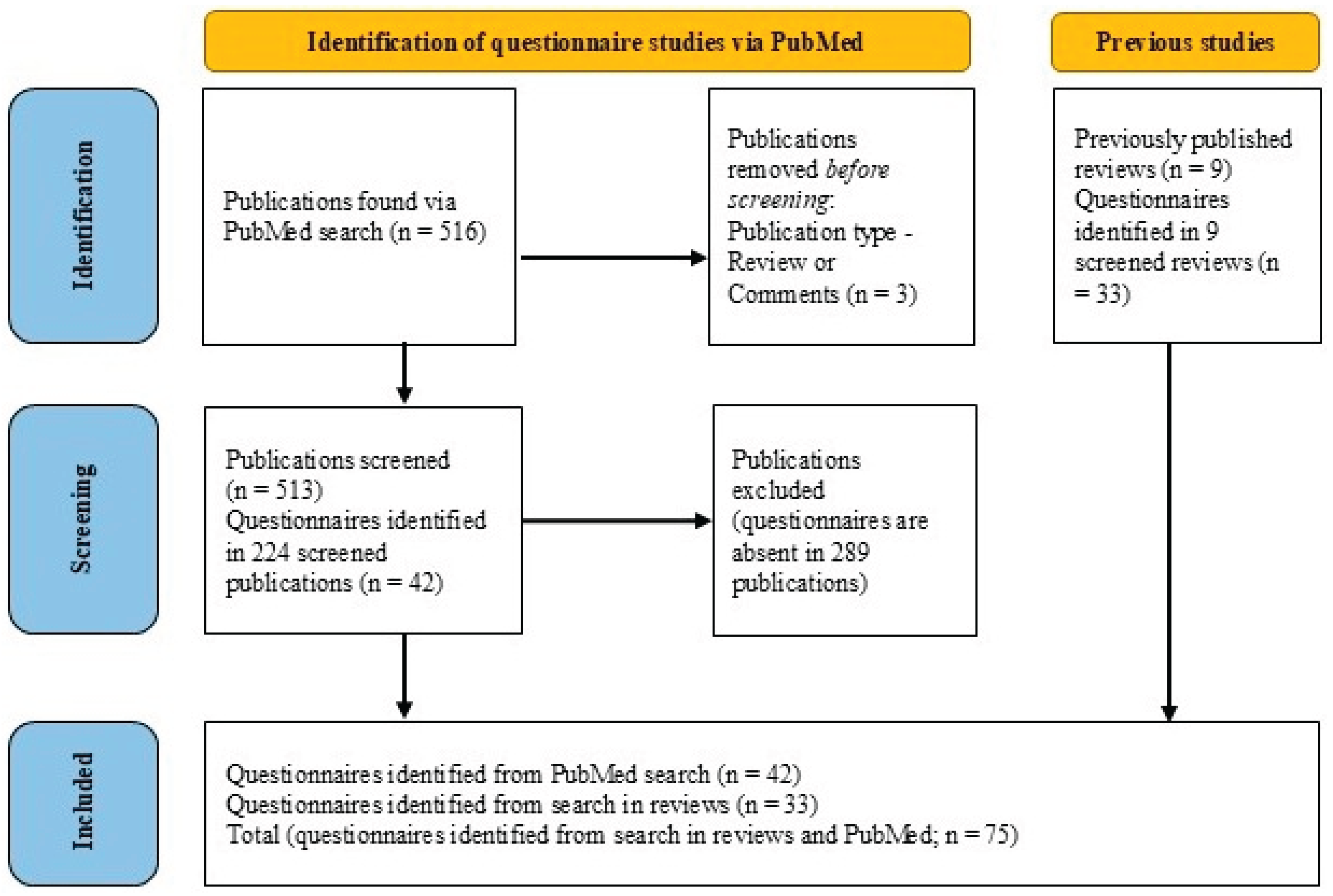

Table 1.
Grouping chronotype questionnaires in families and subfamilies.
| # | Family or | Subfamily | #.Abbreviation- | |
|---|---|---|---|---|
| Isolate | # of items | Number of items and name (abbreviation, yr, and author(s)) | ||
| 1 | 1.1.MEQ | 1.1.1.MEQ | 1.1.1.1.MEQ-19 | The 19-item Morningness-Eveningness Questionnaire (MEQ; 1976, Horne, Ostberg).[4] |
| 2 | 1.1.2.rMEQ | 1.1.2.1.rMEQ-1 | The 19th item of MEQ (MEQ19th; 1976, Horne, Ostberg) [4] | |
| 3 | 1.1.2.2.rMEQ-5 | The 5-item reduced MEQ (rMEQ; Adan, Almirall,1990)[25] | ||
| 4 | 1.2.DTS | 1.2.1.DTS | 1.2.1.1.DTS-7 | The 7-item Diurnal Type Scale (DTS; 1980, Torsvall & Åkerstedt)[5] |
| 5 | 1.3.CSM | 1.3.1.CSM | 1.3.1.1.CSM-13 | The 13-item Composite Scale of Morningness (CSM; 1989, Smith et al.)[7] |
| 6 | 1.3.4.MA | 1.3.4.1.MA-5 | The 5-item Morning Affect factor (MA factor, 2005, Caci et al.)[35] | |
| 7 | 1.3.5.PS | 1.3.5.1.PS-12 | The 12-item Early-Late Preferences Scale (PS; 2002, Smith et al.) [36] | |
| 8 | 1.4.STQ | 1.4.1.STQ | 1.4.1.1.STQ-18 | The 18-item Sleep Timing Questionnaire (STQ; 2003, Monk et al.) [37]. |
| 9 | 1.4.2.MCTQ | 1.4.2.1.MCTQ-32 | The 32-item Munich Chronotype Questionnaire (MCTQ; 2003, Roenneberg et al.)[24] | |
| 10 | 1.4.3.PD | 1.4.3.1.PD-2 | The two-item Perfect Day (PD; 2017, Gross et al.) [38]. | |
| 11 | 1.6.MRhl | 1.6.1.MRhI | 1.6.1.1.MRhI-15 | The 15-item Mood Rhythm Instrument (MRhI; 2016, de Souza et al.)[14] |
| 12 | 1.8.SACL | 1.8.1.SACL | 1.8.1.1.SACL-13 | The 13-item Scale for Assessment of Circadian Lateness (SACL; 2005, Putilov, Putilov) [39] |
| 13 | 1.9.FOLI | 1.9.1.FOLI | 1.9.1.1.FOLI-10 | The 10-item Francis Owl-Lark Indices (FOLI; 2021, Francis et al.)[16] |
| 14 | 2.1.CTQ | 2.1.1.CTQ | 2.1.1.1.CTQ-20 | The 20-item Circadian-Type Questionnaire (CTQ; 1979, Folkard et al.)[8] |
| 15 | 2.1.1.3.rCTI-11 | The 11-item Circadian Type Inventory-revised (CTI-r; 2005, Di Milia et al.) [40] | ||
| 16 | 2.1.2.CAPS | 2.1.2.1.CAPS-38 | The 38-item Circadian Amplitude and Phase Scale (CAPS; 2011, Di Milia et al.) [41] | |
| 17 | 2.2.ChQ | 2.2.1.ChQ | 2.2.1.1.ChQ-16 | The 16-item Chronotype Questionnaire (ChQ; 2011, Ogińska).[9] |
| 18 | 2.2.1.2.SCAS-8 | The 8-item Revised Subjective Amplitude Scale (SCAS; 2017, Oginska et al.) [42] | ||
| 19 | 2.2.2.CCQ | 2.2.2.1.CCQ-16 | The 16-item Caen Chronotype Questionnaire (CCQ; 2013, Dosseville et al.) [43] | |
| 20 | 2.3.CIRENS | 2.3.1.CIRENS | 2.3.1.1.CIRENS-3 | The three-item CIRcadian ENergy Scale (CIRENS; 2011, Ottoni et al.) [44] |
| 21 | 2.4.MESSi | 2.4.1.MESSi | 2.4.1.1.MESSi-15 | The 15-item Morningness–Eveningness-Stability Scale improved (MESSi; 2016, Randler et al.)[11] |
| 22 | 2.5.MQ | 2.5.1.MQ | 2.5.1.1.MQ-16 | The 16-item Marburger questionnaire (MQ; 1981, Moog)[6] |
| 23 | 2.5.2.SRM | 2.5.2.1.SRM-17 | The 17-item The Social Rhythm Metric (SRM; 1990, Monk et al.) [45] | |
| 24 | 2.6.VJT | 2.6.1.VJT | 2.6.1.1.VJT-19 | The 19-time point Visuo-verbal Judgment Task (VJT; 2015, Marcoen et al.) [46] |
| 25 | 2.6.2.SIC | 2.6.2.1.SIC-1 | The Single-Item Chronotyping (SIC; 2021, Putilov et al.).[17] | |
| 26 | 2.7.SWPAQ | 2.7.1.SWPAQ | 2.7.1.1.SWPAQ-40 | The 40-item Sleep-Wake Pattern Assessment Questionnaire (SWPAQ-40: 1990, Putilov) [10] |
| 27 | 2.7.1.2.SWPAQ-72 | The 72-item SWPAQ (SWPAQ-72: 2007, Putilov) [47] | ||
| 28 | 2.7.2.SWAT | 2.7.2.1.SWAT-168 | The 168-item Sleep-Wake Adaptability Test (SWAT-168; 2016, Putilov)[12] | |
| 29 | 2.7.2.2.rSWAT-60 | The 60-item SWAT (SWAT-60; 2021, Putilov) [48] | ||
| 30 | 2.8.LOCI | 2.8.1.LOCI | 2.8.1.1.LOCI-38 | The 38-item Lark-Owl (Chronotype) Indicator (LOCI; 1998, Roberts) [49] |
Notes. The list of 30 of 75 identified questionnaires. The list was reduced this and two next tables by excluding reduced versions with similar properties and leaving only questionnaires for assessing chronotype in unspecified adult study participants, i.e., the reduction was based on the properties 1a. For (questionnaire) for (assessing) and 1b. In (questionnaire for assessing) in (study participants). The questionnaires can be traced back to the concepts behind just two pioneer questionnaires, the MEQ [4] and the CTQ [8]. 1. and 2.: Questionnaires for assessing only the phase parameter of diurnal rhythm (1…) and for assessing also or only other than phase parameter(s) (2…), respectively; 1-30 – numbers were assigned to questionnaires in this and two next tables. See Tables S1-S3 for the full list of questionnaires.
Table 2.
Properties of chronotype questionnaires.
| # | #.Abbreviation- | 2a. | 2b. | 3a. | 3b. | 4a. | 4b. | 4c. | 5a. | 5b. |
|---|---|---|---|---|---|---|---|---|---|---|
| # of items | Size | Items | Parameter | Scales | Variation | Output | Clock h | Behavior | Interval | |
| 1 | 1.1.1.1.MEQ-19 | Pr | 19 | Ph | 1 | TL | Sc | Ch+ | Act+Pre | T+W |
| 2 | 1.1.2.1.rMEQ-1 | Re | 1 | Ph | <1 | Ty | Sc | Ch- | Pre | W |
| 3 | 1.1.2.2.rMEQ-5 | Re | 5 | Ph | 1 | TL | Sc | Ch+ | Act+Pre | T+W |
| 4 | 1.2.1.1.DTS-7 | Pr | 7 | Ph | 1 | TL | Sc | Ch+ | Act+Pre | T+W |
| 5 | 1.3.1.1.CSM-13 | Pr | 13 | Ph | 1 | TL | Sc | Ch+ | Act+Pre | T+W |
| 6 | 1.3.4.1.MA-5 | Re | 5 | Ph | 1 | TL | Sc | Ch- | Act+Pre | T |
| 7 | 1.3.5.1.PS-12 | Fu | 12 | Ph | 1 | TL | Sc | Ch- | Pre | T+W |
| 8 | 1.4.1.1.STQ-18 | Pr | 18 | Ph | 2 | TL | Ch | Ch | Pre | T |
| 9 | 1.4.2.1.MCTQ-32 | Pr | 32 | Ph | <1 | SL | Ch | Ch | Act | T |
| 10 | 1.4.3.1.PD-2 | Re | 2 | Ph | <1 | TL | Ch | Ch | Pre | T |
| 11 | 1.6.1.1.MRhI-15 | Pr | 15 | Ph | 1 | SL | Ch | Ch | Act | W |
| 12 | 1.8.1.1.SACL-13 | Pr | 13 | Ph | 1 | TL | Sc | Ch | Pre | T+W |
| 13 | 1.9.1.1.FOLI-10 | Pr | 10 | Ph | 2 | TL | Scs | Ch+ | Pre | T+W |
| 14 | 2.1.1.1.CTQ-20 | Pr | 20 | Ph+ | 3 | T+AL | Scs | Ch- | Pre | T+W |
| 15 | 2.1.1.3.rCTI-11 | Re | 11 | Ph- | 2 | AL | Scs | Ch- | Pre | T+W |
| 16 | 2.1.2.1.CAPS-38 | En | 38 | Ph+ | 3 | T+AL | Scs | Ch- | Pre | T+W |
| 17 | 2.2.1.1.ChQ-16 | Pr | 16 | Ph+ | 2 | TL | Scs | Ch- | Pre | T+W |
| 18 | 2.2.1.2.SCAS-8 | Re | 8 | Ph- | 1 | TL | Sc | Ch- | Pre | T+W |
| 19 | 2.2.2.1.CCQ-16 | Fu | 16 | Ph+ | 2 | TL | Scs | Ch- | Pre | T+W |
| 20 | 2.3.1.1.CIRENS-3 | Pr | 3 | Ph+ | <1 | S+AL | Sc | Ch- | Act | W |
| 21 | 2.4.1.1.MESSi-15 | Fu | 15 | Ph+ | 3 | T+S+AL | Scs | Ch- | Act+Pre | T+W |
| 22 | 2.5.1.1.MQ-16 | Pr | 16 | Ph+ | 2 | T+SL | Scs | Ch+ | Act+Pre | T+W |
| 23 | 2.5.2.1.SRM-17 | Pr | 17 | Ph- | 1 | SL | Ch | Ch | Act | T+W |
| 24 | 2.6.1.1.VJT-19 | Pr | 19 | Ph+ | 4 | S+AL | Scs | Ch+ | Act | W |
| 25 | 2.6.2.1.SIC-1 | Pr | 1 | Ph+ | <1 | Ty | Na | Ch- | Act | W |
| 26 | 2.7.1.1.SWPAQ-40 | Pr | 40 | Ph+ | 5 | AL | Scs | Ch- | Pre | T+W+S |
| 27 | 2.7.1.2.SWPAQ-72 | En | 72 | Ph+ | 6 | AL | Scs | Ch- | Pre | T+W+S |
| 28 | 2.7.2.1.SWAT-168 | Pr | 168 | Ph+ | 6 | AL | Scs | Ch- | Pre | T+W+S |
| 29 | 2.7.2.2.rSWAT-60 | Re | 60 | Ph+ | 6 | AL | Scs | Ch- | Pre | T+W+S |
| 30 | 2.8.1.1.LOCI-38 | Pr | 38 | Ph+ | 3 | T+AL | Scs | Ch+ | Pre | T+W |
Notes. 2a-5b. Abbreviation of questionnaire property. 2a. (Questionnaire) size: Pr - primary size (full list of items in primary questionnaire), Fu - full (similar to the primary list of items in secondary questionnaire), Re - reduced (smaller than the primary list of items in secondary questionnaire), En – enlarged (larger than the primary list of items in secondary questionnaire). 2b. (Number of) items in questionnaire. 3a. (Diurnal rhythm) parameter: Ph – phase parameter, Ph+ - phase and other parameter(s), Ph- other than phase parameter(s). 3b. (Number of) scales: 1 - number of scales (as sums of items) is equal to 1, <1- single item or less than three items or non-summed responses (like a difference calculated by subtracting one response from another).4a. (Individual) variation: Ty - type (single item naming chronotype), TL - trait-like, SL - state-like, AL - ability-like, T+AL - trait- and ability-like, T+S+AL- trait-, state- and ability-like, S+AL - state- and ability-like. 4b. (Assessment) output: Na - names of chronotypes, Sc - score on the only scale/item, Scs - scores on more than one scale, Ch - clock h rather than score. 4c. (Includes) clock h: Ch+ - Clock h in question or answer or clock h is calculated from several clock h answers, Ch+ - Clock h is among answers or questions, Ch- - clock h is not mentioned in answers and questions. 5a. (Sleep-wake) behavior: Act - actual (current) behavior, Pre - preferred behavior or behavior under specified hypothetical circumstances, Act+Pre - actual and preferred. 5b. Interval (of the sleep-wake cycle): T - interval of sleep-wake and/or wake-sleep transition, W - interval of wakefulness, T+W - both intervals of sleep-wake transition and wakefulness, T+W+S - both these two intervals and sleep interval, T+S - both intervals of sleep-wake transition and sleep (see such a category in Table S4). Reduced versions with similar properties were excluded from this table. Moreover, only questionnaires for assessing chronotype in unspecified adult study participants were included (properties 1a and 1b). See also notes to Table 1 and Tables S1-S5.
Table 3.
Properties of scales of chronotype questionnaires.
| # | #.Abbreviation- | 6a. | 6b. | 6c. | 7a. | 7b. | 8a. | 8b. | 9a. | 9b. |
|---|---|---|---|---|---|---|---|---|---|---|
| number of items |
ME scale(s) |
Dimen- sions |
Items | Amplitude/ Stability |
Items | Wake- ability |
Items | Sleep- ability |
Items | |
| 1 | 1.1.1.1.MEQ-19 | ME | >1 | 19 | 0 | 0 | 0 | 0 | 0 | 0 |
| 2 | 1.1.2.1.rMEQ-1 | ME | <1 | 1 | 0 | 0 | 0 | 0 | 0 | 0 |
| 3 | 1.1.2.2.rMEQ-5 | ME | 1 | 5 | 0 | 0 | 0 | 0 | 0 | 0 |
| 4 | 1.2.1.1.DTS-7 | ME | >1 | 7 | 0 | 0 | 0 | 0 | 0 | 0 |
| 5 | 1.3.1.1.CSM-13 | ME | >1 | 13 | 0 | 0 | 0 | 0 | 0 | 0 |
| 6 | 1.3.4.1.MA-5 | M | 1 | 5 | 0 | 0 | 0 | 0 | 0 | 0 |
| 7 | 1.3.5.1.PS-12 | ME | >1 | 12 | 0 | 0 | 0 | 0 | 0 | 0 |
| 8 | 1.4.1.1.STQ-18 | M,E | <1 | 3,3 | 0 | 0 | 0 | 0 | 0 | 0 |
| 9 | 1.4.2.1.MCTQ-32 | ME | <1 | 1 | 0 | 0 | 0 | 0 | 0 | 0 |
| 10 | 1.4.3.1.PD-2 | ME | <1 | 1 | 0 | 0 | 0 | 0 | 0 | 0 |
| 11 | 1.6.1.1.MRhI-15 | ME | >1 | 15 | 0 | 0 | 0 | 0 | 0 | 0 |
| 12 | 1.8.1.1.SACL-13 | ME | 1 | 13 | 0 | 0 | 0 | 0 | 0 | 0 |
| 13 | 1.9.1.1.FOLI-10 | M,E | 1 | 5,5 | 0 | 0 | 0 | 0 | 0 | 0 |
| 14 | 2.1.1.1.CTQ-20 | ME | 1 | 6 | 2 | 8,5 | 0 | 0 | 0 | 0 |
| 15 | 2.1.1.3.rCTI-11 | 0 | 0 | 0 | 2 | 5,6 | 0 | 0 | 0 | 0 |
| 16 | 2.1.2.1.CAPS-38 | ME | >1 | 14 | 2 | 14,10 | 0 | 0 | 0 | 0 |
| 17 | 2.2.1.1.ChQ-16 | ME | 1 | 8 | 1 | 8 | 0 | 0 | 0 | 0 |
| 18 | 2.2.1.2.SCAS-8 | 0 | 0 | 8 | 1 | 8 | 0 | 0 | 0 | 0 |
| 19 | 2.2.2.1.CCQ-16 | ME | 1 | 8 | 1 | 8 | 0 | 0 | 0 | 0 |
| 20 | 2.3.1.1.CIRENS-3 | ME | <1 | 2 | 0 | 0 | <1 | 1 | 0 | 0 |
| 21 | 2.4.1.1.MESSi-15 | M,E | 1 | 5,5 | 1 | 5 | 0 | 0 | 0 | 0 |
| 22 | 2.5.1.1.MQ-16 | ME | 1 | 8 | 1 | 8 | 0 | 0 | 0 | 0 |
| 23 | 2.5.2.1.SRM-17 | 0 | 0 | 0 | 1 | 17 | 0 | 0 | 0 | 0 |
| 24 | 2.6.1.1.VJT-19 | M,E | 1 | 4,6 | 0 | 0 | 2 | 5,4 | 0 | 0 |
| 25 | 2.6.2.1.SIC-1 | ME | <1 | <1 | 0 | 0 | <1 | <1 | 0 | 0 |
| 26 | 2.7.1.1.SWPAQ-40 | M,E | 1 | 12,8 | 0 | 0 | 1 | 4 | 2 | 4,12 |
| 27 | 2.7.1.2.SWPAQ-72 | M,E | 1 | 12,12 | 0 | 0 | 2 | 12,12 | 2 | 12,12 |
| 28 | 2.7.2.1.SWAT-168 | M,E | 1 | 28,28 | 0 | 0 | 2 | 28,28 | 2 | 28,28 |
| 29 | 2.7.2.2.rSWAT-60 | M,E | 1 | 10,10 | 0 | 0 | 2 | 10,10 | 2 | 10,10 |
| 30 | 2.8.1.1.LOCI-38 | M,E | 1 | 13,13 | 0 | 0 | 1 | 12 | 0 | 0 |
Notes. 6a-9b. Abbreviation of questionnaire scale property. 6a. ME scale(s) (morningness-eveningness scale(s)): ME - one score or clock h or names for morningness-evevningness types, M - one score for morning subconstruct of morningness-evevningness, M, E - one score (or clock time) for morning subconstruct and one score (or clock time) for evening subconstruct of morningness-evevningness, 0 - no any morningness-eveningness scales. 6b. (Number of) dimensions (per each of ME scales): 1 - one scale - one factorial dimension, >1 - number of factorial dimensions per 1 scale is larger than 1, <1- single item or three items or non-summed responses (e.g., like a difference calculated by subtracting one response from another), 0 - no morningness-eveningness items. 6c, 7b, 8b, 9b: (Number of) items in such scale(s). 7a. Amplitude/Stability (scale(s)): 1 - one scale - one factor, 2 - two scales - two factors, 0 - no any amplitude/stability scales. 8a. Wakeability (scale(s)): 1 - one scale - one factor, 2 - two scales - two factors, <1- single item, 0 - no any wakeability scales. 9a. Sleepability (scale(s)): 2 - two scales - two factors, 0 - no any sleepability scales. See also notes to Table 1, Table 2Tables S1-S5.
Table 4.
Number of chronotype questionnaires in each category of a property.
| Property of | Questionnaire | ||||||
|---|---|---|---|---|---|---|---|
| Property # | 1a. | 1b. | 2a. | 3a. | 4a. | 4b. | 4.c |
| Its short name | For | in | Size | Parameter | Variation | Output | Clock h |
| Number | Ch+=15 | - | - | - | - | - | - |
| of | Ch=60 | AN=39 | Pr=21 | Ph=38 | Ty=2 | Na=1 | Ch=11 |
| categories | AL=4 | Fu=9 | Ph+=15 | TL=35 | Sc=29 | Ch+=26 | |
| of | SW=2 | Re=27 | Ph-=6 | SL=10 | Scs=19 | Ch-=23 | |
| properties | AP=3 | En=3 | AL=6 | Ch=9 | |||
| AS=1 | S+AL=2 | Ch+Scs=1 | |||||
| CA=11 | T+AL=3 | ||||||
| T+S+AL=2 | |||||||
| T+SL=1 | |||||||
| Total number | 75 | 60 | 60 | 60 | 60 | 60 | 60 |
| Property of | Questionnaire | Questionnaire scale(s) | |||||
| Property # | 5a. | 5b. | 6a. | 6b. | 7a. | 8a. | 9a. |
| Its short name | Behavior | Interval |
ME scale(s) |
Dimensions |
Amplitude/ Stability |
Wake- ability |
Sleep- ability |
| Number | - | - | - | - | - | - | - |
| of | Act=12 | T=7 | ME=41 | 1=25 | 1=11 | 1=2 | 2=4 |
| categories | Pre=25 | W=7 | M=2 | >1=23 | 2=4 | 2=4 | 0=56 |
| of | Act+Pre=22 | T+W=41 | M,E=11 | <1=8 | 0=45 | <1=2 | |
| properties | T+W+S=4 | 0=6 | 0=4 | 0=52 | |||
| T+S=1 | |||||||
| Total number | 60 | 60 | 60 | 60 | 60 | 60 | 60 |
Notes. *Questionnaires for assessing not only chronotype but chronotype and something else were not included in these calculations (1a. For (questionnaire for assessing), the category Ch+ in Tables S3-S5, n=15). 1b-9a. Abbreviation of a questionnaire or chronotype scale property: Categories (Number of) items (2a, 6c, 7b, 8b, 9b) were not included. See the notes to Table 1, Table 2, Table 3 and Tables S1-S5.
Disclaimer/Publisher’s Note: The statements, opinions and data contained in all publications are solely those of the individual author(s) and contributor(s) and not of MDPI and/or the editor(s). MDPI and/or the editor(s) disclaim responsibility for any injury to people or property resulting from any ideas, methods, instructions or products referred to in the content. |
© 2026 by the authors. Licensee MDPI, Basel, Switzerland. This article is an open access article distributed under the terms and conditions of the Creative Commons Attribution (CC BY) license (http://creativecommons.org/licenses/by/4.0/).
Copyright: This open access article is published under a Creative Commons CC BY 4.0 license, which permit the free download, distribution, and reuse, provided that the author and preprint are cited in any reuse.


