

Submitted:
09 January 2026
Posted:
12 January 2026
You are already at the latest version
Abstract
Engine oil degradation critically influences the performance, efficiency, and longevity of internal combustion engines. Conventional mileage or time-based replacement schedules often result in premature oil changes or delayed servicing, both of which compromise engine health and increase costs. This review examines recent advances in real-time oil condition monitoring and evaluates the feasibility of a low-cost microcontroller-based system that integrates physical sensors with machine learning models for continuous on-board oil health assessment. Drawing on established techniques from industrial lubrication monitoring, we propose an experimental framework that leverages electrical engineering principles, including sensor interface, analog front-end design, signal acquisition, and embedded AI deployment to enable accurate, affordable, and scalable oil health diagnostics. The review highlights opportunities for innovation in embedded systems and electrical engineering design, positioning AI-driven monitoring as a practical solution for predictive automotive maintenance.
Keywords:
engine oil degradation
; condition monitoring
; electrical engineering
; microcontroller
; dielectric sensing
; machine learning
; TinyML
1. Introduction
Lubrication oil plays a vital role in internal combustion engines, reducing friction, dissipating heat, and protecting components from wear. As oil degrades, its ability to perform these functions diminishes, leading to increased friction, faster wear, and reduced engine longevity [1,3]. Traditionally, oil-change intervals are determined by mileage or time-based schedules. However, these approaches do not reflect the actual condition of the oil, resulting in either premature changes that increase maintenance costs or delayed changes that risk severe engine damage [2].
Recent progress in condition-based monitoring systems for industrial machinery and transformers has inspired the development of real-time oil quality monitoring in automotive applications [4]. These systems employ sensors to detect physical and chemical changes in oil, such as viscosity, dielectric constant, acoustic response, and contamination levels. Despite these advances, continuous and accurate oil quality monitoring remains limited, particularly in older or low-cost vehicles without advanced onboard diagnostics [5].
This paper reviews existing techniques for oil condition monitoring, identifies gaps in current approaches, and proposes a framework for low-cost embedded monitoring systems. By integrating electrical engineering design principles with machine learning models, we outline a pathway toward an affordable, real-time oil health assessment [6].
2. Background and Motivation
Condition-based monitoring has long been applied to transformer oils, hydraulic oils, and industrial lubricants to ensure optimal performance and early fault detection. Common sensing methods include [7,8];
- Ultrasound/Acoustic Sensors: Detect changes in fluid properties by transmitting and receiving high-frequency waves, sensitive to viscosity and contamination variations.
- Dielectric Property Sensors: Measure permittivity or conductivity changes linked to oxidation, moisture ingress, or contamination, widely used in transformer oil diagnostics.
- Viscosity Sensors: Monitor flow resistance variations as oil degrades, including thermal viscosity sensors that assess heat transfer characteristics.
- Optical/Turbidity Sensors: Detect changes in particle density, color, or suspended contaminants.
Although these techniques are well established in industrial systems, their adaptation to the monitoring of automotive engine oil remains limited. According to [9,10,11]; in vehicles, real-time oil condition detection is largely confined to high-end models, which rely on Engine Control Units (ECUs) using indirect estimates based on temperature cycles and fuel contamination models rather than direct physical measurements.
This gap underscores the opportunity for a low-cost microcontroller-integrated sensor system capable of providing an accurate, real-time oil quality assessment, particularly for emerging markets and lower-cost vehicle segments.
Figure 1 illustrates typical qualitative trends in selected oil properties as a function of operating time and usage, as reported in previous lubrication oil condition monitoring studies [12,13].
As shown in Figure 1, oil properties such as dielectric constant, acoustic attenuation, and viscosity generally increase with aging due to oxidation, contamination, and thermal stress, motivating direct condition-based monitoring.
3. Proposed Concept
The proposed system continuously measures key physical and chemical properties indicative of engine oil degradation during operation. It integrates a low-cost microcontroller for sensor signal acquisition and processing, and applies AI-based models trained on known degradation patterns to interpret measurements and predict oil health. The system can notify the driver via a dashboard indicator or a mobile application.
Figure 2 presents the unified system architecture, synthesizing concepts reported in prior system-level studies that explicitly combine oil condition sensors, embedded microcontroller-based signal acquisition and processing, and multisensor fusion or data-driven oil health estimation frameworks [16,17].
As illustrated in Figure 2, multiple oil condition sensors provide complementary measurements that are conditioned and digitized before being processed by the microcontroller. Degradation-sensitive features are extracted and fused using state-space or embedded AI techniques to estimate an Oil Health Index, which is then used to inform the driver through dashboard indicators or mobile applications.
3.1. Key Oil Properties for Monitoring
Engine oil degradation is a complex, multi-physical process influenced by thermal stress, mechanical shear, oxidation, and contamination during engine operation. According to [21,22]; As oil ages, its physical, electrical, and chemical characteristics evolve in ways that directly affect lubrication performance, heat dissipation, and engine protection. Consequently, no single parameter is sufficient to fully characterize oil health. Instead, effective condition-based oil monitoring relies on tracking a combination of complementary properties that collectively reflect oil degradation mechanisms, contamination levels, and changes in fluid dynamics. These properties can be sensed using different transduction principles and later fused to form a comprehensive assessment of the oil condition [12,23].
The target parameters include [24]:
- Viscosity variation due to aging, thermal cycles, and temperature effects.
- The changes in the dielectric constant reflect oxidation, moisture ingress, and contamination.
- Acoustic attenuation or speed-of-sound changes related to fluid density variations.
- Changes in electrical conductivity associated with contamination.
- Optical turbidity affected by soot, metallic particles, and suspended contaminants.
3.2. Suitable Sensors for Automotive Oil Monitoring
The selection of sensors for automotive engine oil monitoring is driven by the need for robustness, compactness, cost-effectiveness, and compatibility with harsh operating environments. Unlike laboratory oil analysis, vehicle sensing requires transducers that can operate reliably under wide temperature ranges, vibration, and continuous exposure to lubricants. Previous studies [25,26] have demonstrated that a combination of acoustic, dielectric, thermal, and electrical sensing techniques can provide complementary information about oil degradation mechanisms, allowing real-time assessment when integrated with embedded processing platforms. As a result, several sensor types have been proposed and evaluated in the literature for direct or indirect measurement of key oil properties in automotive and industrial lubrication systems.
Potential sensors include:
- Ultrasonic transducers embedded in the oil sump wall for acoustic measurements.
- Capacitive dielectric sensors placed within the oil flow line.
- Thermal viscosity microsensors for viscosity-related changes.
- Combined temperature and conductivity probes for multi-parameter sensing.
These sensing approaches have been widely investigated for engine oil and lubricating oil condition monitoring applications [16,18].
The dielectric behavior of engine oil can be electrically characterized using a capacitive sensing approach. The relationship between the capacitance of the measured sensor and the relative permittivity of the oil is expressed in (1), following the established capacitive oil detection models [20].
Where denotes the measured capacitance of the oil-filled sensor, A and d represent the effective electrode area and separation, respectively, and is the permittivity of free space. The temperature compensation factor, governed by the coefficient , is introduced to isolate degradation-related permittivity variations from thermal effects.
3.3. Microcontroller Integration
The microcontroller serves as the central processing unit of the monitoring system and provides the following:
- Analog-to-Digital Converters (ADC) for acquiring analog sensor signals.
- Timers and pulse-generation capabilities for ultrasonic measurements.
- Communication interfaces such as UART, I2C, SPI and CAN for vehicle integration.
- Sufficient processing capability to execute lightweight AI inference models (e.g., TinyML) on board.
3.4. Existing Systems for Engine Oil Monitoring
Current vehicle oil monitoring systems remain largely limited in both functionality and accuracy. In most conventional vehicles, direct visual inspection of the oil condition of the engine is not possible, as the engines do not incorporate transparent oil reservoirs. Instead, a mechanical dipstick is commonly used to indicate the amount/level of oil, providing no information about the quality, degradation, or contamination of the oil [11,35]. Although some two-wheeler vehicles employ sight glasses to display oil level, this approach is rarely adopted in passenger cars and does not allow for an assessment of oil health [36].
In modern passenger vehicles, particularly within the higher-end and luxury segments, electronic oil-related indicators are commonly integrated into the dashboard interface. Such indicators are widely encountered in the daily operation of vehicles and are also documented in the literature [43]. These systems typically comprise oil pressure warning lights, oil level indicators, or maintenance reminders activated based on predefined mileage thresholds or time intervals, as illustrated in Figure 3.
In certain premium vehicles from manufacturers such as Audi and BMW, oil condition estimation is implemented indirectly through engine operating parameters, including temperature profiles, engine load, and driving cycles (Figure 3).
However, these approaches rely on empirical or model-based estimations derived from operating parameters such as mileage, temperature history, and driving cycles rather than direct physical measurements of oil properties. As a result, they may yield inaccurate assessments of oil condition when vehicles are subjected to diverse and non-uniform operating conditions, including prolonged idling, stop-and-go traffic, or high-load operation. Recent studies have shown that such indirect models can misrepresent actual oil degradation behavior due to their limited ability to capture nonlinear and cumulative aging effects, leading to premature or delayed service decisions [37].
In many regions, routine monitoring of engine lubricant condition still depends on manual inspection by vehicle owners or technicians during scheduled maintenance. Such traditional practices are subjective, discontinuous, and prone to human error, particularly in identifying early-stage oil degradation. Consequently, existing systems lack the capability to perform an objective and continuous real-time assessment of oil quality. This limitation highlights the need for embedded sensor-based monitoring solutions capable of directly measuring oil degradation indicators and enabling predictive maintenance strategies [38].
3.5. Limitations of Traditional Mileage-Based Oil Service Methods
Traditional engine oil maintenance practices are predominantly based on fixed mileage or time intervals, typically ranging from approximately 5,000 to 10,000 km depending on vehicle type, oil grade, and manufacturer recommendations. Although such schedules offer simplicity, they do not accurately reflect the actual operating conditions of the engine or the true state of degradation of the lubricant [28,29].
In real-world driving scenarios, vehicles can accumulate mileage under vastly different conditions. For example, an engine operating for extended periods in congested traffic or during prolonged idle experience frequent thermal cycling, elevated temperatures, and limited airflow, all of which accelerate oil oxidation and degradation despite the relatively low distance traveled. Under such conditions, oil quality can deteriorate significantly before the scheduled service interval is reached [27].
In contrast, a vehicle can cover the same mileage primarily under steady driving on the highway with minimal load variation and stable operating temperatures. In this case, the engine oil may remain within acceptable performance limits even after reaching the prescribed service mileage. These contrasting scenarios illustrate that the distance traveled alone is an unreliable indicator of oil health [30].
As a result, mileage-based oil replacement strategies can lead to premature oil changes, increased maintenance costs, and environmental waste, or delayed service, which risks accelerated engine wear and reduced reliability. This limitation underscores the need for condition-based oil monitoring approaches capable of directly assessing lubricant degradation in real time, regardless of driving patterns or accumulated mileage.
Figure 4 conceptually illustrates the influence of operating severity on the degradation rate of engine oil.
Figure 4 highlights that oils subjected to severe operating conditions such as stop–go traffic and prolonged idling degrade more rapidly than those used under steady highway driving, despite accumulating similar mileage.
To clearly highlight the limitations of conventional oil maintenance practices, Table 1 presents a comparison between traditional mileage-based oil service strategies based on mileage and condition-based monitoring approaches using direct oil property measurements.
As summarized in Table 1, conventional mileage-based servicing strategies lack sensitivity to real-world operating conditions and oil degradation dynamics. In contrast, condition-based monitoring systems enable a continuous and objective assessment of lubricant health, support predictive maintenance, and reduce unnecessary oil changes and the risk of engine damage [31].
4. Proposed Experimental Framework
As this study is presented as a review paper, this section outlines a comprehensive experimental framework intended to guide future implementation and validation rather than reporting completed experimental results. The framework demonstrates how established electrical engineering principles, combined with modern sensing techniques and embedded artificial intelligence, can be systematically applied to design a low-cost, real-time engine oil condition monitoring system suitable for automotive environments.
The proposed framework emphasizes modularity, scalability, and hardware independence, enabling adaptation across different vehicle platforms and microcontroller families.
- A low-cost microcontroller responsible for sensor interfacing, real-time data acquisition, signal conditioning, and the execution of embedded signal processing and lightweight artificial intelligence algorithms. The use of microcontroller-based platforms for oil condition monitoring has been widely reported in the literature, as they enable real-time processing, low power consumption, and seamless integration with multiple sensors in automotive and industrial environments [11].
- Custom-designed capacitive dielectric sensors, implemented using parallel-plate or interdigitated electrode structures, to monitor variations in the oil’s relative permittivity associated with oxidation, moisture ingress, and contamination. Dielectric sensing has been extensively investigated for lubricant condition monitoring, as changes in permittivity provide a sensitive indicator of chemical degradation and contamination processes occurring during oil aging [20,39].
- Ultrasonic transducers mounted on or embedded within the oil sump or oil flow channel to measure acoustic attenuation and time-of-flight variations correlated with changes in oil viscosity and density. Prior studies have demonstrated that ultrasonic techniques enable non-invasive, real-time assessment of lubricant condition by capturing degradation-induced variations in acoustic propagation characteristics, making them well suited for in-situ automotive oil monitoring applications [6,11].
- Thermal viscosity microsensors to capture temperature-dependent flow resistance and heat-transfer characteristics of engine oil. Thermal-based viscosity sensing has been widely reported as an effective indirect method for tracking lubricant degradation, as changes in viscosity strongly reflect aging, oxidation, and contamination processes under varying thermal conditions [18,39].
- Integrated temperature and electrical conductivity probes to provide auxiliary measurements required for sensor compensation, normalization, and decoupling of thermal effects from degradation-induced variations. Previous studies have shown that temperature and conductivity measurements are essential for improving the reliability and accuracy of oil condition assessment by mitigating cross-sensitivity and environmental influences [13,16].
- Controlled oil samples representing fresh, moderately aged, and severely degraded conditions, obtained under standardized operating cycles and mileage intervals. The use of reference oil samples at different degradation stages is a common experimental practice in lubricant condition monitoring studies, enabling systematic calibration, validation, and performance evaluation of sensing and data-driven diagnostic approaches [6,39].
The experimental platform is designed to operate under realistic automotive conditions, addressing temperature fluctuations, mechanical vibrations, and electrical noise.
4.1. Electrical Engineering Design Considerations
The proposed framework places strong emphasis on electrical engineering design challenges that directly influence the accuracy of measurement and the reliability of the system. Key considerations include
- Analog Front-End Design: Development of low-noise, high-stability signal conditioning circuits, including amplification, impedance matching, and filtering stages tailored to each sensor type.
- Timing and Synchronization: Utilization of microcontroller timers and capture/compare modules to enable precise ultrasonic pulse generation and echo timing measurements.
- Temperature Compensation: Implementation of compensation algorithms to decouple oil degradation effects from temperature-induced variations in sensor outputs.
- Power Management: Design of low-power operating modes and efficient voltage regulation to ensure minimal impact on vehicle electrical systems.
These considerations ensure that the experimental framework remains robust and suitable for long-term deployment in harsh automotive environments.
The degradation of engine oil viscosity is strongly influenced by both thermal exposure and aging time. The combined effects of temperature and oxidative aging on oil viscosity can be modeled using an Arrhenius-type relationship expressed in (2) [40].
where denotes the dynamic viscosity of engine oil at temperature T and aging time t, is the reference viscosity measured at the reference temperature , represents the activation energy associated with thermally induced degradation, R is the universal gas constant and is the degradation rate constant that captures long-term oxidative and shear-related aging effects. This formulation separates instantaneous temperature dependence from cumulative aging behavior, enabling physics-informed interpretation of viscosity changes under real-world operating conditions.
4.2. Data Acquisition and Sensor Fusion Strategy
The framework adopts a multi-sensor data acquisition strategy to improve diagnostic reliability. Raw signals from dielectric, acoustic, viscosity, conductivity, and temperature sensors are digitized by the microcontroller and preprocessed locally. Signal processing steps include [23,44]:
- Noise reduction using digital filtering techniques such as moving-average or finite impulse response (FIR) filters.
- Feature extraction from ultrasonic signals using time and frequency-domain analyzes, including time-of-flight estimation and spectral features.
- Normalization and scaling of dielectric and conductivity measurements to reduce sensor-to-sensor variability.
- Fusion of sensor features at the feature level to combine complementary degradation indicators into a unified representation of the oil condition.
This fusion approach enhances robustness against sensor drift and measurement uncertainty.
Ultrasonic sensing provides a non-invasive method for characterizing oil degradation by analyzing acoustic wave propagation through the lubricant. The combined effects of density, viscosity, and temperature on ultrasonic time-of-flight and signal attenuation can be described by the propagation model expressed in (3) [45,46].
where is the ultrasonic wave velocity in the oil, L denotes the known acoustic propagation path length, and represents the measured time-of-flight between the transmitted and received pulses. The attenuation coefficient is obtained from the ratio of the transmitted signal amplitude to the received amplitude , is the angular frequency of excitation, is the oil density, denotes the dynamic viscosity, and represents the bulk viscosity of the lubricant.
To integrate heterogeneous sensor measurements into a unified representation of oil condition, a state-space sensor fusion model can be employed. The temporal evolution of the oil degradation state and its relationship to multisensor observations are described by the discrete-time state-space formulation in (4) [47,48].
where represents the latent oil degradation state vector at discrete time index k, denotes the measurement vector composed of dielectric, acoustic, viscosity, conductivity, and temperature features, and represents optional control or operating inputs such as engine load and speed. The matrices and describe the system dynamics and input coupling, respectively, while maps the degradation state to measurable sensor outputs. The process noise and measurement noise account for modeling uncertainties and sensor noise, respectively.
For decision-making and maintenance scheduling, the multisensor information can be condensed into a single quantitative metric referred to as the Oil Health Index (OHI). The OHI is defined as a normalized weighted combination of degradation-related features extracted from multiple sensors, as expressed in (5) [49].
where represents the oil health state at discrete time index k, with values close to unity indicating healthy oil and values approaching zero corresponding to severe degradation. The term denotes the i-th degradation-sensitive feature derived from dielectric, acoustic, viscosity, conductivity, or temperature measurements, while and represent the minimum and maximum feature values observed during calibration or training. The weighting coefficients reflect the relative contribution of each sensing modality and may be determined empirically or optimized using machine learning techniques.
4.3. Embedded AI and Model Deployment
Machine learning models are envisaged as the core decision-making component of the system. Supervised learning techniques, including classification and regression models, are trained offline using labeled oil degradation datasets. The trained models are then optimized and deployed on the microcontroller using embedded AI or TinyML frameworks [41,42].
Key aspects of the AI integration include:
- Reduction of dimensions and selection of features to minimize computational complexity.
- Quantization and memory optimization to meet microcontroller resource constraints.
- Real-time inference to estimate an Oil Health Index or classify oil condition states (healthy, moderately degraded, severely degraded).
- Continuous learning potential through periodic model updates as larger datasets become available.
The integration of embedded AI enables adaptive decision-making beyond traditional threshold-based monitoring approaches.
To enable data-driven estimation of oil condition from multisensor inputs, supervised machine learning models can be trained to predict the Oil Health Index. The training objective is formulated as a minimization of the prediction error between the estimated and reference oil health values, as defined by the loss function in (6) [50,51].
where denotes the loss function to be minimized during training, is the model-predicted Oil Health Index at sample k parameterized by , and represents the corresponding reference value obtained from calibration data or laboratory oil analysis. The term M denotes the total number of training samples, while the regularization parameter penalizes excessive model complexity through the -norm of the parameter vector, improving generalization and robustness for embedded deployment.
4.4. Validation Methodology and Performance Evaluation
Experimental validation of the proposed framework will be presented in a forthcoming paper. The evaluation will correlate sensor output with laboratory oil analysis results, including viscosity index, total acid number, and moisture content. The classification accuracy, sensitivity, and robustness of AI models will be assessed across various levels of degradation.
Long-term stability testing will evaluate sensor drift and system reliability. A comparative analysis will contrast single-sensor versus multi-sensor fusion approaches. These procedures will demonstrate the feasibility and effectiveness of the monitoring architecture.
4.5. Expected Outcomes and Practical Implications
The proposed experimental framework is expected to demonstrate that the following is true.
- Multisensor measurements provide a more reliable assessment of oil condition than single-parameter monitoring.
- Embedded AI enables an accurate interpretation of complex degradation patterns under varying operating conditions.
- Electrical engineering design choices, including ADC configuration, signal conditioning, and communication interfaces, significantly influence system performance.
- Low-cost microcontroller-based systems can achieve performance levels suitable for real-world automotive deployment.
In general, the framework establishes a structured pathway for translating laboratory sensing concepts into practical, real-time oil quality monitoring solutions.
4.6. Safety, Handling, and Environmental Considerations
The proposed experimental implementation involves the use of automotive engine oil and low-voltage electronic sensing and processing hardware. Engine lubricating oil is not classified as hazardous material for laboratory research [32]; however, appropriate handling procedures will be followed to ensure safety and environmental compliance.
During experiments, oil samples will be handled using sealed containers to prevent spills and contamination, and standard laboratory practices for personal protection will be observed. The oil samples used will be collected and disposed of in accordance with institutional guidelines and local environmental regulations.
Electrical safety considerations will also be addressed, including proper insulation, grounding, and protection of microcontroller-based circuitry operating at low voltages. These measures ensure that the experimental setup can be safely implemented within a university laboratory environment without requiring special regulatory approval.
5. Conclusions and Future Work
This review highlights the potential of integrating electrical engineering principles with sensor technologies and AI models for real-time monitoring of oil degradation. Future work will involve building and validating prototypes, optimizing analog front-end circuits, and expanding datasets for model training. Additional directions include sensor fusion, cloud-based analytics for fleet learning, and integration with vehicle ECUs via CAN bus. By bridging electrical engineering design with machine learning, the proposed framework offers a pathway toward affordable, embedded solutions for automotive oil health assessment.
Author Contributions
Conceptualization, M.H. and A.A.A.; methodology, M.H.; software, M.H.; validation, A.A.A. and M.H.; formal analysis, M.H. and A.A.A.; investigation, M.H. and A.A.A.; resources, M.H.; data curation, M.H. and A.A.A.; writing original draft preparation, M.H.; writing review and editing, M.H. and A.A.A.; visualization, M.H.; supervision, A.A.A.; project administration, M.H.; funding acquisition, M.H. and A.A.A. All authors have read and agreed to the published version of the manuscript.
Funding
This research received no external funding.
Informed Consent Statement
Not applicable
Data Availability Statement
The original contributions presented in the study are included in the article, further inquiries can be directed to the corresponding author..
Acknowledgments
The authors would like to acknowledge the Durban University of Technology for providing institutional and infrastructural support that enabled the completion of this work.
Conflicts of Interest
The authors declare no conflicts of interest.
Abbreviations
The following abbreviations are used in this manuscript:
| ADC | Analog-to-Digital Converter |
| AI | Artificial Intelligence |
| CBM | Condition-Based Monitoring |
| ECU | Engine Control Unit |
| IoT | Internet of Things |
| MCU | Microcontroller Unit |
| OBD | On-Board Diagnostics |
| OHI | Oil Health Index |
| RUL | Remaining Useful Life |
| SoH | State of Health |
| TBN | Total Base Number |
| TAN | Total Acid Number |
References
- Gołębiowski, W.; Krakowski, R.; Zając, G. Degradation of anti-wear additives and tribological properties of engine oils at extended oil change intervals in city buses. Sci. Rep. 2025, 15, 27238. [Google Scholar] [CrossRef] [PubMed]
- Smigins, R.; Amatnieks, K.; Birkavs, A.; Górski, K.; Kryshtopa, S. Studies on engine oil degradation characteristics in a field test with passenger cars. Energies 2023, 16, 7955. [Google Scholar] [CrossRef]
- Agocs, A.; Besser, C.; Brenner, J.; Budnyk, S.; Frauscher, M.; Dörr, N. Engine oils in the field: A comprehensive tribological assessment of engine oil degradation in a passenger car. Tribol. Lett. 2022, 70, 28. [Google Scholar] [CrossRef]
- Eason, G.; Noble, B.; Sneddon, I.N. On certain integrals of Lipschitz–Hankel type involving products of Bessel functions. Philos. Trans. R. Soc. Lond. A 1955, 247, 529–551. [Google Scholar] [CrossRef]
- Jardine, A.Z.; Lin, D.; Banjevic, D. A review on machinery diagnostics and prognostics implementing condition-based maintenance. Mech. Syst. Signal Process. 2006, 20, 1483–1510. [Google Scholar] [CrossRef]
- Zhou, Y.; Wang, L.; Li, J.; Li, X.; Zhang, Z. Lubricating oil conditioning sensors for online machine health monitoring – A review. Tribol. Int. 2017, 109, 473–484. [Google Scholar] [CrossRef]
- Zhu, J.; Jardine, A.K.; Lang, C. A comprehensive review of online condition monitoring technologies for mechanical and lubrication systems. Int. J. Progn. Health Manag. 2013, 4, 1–15. [Google Scholar]
- Lee, S.; Kim, K. Monitoring the conditions of hydraulic oil with integrated oil sensors in construction equipment. Lubricants 2022, 10, 278. [Google Scholar] [CrossRef]
- Xu, J.; Zhao, J. Review on monitoring of transformer insulation oil using optical fiber sensors. Results Opt. 2023, 10, 100361. [Google Scholar] [CrossRef]
- Wei, L.; Duan, H.; Jia, D.; Jin, Y.; Chen, S.; Liu, L.; Li, J. Motor oil condition evaluation based on on-board diagnostic system. Friction 2020, 8, 95–106. [Google Scholar] [CrossRef]
- Bensalem, R.; Saha Shovan, A.; Trudel, J.M.; Tawfik, H.H.; Allidina, K.; Elsayed, M.Y.; Boukadoum, M.; El-Gamal, M.N. Design of an integrated micro-viscometer for monitoring engine oil. Sensors 2022, 22, 5157. [Google Scholar] [CrossRef] [PubMed]
- Zhao, J.; Wang, D.; Zhang, F.; Liu, Y.; Chen, B.; Wang, Z.L.; Pan, J.; Larsson, R. Real-time and online lubricating oil condition monitoring enabled by a triboelectric nanogenerator. ACS Nano 2021, 15, 11869–11879. [Google Scholar] [CrossRef] [PubMed]
- Zhu, J.; Yoon, J.M.; He, D.; Qu, Y.; Bechhoefer, E. Lubrication oil condition monitoring and remaining useful life prediction with particle filtering. Int. J. Progn. Health Manag. 2013, 4, 1–15. [Google Scholar] [CrossRef]
- Pourramezan, M.R.; Rohani, A.; Abbaspour-Fard, M.H. Comprehensive review of dielectric, impedance, and soft computing techniques for lubricant condition monitoring and predictive maintenance in diesel engines. Lubricants 2025, 13, 8. [Google Scholar] [CrossRef]
- Wolak, A.; Żywica, R. Electrical Properties of Engine Oils—Comparison of Electrical Parameters with Physicochemical Characteristics. Energies 2025, 18, 2776. [Google Scholar] [CrossRef]
- Jakoby, B.; Vellekoop, M.J. Physical sensors for engine oil condition monitoring. IEEE Sens. J. 2003, 3, 562–568. [Google Scholar] [CrossRef]
- Zhu, J.; He, D.; Bechhoefer, E.; Yoon, M. Oil condition monitoring and remaining useful life prediction with data fusion techniques. Mech. Syst. Signal Process. 2011, 25, 2101–2116. [Google Scholar]
- Shah, R.K.; Jain, A. Condition monitoring of lubricating oil using physical and electrical properties. J. Tribol. 2014, 136, 4. [Google Scholar]
- Nuruzzaman, M. AUTOMOTIVE SYSTEM RELIABILITY AND TECHNOLOGICAL CONVERGENCE: A REVIEW OF SMART POWERTRAIN AND MECHATRONIC DIAGNOSTICS. Preprint SSRN 5249873. 2025. [Google Scholar]
- Torres Pérez, A.; Hadfield, M. Low-cost oil quality sensor based on changes in complex permittivity. Sensors 2011, 11, 10675–10690. [Google Scholar] [CrossRef]
- Choudhari, A.; Kumar, A.; Gupta, A.K.; Kumar, A.; Kumar, A. A comprehensive review on introduction to lubrication chemistry. In Performance Characterization of Lubricants; CRC Press: Boca Raton, FL, USA, 2024; pp. 1–32. [Google Scholar]
- Kumar, V.B. Sustainable and Advanced Lubricating Materials for Automotive Industrial Applications. Lubricants 2025, 13(11), 491. [Google Scholar] [CrossRef]
- Zhu, X.; Zhong, W.; Zhang, J.; Wang, Z.; Zhang, L. Lubricating oil conditioning sensors for online machine health monitoring: A review. Tribol. Int. 2017, 107, 37–51. [Google Scholar] [CrossRef]
- Tao, H.; Feng, W.; Yang, G.; Du, R.; Zhong, Y. A Multiple Wear Sensors Online Monitoring and Warning Method in Lubricating Oil Using Multidimensional Transformer Network for Wind Turbine Gearboxes. IEEE Sens. J. 2024, XX, XX–XX. [Google Scholar] [CrossRef]
- Zhang, H.; Che, W.; Cao, Y.; Guan, Z.; Zhu, C. Condition monitoring and fault diagnosis of rotating machinery towards intelligent manufacturing: Review and prospect. Iran. J. Sci. Technol. Trans. Mech. Eng. 2025, 49, 1–34. [Google Scholar] [CrossRef]
- Clark, A.; Gaughan, R.; Kimble-Thom, M. Aviation Gasoline and Other Fuels for Piston Engine Aircraft. In Aviation Fuel Problems and Solutions: From Refinery to Wingtip; Springer: [City], 2026; pp. 91–139. [Google Scholar]
- Shinde, H.M.; Bewoor, A.K.; Kumar, R.; Elsheikh, A.H.; Singh, D.V.; Shanmugan, S.; Panchal, H.; Alrubaie, A.J.; Jaber, M.M. Engine oil quality deterioration estimation using an integrated sensory system. Proc. Inst. Mech. Eng. Part E: J. Process Mech. Eng. 2023, 237, 2257–2267. [Google Scholar] [CrossRef]
- Omiya, T.; Hanyuda, K.; Nagatomi, E. Predicting engine oil degradation across diverse vehicles and identifying key factors. Mech. Syst. Signal Process. 2025, 229, 112524. [Google Scholar] [CrossRef]
- Bensalem, R.; Shovan, A.S.; Trudel, J.M.; Tawfik, H.H.; Allidina, K.; Elsayed, M.Y.; Boukadoum, M.; El-Gamal, M.N. Design of an integrated micro-viscometer for monitoring engine oil. Sensors 2022, 22, 5157. [Google Scholar] [CrossRef]
- Wang, M.; Wei, Y.; Zhu, R.; He, L.; Hu, J.; Li, Z.; Lai, Y.; Su, S. Characteristics of particle and particle-bound PAHs emissions from gasoline vehicles: Influence of gasoline properties (aromatics, olefins and T90). Fuel 2025, 391, 134814. [Google Scholar] [CrossRef]
- Ventikos, N.P.; Sotiralis, P.; Annetis, E. A combined risk-based and condition monitoring approach: Developing a dynamic model for the case of marine engine lubrication. Transp. Saf. Environ. 2022, 4, tdac020. [Google Scholar] [CrossRef]
- Sazzad, M.R.I.; Rahman, M.M.; Hassan, T.; Al Rifat, A.; Al Mamun, A.; Adib, A.R.; Meraz, R.M.; Ahmed, M. Advancing sustainable lubricating oil management: Re-refining techniques, market insights, innovative enhancements, and conversion to fuel. Heliyon 2024, 10, e38509. [Google Scholar] [CrossRef]
- Habyarimana, M.; Adebiyi, A.A. Selection and Placement of Sensors for Electric Motors: A Review and Preliminary Investigation. Energies 2025, 18, 3484. [Google Scholar] [CrossRef]
- Kashyap, B.; Sestok, C.K.; Dabak, A.G.; Ramaswamy, S.; Kumar, R. Ultra-Precision Liquid Level Sensing Using Impedance Spectroscopy and Data Analytics. IEEE Sens. J. 2019, 19, 9468–9478. [Google Scholar] [CrossRef]
- McCuistian, R. How do engine oil life monitoring systems work and what are their limitations. CarParts.com Blog 2025. [Google Scholar]
- Motorcycle existing system description showing that two-wheelers use a sight glass whereas cars typically use a dipstick and electronic level indicators. Vehicle Oil Monitoring Documentation. 2023.
- Nassef, M.G.A.; Wael, O.; Elkady, Y.H.; Elshazly, H.; Ossama, J.; Amin, S.; ElGayar, D.; Pape, F.; Ali, I. Physics-Informed transfer learning for predicting engine oil degradation and remaining useful life across heterogeneous heavy-duty equipment fleets. Lubricants 2025, 13, 545. [Google Scholar] [CrossRef]
- Zhu, J.; Duan, H.; Jia, D.; Jin, Y.; Chen, S.; Liu, L.; Li, J. Motor oil condition evaluation based on on-board diagnostic system. Friction 2020, 8, 95–106. [Google Scholar]
- Soleimani, M.; Sophian, A.; Moradi, R.; Vali, A.S.S. Engine oil condition monitoring techniques: A review. Tribol. Int. 2016, 93, 519–533. [Google Scholar]
- Apostolidou, C.; Sarris, E.; Georgakopoulos, A. Dynamic thermal aging of water-based drilling fluids with different types of low-rank coals as environmental friendly shear thinning additives. J. Pet. Sci. Eng. 2022, 208, 109758. [Google Scholar] [CrossRef]
- Habyarimana, M.; Adebiyi, A.A. A review of artificial intelligence applications in predicting faults in electrical machines. Energies 2025, 18, 1616. [Google Scholar] [CrossRef]
- Alam, M.; Dey, D.; Rahman, M.; Khalid, M.A.U.; Rahman, S.; Sarker, H.; Islam, S.M. TinyML: A comprehensive survey on machine learning implications enabling tiny machine learning (TinyML) for IoT and embedded systems. Sensors 2022, 22, 3568. [Google Scholar]
- Atombo, C.; Akple, M.S.; Dumenya, A.; Adzimahe, P. Comprehensibility and impact of vehicle dashboard indicator light symbols on drivers’ preventive maintenance compliance. PLoS One 2025, 20, e0323386. [Google Scholar] [CrossRef]
- Xue, H.; Zhang, M.; Yu, P.; Zhang, H.; Wu, G.; Li, Y.; Zheng, X. A novel multi-sensor fusion algorithm based on uncertainty analysis. Sensors 2021, 21, 2713. [Google Scholar] [CrossRef]
- Sherif, A.O.; et al. Study on the real-time variation laws and mechanism of oil sample viscosity during ultrasonic irradiation. Ultrason. Sonochem. 2023, 95, 106384. [Google Scholar]
- Pang, Y.; et al. Data-driven mapping of acoustic field evolution in viscous media. Measurement 2024, 241, 114747. [Google Scholar]
- Yiu, L.T.; et al. A multi-sensor approach to remaining useful life estimation for slurry pumps. Measurement 2019, 147, 106854. [Google Scholar]
- Fatehi, A.; et al. Kalman filtering approach to multi-rate information fusion in bearings fault diagnosis. Eng. Fail. Anal. 2017, 79, 630–644. [Google Scholar]
- Chokelarb, W.; et al. Assessment of overall remaining useful life of lubricants by multisensor data fusion. Heliyon 2024, 10, e38509. [Google Scholar] [CrossRef]
- Pourramezan, M.R.; et al. Comparative Analysis of Soft Computing Models for Predicting Engine Oil Viscosity. ACS Omega 2023, 8, 45678–45689. [Google Scholar]
- Malaguti, L.; Lourenço, L. A supervised machine learning model for determining lubricating oil operating conditions. Eng. Fail. Anal. 2024, 158, 107923. [Google Scholar]
Figure 1.
Typical qualitative trends of selected engine oil properties as a function of operating time [14,15].
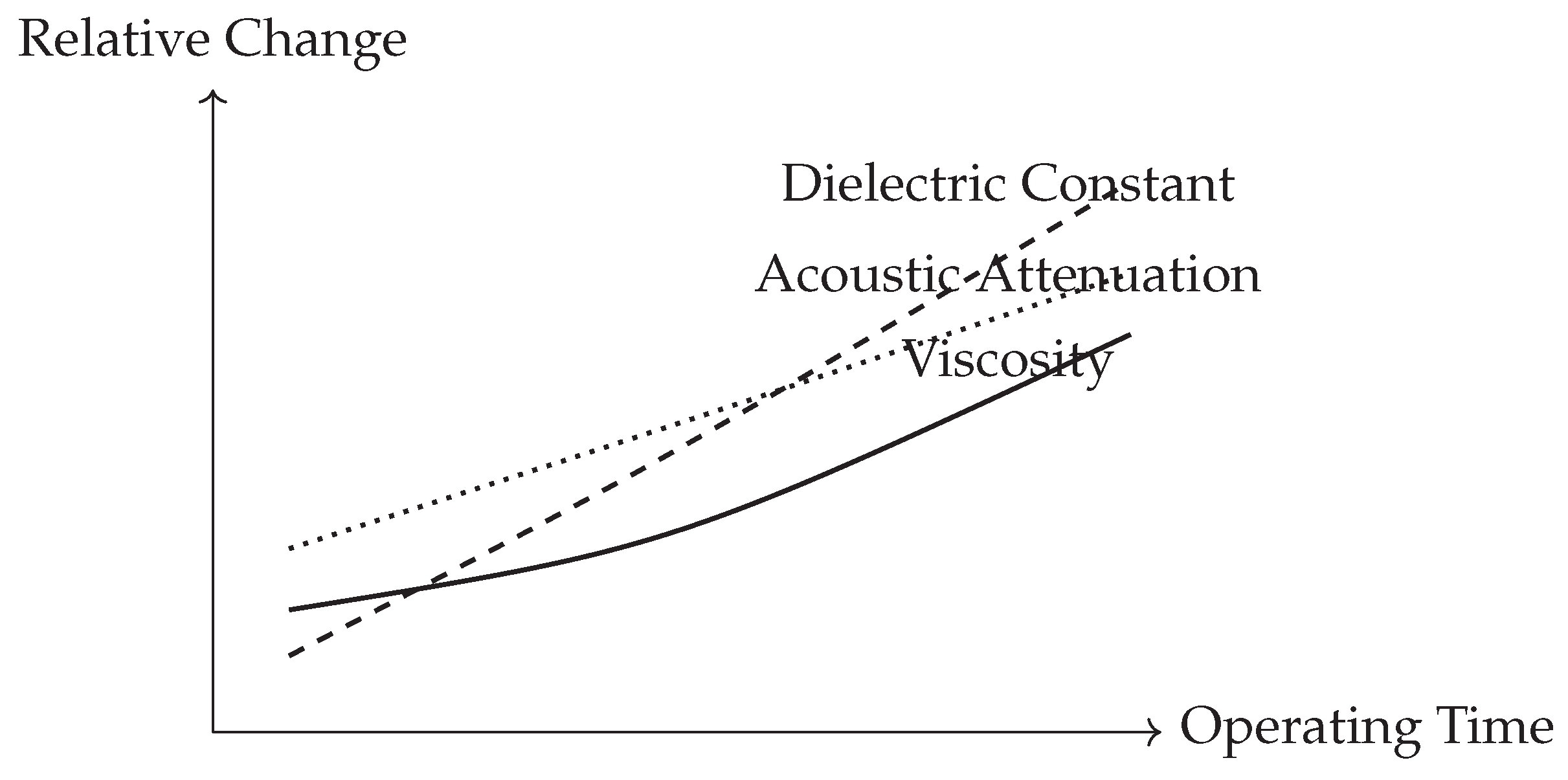
Figure 2.
Unified architecture of a microcontroller-based real-time engine oil quality monitoring system, integrating multisensor acquisition, embedded signal processing, sensor fusion, and AI-based oil health estimation, synthesized from reported oil condition monitoring frameworks [18,19].
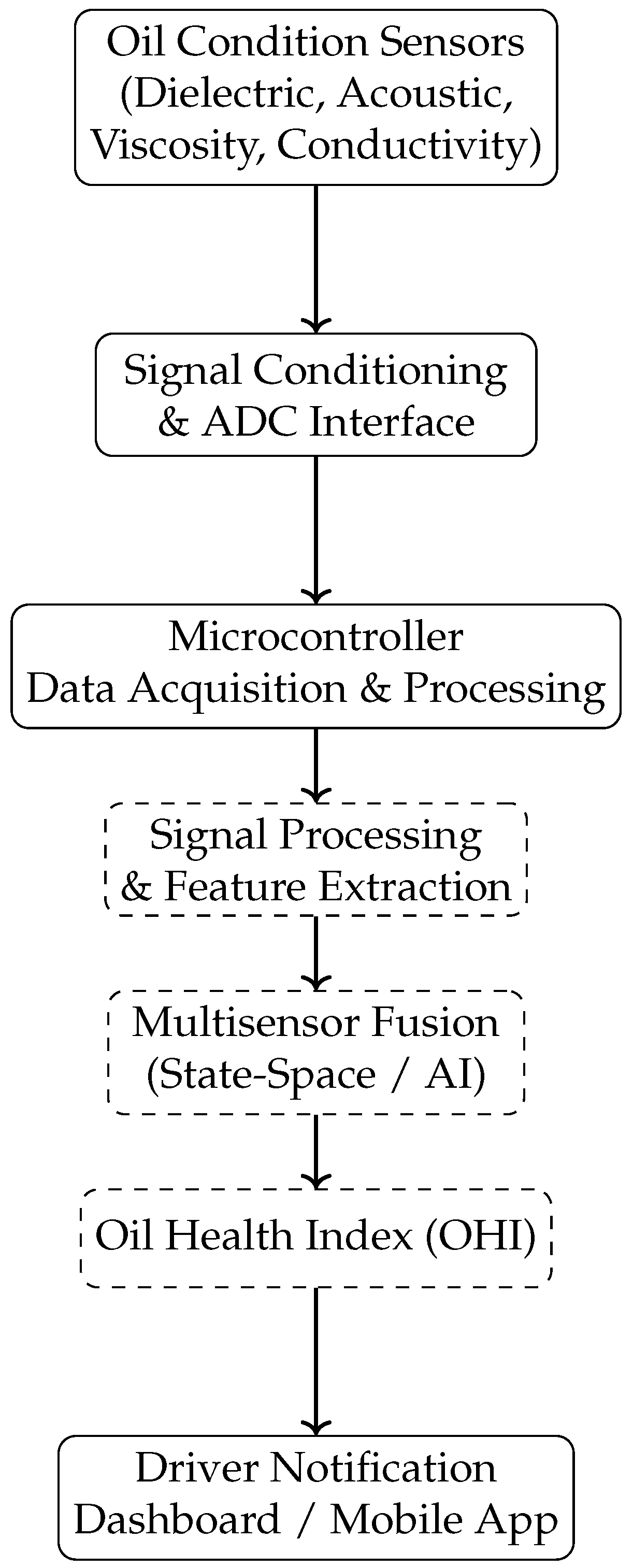
Figure 3.
Illustration of different dashboard-based service indication approaches used in modern vehicles, including conventional mileage-based reminders and indirect oil condition estimation displays.
Figure 3.
Illustration of different dashboard-based service indication approaches used in modern vehicles, including conventional mileage-based reminders and indirect oil condition estimation displays.
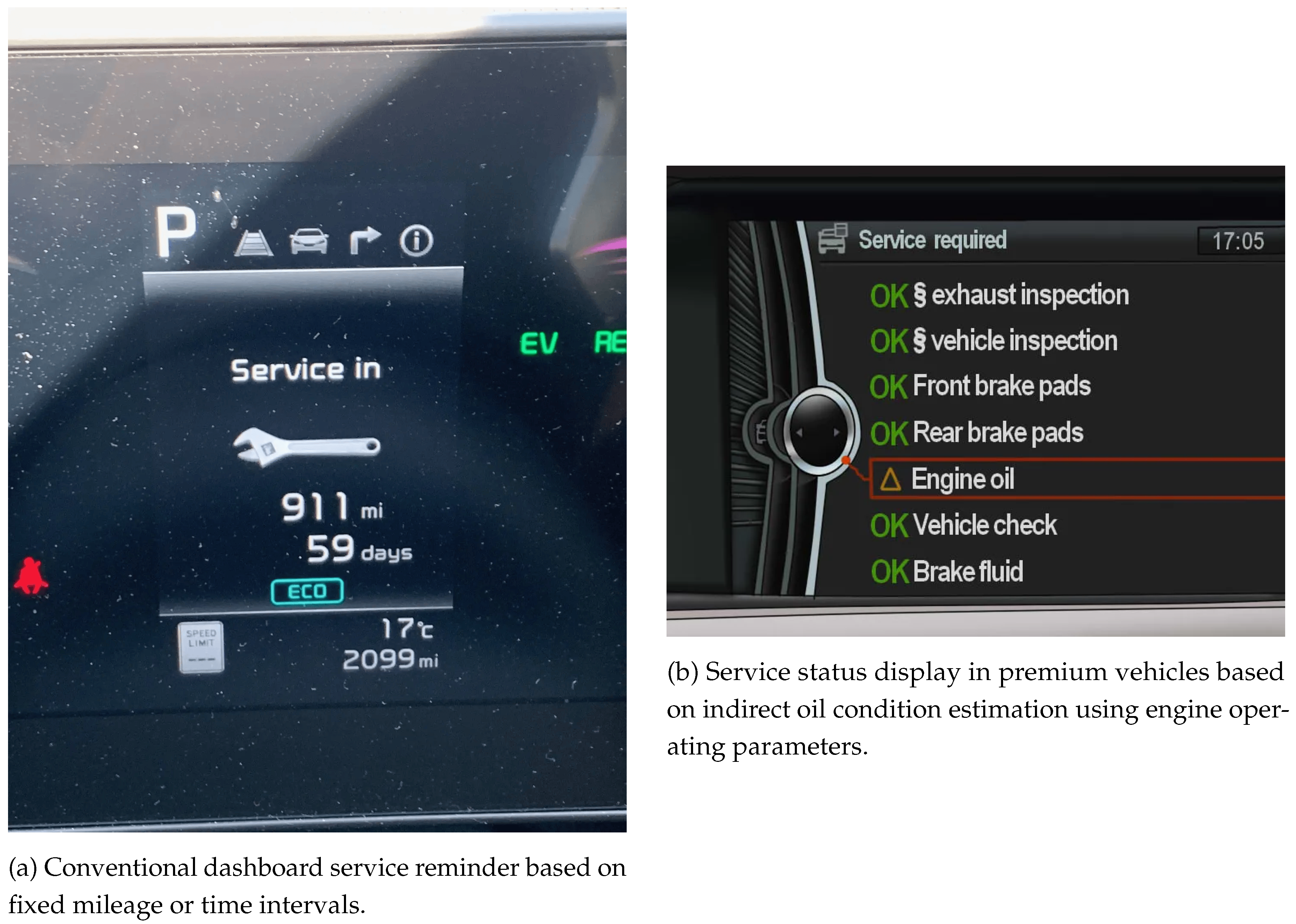
Figure 4.
Conceptual illustration of oil degradation under different operating severity conditions.
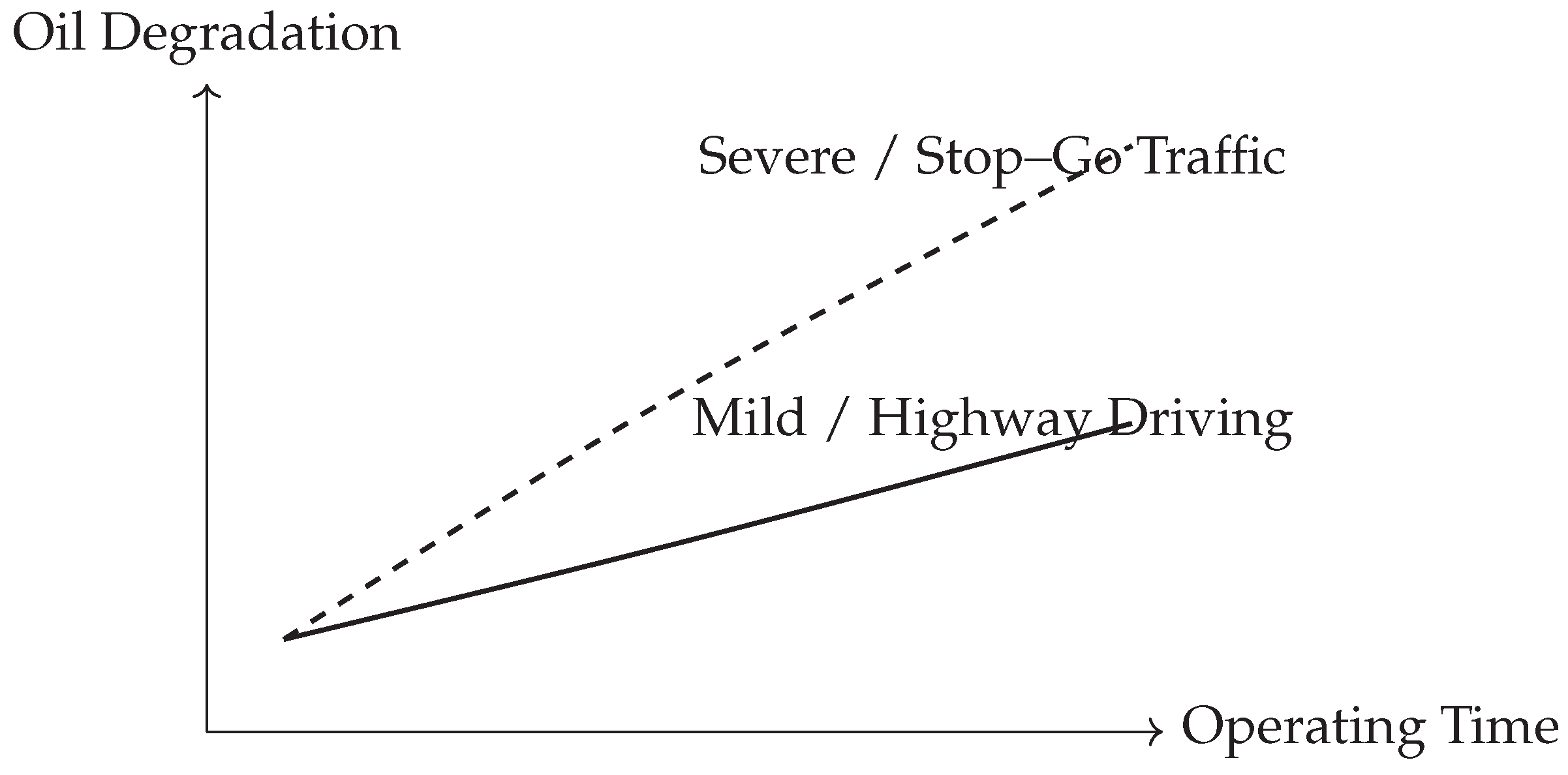

Table 1.
Concise comparison between traditional and condition-based oil monitoring approaches.
| Aspect | Traditional Mileage-Based Service | Condition-Based Monitoring |
|---|---|---|
| Service Criterion | Fixed distance or time interval | Real-time oil condition assessment |
| Oil Quality Awareness | No direct oil quality measurement | Direct sensing of oil degradation indicators |
| Driving Condition Sensitivity | Ignores traffic, idling, and load variations | Adapts to actual operating conditions |
| Maintenance Accuracy | Prone to premature or delayed servicing | Enables timely and accurate servicing |
| Maintenance Strategy | Reactive and schedule-based | Predictive and data-driven |
Disclaimer/Publisher’s Note: The statements, opinions and data contained in all publications are solely those of the individual author(s) and contributor(s) and not of MDPI and/or the editor(s). MDPI and/or the editor(s) disclaim responsibility for any injury to people or property resulting from any ideas, methods, instructions or products referred to in the content. |
© 2026 by the authors. Licensee MDPI, Basel, Switzerland. This article is an open access article distributed under the terms and conditions of the Creative Commons Attribution (CC BY) license.
Copyright: This open access article is published under a Creative Commons CC BY 4.0 license, which permit the free download, distribution, and reuse, provided that the author and preprint are cited in any reuse.


