

Submitted:
08 January 2026
Posted:
09 January 2026
You are already at the latest version
Abstract
This article presents a computational model for transmission and generation expansion planning that incorporates the effects of a new booster inter-area Virtual Transmission lines model, achieved through investments in energy storage systems within the transmission network areas. This approach enables the evaluation of potential reductions and deferrals in transmission line investments, including those involving inter-area trunk lines. Furthermore, the model captures flexibility from TSO-DSO interconnections to examine their influence on overall system expansion choices. A review of state-of-the-art flexibility indicators supports the selection of a metric that effectively quantifies resources for mitigating short-term operational variabilities; this metric is integrated into the model's unit commitment module, incorporating generator ramping and flexibility constraints. Flexibility is supplied to the AC transmission network via connected distribution systems at transmission nodes, with required flexibility levels derived from expansion planning performed by the associated DSOs. The model's core objective is to minimize total system costs, encompassing operations, investments in transmission and generation, and flexibility provisions. To handle uncertainties in demand and variable renewable energy generation, a data-driven distributionally robust optimization (DDDRO) method is employed. The framework utilizes a two-level architecture based on the column-and-constraint generation algorithm and duality-free decomposition, augmented by a third level to embed unit commitment and generator ramping constraints. Validation through case studies on the IEEE RTS-GMLC network illustrates the model's efficacy, highlighting the benefits of the proposed contributions in achieving cost savings, enhanced transmission and generation efficiency, and flexibility metrics.
Keywords:
expansion planning
; energy storage system
; virtual transmission line
; data-driven distributionally robust optimization
; unit commitment
; ramping constraints
; flexibility
1. Introduction
1.1. Background
In recent years, the increasing integration of renewable energy sources, evolving market structures, and heightened concerns over environmental impacts have significantly transformed the landscape of power system planning. The challenge of expanding transmission and generation infrastructure to accommodate these changes while maintaining reliability, efficiency, and economic viability has become more complex and urgent. Building on the foundational work presented in our previous publication [1], which proposed a comprehensive long-term expansion model accounting for storage and renewable integration, this article seeks to address the challenges related to operational flexibility and short-term variability, thereby enhancing the robustness of the planning framework for modern power systems.
Grid boosters, also known as Virtual Transmission Lines (VTLs), use large-scale battery energy storage systems (BESS) placed strategically in the grid to increase the capacity and stability of existing power lines, especially for integrating renewables. Instead of building costly new physical lines, these batteries quickly inject or absorb power (real and reactive) to manage congestion, allowing lines to run near full capacity safely, thereby boosting renewable energy transport from areas like northern Germany to industrial centers [2,3,4].
This second article advances the original expansion planning model by incorporating an additional level of analysis to capture the system’s short-term operational constraints to ensuring system flexibility and feasibility. Building upon the initial framework, which focused on long-term transmission and generation expansion considering a new “Booster and Stacker Inter-Area Virtual Transmission (BSIAVT)” concept, battery energy storage and variable renewable energy integration, the extended model introduces a new third, higher-resolution layer that explicitly accounts for unit commitment and generator ramping constraints. This new level addresses the short-term variability of intermittent renewable resources and the operational flexibility required for reliable system management.
The proposed BSIAVT concept is an innovative method in power systems that uses large-scale Battery Energy Storage Systems (BESS) to increase the effective and profitable power transfer capacity of existing inter-area transmission lines. The term "Stacker” refers to value stacking, where the BESS provides multiple services—such as the above congestion relief, frequency response, and ancillary services—to maximize its economic return and contribution to grid flexibility. The term “Booster refers to increasing transmission capacity, it reduces bottlenecks, thereby decreasing the need for expensive redispatch and the curtailment of cheap, renewable energy. The "Grid Booster" concept based projects are currently being implemented by TSOs in Germany and is a form of Storage-as-Transmission Asset (SATA).
Both BSIAT and system’s short-term operational constraints via unit commitment are critically important across both the Operation (short-term) and Expansion Planning (long-term) horizons of modern power systems, particularly those integrating high levels of renewable energy. Their importance stems from their ability to manage system flexibility, mitigate the risk of grid congestion, and optimize overall system costs.
The short-term operational model is integrated with the original planning framework through a soft-link methodology, enabling a cohesive decision-making process that considers both long-term investment strategies and short-term operational realities. By enhancing the model’s temporal resolution and operational detail, this evolution aims to provide more accurate insights into the system’s behavior under high renewable penetration and variability, supporting more robust and efficient expansion planning in modern power systems.
1.2. Literature Review
The operation, planning, business model and regulatory aspects of an electrical system that has a significant presence of generation units with stochastic behavior, such as some renewable sources, are greatly impacted when compared to that used in a system that uses generation that has fully deterministic behavior and is dispatchable [5].
Planning the capacity expansion of transmission and generation systems is an optimization problem, which needs to have a long-term view, usually analyzed in stages or stages over the proposed time horizon. Bibliographic reviews on the subject can be obtained at [6,7,8].
In the context of electrical power systems, long-term expansion planning for transmission and generation infrastructure plays a pivotal role in ensuring operational reliability and efficiency. This planning horizon, often spanning years or decades, anticipates future demand growth, technological advancements, and policy shifts, such as the integration of variable renewable energy (VRE) sources like wind and solar. By strategically expanding generation capacity and transmission networks, long-term planning can provide the resources, such as diverse generator, storage capacity, and grid interconnections, that enable daily operations to commit sufficient units effectively. Without adequate long-term provisions, short-term unit commitment (UC) processes could face resource shortages, leading to increased costs, reliability risks, or curtailed renewables, as highlighted in studies on generation expansion planning (GEP) models that incorporate UC constraints for realistic feasibility assessments [9,10,11].
The article [12] highlights that traditional energy-based UC formulations used in GEP intrinsically overestimate flexibility and may lead to unfeasible ramping constraints. It proposes a novel power-based UC model which precisely models flexibility capabilities and real-time flexibility requirements, including detailed ramping constraints, operating reserves, minimum up/down times, and network constraints.
The research [13] presents a generation expansion model that addresses the conflict between the temporal variability of variable renewables and limited system flexibility at the planning stage. The model determines investment decisions and full-year, hourly power balances in a single optimization framework. The formulation incorporates flexibility constraints, including ramping, and reserve.
The efficiency of electric power systems needs to be intrinsically tied to long-term energy system transmission expansion and generation expansion planning models, which are crucial for analyzing system transition roadmap and optimizing investments in resources like flexible generators, intermittent renewable energy sources, transmission capacity, and storage resources. Traditionally, GTEP models often neglected detailed operational constraints typically reserved for UC models due to computational limitations. However, it is critical that the long-term planned expansion provides the necessary flexible resources because neglecting operational constraints in planning models risks generating infeasible or suboptimal investment solutions, leading to outcomes such as reserve shortages and load, or generation shedding, in daily operation. Consequently, incorporating operational flexibility details ensures that daily UC has sufficient available resources to commit [14,15].
The Unit Commitment (UC) problem, central to power system operations, has been fundamentally challenged by the large-scale integration of VRE, demanding advancements in modeling operational flexibility, particularly regarding generator ramping capabilities and volatile net demand.
The presence of intermittent and uncertain VRE, requires power systems to become more flexible to accommodate the resulting variability and uncertainty in power outputs. This continuous uncertainty, originating from both renewable energy and demands, has driven the development of Stochastic Unit Commitment (SUC) models, which are viewed as promising tools. SUC typically utilizes advanced techniques like two-stage stochastic programming or robust optimization to handle predictable uncertainties, allowing for better integration of renewable energy and non-generation resources.
The research [16] examines the importance of incorporating operational scenarios representing short-term stochasticity into long-term generation expansion models due to the high shares of VRE.
The increasing variability and unpredictability of VRE intensify the growth of variability and uncertainty in the system net demand (actual demand minus total renewable generation). Deviations from forecasted renewable outputs compel conventional flexible generators and storage resources to ramp up/down quickly to maintain power balance.
Generator ramping constraints (which govern ramp-up and ramp-down limits, are critical technical constraints in UC models. These constraints dictate how fast thermal units can adjust their power output. Ignoring these details in planning models can lead to suboptimal or infeasible investment solutions and an underestimation of operational costs. Ramping constraints must also respect specific limits when a generator is starting up or shutting down.
The research [17], investigates modeling choices, showing that omitting ramps and reserves, degrades solutions significantly but reduces computation time; however, linear relaxations yield minor quality loss, especially when minimizing curtailment in VRE intensive scenarios.
GEP and GTEP models can be static or dynamic. Static expansion planning models typically focus on determining the optimal investment mix for a single target year or period of time. In contrast, dynamic or multi-period Expansion Planning models divide the overall time horizon into multiple periods to evaluate system expansion sequentially. Dynamic models consider several investment horizons in a dynamic manner, allowing for the co-optimization of investments across these various time periods.
The research presented in [18], using a DC power flow model, proposes a static GTEP, considering VRE uncertainties, UC constraints, flexibility, and reserves.
The article [19] proposes a GEP model, using a soft-linking methodology to consider UC constraints to support a short-term hydro thermal model to schedule generation.
A proposal of a flexibility-oriented robust TEP model that incorporates UC constraints, modelling short-term flexibility requirements is presented in [20]. The model includes constraints pertaining to minimum up-time and down-time requirements, minimum production outputs, ramping limits, and start-up/shut-down costs of generator units. It is considered a static expansion planning model, that uses single set of investment decisions.
To explicitly manage this intensified ramping need caused by net demand variability, Transmission System Operators (TSOs) have introduced can count with Flexible Ramping Products (FRP) into Day-Ahead (DA) market models. FRP is distinct from traditional contingency reserves and regulation, serving as reserved ramp capability deployed continuously in Real-Time (RT) scheduling processes to address expected net demand changes between periods.
The research [21], proposes an enhanced flexible ramping product (FRP) in day-ahead scheduling, designing ramp capabilities adaptive to 15-minute net load variability and uncertainty, validated on IEEE test systems to reduce real-time imbalances. This addresses the pitfalls of ignoring intra-hour ramps, where VRE intermittency demands faster response times.
However, traditional FRP design based purely on hourly ramping requirements often fails to accommodate steep intra-hour (e.g., 15-min) net demand changes. This inadequacy, where hourly reserved ramp capabilities cannot meet the rapid dynamics of the subsequent short-term markets (such as the Fifteen-Minute Market (FMM) of CAISO), is a key concern. Consequently, enhanced FRP designs have been proposed that incorporate the impacts of 15-minute net load variability and uncertainty into the hourly DA FRP allocation. This aims to better preposition and commit ramp-responsive resources, enhancing system reliability and reducing operating costs in the shorter scheduling granularity markets. The role of Energy Storage Systems (ESS) is crucial here, as they provide a complementary approach, offering upward ramping flexibility without having to generate long-term energy, thereby mitigating the impacts of intermittent renewable energy outputs and avoiding curtailment during high VRE instability periods.
The Table 1 presents a comparison of the works with the models and solution proposals considered in this review, as well as the proposal being made in this article, considering the characteristics of the planning models.
1.3. Contributions
Considering the foundational work presented in our previous publication [1], this work proposes an extended model for planning the expansion of transmission and generation systems, taking into account Energy Storage Systems, modeled BESS and Pumped Storage Hydroelectric, deployed at transmission level implementing an extended Virtual Transmission Line concept. The model also considers a new optimization level to deal with Unit Commitment contraints.
The contributions of the paper are:
- 1.
- An extend model of Booster Inter-Area Virtual Transmission Lines is considered, in order to support this concept applied to trunks of transmission lines interconnecting areas of a transmission system, enabling the expantion planning consider storage infrastructre deploied at nodes of the two interconnected areas, and the use of revenue stacking from other services provided by this storage investments;
- 2.
- Incomporation of flexibility metrics in Transmission and Generation dynamic expansion planning;
- 3.
- Implementation of a three level GTEP model, with the levels related to a long-term, lower-resolution of time intervals, approach considering investments and operational costs, and a third level, considering unit commitment and generators ramp constraints, considering a higher-resolution of time periods.
The rest of the paper is organized as follows: Section 2 presents the problem formulation and models proposed for deterministic approach; Section 3 presents the uncertainty modeling approach; Section 4 summarizes the solution procedures; Case studies are presented in Section 5, and Section 6 concludes this paper. This document ends with the nomenclature and bibliographical references used.
2. Problem Formulation - Deterministic Model
2.1. Net Demand
In this paper, we build upon and extend the TGEP model proposed in [1], which considers two types of demand met by the transmission system. The first type of demand, whose service planning responsibility is a function of a centralized generation expansion plan that is being carried out, incorporates dispatchable and non-dispatchable generation, both existing and candidates for installation upon investment considered in the plan costs. The second type of demand, which shares the use of the same transmission system, is served by Virtual Power Plants (VPPs) contracted by consumers, who provide both dispatchable and non-dispatchable generation as needed. The amount of this second type of demand must be compatible with the amount of generation provided by those VPPs.
As proposed in [1], demands are modeled using the load duration curve, which illustrates the relationship between the cumulative load and the percentage of time during which that load occurs. The planning model employs the demand for a given time interval, divided into stages that correspond to load block curves, breaking down the expected load levels into discrete time blocks. Each time block within a forecasted load demand block is termed a stage. Furthermore, the concept of demand is extended to net demand, defined as the electricity demand minus the contribution from VRE injection.
2.2. Flexibility Metrics and Models
Considering [49], power system flexibility is the ability of a power system to deal with the variability and uncertainty that VRE generation introduces into the system. Flexibility can be addressed for short- and long-term operations planning issues and targets system security issues as well as avoiding curtailment of VRE generation and reliably supplying all required energy to customers.
Considering metrics for evaluating the flexibility of an energy system, there are multiple proposals, with different calculation complexities and computational resource requirements [50].
Some proposals of flexibility metrics deal with time series to deterministically evaluate the flexibility needs of an energy system, such as [11,51], which allows obtaining indicators of how flexible a system is when subjected to a given situation.
In [52], scenarios for future net demand are considered. Net demand ramps are chosen as a measure of the flexibility requirements of power systems since every change in net demand has to be balanced by flexible resources such as dispatchable power plants, storage or responsive loads in order to maintain system stability. It is presented an analysis of time series of load, wind, PV and the resulting net demand in scenarios from Europe that allow to quantify flexibility requirements in future power systems with high shares of VRE. The analysis focused on deterministic flexibility needs at the temporal scale.
In [52], it is showed that increasing wind and solar power generation above a 30 % share in annual electricity consumption will dramatically increase flexibility requirements. Especially, large PV contributions of more than 20-30 % in the wind/PV mix will foster this trend. In scenarios about future net demand, it is found that the penetration level of wind and PV as well as their mix affect most European countries based on the study.
The aproach in [53] uses a long-term JRC EU TIMES model of the European power and district heat sectors towards 2050 to explore how stochastic modelling of short-term solar and wind variability as well as different temporal resolutions influence the model performance. The main focus is on the impact of time-step granularity of the stochastic market modeling approach. This work evaluates and demonstrates different modelling approaches on how to represent the short-term variability of solar and wind generation in a long-term TIMES energy model of the European power and district heating systems. The choice of temporal resolution is the main focus of this work.
The assessment conducted in [54] deals with the impact on system inertia during high penetrations of wind power to a power system.
From the TSO’s viewpoint in electricity sector interactions involving TSOs, DSOs, and VPPs, upward and downward flexibility describe the capacity of DSOs and VPPs to modify their power demand based on TSO signals [55].
As proposed in [1], from the TSO perspective, upward flexibility involves DSOs and VPPs reducing electricity demand or boosting distributed generation injection amid supply shortages in the transmission network. These shortages may stem from VRE sources like wind or solar, generator failures, or other issues. By curbing demand during such periods, DSOs and VPPs aid in grid balancing and stability. This paper models upward flexibility through demand reduction and VPP injections, without relying on increased dispatchable generation. Conversely, downward flexibility entails DSOs and VPPs increasing demand or cutting distributed generation injection during supply surpluses, often from low overall demand or VRE overproduction. This helps preserve grid stability while avoiding curtailments and congestion. The model here represents downward flexibility via demand increases, sidestepping curtailment of renewables and non-dispatchable sources.
The ramp up surplus, also known as Flexible Ramp Up Surplus (FRUS), is a flexibility metric in electrical power systems that represents the excess upward ramping capability provided by a generator beyond the required forecasted net load movement and uncertainty needs in a given time period. Similarly, the ramp down surplus, or Flexible Ramp Down Surplus (FRDS), quantifies the excess downward ramping capability (expressed as a non-positive value). These metrics are part of frameworks like CAISO’s Flexible Ramping Product (FRP), where they are calculated as the difference between the total flexible ramping award to the generator and the upward/downward forecasted movement requirement [56,57].
The Minimum Inertia is a flexibility metric in electrical power systems that defines the lowest required threshold of total system rotational kinetic energy to maintain frequency stability, limit the Rate of Change of Frequency (RoCoF), and ensure resilience against disturbances in low-inertia grids with high renewable penetration. It considers necessary inertia by establishing a operational constraint that mandates sufficient synchronous or synthetic inertia to prevent excessive frequency deviations [58].
Table 2 summarizes the flexibility metrics that are considered in the proposed planning model.
2.3. Virtual Transmission Lines
The concept of Virtual Transmission Lines (VTLs) was modeled in [1]. In that propoal, VTL is used to defer the expansion of transmission lines by providing additional flexibility and control over the flow of electricity in the transmission system. A storage capacity is deployed at each side of a transmission line and energy is transmited and stored during low line demand stages and not transmited and discharged during high line demand stages. ESS used in this way, can better utilize an existing transmission infrastructure and reduce or defer the need for new ou expansion of transmission lines. In this work, the storage model proposed in [1] is extended, considering the possibility of parameterizing Battery Energy Storage System (BESS), reversible or pumped hydroelectric power plants (PSPP) and demand response.
2.3.1. Virtual Transmission Lines - Revenue Stacking
Despite favorable trends in the CAPEX and OPEX of ESS infrastructure, the implementation of VTL underutilizes dedicated BESS and PHES, as it only leverages the ESS and PHES during periods of low and high demand on the transmission line [59,60,61].
Revenue stacking can be a necessary strategy in the energy sector, particularly for energy storage systems (ESS) and associated technologies like Virtual Transmission line (VTL). It considers the practice of combining multiple revenue sources from a single asset by delivering various grid services simultaneously within a given timeframe. This approach maximizes the economic viability of storage investments, which often face high upfront costs and require diversified income to achieve profitability. In the context of VTL, revenue stacking can be essential because these systems may only be utilized intermittently for congestion management, leaving capacity available for other services. Without stacking, single-service operations can lead to underutilization, making projects financially unfeasible in competitive markets.
Considering this, the model of VTL proposed in [1] is extend to a broader model, where storage units can be located, not only at transmission lines connected nodes, but also at any node. With this kind of model, a storage unit investment, can provide services to form a VTL, and also, other ancillary services and energy arbitrage via wholesale markets, enabling revenue stacking for the storage infrastructure [62].
In Figure 1 a diagram is presented where the operation of an VTL can be illustrated, with the aim of describing the VTL extended model used in this work.
In large-scale power systems, the grid is often divided into distinct Areas. An Area is a geographic and operational subdivision of the whole power system. Each area can be operated by a specific operator, or areas and the whole system can be operated by a single TSO. The concept comes from the need to manage and operate huge interconnected grids efficiently. Transmission trunks, bundles of transmission lines linking these areas, form the backbone for inter-area power flows, effectively treating the grid as a collection areas connected by these trunks.
Due to growing demand, and VRE integration, transmission trunks can face congestion, since the distribution of regional growth among regions may, and often does, not keep pace with the distribution of regional growth in VRE use.
In the nodes of each area interconnected by a trunk, a VTL concept can be considered. In Figure 1, considering Area 1, a number of k BESS and l PHES are planned, and considering Area 2, a number of m BESS and n PHES are planned. The VTL concept can be implemented in trunc
Each group of BESS and PHES units operates ether in charging or discharging status, when providing VTL services. In the example, in the Figure 2, the charge status of Area 1 storage units is indicated as A.1 and the discharge status as A.2, while the charge status of Area 2 storage units is indicated as B.1 and the discharge status as B.2.
The charging or discharging status of each Area’s storage units is controlled based on two indicators, the net demand stage (concept defined in [1]), and the direction of power flow occurring on the transmission lines between Areas.
To describe the four possible situations that a group of storage units can be in, depending on the net demand level and power flow in the transmission lines, Table 3 presents the charging or discharging status of this unit for each situation.
2.4. Virtual Power Plants
Virtual Power Plants (VPPs) are defined as aggregated groups of Distributed Energy Resources (DERs), represented as generators, ESSs and demands, located in multiple transmission network nodes, each one with variable power output divided in stages with similar concept described in Section 2.1. In this article, the same model proposed in [1] is adopted.
2.5. Unit Commitment - Operational Flexibility Assessments
To enhance the robustness of long-term generation expansion plan by incorporating operational flexibility assessments, a unit commitment based module is integrated into the planning model, in order to evaluate the adequacy of a candidate expansion plan against key flexibility metrics, ensuring that the system can handle projected variability in net demand without excessive curtailment or flexibility deficits.
This unit commiment based module operates as a post-optimization validation step within the GTEP. After generating a candidate long-term expansion plan that defines new capacity additions over a multi-year horizon, the module simulates the plan’s performance under operational conditions.
The planner specifies a set of representative future daily net demand time series, selected to capture diverse scenarios such as high and low renewable penetration, seasonal variations, or forecast uncertainties. These time series can be derived from historical data or probabilistic forecasts with higher resolution to reflect real-time variability.
The candidate expansion plan is subjected to multiple unit commitment (UC) simulations. For each selected net demand time series, with its relative weighting considerede, flexibility metrics of the candidate GTEP are evaluated. The evaluated metrics are:
- 1.
- Average and maximum curtailment levels;
- 2.
- Average Ramp Up Surplus. The mean excess upward ramping capability (MW/h) beyond required net load ramps;
- 3.
- Average Ramp Down Surplus. The mean excess downward ramping capability (MW/h), to absorb drops in net load.
2.6. Objective Function - Investment and Operation
The TGEP problem aims to minimize the total cost of investment and operation along the planning horizon. Considering the deterministic optimization, the objective function of the first implementation model is presented in (1). The objective function should minimize the investment cost of the expansion plan and the operating cost, considering the whole planning horizon, computing investment and operational cost to present value.
Where is the investment cost, is the operational and generation cost, is the load curtailment cost, is the VRE curtailment cost and is the cost associated to unit commitment assessment evaluation of the expansion plan.
To make investment projects with different useful life values comparable to each other, their useful life is extended to infinity, and the present value of the infinite series of installments is determined. This results in the sum of several installments, one in each period of time, brought to present value at a previously defined discount rate. The perpetuity financial model procedure used is based in [63].
Investment cost , is detailed in (2). It is related to investment in new line circuits, dispatchable and non-dispatchable generation, and ESS units.
Operational cost , is detailed in (3). It is related to power provided by dispatchable generation, reserve generation (VPP), ESSs and related to congestion of transmission lines.
Load curtailment cost , is detailed in (4). It is related to situations of shortage of power or energy supply.
VRE curtailment cost , is detailed in (5). It is related to situations of shortage of demand or insufficient transmission capacity.
Unit Commitment cost , is detailed in (6). It is related to higher time resolution assessment done to consider flexibility metrics related to ramp capabilities.
Stand-by costs:
where is the stand-by cost per hour, is the binary status variable (1 if online).
Start-up costs:
where is the fixed cost per start-up event, and is the binary start-up variable (1 if starting at t).
Shut-down costs:
where is the fixed cost per shut-down event, and is the binary shut-down variable (1 if shutting down at t).
Demand Curtailment costs:
Start-up costs:
where Variable cost of UC load curtailment at node b, and is the active power of UC curtailed demand, bus b, time period t.
2.7. Energy Storage System Constraints
These constraints are intended to guarantee the electrical characteristics of a battery energy storage power and energy limits.
2.8. Virtual Transmission Line constraints
These constraints are intended to ensure coordination of energy storage systems to implement VTL functionality. The constraints related to ESS are modeled according to the model proposed in [64]
2.9. Flexibility Constraints
These constraints are intended to guarantee the availability of energy supply and consumption services, within the limits contracted as flexibility.
2.10. Unit Commitment Constraints
Status Variables
For committable generators, a binary status variable is defined:
where indicates the unit is running in period t.
The power output is bounded by the status and per-unit limits
are min/max per-unit limits, and is nominal capacity.
Minimum Up-Time and Down-Time
Start-Up and Shut-Down Transition Variables
Binary variables for transitions:
Linked to status changes:
Ramping Constraints
For Non-Committable Units
For Committable Units
2.11. Soft-Linking
Soft-linking refers to a decomposition approach where the subproblems are linked via relaxation or penalties applied to linking variables, rather than strict equality constraints. Subproblems can be solved independently with some control over consistency through iterative adjustments. The subproblems’ linking variables are not enforced to exactly match but are guided towards consistency via penalty functions or Lagrangian multipliers.
Suppose we have two regions, each making investment and operational decisions, and they are connected via an interconnection with capacity ( z ). The goal is to coordinate their investments, but instead of hard linking ( z ) (forcing both regions to have exactly the same value), we use soft-linking with a penalty.
2.12. Inherited Model Components from Prior Work
This section outlines the foundational elements of the expansion planning model that have been retained from our prior work in [1]. These inherited components, including key variables, constraints, and assumptions, form the core framework upon which the proposed extensions are built. For comprehensive details on their formulation and rationale, readers are referred to the original publication, as they remain unmodified in the current model to ensure consistency and comparability.
The inherited components are the following constraints: Power balance, Demand Response, Reference bar and voltage, Transmission line circuits, Virtual power plants and Power limit constraints.
3. Problem Formulation - Modeling Uncertainties
The uncertainty modeling in this extended expansion planning framework is inherited from our prior work [1], employing the Data-Driven Distributionally Robust Optimization (DDDRO) method to identify the worst-case probability distribution across a range of ambiguities, thereby integrating elements of Stochastic Programming (SP) and Robust Optimization (RO) [32]. This approach leverages historical data to generate various scenarios, assigning worst-case probabilities supported by a moment-based ambiguity set to define the probability distribution. It formulates a two-stage robust optimization problem to ascertain the maximum cost within an uncertainty set; however, as scenario numbers increase and nonlinearity emerges, computational complexity escalates, which is mitigated through a Duality-Free Decomposition method that converts the bi-level (max-min) problem into two independent subproblems [66,67]. For a comprehensive exposition of the formulation, rationale, and implementation details, readers are directed to the original publication, as these aspects remain unaltered to maintain consistency with the foundational model.
4. Solution Procedure
4.1. Deterministic Procedure
TGEP problems are considered computationally heavy to solve. These planning problems involve a large number of integer and continuous variables and constraints, especially when considering long-term planning horizons and multiple scenarios or uncertainties. The complexity increases with the size of the power system, the number of potential new generation units, and the possible expansion options for the transmission network. Solving large mixed-integer linear or nonlinear optimization problems requires sophisticated numerical algorithms and optimization techniques. As the size of the problem grows, the search space becomes larger, and it becomes more challenging to find the optimal solution within a reasonable time frame.
One approach to deal with this complexity is distributed optimization. ADMM is proposed in [68,69], and the ability to achieve a converged solution depends on the penalty parameter tuning. Another approach is the use of decomposition, and the main methods that have been used are Benders [70] and Constraint and Column Generation (CCG), and it is considered to converge faster then Benders decomposition [71,72].
The decision variables of vector y of (44) are the binary variables referring to investments in transmission lines, storage, generation units and Virtual Transmission lines. These are the first-stage variables of CCG decomposition. Vector c of (47) defines the investment costs.
The decision variables of vector of (42) are the recourse decision variables of second-stage of CCG decomposition, related to operating conditions of the planned power system at each stage. These second-stage variables represent the CCG columns that are created at each solution procedure step.
Solution Procedure algorithm (CCG):
- 1.
- Set , , k=0 and
- 2.
-
Solve the following Master Problem:s.t.Solution:
- 3.
- Update
- 4.
- Solve the following Slave Problem:s.t.
- 5.
- Update [ ]
- 6.
- If return and finish
- 7.
- Create variables
- 8.
- Add the following constraints to Master Problem:
- 9.
- Update k = k + 1 and Go to Step 2
Figure 3 presents a detailed flowchart outlining the computational optimization procedure used to develop the proposed expansion plan. This systematic process is broken down into key activities, each enclosed in boxes labeled from M01 to M09, facilitating clear reference and understanding. These steps are integral to the overall methodology, ensuring a structured and efficient approach to achieving the specified expansion plan.
Activities M01 to M03 are related to the input processes of all model configuration parameters and data related to the networks whose expansion plan will be determined.
Activities M04 to M06 are related to the generation of all time series that will be provided as input for the optimization activities. The generation of load duration curves, clustering, scenario generation, described in Section 5.1 are done in these activities.
Activity M07 is related to a linear integer programming optimization where binary variables related to investments are determined.
Activity M08 is related to a linear programming optimization where operation optimization variables, considering uncertainty scenarios is processed. These activities are presented in more detail in Section 4.2.
Activity M10, M11 and M12 are related to an assessment of the explansion plan generated by M08, in order submit it to unit commitment constraints using a hier resolution of time to evaluate flexibility metrics related to net demand ramps. These activities are presented in more detail in Section 2.5.
4.2. Procedure Considering Uncertainties
In order to consider uncertainties related to net demand and candidate VRE, module M08 of Figure 3 is decomposed in two problems. An upper level determines the maximum cost within an uncertainty set. The lower level, minimizes the operational costs of each scenario corresponding to an uncertainty set.
Historical data are be converted into data bins, where an estimated probability distribution function (E-PDF) is established from the data bins, which allows the definition of the true probability distribution function (T-PDF) within a tolerance range.
The Duality-Free Decomposition method is used to convert the bi-level (max-min) problem into two independent subproblems [66,67]. For a comprehensive exposition of the implementation details, readers are directed to the original publication [1], as these aspects remain unaltered to maintain consistency with the foundational model.
5. Case Study
This section considers a case study with six scenarios to validate the proposed model to optimize the Transmission and Generation Expansion Planning process, considering Virtual Transmission Lines, Virtual Power Plants, Distributed Energy Injection, and Demand Response Flexibility. The implementation was programmed in Python 3.11.0, using Spyder 5.4.3, Pyomo 6.5.0 and Gurobi 10. All processing were done unsing an Apple Studio M1 64 GB. The data for historical demand and VRE generation were obtained from [74], considering the period from 01/2015 - 12/2023 related to Spain, converted to p.u. in order to be used in Section 5.3. Files with data relating to investment, operating costs and demands used in this research can be obtained at [75].
For the case study, information from one transmission network with data and expansion planning results that can be found in the literature was used. The IEEE RTS-GMLC [76], was chosen to play the role of a medium/large system, where scalability and feasibility issues could be validated.
Initially, the model proposed in this article was used in one scenario, 5.3.1, considered base case, for contrast or comparison with existing models used in the literature that is reviewed. This case considers an expansion plan using models in common with the compared proposals, such as transmission lines, generators and loads. The scenario uses the IEEE RTS-GMLC test system with results found in the literature in references [76].
5.1. Cluster of Data Bins
To deal with uncertainties, it is adopted the same DDDRO method used in our previous publication [1]. Data-driven methodology can produce typical demand scenarios and related confidence uncertainty sets. Hourly historical data on VRE injection and demand power are proposed and available at [76] covering the period of one year. To use the Data Driven methodology with a greater amount of historical data, a period of nine years was considered, with fifteen-minute interval measurements, from [74], as described in Section 5. Considering the results reported in [77], the sample space was partitioned into six data bins to represent random output net demand and produce discrete probability distributions with good results. More details of this implementation can be found in [1].
5.2. Presentation of Case Study Results
Each case study’s scenarios will be presented with a summary table with the relevant investment and cost components of the minimized objective function corresponding to the optimal expansion plan established for each case, computed to present value.
For each scenario, the result of the chosen expansion plan will be shown, presenting in a table a summary of the financial values, computed to present value, of the investments and operating costs chosen to present for analysis and comparisons, this summarized view, of the chosen expansion plan.
The variables that are used in the optimization procedure form a vector of network operation variables presented in Nomenclature, vector notation.. These variables participate in operational constraints related to the electrical system, equipment specifications and resource limits. Almost all operation variables participate in the evaluation of the objective function that is minimized by the optimization procedure to choose the optimal expansion plan.
The summary presentation table has six columns with information of new circuits installed, circuit of installed VTL, total active power of dispatchable generators, total active power of non dispatchable generators, total active power provided or consumed by demand response service, total active power provided or consumed by flexibility services. The last column of the table, Cost column, present the total cost of the corresponding line of the table, computed to present value, that was considered during objective function computation of the optimal expansion plan presented by the table.
5.3. IEEE RTS-GMLC
The IEEE RTS-GMLC test system consists of 104 right-of-ways, 36 at 138kV and 68 at 230kV, and 16 power transformers. The RTS-GMLC proposes time series considering VRE injection, and demand, it considers one hour for day ahead data and fifteen minutes for real time data. The complete data of this network can be obtained from [76]. Table 4 presents a summary of IEEE RTS-GMLC parameters.
The candidates ESS considered are battery storage devices with a maximum charge and discharge rate of 50 MW, a round-trip efficiency of 85 %, and a usable energy storage capacity of up to 75 MWh.
The IEEE RTS-GMLC is a test system dataset designed for various power system analyses, including generation and transmission expansion planning studies. The dataset provides details on the existing network topology, including buses, generators, transmission lines, transformers, reserves, storage, and time series data for loads, renewables. It does not include predefined information or data on candidate transmission lines for network expansion. In expansion planning applications using RTS-GMLC, candidate lines are typically proposed and defined separately by researchers based on their specific scenarios. Considering that in the area of transmission expansion, the focus of this research is the use of VTL applied to power flow between areas, the duplication of all trunk circuits between areas was considered as a candidate investment for transmission line expansion.
For this case study, three scenarios were evaluated: Scenario S1.1, is a base scenario to support comparisons. It considers only dispatchable generation, transmission data, and demands obtained from [76]; Scenario S1.2, considering candidate VTL using actual ESS investment and operation costs obtained from [78,79] and ESS investment and operation costs based in [78]; Scenario S1.3, considers a projected increase of ramp up/down surplus flexibility metric, as a parameter provided by the planner. The model was parameterized to execute a five-year expansion plan, considering an annual linear growth rate of 4.5% for both demand and VRE.
Considering the computational effort, the processing time to obtain the solution was approximately forty minutes on average for the scenarios considered in this case. The scenarios with the largest number of integer variables to be optimized, related to lines, VTL, storage and generation candidates for installation, reached a processing time of around one hour and thirty minutes. These values obtained show that the scalability of computational effort is adequate for use in medium or large-scale problems. The IEEE RTS test system is divided into three generation dispatch areas that can be used to distribute the execution of the optimization model. Without using this resource, adequate performance was achieved.
5.3.1. IEEE RTS-GMLC - Scenario S1.1
This scenario S1 has the objective to be a base case for comparisons. It is considered IEEE RTS-GMLC network with the characteristics specified in , and summarized in Table 4. This infrastrucure, when submitted to the provided demand, provides adequate response, do not needing transmission and generation expansion. A summary, considering a week of high demand, considering data of the defined IEEE-RTS-GMLC is presented in Figure 4 and Figure 5.
Considering this initial infrastructure, a ten-year expansion plan was developed, projecting an annual demand growth of 4.5%.
With regard to transmission lines, the possibility of an additional circuit being considered for expansion to all existing circuits in the existing basic network was specified. Considering generation candidate expansion projects, Table 5 presents a summary of information used. Complete information can be obtained in [75].
Considering that this scenario was created for contrast or comparison with other models in the reviewed literature, it can be observed that the expansion plan obtained is compatible with the solutions found in [76]. A summary, considering a week of high demand, considering the ten years expansion plan defined, is presented in Figure 6 and Figure 7.
5.3.2. IEEE RTS-GMLC - Scenario S1.2
Scenario S1.2 aims to evaluate the impact of part of the installed storage capacity and candidate storage, using a coordinated operation process to apply the VTL concept in transmission line trunks that interconnect areas of a larger transmission system. For this, the trunk of lines between areas 3 and 2 presented in Section 2.3.1 was chosen. Using the base scenario considered in S1.1, a 40% increase in demand in area 2 and an equivalente increase in generation capacity instaled in area 3 were considered for S1.2. With this modification in the demand and installed generation information, expansion planning was carried out with and without the use of storage configured for VTL at the trunk of areas 3 and 2.
The results obtained show the positive impact on the quality of the expansion plan achieved through optimized investment in storage allocation in the two areas involved. It was possible to reduce investments in transmission line expansion and achieve more optimized use, which can be seen in generation expenses.
5.3.3. IEEE RTS-GMLC - Scenario S1.3
Scenario S1.3, considers a projected increase of ramp up/down surplus flexibility metric, as a parameter provided by the planner. IInitially, the expansion plan generated from the base case is used, without using the third step in which, based on the planner’s parameter, a minimum ramp-up and down surplus is defined. The results of the expansion plan obtained, without considering the minimum ramp-up and down surplus flexibility metric, are presented in Table 12.
Similarly to the results presented for the ramp-up surplus metric, the result for the ramp-down surplus metric is Average equal to 0.354 MW/h.
Different technologies and generations of power generation technologies have their own parameter ranges related to ramp-up and ramp-down flexibility indicators. Table 13 presents a summary considering the various values used in published case studies that reference the IEEE RTS-GMLC network. The ratio represents the time in hours to reach nominal power, calculated as 100 / (60 * ramp rate %/min). The values are approximated based on typical ranges for each technology. For gas, an average between OCGT (around 10-12%) and CCGT (around 4-8%) is used, but with a tendency towards OCGT at the former value. For nuclear power, the values are based on modern PWR capacities. For oil, the approximation is similar to that of flexible thermal power plants.
To validate the functionality of the model’s third level, an example target of a minimum average value of 1.5 MW/h for ramp-up or ramp-down is defined, using the initial baseline scenario. The results of the expansion plan obtained, considering the flexibility metric of the minimum ramp-up and ramp-down surplus, are presented in Table 14.
Similarly to the results presented for the ramp-up surplus metric, the result for the ramp-down surplus metric is Average equal to 1.547 MW/h.
6. Conclusions
This article has introduced an extended optimization model for transmission and generation expansion planning (GTEP) that builds upon our prior work by enhancing the Virtual Transmission Lines (VTL) framework through strategic allocation of energy storage systems (ESS) across multiple network areas. This extension enables the optimization of trunk transmission lines connecting these areas, facilitating potential postponements or reductions in expansion investments while maintaining system reliability and efficiency. Additionally, the model incorporates a third optimization level employing unit commitment (UC) procedures to achieve finer temporal resolution, thereby better accommodating ramping resources required to address the uncertainties and variabilities in net demand driven by variable renewable energy (VRE) integration.
The proposed formulation retains core elements from the original model, including a linear AC optimal power flow (AC-OPF) with reactive power considerations, flexibility provisioning from TSO-DSO interconnections via aggregated Virtual Power Plants (VPPs), and a data driven distributionally robust optimization (DDDRO) approach to handle demand and VRE uncertainties. To ensure computational tractability for medium-to-large systems, the model employs a two-level architecture based on the column-and-constraint generation (CCG) algorithm and duality-free decomposition, now augmented by the UC level for enhanced ramping and flexibility constraints. Flexibility metrics are carefully selected to quantify short-term operational resources, with required levels derived from distribution system operator (DSO) planning and supplied to the transmission network.
The extended model was validated through case studies on the IEEE RTS-GMLC test system, demonstrating its effectiveness in real-world scenarios. Results indicate significant benefits, including approximately 10% reductions in total system costs with the use of the proposed Inter-Area VTL in one trunk, encompassing operations, generation and transmission investments, and flexibility provisions. Furthermore, the approach yields enhanced transmission system utilization efficiency and improved congestion indicators, underscoring the value of localized ESS deployment and high-resolution UC in mitigating expansion needs.
Overall, this work advances the design of modern, low-carbon power systems by promoting the integration of advanced storage technologies and flexible resources, offering a robust framework for planners to balance economic, operational, and environmental objectives in an era of increasing renewable penetration. Future research could explore integrated models that couple GTEP expansion planning with other energy infrastructures, such as natural gas networks and hydrogen systems, to optimize cross-sector synergies and support broader energy transition goals.
Funding
This research received no external funding.
Data Availability Statement
The original data presented in the study are openly available in [75].
Conflicts of Interest
The authors declare no conflicts of interest.
Nomenclature
| Sets | |
| Dispatchable generation units | |
| Candidate dispatchable generation units | |
| Non-dispatchable generation units | |
| Candidate non-dispatchable generation units | |
| VPP dispatchable generation units | |
| VPP non-dispatchable generation units | |
| Battery storage units | |
| Virtual Transmission lines | |
| Virtual power plants | |
| Demand stages | |
| Candidate storage units | |
| Set of nodes in the power transmission network | |
| Set of lines in the power transmission network, | |
| Set of circuits in the power transmission network line | |
| Set of scenarios | |
| DDDRO ambiguity set | |
| Indices | |
| b | Node, |
| c | Line dircuit, |
| Candidate dispatchable generation, | |
| Candidate non-dispatchable generation, | |
| h | Battery storage unit, |
| l | Line, |
| s | Stage, |
| t | Time step, t |
| Virtual Transmission line, | |
| Virtual power plant, | |
| w | Scenario, |
| Input Data - Parameters | |
| Time horizon of the problem | |
| a | Area |
| Susceptance [p.u.] of line l | |
| Discount rate | |
| Conductance (p.u.) of line l | |
| Maximum number of circuits of line l | |
| Active power capacity of circuit c of line l | |
| Apparent power capacity of circuit c of line l | |
| Investment cost of additional line circuit at corridor l in time period t | |
| [$/circuit] | |
| Investment cost of additional dispatchable generation at node b in | |
| time period t [$/] | |
| Investment cost of additional non-dispatchable generation at node b | |
| in time period t [$/] | |
| Investment cost of battery storage h in time period t [$/] | |
| Investment cost of VTL in time period t [$/] | |
| Variable cost of existing dispatchable generation at node b in time | |
| period t [$/] | |
| Variable cost of candidate dispatchable generation at node b in time | |
| period t [$/] | |
| Variable cost of upward flexibility at node b in time period t [$/] | |
| Variable cost of downward flexibility at node b in time period t | |
| [$/] | |
| Variable cost of demand response upward flexibility at node b in time | |
| period t [$/] | |
| Variable cost of demand response downward flexibility at node b in | |
| time period t [$/] | |
| Variable cost of storage h in time period t [$/] | |
| Variable cost of P2P active power contracted at node b in time period t | |
| [$/] | |
| Variable cost of P2P active generation contracted at node b in time | |
| period t [$/] | |
| Variable cost of load curtailment at node b in time period t [$/] | |
| Variable cost of non-dispatchable generation curtailment at node b in | |
| time period t [$/] | |
| Variable cost of congestion in time period t [$/] | |
| Probability of scenario w | |
| Probability of scenario w from data | |
| Active power of demand response, bus b, time period t, demand | |
| stage s [] | |
| Reactive power of demand response, bus b, time period t, demand | |
| stage s [] | |
| Demand response available flexibility band, bus b, time period t, | |
| demand stage s [] | |
| Active power of net demand, bus b, time period t, demand stage s, | |
| scenario w [] | |
| Reactive power of net demand, bus b, time period t, demand stage s, | |
| scenario w [] | |
| Active power of candidate non-dispatchable generation units, bus b, | |
| time period t, demand stage s, scenario w [] | |
| Reactive power of candidate non-dispatchable generation units, bus | |
| b, time period t, demand stage s, scenario w [] | |
| Active power of VPP contracted in the P2P market, vpp , bus b, | |
| time period t [] | |
| Reactive power of VPP contracted in the P2P market, vpp , bus b, | |
| time period t [] | |
| Active power available as downward flexibility at bus b, time | |
| period t [] | |
| Active power available as upward flexibility at bus b, time | |
| period t [] | |
| Energy capacity of battery storage h, time period t [] | |
| Maximum power of battery storage h [] | |
| Maximum active power of existing dispatchable generation units, | |
| bus b [] | |
| Maximum reactive power of existing dispatchable generation units, | |
| bus b [] | |
| Maximum active power of VPP dispatchable generation, | |
| vpp [] | |
| Maximum reactive power of VPP dispatchable generation, | |
| vpp [] | |
| Maximum active power of VPP dispatchable generation, | |
| vpp [] | |
| Maximum reactive power of VPP dispatchable generation, | |
| vpp [] | |
| Maximum active power of candidate dispatchable generation, | |
| bus b [] | |
| Maximum reactive power of candidate dispatchable generation, | |
| bus b [] | |
| Maximum active power of upward flexibility, bus b [] | |
| Maximum active power of downward flexibility, bus b [] | |
| Reference bar for voltage angle | |
| M | Large power value [p.u.] |
| Decision Variables | |
| Active power flow of line l, time period t, demand stage s, | |
| scenario w [] | |
| Signed active power flow of origin side of line l, time period t, | |
| demand stage s, scenario w [] | |
| Signed active power flow of destination side of line l, time period t, | |
| demand stage s, scenario w [] | |
| Reactive power flow of line l, time period t, demand stage s, | |
| scenario w [] | |
| Active power of VPP demanded from reserve market, vpp , bus b, | |
| time period t, demand stage s, scenario w [] | |
| Reactive power of VPP demanded from reserve market, vpp , bus b, | |
| time period t, demand stage s, scenario w [] | |
| Active power of VPP dispatchable generation, vpp , bus b, time | |
| period t, demand stage s, scenario w [] | |
| Reactive power of VPP dispatchable generation, vpp , bus b, time | |
| period t, demand stage, scenario w s [] | |
| Active power of existing dispatchable generation units, bus b, time | |
| period t, demand stage s, scenario w [] | |
| Reactive power of existing dispatchable generation units, bus b, time | |
| period t, demand stage s, scenario w [] | |
| Active power of candidate dispatchable generation units, bus b, time | |
| period t, demand stage s, scenario w [] | |
| Reactive power of candidate dispatchable generation units, bus b, | |
| time period t, demand stage s, scenario w [] | |
| Active power of existing non-dispatchable generation units, bus b, | |
| time period t, demand stage s, scenario w [] | |
| Reactive power of existing non-dispatchable generation units, bus b, | |
| time period t, demand stage s, scenario w [] | |
| Active power of VPP non-dispatchable generation, vpp , bus b, | |
| time period t, demand stage s [] | |
| Reactive power of VPP non-dispatchable generation, vpp , bus b, | |
| time period t, demand stage s [] | |
| Active power of curtailed non-dispatchable generation units, bus b, | |
| time period t, demand stage s, scenario w [] | |
| Active power of upward flexibility, bus b, time period t, demand | |
| stage s, scenario w [] | |
| Active power of downward flexibility, bus b, time period t, demand | |
| stage s, scenario w [] | |
| Active power of procured demand response upward flexibility, bus b, | |
| time period t, demand stage s, scenario w [] | |
| Active power of procured demand response downward flexibility, | |
| bus b, time period t, demand stage s, scenario w [] | |
| Active power of curtailed demand, bus b, time period t, demand | |
| stage s, scenario w [] | |
| Storage active power discharge of storage h, time period t, demand | |
| stage s, scenario w [] | |
| Storage active power charge of storage h, time period t, demand | |
| stage s, scenario w [] | |
| Time duration of demand stage s [pu] | |
| Voltage (p.u.) at bus b at time t, demand stage s, scenario w | |
| Voltage (p.u.) at bus b at time t, demand stage s, scenario w | |
| Voltage phase angle between nodes i and j at time t, demand stage s, | |
| scenario w | |
| State-of-charge (), storage h, at time t, demand stage s, | |
| scenario w | |
| Energy available at storage device h in time period t, scenario w | |
| [] | |
| Admittance of line l - real part | |
| Admittance of line l - imaginary part | |
| Binary variable indicating if downward flexibility is considered at | |
| bus b, during demand stage s [0,1] | |
| Binary variable indicating if upward flexibility is considered at bus b, | |
| during demand stage s [0,1] | |
| Binary variable indicating the presence of a circuit c, in corridor l, | |
| time period t [0,1] | |
| Binary variable indicating the presence of storage h, time period t [0,1] | |
| Binary variable indicating the presence of VTL l, time period t [0,1] | |
| Binary variable indicating the presence of candidate dispatchable | |
| generation , bus b, time period t [0,1] | |
| Binary variable indicating the presence of candidate non-dispatchable | |
| generation , bus b, time period t [0,1] | |
| Binary variable indicating the charge/discharge status of battery | |
| storage unit h, time period t, stage s [0,1] | |
| Binary variable indicating the flow status of VTL line l from side, | |
| time period t, stage s [0,1] | |
| Binary variable indicating the flow status of VTL line l to side, time | |
| period t, stage s [0,1] | |
| Binary variable indicating the charge/discharge status of VTL Battery | |
| storage unit 1 of line l, time period t, stage s [0,1] | |
| Binary variable indicating the charge/discharge status of VTL Battery | |
| storage unit 2 of line l, time period t, stage s [0,1] | |
| Unit Commitment - Input data - Parameters | |
| Ramp up capacity of Generator | |
| Ramp down capacity of Generator | |
| ramp limit start up of Generator | |
| ramp limit shut down of Generator | |
| min per-unit limit of Generator | |
| max per-unit limit of Generator | |
| nominal capacity of Generator | |
| min time up of Generator | |
| min time down of Generator | |
| min per-unit limit of Generator | |
| max per-unit limit of Generator | |
| min nominal capacity of Generator | |
| Stand-By cost of Generator n in time period t [$/] | |
| Start-Up cost of Generator n in time period t [$/] | |
| Start-Down cost of Generator n in time period t [$/] | |
| Variable cost of UC load curtailment at node b [$/] | |
| Unit Commitment - Decision Variables | |
| Binary variable indicating if Generator is Dispatched | |
| Binary variable indicating if Generator is start up | |
| Binary variable indicating if Generator is shut down | |
| Dispatch Power of Generator | |
| Active power of UC curtailed demand, bus b, time period t | |
| Vector Notation | |
| Set of network variables: [, , , ] | |
| . | |
| Set of network variables: [ , , , , | |
| , , , , , , , , | |
| , , , , , , , , | |
| , , , , , , , ] | |
| . |
References
- Ferreira, F.A.L.; Unsihuay-Vila, C.; Núñez-Rodríguez, R.A. Transmission and Generation Expansion Planning Considering Virtual Power Lines/Plants, Distributed Energy Injection and Demand Response Flexibility from TSO-DSO Interface. Energies 2025, 18, 1602. [CrossRef]
- Lindner, M.; Peper, J.; Offermann, N.; Biele, C.; Teodosic, M.; Pohl, O.; Menne, J.; Häger, U. Operation strategies of battery energy storage systems for preventive and curative congestion management in transmission grids. IET Generation, Transmission & Distribution 2023, 17, 589–603, [https://ietresearch.onlinelibrary.wiley.com/doi/pdf/10.1049/gtd2.12739]. https://doi.org/https://doi.org/10.1049/gtd2.12739. [CrossRef]
- Agüero, M.; Peralta, J.; Quintana, E.; Velar, V.; Stepanov, A.; Ashourian, H.; Mahseredjian, J.; Cárdenas, R. Virtual Transmission Solution Based on Battery Energy Storage Systems to Boost Transmission Capacity. Journal of Modern Power Systems and Clean Energy 2024, 12, 466–474. [CrossRef]
- Wang, Q.; Li, X. Evaluation of battery energy storage system to provide virtual transmission service. Electric Power Systems Research 2025, 244, 111570. https://doi.org/https://doi.org/10.1016/j.epsr.2025.111570. [CrossRef]
- Matevosyan, J.; Huang, S.H.; Du, P.; Mago, N.; Guiyab, R. Operational Security: The Case of Texas. IEEE Power and Energy Magazine 2021, 19, 18–27. [CrossRef]
- Latorre, G.; Cruz, R.D.; Areiza, J.M.; Villegas, A. Classification of publications and models on transmission expansion planning. IEEE Transactions on Power Systems 2003, 18, 938–946. [CrossRef]
- Hemmati, R.; Hooshmand, R.; Khodabakhshian, A. Comprehensive review of generation and transmission expansion planning. IET Generation, Transmission Distribution 2013, 7, 955–964. [CrossRef]
- Mahdavi, M.; Sabillon Antunez, C.; Ajalli, M.; Romero, R. Transmission Expansion Planning: Literature Review and Classification. IEEE Systems Journal 2019, 13, 3129–3140. [CrossRef]
- Muralikrishnan, N.; Jebaraj, L.; Rajan, C.C.A. A Comprehensive Review on Evolutionary Optimization Techniques Applied for Unit Commitment Problem. IEEE Access 2020, 8, 132980–133014. [CrossRef]
- Ali, A.; Shah, A.; Keerio, M.U.; Mugheri, N.H.; Abbas, G.; Touti, E.; Hatatah, M.; Yousef, A.; Bouzguenda, M. Multi-Objective Security Constrained Unit Commitment via Hybrid Evolutionary Algorithms. IEEE Access 2024, 12, 6698–6718. [CrossRef]
- Tejada-Arango, D.A.; Morales-España, G.; Wogrin, S.; Centeno, E. Power-Based Generation Expansion Planning for Flexibility Requirements. IEEE Transactions on Power Systems 2020, 35, 2012–2023. [CrossRef]
- Palmintier, B.S.; Webster, M.D. Impact of Operational Flexibility on Electricity Generation Planning With Renewable and Carbon Targets. IEEE Transactions on Sustainable Energy 2016, 7, 672–684. [CrossRef]
- Chen, X.; Lv, J.; McElroy, M.B.; Han, X.; Nielsen, C.P.; Wen, J. Power System Capacity Expansion Under Higher Penetration of Renewables Considering Flexibility Constraints and Low Carbon Policies. IEEE Transactions on Power Systems 2018, 33, 6240–6253. [CrossRef]
- Liu, X.; Fang, X.; Gao, N.; Yuan, H.; Hoke, A.; Wu, H.; Tan, J. Frequency Nadir Constrained Unit Commitment for High Renewable Penetration Island Power Systems. IEEE Open Access Journal of Power and Energy 2024, 11, 141–153. [CrossRef]
- Chen, X.; Liu, Y.; Wu, L. Towards Improving Unit Commitment Economics: An Add-On Tailor for Renewable Energy and Reserve Predictions. IEEE Transactions on Sustainable Energy 2024, 15, 2547–2566. [CrossRef]
- Backe, S.; Ahang, M.; Tomasgard, A. Stable stochastic capacity expansion with variable renewables: Comparing moment matching and stratified scenario generation sampling. Applied Energy 2021, 302, 117538. https://doi.org/https://doi.org/10.1016/j.apenergy.2021.117538. [CrossRef]
- Wuijts, R.H.; van den Akker, M.; van den Broek, M. Effect of modelling choices in the unit commitment problem. Energy Systems 2024, 15, 1–63. [CrossRef]
- Ramos, A.; Alvarez, E.F.; Lumbreras, S. OpenTEPES: Open-source Transmission and Generation Expansion Planning. SoftwareX 2022, 18, 101070. https://doi.org/https://doi.org/10.1016/j.softx.2022.101070. [CrossRef]
- Curty, M.G.; Borges, C.L.; Saboia, C.H.; Lisboa, M.L.; Berizzi, A. A soft-linking approach to include hourly scheduling of intermittent resources into hydrothermal generation expansion planning. Renewable and Sustainable Energy Reviews 2023, 188, 113838. https://doi.org/https://doi.org/10.1016/j.rser.2023.113838. [CrossRef]
- Yin, X.; Chen, H.; Liang, Z.; Zhu, Y. A Flexibility-oriented robust transmission expansion planning approach under high renewable energy resource penetration. Applied Energy 2023, 351, 121786. https://doi.org/https://doi.org/10.1016/j.apenergy.2023.121786. [CrossRef]
- Ghaljehei, M.; Khorsand, M. Day-Ahead Operational Scheduling With Enhanced Flexible Ramping Product: Design and Analysis. IEEE Transactions on Power Systems 2022, 37, 1842–1856. [CrossRef]
- Dehghan, S.; Amjady, N.; Conejo, A.J. A Multistage Robust Transmission Expansion Planning Model Based on Mixed Binary Linear Decision Rules—Part I. IEEE Transactions on Power Systems 2018, 33, 5341–5350. [CrossRef]
- Zhang, H.; Heydt, G.T.; Vittal, V.; Quintero, J. An Improved Network Model for Transmission Expansion Planning Considering Reactive Power and Network Losses. IEEE Transactions on Power Systems 2013, 28, 3471–3479. [CrossRef]
- Ghaddar, B.; Jabr, R.A. Power transmission network expansion planning: A semidefinite programming branch-and-bound approach. European Journal of Operational Research 2019, 274, 837–844. https://doi.org/https://doi.org/10.1016/j.ejor.2018.10.035. [CrossRef]
- Mehrtash, M.; Cao, Y. A New Global Solver for Transmission Expansion Planning With AC Network Model. IEEE Transactions on Power Systems 2022, 37, 282–293. [CrossRef]
- Mehrtash, M.; Hobbs, B.F.; Mahroo, R.; Cao, Y. Does Choice of Power Flow Representation Matter in Transmission Expansion Optimization? A Quantitative Comparison for a Large-Scale Test System. IEEE Transactions on Industry Applications 2024, 60, 1433–1441. [CrossRef]
- Wendelborg, M.A.; Backe, S.; del Granado, P.C.; Seifert, P.E. Consequences of Uncertainty from Intraday Operations to a Capacity Expansion Model of the European Power System. In Proceedings of the 2023 19th International Conference on the European Energy Market (EEM), 2023, pp. 1–8. [CrossRef]
- Domínguez, R.; Conejo, A.J.; Carrión, M. Toward Fully Renewable Electric Energy Systems. IEEE Transactions on Power Systems 2015, 30, 316–326. [CrossRef]
- Baringo, L.; Baringo, A. A Stochastic Adaptive Robust Optimization Approach for the Generation and Transmission Expansion Planning. IEEE Transactions on Power Systems 2018, 33, 792–802. [CrossRef]
- Moreira, A.; Pozo, D.; Street, A.; Sauma, E. Reliable Renewable Generation and Transmission Expansion Planning: Co-Optimizing System’s Resources for Meeting Renewable Targets. IEEE Transactions on Power Systems 2017, 32, 3246–3257. [CrossRef]
- Ranjbar, H.; Hosseini, S.H.; Zareipour, H. A robust optimization method for co-planning of transmission systems and merchant distributed energy resources. International Journal of Electrical Power Energy Systems 2020, 118, 105845. https://doi.org/https://doi.org/10.1016/j.ijepes.2020.105845. [CrossRef]
- Zhang, C.; Liu, L.; Cheng, H.; Liu, D.; Zhang, J.; Li, G. Data-driven distributionally robust transmission expansion planning considering contingency-constrained generation reserve optimization. International Journal of Electrical Power Energy Systems 2021, 131, 106973. https://doi.org/https://doi.org/10.1016/j.ijepes.2021.106973. [CrossRef]
- Ranjbar, H.; Hosseini, S.H.; Zareipour, H. Resiliency-Oriented Planning of Transmission Systems and Distributed Energy Resources. IEEE Transactions on Power Systems 2021, 36, 4114–4125. [CrossRef]
- Abushamah, H.A.S.; Haghifam, M.; Bolandi, T.G. A novel approach for distributed generation expansion planning considering its added value compared with centralized generation expansion. Sustainable Energy, Grids and Networks 2021, 25, 100417. https://doi.org/https://doi.org/10.1016/j.segan.2020.100417. [CrossRef]
- Ahmadi, S.; Mavalizadeh, H.; Ghadimi, A.A.; Miveh, M.R.; Ahmadi, A. Dynamic robust generation–transmission expansion planning in the presence of wind farms under long- and short-term uncertainties. IET Generation, Transmission Distribution 2020, 14, 5418–5427, [https://ietresearch.onlinelibrary.wiley.com/doi/pdf/10.1049/iet-gtd.2019.1838]. https://doi.org/https://doi.org/10.1049/iet-gtd.2019.1838. [CrossRef]
- Moreira, A.; Pozo, D.; Street, A.; Sauma, E.; Strbac, G. Climate-aware generation and transmission expansion planning: A three-stage robust optimization approach. European Journal of Operational Research 2021, 295, 1099–1118. https://doi.org/https://doi.org/10.1016/j.ejor.2021.03.035. [CrossRef]
- El-Meligy, M.A.; Sharaf, M.; Soliman, A.T. A coordinated scheme for transmission and distribution expansion planning: A Tri-level approach. Electric Power Systems Research 2021, 196, 107274. https://doi.org/https://doi.org/10.1016/j.epsr.2021.107274. [CrossRef]
- Toolabi Moghadam, A.; Bahramian, B.; Shahbaazy, F.; Paeizi, A.; Senjyu, T. Stochastic Flexible Power System Expansion Planning, Based on the Demand Response Considering Consumption and Generation Uncertainties. Sustainability 2023, 15. [CrossRef]
- García-Bertrand, R.; Mínguez, R. Dynamic Robust Transmission Expansion Planning. IEEE Transactions on Power Systems 2017, 32, 2618–2628. [CrossRef]
- Roldán, C.; Mínguez, R.; García-Bertrand, R.; Arroyo, J.M. Robust Transmission Network Expansion Planning Under Correlated Uncertainty. IEEE Transactions on Power Systems 2019, 34, 2071–2082. [CrossRef]
- Liang, Z.; Chen, H.; Chen, S.; Wang, Y.; Zhang, C.; Kang, C. Robust Transmission Expansion Planning Based on Adaptive Uncertainty Set Optimization Under High-Penetration Wind Power Generation. IEEE Transactions on Power Systems 2021, 36, 2798–2814. [CrossRef]
- Liang, Z.; Chen, H.; Chen, S.; Lin, Z.; Kang, C. Probability-driven transmission expansion planning with high-penetration renewable power generation: A case study in northwestern China. Applied Energy 2019, 255, 113610. https://doi.org/https://doi.org/10.1016/j.apenergy.2019.113610. [CrossRef]
- Yin, X.; Chen, H.; Liang, Z.; Zeng, X.; Zhu, Y.; Chen, J. Robust transmission network expansion planning based on a data-driven uncertainty set considering spatio-temporal correlation. Sustainable Energy, Grids and Networks 2023, 33, 100965. https://doi.org/https://doi.org/10.1016/j.segan.2022.100965. [CrossRef]
- Garcia-Cerezo, A.; Baringo, L.; Garcia-Bertrand, R. Dynamic Robust Transmission Network Expansion Planning in Renewable Dominated Power Systems Considering Inter-Temporal and Non-Convex Operational Constraints. In Proceedings of the 2022 International Conference on Smart Energy Systems and Technologies (SEST), 2022, pp. 1–6. [CrossRef]
- Garcia-Cerezo, A.; Baringo, L.; Garcia-Bertrand, R. Expansion planning of the transmission network with high penetration of renewable generation: A multi-year two-stage adaptive robust optimization approach. Applied Energy 2023, 349, 121653. https://doi.org/https://doi.org/10.1016/j.apenergy.2023.121653. [CrossRef]
- Zhang, X.; Conejo, A.J. Coordinated Investment in Transmission and Storage Systems Representing Long- and Short-Term Uncertainty. IEEE Transactions on Power Systems 2018, 33, 7143–7151. [CrossRef]
- Verastegui, F.; Lorca, A.; Olivares, D.E.; Negrete-Pincetic, M.; Gazmuri, P. An Adaptive Robust Optimization Model for Power Systems Planning With Operational Uncertainty. IEEE Transactions on Power Systems 2019, 34, 4606–4616. [CrossRef]
- Li, J.; Li, Z.; Liu, F.; Ye, H.; Zhang, X.; Mei, S.; Chang, N. Robust Coordinated Transmission and Generation Expansion Planning Considering Ramping Requirements and Construction Periods. IEEE Transactions on Power Systems 2018, 33, 268–280. [CrossRef]
- Taibi, E.; Nikolakakis, T.; Gutierrez, L.; Fernandez del Valle, C.; Kiviluoma, J.; Lindroos, T.; Rissanen, S. Power System Flexibility for the Energy Transition - Irena FLEXTOOL METHODOLOGY. IRENA International Renewable Energy 2018. [CrossRef]
- Cochran, J.; Miller, M.; Zinaman, O.; Milligan, M.; Arent, D.; Palmintier, B.; O’Malley, M.; Mueller, S.; Lannoye, E.; Tuohy, A.; et al. Flexibility in 21st century power systems. Technical report, National Renewable Energy Lab.(NREL), Golden, CO (United States), 2014.
- Cañas-Carretón, M.; Carrión, M. Generation Capacity Expansion Considering Reserve Provision by Wind Power Units. IEEE Transactions on Power Systems 2020, 35, 4564–4573.
- Huber, M.; Dimkova, D.; Hamacher, T. Integration of wind and solar power in Europe: Assessment of flexibility requirements. Energy 2014, 69, 236–246. https://doi.org/https://doi.org/10.1016/j.energy.2014.02.109. [CrossRef]
- Ringkjøb, H.K.; Haugan, P.M.; Seljom, P.; Lind, A.; Wagner, F.; Mesfun, S. Short-term solar and wind variability in long-term energy system models - A European case study. Energy 2020, 209, 118377. https://doi.org/https://doi.org/10.1016/j.energy.2020.118377. [CrossRef]
- O’Sullivan, J.; Rogers, A.; Flynn, D.; Smith, P.; Mullane, A.; O’Malley, M. Studying the Maximum Instantaneous Non-Synchronous Generation in an Island System—Frequency Stability Challenges in Ireland. IEEE Transactions on Power Systems 2014, 29, 2943–2951. [CrossRef]
- Fonseca, N.; Neyestani, N.; Soares, F.; Iria, J.; Lopes, M.; Antunes, C.H.; Pinto, D.; Jorge, H. Bottom-up approach to compute der flexibility in the transmission-distribution networks boundary. In Proceedings of the Mediterranean Conference on Power Generation, Transmission, Distribution and Energy Conversion (MEDPOWER 2018), 2018, pp. 1–7. [CrossRef]
- Rahman, M.M.; Dadon, S.H.; He, M.; Giesselmann, M.; Hasan, M.M. An Overview of Power System Flexibility: High Renewable Energy Penetration Scenarios. Energies 2024, 17. [CrossRef]
- Yurdakul, O.; Ela, E.; Billimoria, F. Flexible Ramping Product Procurement in Day-Ahead Markets. IEEE Transactions on Energy Markets, Policy and Regulation 2025, 3, 13–31. [CrossRef]
- Hurtado, M.; Jafarian, M.; Kërçi, T.; Tweed, S.; Escudero, M.V.; Kennedy, E.; Milano, F. Stability Assessment of Low-Inertia Power Systems: A System Operator Perspective. In Proceedings of the 2024 IEEE Power & Energy Society General Meeting (PESGM), 2024, pp. 1–5. [CrossRef]
- Mohamed, A.A.R.; Best, R.J.; Liu, X.; Morrow, D.J.; Pollock, J.; Cupples, A. Stacking Battery Energy Storage Revenues in Future Distribution Networks. IEEE Access 2022, 10, 35026–35039. [CrossRef]
- Nguyen, T.A.; Copp, D.A.; Byrne, R.H. Stacking Revenue from Energy Storage Providing Resilience, T & D Deferral and Arbitrage. In Proceedings of the 2019 IEEE Power & Energy Society General Meeting (PESGM), 2019, pp. 1–5. [CrossRef]
- Steriotis, K.; Šepetanc, K.; Smpoukis, K.; Efthymiopoulos, N.; Makris, P.; Varvarigos, E.; Pandžić, H. Stacked Revenues Maximization of Distributed Battery Storage Units Via Emerging Flexibility Markets. IEEE Transactions on Sustainable Energy 2022, 13, 464–478. [CrossRef]
- Pocola, T.O.; Robu, V.; Rietveld, J.; Norbu, S.; Couraud, B.; Andoni, M.; Flynn, D.; Poor, H. Optimal sizing and control of a grid-connected battery in a stacked revenue model including an energy community. Applied Energy 2025, 397, 126122. https://doi.org/https://doi.org/10.1016/j.apenergy.2025.126122. [CrossRef]
- Ferreira, T.; Machado, G.; Rego, E.; Esteves, H.; Carvalho, A. Manual de Utilização do Modelo de Otimização da Expansão da Oferta de Energia Elétrica – Modelo PLANEL. https://www.epe.gov.br/sites-pt/publicacoes-dados-abertos/publicacoes/PublicacoesArquivos/publicacao-227/topico-563/NT_PR_004.22_Manual%20PLANEL.pdf, 2022.
- Xu, B.; Oudalov, A.; Ulbig, A.; Andersson, G.; Kirschen, D.S. Modeling of Lithium-Ion Battery Degradation for Cell Life Assessment. IEEE Transactions on Smart Grid 2018, 9, 1131–1140. [CrossRef]
- Hua, B.; Baldick, R.; Wang, J. Representing Operational Flexibility in Generation Expansion Planning Through Convex Relaxation of Unit Commitment. IEEE Transactions on Power Systems 2018, 33, 2272–2281. [CrossRef]
- Ding, T.; Yang, Q.; Liu, X.; Huang, C.; Yang, Y.; Wang, M.; Blaabjerg, F. Duality-Free Decomposition Based Data-Driven Stochastic Security-Constrained Unit Commitment. IEEE Transactions on Sustainable Energy 2019, 10, 82–93. [CrossRef]
- Wang, L.; Jiang, C.; Gong, K.; Si, R.; Shao, H.; Liu, W. Data-driven distributionally robust economic dispatch for distribution network with multiple microgrids. IET Generation, Transmission & Distribution 2020, 14, 5712–5719, [https://ietresearch.onlinelibrary.wiley.com/doi/pdf/10.1049/iet-gtd.2020.0861]. https://doi.org/https://doi.org/10.1049/iet-gtd.2020.0861. [CrossRef]
- Erseghe, T. Distributed Optimal Power Flow Using ADMM. IEEE Transactions on Power Systems 2014, 29, 2370–2380. [CrossRef]
- Kar, R.S.; Miao, Z.; Zhang, M.; Fan, L. ADMM for nonconvex AC optimal power flow. In Proceedings of the 2017 North American Power Symposium (NAPS), 2017, pp. 1–6. [CrossRef]
- Zhang, X.; Conejo, A.J. Robust Transmission Expansion Planning Representing Long- and Short-Term Uncertainty. IEEE Transactions on Power Systems 2018, 33, 1329–1338. [CrossRef]
- Zhao, L.; Zeng, B. Robust unit commitment problem with demand response and wind energy. In Proceedings of the 2012 IEEE Power and Energy Society General Meeting, 2012, pp. 1–8. [CrossRef]
- Mahroo, R.; Kargarian, A.; Mehrtash, M.; Conejo, A.J. Robust Dynamic TEP With an Security Criterion: A Computationally Efficient Model. IEEE Transactions on Power Systems 2023, 38, 912–920. [CrossRef]
- Zeng, B.; Zhao, L. Solving two-stage robust optimization problems using a column-and-constraint generation method. Operations Research Letters 2013, 41, 457–461. https://doi.org/https://doi.org/10.1016/j.orl.2013.05.003. [CrossRef]
- ENTSOE. Electricity generation, transportation and consumption data and information for the pan-European market. https://transparency.entsoe.eu/dashboard/show, 2024.
- Ferreira, F. UFPR - Data Repository. https://github.com/Falferreira/Phd_Files.git, 2022.
- Barrows, C.; Bloom, A.; Ehlen, A.; Ikäheimo, J.; Jorgenson, J.; Krishnamurthy, D.; Lau, J.; McBennett, B.; O’Connell, M.; Preston, E.; et al. The IEEE Reliability Test System: A Proposed 2019 Update. IEEE Transactions on Power Systems 2020, 35, 119–127. [CrossRef]
- Goerigk, M.; Khosravi, M. Optimal scenario reduction for one- and two-stage robust optimization with discrete uncertainty in the objective. European Journal of Operational Research 2023, 310, 529–551. https://doi.org/https://doi.org/10.1016/j.ejor.2023.03.019. [CrossRef]
- Ayres, D.; Zamora, L. Renewable Power Generation Costs in 2023; IRENA, 2024; p. 211.
- Zobaa, A.F.; Ribeiro, P.F.; Aleem, S.H.A.; Afifi, S.N. Energy storage at different voltage levels: technology, integration, and market aspects; Vol. 111, Energy Engineering, 2018.
Figure 1.
Virtual Transmission Line - Areas Transmission Corridors.
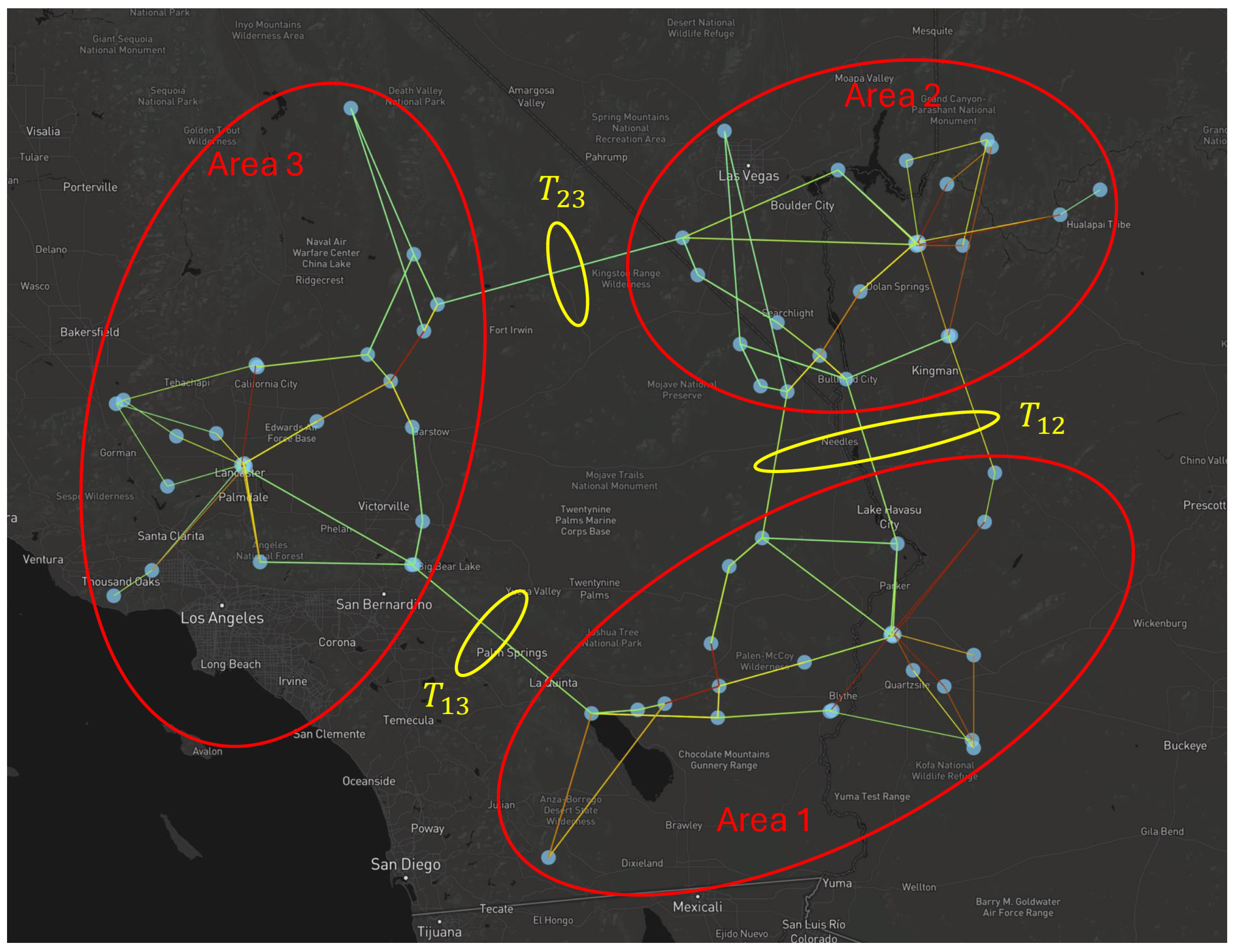
Figure 2.
Virtual Transmission Line - Steps.
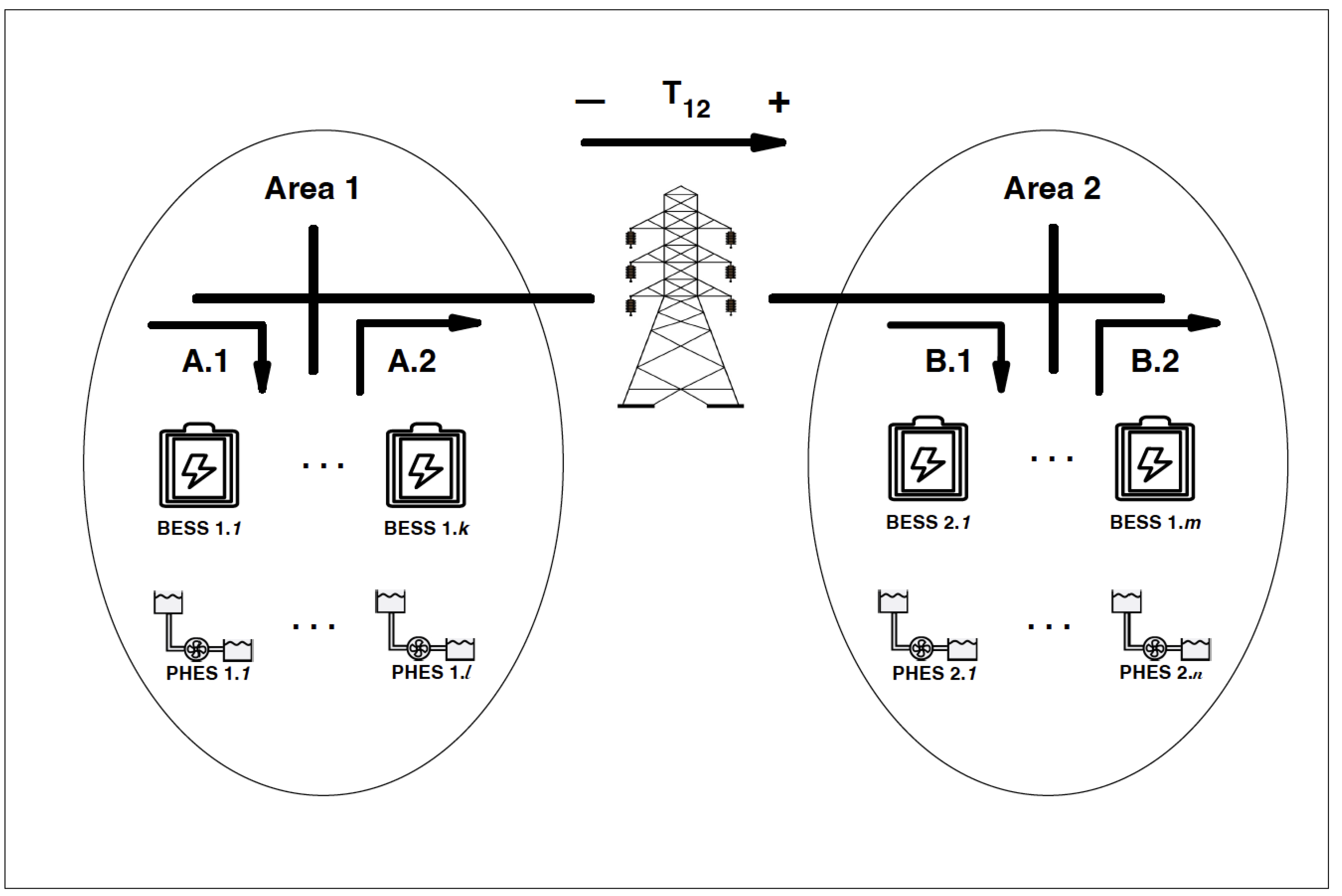
Figure 3.
Expansion Planning Proposed Methodology.
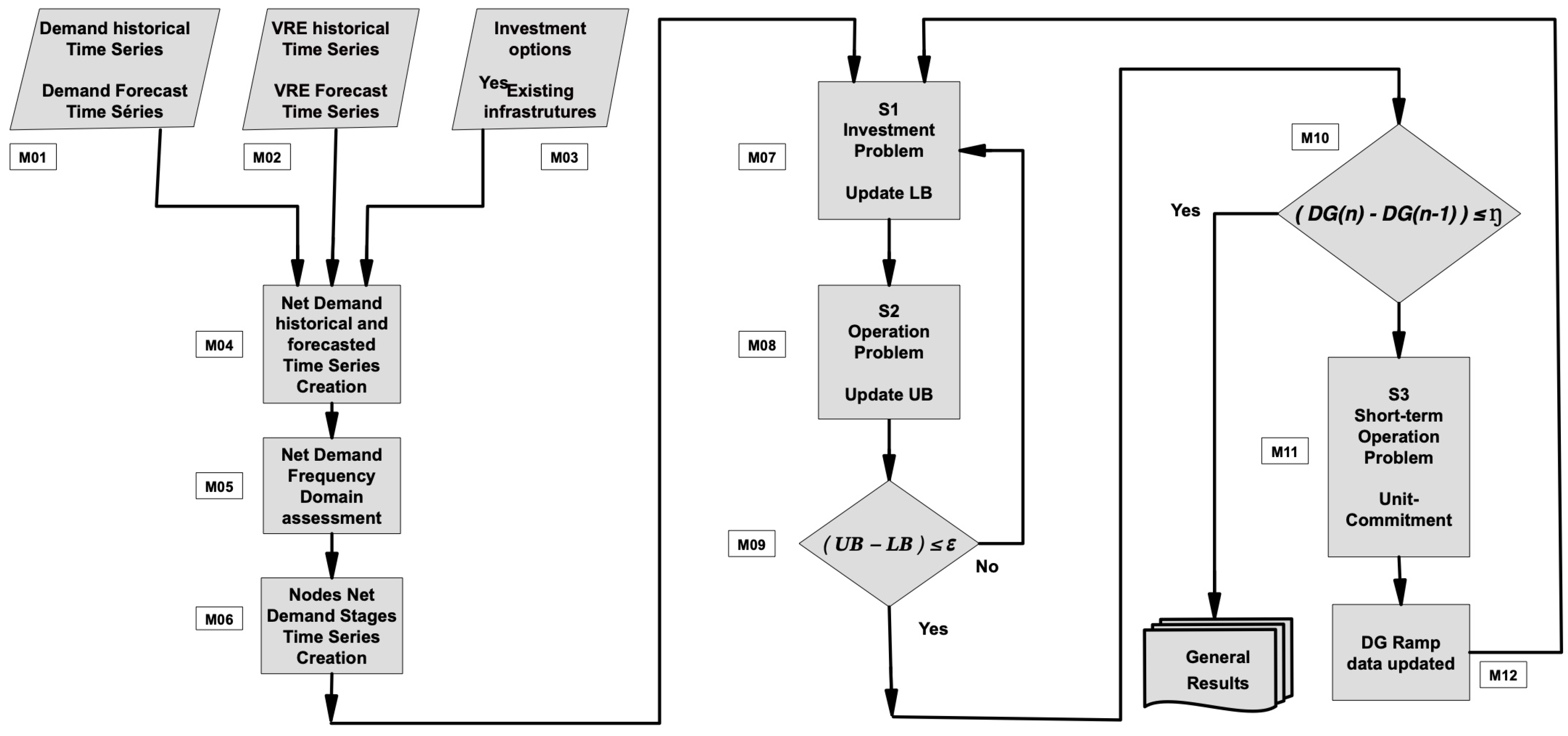
Figure 4.
Scenario S1.1 - Week - High demand - Base Case - Generators Dispatch.
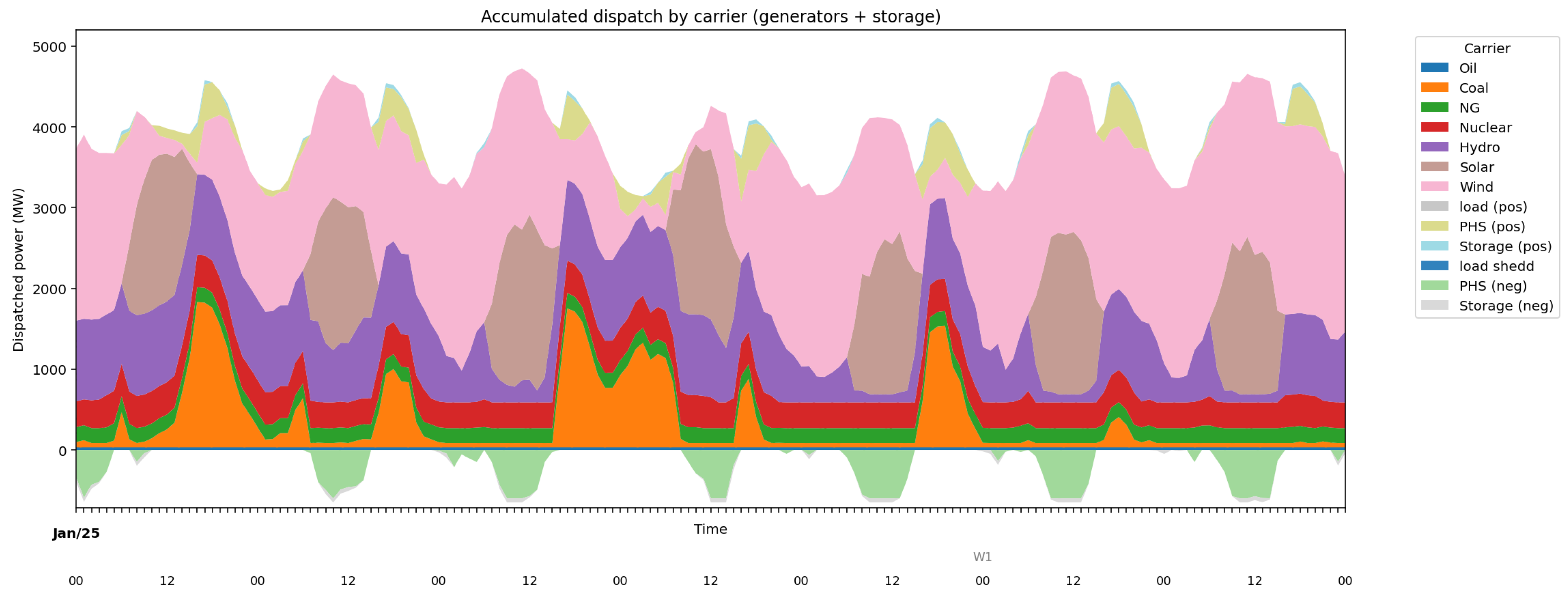
Figure 5.
Scenario S1.1 - Week - High demand - Base Case - Demand.
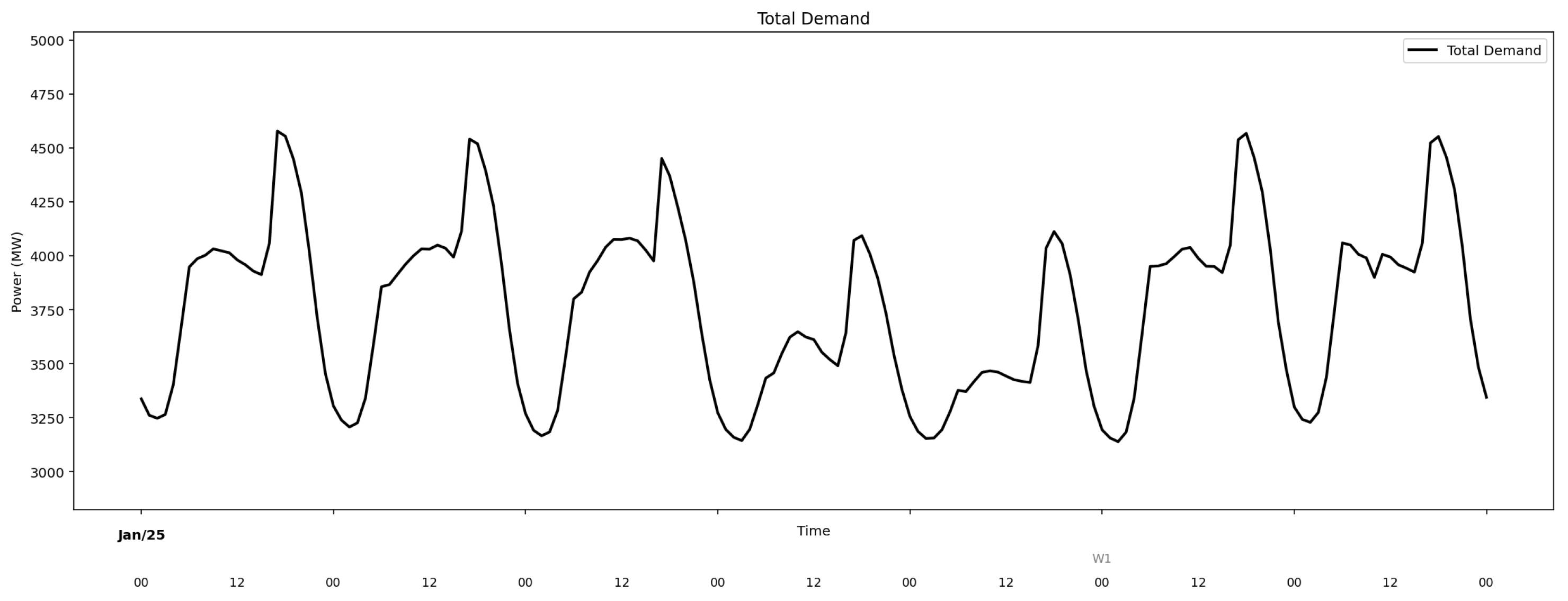
Figure 6.
Scenario S1.1 - Week - High demand - Base Expansion Plan - Generators Dispatch.
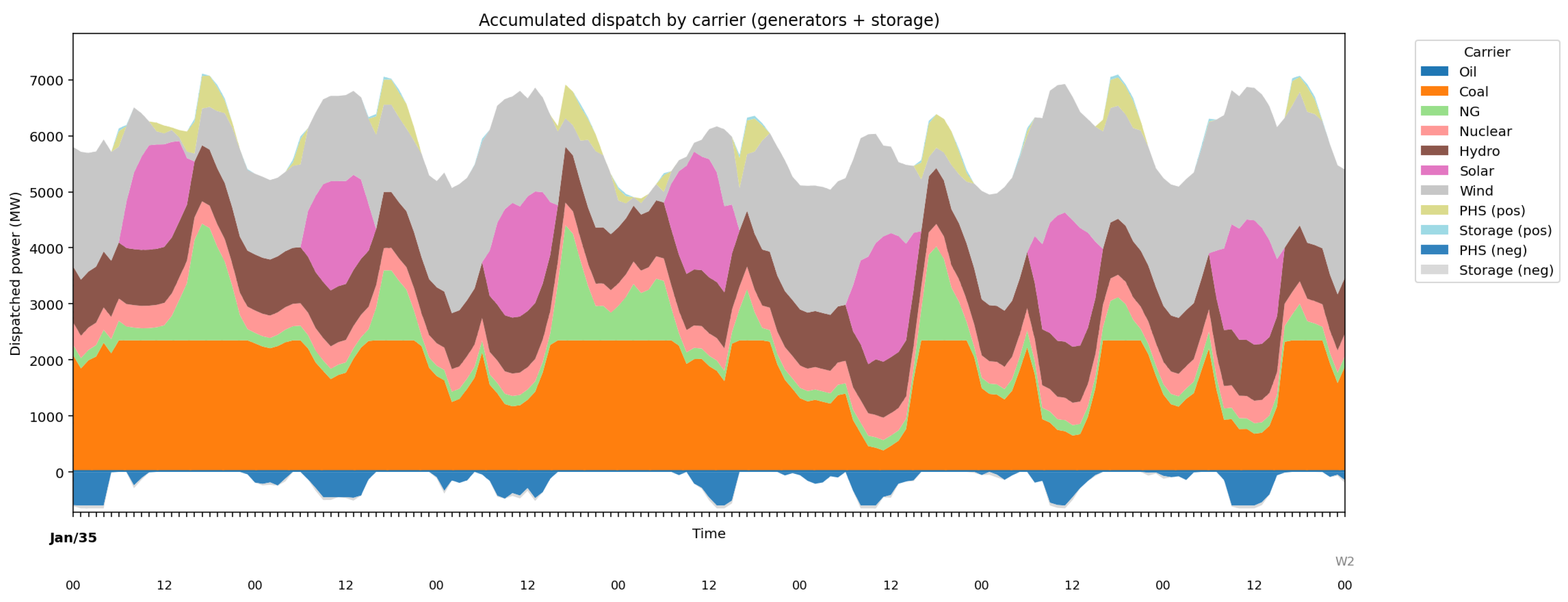
Figure 7.
Scenario S1.1 - Week - High demand - Expansion Plan Case - Demand.
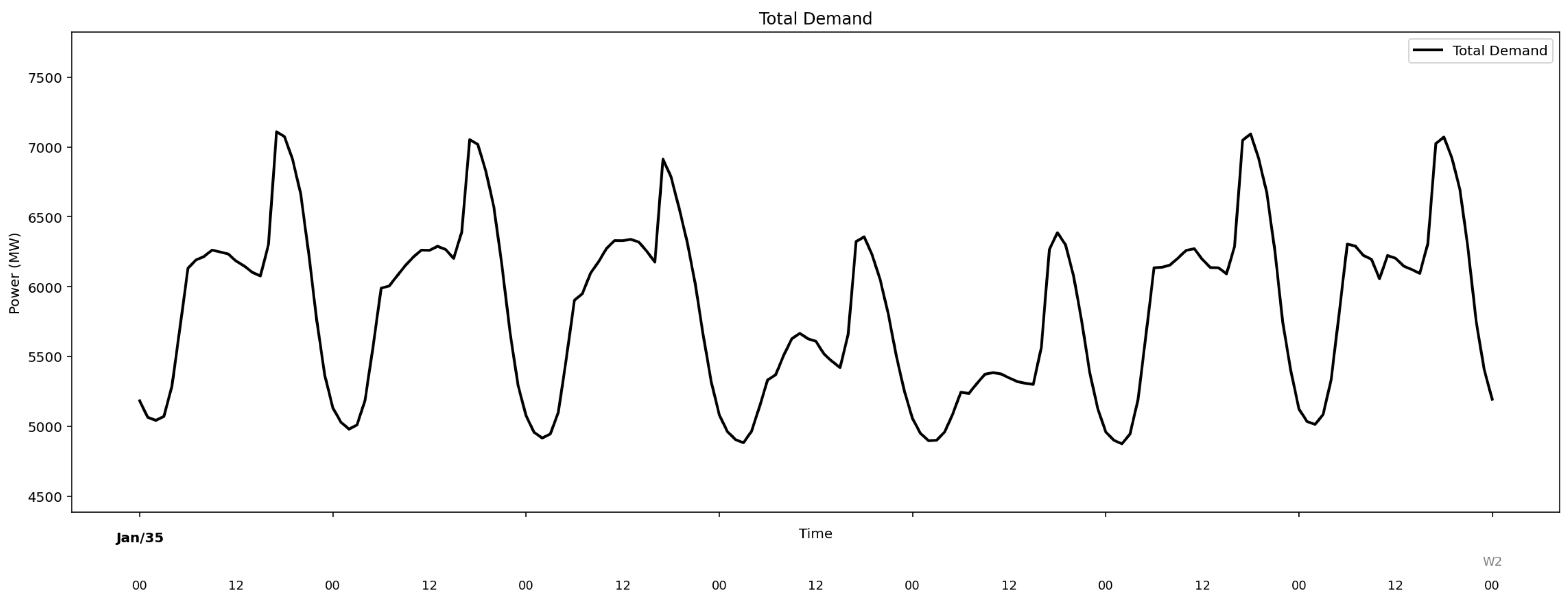

Table 1.
Comparison of the existing approaches with the proposed method.
| Ref1 | GEP2 | TEP3 | UC4 | VPP5 | VTL6 | Flx7 | Gen Flx8 | DR E Flx9 | DR C Flx10 | T Scale11 | VRE12 | Cong13 | AC14 | DC15 | Static16 | Dynamic17 |
| [11] | ✓ | ✓ | ✓ | ✓ | ✓ | ✓ | ||||||||||
| [12] | ✓ | ✓ | ✓ | ✓ | ✓ | ✓ | ✓ | |||||||||
| [13] | ✓ | ✓ | ✓ | |||||||||||||
| [14] | ✓ | ✓ | ✓ | ✓ | ||||||||||||
| [15] | ✓ | ✓ | ✓ | ✓ | ||||||||||||
| [16] | ✓ | ✓ | ✓ | ✓ | ✓ | |||||||||||
| [17] | ✓ | ✓ | ||||||||||||||
| [18] | ✓ | ✓ | ✓ | ✓ | ✓ | ✓ | ✓ | |||||||||
| [19] | ✓ | ✓ | ✓ | ✓ | ✓ | ✓ | ||||||||||
| [20] | ✓ | ✓ | ✓ | ✓ | ✓ | ✓ | ||||||||||
| [21] | ✓ | ✓ | ✓ | ✓ | ||||||||||||
| [22] | ✓ | ✓ | ✓ | ✓ | ||||||||||||
| [23] | ✓ | ✓ | ✓ | |||||||||||||
| [24] | ✓ | ✓ | ✓ | |||||||||||||
| [25] | ✓ | ✓ | ✓ | |||||||||||||
| [26] | ✓ | ✓ | ✓ | |||||||||||||
| [27] | ✓ | ✓ | ✓ | ✓ | ✓ | |||||||||||
| [28] | ✓ | ✓ | ✓ | ✓ | ✓ | ✓ | ✓ | |||||||||
| [29] | ✓ | ✓ | ✓ | ✓ | ✓ | |||||||||||
| [30] | ✓ | ✓ | ✓ | ✓ | ✓ | ✓ | ||||||||||
| [31] | ✓ | ✓ | ✓ | ✓ | ✓ | ✓ | ||||||||||
| [32] | ✓ | ✓ | ✓ | ✓ | ✓ | |||||||||||
| [33] | ✓ | ✓ | ✓ | ✓ | ✓ | ✓ | ||||||||||
| [34] | ✓ | ✓ | ✓ | ✓ | ✓ | ✓ | ✓ | |||||||||
| [35] | ✓ | ✓ | ✓ | ✓ | ✓ | |||||||||||
| [36] | ✓ | ✓ | ✓ | ✓ | ✓ | ✓ | ||||||||||
| [37] | ✓ | ✓ | ✓ | |||||||||||||
| [38] | ✓ | ✓ | ✓ | ✓ | ✓ | ✓ | ✓ | |||||||||
| [39] | ✓ | ✓ | ✓ | ✓ | ||||||||||||
| [40] | ✓ | ✓ | ✓ | ✓ | ||||||||||||
| [41] | ✓ | ✓ | ✓ | |||||||||||||
| [42] | ✓ | ✓ | ✓ | ✓ | ||||||||||||
| [43] | ✓ | ✓ | ✓ | |||||||||||||
| [44] | ✓ | ✓ | ✓ | ✓ | ||||||||||||
| [45] | ✓ | ✓ | ✓ | ✓ | ✓ | |||||||||||
| [46] | ✓ | ✓ | ✓ | ✓ | ||||||||||||
| [47] | ✓ | ✓ | ✓ | ✓ | ✓ | |||||||||||
| [48] | ✓ | ✓ | ✓ | ✓ | ✓ | |||||||||||
| Proposed model | ✓ | ✓ | ✓ | ✓ | ✓ | ✓ | ✓ | ✓ | ✓ | ✓ | ✓ | ✓ | ✓ | ✓ | ✓ |
1-Reference, 2- Generation Expansion Planning, 3-Transmission Expansion Planning, 4-Short-term Unit Commitment, 5- Virtual Power Plants, 6- Virtual Transmission Lines, 7- Flexibility TSO-DSO, 8- Generation Flexibility, 9- DR Energy Flexibility, 10- DR Capacity Flexibility, 11- Multi-Timescale, 12- VRE, 13- Transmission line congestion, 14- AC Power flow model, 15- DC Power flow model, 16- Static, 17- Dynamic
Table 2.
Electrical Power System Flexibility Metrics Considered.
| Metric | Brief Description |
|---|---|
| Ramp Up/ Down Rate | Measures the speed (MW/min or %/min) at which a generator can increase or decrease output to handle variability. |
| Flexible Ramp Up Surplus (FRUS) | Excess upward ramping capability provided by a generator beyond the required net load up movement in a given time period. |
| Flexible Ramp Down Surplus (FRDS) | Excess downward ramping capability provided by a generator beyond the required net load down movement in a given time period. |
| Ramp Range/Flexibility Range | The difference between maximum and minimum stable output levels of a generator. |
| Start-Up Time | Time required for a generator to go from offline to full load. |
| Minimum Up/Down Time | Constraints on the minimum duration a generator must run or stay offline after starting or stopping. |
| Insufficient Ramping Resource Expectation (IRRE) | Probabilistic metric estimating expected hours per year when ramping resources are insufficient. |
| Minimum Inertia | The lowest required threshold of total system rotational kinetic energy to maintain frequency stability. |
Table 3.
Virtual Transmission Line - BESS / PHE Status.
| Demand side (+) | Supply side (-) | |
| Hi grid usage | Discharge | Charge |
| Low grid usage | Charge | Discharge |
Table 4.
IEEE RTS-GMLC Parameters.
| Parameter | Value |
|---|---|
| Number of buses | 73 |
| Number of lines (branches) | 120 |
| Total generators | 158 |
| Generators per technology | - Coal: 12 - Oil: 17 - Natural Gas: 36 - Nuclear: 5 - Hydro: 5 - Wind: 34 - Solar PV: 29 - Rooftop PV (RTPV): 12 - Concentrated Solar Power (CSP): 3 - Synchronous Condensers: 5 |
| Number of load buses | 43 |
| Total average system demand | 4,481 MW |
| Average demand per load bus | Approximately 104 MW (total average demand divided by number of load buses) |
Table 5.
Scenario S1.1 Candidate Generators and Storage.
| Candidate Generators - S1 | ||
| Technology | Quantity | Total Power [GW] |
| Battery | 73 | 4.38 |
| Hydro | 20 | 5.50 |
| Gas-CCGT | 24 | 8.40 |
| Gas-OCGT | 24 | 6.00 |
| Onshore-Wind | 12 | 3.80 |
| Solar-PV | 16 | 4.10 |
Table 6.
Scenario S1.1 Transmission Expansion Summary Results.
| Corridor | AC/DC | 2026 | 2027 | 2028 | 2029 | 2030 | 2031 | 2032 | 2033 | 2034 | 2035 | |
| N_116 | N_117 | AC | ||||||||||
| N_116 | N_117 | AC | ||||||||||
| N_206 | N_208 | AC | ||||||||||
| N_206 | N_208 | AC | ||||||||||
| N_206 | N_210 | AC | ||||||||||
| N_206 | N_210 | AC | ||||||||||
| N_206 | N_210 | AC | ||||||||||
| N_206 | N_210 | AC | ||||||||||
| N_207 | N_208 | AC | ||||||||||
| N_207 | N_208 | AC | ||||||||||
| N_208 | N_209 | AC | ||||||||||
| N_208 | N_209 | AC | ||||||||||
| N_303 | N_324 | AC | ||||||||||
| N_303 | N_324 | AC | ||||||||||
| N_309 | N_311 | AC | ||||||||||
| N_309 | N_311 | AC | ||||||||||
| N_309 | N_312 | AC | ||||||||||
| N_309 | N_312 | AC | ||||||||||
| N_317 | N_318 | AC | ||||||||||
| N_317 | N_318 | AC | ||||||||||
Table 7.
Scenario S1.1 Summary of Results - Costs.
| Solution Cost | M US$ / year |
| Investment Cost Generation | 1 066.63 |
| Investment Cost Network | 29.84 |
| Operation Cost Generation | 219.35 |
| ENS Cost | 0.00 |
| Total | 1 315.82 |
Table 8.
Scenario S1.2 Transmission line investmests without Area VTL.
| Corridor | AC/DC | 2026 | 2027 | 2028 | 2029 | 2030 | 2031 | 2032 | 2033 | 2034 | 2035 | |
| N_103 | N_124 | AC | ||||||||||
| N_114 | N_116 | AC | ||||||||||
| N_115 | N_116 | AC | ||||||||||
| N_115 | N_121 | AC | ||||||||||
| N_116 | N_117 | AC | ||||||||||
| N_116 | N_119 | AC | ||||||||||
| N_117 | N_118 | AC | ||||||||||
| N_203 | N_224 | AC | ||||||||||
| N_206 | N_208 | AC | ||||||||||
| N_206 | N_210 | AC | ||||||||||
| N_207 | N_208 | AC | ||||||||||
| N_209 | N_212 | AC | ||||||||||
| N_210 | N_211 | AC | ||||||||||
| N_216 | N_219 | AC | ||||||||||
| N_303 | N_324 | AC | ||||||||||
| N_309 | N_311 | AC | ||||||||||
| N_317 | N_318 | AC | ||||||||||
| N_318 | N_223 | AC | ||||||||||
| N_323 | N_325 | AC | ||||||||||
| N_325 | N_121 | AC | ||||||||||
Table 9.
Scenario S1.2 Summary of Results - Costs - Without Inter AREA VTL.
| Solution Cost - Without Inter AREA VPN | M US$ / year |
| Investment Cost Generation | 1 335.51 |
| Investment Cost Network | 43.92 |
| Operation Cost Generation | 426.37 |
| ENS Cost | 0.00 |
| Total | 1 805.80 |
Table 10.
Scenario S1.2 Transmission line investmests Considering Area VTL.
| Corridor | AC/DC | 2026 | 2027 | 2028 | 2029 | 2030 | 2031 | 2032 | 2033 | 2034 | 2035 | |
| N_103 | N_124 | AC | ||||||||||
| N_107 | N_108 | AC | ||||||||||
| N_114 | N_116 | AC | ||||||||||
| N_115 | N_116 | AC | ||||||||||
| N_115 | N_121 | AC | ||||||||||
| N_116 | N_117 | AC | ||||||||||
| N_116 | N_119 | AC | ||||||||||
| N_117 | N_118 | AC | ||||||||||
| N_203 | N_224 | AC | ||||||||||
| N_206 | N_208 | AC | ||||||||||
| N_206 | N_210 | AC | ||||||||||
| N_207 | N_208 | AC | ||||||||||
| N_209 | N_212 | AC | ||||||||||
| N_210 | N_212 | AC | ||||||||||
| N_216 | N_219 | AC | ||||||||||
| N_303 | N_324 | AC | ||||||||||
| N_309 | N_311 | AC | ||||||||||
| N_317 | N_318 | AC | ||||||||||
| N_318 | N_223 | AC | ||||||||||
| N_323 | N_325 | AC | ||||||||||
| N_325 | N_121 | AC | ||||||||||
Table 11.
Scenario S1.2 Summary of Results - Costs - With Inter AREA VTL.
| Solution Cost - With Inter AREA VPN | M US$ / year |
| Investment Cost Generation | 1 300.40 |
| Investment Cost Network | 41.89 |
| Operation Cost Generation | 421.66 |
| ENS Cost | 0.00 |
| Total | 1 763.95 |
Table 12.
Scenario S1.3 Results without unit commitment and ramp surplus assessment.
| Ramp Up Surplus | ||||||||||
| Generator | MW/h | Generator | MW/h | Generator | MW/h | Generator | MW/h | |||
| 101_STEAM_3 | 0.018 | 123_CT_4 | 0.152 | 223_STEAM_1 | 0.031 | 313_CC_1 | 0.377 | |||
| 101_STEAM_4 | 0.018 | 123_CT_5 | 0.161 | 223_STEAM_2 | 0.028 | 315_CT_6 | 0.238 | |||
| 102_STEAM_3 | 0.014 | 203_CC_1 | 0.241 | 301_CC_1 | 0.135 | 315_CT_7 | 0.232 | |||
| 102_STEAM_4 | 0.012 | 207_CT_1 | 0.040 | 301_CT_3 | 0.037 | 315_CT_8 | 0.235 | |||
| 104_CC_1 | 1.724 | 207_CT_2 | 0.040 | 301_CT_4 | 0.038 | 318_CC_1 | 0.629 | |||
| 105_CC_1 | 1.263 | 213_CC_3 | 0.486 | 302_CT_3 | 0.026 | 321_CC_1 | 1.165 | |||
| 107_CC_1 | 1.973 | 213_CT_1 | 0.110 | 302_CT_4 | 0.026 | 322_CT_5 | 0.176 | |||
| 113_CT_1 | 0.118 | 213_CT_2 | 0.109 | 304_CC_1 | 0.097 | 322_CT_6 | 0.177 | |||
| 113_CT_2 | 0.118 | 215_CT_4 | 0.047 | 306_CC_1 | 0.037 | 323_CC_1 | 1.575 | |||
| 113_CT_3 | 0.121 | 215_CT_5 | 0.052 | 307_CC_1 | 0.005 | 323_CC_2 | 1.556 | |||
| 113_CT_4 | 0.116 | 216_STEAM_1 | 0.005 | 307_CT_1 | 0.076 | |||||
| 118_CC_1 | 1.765 | 218_CC_1 | 0.190 | 307_CT_2 | 0.071 | |||||
| 123_CT_1 | 0.156 | 221_CC_1 | 1.057 | 308_CC_1 | 0.260 | |||||
| Average Ramp Up Surplus | 0.354 | |||||||||
Table 13.
Scenario S1.3 Results - Ramp up/down metric summary.
| Technology | Typical Ramp Rate (%/min) | Ratio (hours) |
| Oil | 5 | 0.33 |
| Coal | 3 | 0.56 |
| Gas | 10 | 0.17 |
| Hydro | 20 | 0.08 |
| Nuclear | 5 | 0.33 |
Table 14.
Scenario S1.3 Results considering unit commitment and ramp surplus target.
| Ramp Up Surplus | ||||||||||
| Generator | MW/h | Generator | MW/h | Generator | MW/h | Generator | MW/h | |||
| 118_CC_1 | 8.346 | 315_CT_7 | 0.925 | 213_CT_2 | 0.333 | 302_CT_4 | 0.073 | |||
| 221_CC_1 | 7.211 | 315_CT_6 | 0.912 | 308_CC_1 | 0.272 | 101_STEAM_4 | 0.073 | |||
| 107_CC_1 | 6.983 | 301_CC_1 | 0.644 | 307_CT_1 | 0.222 | 216_STEAM_1 | 0.071 | |||
| 101_CC_1 | 6.747 | 322_CT_5 | 0.537 | 307_CT_2 | 0.218 | 306_CC_1 | 0.062 | |||
| 323_CC_1 | 6.617 | 322_CT_6 | 0.525 | 215_CT_5 | 0.179 | 102_STEAM_3 | 0.056 | |||
| 321_CC_1 | 6.406 | 123_CT_5 | 0.470 | 215_CT_4 | 0.161 | 116_STEAM_1 | 0.053 | |||
| 323_CC_2 | 6.382 | 123_CT_4 | 0.457 | 223_STEAM_1 | 0.156 | 102_STEAM_4 | 0.048 | |||
| 318_CC_1 | 5.647 | 113_CT_1 | 0.449 | 223_STEAM_2 | 0.131 | 115_STEAM_3 | 0.036 | |||
| 104_CC_1 | 5.530 | 113_CT_4 | 0.449 | 207_CT_2 | 0.117 | 304_CC_1 | 0.020 | |||
| 213_CC_3 | 5.389 | 123_CT_1 | 0.444 | 207_CT_1 | 0.113 | 223_CT_4 | 0.015 | |||
| 313_CC_1 | 4.276 | 113_CT_3 | 0.435 | 301_CT_3 | 0.090 | 223_CT_5 | 0.015 | |||
| 203_CC_1 | 2.917 | 113_CT_2 | 0.434 | 301_CT_4 | 0.088 | 201_STEAM_3 | 0.001 | |||
| 218_CC_1 | 1.567 | 307_CC_1 | 0.380 | 101_STEAM_3 | 0.077 | 223_CT_6 | 0.000 | |||
| 315_CT_8 | 0.933 | 213_CT_1 | 0.336 | 302_CT_3 | 0.073 | |||||
| Average Ramp Up Surplus | 1.547 | |||||||||
Disclaimer/Publisher’s Note: The statements, opinions and data contained in all publications are solely those of the individual author(s) and contributor(s) and not of MDPI and/or the editor(s). MDPI and/or the editor(s) disclaim responsibility for any injury to people or property resulting from any ideas, methods, instructions or products referred to in the content. |
© 2026 by the authors. Licensee MDPI, Basel, Switzerland. This article is an open access article distributed under the terms and conditions of the Creative Commons Attribution (CC BY) license (http://creativecommons.org/licenses/by/4.0/).
Copyright: This open access article is published under a Creative Commons CC BY 4.0 license, which permit the free download, distribution, and reuse, provided that the author and preprint are cited in any reuse.


