

Submitted:
07 January 2026
Posted:
09 January 2026
You are already at the latest version
Abstract
In the present view on neutrinos three flavour states are recognized that are composed by a characteristic mixture of mass eigenstates. The absolute scale of these eigenstates is unknown. So far, observational experiments have revealed numerical values for the squared mass differences. In this article it is shown that mass ratios can be found as well. This enables the assessment of the absolute scale of the neutrino masses.
Keywords:
neutrino
; neutrino oscillation
; lepton
; flavour state
; mass state
1. Introduction
Neutrinos are among the most abundant yet least understood particles in the Universe. Originally postulated to preserve energy conservation in beta decay [1,2,3,4], neutrinos were long assumed to be massless within the framework of the Standard Model of particle physics [5]. However, experimental discoveries over the past several decades—most notably neutrino oscillations—have demonstrated conclusively that neutrinos possess a nonzero rest mass [6,7,8]. This awareness represents one of the clearest pieces of experimental evidence for physics beyond the Standard Model.
Despite the progress obtained over the years, the absolute scale of neutrino has remained unknown [9]. Determining this mass is a central goal of modern particle physics. In two preceding articles on the subject [10,11], along two different independent approaches the author has made predictions that show a fair correspondence in magnitude. In both cases in the order of magnitude of about 80 meV/ for the absolute scale of neutrino masses. Because both these approaches are unconventional and novel, it is instructive to memorize these approaches first, before adding an additional one. The latter one should serve as a verification for the viability of three independent approaches that all converge to the predicted 80 meV/ mass scale. As to be shown in the article, the verification proof will be based upon the recently published derivation of the mass of the electron from first principles [12].
2. Prediction from Kinematic Analysis
In [11], the author has documented a derivation of the neutrino mass on the basis of the following elements:
1. An novel kinematic analysis, in which a pion in free flight comes to rest and launches a neutrino that flies away at the speed of the pion prior to its rest.
2. The awareness that the pion in free flight is, in its the relativistic state of its rest mass, manifest as a W boson.
3. The awareness that the kinematic analysis is subject to Fermi’s theory of beta radiation, which means that the decay result has two extremes. In one extreme the produced neutrino is at maximum speed while the produced charged lepton is at minimum speed. In the other extreme the opposite is true.
4. An analysis of five lab frame decay processes: (a) decay of the pion to muon, (b) decay of the pion to electron, (c) decay of a muon to electron, (d) decay of the meson to tauon, muon and electron, (e) decay of the into tauon, muon and electron.
5. Application of the results from this analysis to the PMNS theory [13,14], thereby changing the relative scale of the mass eigenstates into the absolute scale.
Let us consider the elements somewhat more. Because the rest mass 140 MeV/ is 80.4 GeV/ in relativistic state, the speed of the pion is known. The kinematic analysis is based upon the conservation laws of momentum en energy.
From the hypothesis that the muon neutrino is launched at the pion’ speed in free state and considering that governs the energy spectrum of the beta radiation, the rest mass scale of the neutrino can be estimated to be 77.9 meV/. Details of the calculation can be found in [11]. A careful analysis of the decay processes just mentioned has revealed that the three neutrino flavours (electron, muon, tauon) have the same effective mass in different states of speed. The two novel concepts of identical effective mass and the physically based guess of the absolute scale of neutrino mass can subsequently be exploited in the PMNS theory of neutrino oscillation. It ends up in
3. Prediction from Structural Modeling (Meson Decay)
In [10], the author has documented a derivation of the neutrino mass from first principles in the Structural Model of particle physics [15]. In the Structural Model, the quark is characterized by a potential function, which in confinement with other quarks, can be characterized by the one-dimensional one,
The exponential term models the screening effect of the omni-present background energy, which in the Standard Model is known as the Higgs field . The spatial parameter x is normalized, such that the denormalized one is . The reciprocal quadratic term models the field of a dipole moment which in Dirac’s classical theory of the electron is imaginary, but which in an unrecognized generalization of Dirac’s theory is real [15]. The reciprocal linear term is the potential field of a monopole in classical field theory. The gyrometric factor is a measure for the balance between the repulsive/attractive effect of the monopole field versus the attractive/repulsive effect of the dipole field. Two of those quarks compose an anharmonic quantum mechanical oscillator that models a meson.
In the Structural Model of particle physics the muon is modeled as an anharmonic quantum mechanical oscillator as well. Unlike as in the pion case, its field is not screened, because the vacuum is transparent for electromagnetism. Two kernels make an anionic bond, each with the potential function,
Considering that the potential is a measure of energy, and that the break-up of a pion into a muon and a neutrino takes place under conservation of energy, it is fair to conclude that the neutrino can be described in terms of a potential function as well, such that
Similarly as the muon, the neutrino can be modeled by a composition of two kernels. If so, each of these neutrino kernels has a potential function , such that
They compose a two-body anharmonic oscillator. Figure 1 shows the potential function of its one-body equivalent. Figure 2 shows the ground state curve as a function of the normalized spacing between the two kernels. At the spacing this ground state curve crosses the energy level of the oscillator in its reference state for minimum energy. The difference between the two states has an influence on the binding energy of the particle. The smaller the spacing, the lower the binding energy. Referencing to the excitation model of the Structural Model, discussed for the neutrino in [10], it implies that the binding energy of the muon neutrino is larger than the binding energy of the tauon neutrino, while their rest masses are the same. The ratio between the two binding energy levels is the ratio between the mass eigenstates and . Details of the calculation can be found in [10]. Applying the result to the known squared mass differences,
yields the result shown in (8):
An important side conclusion is the answer to the mass ordering problem. Normal ordering is the correct one. The method is not fully conclusive, though, in the sense that, unlike , the ratio cannot up-front be calculated. To make that possible, it is required that, next to the muon and the tauon, the electron should be included in the structural model. And that is not trivial. That issue will be addressed in the next section.
4. Prediction by Structural Modeling (Nucleon Decay)
Although the results from the two predictions show a fair correspondence, it is not clear which of the two approaches is the most reliable one. Hypothesizing that the muon neutrino flies away from the rest frame of the pion at the speed of the pion prior to decay, is probably not more than a rough guess. It makes the second approach, based on first principles of the Structural Model of particle physics, more reliable, provided that one is willing to adopt these principles. Anyhow, it would be nice if a third independent way for proof could be found. Such a third independent way would be at hand if we could analyze the most fundamental low energetic production of an electron/(anti)neutrino pair in free-particle energetics. That process is the decay of neutron into a proton, symbolically represented by
Usually, this process is graphically represented as shown in Figure 3. It shows how under emission of an electron and its antineutrino the internal structure of a neutron changes into that of a proton. Basically, it is due to an isopin flip from a d quark into a u quark. Within the nomenclature of the Standard Model this bosonic flip is usually attributed to a W boson. In the terminology of the Structural Model it would make sense as well, in particular by taking into account that, unlike as in the Standard Model, in the Structural Model the nuclear spin flip is attributed to a Z boson.
Unfortunately, we meet a problem here, because in the Structural Model the 80.4 GeV boson has been identified as the relativistic state of the pion. Hence, in the Structural Model the 80.4 GeV acts in fact as a strong interaction boson. This boson cannot be the same as the W shown in Figure 3, because neither the relativistic 80.4 GeV of the Standard Model boson nor the non-relativistic 140 MeV of the pion can be made in agreement with the decay scheme of the neutron into a proton.
The inevitable conclusion is that the true weak interaction boson is a boson that flips the isospin state of a quark and that such boson is different from the 80.4 GeV weak interaction boson of the Standard Model. In fact, acceptance of the concept of a novel boson, does not harm, because in Feynman diagrams of the kind shown in Figure 3, weak interaction is usually conceived as a generic bosonic process that changes the composition of particles that are built by elementary ones. In that sense the bosonic process of a pion decaying into a muon and a muon neutrino is similar to a process of a neutron decaying into a proton and an electron with its antineutrino. This bosonic process of the true weak interaction can be readily understood from the structural three-body model of the nucleon [15]. The triangular structure of the proton has only a slightly larger perimeter than the triangular structure of the neutron as a consequence of the distributed electric charge that is associated with isospin. It is this effect that allows to calculate the difference between the gyrometric factor in the one-body equivalent for the three body proton oscillator and the gyrometric factor in the one-body equivalent for the neutron oscillator. From the same consideration as for the pion decay, we have for the one-body part for the virtual W boson,
Note that two of such one-body parts are required to compose such virtual boson.
De strengths and as well as the gyrometric factors and are only slightly different from each other. The spacing between the quarks in a pion as the archetype pseudo-scalar meson, and the spacing between quarks in its rho-meson sister as the archetype vector meson due to nuclear spin orientation, is much larger than the isospin effect in the nucleons. It makes the Z boson (in virtual state), responsible for the nuclear spin flip, significantly more energetic than the virtual W boson, responsible for the isospin flip.
Defining
we have, after some algebra , from (10),
It is the equivalent for the muon neutrino kernel shown in (6). Apart from the scaling factor , the models are nearly, but not exactly, the same, because . This enables us to compose a harmonic oscillator model for the electron neutrino similarly as we did for the muon neutrino. The behaviour of the oscillator can be described by,
By convention the coupling factor g has been defined in the Structural Model as the square root of the electromagnetic fine structure constant as The oscillator settles into a minimum energy state at . At this setting we have
Due to the shifts in and , the ground state energy of the electron neutrino will be slightly different from the ground state energy of the muon neutrino. We however know from [11] that the effective masses are the same. Hence, this difference in ground state must be the difference in the eigenstates and . Hence, if we would know values for and we would be able to calculate the mass ratio . And similar as we could relate the ratio with the squared mass difference B, we would be able to relate the ratio with the squared mass difference A. See (7).
Fortunately, the shifts and are known from a recent and documented study by the author in which the rest mass of the electron has been calculated from first principles of the Structural Model of particle physics. From [12], eq.15,
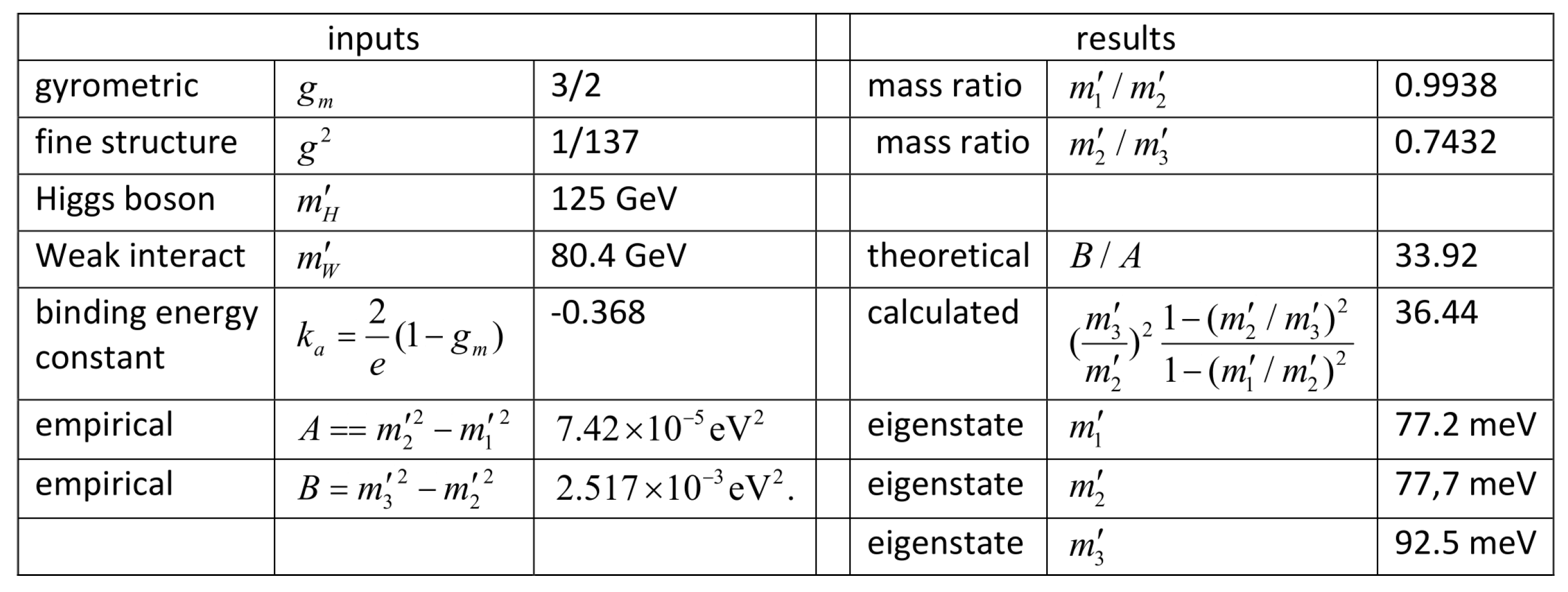
The gyrometric factor , the quantum mechanical coupling factor "g" and the Higgs boson have been introduced in this text before. Next to it, we see in the shift expression the weak interaction boson and a dimensionless constant . This latter constant is a basic one in the Structural Model of particle physics. As can be deduced from (13-14), it is a measure for the binding energy of the pion. The data in Figure Figure 4 show the result of the computation of the mass ratio from the parameters shown in (15). Relating this result with the empirical data A and B allows the calculation of the three mass eigenstates in absolute scale. The result is,
5. Discussion: Prediction or Verification?
It has been shown by (2), (8) and (16) that three independent approaches to the calculation of the absolute mass scale of the mass eigenstates of neutrinos exhibit a close numerical correspondence. Is the independence of the approaches sufficient to claim a verification?
The first of the three approaches has been based upon an addendum to the PMNS theory [13]. The addendum is twofold. The first element here is a novel, but rather conventional kinematic analysis of lab frame decay process that clearly shows that the effective masses of the three neutrino flavours have the same numerical value for their effective mass. That is not more than a result that so far has escaped from recognition. The second element is more substantial. It inherits from the Structural Model of particle physics that the 80.4 GeV energy of the W boson represents the 140 MeV rest mass energy of the pion in relativistic state. If the pion comes to stop, it launches the neutrino at the speed that the pion had before its stop. Its energy and its speed determines its mass at a chosen position within the energy spectrum of the beta radiation. Clearly, this approach gives a prediction.
The two other approaches are calculations from first principles. If a theory predicts a result, it needs verification from experimental evidence. The first of these approaches predicts a numerical value for and the second predicts a numerical value for . Hence, the two results predict a numerical value for
And that value is close to the value 36.44 found from experimental evidence.
It is therefore fair to say that the absolute scale of the neutrino masses is not only predicted, but verified as well.
References
- Pauli, W. 1927: CERN Document Server; Meitner 0393.
- Pauli, W. 1930: "Letter to the participants of the Tübingen Conference (Reprinted in Collected scientific papers"; Interscience Publishers: New York, NY, 1964; Vol. 2, pp. 131–133. [Google Scholar]
- Fermi, E. 1934: Versuch einer Theorie der Beta- strahlen I. Zetschrift fur Physik 88, 161. [CrossRef]
- Griffiths, D. Introduction to elementary particles; John Wiley an Sons, 2008; p. 309. [Google Scholar]
- Cottingham, W.M.; Greenwood, D.A. An Introduction to the Standard Model of Particle Physics; Cambridge University Press, 2012. [Google Scholar]
- Fukuda. Y et.al. 1998: "Evidence for oscillation of atopheric neutrinos". Phys. Rev. Letters 81, 8.
- Ahmad, Q.R. Direct evidence for neutrino flavour transformations. Phys. Rev. Lett. 2002, 89, 011301. [Google Scholar] [CrossRef] [PubMed]
- Esteban, I.; et al. 2020: The fate of hints: updated global analysis of three-flavor neutrino oscillations. JHEP 09 178.
- Granelli, A. Standard and Non-Standard Aspects of Neutrino Physics. Universe 2024, 10, 164. [Google Scholar] [CrossRef]
- Roza, E. On the flavour states and the mass states of neutrinos. 2025. Available online: www.preprints.org.202304.0171.v5.
- Roza, E. On the mass of neutrinos in flavour state. www. preprints.org 2025. [Google Scholar] [CrossRef]
- Roza, E. "An old puzzle solved: Why the mass of the electron is 0.511 MeV/c2. 2025. [Google Scholar] [CrossRef]
- Giganti, C.; Lavignac, S.; Zito, M. : “Neutrino oscillations: The rise of the PMNS paradig”. Journ. Phys.G: Nucl. and Particle Phys. 2018, 98, 1. [Google Scholar]
- Maki, Z.; Nakagawa, M.; Sakata, S. Remarks on the unified model of elementary particles. Progr. of TheorPhysics 1962, 28(5), 870. [Google Scholar] [CrossRef]
- Roza, E 2025. Introduction to the Structural Model of particle physics; Kindle Books; ISBN 978-90-90401-461.
Figure 1.
Potential function of the neutrino’s mass centre.
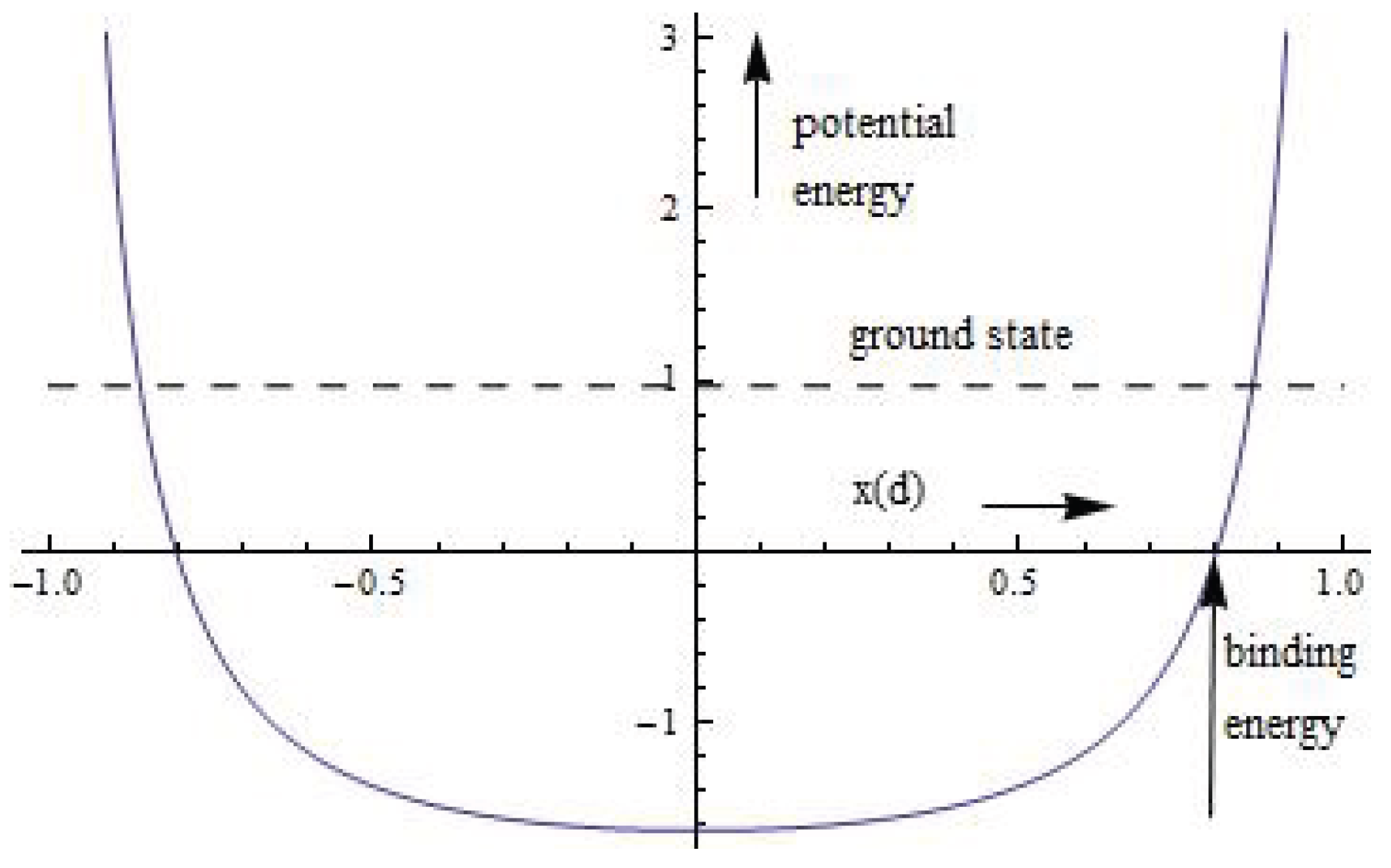
Figure 2.
The ground state energy of the neutrino as a function of spacing between its kernels.
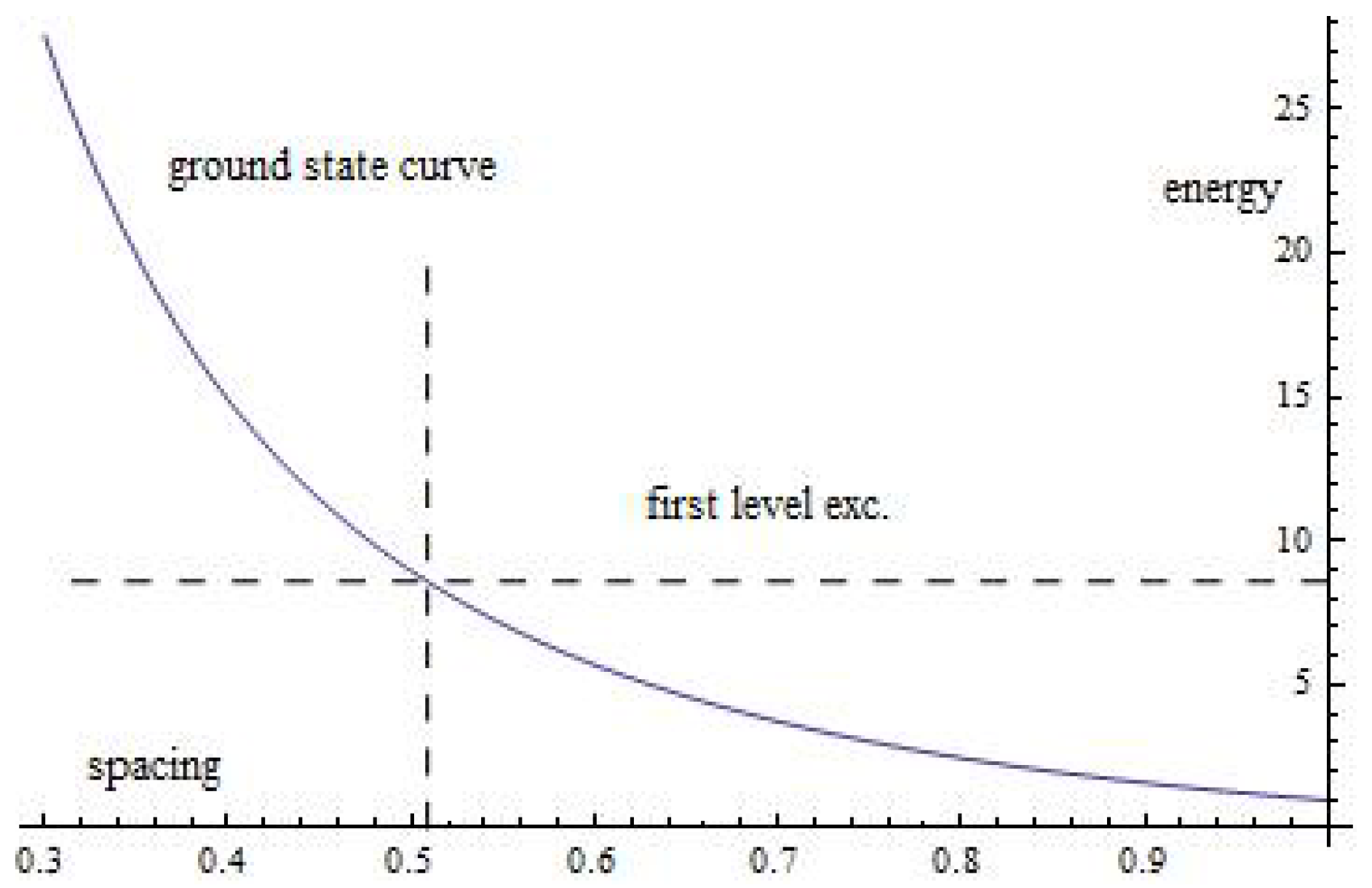
Figure 3.
The decay of a neutron into a proton by an isospin flip.
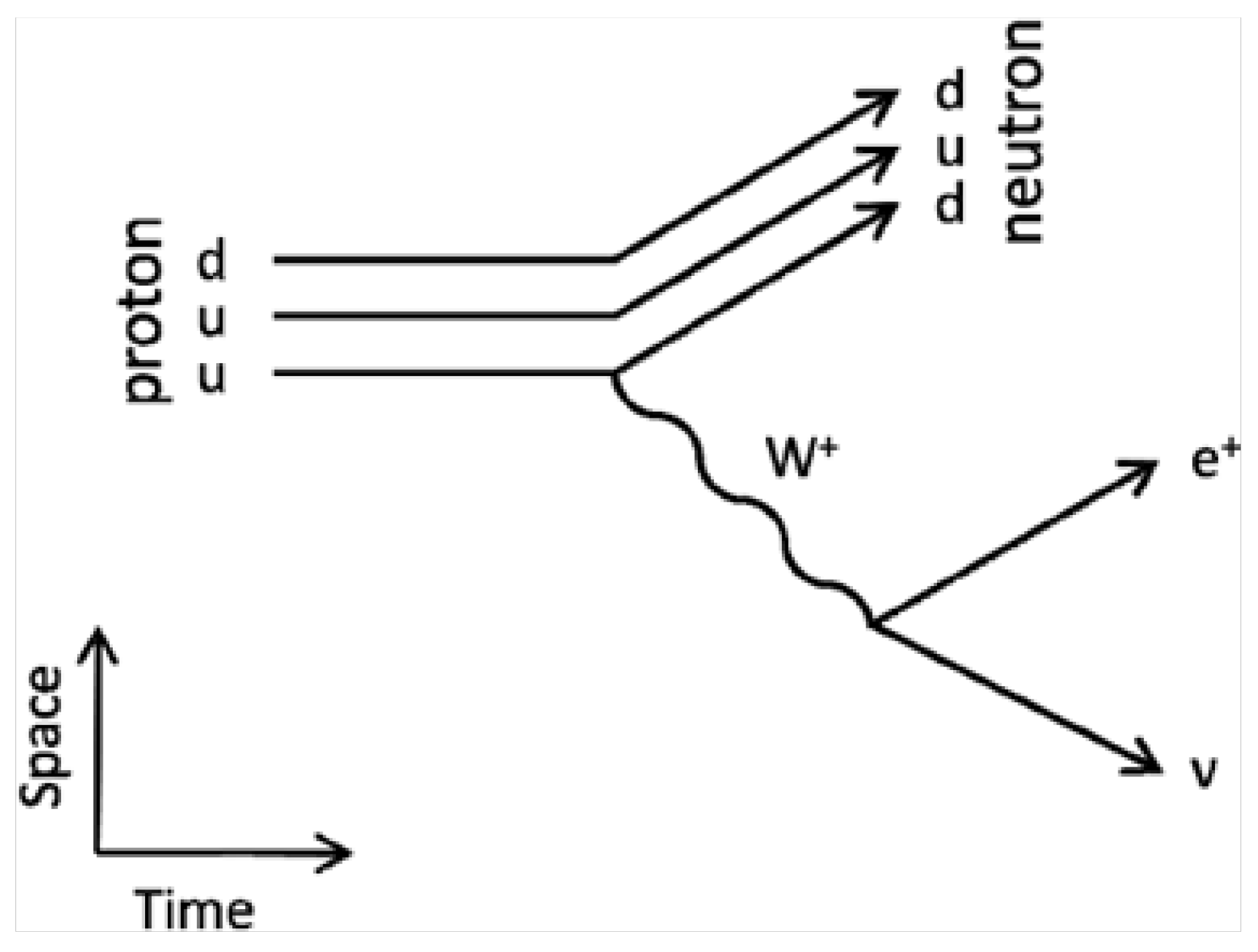
Figure 4.
Computational data. The left-hand part shows the input data. The right-hand shows the results.
Figure 4.
Computational data. The left-hand part shows the input data. The right-hand shows the results.
Disclaimer/Publisher’s Note: The statements, opinions and data contained in all publications are solely those of the individual author(s) and contributor(s) and not of MDPI and/or the editor(s). MDPI and/or the editor(s) disclaim responsibility for any injury to people or property resulting from any ideas, methods, instructions or products referred to in the content. |
© 2026 by the authors. Licensee MDPI, Basel, Switzerland. This article is an open access article distributed under the terms and conditions of the Creative Commons Attribution (CC BY) license (http://creativecommons.org/licenses/by/4.0/).
Copyright: This open access article is published under a Creative Commons CC BY 4.0 license, which permit the free download, distribution, and reuse, provided that the author and preprint are cited in any reuse.


