

Submitted:
06 January 2026
Posted:
09 January 2026
Read the latest preprint version here
Abstract
We present a strict, non-circular formulation of a “copy-horizon” infrared (IR) scale Lcopy(t) defined operationally from a quantum-information copy time τcopy(L, t) by the single criterion τcopy(Lcopy(t), t) = H−1(t). The definition requires only mild locality/monotonicity assumptions and does not postulate an a priori cosmological IR cutoff (such as the future event horizon). We then combine this operational IR scale with the Cohen–Kaplan–Nelson (CKN) gravitational collapse bound to obtain the L−2 energy-density scaling as a consistency constraint, and we formulate “saturation” as a falsifiable mechanism with a severe inequality cQ(z) ≤ 1. We derive the minimal background consequence wQ(t) = −1 + (2/3)(L̇copy/(HLcopy)) and show how a hydrodynamic realization of τcopy yields rigid consistency relations linking expansion, growth, and transient time-of-flight observables.
Keywords:
quantum information
; operational infrared cutoff
; holographic dark energy
; cosmology
; non-circular derivation
; falsifiable signatures
Scope and Non-Circularity
This paper isolates a single operational input—the copy time —and derives its minimal cosmological consequences without introducing an independent cosmological infrared cutoff by fiat. In particular, we do not define as the future event horizon. The event-horizon cutoff is used only as a comparator in a dedicated discussion paragraph.
Operational Definition of
Let and be spatially separated regions of a quantum many-body system. At a local perturbation is applied in (e.g. by a unitary ), yielding two global states and at time with reduced states and on . Given a measurement class accessible to the receiver, define the optimal distinguishability advantage
For unrestricted this reduces to the Helstrom distinguishability associated with the trace distance . Fix . The copy time is
The functional form of is determined by microscopic dynamics and the choice of ; it is not part of the definition. For a complete phenomenology, concrete realizations must be provided (see Sec. 8).
Brick 1: Defining with no Model Parameters
We work in a spatially flat FLRW background with Hubble rate . We define the copy-horizon scale as the largest physical separation for which the copy certificate is achievable within one Hubble time:
Assuming and mild regularity, Eq. [eq:brick1] defines uniquely (locally in time). Differentiating yields the implicit evolution equation
This step is non-circular: is determined by an operational time criterion, not by an assumed .
Illustrative realizations of(ballistic and diffusive) and the definition. The intersection determineswithout assuming a cosmological cutoff.
Brick 2: Scaling from Gravitational Consistency
The CKN bound constrains any effective description in a region of size : the energy must not exceed the mass of a black hole of the same size, . Hence
Equation [eq:CKN] is not a dark-energy model; it is a consistency constraint. The same scaling underlies the holographic dark energy (HDE) literature, but here it is anchored to the operational scale rather than an a priori cosmological horizon choice .
Saturation as Mechanism and a Severe Inequality
We define the copy-horizon component by evaluating the CKN-consistent scaling at and allow for a (dimensionless) saturation parameter :
A severe, falsifiable interpretation is
where would signal a violation of the gravitational consistency bound at the operational IR scale. In the Supplement we provide an explicit attractor toy-model in which saturation emerges as a stable fixed point.
Logical flow of the strict QICT program: operational definition of CKN boundsaturation mechanism and testable consistency conditions.
Brick 3: Fixing from
Define and . At (today), . Equating with Eq. [eq:rhoQ] gives
so once is obtained from Eq. [eq:brick1], the amplitude is fixed with no multi-parameter cosmological fit.
Minimal Cosmological Consequence: from Conservation
Assuming no background energy exchange between and matter, obeys
Since , we have , hence
Thus is a consequence once is determined from .
Concrete Realizations of and Rigid Consistency Relations
Ballistic (Causal) Lower Bound
Locality implies a light-cone constraint (Lieb–Robinson or relativity) : no measurement on can have before . Therefore
Diffusive Hydrodynamic Theorem (Constructive)
Assume a conserved density coupled to the perturbation and a hydrodynamic regime with slowly varying . For an observable in the measurement class, the mean response at distance is controlled by the diffusive Green’s function. Using a severe SNR/Helstrom bound (e.g. via Cauchy–Schwarz and Pinsker-type inequalities) , one obtains asymptotically
up to subleading logarithmic terms that depend on thresholding and region geometry.
A Hard “Triangle” Test
If the diffusive closure [eq:diffusive] applies on the cosmological effective description, Eq. [eq:brick1] yields
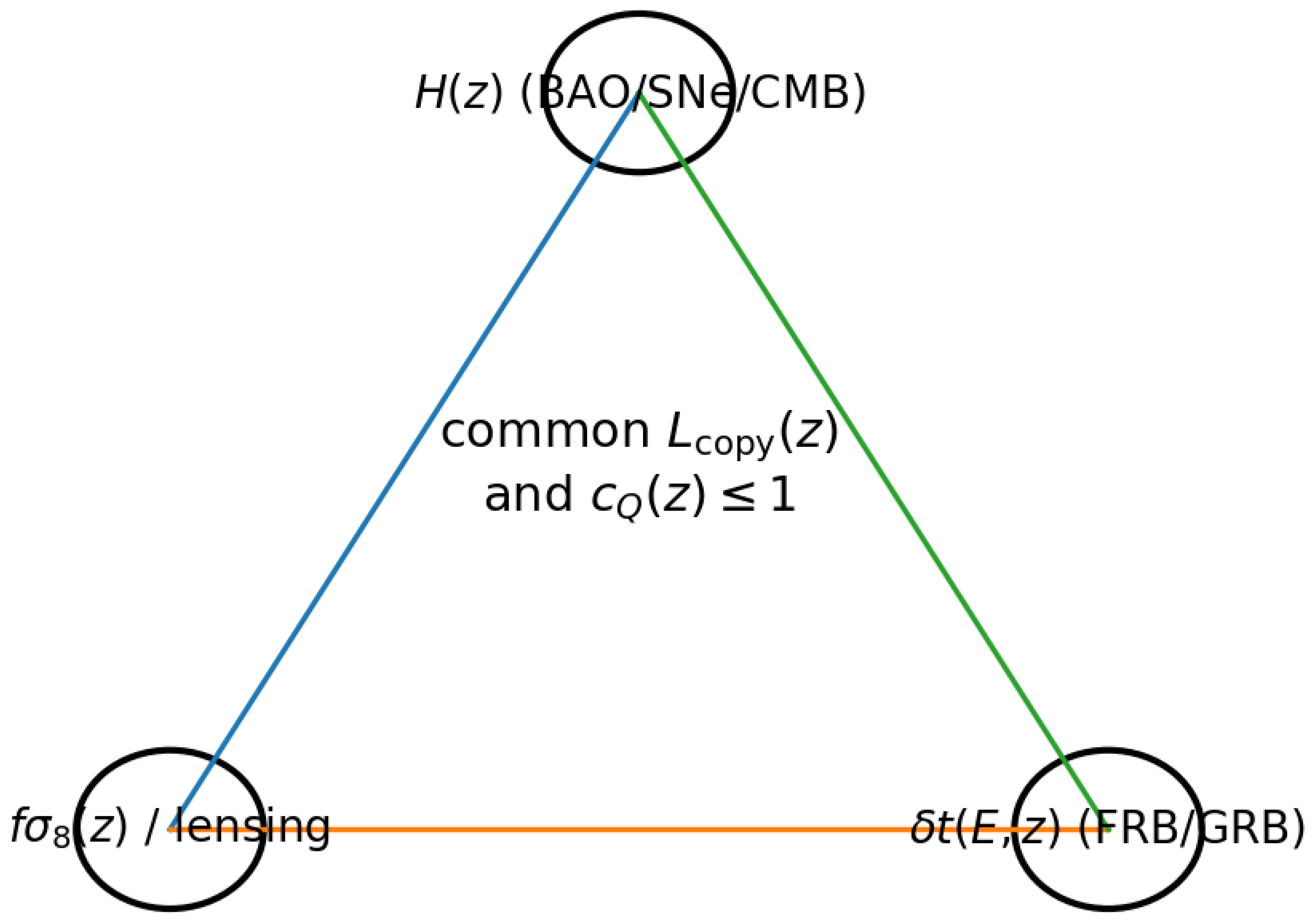
Consequently, [eq:wQ] becomes a rigid relation between and the log-derivatives of and . The strict program is then to confront a single inferred (and ) against multiple datasets: expansion (BAO/SNe/CMB), growth and lensing, and an independent transient observable (e.g. energy-dependent time-of-flight dispersion if present). The joint compatibility is summarized schematically in Figure 3.
A hard observational test: the sameandmust be compatible with expansion, growth/lensing, and an independent transient observable (if predicted) within the same microphysical closure.
Figure 1.
Logical flow of the strict QICT construction: operational copy-time $\rightarrow$ copy-horizon scale $\rightarrow$ gravitational consistency bound $\rightarrow$ saturation hypothesis.
Figure 1.
Logical flow of the strict QICT construction: operational copy-time $\rightarrow$ copy-horizon scale $\rightarrow$ gravitational consistency bound $\rightarrow$ saturation hypothesis.
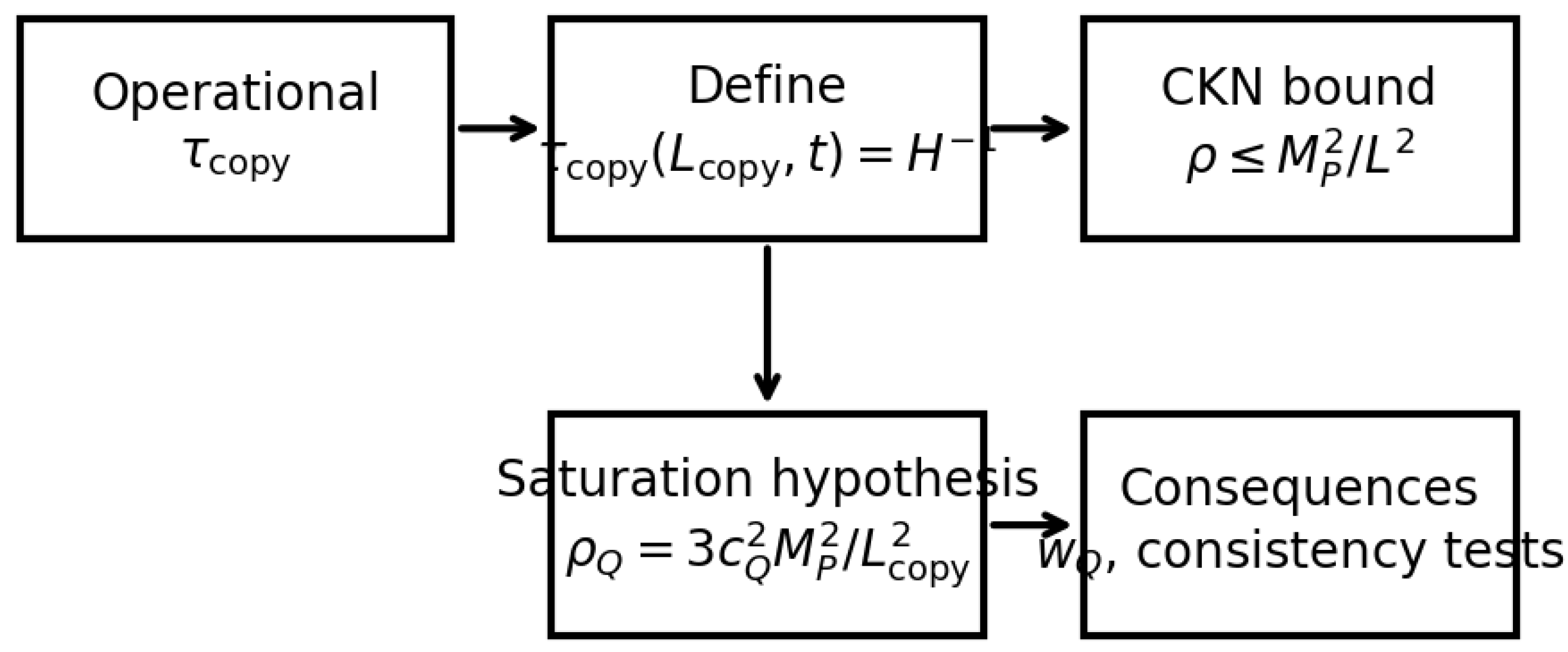
Figure 2.
Examples of copy-time scalings (ballistic and diffusive) and the operational definition $\tau_{\mathrm{copy}}(L_{\mathrm{copy}})=H^{-1}$.
Figure 2.
Examples of copy-time scalings (ballistic and diffusive) and the operational definition $\tau_{\mathrm{copy}}(L_{\mathrm{copy}})=H^{-1}$.
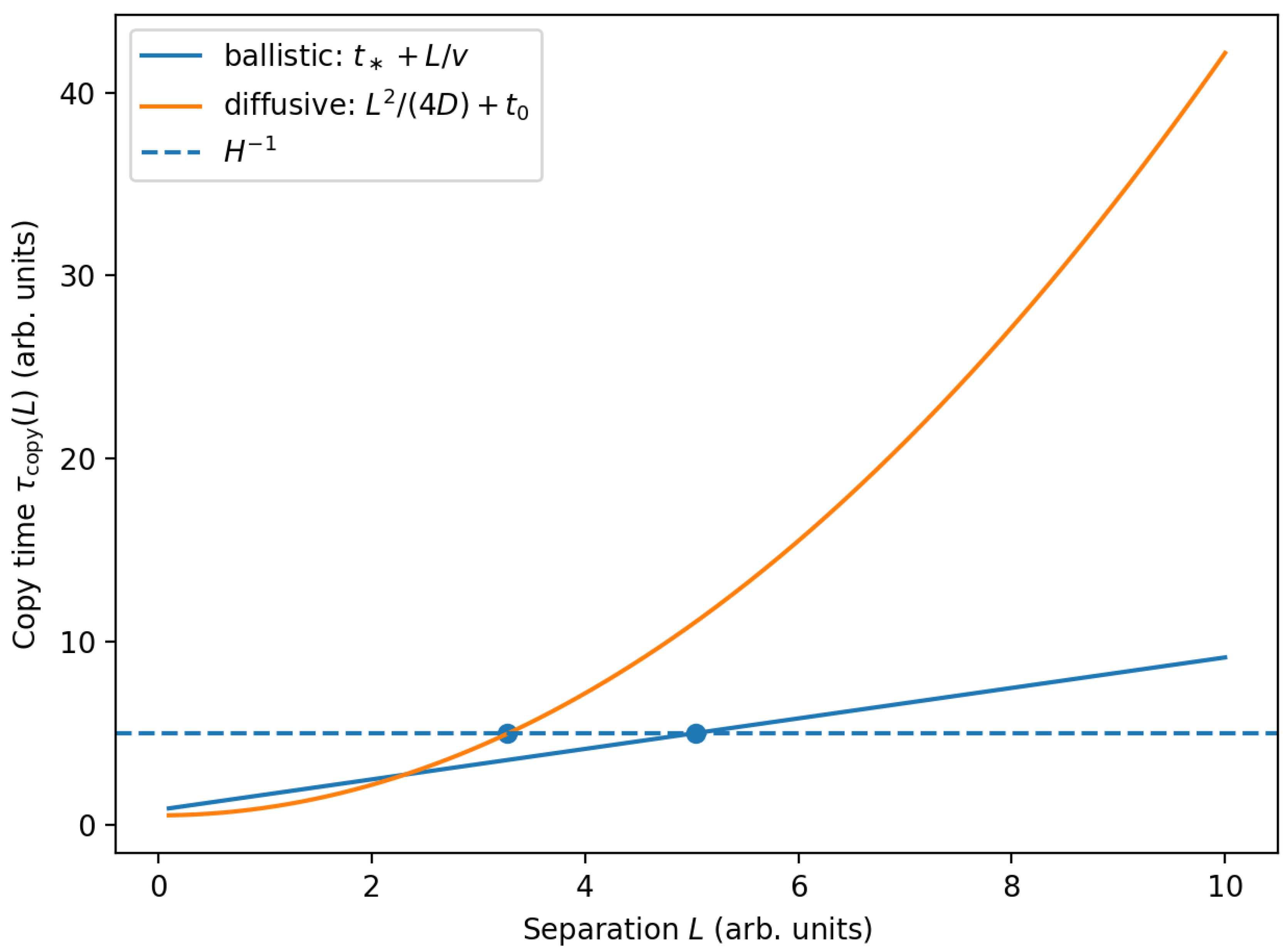
Figure 3.
Cross-observable consistency concept linking expansion $H(z)$, equation of state $w_Q(z)$, and an independent transient timing observable.
Figure 3.
Cross-observable consistency concept linking expansion $H(z)$, equation of state $w_Q(z)$, and an independent transient timing observable.
Minimal Real-Data Sanity Check (Cosmic Chronometers)
To demonstrate that the strict framework can be confronted with actual expansion-rate measurements without introducing many phenomenological degrees of freedom, we present a deliberately rigid closure example: (i) the diffusive scaling [eq:diffusive] with constant effective diffusivity , (ii) maximal saturation motivated by the max-capacity attractor picture in the Supplement, and (iii) spatial flatness with radiation neglected for .
In this limit, the background expansion becomes parameter-free once are fixed. Writing and , the Friedmann equation reduces to a cubic relation
We plot the corresponding prediction (normalized to the Planck 2018 baseline values ) against a 32-point cosmic-chronometer compilation in Figure 4. This is not advertised as a definitive global fit, but as a minimal, falsifiable closure demonstration that can be systematically upgraded (time-dependent , inclusion of radiation/curvature, joint BAO/SNe/CMB likelihoods).
Minimal real-data sanity check: cosmic-chronometerpoints compared to the rigid constant-diffusive closure with maximal saturation(no fitted parameters in this illustration; the normalization uses Planck 2018 values ).
Figure 4.
Minimal quantitative illustration using a public cosmic-chronometer $H(z)$ compilation: data versus an illustrative QICT closure curve (not a full likelihood analysis).
Figure 4.
Minimal quantitative illustration using a public cosmic-chronometer $H(z)$ compilation: data versus an illustrative QICT closure curve (not a full likelihood analysis).
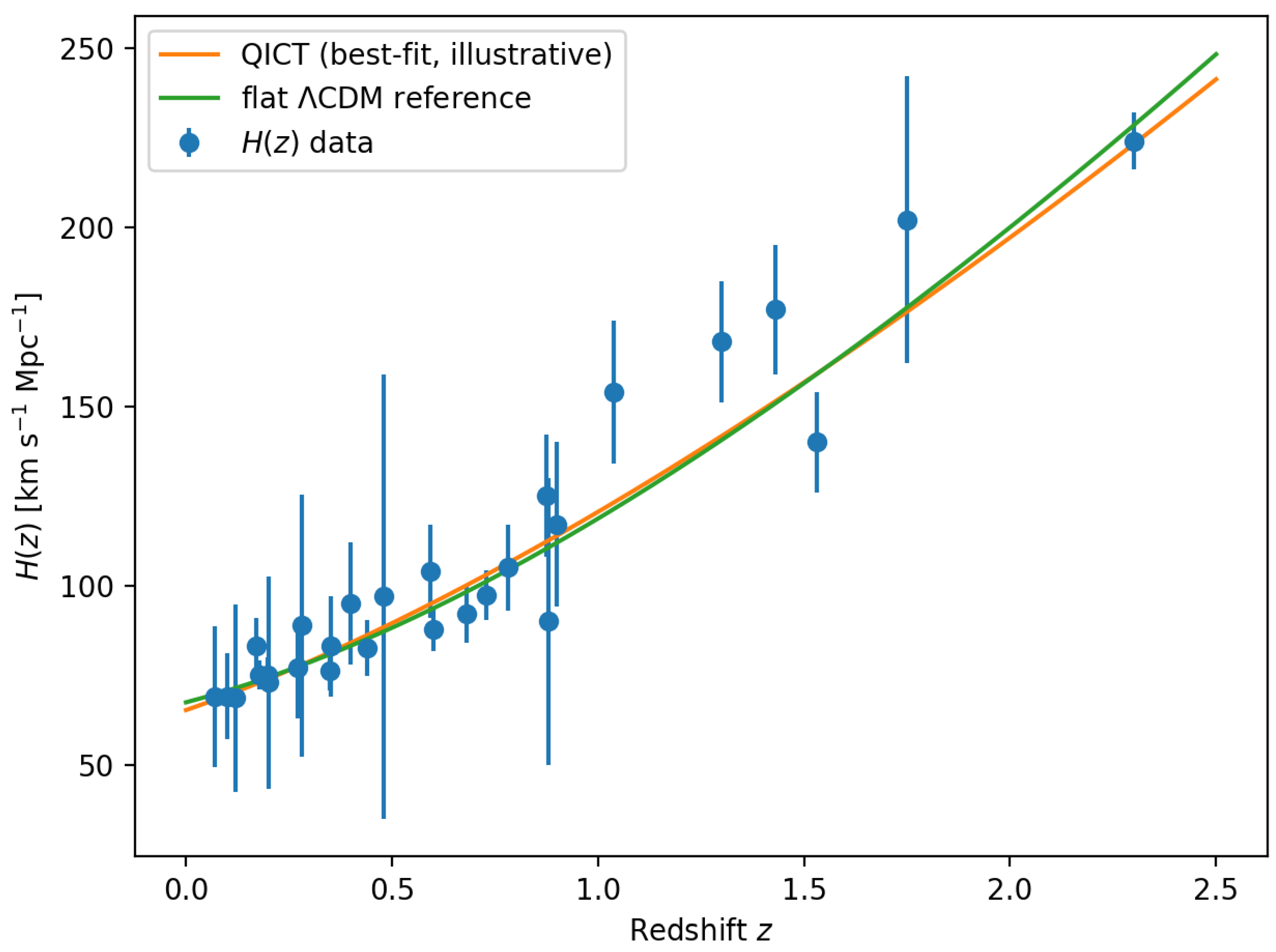
Figure 5.
Derived $c_Q(z)$ from the minimal $H(z)$ illustration, displaying the strict consistency bound $c_Q(z)\le 1$ over the tested redshift range.
Figure 5.
Derived $c_Q(z)$ from the minimal $H(z)$ illustration, displaying the strict consistency bound $c_Q(z)\le 1$ over the tested redshift range.
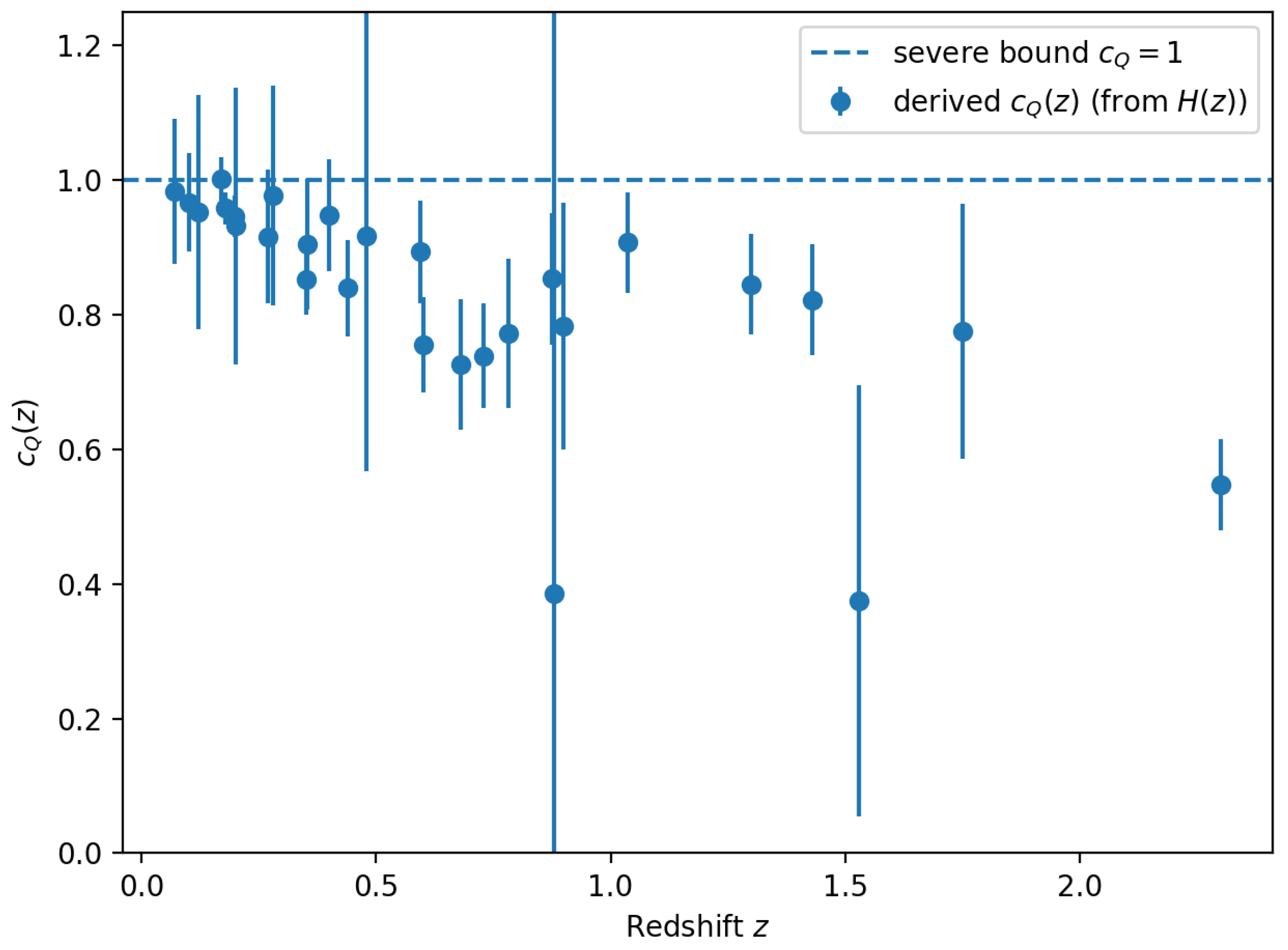
Figure 6.
Illustrative (mock) evolution of the QICT equation-of-state $w_Q(z)$ implied by the copy-horizon closure.
Figure 6.
Illustrative (mock) evolution of the QICT equation-of-state $w_Q(z)$ implied by the copy-horizon closure.
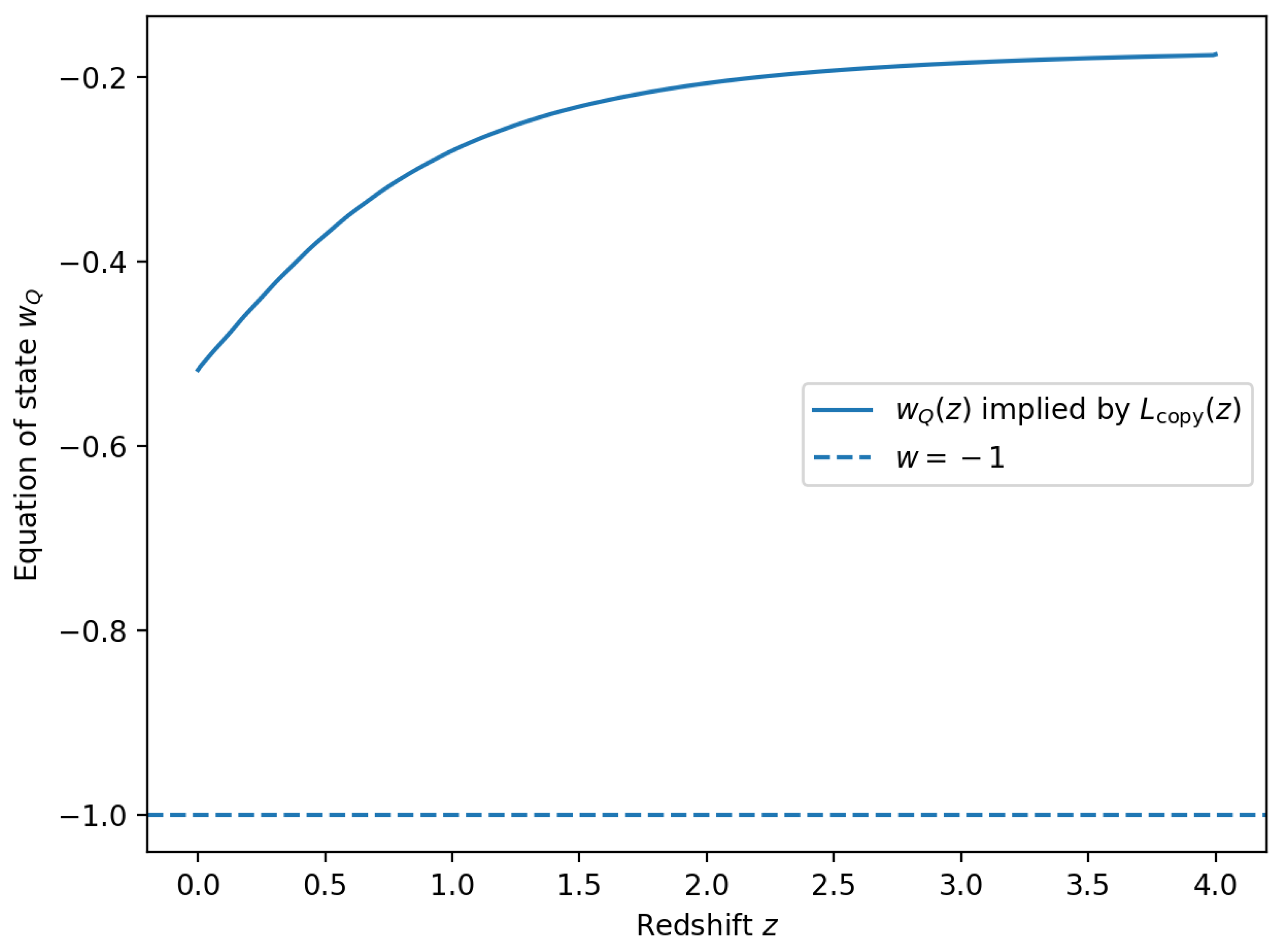
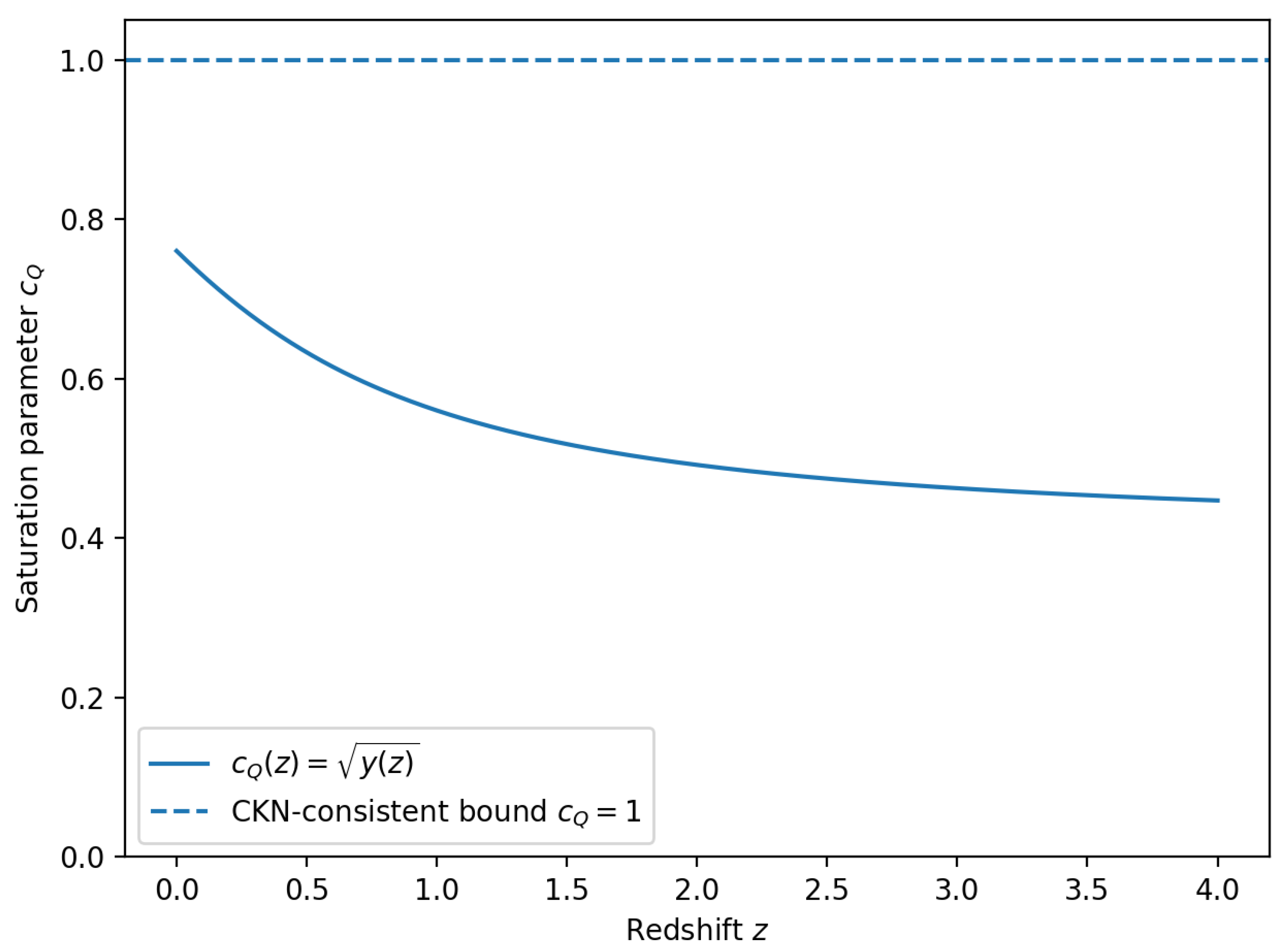
Figure 7.
Illustrative (mock) evolution of the saturation parameter $c_Q(z)$ showing the falsifiable bound $c_Q(z)\le 1$ under an attractor mechanism.
Figure 7.
Illustrative (mock) evolution of the saturation parameter $c_Q(z)$ showing the falsifiable bound $c_Q(z)\le 1$ under an attractor mechanism.
Relation to Standard HDE Cutoffs (Comparator Only)
Standard holographic dark energy often adopts a future event-horizon cutoff . In contrast, the present work defines operationally by Eq. [eq:brick1]. The event-horizon choice may be treated as a comparator model, or potentially recovered as a special case under additional assumptions on the functional dependence of ; we do not assume such an identification in the main derivation.
Conclusions
The strict QICT copy-horizon program is characterized by (i) an operational definition of and , (ii) a gravitational consistency bound implying scaling, and (iii) falsifiable saturation conditions such as and multi-observable consistency relations. The accompanying Supplement and derivation package provide additional proofs, sector separation statements, and reproducible scripts.
References
- C. W. Helstrom, Quantum Detection and Estimation Theory (Academic Press, 1976). [CrossRef]
- S. Holevo, Probabilistic and Statistical Aspects of Quantum Theory (North-Holland, 1982). [CrossRef]
- M. A. Nielsen and I. L. Chuang, Quantum Computation and Quantum Information (Cambridge University Press, 2010).
- E. H. Lieb and D. W. Robinson, “The finite group velocity of quantum spin systems,” Commun. Math. Phys. 28, 251–257 (1972). [CrossRef]
- Cohen, D. Kaplan, and A. Nelson, “Effective field theory, black holes, and the cosmological constant,” Phys. Rev. Lett. 82, 4971 (1999). [CrossRef]
- M. Li, “A model of holographic dark energy,” Phys. Lett. B 603, 1–5 (2004).
- N. Aghanim et al. (Planck Collaboration), “Planck 2018 results. VI. Cosmological parameters,” Astron. Astrophys. 641, A6 (2020). [CrossRef]
- M. Moresco, R. Jimenez, L. Verde, A. Cimatti, and L. Pozzetti, “Setting the Stage for Cosmic Chronometers. II. Impact of Stellar Population Synthesis Models Systematics and Full Covariance Matrix,” Astrophys. J. 898, 82 (2020); arXiv:2003.07362. [CrossRef]
- Mehrabi, Cosmic_chronometer_data (GitHub repository), file HzTable_MM_BC32.txt (accessed 2026-01-06).
- Csiszár and J. Körner, Information Theory: Coding Theorems for Discrete Memoryless Systems (Akadémiai Kiadó, 1981). (See Pinsker-type inequalities.).
Disclaimer/Publisher’s Note: The statements, opinions and data contained in all publications are solely those of the individual author(s) and contributor(s) and not of MDPI and/or the editor(s). MDPI and/or the editor(s) disclaim responsibility for any injury to people or property resulting from any ideas, methods, instructions or products referred to in the content. |
© 2026 by the authors. Licensee MDPI, Basel, Switzerland. This article is an open access article distributed under the terms and conditions of the Creative Commons Attribution (CC BY) license (http://creativecommons.org/licenses/by/4.0/).
Copyright: This open access article is published under a Creative Commons CC BY 4.0 license, which permit the free download, distribution, and reuse, provided that the author and preprint are cited in any reuse.


