
Submitted:
06 January 2026
Posted:
07 January 2026
You are already at the latest version
Abstract
Investigating the impact of factor mobility (FM) on the economic efficiency of marine fisheries (EEMF) holds scientific reference value for promoting high-quality development of the marine fisheries economy in China's coastal regions. This study is based on panel data from 11 coastal provinces and municipalities in China covering the period from 2008 to 2023. Utilizing Tobit models and mediation effect models, it empirically analyzes the direct and indirect impacts of FM on the EEMF, as well as regional heterogeneity in these effects. Research findings indicate that: (1) The level of FM and the EEMF in coastal regions both exhibit fluctuating upward trends, though regional variations exist across different provinces. (2) The FM in coastal regions enhances the EEMF. For every additional unit of FM, the EEMF increases by 0.0825 units. (3) Technological innovation levels and industrial structure upgrading serve as key pathways through which FM influences the EEMF, acting as mediating variables. (4) This impact exhibits regional heterogeneity, with the Eastern Marine Economic Circle being most significantly affected. The research findings expand the scope of studies on FM and the EEMF, providing practical advice for promoting the optimal allocation of factors in coastal regions and enhancing the EEMF development.
Keywords:
economic efficiency of marine fisheries
; factor mobility
; Tobit model
; mediating effect model
; regional heterogeneity
1. Introduction
The marine economy, as a vital pillar for building a maritime power, is assuming increasingly prominent strategic importance [1]. President Xi Jinping’s significant address on advancing high-quality growth of the marine economy at the Sixth Meeting of the Central Financial and Economic Affairs Commission has further delineated the trajectory for marine economic development. As a pillar industry of the marine economy, marine fisheries play a vital role in the high-quality development of the marine economy. The state has continuously empowered the marine fishery sector in recent years through policy guidance. For instance, it has published guiding documents like the "National Fisheries Development Plan for the 14th Five-Year Plan Period," which aids in the implementation of initiatives including the advancement of aquaculture technology, the standardization of ecological fishing practices, and the integration of industrial chains. These initiatives have catalyzed swift advancement in the marine fisheries economics. By 2024, China’s marine fisheries sector attained an annual value-added output of 488 billion yuan, reflecting a 4.0% rise compared to the previous year. Marine fisheries have become a significant growth catalyst for the marine economy in coastal regions [2]. The effective distribution and collaborative interplay of factors such as labor, capital, technology, and data are essential in advancing the marine fisheries economy. Currently, China is deepening the construction of a unified national market and advancing reforms in the market-based allocation of factors. These efforts aim to dismantle institutional barriers and promote the orderly flow and efficient aggregation of factors [3]. In coastal regions, factor mobility (FM) is reshaping the allocation pattern of marine fishery resources, ultimately impacting the efficiency of their economic development. Therefore, examining the influence of FM in coastal regions on the economic efficiency of marine fisheries (EEMF) is of considerable theoretical and practical significance for optimizing factor allocation and directing their rational and systematic movement, thus improving the efficiency of the marine fishery economy and fostering its high-quality development.
Currently, academic research on the EEMF primarily focuses on perspectives such as indicator system selection, measurement methods, spatiotemporal development patterns, and influencing factors. The indicator system integrates benefits spanning economic, social, and environmental dimensions, considering both expected and unintended outcomes [4,5]. Measurement methods have expanded from descriptive statistics to model-based approaches such as Stochastic Frontier Analysis (SFA) and Data Envelopment Analysis (DEA), gradually establishing a relatively comprehensive measurement system [6,7]. Regarding the factors affecting the EEMF, relevant studies suggest that elements such as economics [8], capital [9], technology [10], and industrial structure [11] all impact this efficiency. For instance, Han et al. [12] measured the resilience and efficiency of marine fisheries in China’s 11 coastal provinces from 2000 to 2019 and employed the Haken model to explore their co-evolutionary characteristics. According to the findings, China’s marine fisheries industry should grow sustainably by expanding on its current technology and industrial bases, creating diverse industrial systems, and boosting economic resilience. Doloreux and Melançon [13] based on research into the contributions of coastal marine science and technology institutions in Canada, emphasized that the technical support provided by these institutions is a crucial driver for the rapid development of marine fisheries. According to a review of previous research, most studies examining the variables influencing the EEMF have concentrated on a single dimension, with little attention paid to how FM affects this efficiency.
Existing research on the impact of FM across sectors primarily focuses on economic growth [14], coordinated regional development [15], urban agglomeration development [16], and efficiency [17]. Among these, studies examining the effects of FM on efficiency have garnered significant attention in recent years. For instance, Zheng and Cheng [18] employed STIRPAT theory, integrating panel data regression models with spatial Durbin models, to investigate how innovation factor agglomeration in the Yellow River Basin influences carbon emission efficiency. Wang et al. [19] performed an empirical examination of the direct impacts and processes of innovation FM on energy efficiency by employing provincial-scale panel data from China covering the years 2003 to 2019. Shan and Han [20] constructed a multi-factor spatial network of information, economy, and population within the Wuhan Urban Circle at the county level, revealing the impact of inter-regional FM on land green production efficiency. Sun et al. [21] adopted an international perspective to examine the effects of labor, human capital, and commodity trade flows on environmental efficiency across 54 countries from 1992 to 2017. As regional economic integration accelerates, marine fishery economic activities have become increasingly frequent. Against this backdrop, the significance of FM has gradually emerged. As the intensity and frequency of various interregional FM have markedly increased, their impact on EEMF has continuously strengthened, playing an increasingly vital role in enhancing such efficiency. However, current research has inadequately highlighted the impact of FM on marine fisheries. Fewer scholars have concentrated on the impact of FM on enhancing EEMF and fostering high-quality growth within the marine fishery economy.
Therefore, it is imperative to incorporate FM into the core framework of research on the EEMF, clarify the mechanisms through which FM influences such efficiency, and guide the rational allocation and orderly flow of factors to enhance the EEMF. This paper takes 11 coastal provinces and municipalities as its research subjects, constructs an input-output indicator system for the EEMF, and measures the levels of FM and EEMF across these regions from 2008 to 2023. By comprehensively employing Tobit and mediation effect models, this study empirically analyzes the impact of FM on EEMF and regional heterogeneity. It aims to offer theoretical suggestions for optimizing the structure of FM networks in coastal regions, enhancing economic efficiency, and promoting high-quality development in the marine fishery economy.
2. Theoretical Analysis
In driving the economic development of coastal regions, particularly the high-quality growth of the marine fisheries sector, the optimal allocation and efficient flow of factors—manifested in the FM of labor, capital, technology, and data—serve as the key to unlocking the momentum for economic advancement in marine fisheries. Among these, labor is an indispensable resource for promoting economic development [22]. The influx of labor into coastal regions can effectively alleviate labor supply shortages, drive factor agglomeration, and exert positive effects through the endowment effect, consumption demand effect, and human capital effect [23]. Capital is the principal catalyst of economic progress [24]. The flow of capital further stimulates the reallocation of other factors, such as labor and technology, enabling capital and other resources to shift from less productive marine fisheries sectors to more efficient ones [25]. This process drives the transformation and enhancement of the marine fisheries industry. Technology is a vital pillar for economic growth, providing robust momentum for development [26]. The impact of technological FM on EEMF is more complex than labor and capital FM. While labor and capital factors typically flow only at single spatiotemporal nodes, technological factors are simultaneously utilized across multiple spatiotemporal nodes [27]. Enhancing EEMF likewise relies on the impetus of technological factors. As an emerging factor, data possesses characteristics such as extensive mobility, low sharing costs, and increasing marginal effects [28]. Its value creation extends beyond the data itself, in its ability to systematically integrate factors like labor, capital, and technology. This diversifies the factors and effectively enhances factor allocation efficiency, stimulating new momentum in the marine fishery economy [29]. This article identifies labor, capital, technology, and data elements in coastal regions as primary explanatory factors to assess overall FM levels and examine the influence of FM on EEMF, as depicted in Figure 1.
2.1. The Direct Impact of FM on the EEMF
The interplay of labor, capital, technology, and data directly influences the efficiency of the marine fisheries economy. Specifically, on one hand, the FM in coastal regions has reshaped the structure of factor endowments, achieving an optimized allocation of factor resources. This has driven the expansion of the marine fishery economy in coastal regions and enhanced its efficiency [30]. For instance, the synergistic flow of capital and technology has spurred the development of intelligent marine fishery equipment. Combined with improvements in labor quality, this has significantly boosted marine fishery production efficiency. Meanwhile, the flow of data elements can be used to analyze the marine fishery resource endowments and market demands across different coastal provinces and cities. This analysis carefully guides capital and labor toward high-value-added marine fishery specialty industries. This reallocation of factors successfully addresses the misallocation of marine fisheries resources, directly enhancing the efficiency of the marine fishery economy. Meanwhile, the knowledge and technology spillover effects accompanying FM have become increasingly pronounced, enabling factor-receiving regions and neighboring regions to acquire new technologies at lower costs [14]. This has accelerated the diffusion and application of marine fishery technological innovations in coastal regions. On the other hand, FM drives industrial agglomeration and structural upgrading, enhancing the coordinated development capacity of the marine fishery industry and boosting its economic efficiency [31]. For instance, the rational flow of labor and capital facilitates the transformation of the marine fishery industry structure from single-catching operations toward diversification into aquaculture, processing, and recreational fishing. Data elements facilitate the flow of information throughout the upstream and downstream sectors of the marine fisheries industry chain, optimizing production, processing, and sales operations. The synergistic interplay of multiple factors promotes the efficiency of marine fisheries resource use and elevates the competitiveness of the marine fishery industry while establishing a robust basis for the continuous enhancement of EEMF. Based on this, Hypothesis 1 is proposed in this paper.
H1: The FM in coastal regions contributes to enhancing the EEMF.
2.2. The Indirect Impact of FM on the EEMF
In coastal regions, the coordinated flow and efficient allocation of labor, capital, technology, and data can effectively enhance scientific and technological innovation capabilities, drive industrial restructuring and upgrading, and consequently boost the EEMF. On the one hand, the FM in coastal regions has stimulated technological innovation, promoting the transformation and diffusion of scientific and technological achievements [32]. Driven by the economic development needs of coastal regions, technological innovation has optimized the allocation of factors such as labor and capital toward more promising marine fisheries sectors by enhancing innovation talent and platforms. This has improved the efficiency of factor allocation, fully unleashed the endogenous momentum of technological innovation, propelled the transformation of marine fishery production methods toward modernization and intelligence, and boosted the EEMF [33]. On the other hand, upgrading the industrial structure has significantly enhanced the efficiency of marine resource development and utilization, providing strong support for the high-quality development of the marine fishery economy [34]. This structural enhancement has optimized the organizational frameworks of the marine fisheries industry, enabling efficient coordination among entities throughout the upstream and downstream portions of the production, distribution, and circulation chain. This has propelled the marine fishery economy toward a shift from scale expansion to quality improvement and efficiency enhancement [35]. Moreover, the upgrading of the industrial structure has also promoted the upgrading of production factors [36], shifting labor, capital, technology, and data from resource-intensive industries to technology- and capital-intensive sectors. This has optimized the spatial layout of the marine fishery industry and enhanced its overall efficiency. Based on these observations, Hypothesis 2 and Hypothesis 3 are proposed in this paper.
H2: FM can enhance the EEMF by promoting technological innovation.
H3: FM can enhance the EEMF by advancing industrial structure upgrading.
2.3. The Impact of FM on the EEMF from a Heterogeneity Perspective
Coastal regions leverage abundant marine resources and advantageous geographical locations to foster a diversified marine fishery economy. However, variations in marine resource endowments, economic development levels, and policy orientations across provinces and municipalities result in differing impacts of FM on the EEMF in coastal regions [37]. From the perspective of the marine economic circle [38], the Eastern Marine Economic Circle encompassing Shanghai, Zhejiang, and Jiangsu demonstrates distinct advantages in technological innovation. It attracts high-end factors such as technology and talent, driving the integration of digital technologies like big data into marine fisheries. This continuous advancement propels the marine fisheries industry toward higher-value-added segments, thereby increasing the EEMF. The Northern Marine Economic Circle encompasses Liaoning, Shandong, Hebei, and Tianjin. Leveraging its fisheries resources and port advantages, this region has seen accelerated accumulation of capital and technological factors under policy guidance. However, constraints stemming from labor shortages and a monolithic industrial structure have hindered improvements in the efficiency of its marine fishery economy. The Southern Marine Economic Circle encompasses Fujian, Guangdong, Guangxi, and Hainan. Leveraging its marine fishery resources and geographical advantages, this region features active labor and capital flows. However, particular regions remain reliant on traditional fishing models, with insufficient investment in technology and data. This creates resource constraints and pressures for industrial upgrading, hindering the efficiency gains of the marine fishery economy. Based on this analysis, Hypothesis 4 is proposed.
H4: The impact of FM on the EEMF exhibits regional heterogeneity.
3. Methods and Data Sources
3.1. Model Construction
3.1.1. Reference Model
This research initially formulates the following fundamental model to examine the influence of FM on the EEMF:
Where denotes the EEMF;represents the level of FM;indicates all control variables;denotes the constant term, the coefficient of the dependent variable, and the coefficient of the control variables, respectively;is the random disturbance term,is the regional subscript,is the time subscript.
3.1.2. Tobit Model
The Tobit model is a standard truncated regression model. Ordinary least squares (OLS) methods are prone to estimation bias when dealing with restricted dependent variables. The Tobit model avoids the bias from the dependent variable being restricted to discrete values [21]. It consists of two equations: one representing the selection equation under the constraint, and the other representing the continuous variable selection equation that satisfies the constraint [39]. The Tobit model is described as follows:
Whereandrepresent specific provinces and time variables, respectively;denotes the dependent variable;is the independent variable representing influencing factors;indicates the regression coefficient; represents the random disturbance term.
3.1.3. Mediated Effect Model
Based on mechanism analysis, FM may enhance the efficiency of the marine fishery economy by promoting technological innovation and industrial upgrading. However, traditional stepwise regression methods may suffer from endogeneity issues, increasing the standard error of coefficient estimates. Therefore, drawing on Jiang’s [40] "two-step approach," this study focuses on the causal relationship between core explanatory variables and mediating variables, constructing the following mediation effect model:
Whereandrepresent specific provinces and time variables, respectively;denotes the EEMF;is the mediator variable; tolf indicates the level of FM;represents various control variables;denotes the constant term, coefficient of the dependent variable, and coefficients of control variables, respectively;is the random disturbance term.
3.2. Variable Selection and Explanation
3.2.1. Dependent Variable
Economic Efficiency of Marine Fisheries (EEMF). This research examines 11 coastal provinces and municipalities in China (omitting the regions of Hong Kong, Macao, and Taiwan). When constructing the input-output indicator system for EEMF (Table 1), it draws upon the selection of core factors from classical economic growth theory models—namely land, capital, and labor—while integrating indicator selection methods adopted by domestic scholars in EEMF evaluation and considering data availability [7,41]. This approach ultimately determines the input-output indicator system. Specifically, in constructing input indicators, the region of marine aquaculture and the quantity of marine fish fry are selected to represent land resource inputs. The year-end ownership of ocean-going motorized fishing vessels reflects capital inputs, while the number of personnel engaged in marine fisheries represents labor inputs. In constructing output indicators, the total output value of marine fisheries is selected as the desired output. Considering that marine fishery production is susceptible to adverse external factors such as typhoons, floods, diseases, droughts, and pollution, the total economic losses incurred due to these factors are chosen as the undesired output indicator. This approach comprehensively and objectively measures the EEMF.
Regarding measuring economic efficiency in marine fisheries, Tone pioneered the SBM model based on non-expected outputs in 2001 to comprehensively assess the economic efficiency of multiple inputs and outputs within evaluation units. However, this model struggles to effectively distinguish between evaluation units with identical efficiency values of 1 [42]. Against this backdrop, Tone further proposed the super-efficient SBM model. By introducing a non-expected output variable and modifying the slack variables, this model effectively distinguishes efficiency differences among multiple decision units with efficiency values of 1, thereby enhancing the model’s accuracy [43]. Based on the advantages of the aforementioned model, this study employs a super-efficiency SBM model grounded in non-expected outputs to assess the EEMF in China’s coastal regions.
3.2.2. Core Explanatory Variable
The FM refers to the movement of different factors within or between regions [44]. Existing research on measuring FM primarily categorizes indicators into two types: absolute scale indicators and relative scale indicators. The former focuses on reflecting the overall frequency of regional FM without distinguishing between inflows and outflows, while the latter emphasizes the net FM within a region. In selecting indicators for FM, this paper adopts an absolute scale approach and, drawing on prior research [45,46], identifies labor, capital, technology, and data as the core explanatory variables (Table 1). The rationale is detailed as follows:
Labor factor. As the most dynamic physical factor, labor represents the flow of knowledge, concepts, and other elements to some extent. Other factors must integrate with labor to achieve maximum effectiveness. This paper posits that labor mobility primarily manifests as employment shifts. Therefore, drawing on the methodology proposed by Chen et al. [27] and other scholars for selecting labor mobility indicators, we employ the proportion of employment in the three major industries relative to the total population to measure the intensity of labor mobility.
Capital factor. Capital serves as the primary driver of economic development. Domestically and internationally, scholars have proposed various methodologies for measuring capital factors. For instance, the relative fluctuation in total capital formation is used to characterize the intensity of interprovincial capital flows [47], while investment conditions are employed to gauge the development of interprovincial trade [48]. This paper similarly adopts Chen et al.’s [27] approach for measuring capital FM, selecting the ratio of total fixed-asset investment to gross domestic product as the indicator.
Technology factor. Numerous studies on quantifying technological elements have been carried out by academics both locally and abroad, such as examining patent applications [49] and foreign direct investment [50]. Drawing on prior studies [45] and considering the supportive role of science and technology expenditures in technological innovation, this paper adopts the proportion of science and technology expenditures relative to general public budget expenditures as an indicator to measure the intensity of technical FM in coastal regions.
Data factor. As an emerging factor of production, data exhibits distinct characteristics such as non-rivalry, replicability, and diminishing marginal costs. It serves as both a catalyst and a binding agent for the cross-combination of other factors, facilitating a virtuous cycle of FM and propelling the transformation and upgrading of marine fisheries toward intelligent and sustainable development. Drawing on the measurement methodology proposed by scholars such as Ping et al. [45], this paper employs mobile telephone exchange capacity to indicate data FM.
Drawing on existing dynamic developments in FM, the level of FM is represented by the logarithm of the sum of the absolute values of labor, capital, technology, and data factors [51]. The dependent variable is also log-transformed to eliminate the impact of extreme values and enhance the robustness of the results.
3.2.3. Mediating Variable
Level of Technological Innovation (Stl). The efficient FM in coastal regions has stimulated technological innovation vitality. The application of technological innovation achievements in the marine fisheries sector has significantly boosted the EEMF, ultimately exerting a profound impact on the development of the marine fisheries economy. Drawing on the methodology of Sun et al. [52], the number of marine patents granted is used as an indicator to measure the level of technological innovation.
Industrial Structure Upgrading (Iso). The evolution of industrial structure has facilitated the transition of marine fisheries from conventional capture fishing to high-value-added sectors, optimizing resource distribution and improving EEMF. Drawing upon the industrial structure hierarchy framework developed by Guo and Shao [53] and Xu [54], weights of 1, 2, and 3 are assigned to the marine economy’s primary, secondary, and tertiary sectors, respectively. The respective shares of these sectors in the total marine economic output value are calculated and aggregated.
3.2.4. Control Variables
To minimize estimation errors and control for other factors affecting the EEMF, this study incorporates the following control variables into the regression analysis based on relevant research [55,56]: Population density (Pop), quantified as the ratio of the year-end resident population to land region; Human capital level (Hum), quantified as the ratio of higher education enrollment to the overall population; Informationization level (For), assessed by the ratio of postal and telecommunications services to GDP; Fiscal support intensity (Fin), assessed by the ratio of government general budget expenditures to GDP; Level of openness (Ope), measured by the proportion of total goods imports and exports to GDP; Social consumption level (Soc), measured by the proportion of total retail sales of consumer goods to GDP; Technology market development level (Mar), represented by the proportion of technology transactions in the market to GDP.
3.3. Data Source
This study selected 11 coastal provinces (municipalities and autonomous regions) in China as the research region, specifically Tianjin, Hebei, Liaoning, Shanghai, Jiangsu, Zhejiang, Fujian, Shandong, Guangdong, Guangxi, and Hainan. Hong Kong, Macao, and Taiwan are excluded due to limitations in data availability. Data for the marine aquaculture region, marine fish fry production, year-end ownership of ocean-going motorized fishing vessels, marine fishery workforce, total marine fishery output value, and total economic losses from marine products were sourced from the China Fishery Statistical Yearbook. Core explanatory and control variables data were sourced from the China Statistical Yearbook, the National Bureau of Statistics, provincial/municipal statistical yearbooks, and statistical bulletins. Data for mediating variables were sourced from the China Marine Statistical Yearbook. Missing data for the marine aquaculture region, marine fish fry quantity, and total marine fishery output value were supplemented using linear interpolation.
4. Results
4.1. Features of Spatiotemporal Evolution
4.1.1. Trends in the Evolution of Time
To examine the temporal evolution of FM and EEMF in coastal regions from 2008 to 2023, we measured the levels of FM and EEMF, plotting their respective temporal trends (Figure 2). The results indicate that both FM levels and EEMF in coastal regions exhibited fluctuating upward trends throughout the study period. In terms of development stages, the level of FM has progressed through four phases: From 2008 to 2015, it experienced steady growth, driven by advancing globalization, expanding foreign trade, and increased foreign investment, with all types of FM continuously strengthening. The period from 2015 to 2016 saw a brief downturn due to the impact on export-oriented industries and domestic economic restructuring, with increased pressure on traditional manufacturing sectors to transform, leading to fluctuations in labor mobility. From 2016 to 2020, mobility resumed its upward trend. Driven by industrial restructuring and the deepening of the Belt and Road Initiative, the concentration of high-end factors has continuously elevated mobility levels. From 2020 to 2023, economic activity remained at elevated levels with slight fluctuations. Despite the COVID-19 pandemic disrupting global trade and economic activity, China’s coastal regions maintained stable economic momentum by leveraging their robust industrial foundations and effective epidemic control measures. Concurrently, emerging sectors such as the digital and green economies introduced new dynamics to factor allocation.
The development of EEMF can be broadly divided into three phases: The first phase, spanning 2008 to 2012, saw overall low economic efficiency values. The global financial crisis may have influenced this period, with traditional extensive marine fishery practices dominating. Resource utilization remained inefficient, resulting in suboptimal economic performance. The second stage, from 2013 to 2018, saw a significant improvement in efficiency values. This advancement stemmed from implementing the "Maritime Power" strategy and adjustments to fisheries policies. The gains were driven by technological upgrades in marine fisheries, strict enforcement of ecological conservation systems, and the gradual refinement of the marine fisheries economic industrial chain. The third phase, beginning in 2019, saw efficiency values decline. This downturn stemmed from multiple pressures: the impact of the COVID-19 pandemic, deteriorating international trade conditions, and resource depletion in some marine regions. Particularly, pandemic-induced disruptions in seafood distribution and labor shortages exposed weaknesses in the supply chain’s resilience. Although efficiency values showed a slight rebound in 2023, the sector remains in a phase of fluctuating adjustment overall.
Based on the temporal evolution characteristics of FM levels and EEMF, the following findings emerge: The two variables exhibit similar trends during most periods. For instance, from 2016 to 2020, EEMF and FM levels rose synchronously, indicating that FM promotes EEMF. Rational FM drives marine fishery development and enhances economic efficiency. Additionally, the fluctuation range of FM levels is relatively large. For instance, FM levels declined significantly during 2015–2016 and 2020–2022, while EEMF showed relatively increased volatility. This indicates that multiple factors influence the development of EEMF and do not depend solely on FM levels. On the other hand, the temporal evolution trends of EEMF and FM levels are not entirely synchronized. For instance, EEMF rose rapidly during 2008-2009 when FM growth was relatively sluggish. This suggests that improvements in EEMF sometimes precede increases in FM levels, potentially benefiting from the efficient utilization of already inflowing factors.
4.1.2. Spatial Distribution Characteristics
The study found that the FM across coastal provinces exhibited uneven distribution during this period by analyzing the spatial distribution characteristics of FM in China’s coastal regions from 2008 to 2023 (Figure 3). The eastern region demonstrated relatively higher flows, gradually declining toward the north and south. By tier, provinces with relatively high levels of FM include Shanghai, Jiangsu, Zhejiang, and Guangdong. Shanghai leverages its status as an international metropolis to attract substantial capital, talent, and technology. Jiangsu boasts robust manufacturing and rapidly developing emerging industries. Zhejiang exhibits vigorous growth in new business models and strong innovation vitality. Guangdong’s formidable competitiveness in science and technology, finance, trade, and other sectors facilitates efficient FM within this region. Shandong and Fujian fall within the mid-value zone. Shandong leverages its comprehensive industrial system and marine economic resources to gain competitive advantages in high-end equipment manufacturing and marine fisheries industries. Fujian, meanwhile, capitalizes on policy opportunities to foster the cluster development of distinctive industries, promoting the efficient flow and optimized allocation of factors such as labor, capital, and technology. Hebei, Tianjin, Liaoning, Guangxi, and Hainan are low-value regions. Hebei, Tianjin, and Liaoning have seen slow progress in industrial restructuring, with their economic vitality requiring further enhancement. Guangxi possesses a relatively weak economic foundation and limited capacity to attract factor concentration. As an international tourism island and free trade port, Hainan remains in its developmental phase. While improvements have been made in the scale and dynamism of FM, it still lags behind the developed coastal provinces and municipalities in eastern China.
From 2008 to 2023, the EEMF in China’s coastal regions demonstrated a multi-tiered distribution pattern (Figure 4). Among these, Shanghai, Zhejiang, and Hainan occupied the high-value zone. Shanghai leveraged its technological and financial strengths to advance intelligent aquaculture. Zhejiang relied on information technology to achieve precision management, while Hainan enhanced efficiency through resource advantages and modern farming models. Guangxi, Jiangsu, Shandong, Tianjin, and Liaoning are in the medium-value zone. Guangxi possesses the Beibu Gulf fishing grounds but faces constraints in funding and technology. Jiangsu emphasizes the integration of marine fishery resources and technological application, yet its industrial model and innovation capacity still lag behind the high-value zone. Shandong boasts abundant marine fishery resources but grapples with overcapacity in traditional marine fisheries. Tianjin possesses port hub advantages but has limited nearshore resources; Liaoning has a strong foundation in marine fisheries but faces challenges in optimizing and upgrading its industrial structure, resulting in moderate economic efficiency in its marine fisheries sector. Guangdong, Fujian, and Hebei are in the low-value zone. Some coastal cities in Guangdong face issues such as an excessively high proportion of traditional aquaculture and insufficient industrial chain extension. Factors like changes in marine ecology and market fluctuations significantly impact Fujian. Hebei primarily relies on traditional fishing boat aquaculture, with a relatively monotonous farming model that constrains economic efficiency improvements. Spatially, coastal provinces and municipalities have seen shifting patterns. High-value regions exert radiating effects on surrounding regions. Some provinces and municipalities previously in the medium-value range are moving toward high-value status through increased technological investment and optimized industrial structures. Meanwhile, certain low-value regions have also improved their economic efficiency. Future efforts should strengthen regional coordination mechanisms to enhance overall EEMF.
Comparing the spatial distribution characteristics of FM levels and EEMF reveals that different provinces exhibit distinct regional strengths in these regions. For instance, Hebei and Jiangsu rank among the highest in FM levels, yet their EEMF does not reach high levels. This reflects disparities in regional economic development, which may stem from differences in resource endowments and economic foundations.
4.2. Direct Impact Analysis
Based on the benchmark model constructed earlier, a Hausman test was conducted on the data to determine the applicability of fixed-effects versus random-effects models in panel data analysis. The test results indicate a p-value greater than 0.1, thus accepting the null hypothesis and selecting the random-effects model. Consequently, a random-effects panel Tobit model was employed for estimation. The regression results are presented in Table 2, where Model 1 and Model 2 represent the regression outcomes with and without control variables, respectively.
The regression results indicate that both Model 1 and Model 2 exhibit positive significance at the 1% level, both with and without including control variables. This demonstrates that FM significantly enhances the EEMF, thereby validating Hypothesis 1. An examination of the control variables reveals that population density exerts a certain positive influence, though its significance is relatively minor. This may reflect that, given the current development status in coastal regions, the impact of population growth alone is limited. The impact of human capital levels on the EEMF is positively significant at the 1% confidence level. This indicates that enhancing the knowledge, skills, and other aspects of human capital among personnel involved in marine fisheries in coastal regions is an important pathway for improving efficiency that cannot be overlooked. It can effectively promote the enhancement of EEMF. The degree of informatization has not yet significantly influenced the advancement of EEMF. There may be other constraints on the application of information technology in marine fisheries-related sectors, which require further improvement. Fiscal support plays a crucial role in enhancing the EEMF, and sustained financial investment is a vital safeguard for the sustainable development of the marine fisheries economy. Opening up to the outside world has a negative impact on the EEMF, which contradicts the expected outcome. This may be because, during the process of opening up coastal regions to international competition in the marine fisheries sector, intensified global competition has forced industrial transformation. However, issues such as untimely industrial restructuring have temporarily offset the potential benefits that opening up could have brought. Comparing the empirical analysis results of Model 1 and Model 2 reveals that after incorporating a series of control variables into Model 2, the coefficient for FM levels remains positively significant at the 1% level but exhibits a change. This suggests that additional control factors have a distinct moderating influence on the link between FM and the EEMF. It also suggests that, beyond FM, factors such as population density, human capital, and fiscal support play an indispensable role in enhancing EEMF.
4.3. Indirect Impact Analysis
Building upon the aforementioned findings, an intermediary effect model was employed to further investigate the mechanism through which FM influences the EEMF. The model examined the role of technological innovation levels and industrial structure upgrading in this process. The regression results are presented in Table 3.
Model 1 primarily examined the direct influence of FM on EEMF. Consistent with the aforementioned regression results, FM significantly enhances the EEMF. Model 2 validates the impact of FM on the technological innovation level as a mediating variable. The coefficient of FM on technological innovation level is 1.6100, indicating that FM significantly promotes the enhancement of technological innovation in coastal regions. FM enhances technical innovation in the marine fisheries industry by attracting more capital and creative talent, hence promoting the growth of the marine fisheries economy. This confirms the validity of H2. Model 3 confirmed the influence of FM on the mediating variable of industrial structure enhancement. The results indicate that FM significantly positively affects upgrading industrial structures. Rational FM guides resource allocation toward high-value-added segments of the marine fisheries industry. This elevates the proportion of the tertiary sector, propels the advancement of the industrial structure in marine fisheries, and finally improves the EEMF, consequently substantiating Hypothesis 3.
4.4. Regional Heterogeneity Analysis
To examine the regional heterogeneity of the impact of FM on the EEMF, this paper divides the research region into three major marine economic circles, namely the Northern, Eastern, and Southern Marine Economic Circles, according to the "14th Five-Year Plan for Marine Economic Development," and conducts tests separately (Table 4). Analysis of regional heterogeneity reveals that FM within the Northern Marine Economic Circle significantly and positively impacts the EEMF at the 5% significance level. This analysis demonstrates that FM can, to some degree, improve the EEMF in the Northern Marine Economic Circle. For instance, in regions like Liaoning and Shandong, where numerous ports facilitate frequent trade exchanges, factors such as labor and technology circulate actively among marine fishery-related industries, thereby driving improvements in the EEMF. Compared to the Northern Marine Economic Circle, the Eastern Marine Economic Circle demonstrates a more pronounced effect of FM on enhancing the EEMF. Benefiting from the high concentration of factors in provinces such as Shanghai and Zhejiang, it attracts high-end talent in the marine fishery sector, drives technological innovation in marine fisheries, and continuously optimizes the marine fishery industry chain. These combined effects comprehensively contribute to the development of the marine fishery economy, significantly boosting its efficiency. The influence coefficient of the Southern Marine Economic Circle is 0.0267, and there is no significant influence. The possible reasons for these findings are that, on the one hand, the industrial structure of marine fisheries is relatively simple, and the driving force for the FM to promote the EEMF economy is insufficient. On the other hand, the port infrastructure and marine fisheries industry supporting facilities are relatively weak, which affects the EEMF. Based on the above analysis, the impact of FM on the EEMF presents obvious heterogeneity in different regions. The Eastern Marine Economic Circle performs best in promoting the EEMF through FM, followed by the Northern Marine Economic Circle, and the Southern Marine Economic Circle is weaker, which verifies that H4 is established.
4.5. Robustness Tests
To examine the robustness and reliability of the aforementioned results, this study conducted robustness tests by shortening the time window and increasing control variables (Table 5).
(1) Shorten the time window
The sudden outbreak of the COVID-19 pandemic at the end of 2019 dealt a severe blow to the global economy and the marine fisheries sector. Against this backdrop, selecting the 2008–2019 time window for robustness testing allows us to avoid the exogenous major shock of the pandemic, thereby verifying the reliability of the research findings. Model 1 results indicate that the FM level influences the findings positively after adjusting the sample period to a shorter time window. This indicates that the positive relationship between the two variables remained relatively stable during this period, and the robustness test holds.
(2) Increase control variables
Beyond the variables already controlled for in the baseline regression model, promoting technological market development and elevating social consumption levels represent crucial measures for advancing the marine fishery economy in the new era. This paper incorporates the controlled variables of technology market development and social consumption levels into the original regression analysis model. As shown in Model 2, the results indicate that while the significance of FM’s impact on EEMF has decreased compared to the benchmark regression discussed earlier, it remains positively significant. This demonstrates that after adding the controlled variables, the positive relationship between FM and the core variables still holds, and the robustness test is also passed.
5. Discussion
Based on panel data from China’s coastal regions covering the period 2008–2023, this study empirically analyzes the direct impact of FM on EEMF, the mediating role of technological innovation levels and industrial structure upgrading between the two, and the regional heterogeneity of FM’s influence on EEMF. Key findings include:
First, from 2008 to 2023, the degree of FM and the EEMF in China’s coastal regions exhibited a typically fluctuating rising trajectory. Advantages vary across provinces in relation to these two factors, with the reasons stemming from resource endowments, economic foundations, and other factors. Moving forward, efforts should focus on leveraging regional characteristics to optimize factor allocation mechanisms, refine regional coordination policies, and advance the coordinated development of the marine fisheries economy.
Second, empirical results indicate that FM in coastal regions significantly positively affects EEMF, a conclusion that remains robust under stability tests. Furthermore, control variables such as population density, human capital levels, and fiscal support effectively promote the development of EEMF, suggesting that enhancing such efficiency requires synergistic driving forces from multiple factors.
Third, the mediation effect study verifies that FM in coastal regions may indirectly improve the efficiency of the marine fishing economy through two mechanisms: technical innovation levels and industrial structure enhancement. On one hand, the aggregation of factors accelerates technological innovation and the transformation of results, injecting technological momentum into marine fisheries. On the other hand, it drives the marine fishery industry chain toward higher-end segments, optimizing the industrial structure and layout.
Fourth, the examination of regional heterogeneity uncovers substantial regional disparities in the influence of FM on the EEMF. Among these regions, the Eastern Marine Economic Circle demonstrates the most potent positive effect at the 1% significance level. These findings suggest that differences in resource endowments, industrial structures, and technological innovation capabilities across regions have a significant impact on the effectiveness of FM in enhancing the EEMF.
6. Conclusions
Based on the findings of the above research, the following recommendations are proposed to better leverage the role of FM in coastal regions in enhancing the EEMF and to promote high-quality development in this economy:
- (1)
- Based on the development level of EEMF in coastal regions, focus on leveraging the leading advantages of high-value regions, overcoming development bottlenecks in medium-value regions, and synergistically driving the development of low-value regions, thereby enhancing the overall EEMF of coastal regions. Specifically, for coastal regions with high-value EEMF, focus on leveraging leading advantages, continuously strengthen investment in scientific research and development, deepen cross-sector integration between marine fisheries and industries such as finance and cultural tourism, strive to build high-value-added industrial chains, and promote high-quality development of the marine fishery economy. For provinces with moderate efficiency, the focus should be on overcoming funding, technology, and industrial structure bottlenecks. Policy support should be strengthened to advance the green transformation of marine fisheries. Concurrently, industrial layout should be optimized to cultivate distinctive marine fishery clusters, driving the sector toward modernization and greater efficiency. For low-value regions, it is imperative to accelerate the phasing out of traditional inefficient production capacity, break free from the constraints of single-model operations, actively introduce modern aquaculture technologies, develop new high-value-added marine fisheries industries, and strengthen regional coordination and resource sharing, while enhancing fisheries’ resilience against market fluctuations through ecological monitoring and early-warning risk systems.
- (2)
- Streamline the FM channels in the coastal region and enhance the EEMF economy through the coordinated development of multiple factors. Establish a cross-regional platform for the flow of marine fishery resources in coastal regions to facilitate the free and efficient movement of capital, technology, labor, data, and other resources. This initiative aims to reduce resource mobility costs and unlock synergistic effects among these elements. Promote the transition of coastal densely populated regions from quantitative concentration to qualitative optimization, guide the workforce toward high-value-added marine fisheries sectors, and optimize the population and talent structure. Fully leverage the significant role of human capital in driving progress by enhancing the knowledge, skills, and innovation capabilities of coastal marine fishery workers through specialized training programs and the recruitment of high-caliber talent. Increase investment in information infrastructure development in coastal regions, develop information technologies applicable to marine fishery production and distribution, and promote digital transformation. Strengthen fiscal support, optimize the allocation of public funds, and solidify the foundation for the sustainable development of the marine fisheries economy. In response to the impacts of opening up to the outside world, coastal regions must actively address external competition, accelerate the optimization and upgrading of the marine fisheries industry structure, improve policy support systems, enhance resource allocation efficiency, and fully unlock the potential benefits of opening up.
- (3)
- Further leverage technological innovation and industrial upgrading to enhance the EEMF. On the one hand, we will boost funding for scientific and technological innovation in the marine fisheries industry, strengthen the link between scientific innovation and research outcome commercialization, boost talent development, and expand the role of scientific and technological innovation as an intermediary in marine fisheries. On the other hand, we will keep working to upgrade the structure of the marine fisheries industry, create regulations to direct this progress, optimize the industry’s spatial arrangement, and encourage the flow of marine fishery resources to high-value industries. Finally, we must refine policy coordination mechanisms to enhance the synergy among policies governing FM, technological innovation, and industrial upgrading. By streamlining pathways for FM, we can achieve a comprehensive improvement in the EEMF.
- (4)
- Promote coordinated regional development in the coastal region and reduce regional heterogeneity in the impact of FM on the EEMF. Focusing on the industrial structure and infrastructure gaps within the Southern Marine Economic Circle, we will increase investment in marine fishery infrastructure, cultivate diversified sectors such as marine ranching and recreational fishing, and stimulate the driving force of MF. Leveraging the port trade advantages of the Northern Marine Economic Circle, we will integrate superior marine fishery resources, deepen the integration between port operations and marine fishery industries, strengthen corporate technological cooperation and innovation, and further unleash synergistic effects among key factors. Consolidate the advantages of the Eastern Marine Economic Circle in gathering key resources, continuously attract further resource concentration, and establish a hub for marine fisheries science and technology innovation. Use its influence to create a new marine fisheries industry that works well together and supports development in different regions, helping the marine fisheries economy grow in a balanced and sustainable way.
Author Contributions
Liangshi Zhao: Writing – review & editing, Resources, Methodology, Funding acquisition. Jiaqi Liu: Writing – original draft, Visualization, Conceptualization. Shuting Xu: Writing – review & editing, Supervision, Software, Methodology, Conceptualization.
Funding
This work was supported by the National Natural Science Foundation of China (No. 42471209), Science and Technology Plan Project of Liaoning Province in China (2025-MSLH- 440).
Institutional Review Board Statement
Not applicable.
Informed Consent Statement
This research did not require ethical approval, as it did not involve any human participants, animal experiments, or sensitive data.
Data Availability Statement
Data are contained within the article.
Conflicts of Interest
The authors declare that they have no competing interests.
References
- Sun, J.W.; Jiang, Z.; Hu, J.Y. Spatio-temporal evolution and driving factors of high-quality marine economic development in China. Acta Geographica Sinica 2024, 79, 3110–3128. [Google Scholar]
- Di, Q.B.; Chen, X.L.; Su, Z.X.; Sun, K. Research on regional disparities in carbon emission efficiency and carbon emission reduction potential of China’s marine fisheries under the "Dual-Carbon" target. Marine Environmental Science 2023, 42, 29–37. [Google Scholar]
- Cao, Z.B.; Wang, H.Y. Effect Test of digital economy development on the construction of a national unified large market. Statistics & Decision 2024, 40, 17–22. [Google Scholar]
- Li, C.; Feng, W.; Shao, G.L. Spatio-temporal difference of total carbon emission efficiency of fishery in China. Economic Geography 2018, 38, 179–187. [Google Scholar]
- Idda, L.; Madau, A.F.; Pulina, P. Capacity and economic efficiency in small-scale fisheries: Evidence from the Mediterranean Sea. Mar. Policy 2009, 33, 860–867. [Google Scholar] [CrossRef]
- Tingley, D.; Pascoe, S.; Coglan, L. Factors affecting technical efficiency in fisheries: stochastic production frontier versus data envelopment analysis approaches. Fish. Res. 2005, 73, 363–376. [Google Scholar] [CrossRef]
- Tian, P.; Li, J.L.; Cao, L.D.; Liu, Y.C.; Zhang, H.T. Evaluation of China’s fisheries economic efficiency and forecast of development trends. Chinese Journal of Agricultural Resources and Regional Planning 2023, 44, 160–172. [Google Scholar]
- Han, Y.; James, L.A.; Chu, J.J. Construction of China’s modern marine fishery industry system: Evaluation based on fishery benefit indicators. Review of Economic Research 2016, 57, 3–9. [Google Scholar]
- Xu, W.; Zhu, X. Evaluation and determinants of the digital inclusive financial support efficiency for marine carbon sink fisheries: evidence from China. International Journal of Environmental Research and Public Health 2022, 19, 13971. [Google Scholar] [CrossRef]
- Ali, E.M.; Zanaty, N.; Abou El-Magd, I. Potential Efficiency of Earth Observation for Optimum Fishing Zone Detection of the Pelagic Sardinella aurita Species along the Mediterranean Coast of Egypt. Fishes 2022, 7, 97. [Google Scholar] [CrossRef]
- Howson, P. Building trust and equity in marine conservation and fisheries supply chain management with blockchain. Mar. Policy 2020, 115, 103873. [Google Scholar] [CrossRef]
- Han, Z.L.; Ji, X.Q.; Hu, Y.; Cai, X.Z. The spatial-temporal evolution of marine fishery eco-efficiency based on SBM model in China. Ocean Development and Management 2019, 36, 3–8. [Google Scholar]
- Doloreux, D.; Melançon, Y. Innovation-support organizations in the marine science and technology industry: The case of Quebec’s coastal region in Canada. Mar. Policy 2009, 33, 90–100. [Google Scholar] [CrossRef]
- Bai, J.H.; Wang, Y.; Jiang, F.X.; Li, J. R&D element flow, spatial knowledge spillovers and economic growth. Economic Research Journal. 2017, 52, 109–123. [Google Scholar]
- Zhou, D.; Qi, J.L.; Zhong, W.Y.; Wang, J.W. Urban and rural integration development in urban agglomerations: Measurement and evaluation, obstacle factors and driving factors. Geographical Research 2023, 42, 2914–2939. [Google Scholar]
- Wang, Y.Z.; Wang, H.J.; Zhang, B.; Huang, X.X. Analysis on the network structure of urban agglomeration and its influencing factors based on the perspective of multi-dimensional feature flow: Taking Wuhan urban agglomeration as an example. Economic Geography 2021, 41, 68–76. [Google Scholar]
- Li, T.; Liu, G.Y. Does the flow of R&D elements under the compression of time and space improve the efficiency of regional green innovation? Science & Technology Progress and Policy 2021, 38, 37–46. [Google Scholar]
- Zheng, R.J.; Cheng, Y. Impacts of innovation factor agglomeration on carbon emission efficiency in the Yellow River Basin. Geographical Research 2024, 43, 577–595. [Google Scholar]
- Wang, K.L.; Zhao, B.; Xu, R.Y. Impact of innovation factor flow on energy efficiency. Statistical Research 2023, 40, 88–97. [Google Scholar]
- Shan, Y.H.; Han, Q. Effects of interregional flow of factors on land green production efficiency: A case study of Wuhan urban agglomeration. Resources and Environment in the Yangtze Basin 2023, 32, 2060–2071. [Google Scholar]
- Sun, Q.; Zhang, X.Q.; Lu, G. Research on impact of international factor flow and commodity trade on environmental efficiency. Regional Research and Development 2021, 40, 144–149. [Google Scholar]
- Zhang, Z.D.; Wu, D.; Zhou, S.D. Production factor mobility, regional coordination and integration and economic growth. Journal of Industrial Technological Economics 2018, 37, 58–66. [Google Scholar]
- He, J.; Li, Z. Labor mobility networks and green total factor productivity. Systems 2024, 12, 157. [Google Scholar] [CrossRef]
- Zhou, L. Do the inter-provincial capital flows contribute to regional economic disparities? On Economic Problems 2020, 3, 105–112. [Google Scholar]
- Zhao, R.R.; Shen, C.M. Capital Flow, Industrial Agglomeration and Industrial Structure Upgrading-Based on the Panel Data Analysis of 16 Central Cities in Yangtze River Delta. Inquiry Into Economic Issues 2019, 6, 135–142. [Google Scholar]
- Shang, Y.M.; Zeng, G. The role and mechanism of scientific and technological innovation in promoting the transformation of regional economic development models. Geographical Research 2017, 36, 2279–2290. [Google Scholar]
- Chen, L.; Hu, L.J.; He, F. Factor flow, market integration and economic development-an empirical study based on Chinese provincial panel data. Inquiry Into Economic Issues 2019, 12, 56–69. [Google Scholar]
- Yang, J.; Li, X.M.; Huang, S.J. Big data, technical progress and economic growth: An endogenous growth theory introducing data as production factors. Economic Research Journal. 2022, 57, 103–119. [Google Scholar]
- Li, P.; Liu, J.; Lu, X.; Xie, Y.; Wang, Z. Digitalization as a factor of production in China and the impact on total factor productivity (TFP). Systems 2024, 12, 164. [Google Scholar] [CrossRef]
- Li, X.Y.; Zhao, H.L.; Lin, T.Z. Is element flow "structural dividend" or "structural negative interest"? Review of Economy and Management 2018, 34, 57–67. [Google Scholar]
- Wang, W.W.; Yang, D.P. Factor flow, industrial structure upgrading and regional economic growth. China Development 2022, 22, 39–49. [Google Scholar]
- Ning, L.; Huang, P.H.; Ou, C.Y. Research on the improvement path of commercialization efficiency of marine scientific and technological achievements from the perspective of innovation ecosystem. Science and Technology Management Research 2024, 44, 150–157. [Google Scholar]
- Chen, Z.; Zhang, Q.; Tang, T.; Deng, M. Strategic alignment of technological innovation for sustainable development: Efficiency evaluation and spatial analysis in China’s advanced manufacturing industry. Systems 2025, 13, 139. [Google Scholar] [CrossRef]
- Yang, W.; Zhou, D.D.; Zhao, D. Coupling and coordination analysis of high-quality development of the Chinese digital economy and marine economy. Ocean Development and Management 2023, 40, 98–106. [Google Scholar]
- Yang, T.Y.; Lin, H.C.; Liu, W.H. The Fishery Value Chain Analysis in Taiwan. Fishes 2022, 7, 114. [Google Scholar] [CrossRef]
- Guo, B.N.; Bu, Y. Human capital, industrial structure and China’s carbon dioxide emission efficiency-An empirical research based on the SBM and Tobit model. Contemporary Economic Management 2018, 40, 13–20. [Google Scholar]
- Wang, B.; Zhai, L.; Han, L.M.; Zhang, H.Z. Industrial structure adjustment, changes in marine space resources and marine fishery economic growth. Statistics & Decision 2020, 36, 96–100. [Google Scholar]
- Wang, T. Evaluation and regional differences of marine fishery production efficiency in China. Inner Mongolia Science Technology & Economy 2024, 14, 42–48. [Google Scholar]
- Cheng, G.B.; Zhang, Y.Q. Technology innovation efficiency and influencing factors of the provinces along the Silk Road economic belt. Regional Research and Development 2017, 36, 17–23. [Google Scholar]
- Jiang, T. Mediating effects and moderating effects in causal inference. China Industrial Economics 2022, 5, 100–120. [Google Scholar]
- Han, Z.L.; Zhu, W.C.; Li, B. Synergistic analysis of economic resilience and efficiency of marine fishery in China. Geographical Research 2022, 41, 406–419. [Google Scholar]
- Tone, K. A slacks-based measure of efficiency in data envelopment analysis. European Journal of Operational Research 2001, 130, 498–509. [Google Scholar] [CrossRef]
- Chen, H.J.; Hu, S.L.; Zeng, G.; Chen, P.X.; Wang, J.W.; Wan, Y.Y. Impact mechanism of the digital economy on the green development efficiency in the Yangtze River Delta region. Economic Geography 2025, 45, 13–22. [Google Scholar]
- He, H.G.; Li, Y.J.; Dai, Z.Y.; Lin, Q.R. Study on impact of factor mobility on urban-rural integration development-taking the Yangtze River Delta Region as an example. Agricultural Economics and Management 2024, 1, 76–88. [Google Scholar]
- Ping, W.Y.; Li, W.X.; Luo, L.Q. Research on the influence mechanism and spatial differentiation of factor flow on urban-rural integrated development. Journal of Statistics and Information 2024, 39, 15–31. [Google Scholar]
- Zhang, L. Labor migration, industrial transfer and regional industrial agglomeration-an empirical study based on provincial panel data. Collected Essays on Finance and Economics 2016, 6, 3–10. [Google Scholar]
- Li, X.P.; Chen, Y. The labor flow, capital shift and productivity growth based on Chinese industrial sector’s structure-bonus hypotheses. Statistical Research 2007, 7, 22–28. [Google Scholar]
- Pang, Z.Q. Measurement on the comprehensive opening-up level of regions and provinces’ economy. Statistical Research 2008, 1, 47–50. [Google Scholar]
- Li, P.; Cui, X.J.; Liu, J. Performance analysis of R&D capital input and output in Chinese independent innovation: with discussion of the effects of human capital and intellectual property rights protection. Social Sciences in China 2007, 2, 32–42+204-205. [Google Scholar]
- Keller, W.; Yeaple, S.R. Multinational enterprises, international trade, and productivity growth: firm-level evidence from the United States. The Review of Economics and Statistics 2003, 3, 1–1. [Google Scholar]
- Yang, Y.; Bao, W.; Wang, Y.; Liu, Y. Measurement of urban-rural integration level and its spatial differentiation in China in the new century. Habitat Int. 2021, 117, 102420. [Google Scholar] [CrossRef]
- Sun, Y.X.; Cheng, Y.; Liu, N. Spatiotemporal evolution of China’s high quality economic development and its driving mechanism of scientific and technological innovation. Resources Science 2021, 43, 82–93. [Google Scholar] [CrossRef]
- Guo, L.; Shao, Q. Research on the impact of environmental regulation on the upgrading of marine industrial structure: Based on the mediation effect model analysis. Science Technology and Industry 2023, 23, 145–150. [Google Scholar]
- Xu, D.Y. The determination and measurement of industrial structure equilibrium: Theoretical explanation and verification. Industrial Economics Research 2011, 3, 56–63. [Google Scholar]
- Liu, L.; Ruan, J.J.; Zhuang, H.T. Impact of digital intelligence on green development in the Yangtze River Delta urban agglomeration. Economic Geography 2024, 44, 123–132. [Google Scholar]
- Wang, X.B.; Kong, L.X. The influence of urban digital economy development on the level of manufacturing agglomeration. Economic Geography 2023, 43, 131–138. [Google Scholar]
Figure 1.
Mechanism diagram of how FM in coastal regions affects the EEMF.
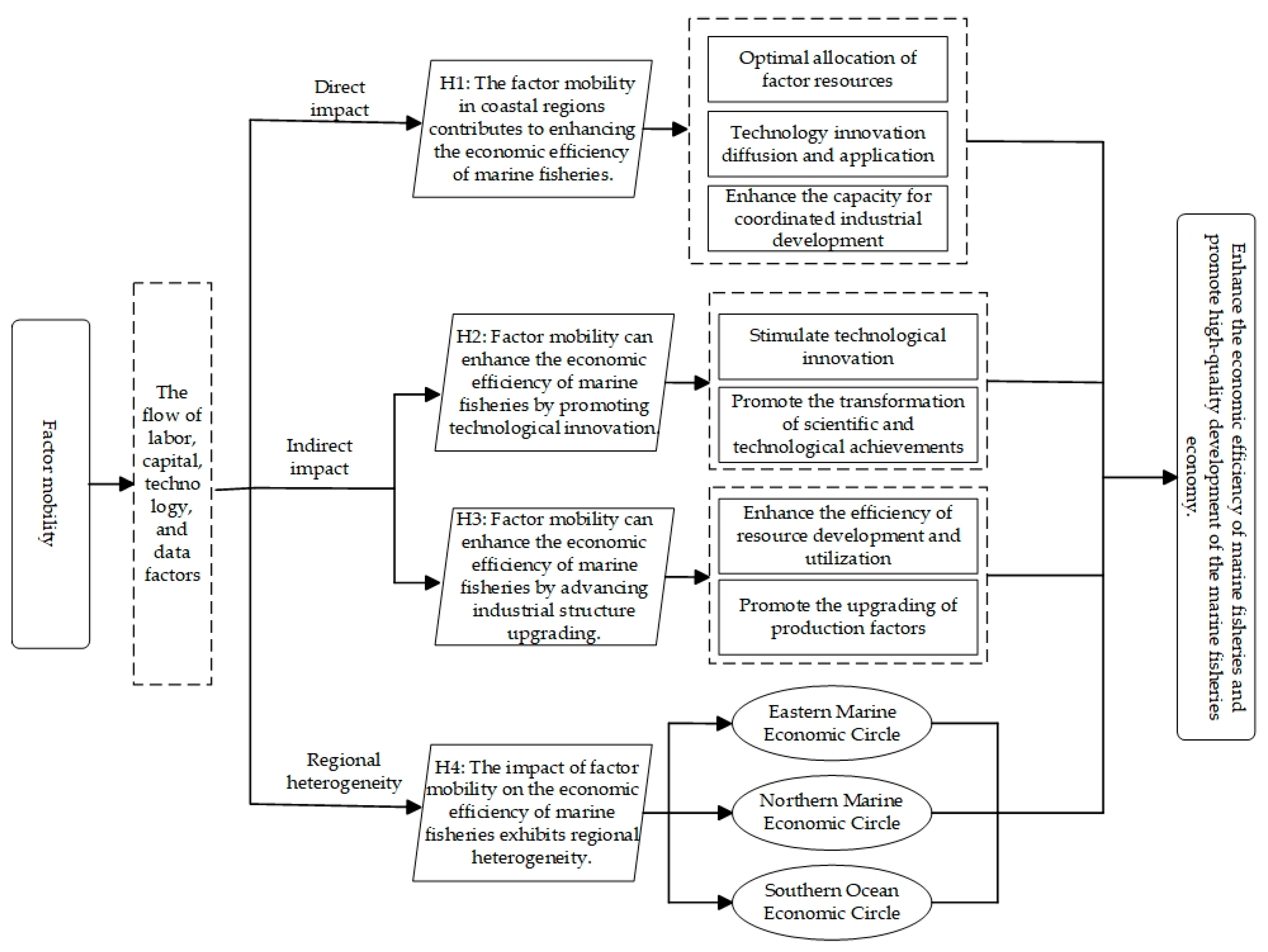
Figure 2.
Trends in FM levels and EEMF in China’s coastal regions from 2008 to 2023.
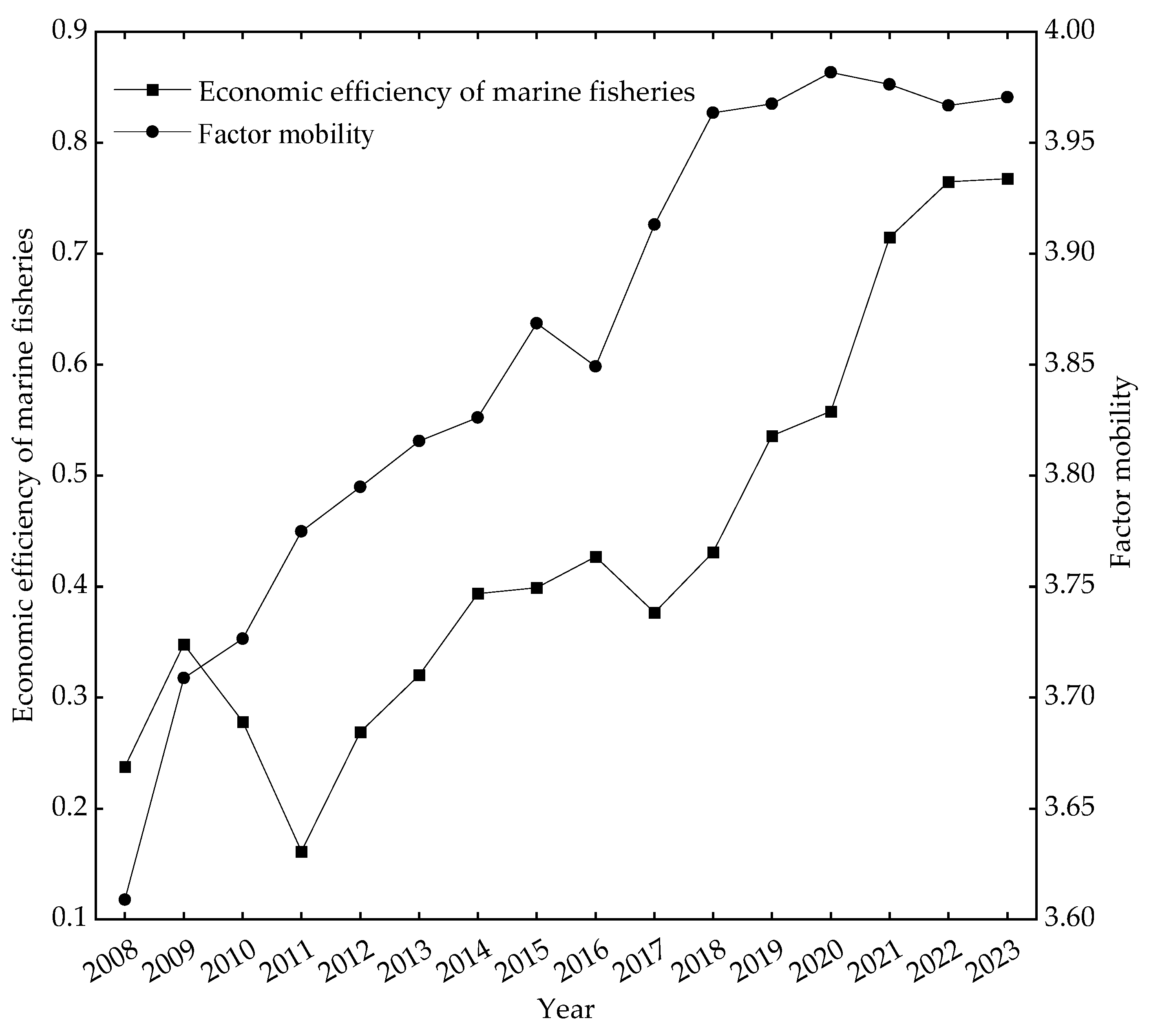
Figure 3.
Thermal changes in the level of FM in China’s coastal regions from 2008 to 2023.
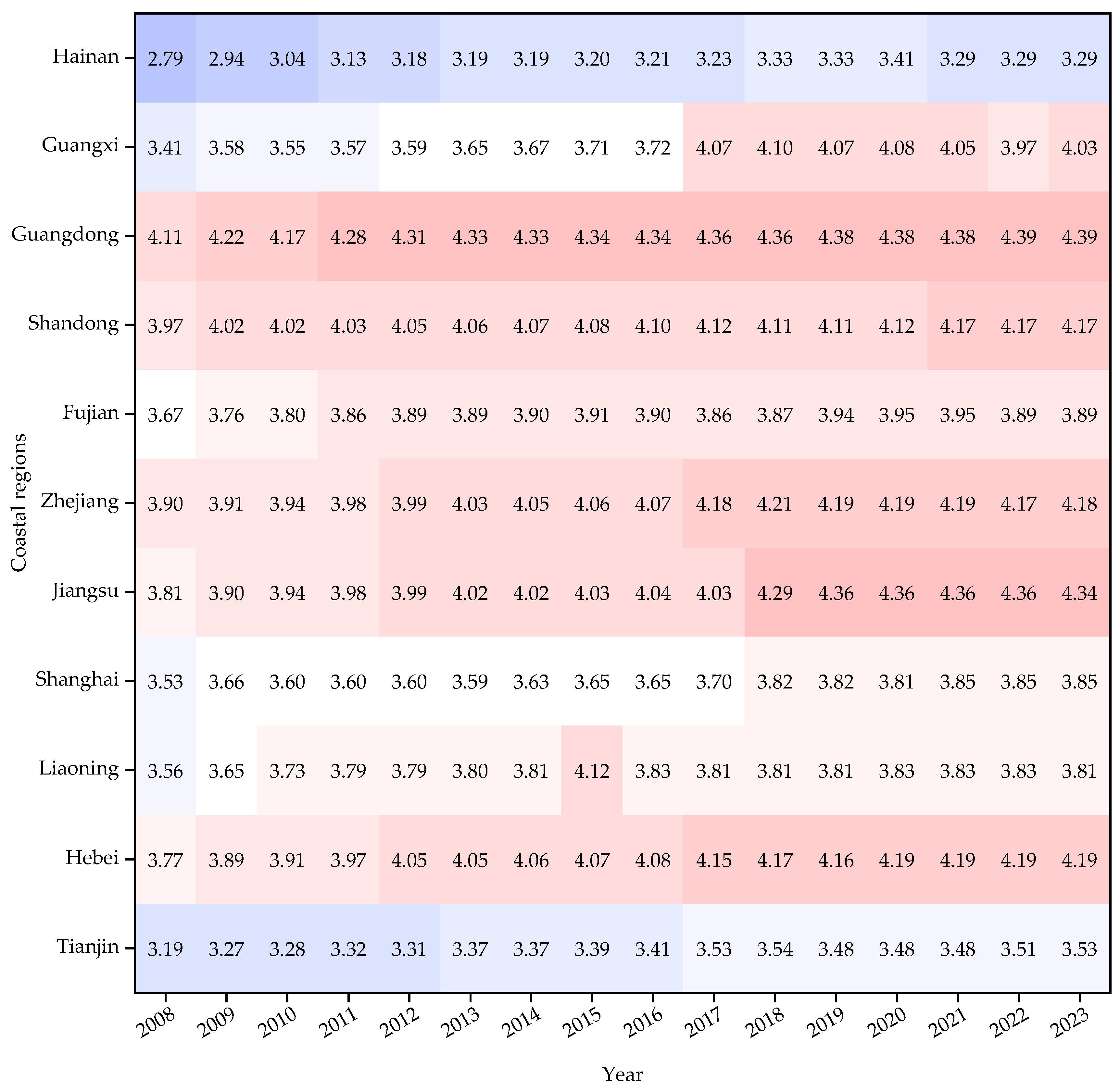
Figure 4.
Thermal changes in the level of EEMF in China’s coastal regions from 2008 to 2023.
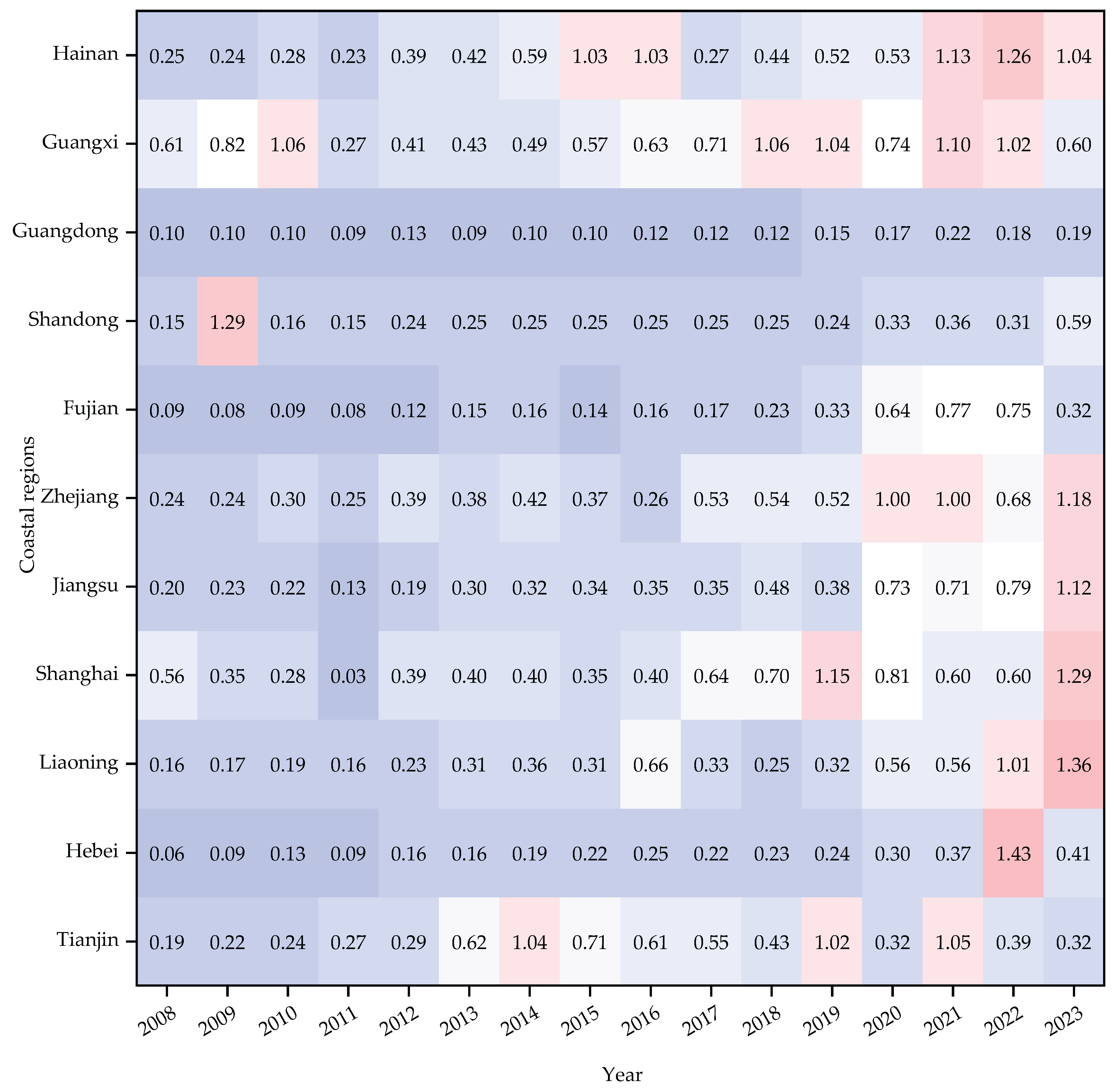

Table 1.
Indicator system for economic efficiency and FM in marine fisheries.
| Primary indicator | Secondary indicators | Tier-three indicators | Proxy indicator |
|
Economic efficiency of marine fisheries |
Input indicators |
Resource allocation Capital investment labor input |
Marine aquaculture region (hectares) Marine fish fry quantity (ten thousand) Year-end fleet size of ocean-going fishing vessels (units) Marine fisheries personnel (persons) |
|
Output indicators |
Expected output Unanticipated outputs |
Total output value of marine fisheries (ten thousand yuan) Total economic losses from marine products (ten thousand yuan) |
|
|
Factor mobility |
Labor factor | Labor factor mobility ratio | Employment in primary, secondary, and tertiary industries / Total regional population |
| Capital factor | Capital factor mobility ratio | Regional fixed asset investment / Regional gross domestic product | |
| Technology factor | Share of science and technology expenditures | Science and technology expenditures / General public budget expenditures | |
| Data factor | Information and communication capabilities | Mobile telephone switching capacity (ten thousand households) |
Table 2.
Benchmark regression test results.
| Variable | Model 1 | Model 2 |
| EEMF | EEMF | |
| FM | 0.2554*** | 0.0825*** |
| (6.3457) | (2.7174) | |
| Pop | 0.0000* | |
| (1.7500) | ||
| Hum | 6.9090*** | |
| (4.3651) | ||
| For | -0.1262 | |
| (-1.0101) | ||
| Fin | 0.4279** | |
| (2.0815) | ||
| Ope | -0.0956** | |
| (-2.5243) | ||
| Constant | -0.8374*** | -0.3650*** |
| (-5.2579) | (-3.0105) | |
| Sigma_u | 0.1173*** | 0.0440*** |
| (4.1480) | (3.4904) | |
| Sigma_e | 0.0662*** | 0.0632*** |
| (18.0291) | (17.9227) | |
| N | 176 | 176 |
Note: Values in parentheses represent standard errors; ***, **, and * denote; p < 0.01, p < 0.05, and p < 0.01, respectively. The same applies to the table below.
Table 3.
Results of mediating effect tests.
| Variable | Model 1 | Model 2 | Model 3 |
|---|---|---|---|
| EEMF | Stl | Iso | |
| FM | 0.0666*** | 1.6100*** | 0.0246*** |
| (3.0788) | (11.5182) | (9.7018) | |
| Pop | 0.0000** | 0.0001 | 0.0000*** |
| (2.4427) | (1.3832) | (5.8454) | |
| Hum | 4.3175*** | 60.1265*** | 0.5176*** |
| (4.4142) | (9.5100) | (4.5146) | |
| For | -0.1094 | -1.2839 | 0.0444** |
| (-0.7521) | (-1.3659) | (2.6028) | |
| Fin | 0.6764*** | 2.8522*** | 0.0770*** |
| (5.2015) | (3.3932) | (5.0495) | |
| Ope | -0.0726** | 0.7351*** | 0.0077** |
| (-2.4915) | (3.9007) | (2.2529) | |
| Constant | -0.3005*** | -6.4085*** | 0.4077*** |
| (-2.8587) | (-9.4313) | (33.0809) | |
| N | 176 | 176 | 176 |
| R2 | 0.296 | 0.600 | 0.598 |
Table 4.
Results of regional heterogeneity tests.
| Variable | Model 1 | Model 2 | Model 3 |
| Northern Marine Economic Circle |
Eastern Marine Economic Circle |
Southern Marine Economic Circle | |
| FM | 0.1128** | 0.3716*** | 0.0267 |
| (2.1059) | (3.5023) | (0.4861) | |
| Pop | -0.0000 | 0.0000* | -0.0002 |
| (-0.1500) | (1.8432) | (-1.5416) | |
| Hum | 4.8246 | -0.3349 | 8.7182*** |
| (1.4029) | (-0.0676) | (3.2782) | |
| For | -0.6073** | 0.2593 | -0.0822 |
| (-2.3088) | (0.9922) | (-0.5138) | |
| Fin | 0.8522* | 0.3015 | 0.2610 |
| (1.9322) | (0.5274) | (0.8799) | |
| Ope | 0.1076 | 0.0130 | -0.0503 |
| (0.7564) | (0.1769) | (-0.9159) | |
| Constant | -0.5633** | -1.4441*** | -0.0742 |
| (-2.2256) | (-3.6877) | (-0.3971) | |
| Sigma_u | 0.0000 | 0.0000 | 0.0303 |
| (0.0000) | (0.0000) | (1.6295) | |
| Sigma_e | 0.0661*** | 0.0537*** | 0.0578*** |
| (11.3137) | (9.7980) | (10.6144) | |
| N | 64 | 48 | 64 |
Table 5.
Robustness test results.
| Variable | Model 1 | Model 2 |
| Shorten the time window | Increase control variables | |
| FM | 0.0428* | 0.0637* |
| (1.6562) | (1.9282) | |
| Pop | 0.0000** | 0.0000 |
| (2.0966) | (1.0375) | |
| Hum | 3.2675* | 5.9899*** |
| (1.8375) | (3.1841) | |
| For | 0.1813 | -0.1347 |
| (1.3225) | (-1.0830) | |
| Fin | 0.4711*** | 0.3954* |
| (2.9348) | (1.8925) | |
| Ope | -0.0894*** | -0.0832** |
| (-2.6228) | (-2.1918) | |
| Soc | 0.1630 | |
| (0.9377) | ||
| Mar | 0.6644 | |
| (1.5621) | ||
| Constant | -0.1789* | -0.3332*** |
| (-1.6598) | (-2.6652) | |
| sigma_u | 0.0344*** | 0.0424*** |
| (3.8755) | (3.3918) | |
| sigma_e | 0.0492*** | 0.0629*** |
| (15.5098) | (17.8882) | |
| N | 132 | 176 |
Disclaimer/Publisher’s Note: The statements, opinions and data contained in all publications are solely those of the individual author(s) and contributor(s) and not of MDPI and/or the editor(s). MDPI and/or the editor(s) disclaim responsibility for any injury to people or property resulting from any ideas, methods, instructions or products referred to in the content. |
© 2026 by the authors. Licensee MDPI, Basel, Switzerland. This article is an open access article distributed under the terms and conditions of the Creative Commons Attribution (CC BY) license.
Copyright: This open access article is published under a Creative Commons CC BY 4.0 license, which permit the free download, distribution, and reuse, provided that the author and preprint are cited in any reuse.


